As a youngster, I read and re-read the books in the biography section in the children’s room in the basement of the Kenmore Public Library. That is where I first became acquainted with George Washington Carver. His life story really captivated my imagination. So, when HistoriCorps made available the opportunity to help preserve his first school, I couldn’t resist.
The school was started in 1872, and George Washington Carver referred to school as “the Golden Door of Freedom.” When Missouri was directed to provide for education of the former enslaved people, they bought a building that had been built on speculation. It was a two-room building built in the style called “hall and parlor“. It was intended to be a house, but it had not yet been lived in when the city bought it. It was used as a dwelling after it was no longer used as a school. HistoriCorps‘ task during the three weeks it scheduled to work was to take off the additions and stabilize it for future preservation.
The first day of the project, we met at the school and posed for our team portrait.

You know, after counting the people in this photo, I think some folks are missing from the picture. It was a busy job site – someone was always working!
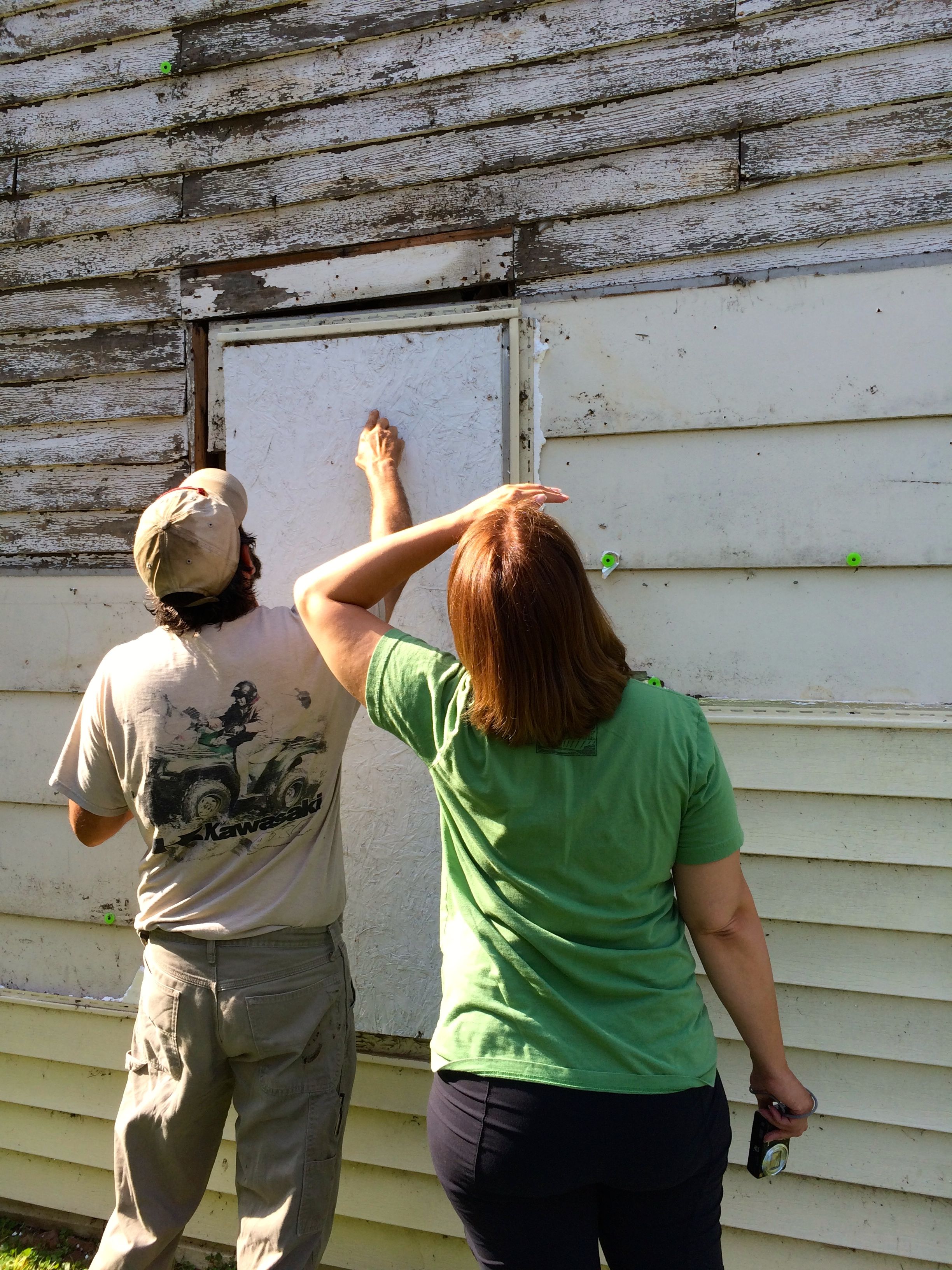
The our first project-related task was to walk around and check out the building and identify what we would be doing. Our job was to remove the additions that had been made to the back, as well as all the non-original siding. The porch would be removed by a later team.
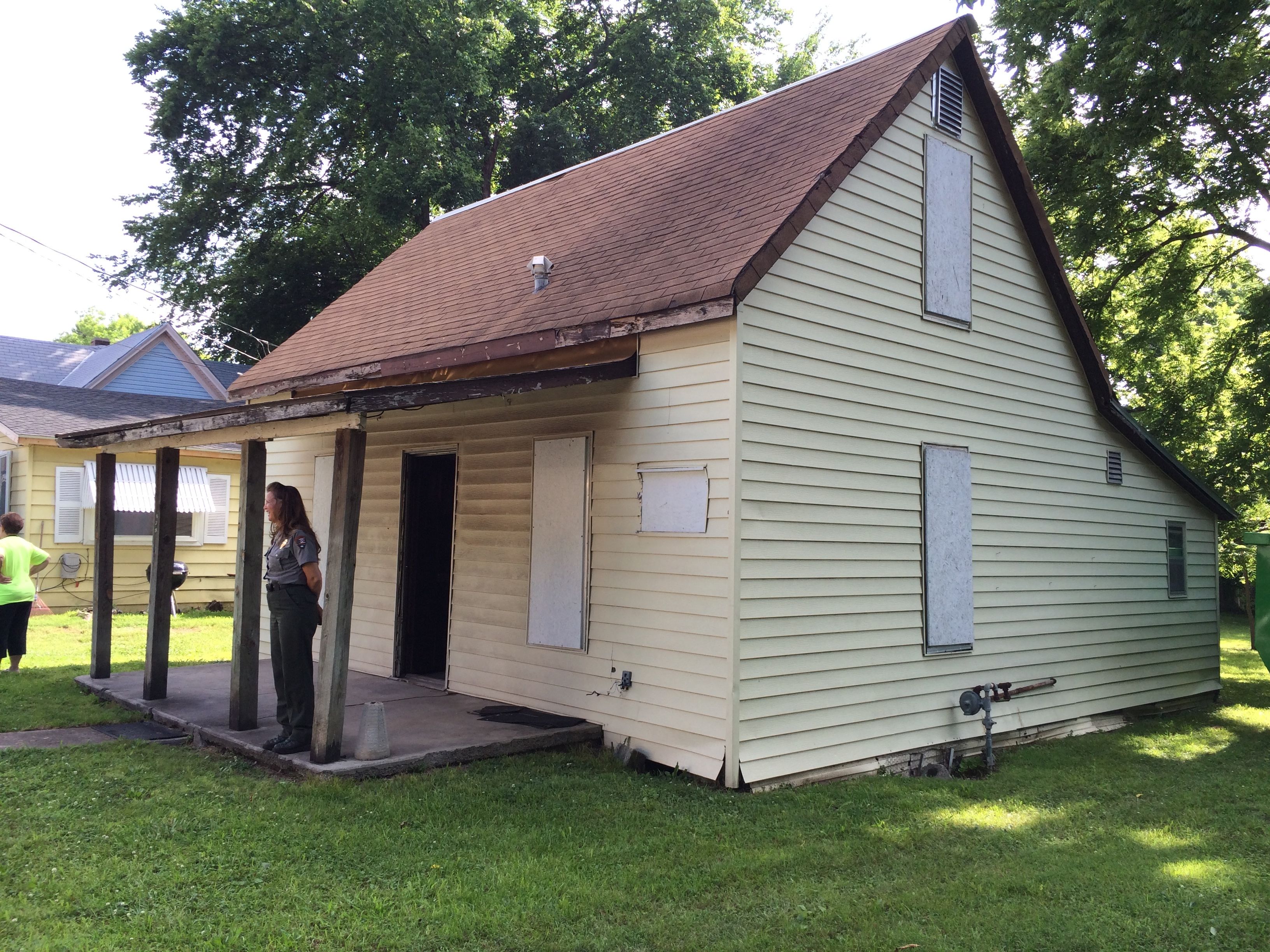
Standing on the porch, which is one of the additions that needed to be removed, is a ranger from the George Washington Carver National Monument. The rangers came by often – sometimes as part of their workday and sometimes after hours in their civilian clothes.
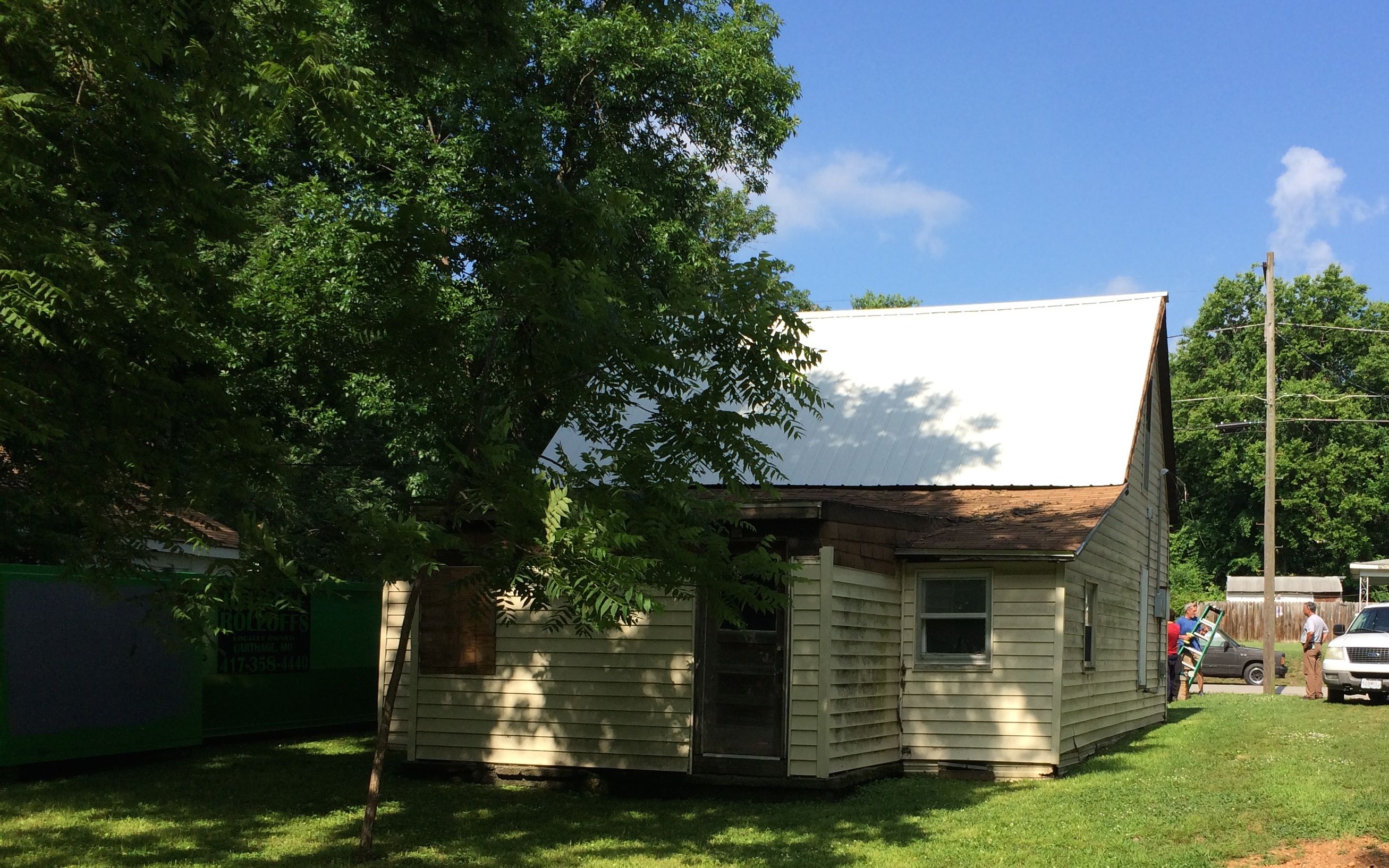
This is the view of the back of the building, most of which we would be removing. Mature trees lent much appreciated shade in the steamy Missouri weather.
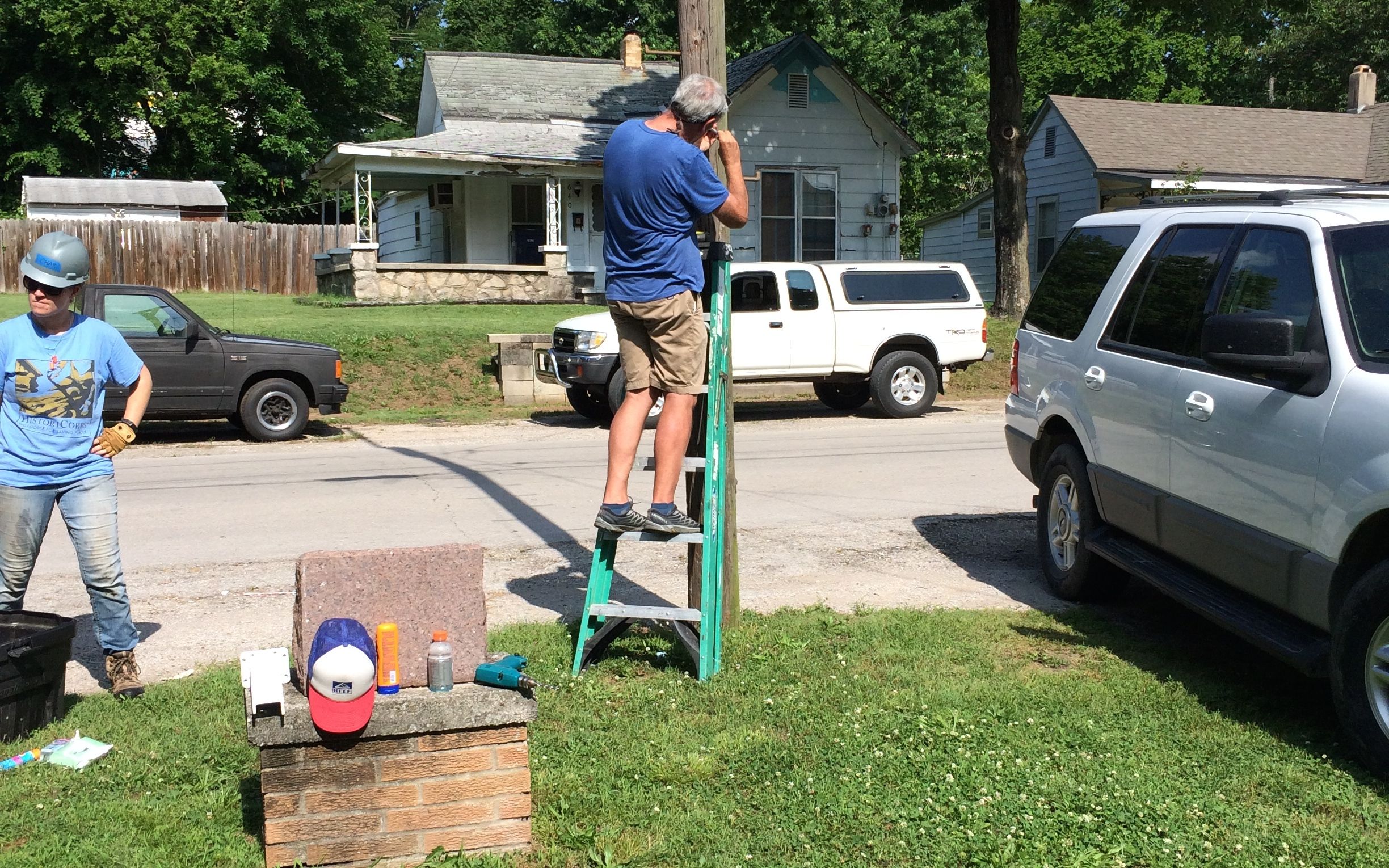
There was a lot of interest in our project. Here, you can see a photographer installing a time-lapse camera. It was set up to take a photo once every five minutes to document the changes taking place.
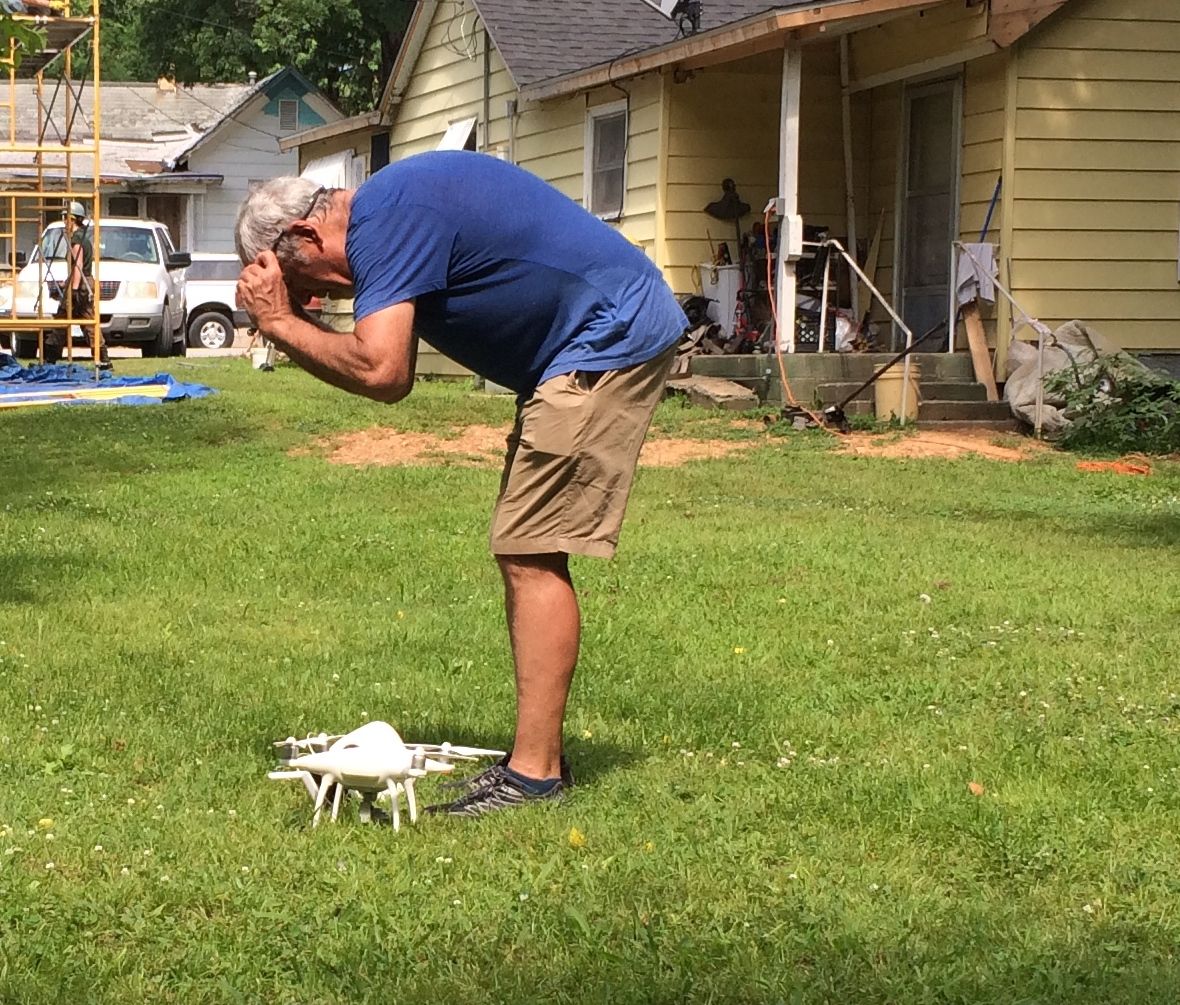
The photographer, whose name was Jim (I think) even captured our work with a drone.
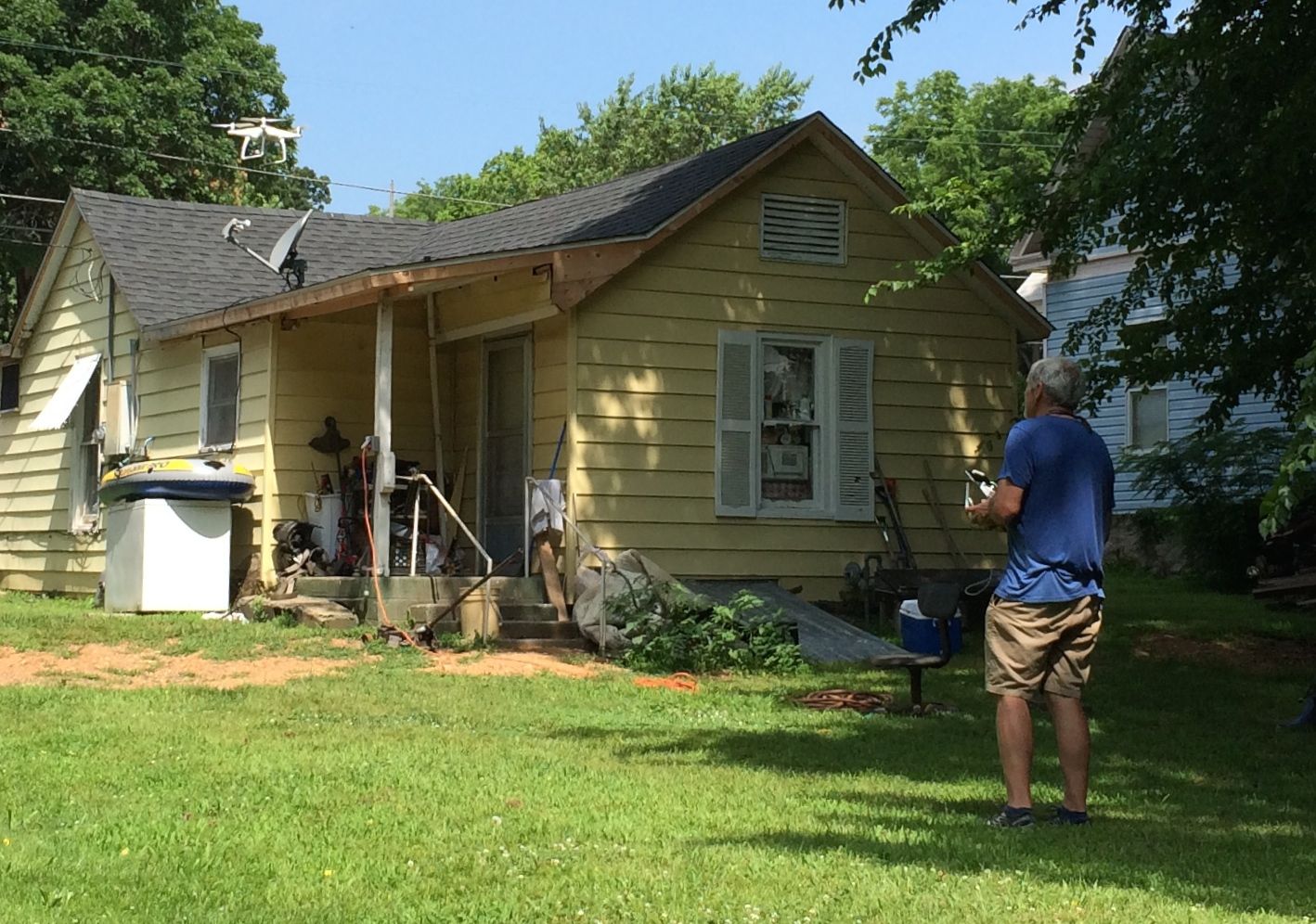
And here it is – up in the air. I hope the show ends up being made – and that I get a chance to see it!
We were finally issued our hard hats and set to work. First job, remove the siding on the additions in the back.
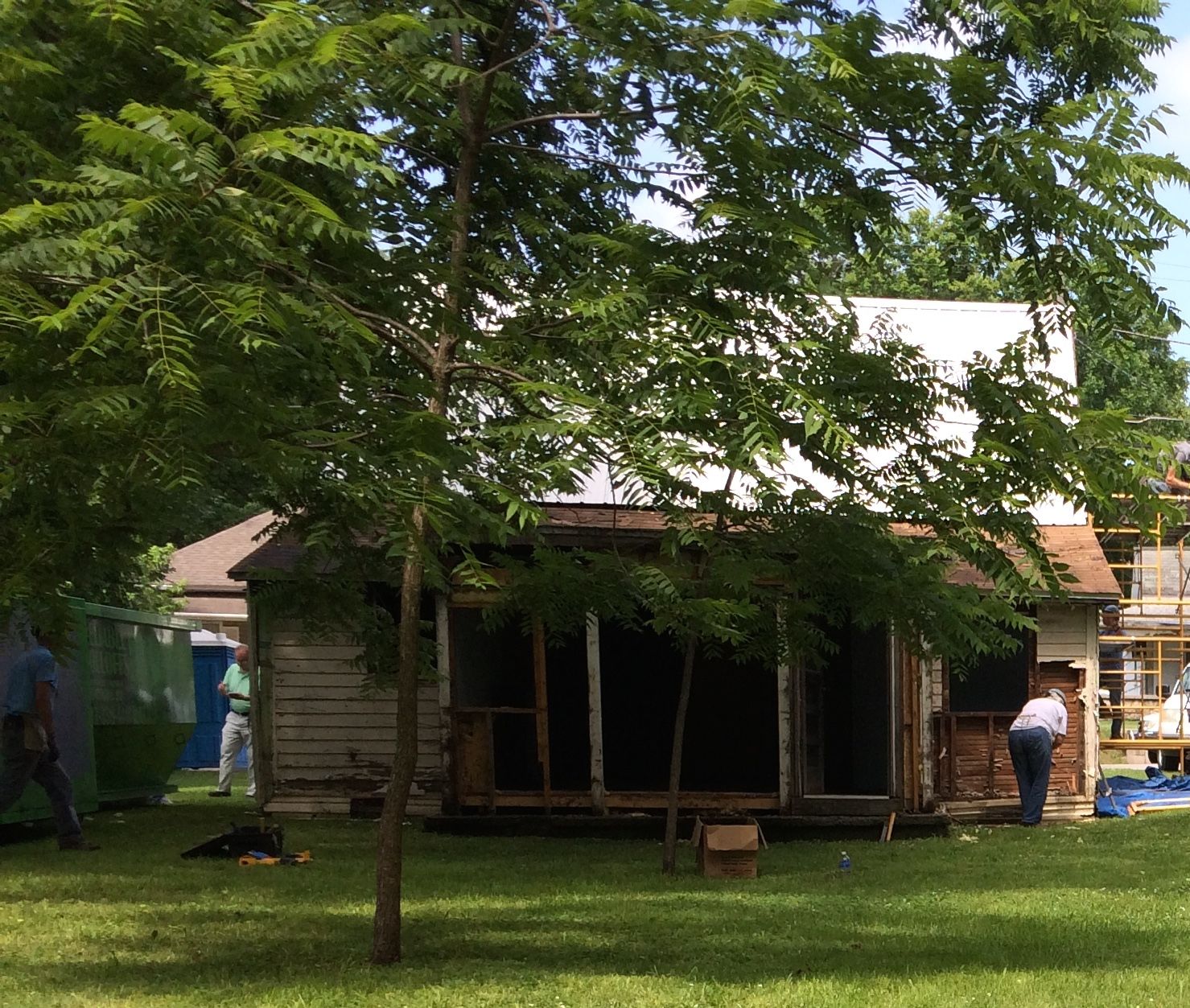
We made good progress. By the time we broke for lunch, the back was pretty much stripped.
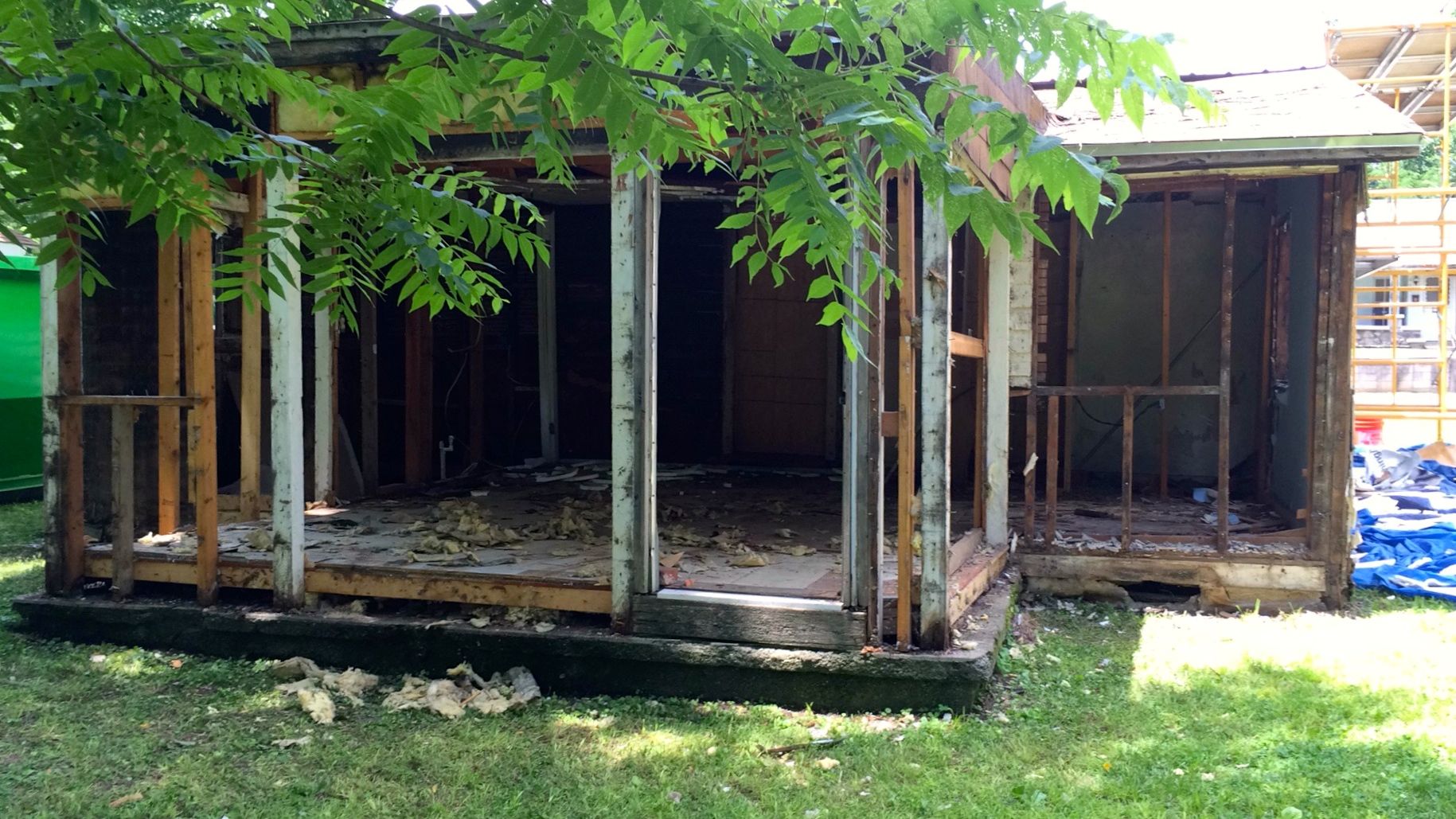
After lunch, we had the additions cleared off, right down to the studs.
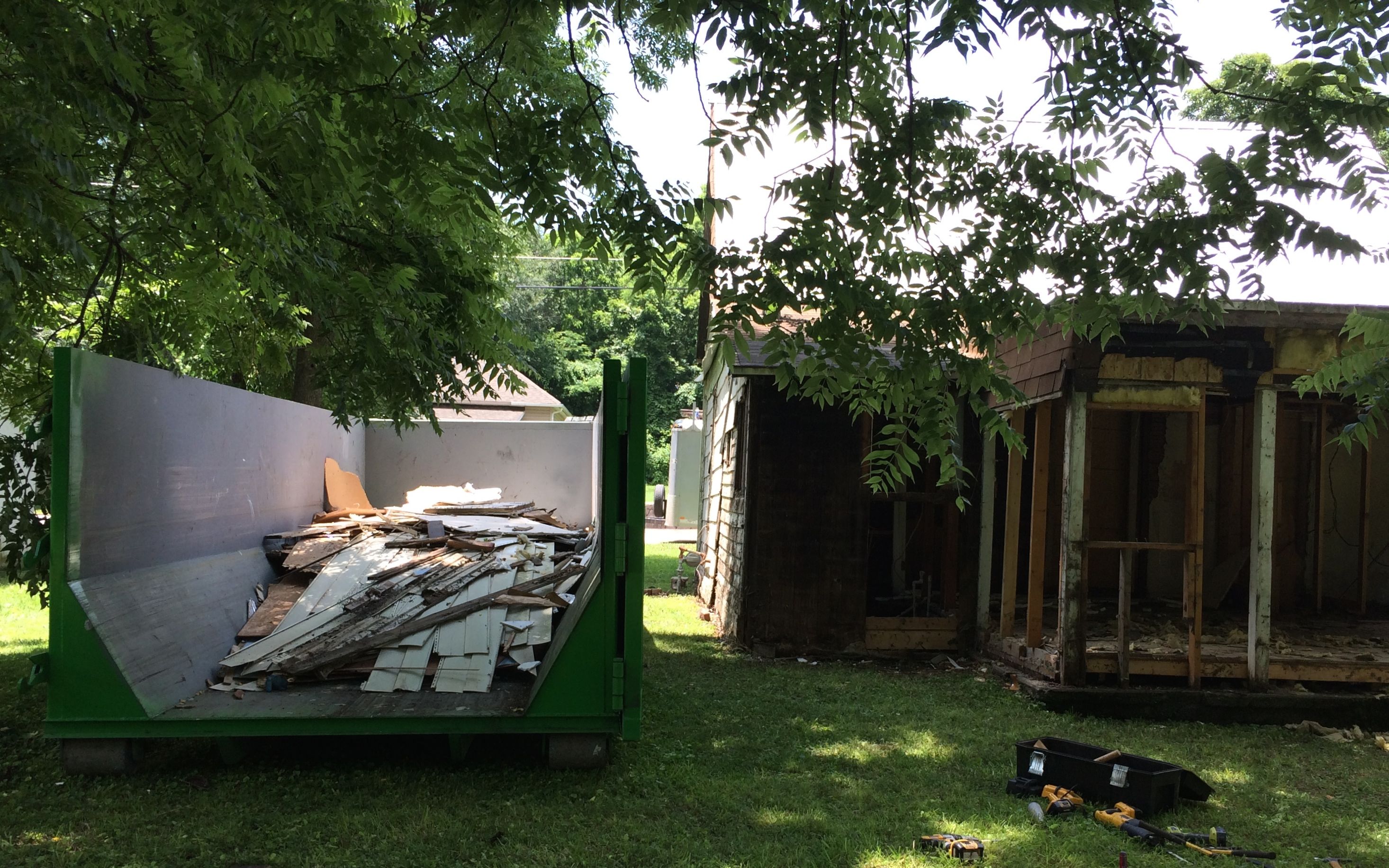
We were getting that dumpster filled up!
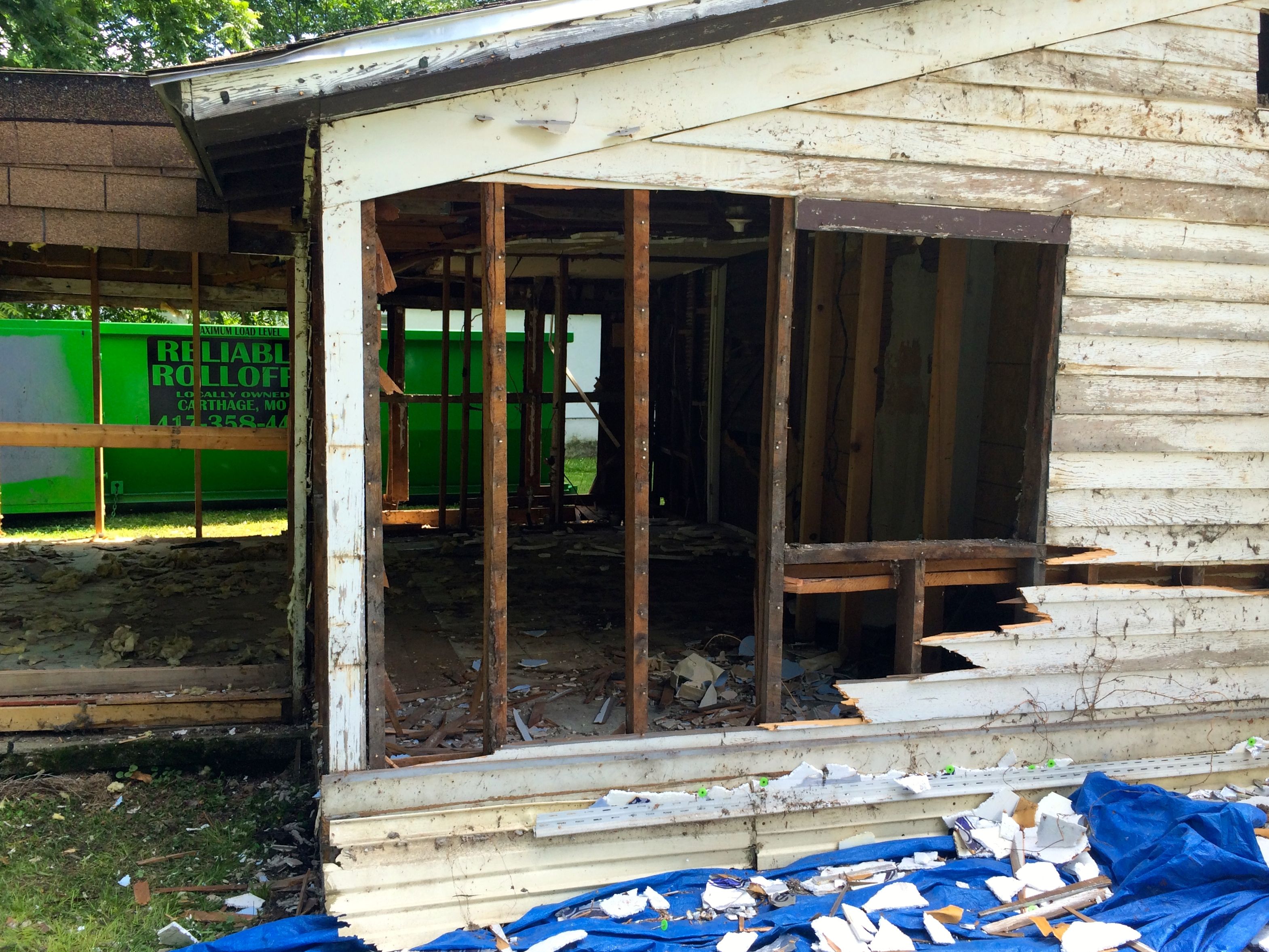
Talk about a room with a view! No walls – all windows!
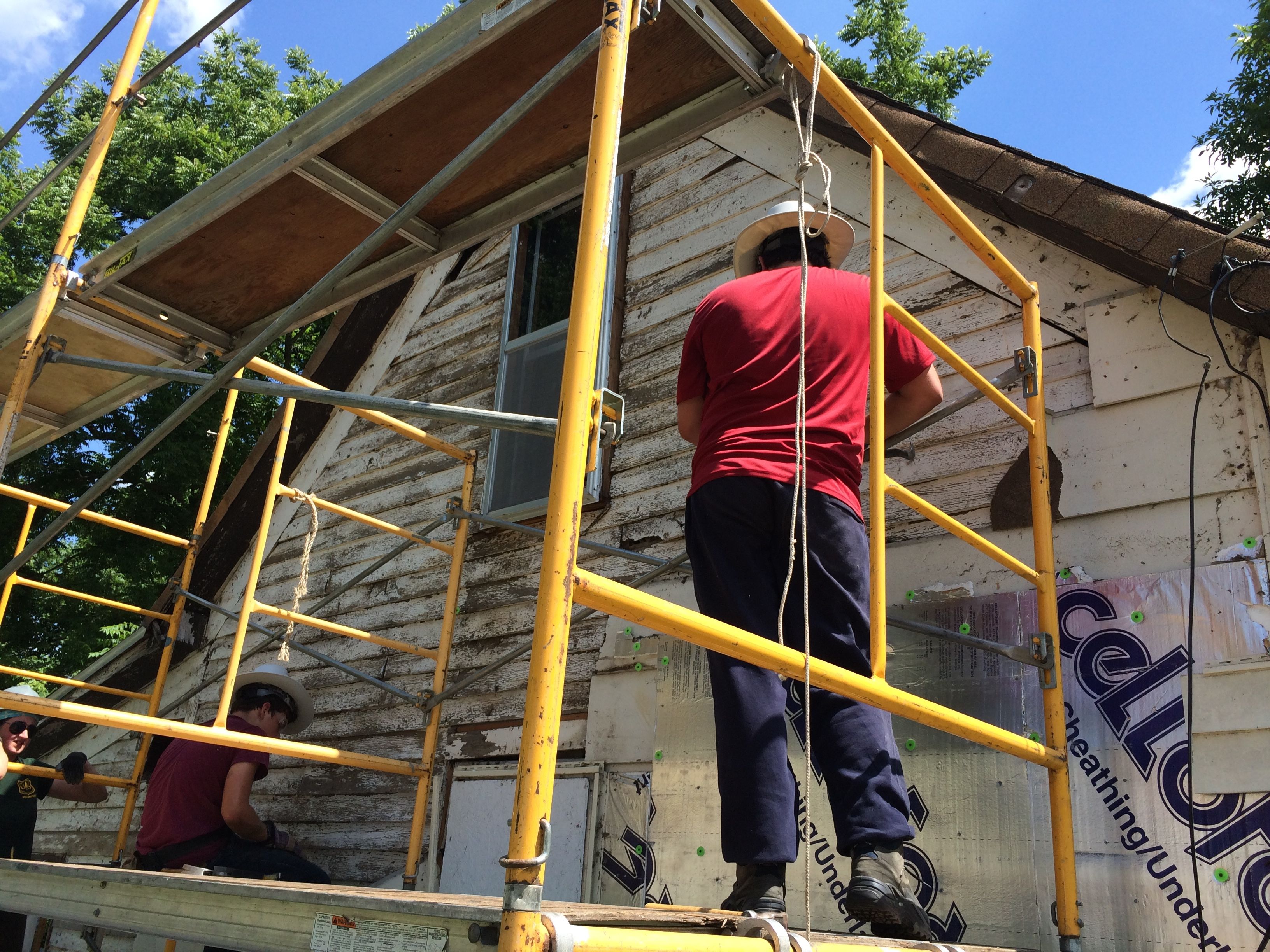
The two young men from New Jersey made short work of the siding on the ends of the buildings. They got down to the original siding quickly.
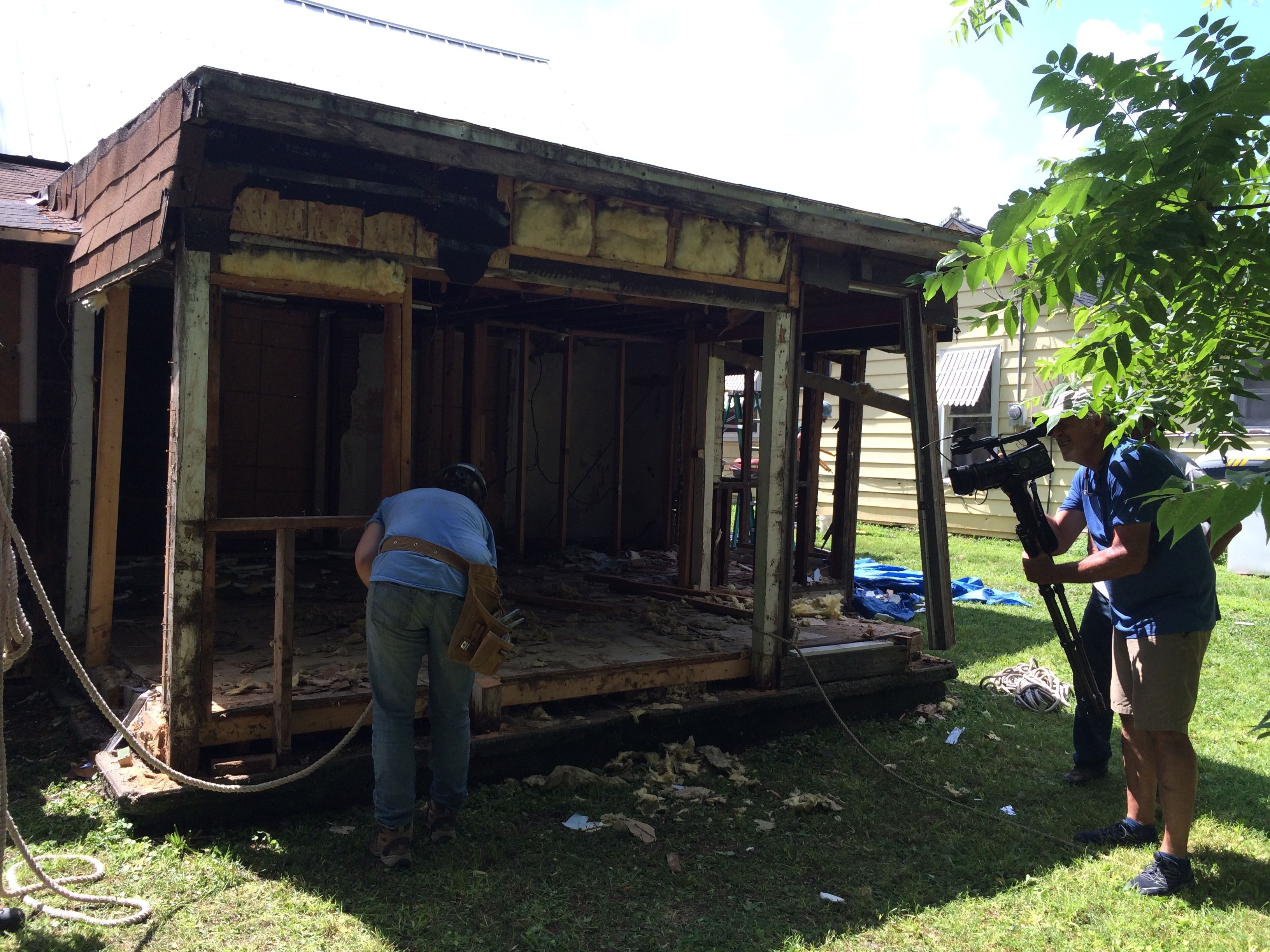
Our last task on day one was to collapse the additions. Here you can see the photographer documenting the job. The first thing we tried was pulling it down with ropes. Half of us got on a rope on the left side and the other half of us were on the right side. On the count of three, we pulled and we pulled. Nothing happened.
We repositioned the ropes and tried again. Nothing budged.
Kim Mailes, the Neosho local who had been spearheading this project for years, got his truck and pulled. One upright at a time was removed. That roof just did not want to come down. Eventually, however, gravity triumphed and the roof slowly sank to the floor.
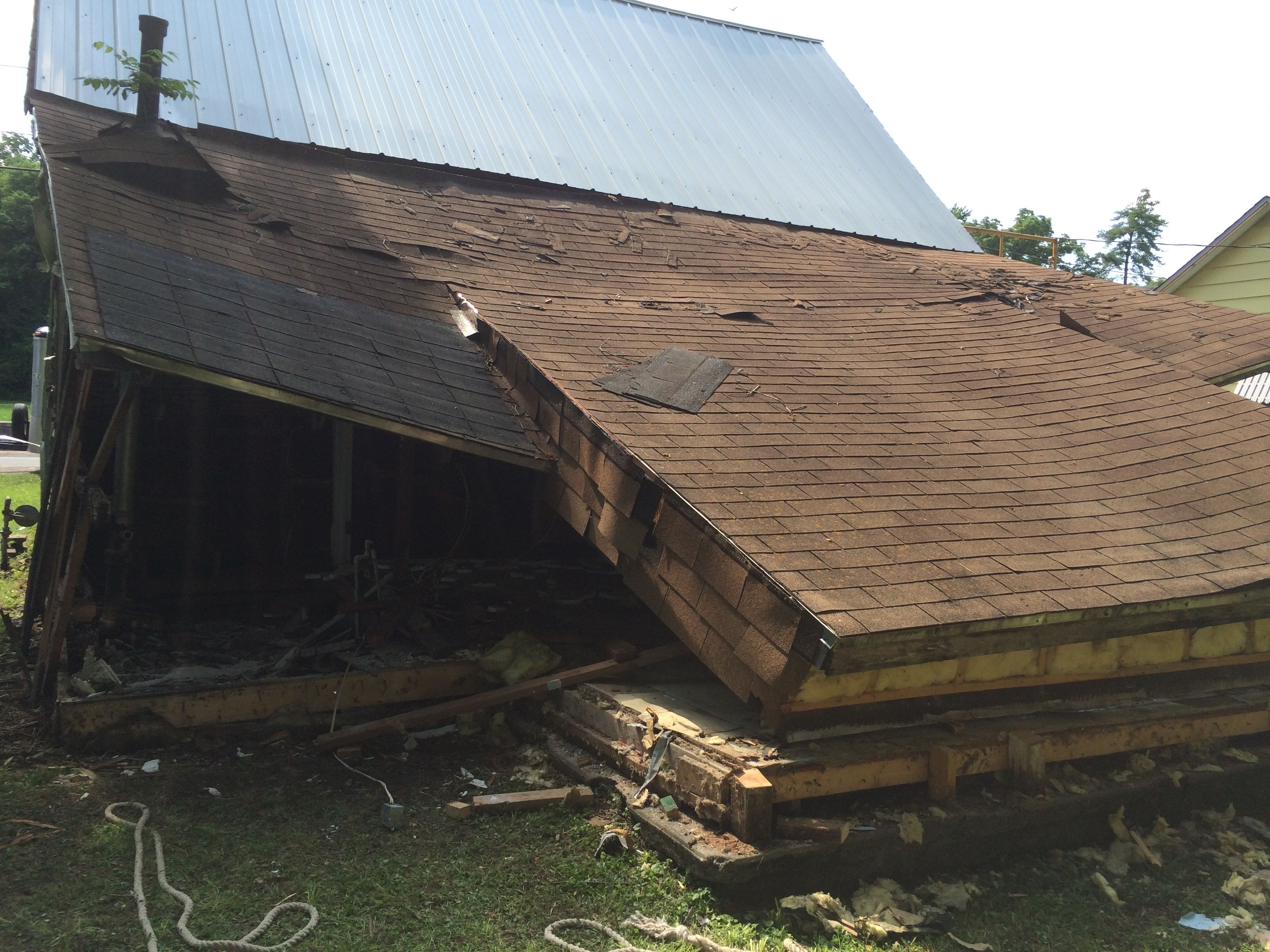
The building was really cobbled together, but I guess if you double up enough substandard material, it gains structural integrity.
We made so much progress the first day, that John, the project leader, and Angie, the architect, had to get together and reorder the job list.
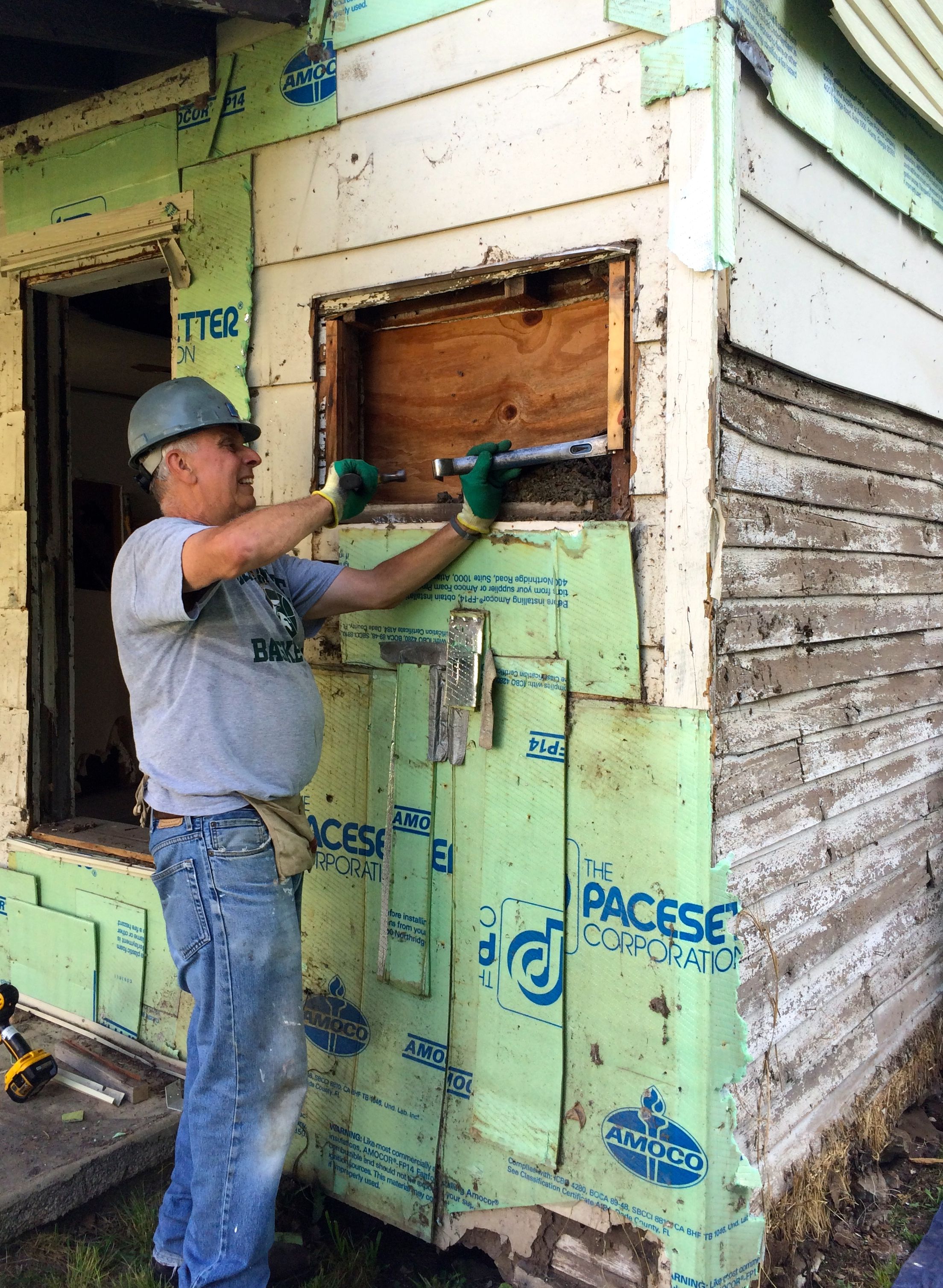
The building was covered with layer upon layer of materials, all of which needed to be removed.
Arvest Bank had acquired the property through foreclosure about twelve years ago and they offered it to the Carver Birthplace Association (CBA). It was known that this was the site of the Neosho Colored School, but no one knew for sure if this was the original building. In fact, most people thought that the original building had been torn down long ago. The CBA thought that they might tear the building down and create a memorial park, but they commissioned a study of the building to make sure that the original school wasn’t still there.
Angie, the architect, did the study. She estimated that the building was about 70% there.
So, with every piece of siding that was removed, we got closer to the original structure.
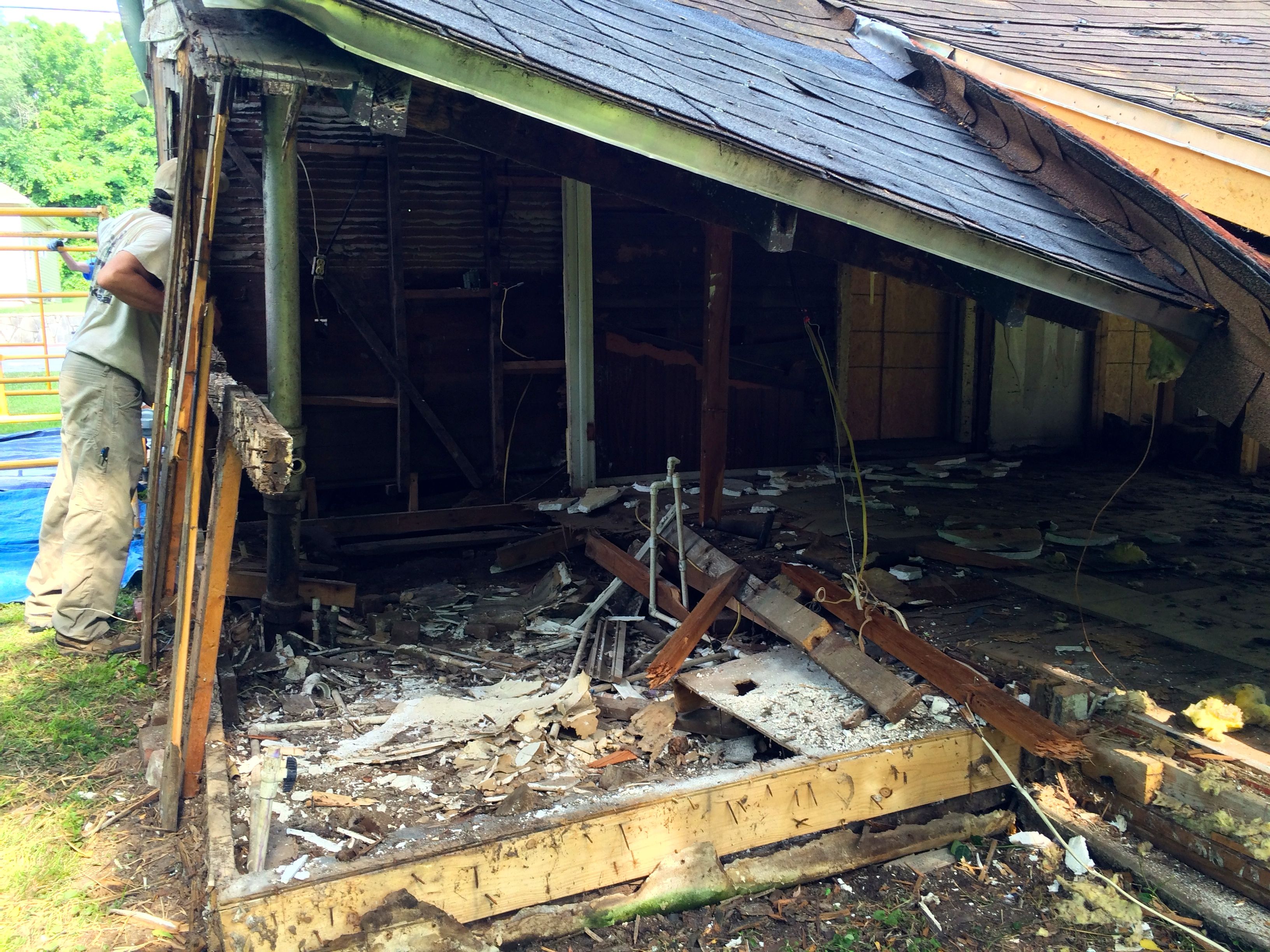
We kept picking away at the additions on the back.
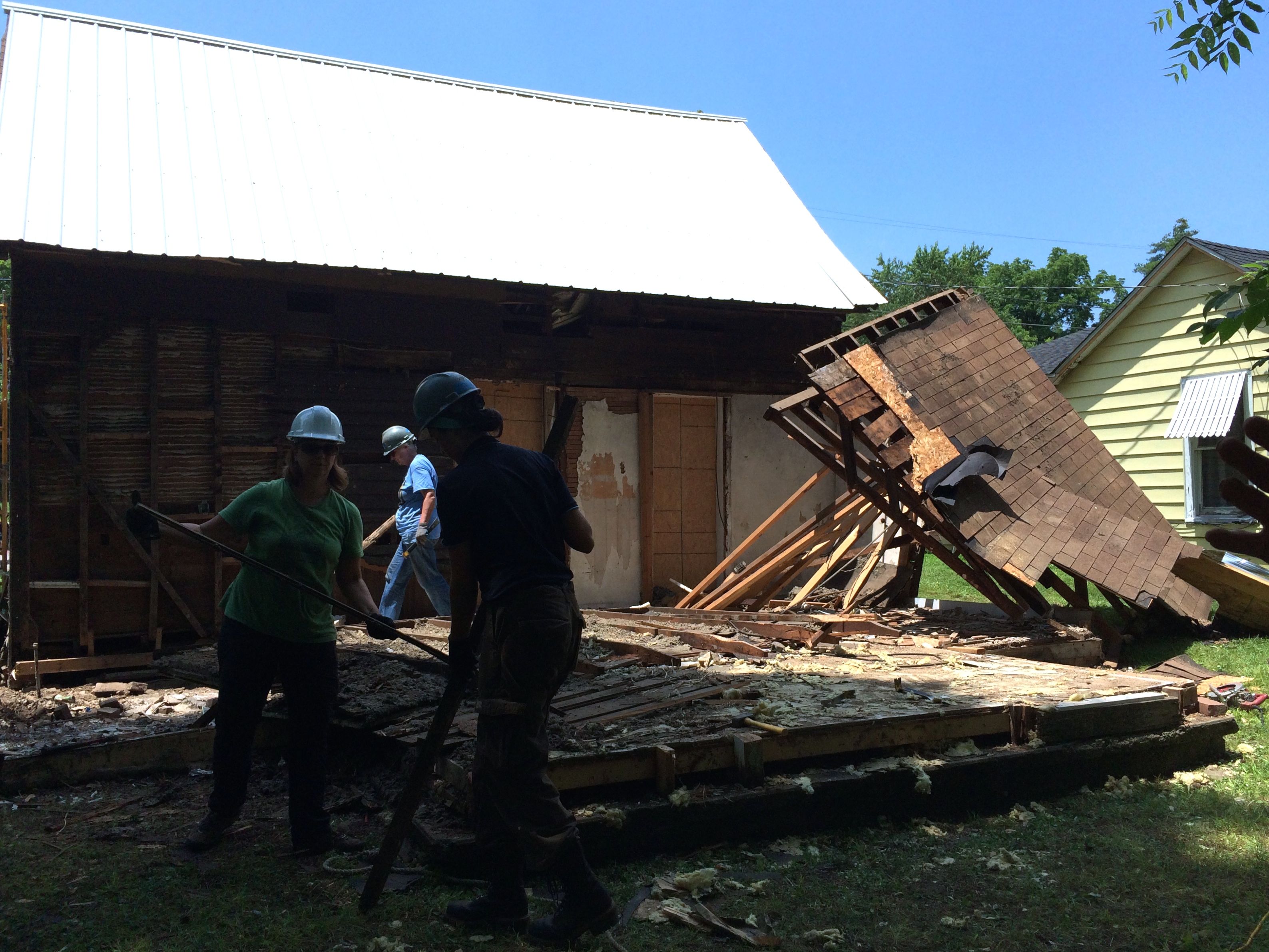
The roof is just about gone. We filled up one dumpster and almost filled up another.
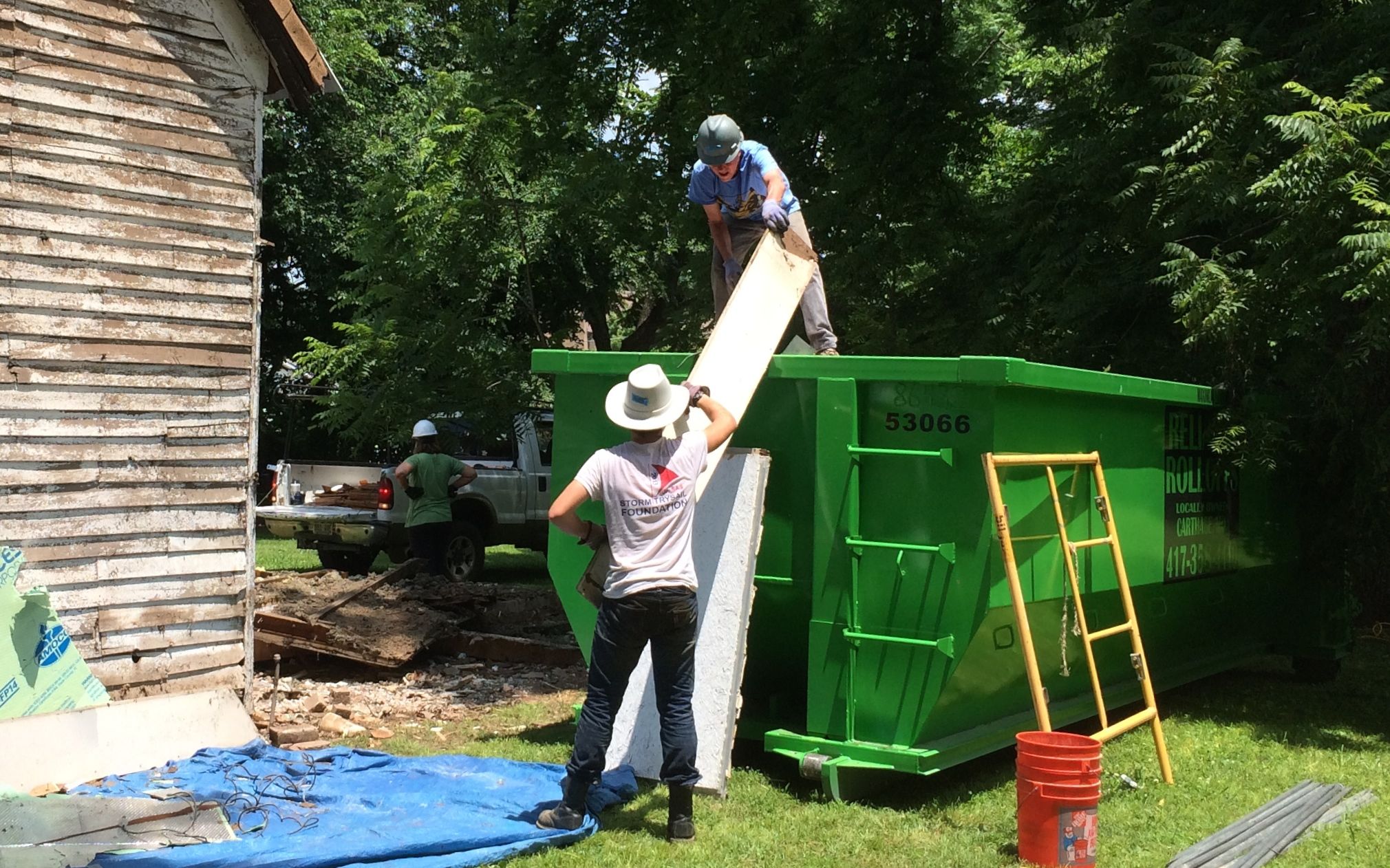
Finally, all the addition walls and the rear roof was gone.
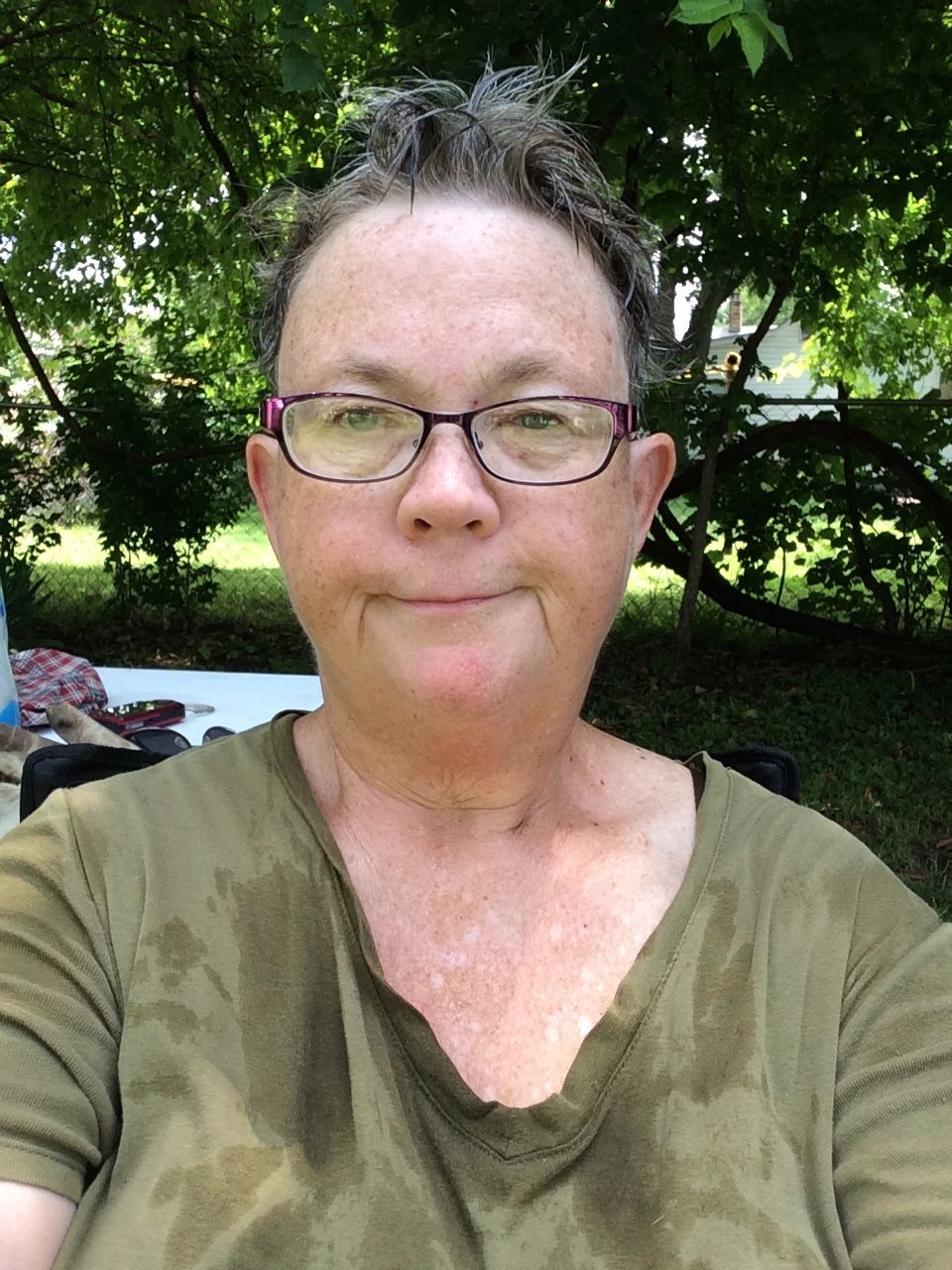
Man, it was hot work! The heat and humidity were off the charts, and the hard hats we had to wear while we were working didn’t help keep us cool.
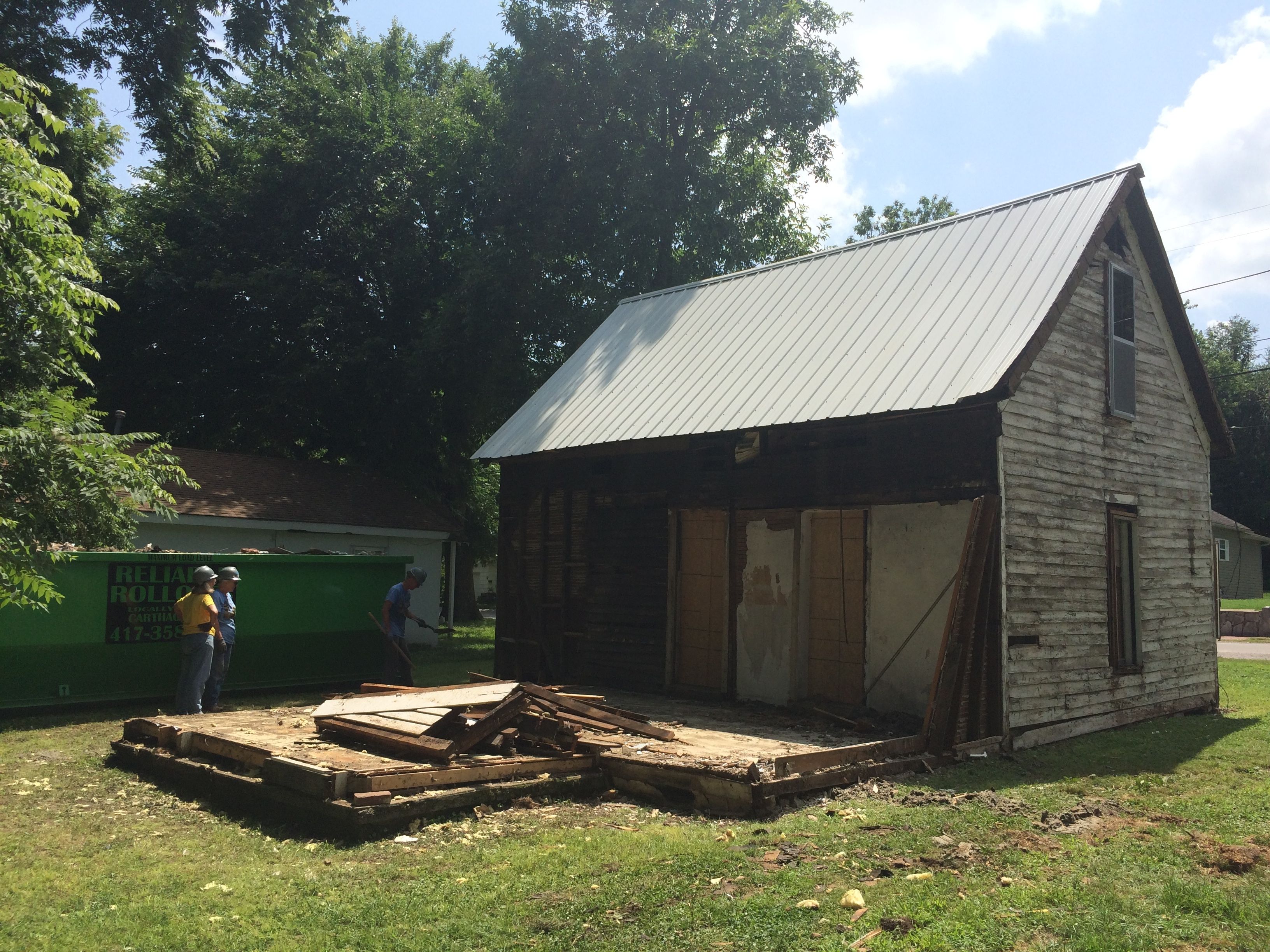
Next step, remove the foundation and floors of the addition.
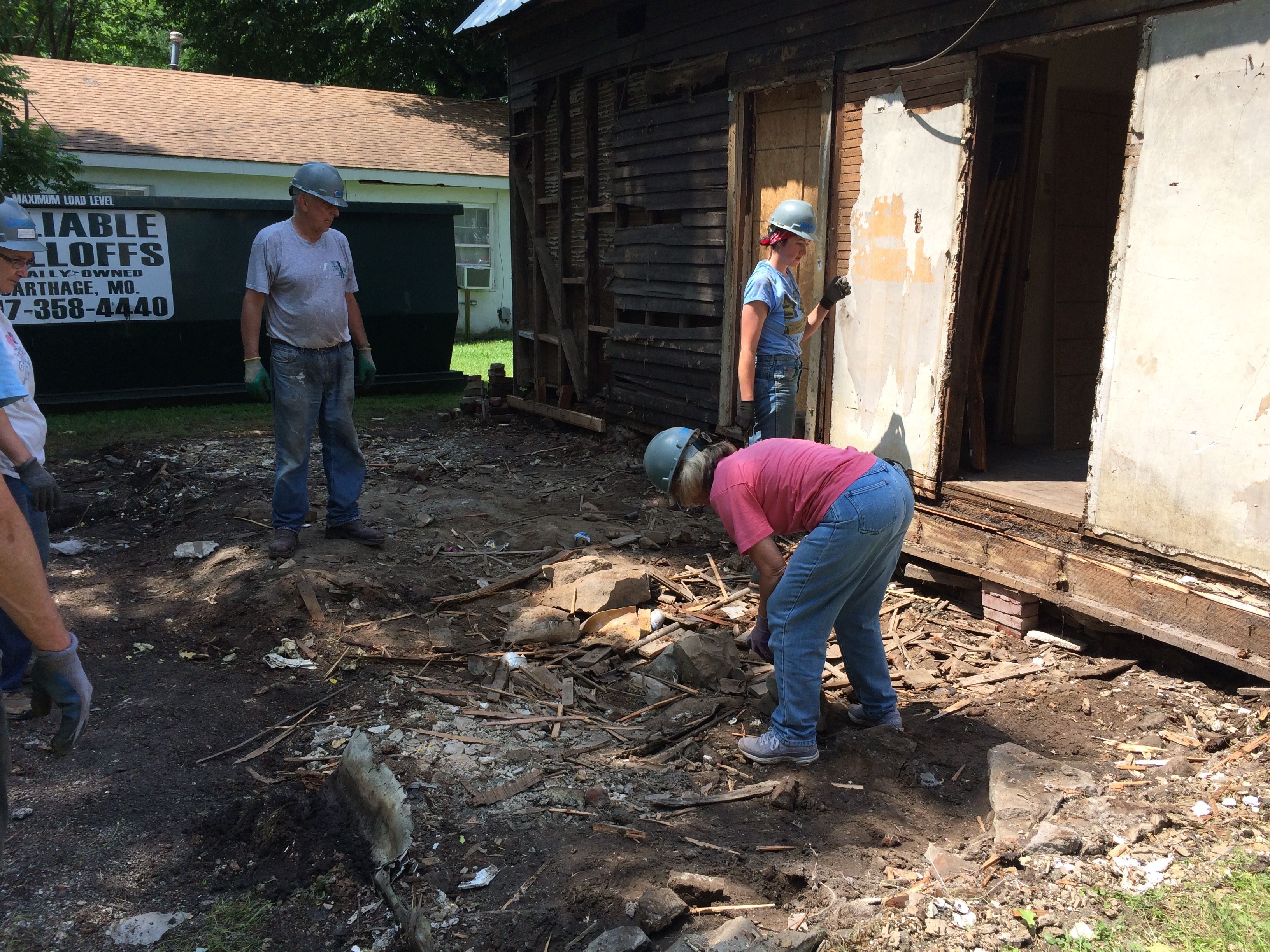
We found all sorts of “artifacts” under the additions.
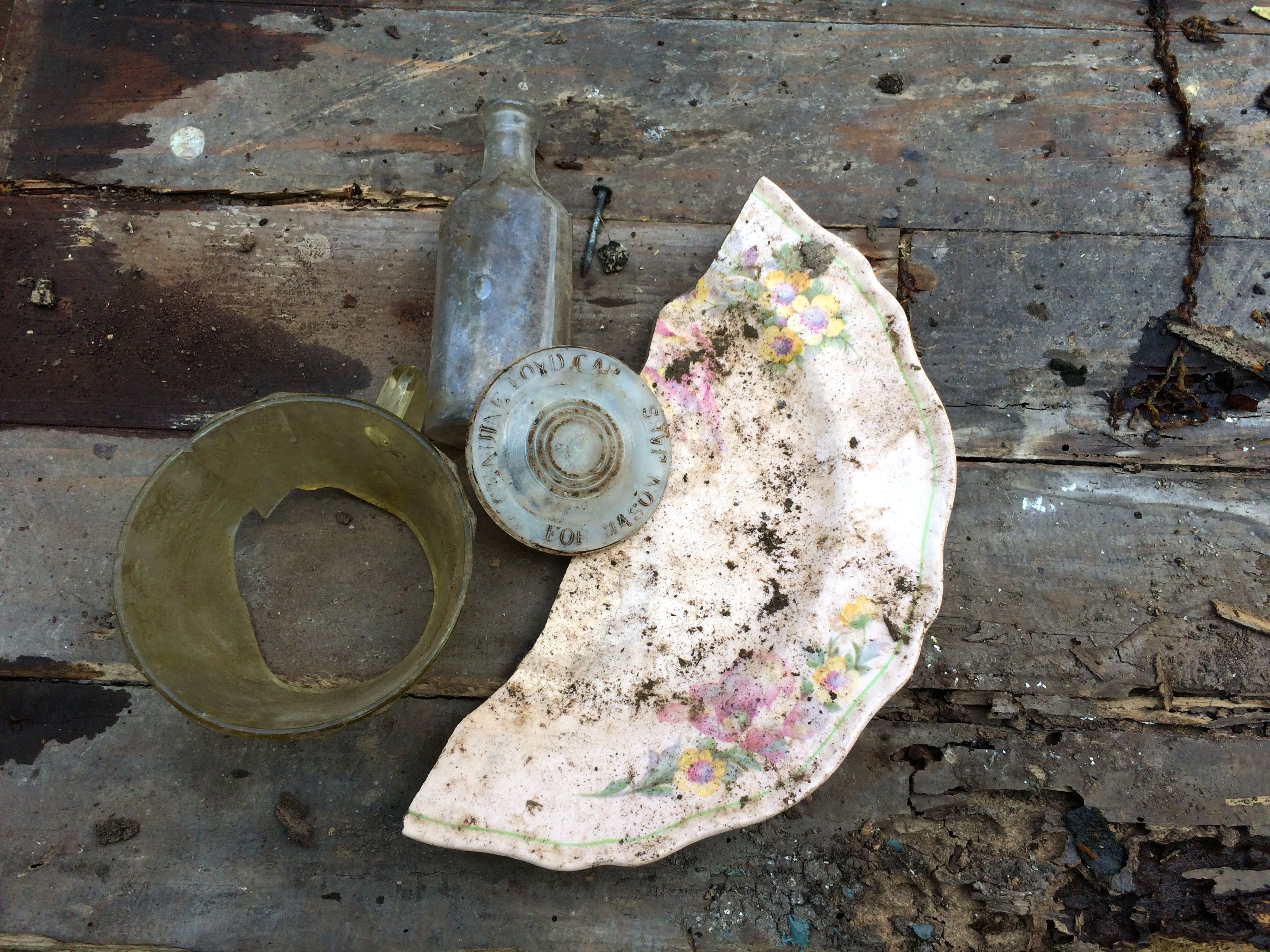
An archeologist was on site most days. I don’t think we found anything that was particularly significant, but you never know.
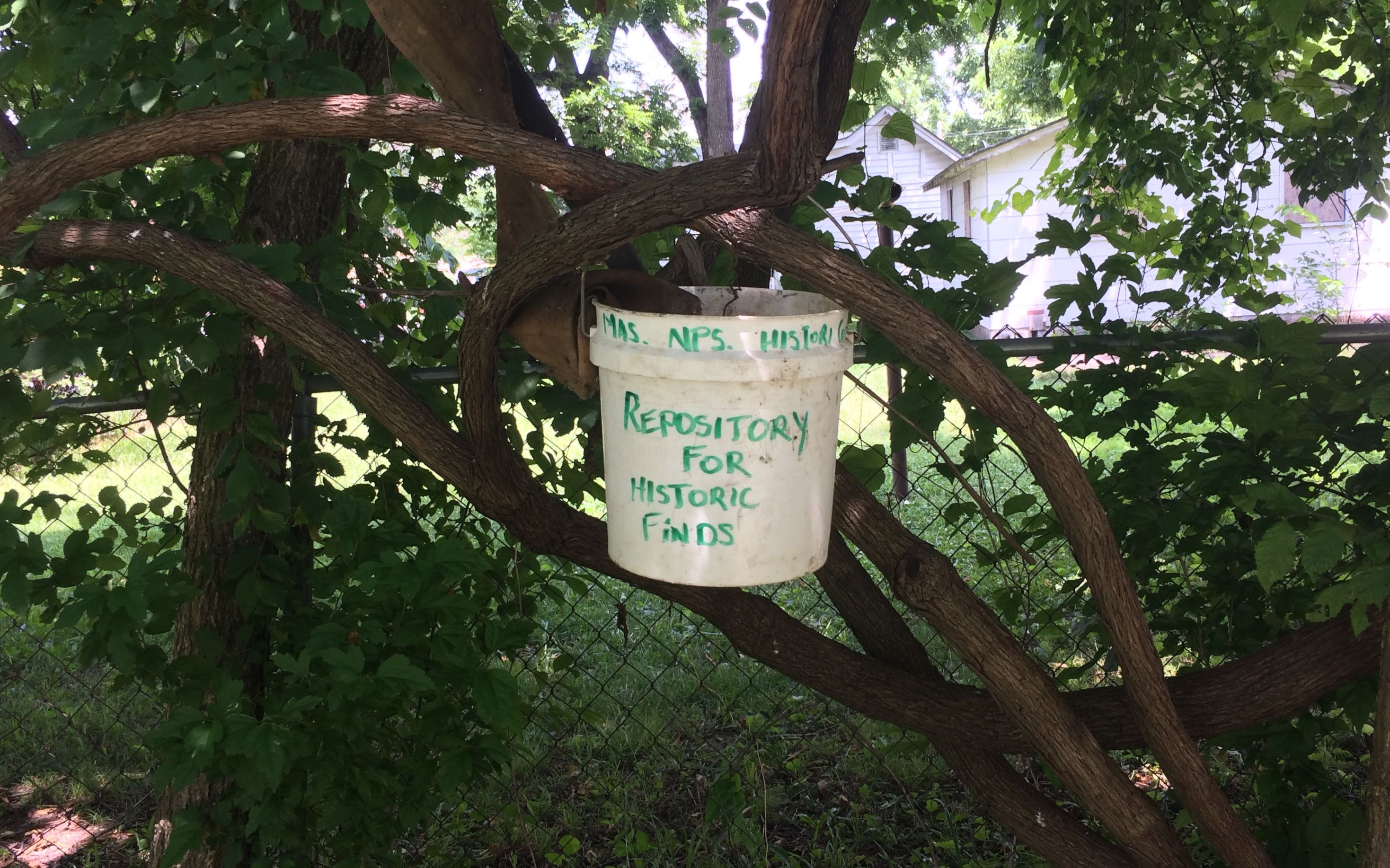
We even had a “Repository for Historic Finds” hanging in a shrub back where we took out breaks.
It wasn’t all hot, sweaty work. After the work ended for the day, we were free to cool down however we saw fit. One evening, I decided to explore Hickory Creek, which ran through our campground. I indulged in a little “catch and release” rock collecting.
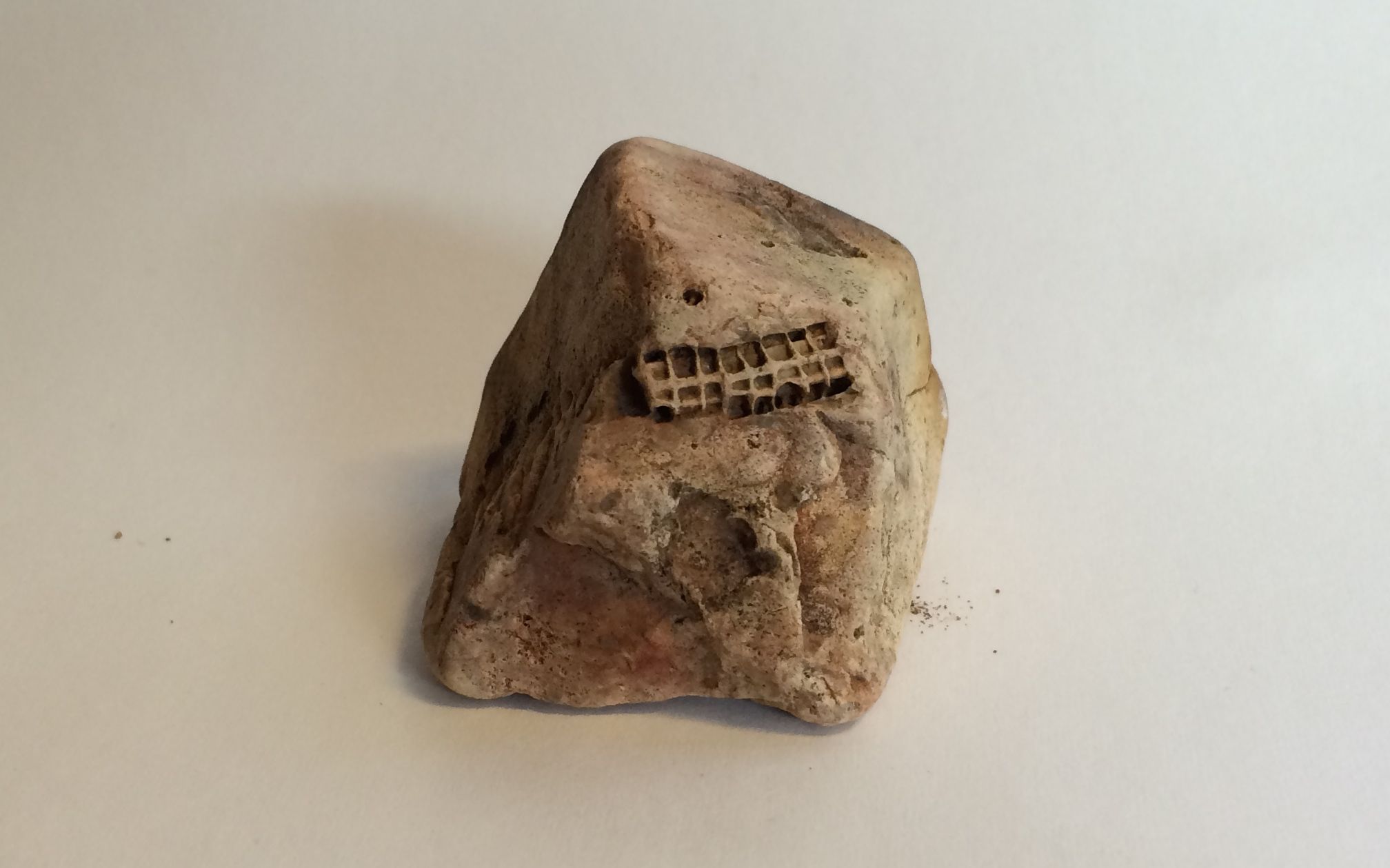
I found some interesting fossils. (Interesting to me, that it!)
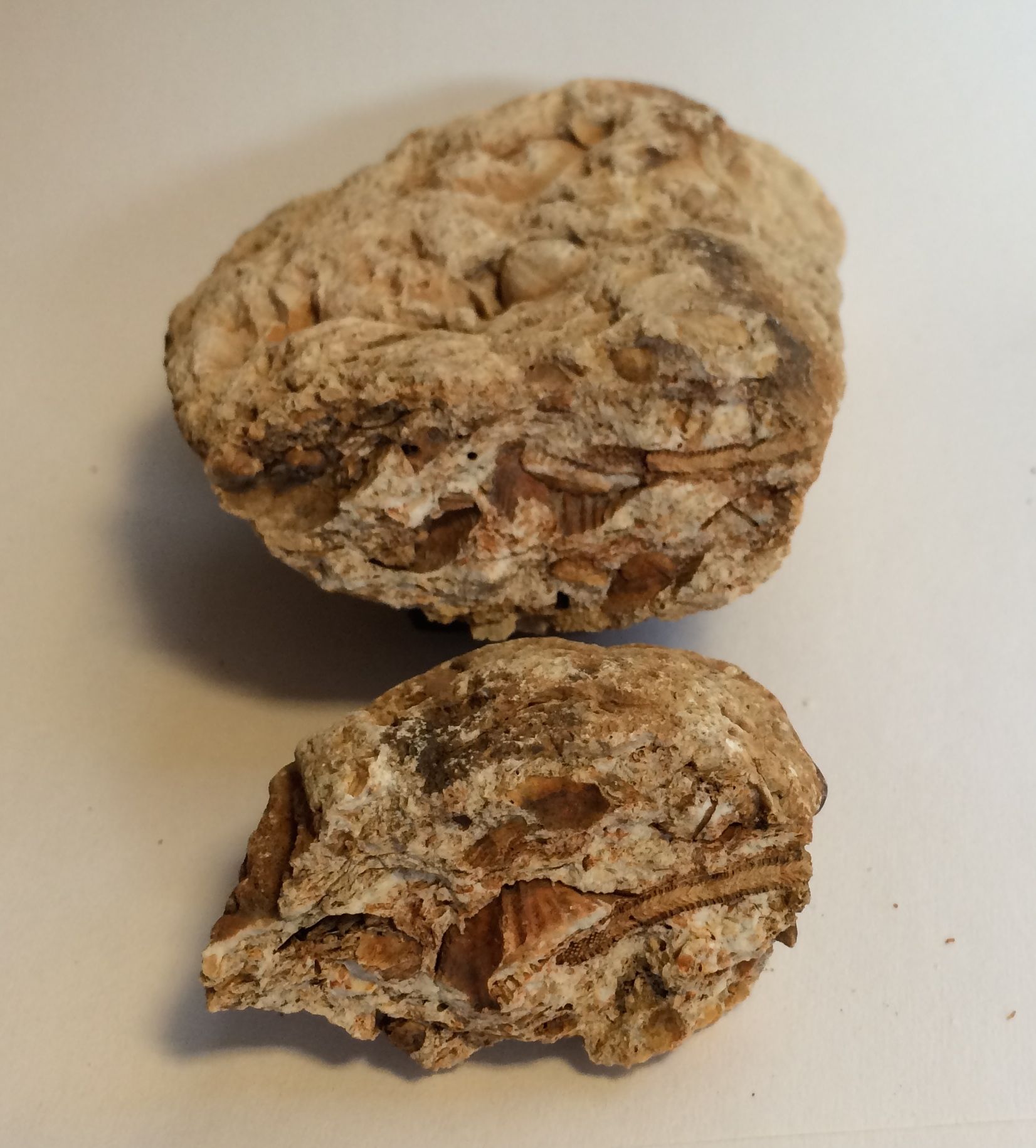
You could still see the shells sandwiched in with the other fossils in this piece. I saw a crack, so I snapped it apart.
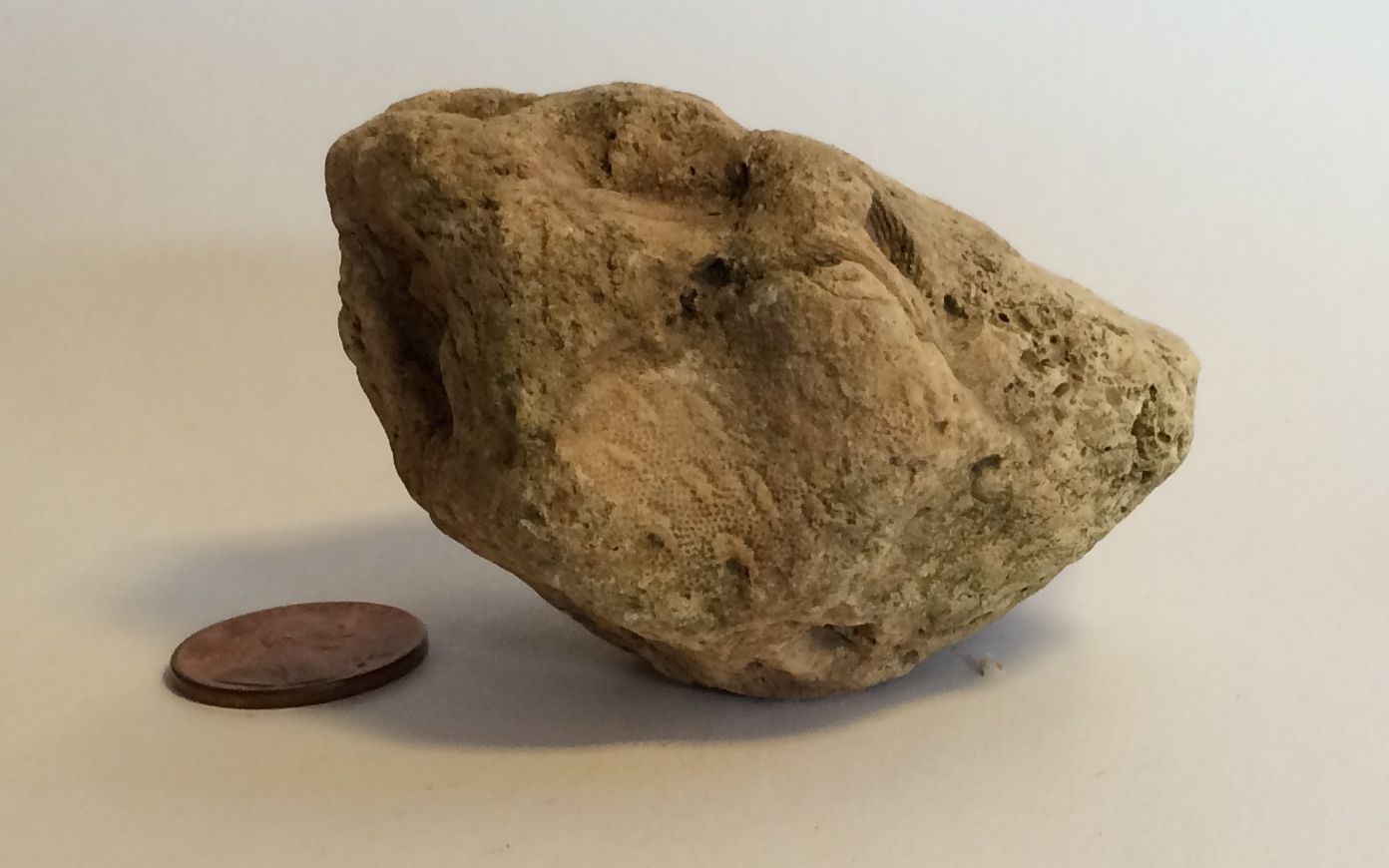
These are fossils unlike any I’ve ever found.
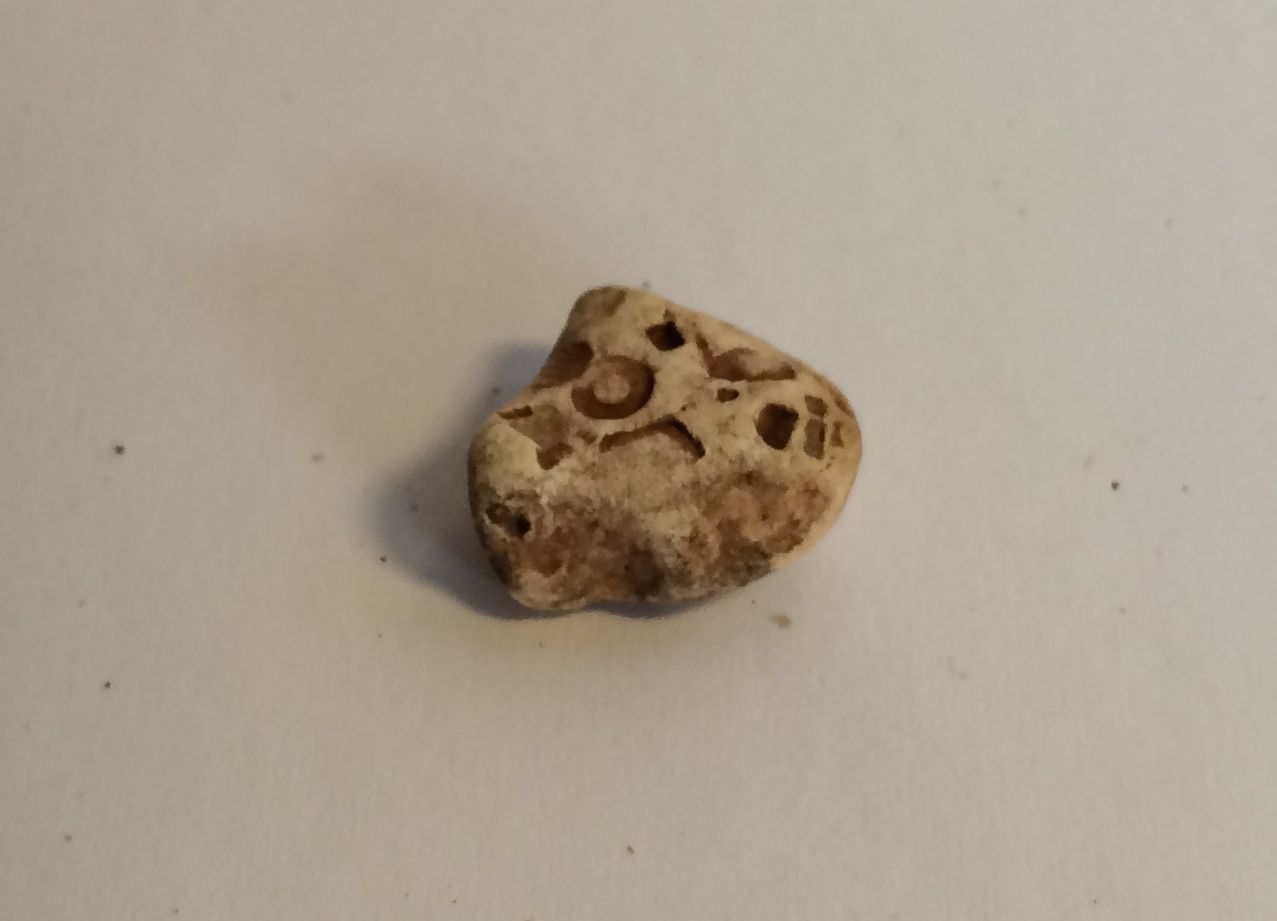
It was fun looking.
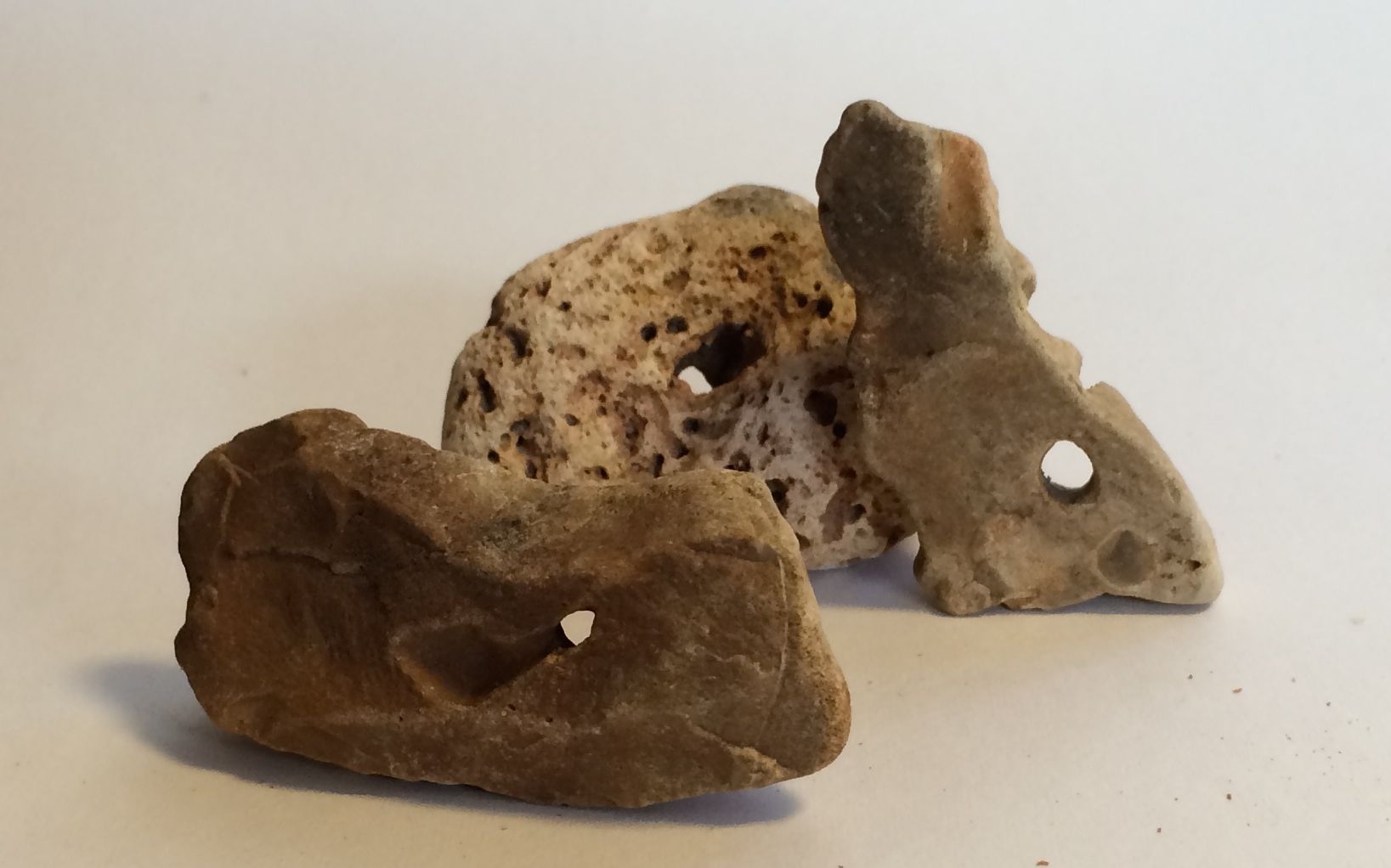
In addition to the fossils, I found some rocks with natural holes. I decided to hold on to these. Maybe I’ll string them together with other things some day.
The people of the town were very gracious. A group of anonymous donors had one meal a week catered for the project, and a church invited us to a dinner where they served up a mess of crappie along with an eye-popping array of pot luck dishes. Incidentally, “crappie” is pronounced more like “CRAW-pee”, not the way the spelling would lead you to believe. And, it was pretty good. Kim also had us out to his lovely home for dinner one night. We were well taken care of!
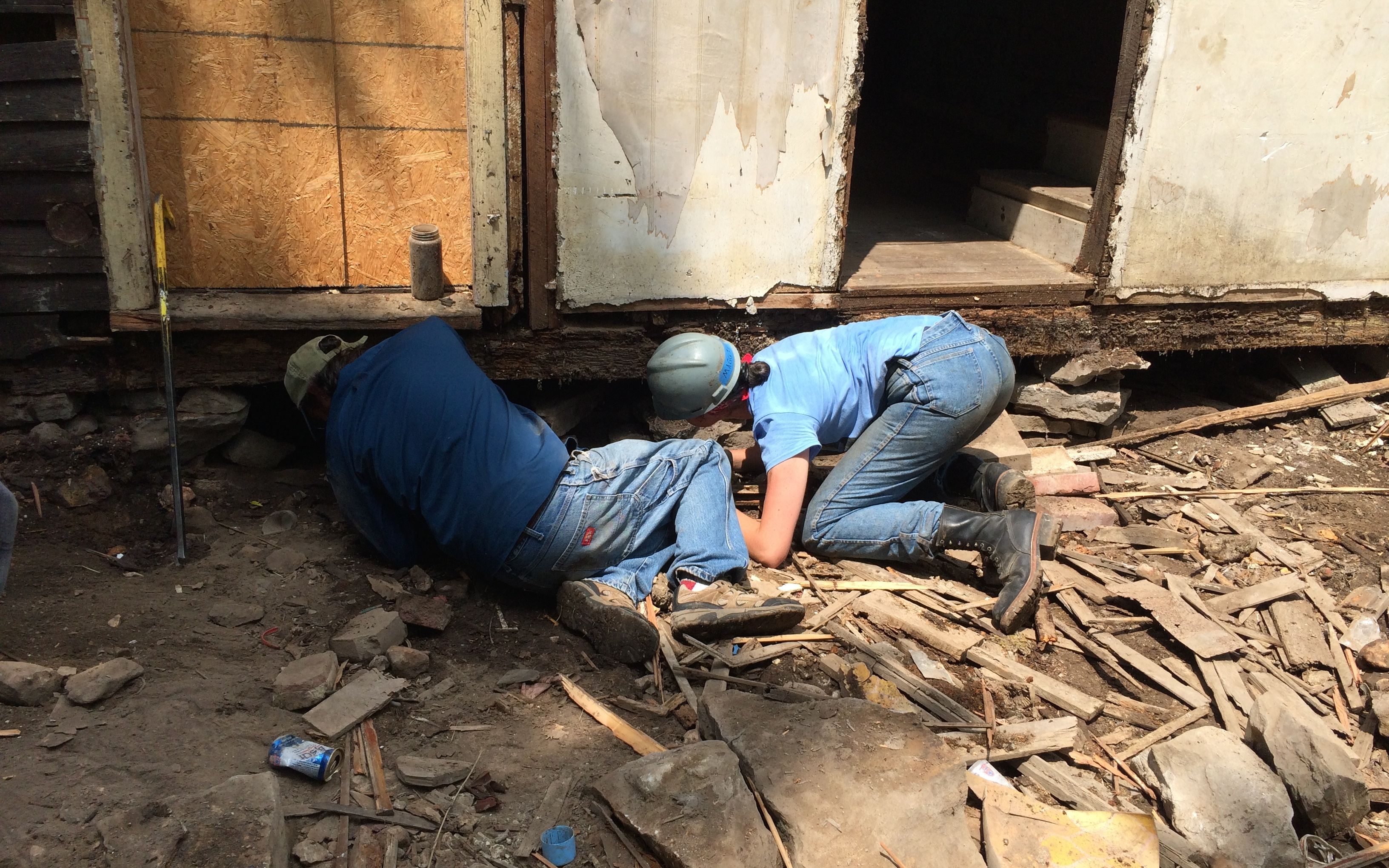
After we had the rear additions removed, they started planning for the next steps. Unfortunately, some of the projects for the coming weeks included replacing the rotted and termite-riddled sills and shoring up the foundations. Fortunately, this was not a project for our group.
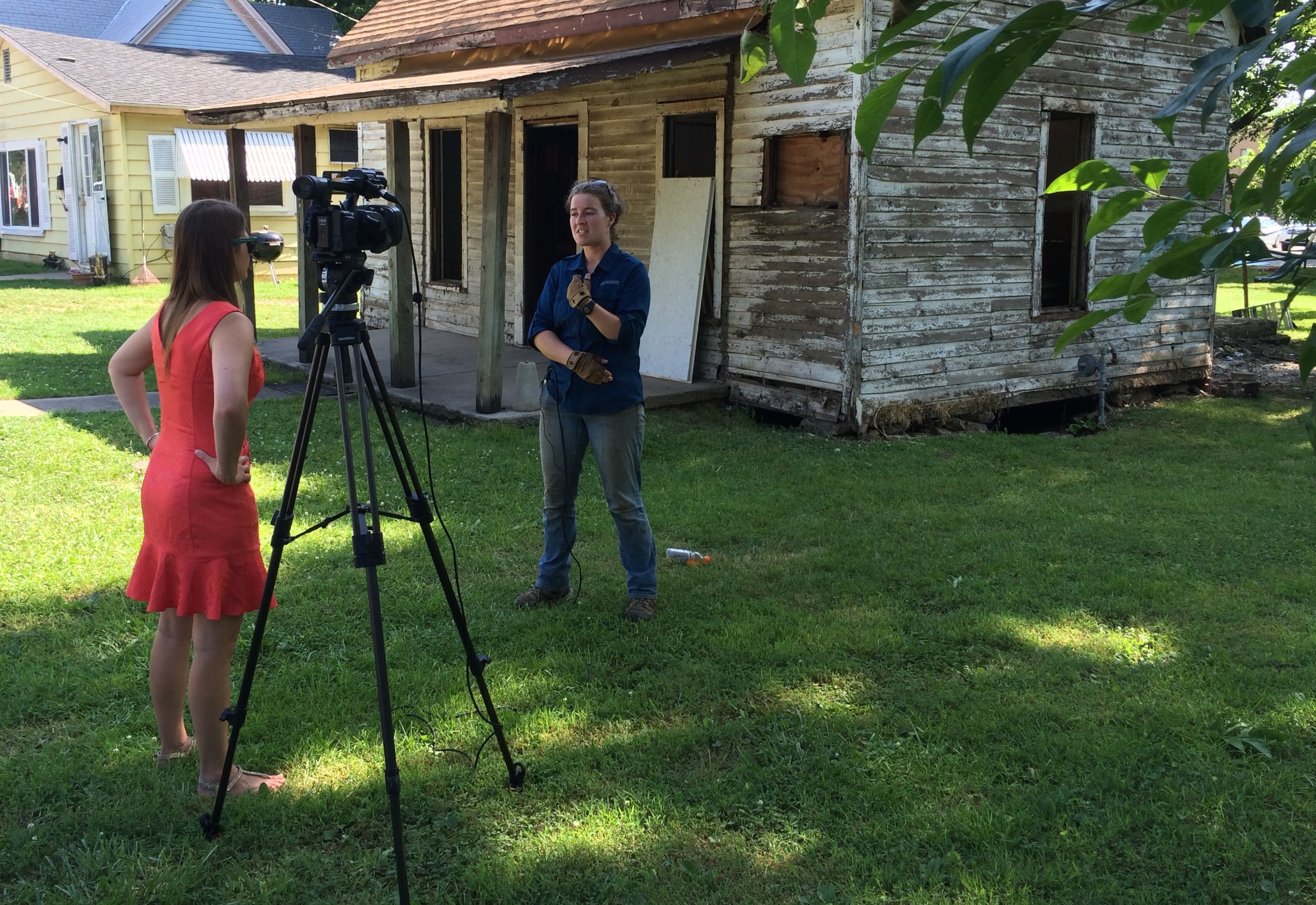
There was a lot of media interest in the project. It seems like there was either a newspaper article or TV segment each day of the week I was there. Some days, I think there might have been both!
If you are interested in the media coverage or the project as a whole, I suggest that you take the time to check out the blog that Kim Mailes kept.

The last day of the first session finally came, and here is the progress we made.
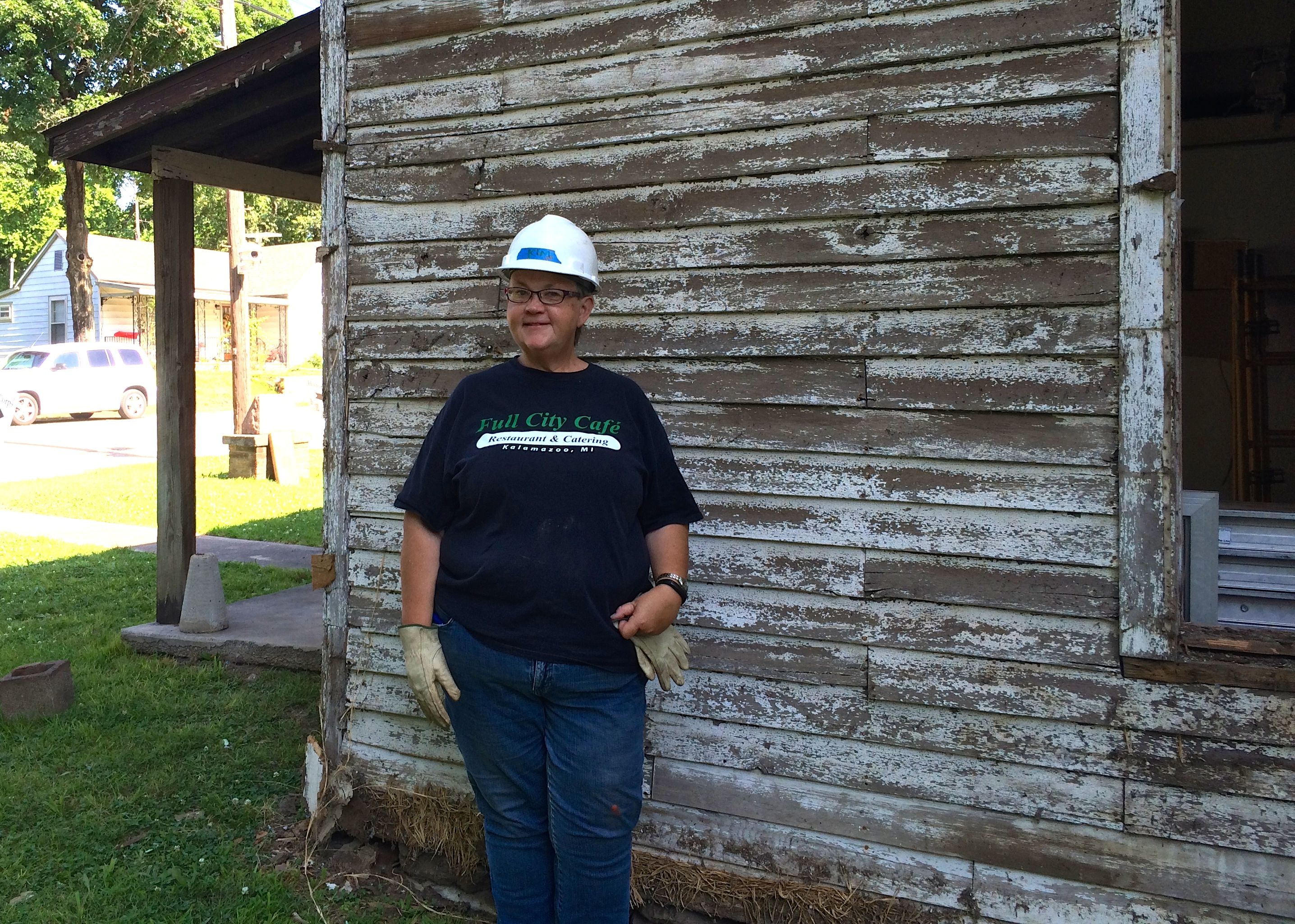
Here I am, posing in my hard hat.
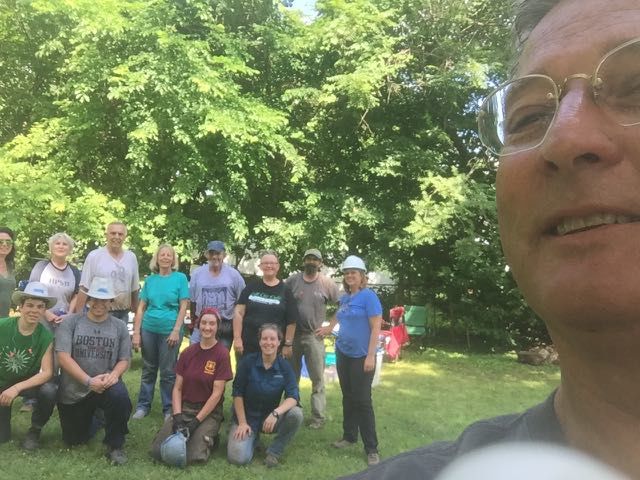
And the gang, just before we all headed our separate ways.
There were two more work sessions after us, and they made great progress. This is how the school looked after three weeks of work.
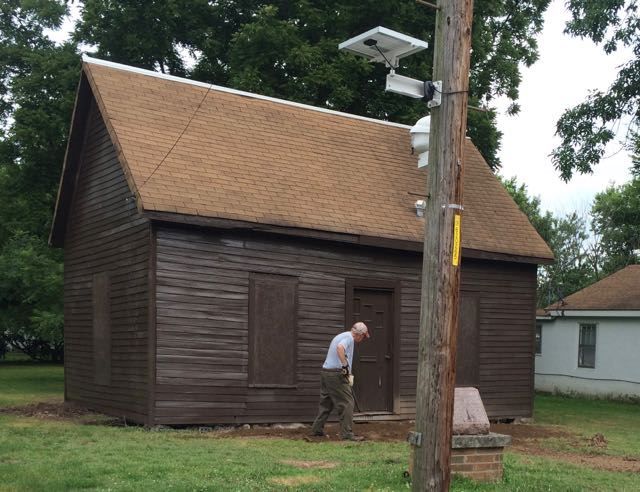
That’s pretty remarkable, by itself, but compare Dr. Carver’s sketch of how he remembered the school some fifty years after he attended it with how it was left at the end of the project.
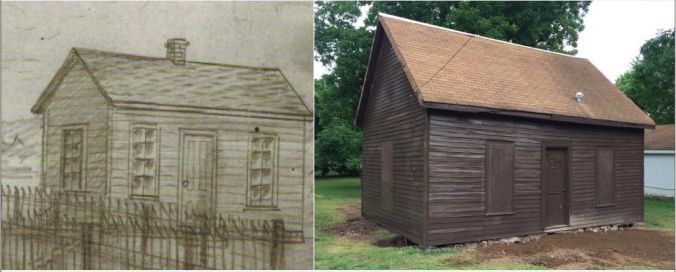
Of all the things I’ve done on my travels, I think this is the most impressive.
This project is so cool! Thanks for the documentation, great work 🙂
Thanks, Tina! It is truly one of the high points of my journey so far.
Wow, what a great project! Good for you! I especially admire your willingness to work in the heat and humidity. I don’t think I would have been so noble!
Well, we only worked as hard as we were able. Some people were unstoppable. I got a lungful of mold one day and kind of had to lay low for a while. Still, I am so proud that I was able to contribute to something that I found so personally meaningful.
That looks amazing! We almost stopped there on our first trip to the southwest. I’ll put it back on my list to visit
I found it to be very moving. Enjoy your travels!
That is awesome! Wonderful story and experience Kim! Wow!
Thanks, Mickey! It was a pretty awesome experience.
Kim – I saw the post about you on HistoriCorps’s Facebook page and followed through to your blog. Thank you so much for the photos and great description of the work! It’s cold in Colorado right now and cheered me up immensely to think about the project in Neosho, although I sure don’t miss the summer heat and humidity. Hope you’re well, and it was a pleasure to work with you! (And I’m sorry for being rude about the picture of my butt when we were on the job site. 🙂 It’s a great photo and I’m glad you put it up!)
Hey, Maggie! Nice to hear from you! It was steamy then, wasn’t it? It was a marvelous experience! I can’t wait to see if there are any Historicorps projects where I will be next summer!