Havre de Grace

Another weekend rolled around and I found myself in Maryland, somewhere northeast of Baltimore. I found a chain hotel at an interchange and settled in there for a few days of rest and relaxation.

Of course, you know how I relax. After a week of driving in circles, I jump in the car and drive somewhere. This time, I headed to Havre de Grace.

Havre de Grace is an old town – or, should that be Ye Olde Towne? According to my Preferred Source, General Lafayette visited the small hamlet known as Harmer’s Town several times during the Revolutionary War. He is reputed to have said that it area reminded him of the European seaport of Le Havre, which was originally named Le Havre-de-Grâce. Inspired by Lafayette’s comments, there residents incorporated the town as Havre de Grace in 1785. Washington stayed overnight in the town in 1789 on the journey to New York City for his first inauguration in 1789.

Fun fact: During the First Congress in 1789, Havre de Grace missed by only one vote being named the capital of the United States. I wonder how the votes fell in the voting? It seems like there were a number of cities that lost out on the honor by only one vote, although I can’t name them at the moment.
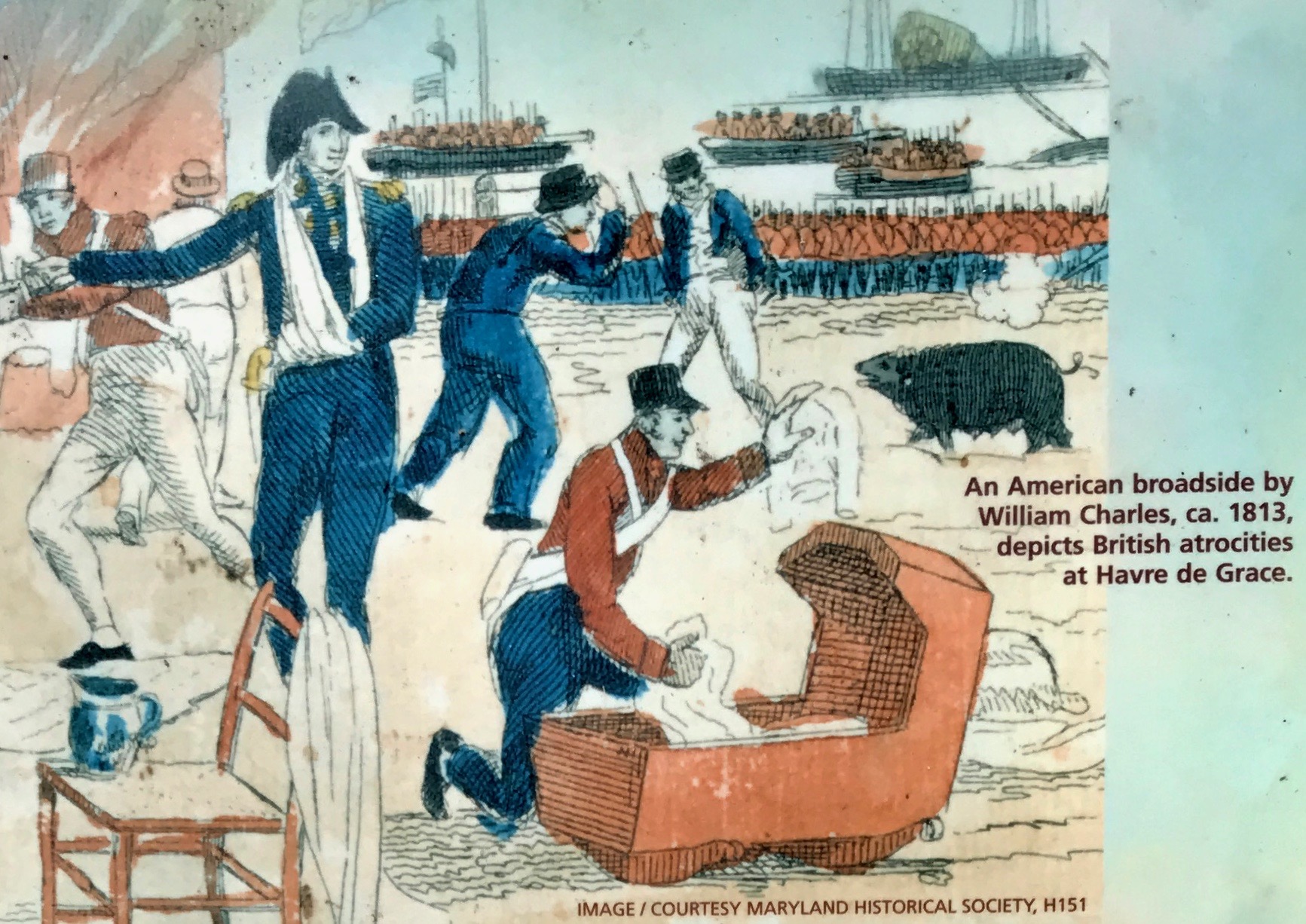
The bit of history that surprised me about Havre de Grace was the attack by the British during the War of 1812.

Rear Admiral George Cockburn burned and plundered the city. According to an interpretive sign I saw along the way, first person accounts of the devastation at Havre de Grace fueled newspaper reports of “wanton barbarity among civilized people.” Cockburn, portrayed as a villainous “violator of all laws, human [and] divine,” struck terror as he made an example of Havre de Grace for other towns.

The American Lieutenant John O’Neill single-handedly manned a cannon to help defend the town. O’Neill was wounded and captured by the British, although he was soon released.
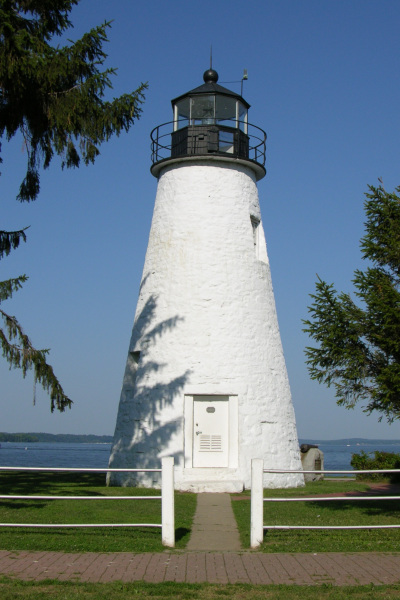
CC BY-SA 2.5, https://commons.wikimedia.org/w/index.php?curid=227854

In gratitude for his bravery, Havre de Grace made O’Neill and his descendants hereditary keepers of the Concord Light House, which overlooks the point where the Susquehanna River flows into the Chesapeake Bay.

Kind of makes me wish I had dug a little deeper when I visited the tourist information office. I might have seen some information about the lighthouse. I definitely would have gone to visit it. According to my Preferred Source, it was built in 1827 by John Donahoo, a prolific lighthouse builder who is responsible for many lighthouses in Maryland.

What I did notice was a walking tour, called the Lafayette Trail.
The helpful man in the tourism office gave me a map and I set out to see what I could see. My first stop was number eighteen.
Saint John’s Episcopal Church
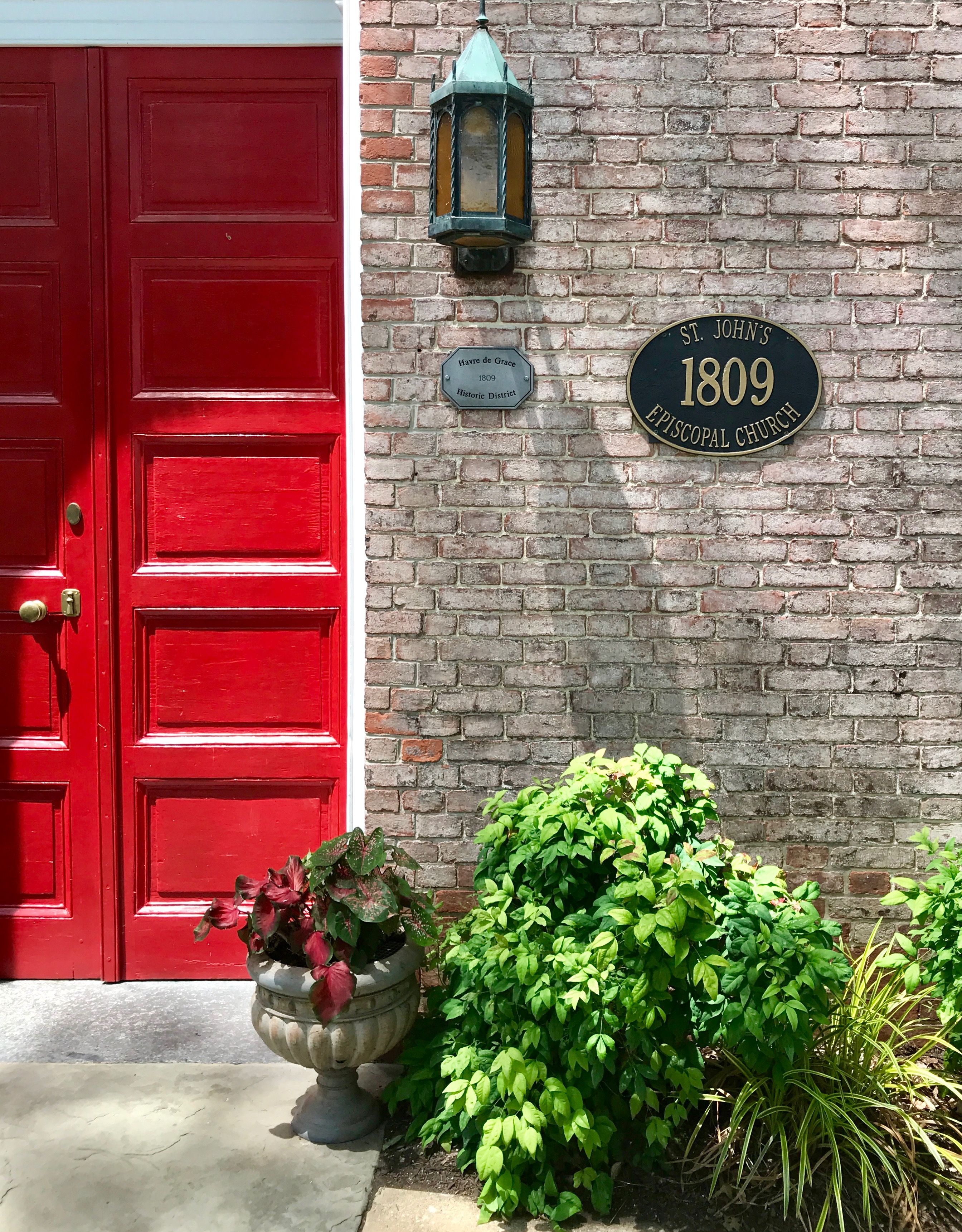
St. John’s is Havre de Grace’s oldest church. Financing for the church was through a lottery commissioned in 1802. It was built in 1809, and the church was damaged by the British during the War of 1812. It was gutted by fire in 1832, and changes to the original rectangular building were made in the early 1860s.
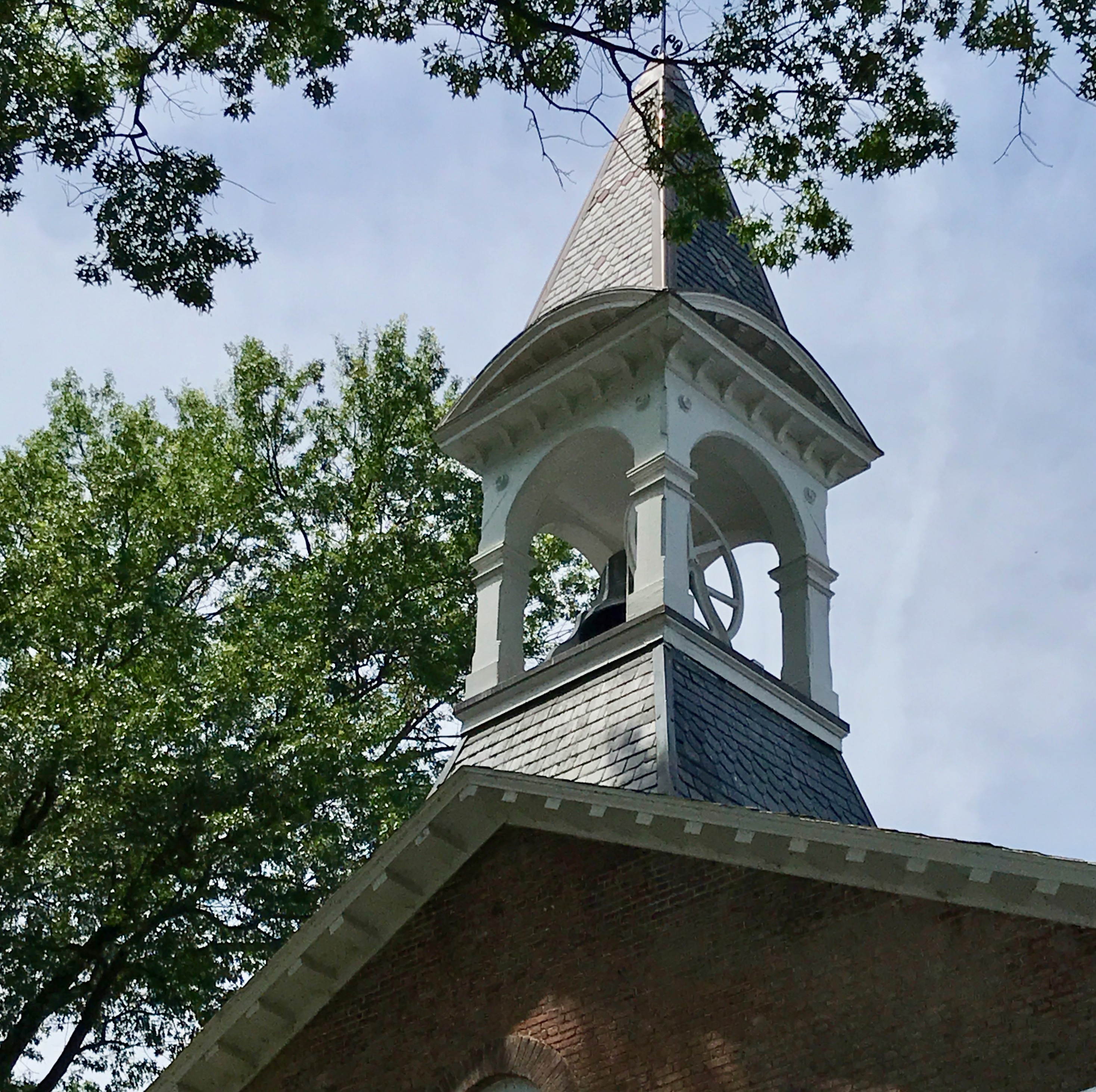
A slate roof and belfry were added in the 1880s.

Notice the Flemish bond brick walls.
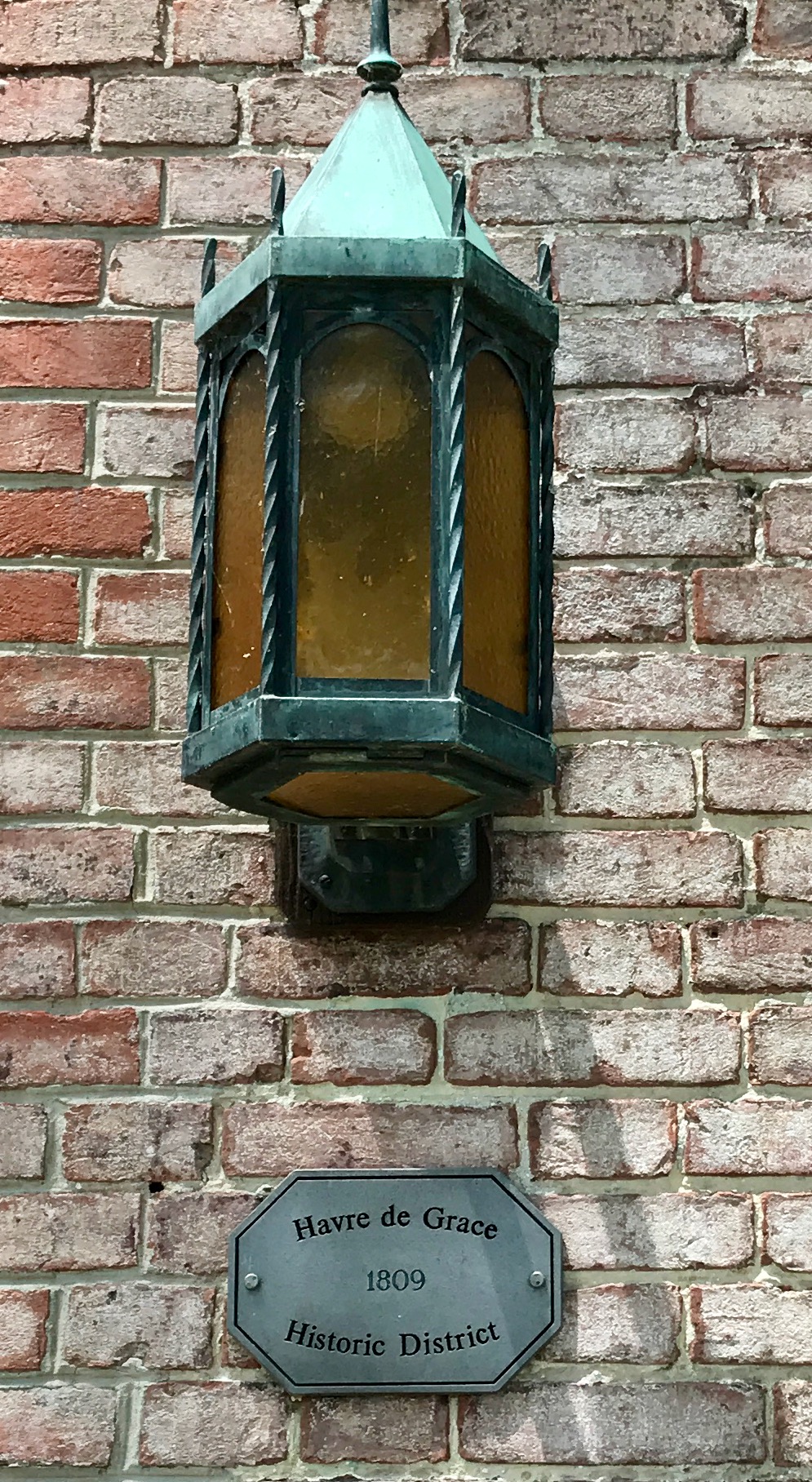
After admiring the exterior, I headed off in search of my next stop. Coming up: number nineteen.
This quietly elegant house is Carver-Craig House, built in 1855.
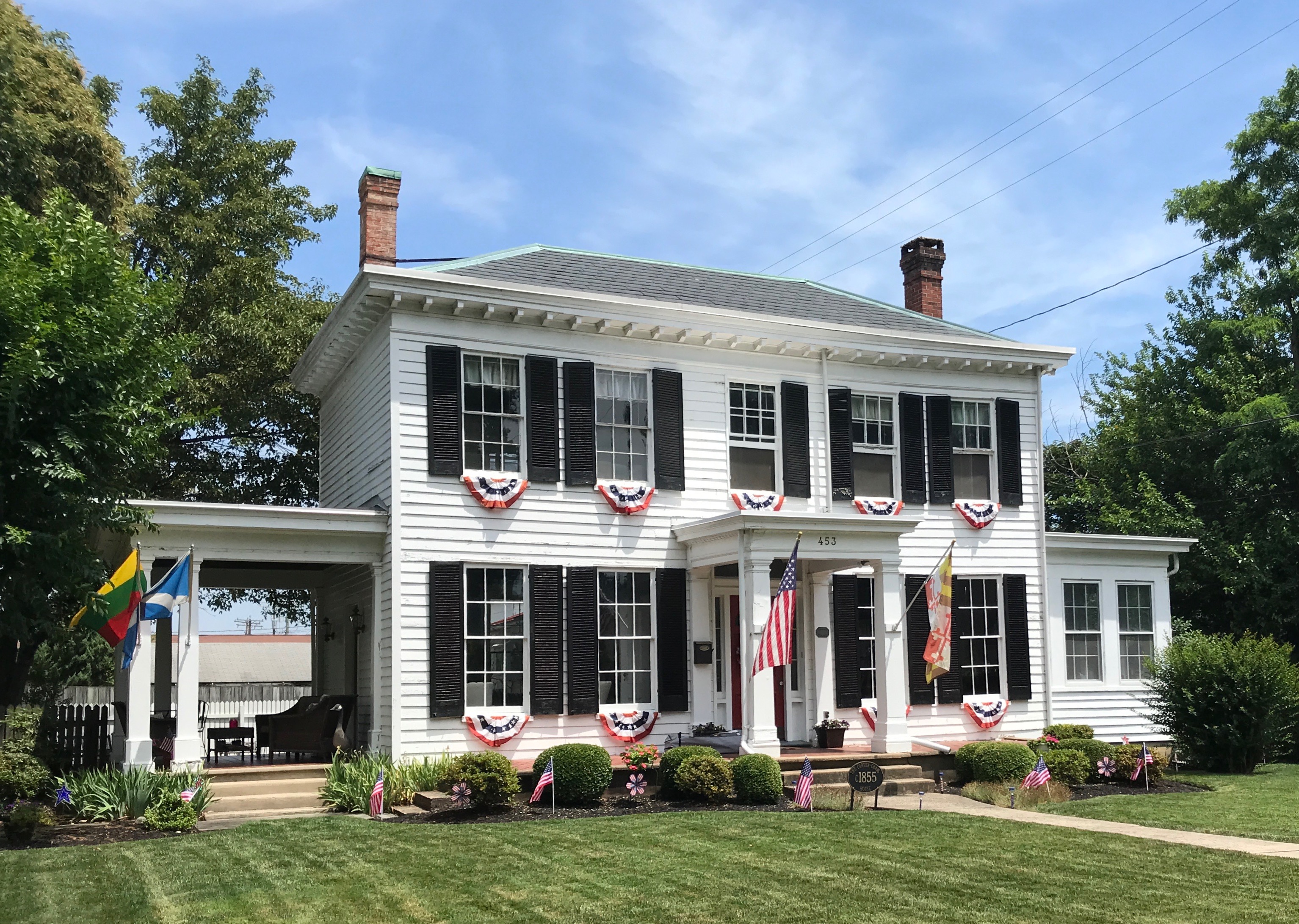
It is a combination of Greek revival and Italianate styles. It has a slate-covered hip roof with overhanding eaves and a bracketed cornice. A one-bay porch supported by square pillars protects the front entrance. The open porch on the west side and the enclosed porch on the east were added later.
Just in case you were curious, The windows are six feet tall with six-over-six lights. I wonder how much Windex they go through in a year?
On to stop number twenty.
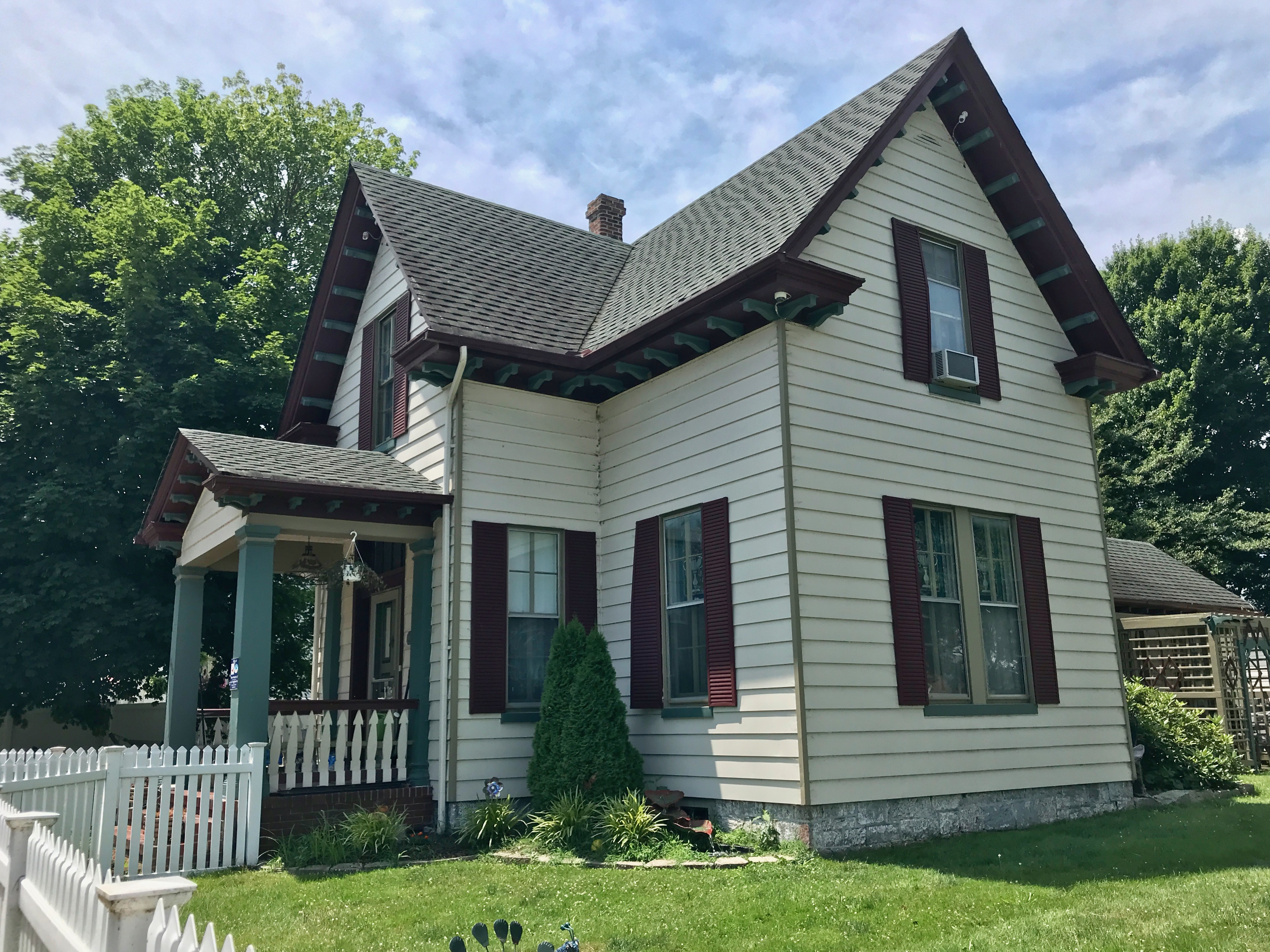
This is the Maslin House. It was built in 1860, and Maslin family members have lived in this home since its construction. Dick Maslin, the great-grandfather of the current owner, was a Chesapeake Bay boat pilot. Another Maslin ancestor was a lock house tender who resided the Lock House.

The facade of this frame cottage is unusual because it is built in the shape of a Greek cross. The four-over-four double-hung windows are original, in service for over 150 years.

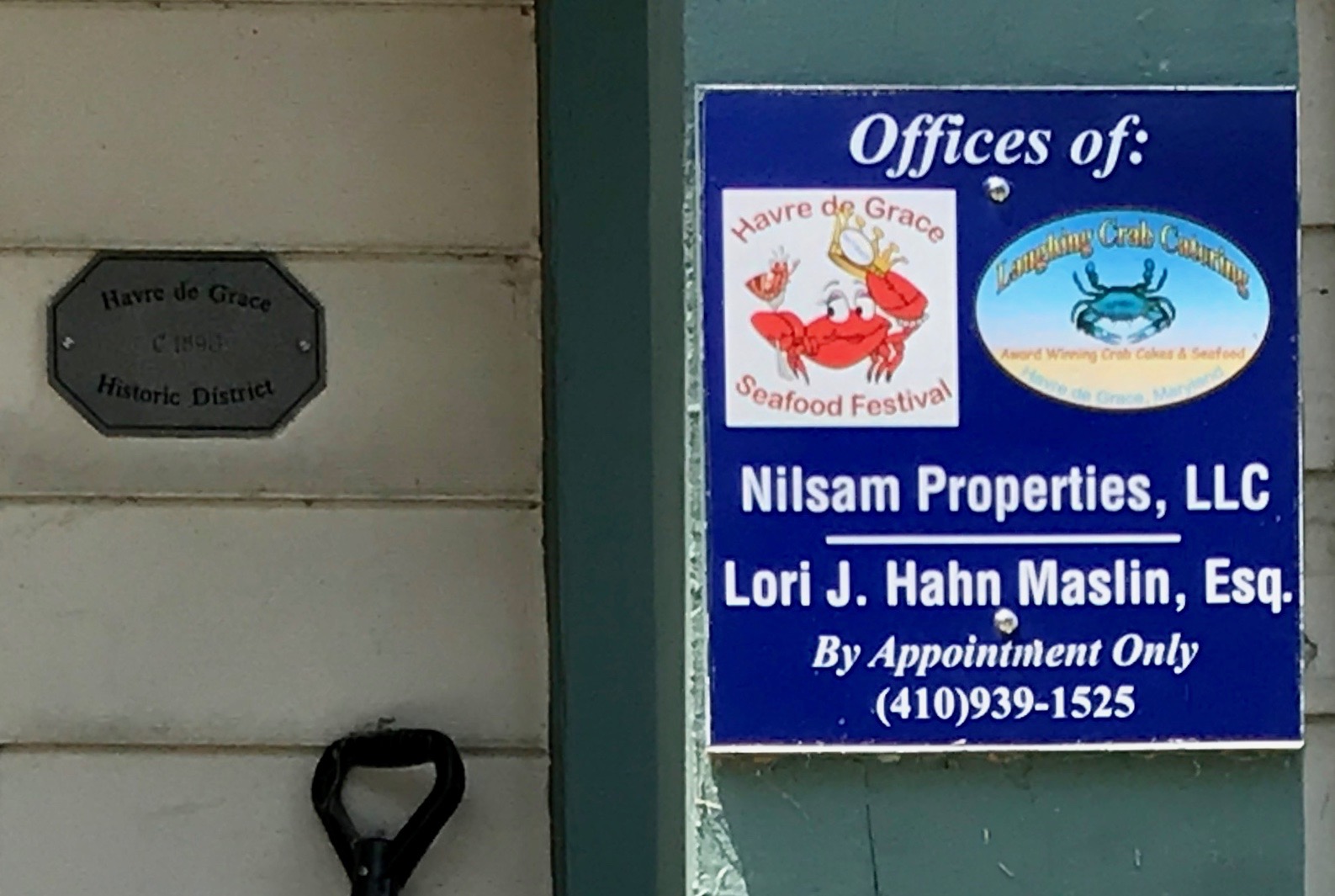
I spotted this sign on the house.
This car was parked in front of it.
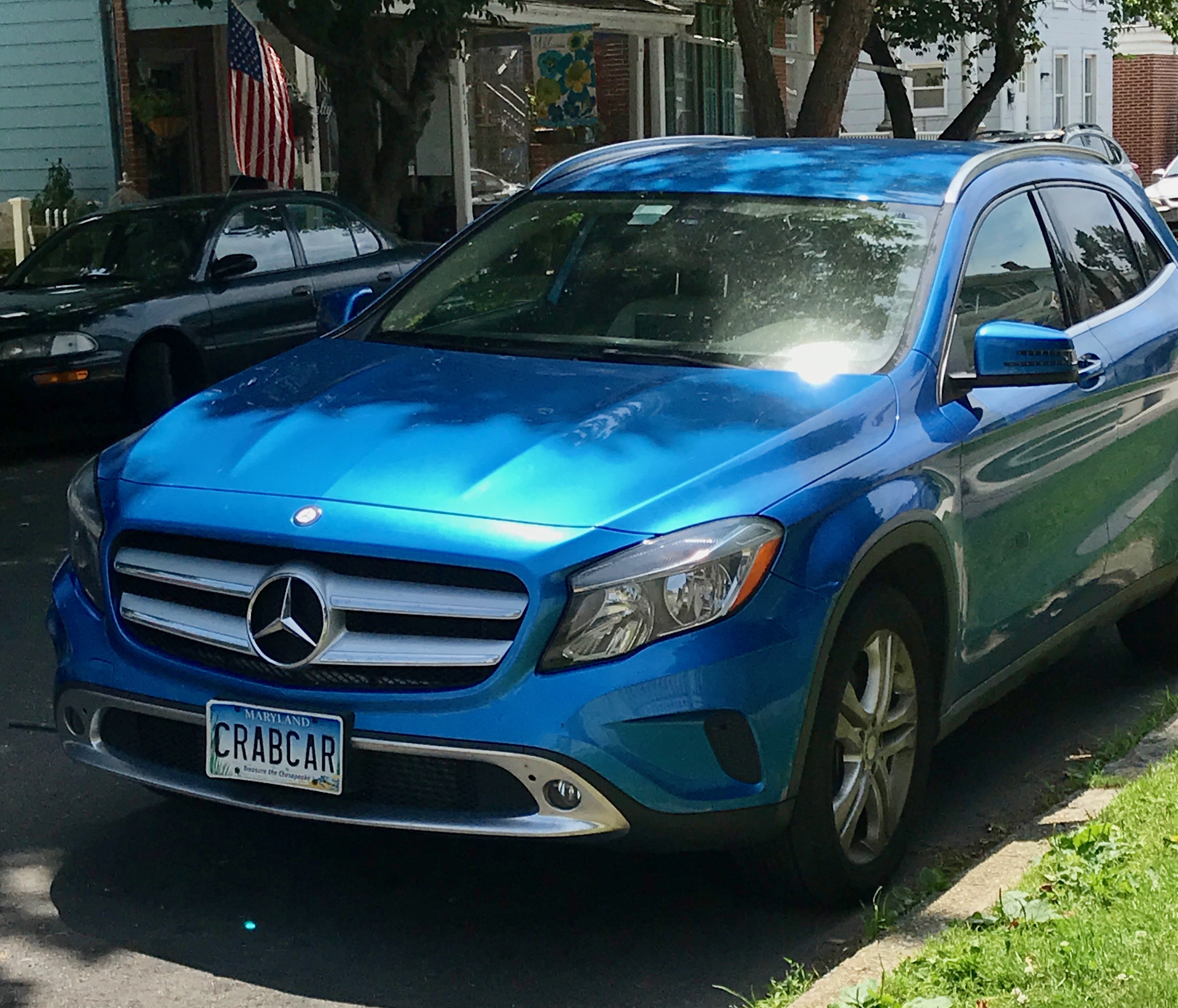
I particularly enjoyed the license plate. “CRAB CAR”

By this time, my enthusiasm for this walking tour was flagging. It was hot and sunny. Sitting here, in cold, dreary Michigan, it seems odd to be complaining about a hot day – but there you have it. I’m sure it’ll be warm again here before you know it. (Knock on wood.)

But, after all, it was summer! It was supposed to be hot. I grabbed something to drink at one of the little shops and headed back to the car. I figured I’d drive to the farthest point on Lafayette Trail and check that out.

(Just in case you might be entertaining the idea that I actually remembered all that information about the buildings, I managed to find a copy of the walking tour on line. No memory cells were harmed in the writing of this post. At least not to this point.)

I set off in the direction of the Lock House, which was the farthest point on the trail, but got distracted by this view of the bridges.
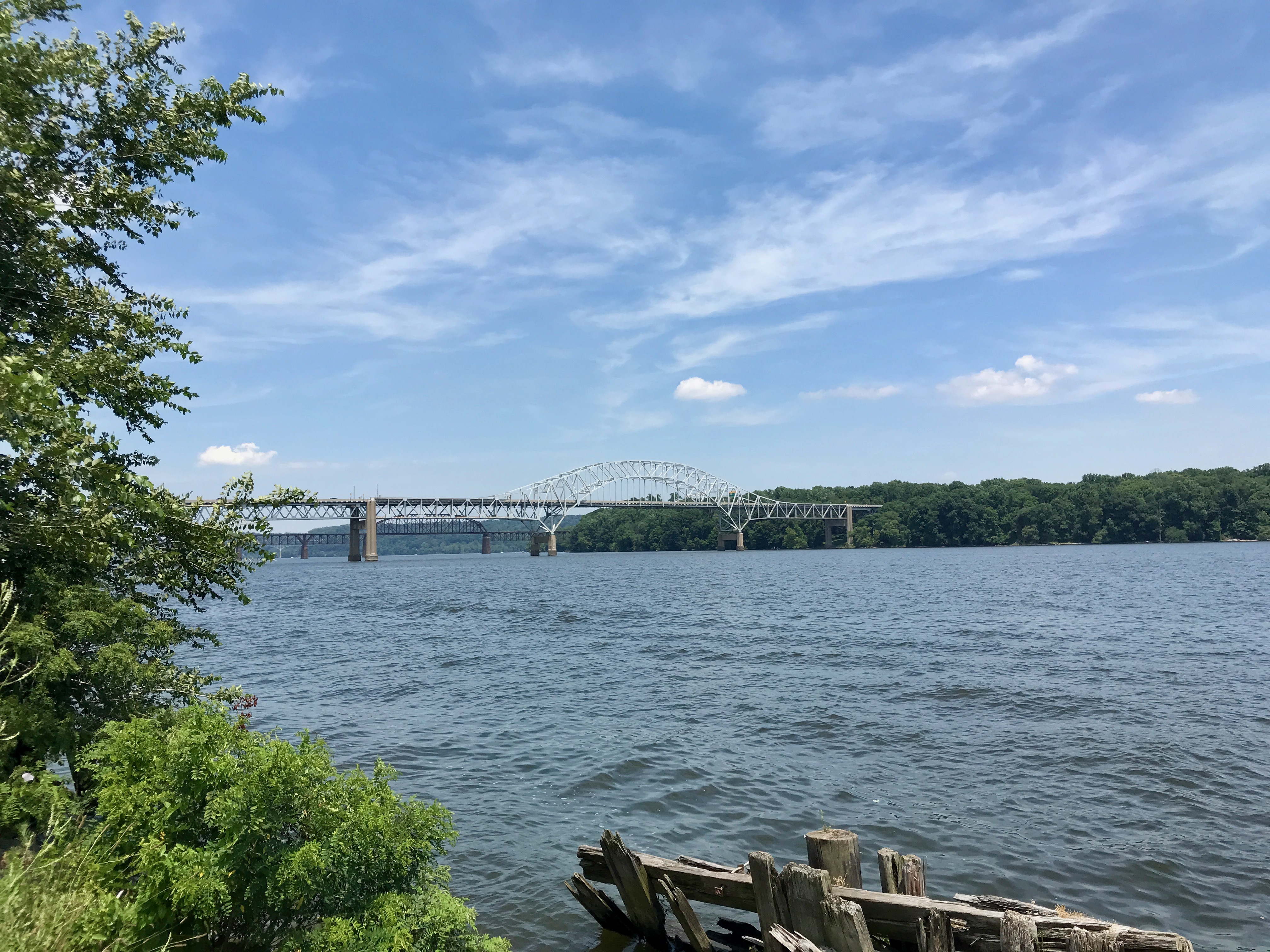
Luckily, there was a nice parking area to stop and look at them.
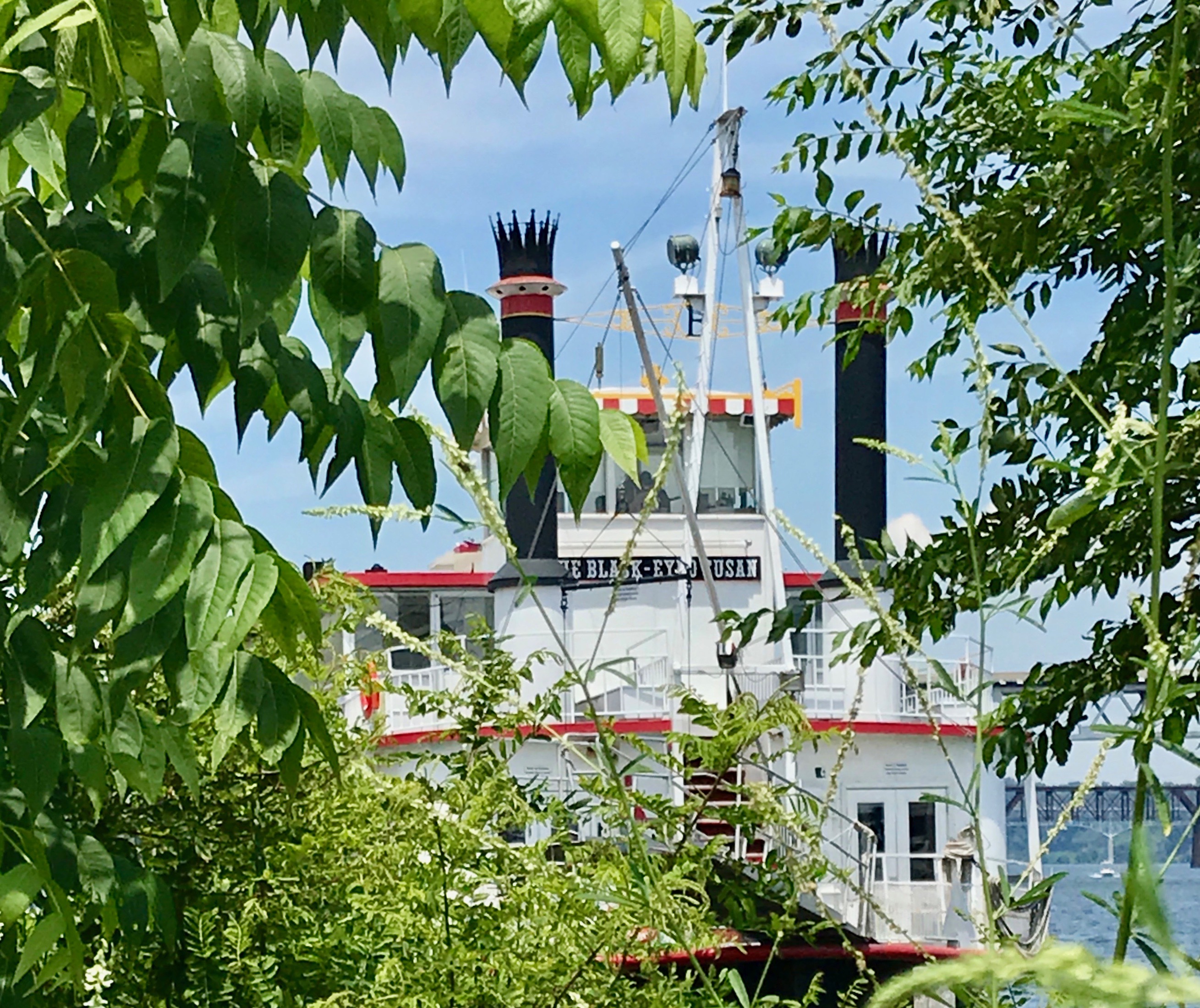
While looking through the branches, I saw this riverboat, named The Black-Eyed Susan. For those of you not familiar with the name, it is a common name for the flower, Rudbeckia hirta.

Black-eyed Susan

I continued along and eventually reached the Lock House.
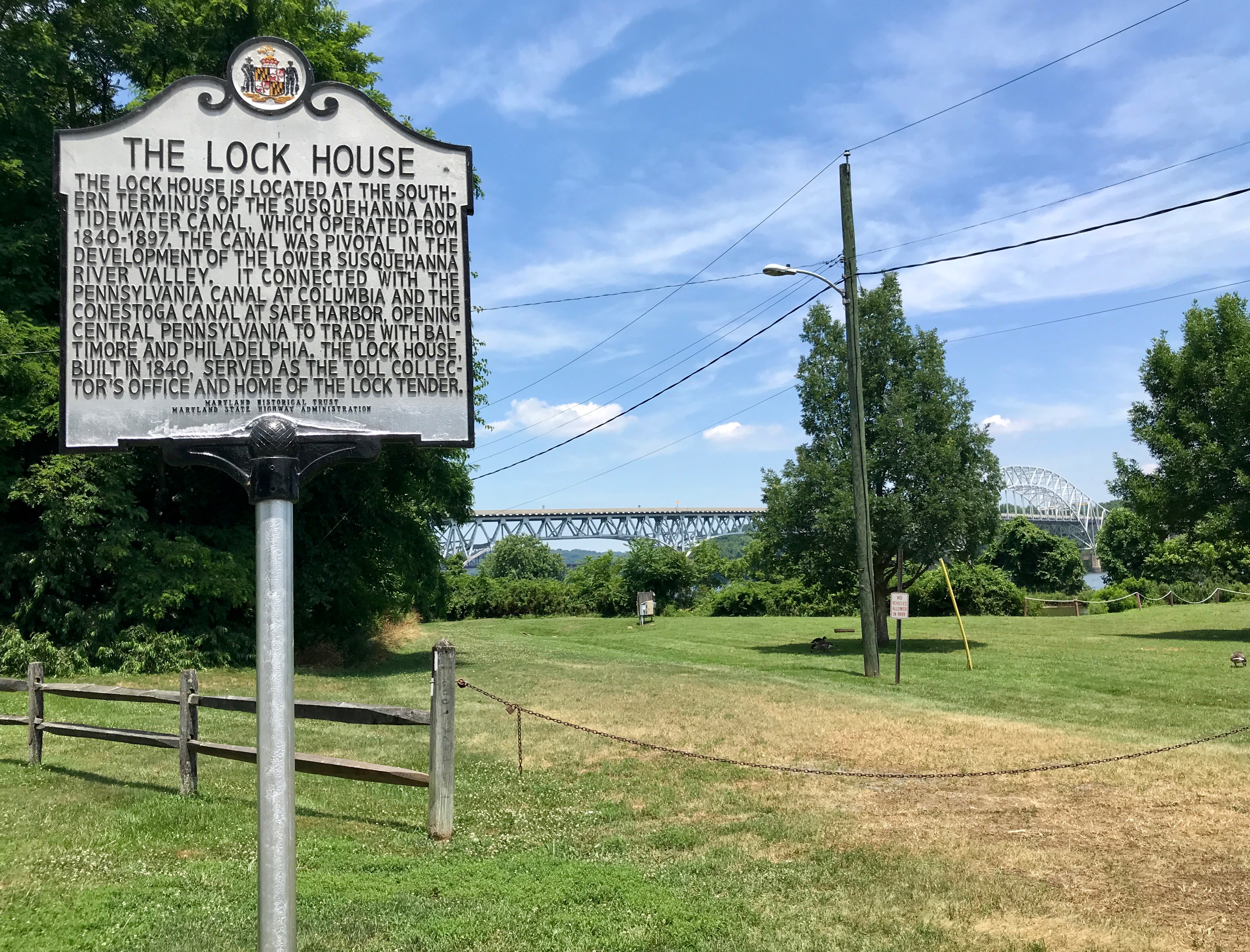
Hmm. There’s a sign. I wonder where the Lock House is? Well, it wouldn’t be the first time there was a sign for something that wasn’t there. But, I looked around and found a driveway that lead to The Lock House Museum.
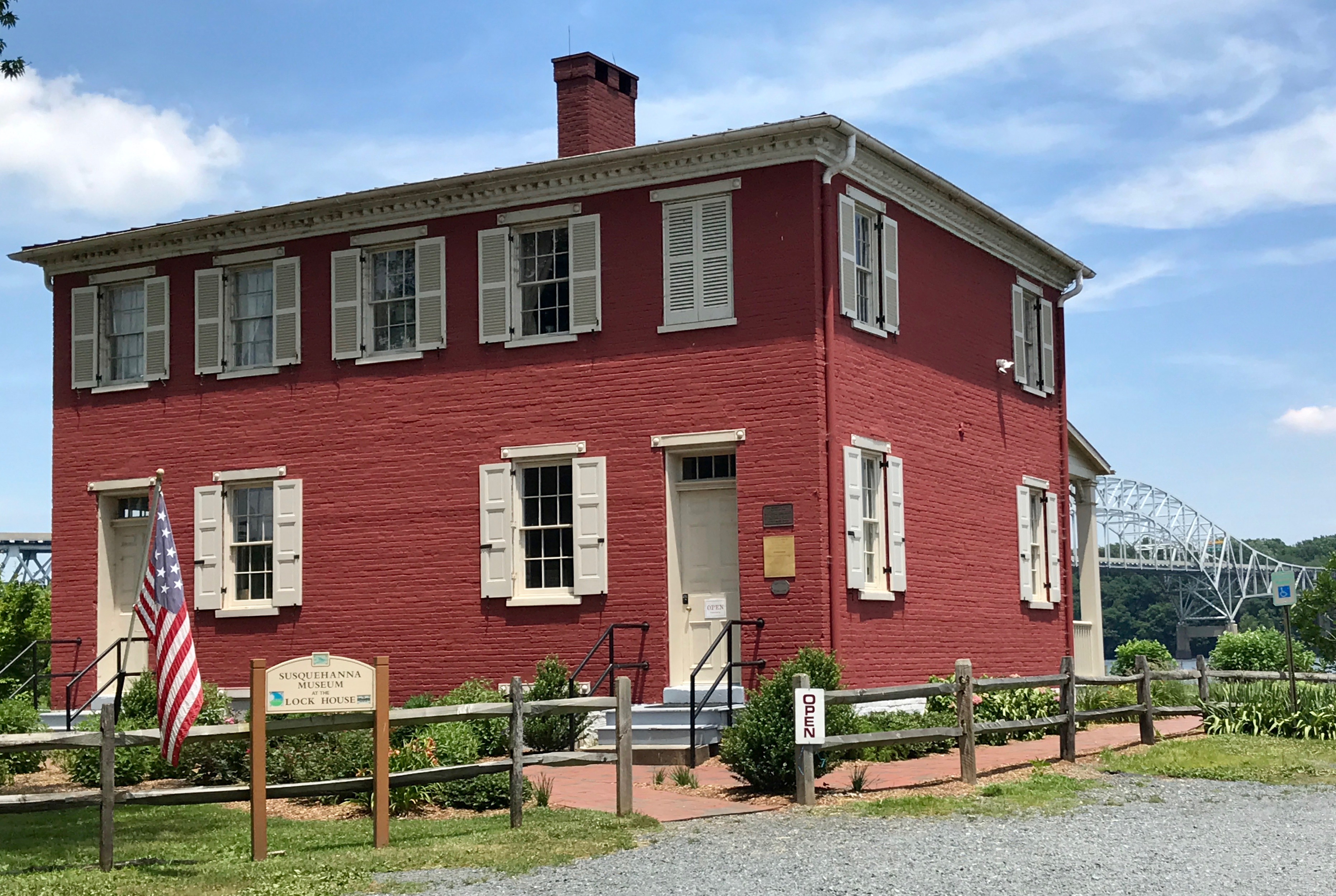
And it was OPEN!
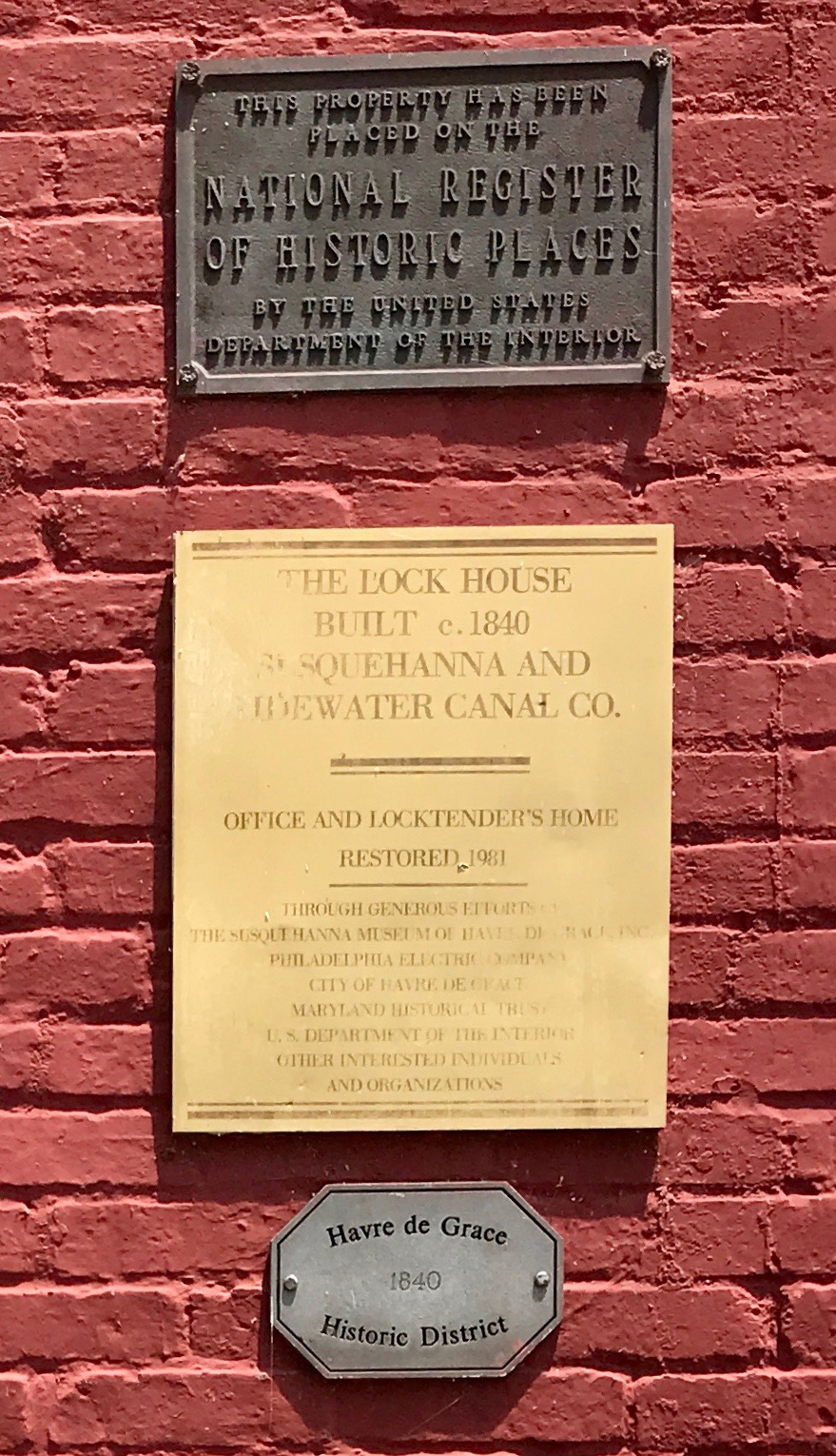
I walked up to the building and paused a moment to look at the signs that were by the door. I went inside and was met by Bill, who was a most able guide. He really had a passion for the canal, the lock and the Lock House.

The Lock House was built in 1840 and is situated on the western bank of the Susquehanna River, by the outlet lock for the Susquehanna and Tidewater Canal. The canal connected Wrightsville, Pennsylvania, 45 miles upstream, with the markets on the coast. Although the Susquehanna connected the two places, north of Havre de Grace it was too shallow and had too many boulders to navigate. I thought they might have dredged a channel along the shore, but Bill told me they dug a canal alongside the river. He took me into another room to demonstrate how the lock worked.
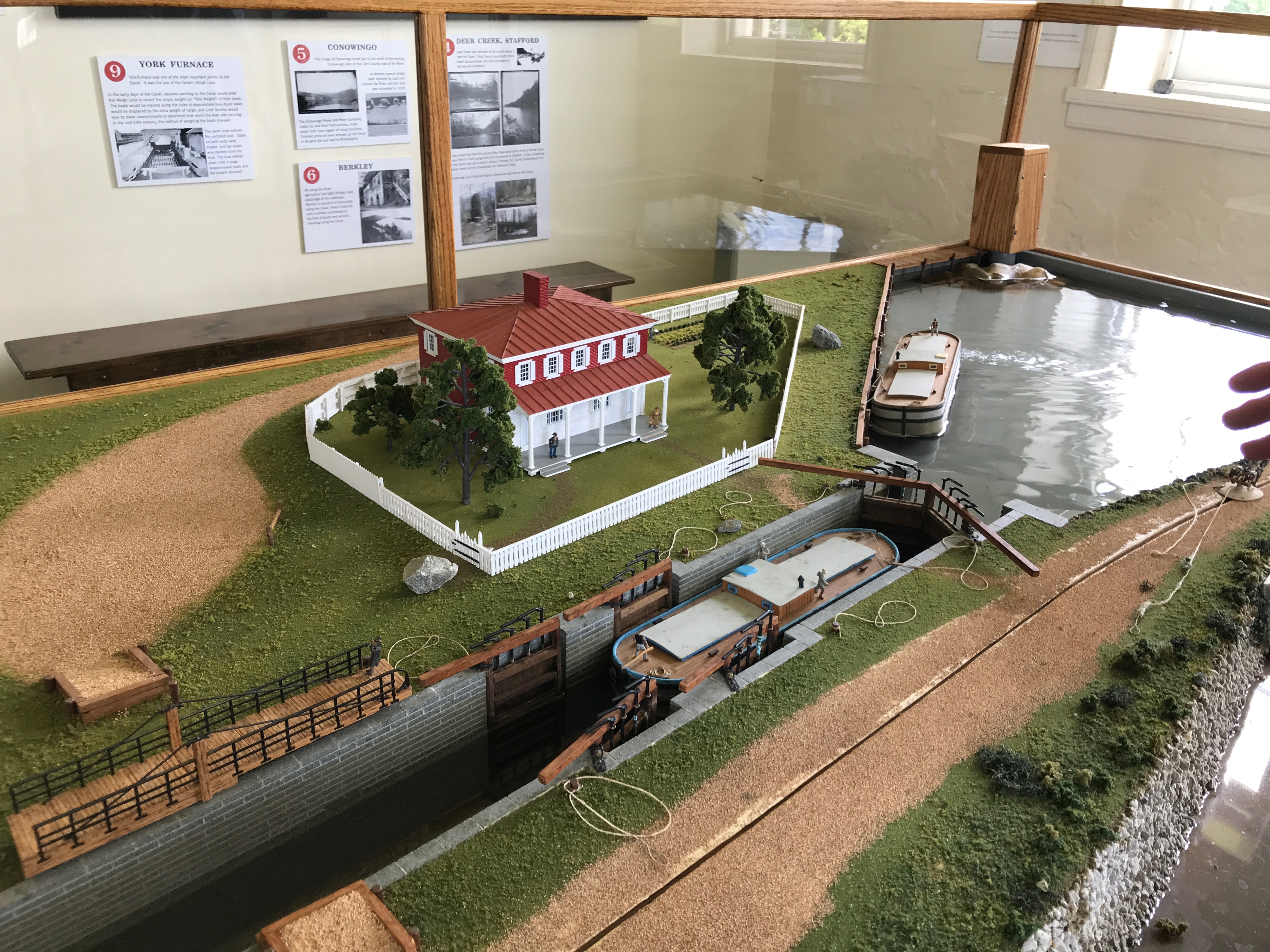
There were holding areas for boats waiting to go through the lock. There was only one lock, so they had to take turns coming and going.
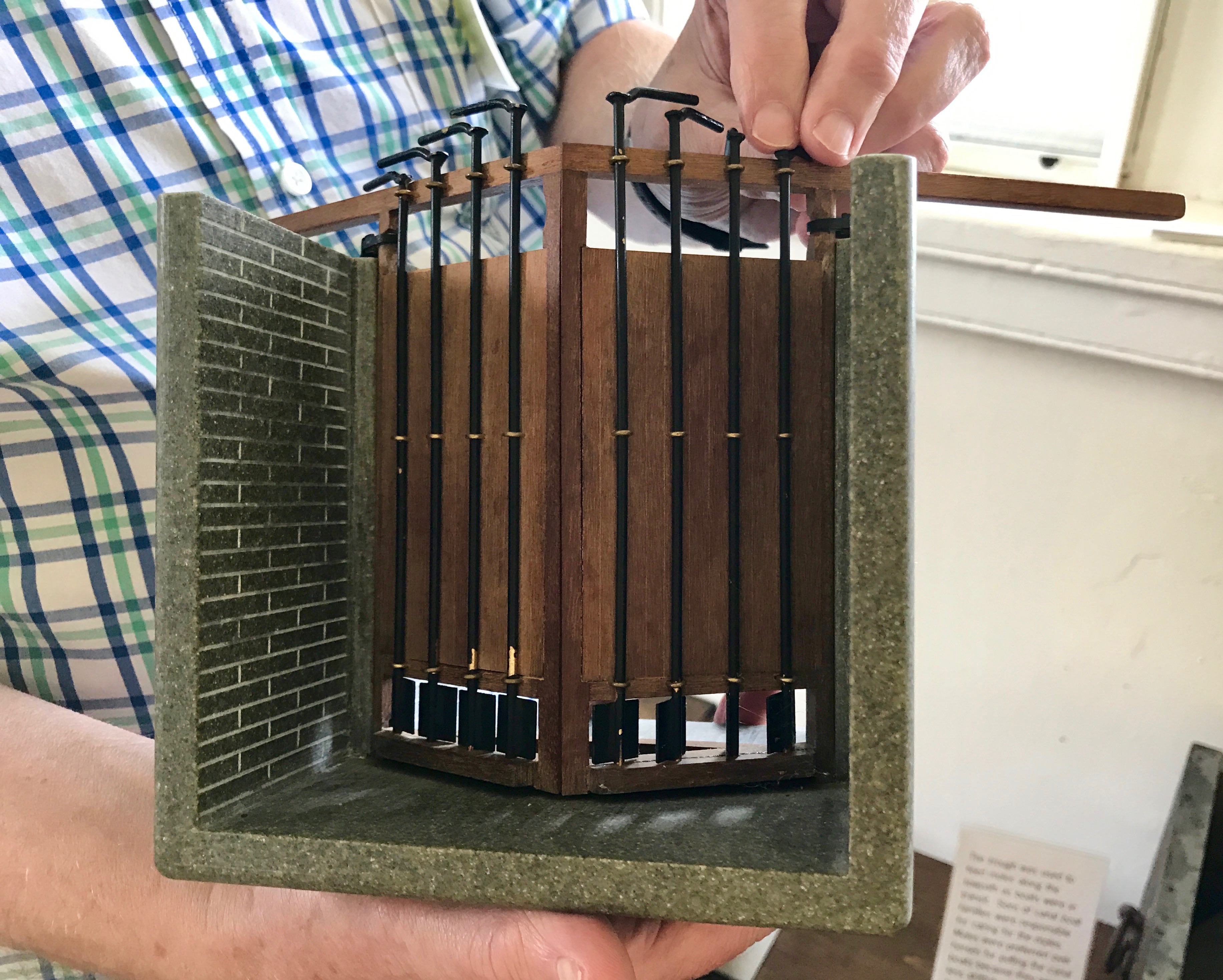
I was fascinated with this model of the gates. I always wondered how they managed to let the water out to lower the boats. There are little doors at the bottom of the gates that are opened with the handles on the tops. I wonder if people had to walk out on the top of the gates to operate them or did they use long poles or some other means to move the levers? I was just so amazed at the model that I didn’t ask enough questions.
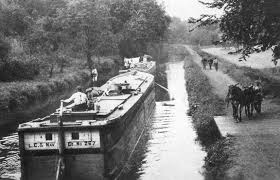
I tried to take a photo of the photos of the canal boats in the museum, but they were framed under glass. Try as I might, I couldn’t find an angle without glare. I am including this photo to illustrate what the boats looked like.

The boats on this canal were freighters and they carried primarily coal. They were typically 60 to 70 feet long and 15 to 16 feet wide. Each boat could carry up to 150 tons of raw materials and they were pulled by mules.

The mules were often stabled on the boats, as the narrow Susquehanna Valley provided few pastures. The mules lived forward and the canal boat captain and his family lived in small quarters in the rear of the boat.
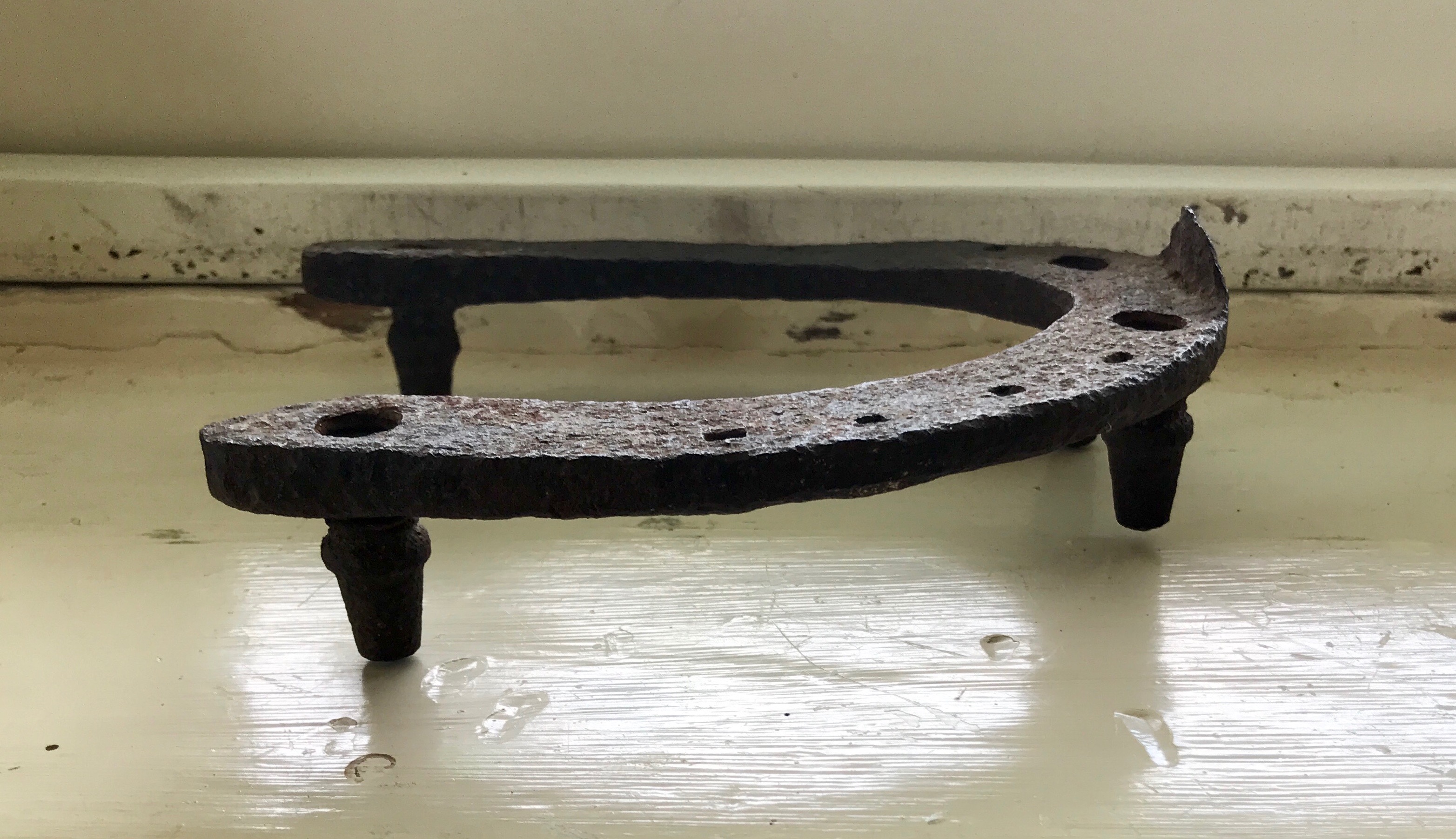
Good shoes are important for doing good work.
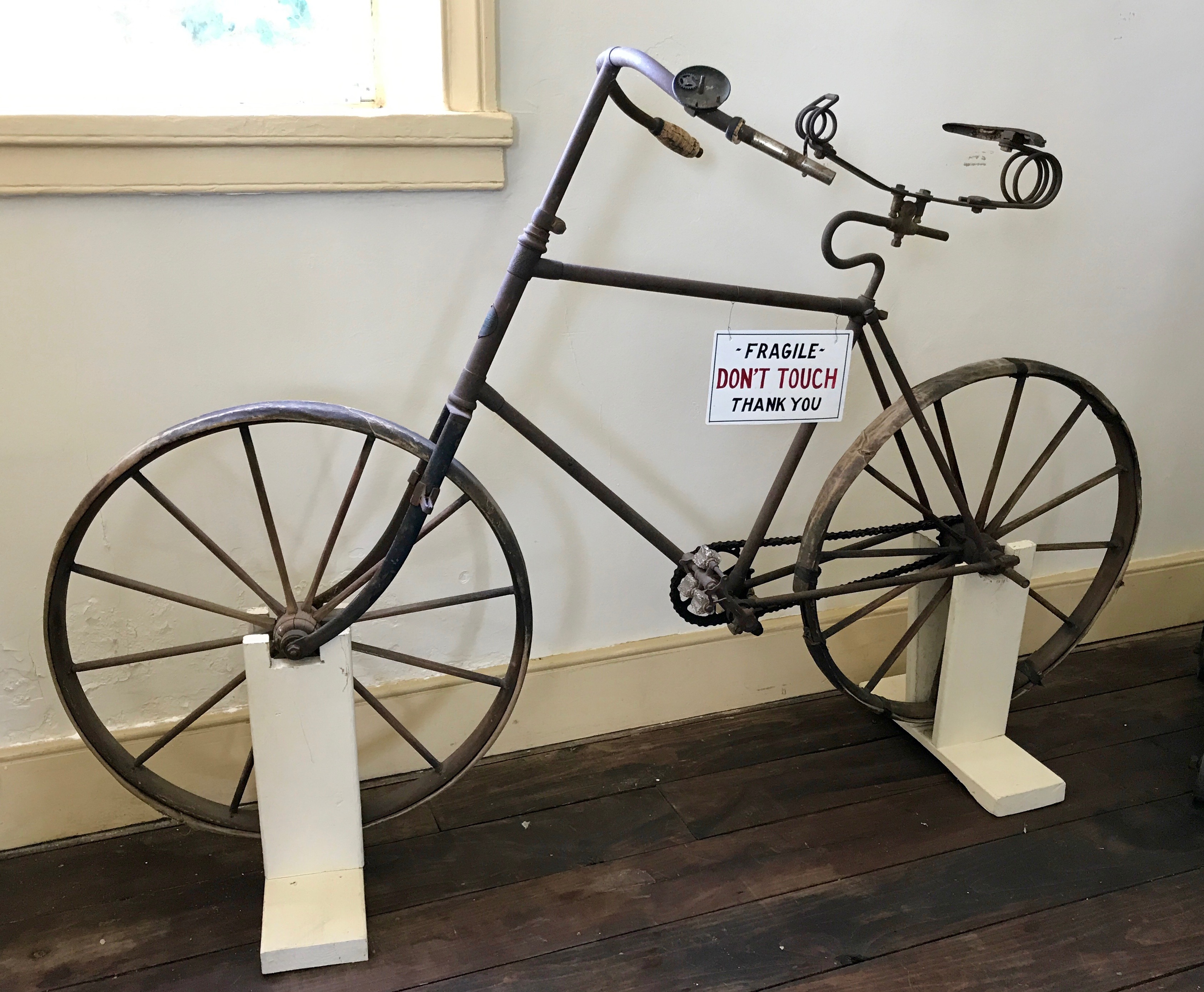
There were a number of items in the museum that were included to show what life was like for the lock tenders.

This bicycle is said to have been owned by Carville Maslin’s son and is reputed to have been riden to Baltimore from Havre de Grace. Patented in in 1866, this model had inflatable tires and wooden wheels. That sounds pretty modern, but the only braking power came from the feet being pressed on the ground or on the font wheel. According to the informational sign, the bicycle cost $100 at a time when the Lock Tender made less than $1000 per year.
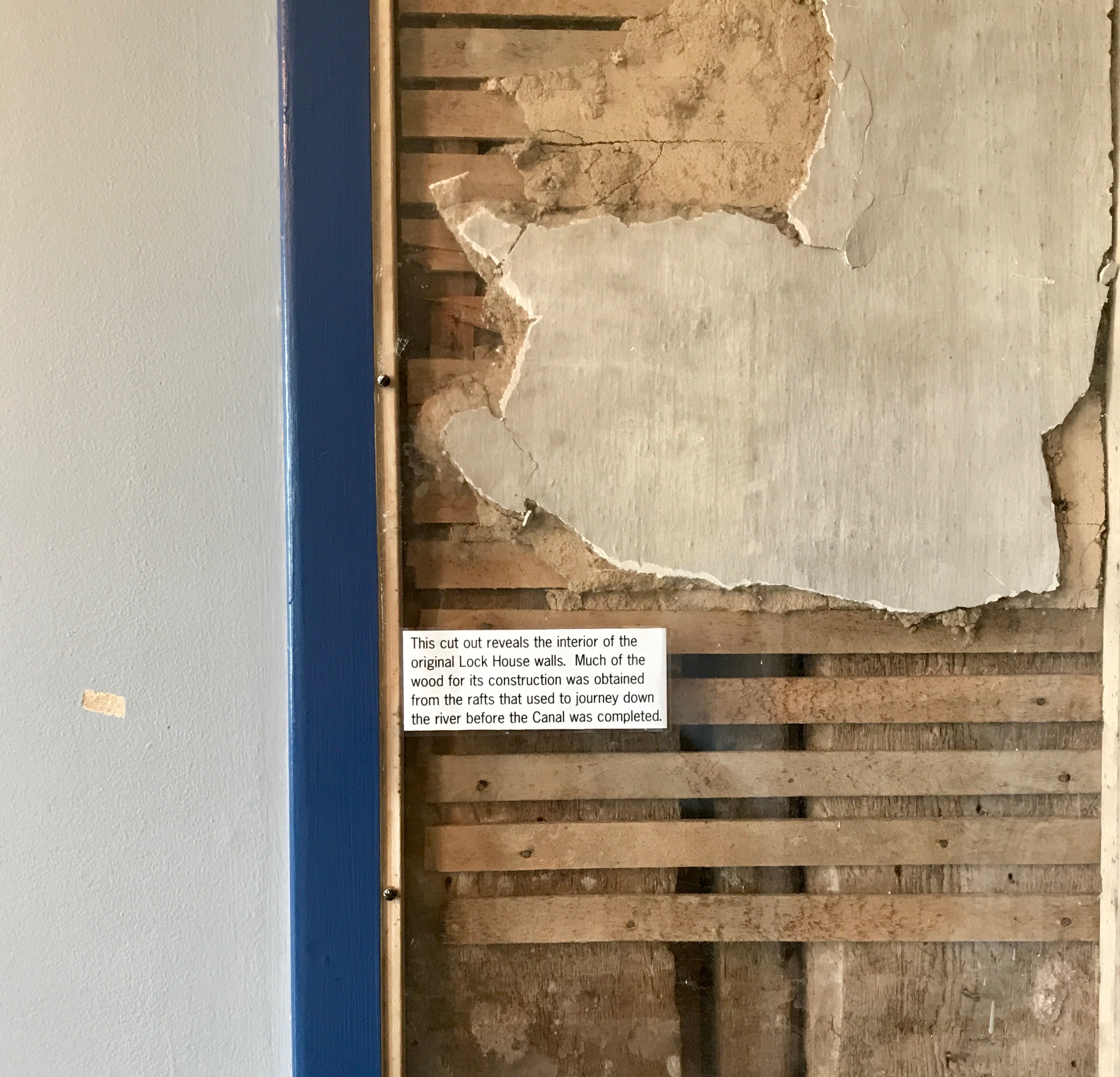
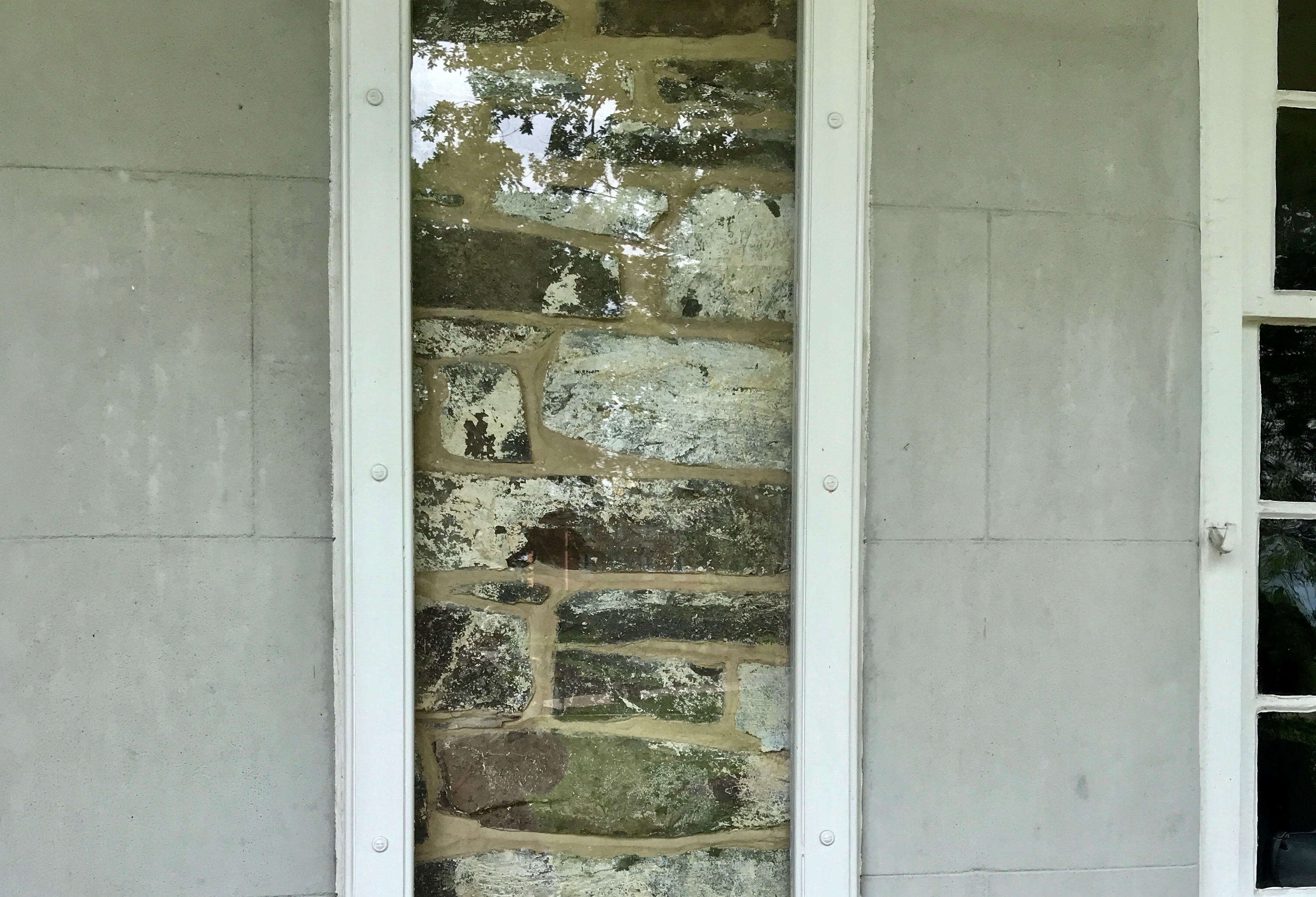
When the Lock House was restored in 1981, they left this “truth window” so you could see the construction of the original building. After more than 140 years and  close to 100 years after the canal ceased operation, I imagine it was due for restoration.

We continued upstairs for a few more exhibits.
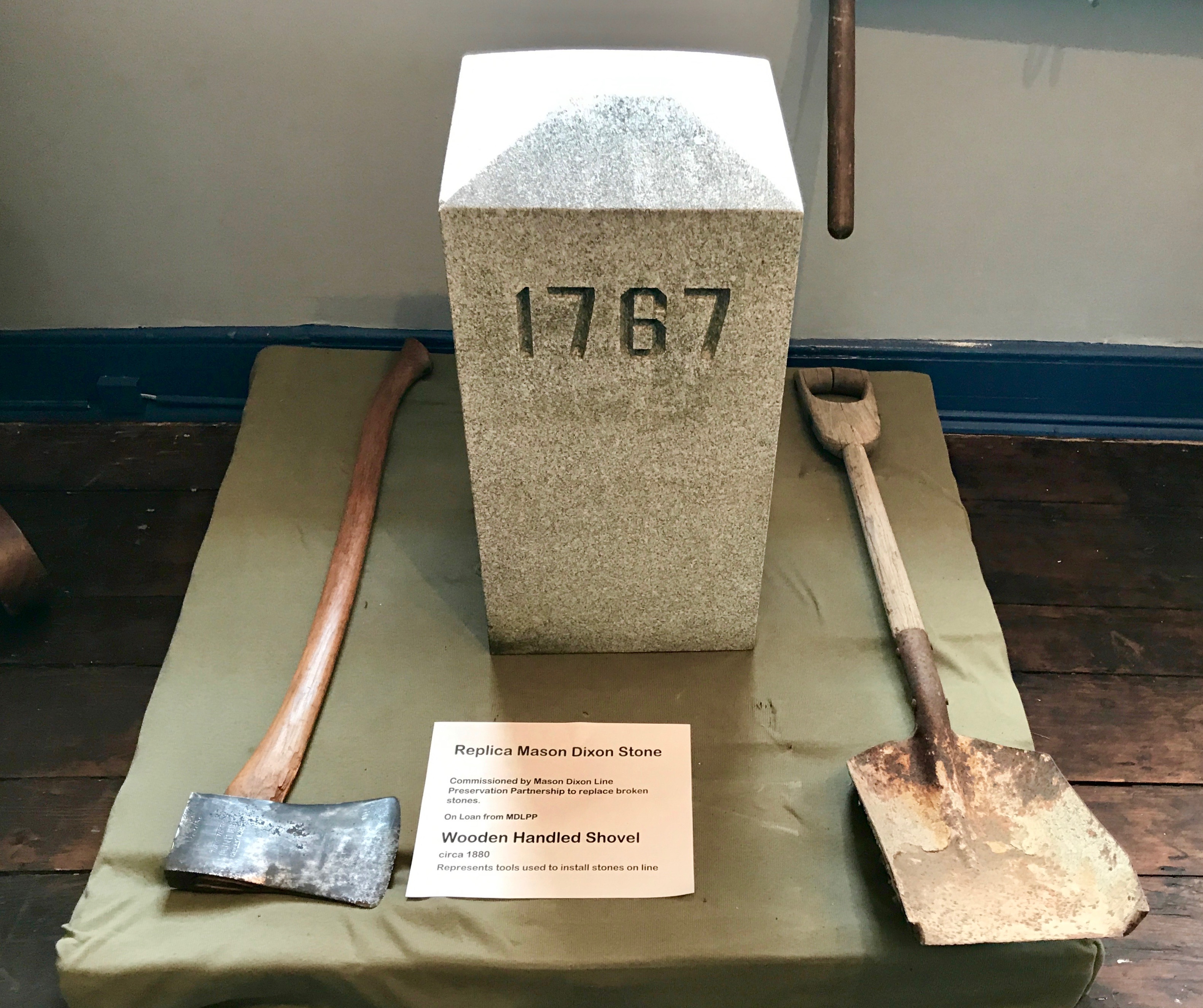
This is a replica of one of the stones placed along the Mason Dixon Line. The line was established to resolve a border dispute involving Maryland, Pennsylvania and Delaware.
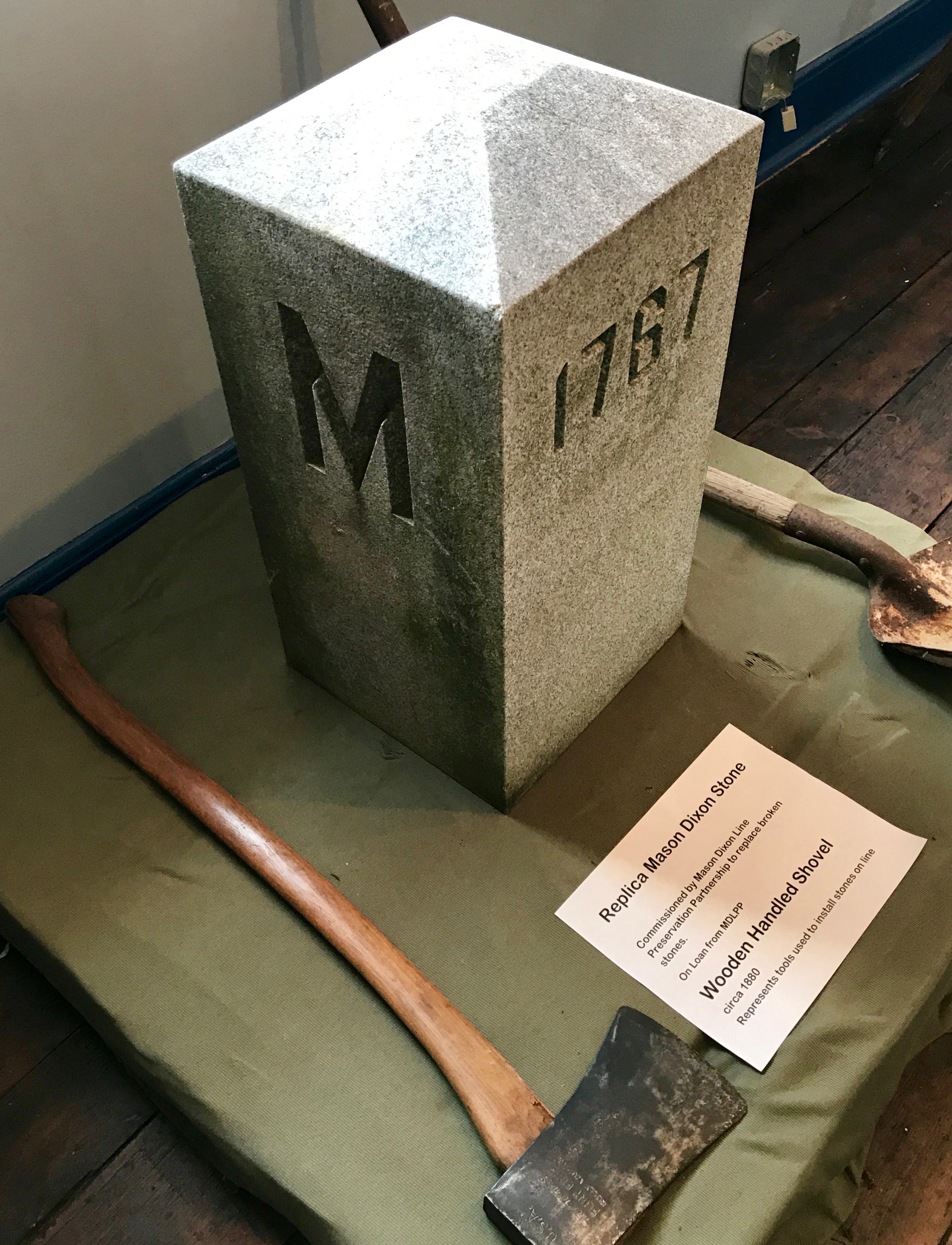
This side is Maryland.
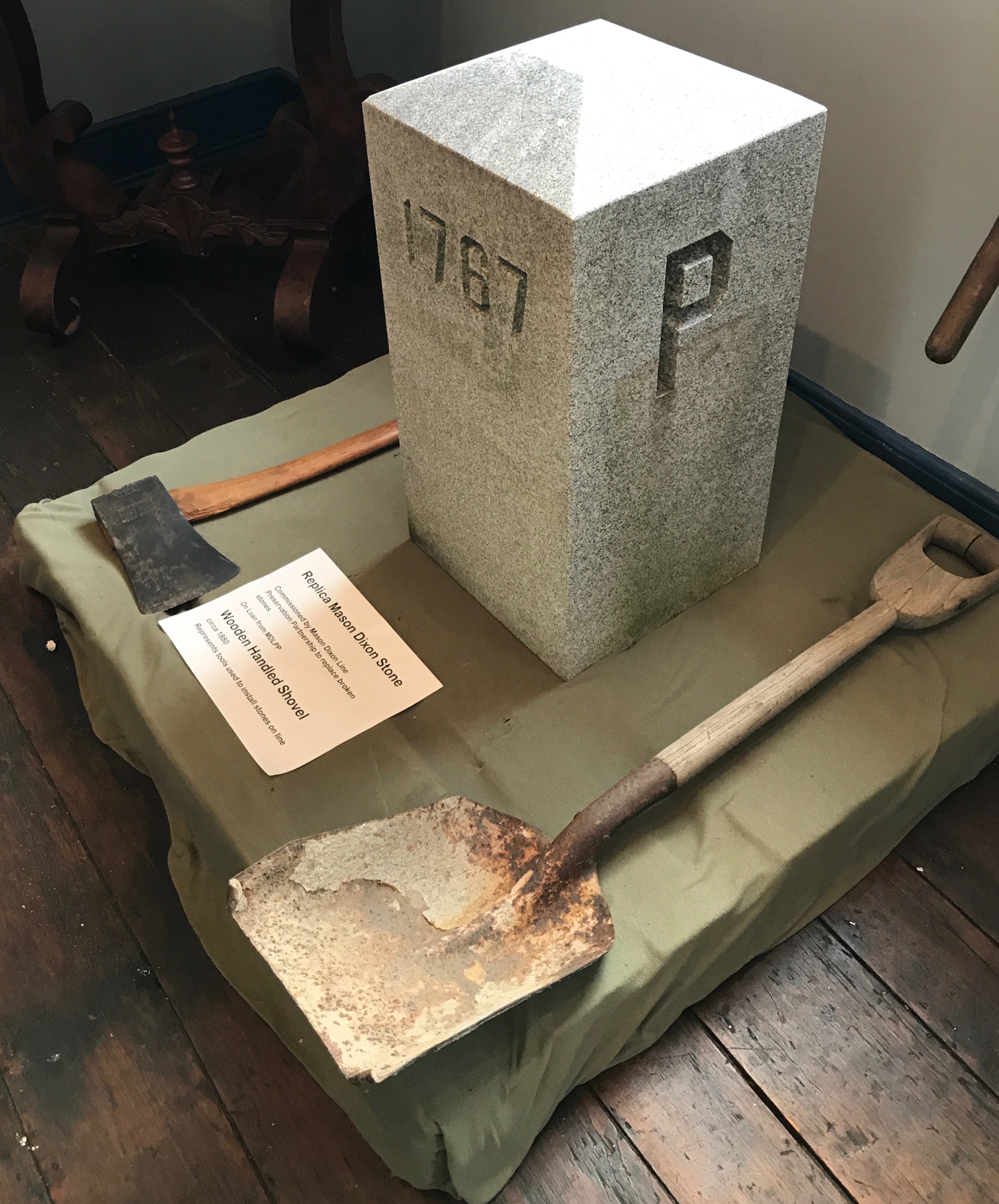
This side is Pennsylvania.

The work was directed by Charles Mason and Jeremiah Dixon, and they surveyed the line between 1763 and 1767. My tour guide, Bill, had an ancestor that worked on the project as a laborer. Bill said that the bosses – presumably Mason or Dixon or one of their underlings – would come by and indicate the direction the axmen were to go, and the workers would commence felling trees. They had to clear a “visto” 8 – 9 yards wide. Every now and then, the bosses would come by to course correct, and then they might have to recut the line a little further one way or the other.

I was amazed to meet a descendant of one of the people who helped create one of the more evocative and provocative borders in America’s history. When I shook his hand, it was like I was holding hands with history.
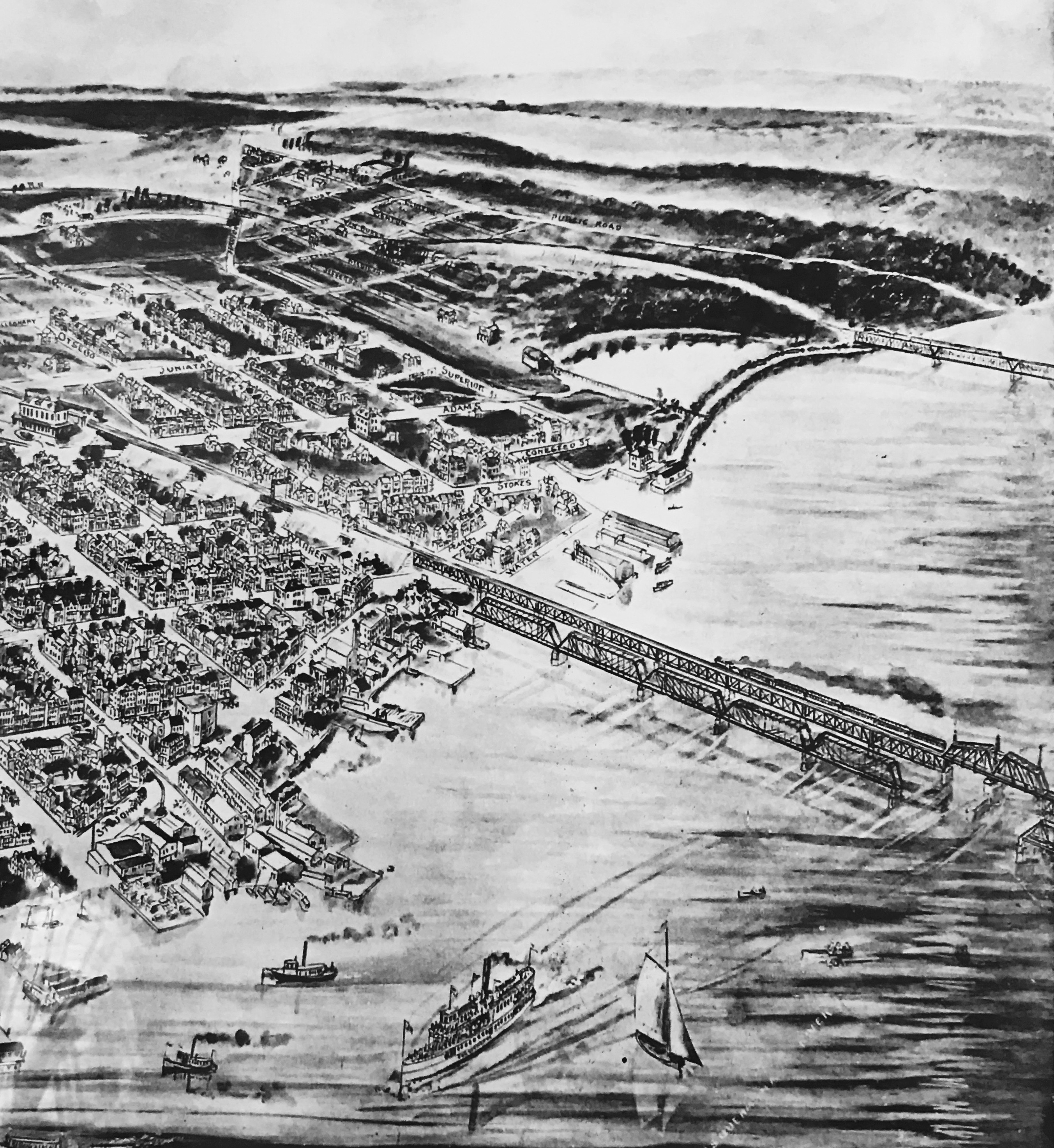
This “birds eye view” of Havre de Grace was made in 1909. Look at all the modes of transportation! You can still see the Lock House and the final lock of the canal, even though it ceased operation in 1894.
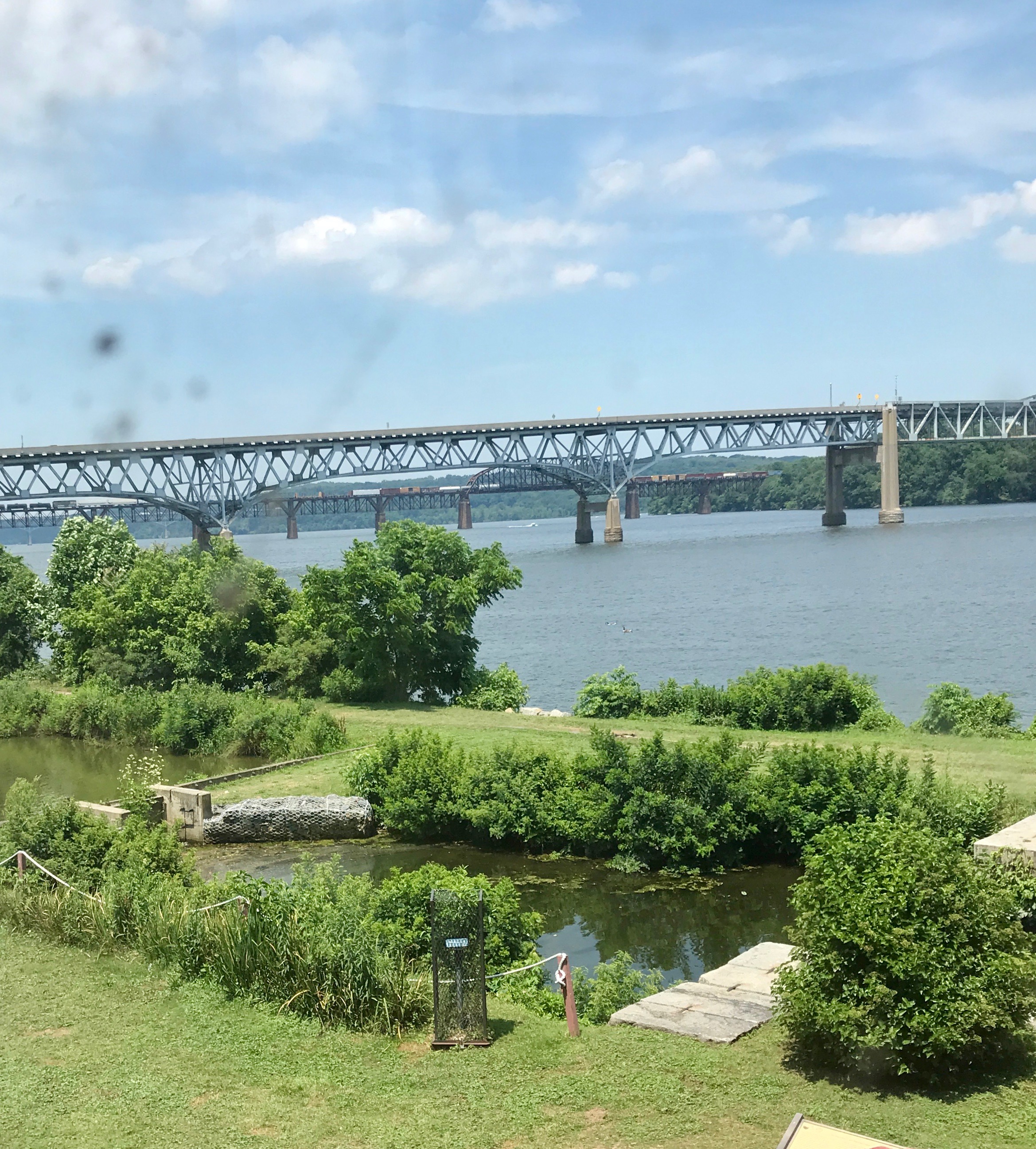
I took a look out of the upstairs window and decided it was time to go see the lock itself. I thanked Bill and headed outside.
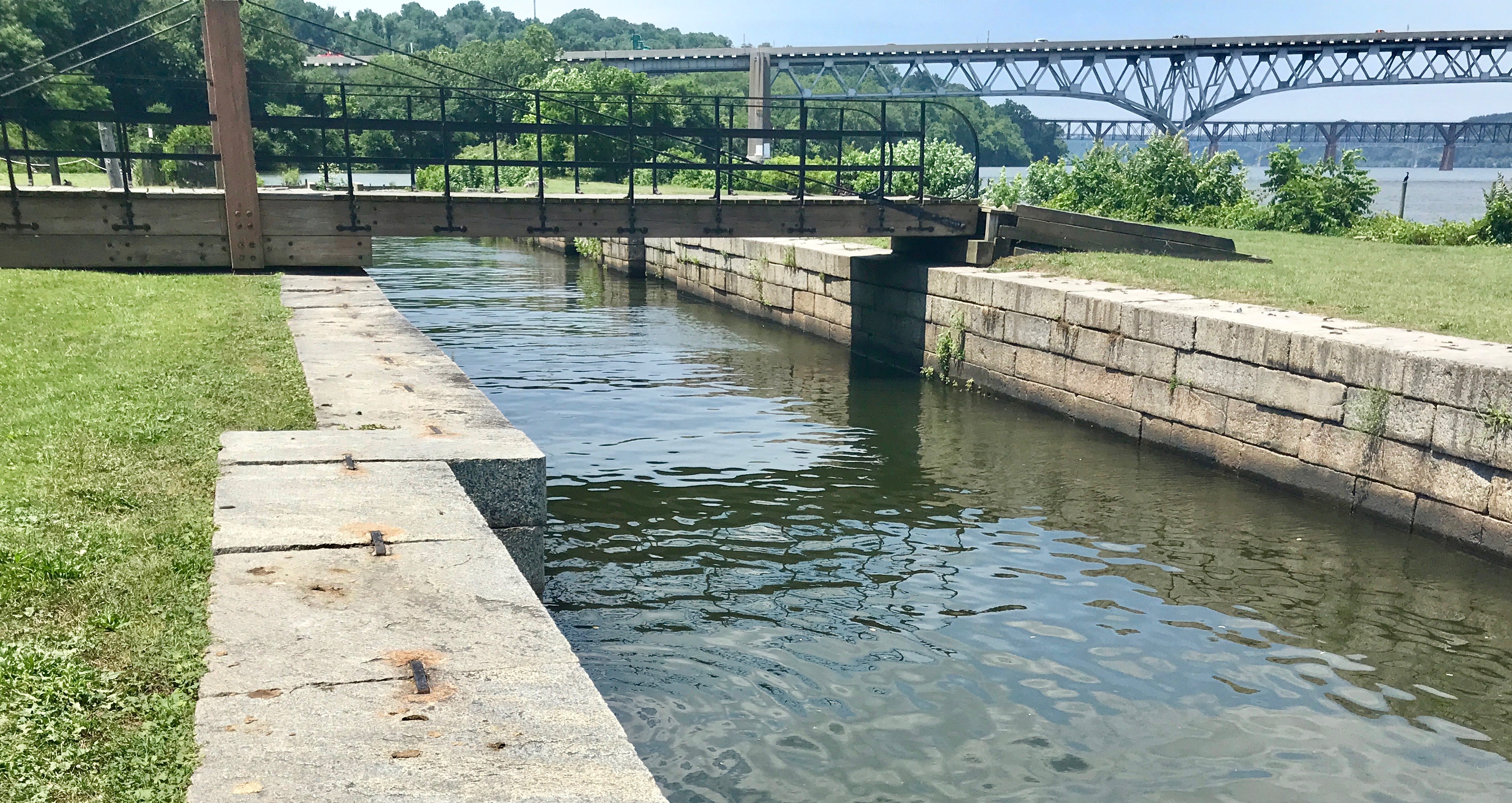
In the late 1980s, the lock was de-silted and the remnants of the original gates were removed. The granite walls were stabilized and straightened.
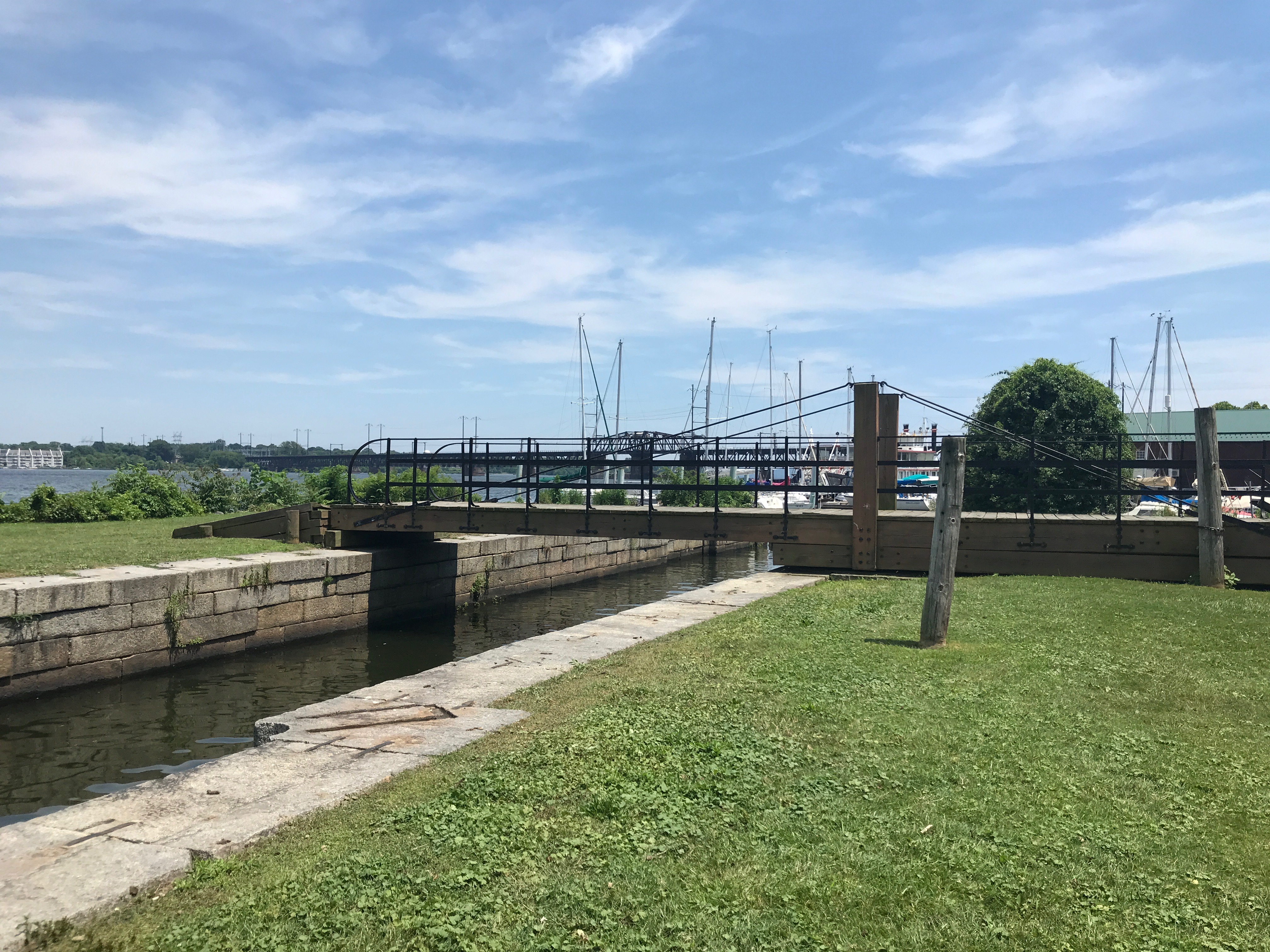
The bridge across the canal could pivot. This made it possible for people, wagons and mules to cross to the towpath and wharves on the riverside.
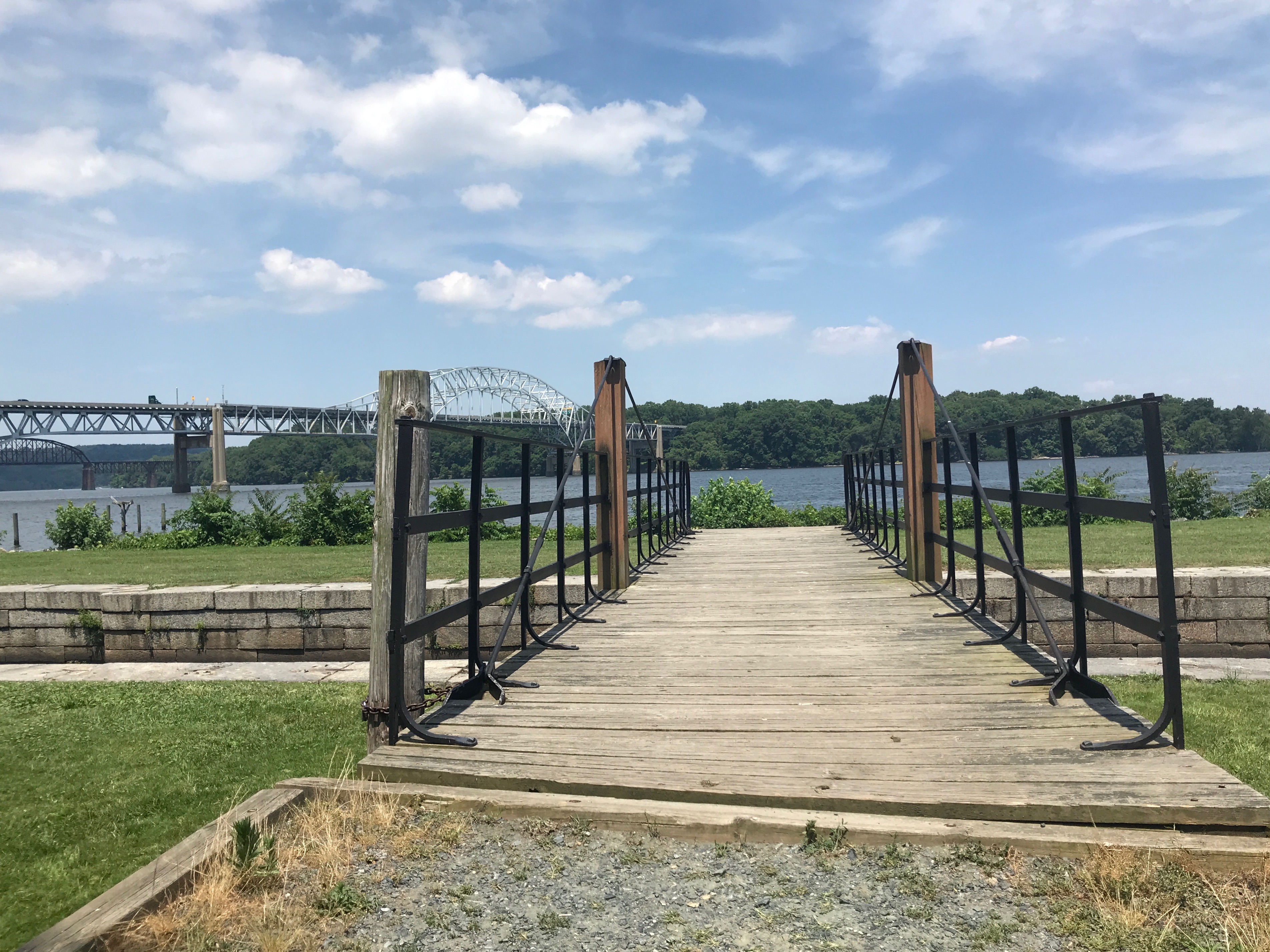
When the bridge wasn’t being used, it was swung away so that the boats could pass through the locks.
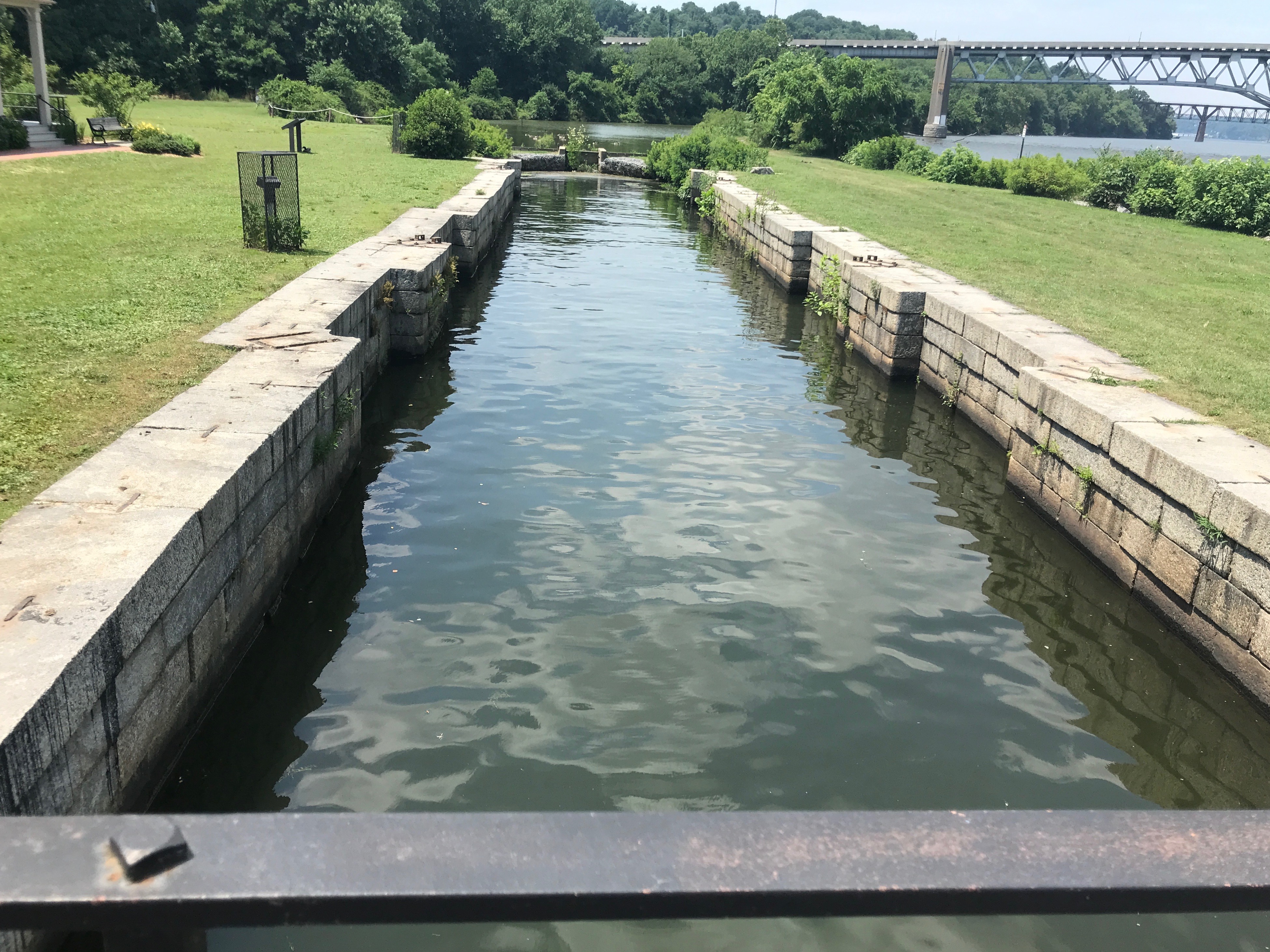
It’s amazing to look down the canal lock toward the automobile bridge and the rail bridge. Transportation is so interesting.
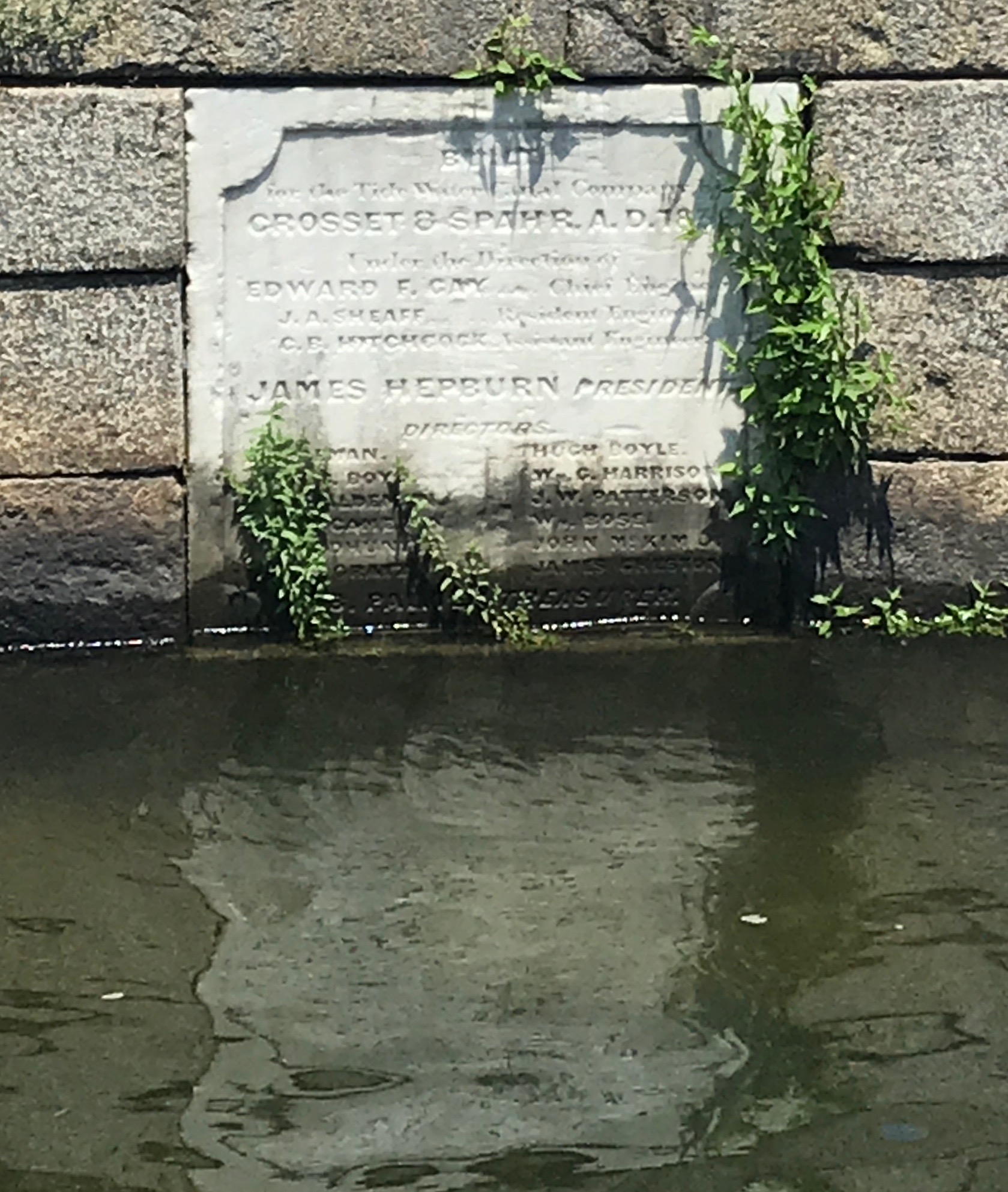
People have the need to put their names on things. 
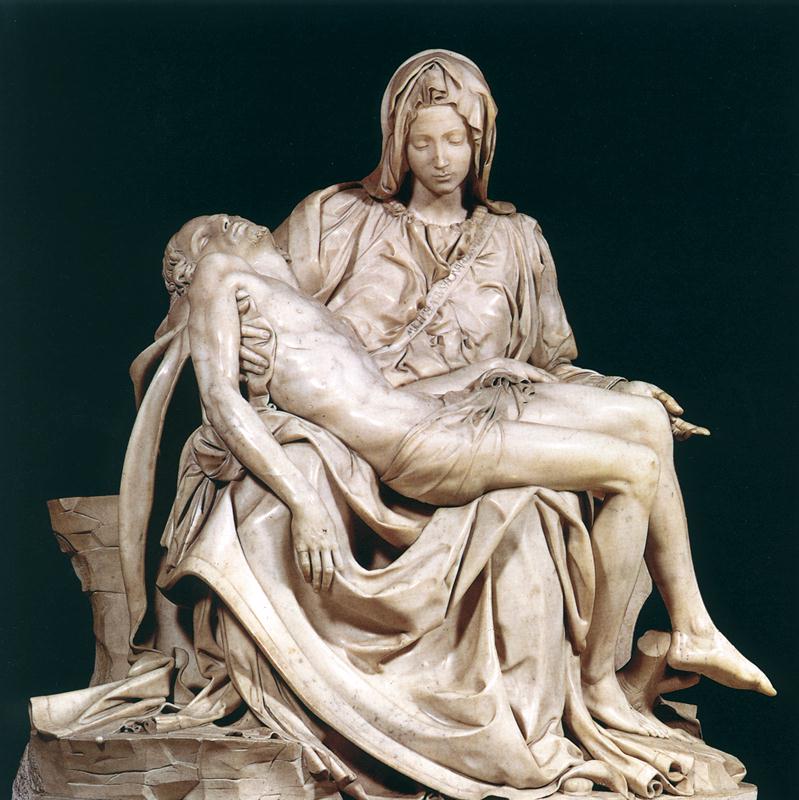
Which reminds me of Michelangelo’s Pieta.  The story is that after he had finished the Pieta, he overheard some men from Milan saying that it was the work of another sculptor. Well, he wasn’t having any of that! He thought it was one of the best statues ever carved and he wanted credit for it. So that night he went into the church with his hammer and chisels and candles and carved his name in big letters on the Virgin.
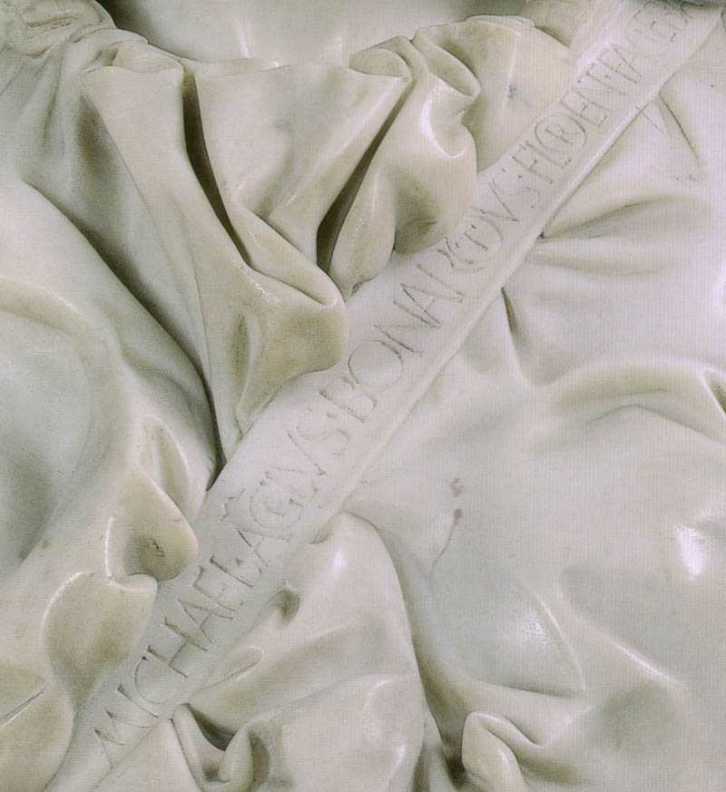
It reads: Michaelangelus Bonarotus Florent(inus) Facieba. (Michaelangelo Buonarroti made this.)

Once again, thank you, Sister Jeanne!
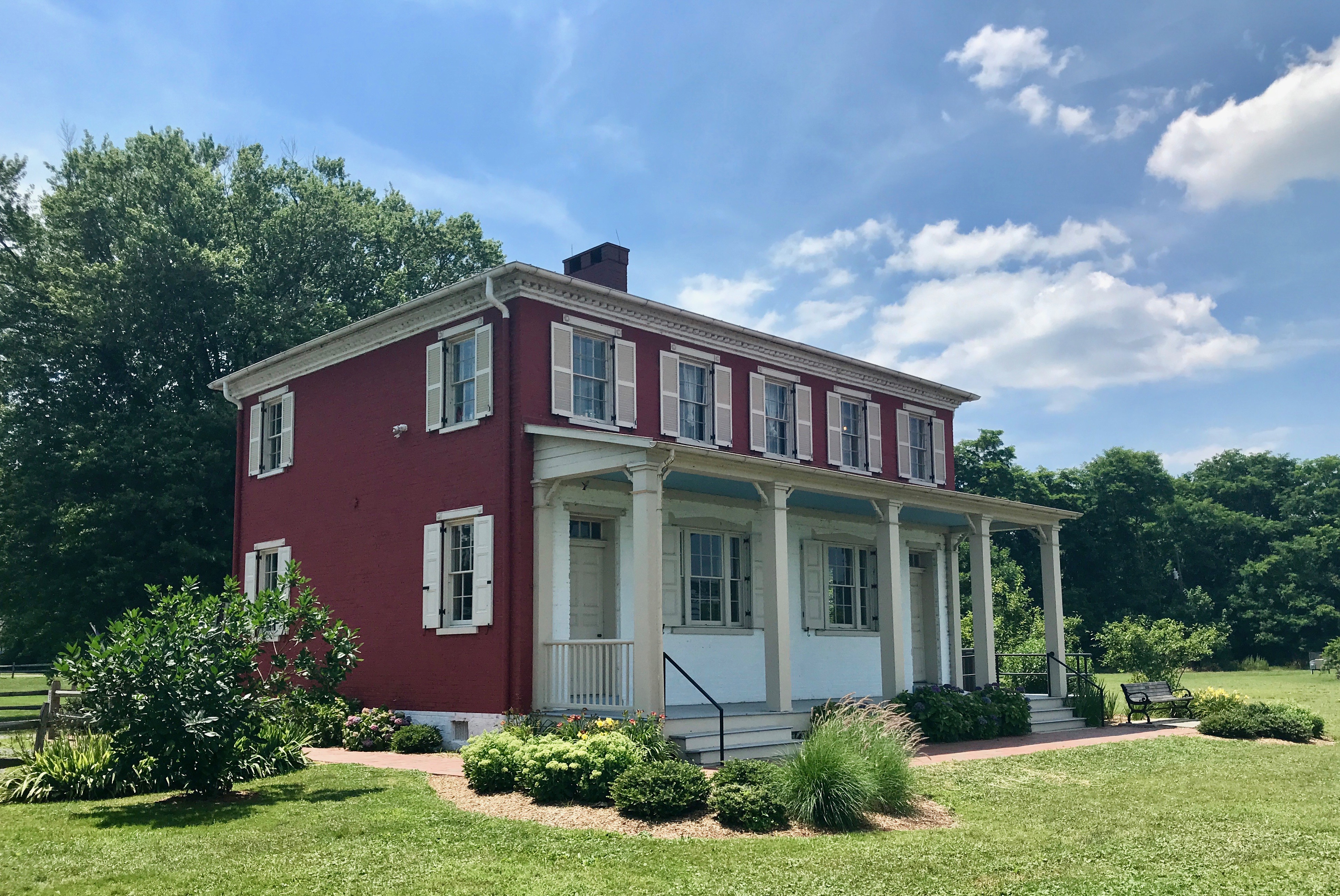
I turned to head back to the car. What a lovely front porch! I think this must have been a very pleasant place to live in the summer.
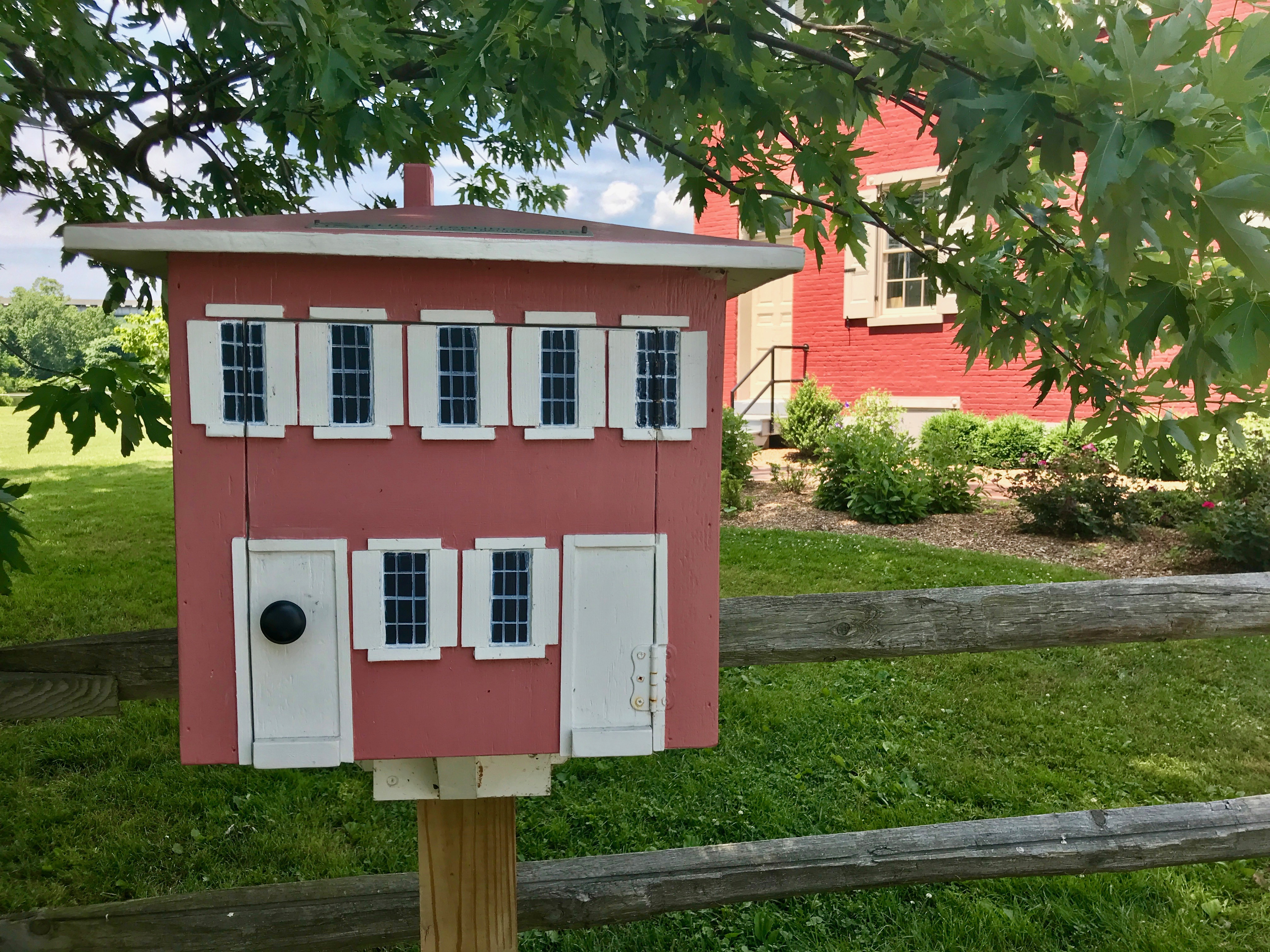
Walking back to the parking area, I noticed this LittleFreeLibrary.
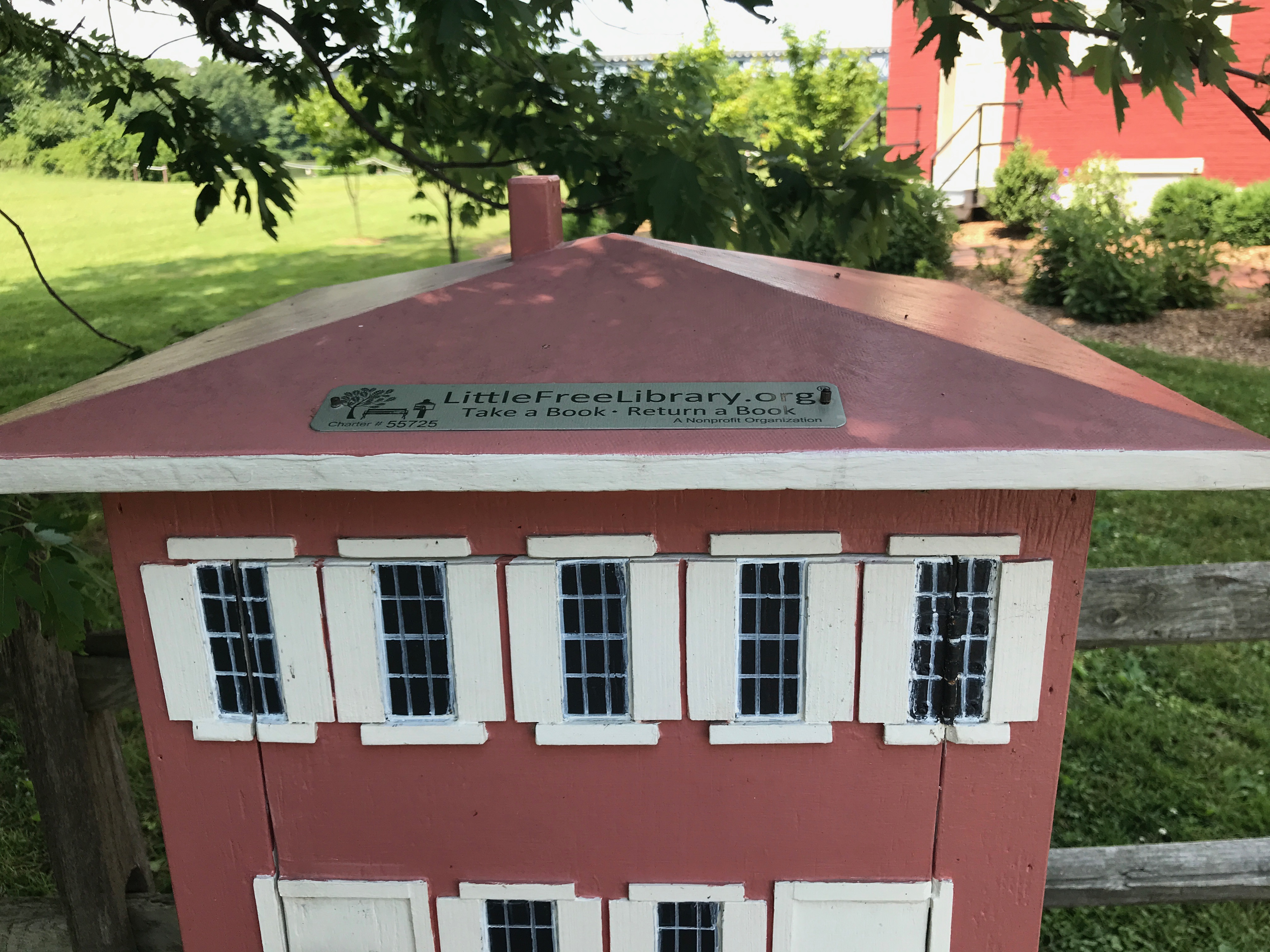
I love how they made it look like the Lock House!

I bid adieu to Havre de Grace and headed across the bridge to Chesapeake City. I heard there was a canal museum there.
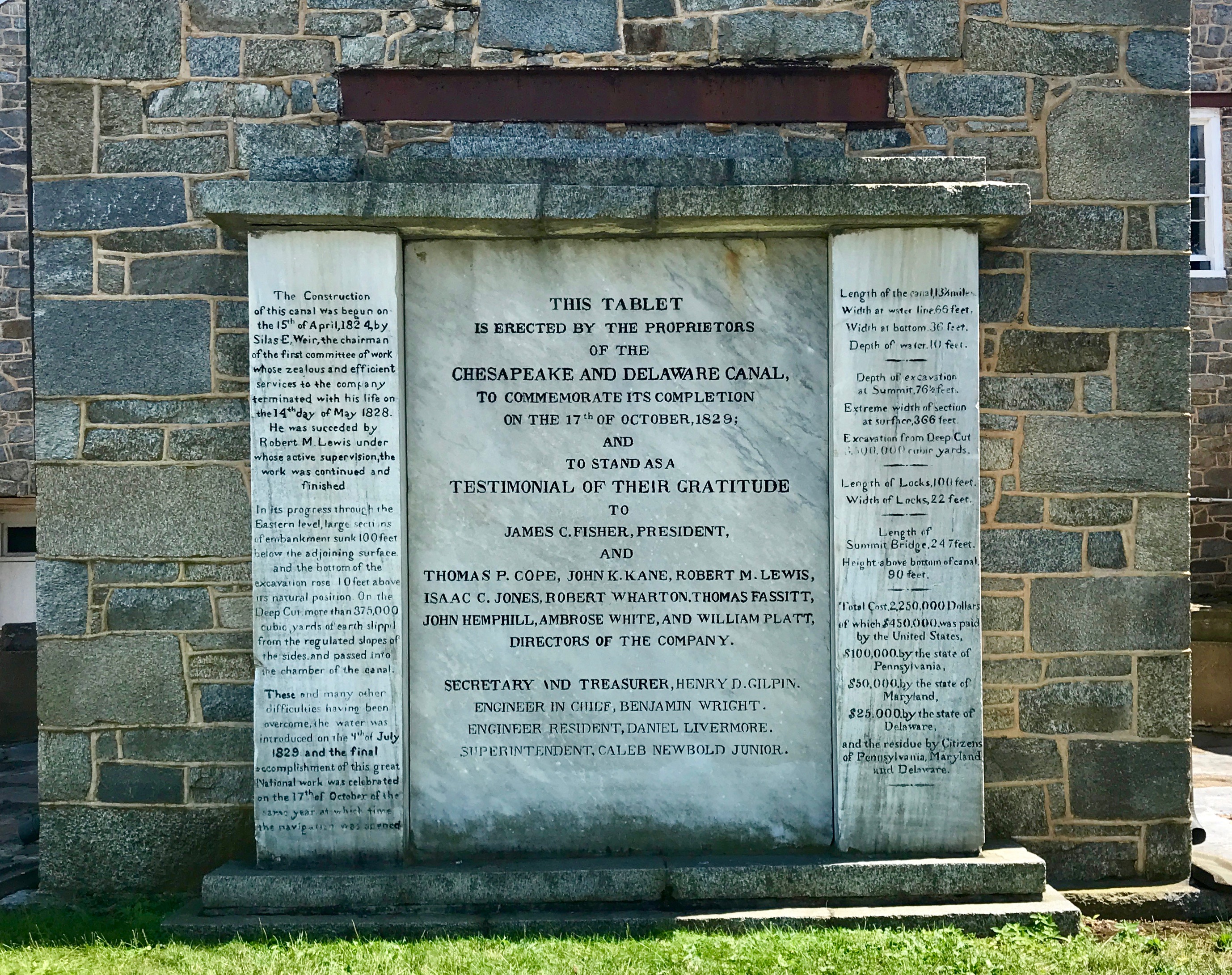
There was! It is the C & D Canal Museum run by the Army Corps of Engineers. My goodness, there were a lot of canals back in the day! This one is different in that the water was lifted to a higher level by steam operated waterwheels.
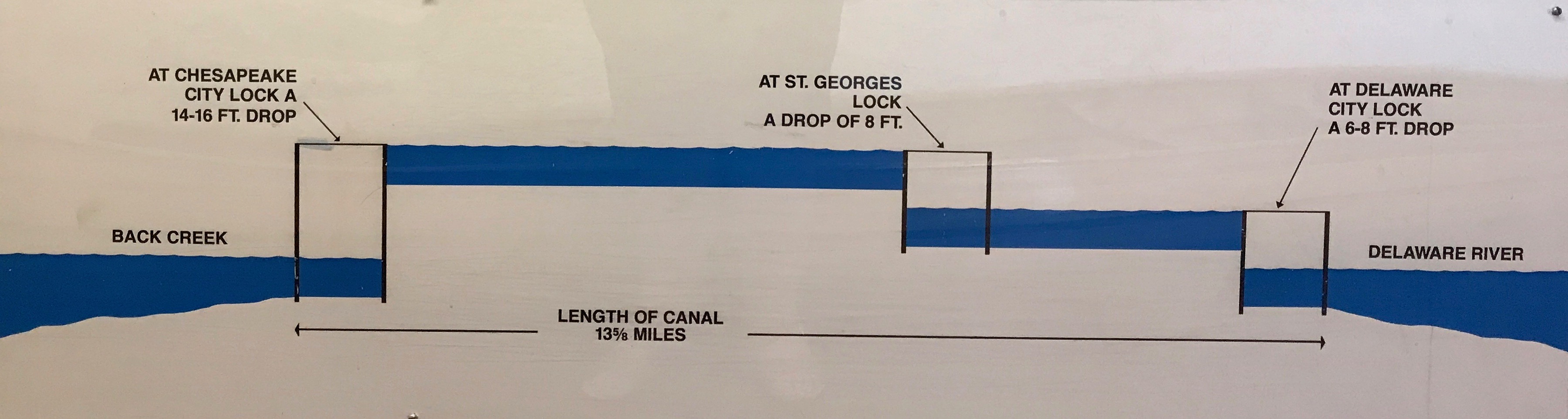
You see, in this canal, they had to go over something, so you couldn’t rely on natural water flow to do the trick.
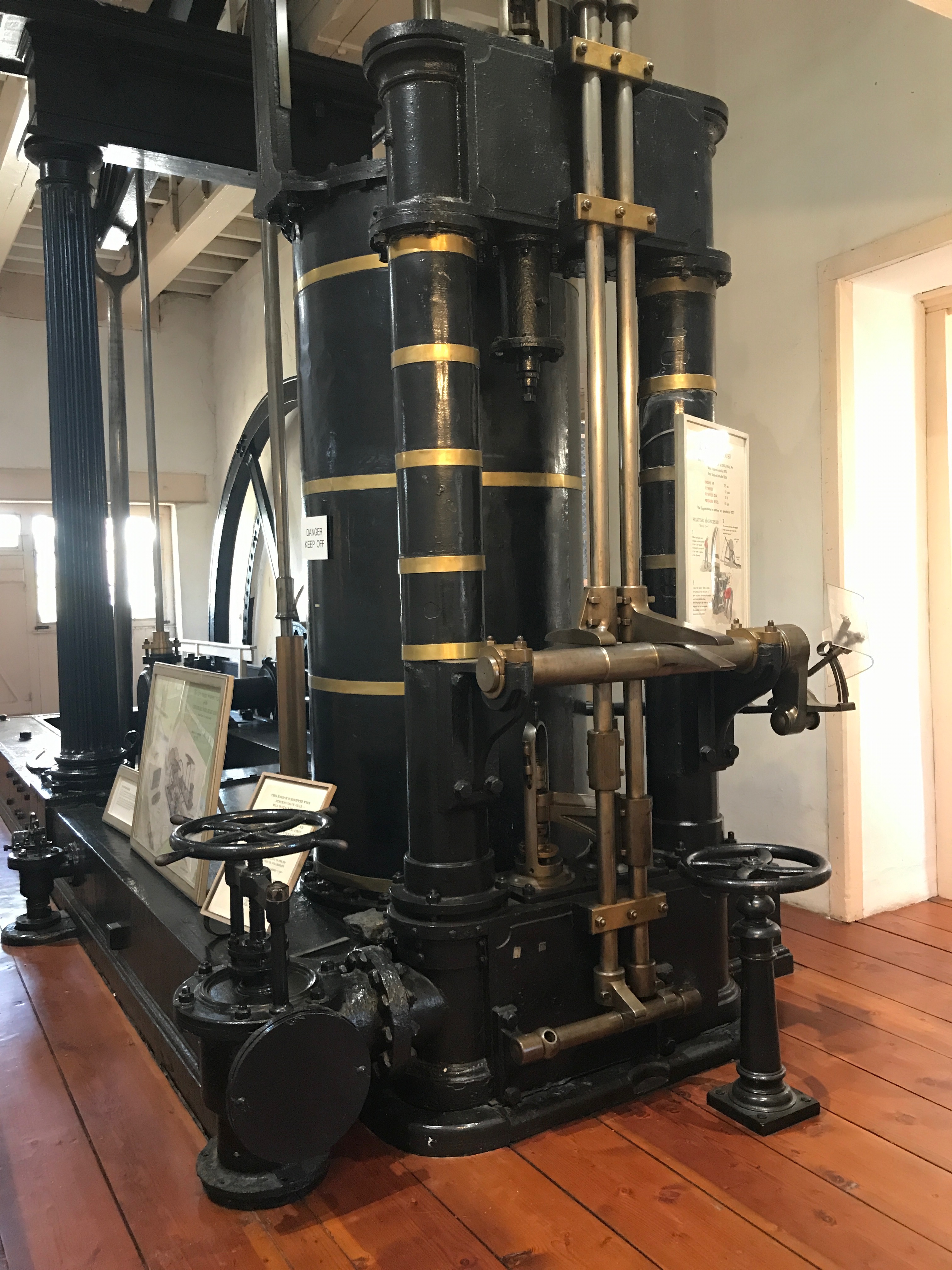
The machinery on display was impressive.
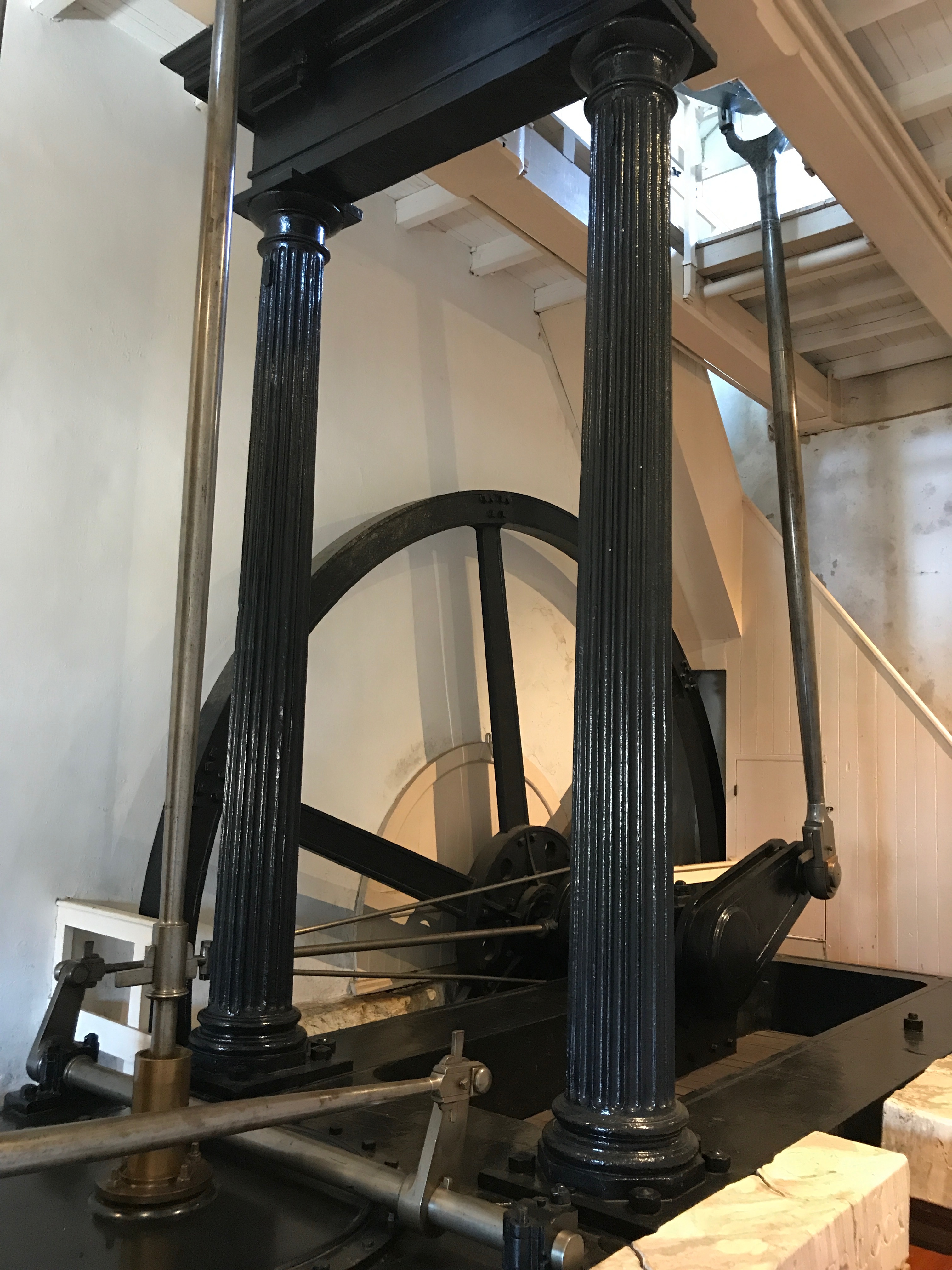
Notice the esthetic details. Can you imagine that manufacturers went to the effort to make their work so attractive? Maybe fluted cast iron columns are stronger than plain columns. Hmm…something to look into some other time.
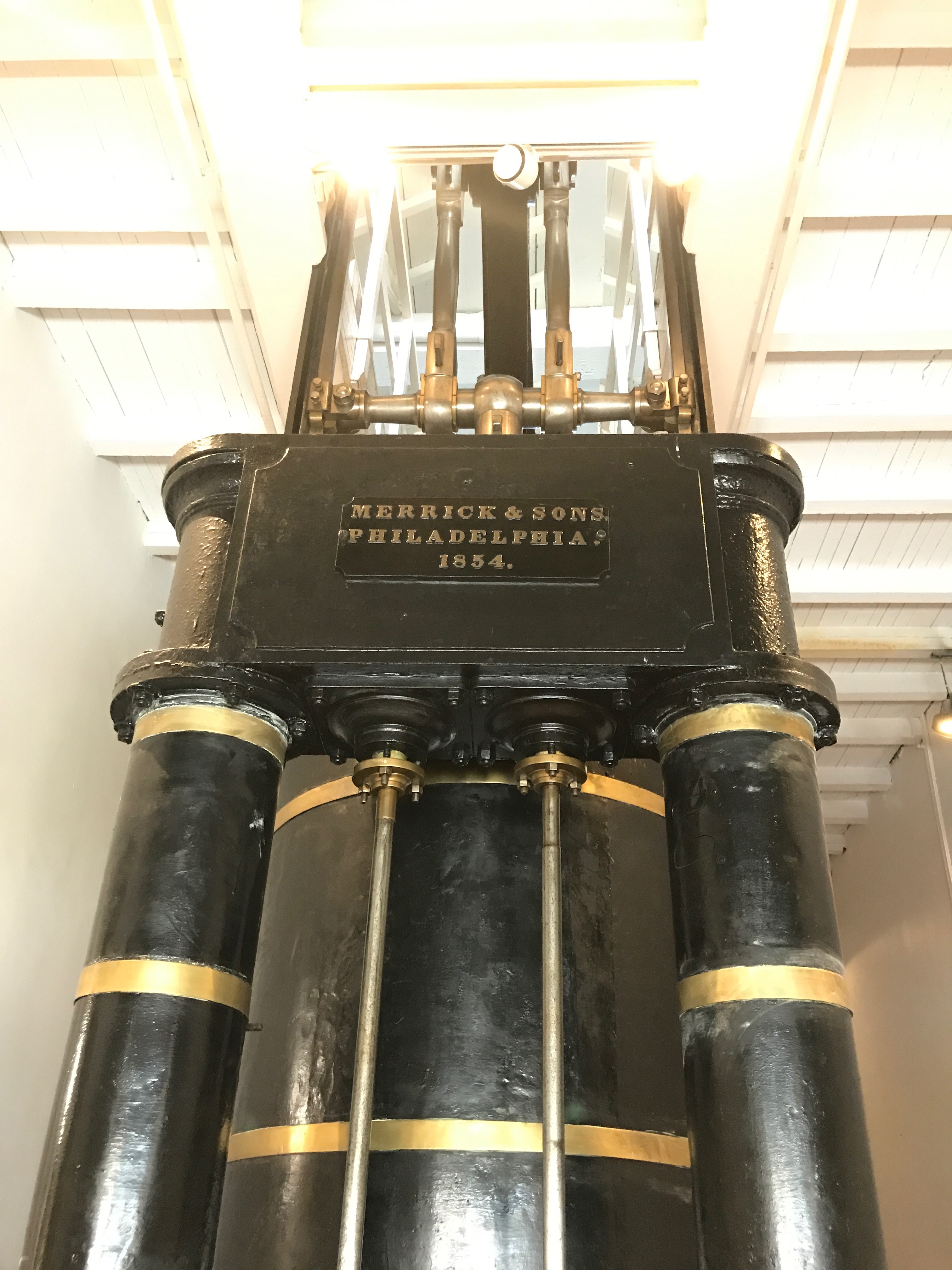
In any event, no wonder they wanted to put their names on their products in such a prominent position.

The Chesapeake and Delaware Canal – the C & D Canal – was first conceived in the mid 1600s by Augustine Herman. He was a mapmaker and he observed that the two great bodies of water – the Delaware River and Chesapeake Bay – were separated only by a narrow strip of land. Herman proposed that a waterway be built to connect the two. Unfortunately, this was an idea whose time had not yet come.

More than a century passed before anyone acted on the idea. In 1764, a survey of possible war routes across the Delmarva Peninsula was made. Again, no action was taken. In 1788, regional business leaders raised the idea again. The canal would reduce the trip from Philadelphia to Baltimore by nearly 300 miles.

Digging the canal was begun in 1802, but the project was halted two years later because of a lack of funds. The canal company was reorganized in 1822, and new surveys determined that more than $2 million in capital was needed to resume construction. Pennsylvania purchased $100,000 in stock, Maryland kicked in $50,000, and Delaware threw in $25,000. The federal government invested $450,000, with the remainder subscribed by the public.

Canal construction resumed in 1824, and within several years some 2,600 men were digging and hauling dirt from the ditch.
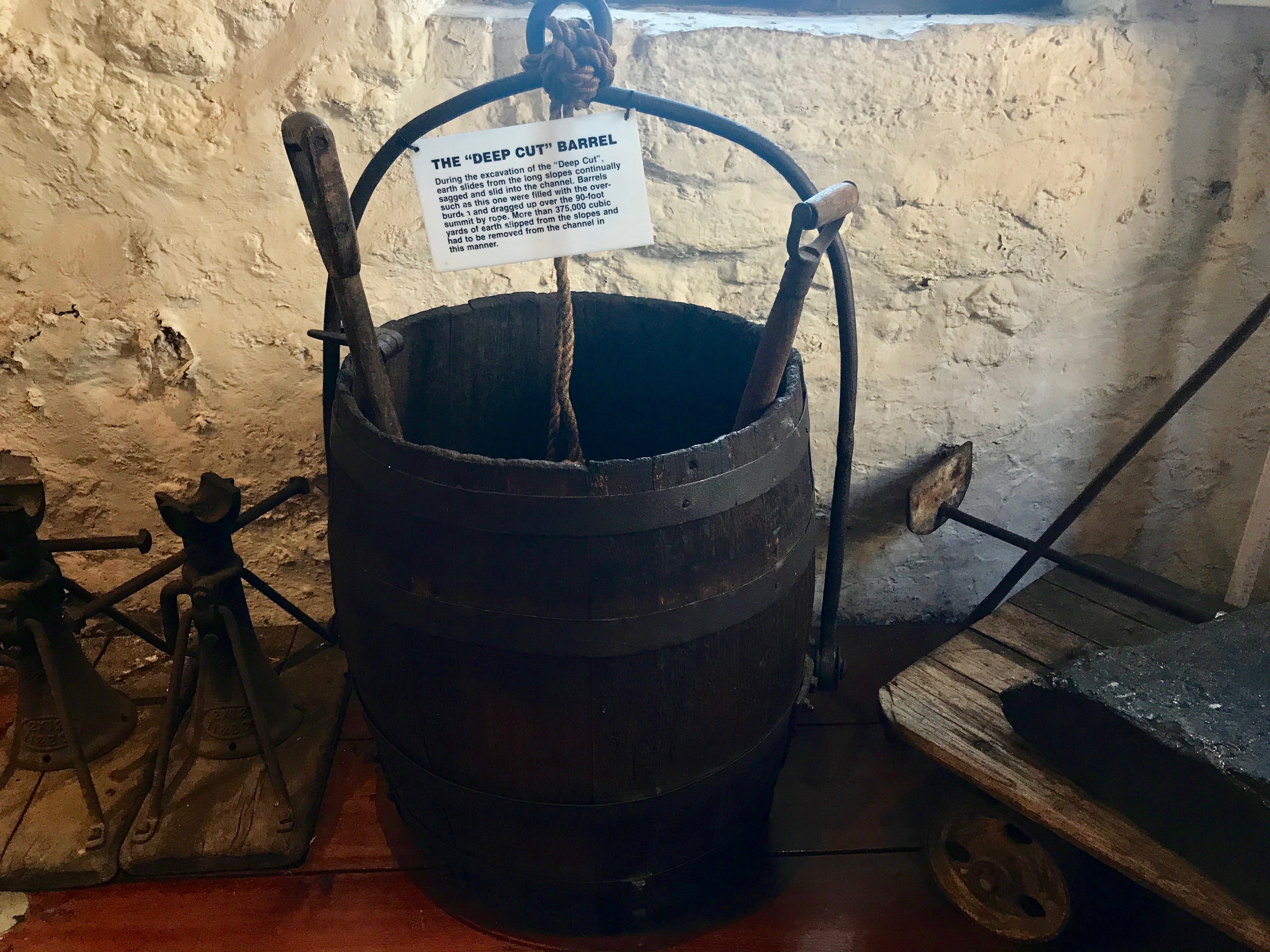
I have included a close up of the sign on the barrel.
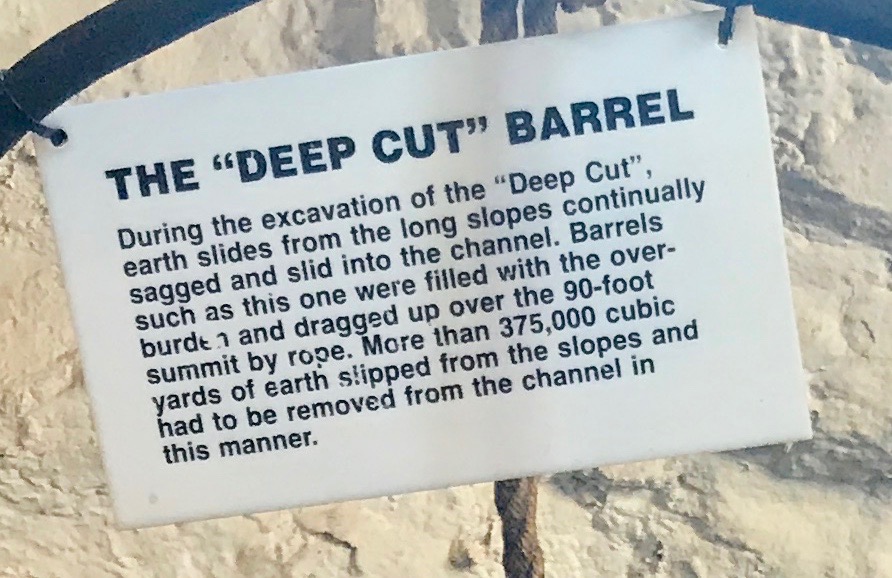
In addition to the slides, the swampy marshlands along the canal’s planned route was an impediment to progress. Laborers told with pick, shovel and barrel at the immense construction task for the princely sum of 75¢ a day.

The canal was finally open for business in 1829, and its construction cost of $3.5 million made it one of the most expensive canal projects of its time. Of course, the Erie Canal, which opened in 1825, cost $7 million. But, it you want to look at cost per mile, the 363 mile-long Erie Canal cost about $19,300 per mile. The 14 mile-long C&D cost $250,000 per mile.
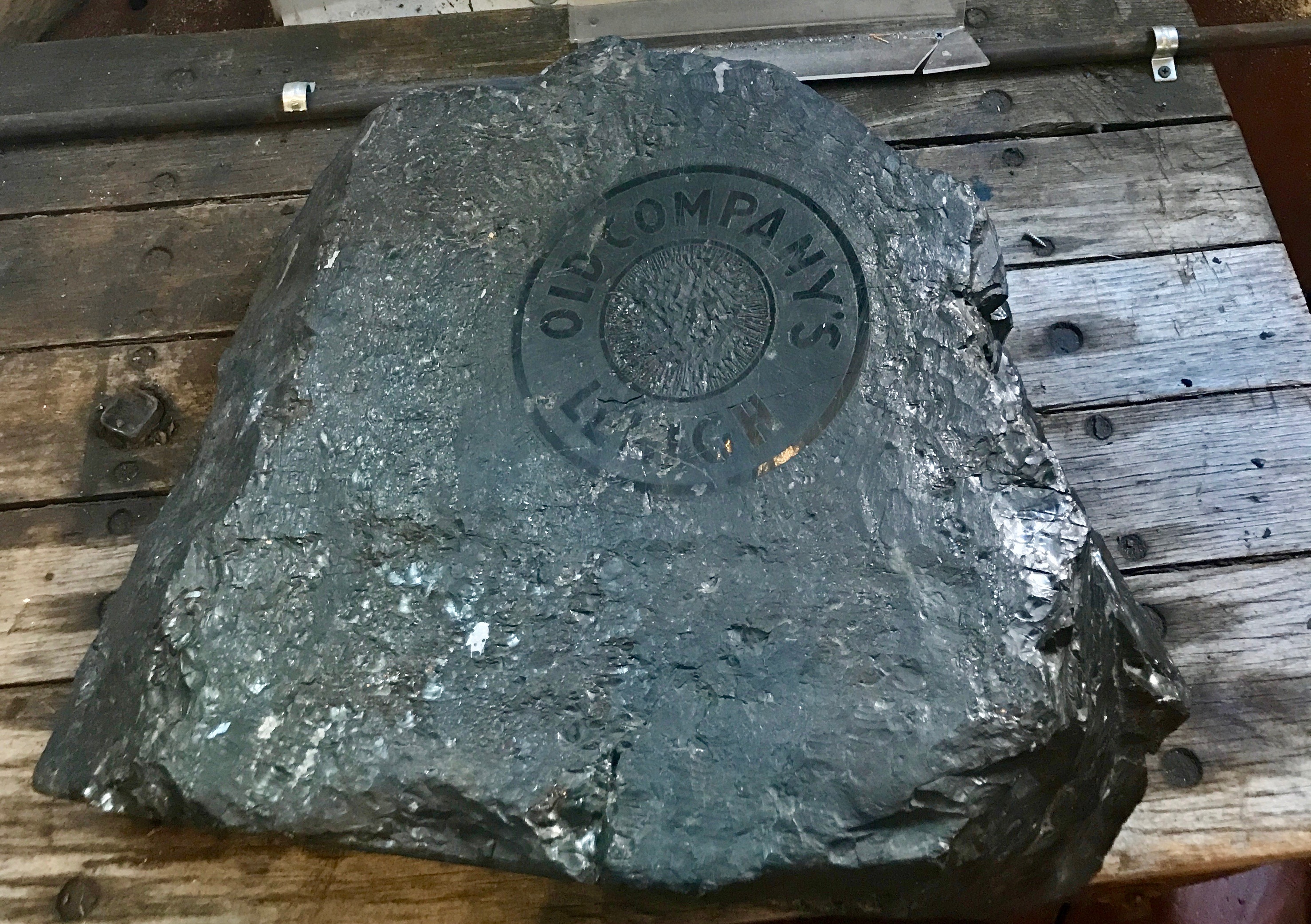
This canal is still in operation. At the beginning, the focus was on moving products. Coal was branded with the seal of the company it belonged to. If I understood the label with the display correctly, Old Companies was the local supplier of coal for the boilers that pumped the water in the canal. The mine was in Lehigh, Pennsylvania, and they had an office in Chesapeake City.
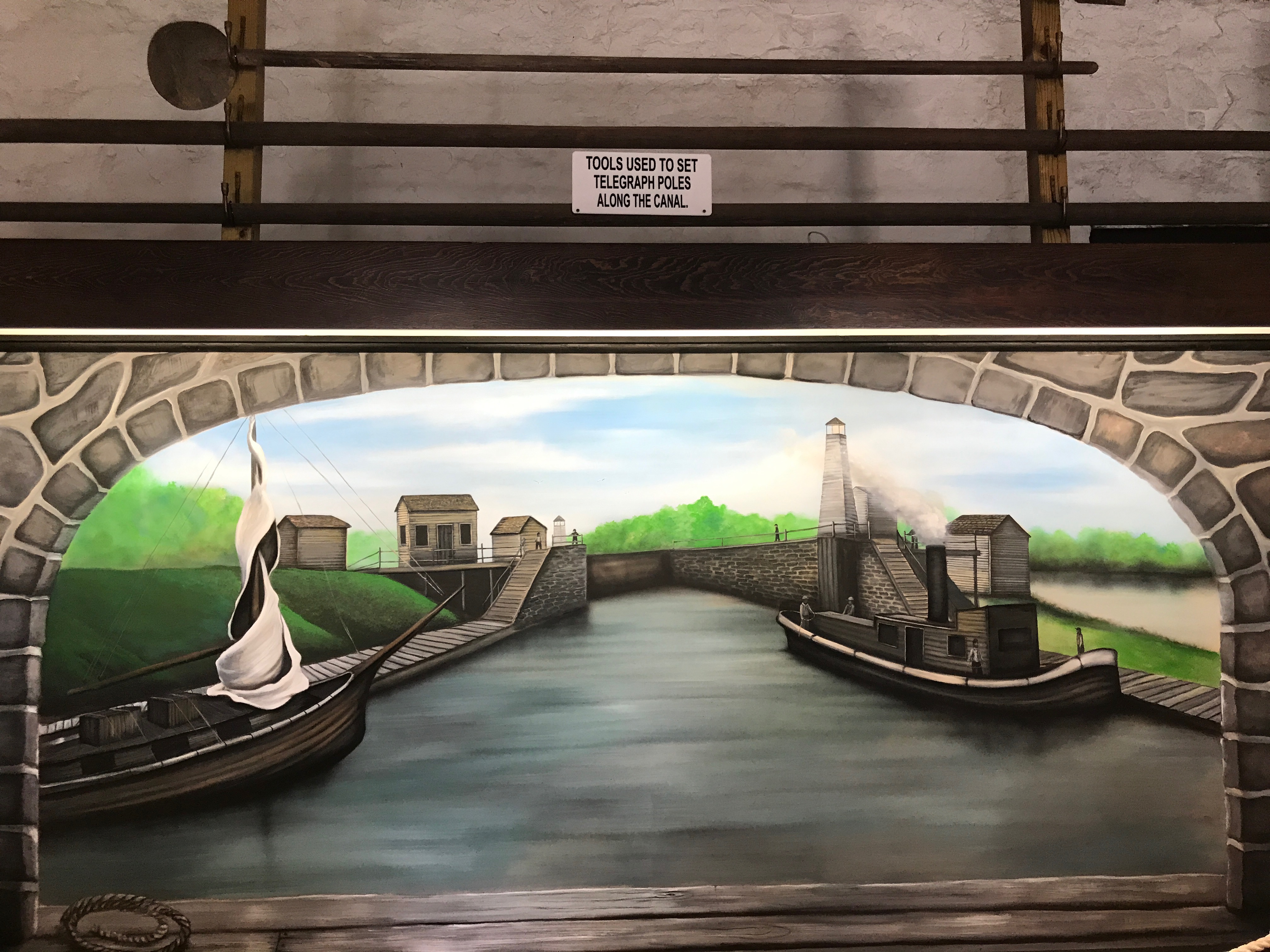
By this time, I was reaching the end of my tolerance for tourism for the day. I headed out in search of sustenance.
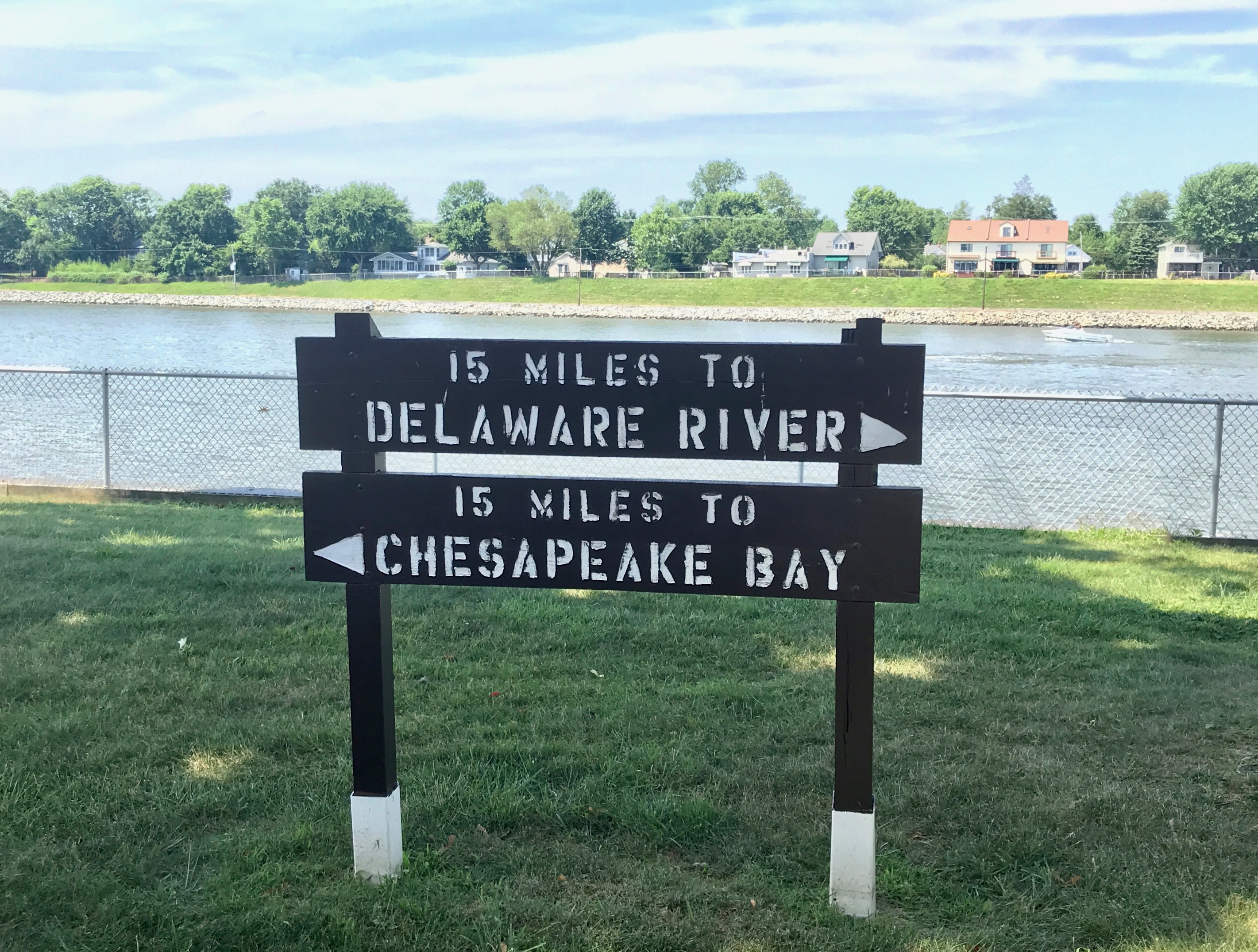
Hmm…which way should I go? To the nearest restaurant, of course! I found one sitting on the water’s edge.
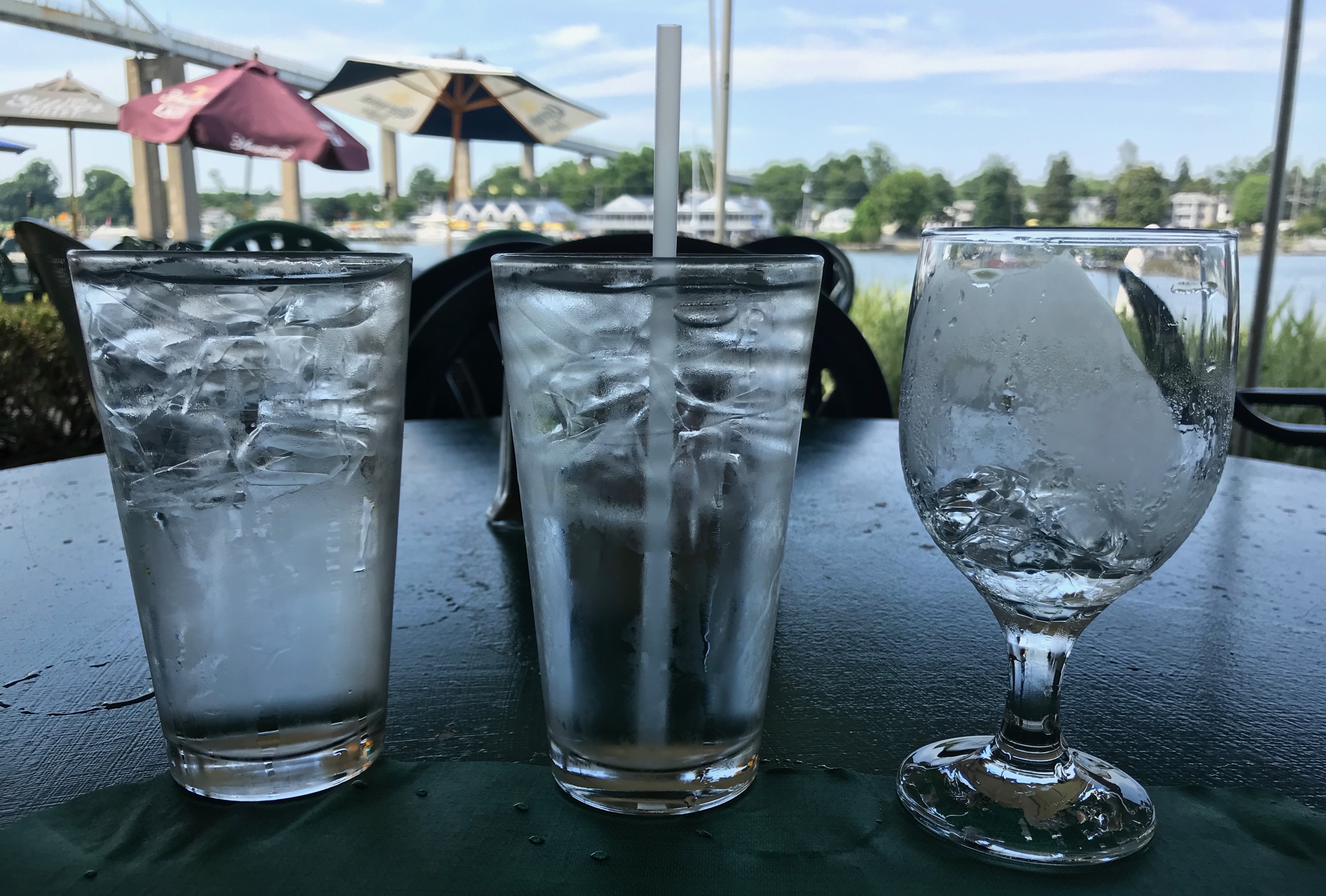
Bless the waitress who took me seriously when I told her I was really thirsty.
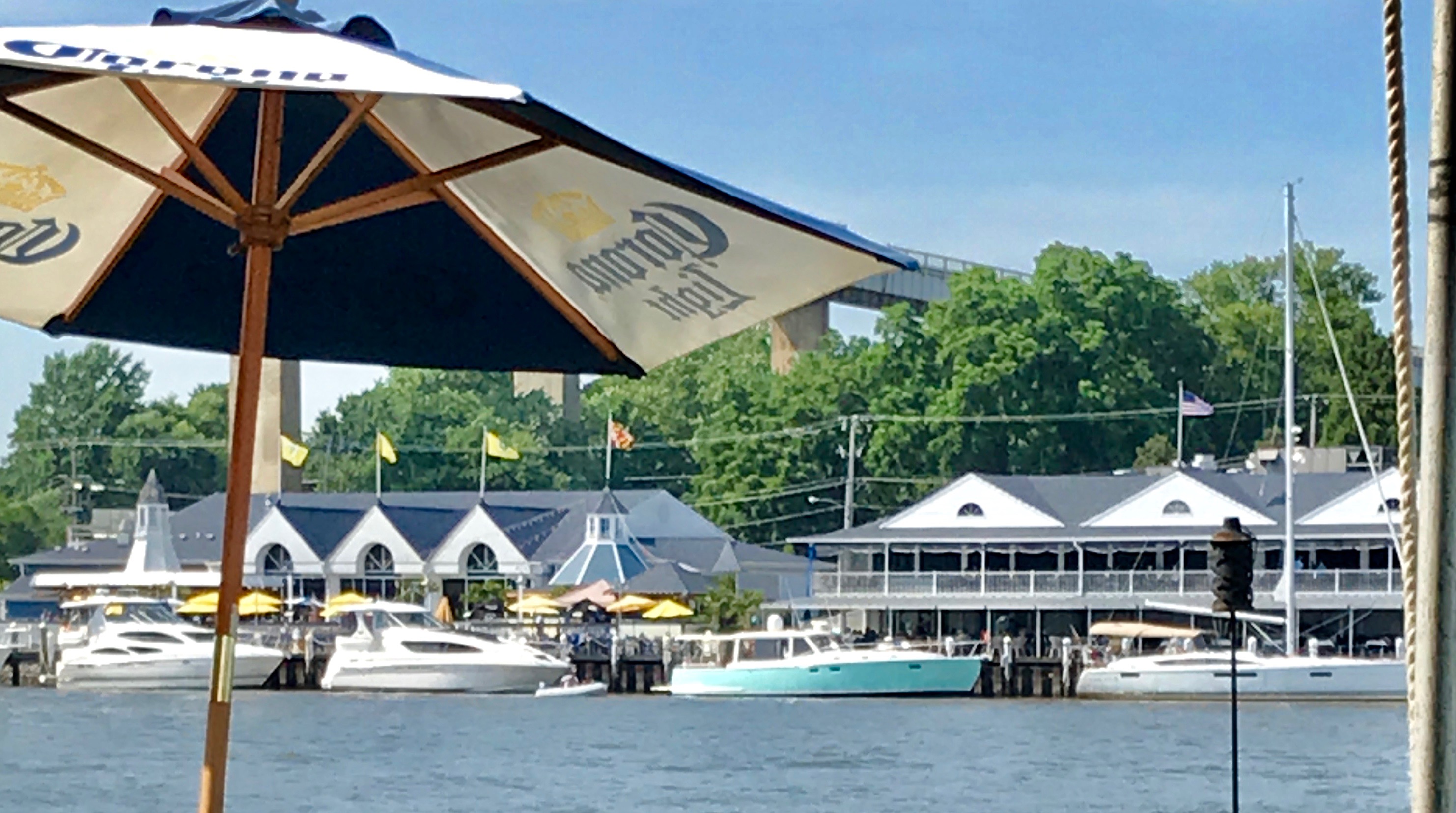
What’s that I smell? Oh, yeah…money!
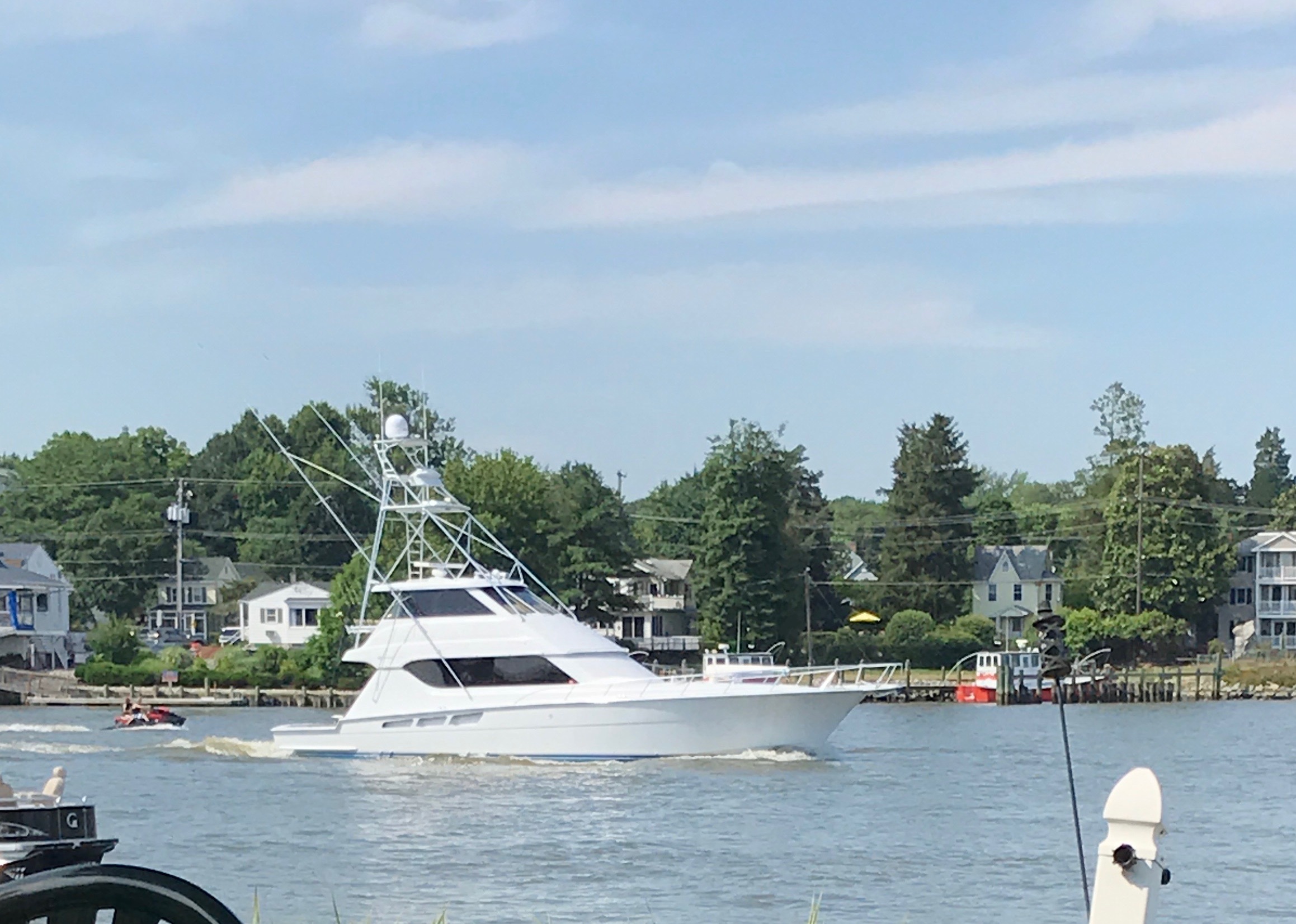
There were some might fine boats in the canal.
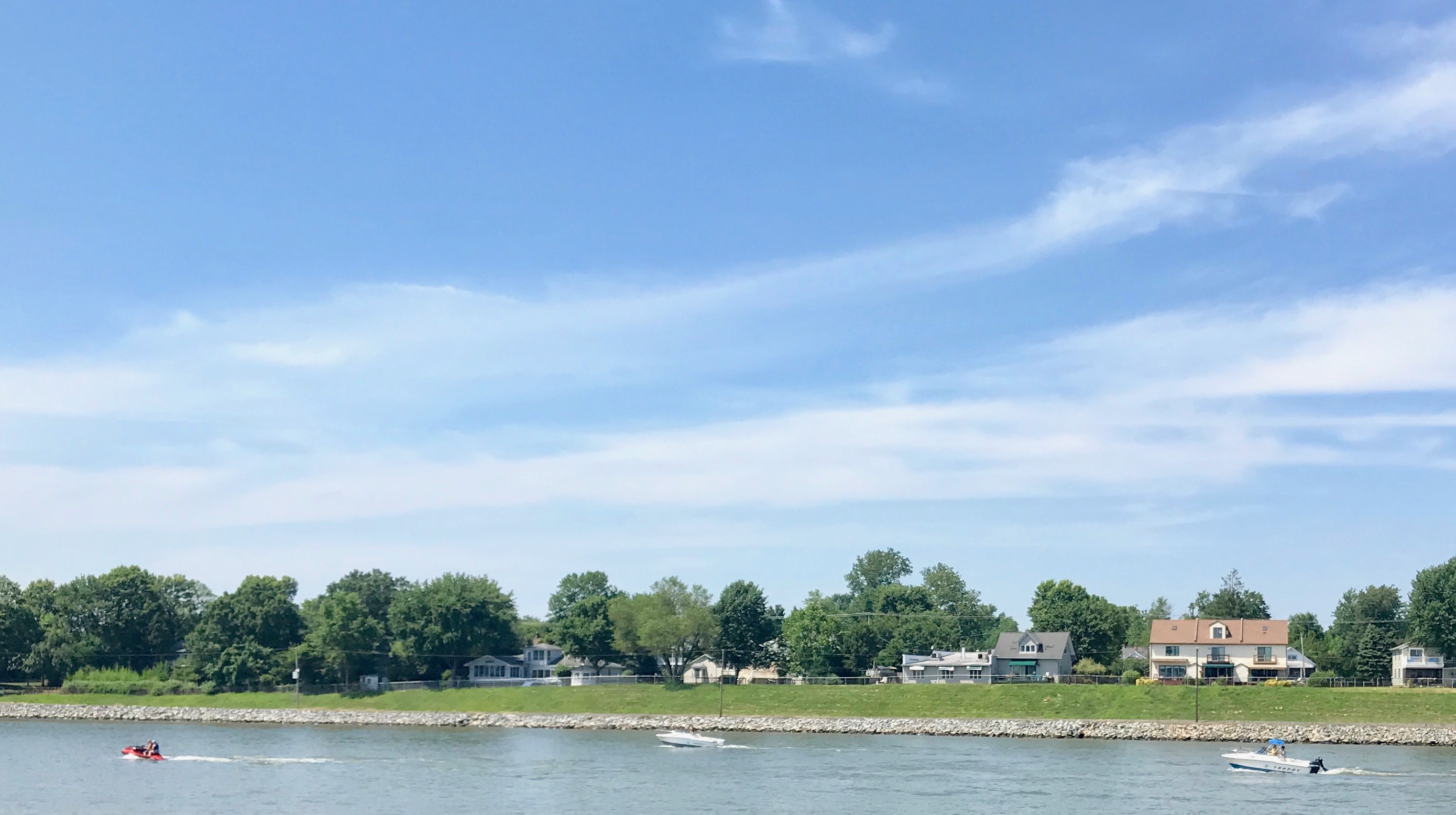
There were also smaller vessels.
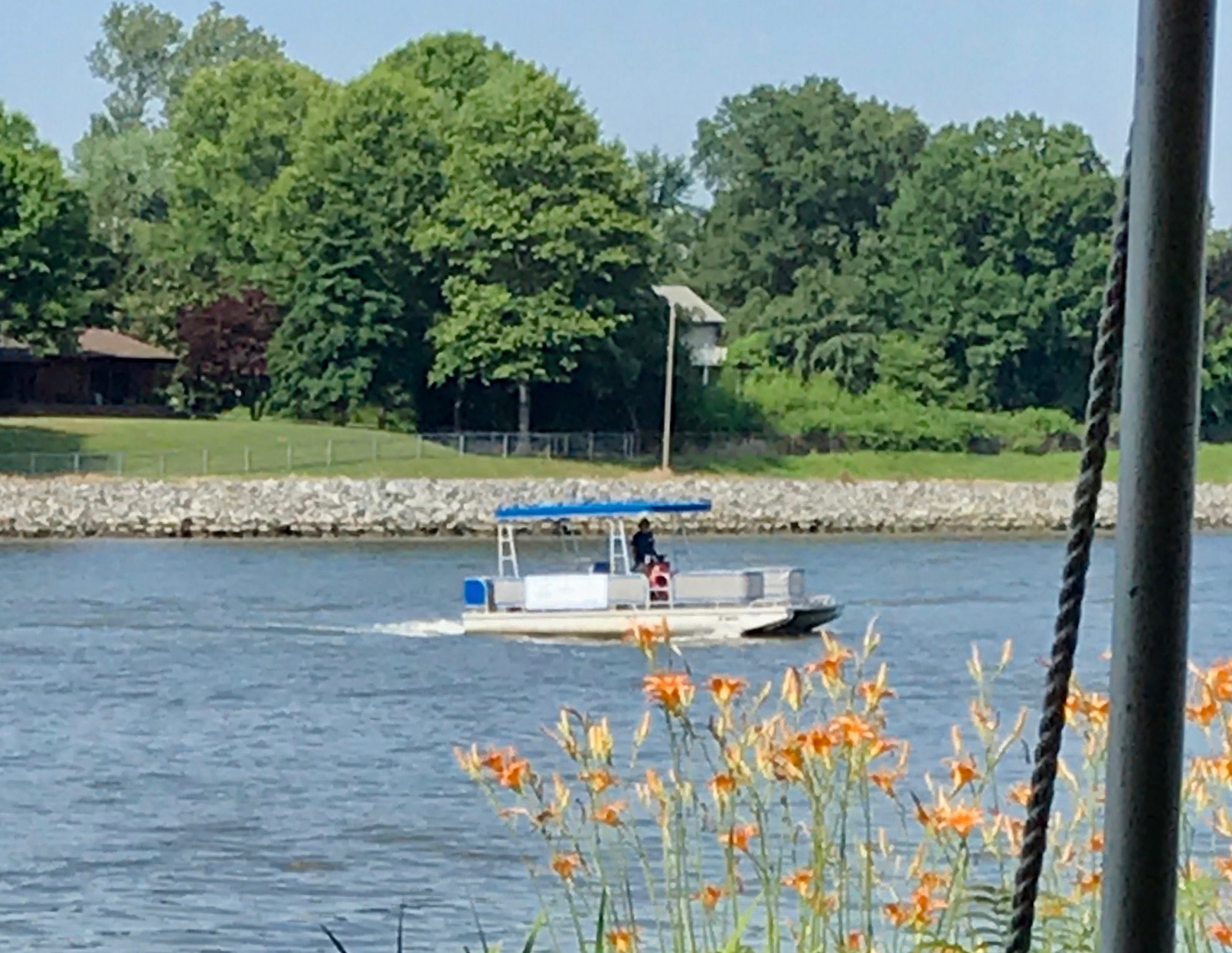
You don’t need to be a millionaire to enjoy the water!

You know how sometimes when you are tired, hungry, and thirsty and you just can’t decide what to eat? Well, I solved that problem by going with two appetizers.
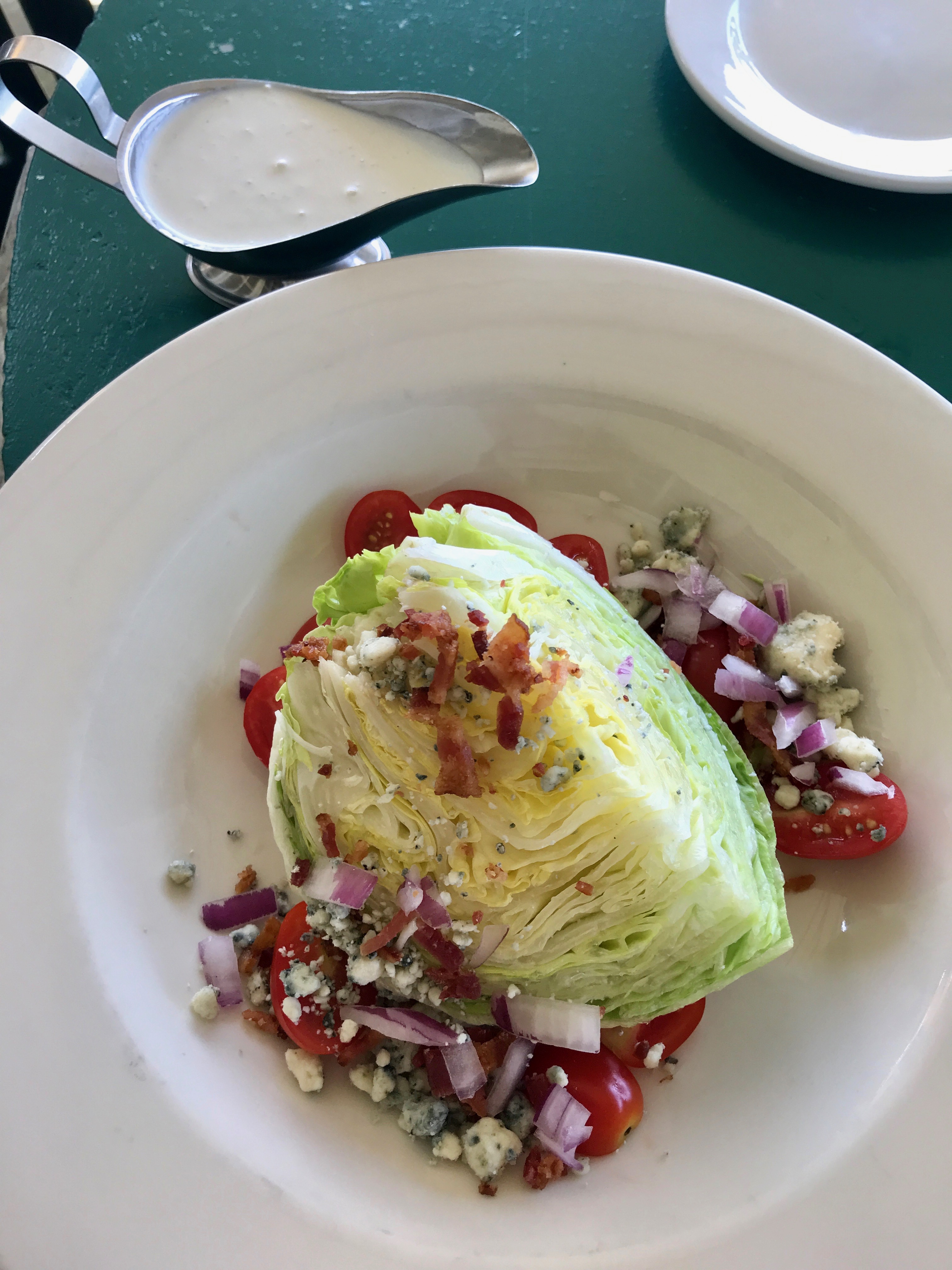
I started off with a refreshing wedge salad.
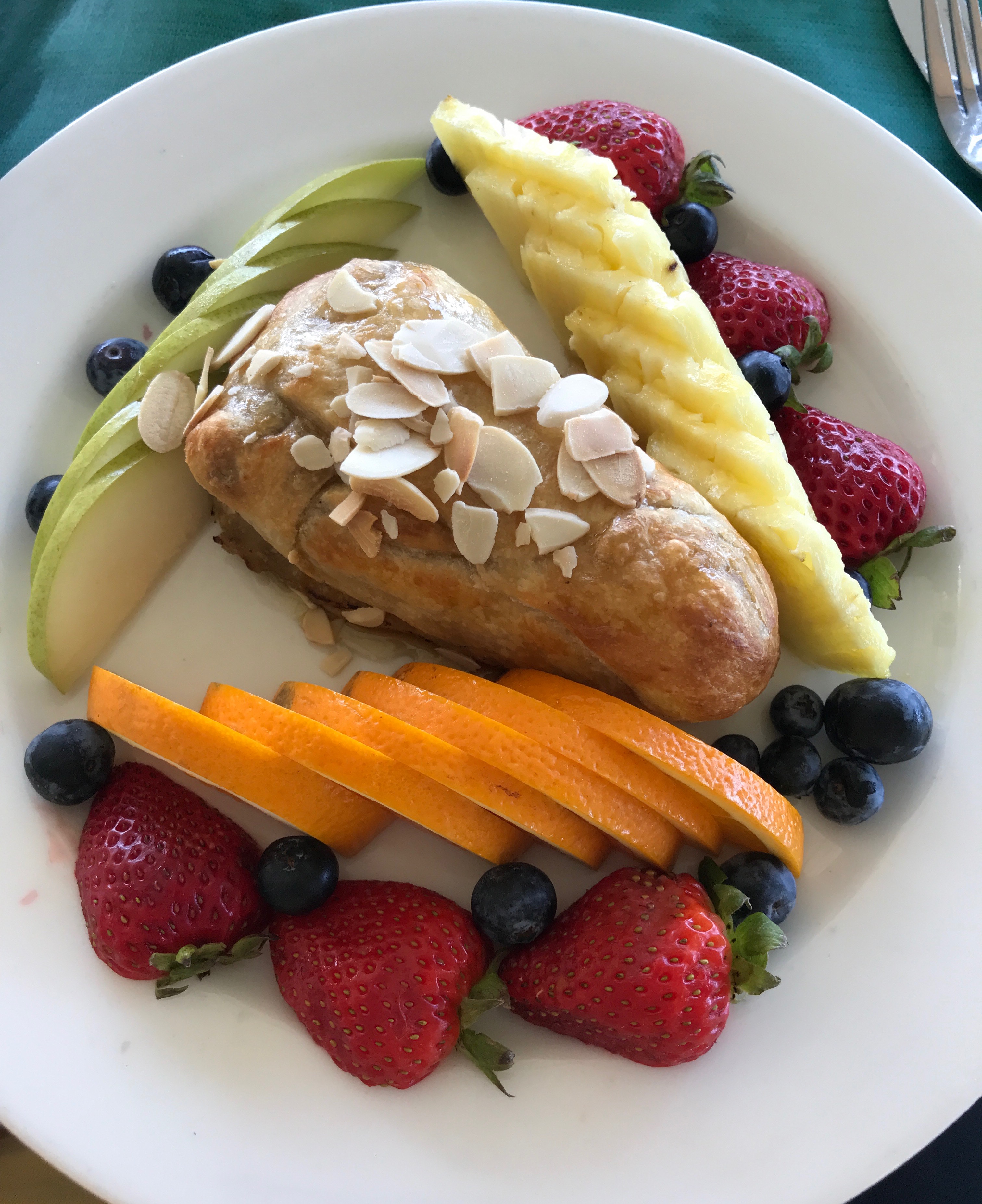
The baked brie rounded out the meal perfectly.

Sufficiently nourished, I headed back to whatever hotel I had holed up in for the weekend.
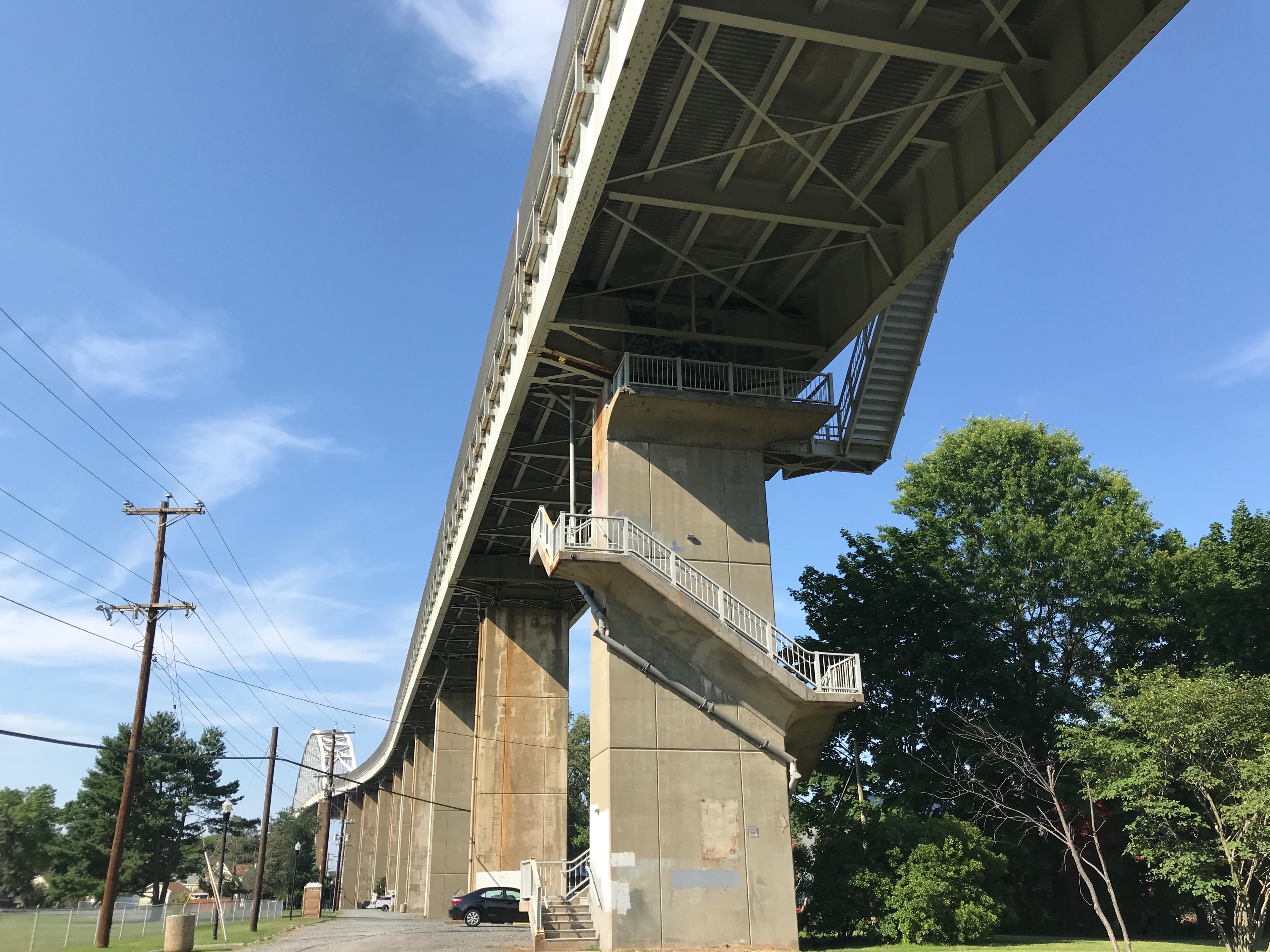
En route to the bridge, I spied these stairs. Amazing! And, no, I didn’t climb them. I wonder if the local residents use them.

After my big adventure, I spent the rest of the weekend holed up. I rested, relaxed, handled laundry and took care of business so I’d be ready to roll on Monday.
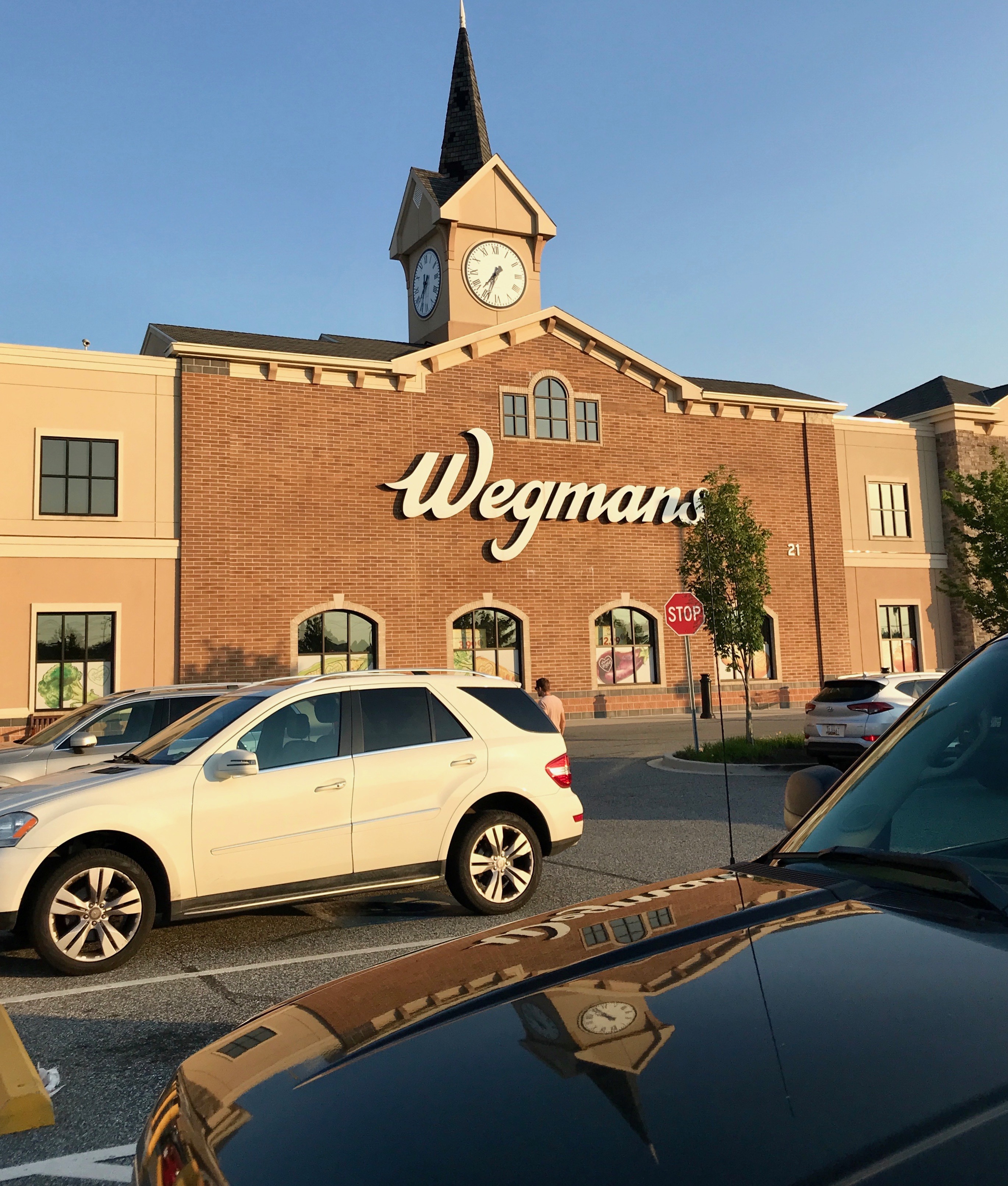
I even found a Wegmans! What a great grocery store!
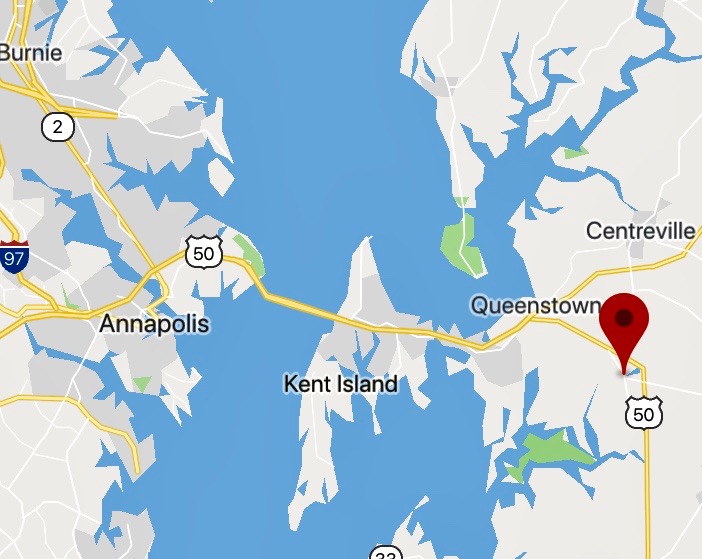
Wye Oak? Why Not!

I am truly driving in circles at this point.

I had been in the area earlier, but the wheat harvest wasn’t in yet. I dropped off bags and told them that I would be back. I had noticed a sign for Wye Oak across from one of the elevators on my first loop, but it wasn’t a good time to stop.

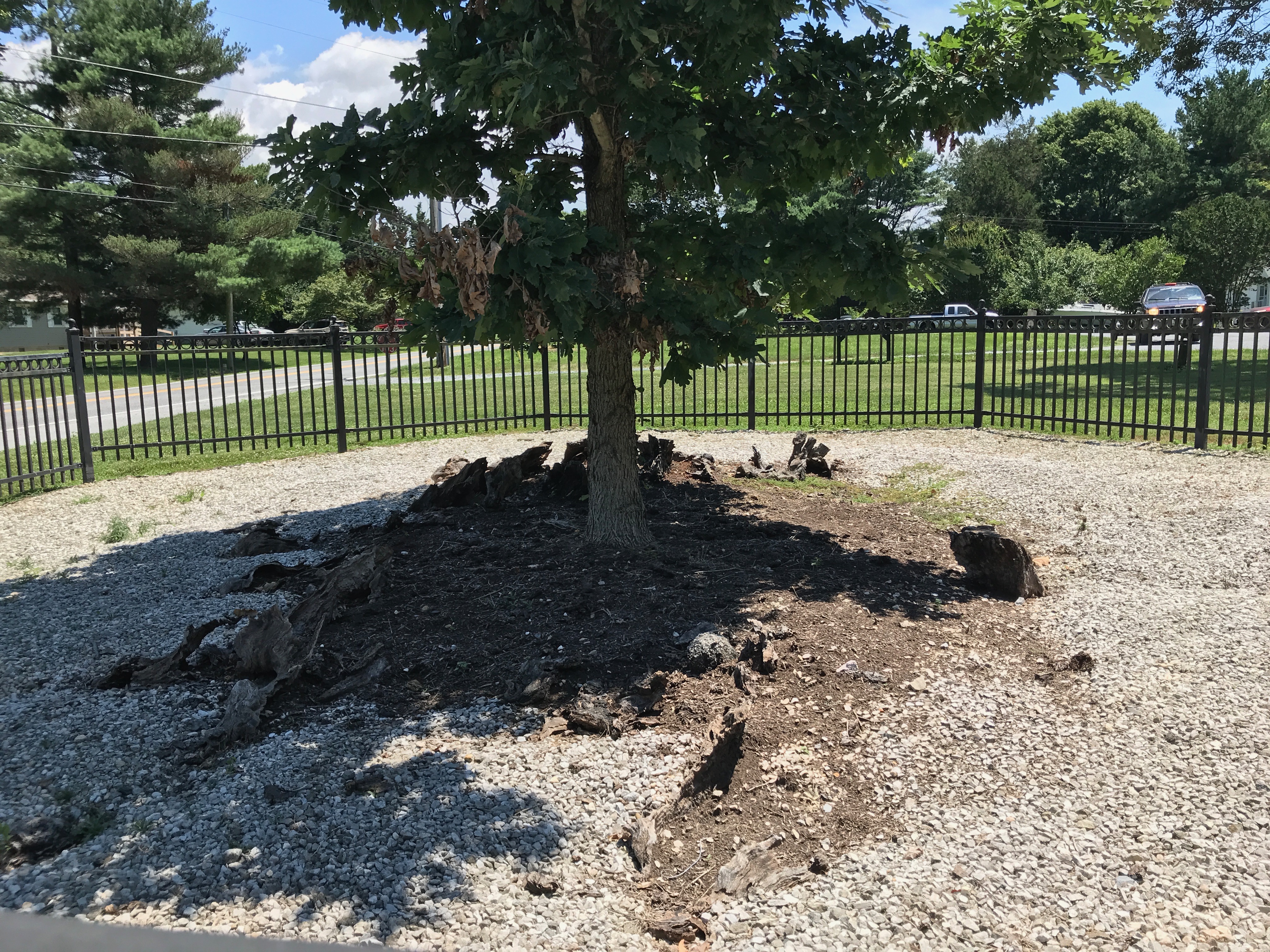
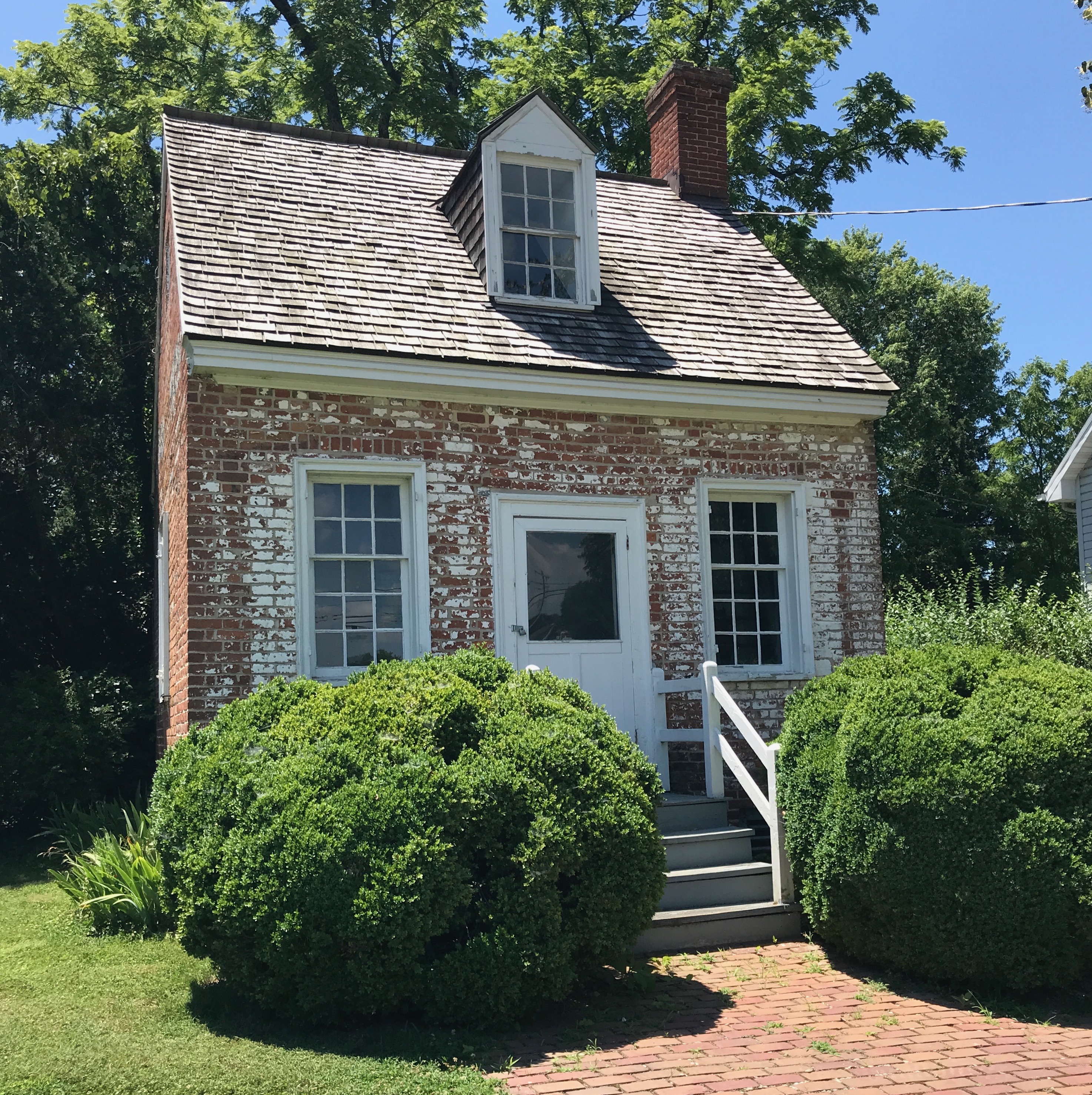
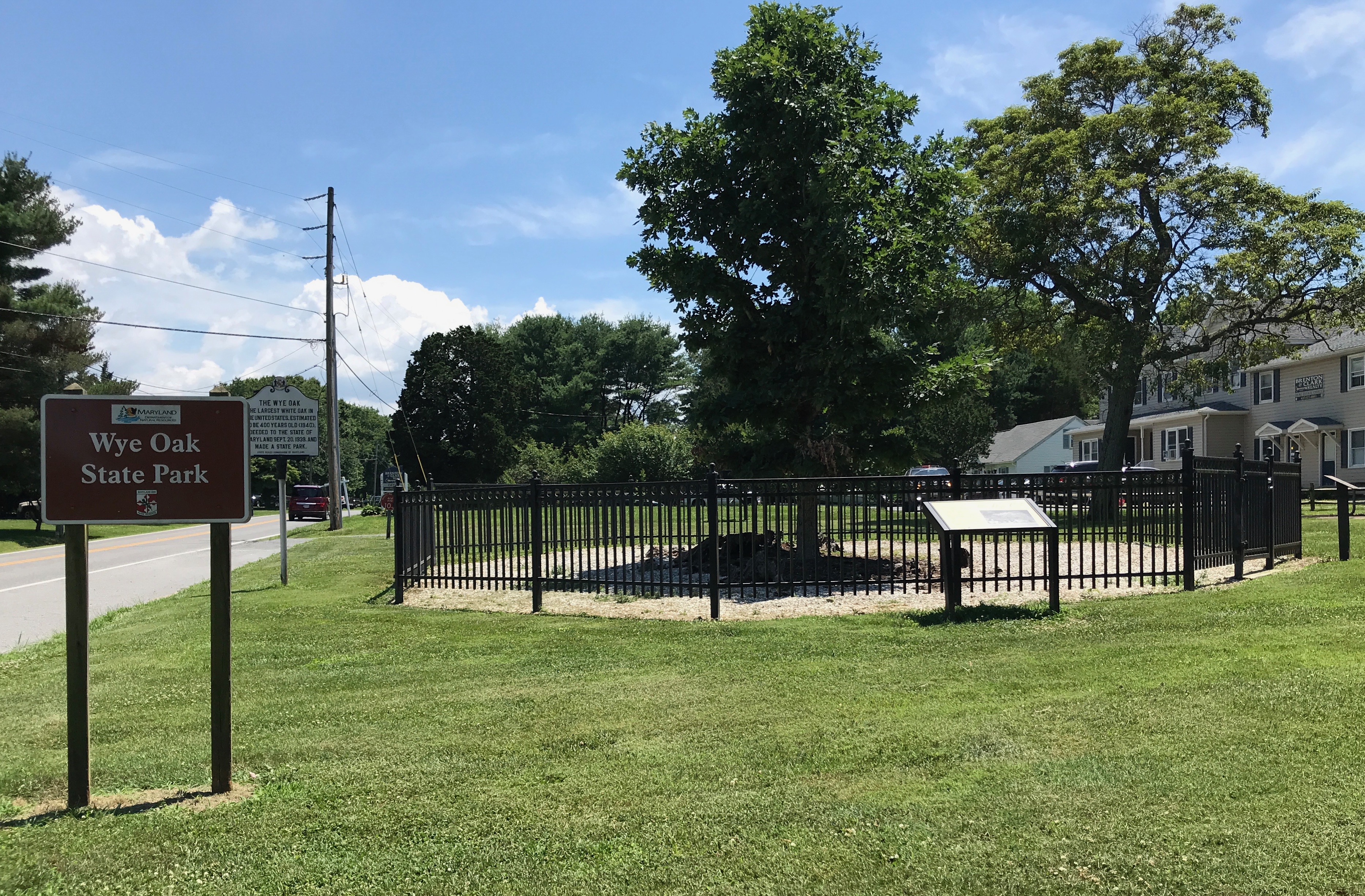
I mean, doesn’t this make you curious? The sign “Wye Oak State Park” on a lot that would make a nice playground and a rather juvenile tree inside a fence? I had to know more!
First of all, according to the Maryland Department of Natural Resources website, the park is actually 29 acres, not the acre or so out by the road. I don’t know where the rest of the park is. Maybe it’s down behind the housing development you can see in the background.

And, while the tree is rather young, if you look closely, you can see that it is growing where the original Wye Oak once stood.

The tree growing now is a clone of the original Wye Oak, that was believed to be about 460 years old at the time of its destruction during a severe thunderstorm in 2002. The clone was planted in 2006, four years to the day of when the original tree fell in the storm. Two other clones were planted at Mount Vernon.

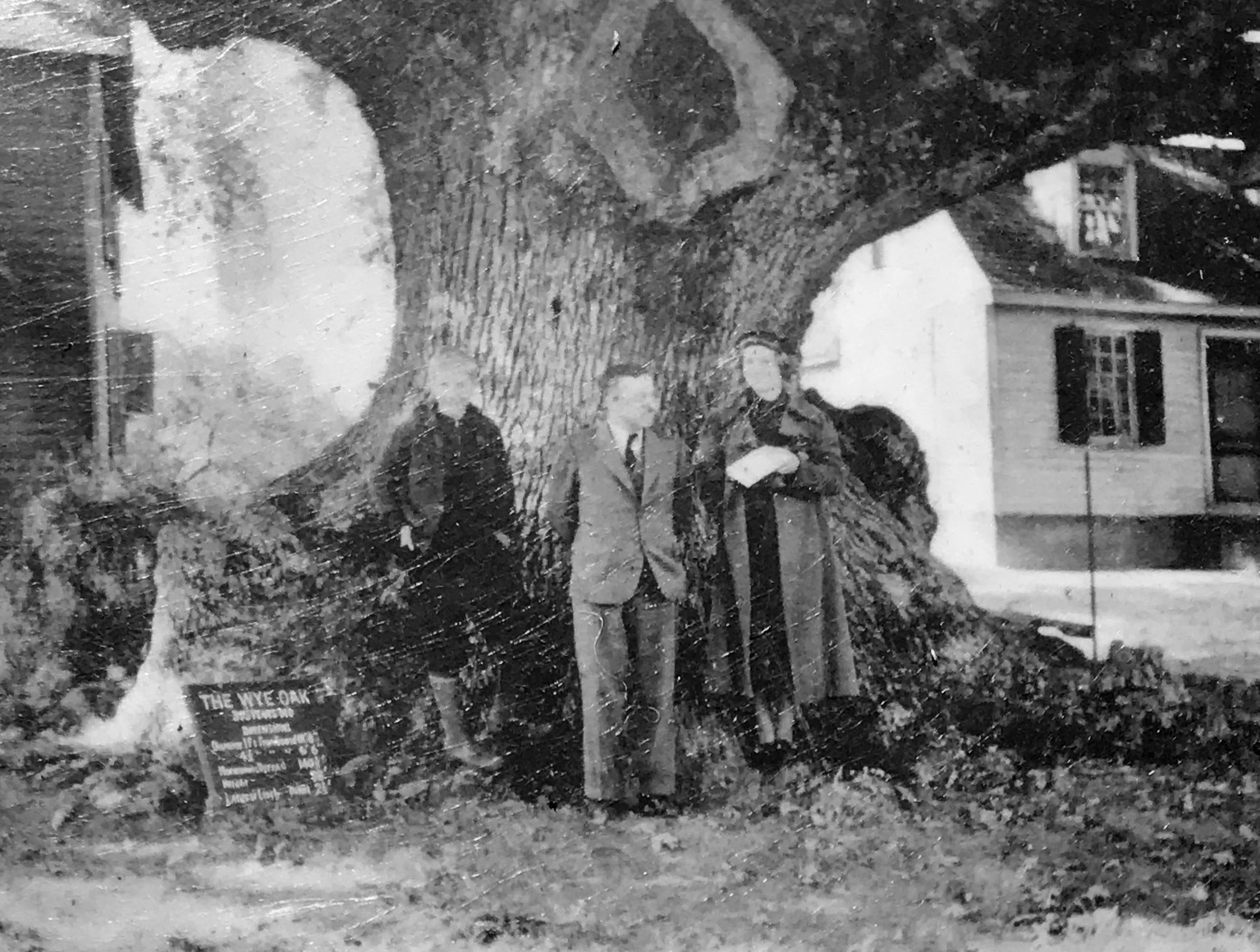
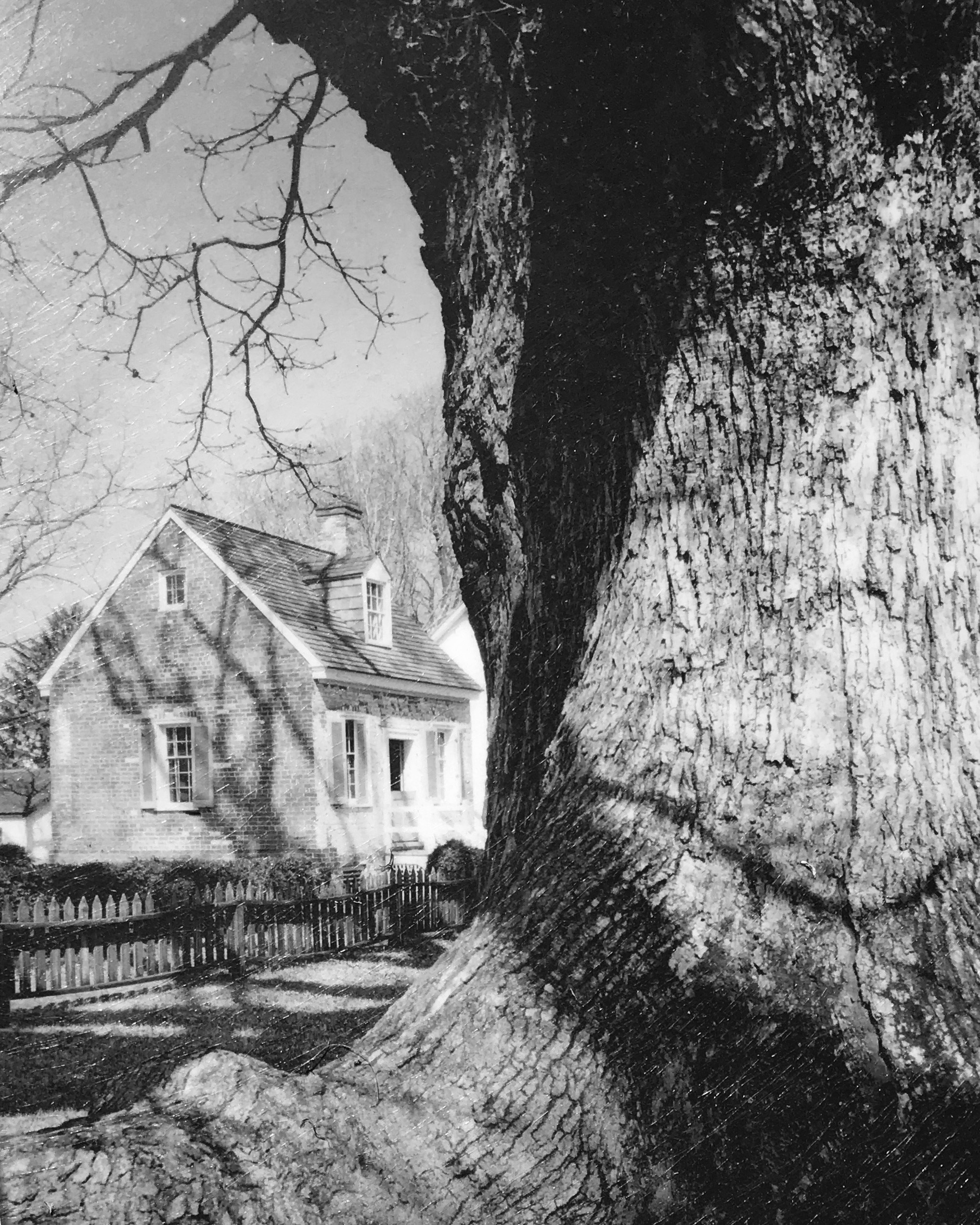
According to my Preferred Source, it measured 31 feet 10 inches in circumference at breast height. It was 96 feet high and had a crown spread of  119 feet. It is believed that the acorn that became the oak germinated around the year 1540. The Wye Oak was still bearing a maturing crop of acorns when it toppled in the thunderstorm.

This was the State Tree of Maryland State Tree and largest white oak tree in the United States from 1941 until its demise in 2002.

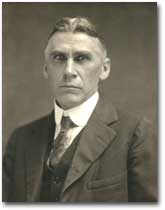
Incidentally, this tree was the inspiration for the American Forestry Association’s National Registry of Big Trees. Maryland State Forester Fred W. Besley made the first official measurement of the tree in 1909.

Fred W. Besley

In 1919, it was featured in American Forestry magazine as the first tree in the American Forestry Association’s “Tree Hall of Fame.” Besley founded the Big Tree Champion Program in 1925. As a result, the American Forests Association named the Wye Oak one of its first National Champion Trees.

The scientific name for the white oak is Quercus alba, and the current National Champion Tree for the Quercus alba is in Brunswick County, Virginia.

The Current Champion

The current Champion Tree has a score of 451. They Wye Oak had a score of 518.

The score is determined by applying this formula to the measurements of the tree:

Trunk Circumference (in inches) + Height (In feet) + 1/4 Average Crown Spread (in feet) = Total Points

The Wye Oak was one BIG tree!
But, all living things have a life span. The tree lost a large limb in 1956, which sparked concerns. Another large limb fell in 1984. That one weighed 70,280 pounds!
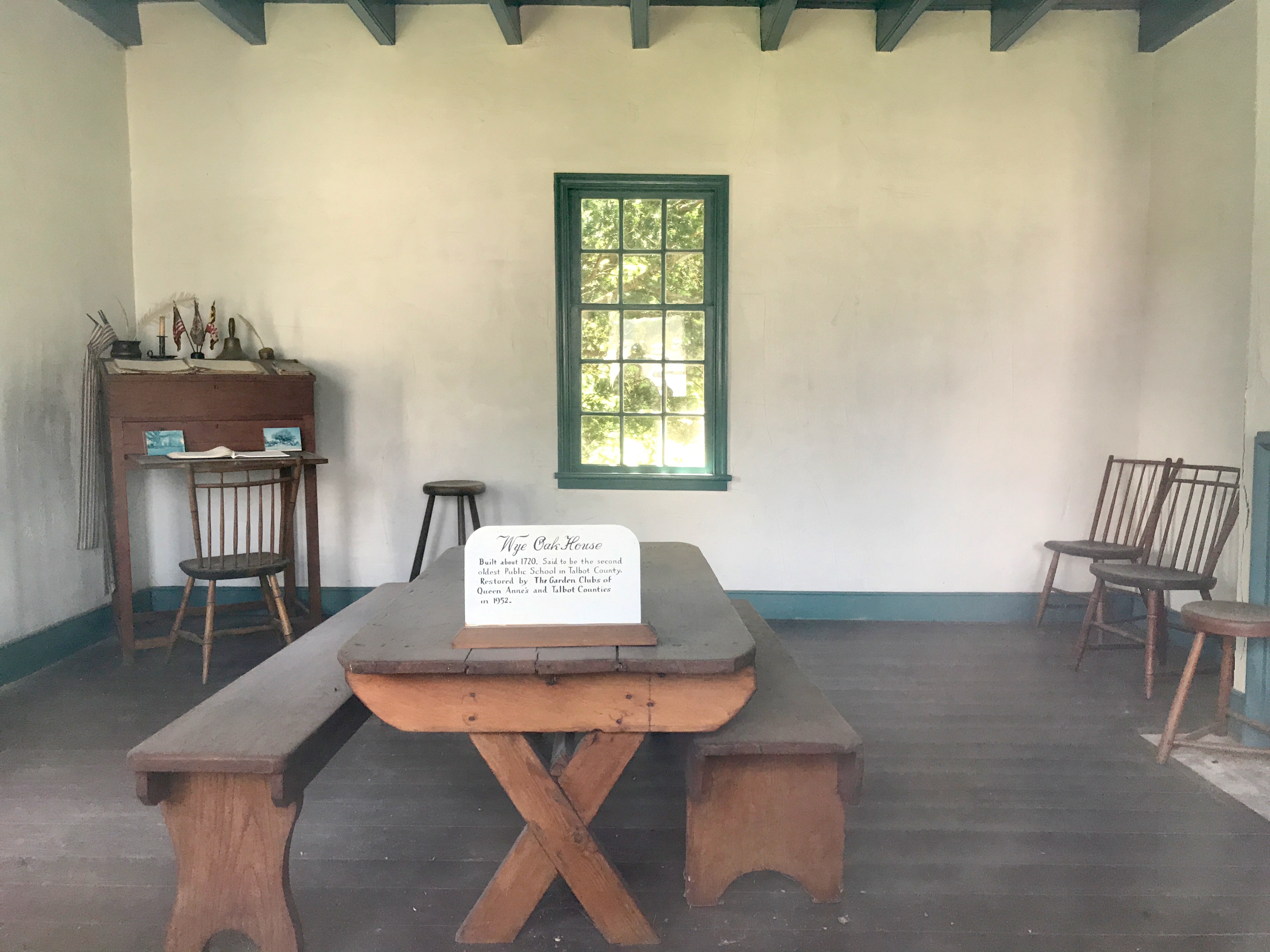
The little building you can see in the background is still standing. It is called the “Little House” in the shade. It dates back to about 1800, and local lore holds that it once served as a one-room schoolhouse.

The Queen Anne Garden Club restored the “Little House” in 1952. The foundation was strengthened, windowpanes repaired and a walkway was laid. They furnished the house as a classic American one-room schoolhouse, although it may have been a dwelling.

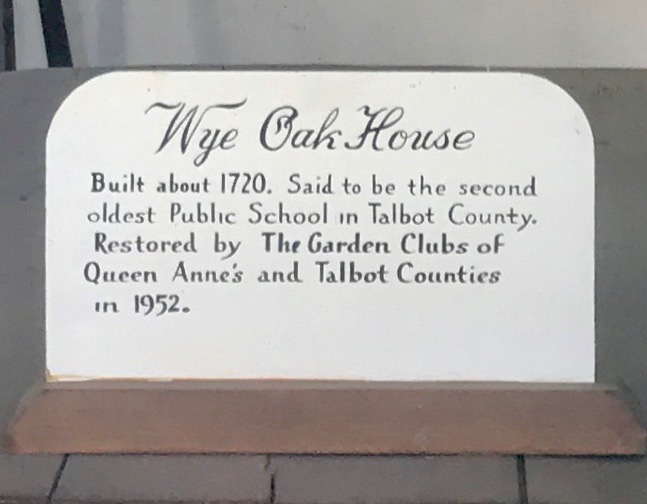
And while on of the interpretive plaques says that it was built around 1800, I’ll let you read the sign on the table for yourself.

I guess there are alternative facts.

My tour completed, I got back in the Ford Transit and got ready to rack up more miles on the odometer.

I had miles to go before I could call it a day.


By the Sea, By the Sea, By the Beautiful Sea…

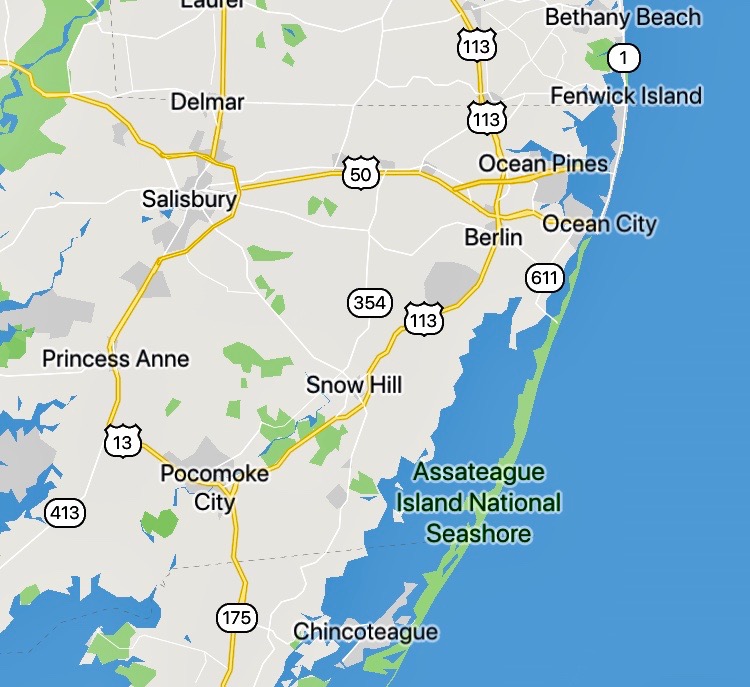
If you look at the map, faithful readers may notice that I am back in an area I’ve been before.

There’s Chincoteague and Assateague down there in the South. My last stop of the day was just east of Salisbury, so I figured that I might as well head over to the shore for the night.

I used one of those booking apps and found a hotel that was probably an elegant location back in the day. It was going to be fine for the night. After getting settled in room #2 – the first room they put me in didn’t have functioning air conditioning – I set out in search of dinner.

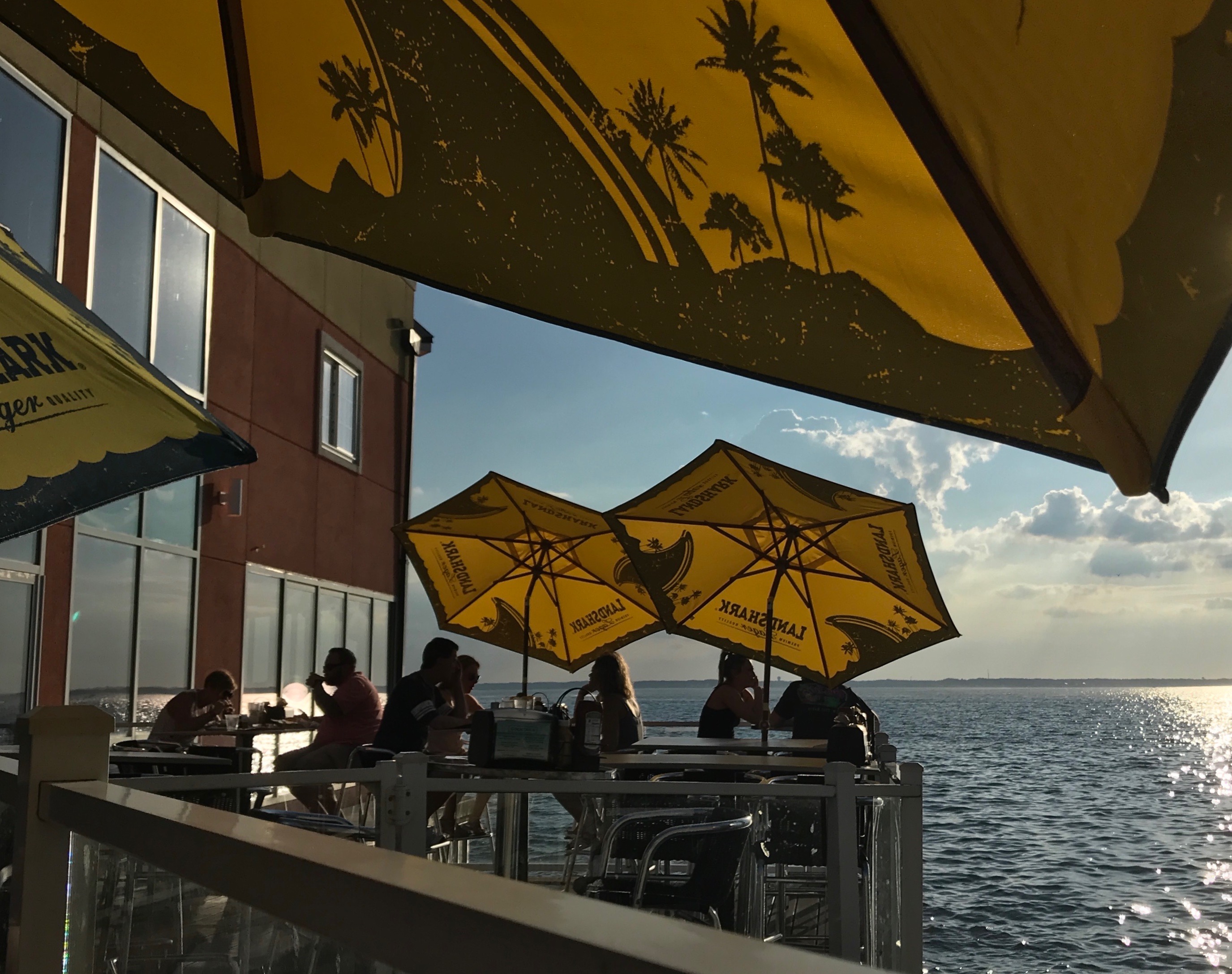
Just down the road, I found the 45th Street Taphouse Bar & Grill. The big attraction for me was that they had a patio facing the bayside, and I would be able to watch the sunset.

What a lovely evening!

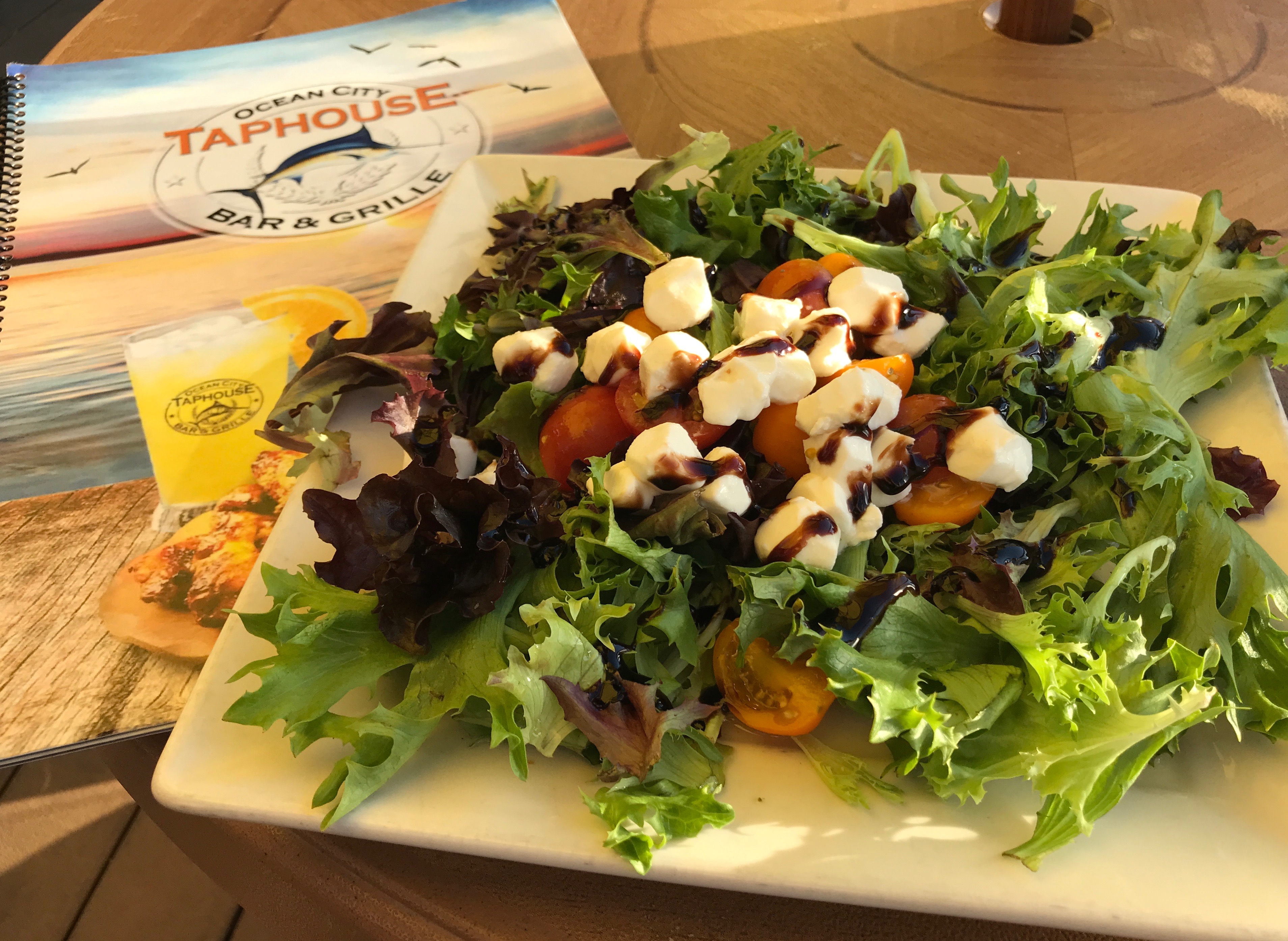
I perused the menu and settled on the Caprese Salad. This is what I had in mind, photo courtesy of The Food Network:

Doesn’t that look refreshing and delicious?

Unfortunately, this is what I was served:

Oh, well… it was edible and it would keep body and soul together. I considered sending it back, but who knows if anything on their menu was better. Besides, I was there for the sunset.

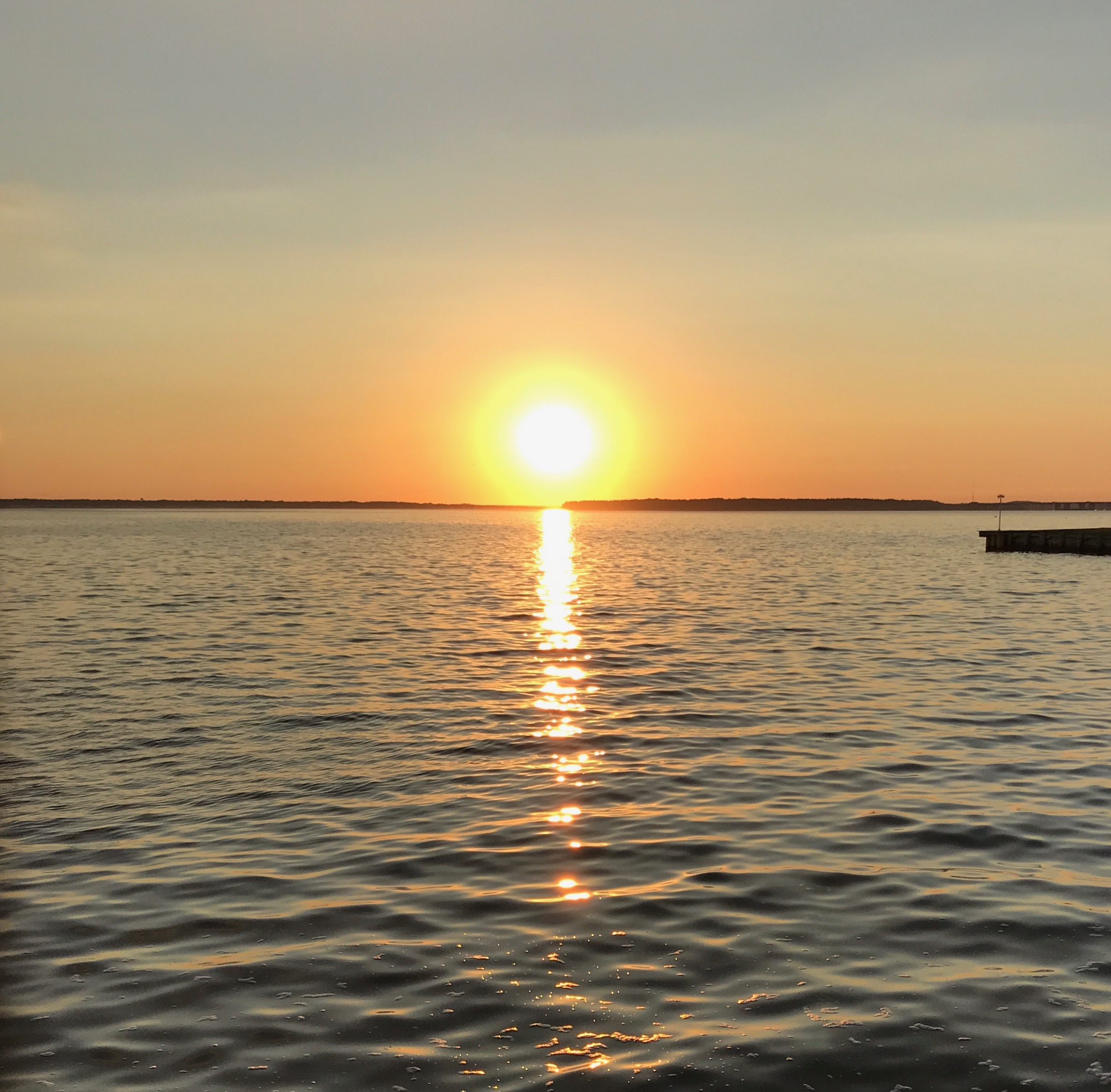
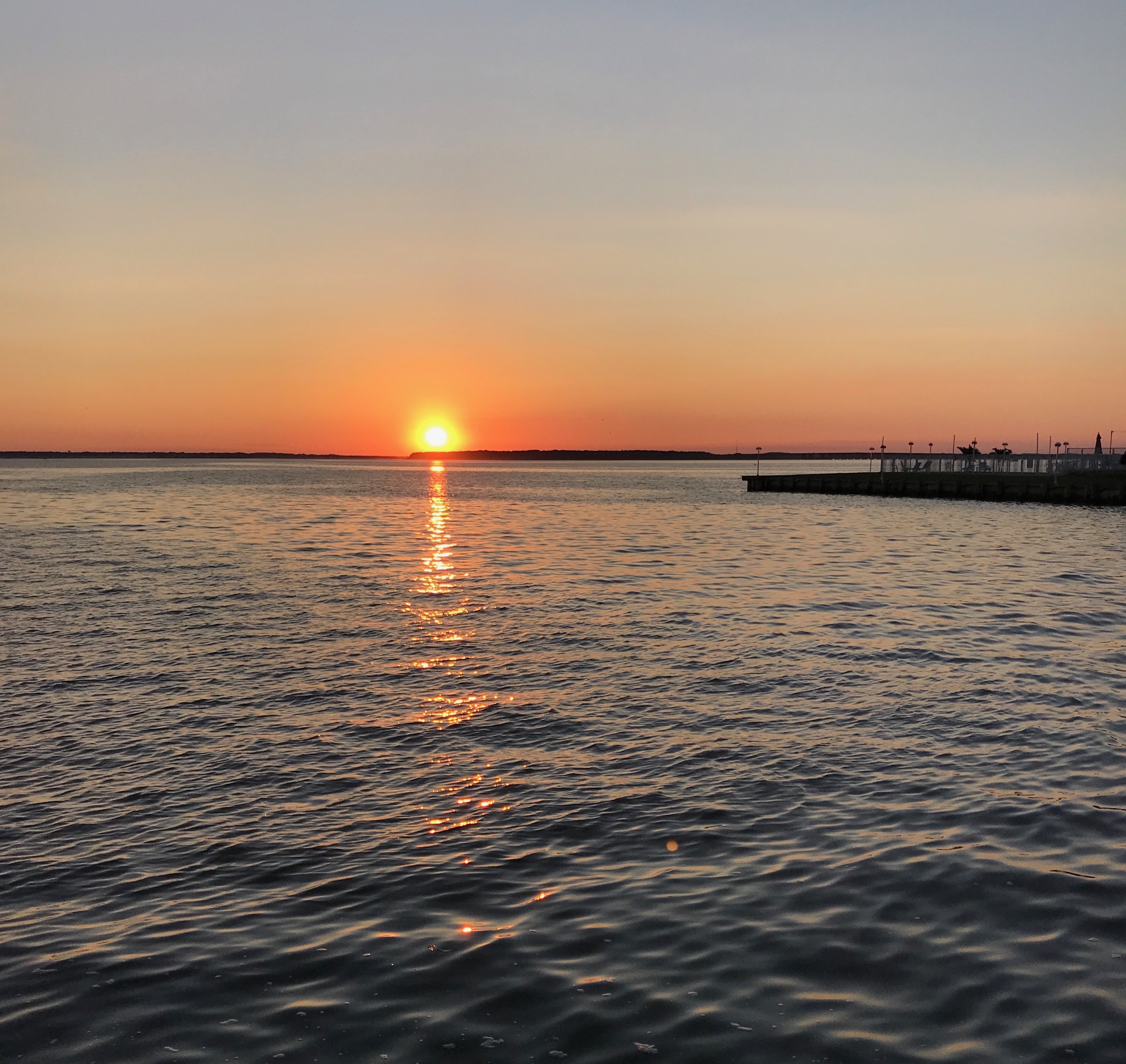
After nibbling on my salad and nursing my water for a long time, the sun finally started going down.

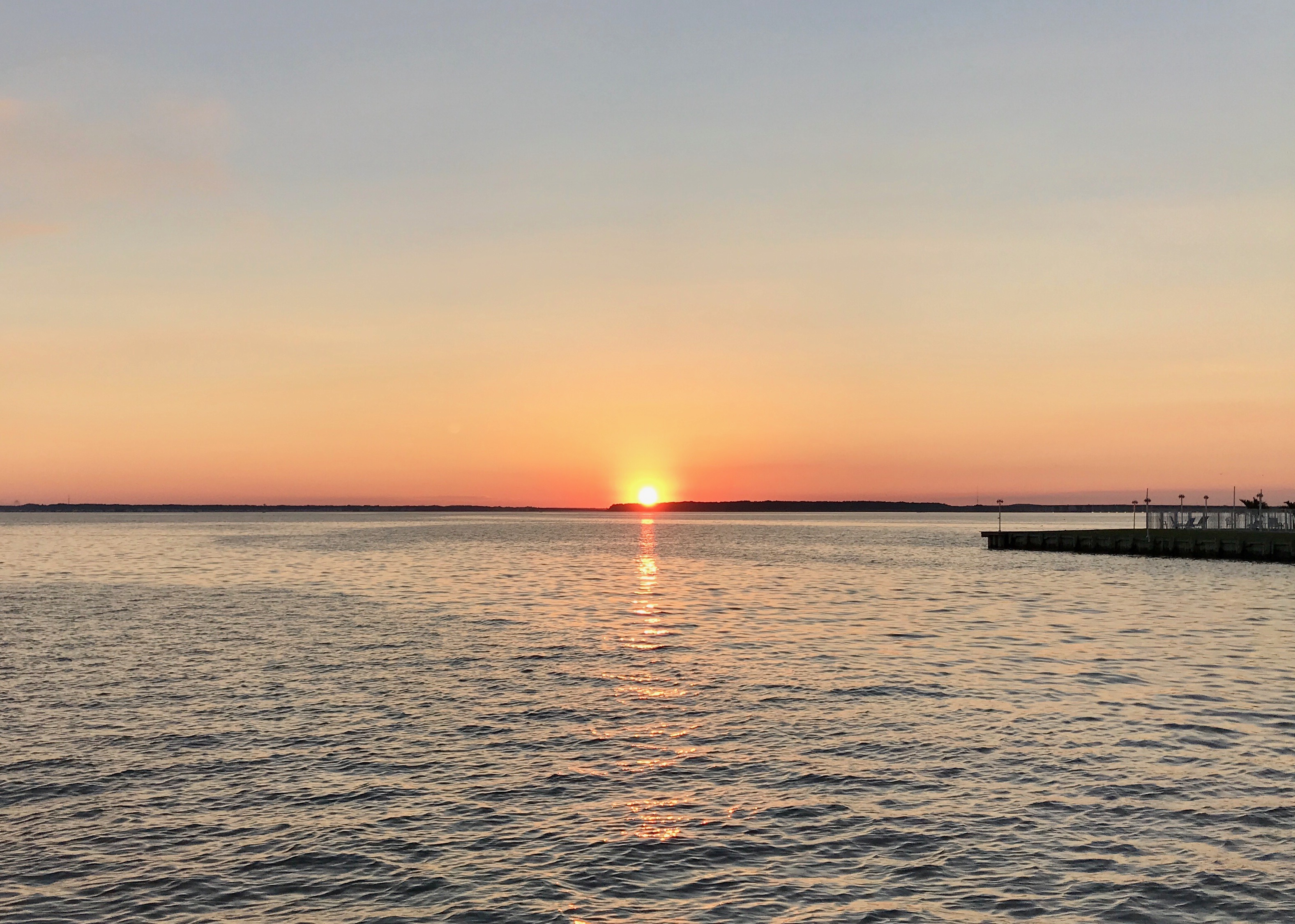
And down…

and down…

sill going…

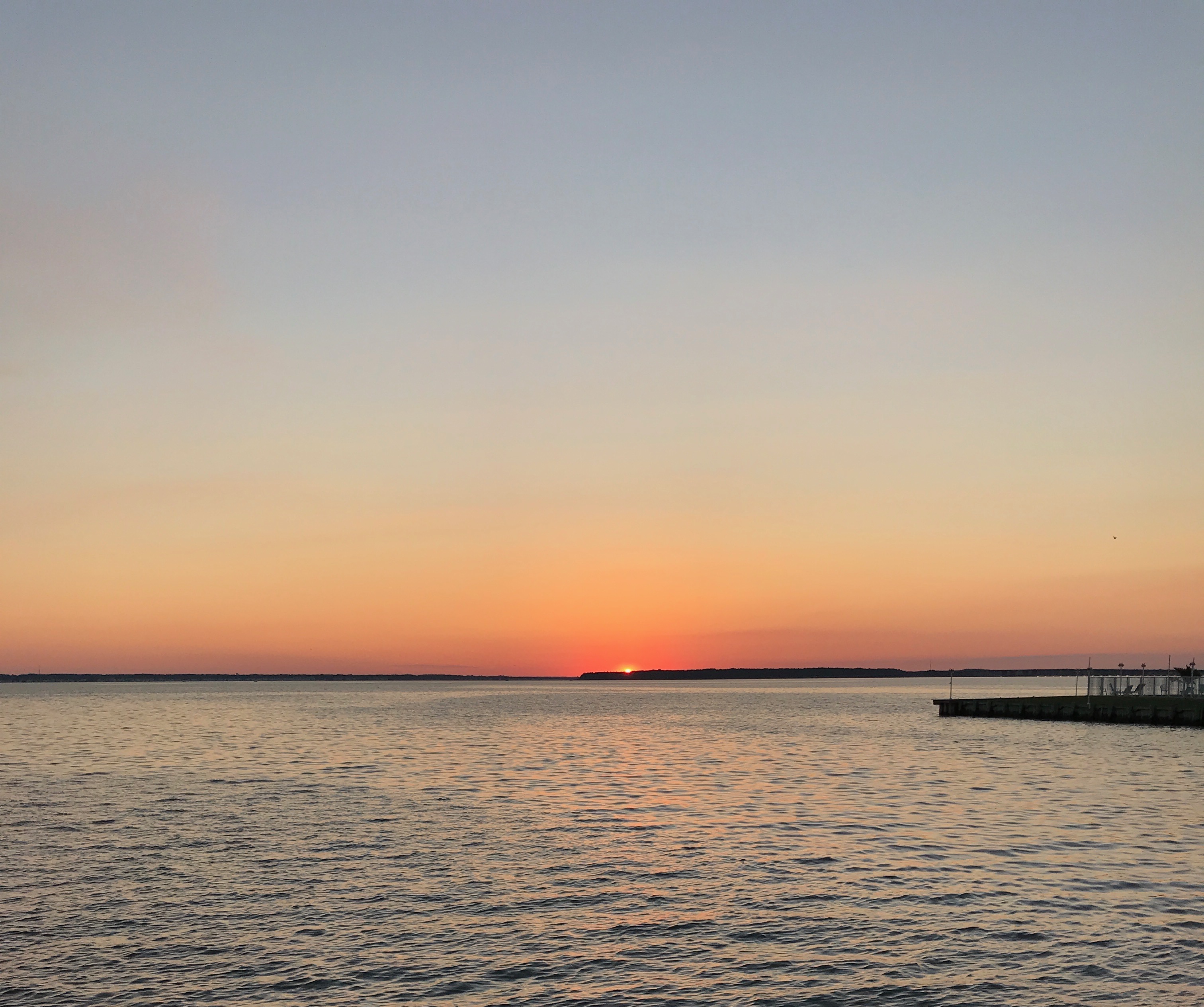
Just the tiniest sliver left above the horizon.

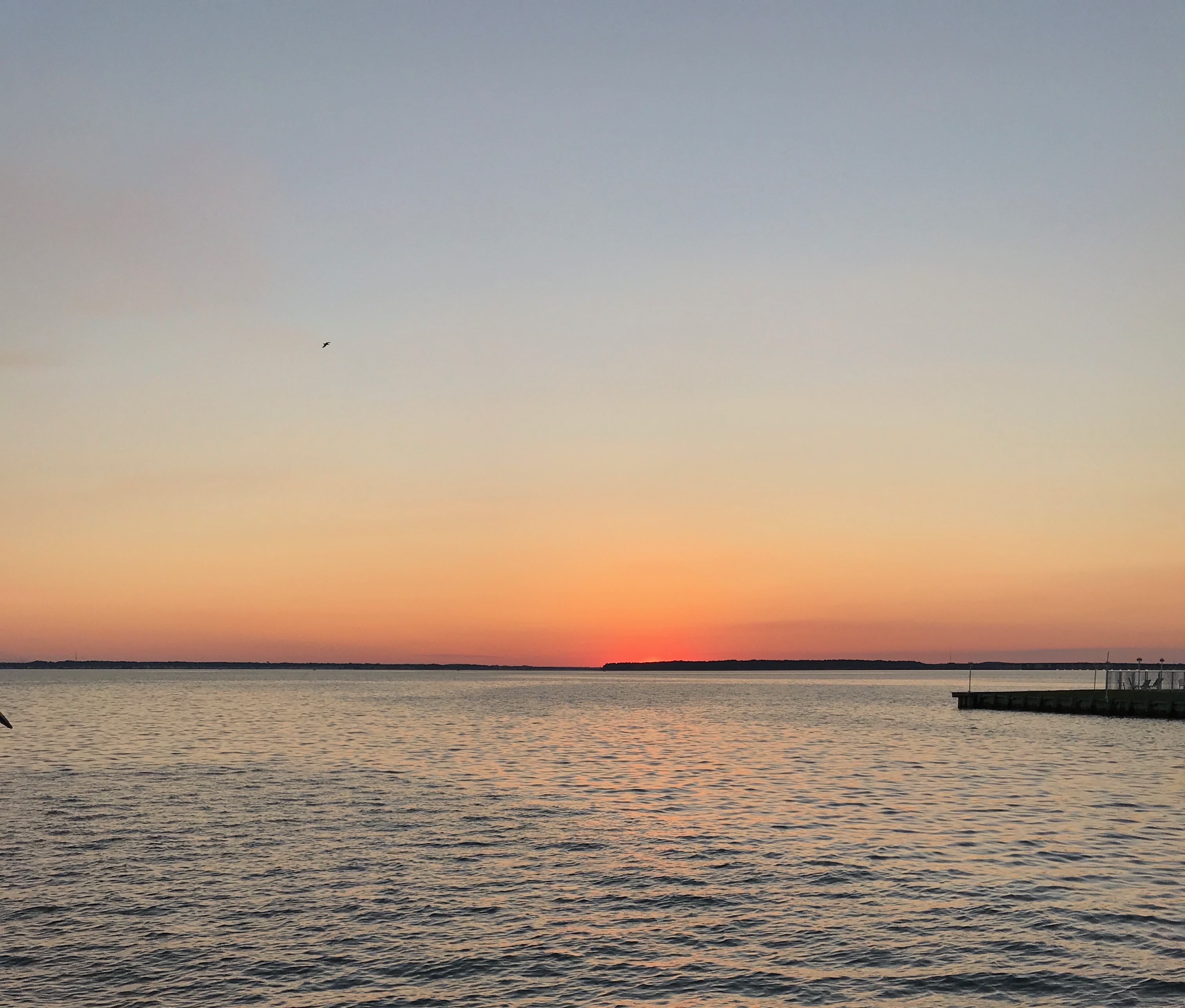
Finally, it was gone.

And so was I. Back to my room to get rested up for another day on the road.


A Little Further along the Road

With the weekend over, it was time to get rolling. I looked at the map, and realized one of the routes I could choose would take me through Manassas, Virginia.

I had been there in 2015 for quite a few days, so I didn’t really need to tour the battlefield again. However, old friends live there, so I stopped off for a quick visit.

Linda went to college with me. She met Tom after college. I knew Tom was planning to marry her when he made her a piece of furniture. For some reason, that didn’t even dawn on her – or so she said.

And, in the “no photo or it didn’t happen” category, here is the proof that I visited.

With that technicality out of the way, I had to keep rolling. This wasn’t my final destination of the day. I had to get a little further down the road to be positioned for the next round of collections.

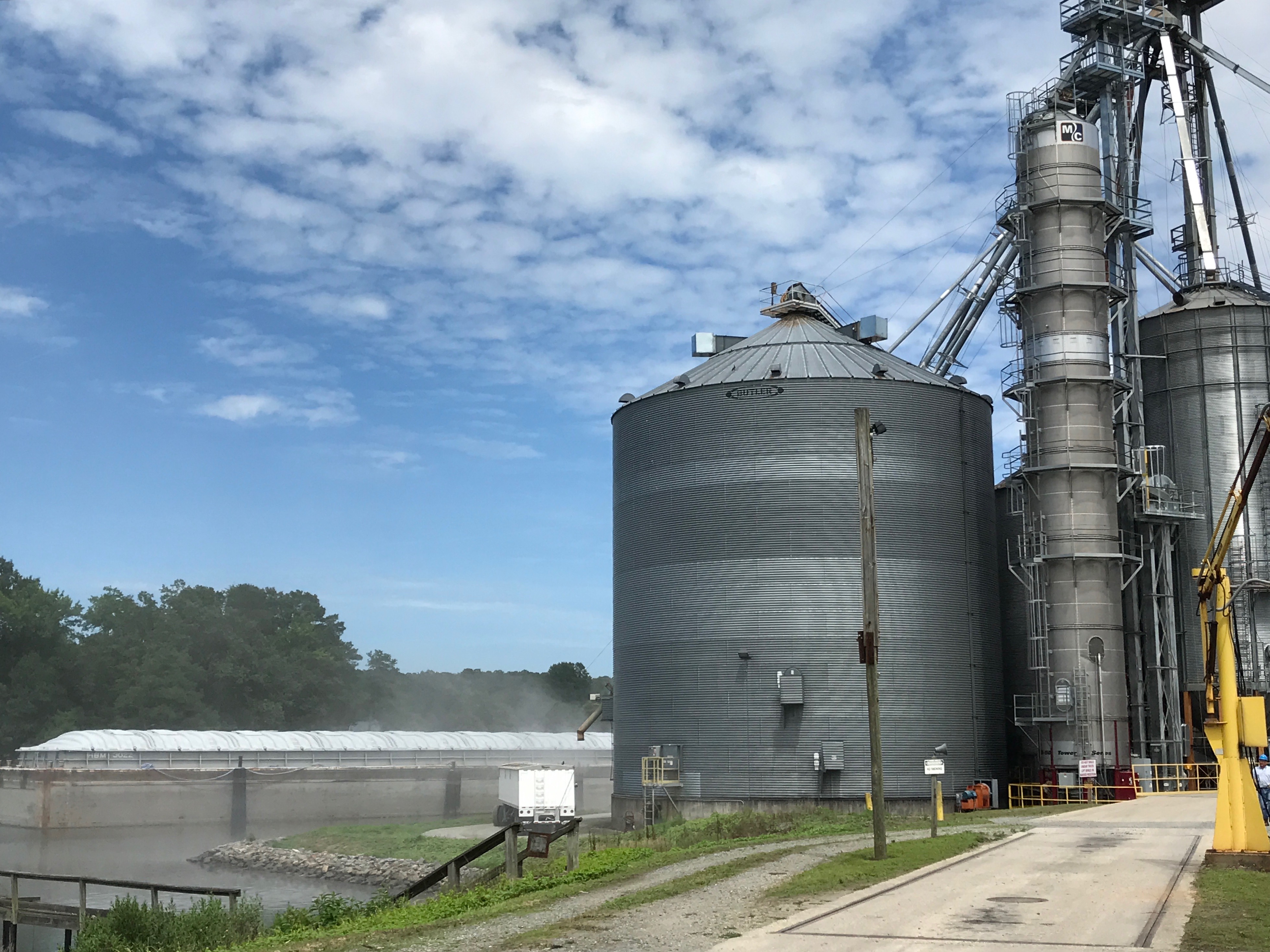
This was really an interesting gig! This facility loads the grain right on to the barge. It’s not much to look at, but that’s the barge on the left side of the photo.

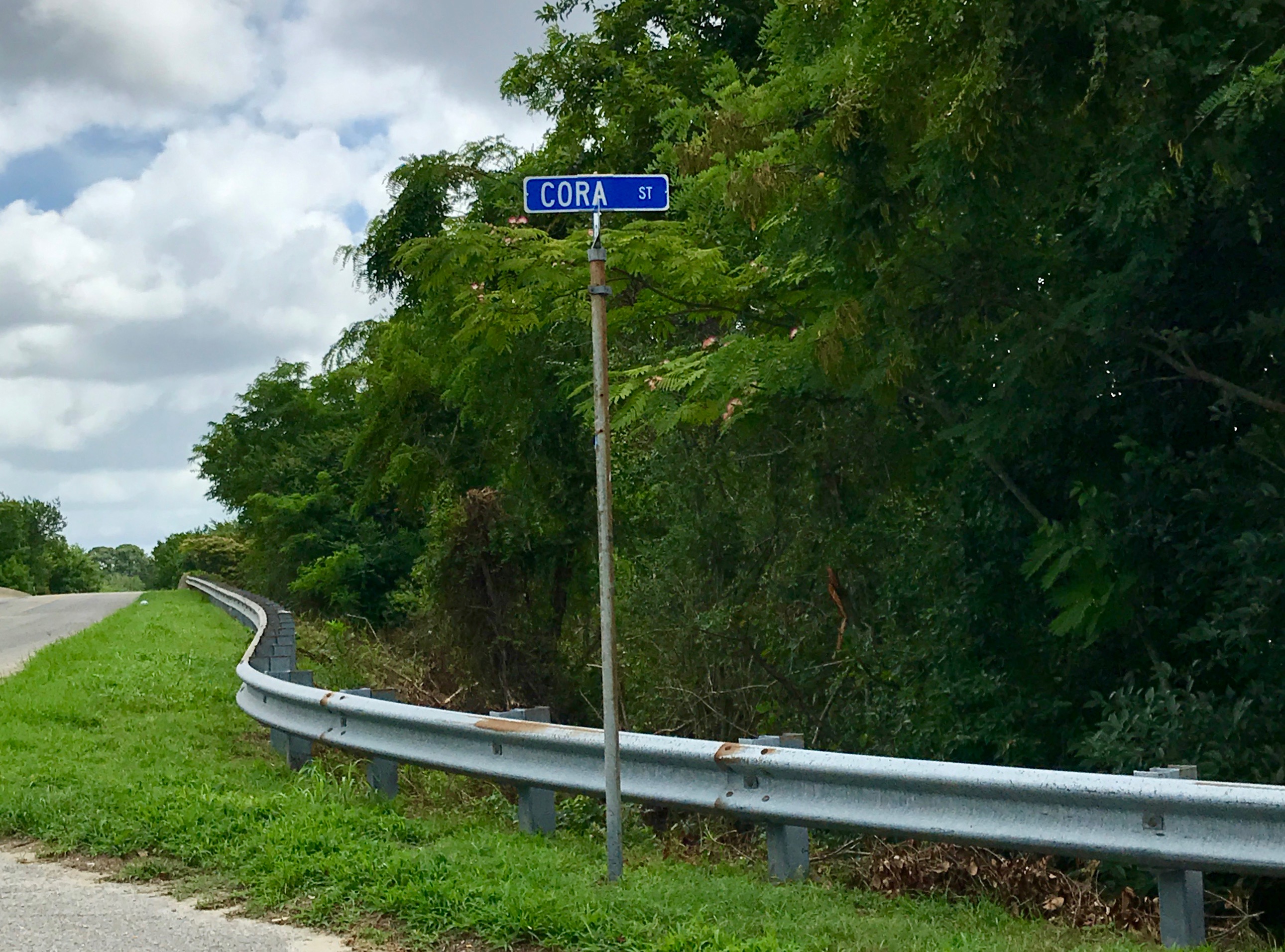
This street sign made me think of my dear kitty, Cora. I hope she remembers me when I get home.

I came across a lot of interesting road signs on my travels. I imagine there is an interesting story about why this thoroughfare is named “Prison Camp Road.” But, there was no one to ask, and I had places to go. In fact, I don’t even know where I was!

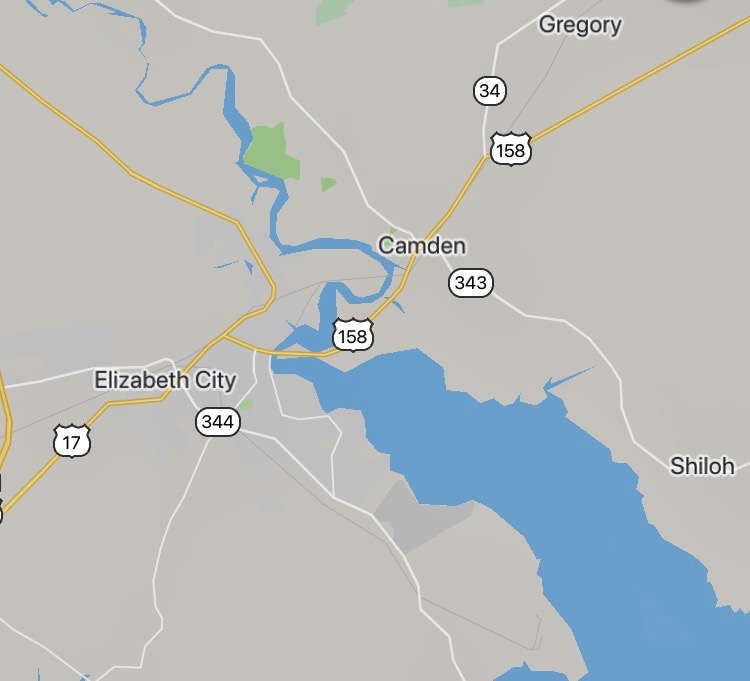
When my work day was done, I found a room for the night in some roadside hotel near Elizabeth City, North Carolina and then headed out to eat.

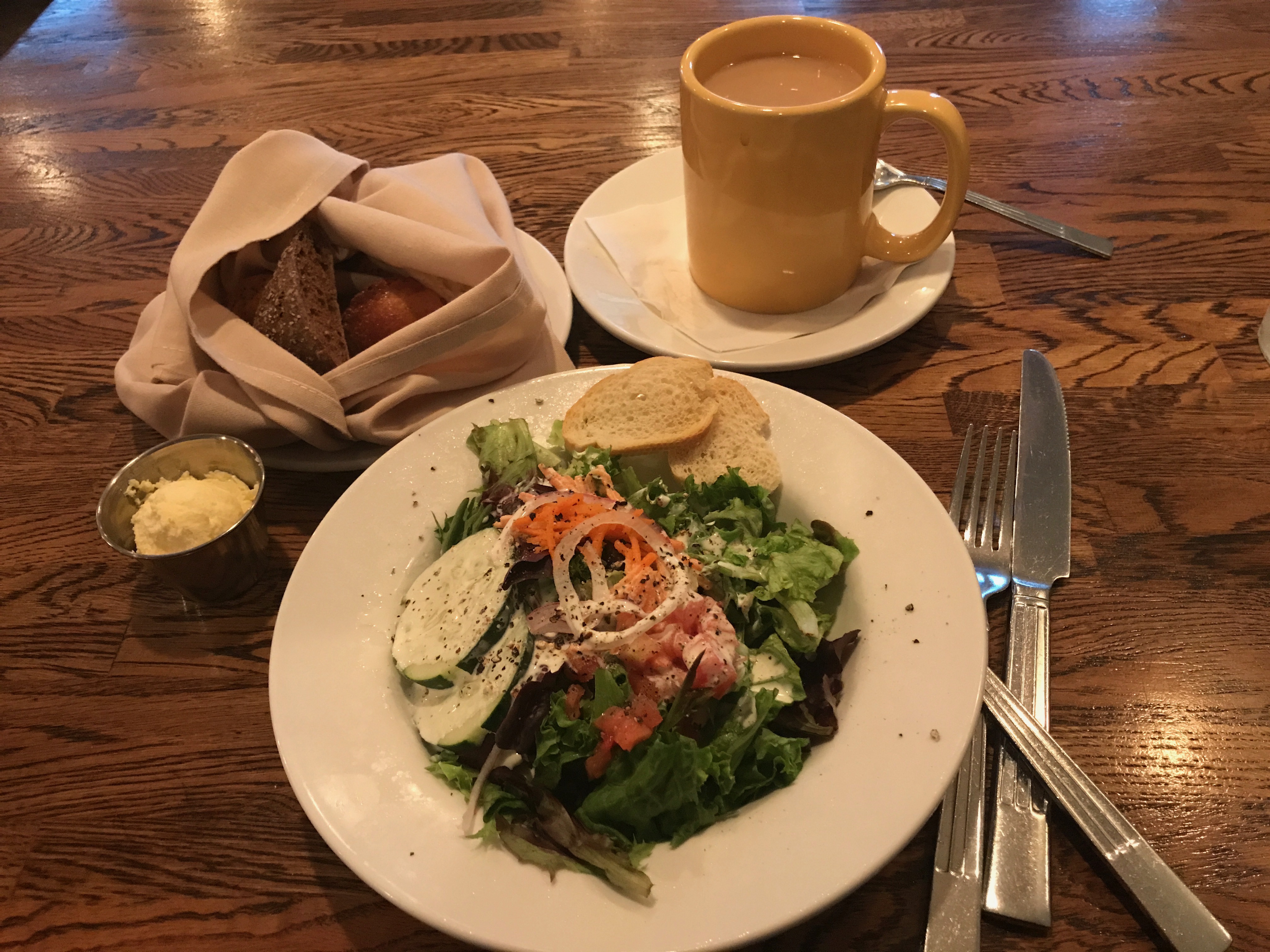
First, a salad.

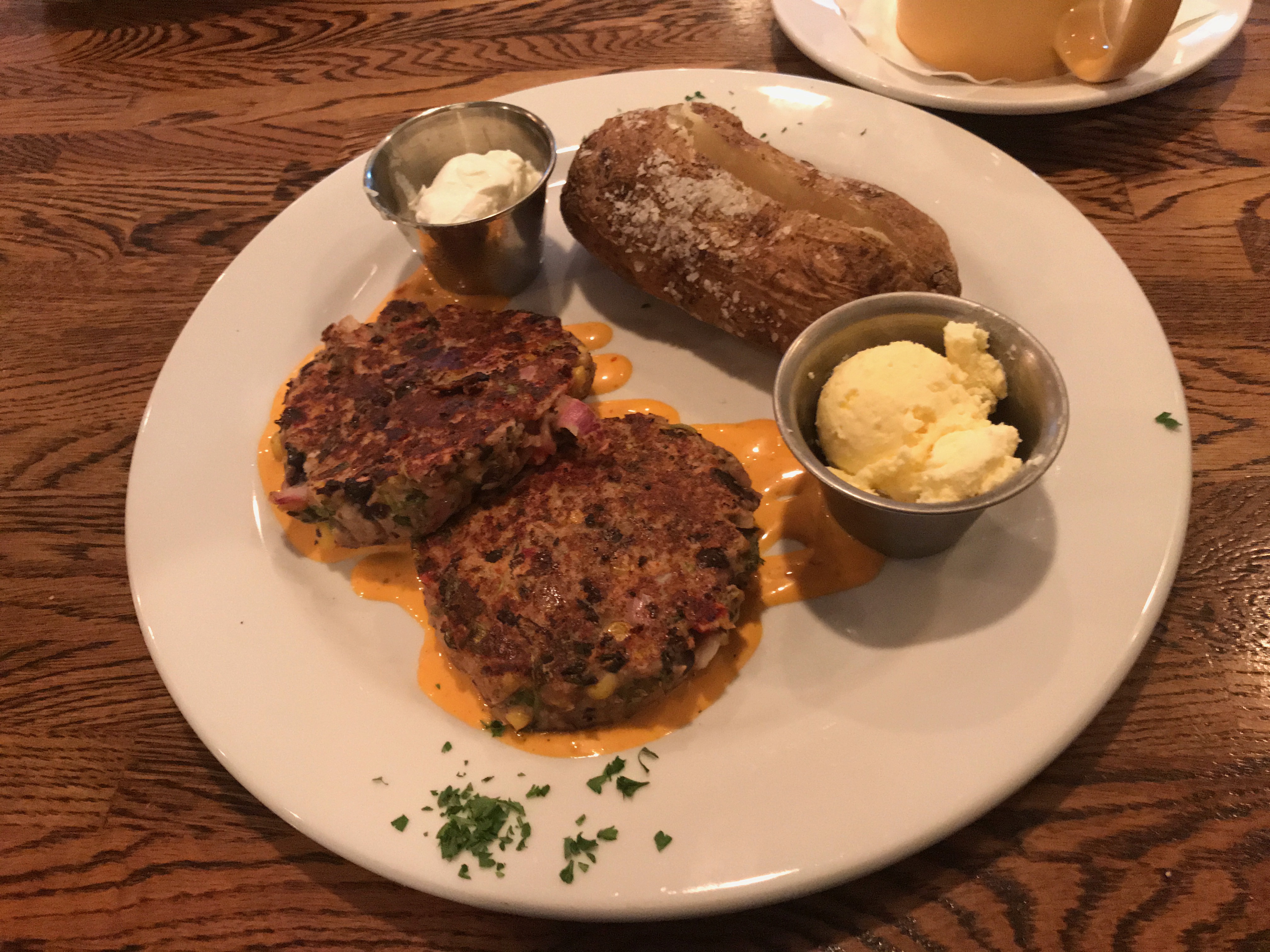
Then , the entree. I wish I remembered what the protein was, but I can identify the baked potato. I was really enjoying the baked potatoes I was getting with my meals. I love them, and I don’t make them for myself. I know you can do them in the microwave, but you don’t end up with the crispy skin. Yum!

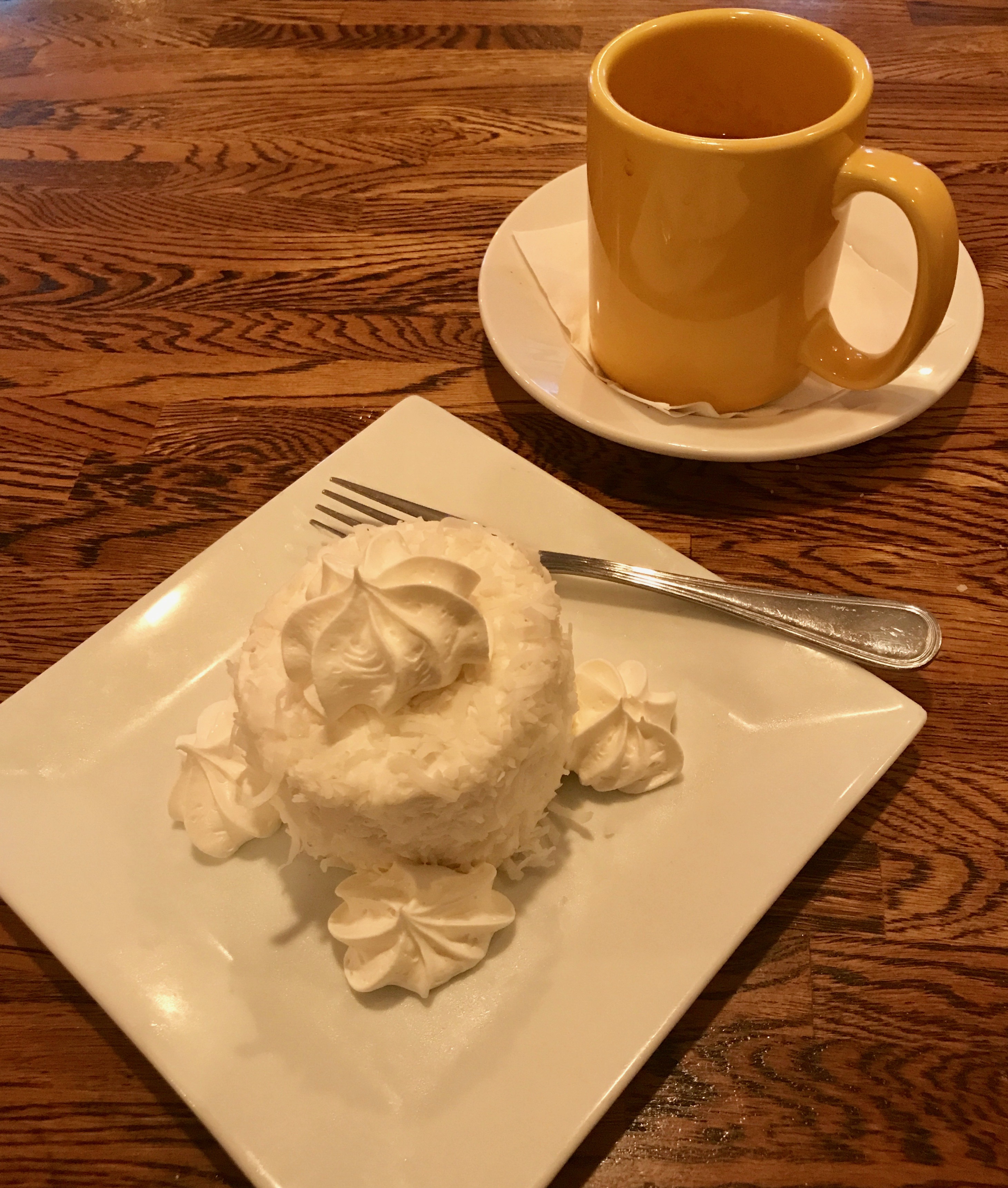
I don’t remember what the dessert was, either. But, I am sure it was tasty, and it had coconut on it!

After dinner, I decided to explore Elizabeth City.

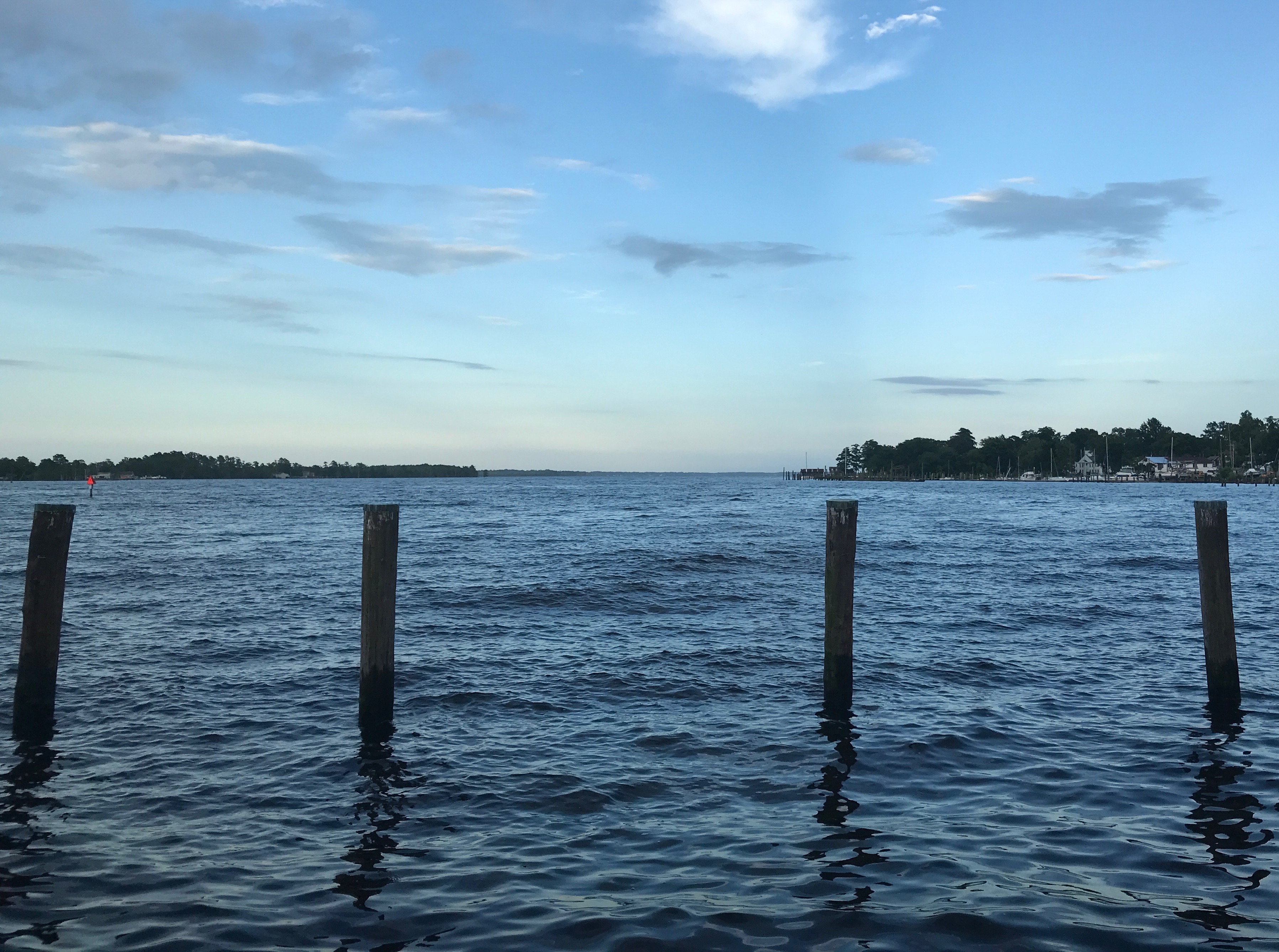
I wound my way down to the harbor, which is on the Pasquotank River. They have a lovely waterfront.

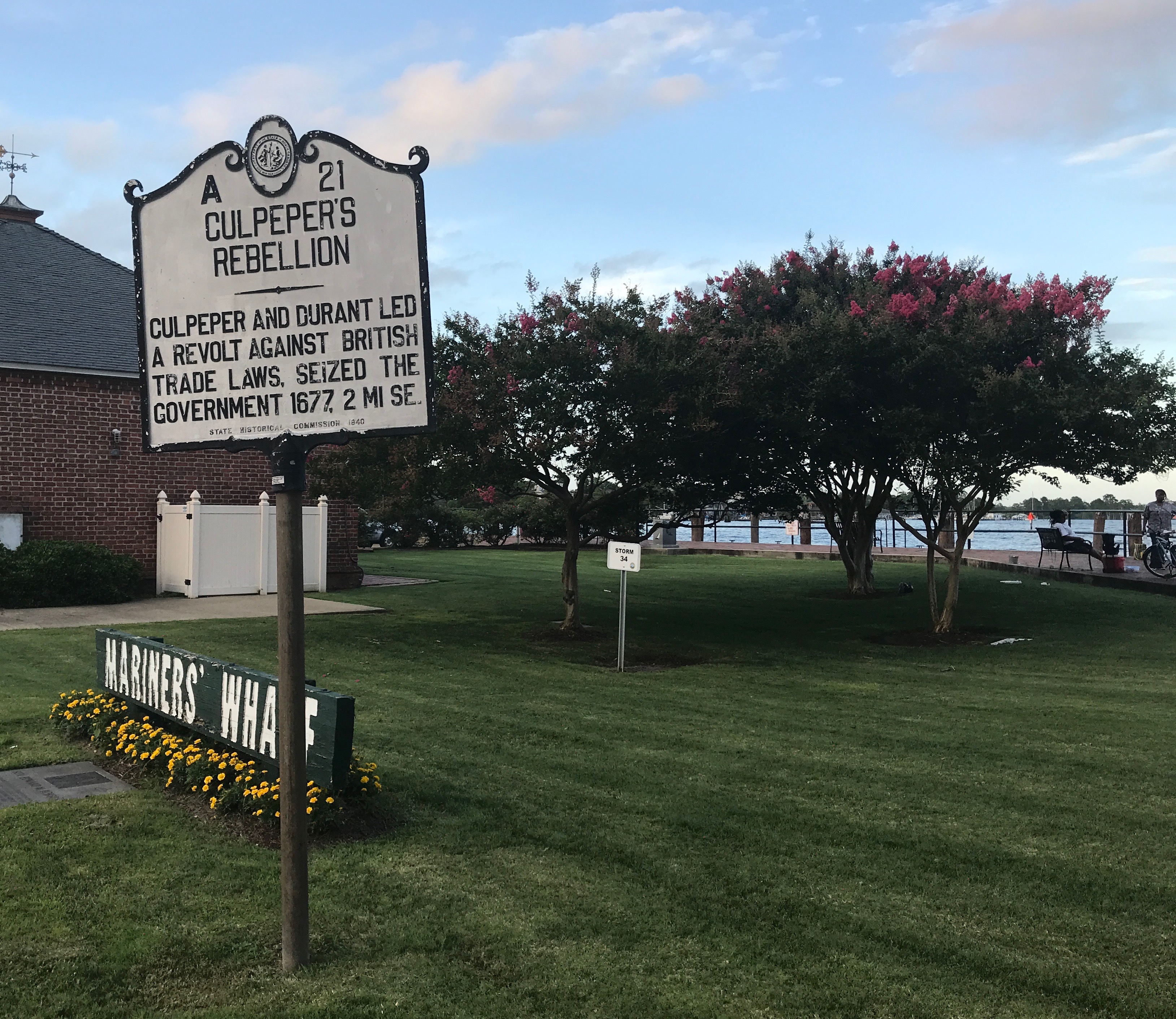
I parked and walked over to investigate. I am always tickled by signs that tell you about places that aren’t where you are. Culpepper’s Rebellion took place two miles away. At least I had a direction to head, if I had a mind to. Southeast.

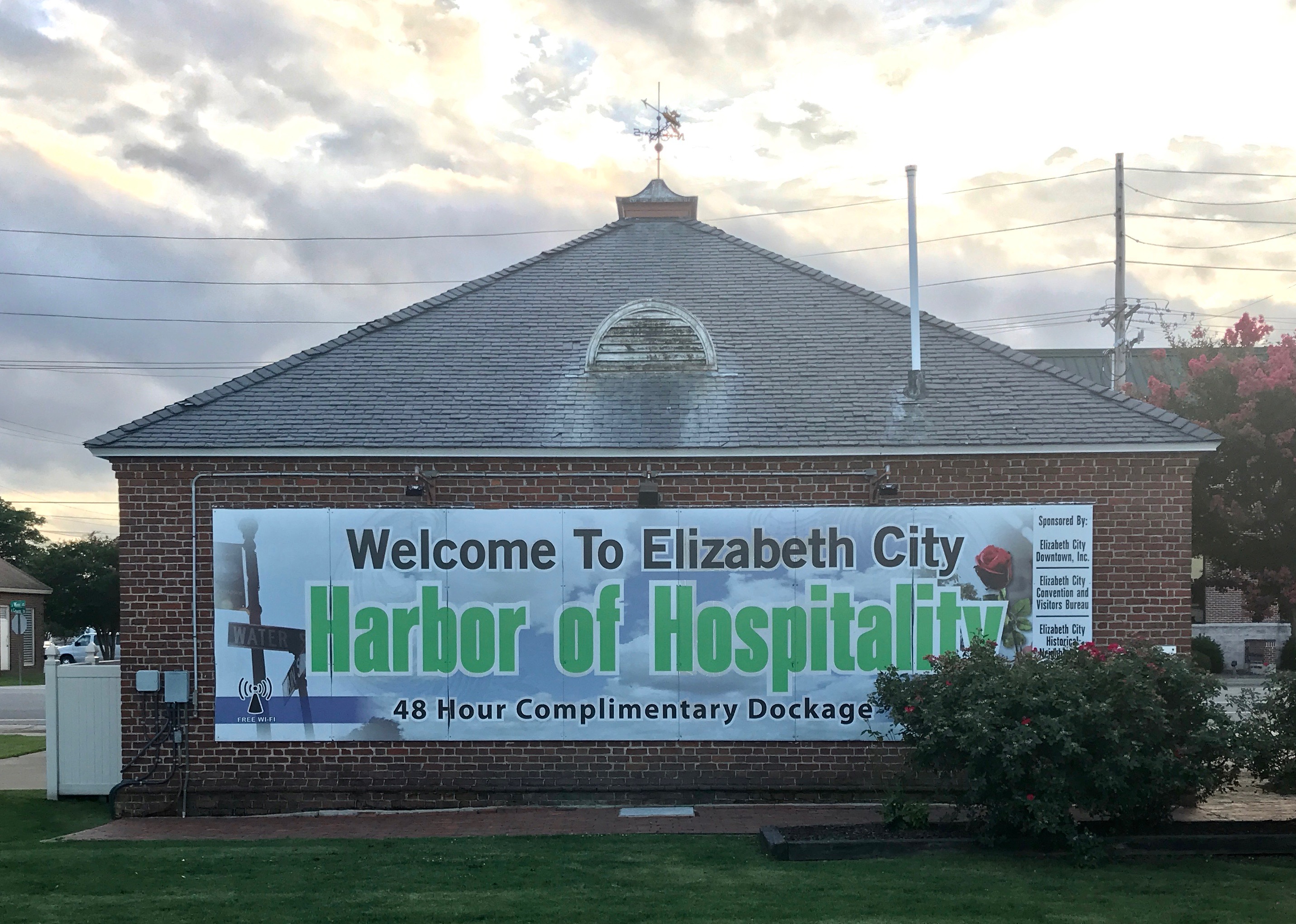
They call themselves the “Harbor of Hospitality” and offer 48 hours of complimentary dockage. That sure is hospitable!

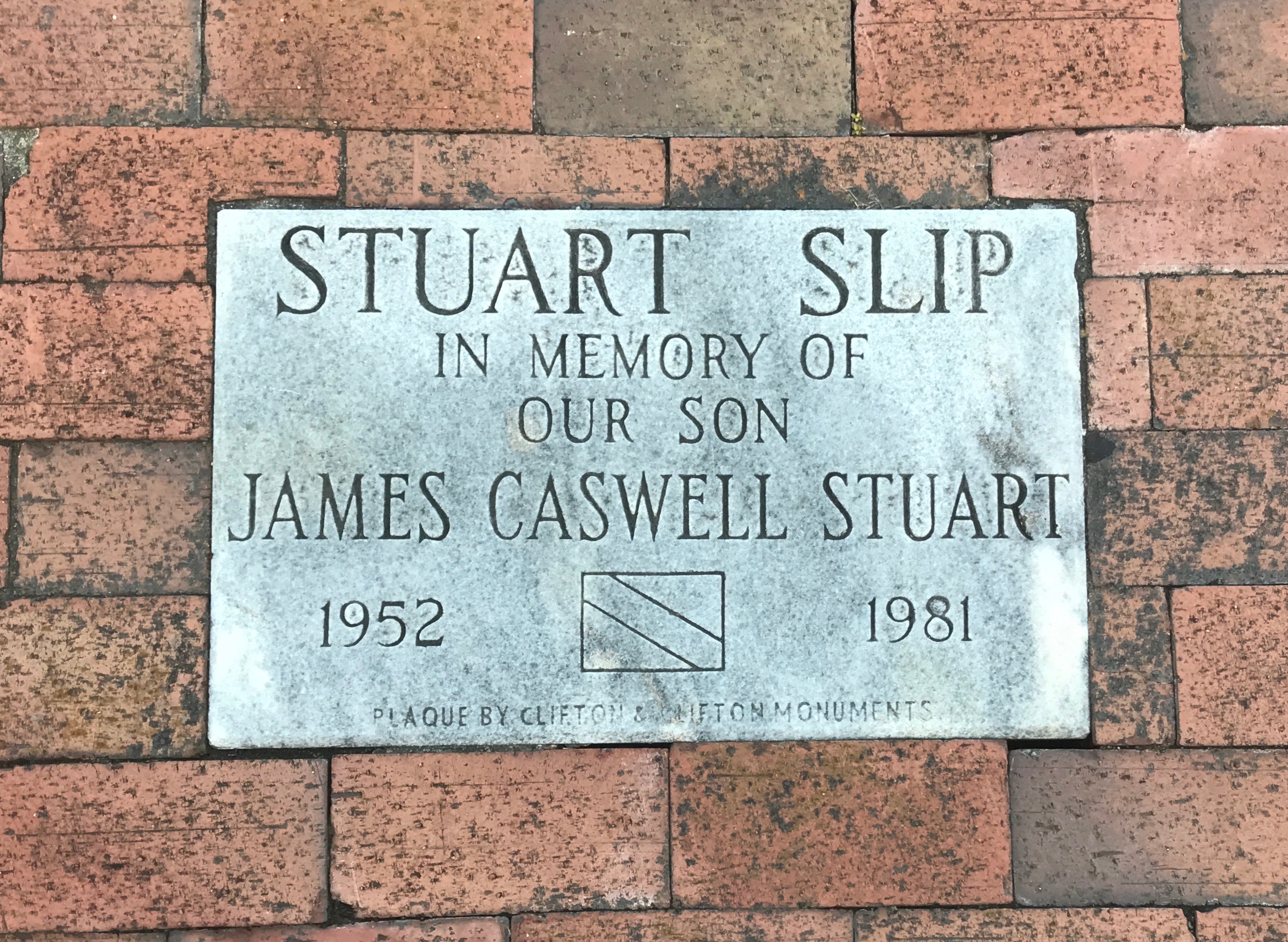
I thought this was a thoughtful way to honor their son, who died all too young. I am sure all who stay in the slip think of him and them.

The park around the harbor is quite lovely, and I love the idea of transplanting someone’s beloved rose bushes to a place where they can continue to be enjoyed.

In case you can’t read the writing on the monument, back in 1983, two friends, Fred and Joe, hosted a gathering for “the mariners” – I assume that means people with ships in the harbor. Joe brought roses from his own bushes to give to the “first mates” – I assume that means the wives of the “captains.”

When Joe died in 1987, his rose bushes were transplanted to the park by the wharf. Fred continued to care for his friend’s rose bushes even as he reached his 90s. He was assisted by local businesses and organizations. The care for the roses have continued after Fred died in 2007.

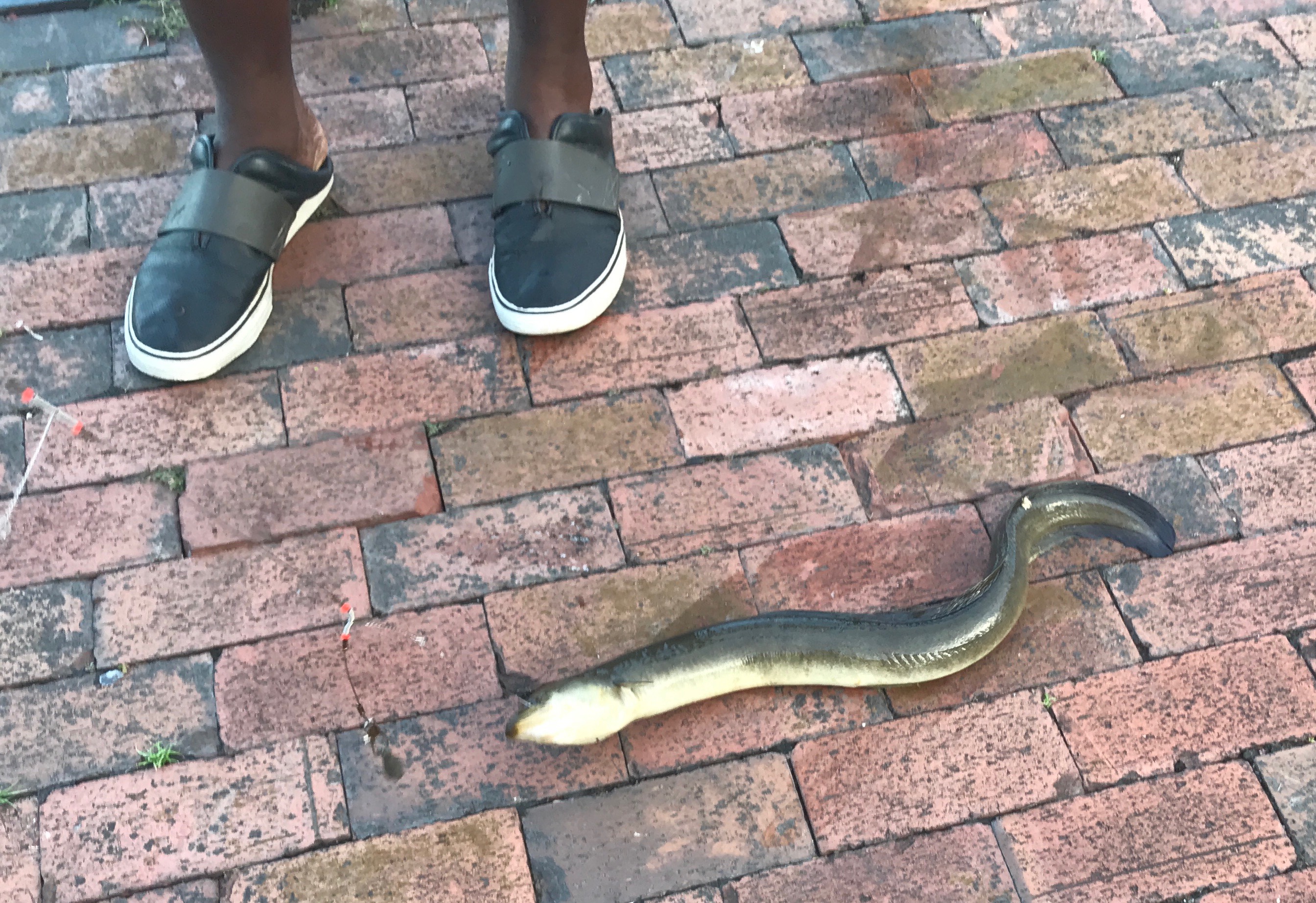
Some people were fishing off the wharf. They were all gathered around something, so I walked down to see what they were looking at. Eww! An eel!

I took a last look out into the harbor. We surely do live in a beautiful world! Back to the hotel for a solid night’s sleep. The morning would be here soon enough and I would be on the road again.


This Basilica…

After driving around in circles the past week, I managed to find a room for the weekend in Frederick, Maryland. I somehow snagged a room with a jacuzzi tub, and the hotel had above average breakfasts. I did a lot of resting that weekend, but I did make one field trip.

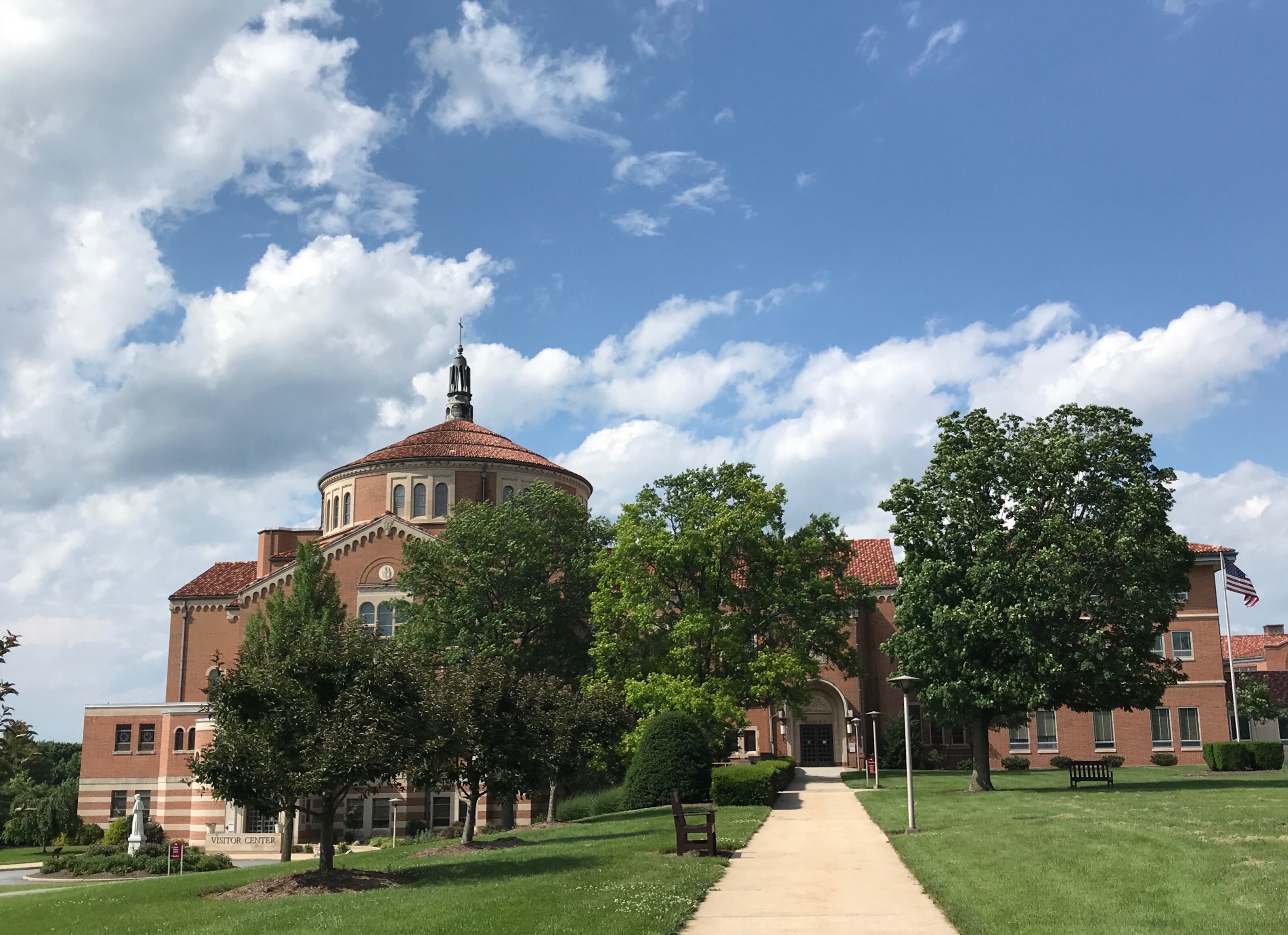
I went to attend mass at the National Shrine of Saint Elizabeth Ann Seton in Emmitsburg, Maryland.

I have to admit that I didn’t know as much as I probably should have about her, although I was aware that she was the first native-born citizen of the United States to be canonized by the Catholic Church. I knew little else about her, and what I thought I knew about her I had conflated with Mother Frances Cabrini, who was the first naturalized American citizen to be canonized.

Both women did incredible things and founded religious orders that improved the lives of the poor. For this post, I will try to give some information on Saint Elizabeth Ann Seton. If you want to know more about Mother Frances Cabrini, you are on your own.

I made it in time for mass. I was in such a rush, that I didn’t notice that the shrine was also a basilica, so I didn’t take the time to look for the symbols that go with being a basilica – you know, the umbraculum, the tintinnabulum, and the crossed keys, which are the papal symbol. I guess I’ll have to go back and check for them, next time I’m in the neighborhood.

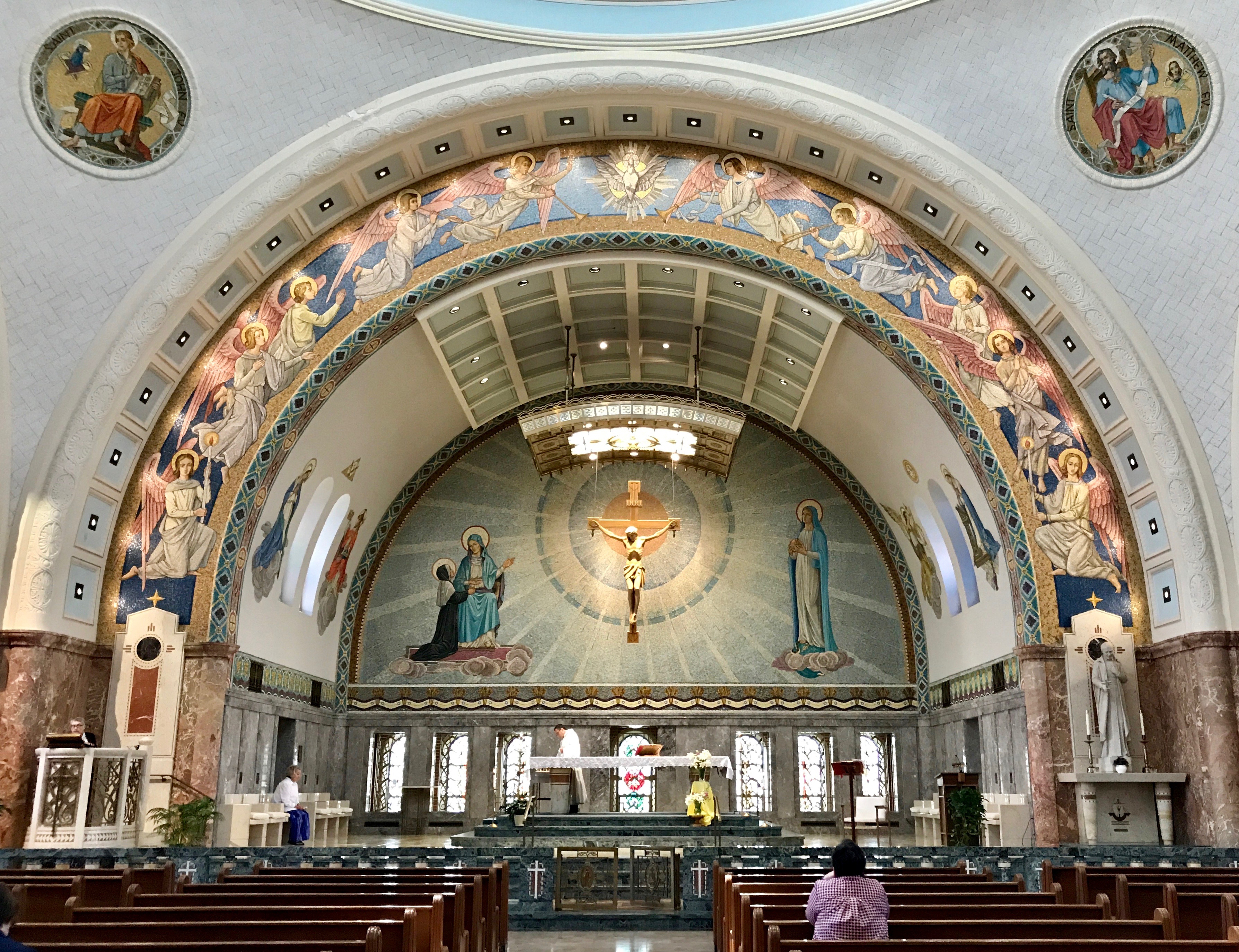
The Basilica was bright and airy. This is the view toward the main altar.

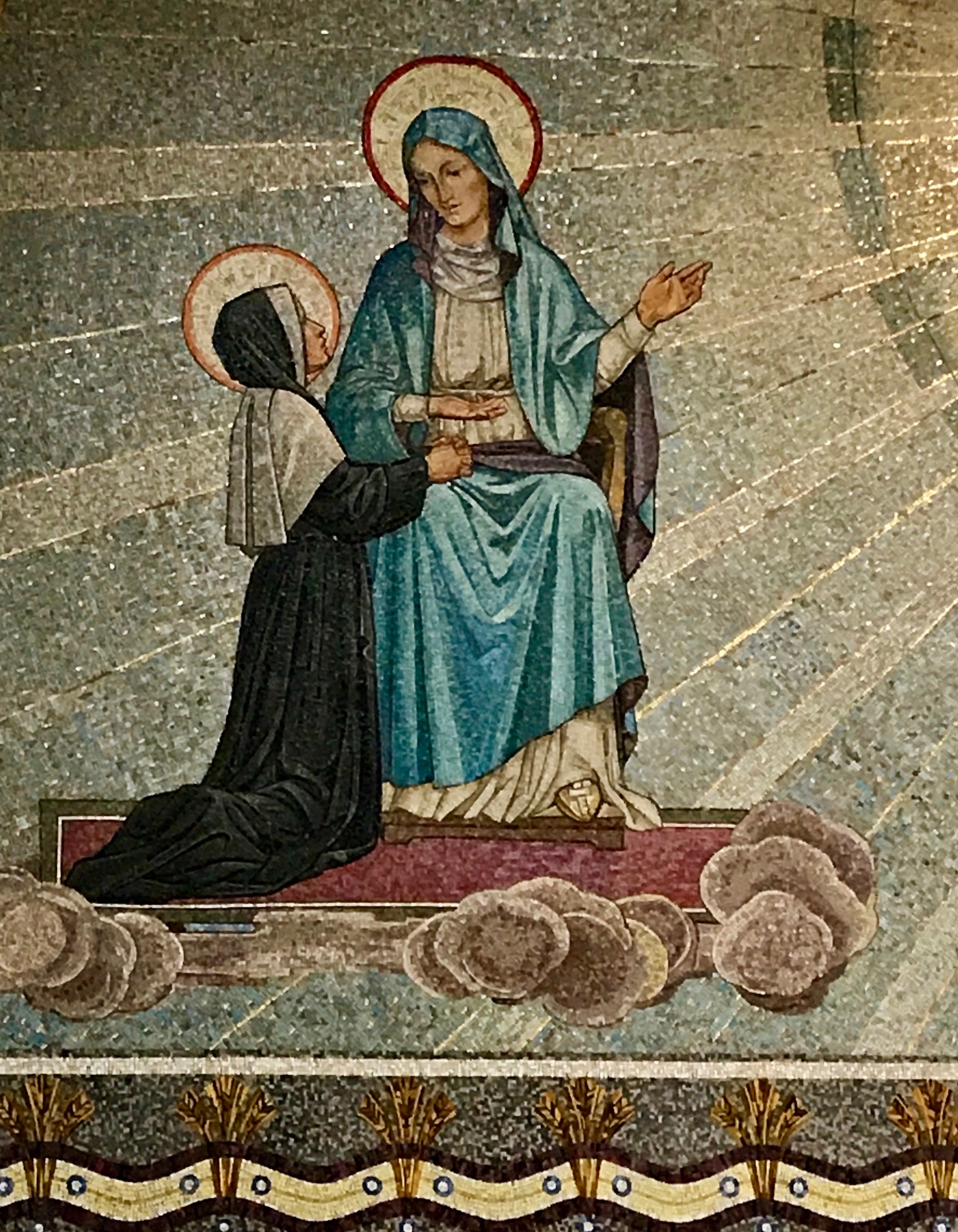
There was no one to ask at the time, but I assume that this was Mother Seton. Incidentally, one of her symbols is wheat, which you see in the border.

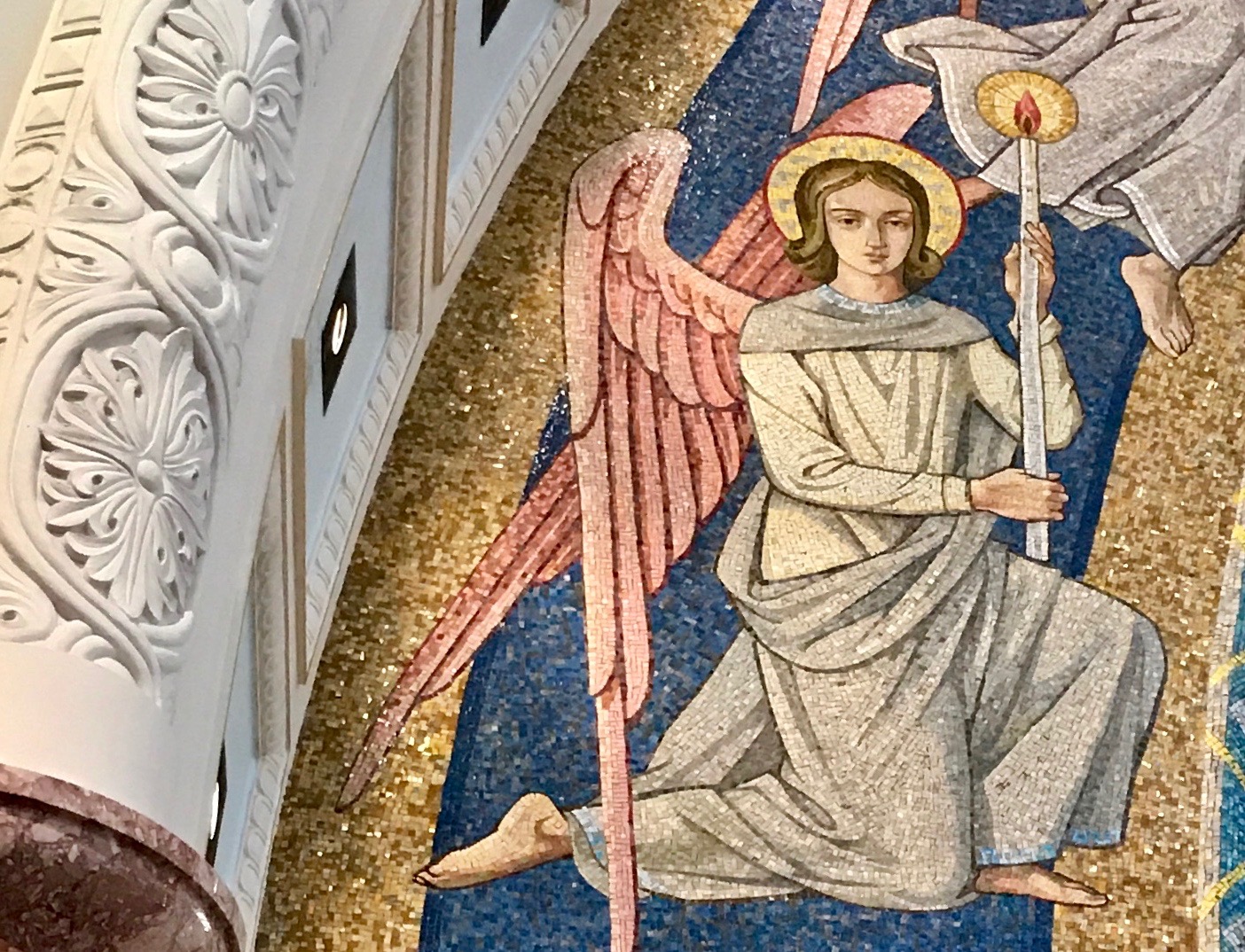
This angel was striking. I always appreciate mosaic art.

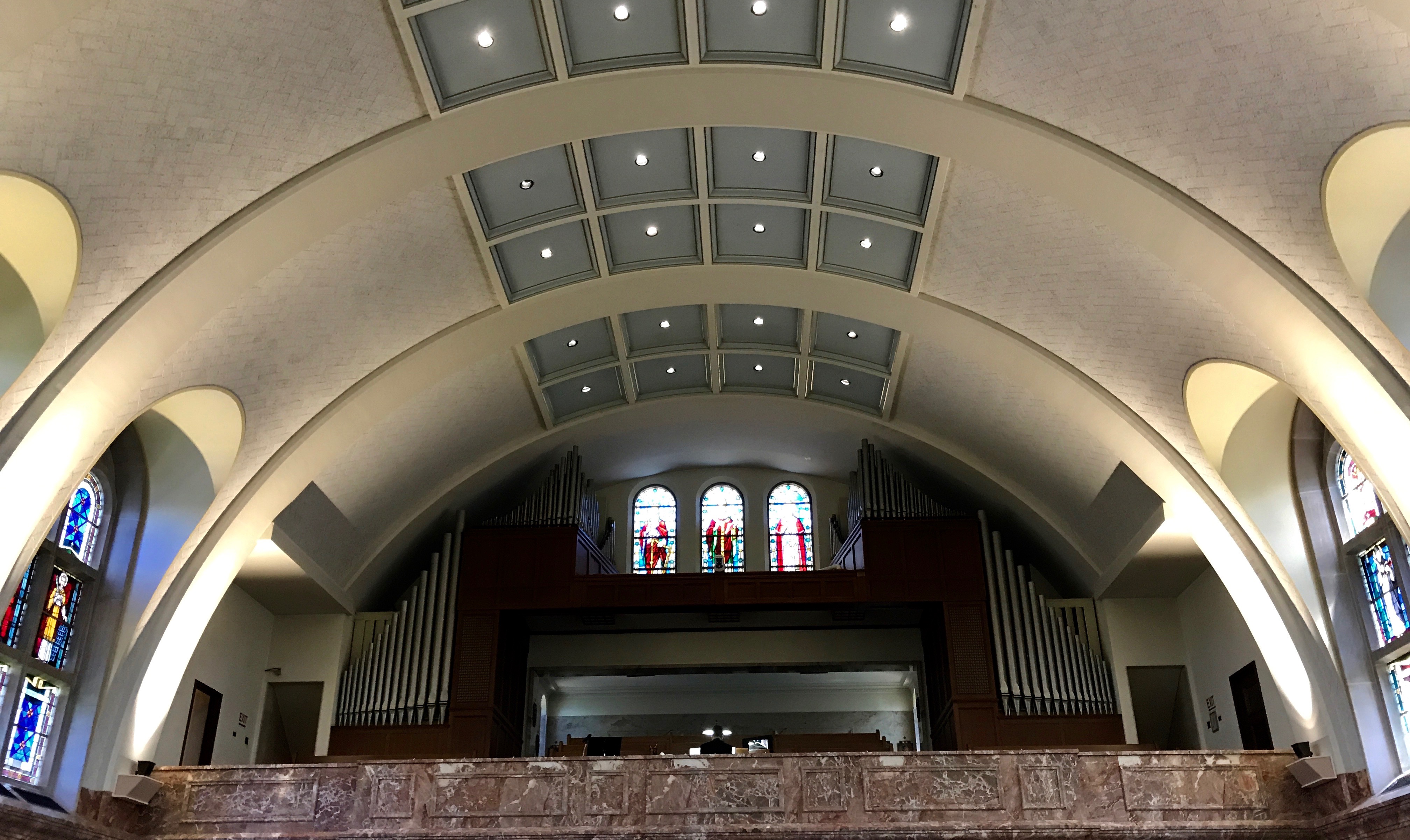
Opposite the main altar was the choir loft and organ – a relatively small organ, praises be!

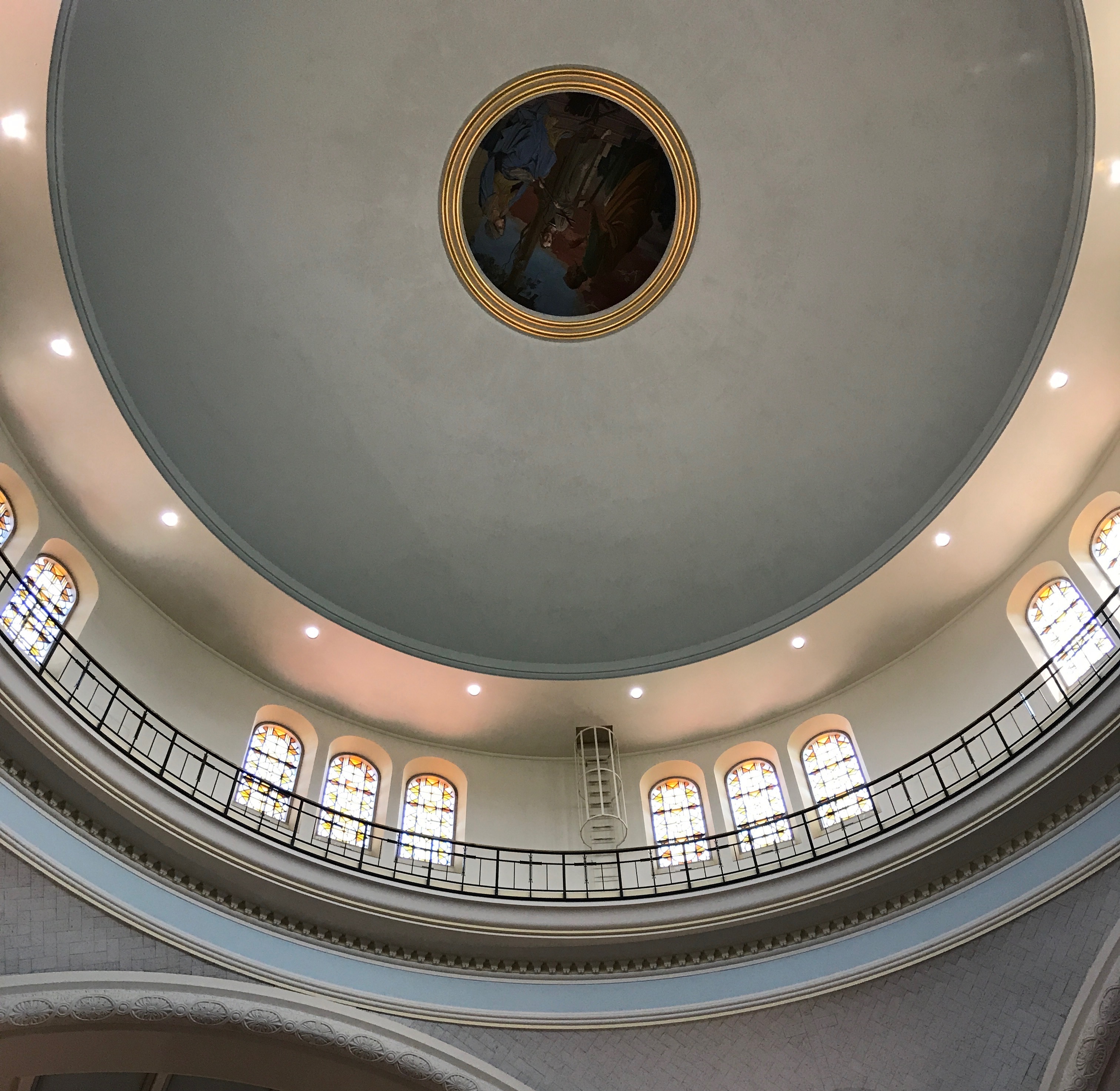
Above the crossing was the dome.

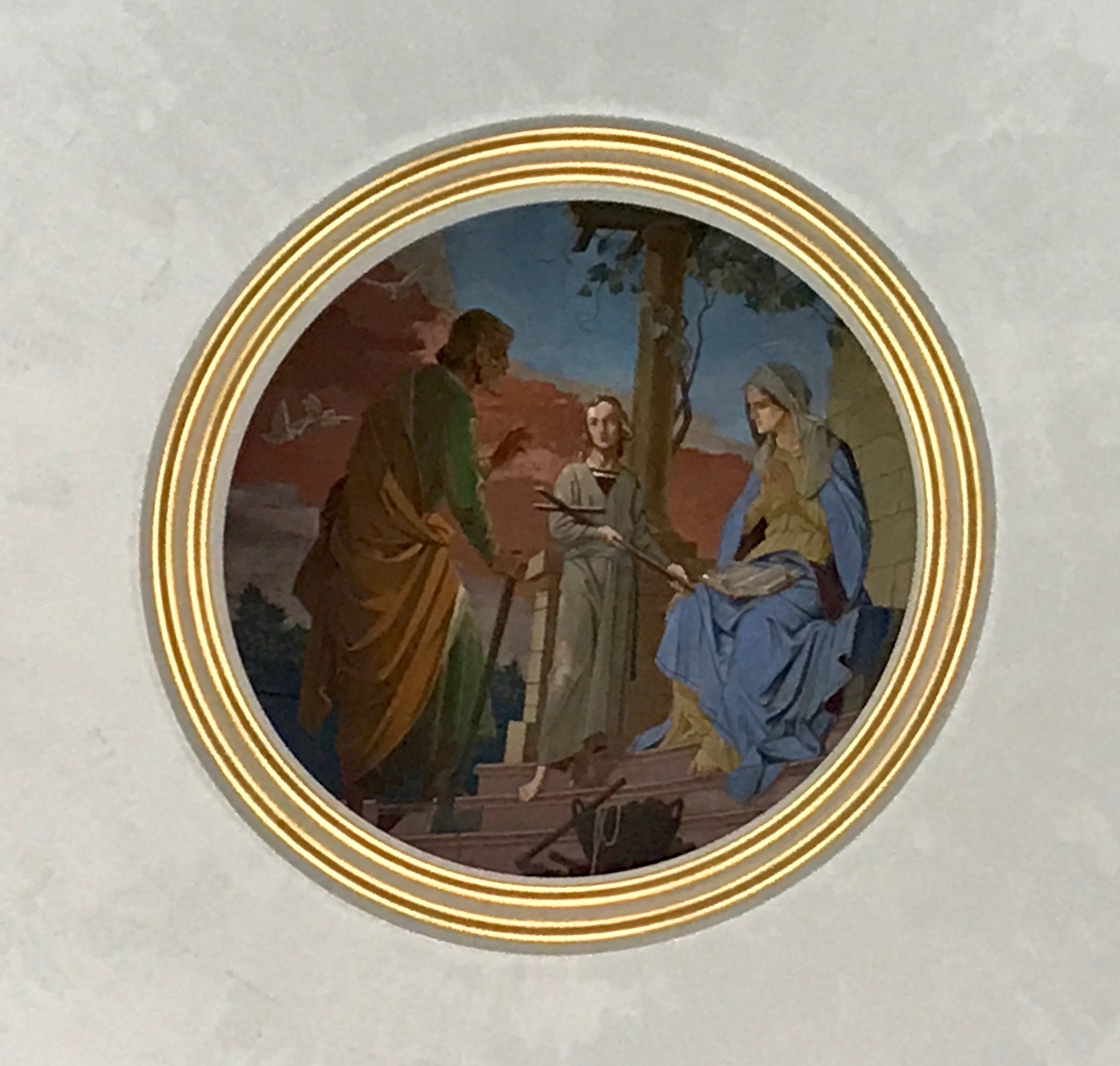
Through a little fiddling with my photo program, I was able to bring the medallion in the dome into better focus.

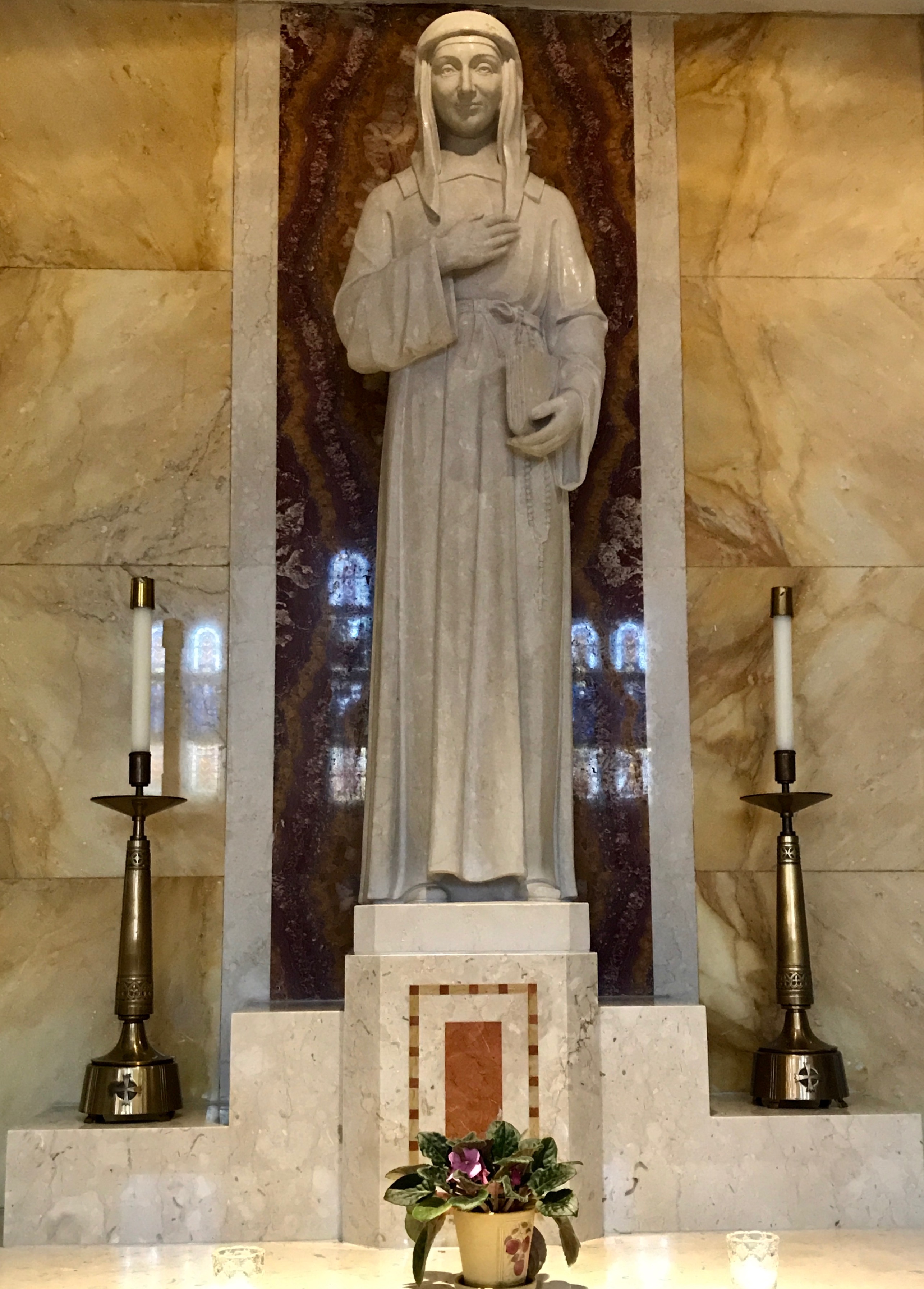
I was taken with this statue of Saint Louise de Marillac. She was born in Paris in 1591. She married in 1613, but was widowed in 1625. Did you know women could take a vow of widowhood? I didn’t know that, but that’s what she did.

She collaborated with St. Vincent de Paul in founding the Community of the Daughter of Charity in Paris in 1633. She died in Paris in 1660. She was canonized in 1920 and is the patron saint of all Christian social workers.

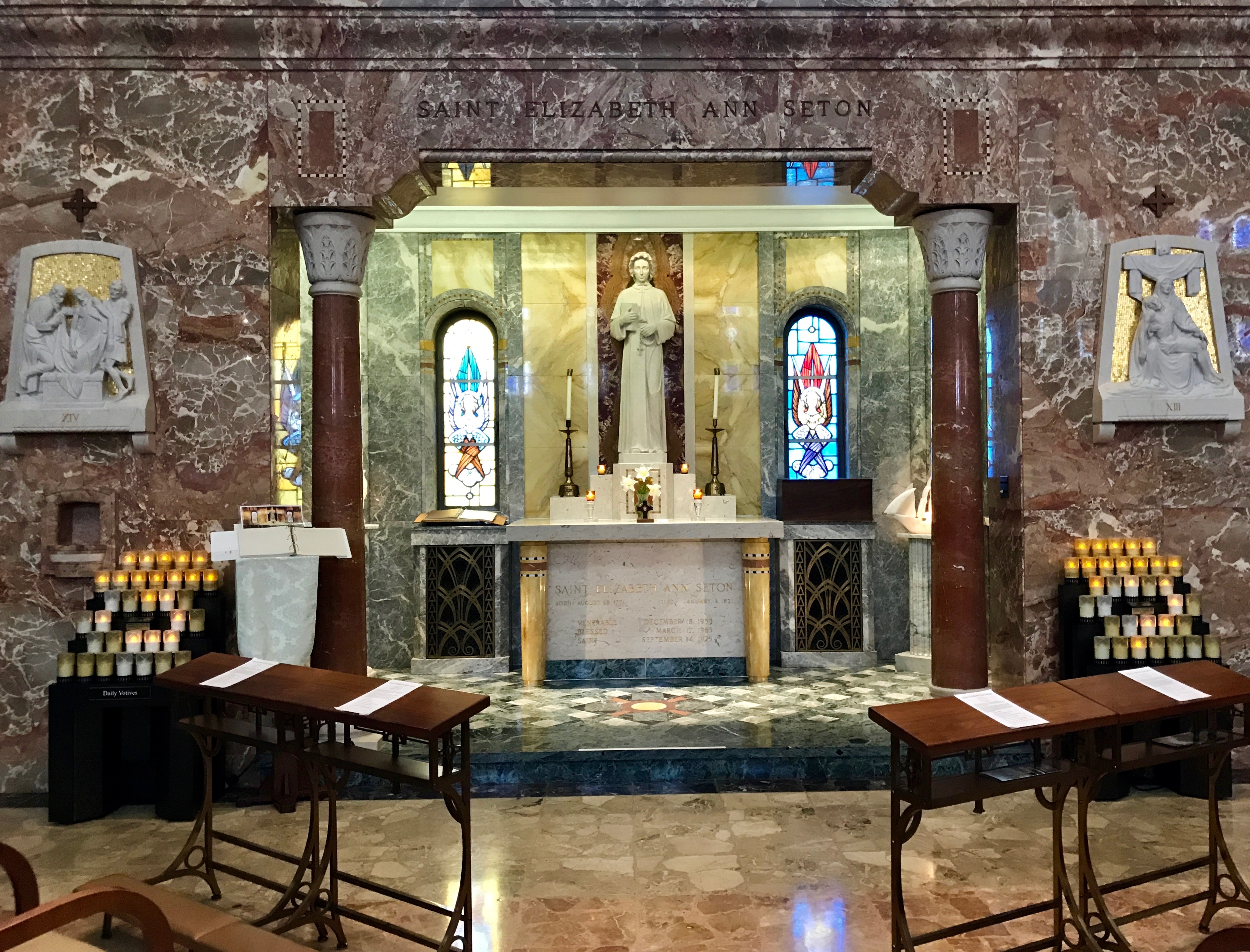
The reason for the Shrine is Saint Elizabeth Ann Seton. This is her final resting place. The basilica was completed in 1965 and her remains were transferred here in 1968. Beneath the altar and enclosed in marble, her remains rest in a small copper casket.

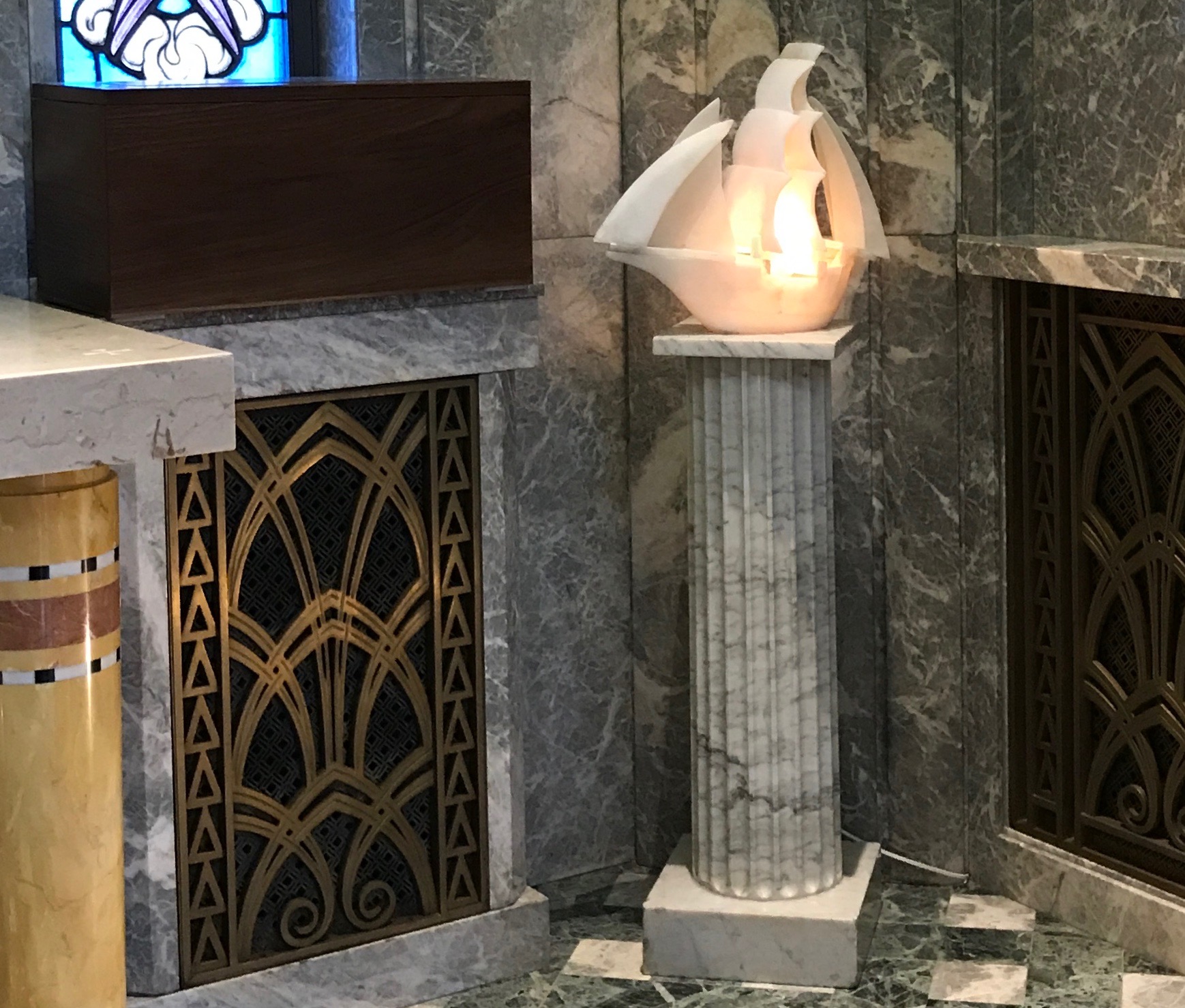
In the shrine is a lamp in the shape of a boat. Saint Elizabeth Ann is the patron saint of seafarers. You can also see the wheat motif repeated in the brass grate between the altar and the pillar.

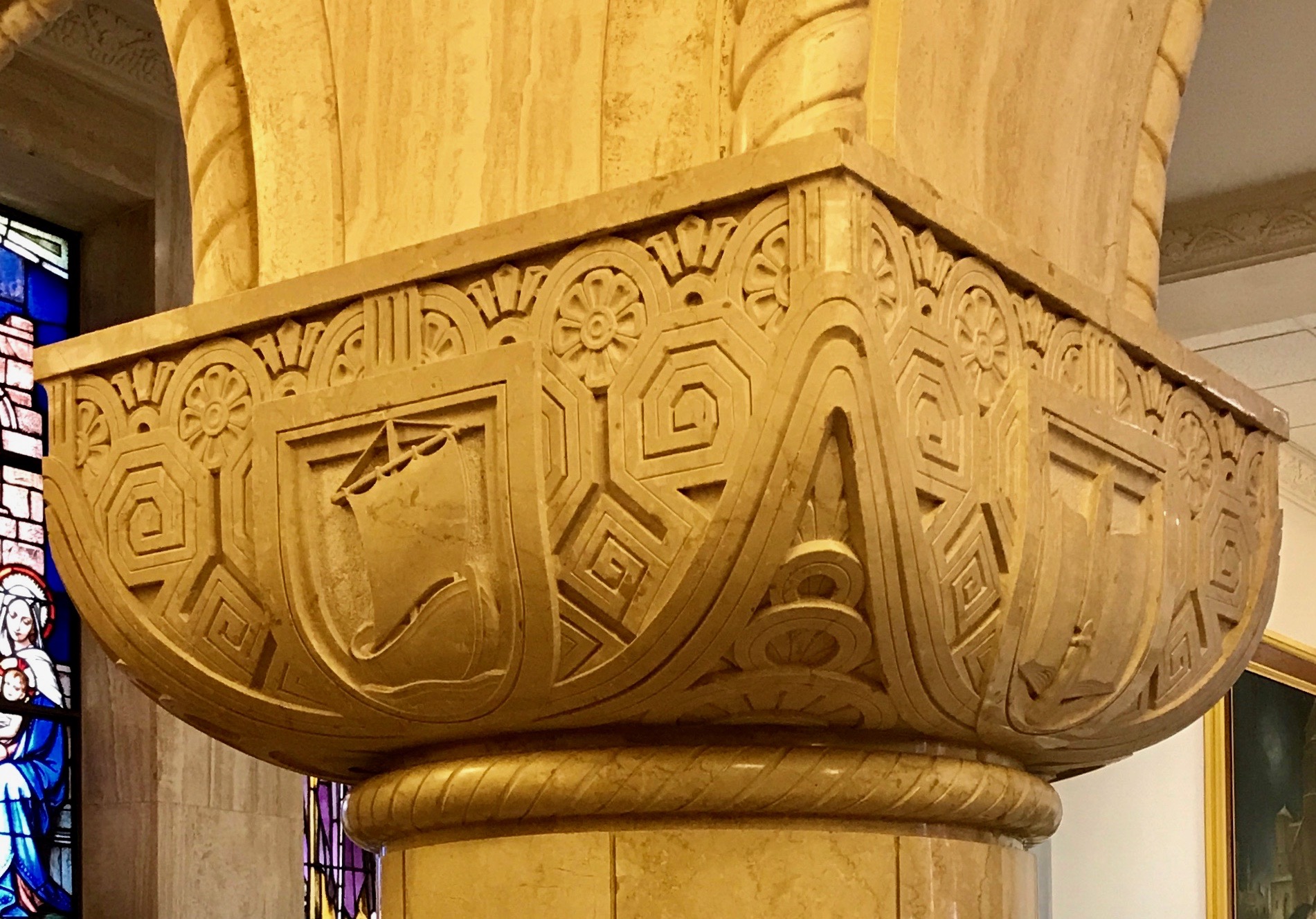
There was a sign directing me to a museum in the lower level. I passed by this pillar with the interesting capital. You see the ship, and, if you use your imagination, there is stylized wheat at the top edge. According to one source I found (but can’t locate to give it to you) a pink flower and a book are also her symbols. You can see flowers repeated along the top edge and an open book on the right side.

Once downstairs, I saw that there was a tour leaving shortly. I took a quick look through the museum while I was waiting.

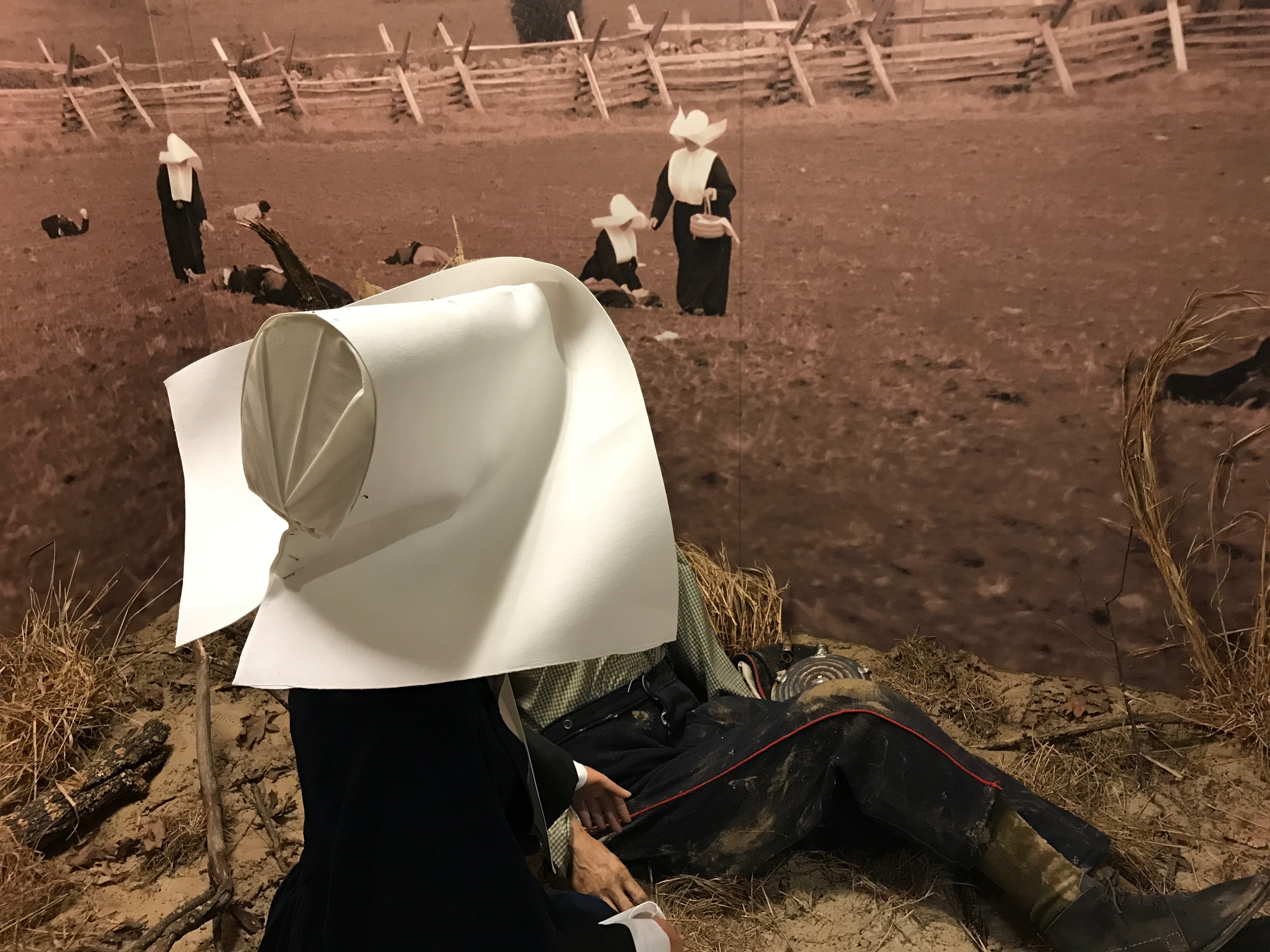
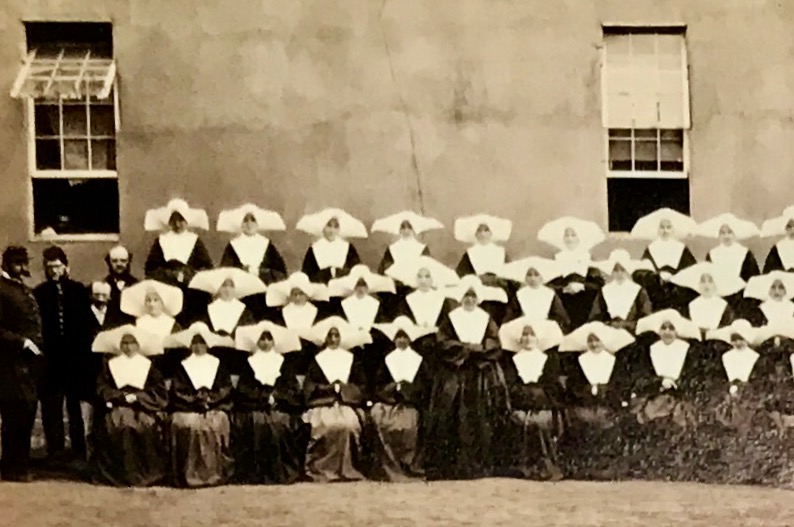
The sisters served as nurses during the Civil War. They were at the Battle of Shiloh in Tennessee and the Battle of Antietam in Maryland. More that 100,000 fought and more that 22,000 died in each battle.

The photo above shows a mannequin posed in front of a photo from an reenactment. Can you imagine being able to maneuver in a battlefield in the habits those sisters wore? I can’t.

Even in the more controlled environment of Satterlee Hospital in Philadelphia, wearing those habits definitely required faith.

Saint Joseph Military Hospital was staffed by the Sisters of Charity, and Saint Elizabeth Ann Seton’s grandson, Captain William Seton III received treatment there. As he recovered and began to converse with this nurse, Sister Mary Ulrica O’Reilly, Was amazed to discover that she was caring for the Foundress of her order.

William Seton III

Soon it was time to set out on the tour. My group met our guide, and he walked with us over to the Stone House, which was originally built in 1750.

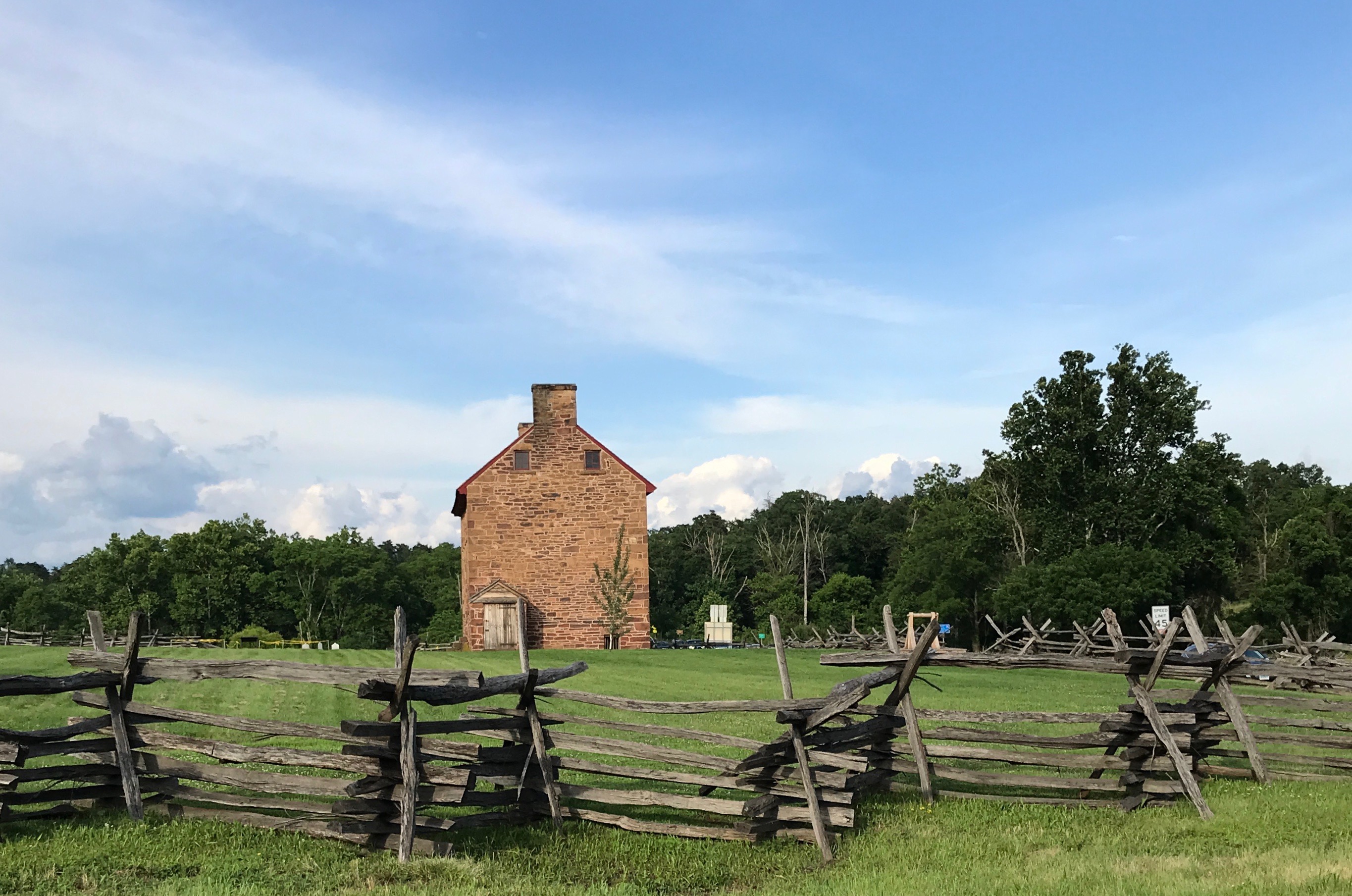
This was originally a four room building, with one of the rooms devoted to use as a chapel. There were sixteen people in the house at that time.

I’m not sure if one of the original rooms was also a kitchen. There is an early 1800s-style kitchen there now. Eventually they added on to the building through the years.

The house was moved to where it is now. That must have been some feat!

Although the house had the appearance of fine stone, that illusion was maintained by a fine layer of some sort or another. I was please that they left us a “truth window” so we could see what how the house was really constructed.

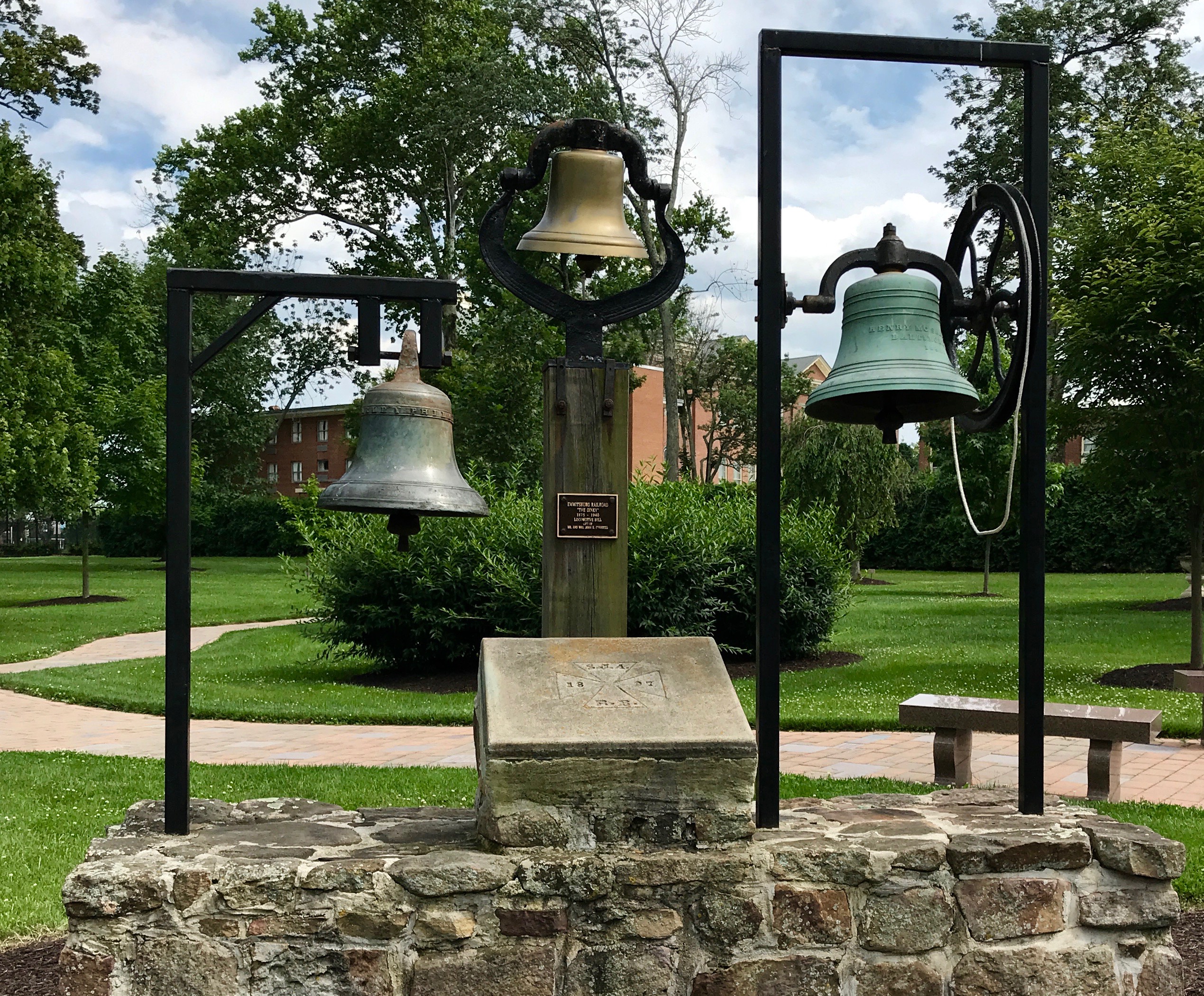
On the way to The White House we passed by the bells of St. Joseph’s Valley. The bells pealed throughout Saint Joseph’s valley when they received the news of Mother Seton’s beatification in 1963.

According to the plaque, one of the bells was the Academy bell, that summoned the boarding and day pupils of Saint Joseph’s Academy to classes, worship and recreation for 1875 until 1940.

One of the bells was referred to as the “Dinky” bell, which announced the arrival of the Emmitsburg train form 1875 until 1940. The “Dinky” transported pupils, visitors and sisters along with livestock and freight. The Sisters of Charity of Saint Joseph were the major stockholders of the Emmitsburg Railroad. I think that was a wise investment.

The third bell was the Seminary bell, which called new members of the Daughters of Charity to prayer, study and community gatherings until 1964 – nearly a century.

The cornerstone of a building of Saint Joseph’s Academy that was in use from 1897 until 1965 is in the center of this heritage monument.

I’m sure you see the rope hanging from the bell on the far right. You know who had to pull it, don’t you? Well, there weren’t any children on this tour, so I had to fill in. (It wasn’t much of a stretch for me)

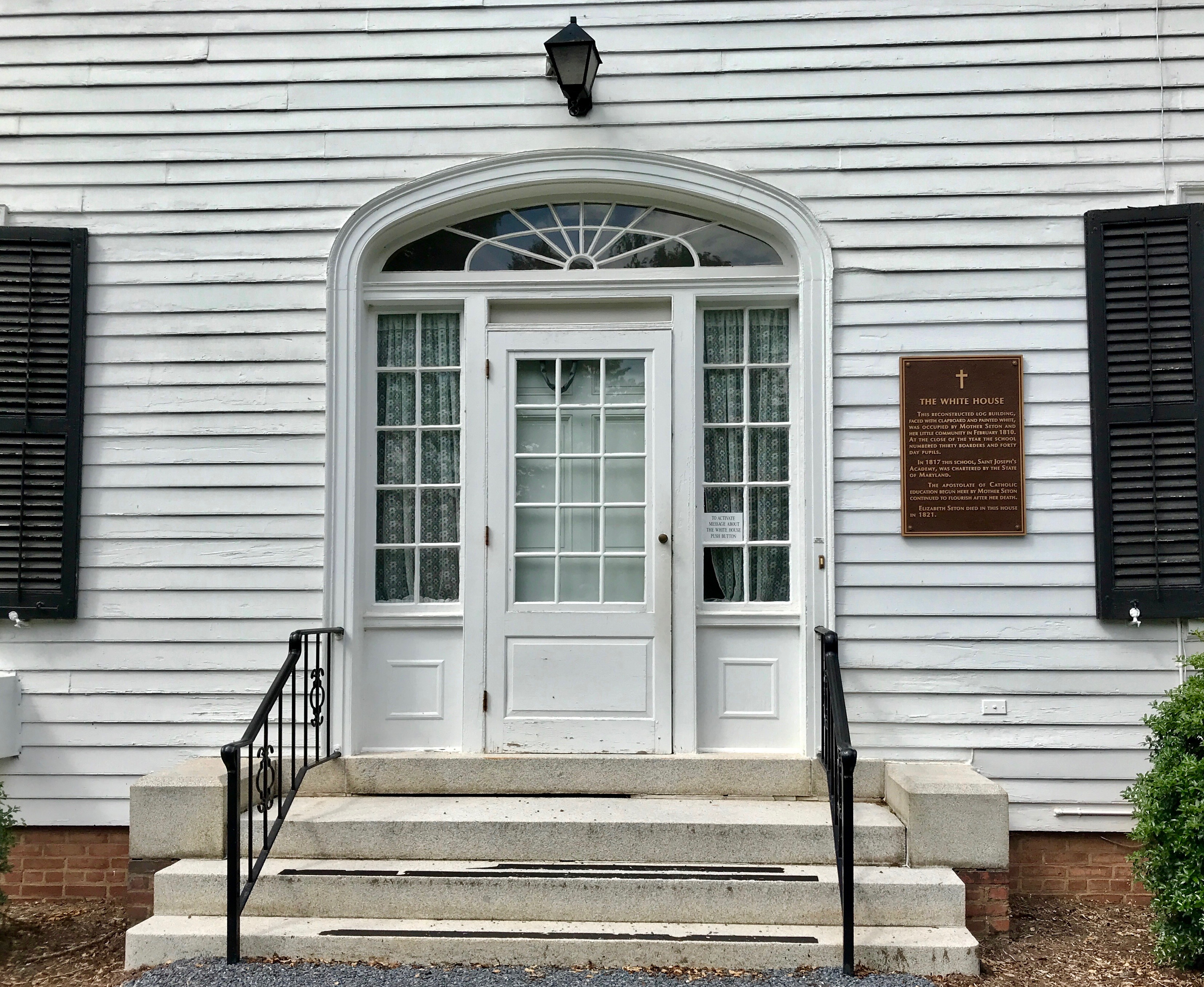
Our next stop was The White House.

No, not that White House.

This White House, which was built in 1810, when Mother Seton realized that more space was needed

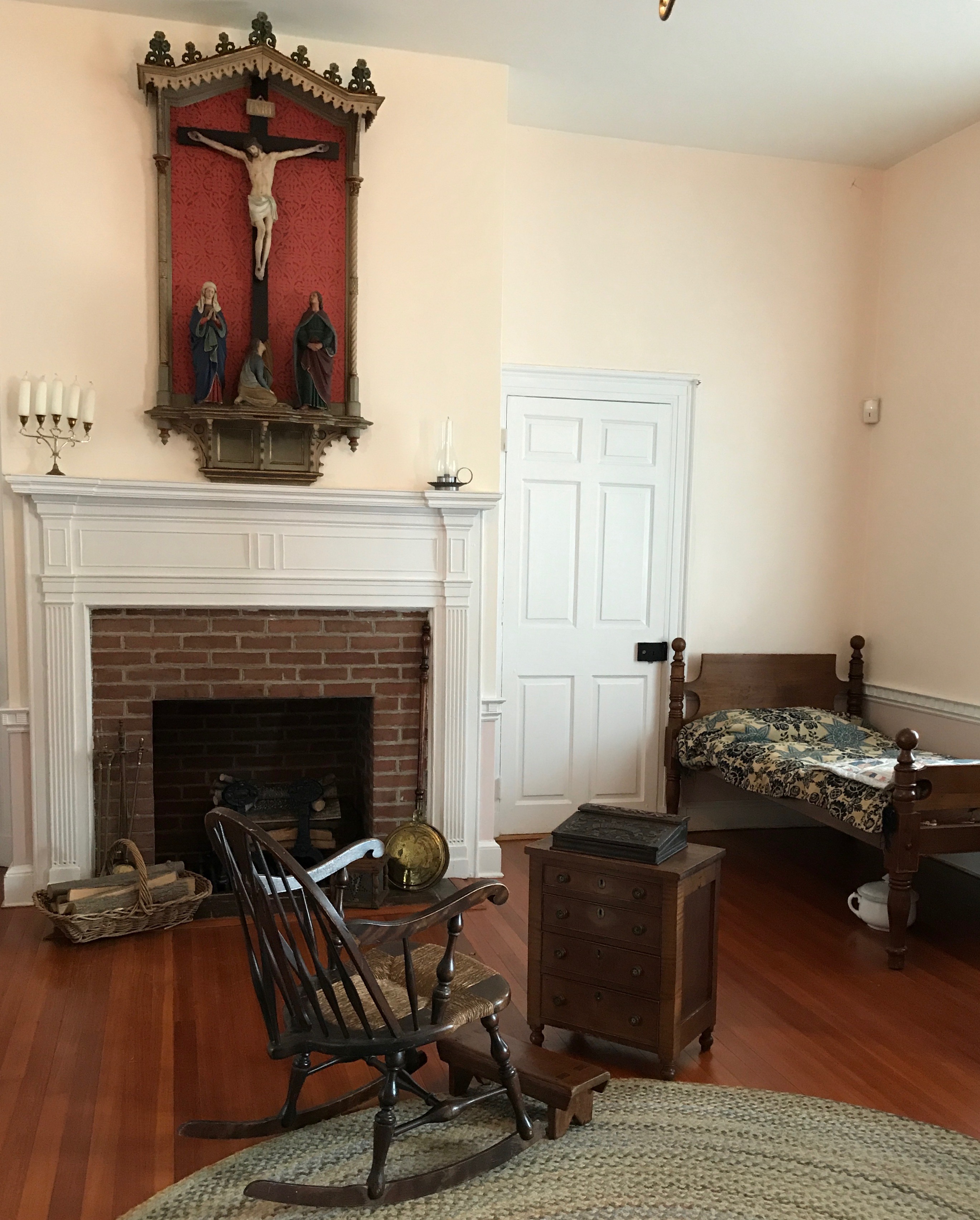
I didn’t take very good notes and I can’t find a reference about this after several Google searches, but I think this was Mother Seton’s room.

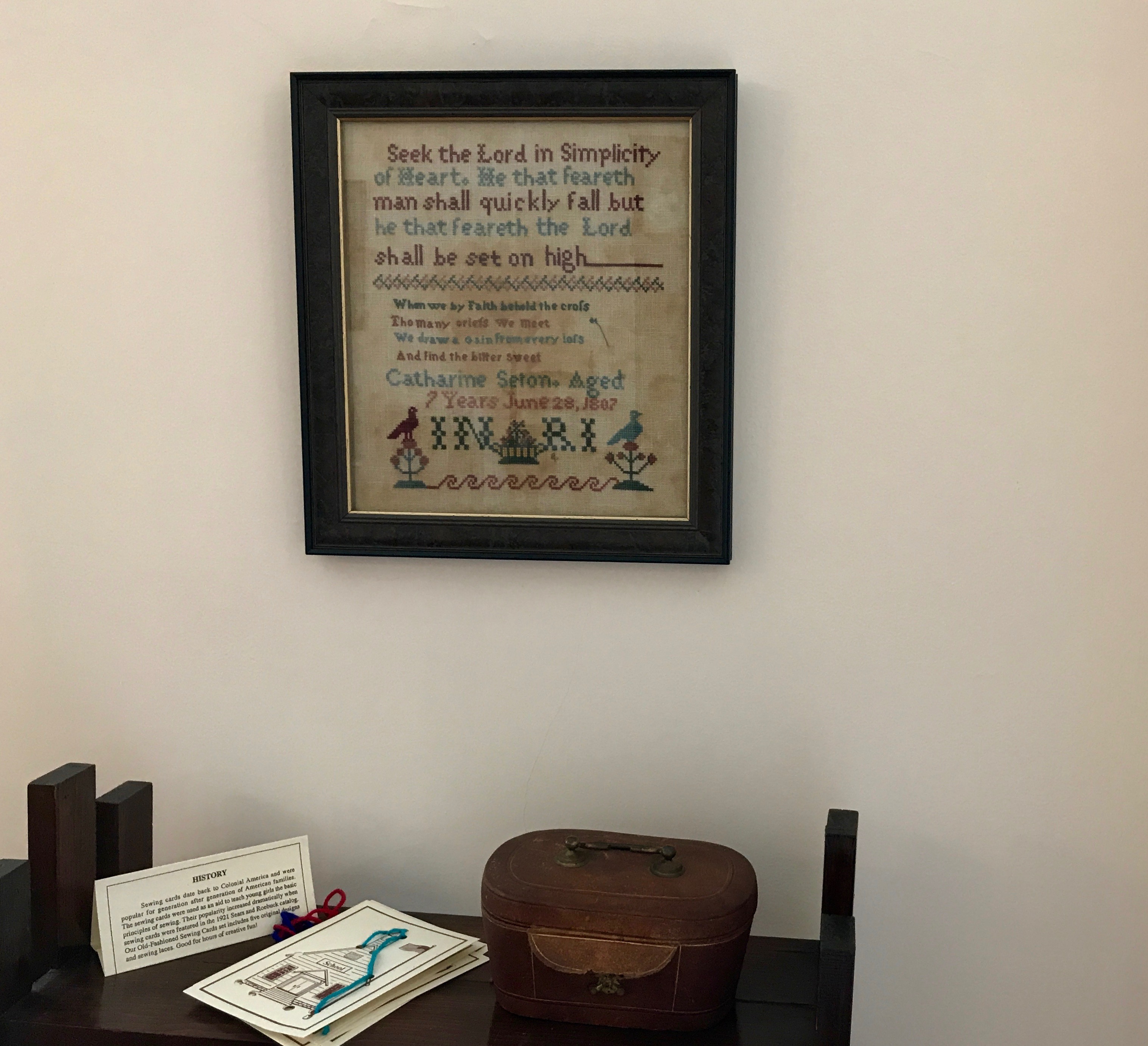
A sampler made by her daughter, Catherine, in 1807 at age 7 is hanging in the room.

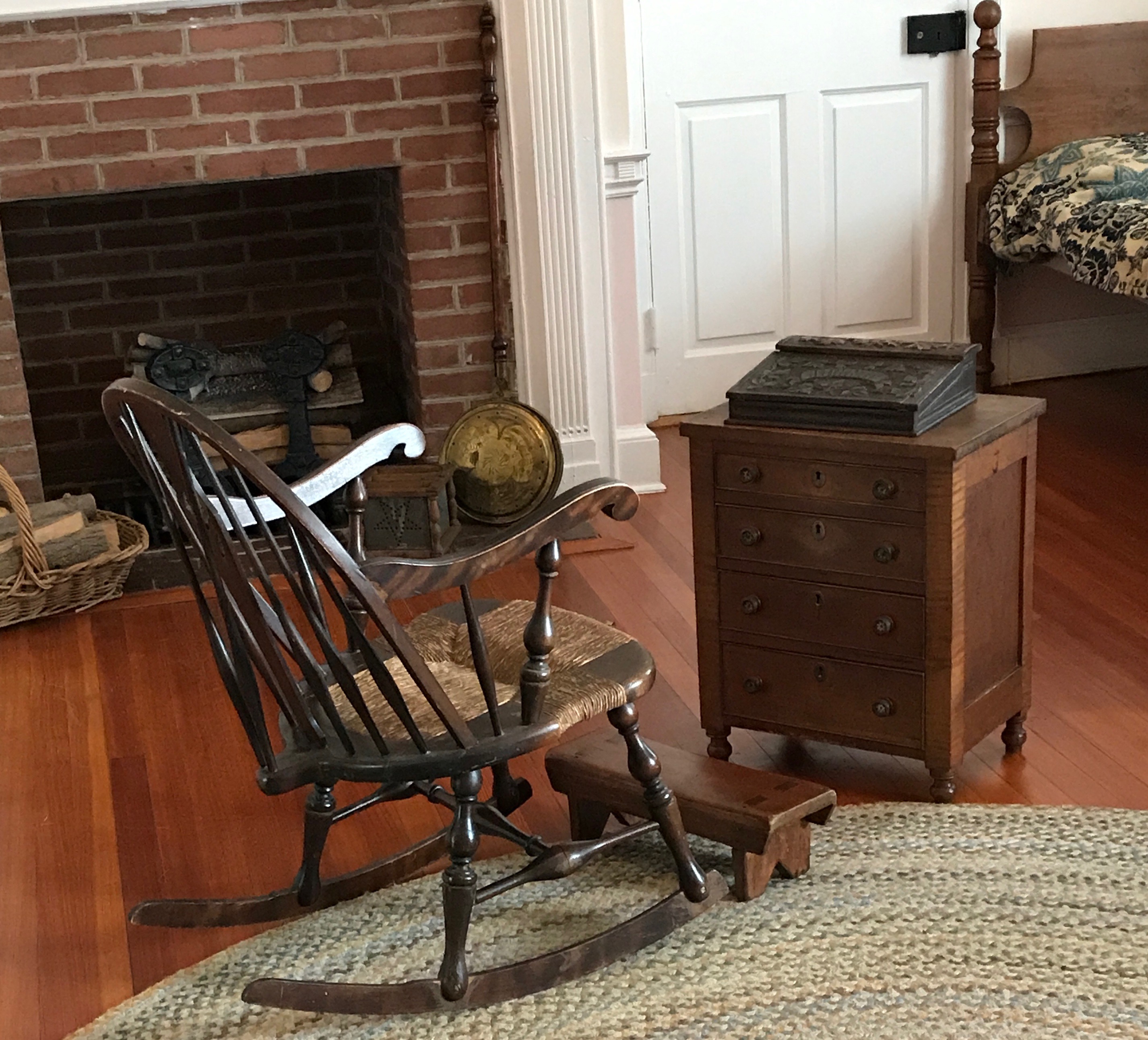
I like the idea of a rocker to help her get on and off her kneeler. Or, maybe I am reading too much into the placement of the furniture.

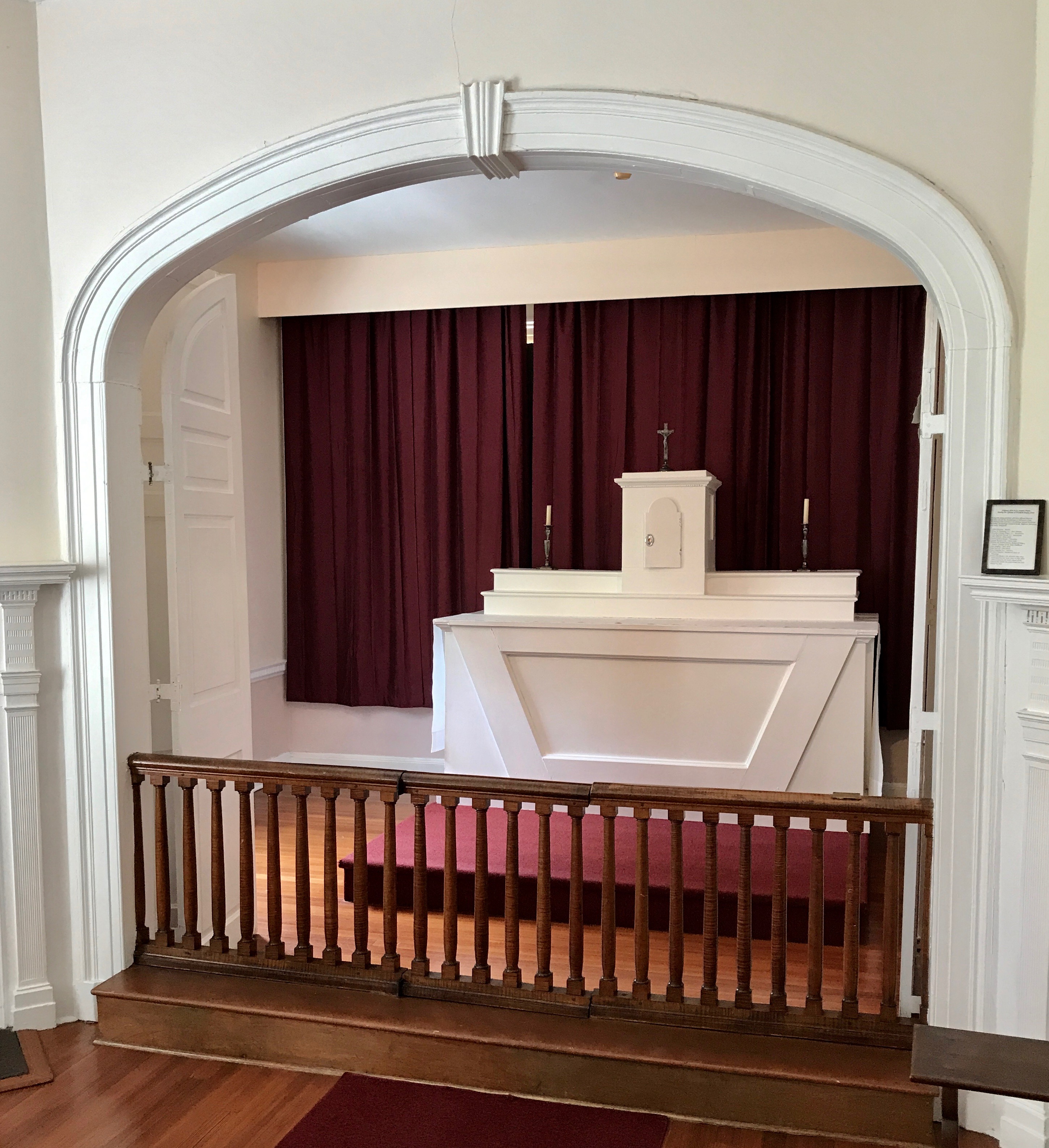
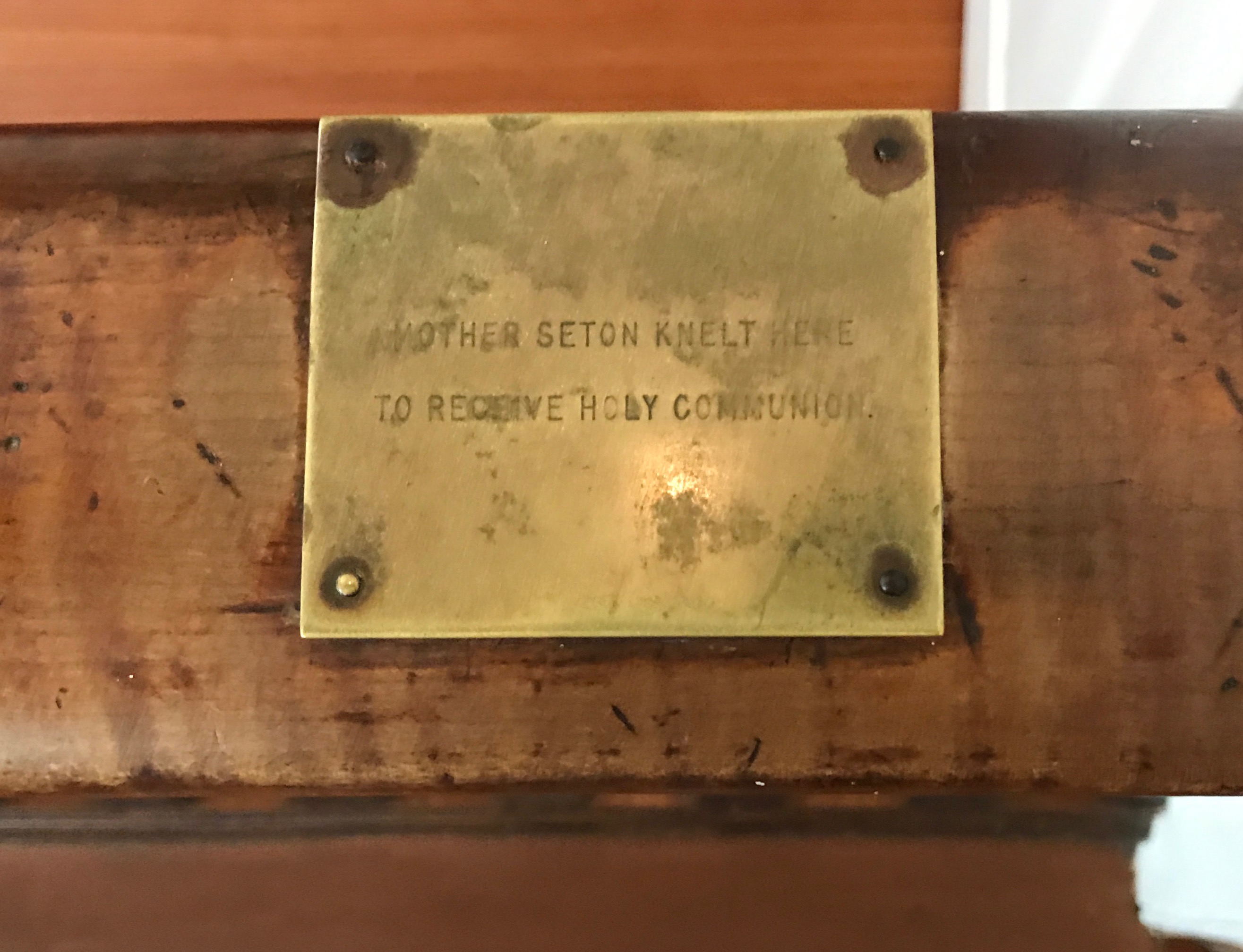
There is also a chapel in The White House. The guide pointed out that Mother Seton knelt to receive communion at the right end of the altar rail.

There is a brass plaque there to mark the spot.

After our tour of The White House, there was one stop left.

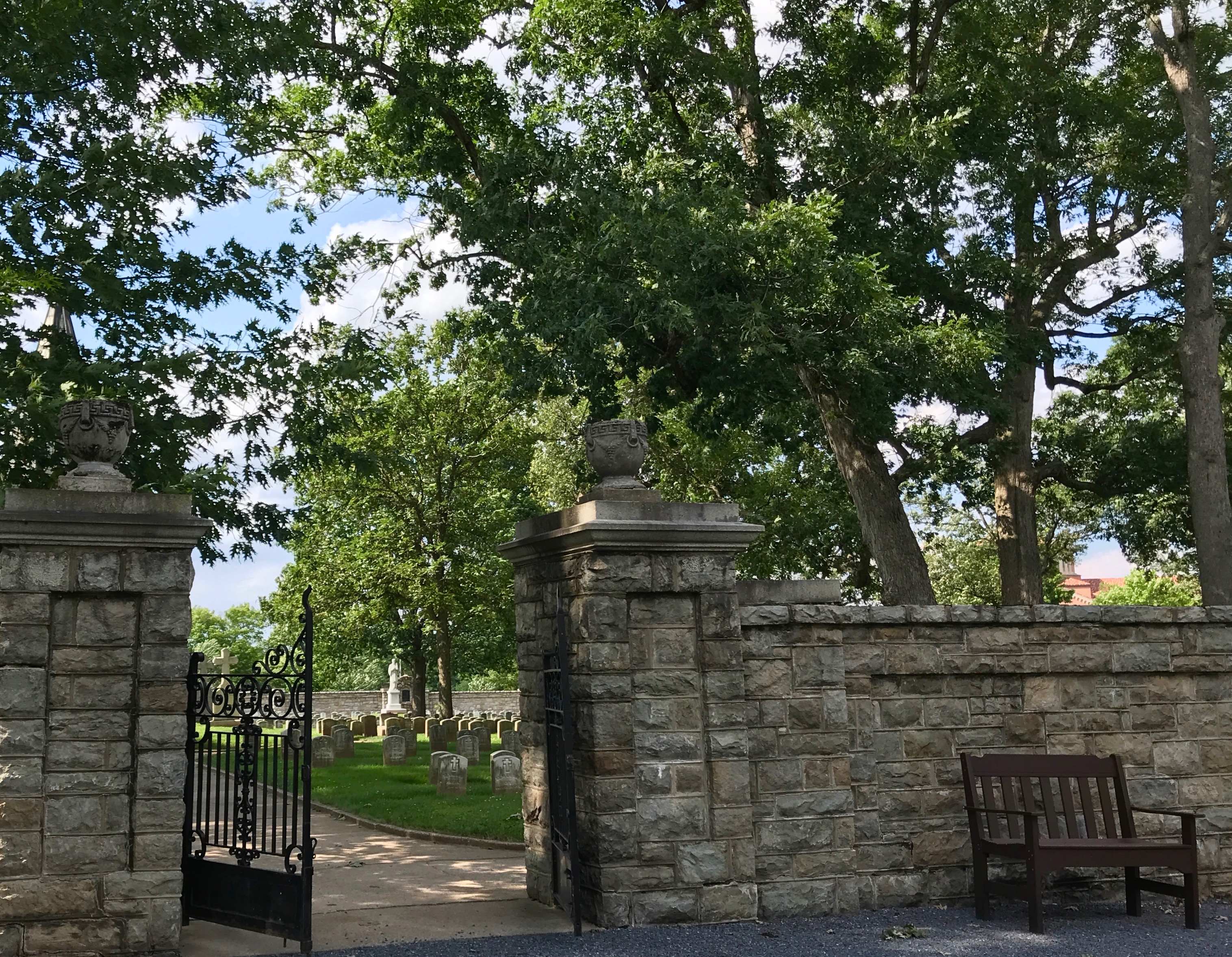
The cemetery

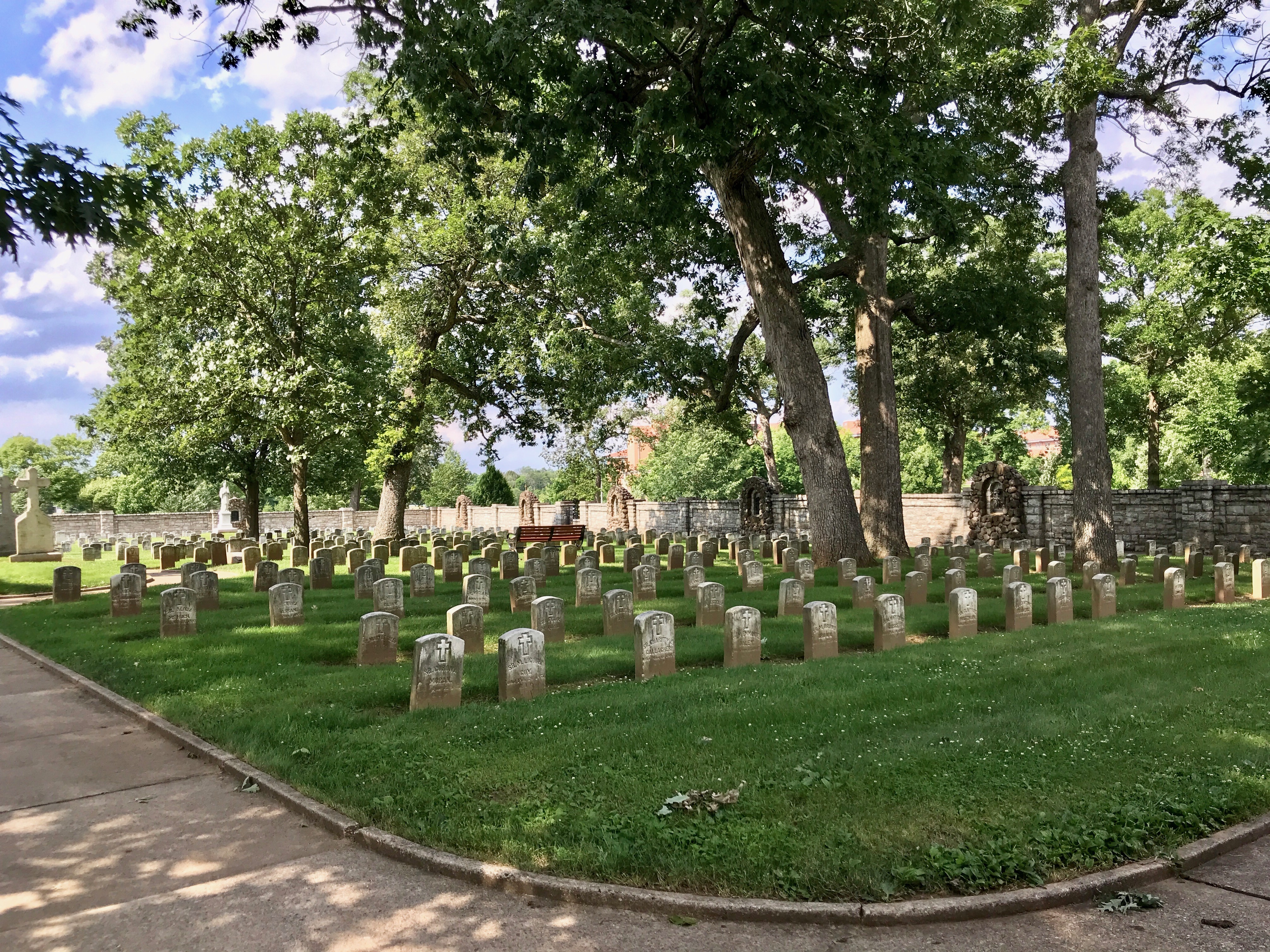
Many sisters over the years were buried here. Mother Seton’s sister-in-law, Harriet, was the first person buried in the cemetery. According to oral tradition, when they were out walking through the forest looking for a location for the cemetery, Harriet rested against a large, old oak tree. She playfully threw and apple core against its trunk and declared, “This is my spot!”

Sadly, Harriet died later that year and was buried beneath the oak and her grave was the first of many graves of Sisters and Daughters of Charity in the cemetery.

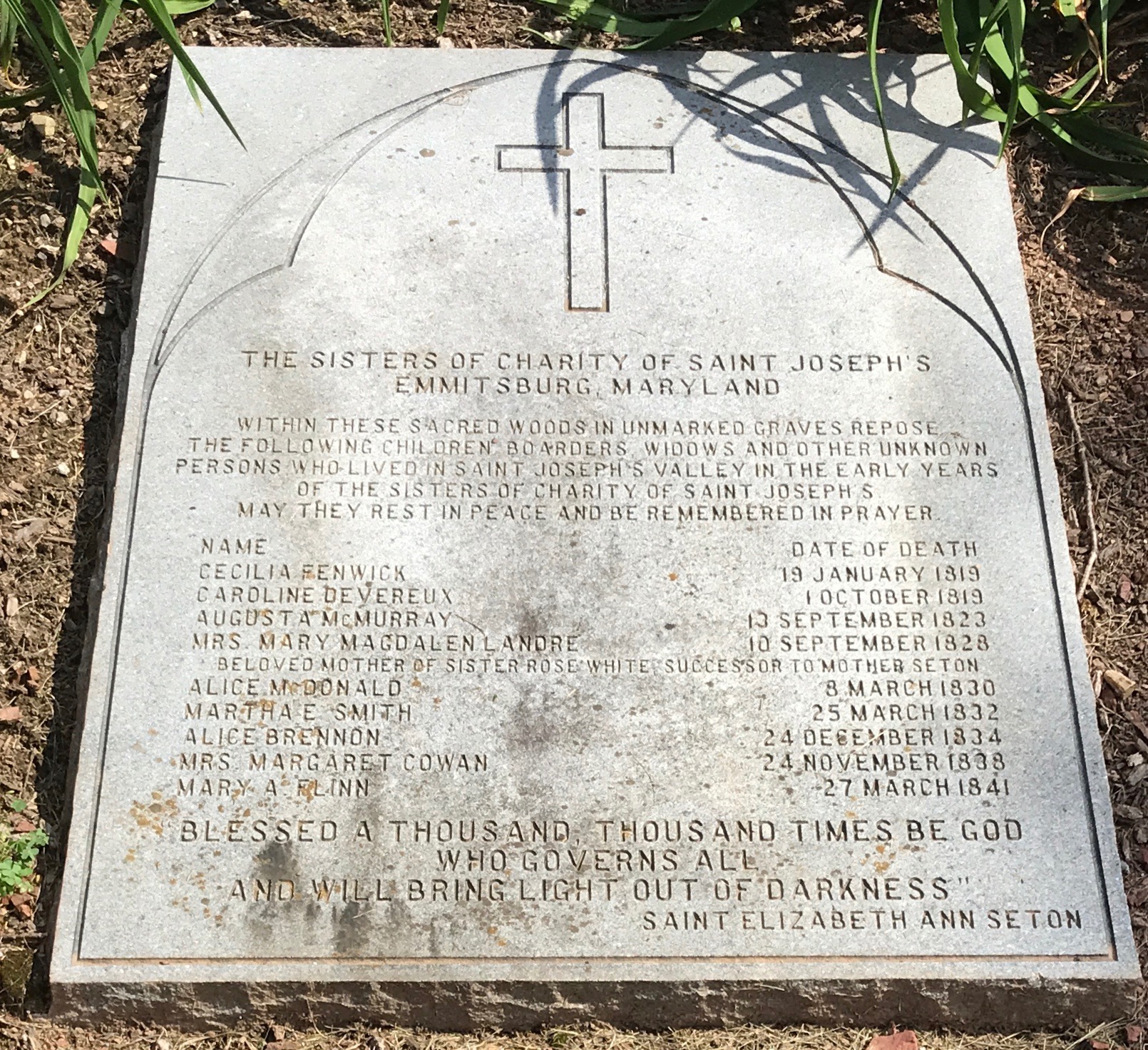
They also memorialized those who lie in unmarked graves.

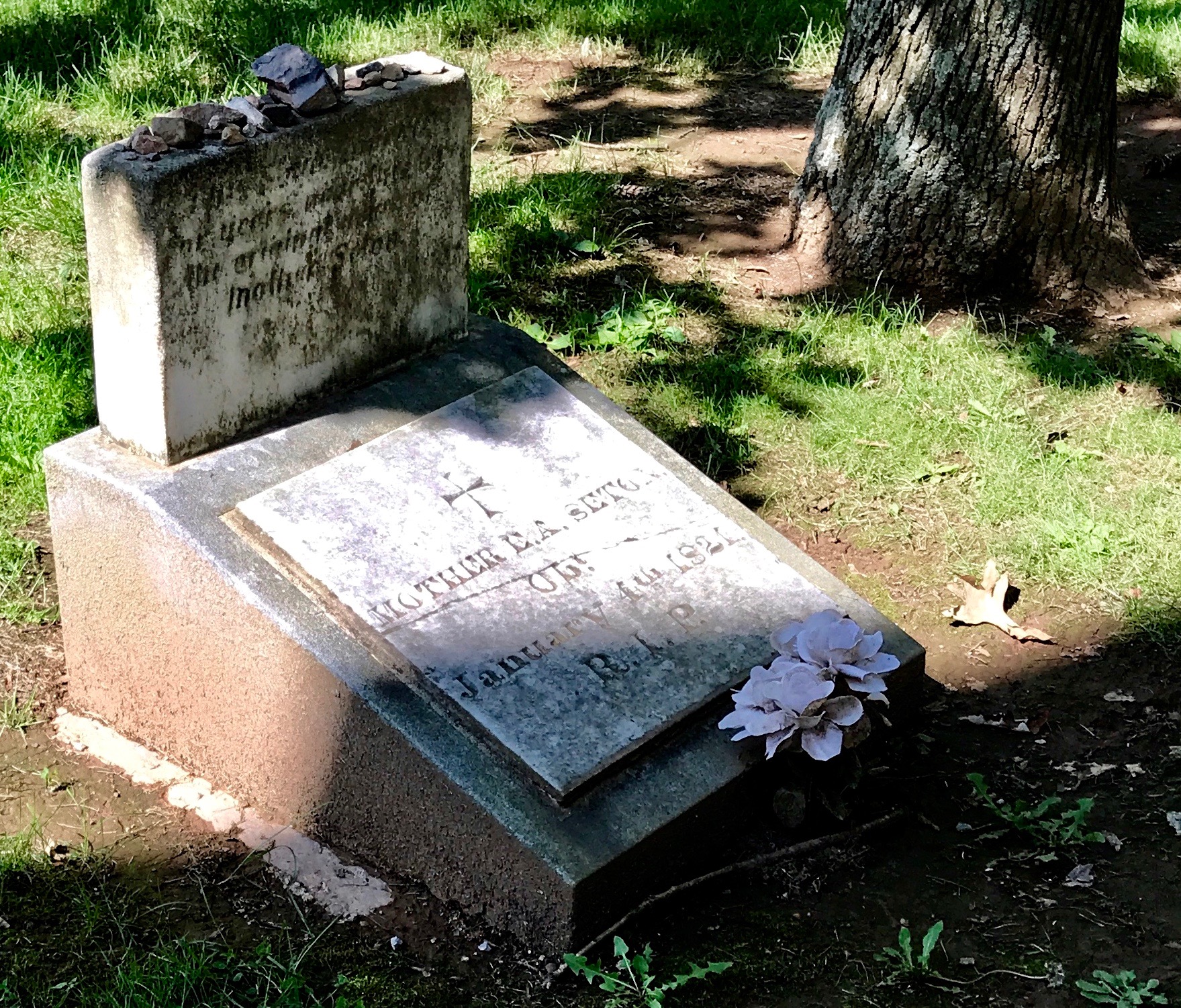
Mother Seton was buried here first. I think the small stones left by visitors are touching.

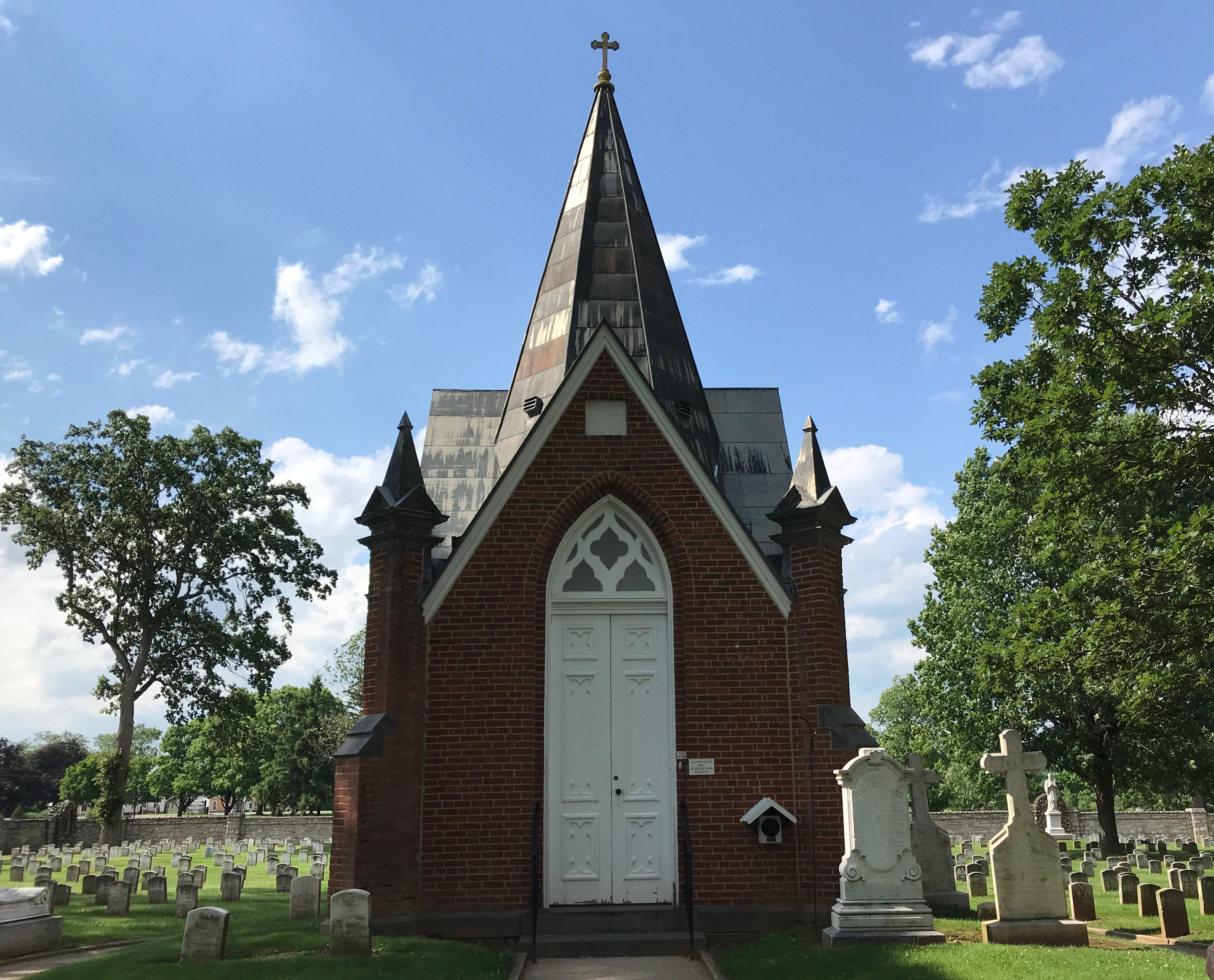
Mother Seton’s son, William, had the Mortuary Chapel built to honor his mother. In 1846, her remains were transferred to the chapel’s vault.

And now her remains are in the Shrine.

After feeding my soul, there was one more thing I needed to do. I needed to feed my body.

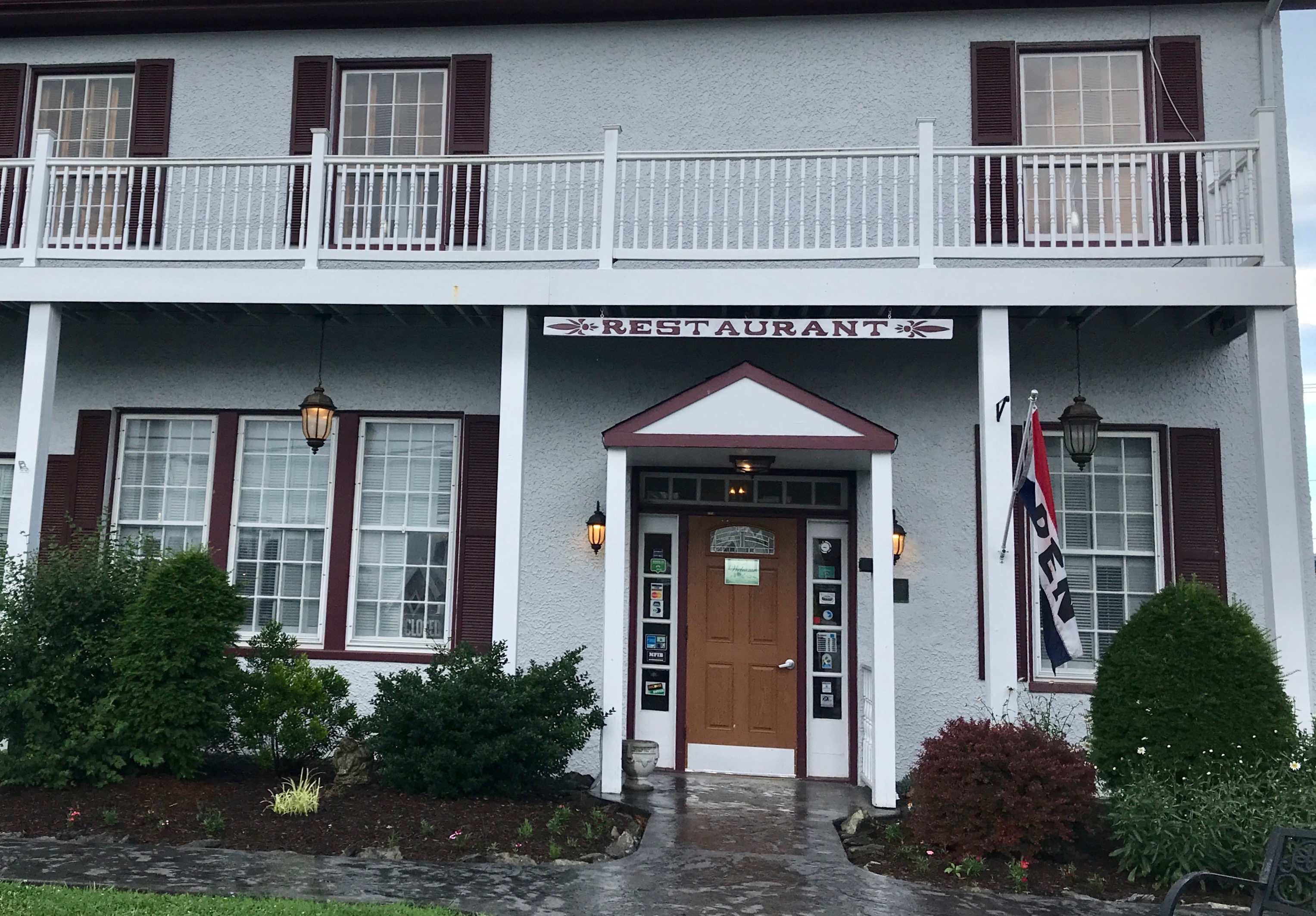
I consulted my iPhone and found The Carriage House Inn Restaurant.

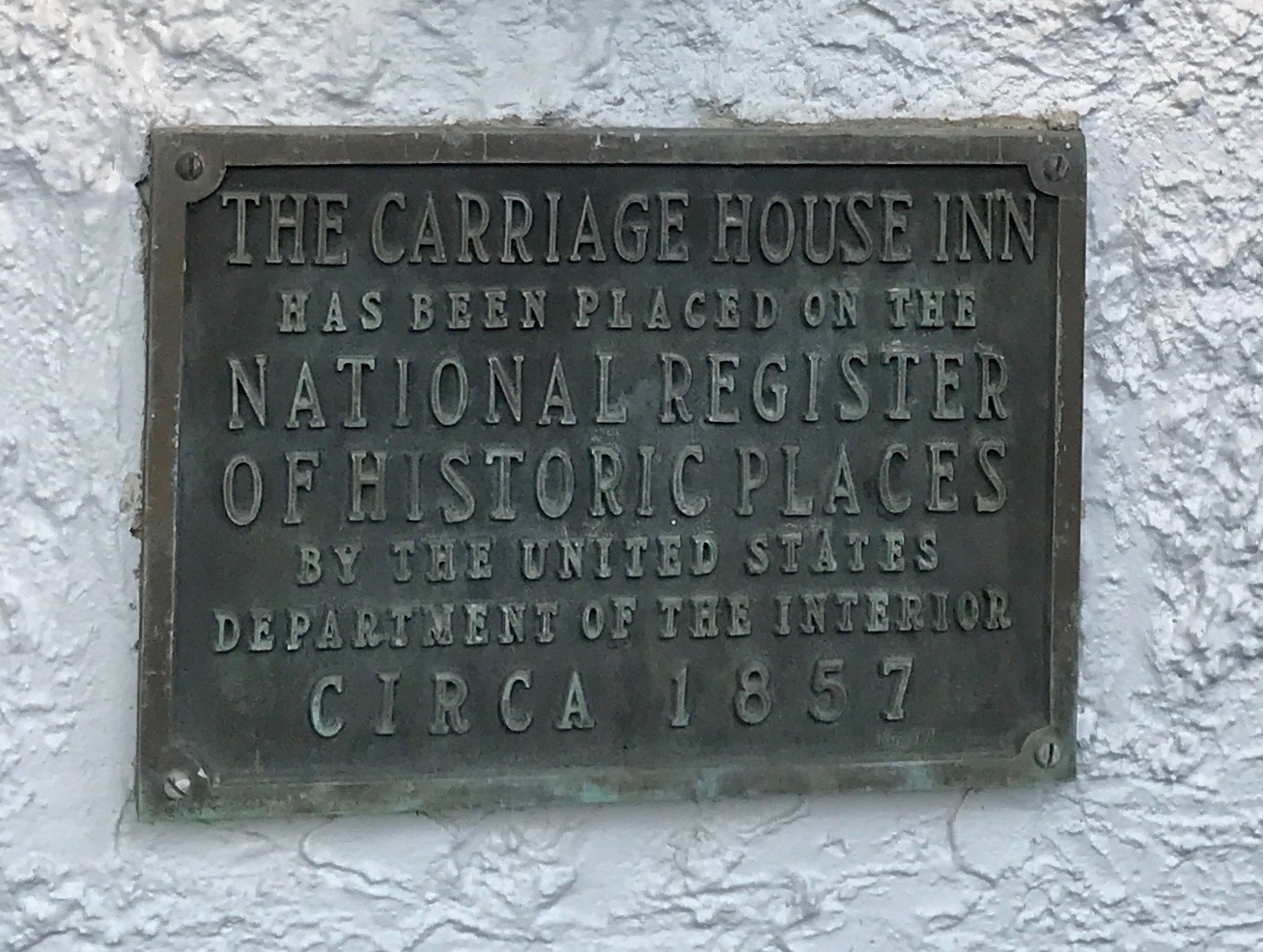
According to their website, the building was built in 1857, and it became the Zimmerman and Maxwell Feed and Grain Warehouse in 1877. After the turn of the century, it served as a broom factory and later as a bus depot. The building first became a restaurant named “The White House” in 1953. Three decades later, it was purchased by the Hance family and The Carriage House Inn was born.

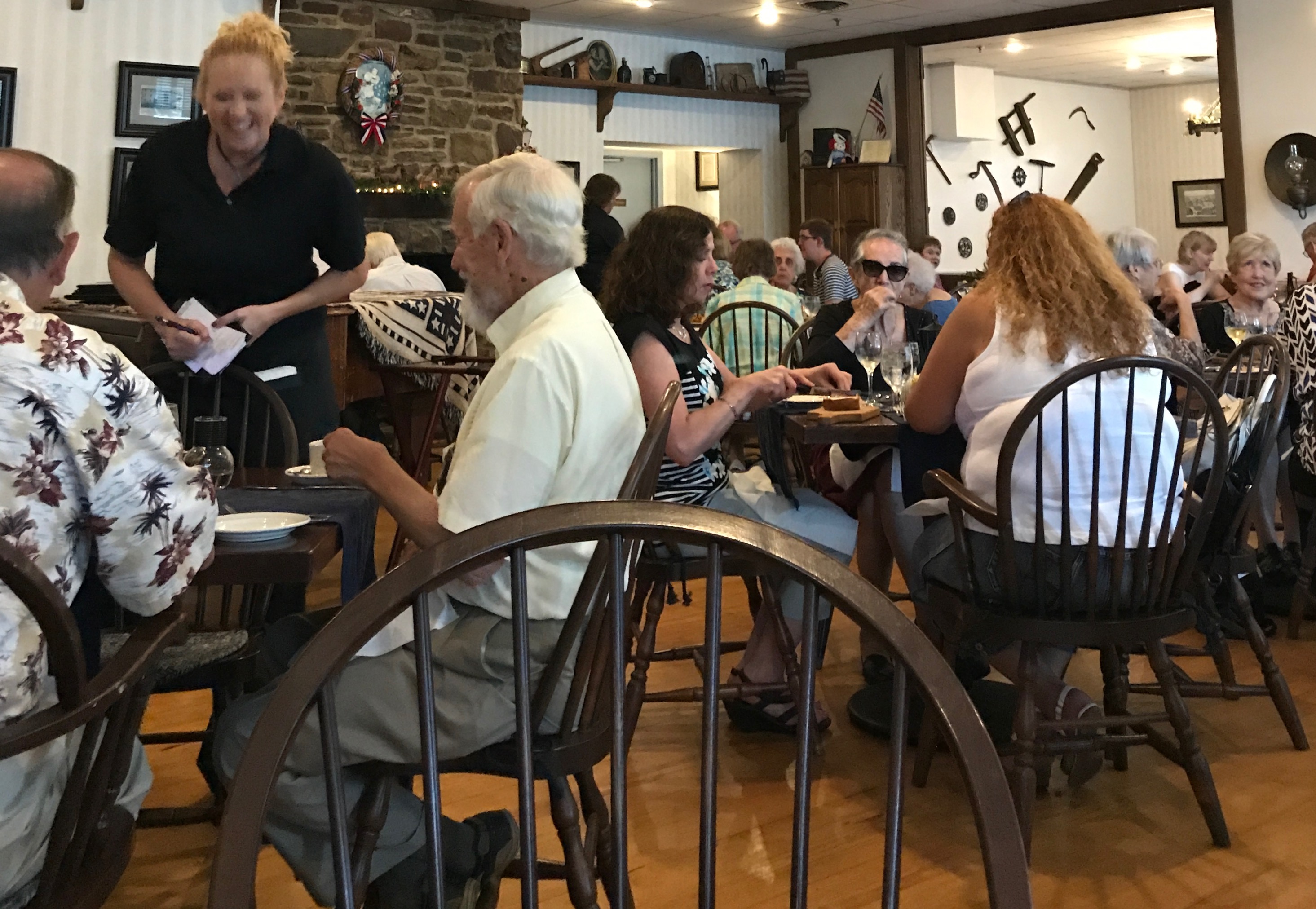
It was a very popular place to dine.

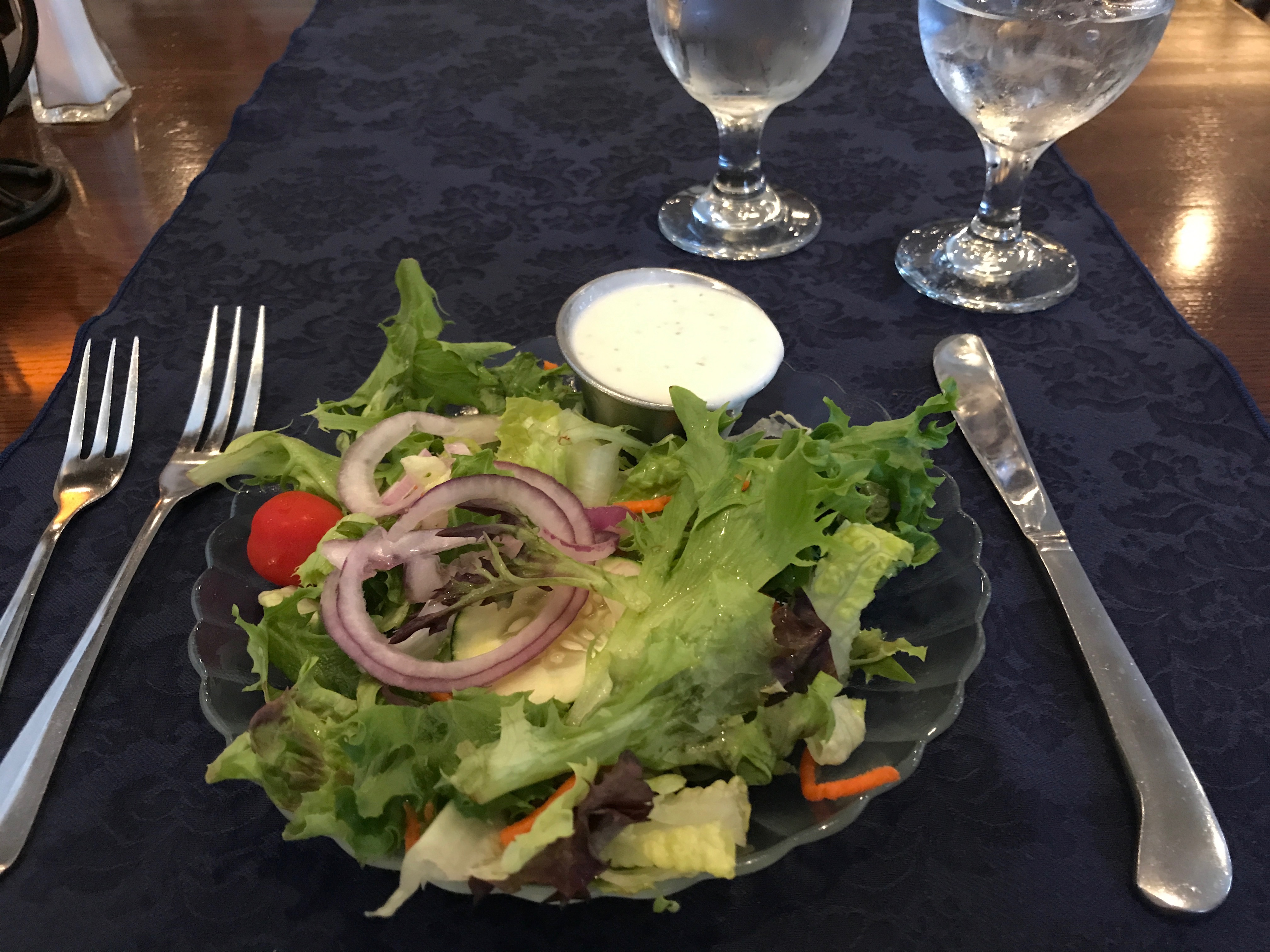
I started with a salad.

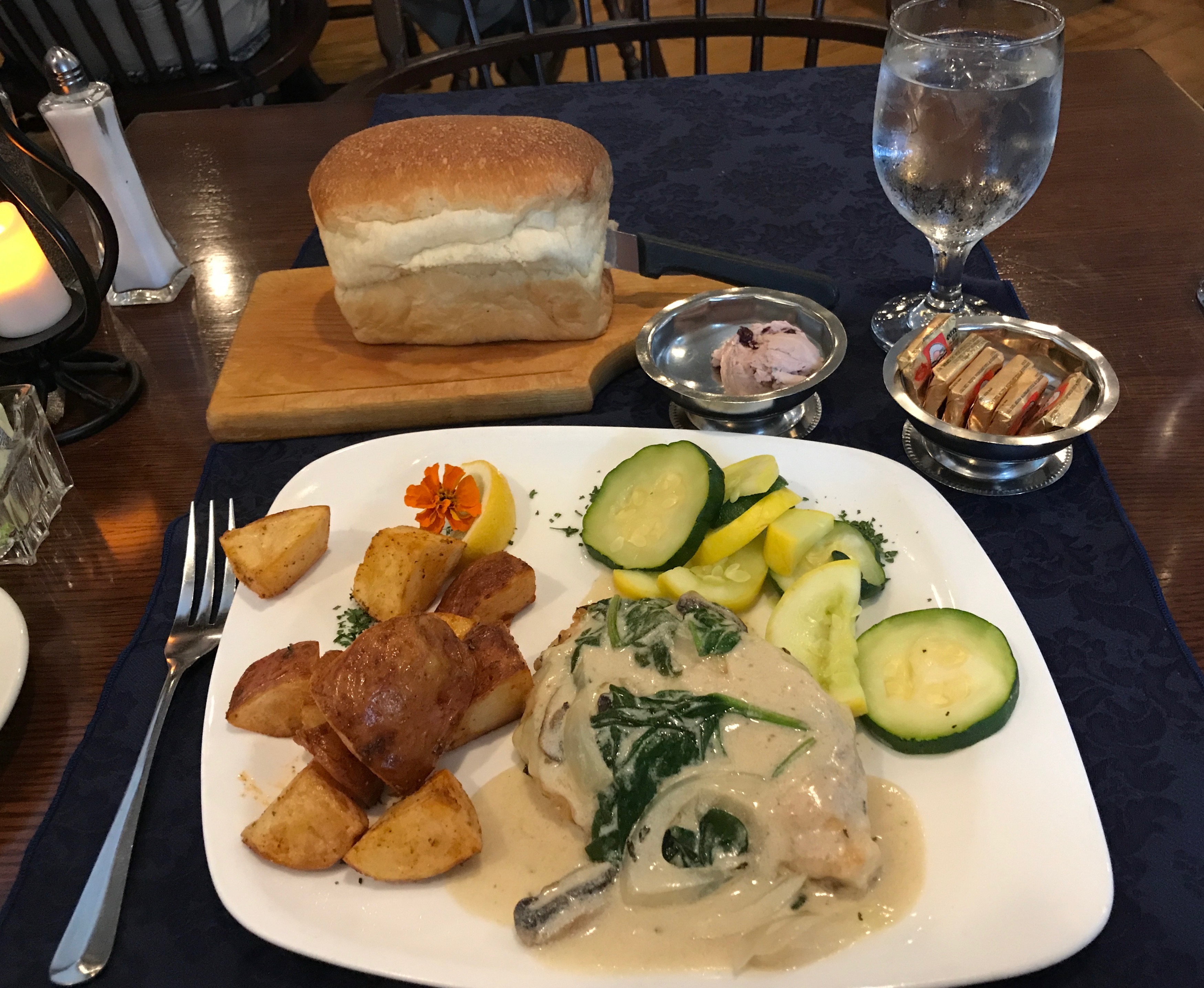
Worked my way through the delicious entree. I can’t remember what it was, except that everything was marvelous. Even the butter that went with the little loaf of bread had a unique touch.

Now, I don’t usually do dessert. I just can’t eat that much at one sitting. The waitress tempted me to get one to go. It was every bit as good as the rest of the meal.

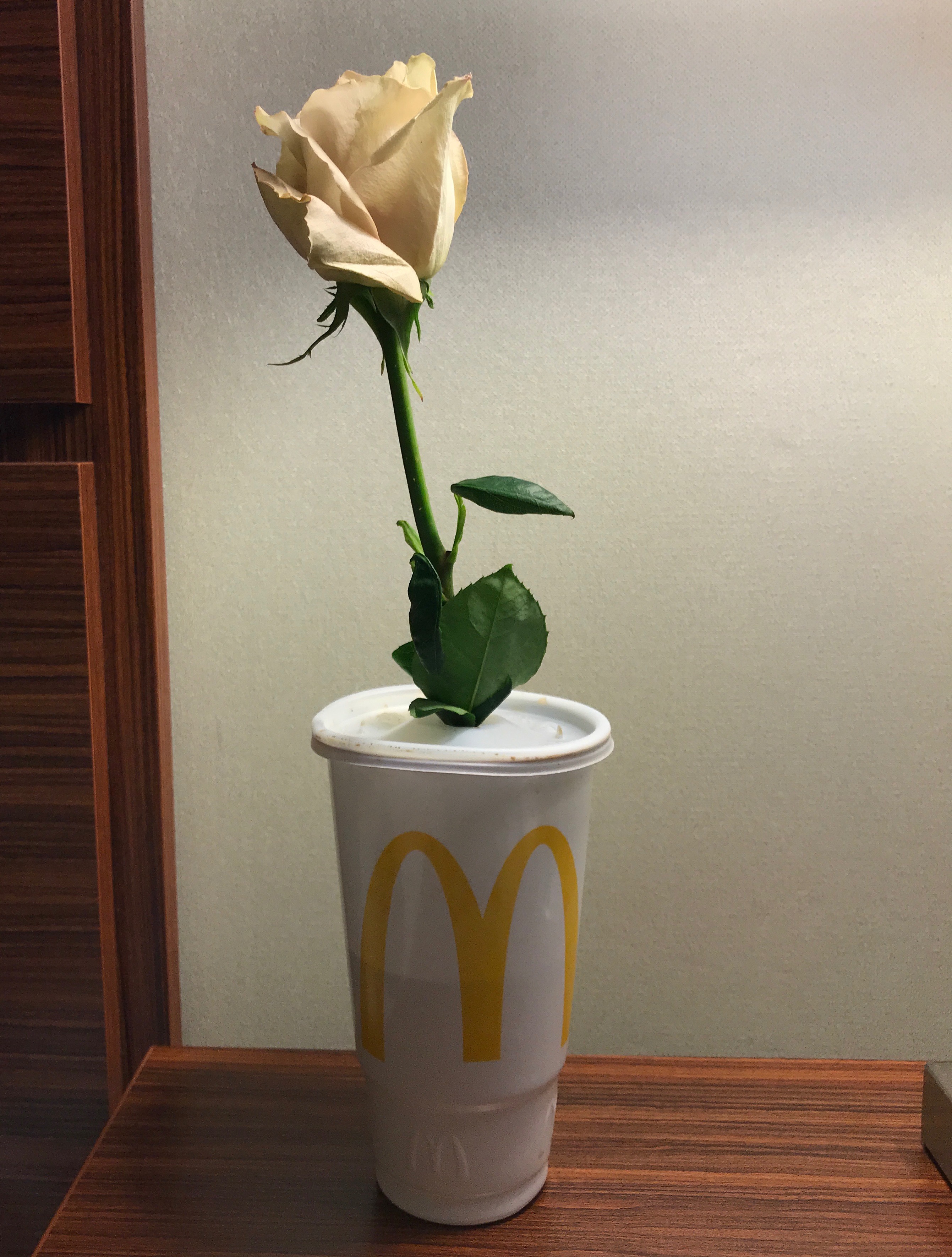
When the waitress brought me my dessert, she also brought me a rose. I appreciated the gesture, but I didn’t know what I as going to do with it.

But, where there’s a will, there’s a way!


Ann Bayley Seton, SC, (August 28, 1774 – January 4, 1821) was the first native-born citizen[1] of the United States to be canonized by the Roman Catholic Church (September 14, 1975).[2] She established the first Catholic girls’ school in the nation in Emmitsburg, Maryland, where she also founded the first American congregation of religious sisters, the Sisters of Charity.