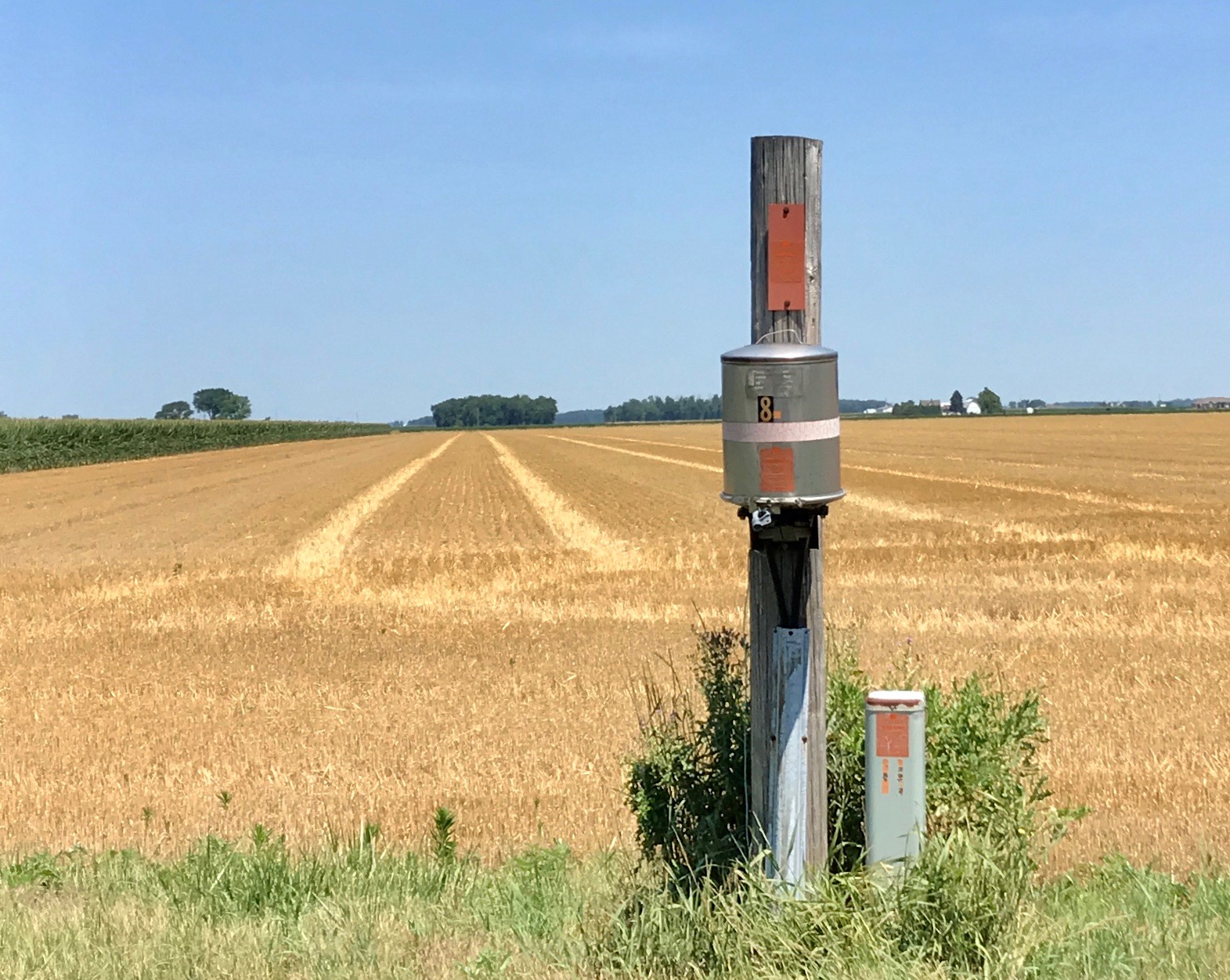
Every now and then, I came across what I imagined might be a wheat field that has already been harvested.
I am still trying to find out what these things are. I imagine they might have something to do with the electrical grid, but I don’t know what. Maybe someone will tell me one of these days – or I will find the right person to ask.
This day’s circling landed me in Bowling Green.
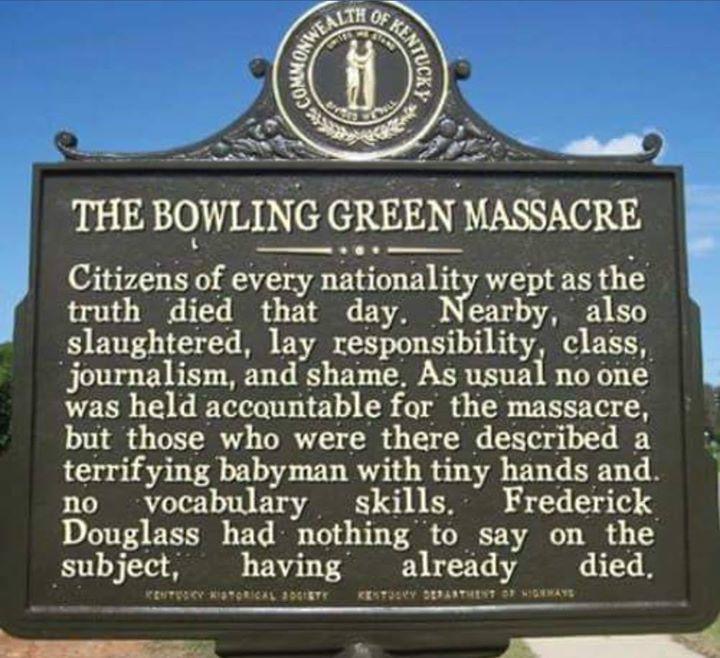
This photo I saved from Facebook seemed appropriate for this post, even if it was referring to Bowling Green, Kentucky.
I didn’t have much time to explore Bowling Green. If you would like to know more, here’s link to my Preferred Source. I took a glance at the site, and here are three things that stood out to me:
Bowling Green State University is located there.
It is located 20 miles southwest of Toledo and is part of the Toledo Metropolitan Area.
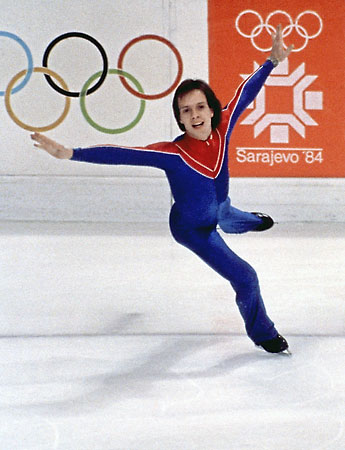
Scott Hamilton was born there in 1960.
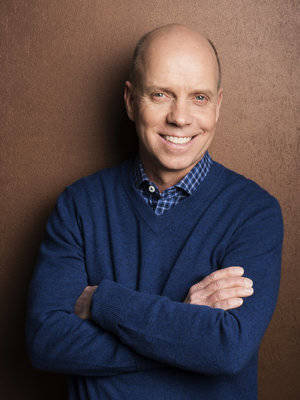
Scott Hamilton THENScott Hamilton NOW
Hey, we’re all getting older. He’s still awfully cute.
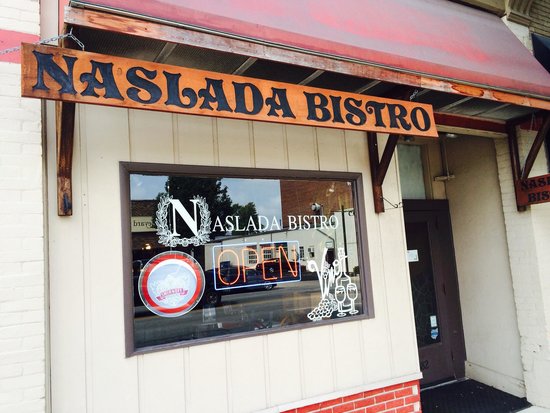
I checked into the hotel and headed out to find dinner. What a dinner I found! I parked down in the central business district and strolled about. I came across Naslada Bistro.
The exterior wasn’t impressive, but it said that it had Bulgarian cuisine. That would be a first for me. I thought I give it a try. After all, if I wasn’t wild about it, another meal would be coming along in the morning.
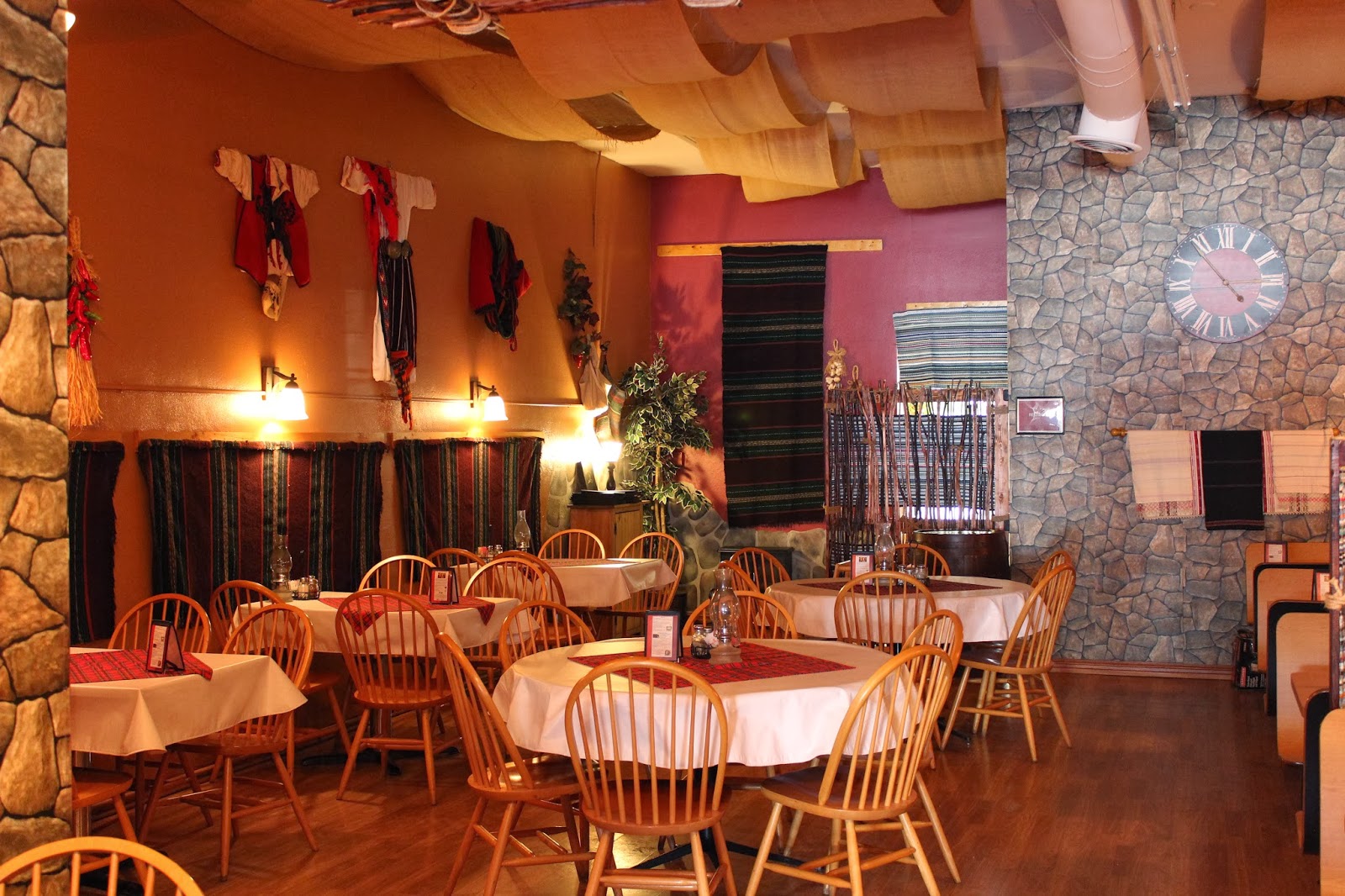
The dining room was comfortable, though. I am a sucker for real cloth napery. I took my seat and decided on my dinner. I decided to order appetizers for dinner.
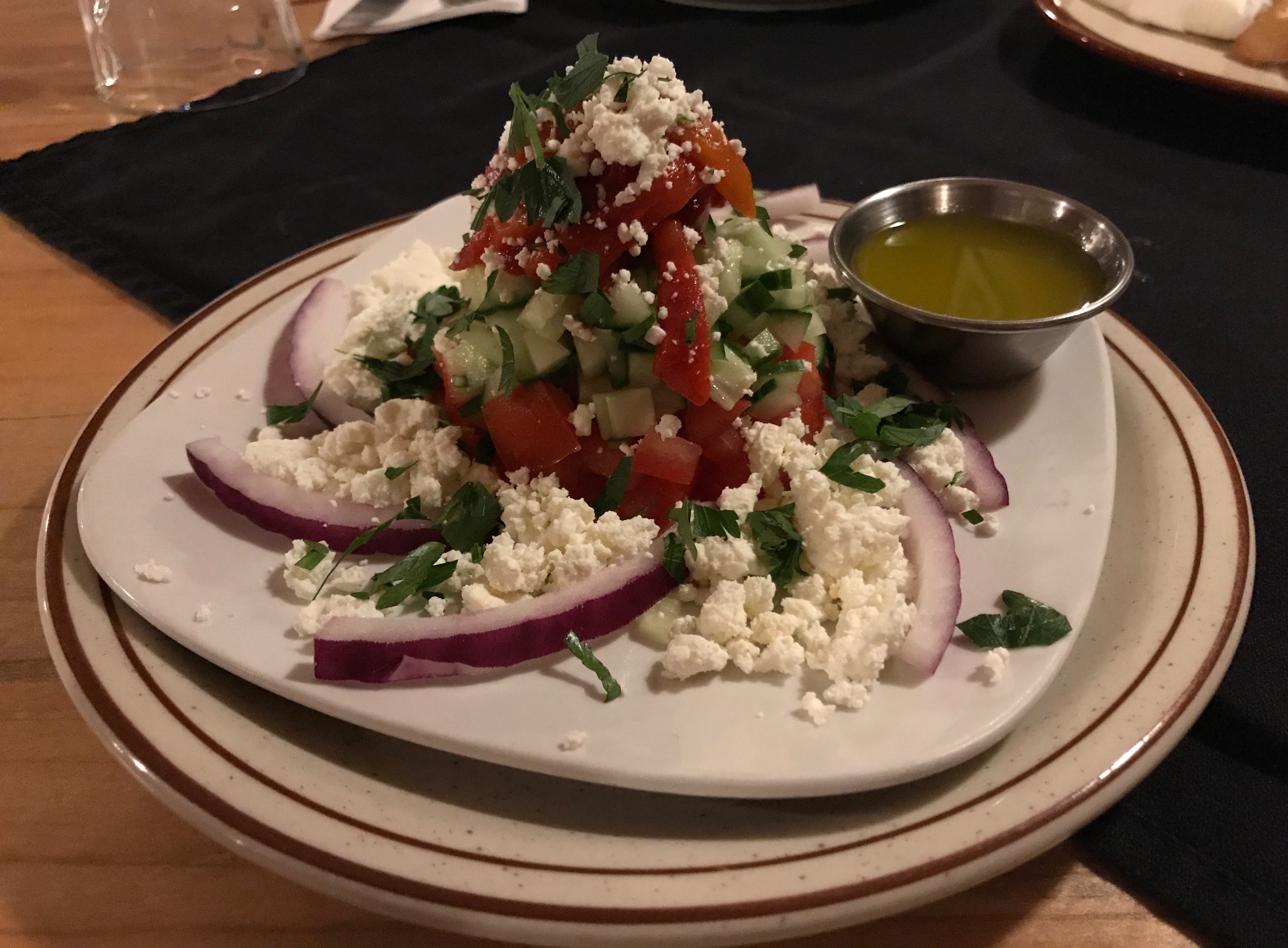
I started with the Shopska Salad.
The top view didn’t do it justice. I had to try for a side view. It was beautiful and tasty, too.
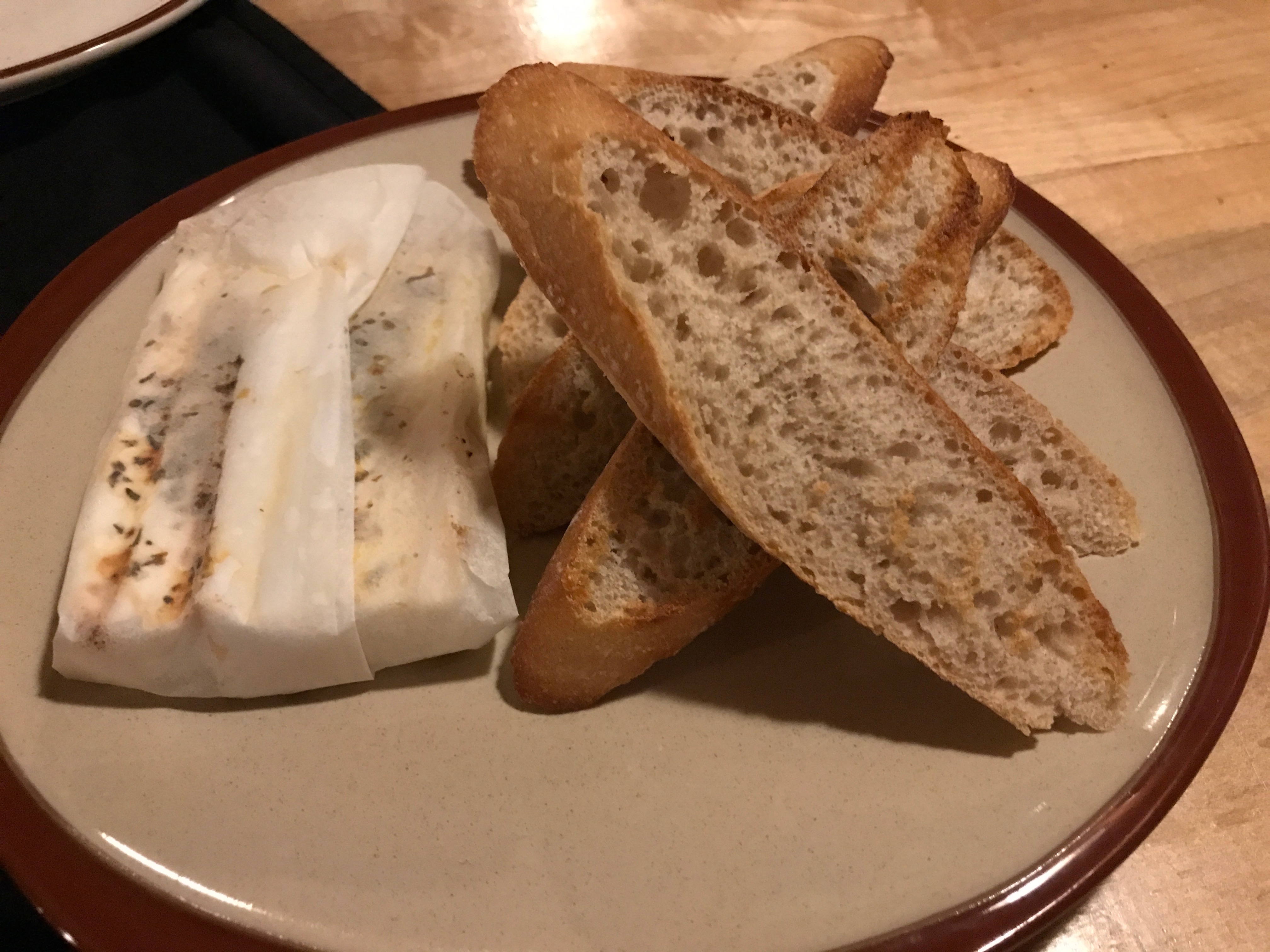
Another dish they had was Seasoned Feta on the Grill. I like feta, but mostly I was curious about how they could grill cheese.
The answer was served to me. They wrap the feta up in a paper before putting it on the grill.
This isn’t a dish you could get at Denny’s!
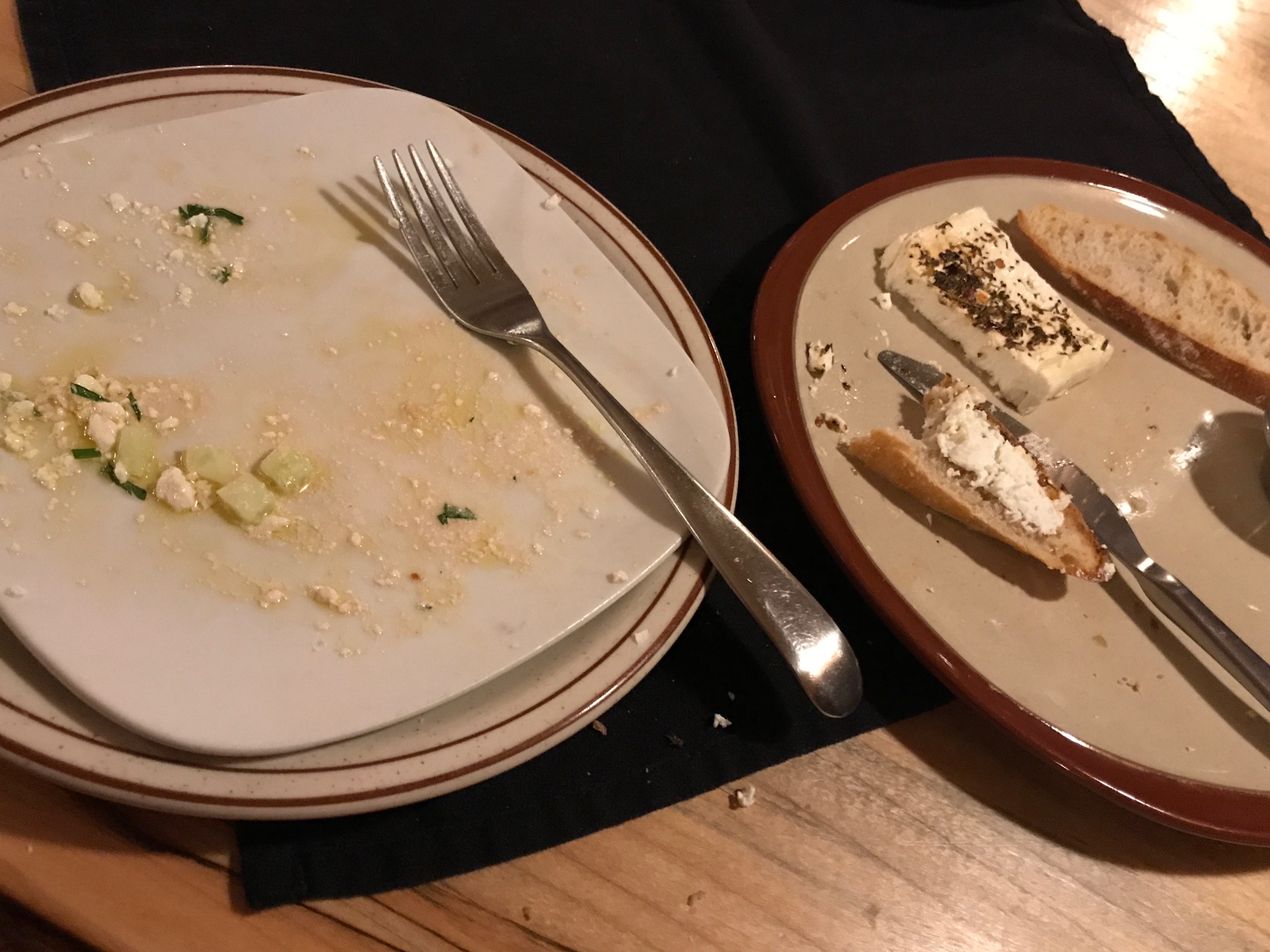
I think I did a pretty good job. Since I joined the Clean Plate Club, I decided that I could order dessert.
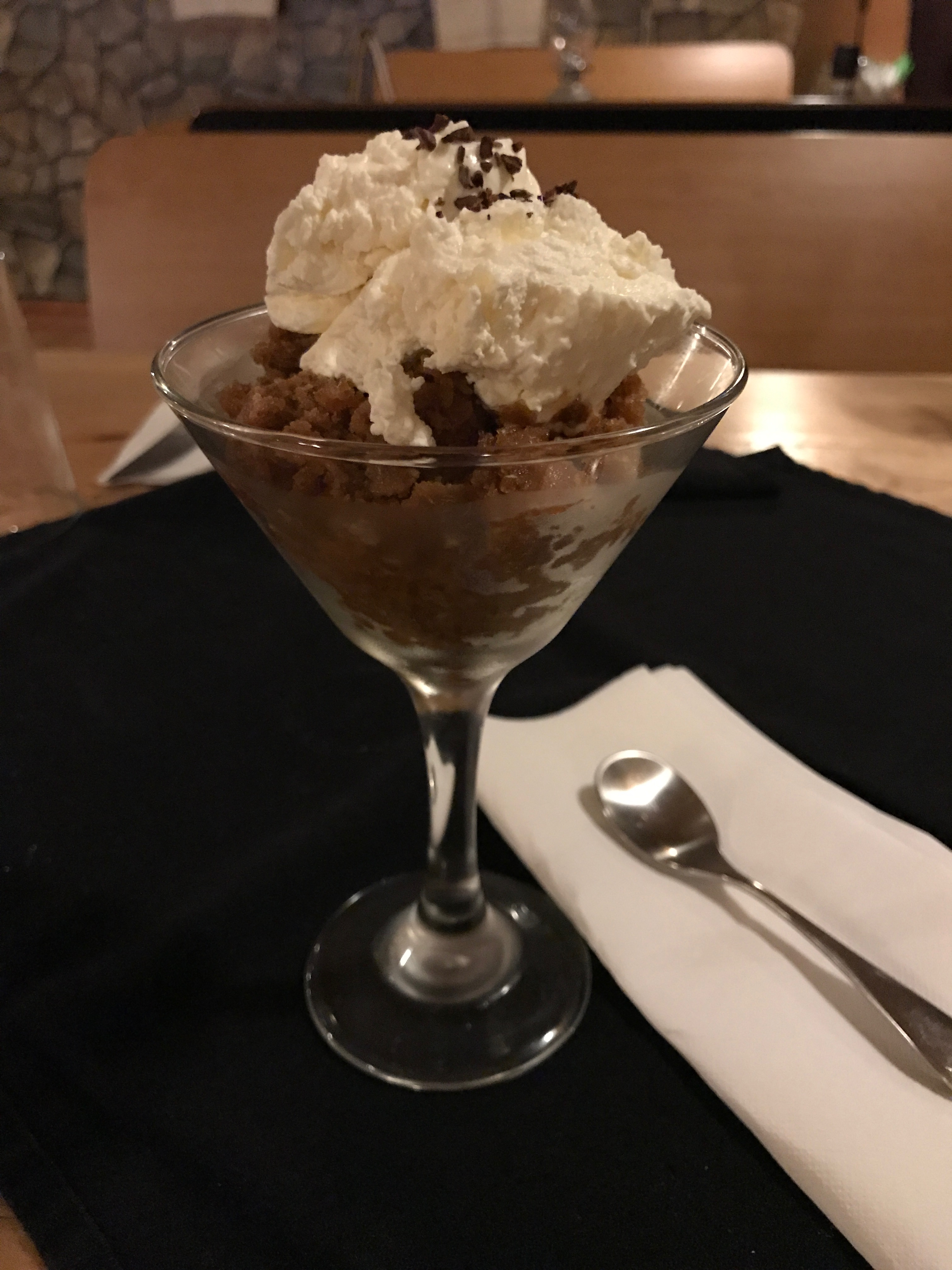
Doesn’t that look lovely? It was some sort of espresso ice concoction. I thought I would like it, but unfortunately, it was a little less sweet than I had hoped it would be.
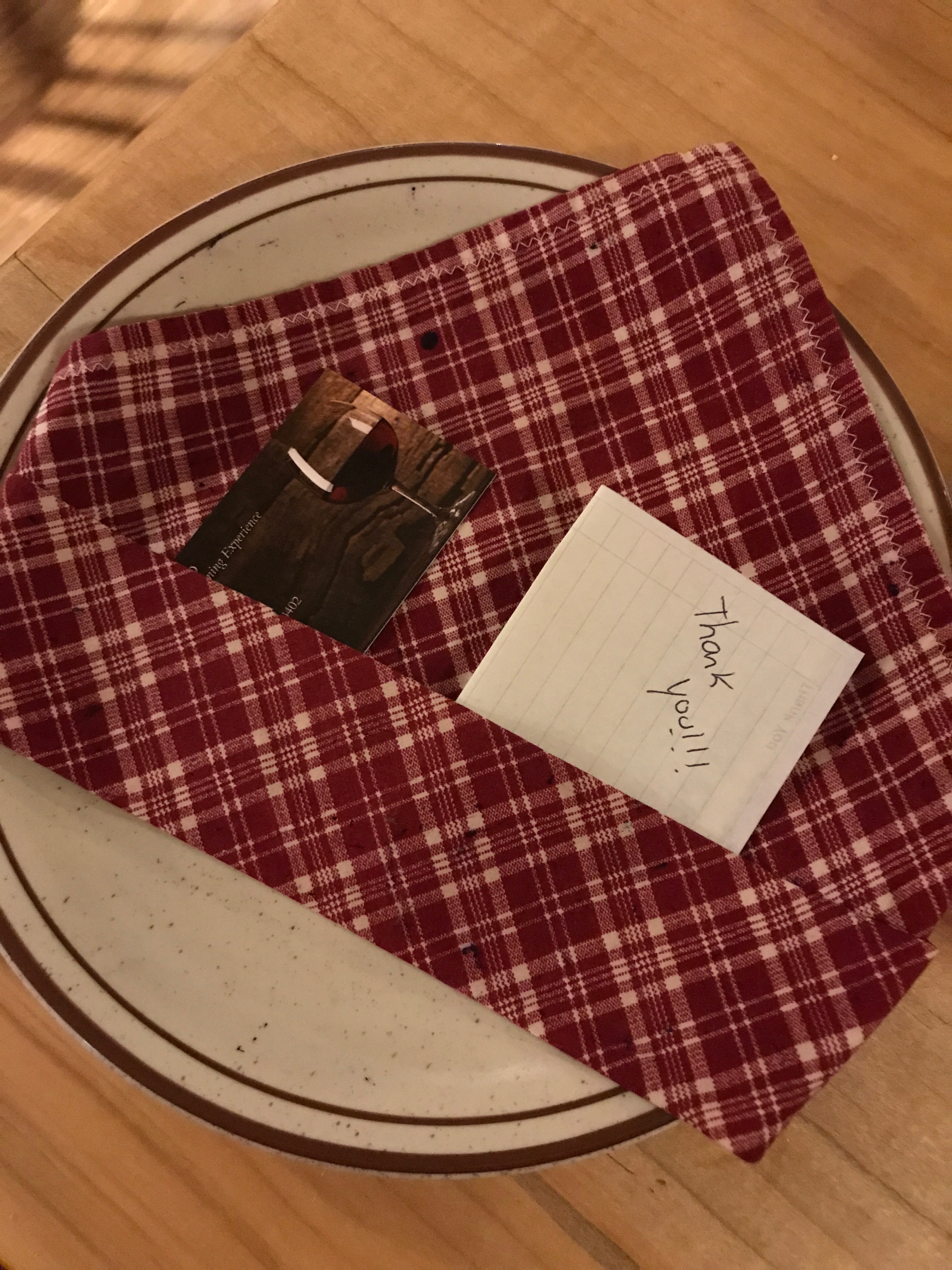
I asked for the check, and they blew me away with the presentation.
Have you ever thought about how many hands touch those plastic folders that bills are frequently presented in? Not only was this attractive, it was sanitary!
They even included a business card!
If you are ever in the area, I highly recommend dining at Naslada Bistro!
With that, I made my way back to the hotel to get rested up for another day of driving in circles.
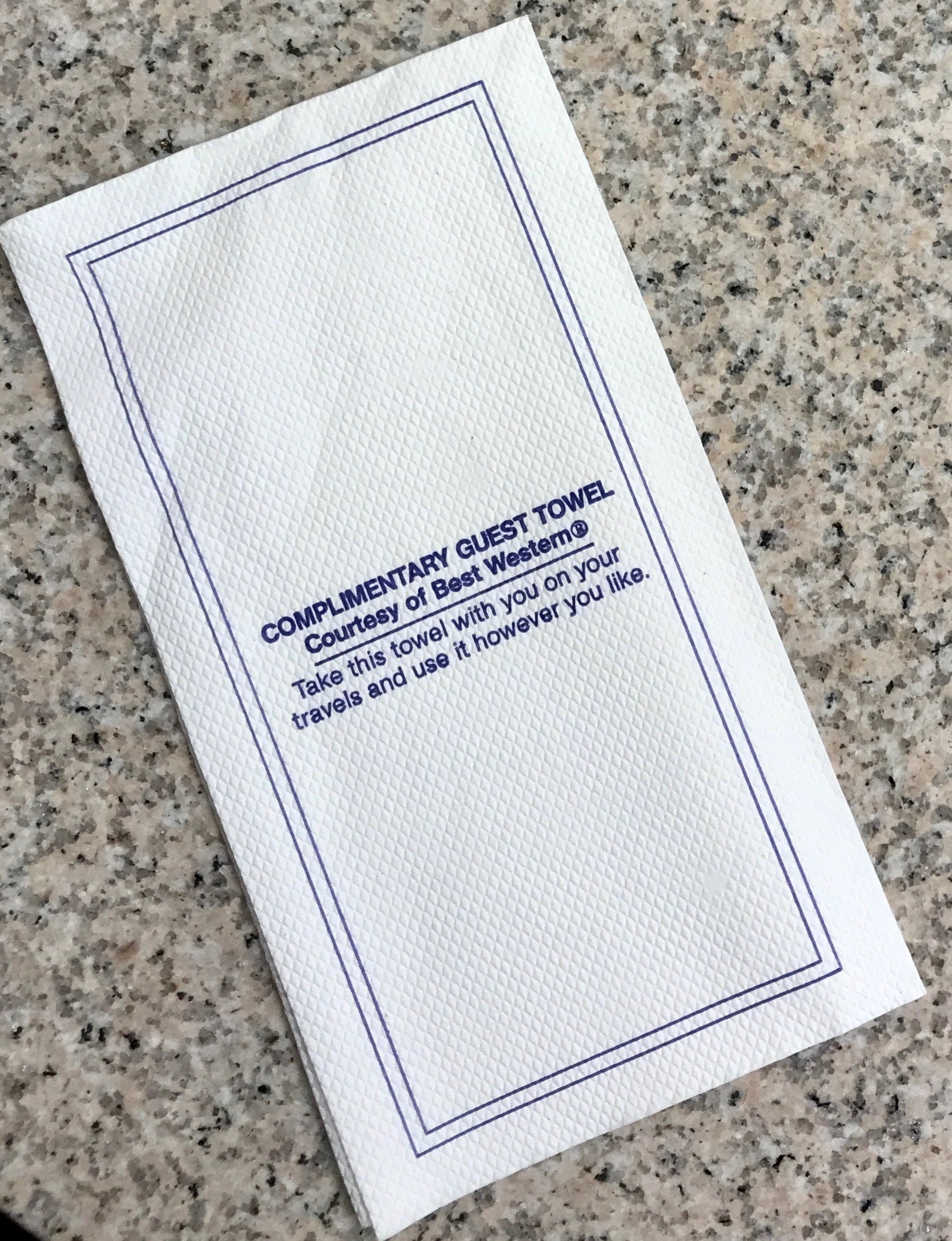
I made sure to pack up my COMPLEMENTARY GUEST TOWEL. Those people at Best Western sure are hospitable.
I love it when I get to visit places I would not normally visit. In this case, I stopped for the night in Upper Sandusky, Ohio.
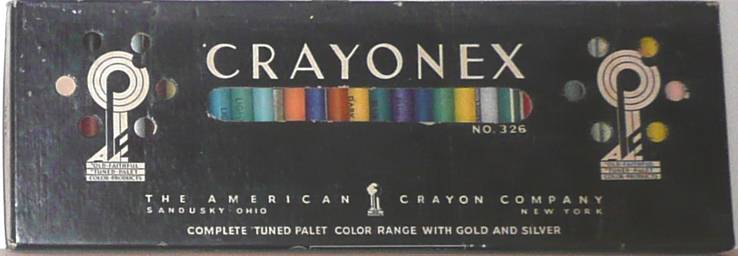
You might be wondering, as was I, why it is named Upper Sandusky. As you look at the map, it is clear that Upper Sandusky is below plain ol’ Sandusky. (Home of Cedar Point and The American Crayon Company.)
It turns out that it is named Upper Sandusky because it is located near the headwaters of the Sandusky River. It played a part in the Revolutionary War as well as the War of 1812.
I wasn’t sure if there was anything to see there, but after securing a hotel room for the night, I set out to see what I could.
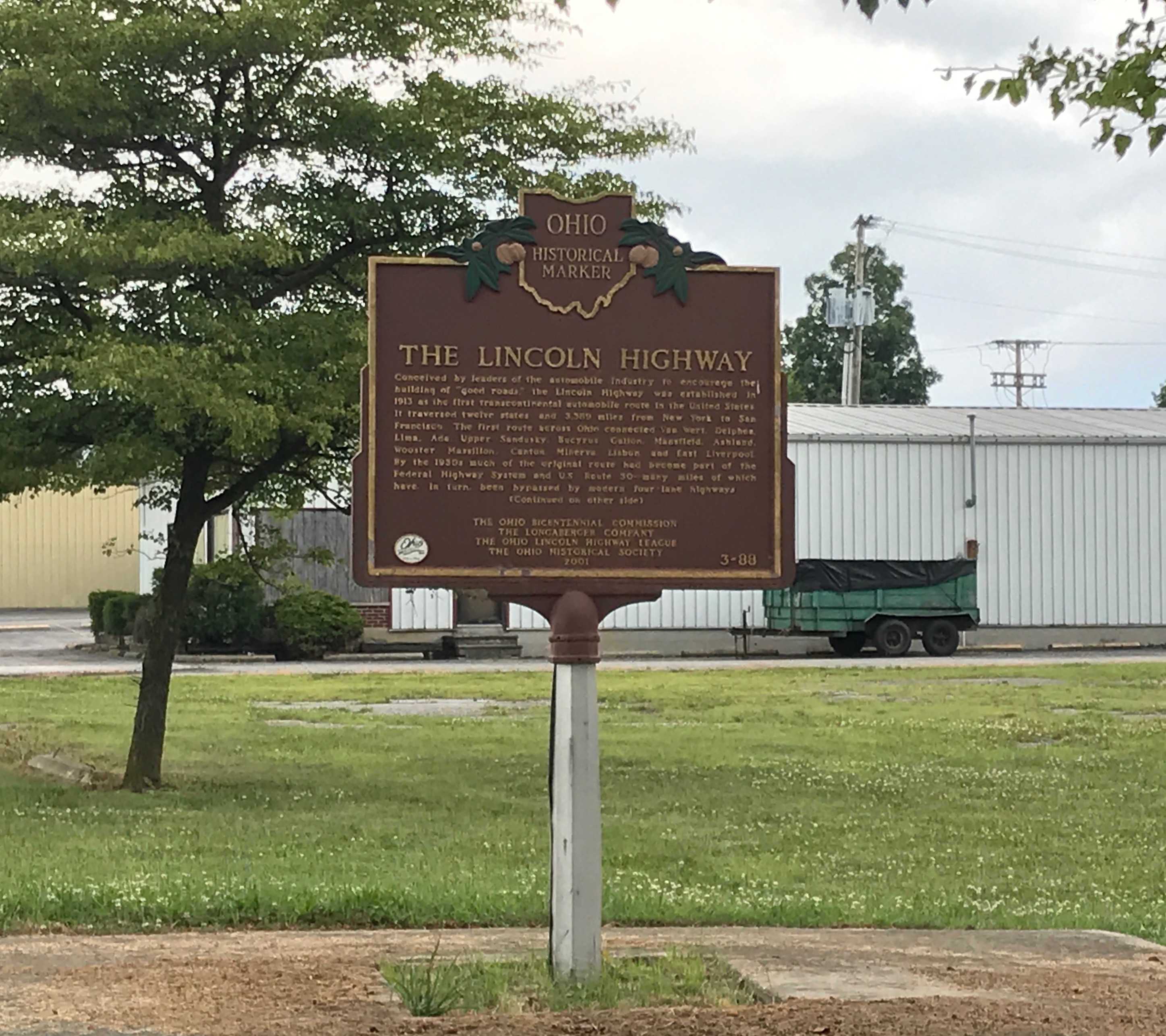
On the way in, I passed a marker for The Lincoln Highway. The sign reads:
THE LINCOLN HIGHWAY
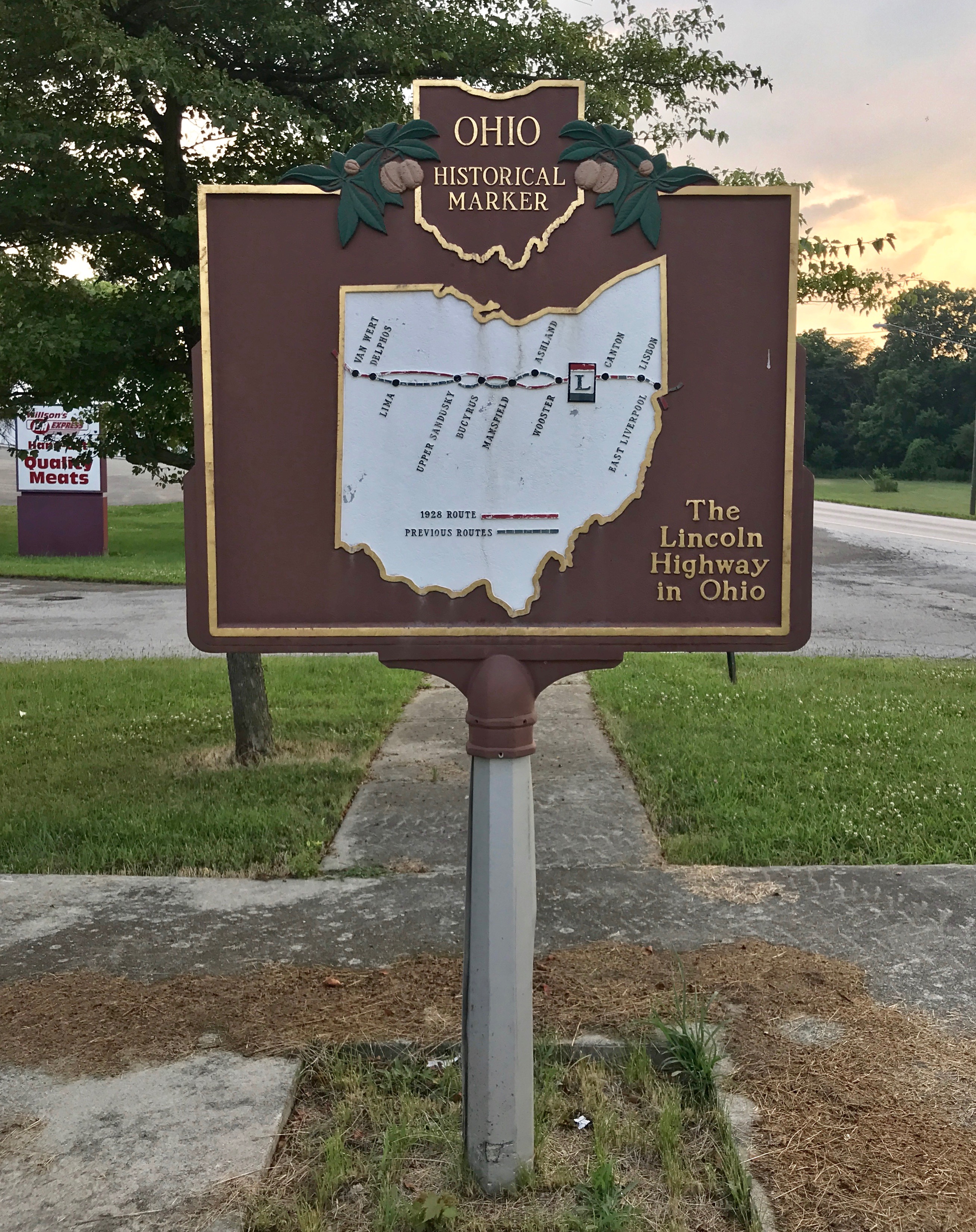
“Conceived by leaders of the automobile industry to encourage the building of “good roads,” the Lincoln Highway was established in 1913 as the first transcontinental automobile route in the United States. It traversed twelve states and 3,3089 miles from New York to San Francisco. The first rout across Ohio connected Van Wert, Delphos, Lima, Ada, Upper Sandusky, Bucyrus, Callon, Mansfield, Ashland, Wooster, Massillon, Canton, Minerva, Lisbon.
Continued on other side”
I guess change is the only constant.
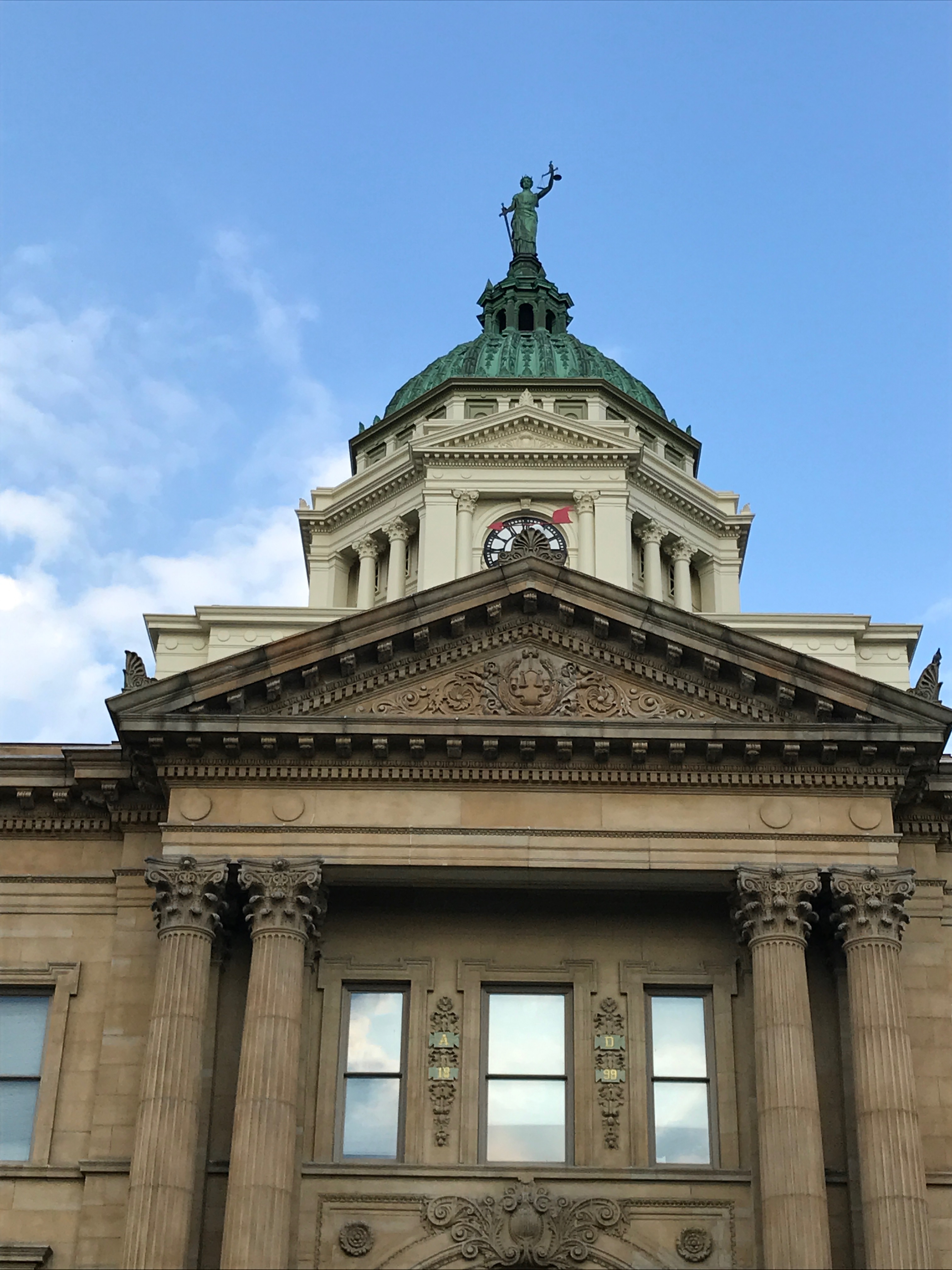
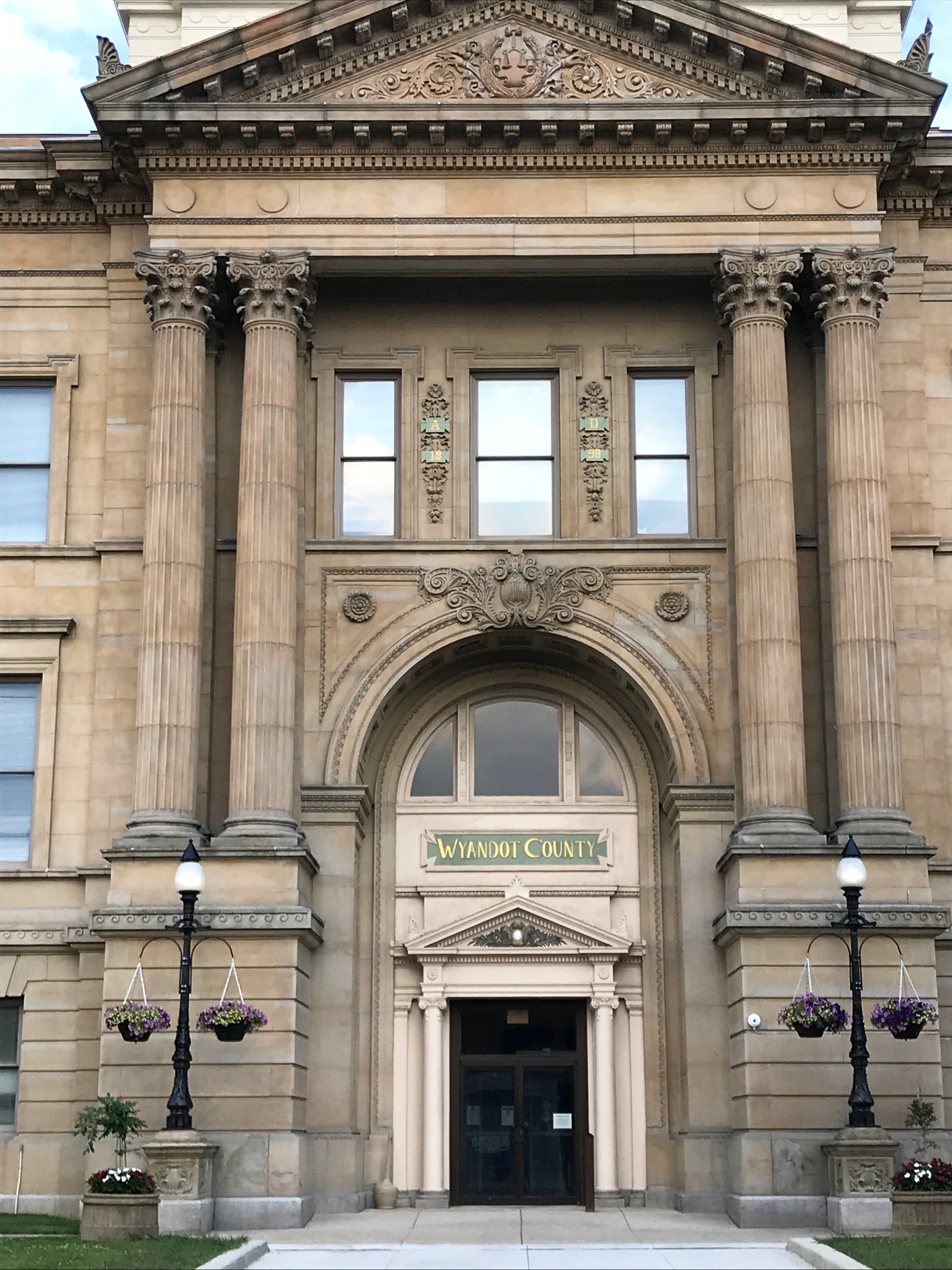
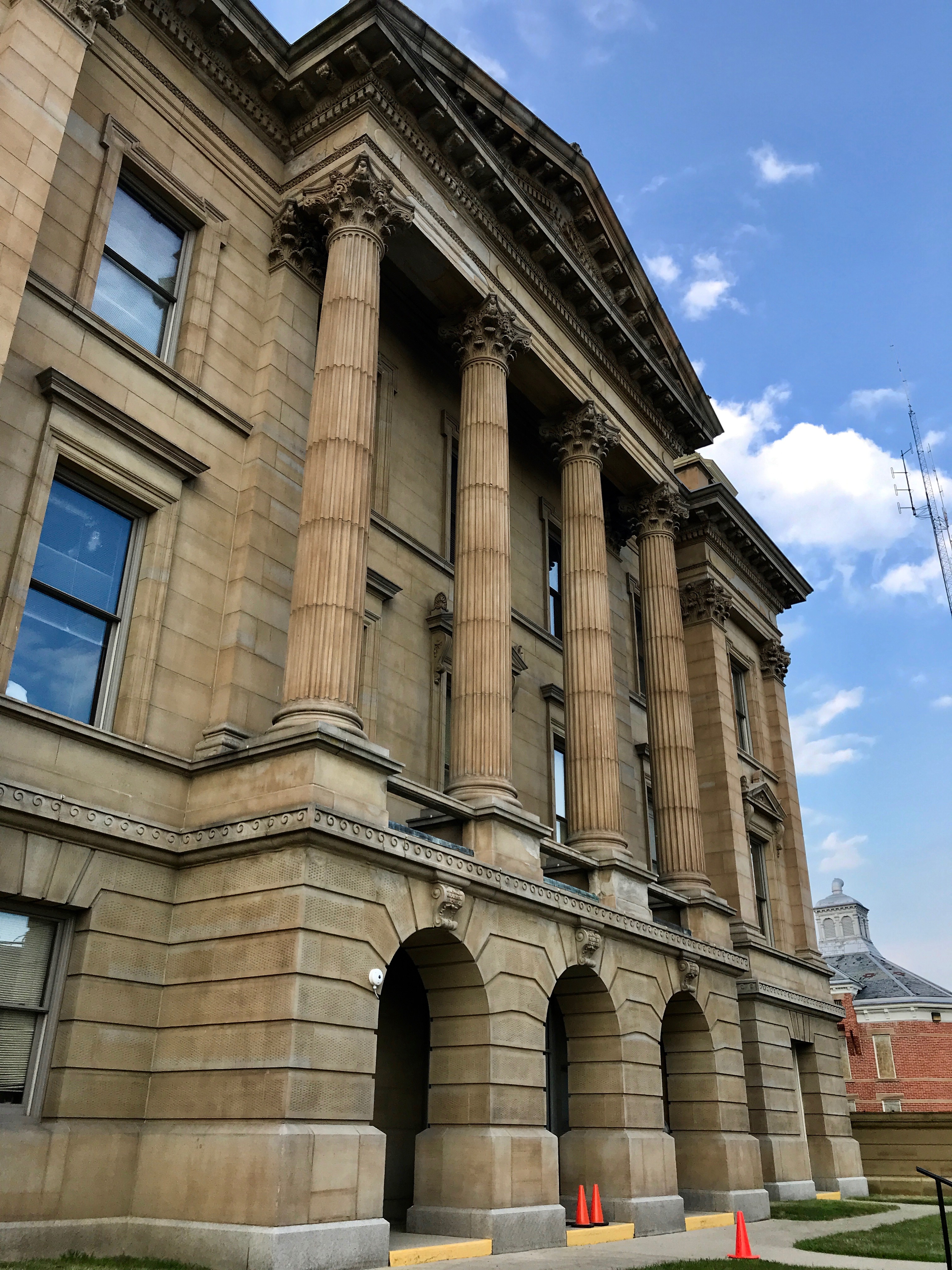
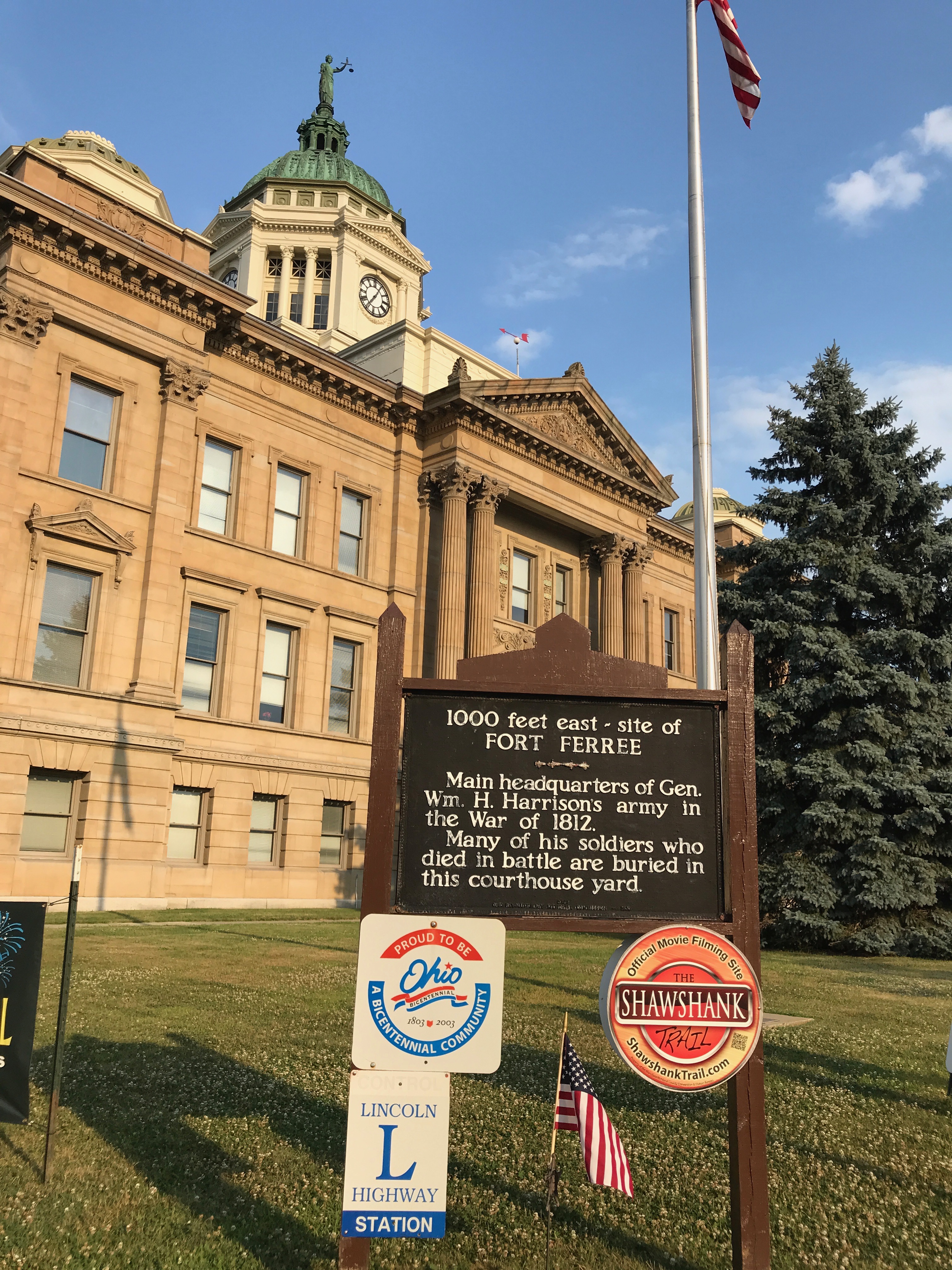
I arrived downtown and spotted this amazing courthouse. I parked the vehicle and got out to explore.
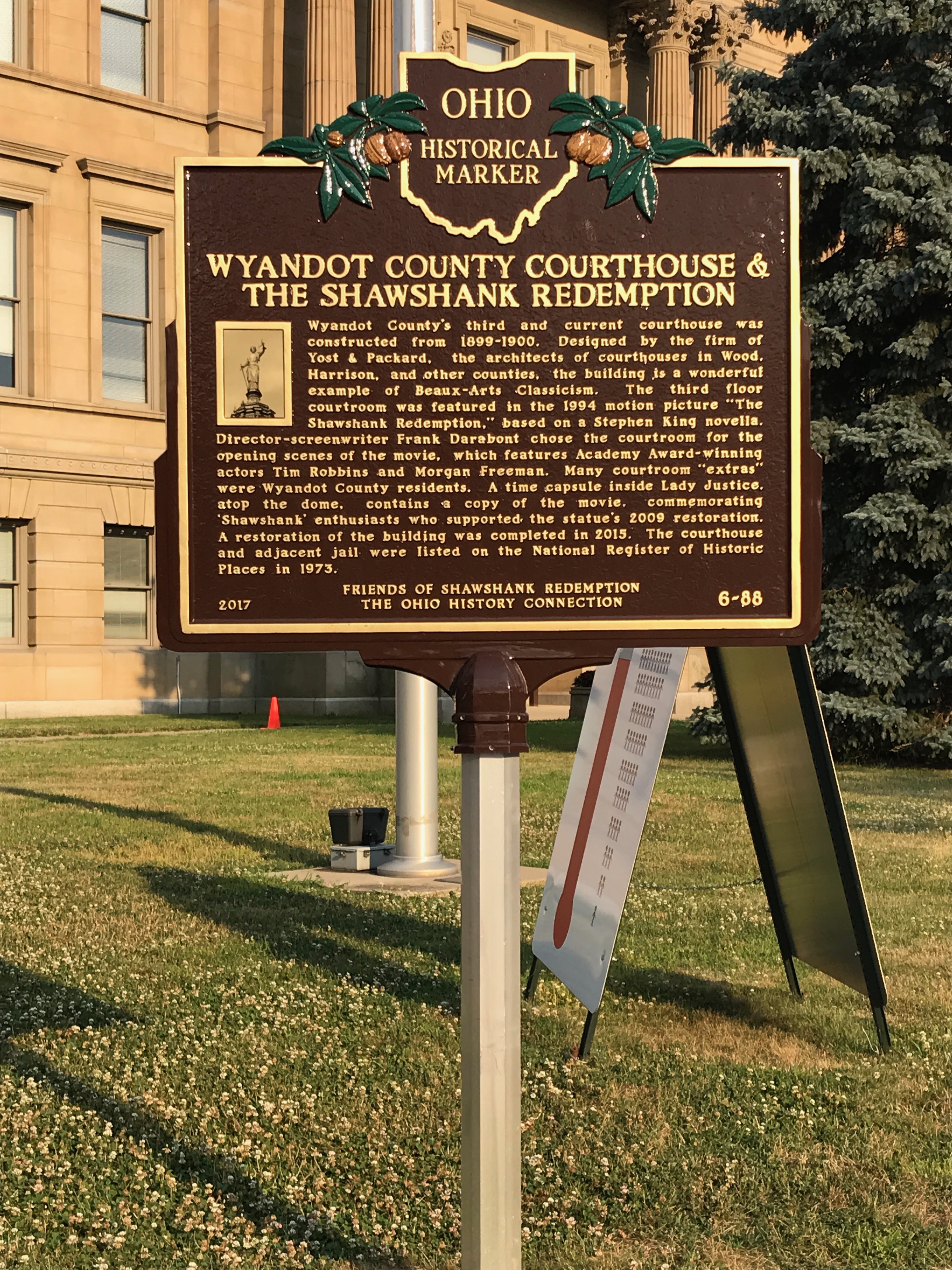
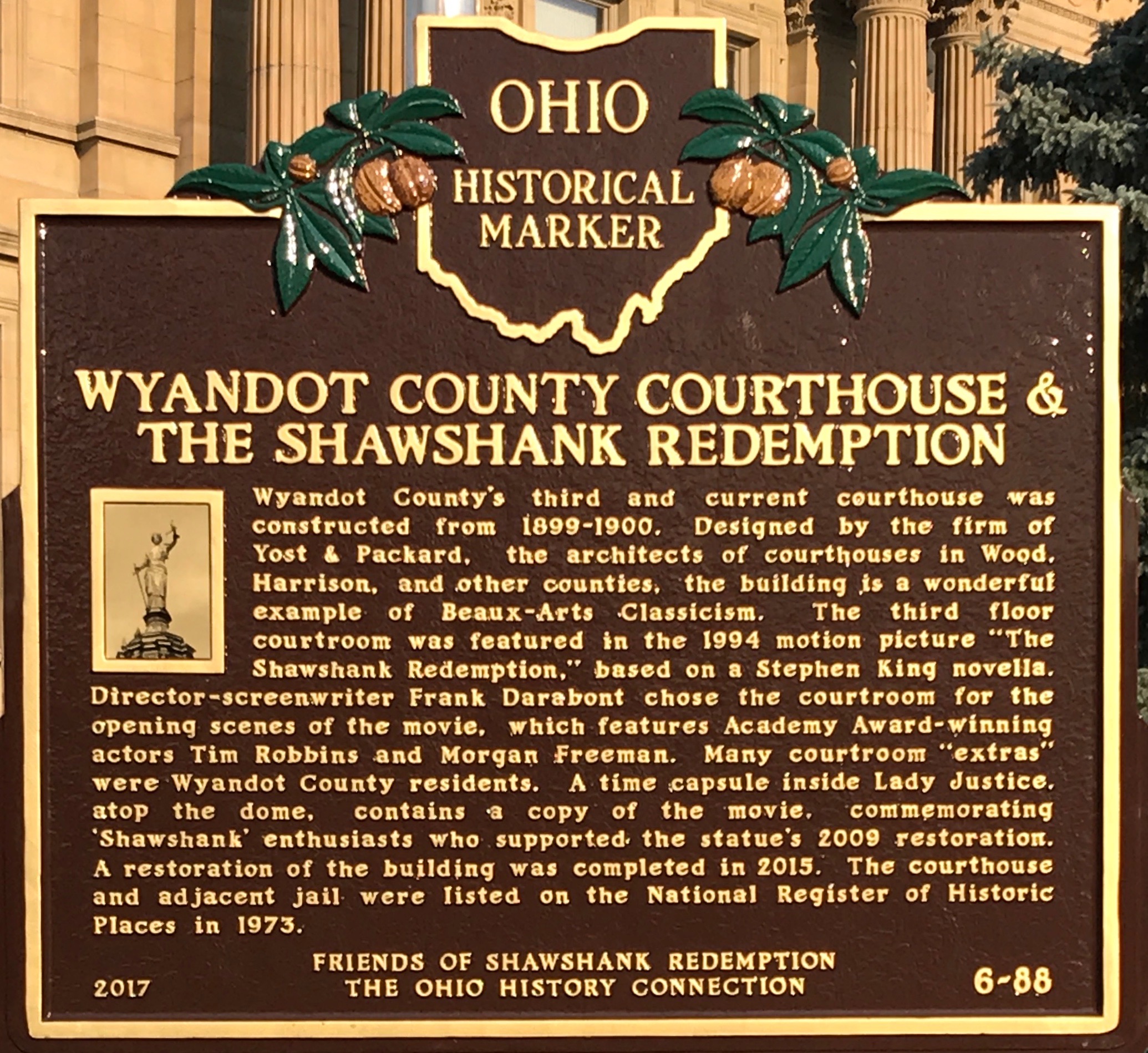
Wait,,,WHAT?! The Shawshank Redemption?! Filmed here?!
I guess so.
It really is a lovely building.
Of course I could only judge the building on the exterior. I make these stops after the end of my work day, which, incidentally, happens to be the end of the work day for just about everyone else.
I walked around it, enjoying the solid architecture and the beautiful blue sky.
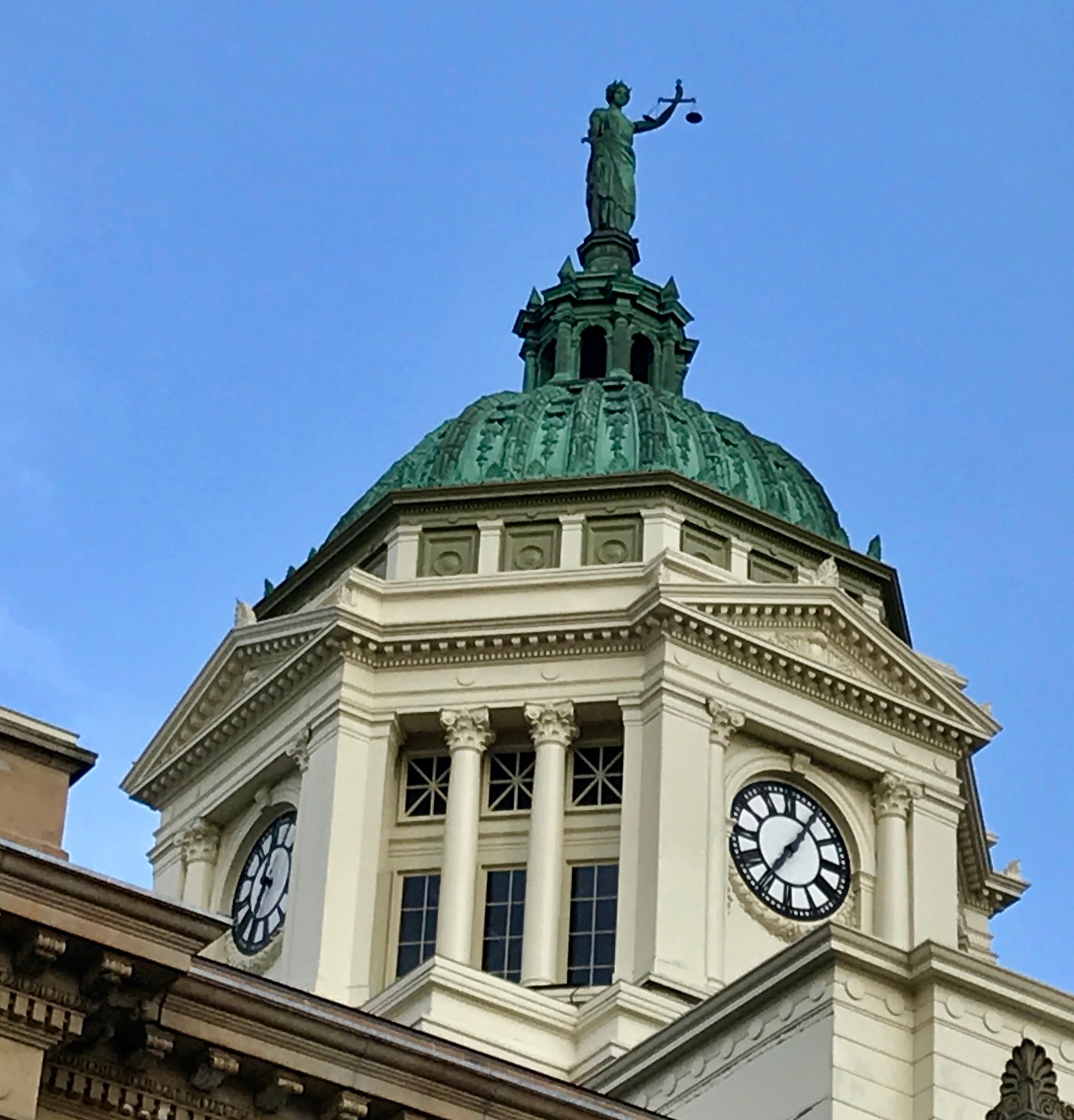
There’s Lady Justice atop the dome, guarding the time capsule with the copy of the Shawshank Redemption. I wonder what technology will be used to play movies when they open the time capsule. I do hope someone thought to include whatever machinery will be needed to play the movie at some point in the future.
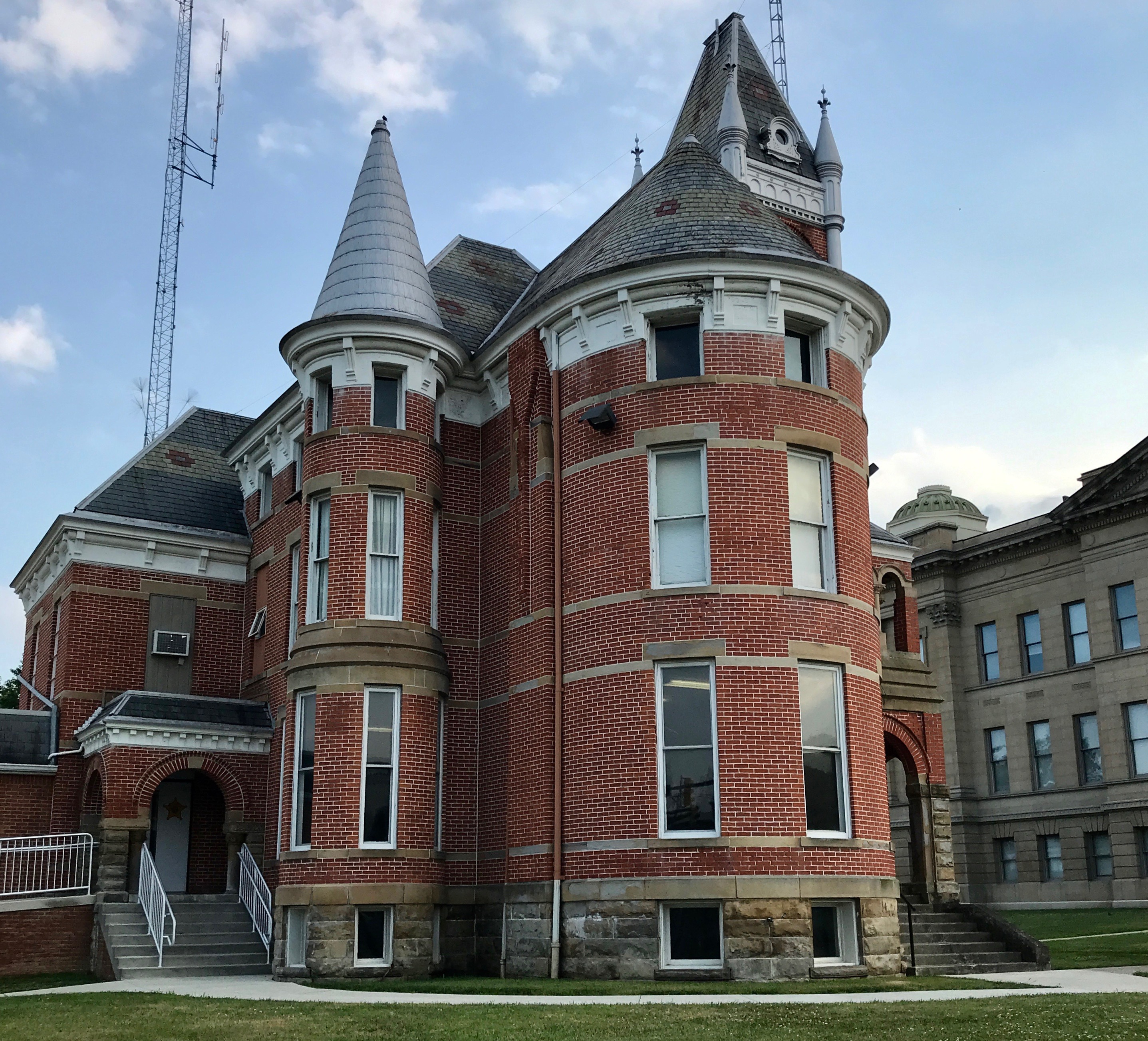
I rounded the corner and came to the jail. The lack of bars on the windows leads me to question whether it might have been repurposed somewhere along the way.
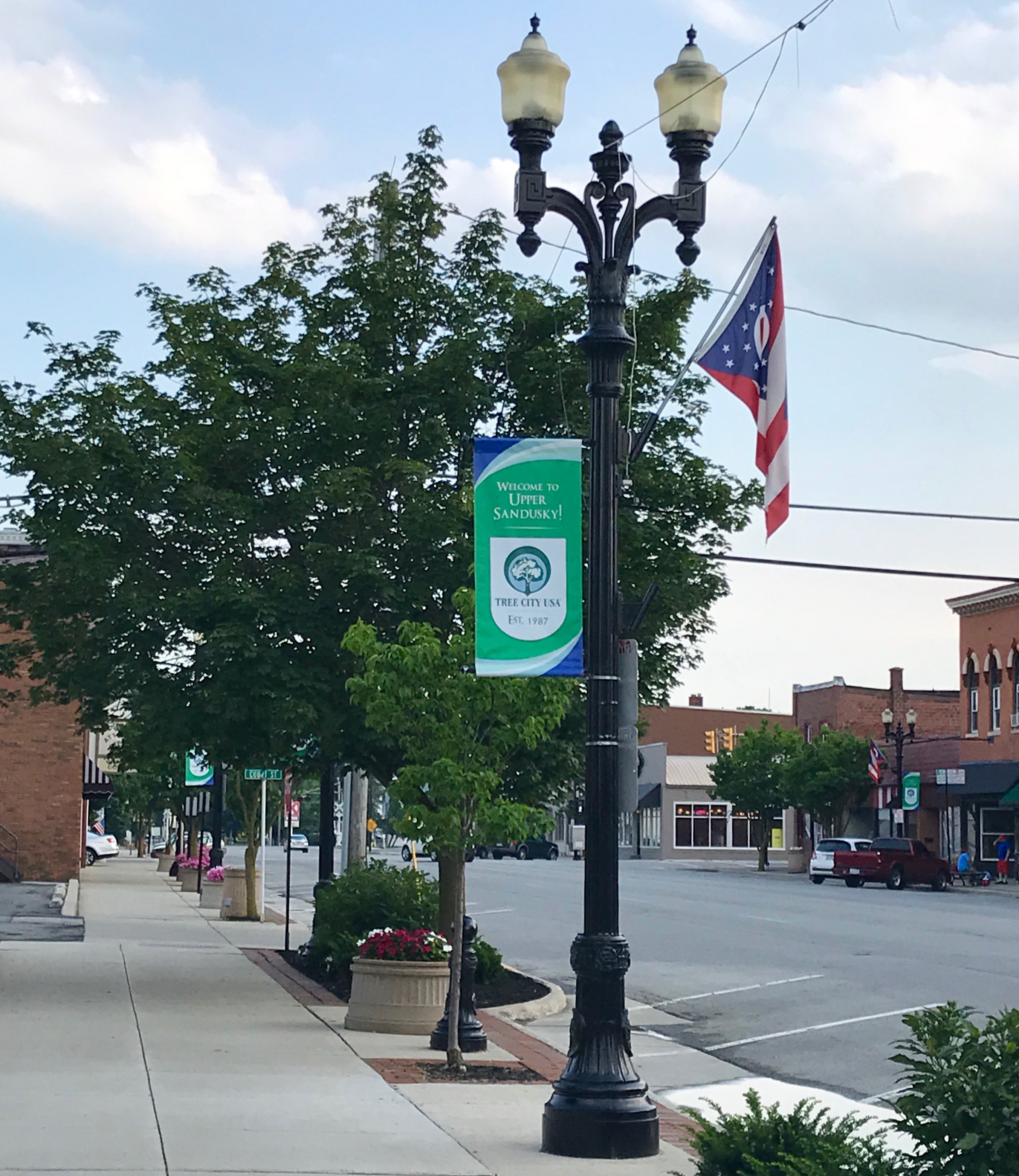
I got back to the vehicle and snapped this picture of the streetlamp banner, to remind myself of where I was, I got back in the driver’s seat and headed back to whatever hotel I was in that night.
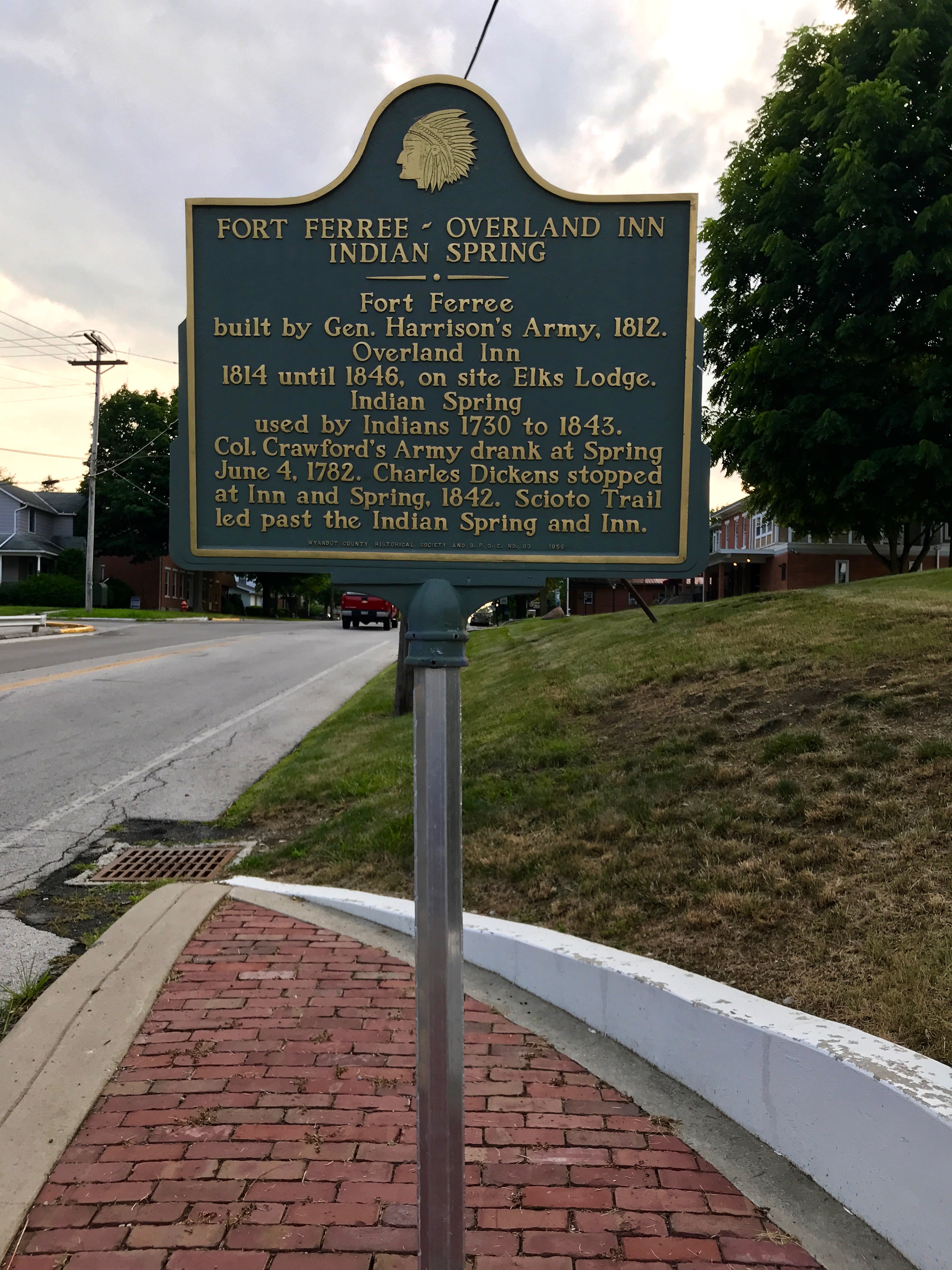
Before calling it quits for the day, though, I thought I’d see if I could track down the site of Fort Ferree.
What do you know? I did find another plaque!
Satisfied, I declared my drive-by tourism a success for the day.
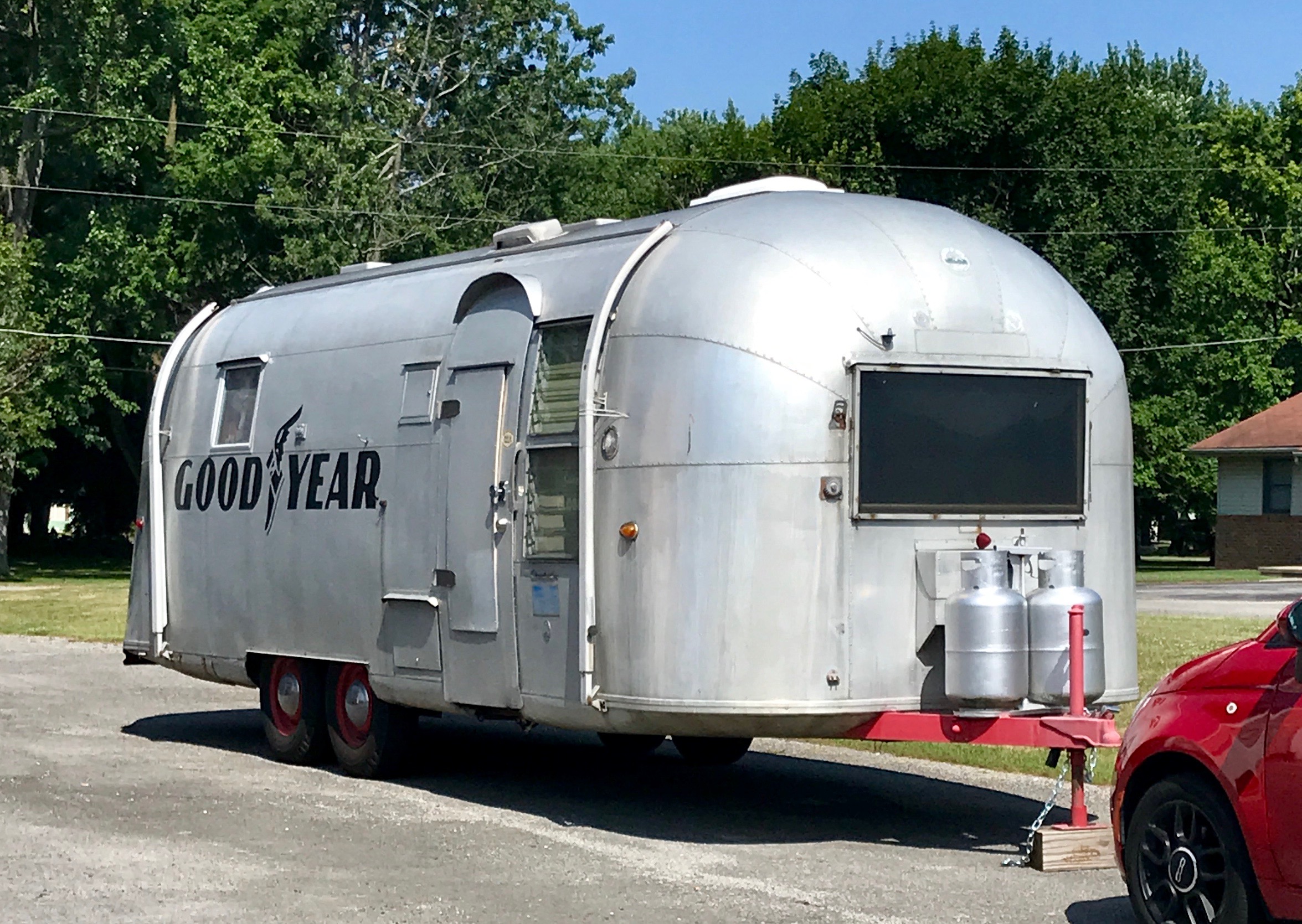
This Airstream I spied parked behind a shop was just the cherry on top!
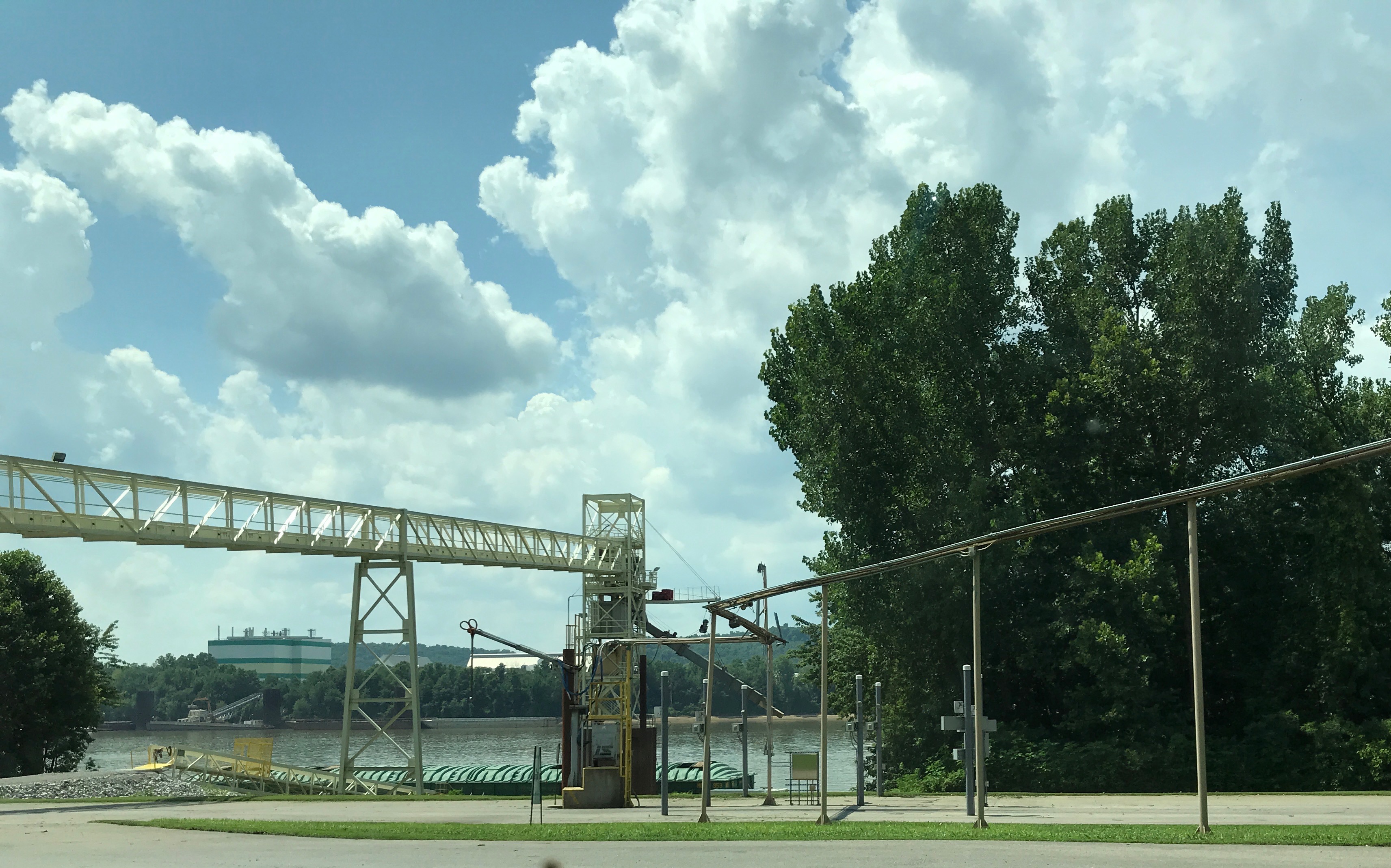
I left my friends’ house and headed for the first stop of the week. It was a facility that loaded the grain right on to barges that took the product to where it was needed.
After that, it was off through the countryside.
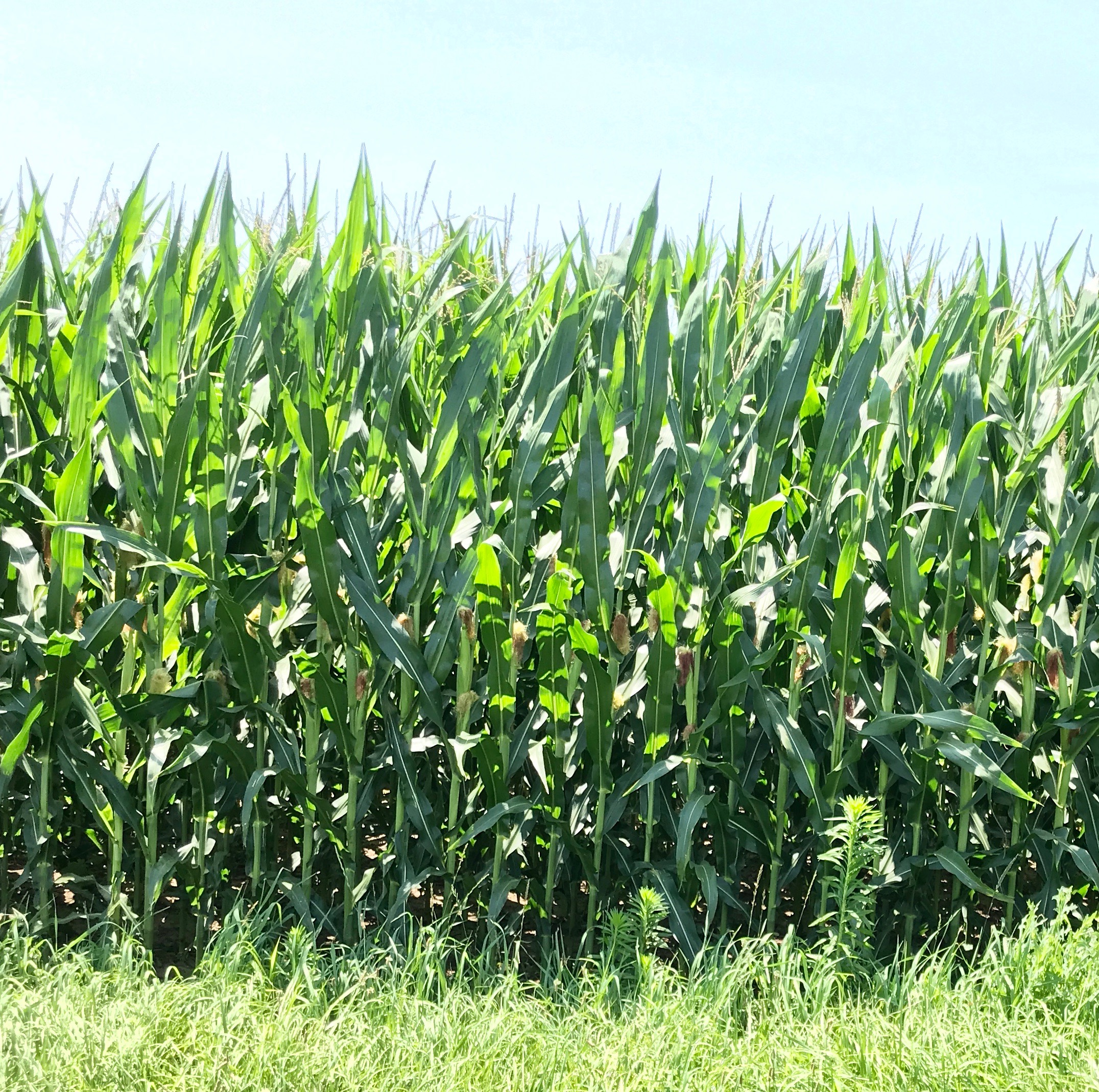
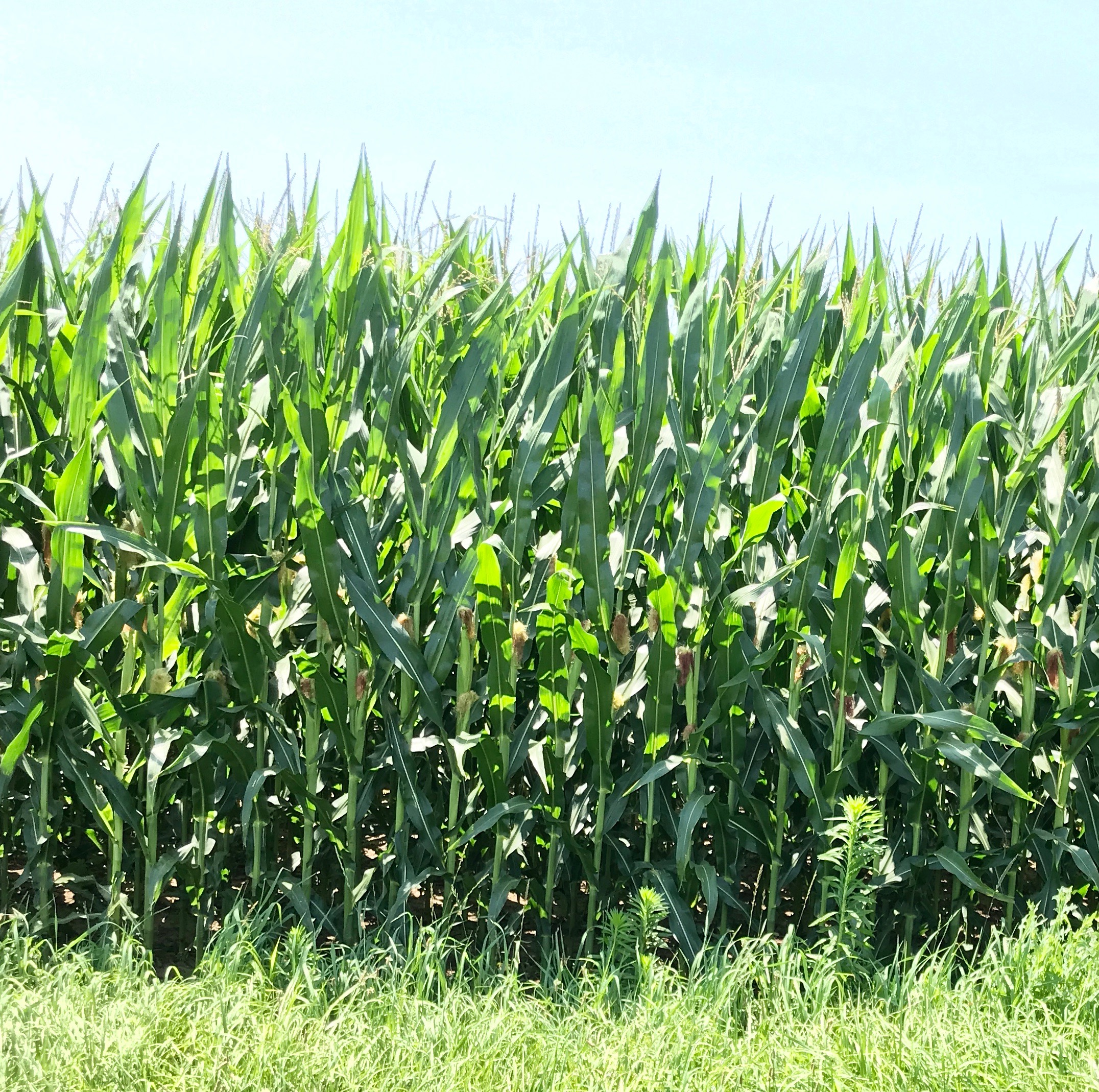
I saw plenty of corn,
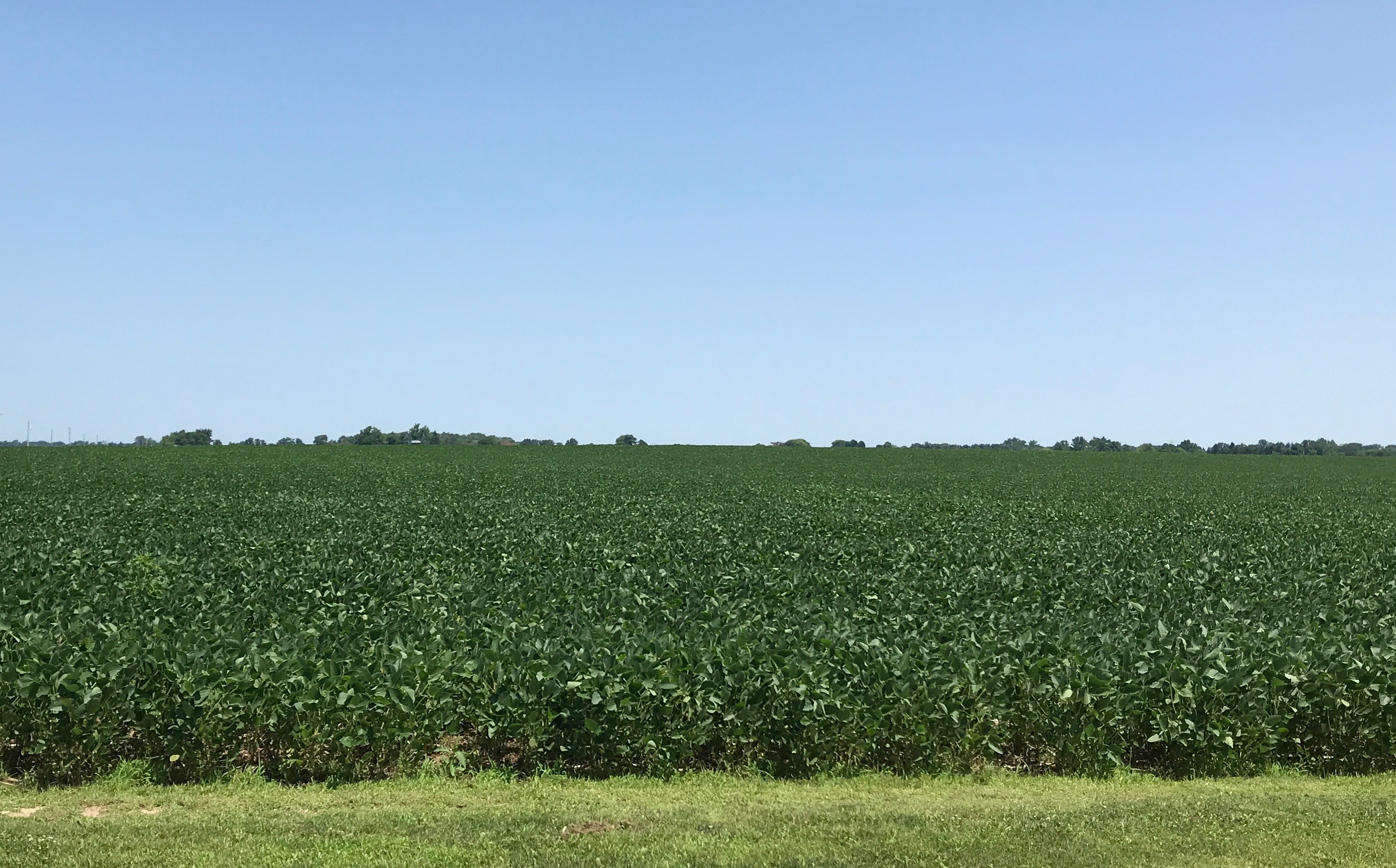
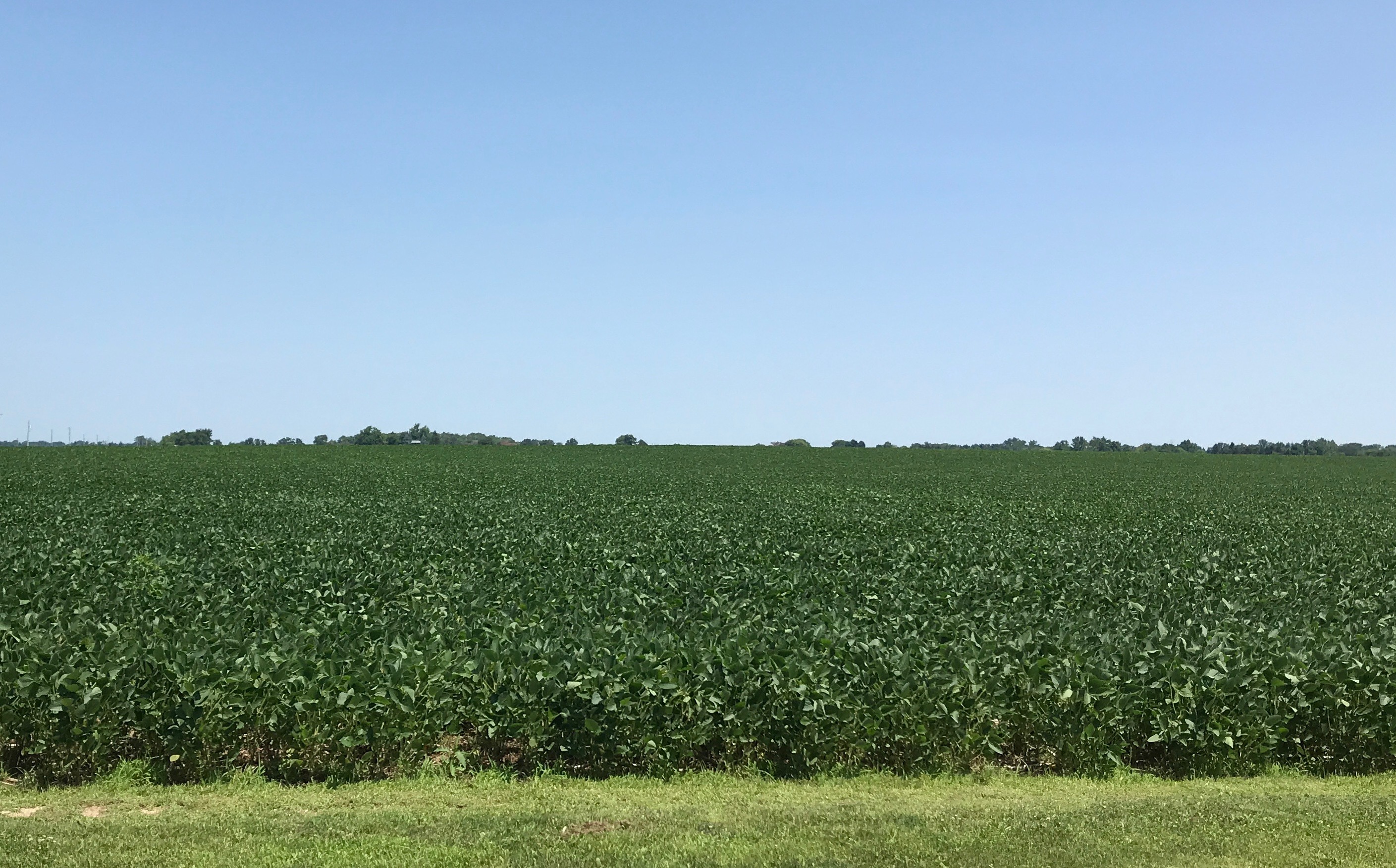
and soy,
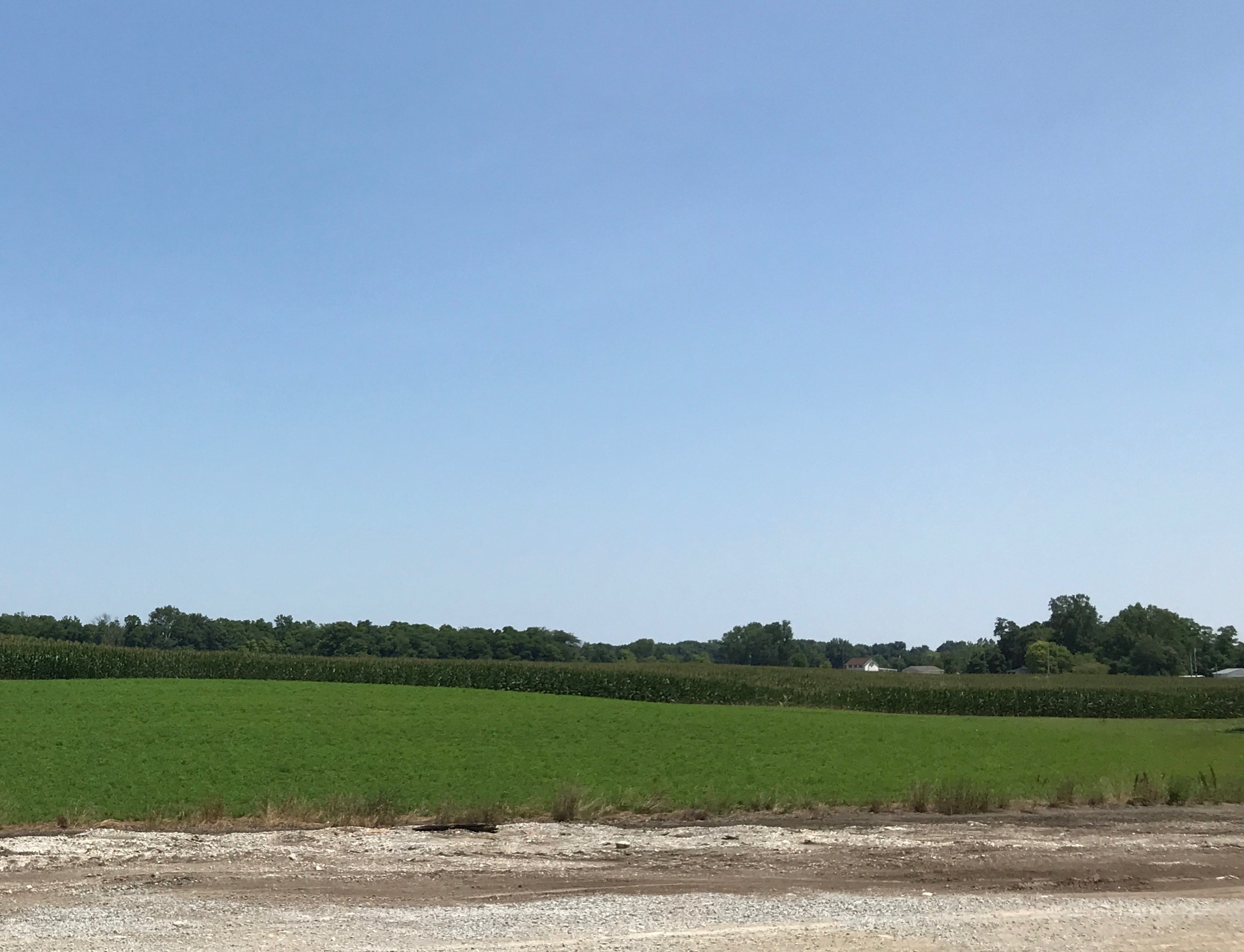
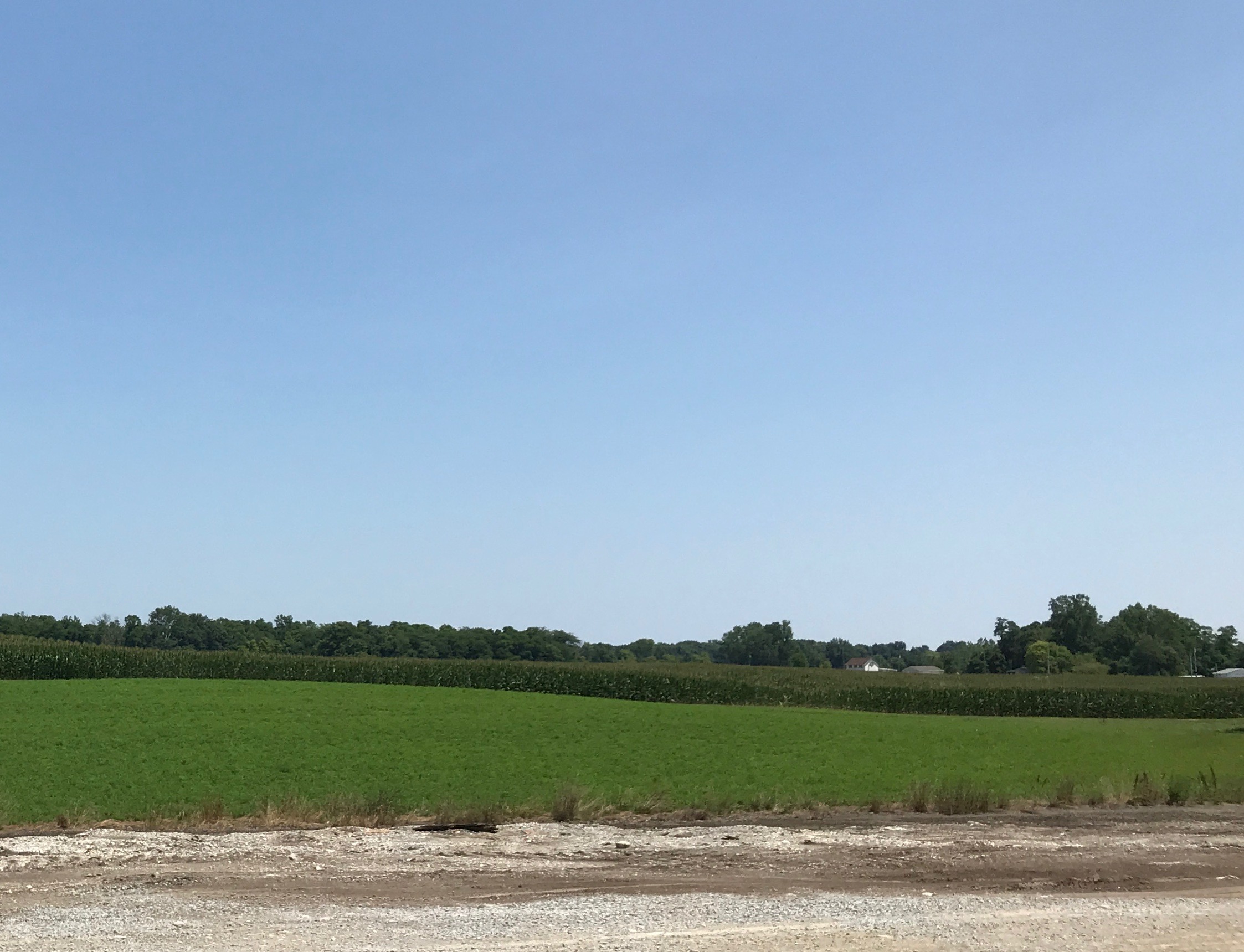
and corn and soy,
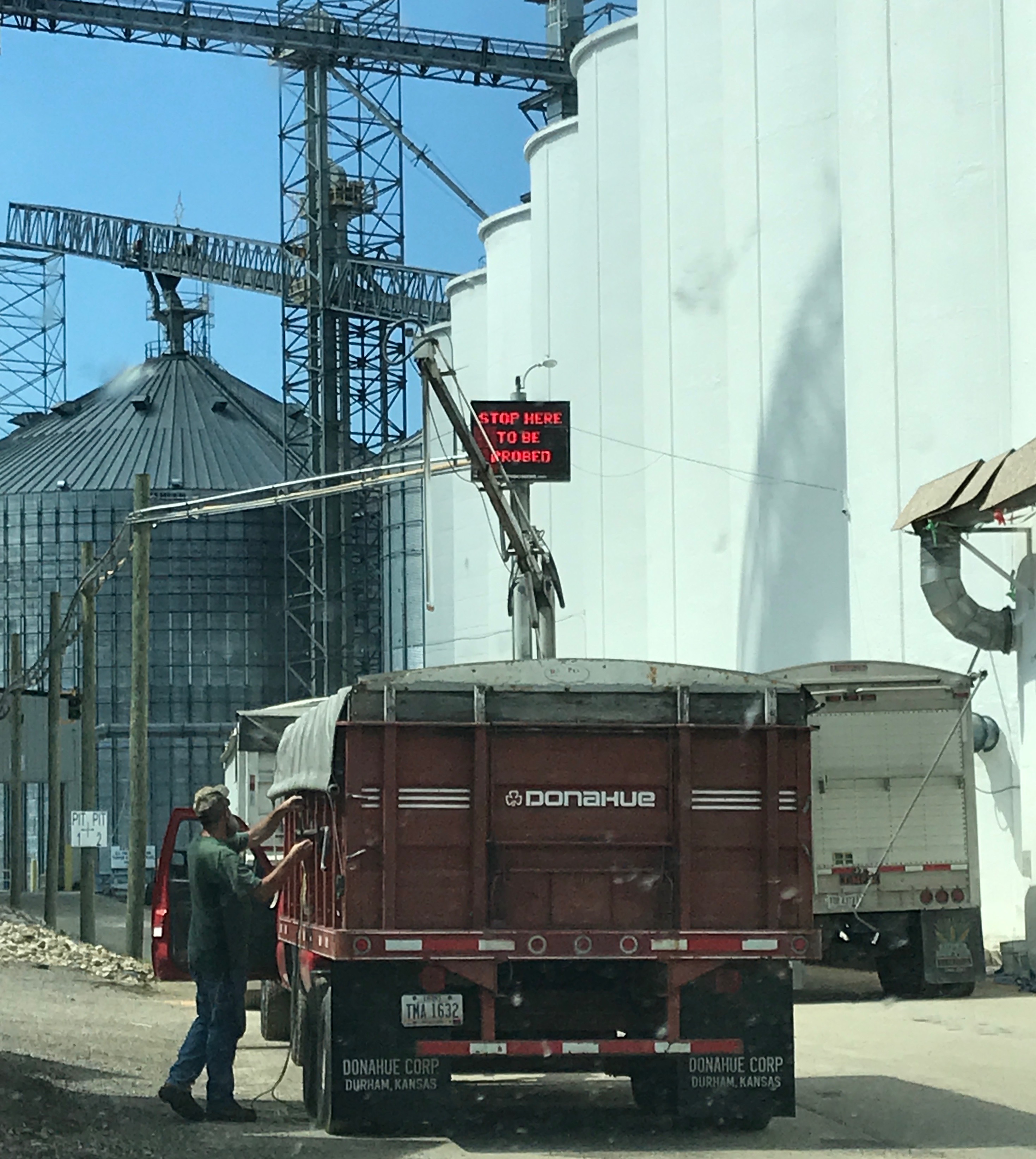
interspersed with the occasional stop at a grain elevator. The next time I do this, I will definitely figure out a way to plot where I have traveled. Honestly, I felt like I was driving circles some days – and I probably was.
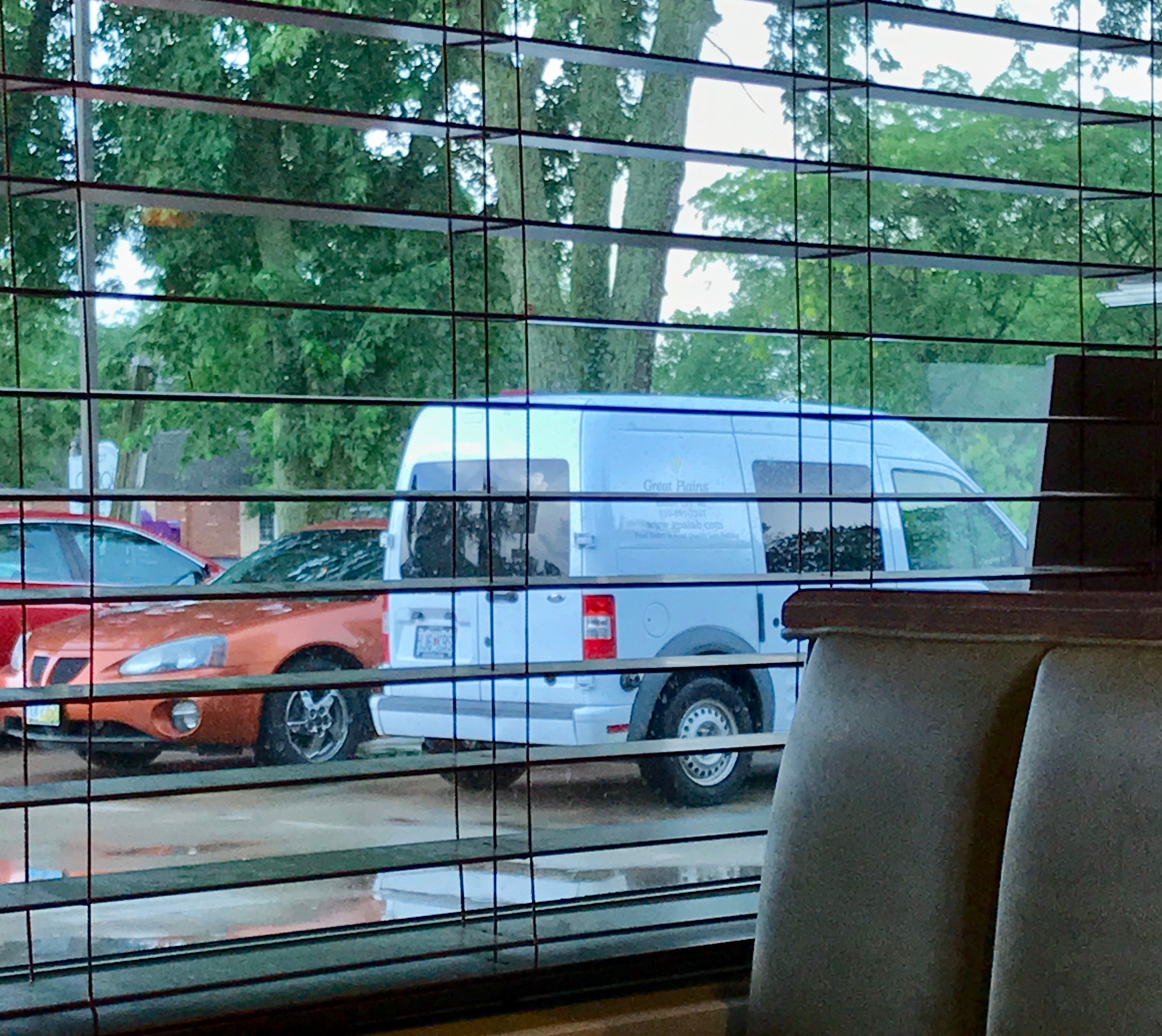
Here’s a somewhat amusing anecdote: I had stopped for the night and I drove over to the closest restaurant for dinner. I was sitting there, eating whatever I had ordered and I looked up and saw a van from Great Plain Analytical Laboratories – my company!
I was all excited. I wondered who was driving that vehicle and where they were seated in the restaurant.
That is, I was excited until I realized that the van was the one Iwas driving. At that point, I realized that I was pretty darned tired and needed a bit of rest before the next day’s labors. I got back to my room and got a good night’s sleep. The next day was Friday, and after that comes the weekend.
This weekend would find me near Columbus, the capital of Ohio.
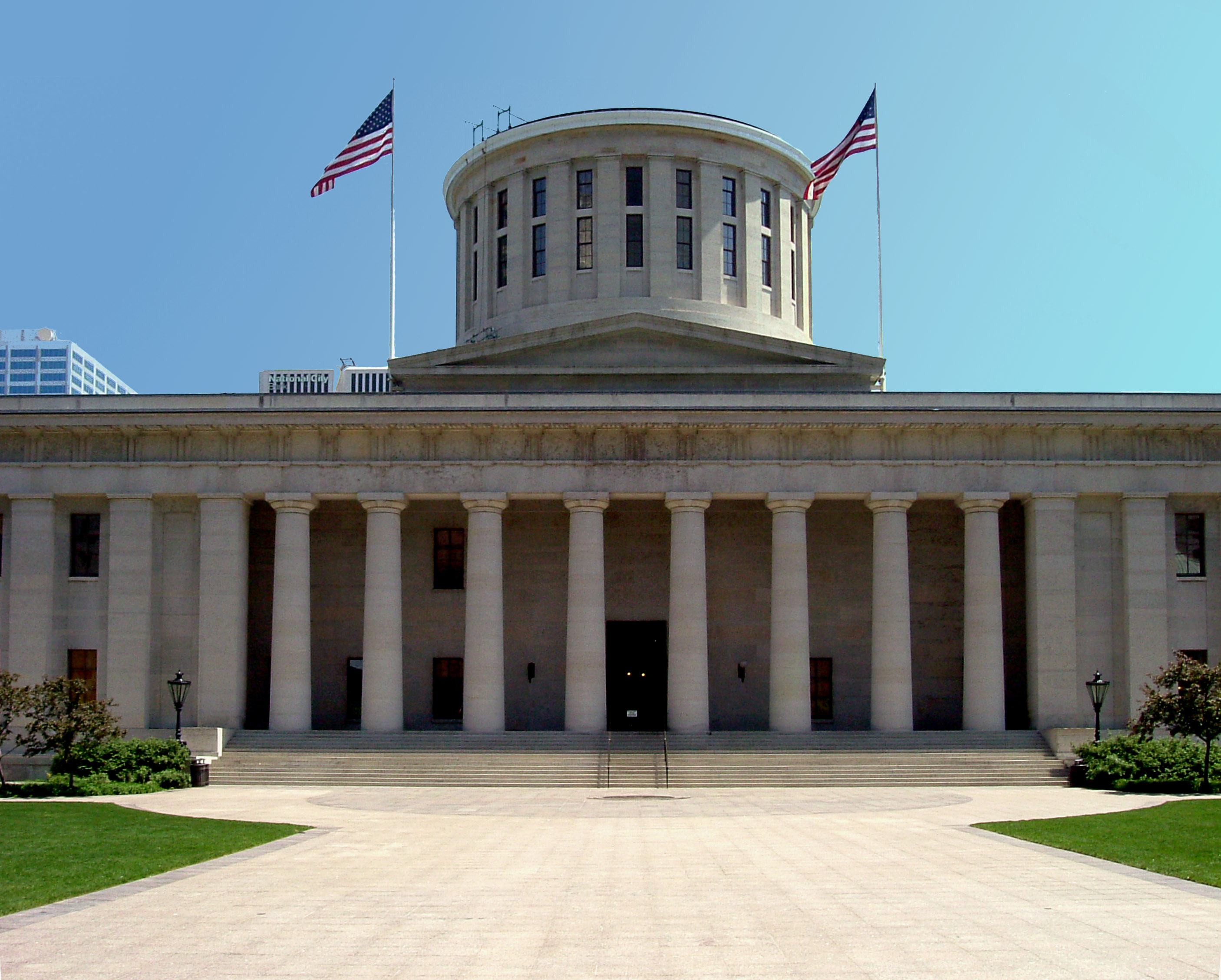
This image is thanks to my Preferred Source. In all the photos I took of the place, I didn’t get one of the west façade. Since I knew the building was not open for visitors, I satisfied myself with looking at the sculptures and memorials on the campus around it.
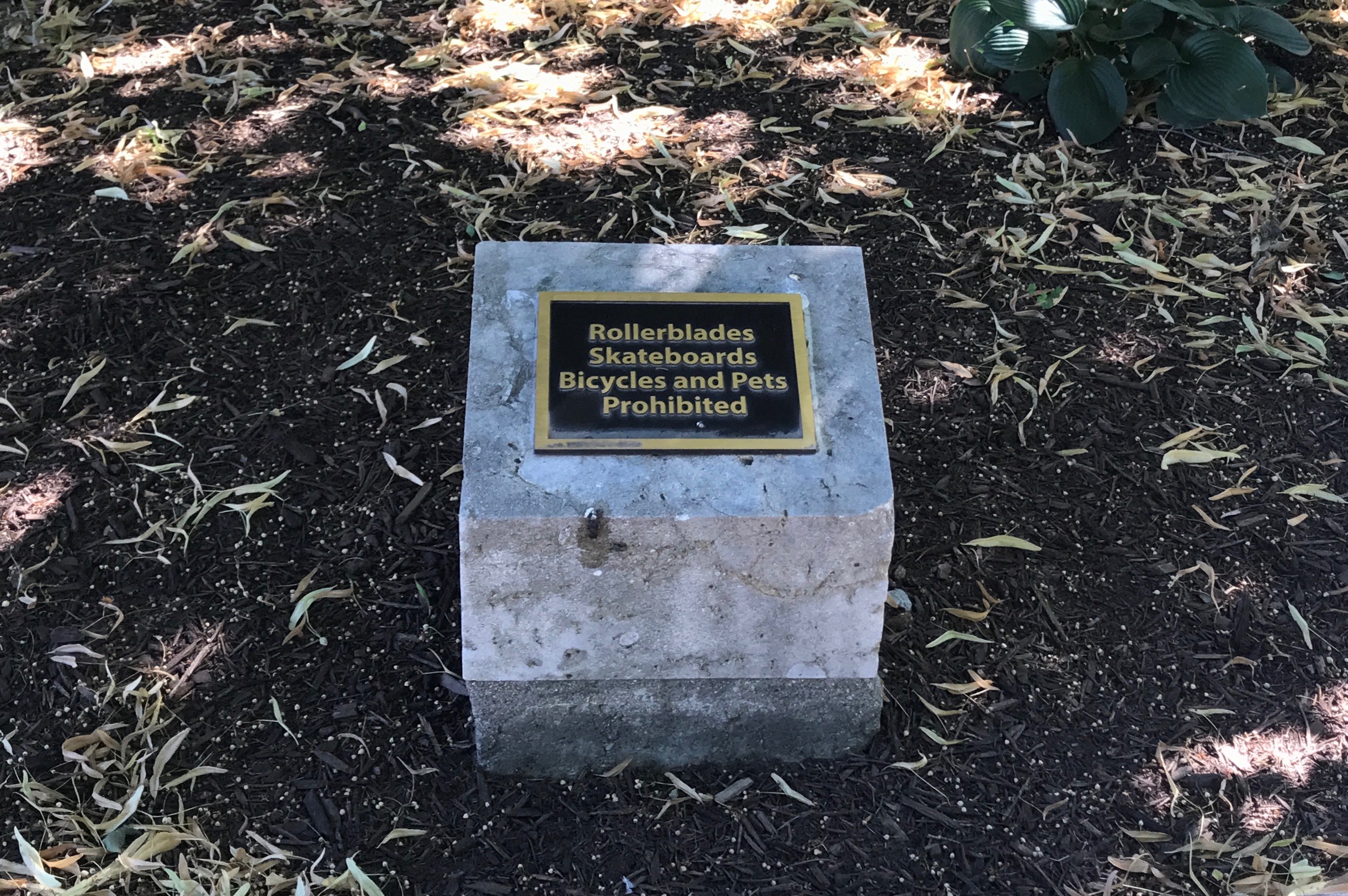
It was all quite stately. Even the signs that told what wasn’t allowed had a rather proper air to them.
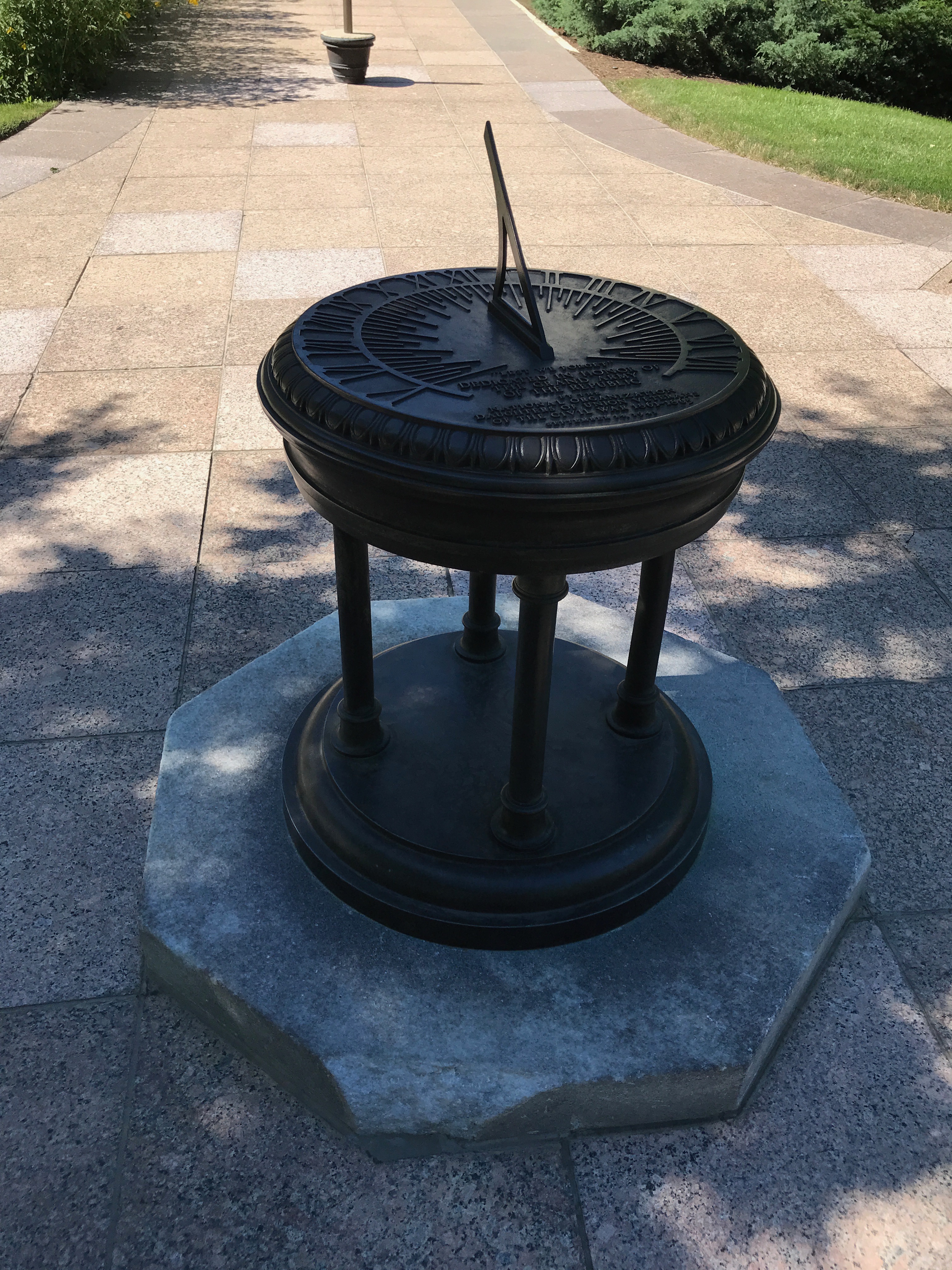
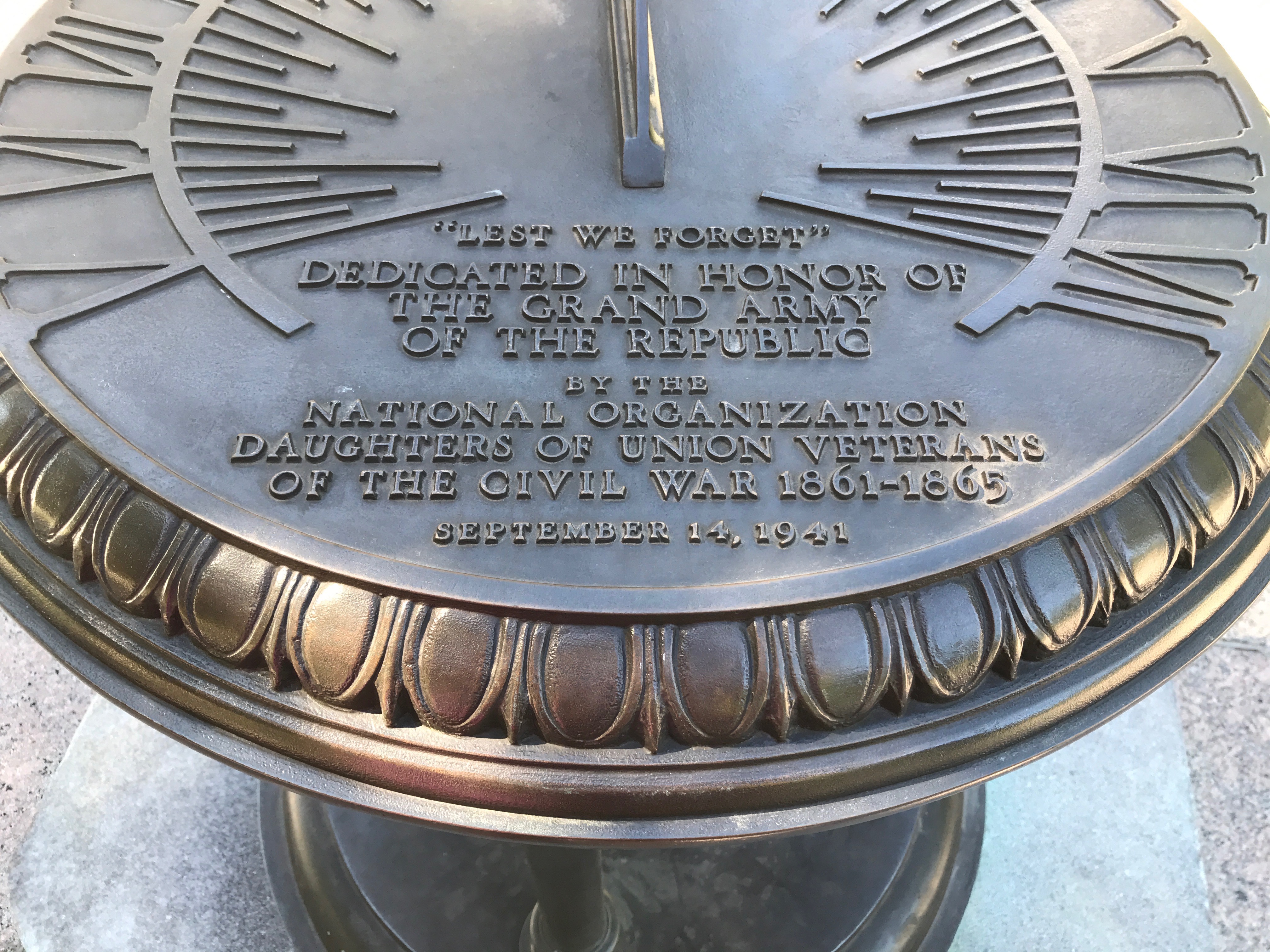
I have seen quite a few sundials that are in shaded locations. I always get a chuckle out of them. Why have a sun dial in the shade?
But, this one was erected in 1941. I suppose that the trees might have filled in since then.
It was a beautiful day to explore the outside of the capitol! I might have to plan a return visit to see the interior.
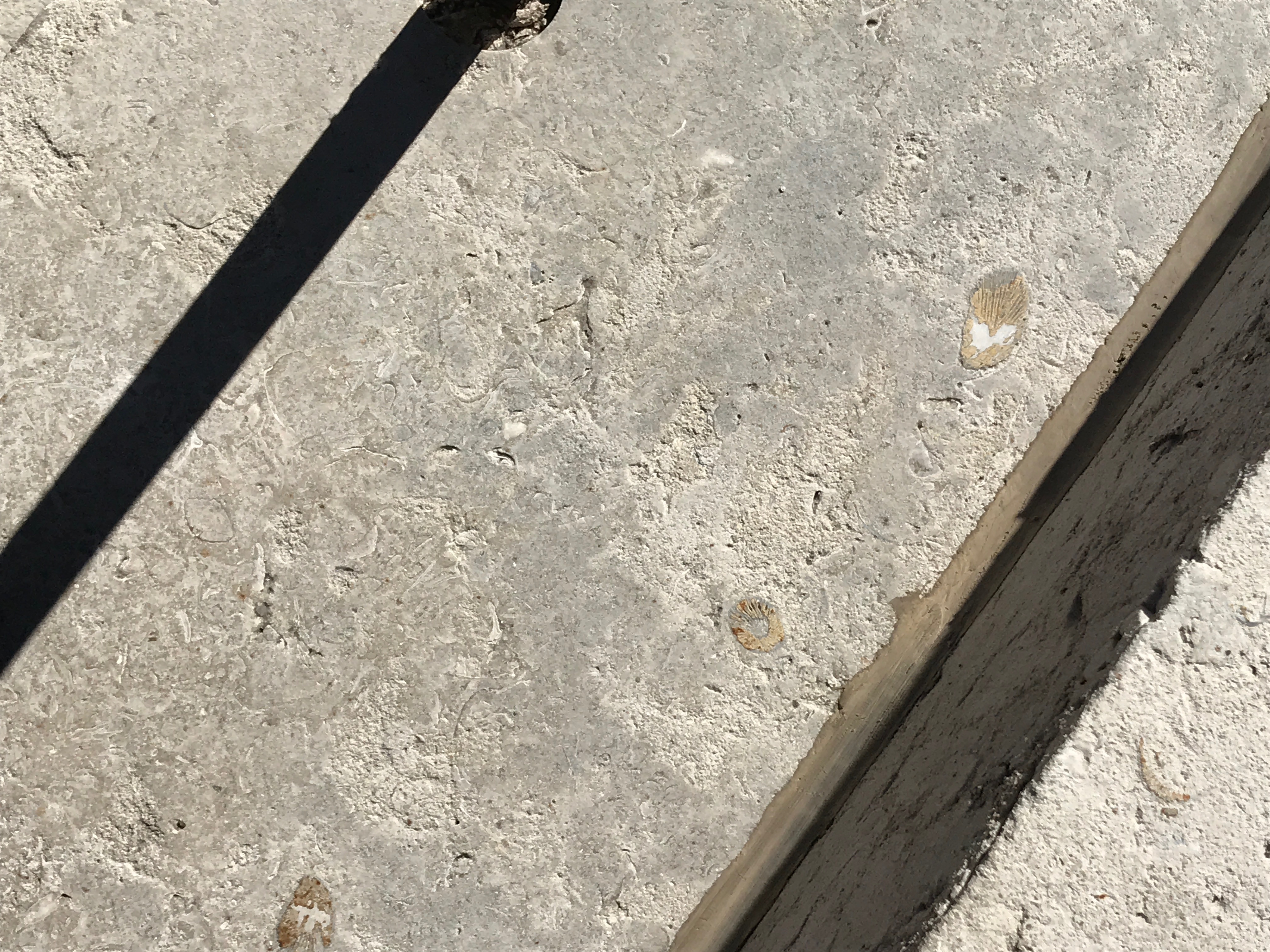
The exterior had a lot to see. For instance, if you look carefully, you can see fossils in the limestone.
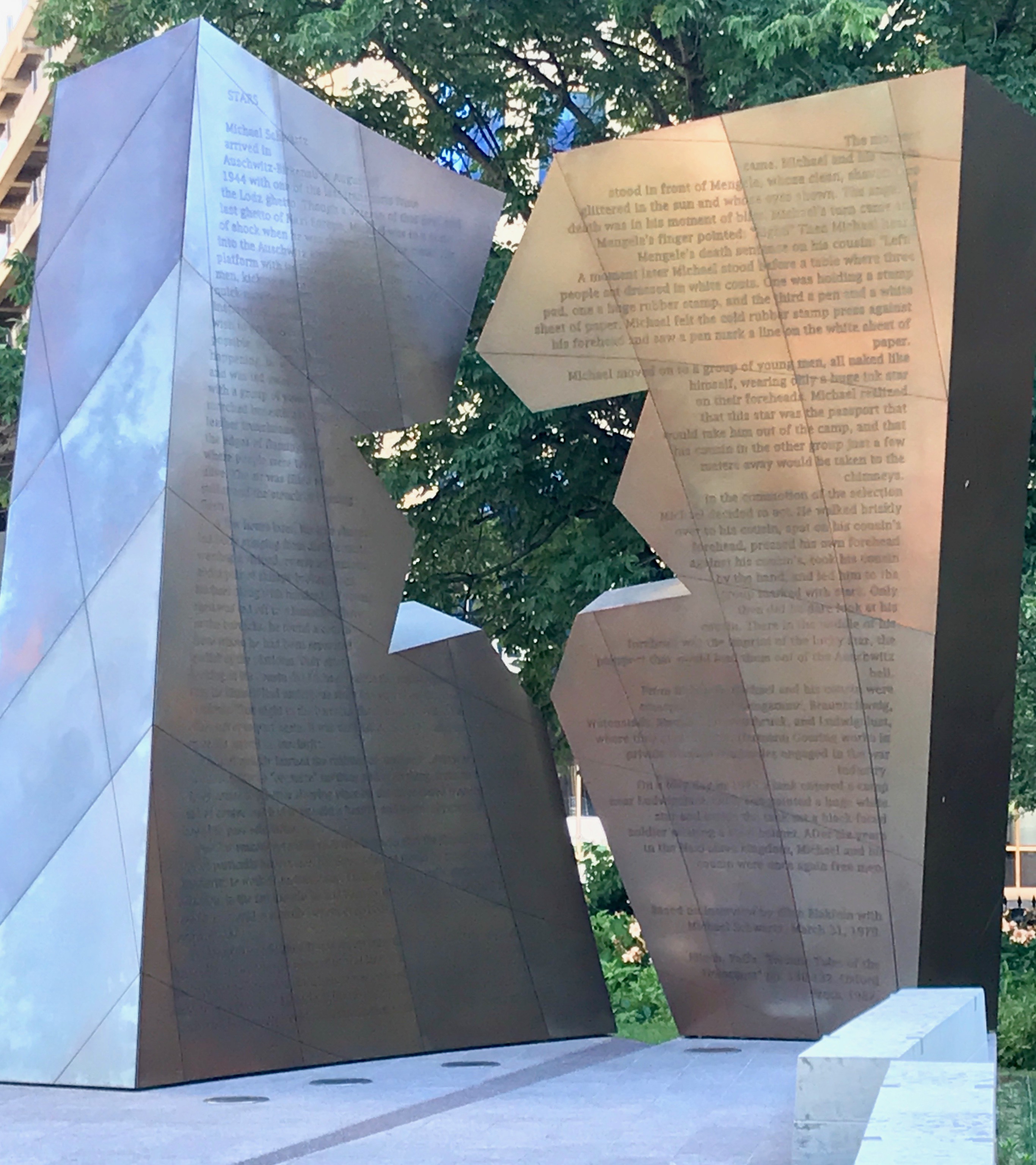
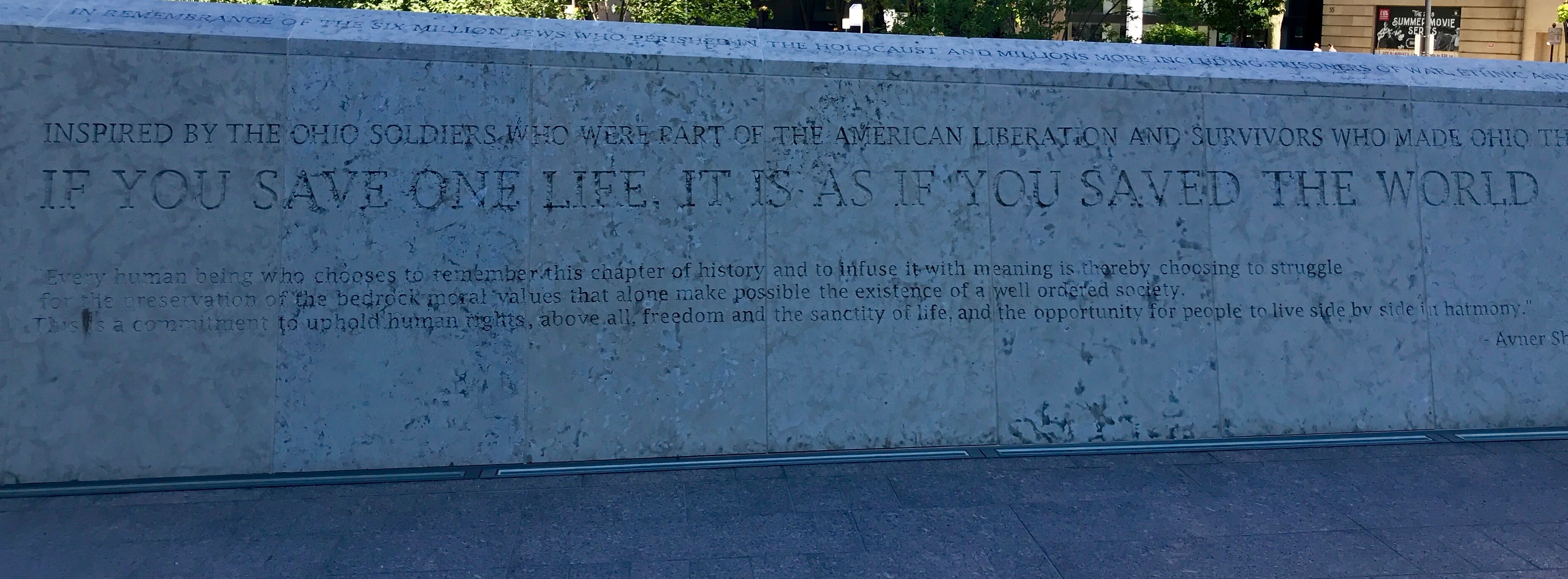
I came upon the Ohio Holocaust and Liberators Memorial. It was unveiled in 2014 by Governor John Kasich and architect Daniel Libeskind. According to the website, “The memorial speaks for the millions of voices the Holocaust silenced and thanks the brave men and women of Ohio who liberated the oppressed and fought for human freedom during the Second World War.”
The story of Michael Schwartz and his cousin is inscribed on the bronze pieces that make up the star. It is moving, and if you are interested reading it, click on the link.
If you save one life, it is as if you saved the world.
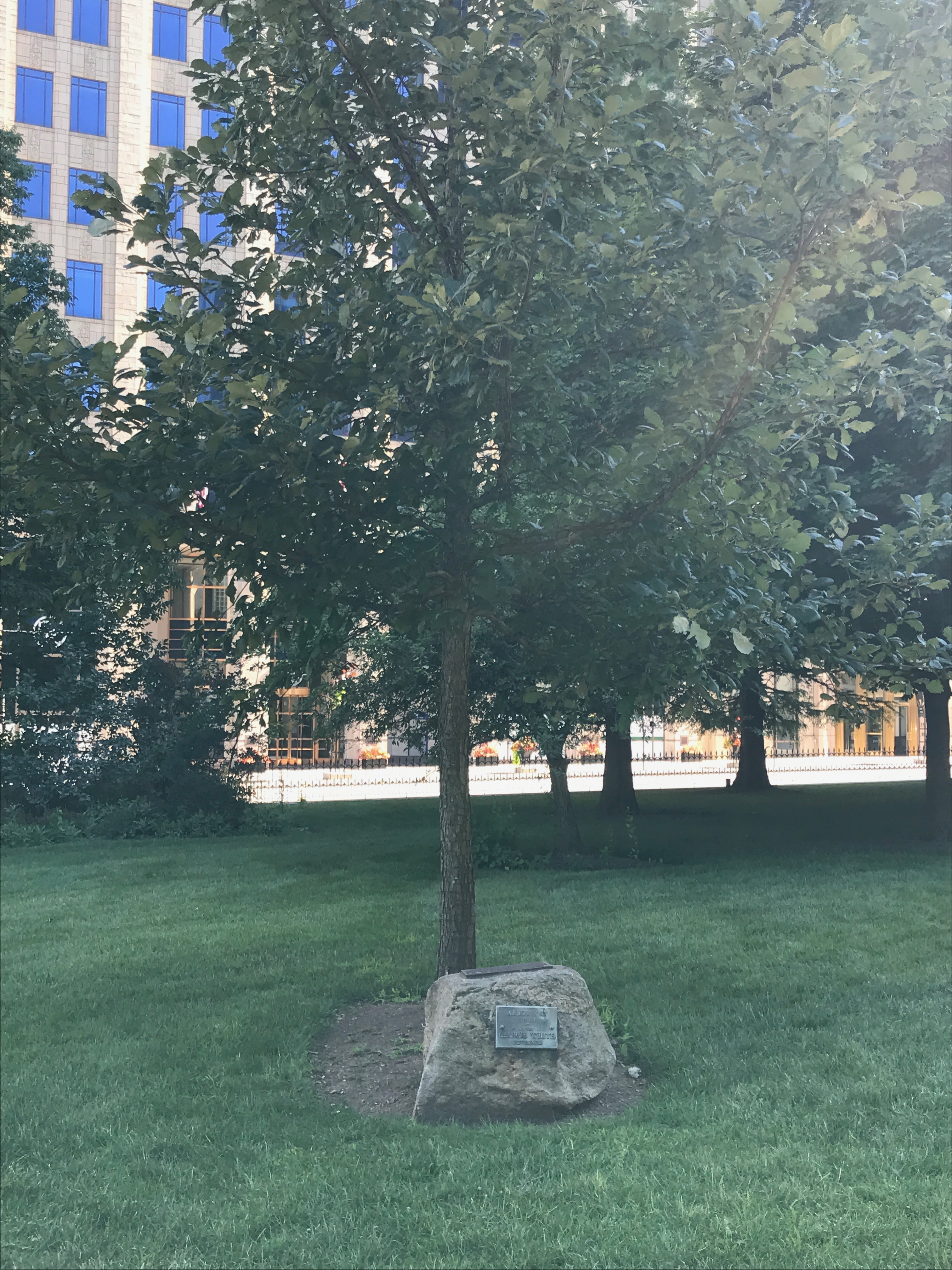
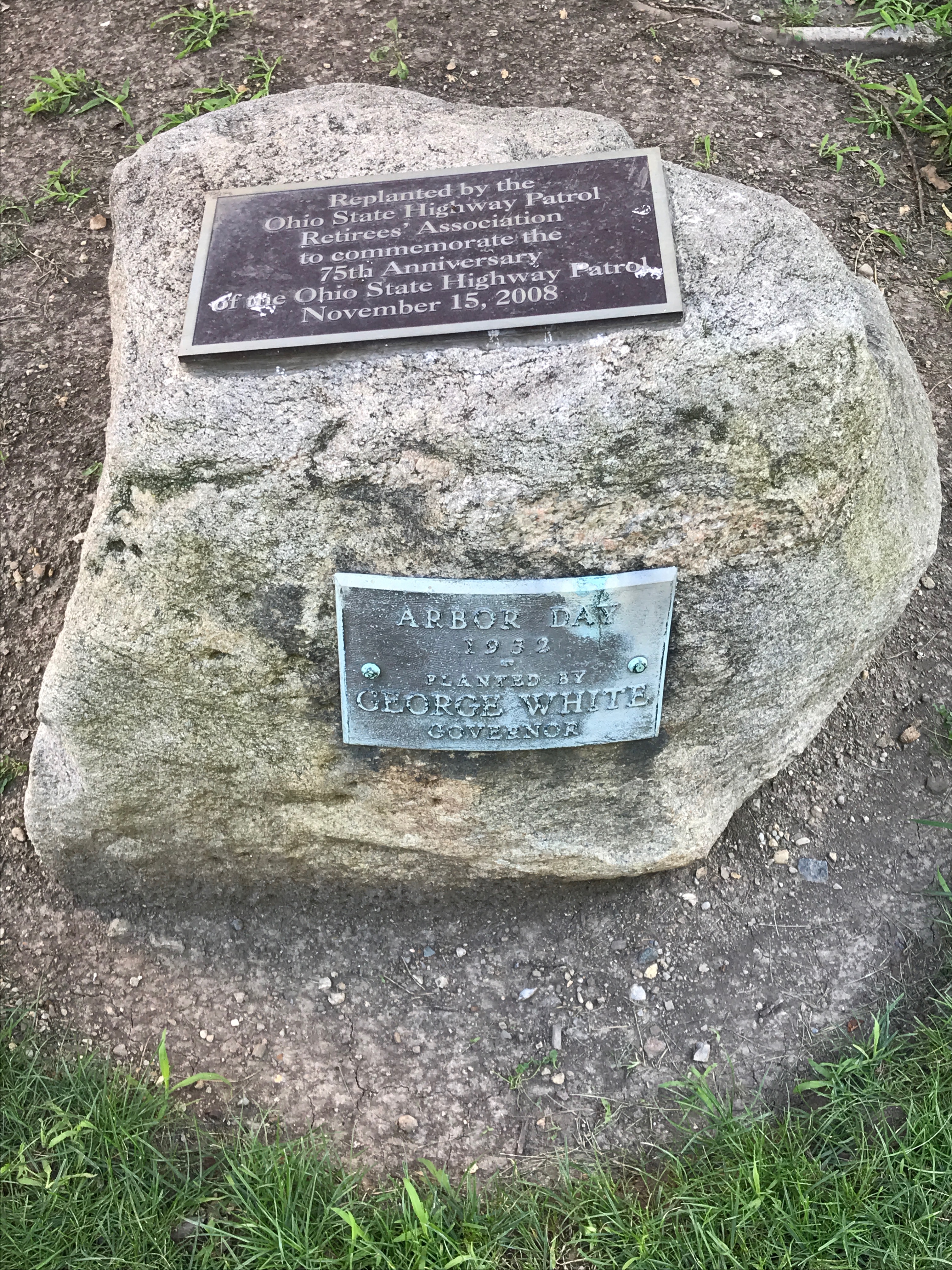
I continued on around the capitol and came upon this tree with a boulder at the base with two plaques on it. I wonder what that is all about?
Since there is no one around to ask, I assume that the original tree, planted in 1932, must have died and they planted a replacement tree in 2008.
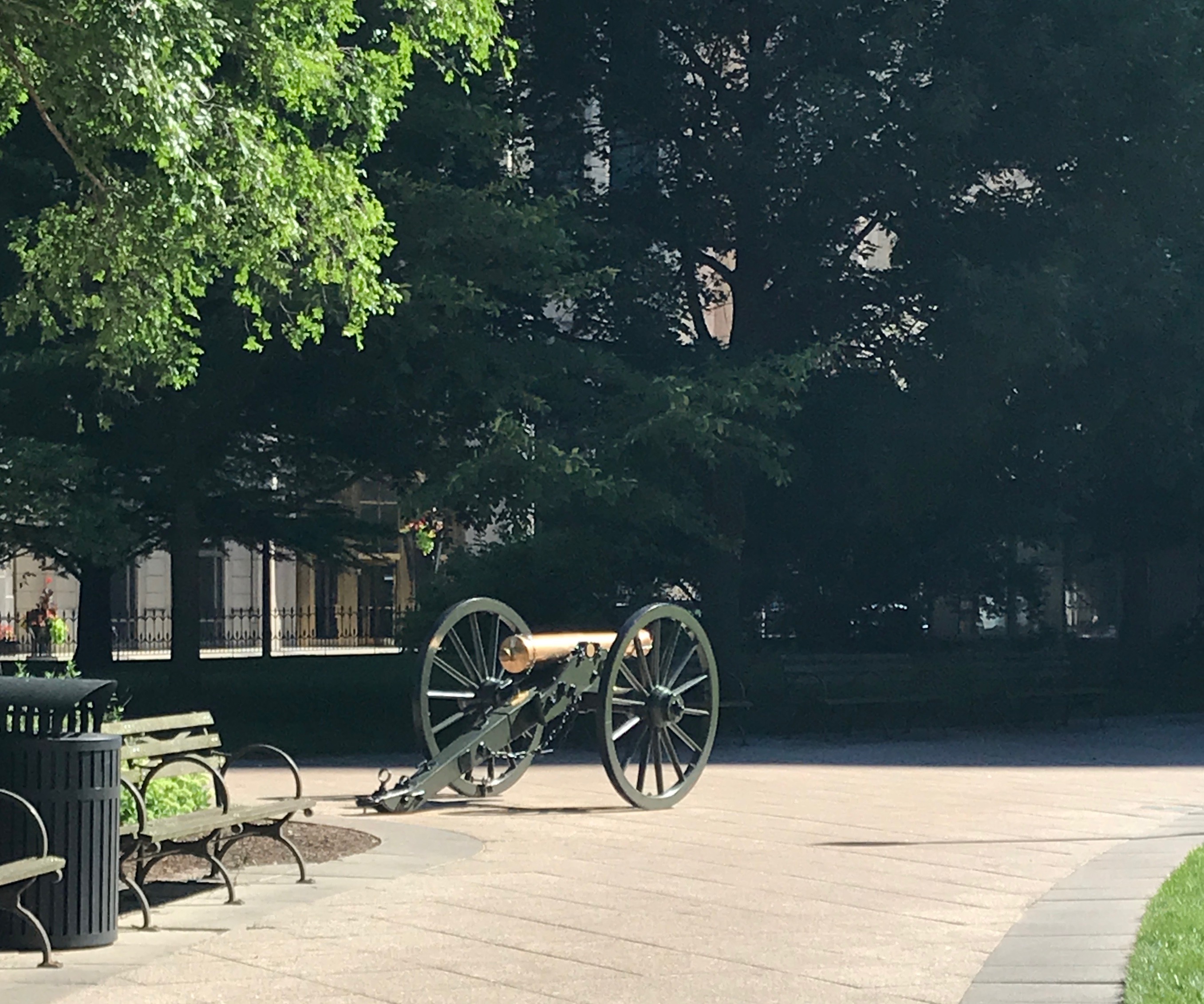
There is the obligatory cannon, defending the capitol from the marauding hoards.
Actually, there are four cannons on the capitol square. They are actual working armaments that were created during the Civil War and intended for active service. By the time of their creation, though, the war was pretty much over. According to the website, they are still in working order and are fired for “ceremonial and educational events.”
The expression might be “Don’t mess with Texas,” but Ohio is actually armed and ready.
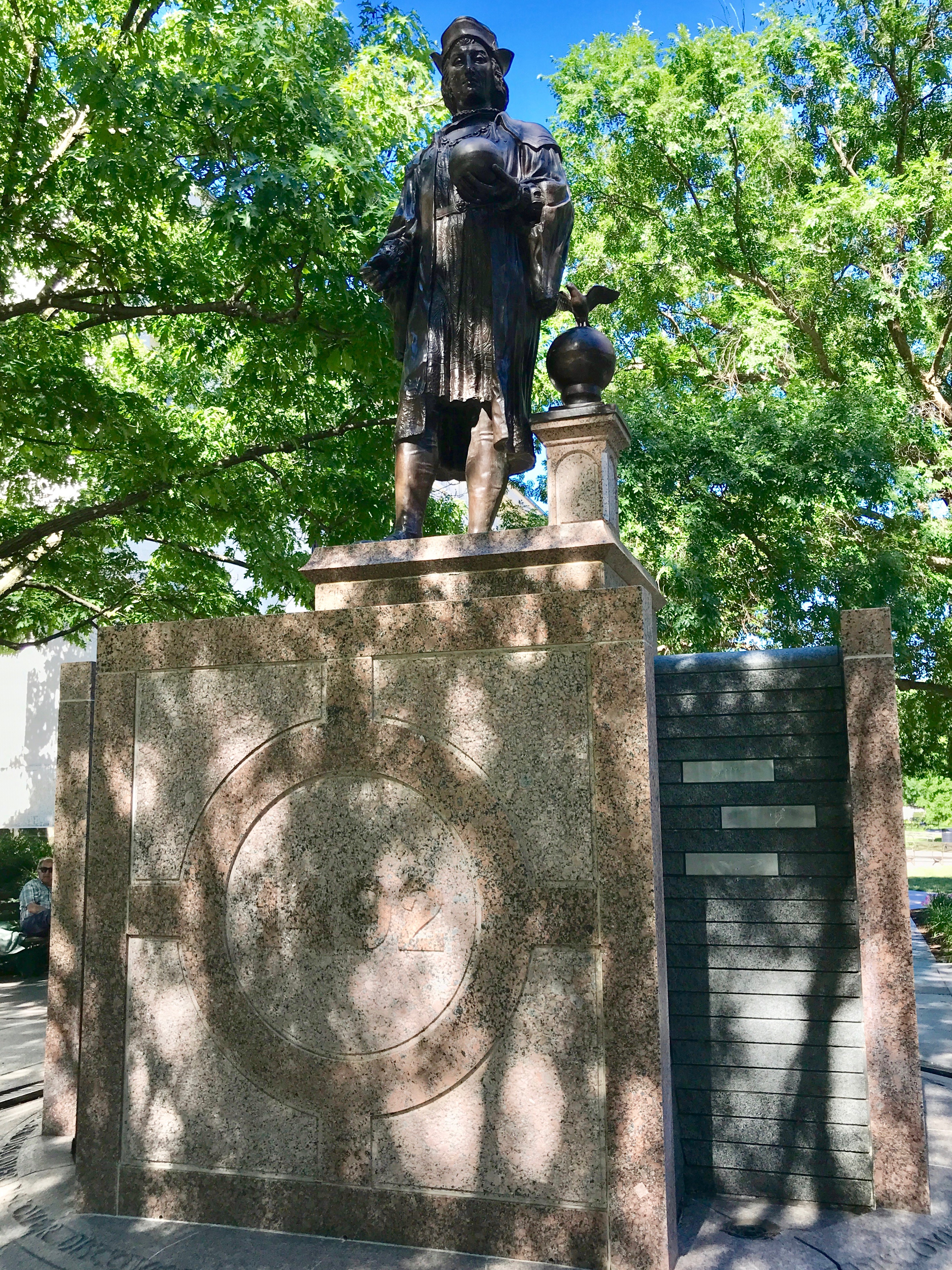
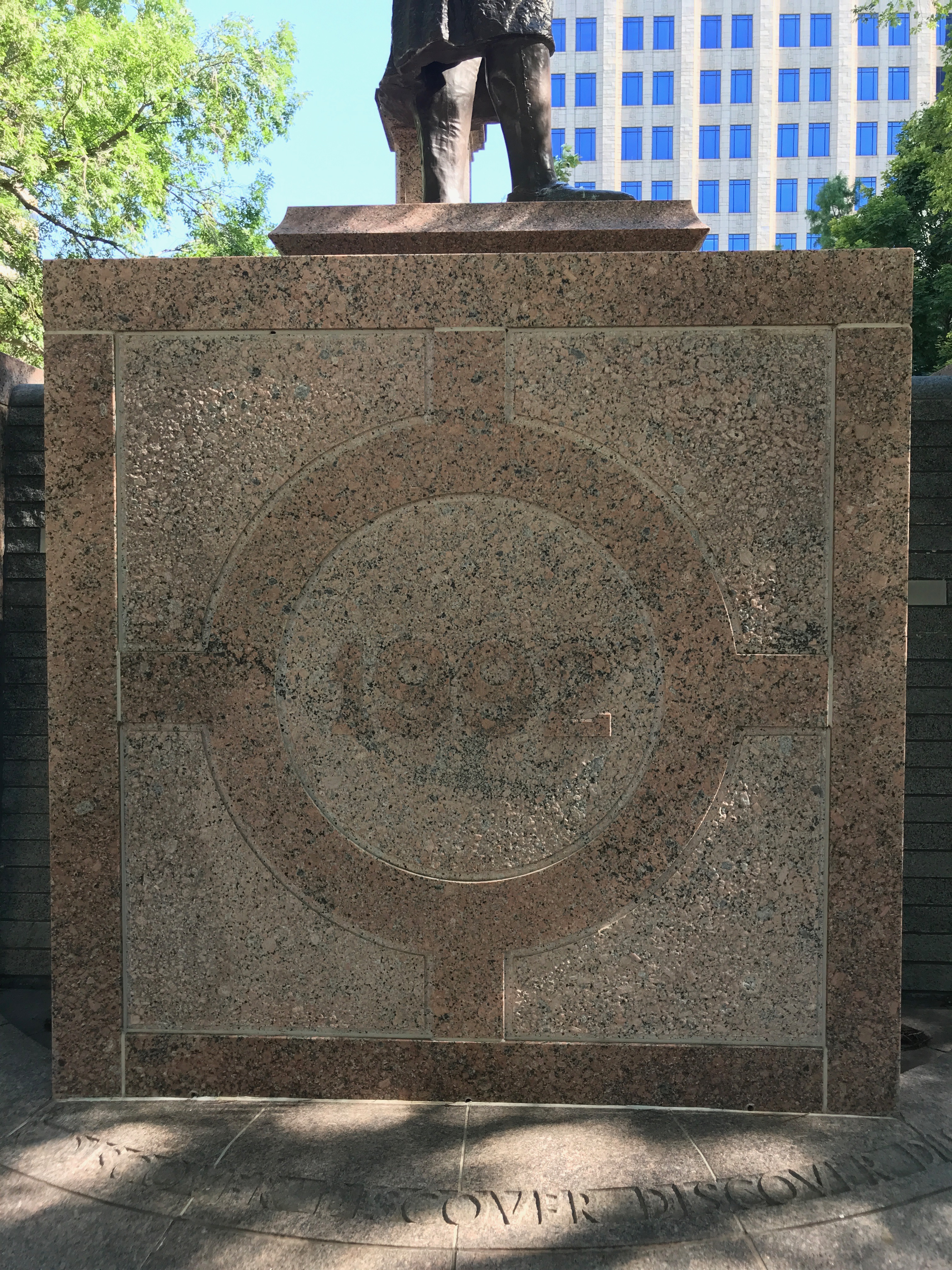
Continuing on around, I came to a Christopher Columbus memorial. I wondered why that was there. It took me but a moment to figure out the connection. The capital of Ohio is Columbus. Duh!
Back in the day, I had some Puerto Rican friends who wore buttons that said, “Me cago en el quinientos aniversario.” If you want to know what that means, here’s a link to Google Translate.
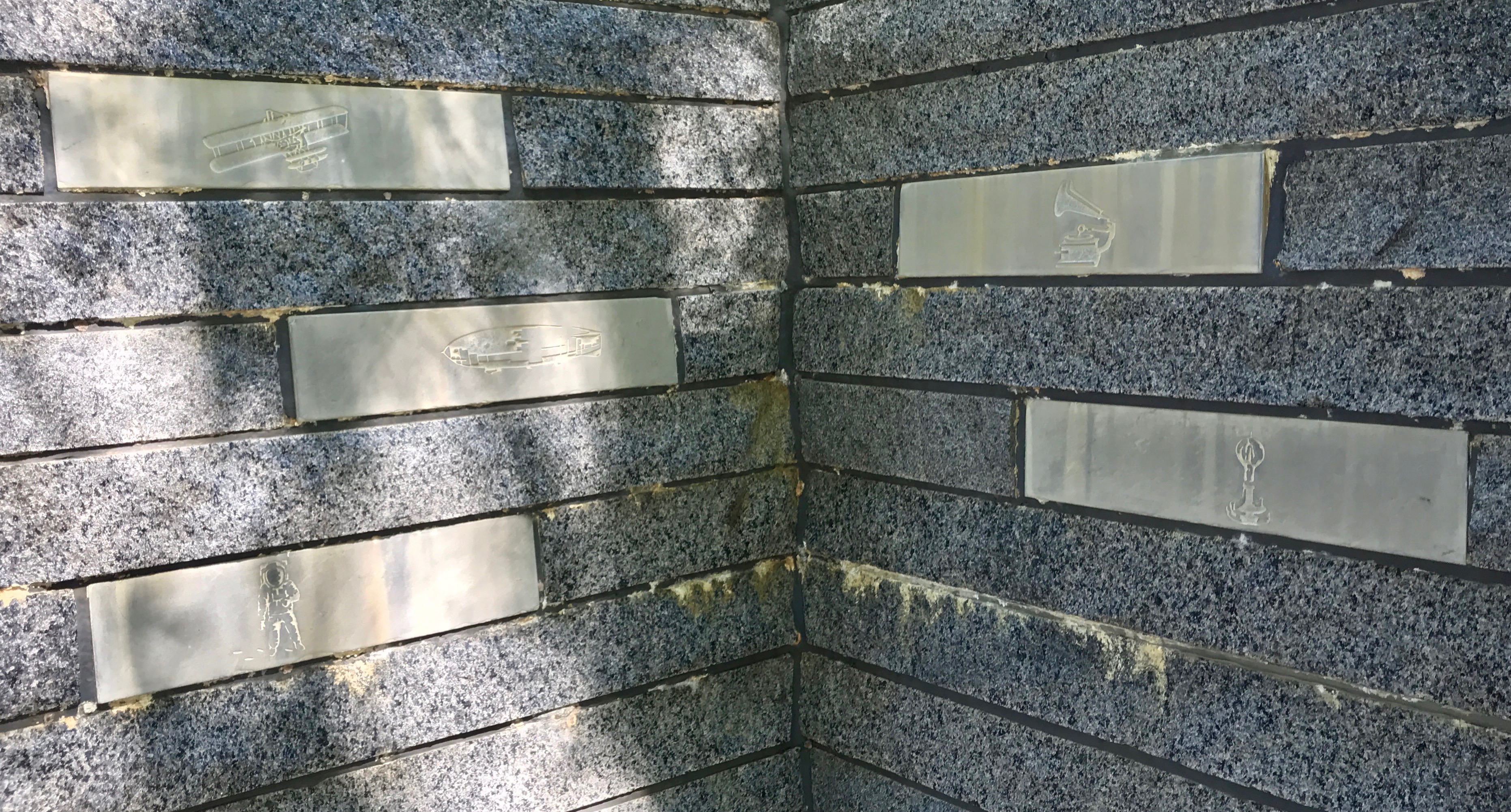
In the slabs around the monument, they had points of Ohioan pride, some of which were flight, space travel, electric light, recording and some other glyph I couldn’t decipher.
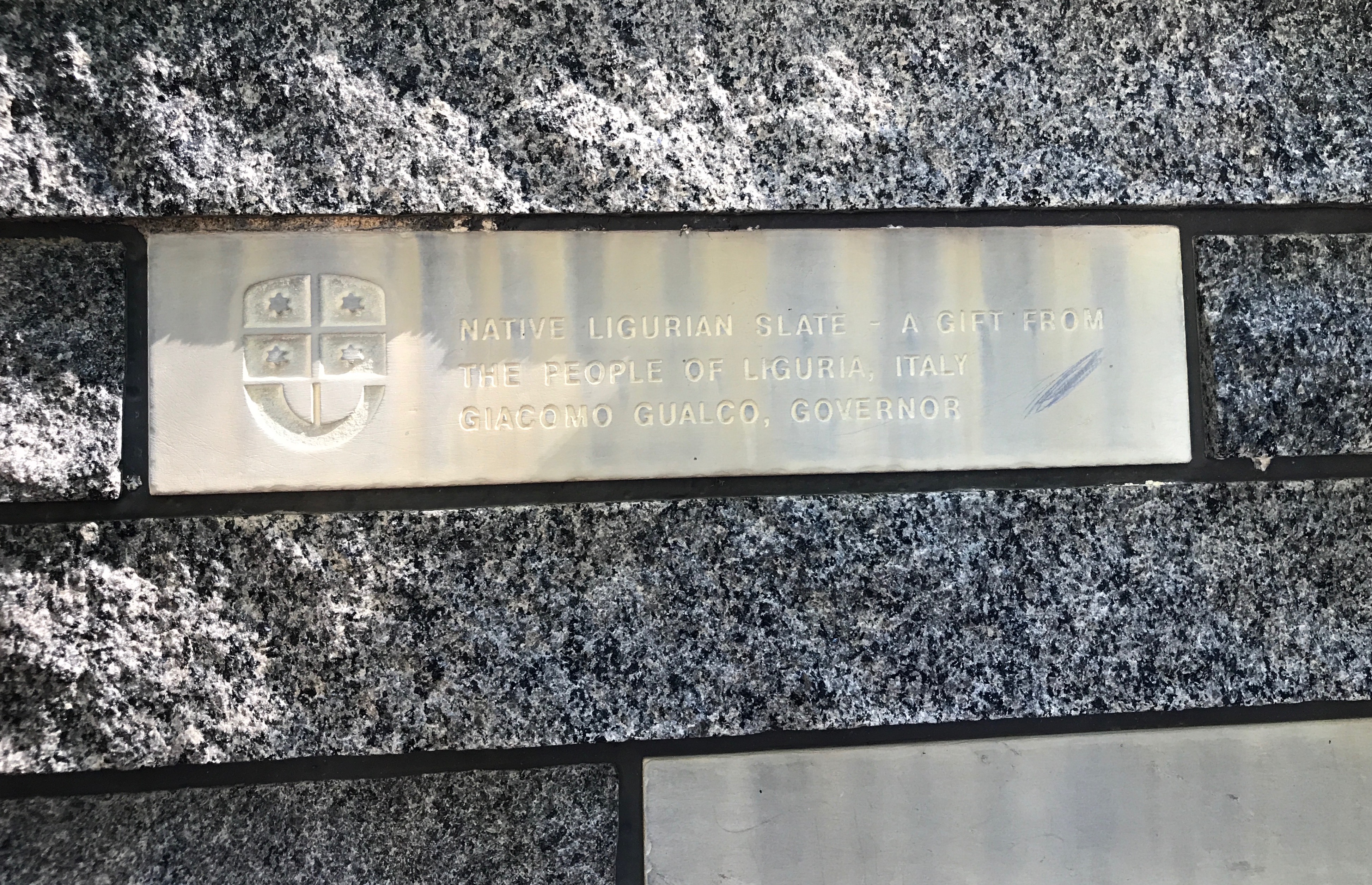
There was also this piece of native Ligurian slate. Genoa, in the region of Liguria, Italy, is generally considered to be the birthplace of Christopher Columbus.
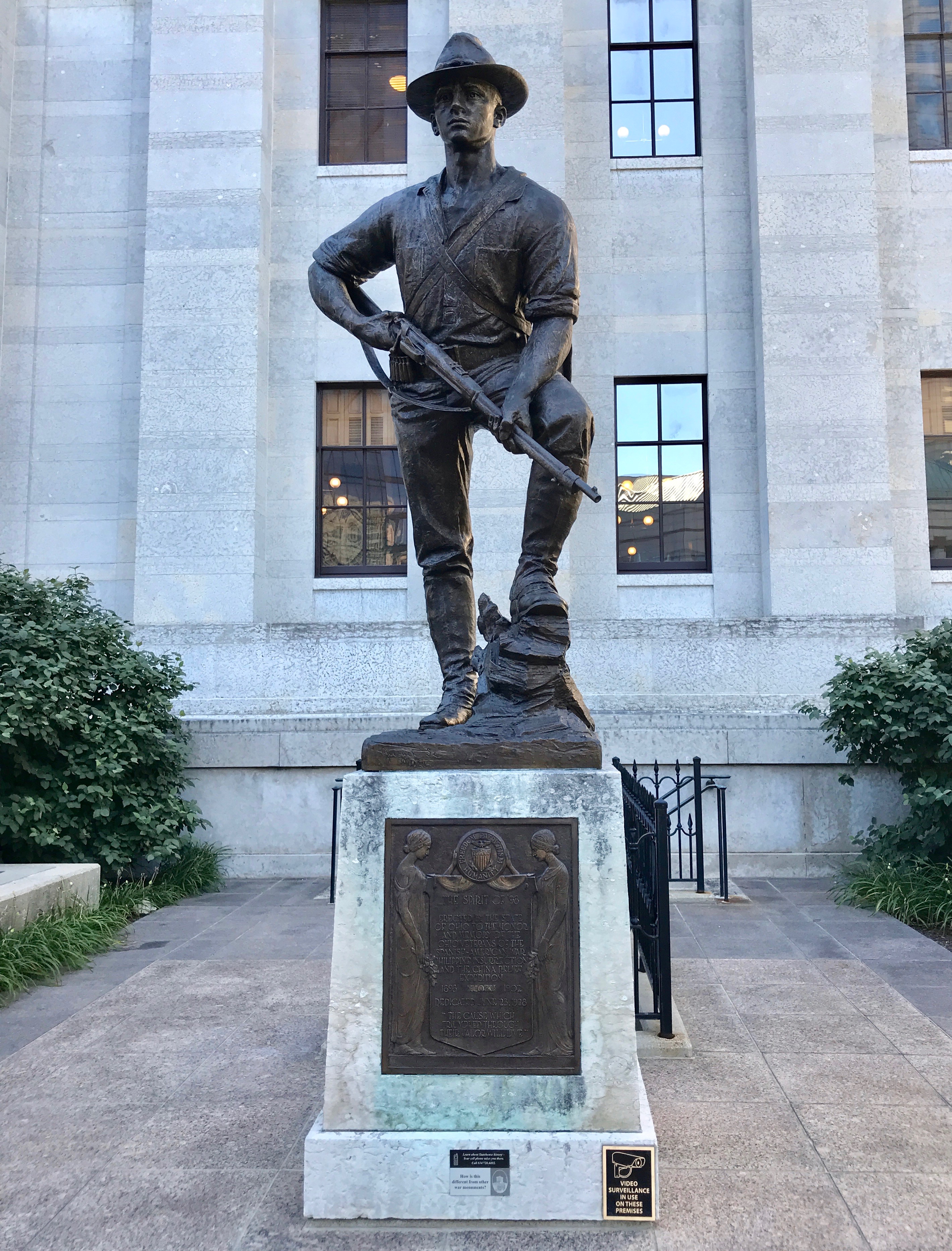
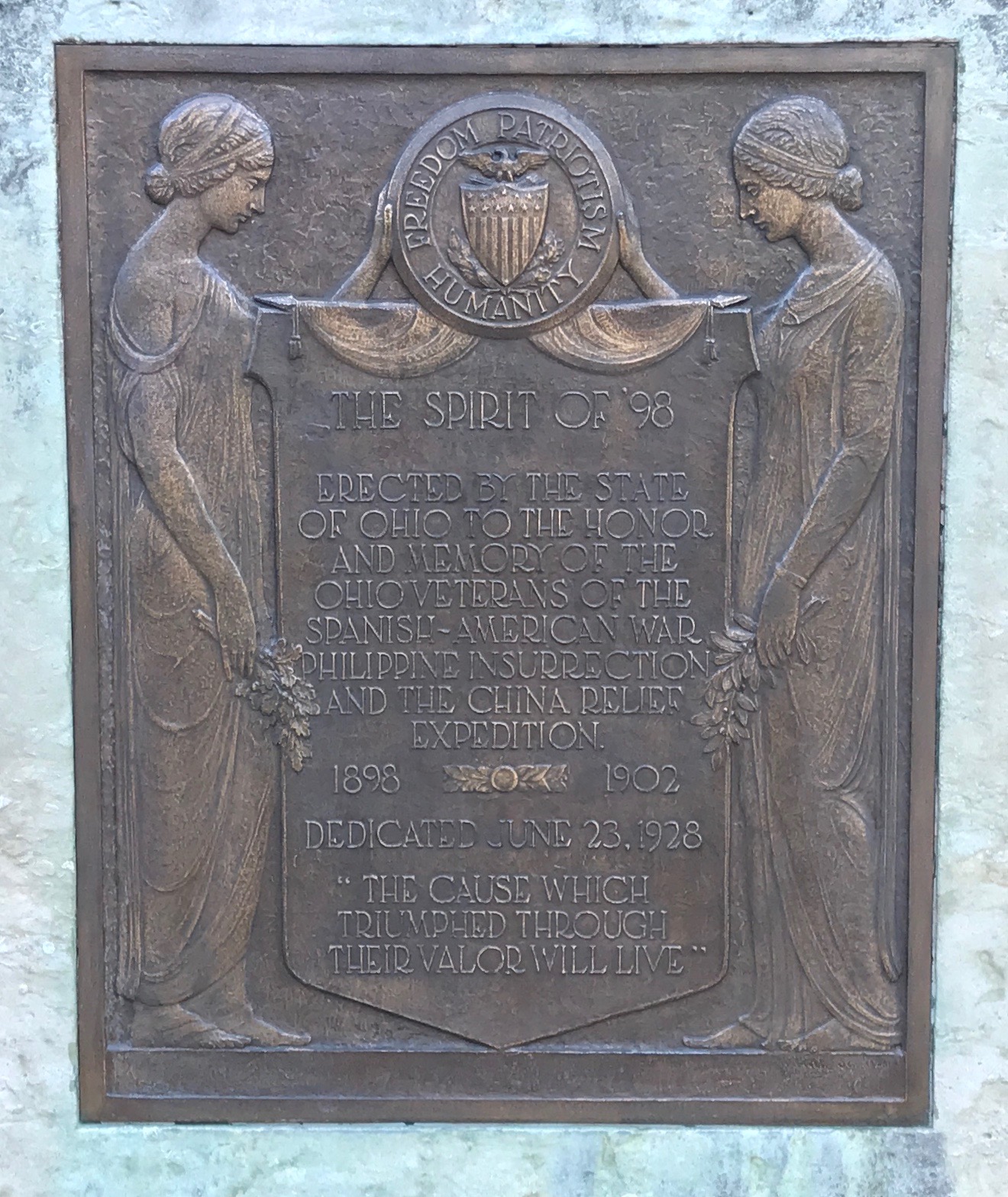
There was this memorial to Ohio veterans of the Spanish-American War.
My goodness! This country has been at war so often that it is easy to forget some of them.
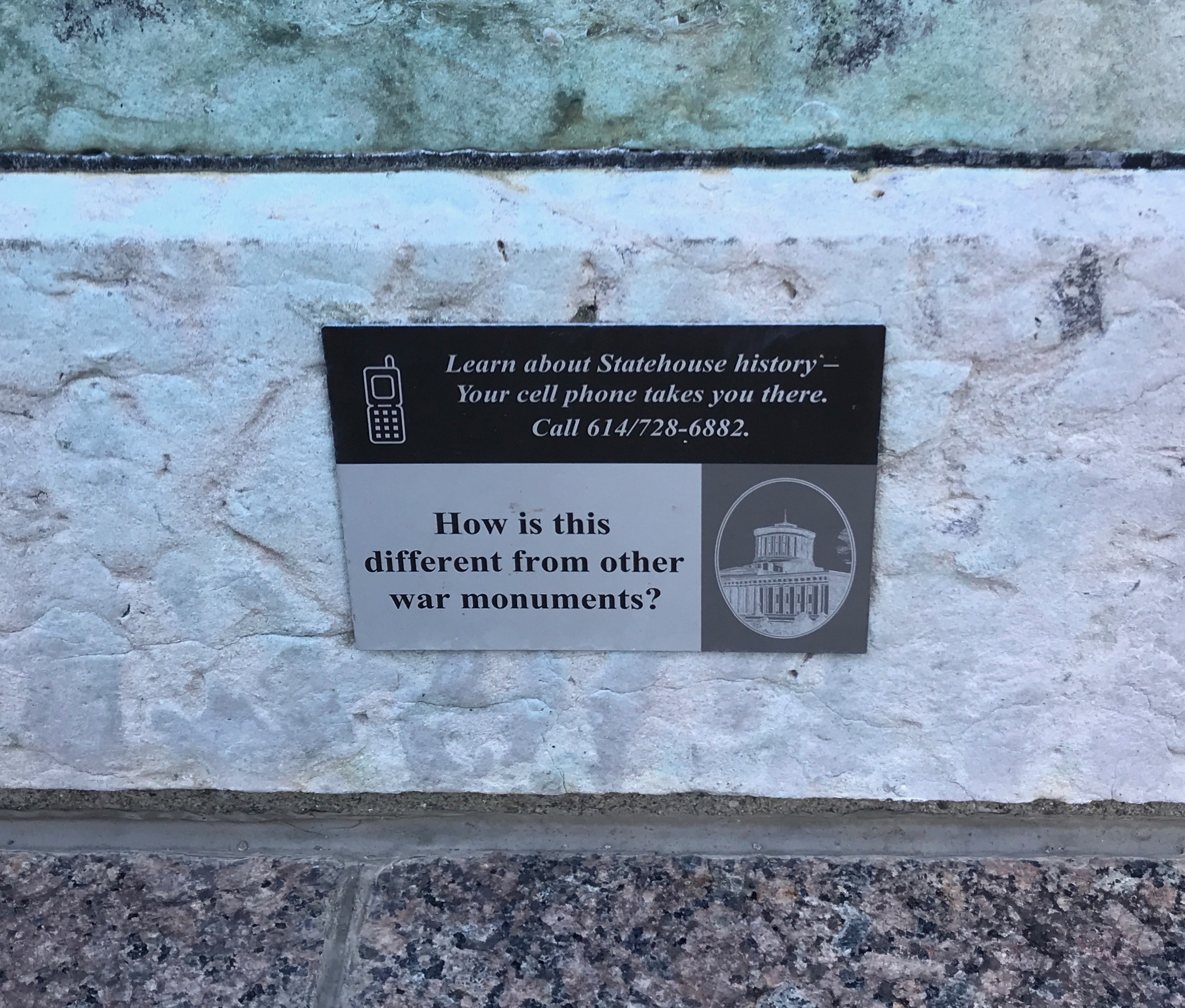
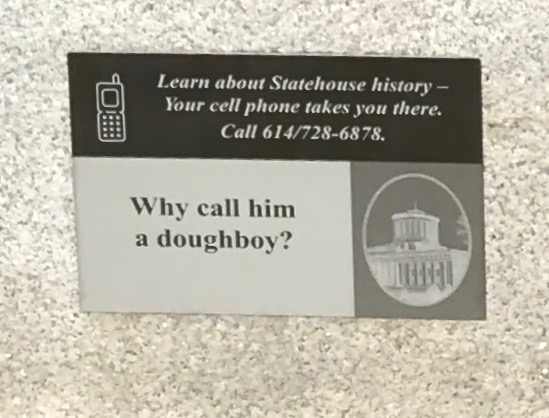
I was impressed that many of the monuments around the capitol have thought-provoking questions about them and phone numbers were you can call for the answer. I took photos of some of them so that I could call later. The sun was setting and the shadows were making it hard to get decent photos.
I just dialed this number. While it does give some interesting information, it doesn’t answer the question! I still don’t know why this monument is different from other war monuments.
*News Flash!*
I just received an email from Mike Rupert, Communications Manager, Capitol Square Review and Advisory Board. He actually read this post and answered the question for me!
He wrote, “The answer to the question on the cell phone tours, is that monuments were starting to focus on the average soldier instead of the famous leaders.”
He went on to thank me for mentioning it and that they would work on the recording. He also wrote, “Your writing is informative and full of humor. We appreciate it.”
Wow! Someone is reading my blog and they like it! My head is swelling up as I add this edit.
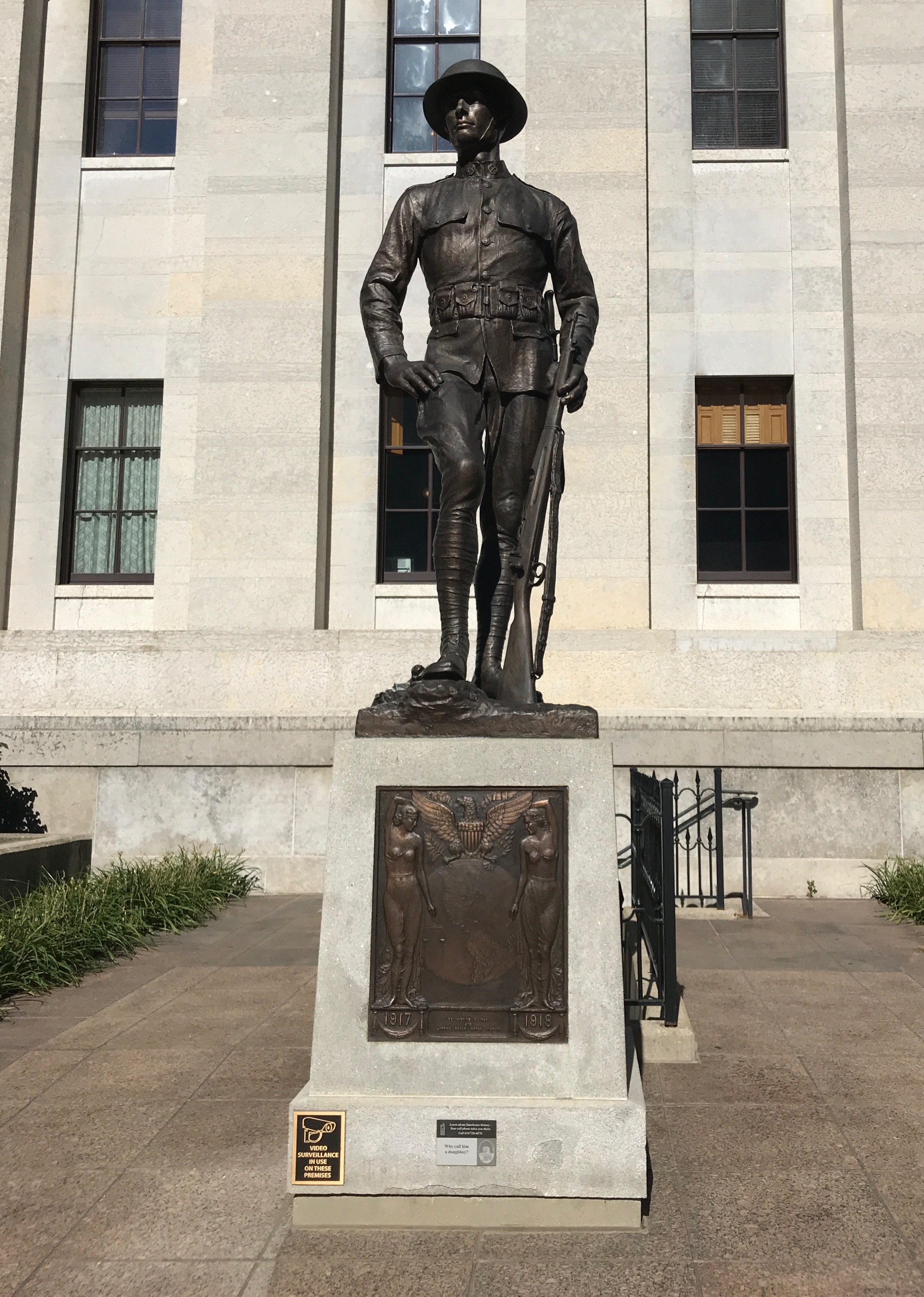
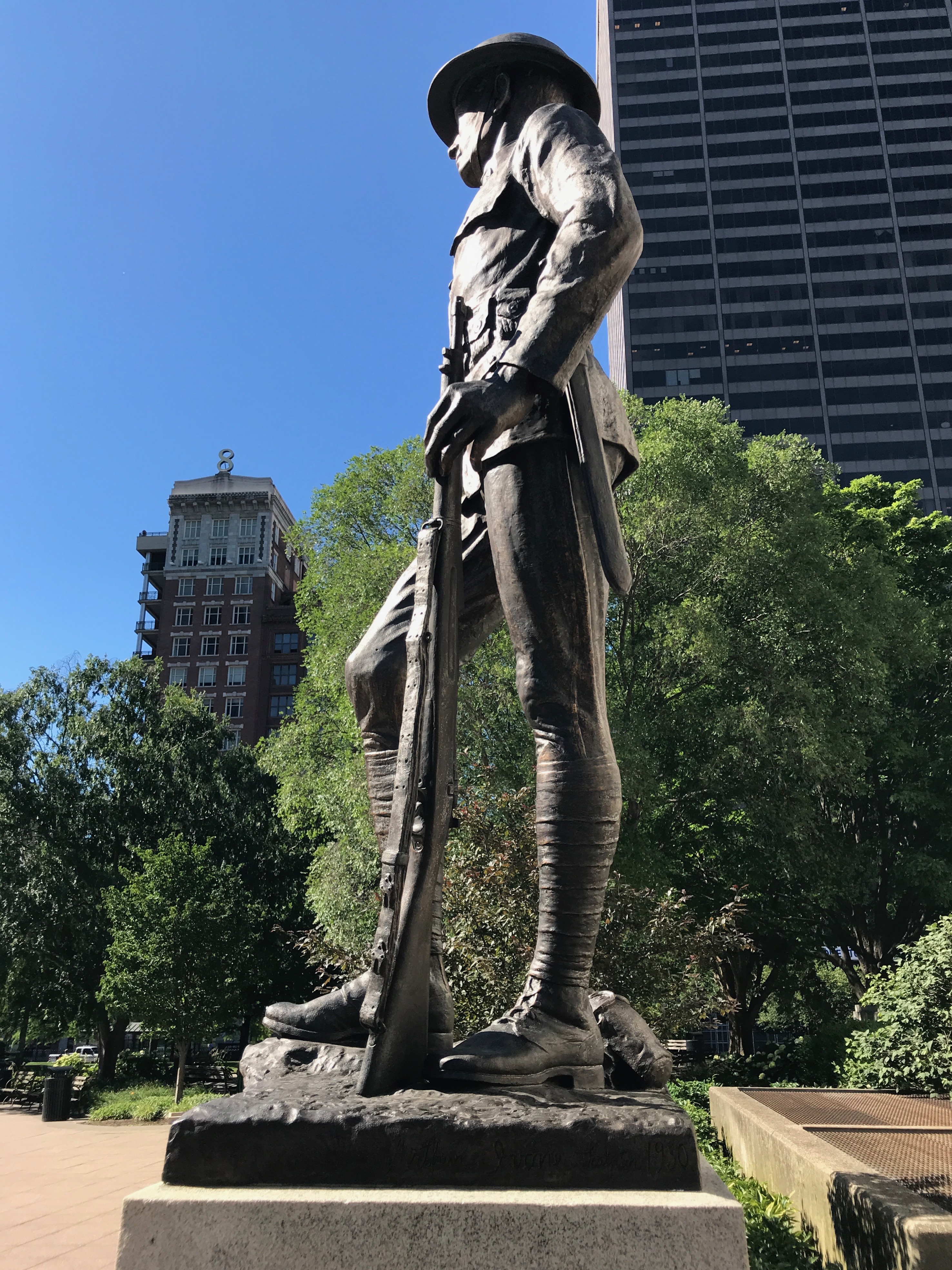
The statue of the doughboy is on the other side of the west entry.
On the other hand, if you call this phone number, you will find out two theories about why soldiers were referred to a “doughboys.”
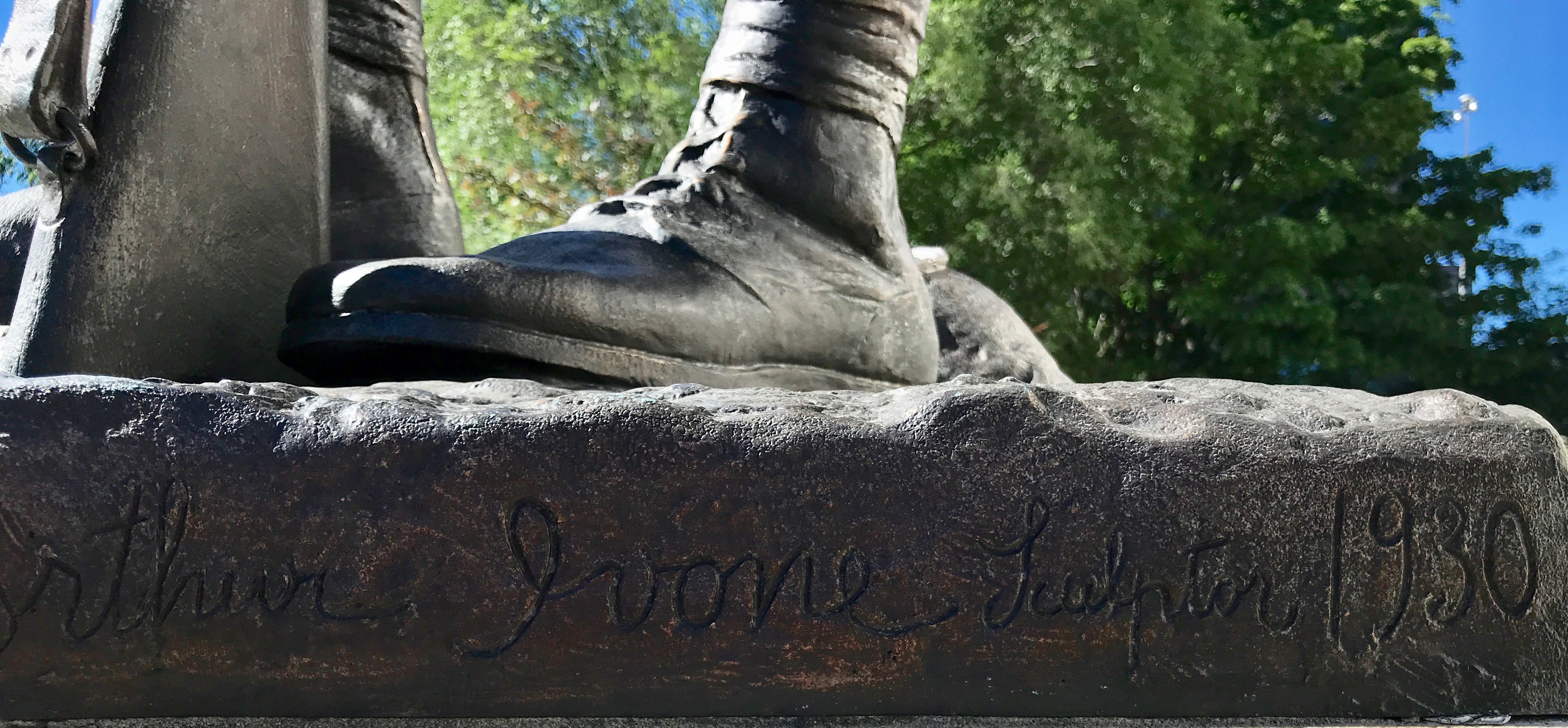
The sculptor was Arthur Ivone. I did some searching on the web, and I was surprised to find no other entries.
Perhaps this was the era when this sort of memorial was falling out of favor.
I looked to my left and I saw a large statue closer to the street and went take a look.
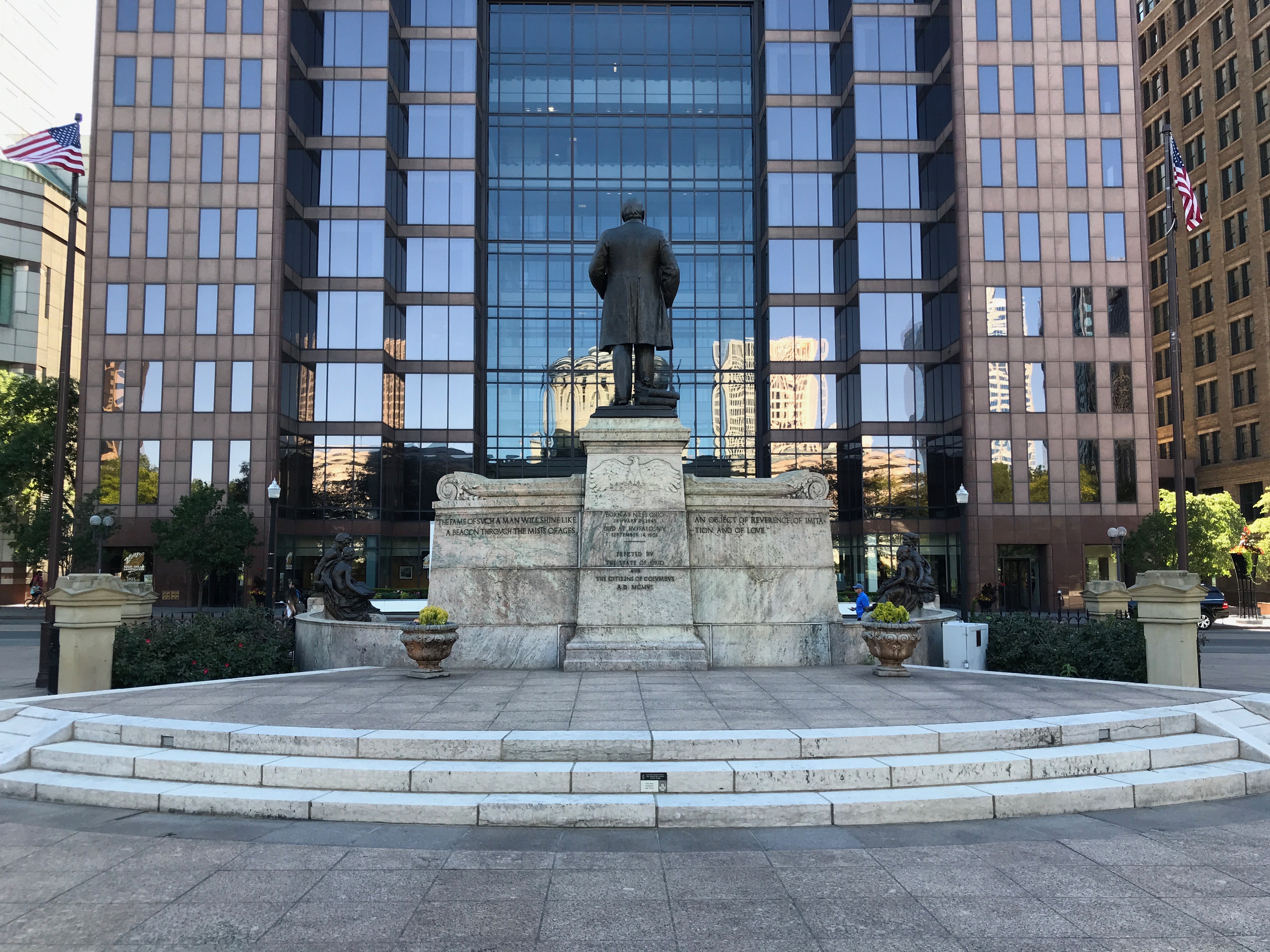
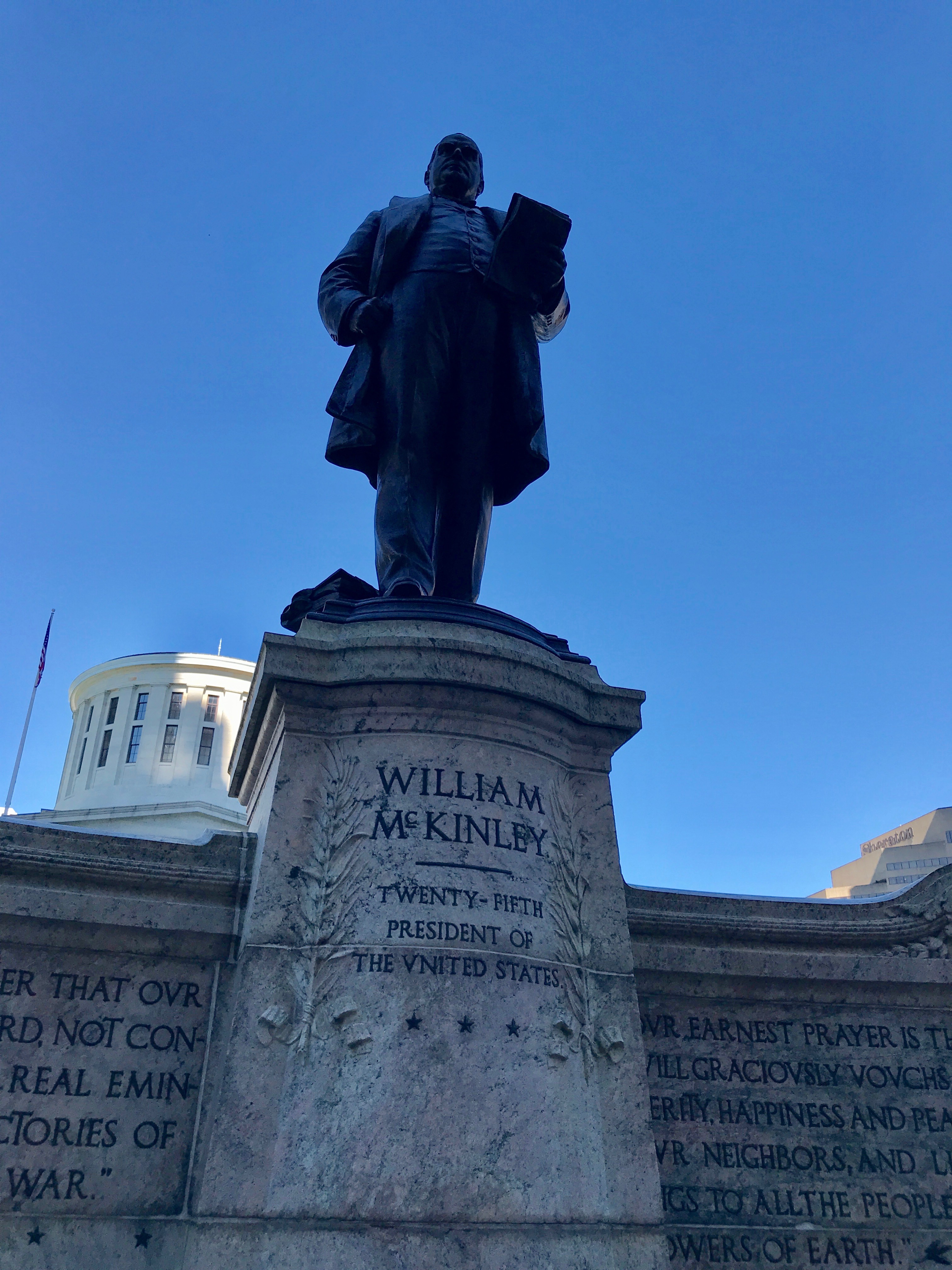
It turns out that it was William McKinley, former governor of Ohio and United States president. He was assassinated in Buffalo in 1901 – my hometown. (And, for those of you keeping track, the name of the street I grew up on.)
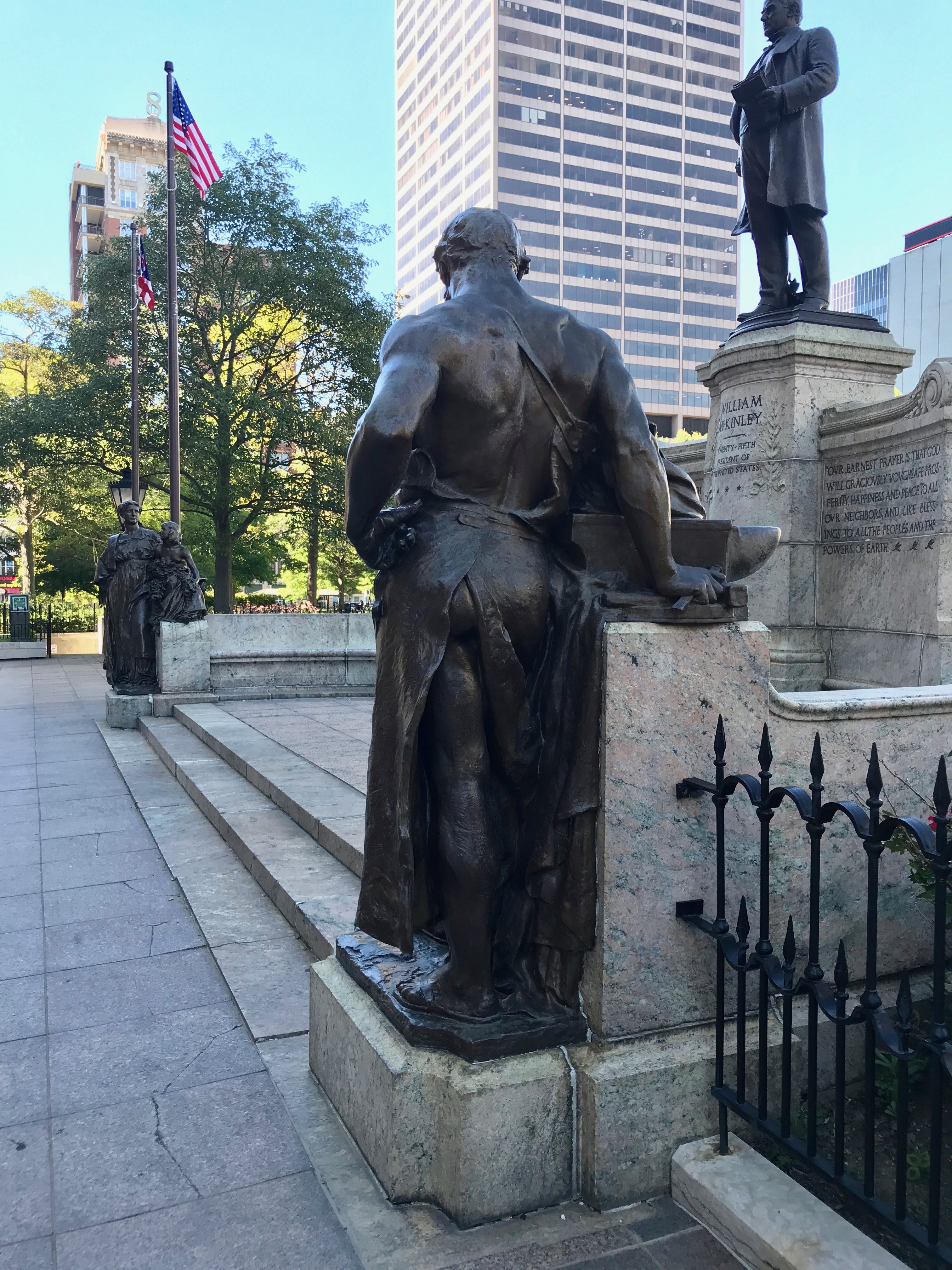
I have to admit that I was a little perplexed by the backside of the man on the right side of the memorial.
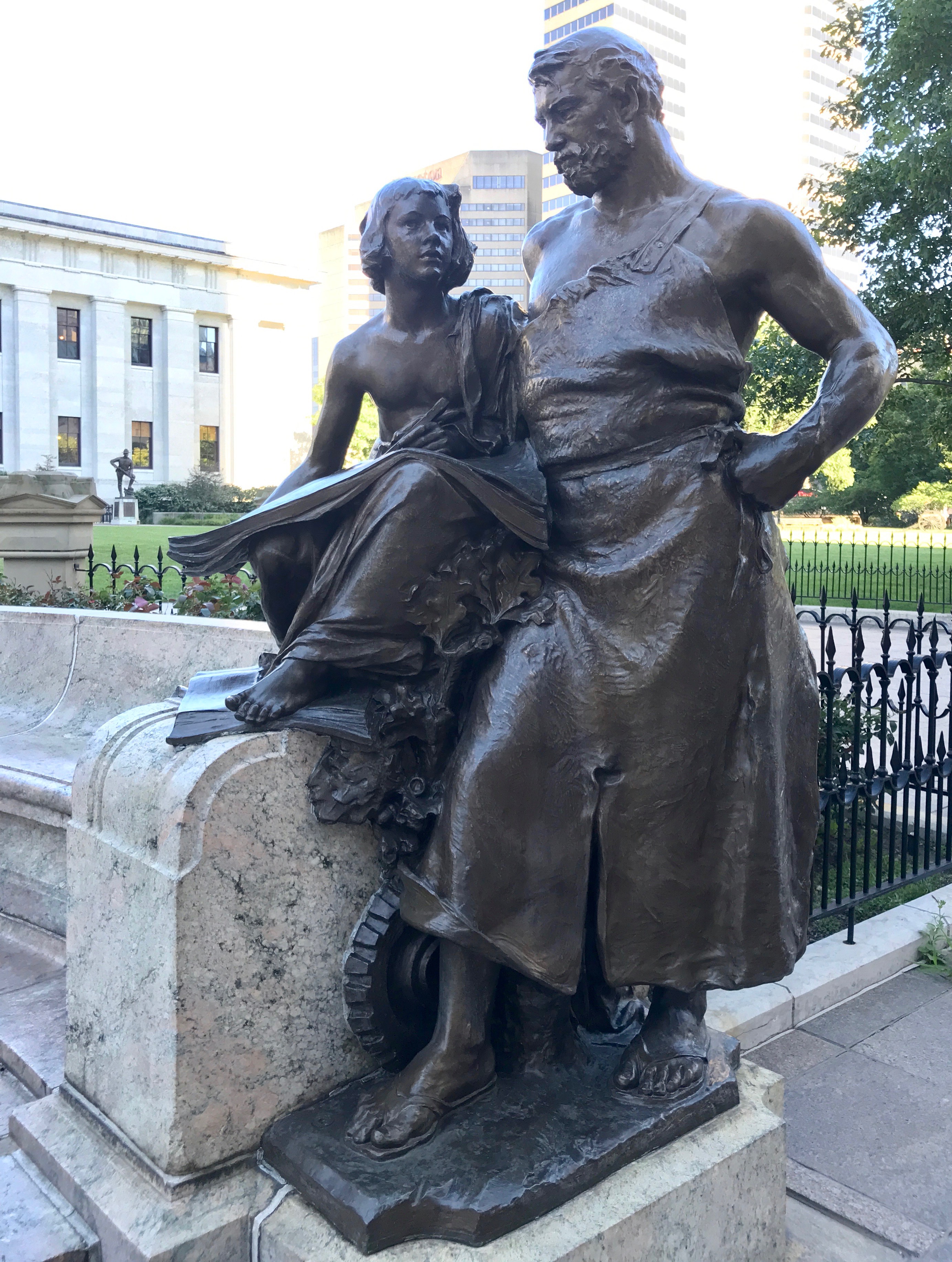
It seems that he is wearing a leather apron. I assume that was to protect himself from whatever his labors were. However, if he needed protection, where in the world were his pants?
However, it does seem that he is reading with a young child – presumably his son.
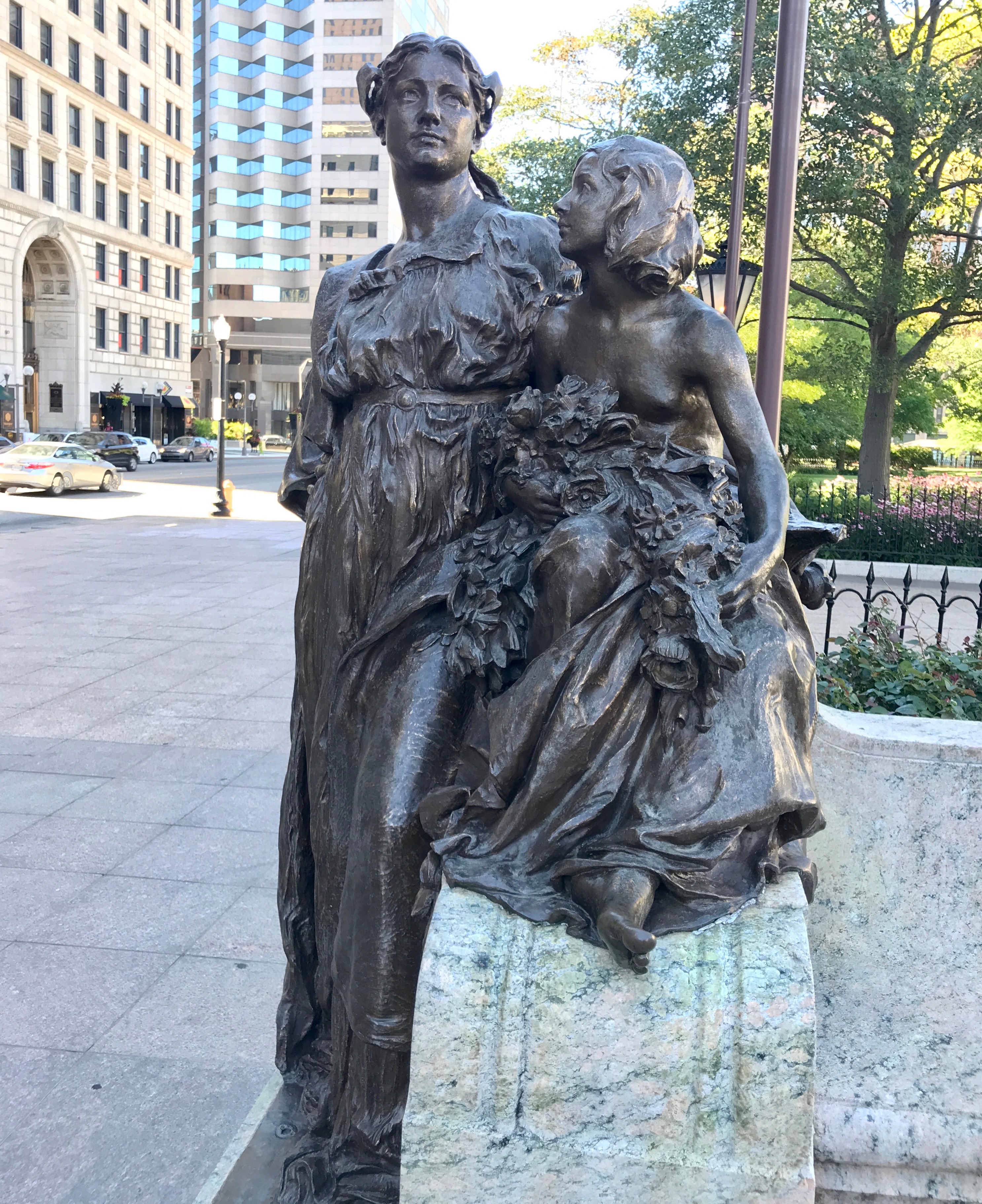
On the other side of the memorial, the women are more modestly clad, although I am not sure why the young female has bare breasts.
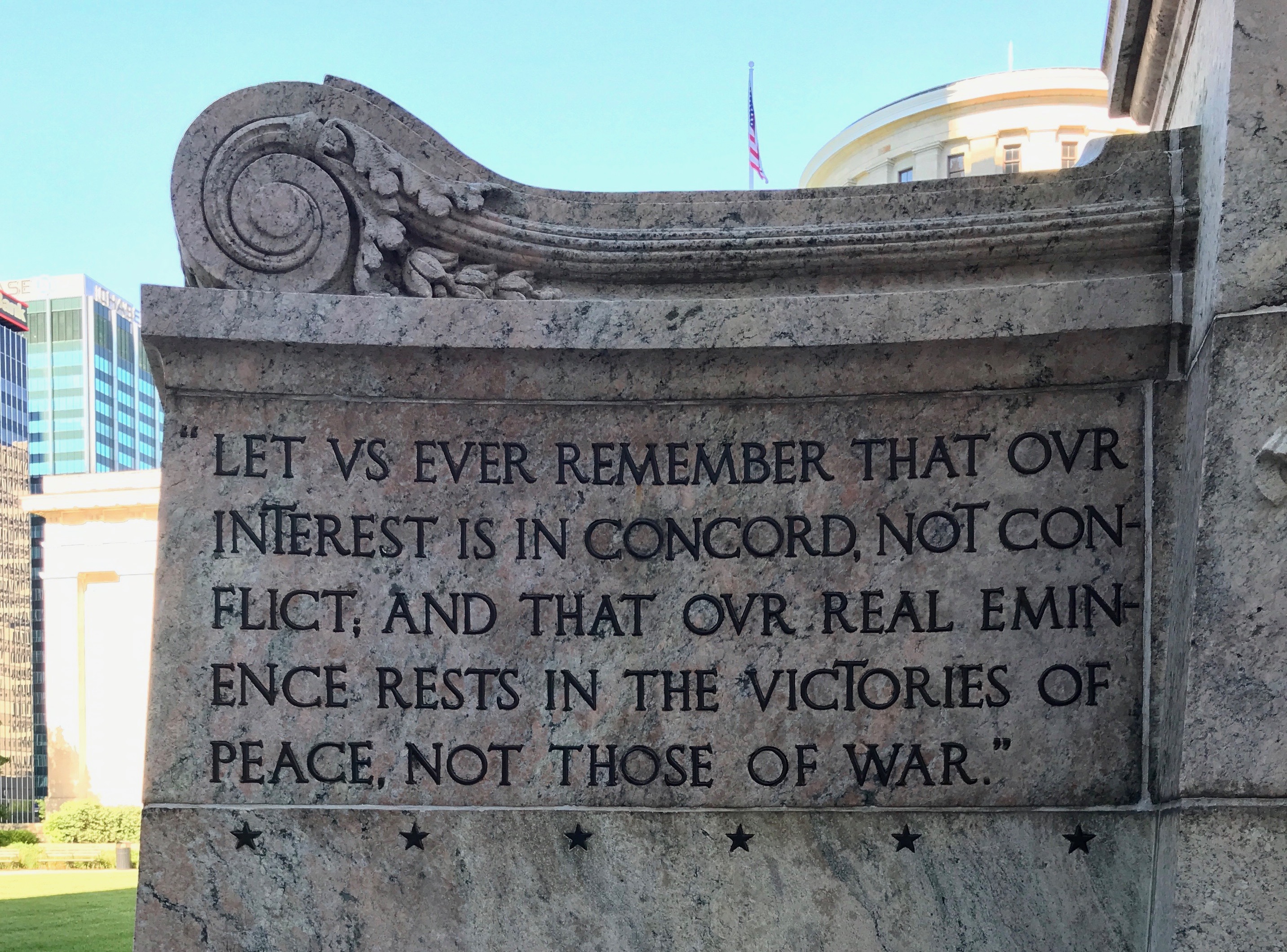
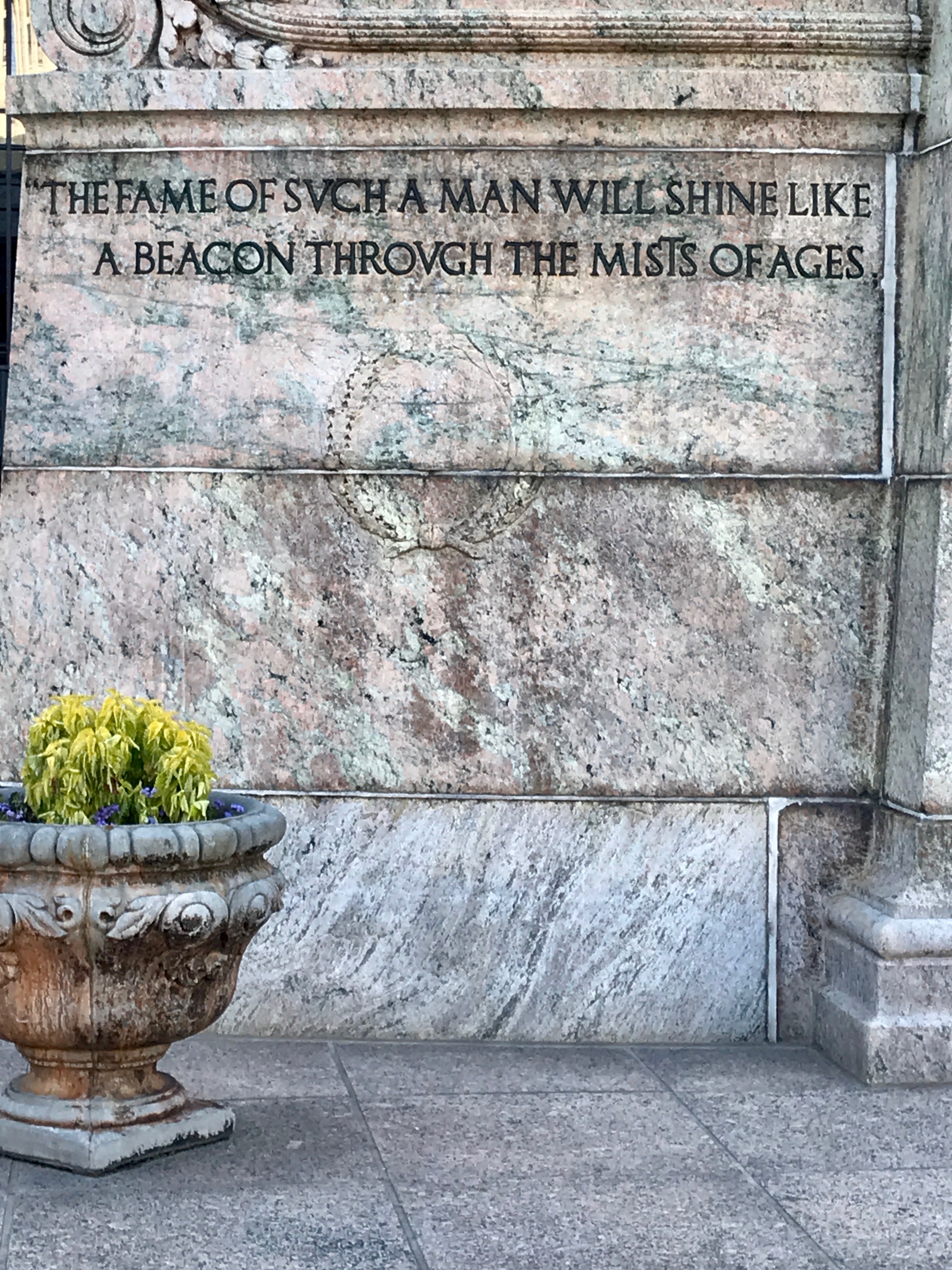
There were some good quotes on the memorial.
Odd, though, that his fame has not persisted. Or, maybe we are just awaiting resurgence of interest in William McKinley.
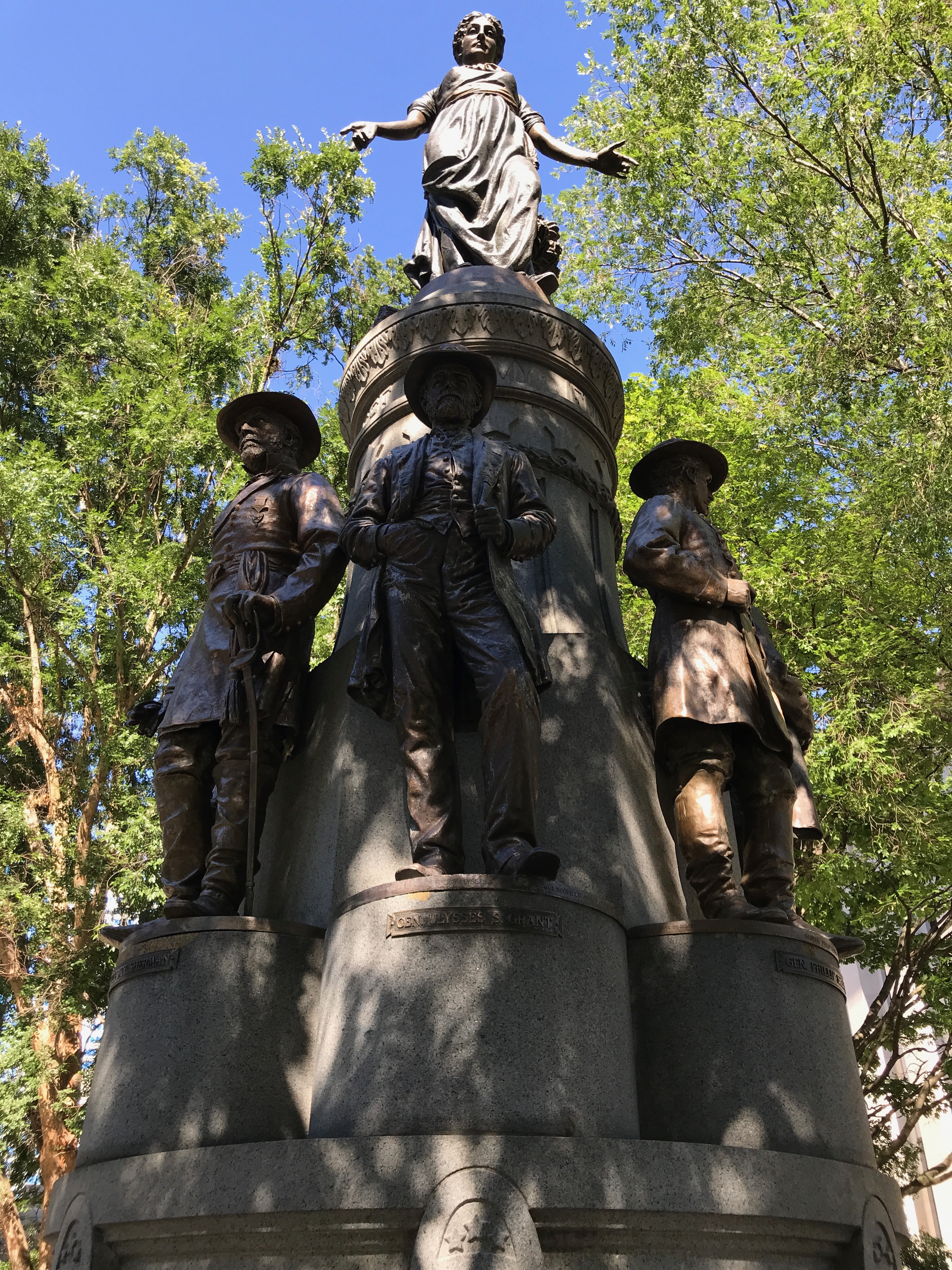
Rounding the corner, I came upon this memorial to some of Ohio’s favorite sons.
This memorial is called “These Are My Jewels.” The title comes from an anecdote of Roman history about Cornelia, who is depicted at the top of the statue. While her friends took delight in displaying her sumptuous clothing and jewelry, her pride was in her sons.
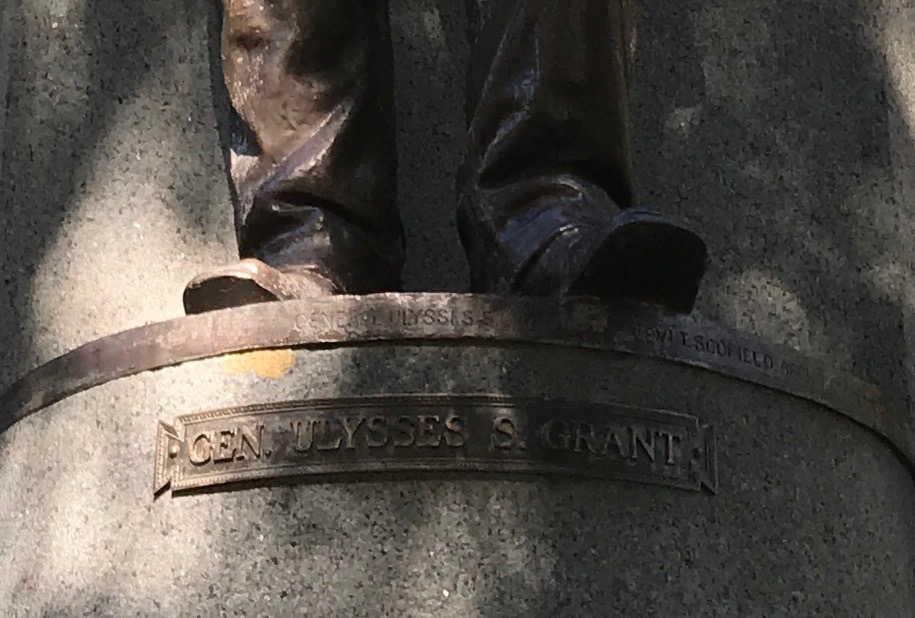
Surrounding the drum that Cornelia stands atop are Generals Ulysses S. Grant, William T. Sherman, James A. Garfield, Phillip Sheridan, Treasury Secretary Salmon P. Chase, Secretary of War Edwin Stanton, as well as Rutherford B.Hayes.
Three of the state’s presidents are honored in this one memorial to military and political leaders from the state of Ohio who were vital to the Union cause during the Civil War.
I kept moving along. I wondered if I would ever come to anything that recognized the contributions of real Ohioan females to the world. I was sure there must be something that women from Ohio did.
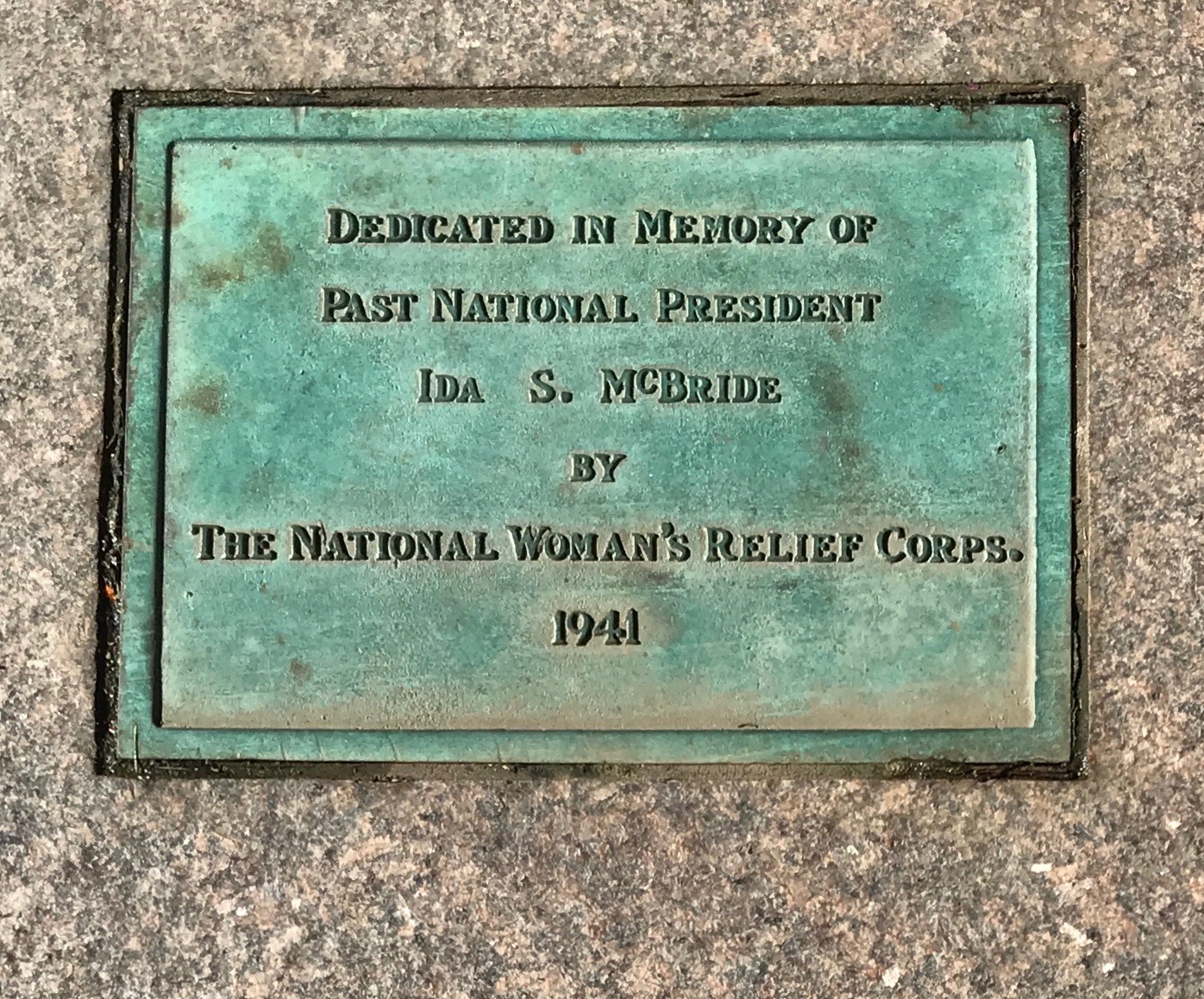
I finally came upon this plaque.
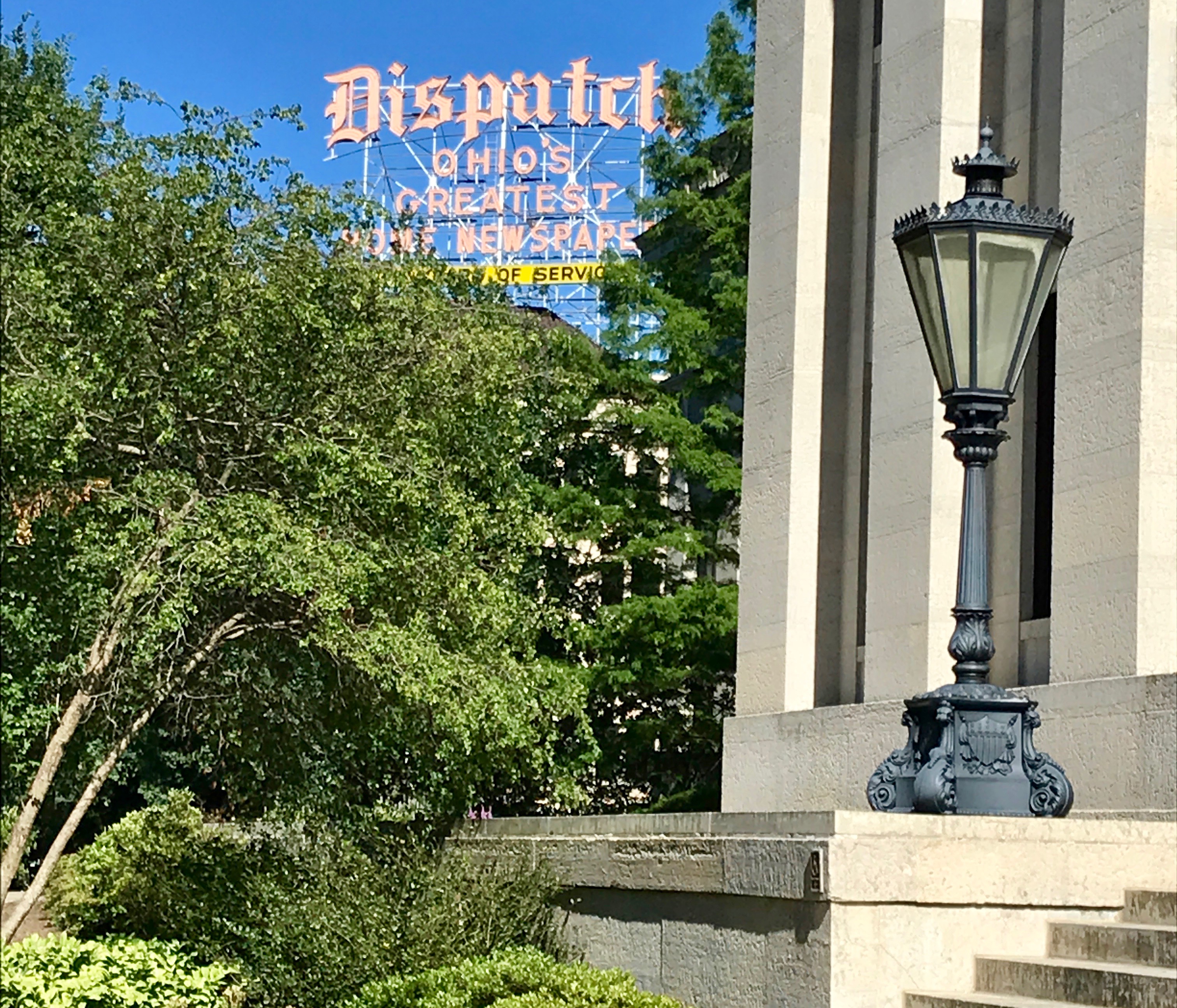
I appreciated the placement of this sign for the Columbus Dispatch. We need to have a vibrant journalistic community watching our government and keeping us informed about what is going on. As The Washington Post’s slogan reminds us, “Democracy Dies in Darkness.”
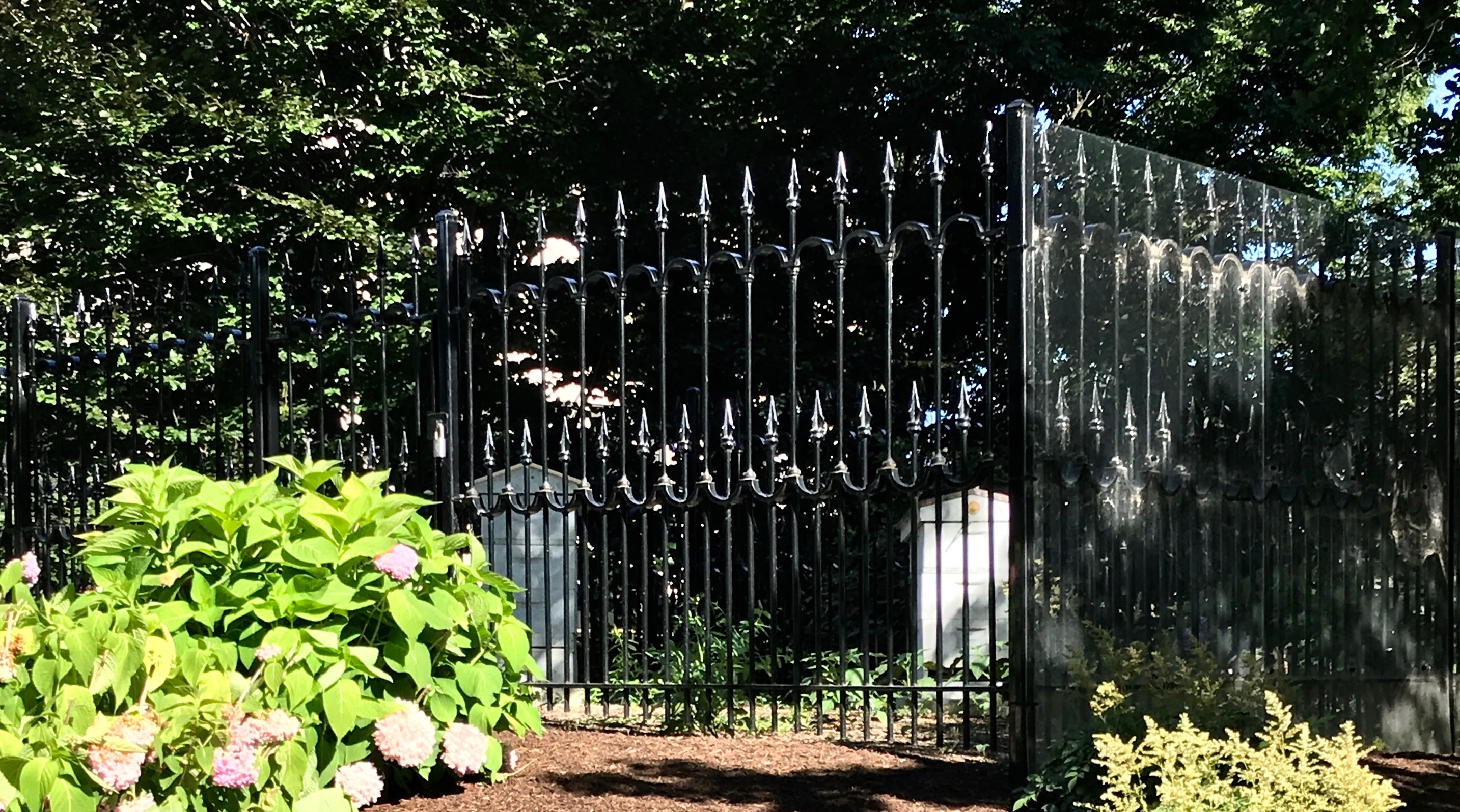
Tucked away in a corner of the 10 acre campus is the Capitol Square Honey Bee Apiary. It was dedicated on Earth Day 2015. It was installed after the Colony Collapse Disorder in 2006, where millions of bees vanished from their hives. It’s located on the capitol square to reinforce Ohio’s commitment to the environment and to help this beneficial pollinator recover from the devastation.
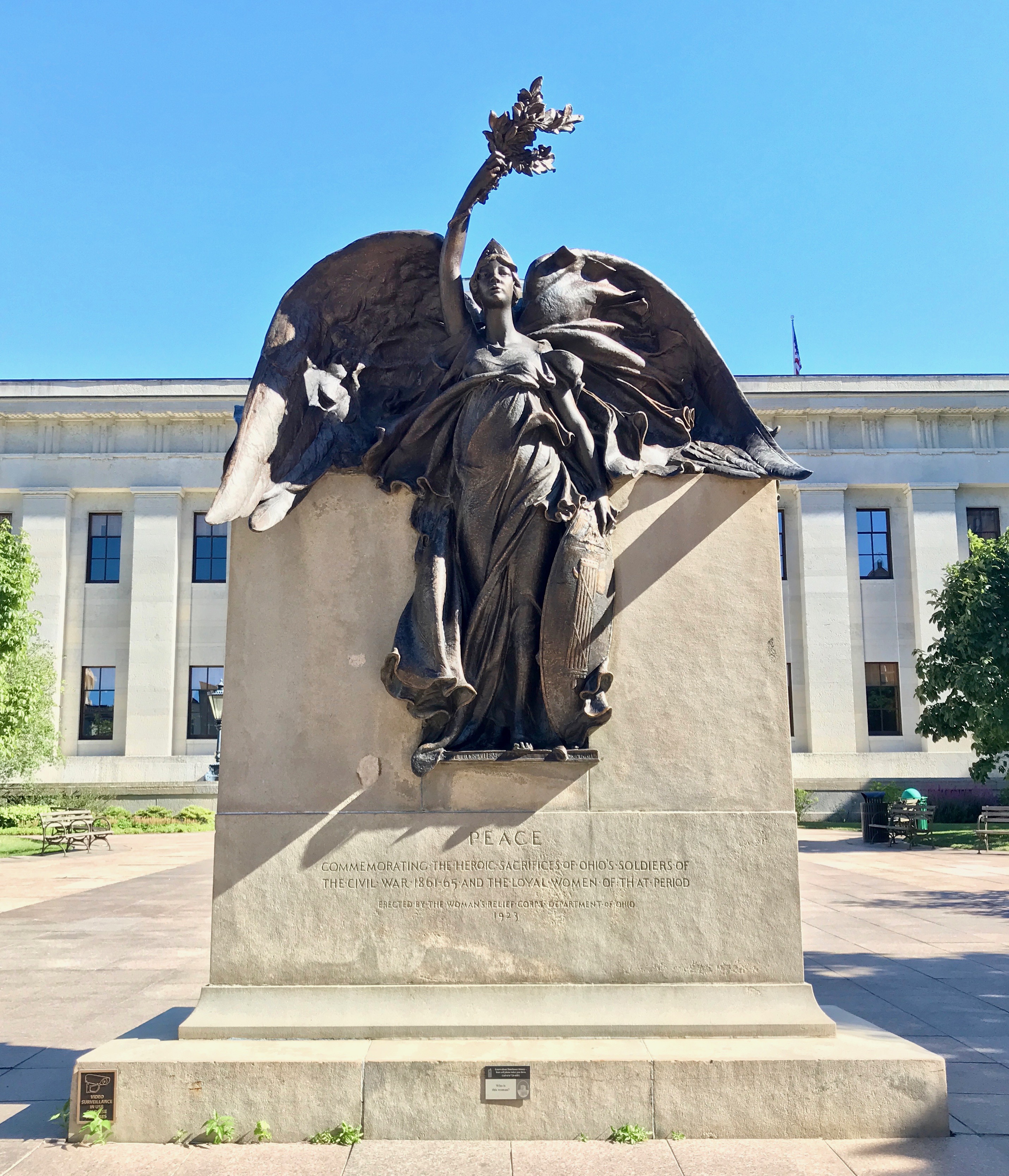
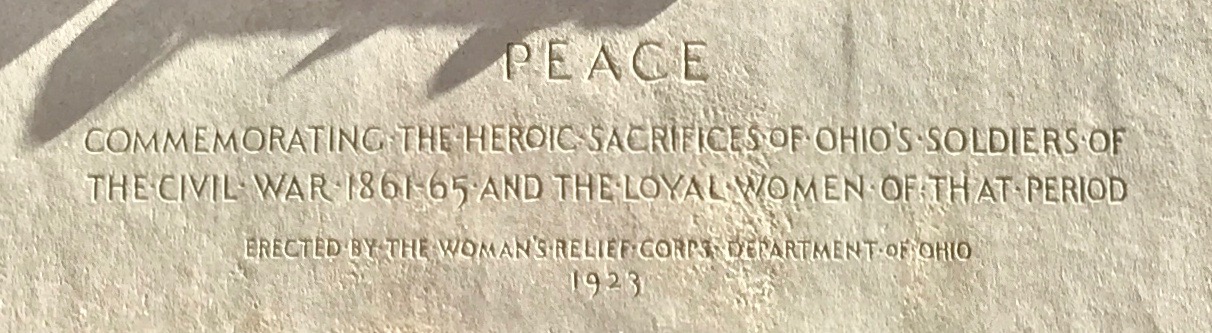
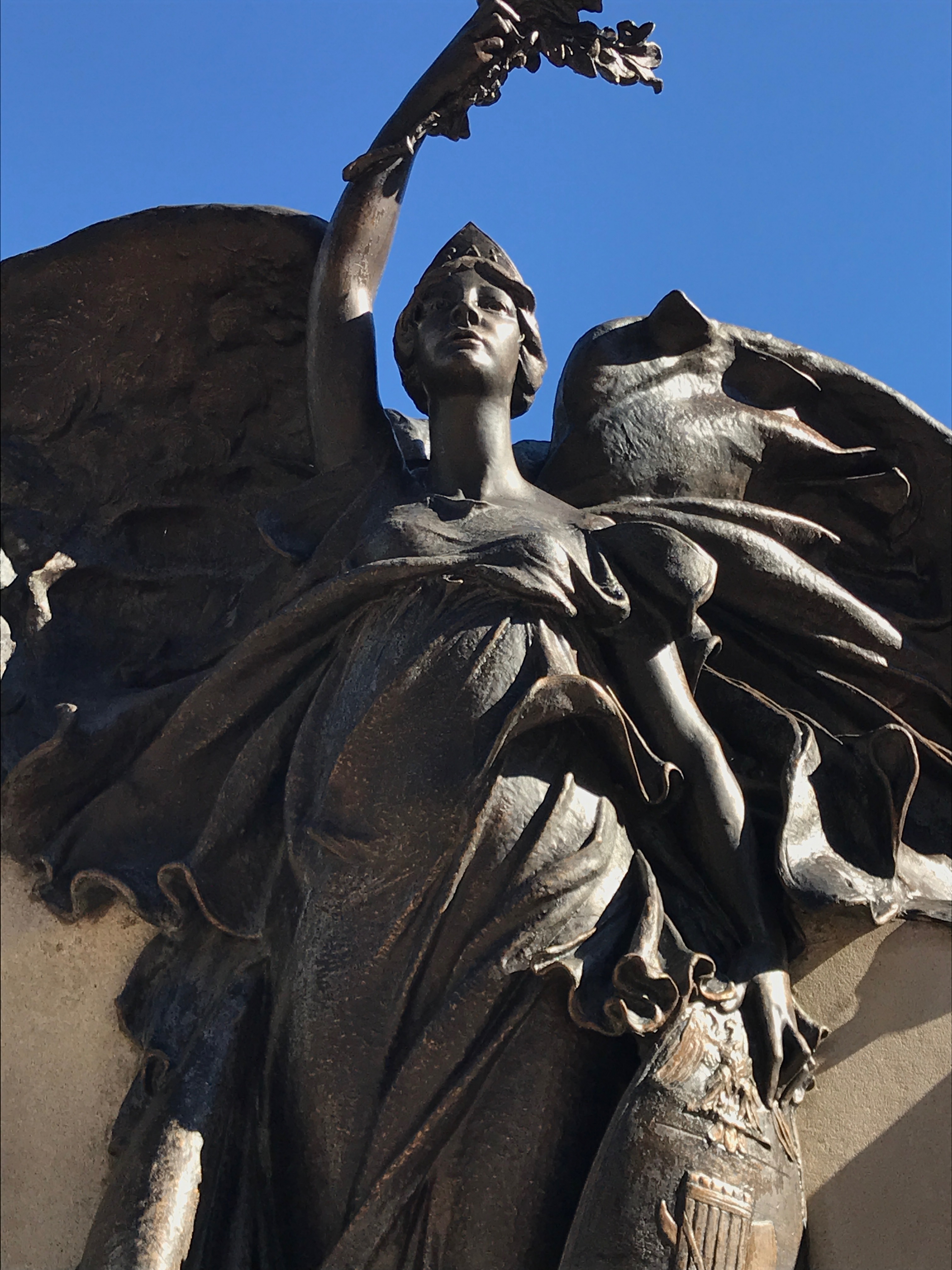
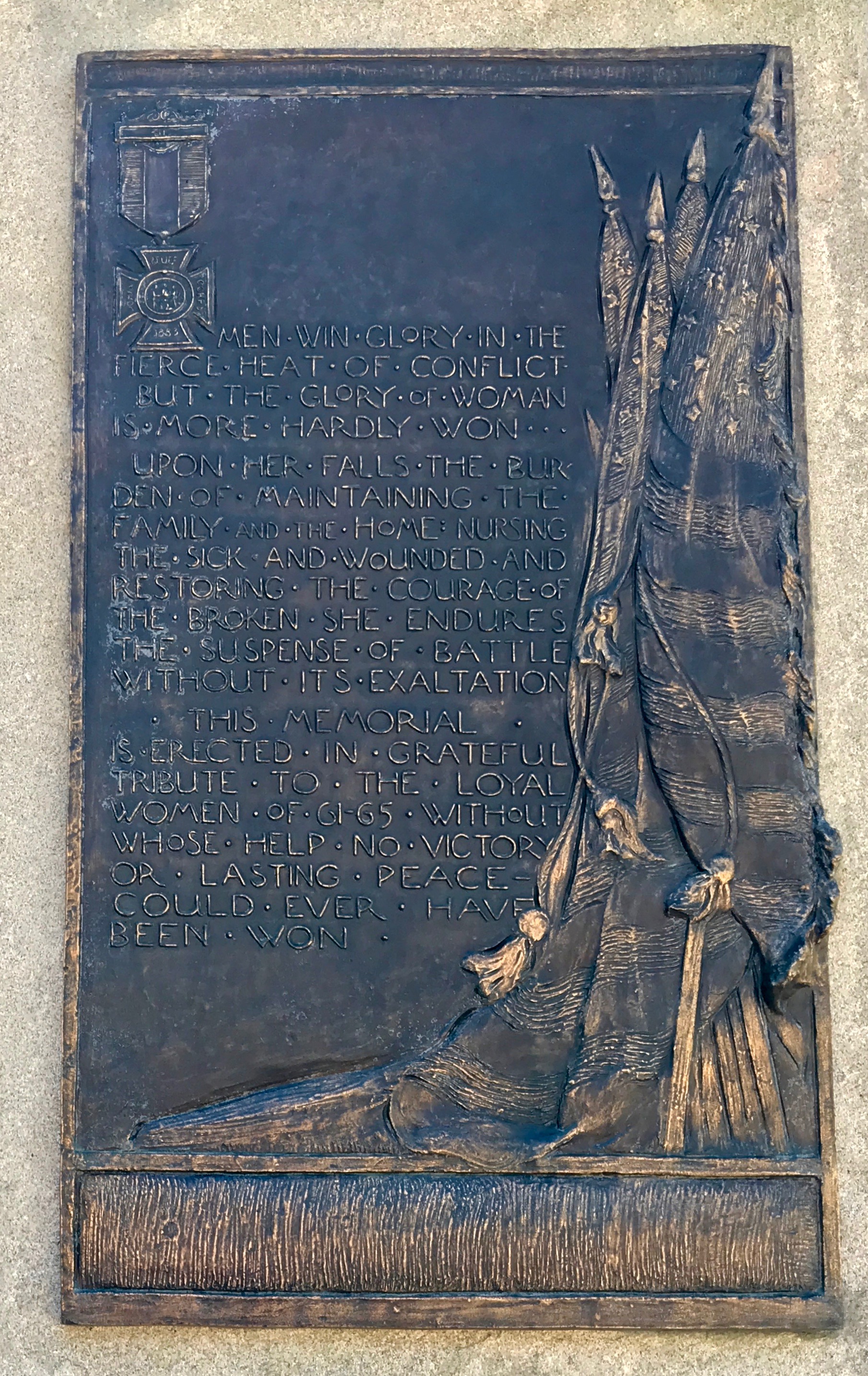
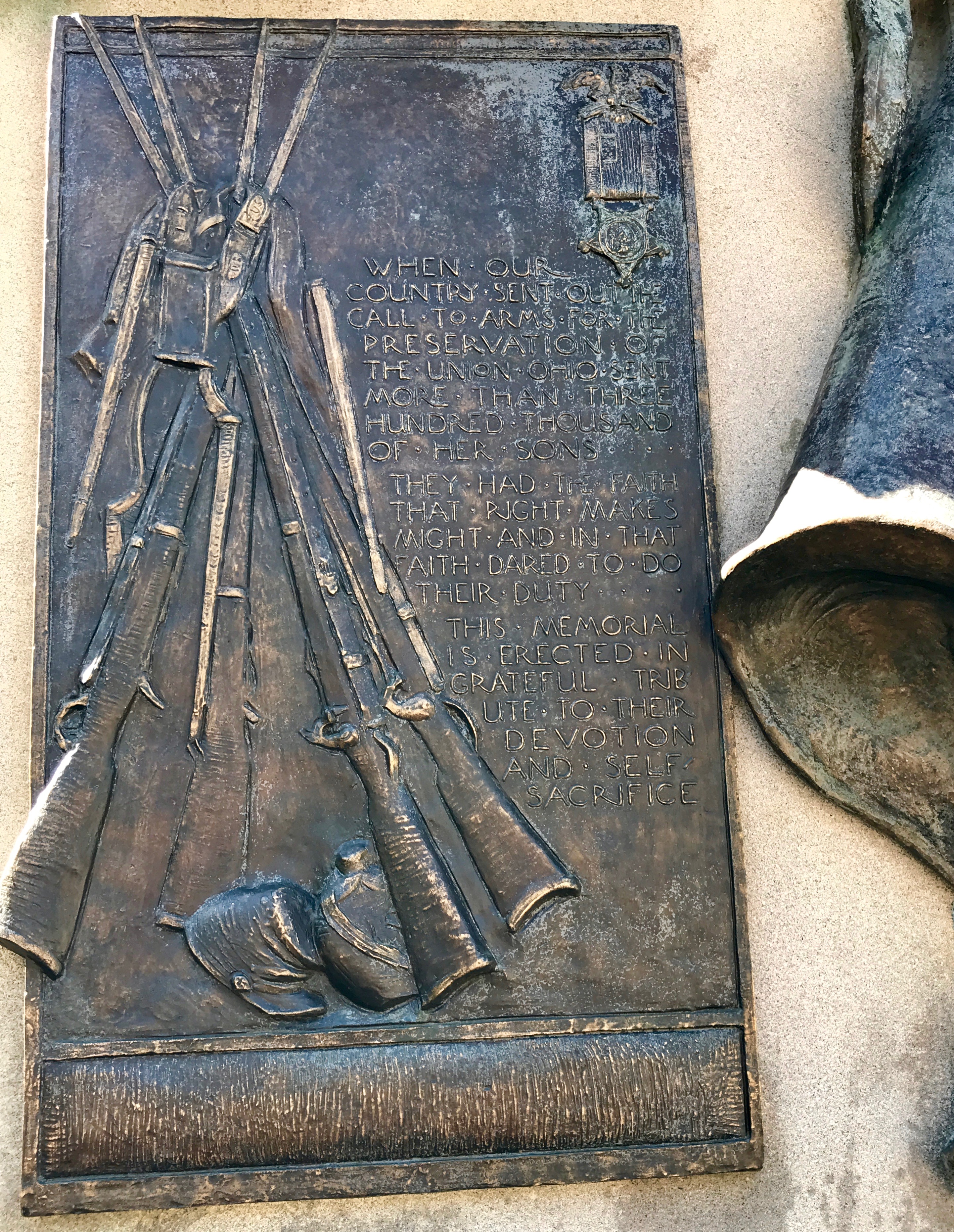
Finally, a monument to peace!
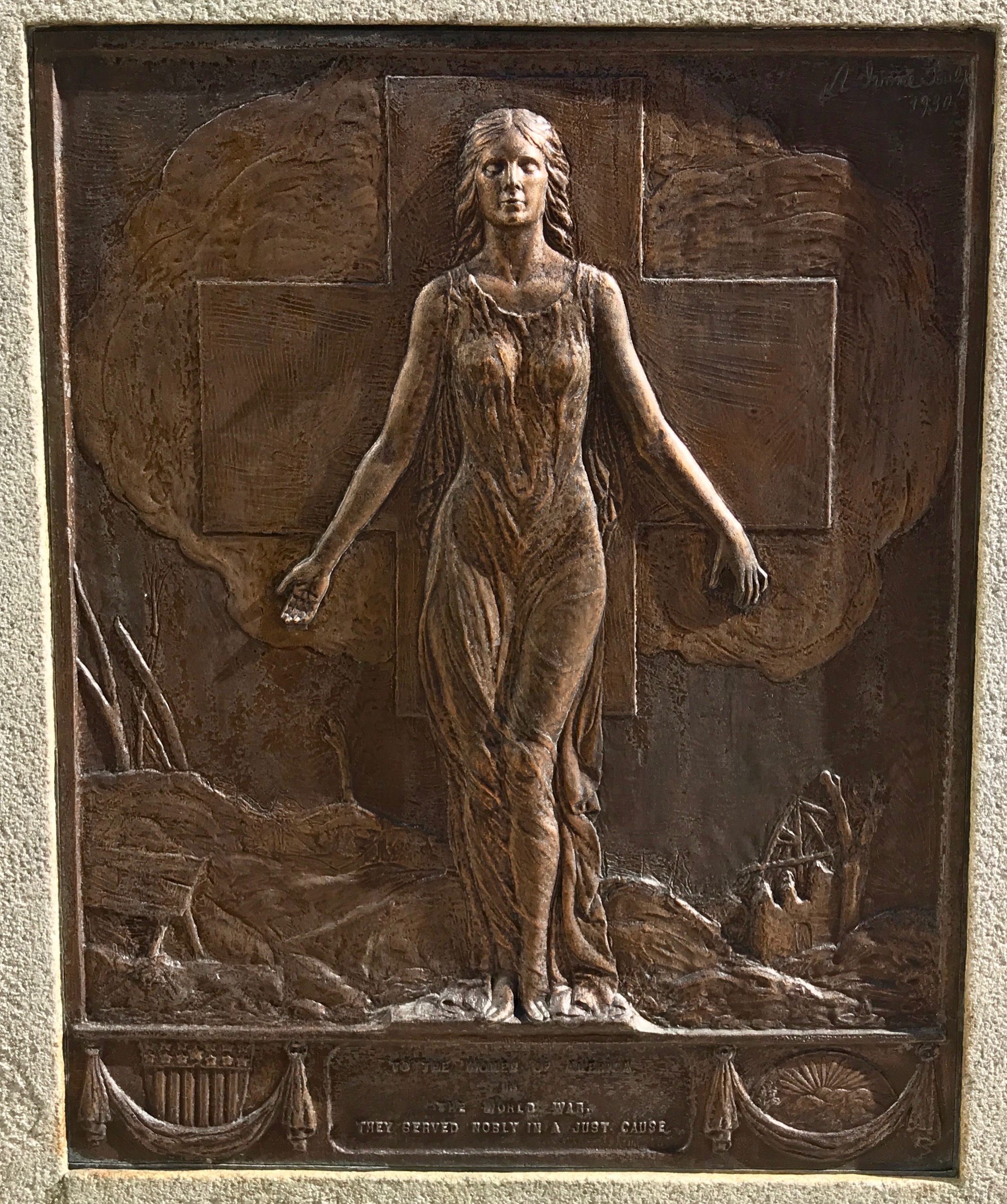
And to women. Of course, the women had to erect it themselves.
I notice that this woman is fully clad. Maybe it takes a women’s group to think of that.
Here’s the plaque for the women.
Here’s the plaque for the men.
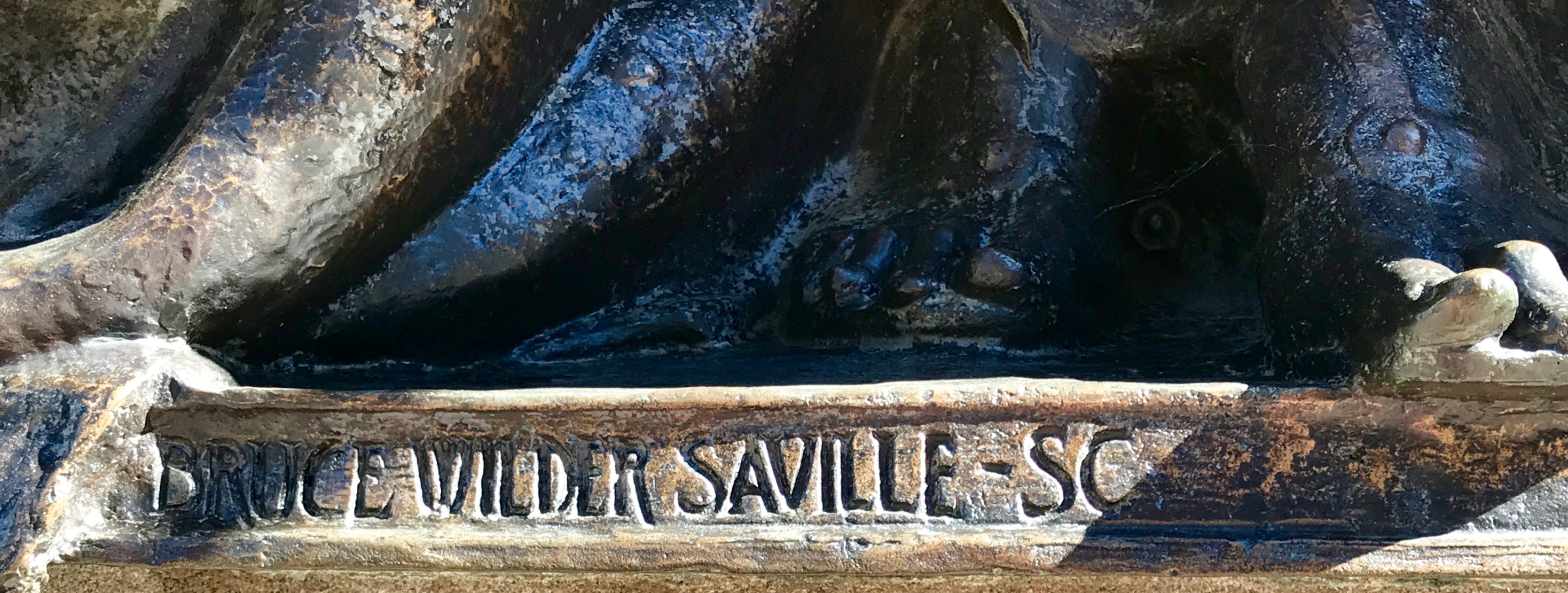
The sculptor, Bruce Wilder Saville, was a fairly prominent sculptor who was known for his monuments. From Quincy, Massachusetts, he was born in 1893 and died in 1938.
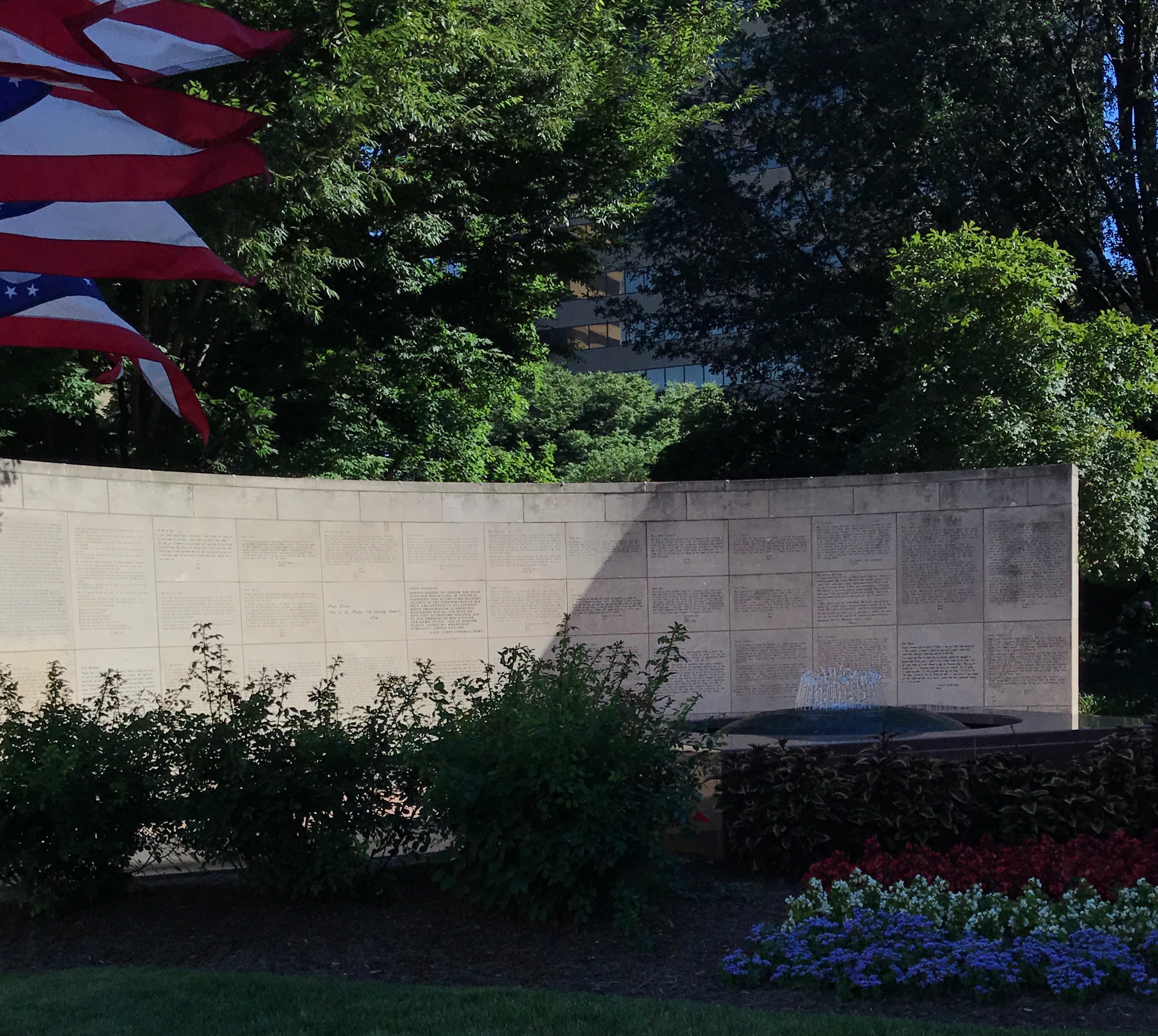
In front of the east façade is the Ohio Veterans Plaza. According to the website, “The inspiration for the Ohio Veterans Plaza is rooted in an act of civil disobedience. In 1981, two Vietnam veterans, Carl Chandler and Harry Edwards, erected under the cover of night on the Capitol grounds a hand painted four-by-eight-foot sheet of plywood as a tribute to veterans of the Vietnam War.”
A bill was passed in the legislature to install a permanent veterans’ memorial. The plaza honors Ohio men and women who have served our country since World War II, as well as those who will serve in the future.
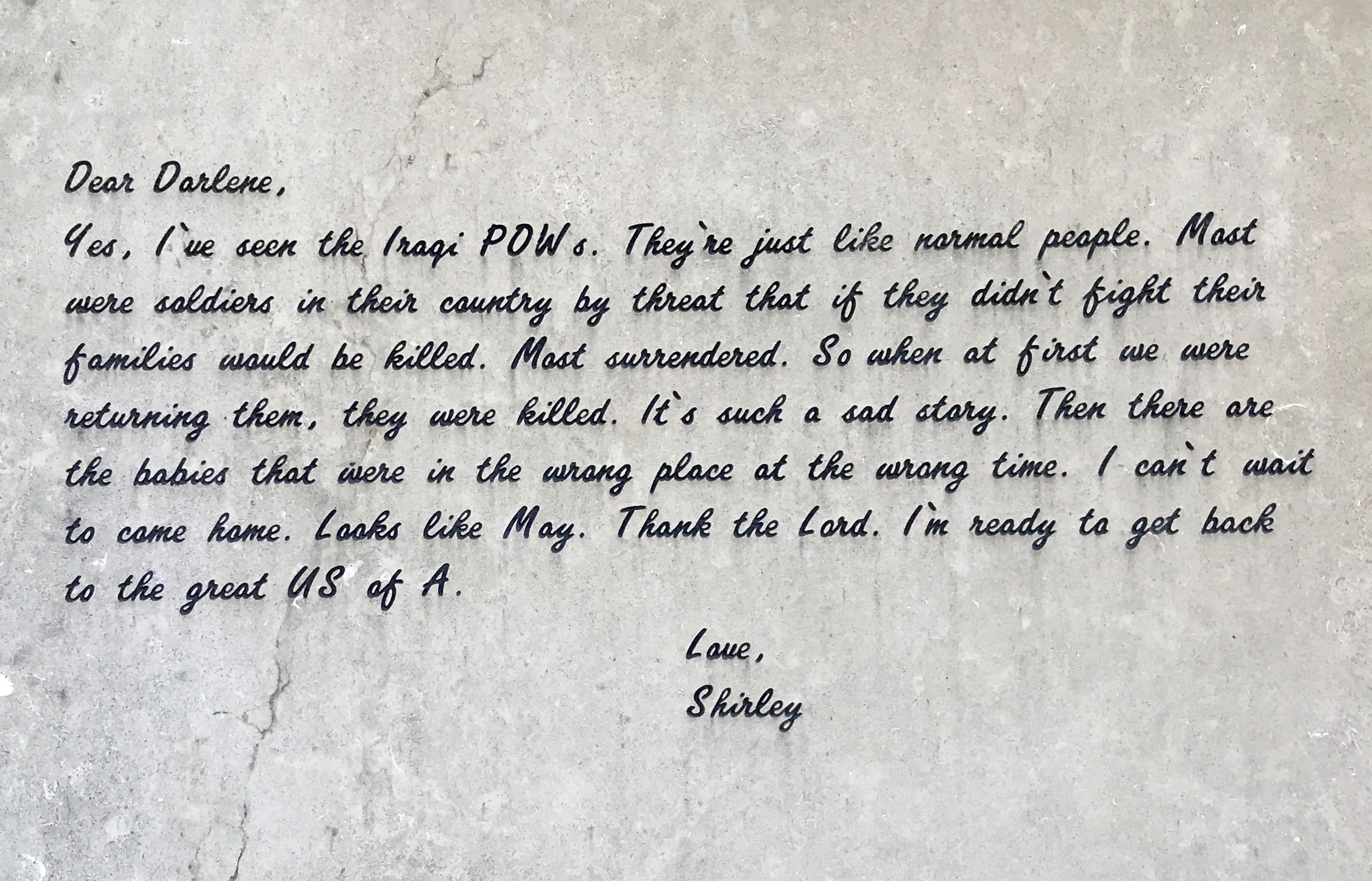
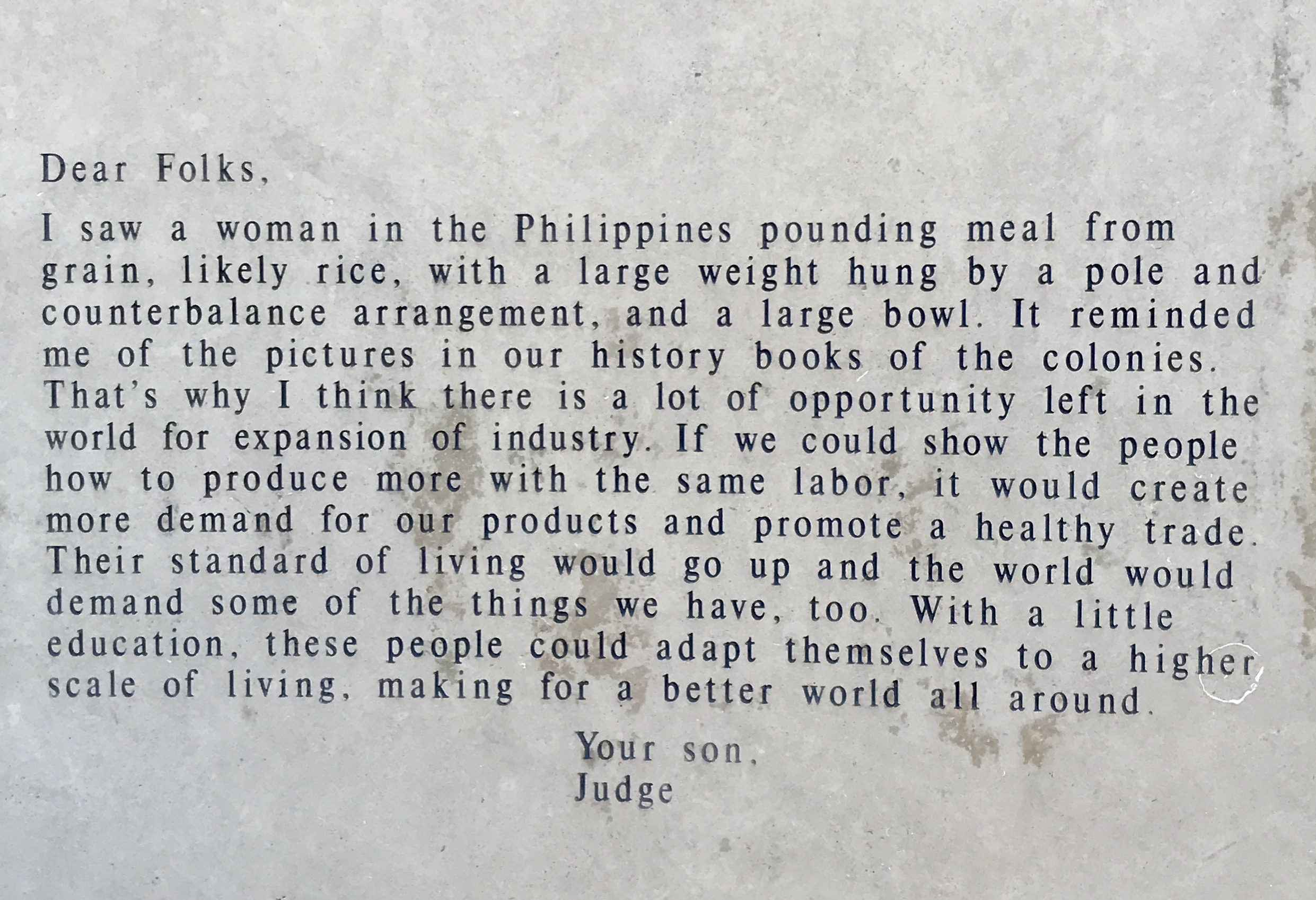
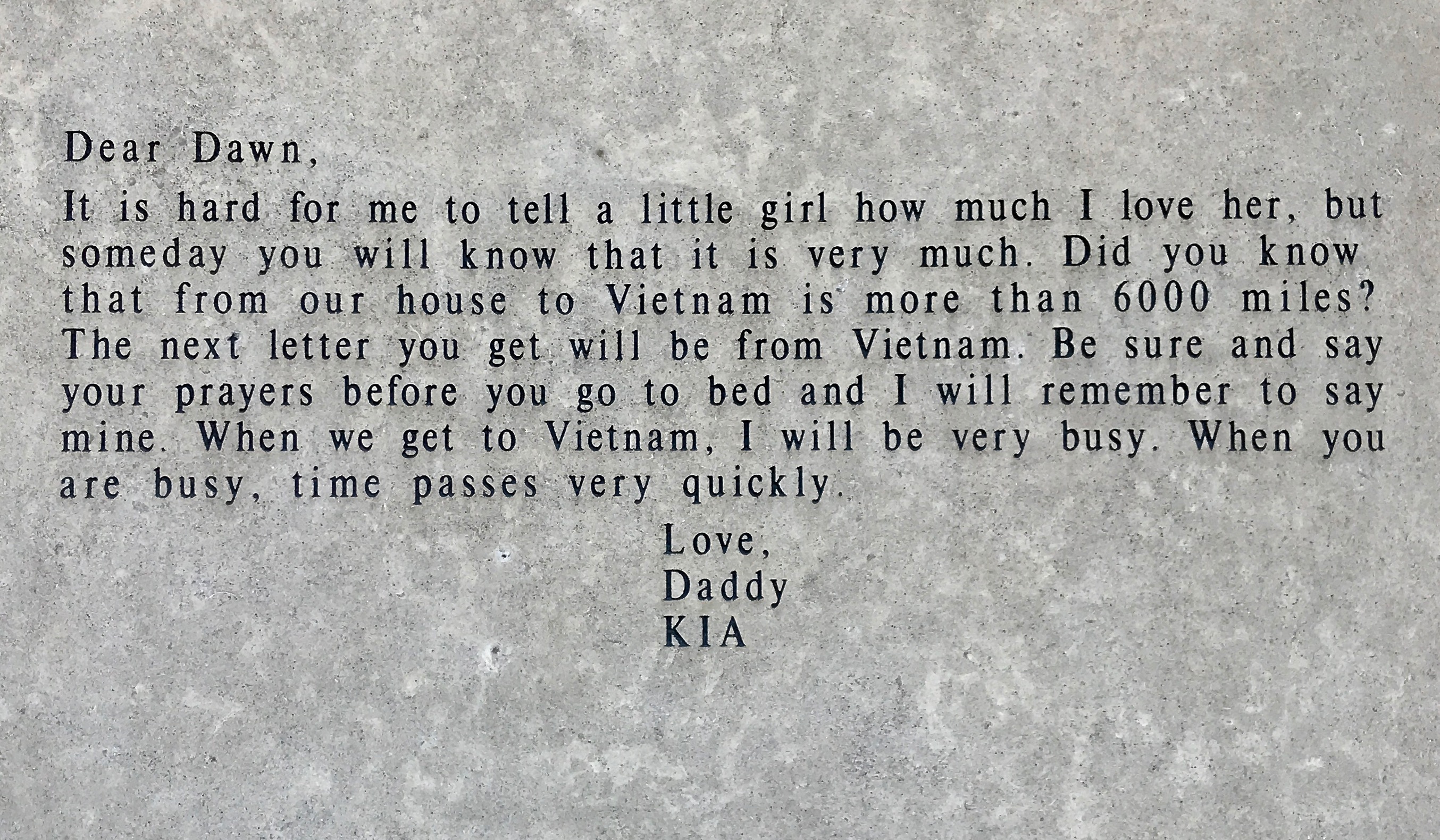
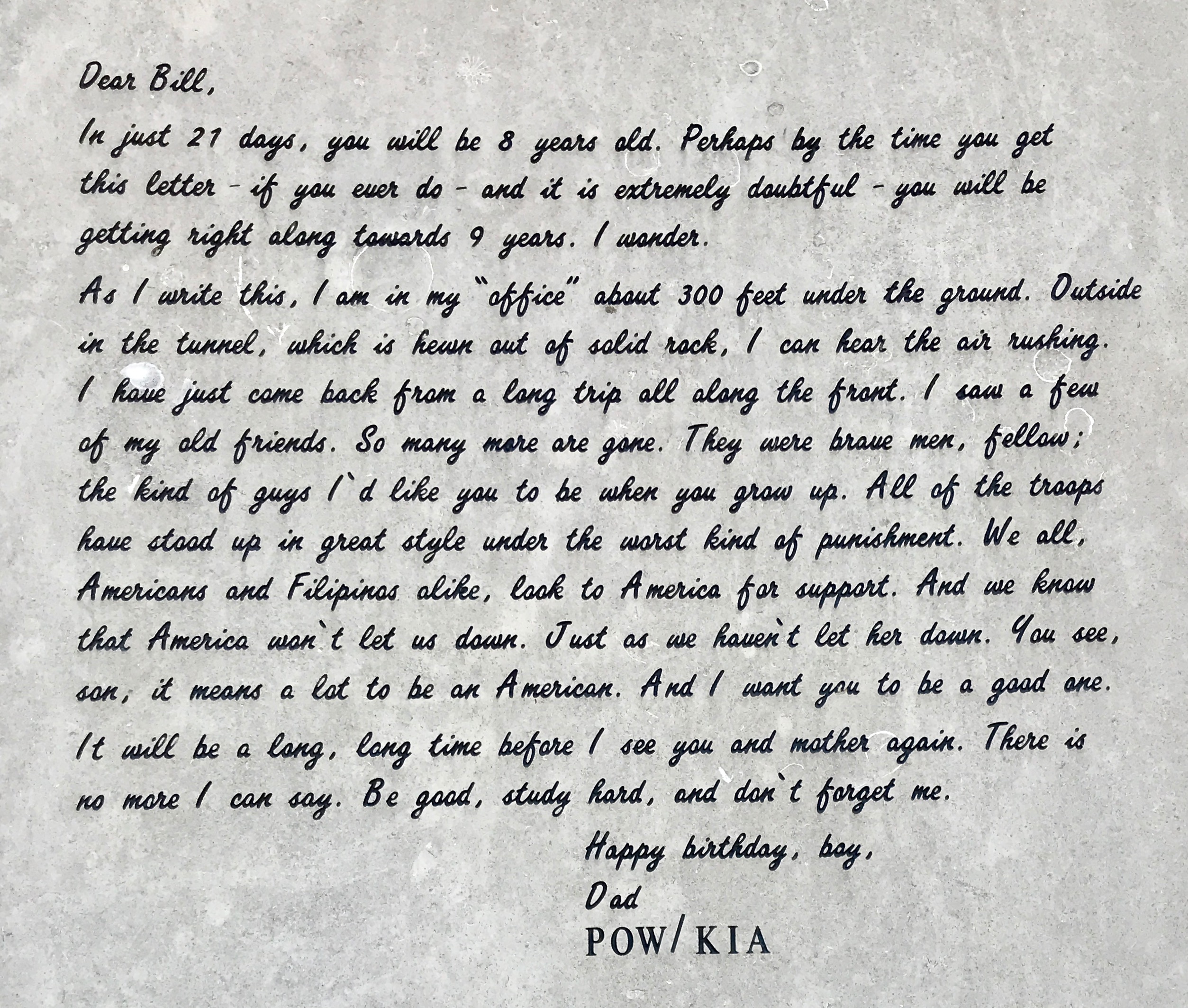
The grassy area lined with Ohio flags is flanked on either end with curved limestone walls that are inscribed with letters from the text from correspondence from Ohio military personnel .
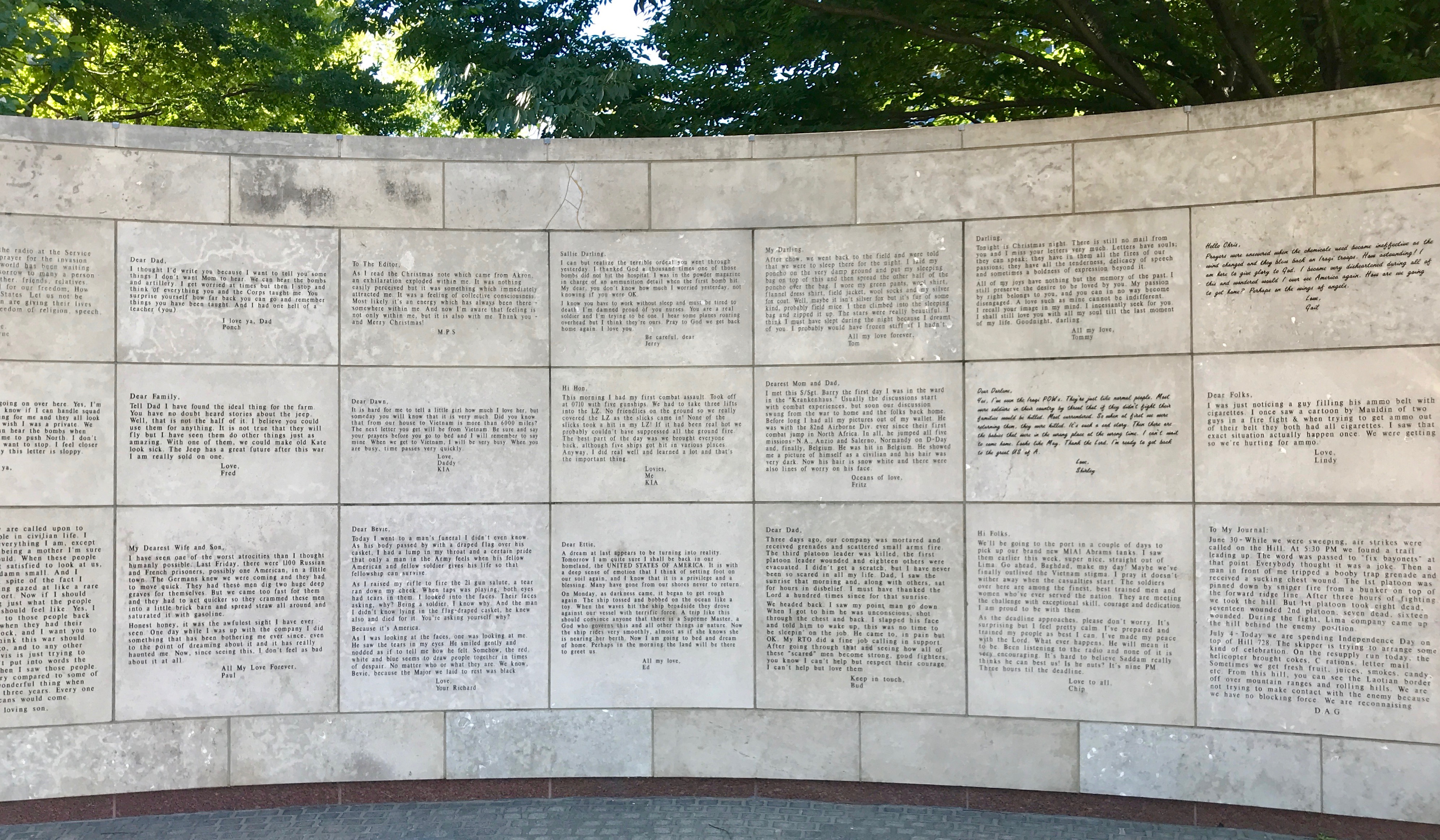
When you get closer, you can read the letters that were selected from the over 1500 letters that were contributed from Ohioan families.
Some described a bit of their experiences.
Others coupled their observations with ideas for the future.
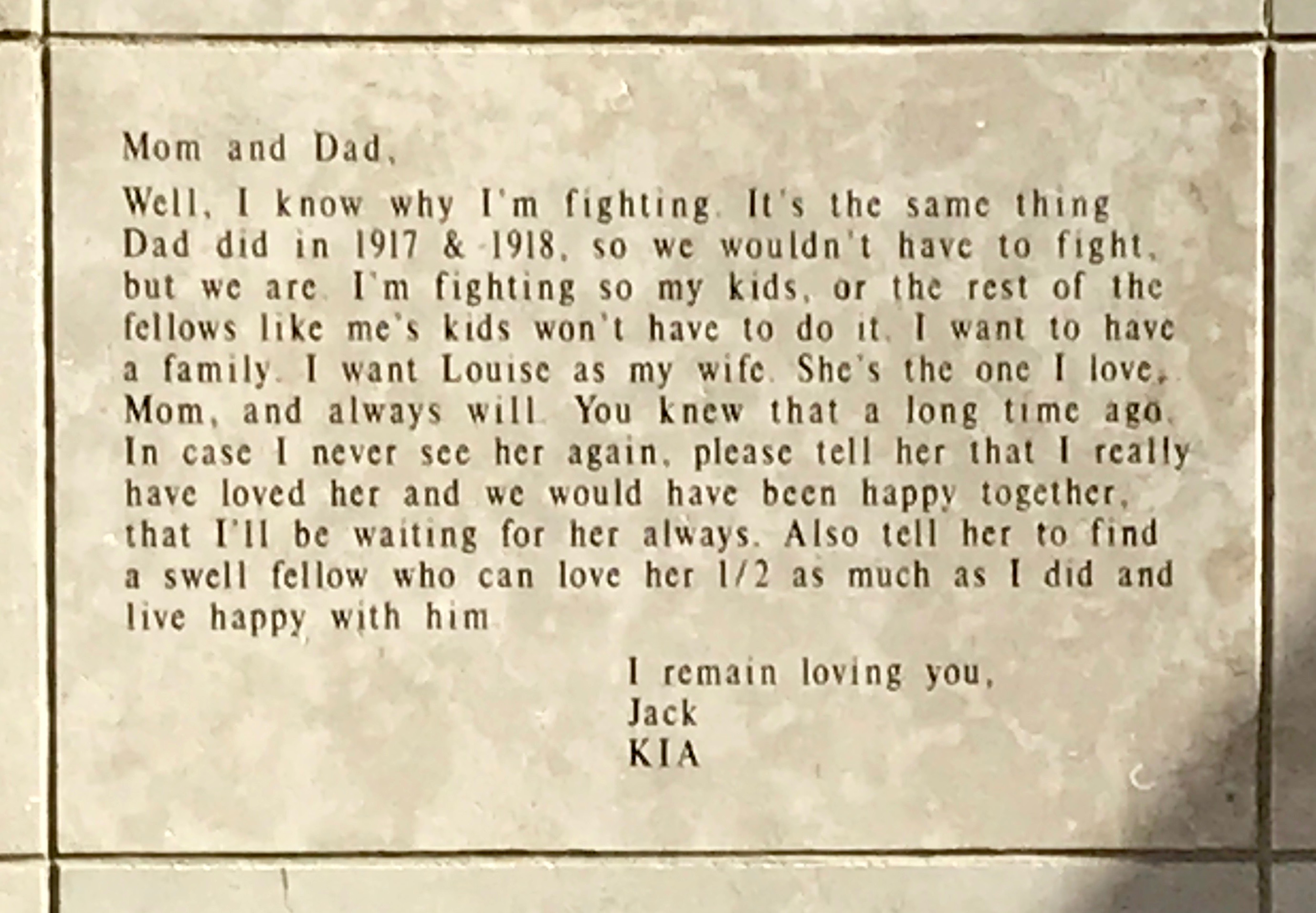
Others were love notes to their families from soldiers that never returned, like this one…
…and this one.
This letter is heartbreaking for the things that never came to pass.
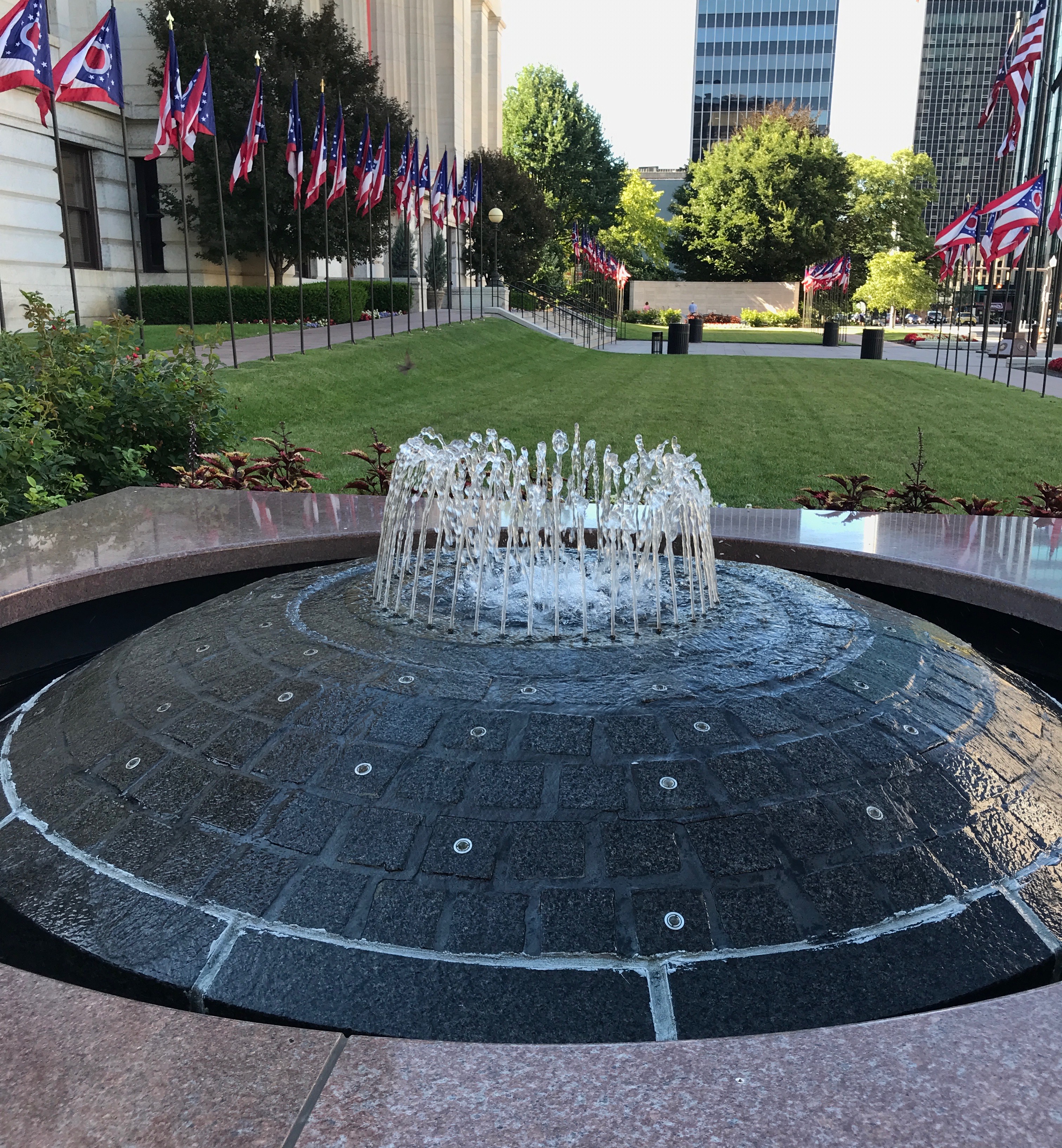
I wonder if this fountain was intended to represent the tears of the loved one, as I was feeling quite sad after reading some of these letters.
By this time I had seen about as much as any casual visitor to Capitol Square could see – without going inside. It was time to move along.
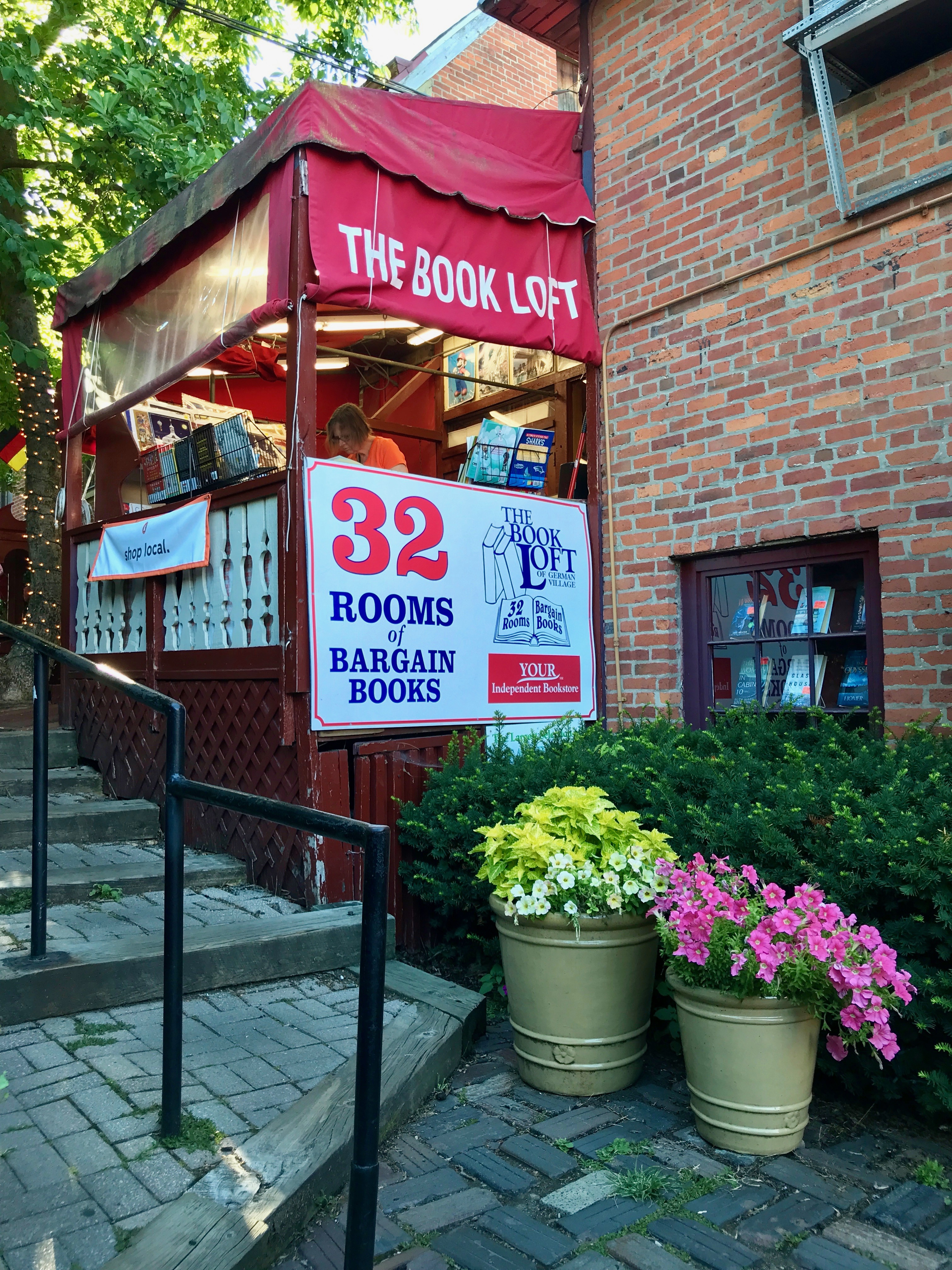
Some friends had recommended that I visit The Book Loft. It wasn’t too far away, so I headed over to see what I could see.
It was a unique store tucked into a building. I believe they really did have 32 rooms of bargain books, but I didn’t spend much time there. I looked in the windows and the entrance. It was just too crowded for my tastes, so I sat on a bench outside for a bit and enjoyed the literary ambiance.
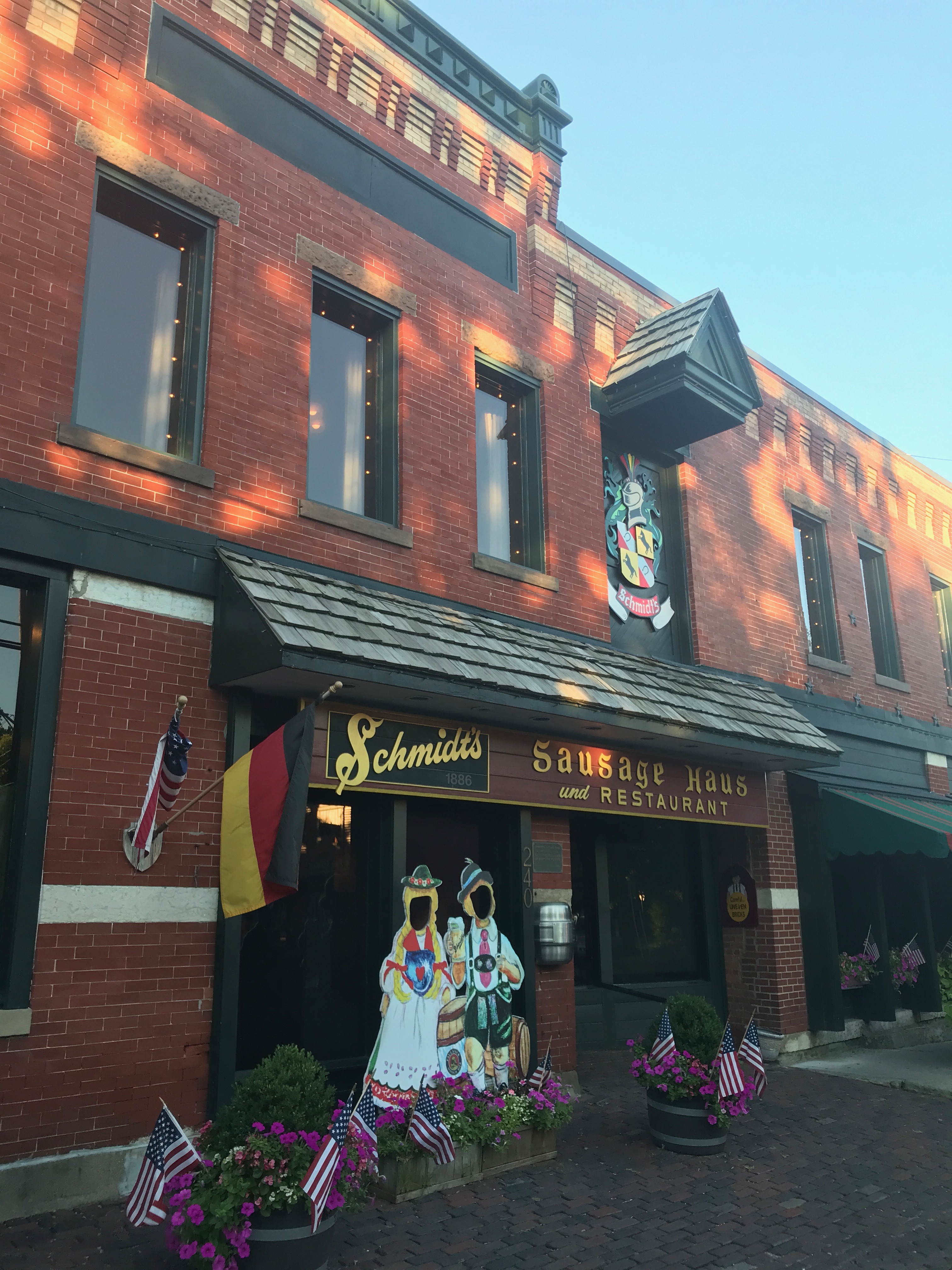
The other recommendation was that I visit German Village for some authentic German food. Since I don’t think I’d had any truly authentic German food since I was last in Germany, I decided to head to Schmidt’s Sausage Haus und Restaurant for dinner.
Since I arrived at the dinner hour on a weekend, there was quite a line up for a table. As I was dining solo, I asked if I might have a seat at the bar. They were happy to accommodate me.
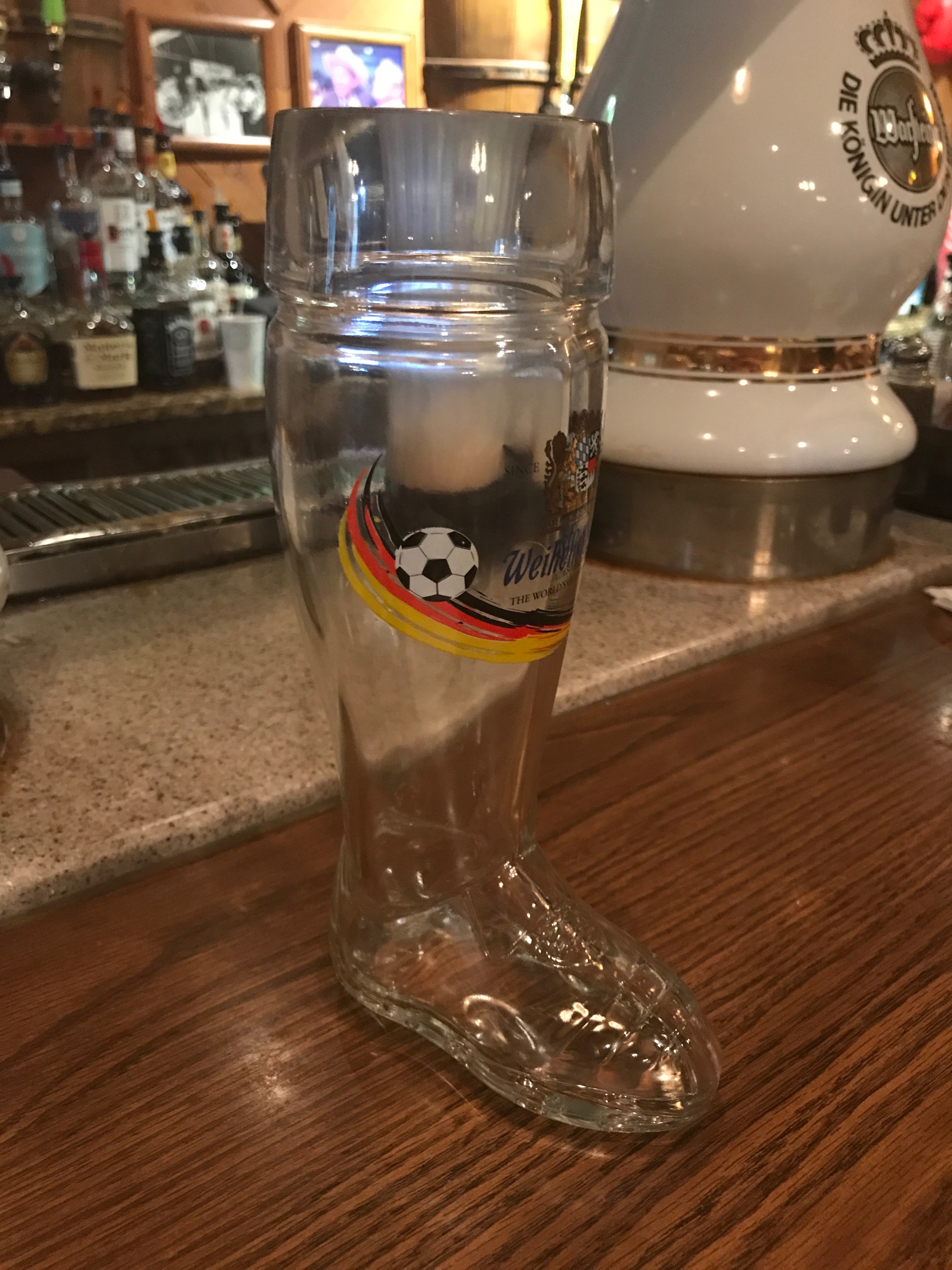
I made my selection from the menu and waited for my food to arrive. In the meanwhile, I looked around. I saw this beer boot and asked to take a photo of it.
Just in case you are wondering why beer is drunk out of a glass boot, this is what my Preferred Source has to say about it:
“Beer boots (or Bierstiefel) have over a century of history and culture behind them. It is commonly believed that a general somewhere promised his troops to drink beer from his boot if they were successful in battle. When the troops prevailed, the general had a glassmaker fashion a boot from glass to fulfill his promise without tasting his own feet and to avoid spoiling the beer in his leather boot. Since then, soldiers have enjoyed toasting to their victories with a beer boot. At gatherings in Germany, Austria and Switzerland, beer boots are often passed among the guests for a festive drinking challenge. Since the movie Beerfest appeared in 2006, beer boots have become increasingly popular in the United States.”
I’d seen them before, but I assumed they were mostly intended for consuming mass quantities of beer.
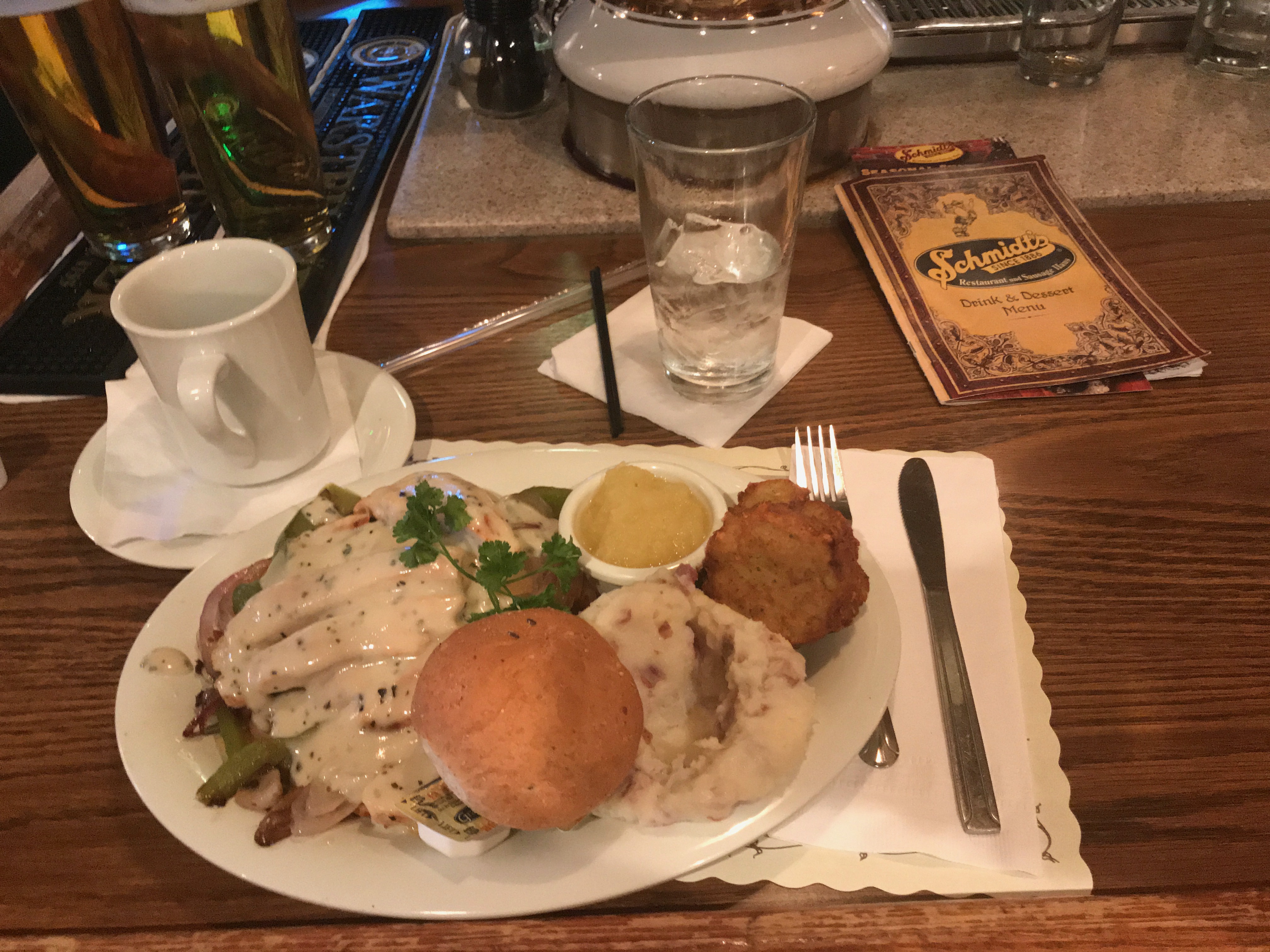
While it was fun gazing at the memorabilia and watching the waiters charging in and out of the kitchen, I was happy when my food arrived at last.
It was quite heavy fare. I sampled everything, but I definitely didn’t join the Clean Plate Club for that meal. That plate looked like it could easily have provided the calories necessary for a small family. But, do I let calorie content stop me?
I do not!
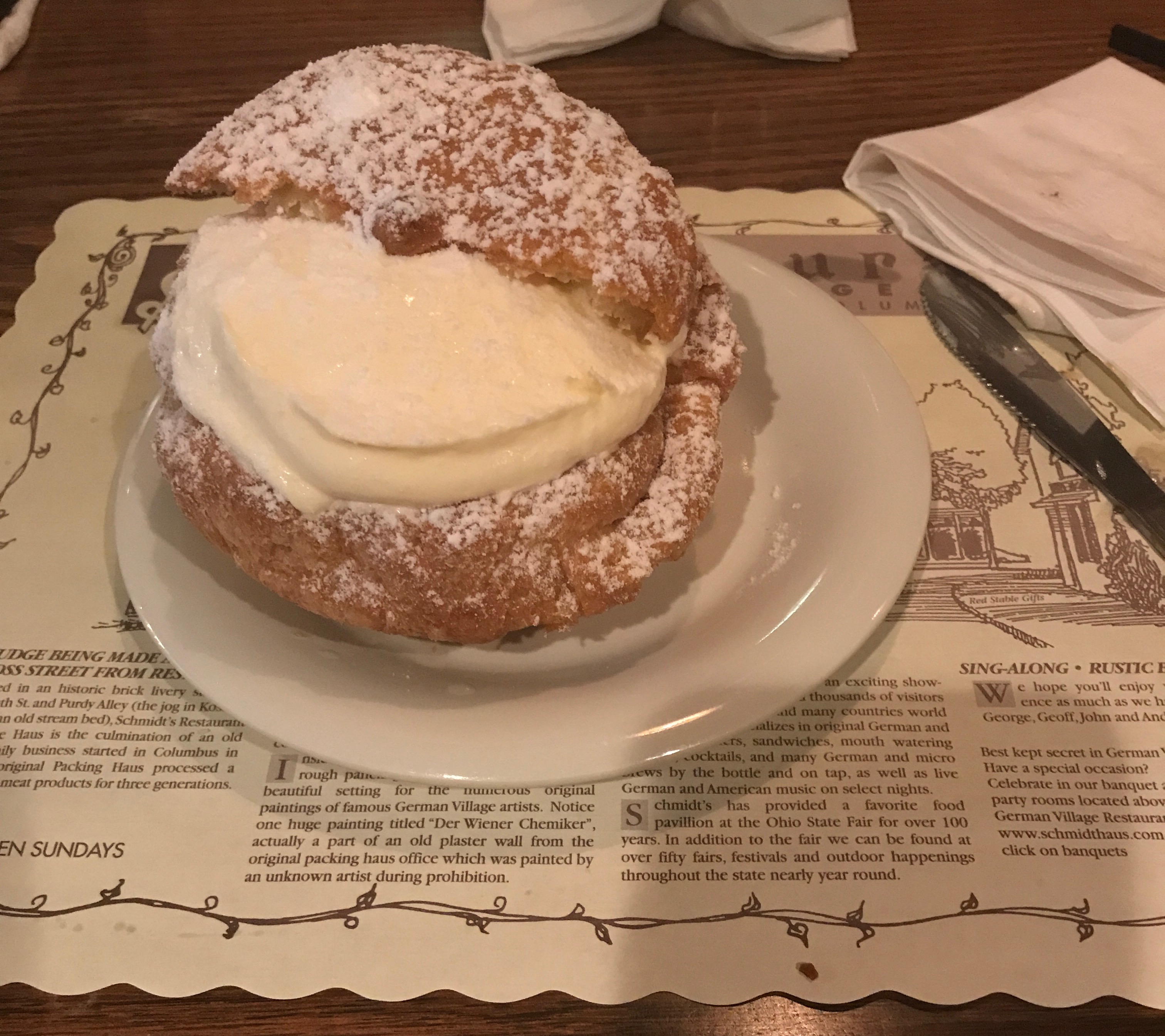
I had to order the Jumbo Cream Puff that people had also urged me to sample. This is how the restaurant’s menu describes it:
“Our famous half pound, award-winning combination of special whipped filling in a lightly baked pastry shell.”
It was enormous! (I didn’t finish the, either.)
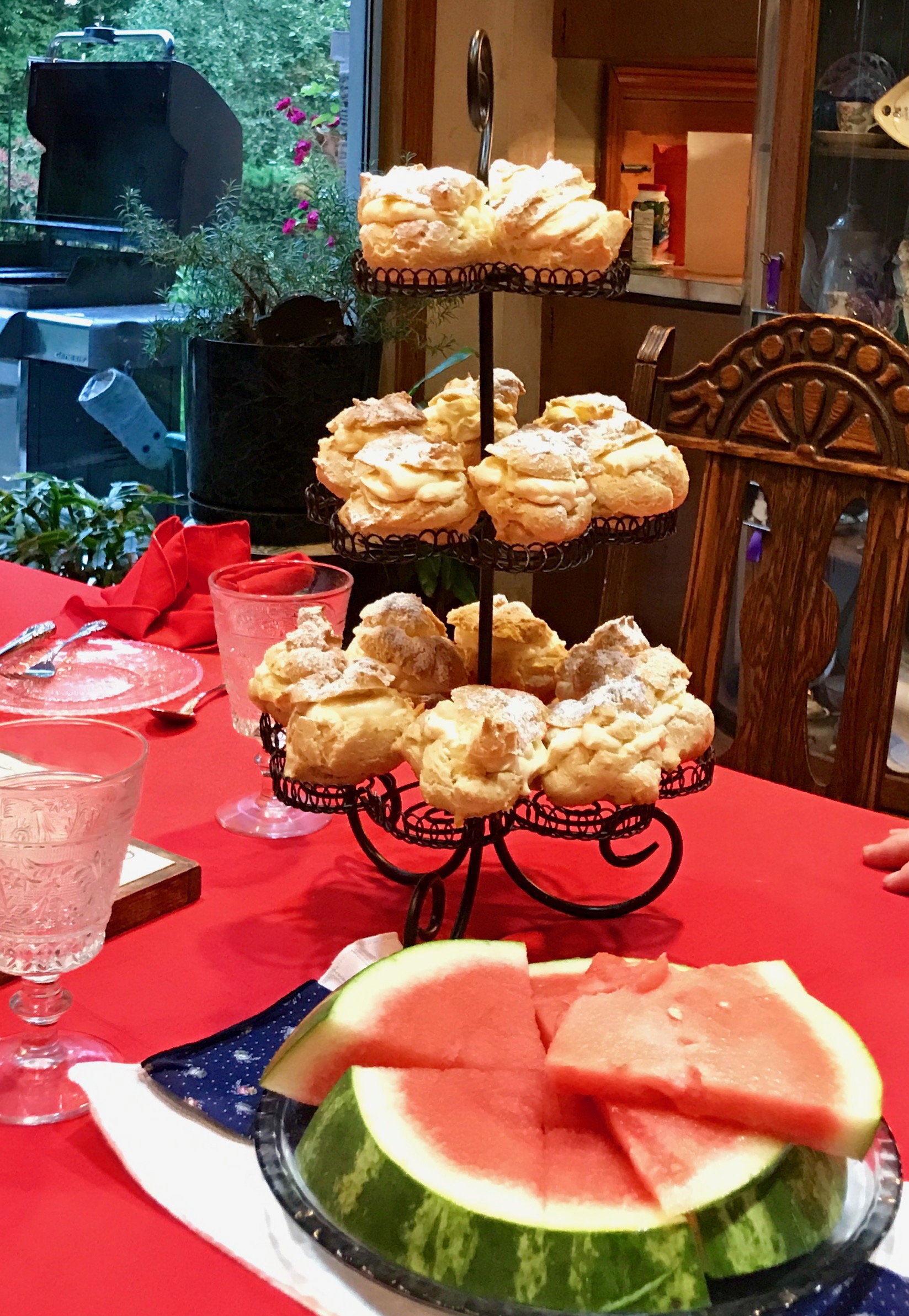
Truth be told, I much prefer my friend Ruth’s cream puffs. They are not a half pound, but, man, are they delicious!
With that it was time to head back to wherever I had parked for the weekend. Time for laundry, rest and preparing for the coming week.
As I mentioned in my last post, the weekend was here and I was spending it with friends.
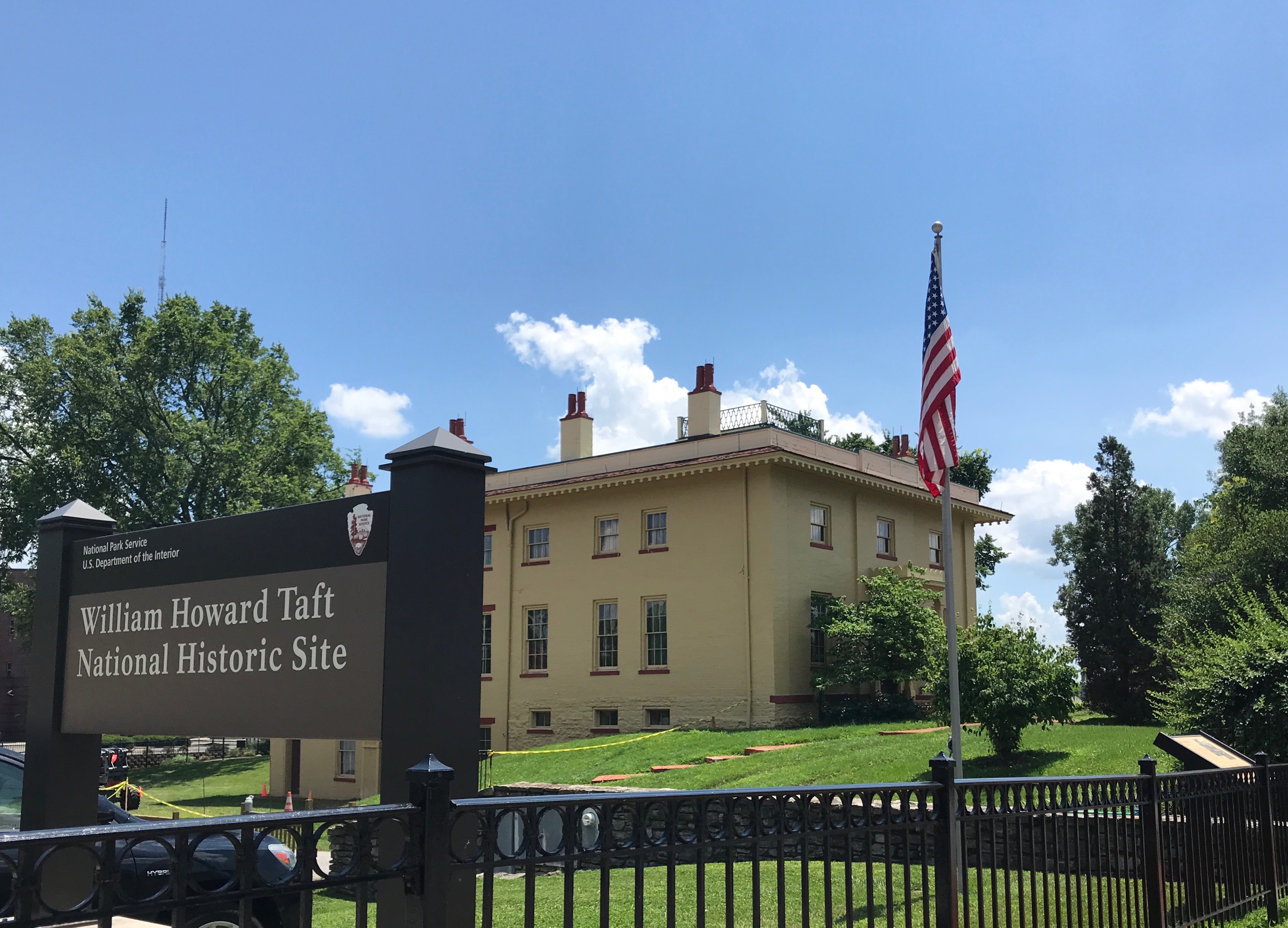
There’s nothing better than time spent with old friends! We did a lot of hanging out and chilling. Even though it was the Fourth of July weekend, DC had some work obligations, but Ron and I played tourist a bit.
It was a laid back weekend, but Ron and I managed to find something of historic significance to do.
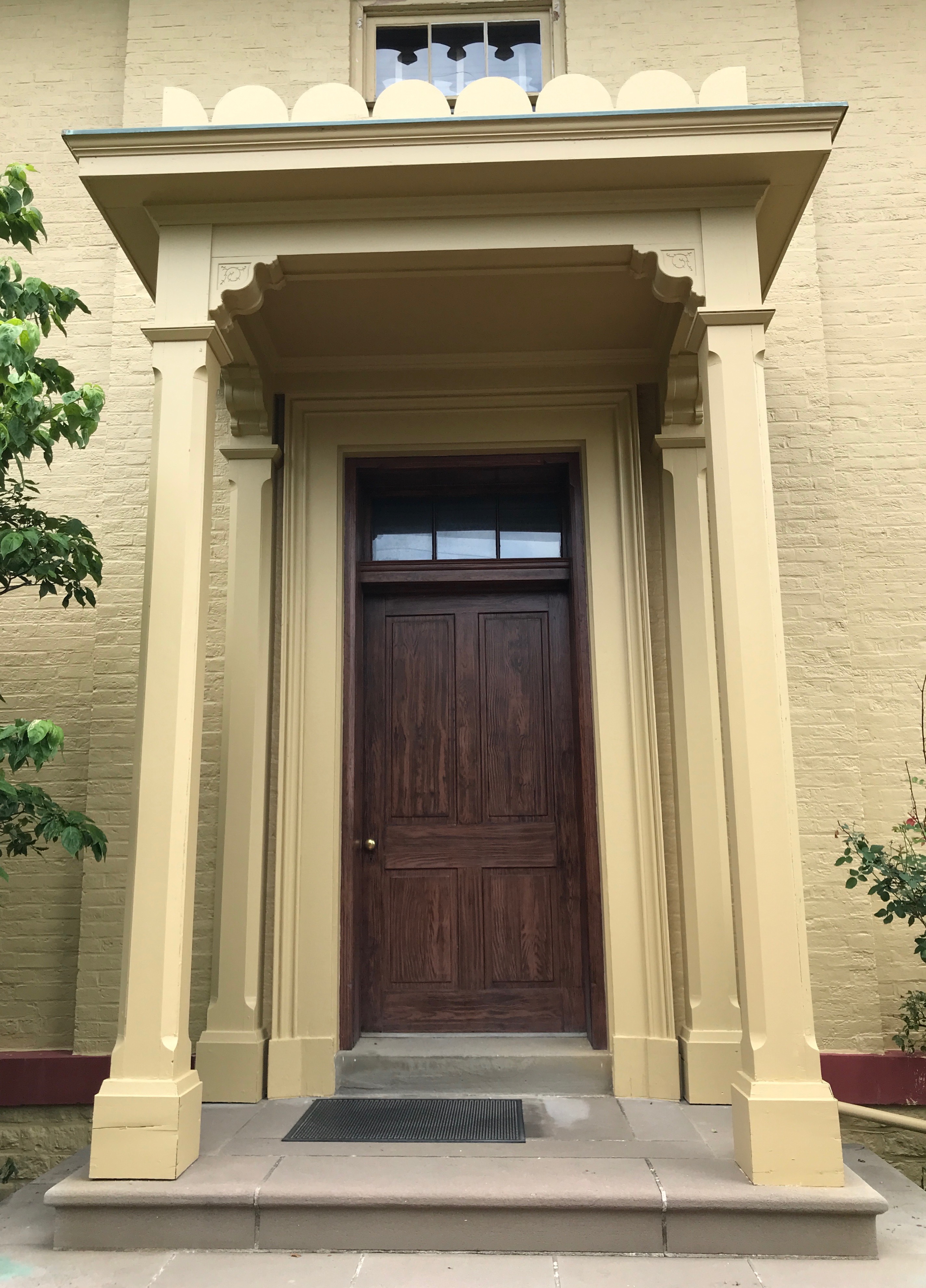
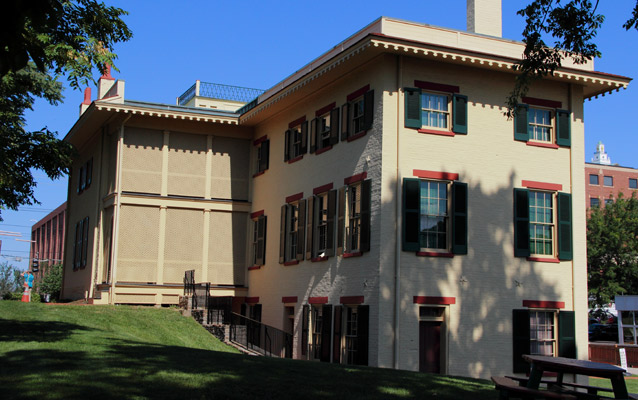
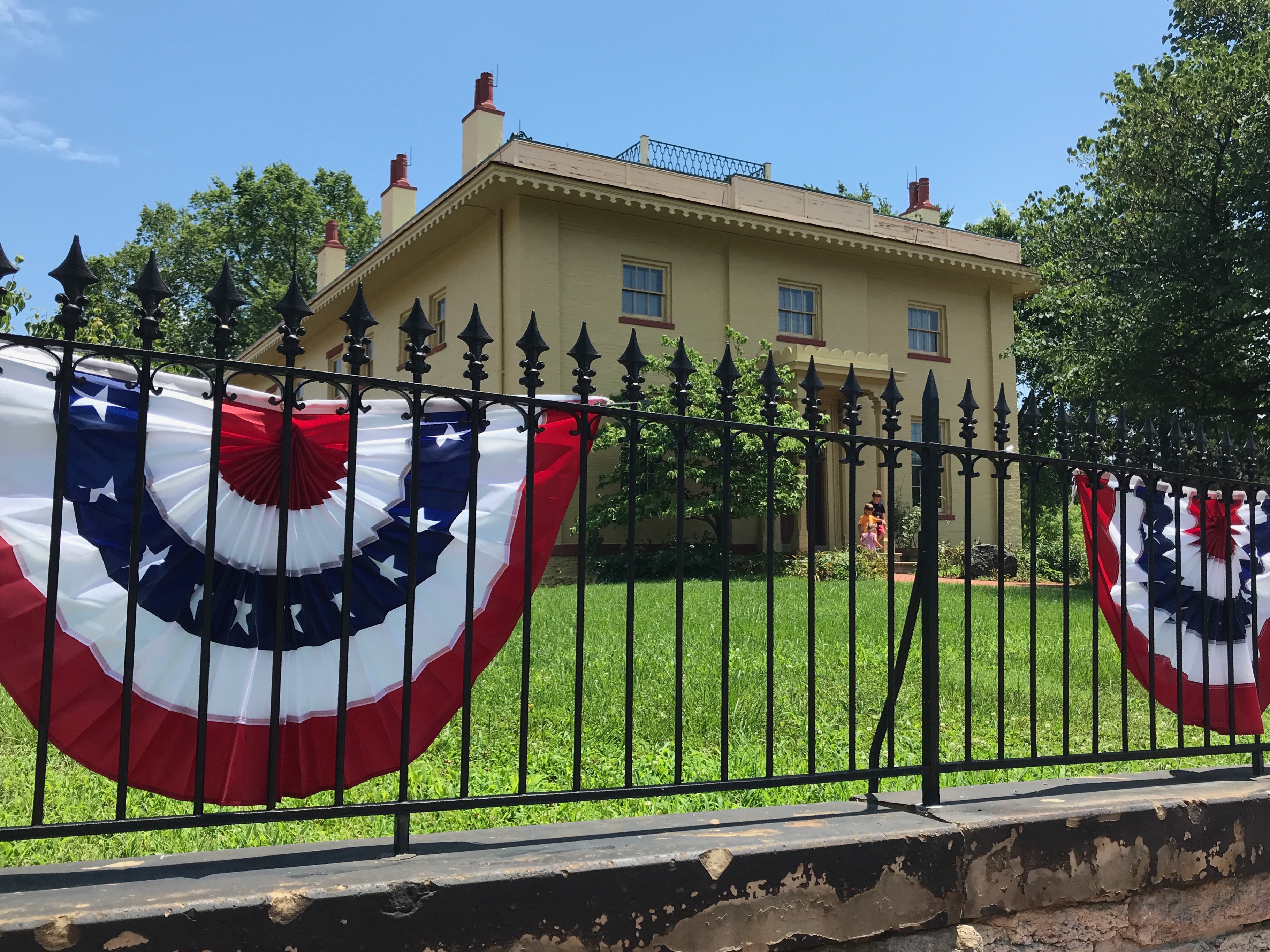
He was born in this Greek revival house on September 15, 1857, high atop one of Cincinnati’s most prominent hilltops. His father, Alphonso Taft, was a U.S. Attorney General and Secretary of War, so he had quite the role model. He attended Yale, like his father, and was also a member of Skull and Bones, like dear ol’ dad.
The house was built in 1840, and Alphonso bought it for his growing family in 1851. He added an addition on to the original structure. William and his six siblings must have been a lively bunch. He lived here until he went to Yale in 1874. The Taft family lived in the house until 1889, when Alphonso and his wife moved to San Diego due to his failing health. Alphonso died in 1891, but it stayed in the Taft family until 1899 when his widow was finally able to sell the house.
Interestingly, my Preferred Source says that the Taft family was not wealthy. This house is described as a “modest” home in the suburb of Mount Auburn. His father, in addition to being part of President Ulysses S. Grant’s cabinet, was also a judge and an ambassador.
Personally, I would consider the family to be fairly well-heeled.
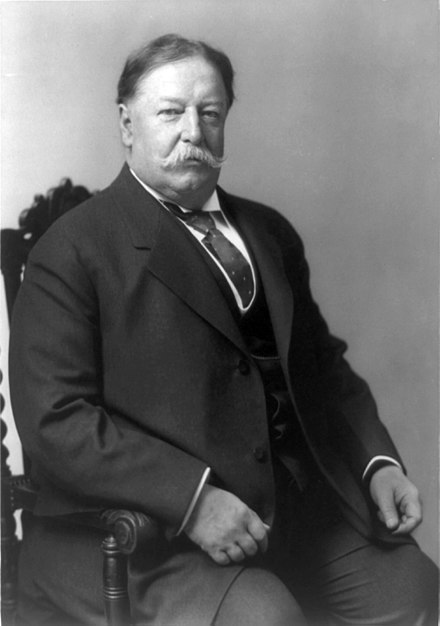
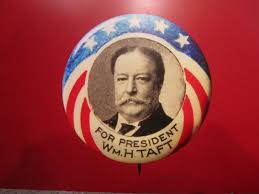
I have included this photo of President Taft, just in case you couldn’t remember what he looked like.
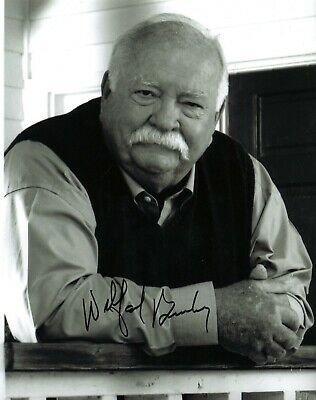
I do believe Wilford Brimley could have played him in a biopic, though.
Since I couldn’t remember anything much about Taft, I had to look up some information about him. He had quite the career.
When he passed the bar, he served as a lawyer and assistant prosecutor of Hamilton County, where Cincinnati is located. President Chester A. Arthur appointed him Collector of Internal Revenue for Ohio’s first district, but quit because he refused to fire competent employees who were politically out of favor.
His next big job was as judge on the Superior Court of Cincinnati.
Taft’s major professional goal was a seat on the Supreme Court of the United States. Ohio Governor Foraker suggested that President Harrison appoint Taft to fill a vacant seat. In 1889 Harrison appointed him, but not to the Supreme Court. He was appointed Solicitor General of the United States and removed to Washington.
In 1891, Taft was appointed as a judge to the Sixth Circuit, which was based in Cincinnati. These appointments are for life, just like the appointments to the Supreme Court. Somewhere along the way, he became dean and Professor of Property at his alma mater, the Cincinnati Law School. I wonder if this was considered to be moonlighting?
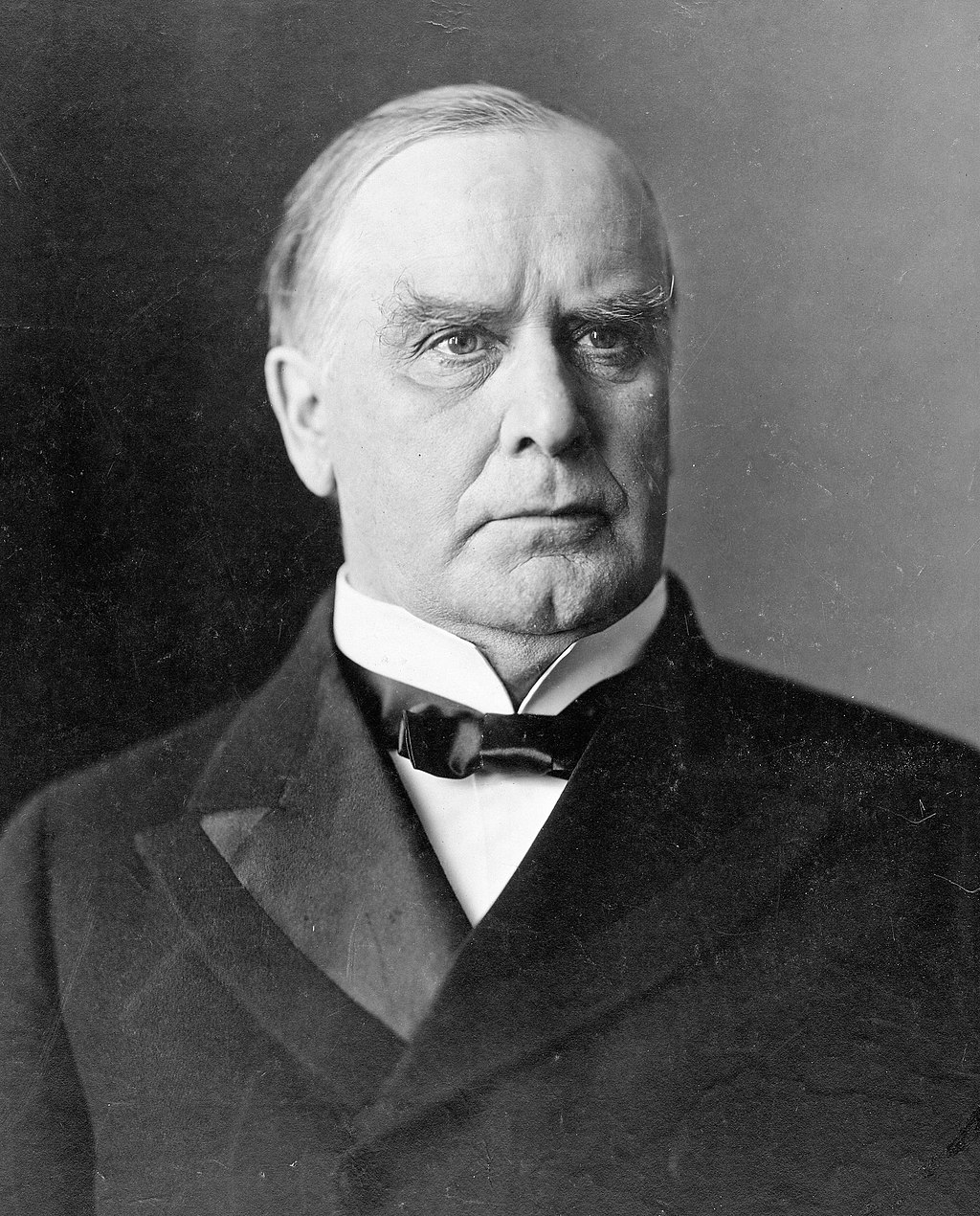
Ohio Governor William McKinley was elected president in 1896.
In 1898, a place on the Supreme Court opened. I imagine that Taft must have thought he had a good shot at the seat, as they were both from Ohio, but McKinley appointed Joseph McKenna.
In 1900, McKinley summoned Taft to Washington. Taft again hoped that a Supreme Court appointment was in the works. Instead, McKinley placed Taft on a commission to organize a civilian government in the Philippines. The appointment would require that Taft resign from the bench, but the president assured him that if he fulfilled this task, McKinley would appoint him to the next vacancy on the high court.
Unfortunately for Taft, McKinley only had one vacancy on the Supreme Court during his term. His presidency was cut short by Leon Czolgosz, who shot him at point blank range at the Pan-American Exposition in Buffalo in 1901.
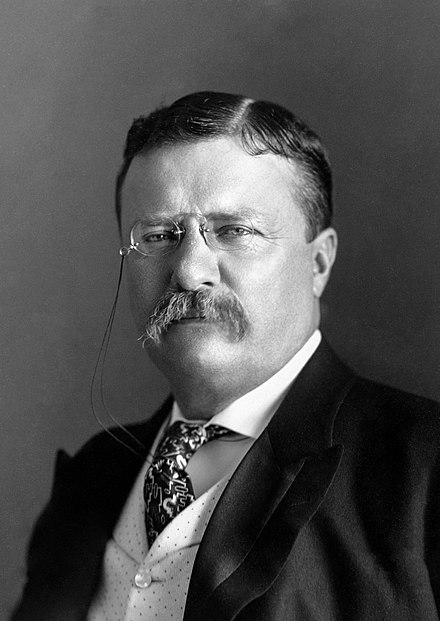
Theodore Roosevelt became president.
Hmm…Perhaps a young Wilford Brimley?
In late 1902, Taft heard from Roosevelt that a seat on the Supreme court would soon fall vacant. Roosevelt wanted Taft to fill it. Even though this was Taft’s lifelong professional goal, he refused the nomination, as he felt that his work in the Philippines was not yet complete. In 1904, Roosevelt asked him to become Secretary of War. As the War Department administered the Philippines, Taft would remain responsible for the islands.
After consulting with his family, Taft agreed and sailed for the United States in December 1903.
Personally, I imagine that his family started packing before the words were out of his mouth. The climate there is characterized by relatively high temperatures, oppressive humidity and plenty of rainfall. Remember that this was before the invention of air conditioning.
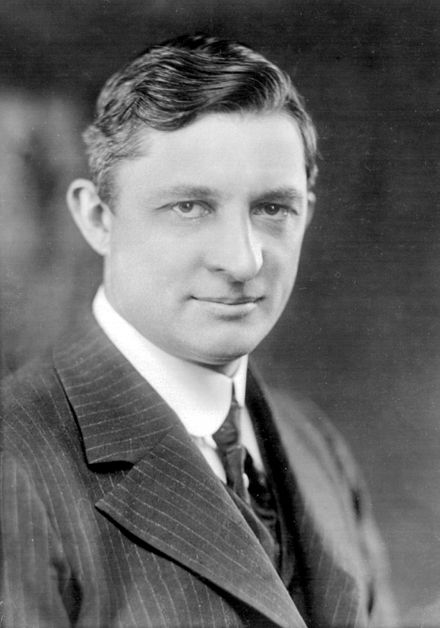
Willis Carrier, Buffalo boy made good, submitted drawings for what became recognized as the world/s first modern air conditioning system. That didn’t happen until 1902, and it was developed for a factory, not for home use.
Roosevelt completed three years of McKinley’s term and won election in his own right in 1904. On the night of his election, he pledged not to run for re-election in 1908. Although Roosevelt came to regret his promise, he stuck by his word. Taft was elected in 1908.
Taft was president from 1909 – 1913. Things happened. There are far too many to recount here. If you are interested in learning more, my Preferred Source is a good place to start.
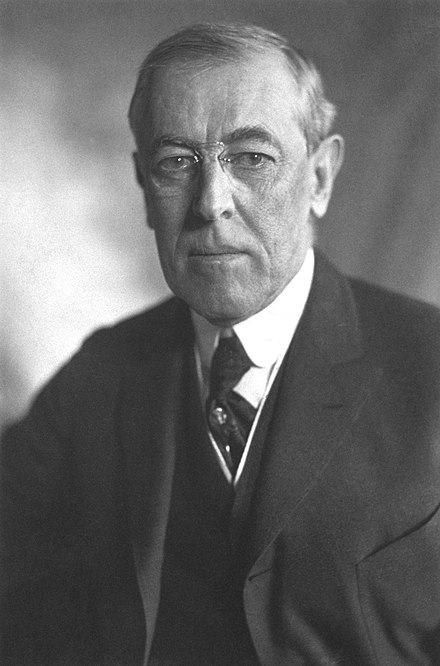
in 1913, Woodrow Wilson became the 28th president of the United States.
After leaving office, Taft was faced with a dilemma. At 56, with no pension or other compensation to expect from the government, he had to figure out how to support himself. The Former Presidents Act, which provides lifetime benefits to presidents who were not removed from office, wasn’t passed until 1958.
He considered returning to the practice of law. However, since he had appointed many federal judges, including a majority of the Supreme Court, this would raise questions of conflict of interest at every federal court appearance. His problem was solved when Yale invited him to be the Kent Professor of Law and Legal History. He also earned money with paid speeches and articles for magazines, and ended his eight years out of office having increased his savings.
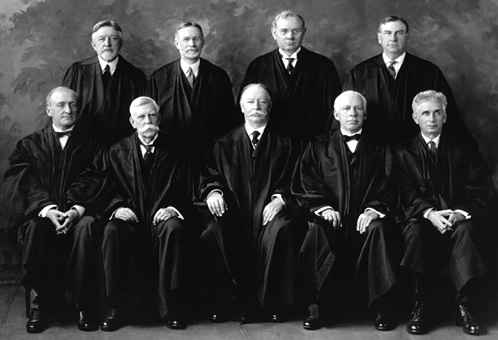
In 1921, Taft finally achieved his lifelong career goal. Warren G. Harding appointed him as chief justice.
Taft’s health declined during the time he was Chief Justice. He died in his home in Washington D.C. on March 8, 1930.
His birthplace was established as a national historic site in 1969 when President Richard Nixon signed the legislation authorizing the William Howard Taft National Historic Site.
My route took me near Charleston. Since Charleston is the capital of West Virginia, I figured it was worth taking a quick trip to see the capitol. (See what I did there? Capital is the city, capitol is the building. If I keep repeating these two words, I may one day remember the distinctions.)
I had seen it many times, as I would drive south over the years. That golden dome is really eye-catching.
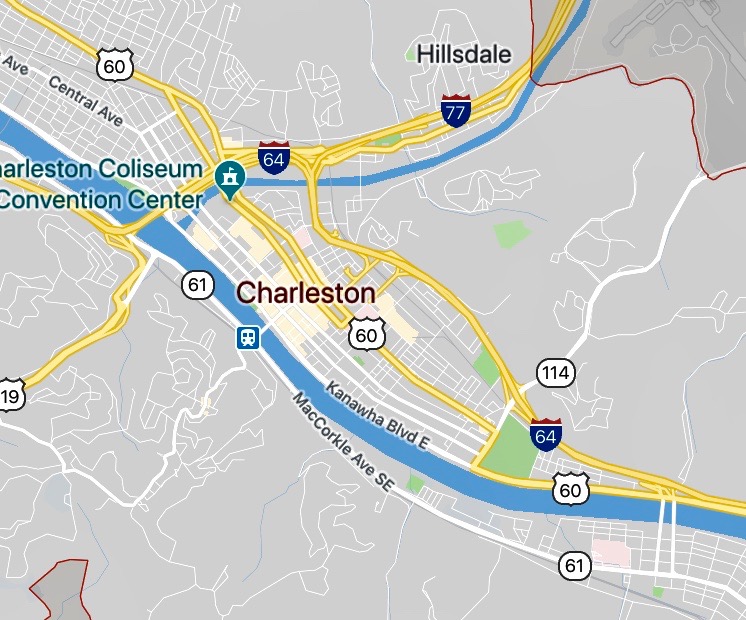
And, it had a great riverside location. The capitol is on the Kanawha River in the green area right by the I-64 symbol. And, no wonder the dome was so remarkable. The gold-leafed dome is larger than the dome on the United States Capitol!
The state capital moved around between Wheeling and Charleston, Charleston became the capital of West Virginia in 1877.
Interesting facts about West Virginia’s statehood: according to my Preferred Source, it was originally part of Virginia and when Virginia succeeded from the Union during the Civil War, it was occupied by the Union forces. The military units were dispatched from Ohio to western Virginia early in the war to secure access to the coal mines and transportation resources.
It officially became a state by Presidential Proclamation. Abraham Lincoln declared the northwestern portion the northwestern portion of Virginia to be returned to the Union. On June 20, 1863, West Virginia became the 35th state.
From what I could glean from the internet, this capitol is the third building. The first one burned in 1921. A hastily built replacement burned in 1927. Architect Cass Gilbert designed the buff Indiana limestone structure in the Italian Renaissance style. It was completed in 1932.
Cass Gilbert has designed at least three state capitols: West Virginia, Minnesota, and Arkansas. If my loyal readers remember, when I visited Helena, Montana, I found out that he had designed their capitol. They ended up not using his design, so he sold it to Arkansas.
Anyway, I parked and went inside. There was going to be a tour in a bit, so I poked around for a few minutes to see what I could see.
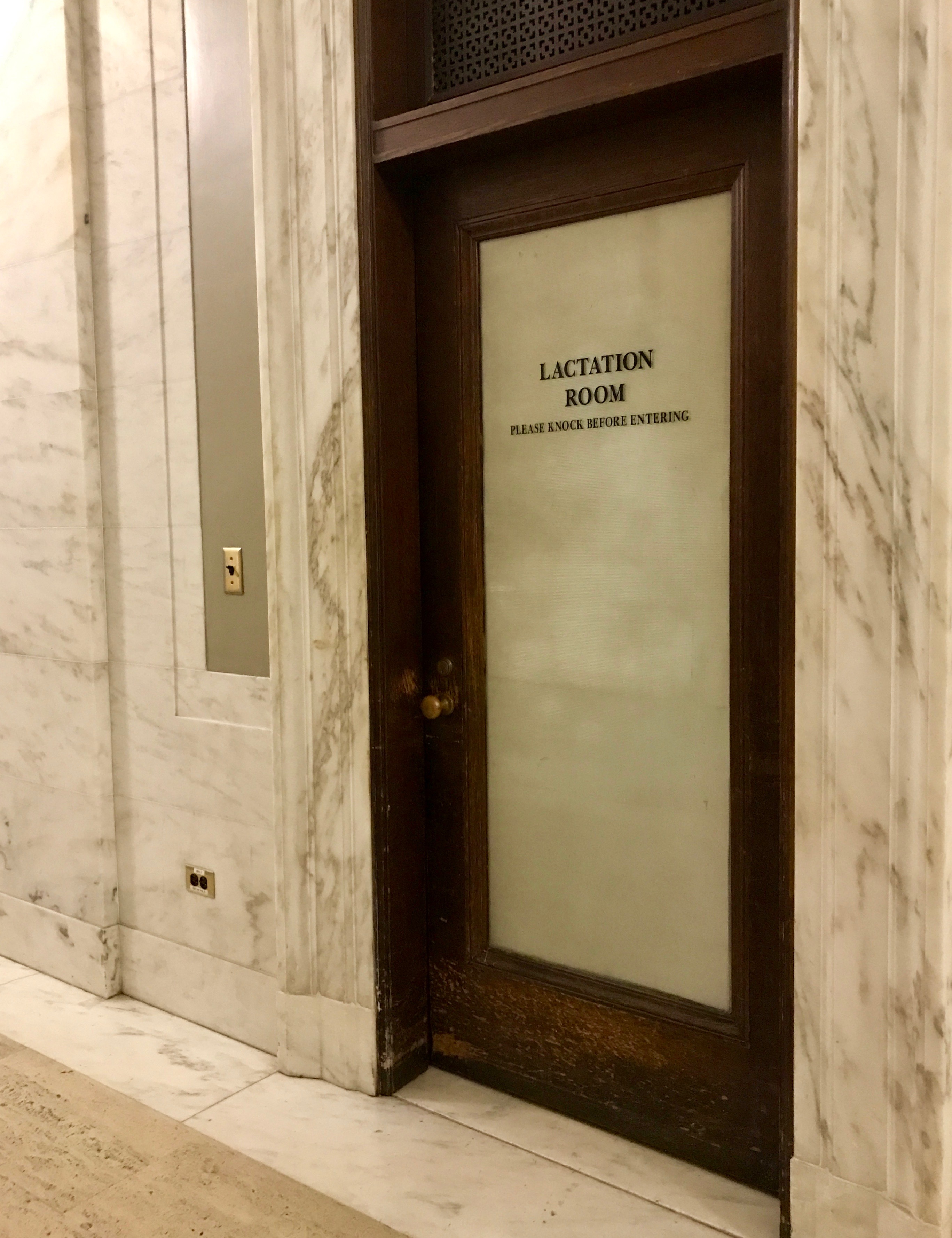
I was impressed that they had a lactation room. Nursing mothers don’t need to hide in the bathroom.
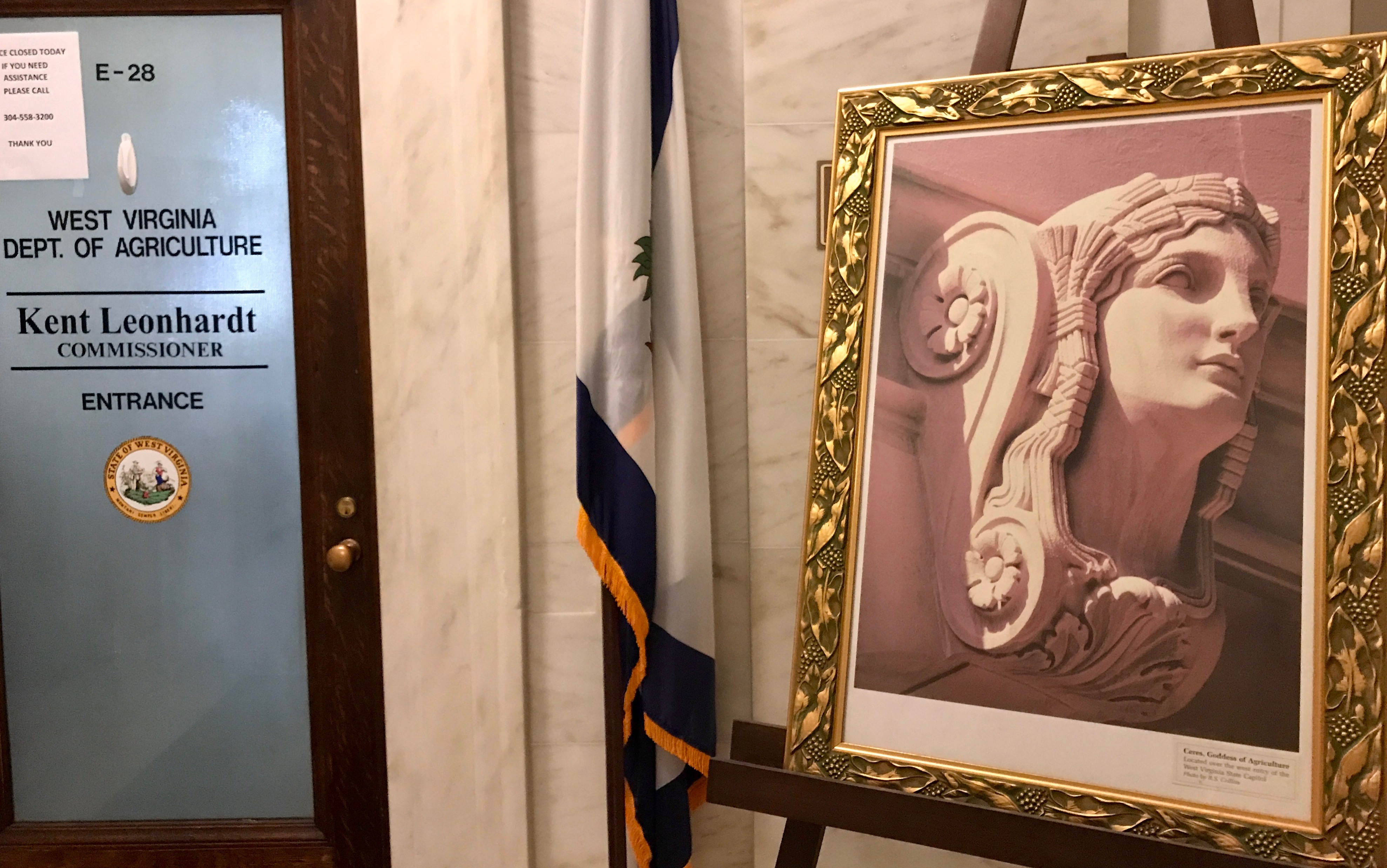
Ceres, the Goddess of Agriculture sits outside the door of the Department of Agriculture. The bust is located over the west entry of the capitol.
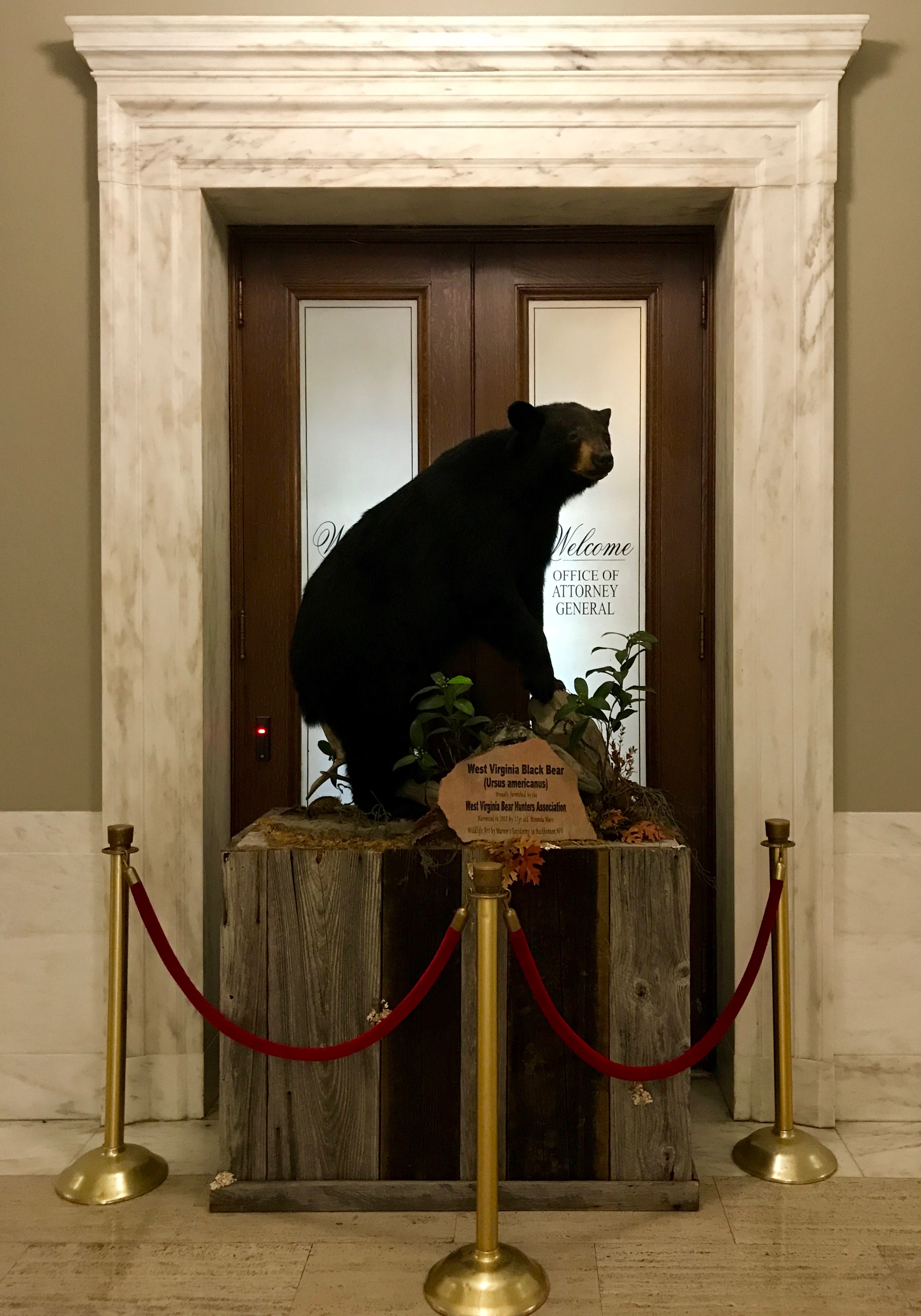
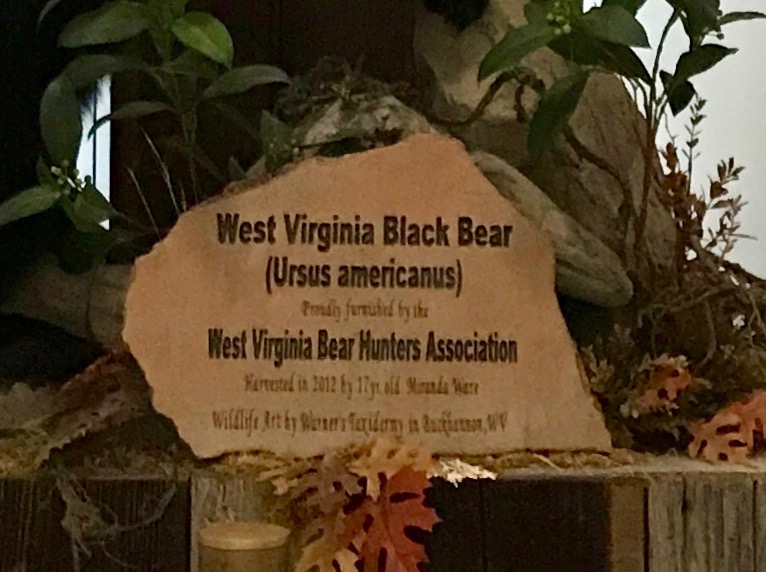
This large bear was guarding the door to the Attorney General’s office. I don’t know that a large black bear in front of the door goes with the sign that says “Welcome to the office of the Attorney General.” The red velvet ropes don’t help, either.
I guess they have associations for everything!
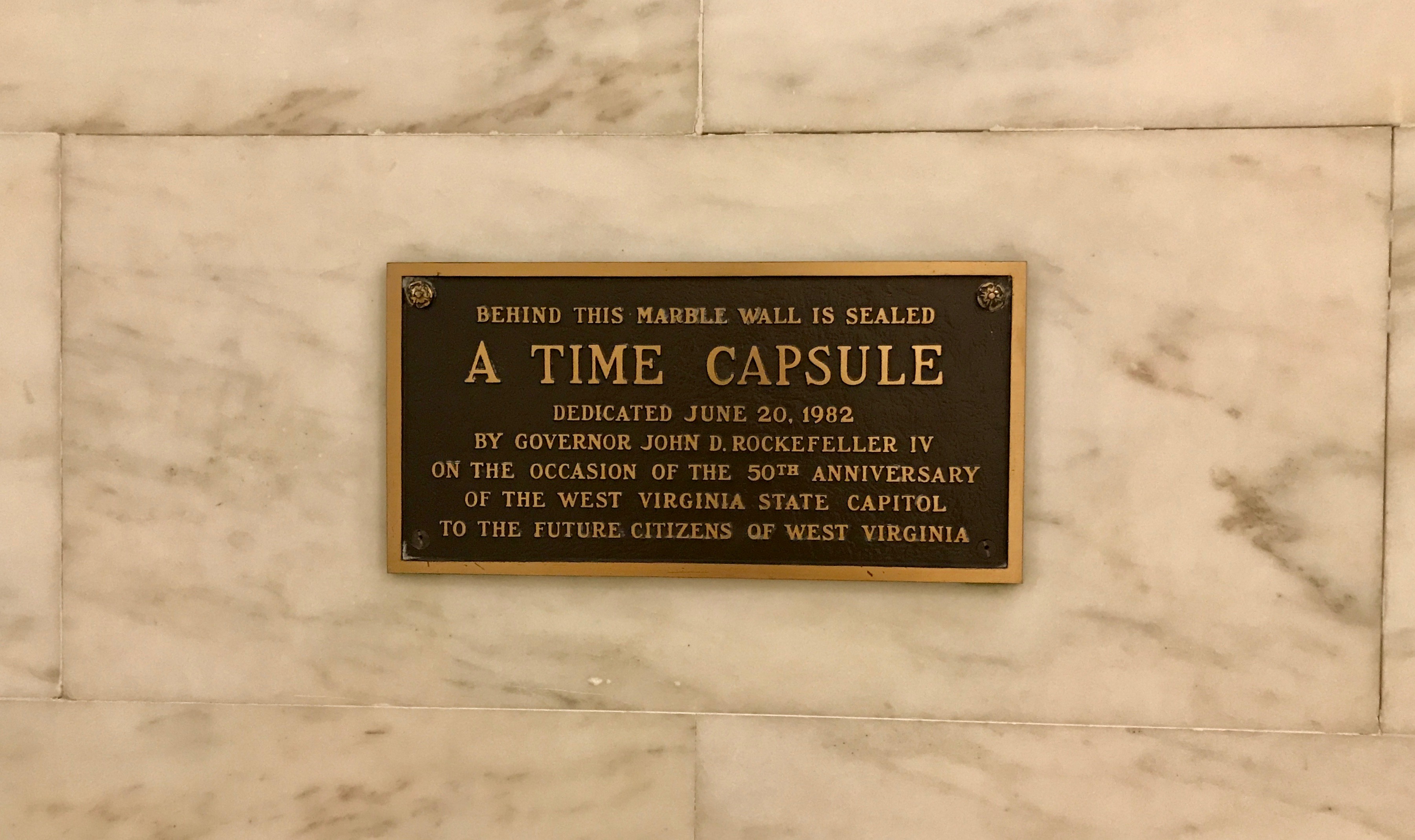
This is an interesting approach to a time capsule. In the first place, it’s in an obvious place that is clearly labeled. In the second place, it looks like they have left the date of its opening to TBD.
The tour finally began, and we walked through the hallowed halls.
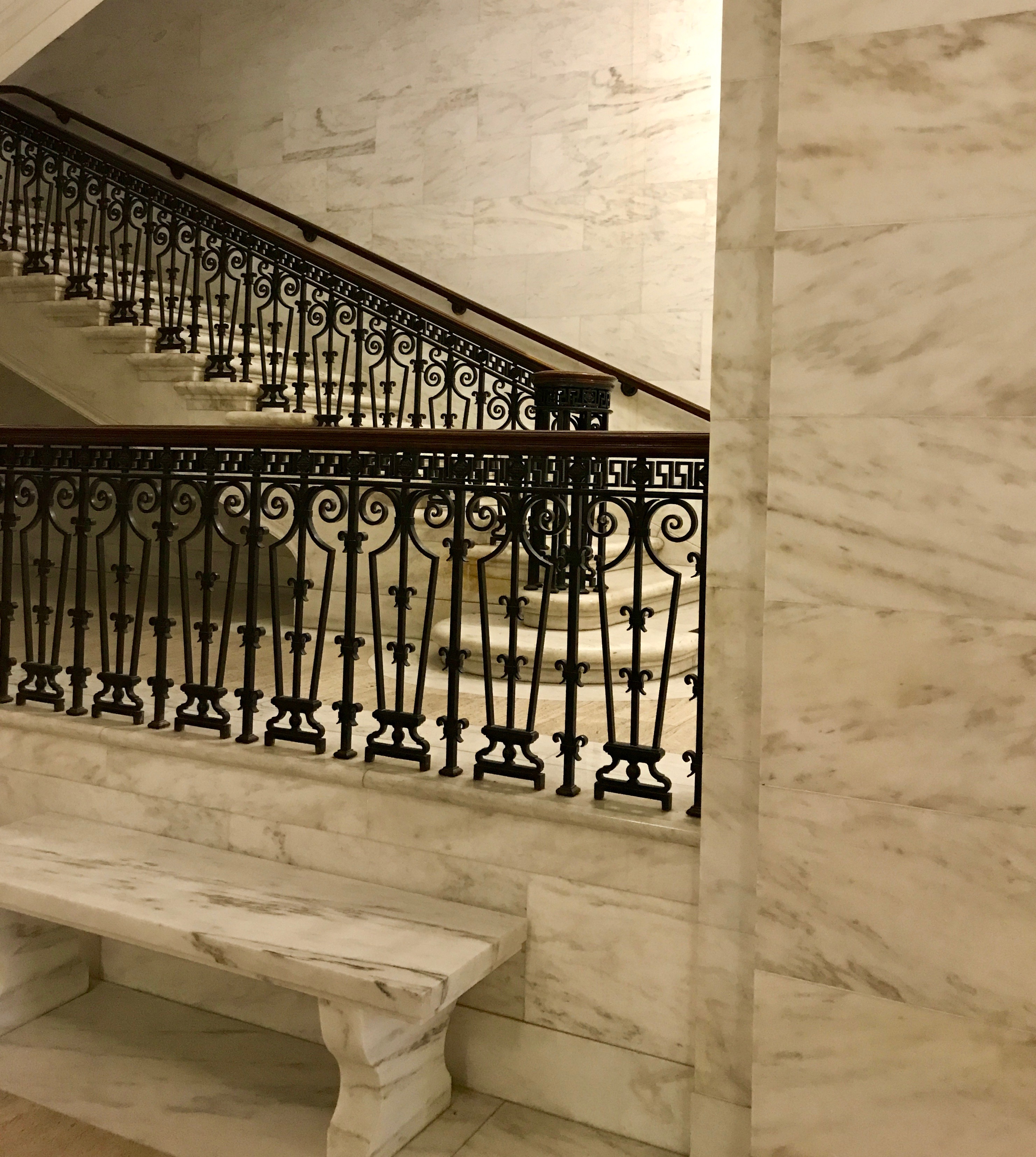
I don’t mean to be pessimistic, but if there is something I would like to see there seems to be at least a 50/50 chance that something will impede the visit. Places are usually closed, but in this case, the building seemed to be undergoing extensive renovations. I must say that they did a marvelous job of enclosing the rotunda area. If you weren’t hoping to gaze up into the dome, you might think it was supposed to look like this.
Dimensions and facts for West Virginia Capitol building[14]
Measurements
Height of dome
292 ft (89.0 m)
Diameter of dome
75 ft (22.9 m)
Floor Space
525,000 sq ft (48,774.1 m2)
Weight of chandelier in dome
4,000 lb (1,810 kg)
Weight of individual bronze doors on each porticoe
2,800 lb (1,270 kg)
Height of eagle on top of dome
5 ft (1.5 m)
I mean, according to this chart of fun facts from my Preferred Source about the capitol, the chandelier in the dome weighs two tons. That must be some lighting fixture!
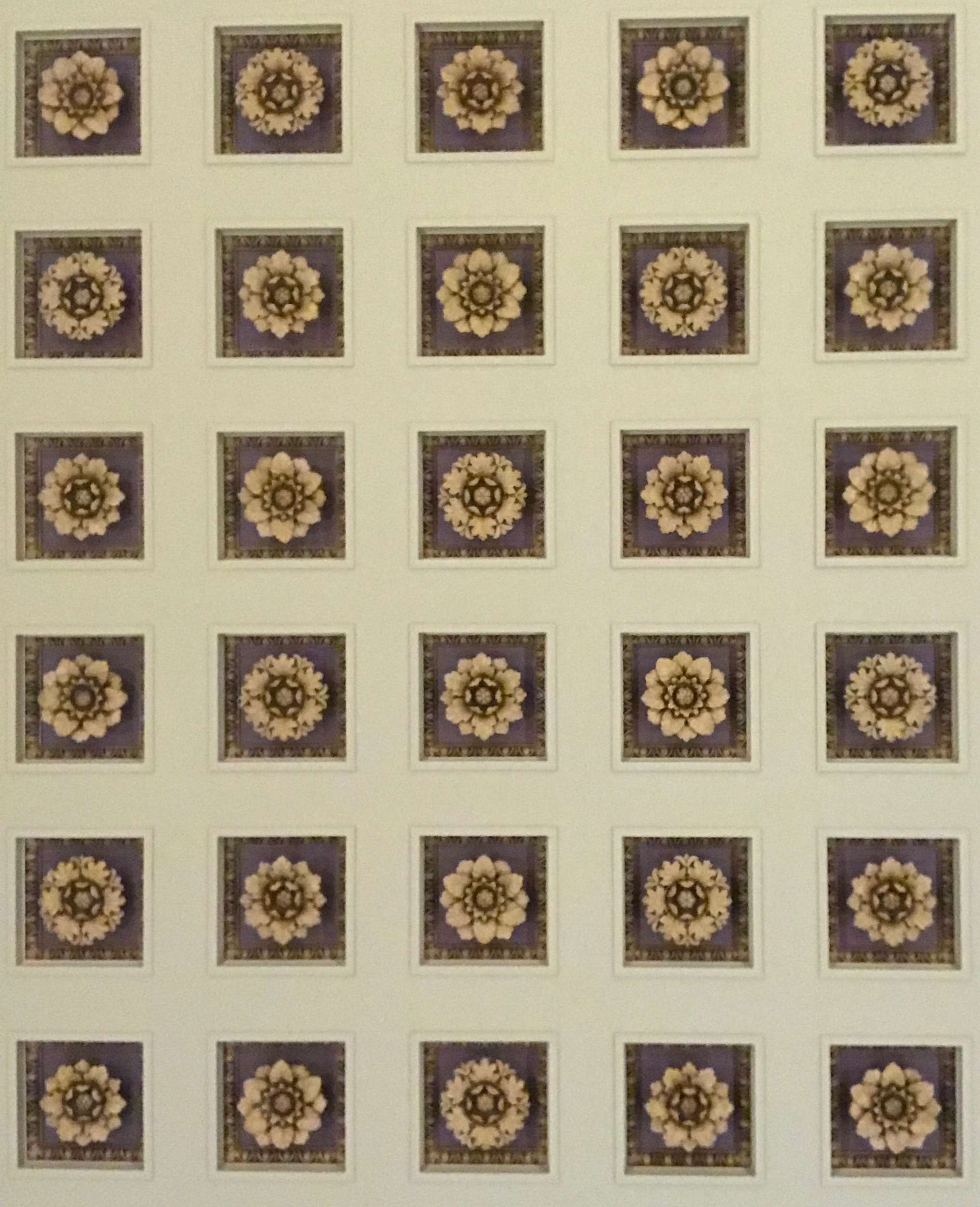
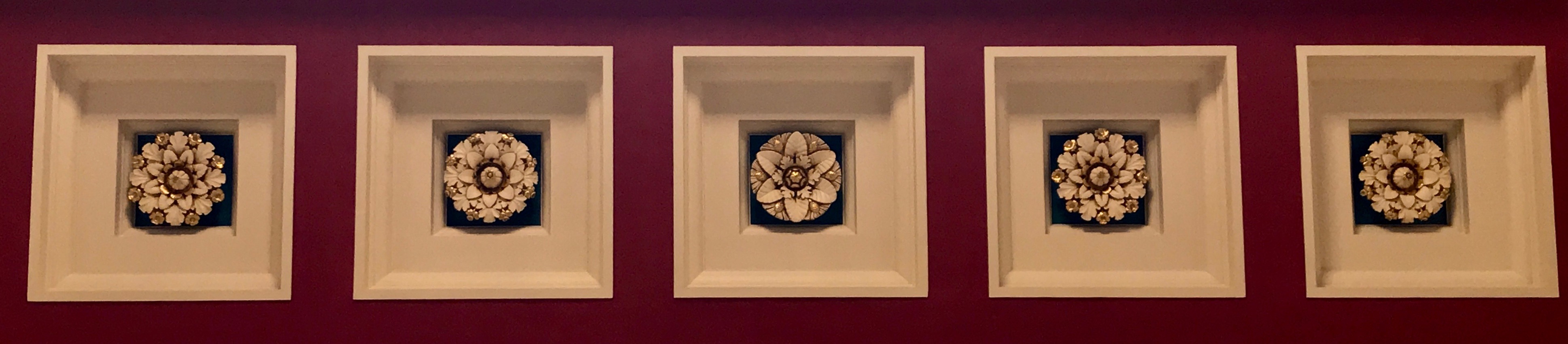
I have seen a good number of state capitols by this point, so I may be wrong on some of the details, but I could swear that these flowers that are used as a repeating motif in the building are stylized renditions of each county’s official flower. However, there is a good chance that I am conflating this capitol with another one.
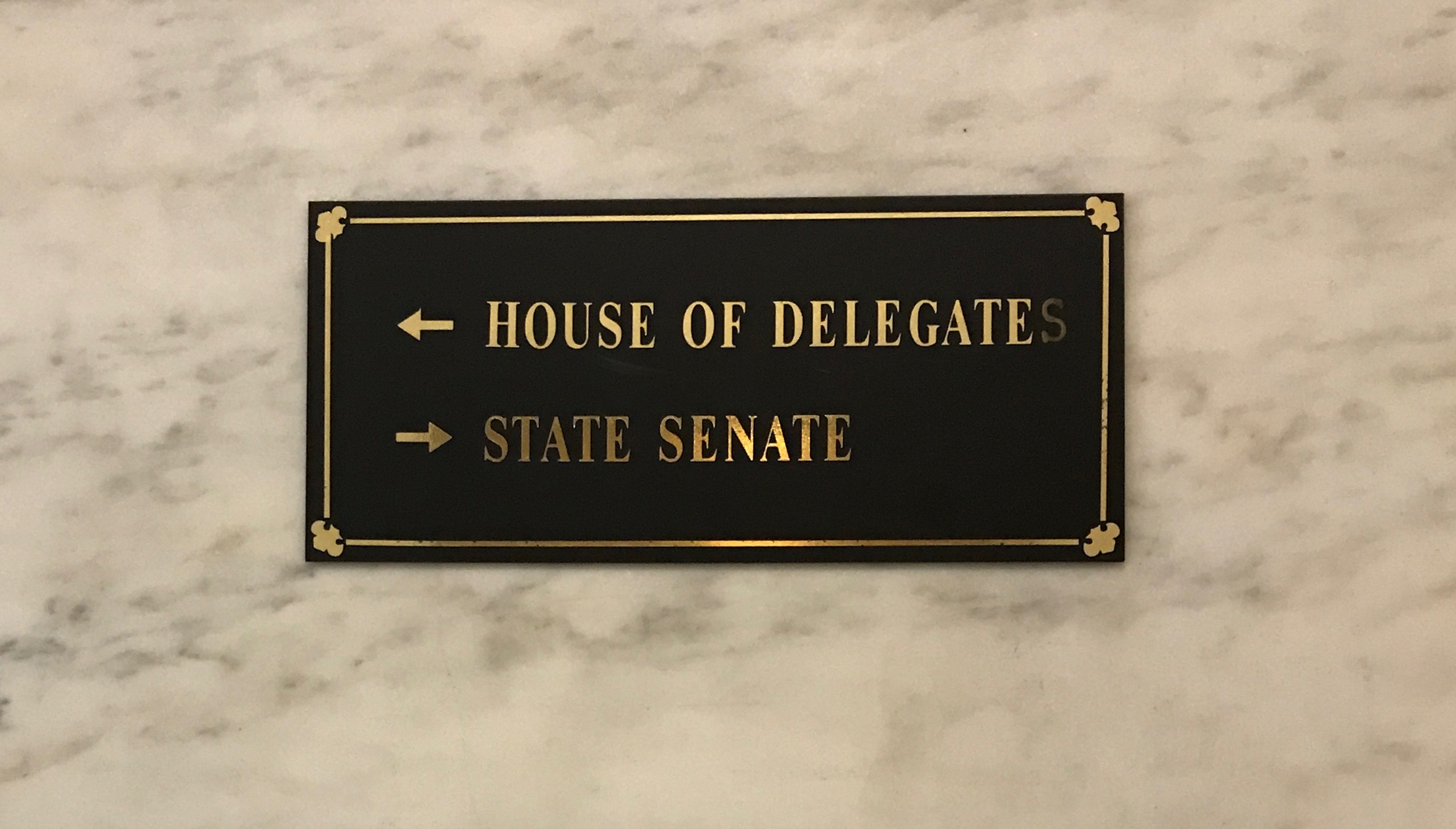
Hmm…which way should we go?
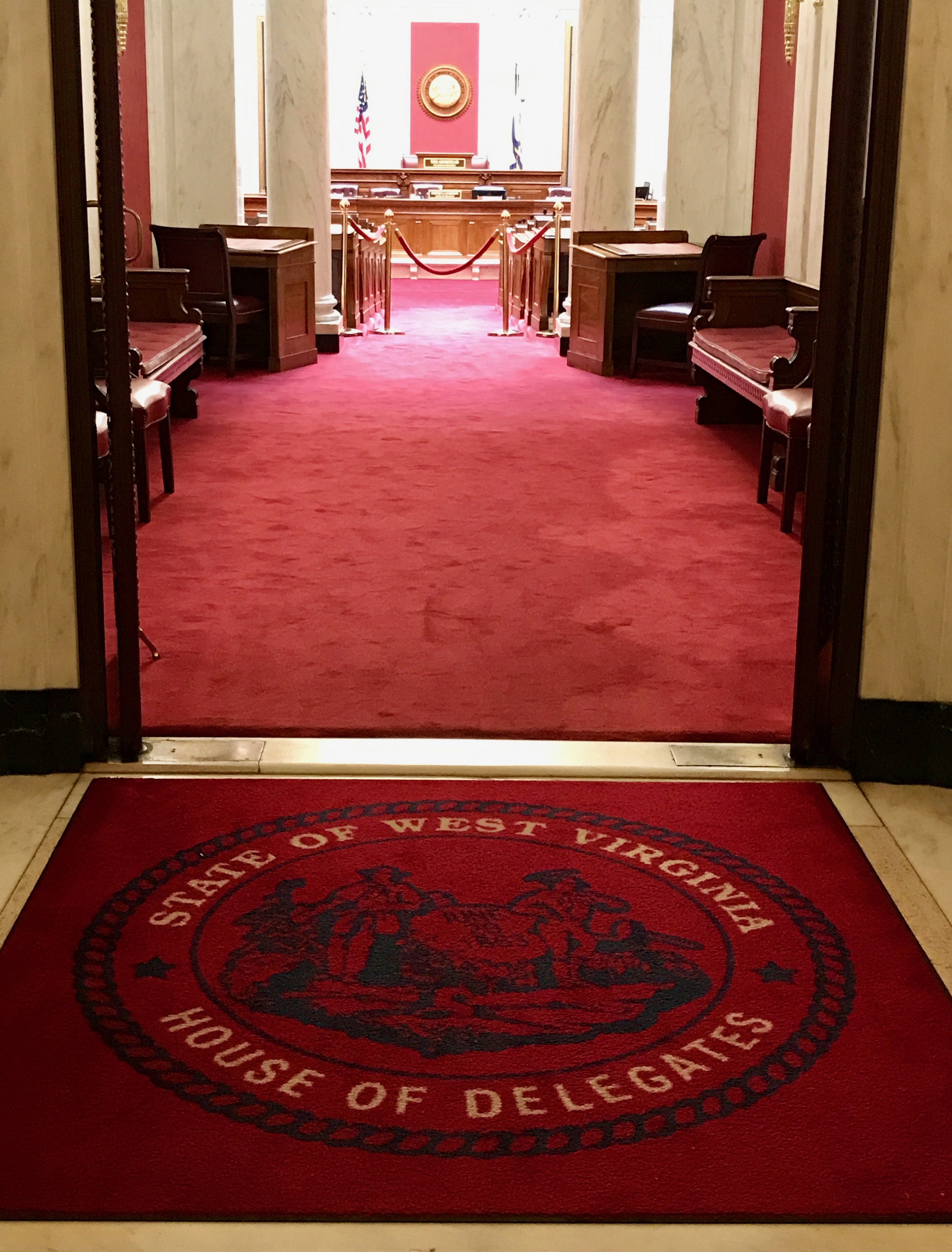
I guess we’ll go to the House of Delegates.
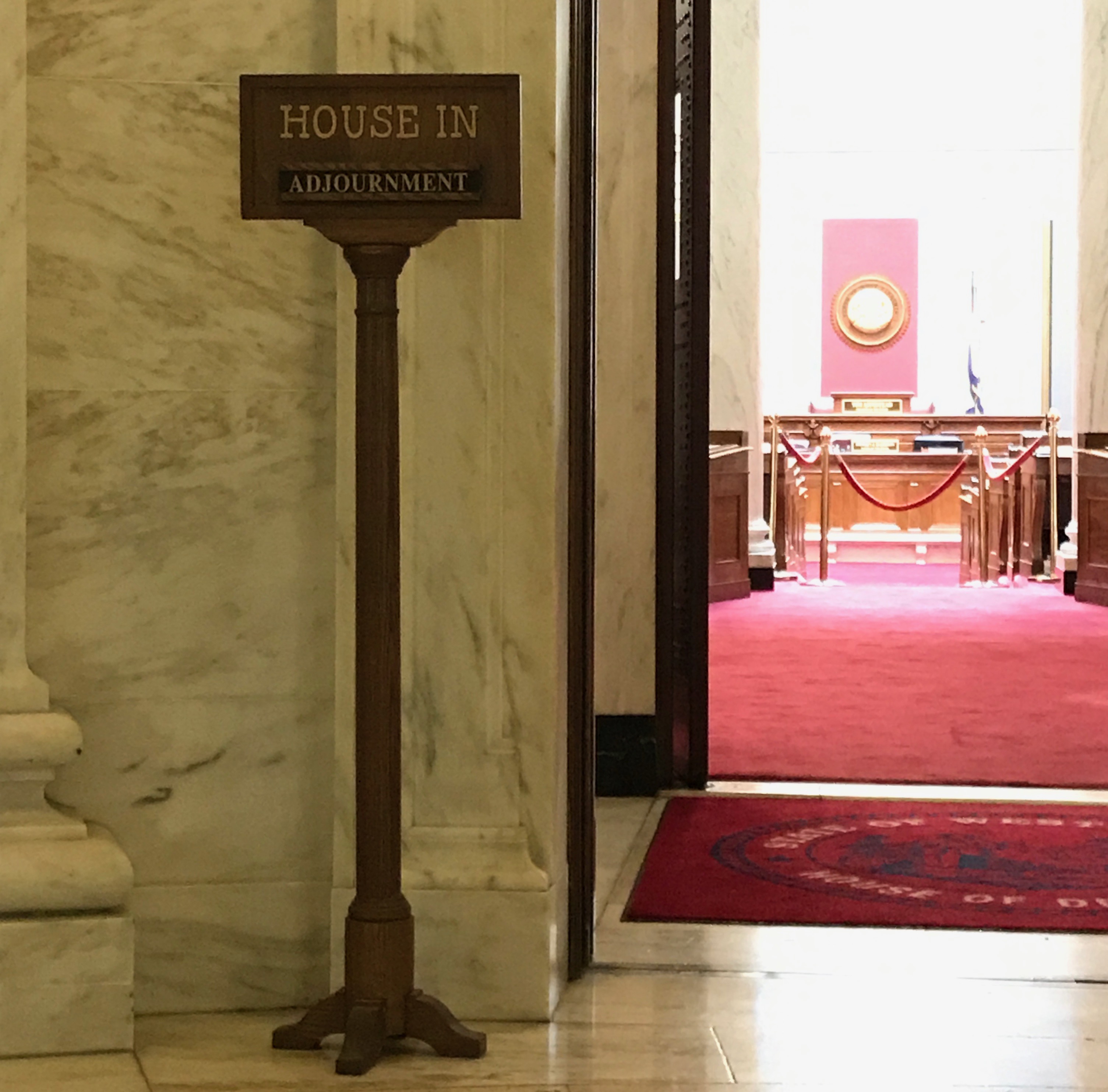
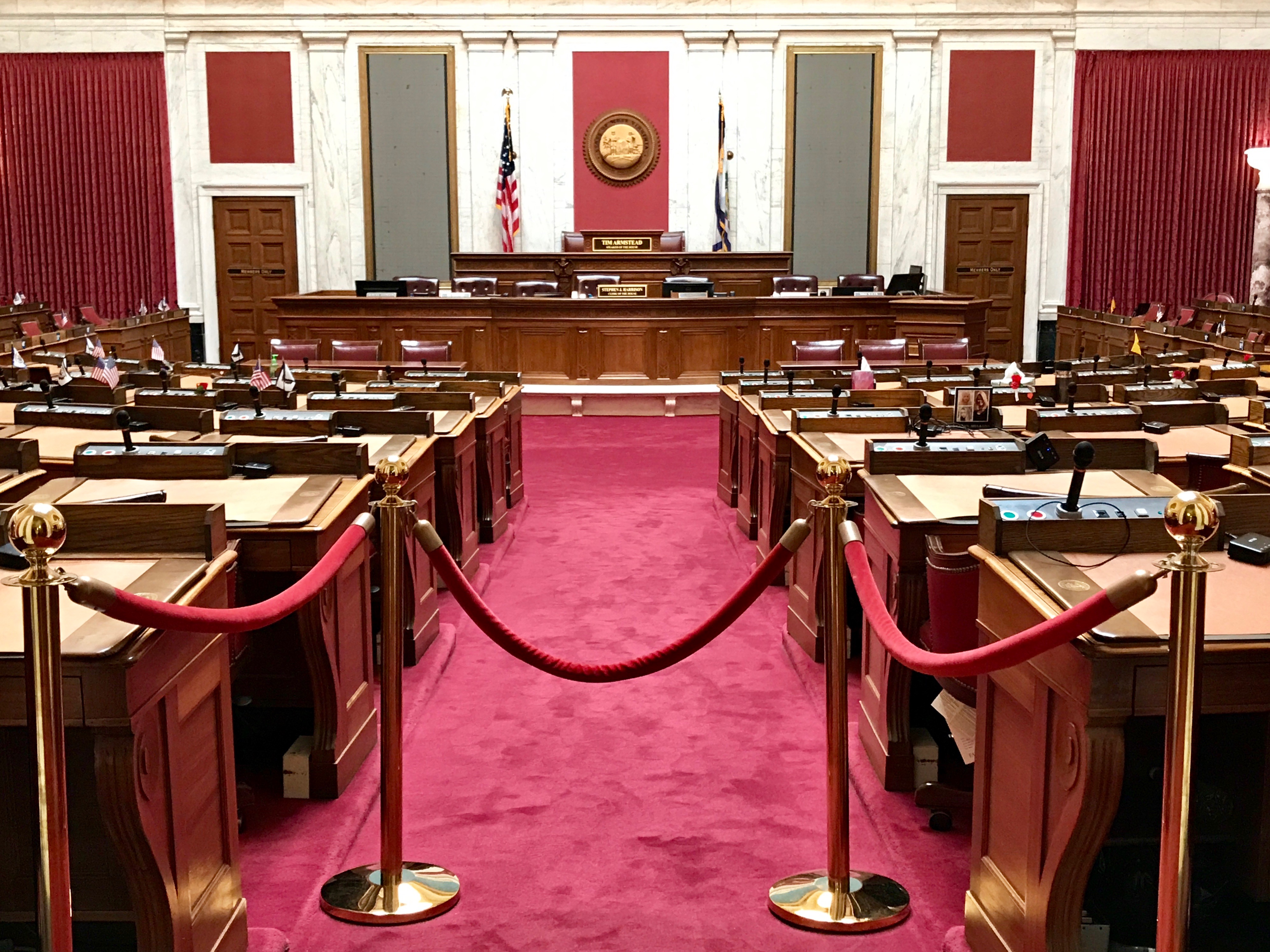
They are in adjournment. I don’t suppose they will mind us peeking in.
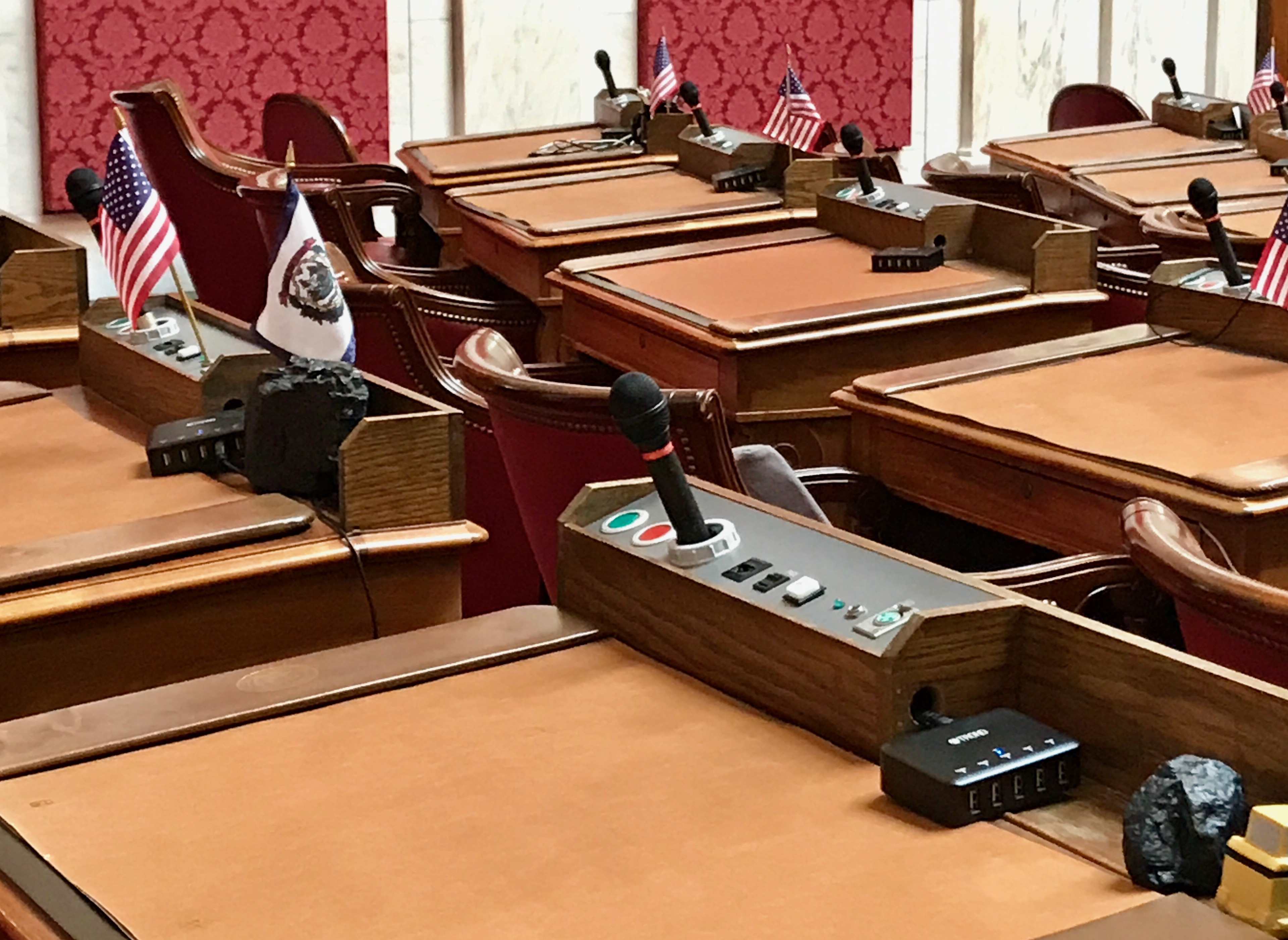
The desks seem rather high tech, as would befit our modern age.
Did you happen to notice the lumps of coal on some of the members’ desks? They need to remember who their sponsors are, I suppose.
Here are some more of those repeated floral motifs.
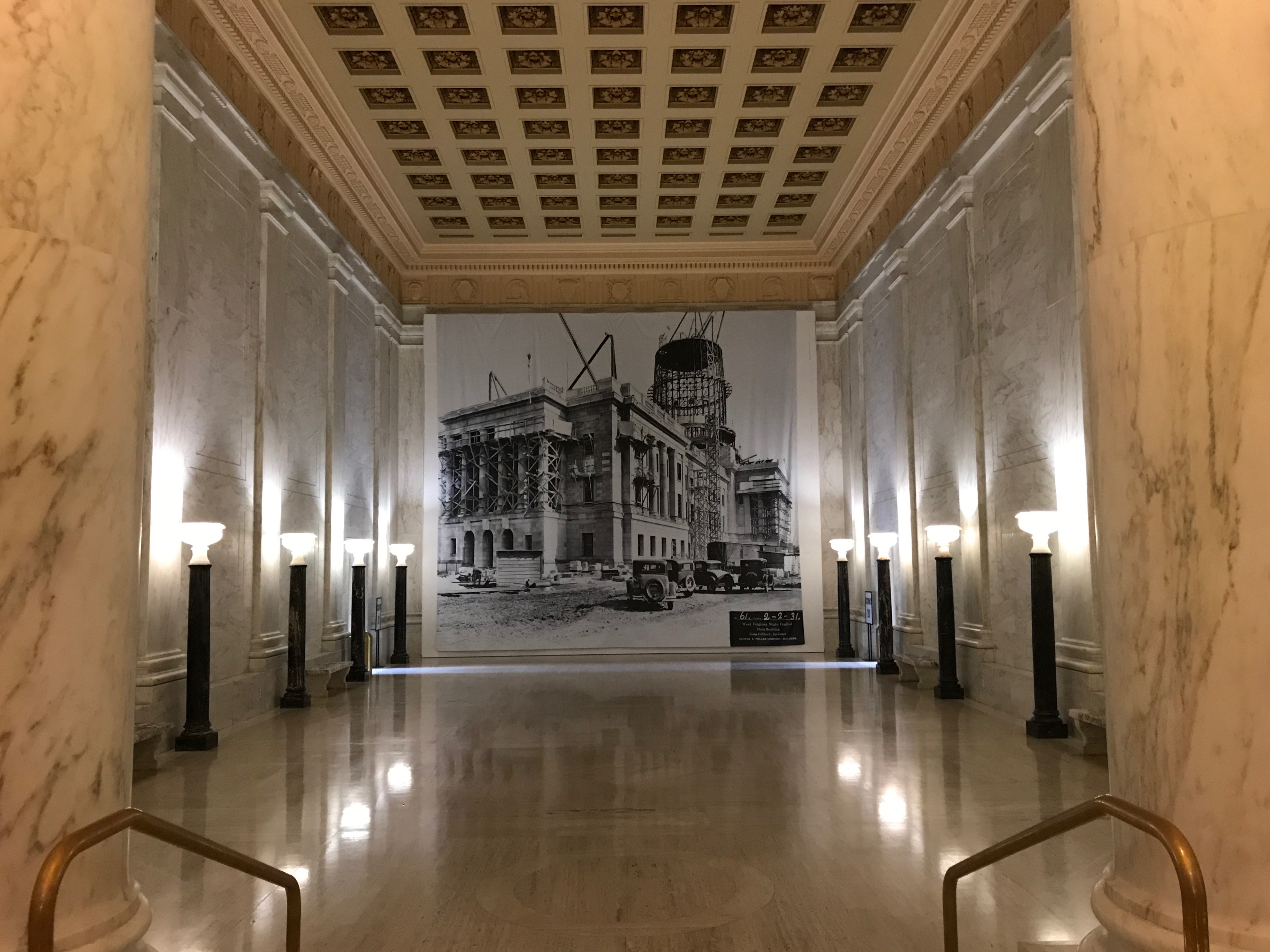
If I ordered my photos correctly when I put them in the folder, this hall or reception area is outside the chamber. That enormous photo isn’t usually there. It is hiding some of the renovation work being done. I am really impressed with the quality of their enclosures.
I mean, this even adds to the experience. This is what is being worked on. From the old vehicles and the date on the photo, you can almost cut them some slack. 80 years later, the building is bound to need some updating.
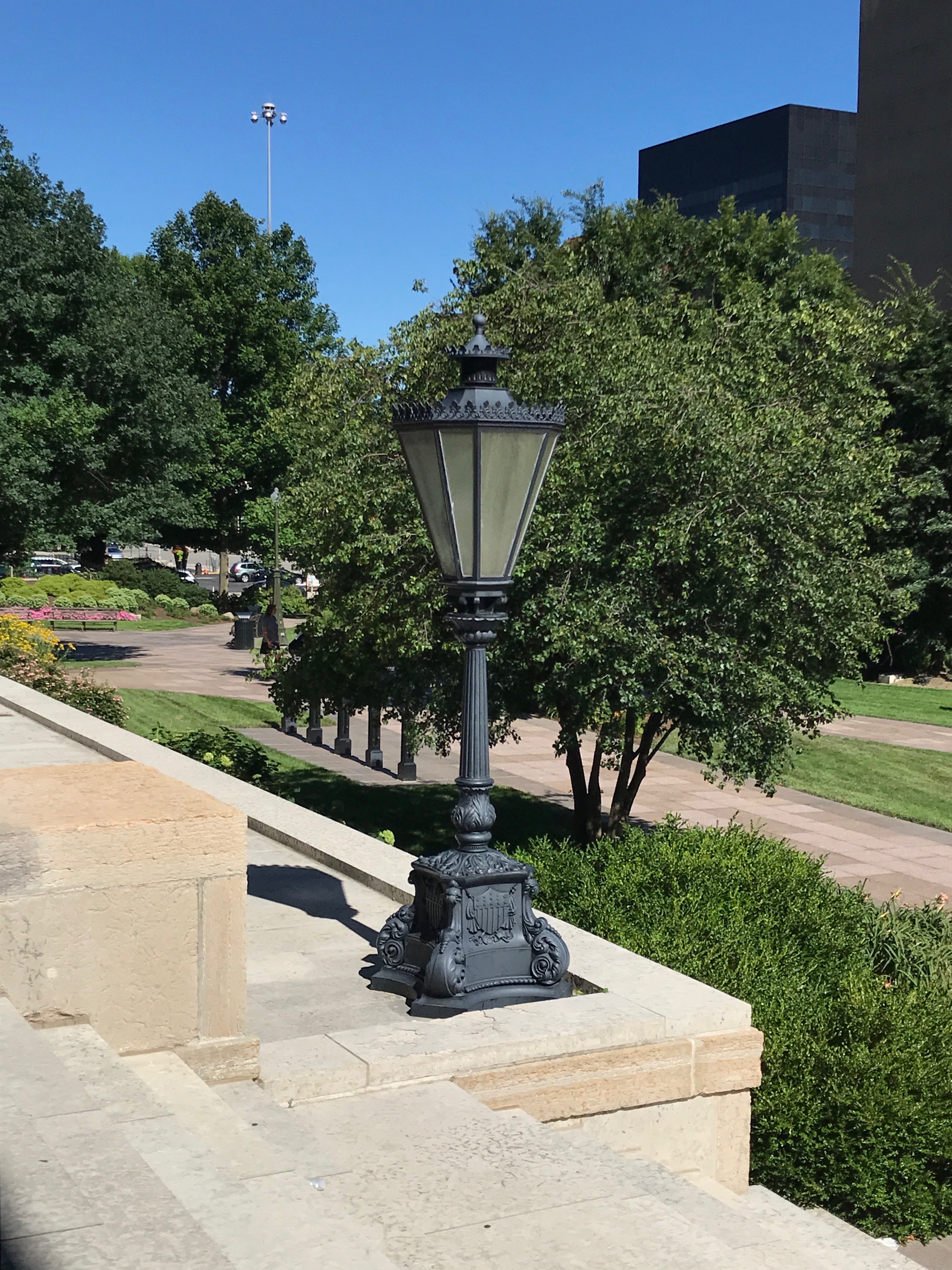
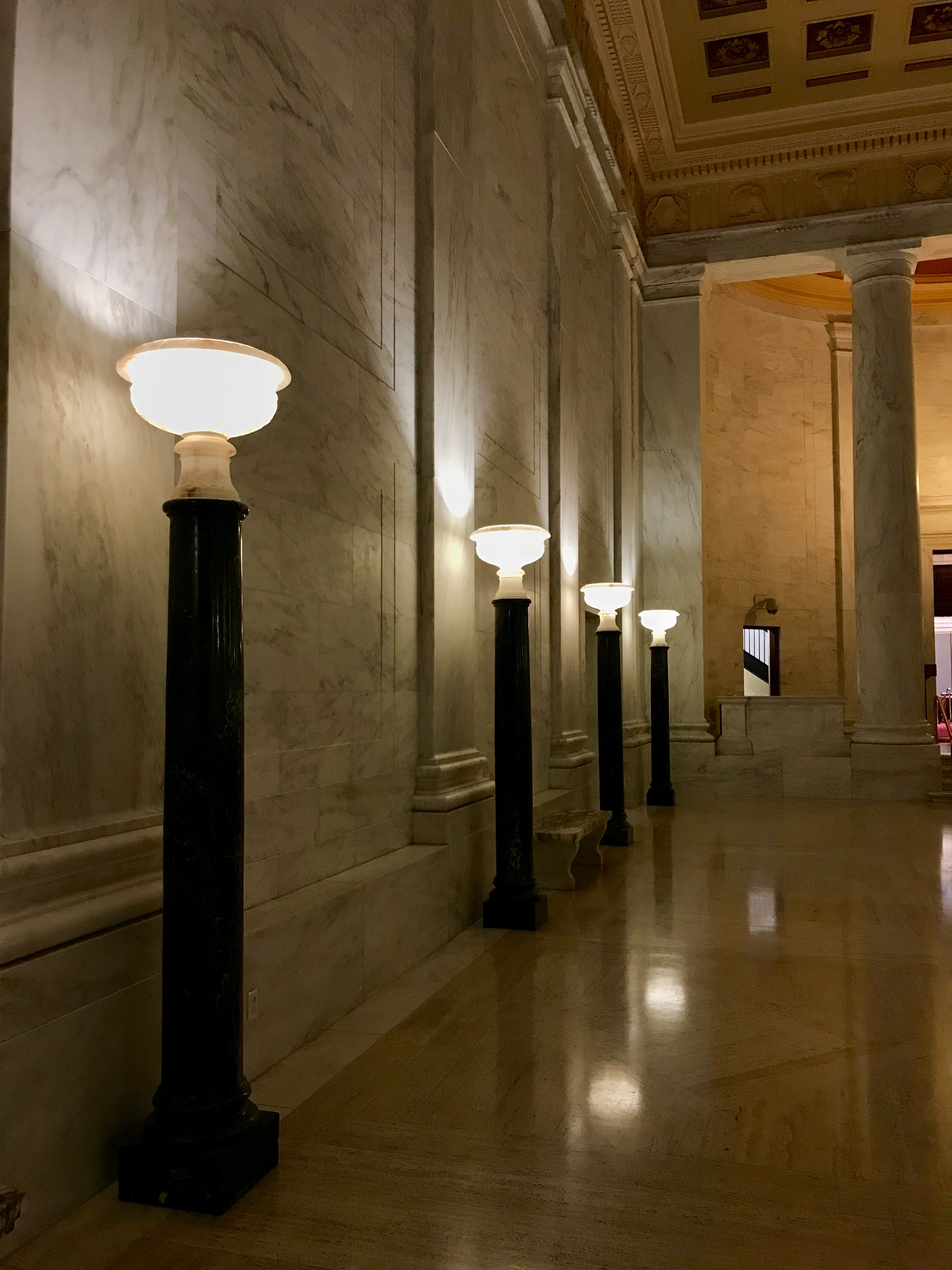
The row of torchieres lining the hall lends an elegant air to the building.
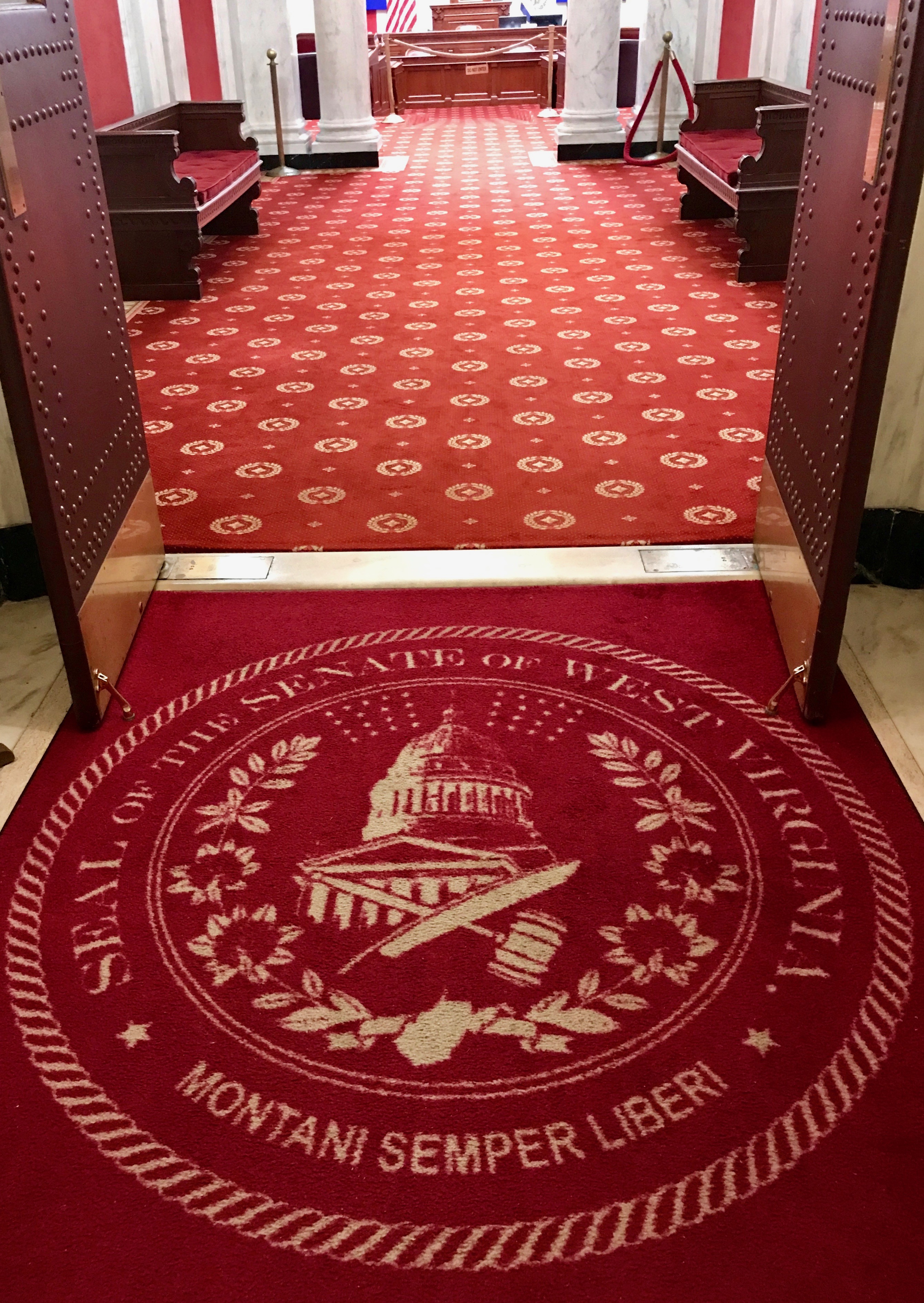
On to the Senate.
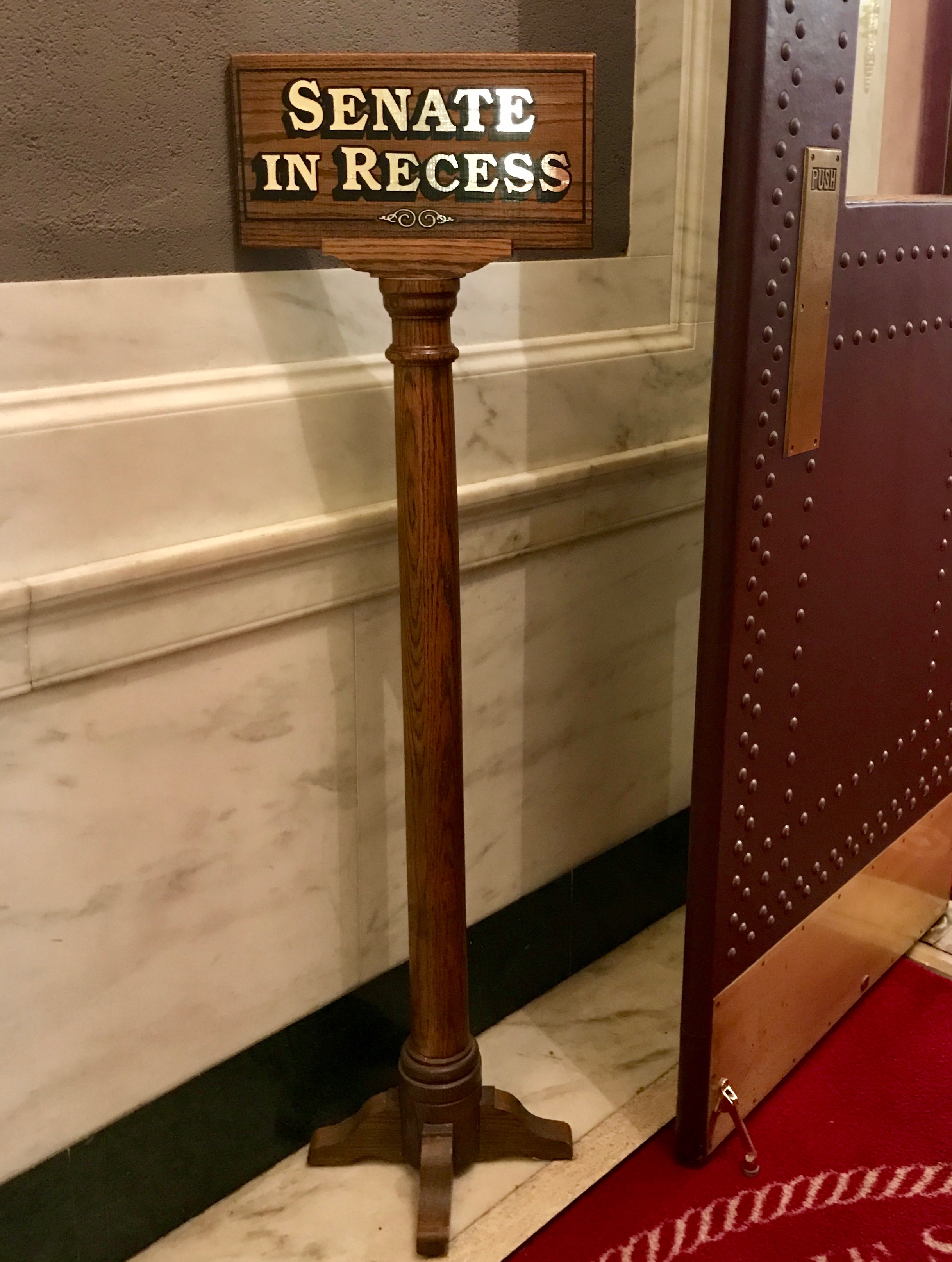
The Senate is in Recess. How odd…I didn’t notice any playgrounds on the campus. (A bit of retired schoolmarm humor, there.)
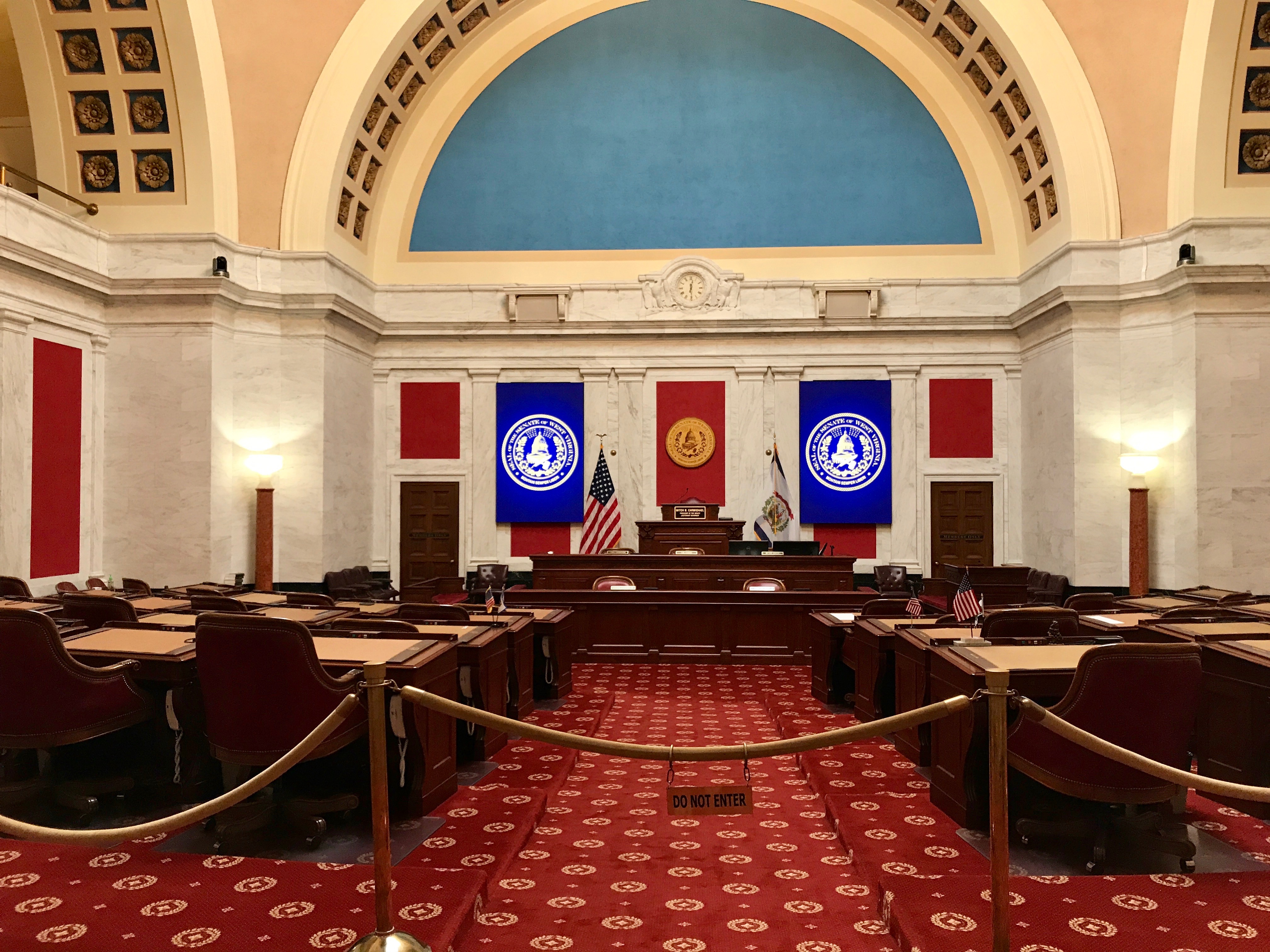
When they are in session, this is where they sit.
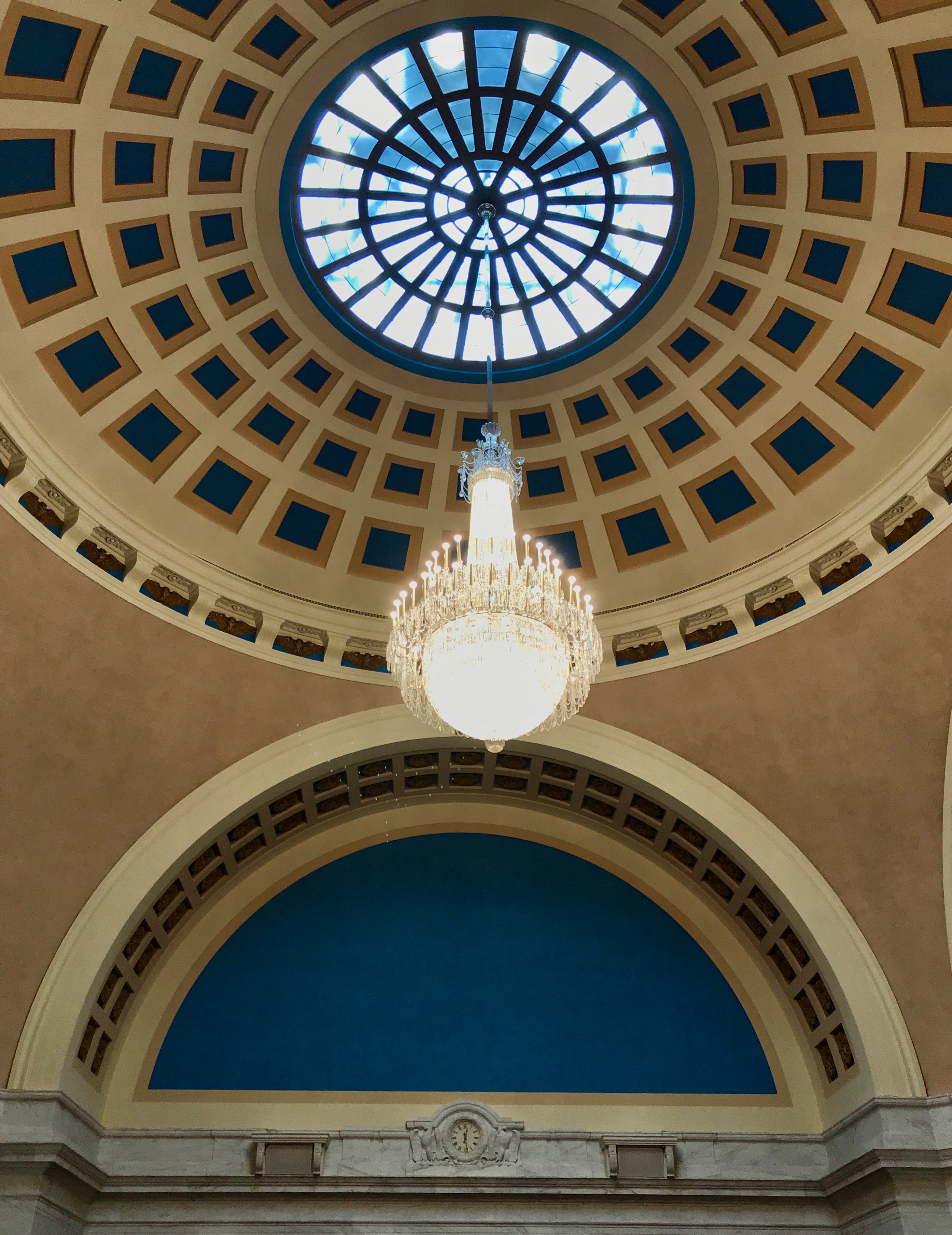
They had an elegant dome in their chamber. (If the House of Delegates had a dome, I missed taking a photo of it.)
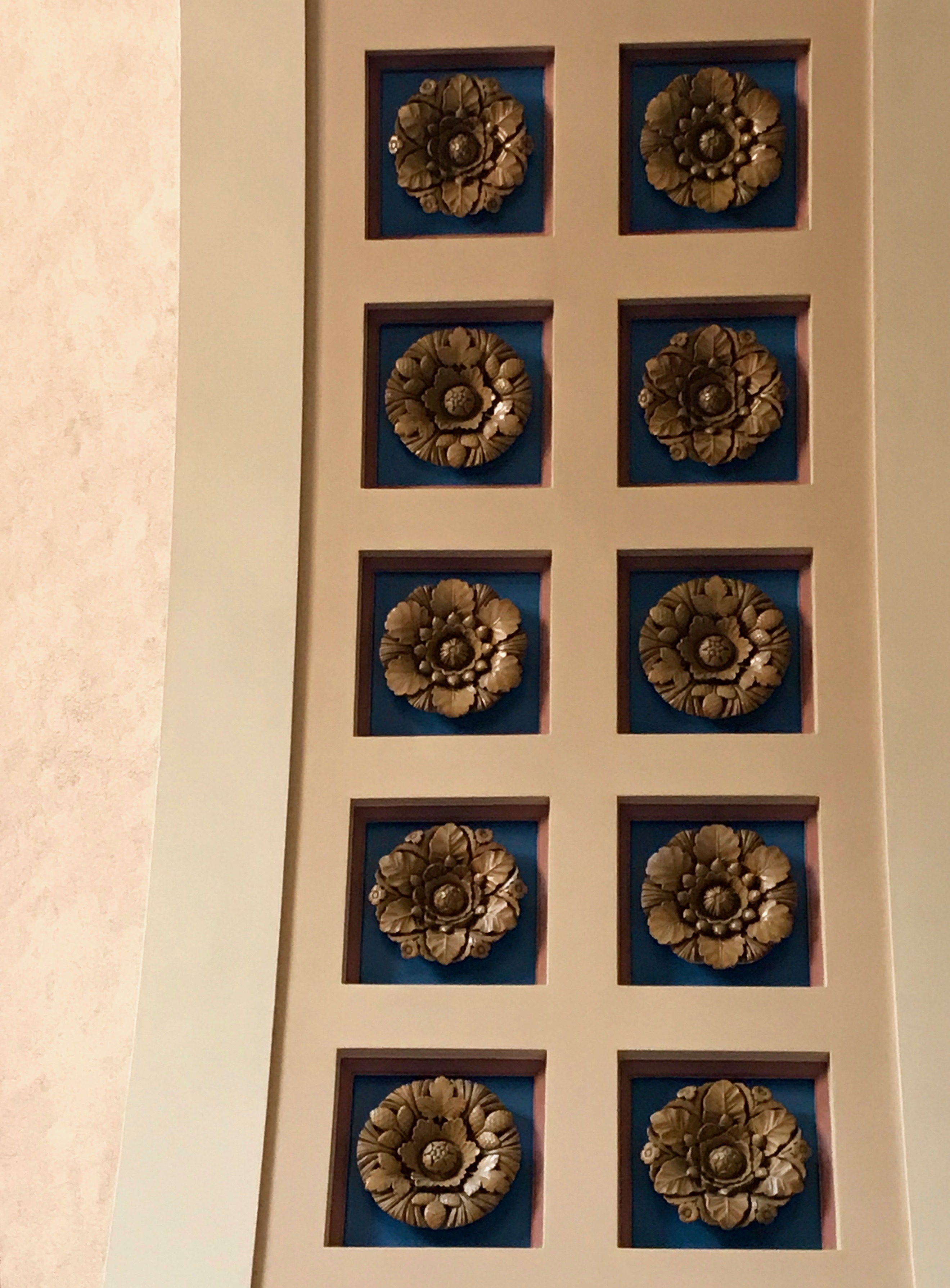
Here are some more of those stylized flowers.
With that, the tour was complete. I had places to go, so I bid adieu to Charleston, West Virginia and continued on my way to Cincinnati.