It’s Time for Some Art

Actually, it’s time for a whole lot of art!
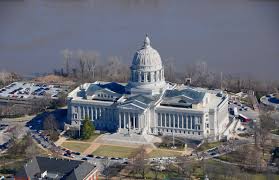
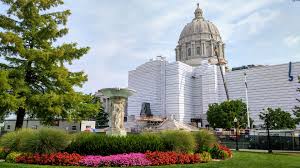
We’re back at the Missouri State Capitol, on the south bank of the Missouri River is Jefferson City. According to my Preferred Source, it was designed by the architectural firm of Tracy and Swartwout out of New York City.

NEW YORK CITY??!!!

Yeah, well, everyone has to be somewhere.

This capitol was completed in 1917, and the dome was topped with a statue of Ceres, the Roman goddess of agriculture.
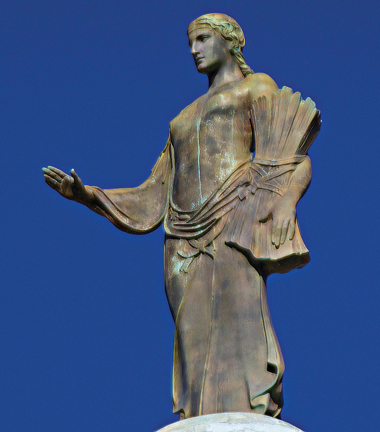
According to the Missouri Capitol website, Ceres was installed in 1924, and she was on top of the dome until November 2018, which is just weeks after my visit. I miss everything!

They had to winch her up in three pieces and then assemble it on top of the dome. She weights about one ton,  and stands 10 feet, four inches tall. They took her down as part of a multi-year renovation. The last time she was cleaned was in 1995, when a crew restored her on top of the dome, which is 238 feet above ground level. She was suffering from “bronze rot.” If I were one of the conservators, I’d be suffering from a whole lot more than “bronze rot.” I do believe, though, that my face might have been a nice shade of verdigris. “Height” is not something I do willingly.
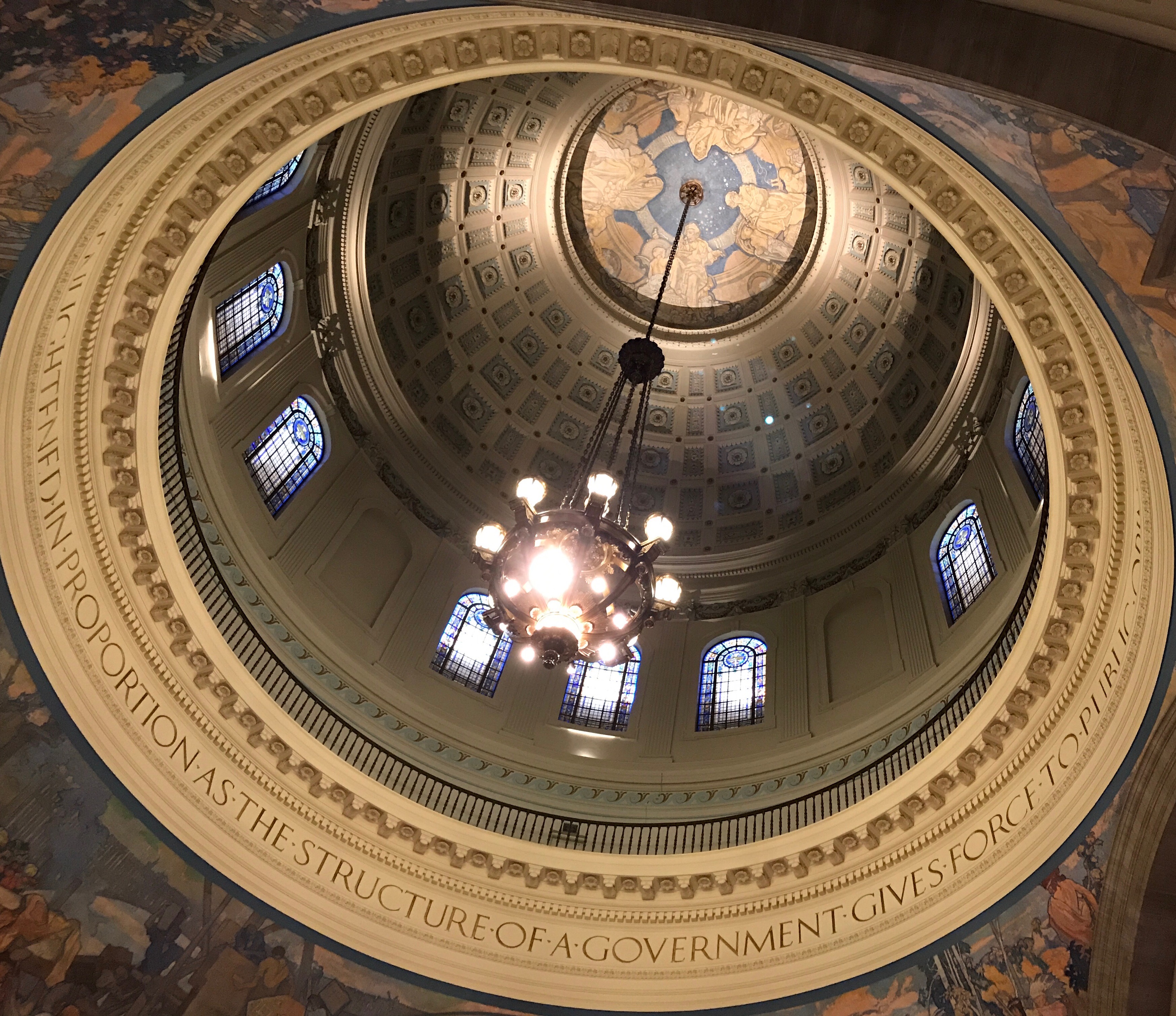
Hanging from the eye of the dome is a 9,000 pound chandelier. It hung there safely until 2006. It was lowered almost to the floor for maintenance when it fell the remaining five feet. While the chandelier cost $5,000 in 1918, which would be $83,285 in 2018 dollars, it cost $500,000 to be restored. That is $641,410 in 2018 dollars. It was reinstalled nearly a full year later.

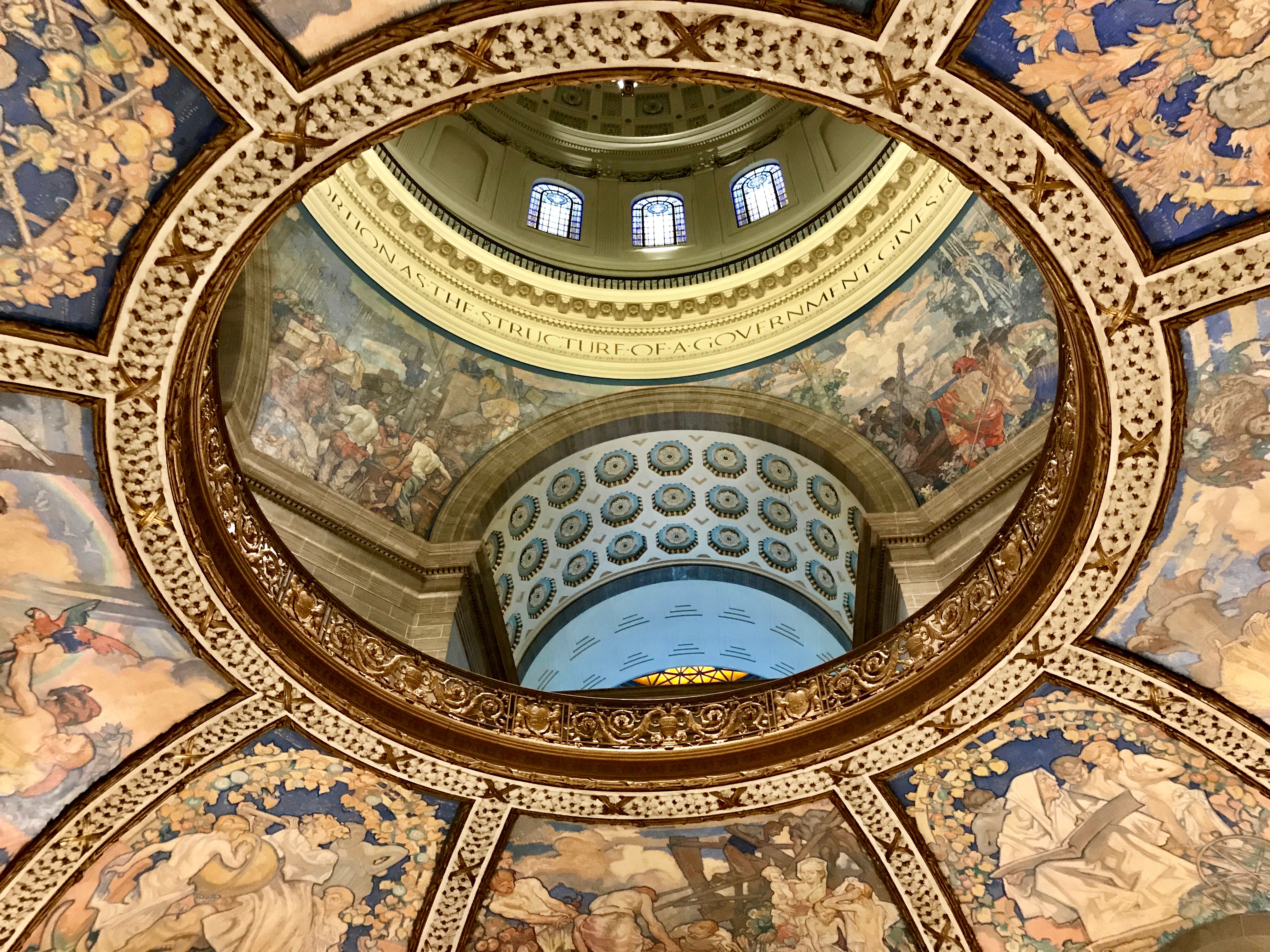
The dome is covered with murals created by Frank Brangwyn, a prolific, popular and much awarded artist of the time. He was largely self-taught, but he did work in the studios of William Morris for a time.
Those familiar with the work of William Morris might see some of his influences in his work.
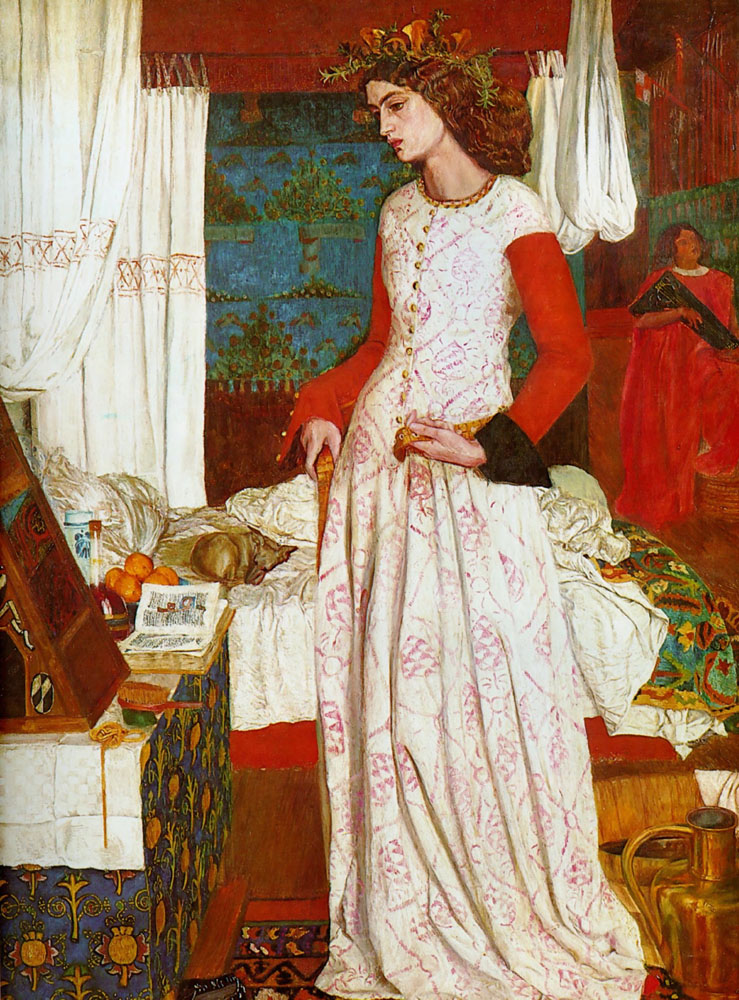
By William Morris – The Yorck Project (2002) 10.000 Meisterwerke der Malerei (DVD-ROM), distributed by DIRECTMEDIA Publishing GmbH. ISBN: 3936122202., Public Domain, https://commons.wikimedia.org/w/index.php?curid=155928

William Morris’ most famous quote is one that Marie Condo seems to have adopted:

“Have nothing in your house that you do not know to be useful, or believe to be beautiful.”
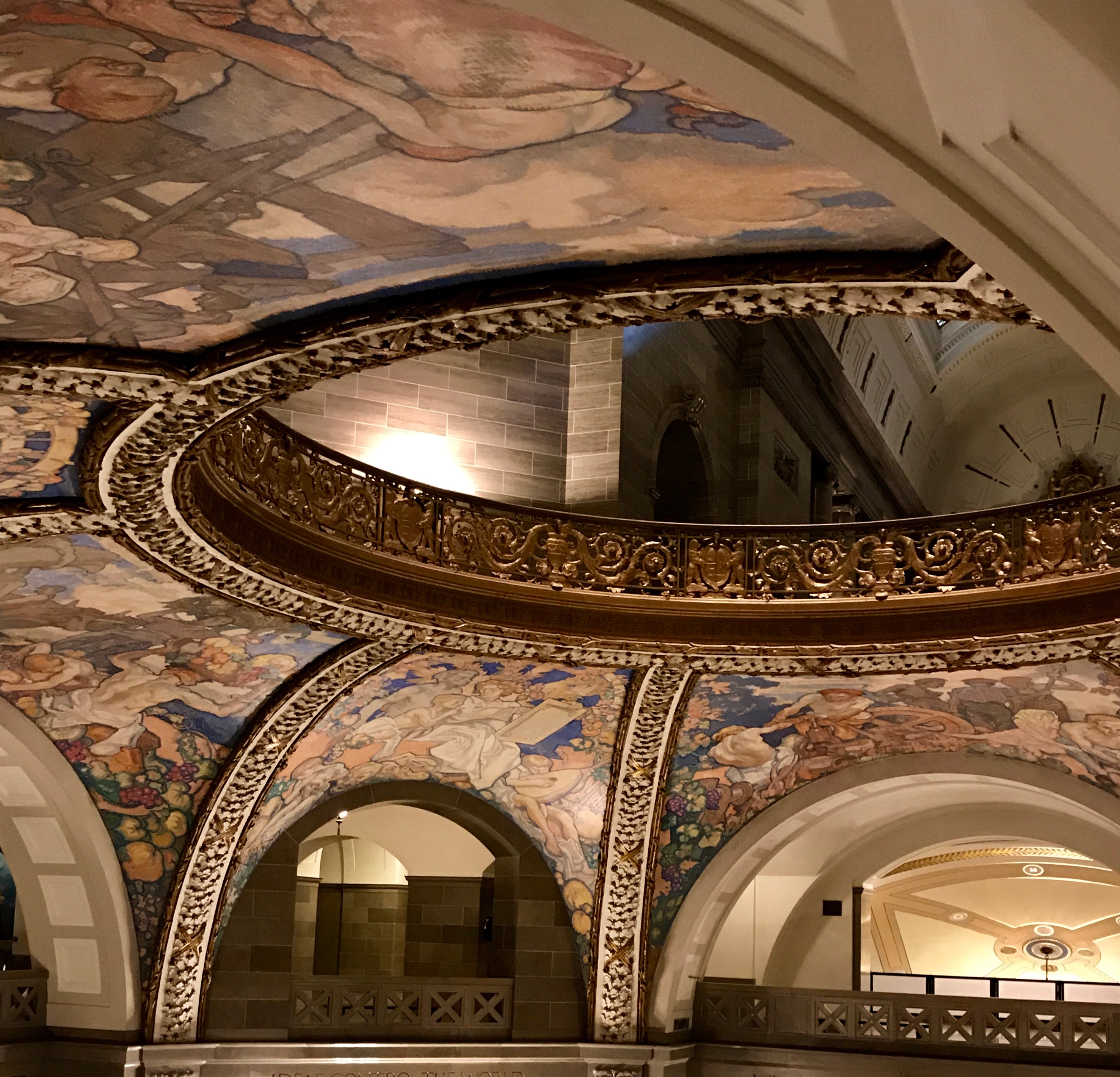
The interior of the dome almost reminds me of a Faberge egg, turned inside out.
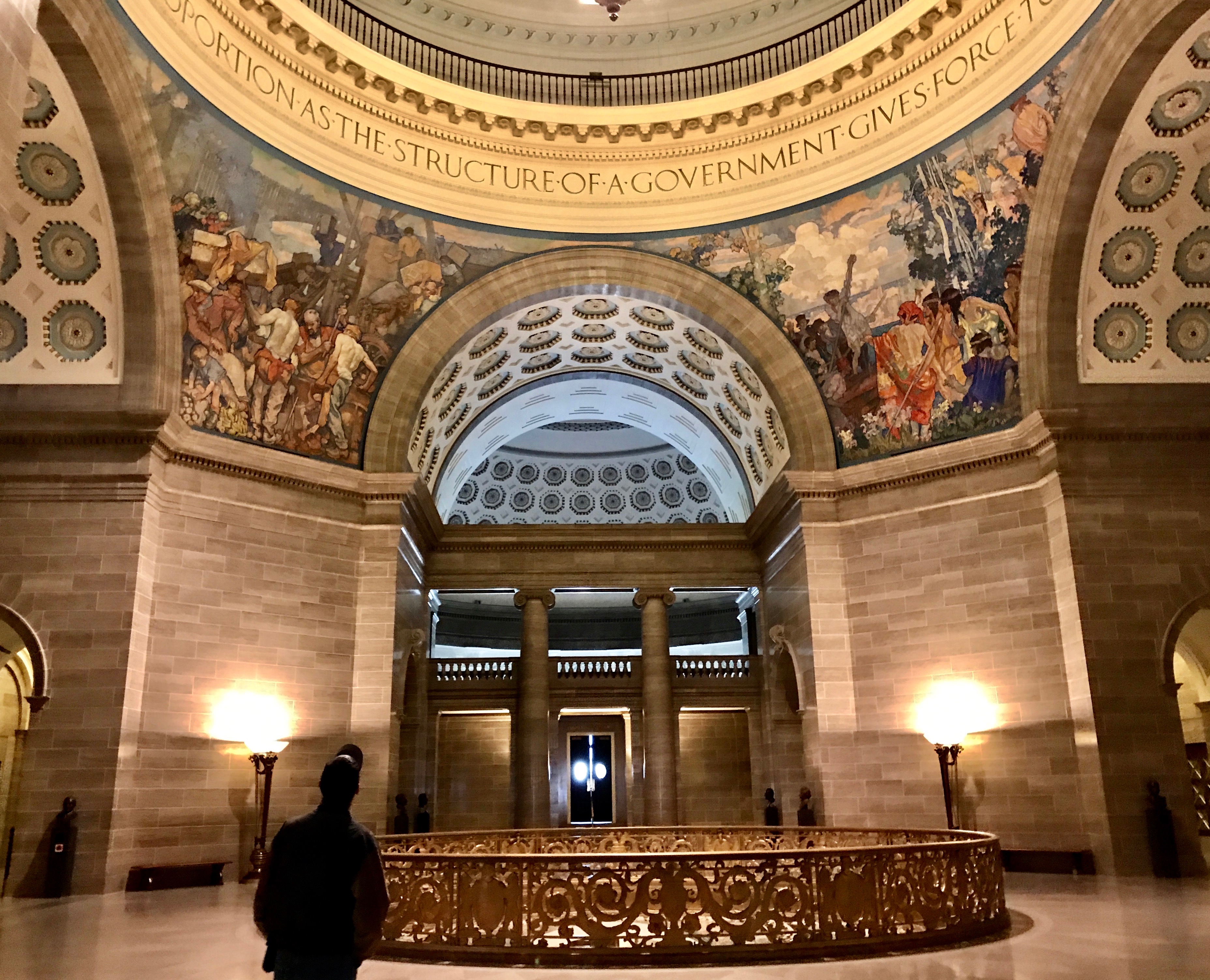
Around this level of the dome, there are works of art that show important aspects of Missouri’s history.
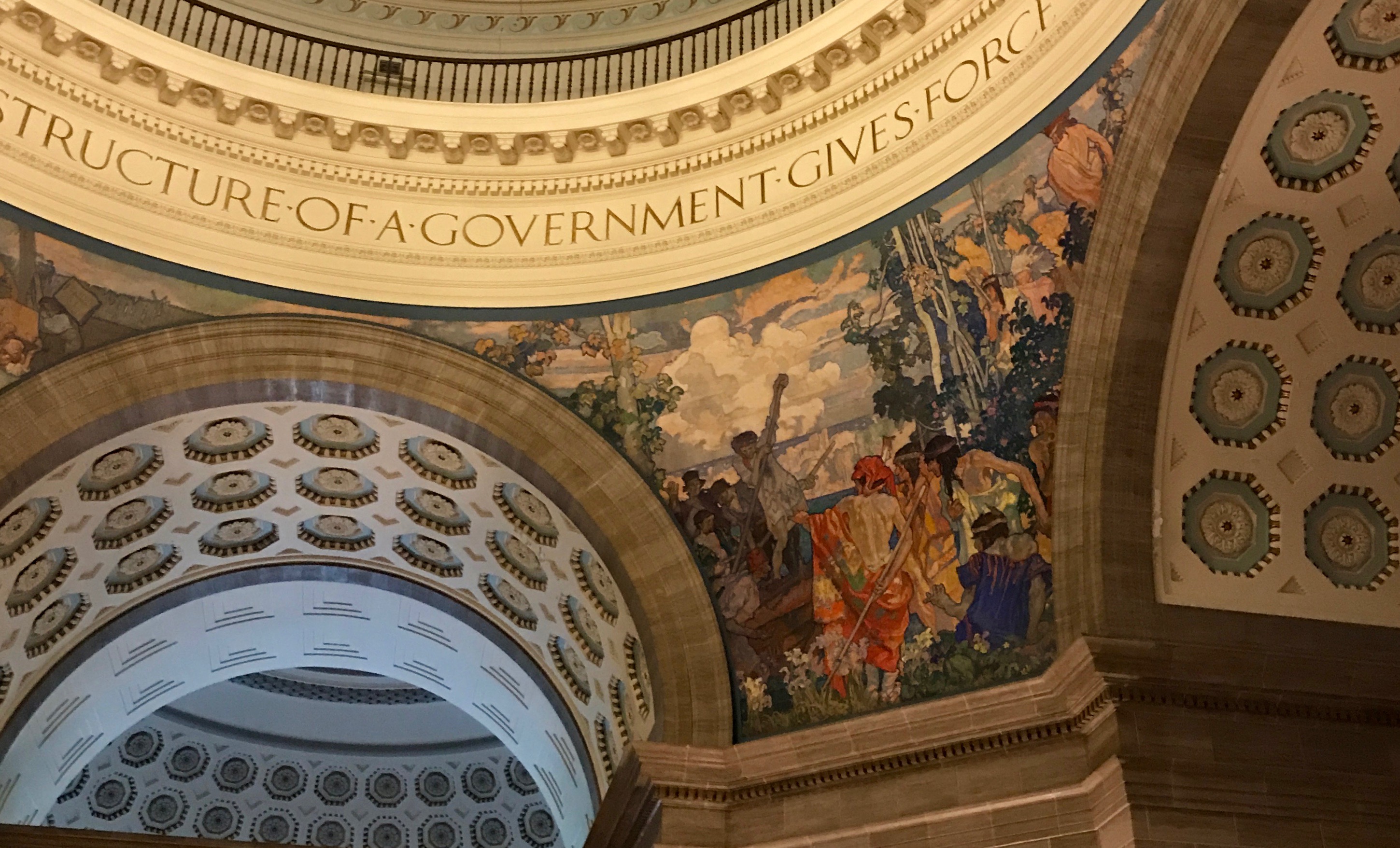
Really, there are so many levels that open onto the rotunda that it’s hard to keep track of which ones were on which level. The differing decorative bands help to sort it out.
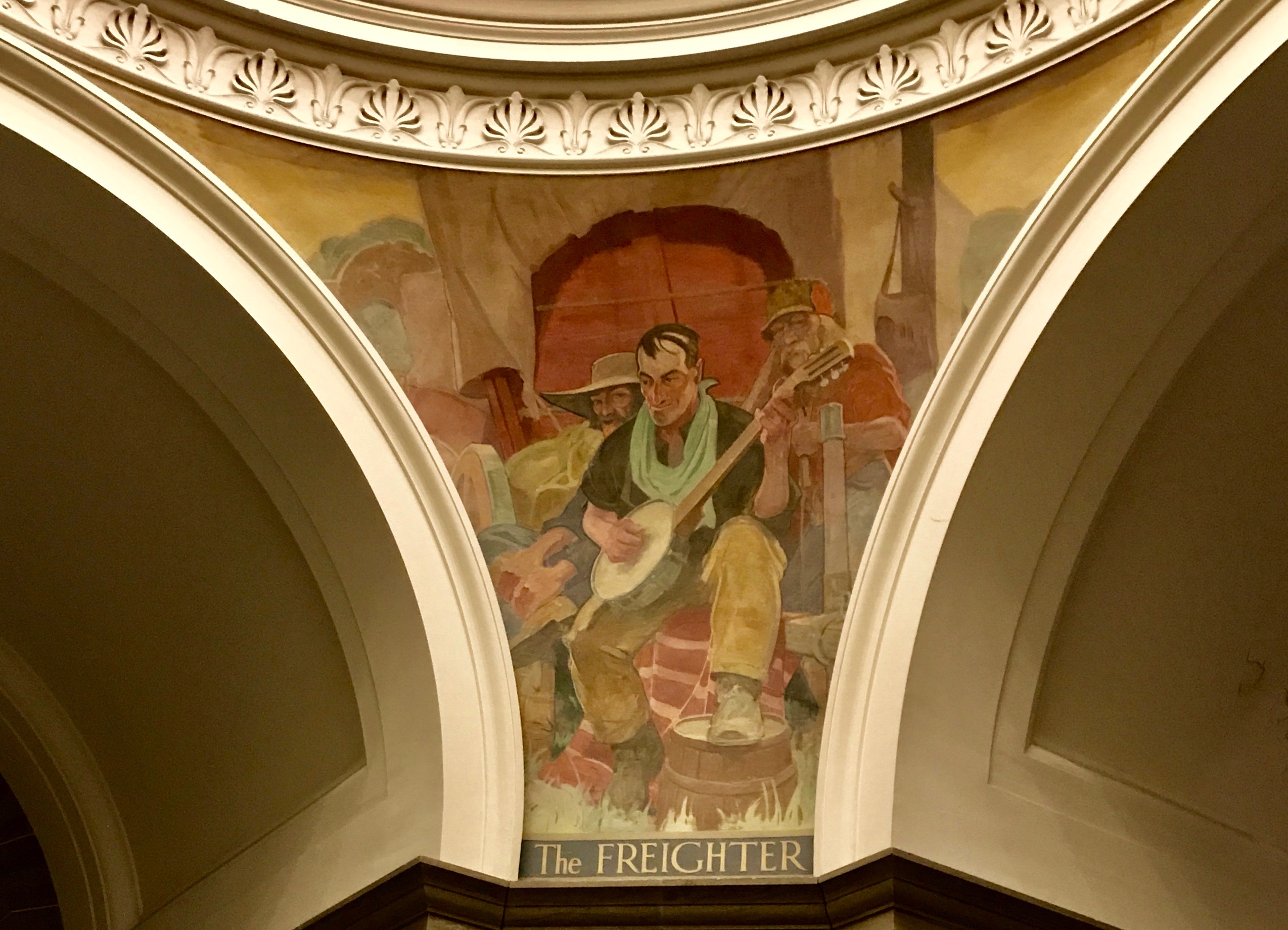
I have seen “freighters” honored in several of the western capitols. These wagon drivers were the long haul truckers of their day. The products and supplies they carried in their wagons made settlement possible.
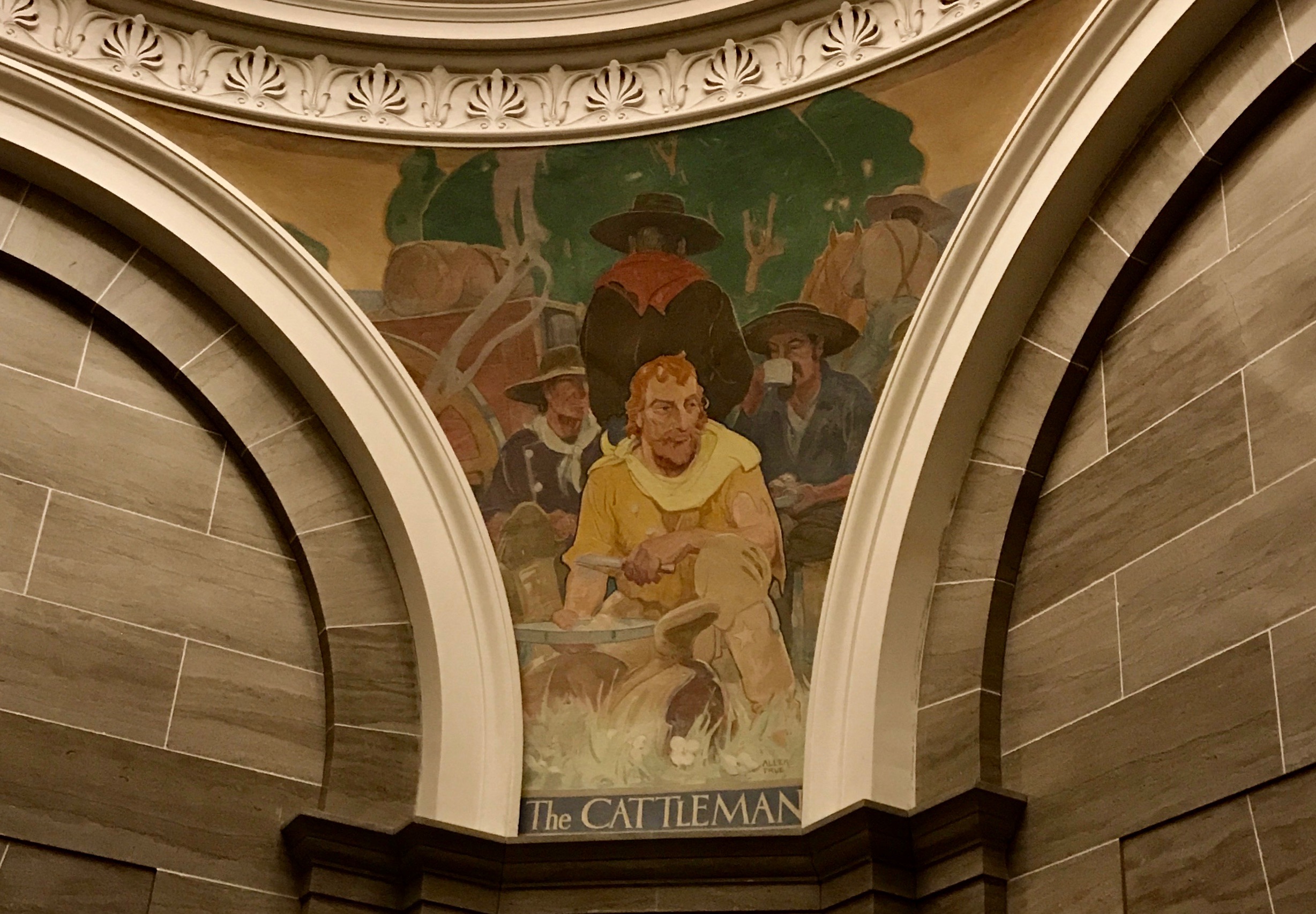
The cattlemen played a large part in Missouri’s economic development.
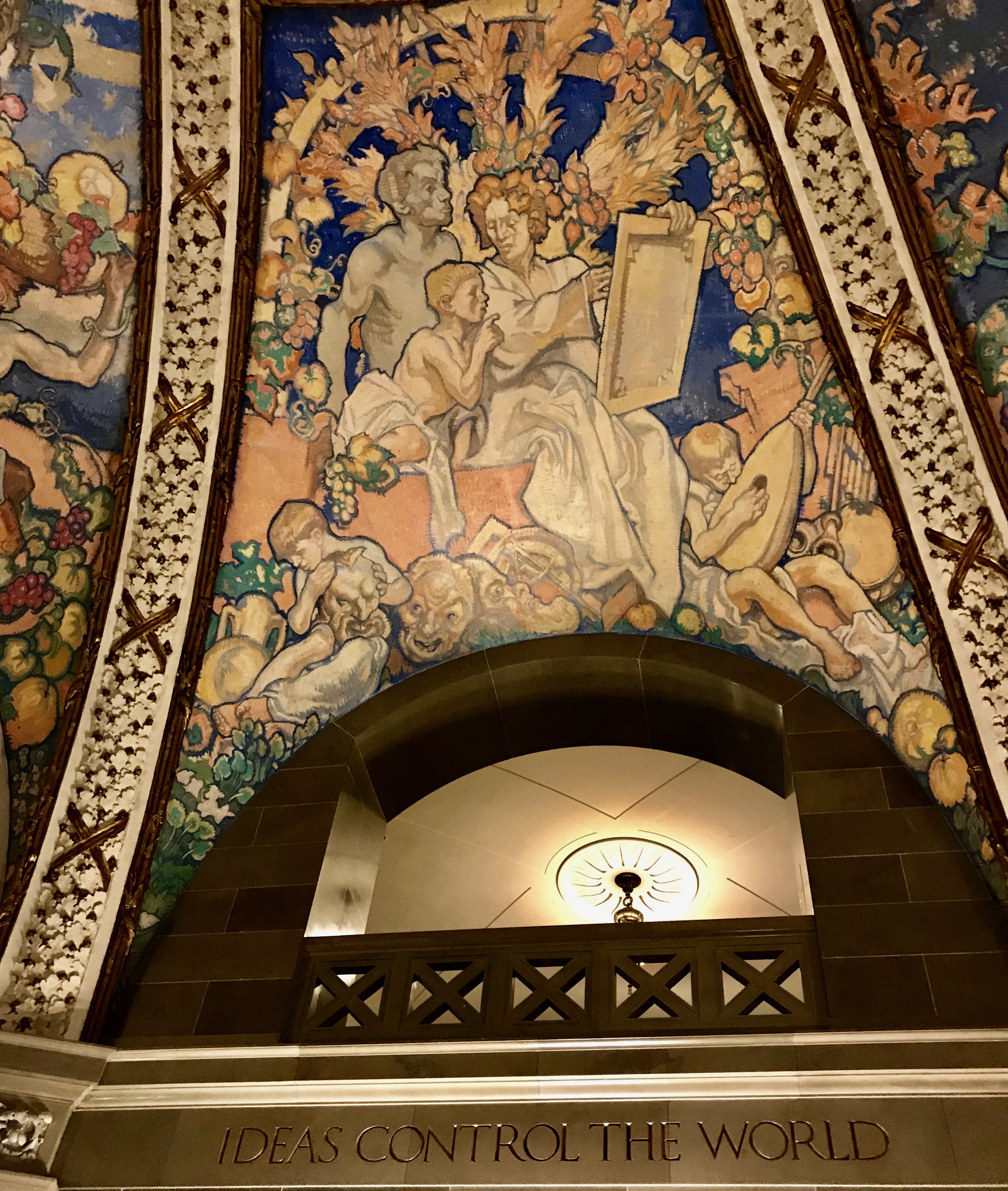
This is a section I shared in my last post. I like it, so I am sharing it again.

One more look up and then on to the works of other artists.
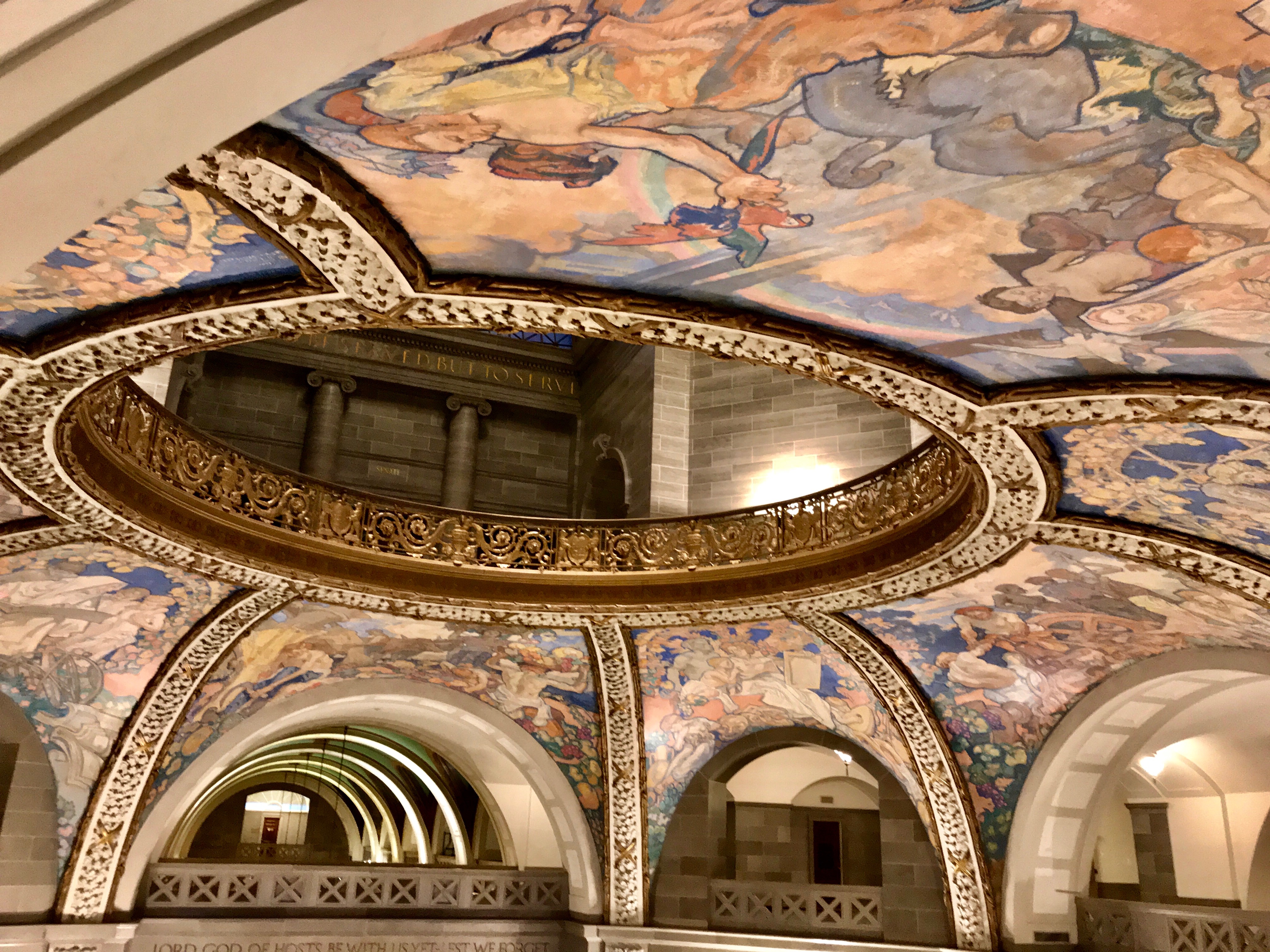
Okay, make that two more photos. Honestly, Frank Brangwyn did an amazing job of painting a complicated surface.
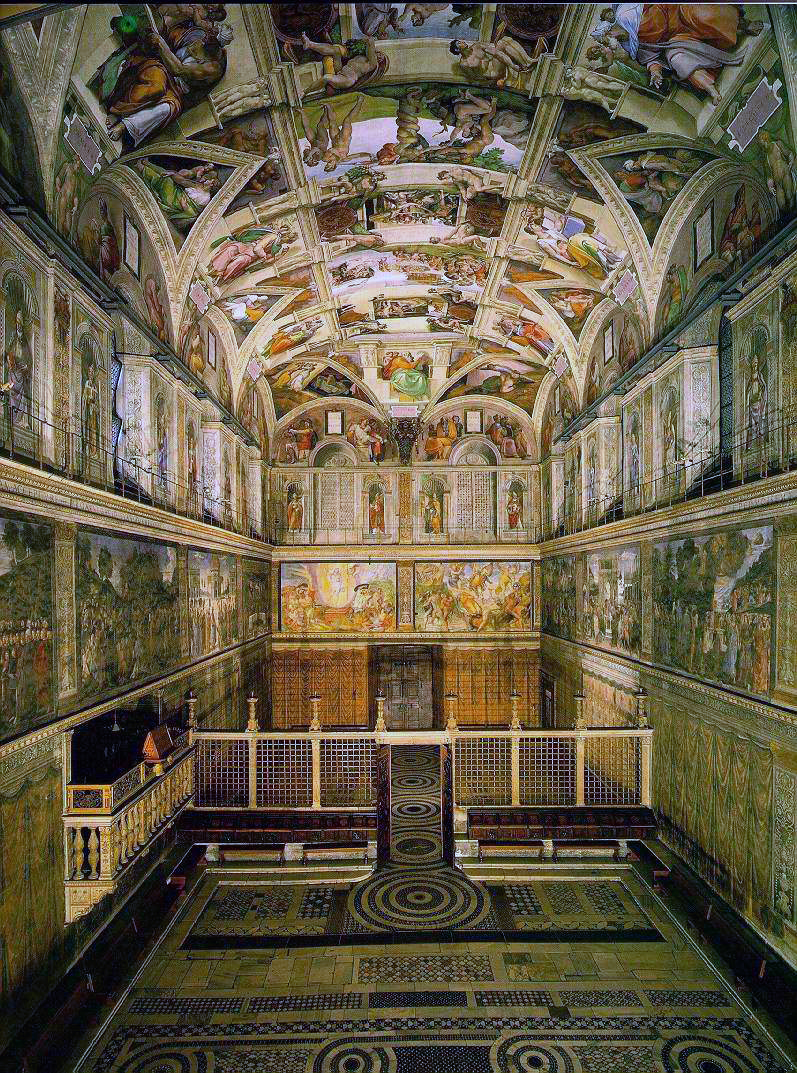
By The original uploader was Snowdog at Italian Wikipedia. – http://artchive.com/ftp_site.htm Transferred from it.wikipedia to Commons by Pierpao using CommonsHelper., CC BY-SA 3.0, https://commons.wikimedia.org/w/index.php?curid=18462479

It’s not the Sistine Chapel, but it made me think of it.

Our guide made a point of showing us these works of art by Frank Nuderscher.
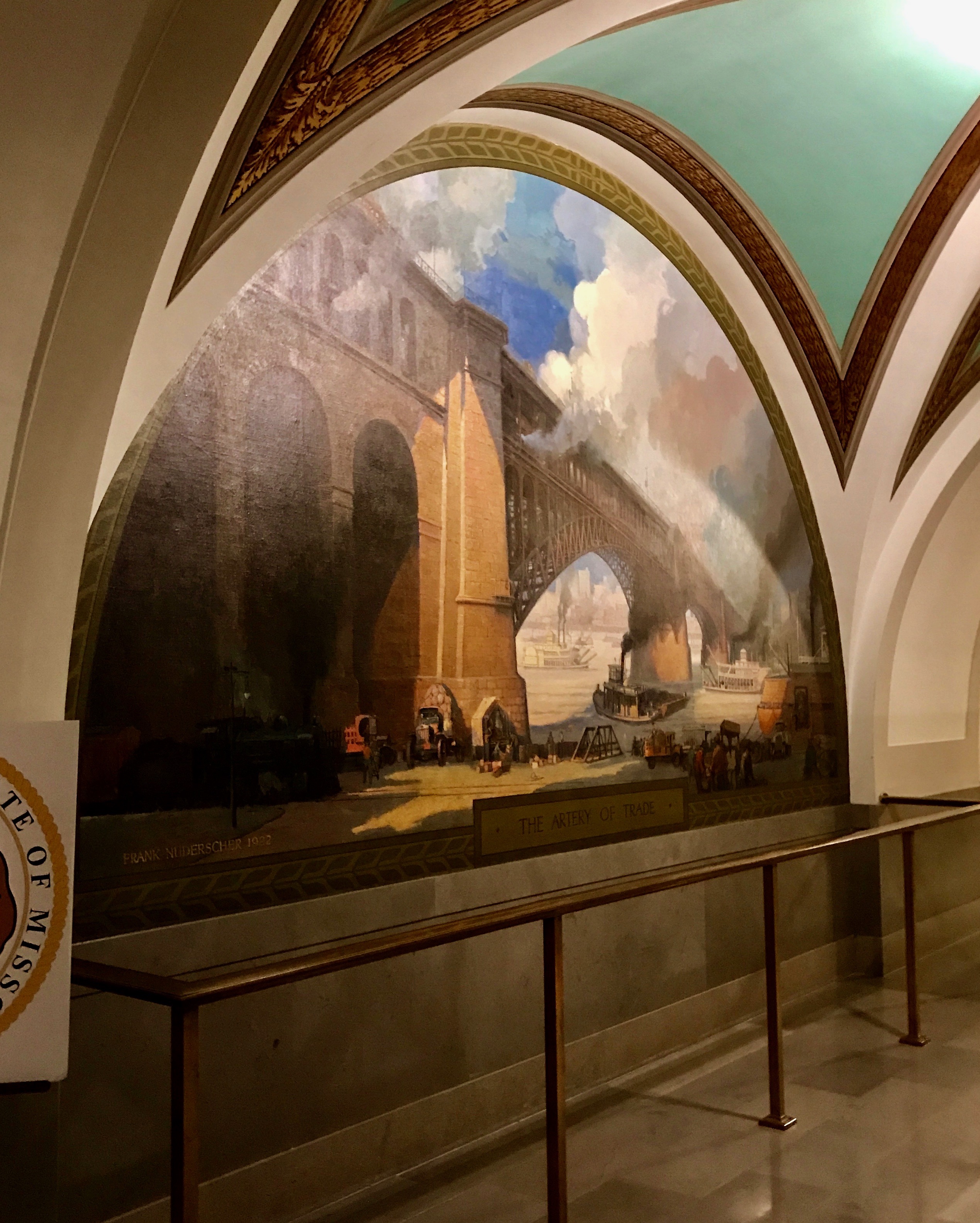
Born in St. Louis in 1880, he was an illustrator, muralist, and painter of the American Impressionism style. He was called the “dean of St. Louis artists” for his leadership in the Missouri art community.
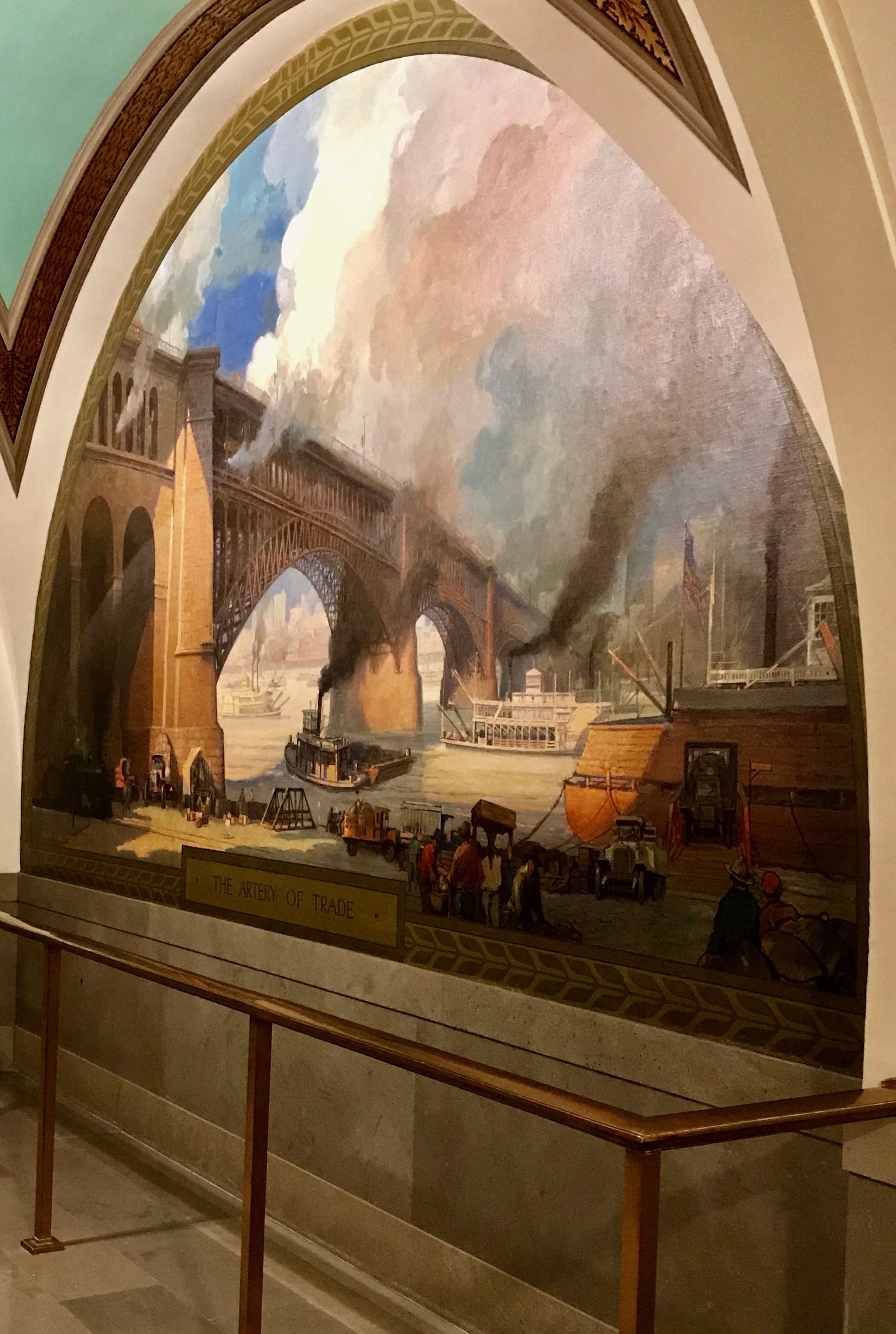
Our guide was very intent on showing us his painting from the two sides. He told us that there was a trick in the perspective that made things look different. Quite frankly, I don’t see it.
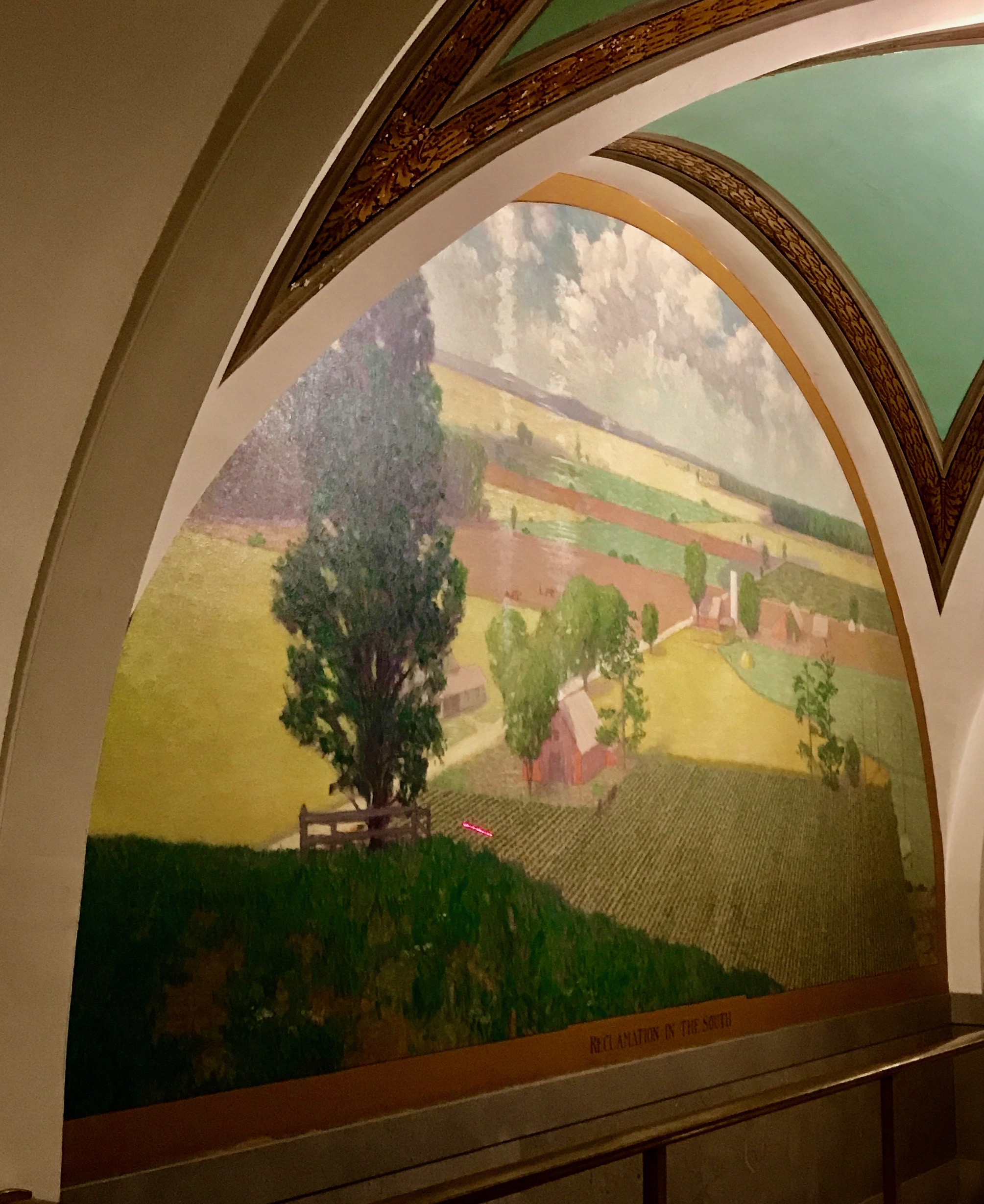
There was a second Nuderscher painting in the same hallway.
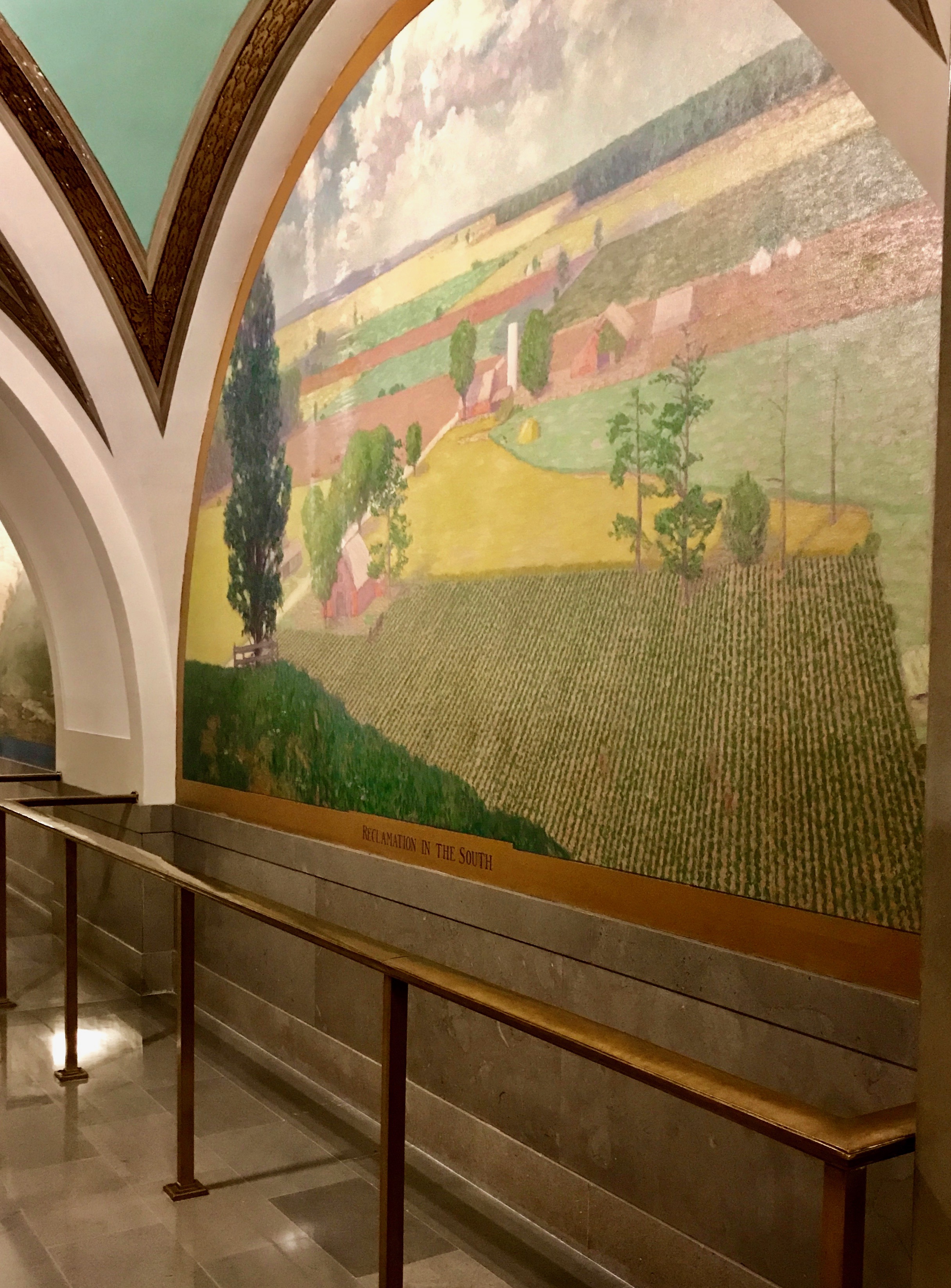
Again, there is supposed to be some sort of trick in the perspective. Supposedly the rows of crops change direction. If you see it, please let me know. Maybe I am looking in the wrong places.
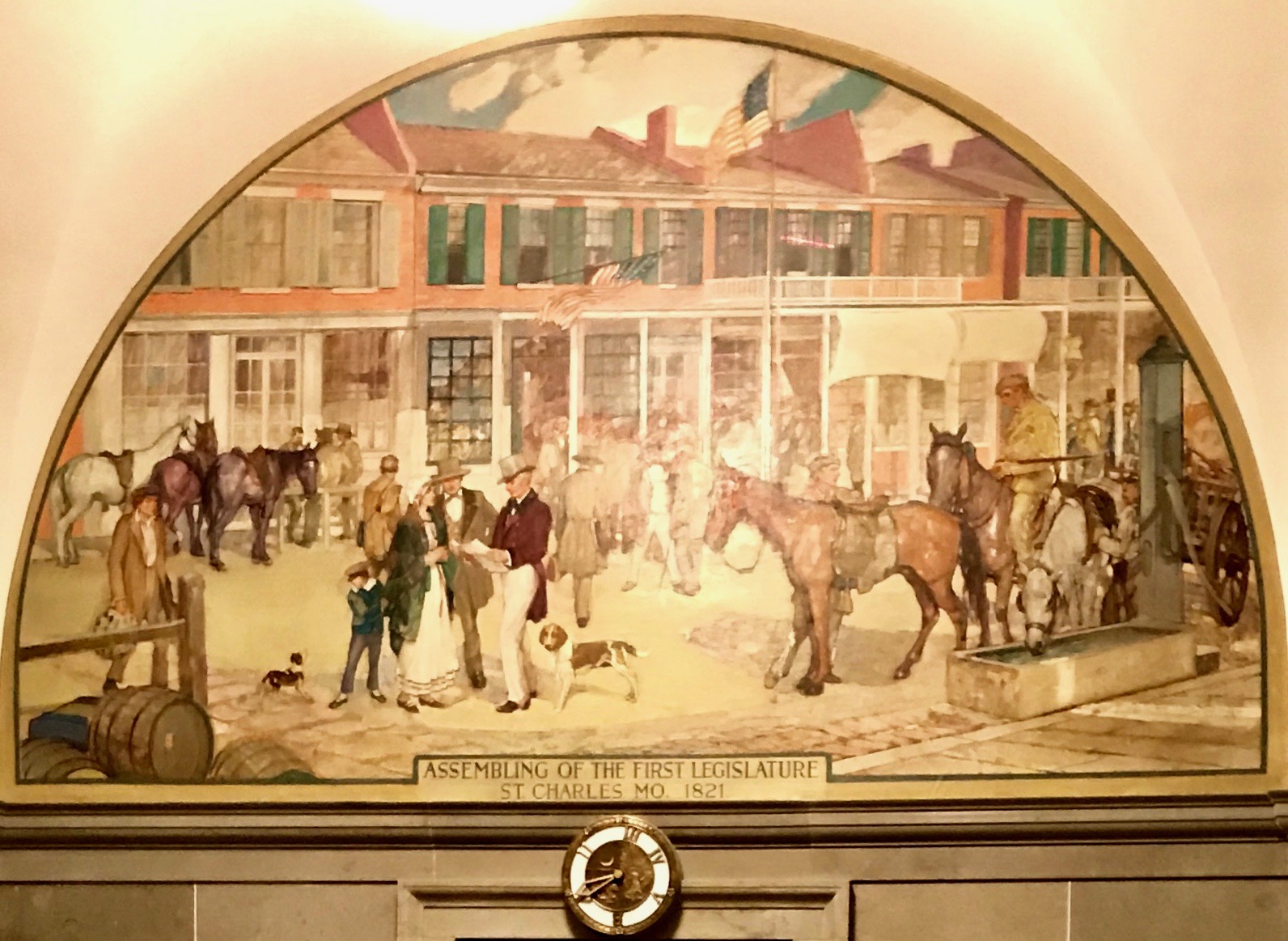
Smaller lunettes in the same hallway showed some of the history of Missouri. This is the assembling of the first legislature in St. Charles in 1821.
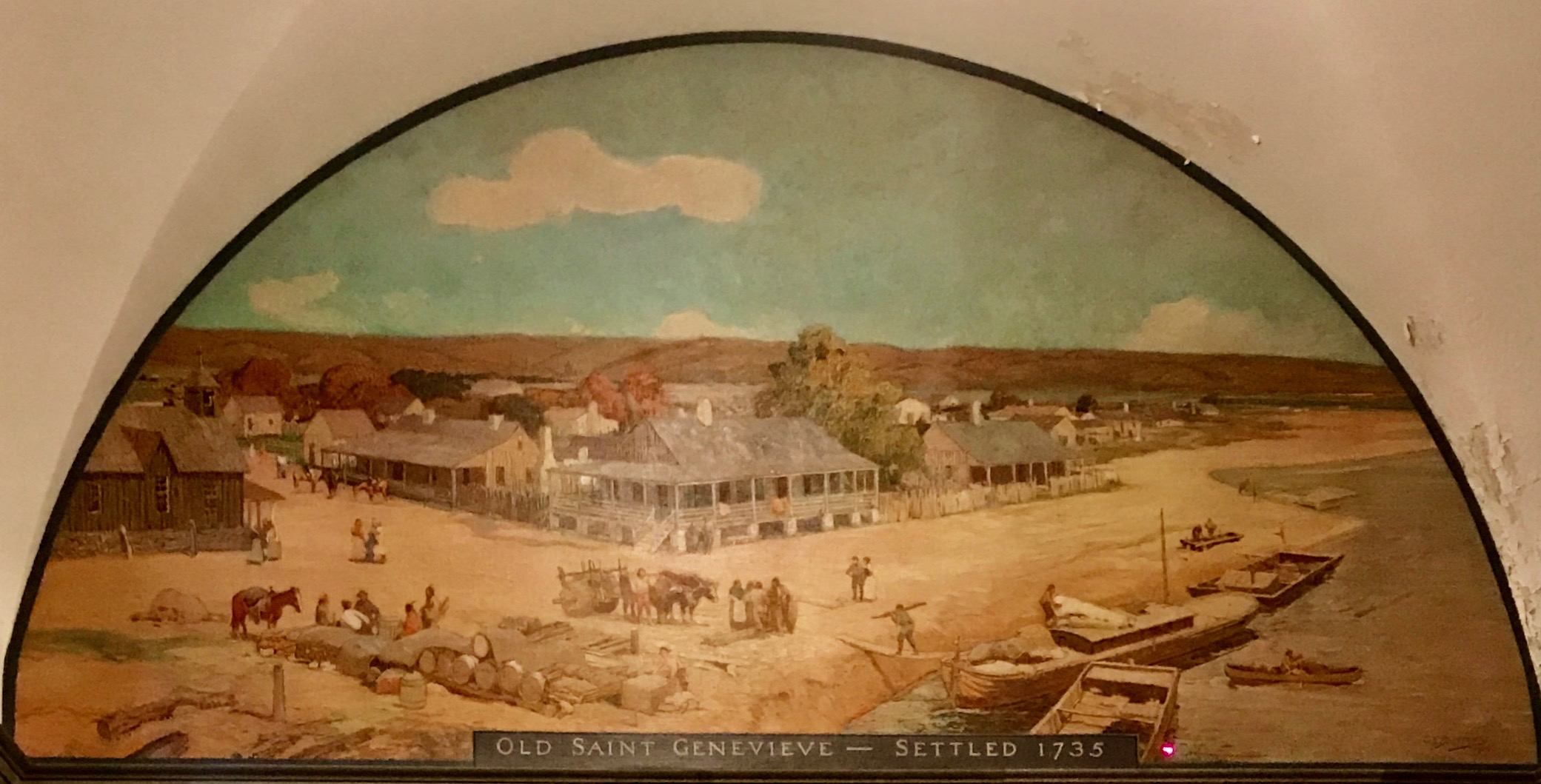
Old Saint Genevieve is in one of the lunettes. According to sources, it is the “first permanent civilized settlement” in Missouri. The French established it on the Mississippi River, about 60 miles south of St. Louis. According to the source, one of the reasons they settled there was to take advantage of the salt springs on Saline Creek. I didn’t know there were salt springs!
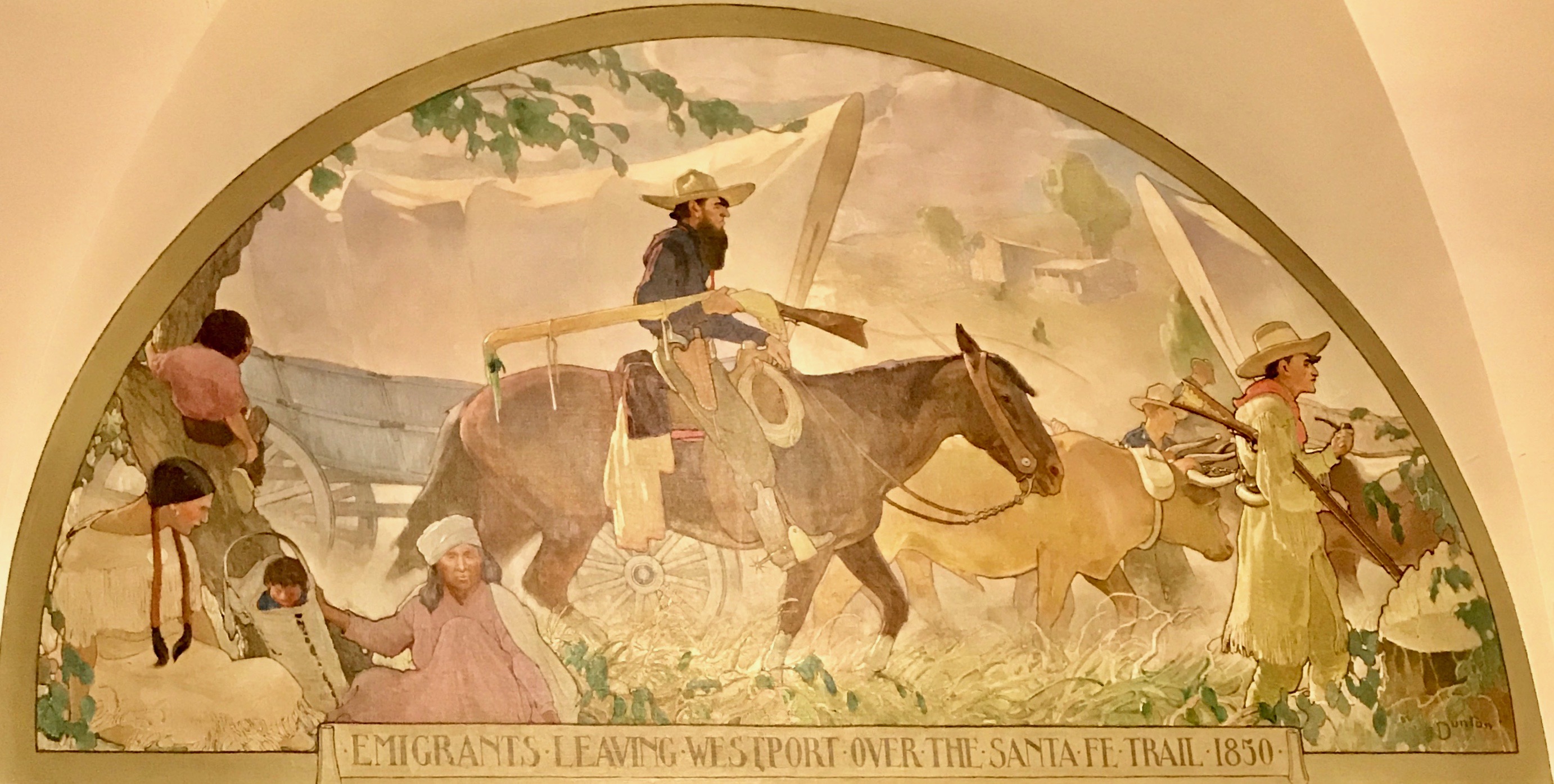
With all the discussion these days about immigrants, I had completely forgotten about emigrants. It wasn’t all that long ago that our own people were leaving all that they knew to make a better life for themselves and their families.
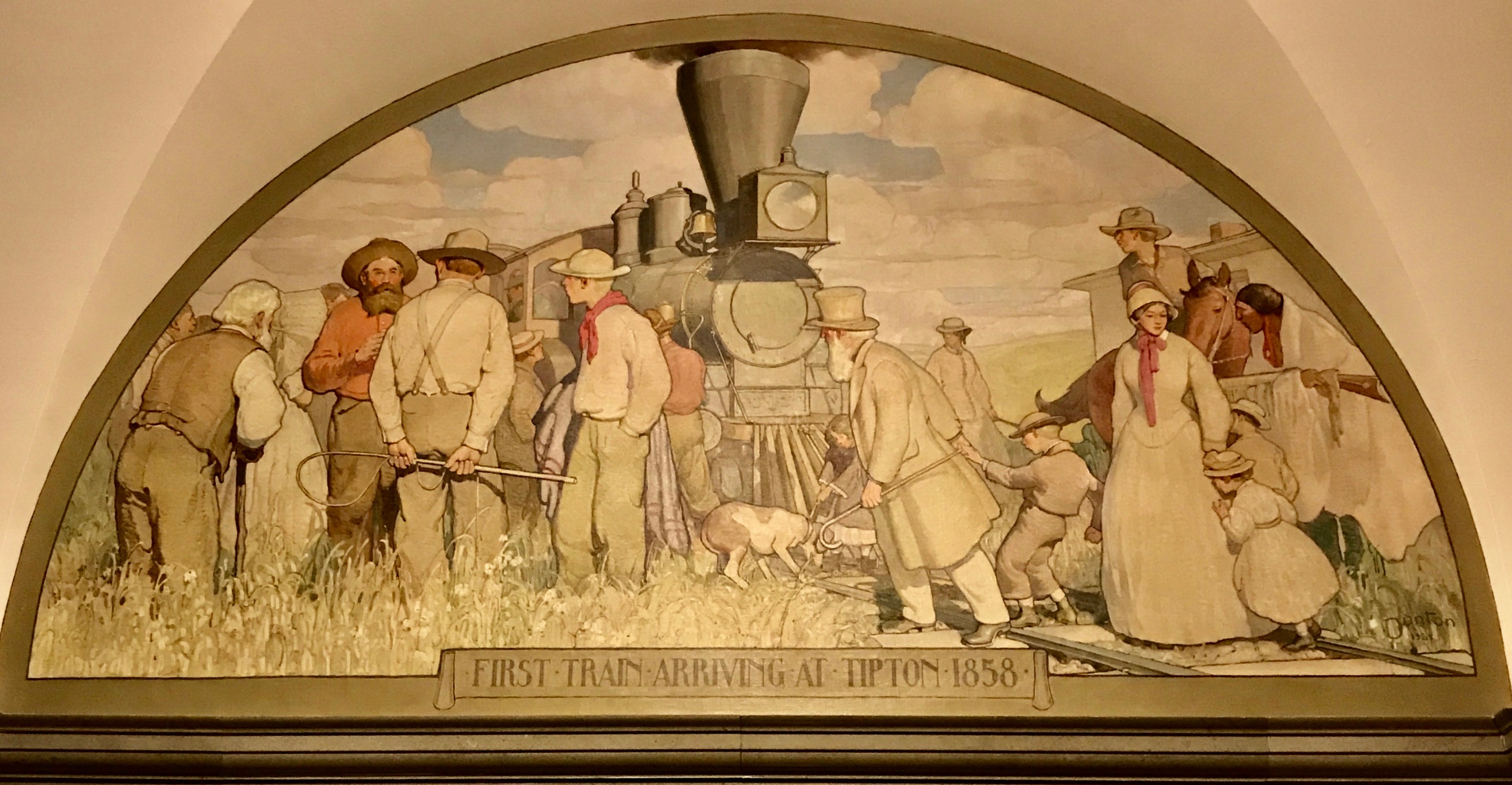
I guess pushing ever westward was a big part of Missouri’s history.

There’s Tipton, west of Jefferson City.
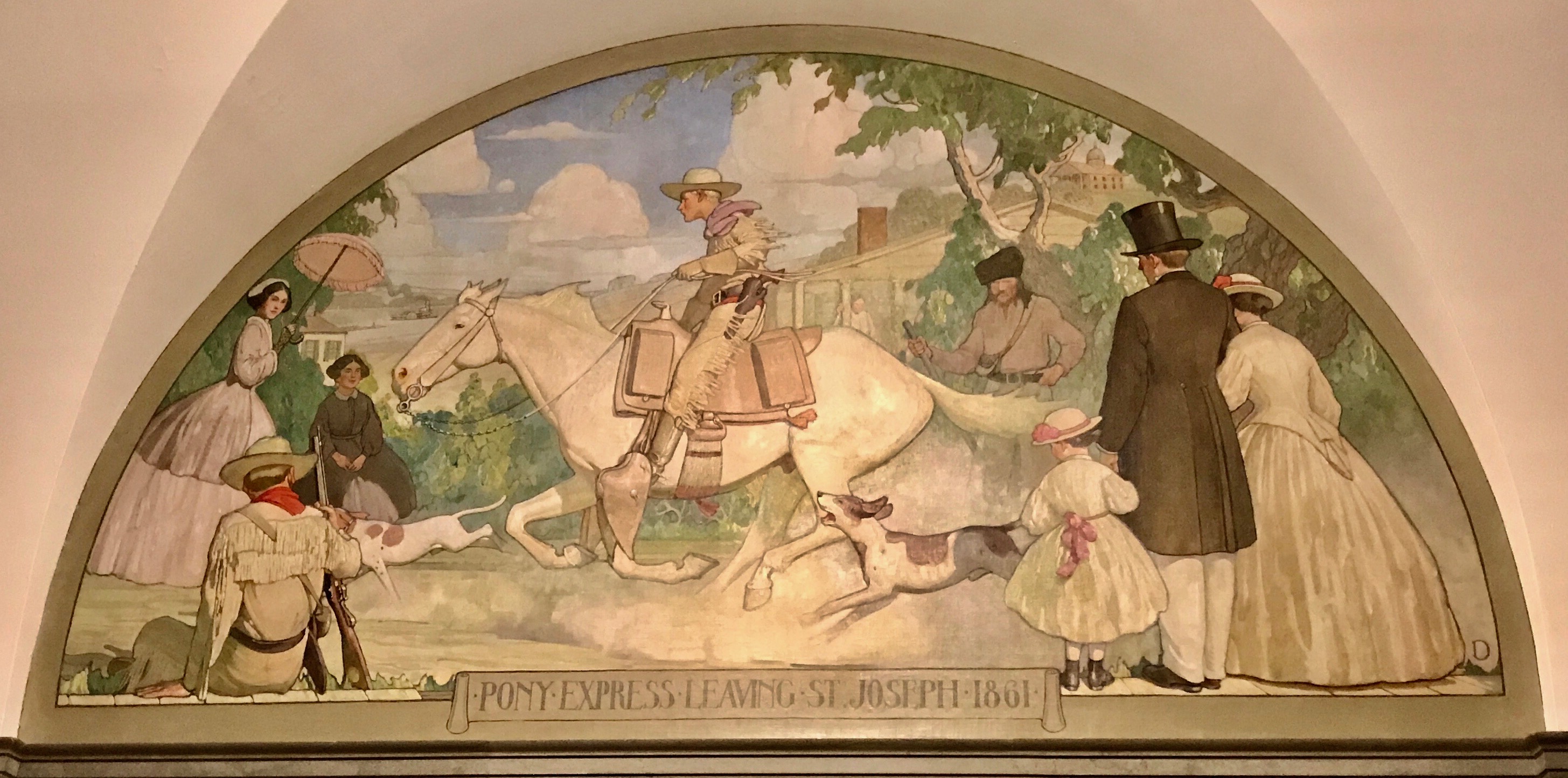
Moving information west (and east) was also important. The Pony Express was only in operation for 18 months, but it remains vivid in our imaginations.
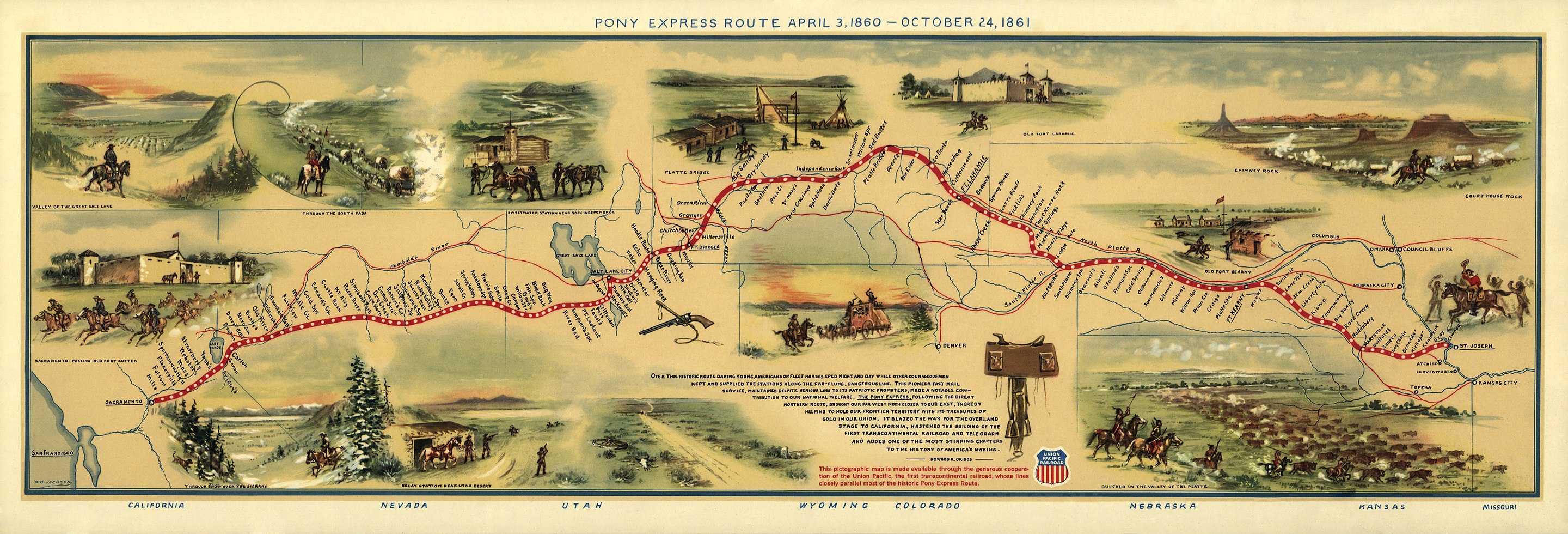
By William Henry Jackson – Illustration: William Henry Jackson, American artist. Text: Howard Roscoe Driggs. Scan: US Library of CongressPhoto image obtained/rendered by Gwillhickers. Restoration by Crisco 1492, Public Domain, https://commons.wikimedia.org/w/index.php?curid=10111804

The first westbound Pony Express trip left St. Joseph, on April 3, 1860 and arrived in Sacramento, California on April 14. According to a famous advertisement, the employers were looking for,  “Young, skinny, wiry fellows not over eighteen. Must be expert riders, willing to risk death daily. Orphans preferred.”

Whether or not that is true or an exaggeration, what is true is that they could not weigh over 125 pounds and they had to swear an oath:

“I, , do hereby swear, before the Great and Living God, that during my engagement, and while I am an employee of Russell, Majors, and Waddell, I will, under no circumstances, use profane language, that I will drink no intoxicating liquors, that I will not quarrel or fight with any other employee of the firm, and that in every respect I will conduct myself honestly, be faithful to my duties, and so direct all my acts as to win the confidence of my employers, so help me God.”
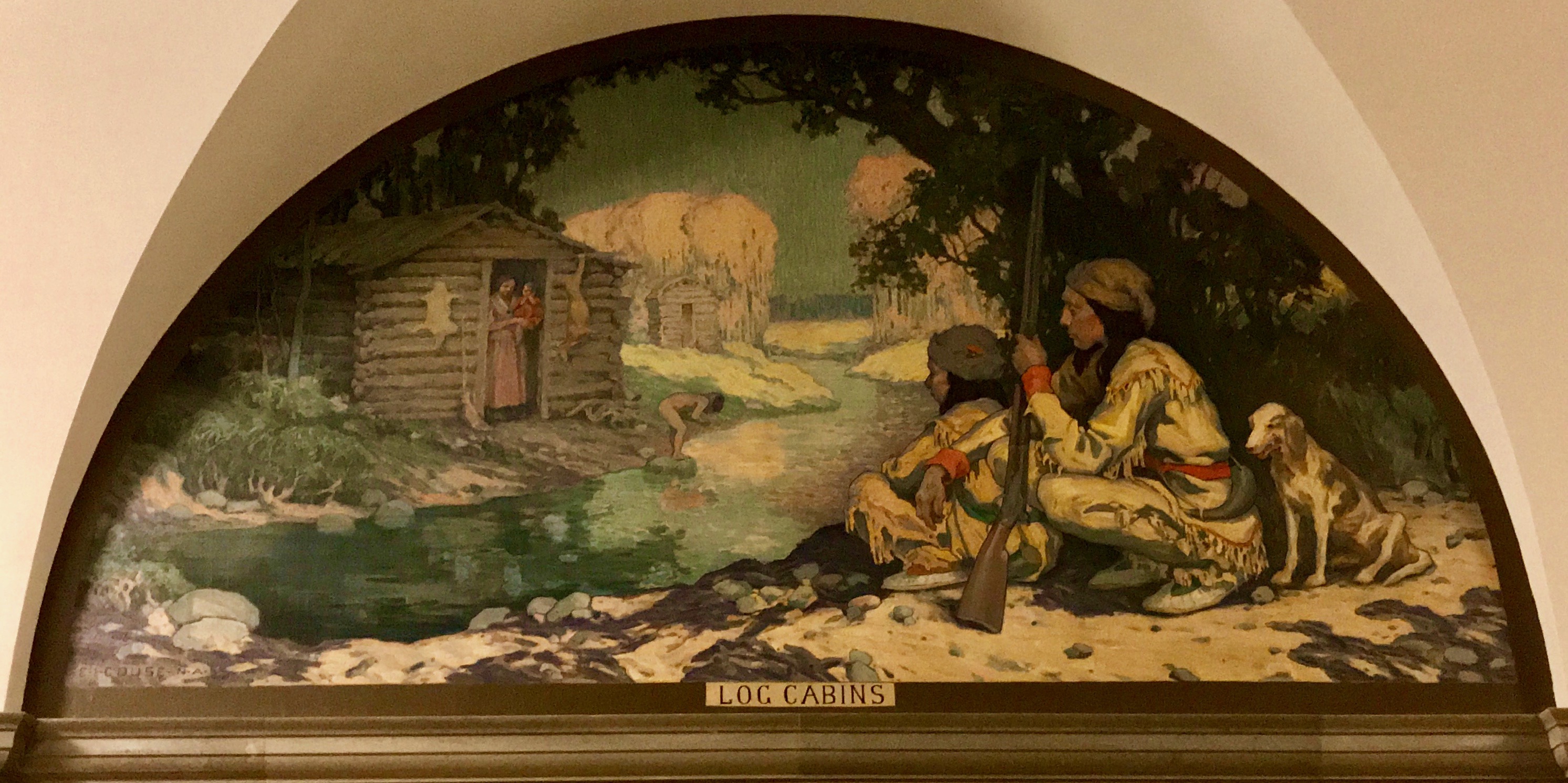
I am not quite sure what to make of this painting. At first, I thought that it showed the Osage looking at the settler’s cabin. Upon closer examination, I think the two figures on the right side are male anglo settlers watching a young girl bathe outside her cabin, with her mother looking on from the doorway. I wonder what the artist’s intent was?
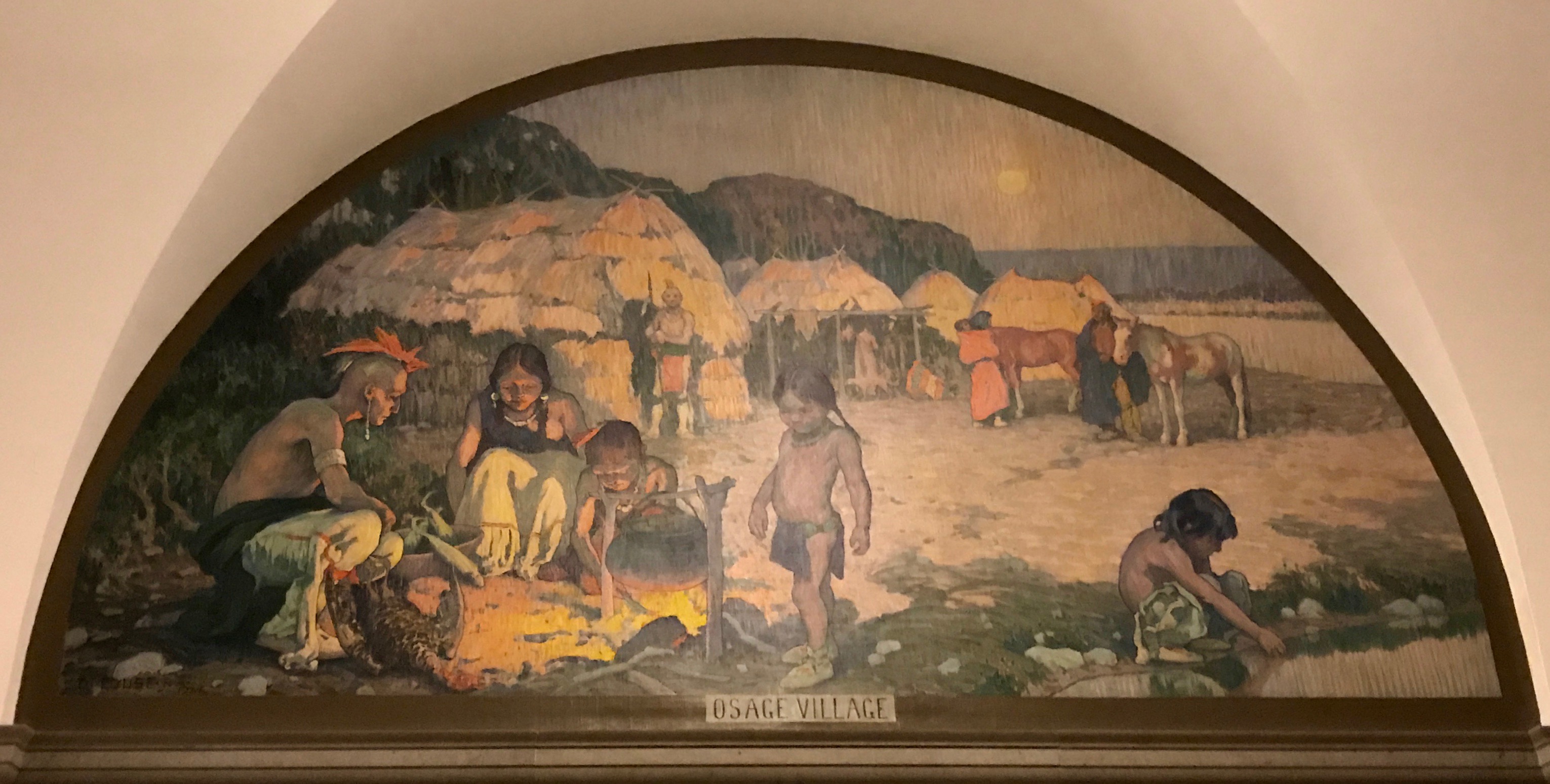
They did not completely ignore the first inhabitants of the land. Here’s a lunette showing an Osage village. We know it must be depicting a scene after 1942, as there were no horses in the Americas prior to the Columbian exchange.
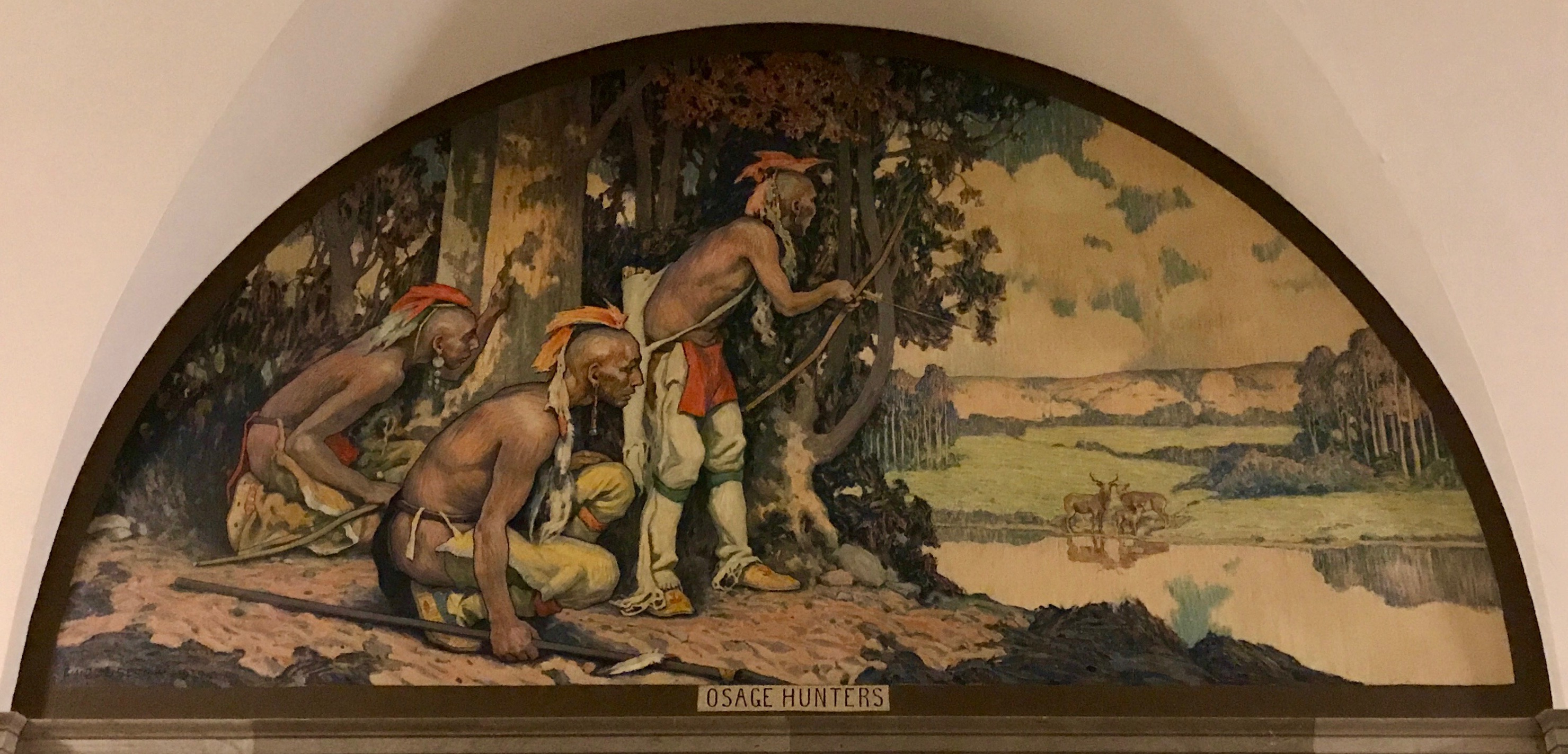
These people certainly knew how to make use of the resources available to them.

While these works of art were good – and in any other capitol, I’d say they were great – next up was what I was really eager to see. The Thomas Hart Benton murals.
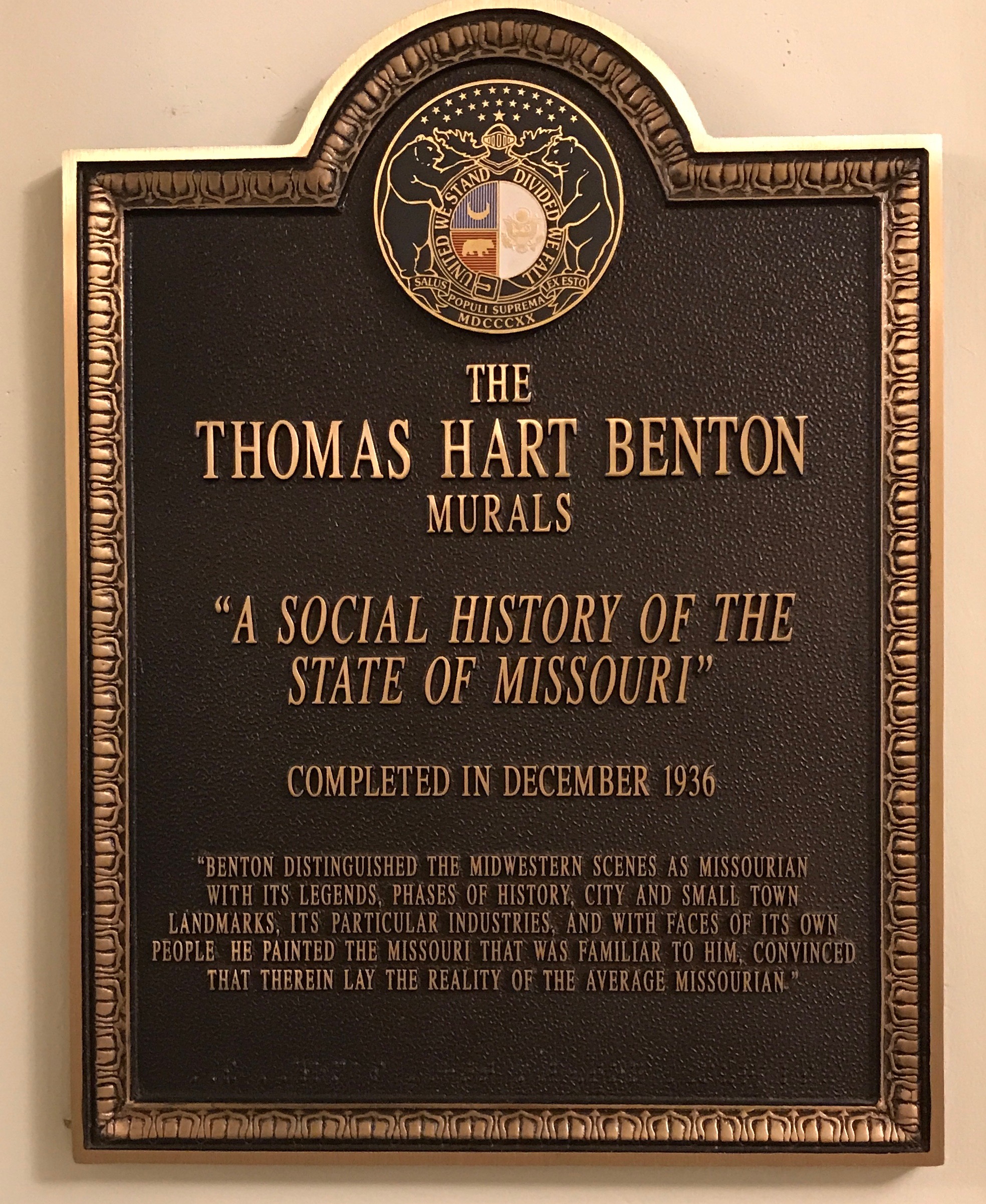
Thomas Hart Benton was commissioned to paint murals for the House Lounge, which is now used as a reception room – not what I think of as a lounge.

Thomas Hart Benton was an American painter who was in the forefront of the Regionalist art movement, along with Grant Wood and John Steuart Curry.

You all know Grant Wood, if for nothing more that his iconic American Gothic and the multitudinous parodies. 
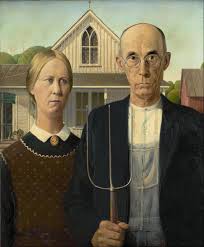
In fact, I visited the house that was used in the background and wrote about it in and earlier post.

The other name often mentioned as a Regionalist artist is John Steuart Curry. I have to admit that I wasn’t familiar with that name. Perhaps Sister Jeanne taught us about him, but that was a good 40 years ago. (gulp!) I may have forgotten.
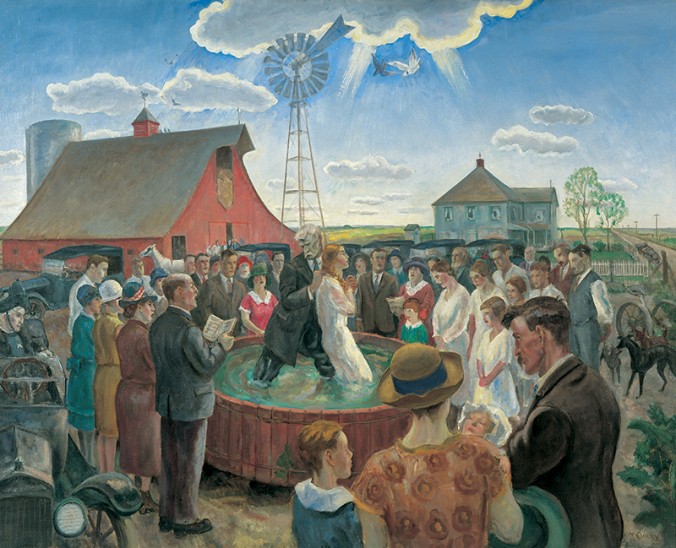
By John Steuart Curry – http://janieusart.web.unc.edu/, Public Domain, https://commons.wikimedia.org/w/index.php?curid=48542300

Curry also did murals, but in the state capitol of Kansas. I guess Regionalist art  makes sense in a Midwest state capitol.

Regionalism is a realist modern art movement arose in the 1930s as a response to the Great Depression and ended in the 1940s, along with the end of World War II. Its height of  popularity was from 1930 to 1935.  It was appreciated for its reassuring images that focused on depicting scenes of rural and small-town America primarily in the Midwest and Deep South. According to my Preferred Source, Regionalist Art in general was in a relatively conservative and traditionalist style that appealed to popular American sensibilities.

I am not sure that the legislators found Benton’s work particularly reassuring. In fact, when the legislature convened in 1937, there was an uproar. The legislators wanted the murals covered up. They gave many reasons for wanting the murals covered up, including: the subject matter; the largeness of the figures; the bright colors; and the crowds flocking to the Lounge to look at the murals.

At the time, legislators did not have their own offices, and they used the Lounge to  congregate and to get work done.
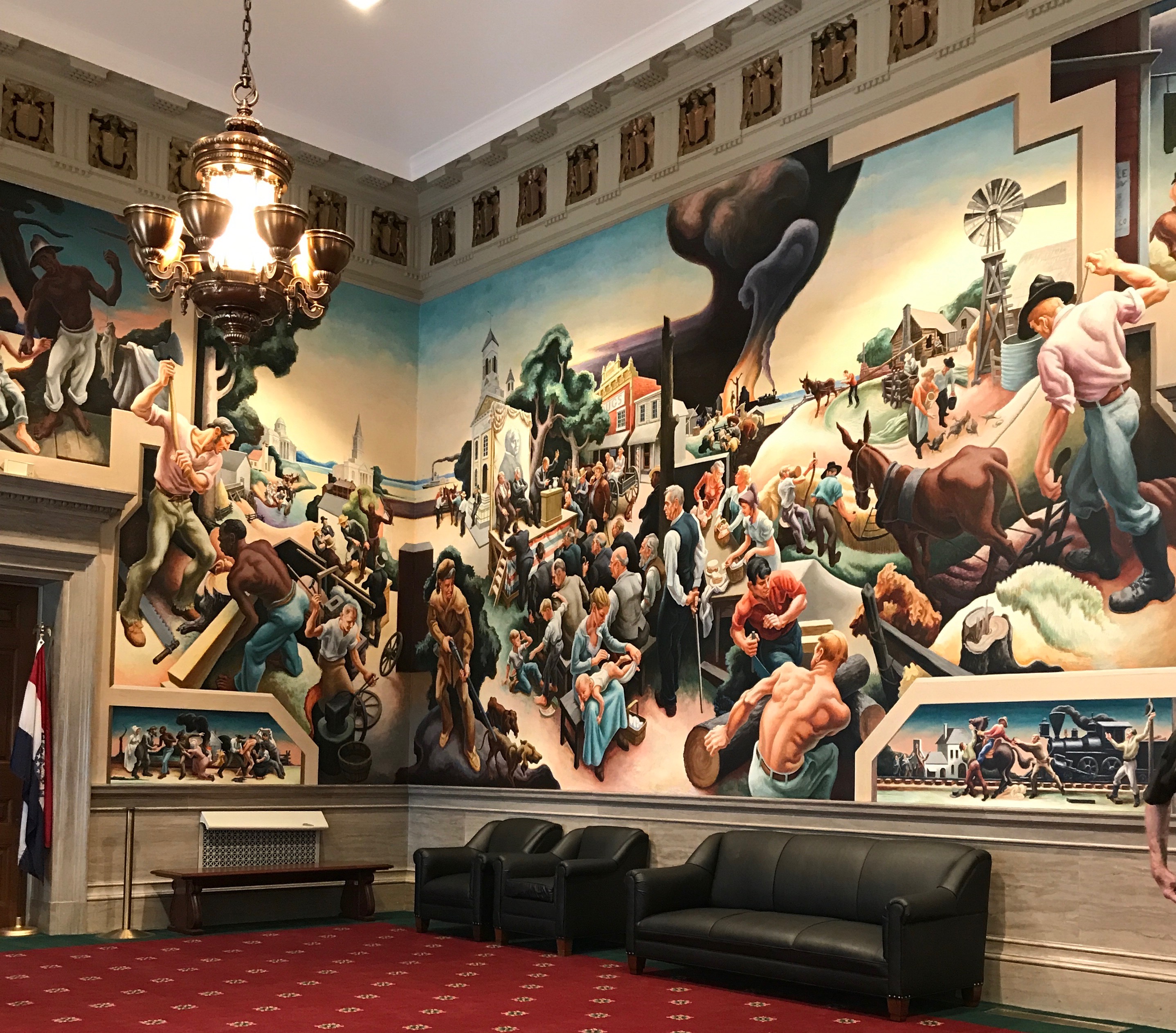
There is no denying any of those criticisms.
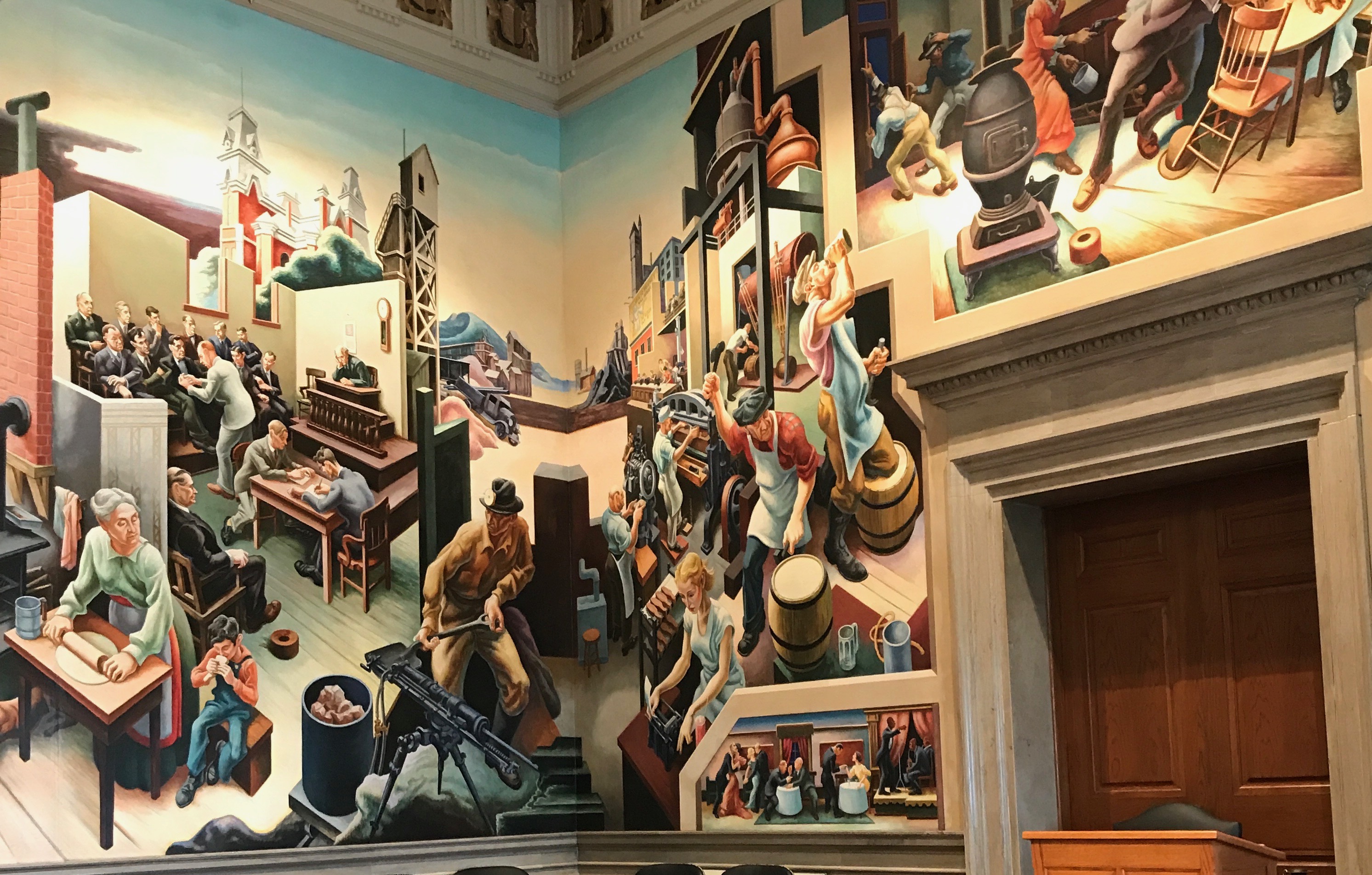
Benton was given the princely sum of $16,000 for decorating the Lounge. It was a considerable amount, considering that this was the height of the Depression. It was more than the Governor’s annual salary. In 2019 funds, this would be equal to almost $300,000. Quite frankly, I think they got their money’s worth.
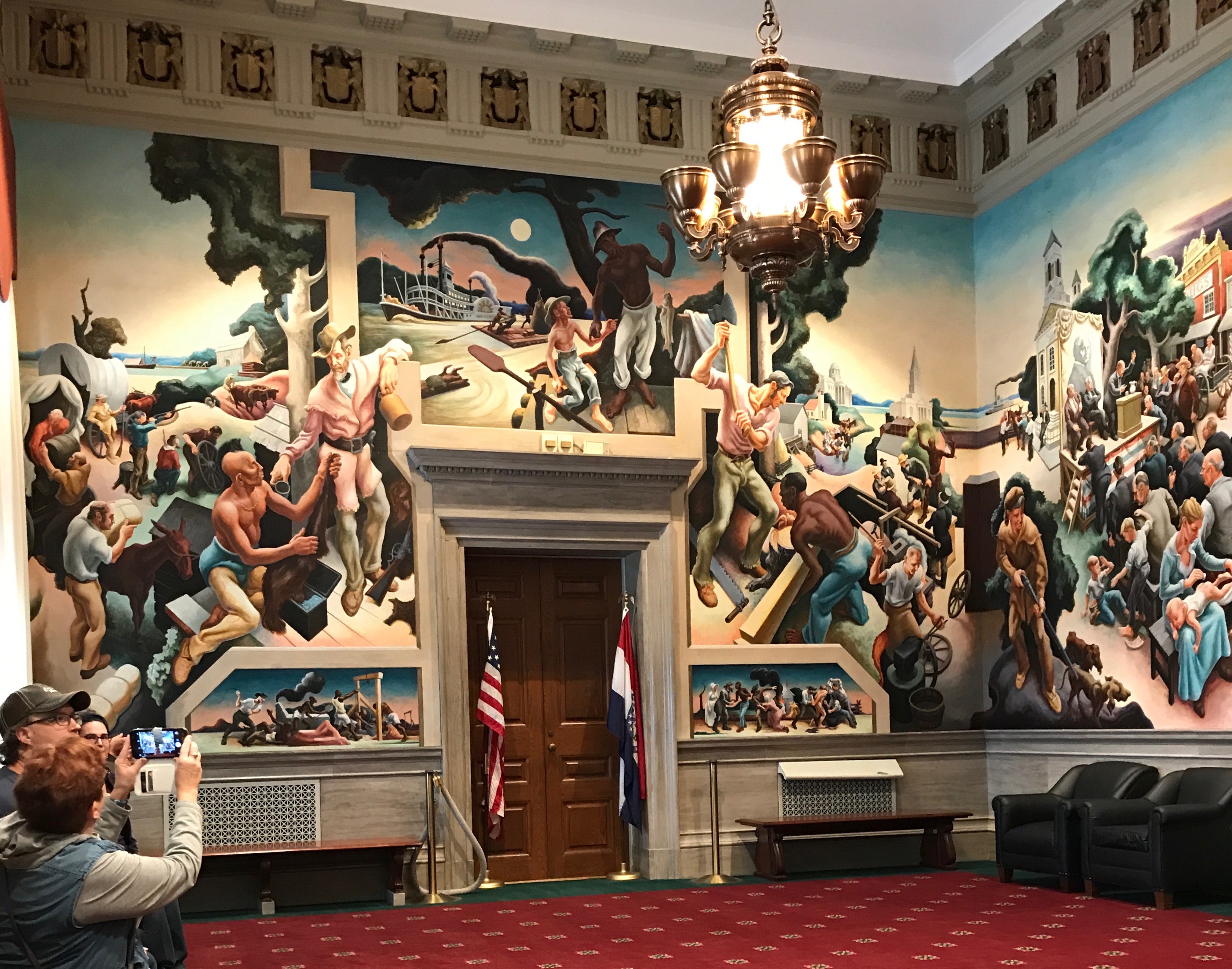
Benton was charged with showing the history of Missouri from the arrival of the French in the 1750s to the 1930s, when the painting was completed. It doesn’t look away from the darker episodes of the state’s history, including slavery and the Missouri Compromise.
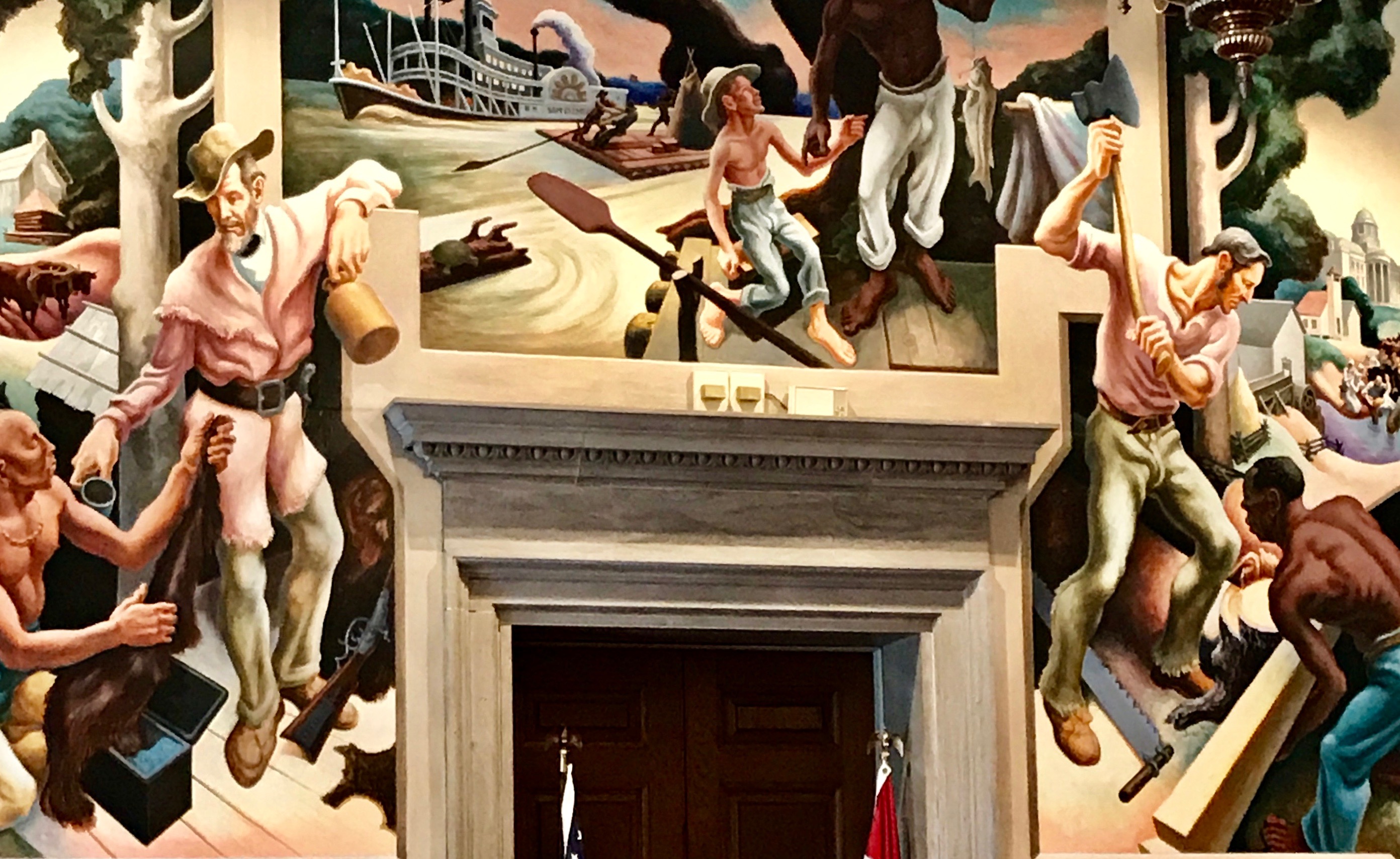
Notice the European settler on the left giving and native resident what I can only assume is alcohol.
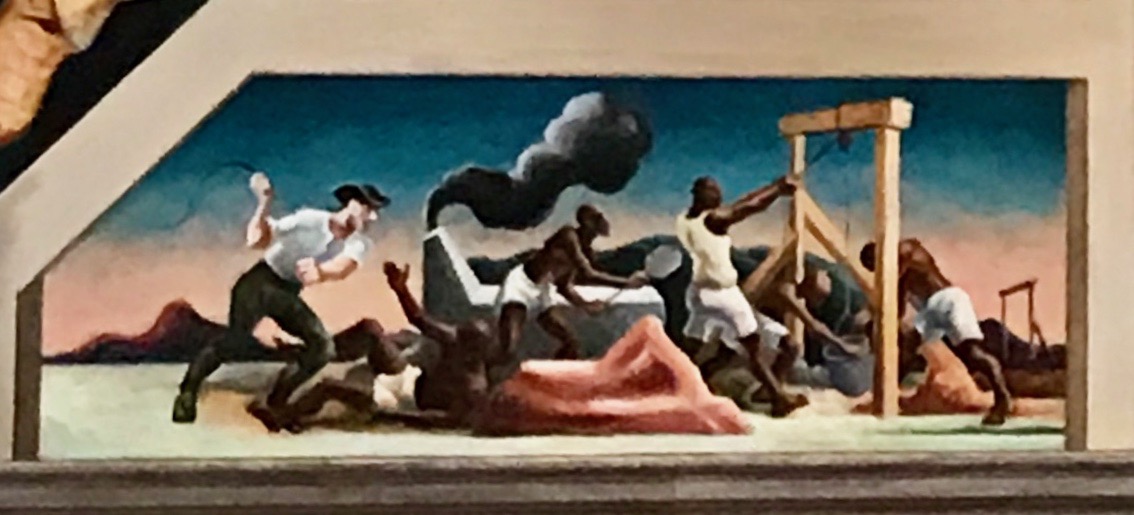
The treatment of slaves was included in the historical record.
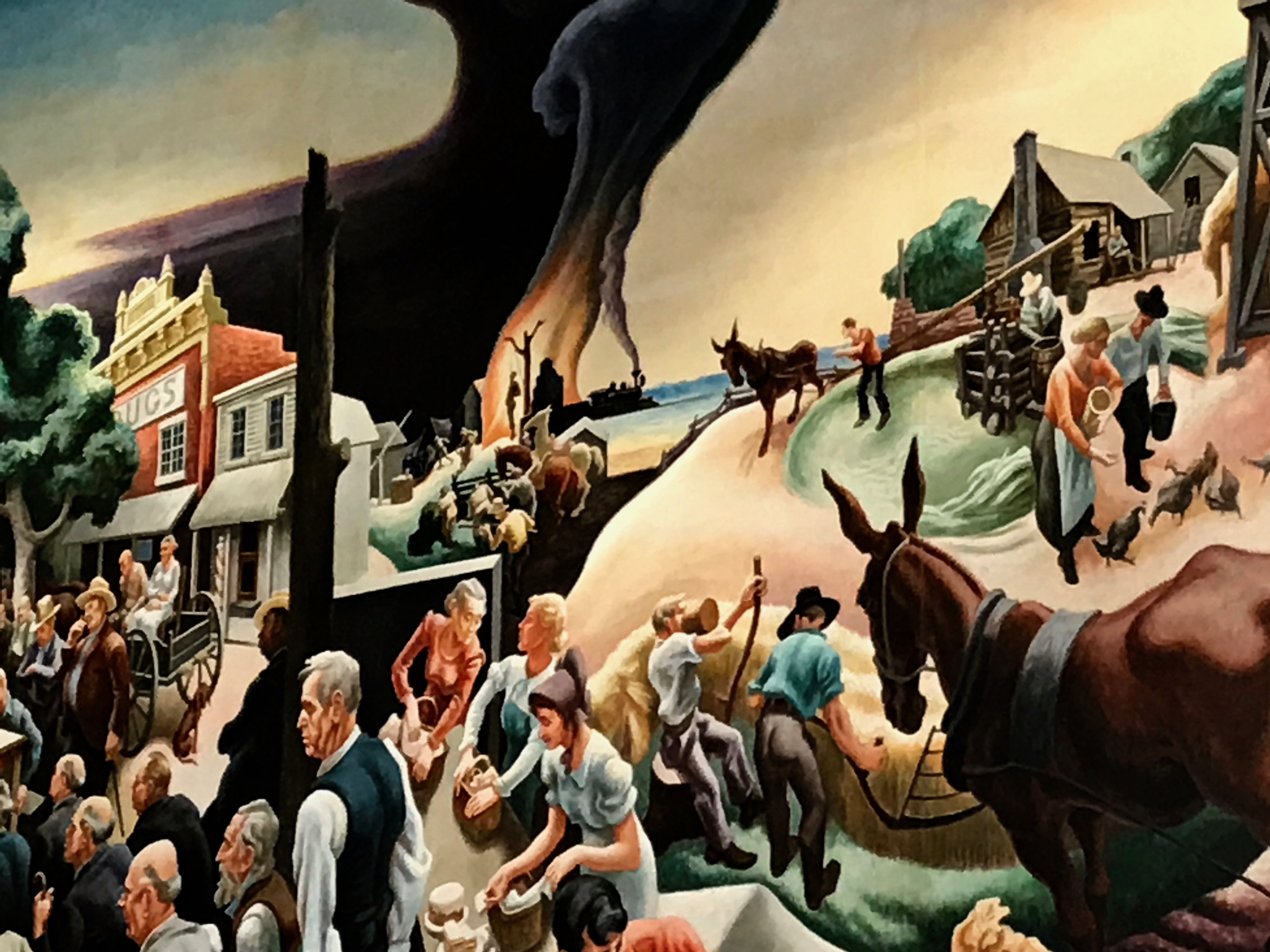
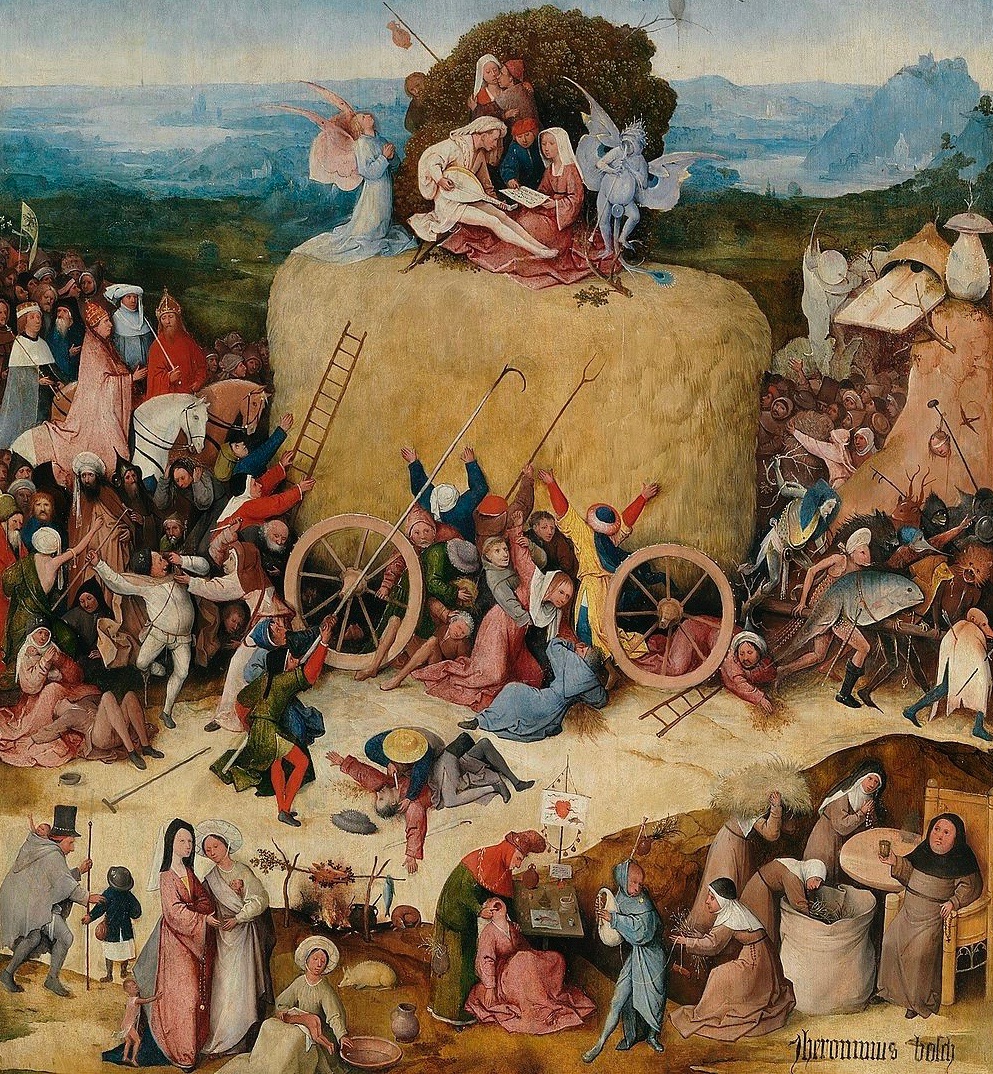
This painting reminds me of the work of Hieronymus Bosch, a Dutch painter born in the 15th century.
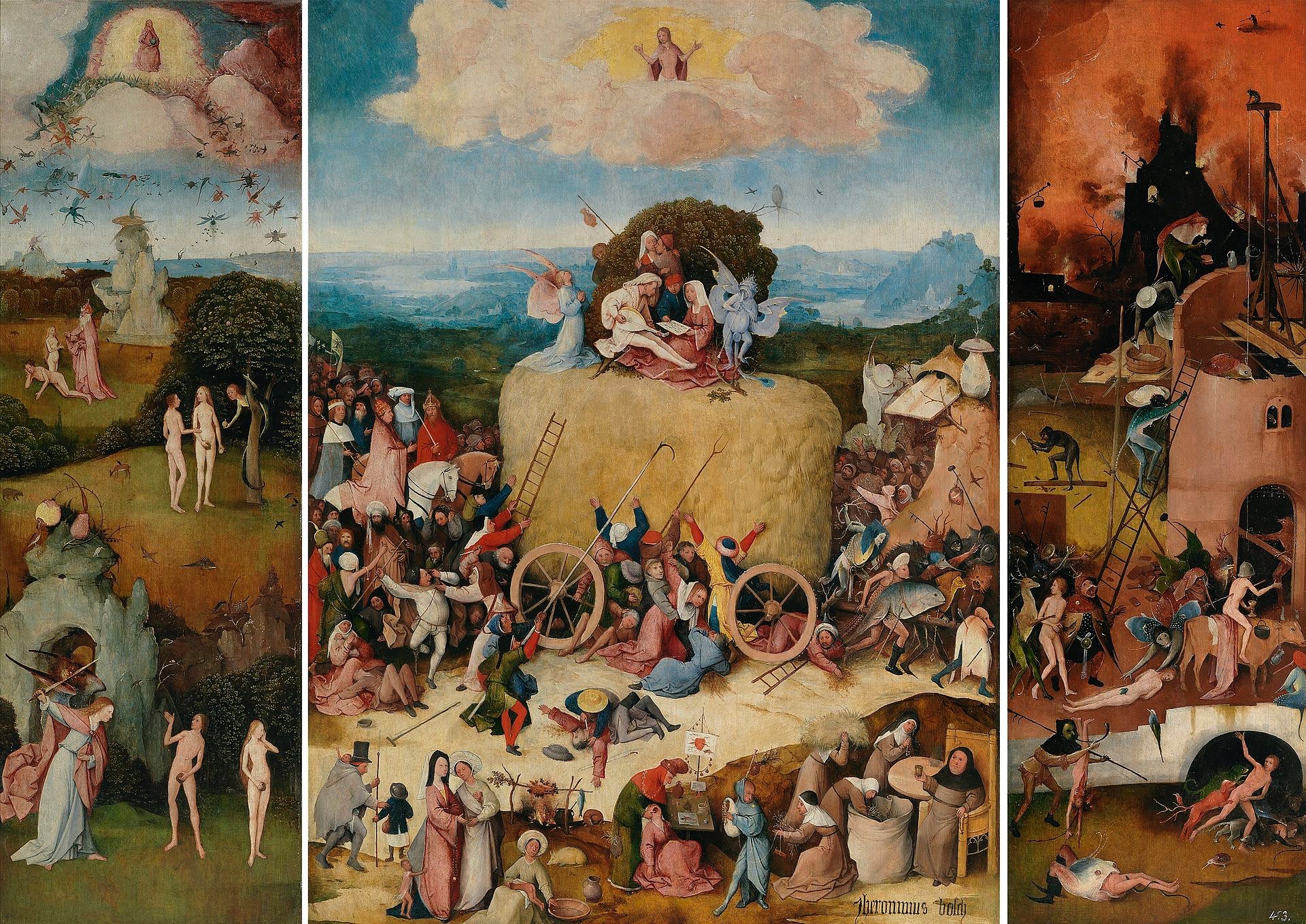
By Hieronymus Bosch or workshop – Museo Nacional del Prado, Public Domain, https://commons.wikimedia.org/w/index.php?curid=27598882

Everywhere you look is something astounding.
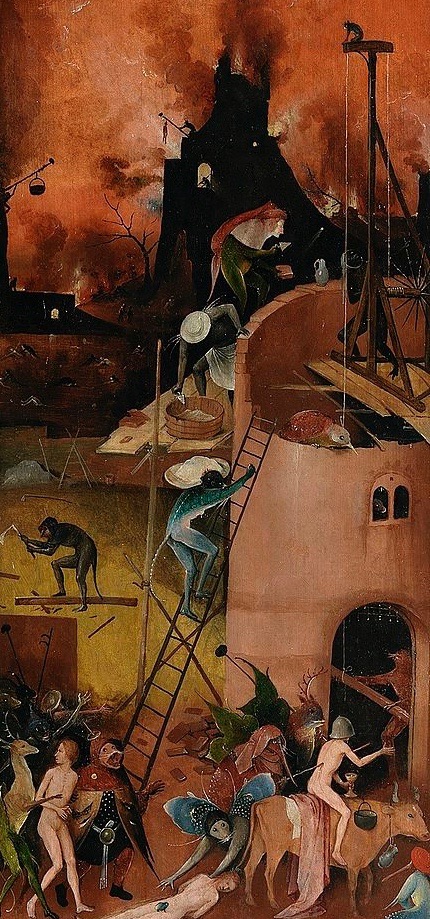
By Hieronymus Bosch or workshop – Museo Nacional del Prado, Public Domain, https://commons.wikimedia.org/w/index.php?curid=27598882

And unsettling.

By Hieronymus Bosch or workshop – Museo Nacional del Prado, Public Domain, https://commons.wikimedia.org/w/index.php?curid=27598882

But we’re not here to talk about Hieronymus Bosch. Back to Thomas Hart Benton.
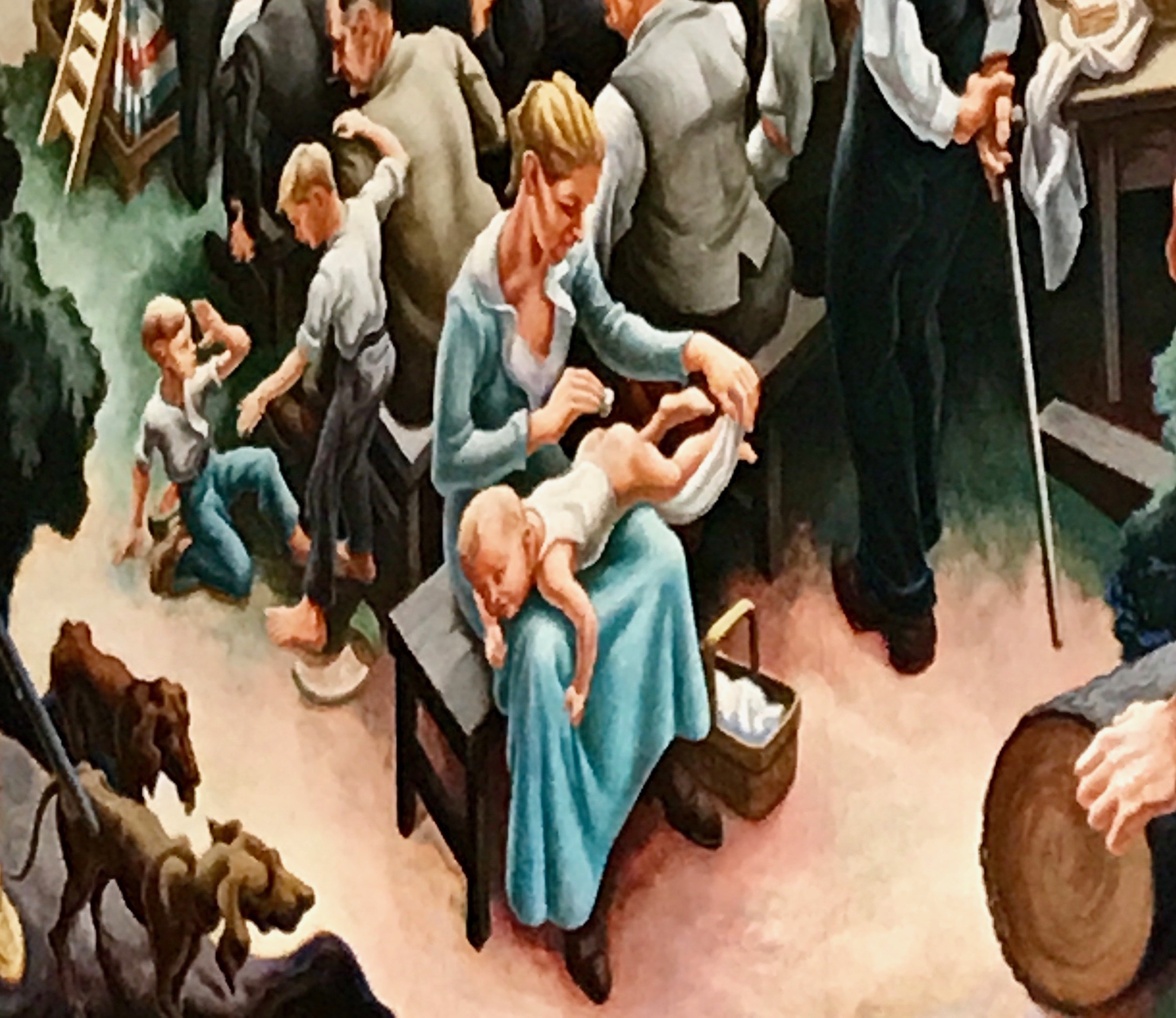
The lawmakers were scandalized by the inclusion of such quotidian activities.
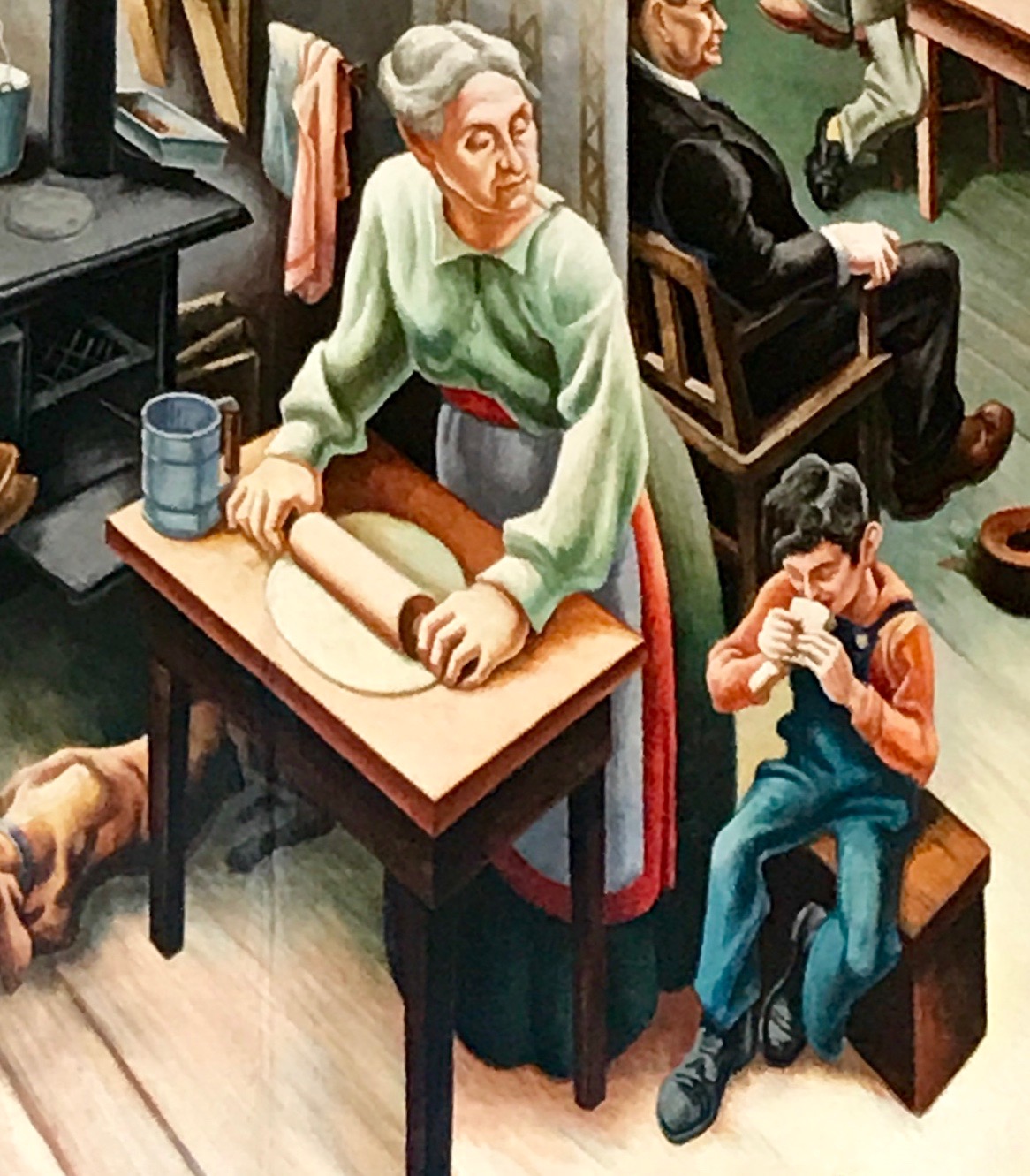
I think some of the models for these figures were family members.
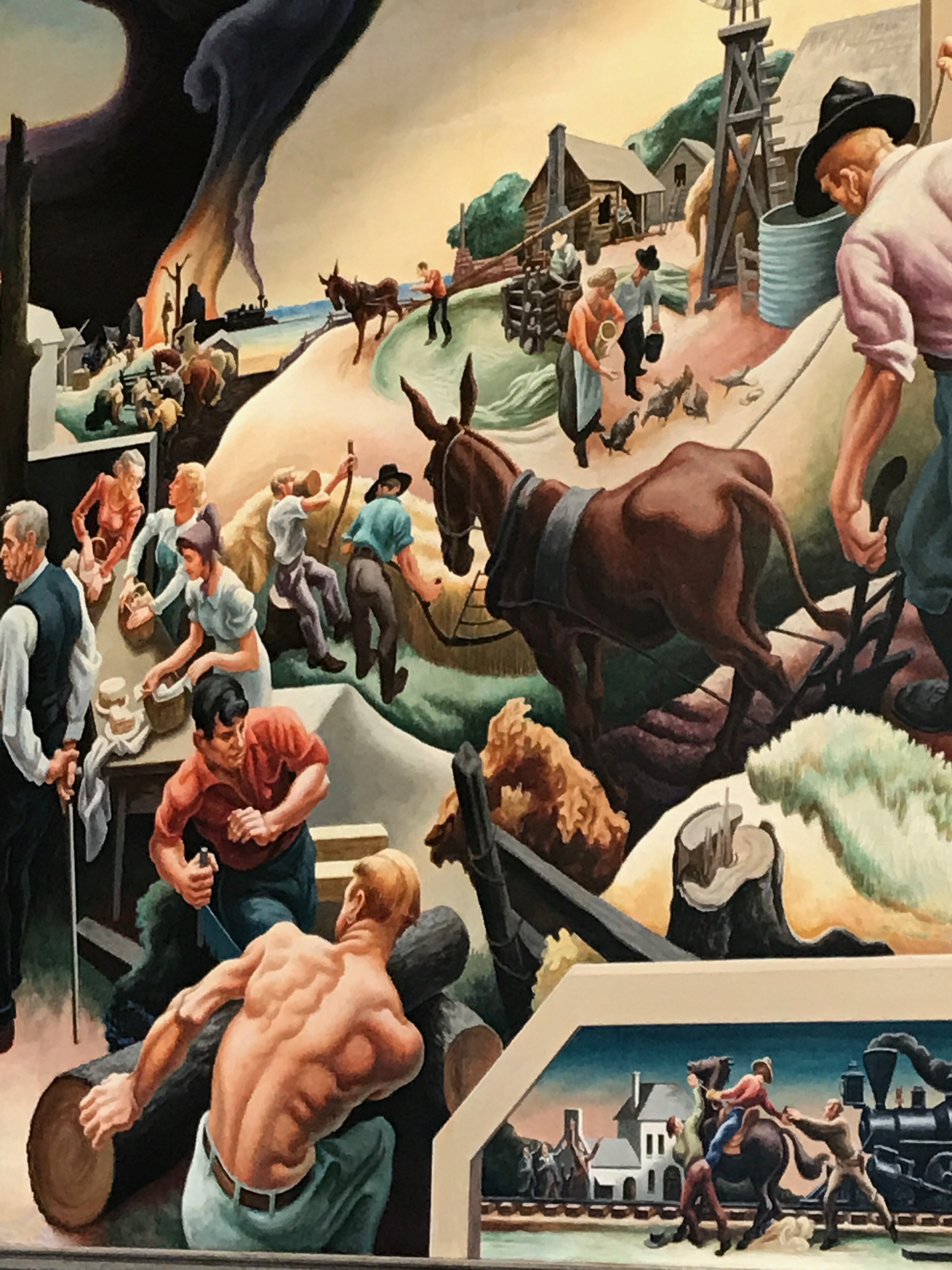
The lumberjack reminds me of the statue, “Laocoön and His Sons,” an ancient Greek statue. (Thank you, Sister Jeanne!) One of the things I remember her telling me about the Greek statue was that they really got into showing all the muscles bulging – and not in a natural way. I mean, if you are really doing something, some muscles are tense and others are relaxed. Anyway, if you want to see what I am referring to, click on the link.
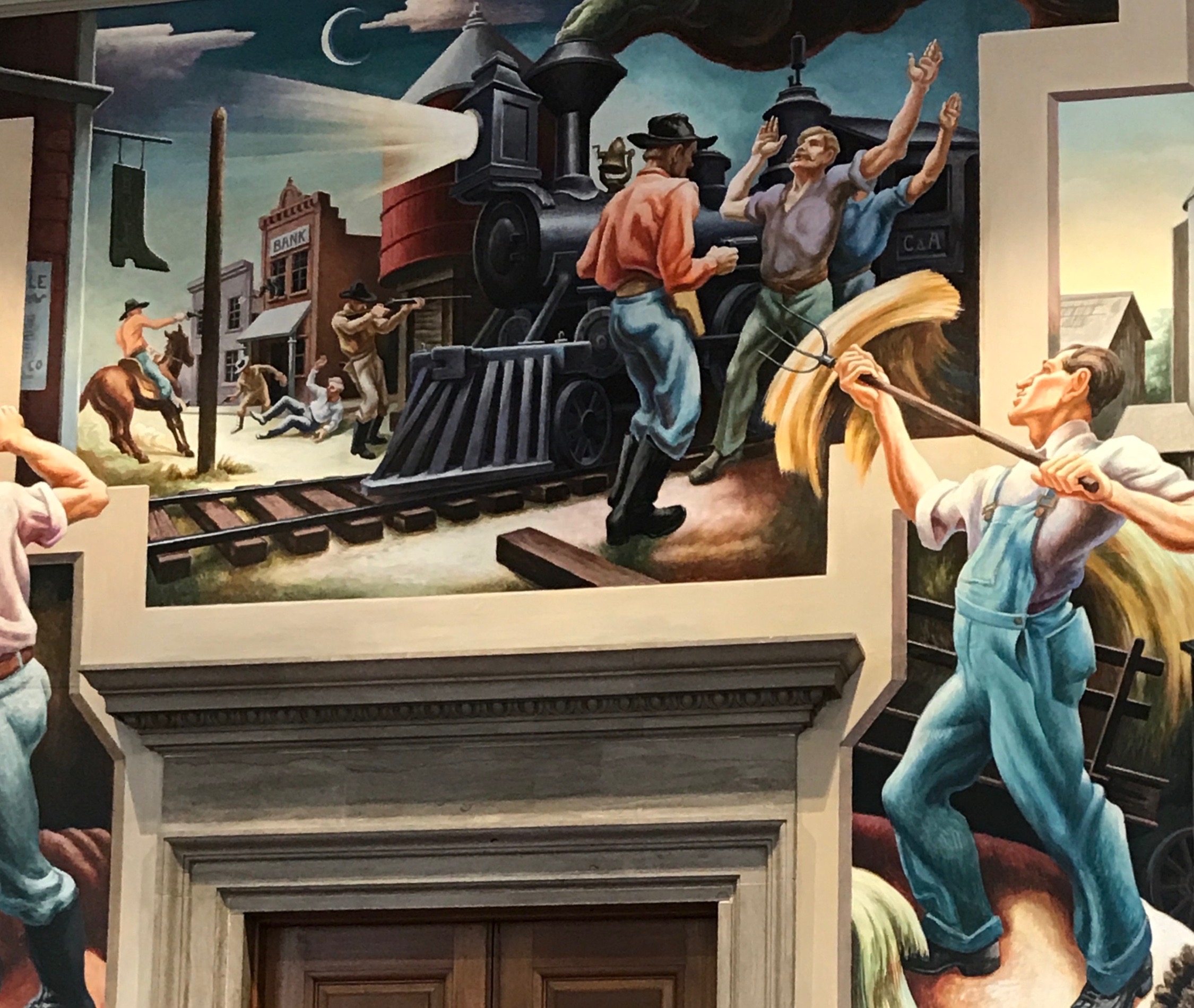
Benton included all sorts of things that were part of the history of Missouri, including Jesse James robbing trains.
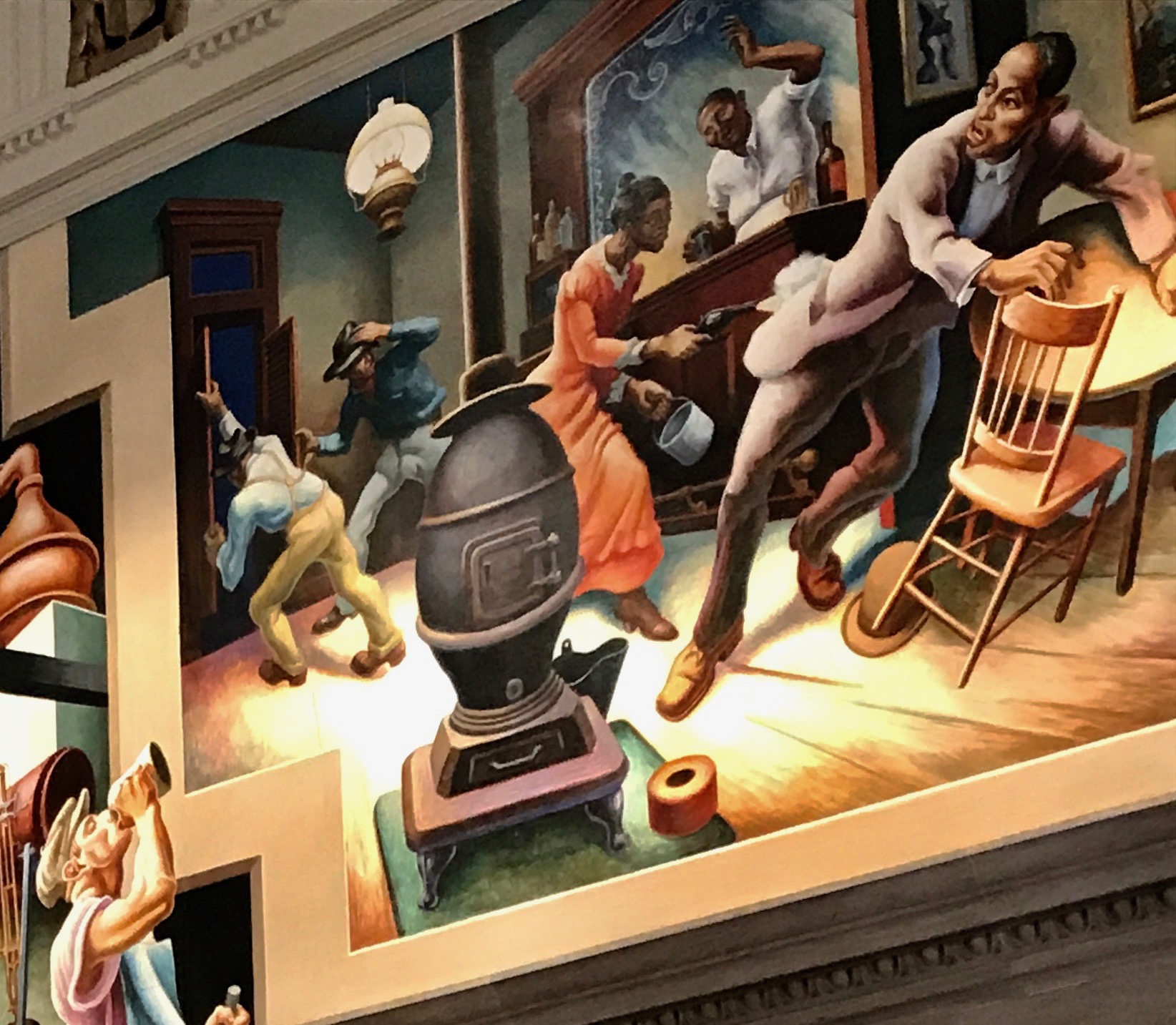
And the real life story behind the song, Frankie and Johnny. It was based on an 1899 St. Louis murder.

There are many versions of the song out there floating around. I selected this one for your enjoyment.
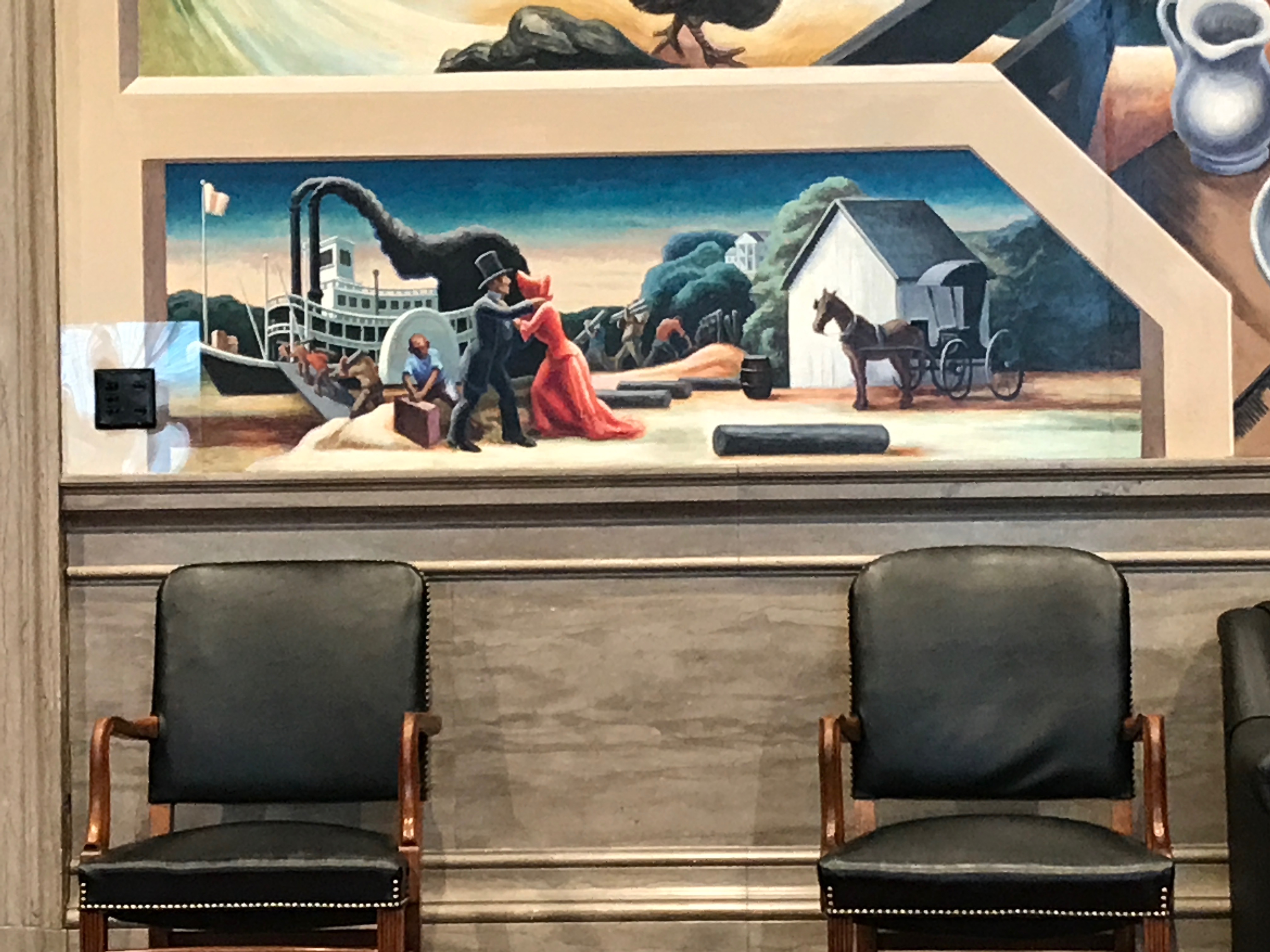
This detail looks like misogyny is also part of the state’s history.
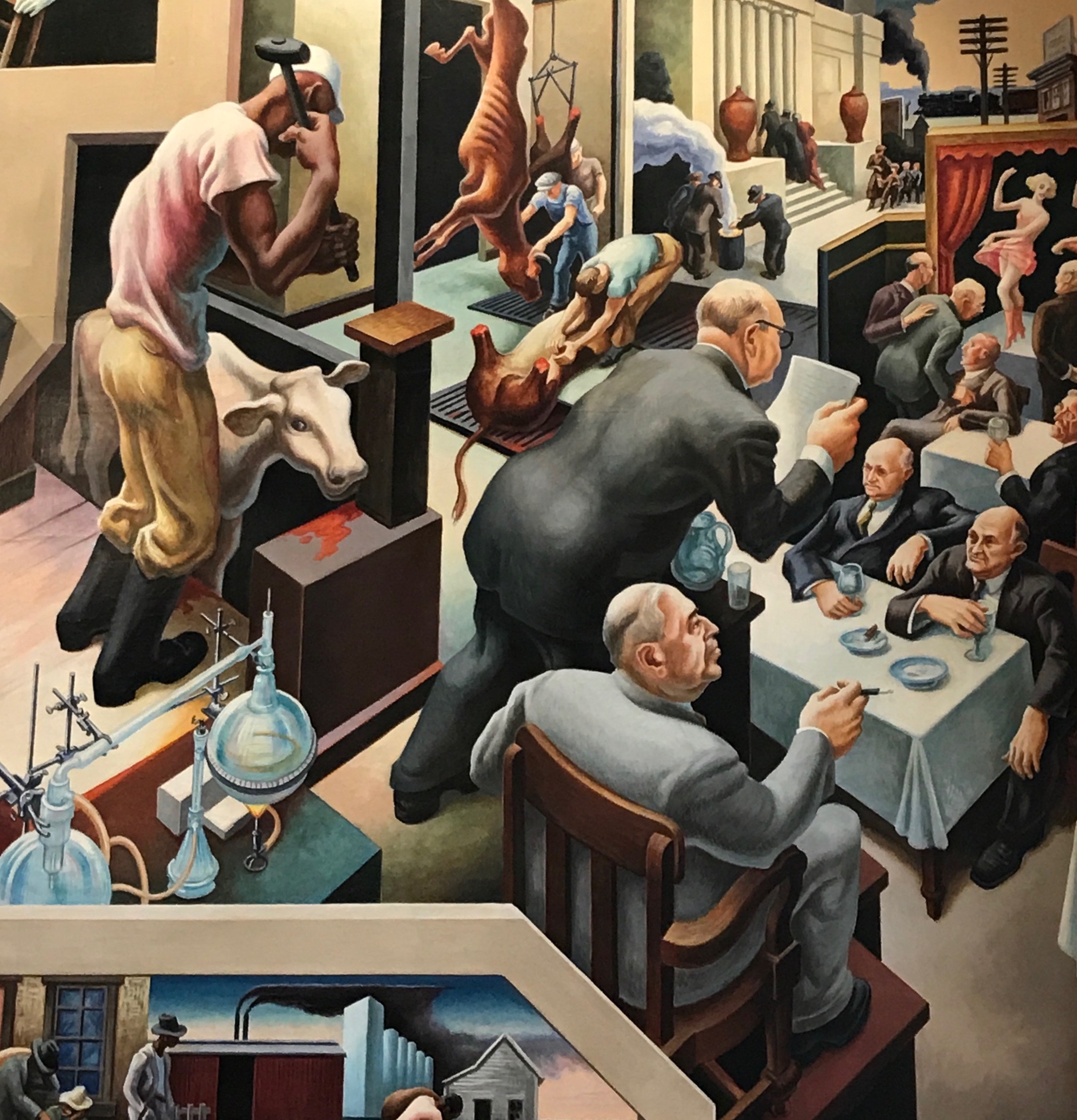
I’ve mentioned Tom Pendergast and his political machine before. Here he is, right on the walls of the state capitol. In fact, at the time this mural was painted in 1936, he was still very much in charge of Missouri politics. In 1939, he was convicted of income tax evasion and served 15 months in a Federal prison.
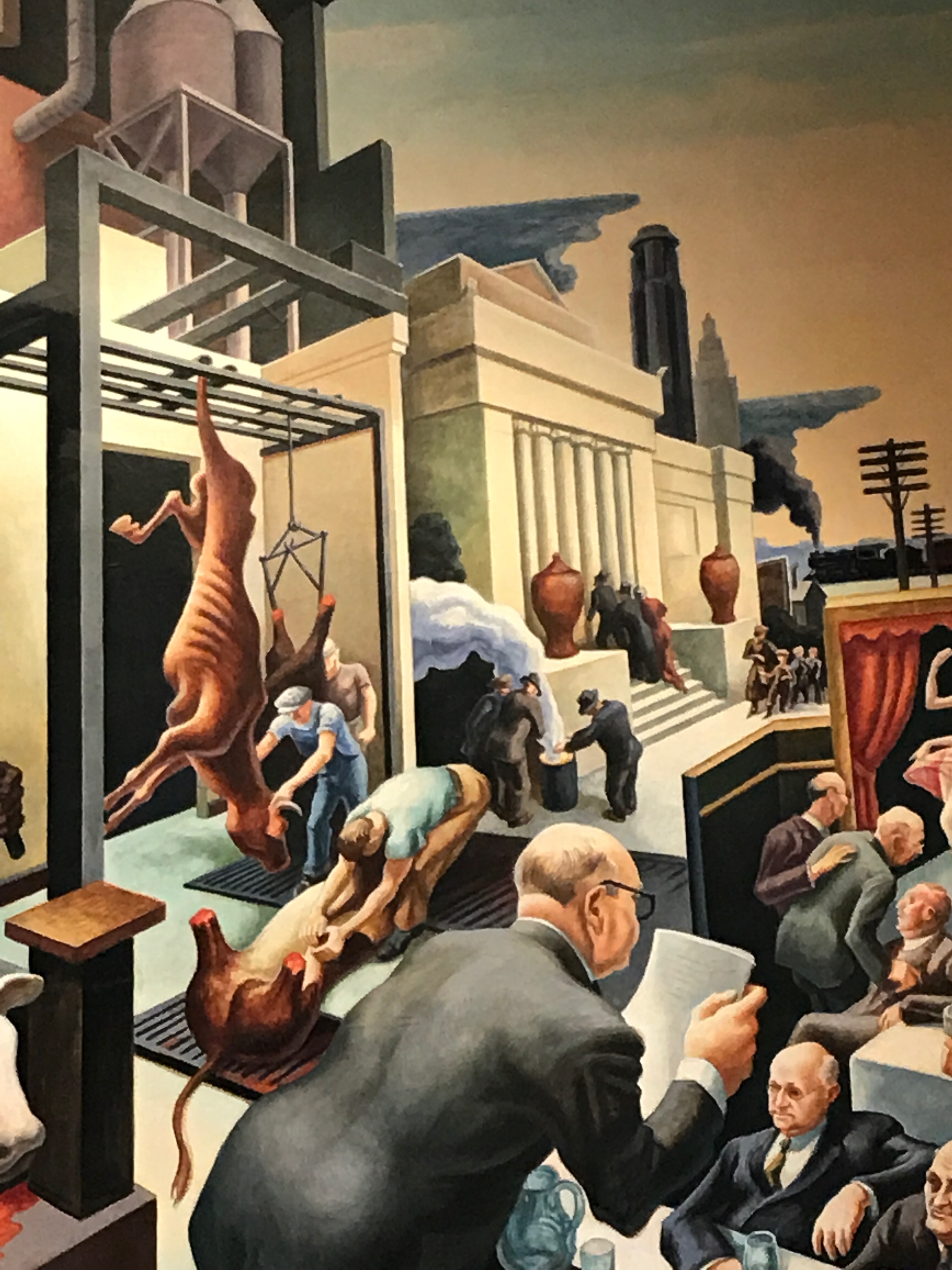
I have zoomed in on these images, because they are of places I hope to see while I am in Kansas City: The Nelson-Atkins Museum of Art and the Liberty Memorial, now known as the National WW I Museum and Memorial.

And, with that, we leave the House Lounge and the Thomas Hart Benton murals.

Believe it or not, there is yet another post coming about the Missouri State Capitol.

So, stay tuned!

(I promise the next one will be the last post about the capitol, at least for this visit.)
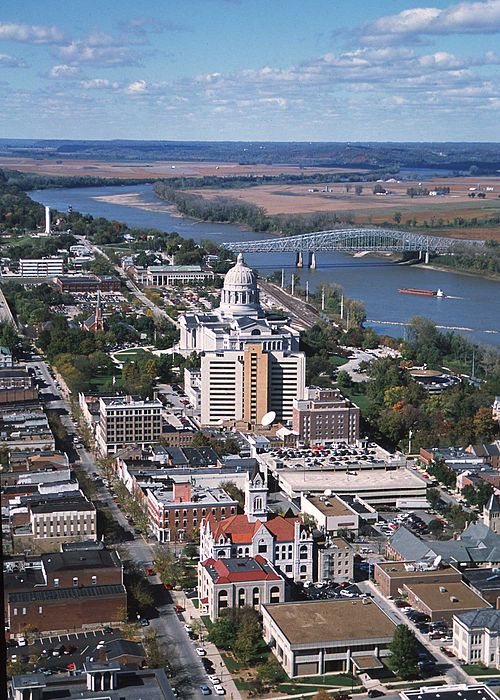


Oh, My! The Capitol Building of Missouri!

The capital of Missouri is Jefferson City – that’s Jeff City to its friends. It’s a surprisingly small city for a state capital. The 2010 census pegged it at about 43,000. According to my Preferred Source, it is the 15th largest city in Missouri. The largest city in the state is Kansas City, at about 460,000, and the populations continue down from there. In fact, the smallest place listed as a city in this source is Triplett with a population of 41 in 2010. What is at the bottom of the list? Well, it’s Goss, with a population of 0, according to the 2010 census. (But it’s only identified as a town.)

While the city is on the small side, the capitol building is not. It is built on a bluff on the south side of the Missouri River. Lewis and Clark paddled past this very spot on their 1804-1806 Corps of Discovery Expedition. Of course, none of these buildings were here.

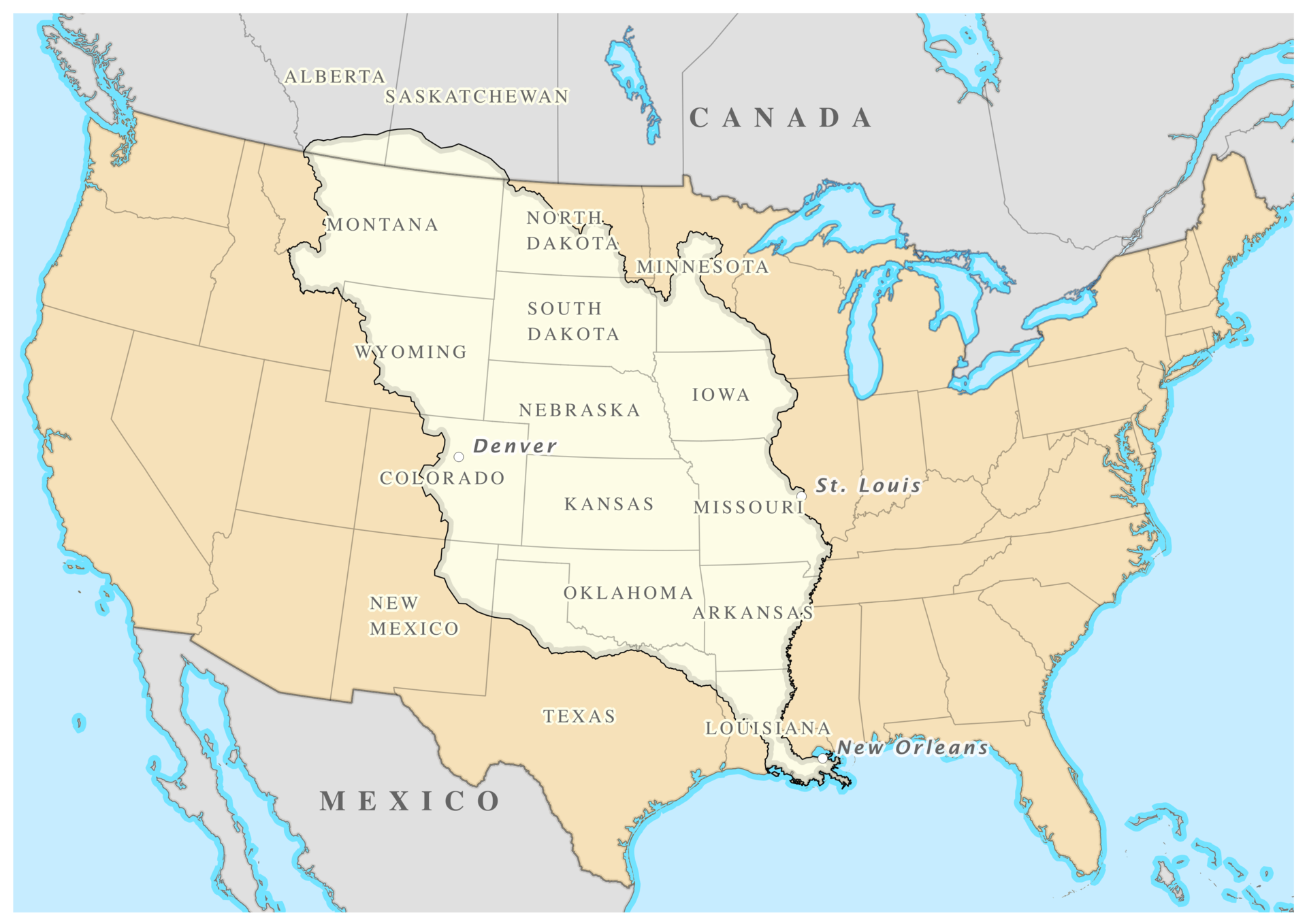
I was tempted to say that Missouri wasn’t even part of the United States at that time, but it was acquired from the French in 1803 as part of the Louisiana Purchase. The USA paid the French fifteen million dollars, or approximately $18 per square mile. That works out to about three cents an acre. They acquired a total of 530,000,000 acres – or about 830,000 square miles.

The Missouri Territory was organized in 1812. St. Louis, on the Mississippi River, was the seat of government. St. Charles, located on the Missouri River, became the second seat of government. Jefferson City was chosen as the new capital in 1821. The village was first called “Lohman’s Landing.” When the legislature decided to relocate there, they proposed changing the name to “Missouriopolis.”

I don’t know about you, but I prefer the name Jefferson City.

The settlement was incorporated as a city in 1825 and the Missouri legislature met there for the first time a year later.

I spent a lot of time trying to figure out how to present this capitol building. The building itself is mammoth, but it is filled with the more amazing works of art that I have seen in most state capitols. So, I have decided to break this up in to two posts. The first one will focus mainly on the building. If you’re not so much into the building, the post with the artwork should be along in a few days.

If you are not a fan of my state capitol posts, well, something else will be along in a eventually.

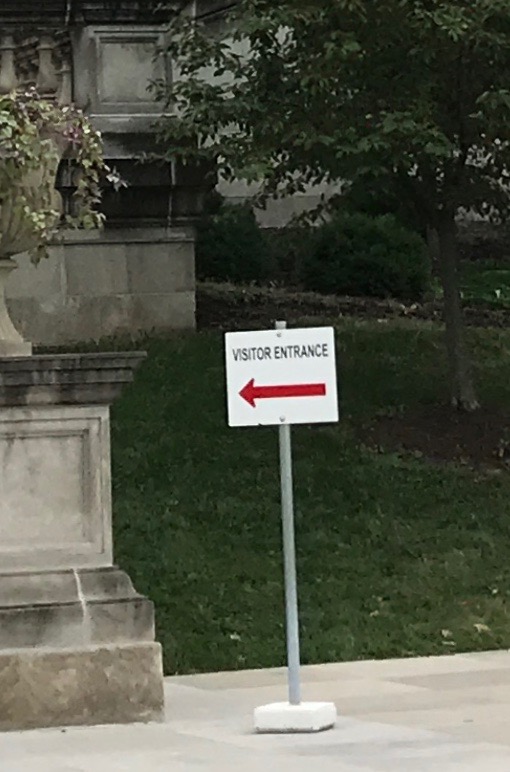
It was still a soggy day when I got up, but not quite as bad as what I had driven through the day before. I got myself ready and headed to the Capitol Building. I parked and found a sign directing me to the visitor’s entrance.

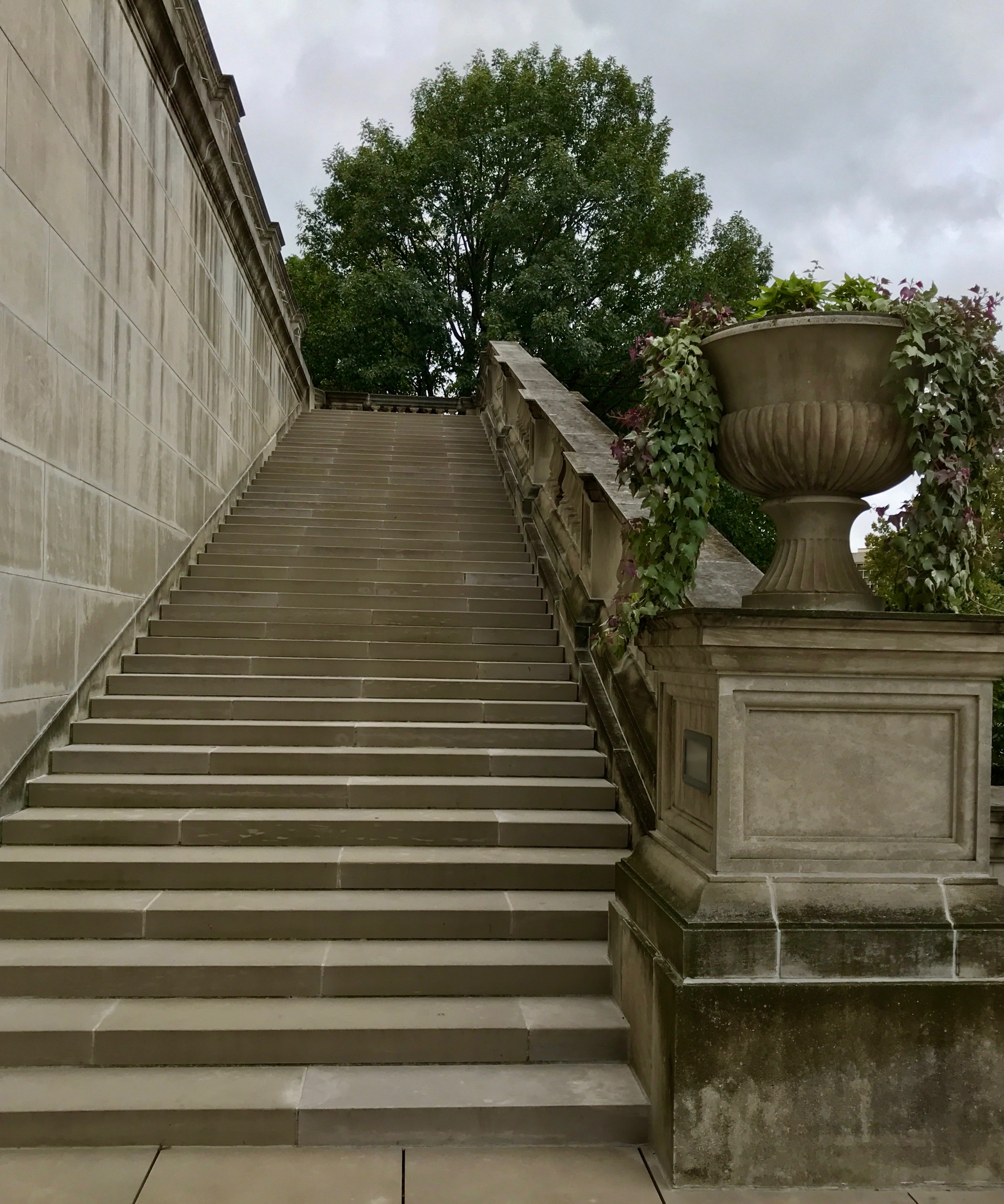
I started climbing. At one landing, there was an entrance. It wasn’t my entrance, however.

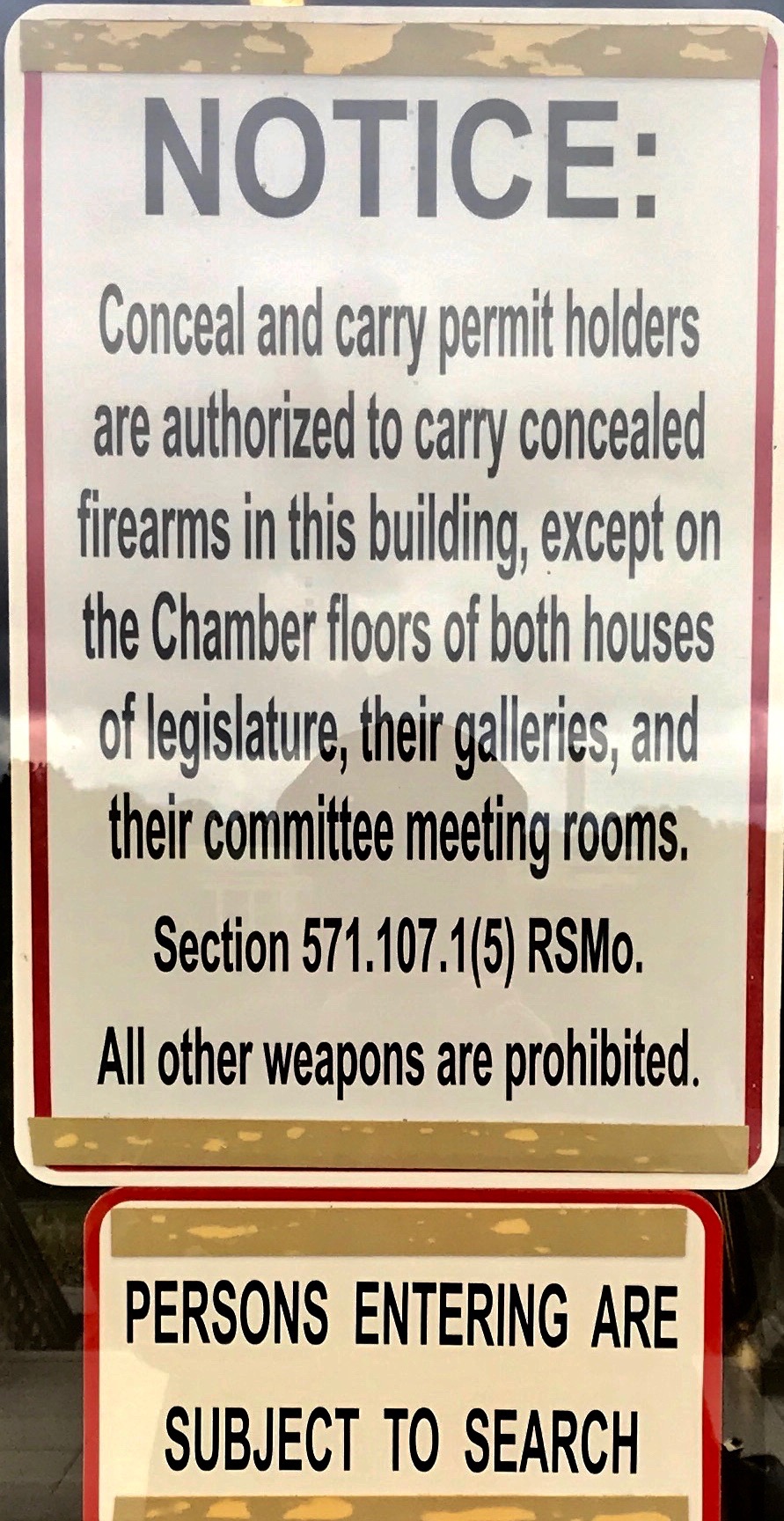
Of course, I had to go up and read the signs on the door.

And, if you wanted to know what the signs said, now you do. I continued on up the stairs.

I wish I had been counting the number of stairs! They seemed to go on for ever.

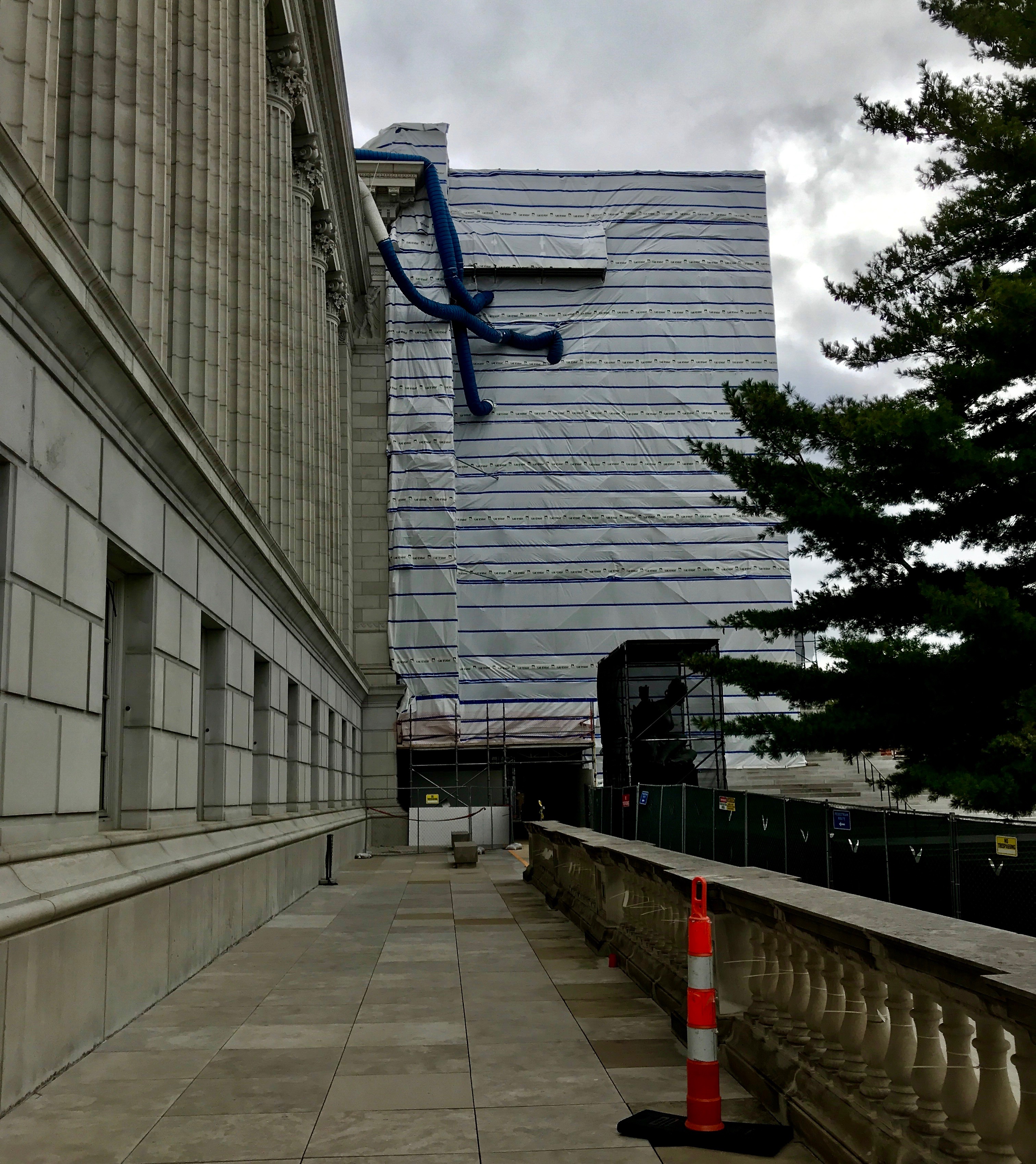
I followed the arrows around to the visitor’s entrance. I guess they must be doing some renovations. It kind of reminds me of one of Christo’s wrapped buildings.

Here’s a photo of the Reichstad in Berlin in 1995.

You can see the similarities, although Christo’s wrapping was only up for fourteen days. I wonder how long the wrapping on the capitol will be up? Incidentally, while Christo didn’t wrap the Reichstad until 1995, I first heard about it in art history class with Sister Jeanne when I was in college. Christo started planning that temporary work of art in the sevenities.

Thank you, Sister Jeanne!

Anyway, I entered the building and looked around for a restroom. The tour wasn’t going to start for a bit, and I figured that I might as well make myself comfortable.

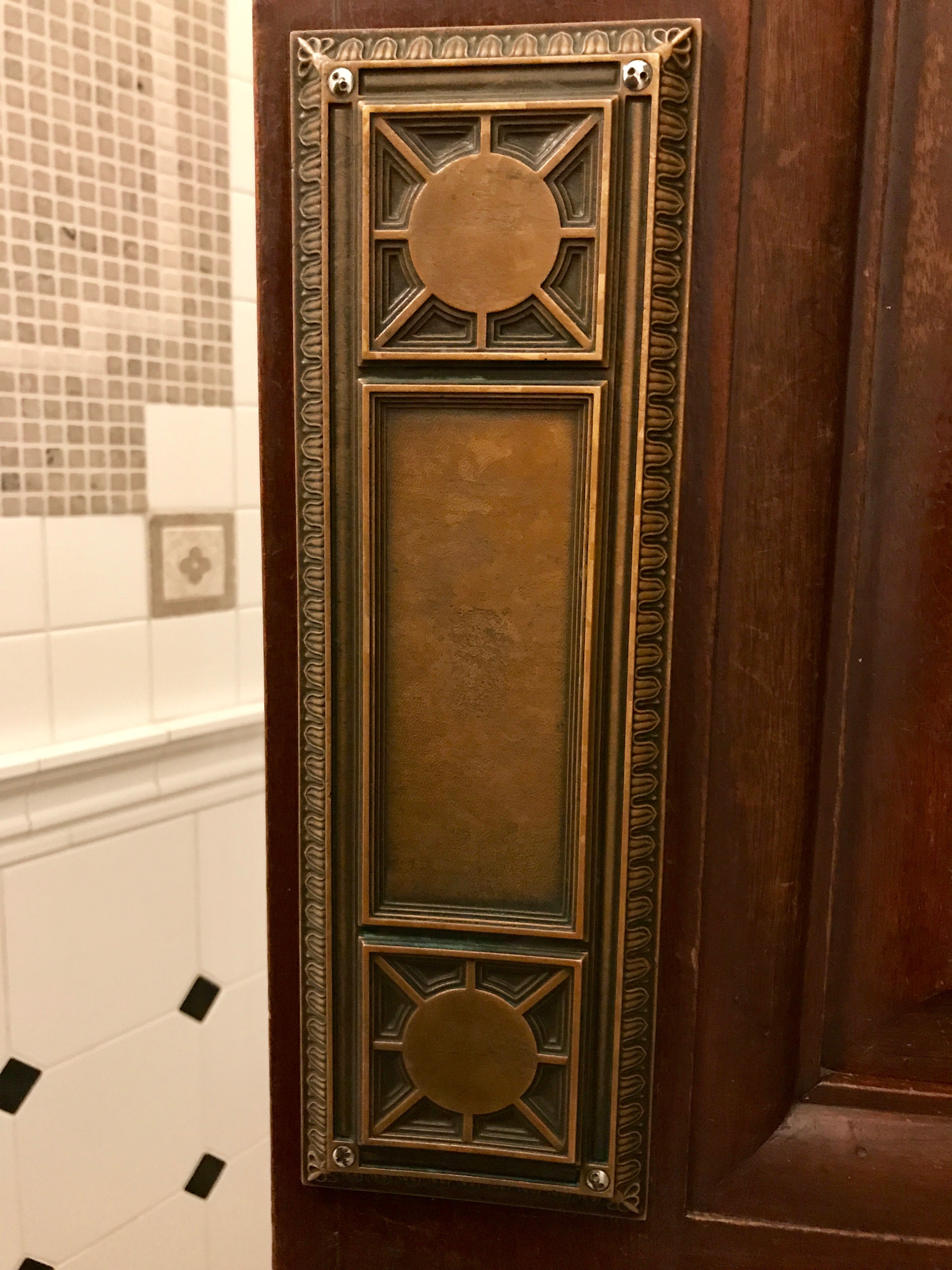
The push plate on the door was quite lovely.

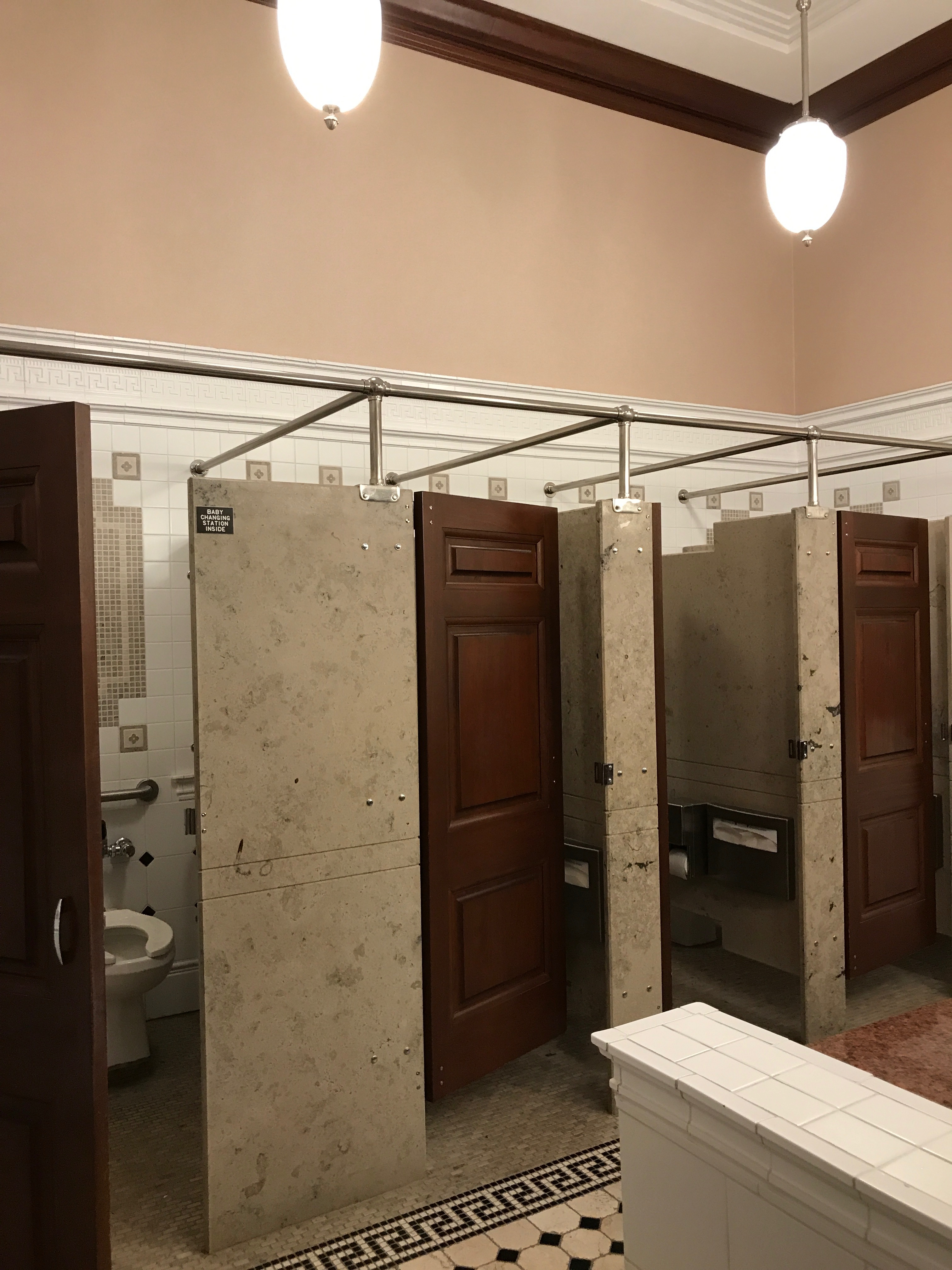
The restroom was also elegantly appointed with marble and tile work.

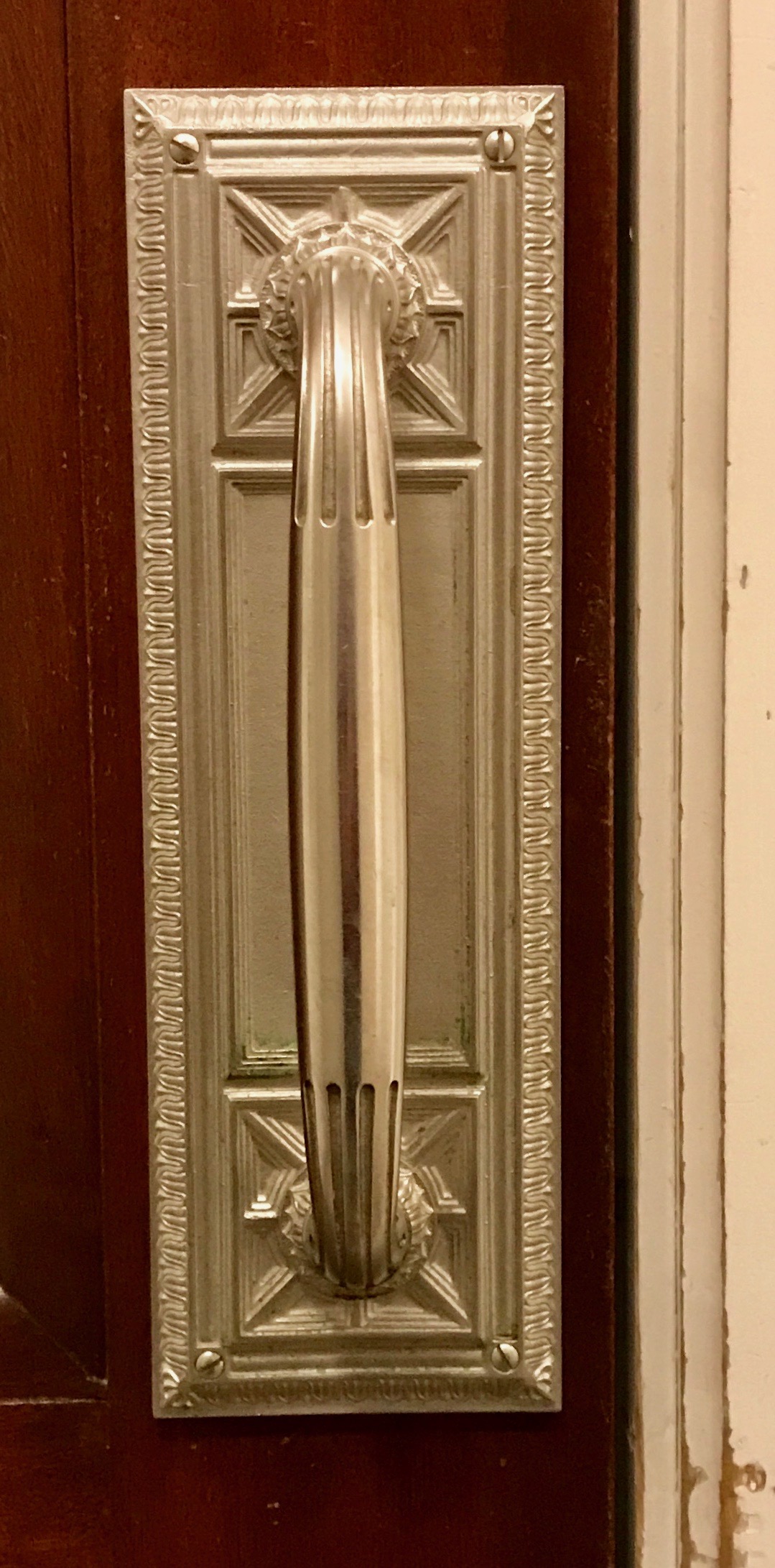
As I left, I was struck by the quality of the pull plate. At this point, I was starting to think that this building might really be something out of the ordinary.

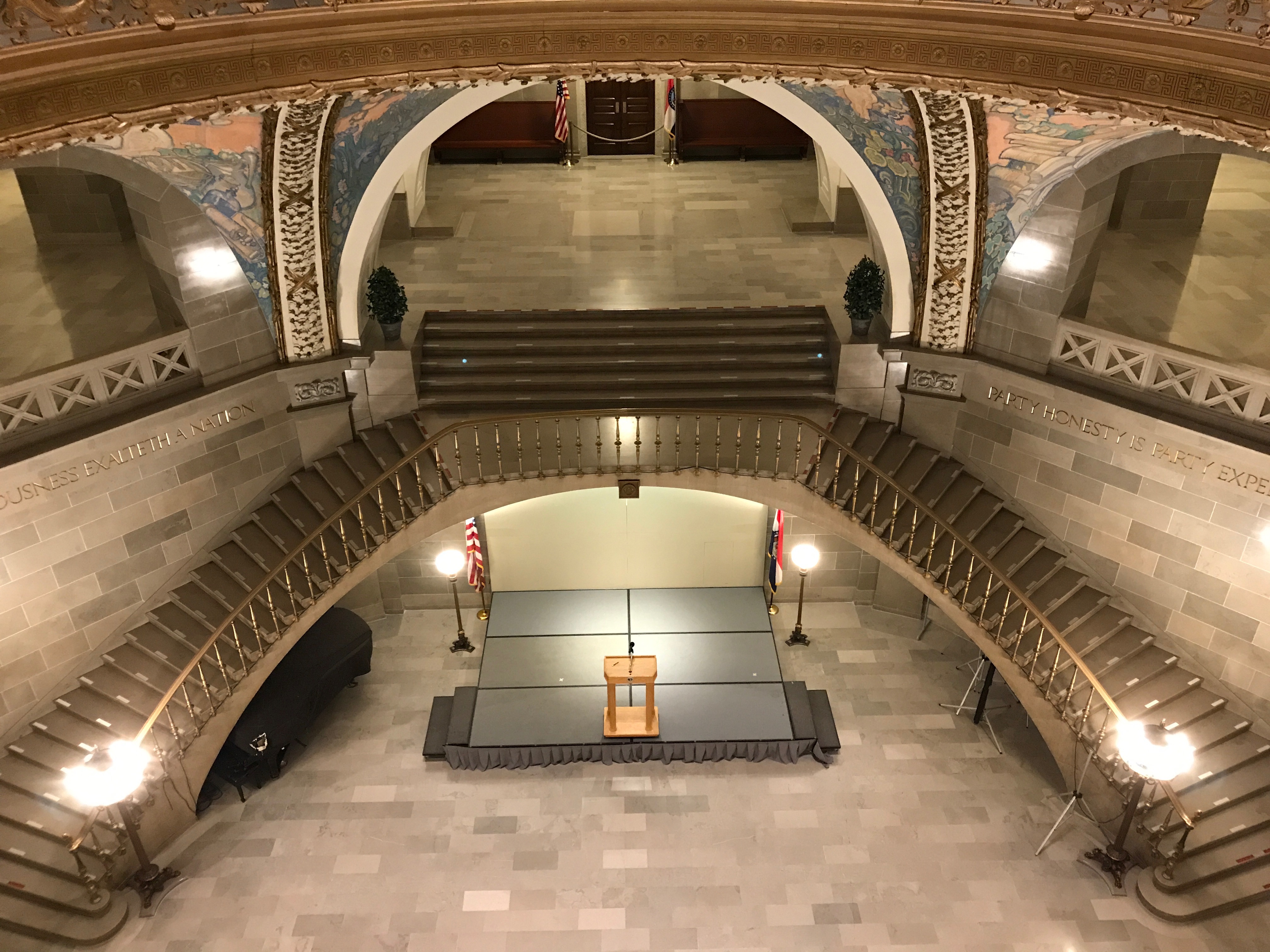
Oh, my! I do believe this building is designed to be inspirational as well as elegant.

This is one of the views looking up into the dome.

All the areas of the dome are covered with artwork and inscriptions designed to inspire. I particularly liked with panel. I think of it as a pro-education, pro-teacher segment. But, even if it is just “pro-get-a-clue,” I like it.

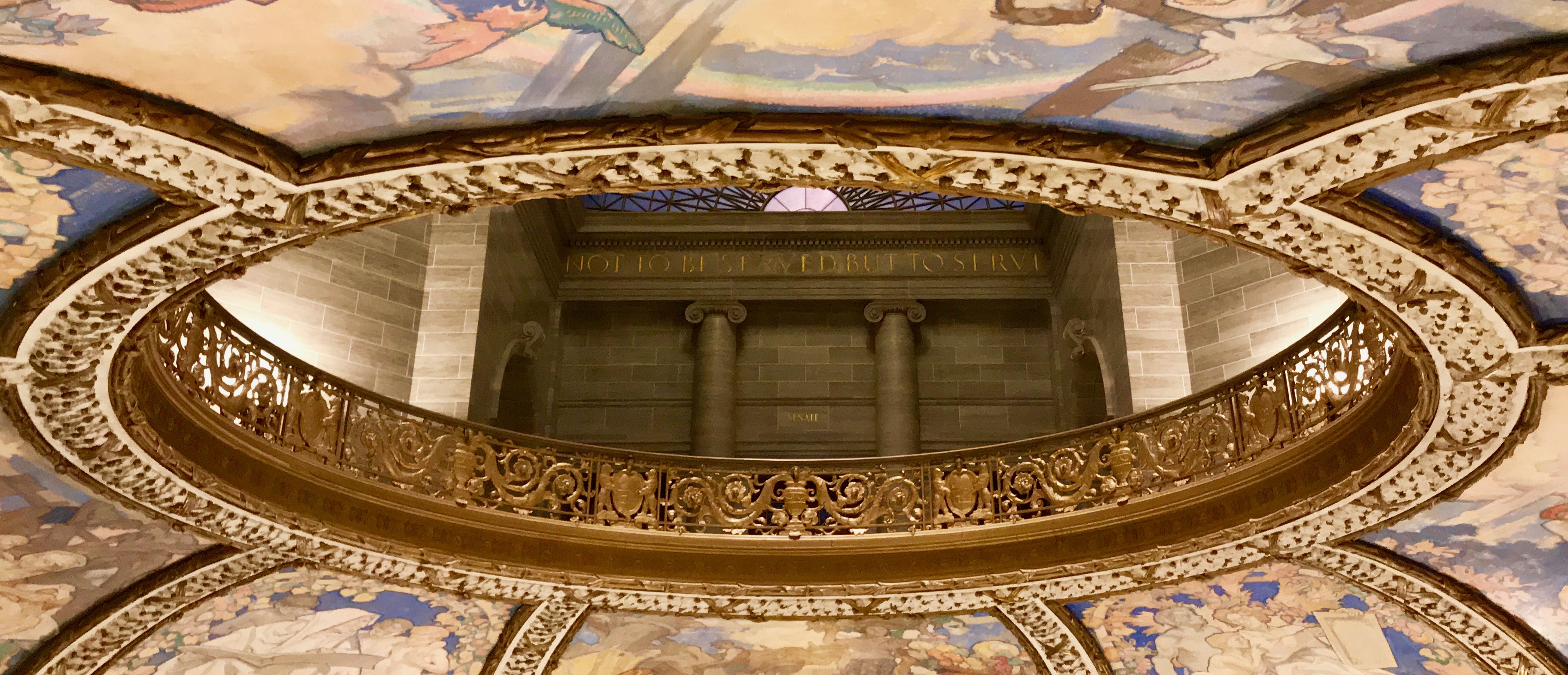
The views change depending on which floor you are standing on and where exactly you are standing.

These are noble words, as well. In case you can’t read the inscription seen through the circle, it says, “Not to be served but to serve.” I hope that is over the entrance to one of the legislative chambers – and I hope they look up and read it from time to time. Maybe they could even think about it. (Incidentally, this is not a critique of the Missouri legislators. I am not familiar with the workings of Missouri politics.)

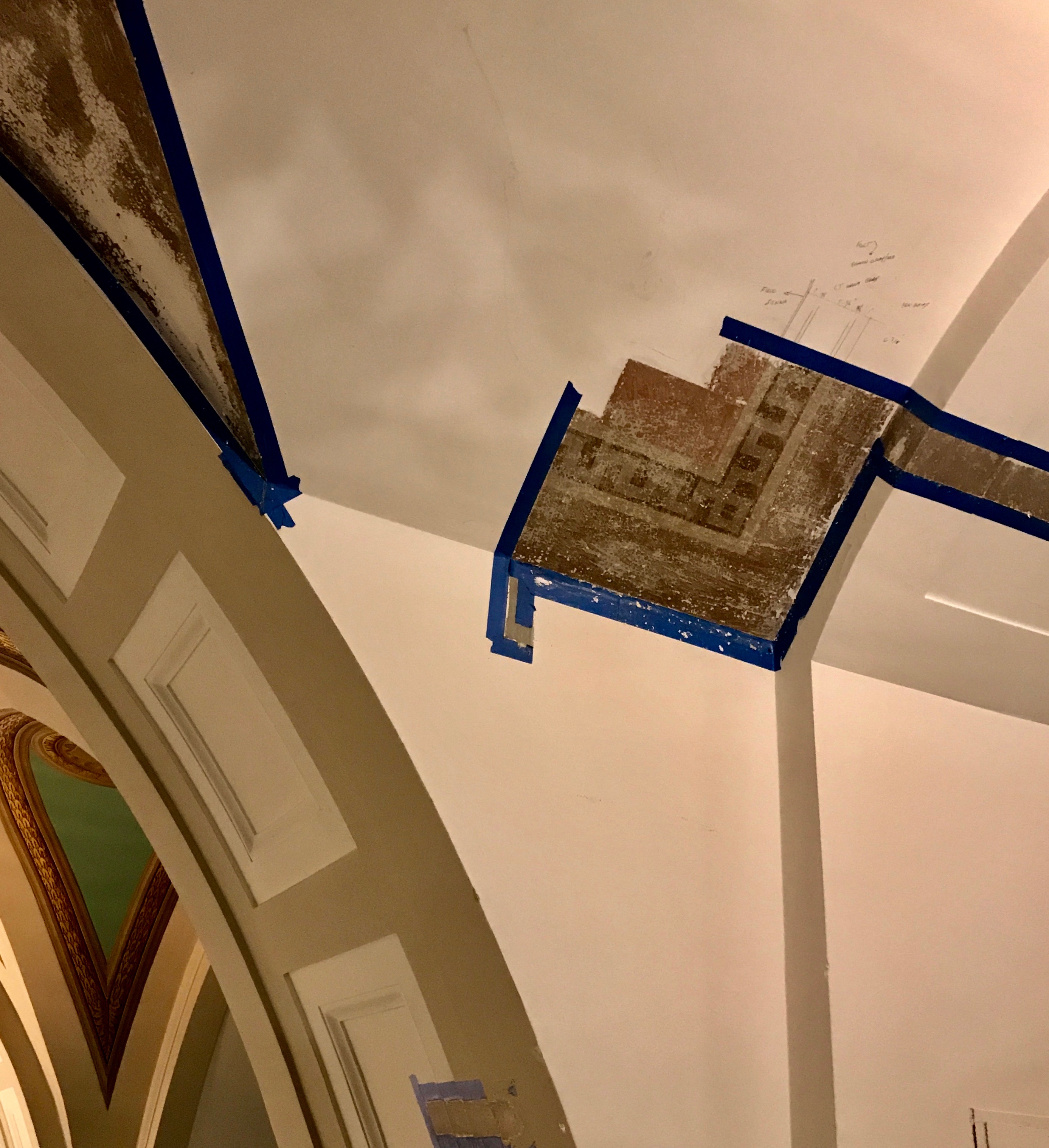
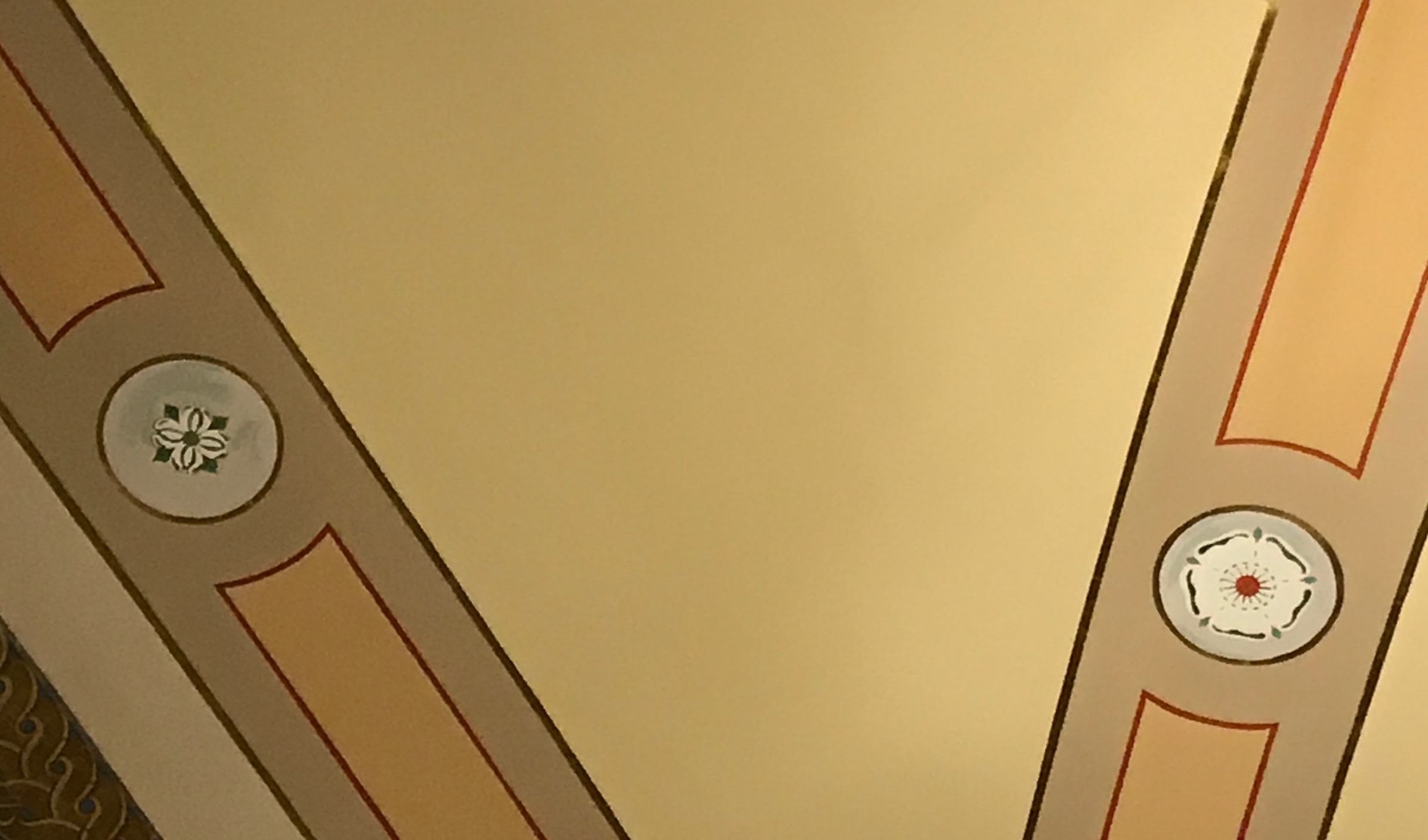
This is a building under renovation. This is the third building to serve as the capitol in Jefferson City. It was completed in 1917. You can see a remnant of some of the original paint in this fragment.

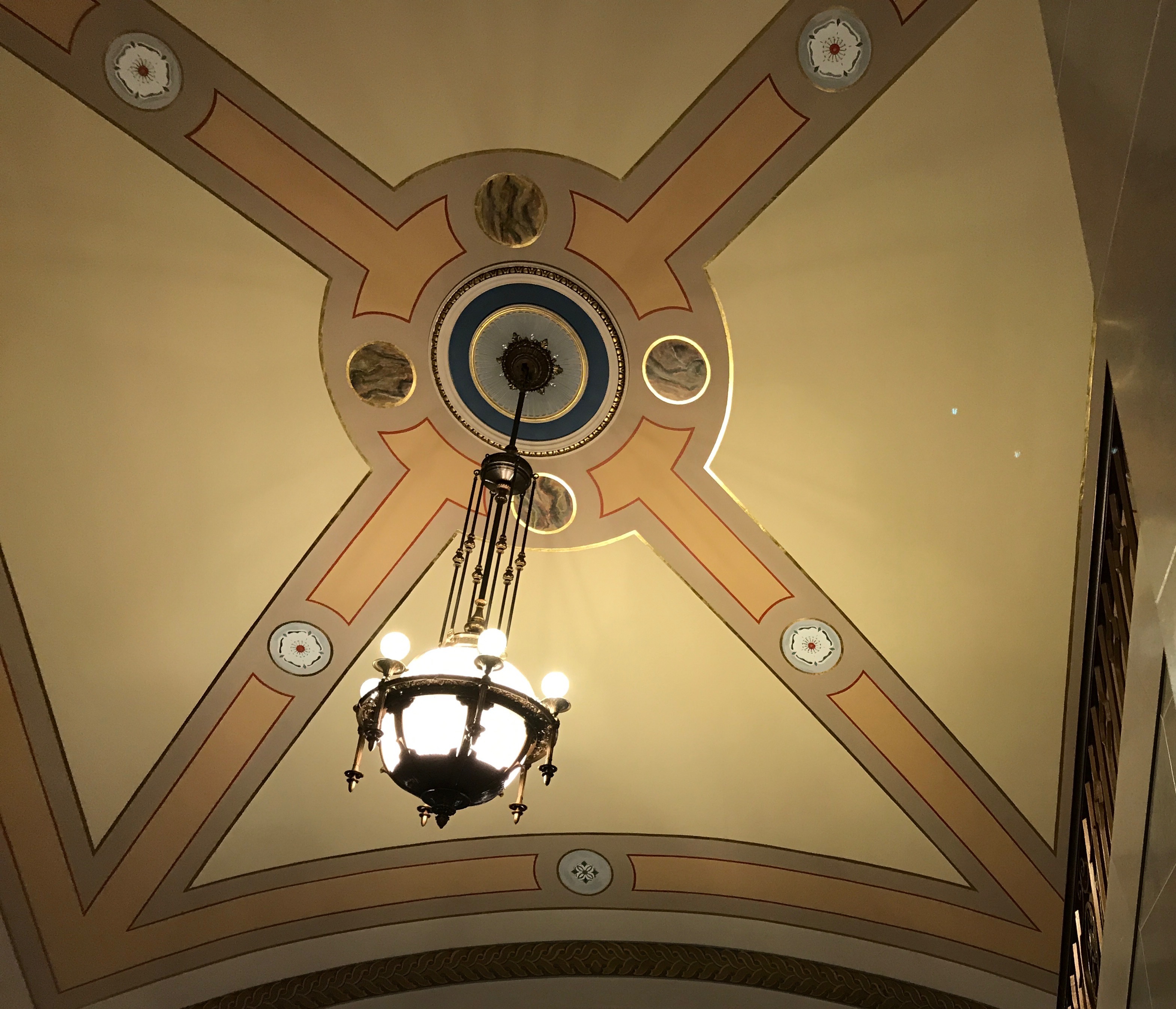
The colors and the sensibilities have been used in some of the restorations that are already complete. This was in the area that visitors pass through when they enter.

Incidentally, the state flower and the state tree are included in the designs. The state flower is Crataegus punctata, which is a kind of hawthorn. The state tree is the Cornus florida, or the flowering dogwood.

This is the state flower, which looks almost like a tree.

This is the flowering dogwood, which is a tree.

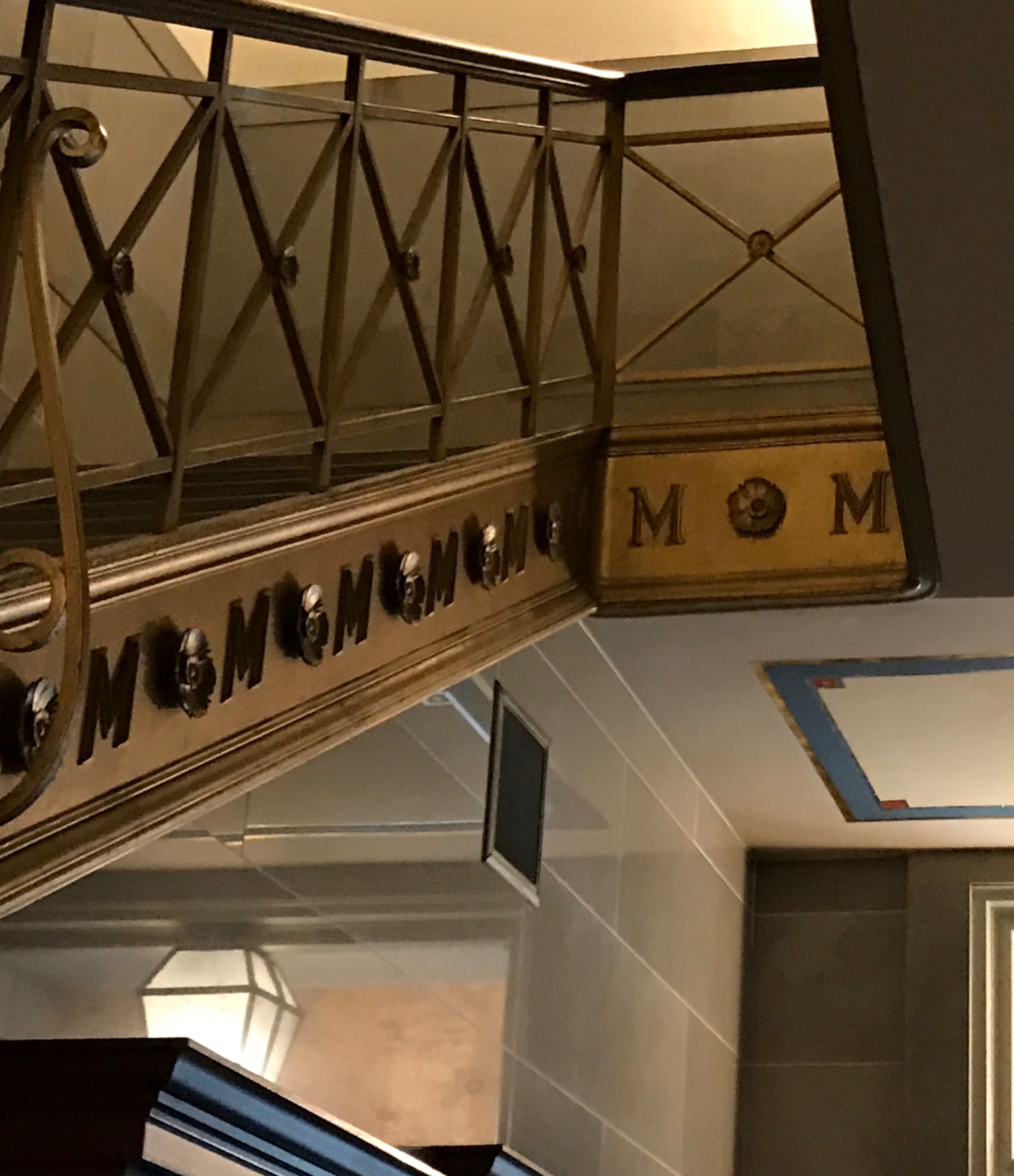
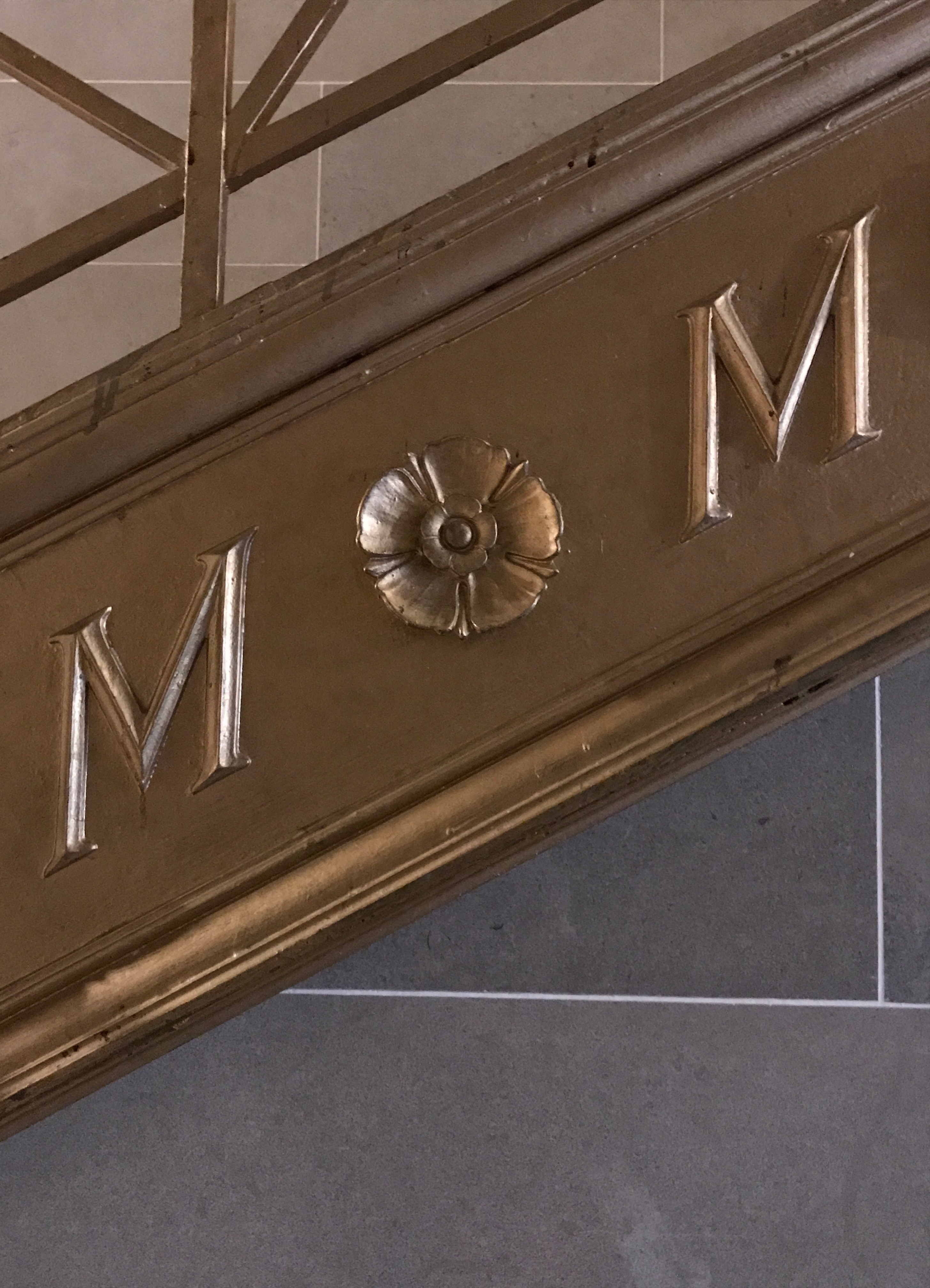
This stairway in the same area had the hawthorn as a repeating motif.

It also tickled me the way it looked like it spelled out “MOM.”

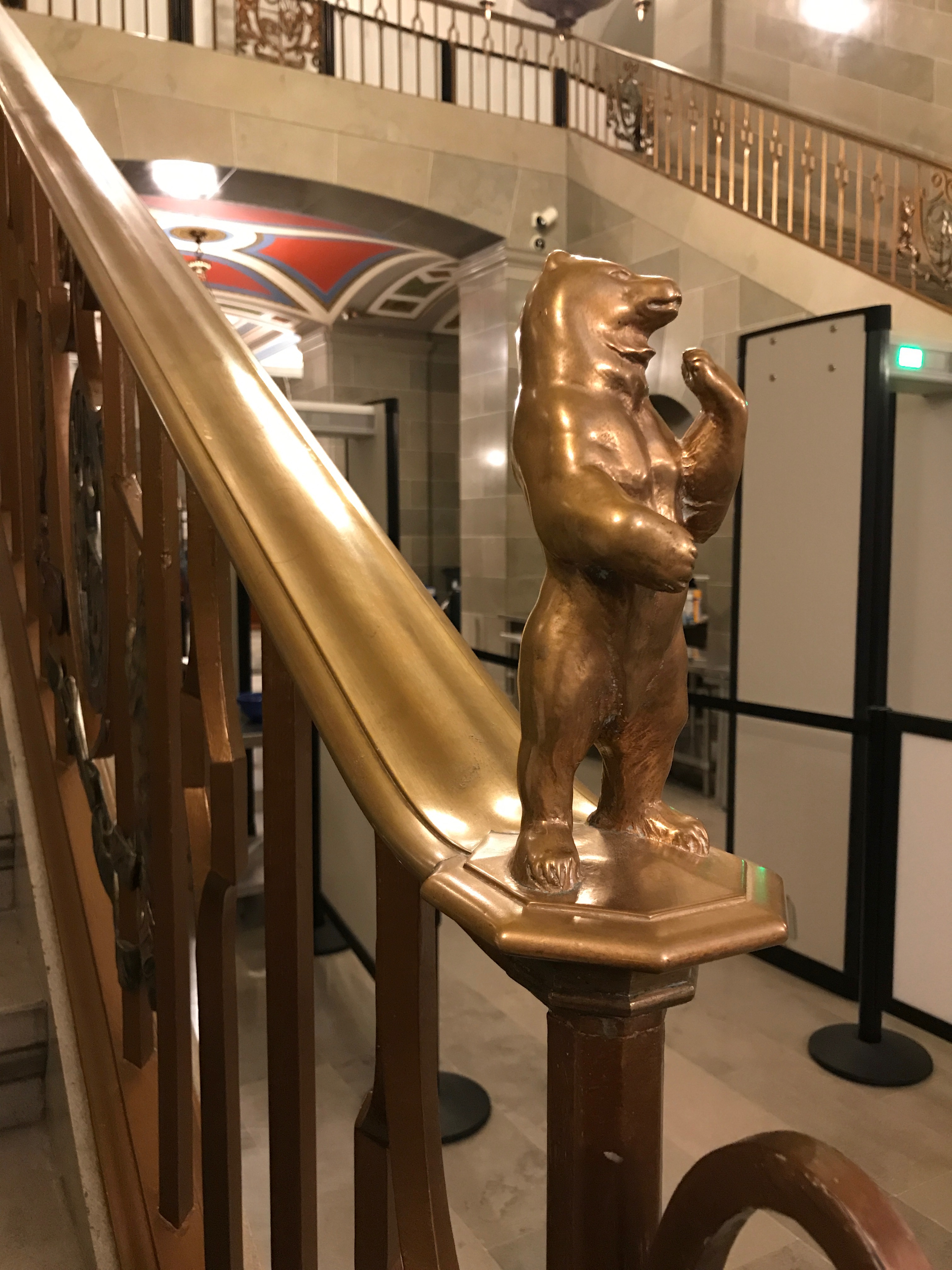
Incidentally, at the end of the balustrade, was this amazing finial. I figured that the bear must be the state animal. I asked our guide if it was, but, no, it turns out that the state animal is the mule. Incidentally, the state bird is the bluebird, the state dessert is the ice cream cone and the state dance is the square dance. The factoids you can find if you look!

You might be wondering why the ice cream cone is Missouri’s state dessert. I had an idea about that, so I did a little research. According to my Preferred Source, the ice cram cone became mainstream in the USA at the St. Louis World’s Fair in 1904. Arnold Fornachou ran out of the paper cups he was using to serve the ice cream he was selling. Next door to him as a waffle vendor named Ernest Hamwi. He sold Arnold some of his waffles. Arnold rolled the waffles into cones to hold the ice cream. The rest is history.

And mighty delicious history, at that!

Speaking of our guide, he spent a lot of the tour talking about the artwork. Really, this building is so rich in art, that it’s hard to separate the art from the building. You do notice that I haven’t completely avoided the art. The reason that there is so much art in the building is that they ended up with too much money.

The original budget allotted $3 million for the building and and additional $500,000 allocated for the site and furnishings. The state miscalculated on the revenue projections and ended up collecting $4,215,000.  I whipped out my calculator, and figured that they collected $715,000 more than they thought they would need. If I remember correctly what the guide told us, by law they could only spend the money they raised on the capitol. That is why there is so much artwork and why it is of such high calibre. I will talk more about the artwork in the next post.

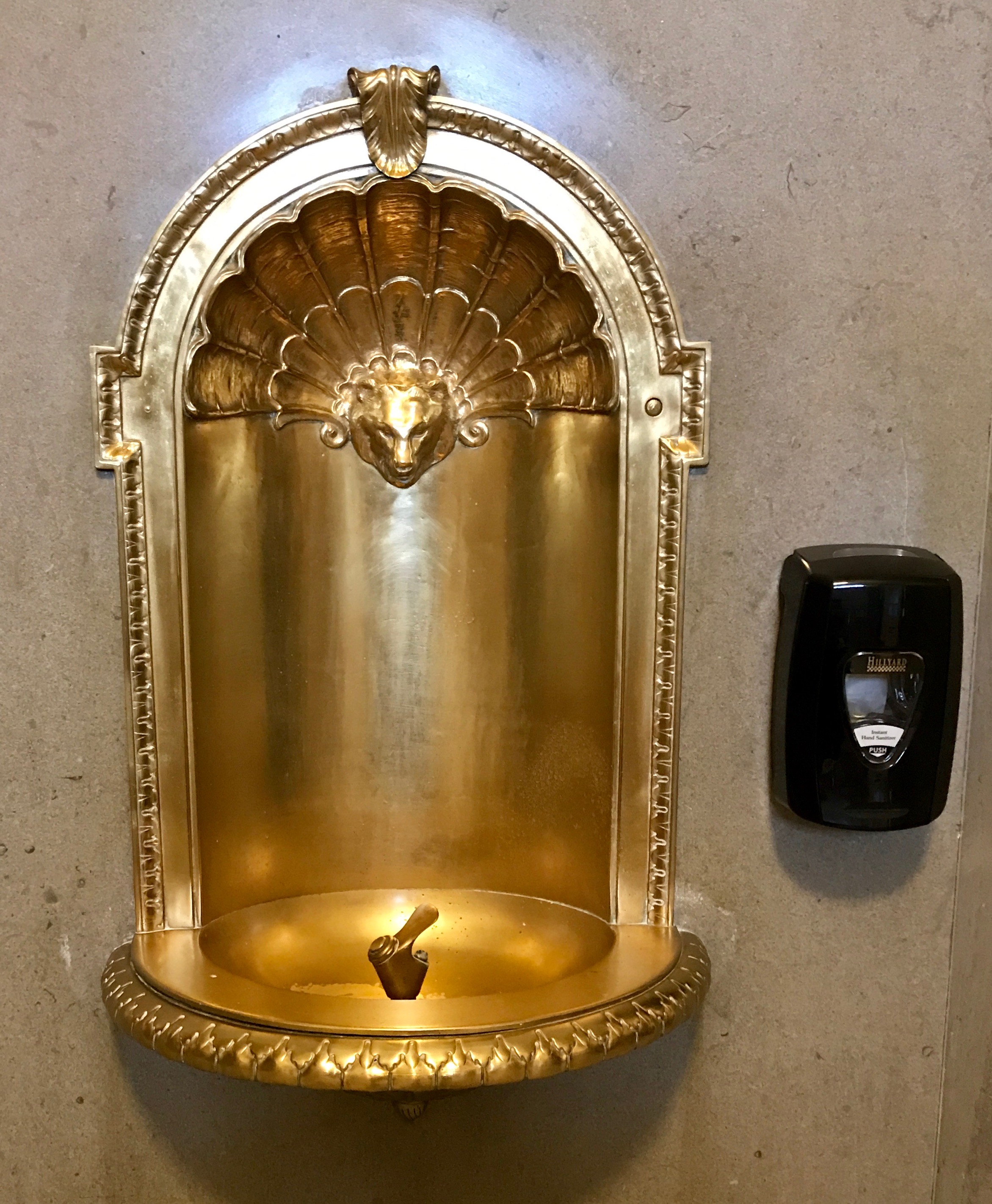
But, as long as I’ve paused to talk about funding, compare and contrast this original drinking fountain with the hand sanitizer dispenser. (Go ahead, I’ll wait.)
In my opinion, they ought to fling that ugly piece of plastic far away. I doesn’t belong next to that glorious drinking fountain.

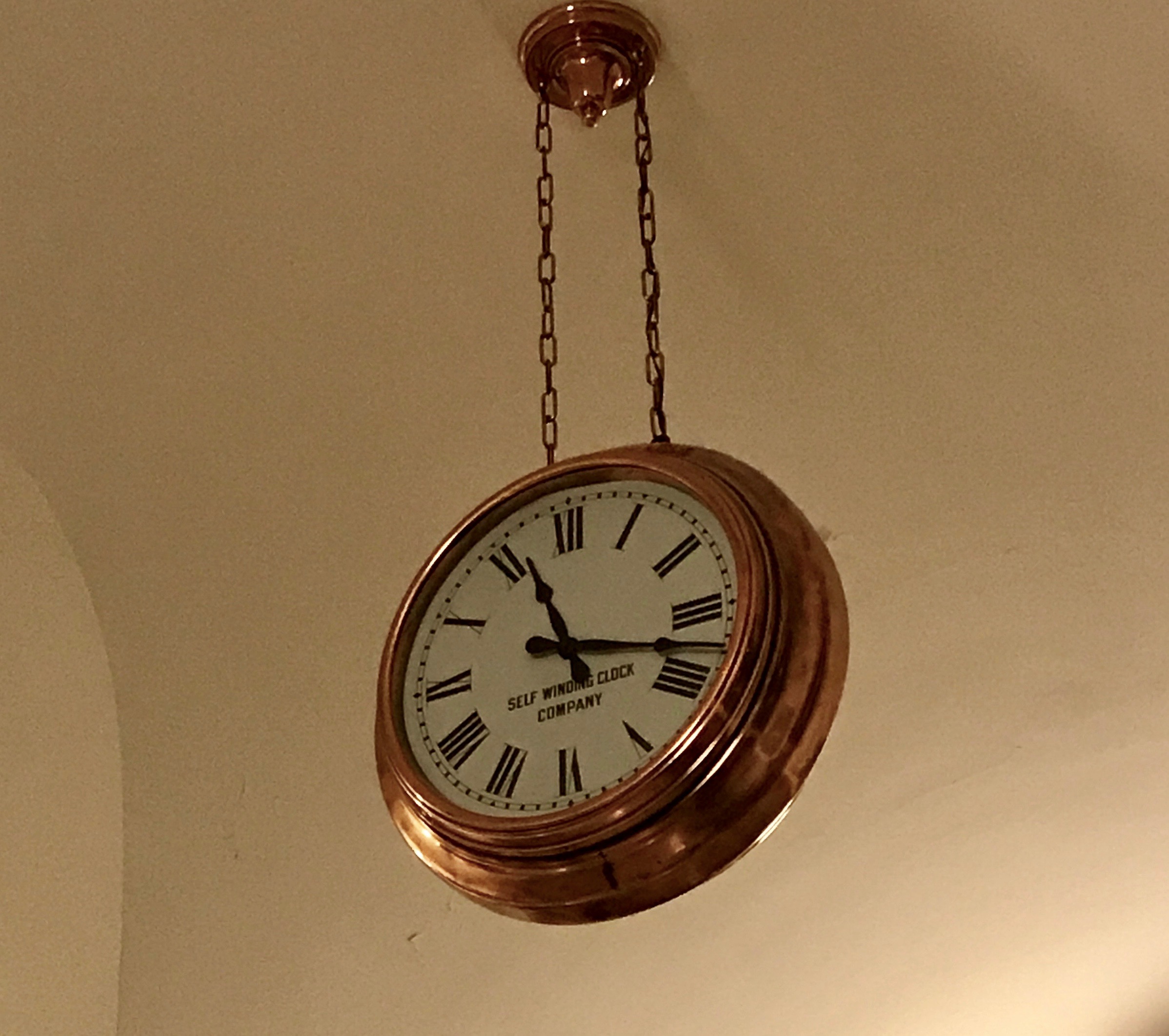
And how about that elegant clock hanging in the hallway? The dial proclaims it to be “self winding.” I wonder how that works? Do you think the wire woven into the chain on the right side has something to do with it how it operates?

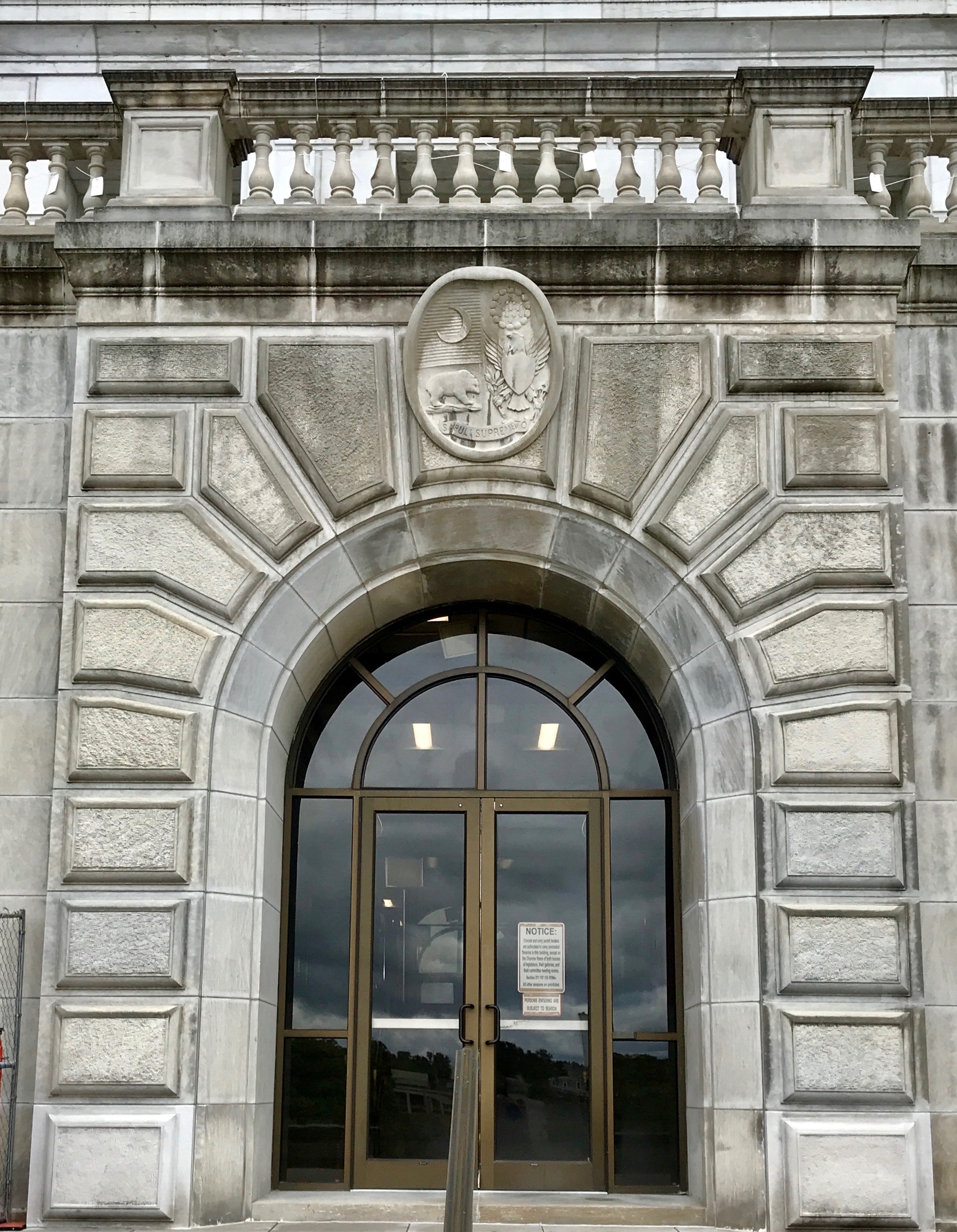
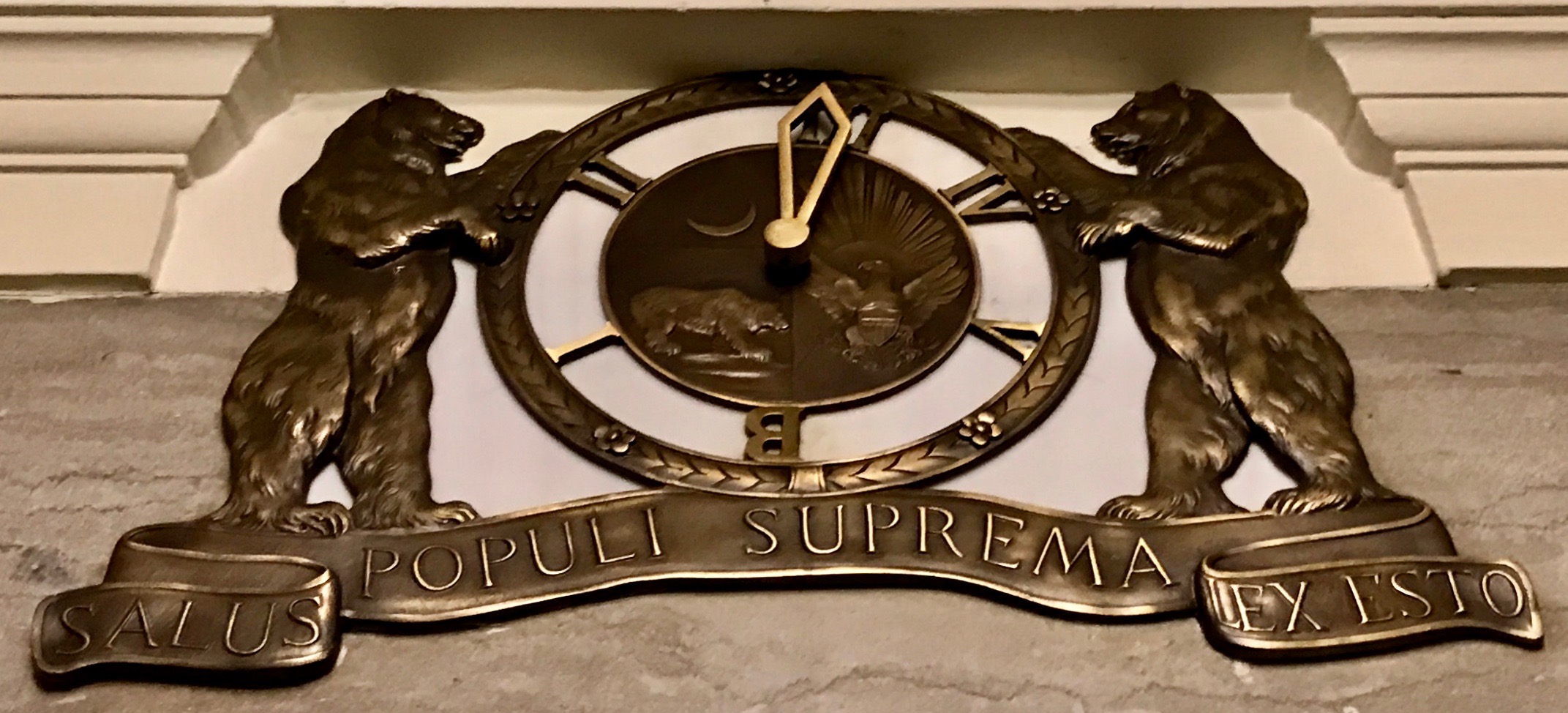
Take a look at this elevator dial! I am sure someone wanted a bear as the state animal. The state’s motto is “Salus populi suprema lex esto” which means “Let the good of the people be the supreme law.”

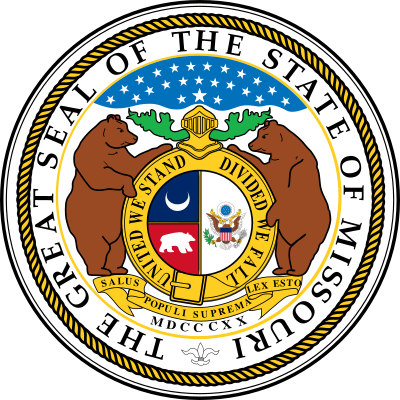
The elevator dial is based on the Great Seal of the State of Missouri. The bears represent strength and bravery. The crescent moon represents the newness of statehood and the potential for growth. MDCCCXX is Roman numerals for 1820, although Missouri wasn’t admitted to the union until 1821. They must have been into the power of positive thinking. Incidentally, take a look at the yellow belt with the words “United we stand divided we fall” in the enter of the seal. Do you see the buckle? The buckle signifies the State’s ability to secede from the Union if they deemed it necessary. The belt can be unbuckled.

So, did Missouri unbuckle during the Civil War? According to my Preferred Source, it was a “hotly contested border state, populated by both Union and Confederate sympathizers.” Both the Union and the Confederacy claimed the state. It sent armies, generals and supplies to both sides and maintained dual governments. They carried on a bloody neighbor-against-neighbor intrastate war within the larger national war.

By the end of the war in 1865, nearly 110,000 Missourians had served in the Union Army, and at least 30,000 had served in the Confederate Army. The war in Missouri was continuous between 1861 and 1865. There were battles and skirmishes in all areas of the state. The largest battle west of the Mississippi River  was the Battle of Westport in Kansas City. If you count all the military actions, from the large ones to the minor skirmishes, Missouri saw more than 1.200 distinct engagements within its boundaries. Only Virginia and Tennessee had exceeded that number.

I guess the belt buckle stayed fastened.

I wandered around a bit more. You can really see the money that was spent on the building.

The stonework is so well done.

I wonder if there are even enough skilled artisans left in the world if we wanted to recreated these structures?

Everywhere you look, there is a little vignette waiting to be appreciated.

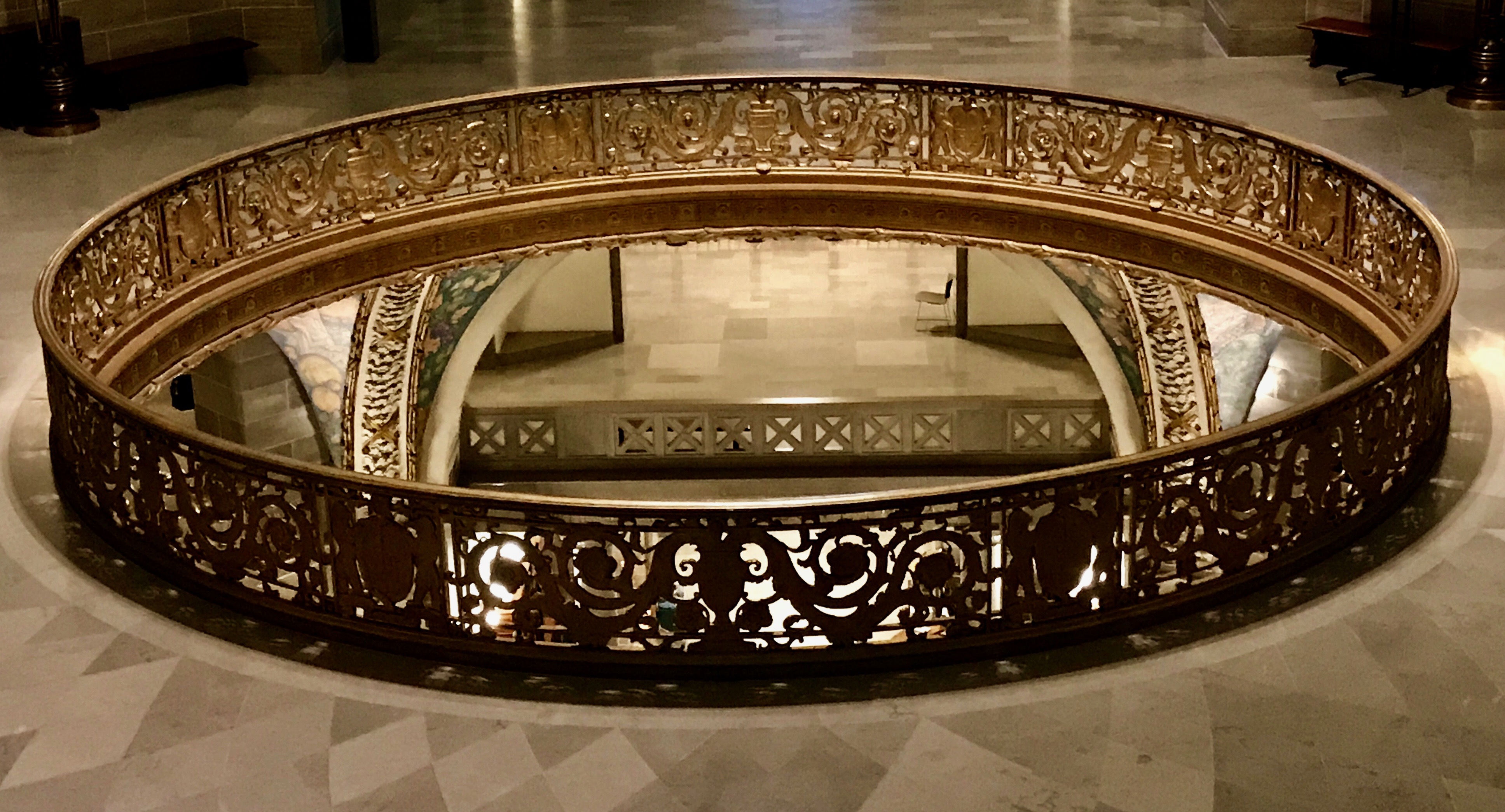
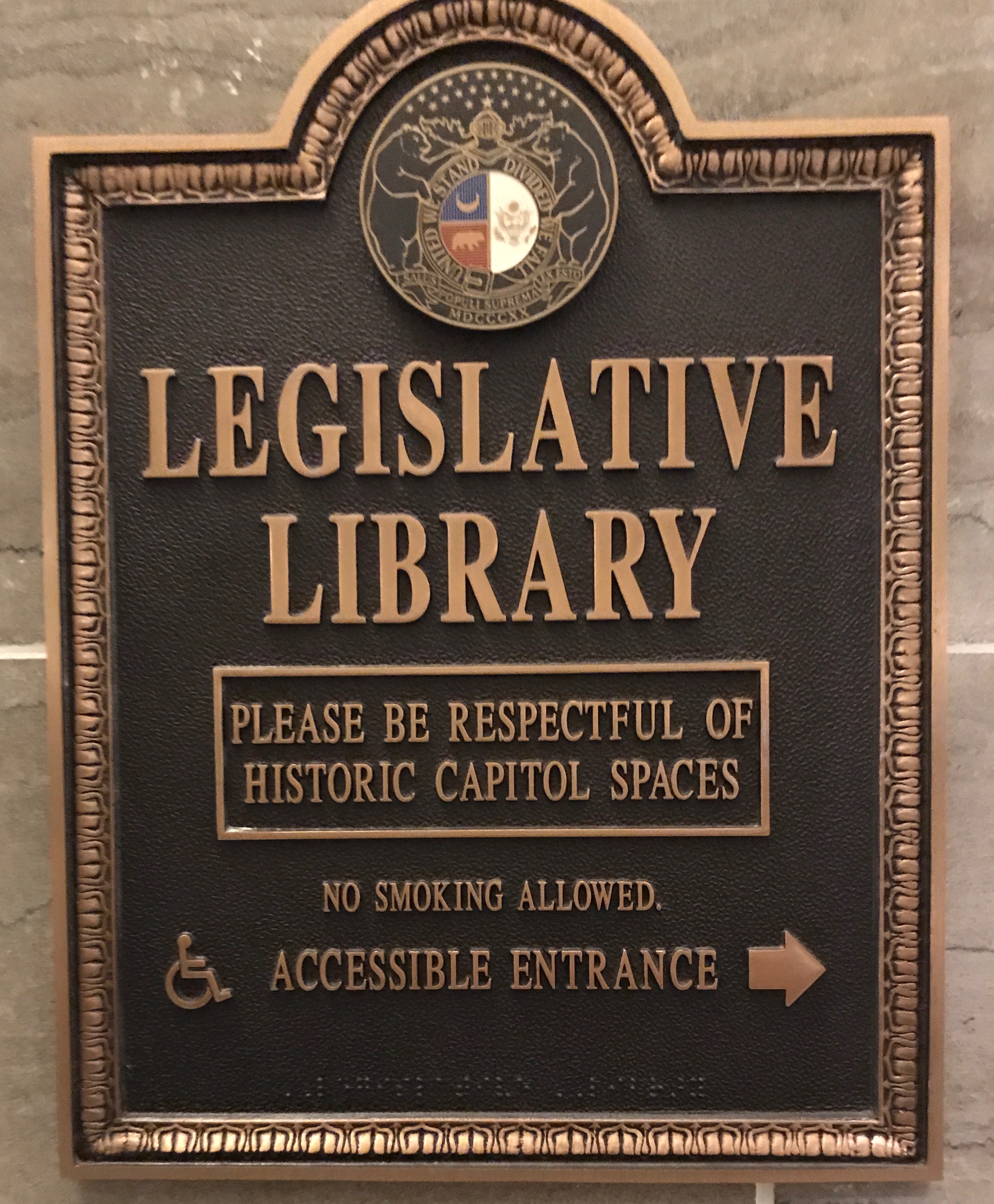
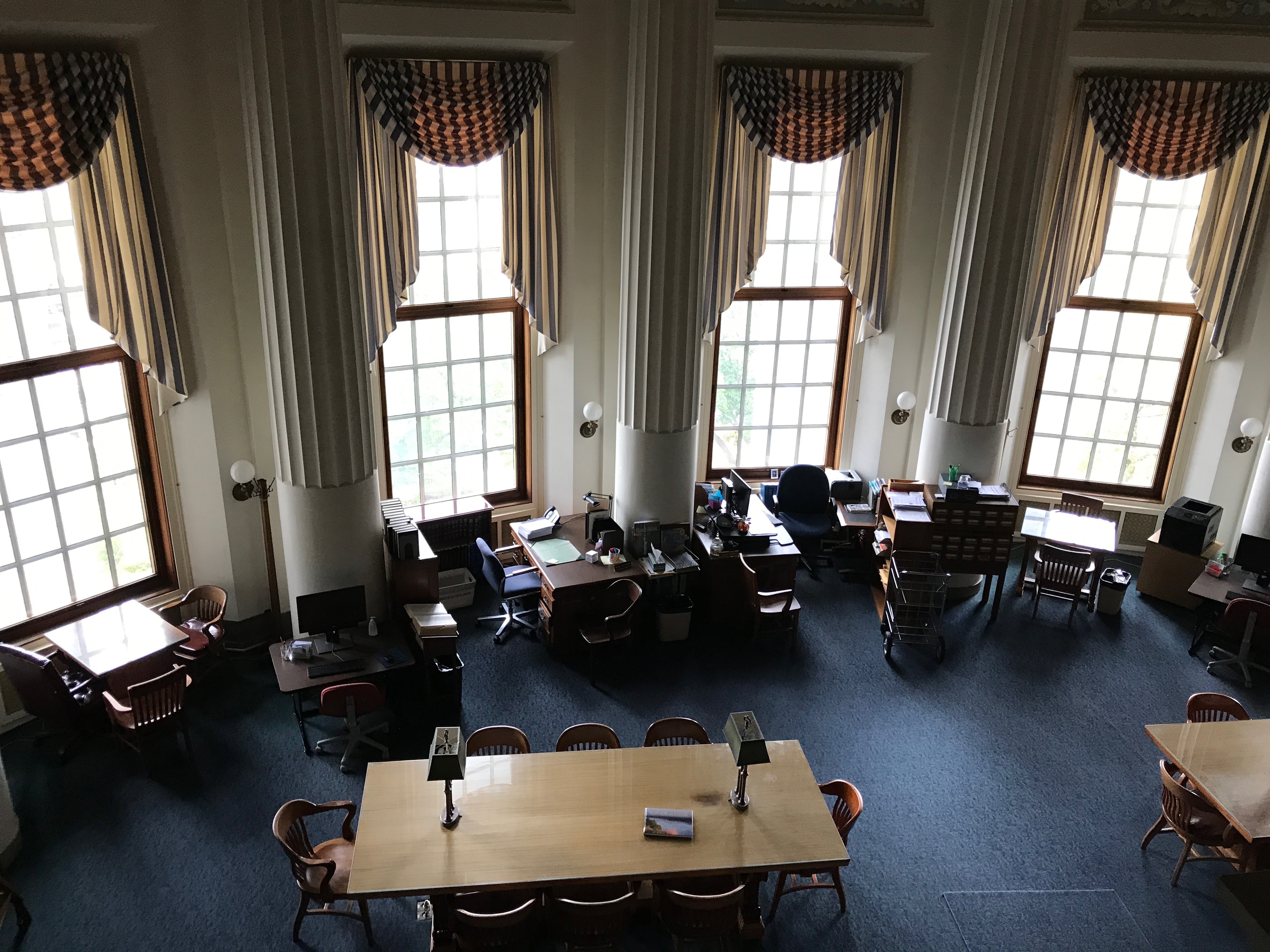
The Legislative Library was open to be viewed.

You had to look at it from above, but that makes it easier of take a photo, anyway.

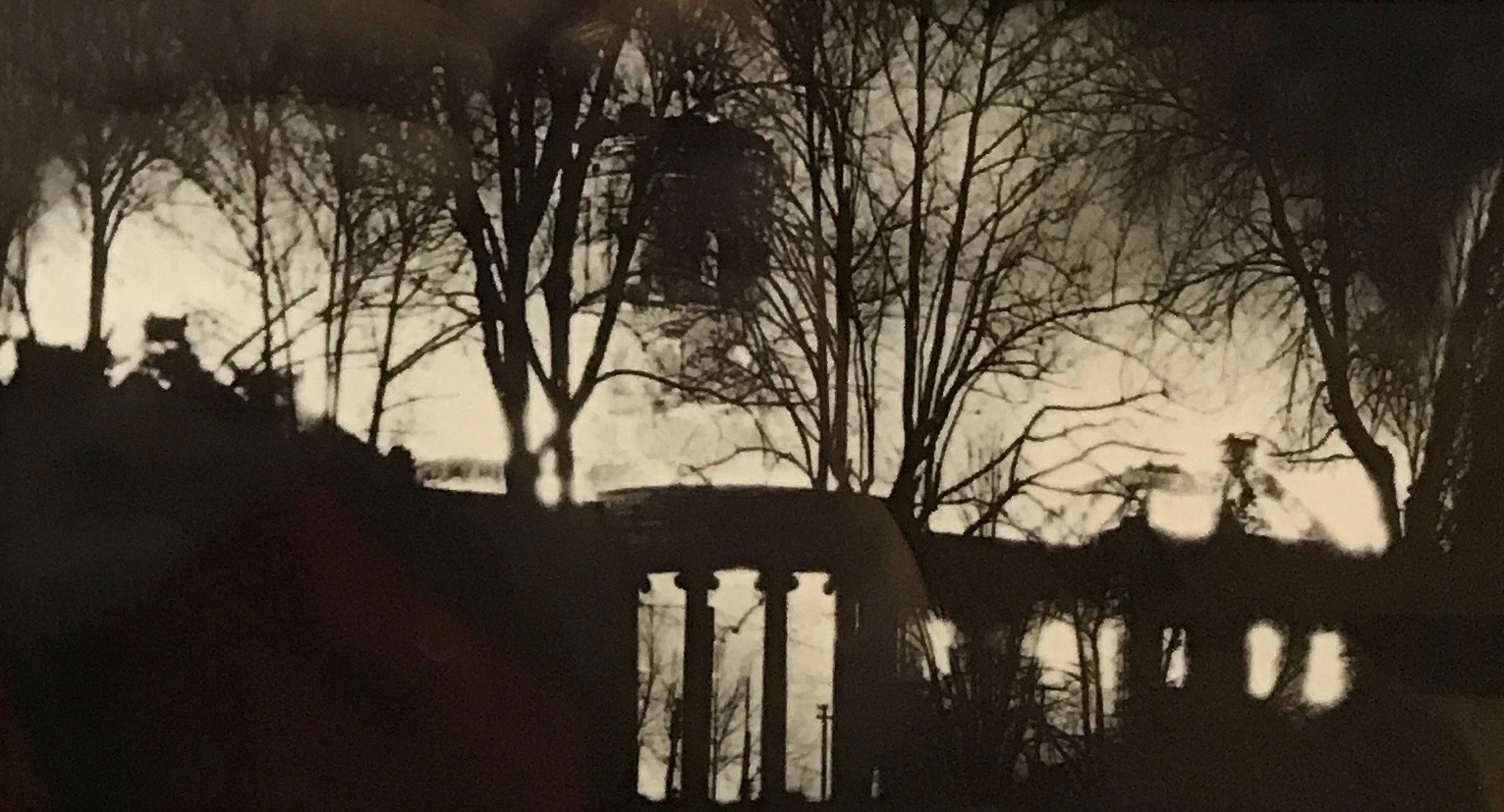
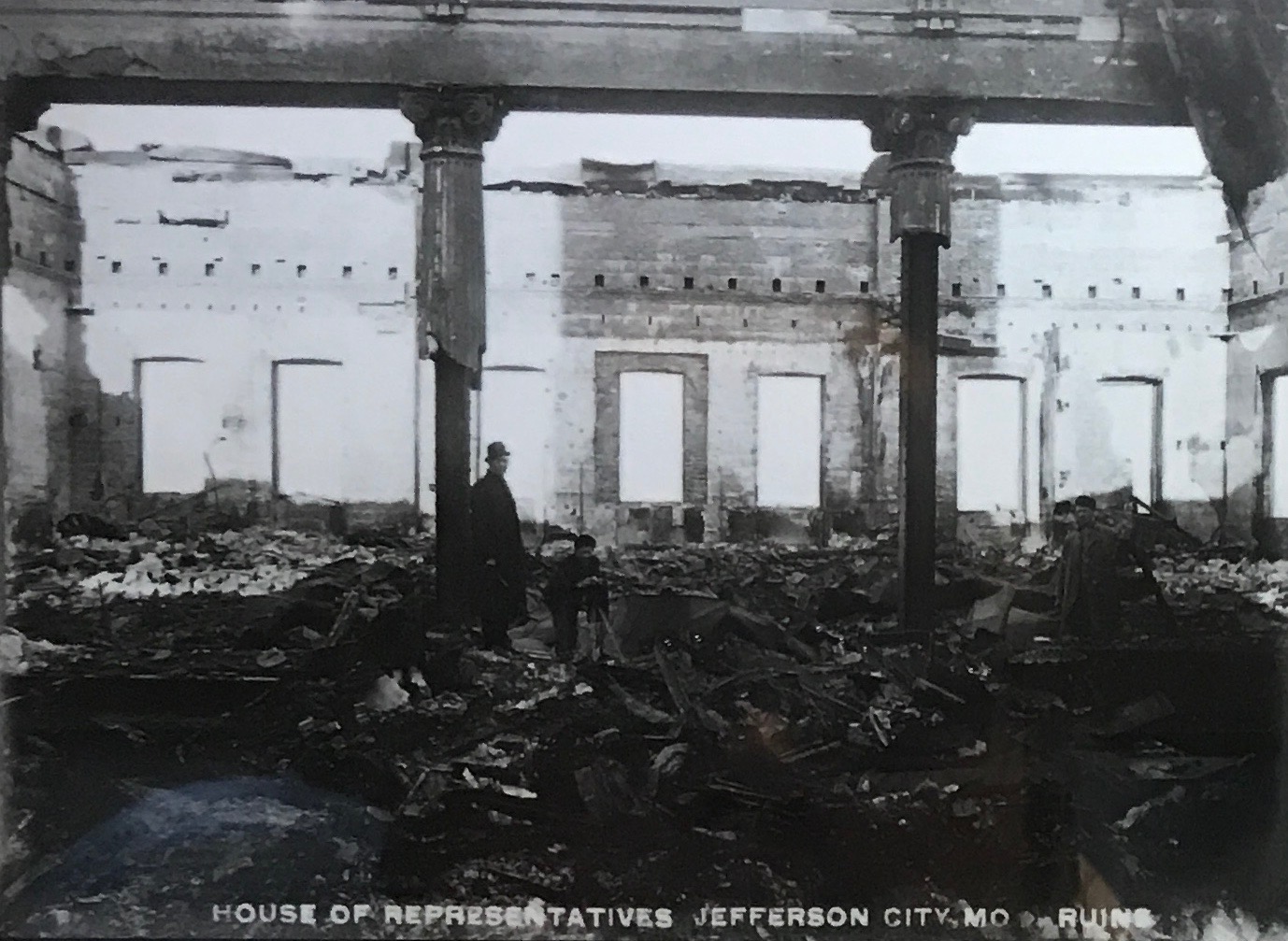
In the basement was a display about the fire that took down the previous capitol. It was struck by lightning in 1911 and burned throughout the night.

The House of Representatives lay in ruins – along with the rest of the building.

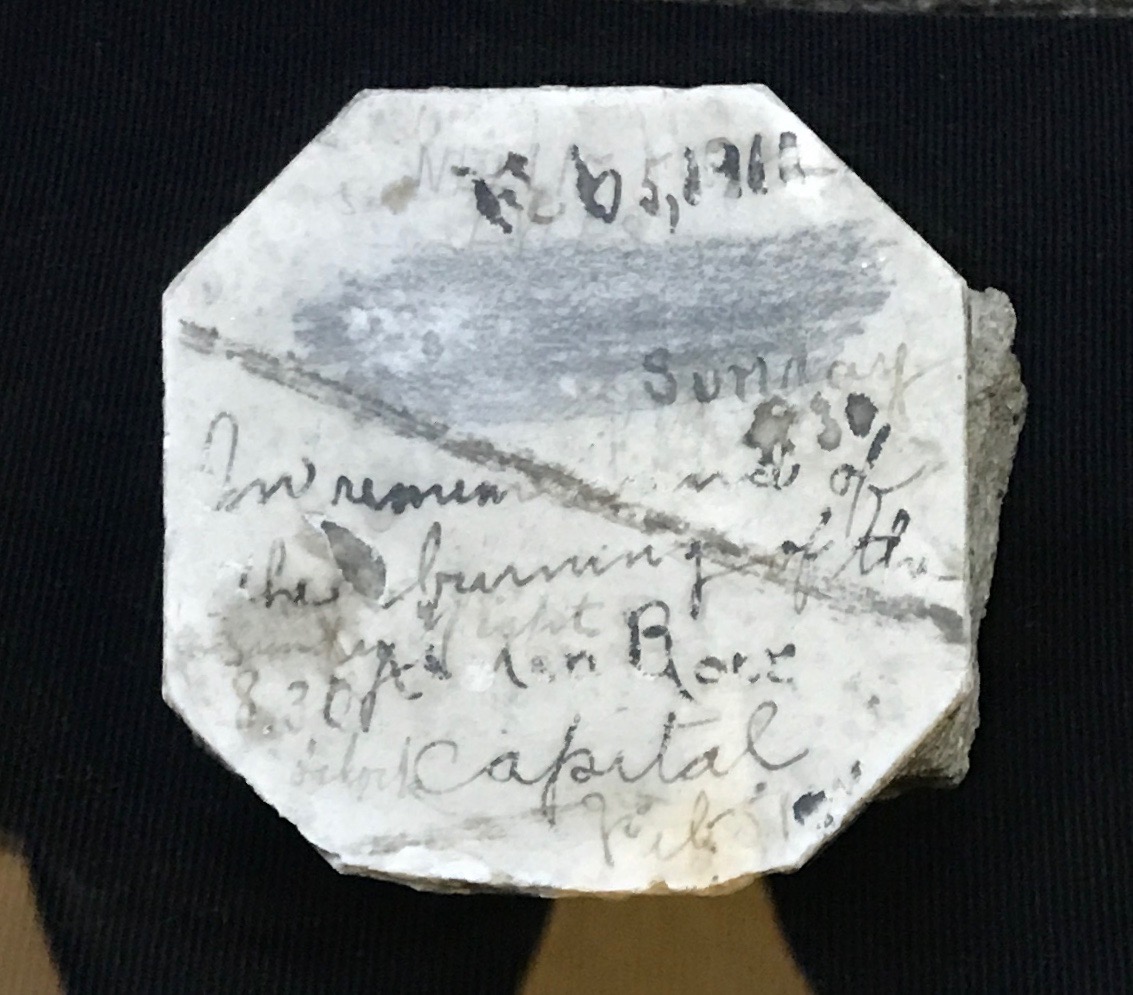
According to the sign with this artifact, “A curiosity seeker pulled this floor tile from the rubble of the 1911 fire. It reads, “Feb. 5, 1911…Sunday…In remembrance of the burning of the Capitol…8:30 A[M]” the rest of the inscription may be names.

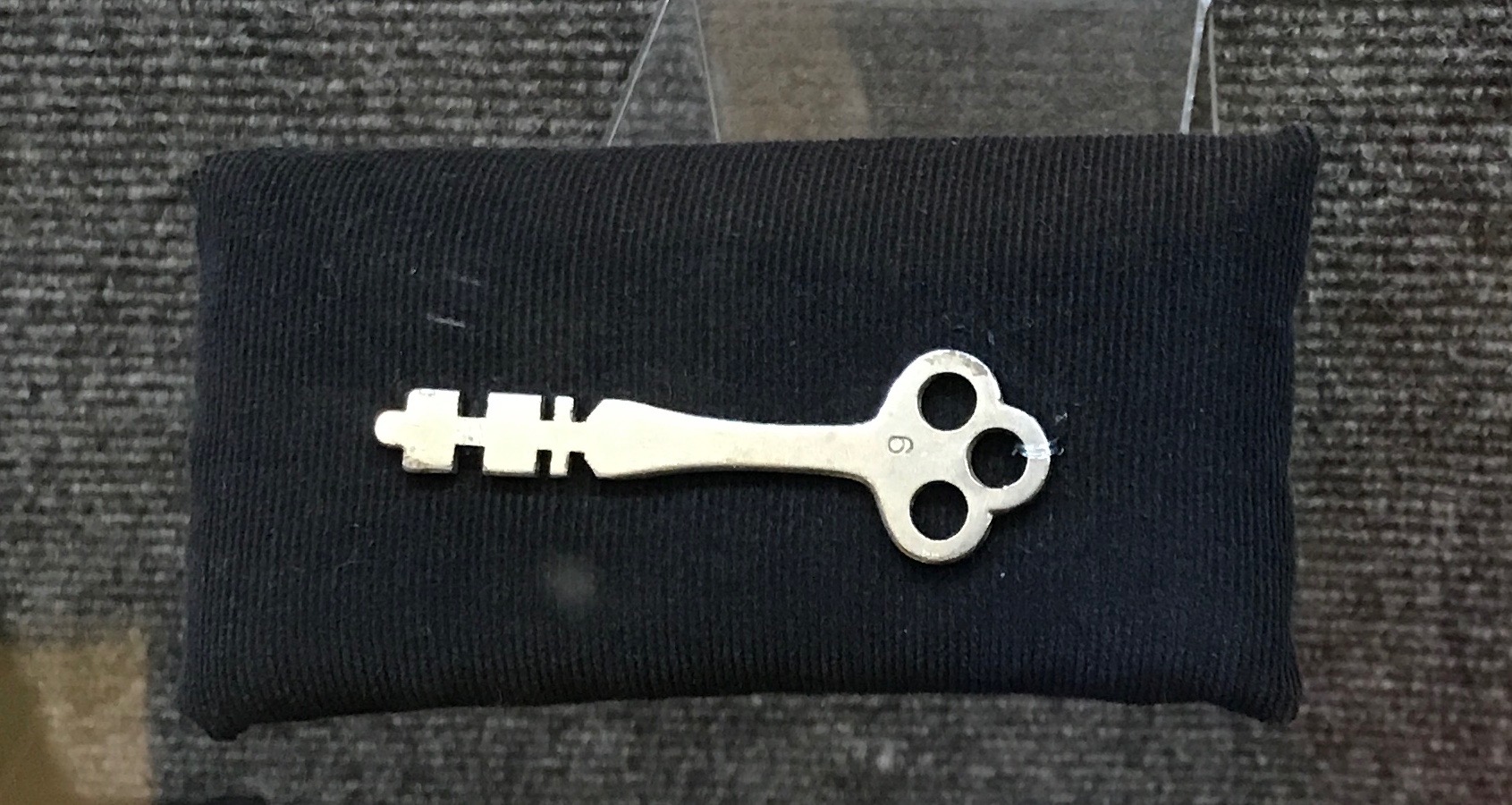
This is the key to the dome of the capitol that burned in 1911. If I remember correctly what the guide said, someone had taken it home. Since it wasn’t at the capitol, it hampered the fire fighting. This key may be the reason why the building burned to the ground. But, maybe I am not remembering this correctly.

I will tell you more about the artwork in my next installment. At this point, I wound my way out.

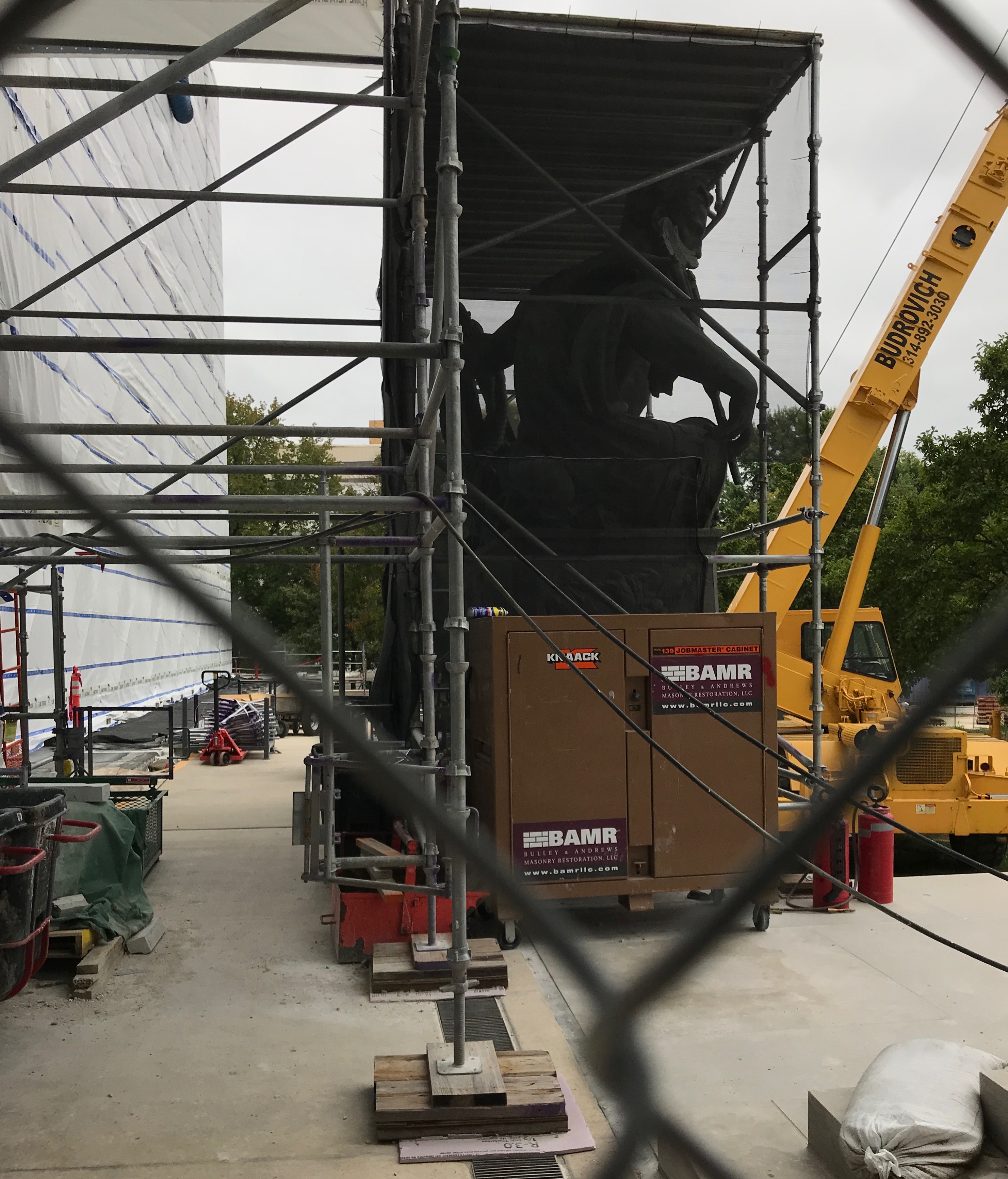
I passed the statuary that was protected by mesh during the reconstruction.

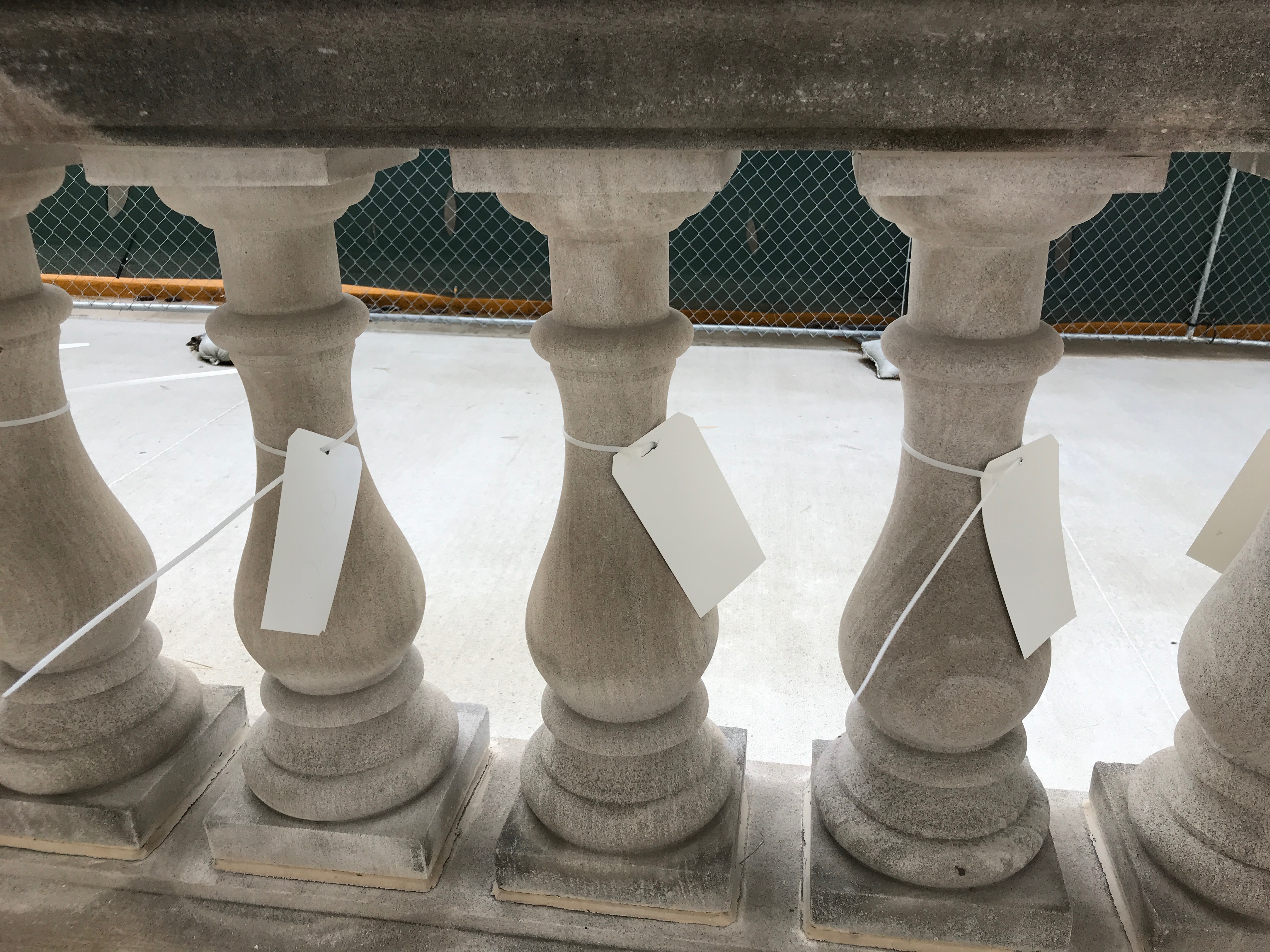
I passed the tagged balustrade. I imagine they are going to remove these and then return them when the work is complete. You want to make sure you put things in the right spots!

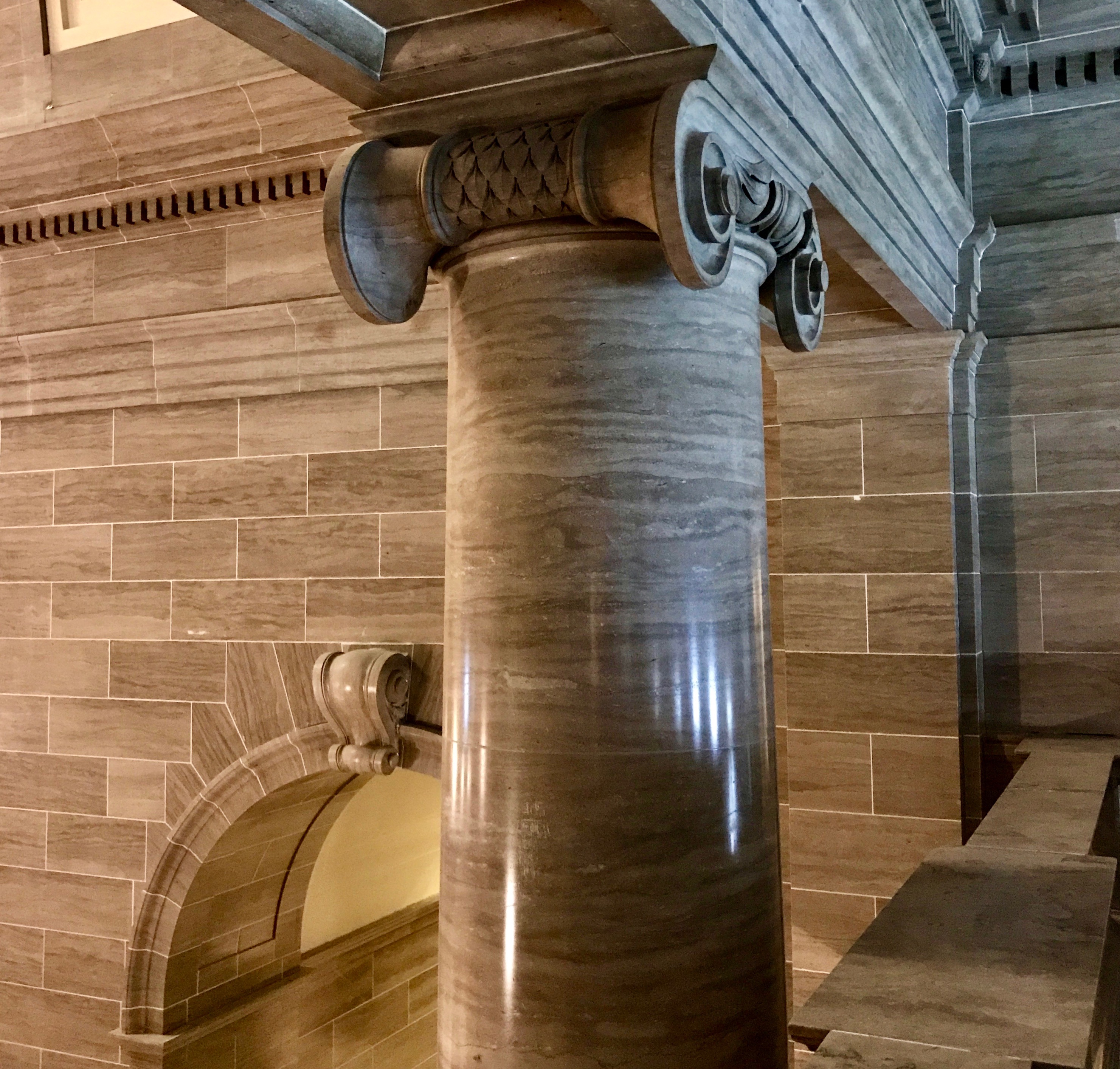
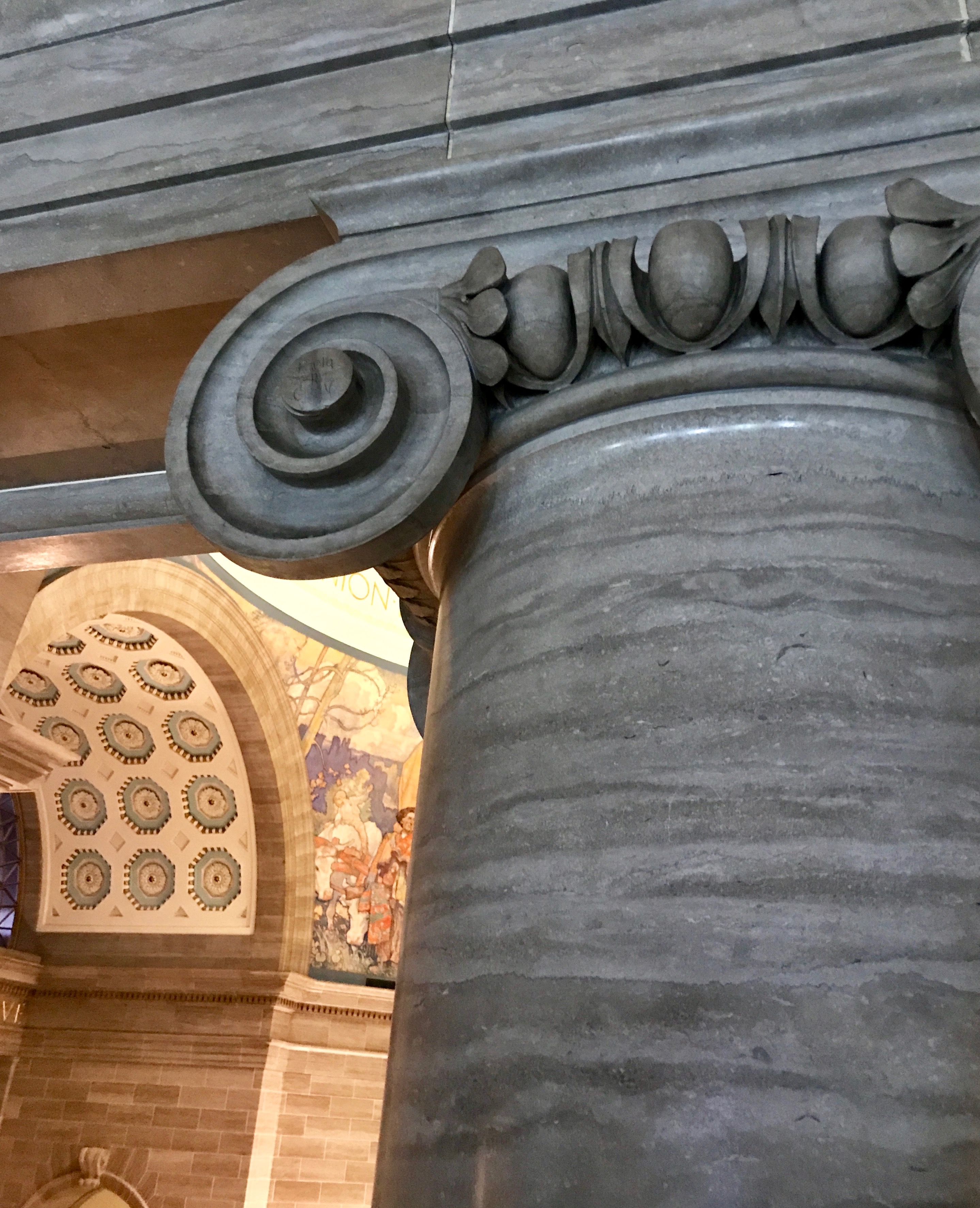
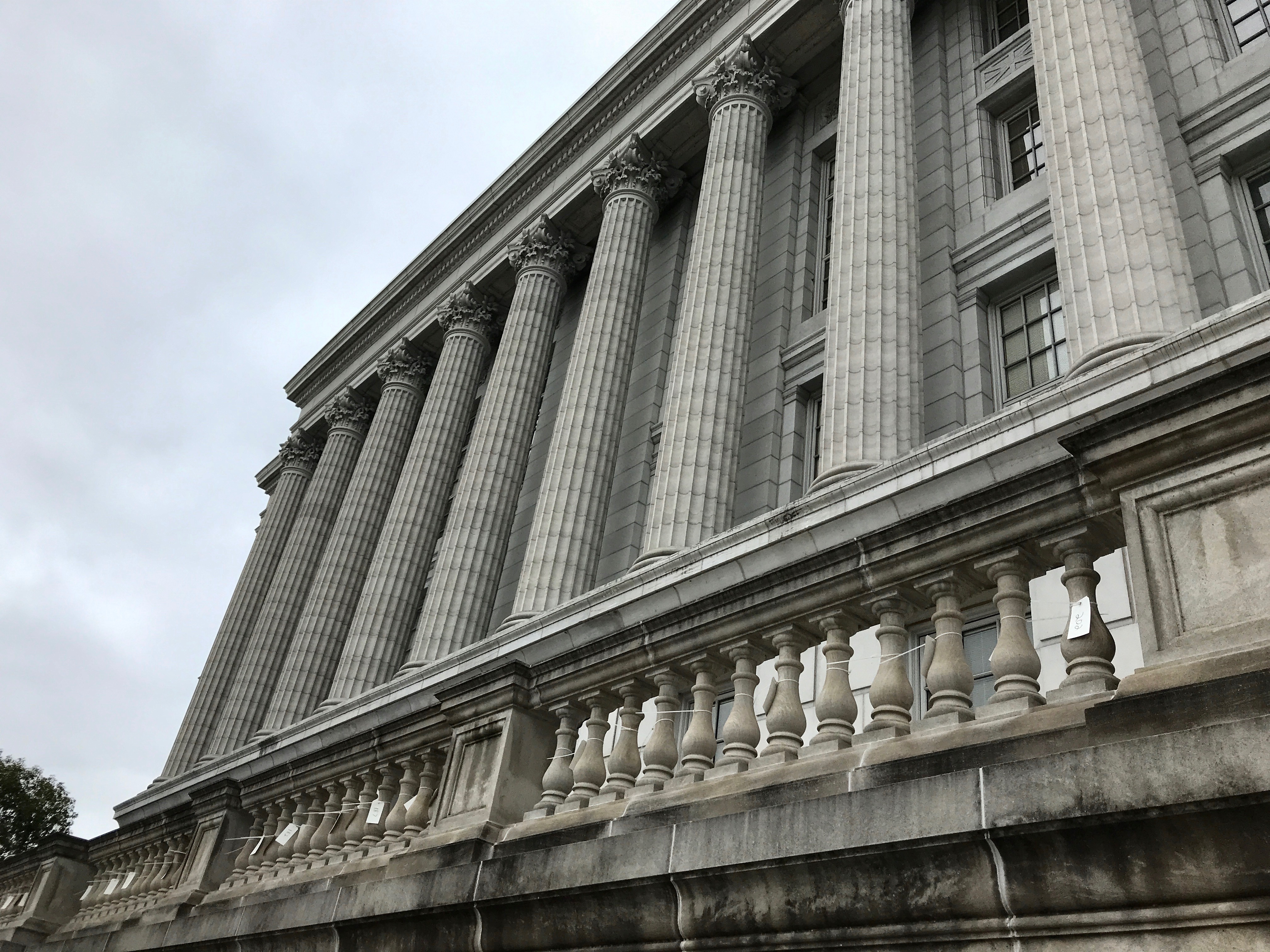
I looked up at the columns.

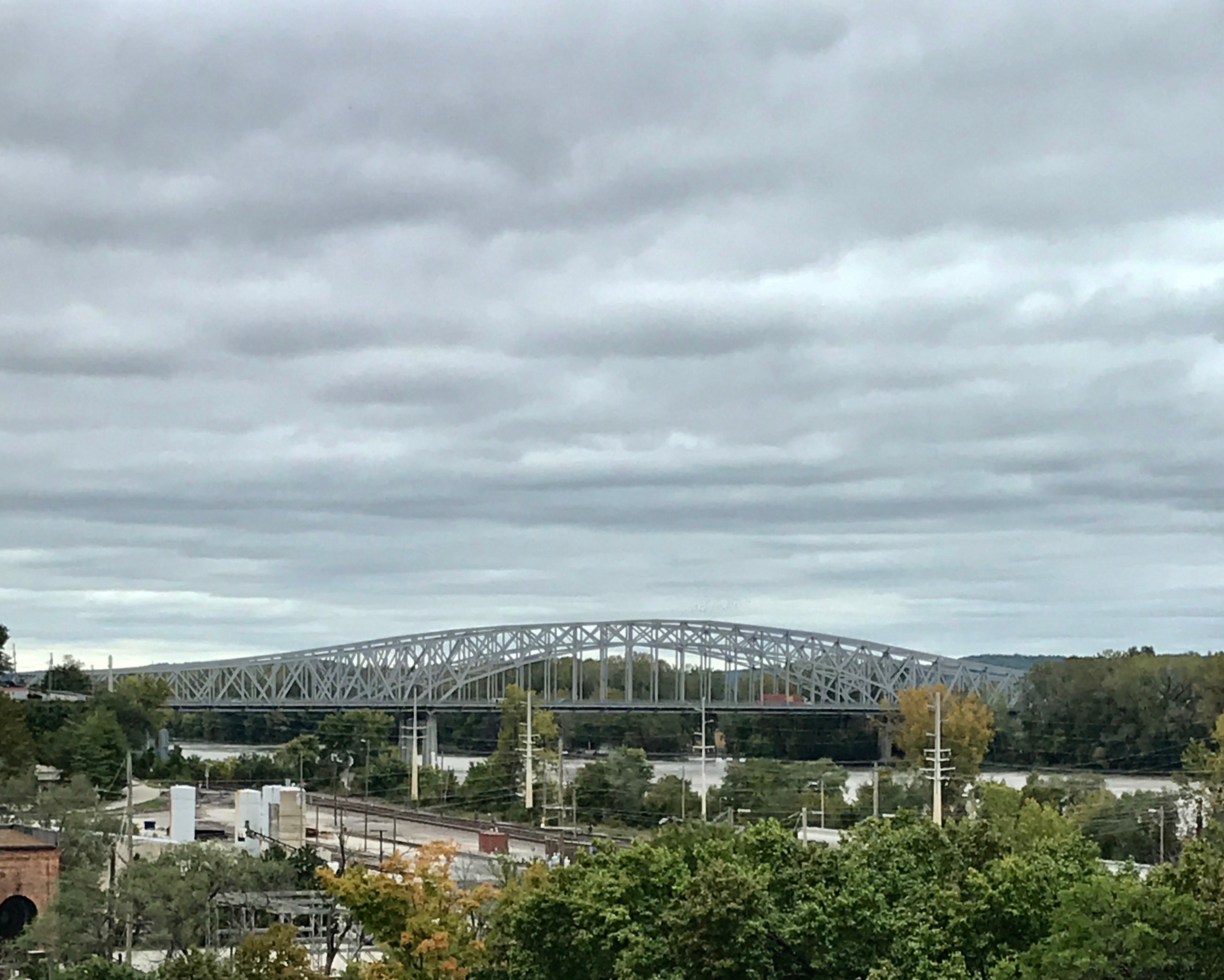
I paused to snap a photo of the bridge across the Missouri, and then I went to find my car. It was time to go find something to eat!


Mission: Cross Some Items off “The List”

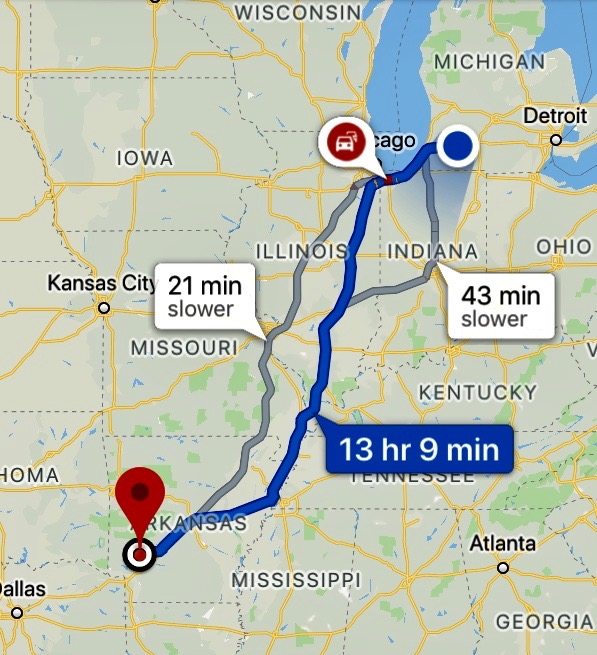
Fall came, and I decided that I needed to get the T@b out for another trip in calendar year 2018. I checked out my list of things I had to put on The List for “next time.” I decided to aim for Crater of Diamonds State Park in Arkansas and see what else might fill in along the way.Hmm…Just how close to Chicago do I want to get? I mean, if that is the most logical thing to do, I will drive the Interstates to get around Chicago. I towed Flo the Airstream on I-94 through Chicago once. Once. That was enough to persuade me of the wisdom of avoiding it – especially with a trailer in tow.

Since the trip is 13 hours at a minimum, I decided to take the Indiana route and ,stop for the night at the Cracker Barrel near Effingham.I love the welcome Cracker Barrel extends to us “nomads.” I have to admit, though, that their definition of “comfort food” is not mine. I was thrilled to find this bowl of beans on the menu. Beans are more my speed. I hope they leave it on the menu, because it is going to be my “go-to” dinner when I stop at Cracker Barrels to spend the night.

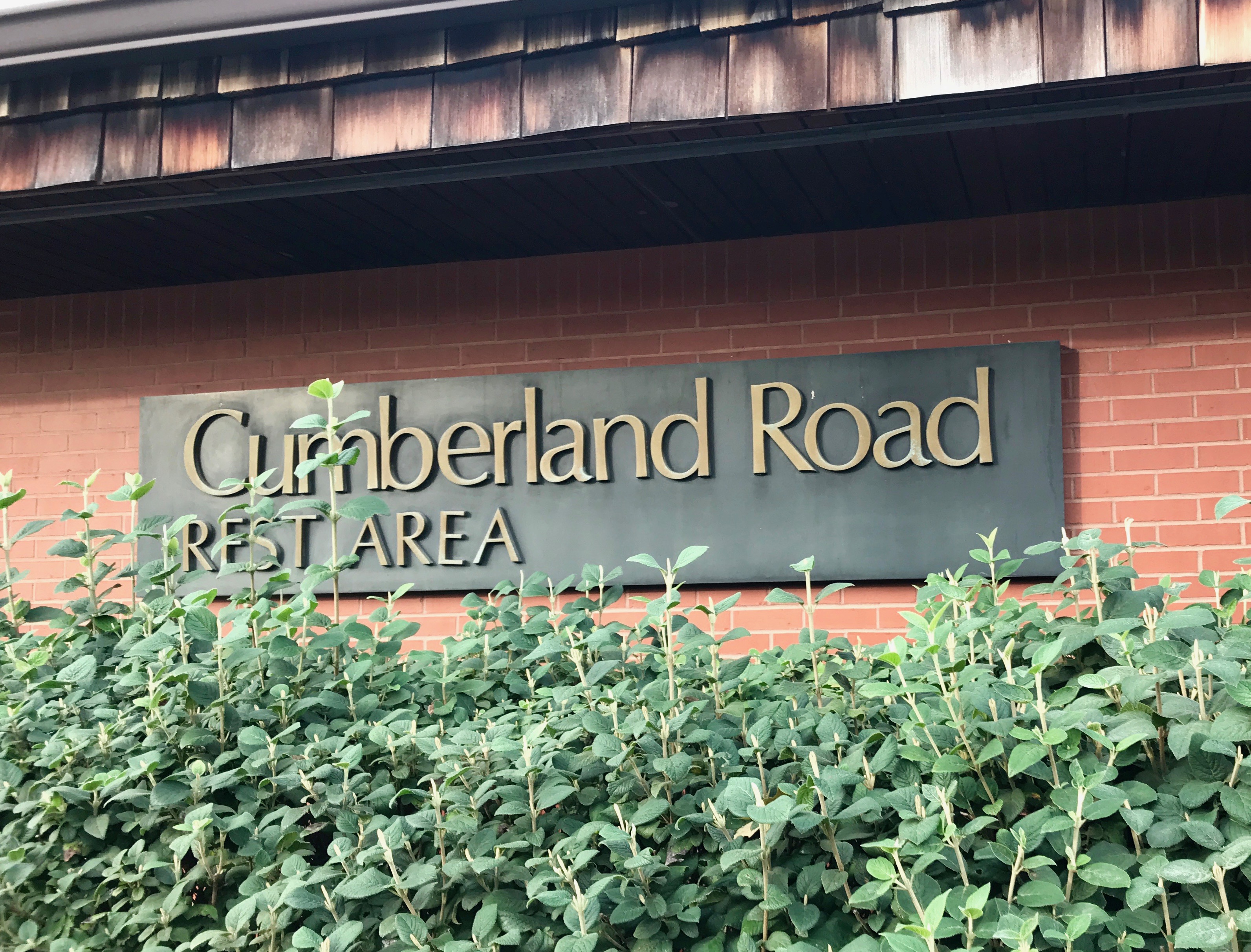
I got going early-ish in the morning and headed west on I-70. I stopped to take a break at this rest area near, Marshall, Illinois. (Never pass up a restroom!)What do you know? Cumberland!

It was a decent rest area. While stretching my legs, I spied this bridge and decided to check it out.It turns out that it is what is left of the Fancher Pony Truss Bridge.

The Trout brothers, Hiram and Everett, were born in the area and the operated a machine shop in Shelbyville, Illinois in the late 1800s. They invented and patented this design for a pony truss bridge.

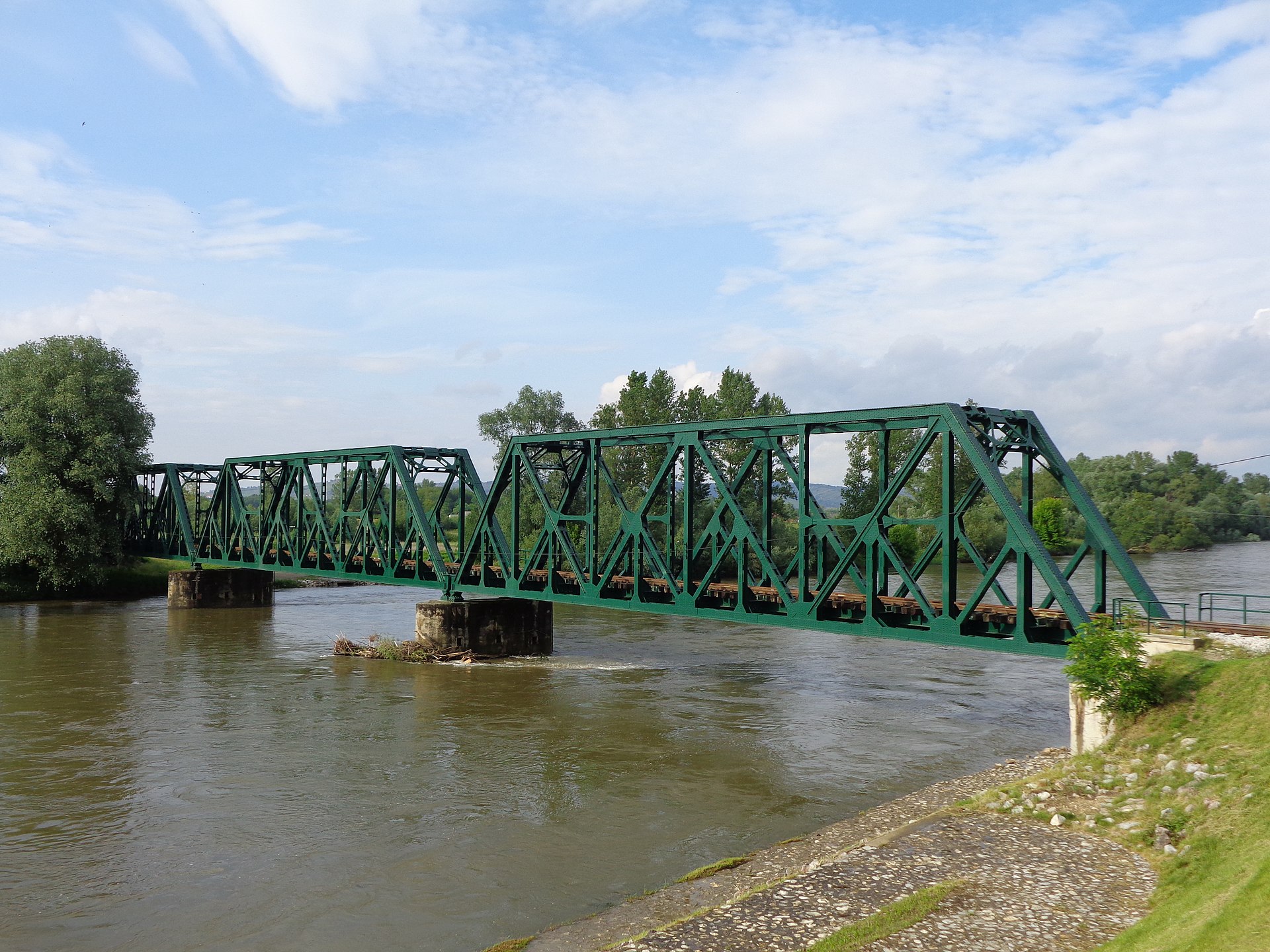
“What is a pony truss bridge?” I can hear you screaming this at your screen. Well, I imagine you know what a truss is on a bridge, right?

Well, in case your education on bridges was lacking, according to my Preferred Source, a truss is: “an assembly of beams or other elements that creates a rigid structure. In engineering, a truss is a structure that “consists of two-force members only, where the members are organized so that the assemblage as a whole behaves a a single object.”

Essentially, it is material fastened together into a bunch of triangles that work together to hold up the bridge.I’m sure you’ve seen bridges like this before…and this.

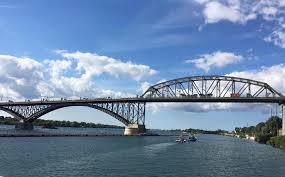
My beloved Peace Bridge is also a truss bridge, albeit a bit fancier than the previous ones. I am sure I drove my folks nuts asking them why it had that hump on top. They told me that it held the bridge up. I couldn’t wrap my mind around the concept that something on top could hold something up. Why wasn’t it underneath?
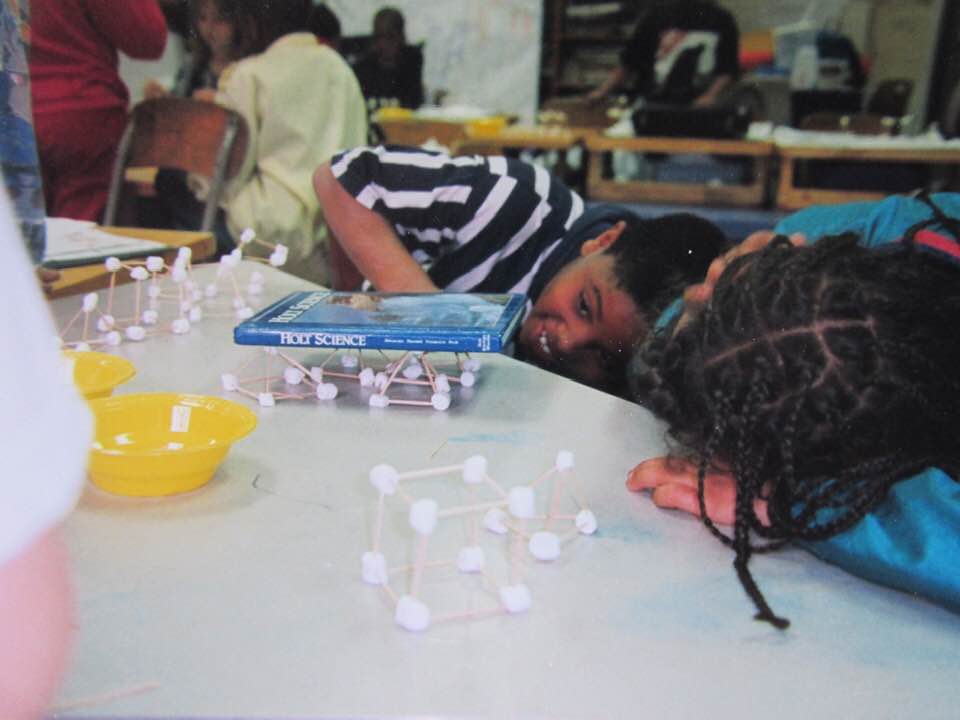
It took teaching shapes by building with toothpicks and marshmallows that I finally got it. (Personally, I preferred building with toothpicks and gumdrops, but I didn’t have a photo of one of those activities in my files.
Okay, so that’s what a truss is. So what is a pony truss?
A pony truss is a short truss that doesn’t connect overhead, like the other examples I showed you. That explains (to me, at least) why they call short walls in houses “pony walls.”

Anyway, our friends, the Trout Brothers, built about 150 of these bridges between 1892 and 1897. That’s about 30 bridges a year! They must have been churning them out at a rate of a bridge about every week and a half.

According to the sign that was at the bridge, what makes these bridges unique is that they used round pipe in construction, instead of the usual rivet-connected channel plates and angle iron. I guess that’s why they were awarded a patent on the bridge.

This bridge was in use for 88 years, from 1895 until 1983. It was reduced in width from 15 feet to 8 feet and moved 70 miles to this location for preservation.

And that’s all I have to say about that.
The reasons for the stop having been satisfied, I set out again. My next destination was Jefferson City, Missouri. But first, I had to go through St. Louis.
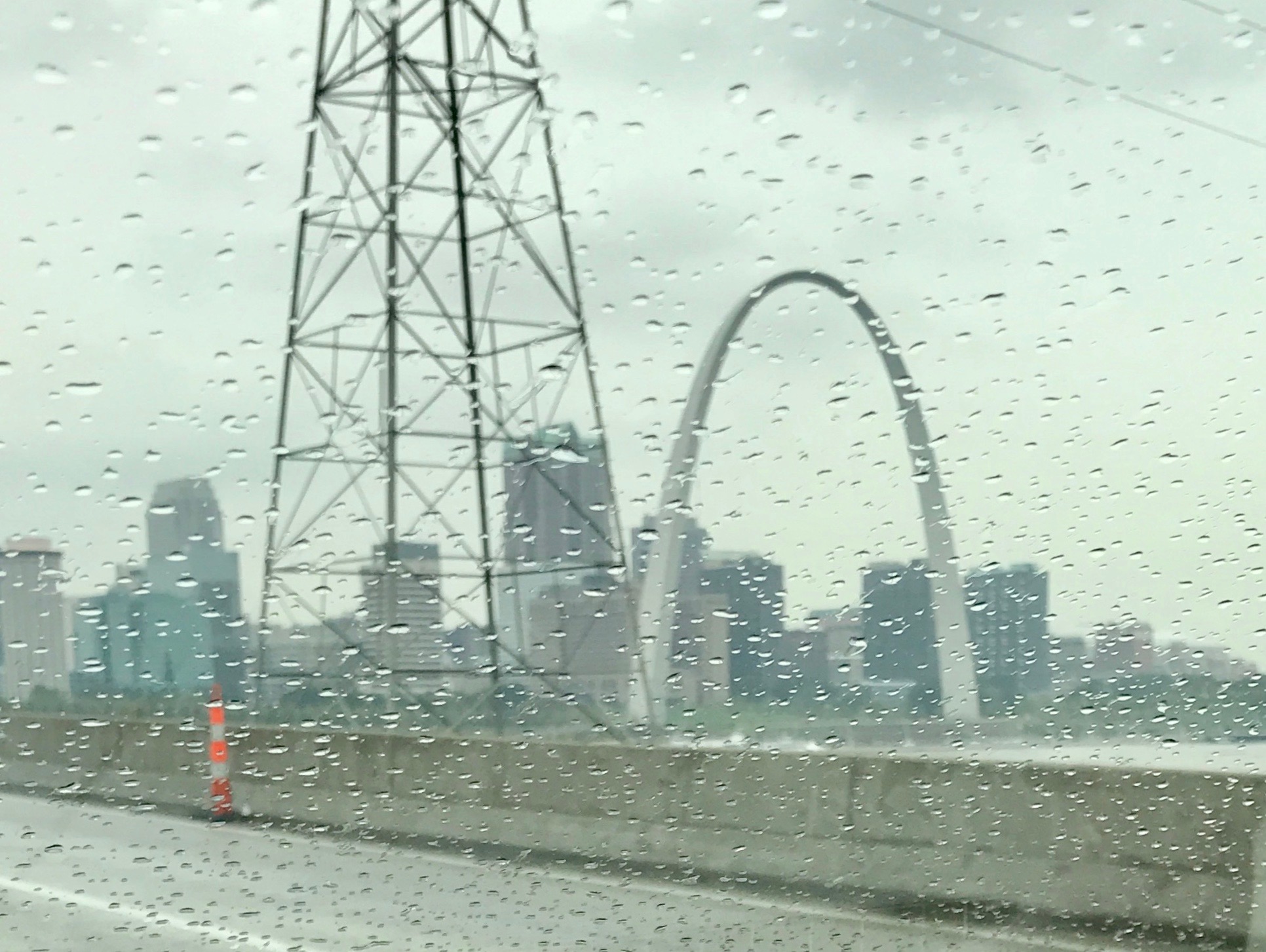
It was raining. (I hate rain!) The traffic was dreadful, thanks to construction. At least the stop-and-go traffic gave me the opportunity to snap this water-logged photo of the Arch. (I’ve been there before, so it is not on The List.)
My purpose in visiting Jefferson City was to see the capitol. I booked a site in the closest campground I could find. I pulled in and signed their two page (TWO PAGE!) list of rules and they gave me my site for the next two nights.
If they need a two page list of rules, they must have some rowdy customers at times. At this time of year, though, the campground was largely empty. I settled in for the night and got ready to visit the capitol on the morrow.
Stay turned!


Family Fun

The other important component of my first adventure with my new trailer was family fun.

I’ve already mentioned getting together with my sister.

Later, I got together with sister Amy and brother Craig’s families. Food and fun!

and games!

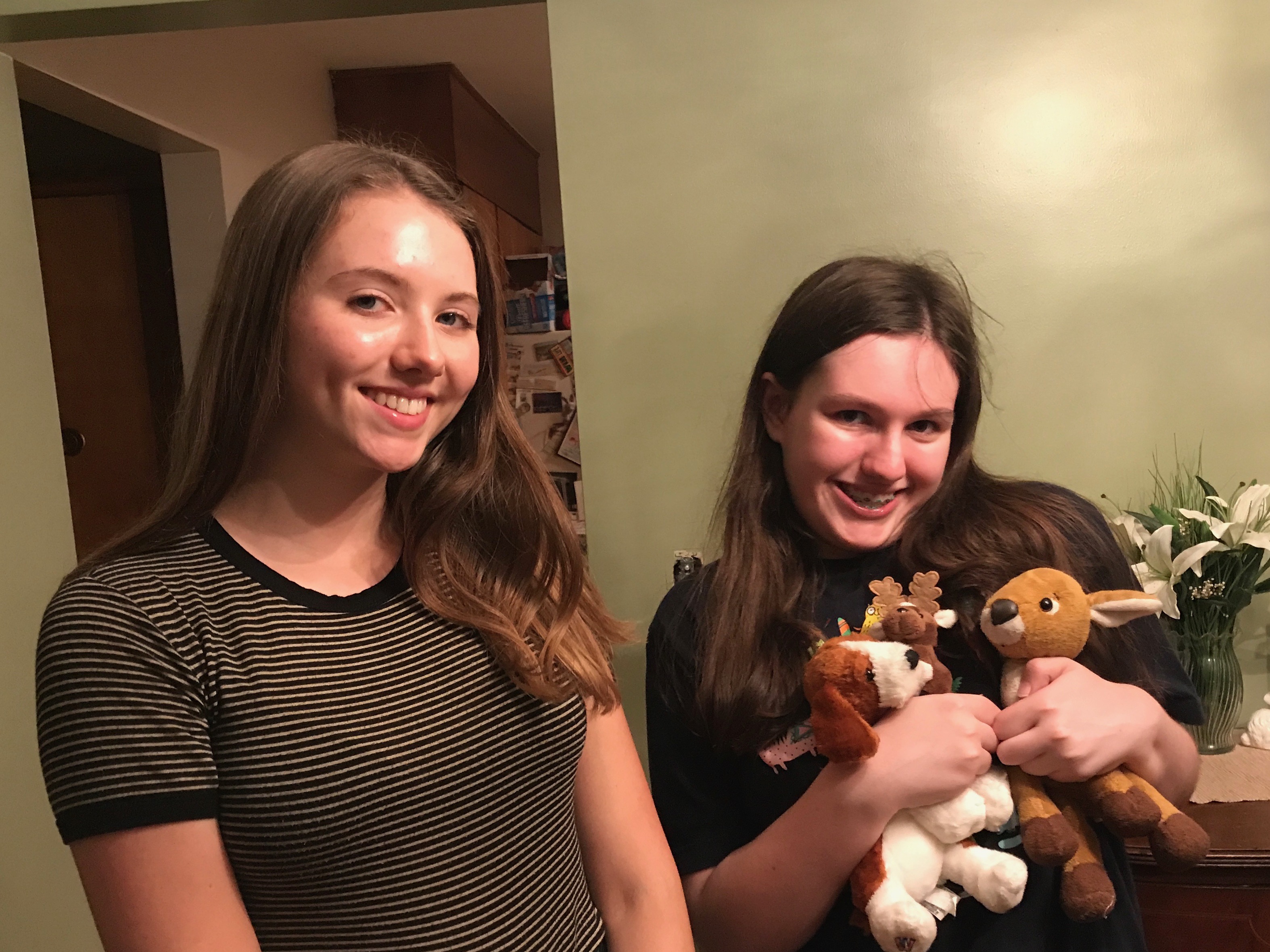
Here’s Craig’s daughter, Mariel, and Amy’s husband, Steve, playing Connect Four with stuffed animals as proxies.

Here are two-thirds of my nieces, Sarah and Mariel. I wonder where Katie was?

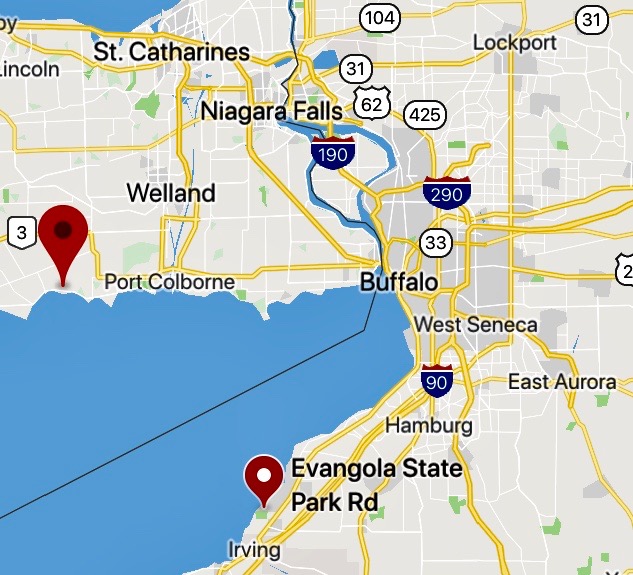
The next day it was time for me to break camp at Evangola State Park. I got hitched up and headed to

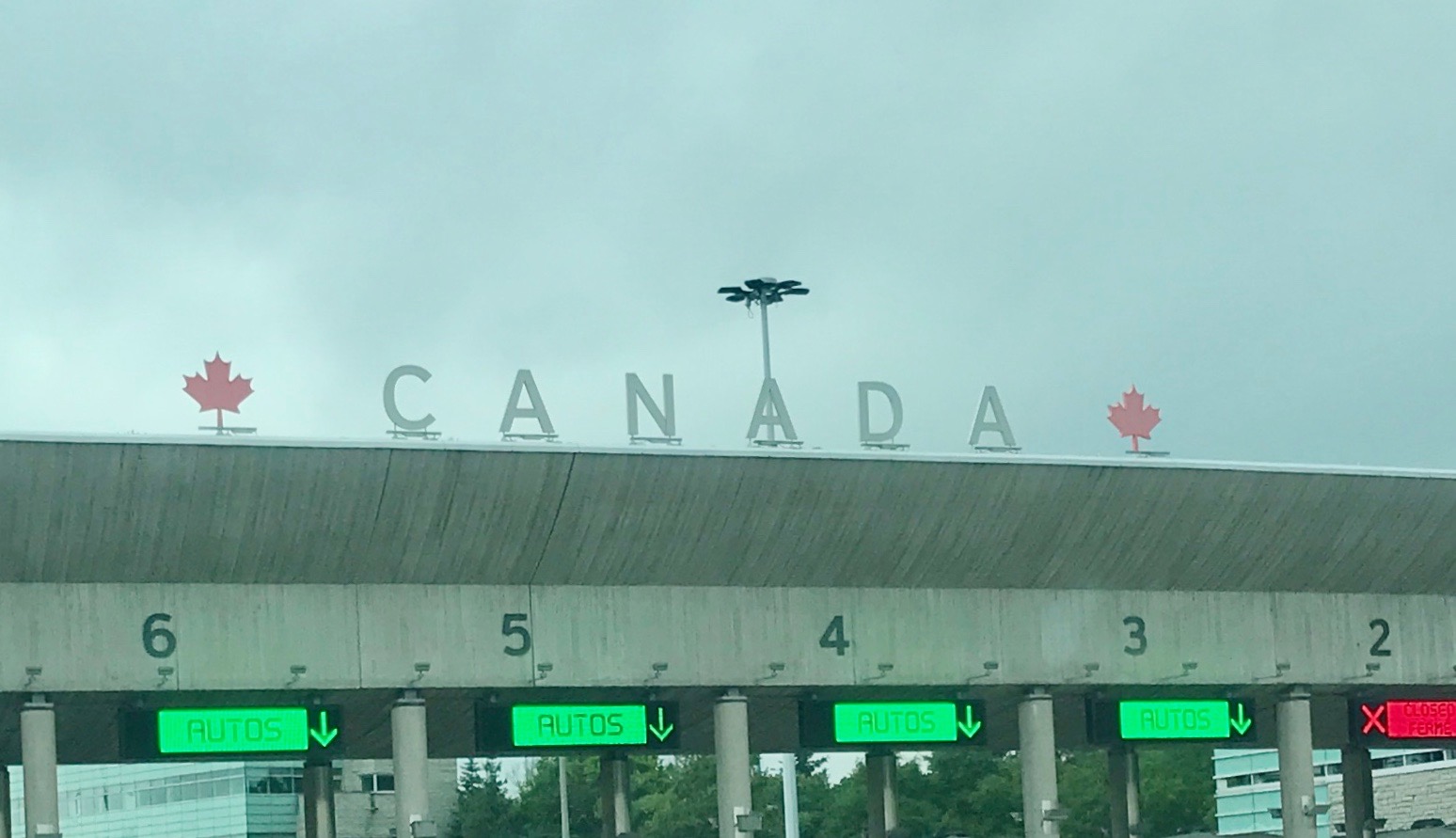
It was my first border crossing with the T@b, but hardly my first crossing. With family on both sides of the border, I’ve been back and forth across the Peace Bridge thousands of times.

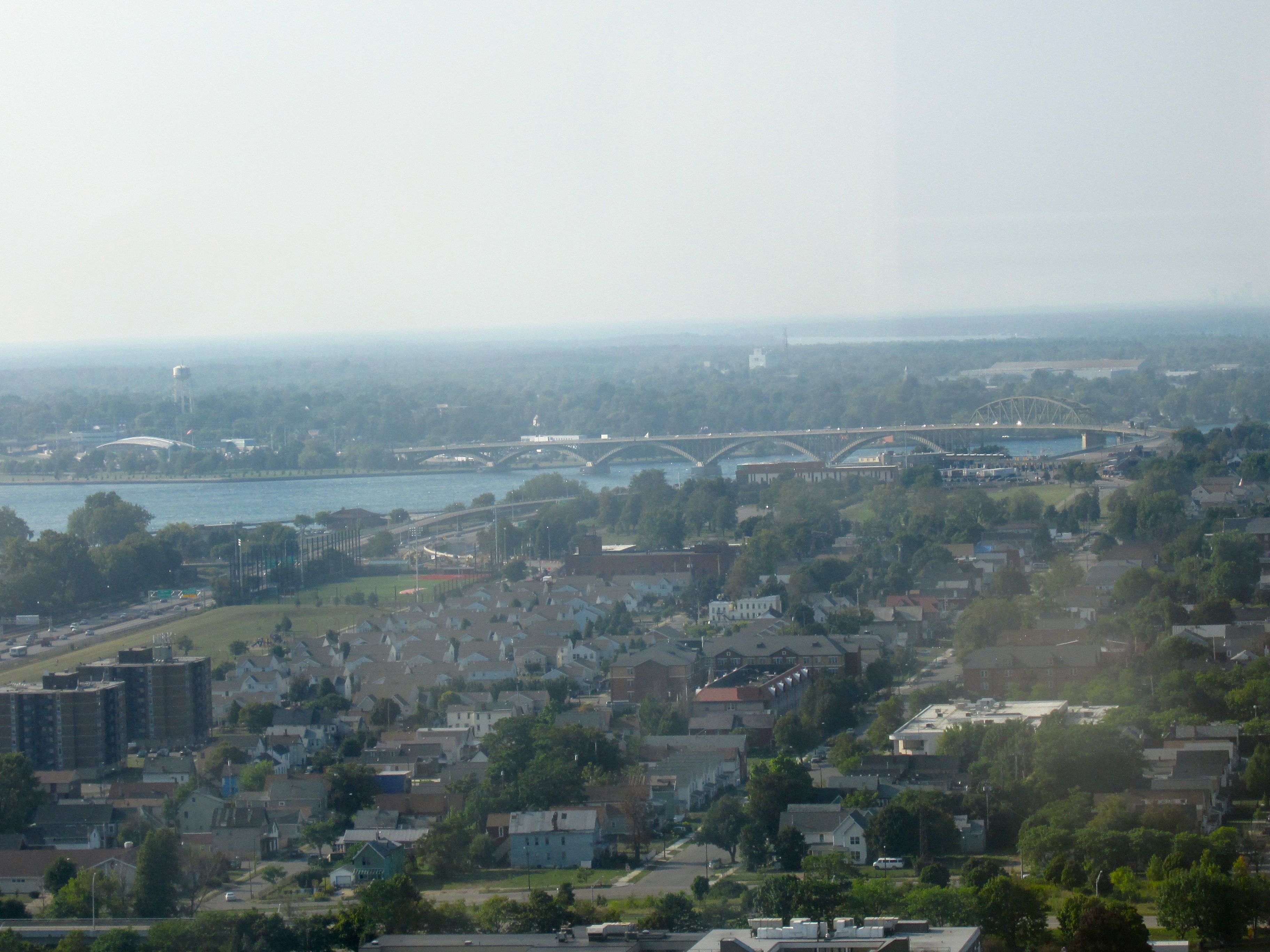
I took this photo of The Bridge a few years ago when I was on the top of the Buffalo City Hall.

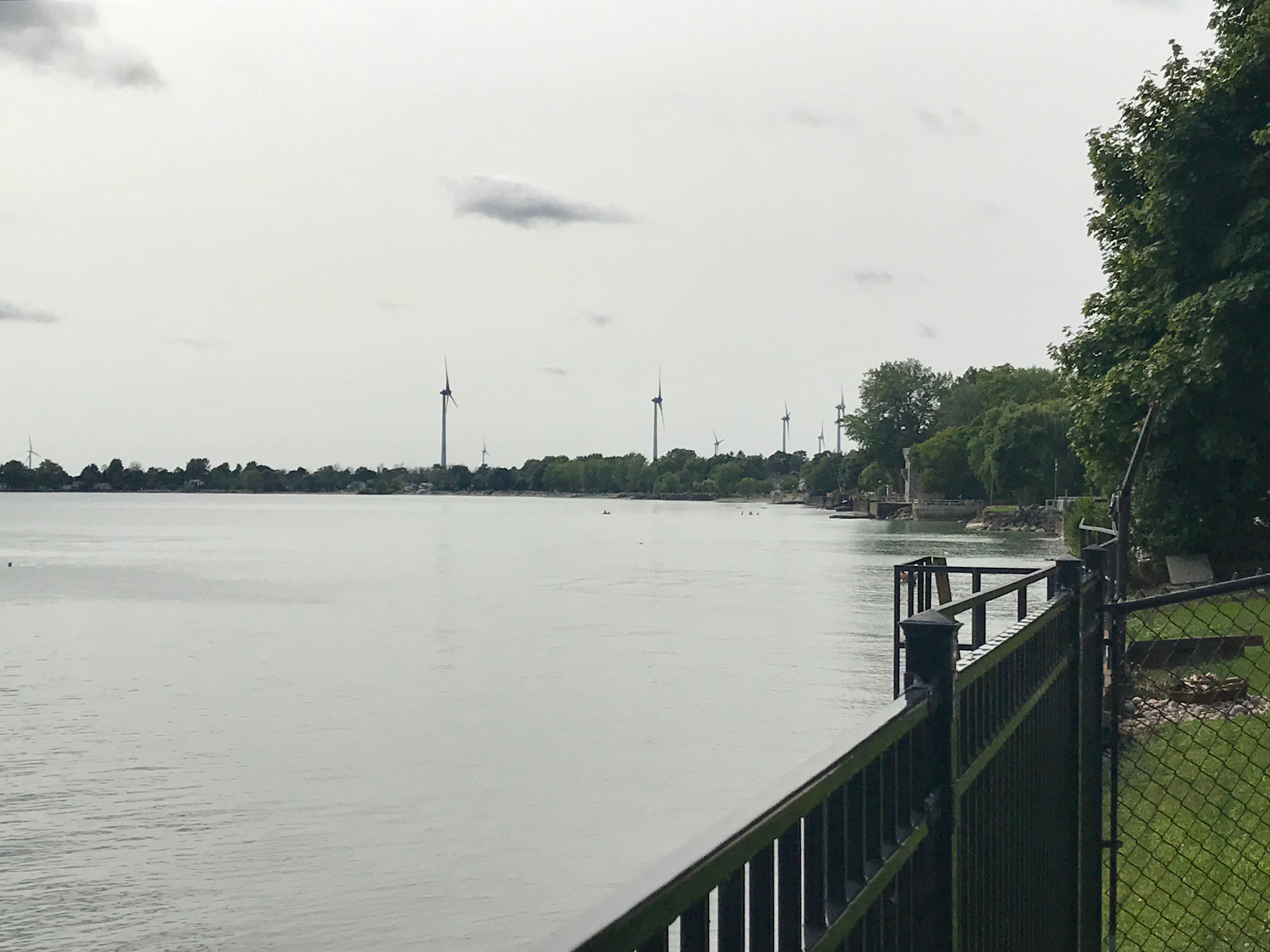
My destination was Long Beach, Ontario.

My cousin, Bill, and his wife, Lori, have a site for the season at Long Beach Conservation Area and Campground. We’d been talking about camping together for a few years. It was time to finally get it done!

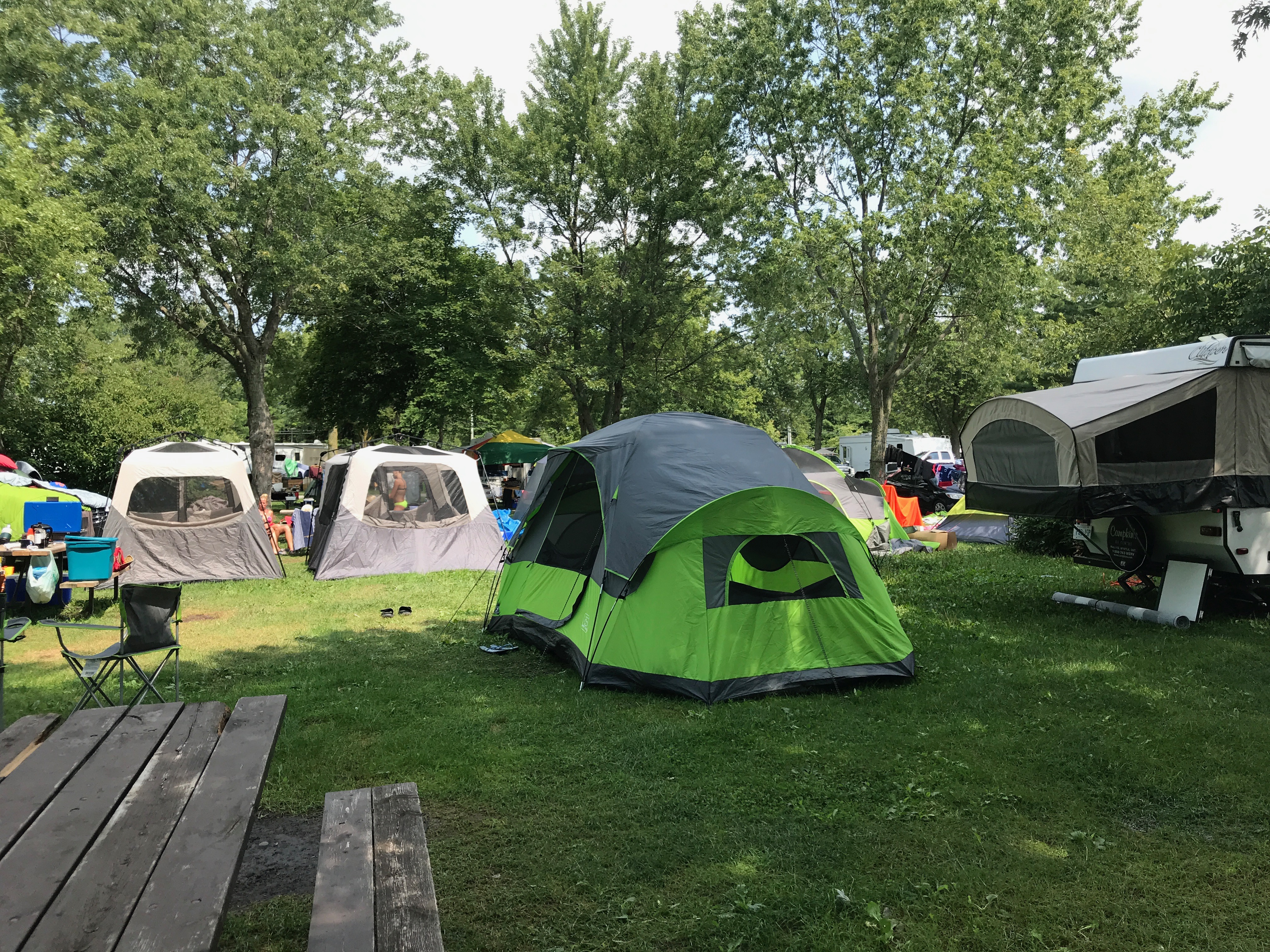
It was a very popular campground!

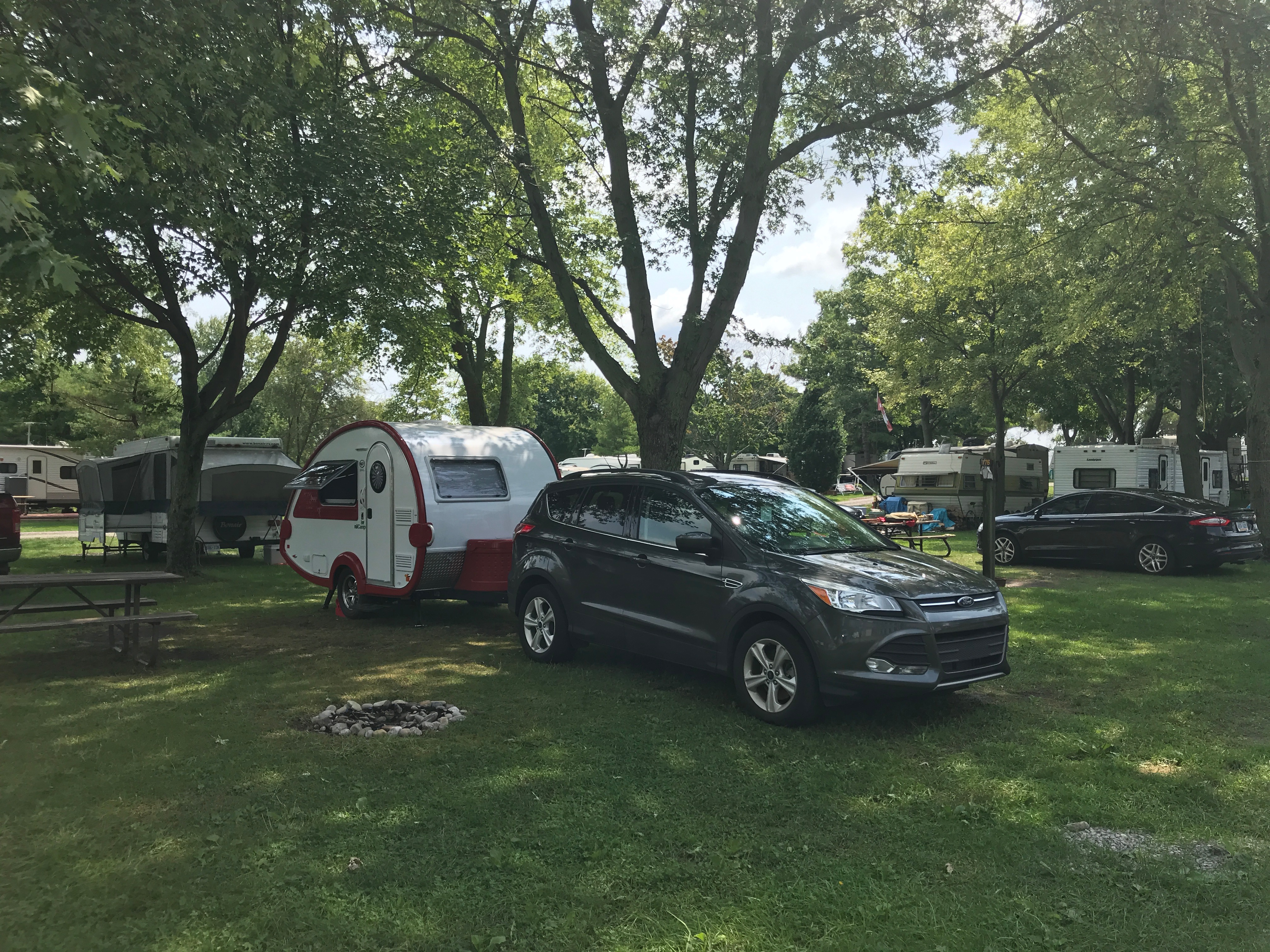
I got my T@b wedged in. More people packed in around me after I got set up.

Lori and Bill had a primo site – right at the shore.

I like this close up photo better. I am really big on cropping!

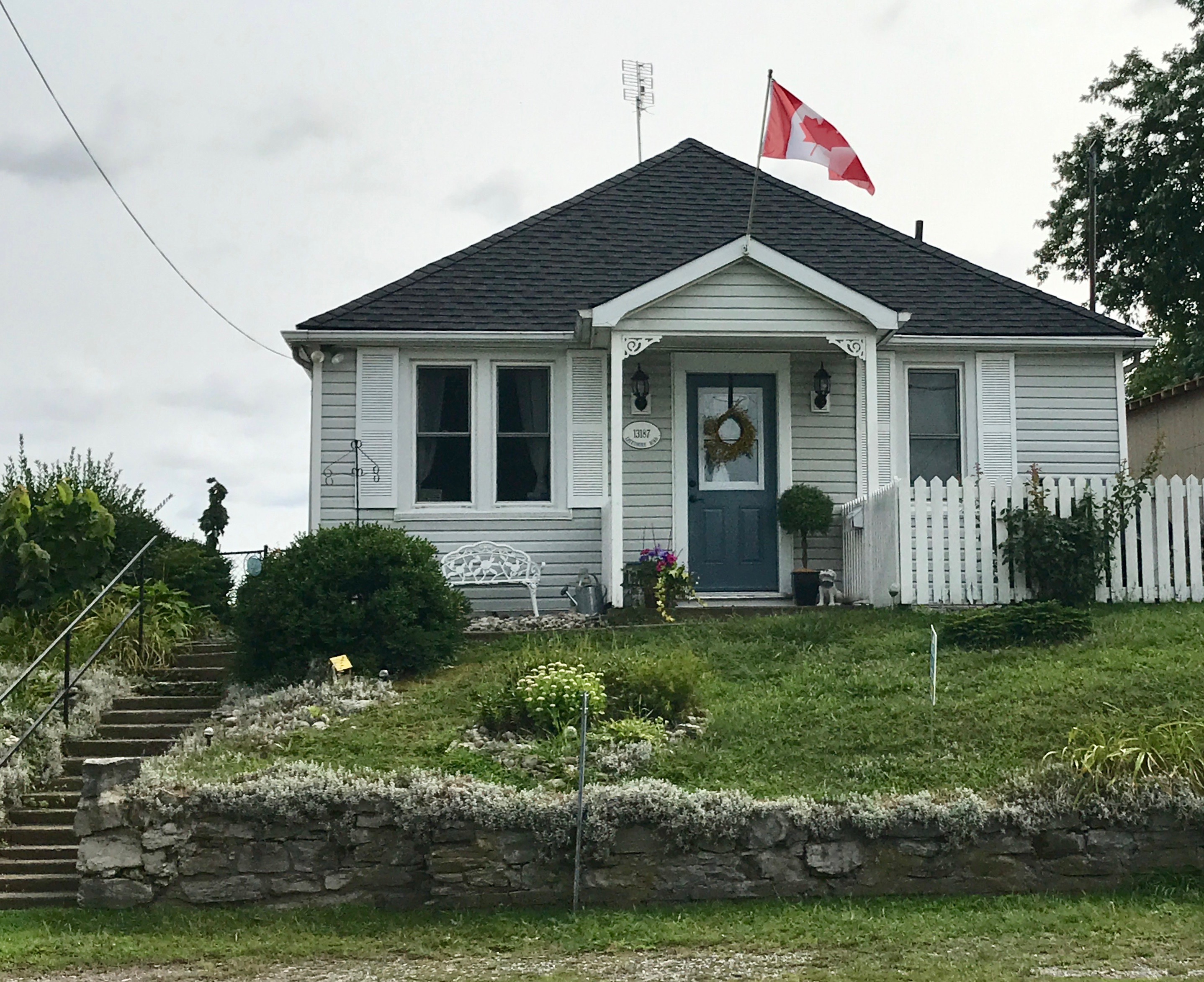
Amy and Katie came over to spend some time with our cousins, Bill and Wayne. After snacking and hanging out a bit, we went for a little drive. I asked if we were near our Auntie Lo and Uncle Bill’s cottage. We were!

The neighbor on the right was outside, and I got out and engaged her in conversation. After a bit, the current owner came up, and we chatted with him, too. He had just finished renovating it and he insisted us up to see what he had done.

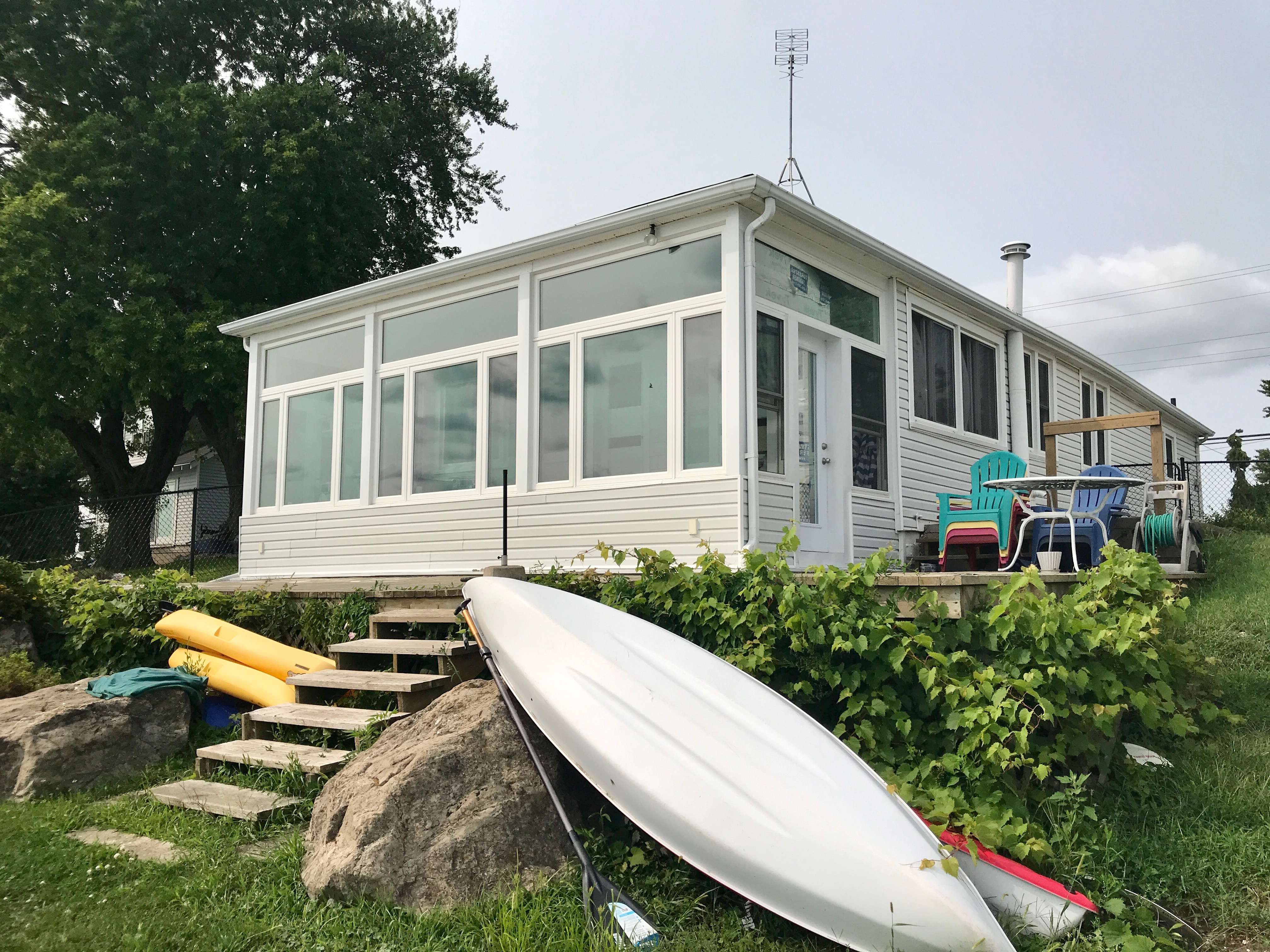
He did a really great job! The floor plan was the same as I remember, except for the bedroom that was to the right of the door.  Well, actually, the floor plan of that room was the same, but the amazing bunk beds were gone. Auntie Lo and Uncle Bill had triple decker double sized bunk beds! They could really cram a lot of guests in the house!

They even had couches on the porch facing the lake that people couple sleep on. There were changes. For instance, the beach.

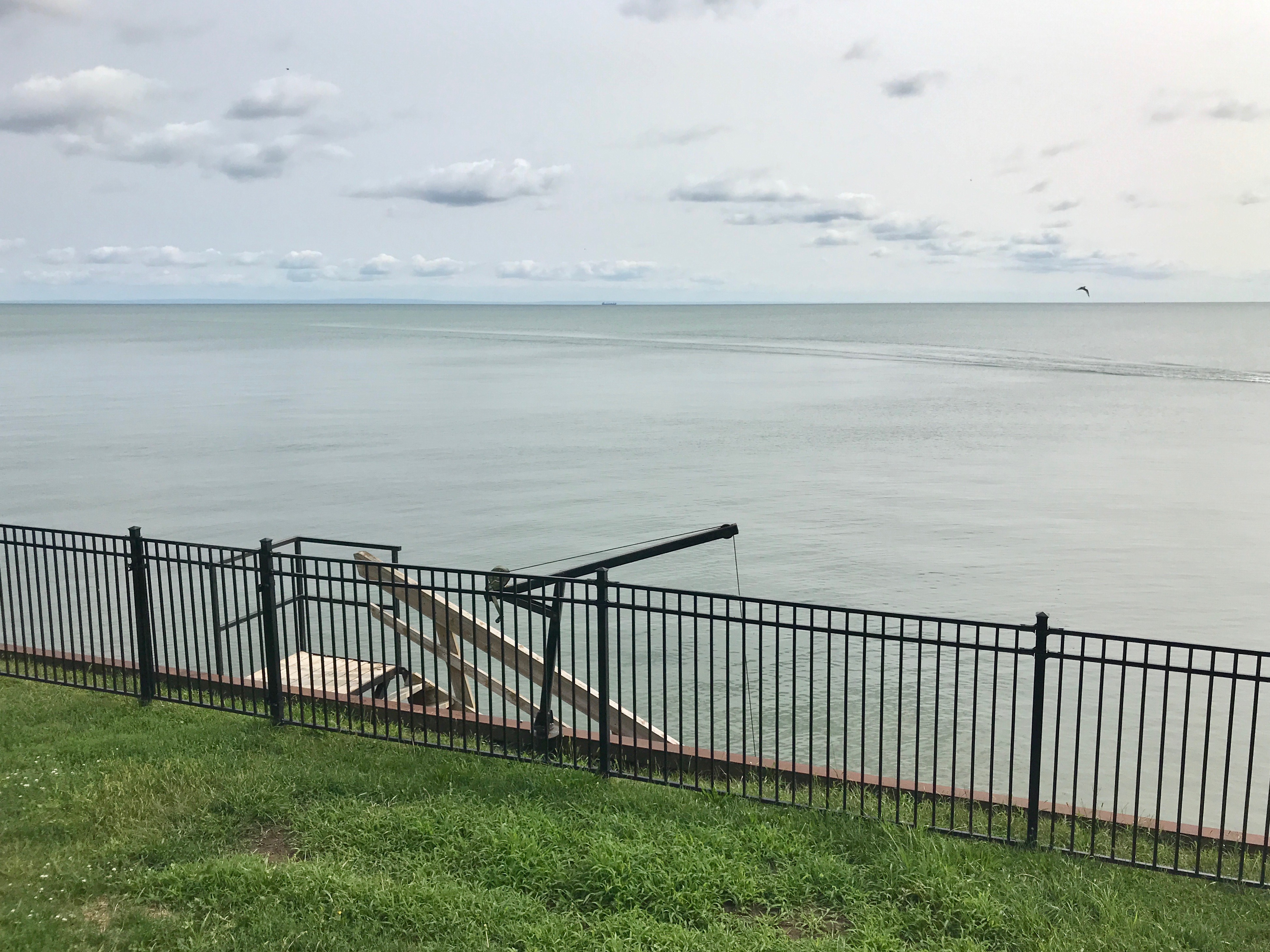
The beach was gone!

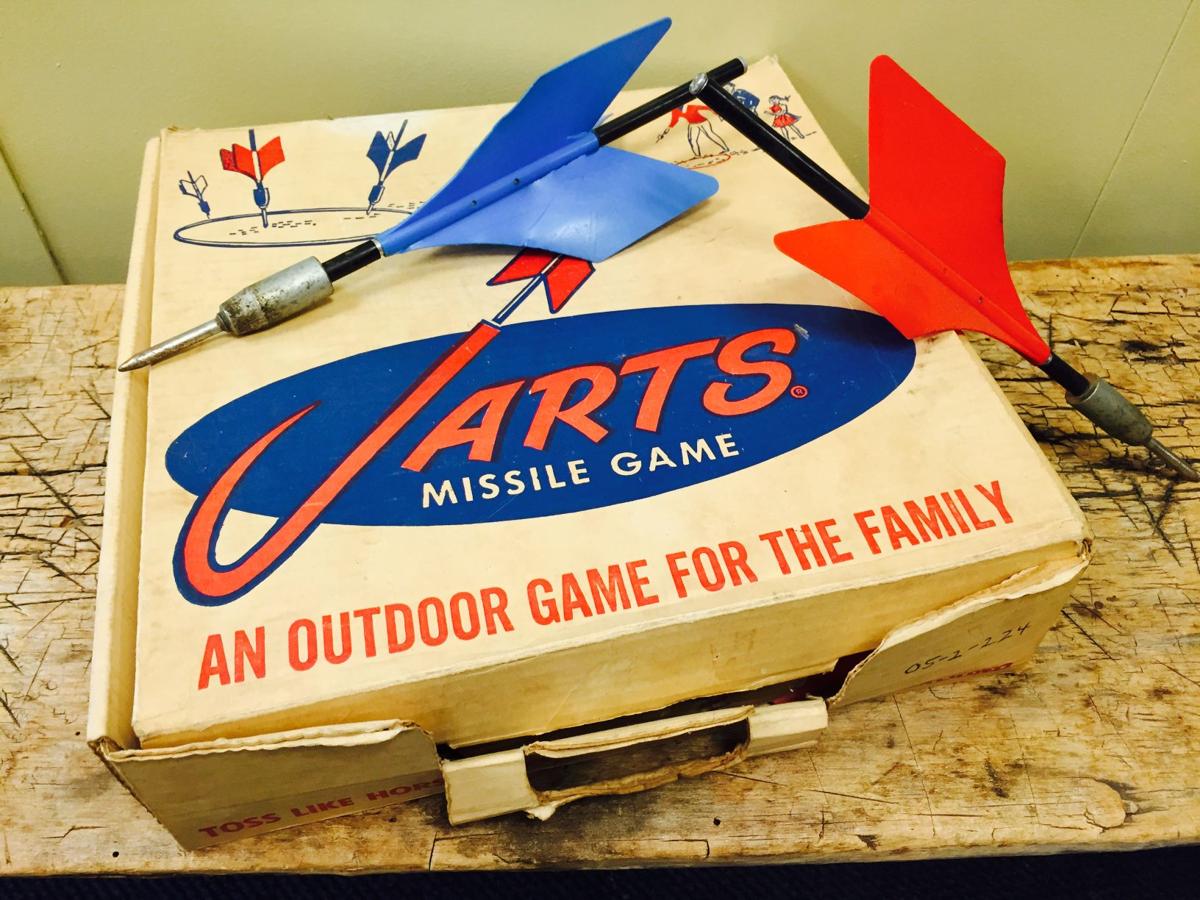
As I remember it, there was a good sized yard that we played games on. For some reason, I think we played Jarts. But, I could be mis-remembering it.

The beach was wide. There was a black rubber conveyor belt to make it easier to walk across the rocky beach. The idea was great, except that – boy – did it get hot in the sun!

Really, the beach was absolutely gone! If the owners who came after Auntie Lo sold it in 1976 hadn’t put in a restraining wall, they cottage probably would have tumbled in the lake.

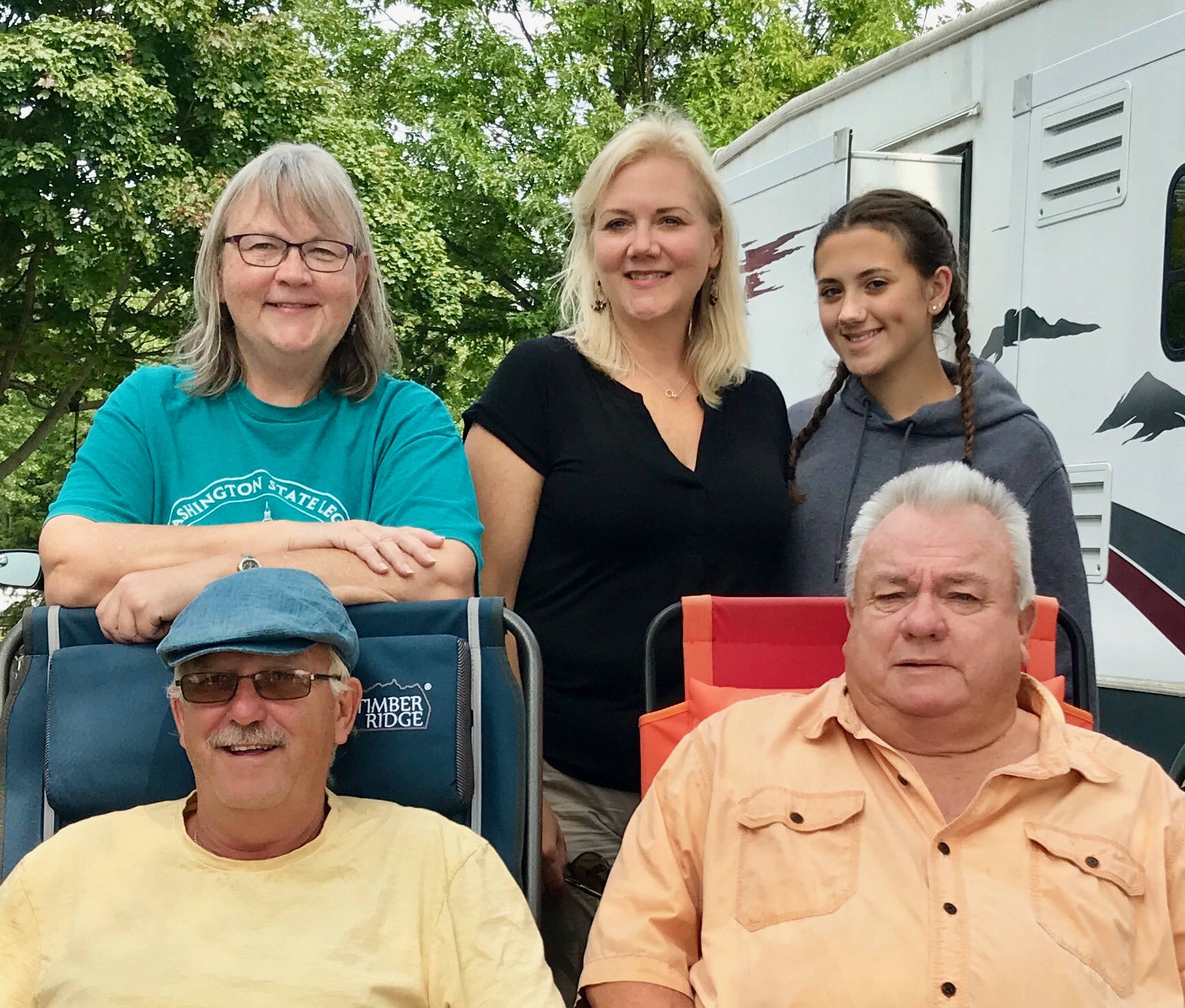
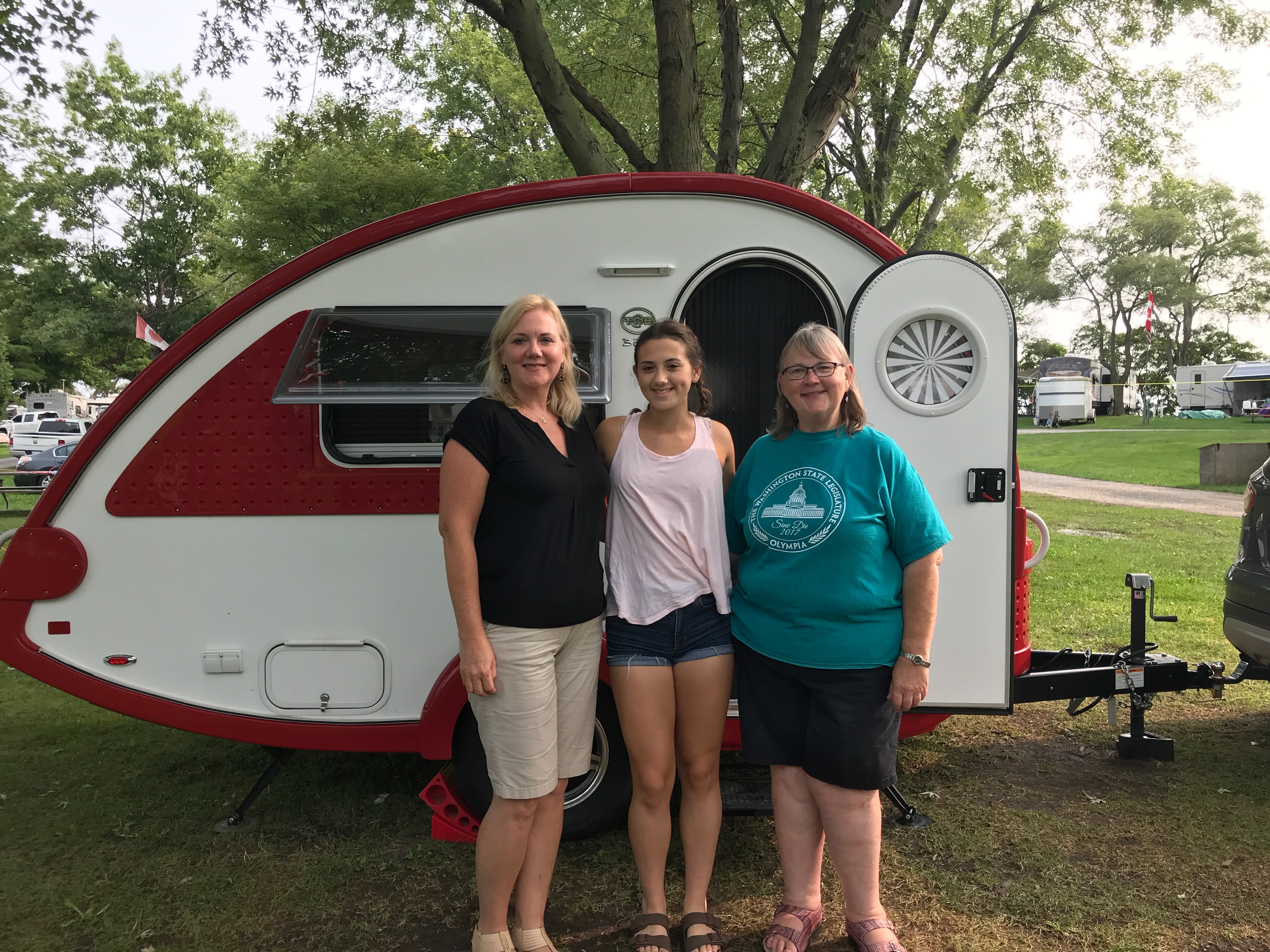
After our trip down memory lane, Amy and Katie needed to be getting back. We had a photo taken by my trailer and said our goodbyes.

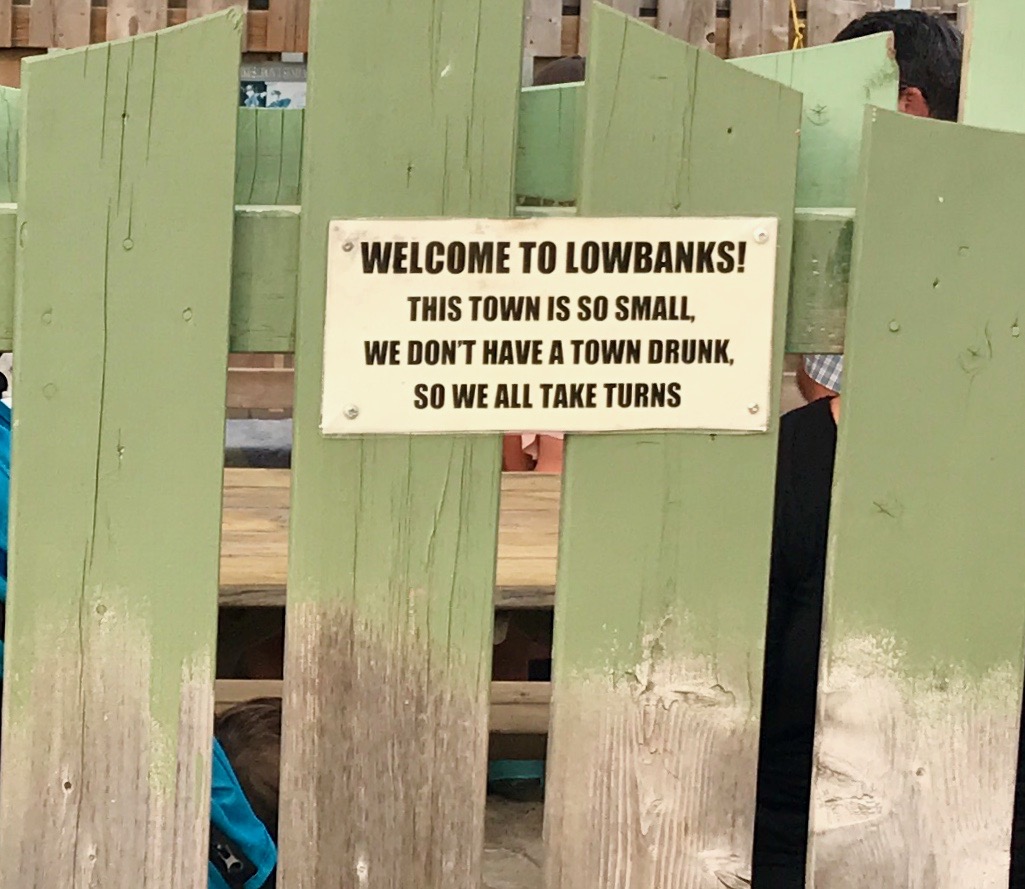
That evening, The rest of us, headed to a beachside restaurant in Lowbanks.

A good time was had by all. The sign made me giggle.

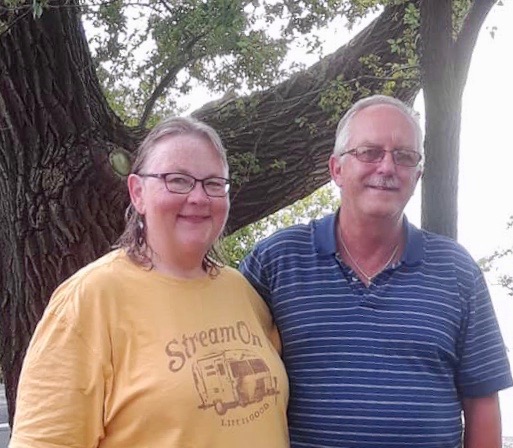
In the morning, I got myself ready to hit the road. We thought it would be a good thing to take a photo of me and my cousin, Bill, to commemorate the visit. The wet hair makes me wonder if it really was a good thing.

But, there’s a photo and it so it happened.

Time to hit the road.

Destination: Kalamazoo.


Greycliff: The Restorations Continue

Long time readers of my blog – or those people who know me in real life – know that I am very interested in the work of Frank Lloyd Wright. I grew up with his famous Martin House in Buffalo. I even toured it with a Girl Scout group back when it was in real disrepair. Man, you should see it now! Honestly, if you ever get to Buffalo, you must visit the Martin House.

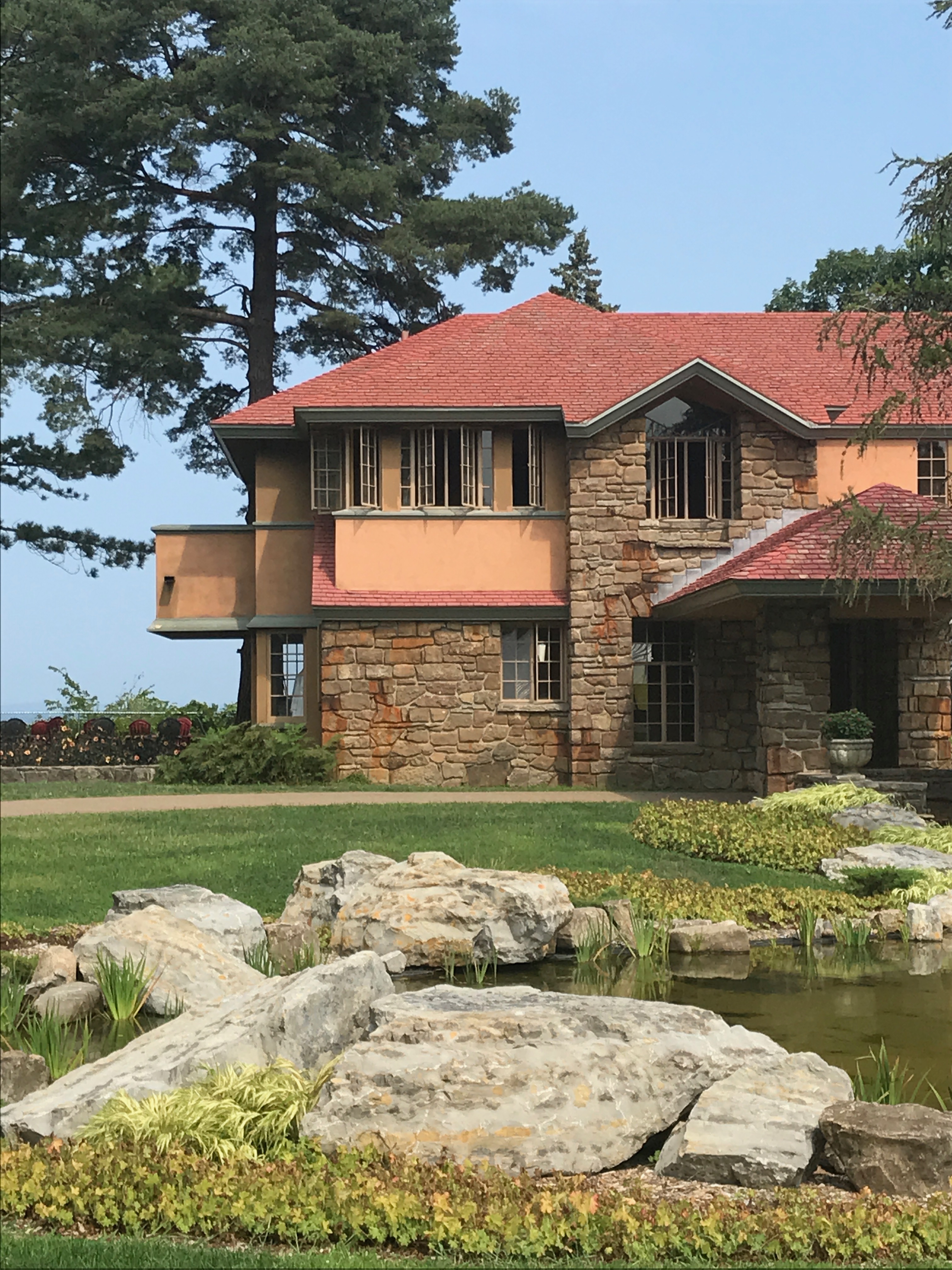
But, I digress – sort of. Greycliff is another Frank Lloyd Wright house – and another Martin House. It’s their summer place, on the Lake Erie shore, and only about ten miles from Evangola State Park. I decided to take a tour.

It was built between 1926 and 1931, and is one of only five Frank Lloyd Wright designs that were built between 1925 and 1935, and it is the only Wright designed structure built between Taliesin (1914) and Fallingwater (1936) that was built using stone. According to my Preferred Source, Greycliff is considered to be one of Wright’s most important mid-career works in his Organic Style.

While I was waiting, I managed to snap a photo of a drawing of the complex made from a bird’s eye view. The building on the left is known as the Isabelle R. Martin House. The structure to the right is the Foster House. It was originally designed as a garage with quarters for the chauffeur and his family. It was expanded, and eventually the Martins’ daughter, Dorothy and her husband James Foster, and their children spent many happy summers there. It kind of makes me wonder what happened to the chauffeur and his family. There is a small building between the two larger ones. It’s called the Heat Hut, and it housed the furnace.

Incidentally, my first visit to Greycliff was while I was at Daemen College. Sister Jeanne took us on a field trip here. We didn’t go to see the house, though. I imagine it was in really rough shape at that point, as it had been a school run by the Piarist Fathers. As I recall, this school was started by a group of Hungarian priests that had fled the Communists. The order was founded in 1617 by Saint Joseph Calasanctius, who was from Spain.

Okay, stay with me. This bit of information is important to me because my first teaching job was at Calasanctius Preparatory School in Buffalo, New York, founded and run by the Piarist Fathers. Isn’t that a great big circle of coincidences?

They also had a school here. The modifications they made to the original plan are not shown in the drawing. Luckily, they didn’t do anything with the Wright buildings that couldn’t be reversed. They built a classroom annex in front of the garage to the right of the drawing. What we originally came out to see was a sgrafitto work of art that was on the facade.

I mentioned this to the docent giving the tour. She told me what became of the work of art after the classroom building was demolished – but I forget what she said! I wish I took better notes.

I did send a message to Greycliff and received a response from Ryan Gravell, Greycliff Director of Operations. He told me that the sgrafitto was removed from Greycliff in the early 2000s and it was rehouses on the campus of Buffalo State College and became part of their collections.

I have sent and email to Buffalo State, but I haven’t heard back yet. If they respond, I’ll add the information I get.

Incidentally, Buffalo State College is right next door to the famous H.H. Richardson building I wrote about a while back. It was the old Buffalo Psychiatric Hospital but has since been repurposed into an upscale hotel. But, once again, I digress…

I made a second trip to see the house many years ago, just as restorations were getting serious. I was eager to see what they had managed to do in the years since my last visit.

I continued checking out the displays, as the waiting area filled with Wright enthusiasts waiting to take the tour.

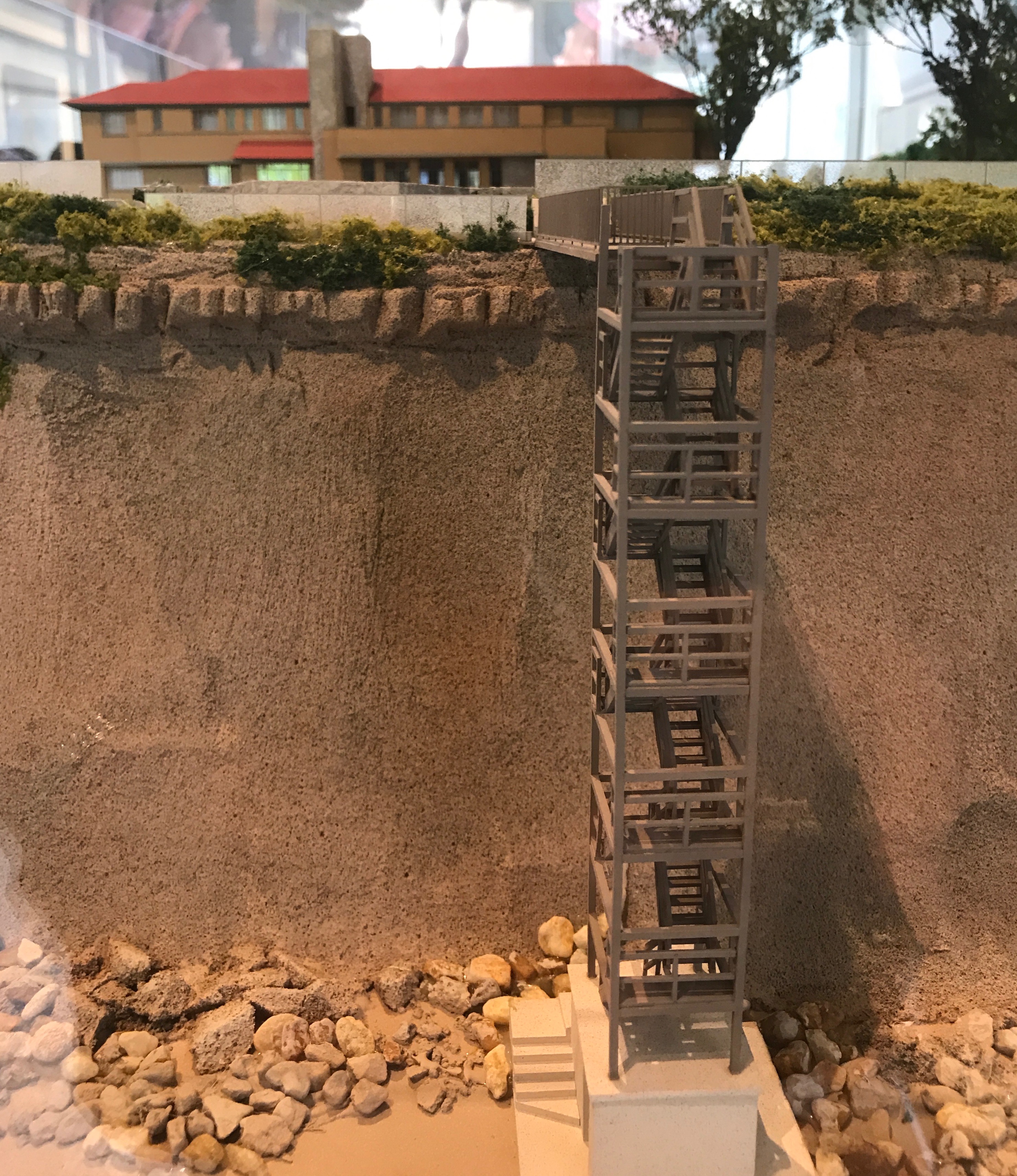
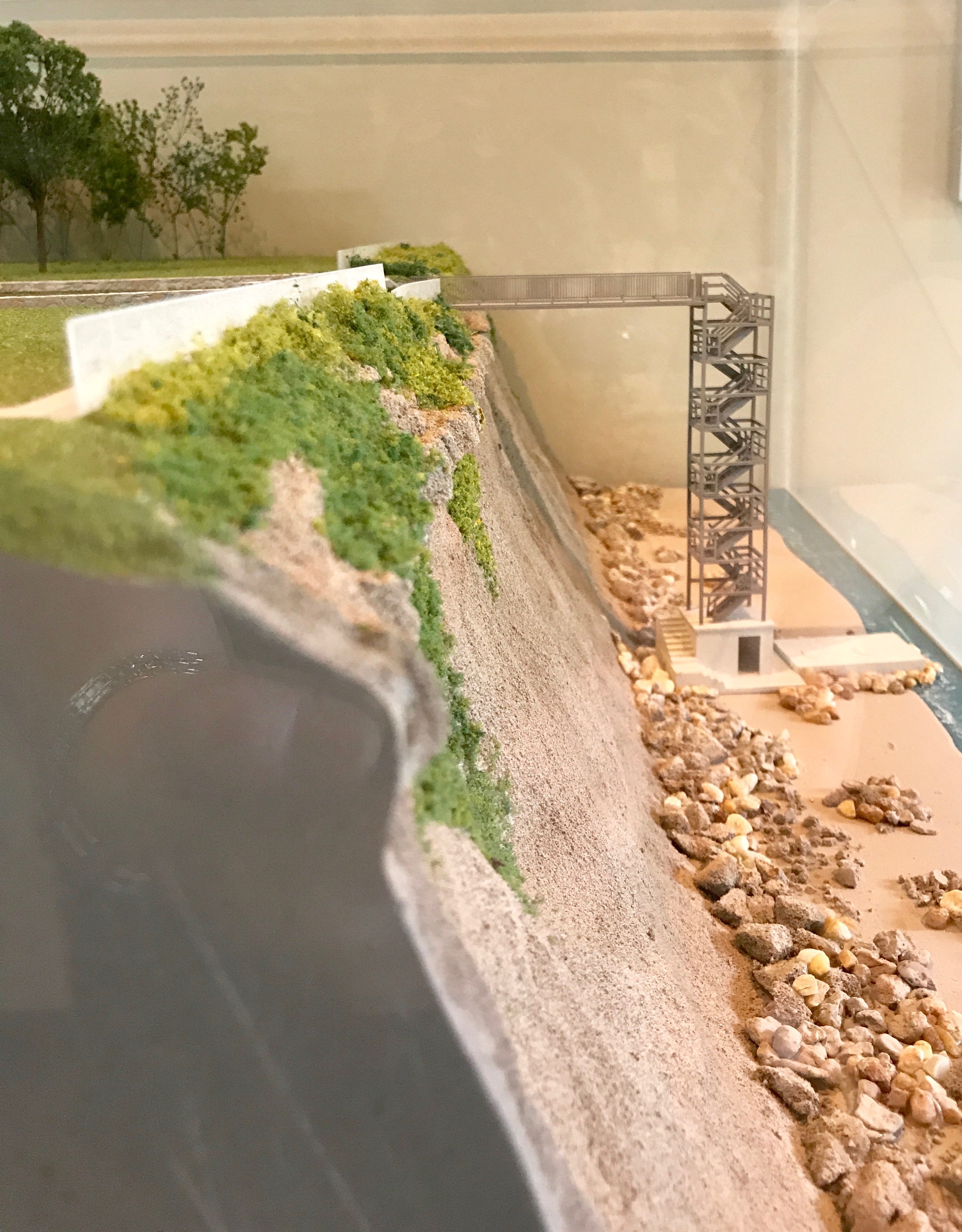
This is a view from an angle I had never seen before – from the lake.

I don’t think I would want to take that walk down to the beach. My hair would be standing straight up just walking from the cliff to the stairs. And then all those stairs! Whoah!

Luckily, I didn’t have to think about that trip too much longer. It was time for the tour to begin.

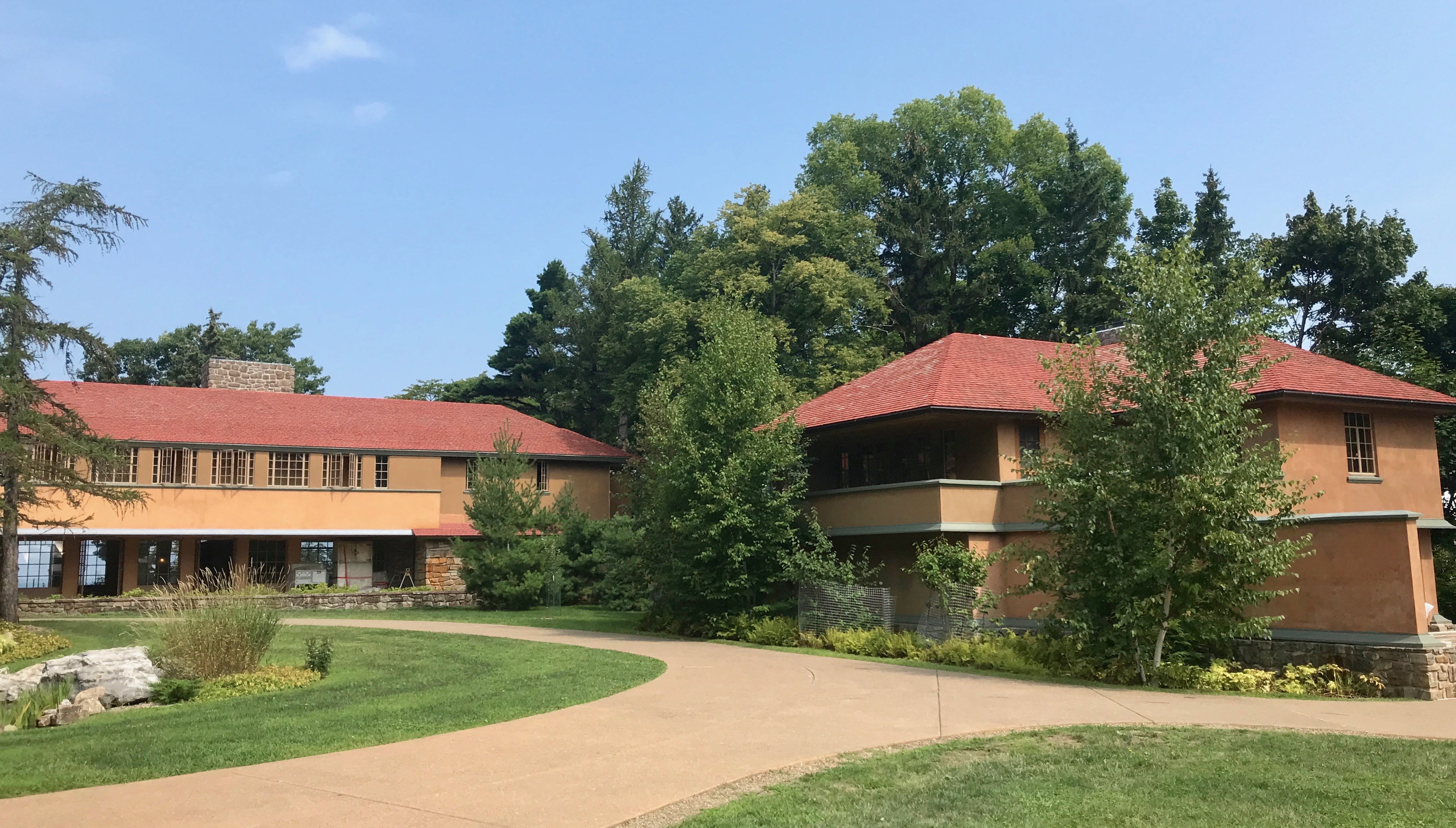
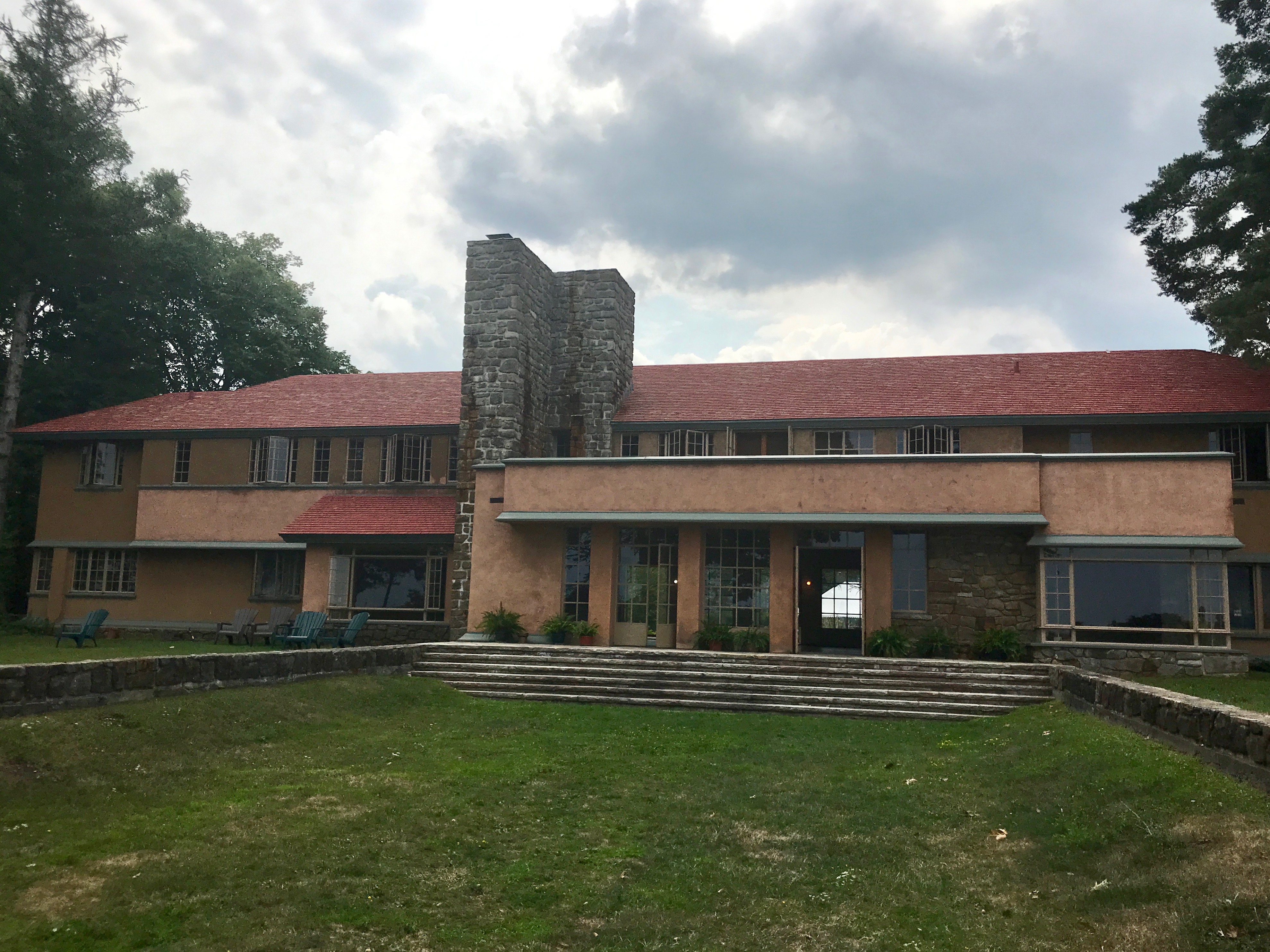
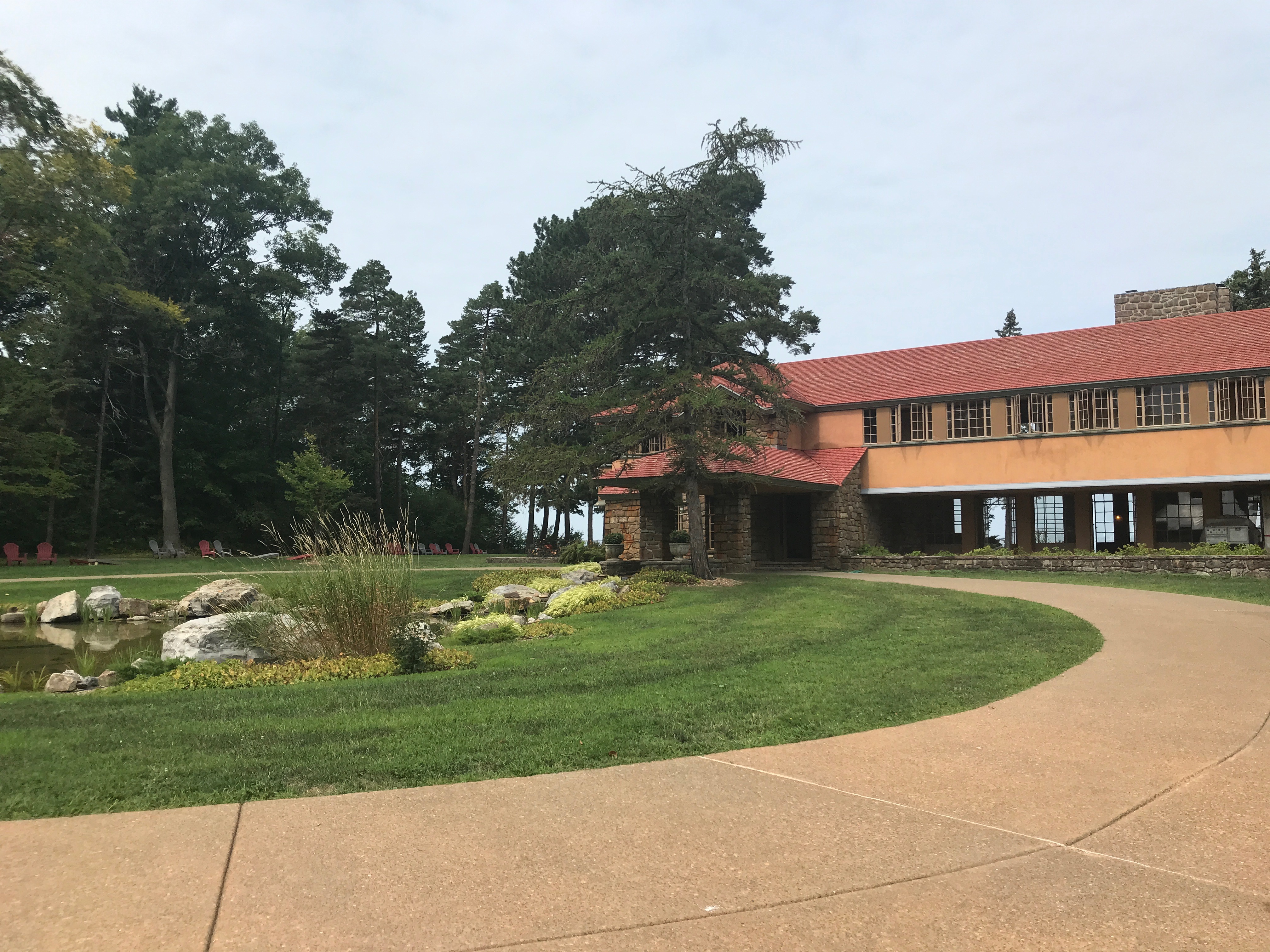
We walked out of the visitor center. The building to the right is the garage, with quarters originally intended for their chauffeur.  The building on the left side is the main house.

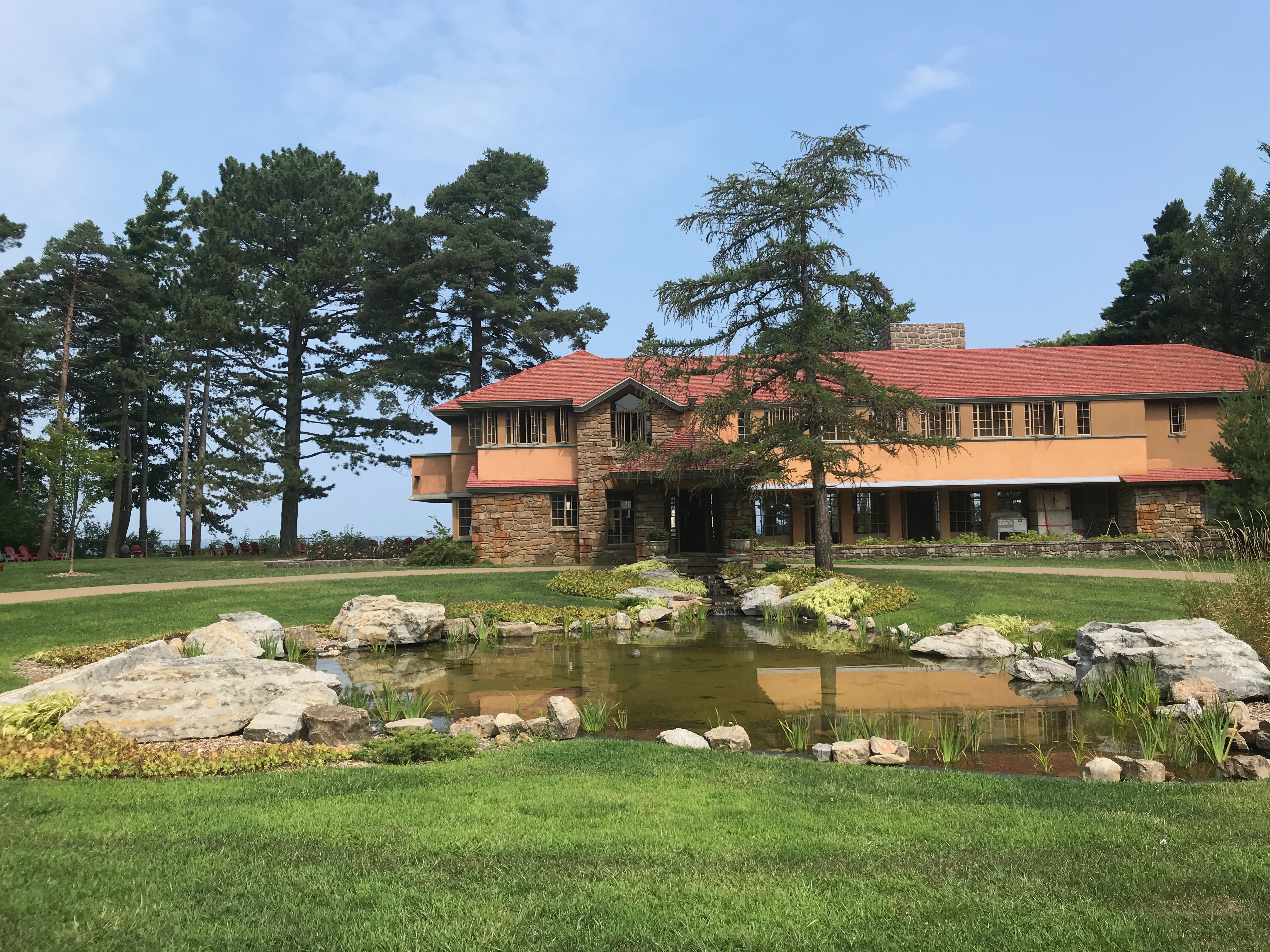
The house is reflected in the pond in front of it.

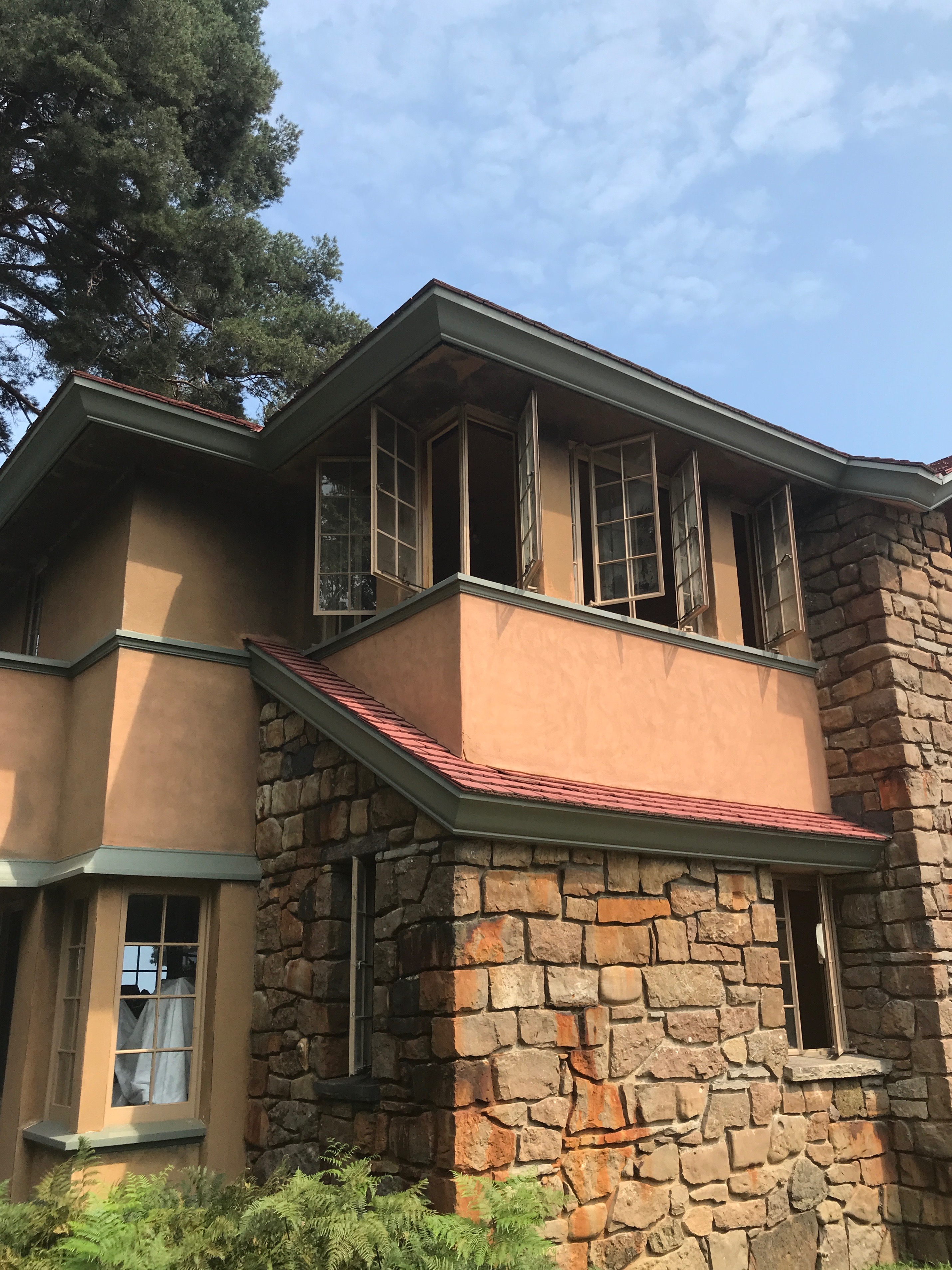
From this view, you can see one of Wright’s famous cantilevered porches.

To me, there is nothing more summer-y than having the windows open and cooling the house naturally. The breezes off Lake Erie must have been a welcome respite in the summer.

In the winter, I imagine that those Lake Erie breezes would not be near as salubrious. (Yes, that car is parked by Lake Erie. It was covered in ice during a storm in 2016.)
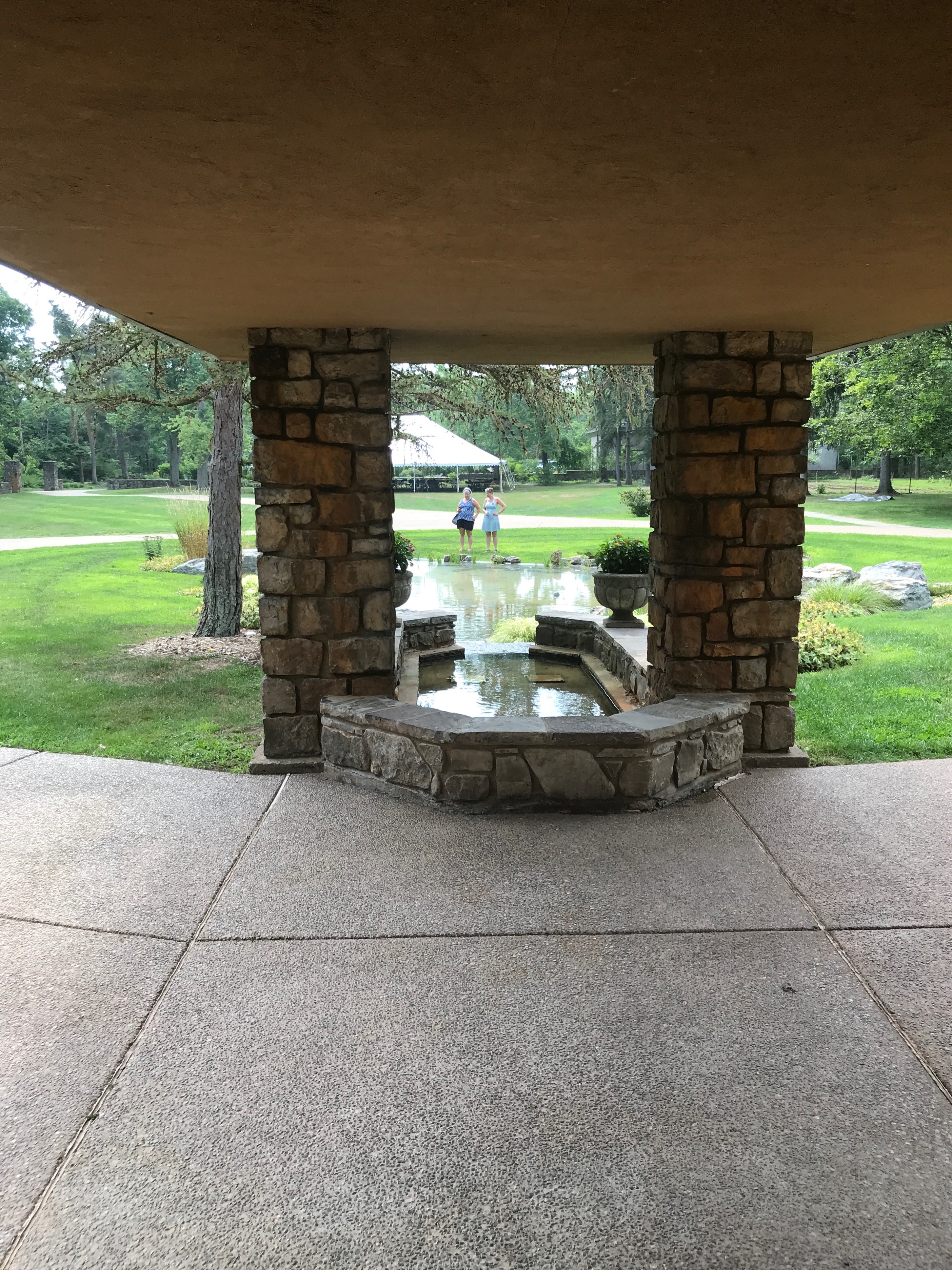
We got up to the entrance and looked back at the pond from under the porte-cochere. That sounds so much more classy than “car port.”

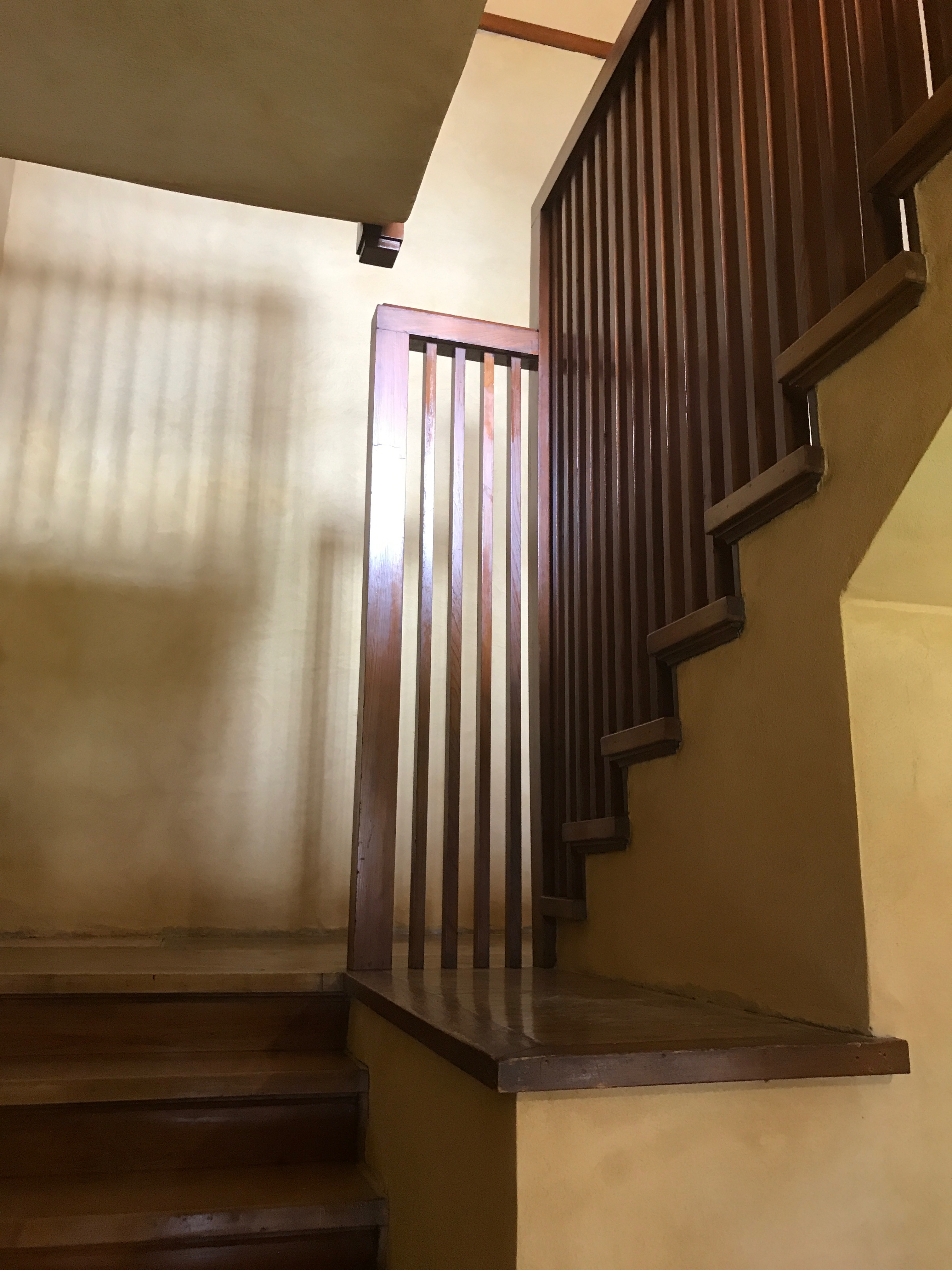
Just inside the door is the stairway to the second floor.

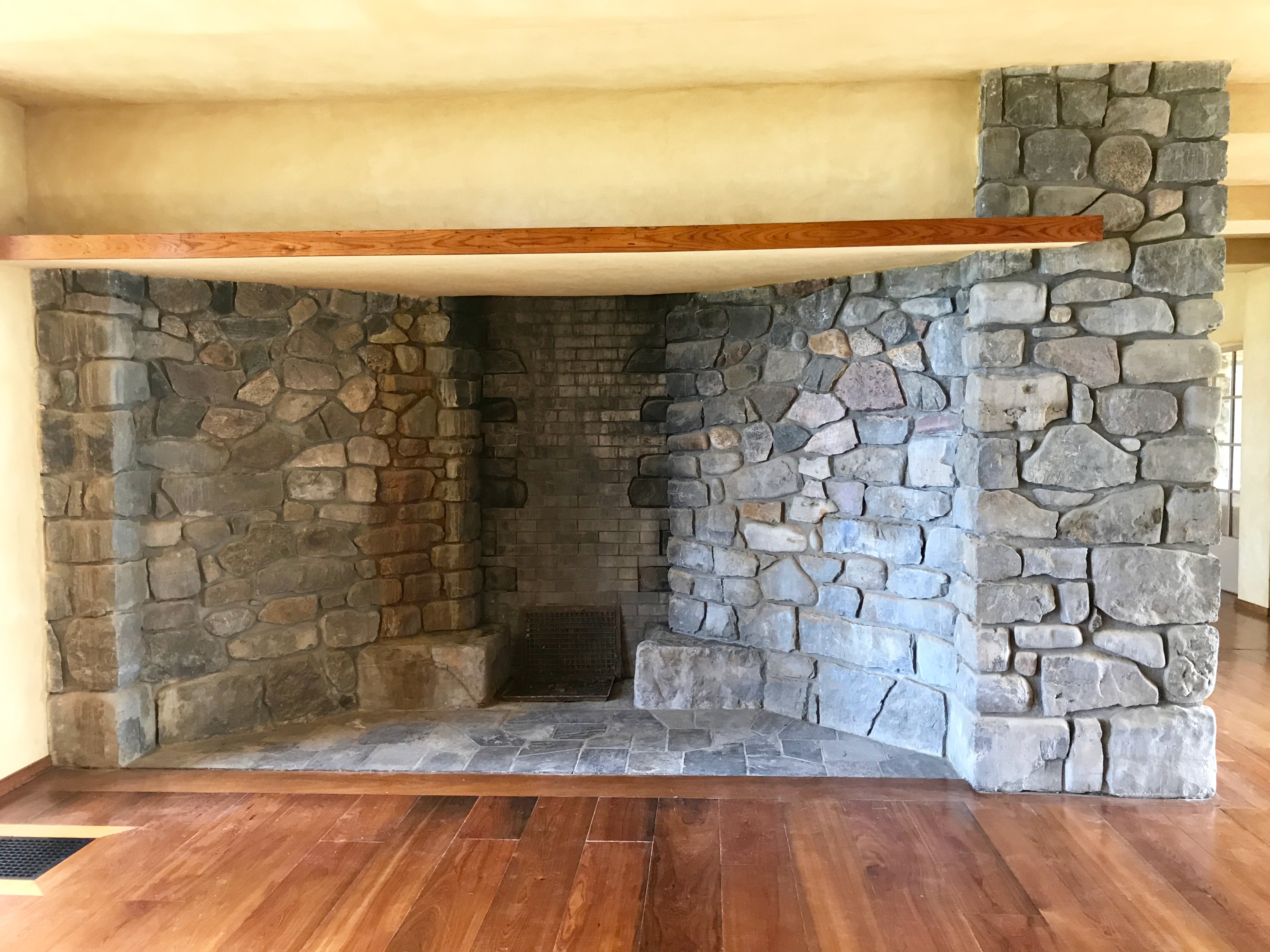
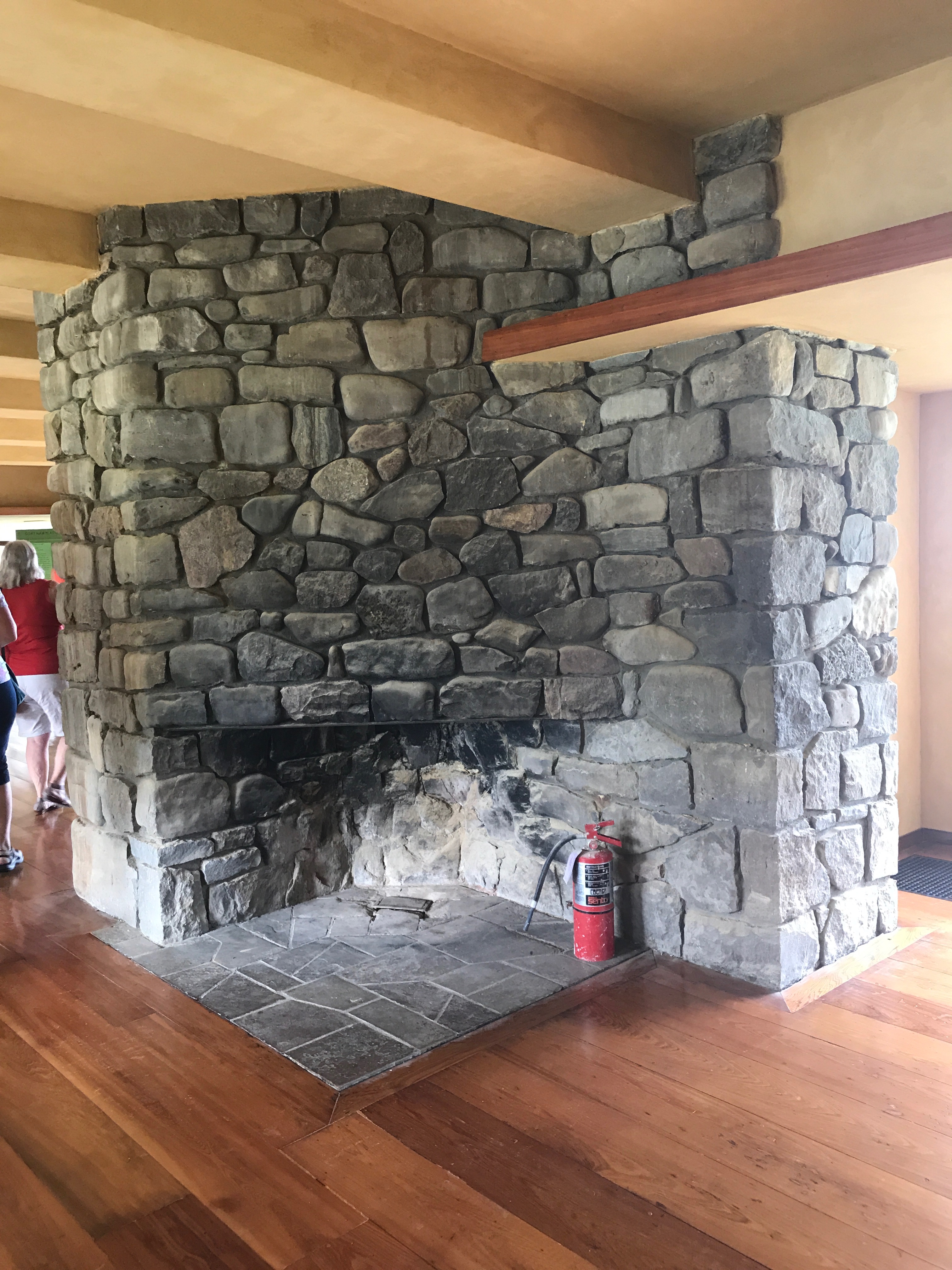
We headed over to the living room. Of course Wright designed a fireplace into the room. He was very big on fireplaces.

In fact, on the other side of that fireplace is another fireplace. I believe that is area is the dining room. I think the fire extinguisher is a nice touch.

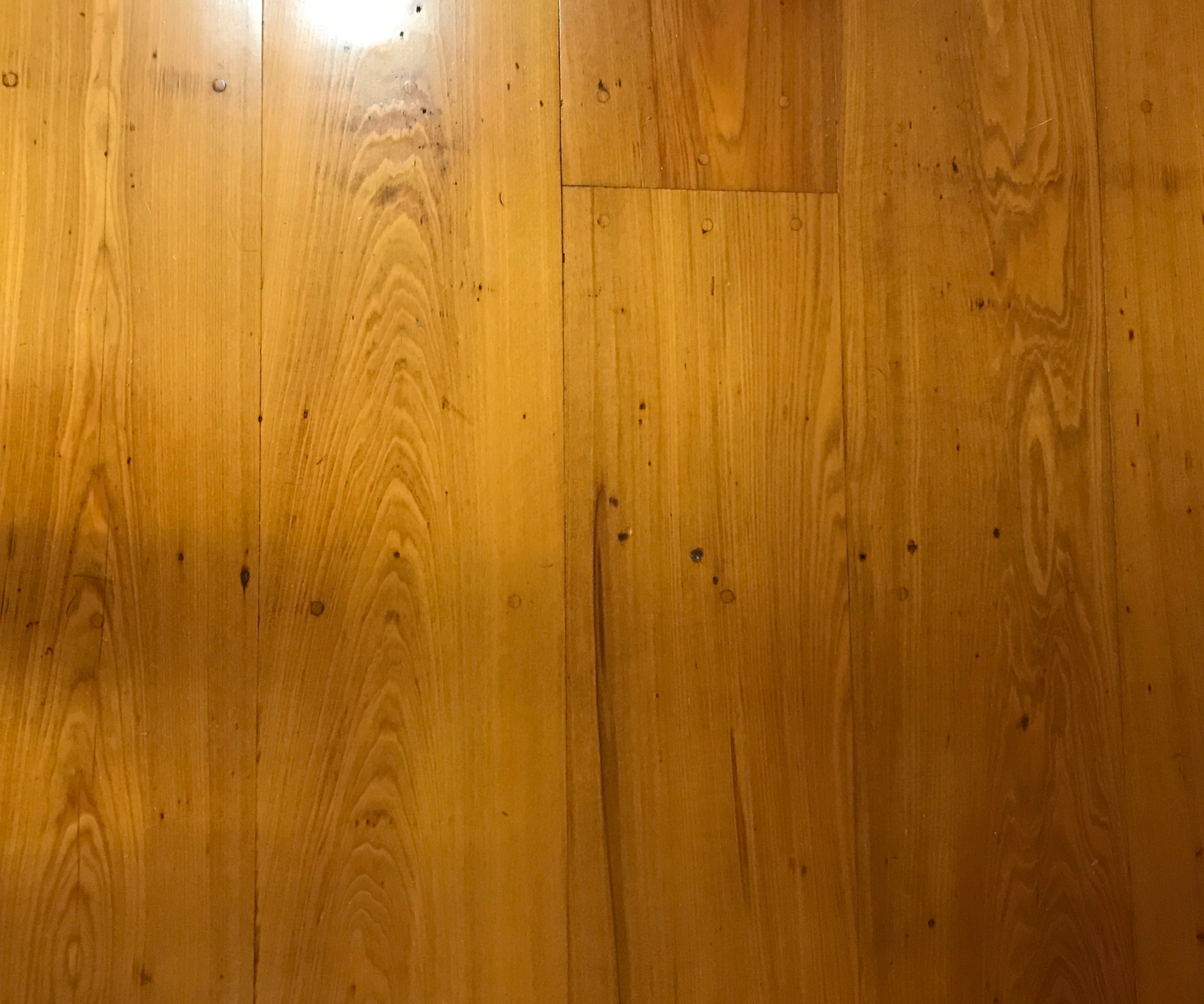
The floors appear to have been freshly refinished and they are gorgeous, wide planks. I believe the floor is pine, but I may be wrong. Unfortunately, this Wright building is not one of the ones that has been written about extensively, although I am sure there is extensive documentation somewhere.

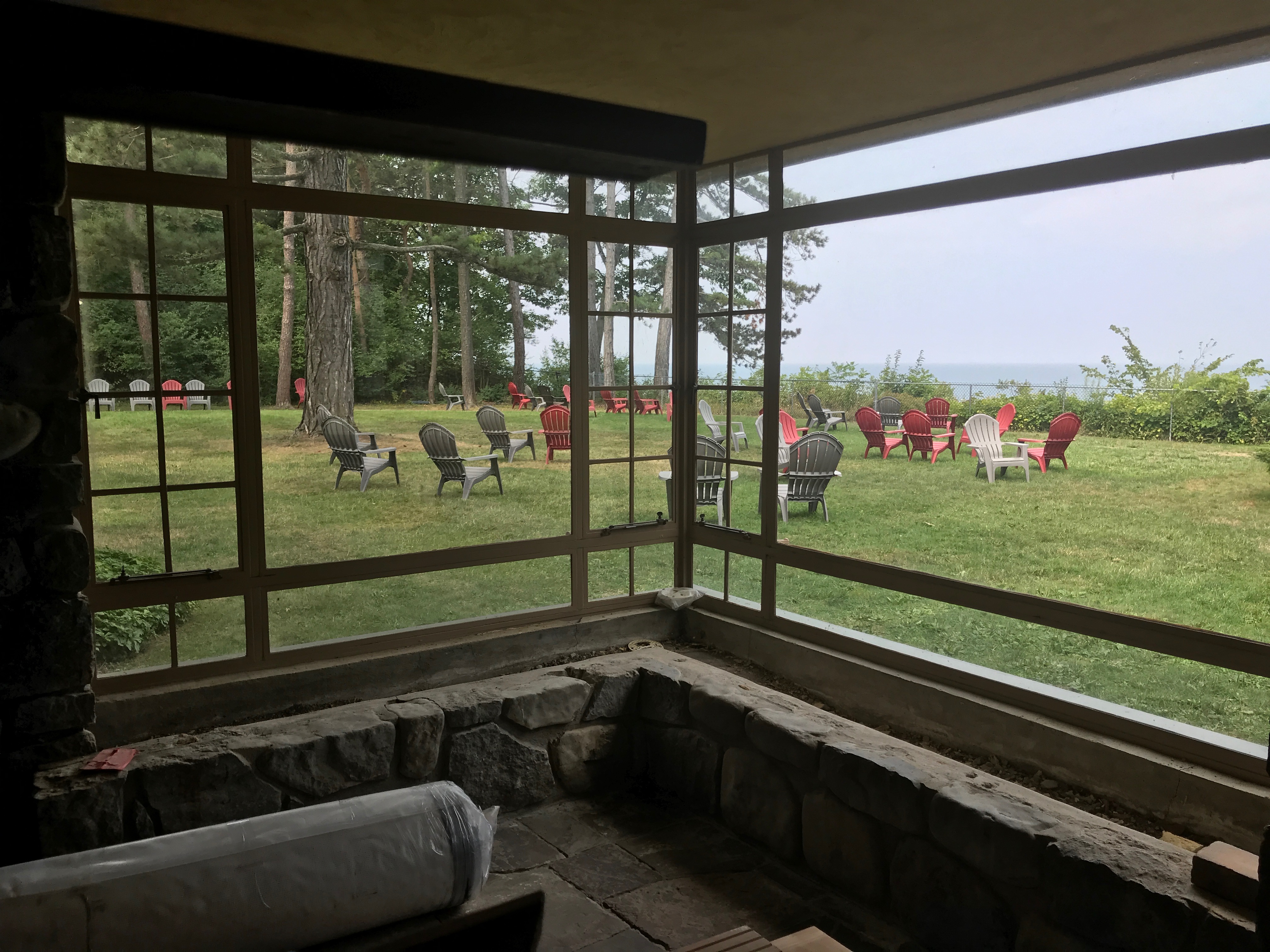
This house was built for the pleasure of Isabelle Martin. She wanted lots of light. After the long, gloomy Buffalo winters, I can completely understand that. Buffalo is the 19th least sunny city in the United States.   On Average, there are 155 sunny days per year in Buffalo. The US average is 205 sunny days per year.

We walked down the stairs off the living room and turned to look back at the house. You can see the light shining through from the other side. This would give Isabelle the light she craved.

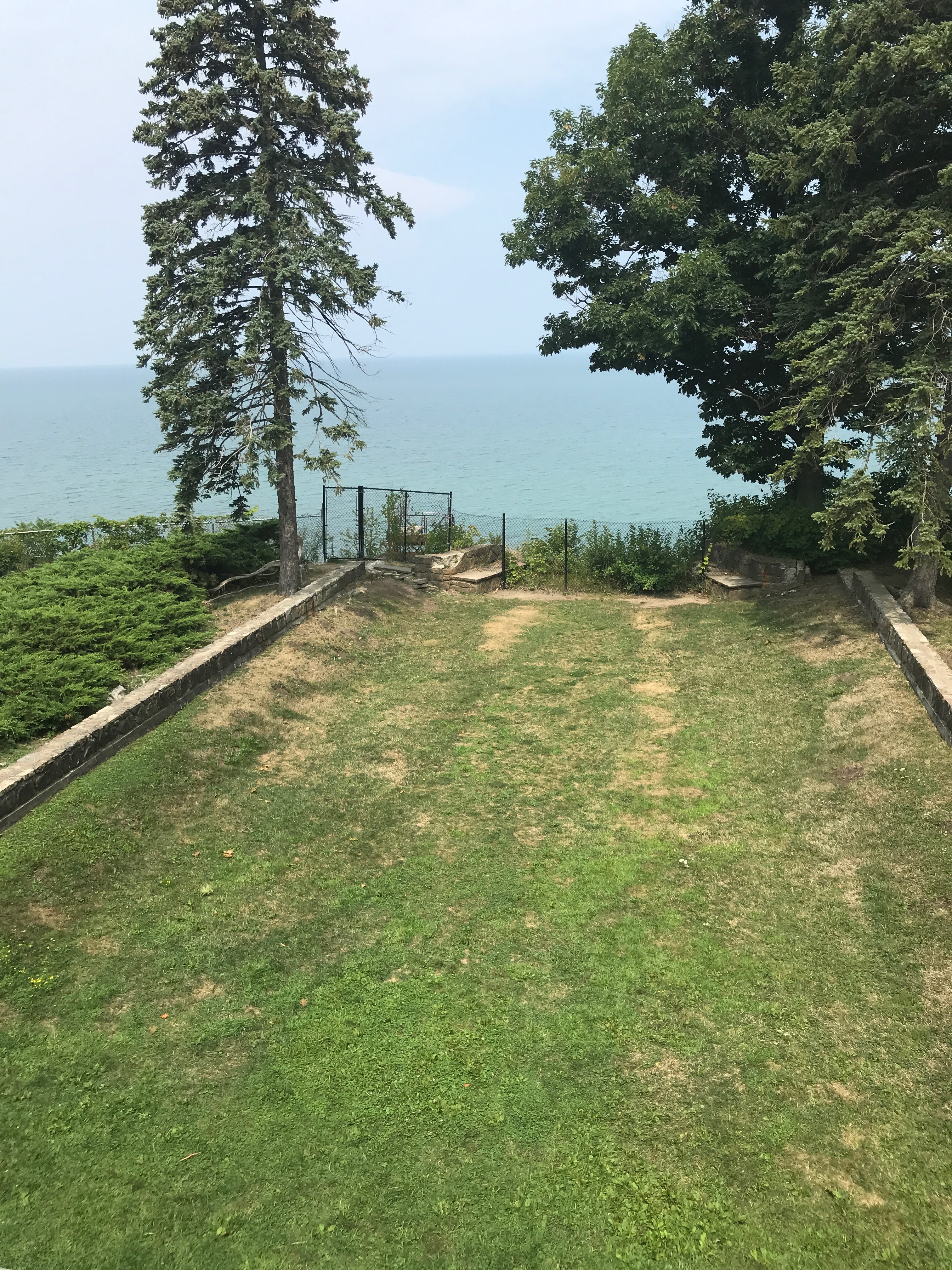
Originally, there was supposed to be some sort of water feature that tied the pond at the entrance to the lake. According to my Preferred Source, “…a broad esplanade connects the terrace to the cliff and lake. The esplanade was designed to carry water, pumped from Lake Erie, down its length and over the bluffs, completing the illusion of water flowing through. Deemed financially extravagant this feature was halted after only the esplanade itself was completed.”

I have to agree that this water feature would have been financially extravagant. I’m not even sure that it would have been feasible. I would be concerned about the effects of the water on the stability of the site. But, what do I know?

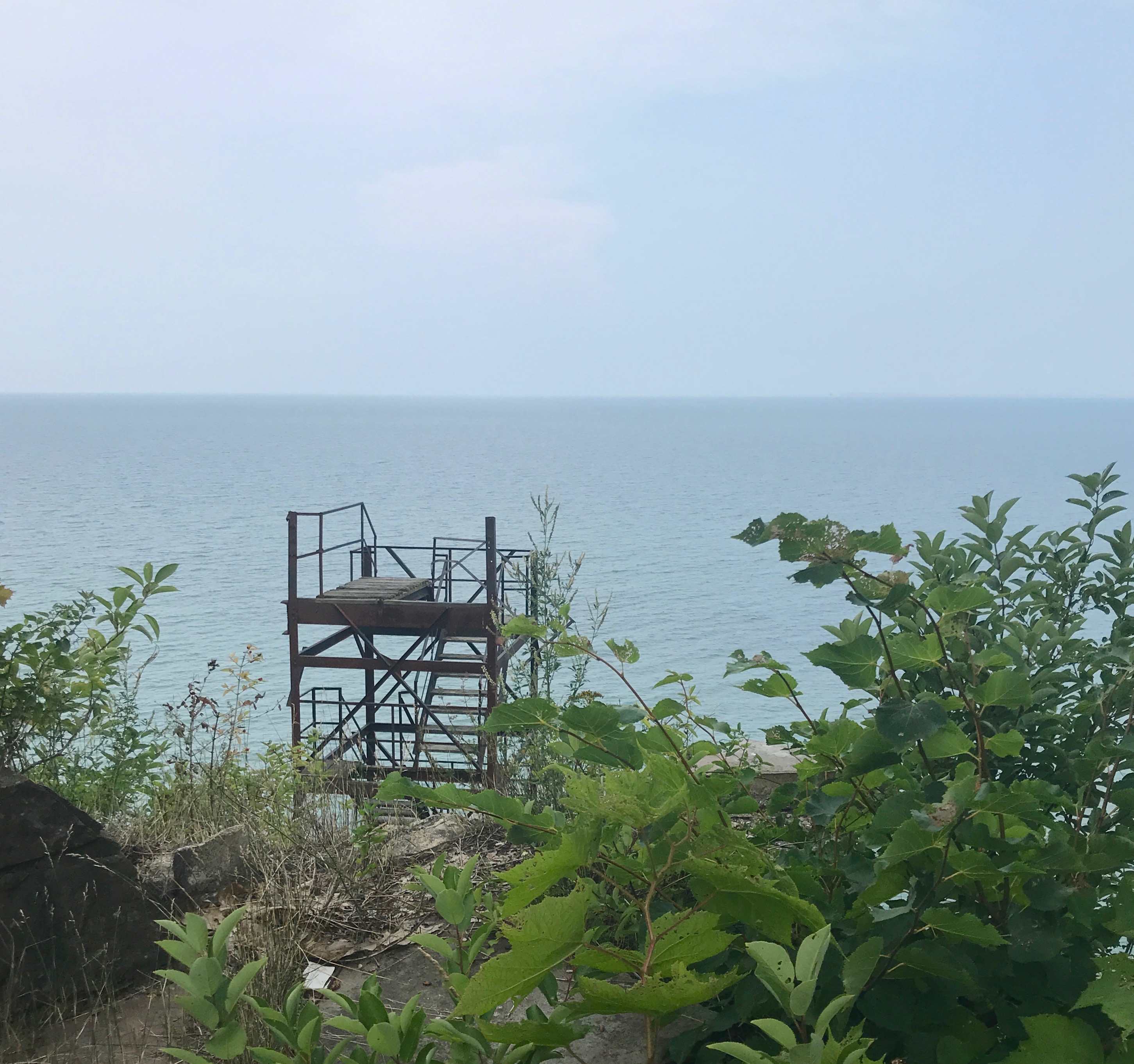
We continued over to the edge of the cliff and we could see the remains of the stairs down to the beach. If I remember correctly, the docent told us that there are plans in the works to renovate the structure. Or, was that tear and them down and rebuild them? Either way, it doesn’t matter to me in a practical sense, as I will not be using them. I do not like heights!

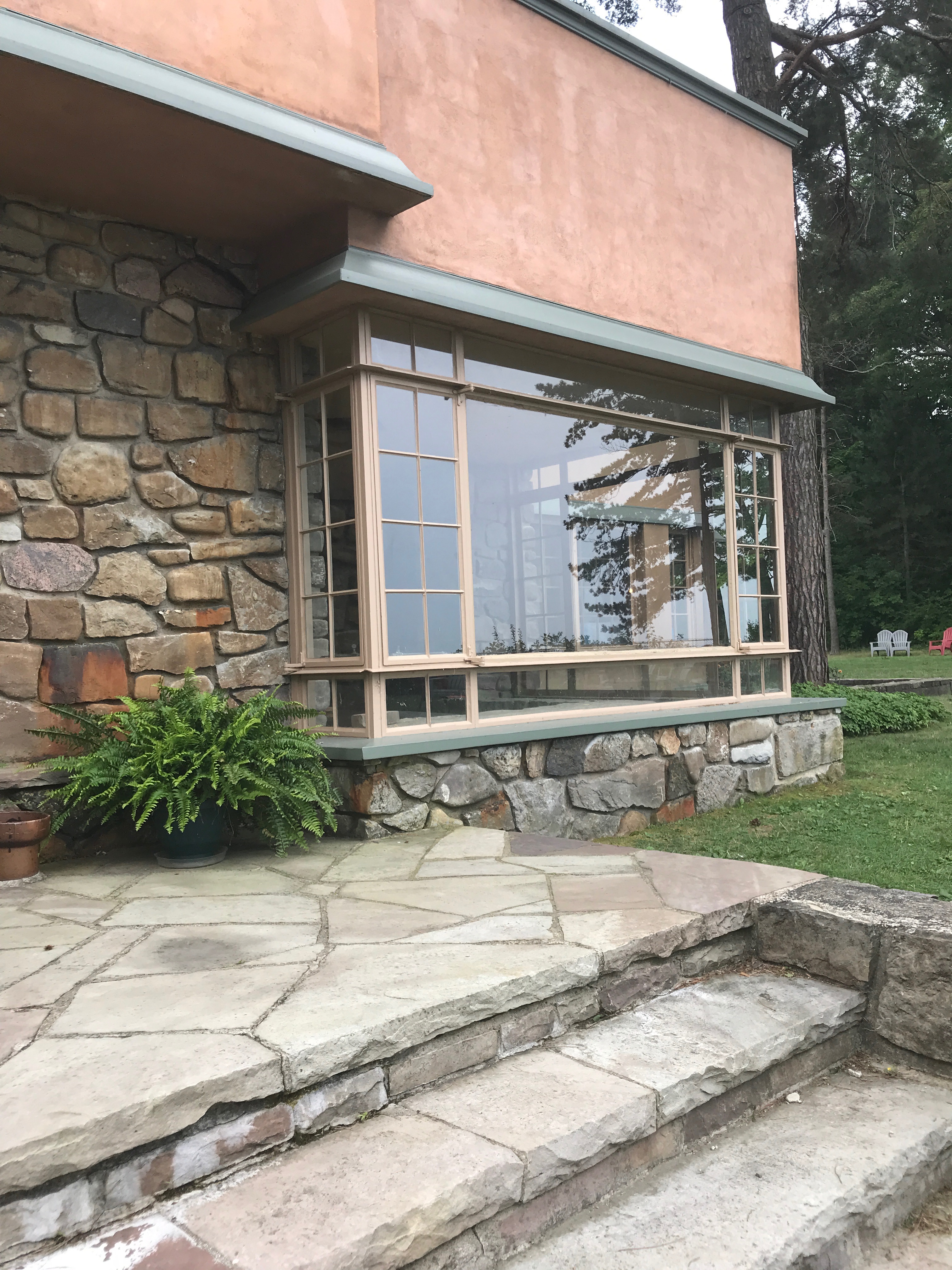
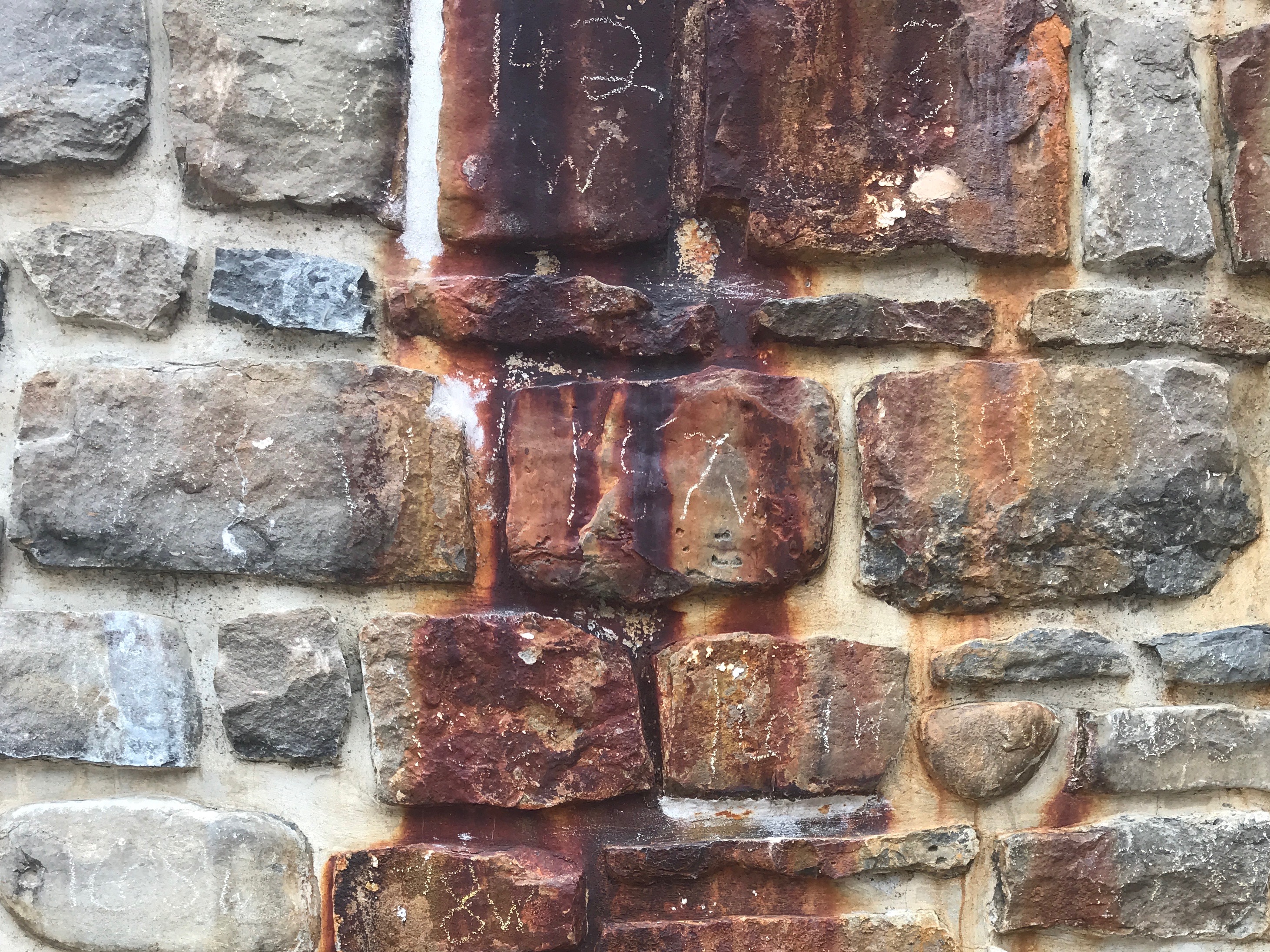
We returned to the house to continue our tour. This is a good view of the stone used in construction. According to my Preferred Source, it is constructed of stone found at the lake’s edge. The only note I managed to record from the docent was that the building was constructed of Tichenor Limestone. While researching this information, I found out that Tichenor Limestone is “richly fossiliferous.” If you would like to know more about what fossils are found in this rock, click on the link above. If I go back, I’m going to see if I can spot any of those fossils.

Apparently, there is still work going on.

We took those stairs up to the second floor.

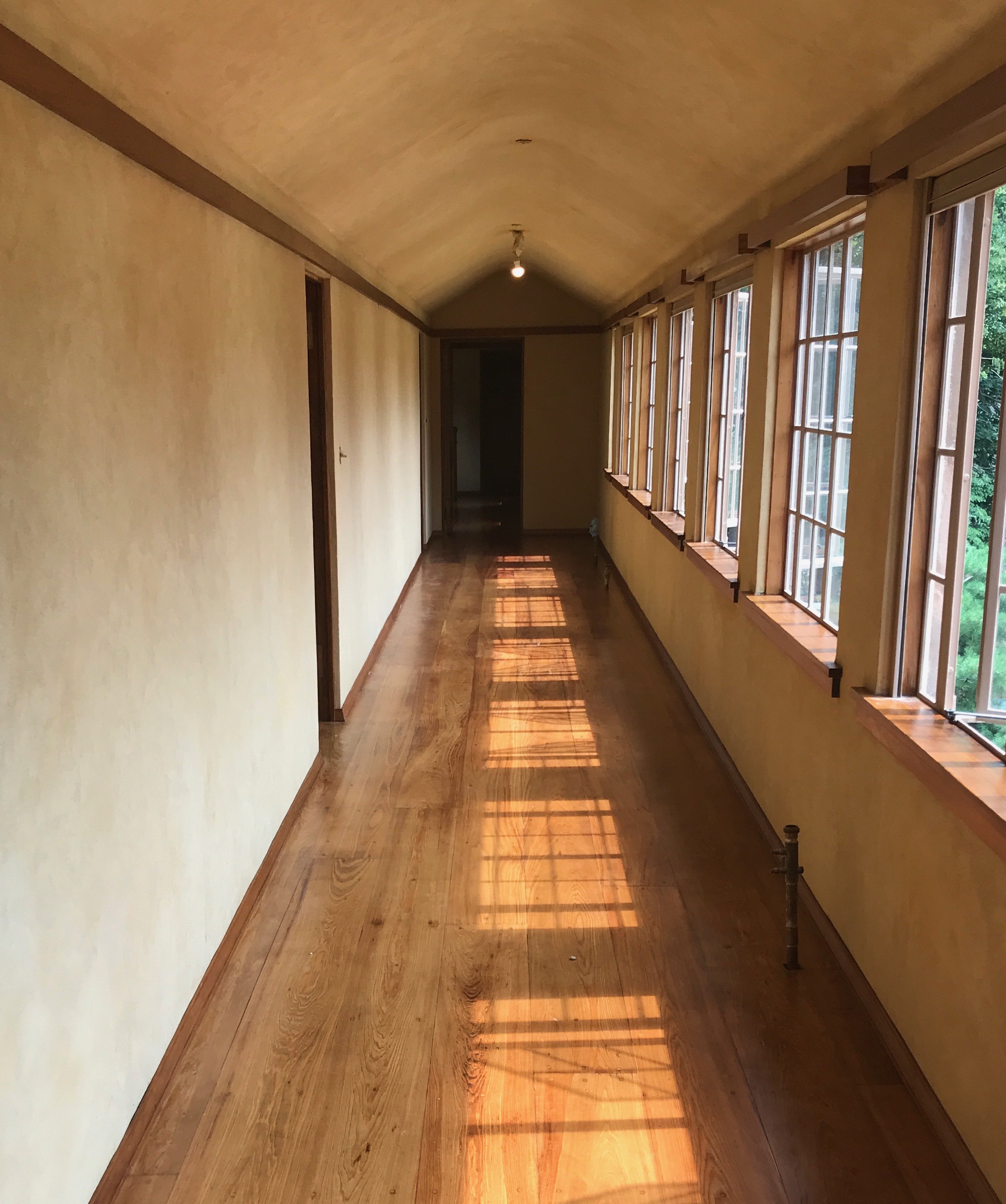
A hallway ran along the east side of the building. The lake was on the west side, and they wanted to save that side for the views. Judging by the pipe coming up from the floor, they probably had a radiators there to heat the hallway. That is just my guess.

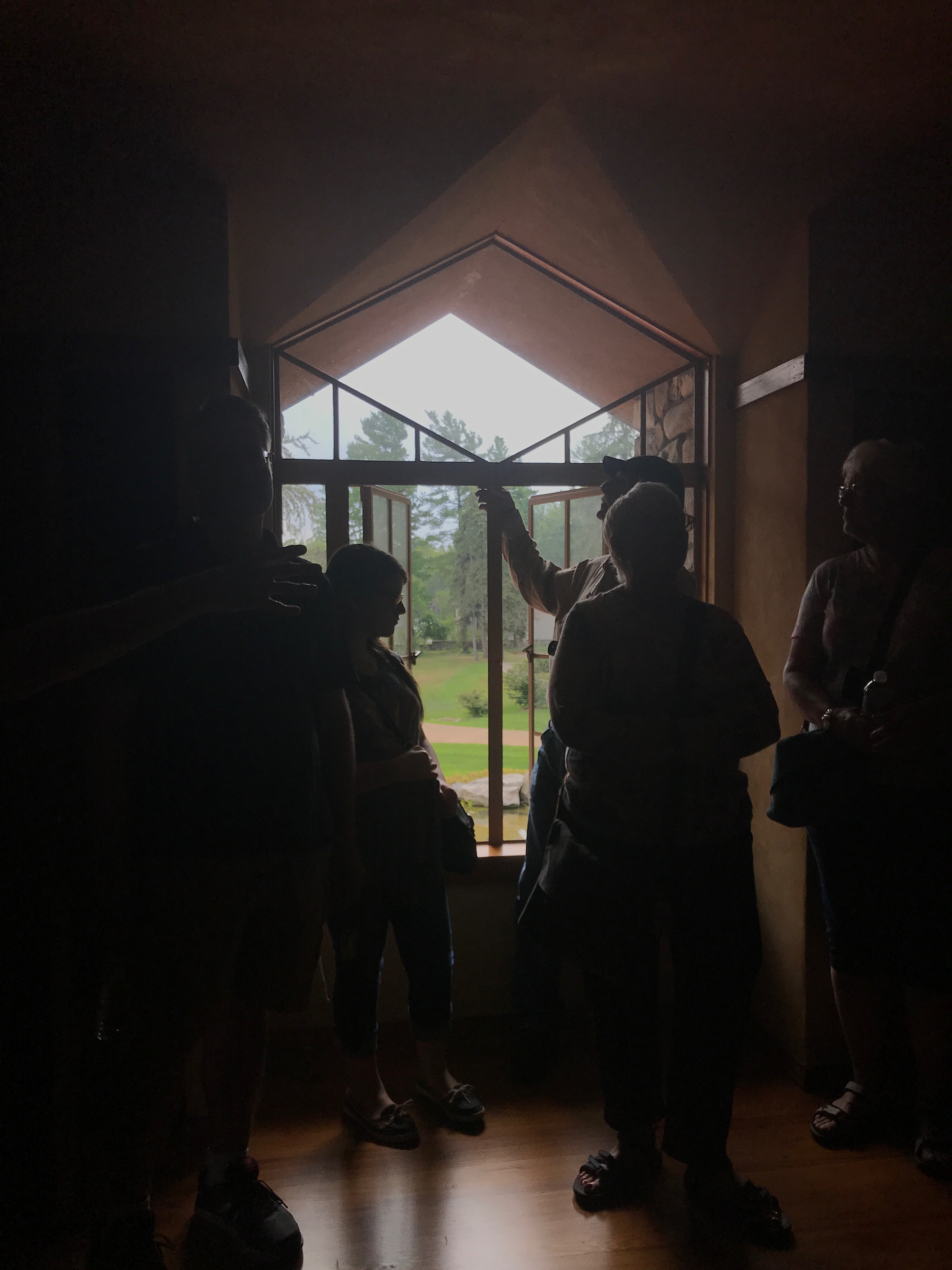
The docent demonstrated the diamond windows.

The door was rather interesting. Although the house was designed in 1926, the door reminds me very much of the “mid-century modern” vibe.

Look at how wide the floor planks are! And, there is that pipe coming up through the floor again. It must be for a radiator.

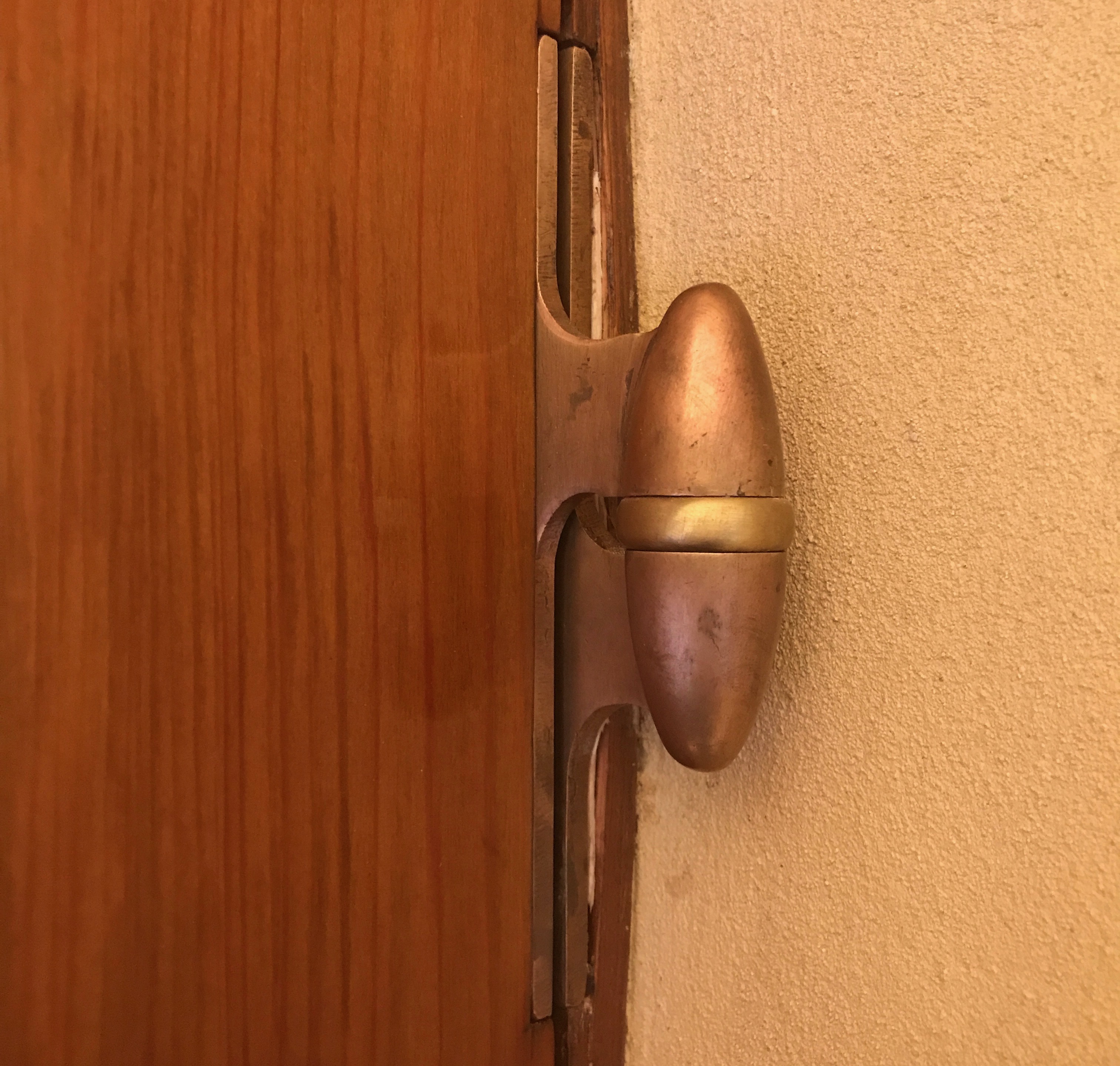
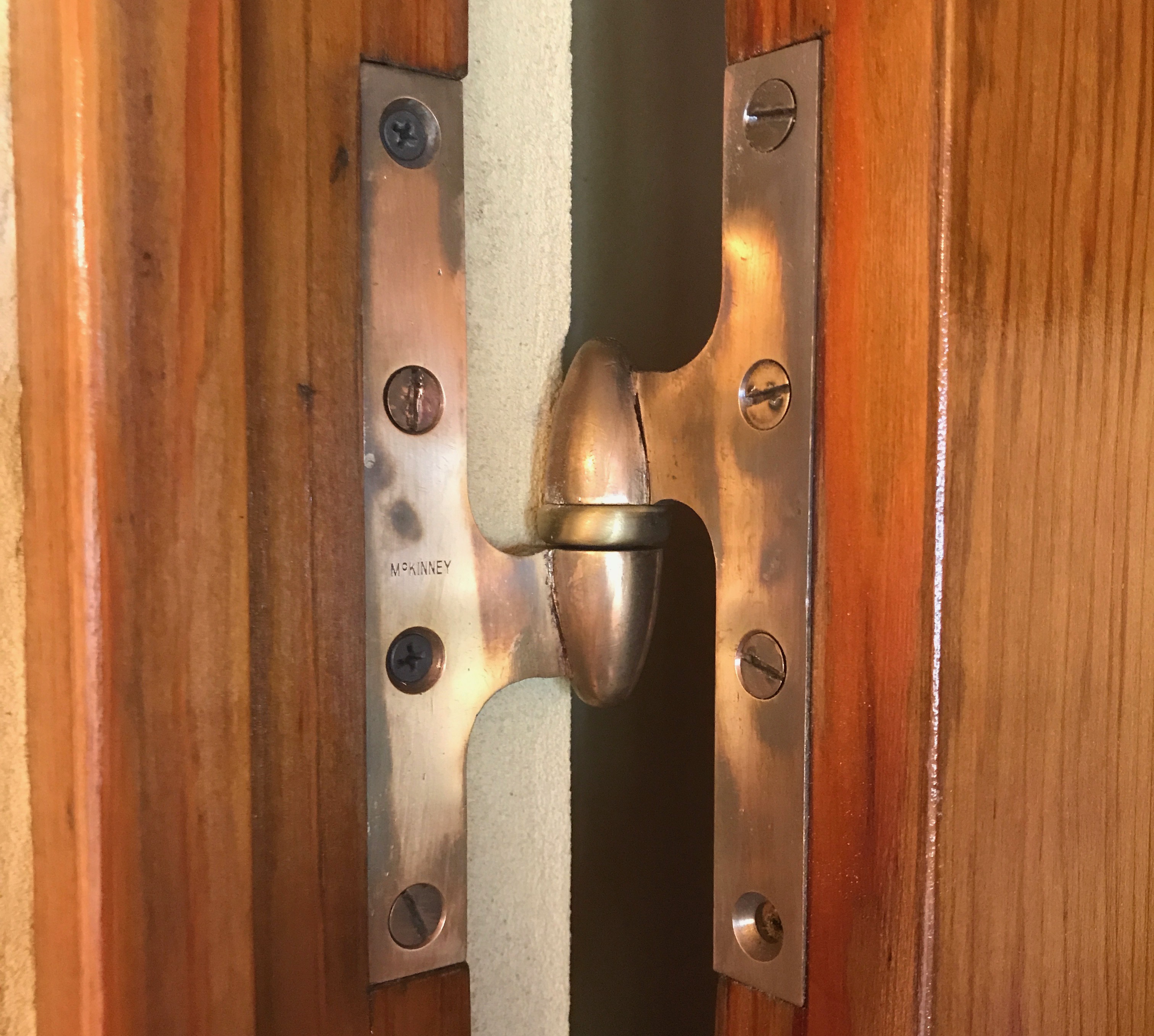
While the door looks a little mid-century modern, the hinge just screams “art deco.”

They don’t make hinges like that anymore! (At least not in my price range, they don’t!)
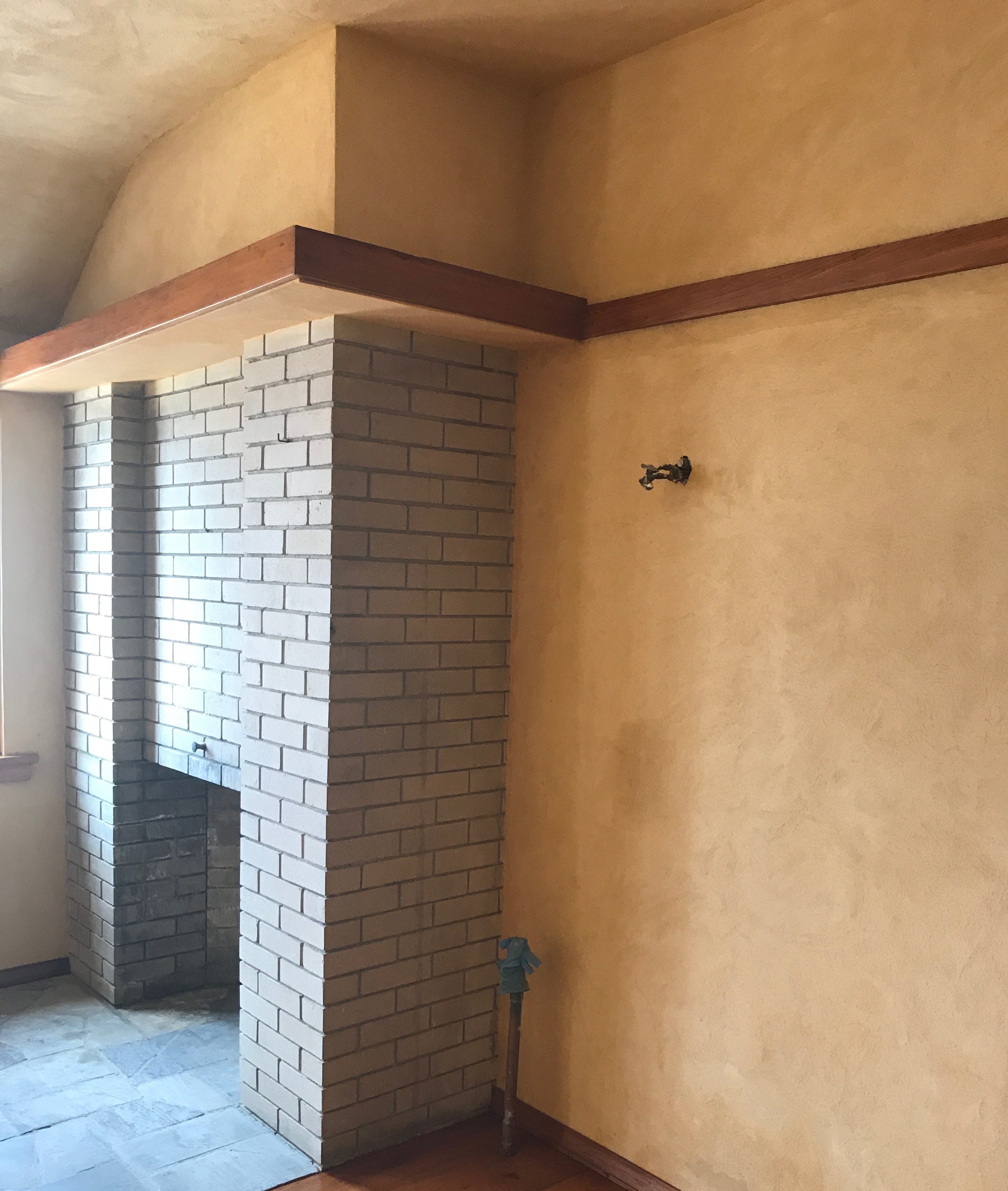
This is a fireplace from a bedroom. There is that pipe coming up through the floor again.

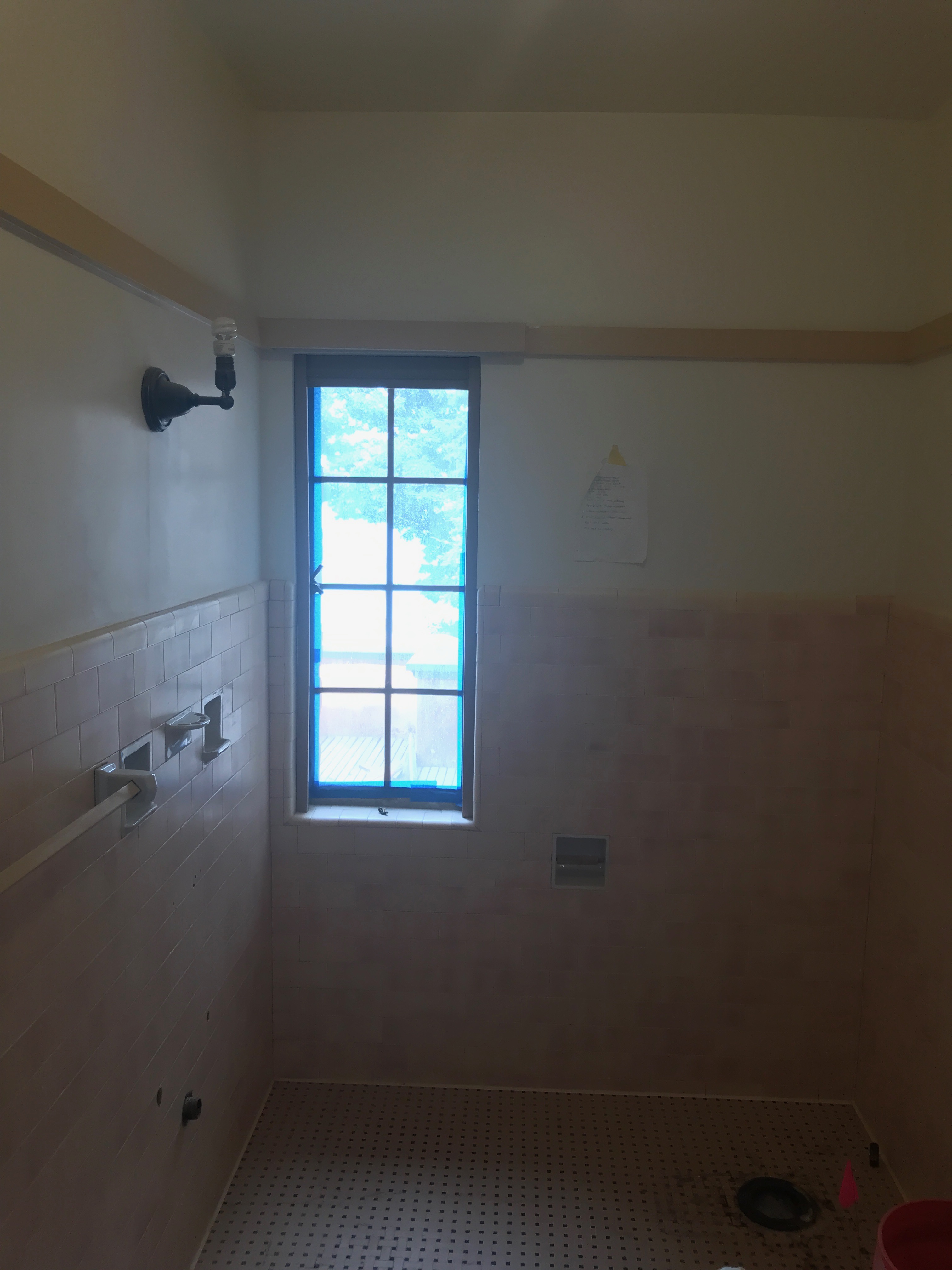
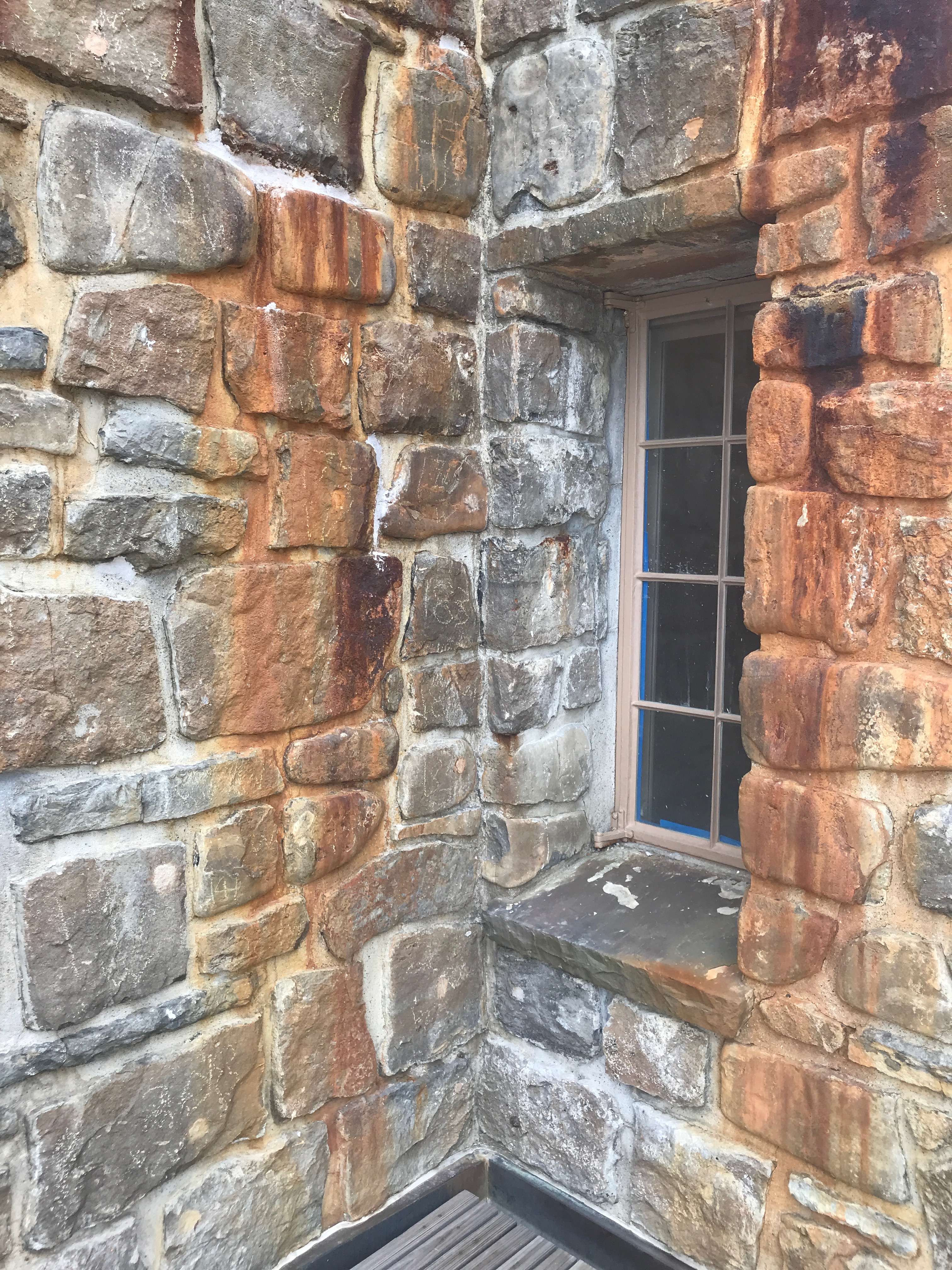
This is a shot of one of the bathrooms. I seem to recall some story about Mrs. Martin doing battle with Frank Lloyd Wright over the placement of the window. He didn’t want to put it in, but she insisted.

In the end, he relented, but he had to put it in through the stonework.

On the other hand, maybe I am conflating stories.

Ah, grafitti! Well, these folks are now part of the historical record. I wonder if any of these marks were made by the boys at the school run by the Piarist Fathers? Heck, the priests themselves might have done it!

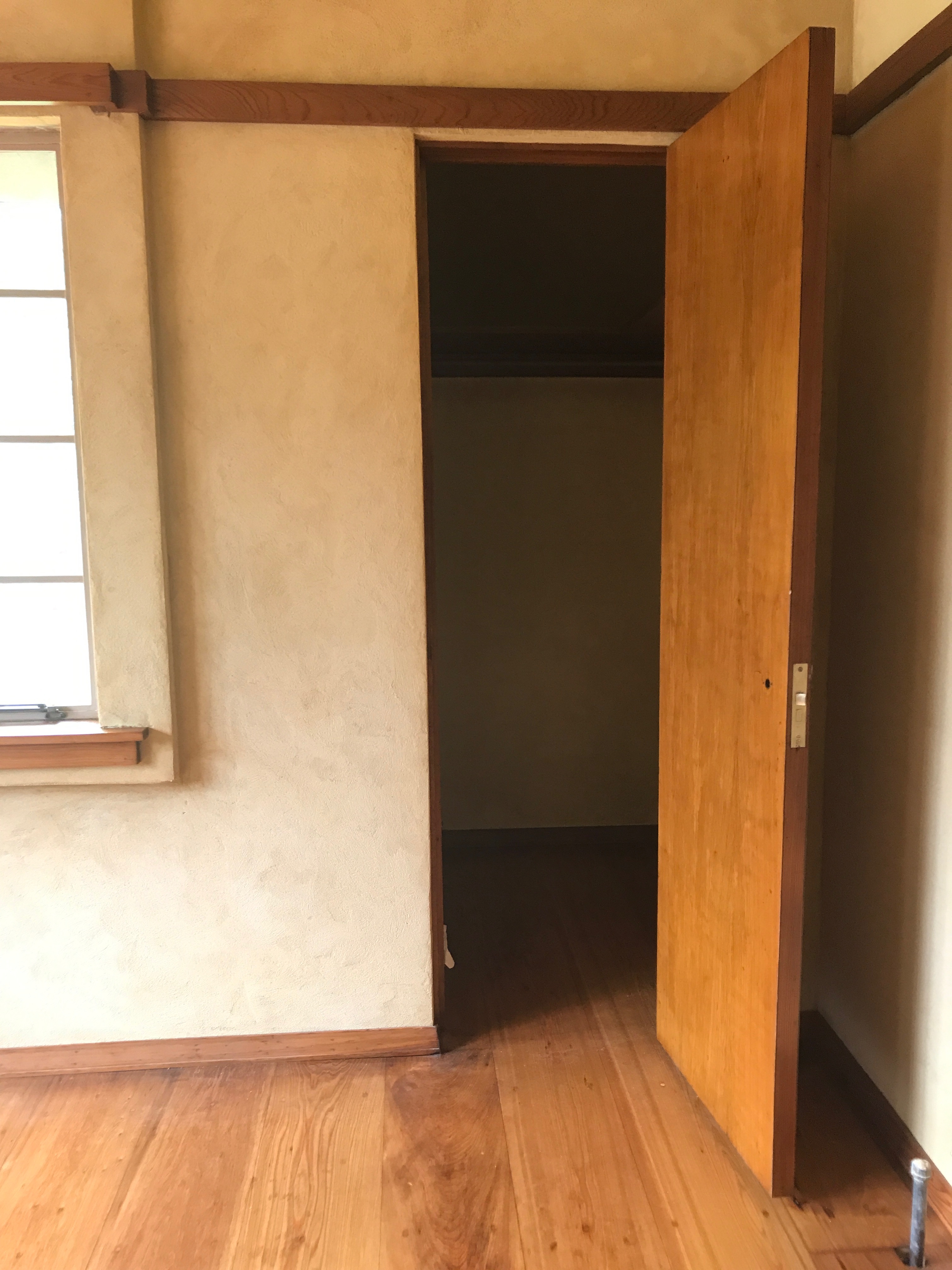
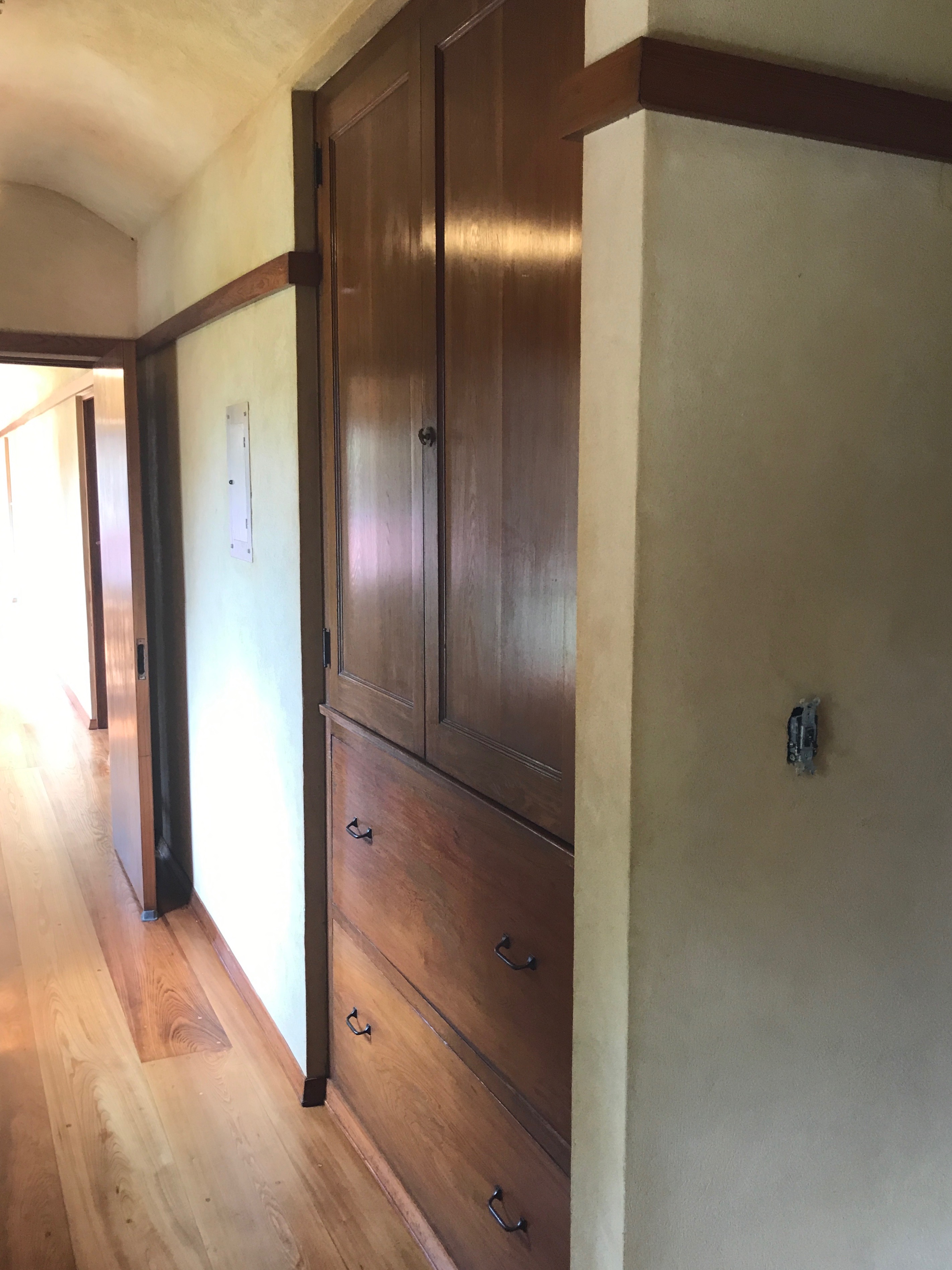
One of the things I’ve heard about Wright and his designs was that he was resistant to including closets and storage. I was glad to see that there was a linen closet built in.

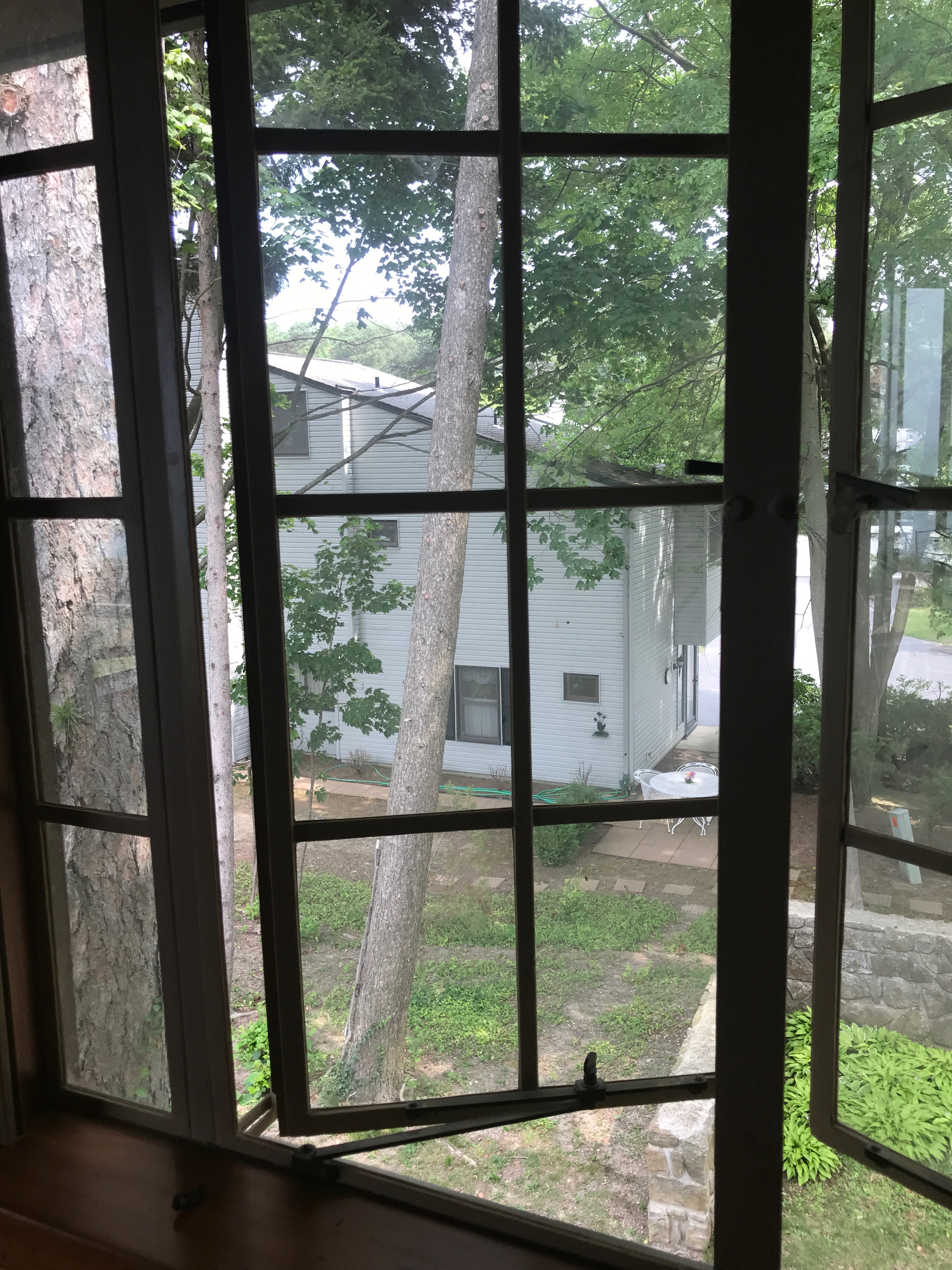
Although the original property was sited on an 8.5 acre estate, apparently tracts of land were sold off over the years. I am sure that Wright would not approve of the neighbors being so close to his design. While the land around the Martin House in Buffalo has been re-acquired and the original designs rebuilt, I can’t imagine that they will ever be able to re-acquire lakefront property. I would love to be proven wrong. According to my Preferred Source, Greycliff had one of the few, if not only, landscape designs in his own hand.

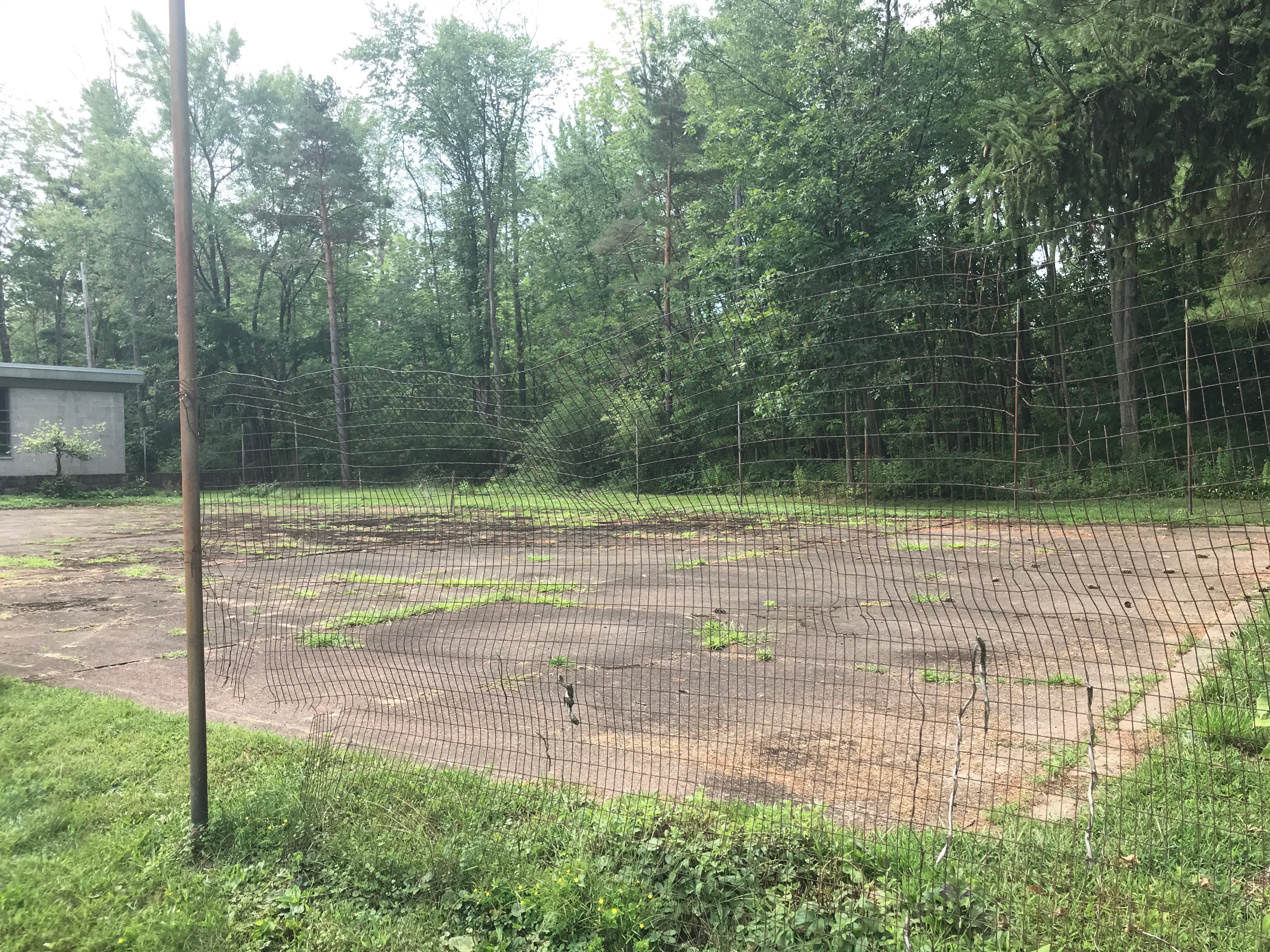
His design even included a tennis court.

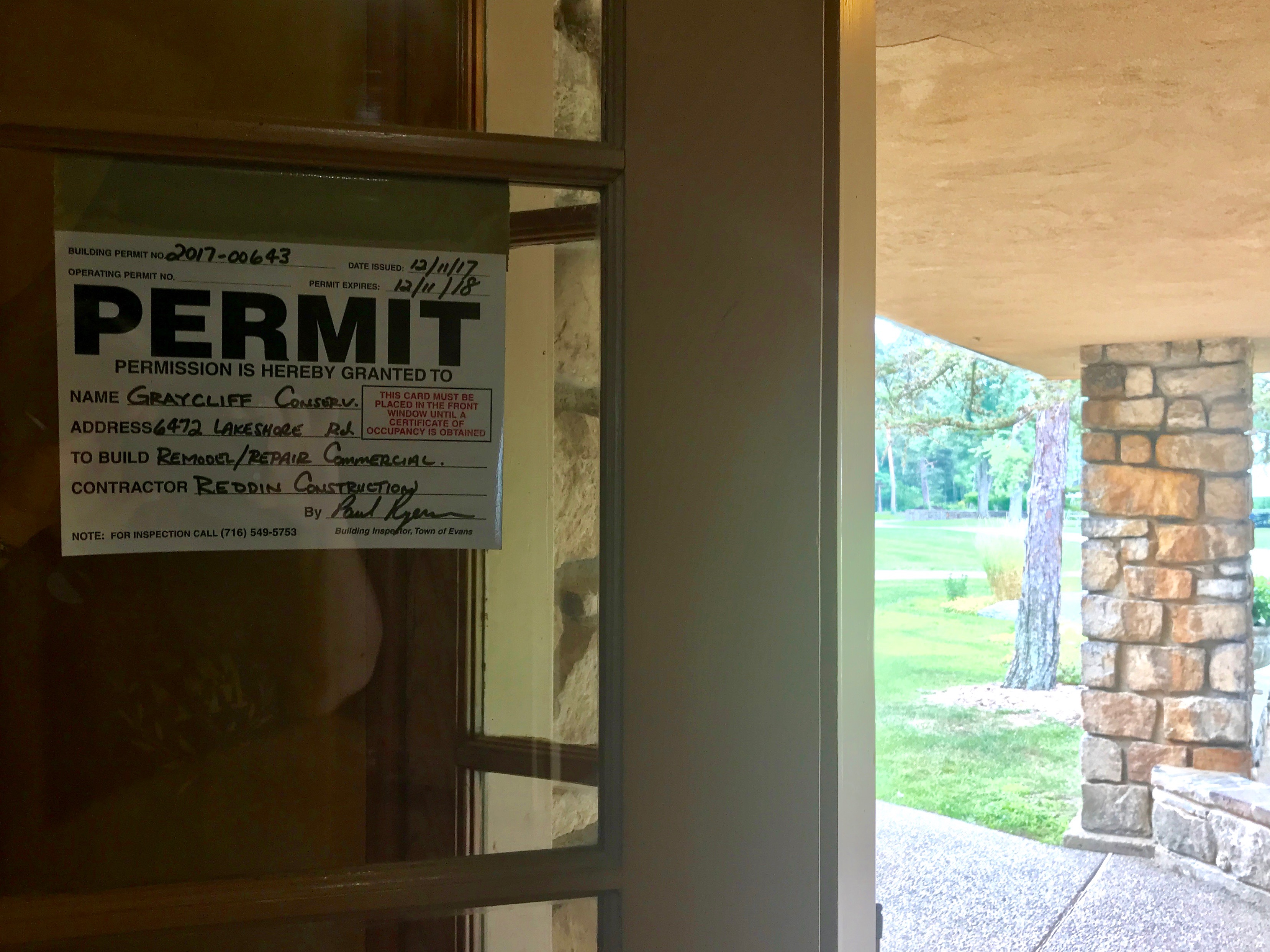
Apparently there is a need for the building permit. Work continues on the house.

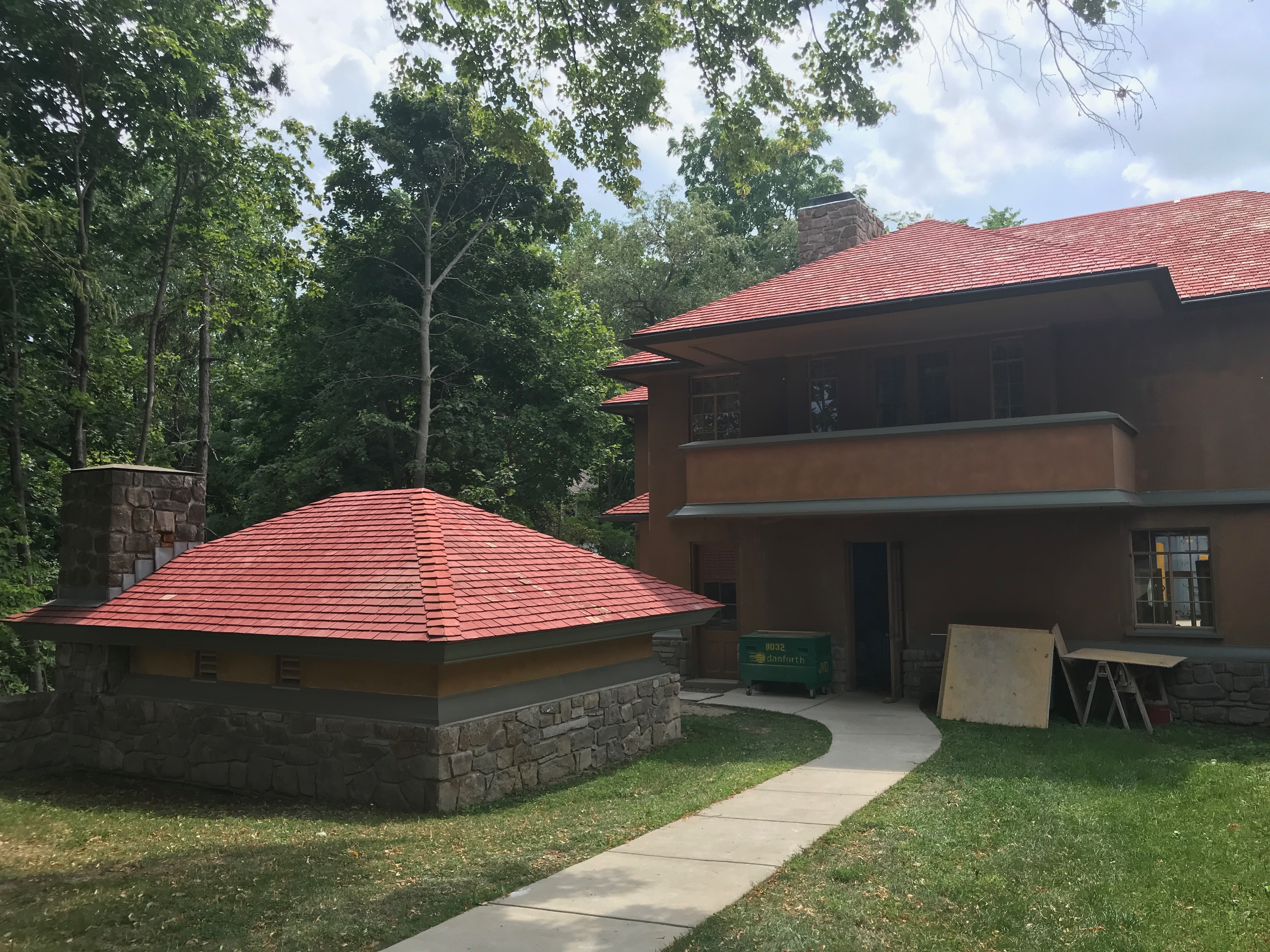
We left the Isabelle R. Martin House by the back door and headed back toward the visitor center. We passed the Heat Hut and walked around the Foster House.

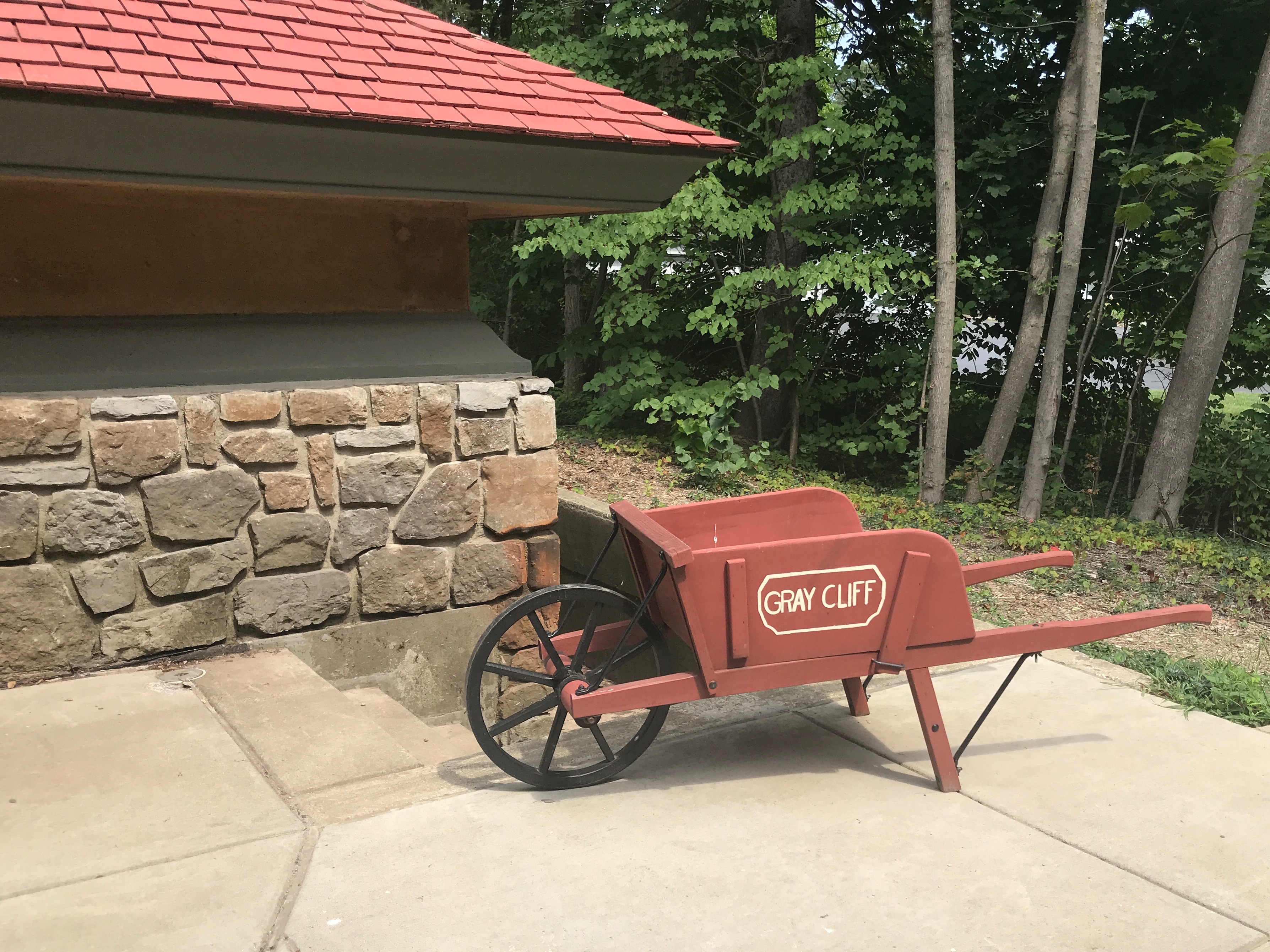
What a cute, decorative wheelbarrow!

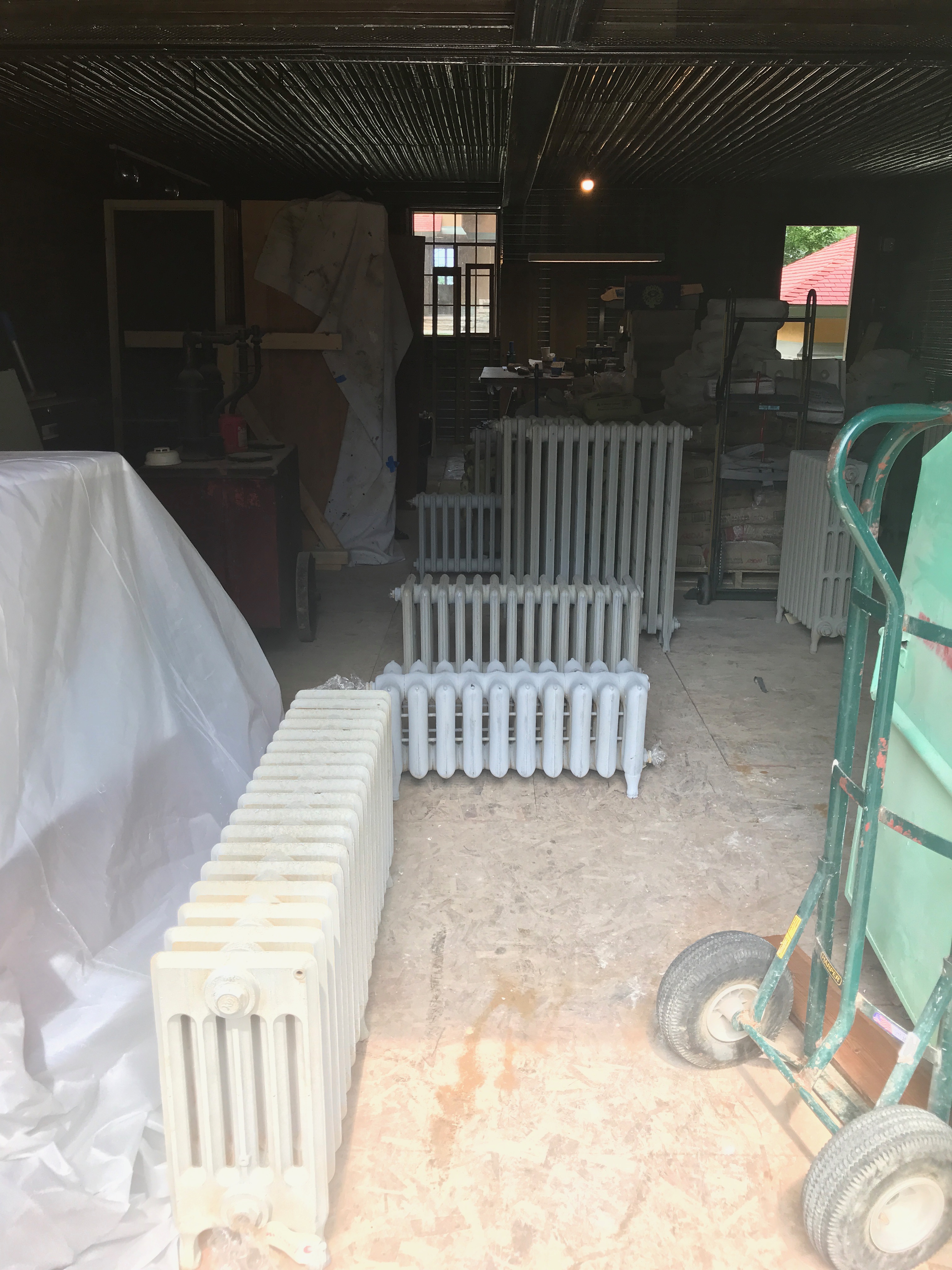
Ah! That’s where all the radiators are! I hope they got them in before the winter weather hit.

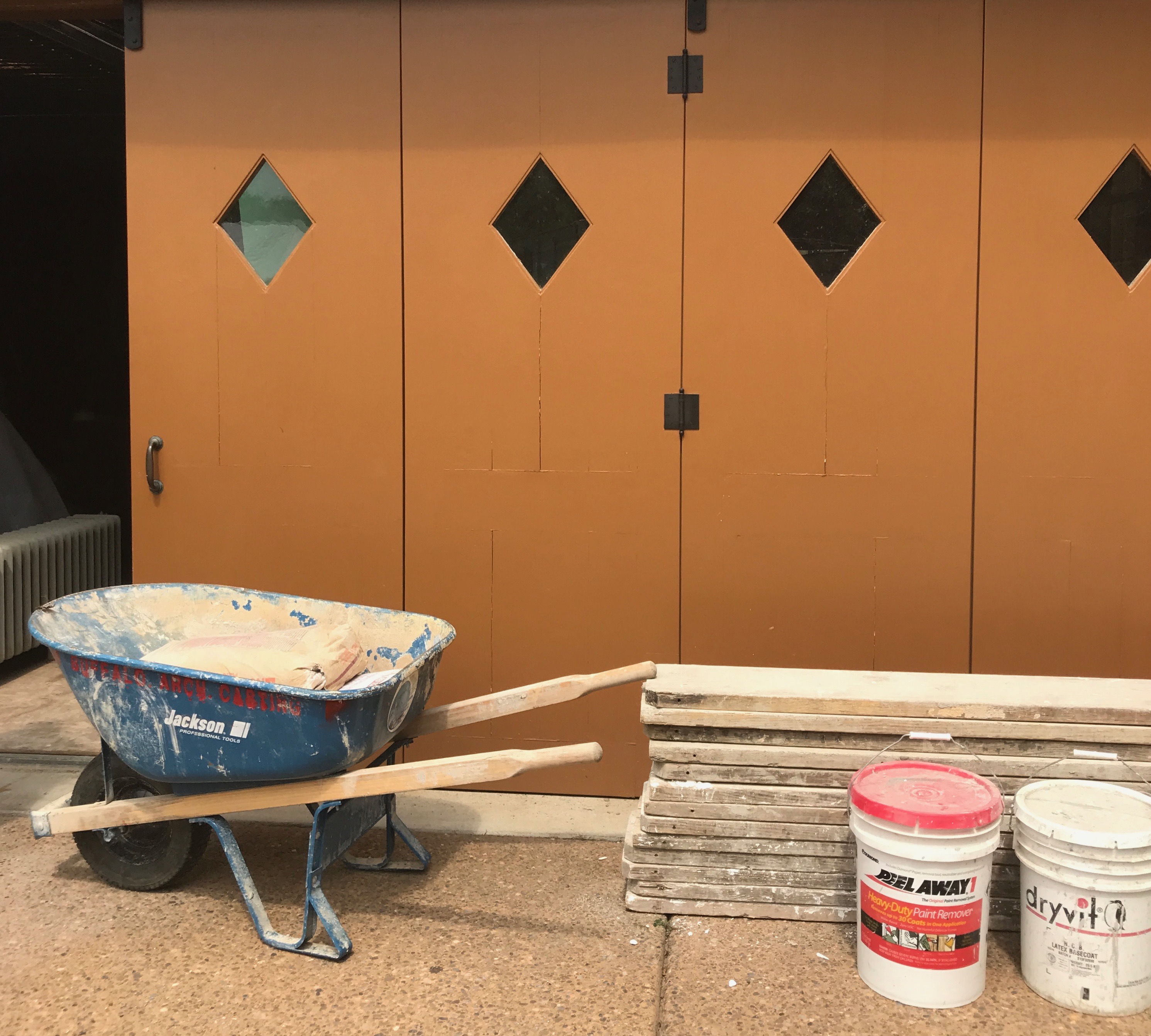
We passed the garage doors with the distinctive diamond shaped windows. Now, here’s a real working wheelbarrow, and it appears that there is real work continuing.

One more look back and then it was time to head out.

Once I was back in my car, I fired up Google Maps to map out the route to my next stop.

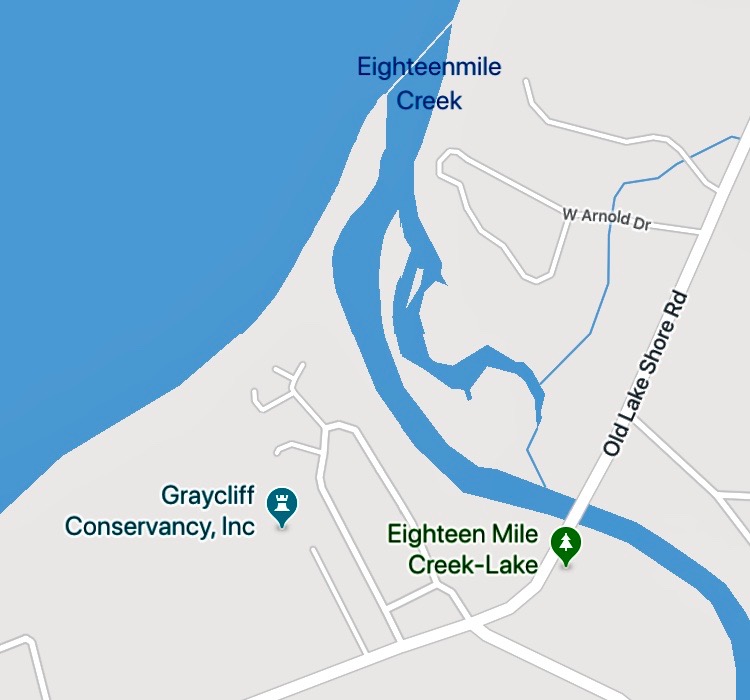
I saw a park on I had never seen before just up the road. I wondered what it was, so I took small detour to check it out. It wasn’t much of a park, but there was access to Eighteen-Mile Creek.

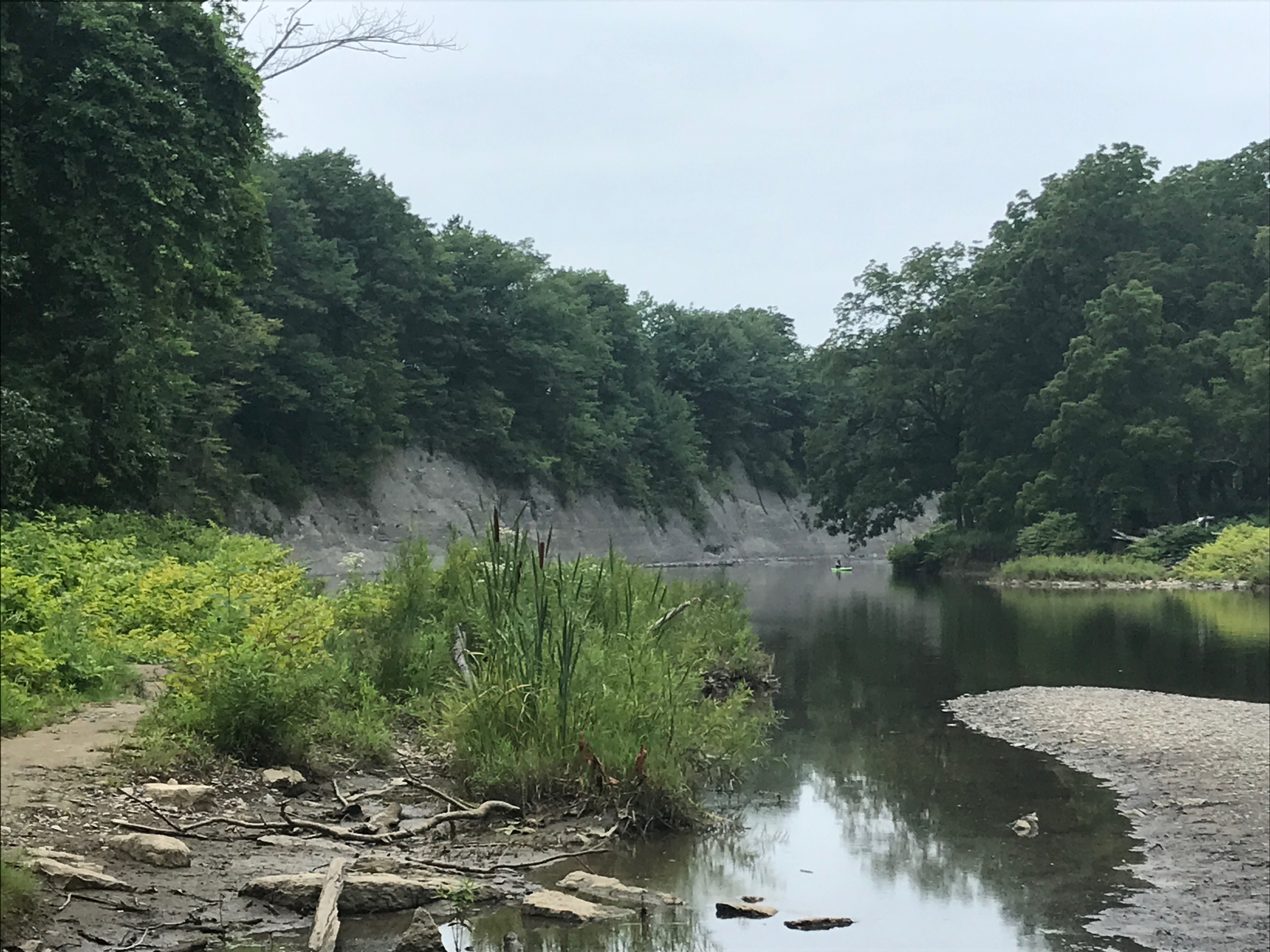
And I got a good view of the real grey cliffs! One of those layers must be Tichenor Limestone.

The park seemed like a place for people to hang out and make their mark, although kayakers might have been able to launch here. In the first photo, you can see a kayak going around the bend.

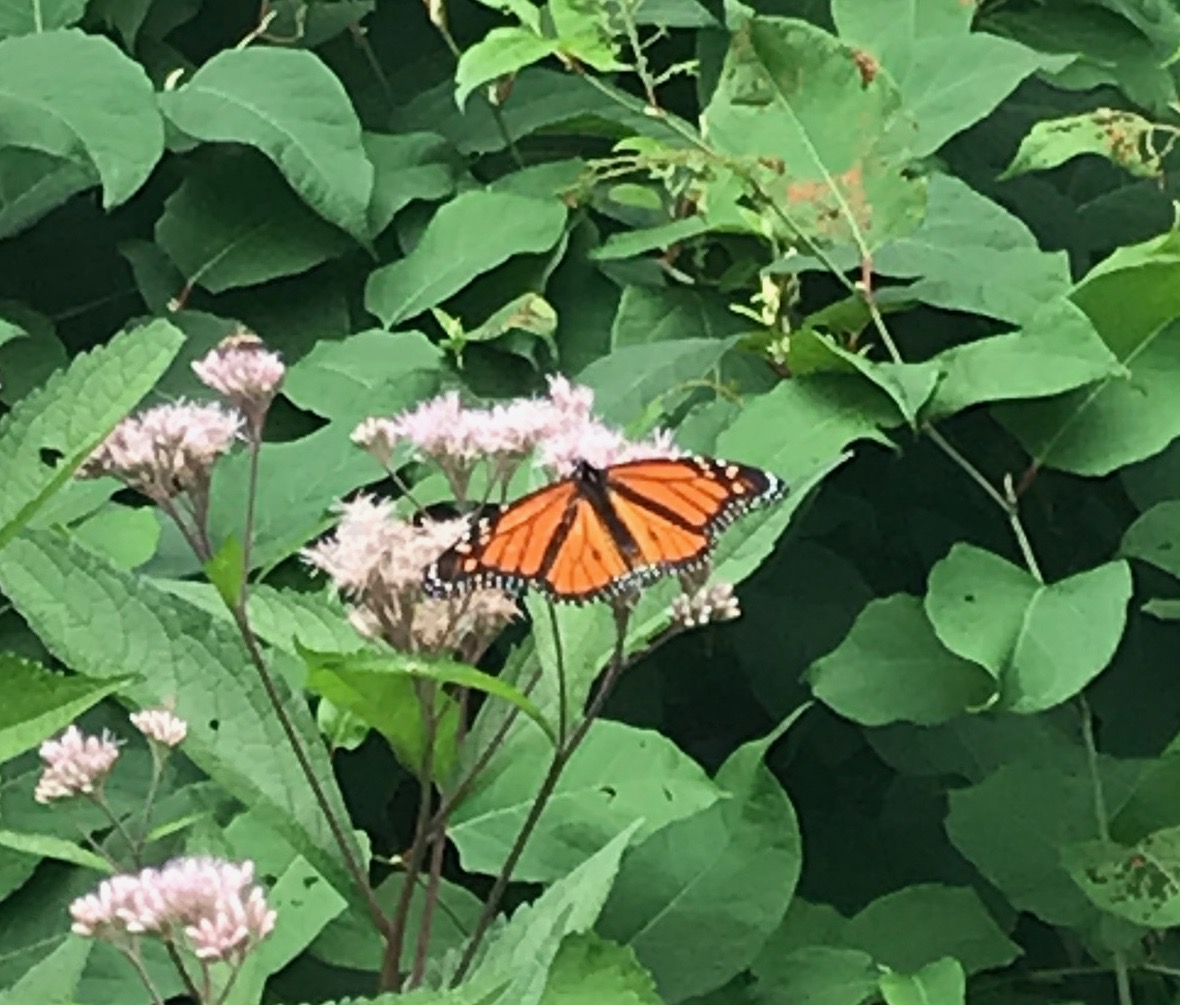
It was a peaceful place. I spent some time enjoying the plants and butterflies and then set off for wherever it was I was planning on going.


And I’m Off on Another Adventure!

I got back from the seed courier gig in July 2018 and now it was the middle of August.

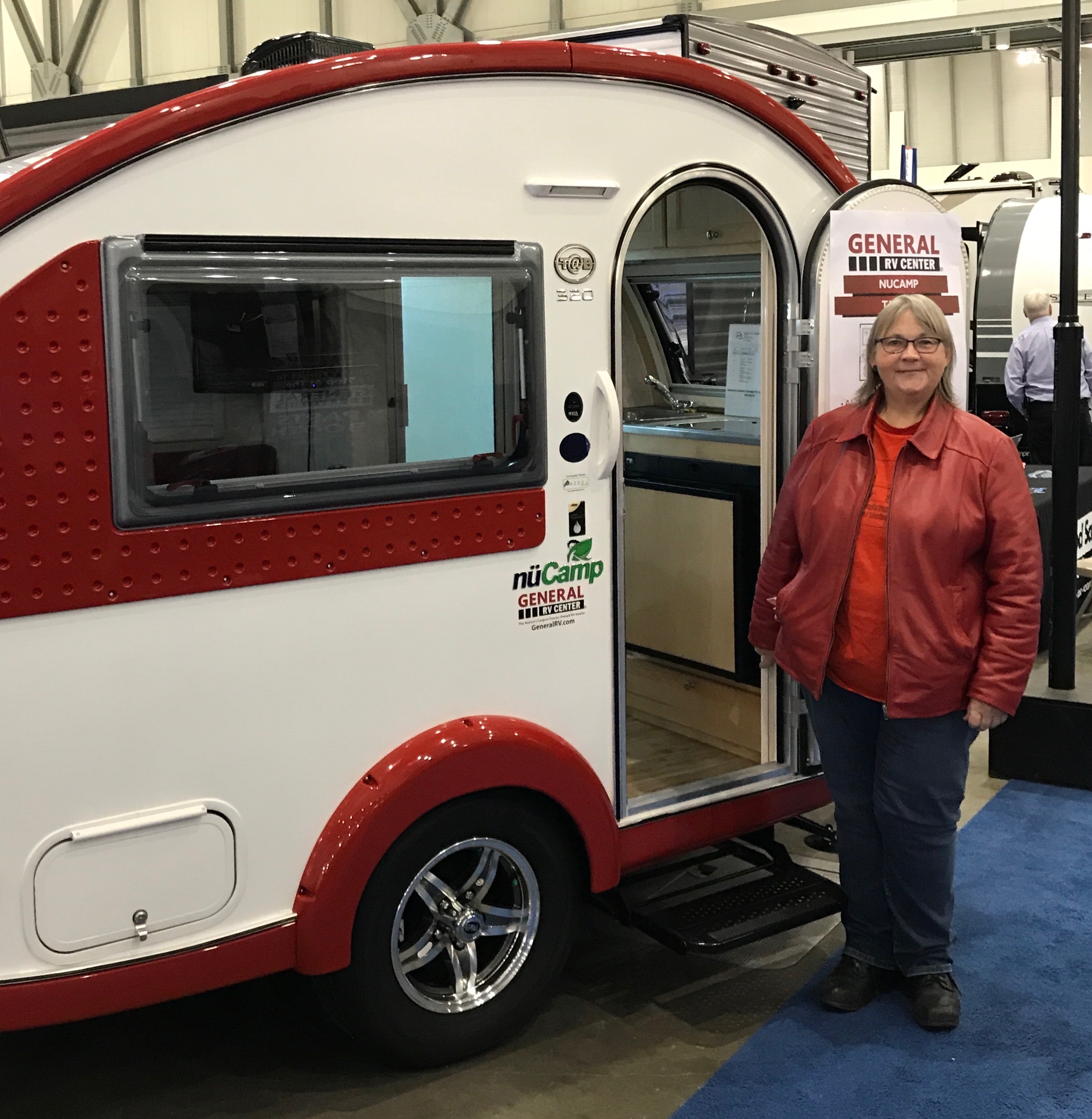
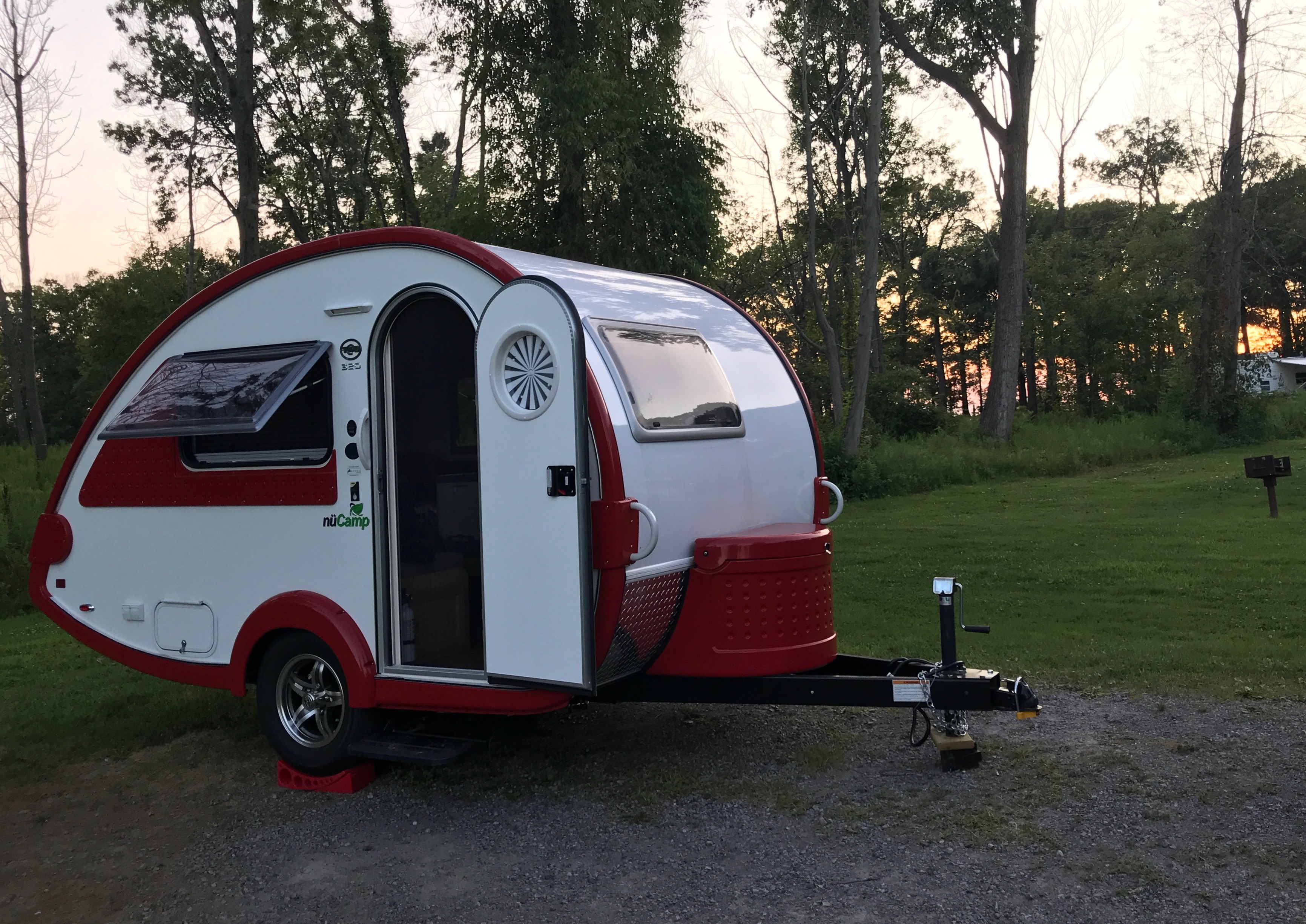
I bought my new trailer in January, but still hadn’t used it. Isn’t it cute? It’s a T@b, made by nuCamp. I figured the I should remedy that situation before the summer was over. I made plans to visit my family on both sides of the border.

After getting a few “minor” things taken care of – like a non-functioning refrigerator – I managed to get to the campground in time for my reservation. I’m glad that I tried to start things up while I was in the driveway. You don’t want to discover that important systems don’t work when you’re on the road.

I headed east, toward the Buffalo, New York region.

I was back in Evangola State Park, a favorite from my Airstreaming days. I even picked a site I had been in before. It’s always nice to know where the water is. In my experience, New York State parks usually have electricity at the campsites for RVs, but you need to fill up your water tanks at a communal spigot.

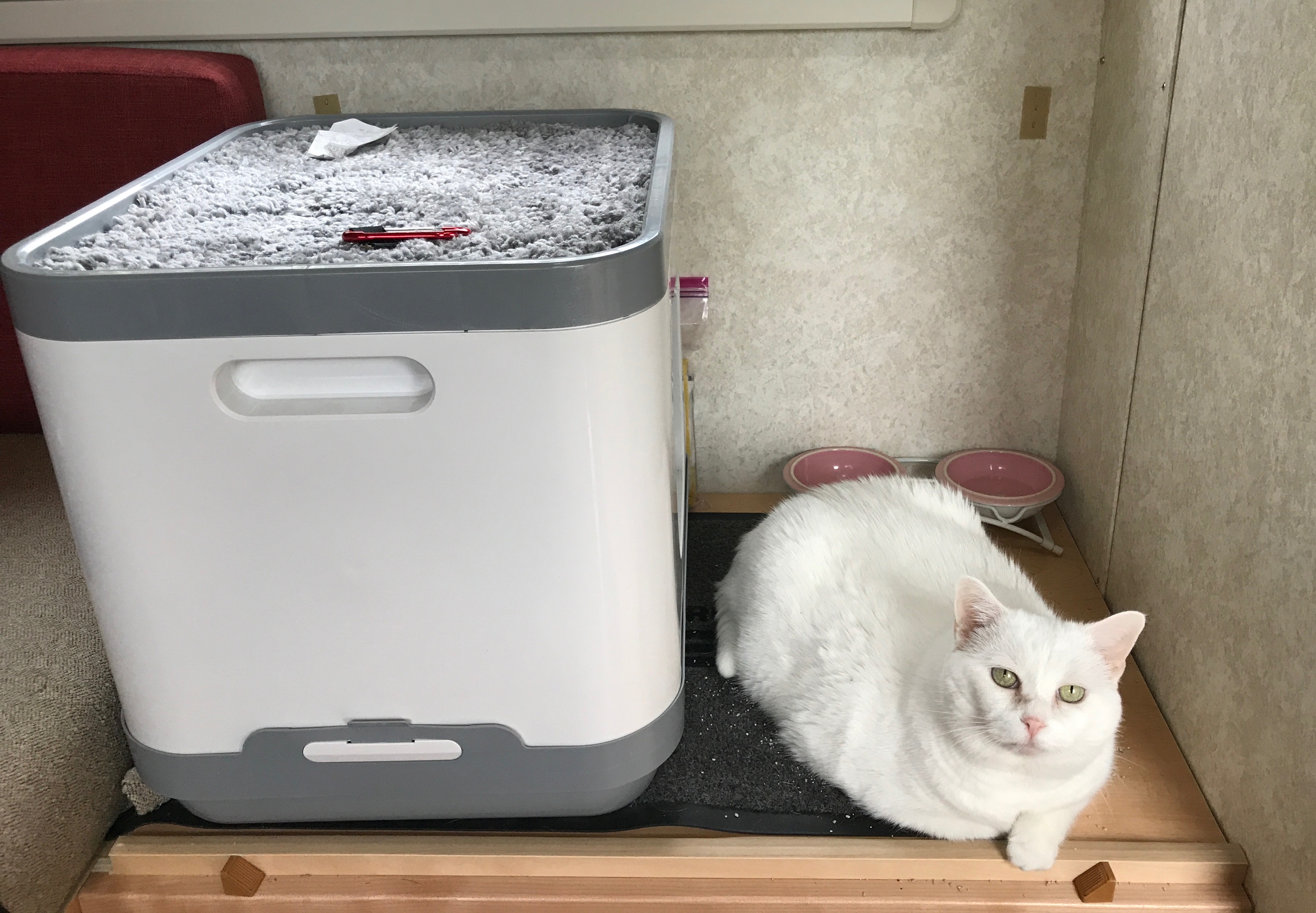
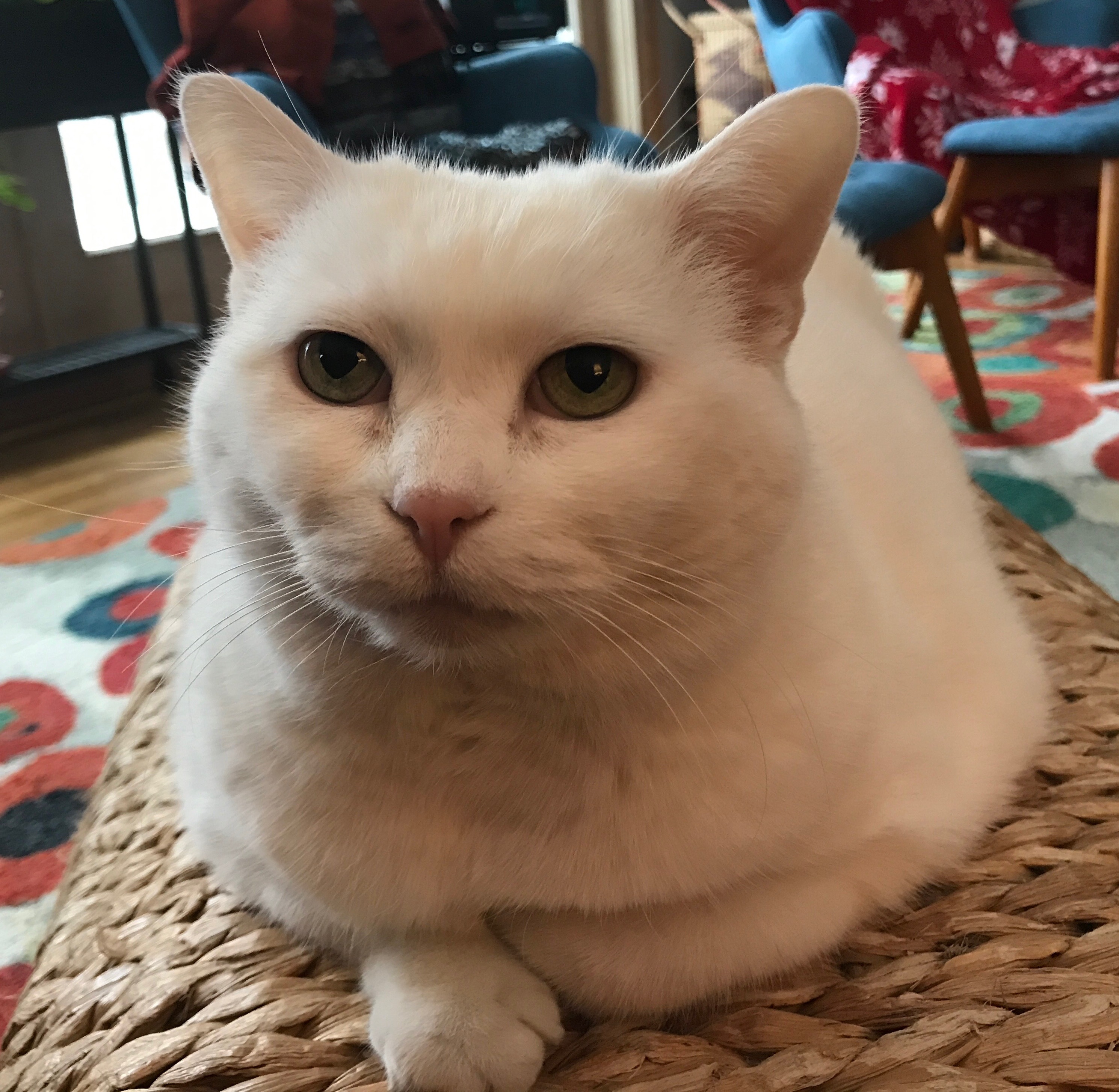
This is Cora’s part of the T@b. Some people have commented that cats don’t like to eat by their “bathroom.” I think you will agree that Cora doesn’t appear to mind. (In case you are impressed with the litter box, here’s a link to it.)
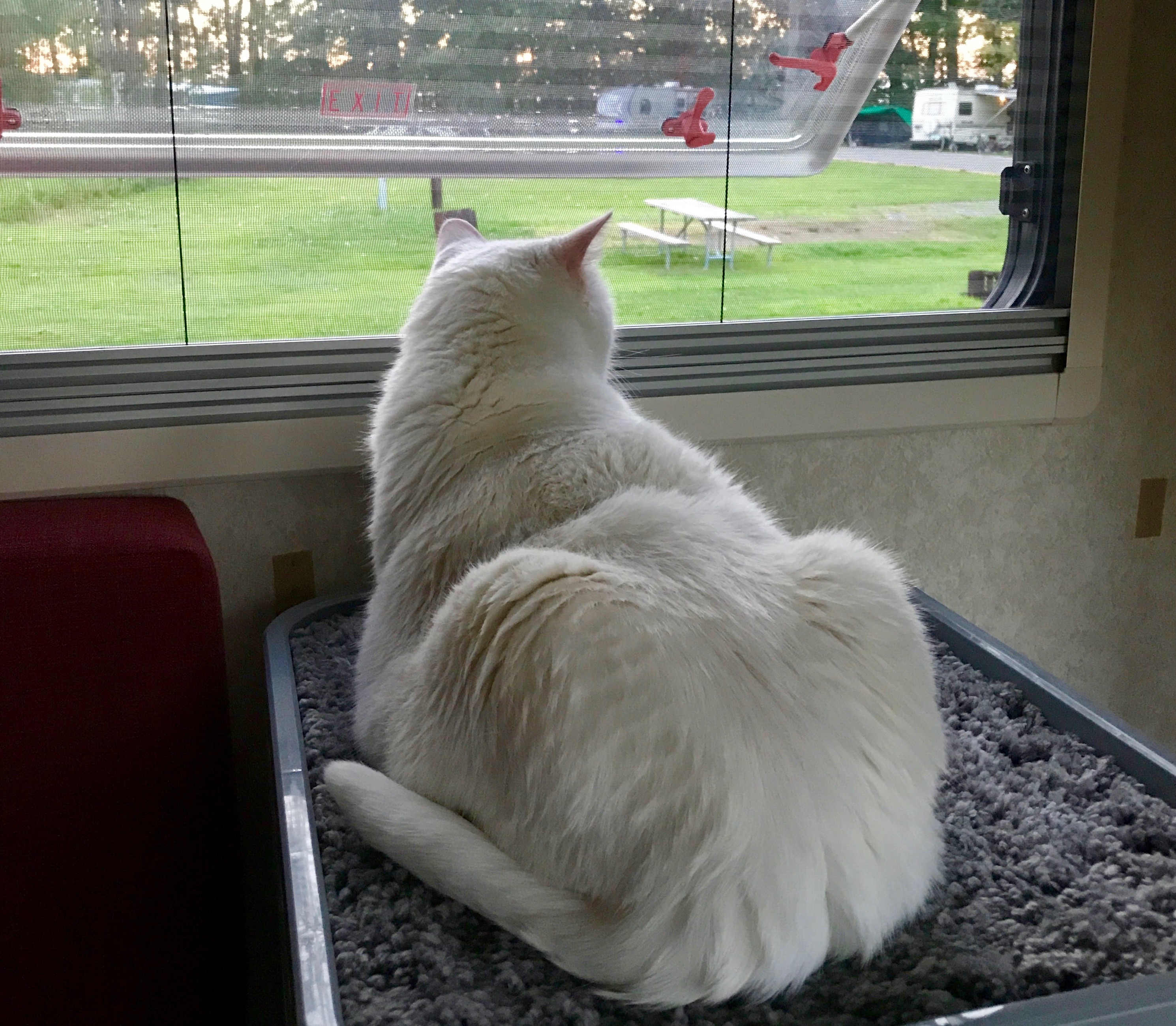
Cora enjoys sitting on top of her litter box and looking out the window.

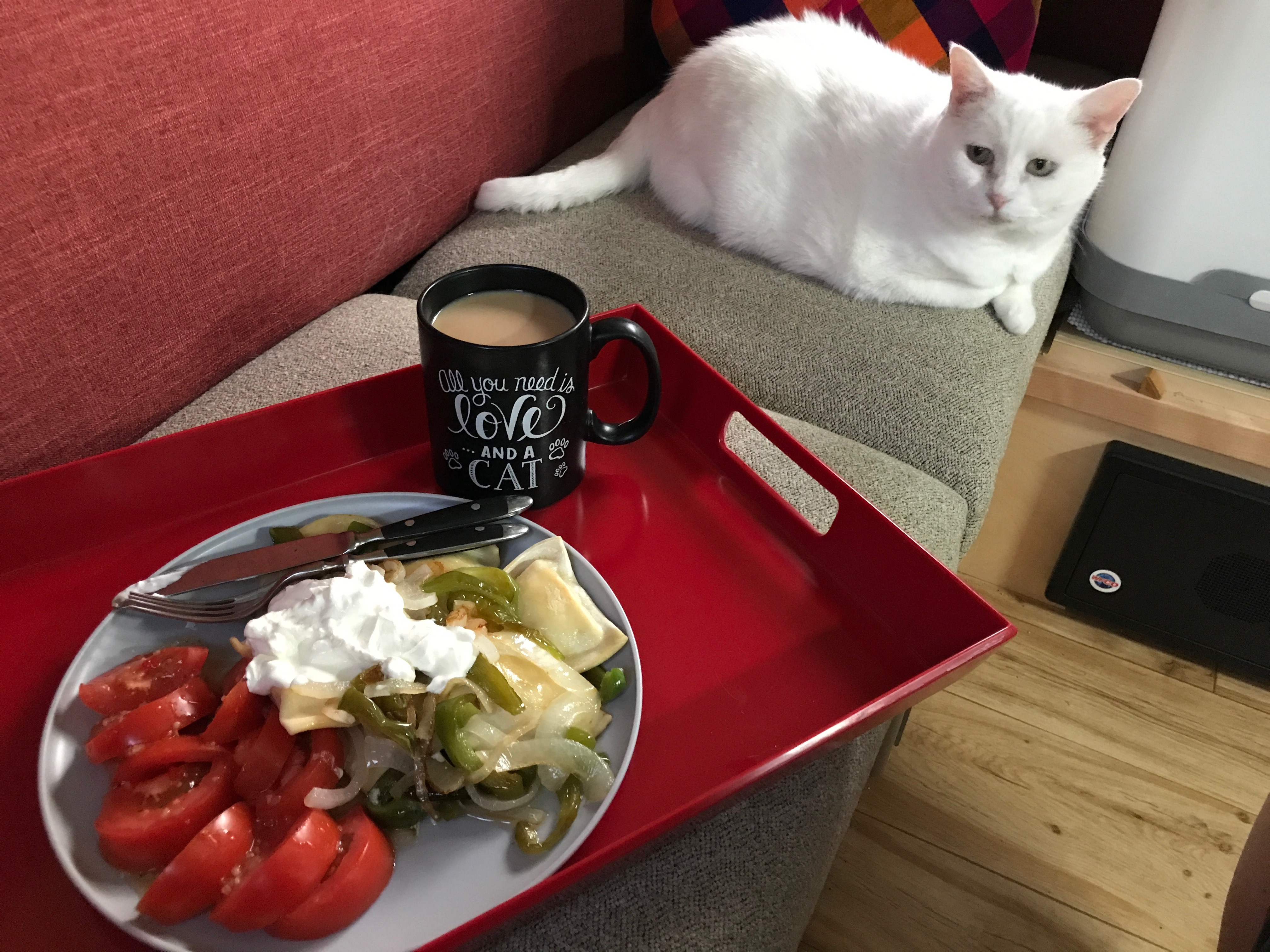
This was my first dinner in my new trailer. Pierogis sautéed with onions and peppers with tomatoes on the side. Some people grill when they camp – I make pierogis.

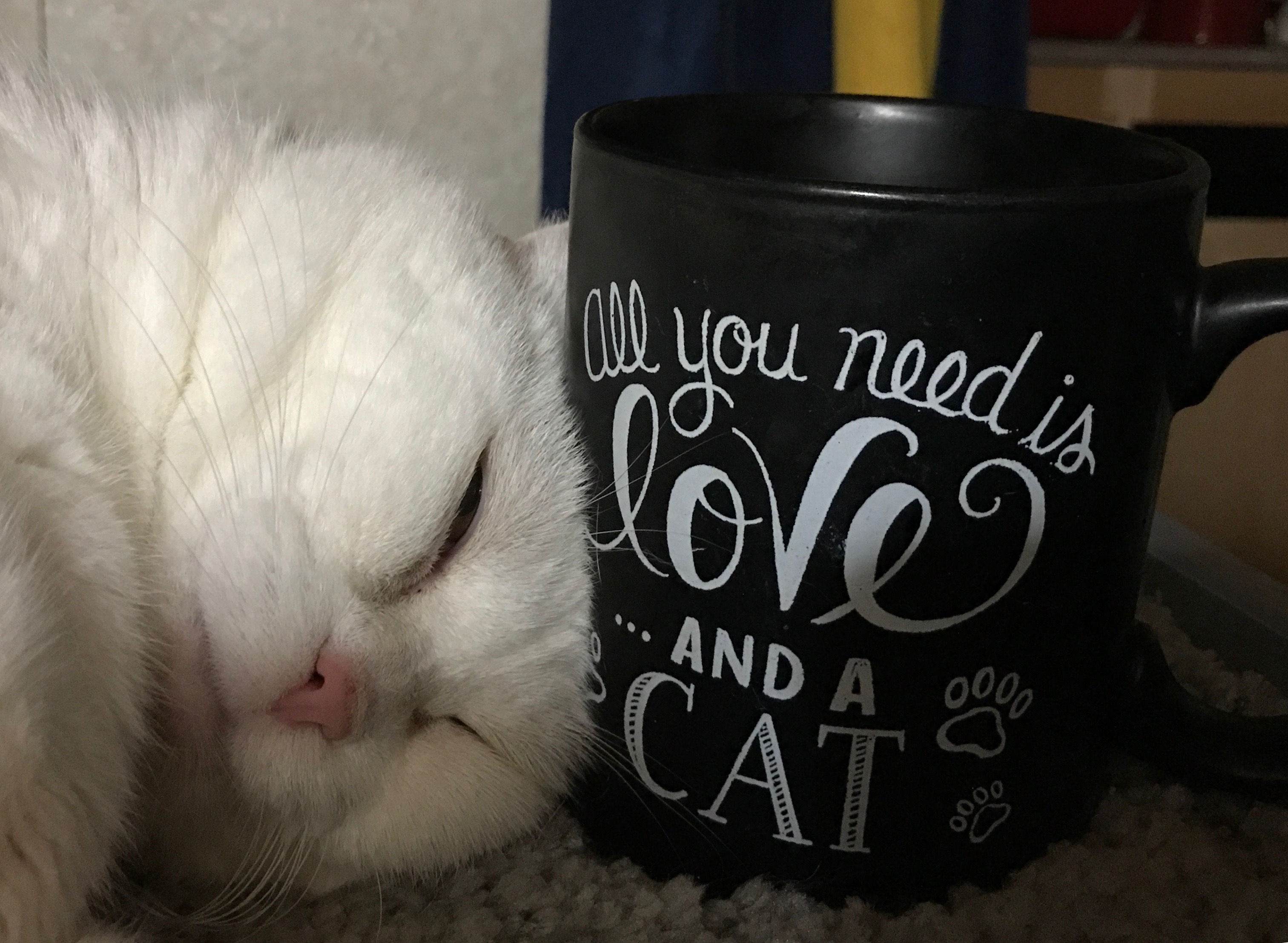
I figure this photo says it all.

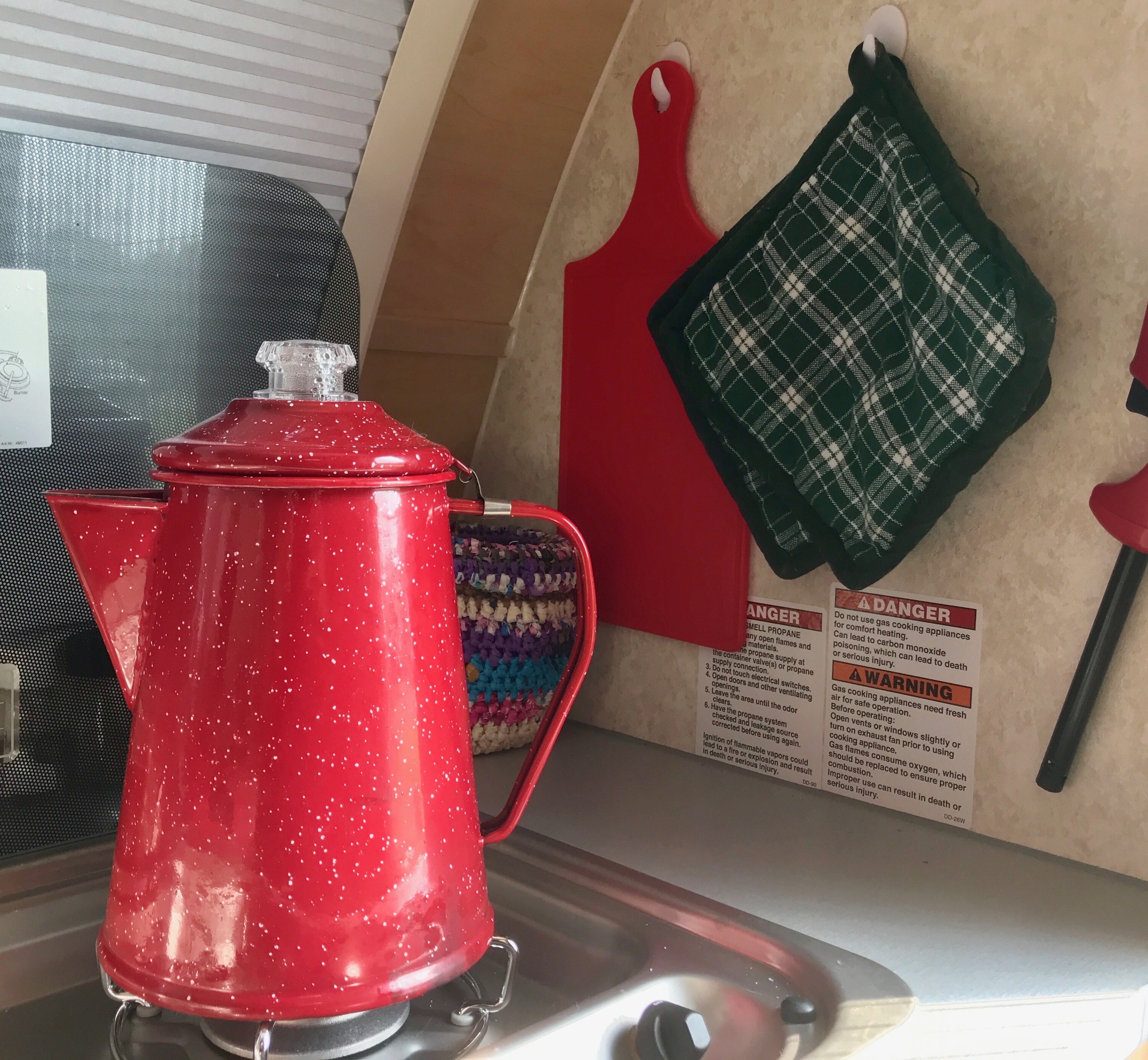
I haven’t really gotten too much into decor yet, but I have a red theme going on that matches the red and white colors of the T@b.

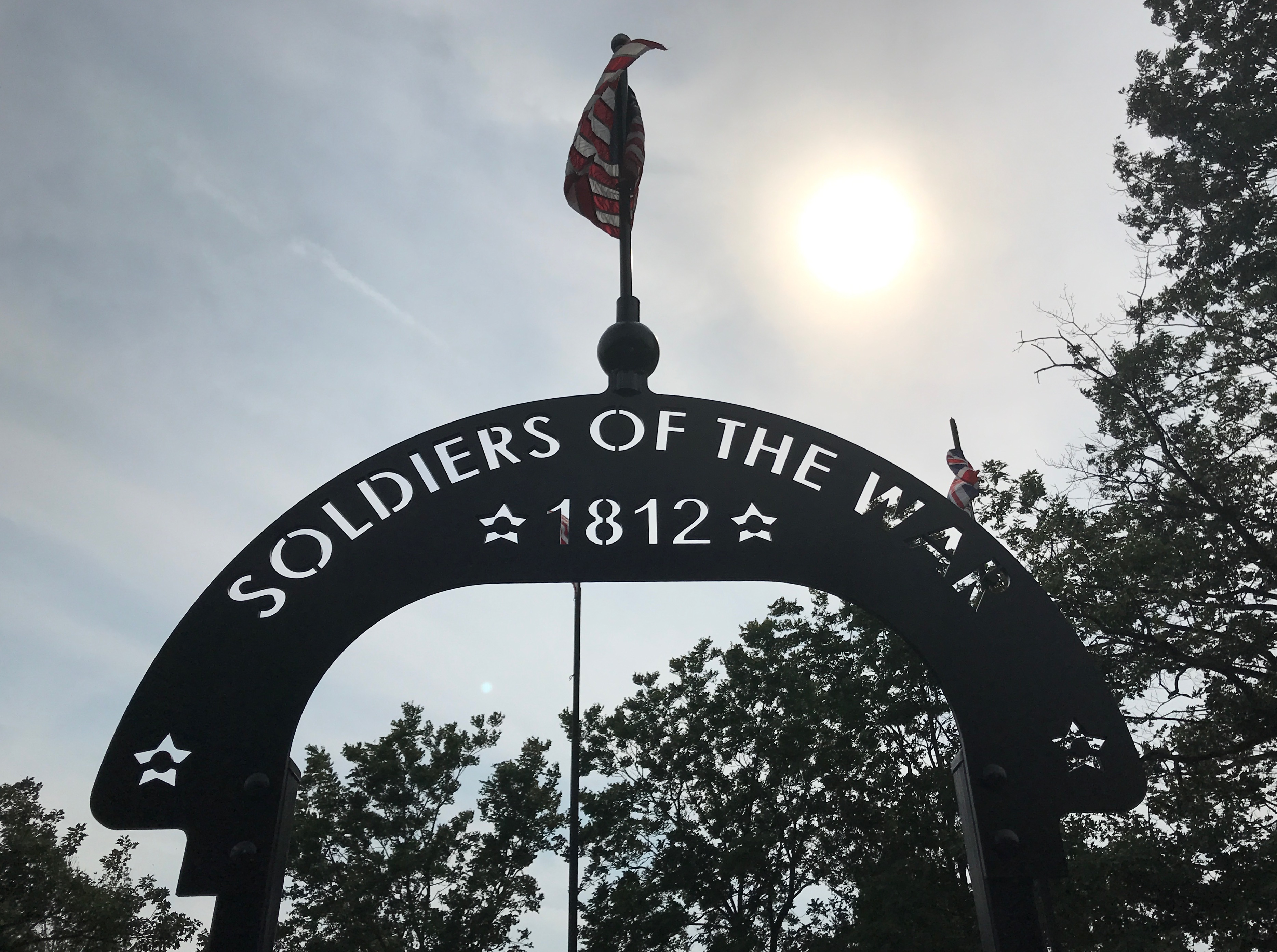
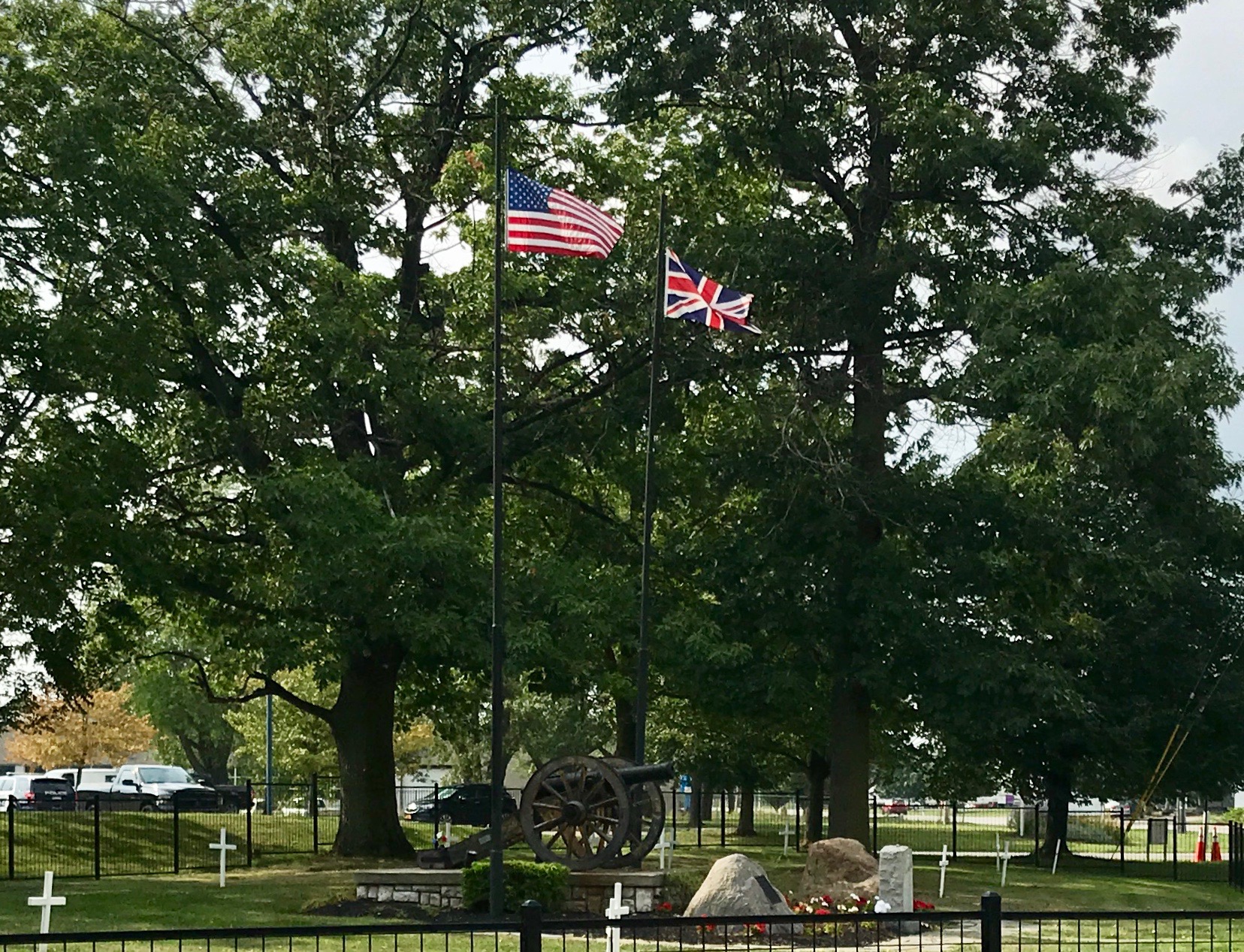
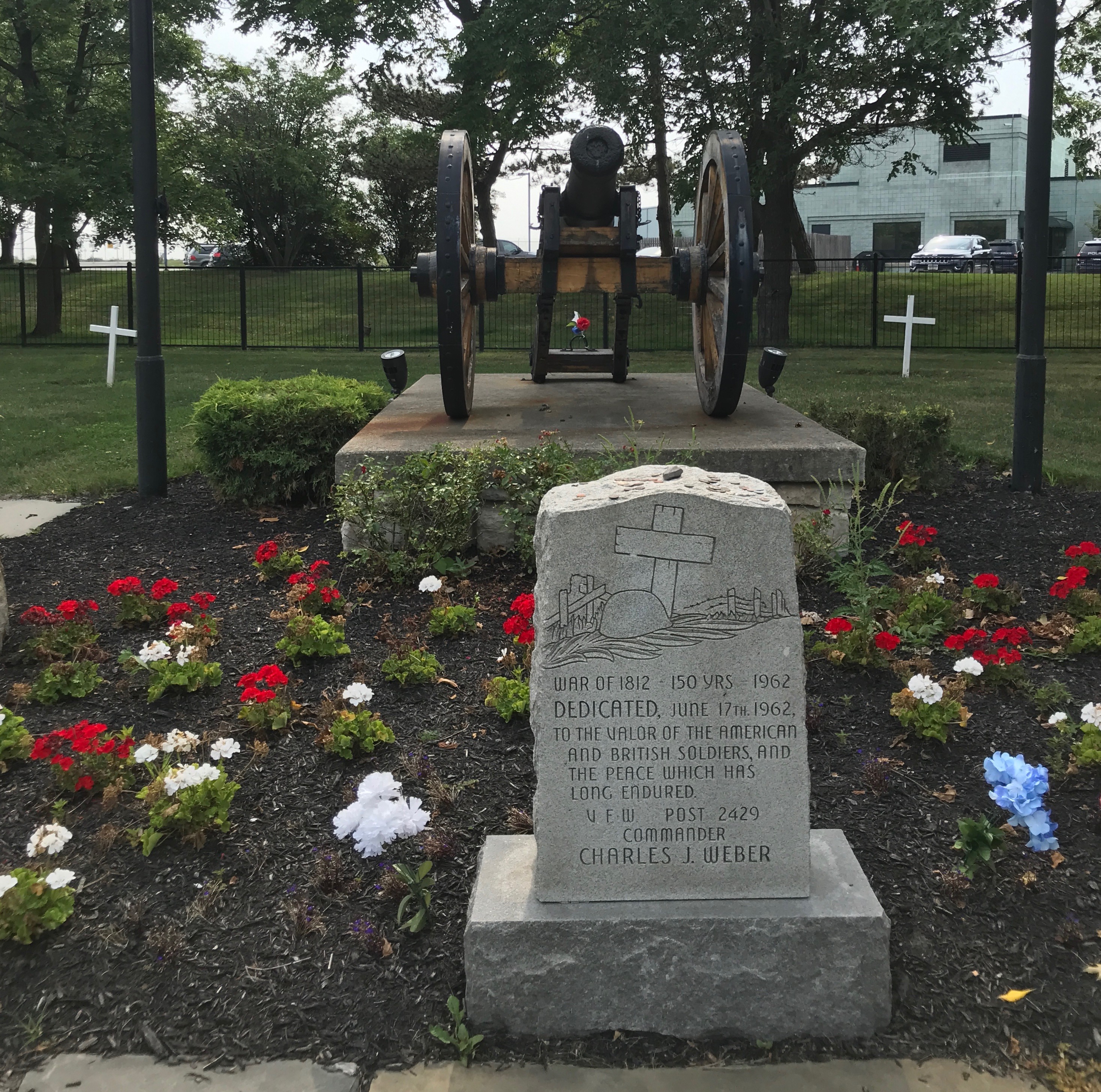
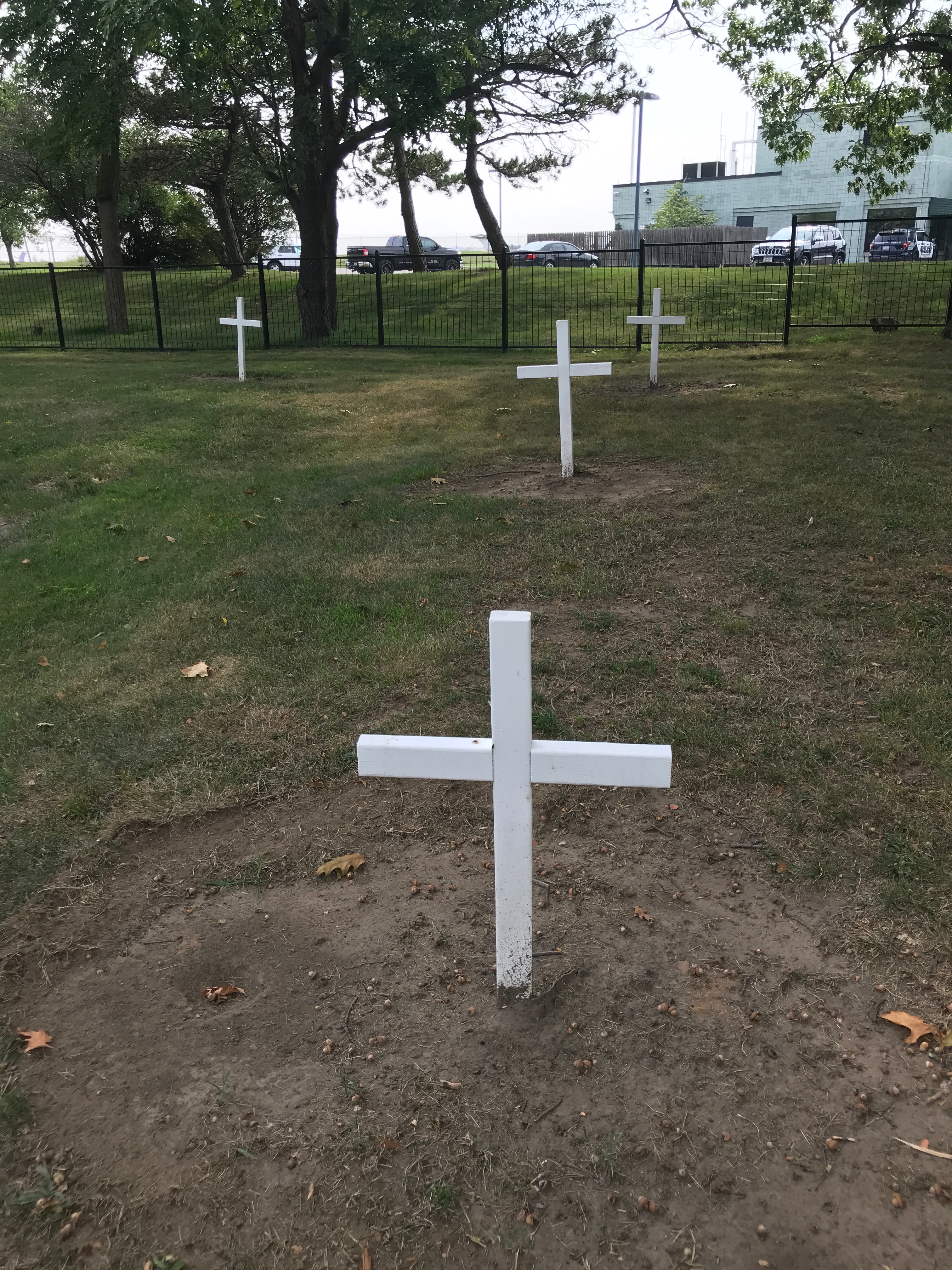
I figure that I’ve covered just about everything there is to cover in Buffalo, but I set out to find some new things to explore. I found a cemetery for soldiers of the War of 182.

You might ask, “Where is that?” Good question.

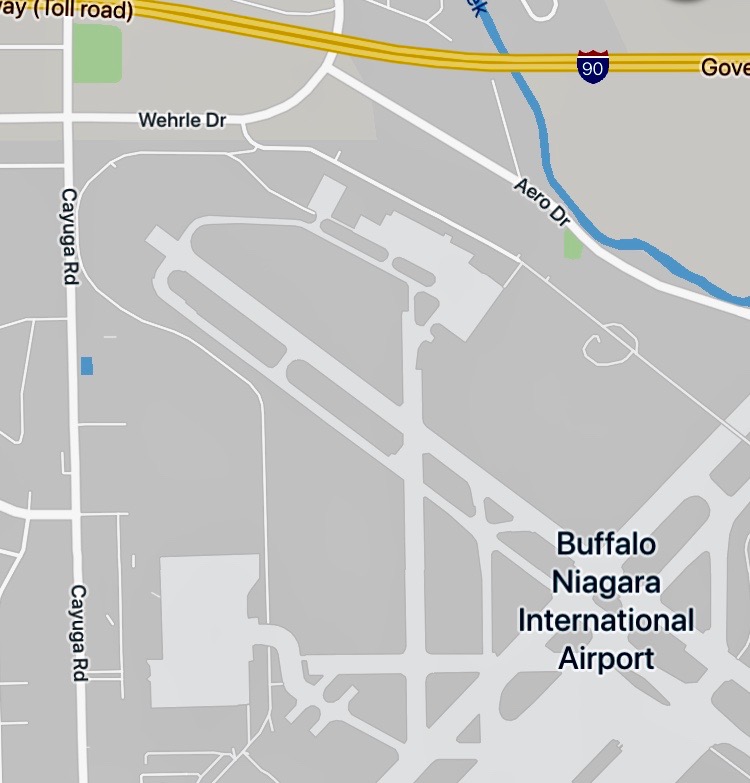
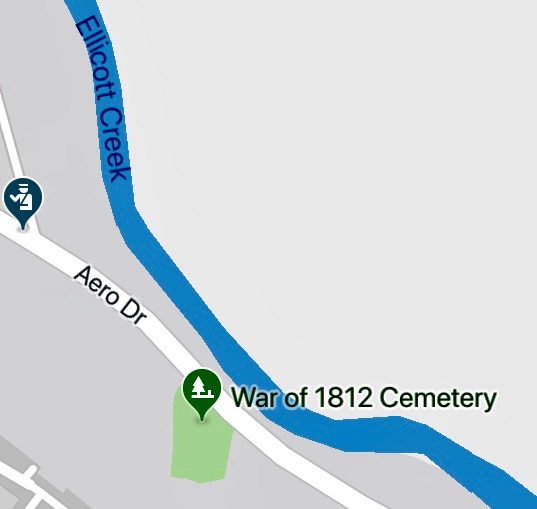
It’s right there, between the Buffalo Niagara International Airport and the Thruway, on the bank of Ellicott Creek. Do you see it?

If you zoom in close enough, it pops right out. There was a military hospital nearby and they buried the dead in this cemetery. The information you can find on the internet is astounding! I found one site that lists the names of the dead and what they died of. Incidentally, diarrhea seems to be a leading cause of death back then.

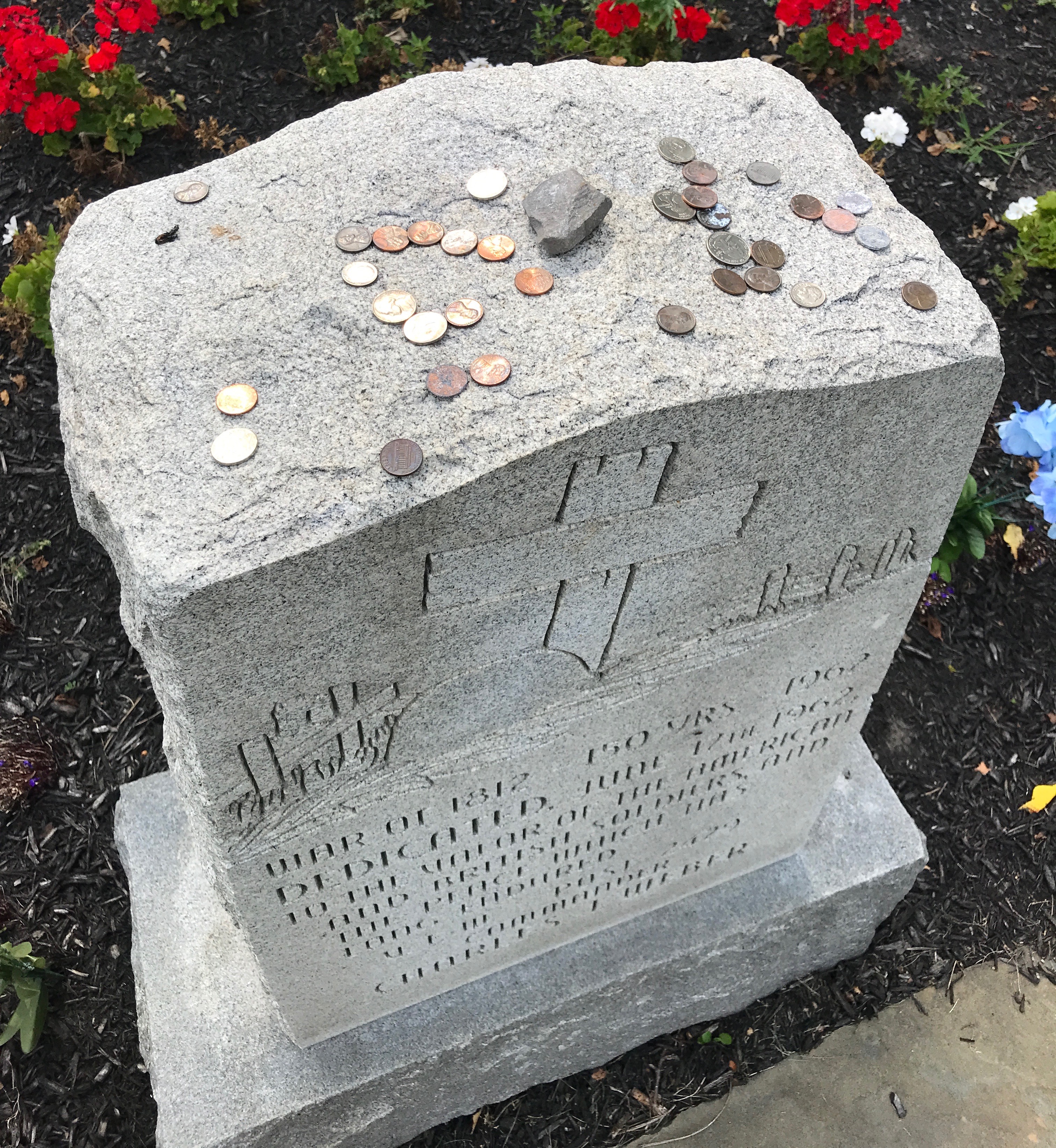
Both American and British soldiers are buried here.

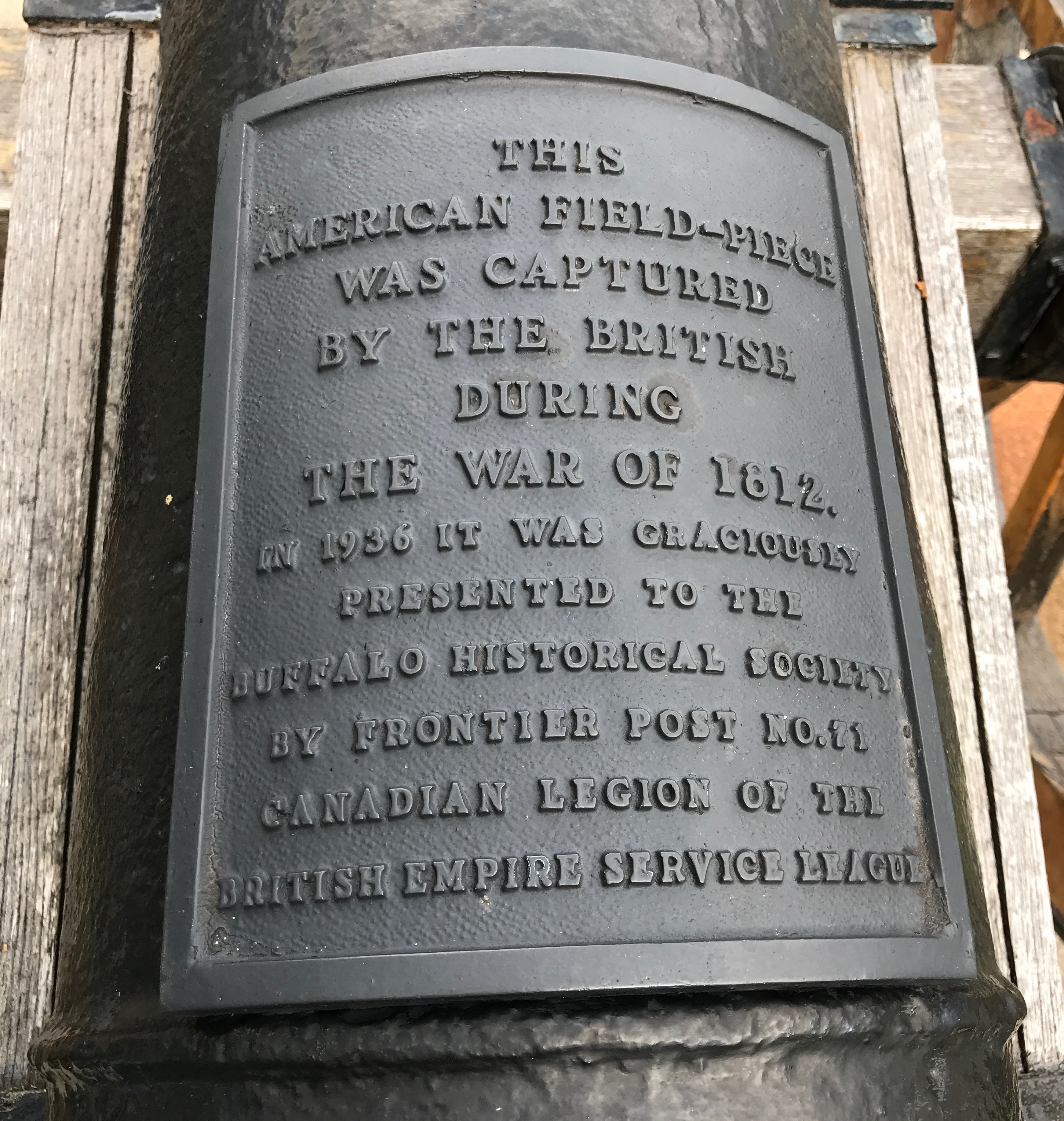
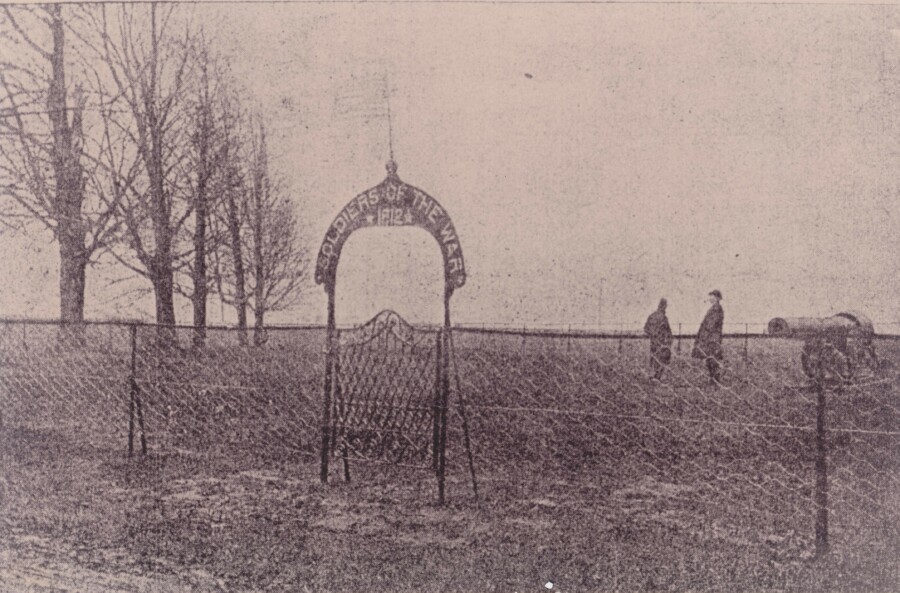
One source I located said that the cannon that was placed there in 1898 by the Buffalo Historical Society, but was donated in 1942 to Bethlehem Steel to be used as scrap metal for the war effort.

So, maybe this is a replacement cannon.

The website identifies this photo from 1898 or 1899.

Graves are marked with wooden crosses. I always wonder when you see cemeteries marked with crosses like this if they have actually identified that people are buried in those specific locations or if they are reminders that this is hallowed ground.

People still come to pay their respects.

I finally managed to get together with my sister, Amy. We picked a spot near her home.

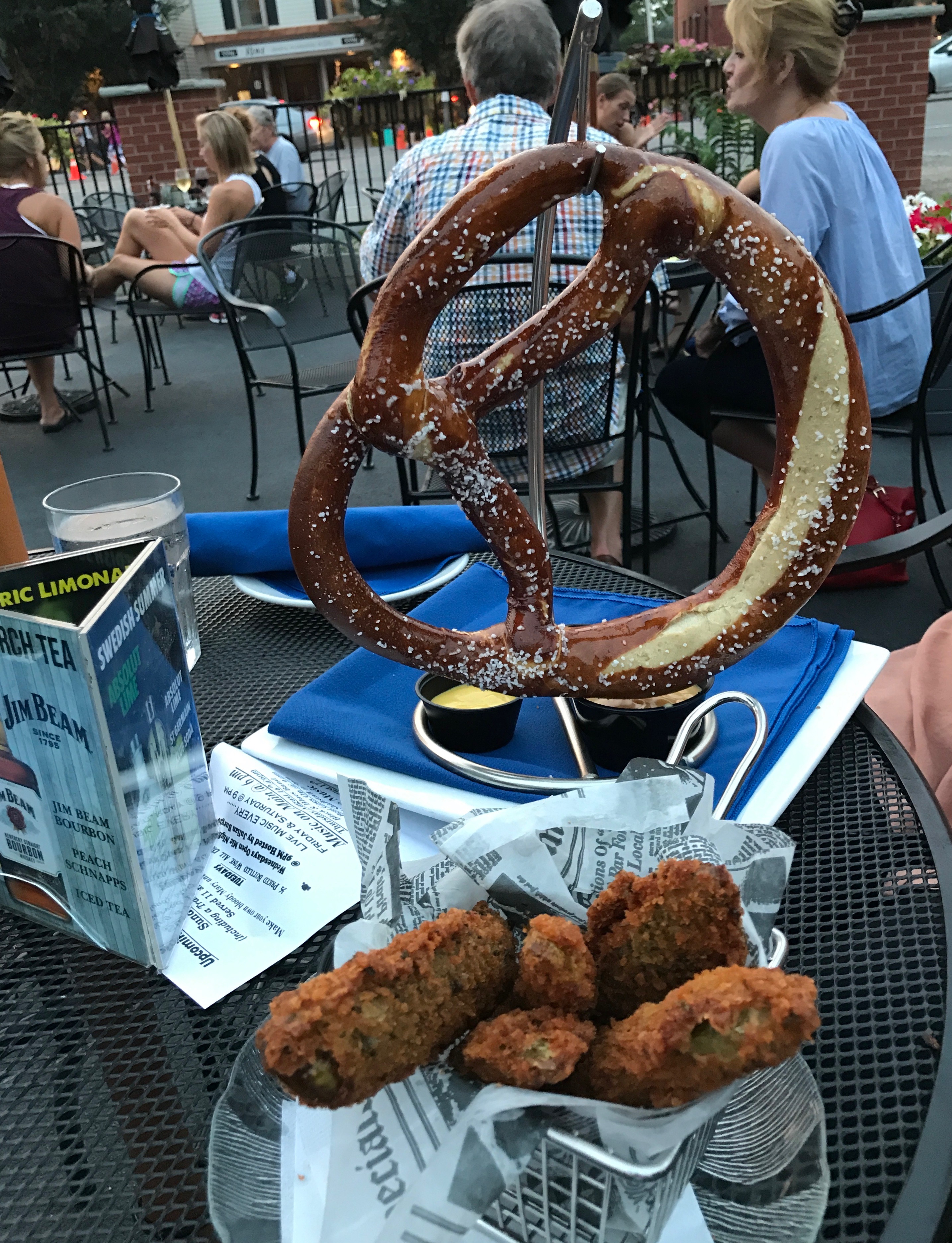
A big ol’ soft pretzel, some sort of fried things, a couple of beers and my sister…that sounds like a recipe for a good evening.

And then it was time to head back to the trailer. Cora was waiting for me!


The Home Stretch

I hit the road bright and early and continued making my way east.

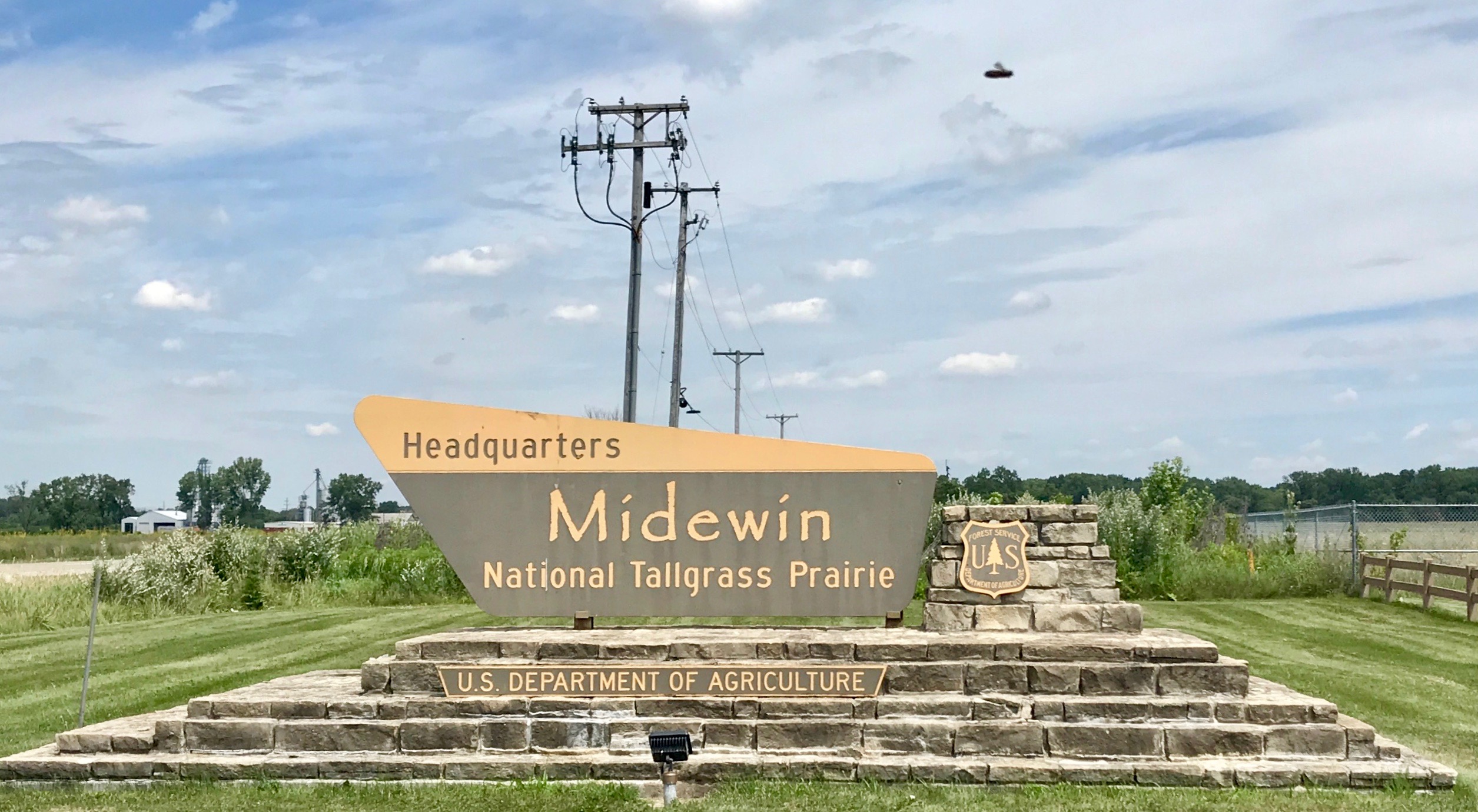
A “brown sign” for the Midewin National Tallgrass Prairie lured me off the Interstate. I’d always been curious about the concept of a Tallgrass Prairie.

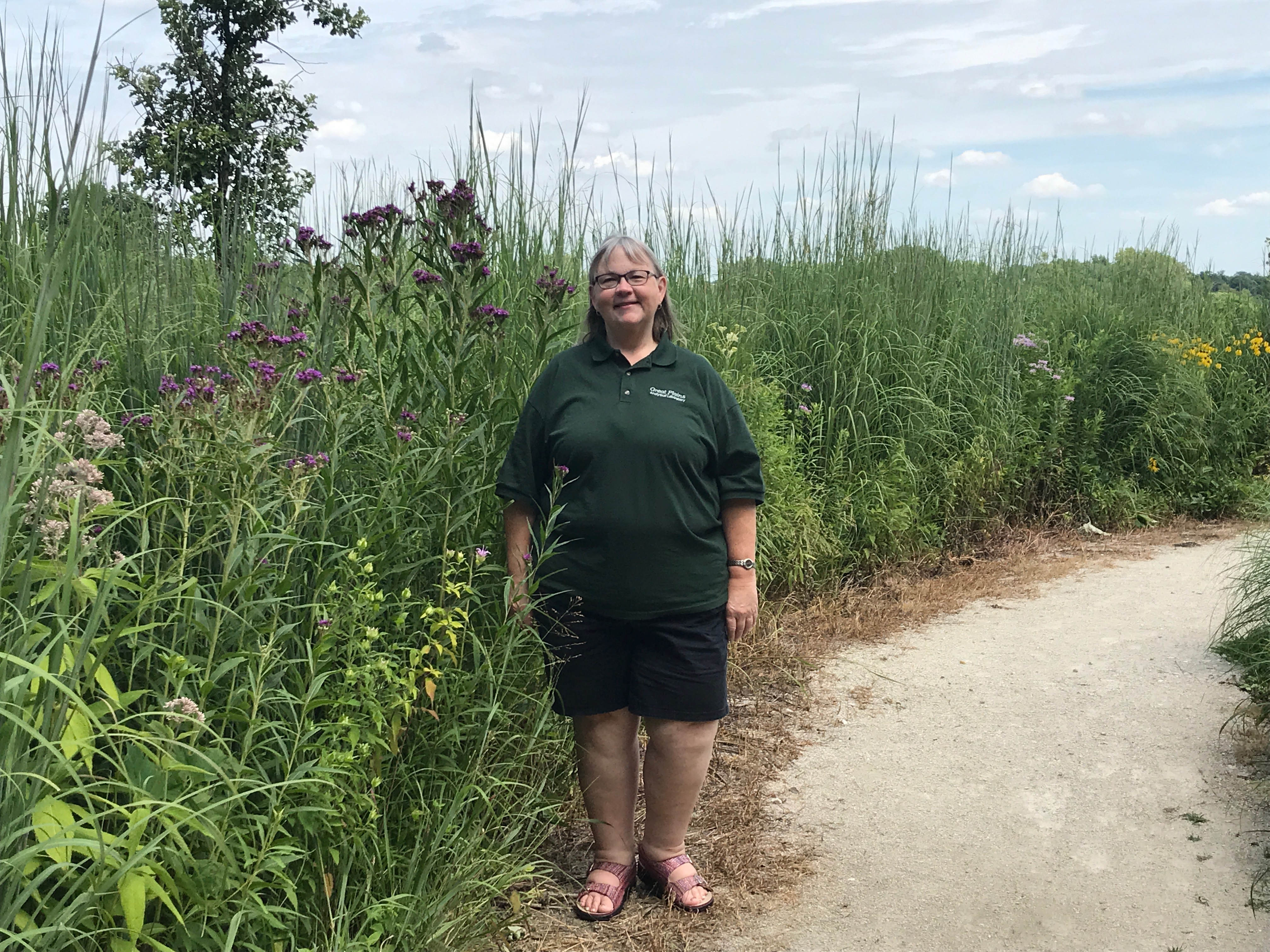
I wanted to know just how tall the tallgrass was.

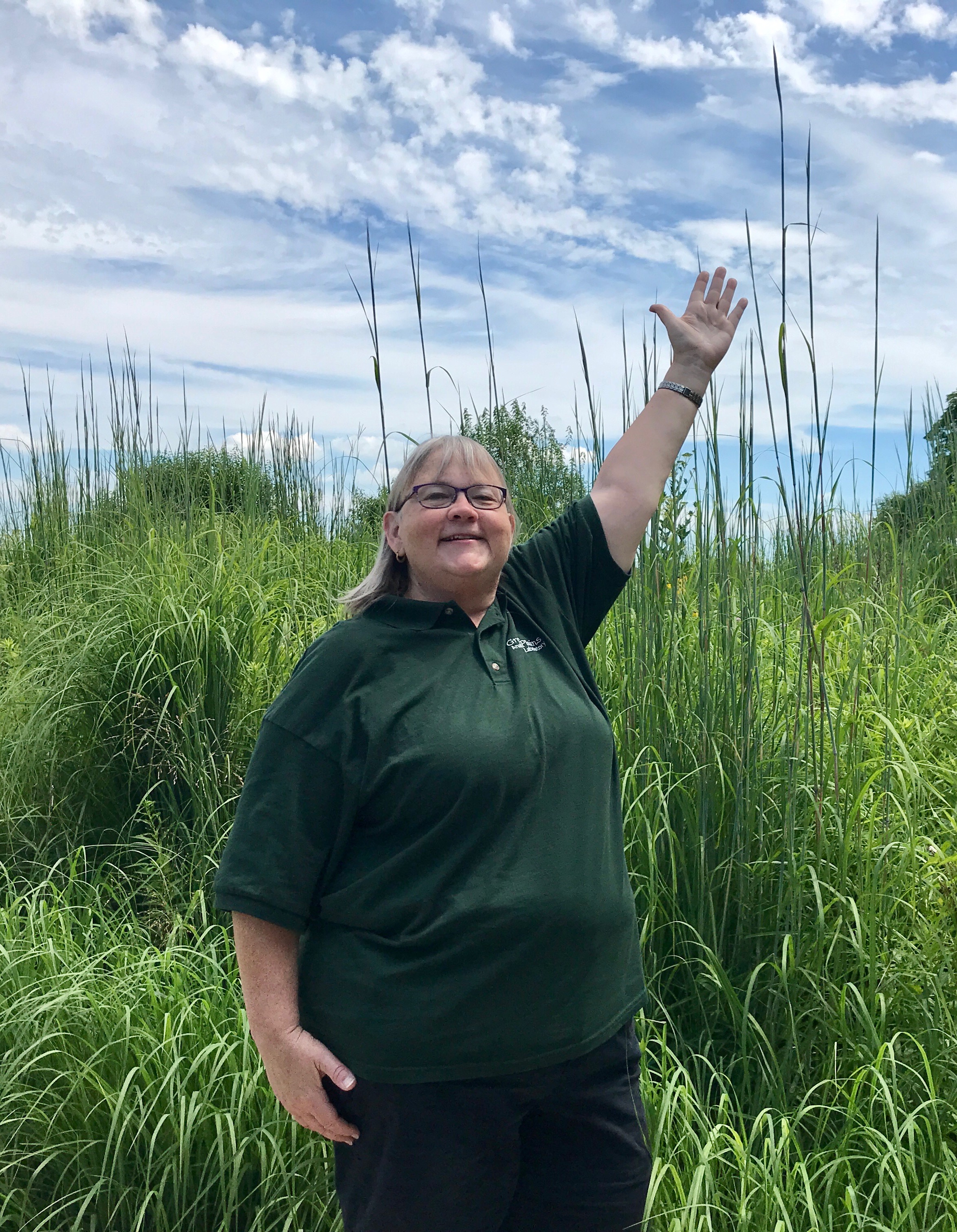
It was pretty tall.

That is some mighty tall grass!

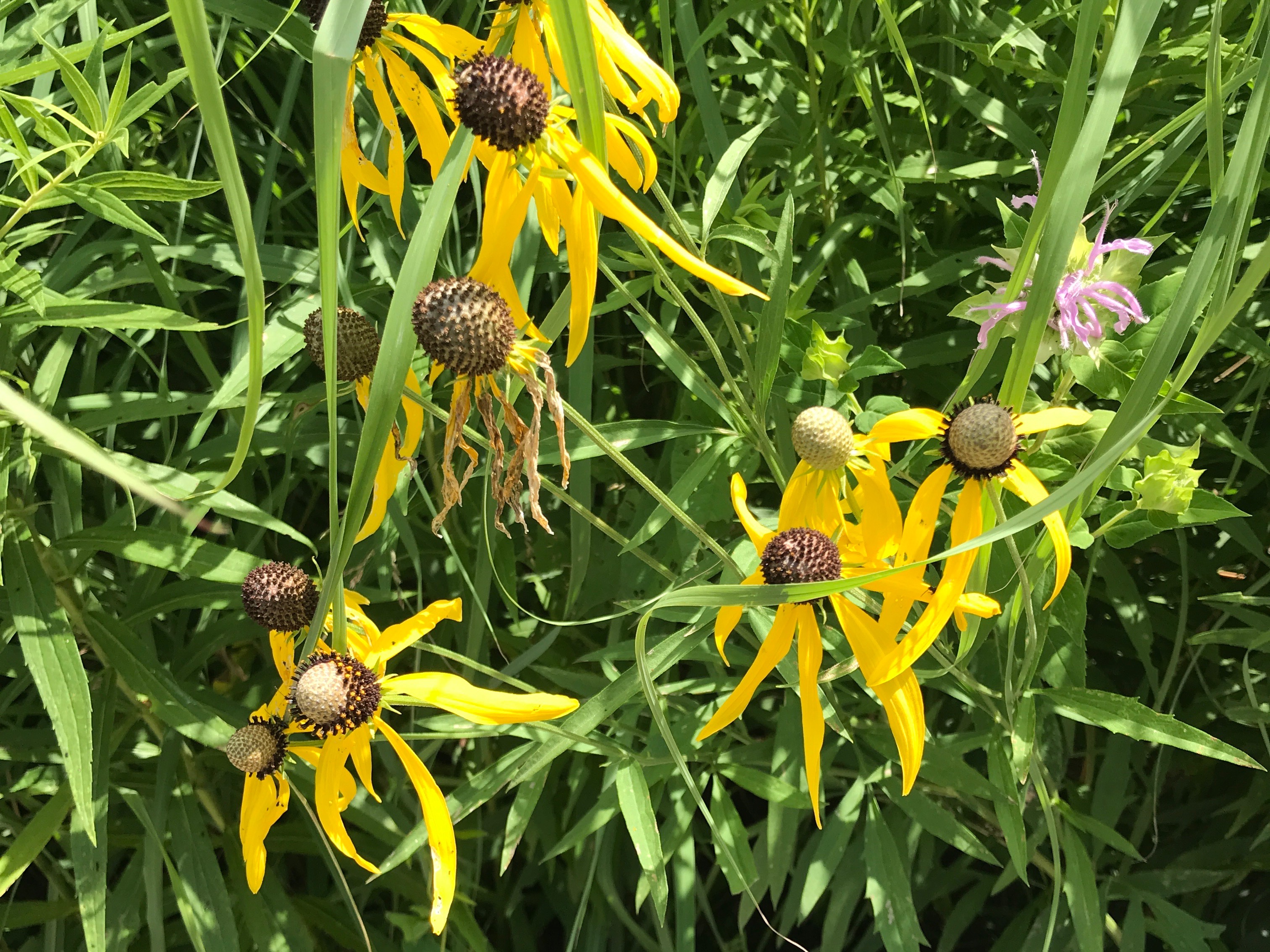
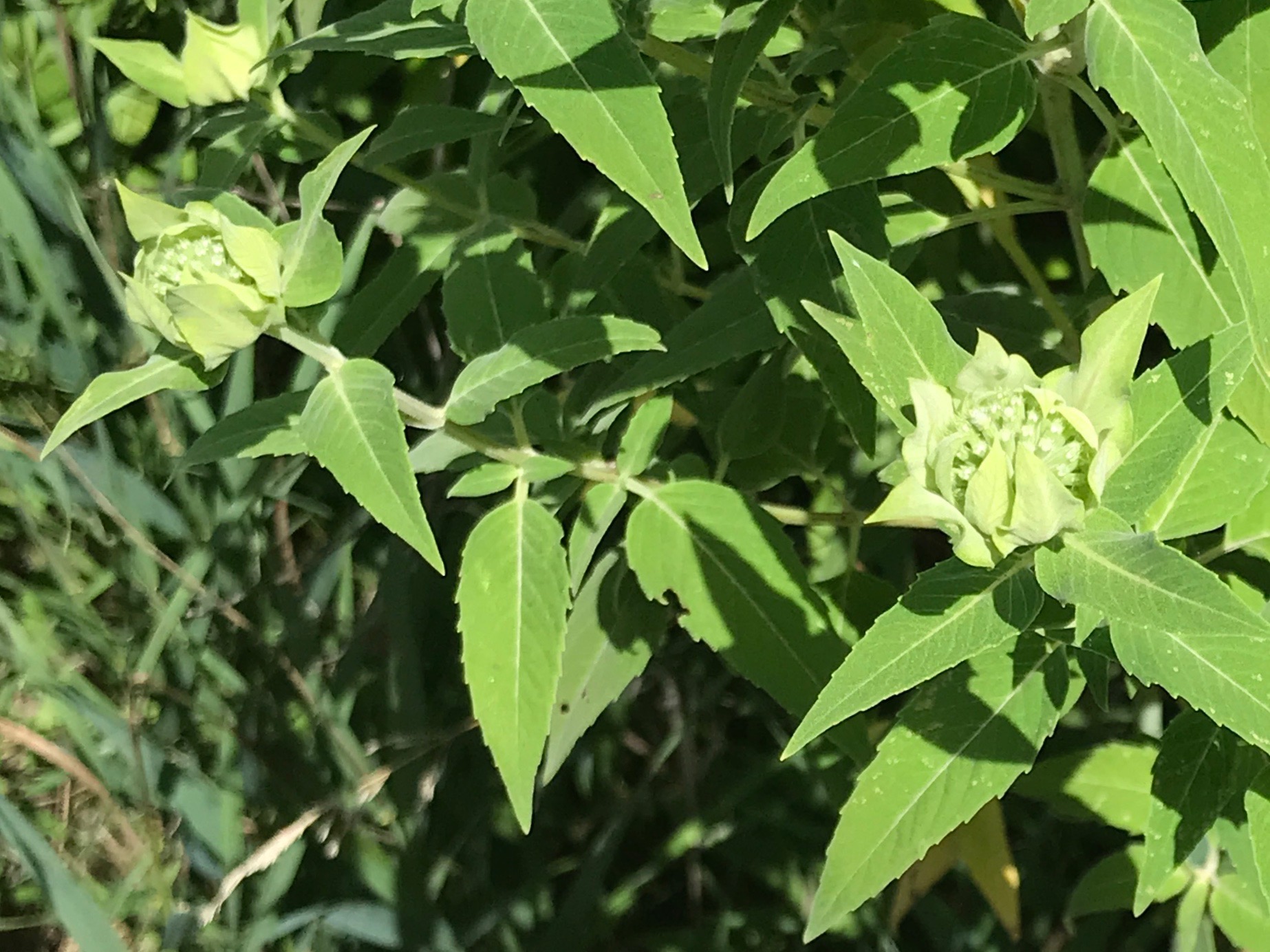
Tucked in the grass were some lovely flowers. There were purple flowers,

…yellow flowers,

…light and dark purple flowers,

…these interesting white shapes,

…and these pale structures. Do you suppose they are seed pods?

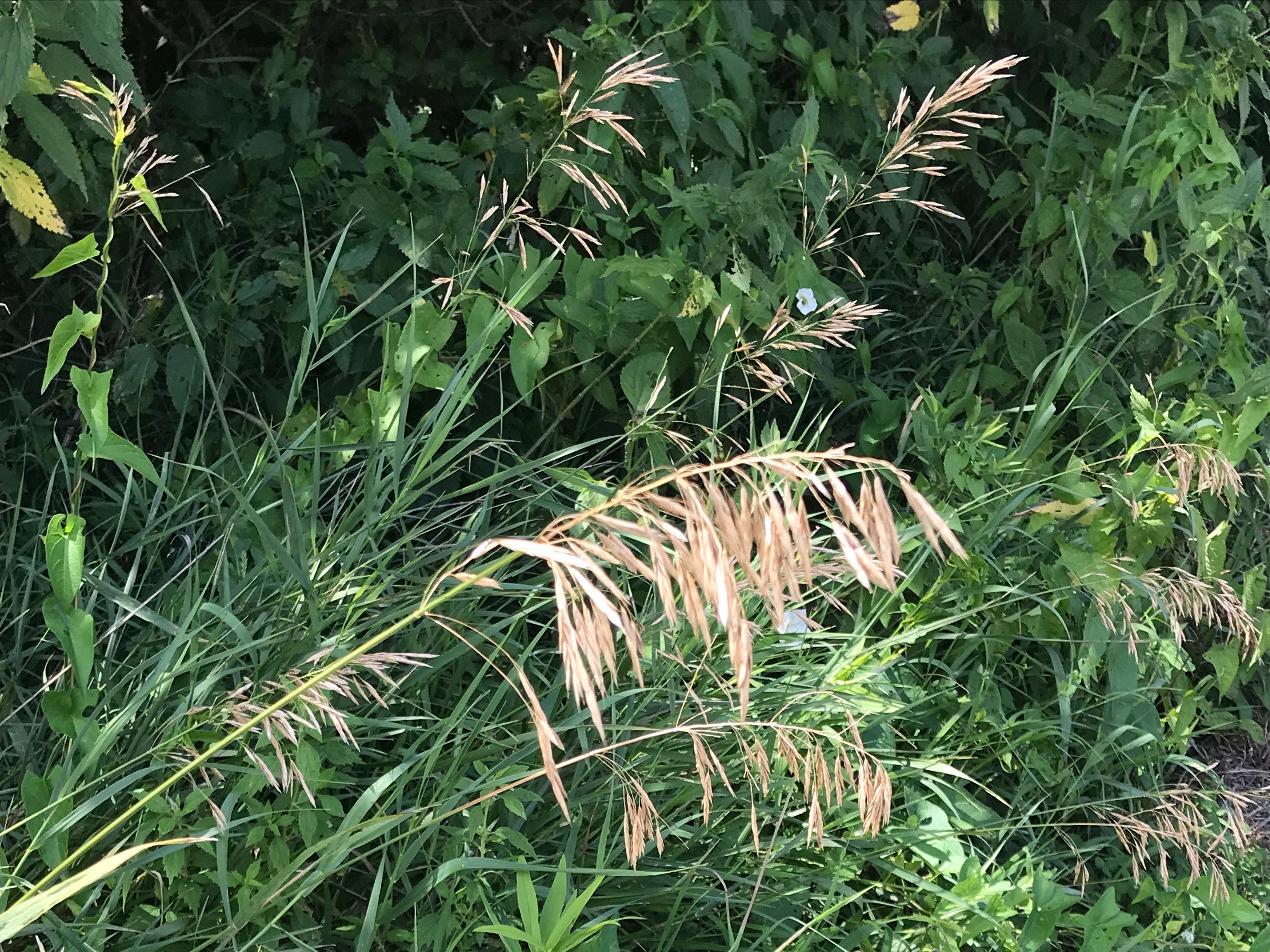
Here’s a shot of more what I expected to see – grass seeds.

The purple flowers were my favorites.

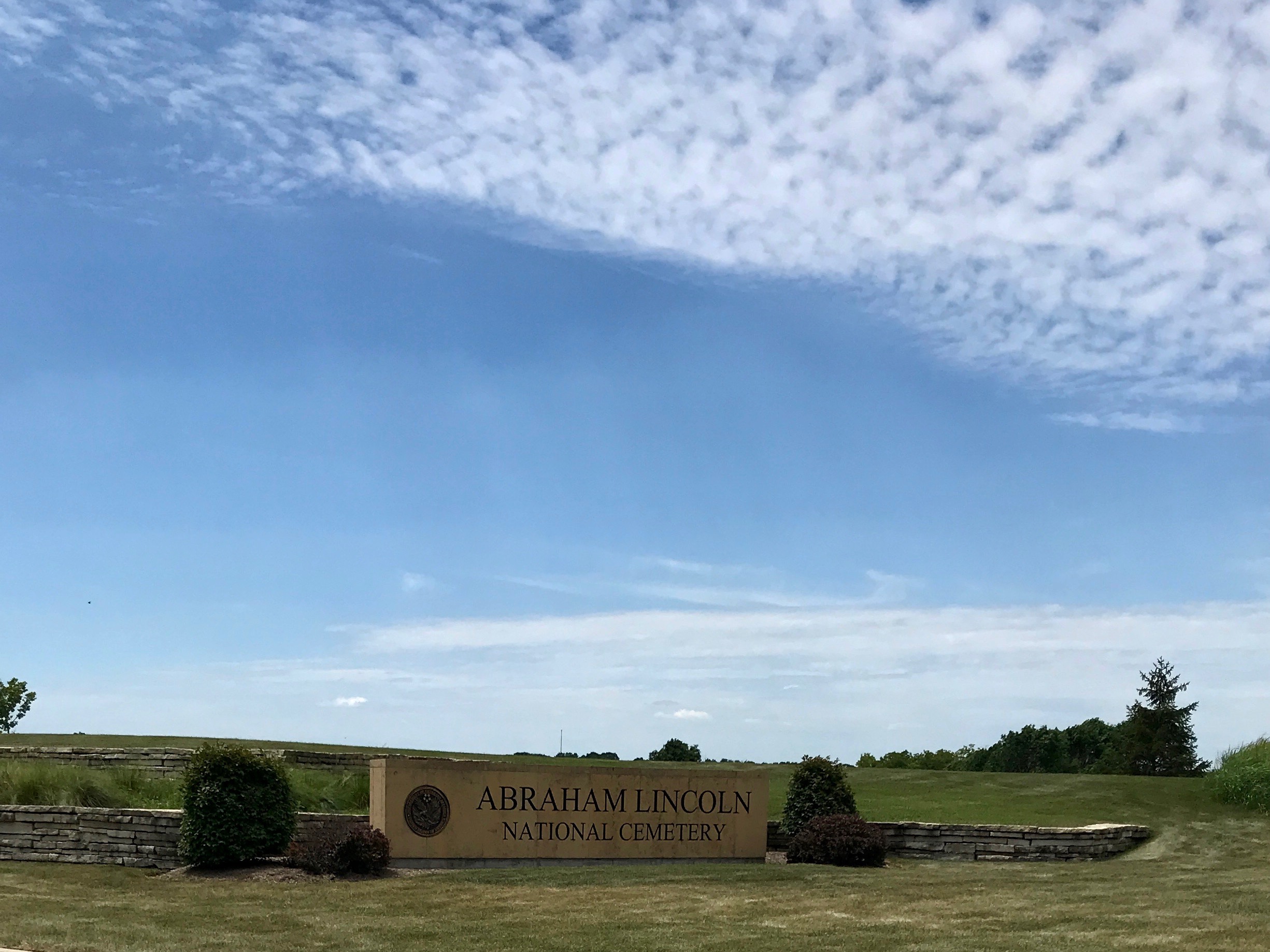
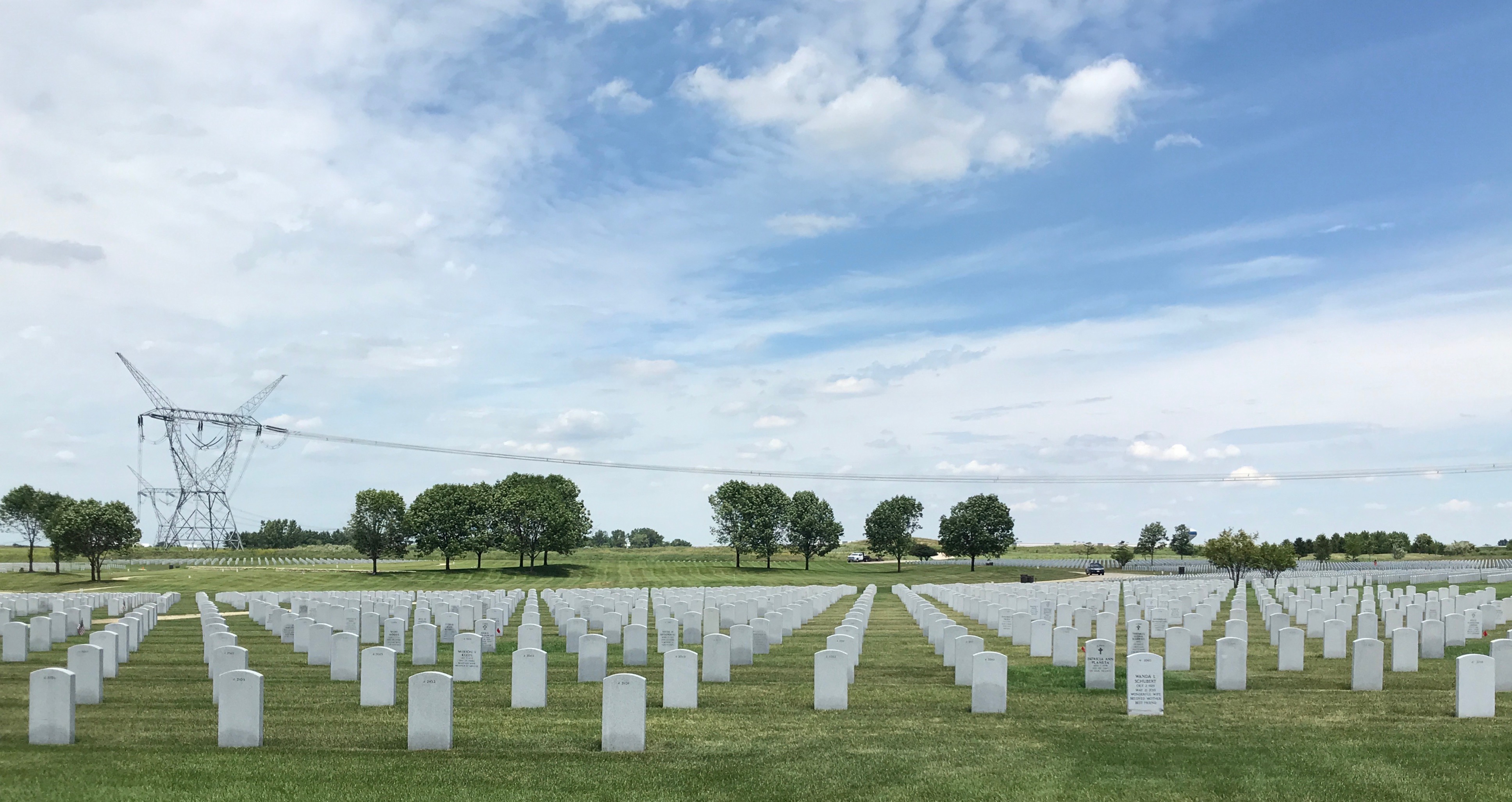
As I left the park, I saw a sign for the Abraham Lincoln National Cemetery, the 117th national cemetery. I decided to pay my respects before jumping back on the Interstate.

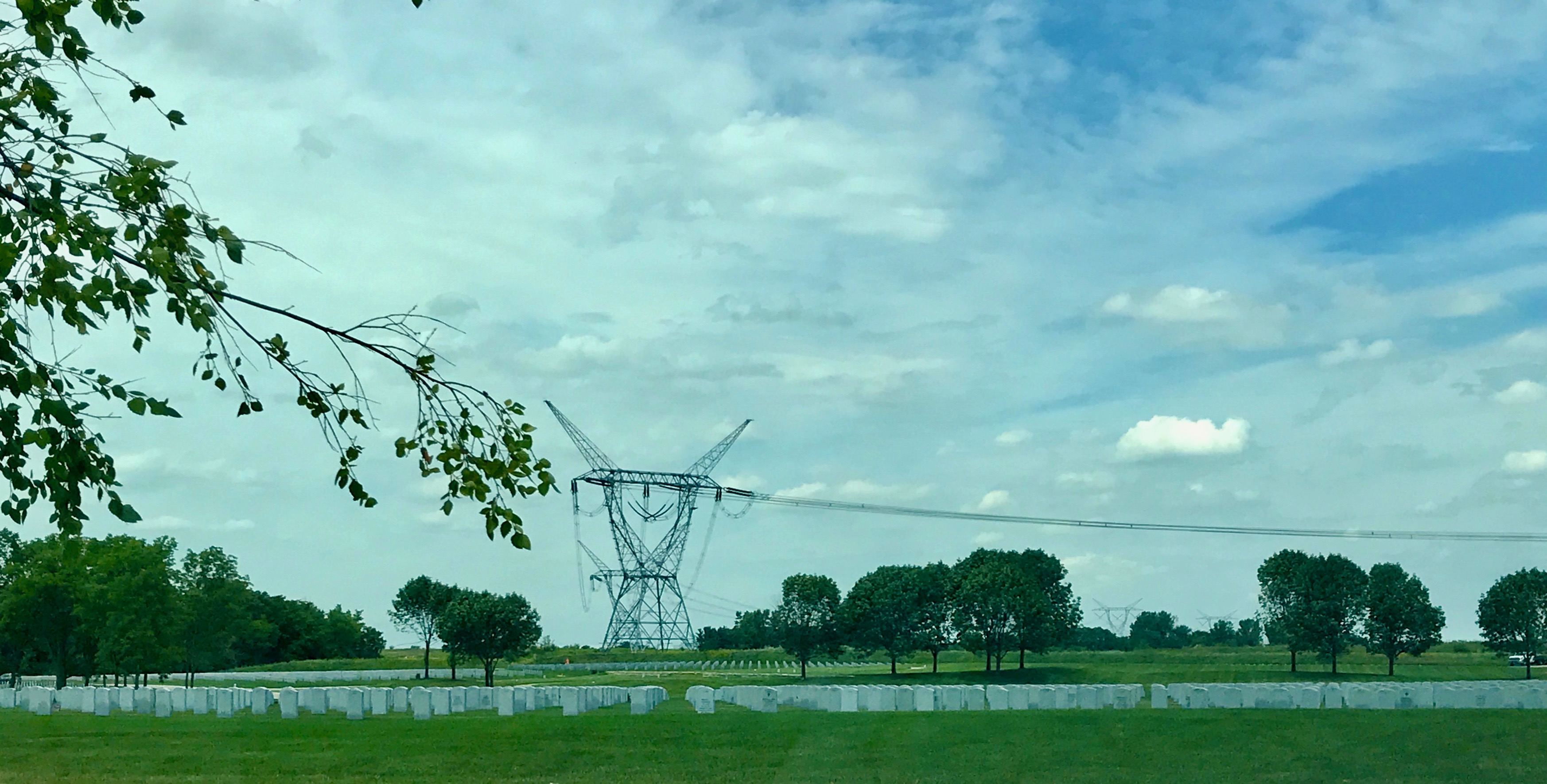
I passed through the gate and followed the road around. The cemetery is 982 acres and will provide 400,000 burial spaces when it is fully developed.

The graves were well-tended, but I found it less than dignified that the veterans were buried by the high tension lines.

There certainly were a lot of graves and there was room for more.

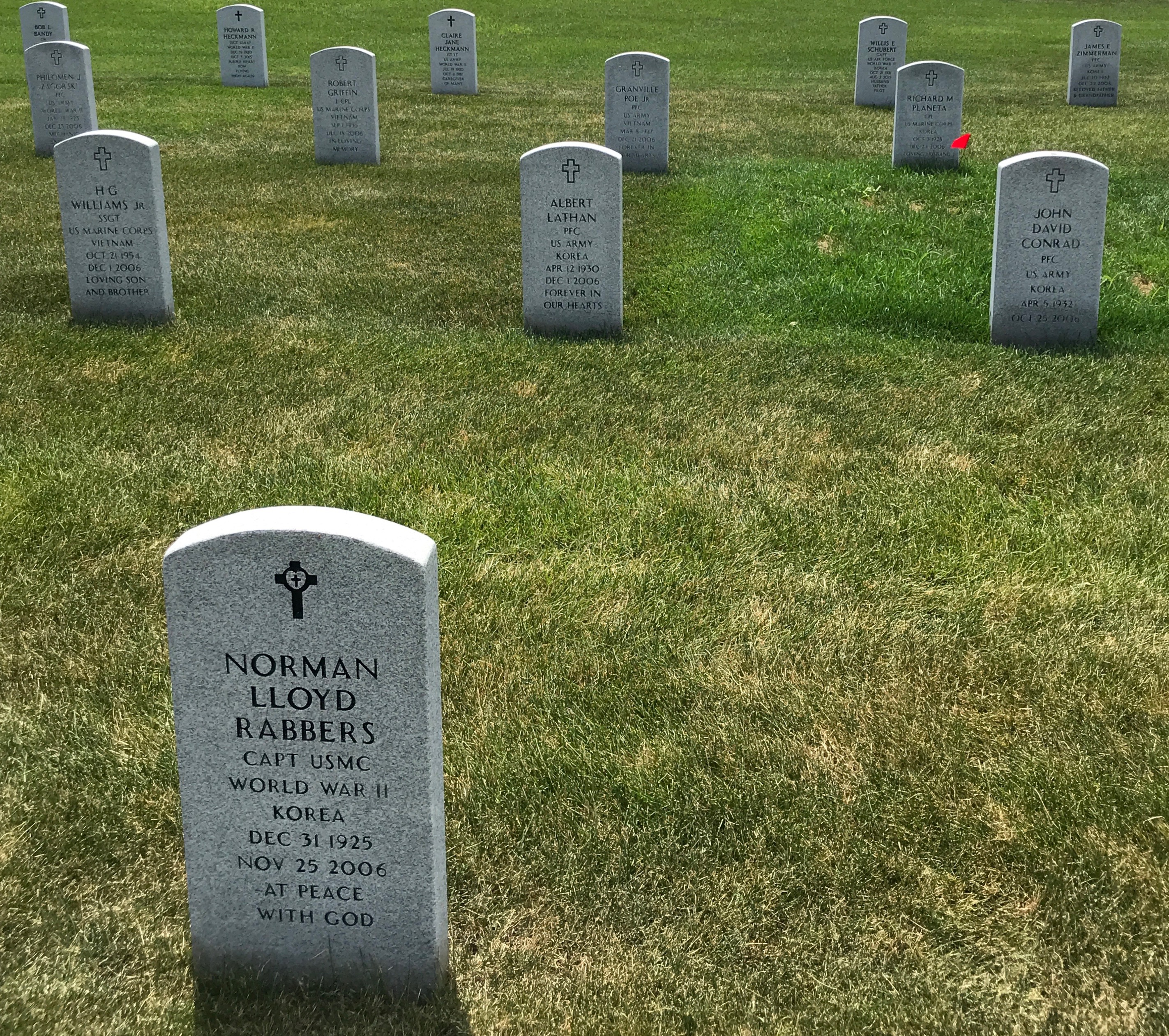
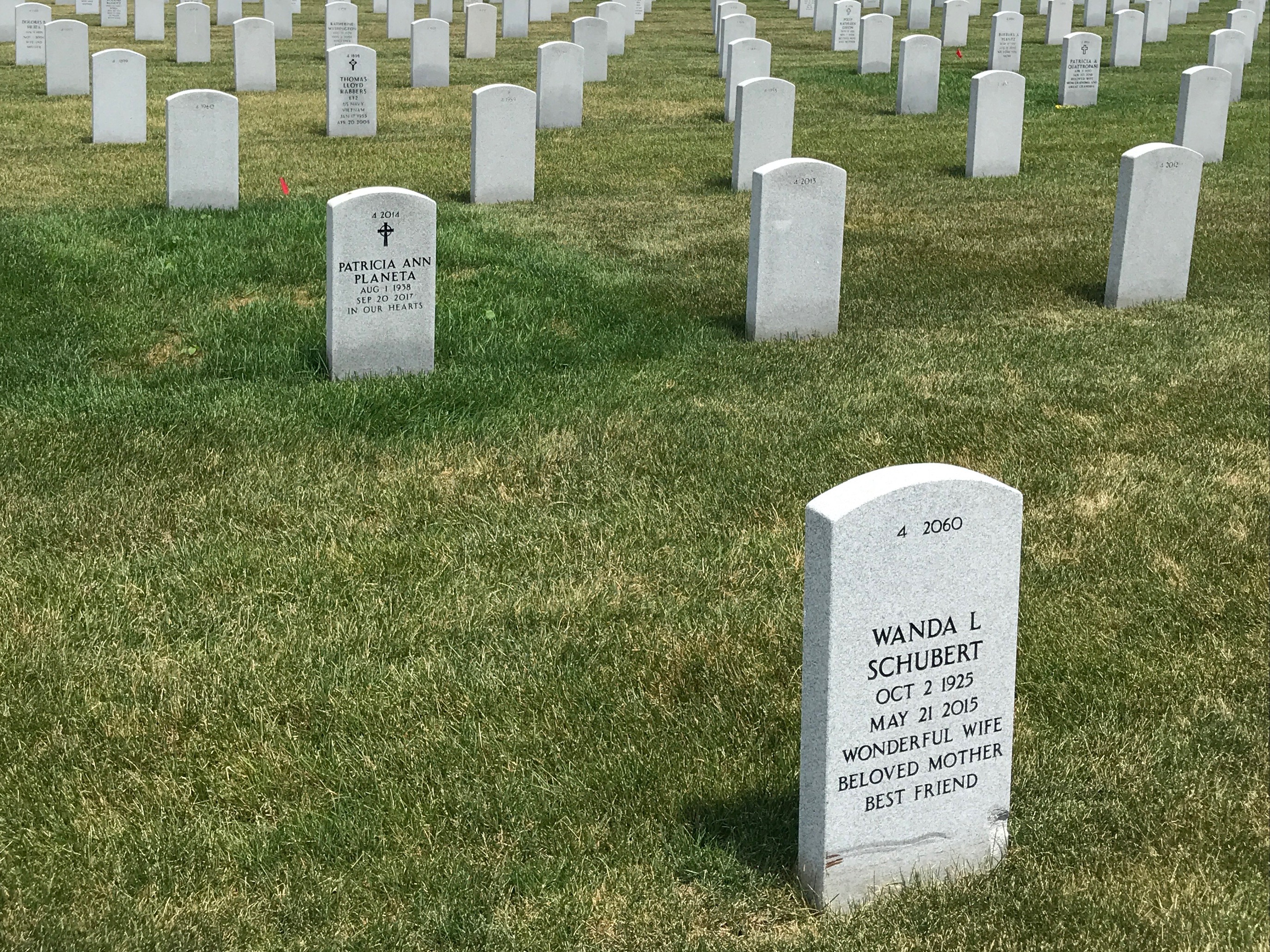
I think it’s nice that there is room for a brief message in addition to the identifying information.

I also appreciate the fact that spouses are buried together. Minor dependent children and, under certain conditions, unmarried adult children with disabilities may also be eligible for burial.

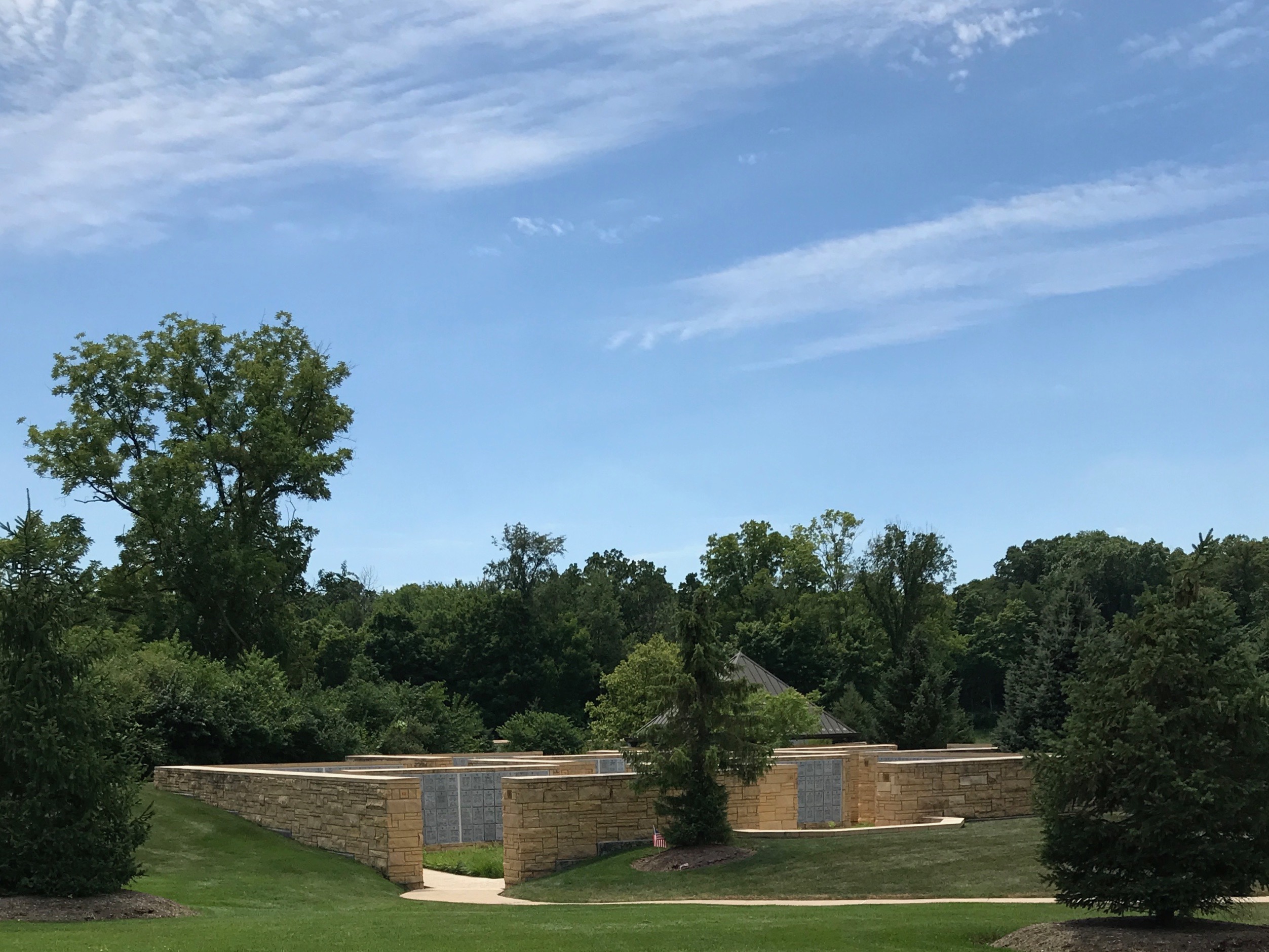
Space is also set aside for cremains in a Columbarium.

It was time to get on the road. I was eager to get home.

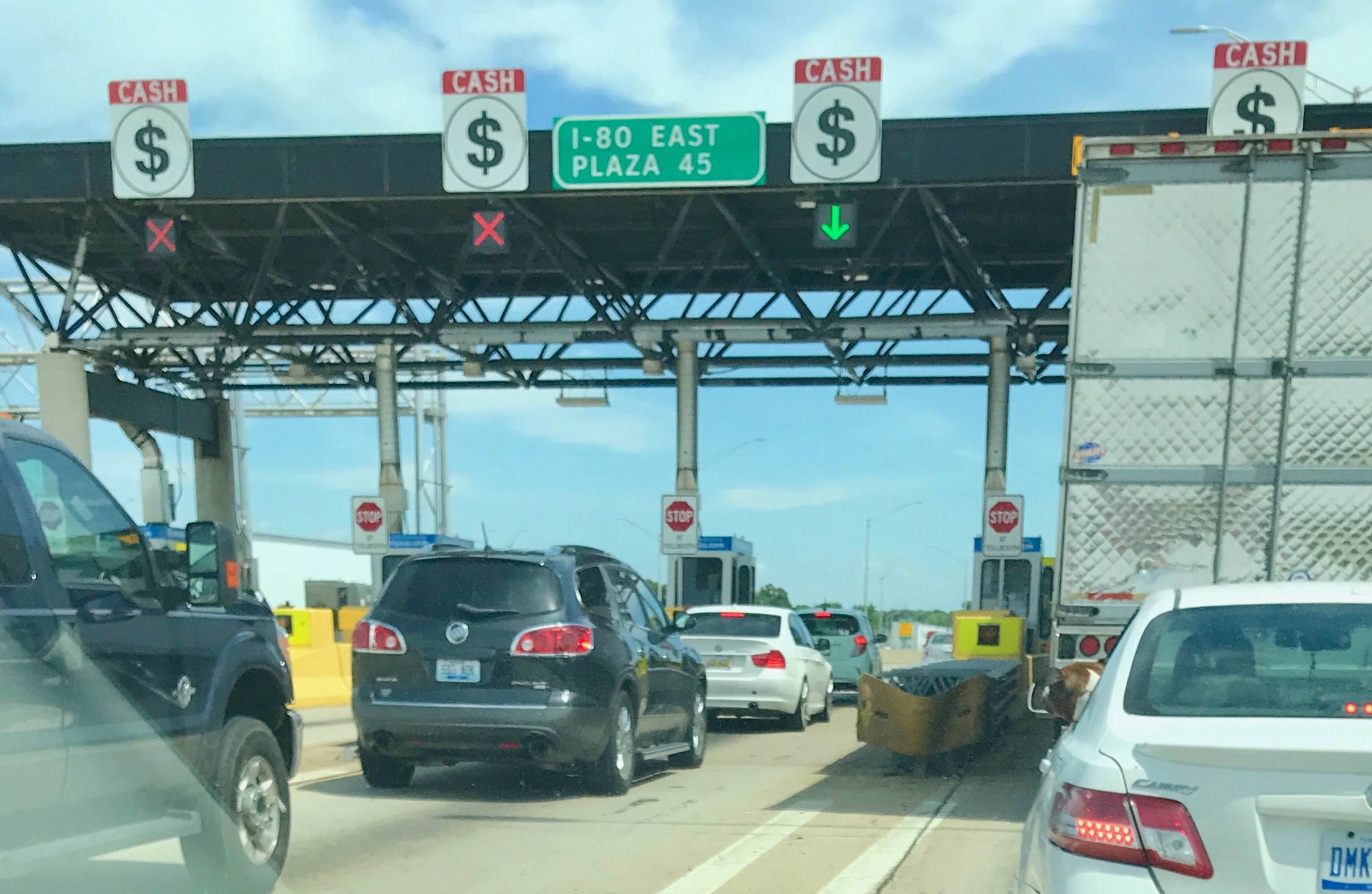
Drat! A toll!

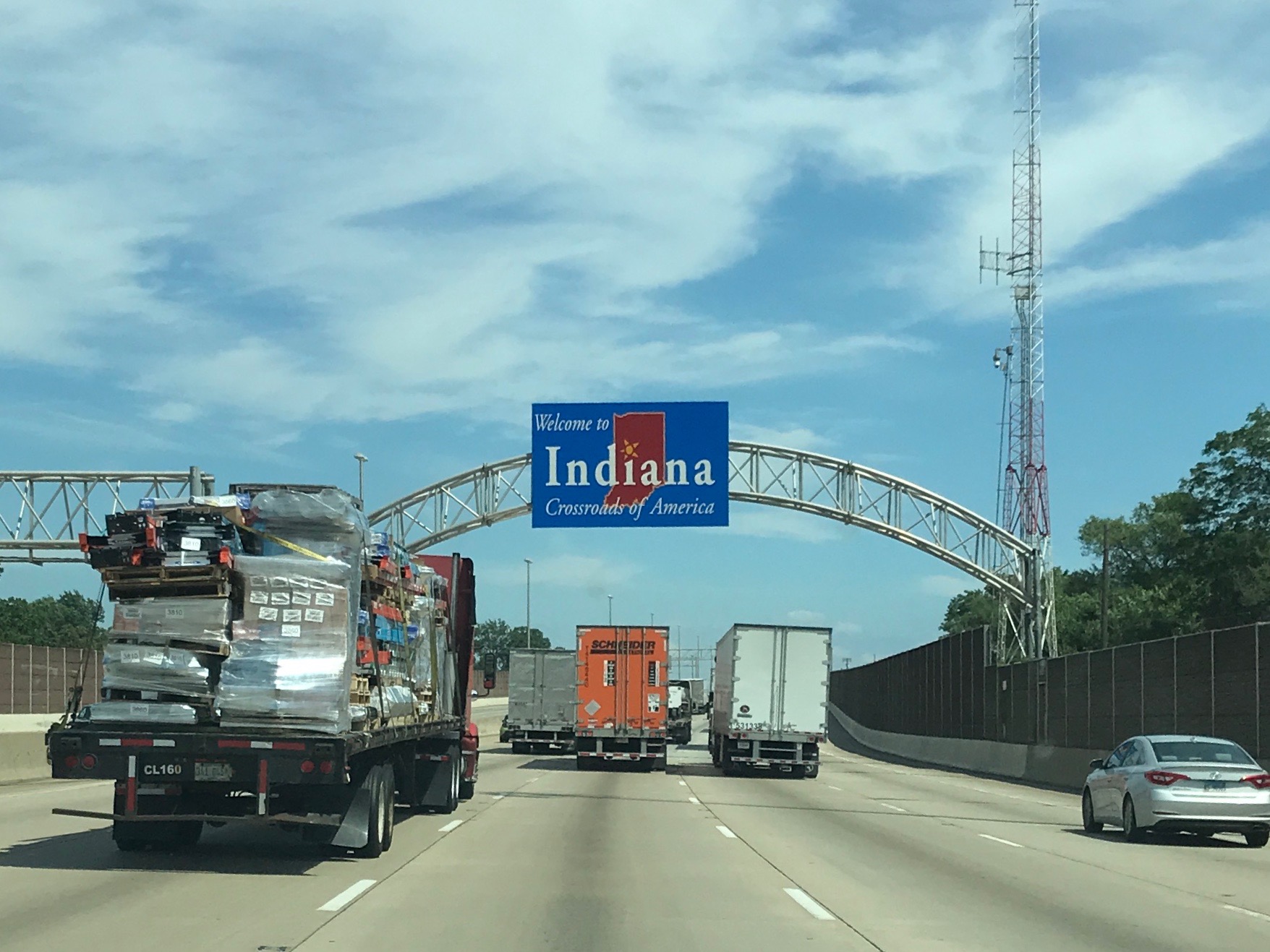
Finally! Indiana!

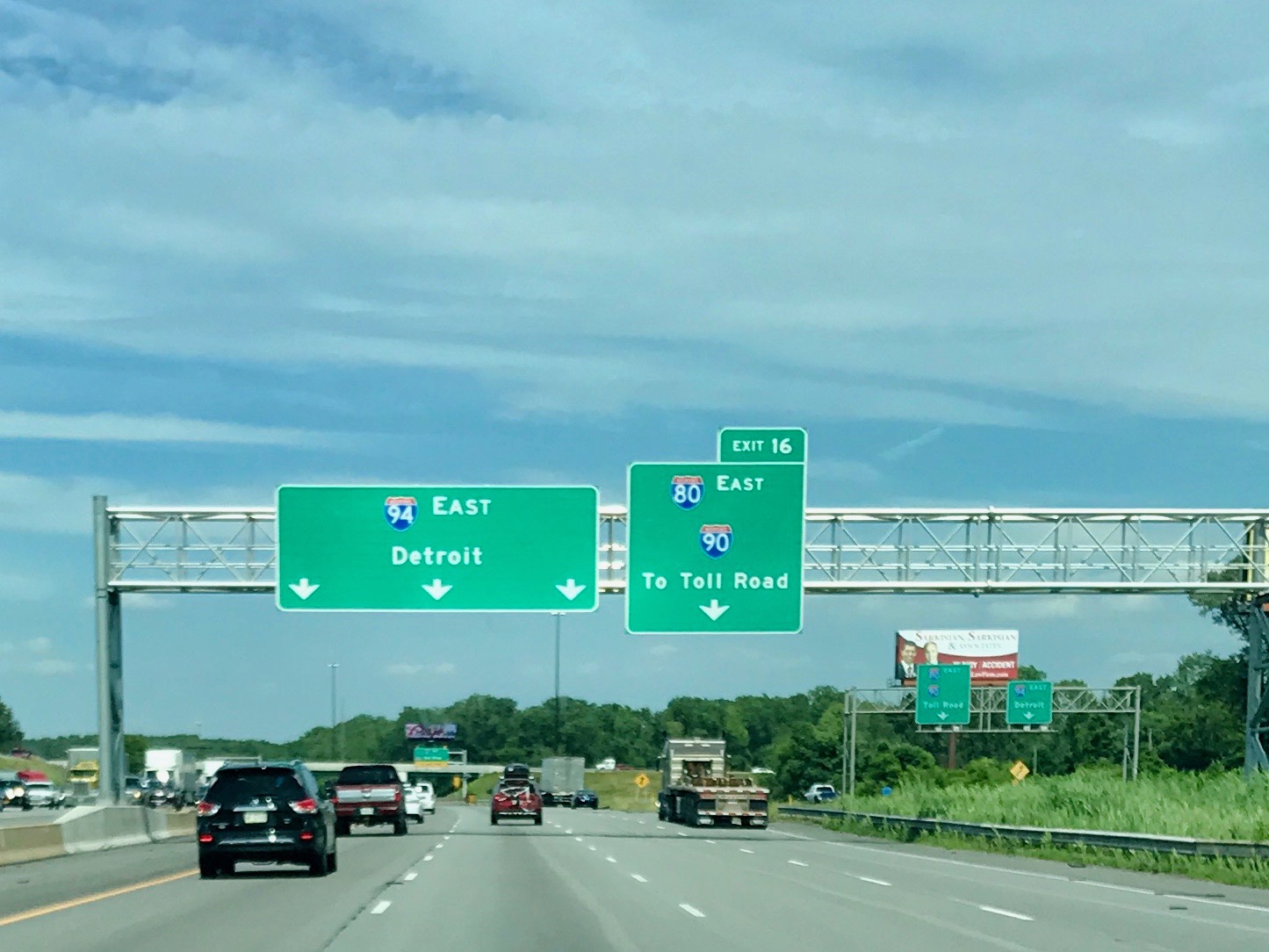
I-94! That is my Interstate!

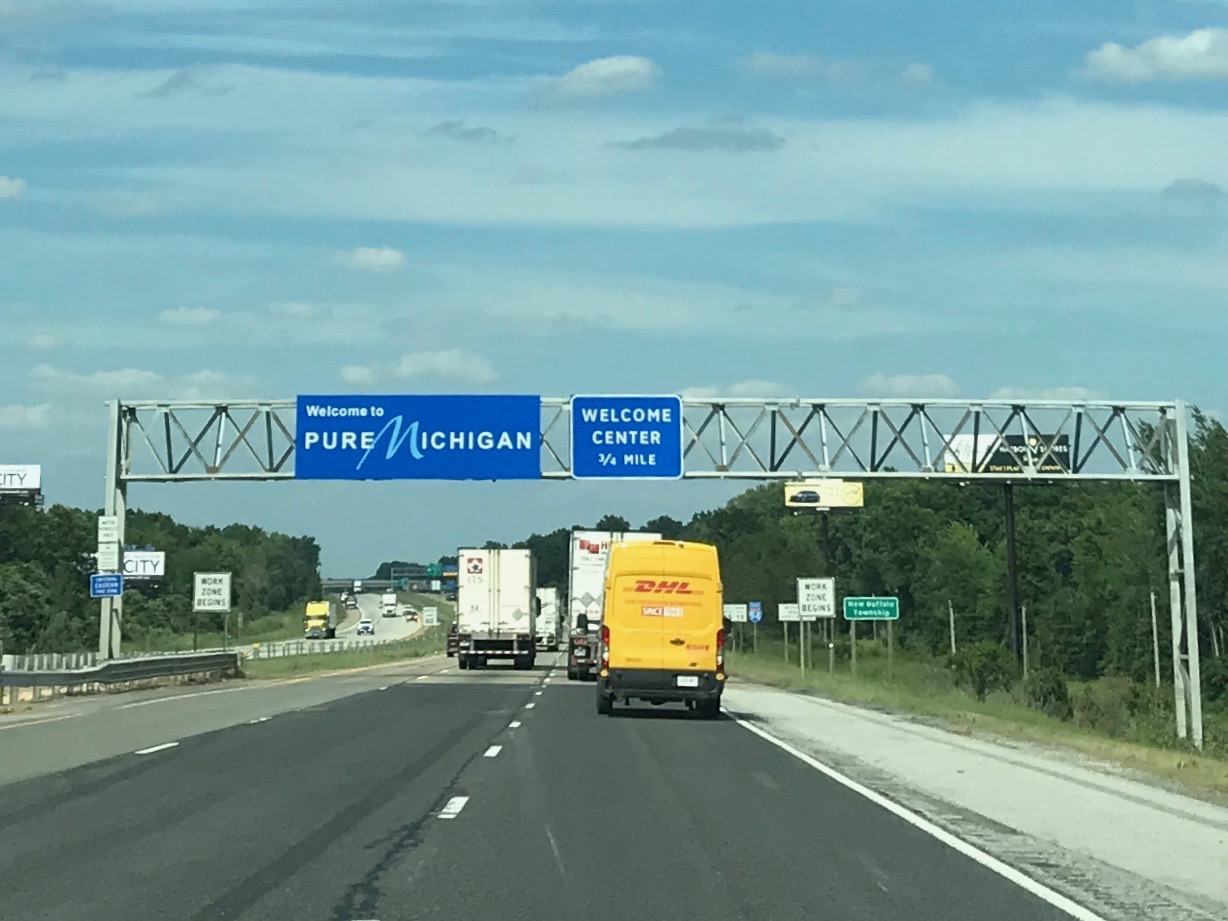
Michigan! Only about 75 miles to go!

Home!

And Cora!

We’ve got some serious cuddling to make up for!