The Great War.
The War to End War.
The War to End All Wars.
World War I.
Kansas City is home to The National World War I Museum and Memorial. It tells the story of the story of The Great War from the seeds of the conflict to the 1918 armistice to the 1919 Paris Peace Conference. I was taught that the assassination of Archduke Ferdinand was the reason behind World War I, but it was more complex than that. The demands from Austria-Hungary for impossibly large reparations from Serbia lead them to declare war on Serbia. A complex web of alliances was activated as Russia declared war on Austria-Hungary, Germany declared war on Russia and France and Britain declared war on Germany and Austria-Hungary.
World War I had begun.
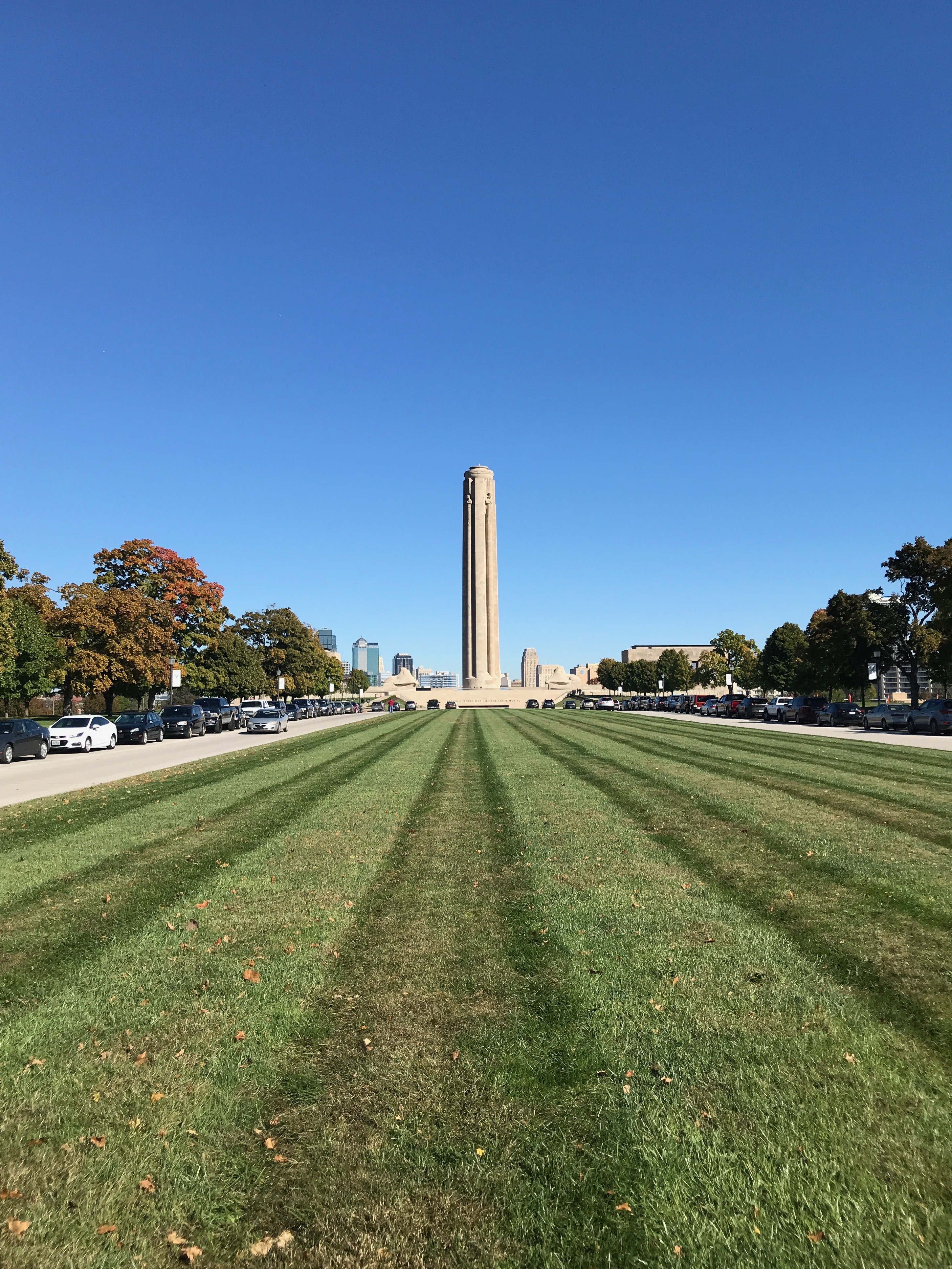
On this glorious October day in 2019, I was going to visit the Memorial and Museum. The Liberty Tower rises above the complex. It’s 217 feet tall, and I’m told that at night the tower displays a “flame effect” that is created by steam illuminated by bright red and orange lights. I’ll bet that’s something to see. It’ll have to go on the “The List” for next time.
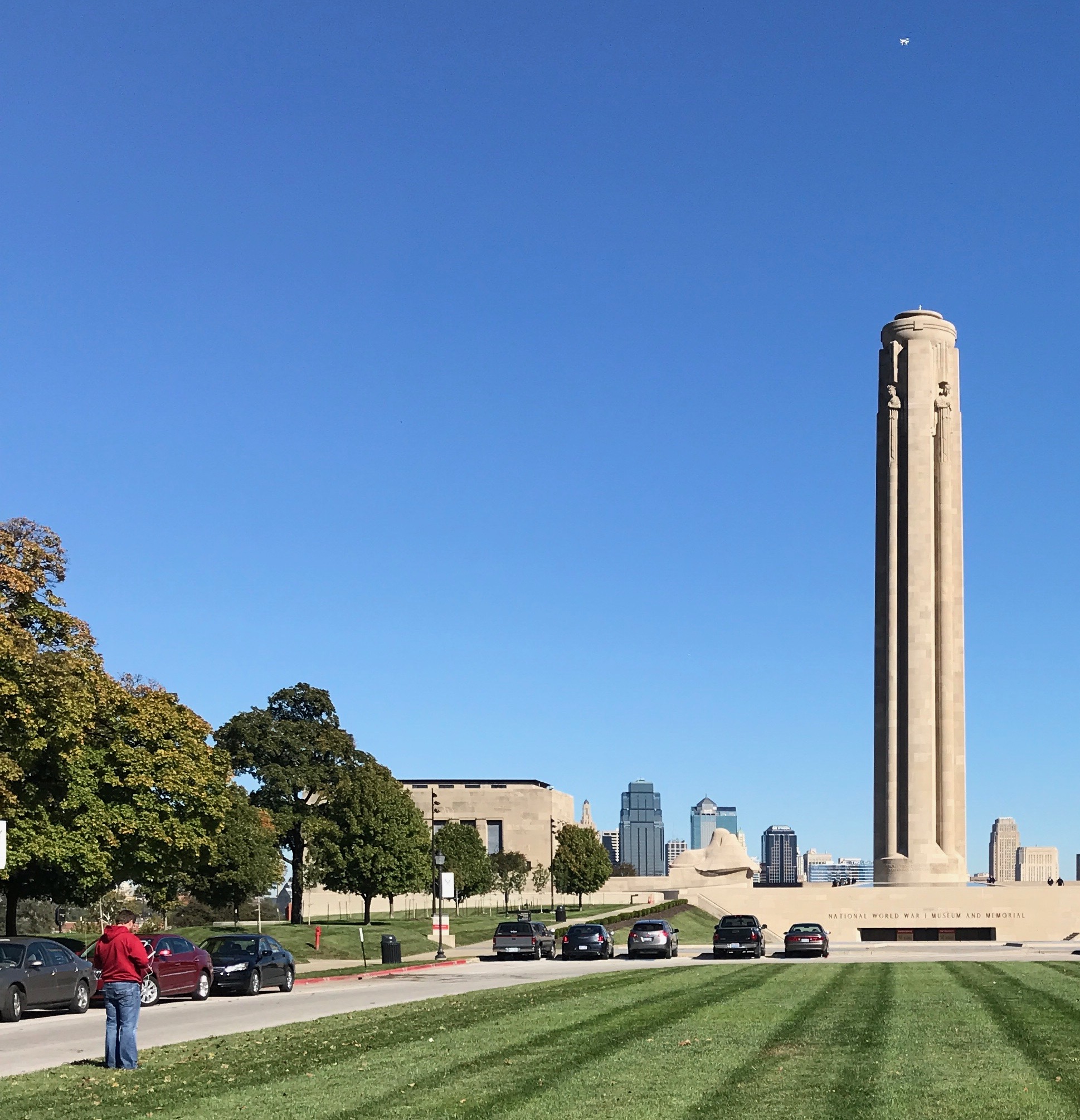
I parked and walked closer. I found a person flying his drone.
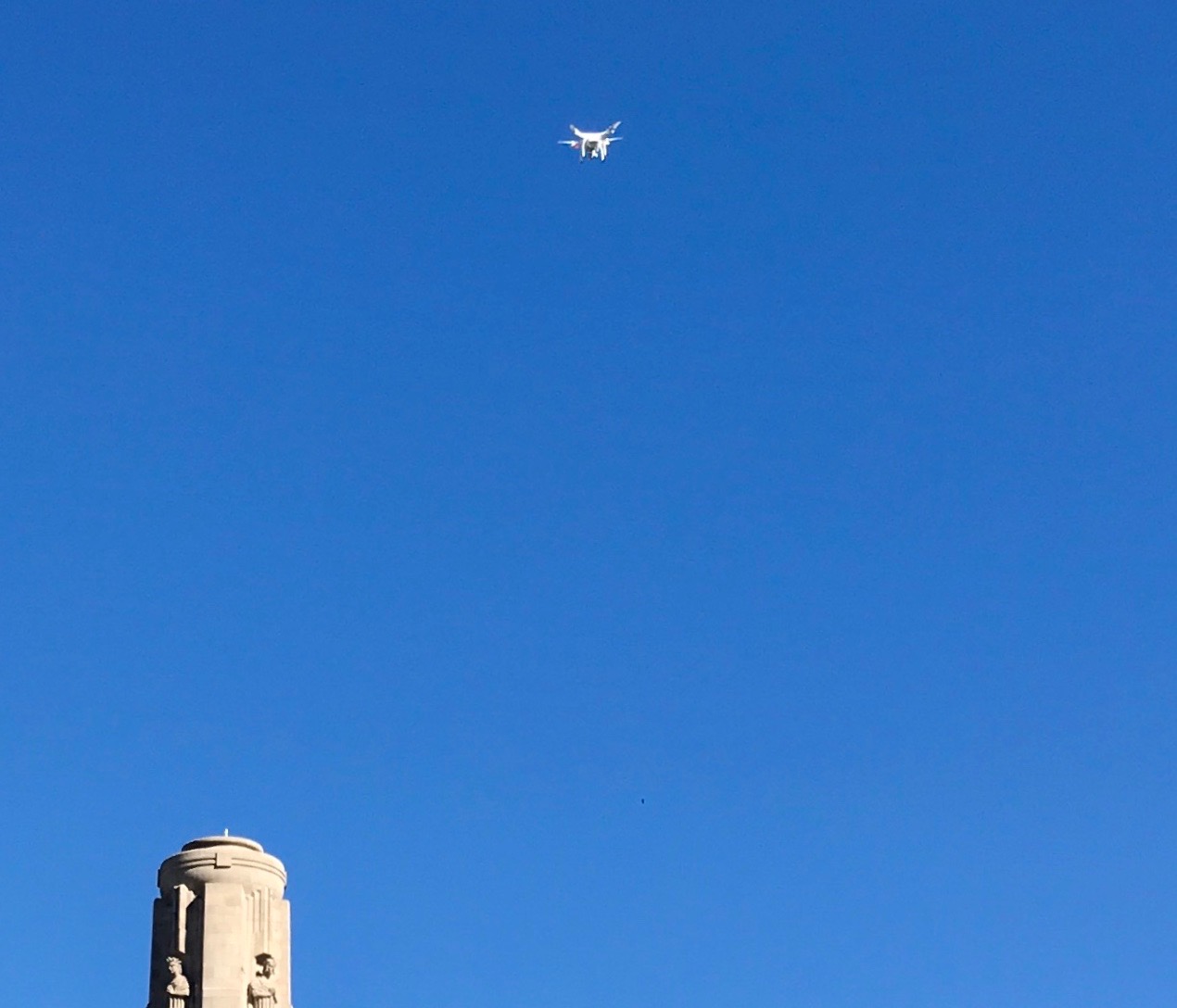
Look! Up in the sky! It’s a bird! It’s a plane!
No, just a drone. I stopped and talked with him for a bit, and asked him if it he could see if it was crowded on top of the tower. He said it wasn’t.
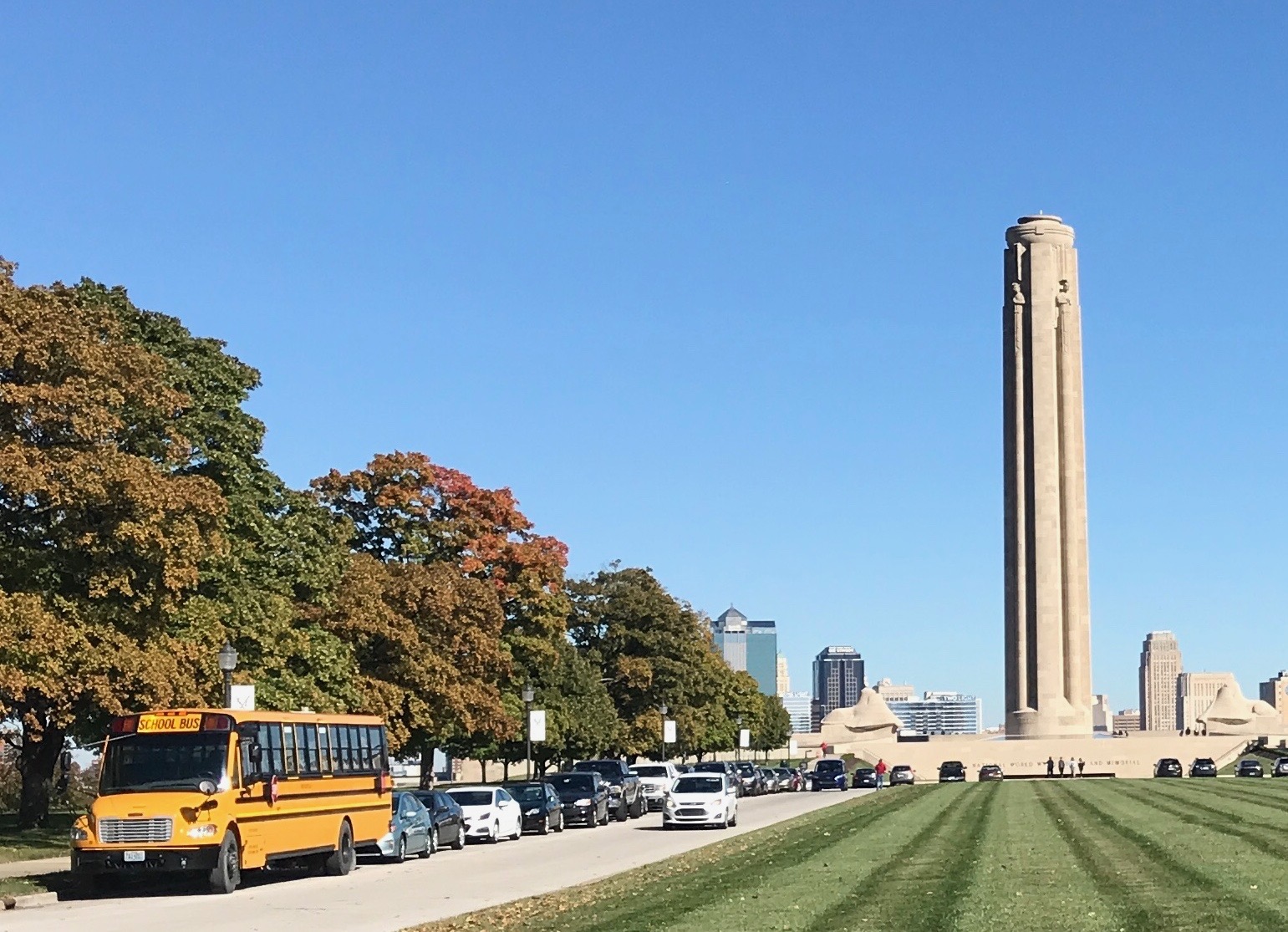
You see that yellow thing on the left side of the photo? I was afraid that the Memorial and Museum might be filled with {shudder} students on field trips!
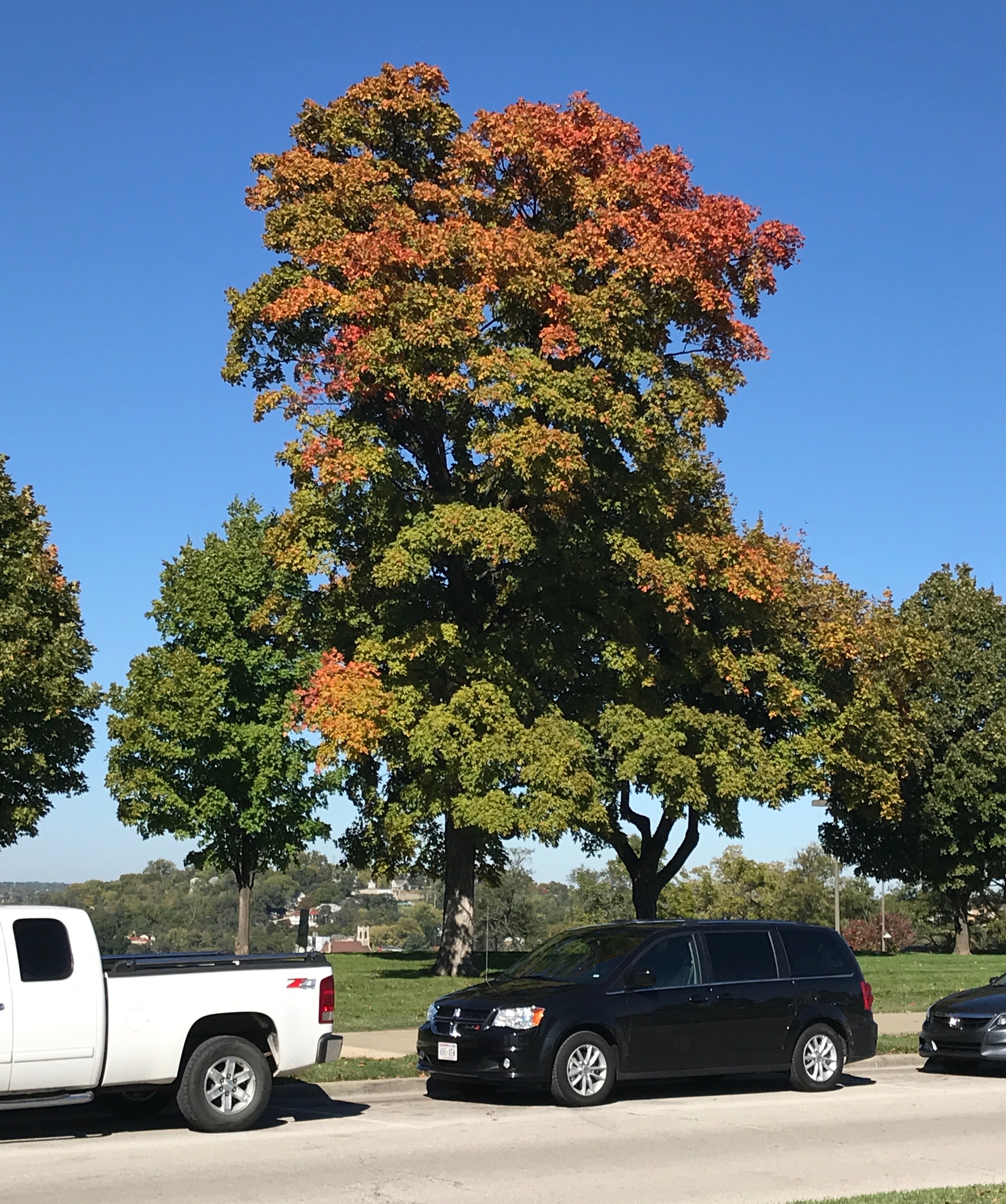
What a perfect day to be out and about! You can see the fall colors starting to decorate the trees.
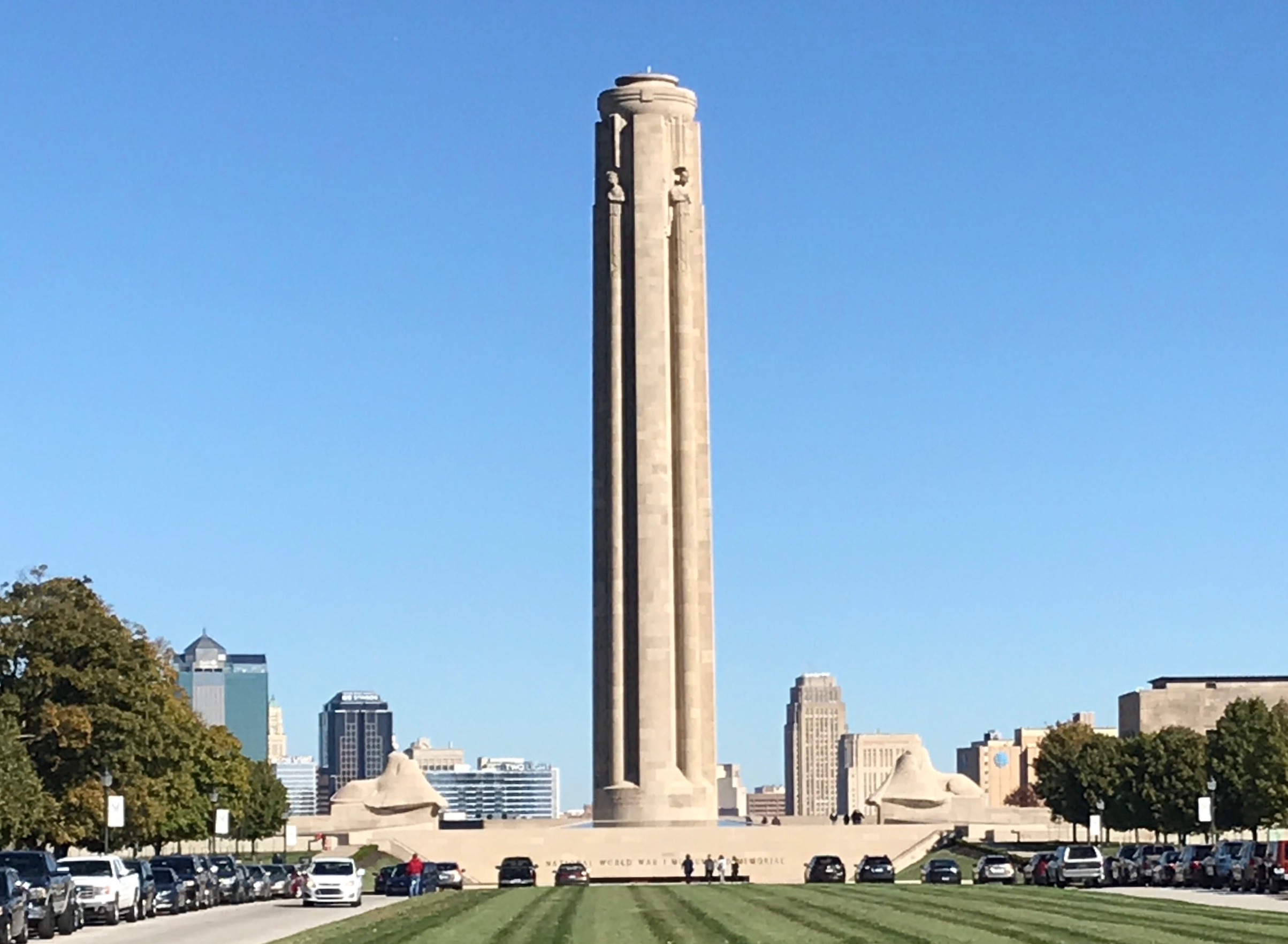
I kept walking and got closer…
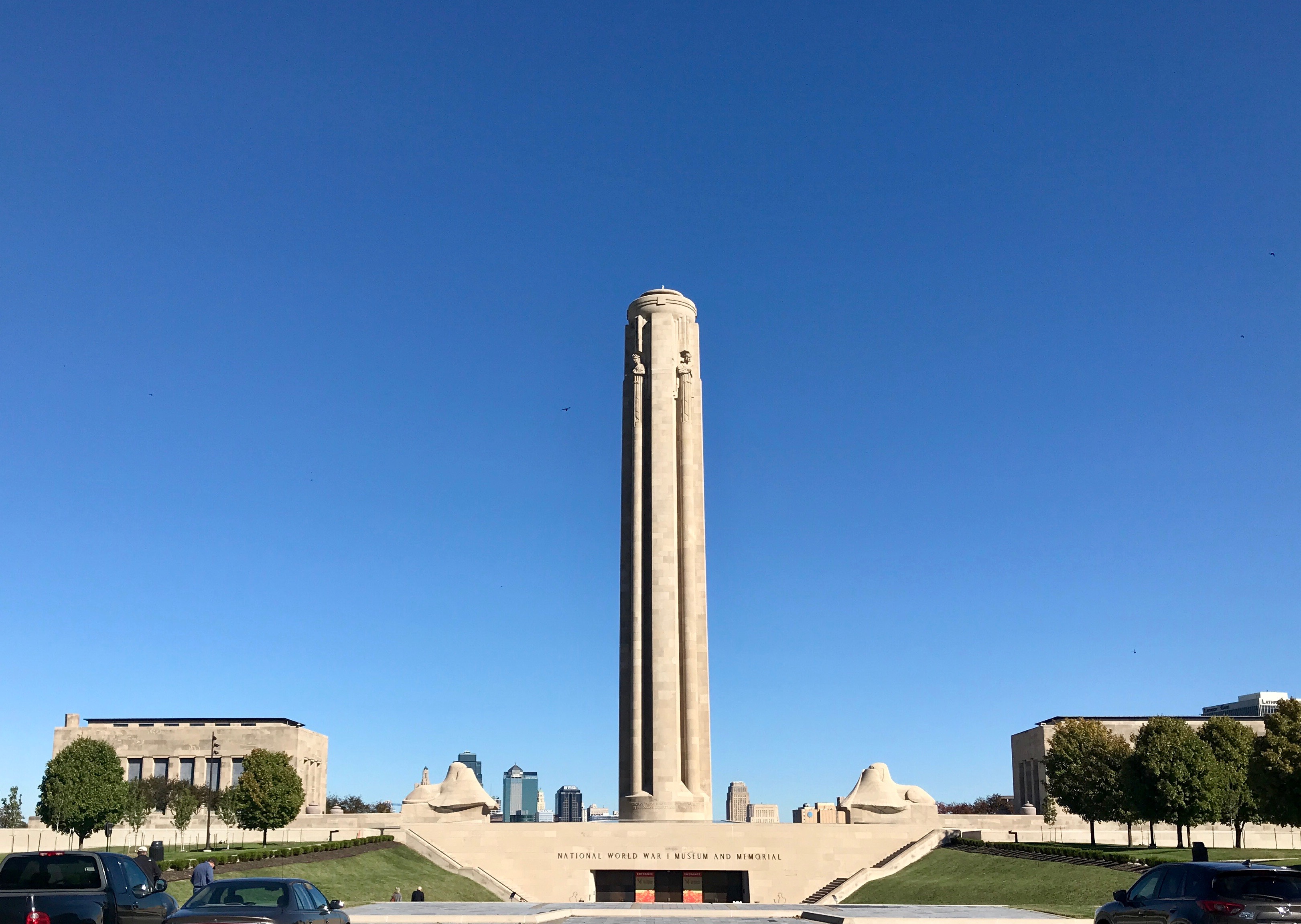
…and closer. Finally, the entrance was in sight.
The walk into the Museum was paved with blocks honoring people who served. I found this one for Thomas J. Hurst to be particularly poignant.
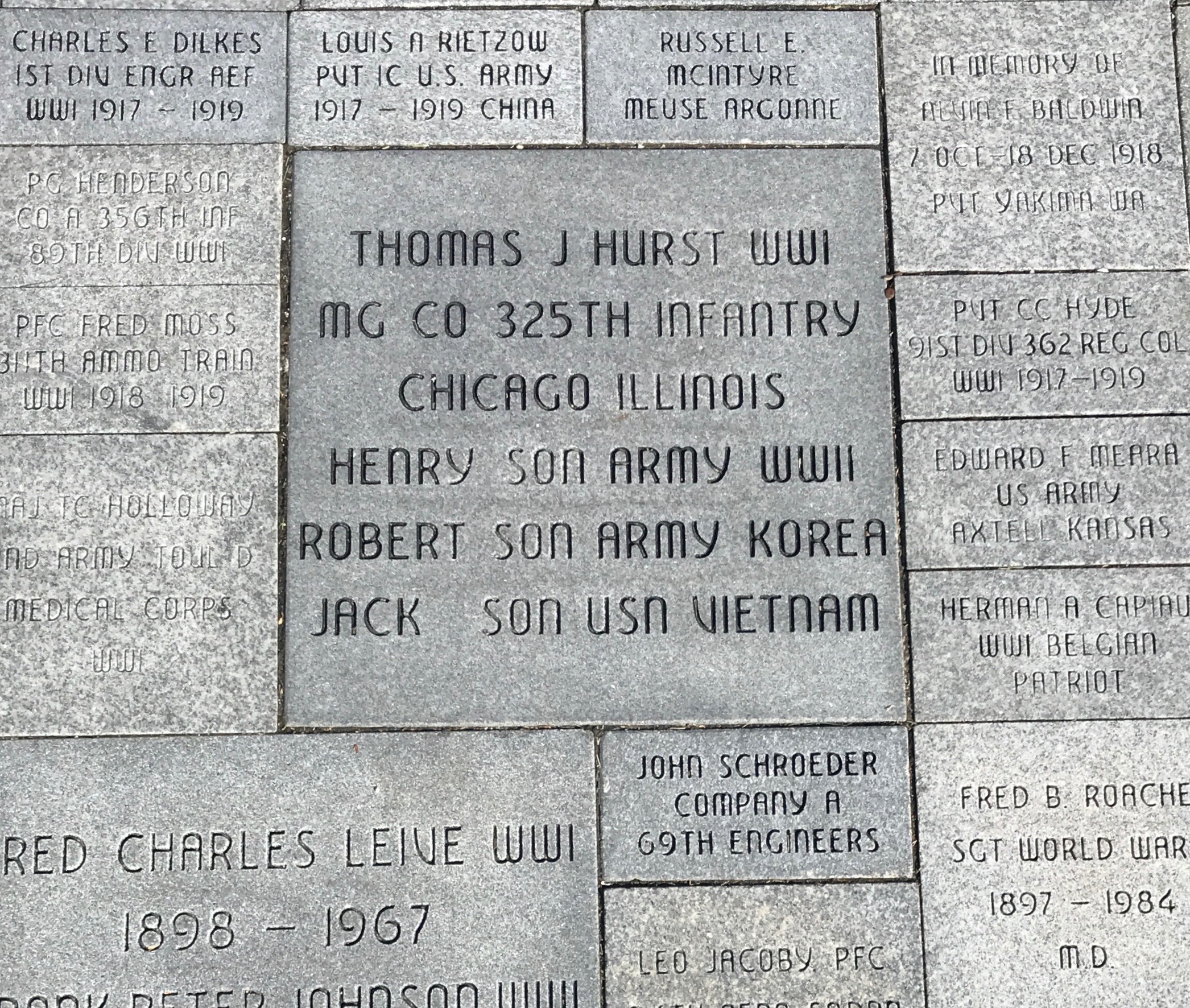
He served in World War I – the War to End All Wars. His sons served in World War II, Korea and Vietnam.
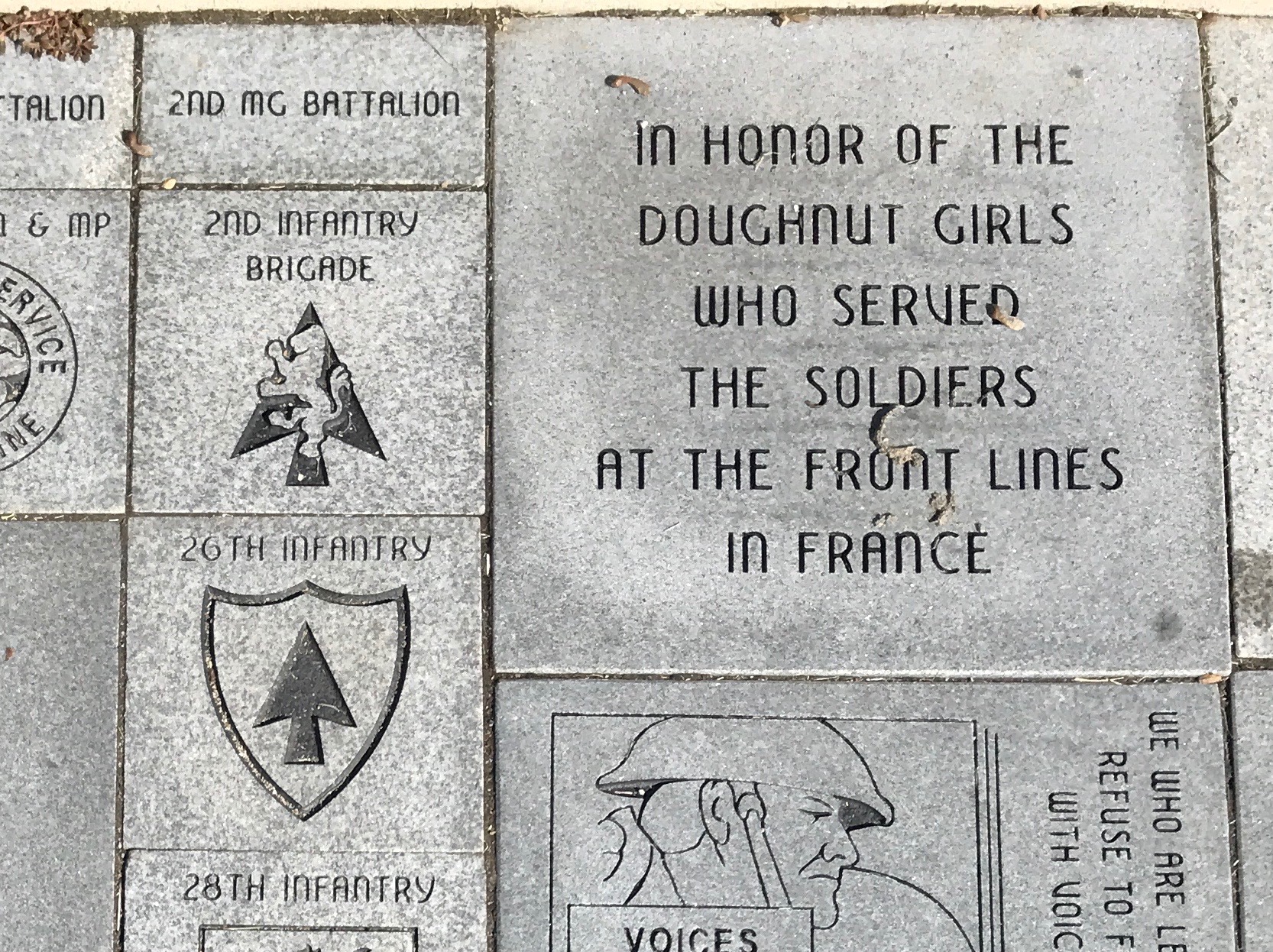
I appreciated this one in honor of the Doughnut Girls. If you are interested in learning more about their service, Smithsonian Magazine has an interesting article.
Fun fact: We have The Doughnut Girls to thank for National Doughnut Day, which is held yearly on the first Friday of June.
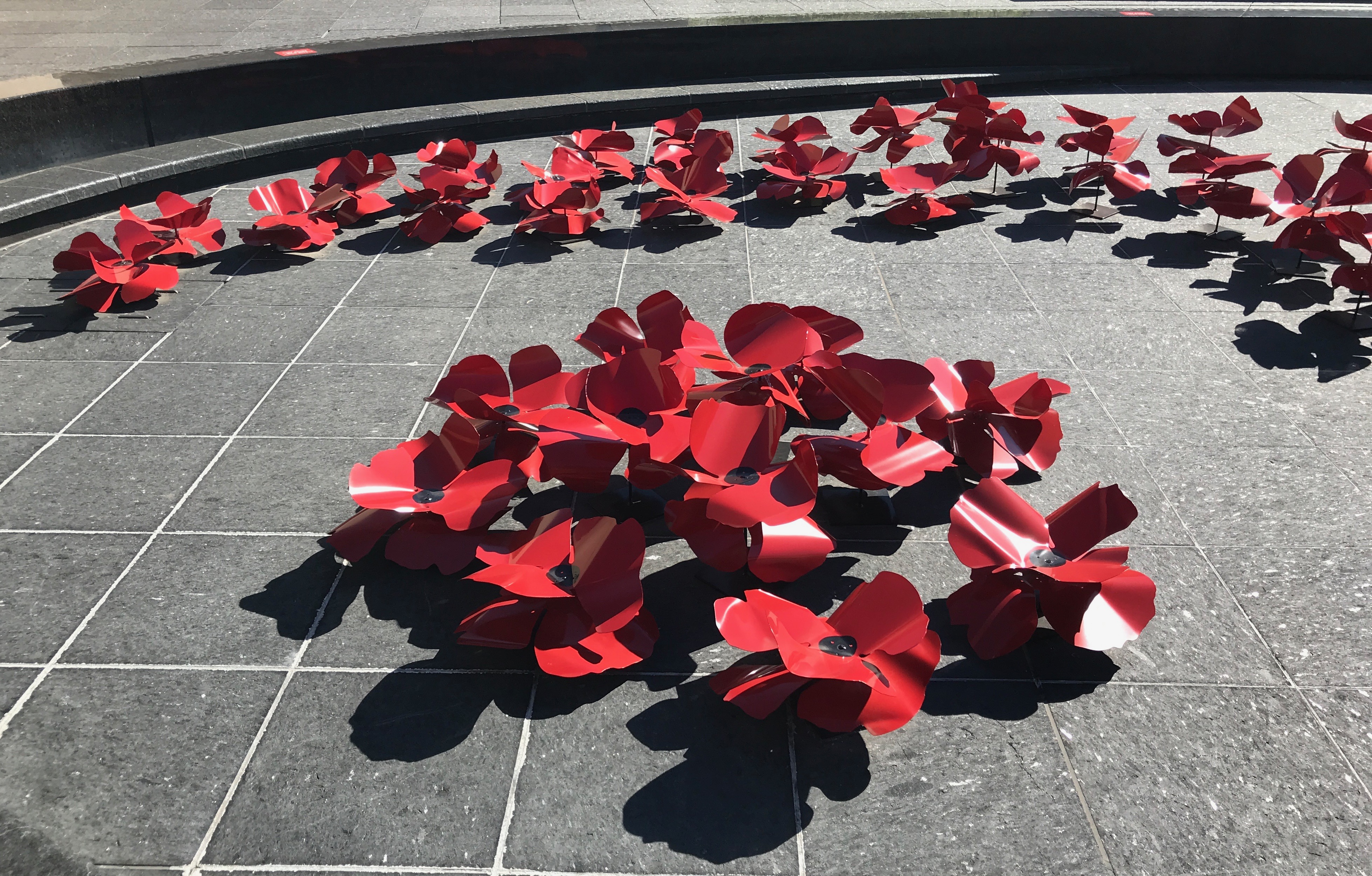
I continued on. Right in front of the entrance is “Reflections of Hope – Armistice 1918.” I imagine that it is spectacular when there is water in the reflecting pool. Altogether, there are 117 metal poppies. Each poppy represents 1,000 American lives lost, but not forgotten.
Why poppies?
Poppies have come to be a symbol for World War I. It is based on Lieutenant-Colonel John McCrae’s poem, “In Flanders Fields.”
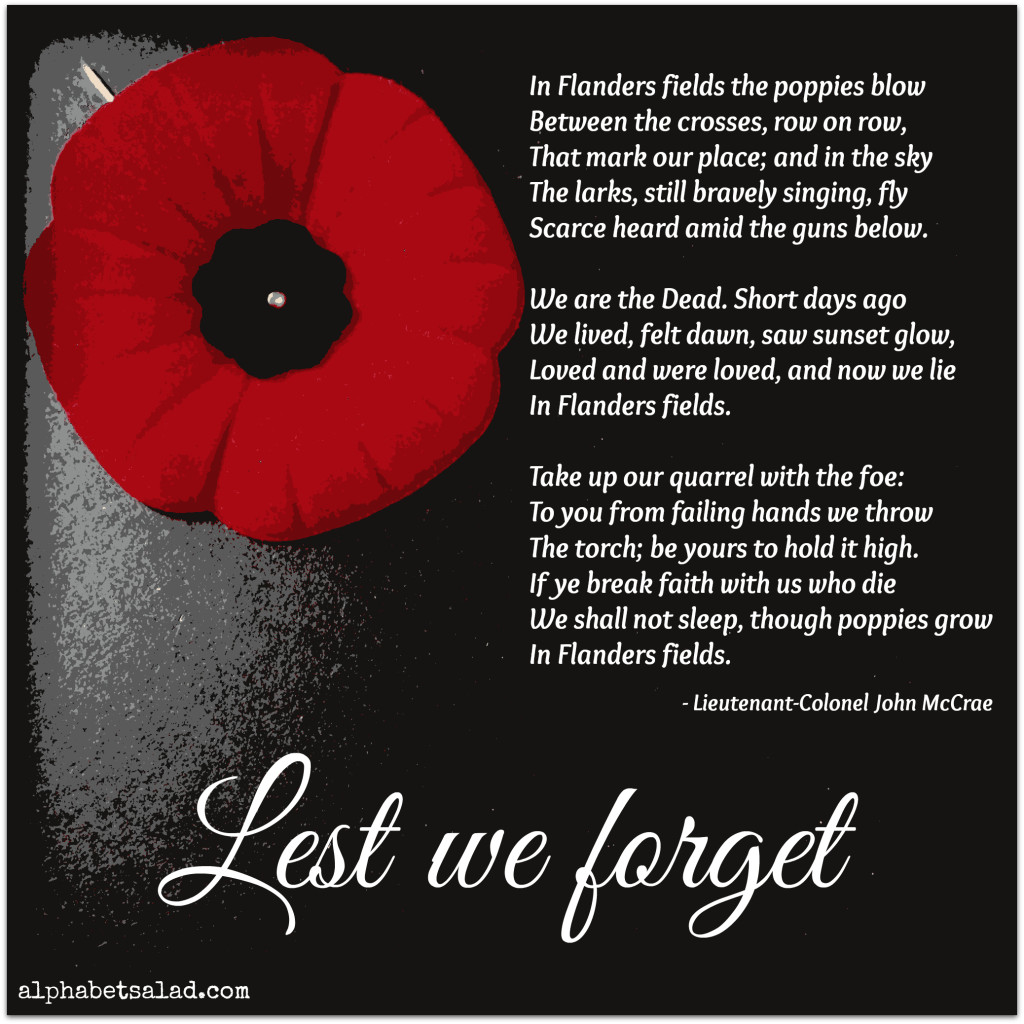
This is my favorite poem, and I loved some of the projects I did with my students “back in the day.”
John McCrae was worn in 1872 in Guelph, Ontario, which is about 100 miles from my hometown, Buffalo, NY. He was a medical doctor, and fought in the South African War before starting his practice. When Germany declared war on Britain in 1914, he joined up immediately. He was a medical officer with the First Brigade of the Canadian Field Artillery.
On August 4, 1914, Britain declared war on Germany. Canada, as a member of the British Empire, was automatically at war, and its citizens from all across the land responded quickly. 45,000 Canadians rushed to join up within three weeks. John McCrae was among them. He was appointed a medical officer with the First Brigade of the Canadian Field Artillery with the rank of Major and second-in-command. Unfortunately, he was a casualty of the war. He died of pneumonia.
While two out of three soldiers died in battle, the rest died due to infections or disease. The Spanish flu pandemic also killed many in prisoner camps
But, back to the Memorial and Museum.
I entered and bought my tickets to the museum and to the tower. As long as I was here, I figured I ought to see both. They advised me that I ought to do the tower first, as the school group would be going up later. They didn’t need to tell me twice!
I took the elevator up to the plaza level.
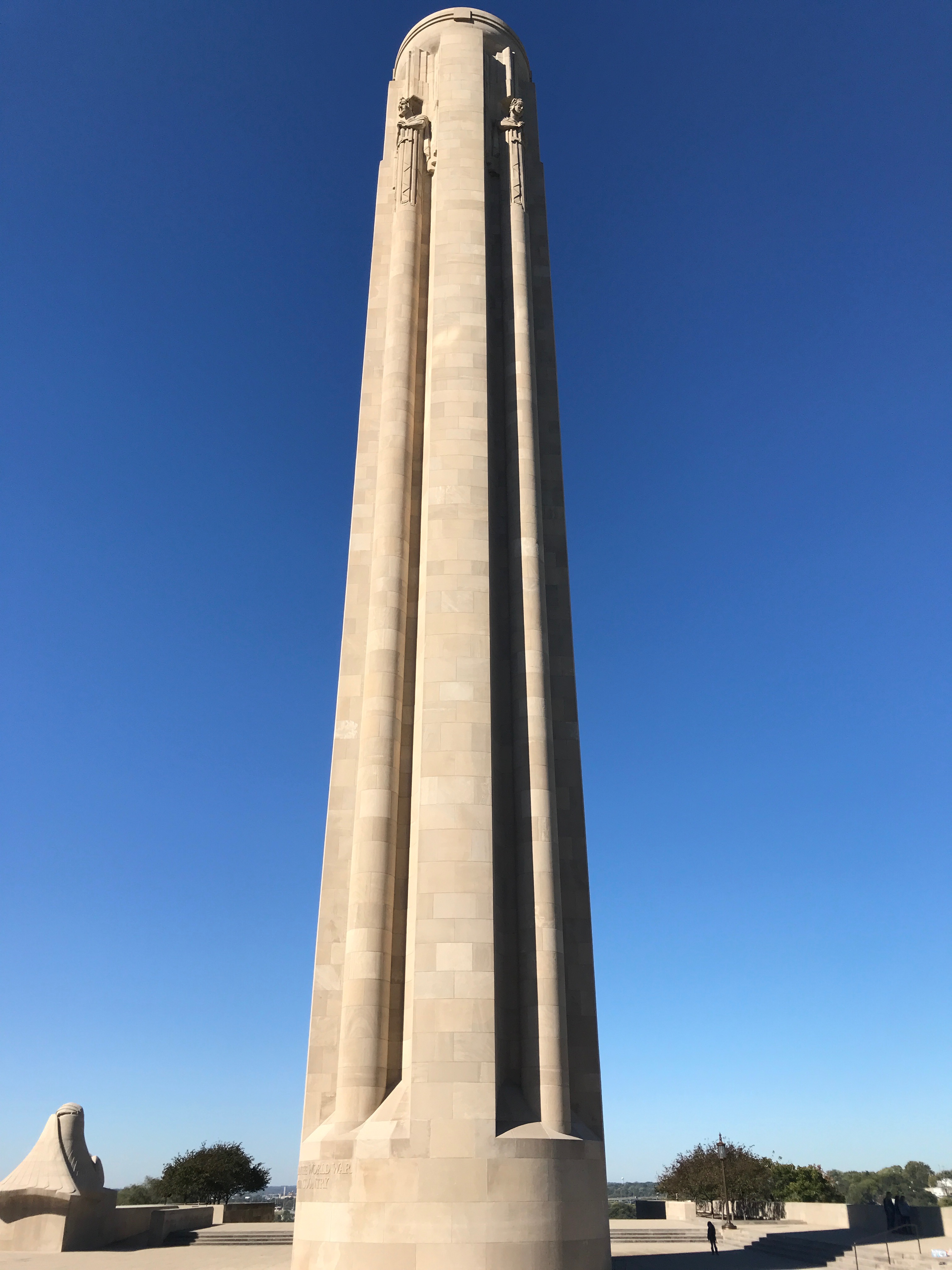
That person on the right side of the tower gives you some idea of the size of the structure.
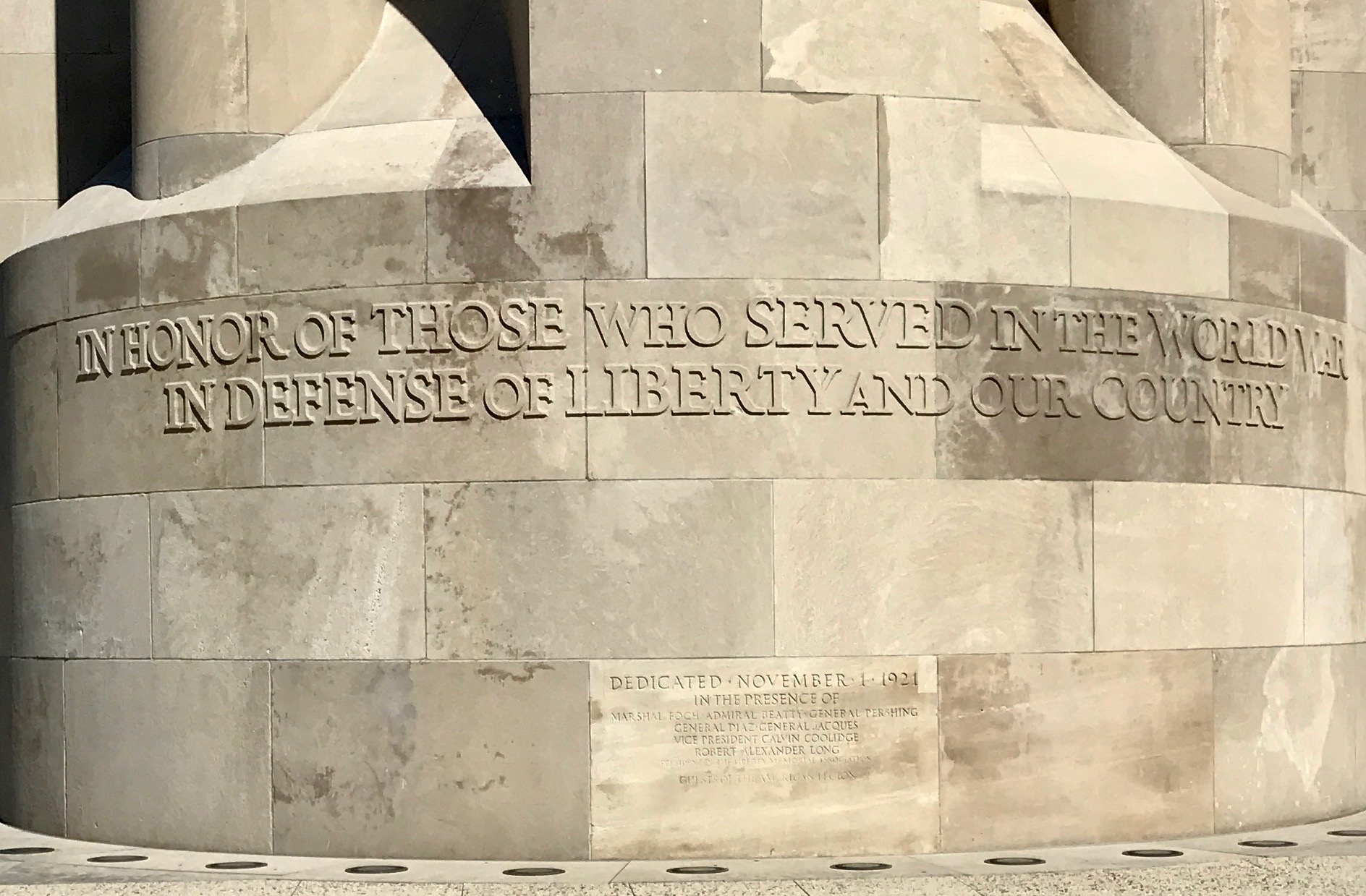
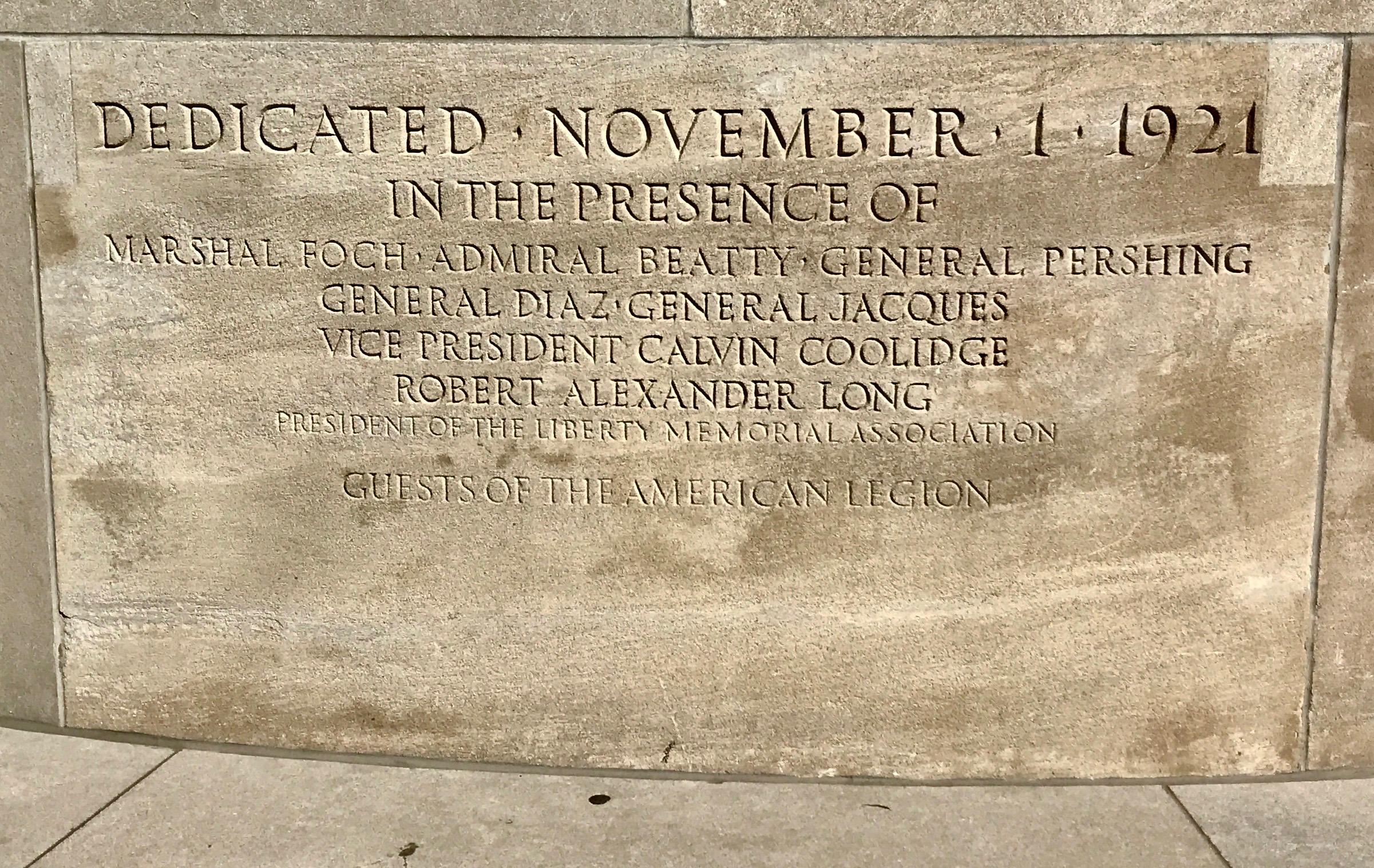
Warren G. Harding was president at that time, having taken the reins from Woodrow Wilson in March 1921. According to my Preferred Source, during his time in office, he was one of the most popular U.S.Presidents up to this point. It rather puzzles me as to why he was not in attendance at the dedication. Maybe back in those days, presidents stayed in Washington and attended to the business of running the country.
Harding did send his vice president, Calvin Coolidge. Interestingly enough, future president Harry S. Truman was also there, along with 60,000 members of the American Legion. He was chosen to present flags to the commanders that were present. In all, 200,000 people were in attendance at the dedication.
I was glad to be going up before the tour. I don’t think it would be much fun to be on top of that relatively small space with a bunch of kids.
I got in the very small elevator in the tower and rode up to the top.
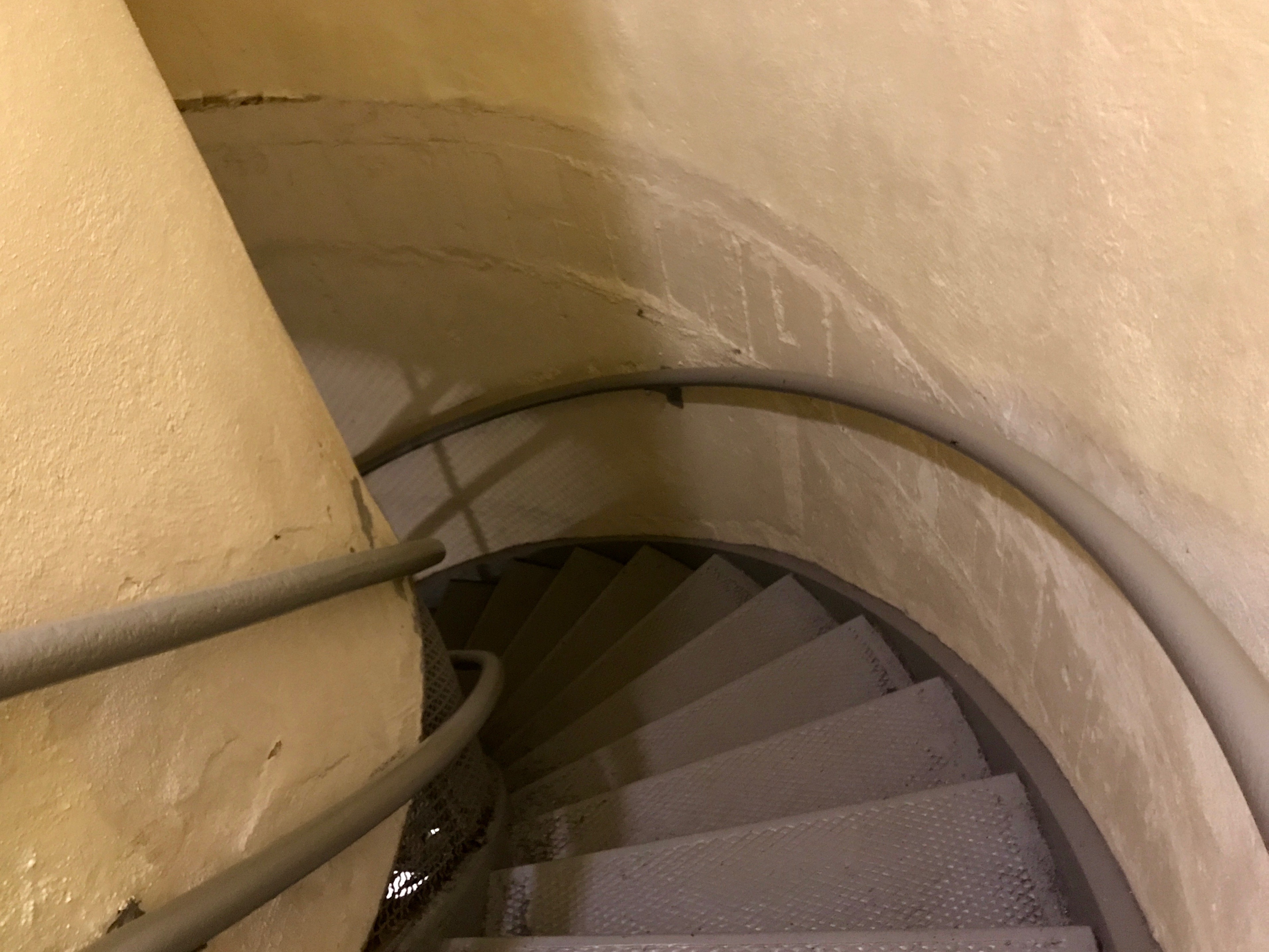
I walked up the 45 steps to the Observation Deck and turned around to take a photo of the stairs. (If there isn’t a photo, it didn’t happen.)
Then out to Observe.
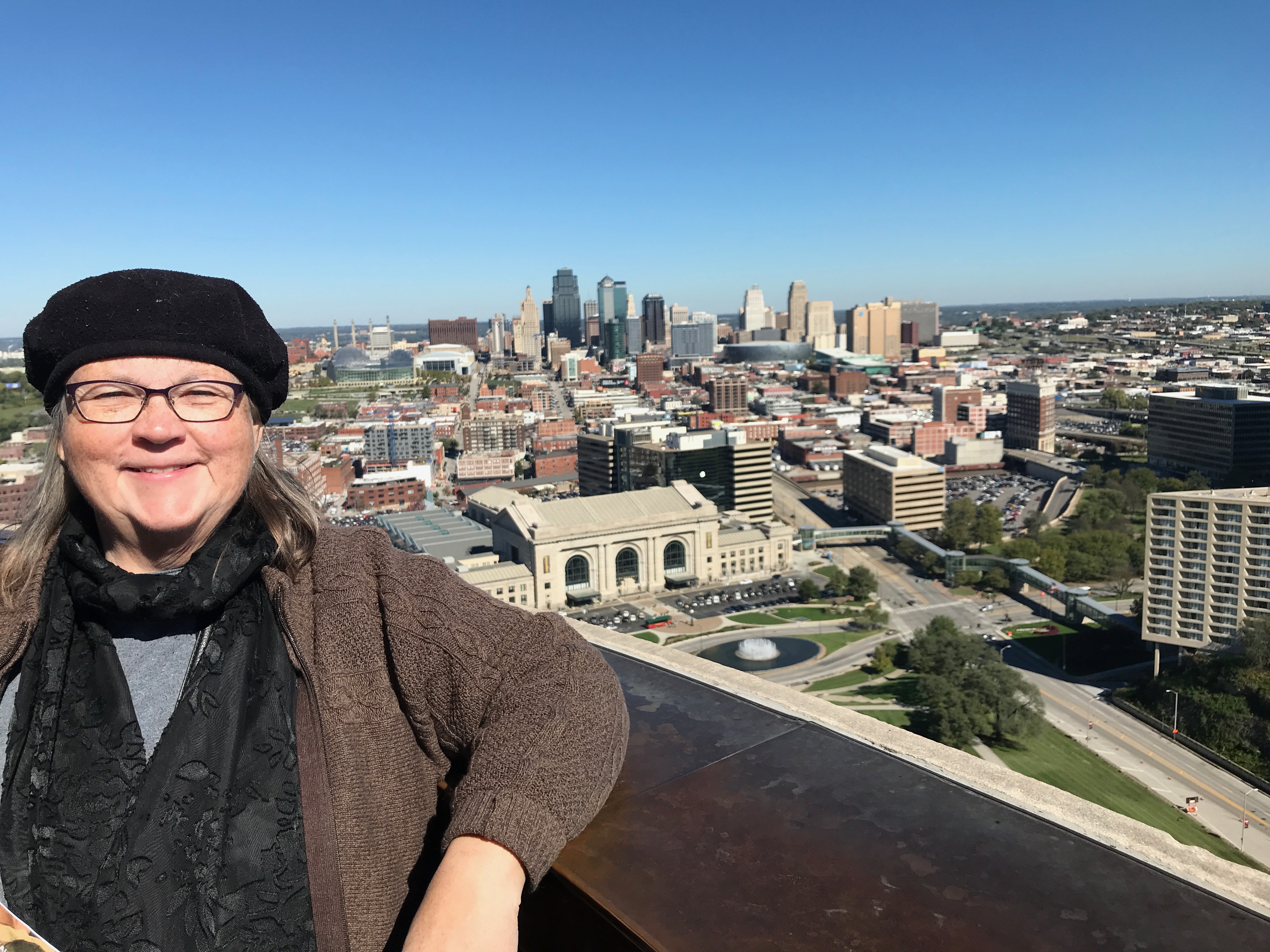
There’s a photo, so you can tell I really did spring for the elevator trip to the top of Liberty Tower. That’s Union Station in the background. It’s one of those repurposed train stations that so many of our cities have, but are no longer transportation hubs. The website for Union Station describes it as a “hub of culture, education and entertainment.” I might visit it one of these days.
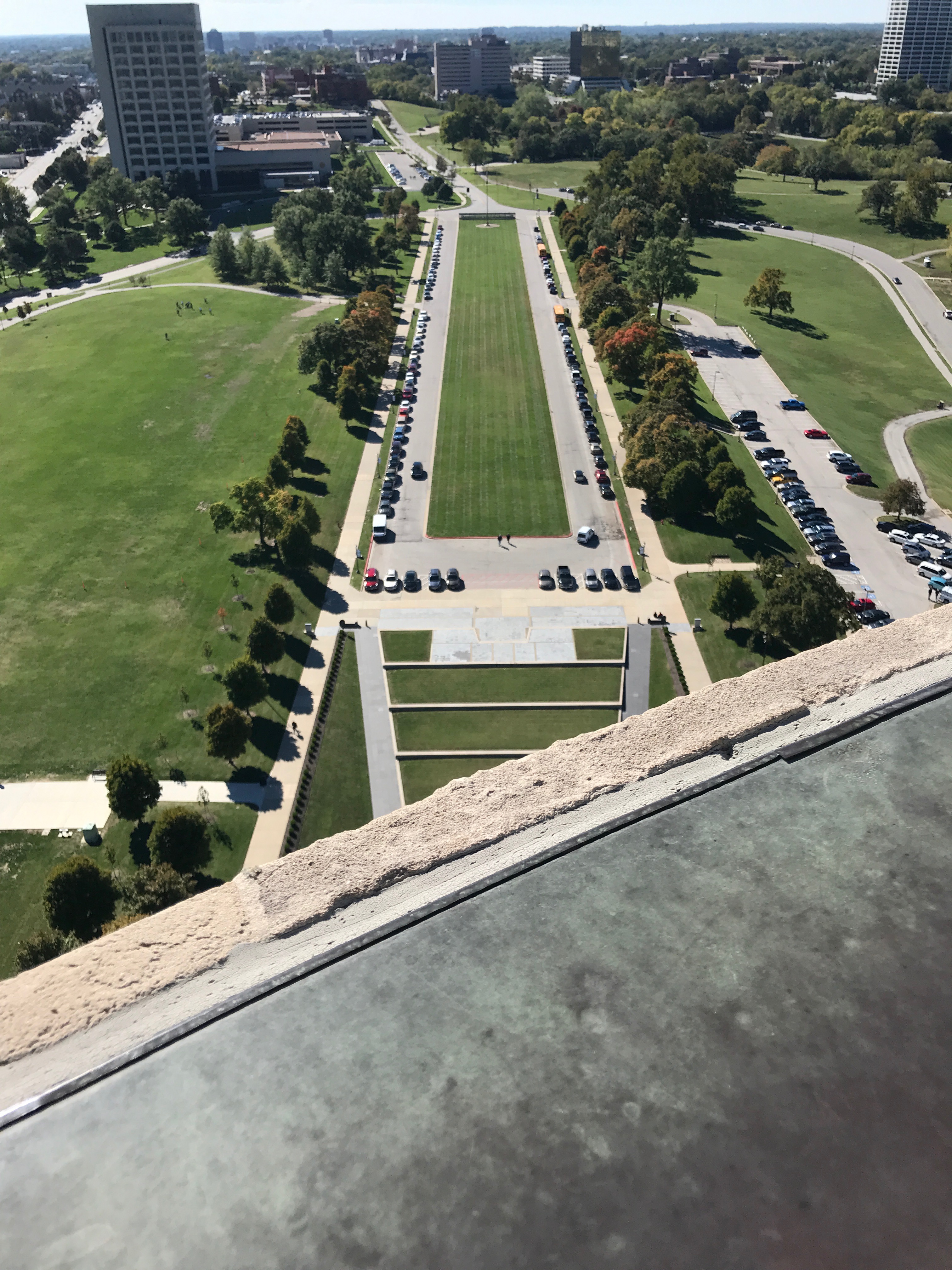
My car is down there somewhere.
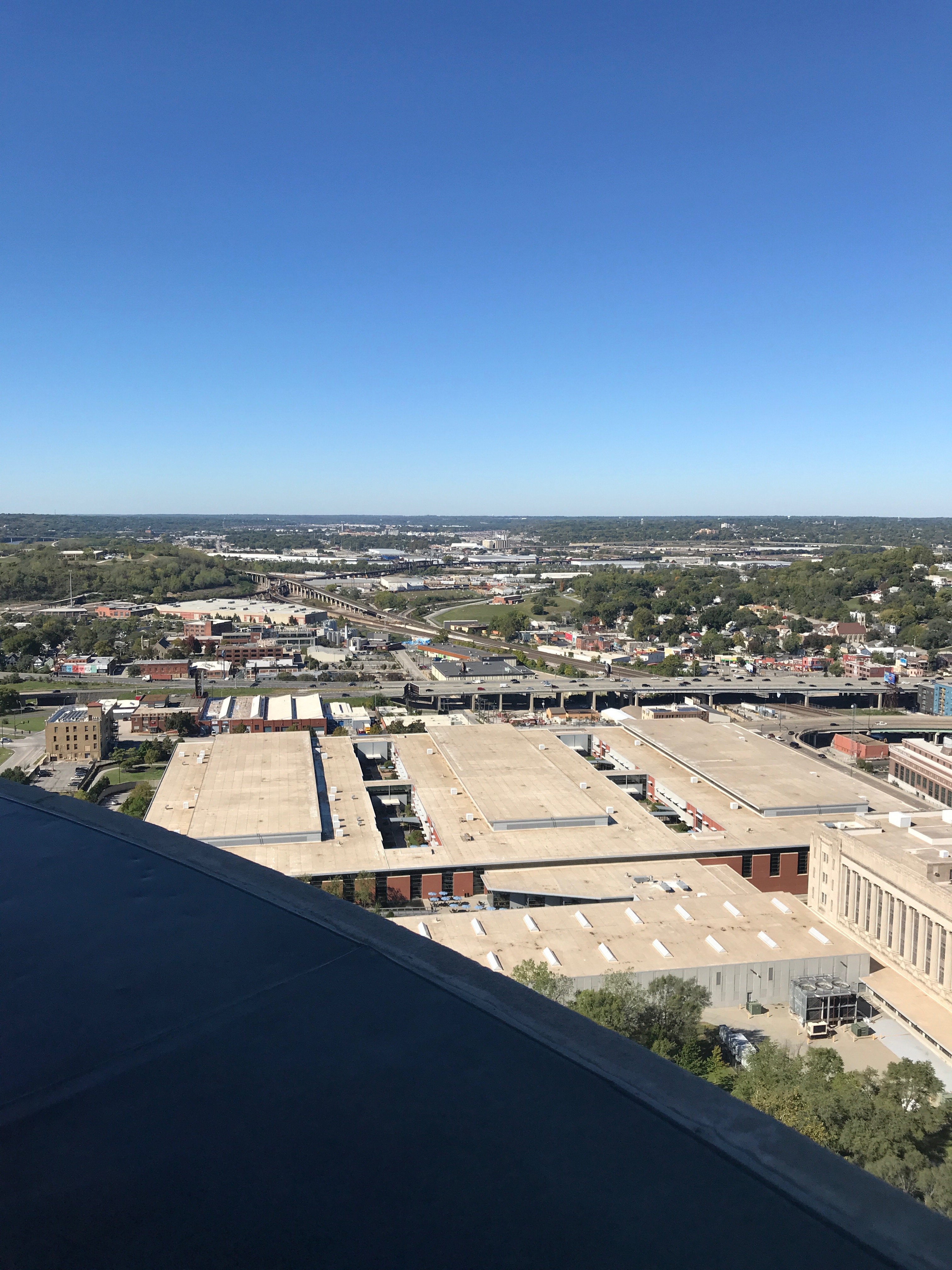
Here’s the view in another direction. I can’t get enough of the blue skies! (Have I mentioned lately that I hate rain?)
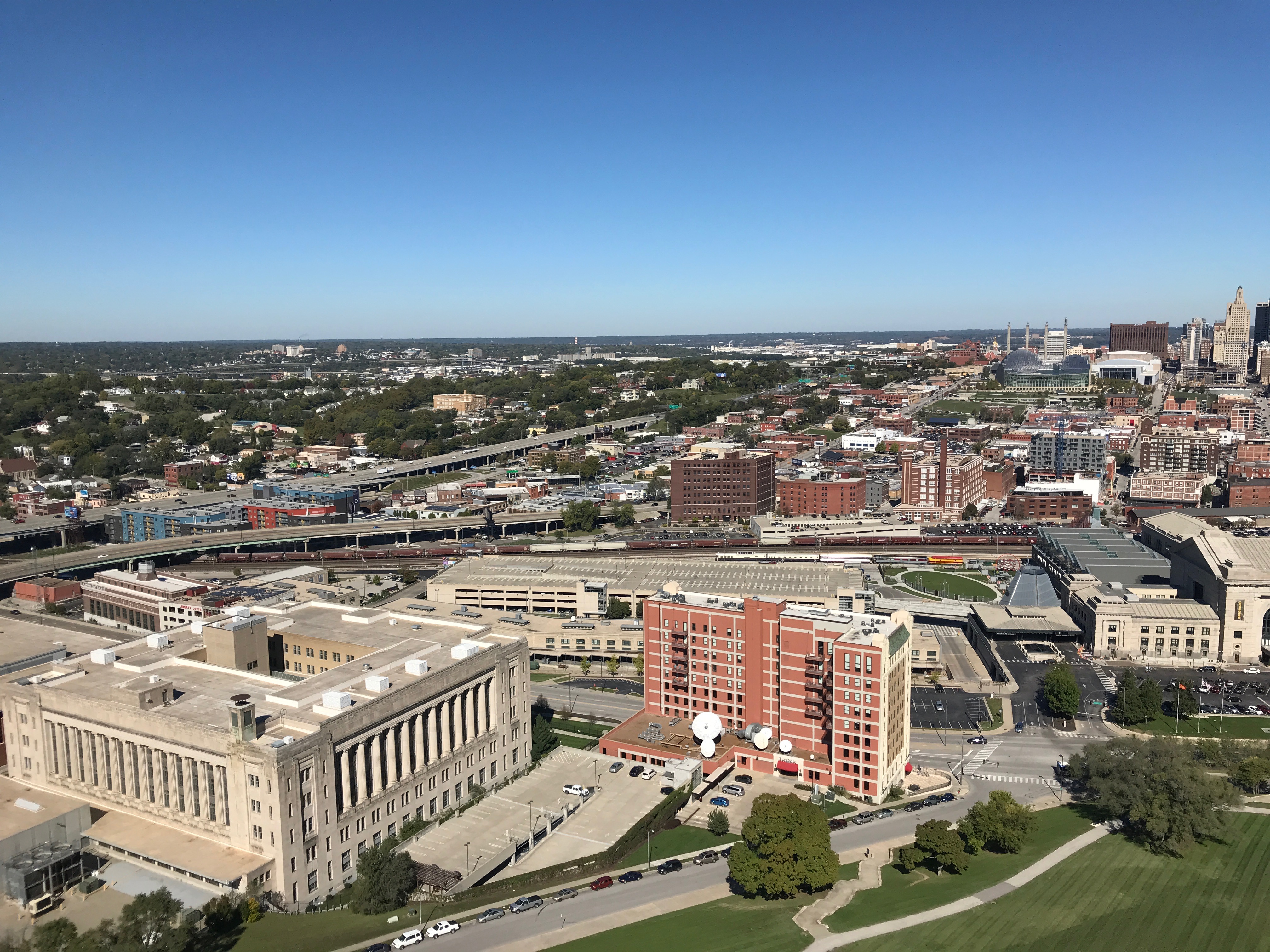
Here’s a look in the final direction, and then it was time to descend the tower. I made it before the field trip arrived! Hooray!
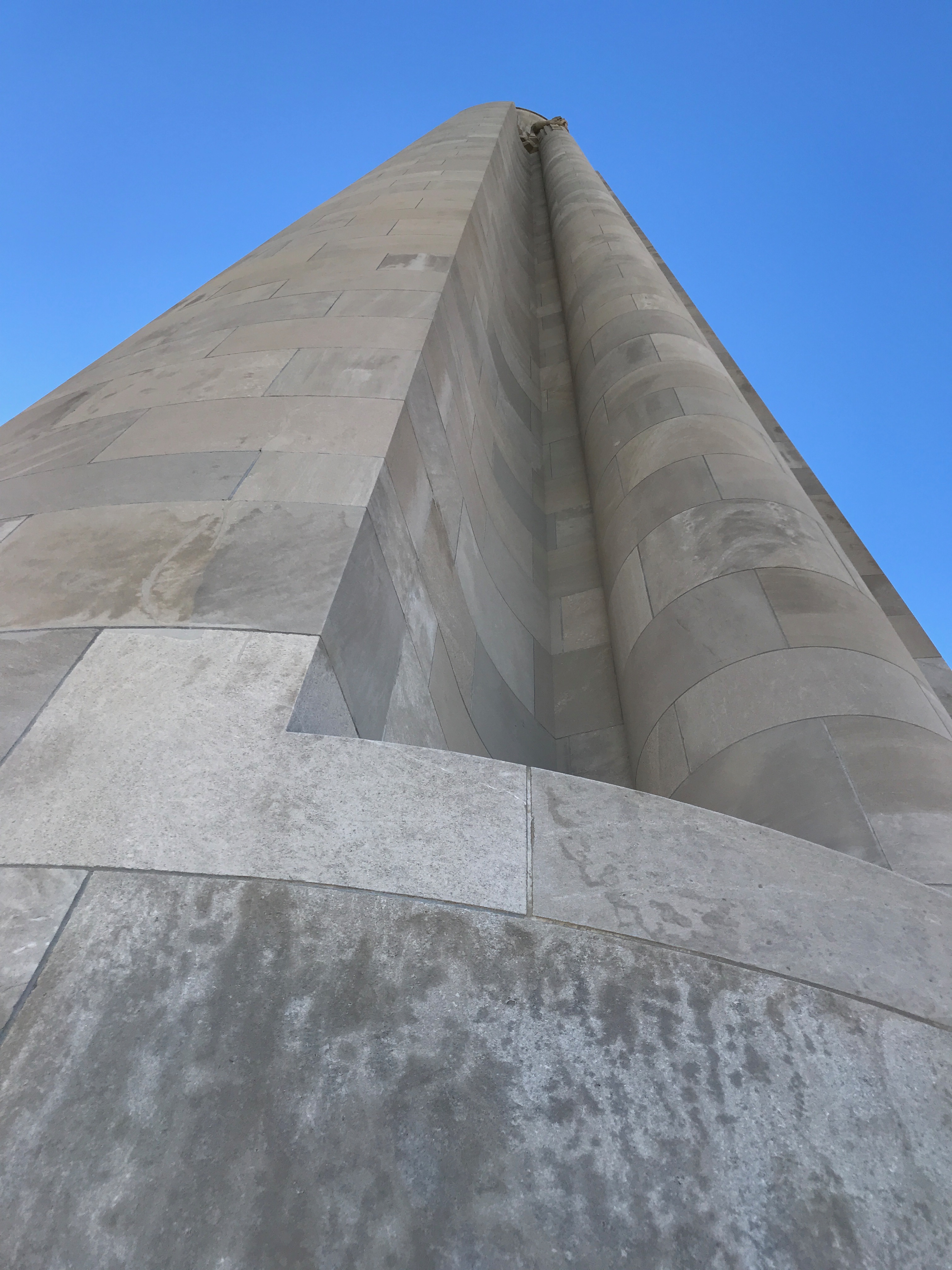
I paused at the base of the tower to look up.
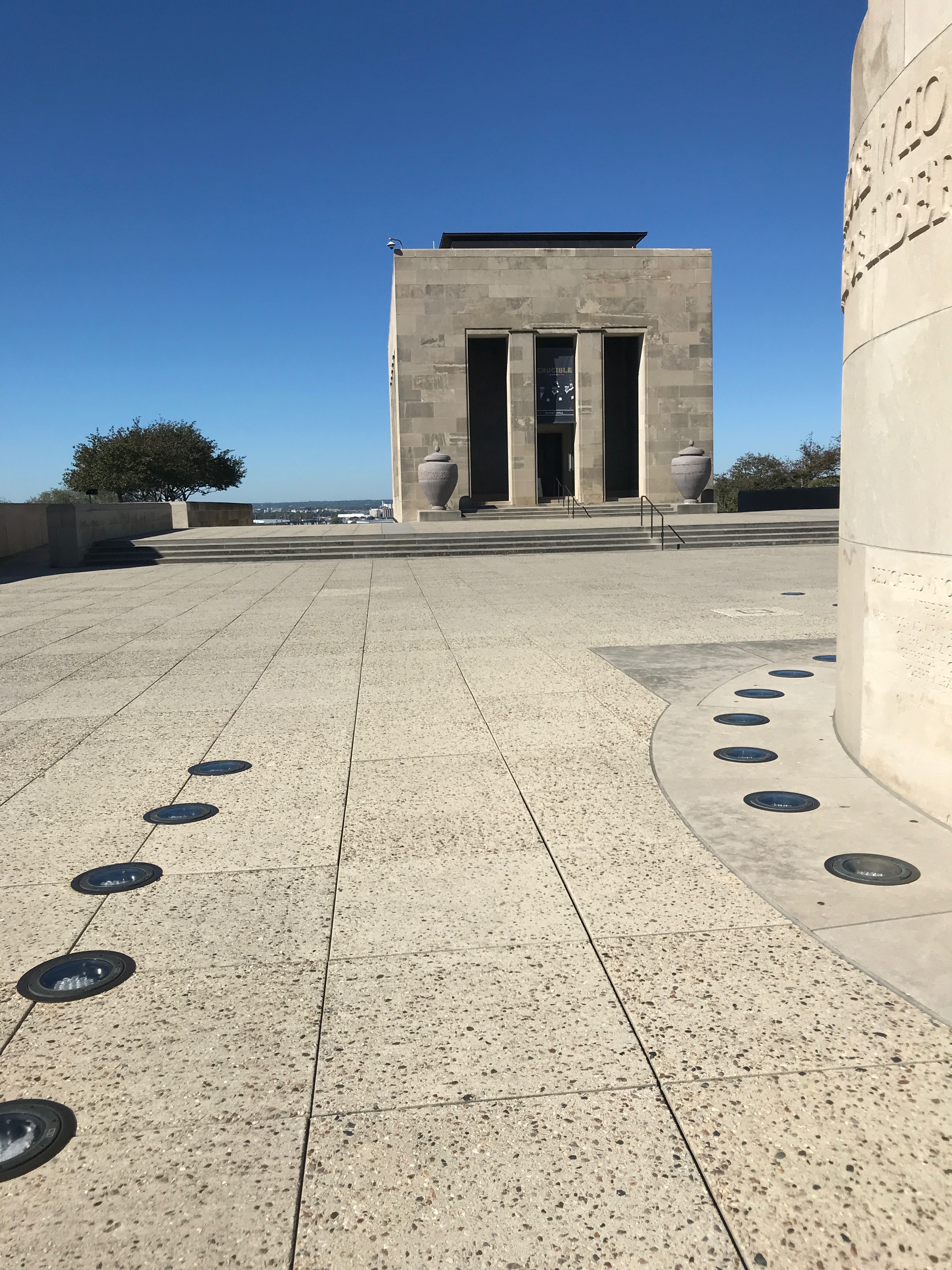
On this level, there are two buildings that serve as memorials and museums. Incidentally, the original structures are built in the Egyptian Revival style.
Between each hall and the tower sit two stone sphinxes, named “Memory” and “Future.” Memory faces east, hiding its face from the horrors of the European battlefields. Its twin faces west and shields its eyes from a future yet unseen.
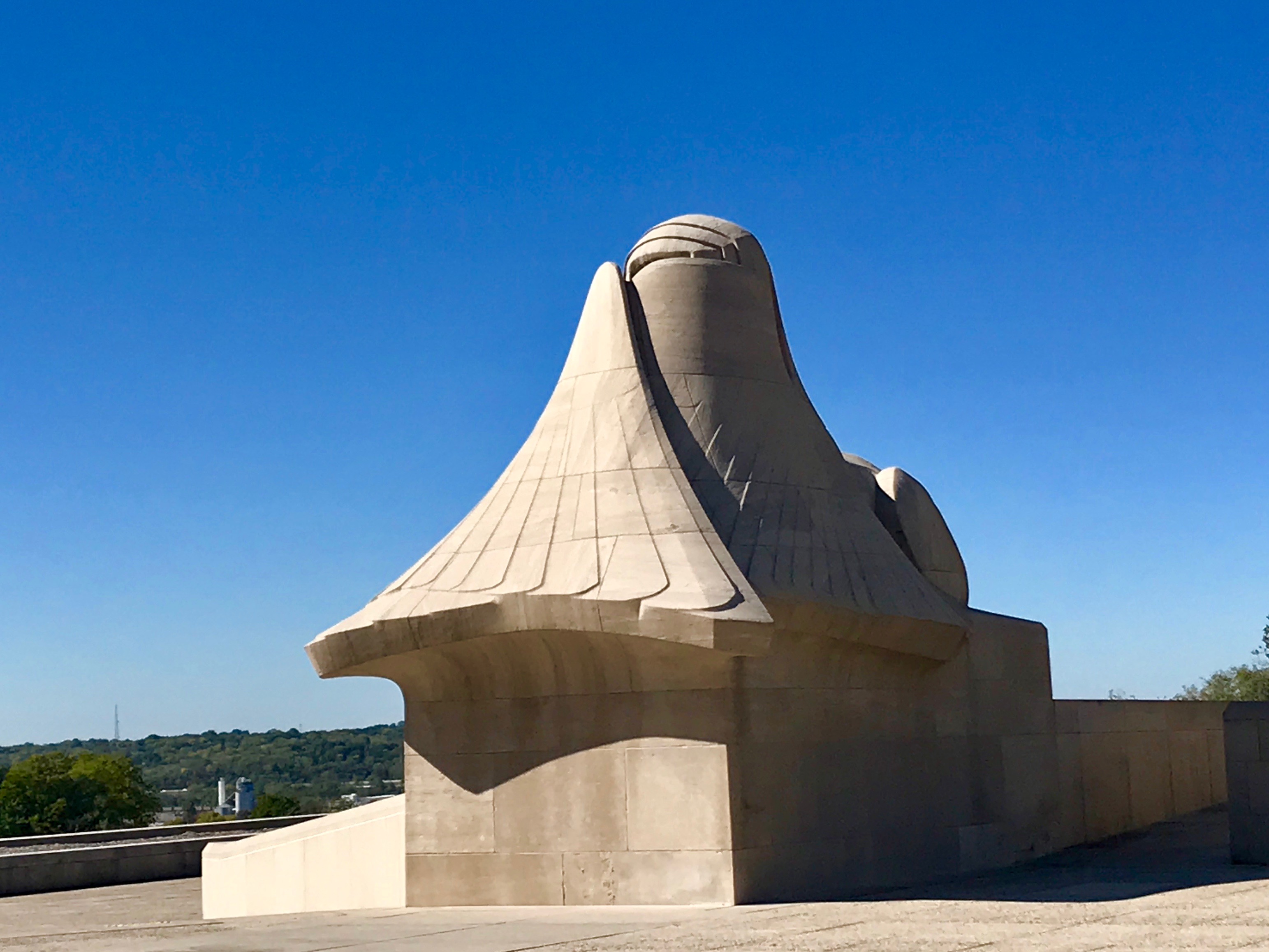
I guess it goes to show you that even back in 1921, they didn’t believe that this really was the War to End All Wars. The future was so bleak that the sphinx didn’t even want to look at what was going to happen next.
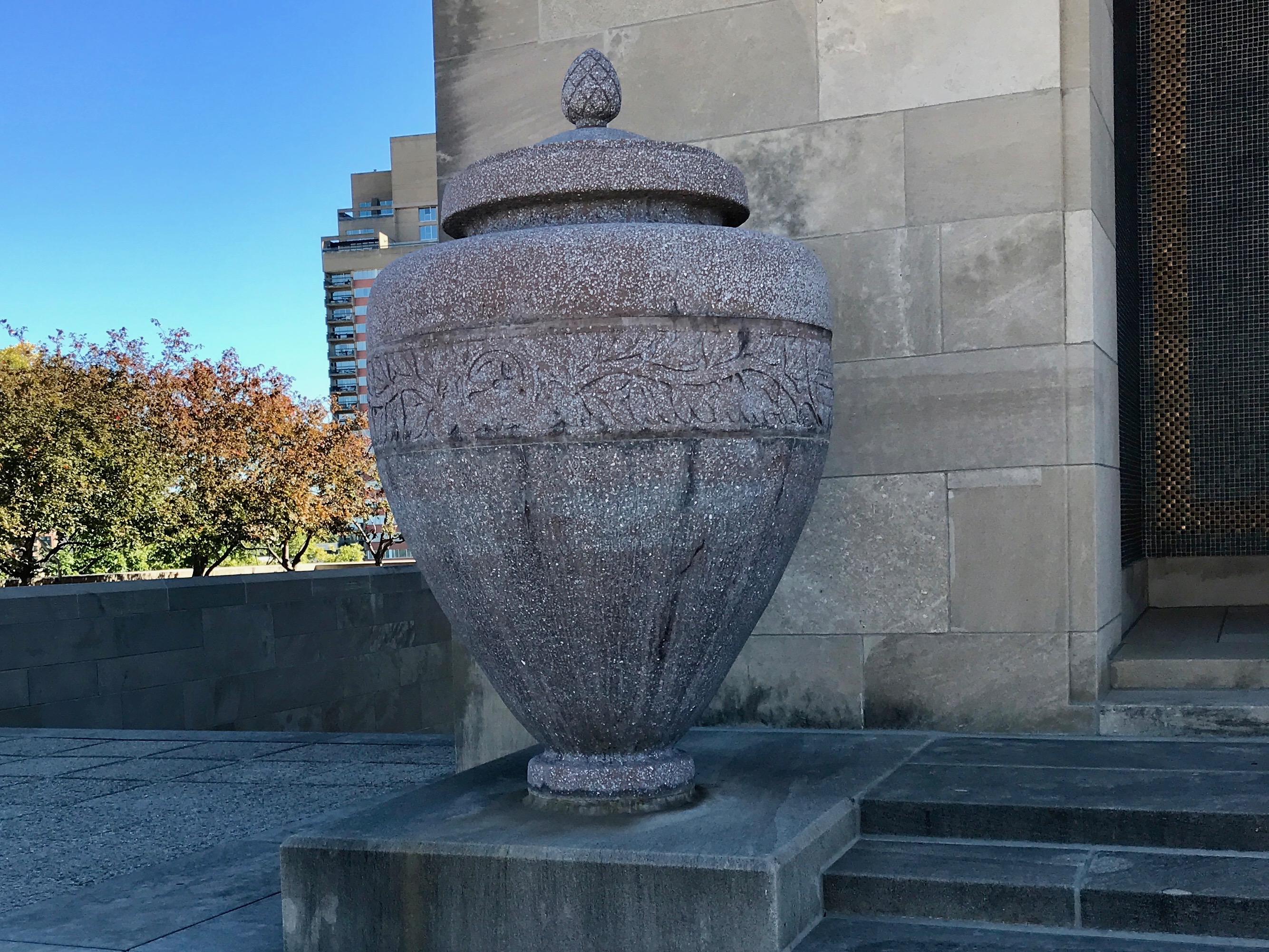
I climbed the steps past the ornamental urns.
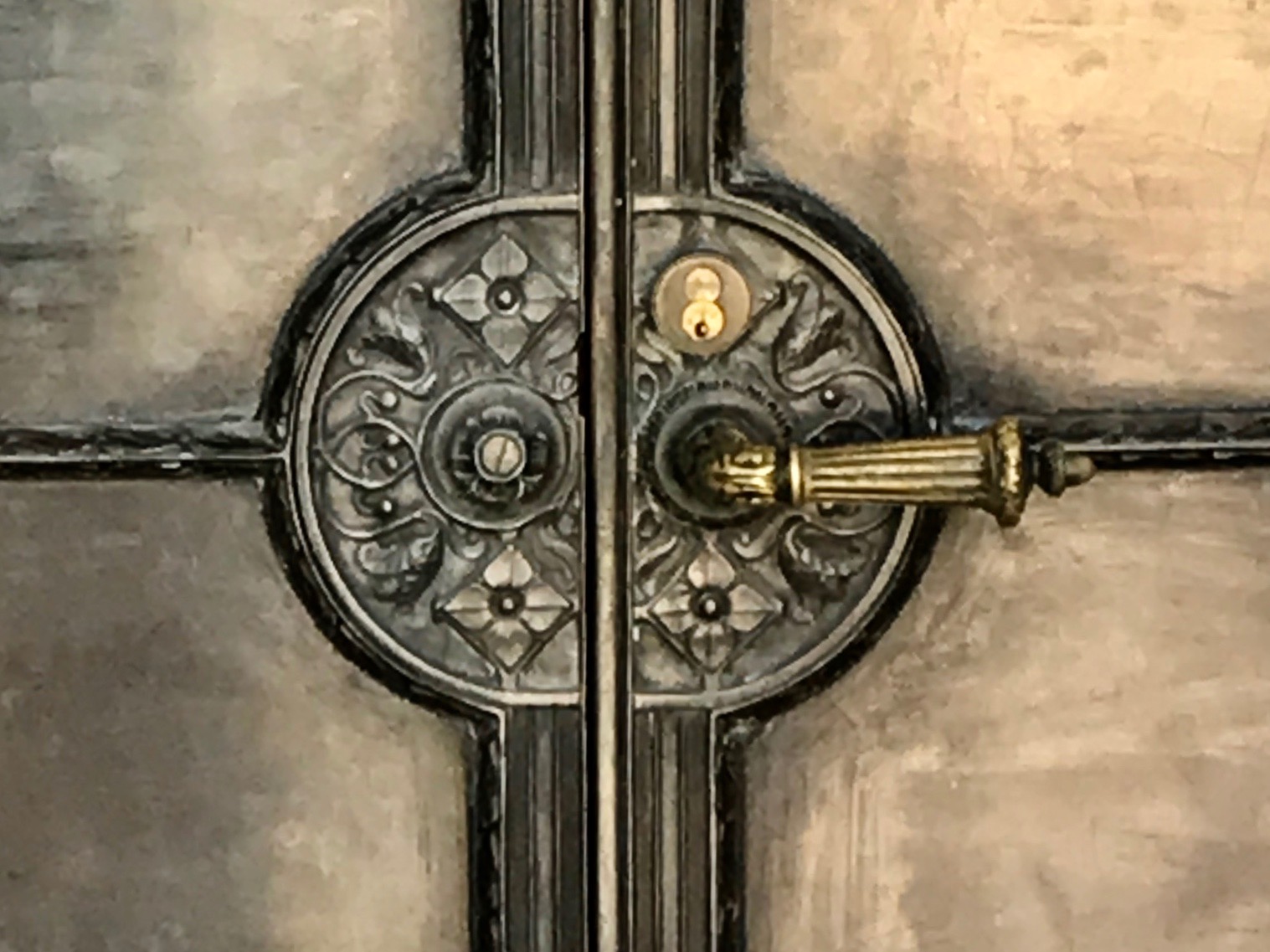
The doors had some intricate work on them.
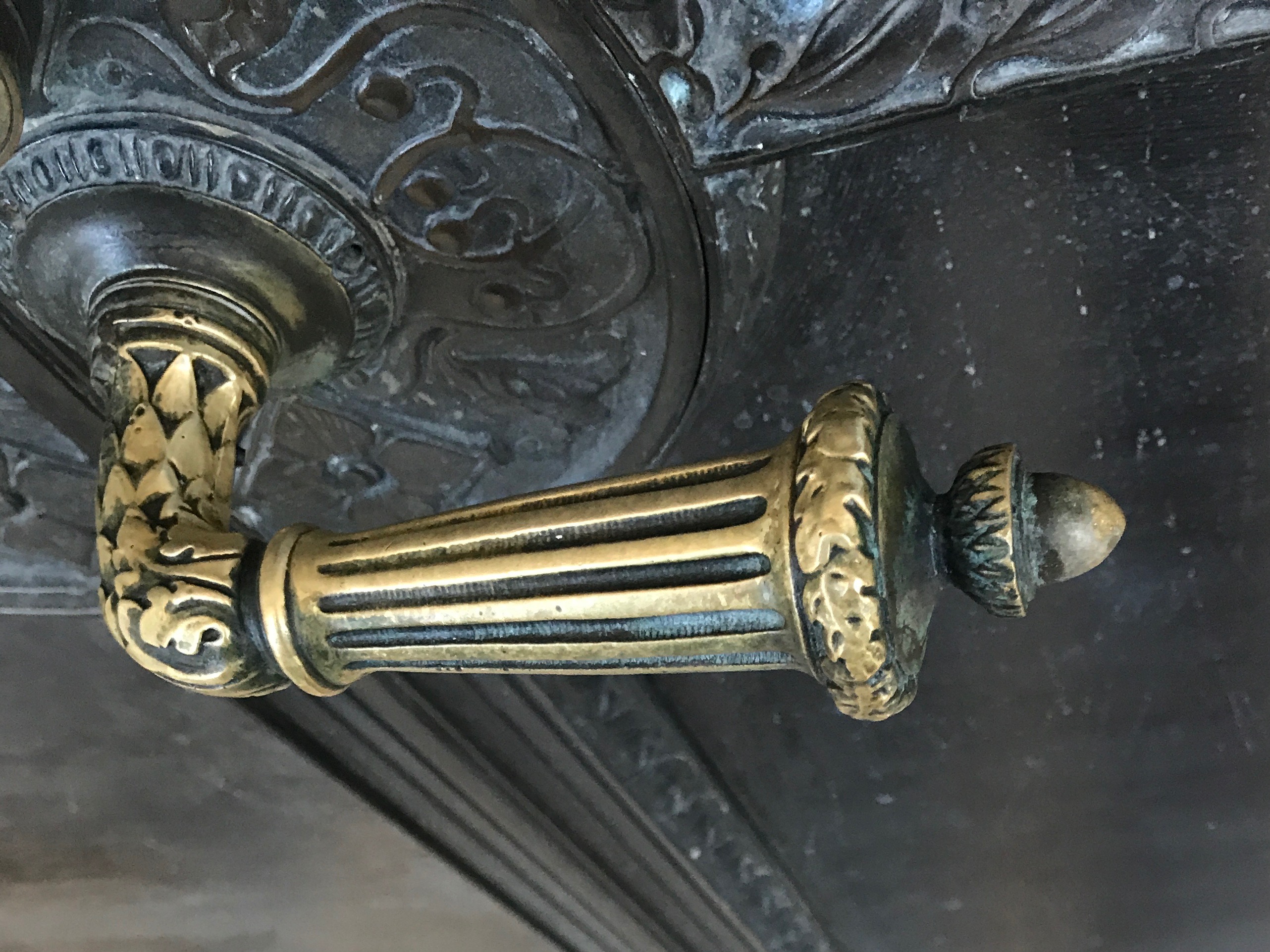
Wait! There’s an acorn on the handle. I racked my brain for a connection. I seemed to remember something about the oaks of Verdun.
It turns out that the forests around Verdun were devastated during the longest running battle of the war. More that 400,000 French and German Lives were lost, and the Verdun’s oak and chestnut forests still bear the scars of the conflict that took place over a century ago. More than 700 square miles of forests were destroyed.
There are a few stories about how the acorns got to England, but they were planted as tributes to the fallen, even while the battles were still raging. Woodland Trust, a United Kingdom conservation charity, has succeeded in locating some of the original trees grown from the seeds taken from the battlefield and they are now engaged in growing the next generation of the trees as a perpetual memorial.
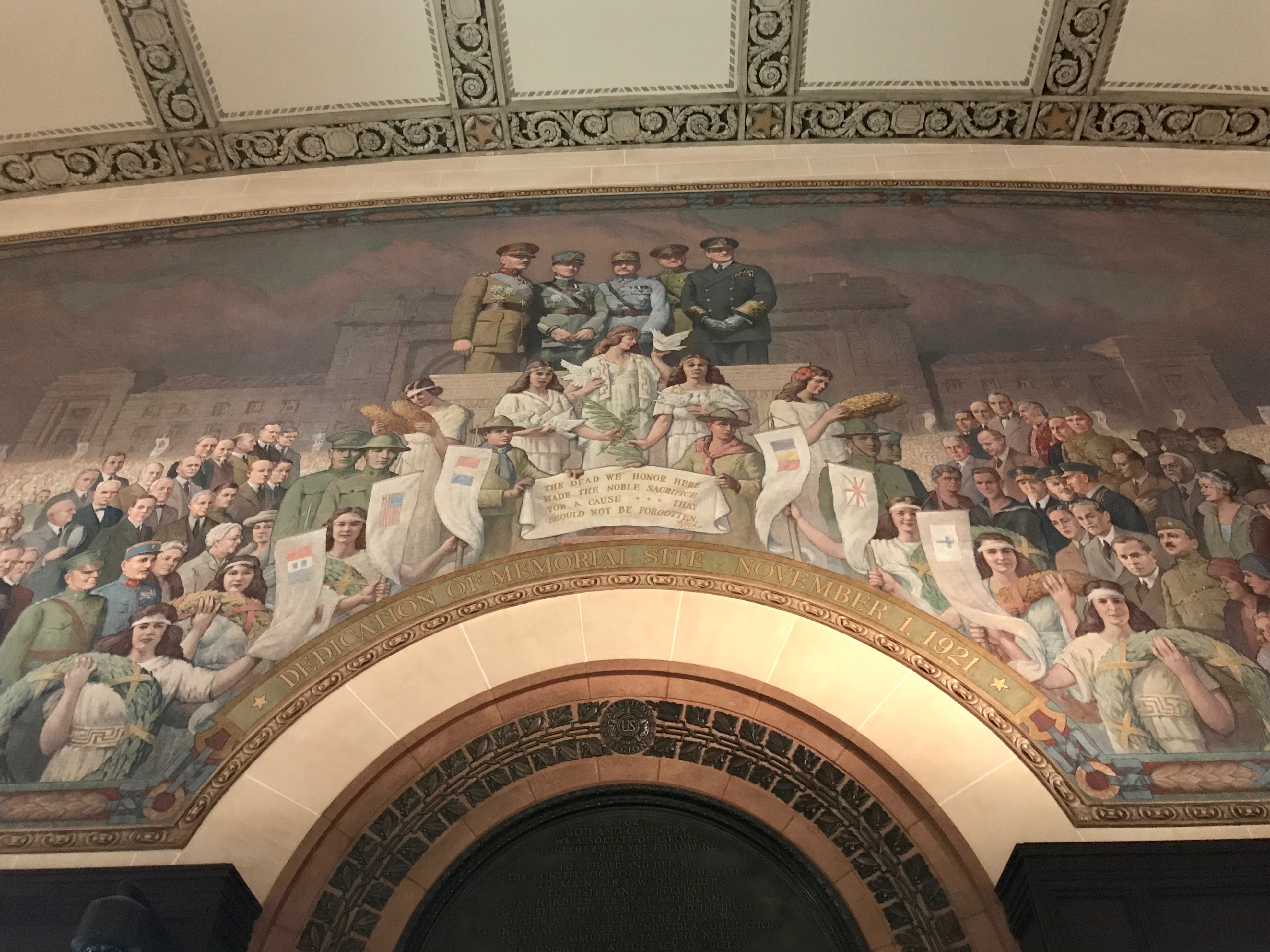
Inside the buildings are some interesting murals.
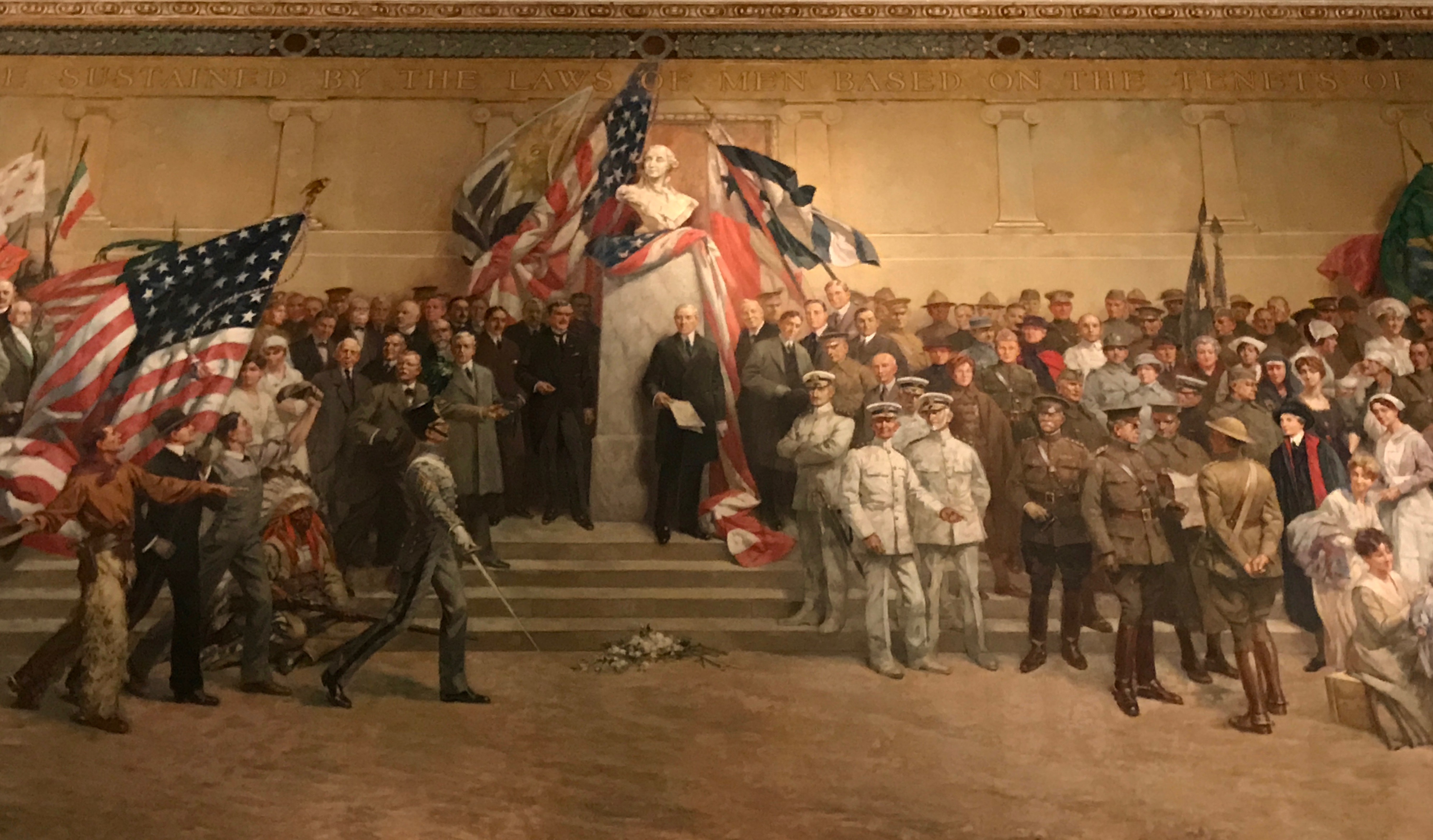
What is exhibited in the two buildings are actually portions of a massive painting called the Panthéon de la Guerre. The project was begun in September 1914, after the Battle of the Marne. It was coordinated by French artists Pierre Carrier-Belleuse and Auguste François-Marie Gorguet, who were apparently well-known at the time. Around 130 artists participated in creating the monumental artwork – a circular panorama that was 402 feet tin circumference and 45 feet high. It has been described as the largest painting in the world.
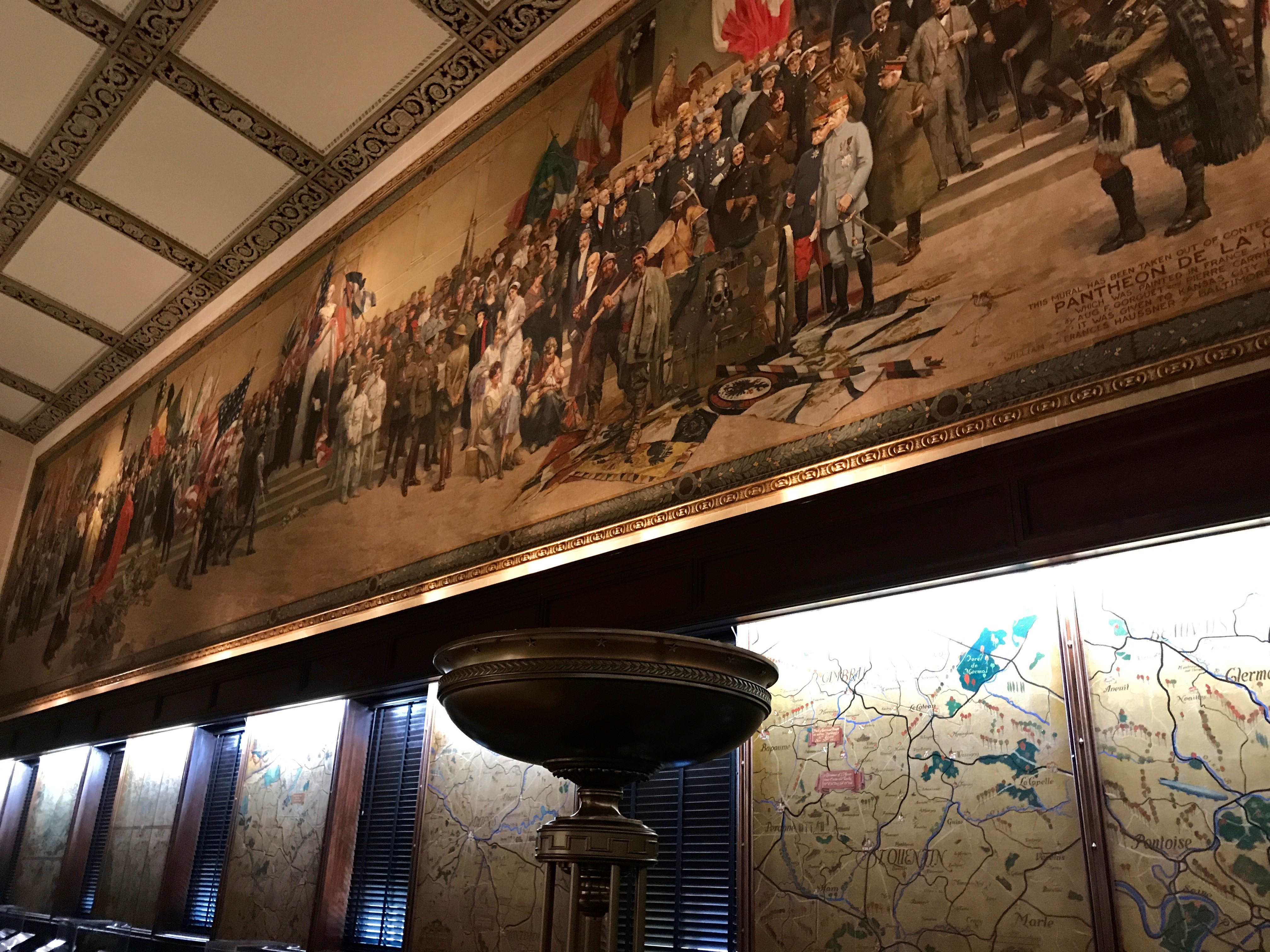
The painting included full-length portraits of around 6,000 wartime figures from France and its allies. It was executed while the war raged on and had to be updated as countries left or joined the alliance. An entire section of the cyclorama had to be repainted when the United States entered the war in 1917.
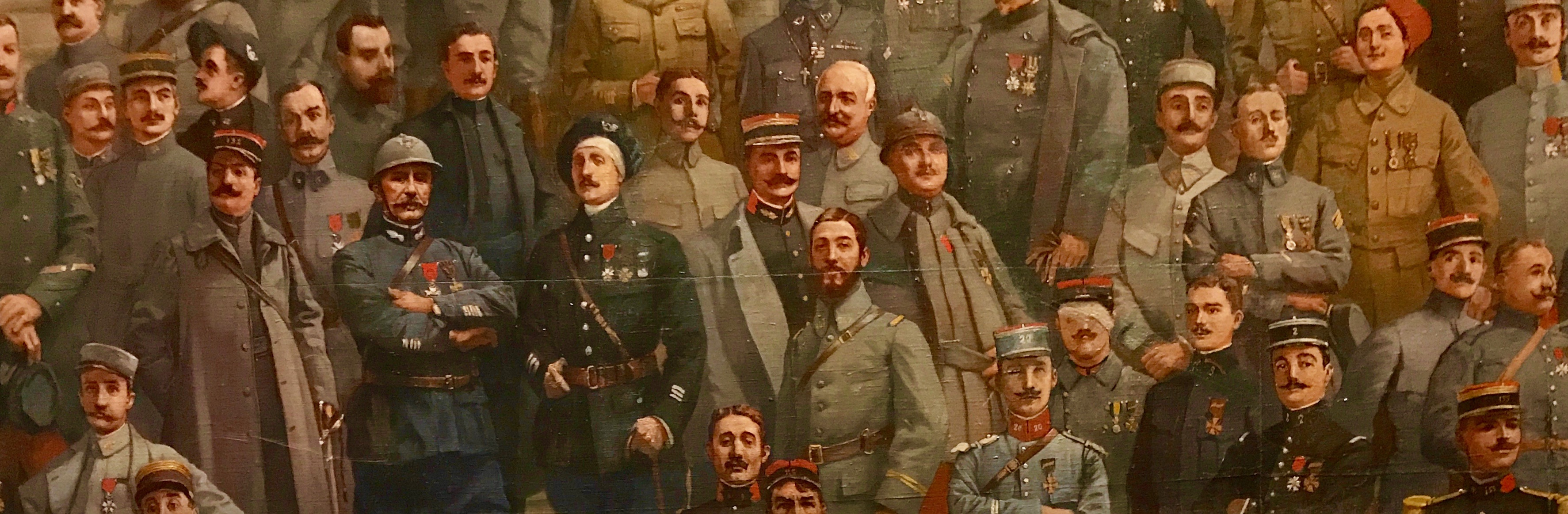
It was inaugurated by French president Raymond Poincaré in October 1918, just three weeks before the Armistice was signed. The Panthéon became an almost sacred pilgrimage site for the French people and the soldiers passing through Paris. It was visited by three million people between 1918 and 1927.
In 1927, the painting was bought by U.S. businessmen and sent on a U.S. tour. For political and marketing reasons, several figures were added to the painting and others were altered before it was shipped across the ocean. In the U.S., the Panthéon was no longer treated as the sacred object it had been in Paris. Instead, it was promoted as a “great spectacle.” I imagine the low point of public respect was when it was exhibited on the Midway at Chicago’s Century of Progress World’s Fair in 1933-1934.
The painting was all but forgotten after World War II. It sat moldering in outdoor storage until Kansas City Artist Daniel MacMorris procured it for the Liberty Memorial in 1957. MacMorris cut up the panorama, drastically reducing it and reconfiguring it to fit into the space available. In the process, he transformed the original, French-focused composition into the U.S.-centric mural that we see today. He altered and cut the French section – the Panthéon’s largest section – to fit the west wall of the other building.
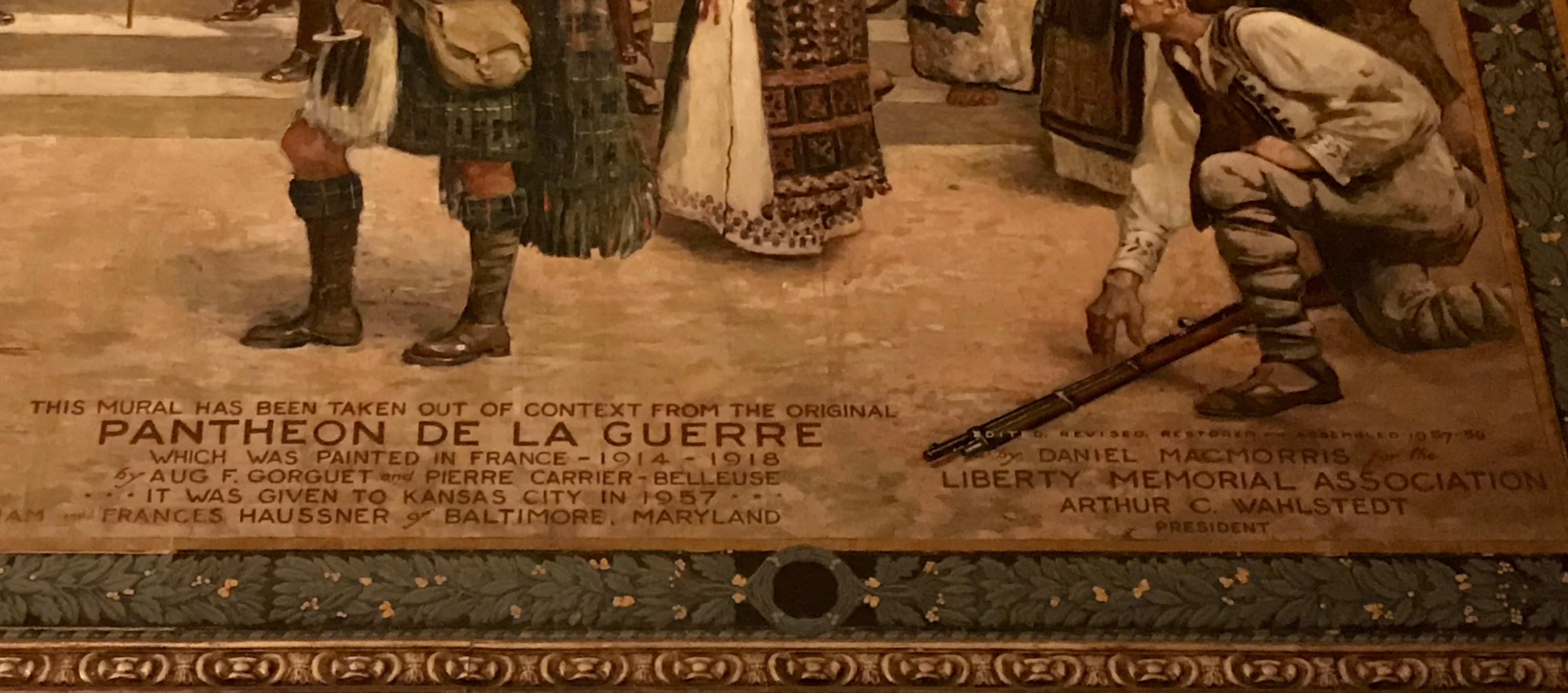
In case you can’t make out the writing on this part of the mural, it says, “This mural has been taken out of context from the original Panthéon de la Guerre, which was painted in France – 1914 – 1918. It was given to Kansas City in 1957. Frances Haussner of Baltimore, Maryland. Edited, revised, restored and assembled by Daniel MacMorris for the Liberty Memorial Association. Arthur C. Wahlsted, President”
While it might seem like a pity that such a monumental work of art that moved so many people for so many years should not be conserved in its original form, it is an interesting metaphor for how we reimagine and reshape our personal and national histories.
There were many more things that were displayed in these two halls. Perhaps I’ll share them in my next post.
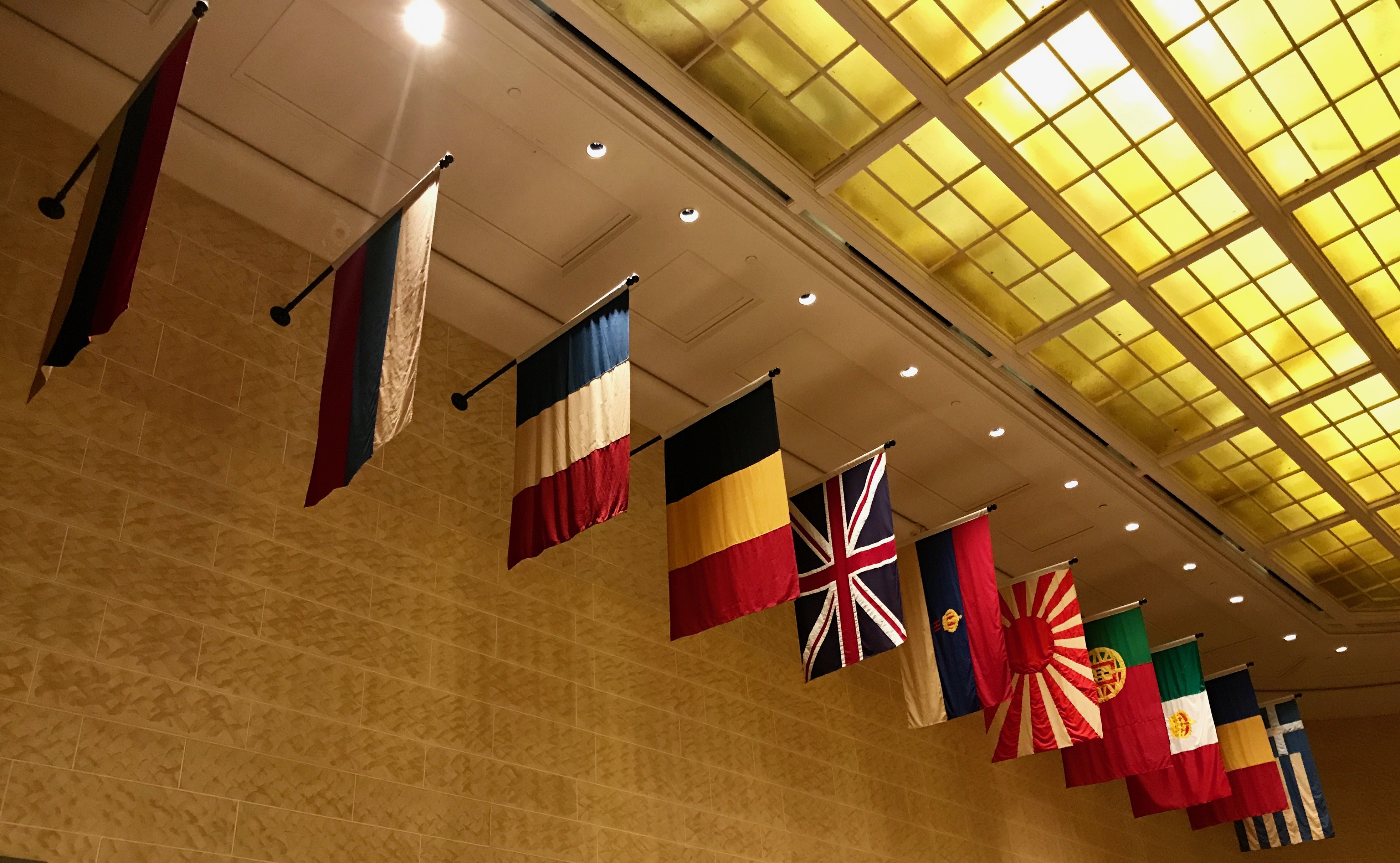
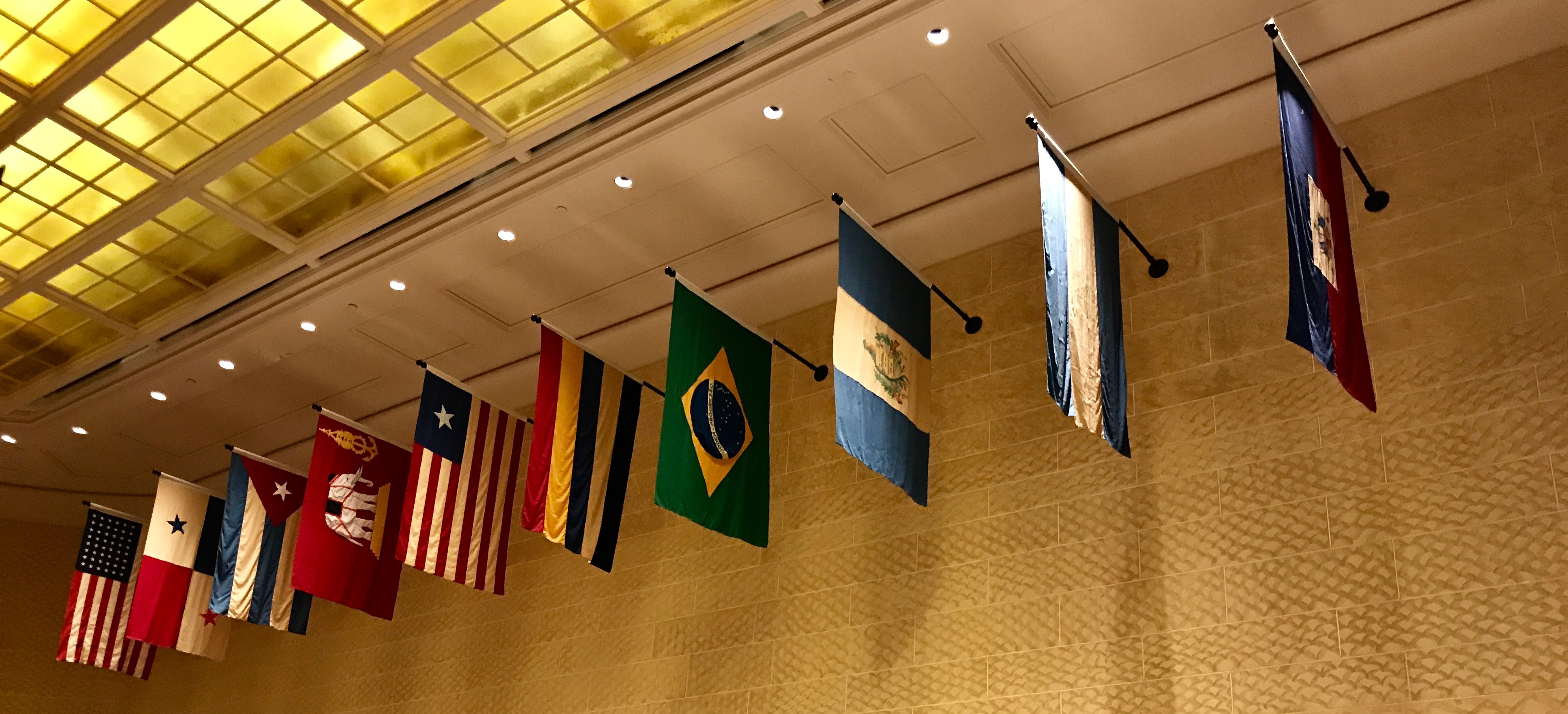
Until then, I’ll close with the flags of the allies.
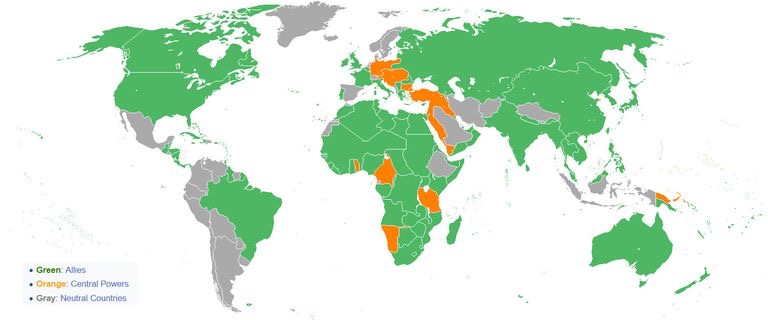
And a map showing that it really was a global conflict.
Helmandsare, Joaopais, El Jaber, Aivazovsky