I set off down I-57, and picked up I-55 near Sikeston, Missouri. I visited there a couple years ago, when I was doing my seed courier gig in 2018. I ate at Lamberts, the Home of Throwed Rolls. But, there was no time to stop. I had to drive!
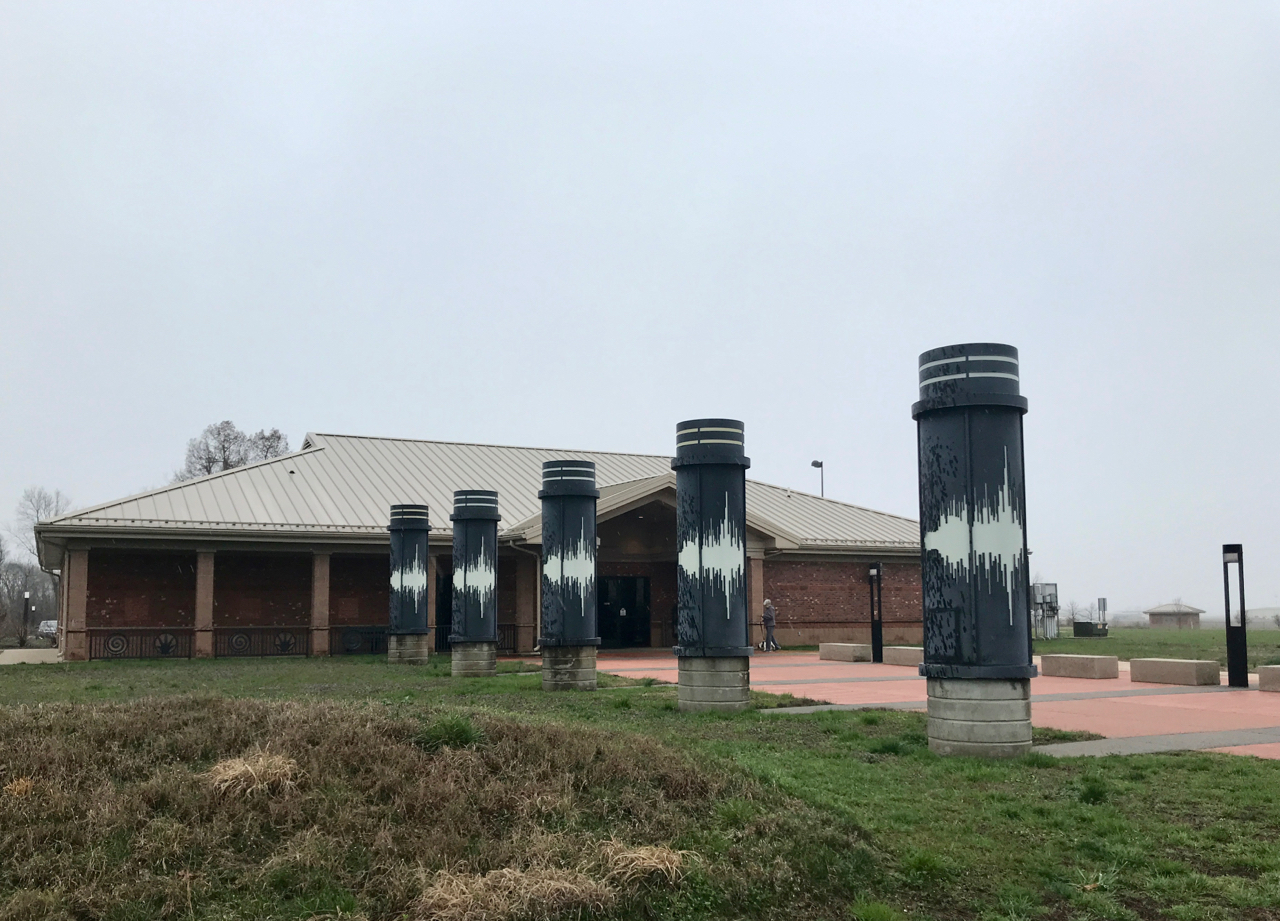
A few miles later, though I had to stop to use the restroom and stretch my legs. There was a great rest stop just past New Madrid, which is the site of the country’s largest earthquake back in 1812.
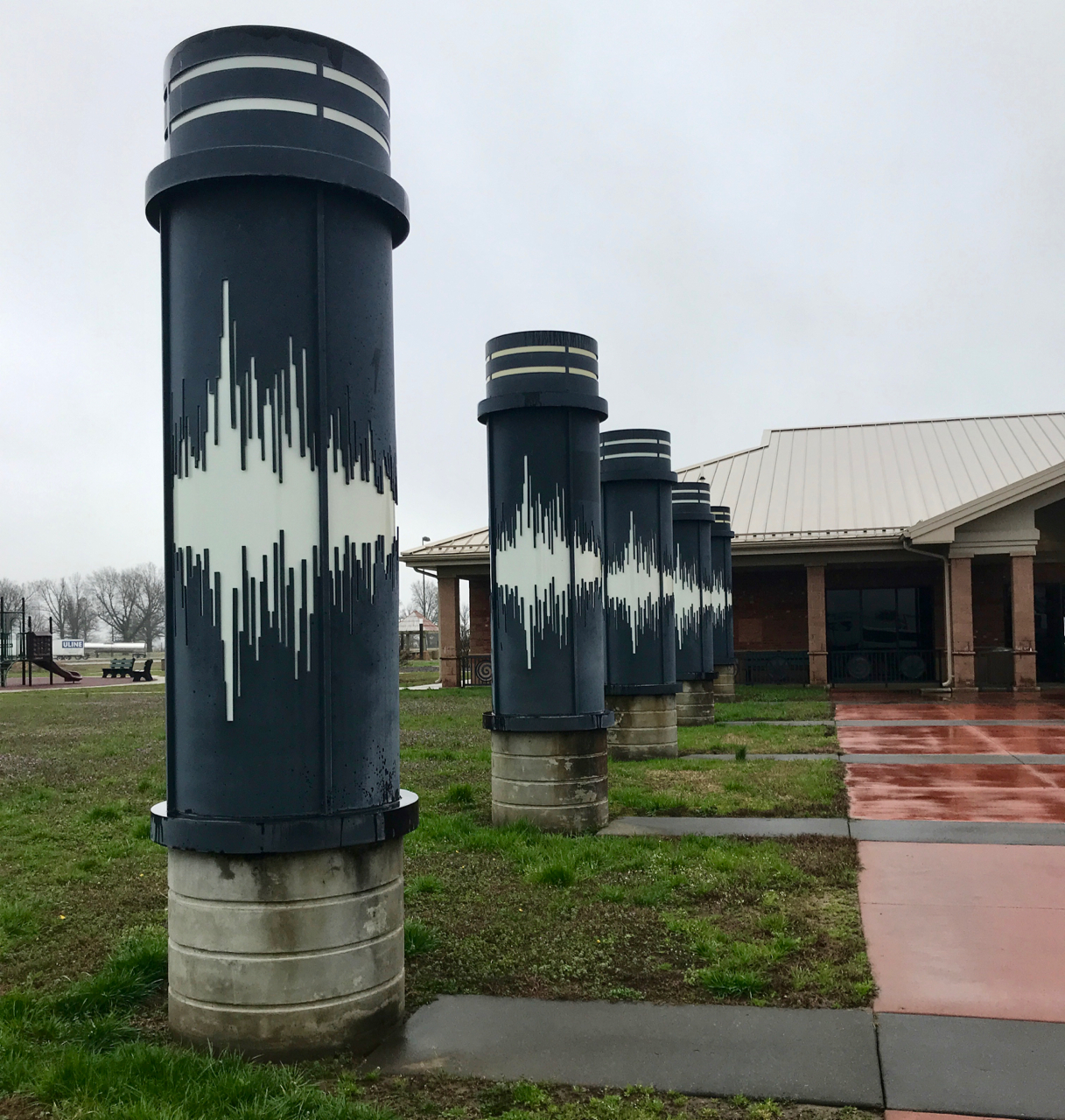
I parked and walked up to the center. I was taken by the pillars that suggest the readout of a seismograph.
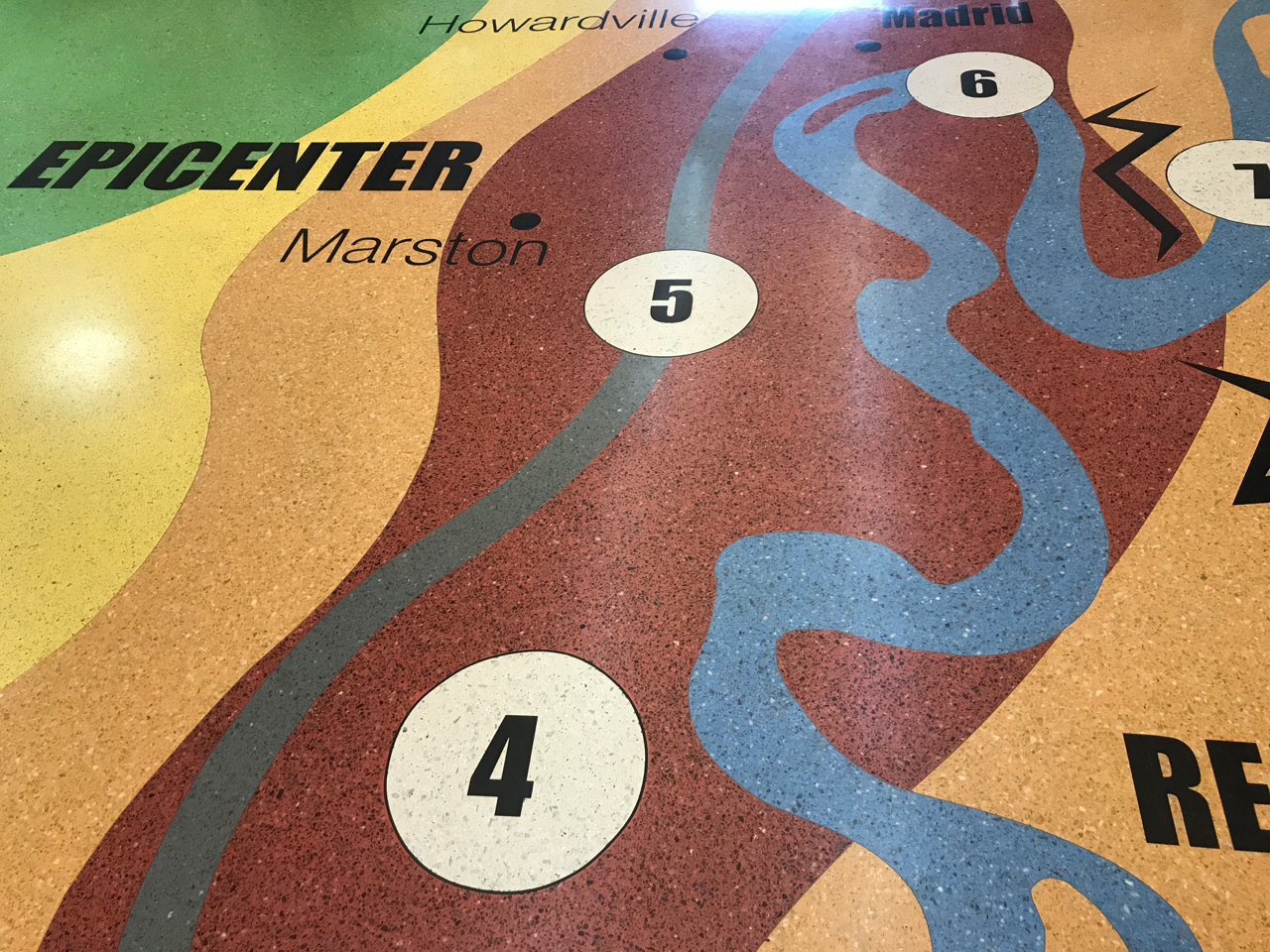
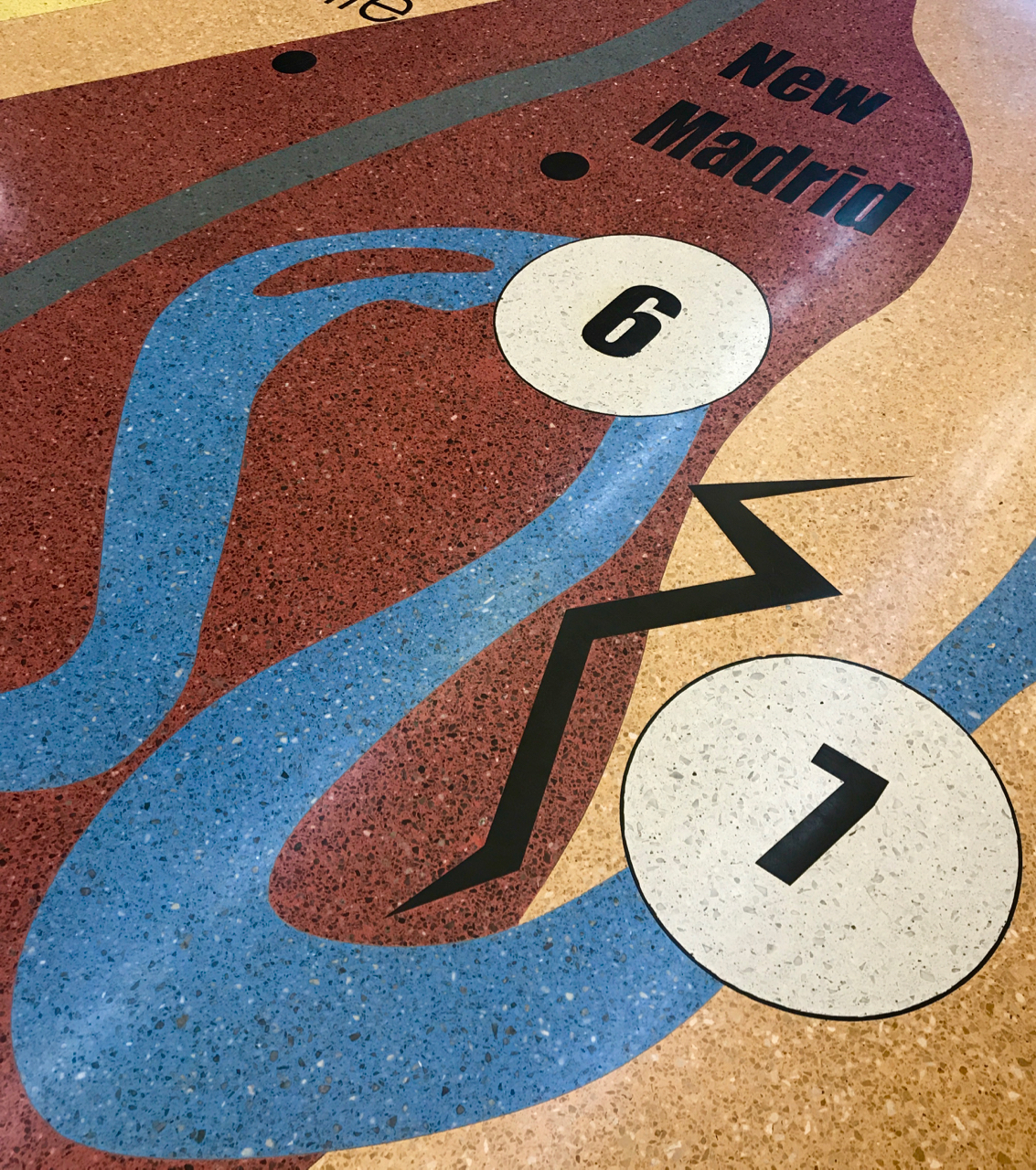
The floor was a spectacular rendition of the map of the area done in epoxy-terrazzo.
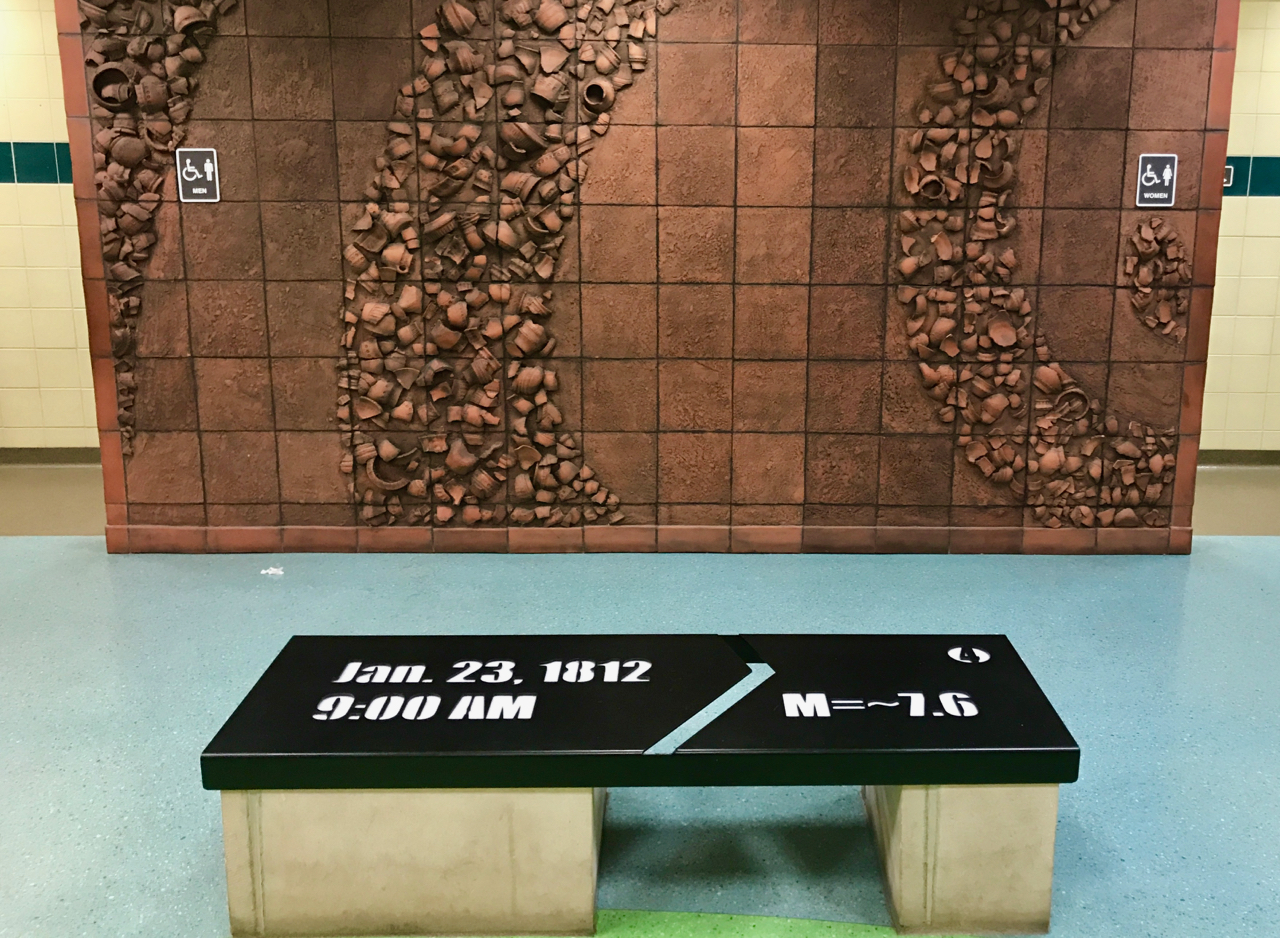
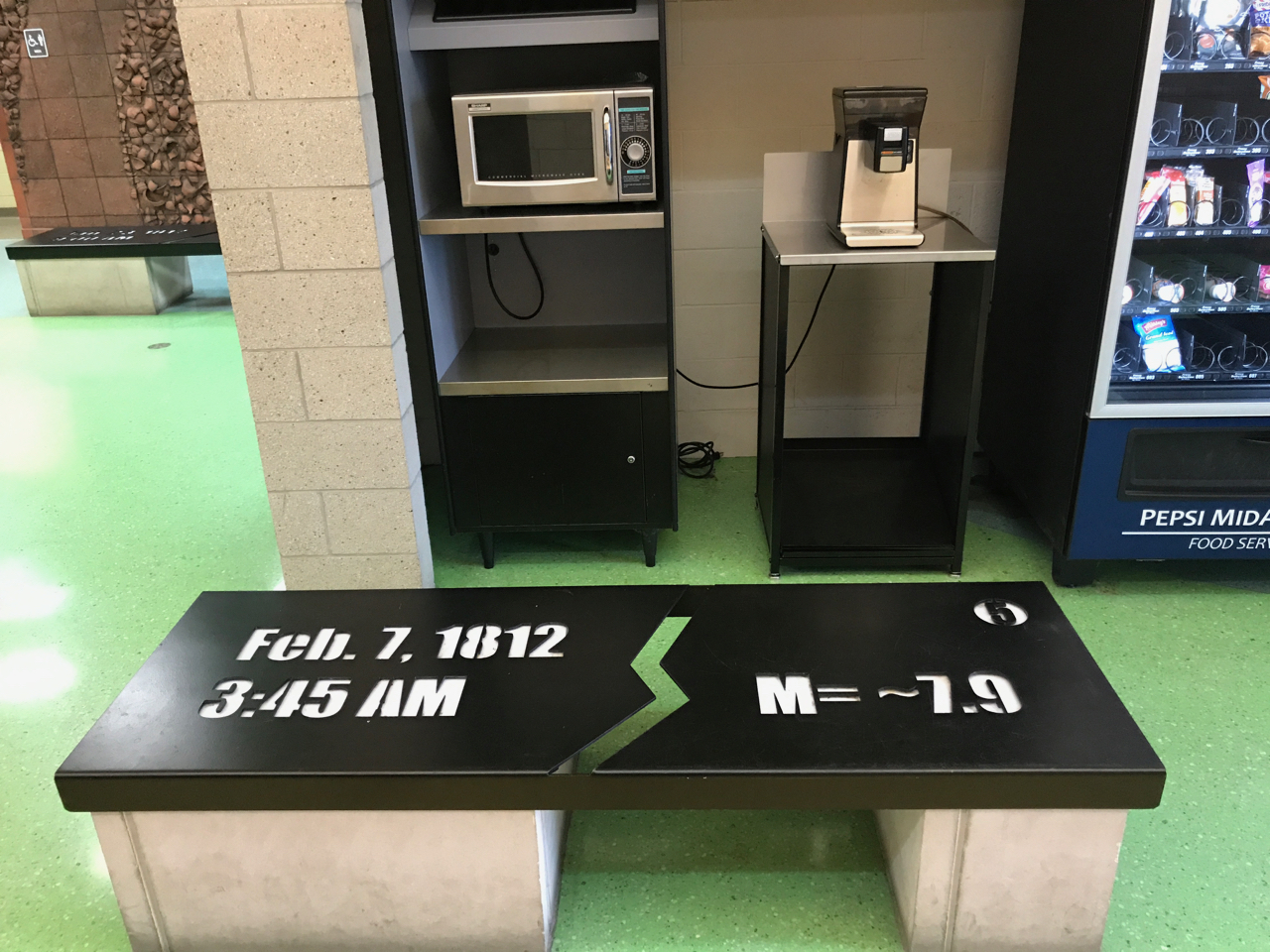
There were benches with lots of interesting information that cued in to the map on the floor. The wall between the restrooms paid homage to the inhabitants of the area at the time. The broken pottery tiles mimic the outward vibrations of the earthquake.
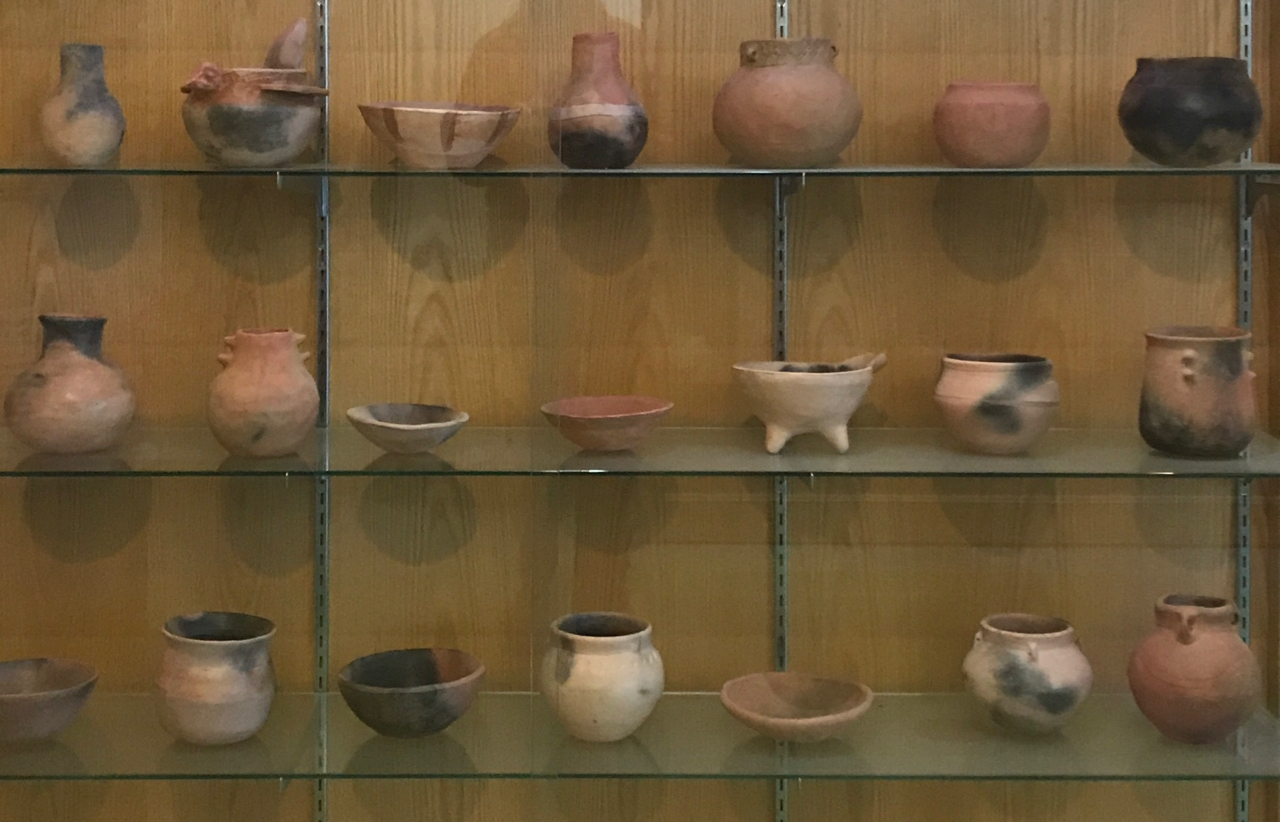
There were two display cases of pottery. They are recreations of Mississippian culture pottery that are found in the Beckwith collection at the Crisp Museum of the Southeast Missouri University in Cape Girardeau, Missouri.
On my way to the rest stop, I passed a sign for the New Madrid Historical Museum, which has information on the earthquake. That is going on my “Next Time” list.
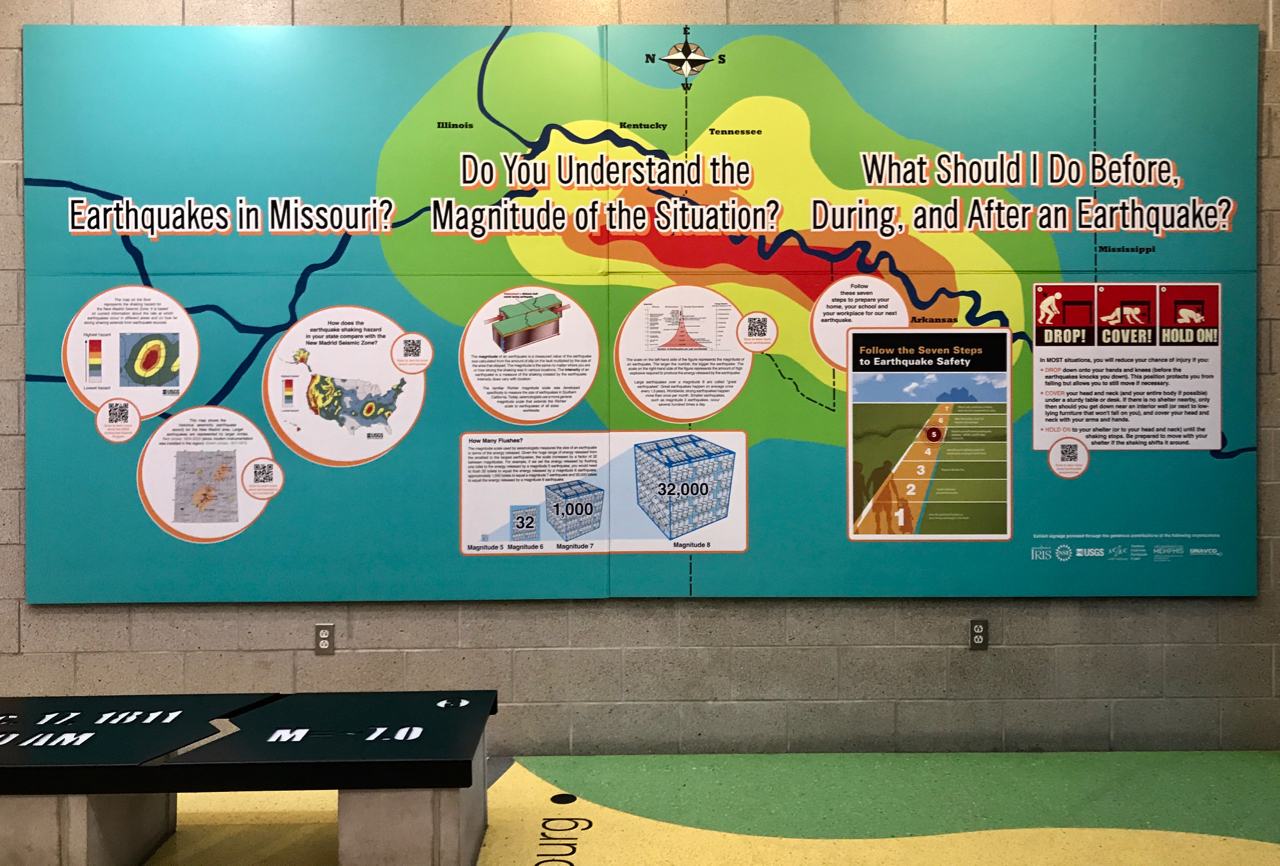
They had a great display. I loved how the colors on it related to the floor.
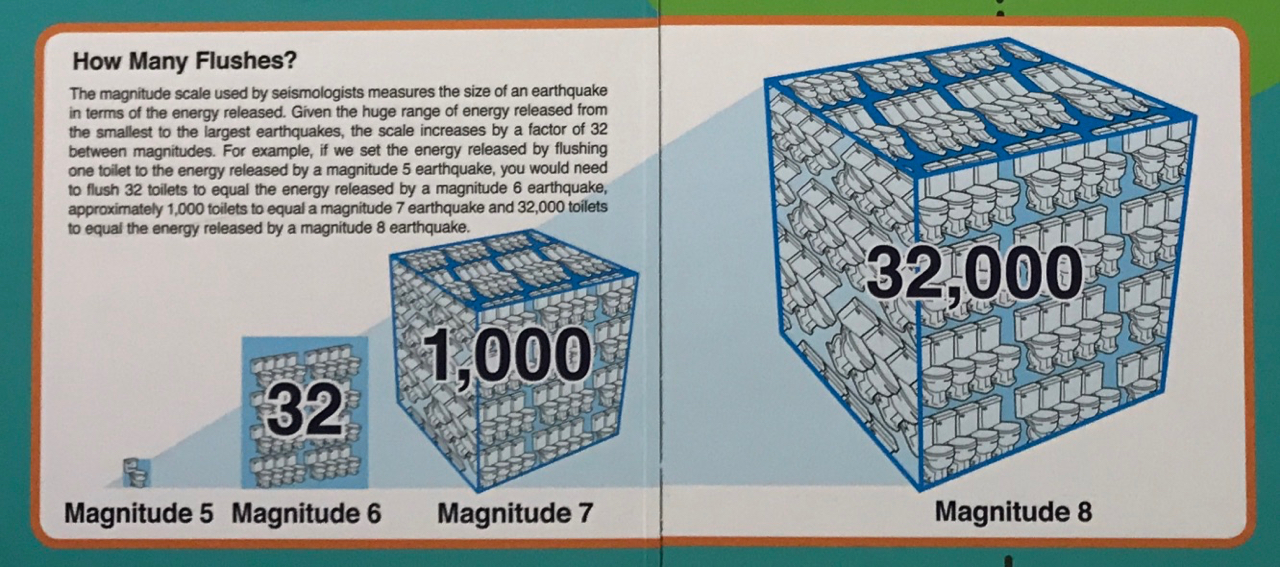
Their illustration of the concept of the Richter scale really made sense to me. I always “knew” this information, but this really drives home the relationship between the different magnitudes.
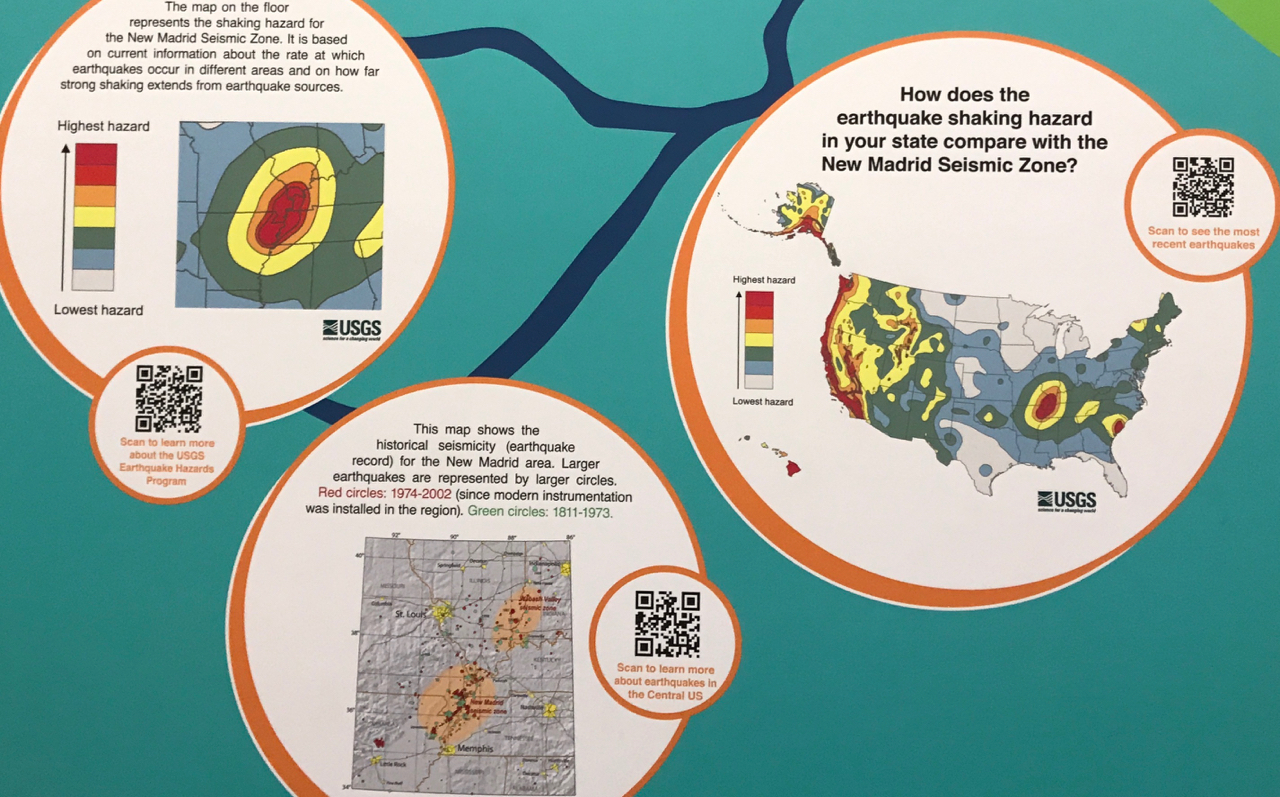
It’s kind of hard to believe that Missouri is as at risk as much as the west coast! But, there it is on the map.
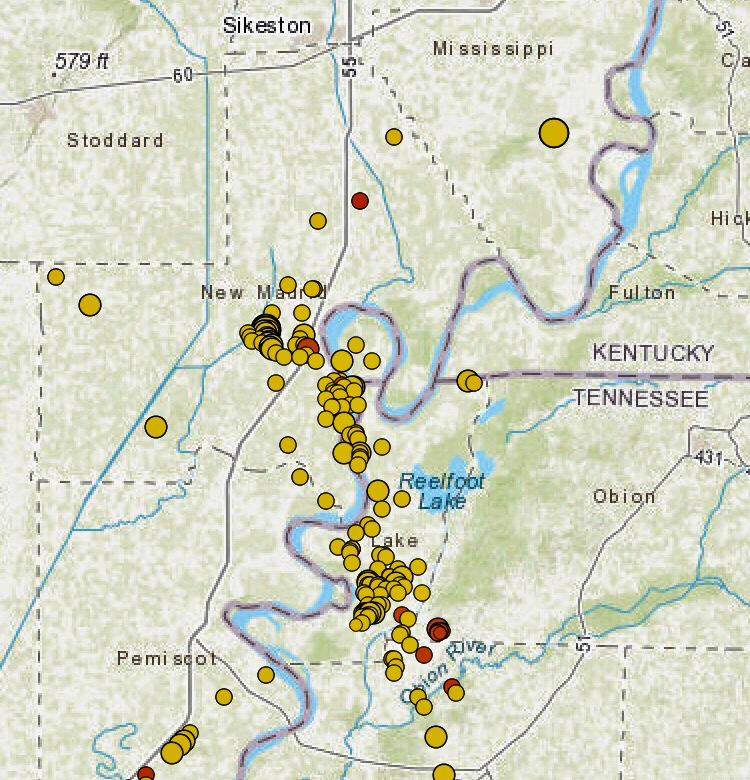
And, earthquakes around here are not only a historical fact. These are the recent quakes that have been detected.
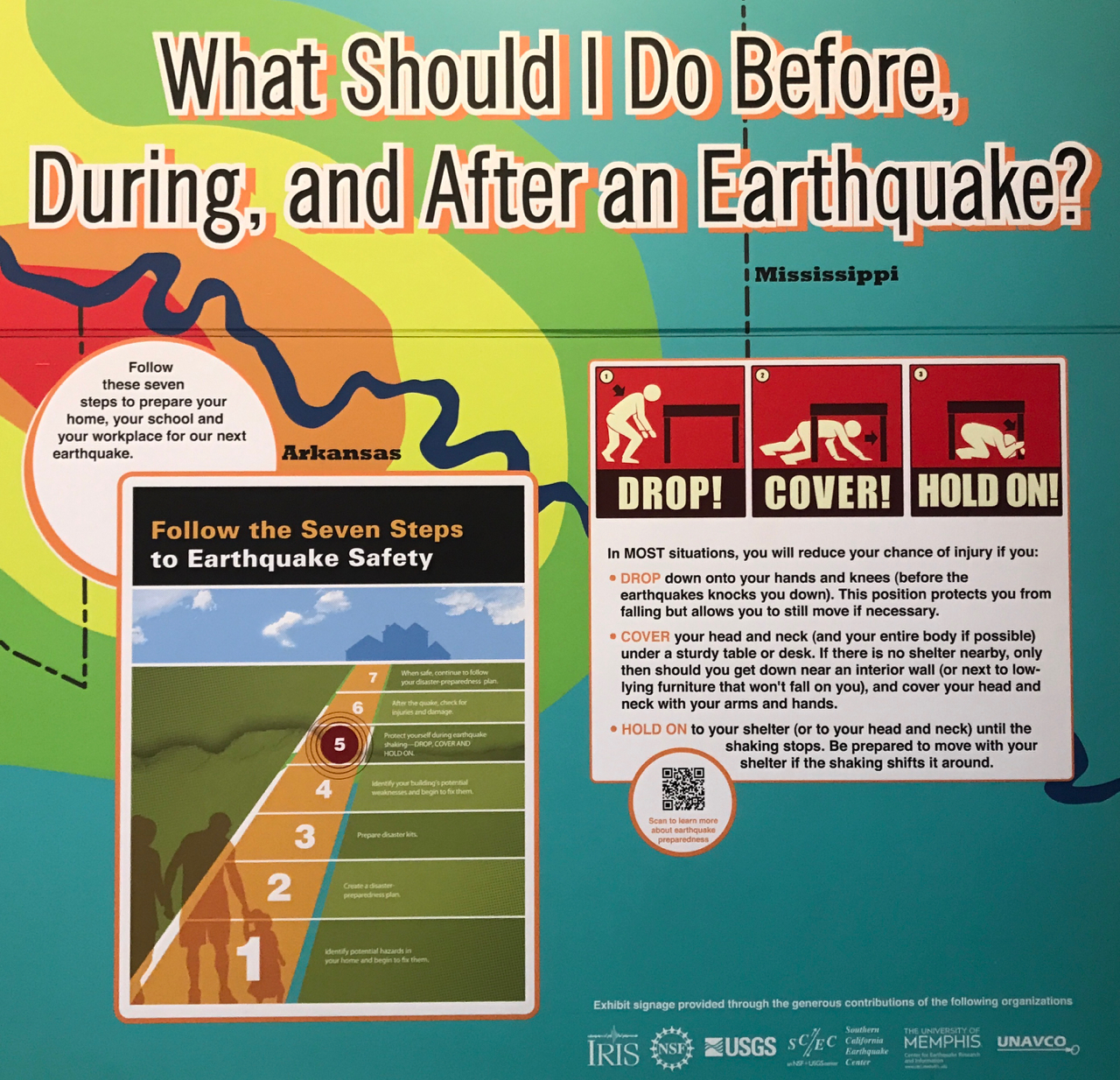
Drop! Cover! Hold on! It reminds me of Stop, drop and roll. I wonder if they have earthquake drills in the schools in this region? I’d call a school in the area, but everything is closed. CoViD, you know.
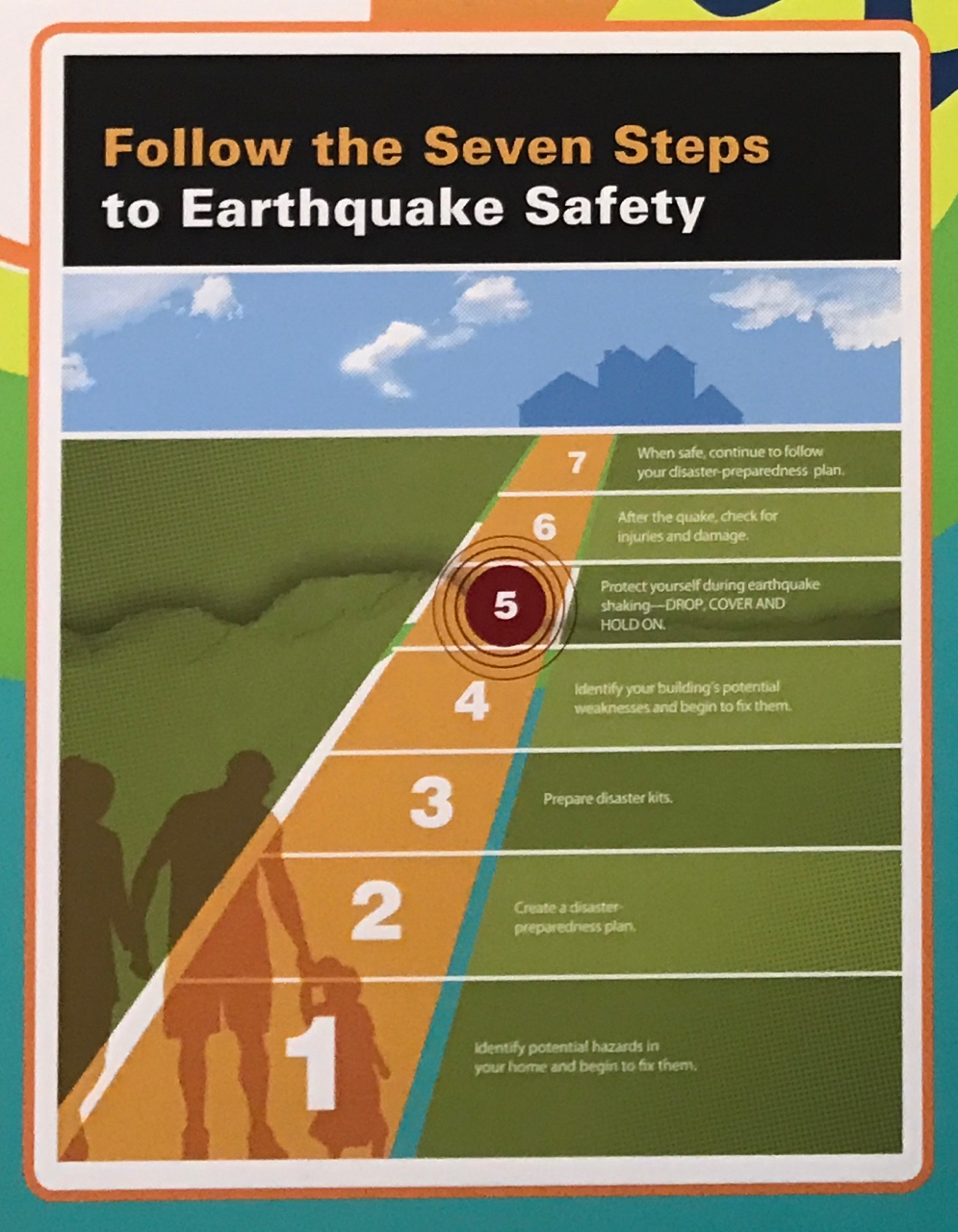
Drop, cover and hold on is actually step 5 out of 7 in the earthquake safety path.
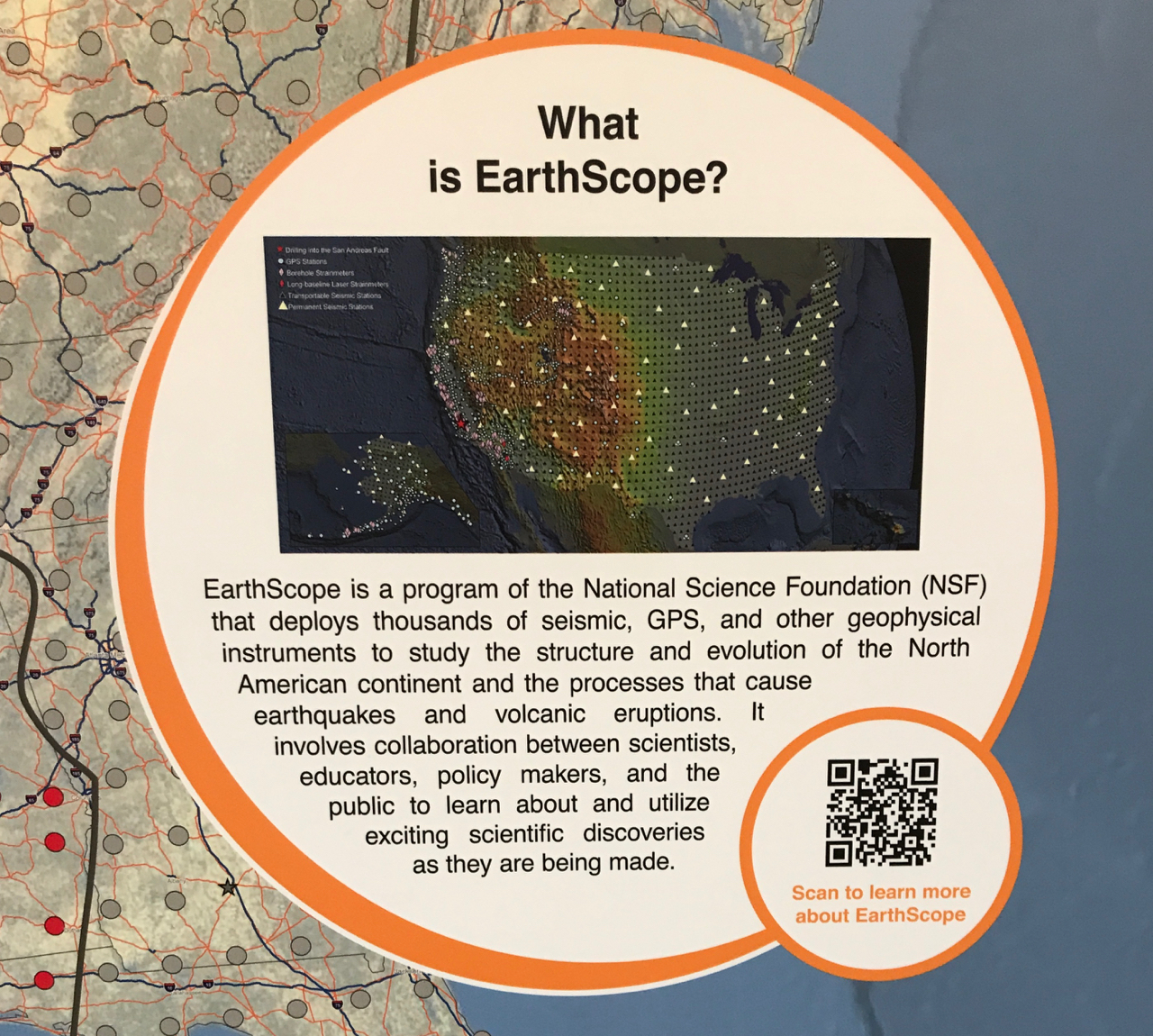
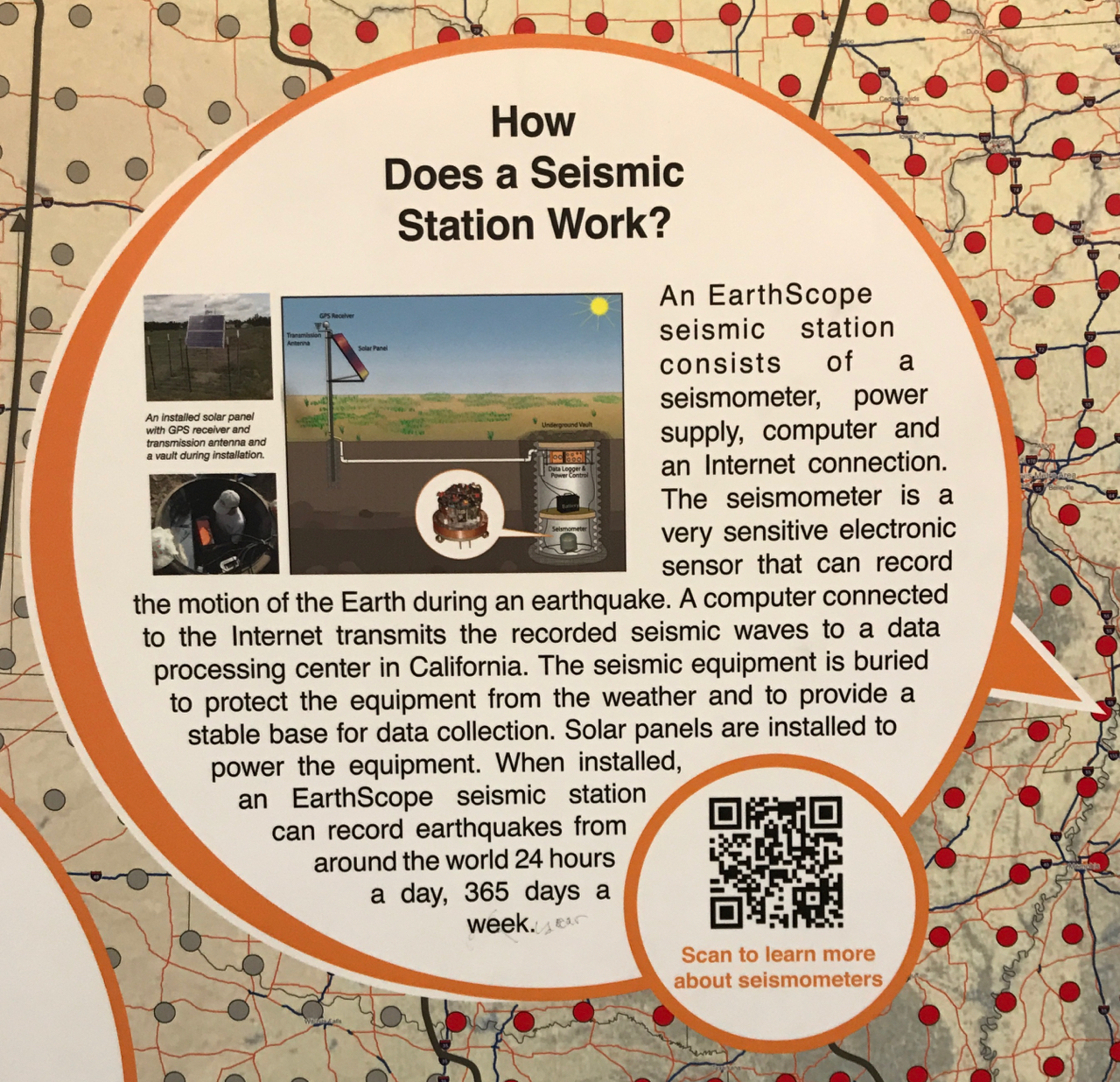
There was also a display about tracking seismic activity.
I wonder if they had a seismometer at the rest stop? Next time I’m in the area, I will spend a little more time looking around.
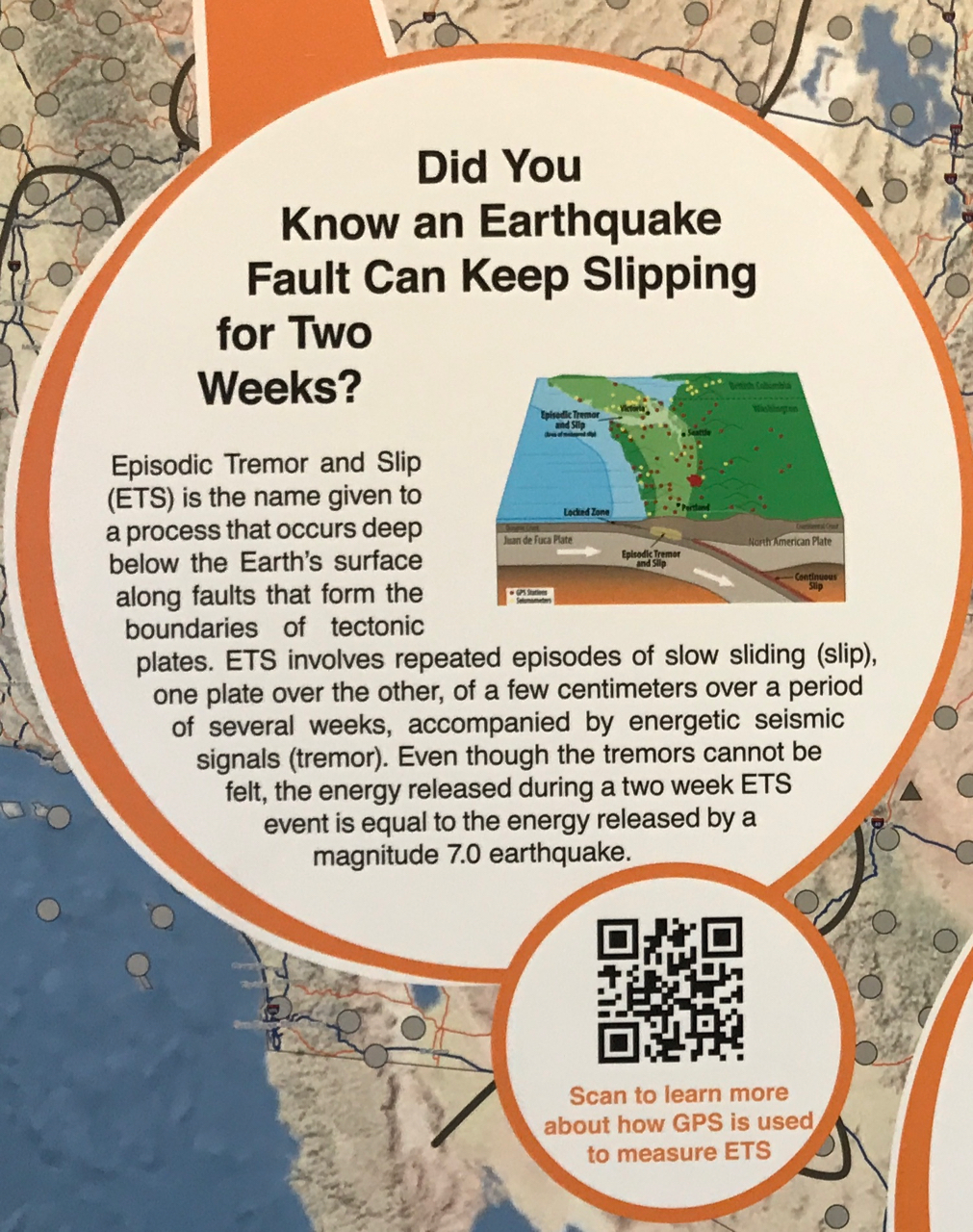
So, that’s where the aftershocks come from! Earthquake faults that keep slipping.
If you want more information, open up your camera app on your phone and focus on the QR code. It will give you the option to open a website. Friends tell me that most newer iPhones have the program built in. If you prefer to do it the “old-fashioned way” the URL for the Incorporated Research Institutions for Seismology is ds.iris.edu.
This is quite the rest stop! I’ve never seen one with a microwave and coffee maker, along with the usual snack machines.
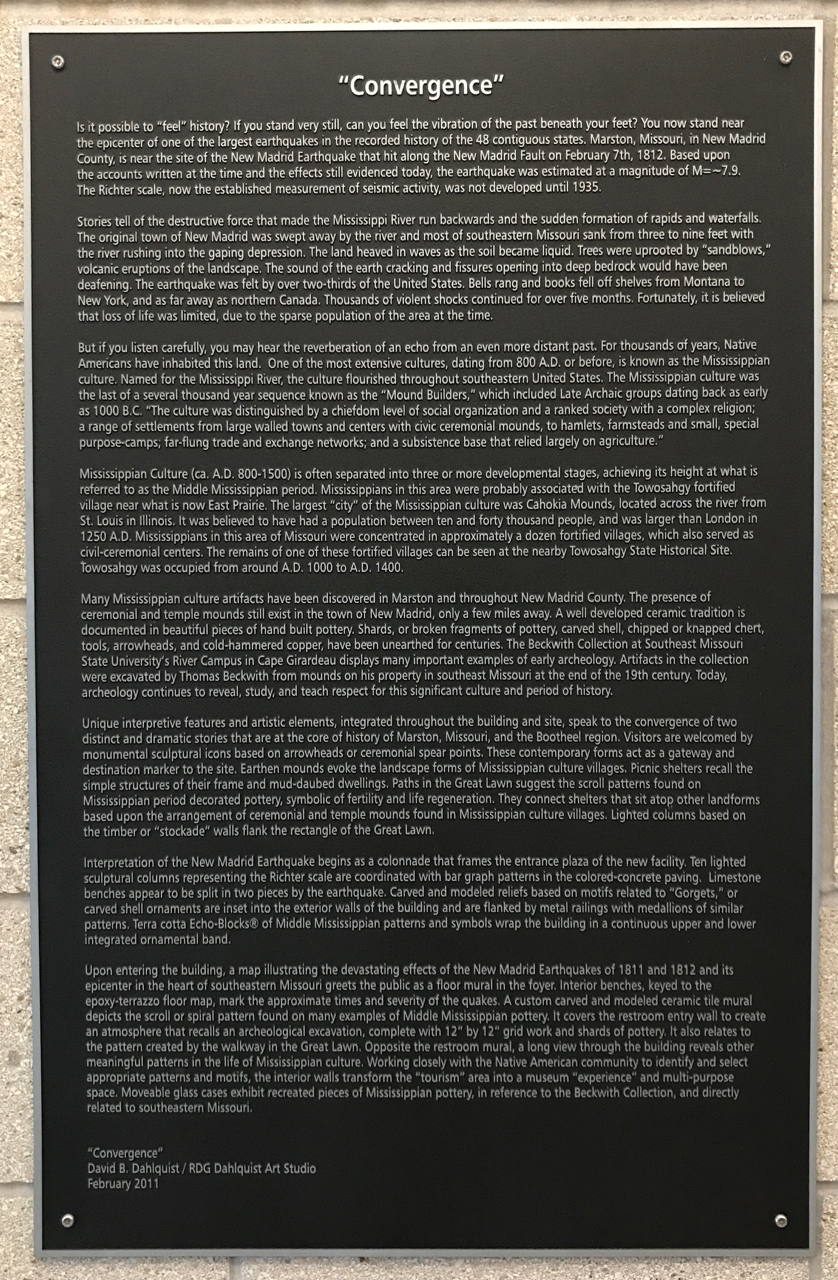
I don’t expect you to read this plaque. It gave great information about the earthquake and the thought that went into designing the rest stop.
I have to share one paragraph from it, though.
“Stories tell of the destructive force that made the Mississippi River run backwards and he sudden formation of rapids and waterfalls. The original town of New Madrid was swept away by the river and most of southeastern Missouri sank from three to nine feet with the river rushing into the gaping depression. The land heaved in waves as the soil became liquid. Tree were uprooted by “sand blows,”volcanic eruptions of the landscape. The sound of the earth cracking and fissures opening into deep bedrock would have been deafening. The earthquake was felt by over two-thirds of the United States. Bells rang and books fell off shelves fro Montana to New York, and as far away as northern Canada. Those of violent shocks continued for over five months. Fortunately, it is believed that loss of life was limited, due to the sparse population of the area at the time.”
Isn’t that incredible?
I will definitely have to make another visit to the area. I want to examine the rest area more closely. It sounds like there are more design details I would find interesting.
I couldn’t resist a last look back at the rest stop. According to information on the plaque, those pillars light up at night.
I kept driving. Due to getting on the road so early, I would have reached the Jackson Cracker Barrel at 3:00, which was just too early for me to sit in a parking lot. Besides, the weather had improved quite a bit during the day. When I stopped for gas, I spent a few minutes to see if there was a campground in the area that might work.
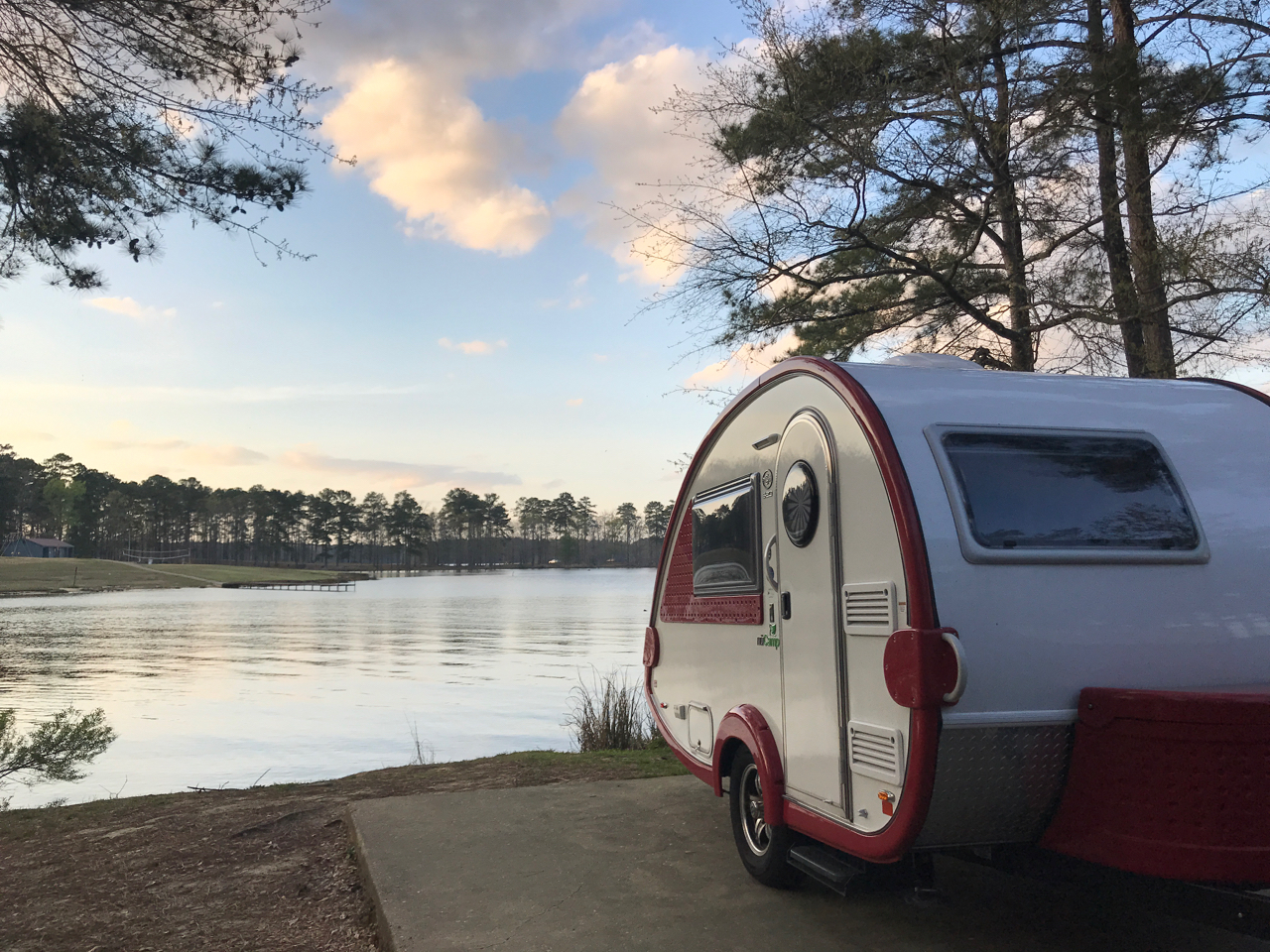
I called Lake Lincoln State Park in Wesson, Missouri, and they had a spot. They even had a waterside site with FULL HOOK UPS!
There was some heavy traffic en route, but I finally got there and got set up.
I mentioned in my last post that I was big on intention but not so good with the actual planning of trips. However, I did have a start date and a first reservation for this adventure.
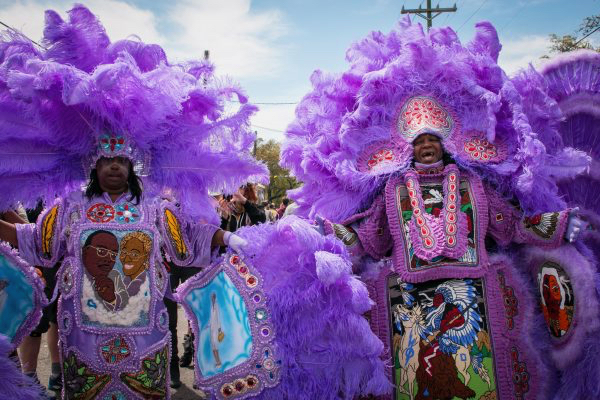
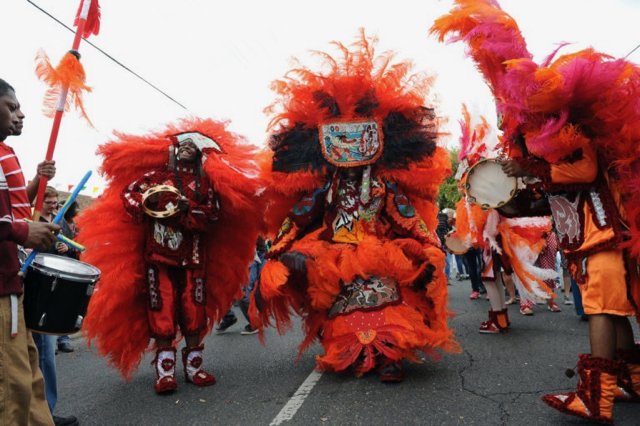
I was planning to meet up with Pat and Shelly, friends I met during my second year on the road. We were both camped at South Llano River State Park near Junction, Texas. We got to chatting and it turned out that we were both from Buffalo. What a small world! We had been comparing travel schedules and finally found an event that would work to meet up. We were going to meet up at Bayou Segnette State Park near New Orleans and go see the Mardi Gras Indians as they all take to the streets in their intricate suits parade and perform through the streets.
According to the gonola.com website:
“Mardi Gras Indians form a vibrant subculture of local Carnival traditions. Though their exact origins are hazy, the common belief is that Native Americans sheltered runaway slaves, and Mardi Gras Indian tradition is a way of paying homage. Their practices date to the 1800s. Mardi Gras Indian traditions germinated within the period of Jim Crow and segregation when African Americans were forbade from participating in mainstream carnival organizations.
“Because of this, unique and territorial tribes emerged across the city. While for many years confrontations could turn violent, the culture changed, largely due to the efforts of the late Big Chief Allison “Tootie” Montana of the Yellow Pocahontas tribe. Now, when tribes meet, they perform dances, chants and other rituals, working to outdo each other.”
Doesn’t that sound amazing? Anyway, we were planning to go take in the spectacle of Super Sunday, which was to take place this year on March 15, 2020.
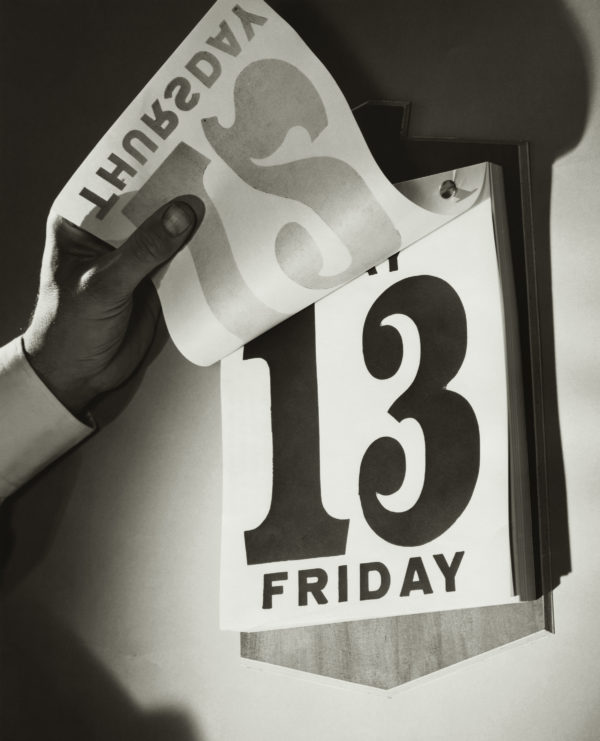
I planned to arrive at Bayou Segnette State Park on Friday, March 13. Hmm…Friday the 13th. Maybe that was a bad omen.
Anyway, I got myself organized and got the trailer packed so that I would be ready to head out as early as possible on Wednesday, March 11.
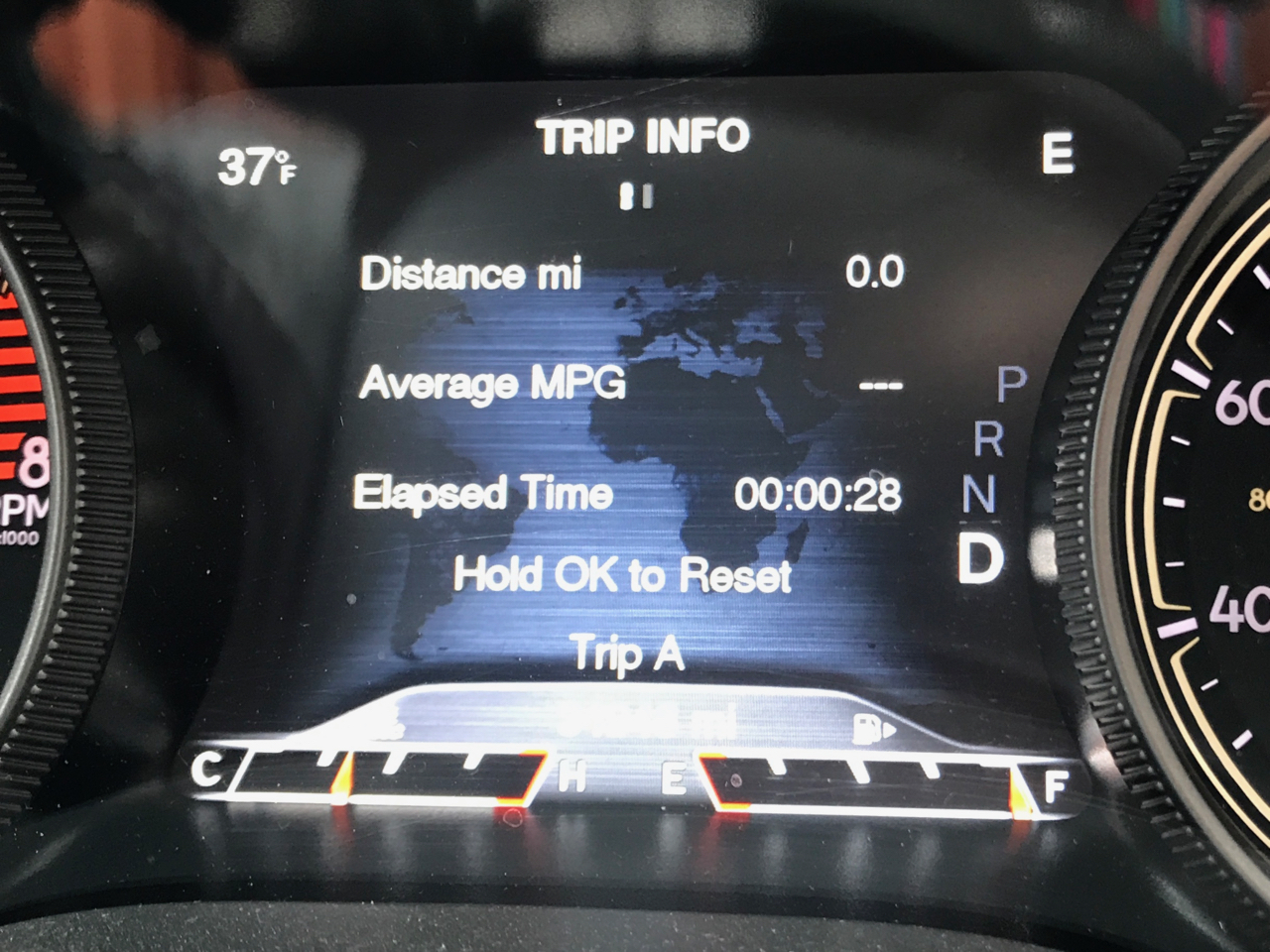
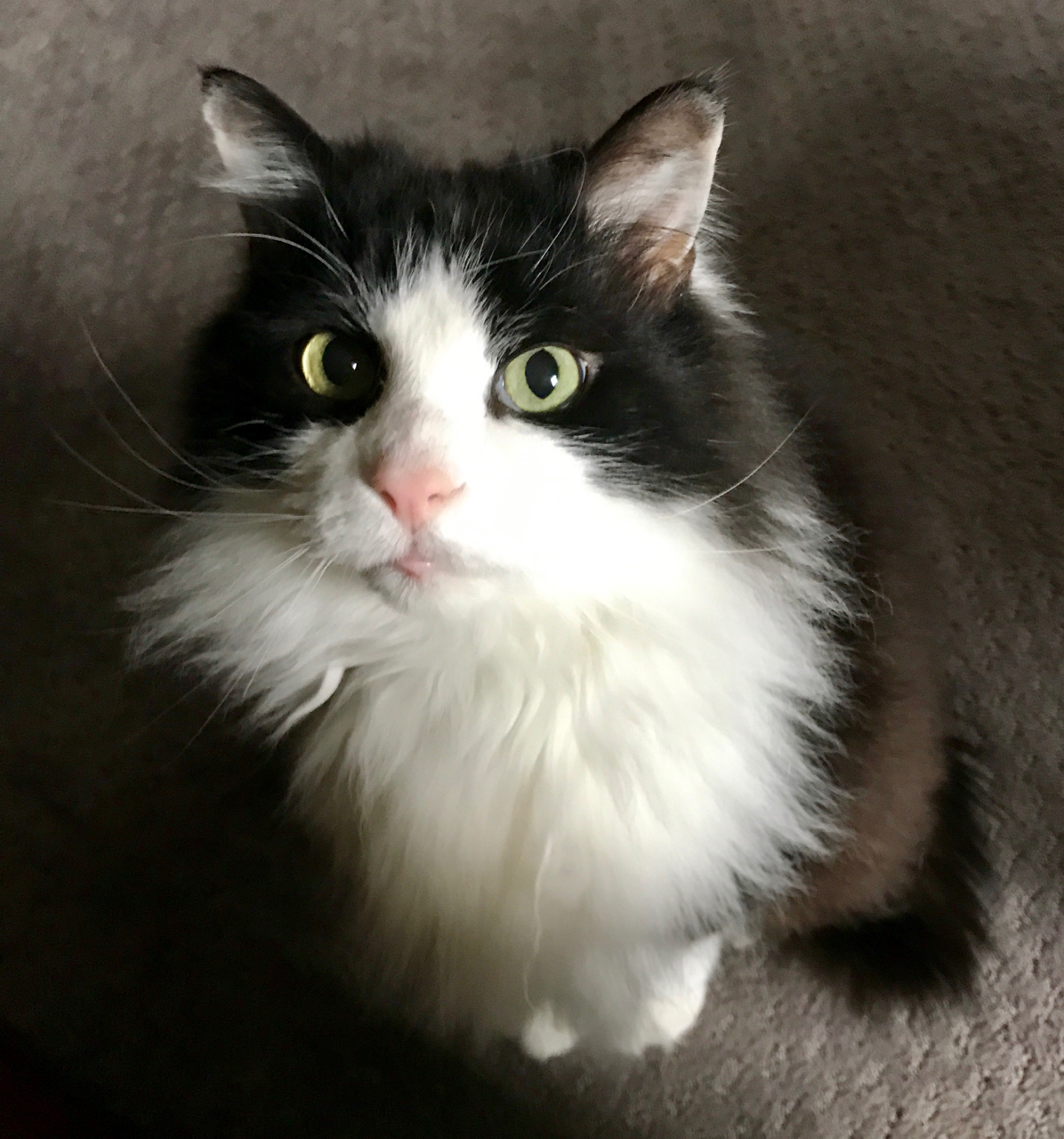
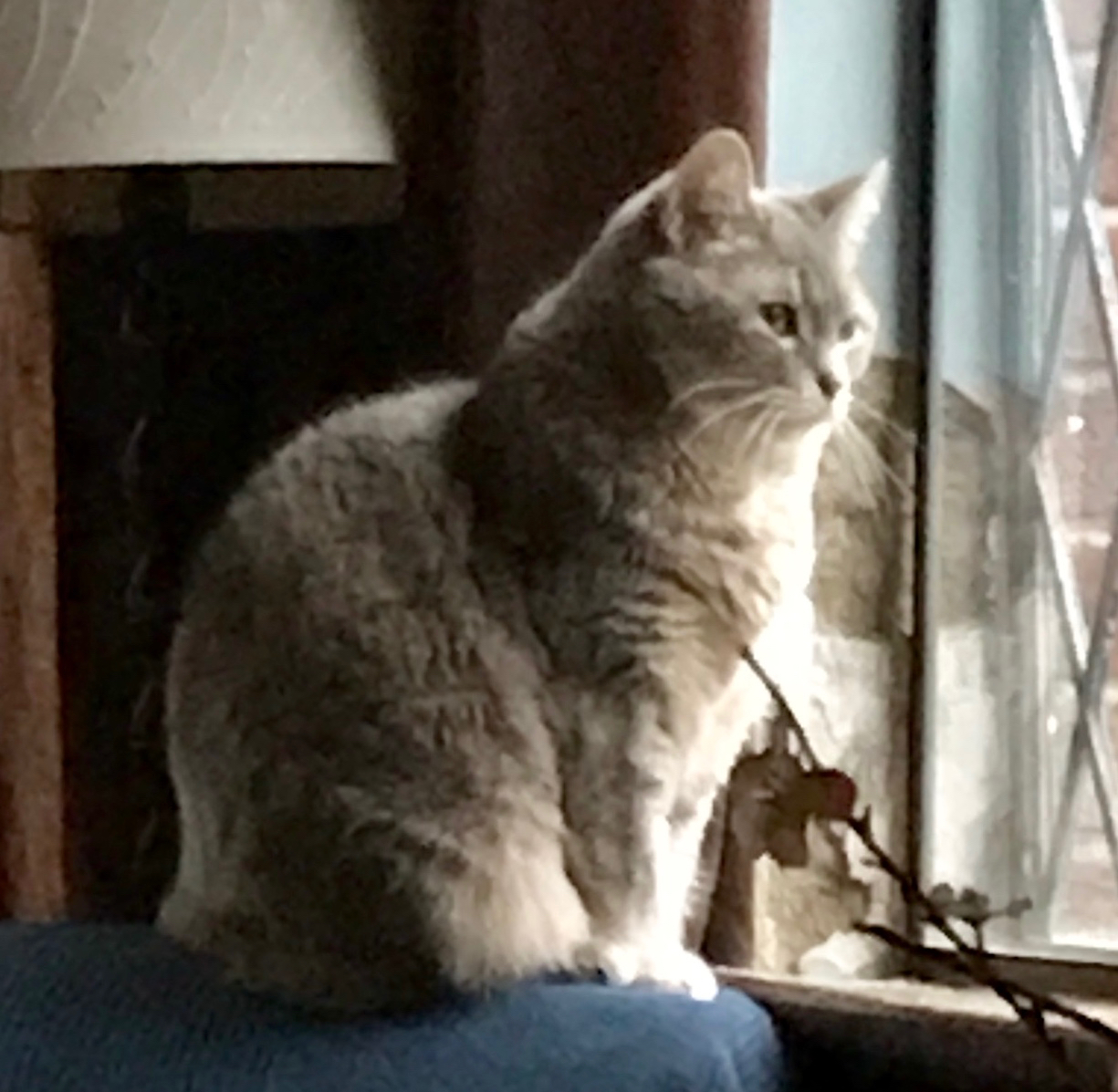
I hit the road at the crack of 10:30. I loaded Cora the Travel Cat into her carrier and hoped that she would ride calmly in the Jeep. With the temperature at 37 degrees, I didn’t want to put her in the T@b unless it was absolutely necessary. But, Cora handled it well. She just curled up and slept most of the way.
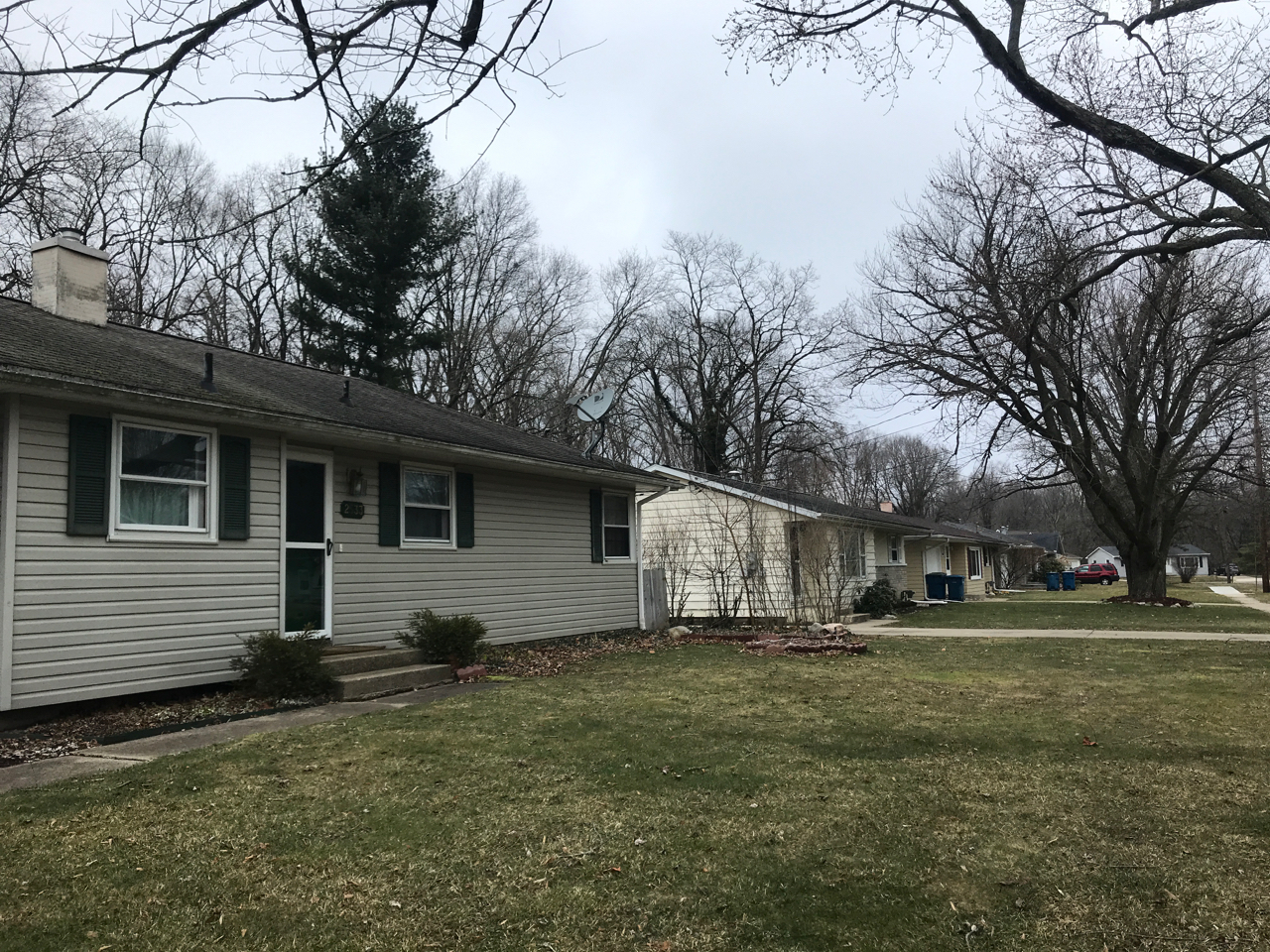
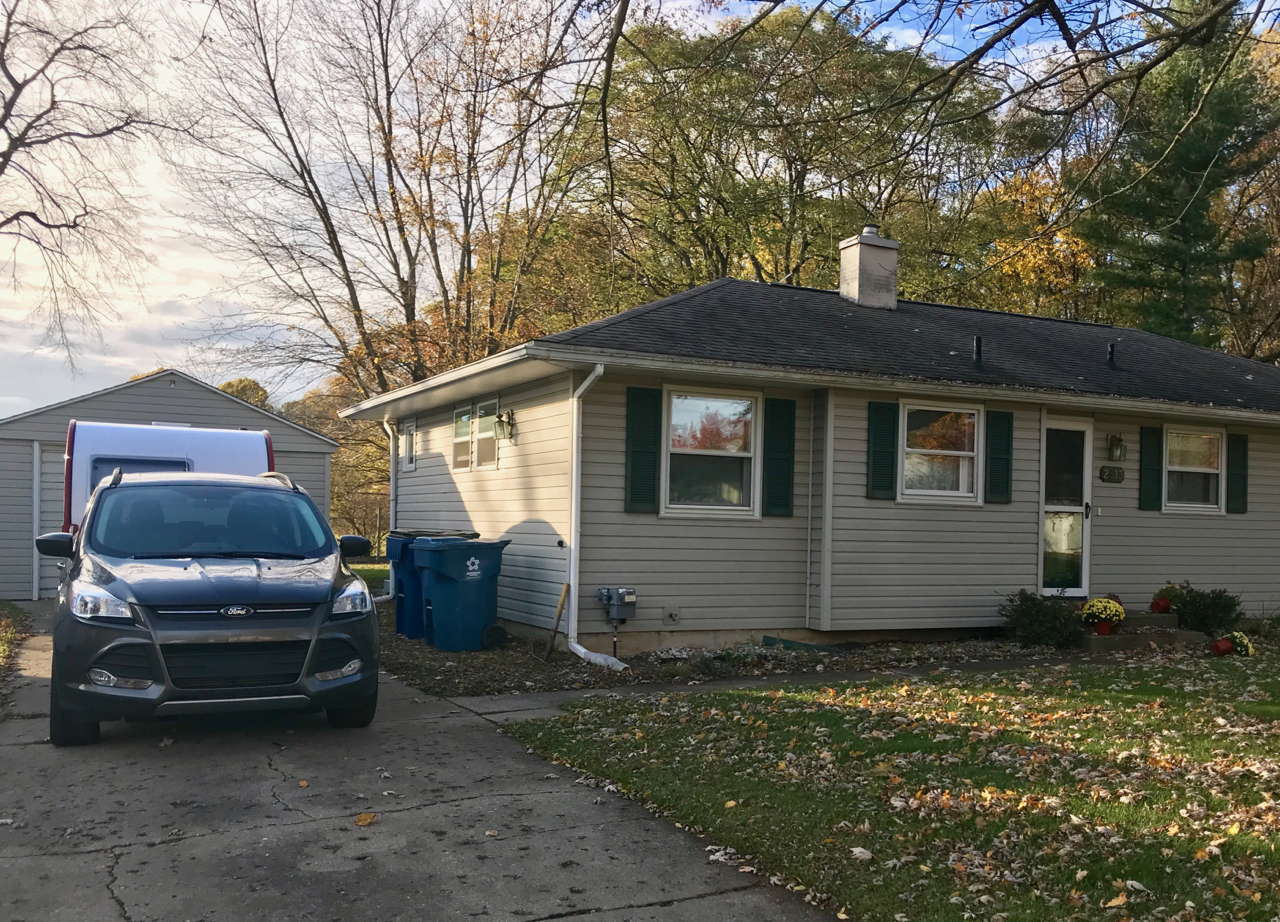
As I pulled out the driveway, I snapped this photo of the front of the house. I ws thinking that it would look a lot different when I got back in May.
As I headed south, I drove out from under the perma-cloud in Michigan. I played tag with a T@b from Minnesota heading down I-57 as I headed to my first planned overnight stop.
When I stopped at a rest stop, I reveled in the blue sky.
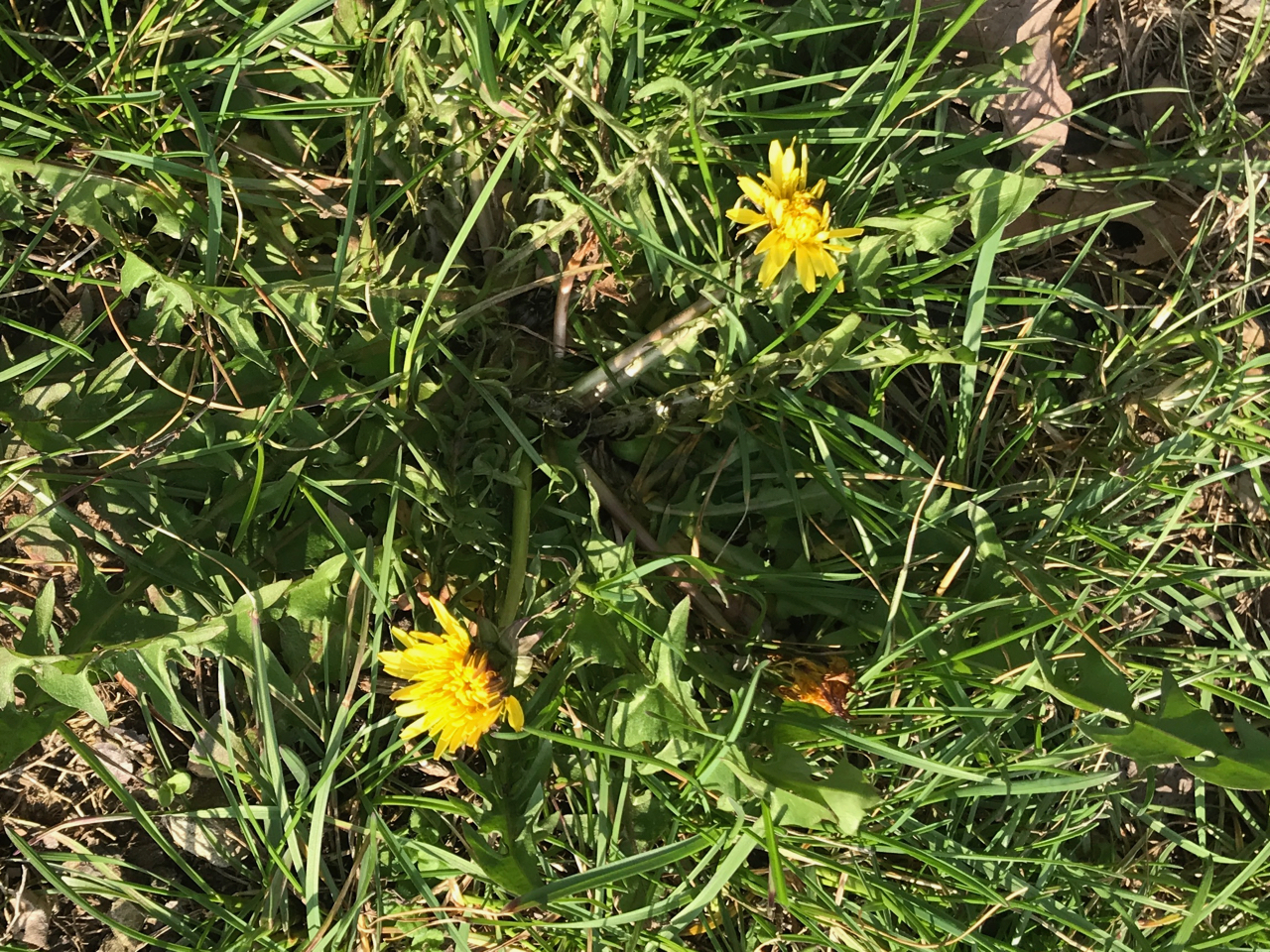
I was thrilled that I had driven into spring! I always love it when I see the first dandelions of the season.
Drive, drive, drive, drive
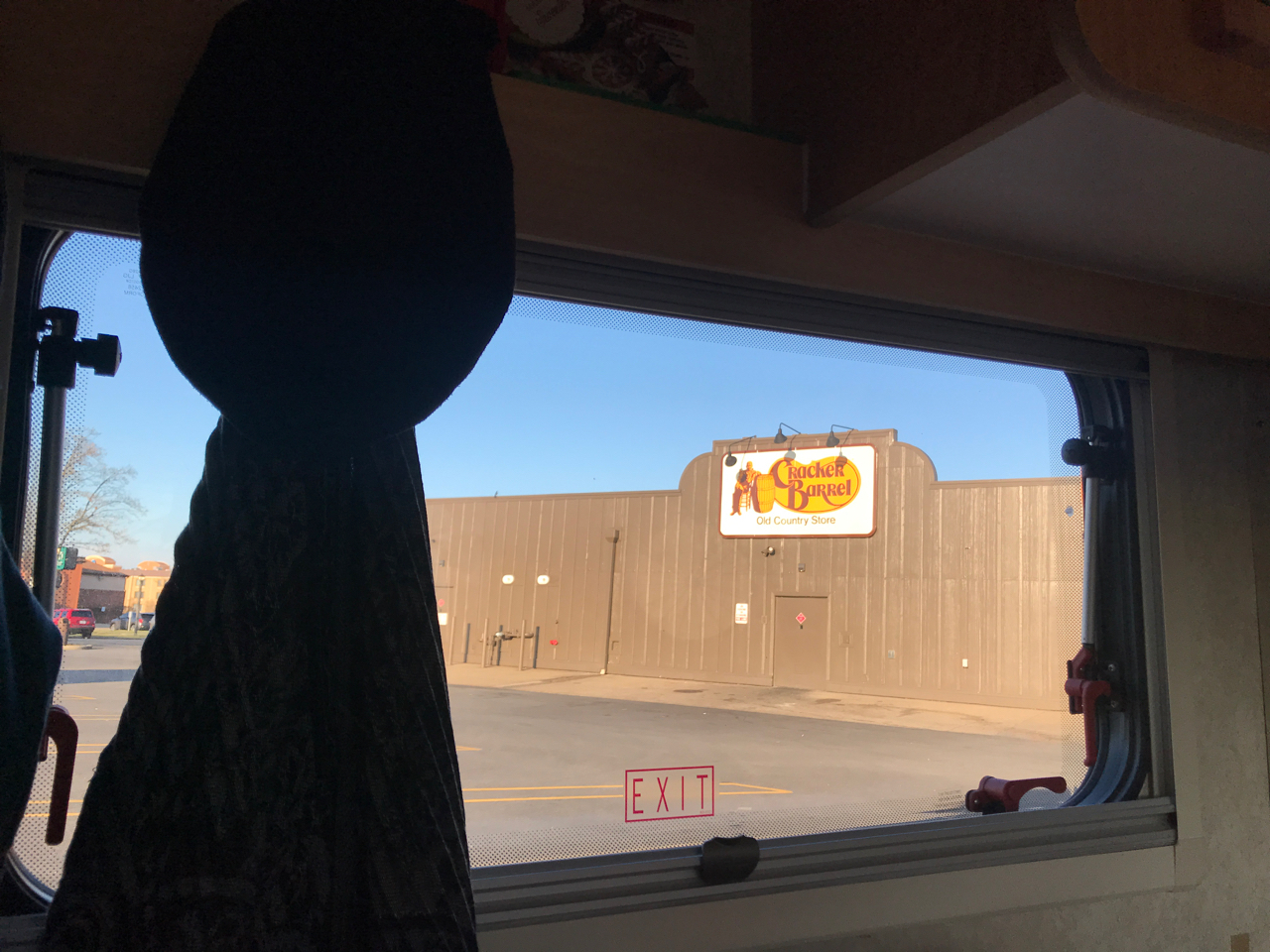
And then I was there! My stop for the night was Cracker Barrel in Marion, Illinois.
The sky was blue and it was as warm in my trailer as it was in my house. I went into the Cracker Barrel for dinner. I had my usual bowl of pinto beans cooked with country ham and served with an onion slice and chow chow relish. It was served with some little corn muffins and real butter.
Is your mouth watering? No? Well, I do like my beans.
After dinner, I unfurled my blankets and snuggled up with Cora and I had a decent night’s sleep.
I was up early and headed south. My next planned stop was a Cracker Barrel in Jackson, Mississippi.
I had a grand trip planned for this Spring 2020. Well, planned isn’t quite the right word. I had grand intentions…
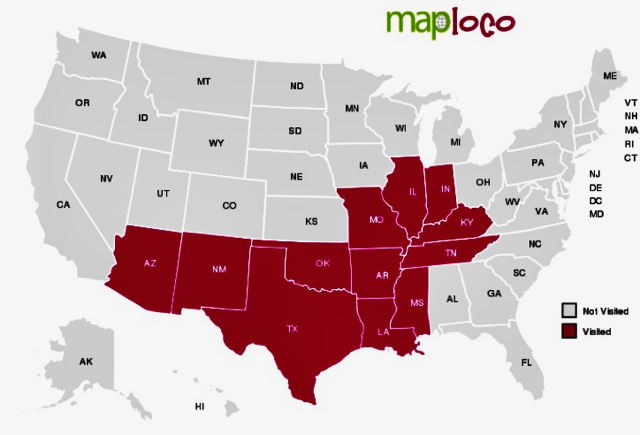
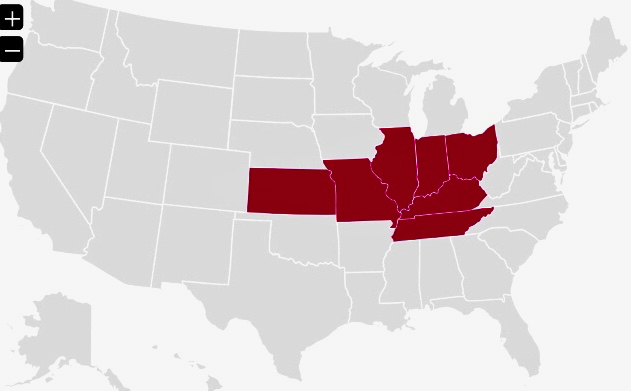
Map created at Maploco.com
Anyway, while I was preparing to set out on March 11, they were downplaying things. They recommended frequent hand washing and practicing social distancing. I figured that I could do that in my T@b as easily as I could in my house. I packed and prepared enough food so that I could stay out of markets. I wouldn’t need to shop for several weeks.
I thought I was golden.
Well, a few days into it, I decided that the best decision would be to be save this trip for a later date.
Given the unprecedented and rather historical nature of travel in the time of CoViD, I thought I’d write this up now while things are fresh in my mind. I can resume my reports on older trips later.
I just love it when I get to visit friends and family along the way. It’s fun if I am staying in a nearby campground, but home hospitality is even better.
I visited Frank and Debbie in Asheville, North Carolina. I know them through my Airstream connections. And, while every house looks better with an Airstream in front of it, a T@b isn’t all that bad. They have electric and water hook ups at their Airstream parking spot, but they invited me to stay inside.
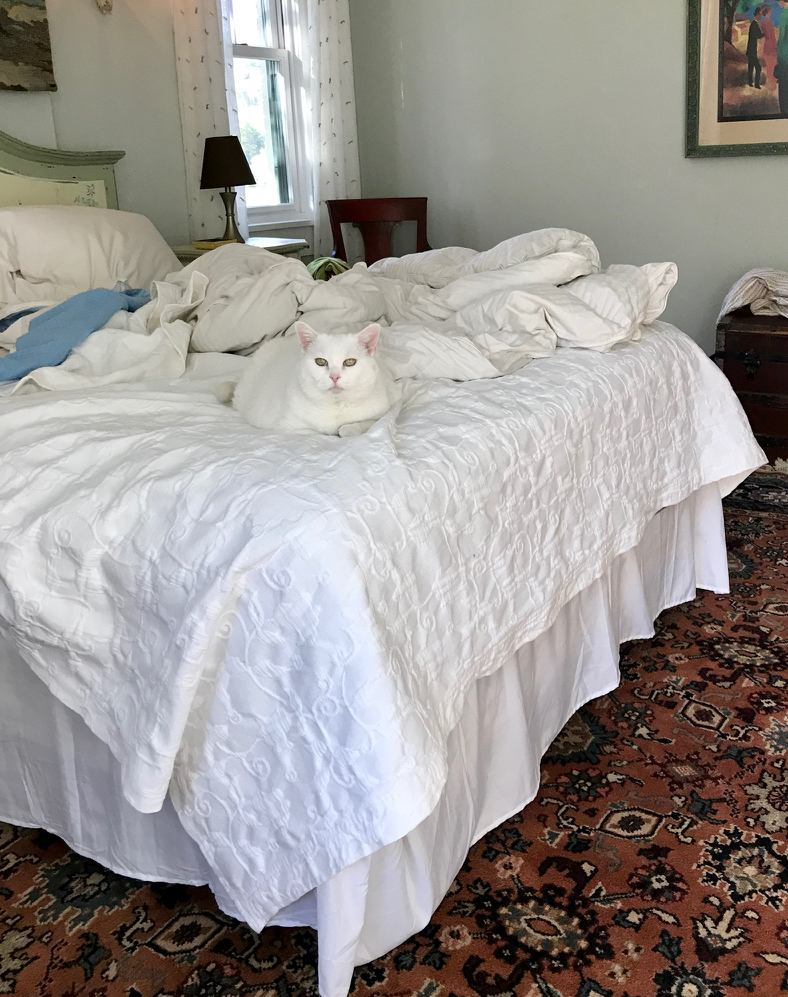
Cora made herself at home very quickly. She looks like she belongs there, don’t you think?
Incidentally, I arrived at Frank and Debbie’s house on April 1, 2019. Since it is now March 20, 2020 when I am finally immortalizing their hospitality, please forgive me if my recollections are a bit fuzzy. Thank goodness that the photos are stored by date, otherwise I wouldn’t even know when I was there!
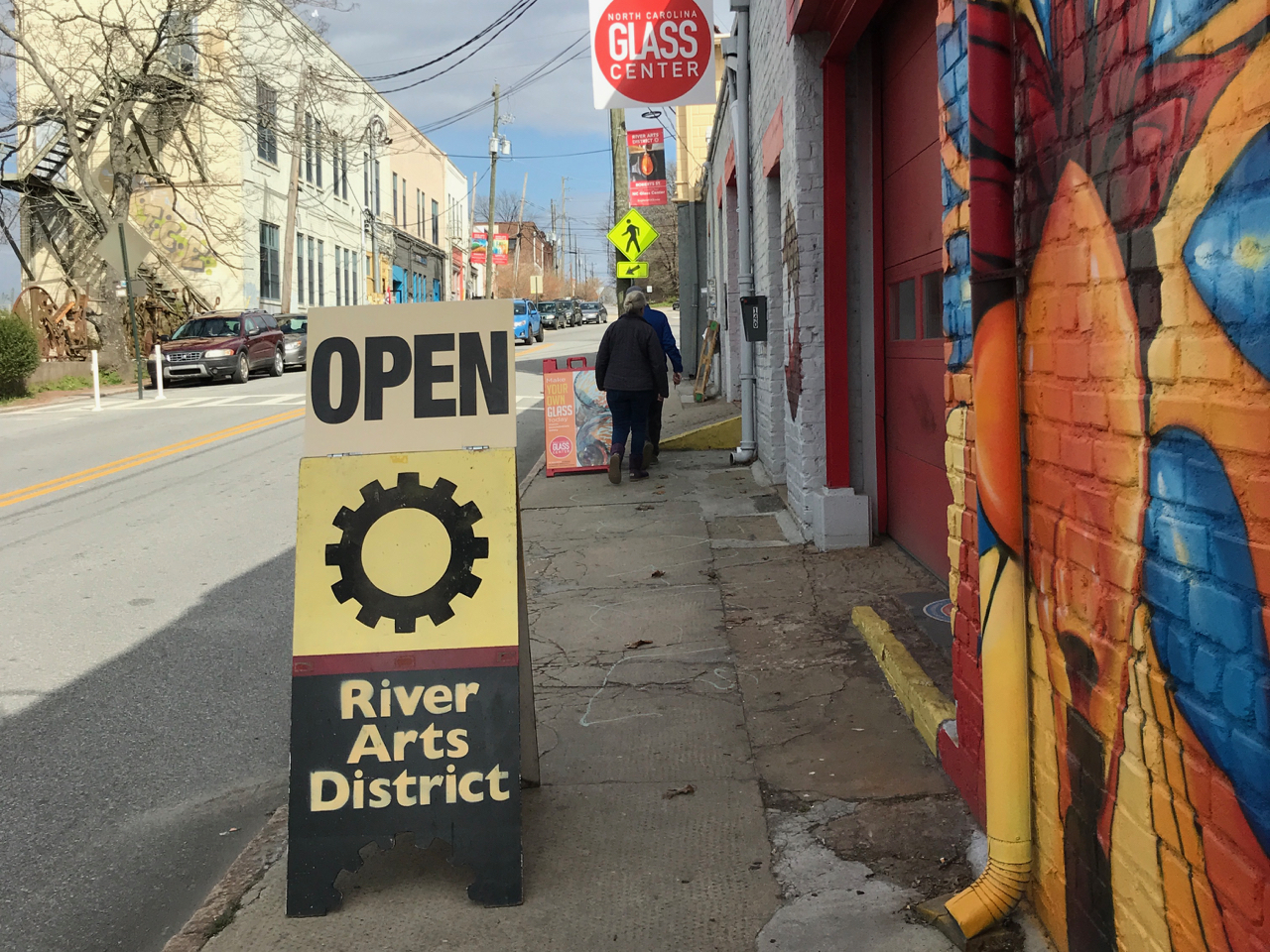
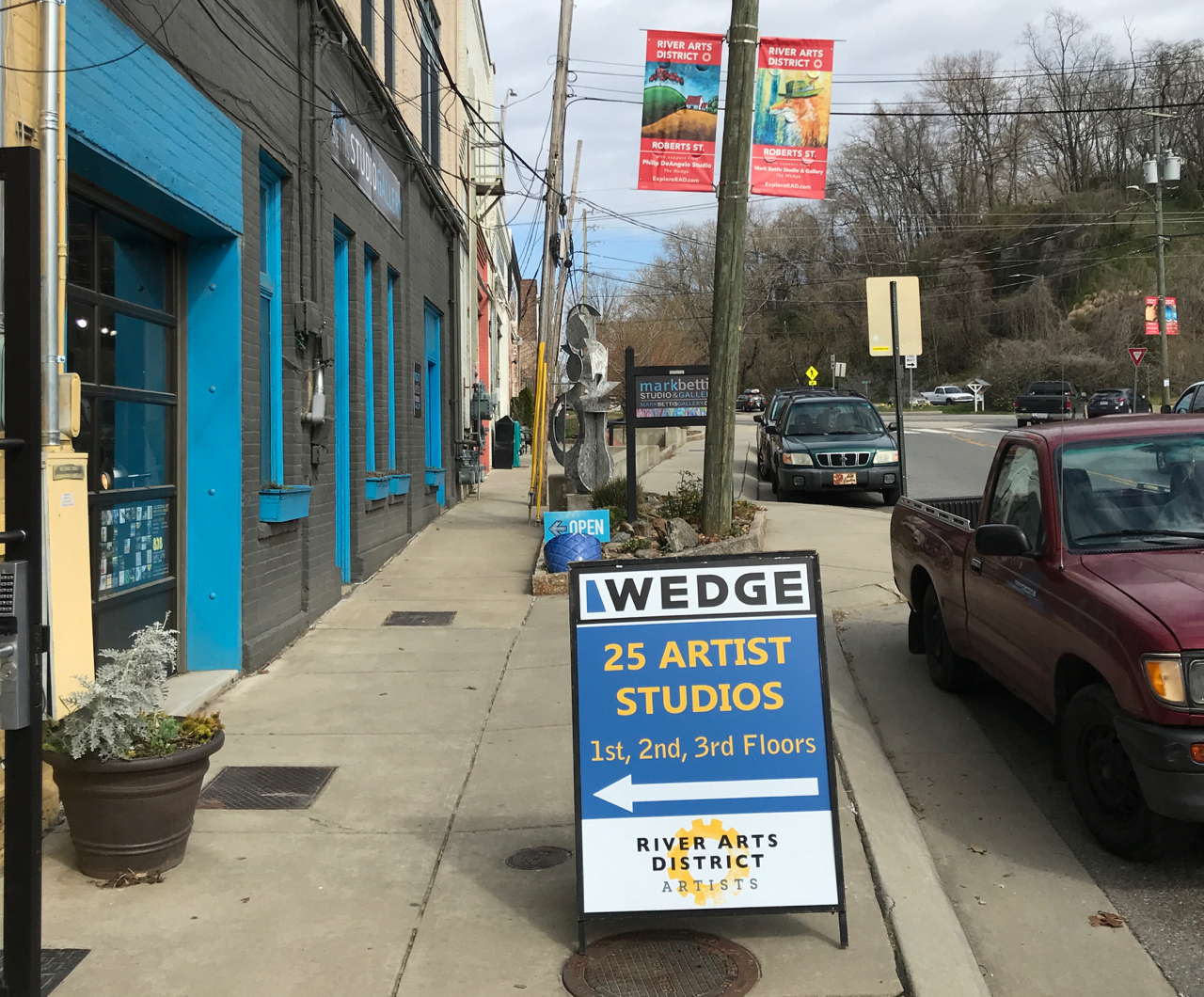
Anyway, the next day, we set out to explore the River Arts District.
There were many studios and galleries to visit.
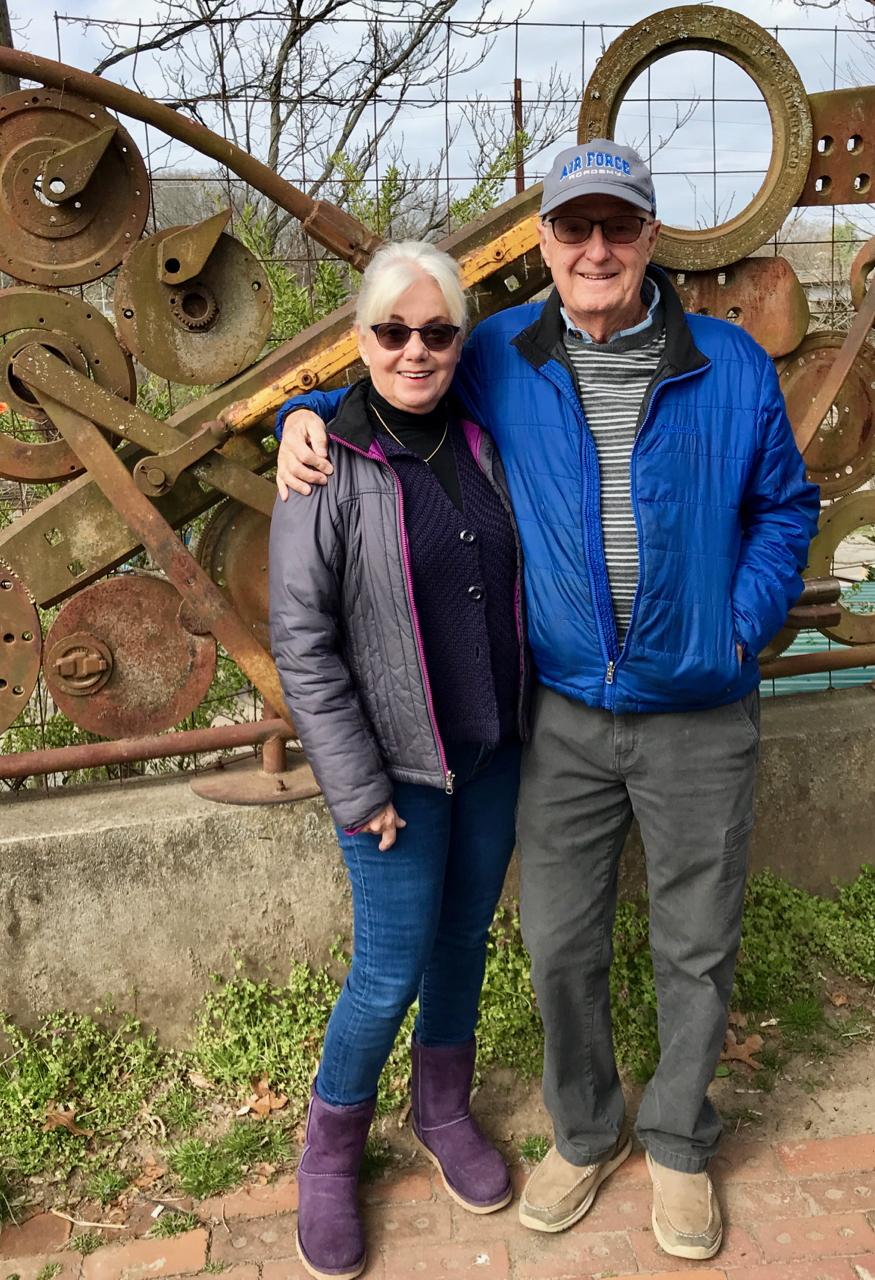
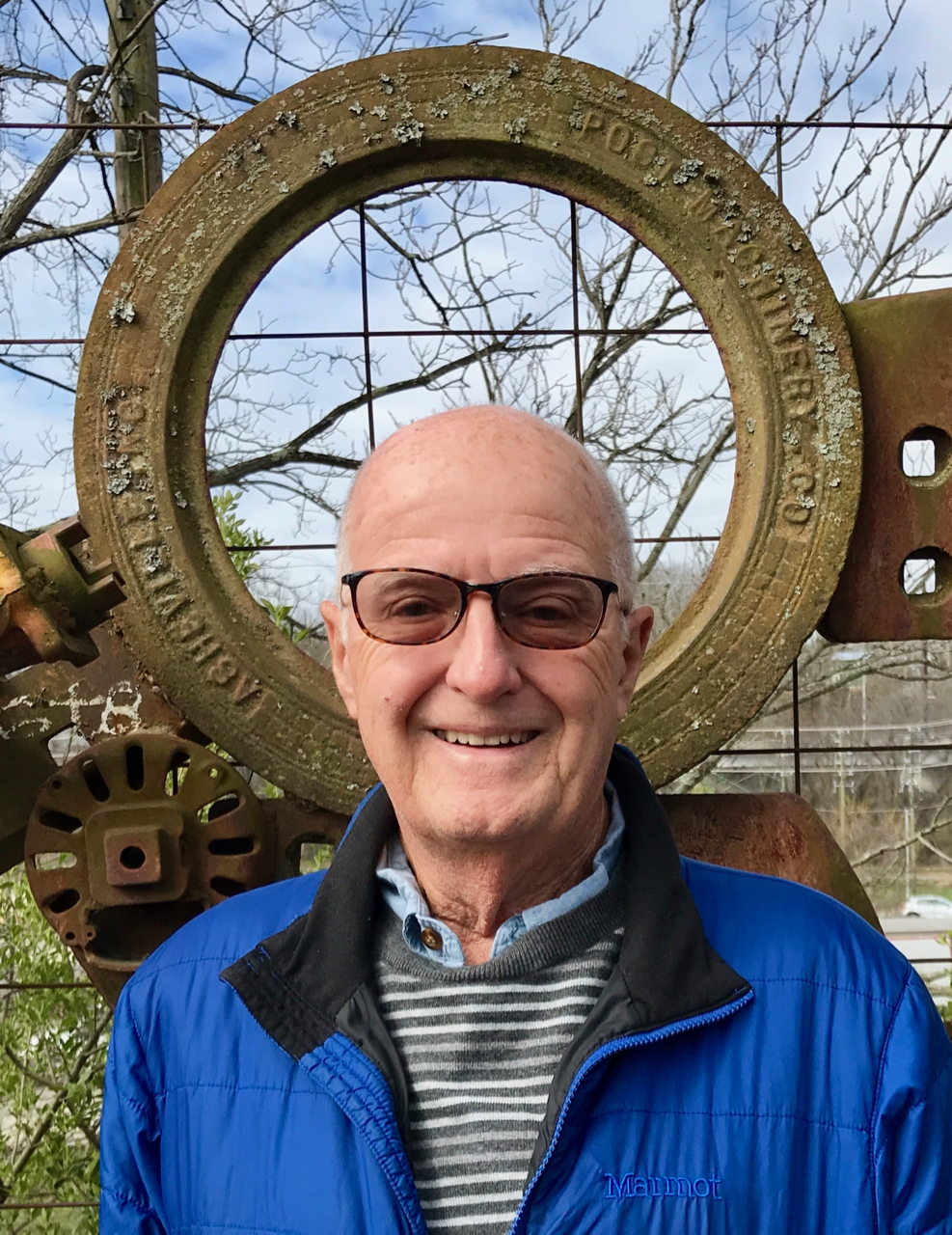
I thought this sculpture was interesting. I’ve always had a thing for found objects – otherwise known as “junk.” First I snapped a photo of Debbie and Frank.
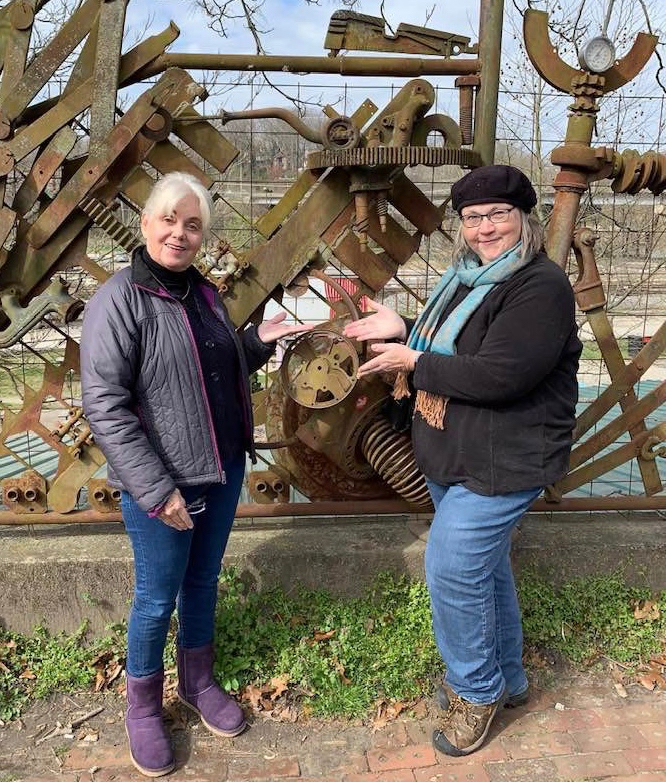
Then Frank snapped one of Debbie and me gesturing artistically at each other.
Then, I couldn’t resist the opportunity to snap a shot of Saint Frank.
We continued our way around the studios and galleries.
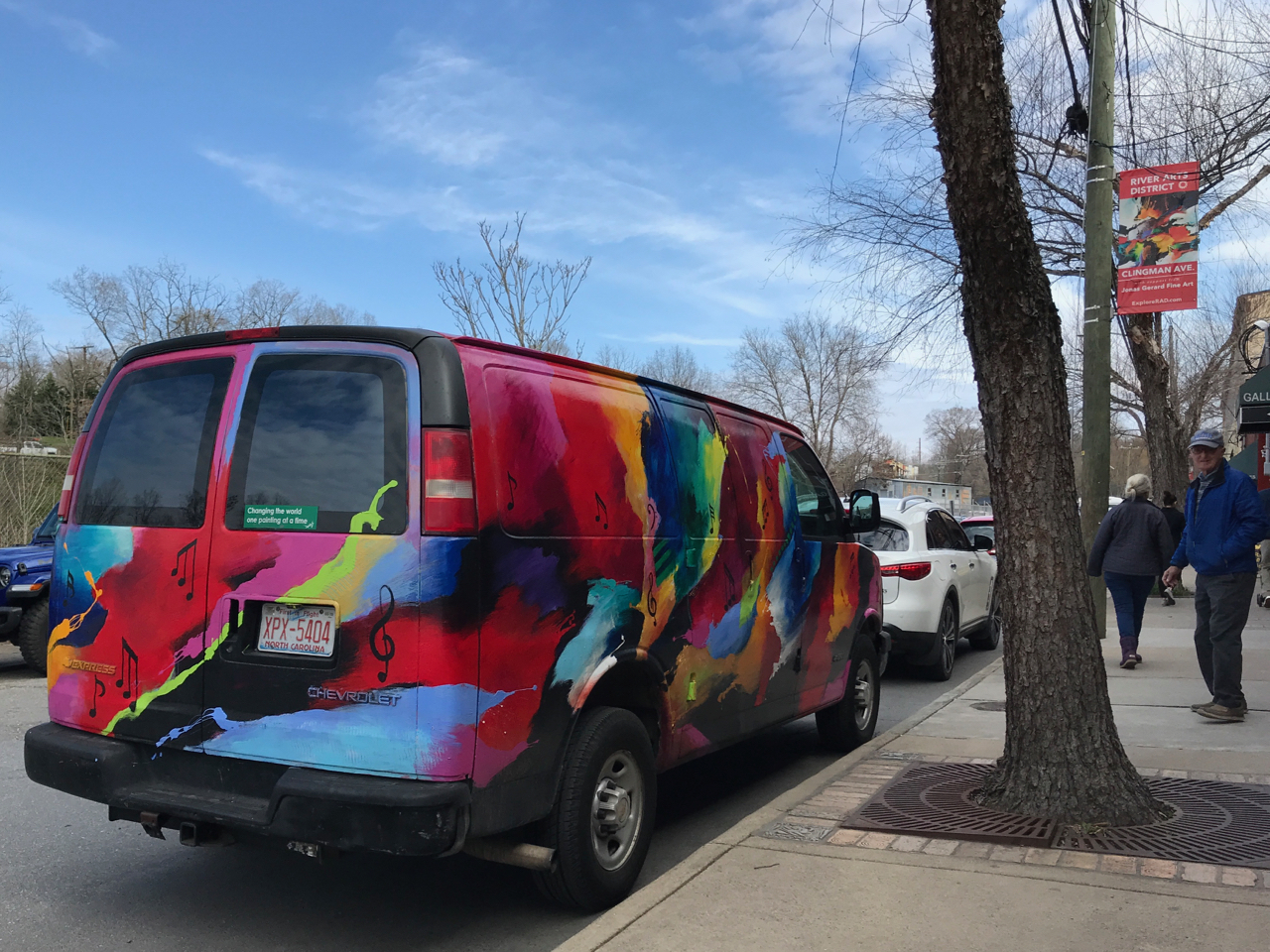
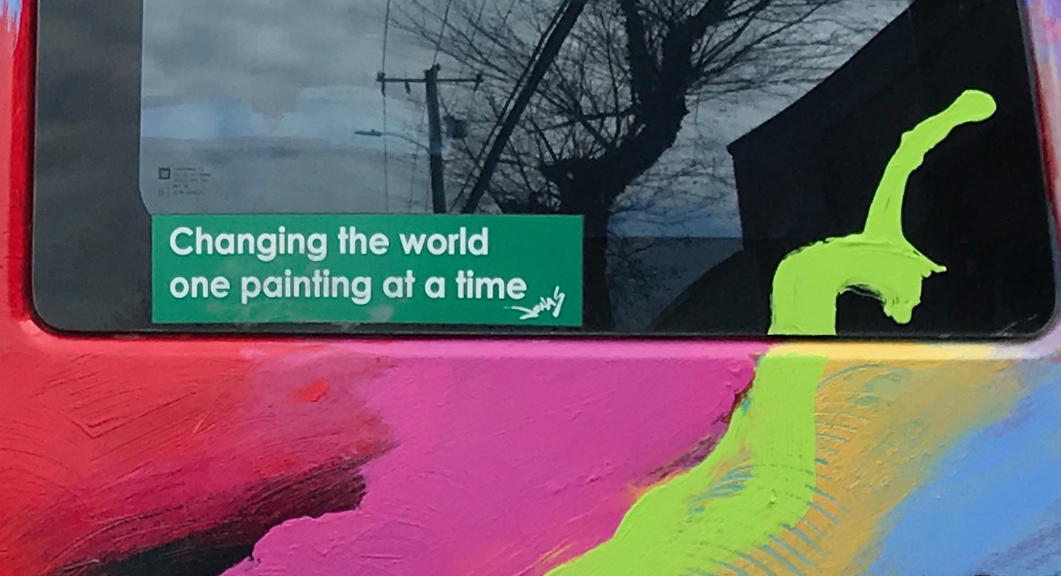
But, you didn’t even have to go inside to see art. This was quite the Art Van.
Okay, a little humor for those familiar with the Midwest chain of furniture stores that will soon join the ranks of Sears and Montgomery Wards.
At least this art van has a sense of itself. I imagine that colorful van changes any place in the world that it is parked.
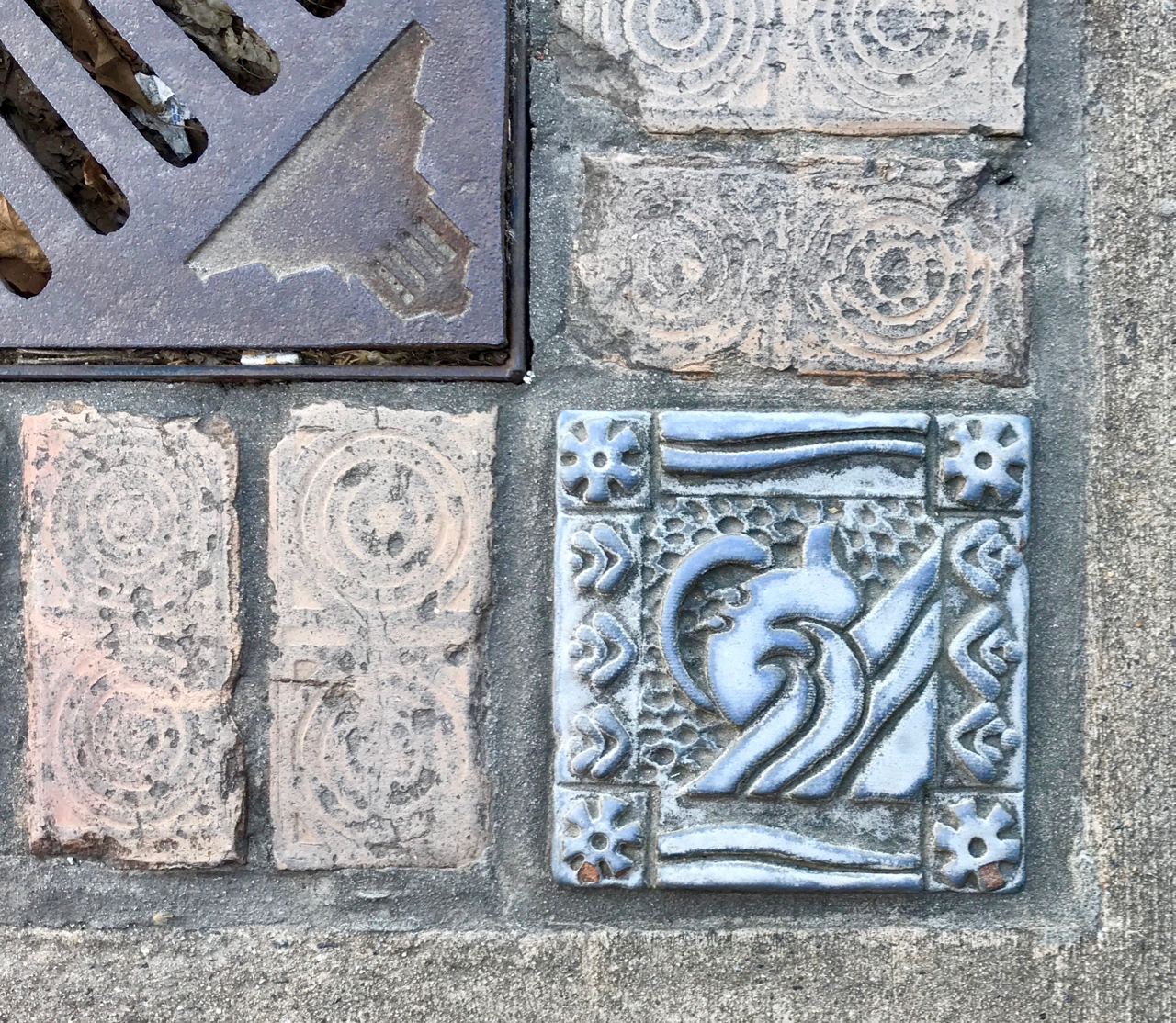
I also enjoyed the artistic tiles and grates in the sidewalk.
I didn’t take photos in the galleries and studios we visited out of consideration for the artists. I think they would prefer that people buy their art rather than take photos of their work.
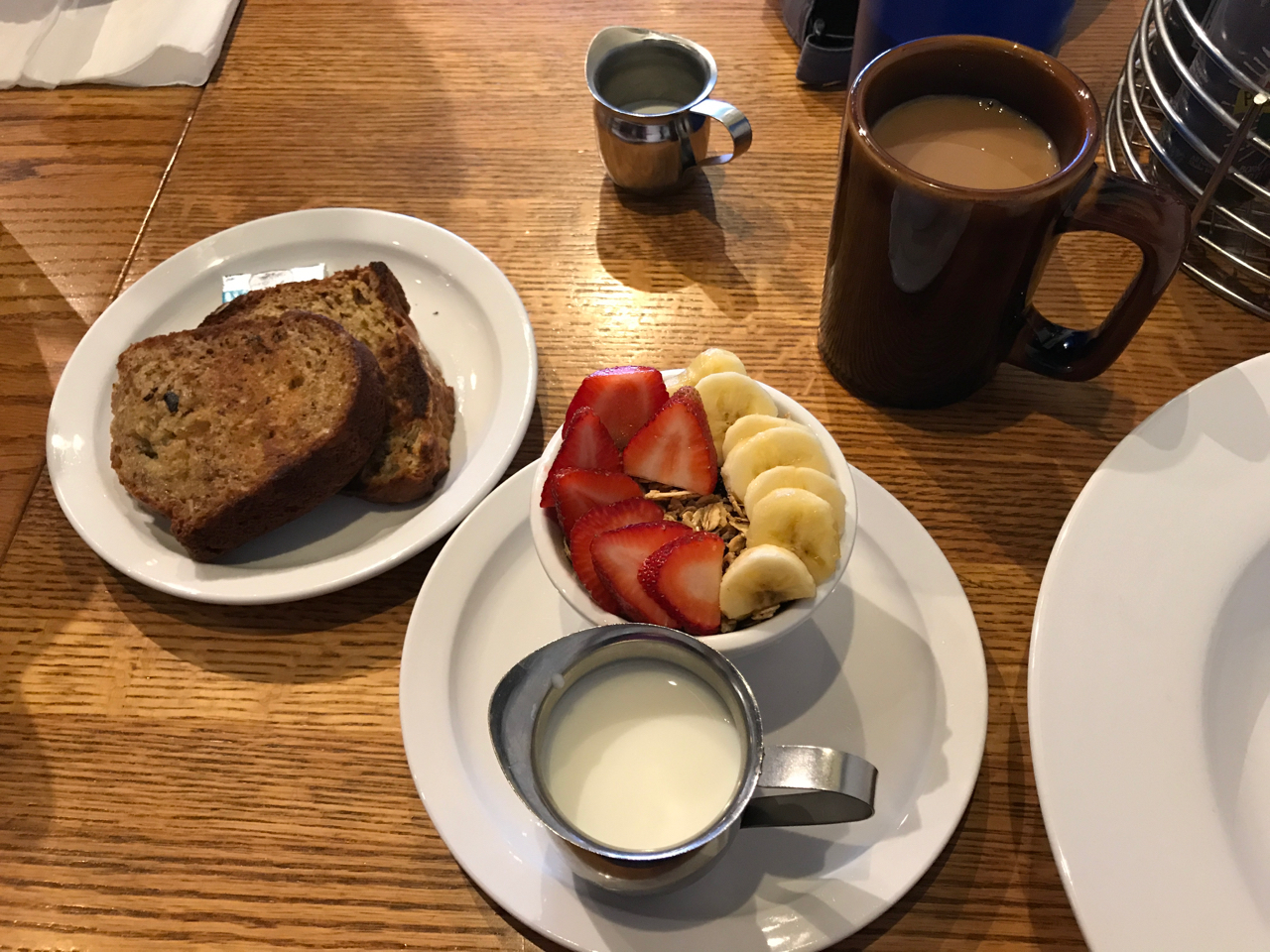
We stopped in at Early Girl Eatery for lunch. I couldn’t resist ordering the same thing I had when I visited the year before. I did have to request a larger bowl to put my granola in. The cup they served it in was too petite to add the milk.
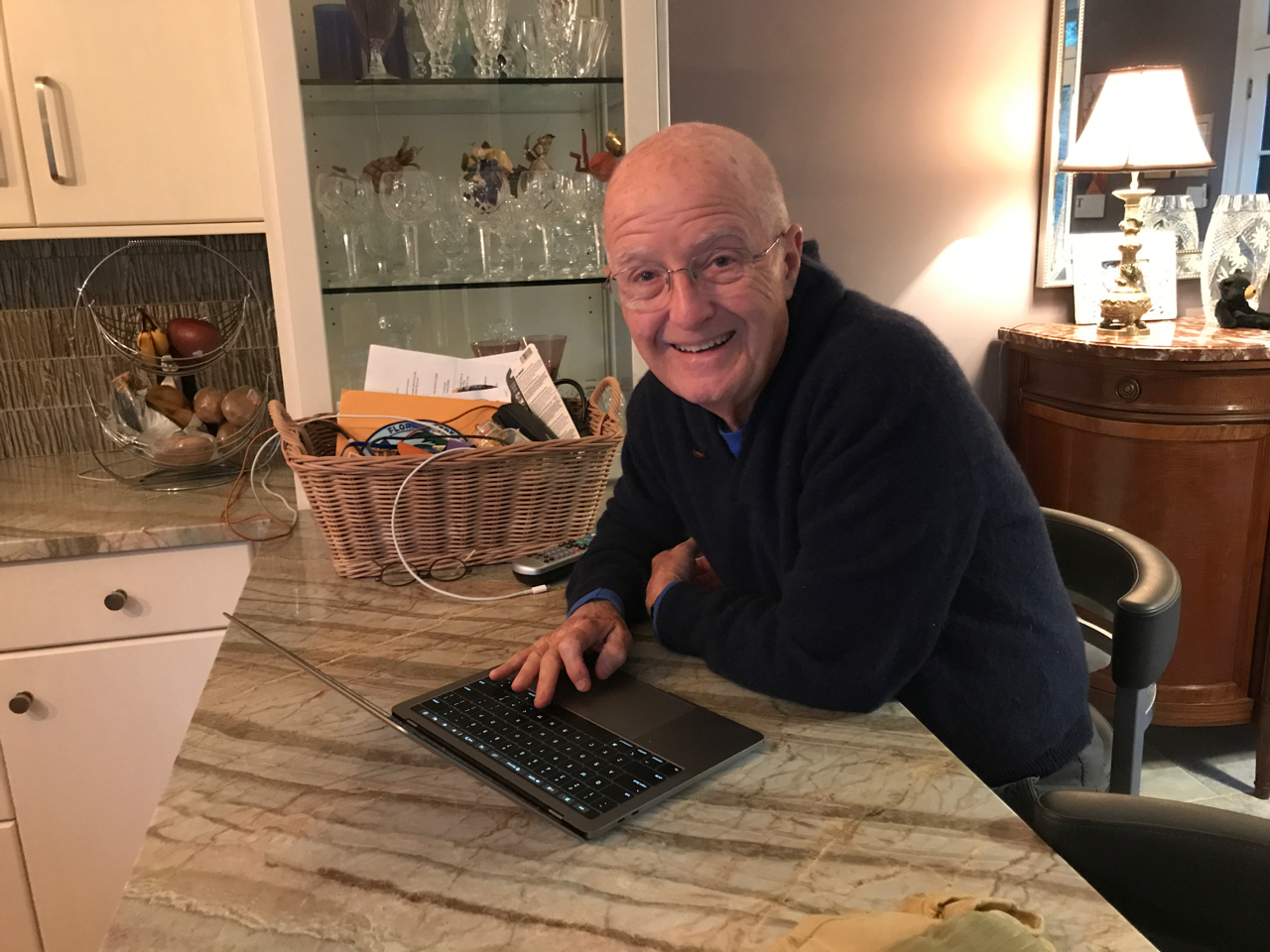
When we got home, we spent some time doing our own things. Frank was working on a “mash up.”
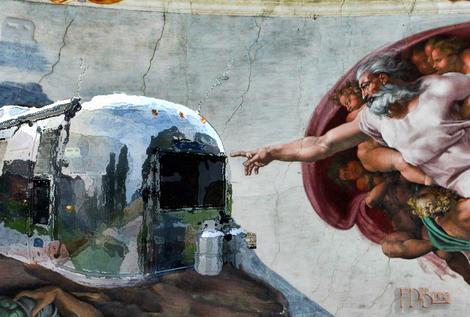
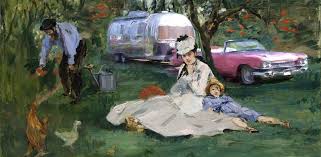
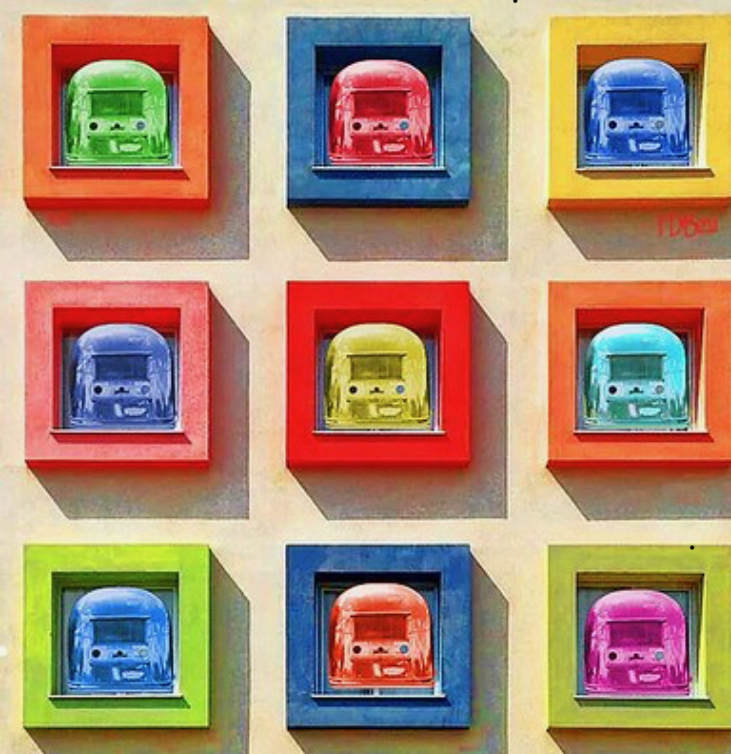
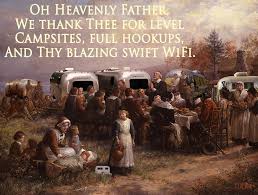
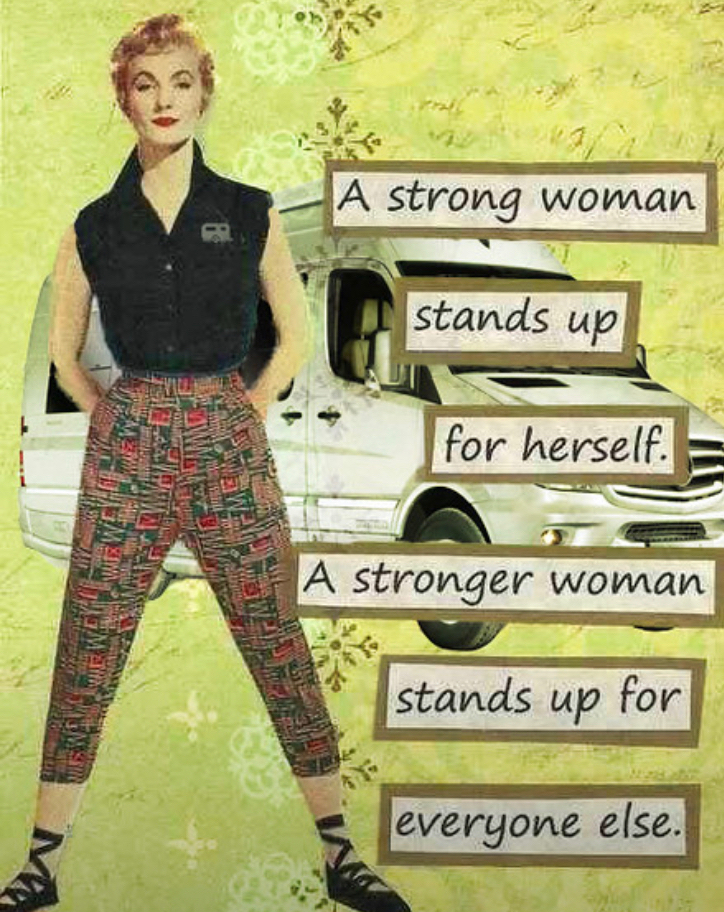
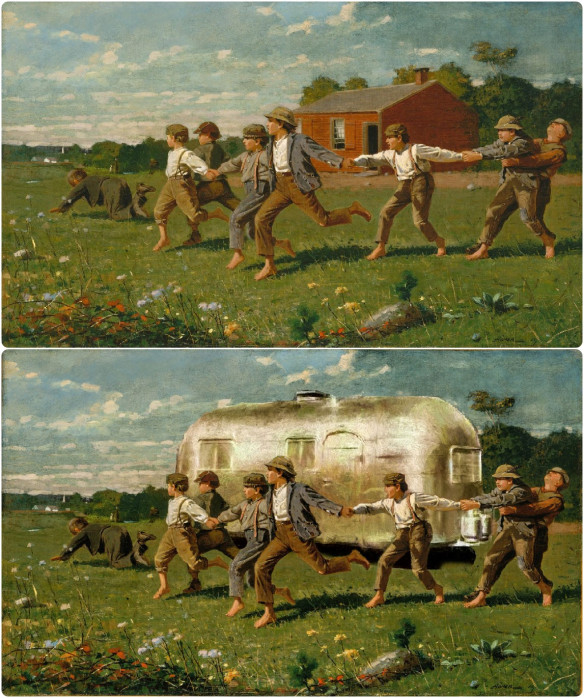
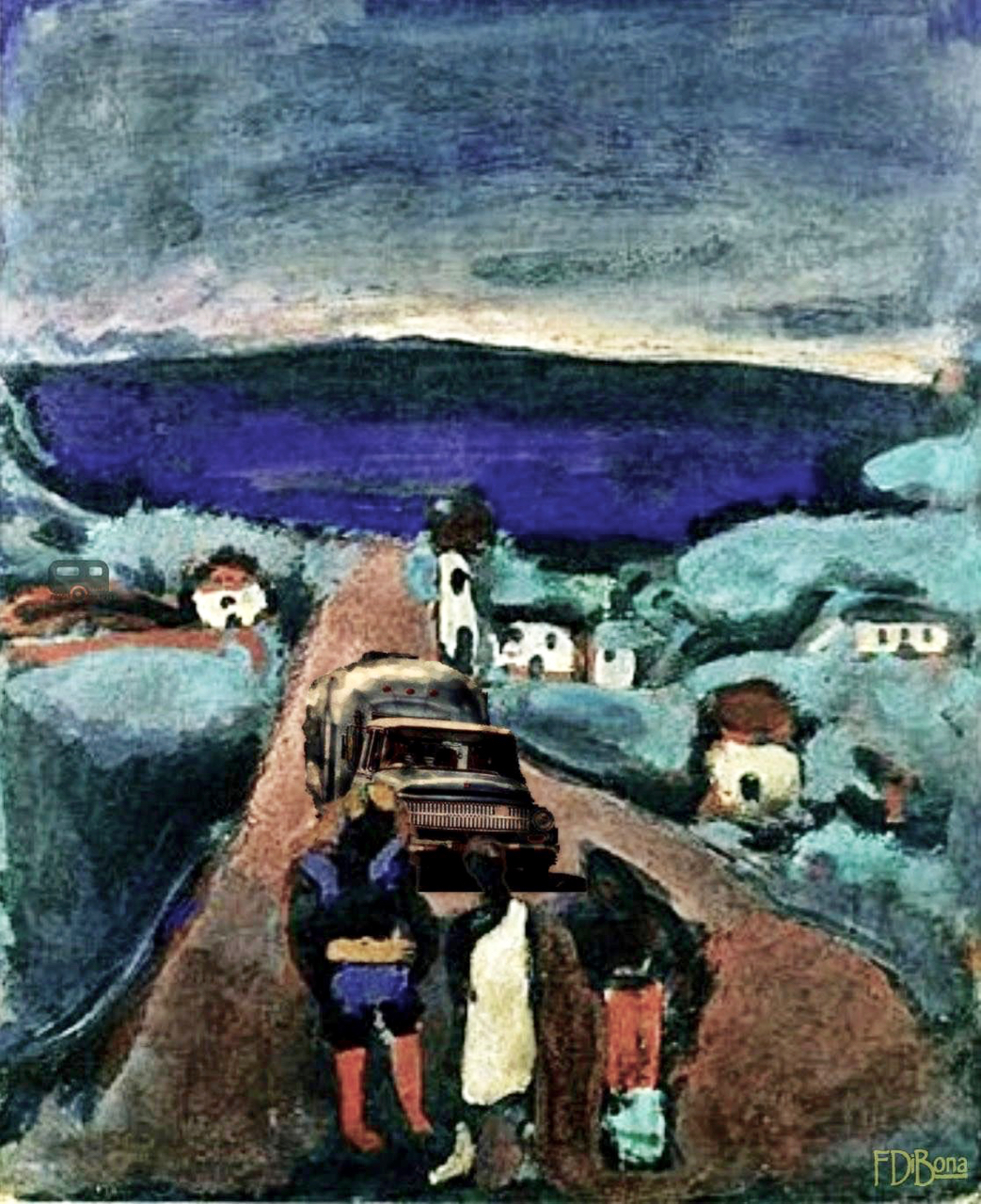
He does some really creative work putting Airstreams in other people’s artwork via photoshop.
This was his first “mash-up,” done shortly after he bought his Airstream.
Some of his works of art are based on more classical paintings.
Others are more modern.
He manages to capture the perpetual desires of the Airstream vagabond…
…as well as more universal themes.
This photo shows Homer Winslow’s “Snap the Whip” before and after the famous Frank DiBona treatment.
He demonstrated how it works, and he let me have the thrill of working together to create this one. I think it needs more work, but it’s a start.
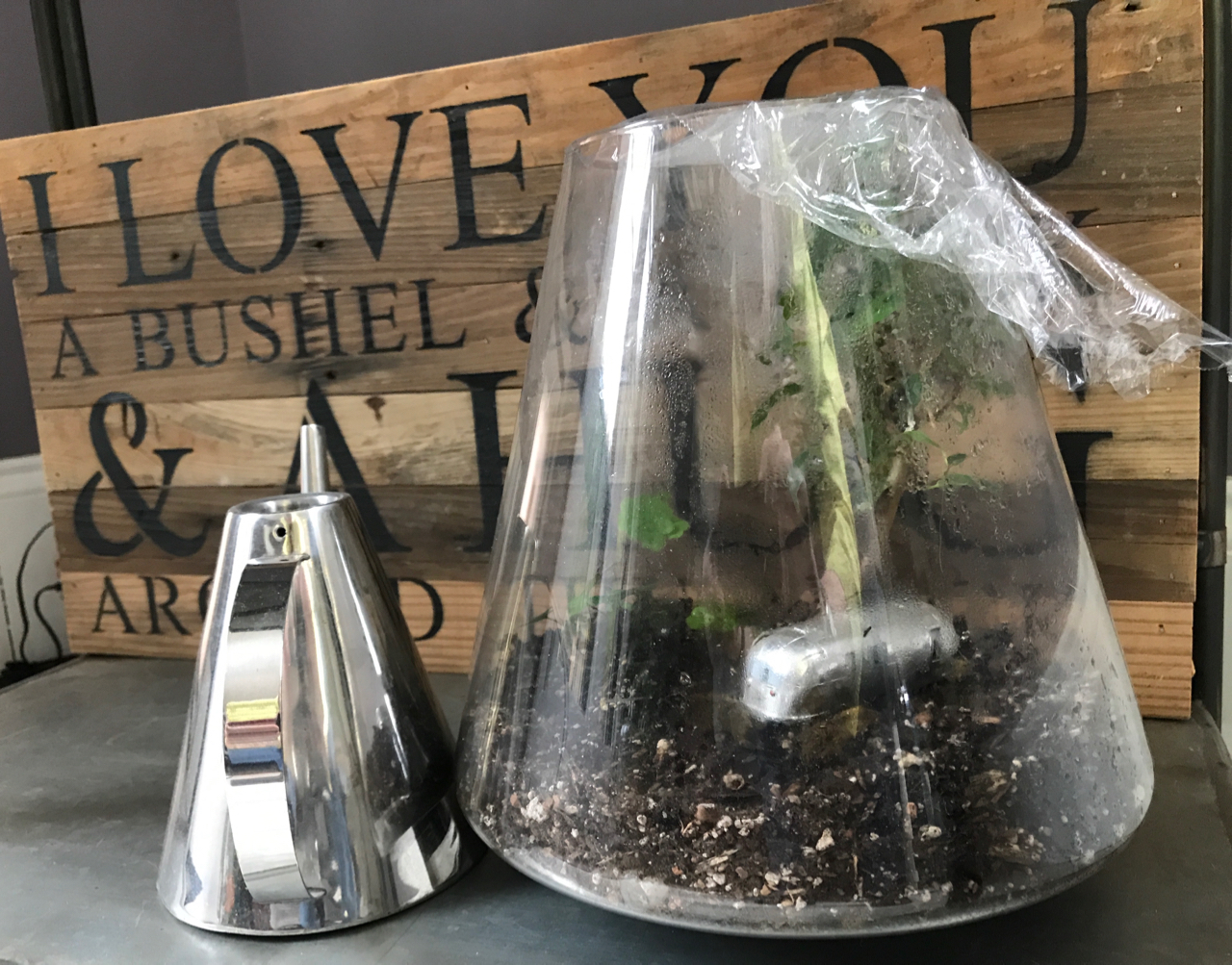
Frank’s sells his Airstream works of art though is business called “Airstreams Everywhere.” And, truly, there are Airstreams everywhere in this house.
There is even one in the terrarium!
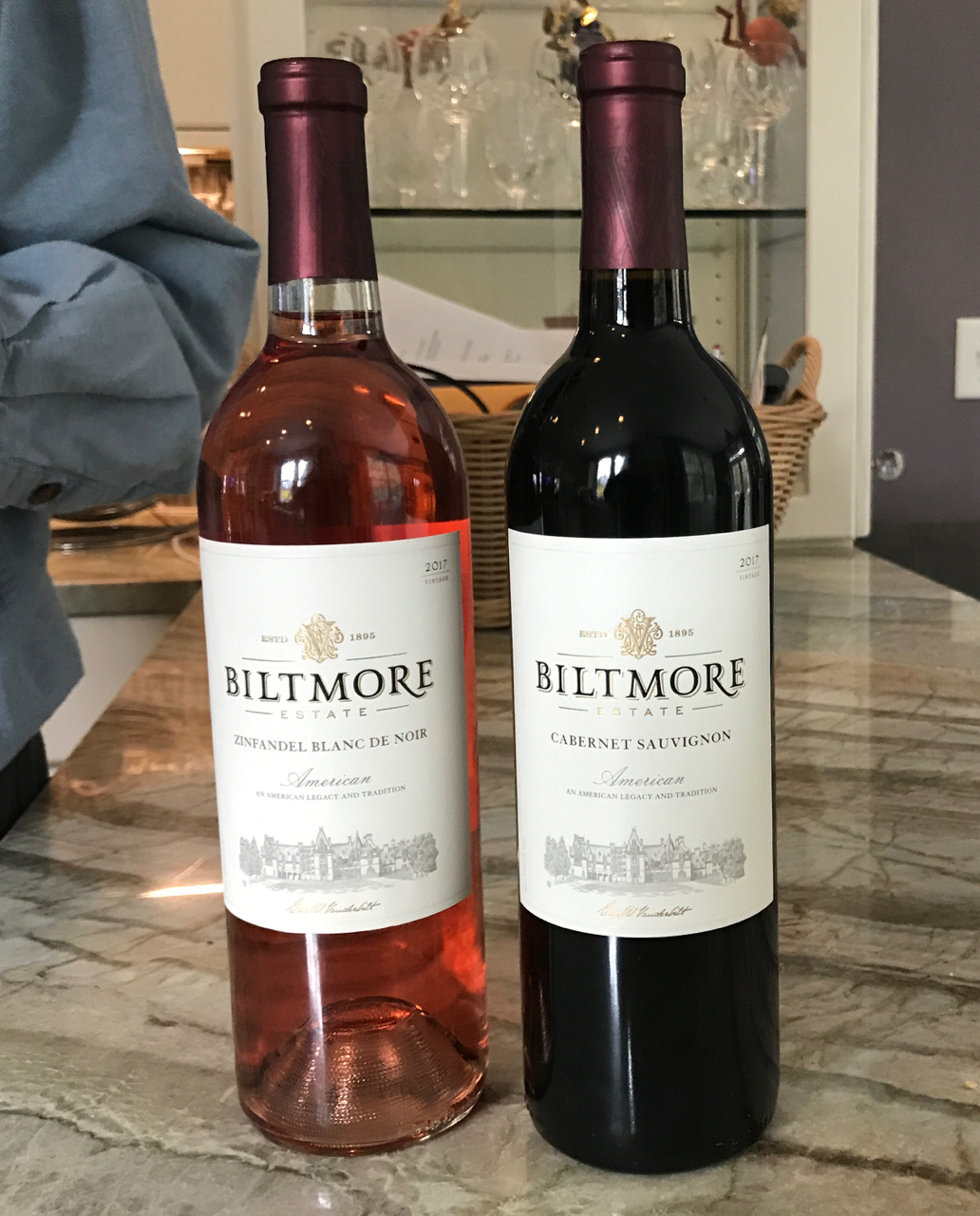
That night, Frank and Debbie had a few local Airstreamers over from the Facebook group we belong to. Before going out to dinner, we had a few appetizers and beverages. The Biltmore Estate is in Asheville. (Frank and Debbie have annual passes, and offered to take me there. But, those who are at all familiar with me could predict that I would have trouble justifying the $80 admission fee.)
Anyway, we went out to dinner at Vinnie’s, a popular local Italian restaurant.
Alexis and Chuck were there.
John and Renee also joined in the pasta and merriment.
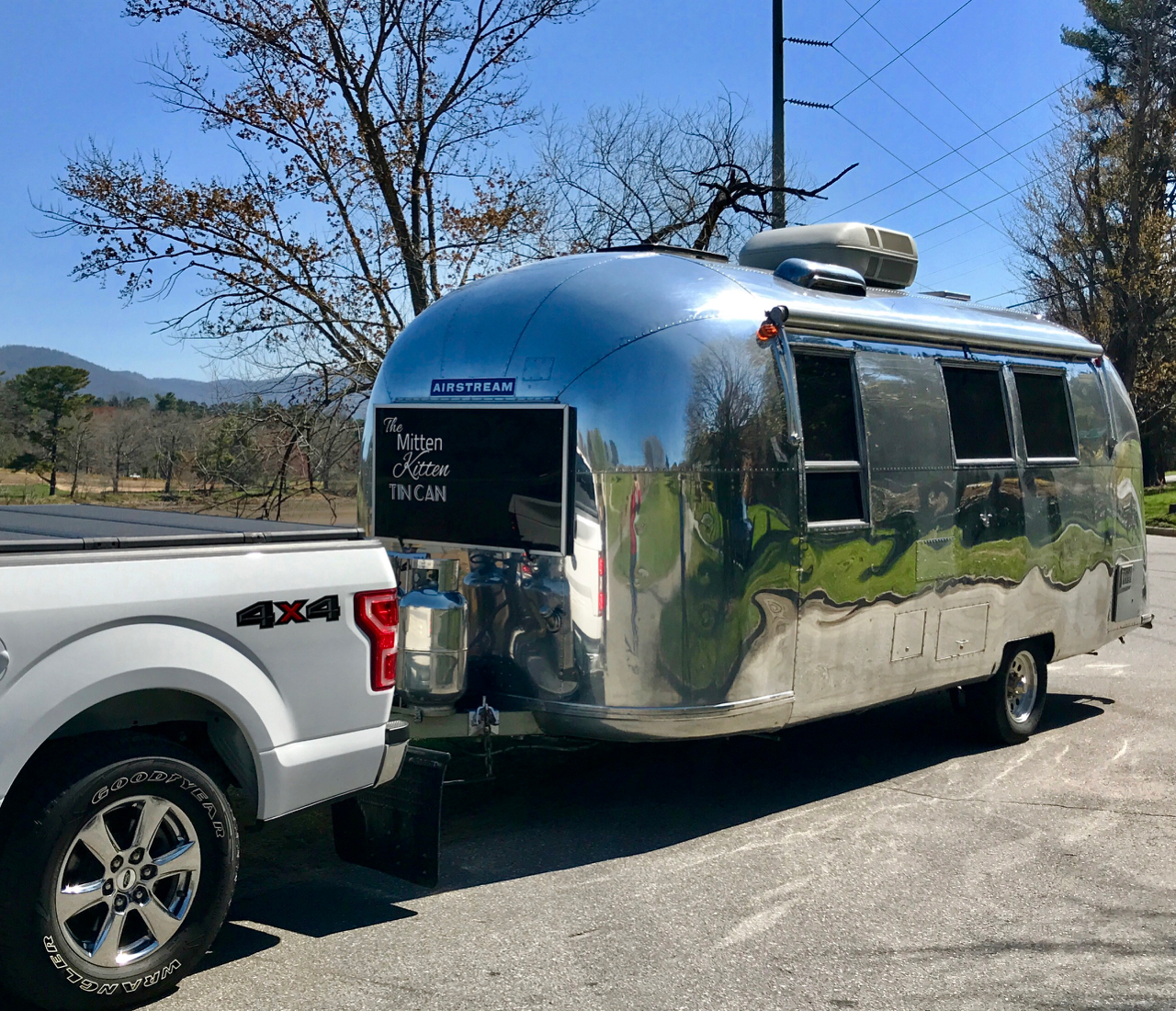
The next day, Lindy, also known as “The Mitten Kitten” rolled by.
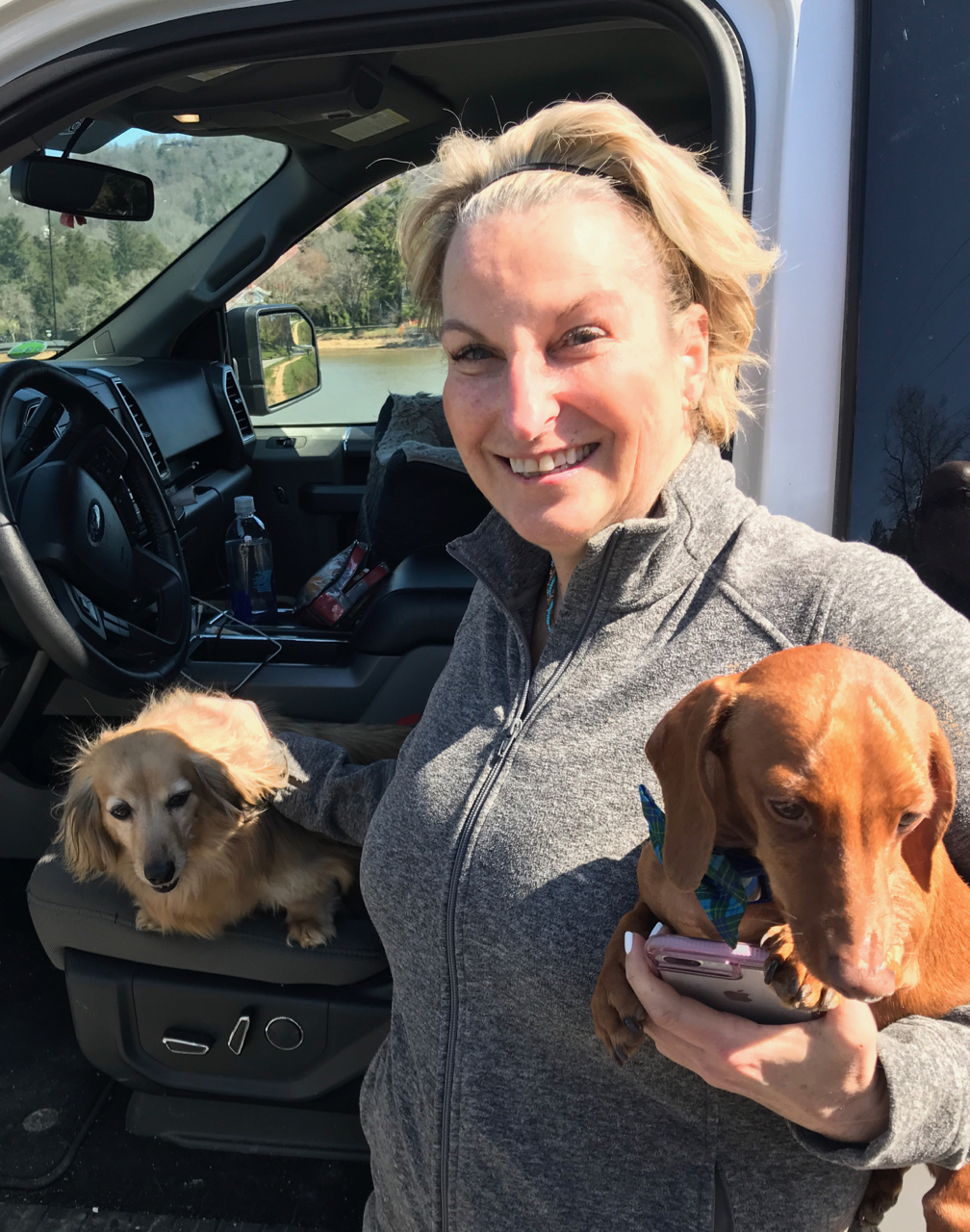
Lindy and her pups are fellow Michiganians.
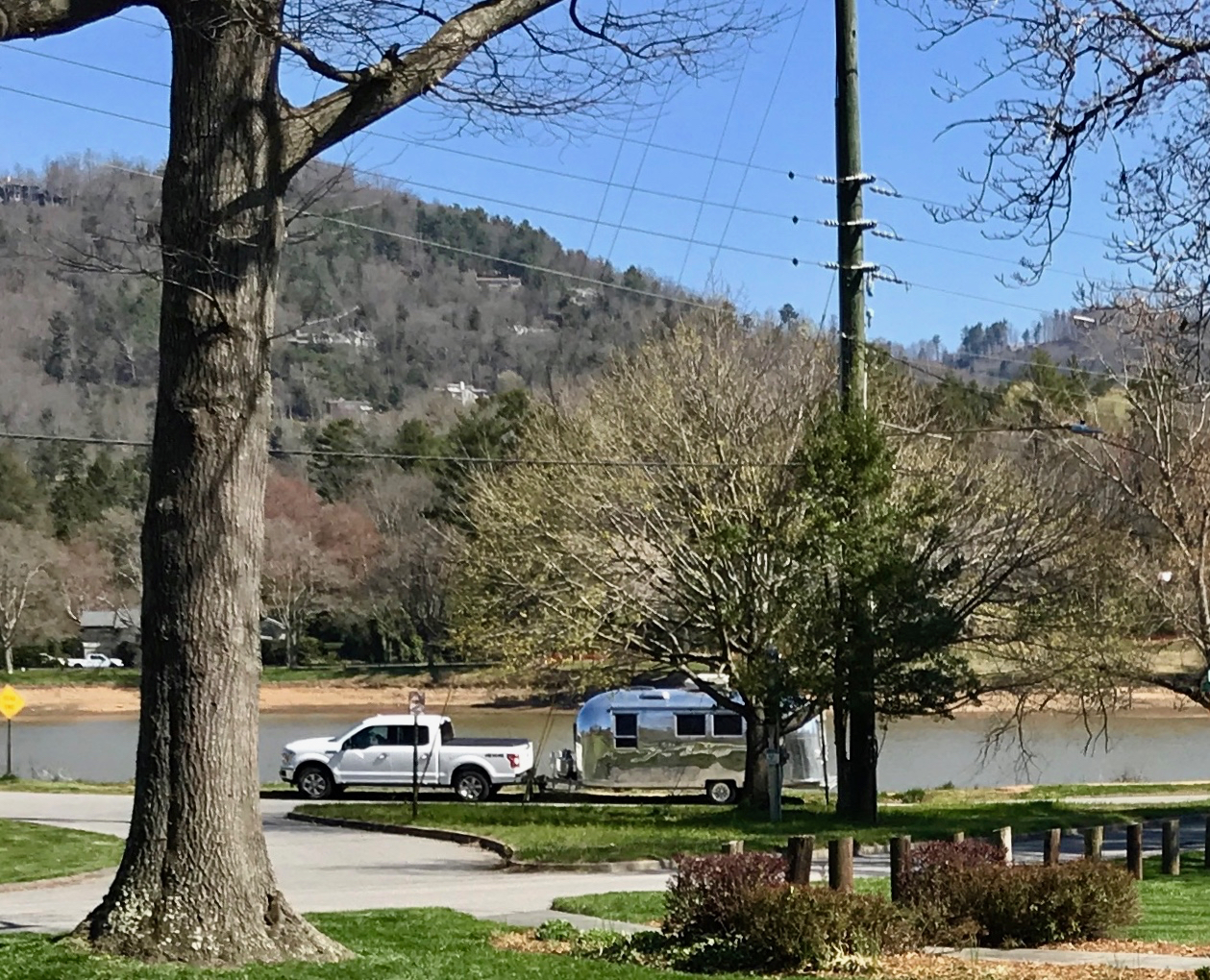
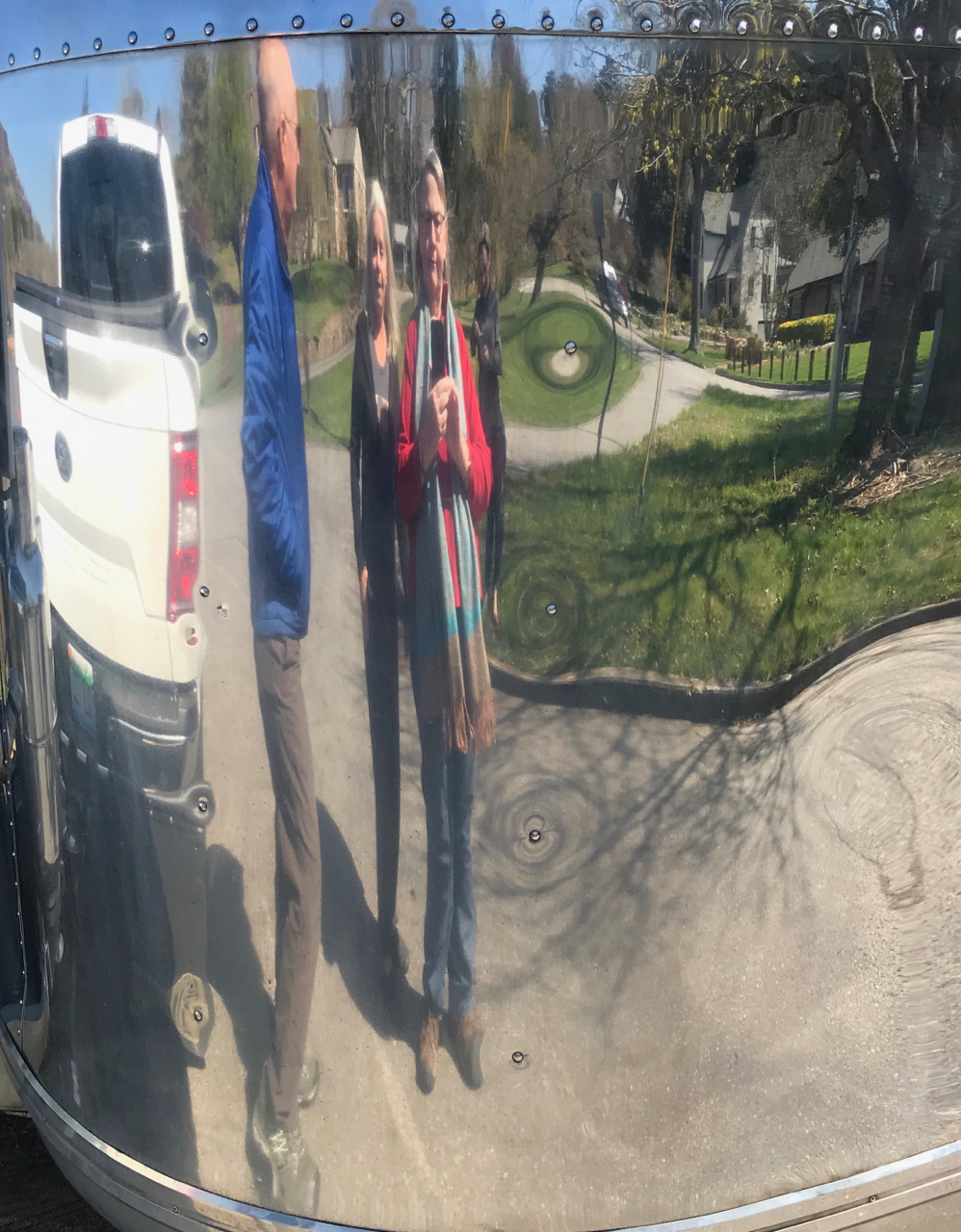
Get a load of her shiny Airstream! She has a vintage Airstream, and those can be polished to a mirror shine. I just love the shiny ones!
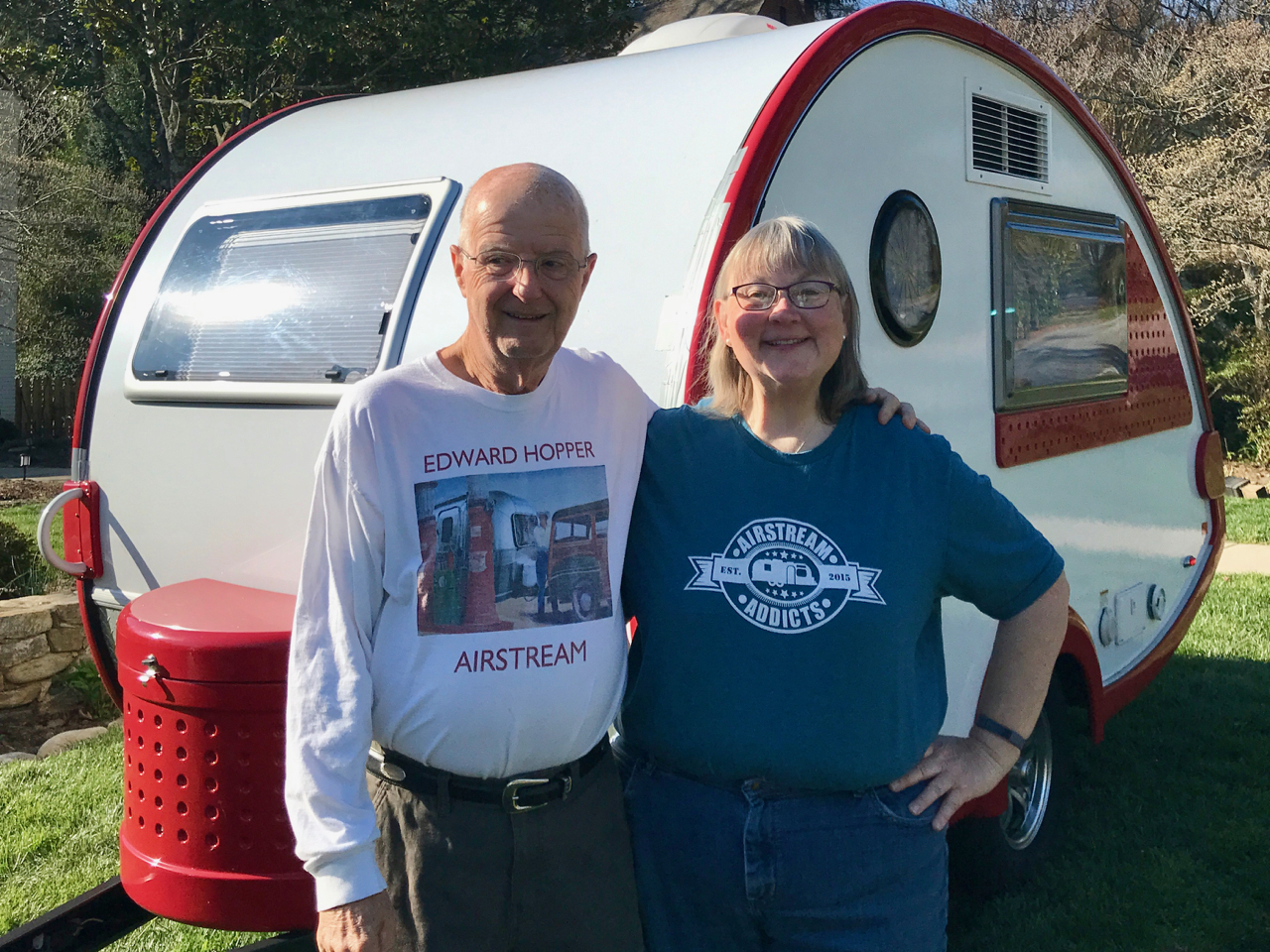
Here’s a photo of Frank, Debbie and me.
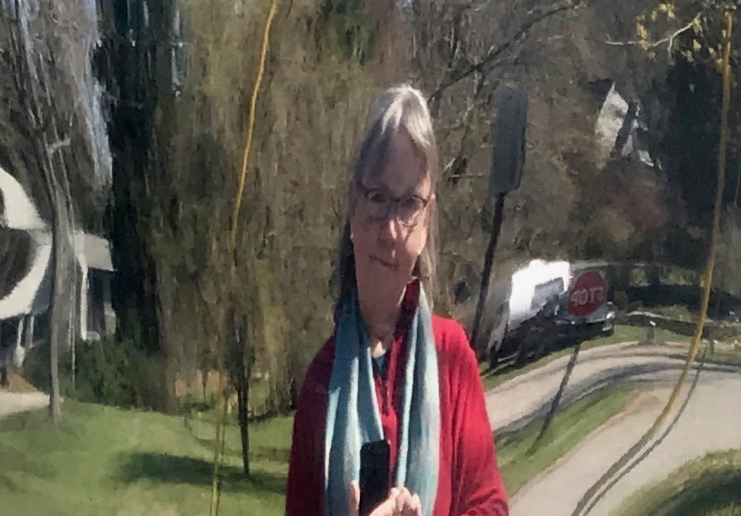
And, my own self portrait.
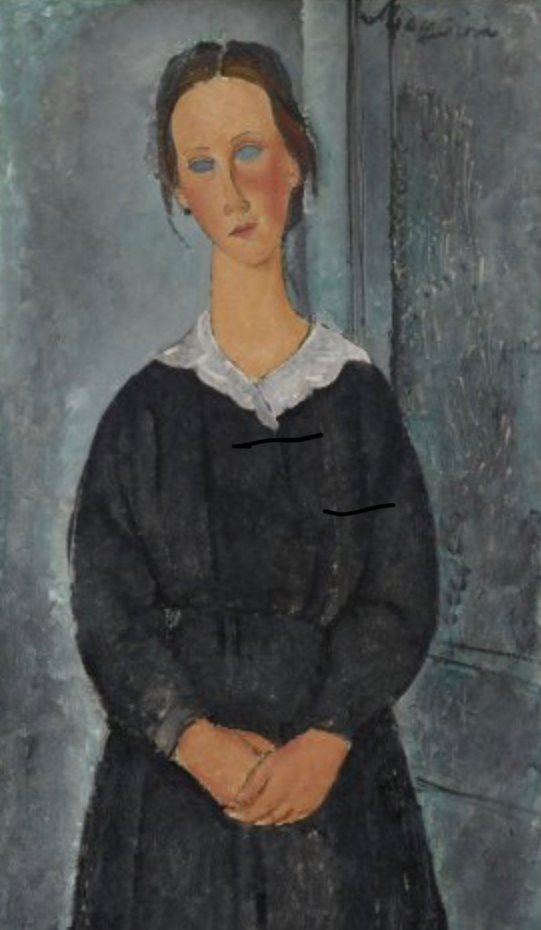
My photo kind of reminded me of a work of art I grew up with in the collection of the Albright-Knox, La Jeune bonne (The Servant Girl). It was painted by Amedeo Modigliani, and Italian Painter who lived from 1884 to 1920.
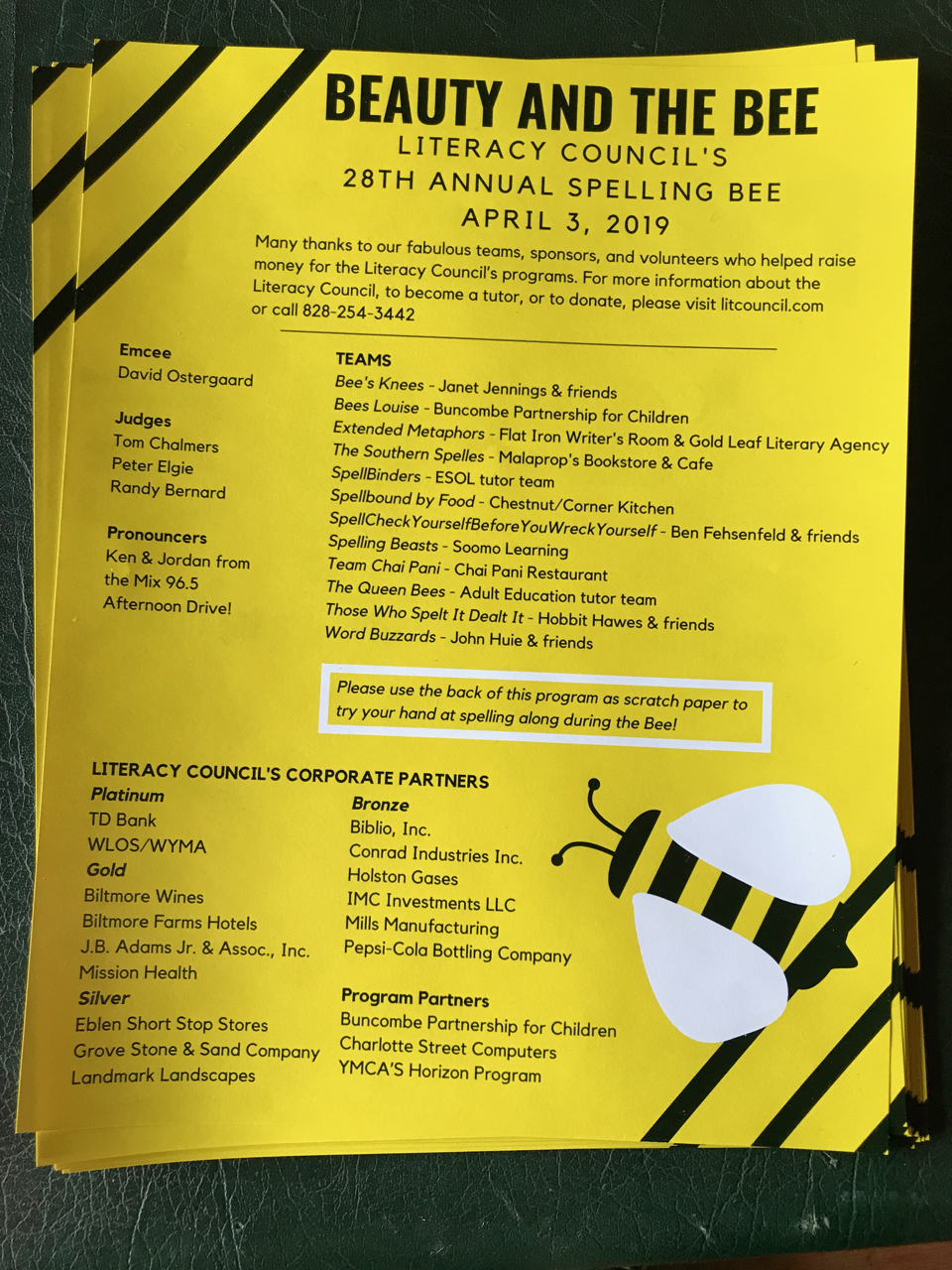
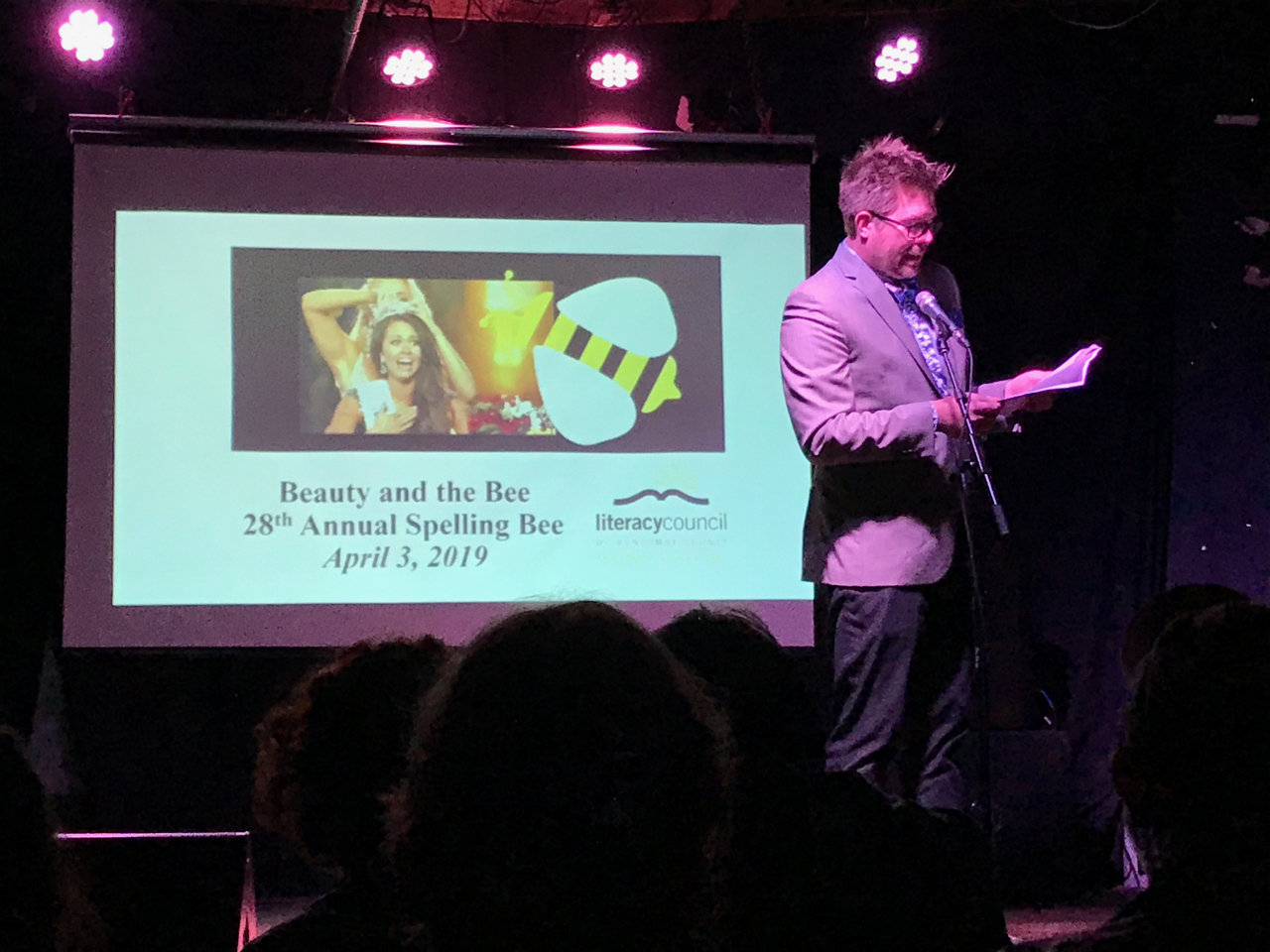
That evening, we attended a spelling bee that was a fund raiser for the Literacy Council.
The Beauty and the Bee was hosted by MC David Ostergaard.
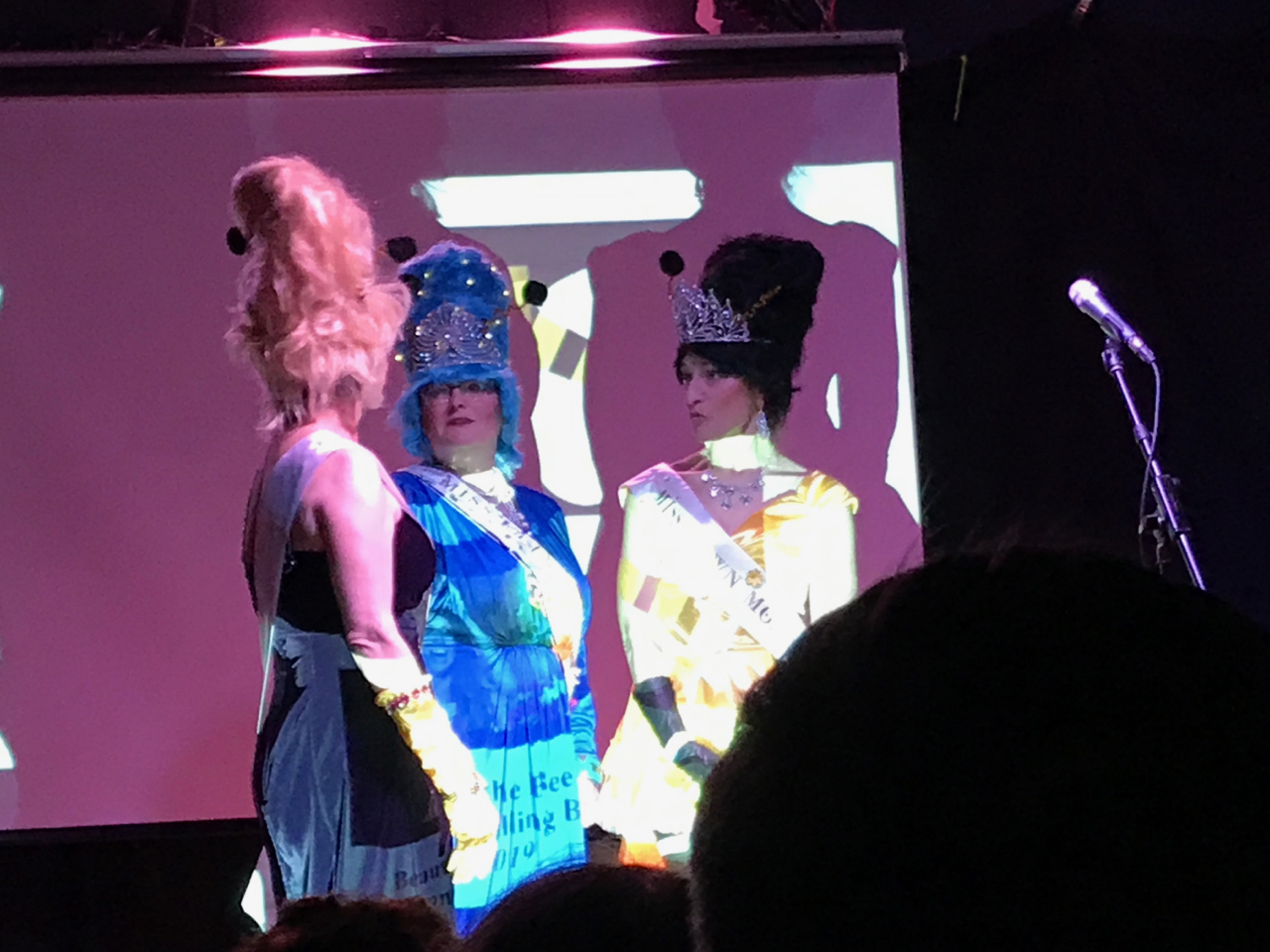
The teams really got into it with their costumes.
I wonder if they intended to sport those beehive hairdos for the spelling bee?
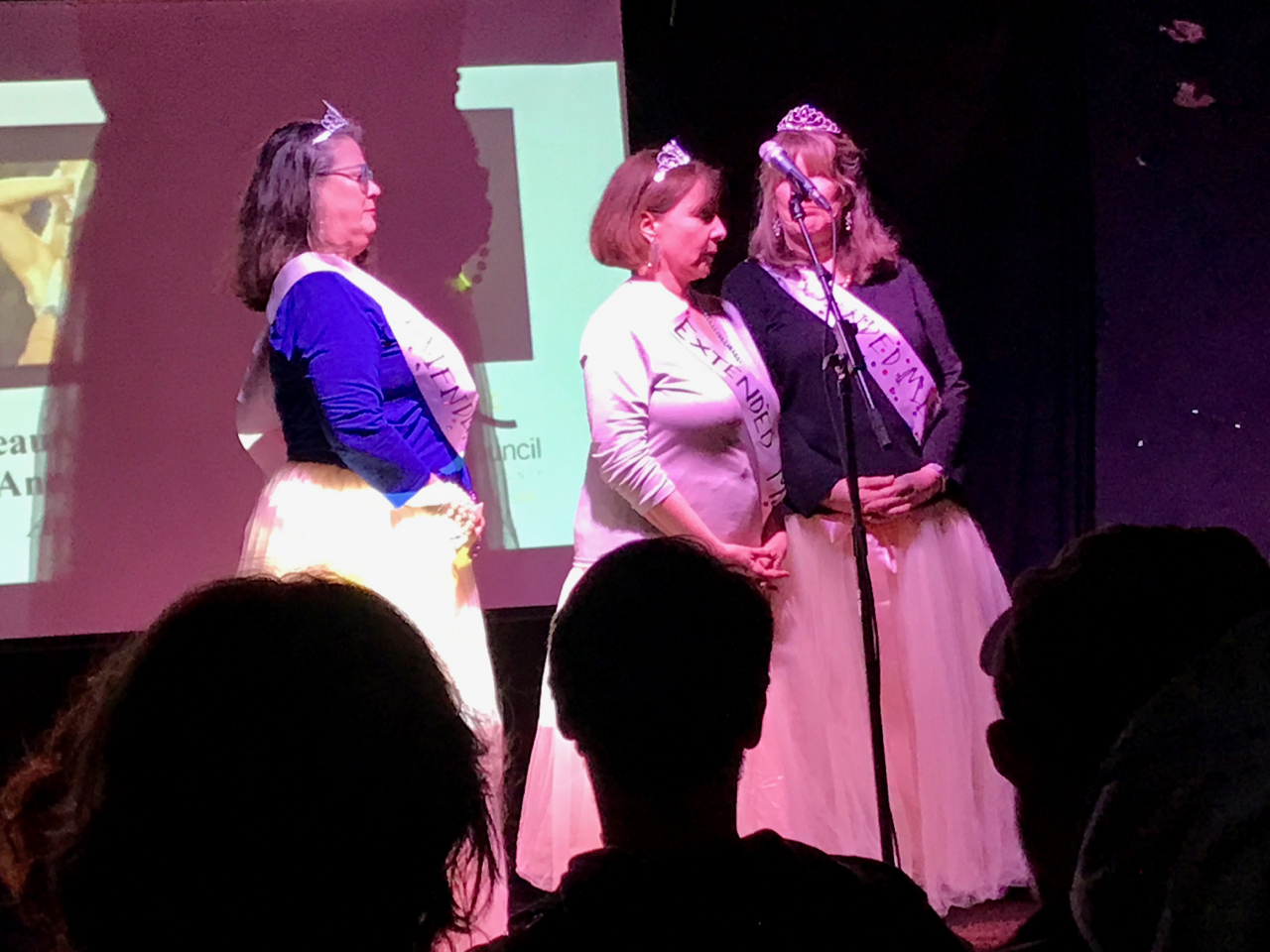
I love the literary reference in this team’s name – The Extended Metaphors.
I think they were having a ball!
The next day it was time to roll on. I’m not sure when this photo was taken, but here we are together – Debbie, Frank and me.
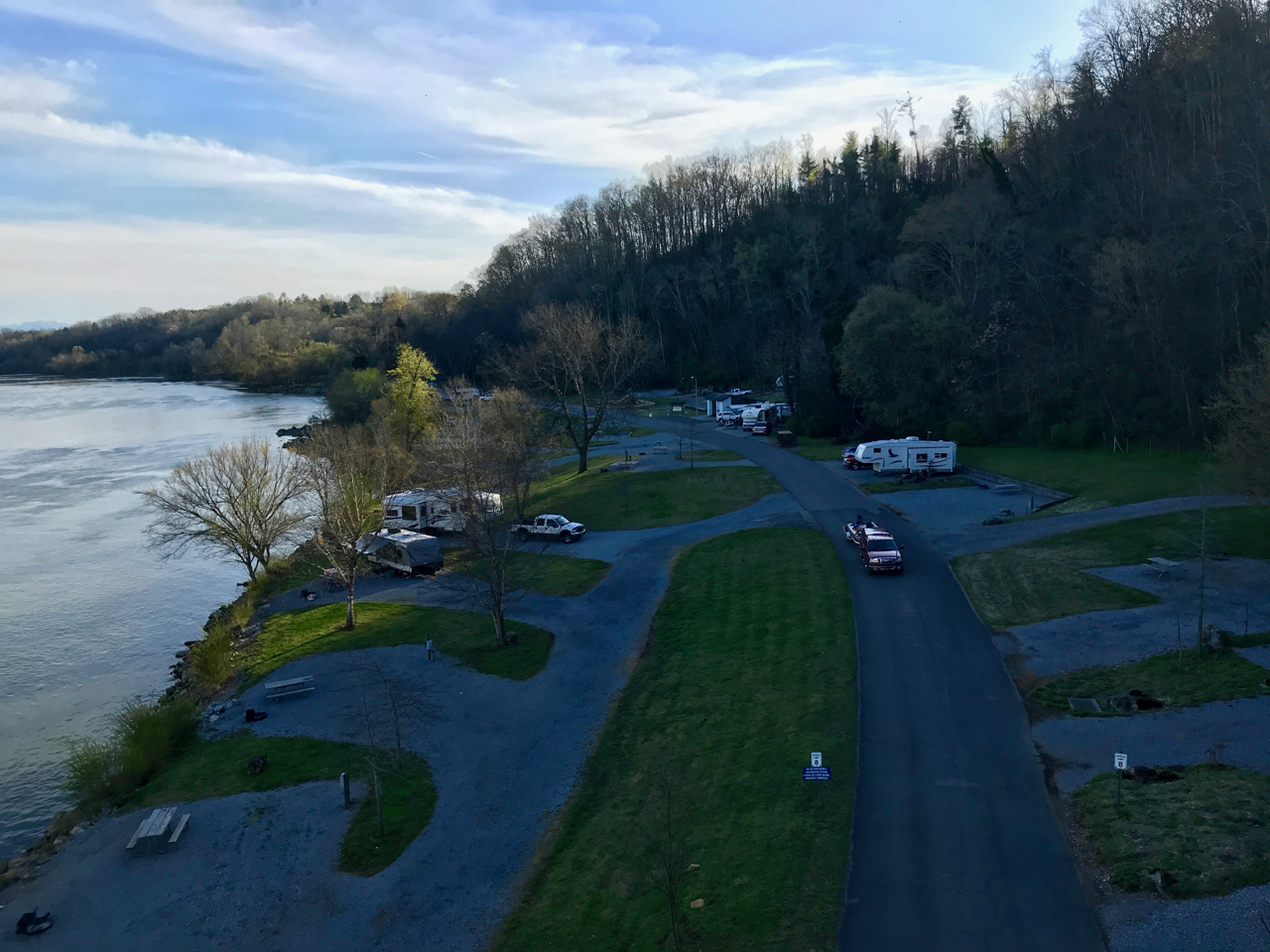
My “List for Next Time” contains all sorts of things. Some of them are monumental and of interest to all sorts of people, whether or not they take their lodging with them, like I do. Others are of interest mainly to RVers. I had heard so many good things about Anchor Down RV Resort that when the opportunity came to stay there, I took it.
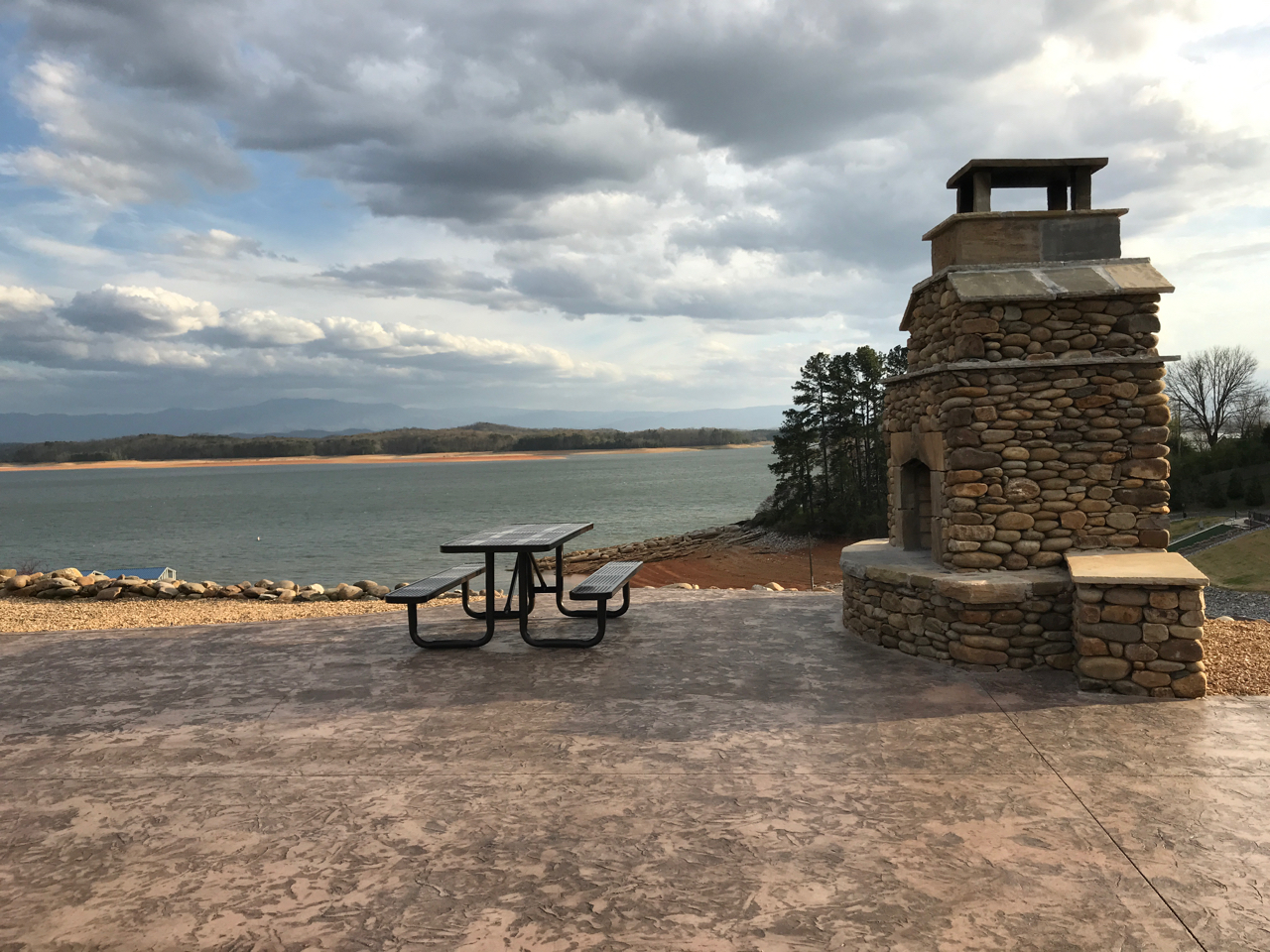
The location, on Douglas Lake in Dandridge, Tennessee, is lovely. They provide a wide range of amenities, but most of those amenities would be more enjoyable when the weather is warmer.
Some of the sites are fantastic!
However, a site like this would be best enjoyed when you can sit outside without thermal underwear.
Just how much would one of these premium sites cost? Here’s the site map and rate schedule.
Those of you who know me well know that I selected one of the back-in sites.
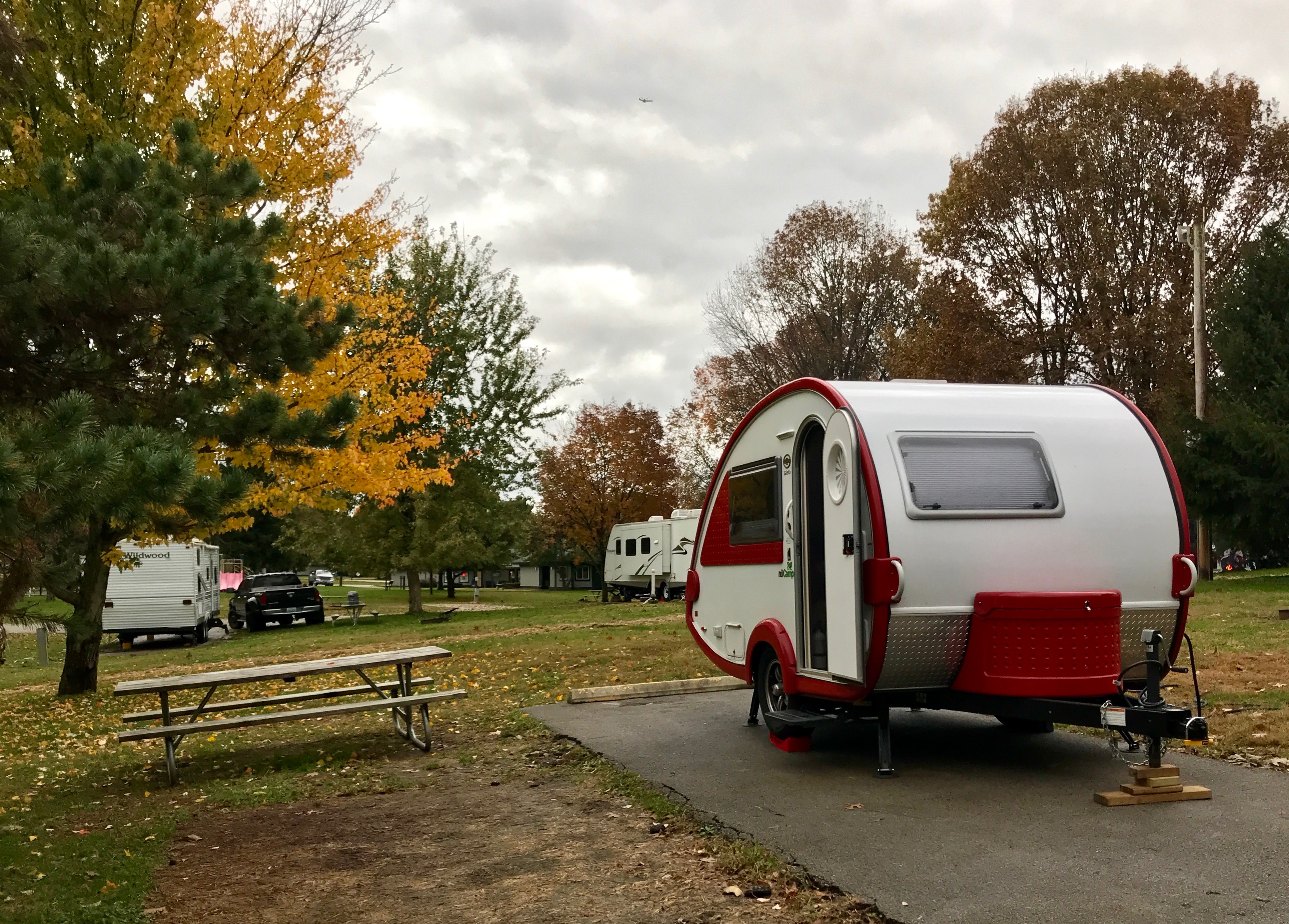
And here I am, all set up. The trailer is dewinterized and I’m ready for adventure! Since I really wasn’t planning on taking advantage of the Resort’s amenities – although I may have watched some TV with their cable – the next day, I headed out to see what I could see.
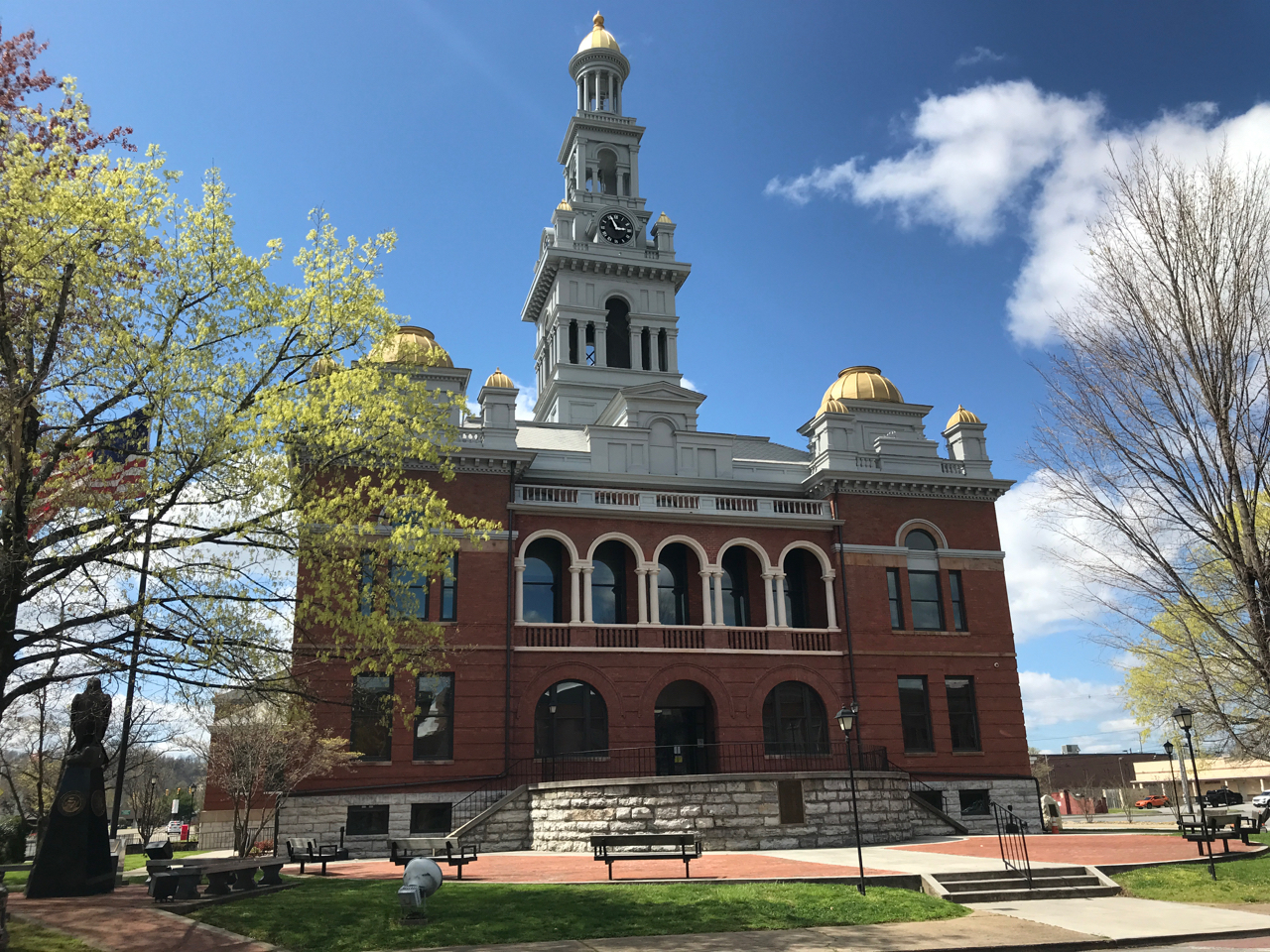
My first stop was Sevierville, Tennessee. I just had to stop and check out the Sevier County Courthouse. Designed by the McDonald Brothers in the Beaux Arts style, it was built in 1895. It was added to the National Register of Historic Places in 1971.
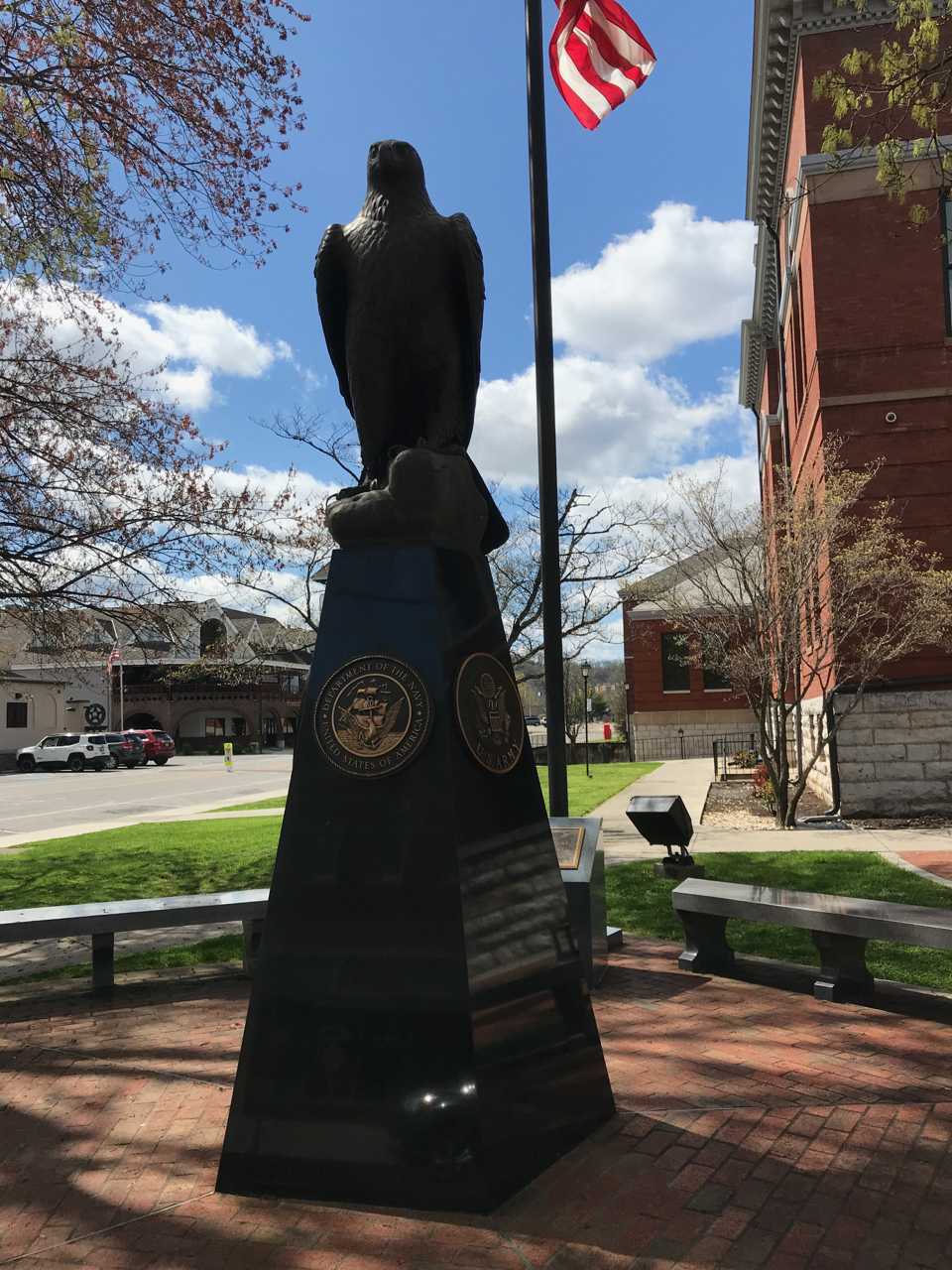
It is flanked by two memorials. The first is for the military.
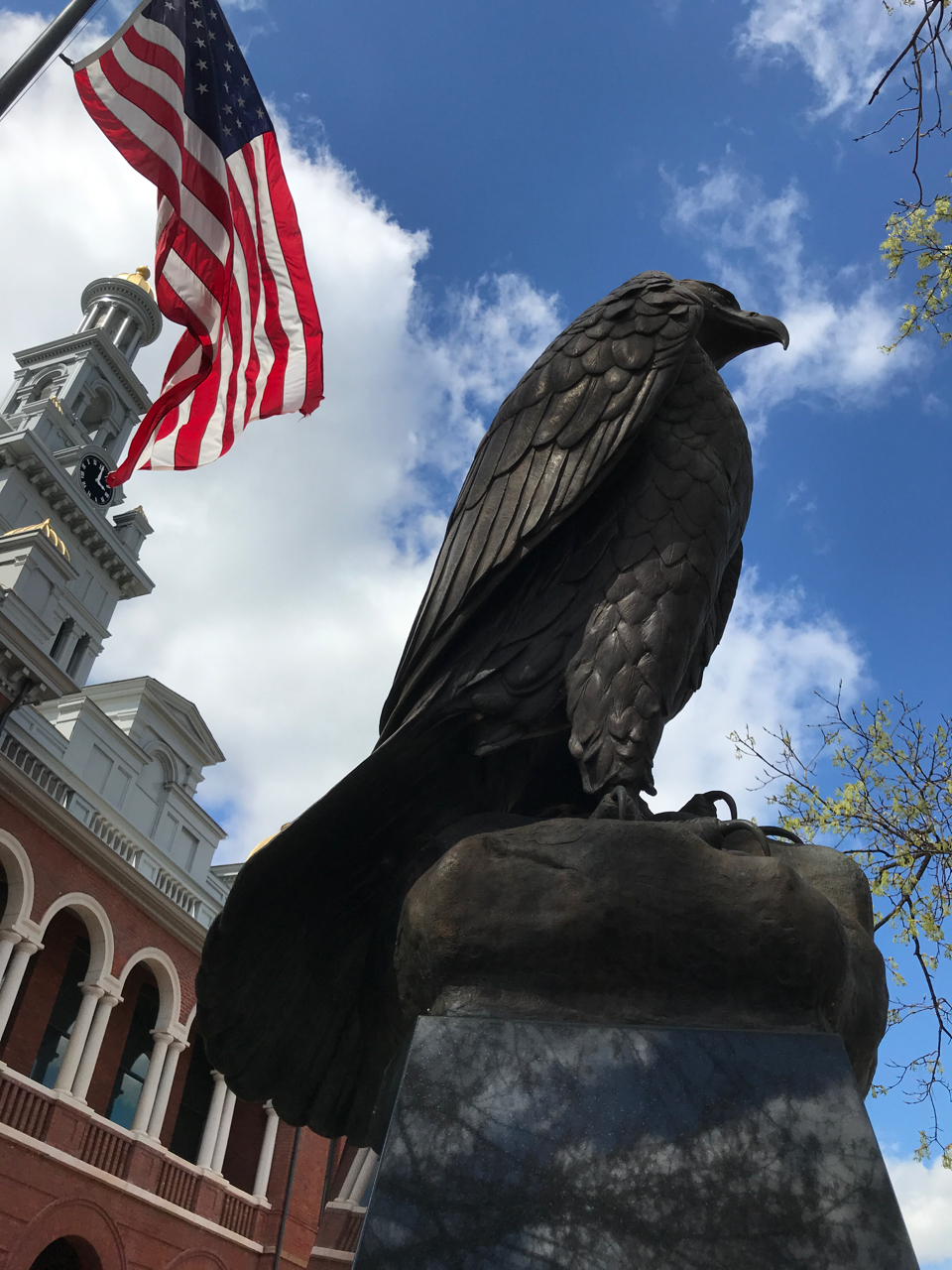
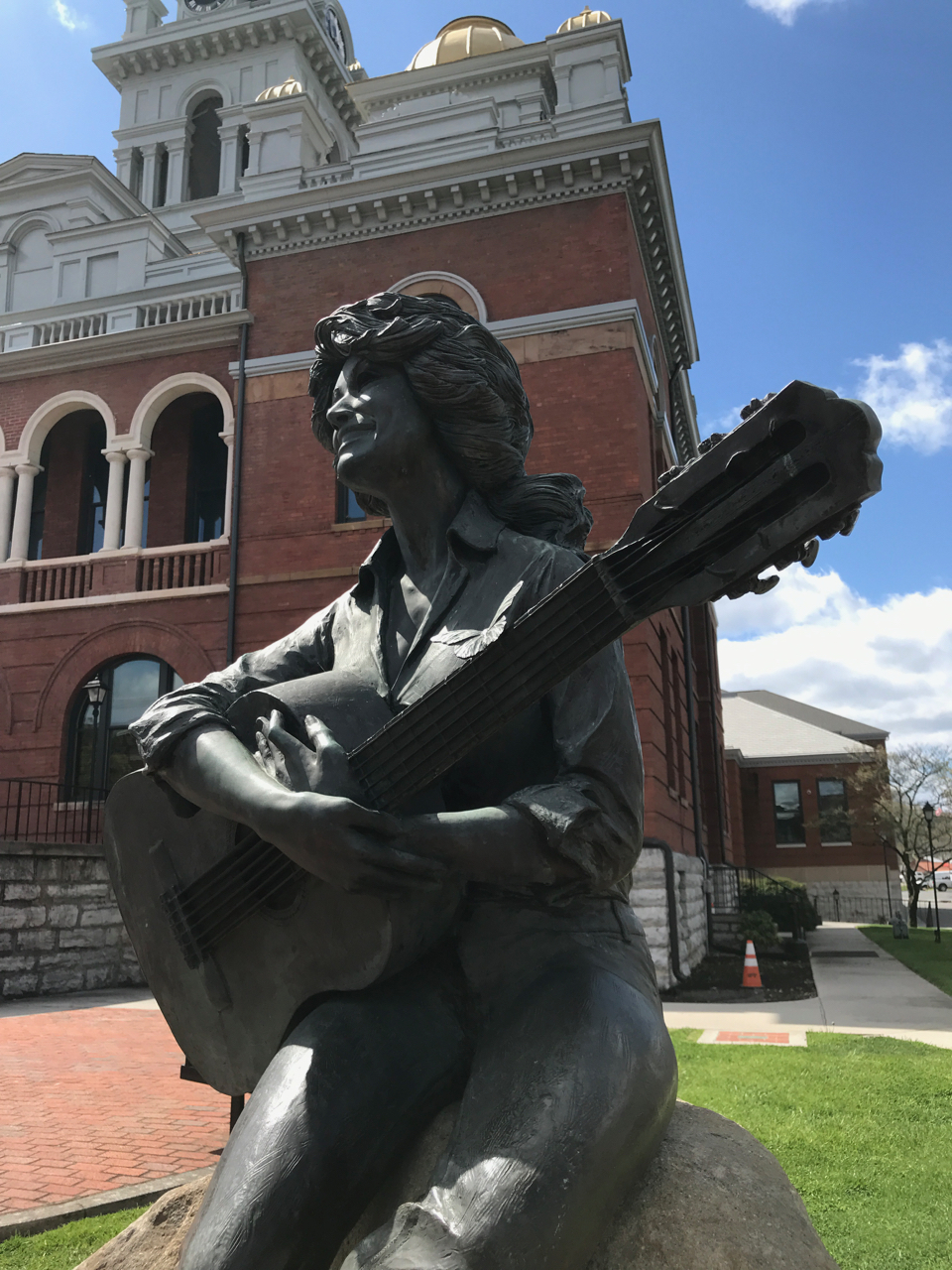
I couldn’t resist including this arty shot in my post.
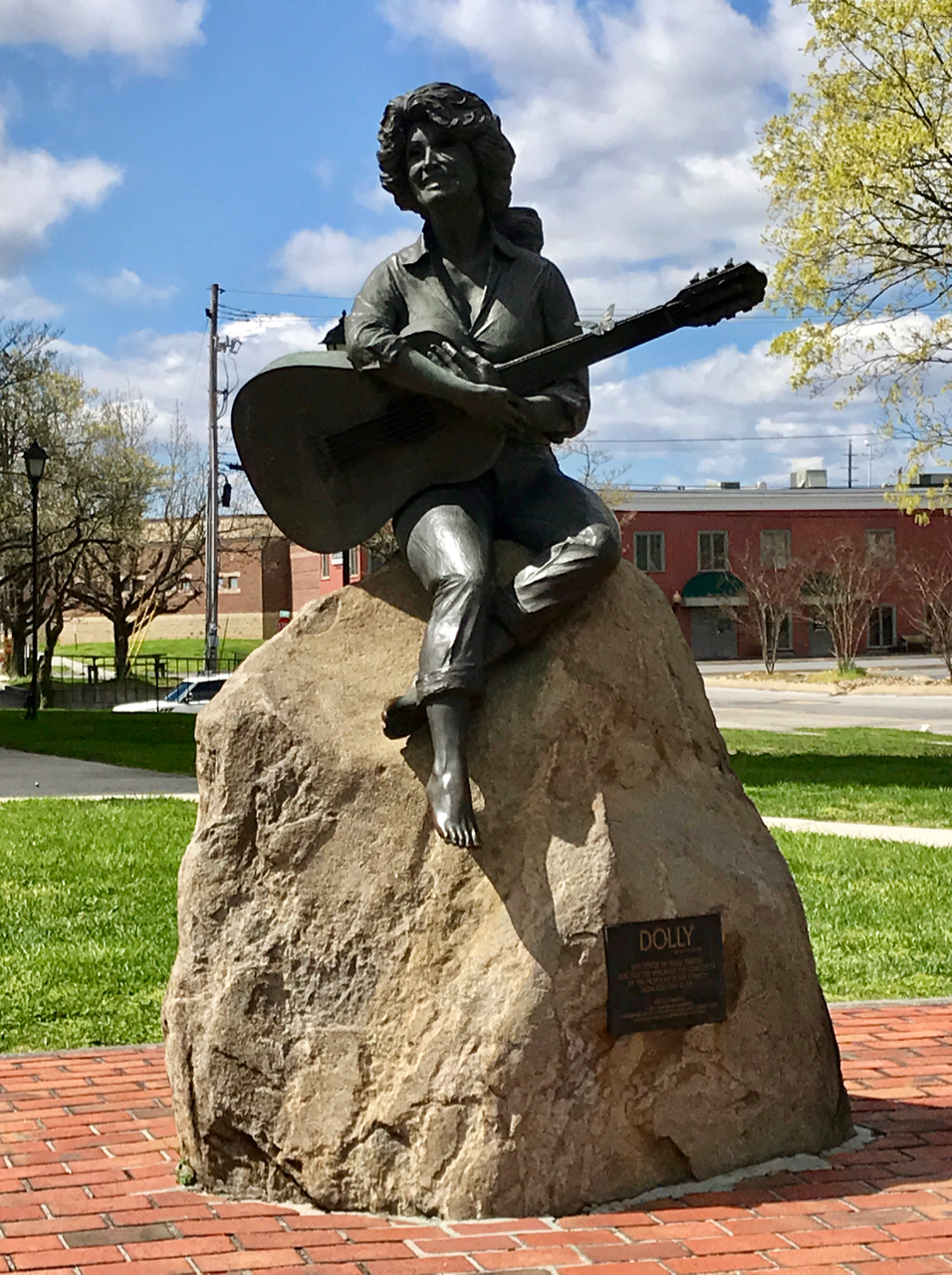
The second memorial is to local girl made good and national treasure, Dolly.
I thought she should get an equally arty shot.
The statue of Dolly is by Jim Gray and was dedicated in 1987. It’s kind of hard to believe that it has been more than 33 years since its dedication. Where does the time go?
My next stop was to Great Smoky Mountains National Park. This is the Most visited national park in the country, with more than 11 million recreational visitors annually. I stopped off in the visitor center to get my National Parks passport stamped and to see what they had to offer.
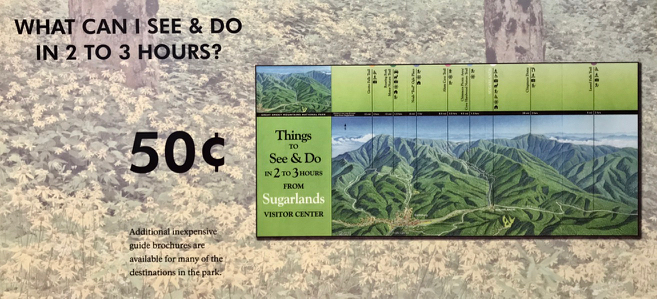
There was a display offering this brochure for 50 cents. I should have bought it, I guess, but I got the general idea and decided to just head out for a little drive.
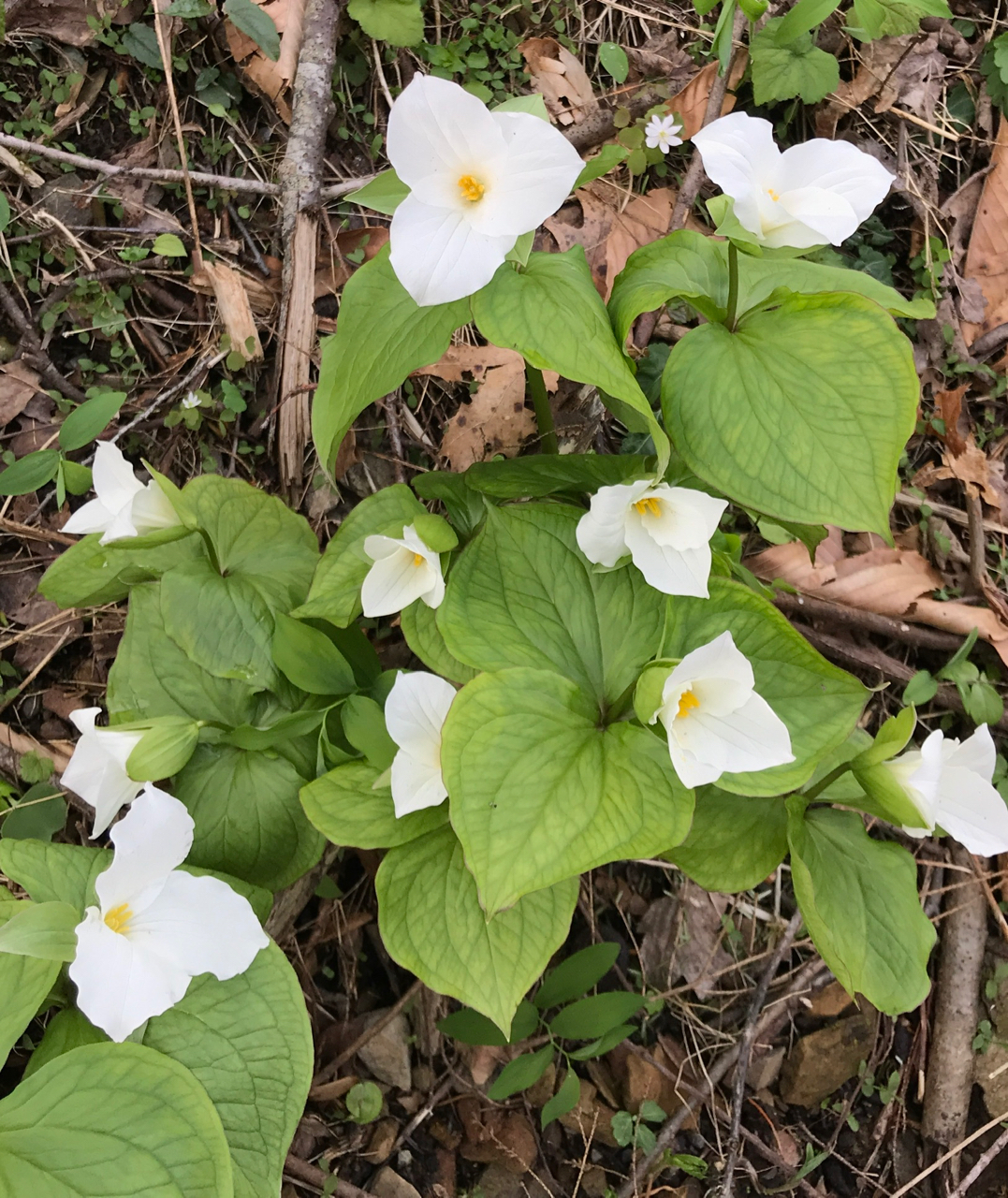
I was thrilled to find the trilliums in bloom! My genius of a father built us a cabin in the woods south of Buffalo, and in the springtime, we were surrounded by trilliums. What a memory!
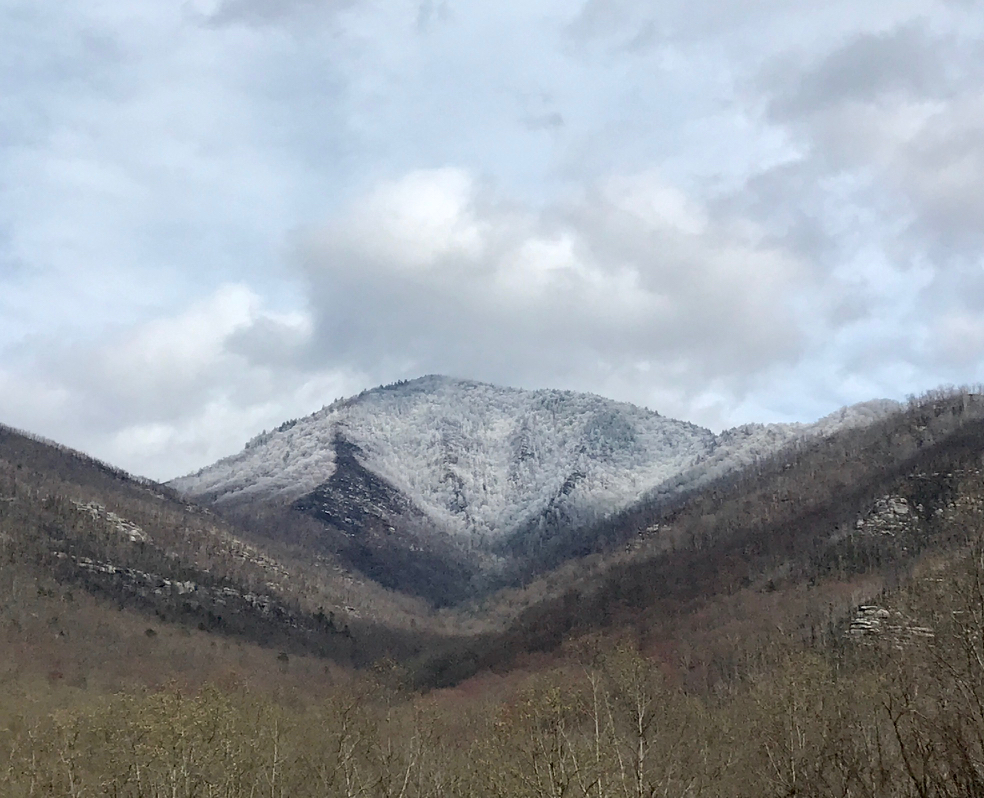
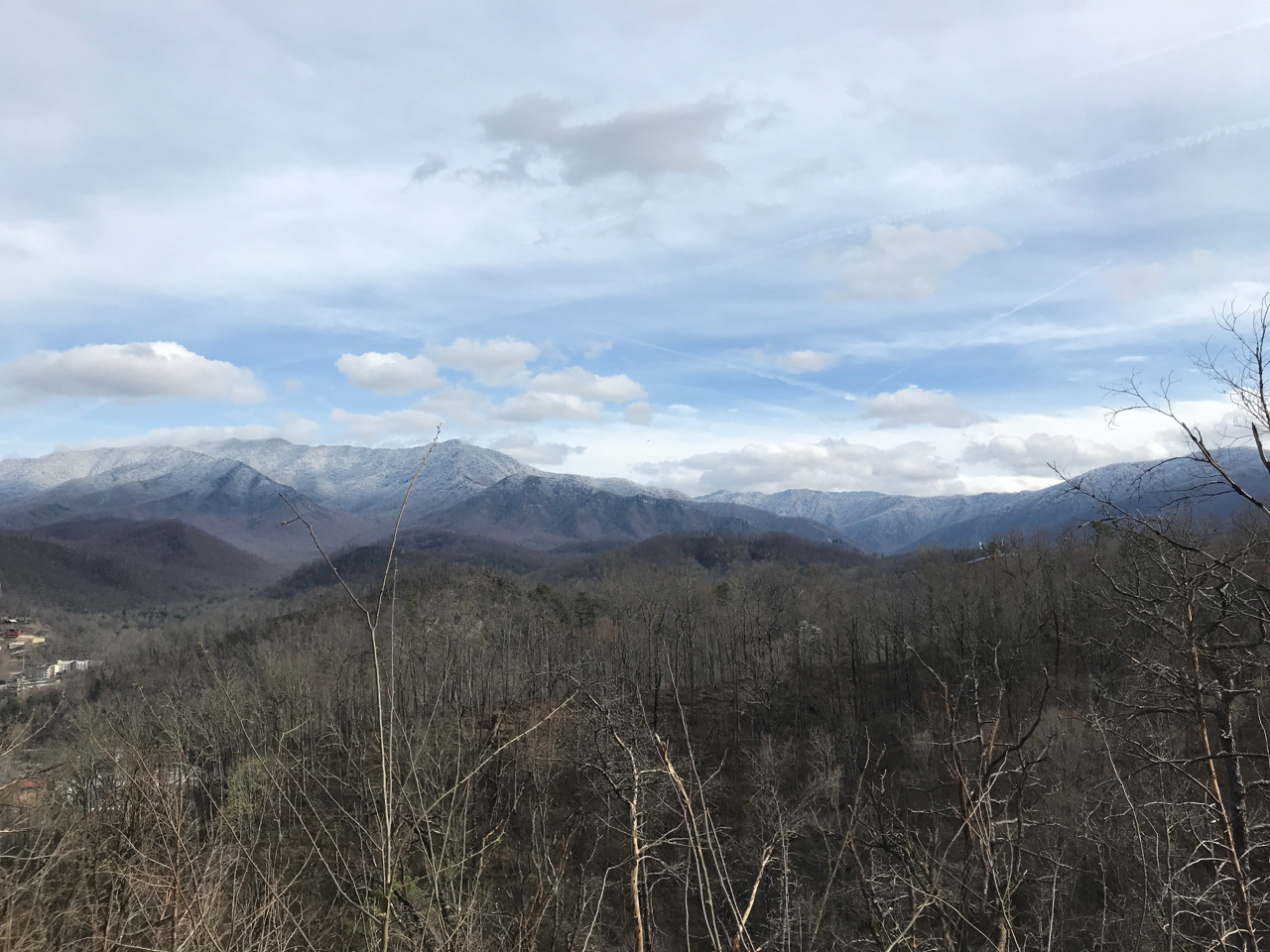
I found a place to pull off the road and taken the splendor. I was kind of wondering why the mountain looked so pale. I wondered if there had been some sort of blight that killed all the trees on it.
I started chatting with some other visitors about it. The man I spoke with said that the whiteness was snow. He and his kids had been camping in a tent up there! I must say, they were amazingly cheerful. I hope they had good sleeping bags.
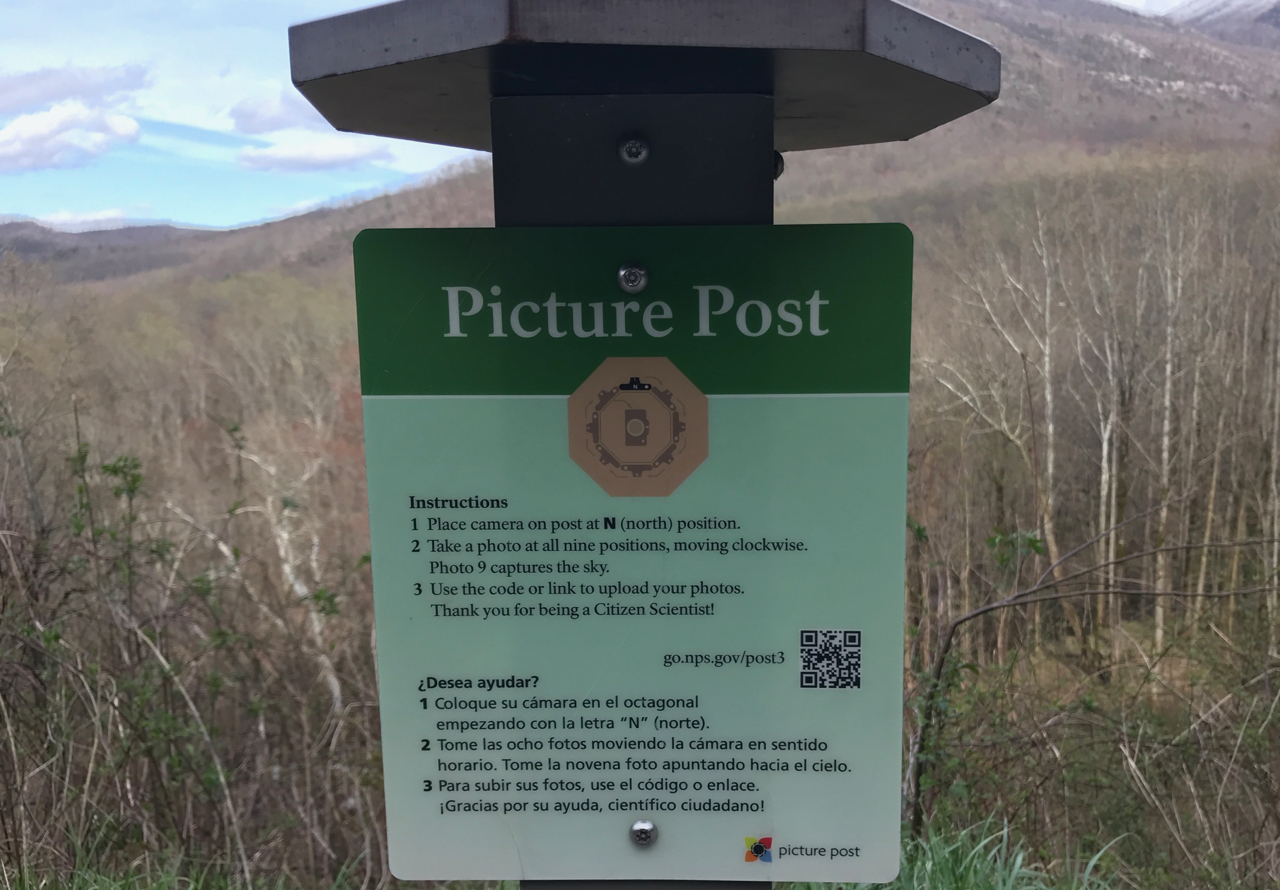
I thought this was an interesting idea. The park invites visitors to become “Citizen Scientists” by taking nine photos from the post, following the directions on the sign, and uploading them to a website. I did take the photos, but I’m not sure whether I followed through on sending them in.
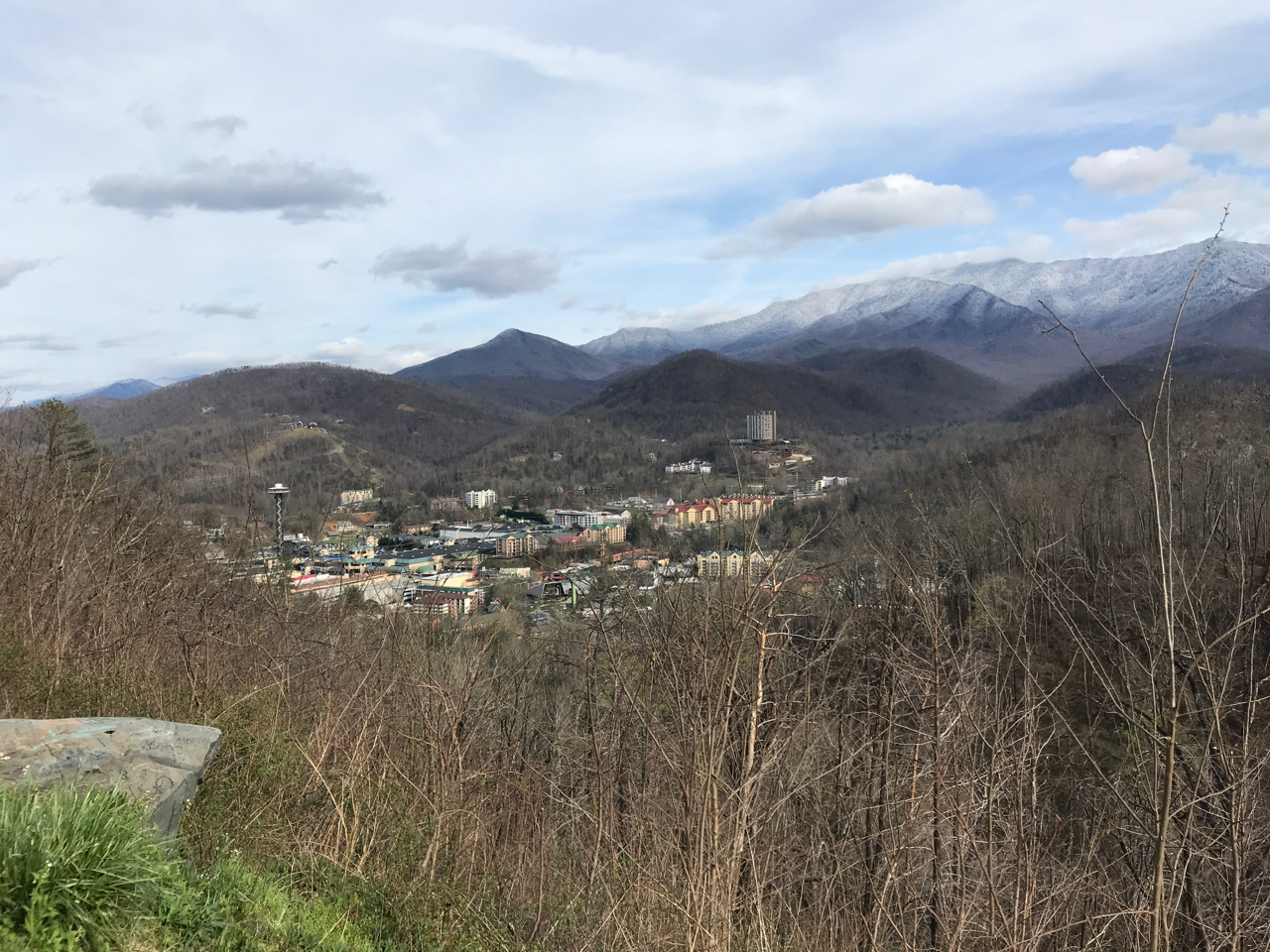
On the way back to the Resort, I stopped and took a photo of a touristy spot nestled in a valley. Could it be Dollywood? It just might be! I didn’t drive in to check, though.
More scenery on the way back to my T@b and Cora. I was almost to the resort when I saw a sign for the TVA Douglas Dam. I remember learning about the TVA when I was in school. Quite frankly, I was a bit mystified as to why it was such a big deal. I mean, who would think electricity was such a big deal? Actually, it was part of FDR’s New Deal, and was a wonderful boost to the area. It provided employment and income to the people involved in the building and design and made other employment possible. I guess if you had to live without electricity all the time, it would make all sorts of things difficult.
In any event, I thought might as well check it out.
There it is!
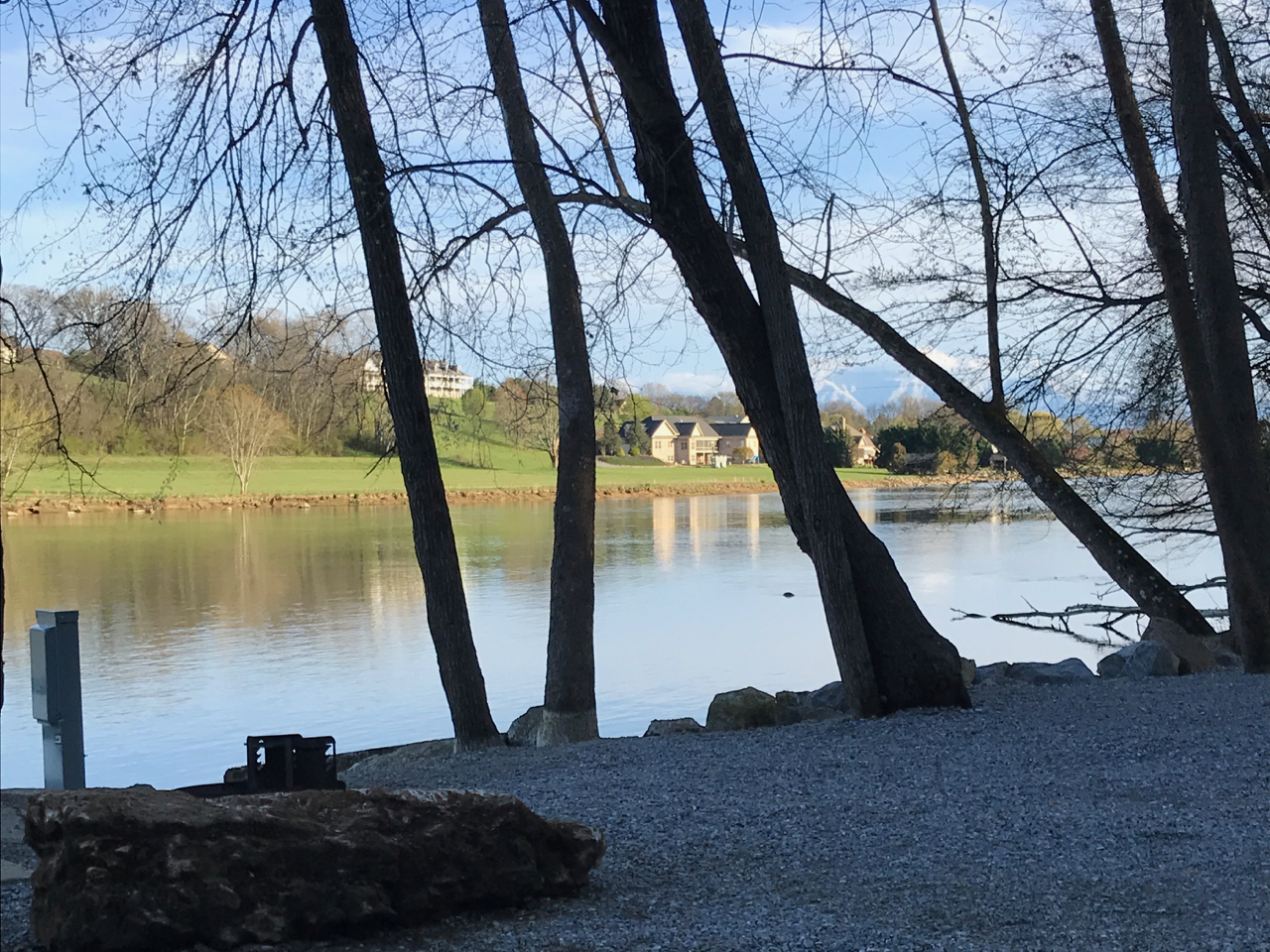
And, wouldn’t you know it? They have a campground! This is more my speed of campground. No “amenities” but look at that view! For those who may be interested in giving it a try, this is the Douglas Dam Tailwater Campground.
That waterside campsite costs $29 a night – or $22 with the discount. If it’s a senior discount, I qualify! Incidentally, it that is still to rich for your blood, they have a few sites that you can snag for $19 a night – or $13 with the discount.
After a good night’s sleep, Cora and I are ready to roll.
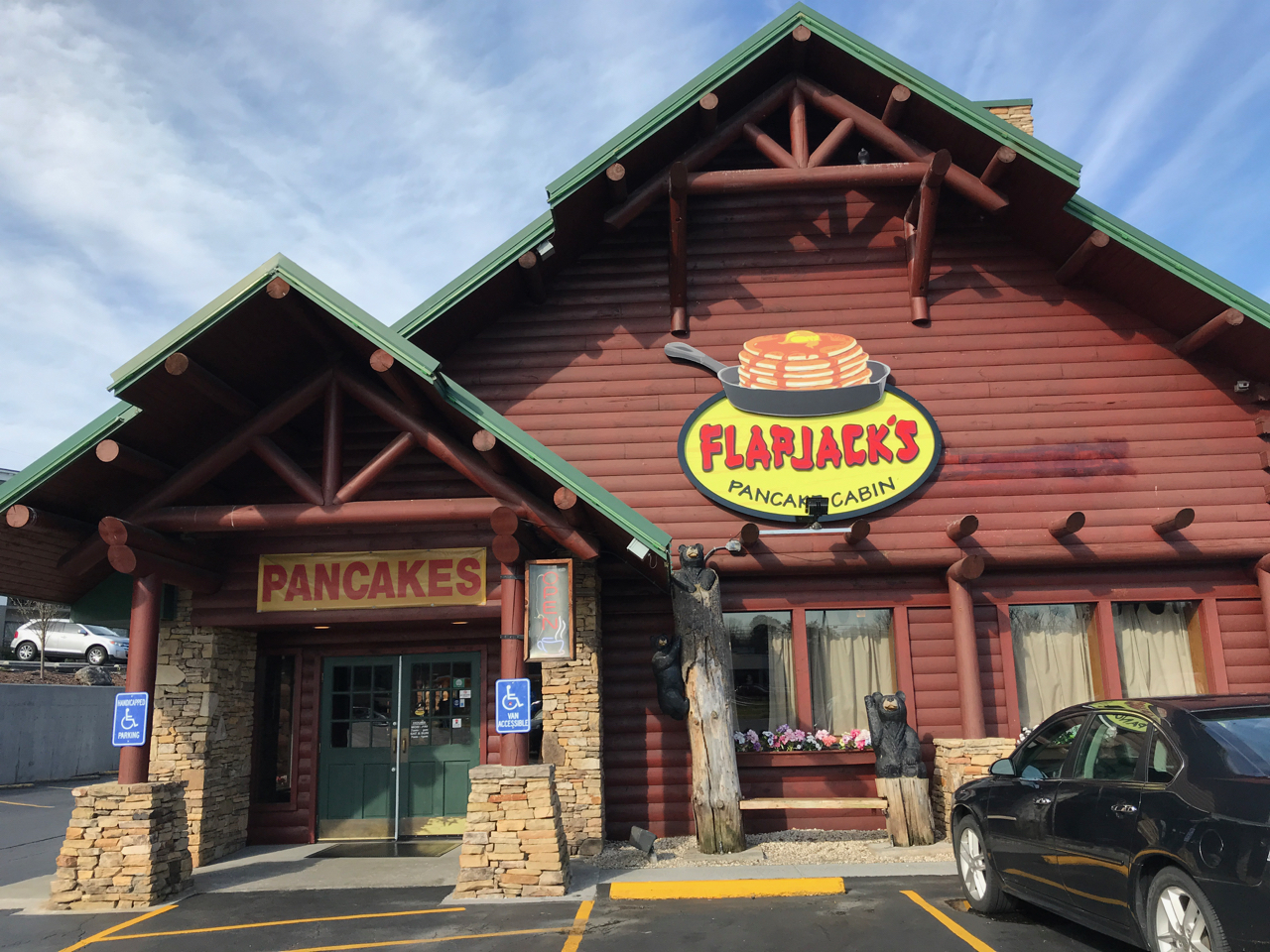
Cora had to make do with kibble while I feasted on pancakes at Flapjack’s Pancake Cabin.
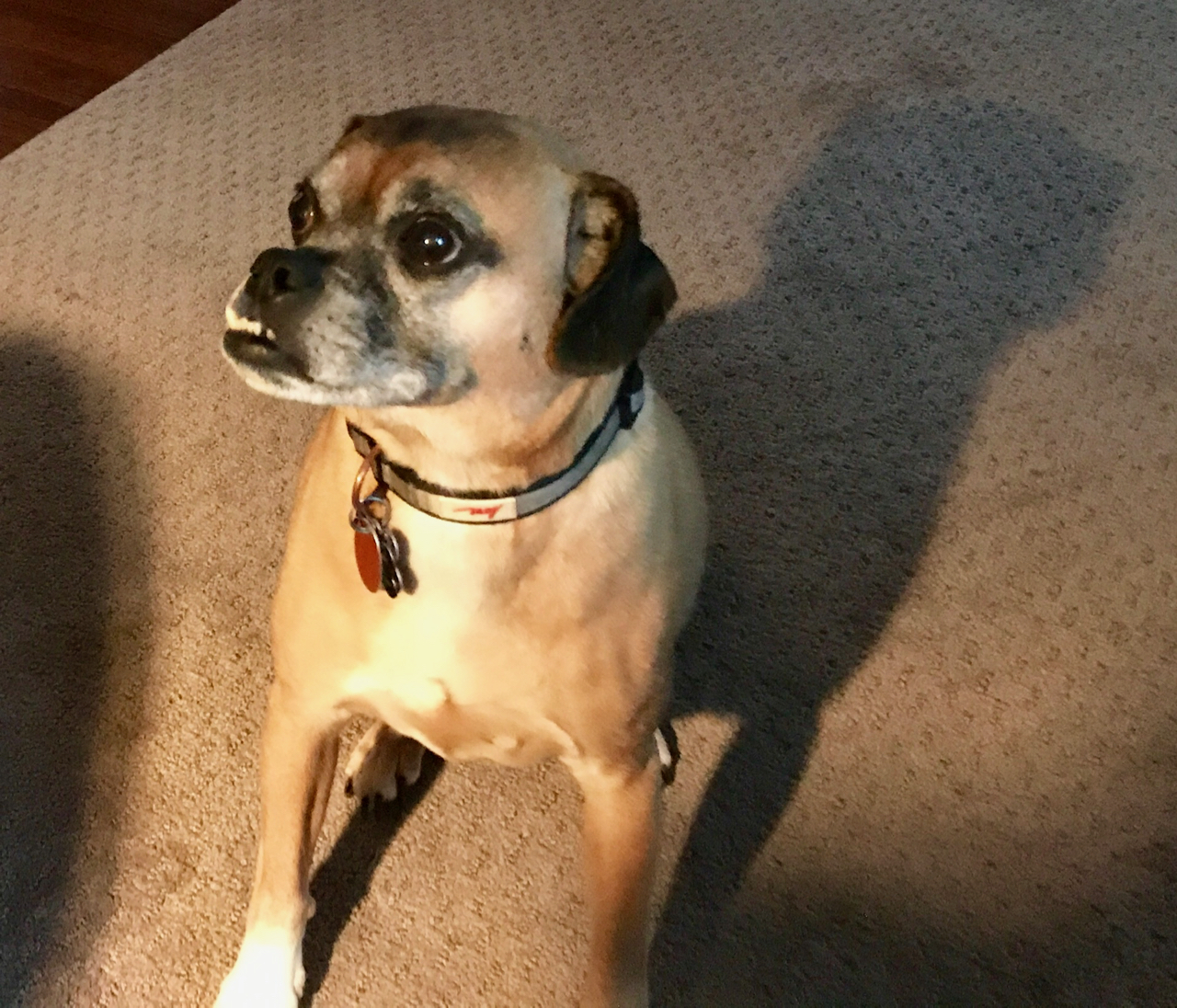
Our first stop is Cincinnati and Cora and I get to enjoy Ron and DC’s fabulous hospitality. Oddly enough, I didn’t get any photos of the three of us together during this visit, so I will share some shots of the four-legged residents of their house.
There’s Dodger,
Floyd,
Mojo,
and Molly.
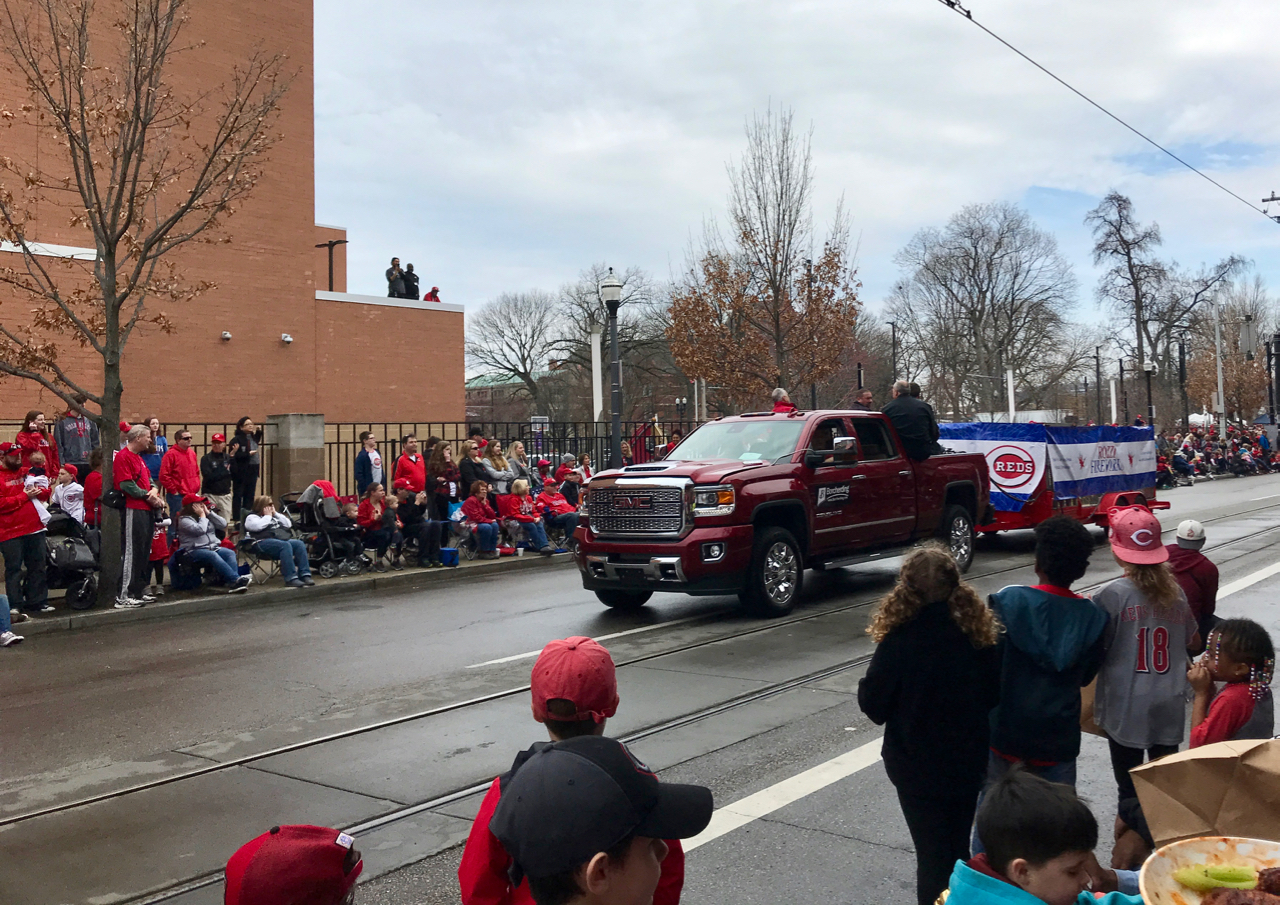
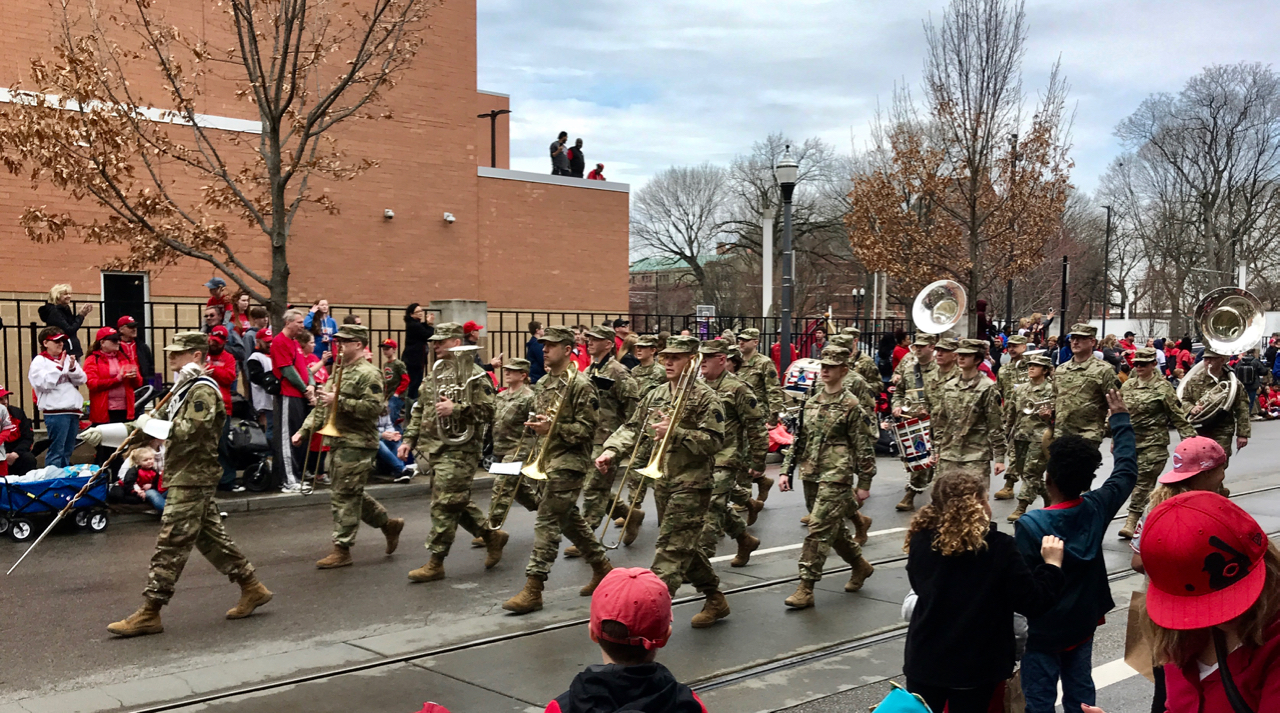
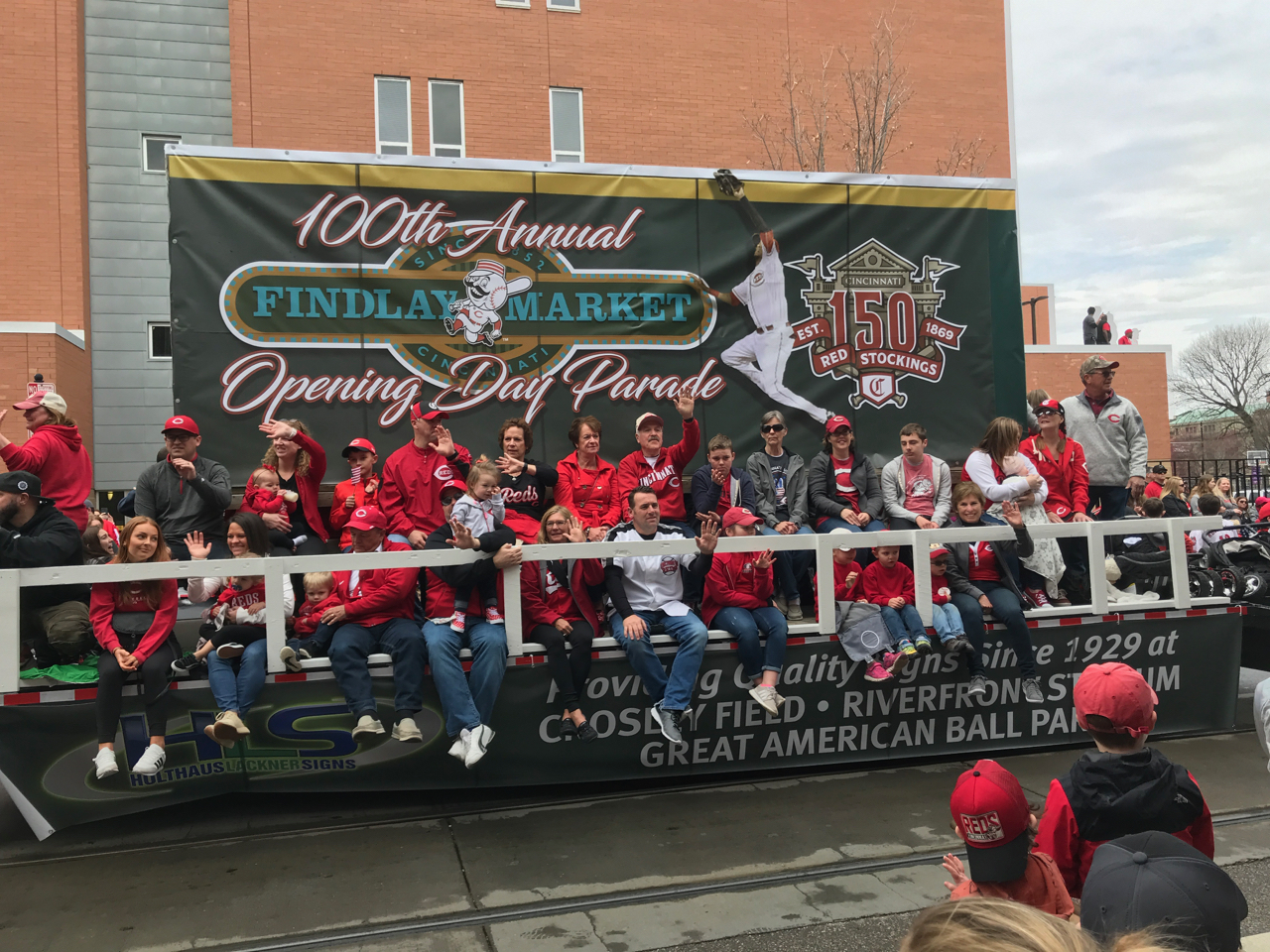
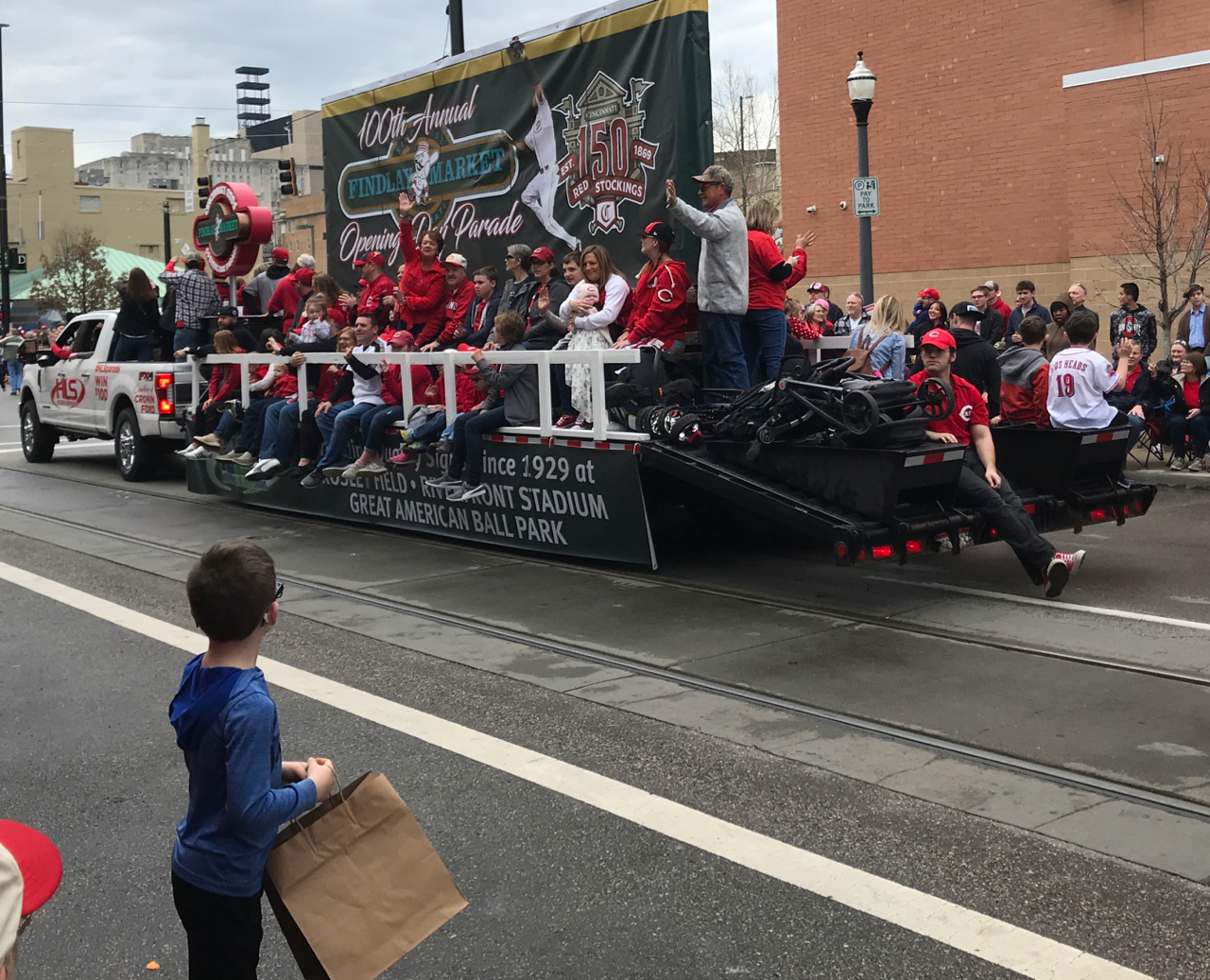
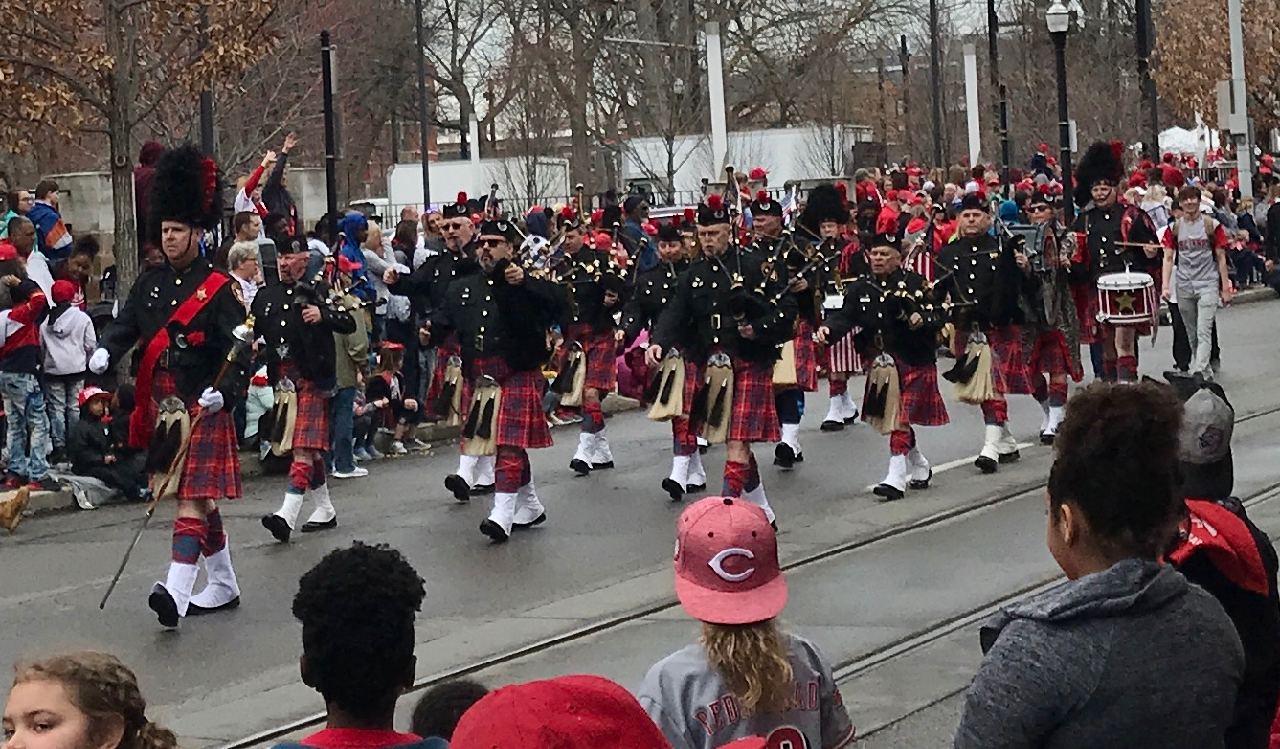
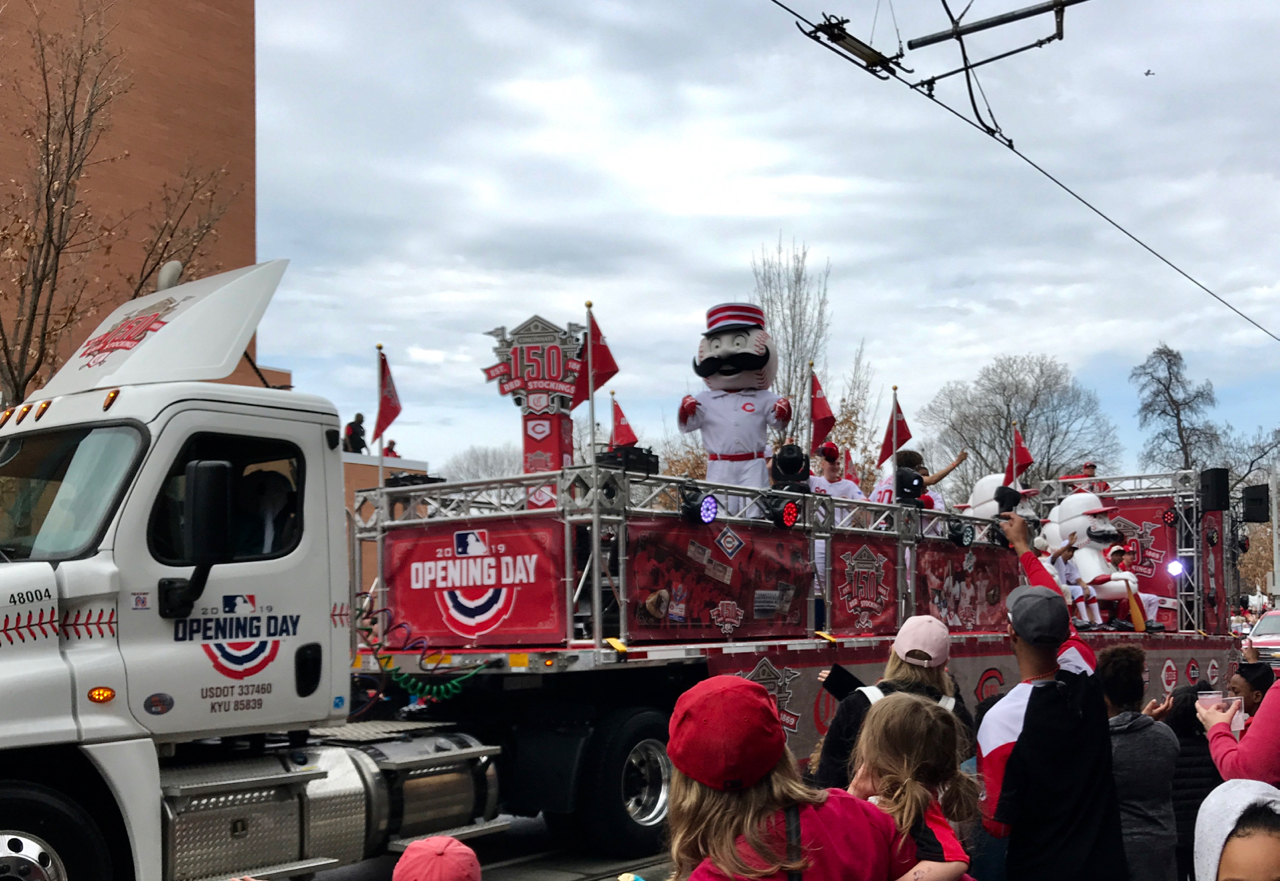
My visit to Cincinnati coincided with the beginning of the first game of 2019, on March 28. They also had the 100th Findlay Market Opening Day Parade the same day.
Now, baseball isn’t my cup of tea, but I’m always up for a new experience. DC had arranged a place for us to hang out while watching the parade.
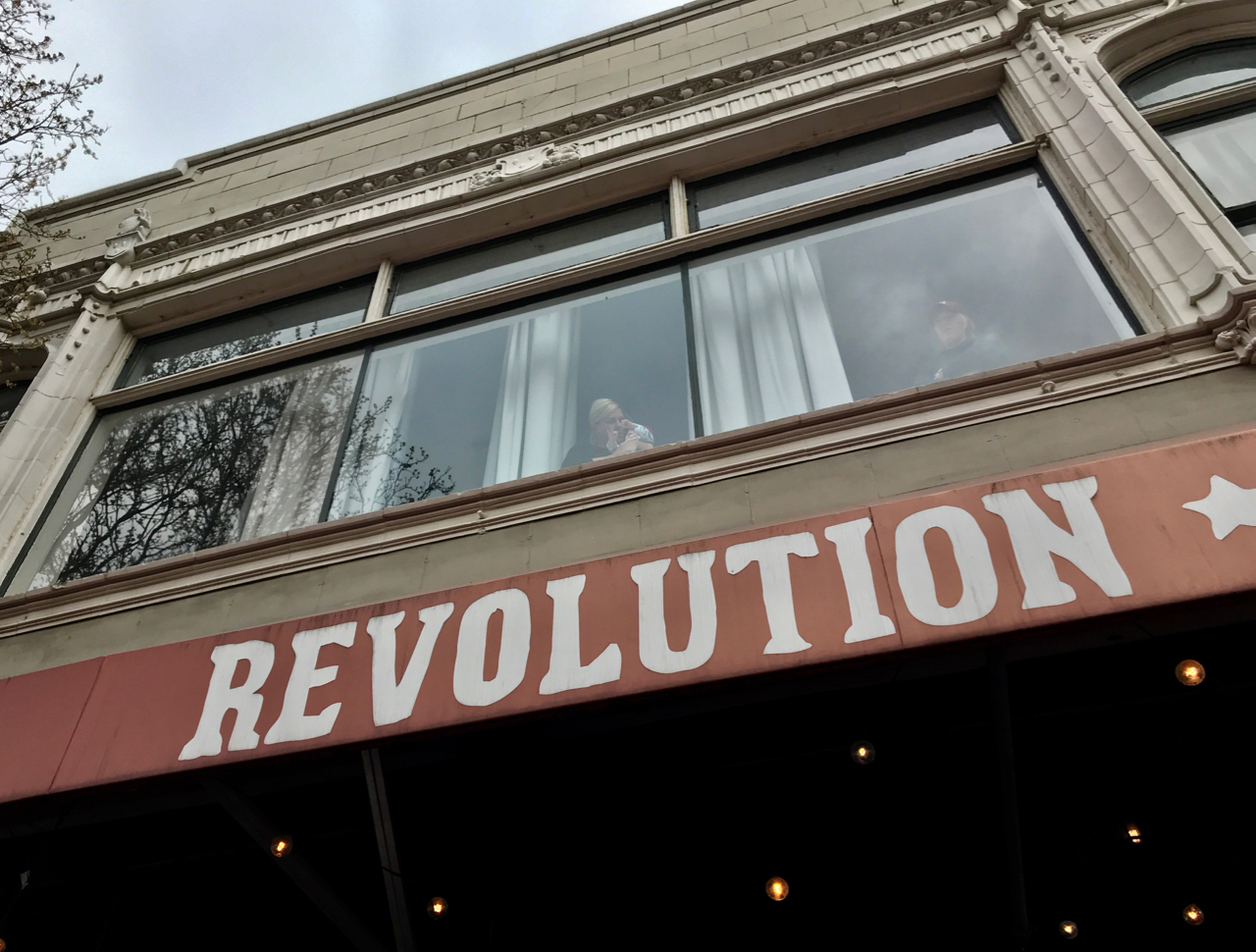
We took up our spots in Revolution Rotisserie and waited for the parade. We didn’t have to wait too long.
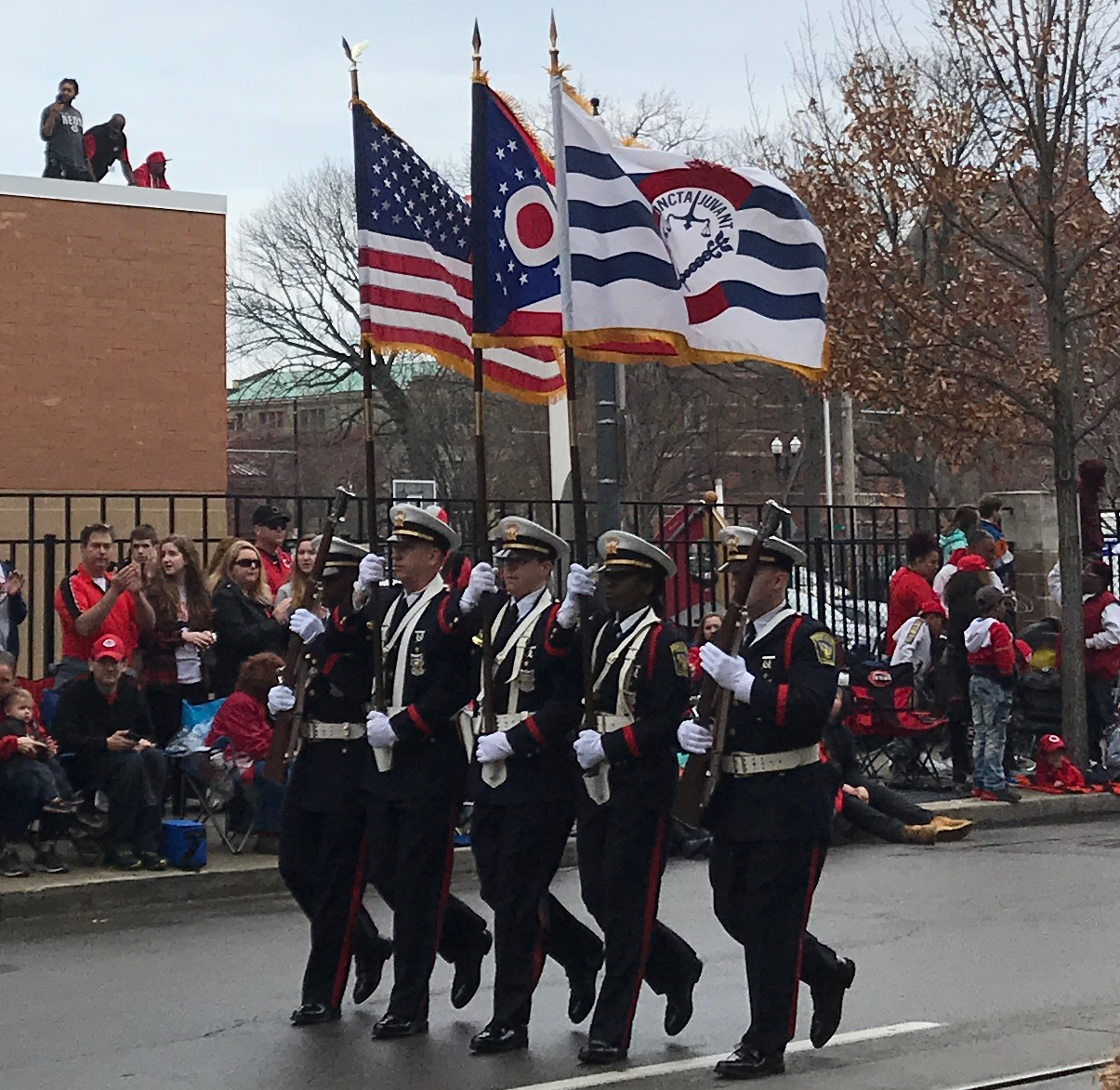
The color guard lead the way.
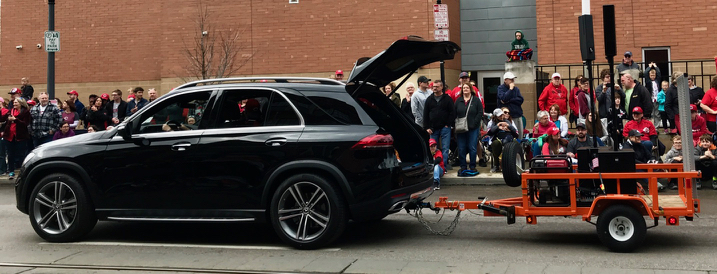
Then there was a “float.” At least, it looked like a float.
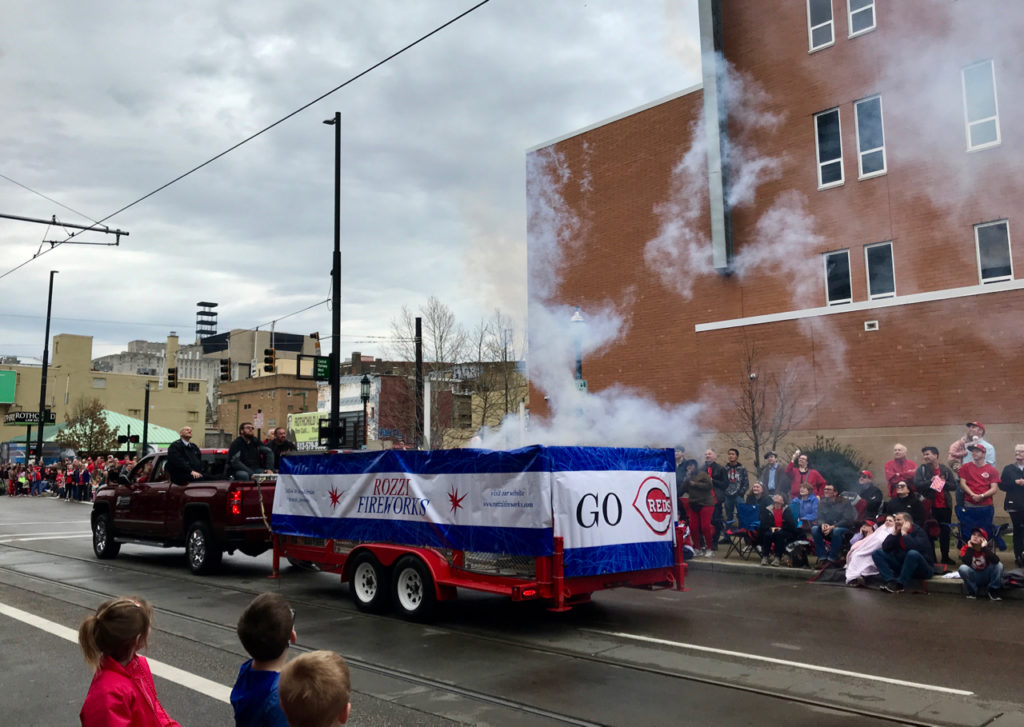
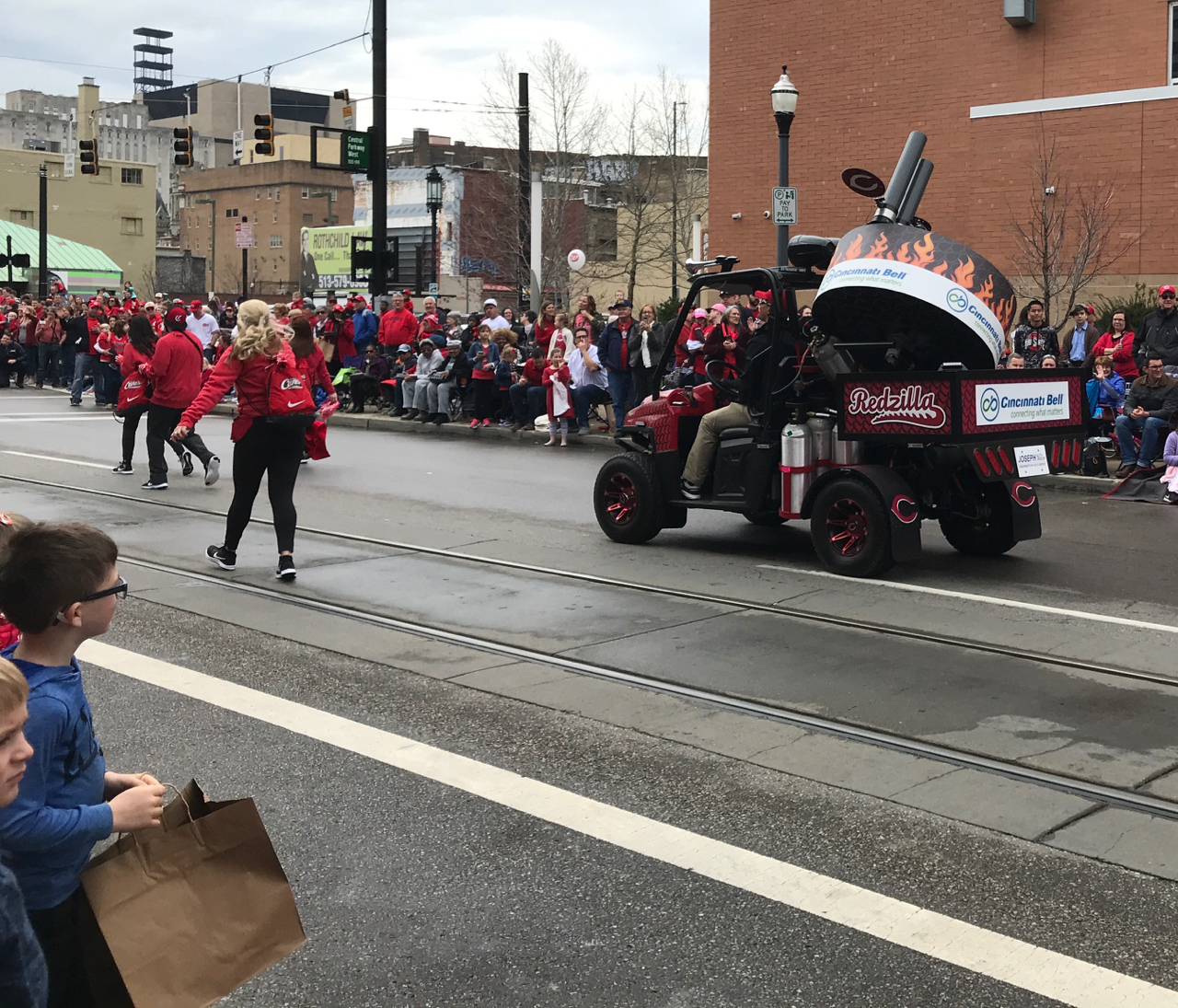
Actually, it was a trailer hauling a machine that shot off fireworks! I think the last time I saw daytime fireworks as part of a procession was at Las Fallas in Valencia, Spain in 1976.
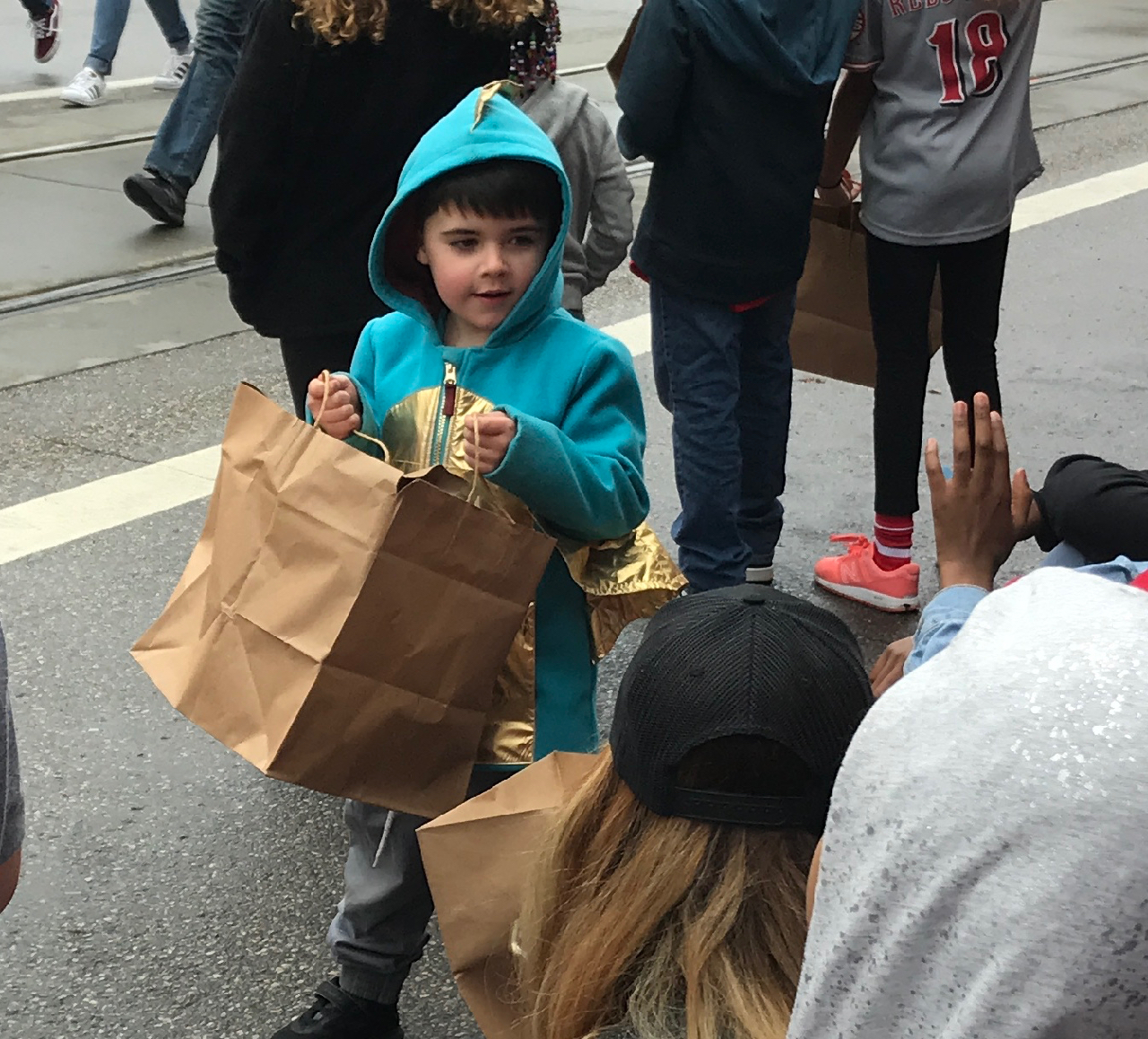
Kids came equipped with bags to catch loot being thrown. Incidentally, Rozzi Fireworks didn’t throw any firecrackers to the kids.
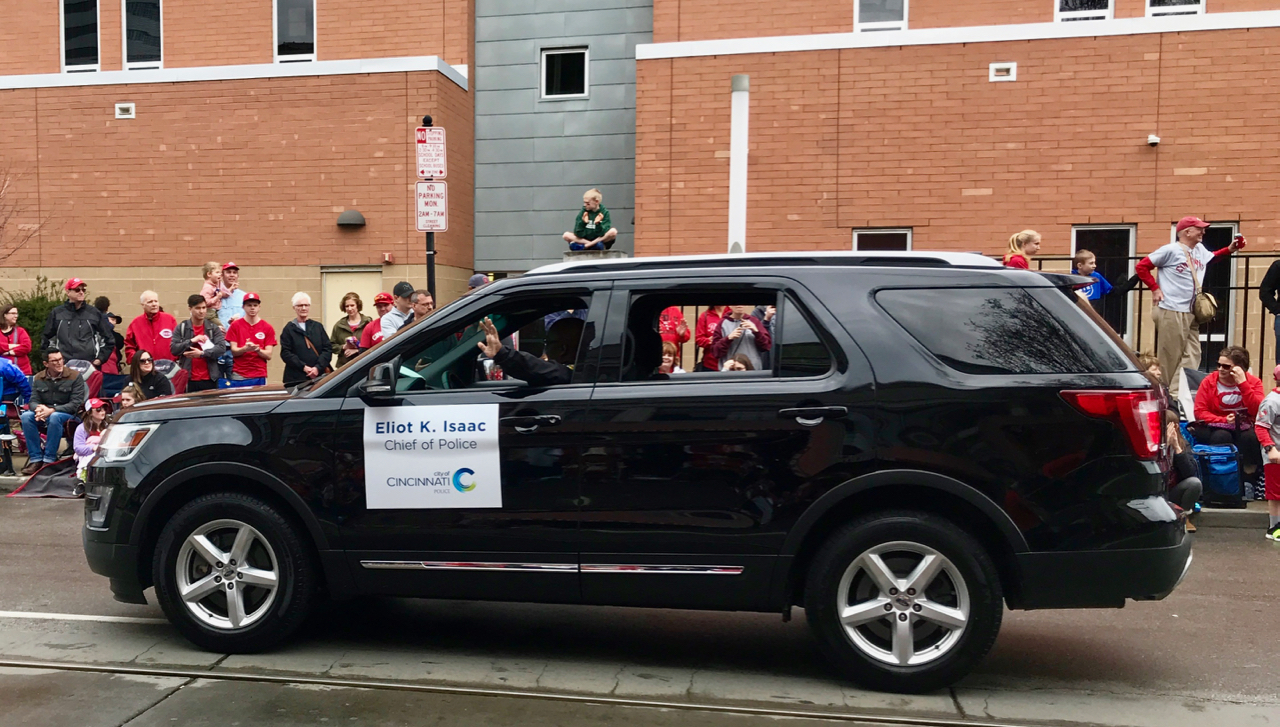
The Chief of Police was there. Or, at least his car was there. (I just say that because the only Chief of Police I know to identify is Commissioner Reagan.)
But that’s New York City…back to Cincinnati!
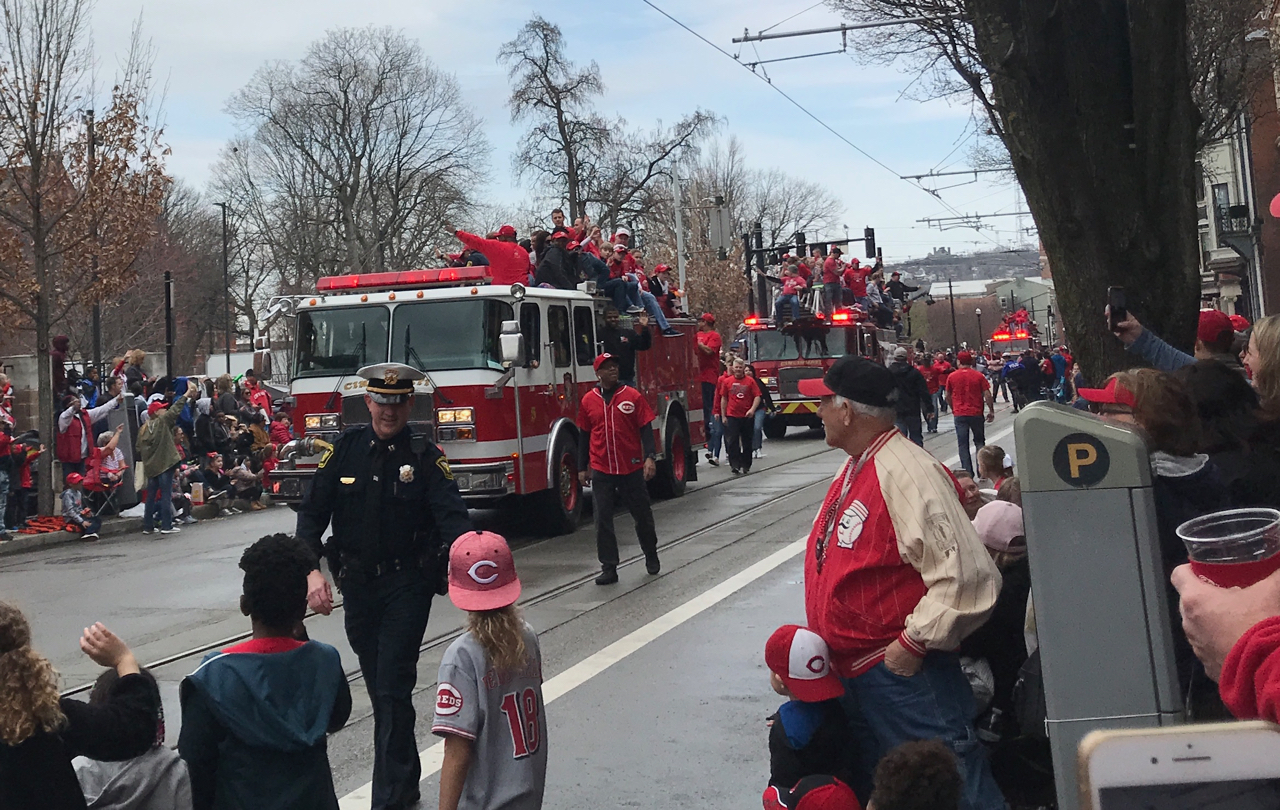
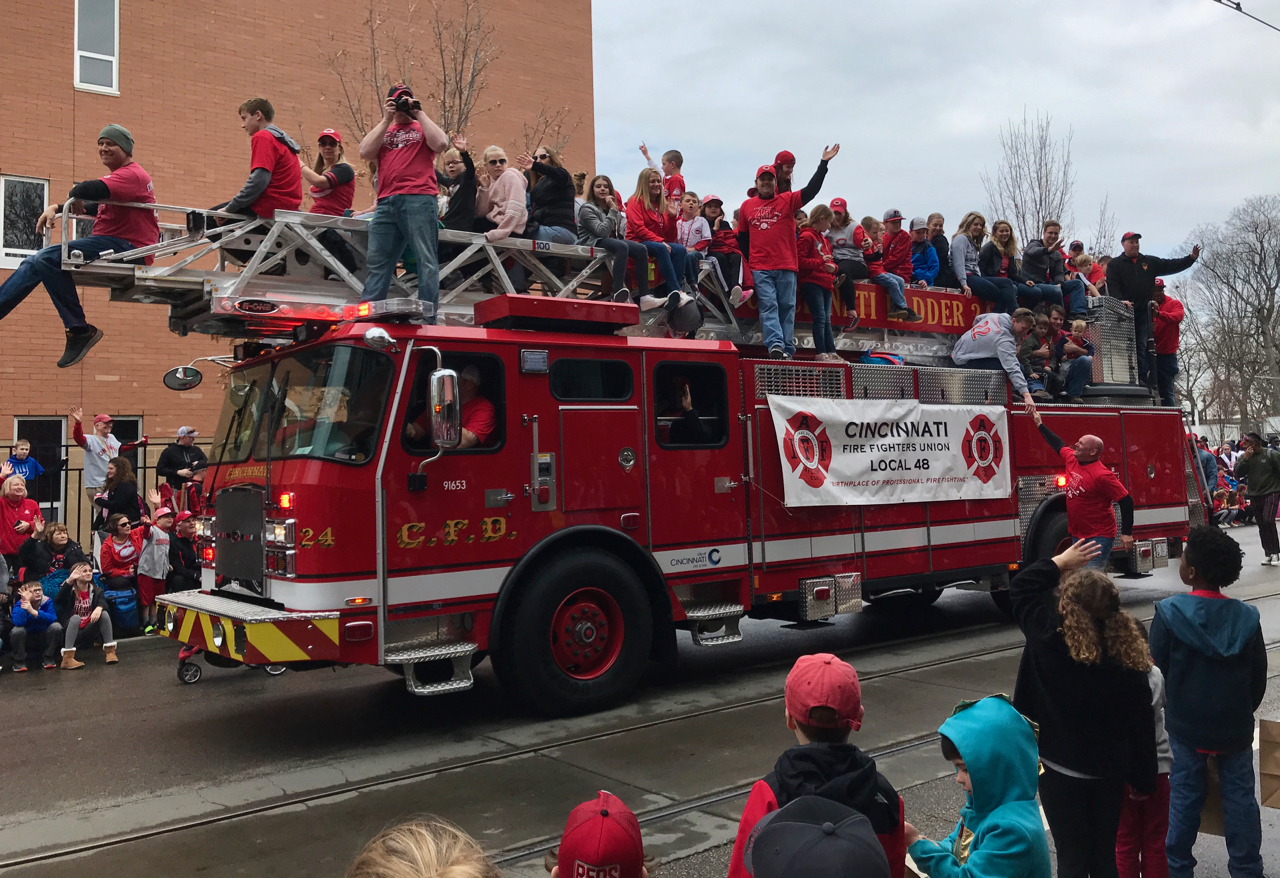
Next came the firefighters.
I wonder what the maximum capacity is for a firetruck?
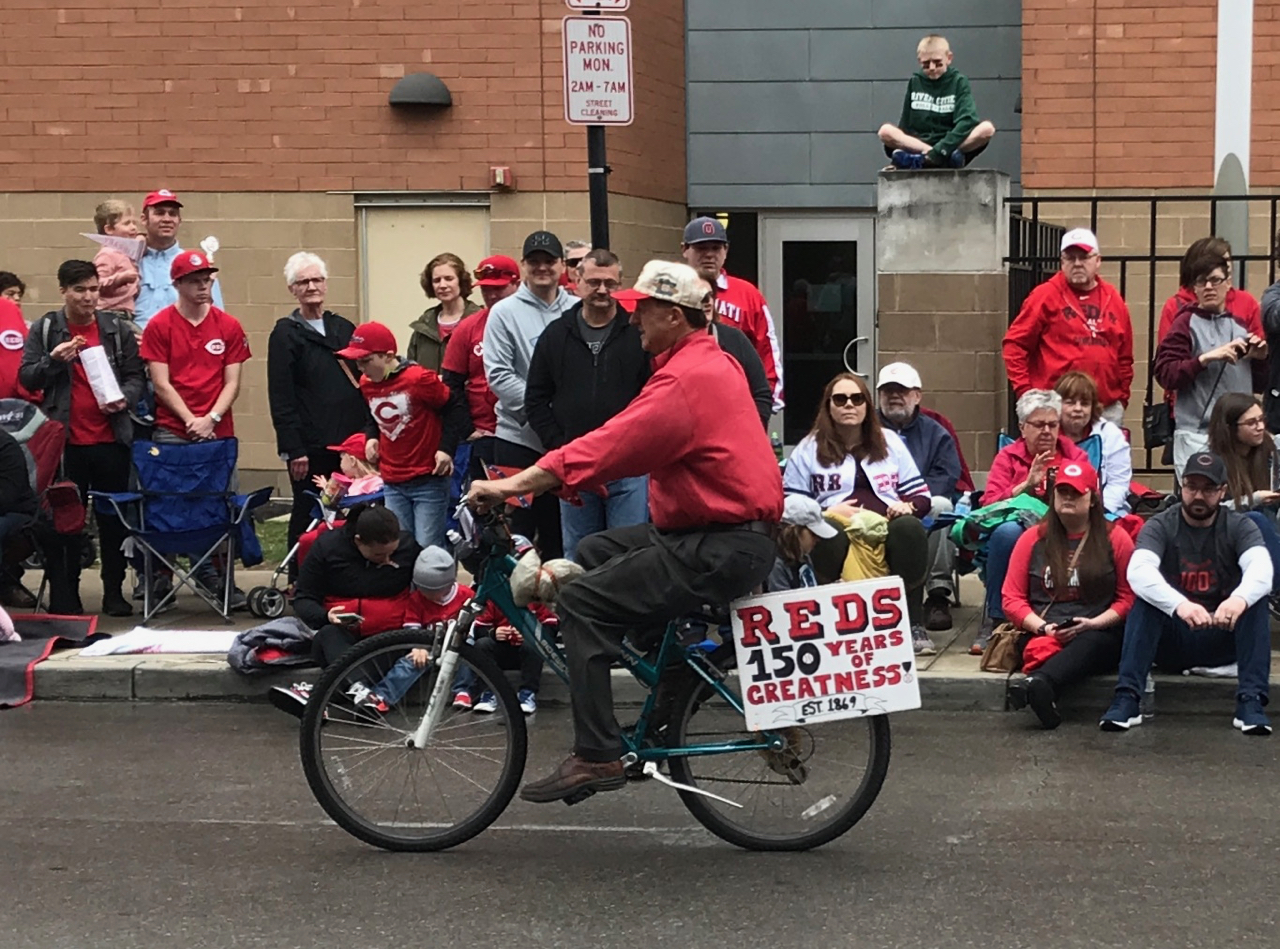
A guy decorated his bicycle and joined in the parade.
You might have to look really hard to find the marching band in this photo. After all, they are wearing camouflage.
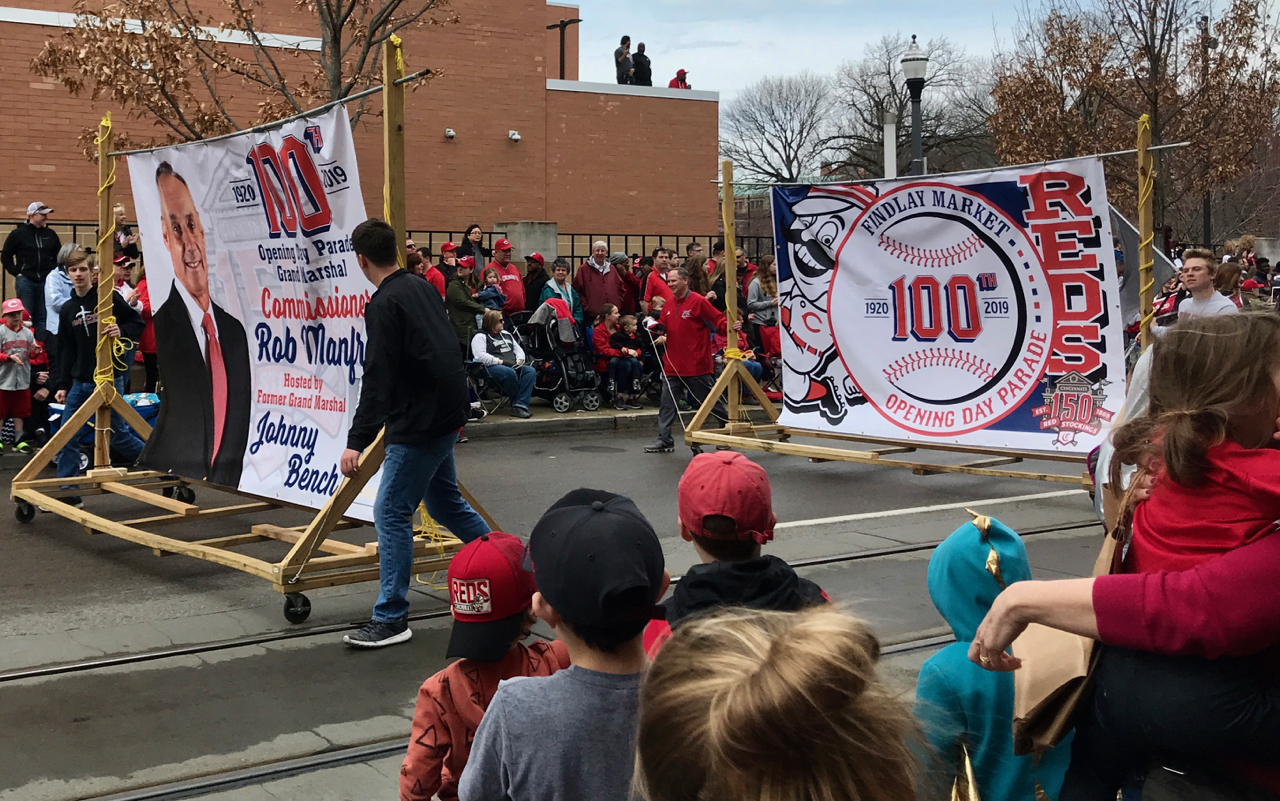
Findlay Market is making an appearance, celebrating their 100th Anniversary of sponsoring the parade, AND the Red Socks 150th anniversary.
The poor kids are still waiting hopefully for the first treat to be thrown.
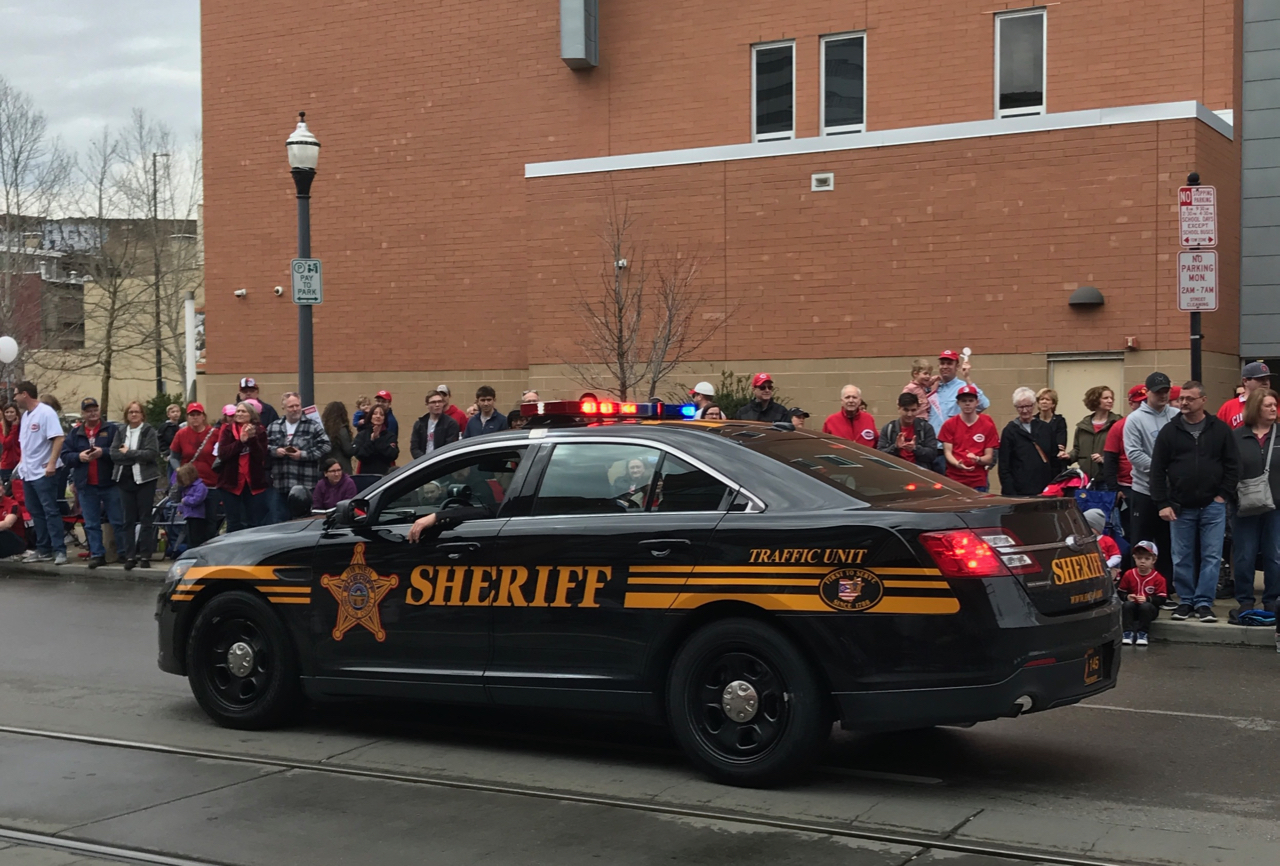
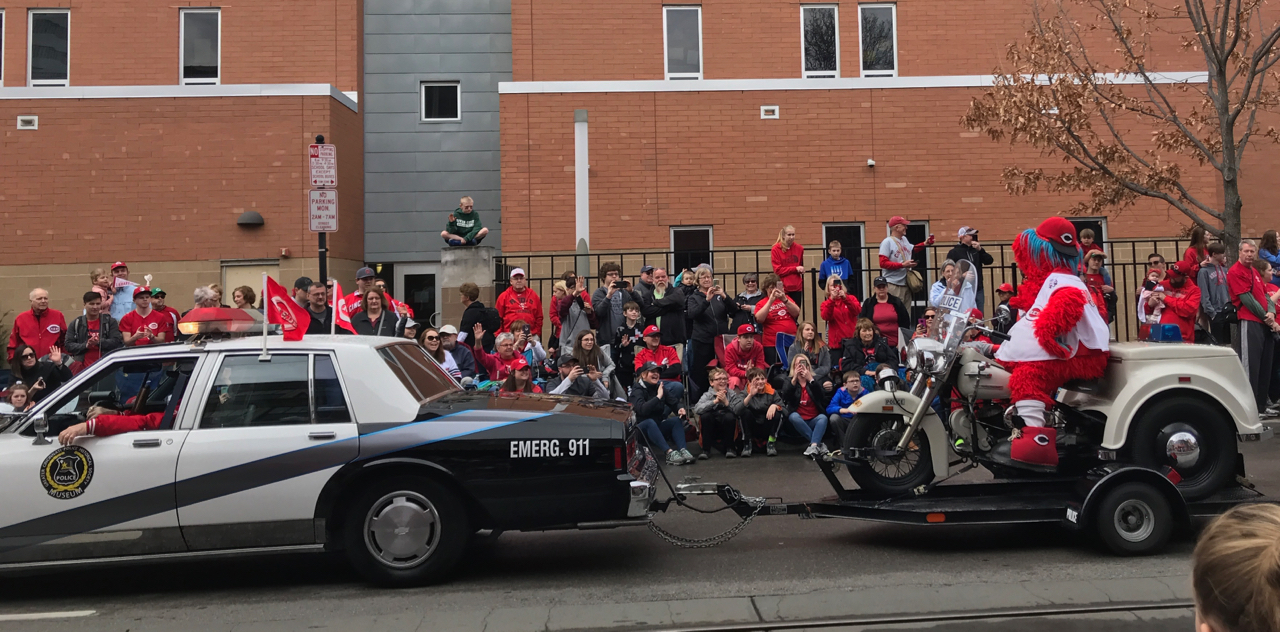
The Traffic Unit of the Sheriff’s Department rolled on by.
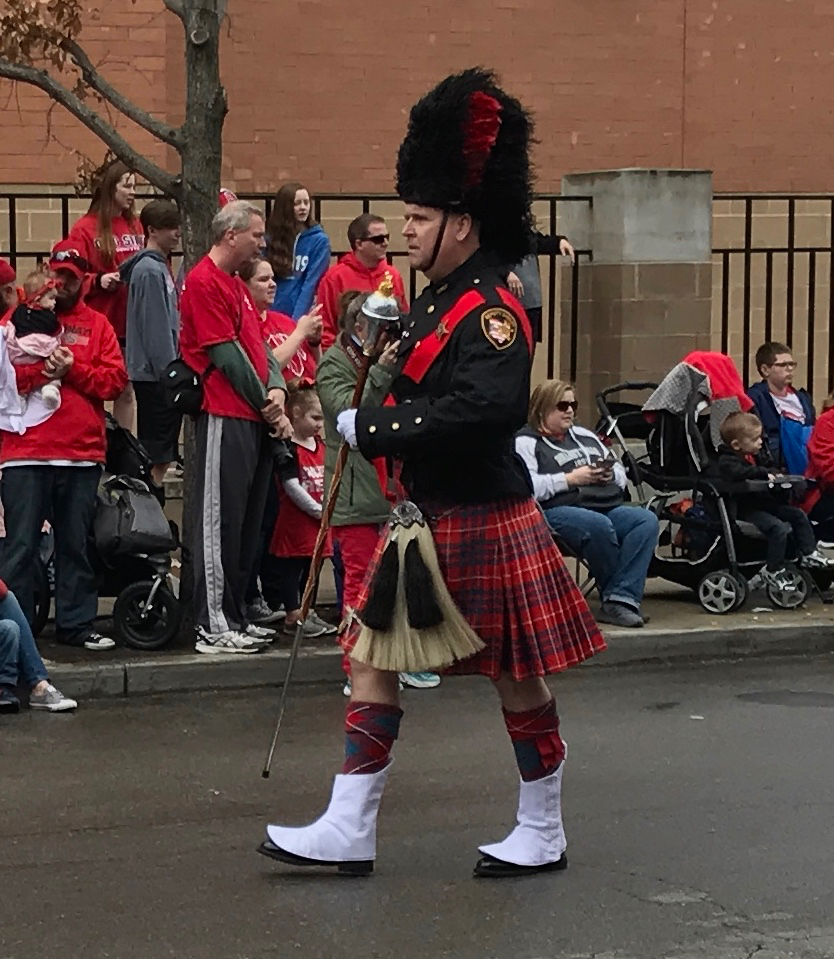
Followed by the pipers.
The Drum Major was really strutting his stuff! Incidentally, that staff he is carrying is called a mace.
Not being from Cincinnati or a baseball aficionado, I had to look up this Reds mascot. Here we have Gapper riding a three-wheeled motorcycle on a two-wheeled trailer.
Apparently, they have four mascots. In addition to Gapper, there is Rosie Red, Red Legs and Mr. Red.
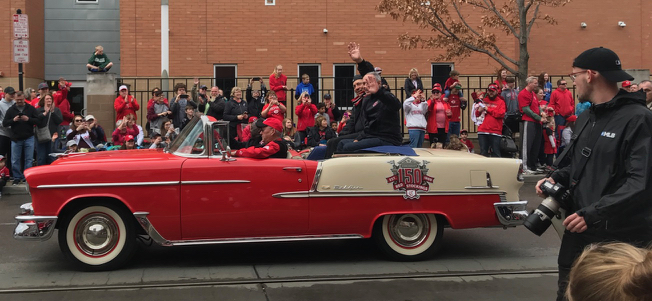
Old-timey cars belong in parades – especially if they are convertibles and they are Red Socks red!
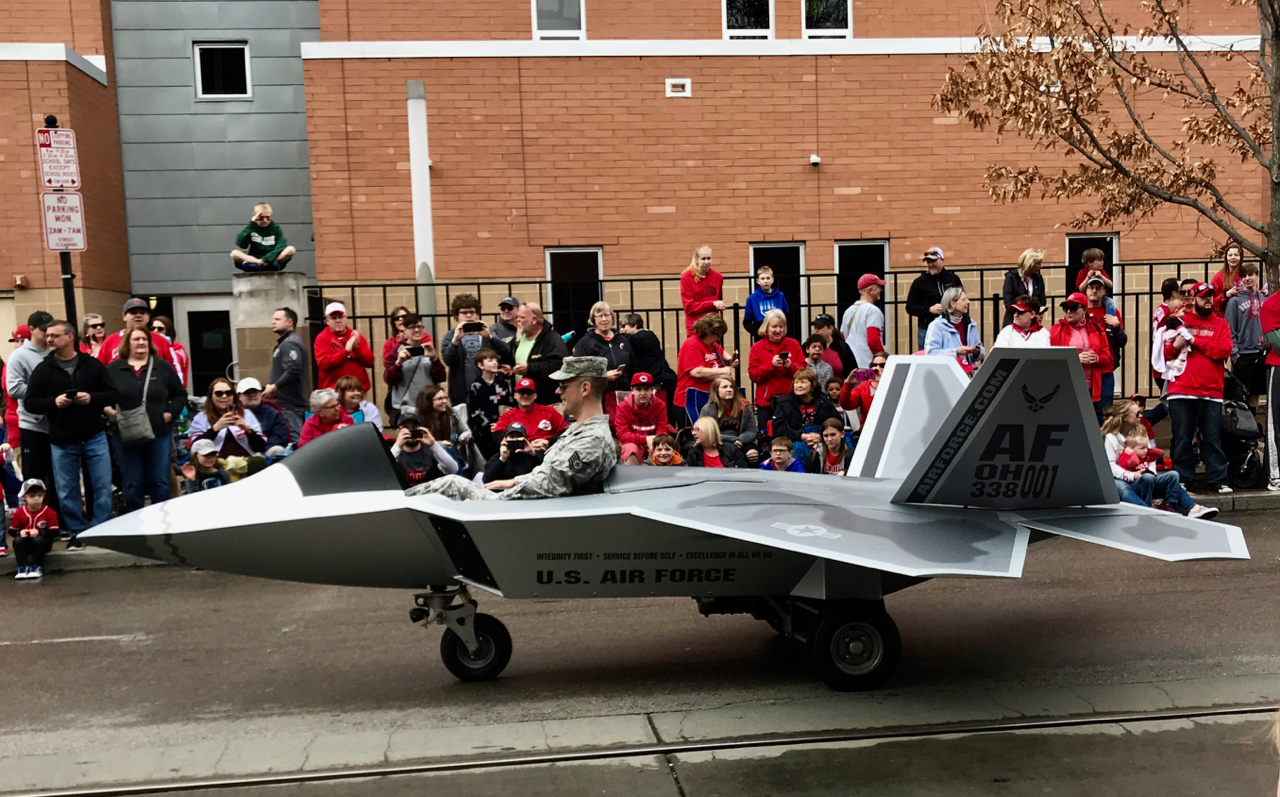
The Air Force brought out one of their smallest planes to join in the fun.
Ah! More mascots!
I guess cars don’t have to be particularly old to join in the fun – just as long as they have the appropriate color scheme.
Too bad they aren’t launching any trinkets those poor kids can put in their bags.
If it has wheels or can march, it seems to belong in this parade. This group has both!
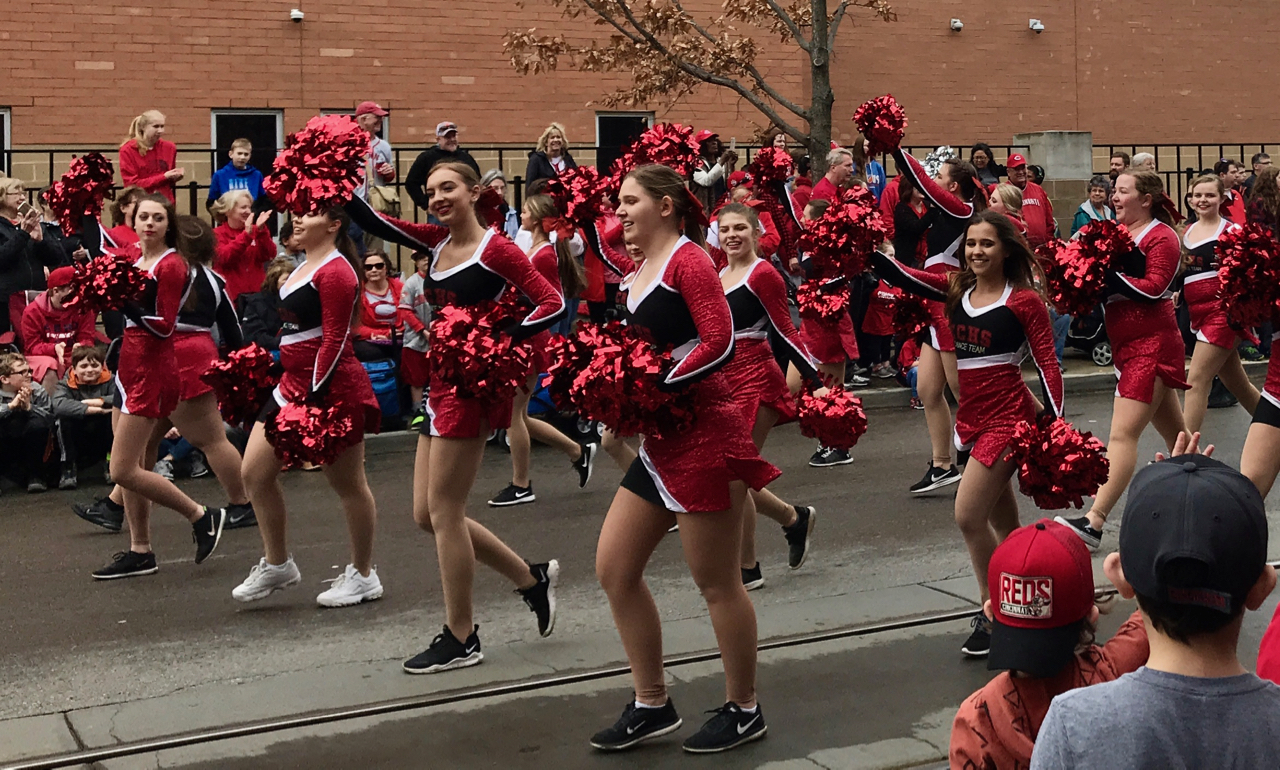
Here come the marching pompon girls.
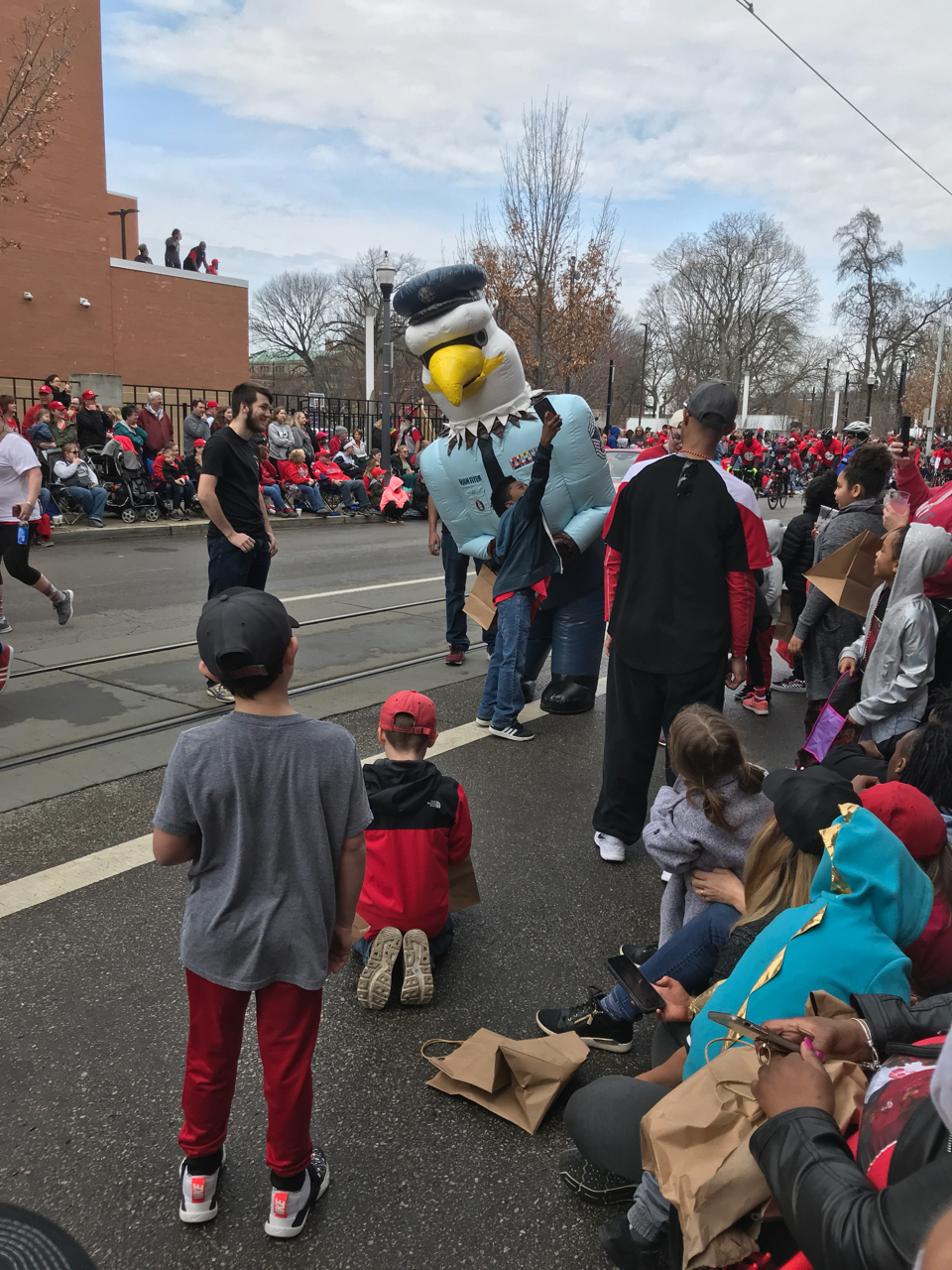
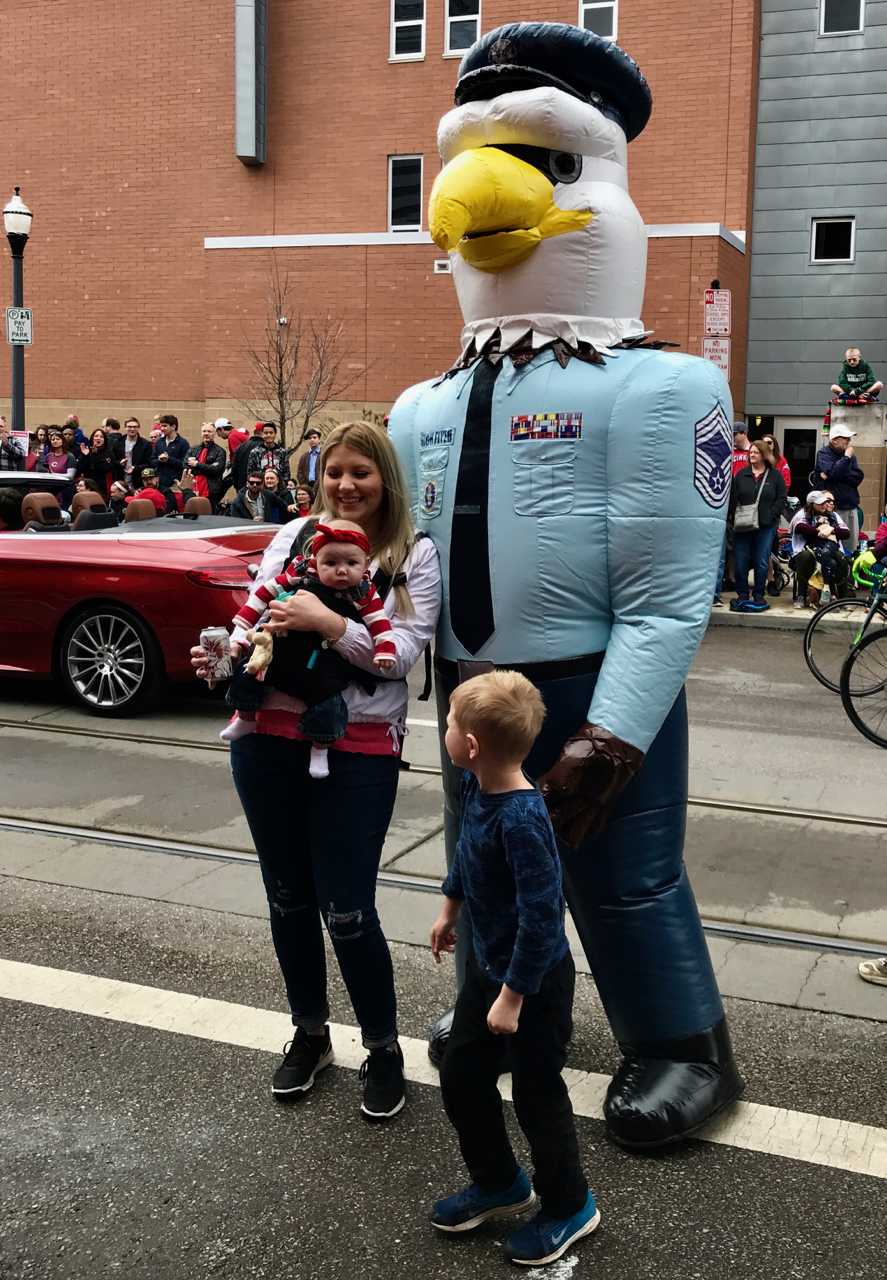
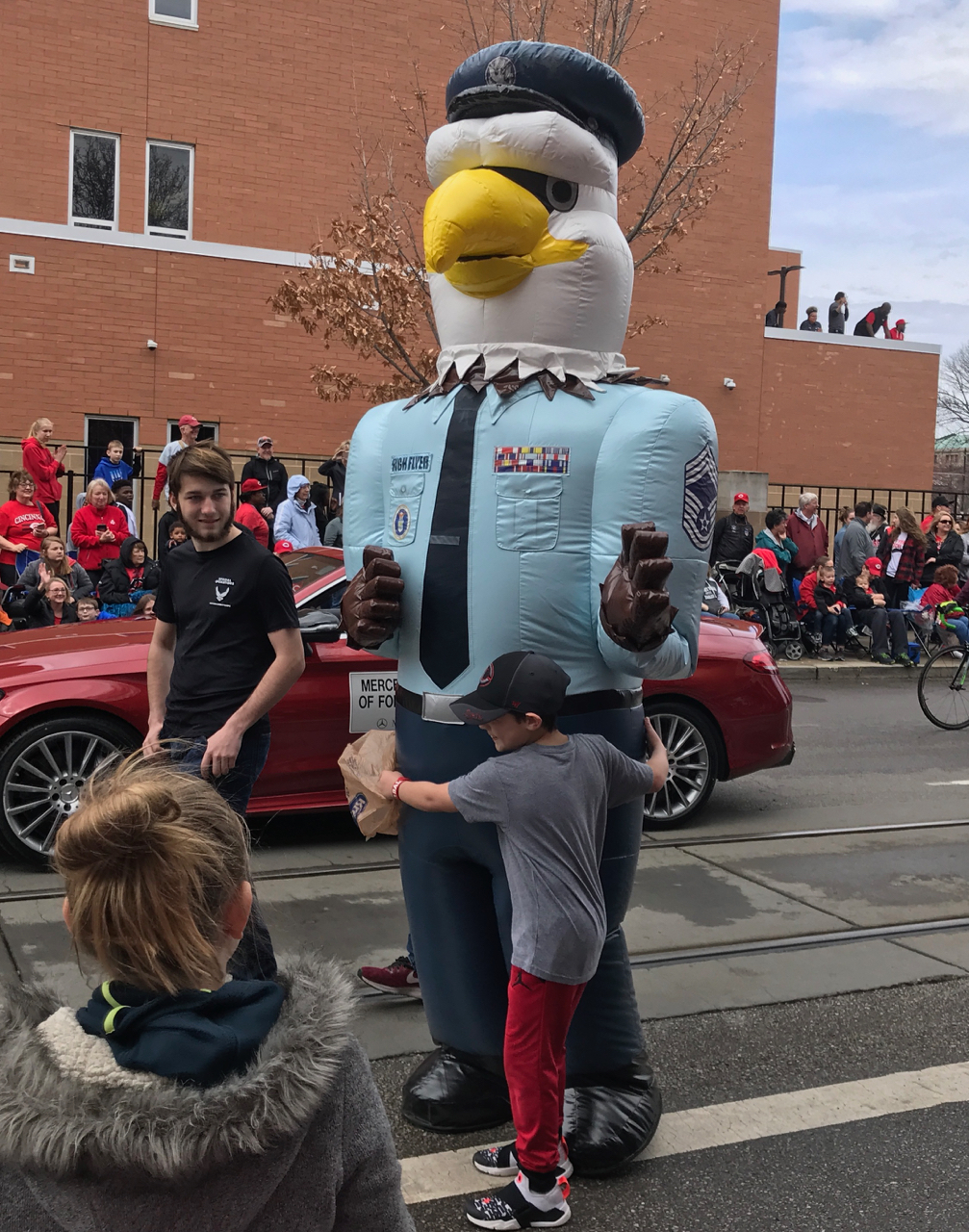
Now, this is something I’ve never seen in a parade before – a marching inflatable. This inflated Air Force eagle had a handler who helped him navigate and steer clear of obstacles.
He’d stop every now and then and people would gather around for photos ops.
Sometimes a hug would suffice.
Where have all the marching bands gone? The sound track of this portion of the parade was provided by a sound system with speakers on the back. I guess this is the melding of tradition and technology – or perhaps the result of defunding the arts in schools.
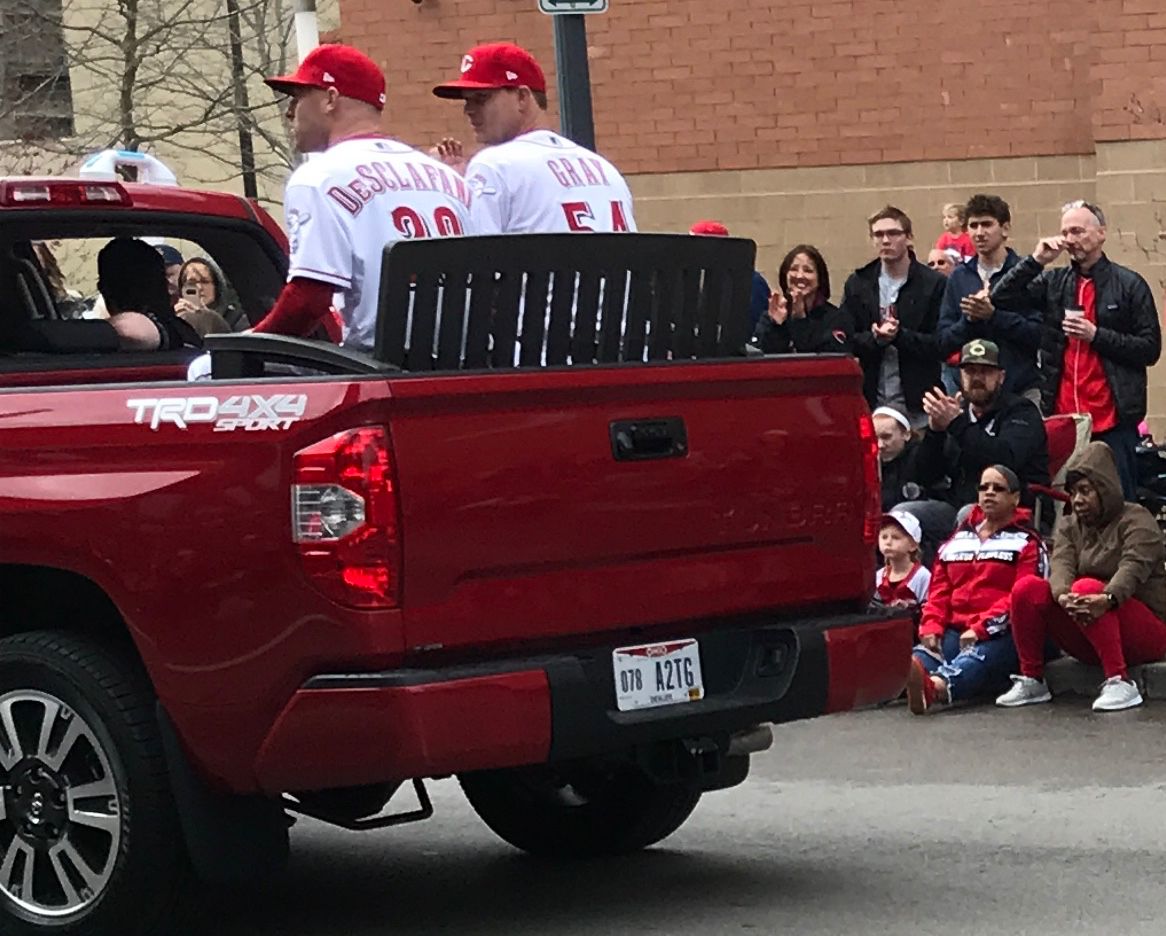
Not being from Cincinnati nor a baseball devotee, I had to look up these names. The look like real live Cincinnati Reds team members – pitchers Anthony DeSclafani and Sonny Gray.
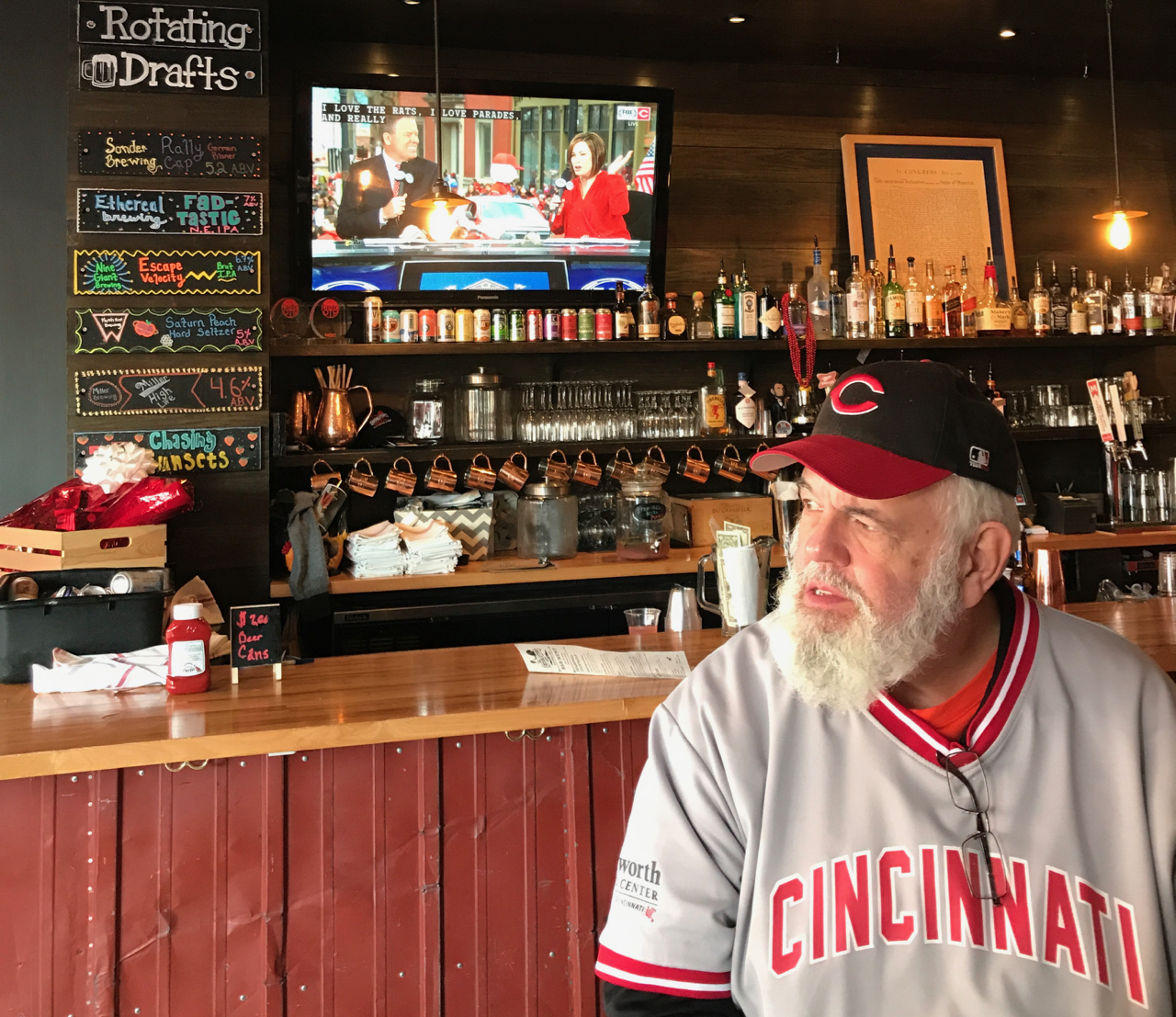
I thought I should head back into the bar to see what was happening there. It was playing on the TVs inside, so there was no need to fight the crowds on the street.
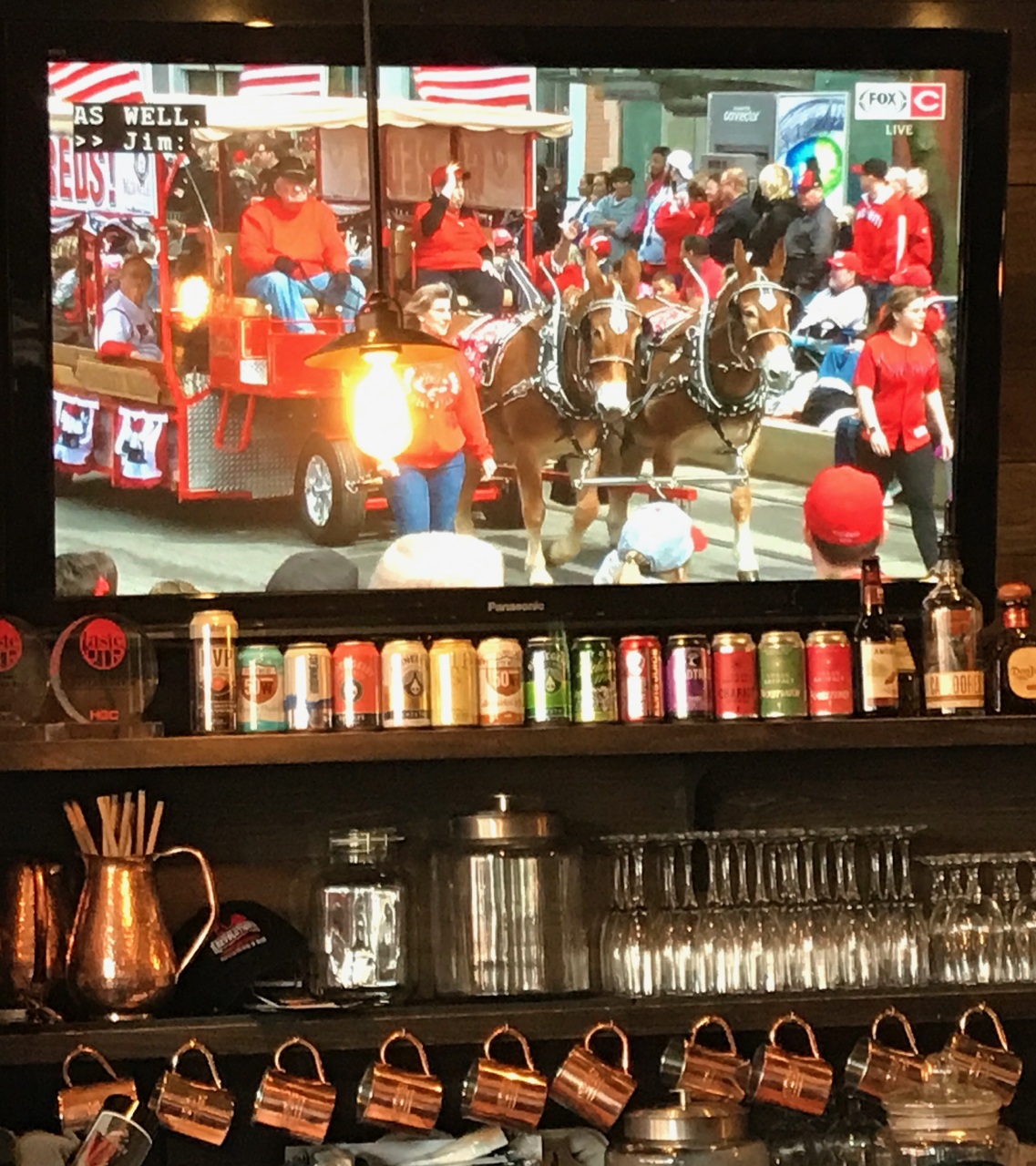
Hey! The horses are coming! I’d better get back out there and check them out.
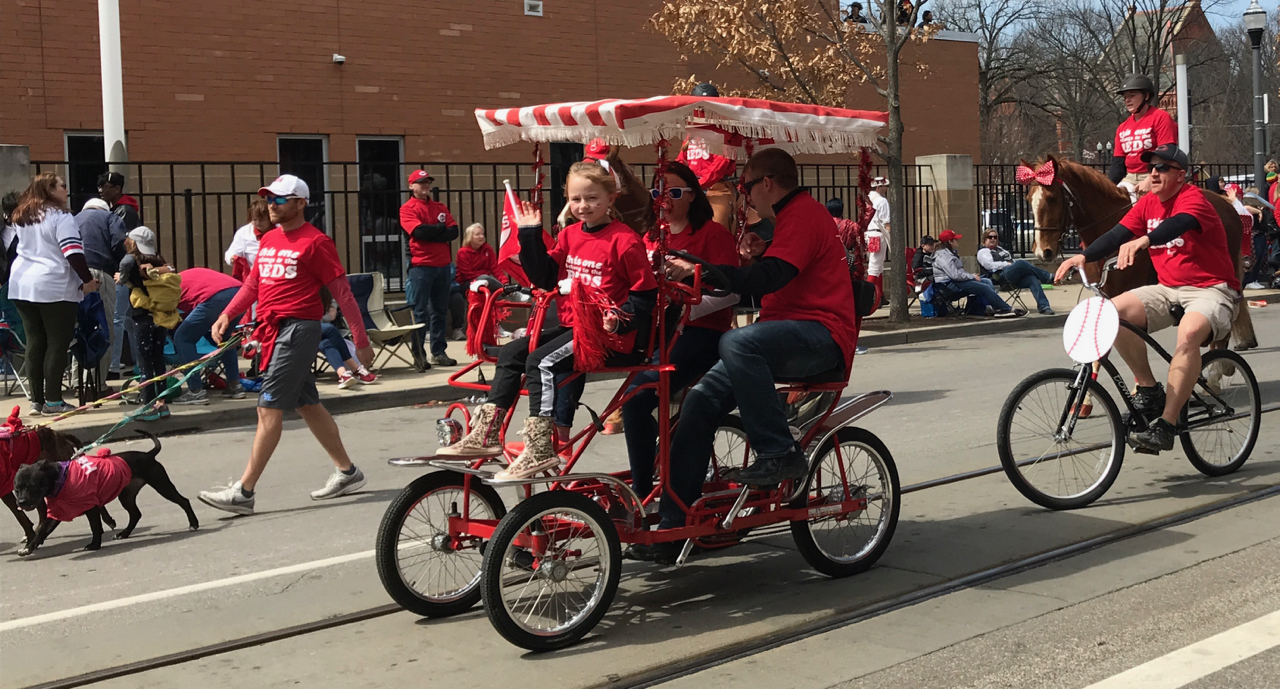
No horses yet, but an interesting assemblage of wheels and dogs were passing.
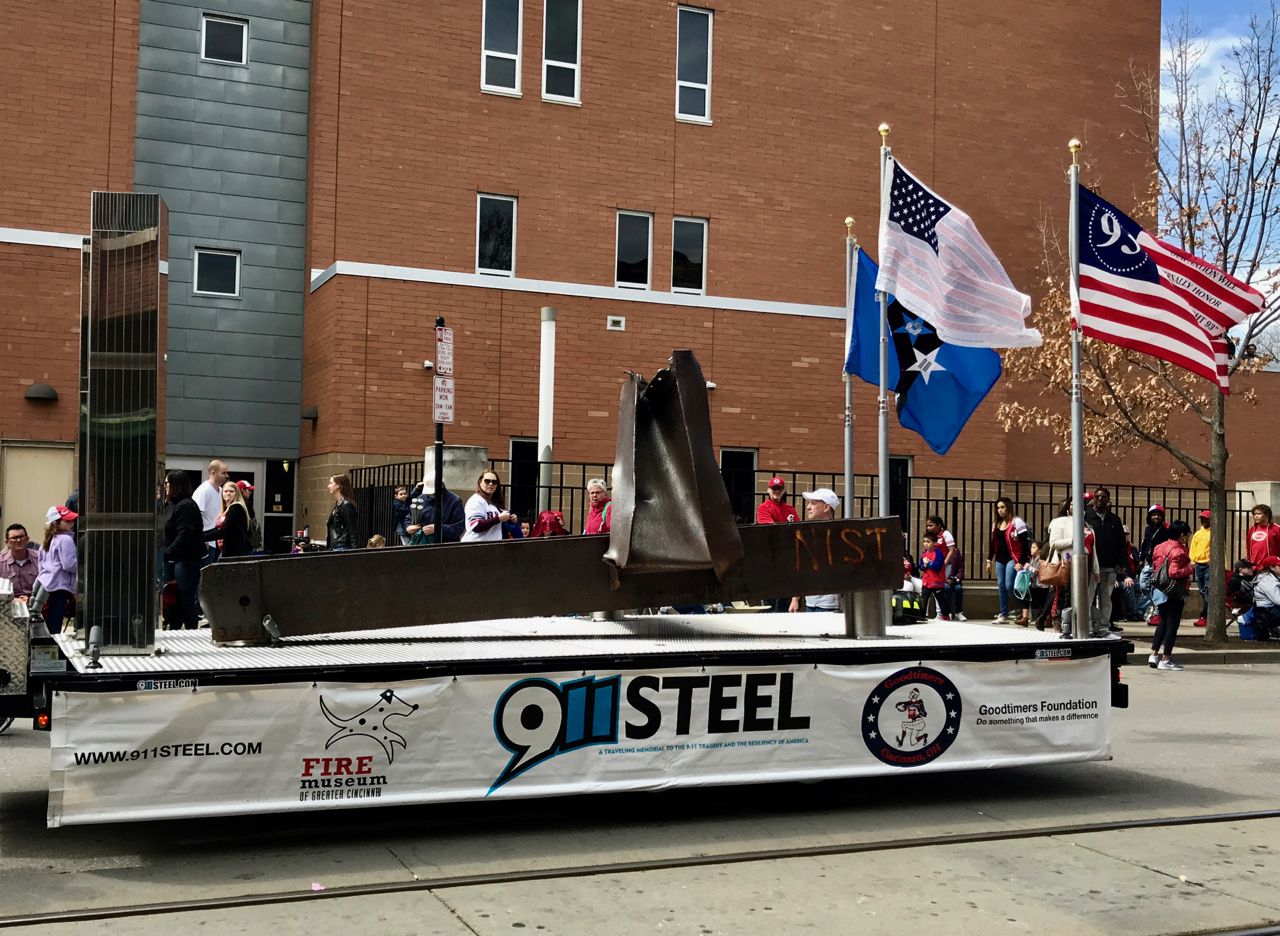
An artifact from the World Trade Center rolled by.
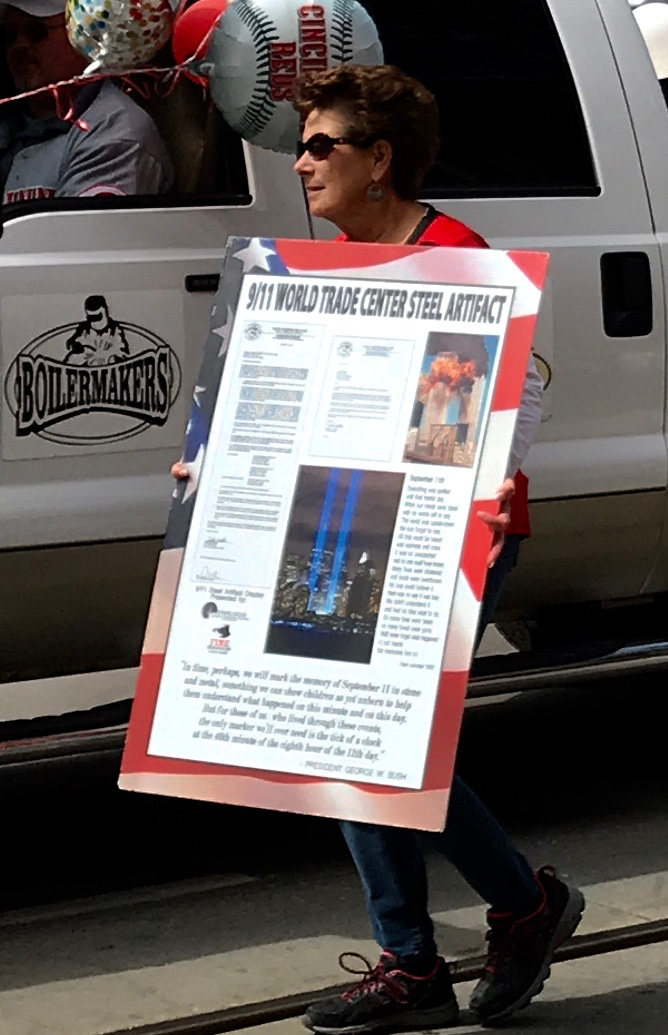
A marcher carried a poster with facts along side the truck hauling the float.
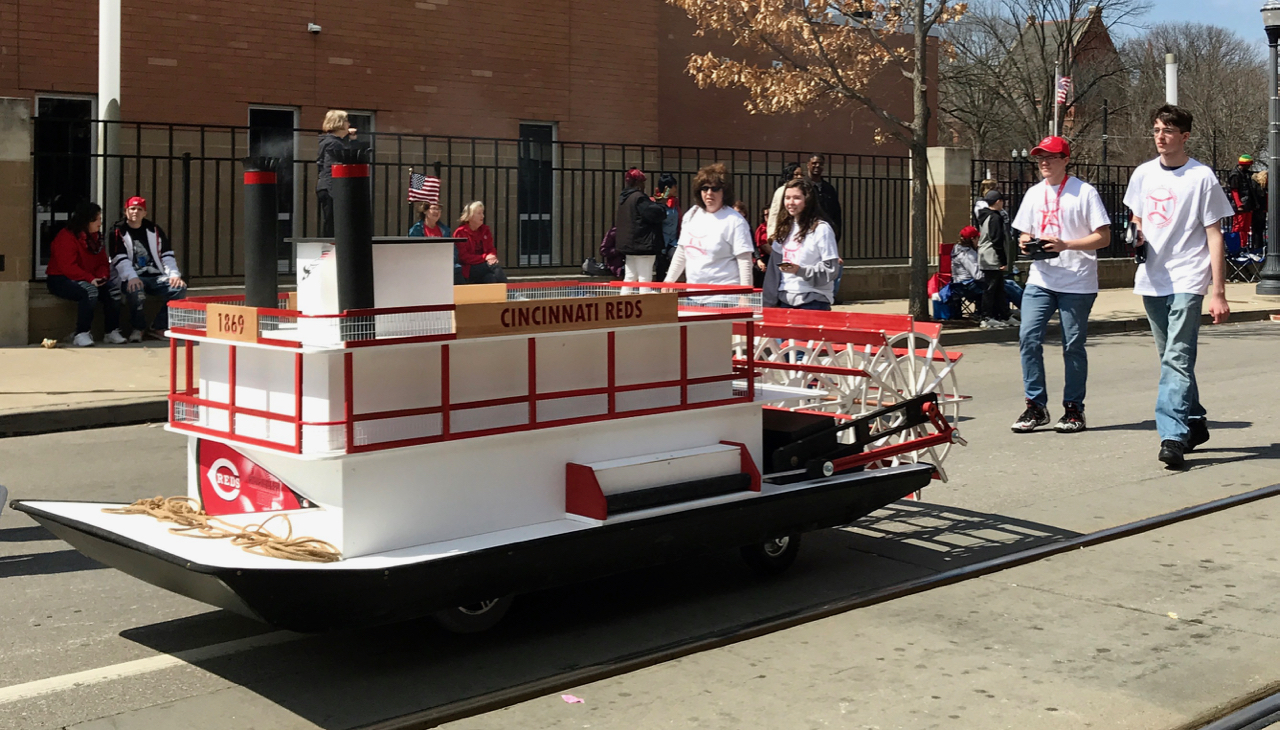
A steamboat with its remote control handler chugged down the street.
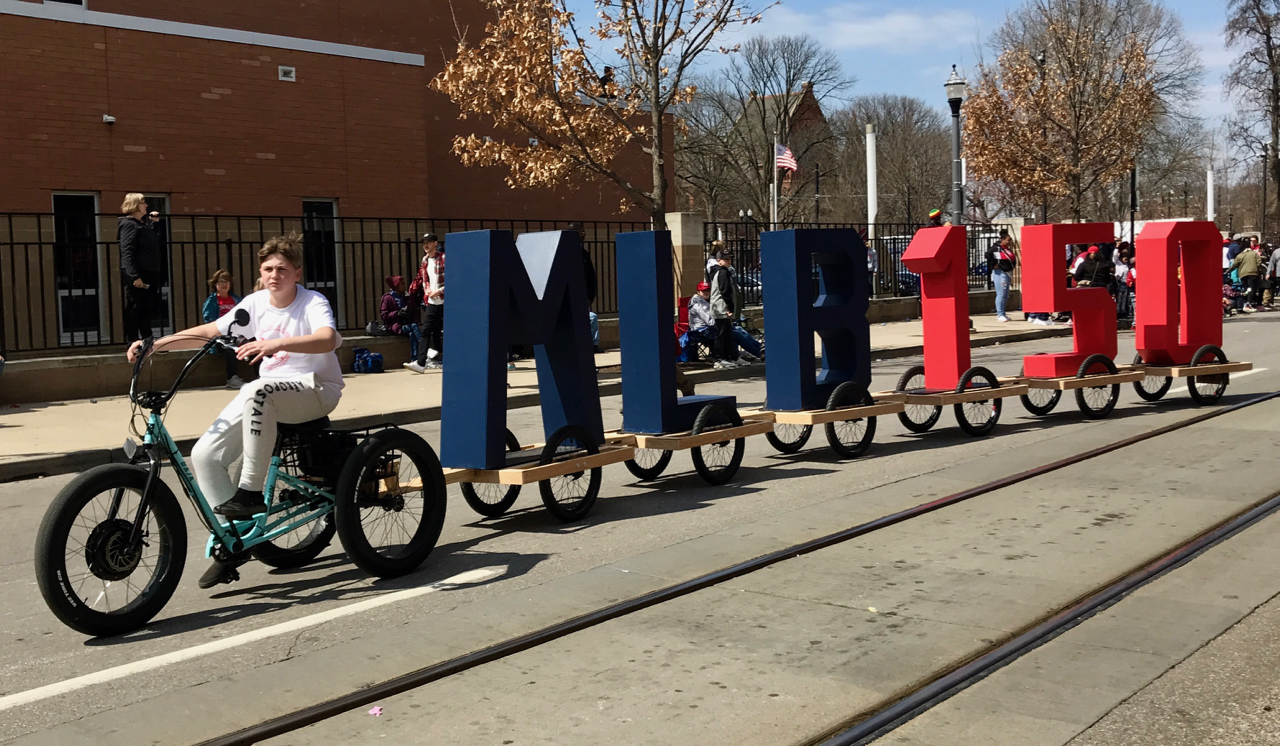
A tricycle rider pulled a string of trailers proclaiming MLB 150.
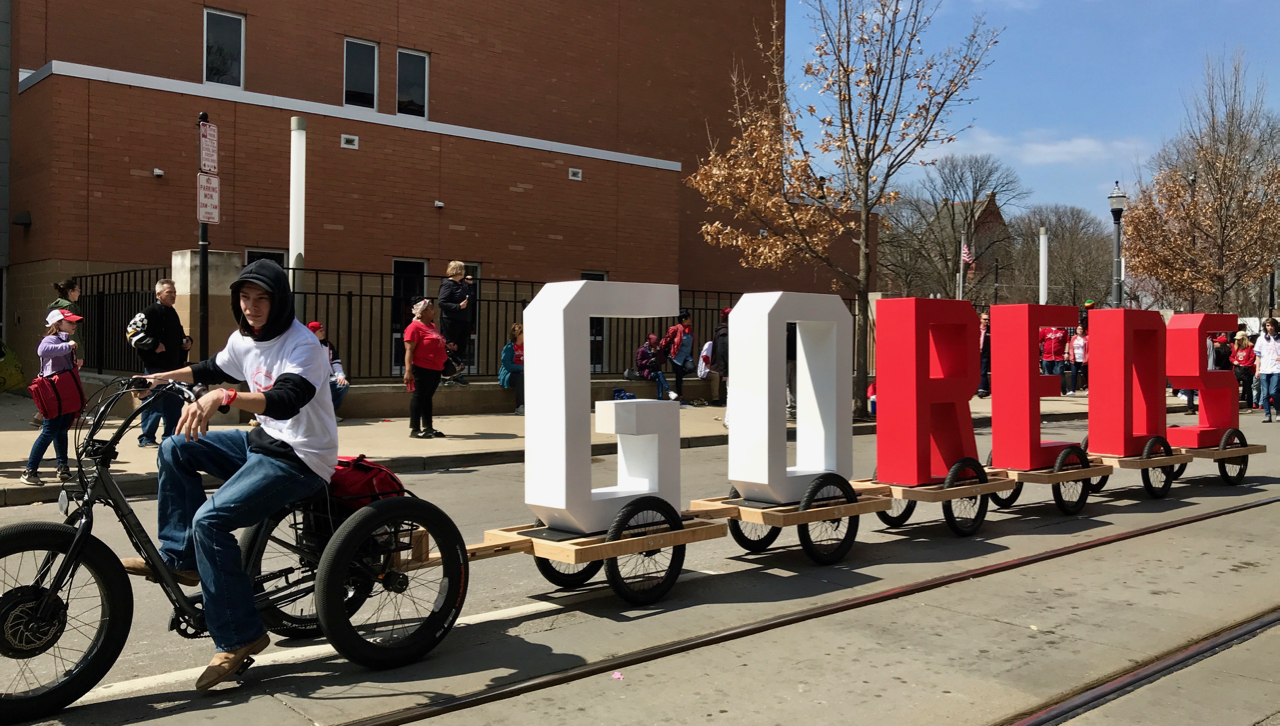
Followed by “GO REDS.”
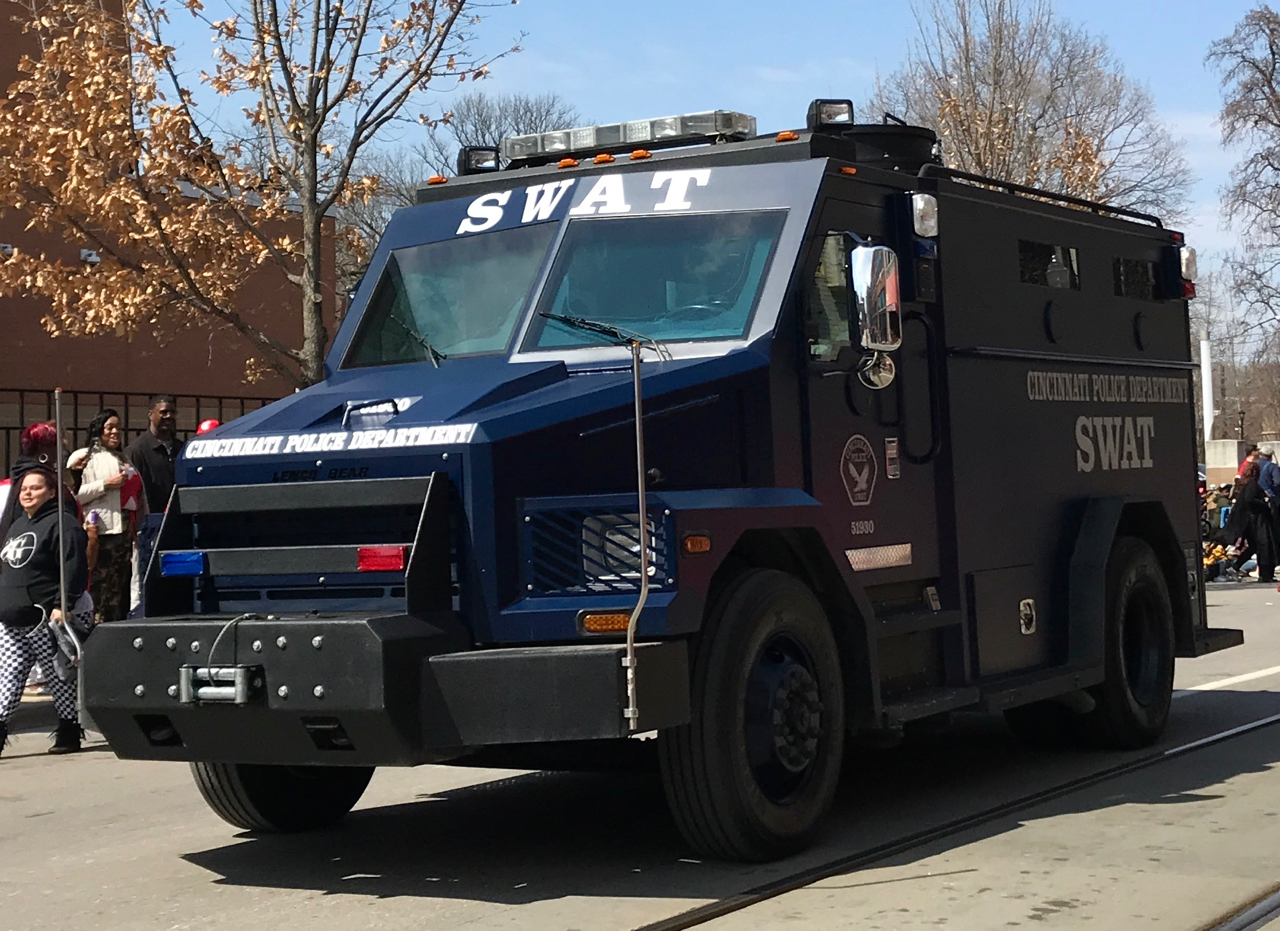
The SWAT team took part, too. At least, I think they were there to participate in the celebration. I don’t think they were their in their official capacity. I know sports fans can get rowdy, but this crowd seemed pretty calm.
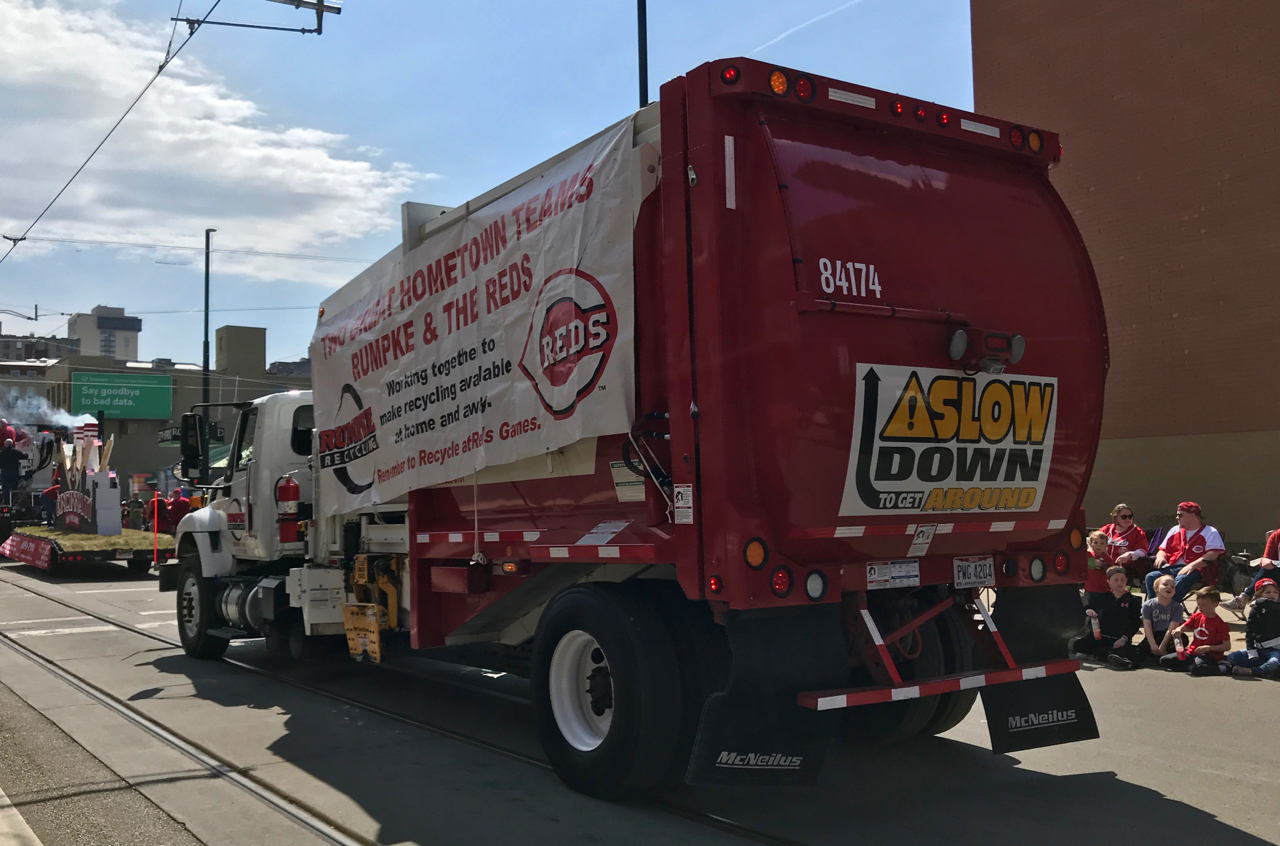
When the trash truck rumbled by, we decided that it we had seen enough parade for one day. I wonder how much longer it would be passing by? Could it be that they just made a big loop – a Mobius strip of a parade?
Ehh…probably not.
In any event, we went back to the house. Or maybe out to dinner.
After a good night’s sleep, Cora and I were on our way again.
The capitol of Kentucky in Frankfort rounds out the group.
I also managed to get a few things checked off my “Next Time” list.
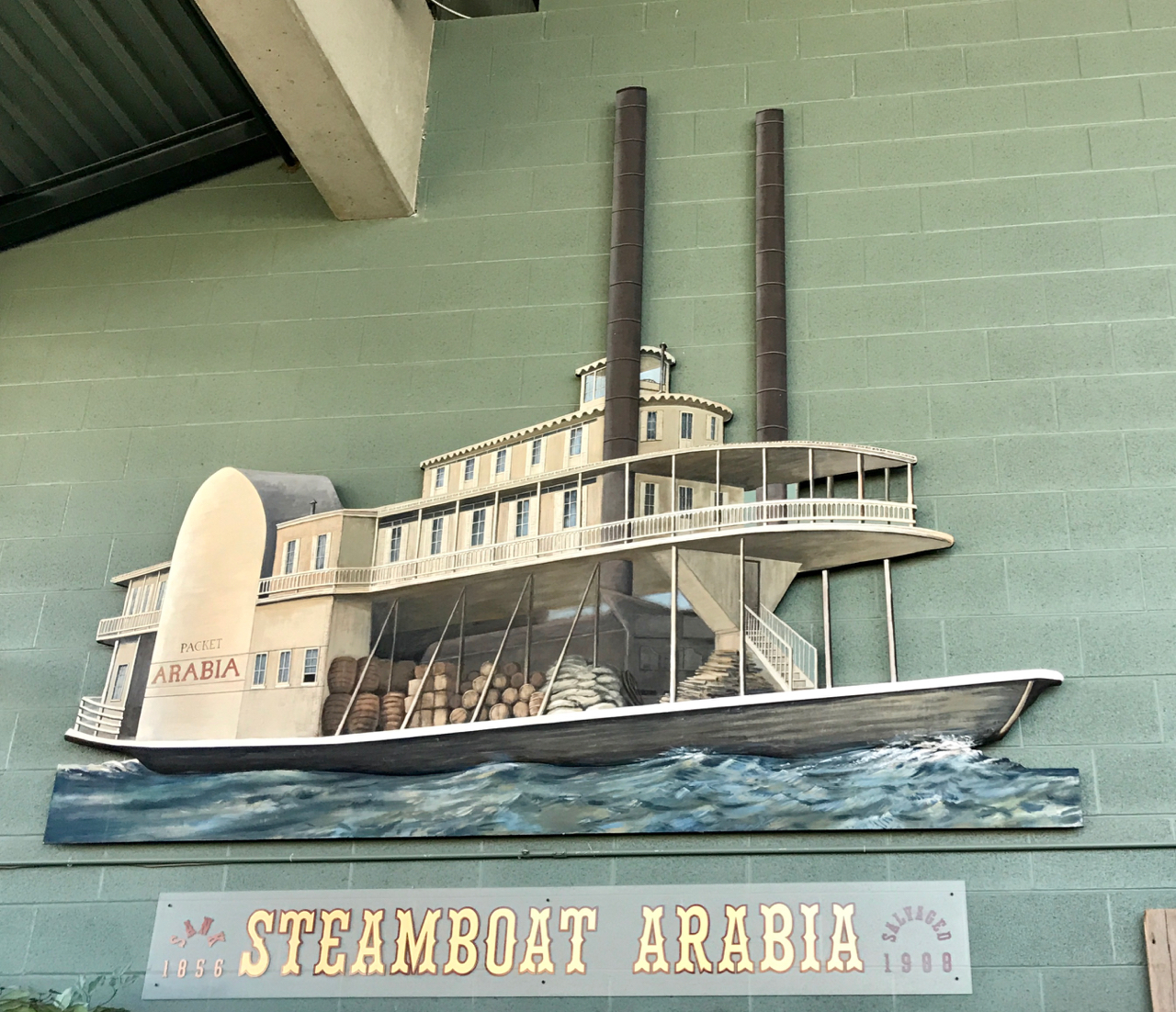
I visited The Steamboat Arabia Museum in Kansas City, Missouri. The steamboat sank in the Missouri River in 1856 and was found in a cornfield in 1988. The course of the river shifted so much over time that it made it hard to locate, even though people had ideas about where it was. It was a treasure trove of everything needed for daily life in the middle of the 19th century.
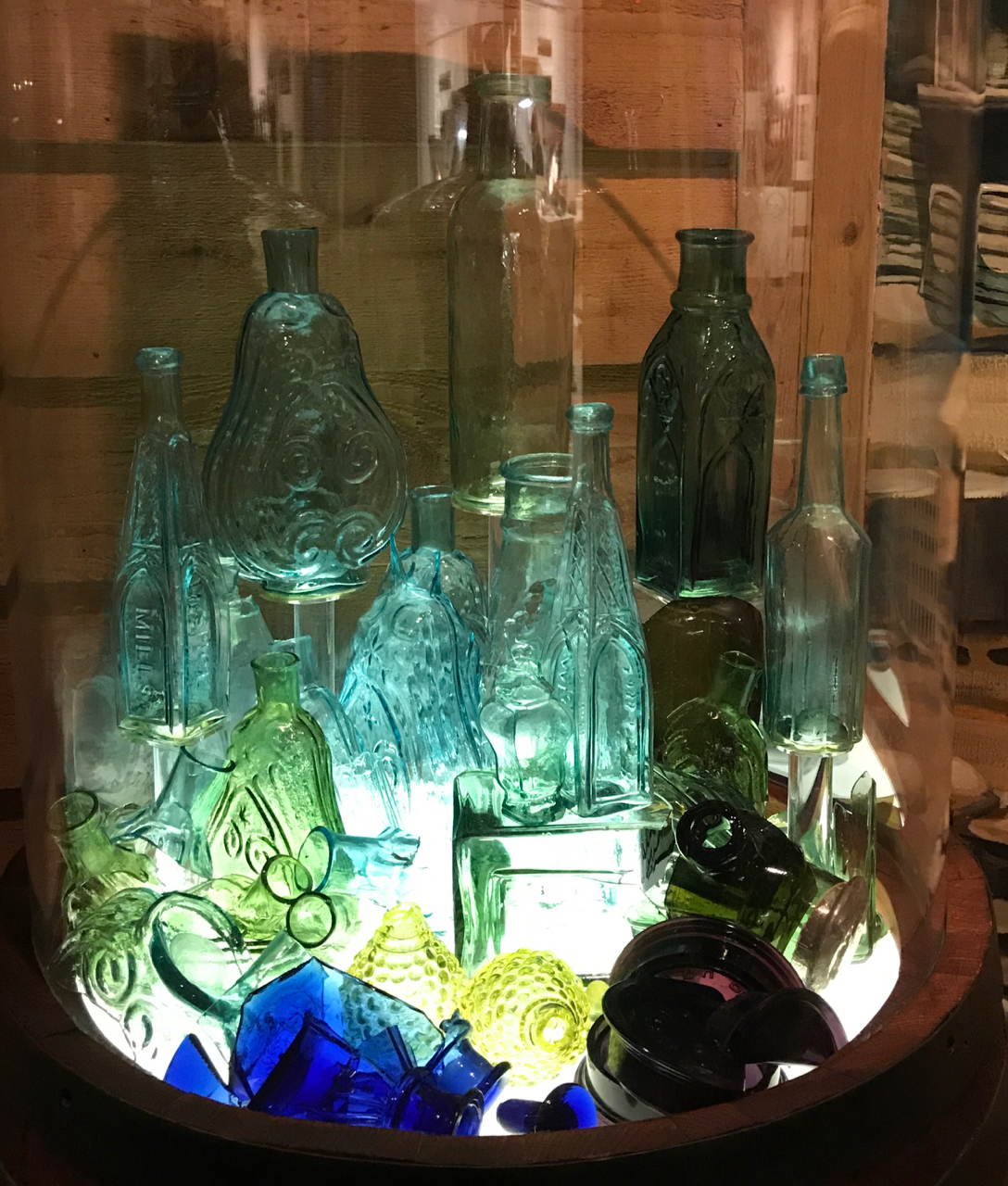
There was glassware.
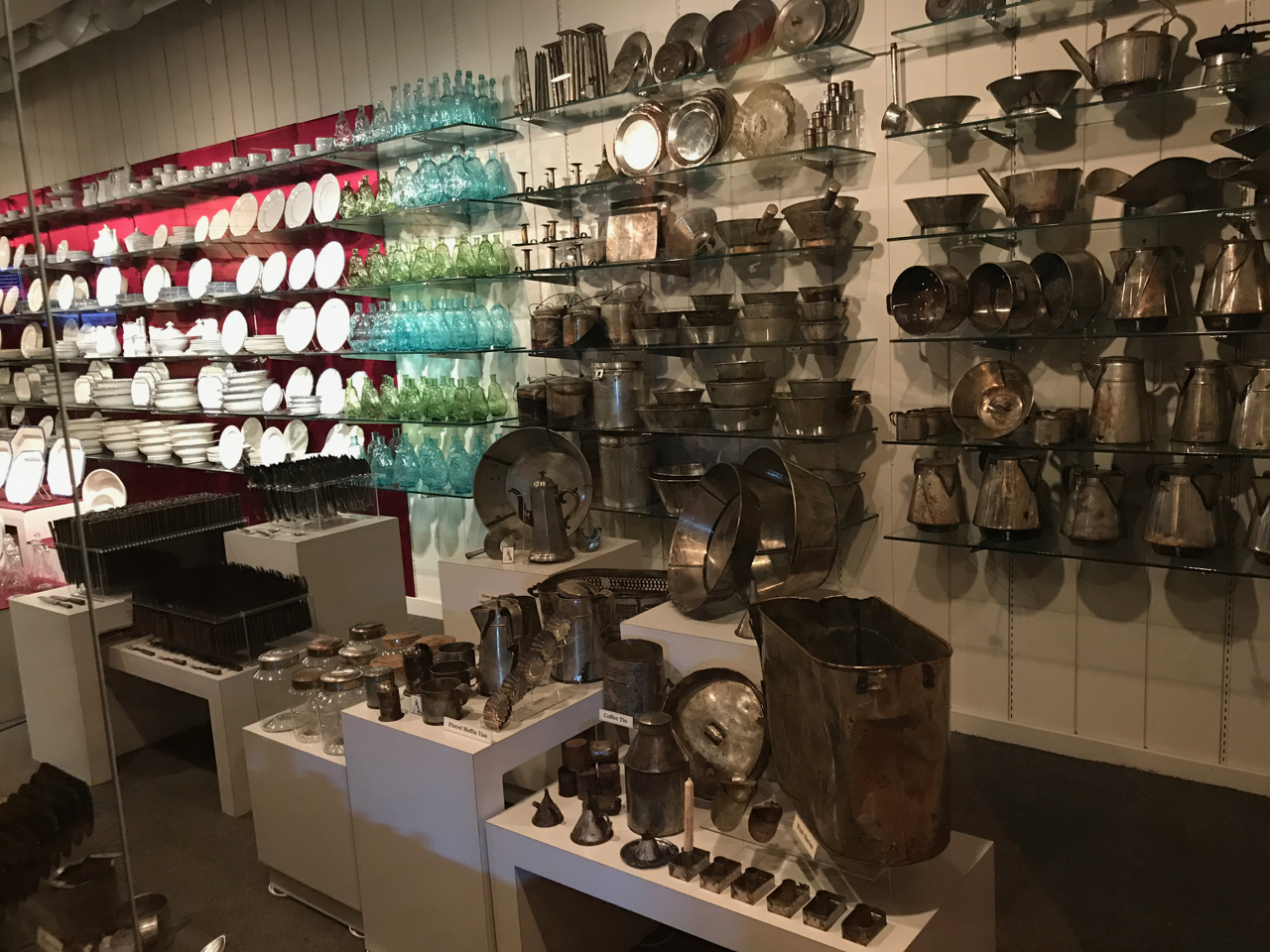
All the goods you would need to set up housekeeping.
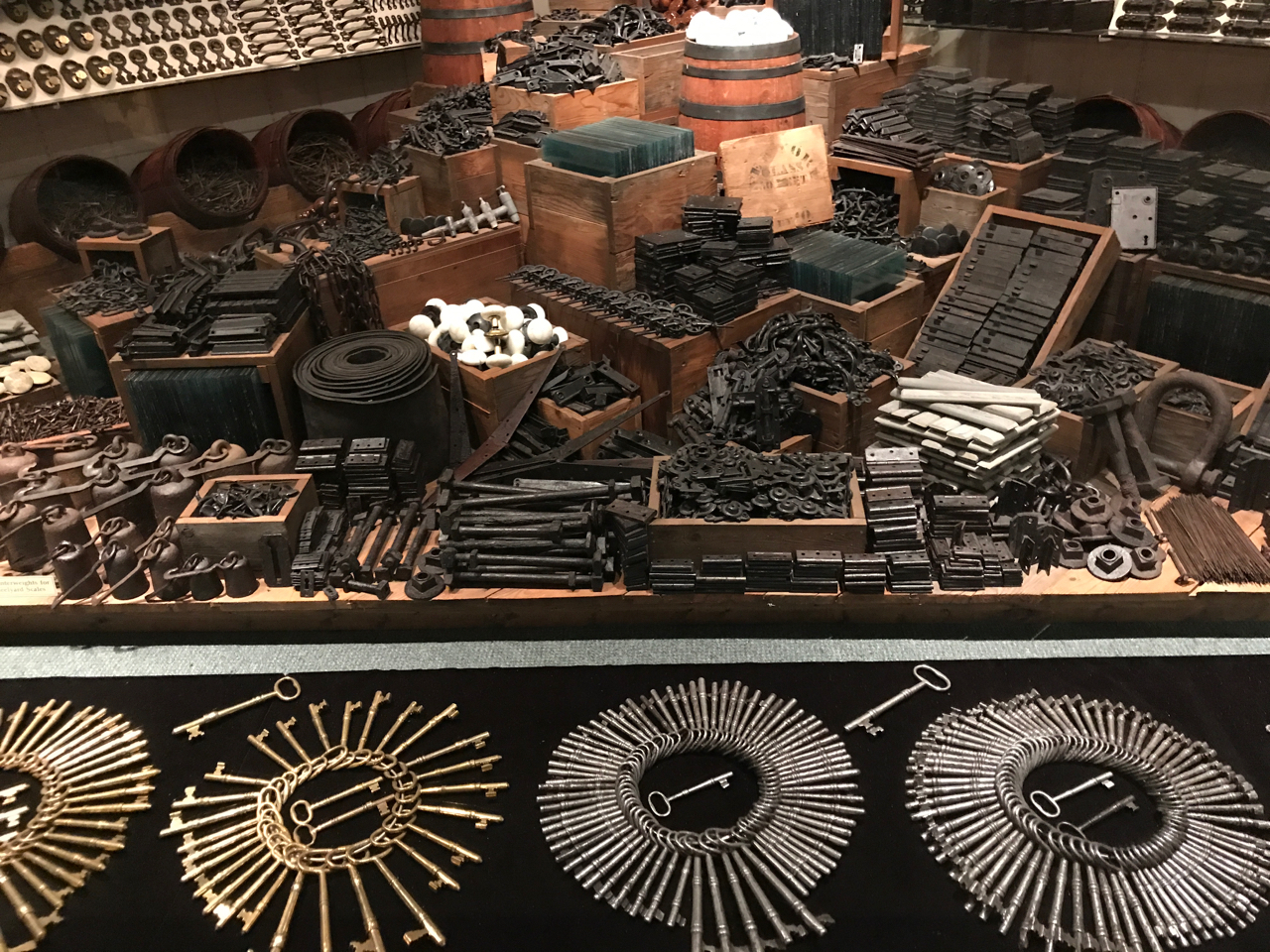
Heck! They even had the stuff you would need to build the house!
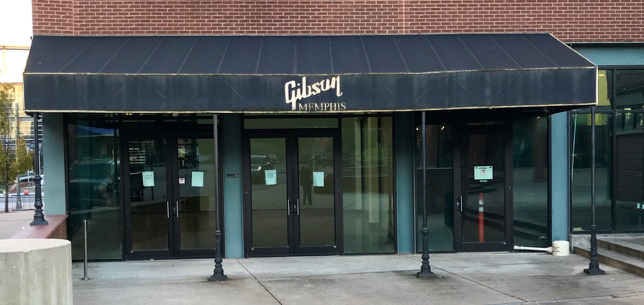
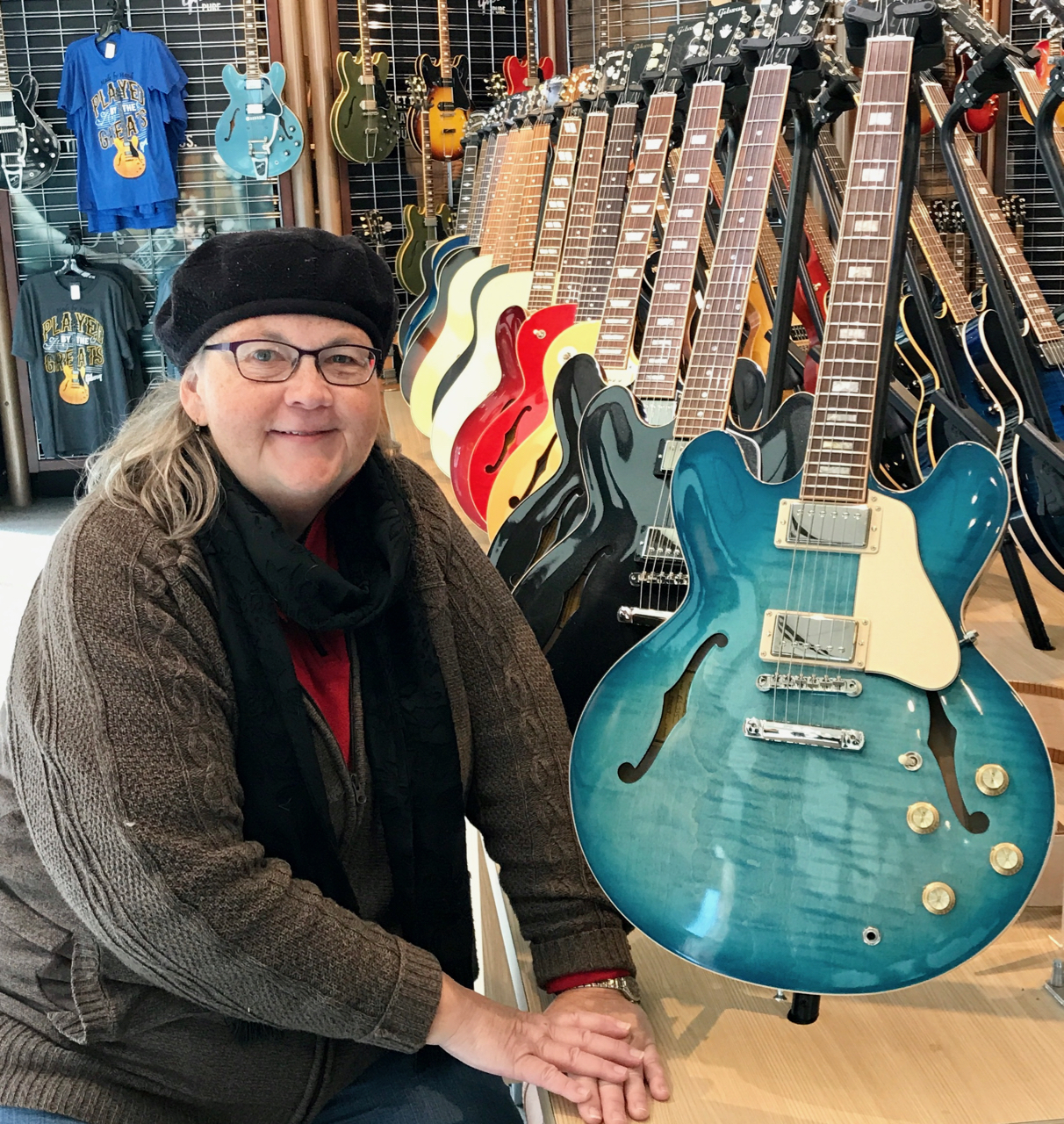
I managed to tour the Gibson Guitar factory in Memphis, before it closed.
I am usually partial to red, but this blue guitar is mighty pretty.
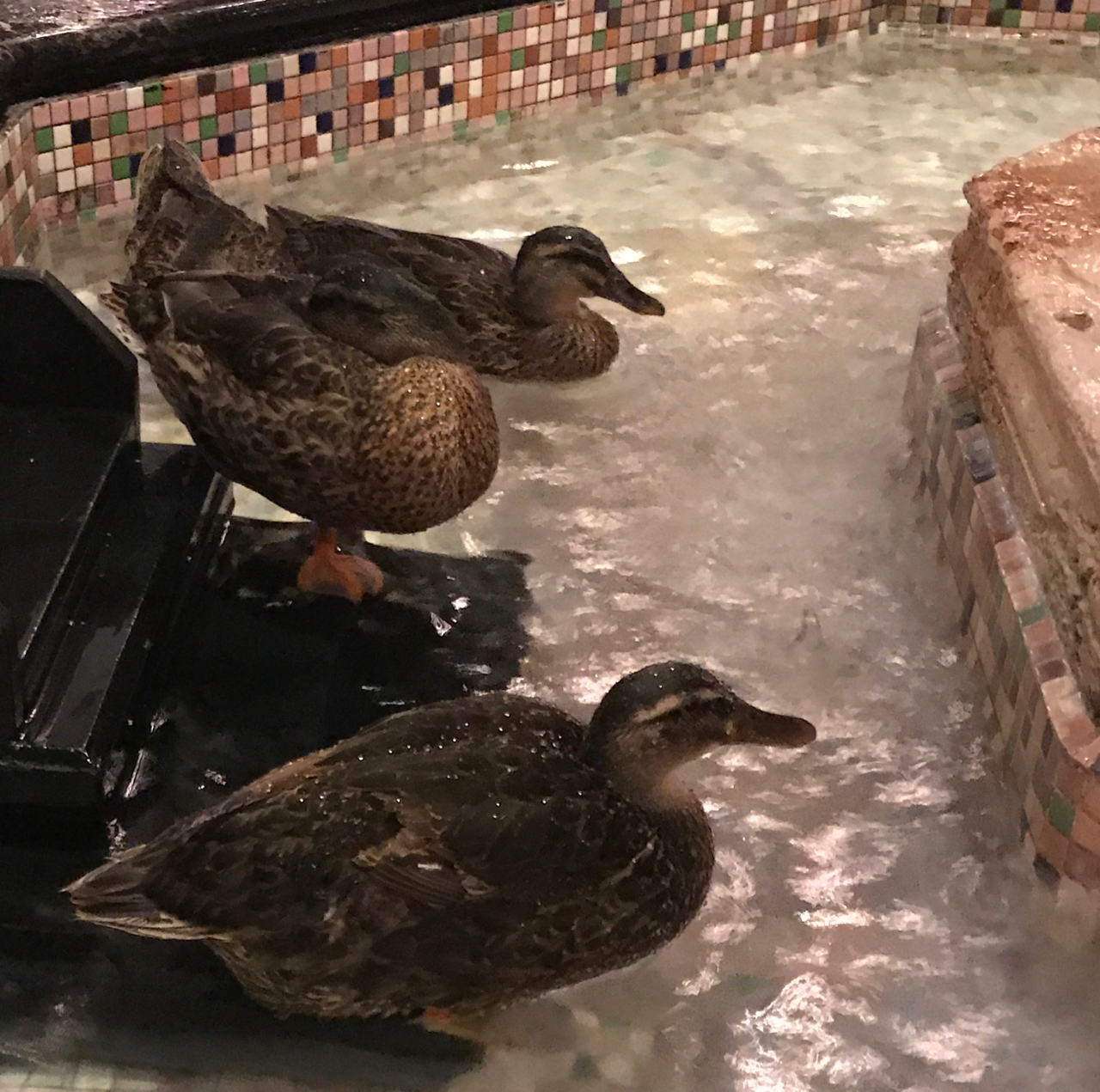
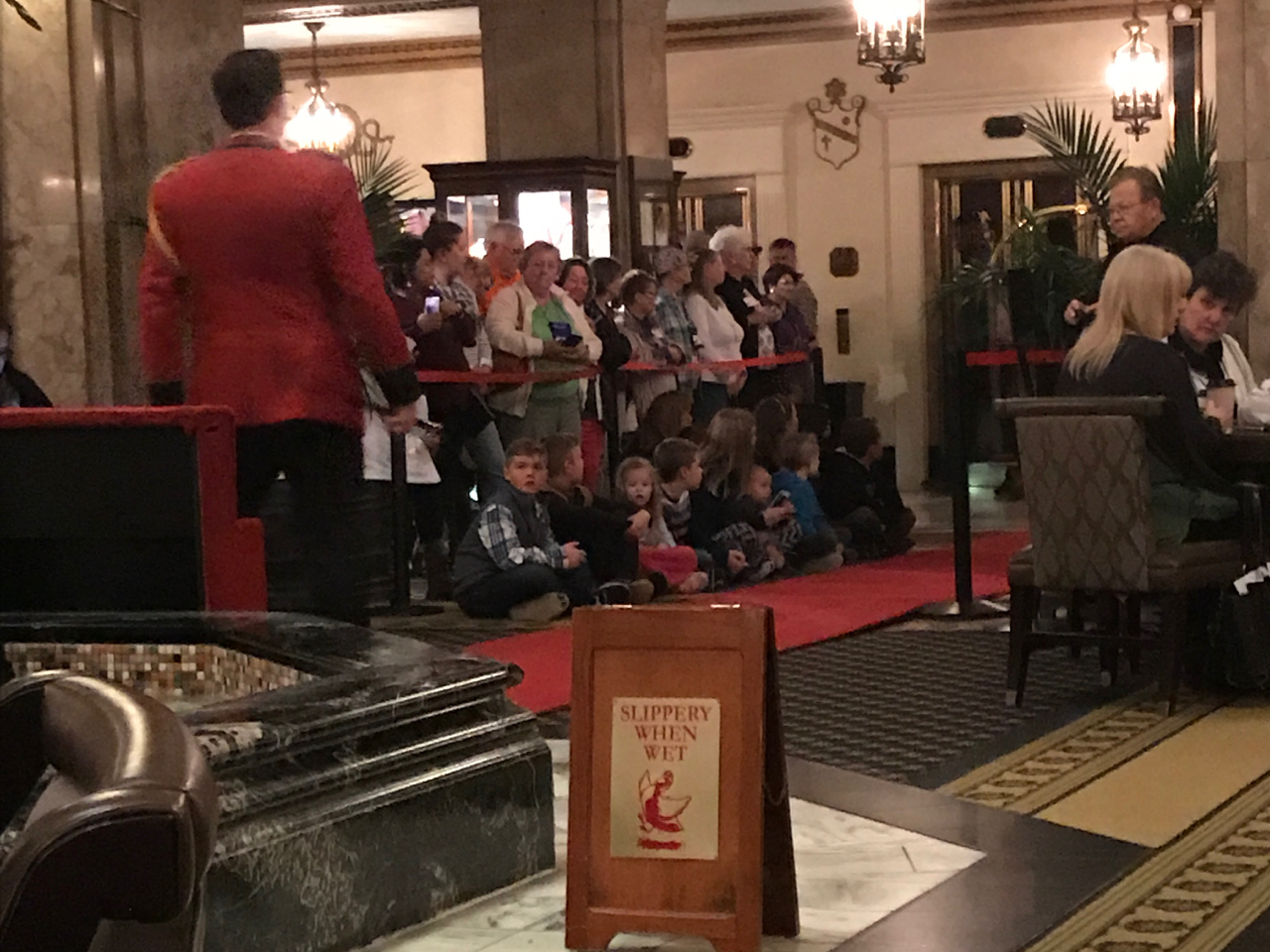
The hotel is famous for the ducks that live in the fountain in the lobby.
Each afternoon, the duckmaster comes down and marches the little flock from the lobby into the elevator and to their penthouse on the roof.
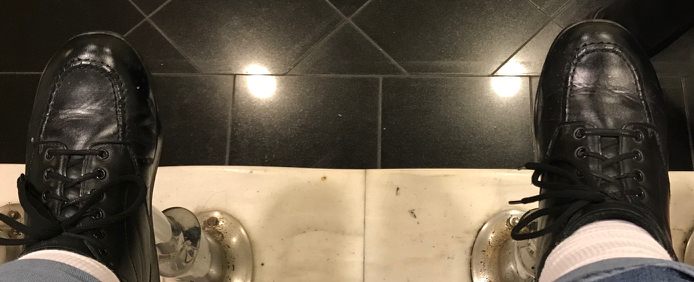
Not quite a “Next Time” list item, but I also had my shoes shined while I was at the hotel. I love having my shoes shined!
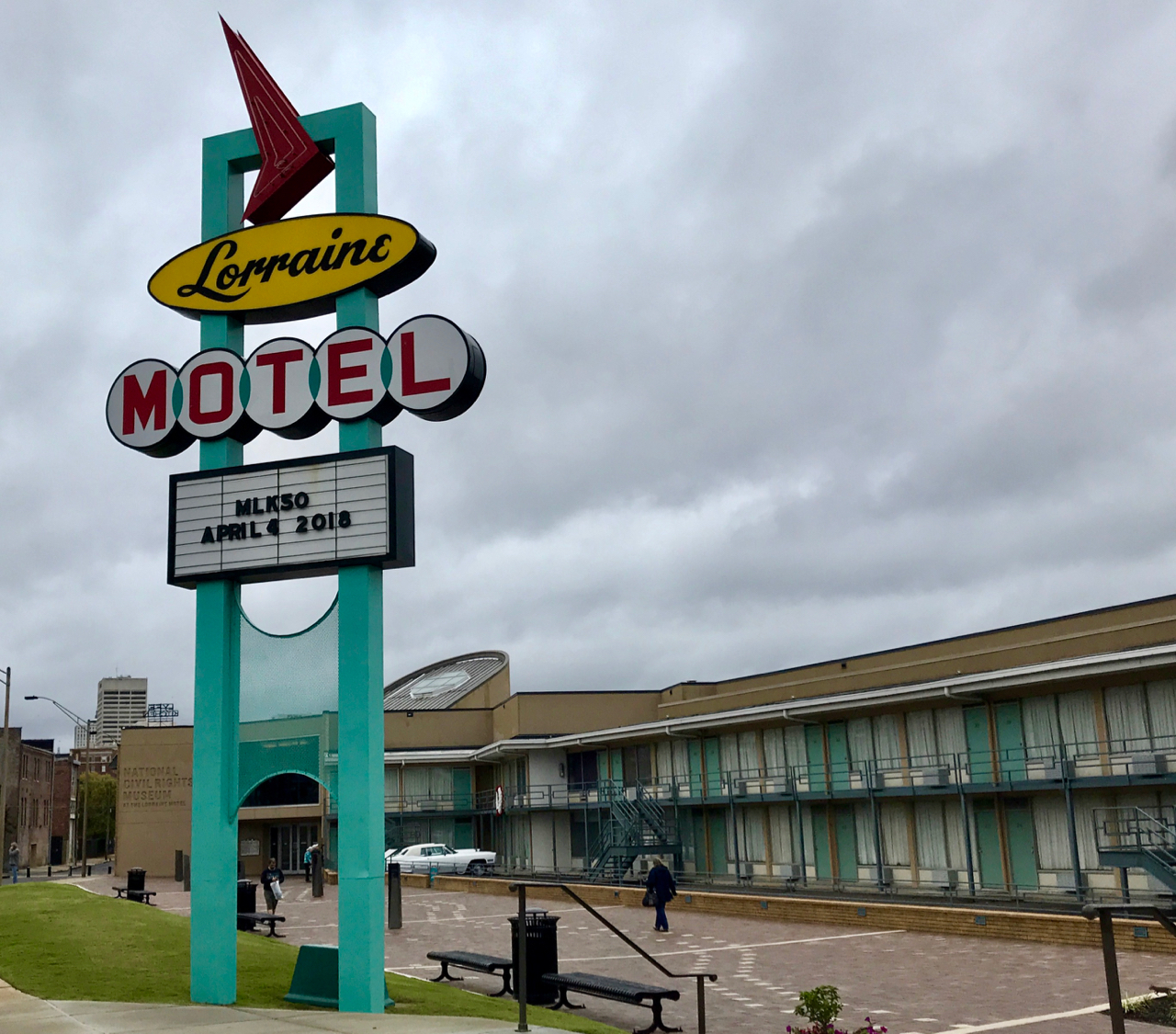
The Lorraine Motel has also been on my bucket list. People of a certain age will never forget what happened here. Not a joyous spot to visit, but definitely important.
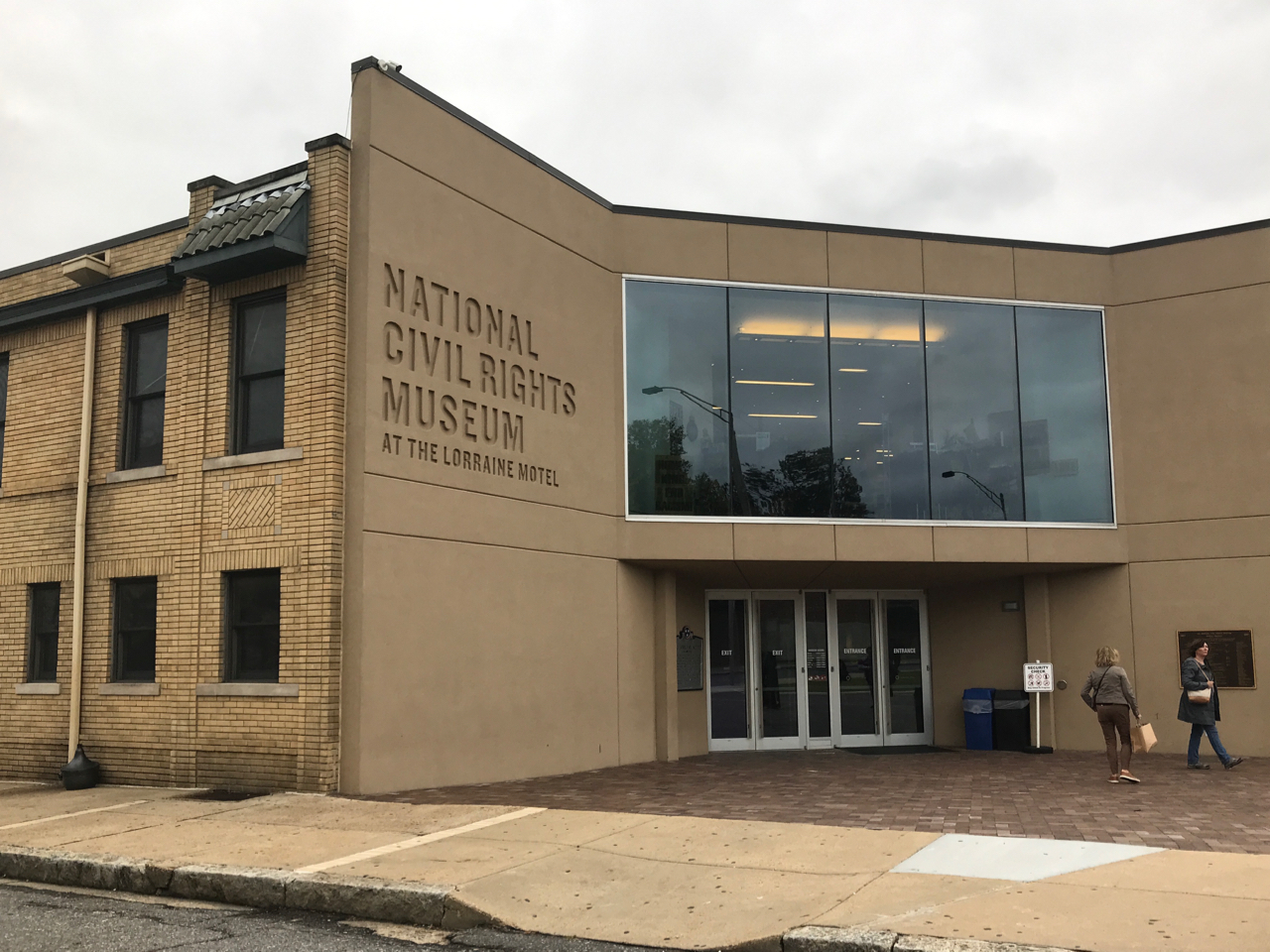
It is also home to the National Civil Rights Museum. If you visit, you will be bowled over by the horrors of the struggle for equality.
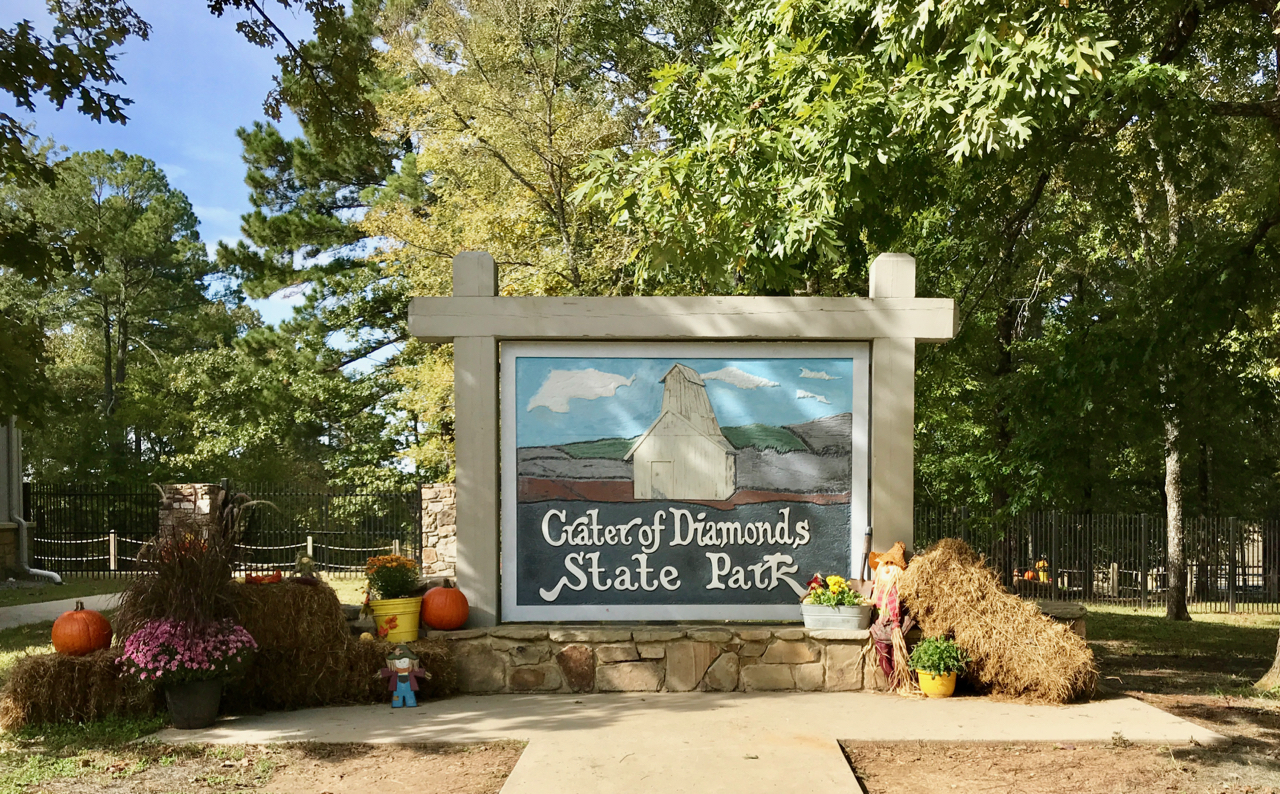
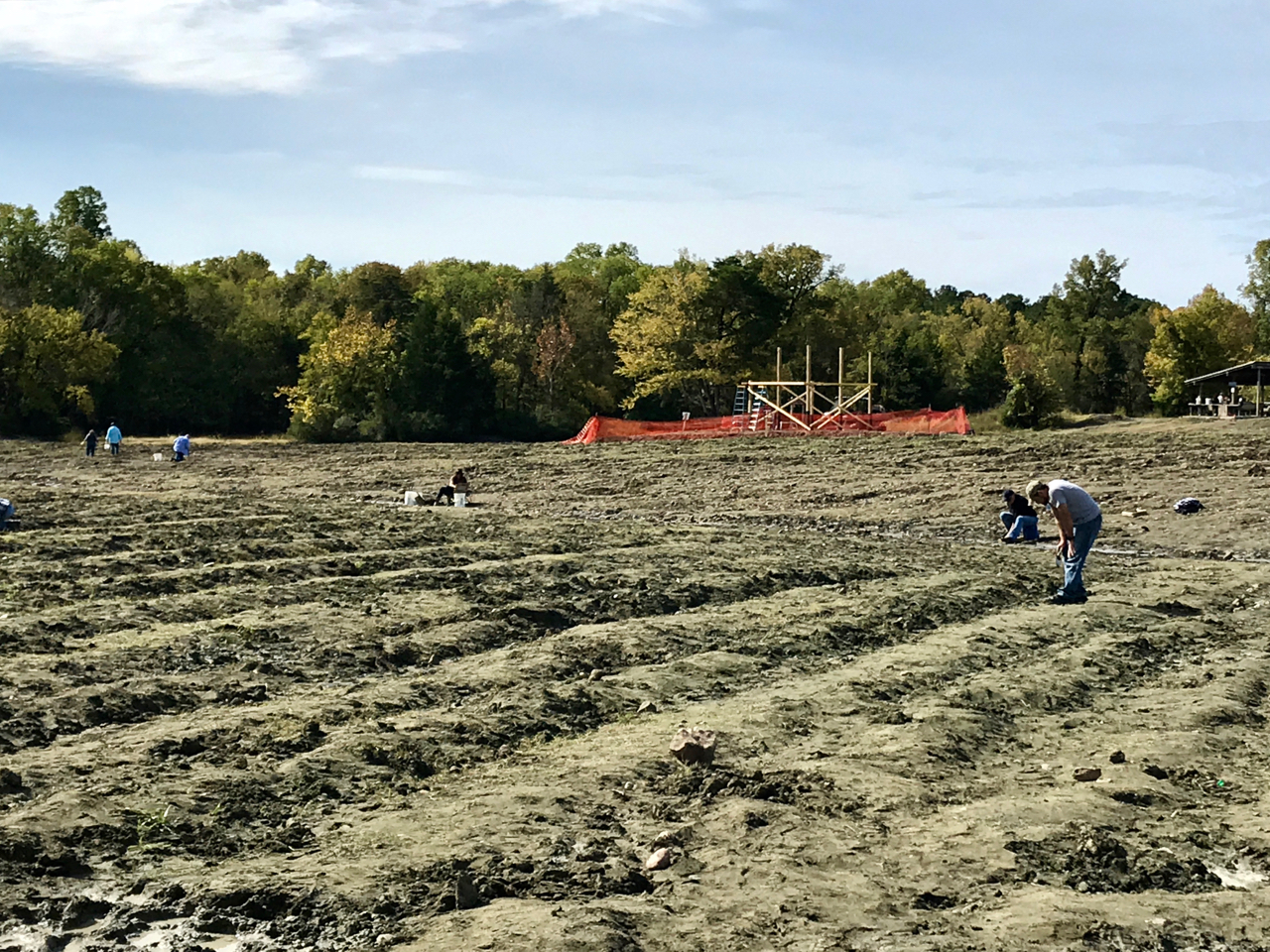
I was a bit surprised when I saw that this was the diamond mine.
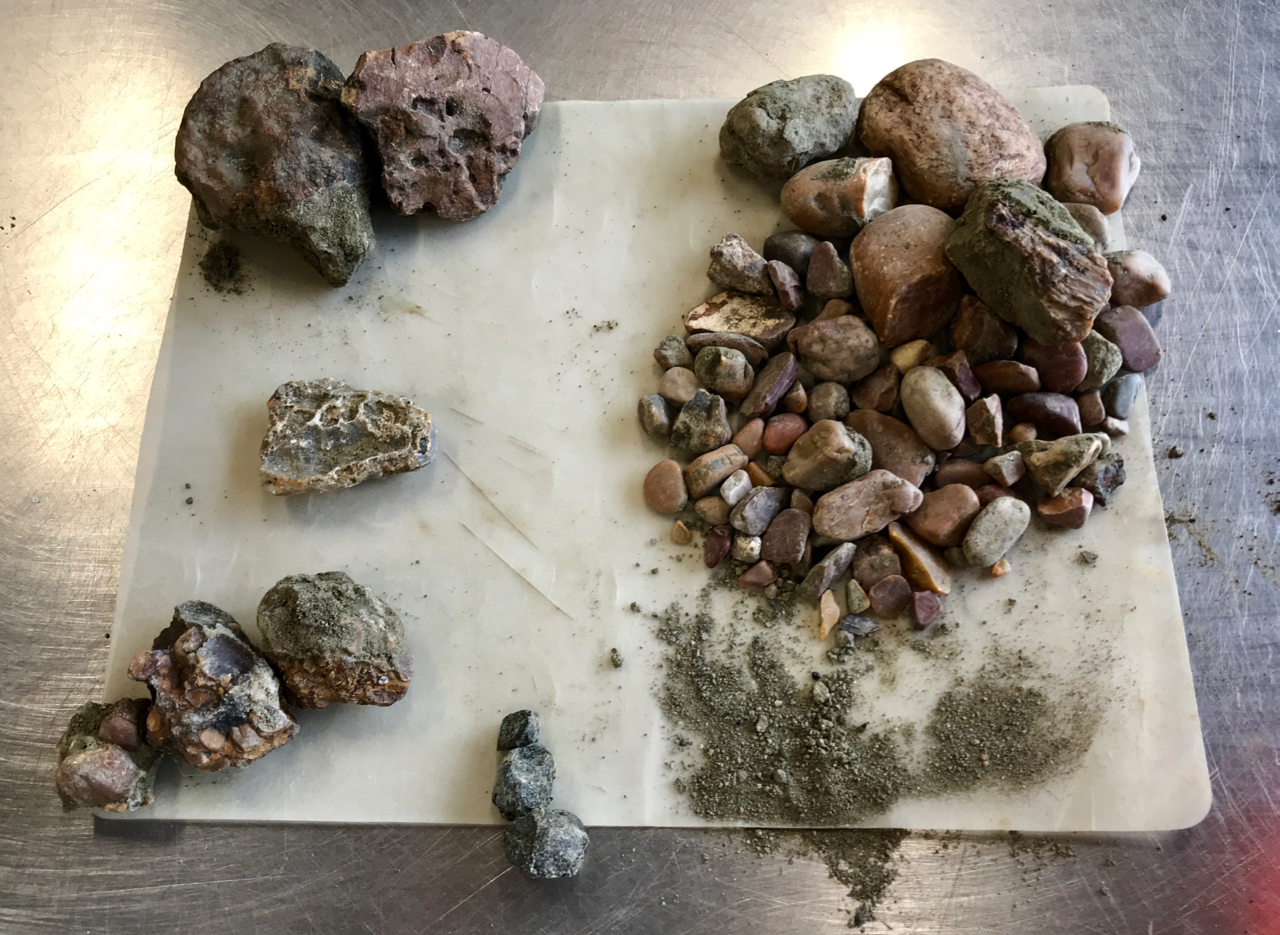
This was my “haul.”
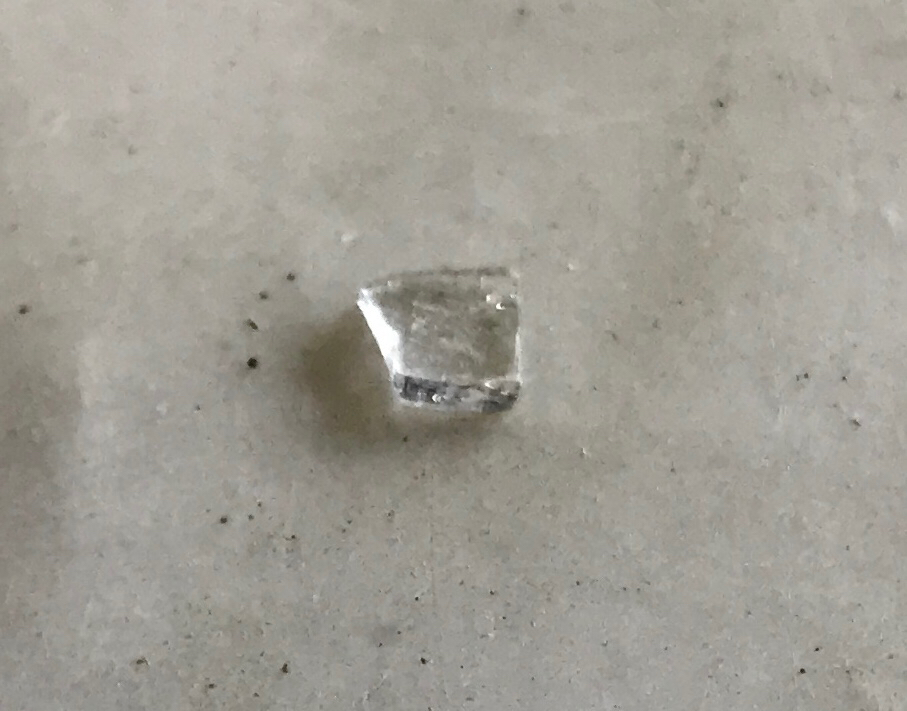
The closest I got to finding a diamond was this tiny shard of glass. Oh, well…
I also revisited places I’ve been before.
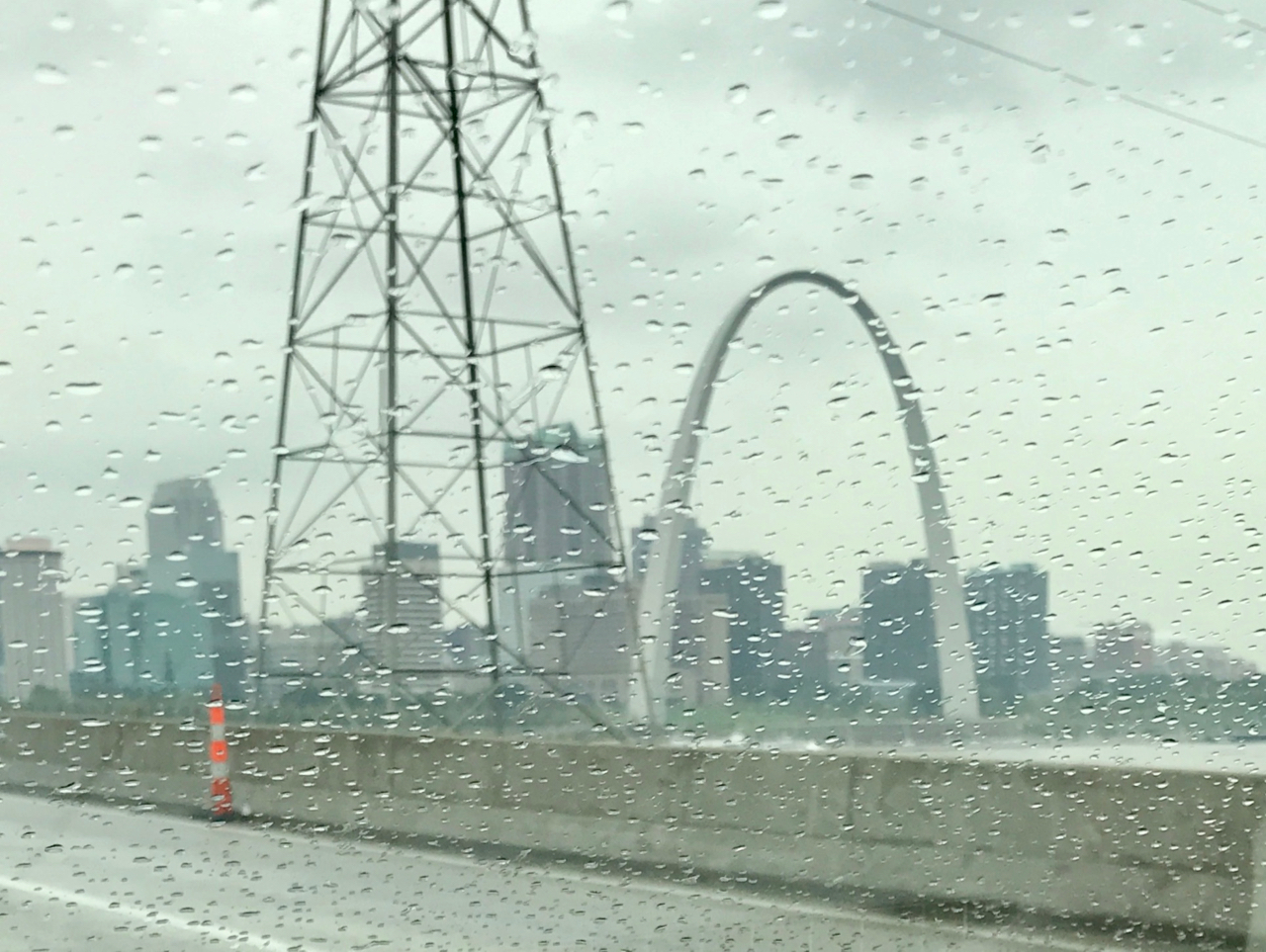
I managed to snap this rainy photo of the St. Louis Arch as I crossed the Mississippi River.
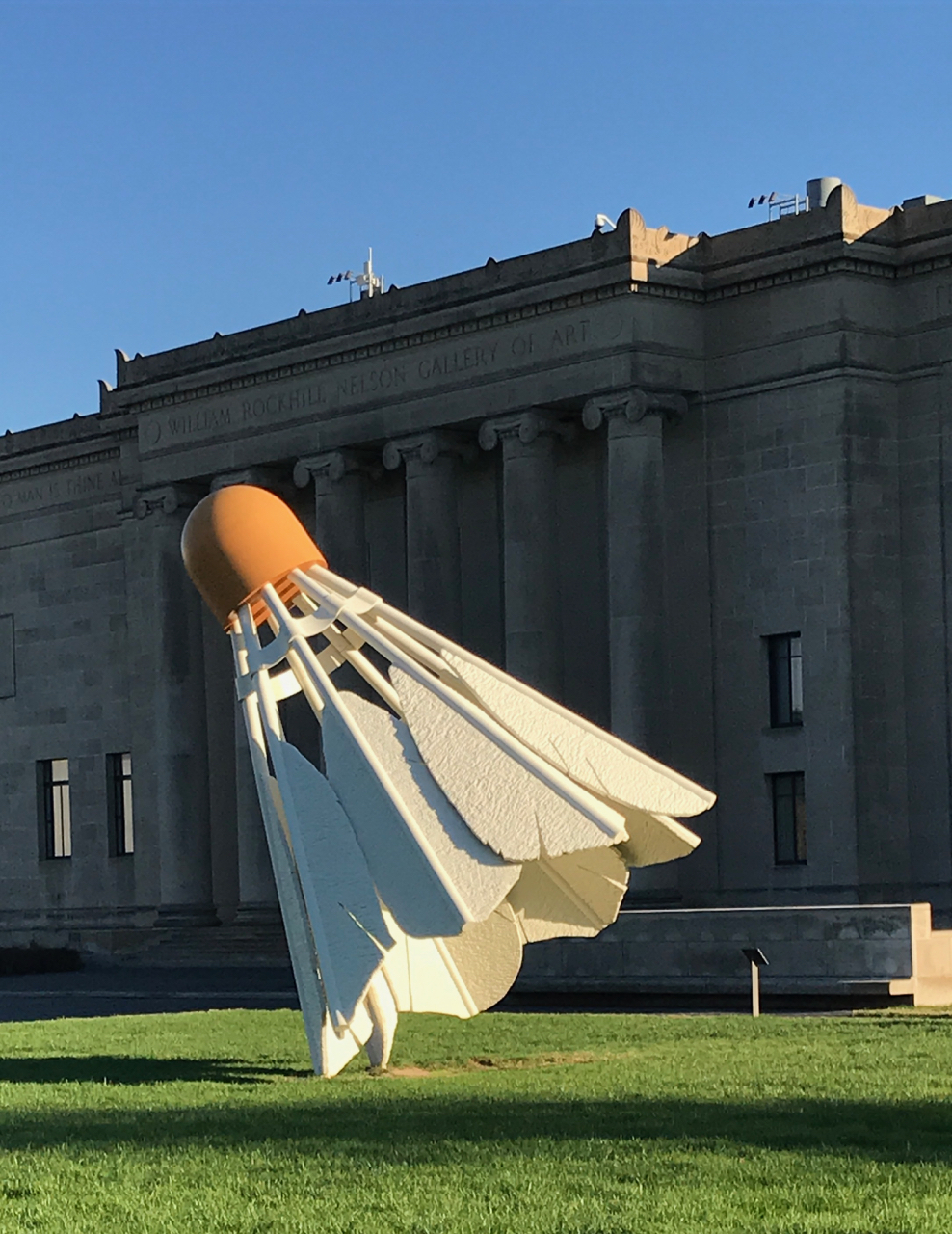
I knew the Nelson-Atkins Museum of Art was closed, but I stopped by to see if they had any interesting sculptures on the grounds. I had been there in the ’70s as part of a Girl Scout event.
I stopped by the Colored School in Neosho, Missouri. This is where George Washington Carver began his education. I worked on restoring the building to its original configuration as part of an HistoriCorps project in 2015.
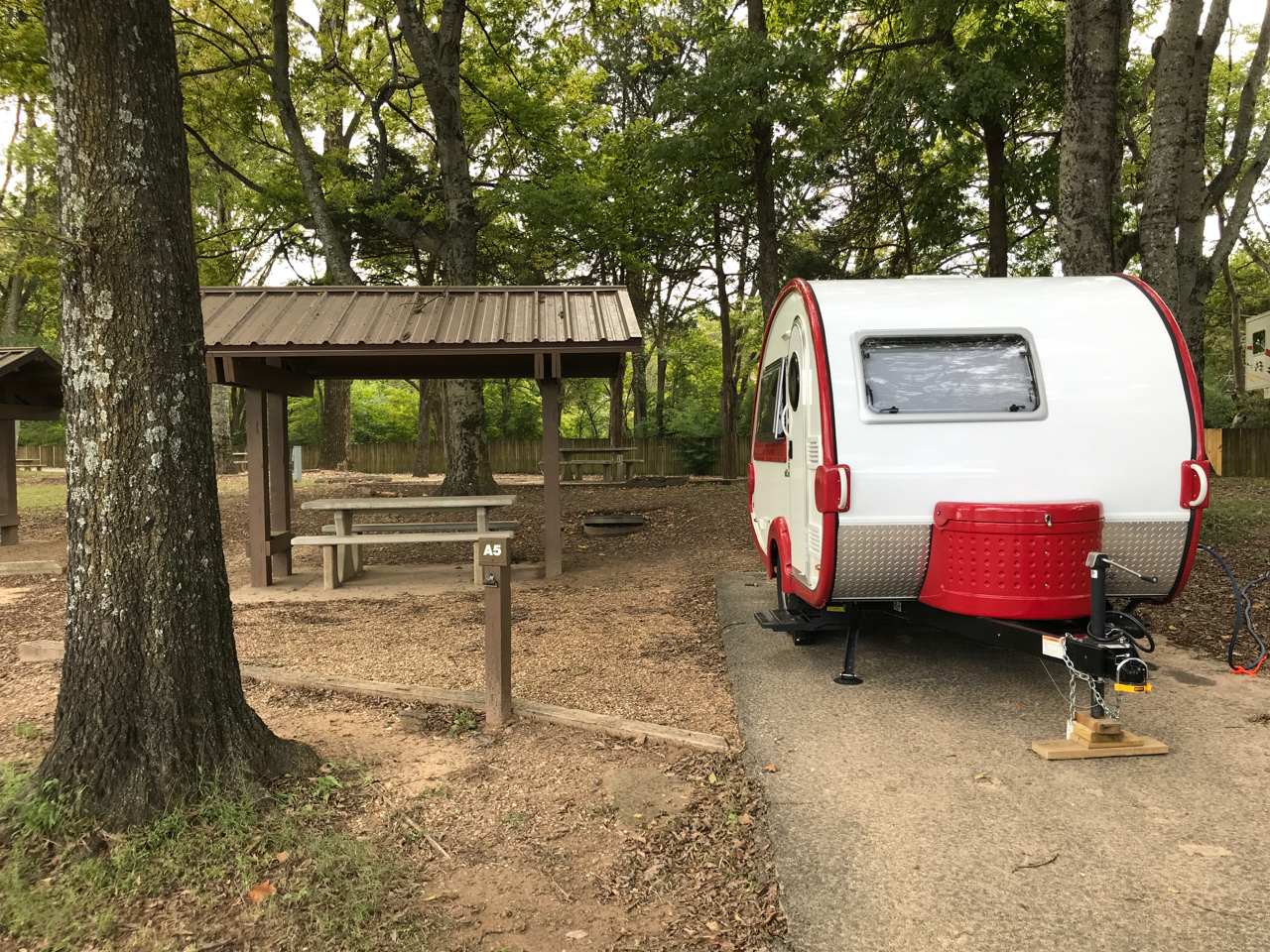
I stayed at Toad Suck Campground near Conway, Arkansas again. I even had the same campsite!
You can’t beat those Army Corps of Engineer campgrounds for quality and (usually) great water views.
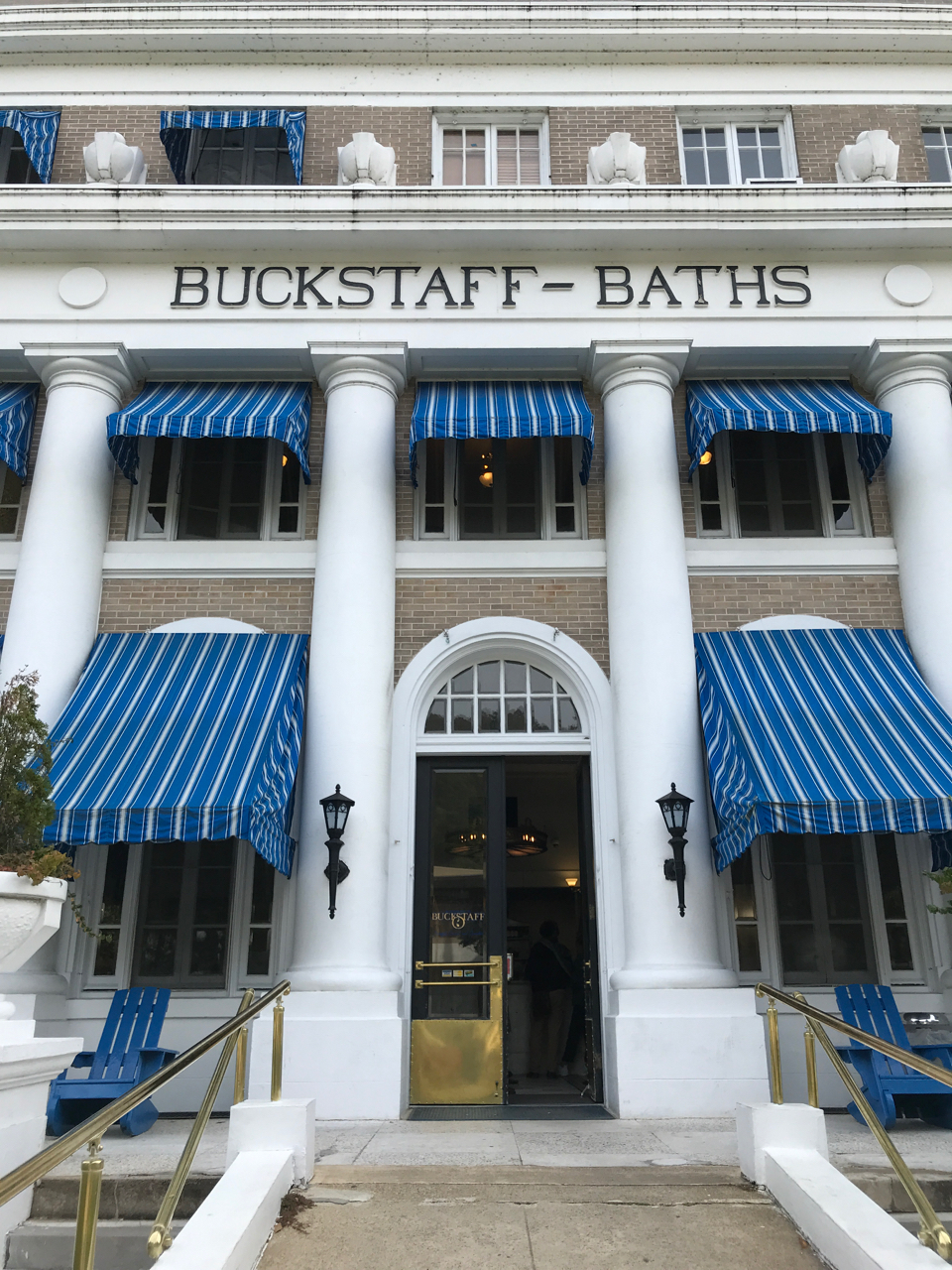
I had been to Hot Springs, Arkansas before. This time, I booked a bath at the Buckstaff Baths. It was a marvelous experience. If I had known how wonderful it would be, I would have put it on my “Next Time” list.
There were also some interesting things that kind of popped up.
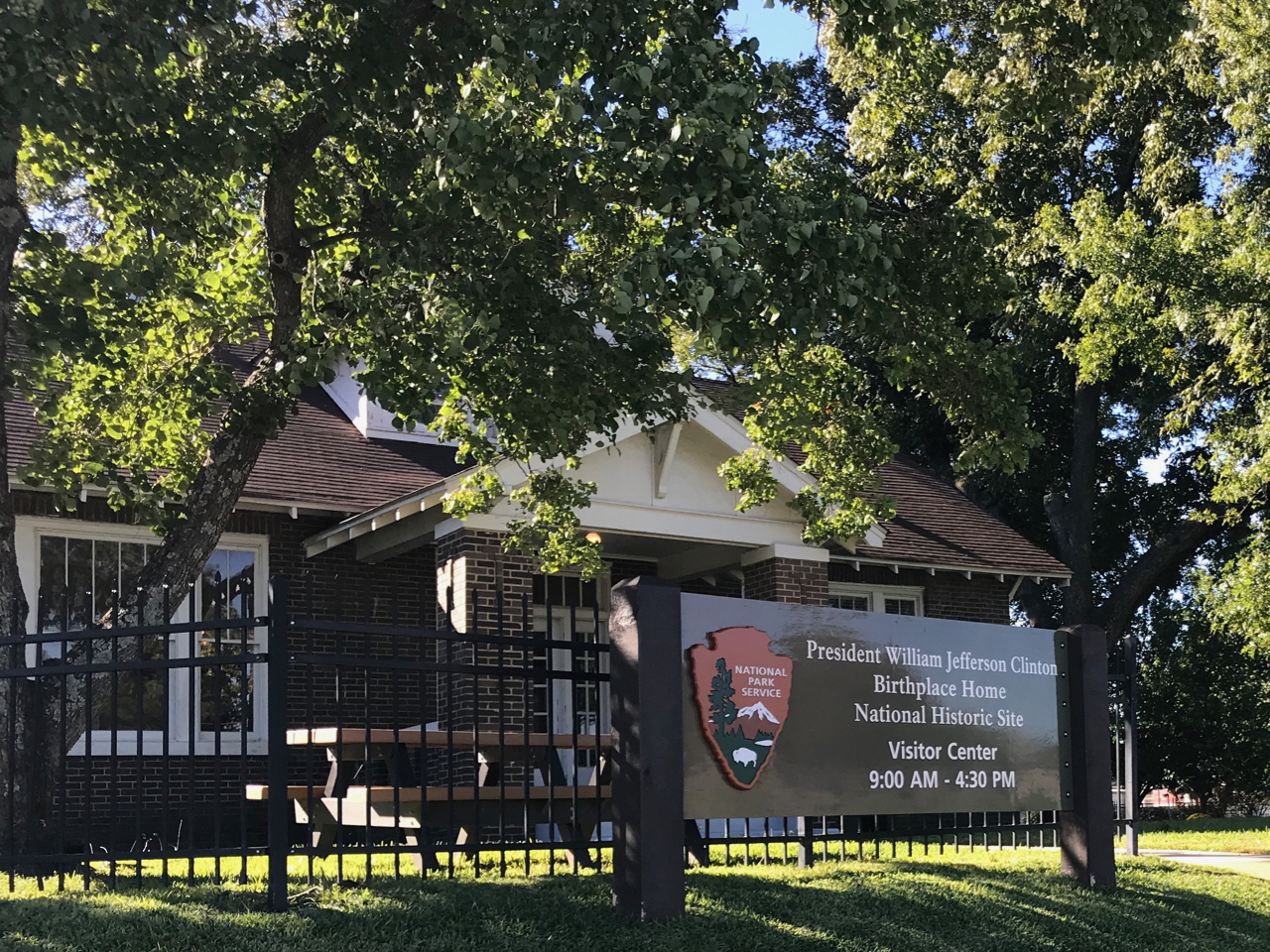
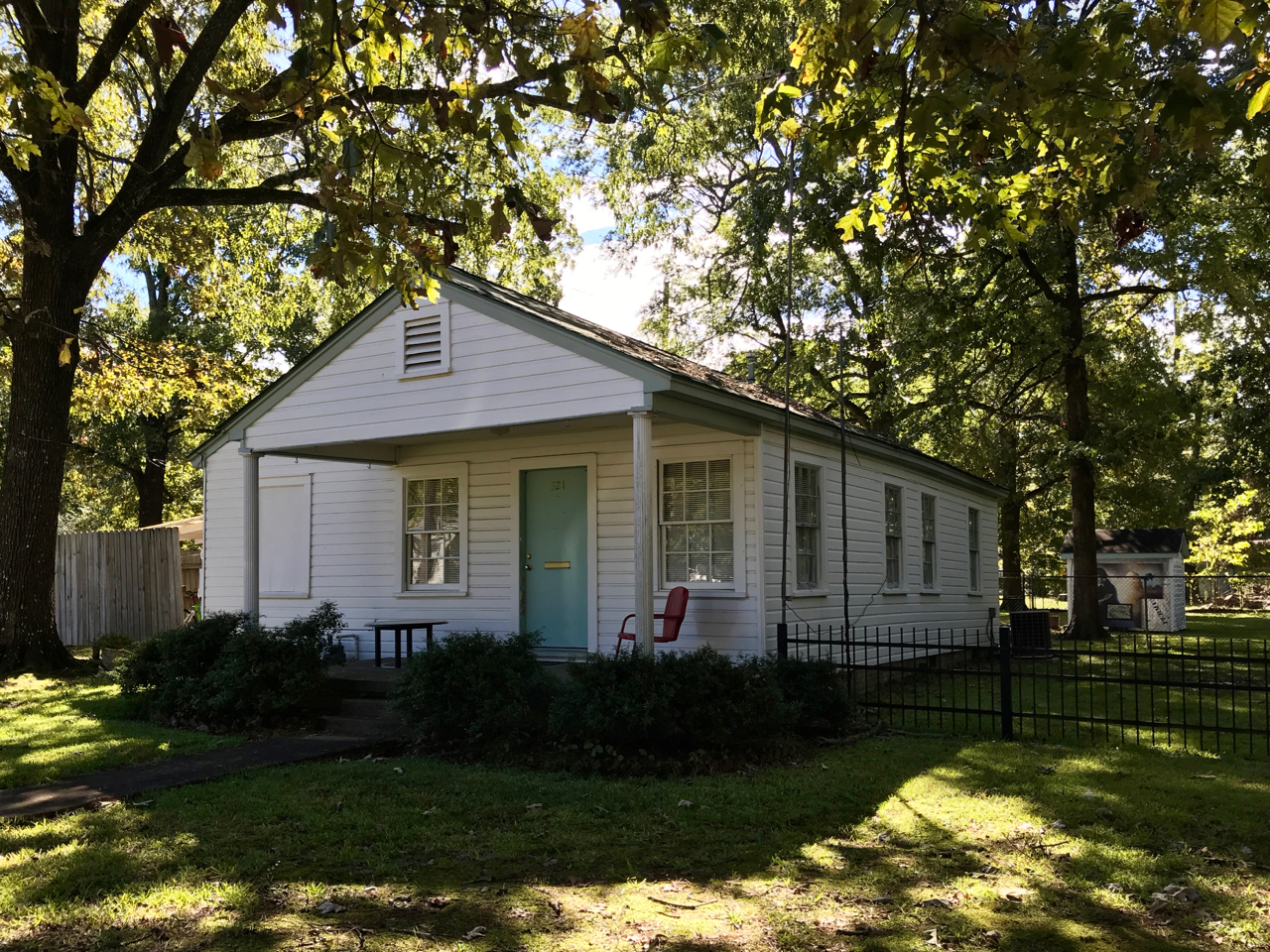
The house Bill’s family moved to when his mother married his stepfather was also in Hope.
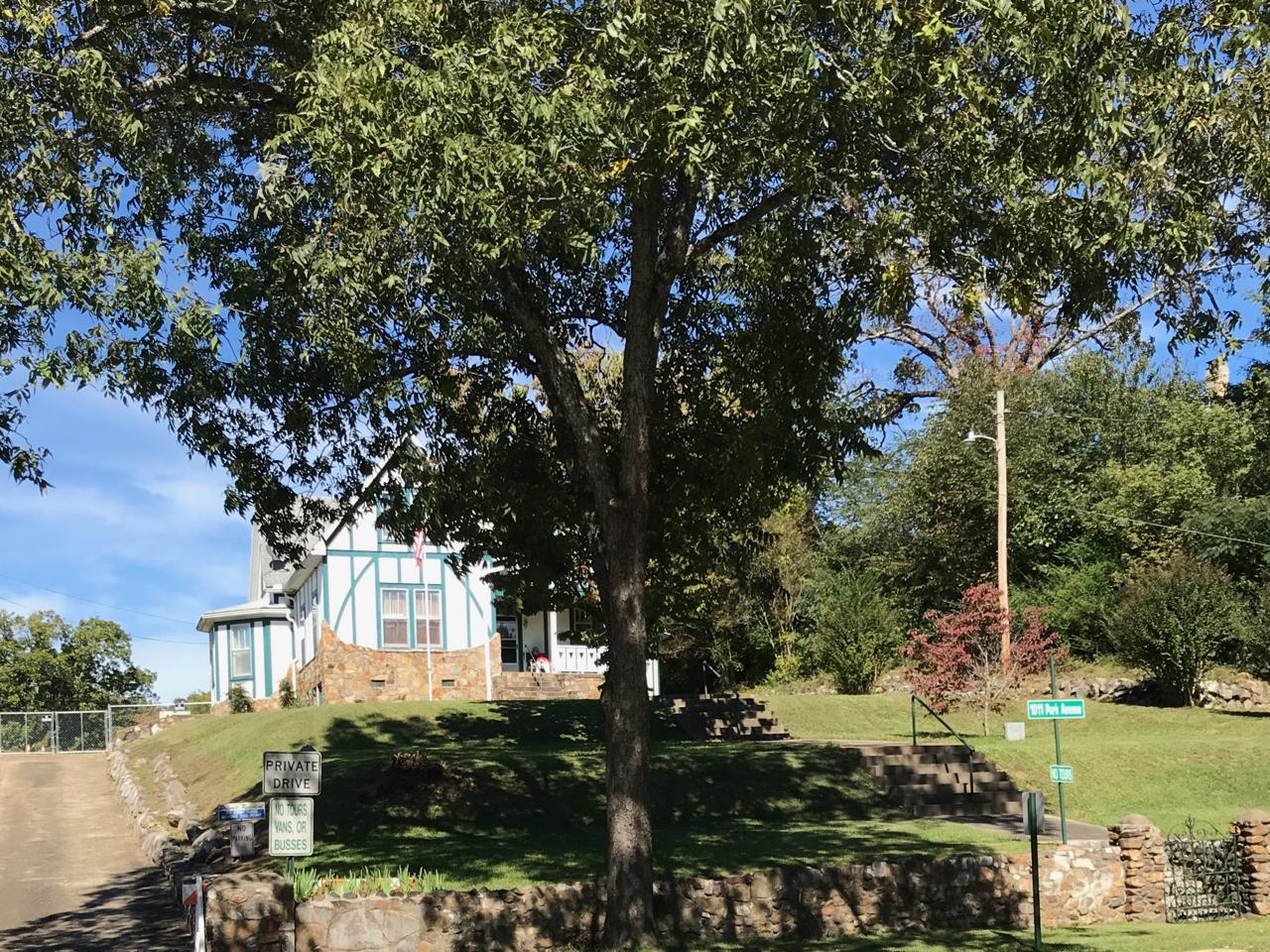
This house, in Hot Springs, is where he spent his teenaged years.
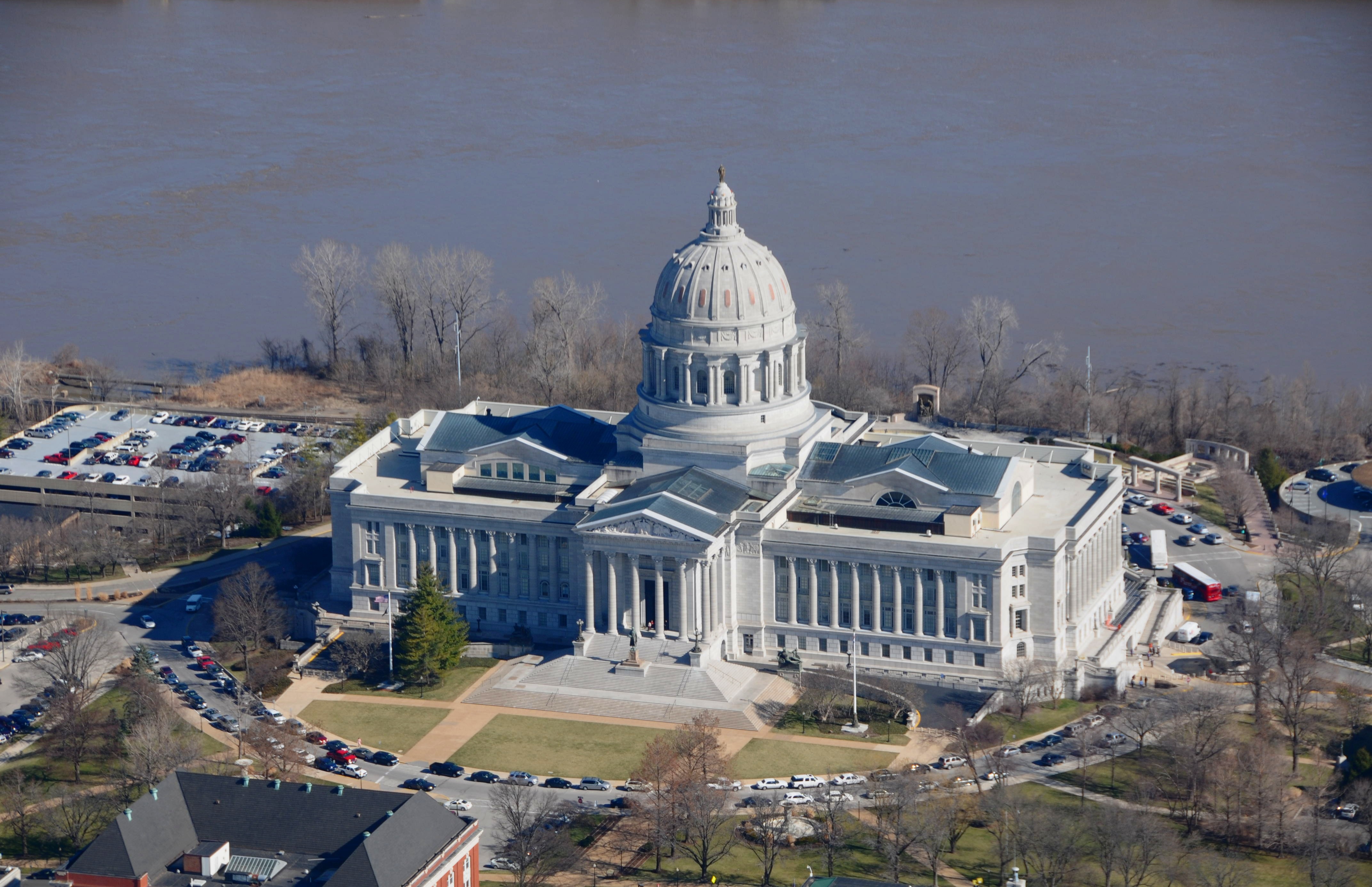
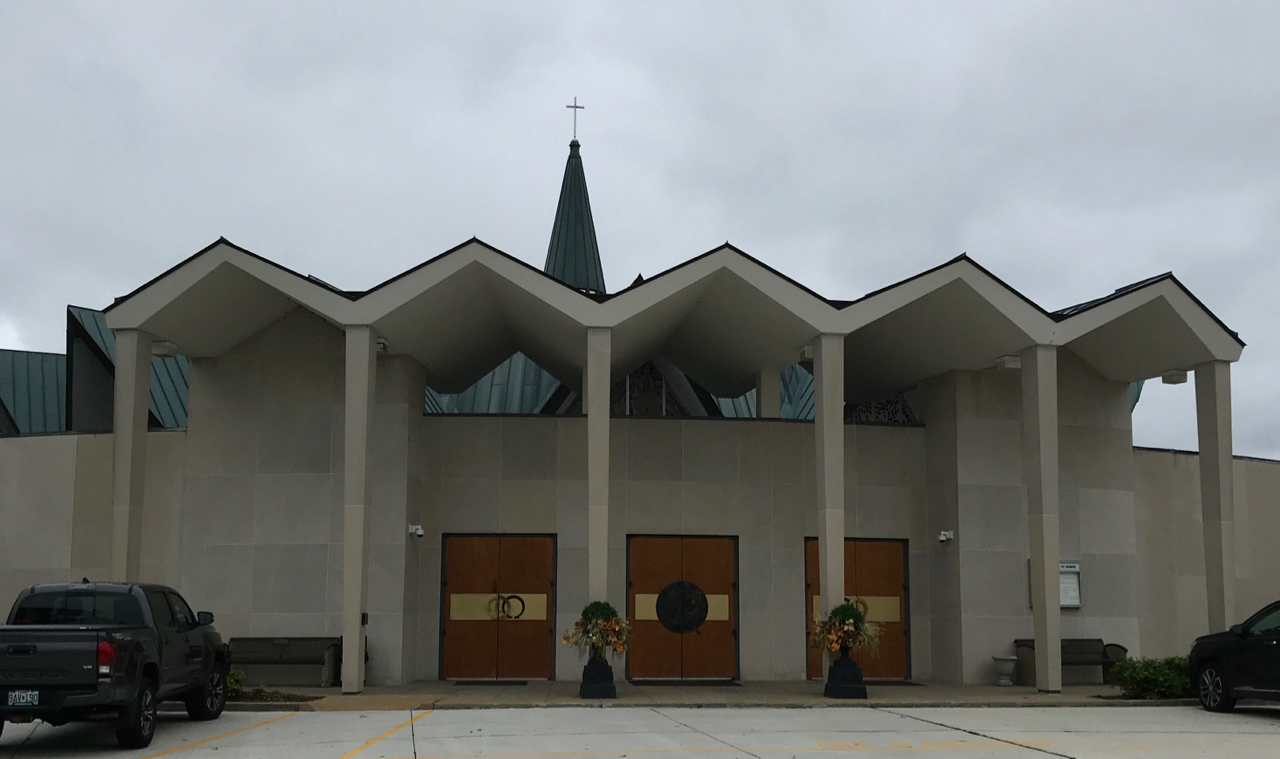
I came across this unusually modern cathedral in Jefferson City. I’d seen modern architecture used in churches before, but never anything like this in a cathedral.
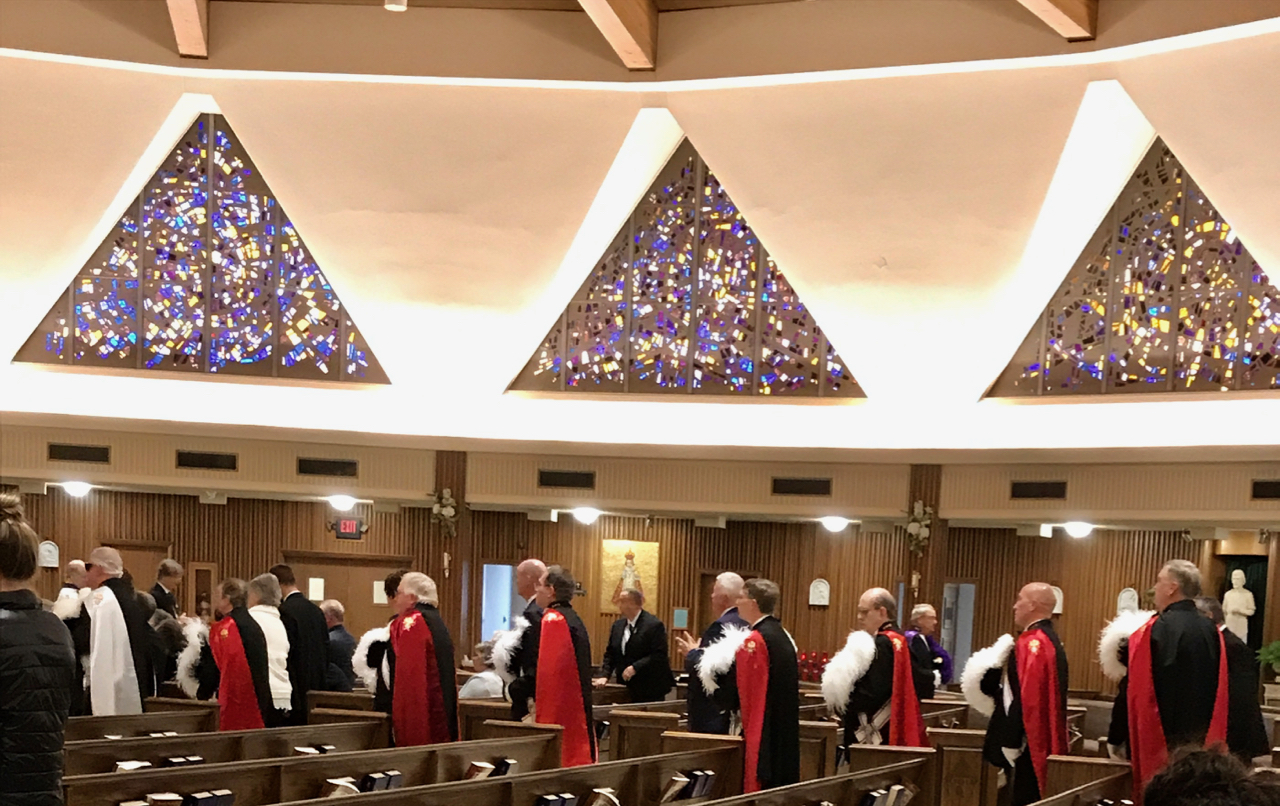
It was also interesting because I happened in on a Knights of Columbus mass.
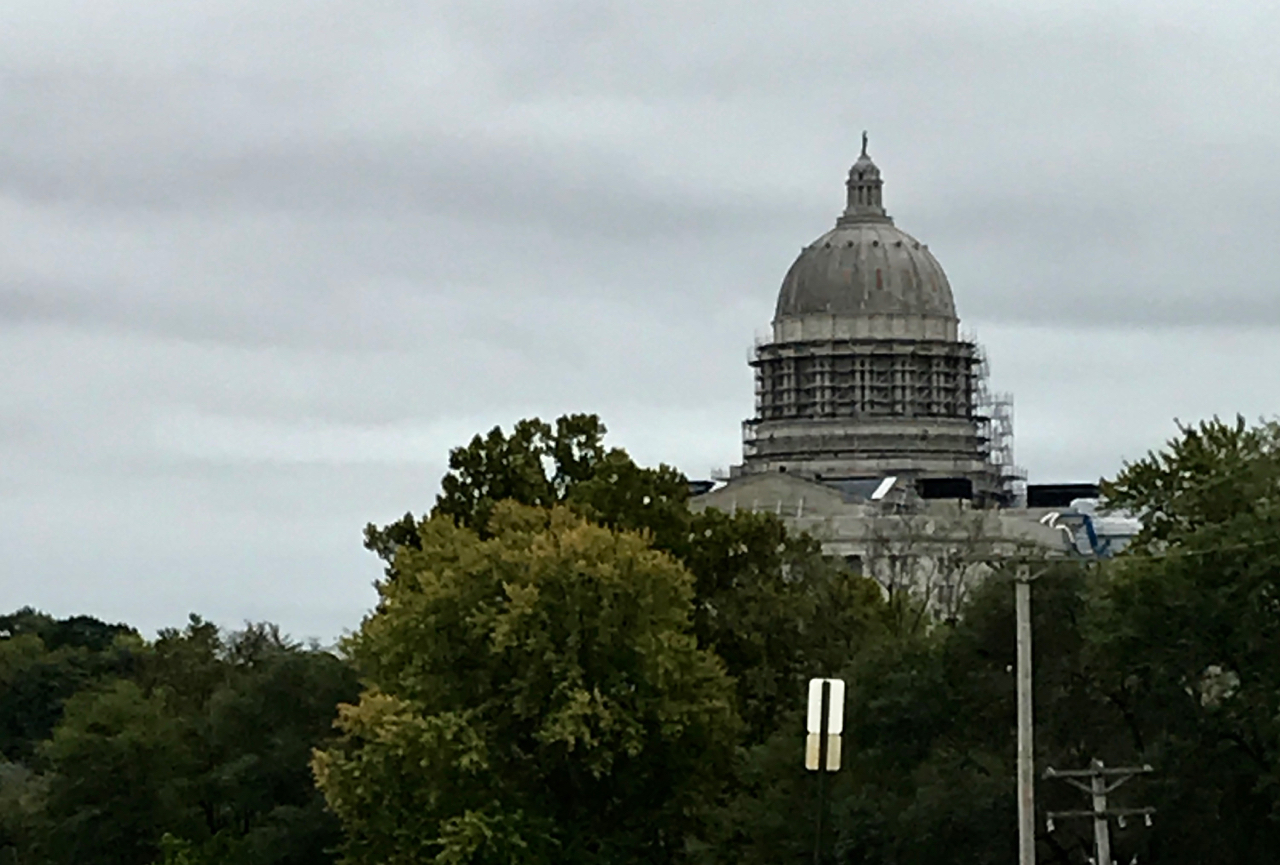
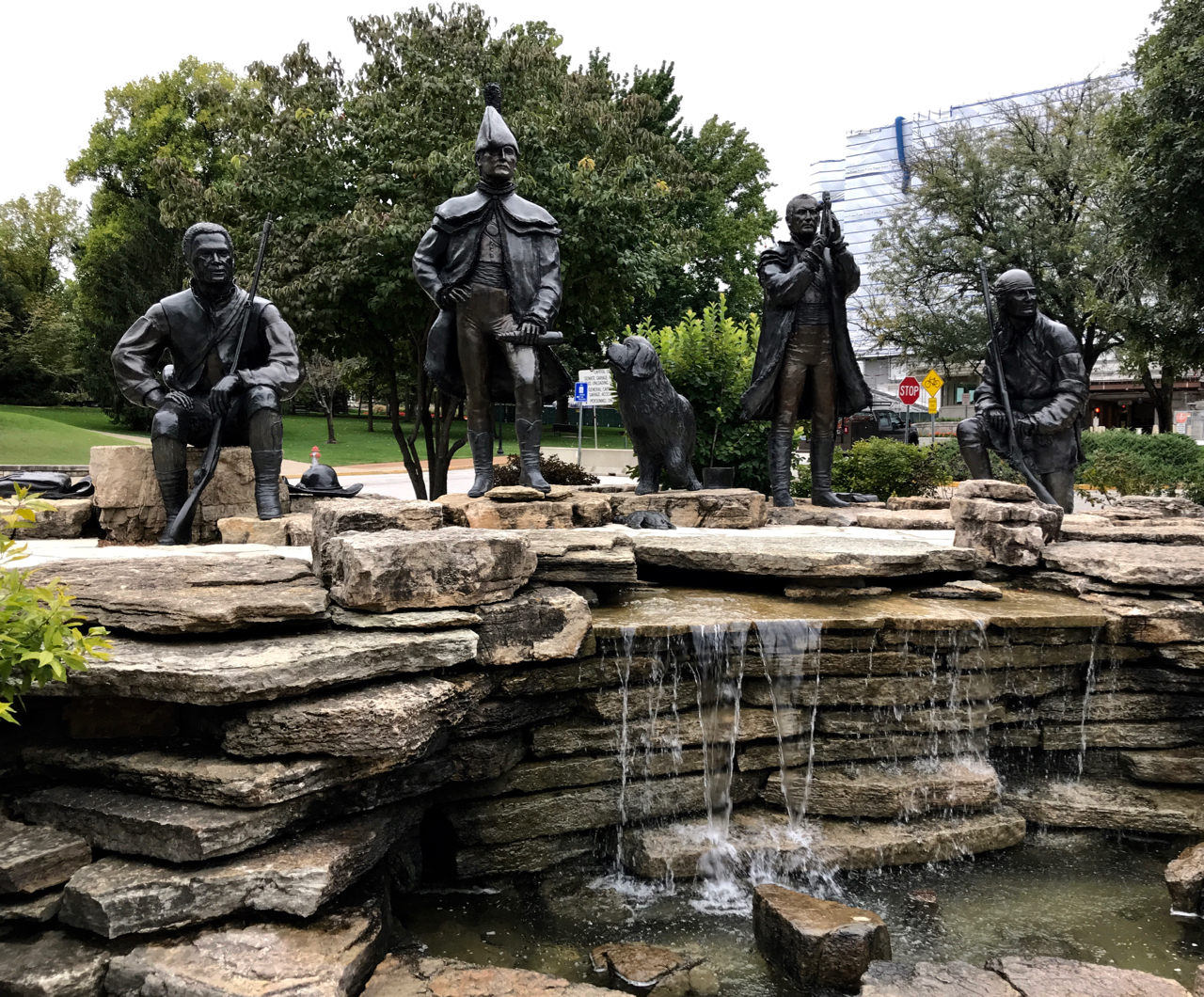
I was back in Lewis and Clark territory. I came upon this interesting sculpture grouping near the Missouri capitol.
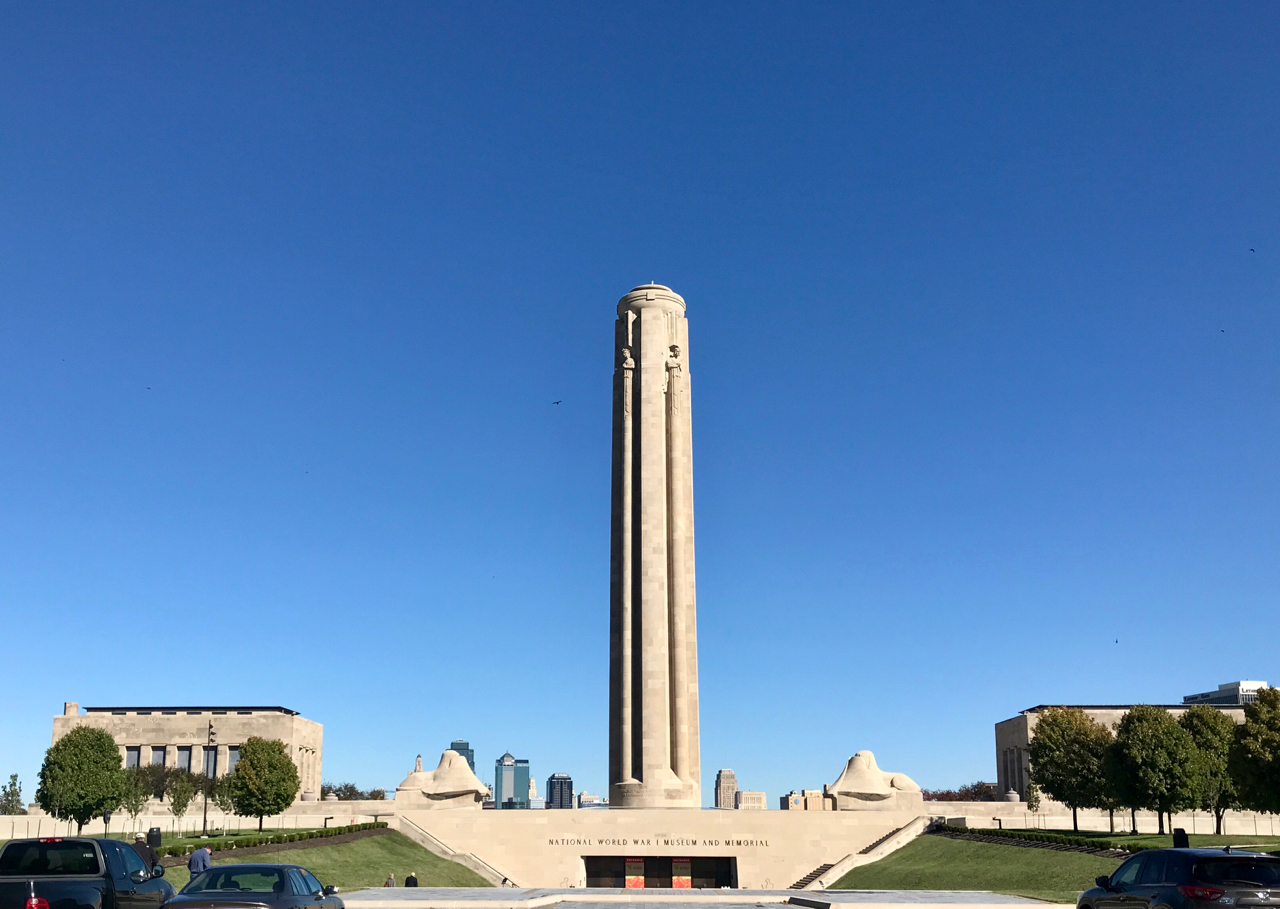
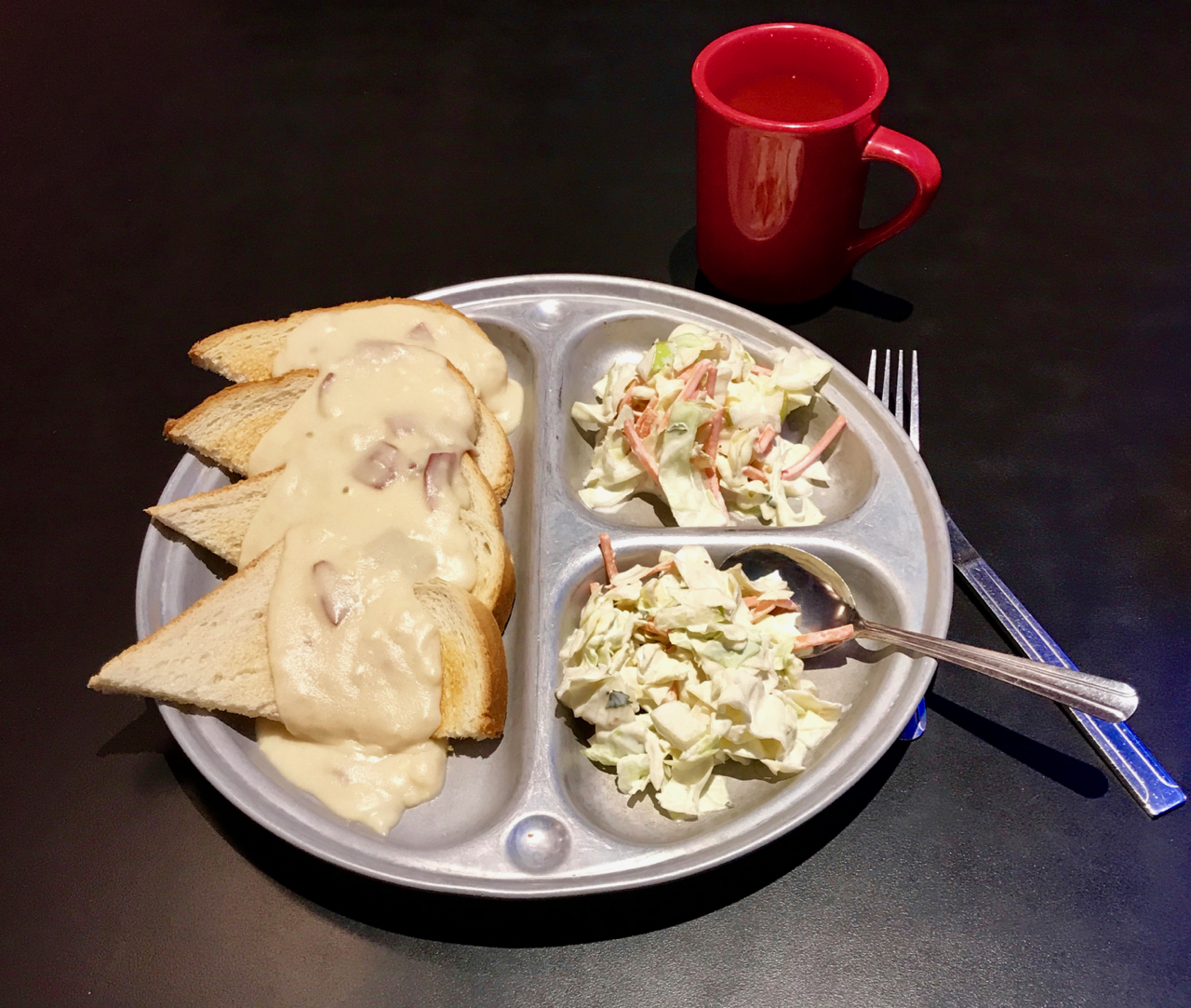
I decided to have lunch in the cafeteria. There were several authentic dishes that the doughboys would’ve eaten. I selected “S.O.S.” which was served on a tin dish.
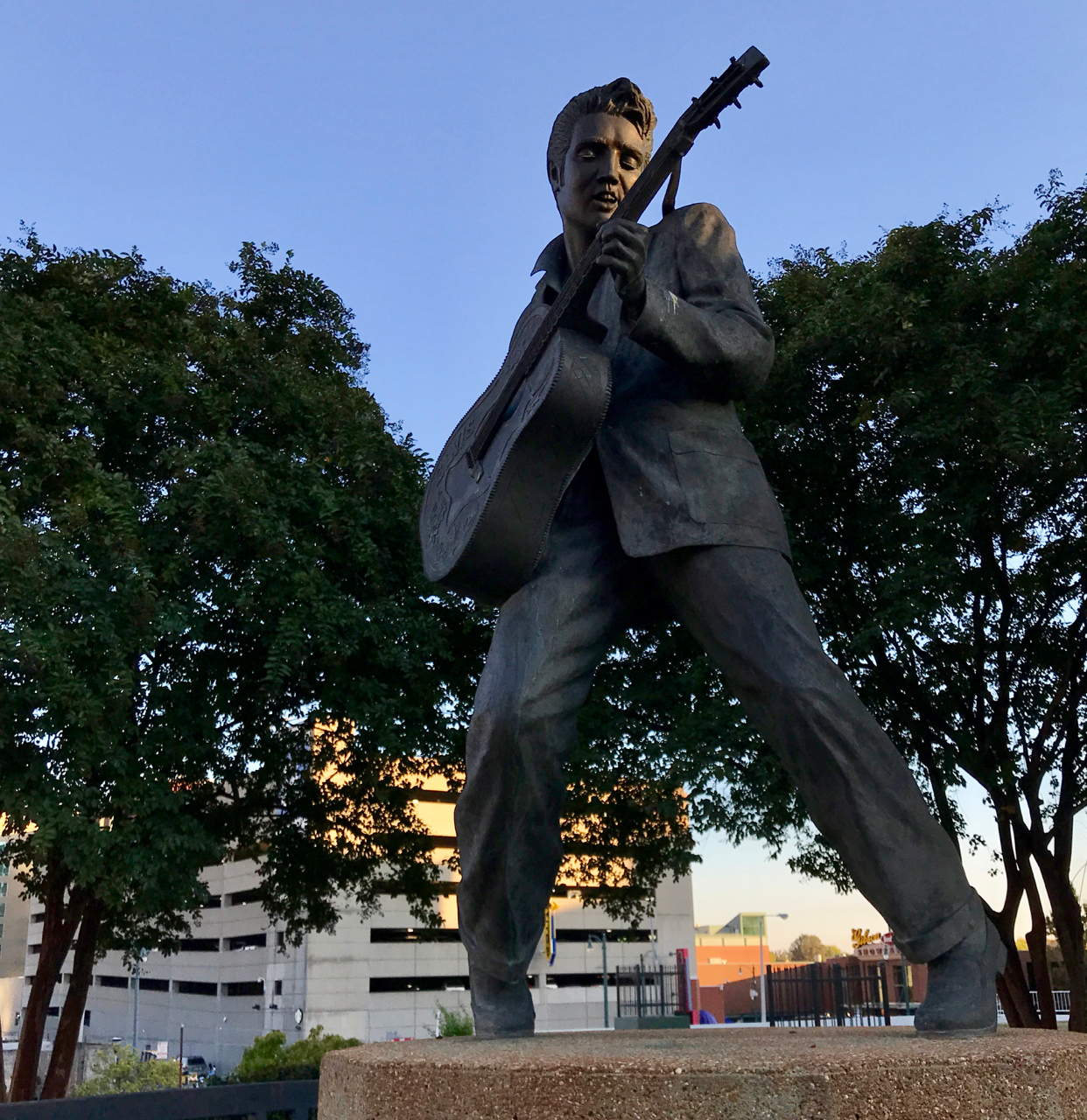
In Memphis, I came across Elvis.
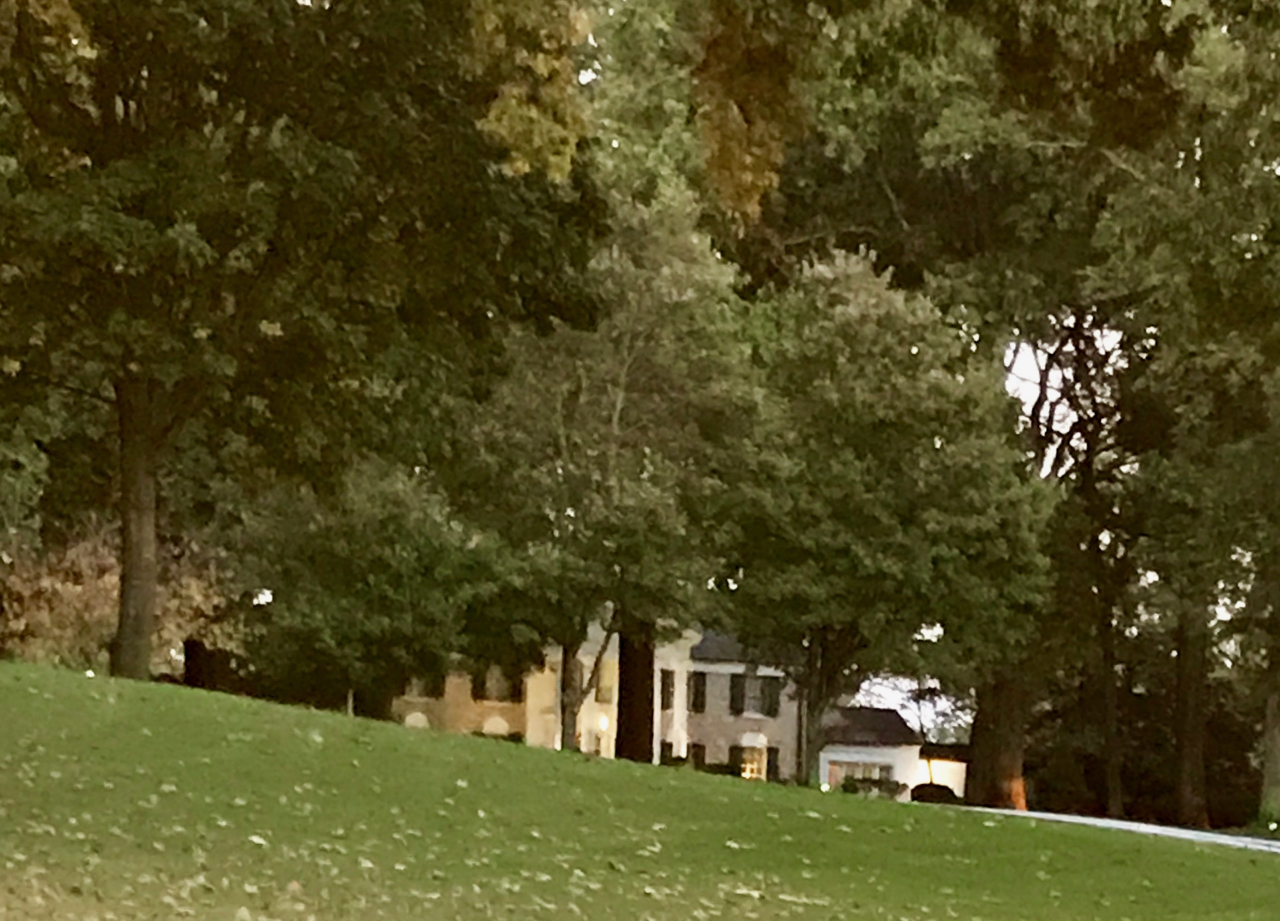
I also drove out to take a peek at Graceland. At a minimum price for adults of $41 dollars, I wasn’t about to make a visit a priority.
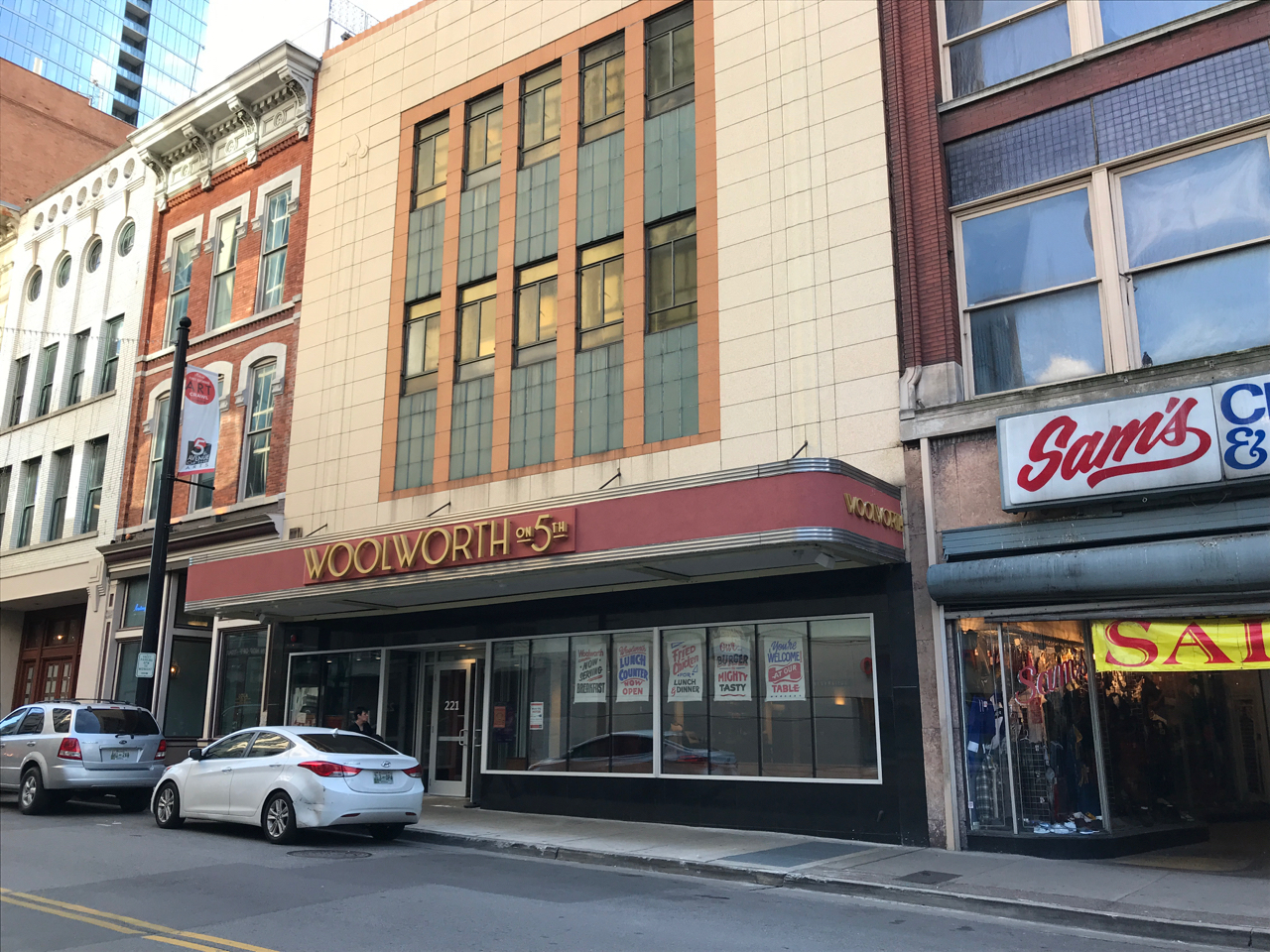
While prowling around Nashville, I came across this Woolworth that had been converted to a restaurant. It was the site of sit-ins for civil rights back in the ’60s. I had a little refreshment there.
One last unexpected item before I summarize the trip.
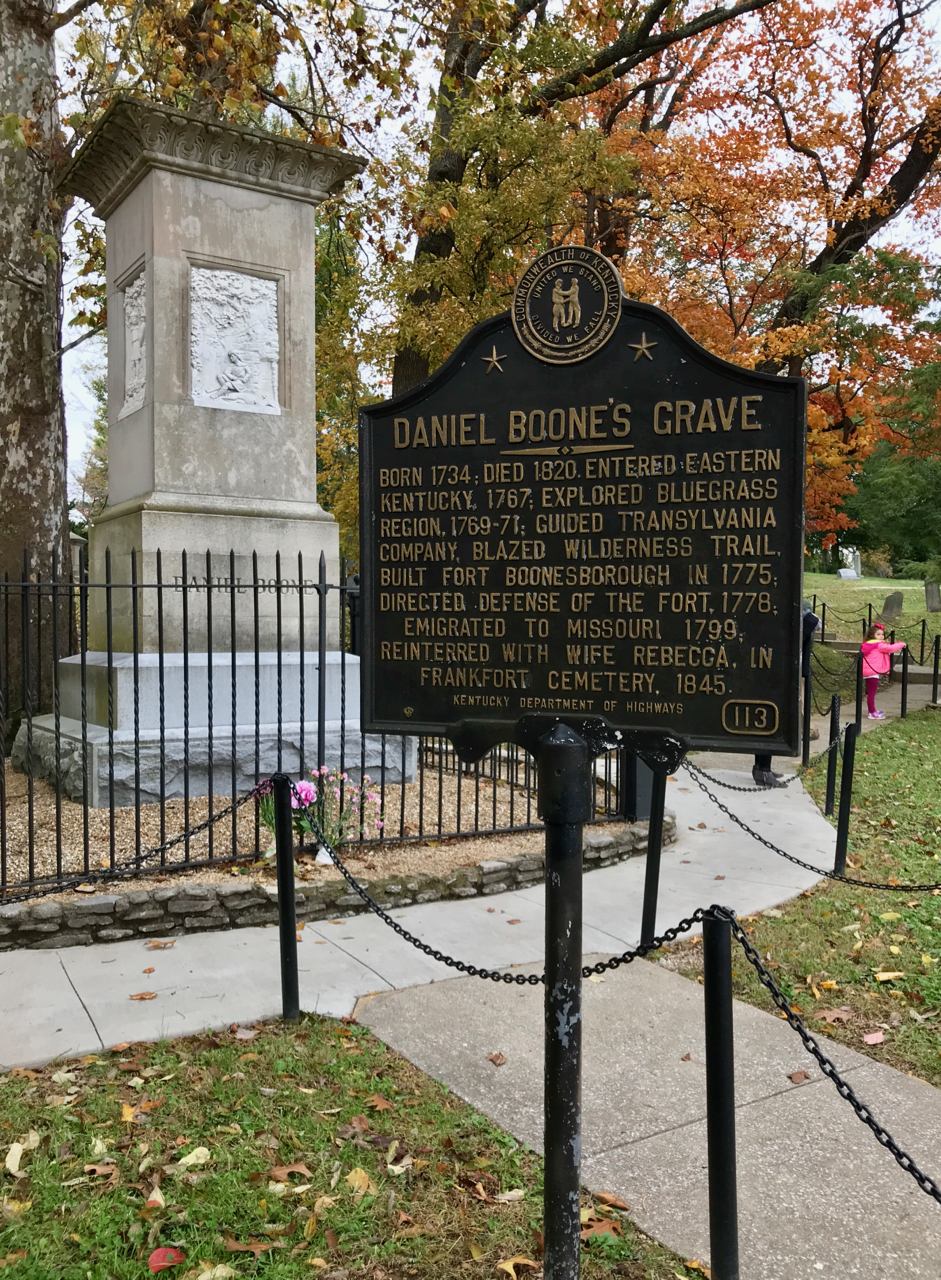
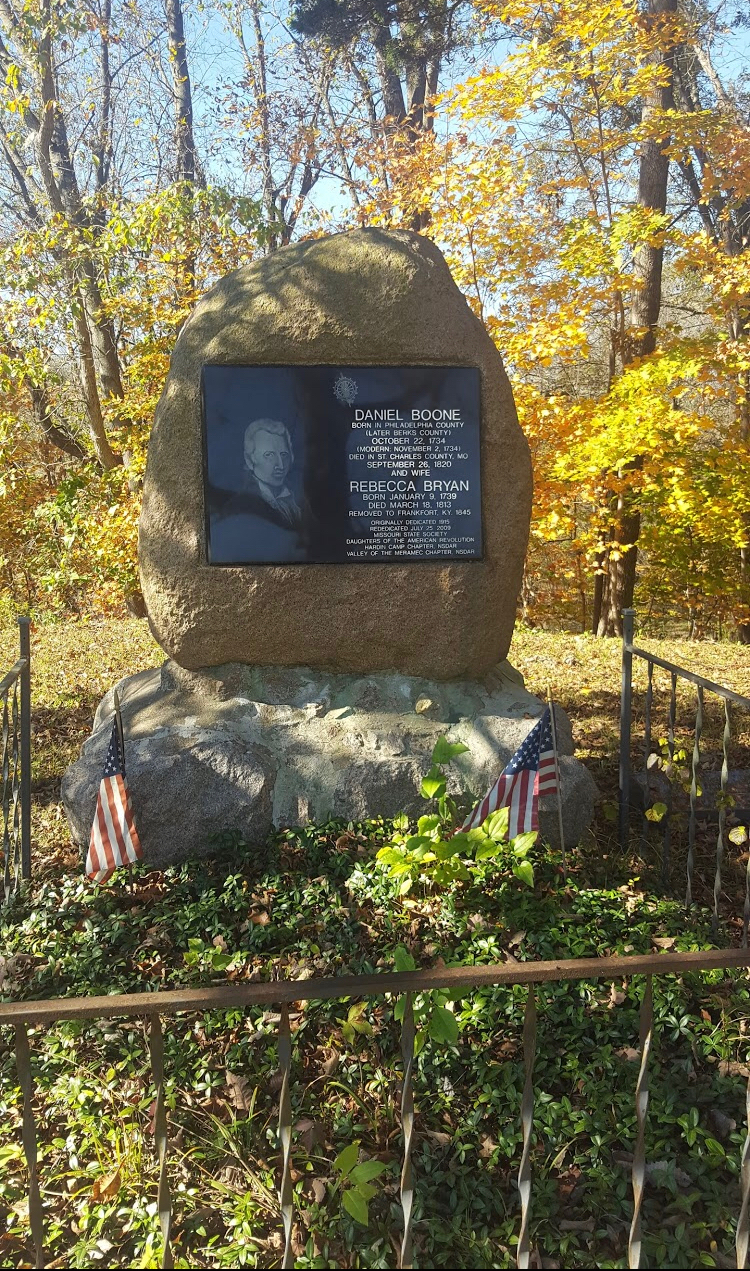
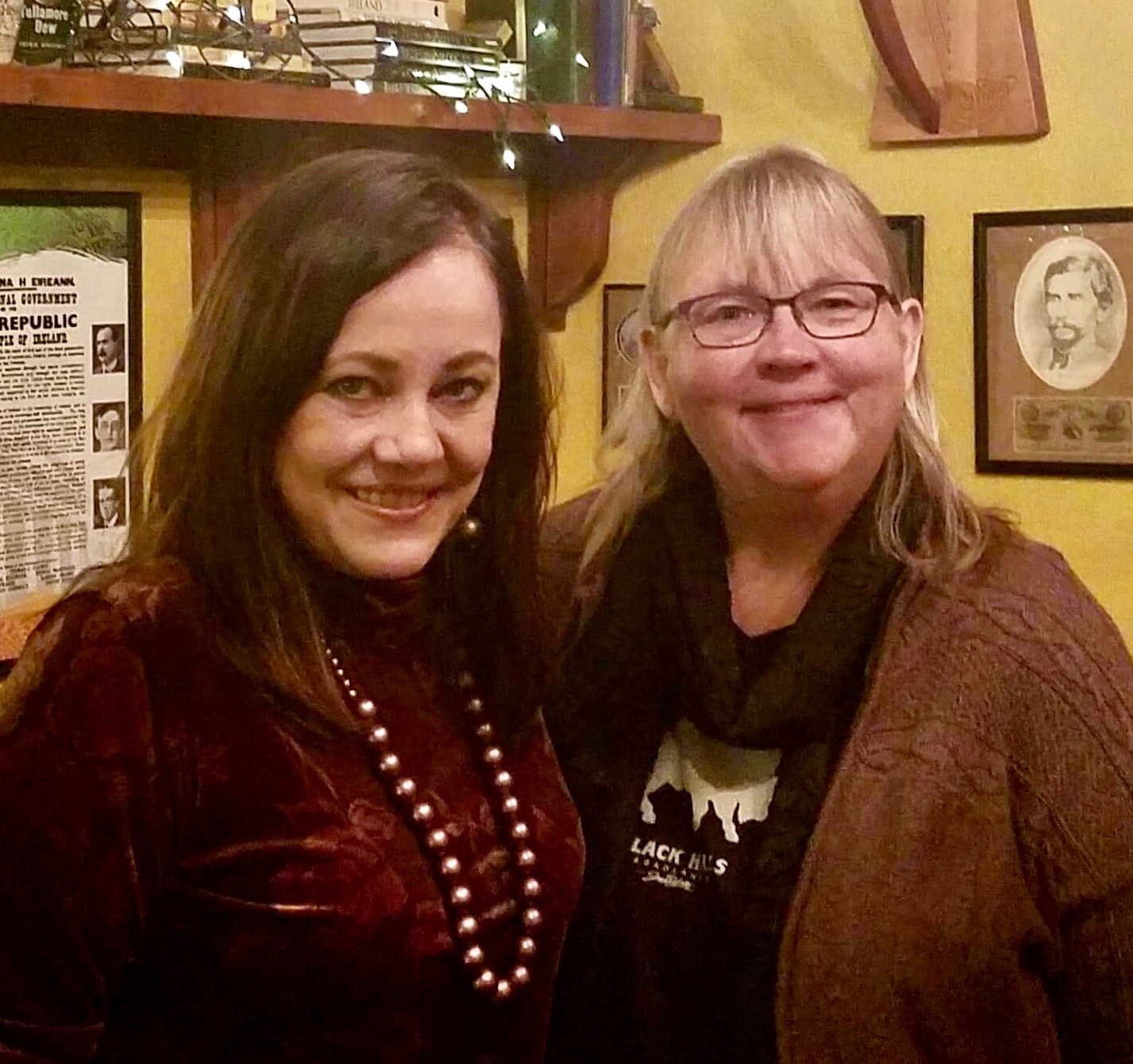
I found Daniel Boone’s final resting place in Frankfort, Kentucky and I actually met a descendant of his while I was there.
And now, my trip by the numbers:
Number of states I slept in: six
Number of days in the trip: 24
Number of miles towing: 2750
Number of campgrounds: 8
Number of alternative lodgings: 1 night behind a Cracker Barrel (Crackerdocking, we call it) and 2 nights of home hospitality
Number of old friends I met up with: 8
Number of new friends I’ve kept in touch with since: 2
And finally…
Number of days until my next trip: 142
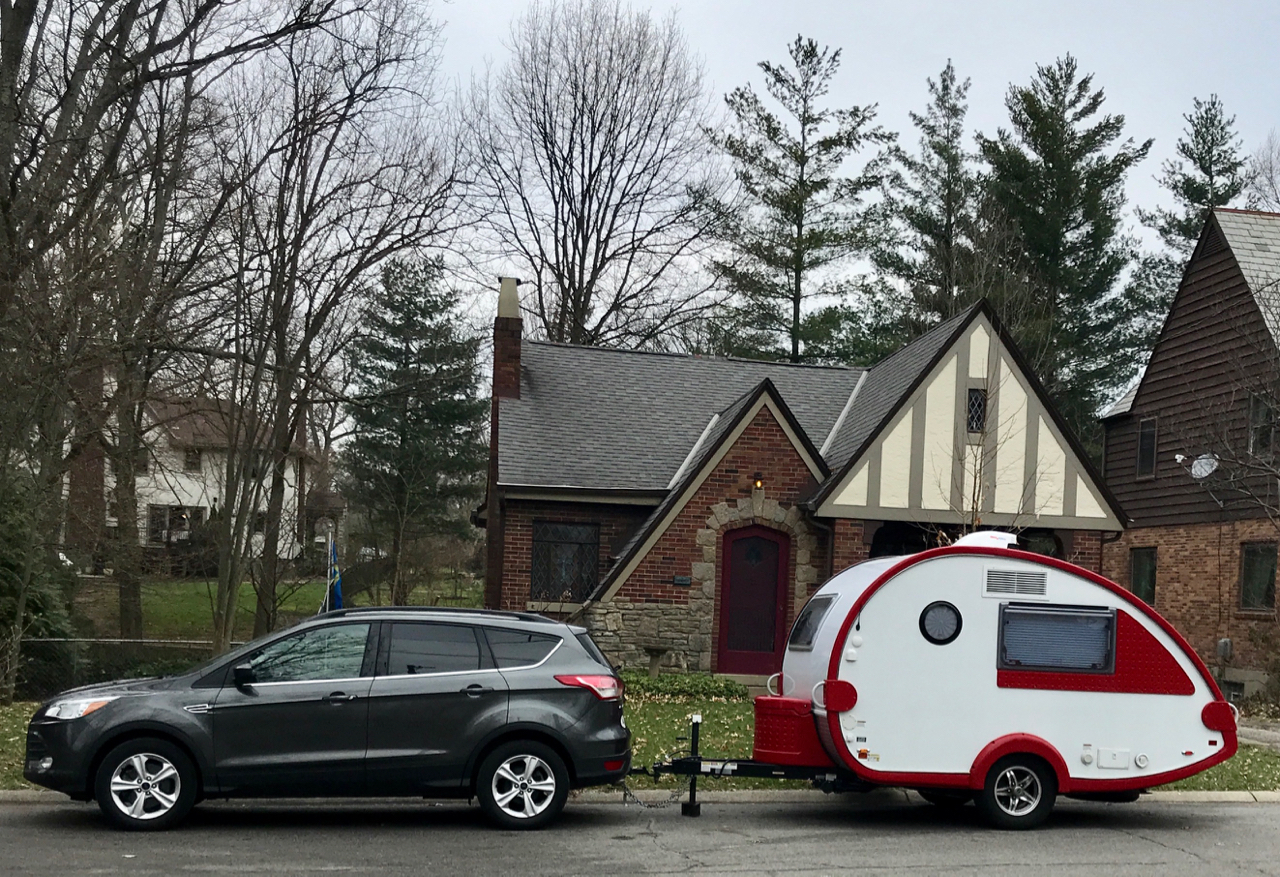
My last stop on this journey was Cincinnati. My friends, Ron and DC invited me to stop at their house. I parked in the street and enjoyed the comforts of their adorable house.
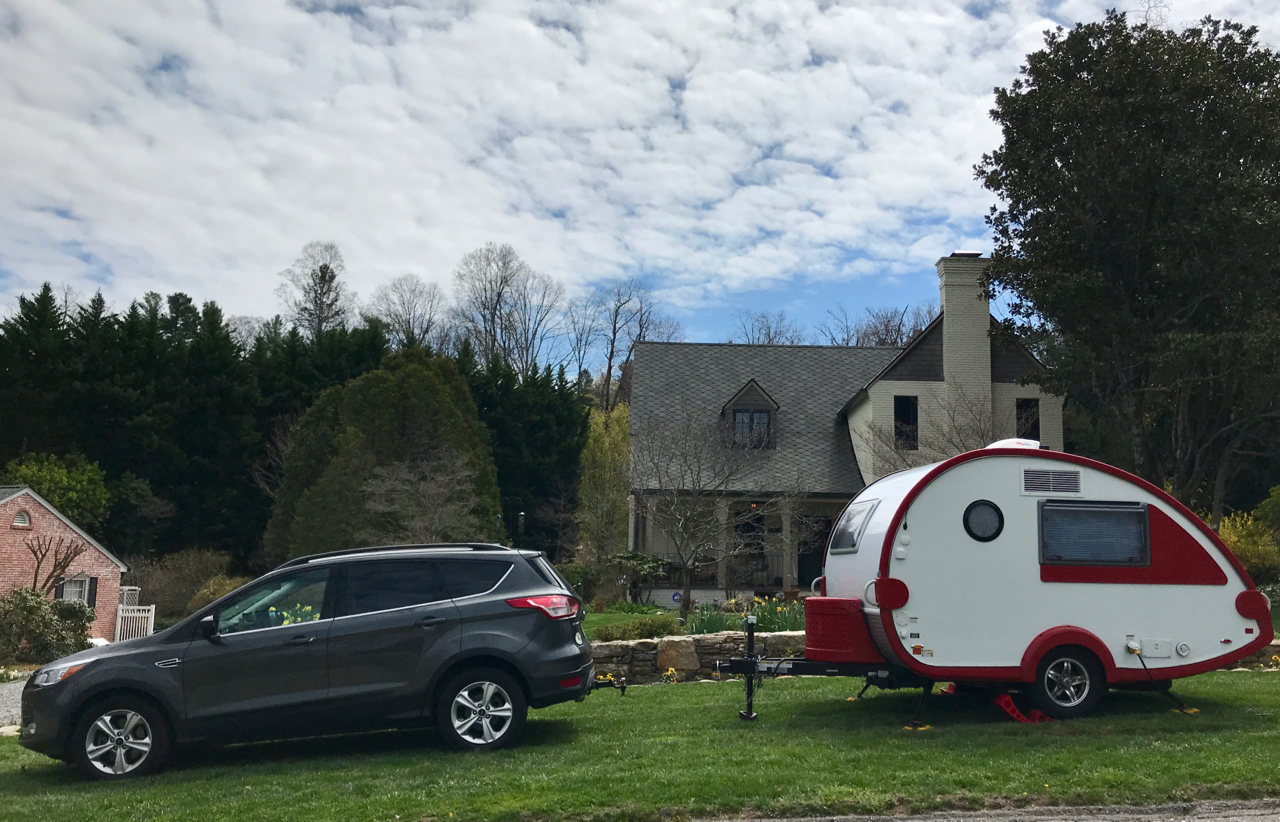
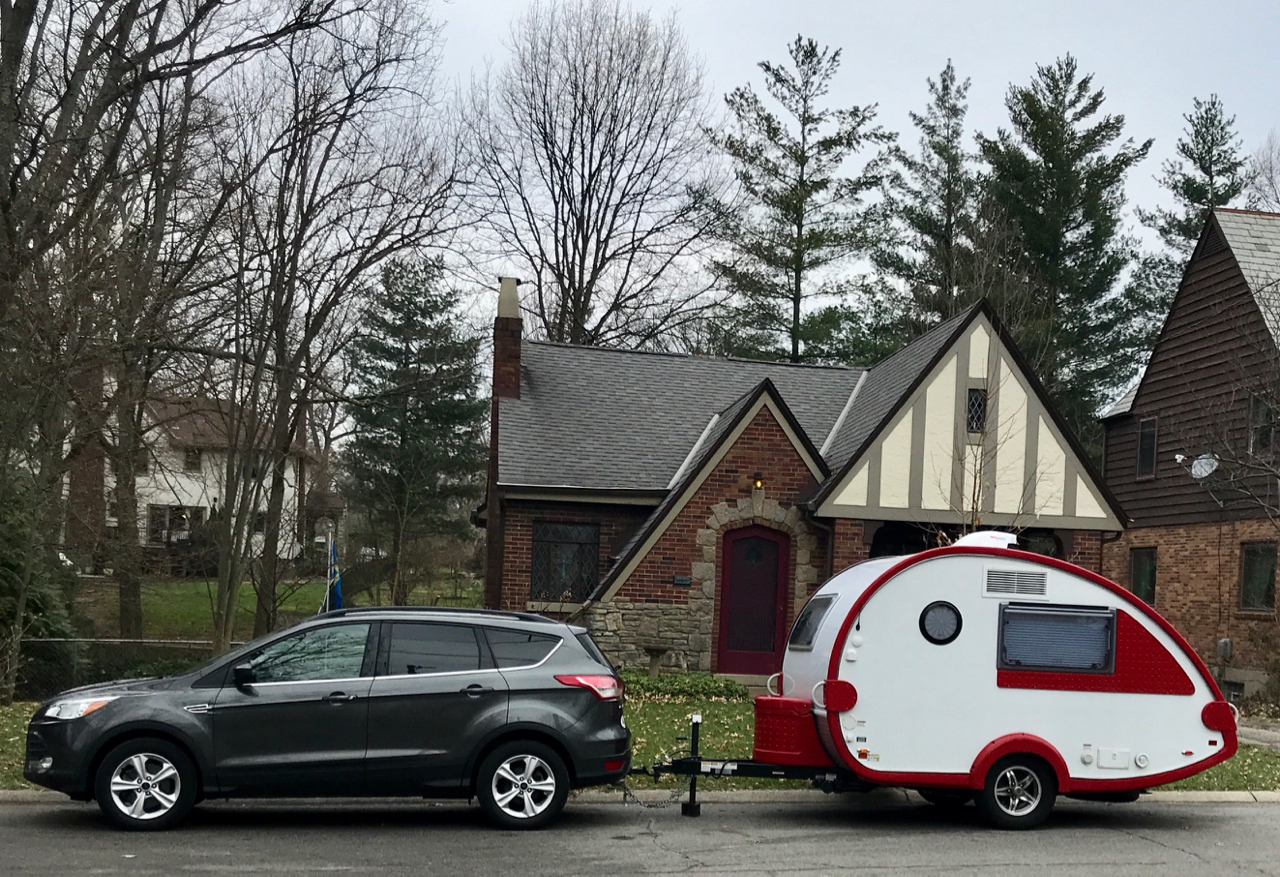
I always said that any house looks better with an Airstream in front of it, but a T@b isn’t bad, either.
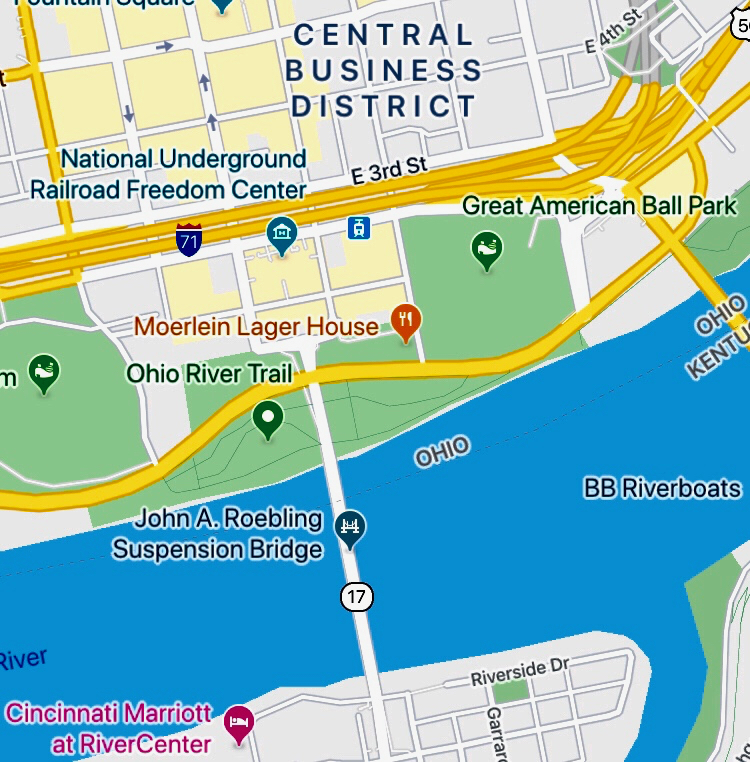
This was just a short visit, as I really did need to get home. Ron took me across the river to Covington, Kentucky. Our first stop was George Rogers Clark Park.
George Rogers Clark Park is that small green rectangle on the southern side of the Ohio River.
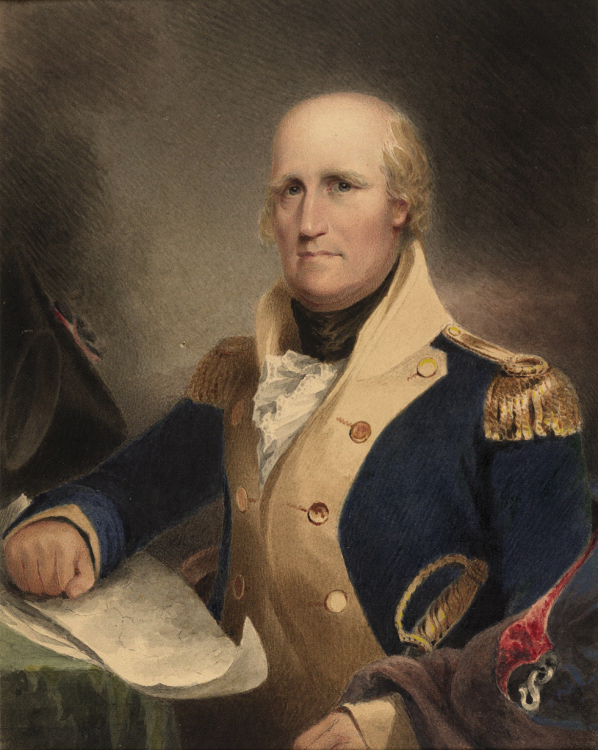
I was wondering who George Rogers Clark was, so of course I had to check my Preferred Source. I wondered if this was the Clark in Lewis-and-Clark. After all, it is right by the water. No, that Clark was William Clark, his younger brother. This Clark was a surveyor, soldier and militia officer from Virginia. During the Revolutionary War, he served as leader of the militia in Kentucky, which was still a part of Virginia at that time. Due to his successes during the Illinois Campaign, he greatly weakened British influence in the Northwest Territory. The British ceded the entire Northwest Territory to the United States in the 1783 Treaty of Paris. Clark has often been hailed as the “Conqueror of the Old Northwest”.
By James B. Longacre – http://npg.si.edu/object/npg_NPG.72.14, Public Domain, https://commons.wikimedia.org/w/index.php?curid=1385299
I don’t know how true of a likeness this is, as it was painted seven years after his death in 1818, but I offer it to you for your consideration.
Apparently they were big on sobriquets back then, as he appears to have had a number of them.
Conqueror of the Old Northwest
Hannibal of the West
Washington of the West
Father of Louisville
If you are interested in knowing more about his life, you can start with my Preferred Source. Or, maybe this is as much as you ever care to know about this person. In which case, you’re welcome.
Anyway, back to the park named in his honor.
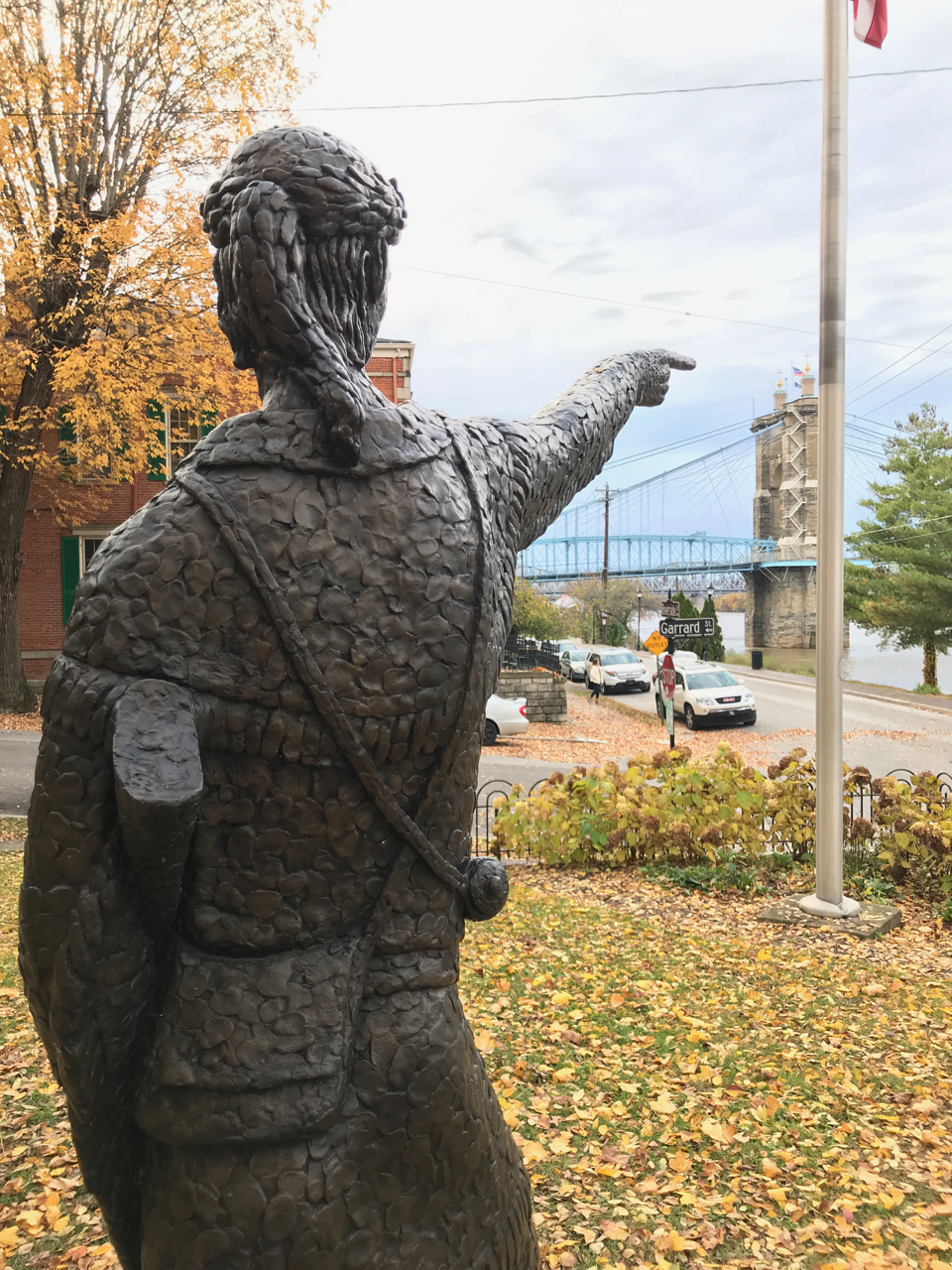
It is a small, but scenic location with a great view of the Roebling Suspension Bridge and the Cincinnati skyline.
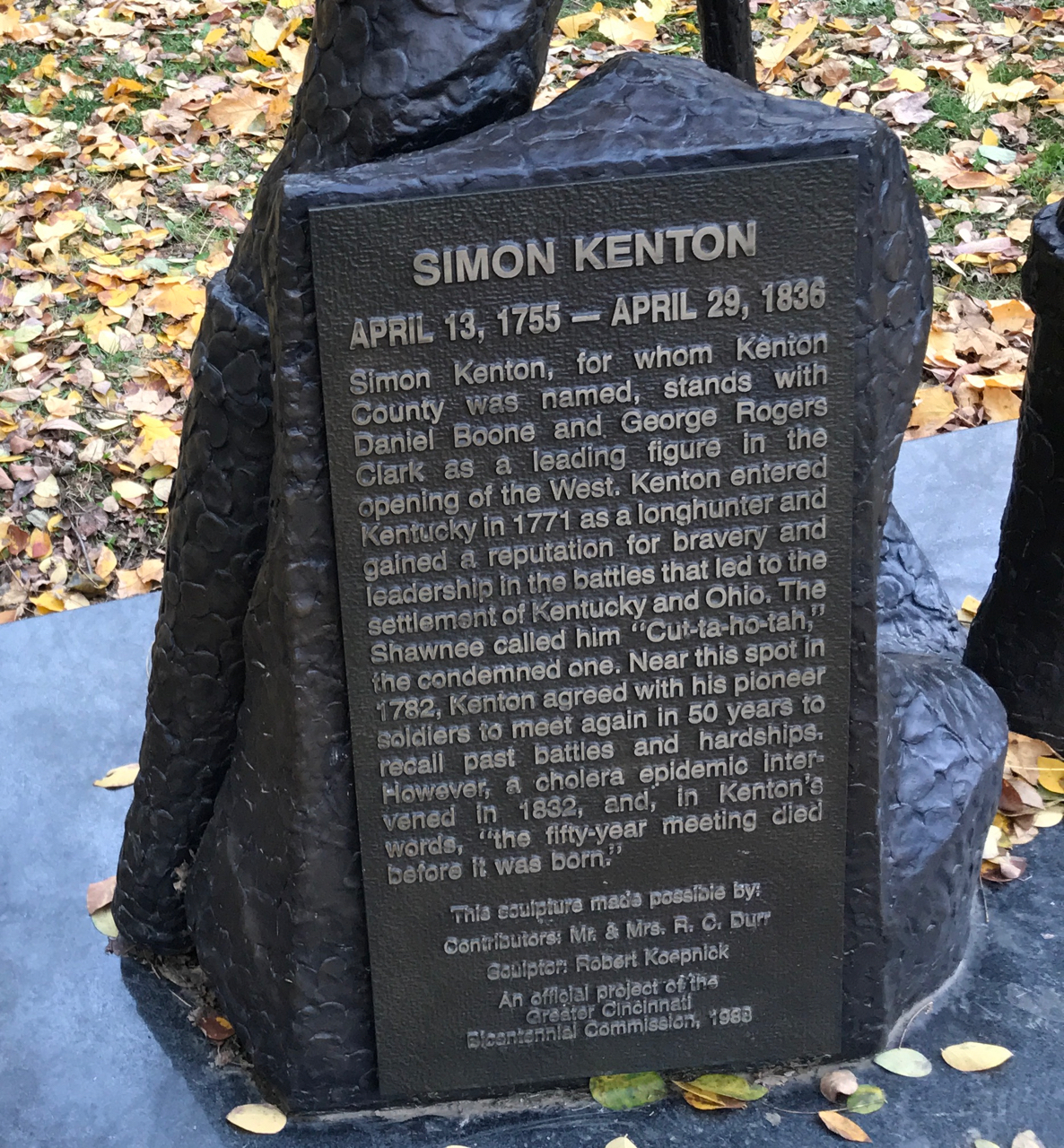
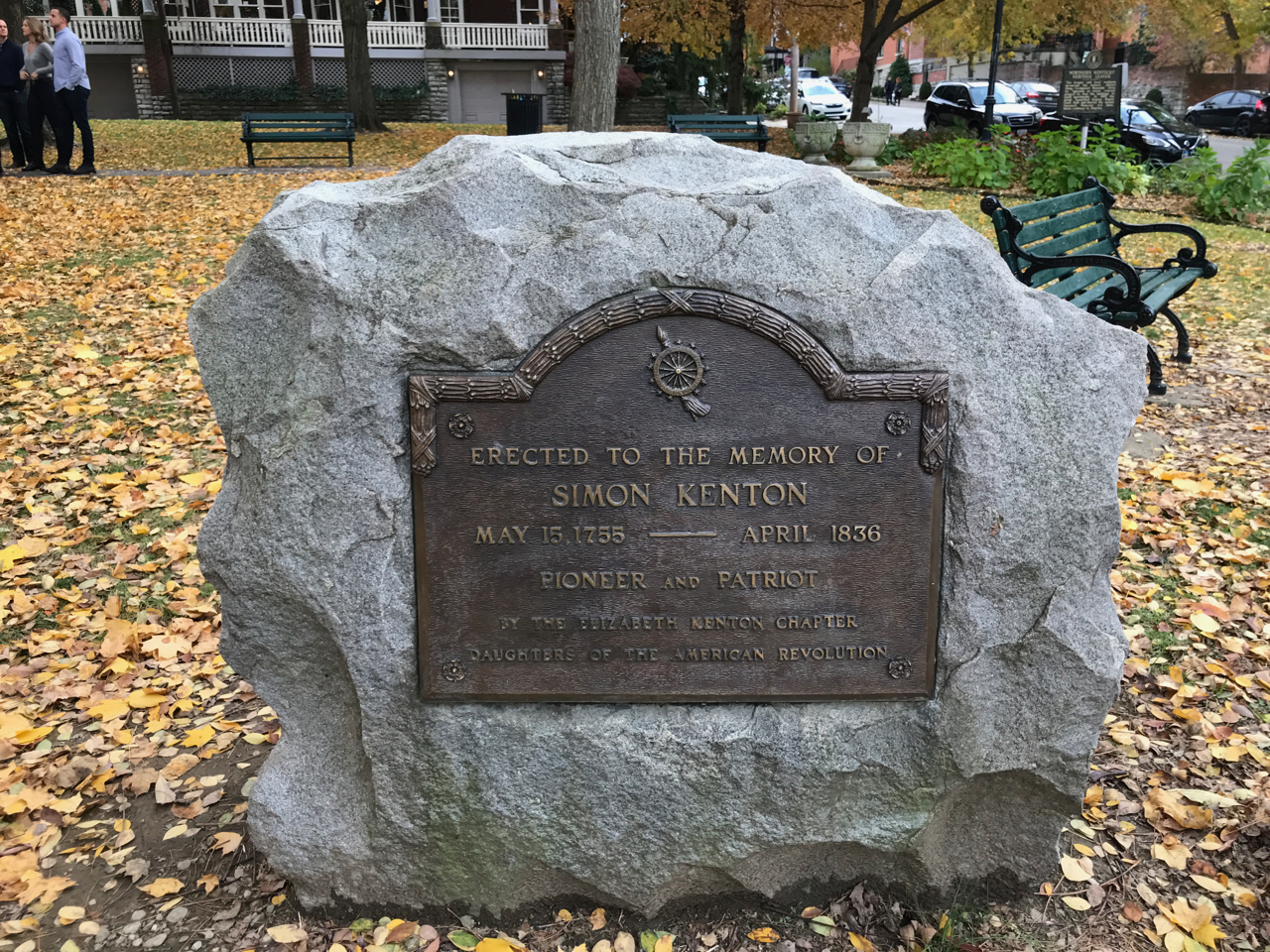
This statue that is pointing the way is of Simon Kenton.
I’ll let you read the plaque that is on the base of the statue.
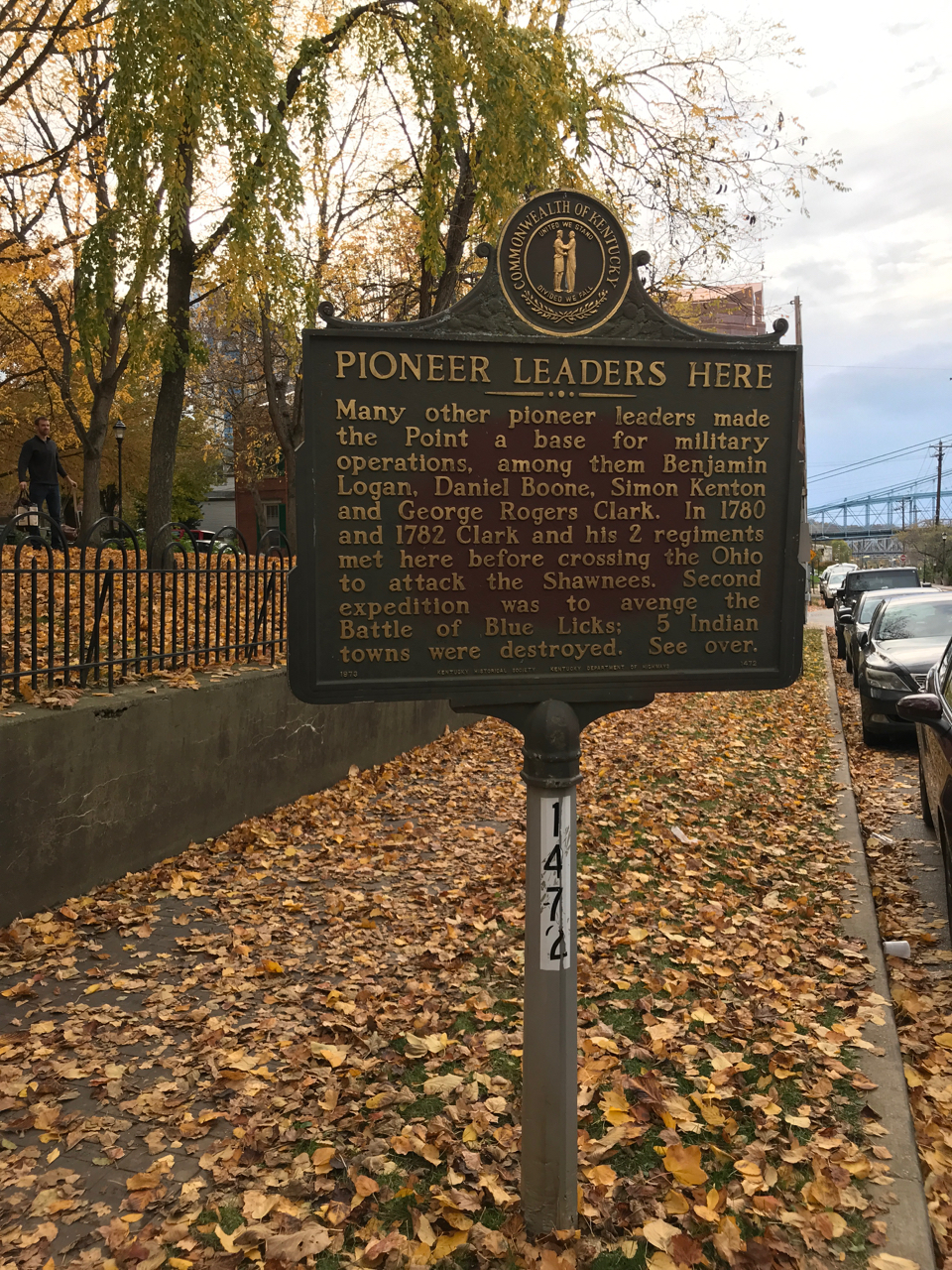
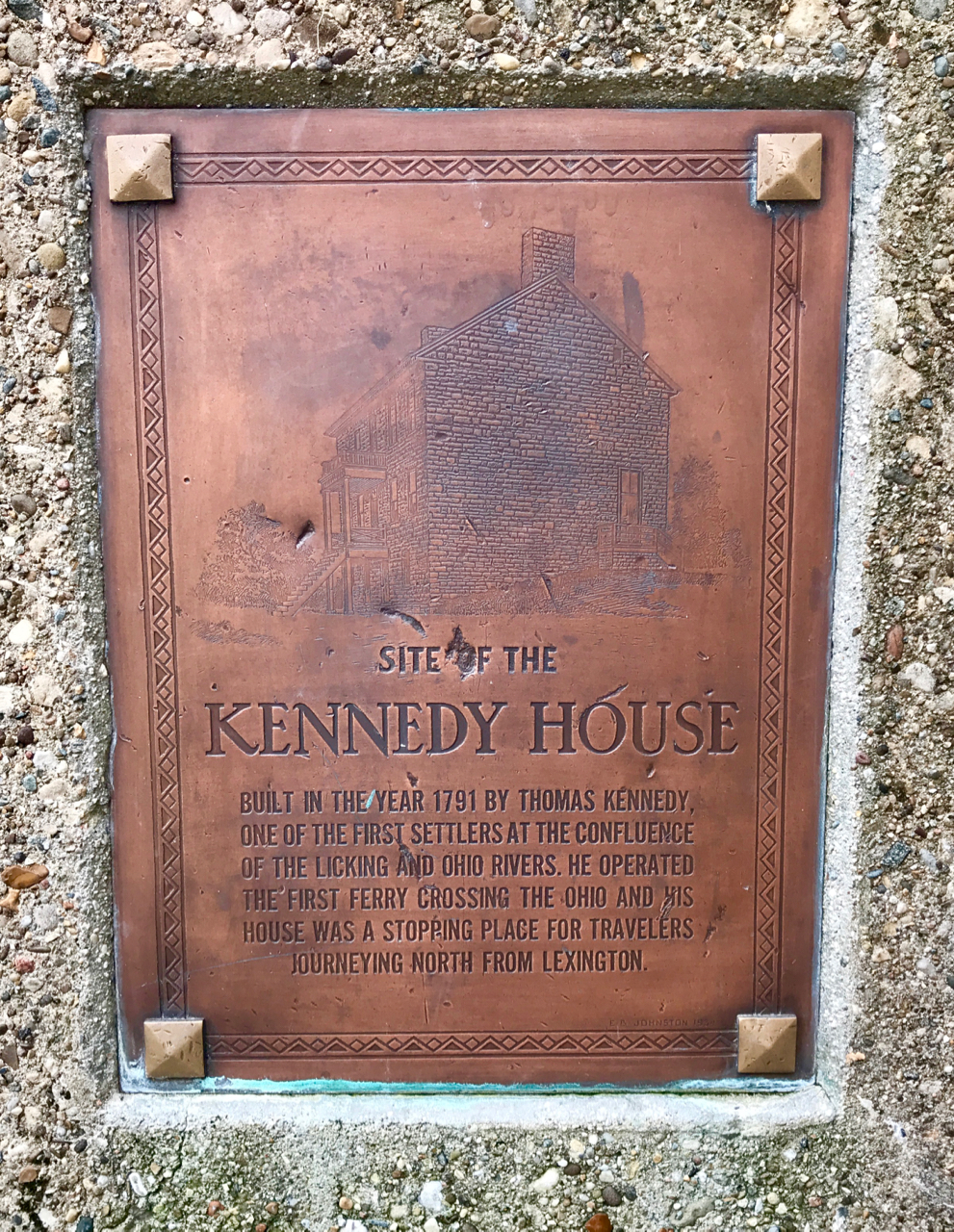
If the statue weren’t honor enough, there is also a boulder with a plaque on it.
This place was frequented by many Pioneer Leaders. It certainly was a great location. For some reason, I neglected to take a photo of the other side.
It was a beautiful day, and we strolled about the park to see what we could see.
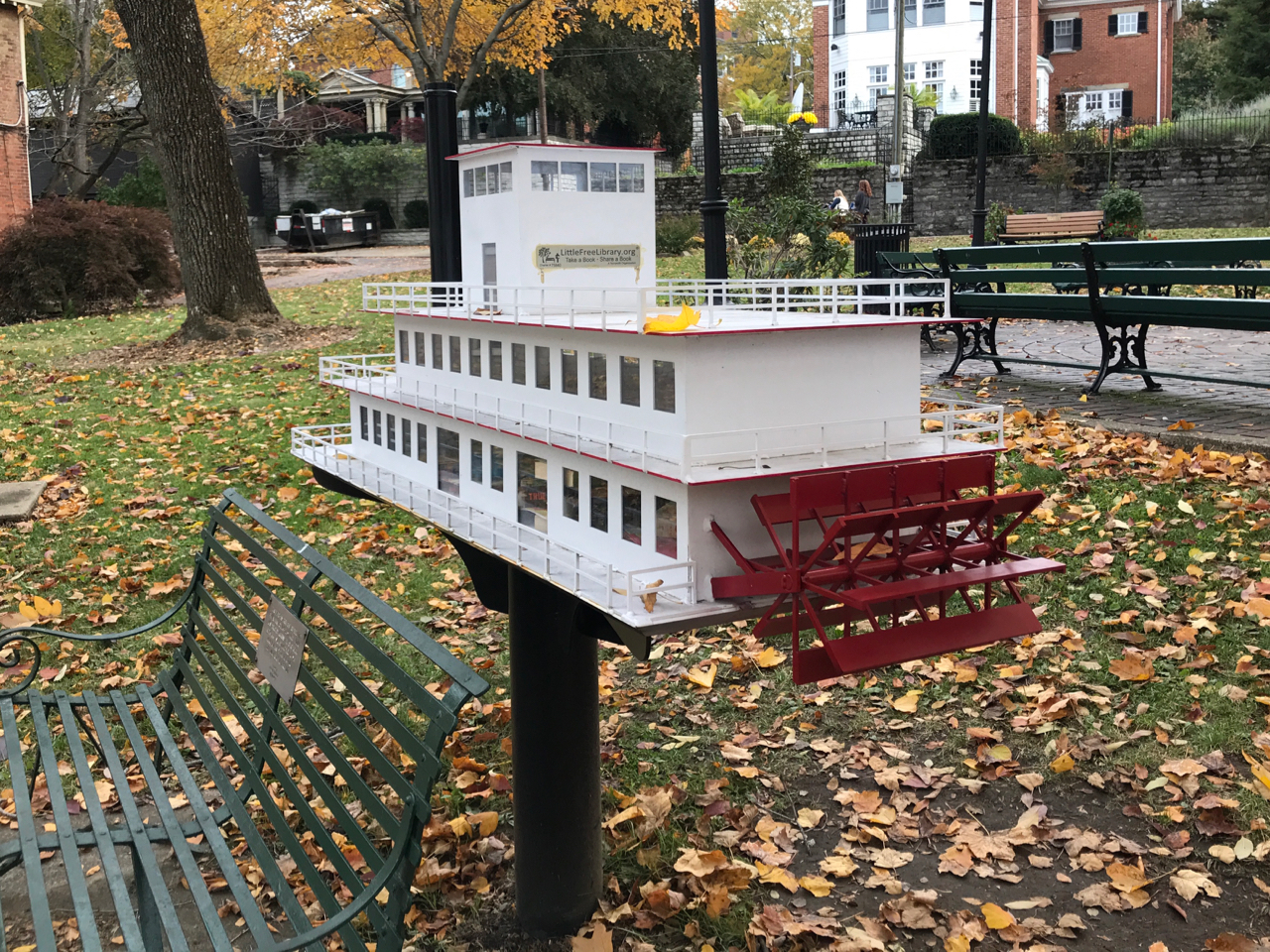
For some reason, I thought this was a Little Free Library. Upon closer inspection of my photo, I’m not sure if it is. I’ve seen some really cute ones in my travels, so I probably just assumed that is was. You know what happens when you a assume, right?
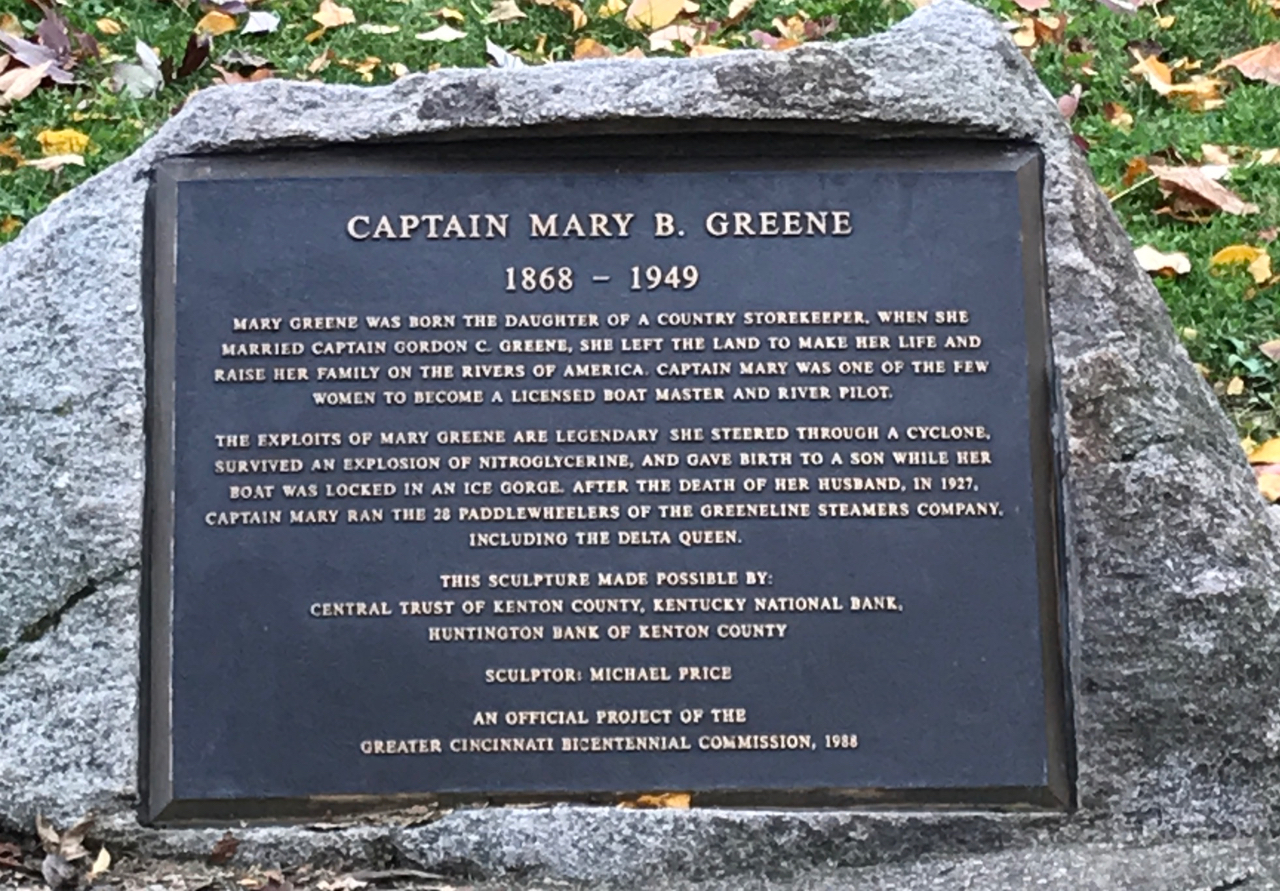
Maybe the riverboat was there in honor of Captain Mary B. Green, one of the few women to become a licensed Boat Master and River Pilot.
In case you can’t read the text on the plaque, let me share it with you.
Mary Greene was born the daughter of a country storekeeper. When she married Captain Gordon C. Greene, she left the land to make her life and raise her family on the rivers of America. Captain Mary was one of the few women to become a licensed boat master and river pilot.
The exploits of Mary Green are legendary. She steered through a cyclone, survived an explosion of nitroglycerine, and gave birth to a son while her boat was locked in an ice gorge. After the death of her husband in 1927, Captain Mary ran the 28 paddle wheelers of the Greeneline Steamers Company, including the Delta Queen.
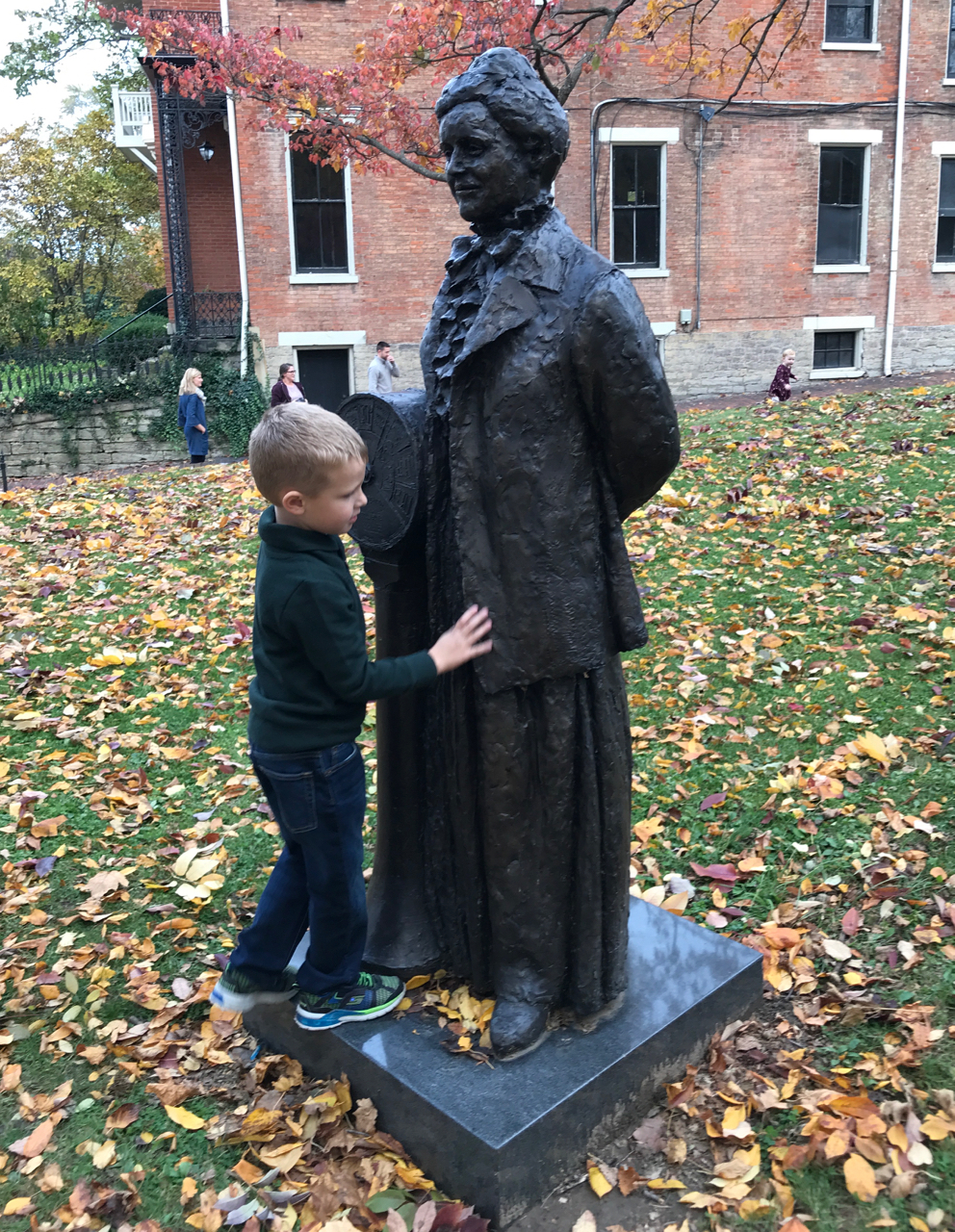
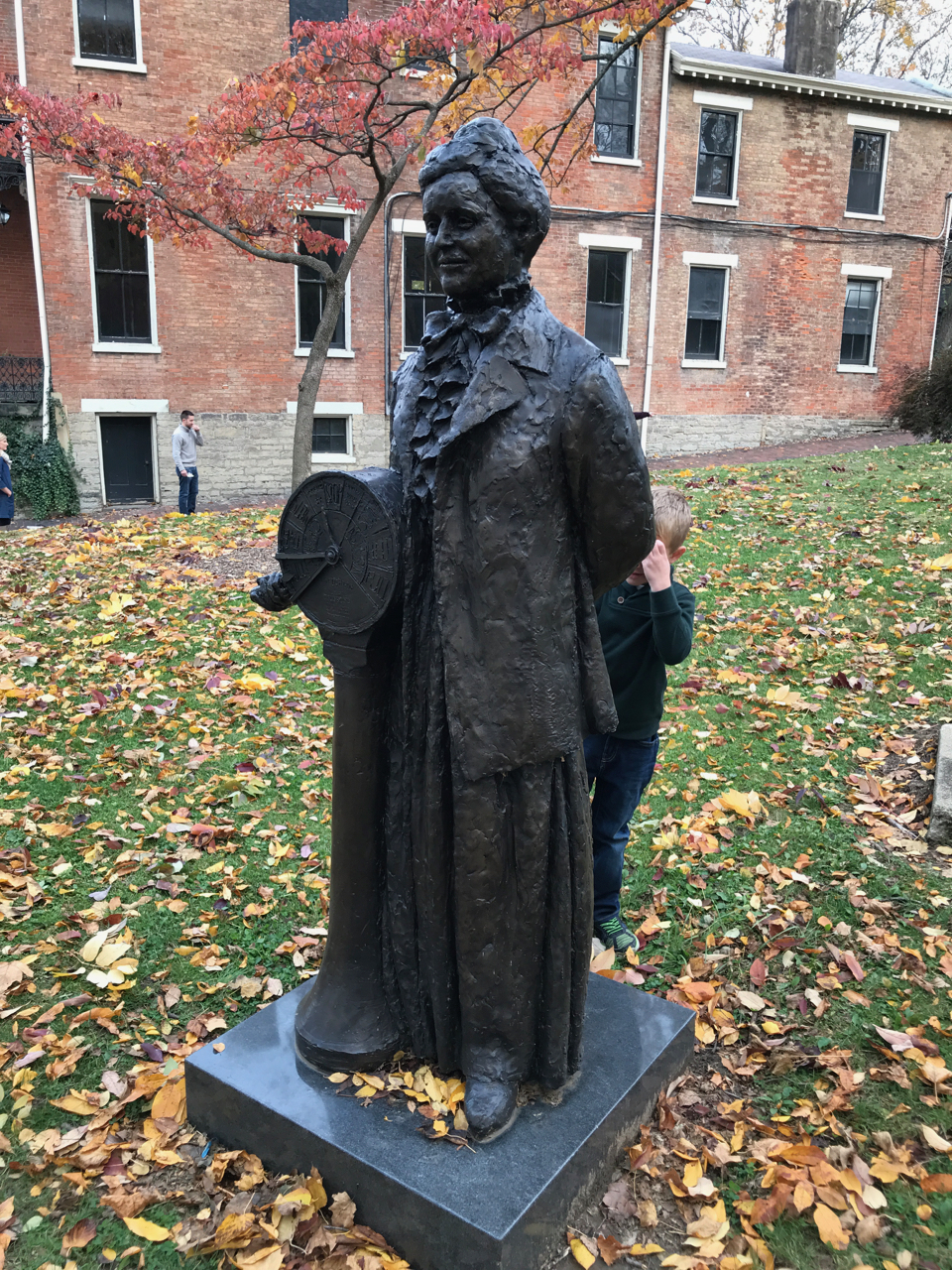
I enjoyed this youngster exploring the statue of Captain Mary.
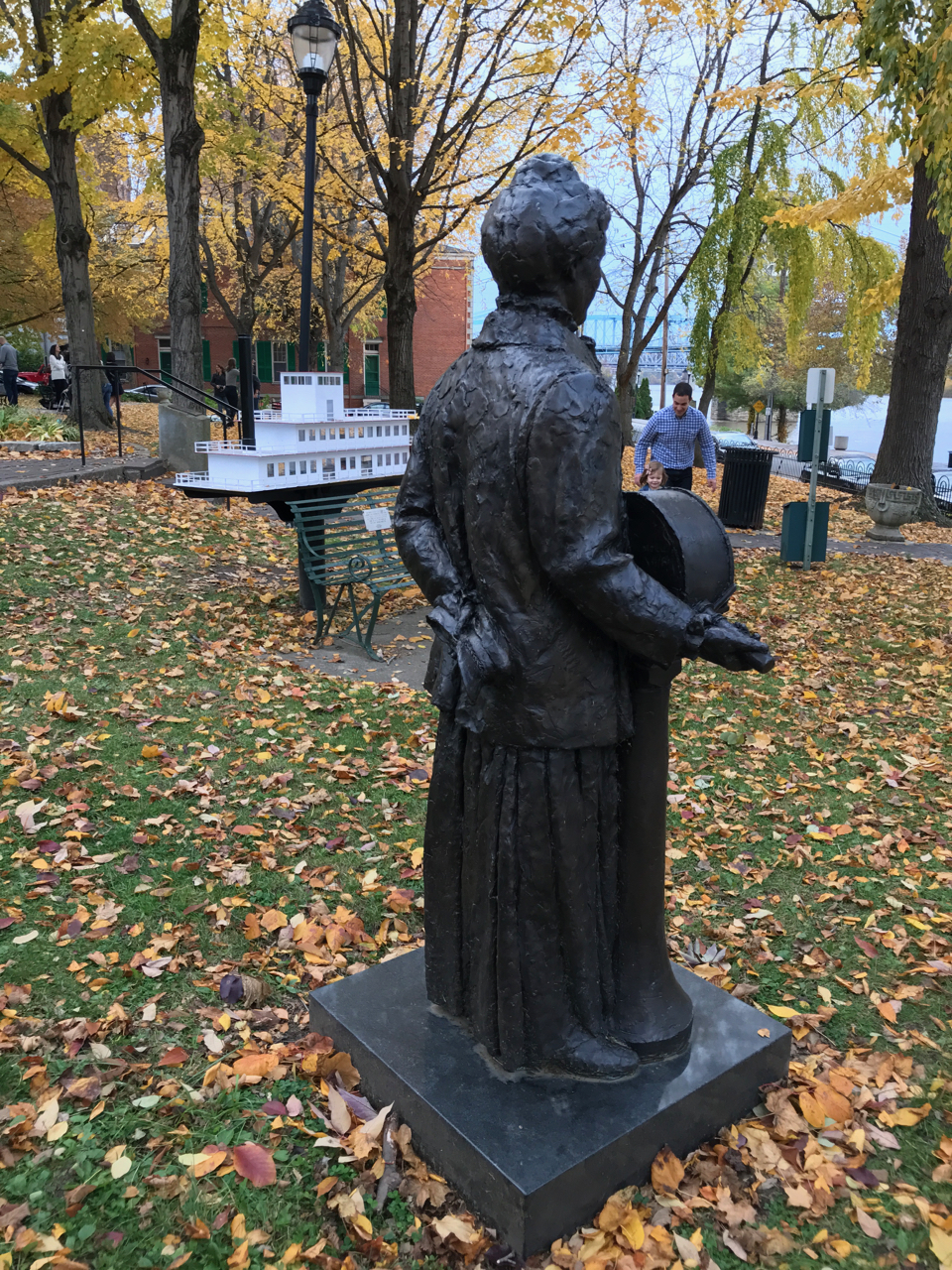
He worked his way around the statue, from the front to the back.
He looked like he was scratching his head, puzzling out something on the back of the statue, so I had to take a look.
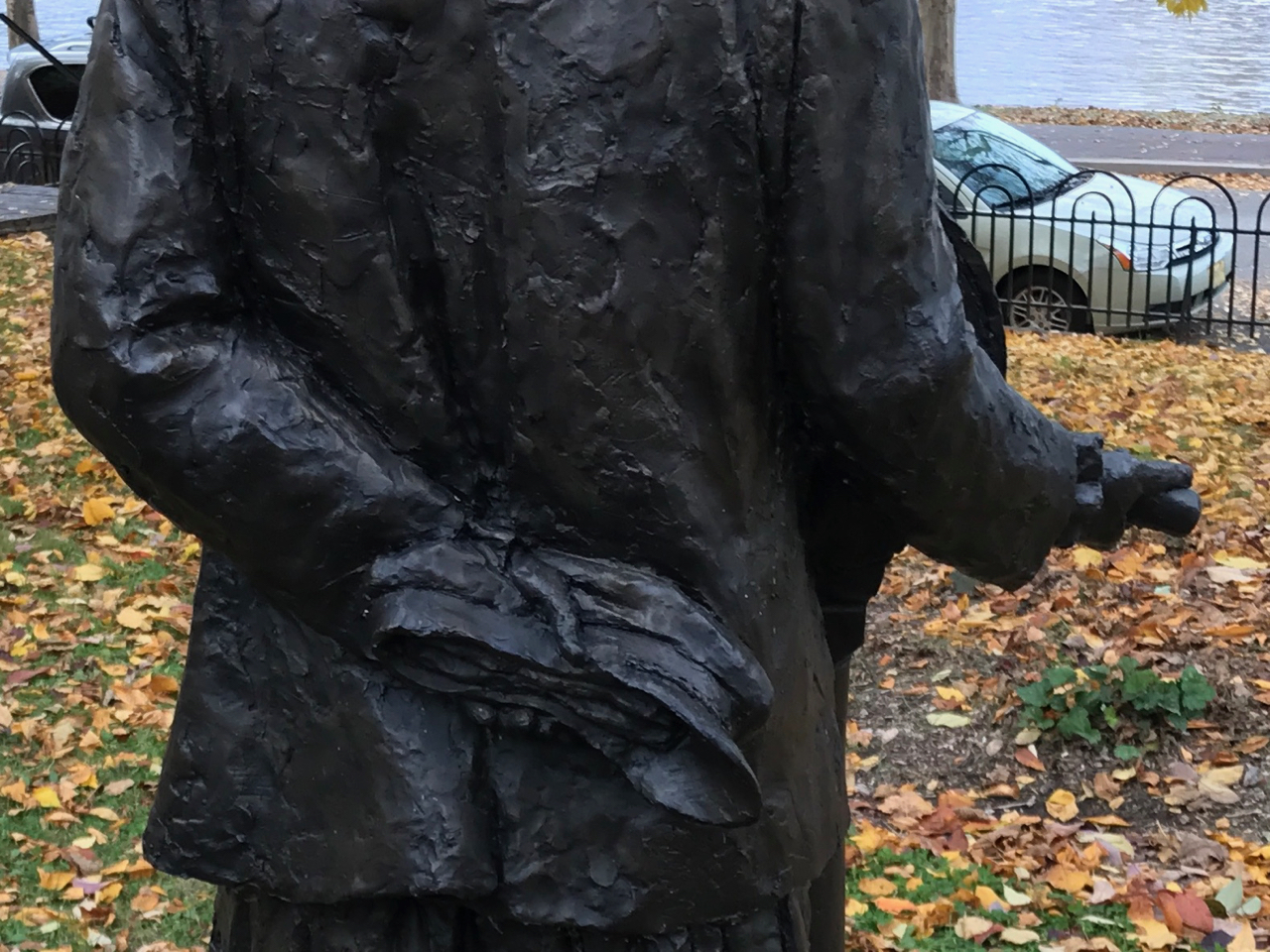
Hmm…I’m not quite sure what it is. It’s time for a closer look.
Ah! She’s holding her captain’s hat.
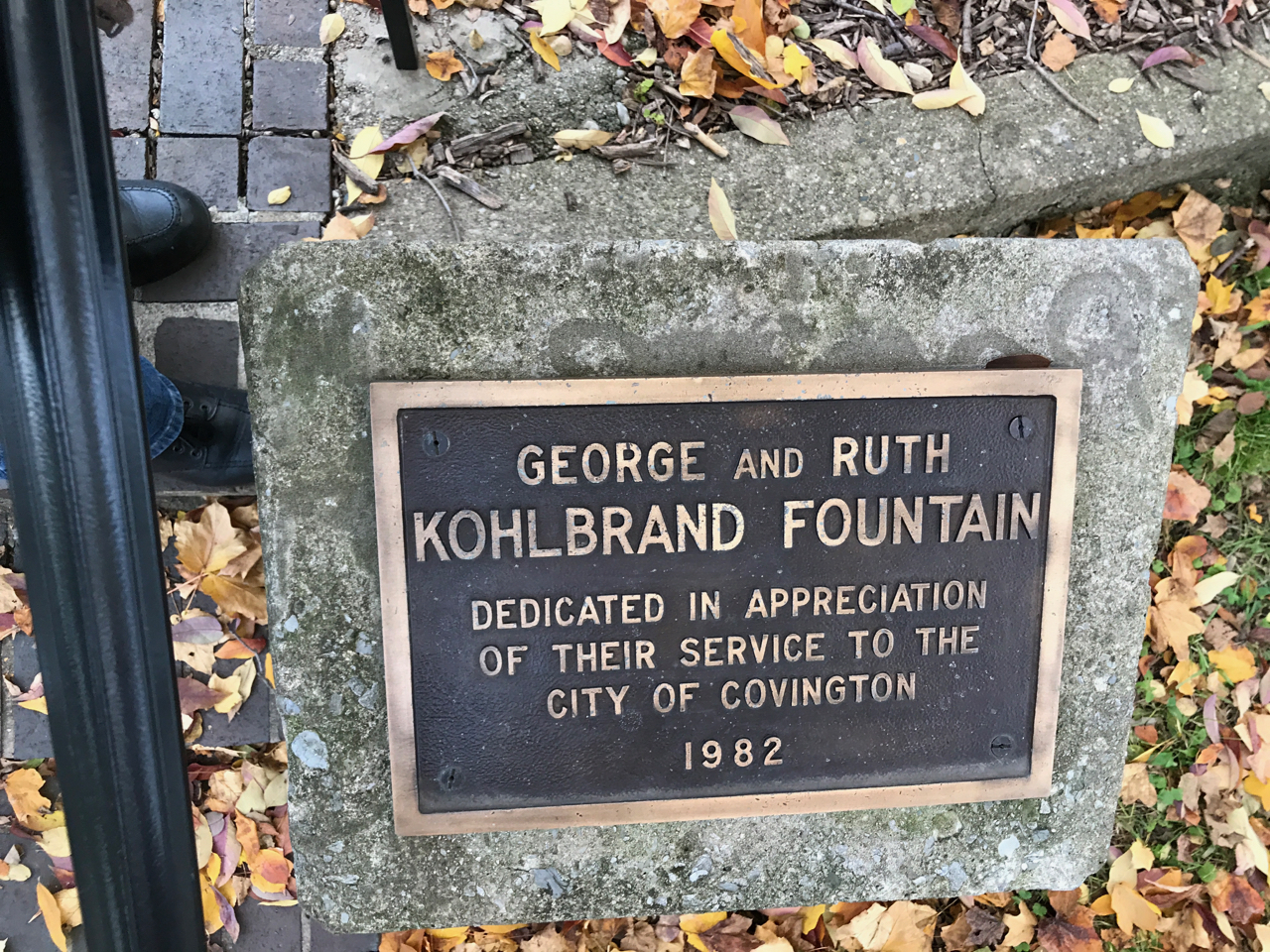
I saw this plaque, but I didn’t see the fountain. I went looking on the Internet for a photo – you know, you can find just about everything if you just look – but I didn’t find one.
I did find a newspaper clipping for George and Ruth. They moved into a house that was right on the park in 1940, and he was born in the area in 1905.
And that’s all I can find about them.
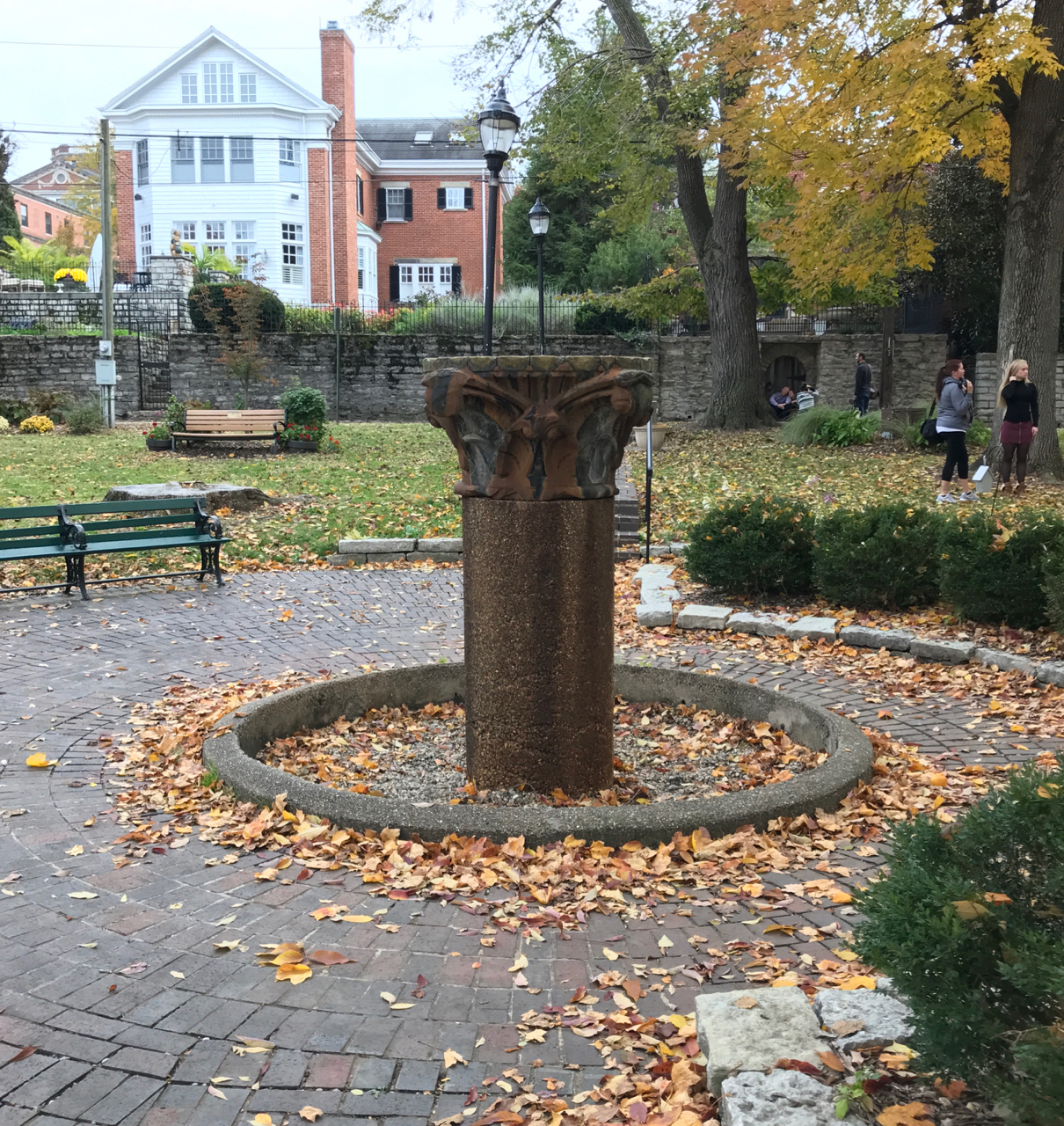
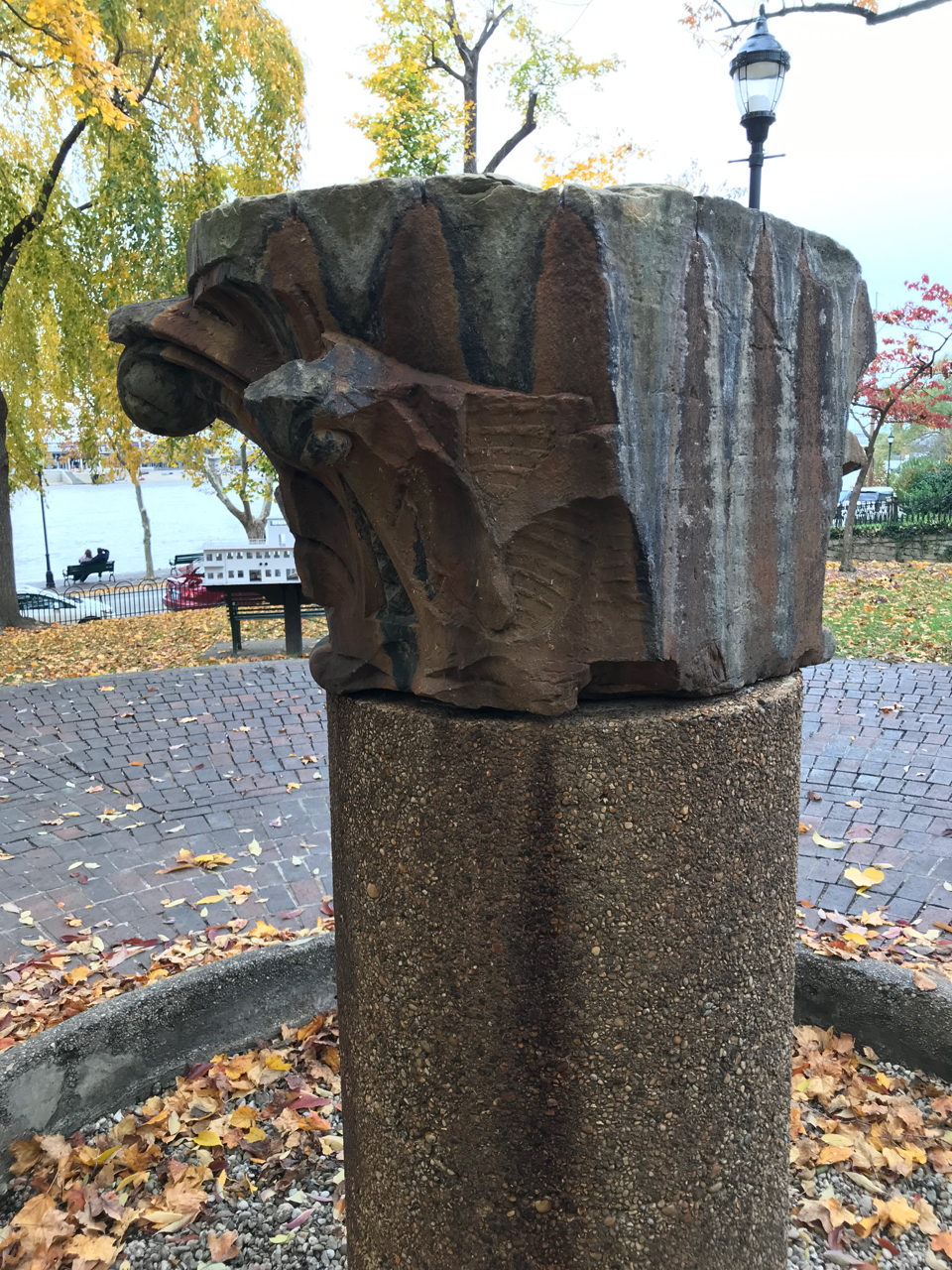
Thought that this might be their fountain, but it doesn’t quite look like a fountain. I mean, the area at the base of the pillar is filled with gravel.
Hmm. This really doesn’t look like a fountain. Next time I’m in the area, I’ll have to look at it more closely.
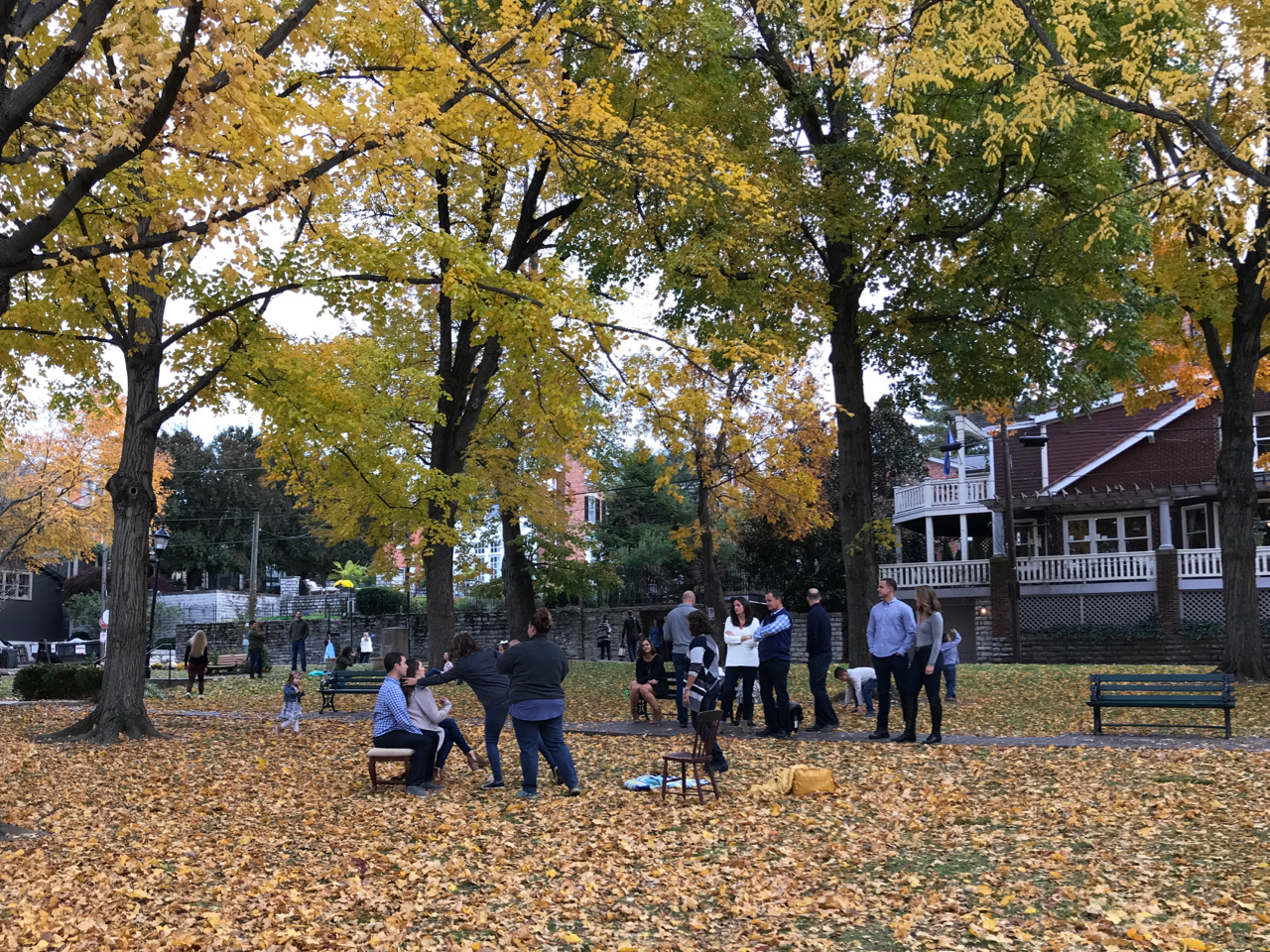
The park was filled with family groups taking photos. I am such an old fogey that my idea of taking pictures of the family is finding someone to point and shoot someone’s camera – a Brownie Hawkeye, a Polaroid Land Camera or maybe an Instamatic. Of course, the shots were out of focus or the heads would be cut off. And, since film and processing was so expensive, people only took one or two shots.
Now, with digital cameras and professional photographers, family portraits are great!
Ron and I kind of had a foot in each world. Digital photo, someone else took it – but it was just a passerby that I passed my phone to. Cheap, yet effective.
One last photo of a memorial to the history of the area before we move on. There were so many plaques and signs and memorials in the park! Maybe I’ll go back someday and read them all. (Or not…)
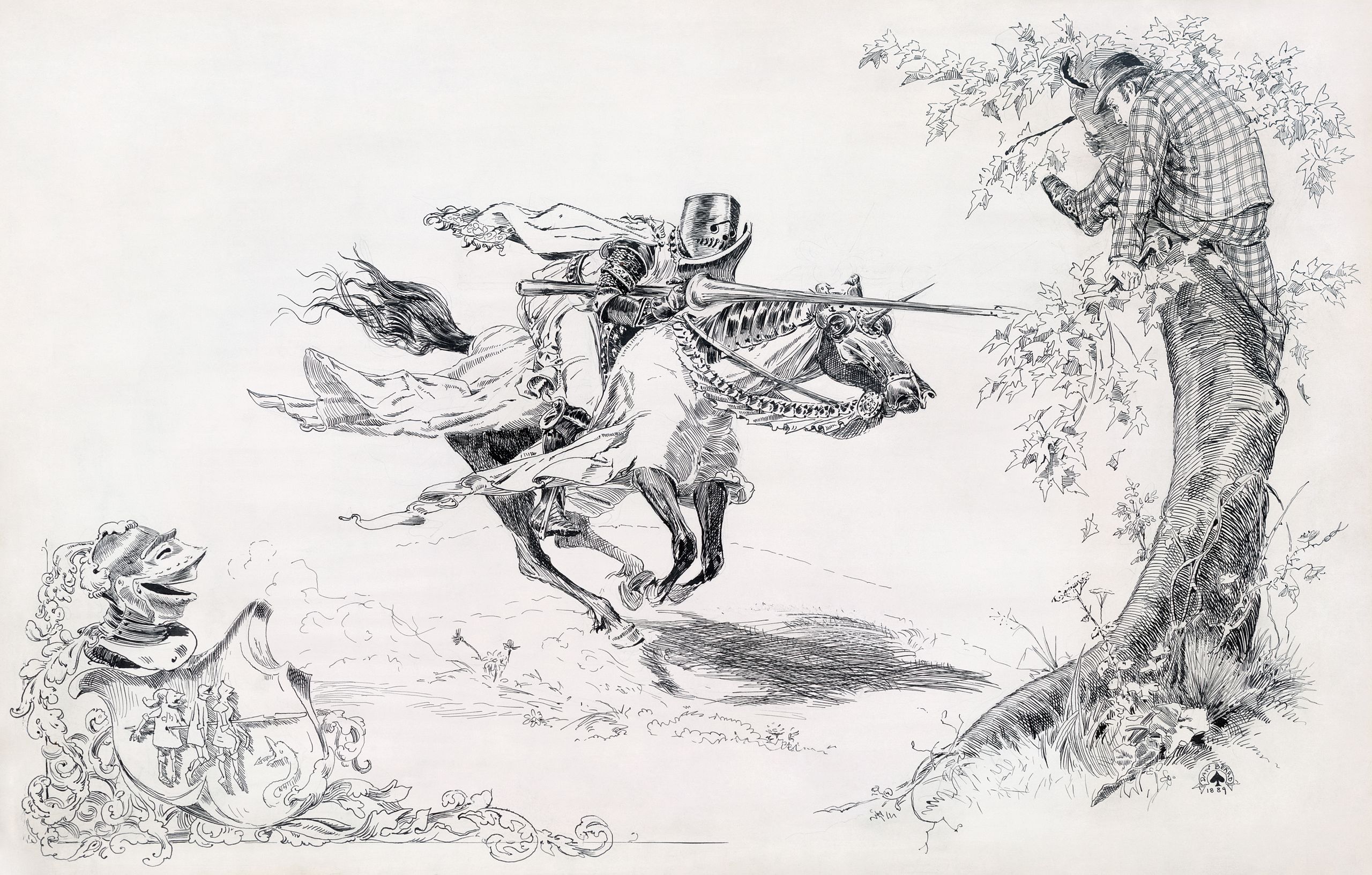
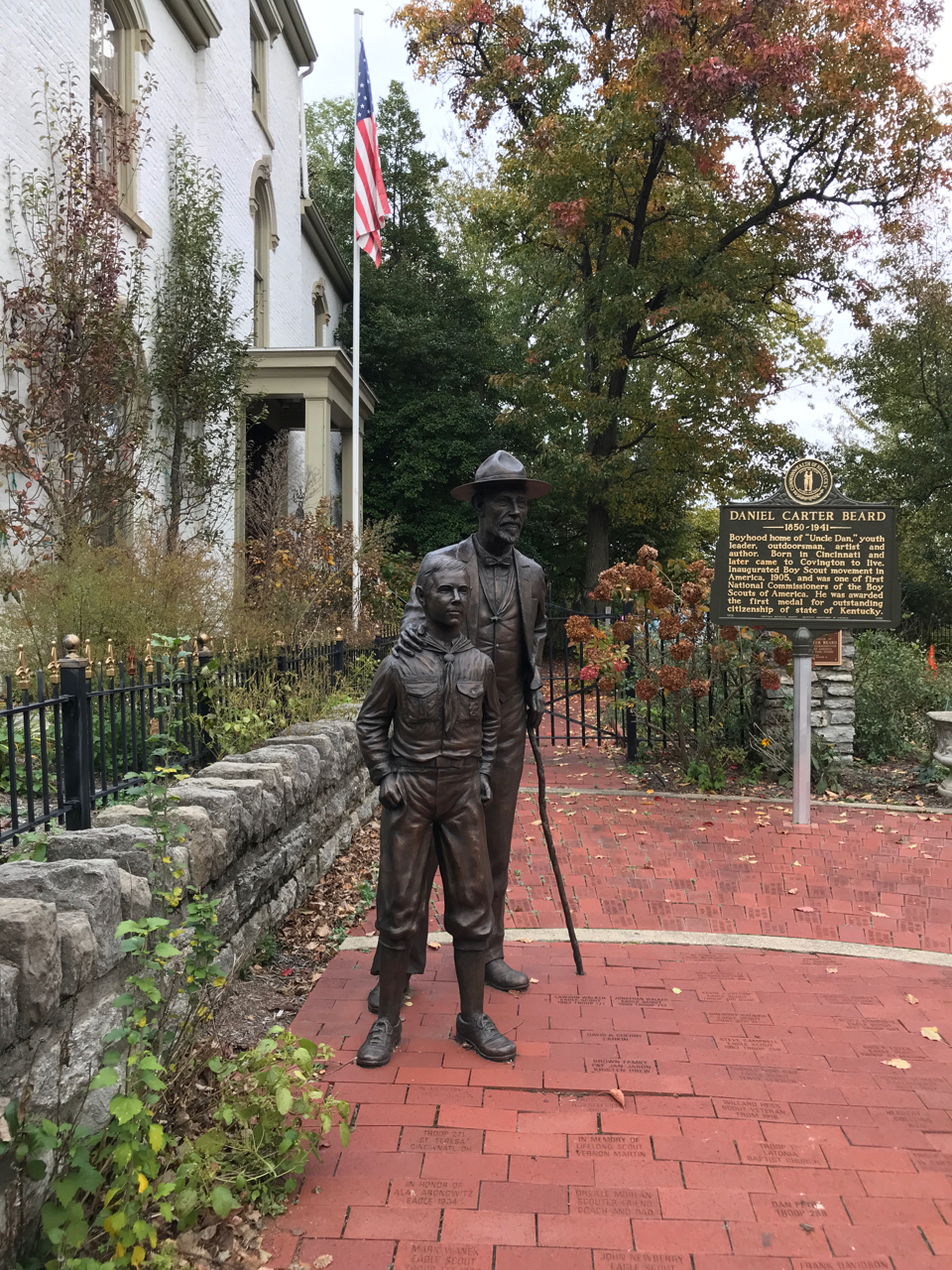
Our second – and last stop in Covington – was the home of Daniel Carter Beard. He is honored as “The Father of Scouting.” “Uncle Dan,” as he was known, was an interesting fellow. In addition to organizing a group called the “Sons of Daniel Boone,” he was an artist, a social reformer and a civil engineer. In fact, he did some work for Mark Twain.
By Daniel Carter Beard – Library of Congress[1], Public Domain, https://commons.wikimedia.org/w/index.php?curid=7016533This was from A Connecticut Yankee in King Arthur’s Court, which was published in 1889.
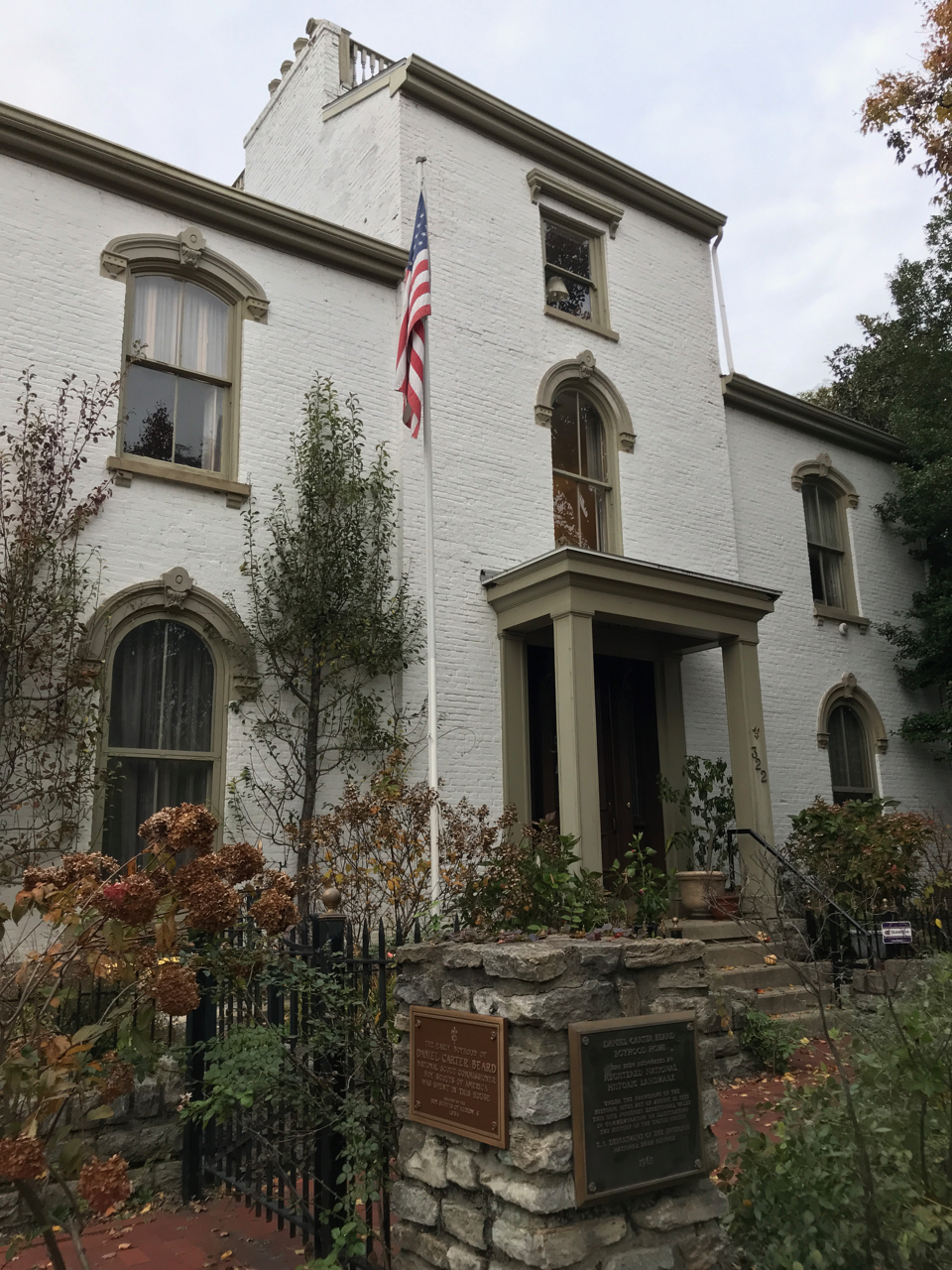
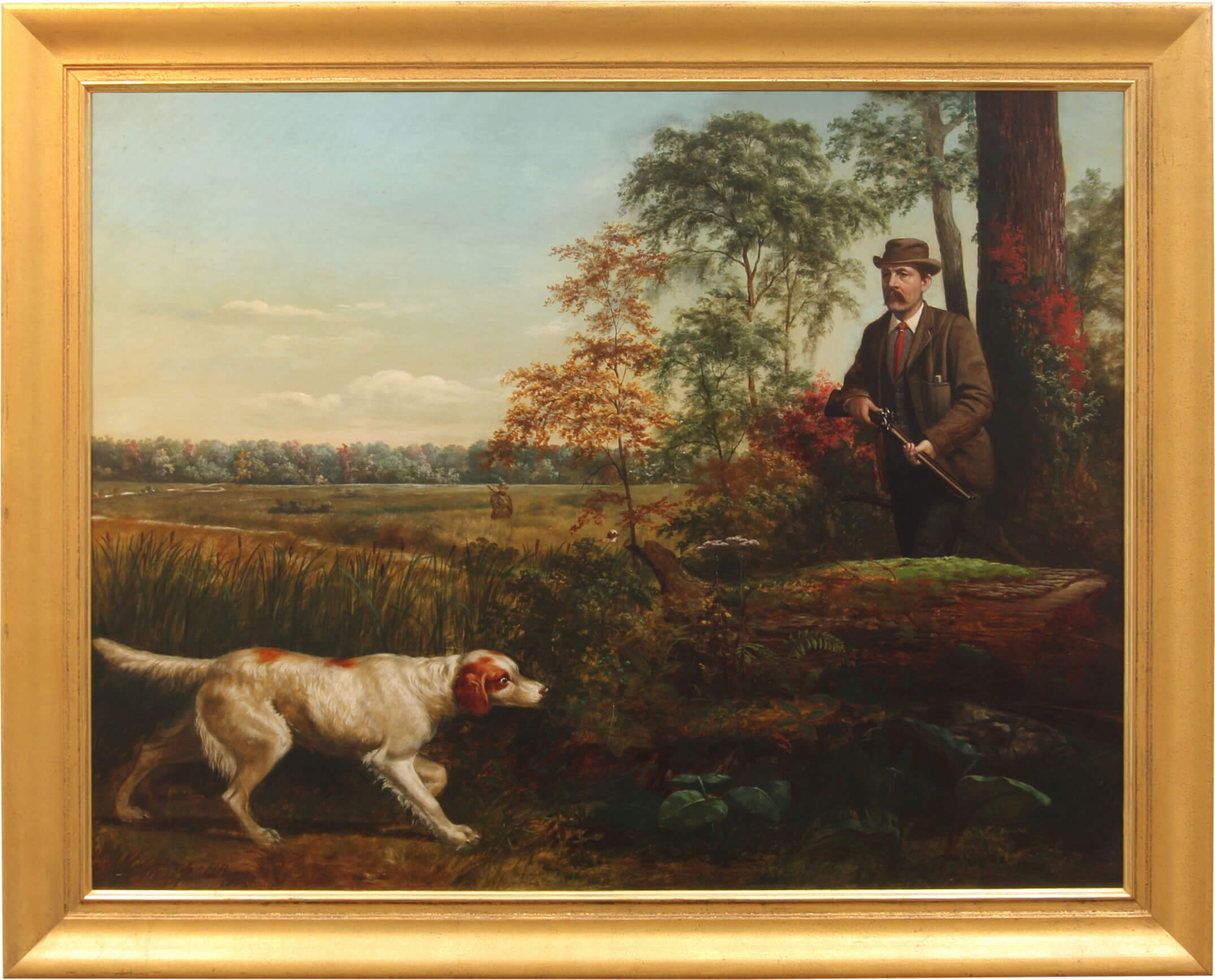
He came from a family of artists, and the home that we stopped to look at was his uncle’s House – William Holbrook Beard. His uncle specialized in satirical paintings of animals performing human-like activities.
By William Holbrook Beard – jwHVtTrNKnH3dQ at Google Cultural Institute maximum zoom level, Public Domain, https://commons.wikimedia.org/w/index.php?curid=22490950
His father, James Henry Beard, was also a painter. Incidentally, he was born in Buffalo, New York in 1812. There happened to be a war going on there in 1812. Not exactly a place you’d want to raise a family. I visited an 1812 cemetery in Buffalo on an earlier trip.
If you are interested in buying this painting, it is for sale at the Bedford Fine Art Gallery in Bedford, Pennsylvania.
Anyway, back to Uncle Dan. He founded his “Sons of Daniel Boone” in 1905, and merged it with the Boy Scouts of America in 1910, and is considered one of the founders.
This sculpture dedicated to him is from the Cincinnati Bicentennial Project in 1988.
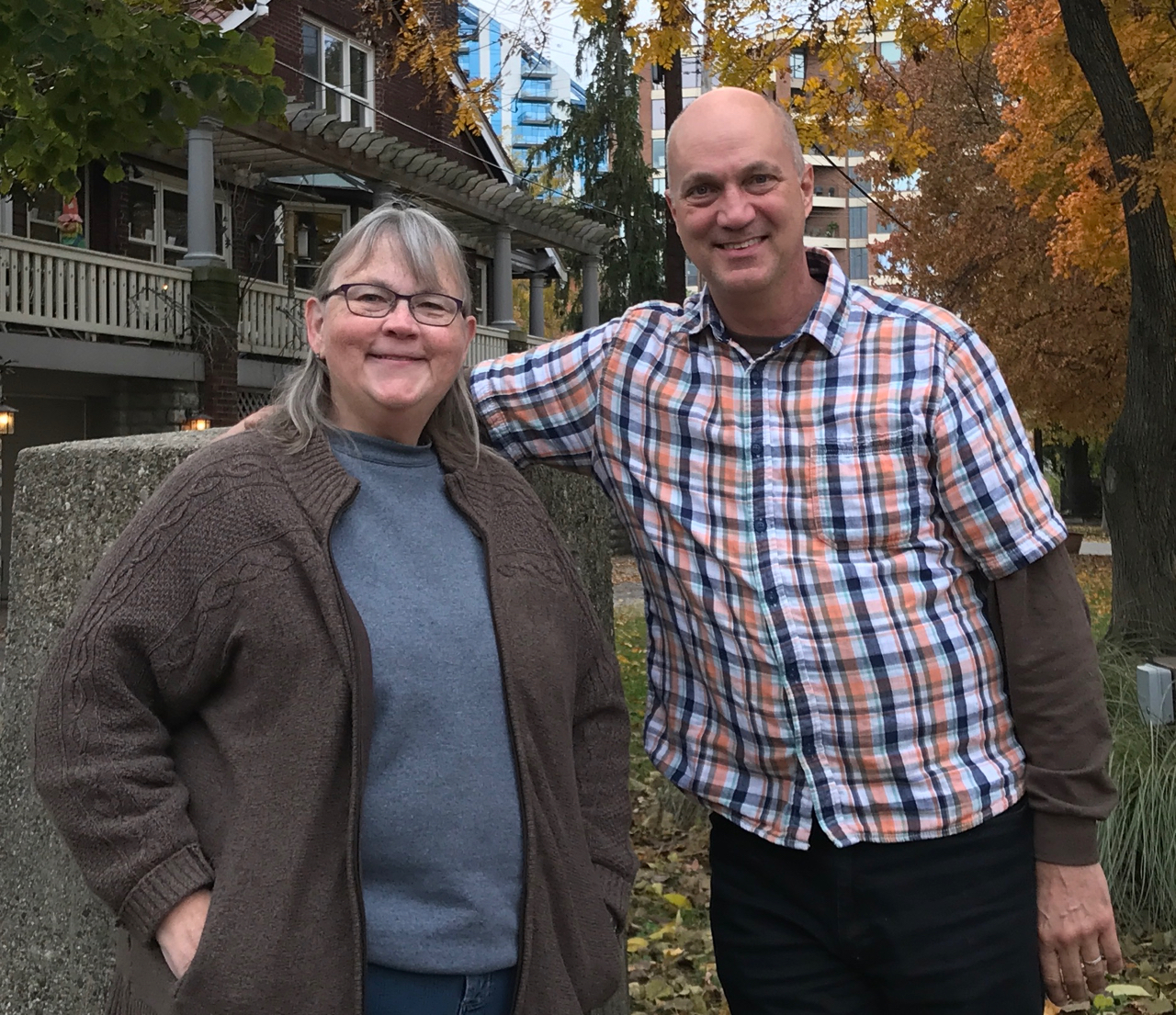
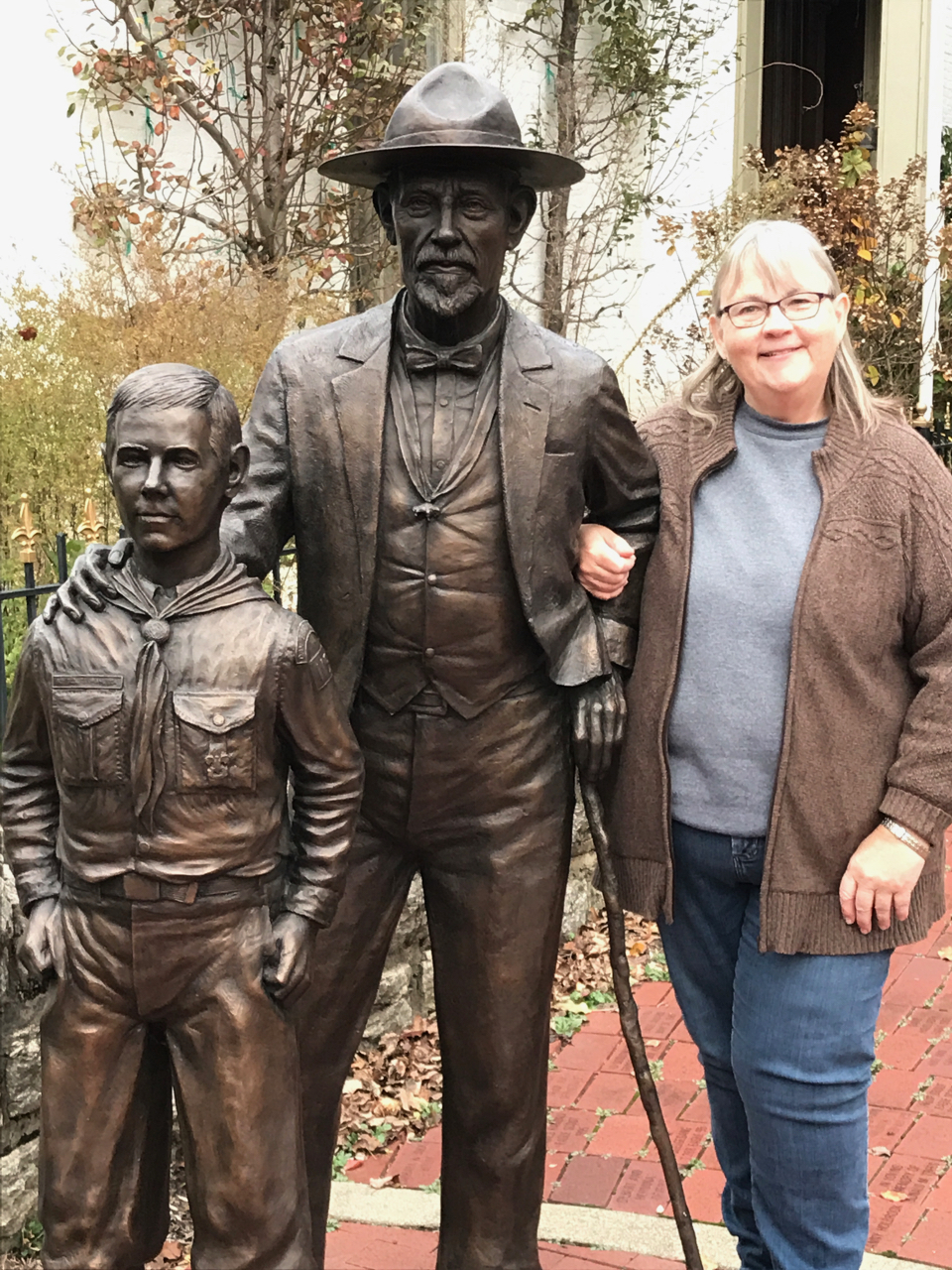
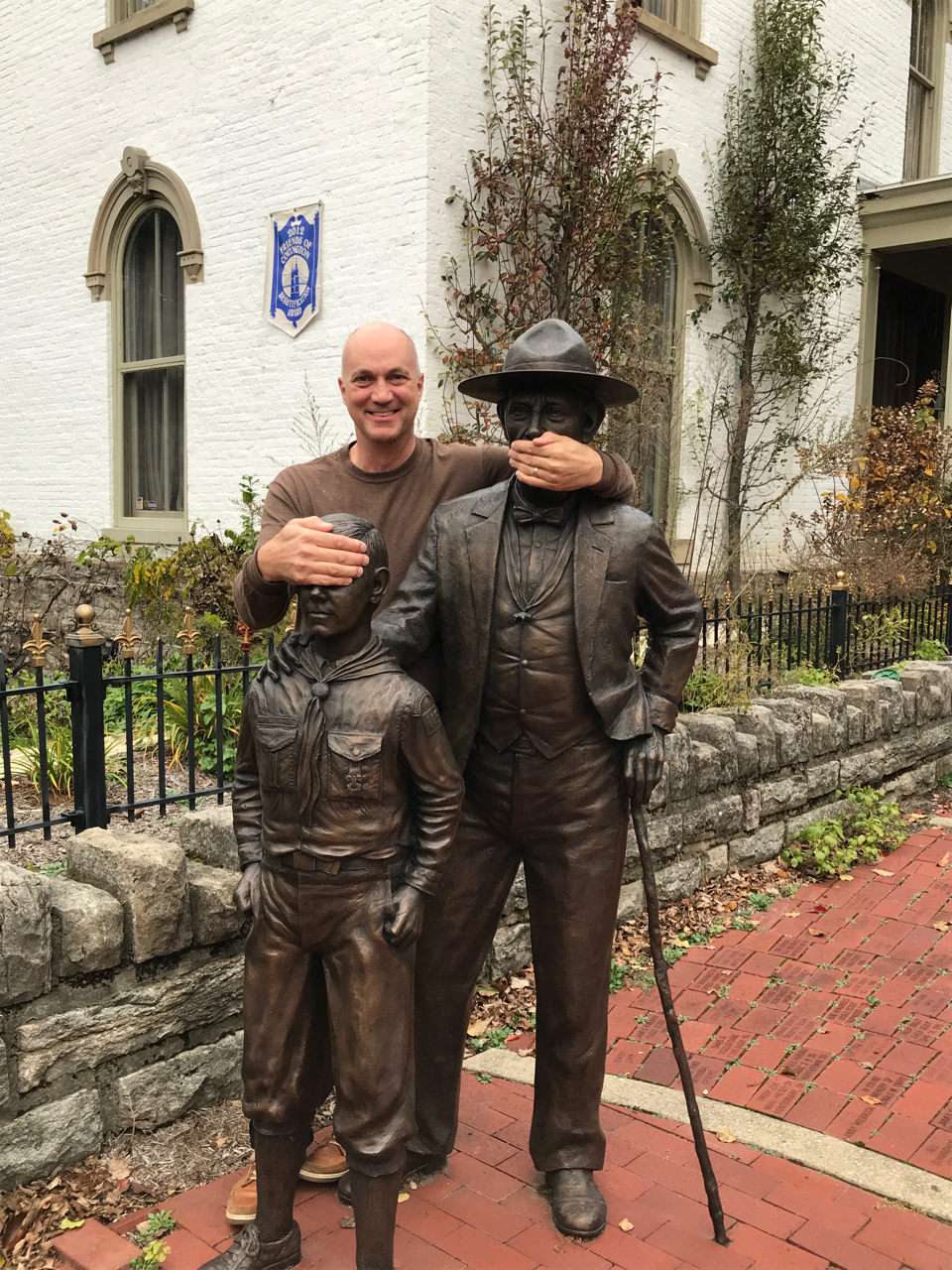
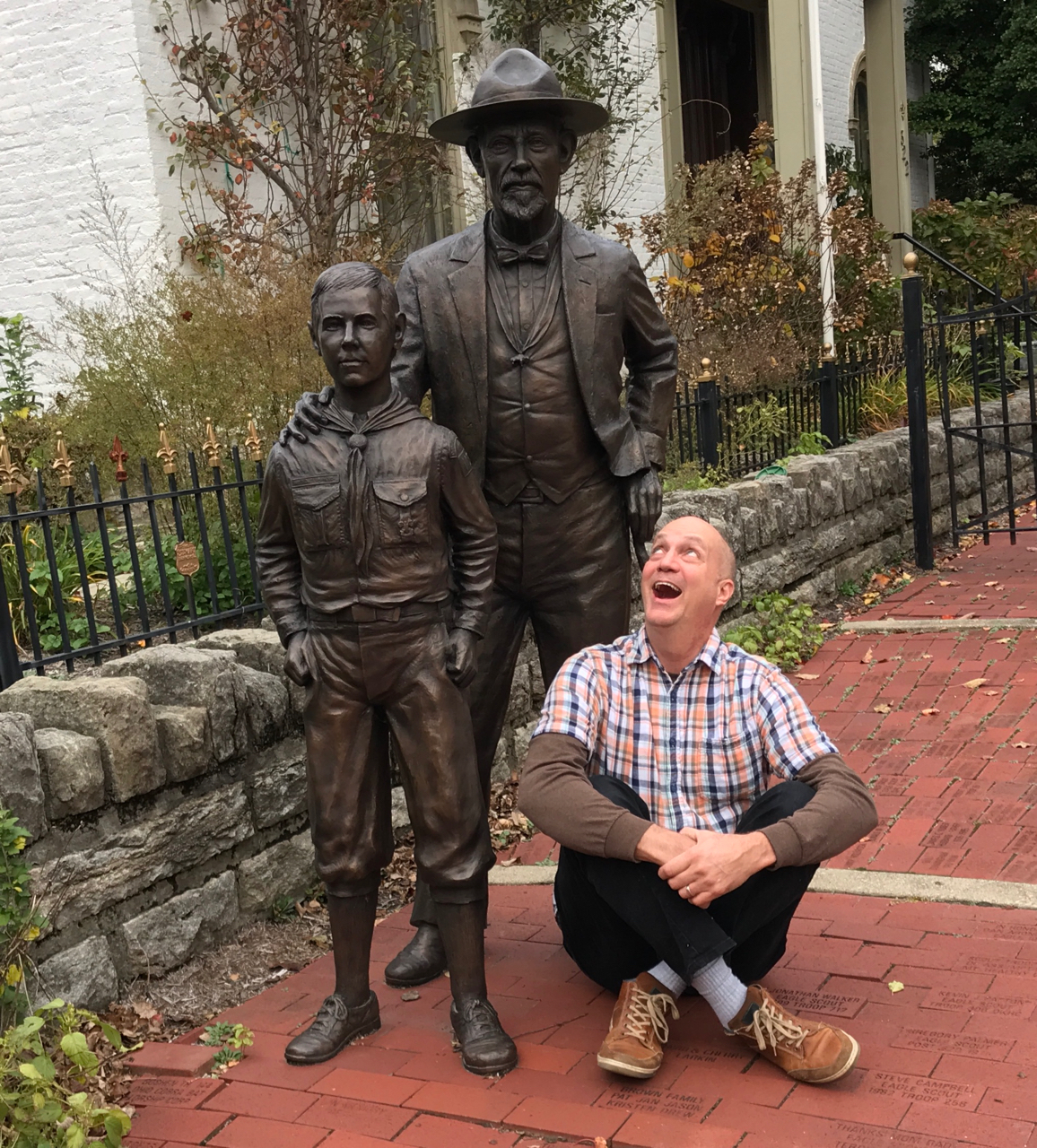
We had to take some photos. Here I am With Uncle Dan and a Boy Scout.
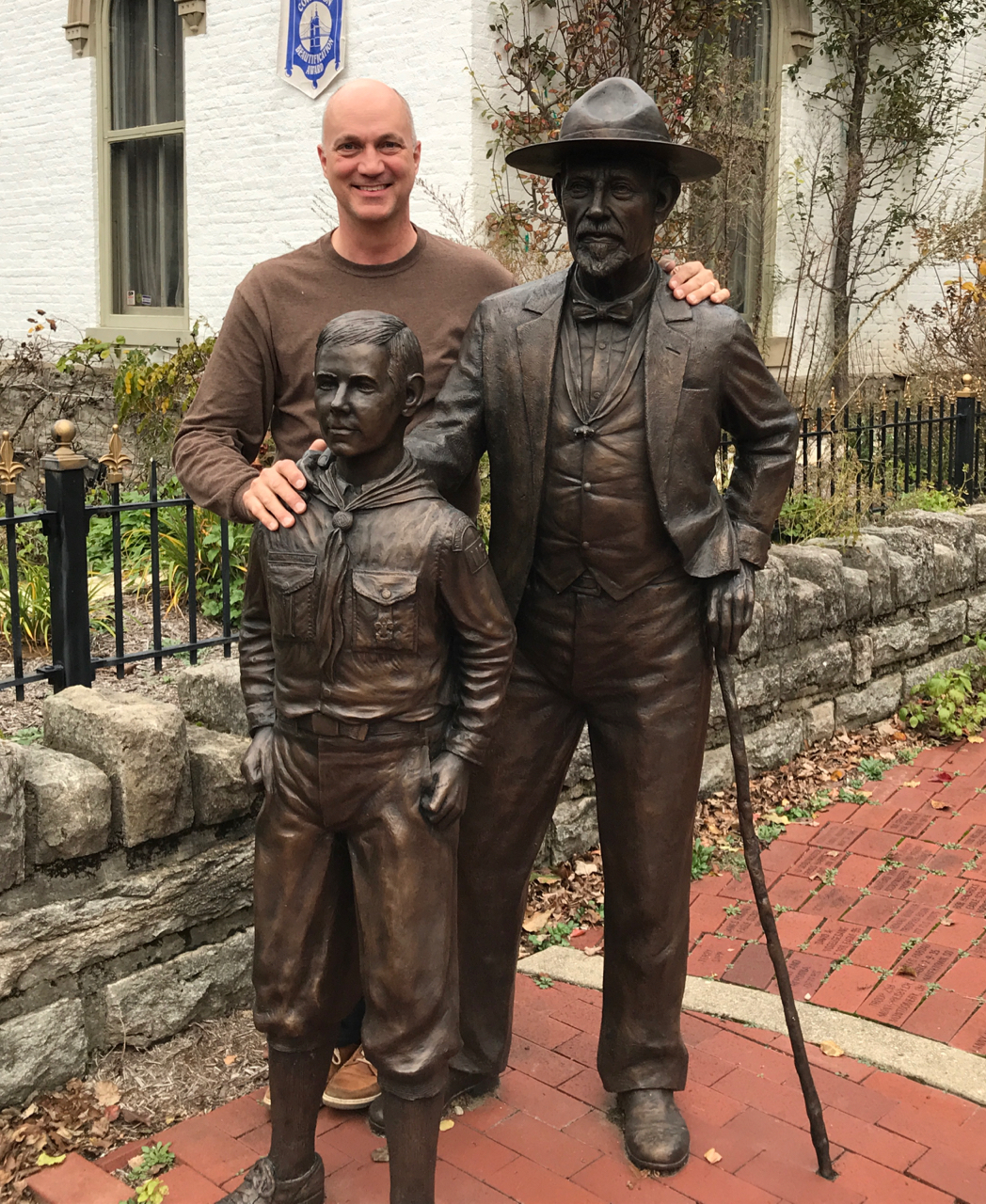
And Ron had his photo taken.
Ron had to get creative! I guess the boy is “see no evil” and Uncle Dan is “Speak no evil.” I guess that leaves “hear no evil” for Ron.
Time for one more funny photo and then it was back to Ron’s house. Dinner and a good night’s sleep and I hit the road in the morning.
I have a lot of different kinds of things on “The List.” One group of things I want to be sure to hit is campgrounds people have recommended. Many People I met during my Airstreaming days were extremely enthusiastic about Kentucky Horse Park Campground. If you are a lover of all things equine, and you want to camp, this is the place for you. It was a good campground with plenty of trees, level, paved sites and enough space between the sites so that you didn’t feel crowded. Who could ask for more?
The campground is part of the Kentucky Horse Park. Not only is it close to the horses and the horse museums, it is close to Lexington. I didn’t have too much time to spend in the area, so I didn’t visit the museums or Lexington. I spent a couple of days in Lexington during my first year on the road, so I didn’t feel bad about skipping it on this trip.
No, my goal was to visit Frankfort, the capital of the Commonwealth of Kentucky. It was only about 25 miles to the Northwest.
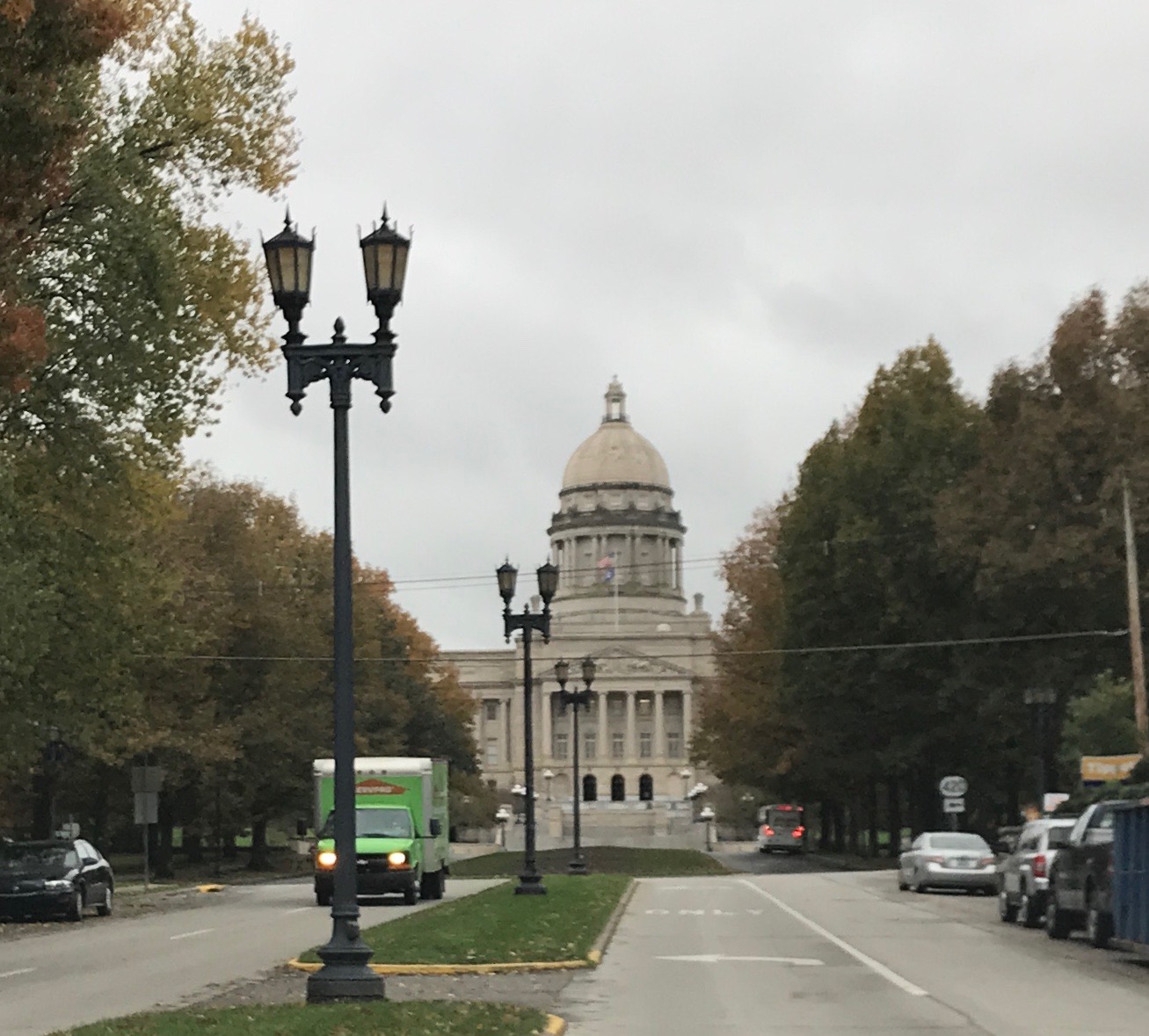
I arrived in Frankfort. It wasn’t too hard to pick out the capitol. Although it is the capitol of Kentucky, it has a small-town feel to it. I looked up the population and discovered that an estimated 28,000 people live there. It is classified as a home-rule class city.
In Kentucky, there are currently two classes of cities: First class and home rule. There used to be many more different categories, but they switched things around a few years ago. There are 419 cities in Kentucky. Two of them are first class cities – Lexington and Louisville – and the rest are home rule.
On to the capitol!
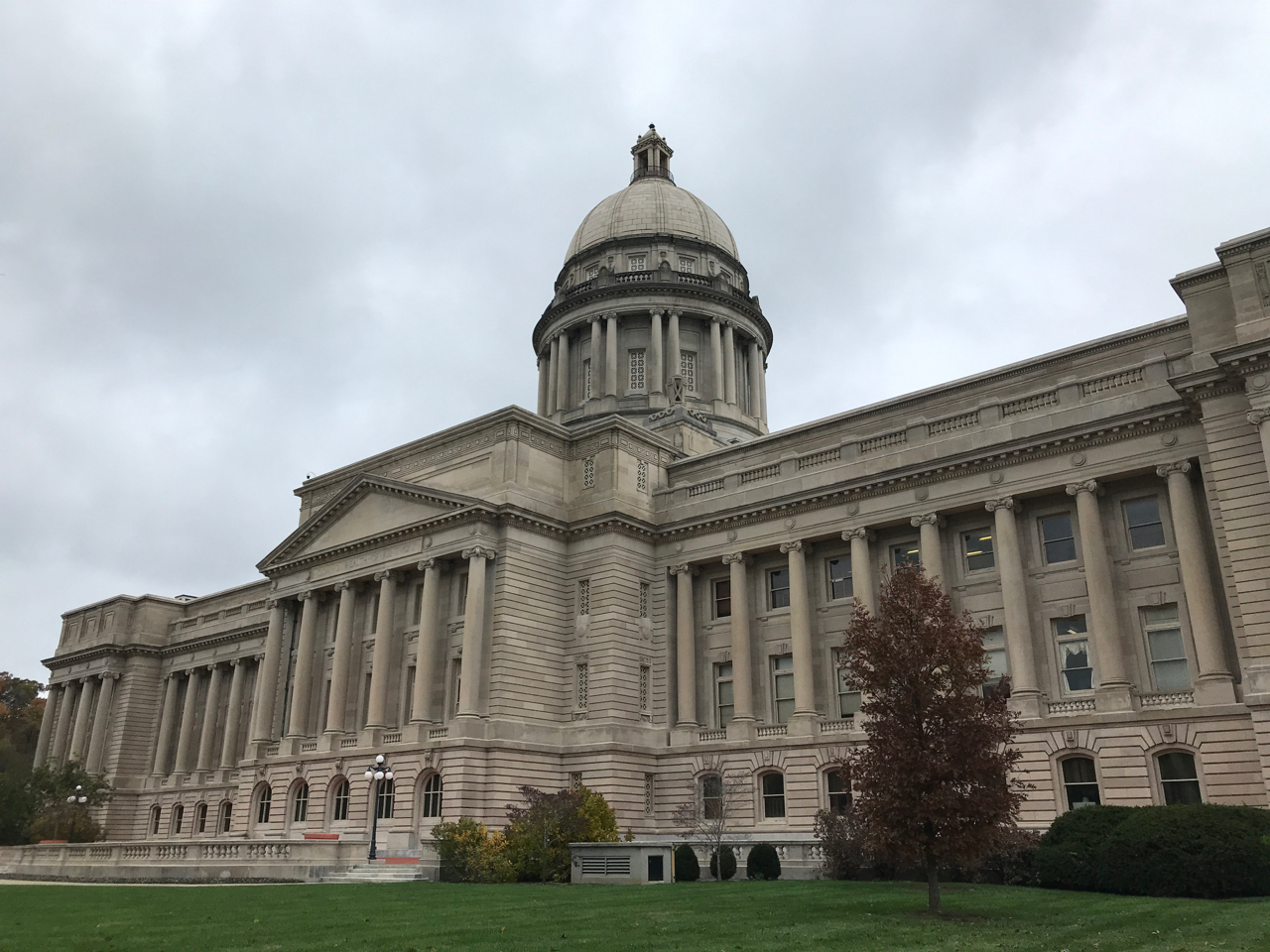
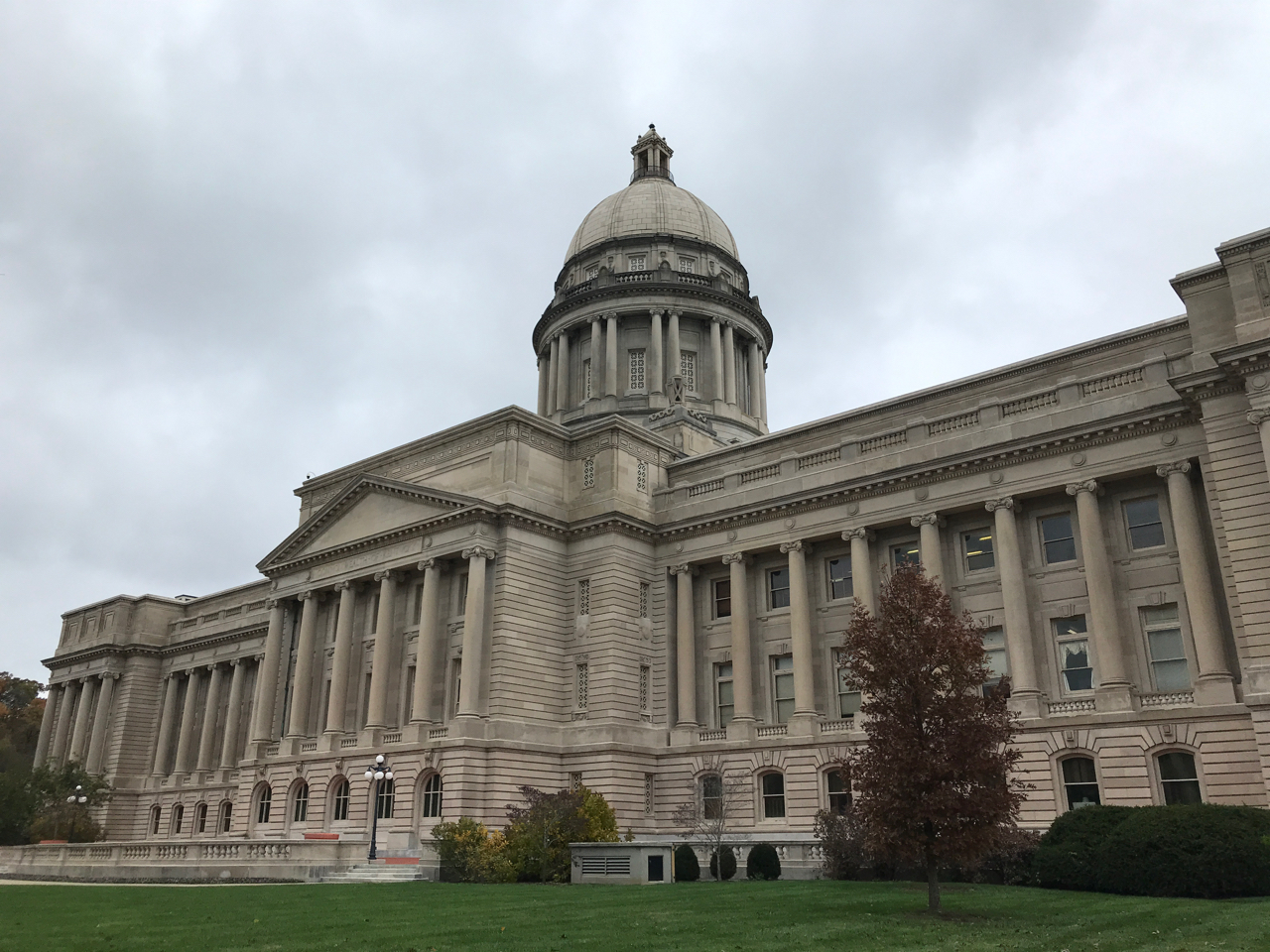
This stately building was inaugurated in 1910. Designed by Frank Mills Andrews, he used the Beaux-Arts style.
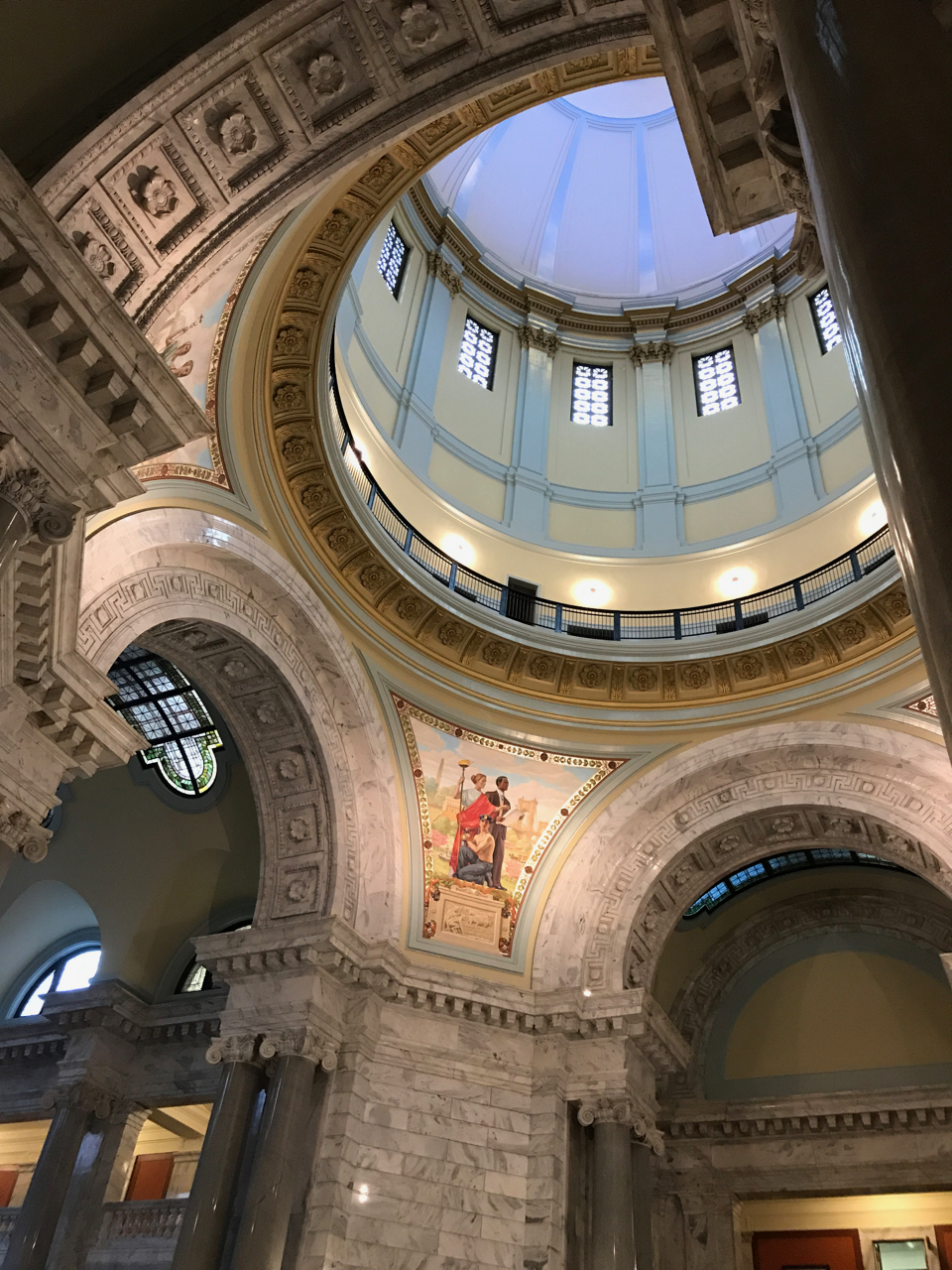
Now, this capitol has a dome and a rotunda. I entered and walked in to see what I could see.
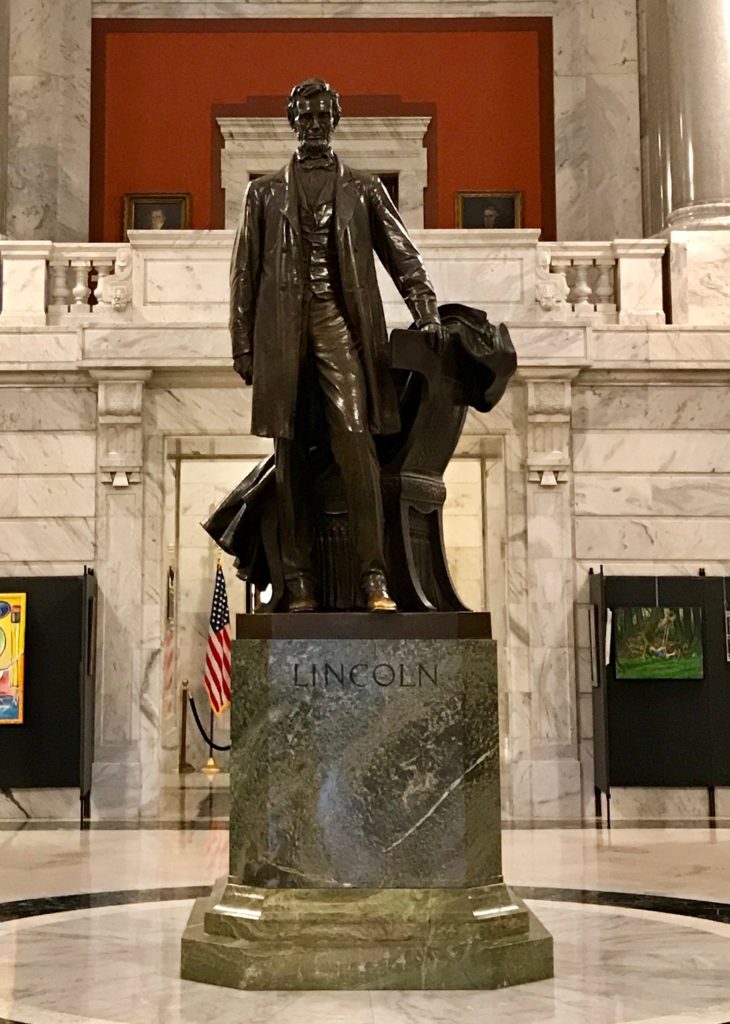
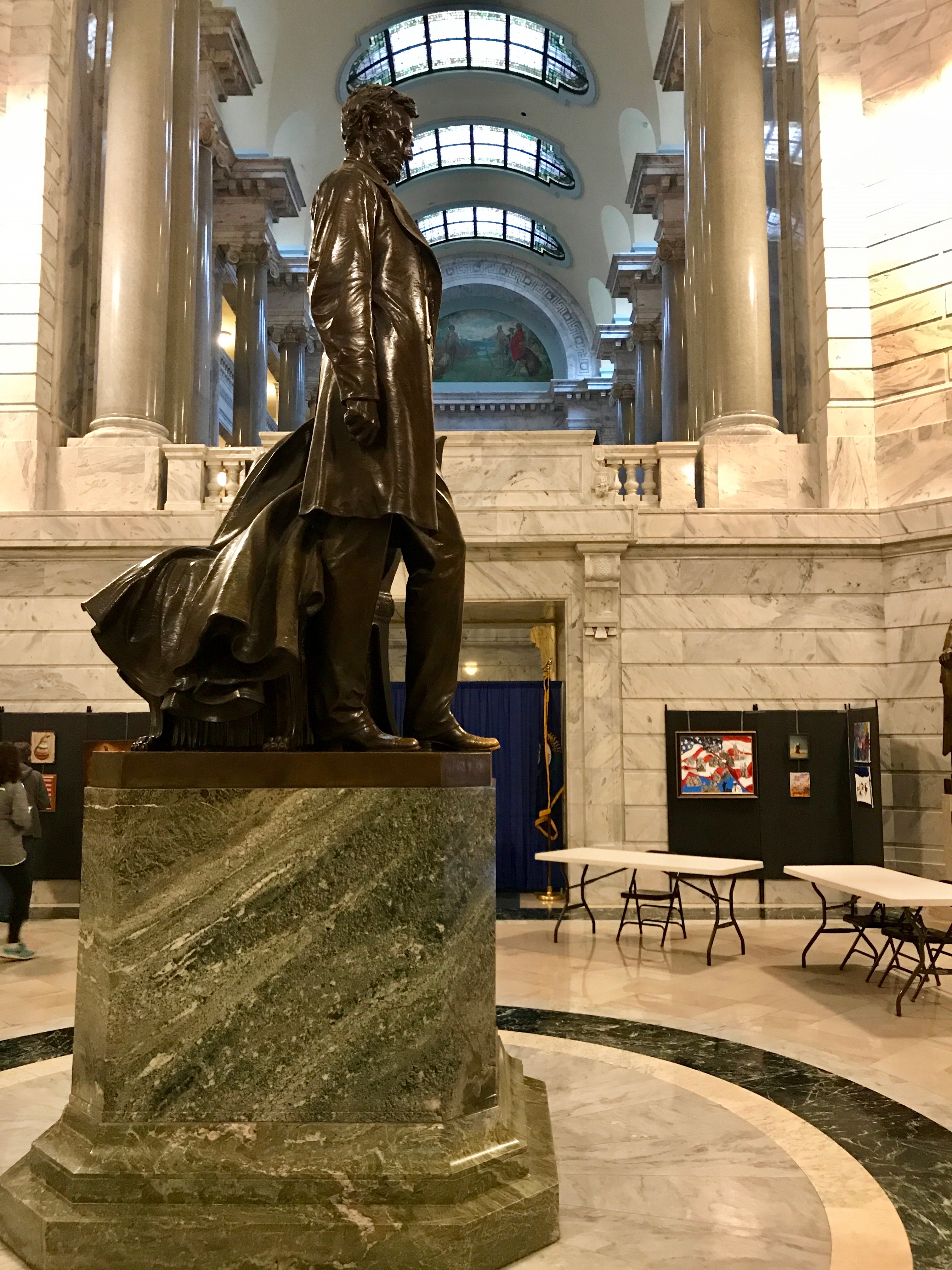
In the center of the rotunda, I was greeted by native son, Abraham Lincoln. He was born in a log cabin in Kentucky near Sinking Spring. You can still see the spring if you visit Abraham Lincoln Birthplace National Historic Site, which is about an hour and a half from Frankfort. I visited in 2014, and I’d say it’s worth a visit.
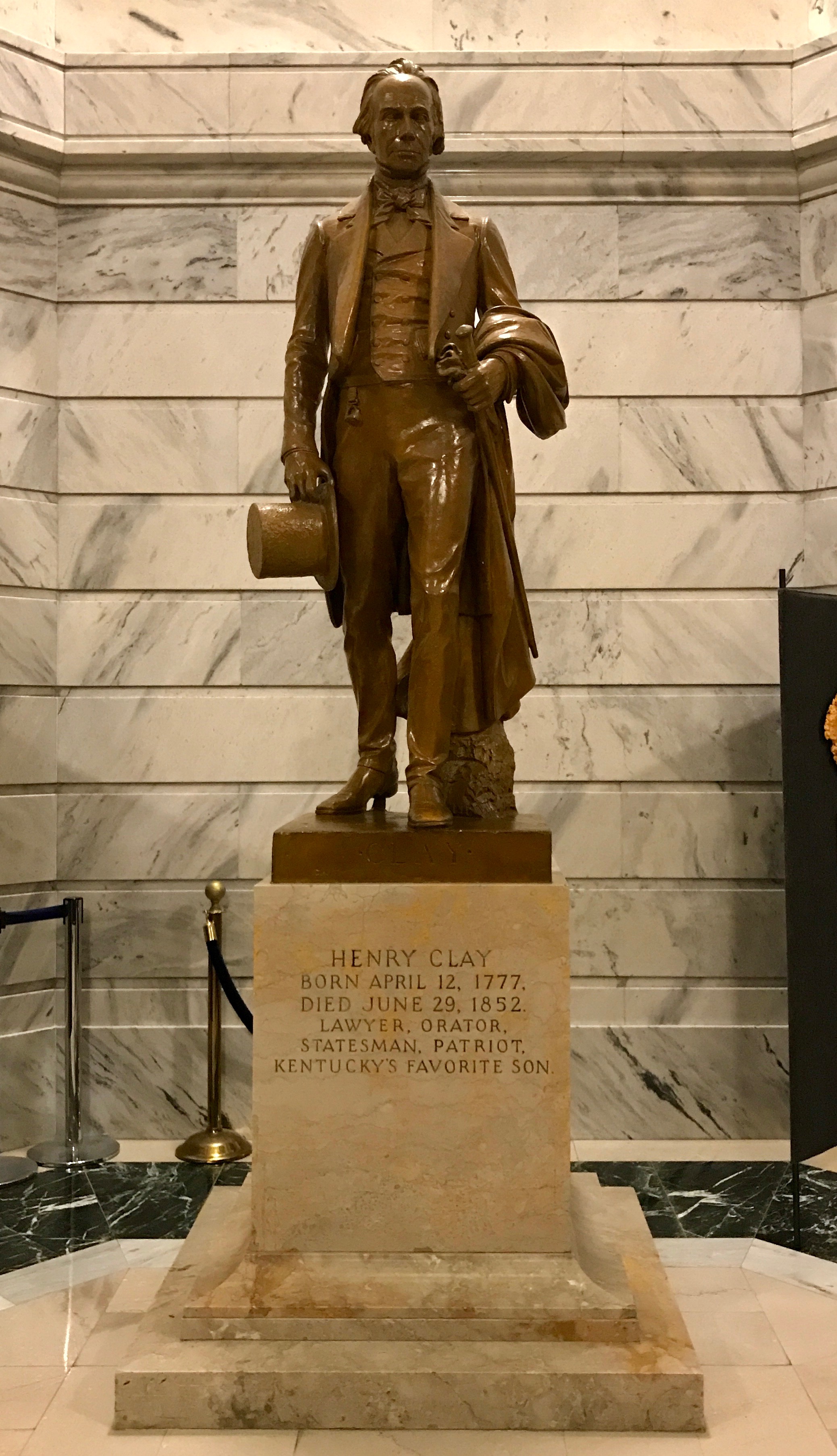
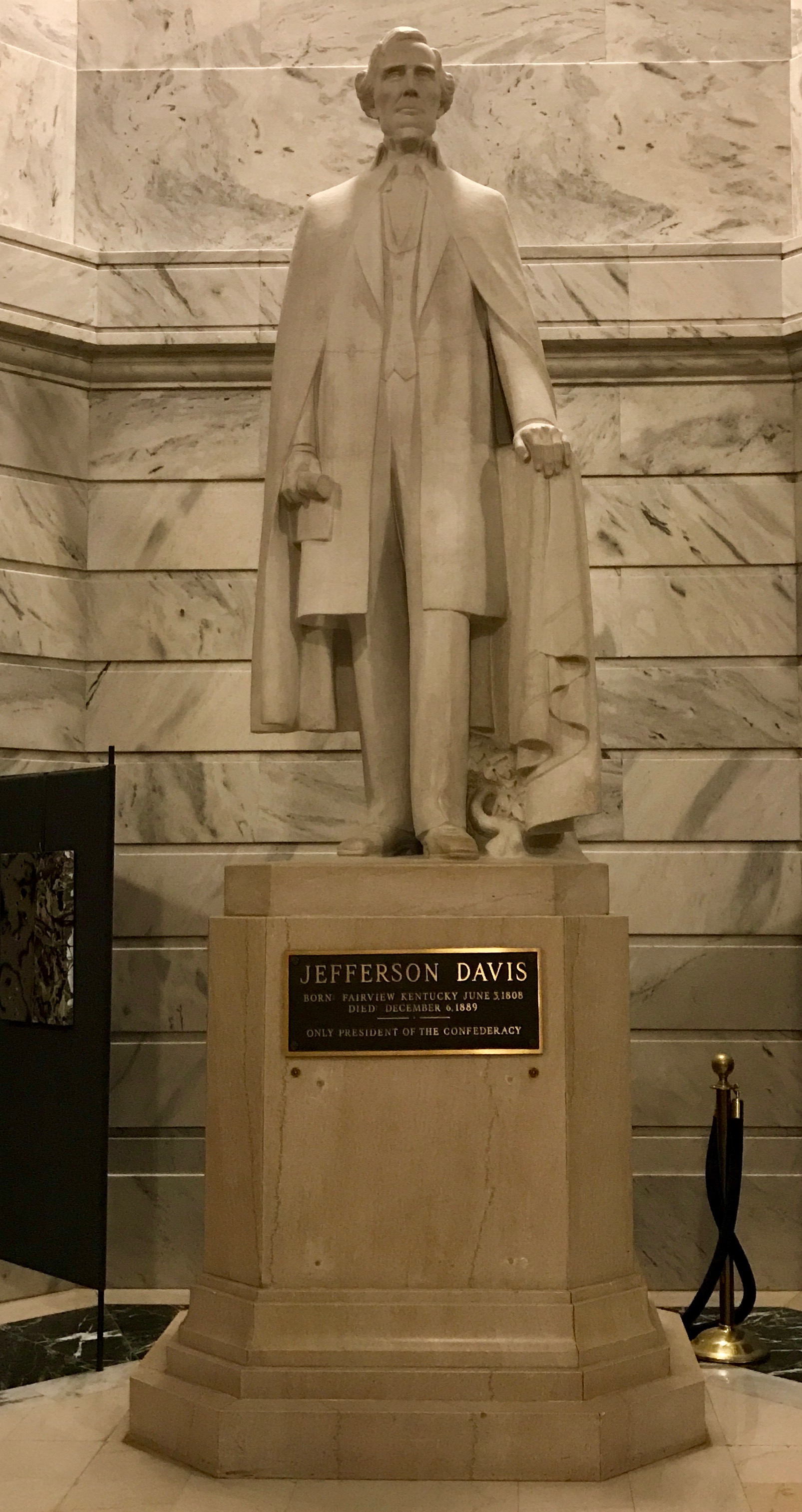
Surrounding Lincoln are other statues honoring other significant Kentuckians.
Alben W. Barkley, who was elected to the U.S. House and Senate and served as Vice President with Harry S Truman.
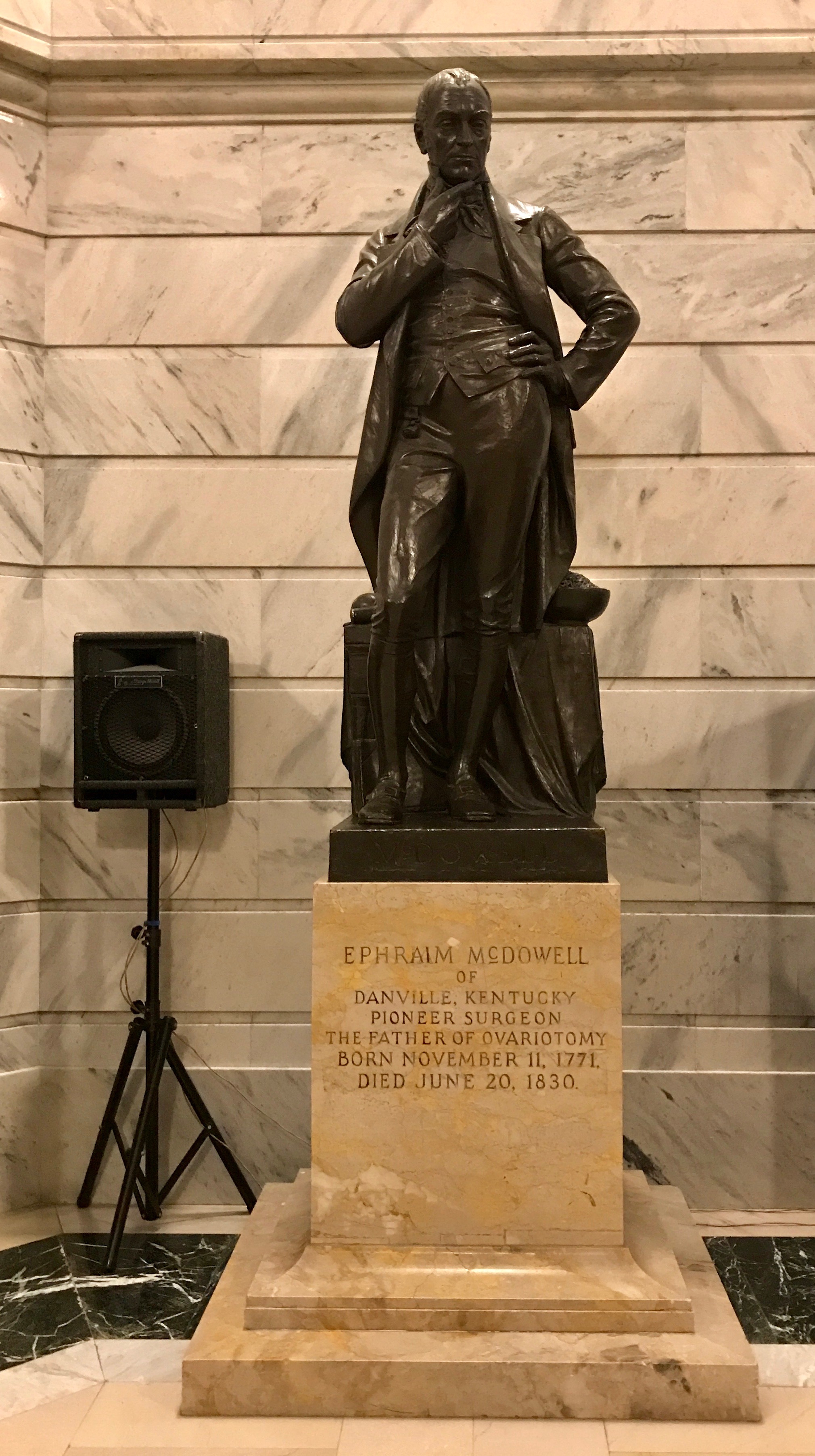
Then there is Ephraim McDowell, who was a pioneer surgeon. He was the “Father of the Ovariotomy.” If you remember your suffixes, you’ll remember -otomy means “the removal of” and it comes from the Greek “ectomy.”
Okay, this ‘pioneer surgeon” was removing ovaries with, apparently, morpheine the only option for anesthesia and before Joseph Lister got antiseptic surgical procedures to be accepted. It boggles the mind. Well, my mind is boggled.
Henry Clay was born in Virginia in 1777, but moved to Kentucky before the end of the century. He served in the U.S. House and Senate as well as serving as Secretary of State under John Quincy Adams. He died while he was serving as Senator.
Then, there is Jefferson Davis. Born in Fairview, Kentucky, he moved at an early age to Mississippi. He is honored for two things: being born in Kentucky and being the only president of the Confederacy. Seems like just maybe they could have found a woman to honor somewhere in Kentucky’s history.
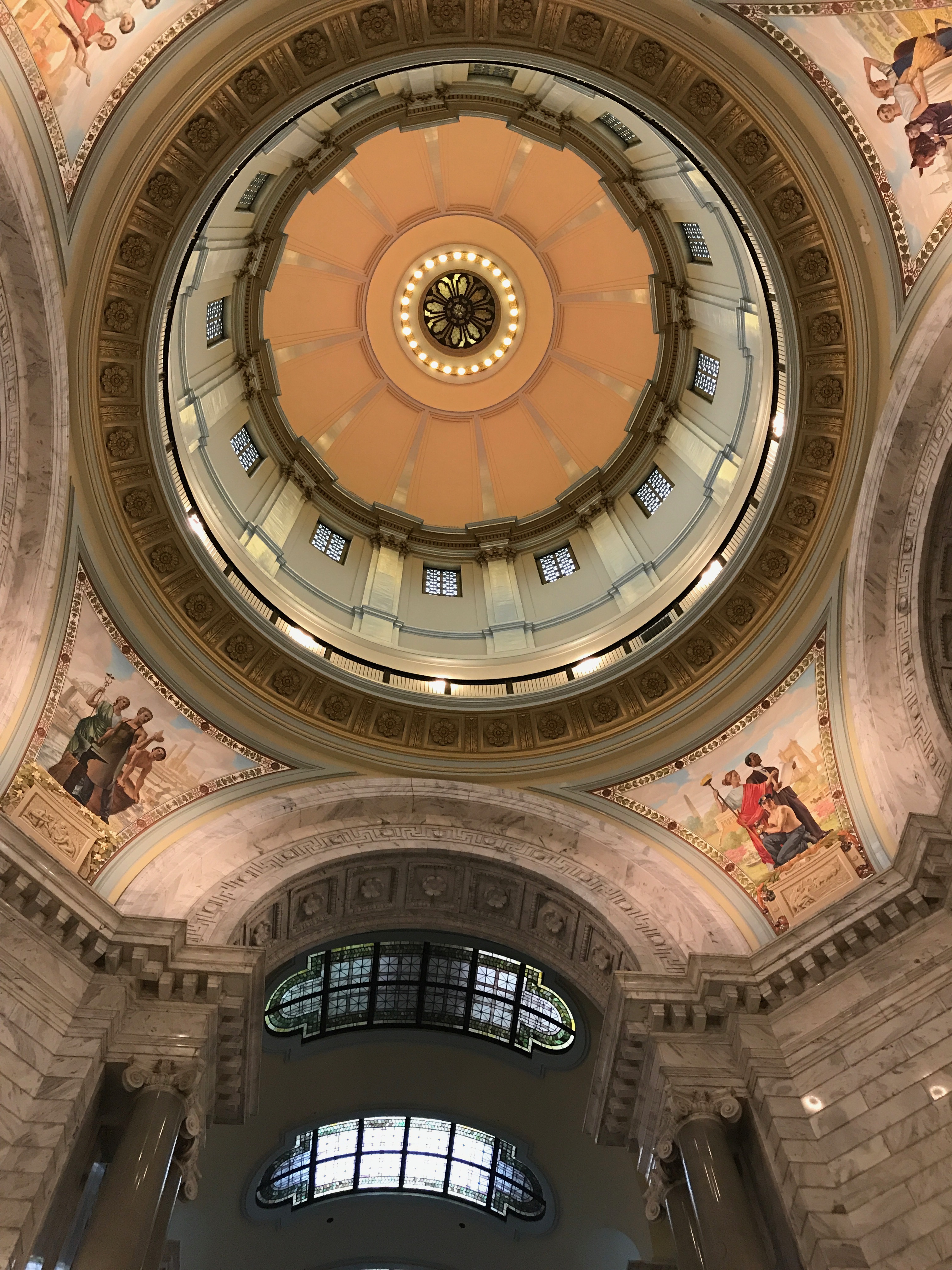
The dome is something to behold – but more about that later.
Just another look around before I head off to explore.
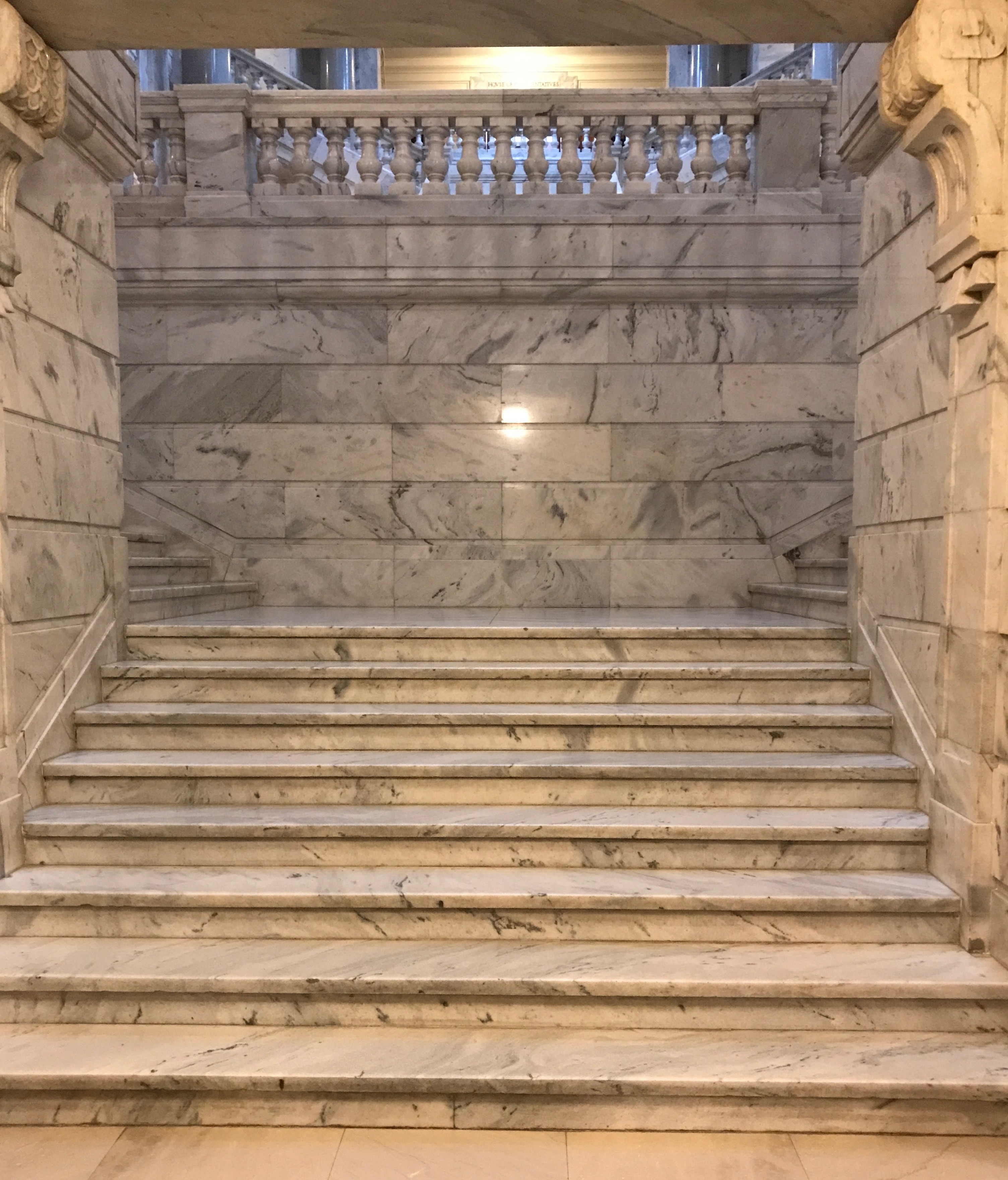
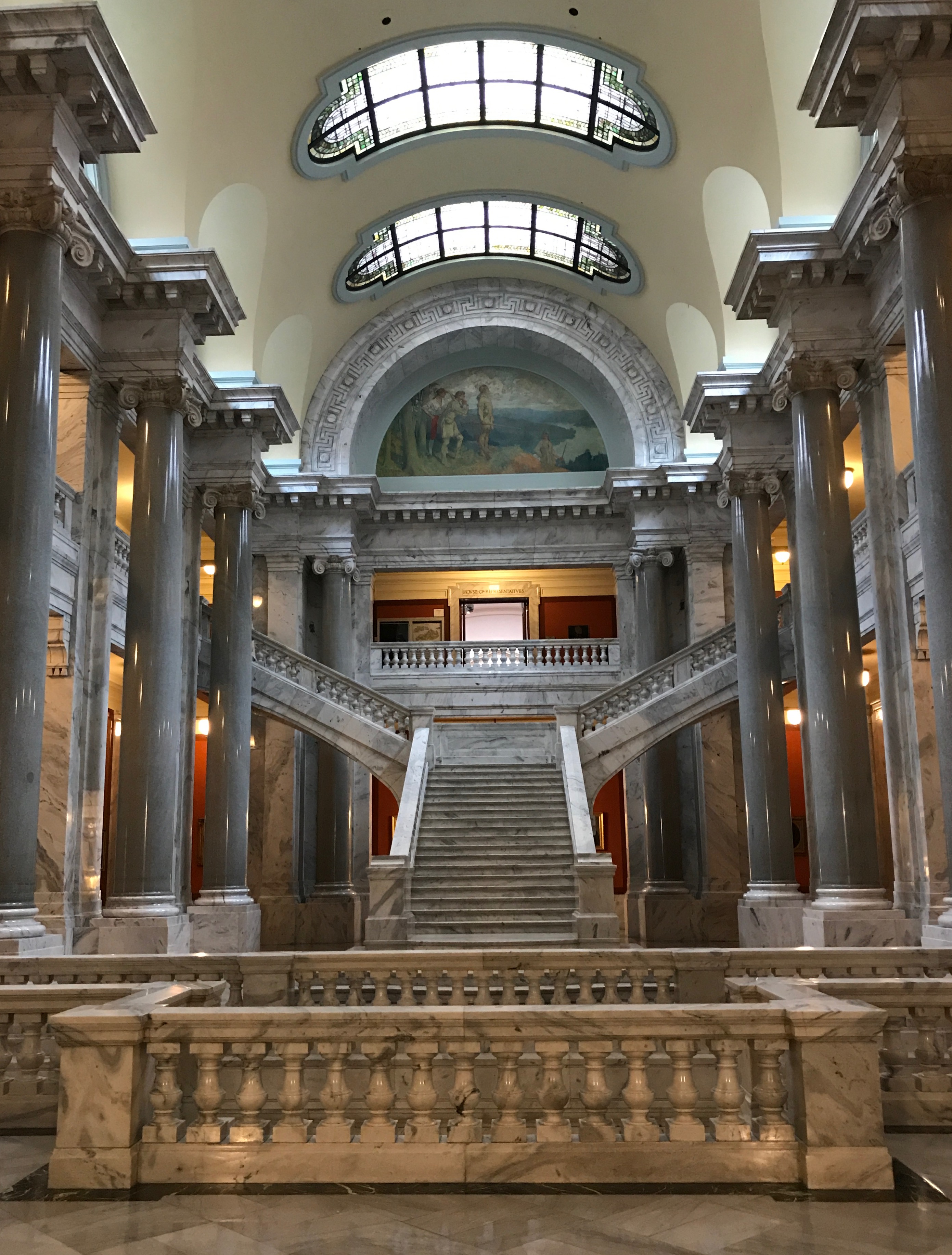
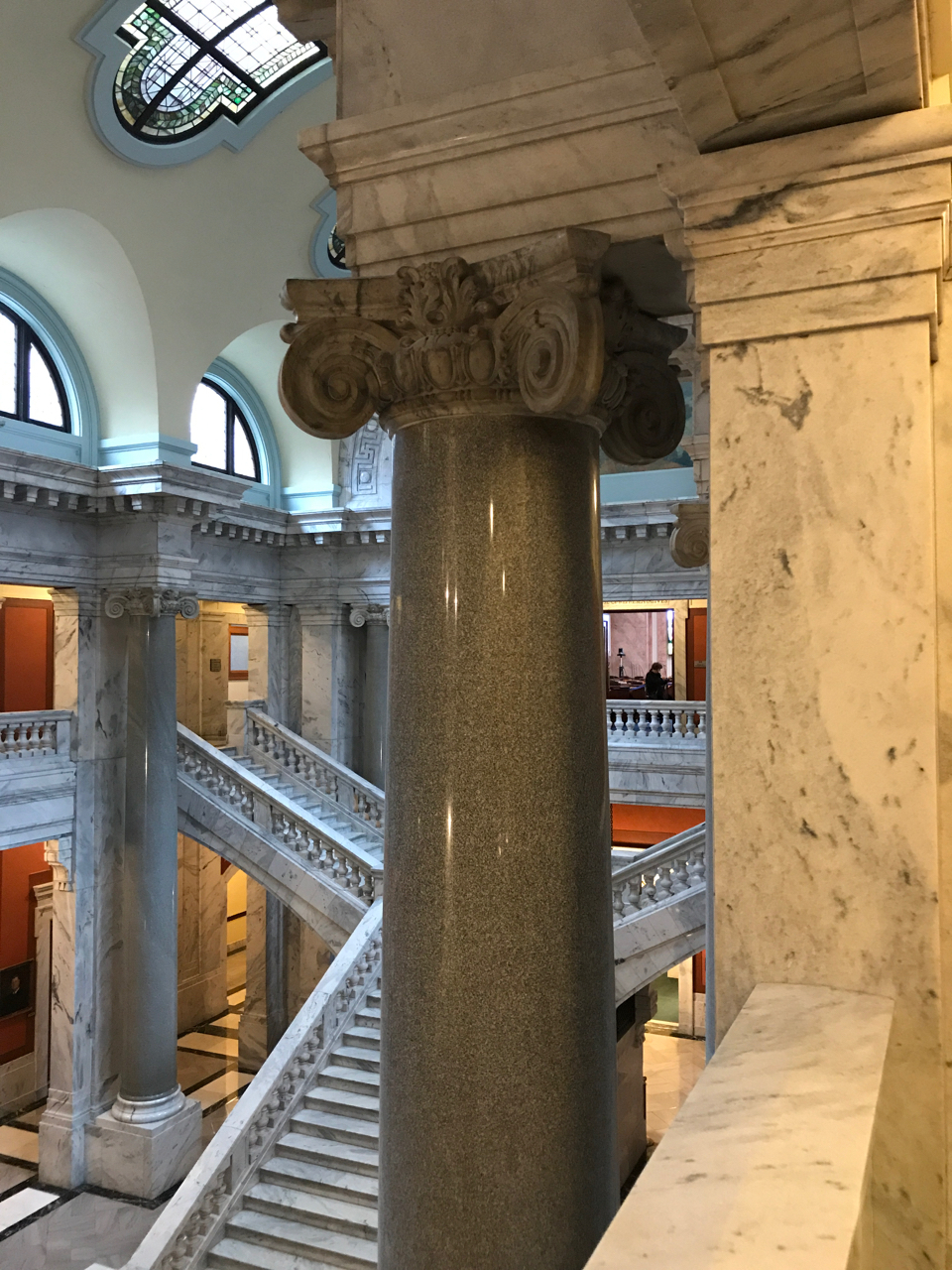
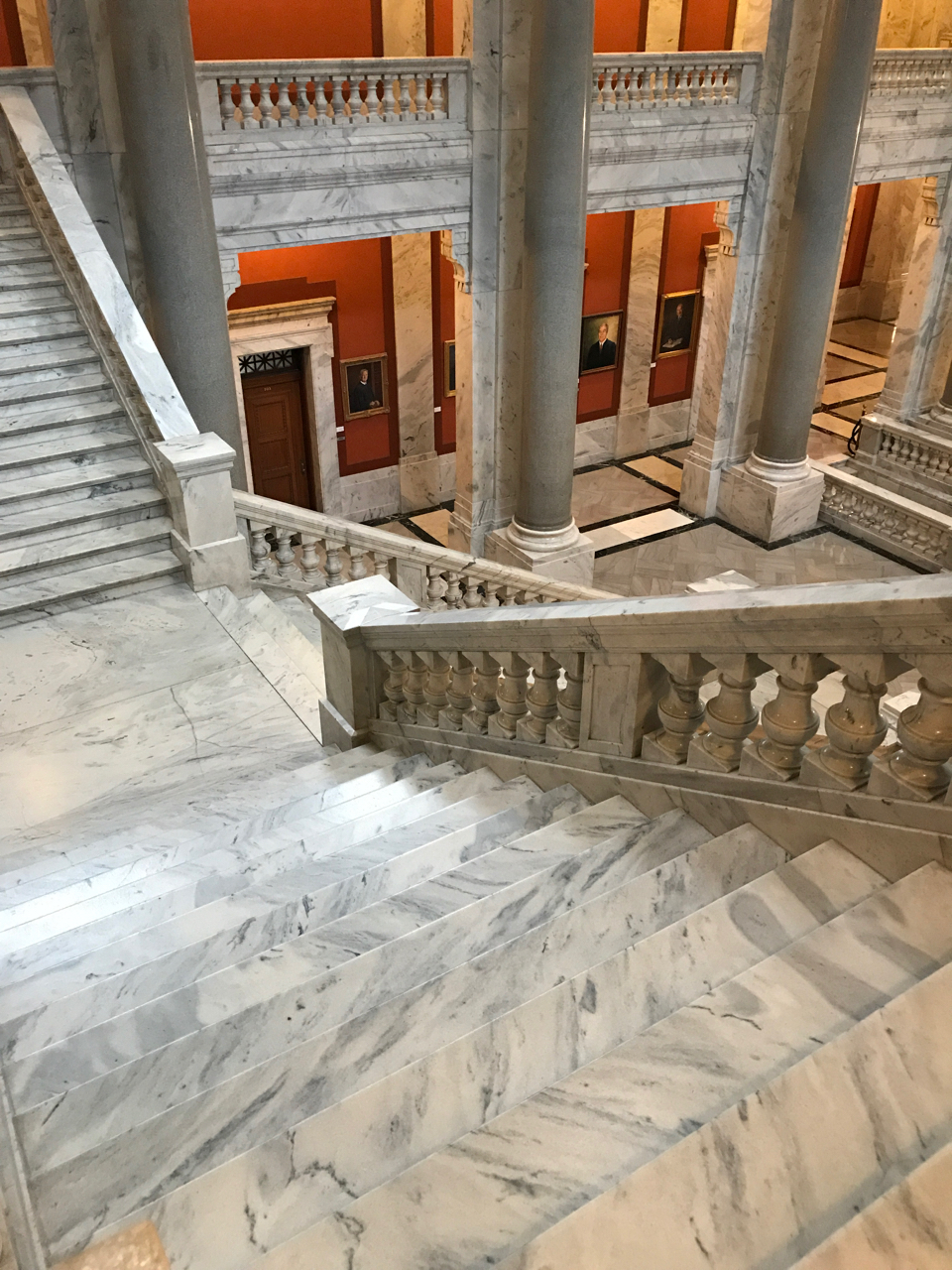
Up the marble stairs.
My goodness! What a lot of stairs! My Preferred Source says that the staircases are replicas of those of the Opera Garner in Paris.
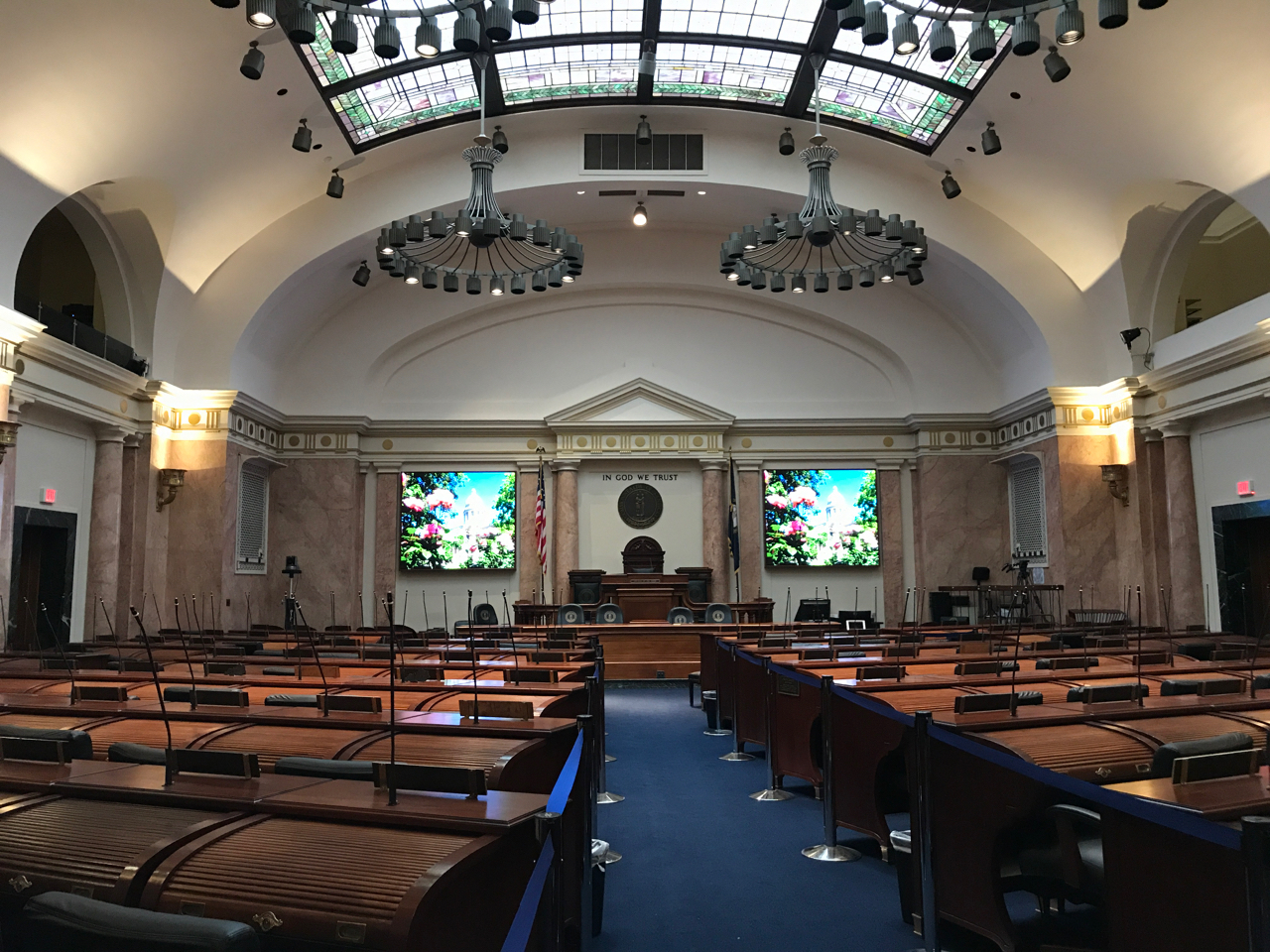
On to the House, which seems like a calm venue to do the people’s business.
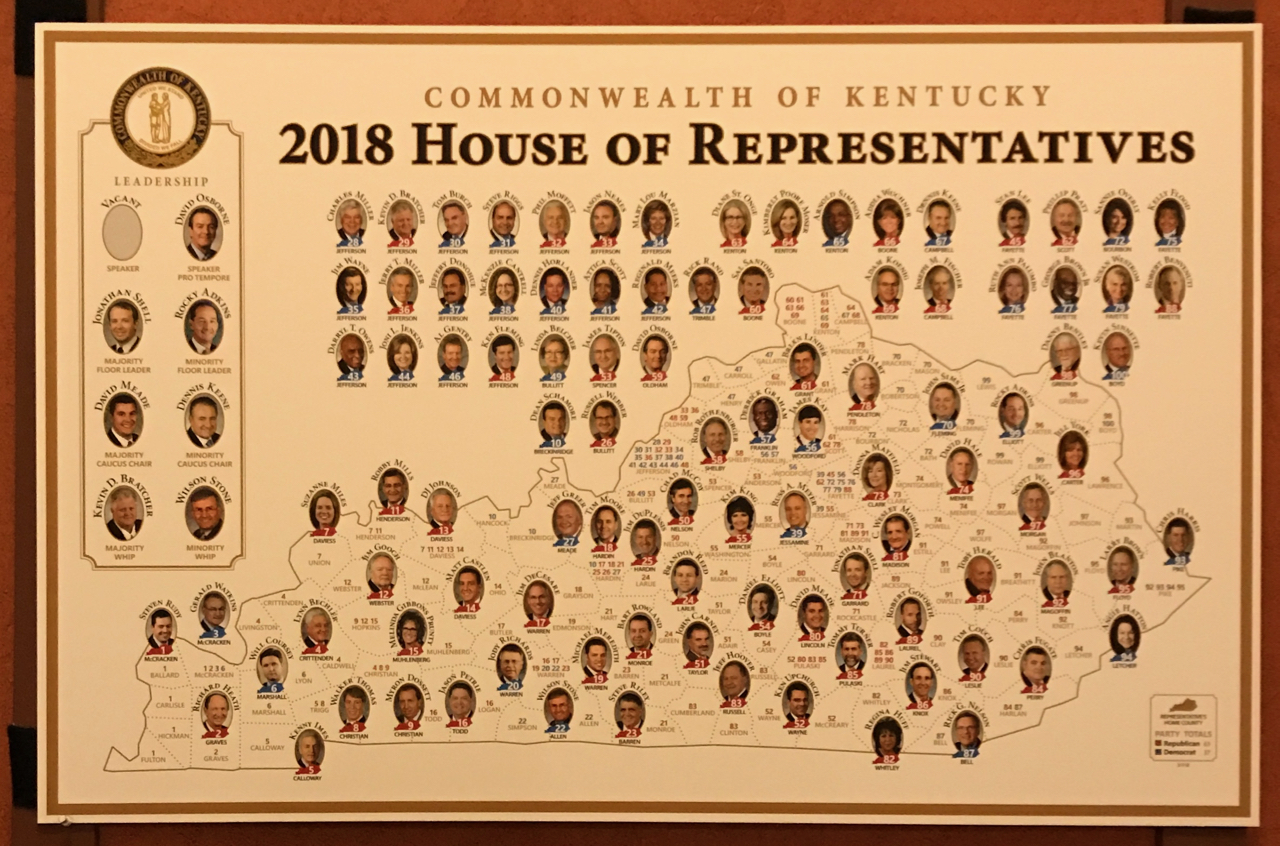
This map would help you be able to pick out your Representative.
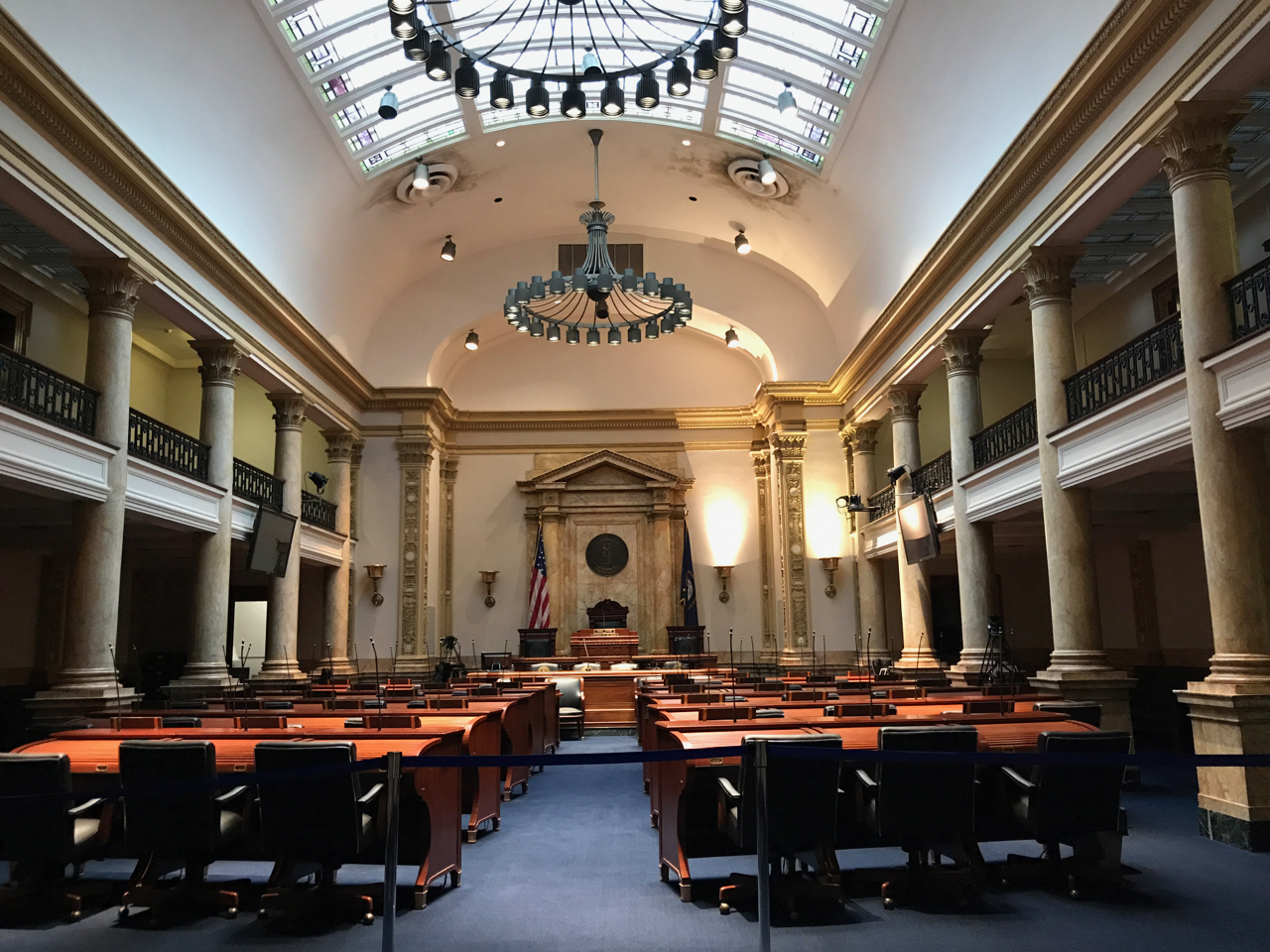
Next, the Senate. This chamber seems a little more imposing.
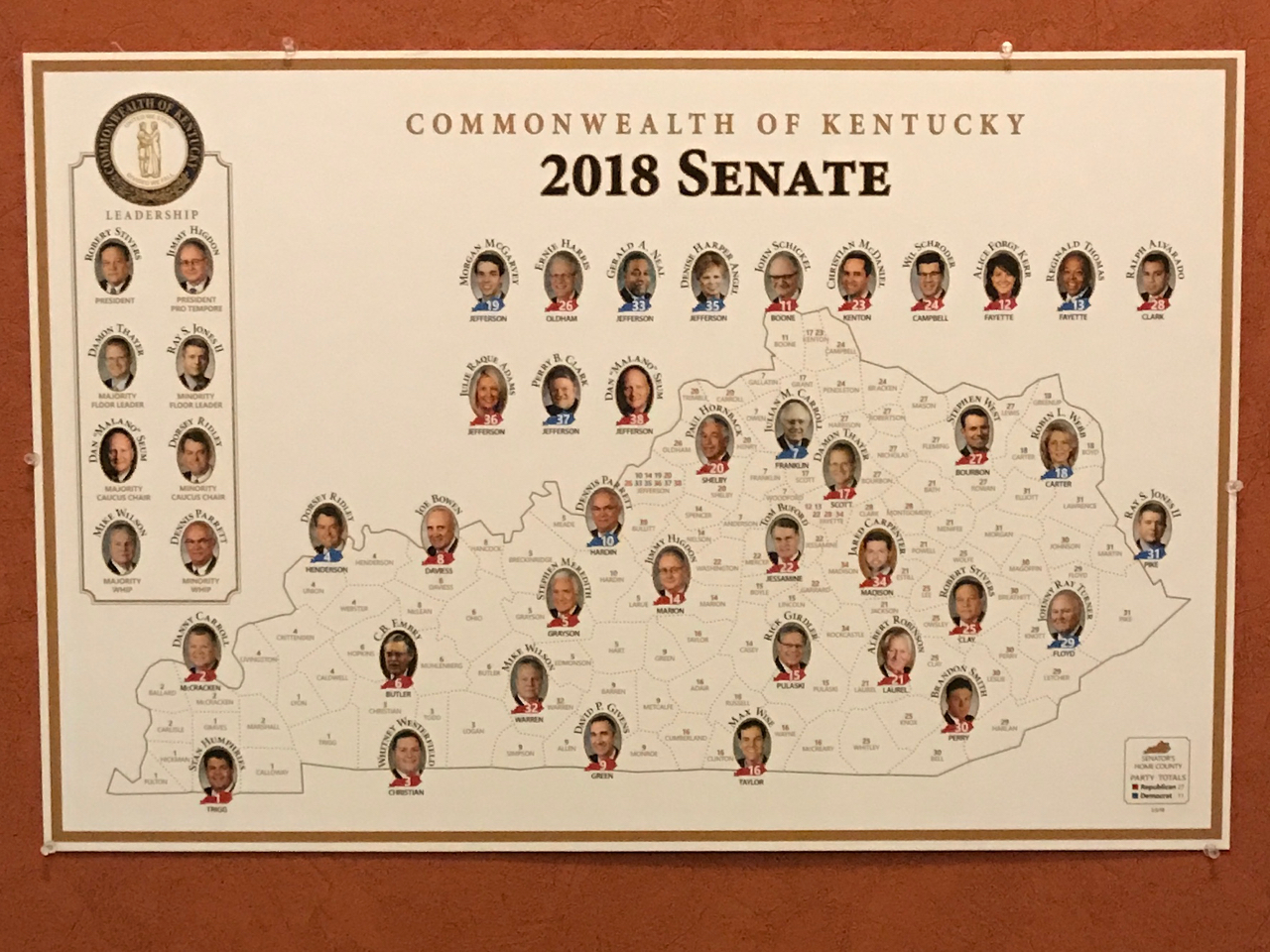
They, too, provide a guide to help you identify your Senator.
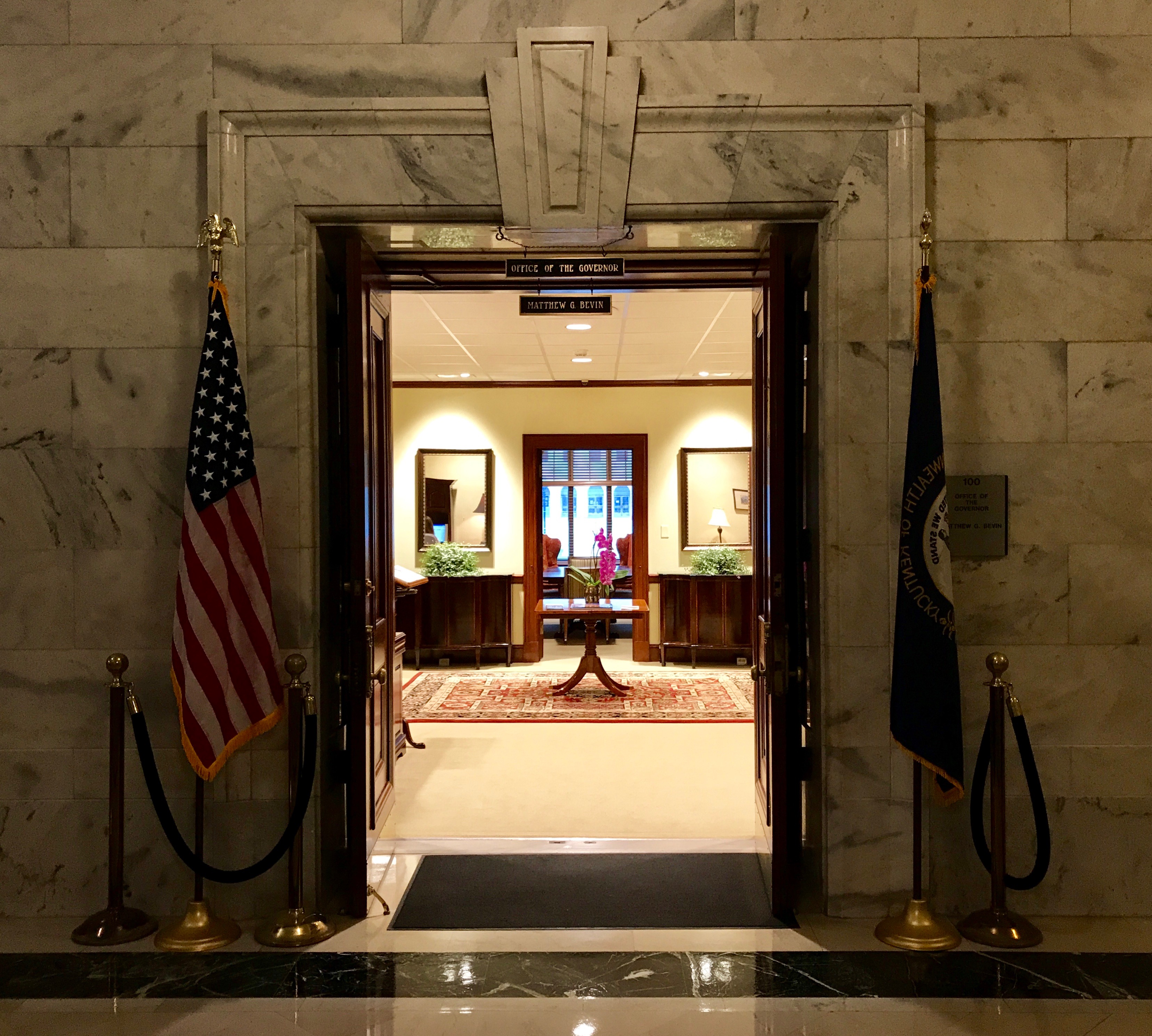
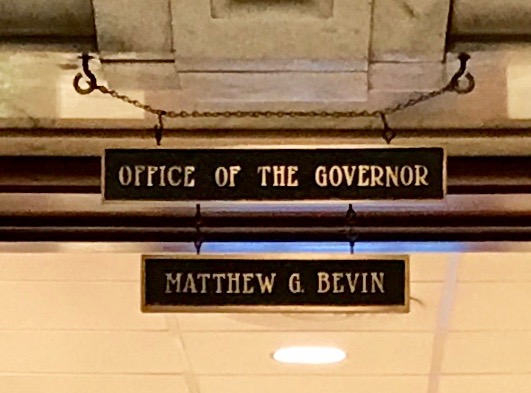
Ah! The Governor’s office.
Well, this was 2018, after all. Governor Bevin was replaced by Andy Beshear in the 2019 election.
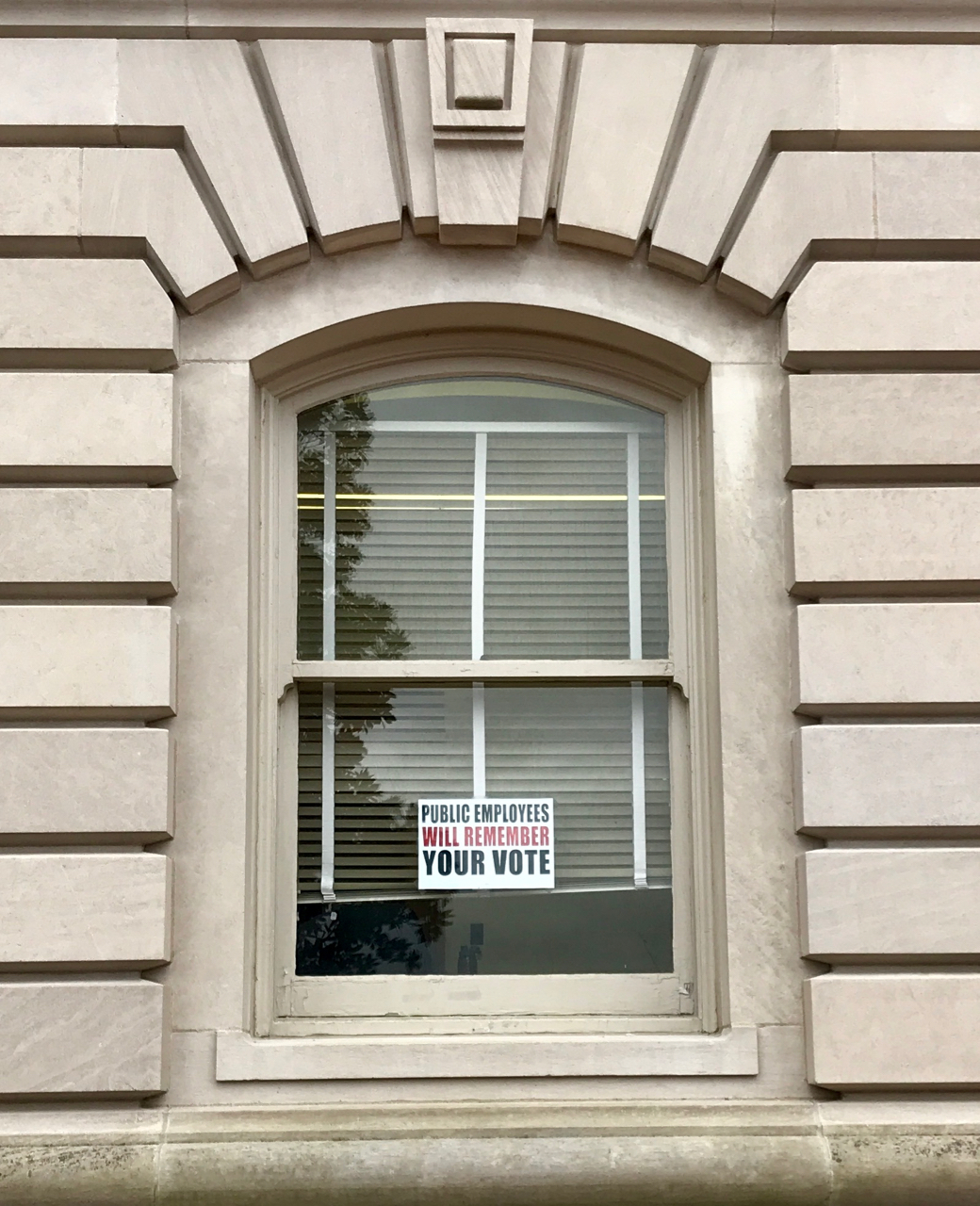
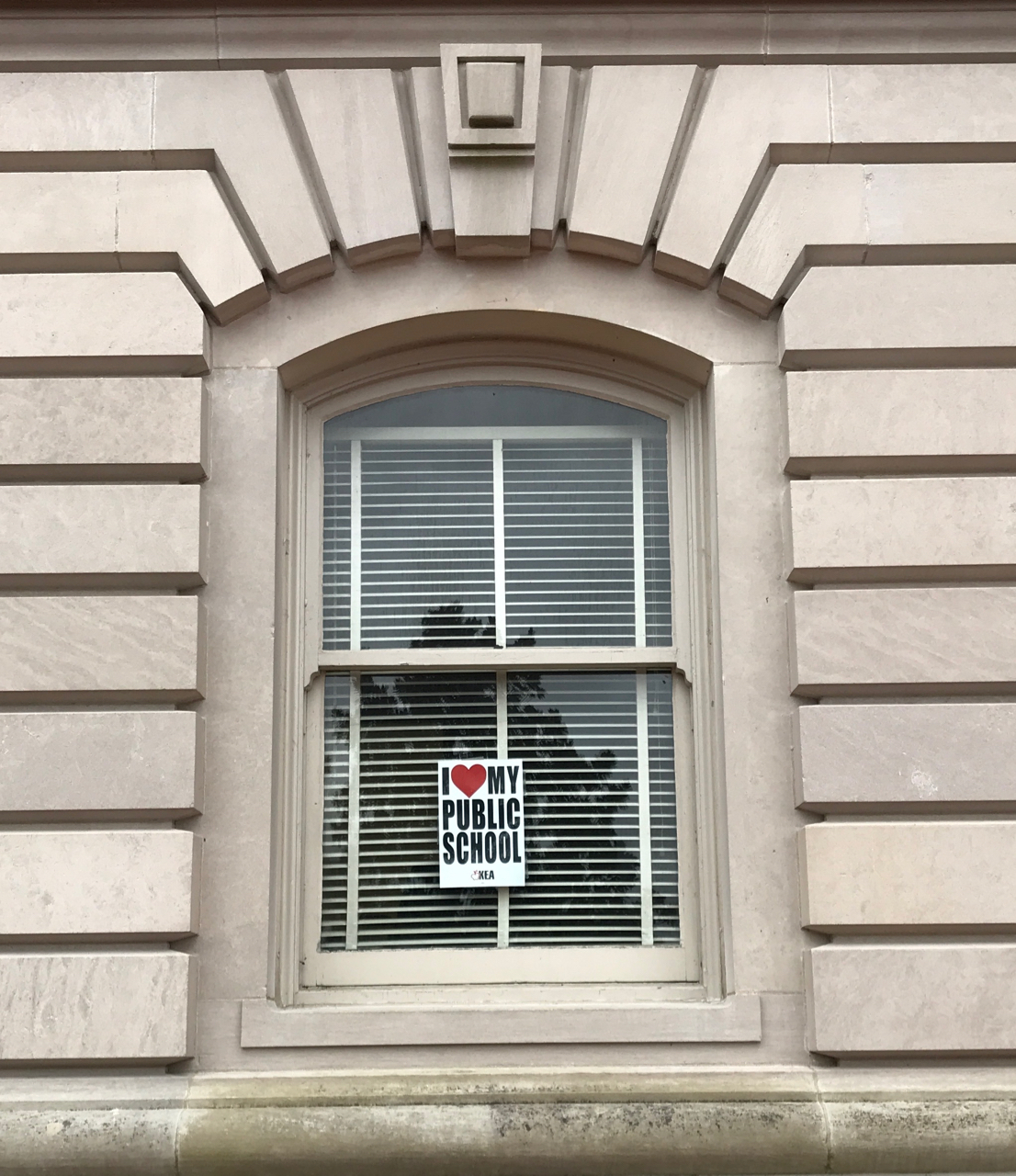
I saw this sign posted in a window as I walked around the building. I wonder if there is a connection to Bevin’s ouster and public employees?
I guess it’s a good idea not to push teachers past their breaking points.
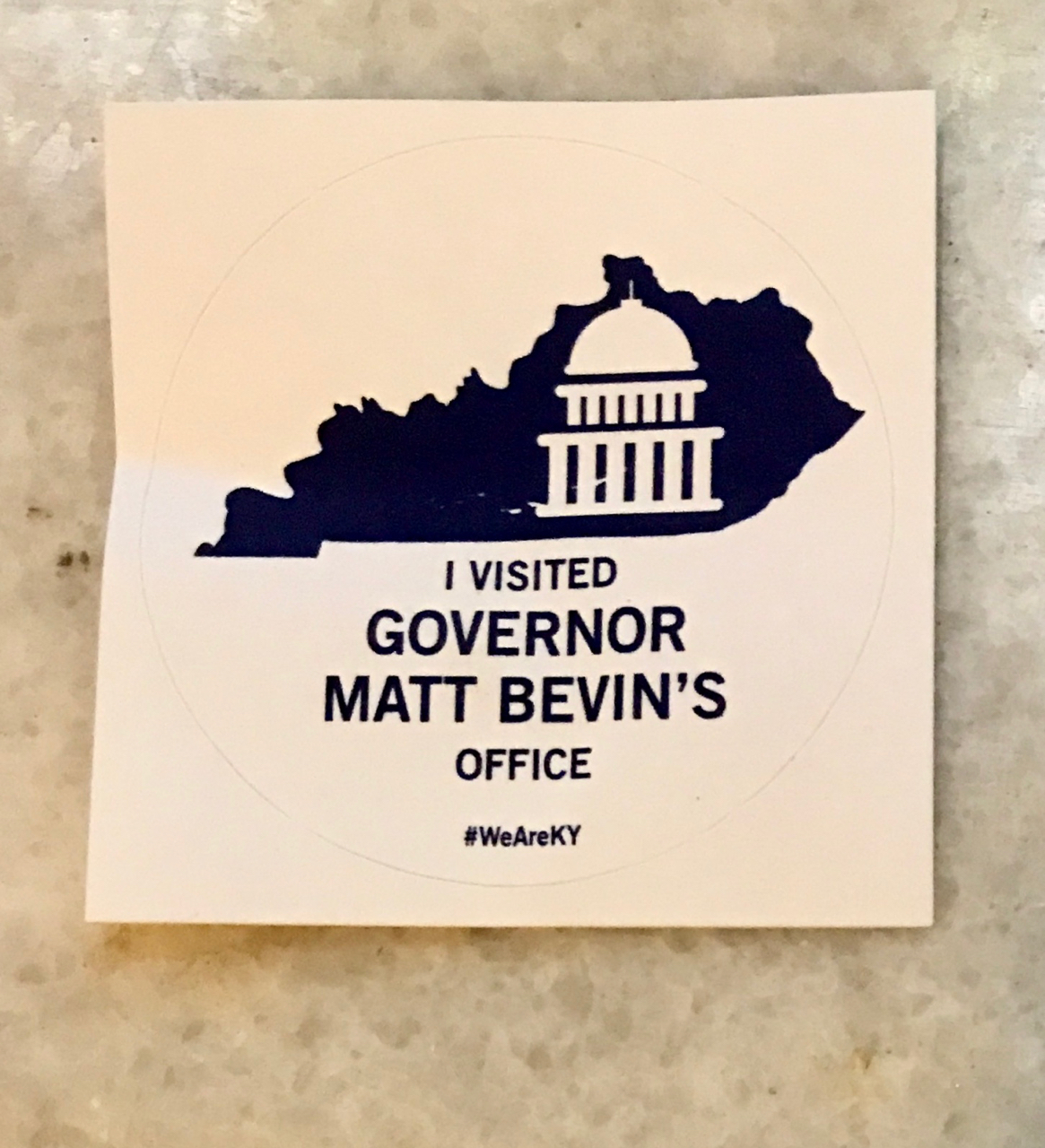
Even though I wasn’t a constituent, they let me have a souvenir.
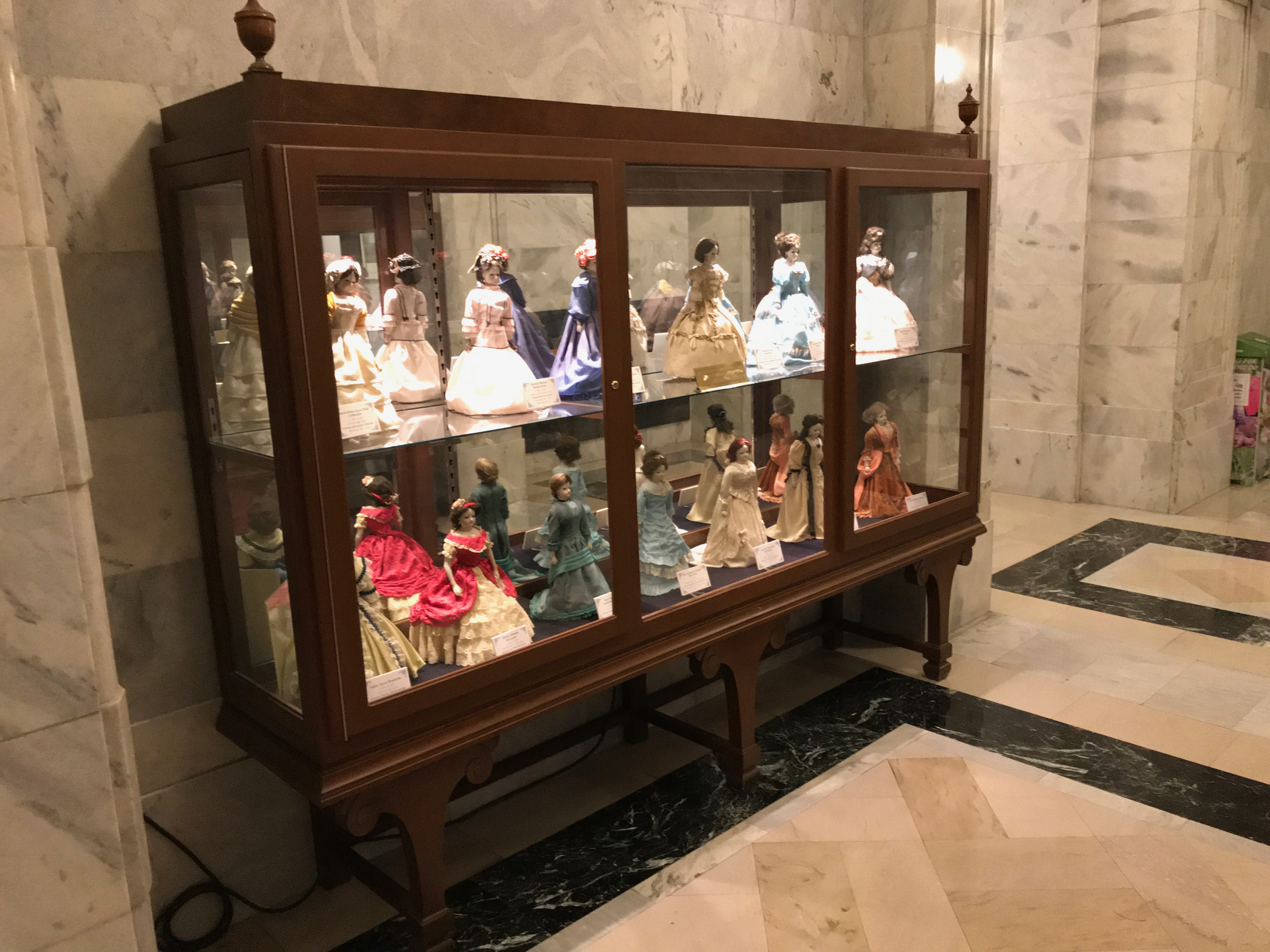
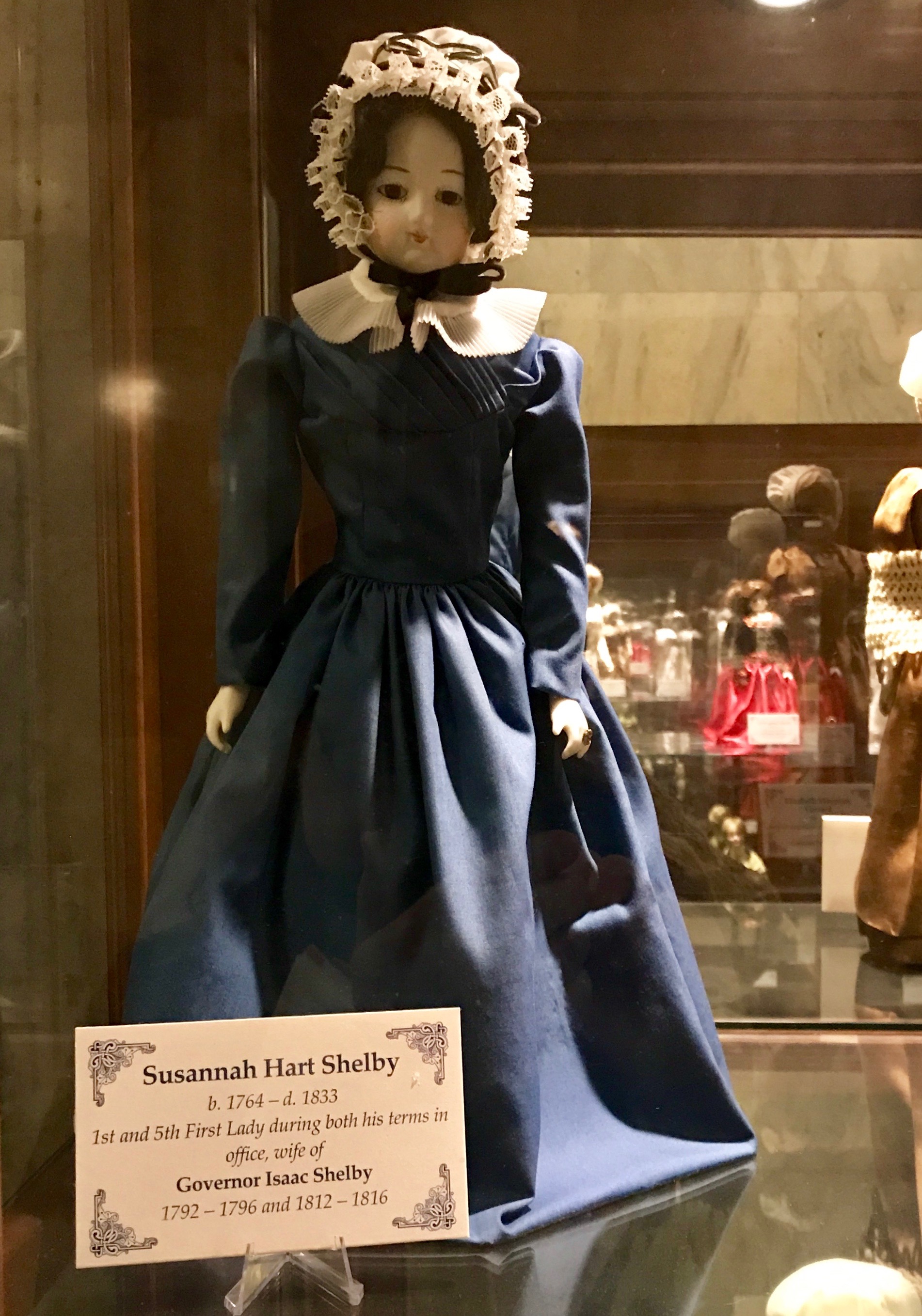
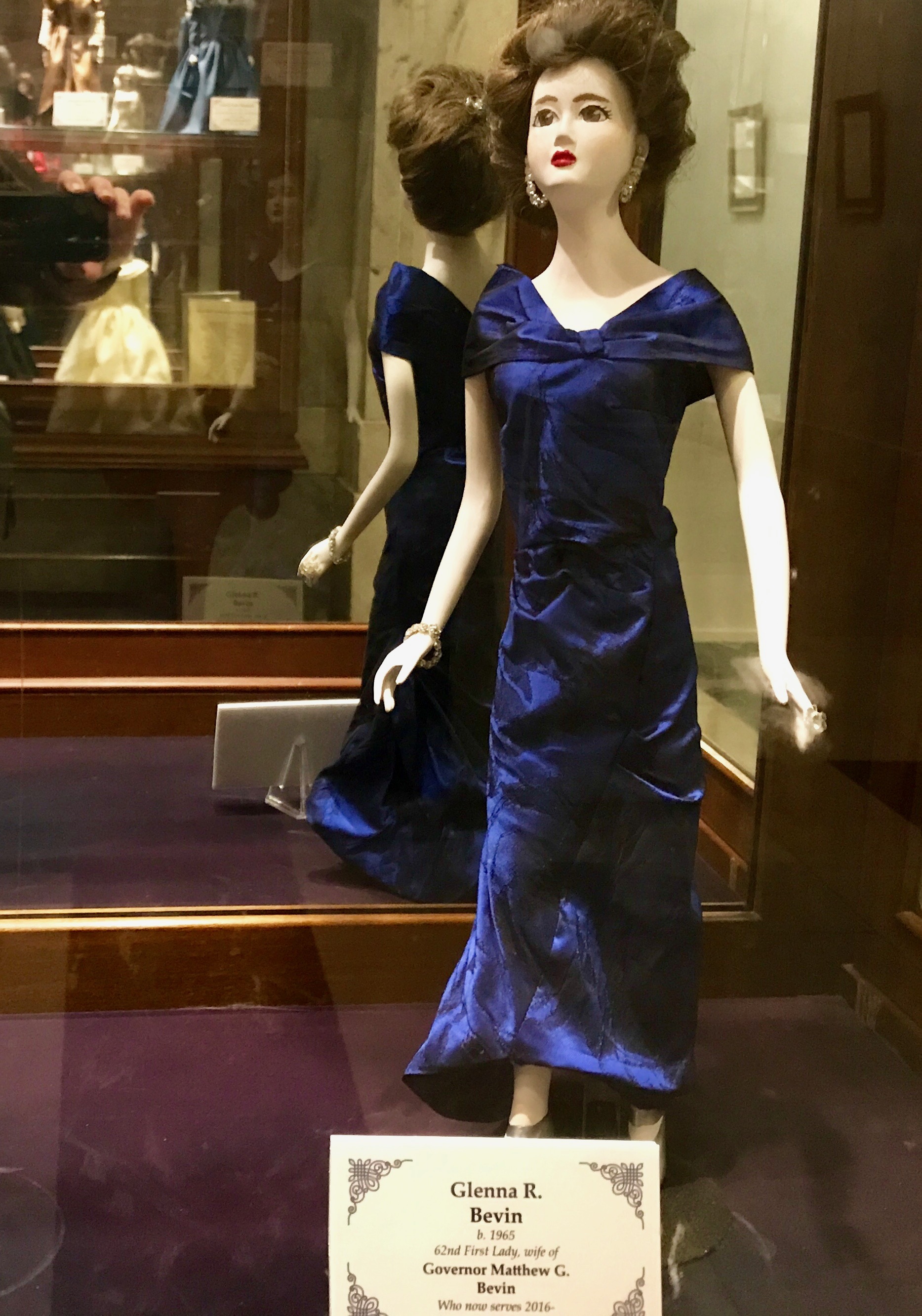
One thing they do have that I’ve never seen in any other capitol is a collection of first lady dolls.
This is the 1st First Lady, Susannah Hart Shelby.
And the First Lady at the time I visited, Glenna R. Bevin.
I guess the doll collection makes up for the lack of female representation in the statuary.
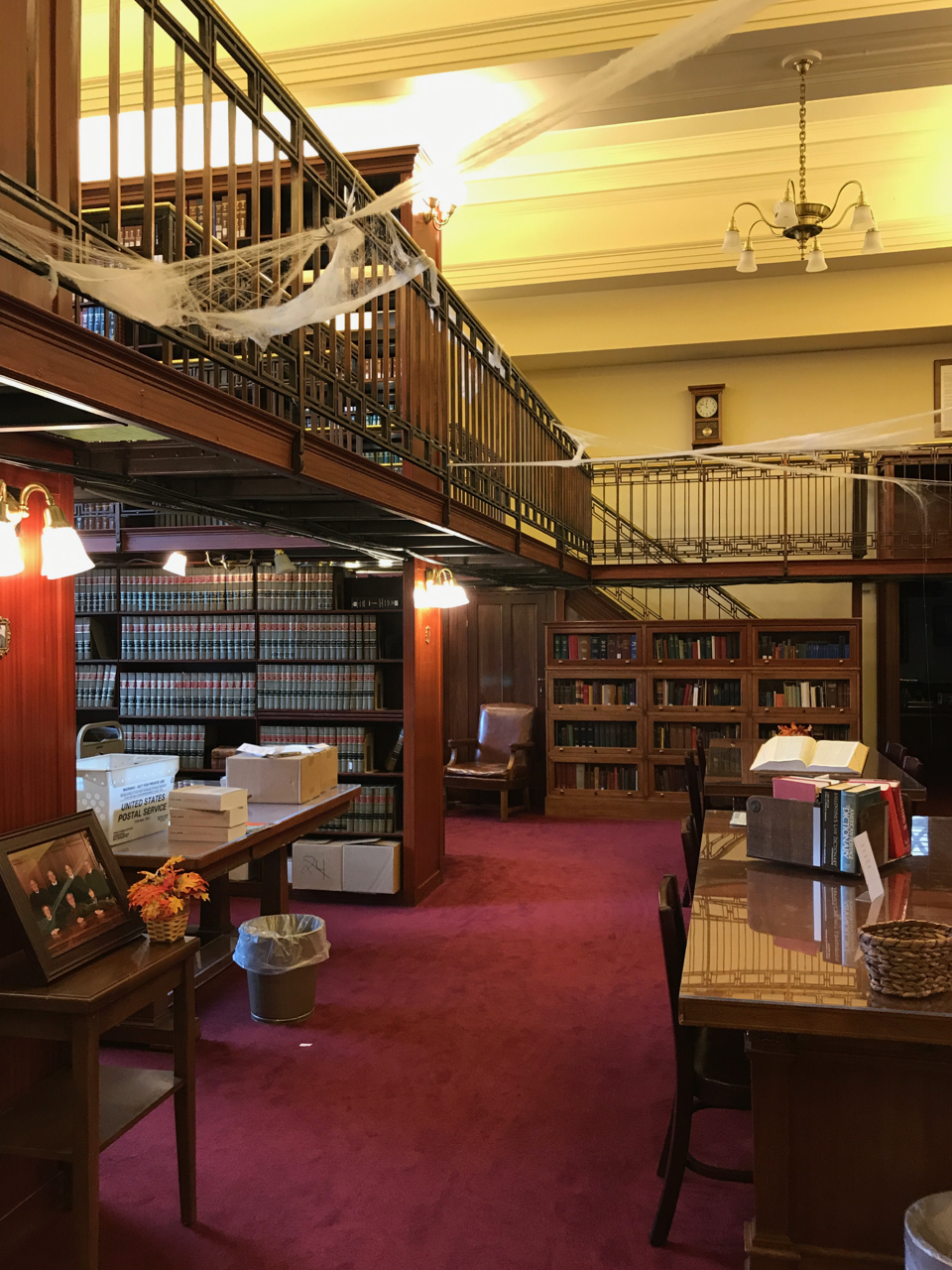
It was just after Halloween when I visited, and the library was still decorated for the season, with cob webs galore.
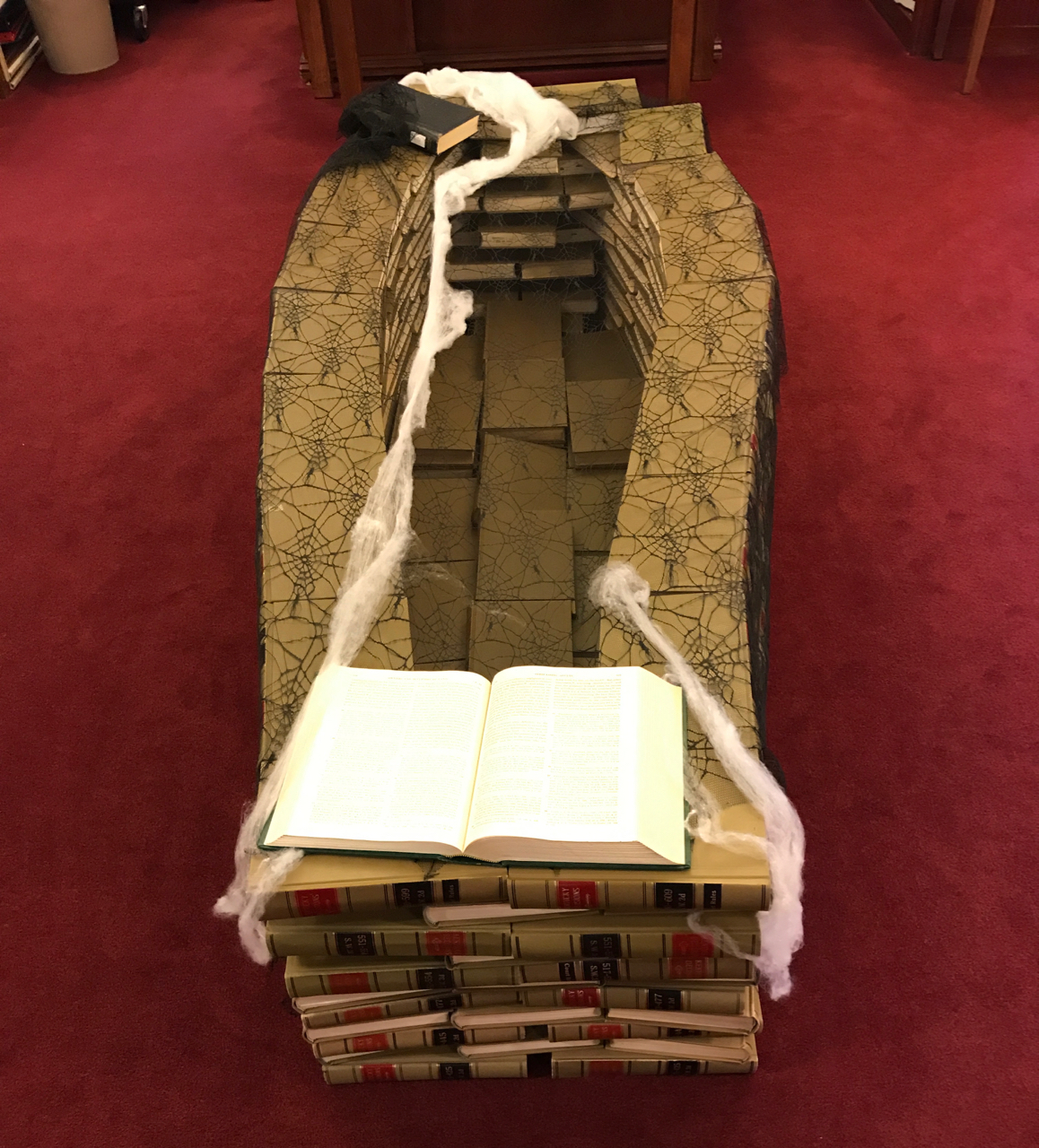
They also made a coffin out of the law books.
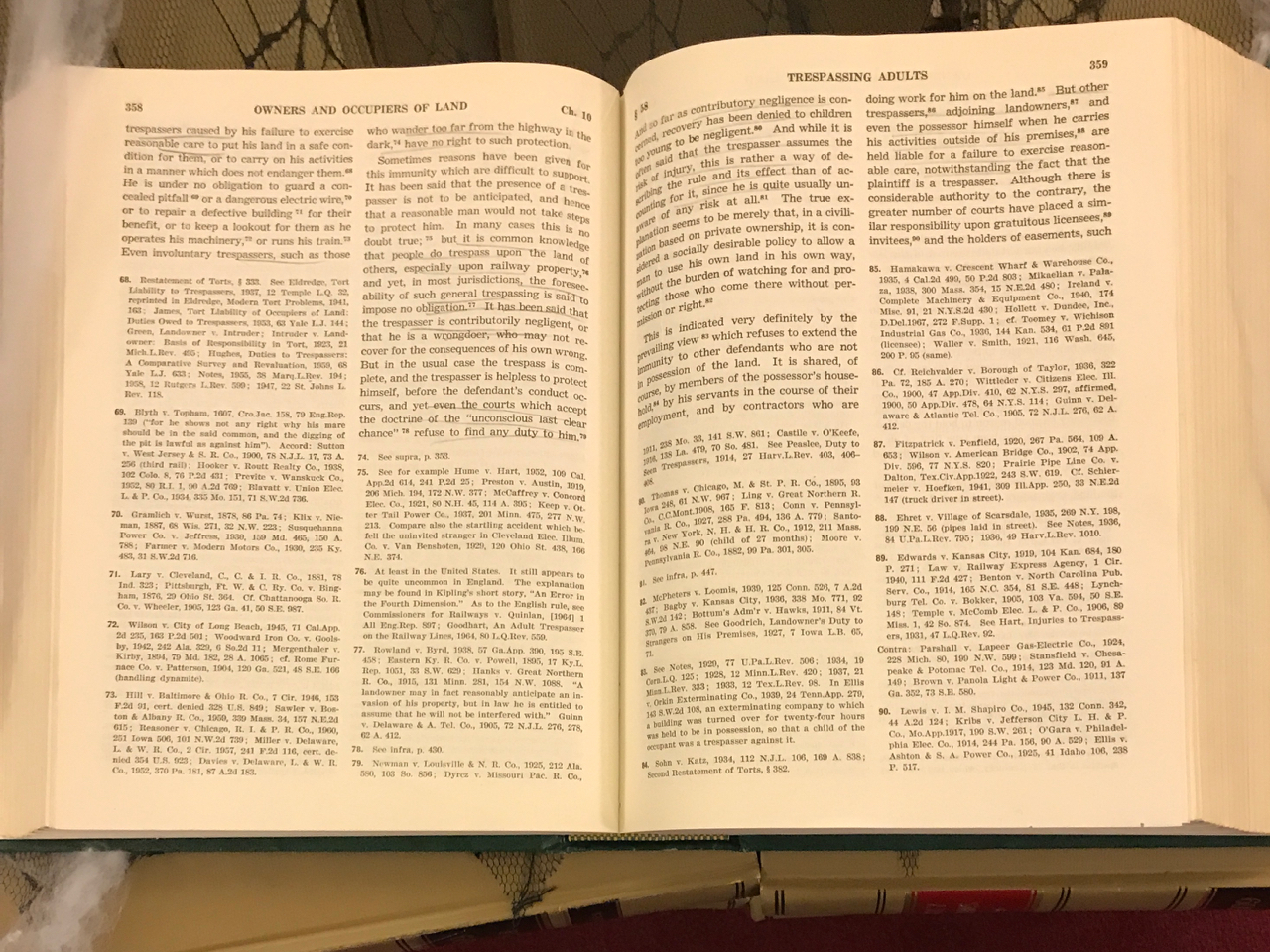
Just in case you are curious, this is the book that is open on the end of the coffin.
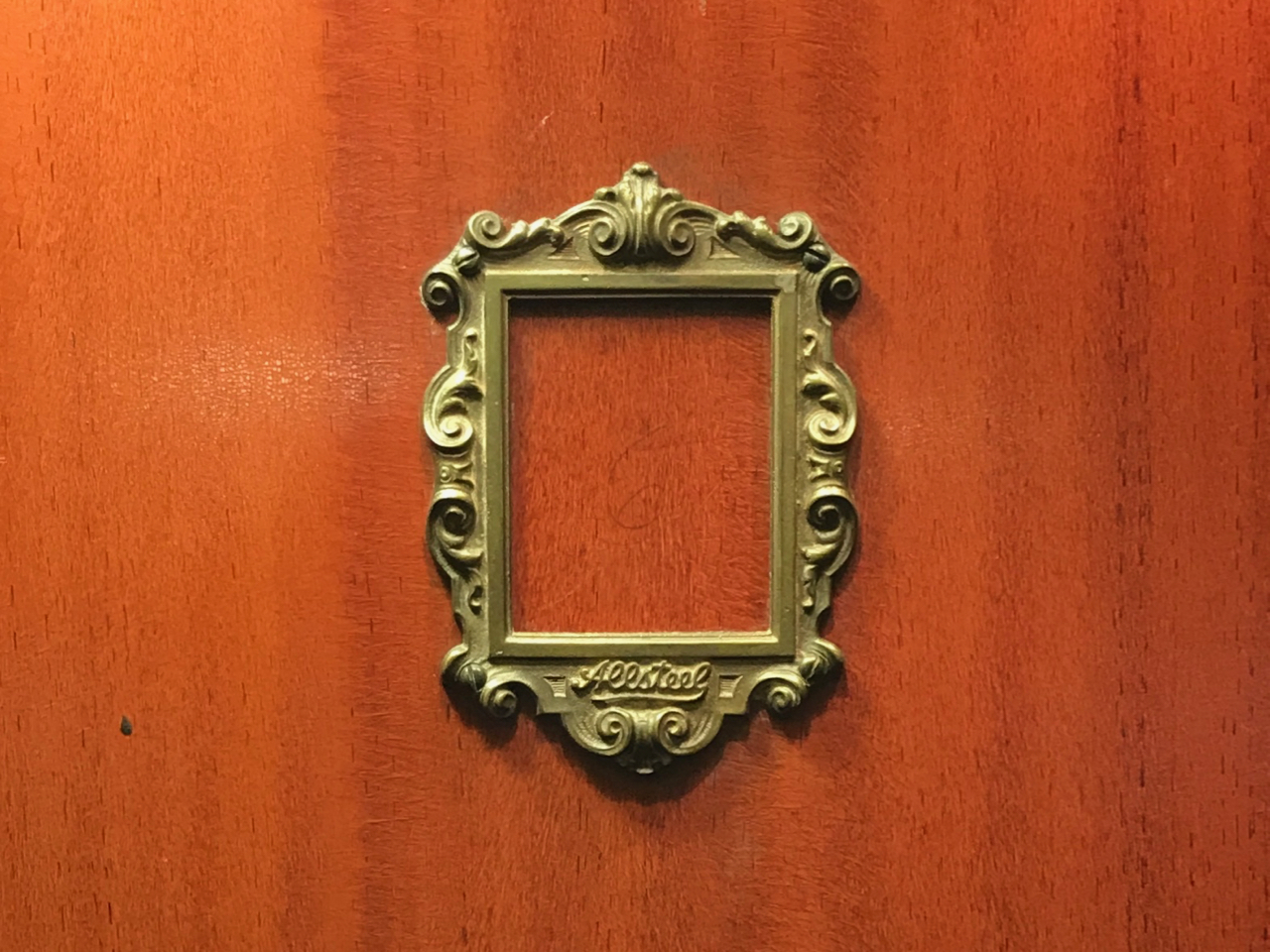
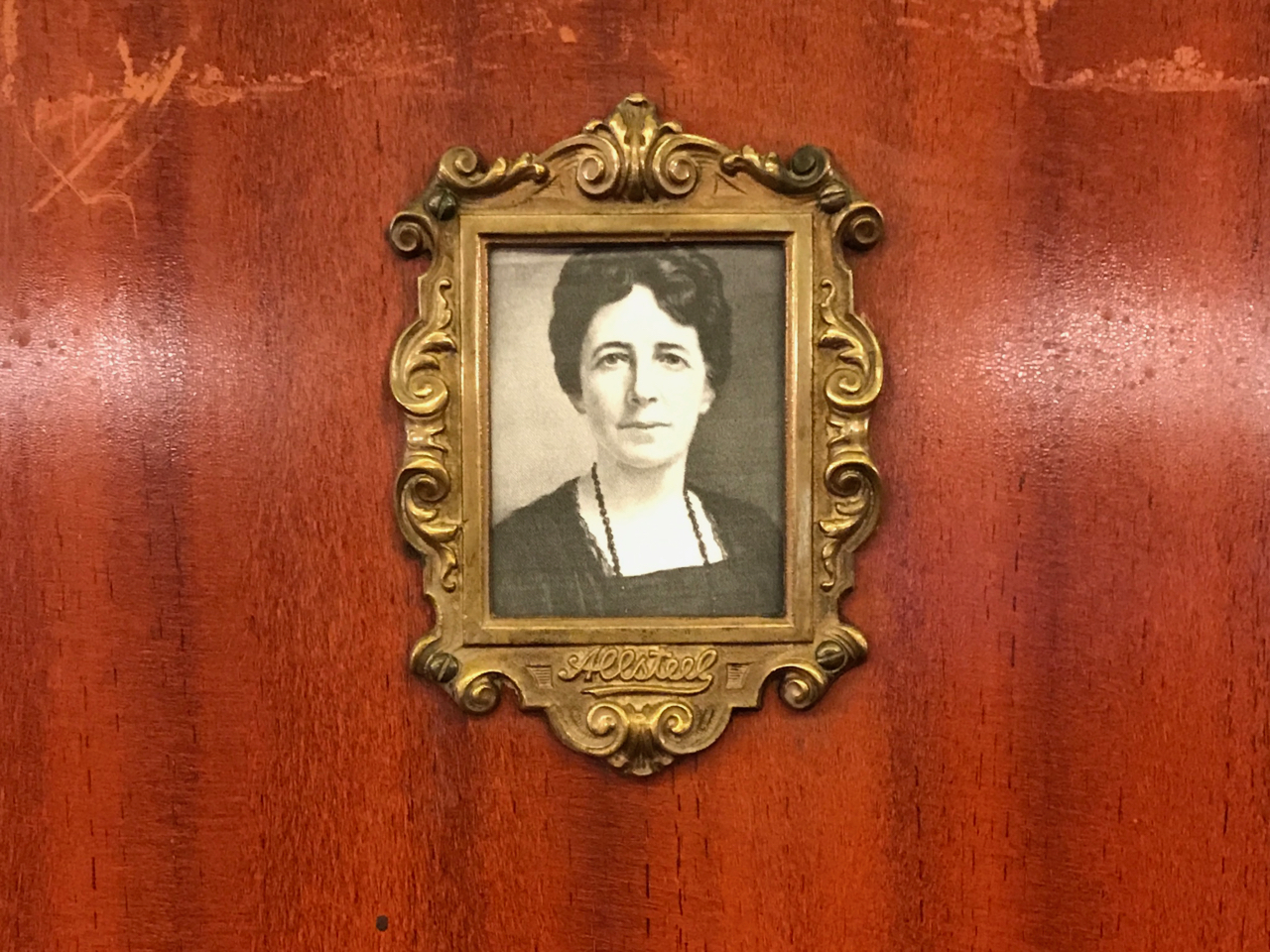
Although this library is modest in comparison with Tennessee’s capitol library, there was this hint of metallic grace. I wonder why the frame is empty?
And, who do you suppose this woman is?
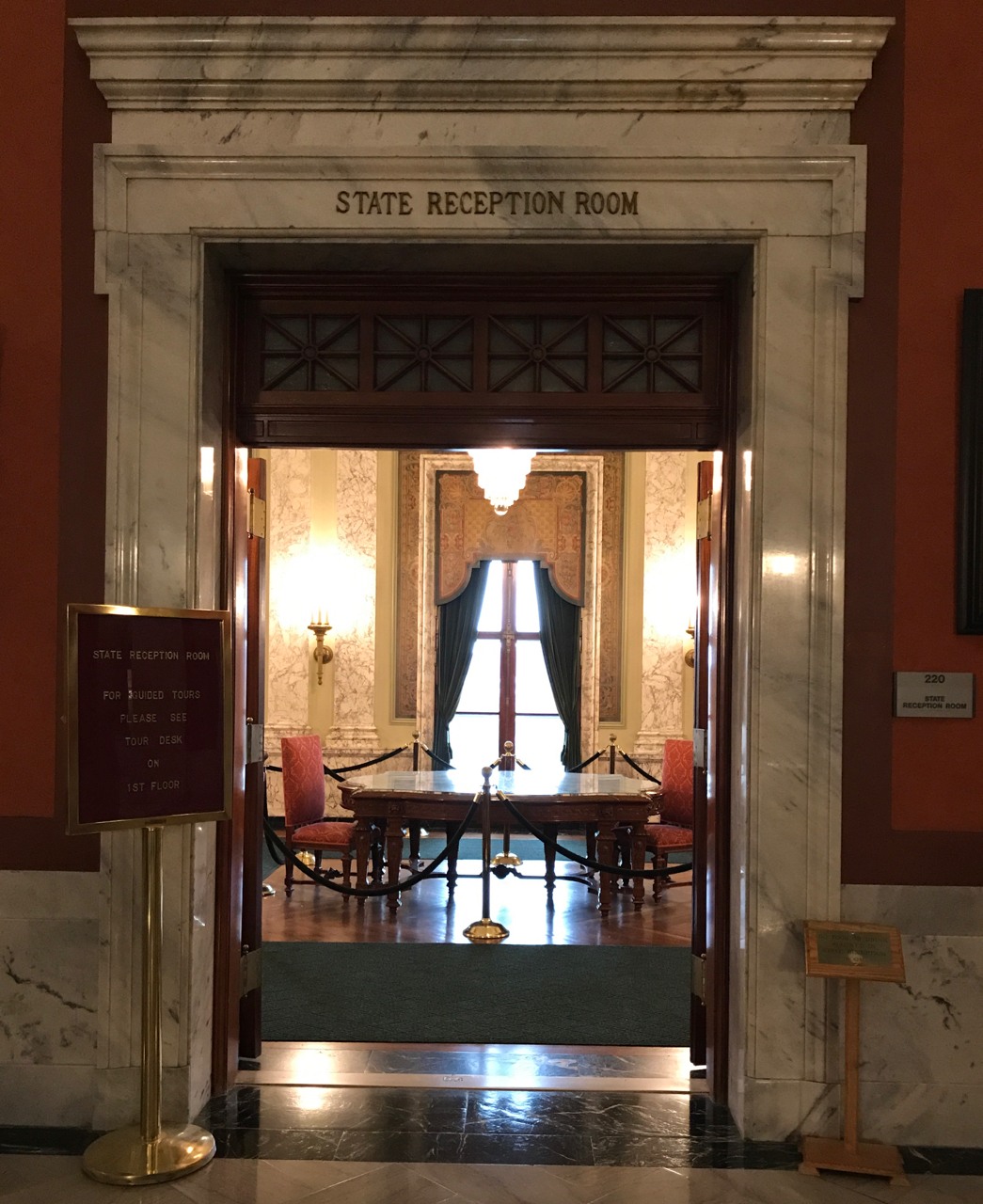
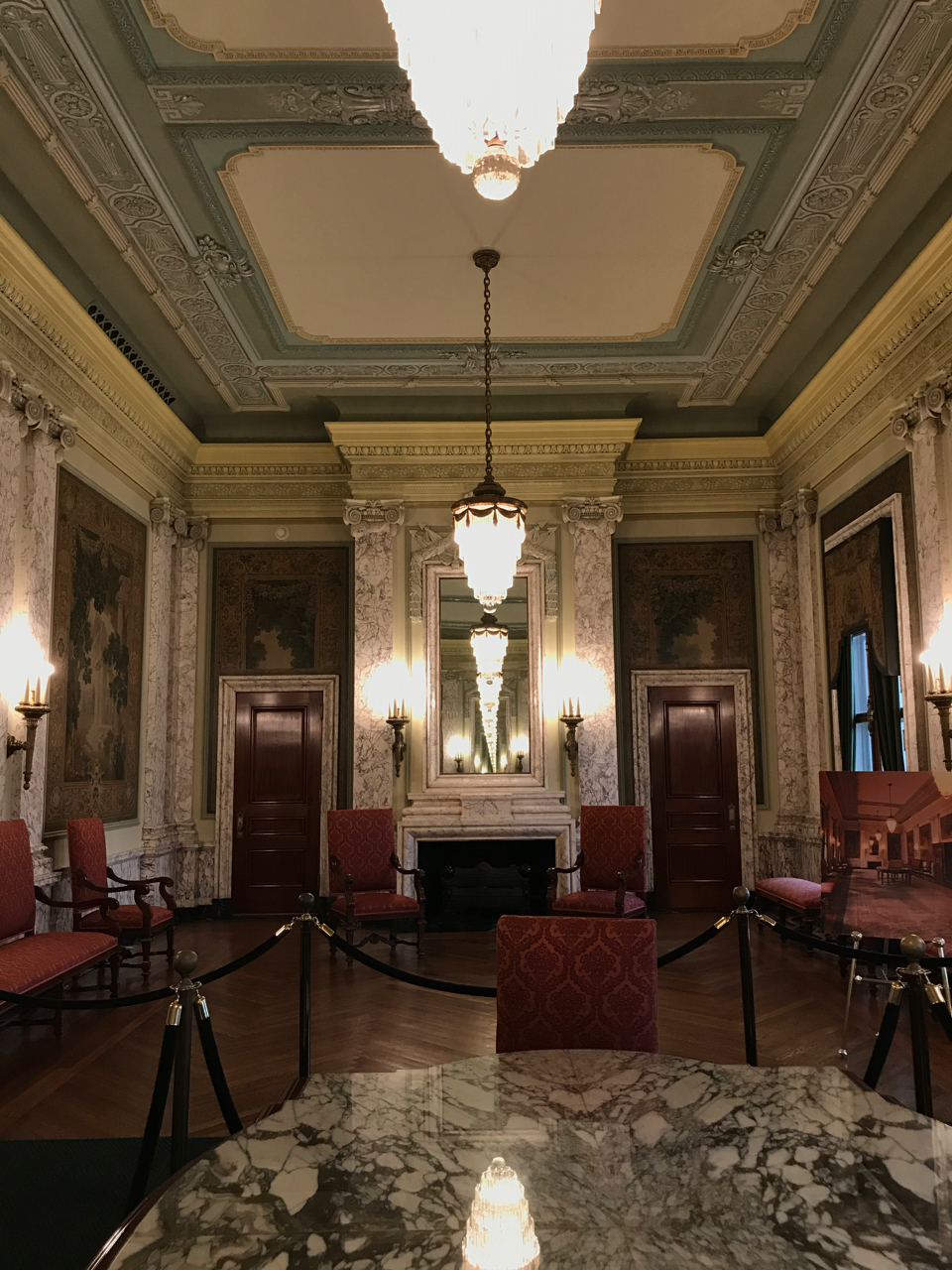
The State Reception room was open for viewing.
It was quite an elegant venue for a soiree.
They made extensive use of stone. It was quite grand.
Okay, back to the rotunda and the dome.
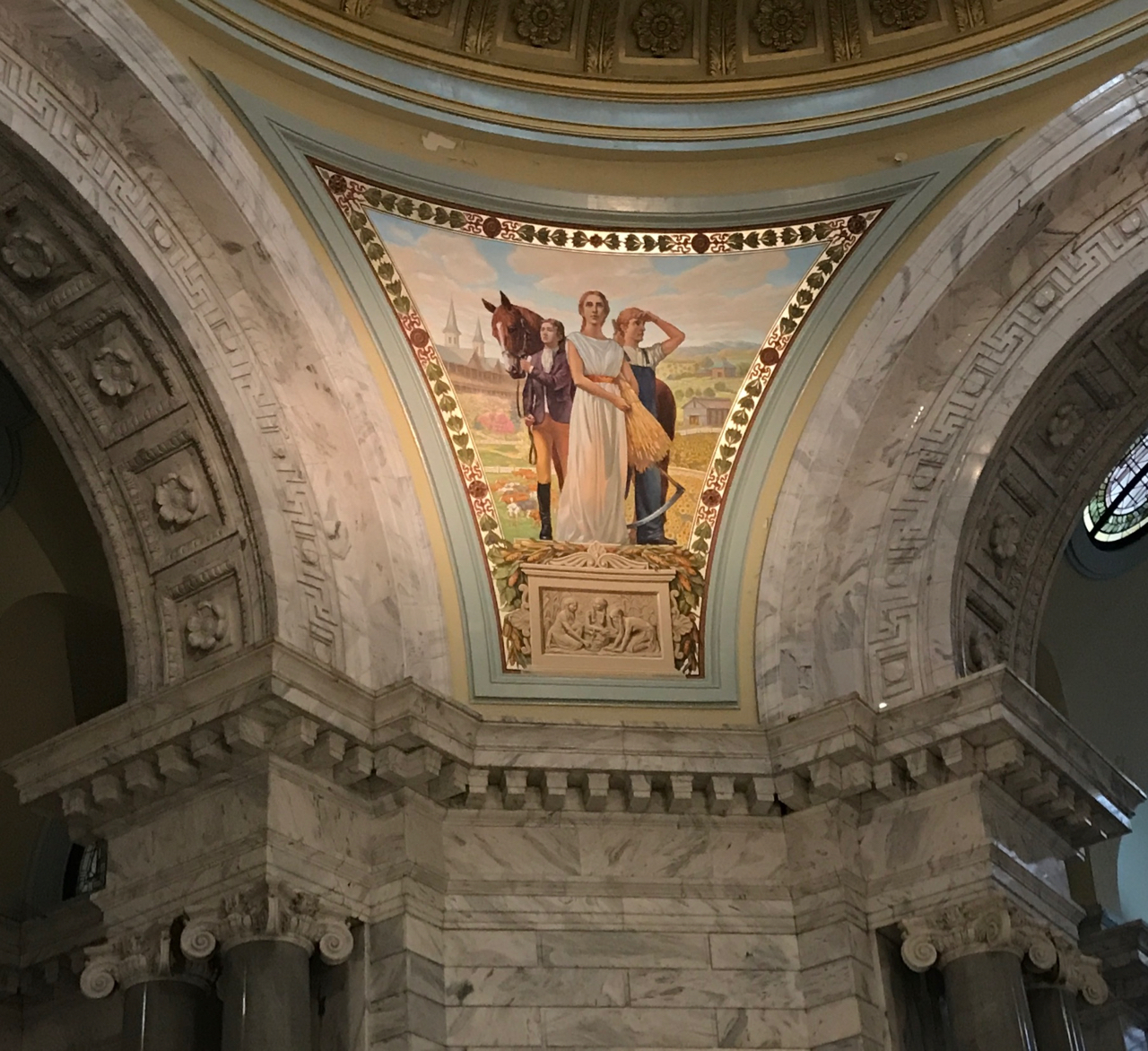
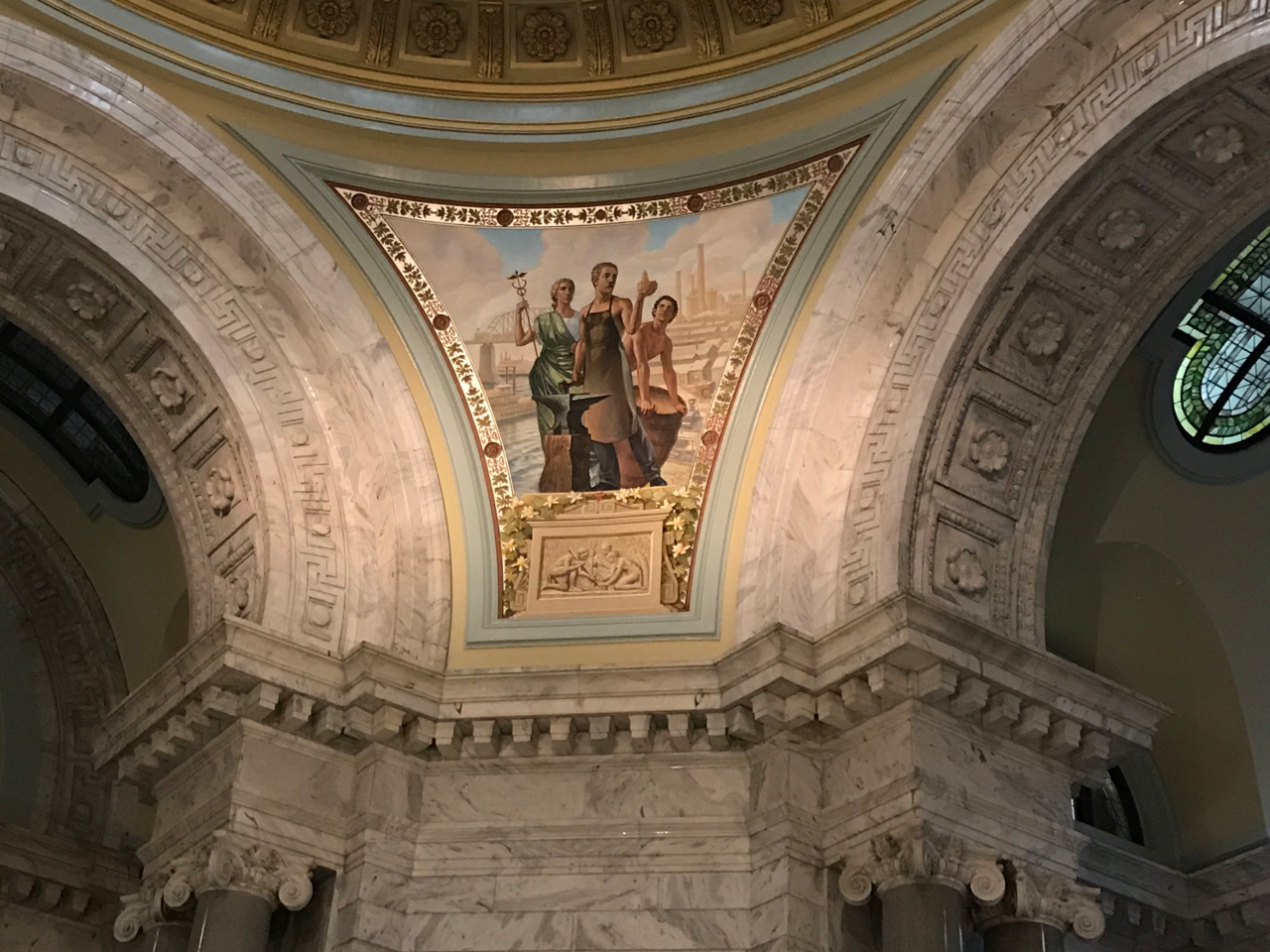
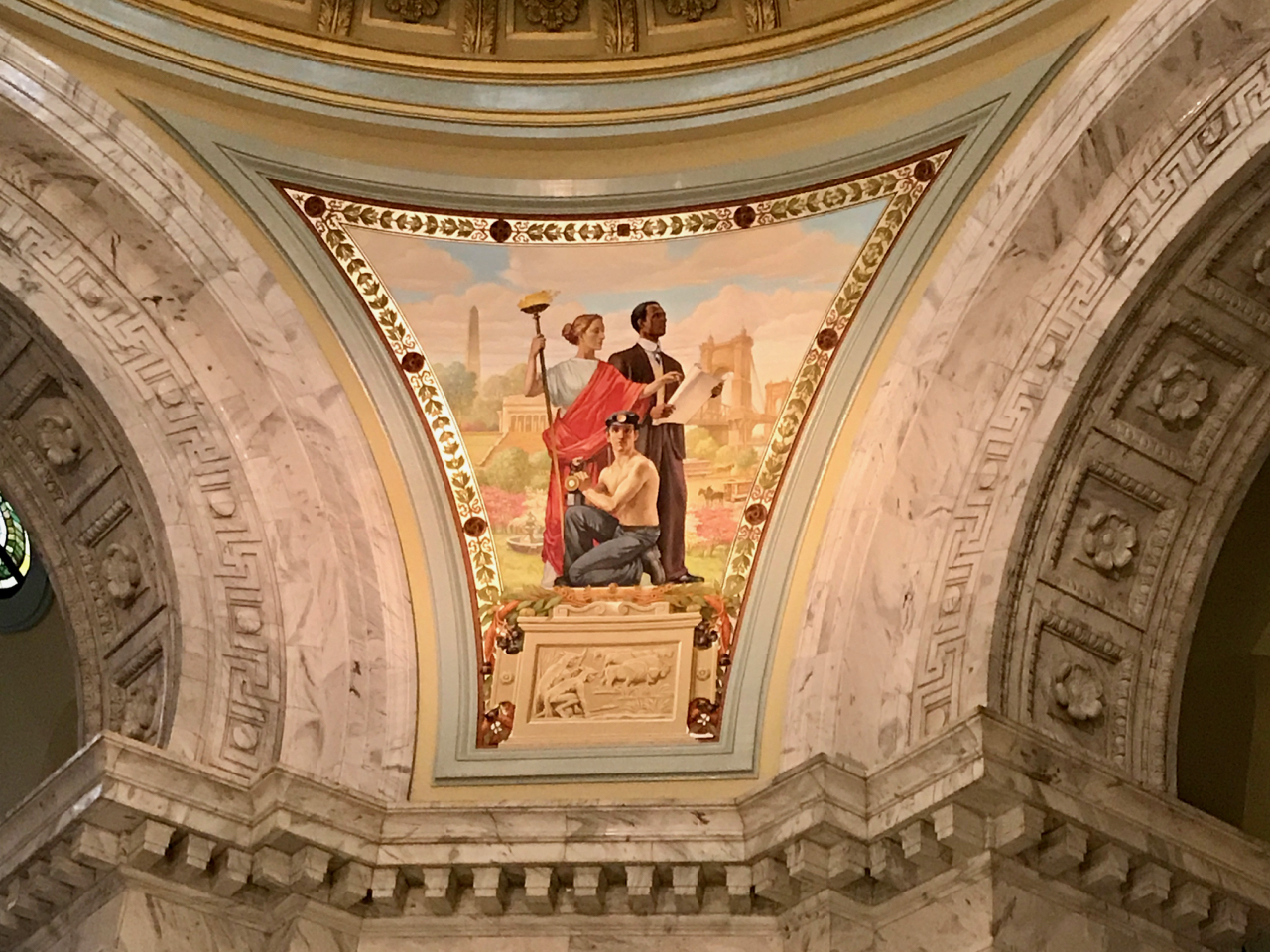
The Kentucky Capitol Centennial Commission selected the rotunda pendentive murals as the legacy project for the 100th anniversary of the capitol. Just in case you are wondering about the word “pendentive,” it refers to those triangular shapes that permit placing a circular dome over a square room.
They are quite elegant.
You can see Kentuckians’ points of pride: horses and agriculture…
industry…
planning for the future.
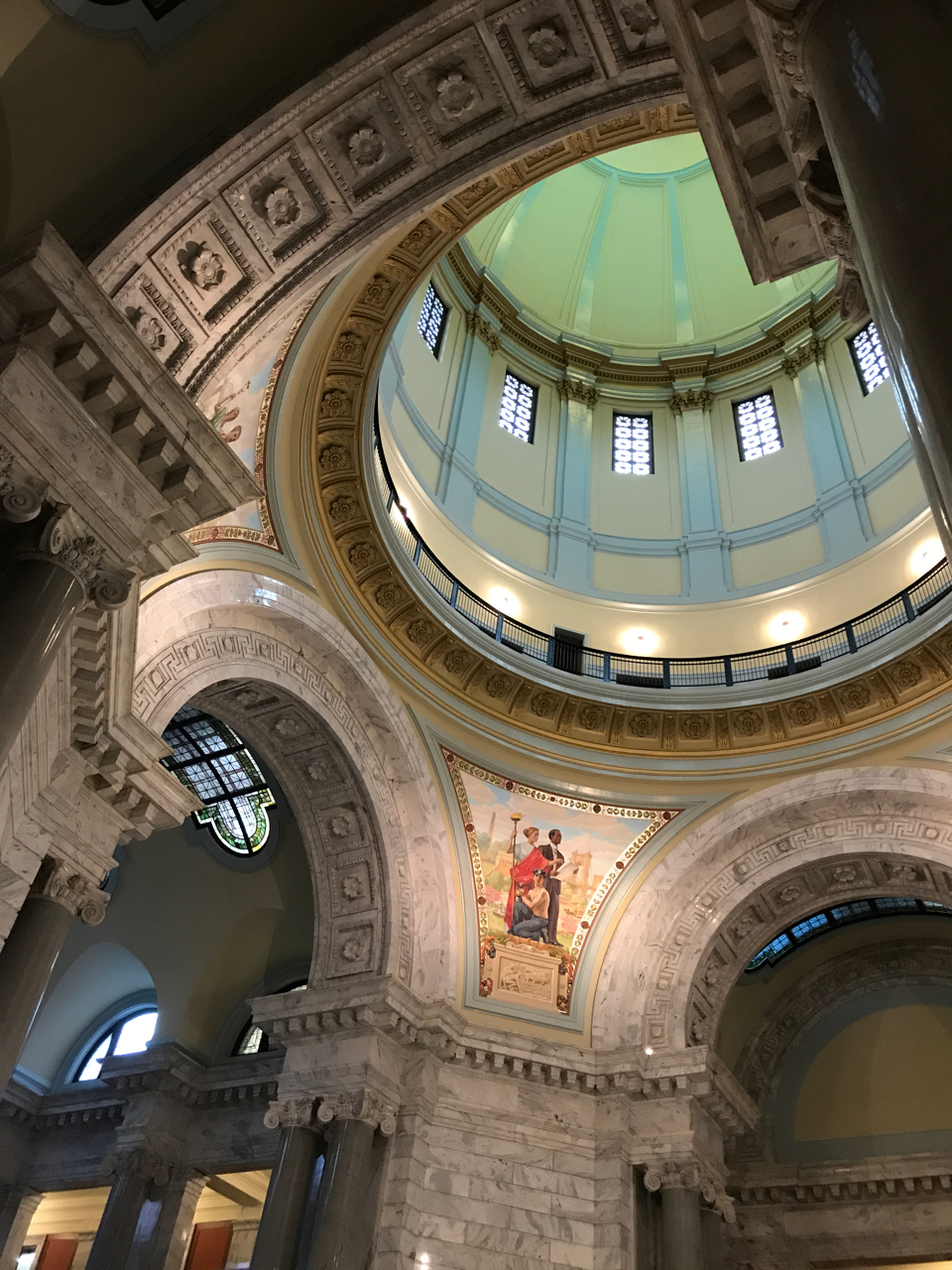
This photo shows how the pendentives help transition the circular shape of the dome to the square room below.
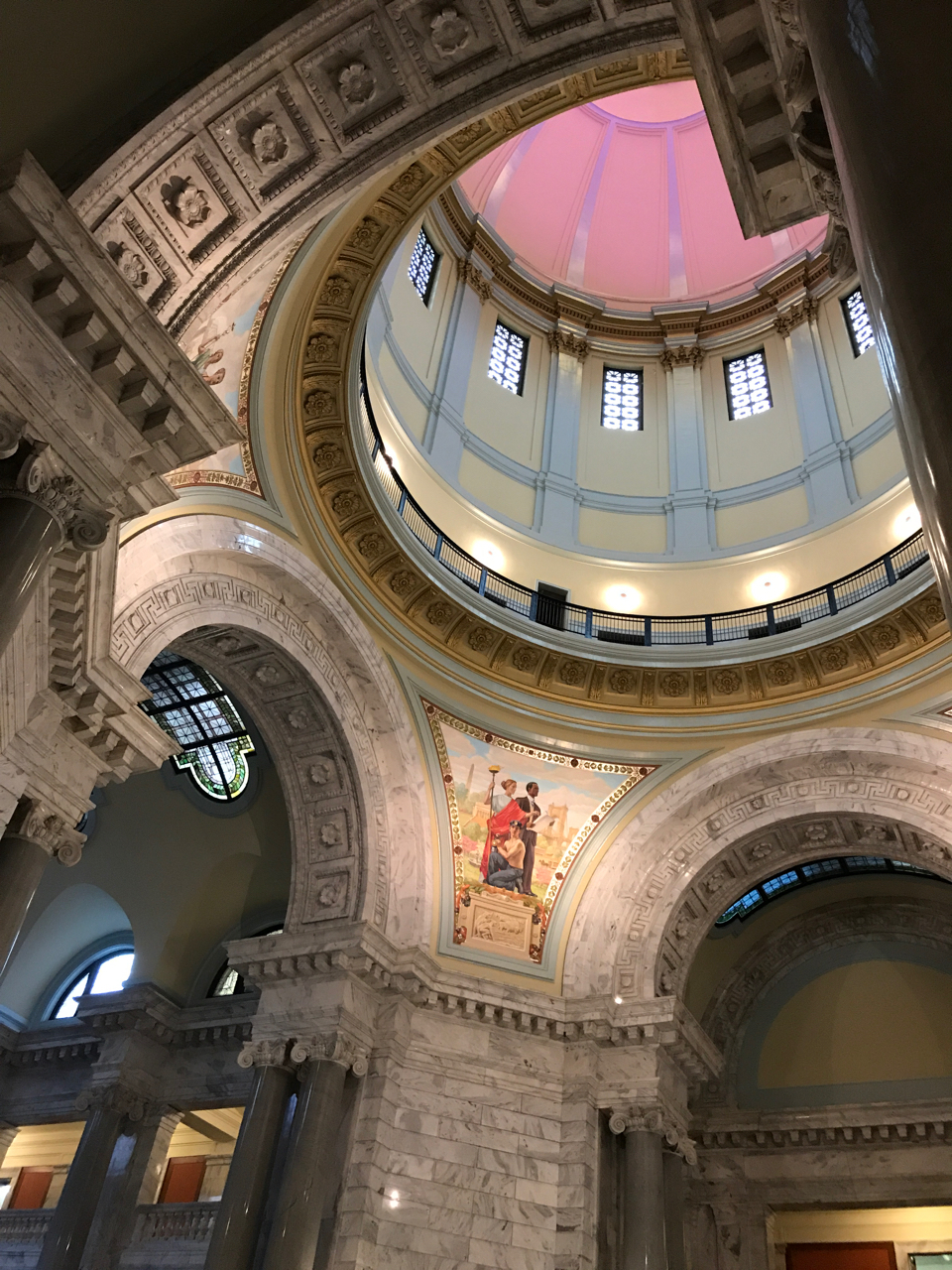
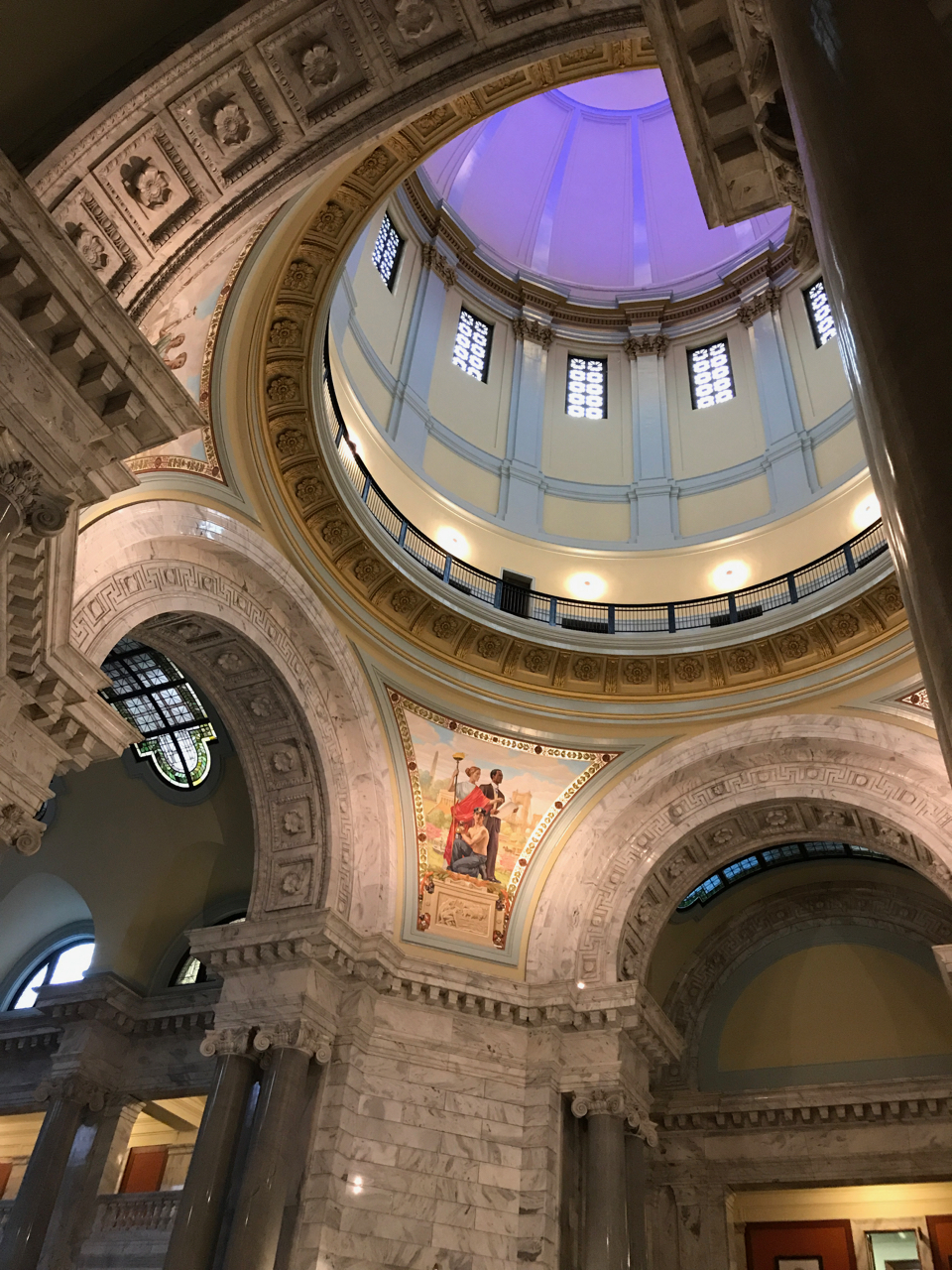
This dome does something I have never seen in any of the other state capitols – it has a light show!
It changes from the yellow to green…
to pink…
to blue…
and finally to purple.
Isn’t that unique?
I am just about done with my visit to the capitol. Before I leave, I want to share a few photos I snapped of things that interested me.
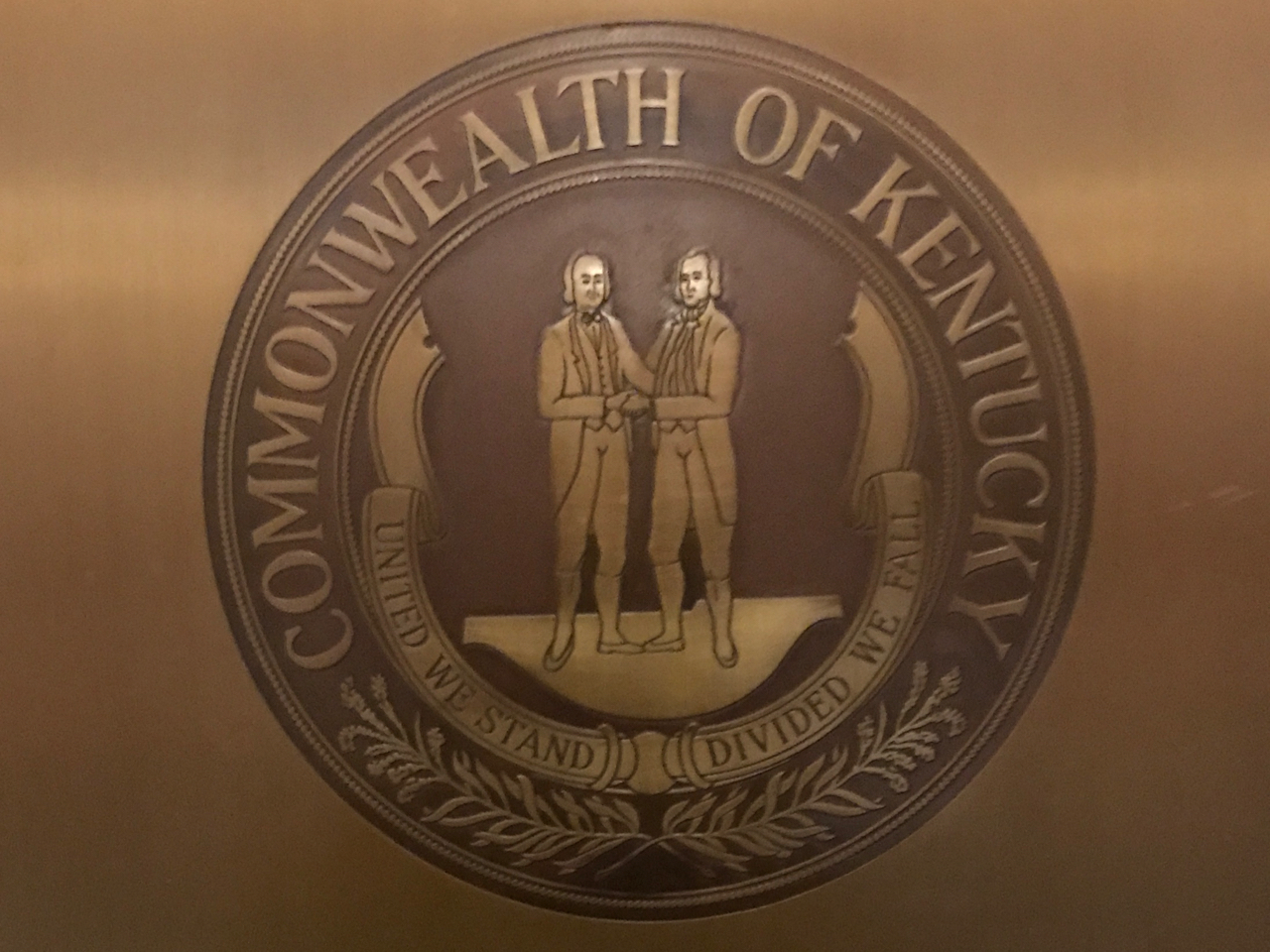
The seal of the Commonwealth of Kentucky. I got to wondering about the difference between a state and a commonwealth, so I went looking. Essentially, there is no difference. There are four states that identify themselves as commonwealths. (If you want to check your knowledge, you can click on the link and see if you were right.)
Oh, all right…the four commonwealths are Kentucky, Virginia, Pennsylvania and Massachusetts. Commonwealth is a traditional English term for a political community founded for the common good. Massachusetts, Pennsylvania and Virginia were members of the original 13 colonies. Kentucky was originally a part of Virginia. It split from Virginia in 1792 and became the 15th state to join the union. I guess it just made sense to use the title “commonwealth” – or maybe they were trying to stake a claim to being part of the original 13 by keeping the designation Virginia uses.
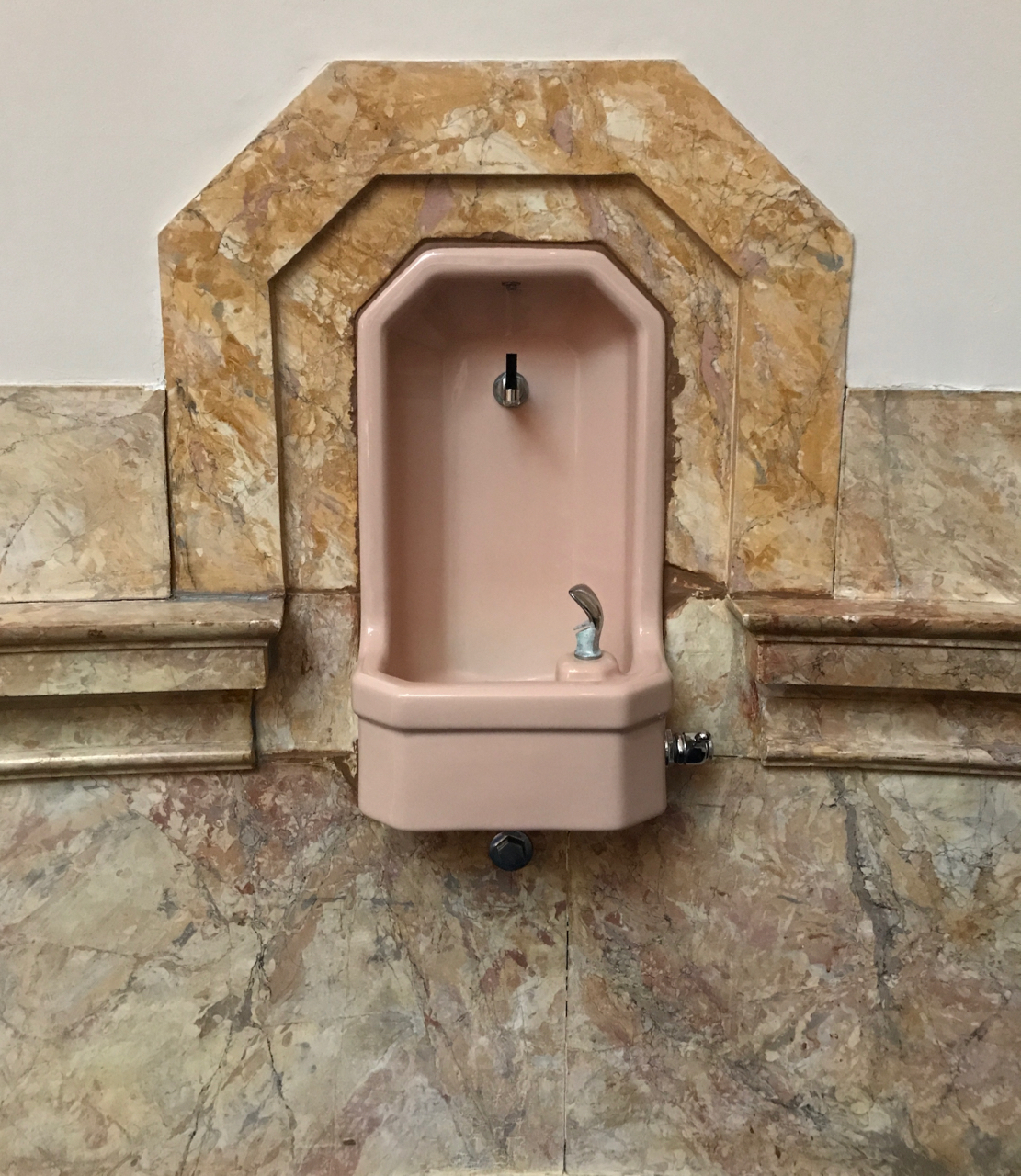
I rather liked this pink drinking fountain. It reminded me of my house with the pink porcelain bathroom fixtures I had before I left for my Airstream adventures.
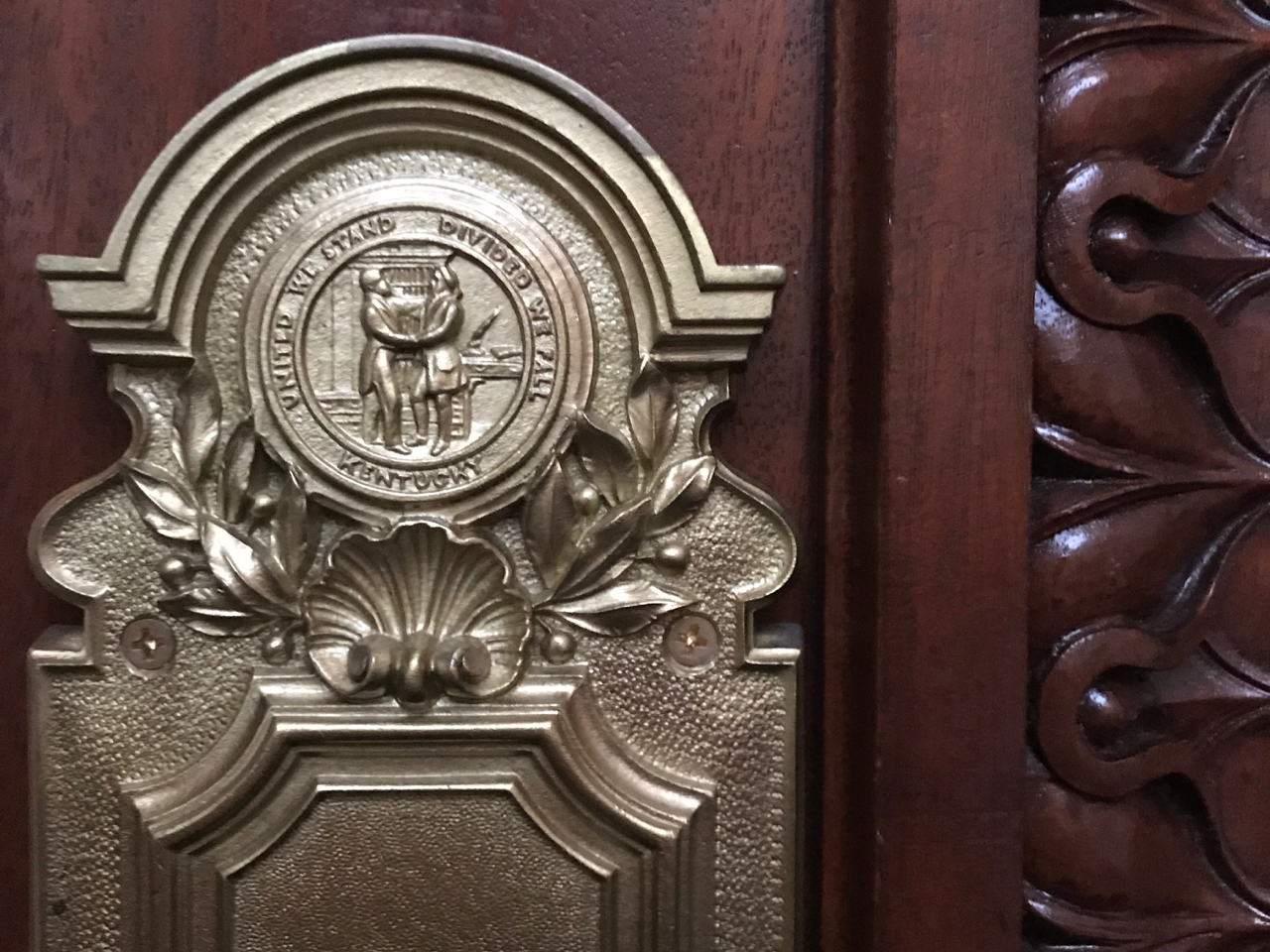
I liked this ornamental door plate.
You know, it’s a little ironic that their state motto is “United we stand, divided we fall.” I mean, they divided themselves from Virginia and they honor the president of the Confederacy in their rotunda…
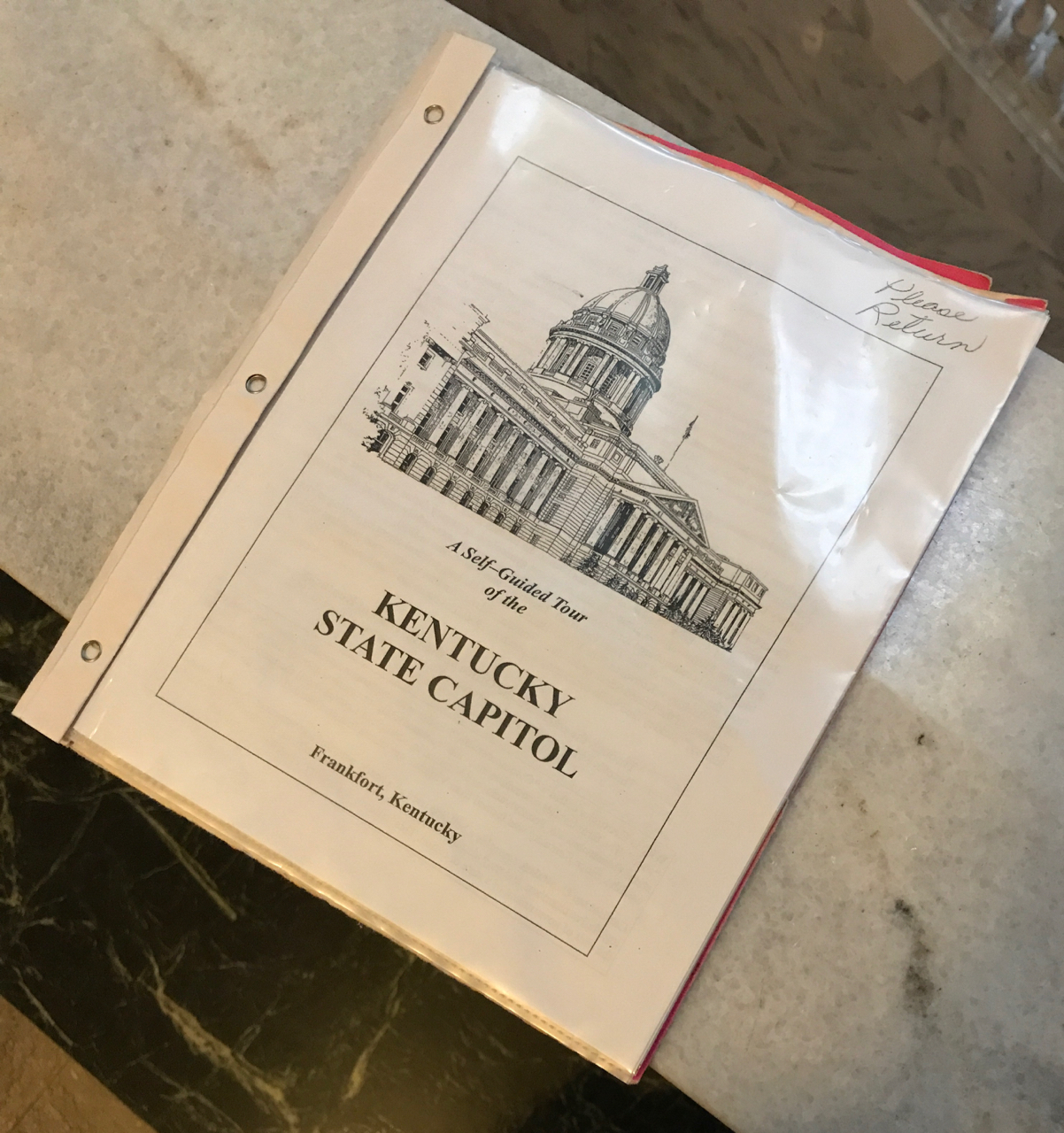
Before I left, I asked if they had a brochure for the self-guided tour. There was a guide, but it had to be returned to the desk. I have no cause for complaint – Wikipedia can give me the information that I can’t remember and I did get a sticker from the governor’s office. Besides, the visit was free.
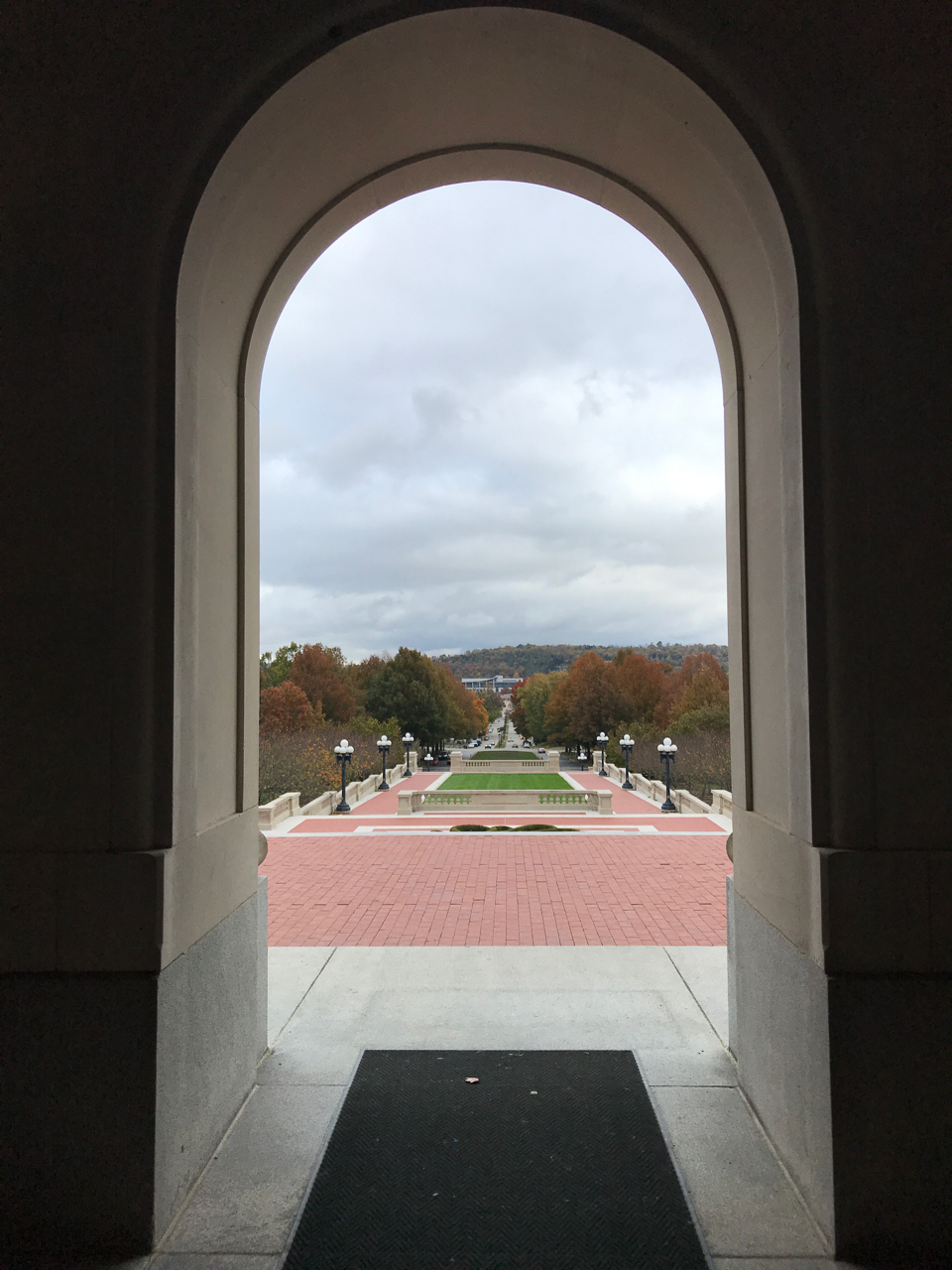
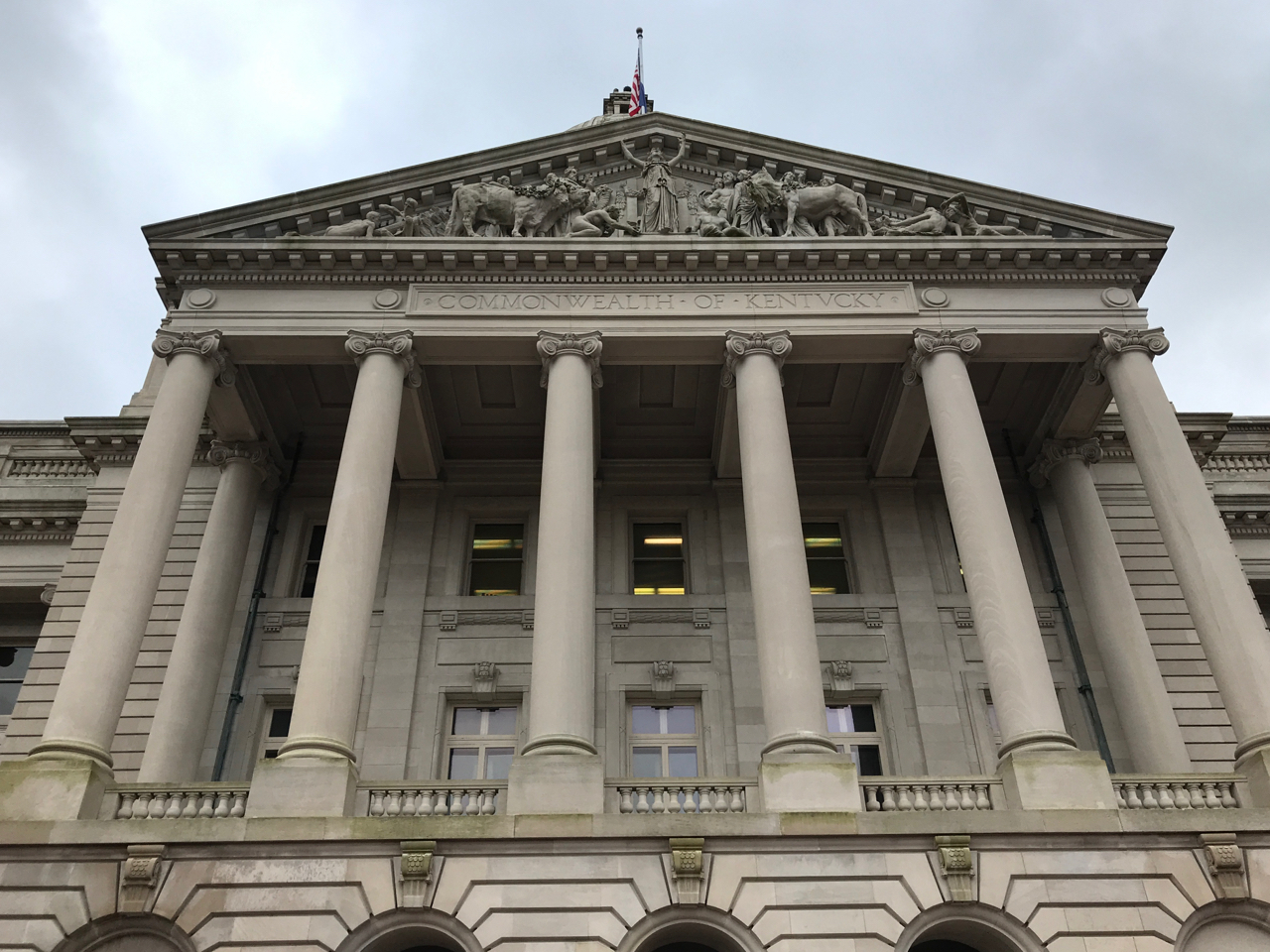
There was quite a view from the entrance.
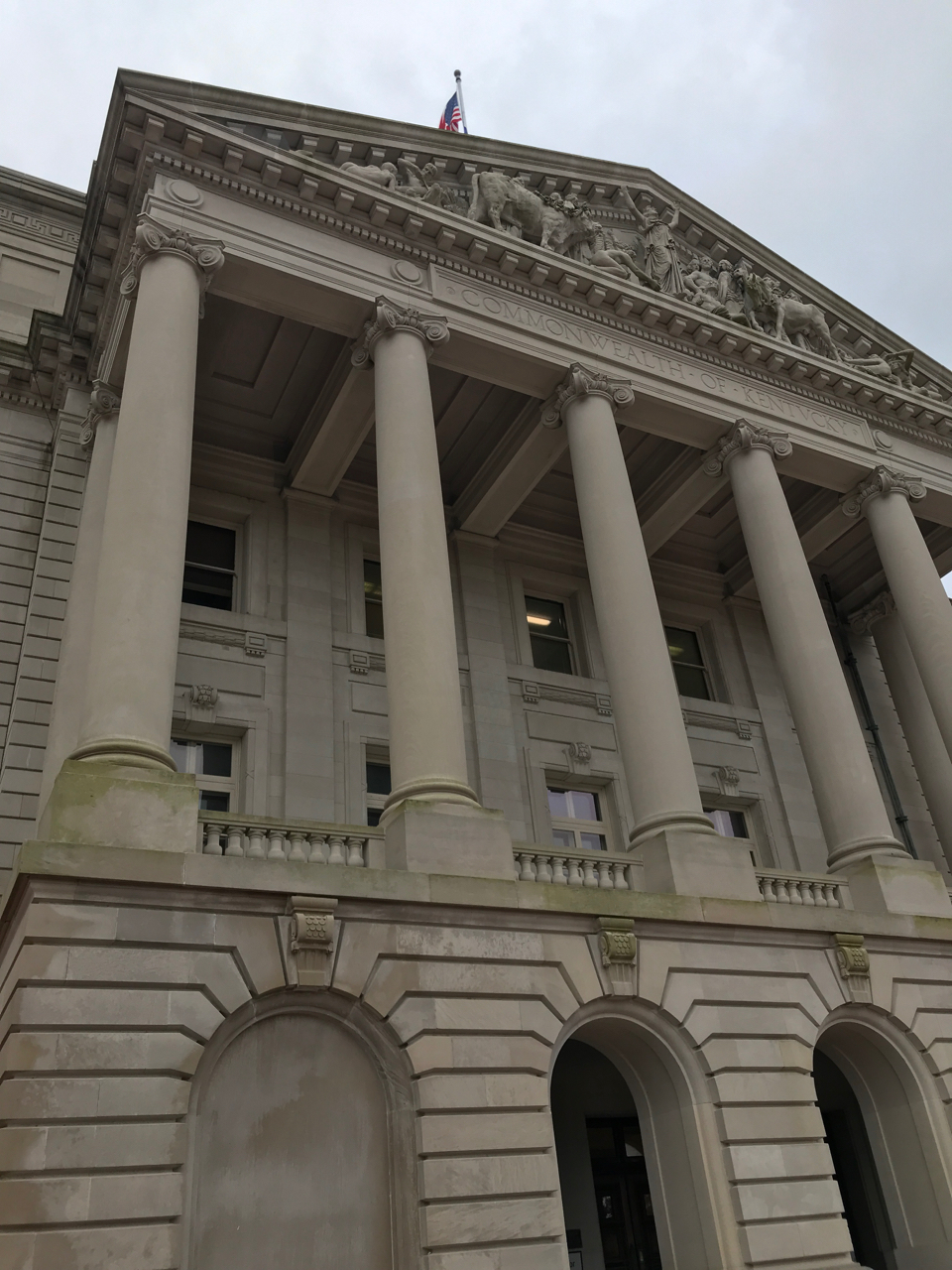
I turned around to look back at the entrance.
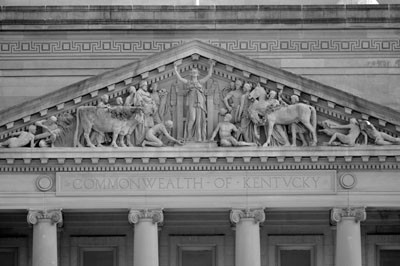
That is quite a sculpture on the pediment above the entrance!
I wondered if there might be a better photo that showed the sculptures in better detail. I found one here, on the Frankfort Public Art website. I also learned that it was the work of David Henry Niehaus and is made of Indiana Limestone.
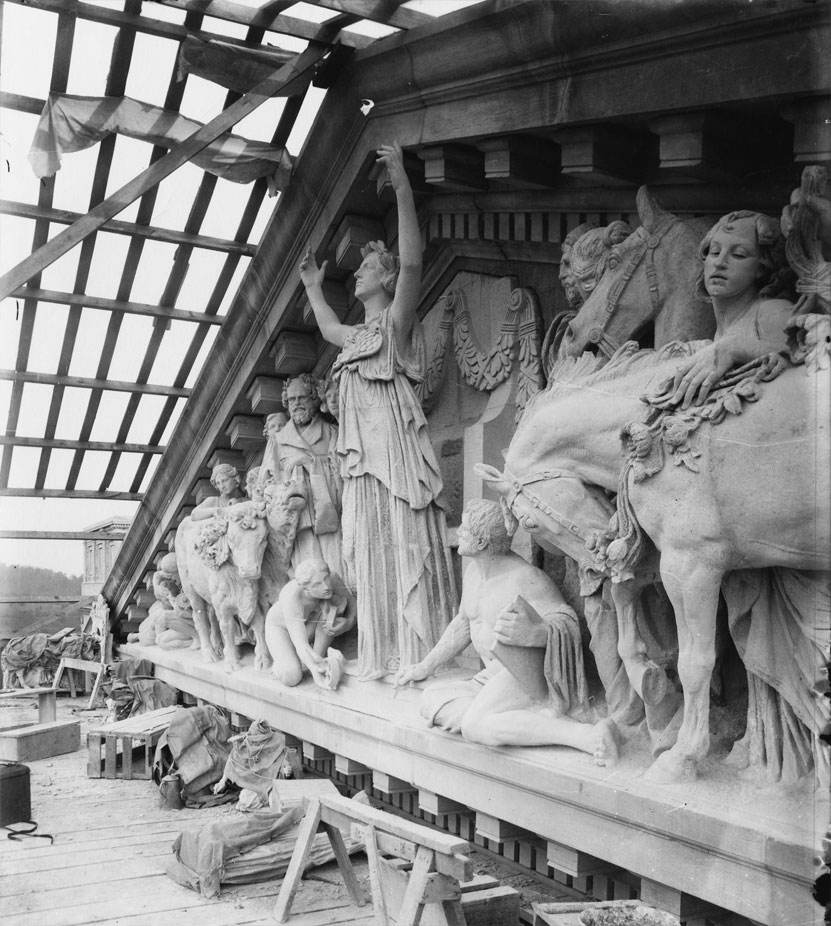
This historic photo, from the same source, gives you an idea of the monumental scale of the sculptures.
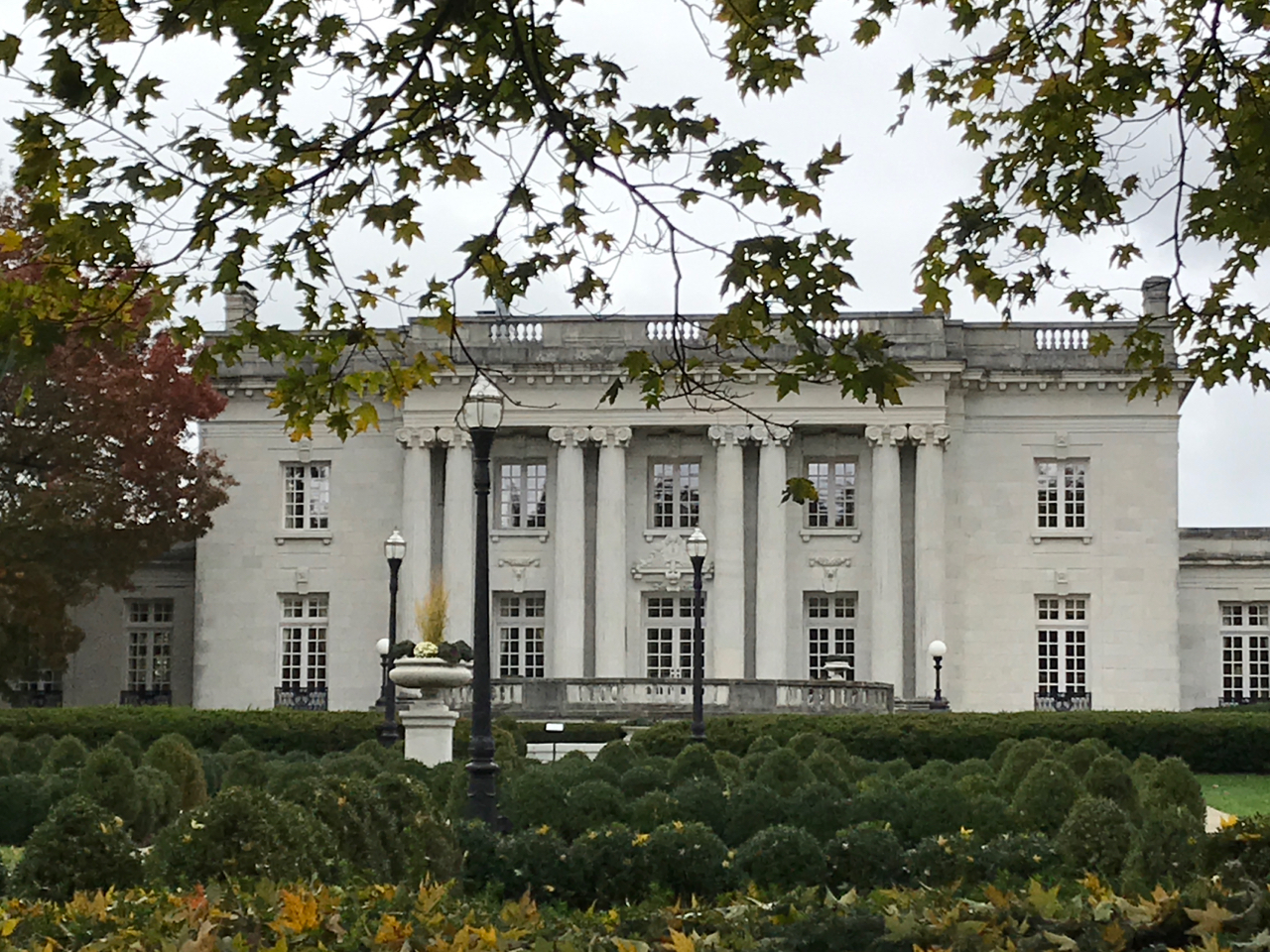
A short ways away from the capitol is the Executive Mansion. According to the marker in front, it was built just after they finished the capitol. The two year construction project cost $95,000, which would be equal to $2,516,755 in today’s money. The 25-room limestone mansion is patterned after Marie Antoinette’s villa. I wonder if they might have been able to find a building to copy of someone who wasn’t removed from prominence so…permanently.
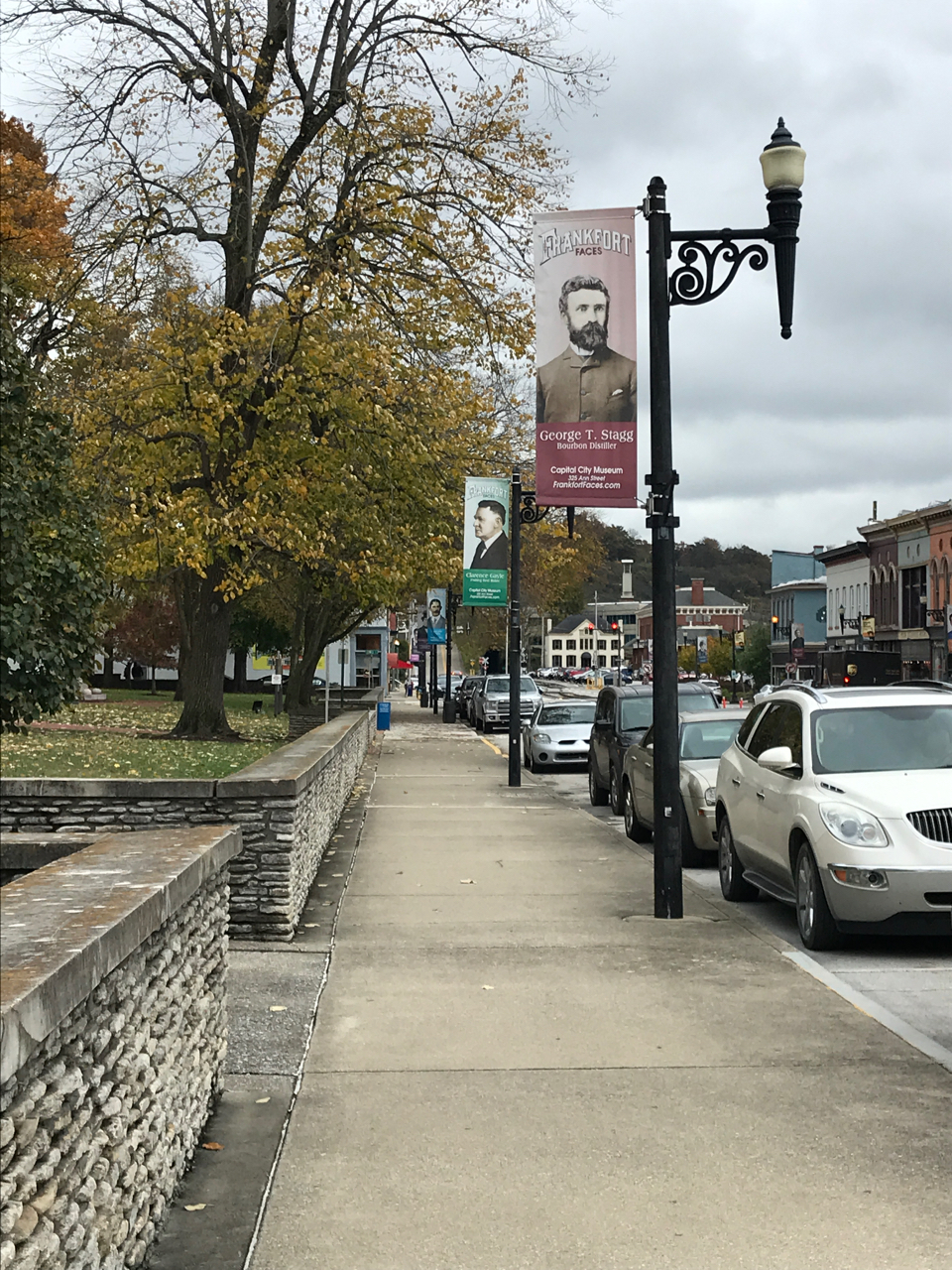
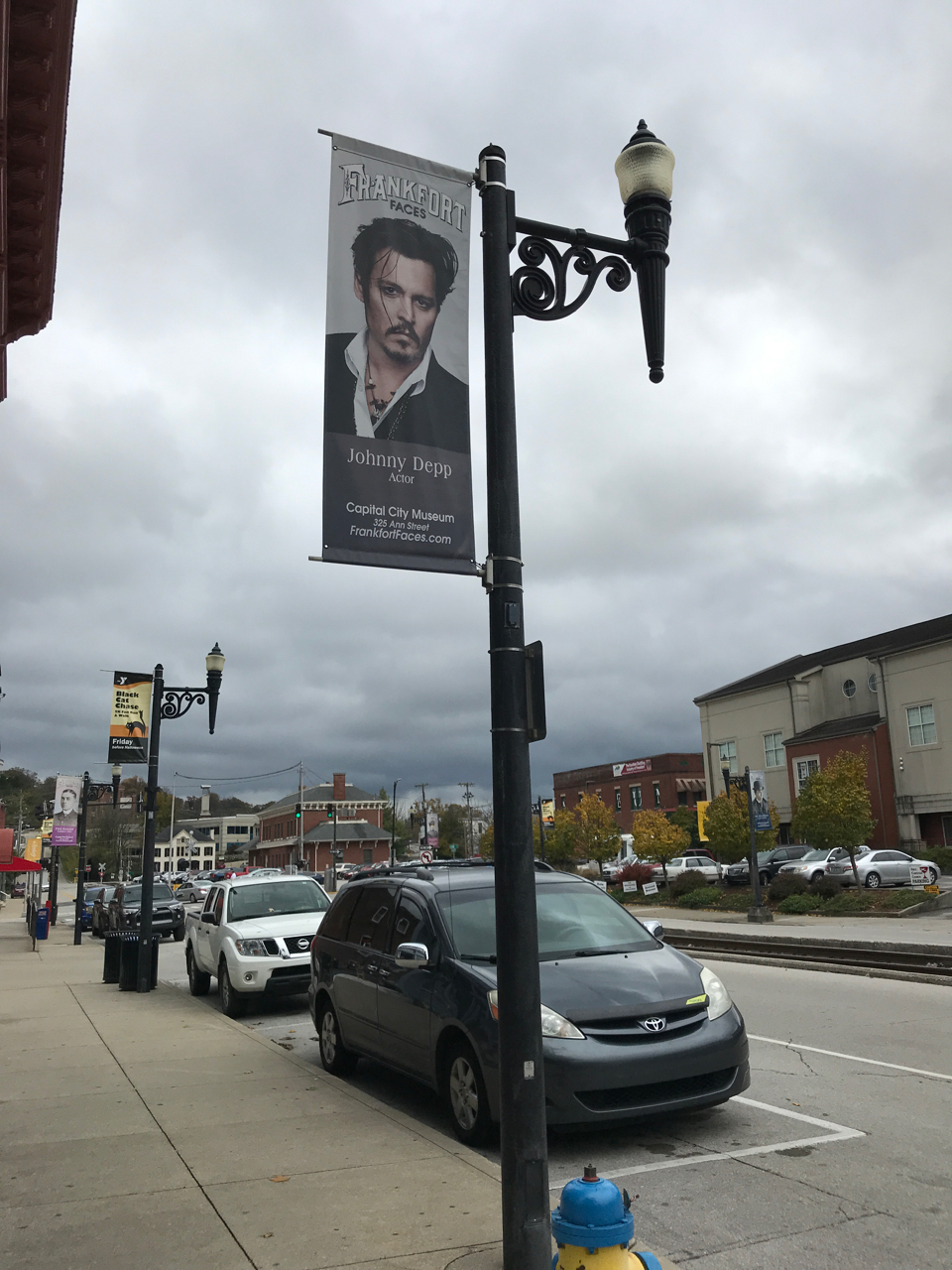
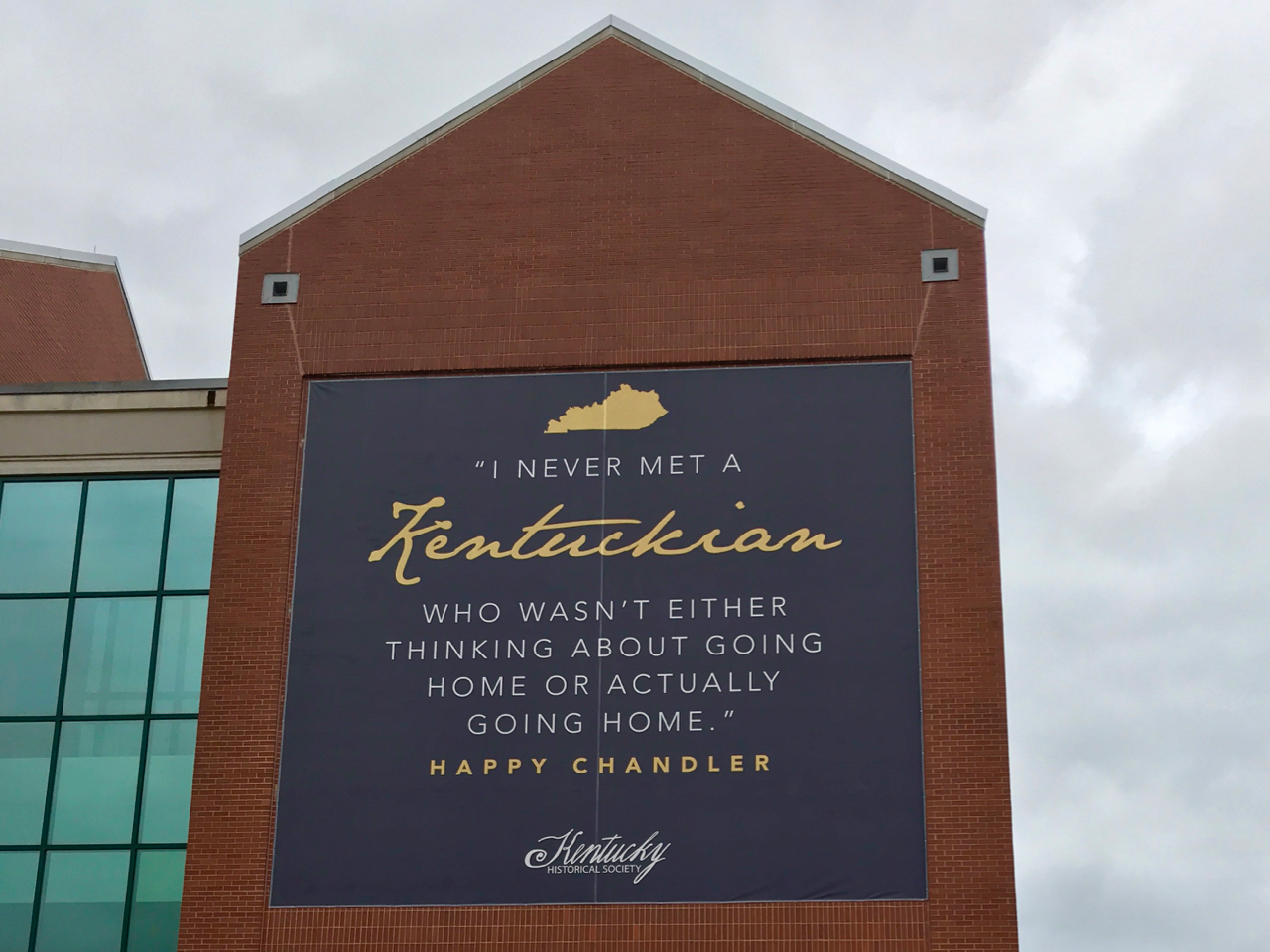
I headed over to the older section of town. There were banners celebrating “Frankfort Faces”
Huh! I didn’t know that Johnny Depp was from Frankfort!
Well…he isn’t, although he is from Kentucky. He was born in Owensboro, about 150 miles away. His bio says that his family moved frequently, so maybe he lived here. Or maybe he went shopping here. Or maybe he rode the train through town.
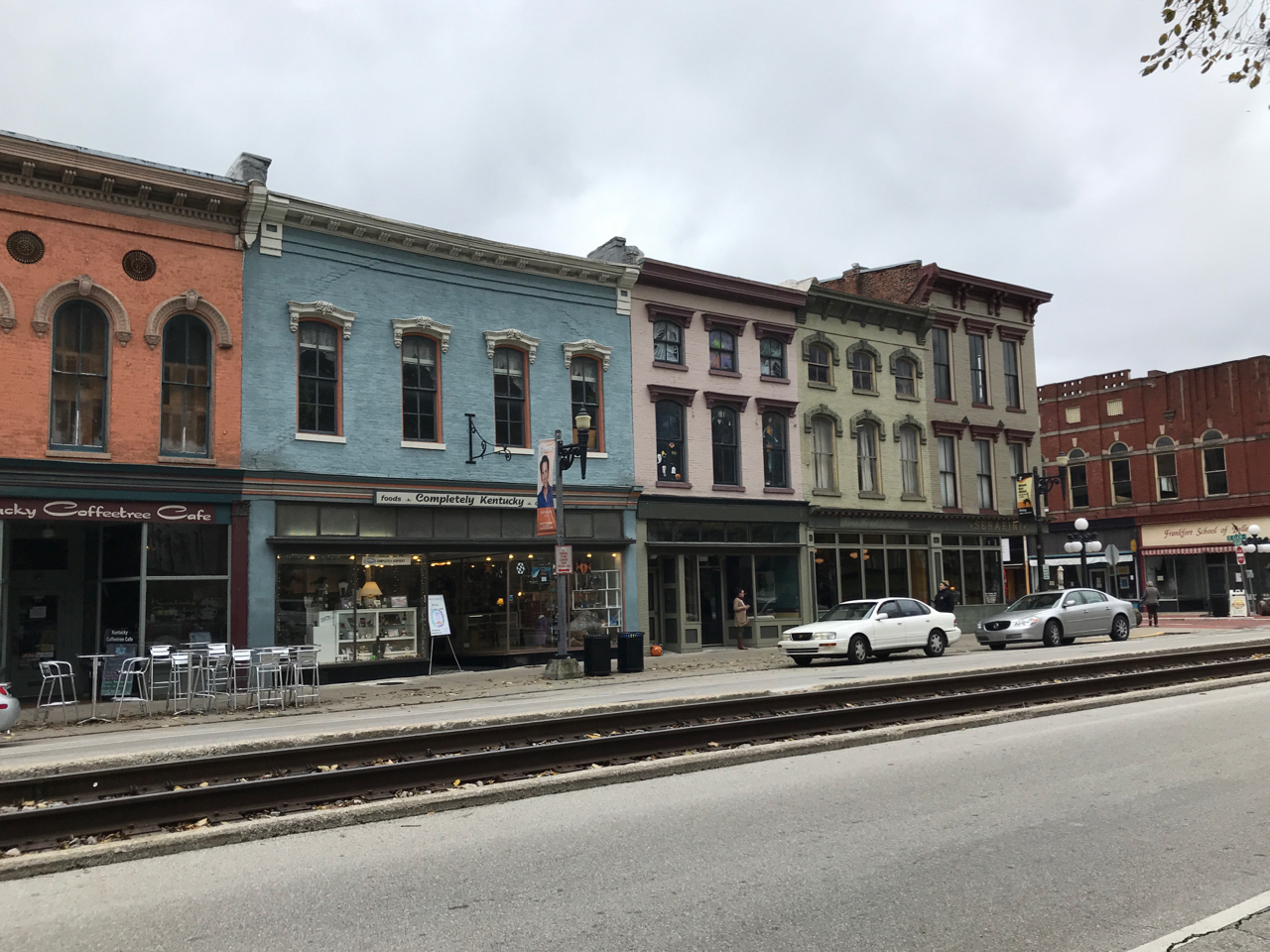
I mean, he could have ridden the train through town, as the tracks run right down the middle of what would have been the main street at one time.
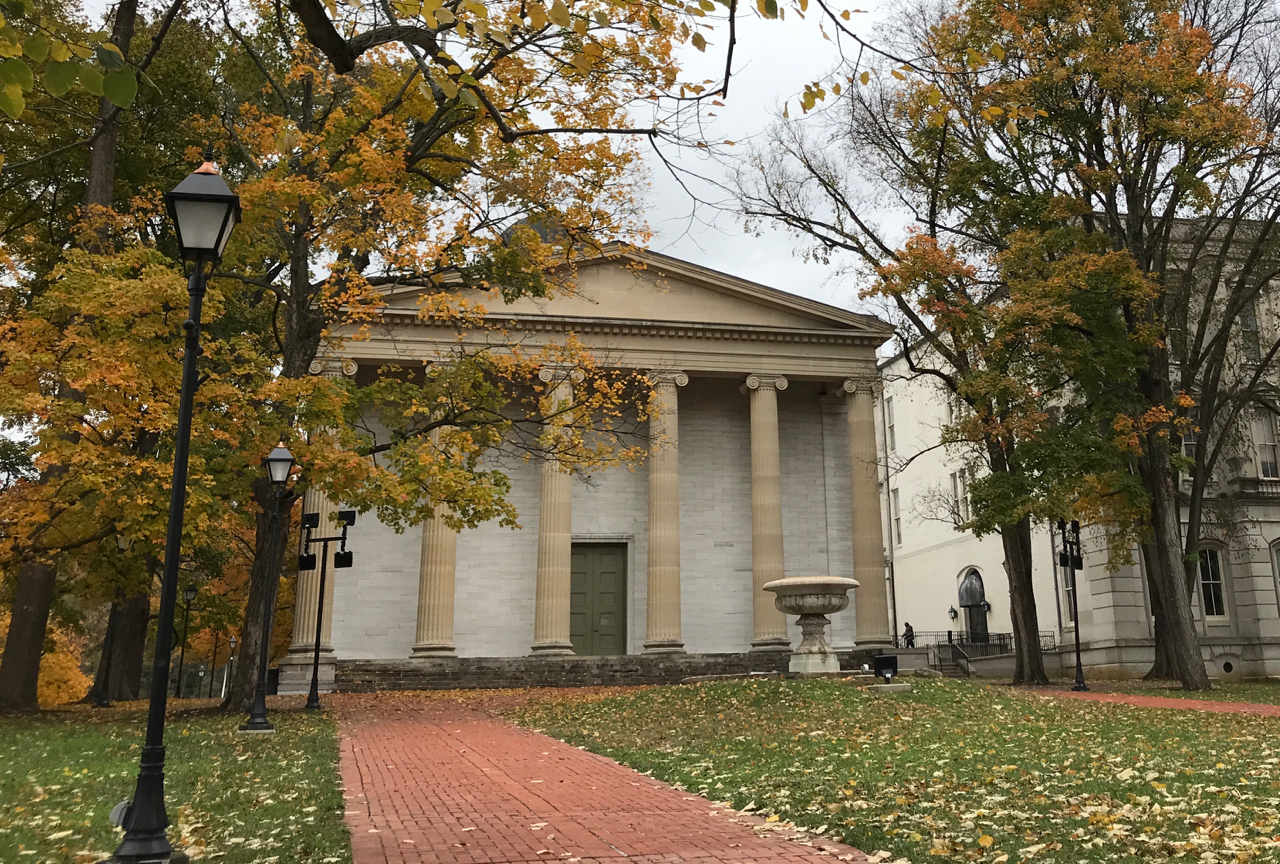
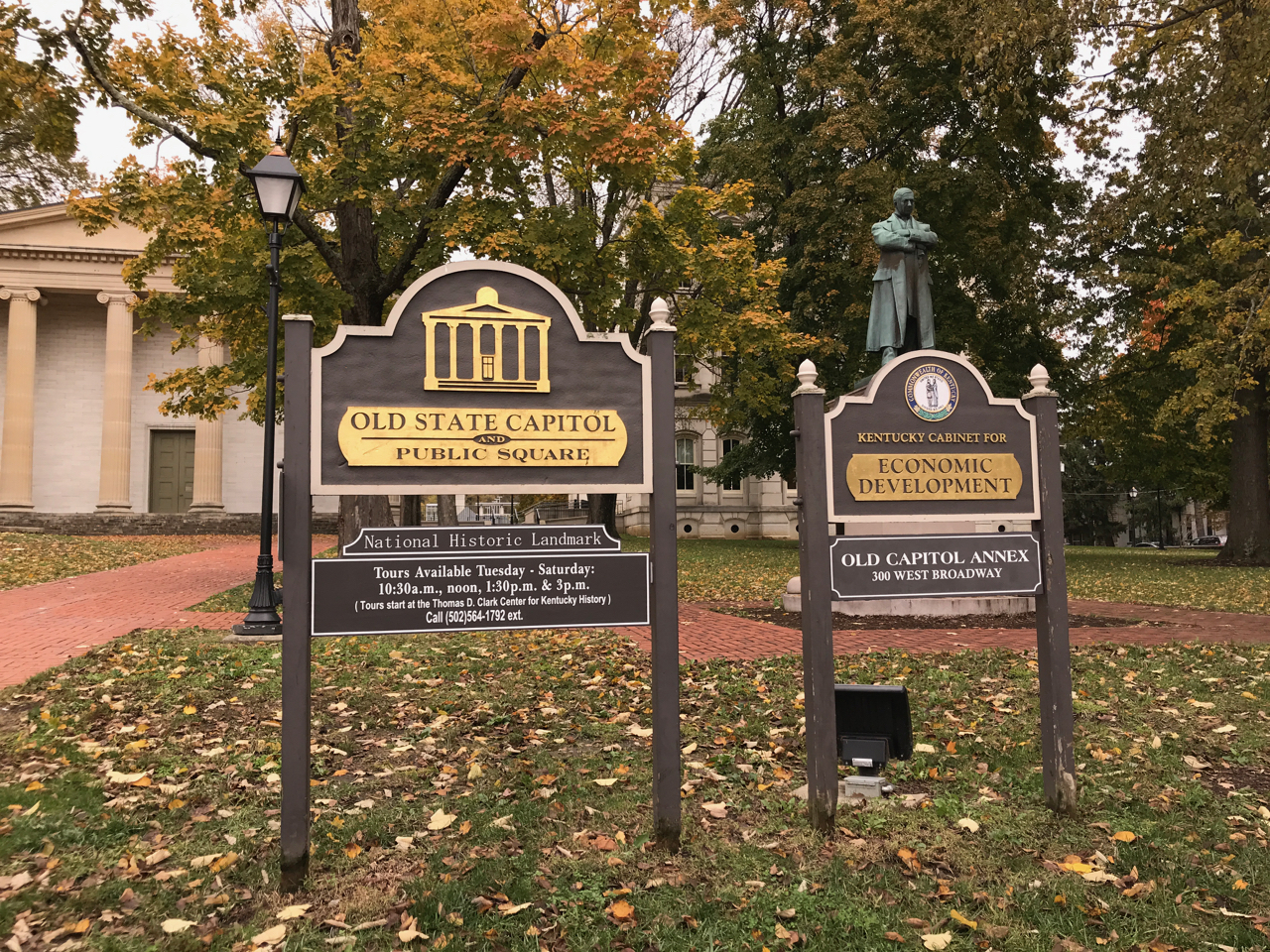
This is actually the third capitol building. From 1792-1830, two other buildings were used as the seat of the government, but both of them burned down completely. This building was in use from 1830 until the new capitol opened in 1910.
This building was designed in the Greek Revival style by 25-year-old Gideon Shyrock of Lexington, and it was his first building. His chose the Greek Revival style to symbolically link the relatively young republic of Kentucky with ancient Greece, the prototype of popular democratic government.
The front of the building is modeled after the Temple of Minerva Polias at Priene. Since Greek temples had no windows, he chose not to have windows in the front.
It is now a museum. I can’t remember if I was there on a day when it wasn’t open or if I didn’t feel like paying to visit.
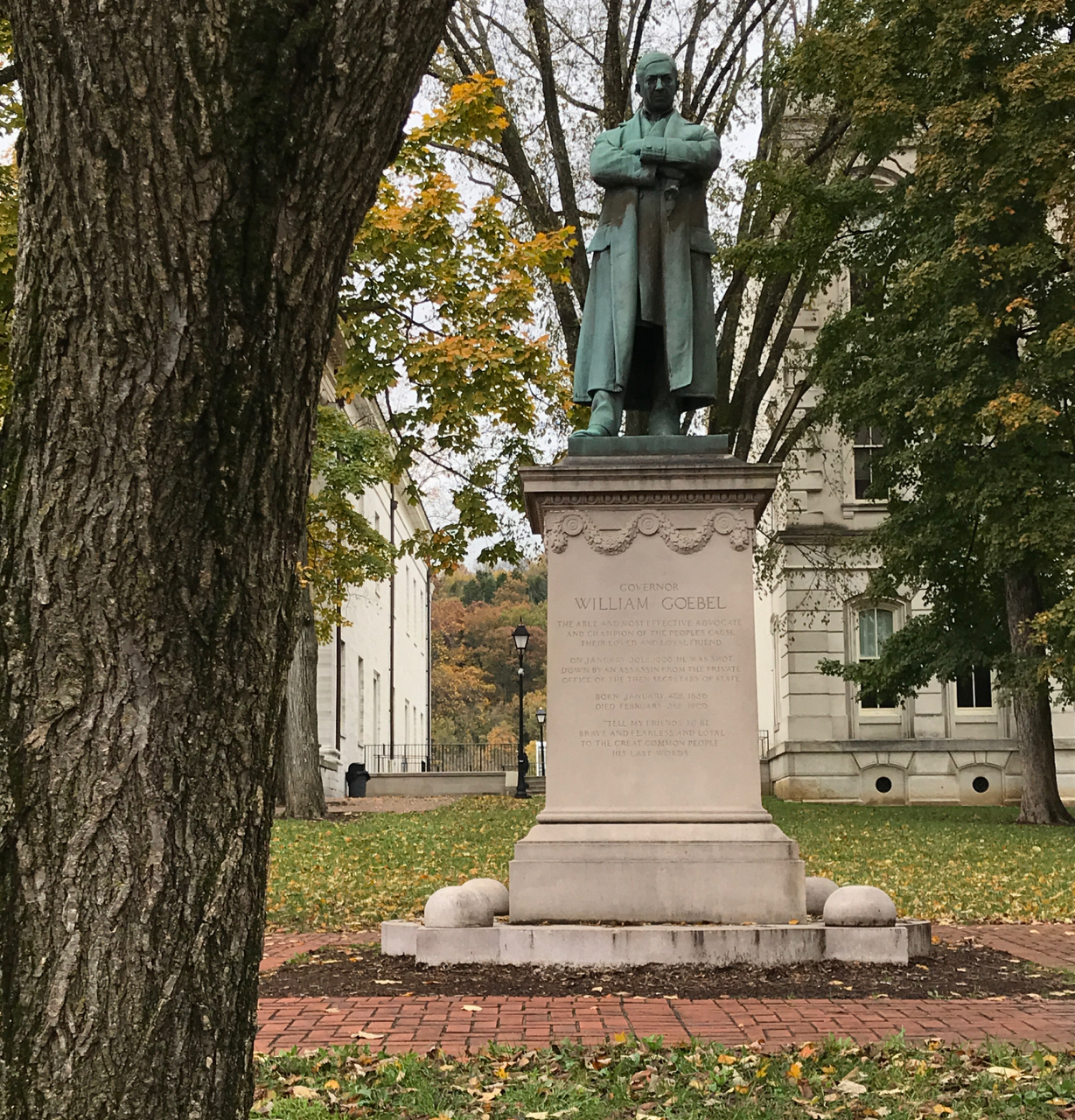
This statue is of William Goebel, who was elected in the 1899 governor race.
By Acdixon – Own work, Public Domain, https://commons.wikimedia.org/w/index.php?curid=14390488
He was assassinated at the Capitol on his way to be inaugurated.
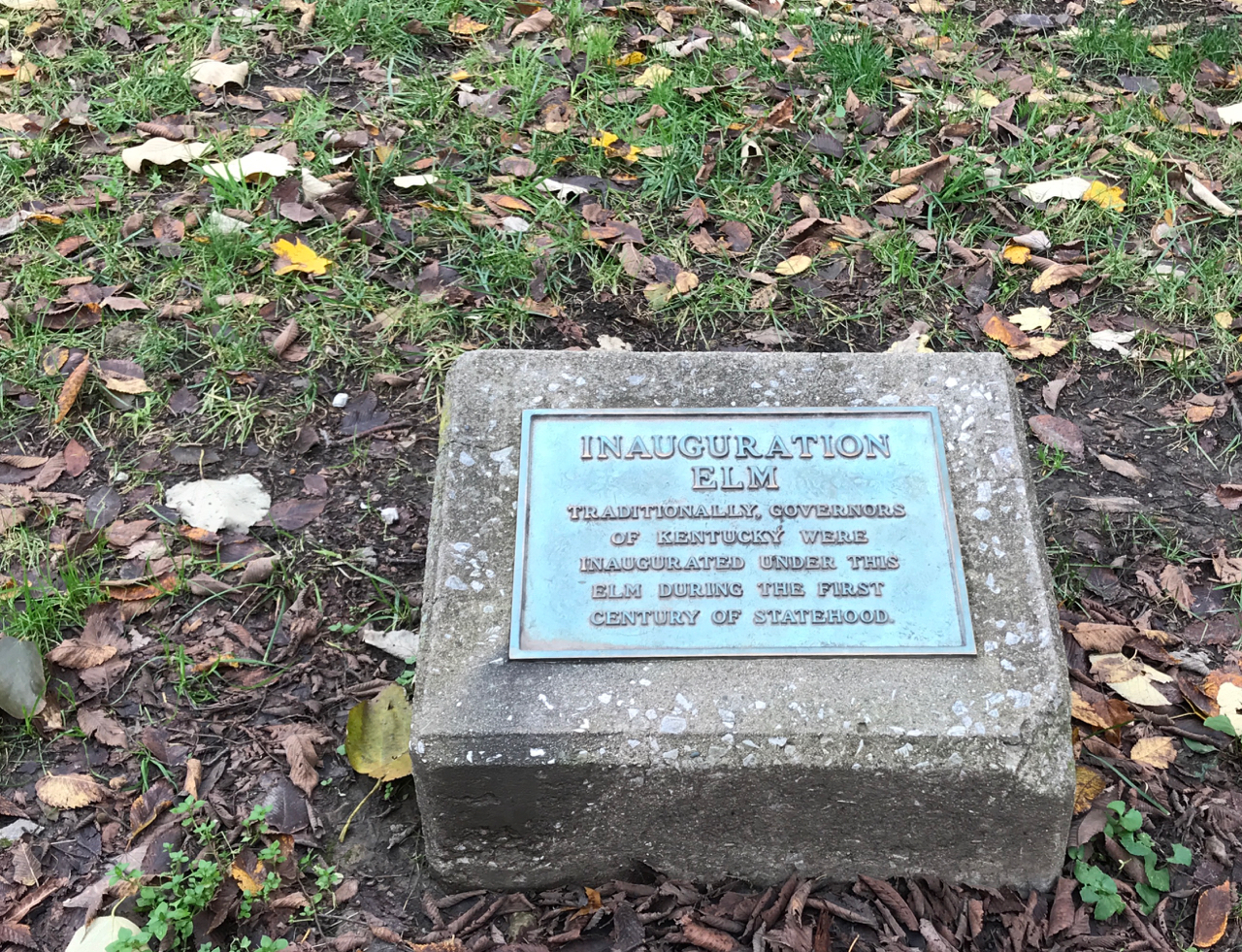
Do you remember my last post where I commented on the transience of trees as memorials? Apparently, inaugurations were carried out beneath an elm tree for more than a century. It is no longer here, but the tree carries on in trees grown from cuttings.
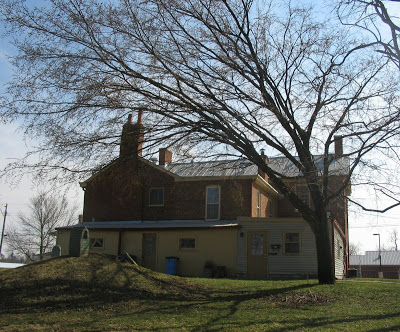
This elm is at the Stanley-Case home in Shelbyville, Kentucky. It’s only about 20 miles away, if you care to go take a look. (I didn’t. I borrowed the photo from the above website.) The oldest part of the building dates from the early 1800s. It is now the headquarters of the Shelby County Historical Society.
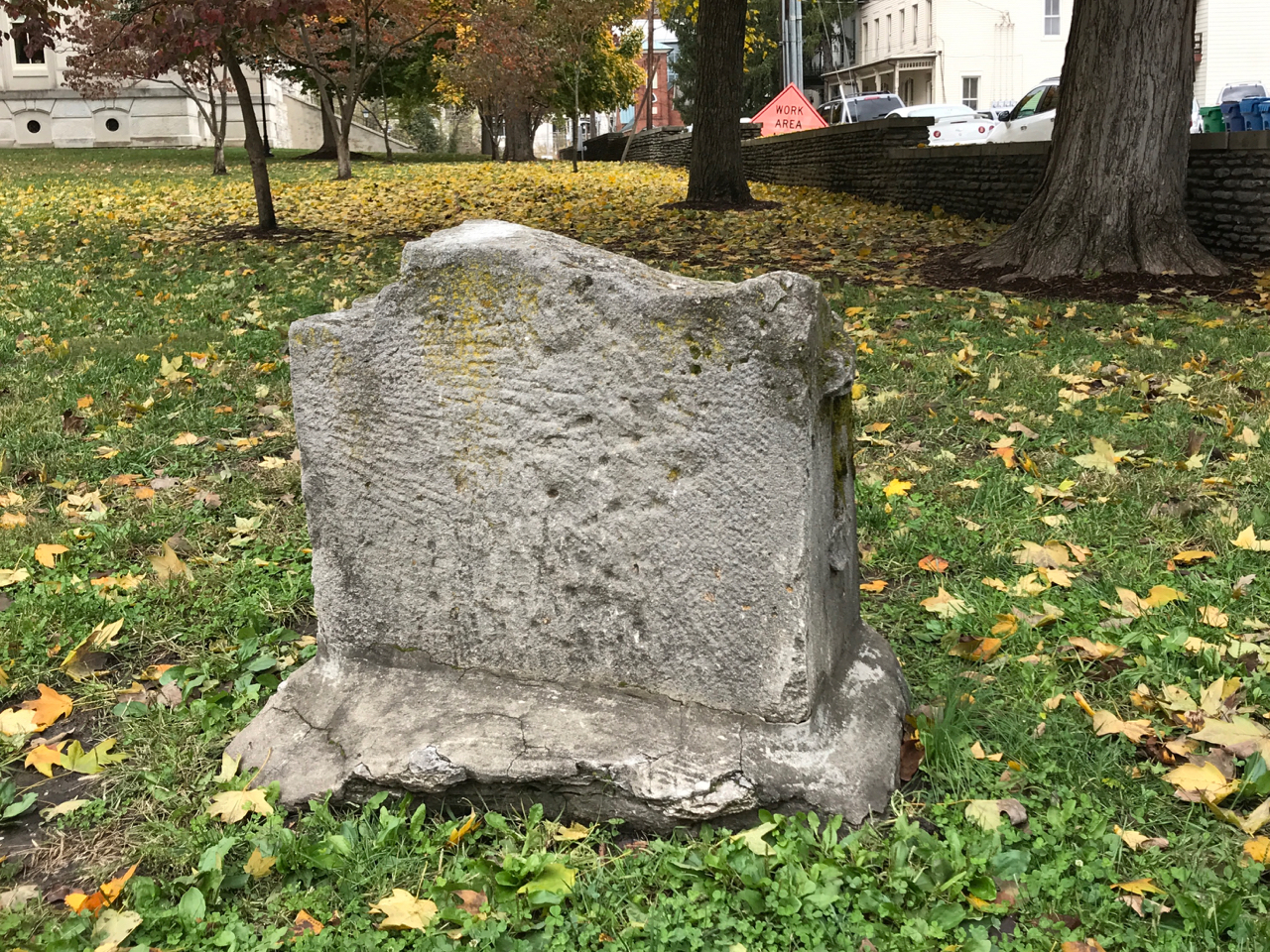
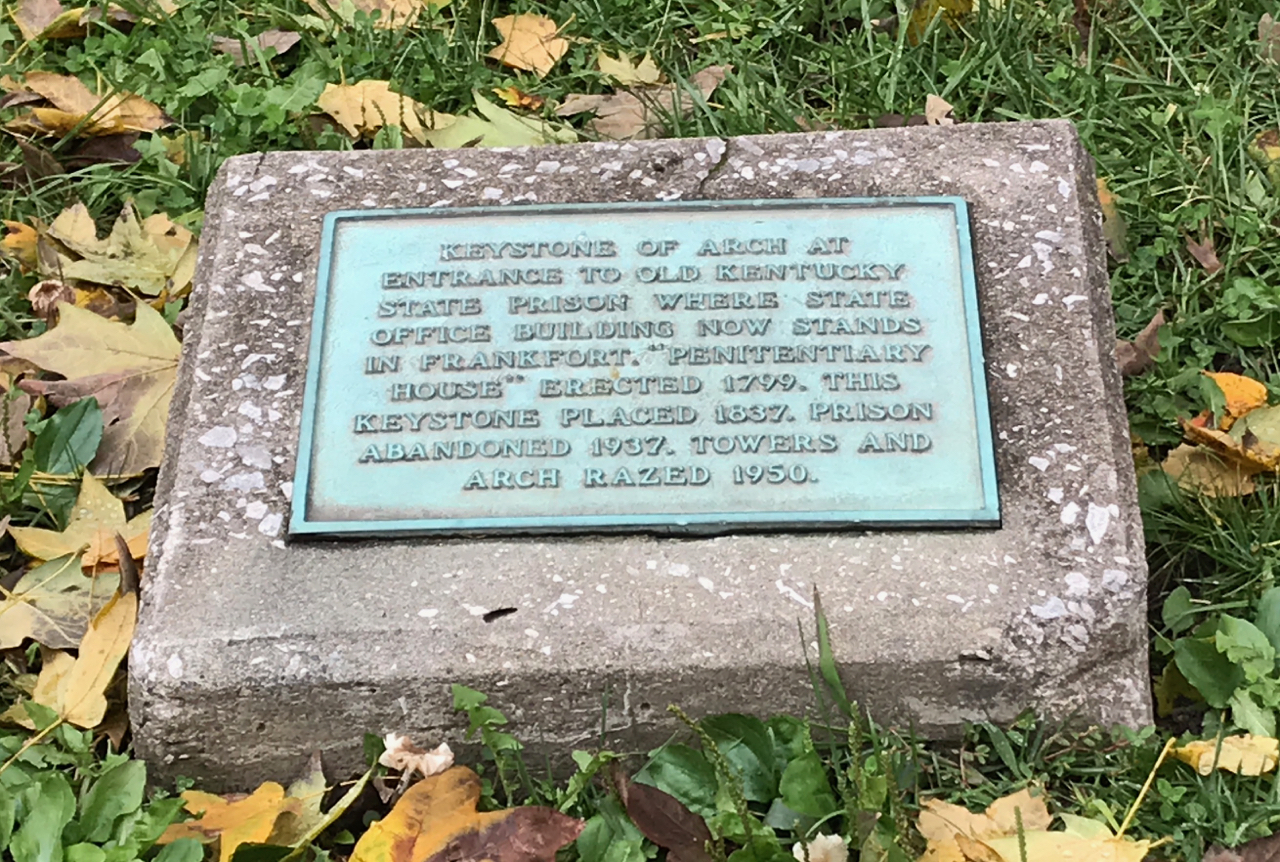
Now, I’m not 100% certain, but I think this is the keystone of the arch at the entrance to the Old Kentucky State Prison. According to a plaque nearby, the “penitentiary house” was erected in 1799, and the keystone was place in 1837. The prison was abandoned in 1937 and the towers and the arch were razed in 1950. The State Office Building in Frankfort now stands on the site it once occupied.
I was starting to feel peckish and I went looking for some lunch.
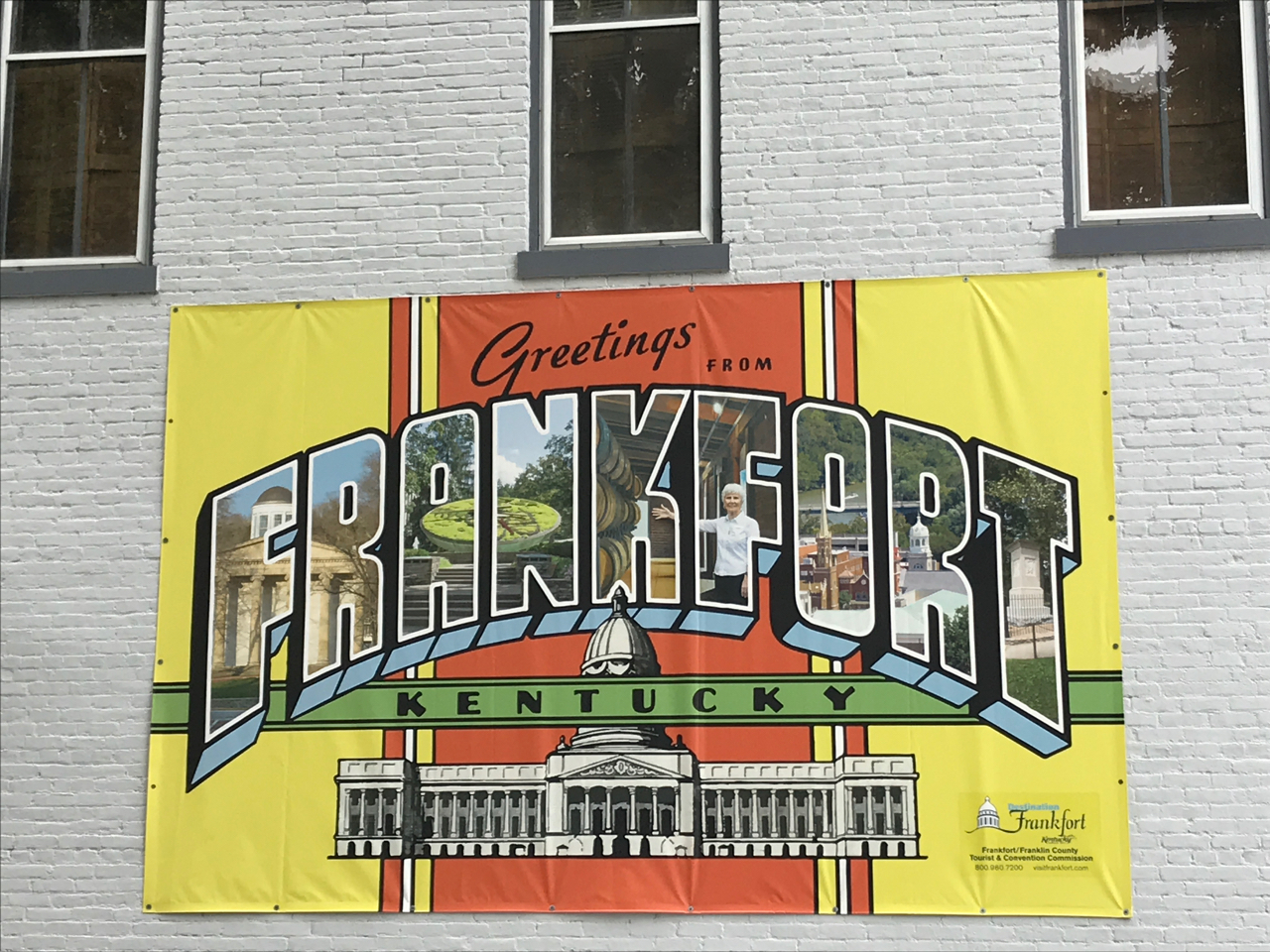
Along the way, I saw this banner.
Ah! Pizza would be good for lunch.
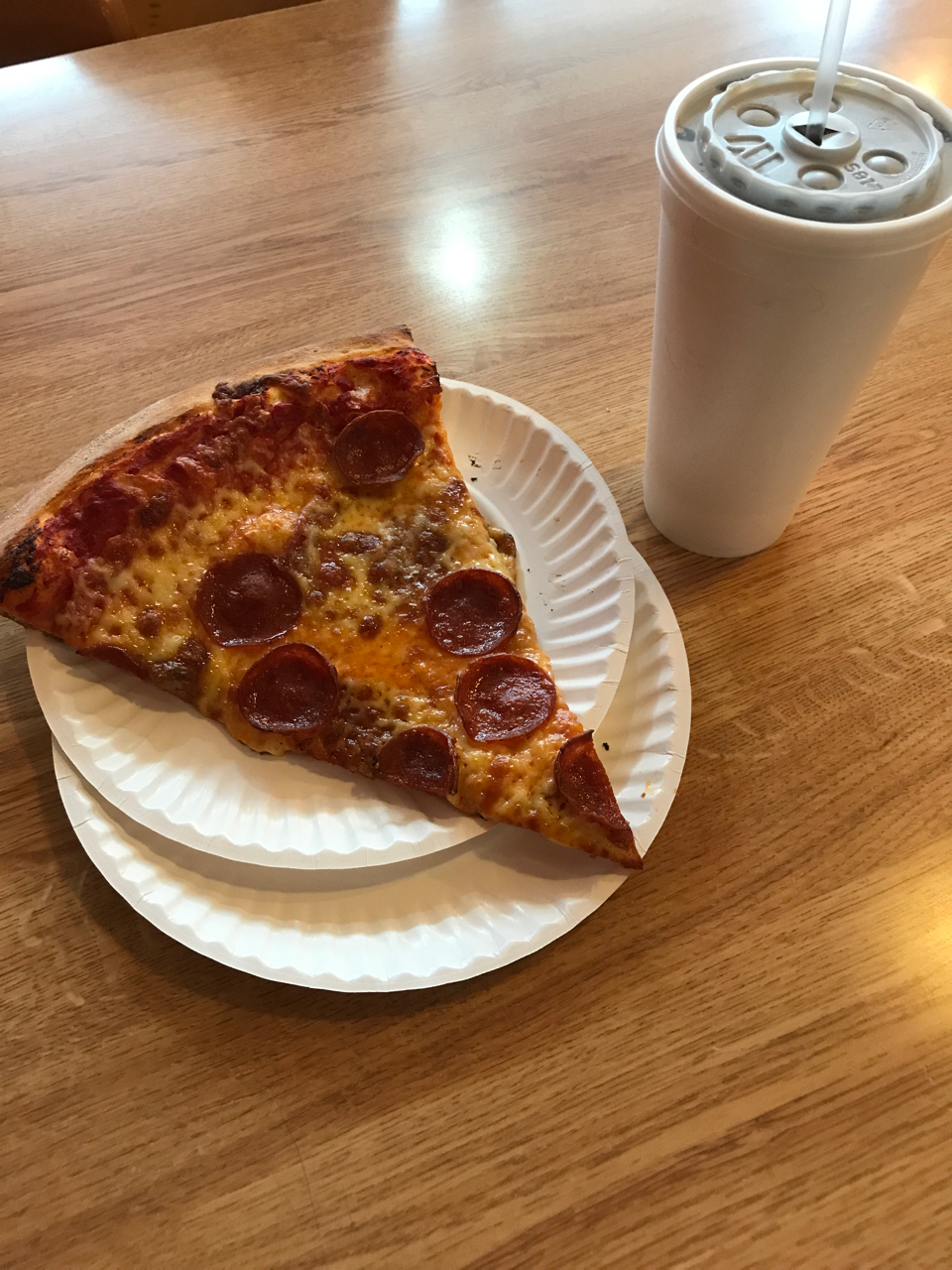
I got a slice so big they needed two plates.
Thus restored, I headed out for a bit more exploration.
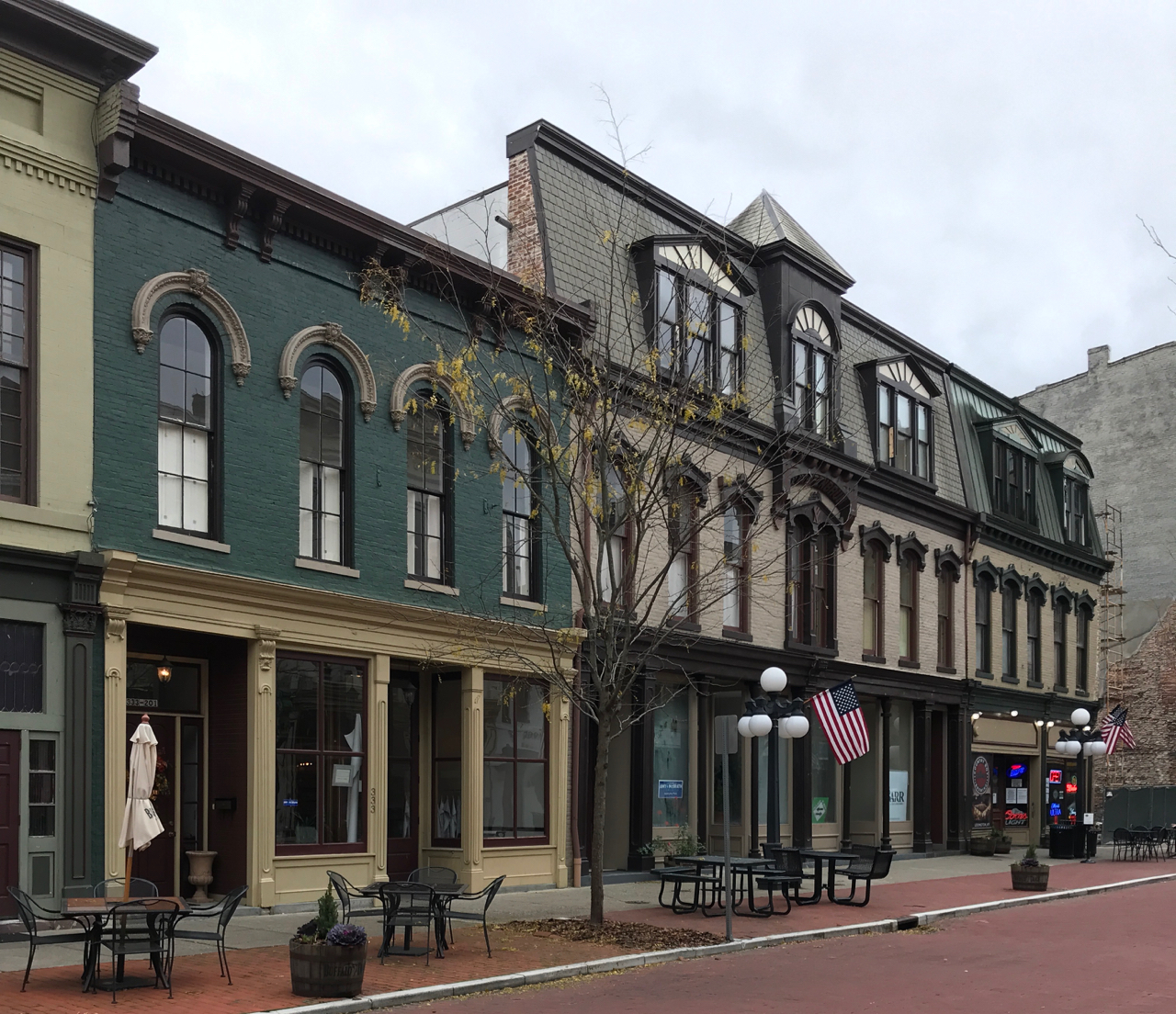
I crossed the tracks that ran right through town and over to the historic shopping area.
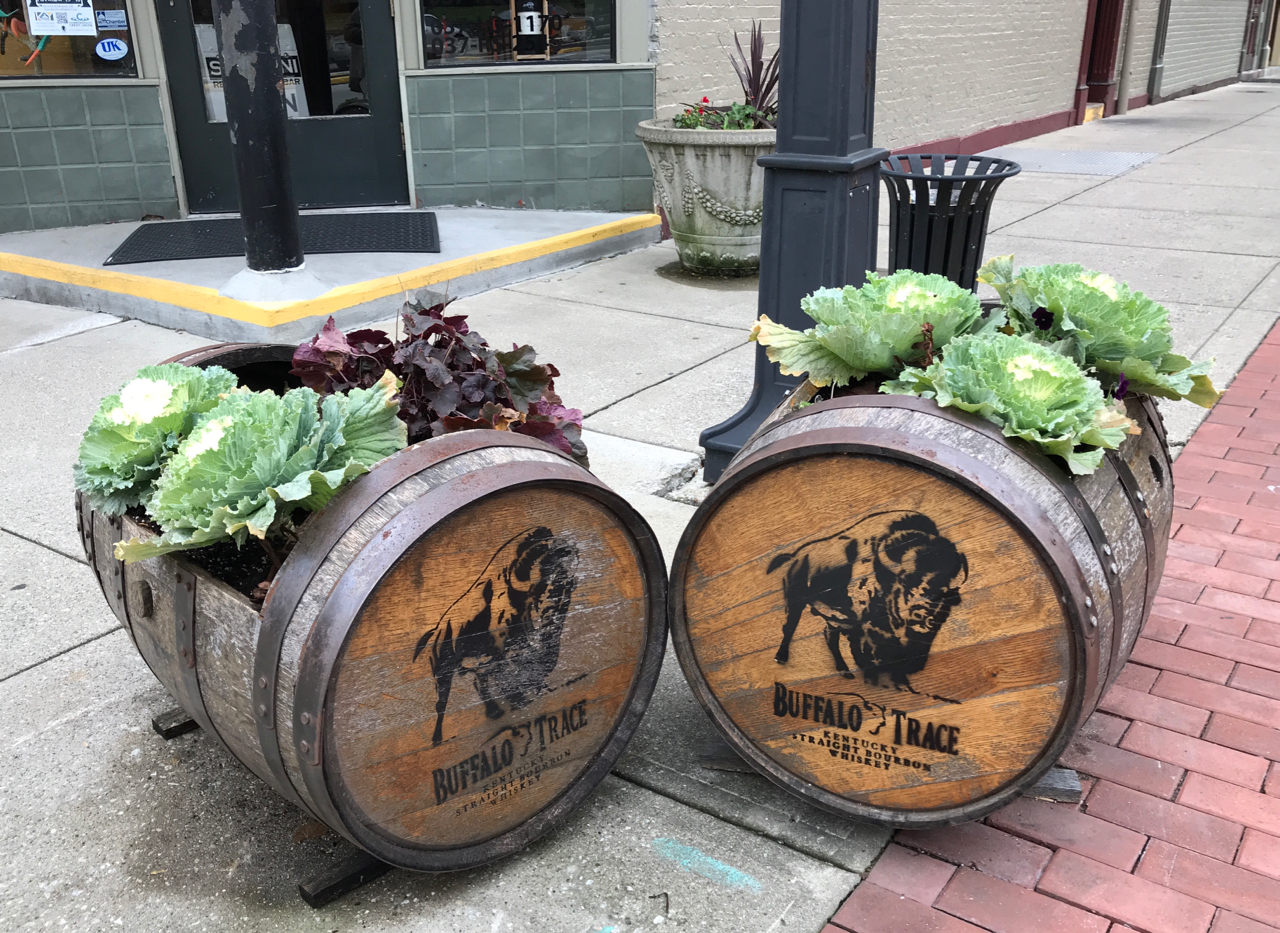
I thought this planters were interesting. I liked the decorative cabbage that was planted in them and this Buffalo Gal can’t resist a buffalo!
I’ll bet that this is a cute part of town to explore when the weather is nice. But, I had another objective for my visit to Frankfort. I wanted to see where Daniel Boone was buried. I headed over to the Frankfort Cemetery.
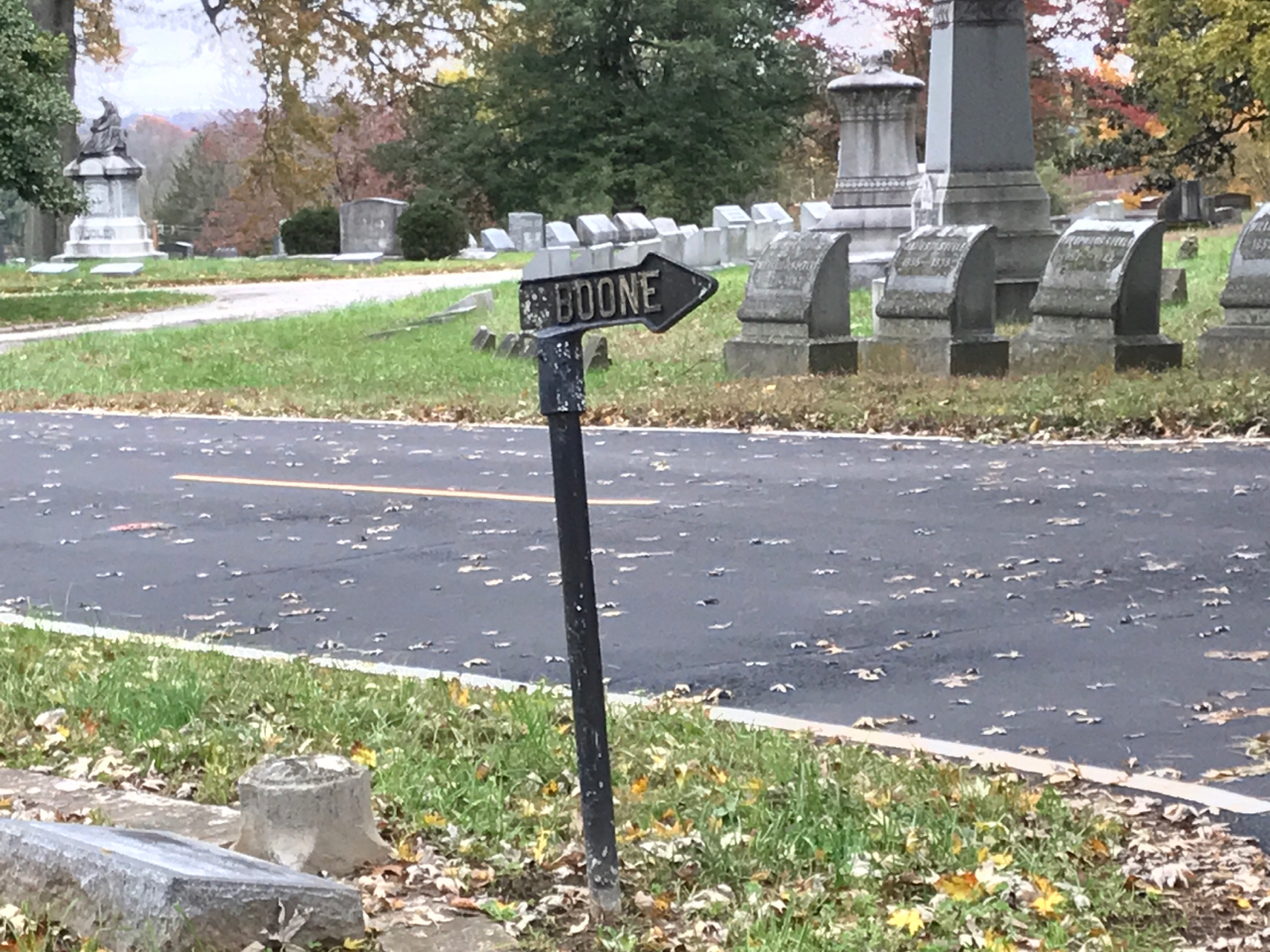
I liked how they made it easy to find this grave. Here’s the first sign.
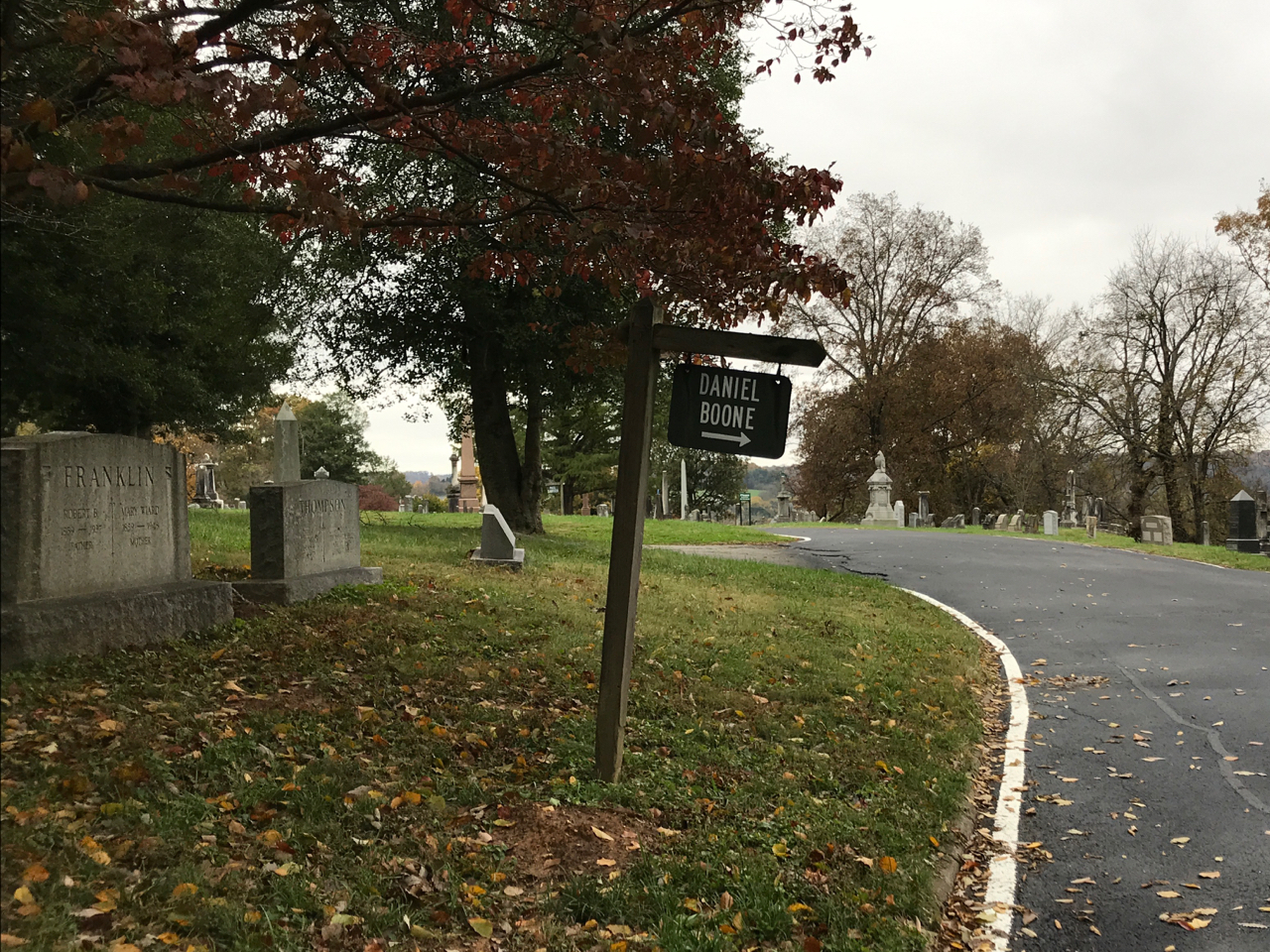
Here’s the second sign.
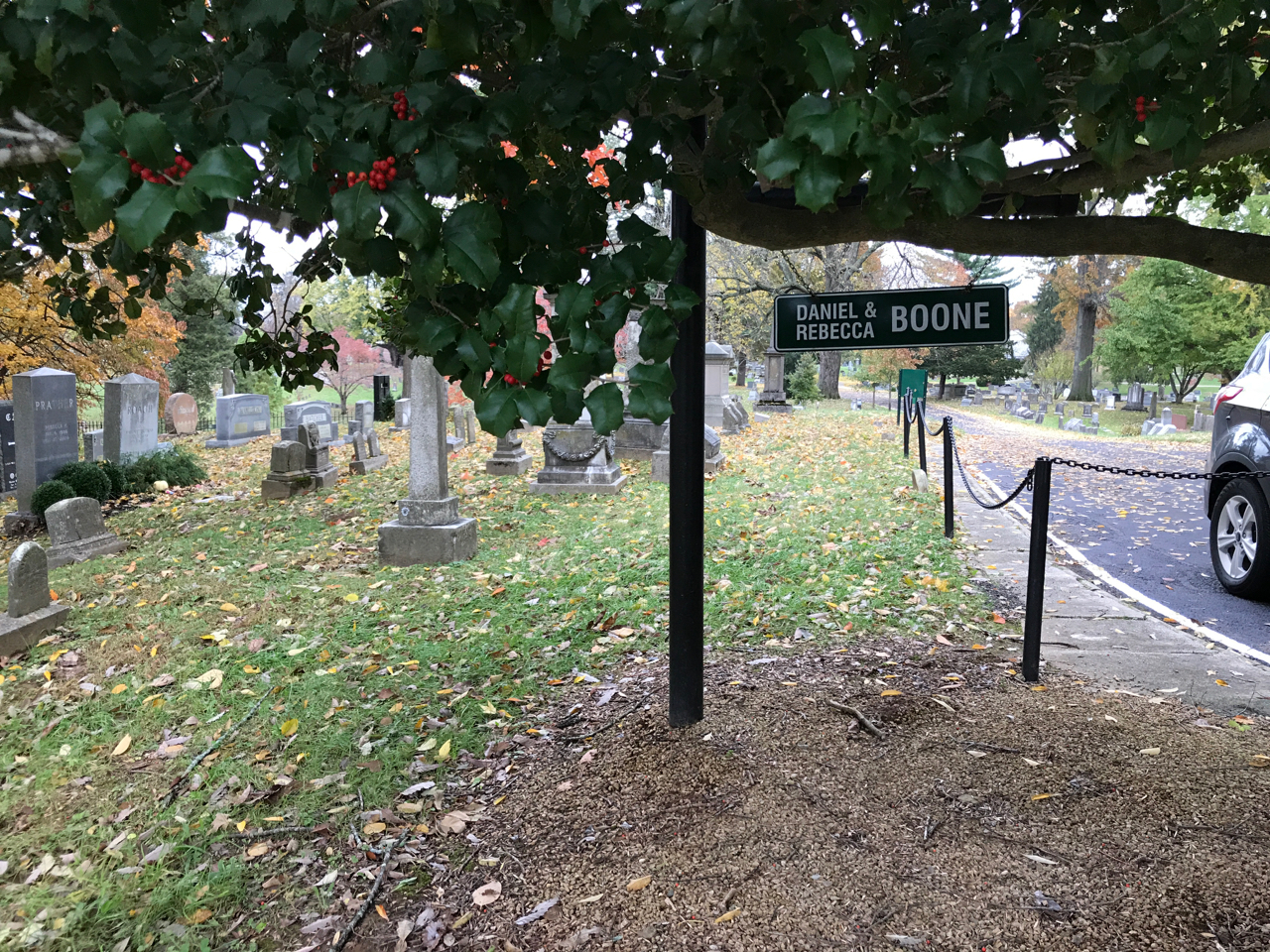
Judging why the number of cars parked nearby, I think this last sign was pointing to the gravesite.
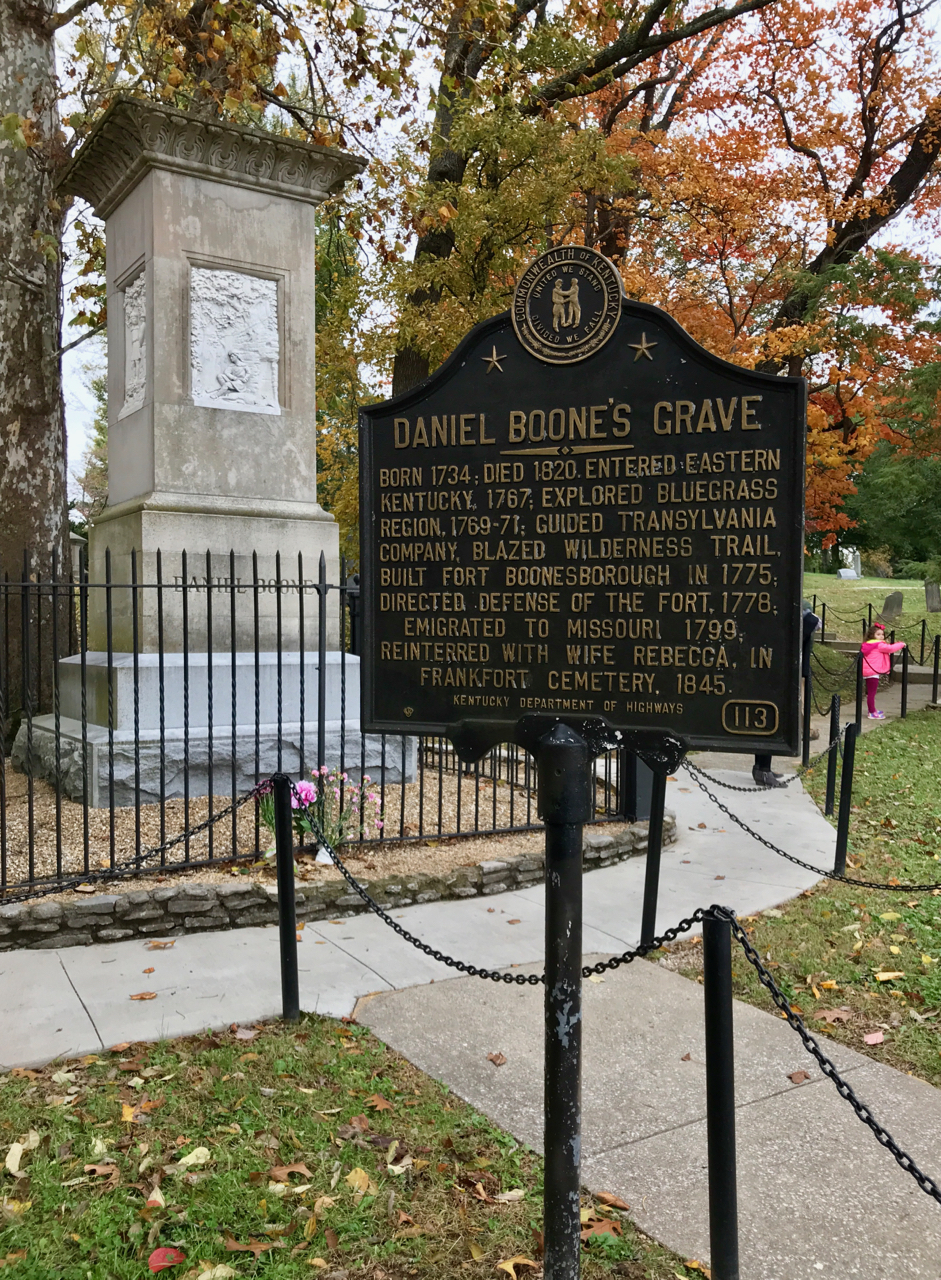
While I was there, I met a man who claimed to be related to Daniel Boone. It was right around Daniel Boone’s birthday, which is November 2.He had come to pay his respects.
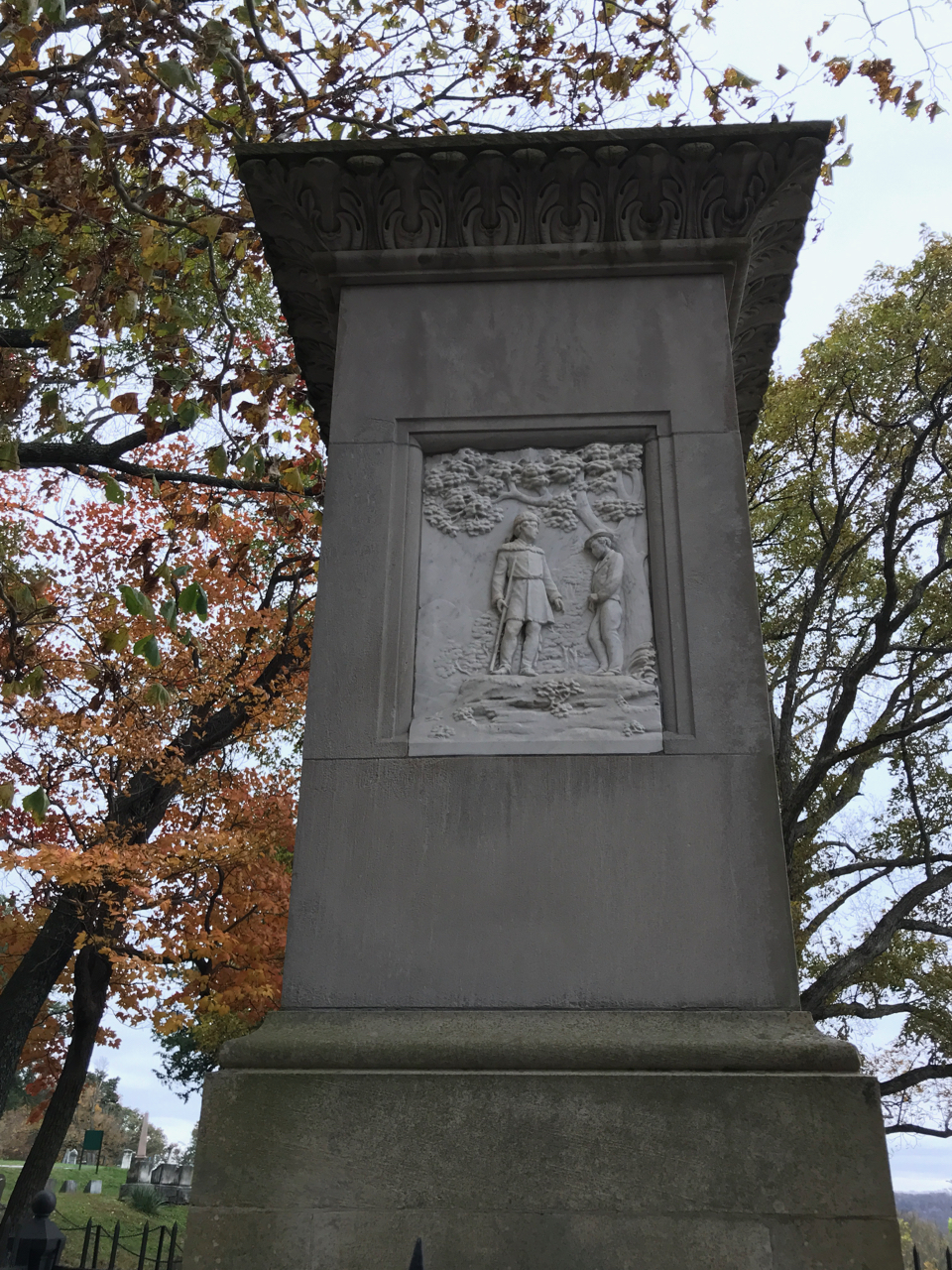
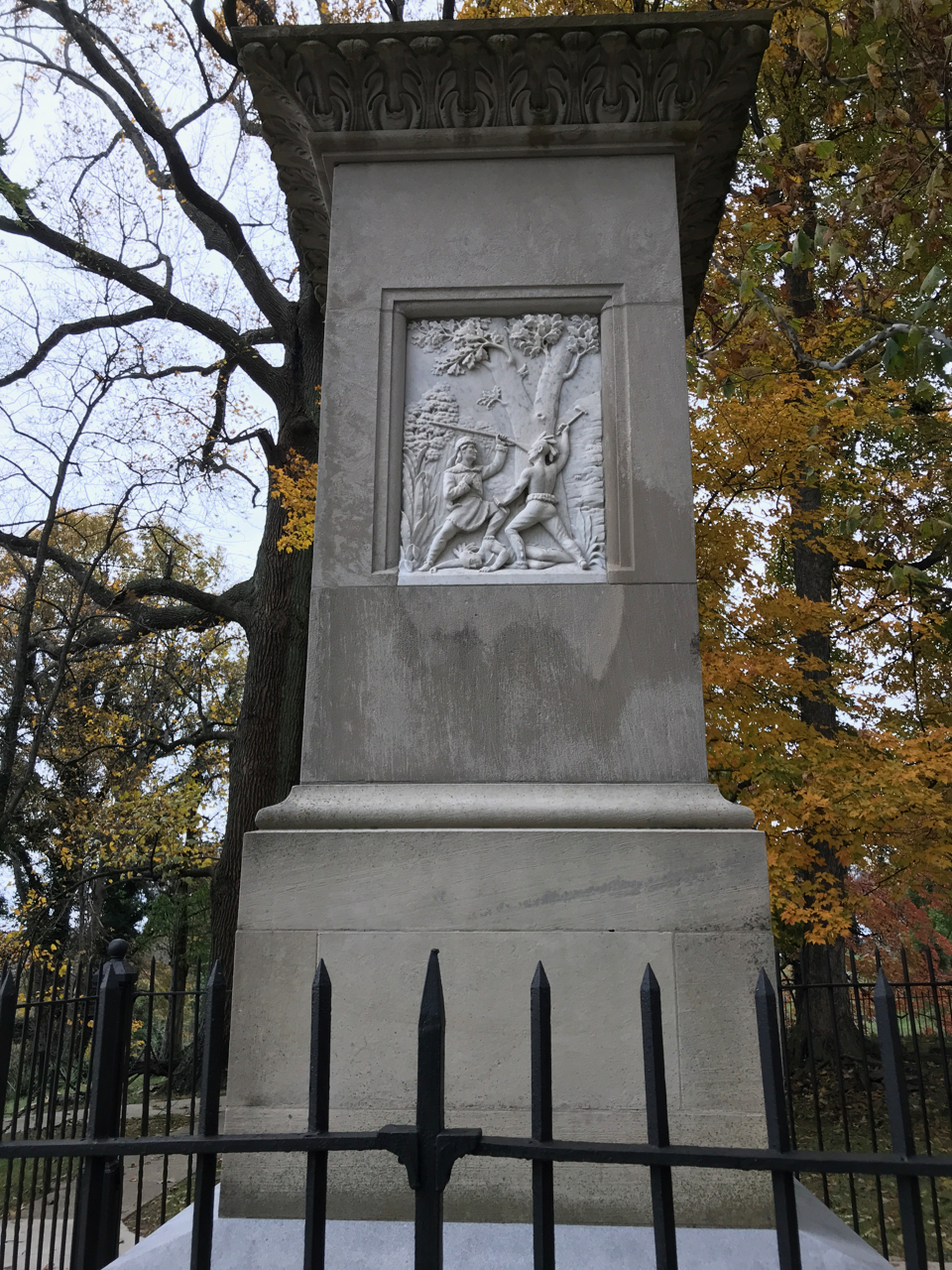
I walked around the monument and looked at the carvings depicting scenes from Daniel’s life.
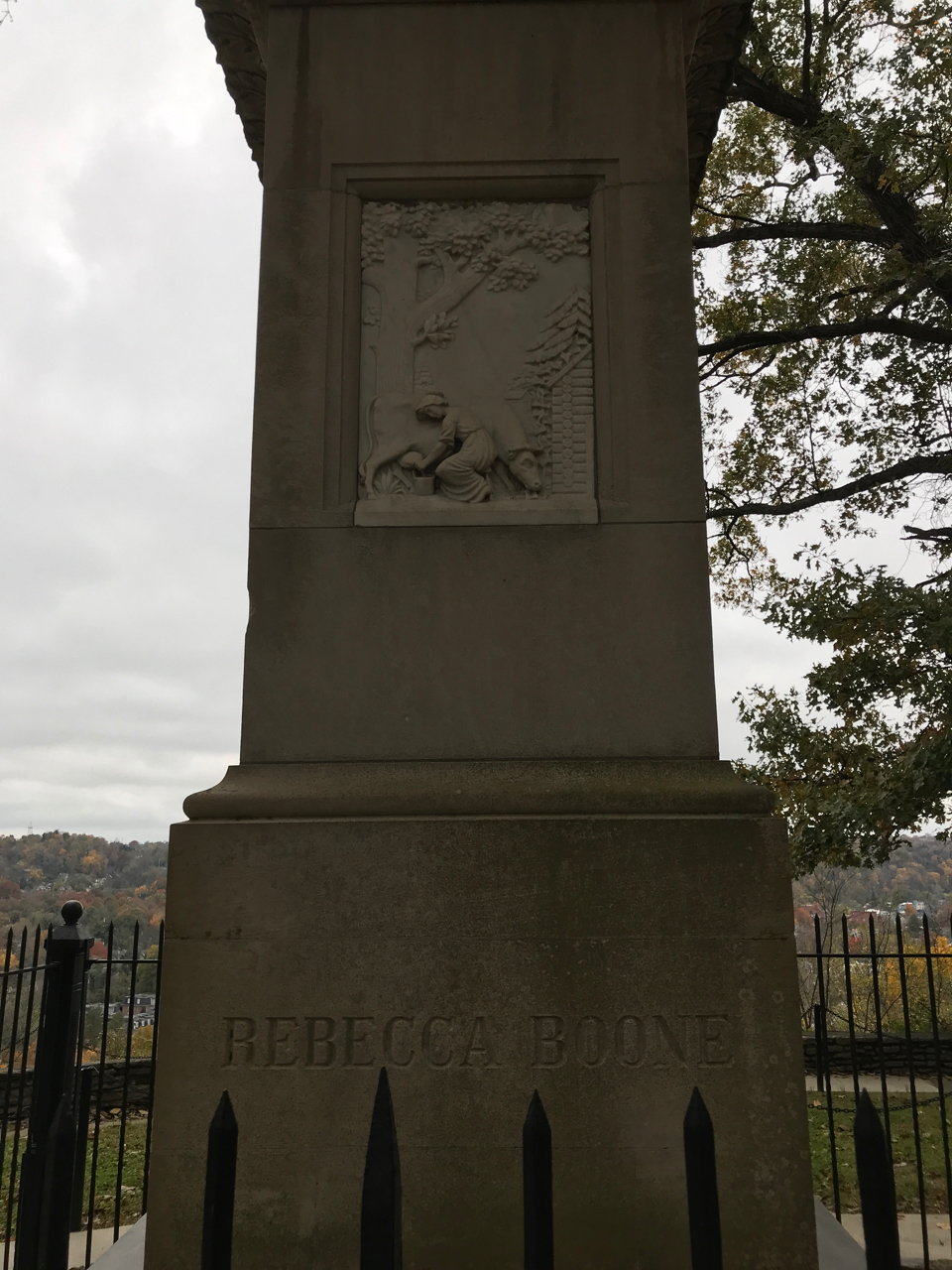
Rebecca got a panel, too. Here she is, milking a cow, which is a practical skill to have.
The monument was erected in 1860 and the marble panels were added in 1862. The panels were vandalized during the Civil War and restored in 1906 and again in the 1940s.
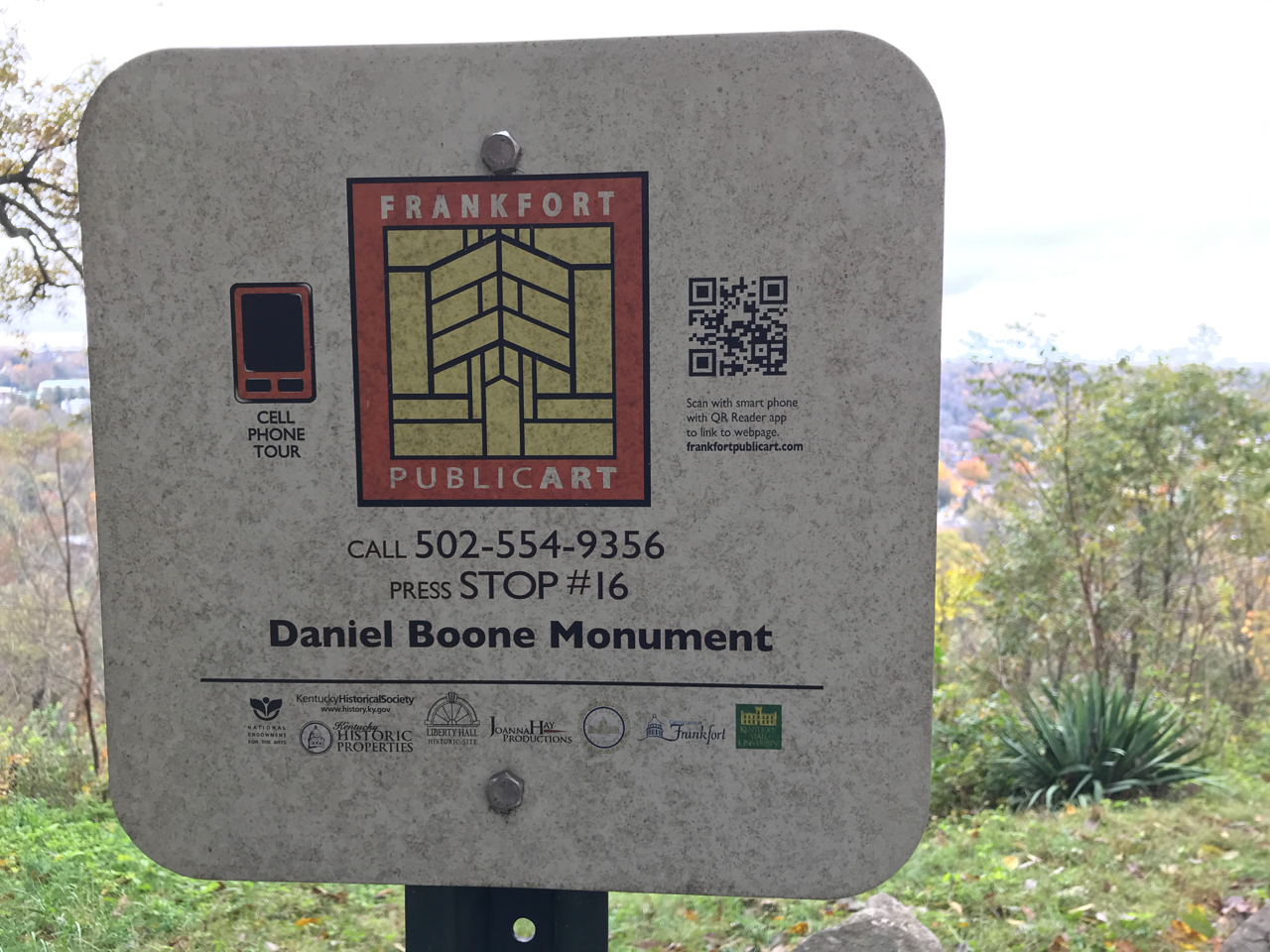
There is some interesting information about the cemetery and the Boones at this phone number.
Apparently, they established this new cemetery in the 1840s and thought that it would help make if more popular if there were famous people buried in there. they convinced Daniel Boone’s son to permit his parents’ to be dug up in from where they were buried in Missouri and reinterred here.
While there is no dispute that Rebecca’s remains are here, there is a question as to whether they dug up Daniel’s remains. Rebecca predeceased Daniel by seven years. When they were ready to bury Daniel, the spot next to Rebecca had someone else in it, so they buried him at her feet. So, they aren’t quite certain is Daniel is here or if he got left behind in Marthasville, Missouri. If you are in the St. Louis area, and you want to go looking for where Daniel Boone’s remains might…remain, just go to Google Maps and put in Old Bryan Farm Cemetery, and it will take you right there.
Just in case you can’t wait, here is a photo of the original gravesite in Missouri.
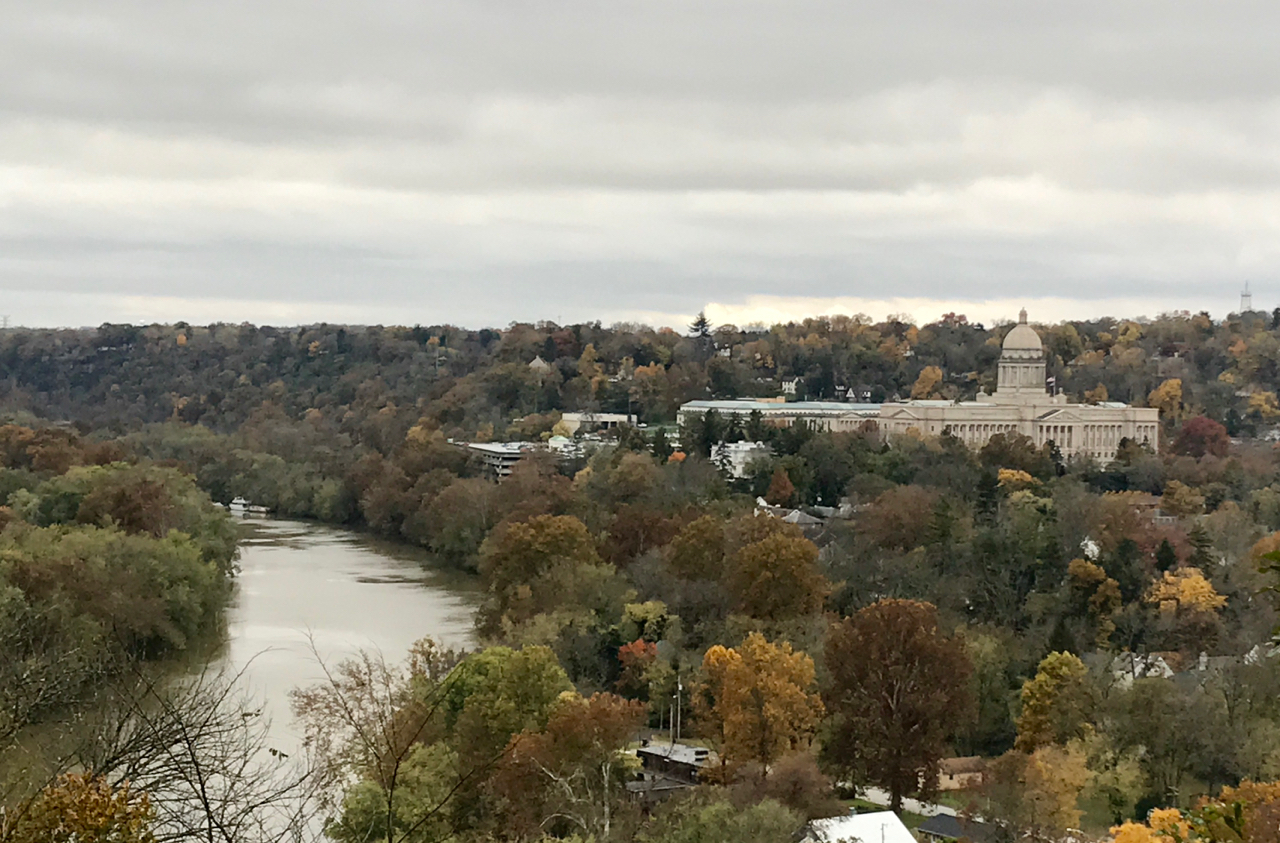
The cemetery is a great place for a view of the capitol and the Kentucky River.
With that, it was time to head back to the campground.
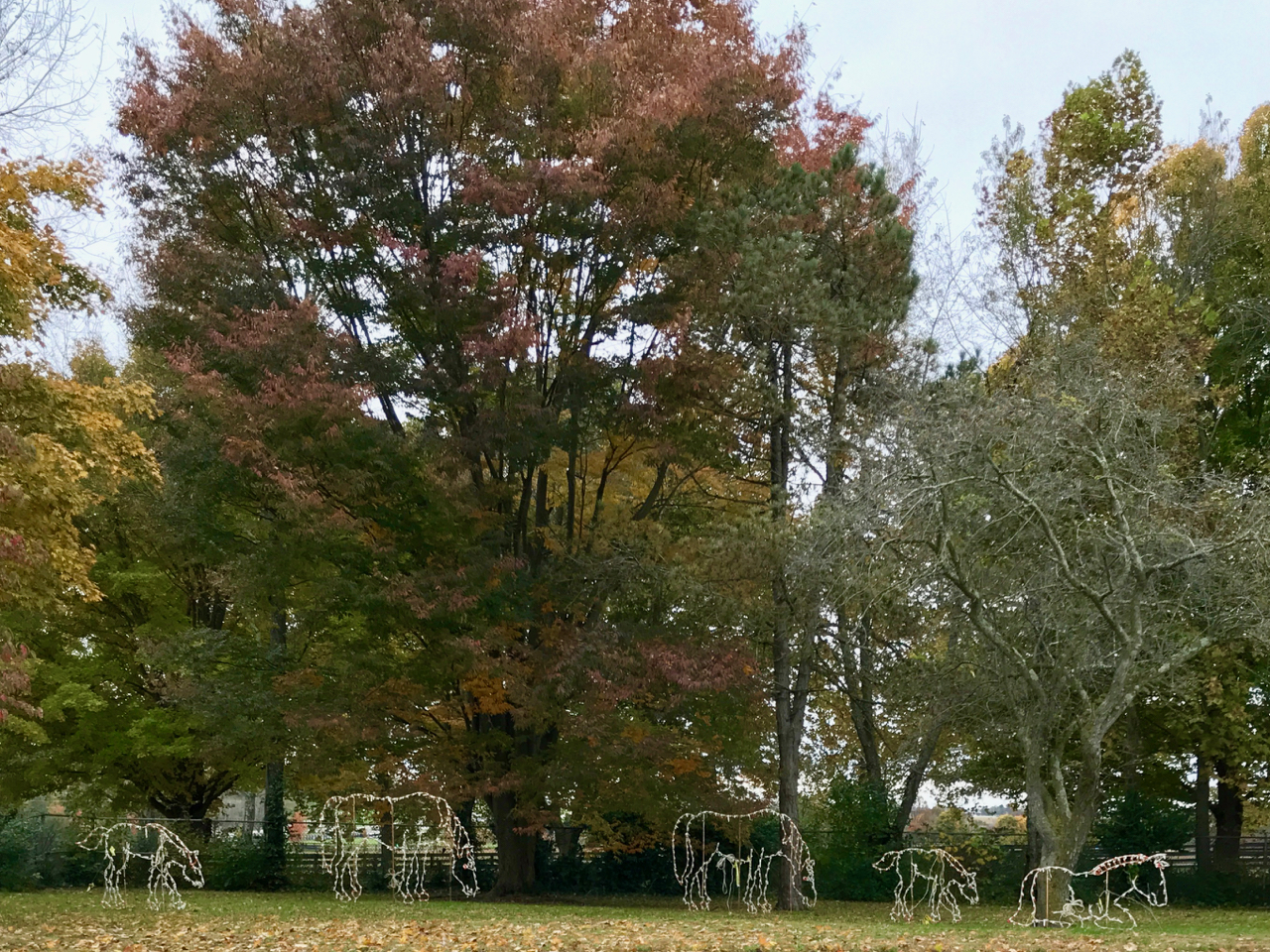
It was getting toward dusk, so I imagine that they would be turning on the horse lights soon. I had to get packed up and ready to roll in the morning, so I didn’t wait around to see them illuminated.
My next stop was Nashville. It was a short visit, and I had two goals.
My first goal was to meet up with a friend I had met years and years ago on the Dictionary.com forum. I got situated in a campground and then we met up for dinner. After all those years of being digital friends, it was marvelous to finally meet Karen in person.
My other goal for Nashville was to see the state capitol. But, I had a little time to spend near my campground, and Karen recommended that I visit Opryland Hotel. With 2888 rooms, it is one of the 30 largest hotels in the world.
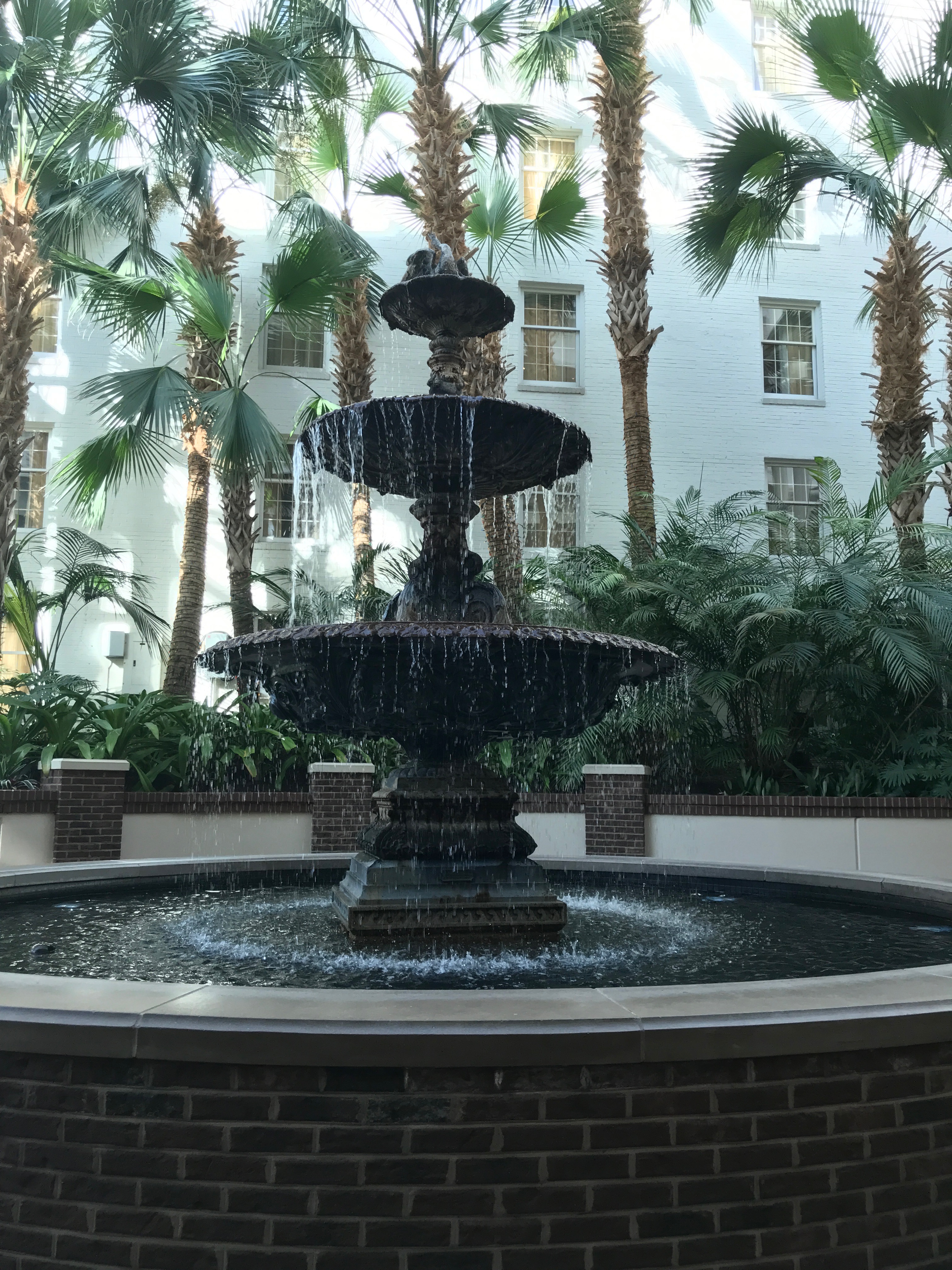
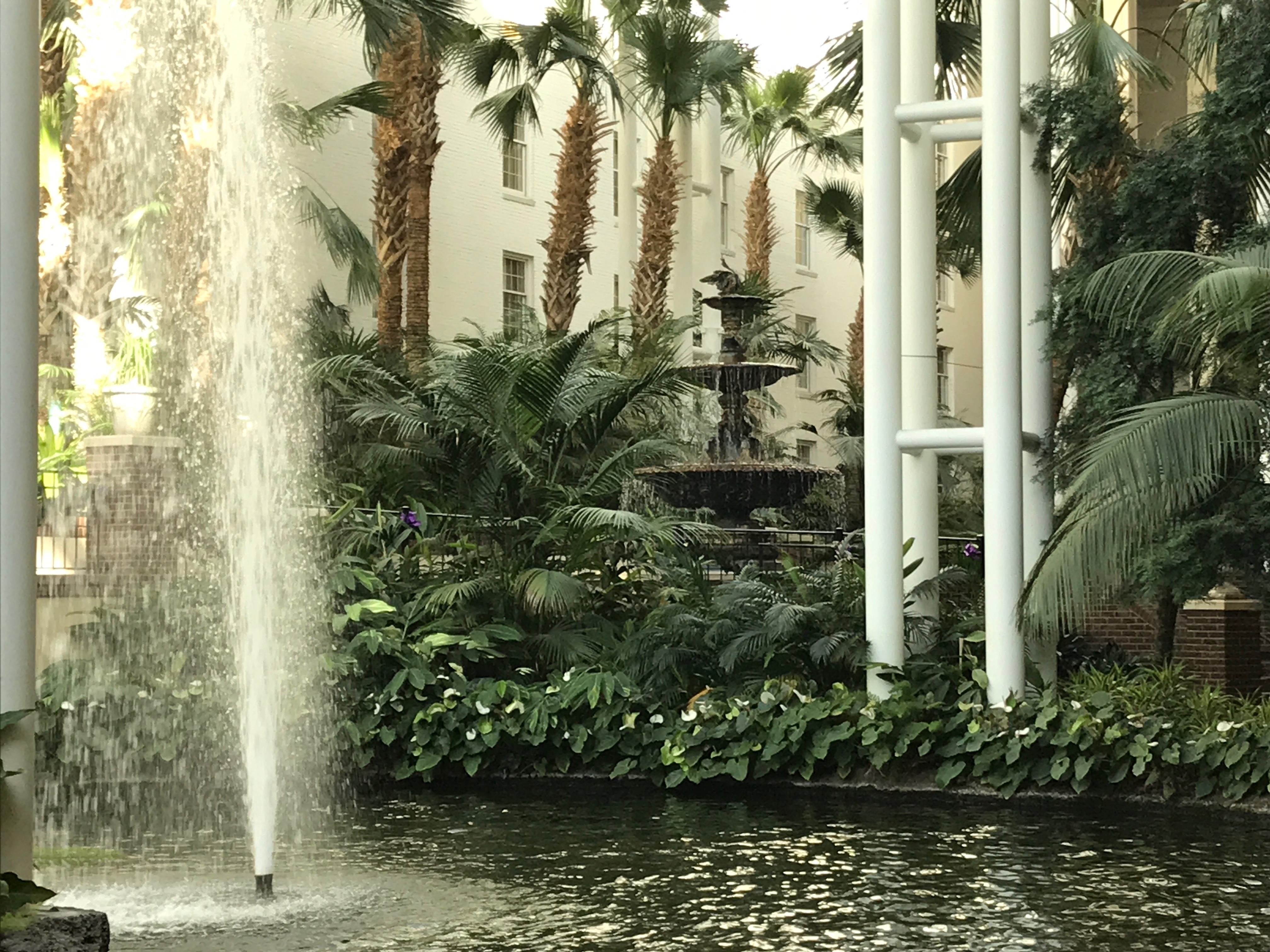
Really, it is enormous. There are fountains and plantings all over.
It seems more like a tropical oasis than someplace in Tennessee, and a quarter mile long river runs through the main atrium.
The plantings are really lush and well-tended. I can’t even imagine how many gardeners they have taking care of all of the plants that are inside.
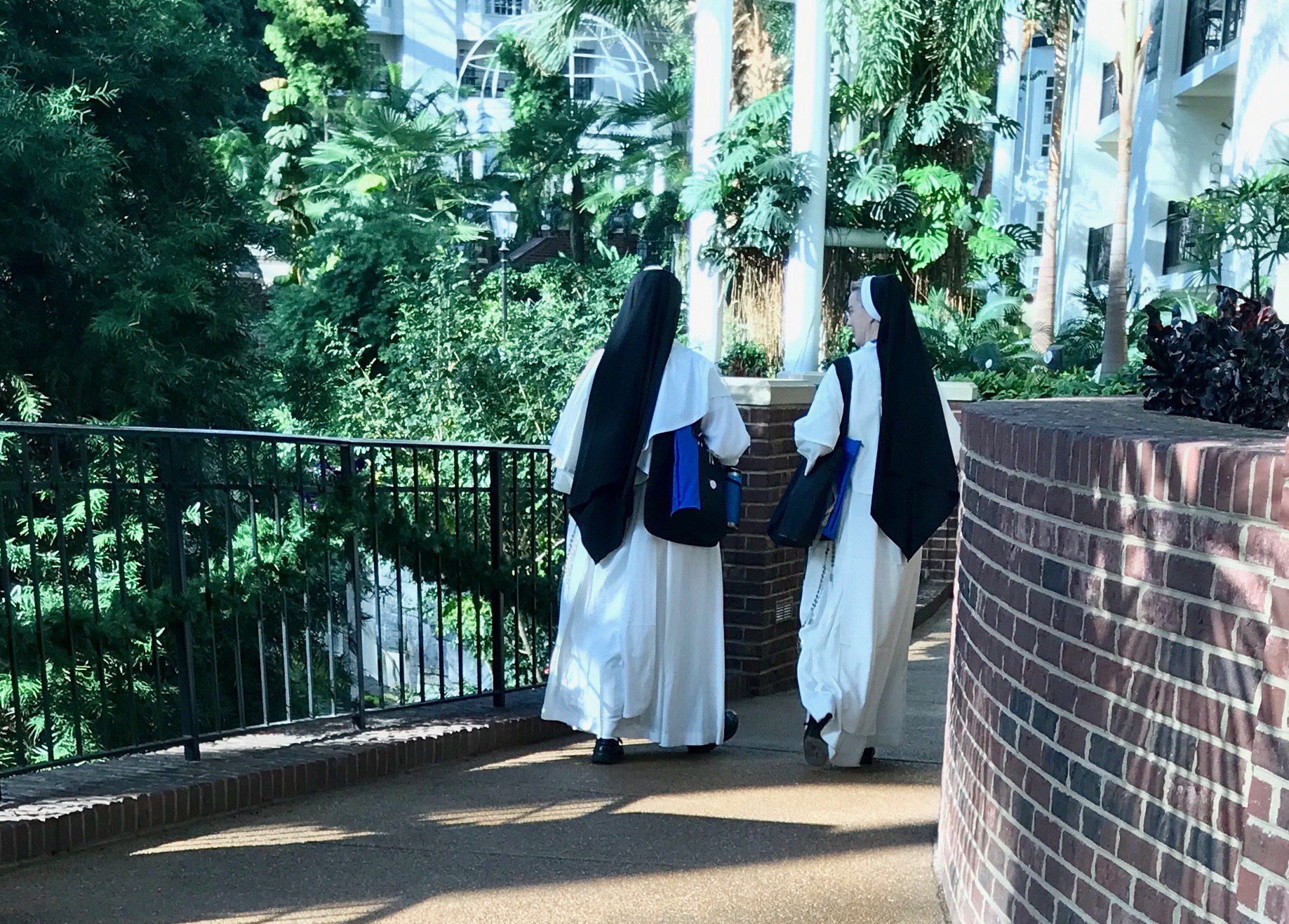
There were several different conferences going on the day I visited. I wondered which conference these sisters were attending.
I walked around a bit and then headed outside. It was the beginning of November when I visited, and they are getting things set up for Christmas.
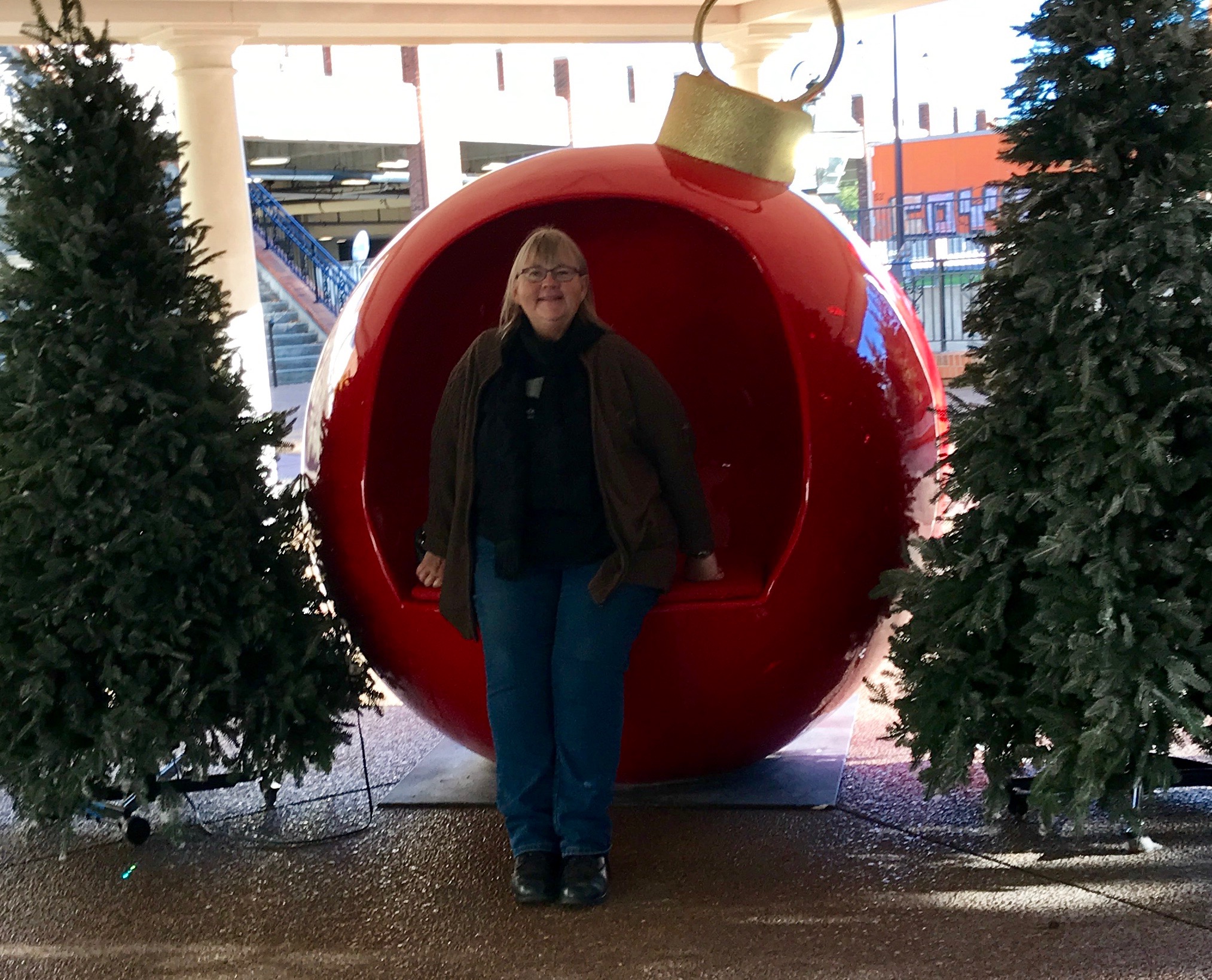
I persuaded a passerby to snap a photo of be sitting in this giant ornament.
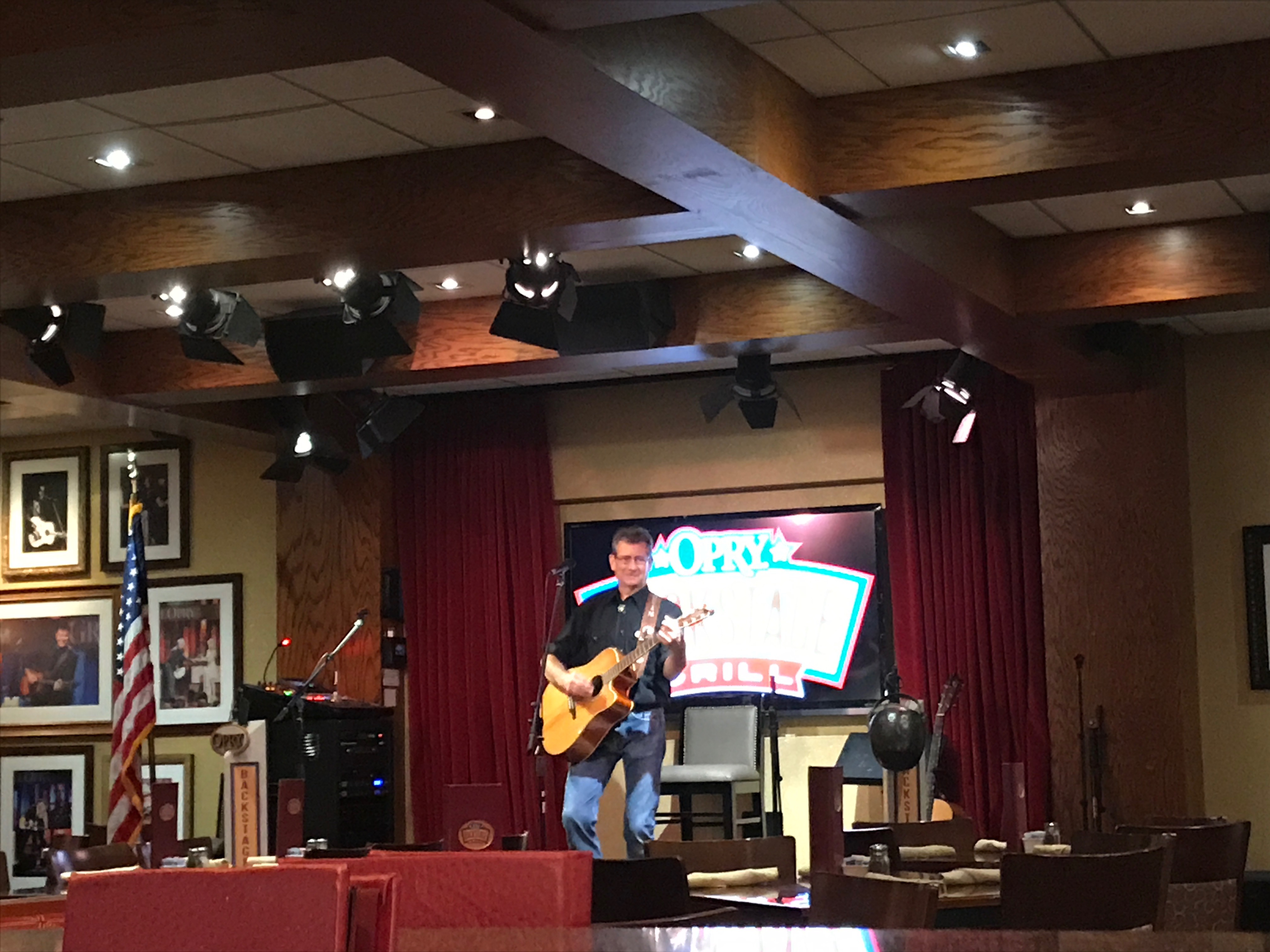
Karen also encouraged me to eat at the Opry Backstage Grill. A friend of hers was working. The waiters get up and perform between serving their customers. This is her friend, but unfortunately I’ve forgotten his name. I do remember that he was a good musician.
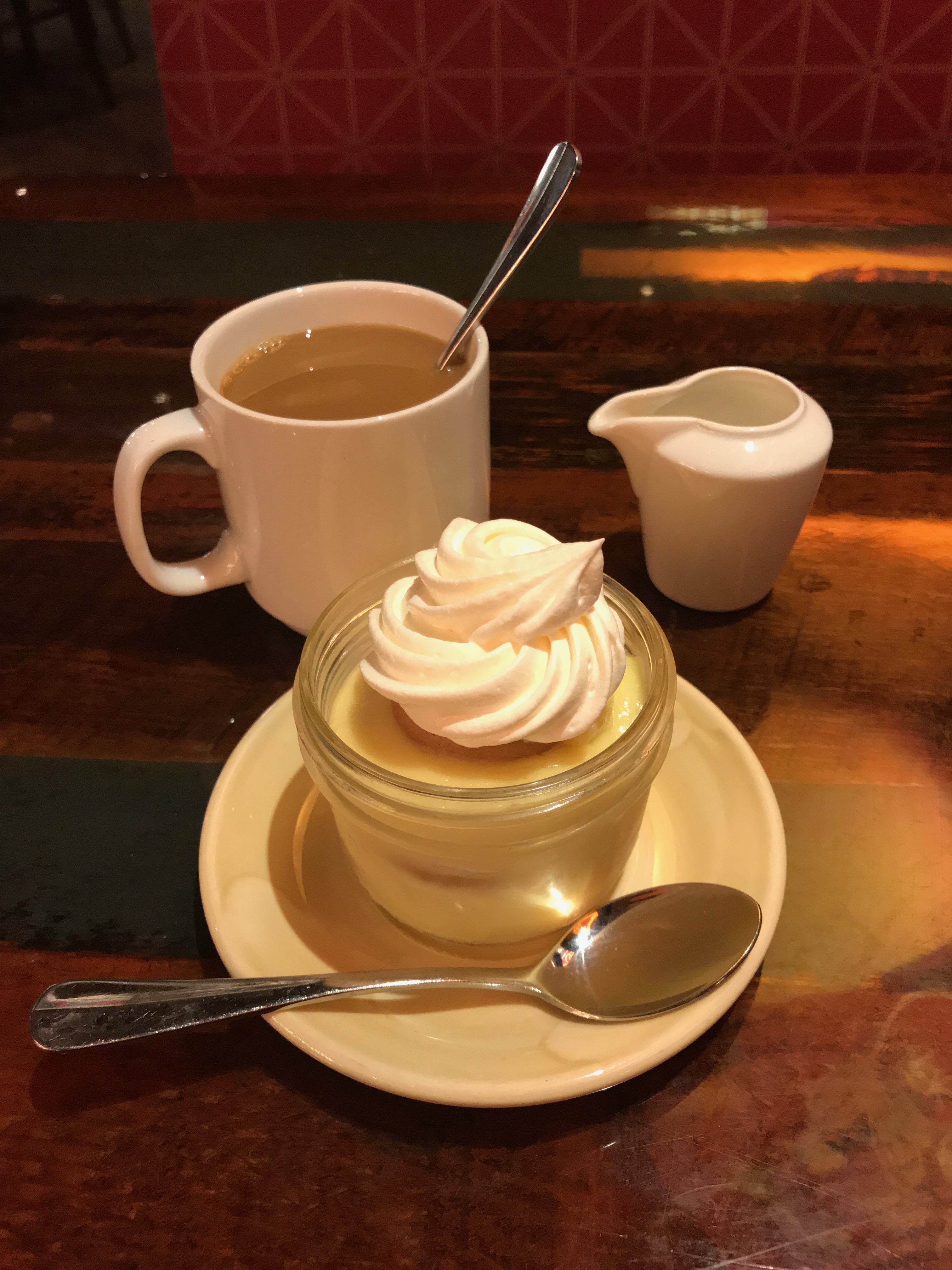
I am pretty sure I ate a meal there, but I’ve forgotten what it was. I do remember the banana pudding I had for dessert. Yum!
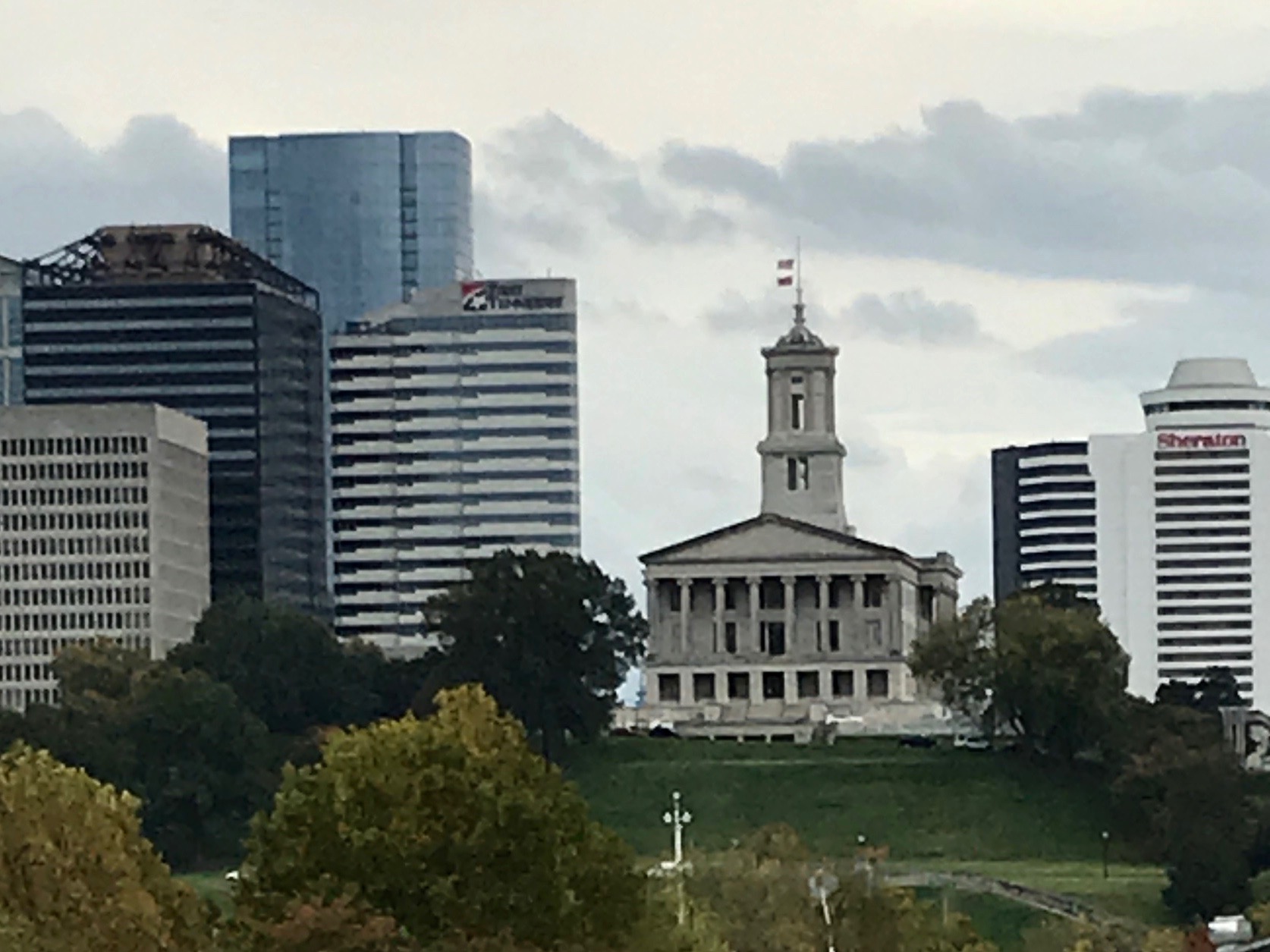
It was time to cross another state capitol off my list. I parked in a spot close to the building and started climbing. It seems that city planners make a point of putting capitols on tops of hills! One of these days, I will do a compare and contrast of all the capitols.
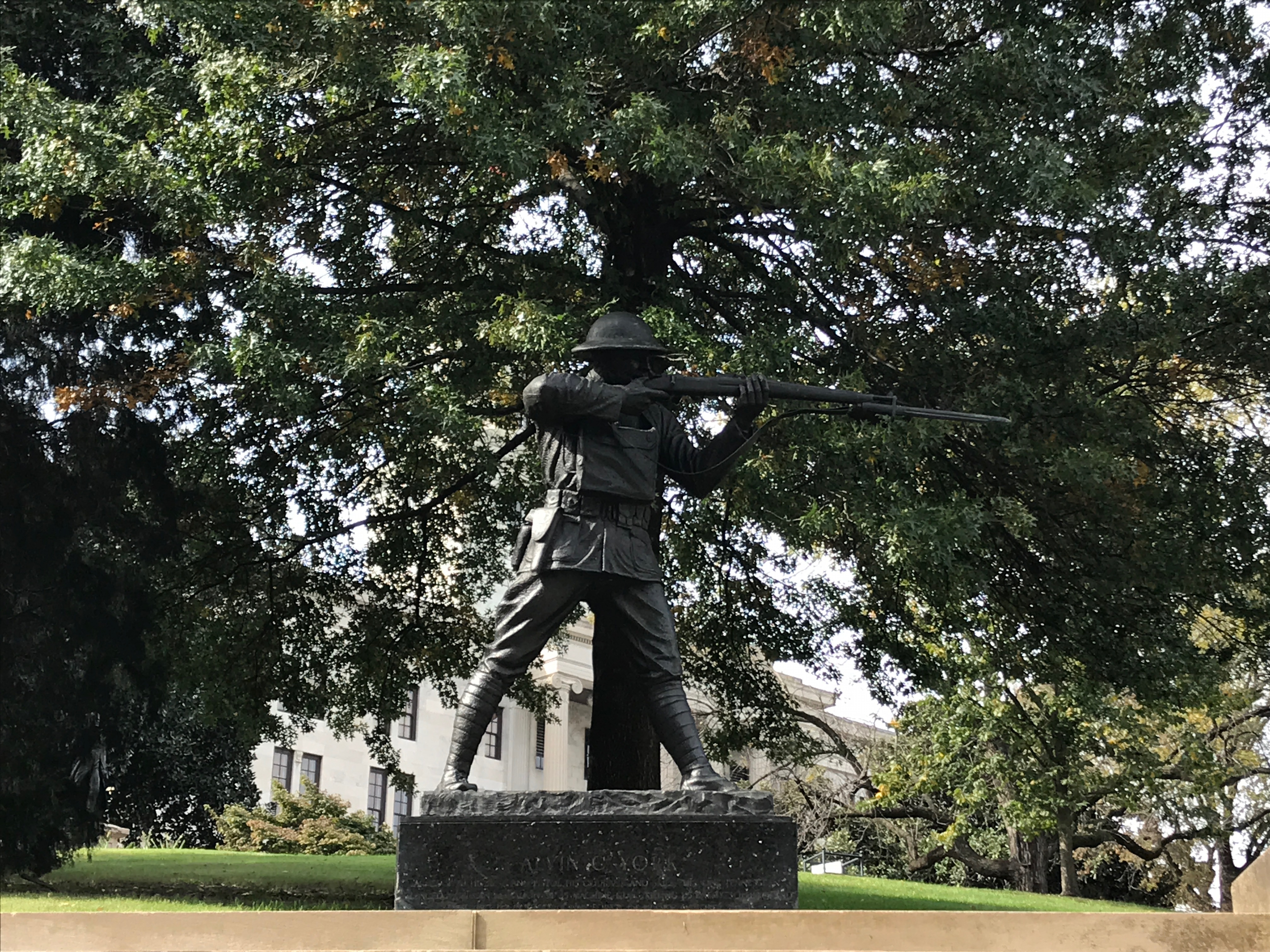
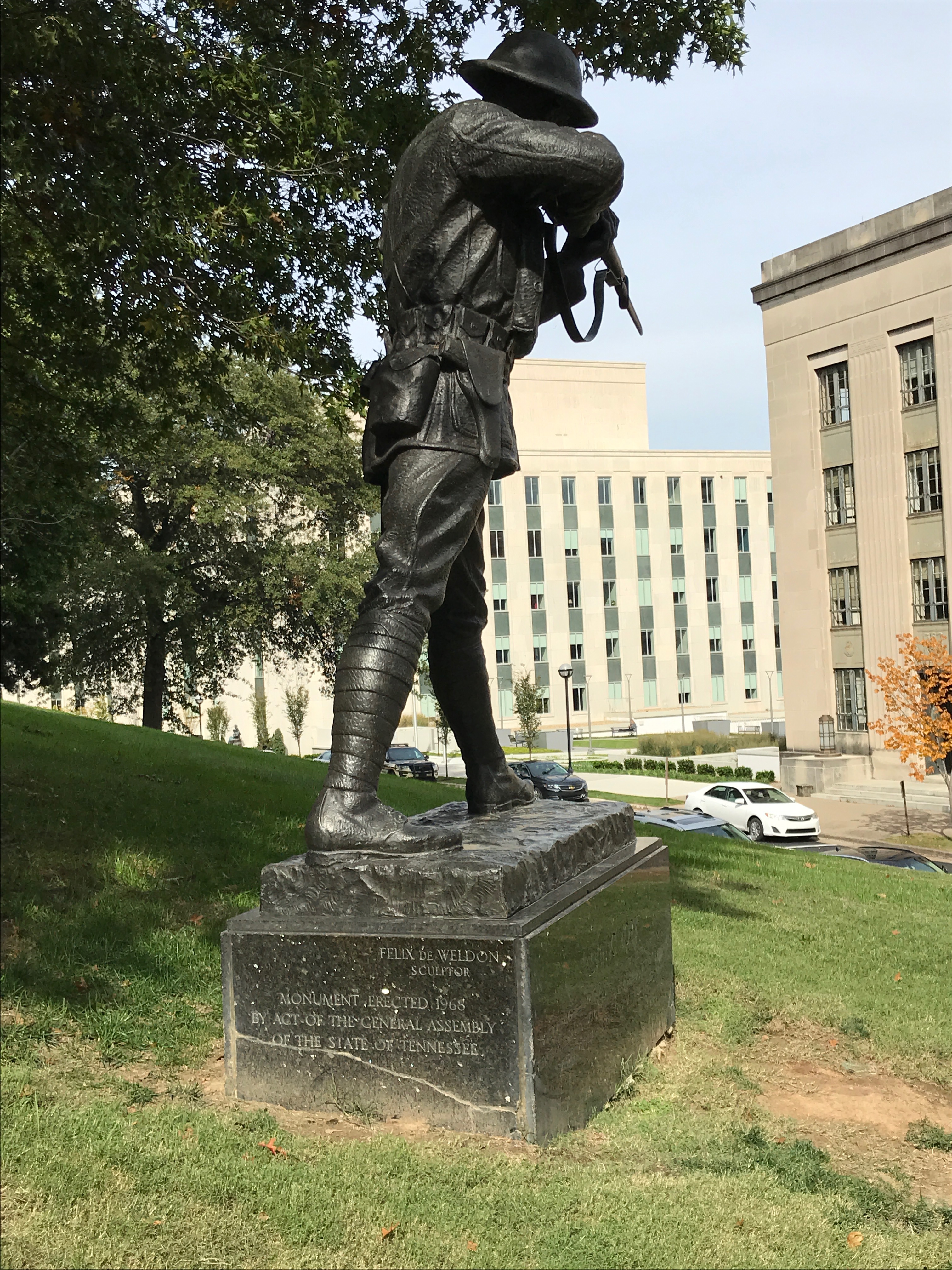
I got up to the top of the hill and came upon this statue of a WW I doughboy.
It turns out that it was Sergeant York, one of the most decorated United States Army soldiers of World War I. He received the Medal of Honor for leading an attack on a German machine gun nest, taking at least one machine gun, killing at least 25 enemy soldiers and capturing 132.
If you are so inclined, click on the link above and read about his interesting life, starting out in a two-room log cabin in Fentress County, Tennessee. He was born in 1887, and died at age 76 in 1964. I must be getting old, because I can remember when World War I vets weren’t that uncommon.
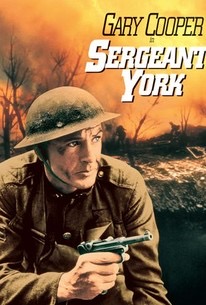
If you are not inclined to read the link, you could always watch the sanitized Hollywood version of his story.
Sergeant York was a 1941 film based on Alvin York’s diary. It was directed by Howard Hawk and was the highest-grossing film of the year. Gary Cooper won the Academy Award for Best Actor for his portrayal of Sergeant York. The American Film Institute ranked the film 57th in the 100 most inspirational American movies, and rated Alvin York 35th in it’s list of the top 50 heroes in American cinema.
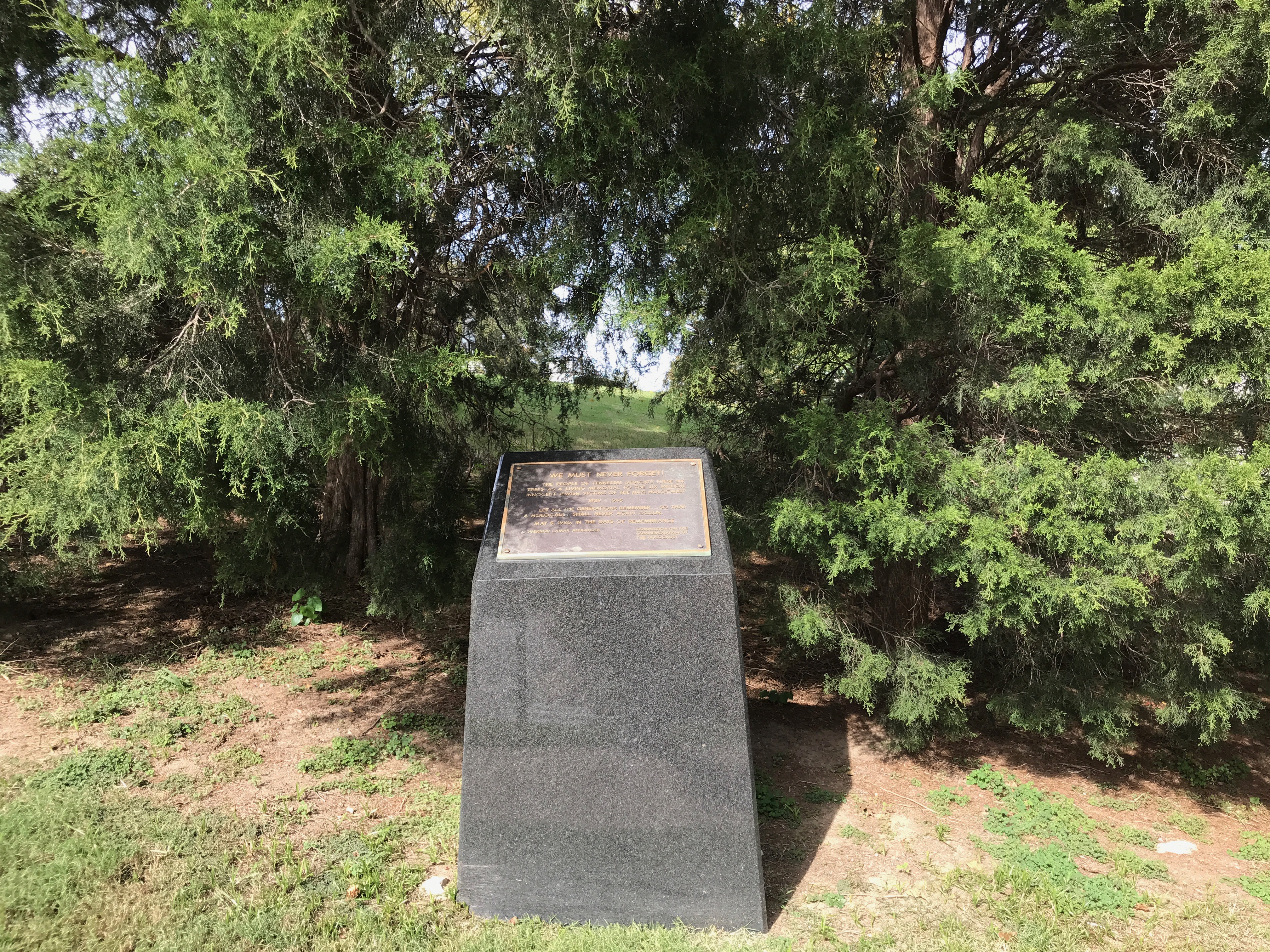
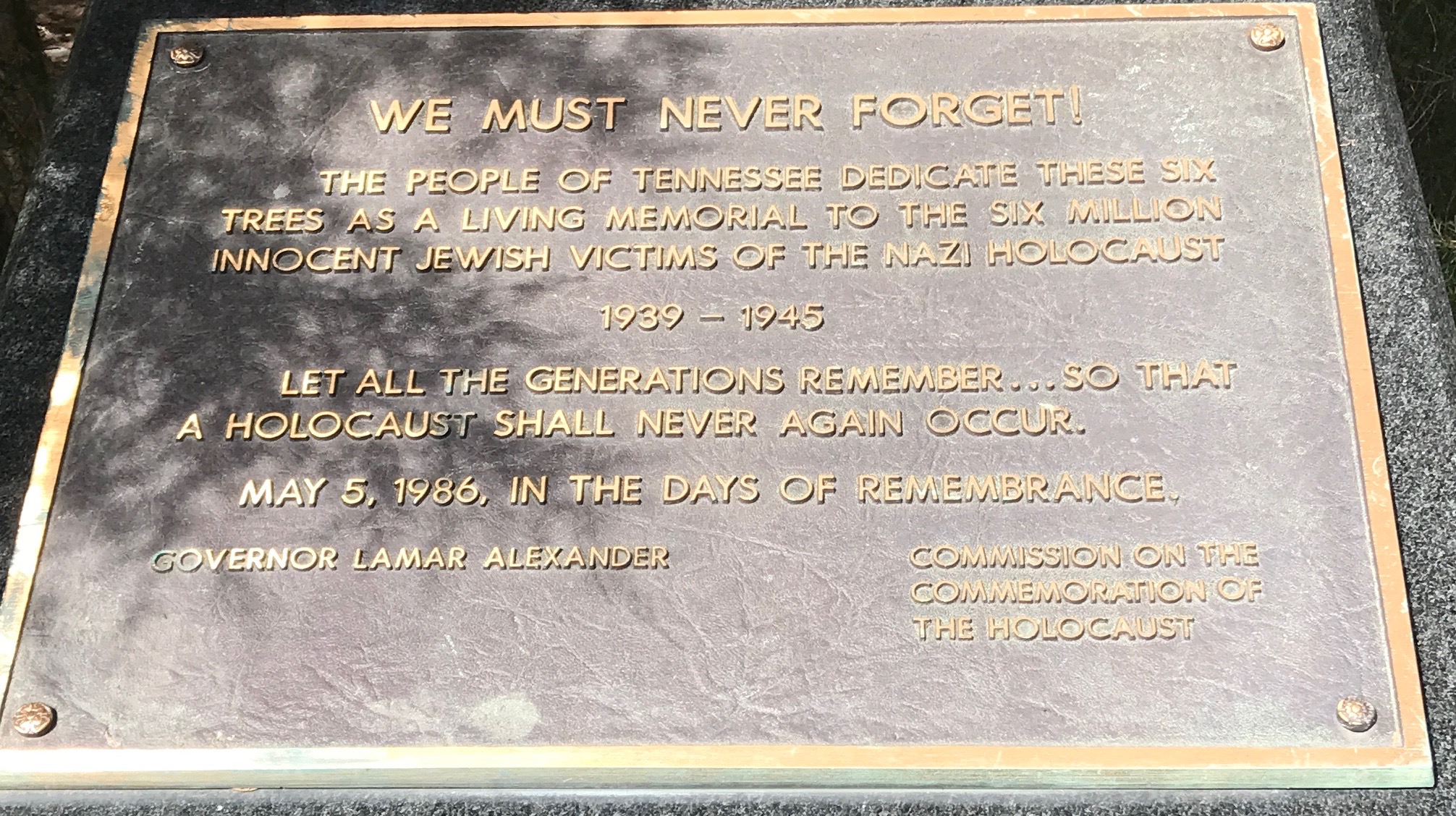
This small grove of trees is a memorial to the six million Jewish victims of the Nazi Holocaust. It was dedicated by Governor Lamar Alexander on May 4, 1986.
I had to check one of my previous posts to see when the holocaust memorial on the grounds of the Ohio state capitol was dedicated. I wondered if the ’80s was a period of holocaust memorials. Apparently not. Ohio’s memorial was dedicated in 2014, and the United States Holocaust Memorial Museum was dedicated in 1993.
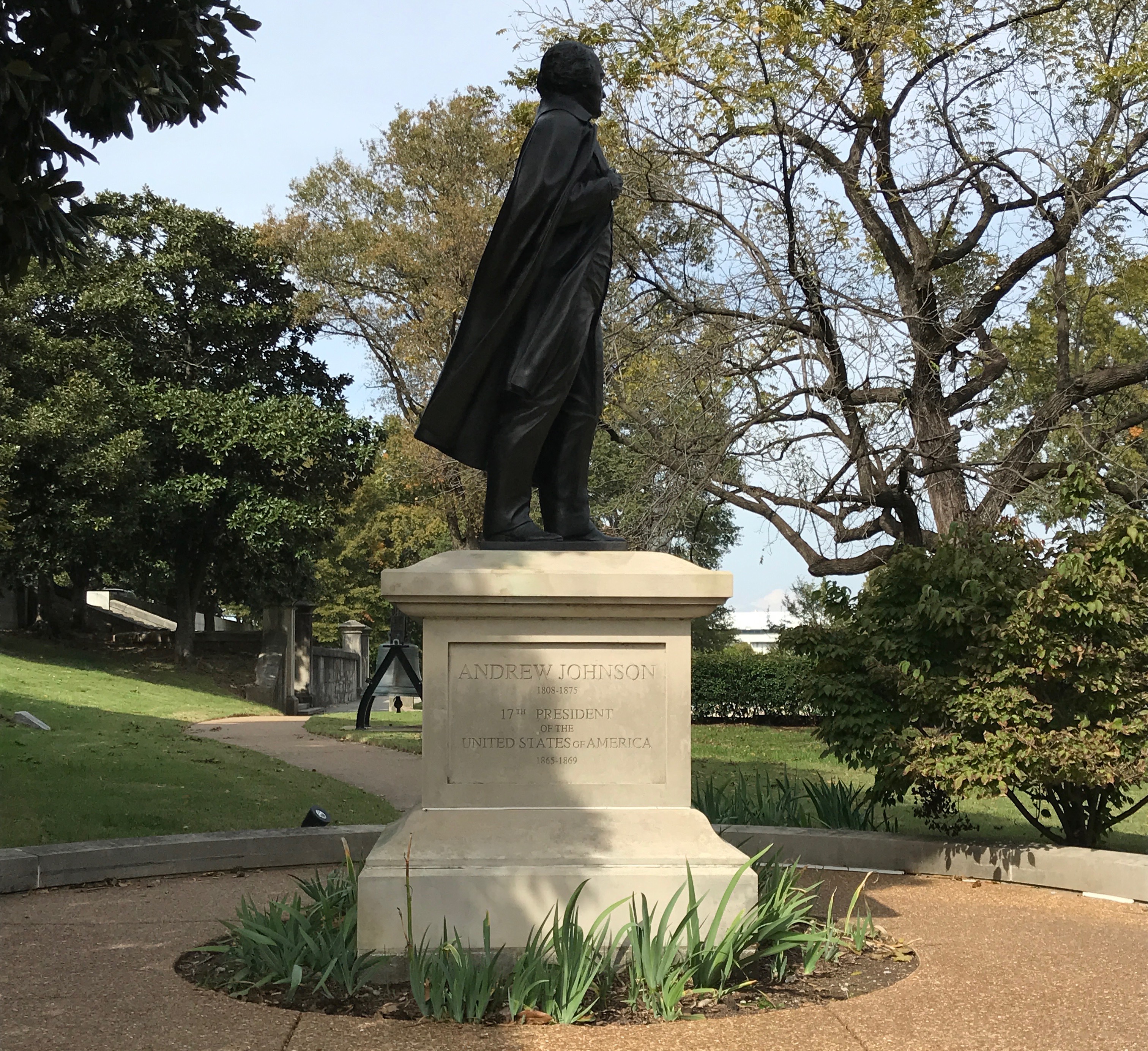
There is a bronze statue of Andrew Johnson, the first American president to be impeached. He was born in North Carolina, but that didn’t stop him from serving Tennessee, first as mayor of Greenville, then as a representative to the U.S. Congress and as the 15th governor of Tennessee before he became Lincoln’s vice president on March 4, 1865. That gig was a short one. He became president on April 15, 1865, after Lincoln’s assassination. Johnson survived the 11 counts of impeachment brought against him, and went on to serve until the end of his term in 1869.
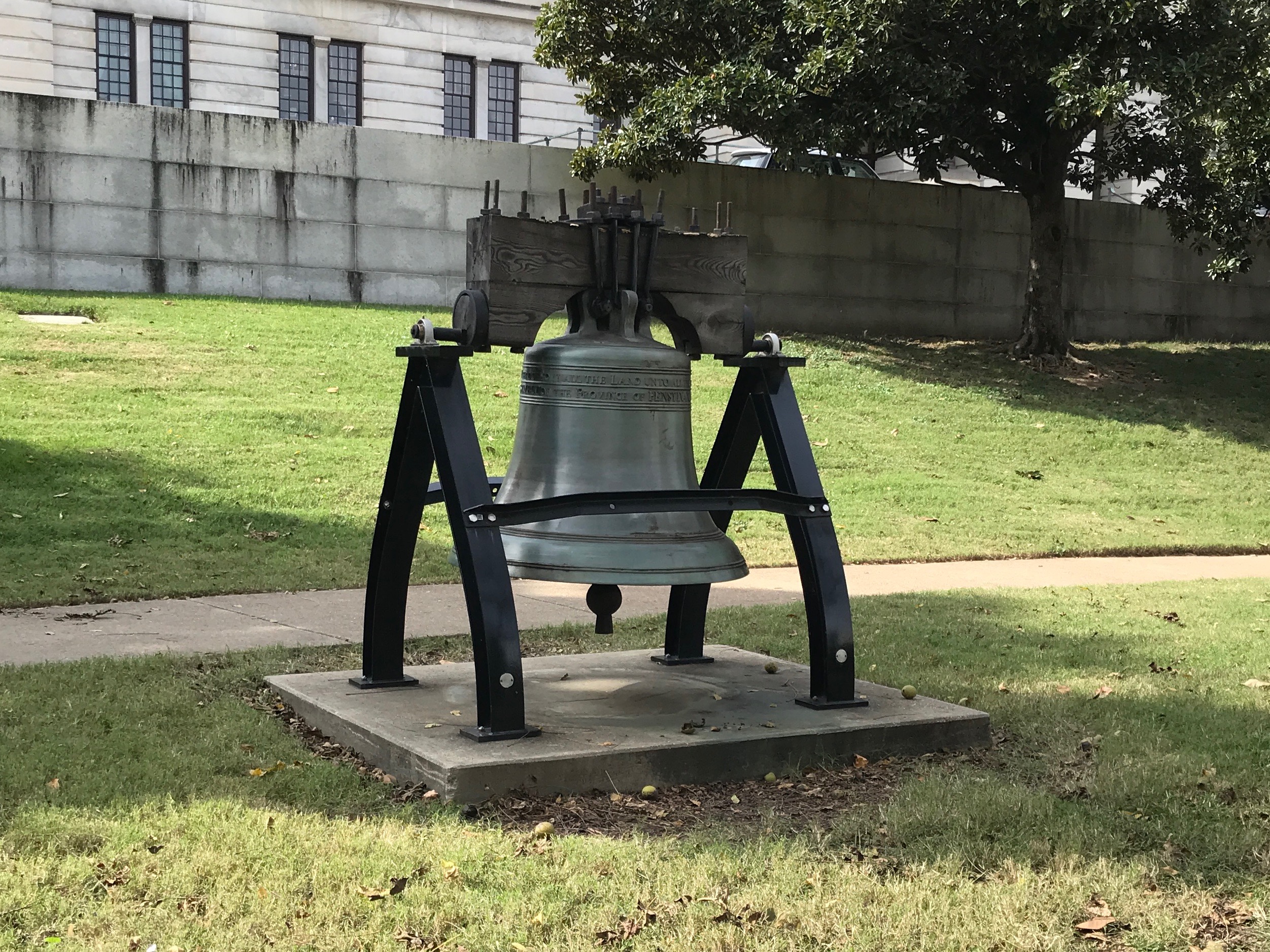
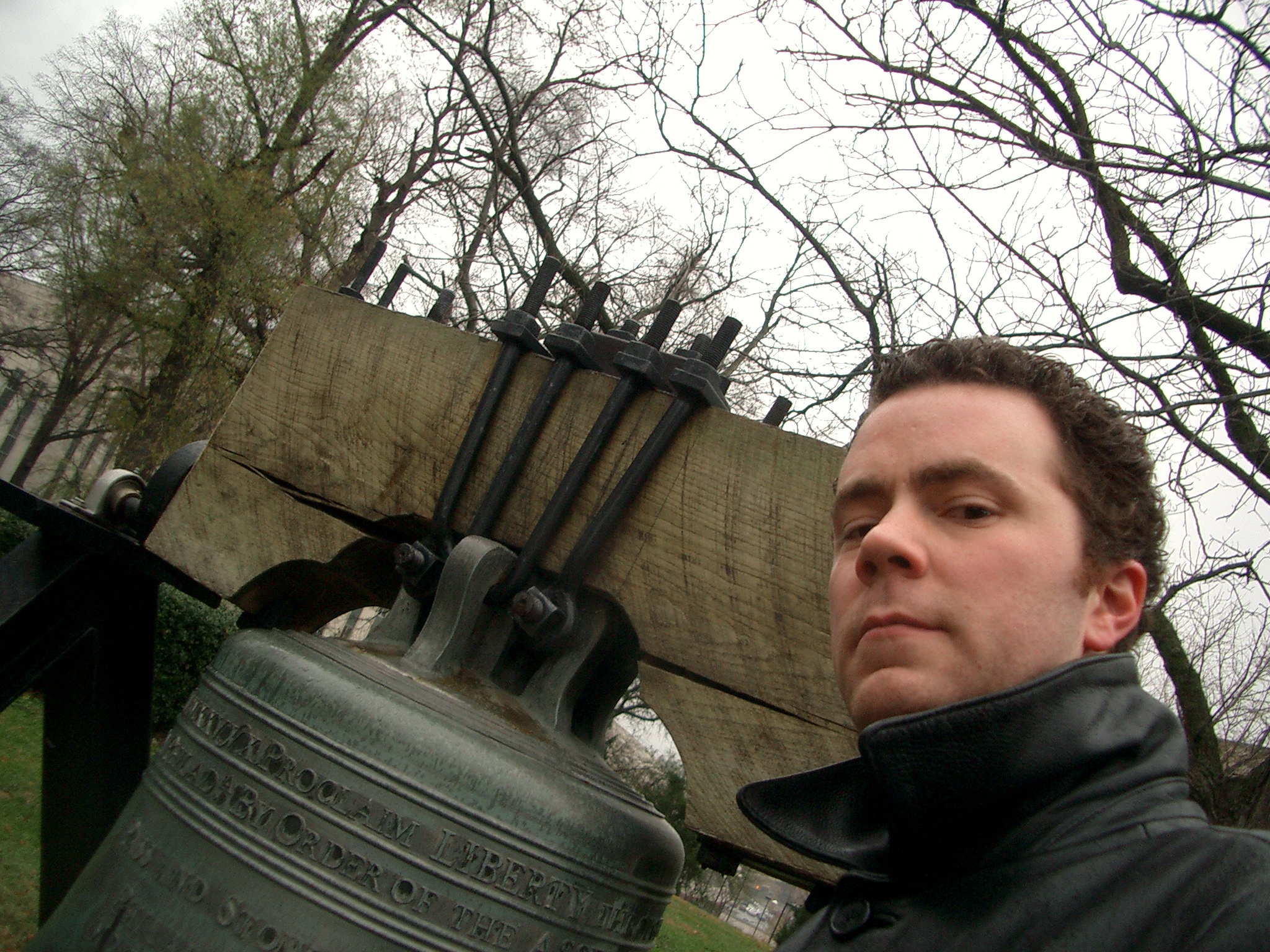
Here is one of the 57 liberty bell replicas that the U.S. Treasury minted and sent to each state and territory in 1950 as part of a savings bond drive. I swear that there are blogs for everything!
Check out Tom and his quest to find the 57 Liberty Bells. Incidentally, I borrowed this photo from his website. I let him know, so if he objects, I will take it down.
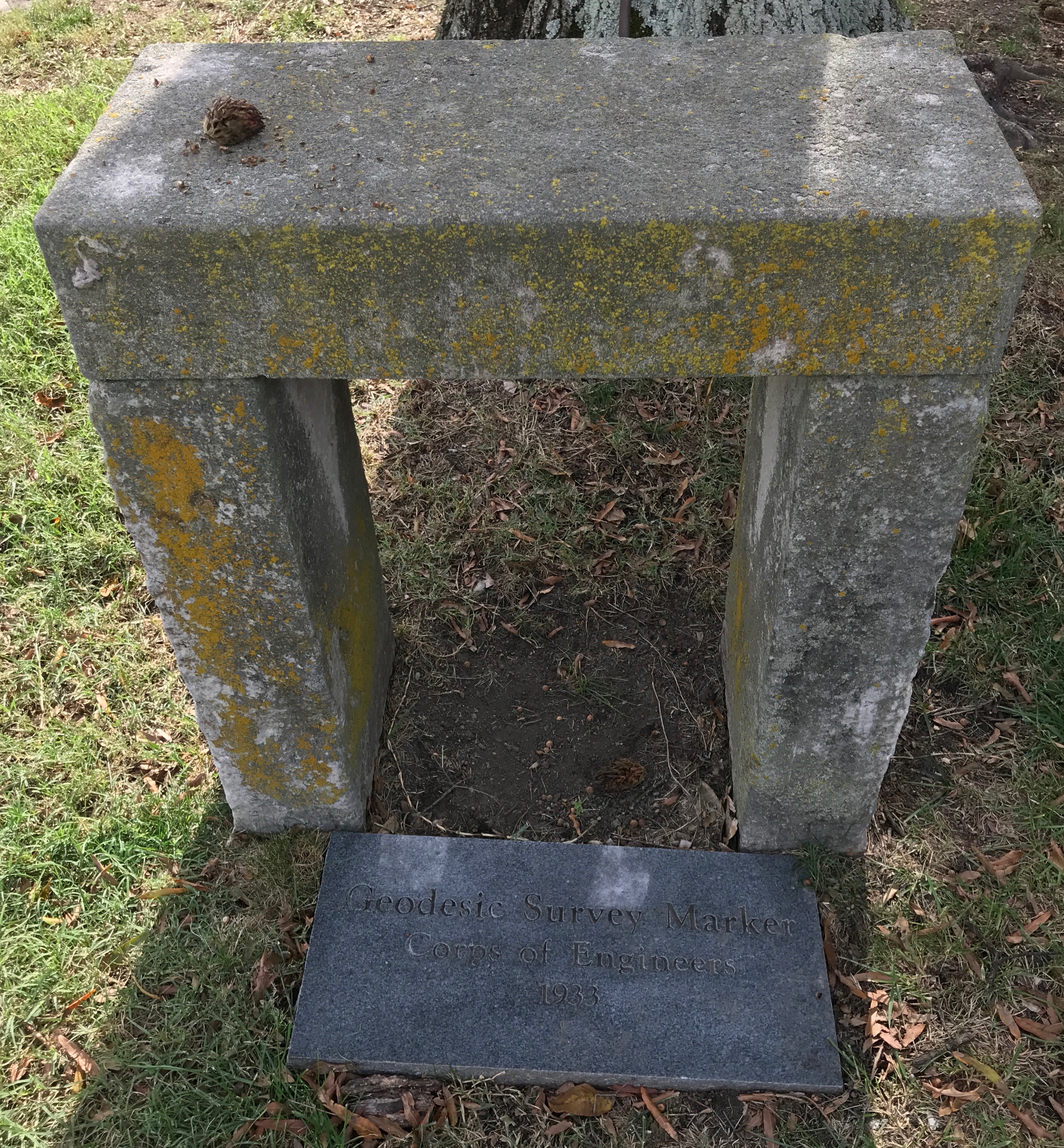
Continuing on around the grounds, I came upon this 1933 Corps of Engineers Geodesic Survey Marker. I was curious about the meaning of “geodesic”, so I looked it up. Apparently it has to do with measuring the shortest possible line between two points on a curved surface. If so, I would imagine that there are other geodesic survey markers, but I don’t remember coming across them on my travels.
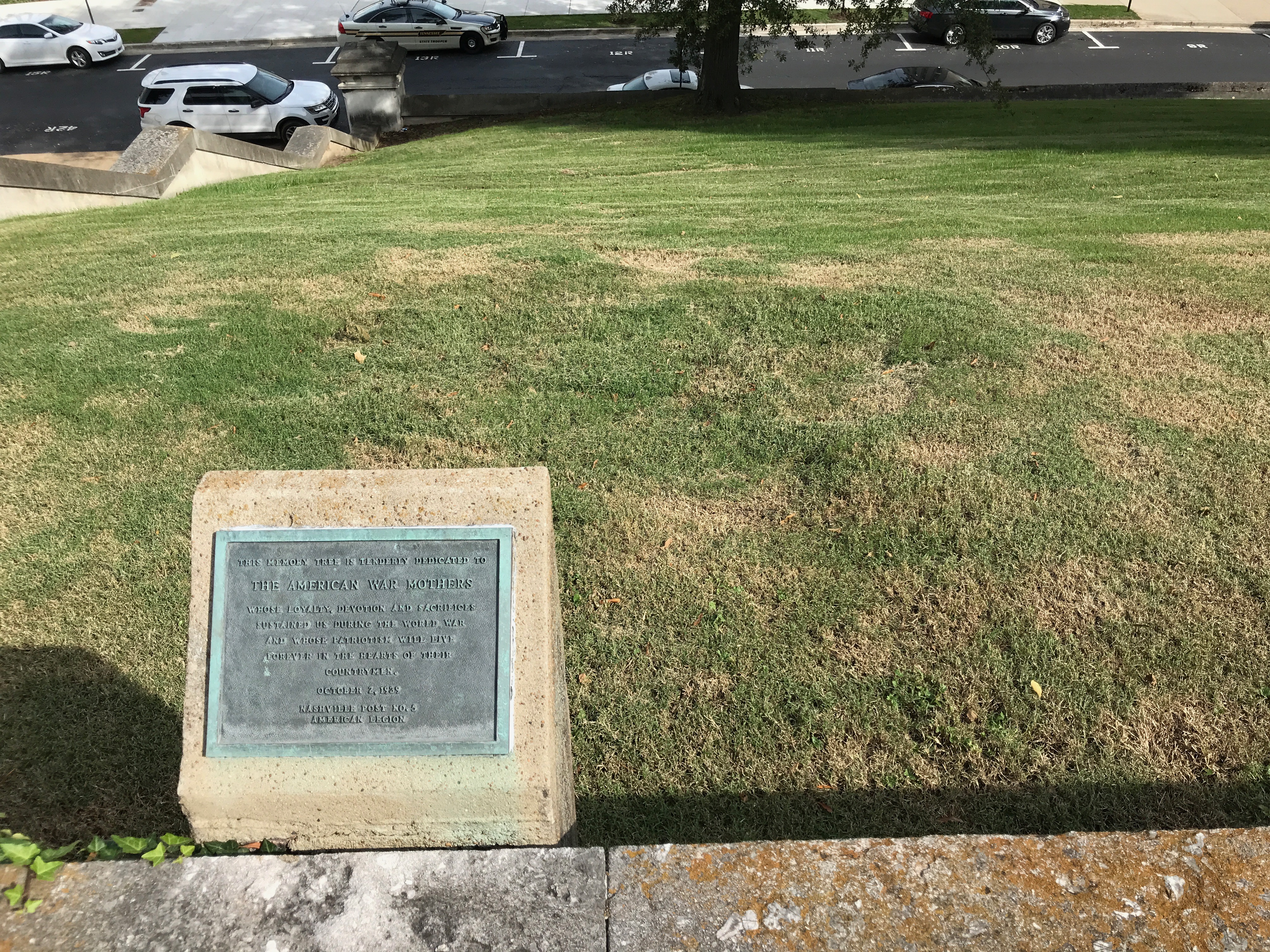
While I absolutely love trees, there is a problem with planting trees as a memorial.
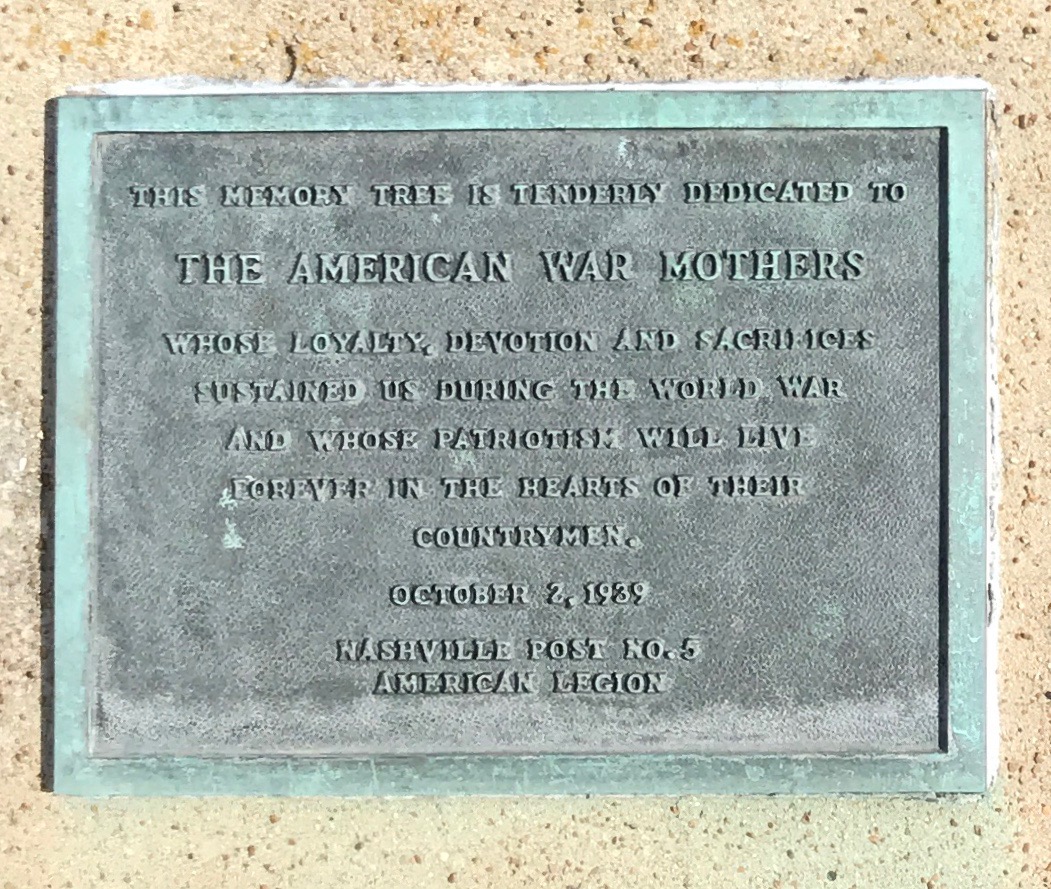
The “loyalty, devotion and sacrifices” of the American war mothers during the War to End All Wars may live on in the hearts of their countrymen, but trees have a tendency to die.
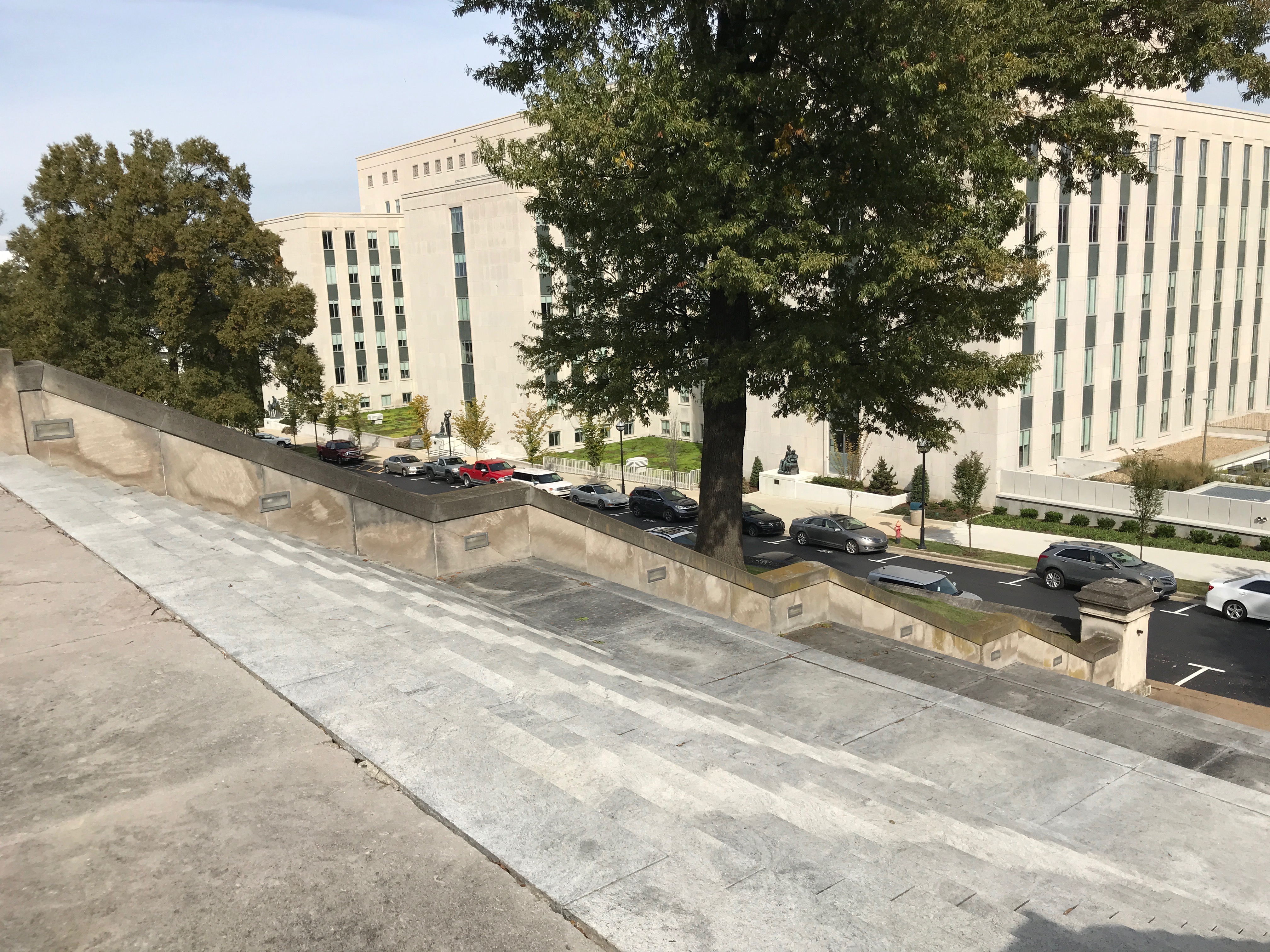
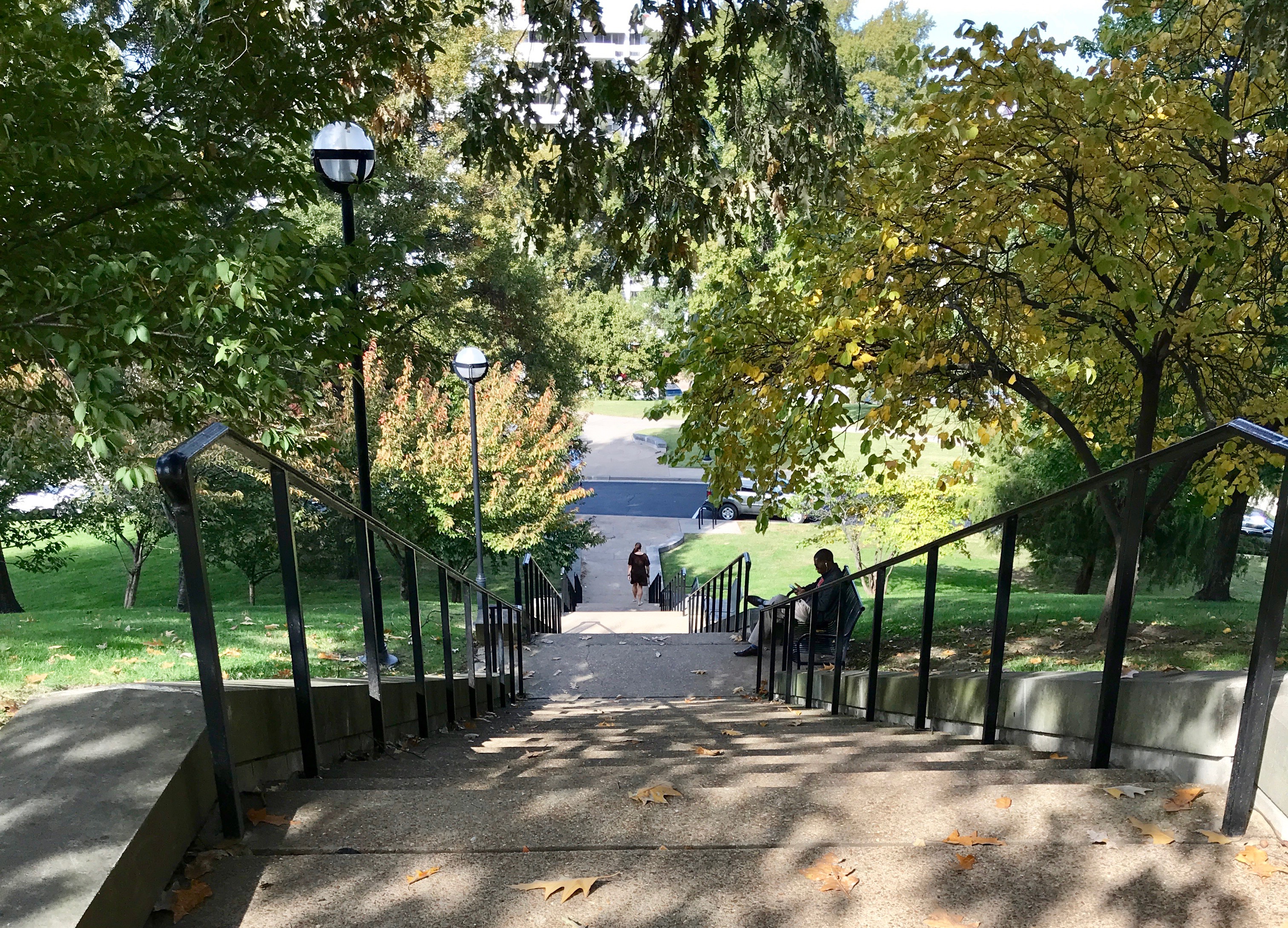
Man, there are a lot of stairs!
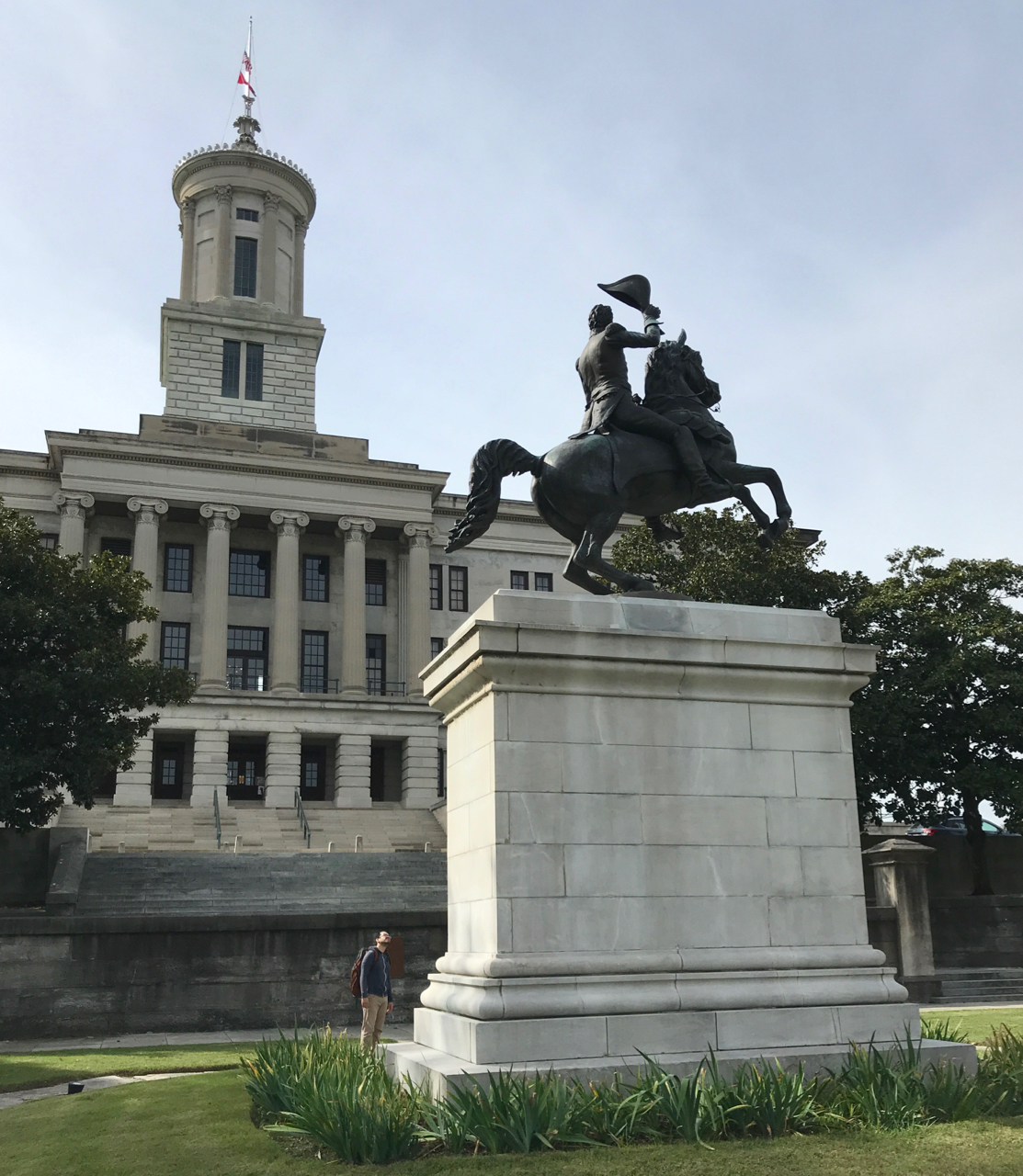
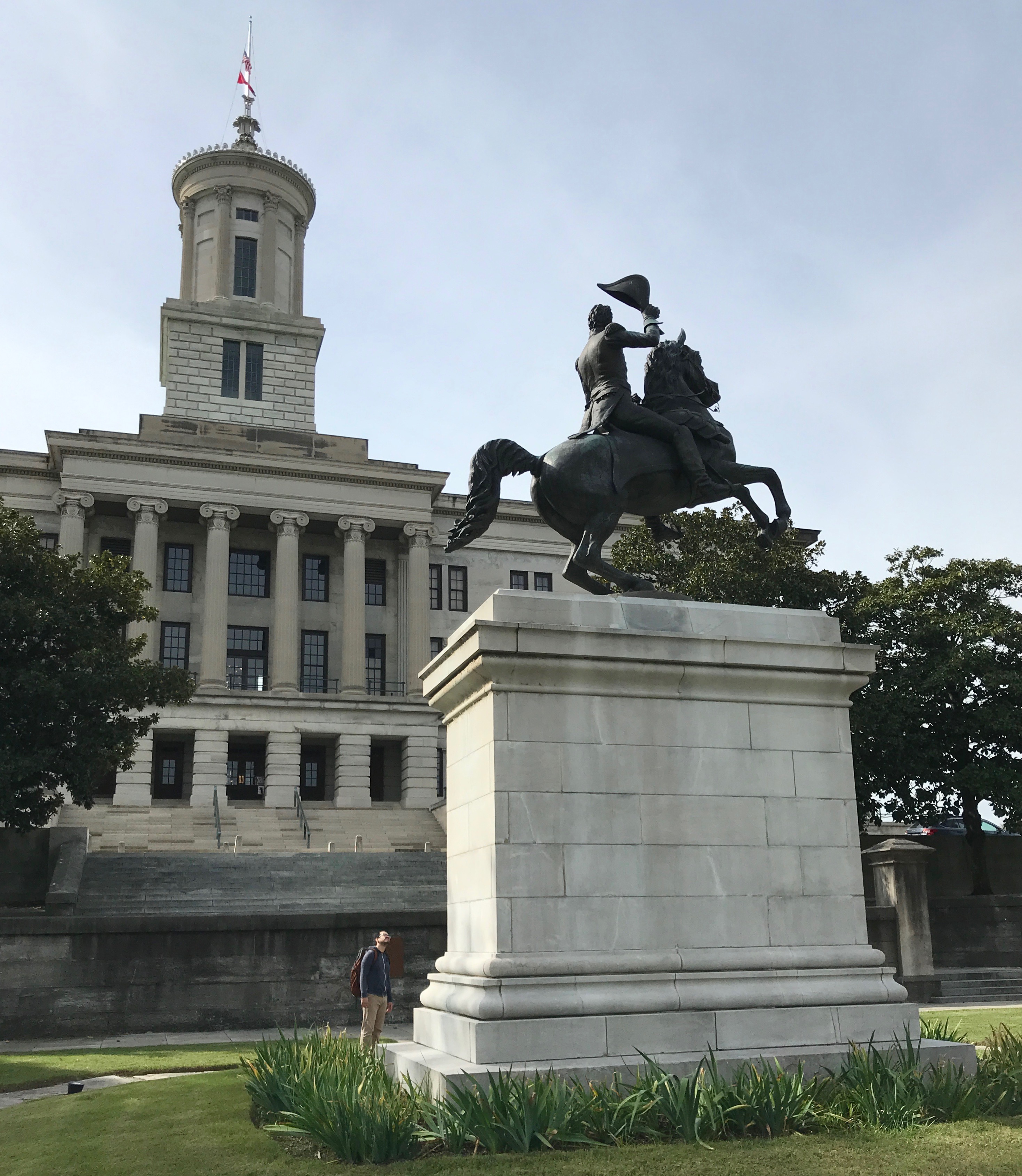
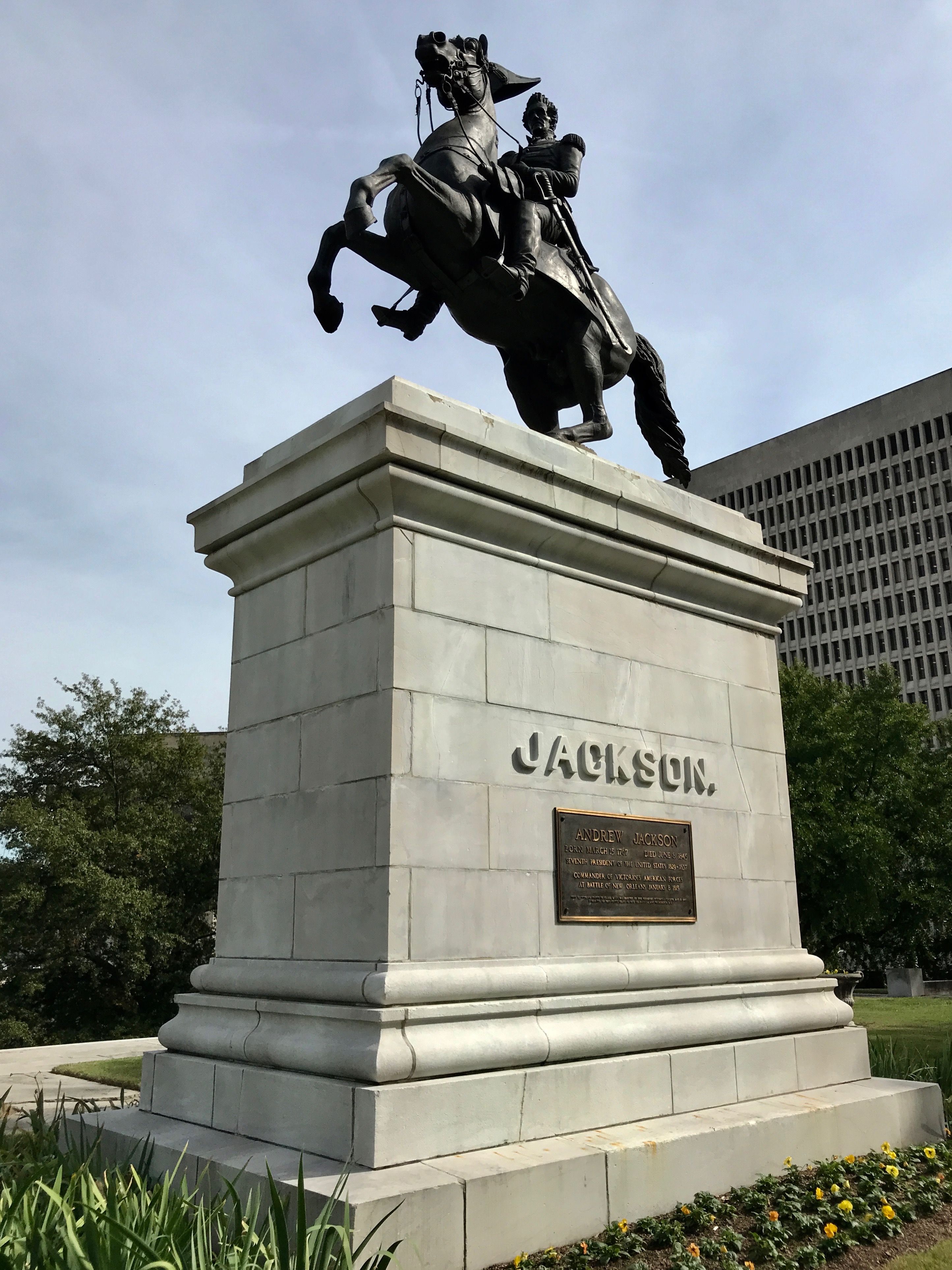
Andrew Jackson appears to be tipping his hat to the Tennessee state flag.
Andrew Jackson was the seventh president of the United States, from 1829-1837. I visited his plantation, The Hermitage, the year before.
Oh, my golly! More stairs!
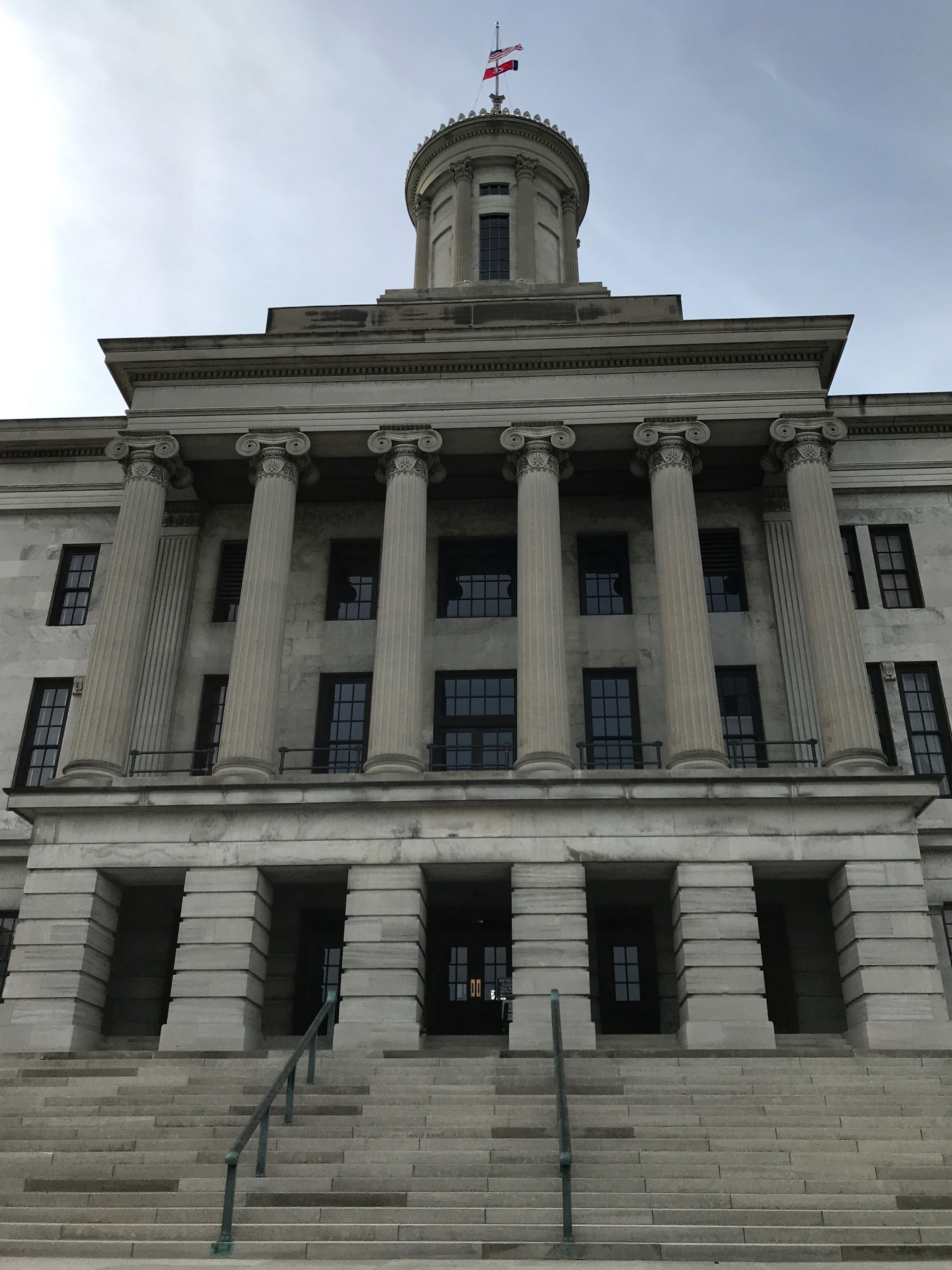
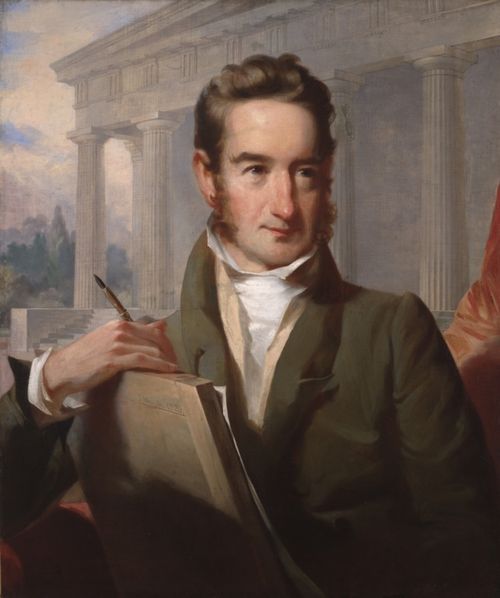
William Strickland, prominent Philadelphia architect, modeled the capitol after a Greek ionic temple.
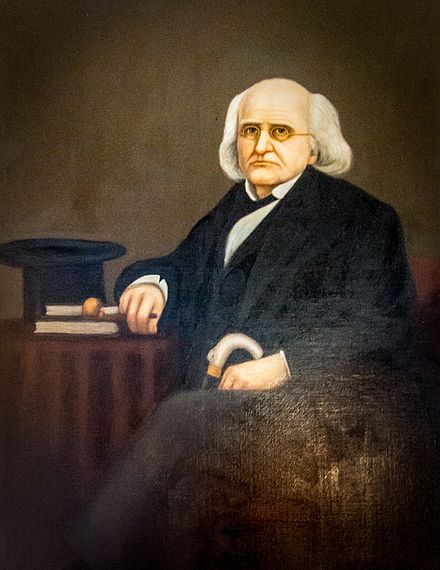
William Strickland by John Neagle
The cornerstone was laid in 1845 and the capitol was completed 14 years later, in 1859. Poor William didn’t live to see the completion of his masterpiece. He died in 1854 and is entombed in the Northeast wall. His son, F. W. Strickland, supervised completion of the structure. Samuel Dold Morgan, chairman of the State Building Commission overseeing the construction of the Tennessee State Capitol, is entombed in the Southeast corner near the South entrance.
Samuel Dold Morgan 1798 – 1880
At least Samuel lived to see the completion of the building. He died in 1880.
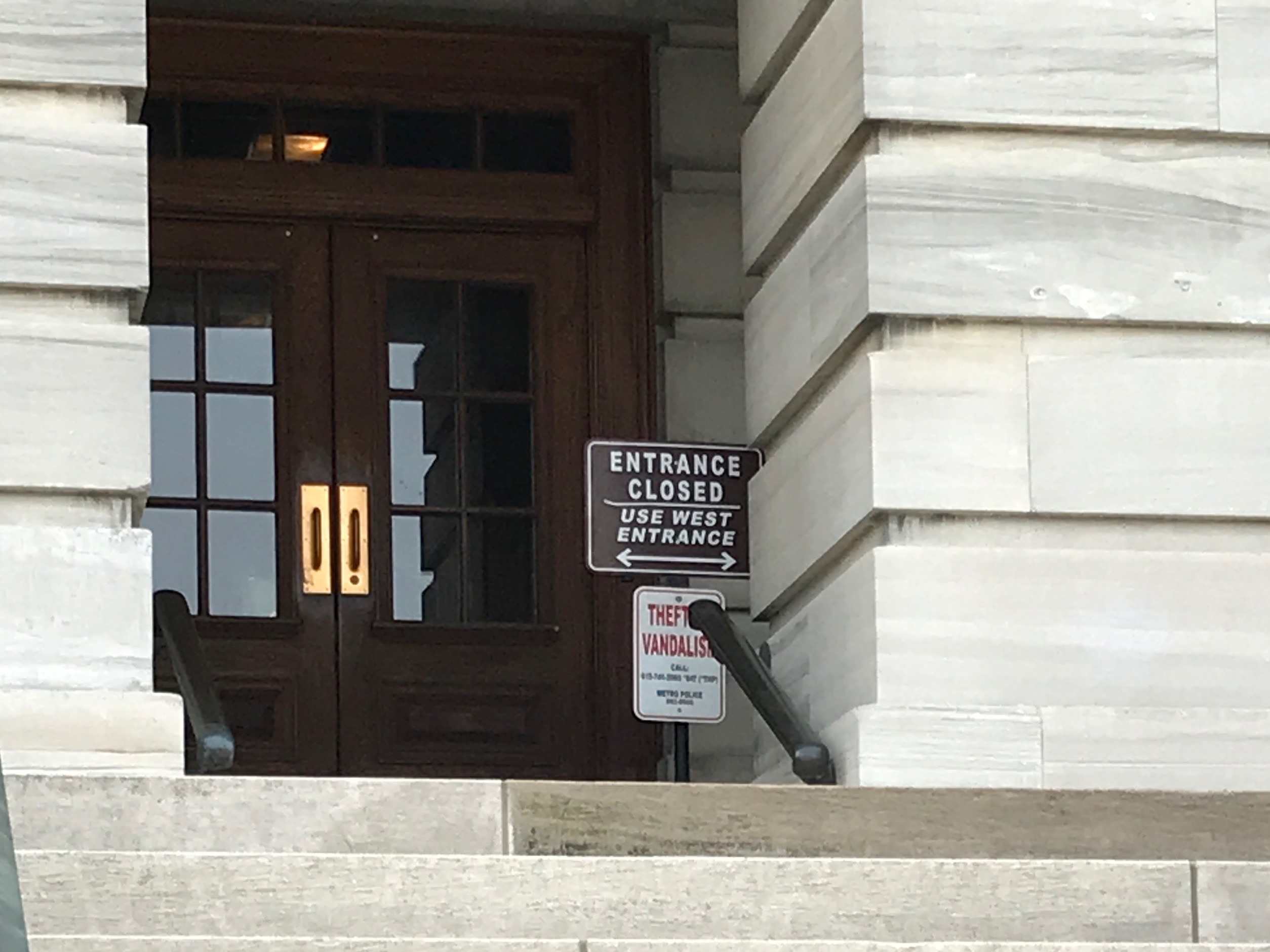
I must admit that this sign rather confused me. Oh, I’m used to entrances being closed, but which way is west? Should I go right or left? I don’t remember what I did, but I eventually got inside.
This elegant building has served as Tennessee’s capitol since it opened in 1859.
One interesting feature about the building is that it is one of 11 state capitols that does not have a dome. Those states are Alaska, Florida, Hawaii, Louisiana, New Mexico, New York, North Dakota, Ohio, Oregon, Tennessee, and Virginia – just in case you wanted to know.
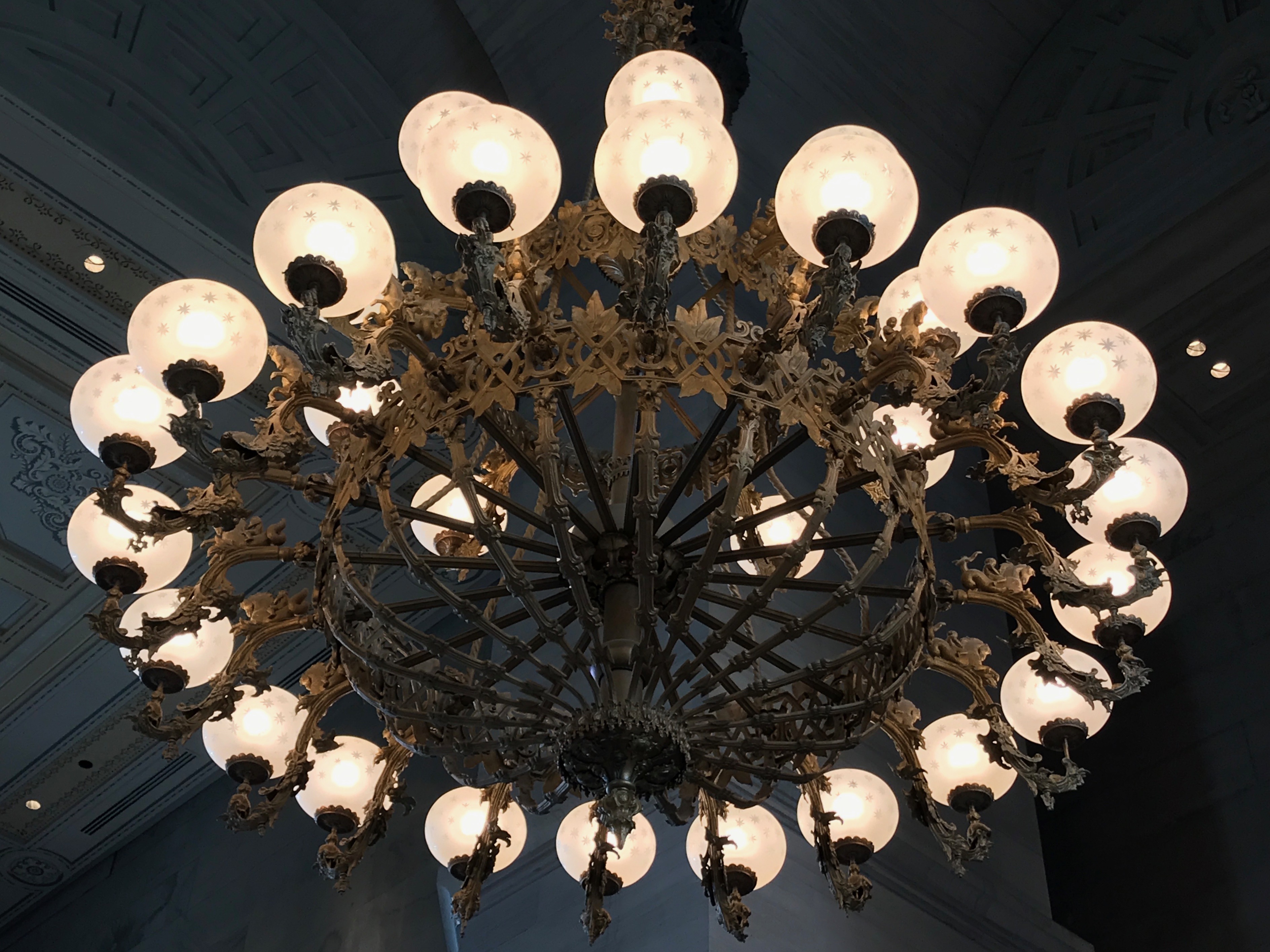
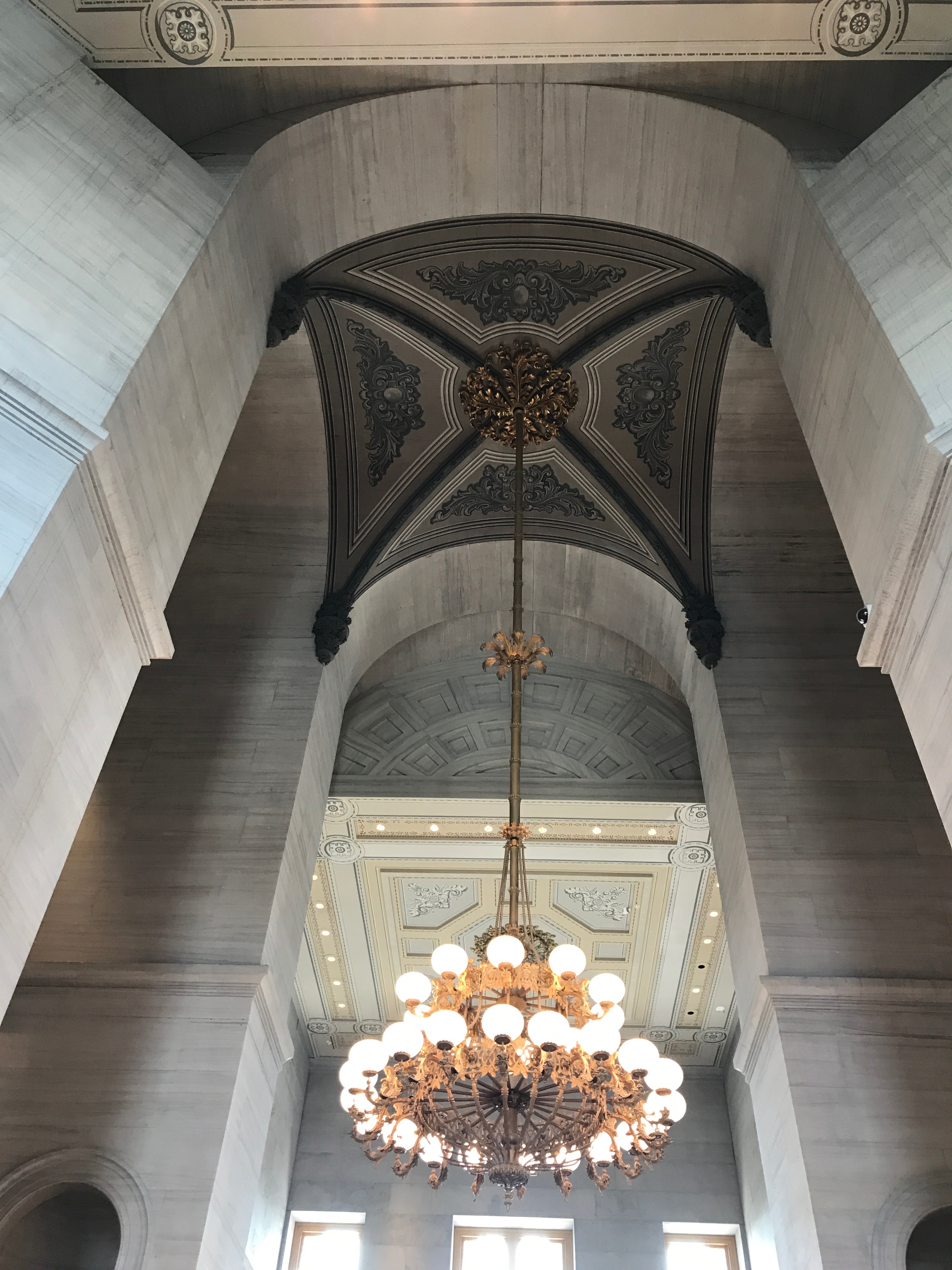
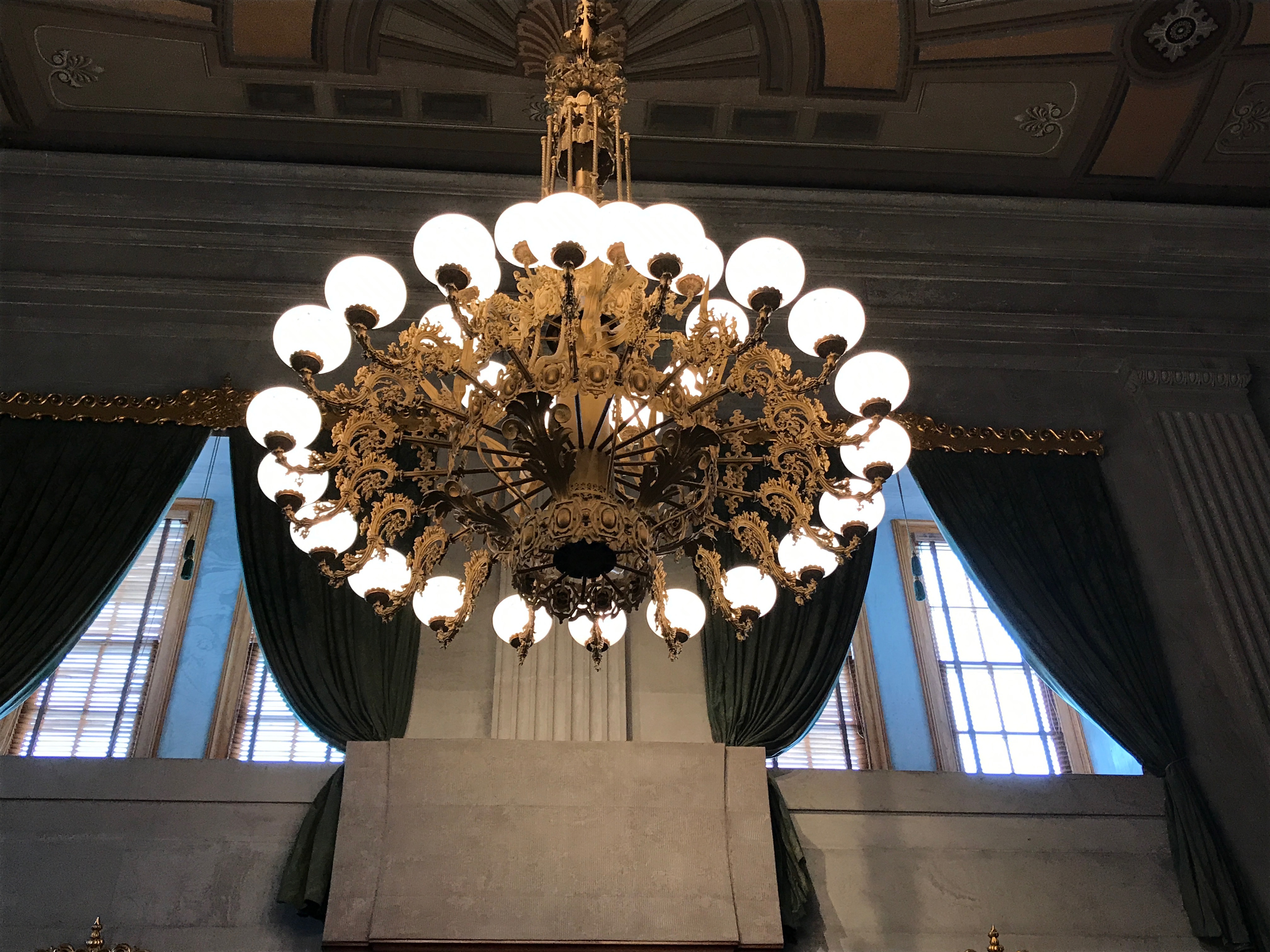
There is no lack of architectural detail to draw the eye upwards as there are quite a few lovely chandeliers inside.
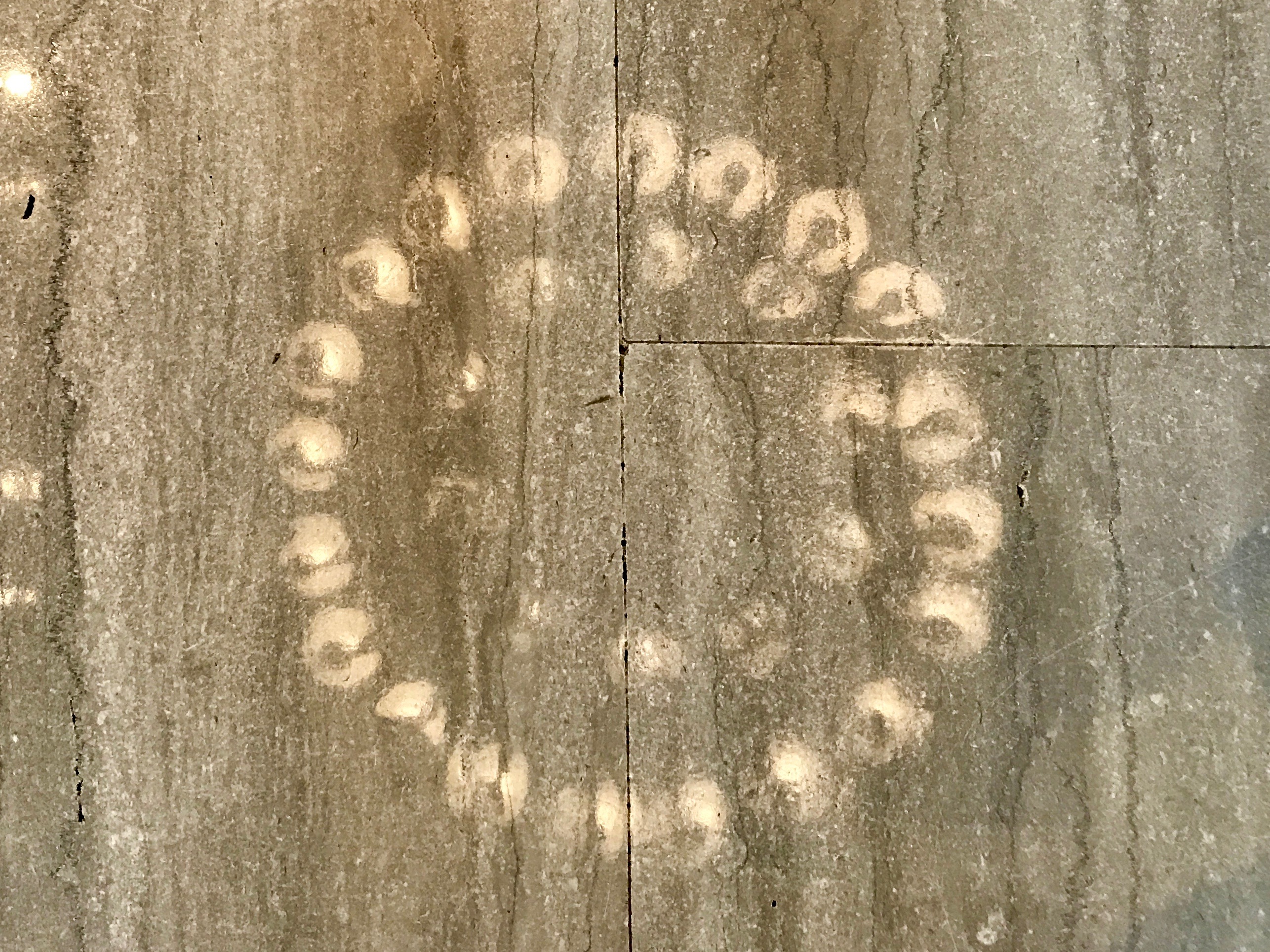
And they are reflected in the highly polished floors.
There are soaring arches, so the lack of a dome is really not noticeable. In fact, I didn’t realize that it was lacking a dome until I looked at my photos and read up on the building.
The American Society of Civil Engineers has listed the building as a civil engineering landmark in recognition of its innovative construction. It made unusually extensive use of stone. Both the interior and exterior are built with limestone from a quarry that was only about a mile away. My Preferred Source says that some interior columns were built from single pieces of stone, which required massive wooden derricks to hoist them into place. Structural iron was used for roof trusses to reduce the building’s vulnerability to fire, which was an innovation in design.
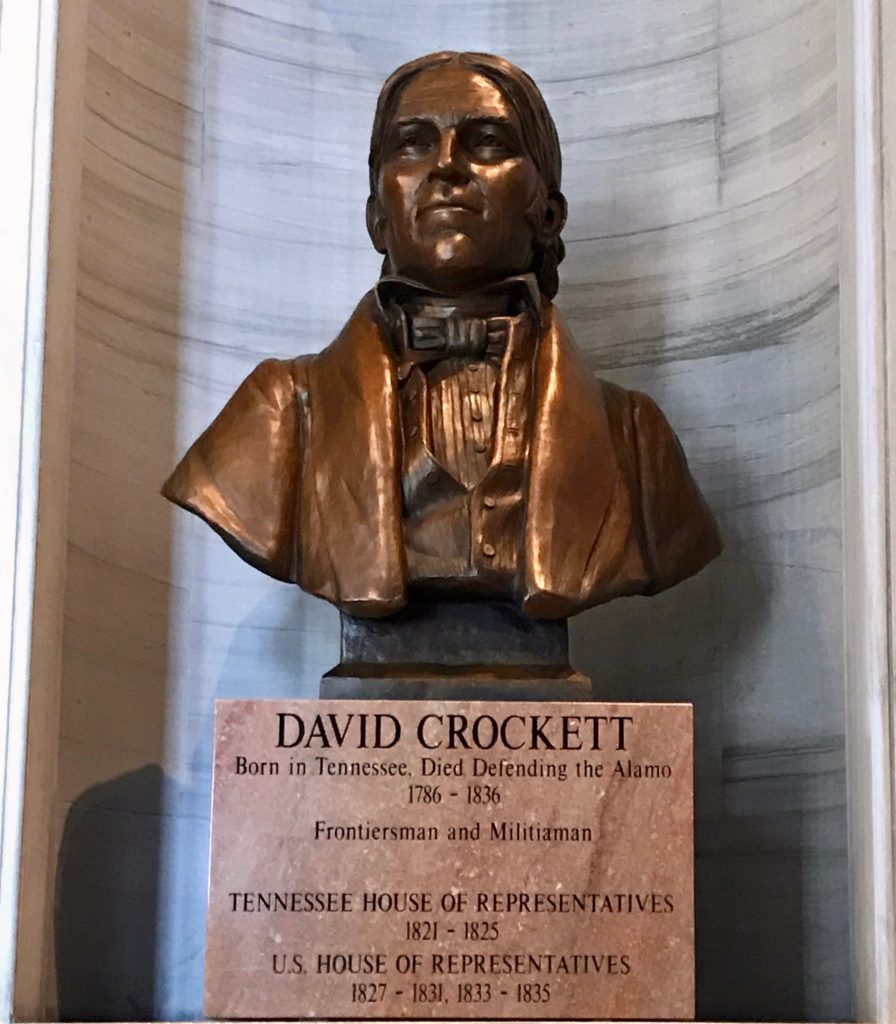
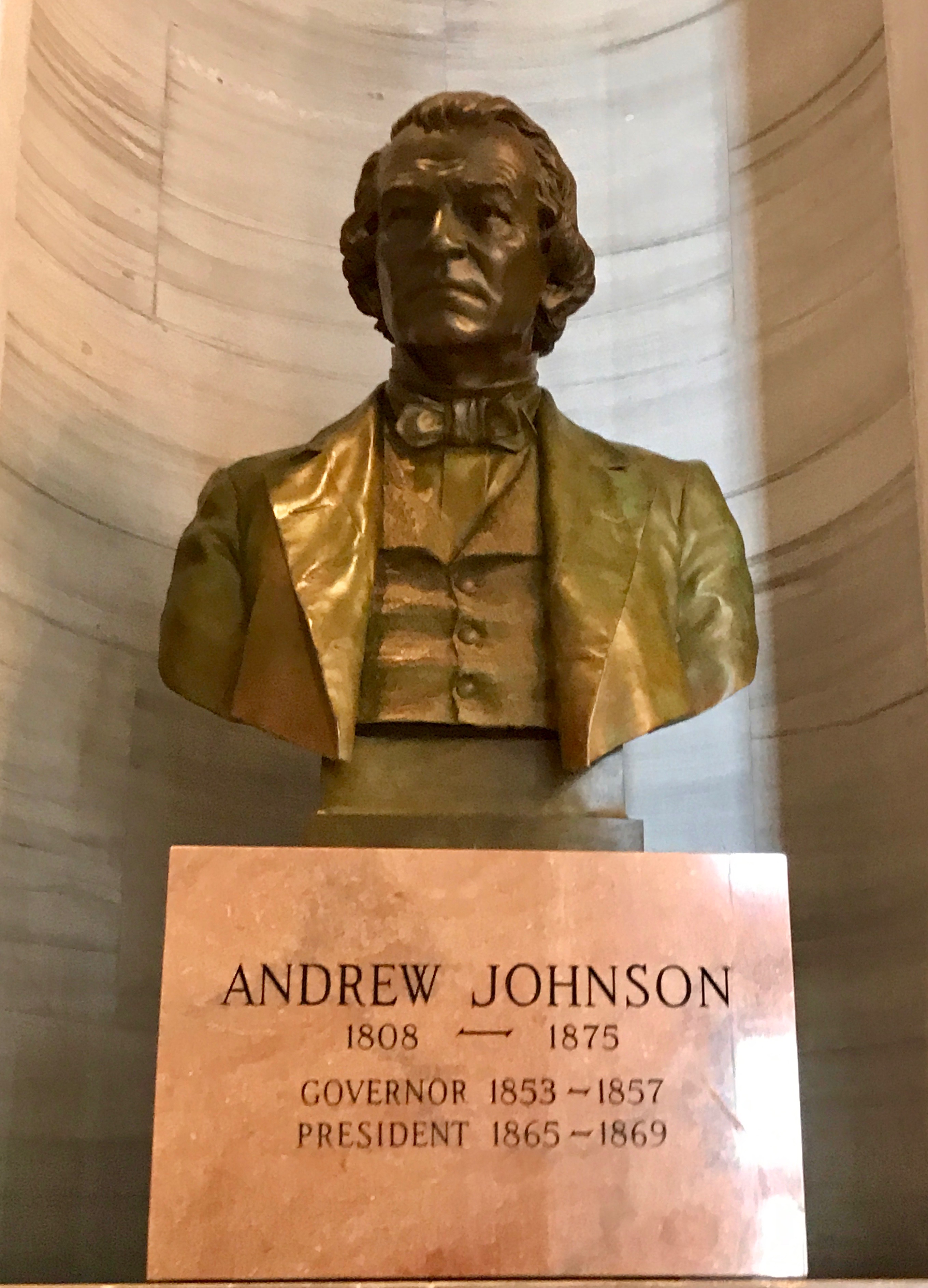
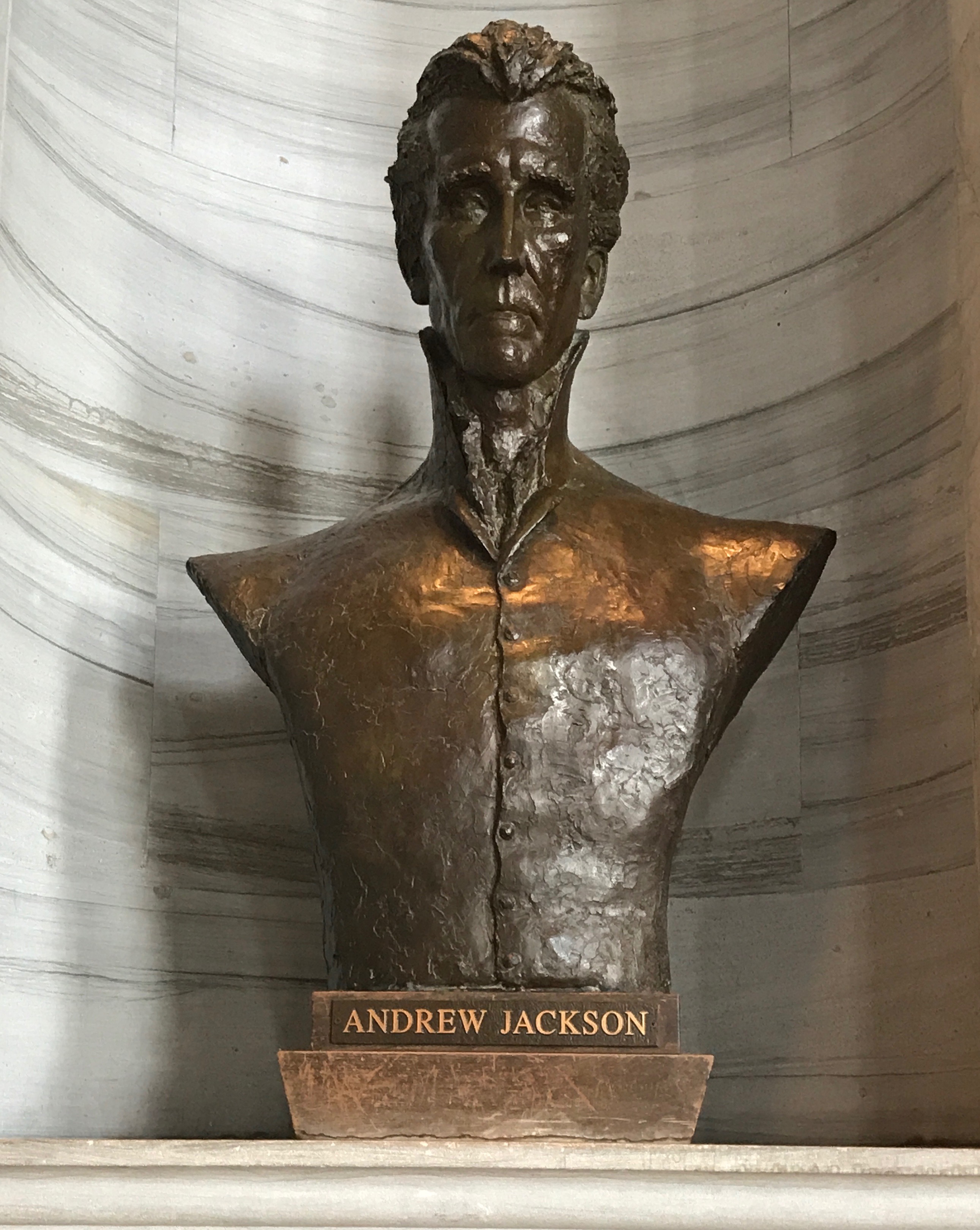
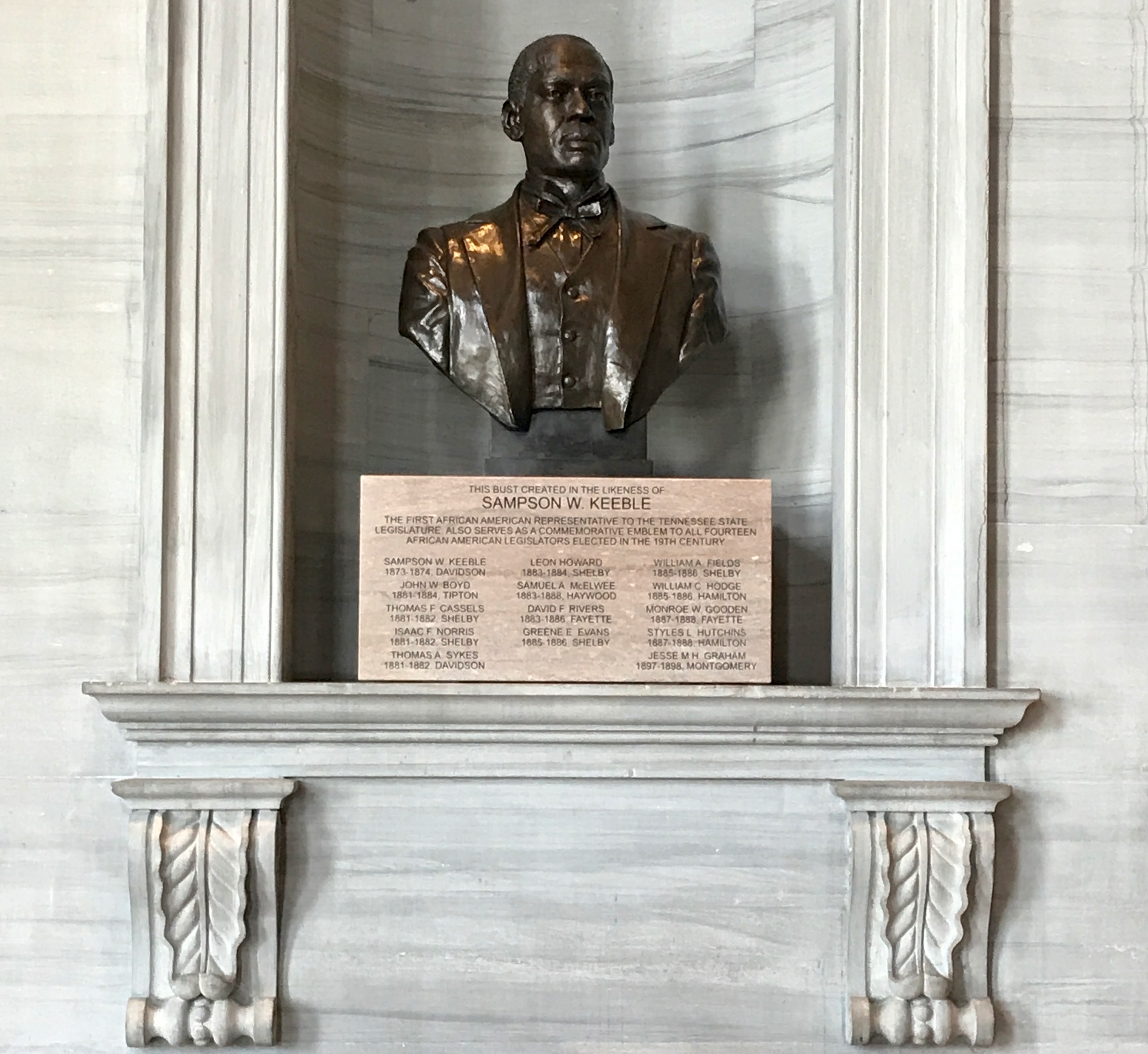
Busts of significant people in Tennessee history are set into niches.
Davy Crockett
Andrew Johnson
Andrew Jackson. (Honestly, though, was is up with his neck? He looks like the statue was designed by El Greco.)
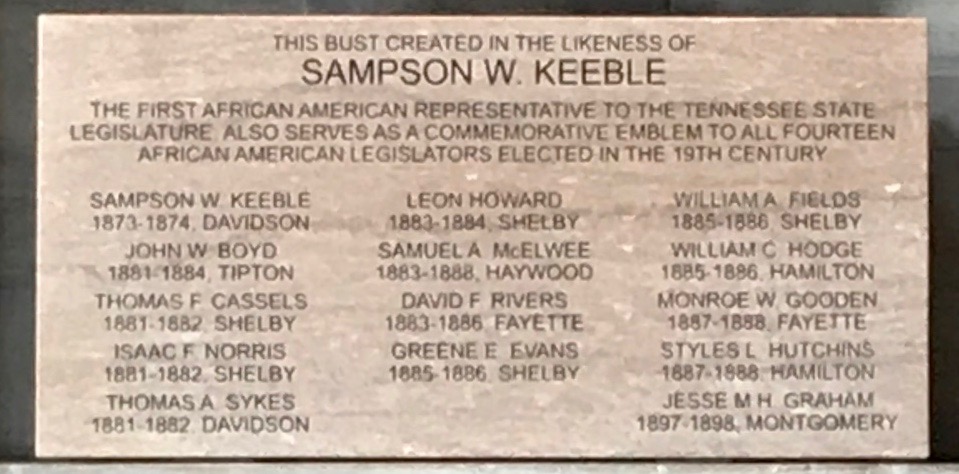
According to the information carved into the base of this bust, it was created in the ‘likeness of Sampson W. Keeble.”
I’ll let you read the rest of it for yourself.
Admiral Farragut has a bust here. He was born near Knoxville in a town named Campbell’s Station. It has since been renamed Farragut. His mother died at when he was quite young and he was fostered by David Porter. Mr. Porter was a naval officer, and it must have been “Take Your Son to Work Day”. He served in the War of 1812 under the command of his father. At least he made it to double digits before he went to war.
He resided in Norfolk, Virginia prior to the Civil War, but he was a Southern Unionist who strongly opposed Southern secession. He remained loyal to the Union and captured New Orleans in 1862. He helped extend Union Control of the Mississippi River and also led a successful attack on Mobile Bay, home to the last major Confederate port on the Gulf of Mexico. He is credited with the order “Damn the torpedoes, full speed ahead!” This is a paraphrase of what he actually said. If you want to know what his actual order was, click here.
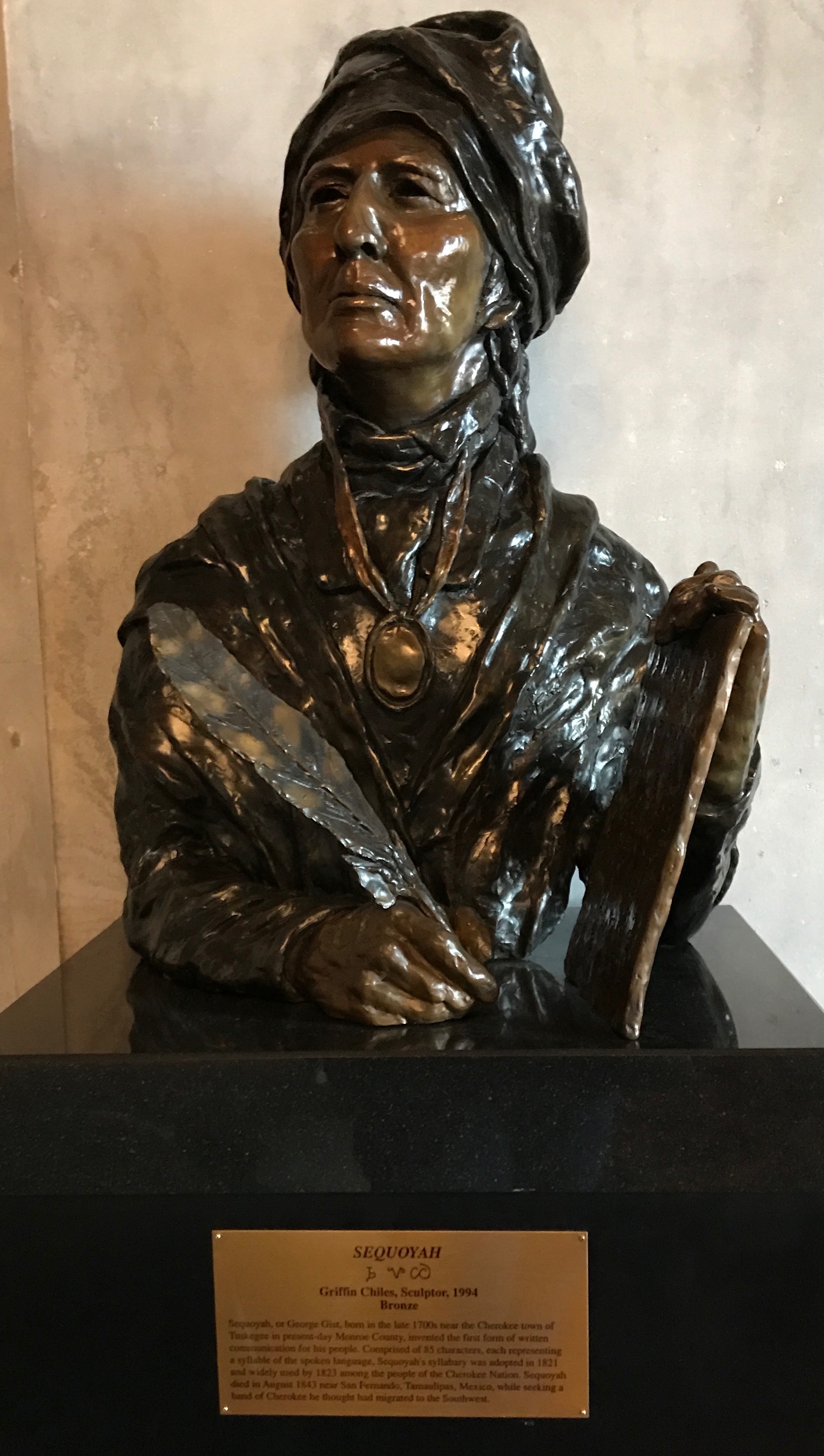
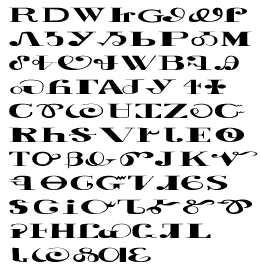
Sequoyah was born near Knoxville in the late 1700s. We had a story about him in one of the reading series at school, and I was always amazed that he invented a way to write his language. It is one of the few times in recorded history that a member of a pre-literate people created an original, effective writing system.
Just in case you are curious, this is what his syllabary looked like. It consisted of 85 characters, each representing a syllable of the spoken language. The first person he taught to read was his six-year old daughter, Ayokeh. He couldn’t find any adults who were interested. Together they traveled to the Arkansas Reserves where some Cherokee had settled. The chiefs weren’t too interested until he had them dictate some words that he wrote down. He called Ayokeh to read they words back to them. Literacy rules!
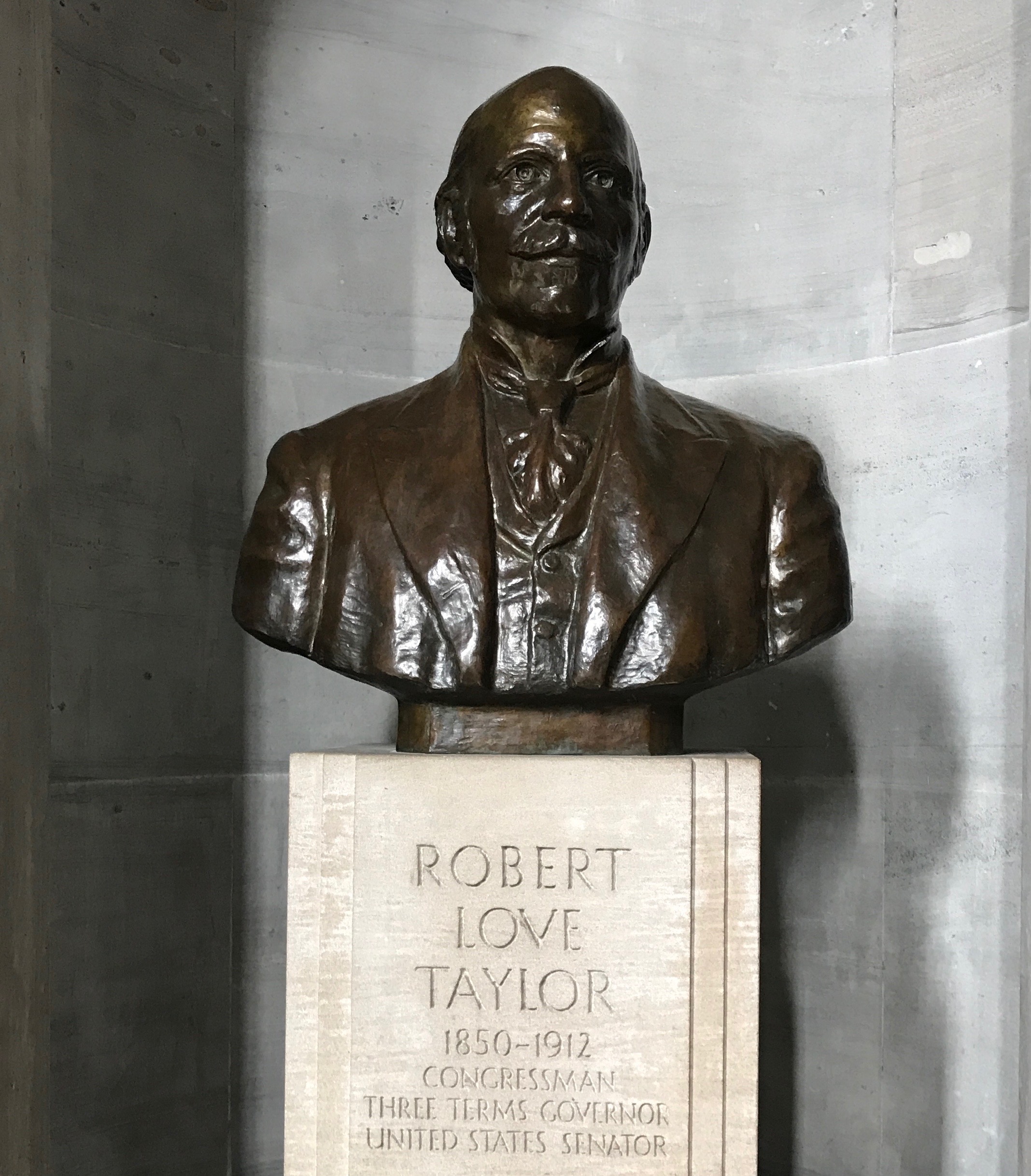
Robert Love Taylor was an interesting fellow. His first elected office was as governor. I imagine family gathering might have been contentious affairs. In that election, he defeated his older brother, Republican Alfred Taylor. However, maybe the campaign was more good-natured than we have become used to in recent years. The 1886 campaign was known as “The War of the Roses” and it involved story-telling, fiddle-playing and practical jokes.
Alfred did finally have his turn in the governor’s seat, though, as he was elected in 1920, after Robert had died.
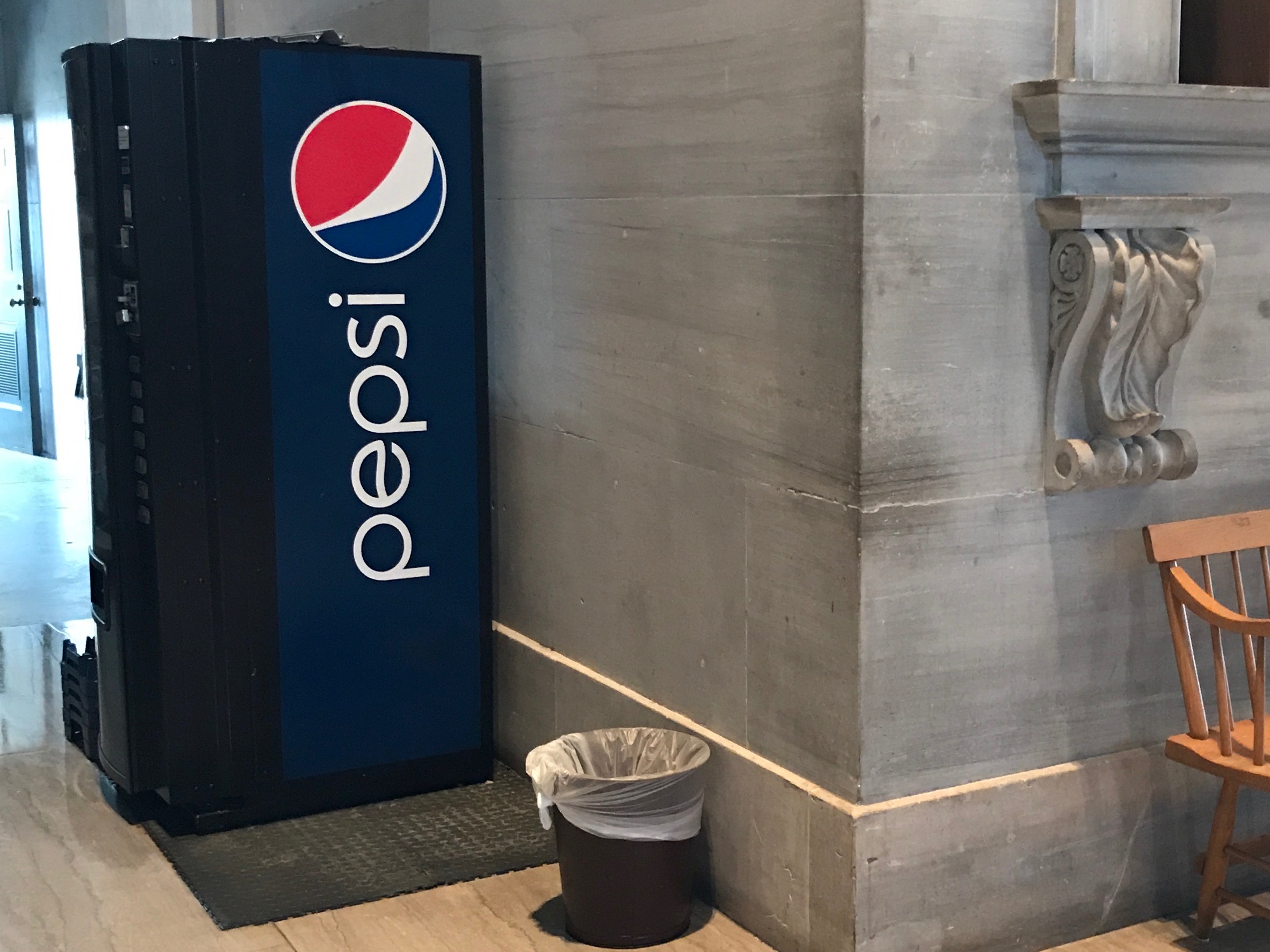
There are always divisions. Some people like Pepsi…
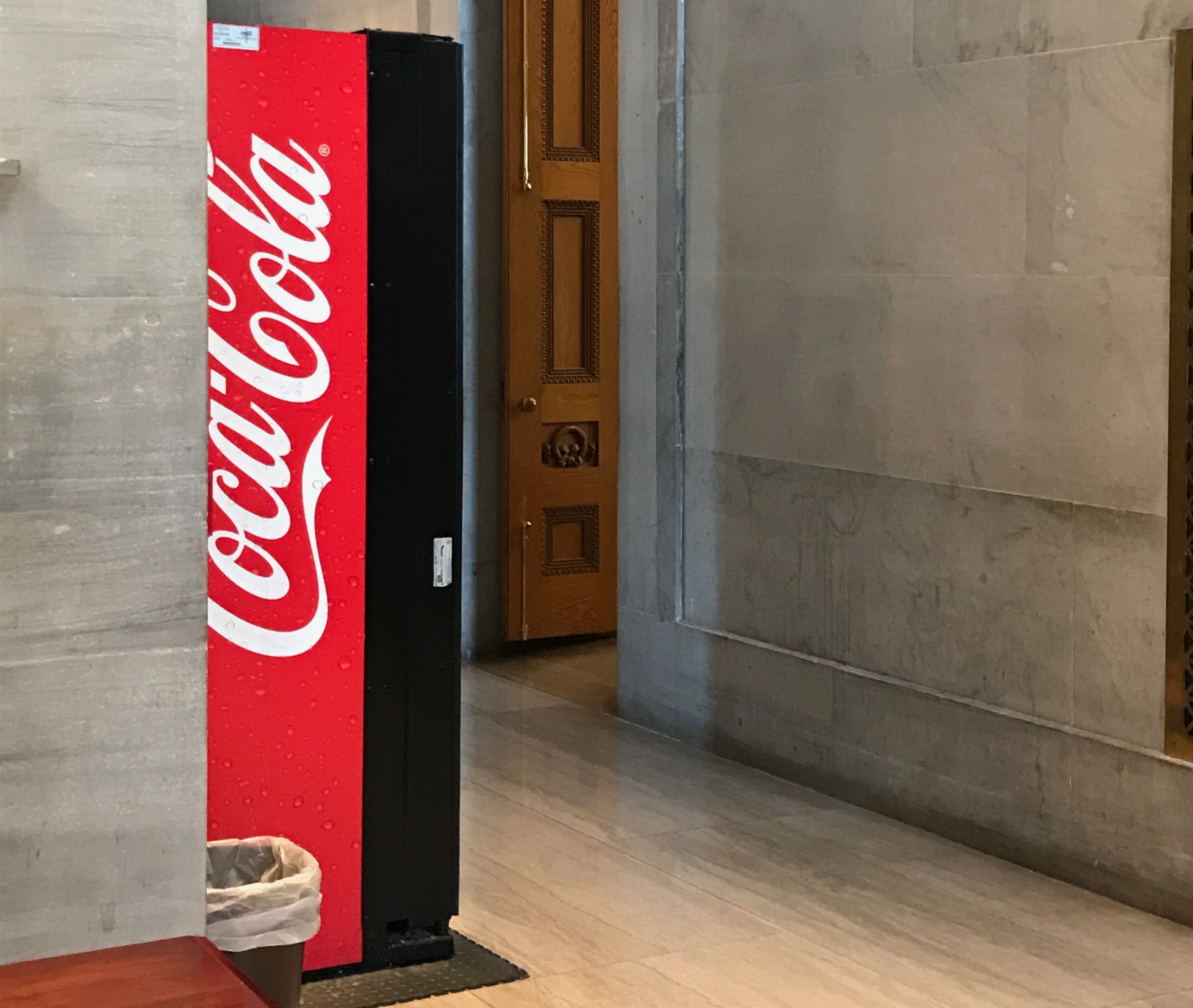
while others prefer Coke.
I thought it was very accommodating that they had both options available.
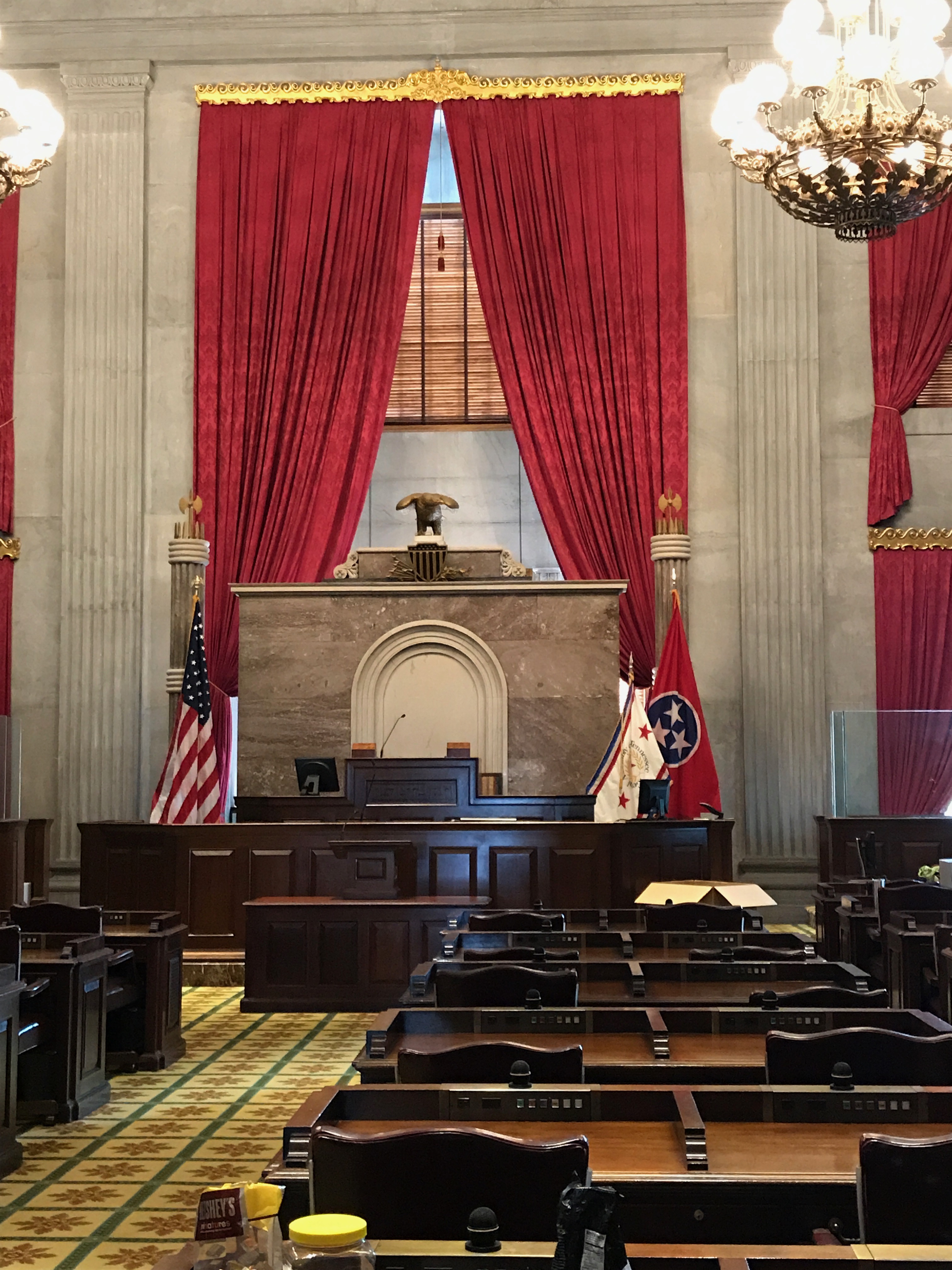
We got to look inside the House of Representatives.
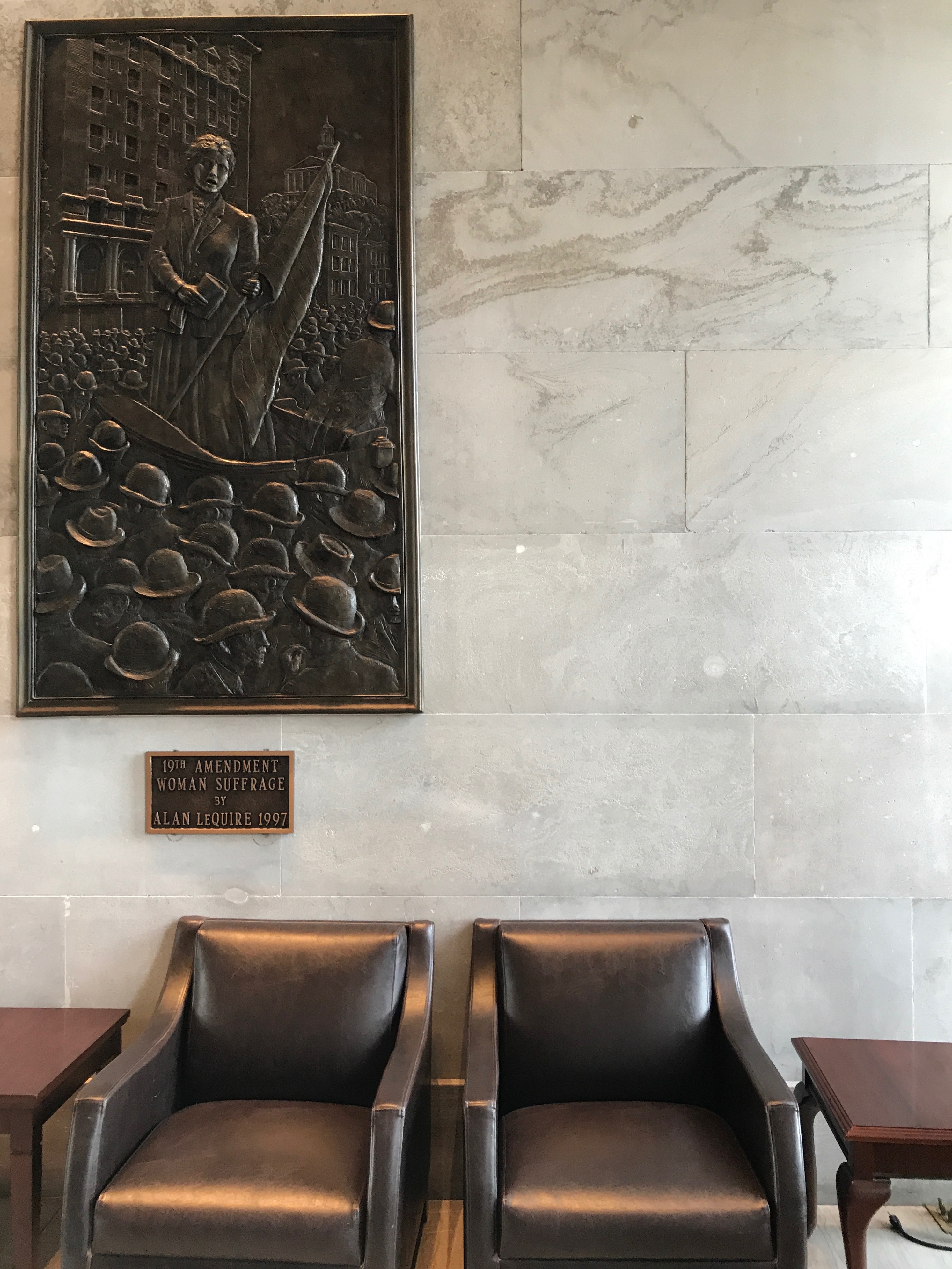
In one of the reception areas, there were some bronze plaques honoring Constitutional amendments. This one was for the 19th Amendment, which gave women the vote. Tennessee was the last of the 36 states needed to secure ratification of the amendment. That happened on August 18, 1920. The Nineteenth Amendment was officially adopted on August 26, 1920.
Did you know that prior to 1776, women had the right to vote in several of the colonies in what later became the United States? But, by 1807, every state constitution denied even limited suffrage. I did not know that.
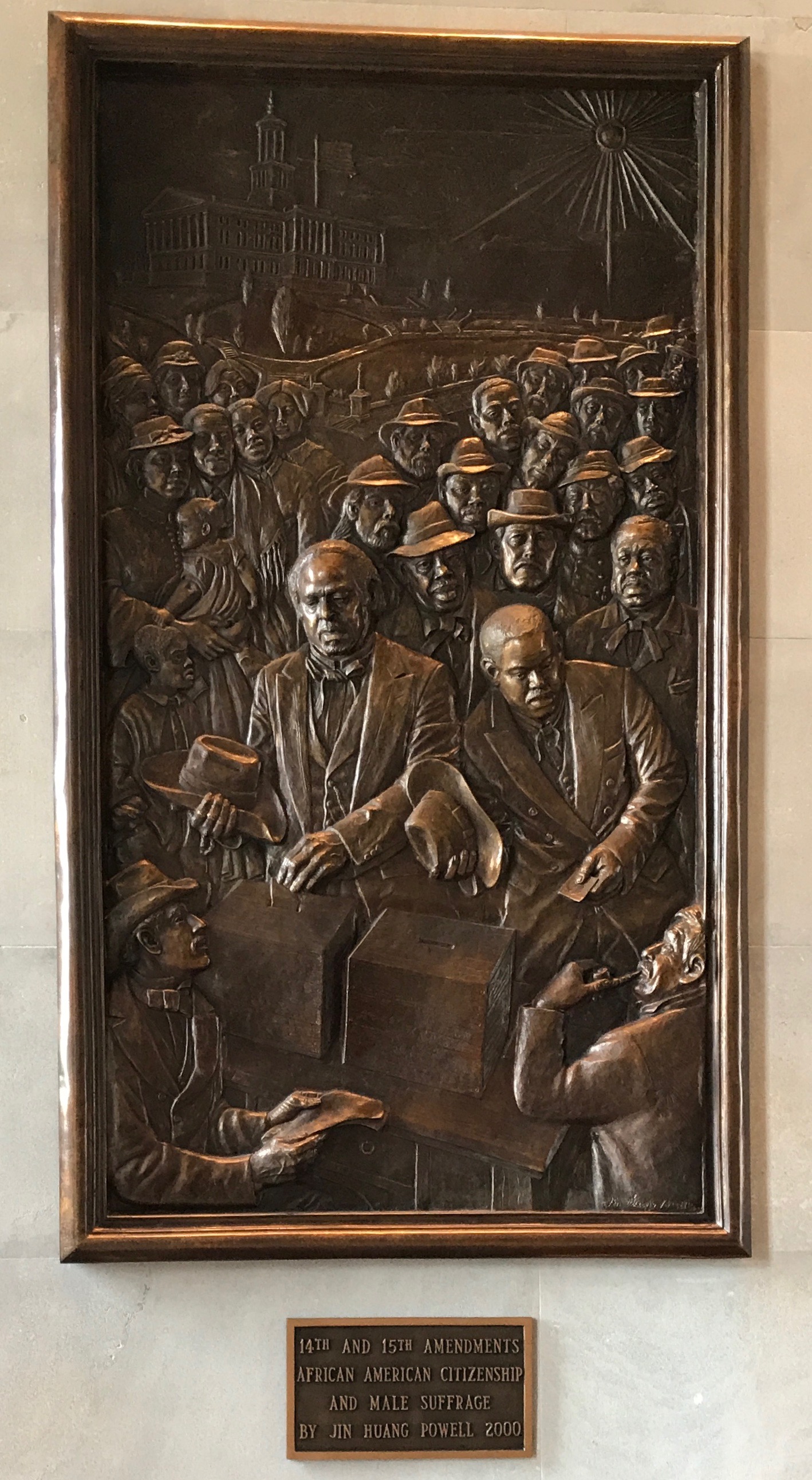
This plaque honors the 14th and 15th amendments.
The 13th amendment, ratified in 1865, abolished slavery and involuntary servitude, except for those duly convicted of a crime. I guess that is how we can have crews of convicts working on the roads and in parks even today – especially down south.
The 14th Amendment, ratified in 1868, addresses citizenship rights and equal protection of the laws for all. The 15th Amendment (ratified in 1870) prohibits discrimination in voting rights of citizens on the basis of “race, color, or previous condition of servitude.”
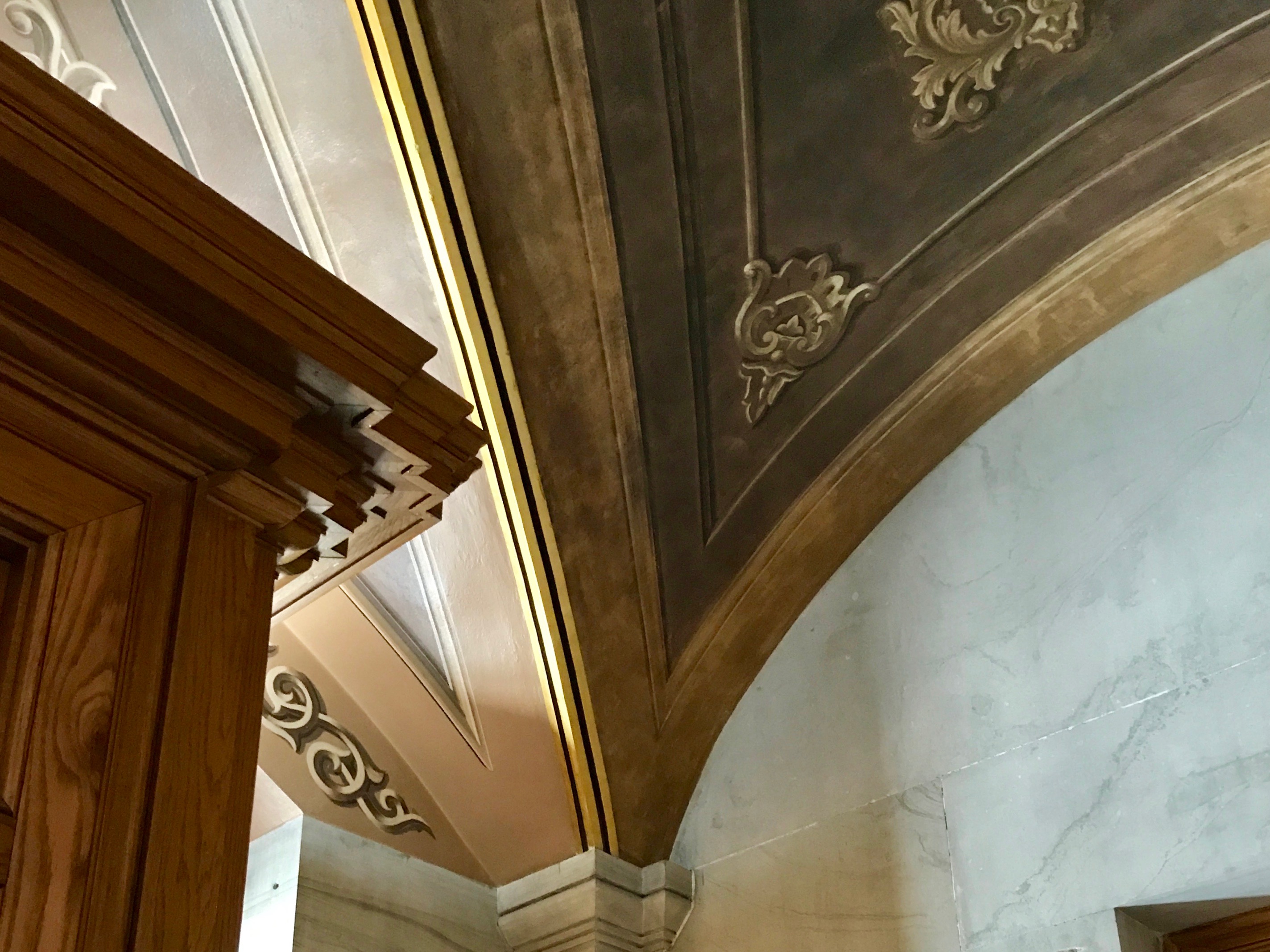
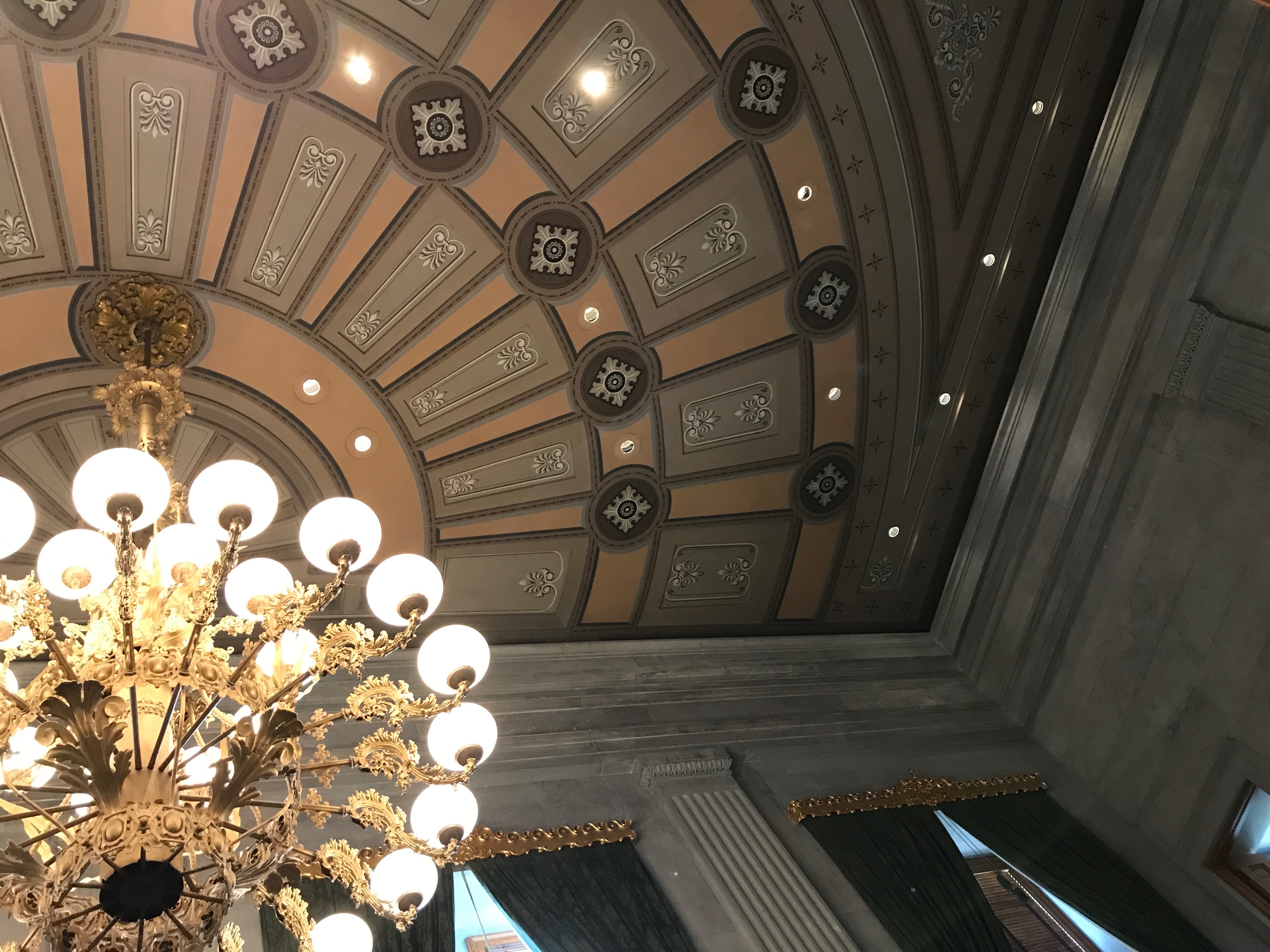
What really caught my eye, though, was the ceiling treatment. Who needs domes with ceilings like these?
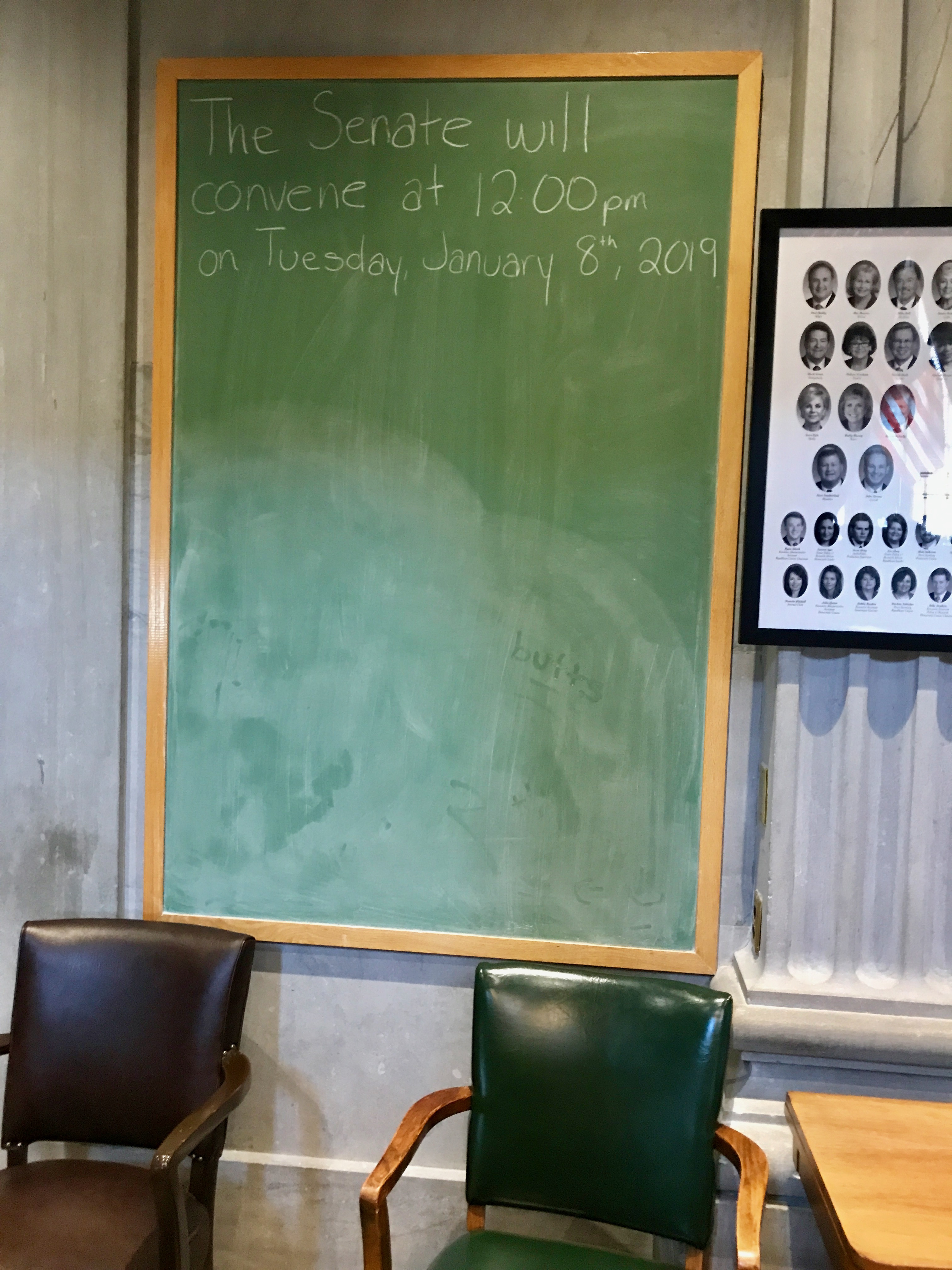
I thought this rather low-tech sign in the Senate chamber was anachronistic. Or, perhaps, it was period appropriate, for when the capitol was built, in the mid 1800s.
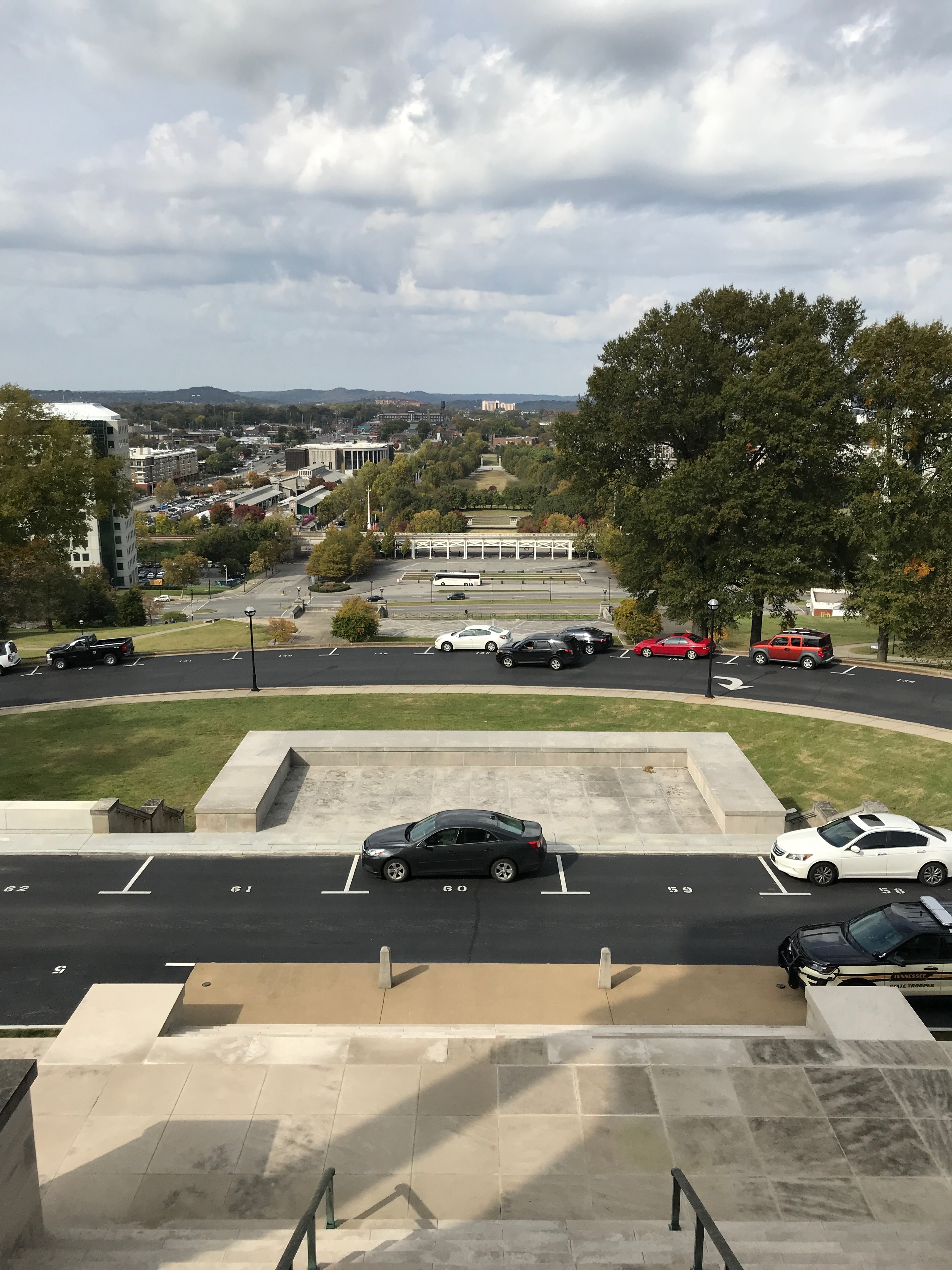
We paused and looked out the door. That’s a long way down!
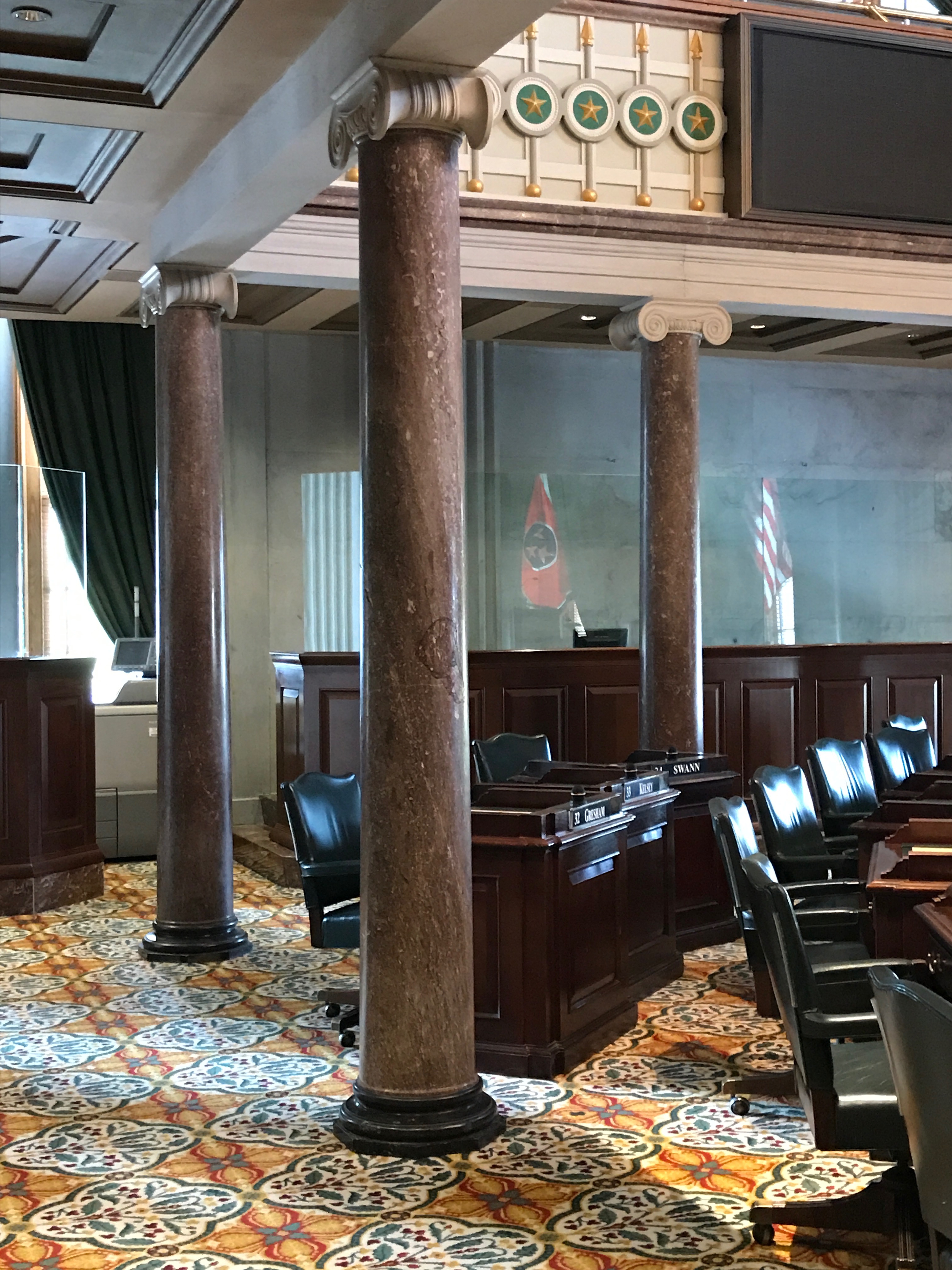
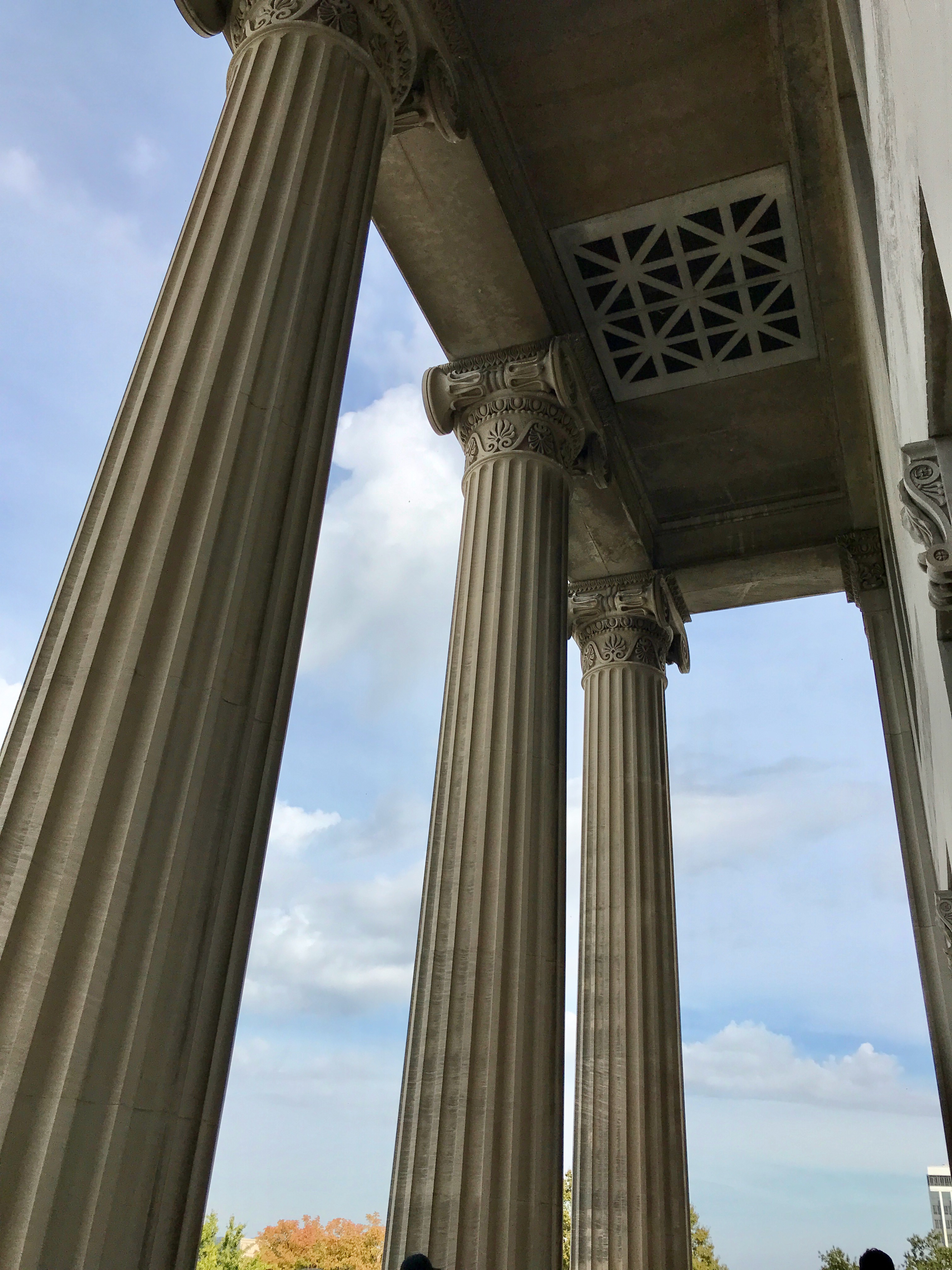
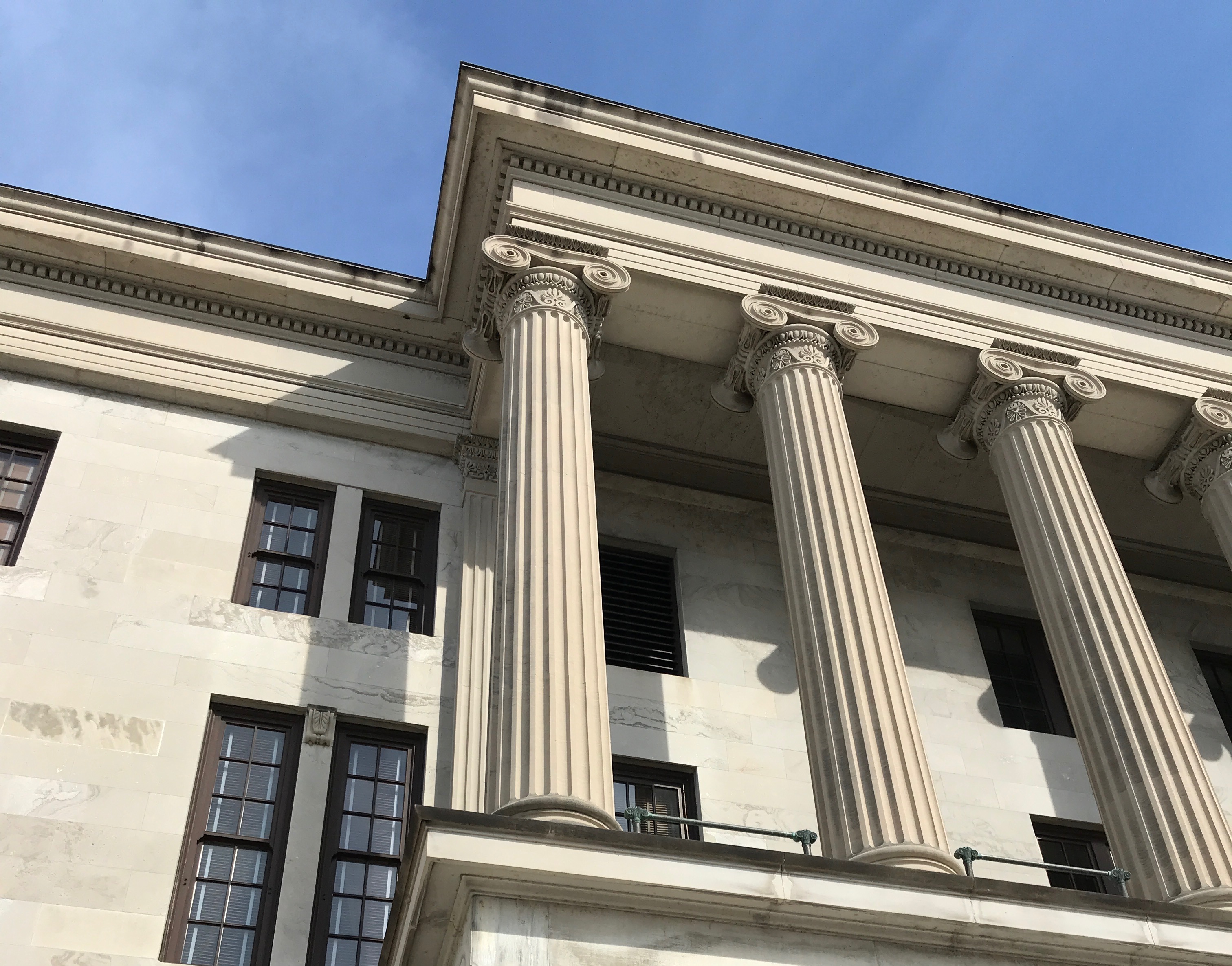
It goes without saying that I had to look up at the capitals on the capitol. Of course, they are of the Ionic order.
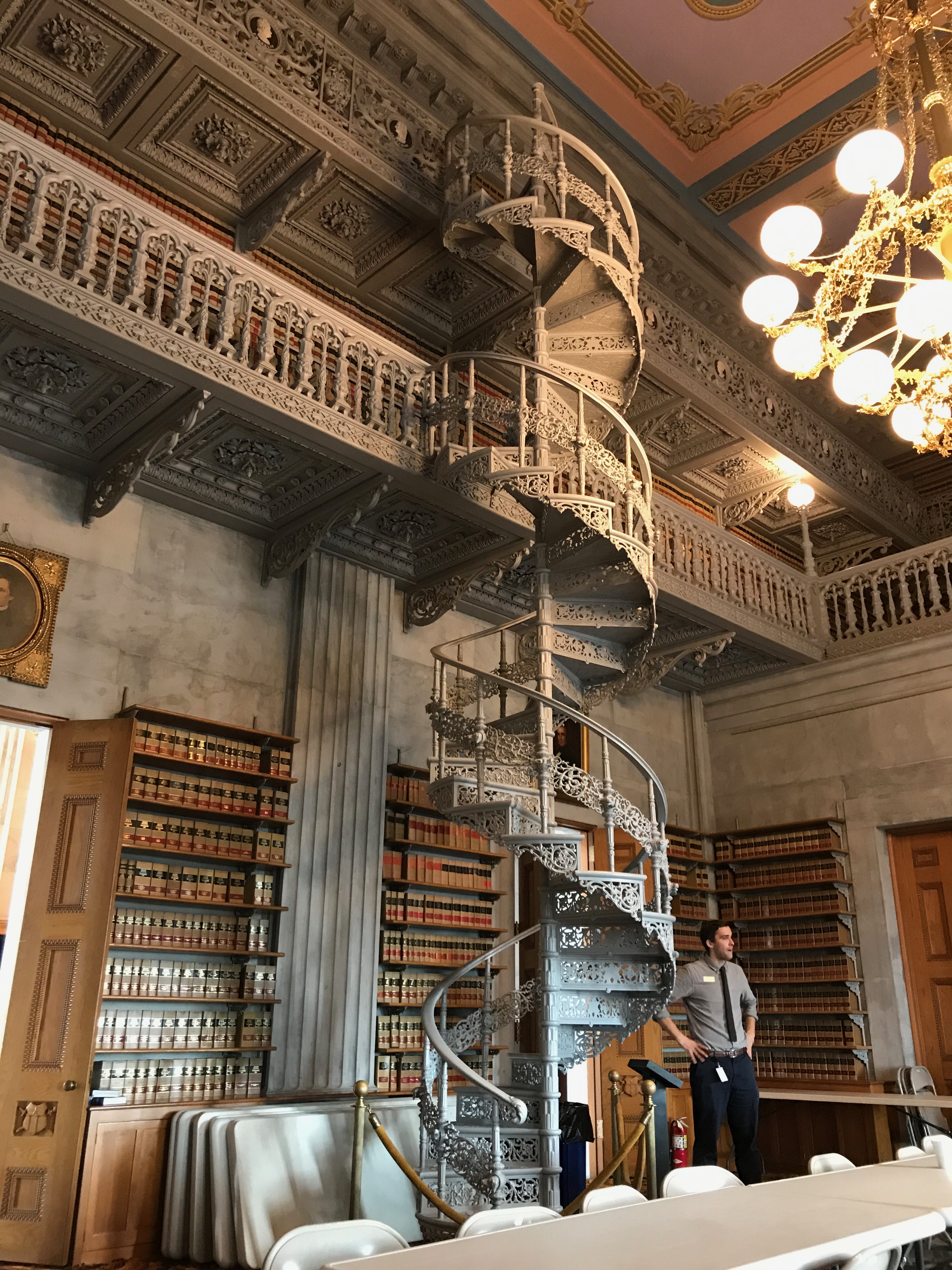
Our next stop on the tour was my favorite – the library.
Can you imagine being a clerk and having to ascend and descend that spiral stairway?
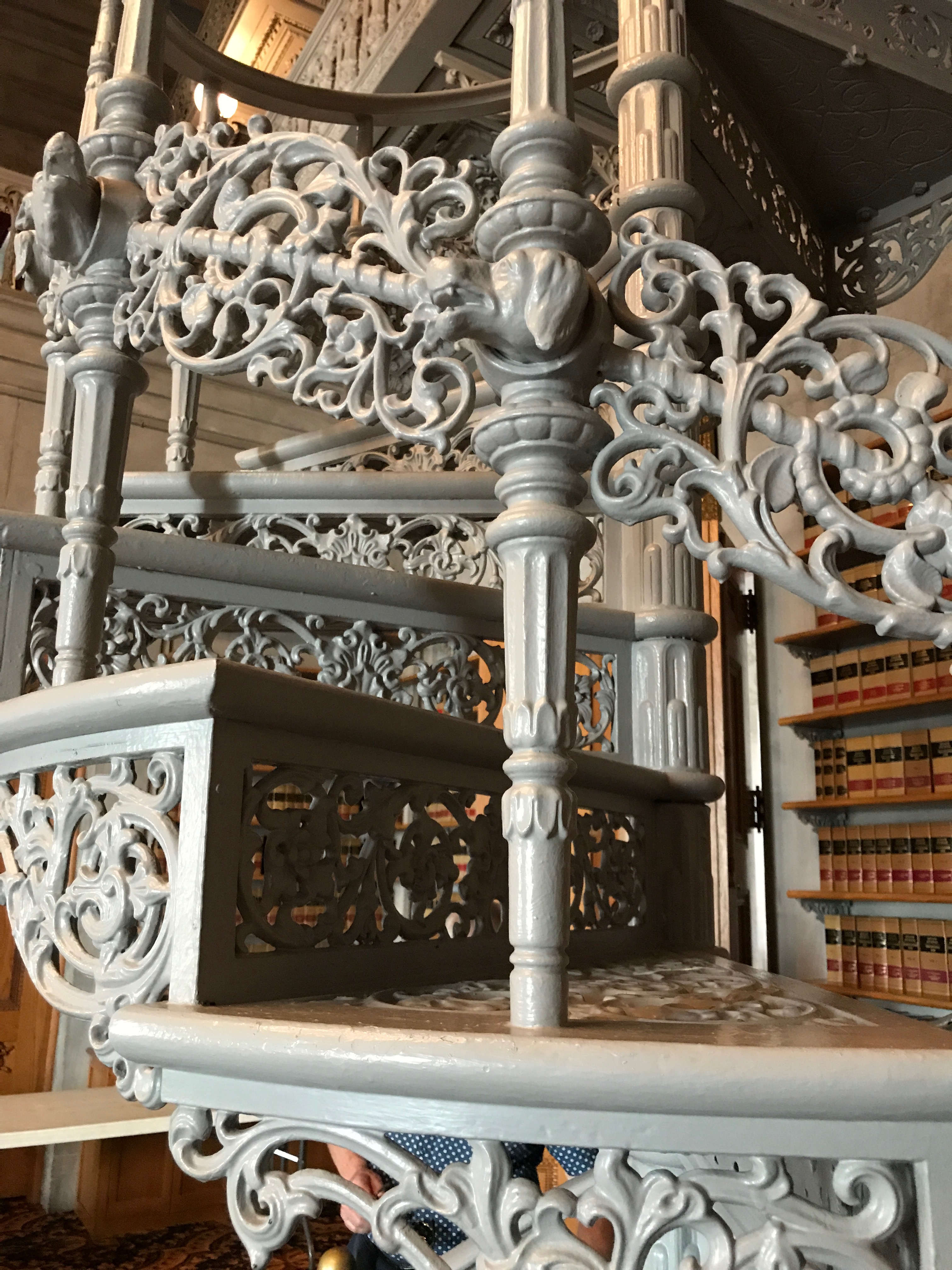
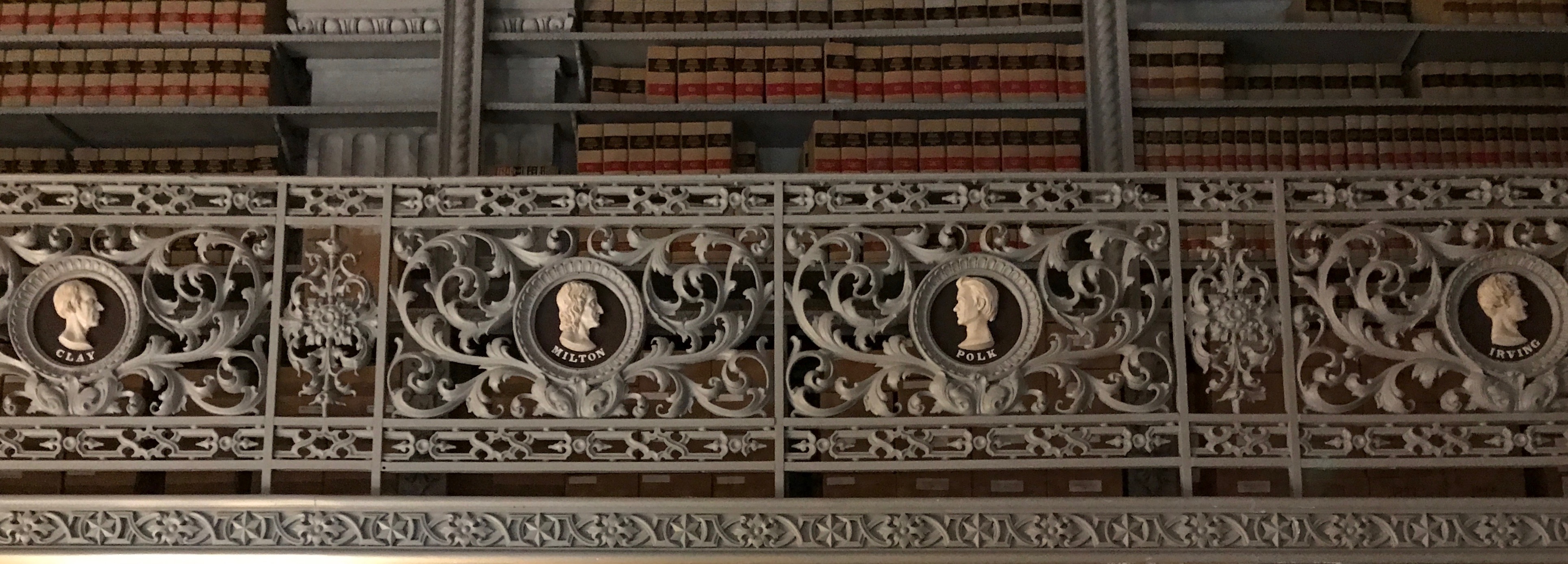
It was so intricate! I mean, look at all those animal heads!
In all the state capitols I’ve visited, I’d never seen any library as remarkable as this one.
Isn’t that something?
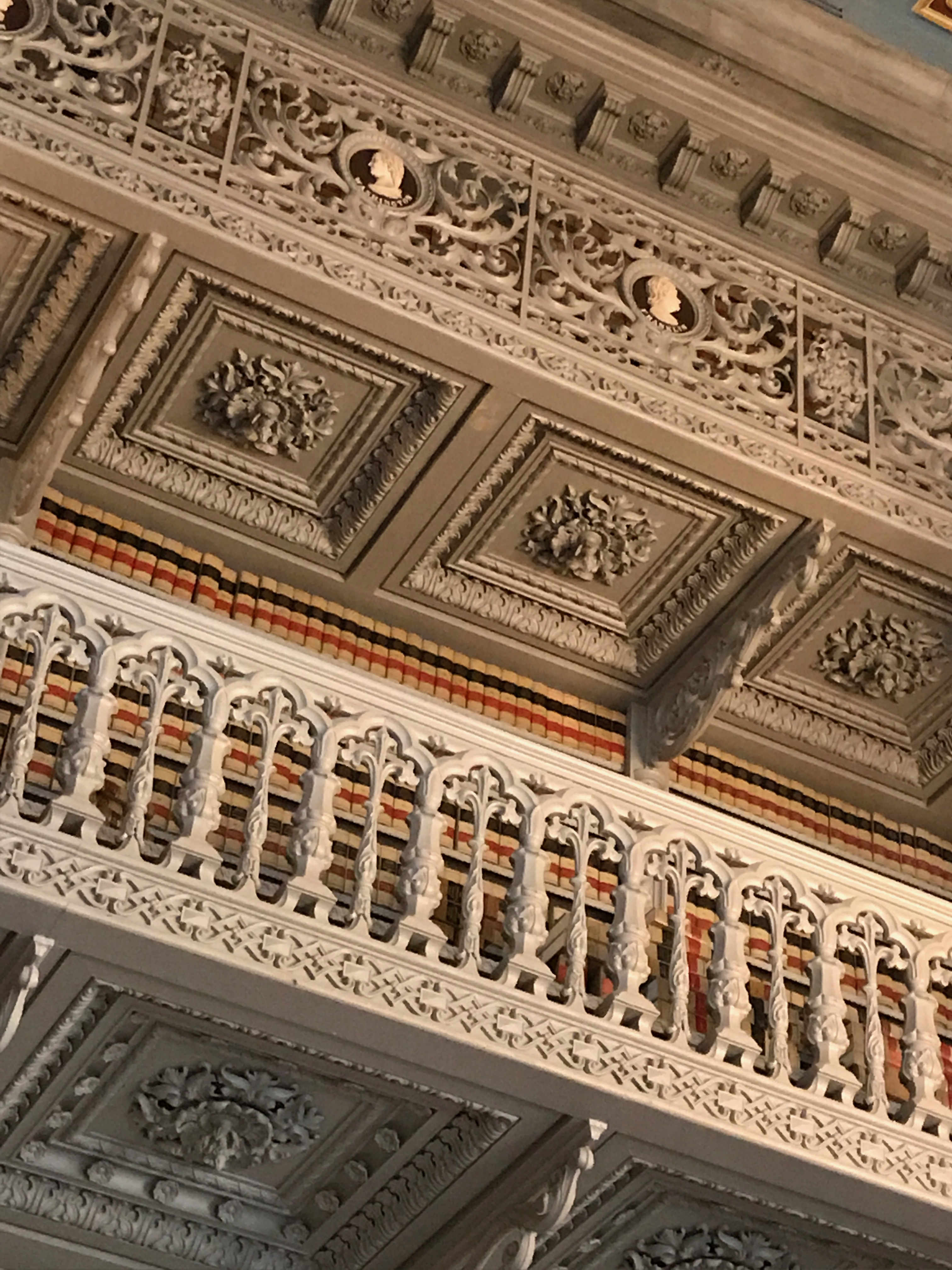
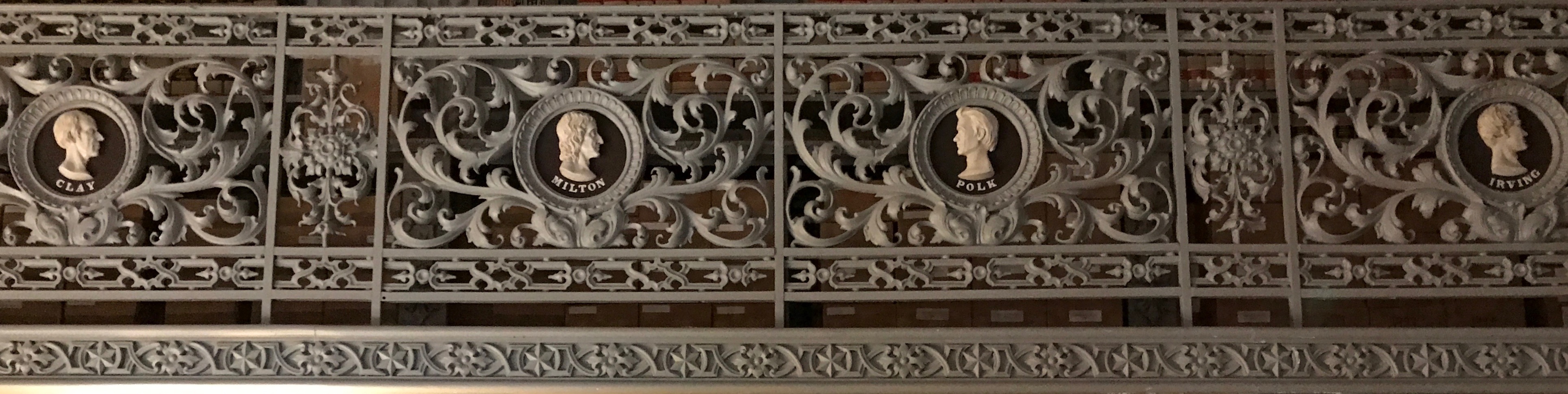
If I remember the guide correctly, this intricate ironwork wasn’t created specifically for this building. It was a style that they made for libraries in general. If you will notice, the portraits in the “cameos” are of literary figures – Milton and Irving.
There are two portraits of political figures – Polk, who I assume is the 11th President, and Clay, who also figured importantly in the politics of the first half of the 19th century. I don’t know if these are likenesses of the politicians or they just changed the names on the preexisting profiles.
With that, the tour was over. I spent a few minutes looking around and snapping photos of things that caught my attention – like that beautiful blue sky and the columns.
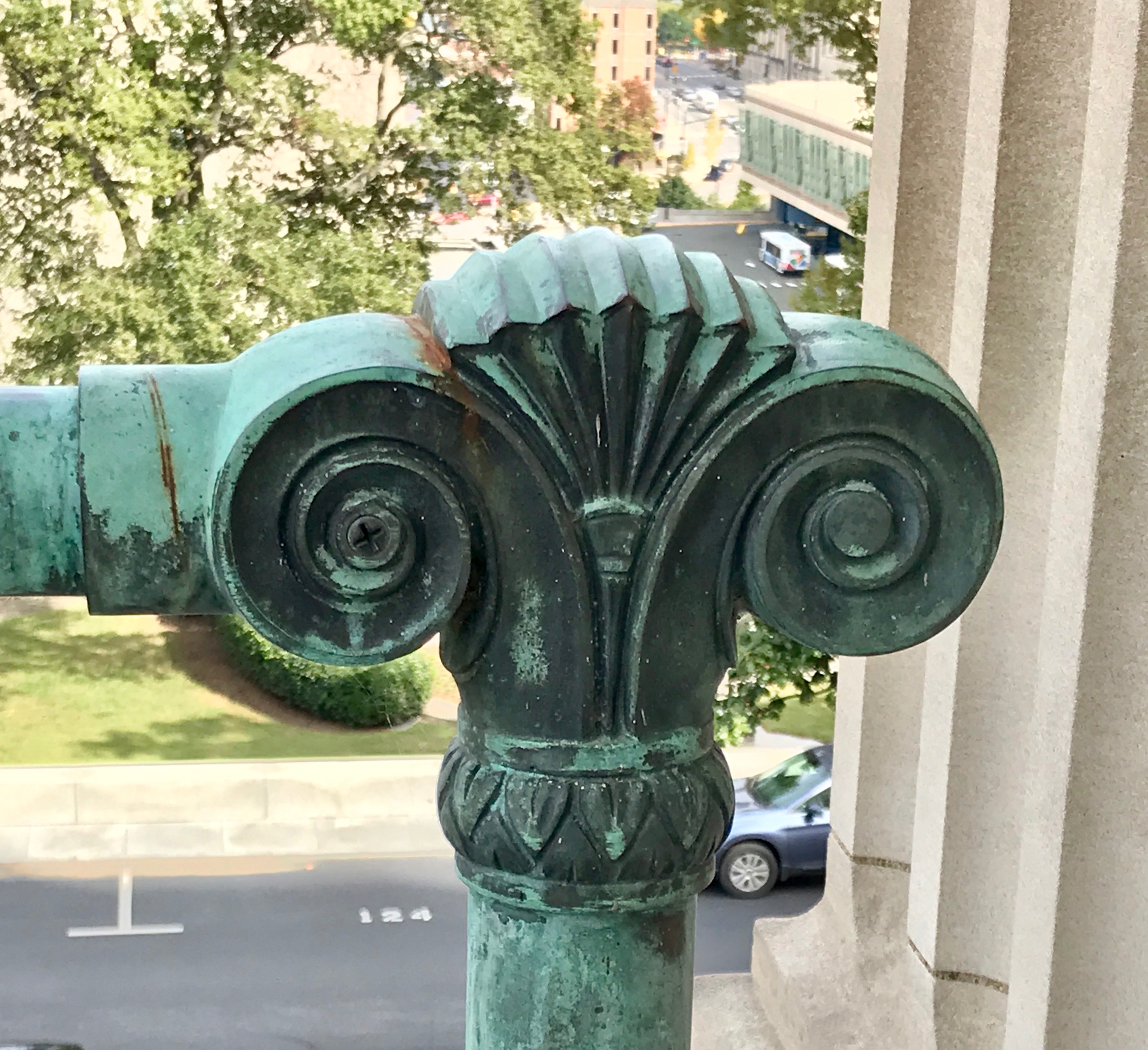
The decorative railing finial – they just don’t make them like that any more!
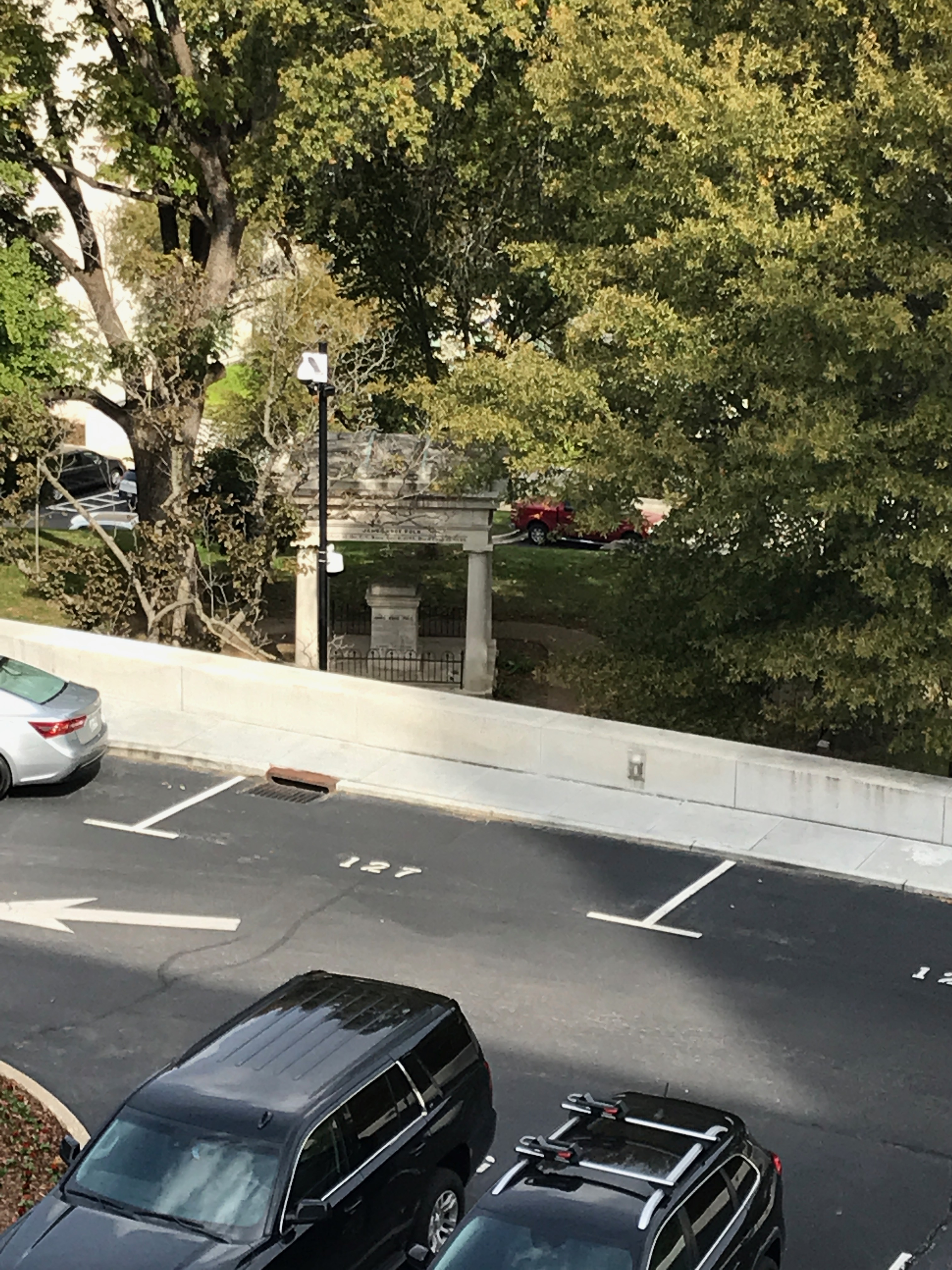
Hmm..what is that? It looks like something out of a grand cemetery. I must go investigate!
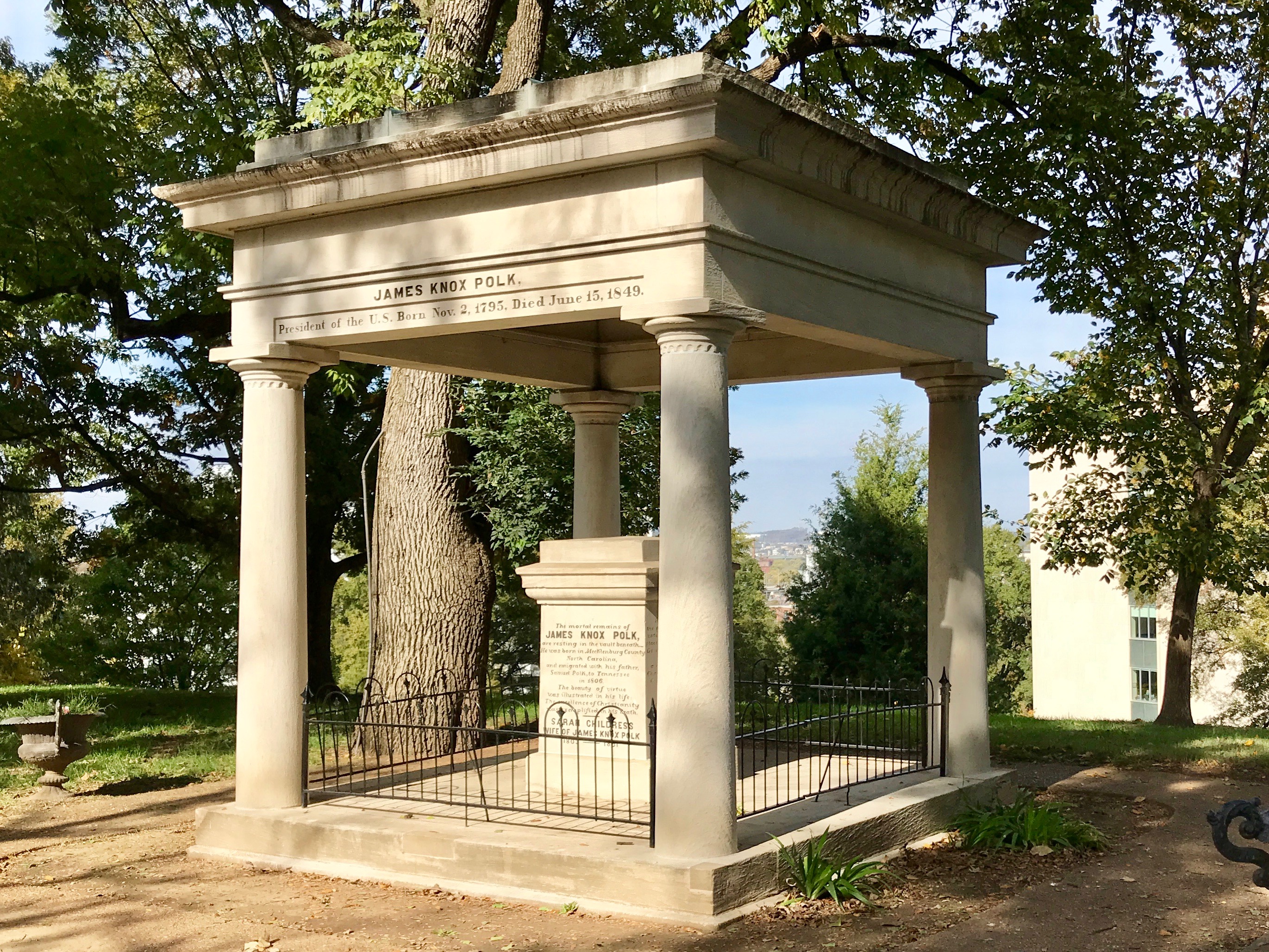
Well, look at that! It’s the tomb of the 11th president, James K. Polk!
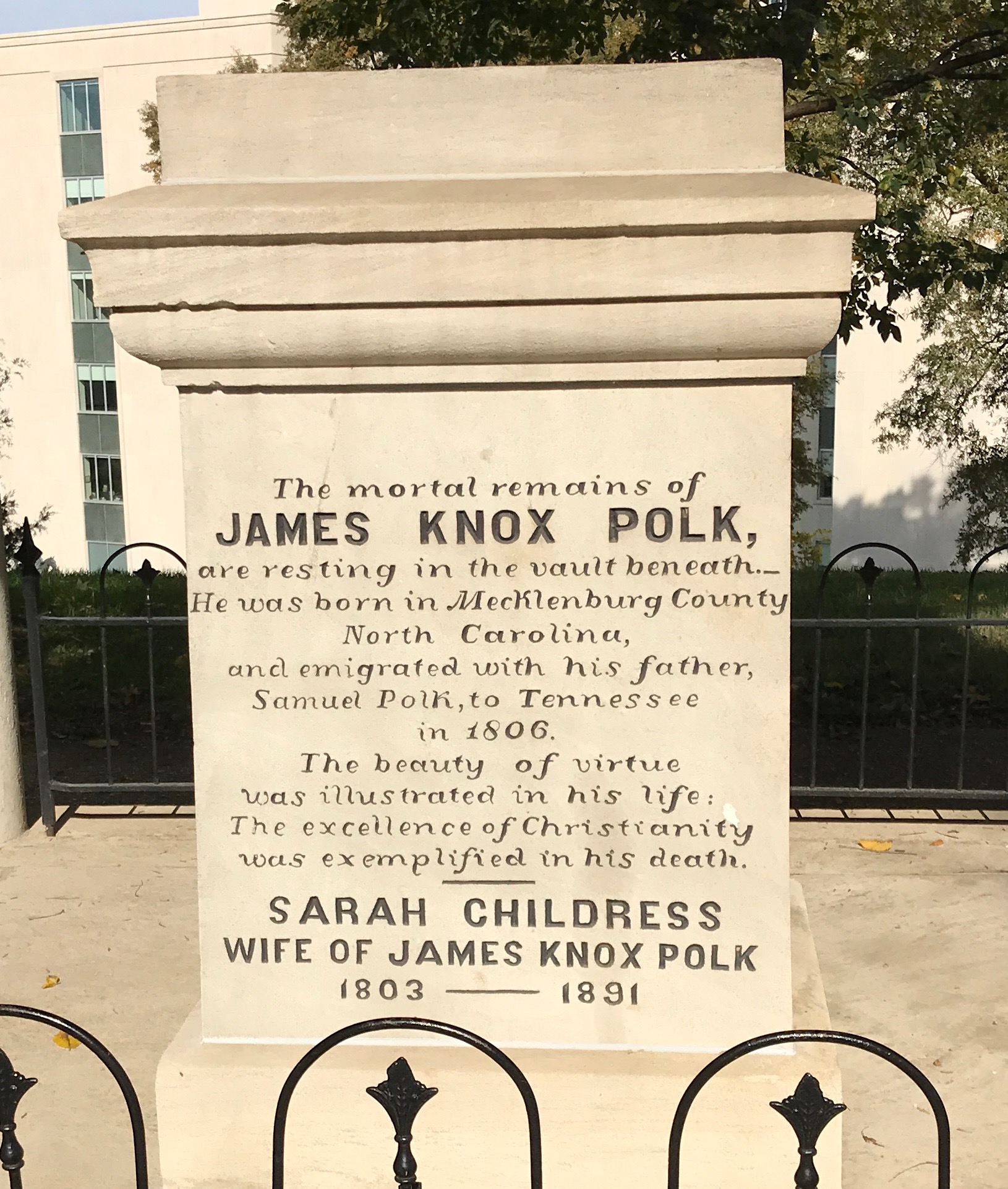
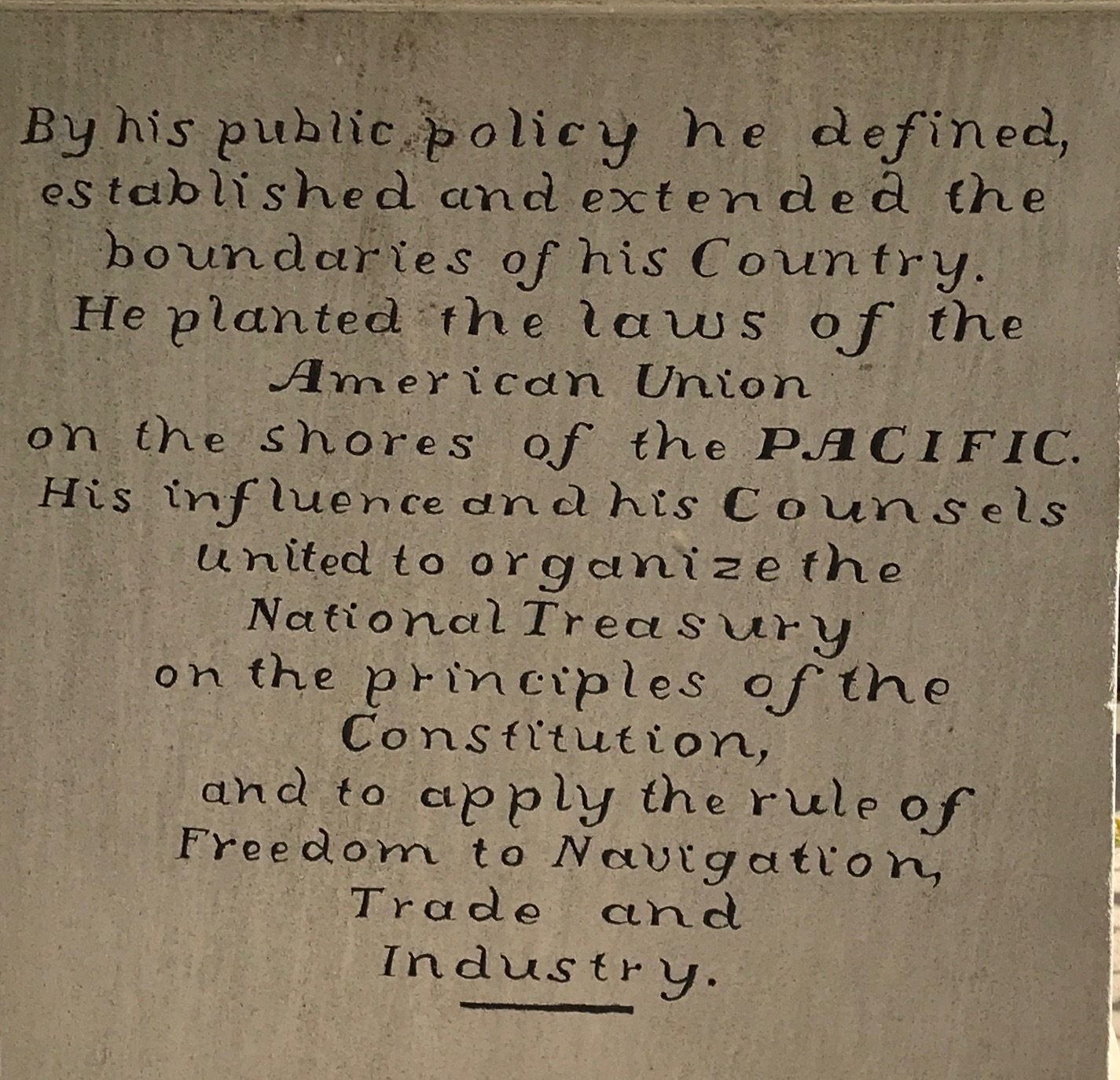
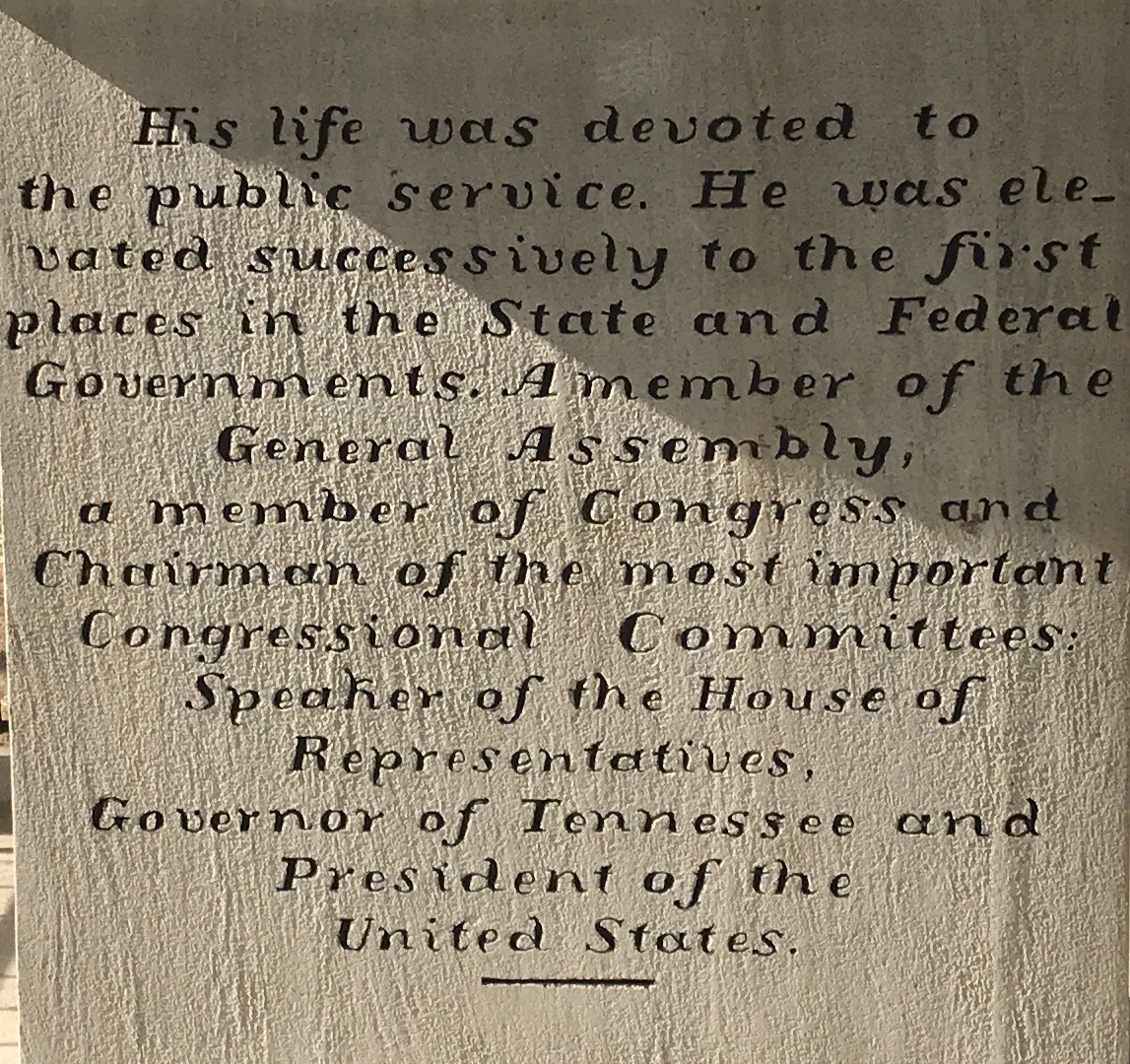
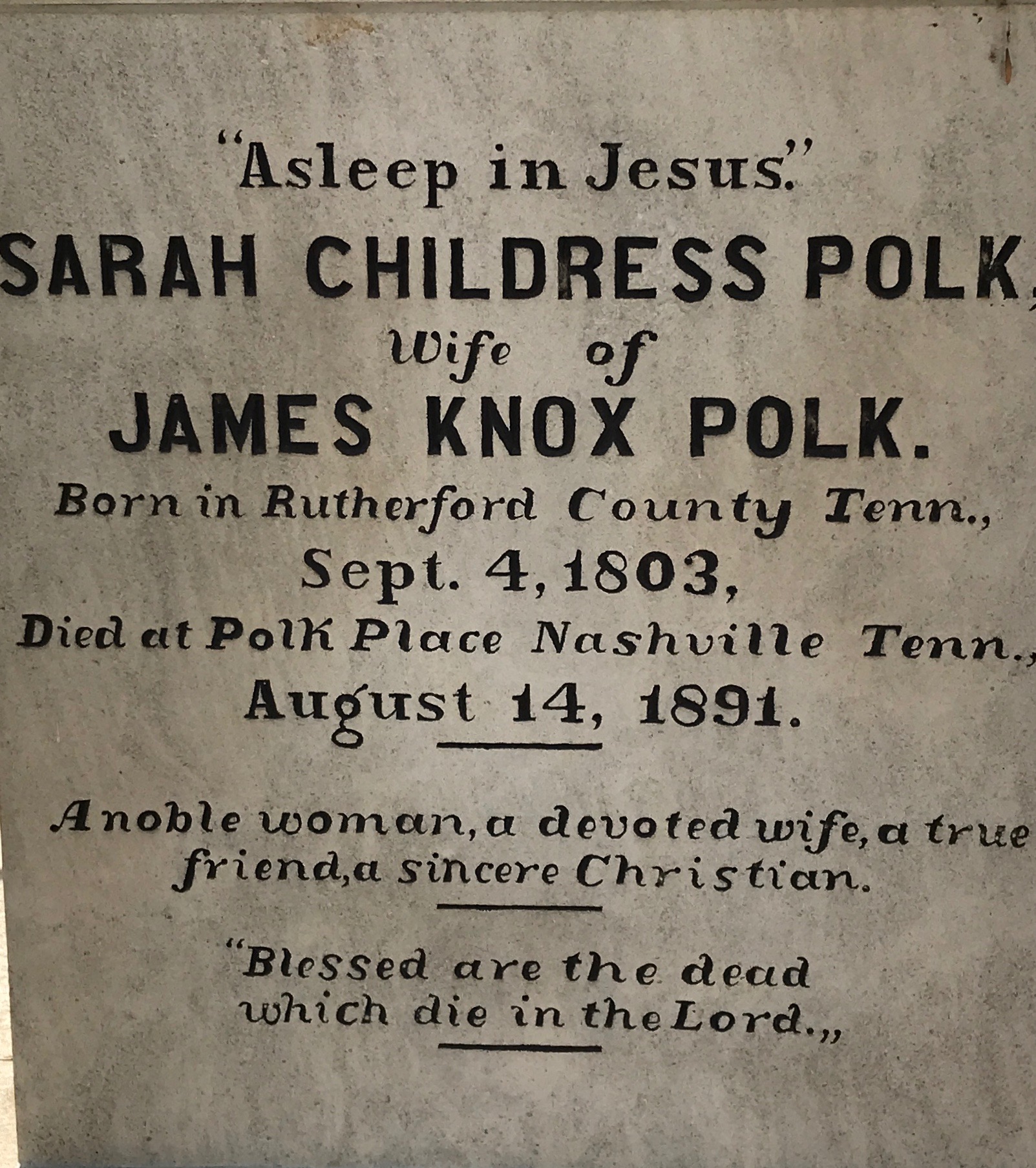
I walked around the marker and took photos of what they chose to inscribe upon it.
I alway wondered whether Polk was responsible for expanding the boundaries of the USA, as many states have counties named “Polk.” Off to my Preferred Source to check. It turns out the there are 12 states with counties named Polk, which puts it at the 17th most common country name. Ten of those 12 counties are named after President Polk. The other two? One is named after Revolutionary War hero Ezekiel Polk, who was James K’s grandfather. The other was named after William Polk, also a Revolutionary War hero – and a first cousin, once removed.
So, they kept it all in the family.
That’s quite a resume!
Sarah got a section, too. Since James died in 1849, she had quite a long widowhood.
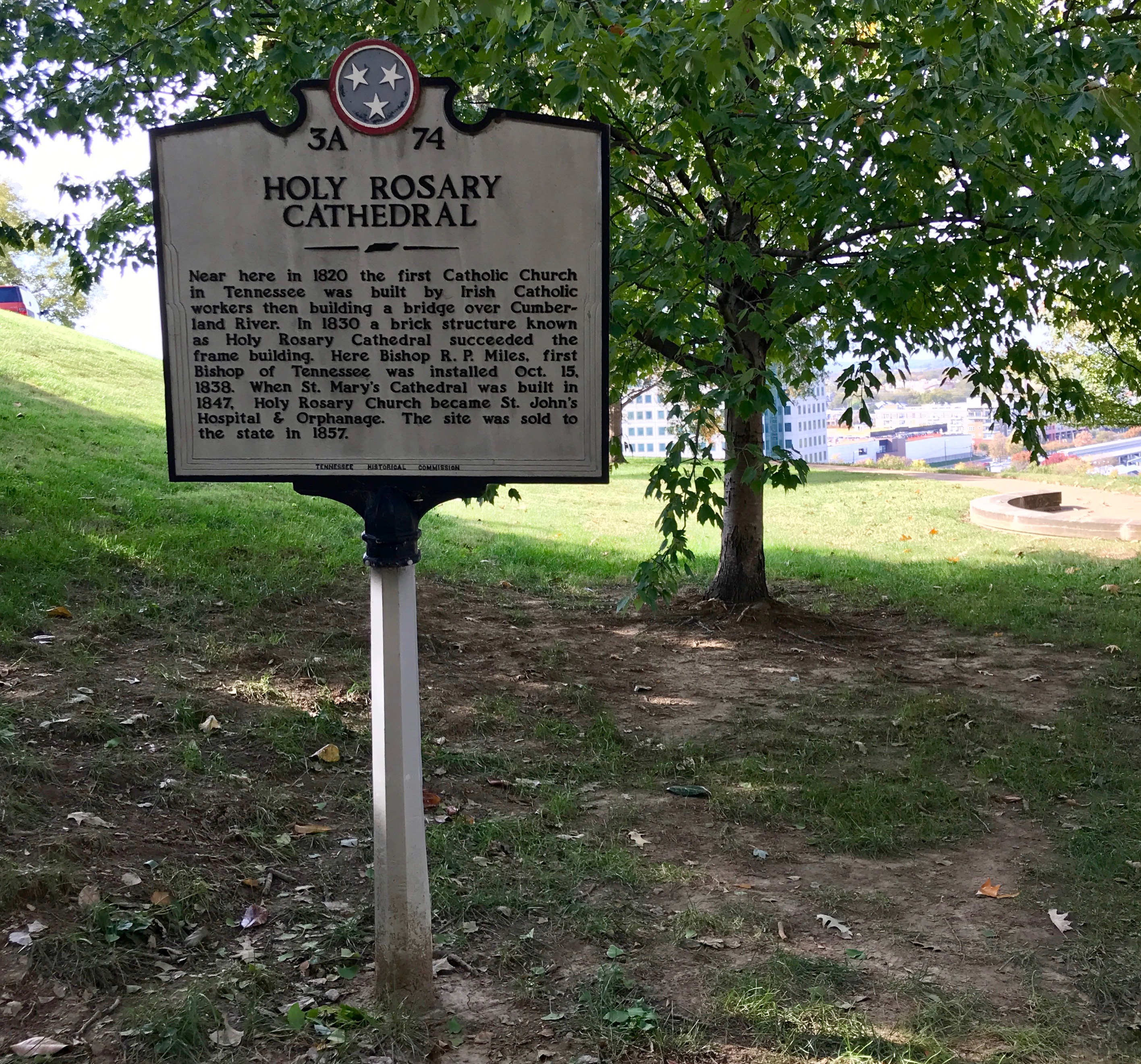
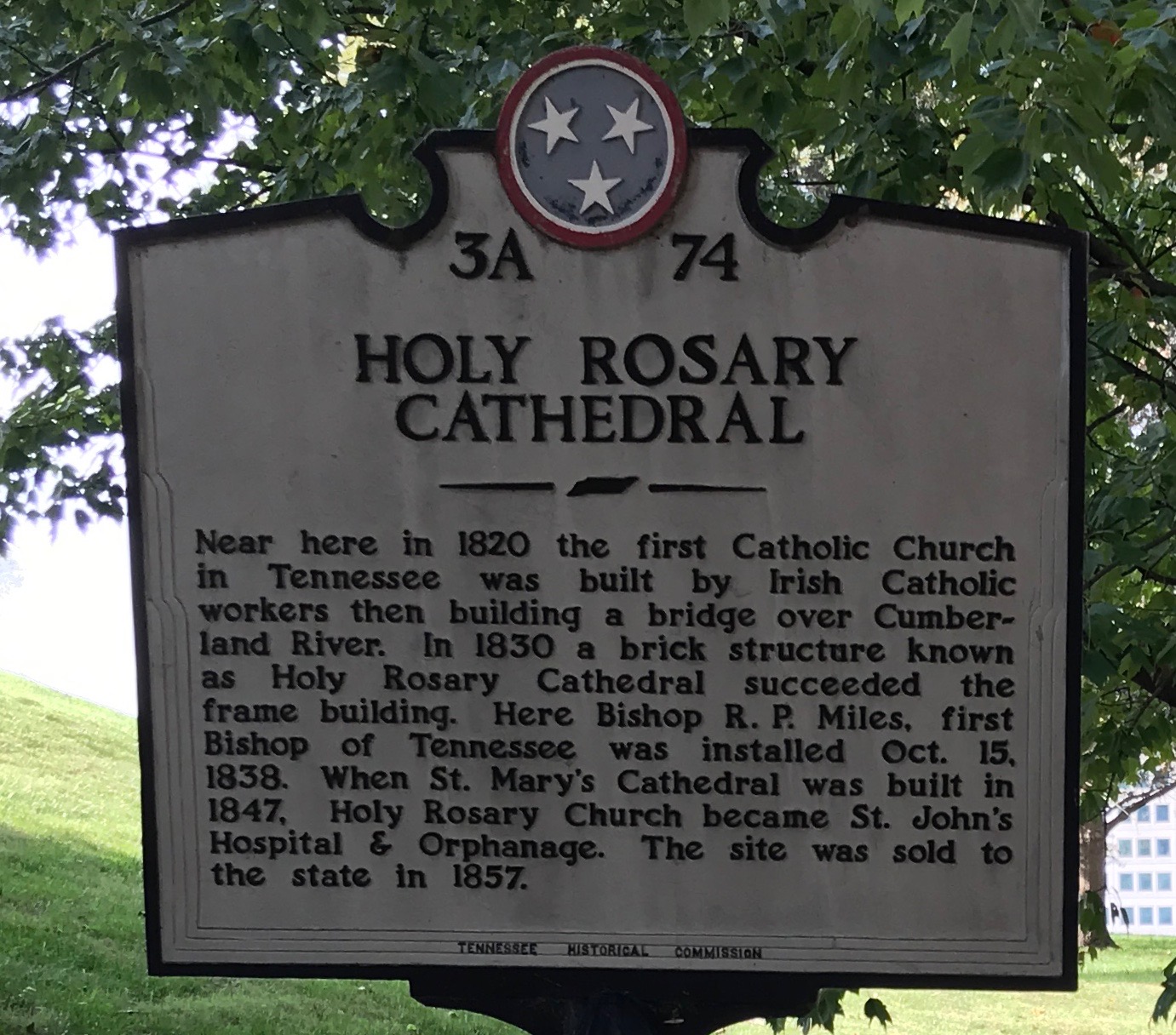
I saw another marker commemorating the first Catholic Church in Tennessee, which was on the site until it was sold to the state in 1857.
Here’s a closeup, if you want to read more.
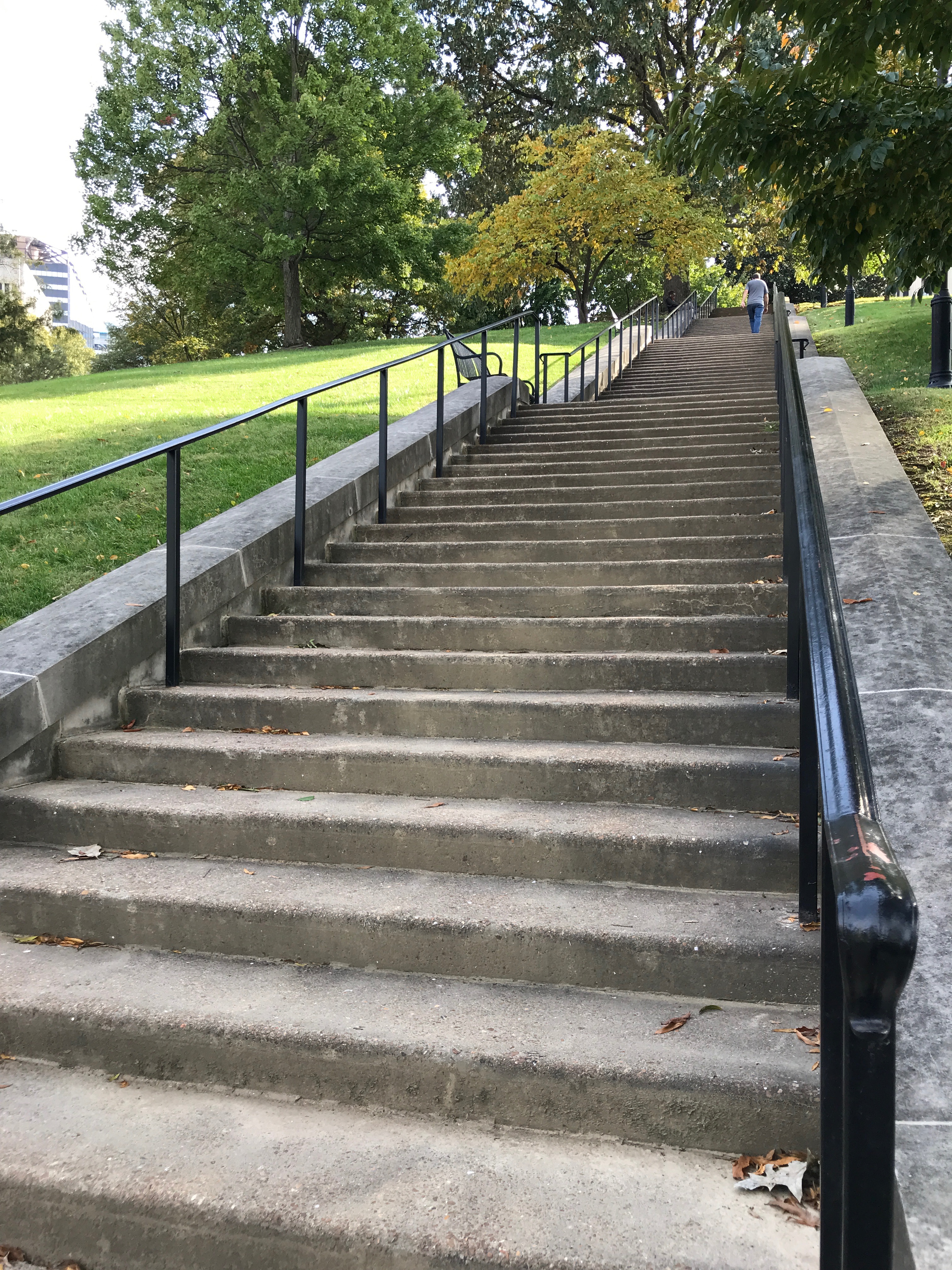
Oh, my goodness! All those stairs going down.
Once I was down, I had to turn around and look at them going back up. Two things I am not fond of: stairs and rain. At least the weather was good.
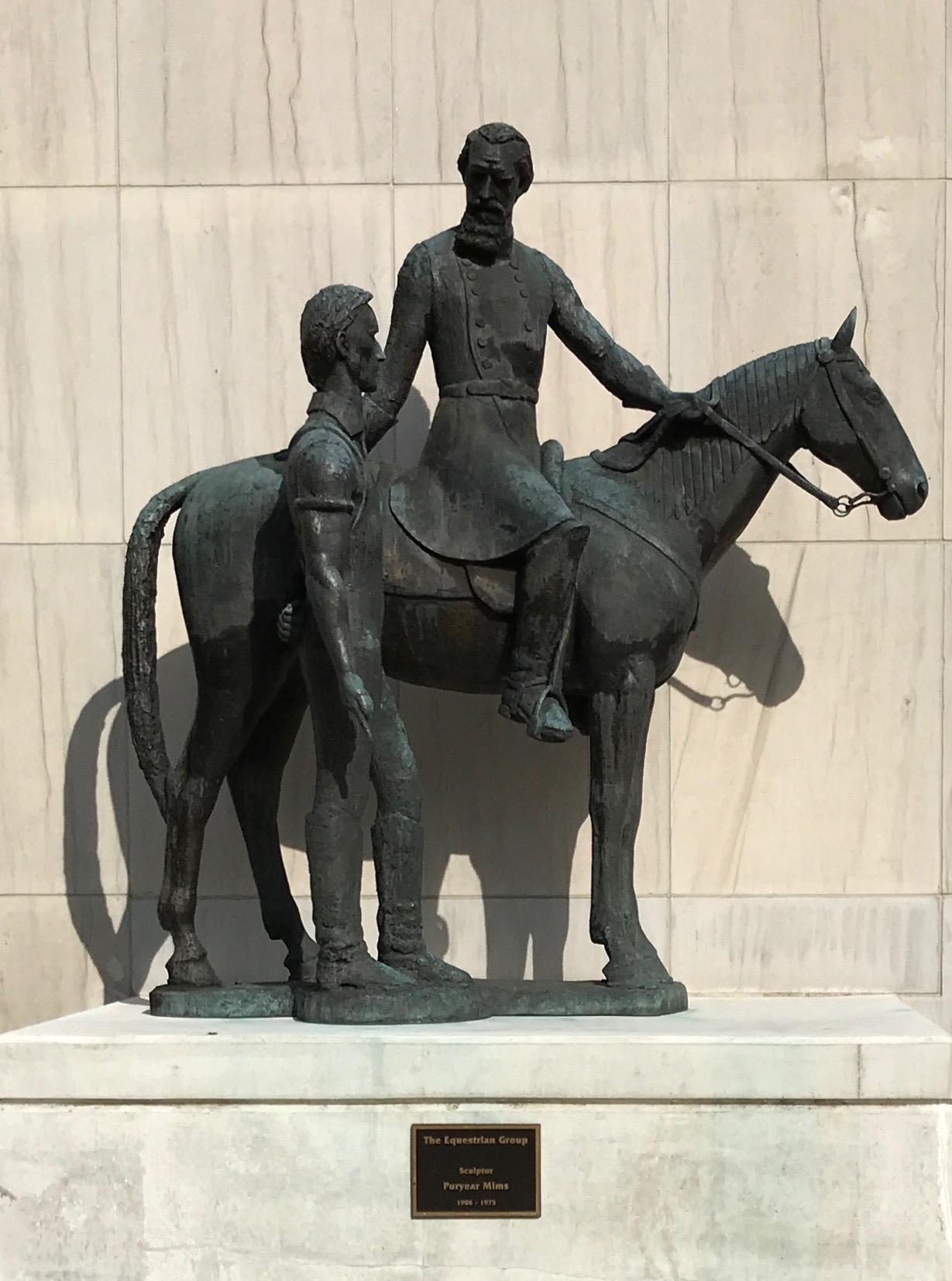
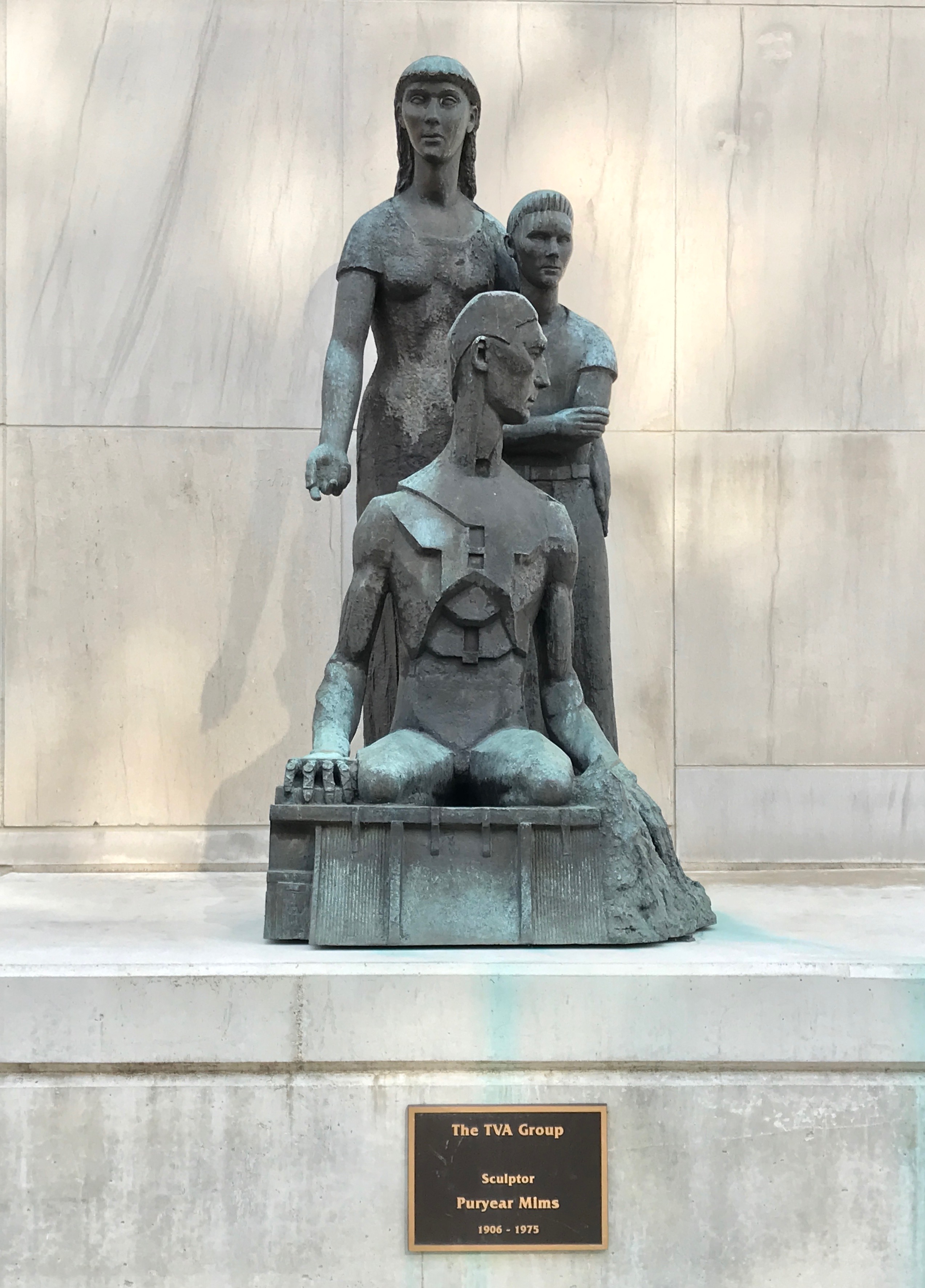
Nearby, I passed some governmental buildings that had interesting statues in front.
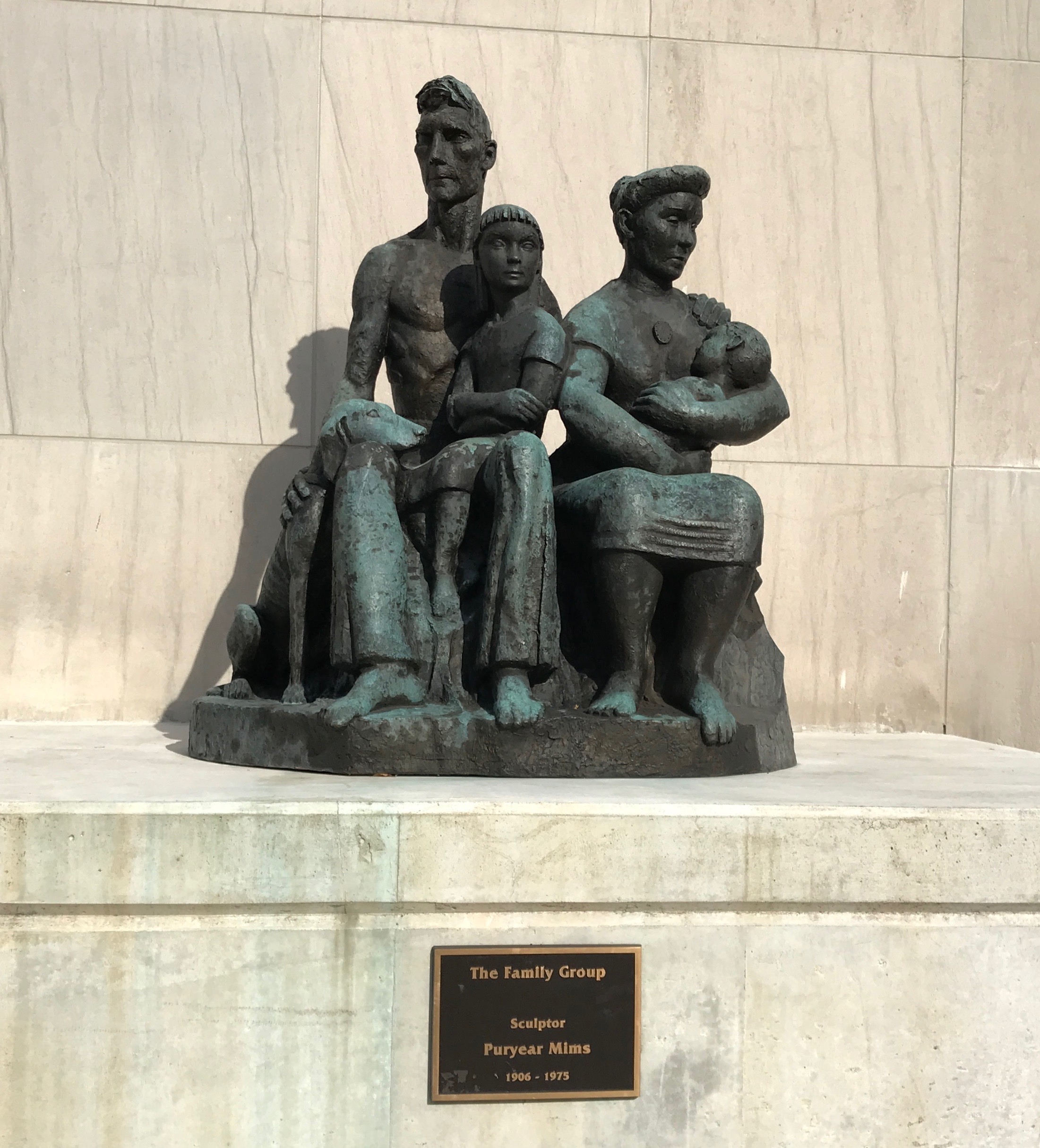
This one is “The Equestrian Group” by Puryear Mims.
He was a new sculptor to me, so I had to go looking for some information. I was verklempt when my Preferred Source (Wikipedia) failed me! I went digging around and found a page with information about him on Facebook – of all places. I found that a bit ironic, considering that he was born in 1906 and died in 1975, years before Facebook was even a thing. It was even nine years before Mark Zuckerberg was born!
This one is “The TVA Group.” I remember learning about the TVA – the Tennessee Valley Authority – in social studies. From what I remember, it was one of Roosevelt’s great achievements, along with the CCC and the WPA.
And, we round out my photo essay with “The Family Group.”
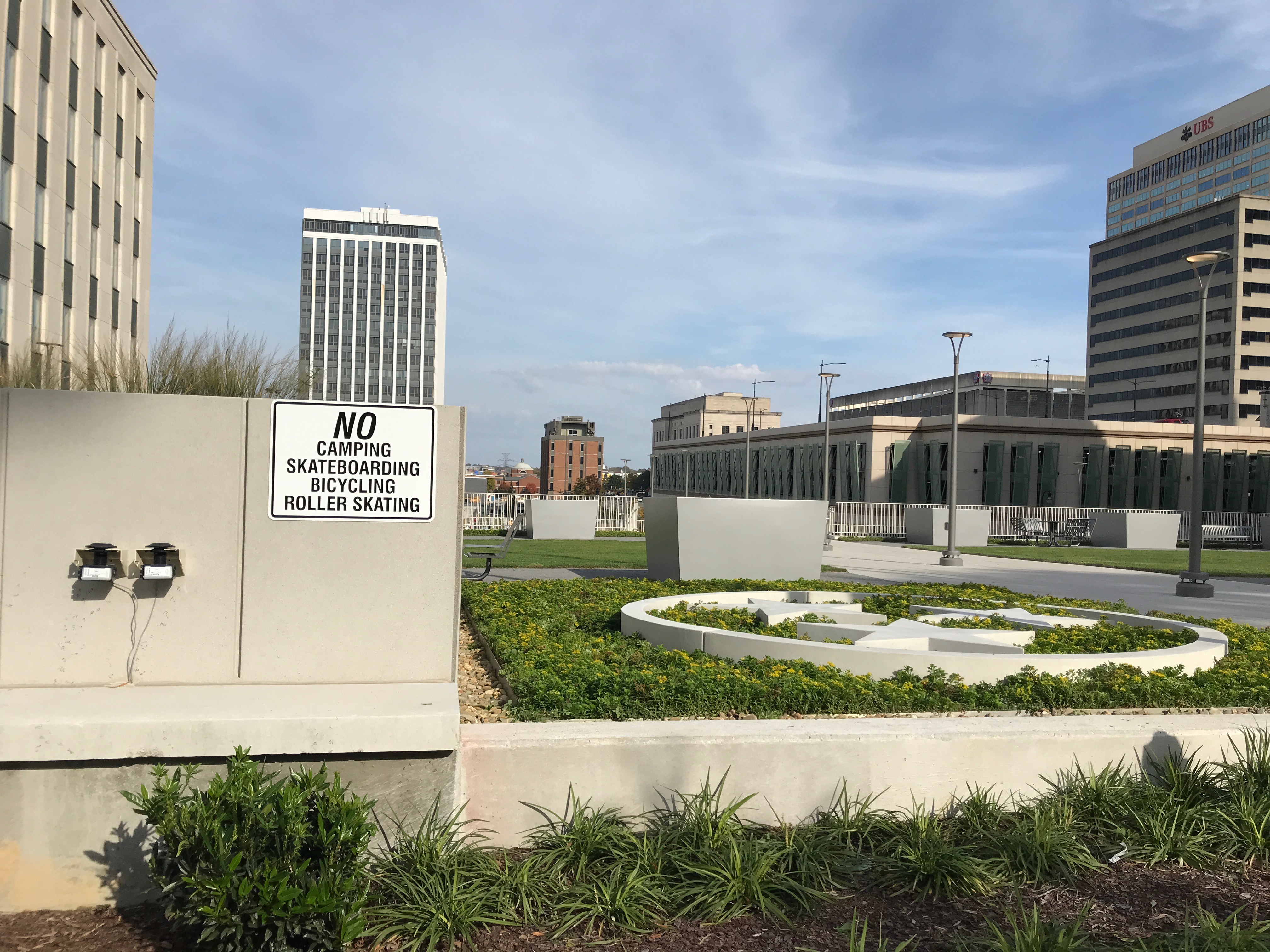
A little more wandering brought me to this plaza. I’m sure I took this photo for the sign prohibiting camping. I don’t remember ever seeing a sign in a city that prohibits camping.
I looked up places nearby to eat, and I found a listing for a restaurant in an old Woolworth’s. We had one in my town growing up. I used to love to walk “up town” and go shopping. It had creaky old wood floors. I was sad when it closed.
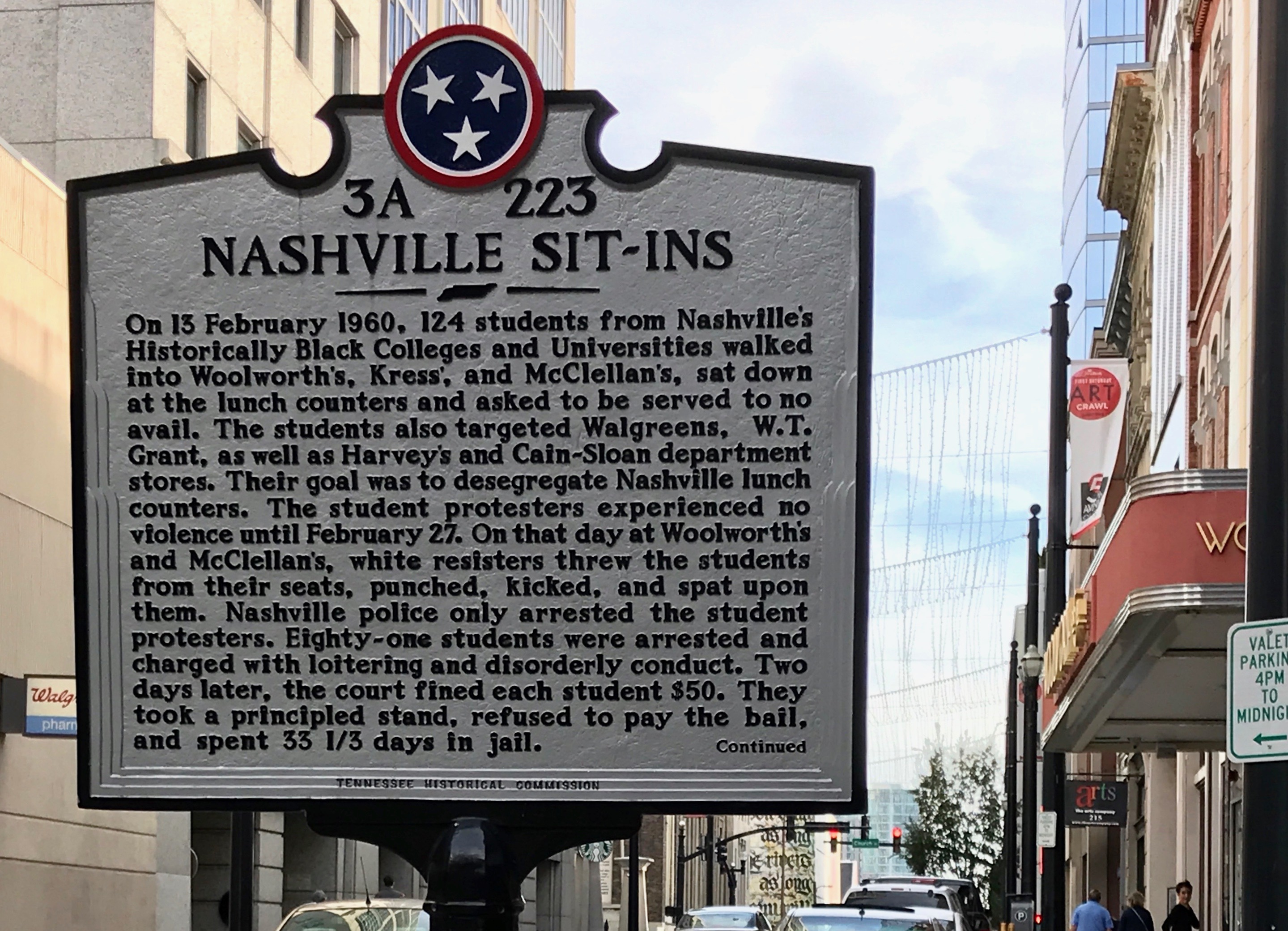
On my way, I passed this sign about the sit-ins held at lunch counters in the 1960s.
The people took their lives in their hands to make our world more just.
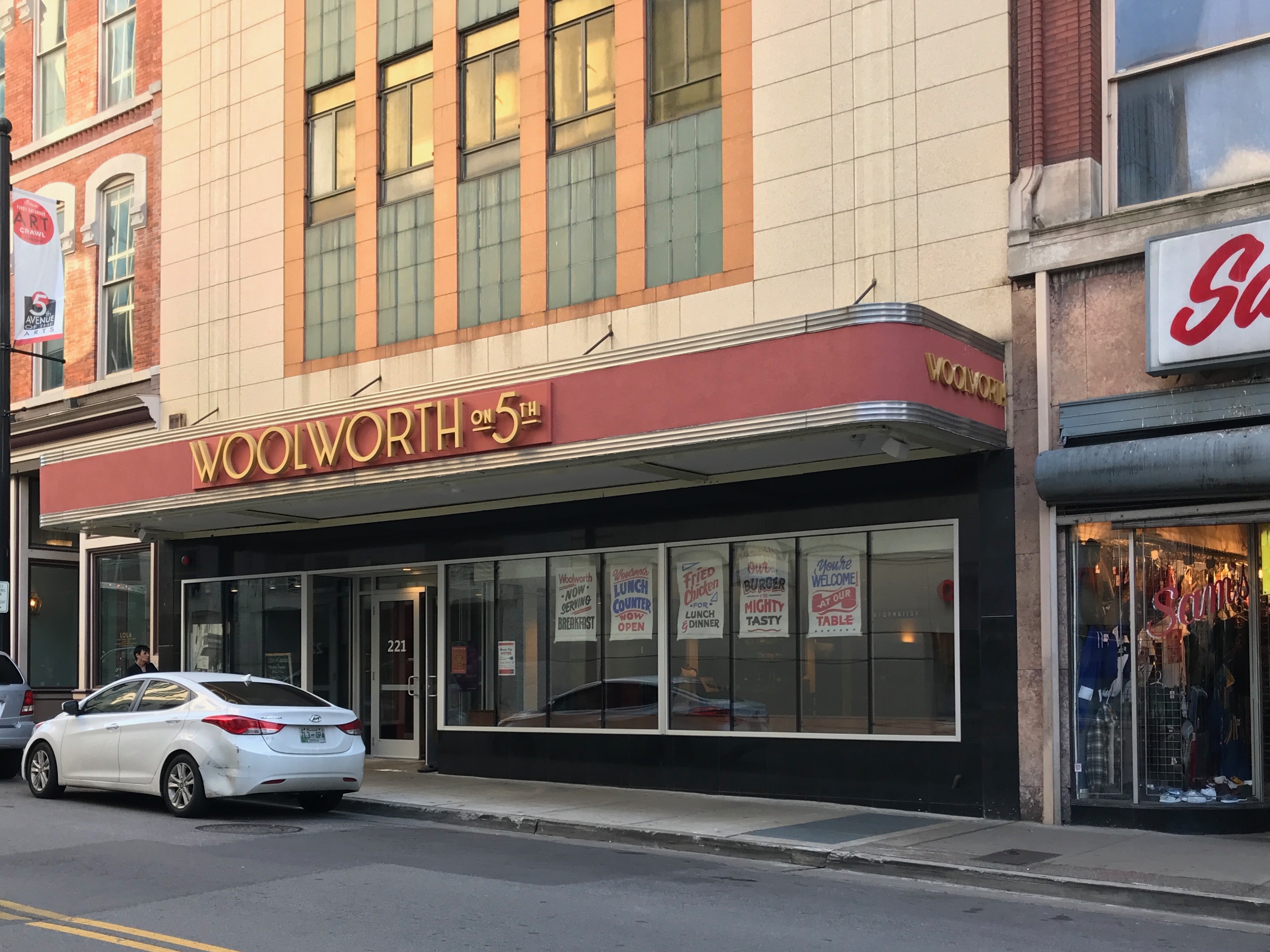
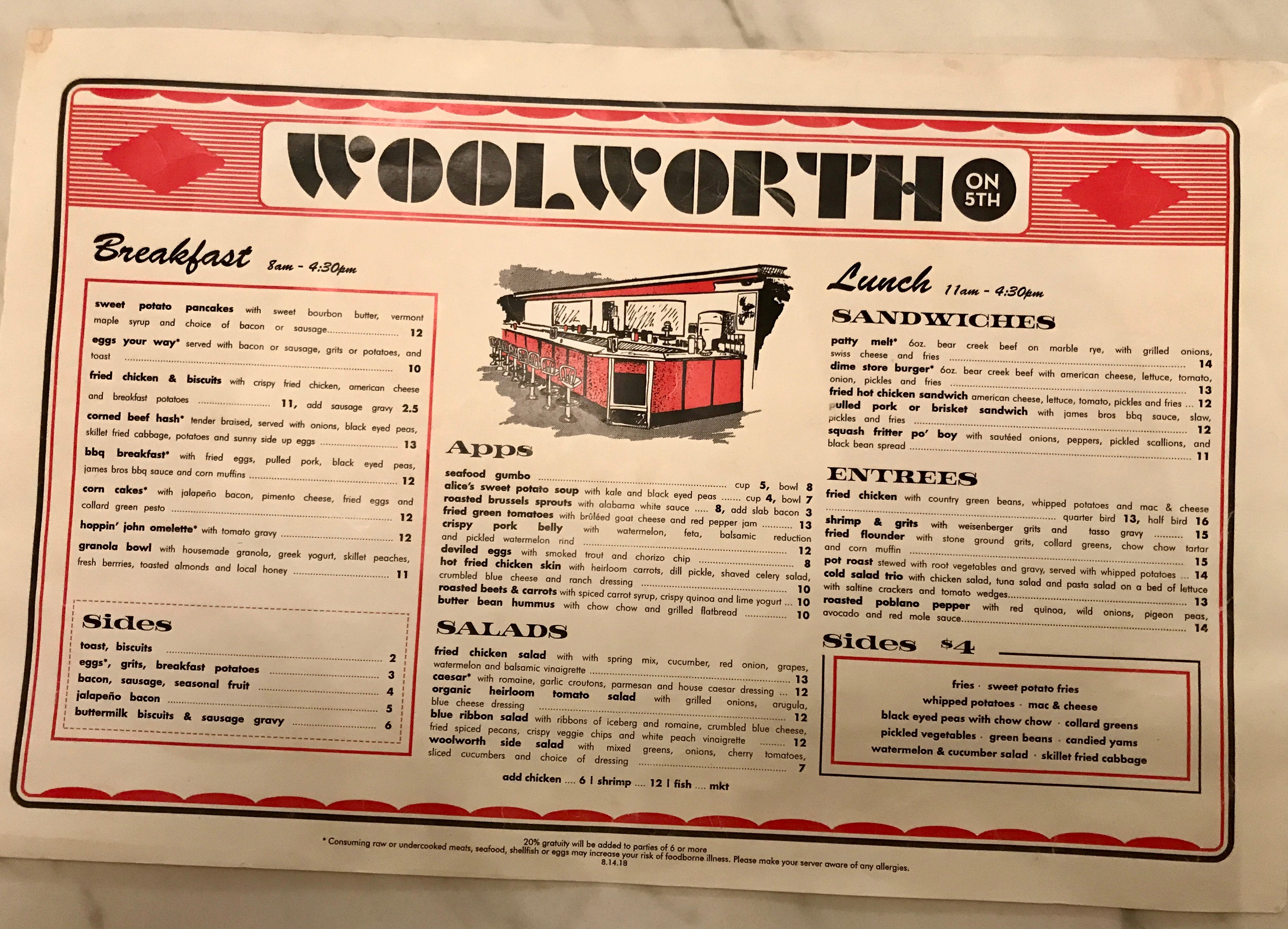
There’s the old Woolworth’s! Its now called “Woolworth on 5th.” It is part of a 1890s commercial development that housed other building before Woolworth opened there in 1913. It added a lunch counter in 1925 to cater to the downtown workers.
Blacks were prohibited from sitting at the lunch counter because of the Jim Crow laws that were established in the 19th century. Students from historically black universities – Fisk University, American Baptist College and Tennessee A&I, among others, began walking into downtownluknch counter locations. They sat down at the lunch counters and asked to be served. The first sit-in was on February 13, 1960. The second was two weeks later, on February 27. It was during this sit-in that Congressman John Lewis was arrested for the first time. Throughout his career, he has been arrested almost fifty times for non-violent protest.
The lunch counter where the sit-ins took place was on the mezzanine level. I was seated at a counter on the ground floor. Woolworth closed in 1976. It went through several different uses until this restaurant opened in 2018. It tried to keep the retro flare alive.
As I remember, I was there between meal times, so they weren’t offering all the items on the menu. What to do?
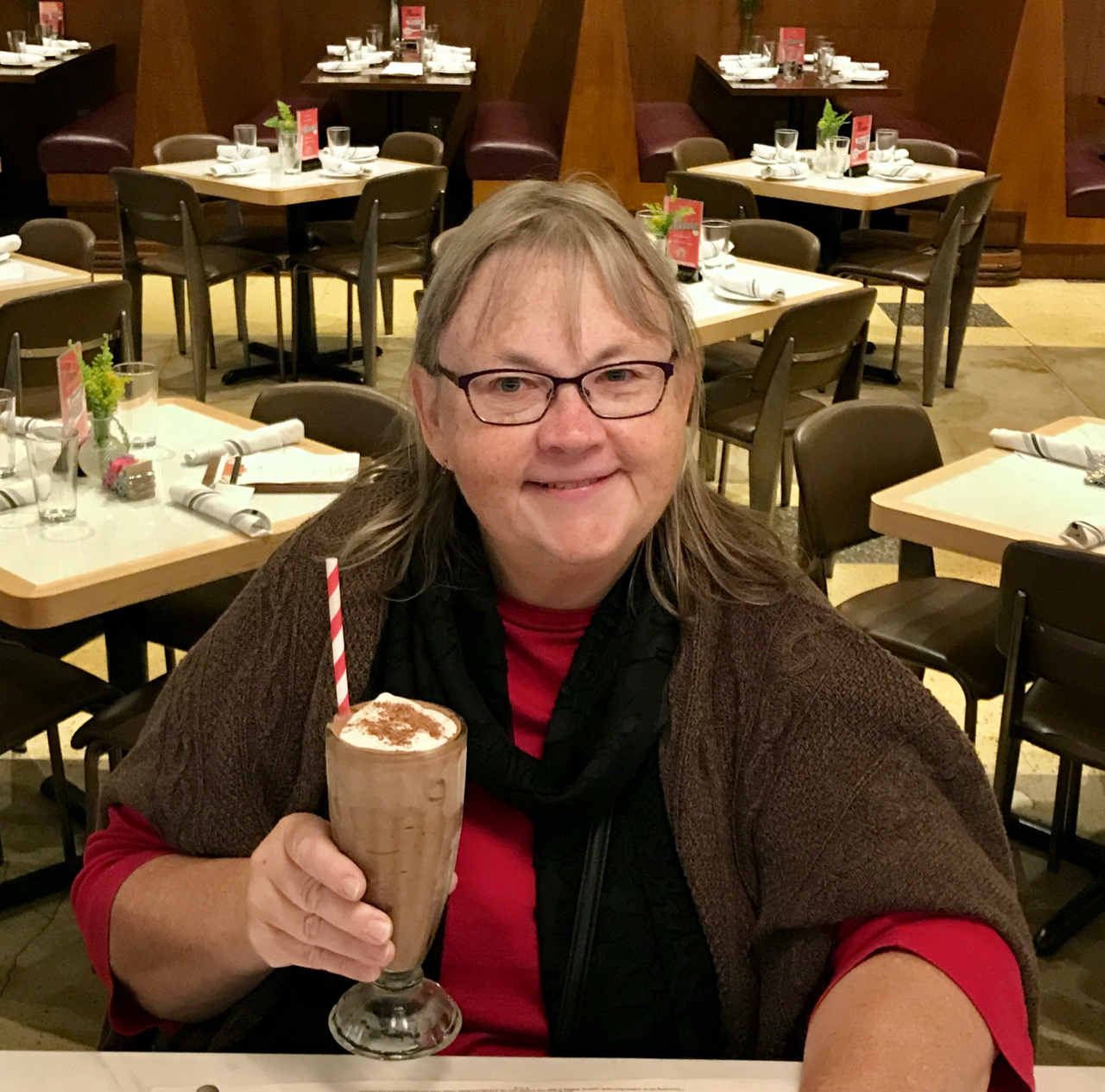
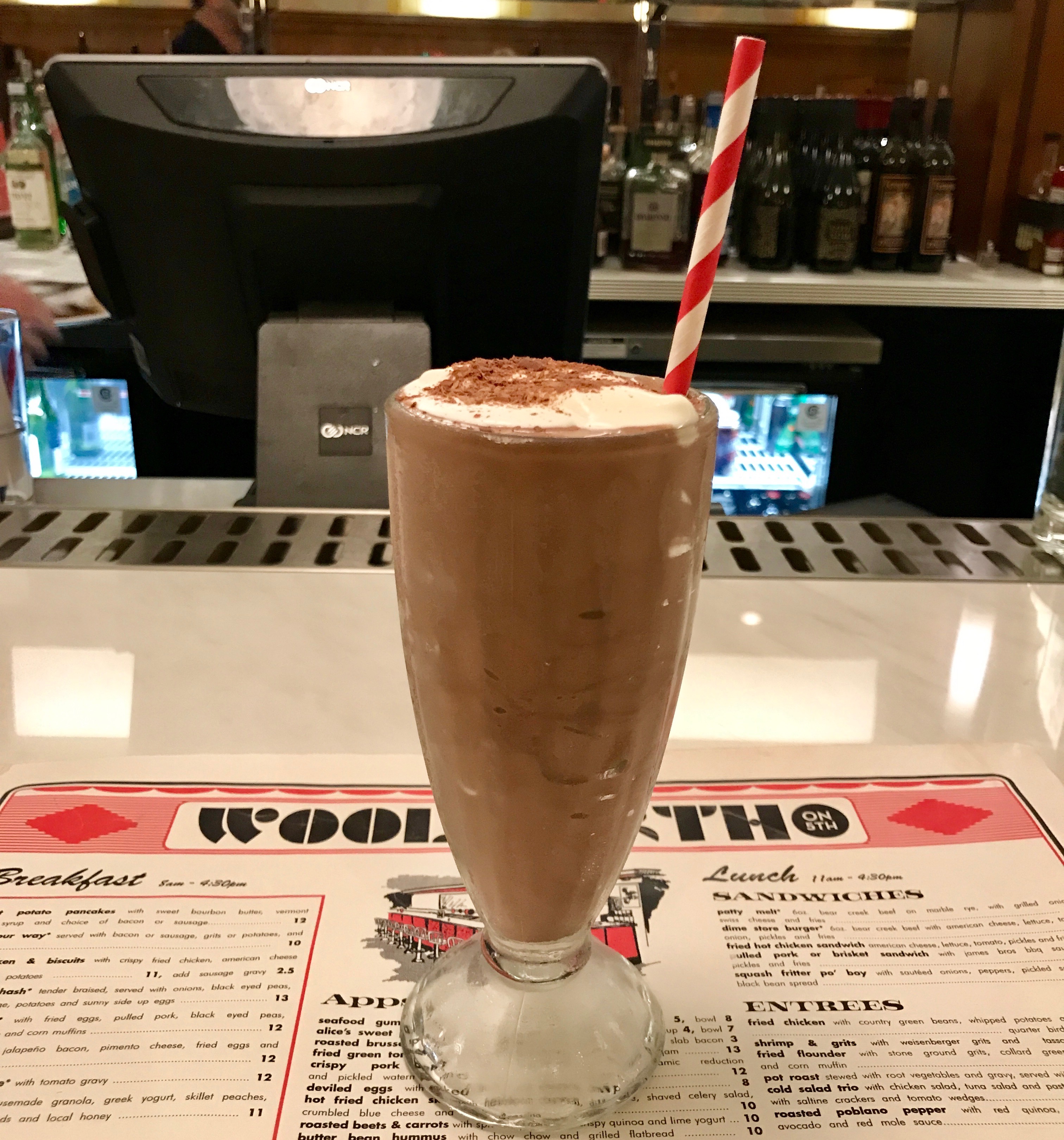
Why not a milk shake?
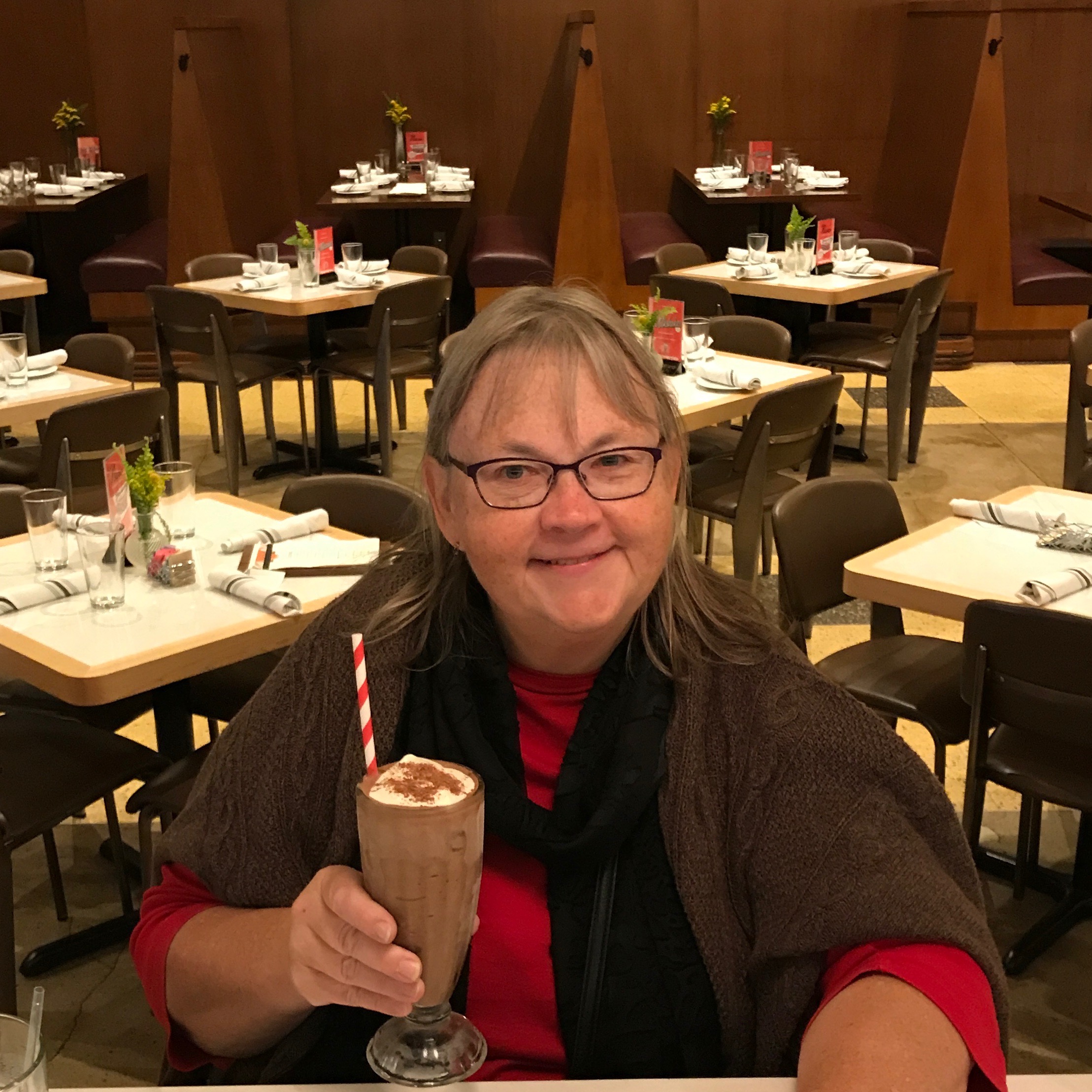
And it was mighty tasty, too!
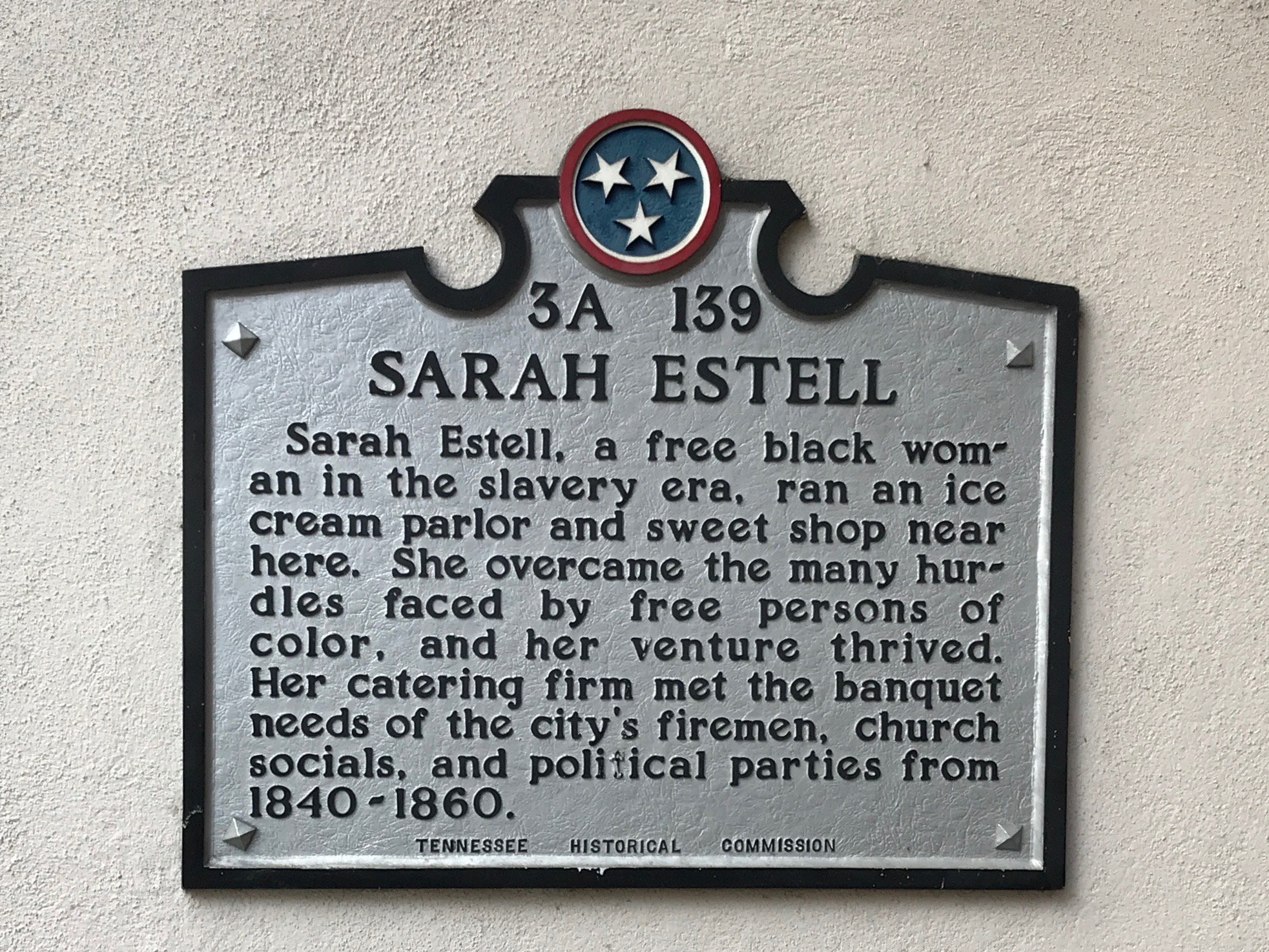
I finished up and headed back to the car. Along the way, I passed another plaque honoring black perseverance.
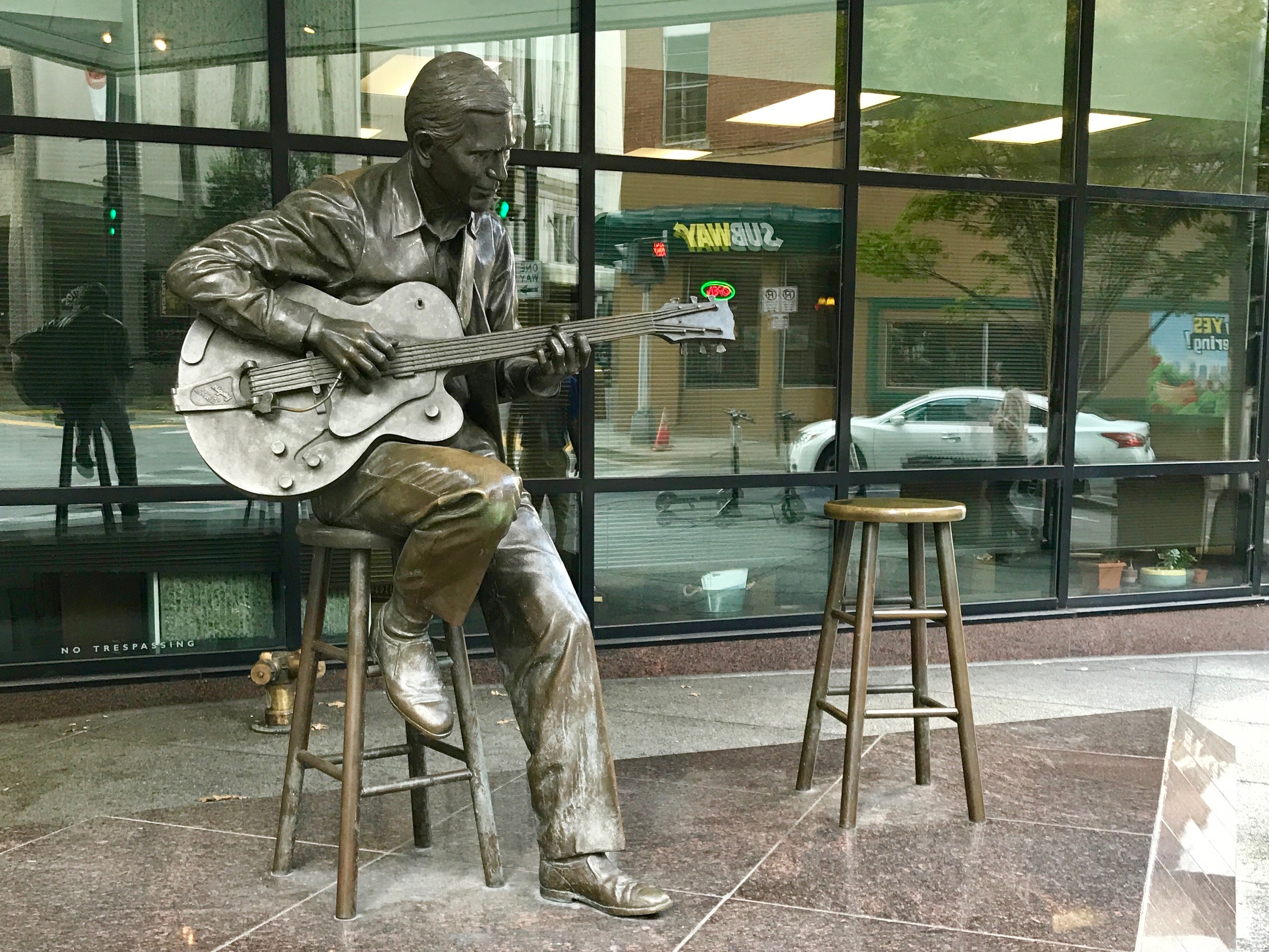
I also passed this statue of Chet Atkins, a famous musician who was born and died in Tennessee, 1924 – 2001. While he is known for having created the “Nashville Sound” but he didn’t consider himself to be a “country guitarist.” He wanted to be known, simply, as a guitarist. Rolling Stone ranked him as Number 21 on their list of “The 100 Greatest Guitarists of All Time.”
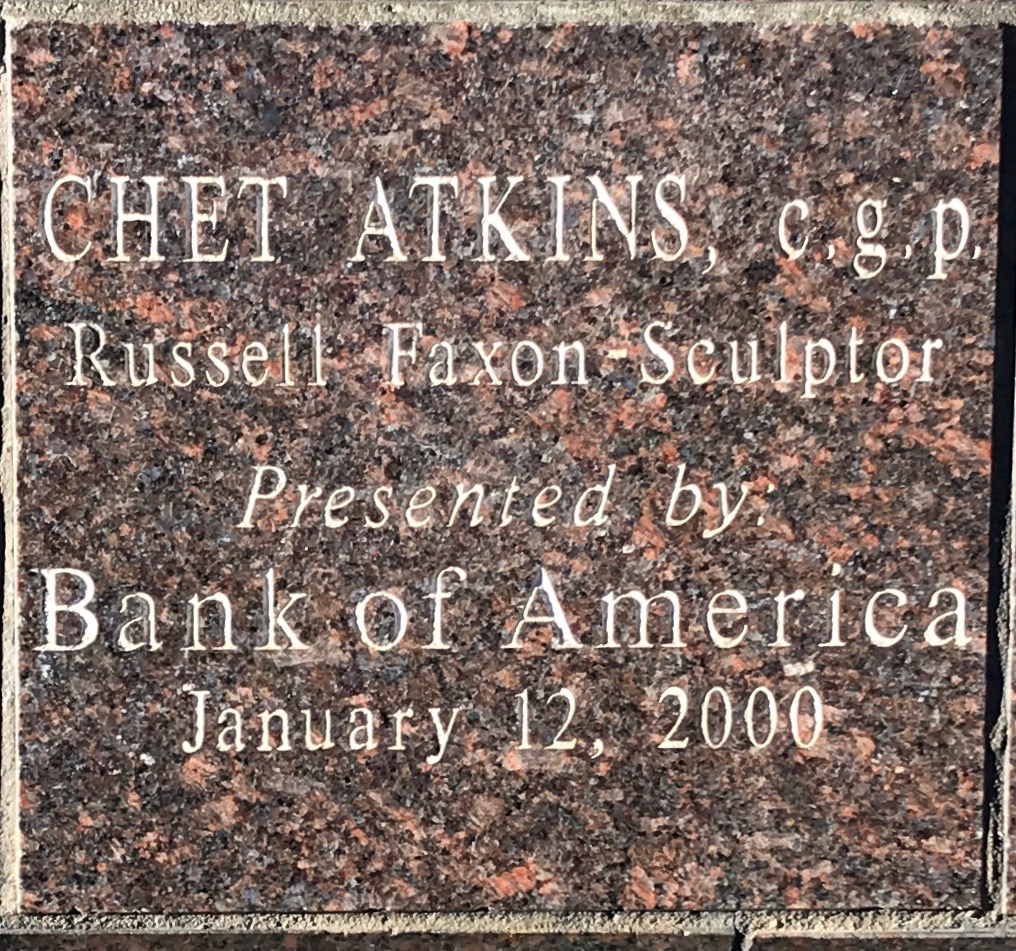
This plaque was by the statue. I thought it was nice that it was erected during his lifetime. I wondered what the c.g.p. after his name meant. I went a’googling and found out that C.G.P. stands for Certified Guitar Player. This is a designation that Chet Atkins assigned to guitar players who excelled far beyond the normal line of playing. He handed the title out to only four guitarists in his lifetime. His daughter added another guitarist. If you want to know more, click on the link above.
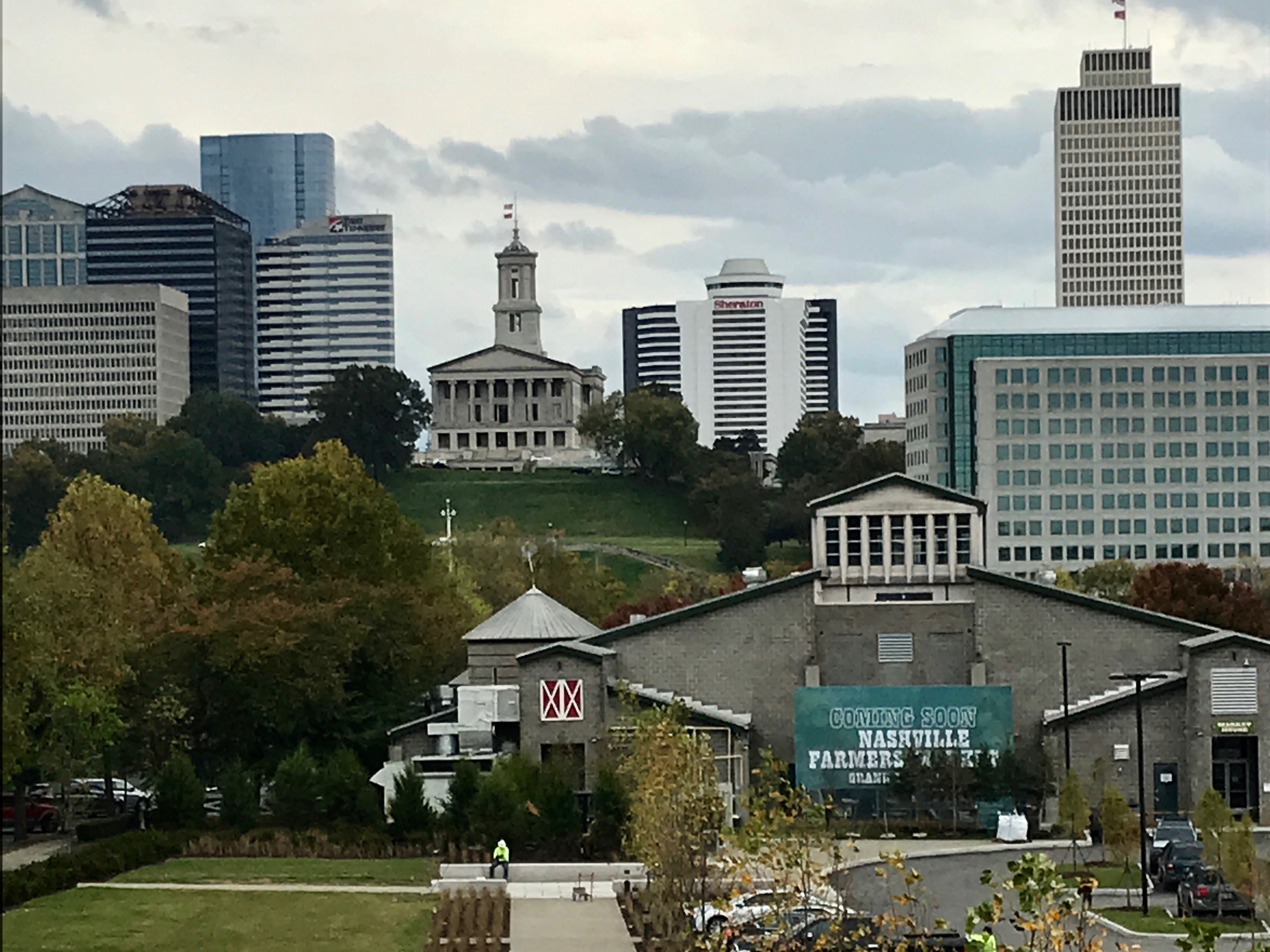
I was just about done with my day. I drove over to the Farmers Market. In spite of the sign that proclaimed “Coming Soon” it was opened for business.
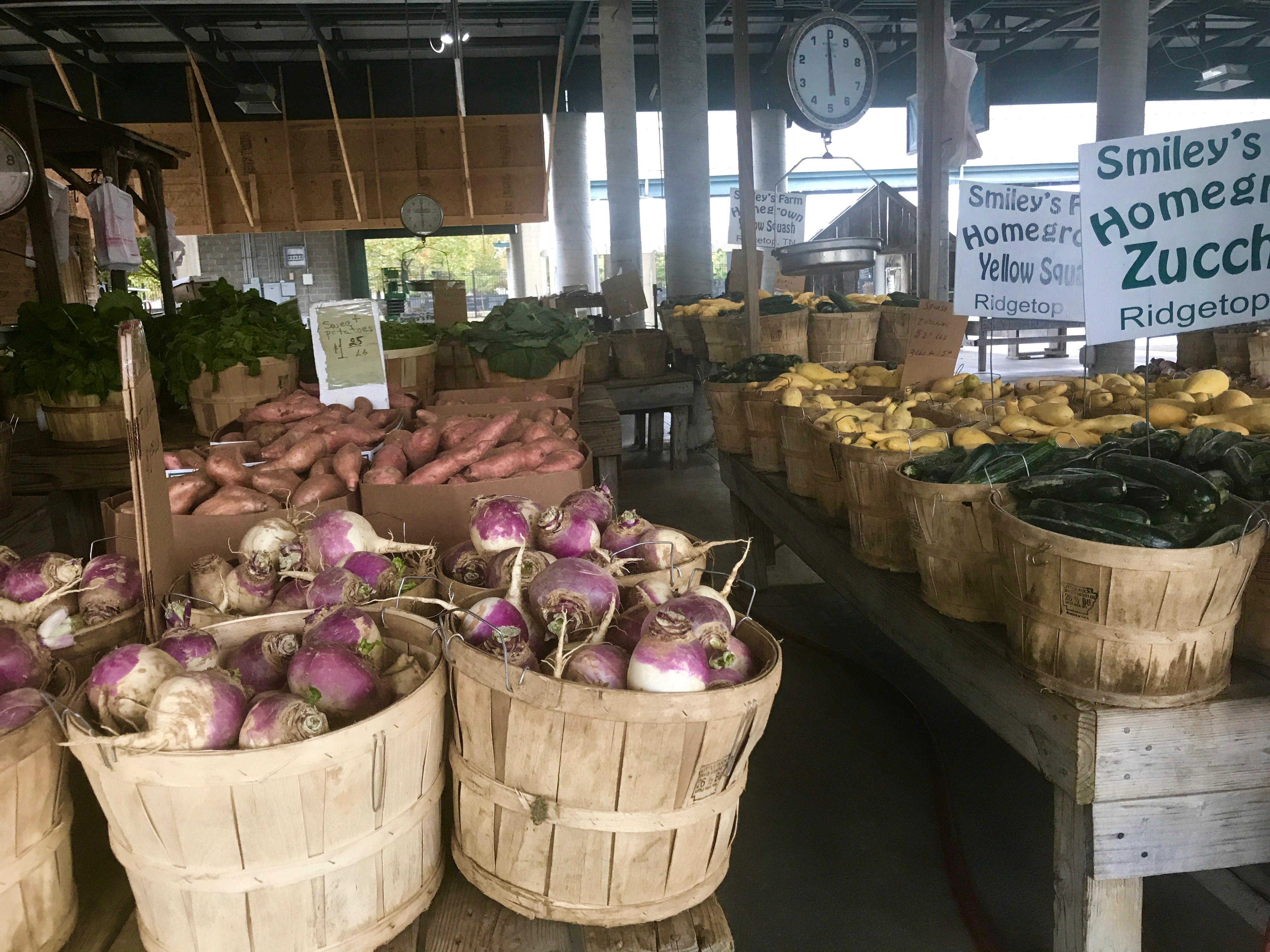
I wandered around a bit, to see what I could see.
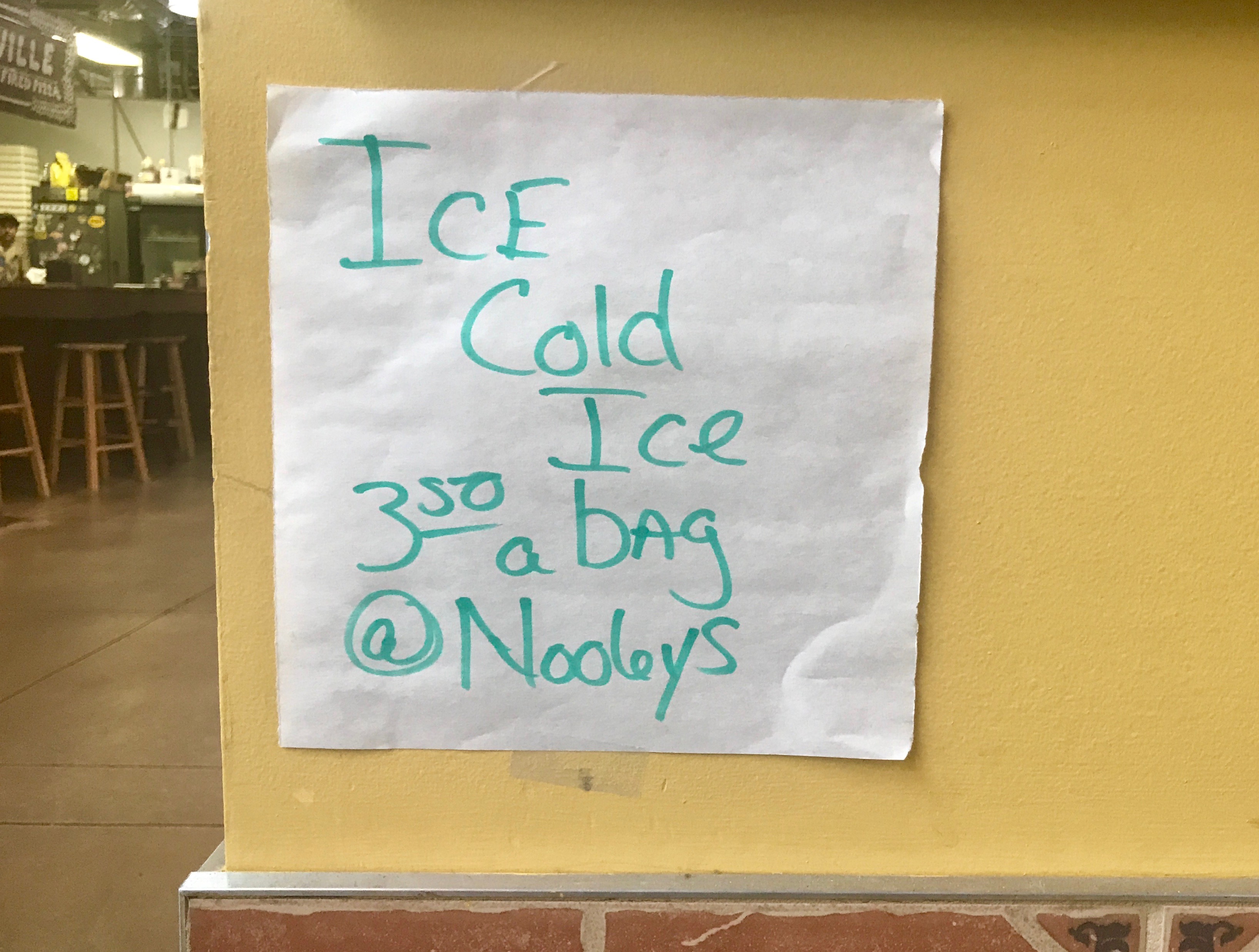
Thank goodness that they keep their ice “ice cold.” If they didn’t, I guess they would be selling water.
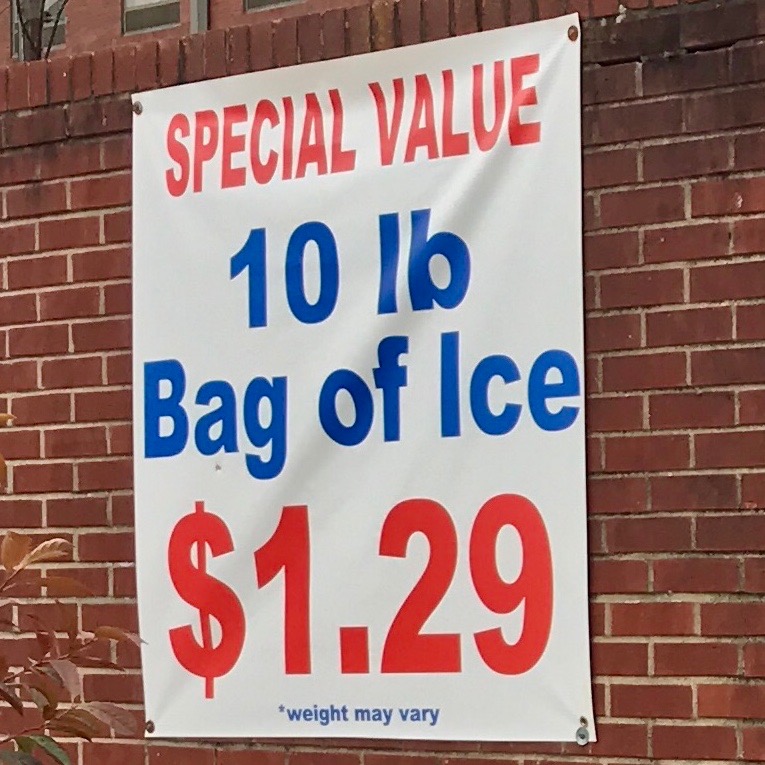
They must have a thing about ice. I saw this sign at a drive through in McDonalds.
How in the world can 10 pound bags of ice be of varying weight?
I had no time to ponder that conundrum. It was time to get ready to leave for my next stop. See you down the road!