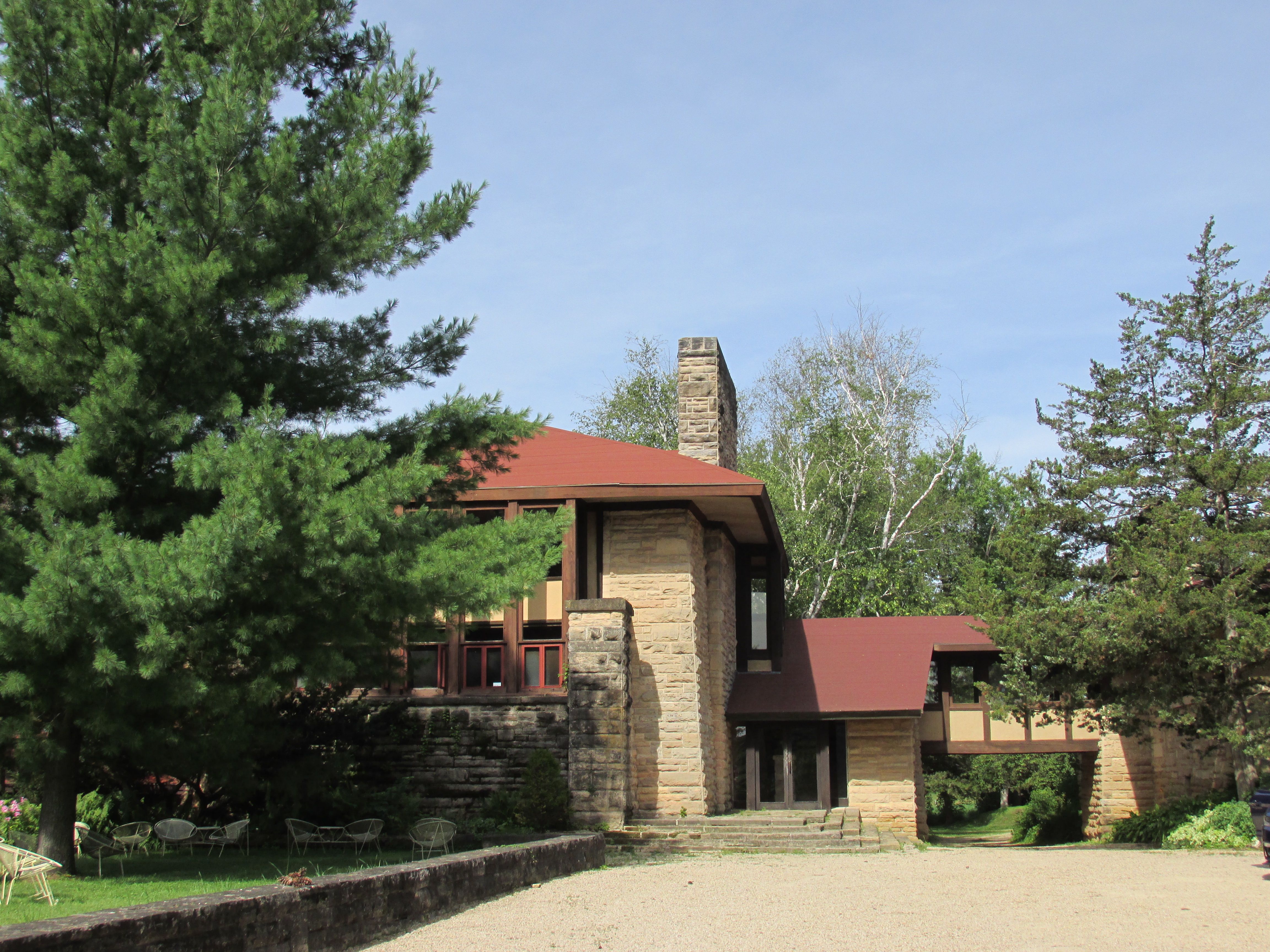
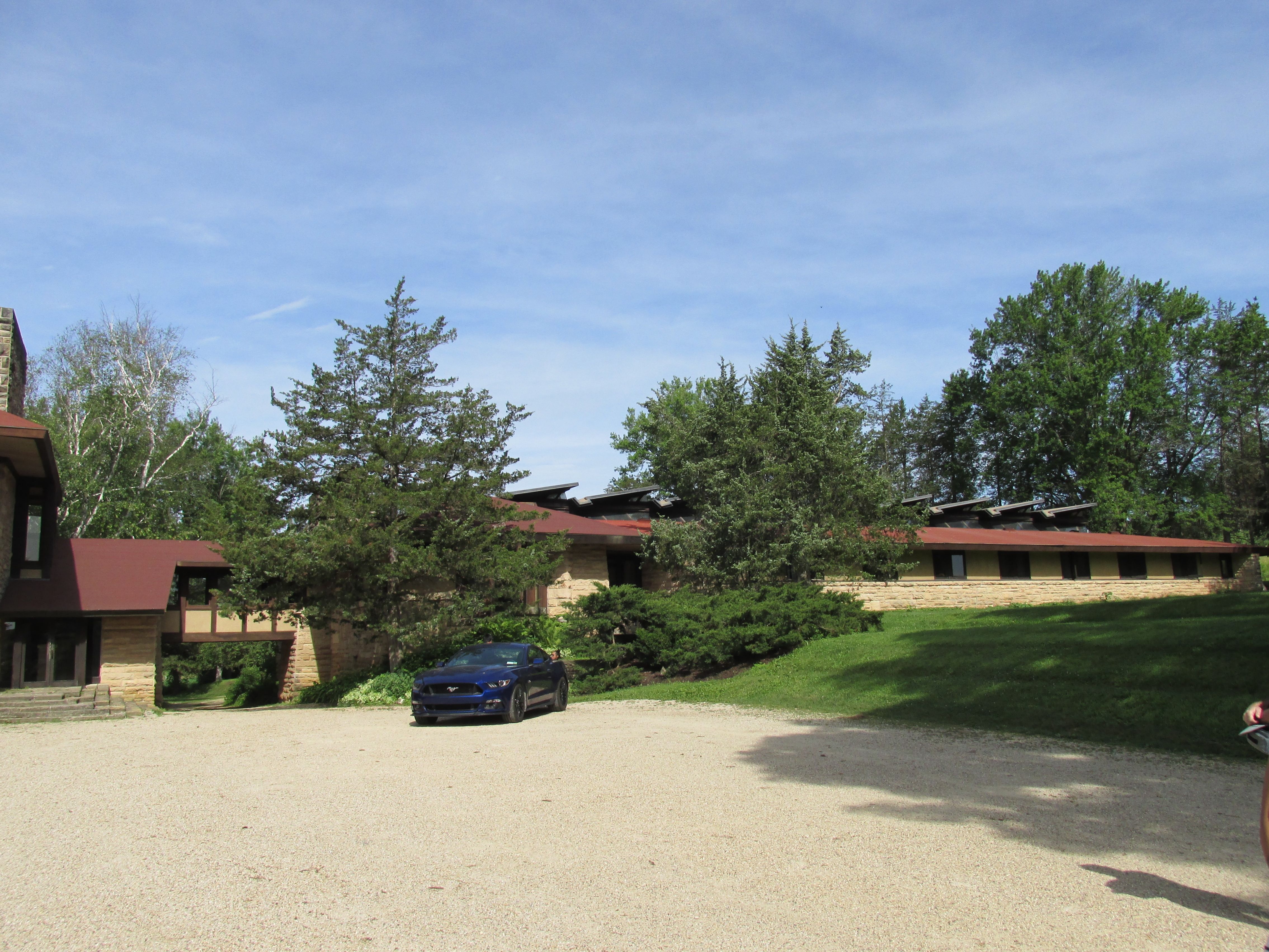
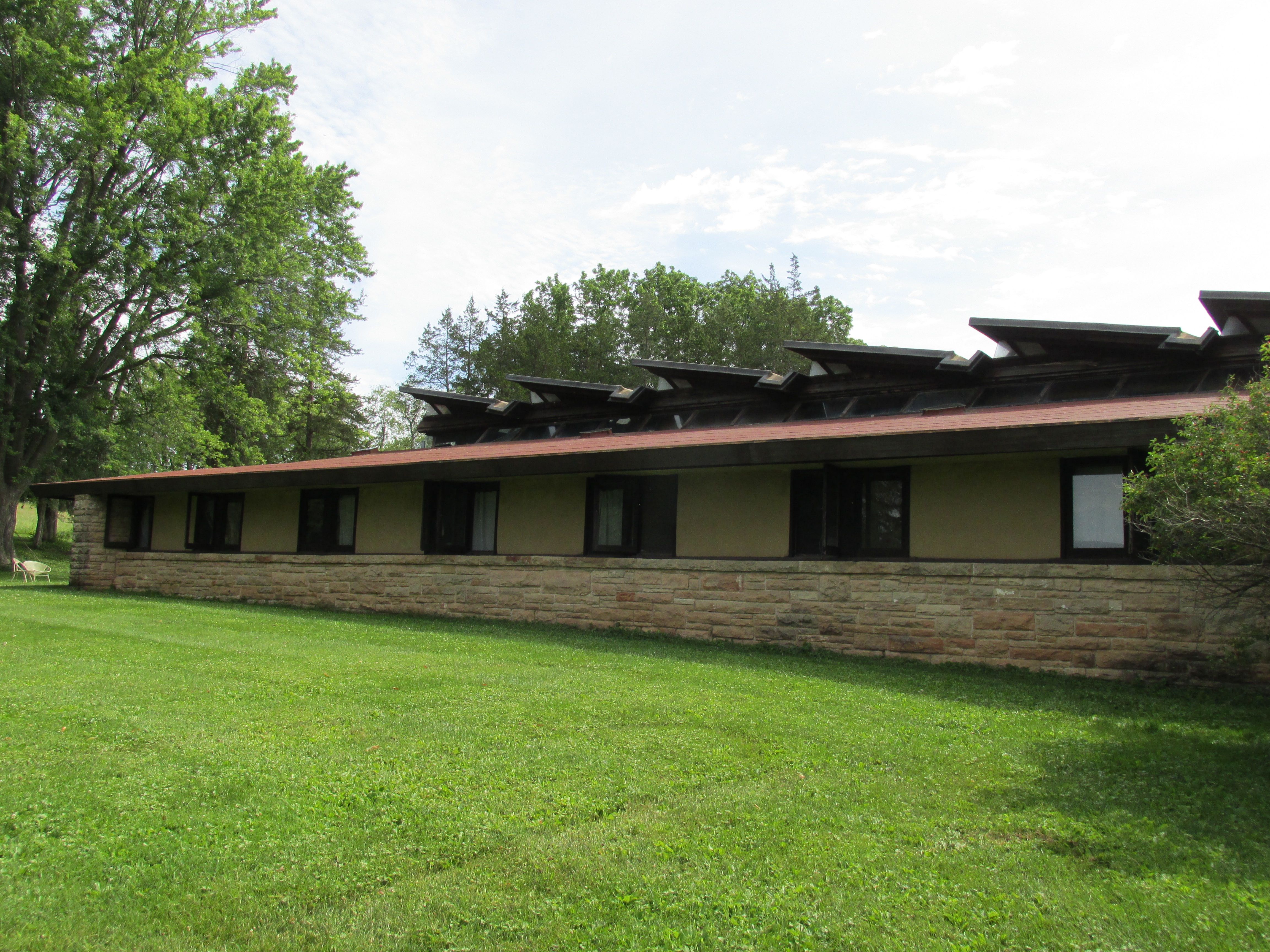
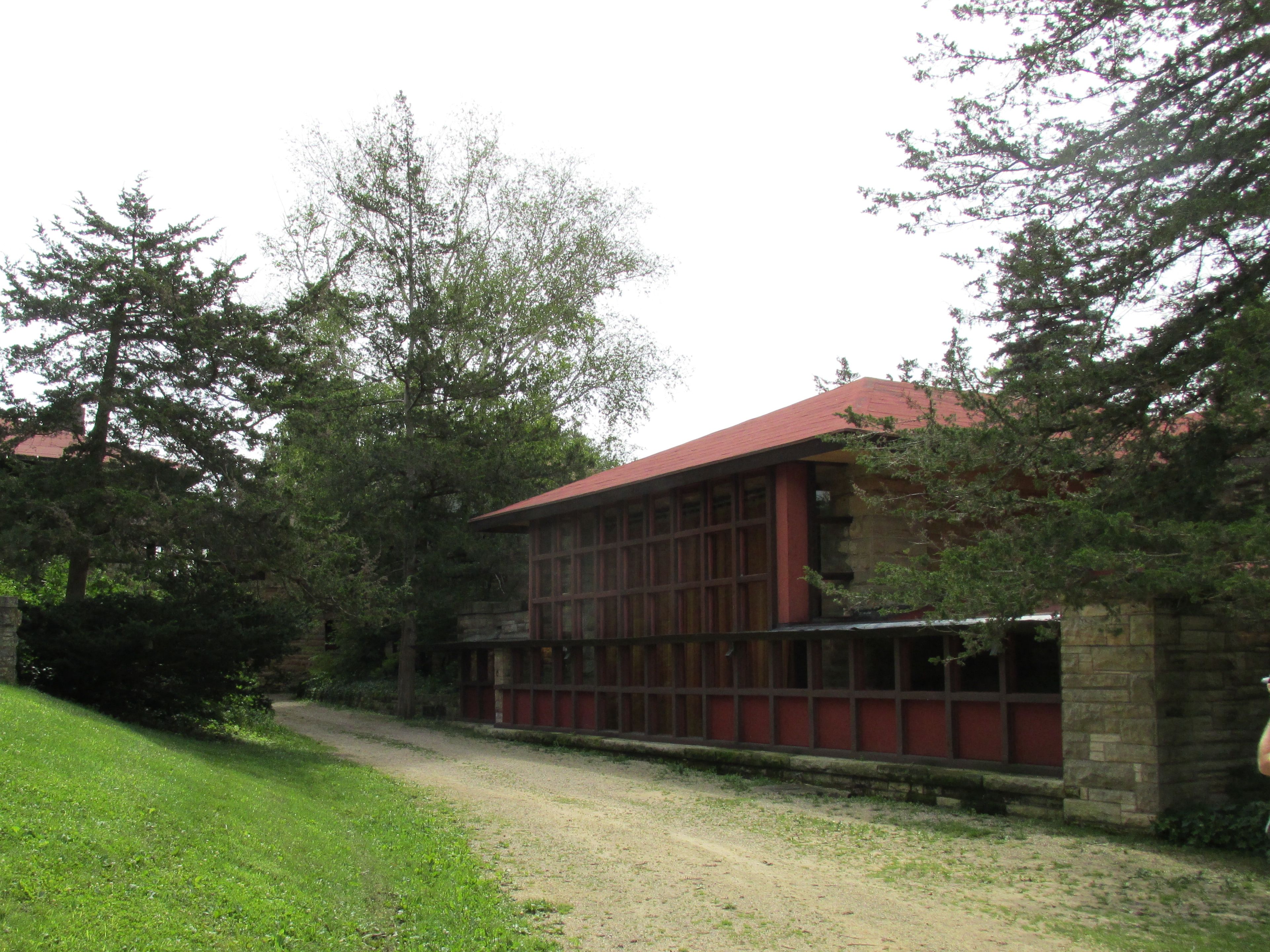
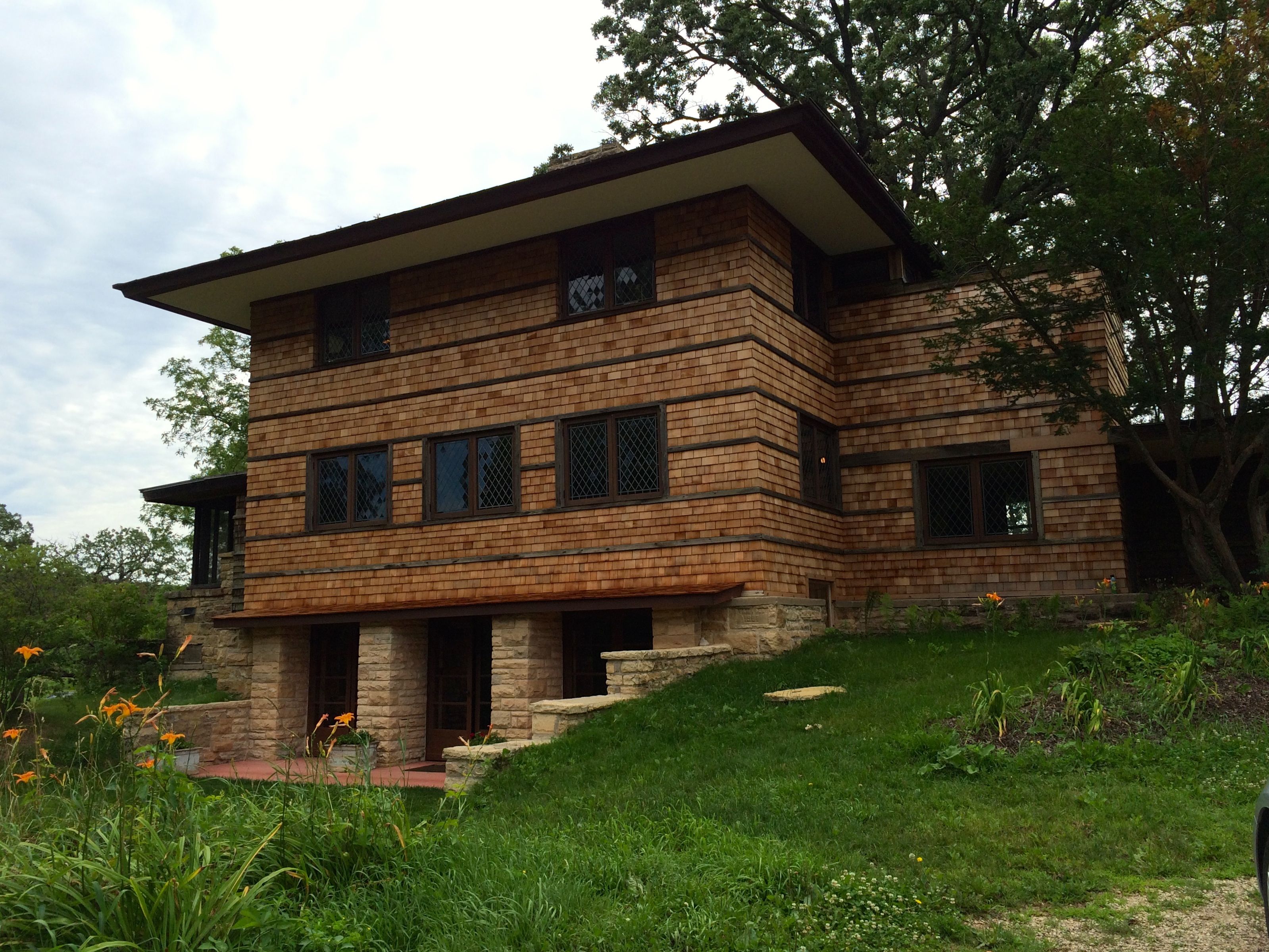
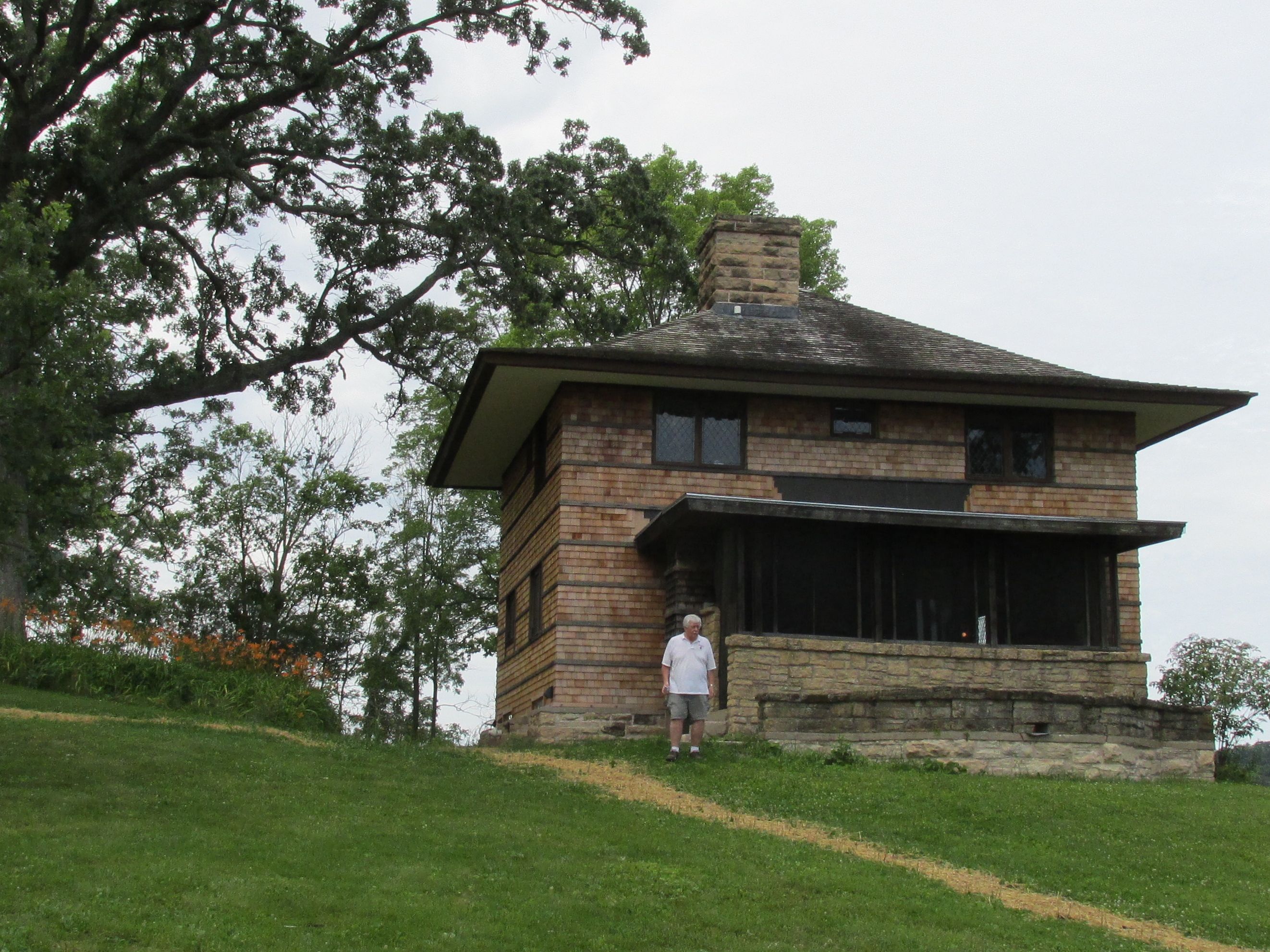
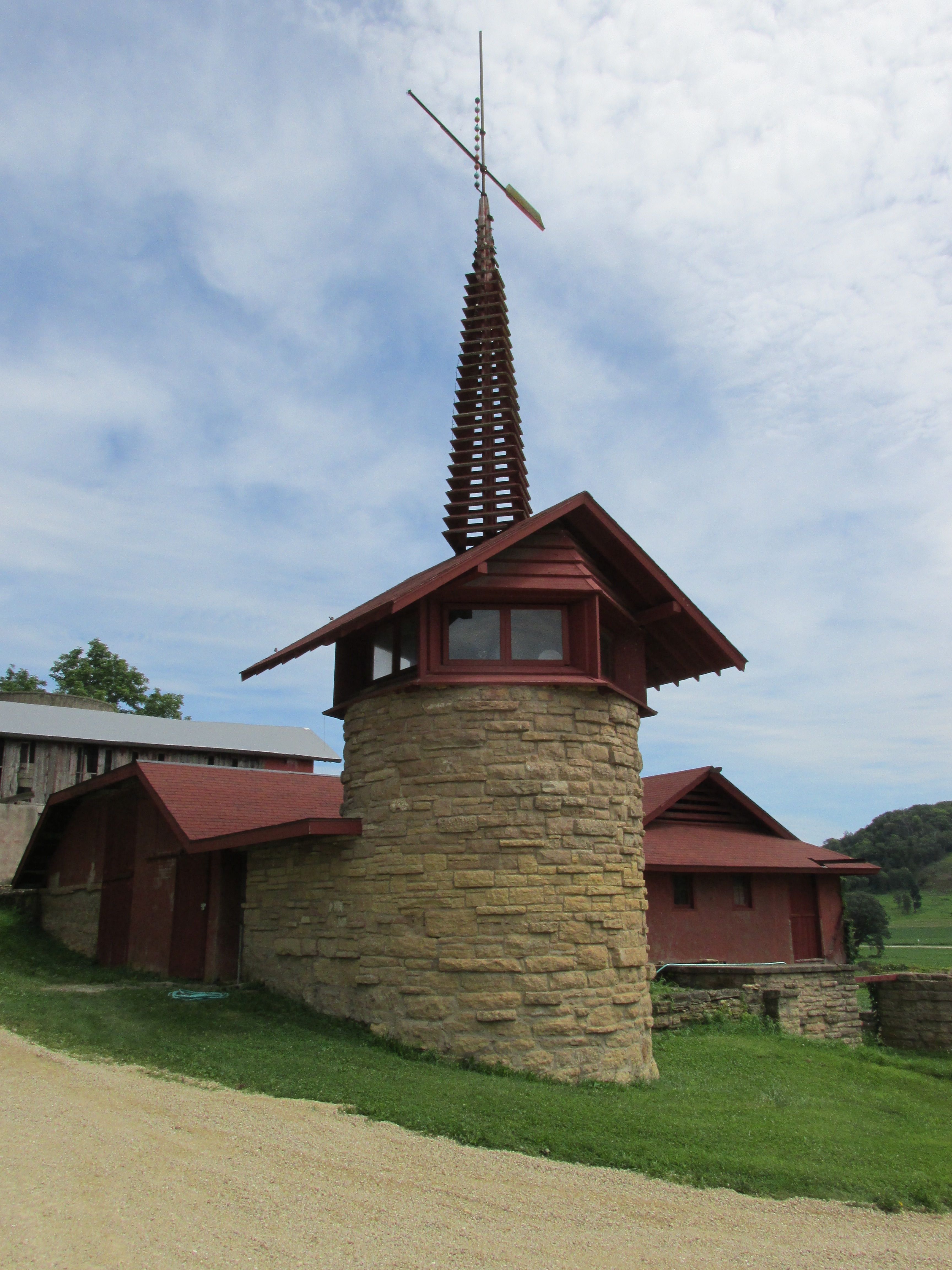
Greycliff: The Restorations Continue

Long time readers of my blog – or those people who know me in real life – know that I am very interested in the work of Frank Lloyd Wright. I grew up with his famous Martin House in Buffalo. I even toured it with a Girl Scout group back when it was in real disrepair. Man, you should see it now! Honestly, if you ever get to Buffalo, you must visit the Martin House.

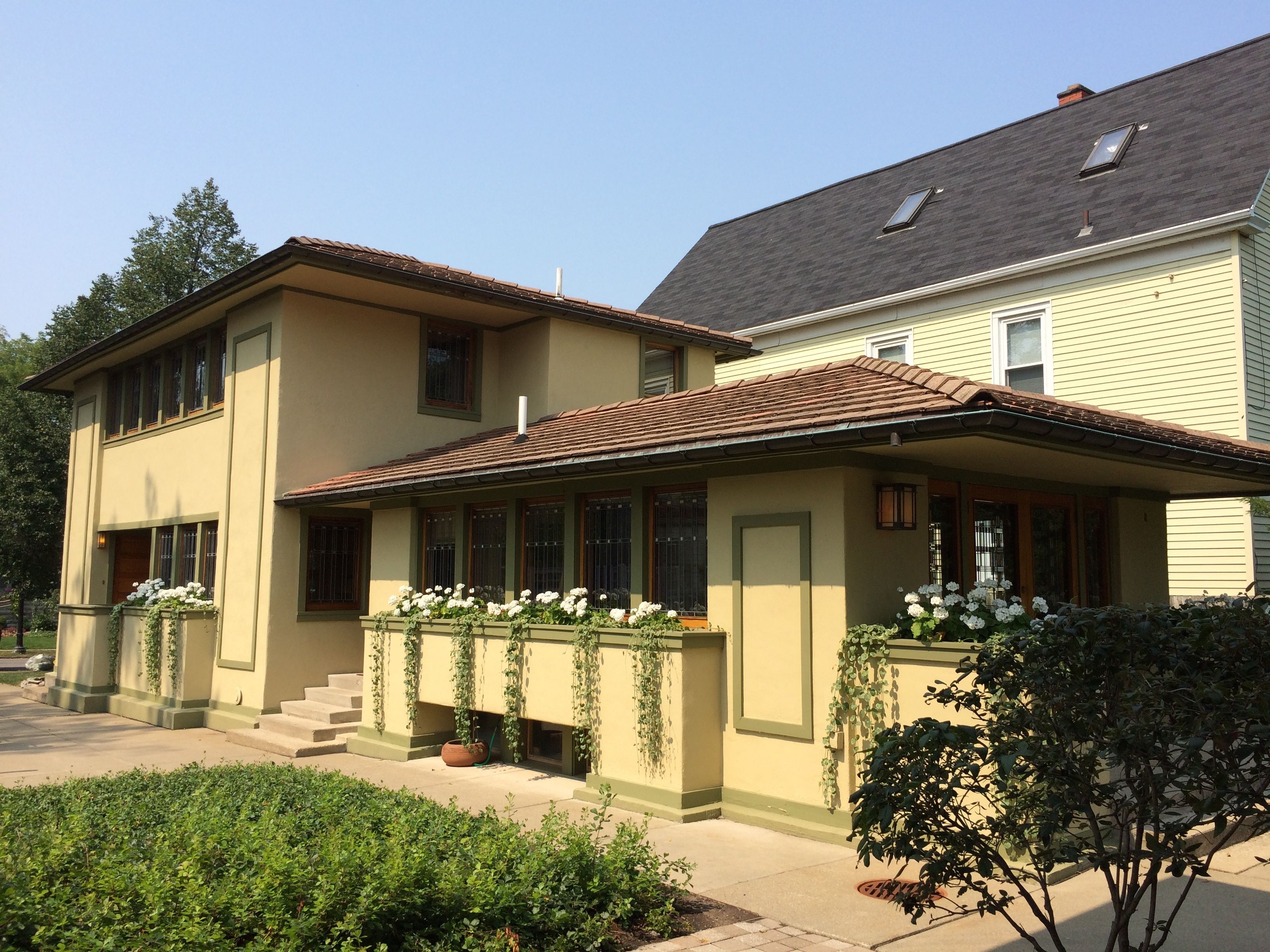
But, I digress – sort of. Greycliff is another Frank Lloyd Wright house – and another Martin House. It’s their summer place, on the Lake Erie shore, and only about ten miles from Evangola State Park. I decided to take a tour.

It was built between 1926 and 1931, and is one of only five Frank Lloyd Wright designs that were built between 1925 and 1935, and it is the only Wright designed structure built between Taliesin (1914) and Fallingwater (1936) that was built using stone. According to my Preferred Source, Greycliff is considered to be one of Wright’s most important mid-career works in his Organic Style.

While I was waiting, I managed to snap a photo of a drawing of the complex made from a bird’s eye view. The building on the left is known as the Isabelle R. Martin House. The structure to the right is the Foster House. It was originally designed as a garage with quarters for the chauffeur and his family. It was expanded, and eventually the Martins’ daughter, Dorothy and her husband James Foster, and their children spent many happy summers there. It kind of makes me wonder what happened to the chauffeur and his family. There is a small building between the two larger ones. It’s called the Heat Hut, and it housed the furnace.

Incidentally, my first visit to Greycliff was while I was at Daemen College. Sister Jeanne took us on a field trip here. We didn’t go to see the house, though. I imagine it was in really rough shape at that point, as it had been a school run by the Piarist Fathers. As I recall, this school was started by a group of Hungarian priests that had fled the Communists. The order was founded in 1617 by Saint Joseph Calasanctius, who was from Spain.

Okay, stay with me. This bit of information is important to me because my first teaching job was at Calasanctius Preparatory School in Buffalo, New York, founded and run by the Piarist Fathers. Isn’t that a great big circle of coincidences?

They also had a school here. The modifications they made to the original plan are not shown in the drawing. Luckily, they didn’t do anything with the Wright buildings that couldn’t be reversed. They built a classroom annex in front of the garage to the right of the drawing. What we originally came out to see was a sgrafitto work of art that was on the facade.

I mentioned this to the docent giving the tour. She told me what became of the work of art after the classroom building was demolished – but I forget what she said! I wish I took better notes.

I did send a message to Greycliff and received a response from Ryan Gravell, Greycliff Director of Operations. He told me that the sgrafitto was removed from Greycliff in the early 2000s and it was rehouses on the campus of Buffalo State College and became part of their collections.

I have sent and email to Buffalo State, but I haven’t heard back yet. If they respond, I’ll add the information I get.

Incidentally, Buffalo State College is right next door to the famous H.H. Richardson building I wrote about a while back. It was the old Buffalo Psychiatric Hospital but has since been repurposed into an upscale hotel. But, once again, I digress…

I made a second trip to see the house many years ago, just as restorations were getting serious. I was eager to see what they had managed to do in the years since my last visit.

I continued checking out the displays, as the waiting area filled with Wright enthusiasts waiting to take the tour.
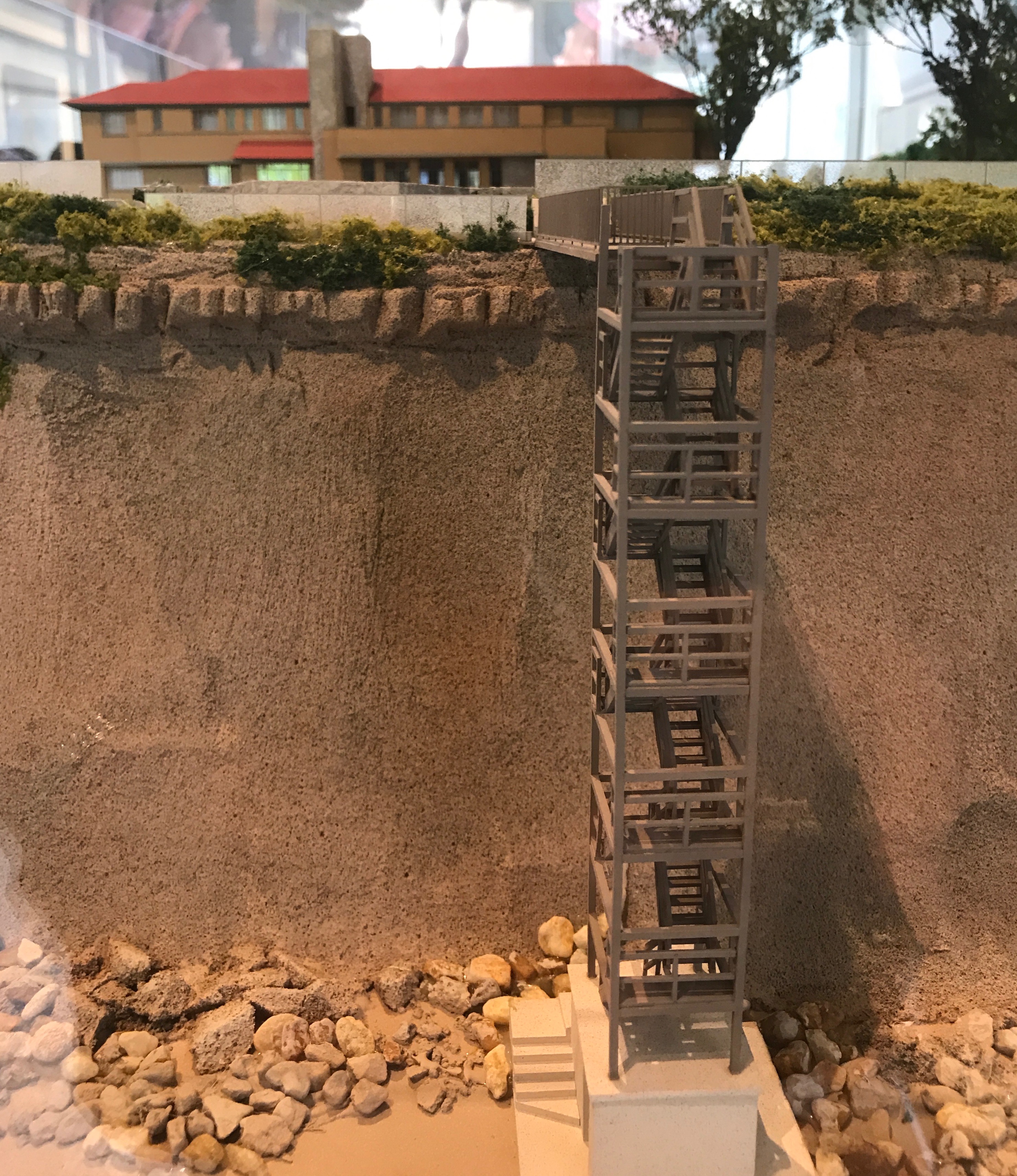
This is a view from an angle I had never seen before – from the lake.
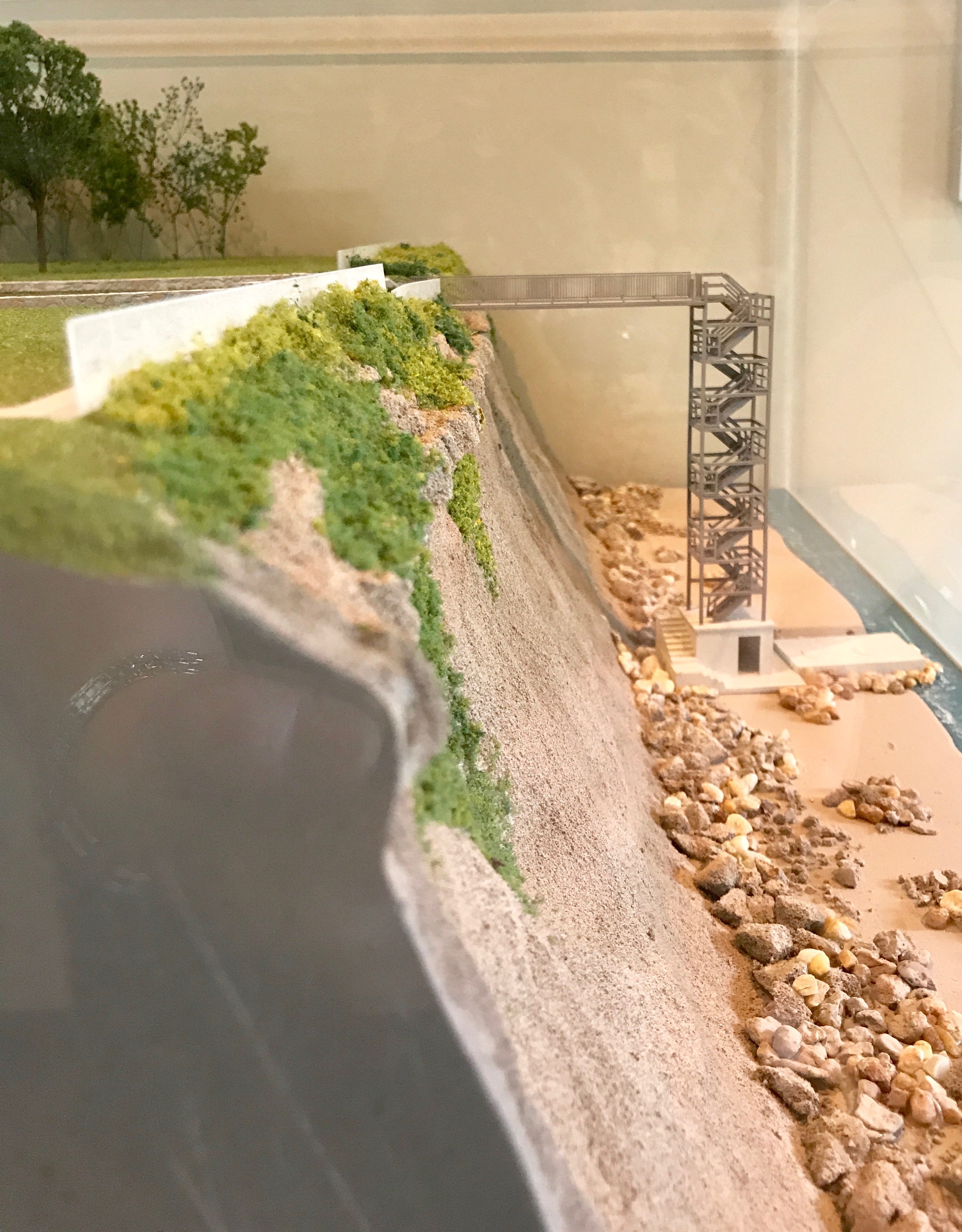
I don’t think I would want to take that walk down to the beach. My hair would be standing straight up just walking from the cliff to the stairs. And then all those stairs! Whoah!

Luckily, I didn’t have to think about that trip too much longer. It was time for the tour to begin.
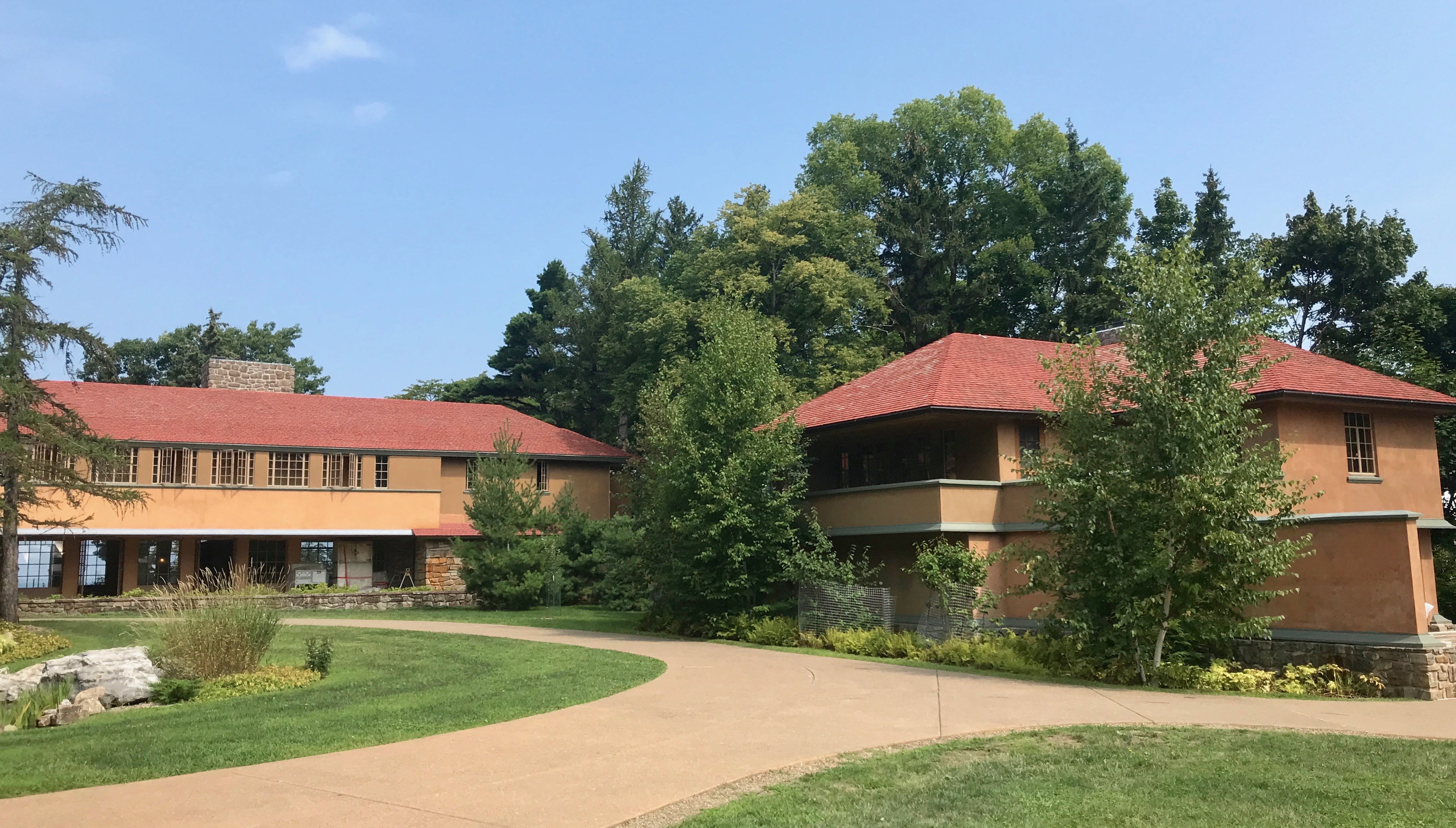
We walked out of the visitor center. The building to the right is the garage, with quarters originally intended for their chauffeur.  The building on the left side is the main house.
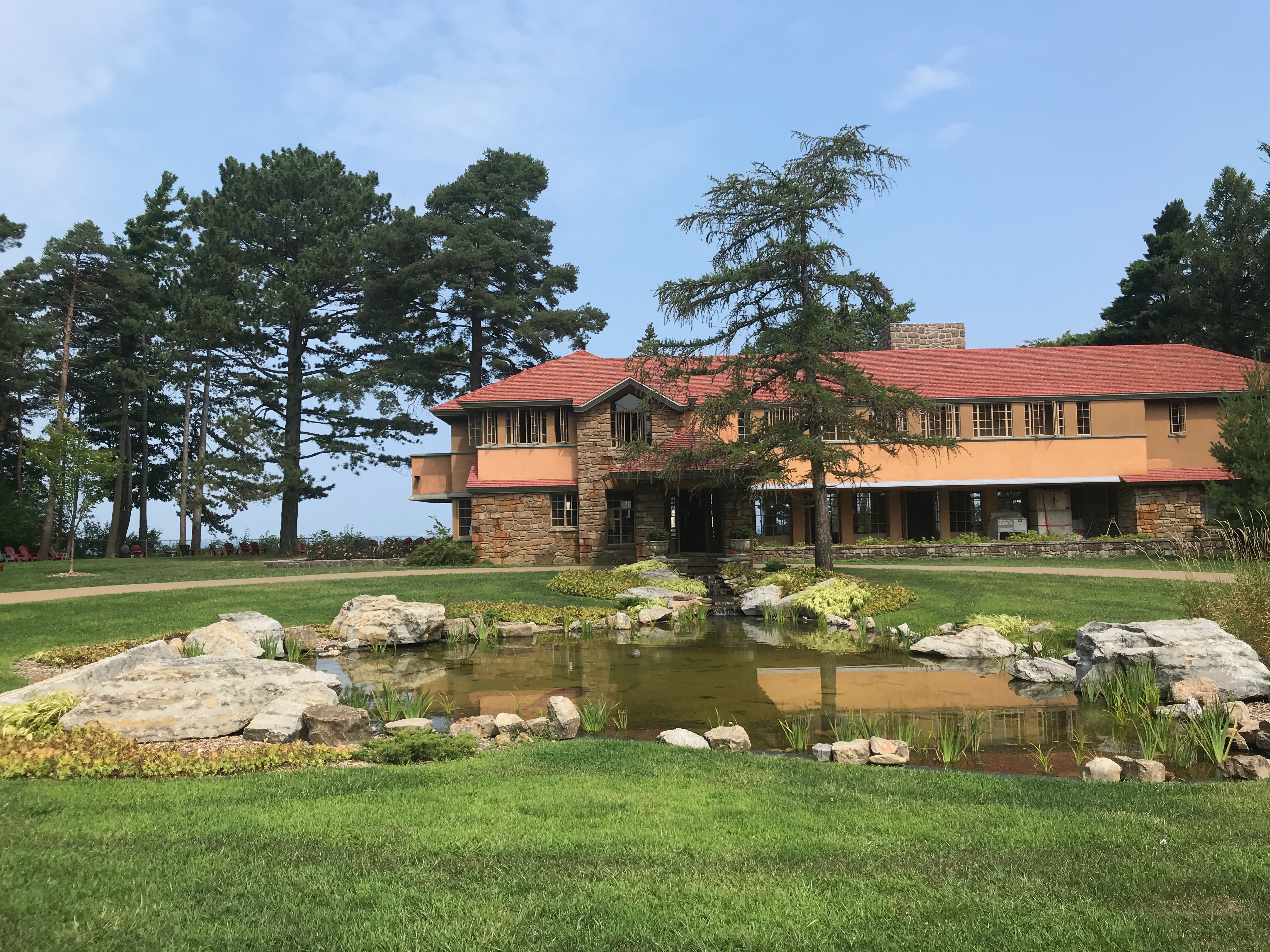
The house is reflected in the pond in front of it.
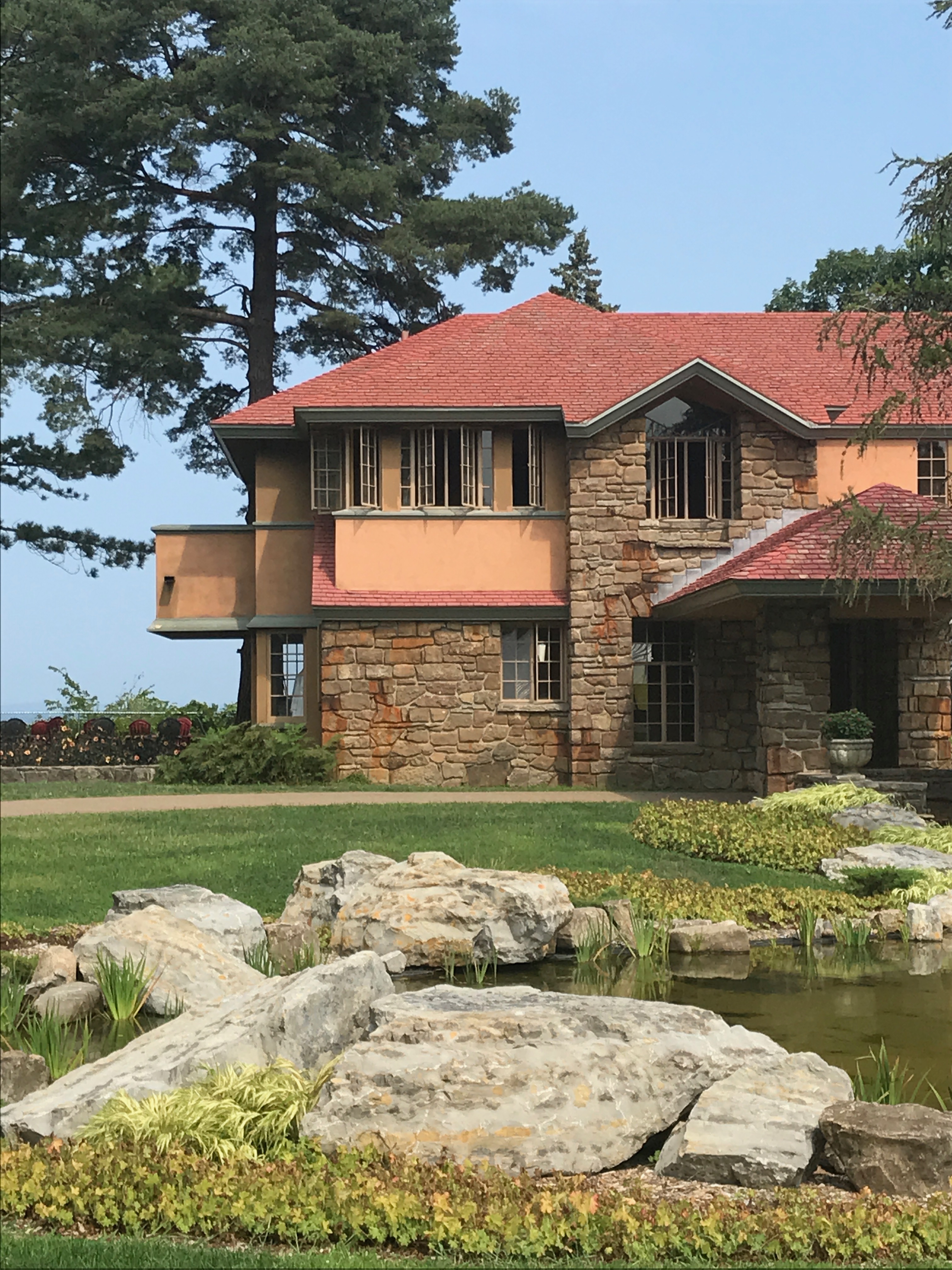
From this view, you can see one of Wright’s famous cantilevered porches.
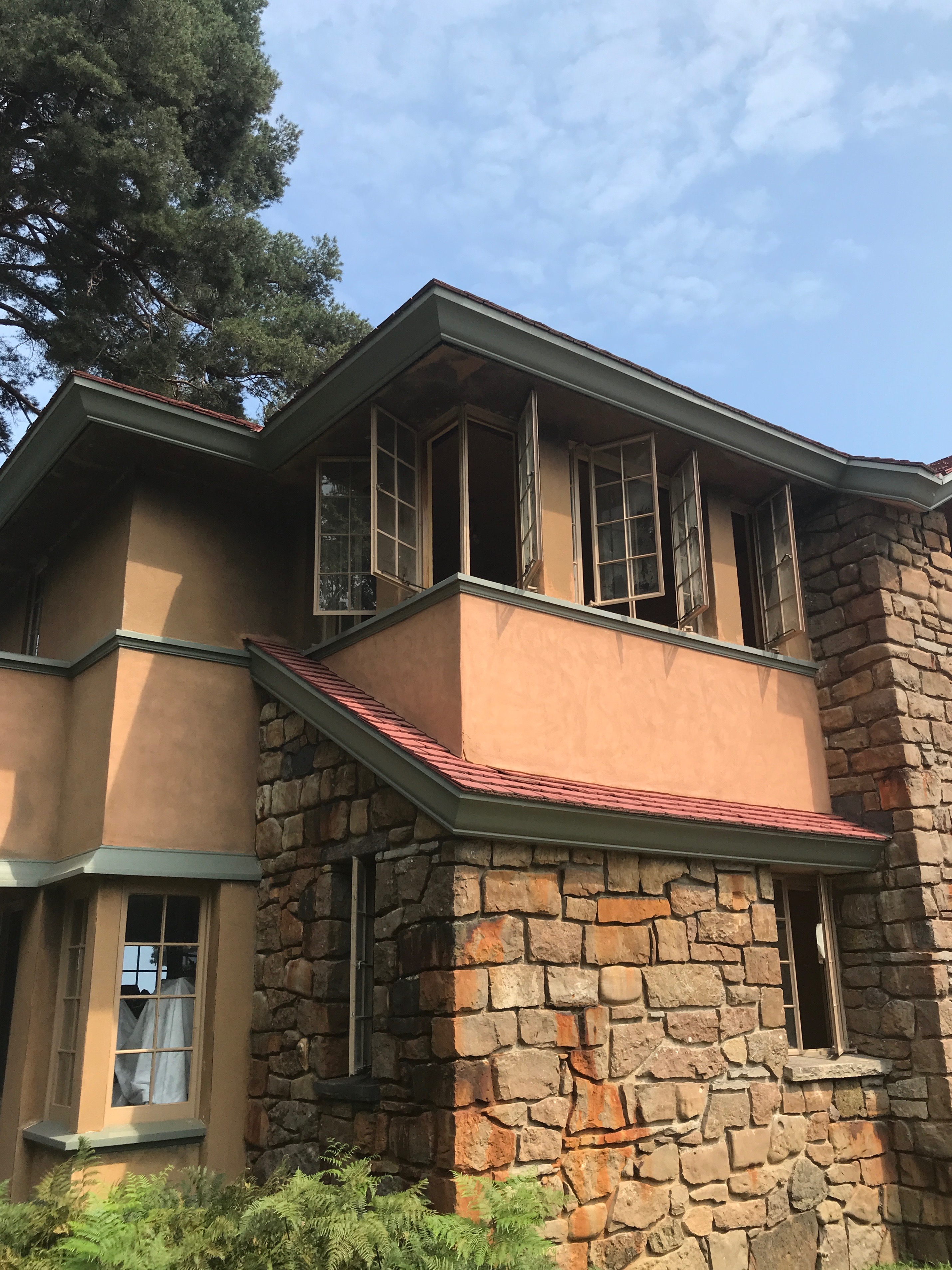
To me, there is nothing more summer-y than having the windows open and cooling the house naturally. The breezes off Lake Erie must have been a welcome respite in the summer.

In the winter, I imagine that those Lake Erie breezes would not be near as salubrious. (Yes, that car is parked by Lake Erie. It was covered in ice during a storm in 2016.)
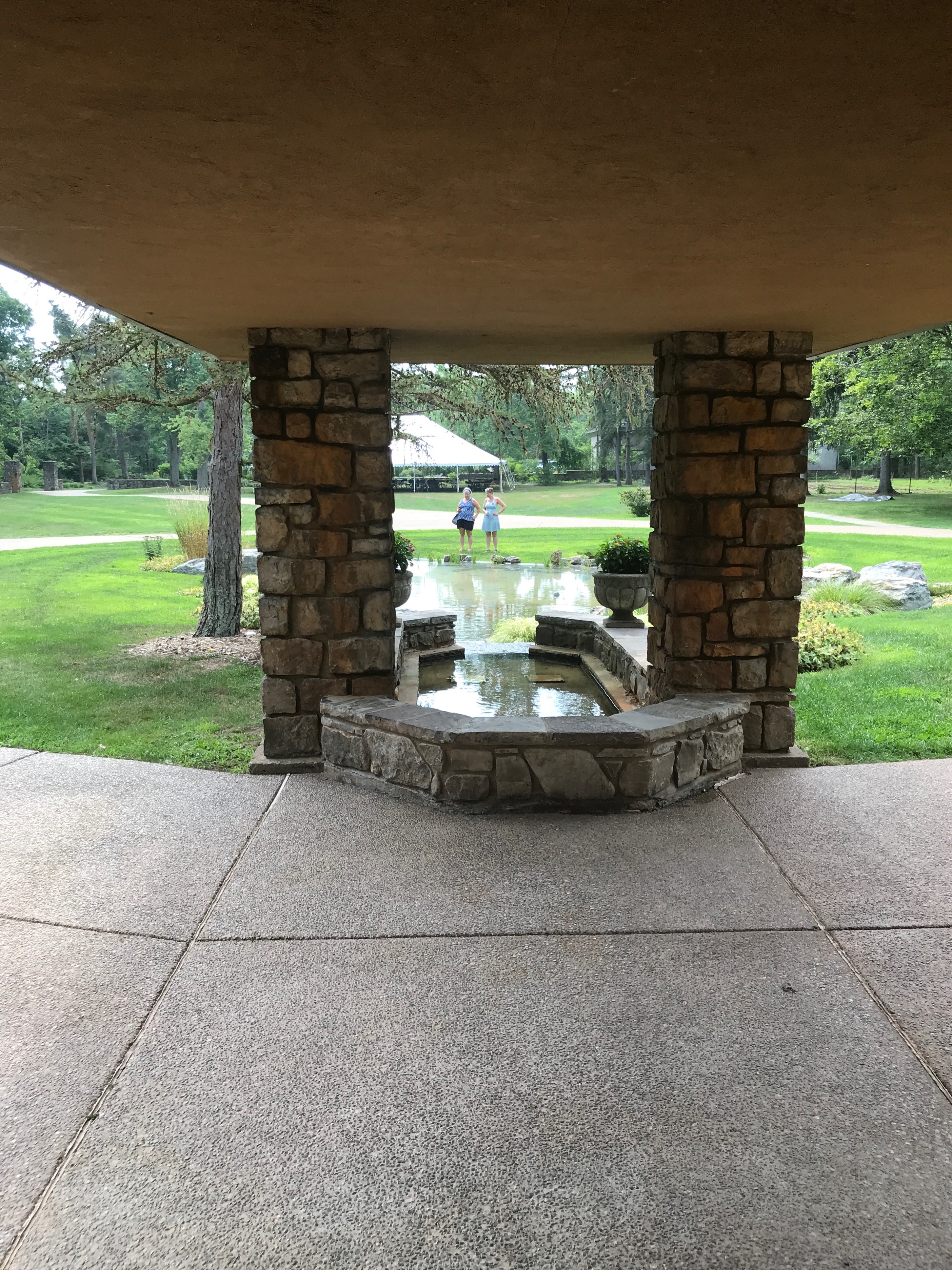
We got up to the entrance and looked back at the pond from under the porte-cochere. That sounds so much more classy than “car port.”
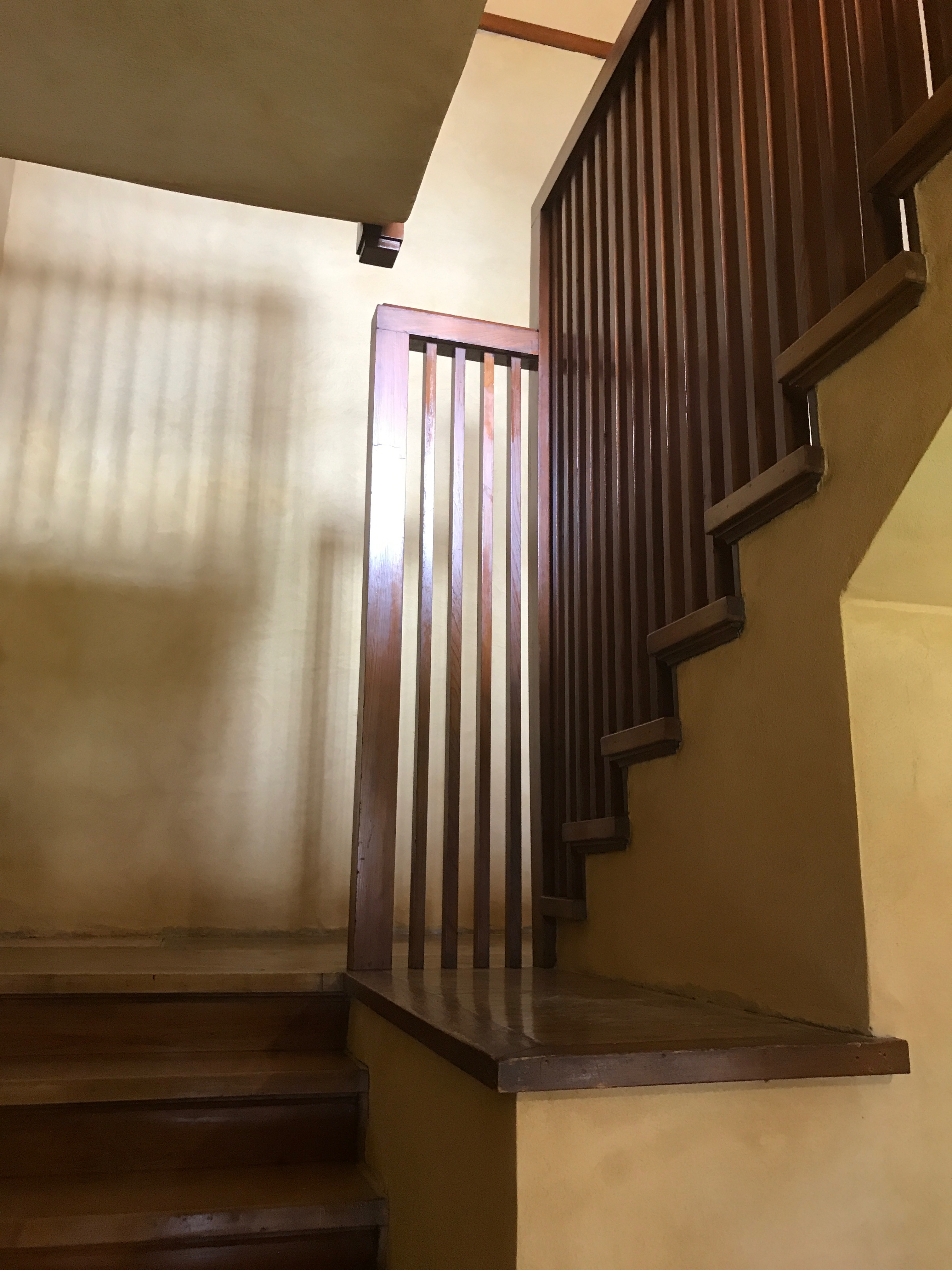
Just inside the door is the stairway to the second floor.
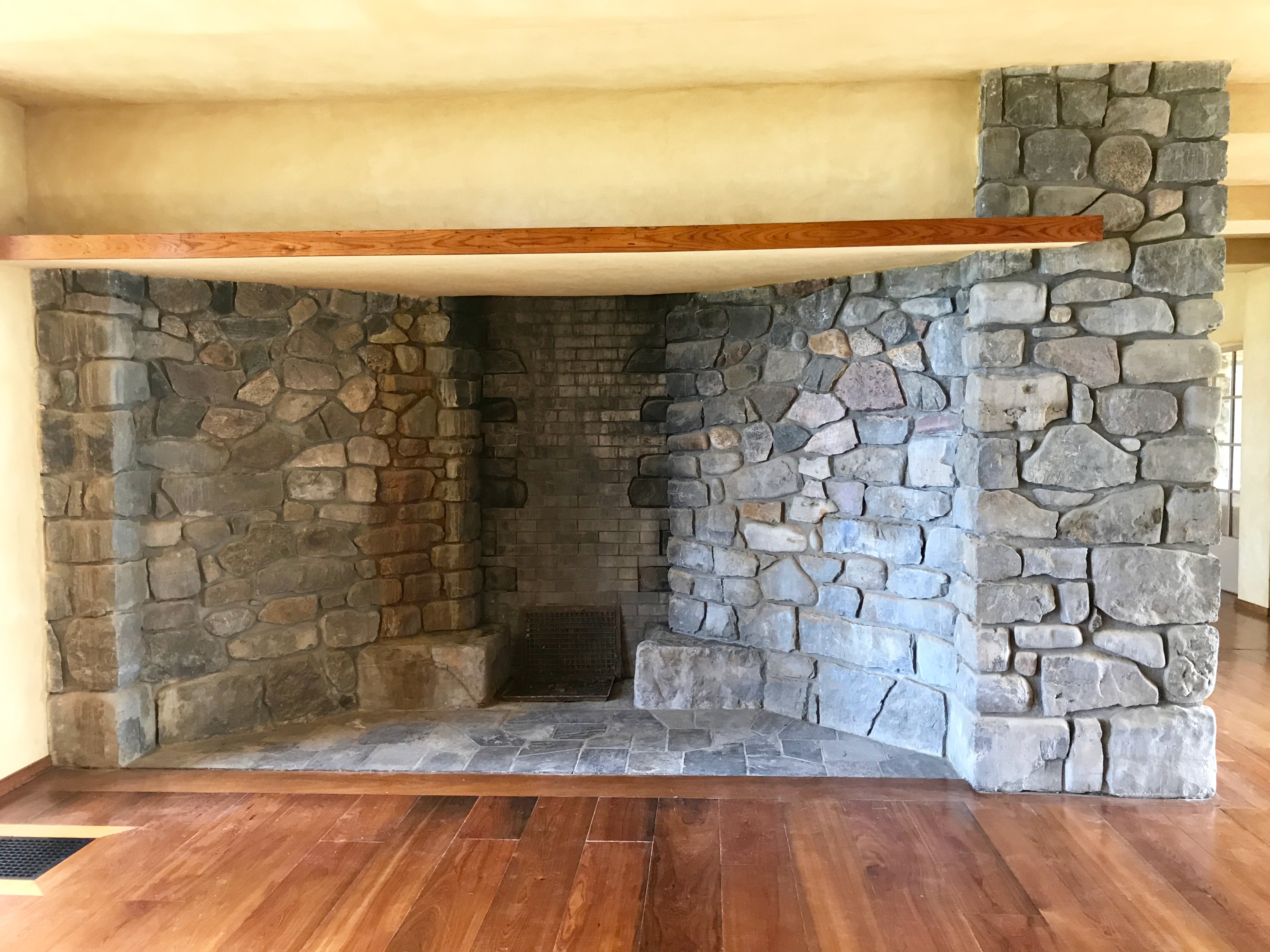
We headed over to the living room. Of course Wright designed a fireplace into the room. He was very big on fireplaces.
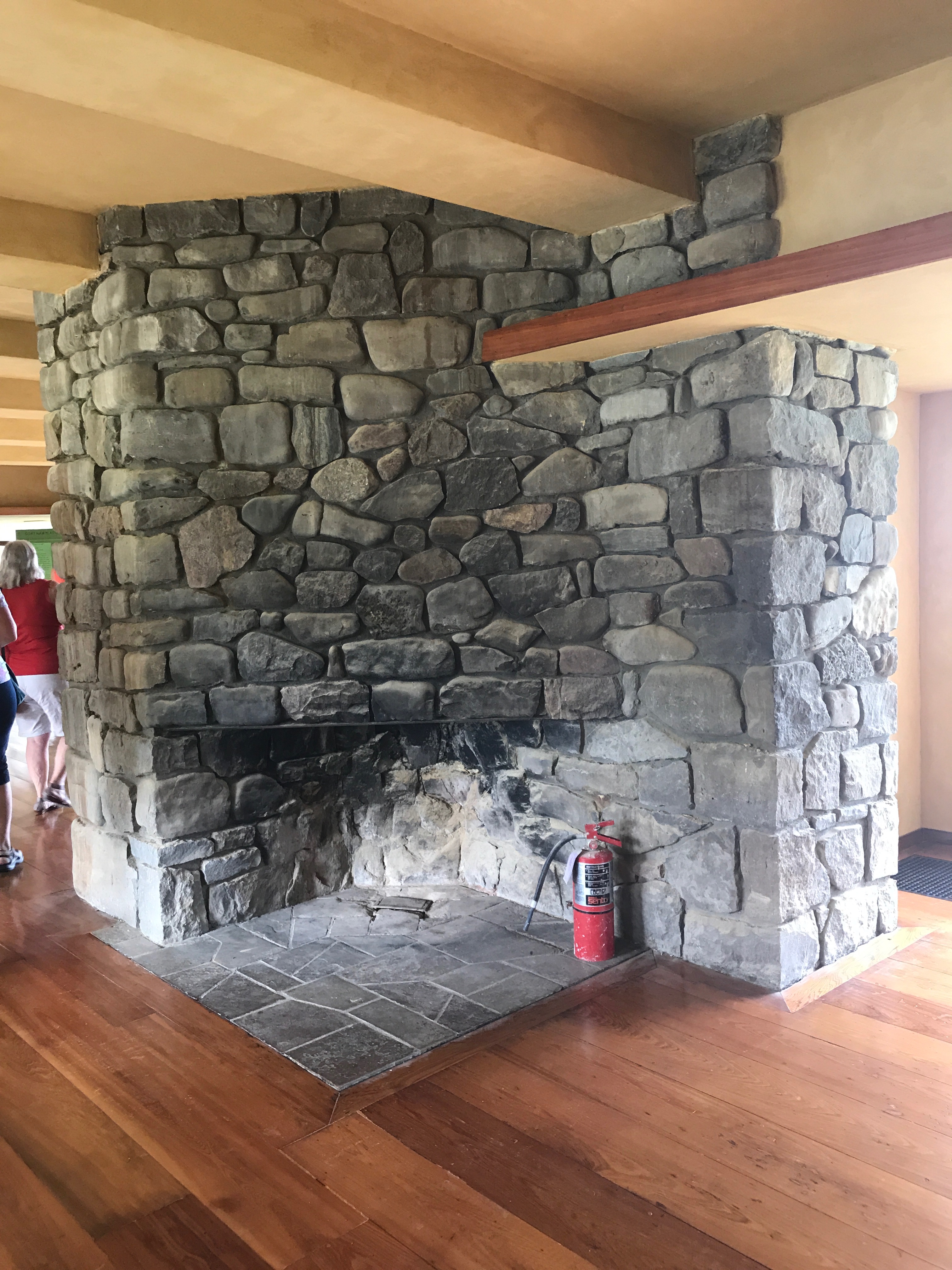
In fact, on the other side of that fireplace is another fireplace. I believe that is area is the dining room. I think the fire extinguisher is a nice touch.
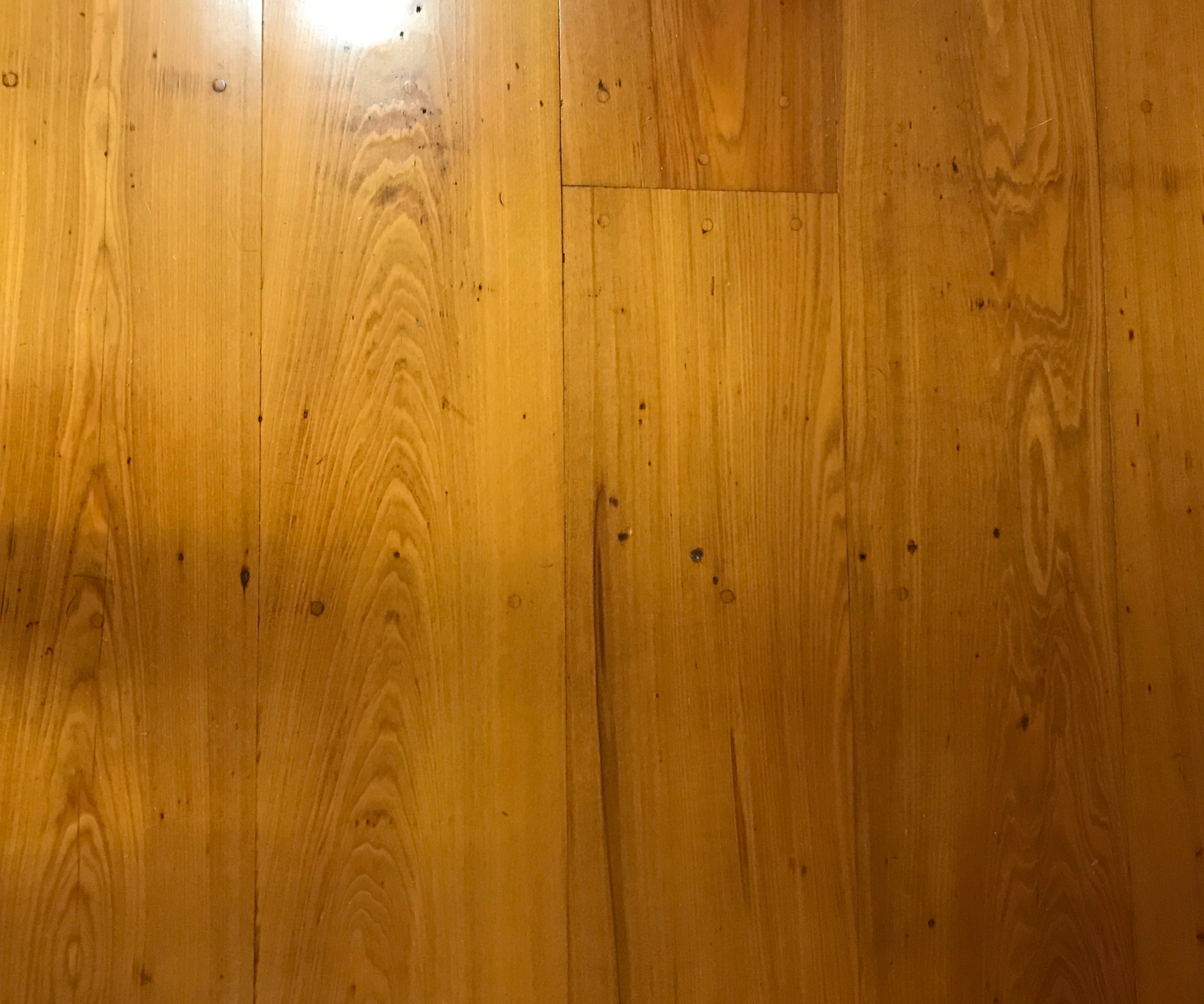
The floors appear to have been freshly refinished and they are gorgeous, wide planks. I believe the floor is pine, but I may be wrong. Unfortunately, this Wright building is not one of the ones that has been written about extensively, although I am sure there is extensive documentation somewhere.
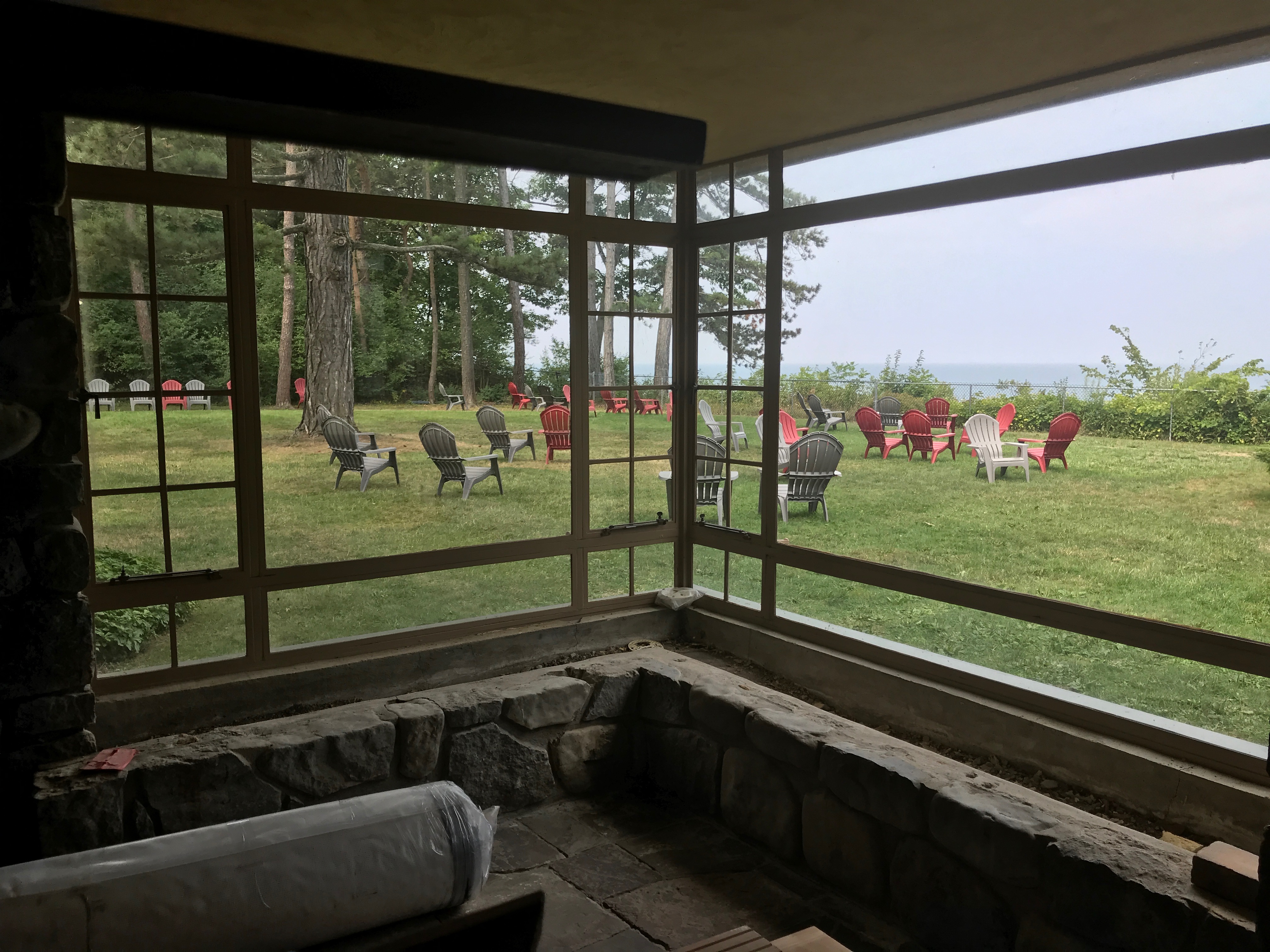
This house was built for the pleasure of Isabelle Martin. She wanted lots of light. After the long, gloomy Buffalo winters, I can completely understand that. Buffalo is the 19th least sunny city in the United States.   On Average, there are 155 sunny days per year in Buffalo. The US average is 205 sunny days per year.
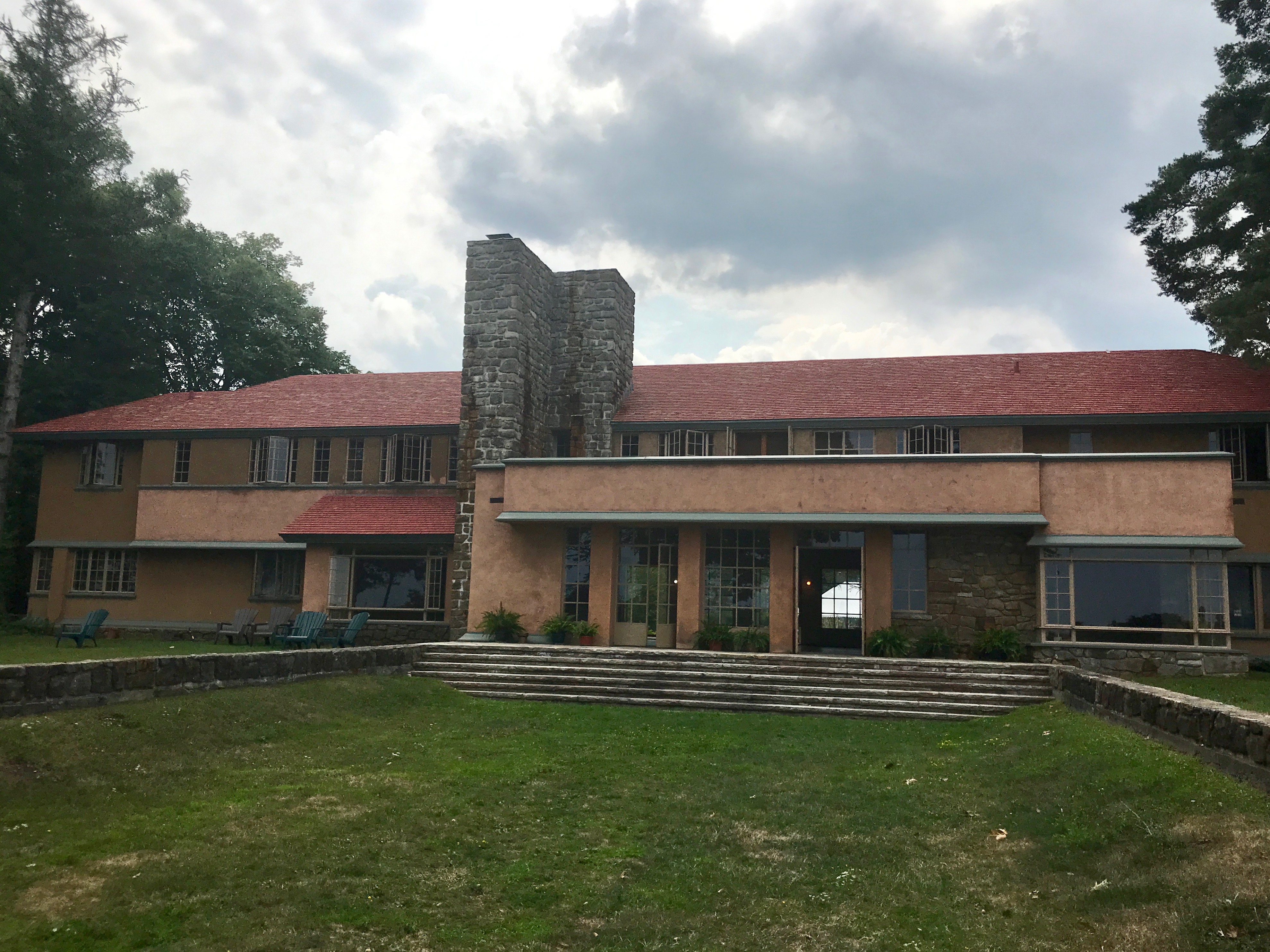
We walked down the stairs off the living room and turned to look back at the house. You can see the light shining through from the other side. This would give Isabelle the light she craved.

Originally, there was supposed to be some sort of water feature that tied the pond at the entrance to the lake. According to my Preferred Source, “…a broad esplanade connects the terrace to the cliff and lake. The esplanade was designed to carry water, pumped from Lake Erie, down its length and over the bluffs, completing the illusion of water flowing through. Deemed financially extravagant this feature was halted after only the esplanade itself was completed.”
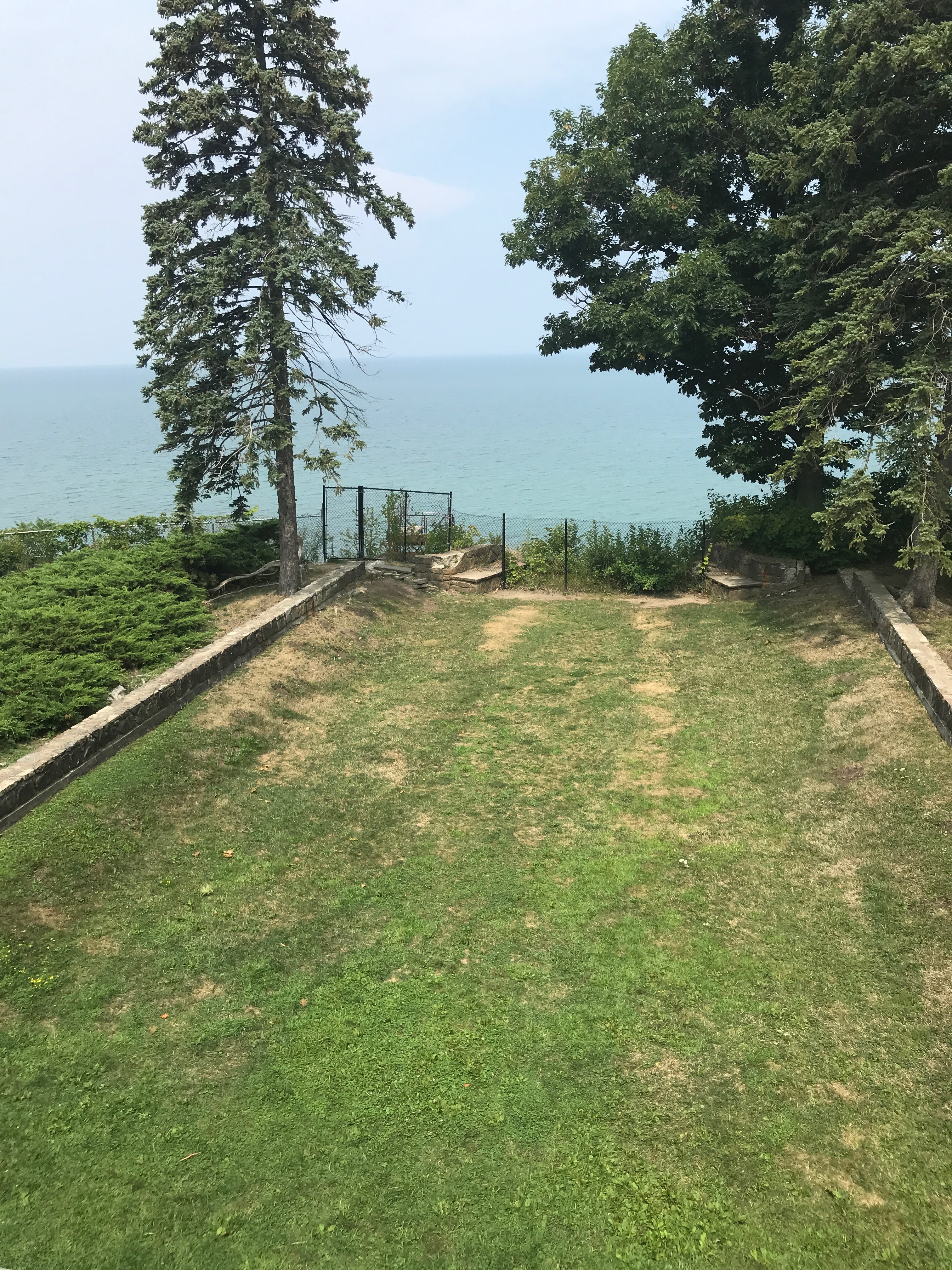
I have to agree that this water feature would have been financially extravagant. I’m not even sure that it would have been feasible. I would be concerned about the effects of the water on the stability of the site. But, what do I know?
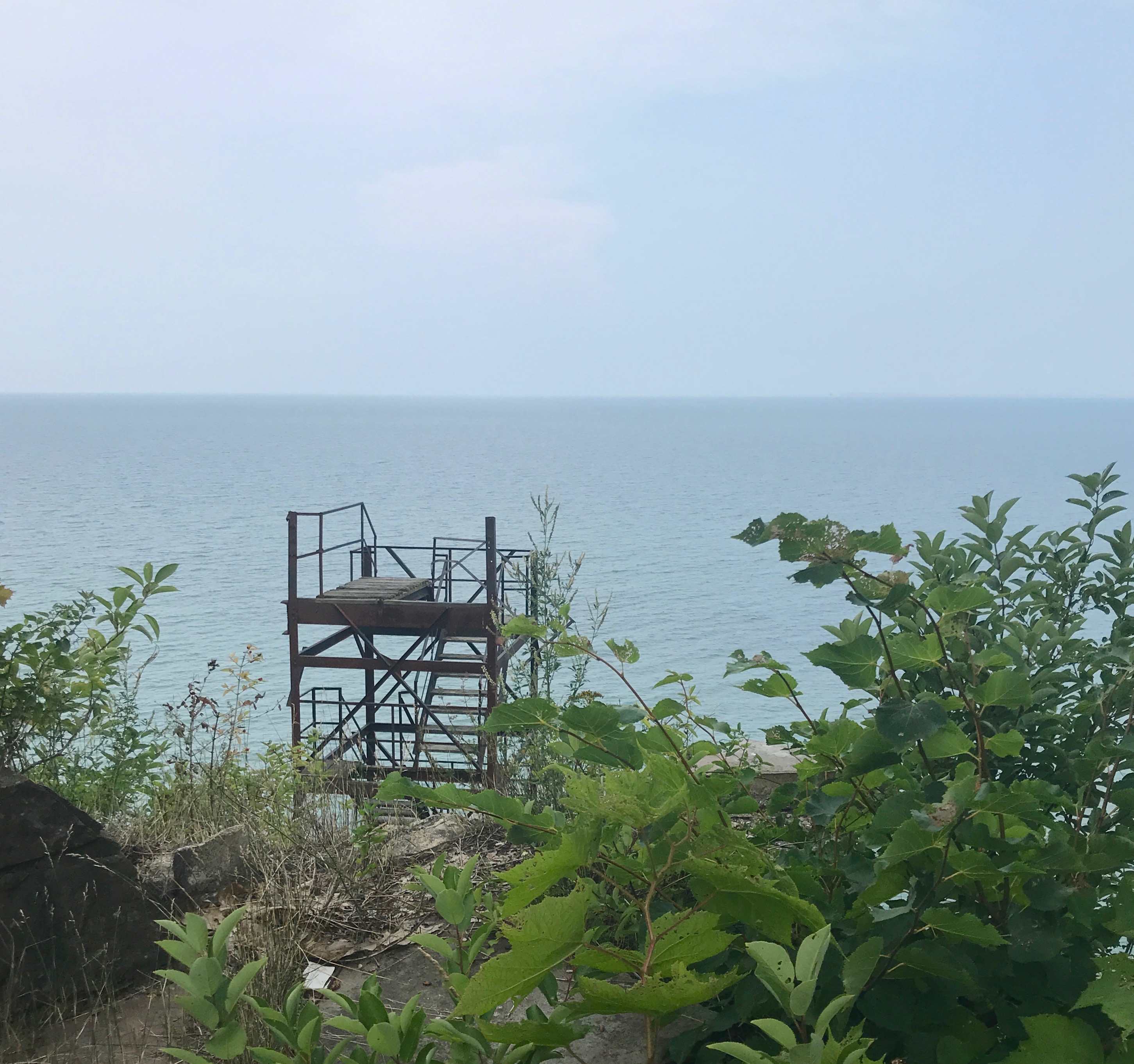
We continued over to the edge of the cliff and we could see the remains of the stairs down to the beach. If I remember correctly, the docent told us that there are plans in the works to renovate the structure. Or, was that tear and them down and rebuild them? Either way, it doesn’t matter to me in a practical sense, as I will not be using them. I do not like heights!
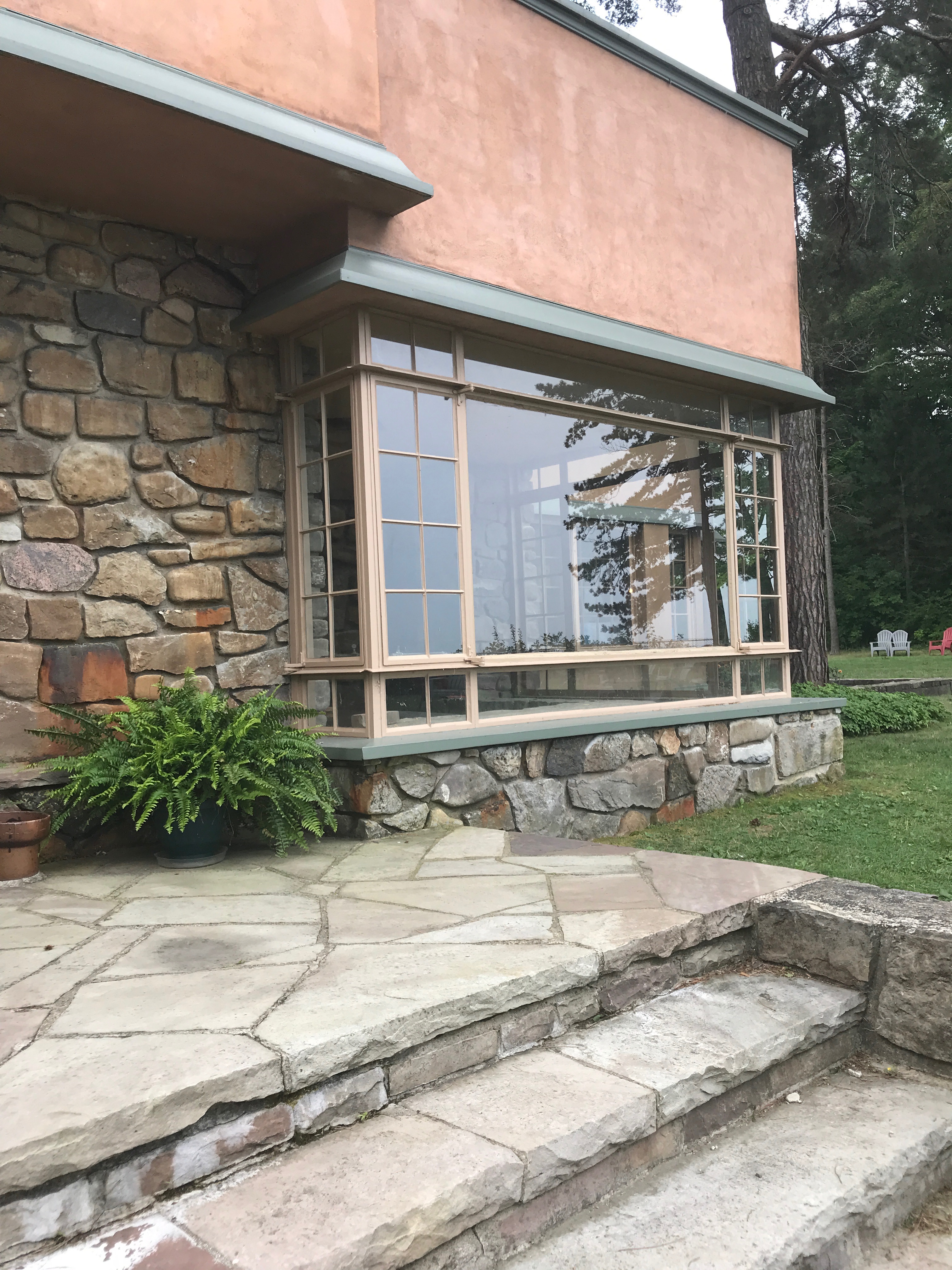
We returned to the house to continue our tour. This is a good view of the stone used in construction. According to my Preferred Source, it is constructed of stone found at the lake’s edge. The only note I managed to record from the docent was that the building was constructed of Tichenor Limestone. While researching this information, I found out that Tichenor Limestone is “richly fossiliferous.” If you would like to know more about what fossils are found in this rock, click on the link above. If I go back, I’m going to see if I can spot any of those fossils.
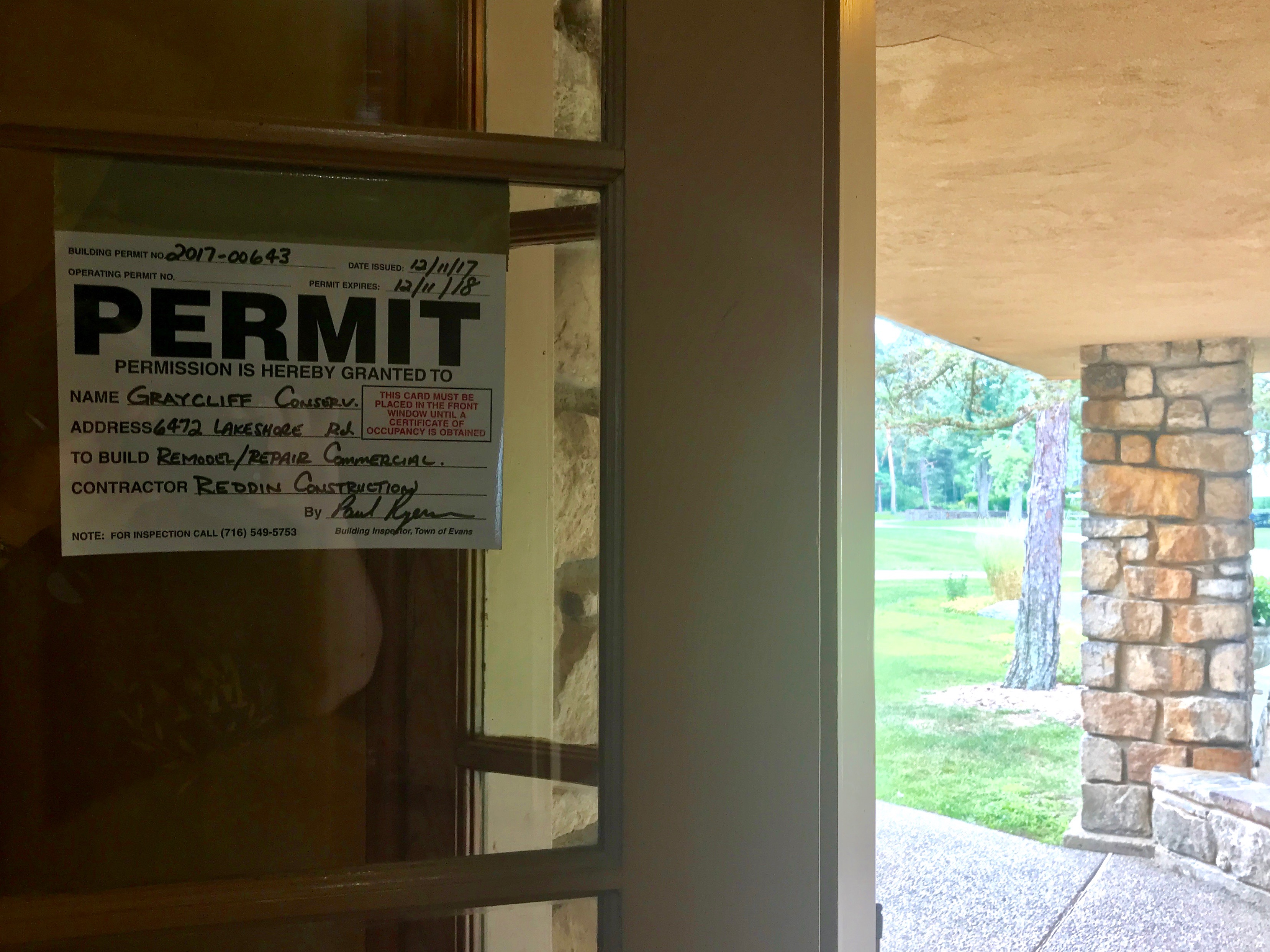
Apparently, there is still work going on.

We took those stairs up to the second floor.
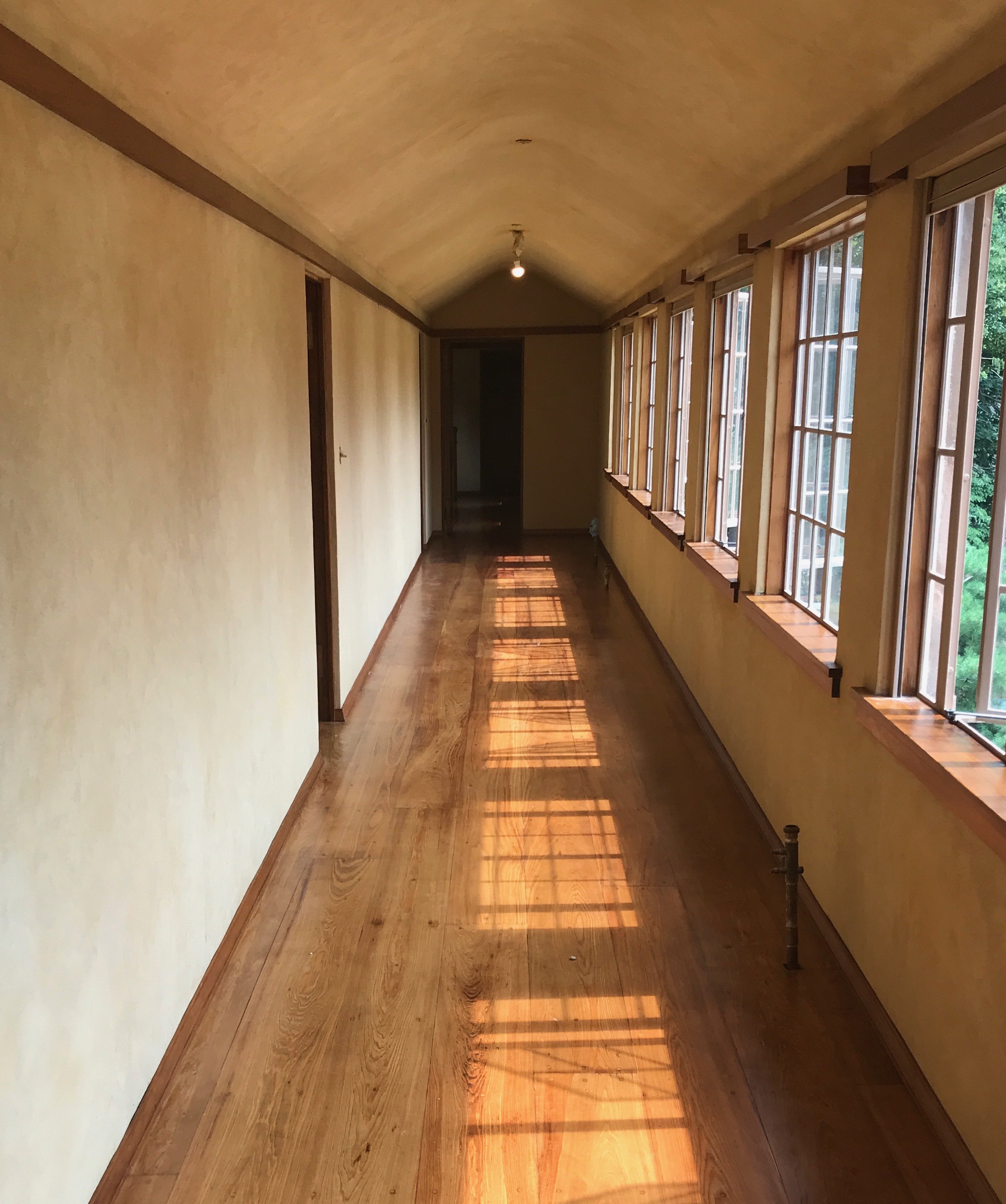
A hallway ran along the east side of the building. The lake was on the west side, and they wanted to save that side for the views. Judging by the pipe coming up from the floor, they probably had a radiators there to heat the hallway. That is just my guess.
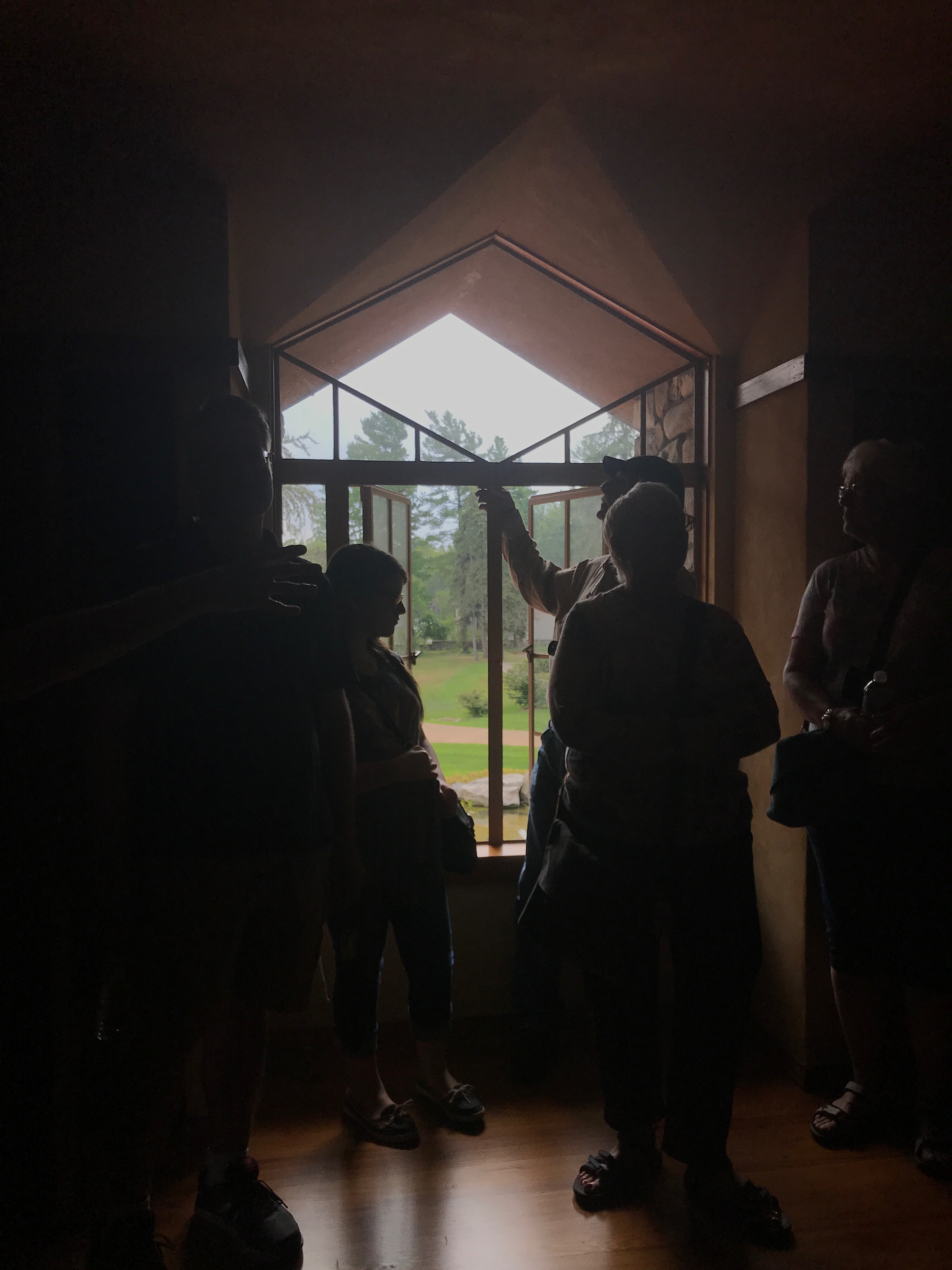
The docent demonstrated the diamond windows.
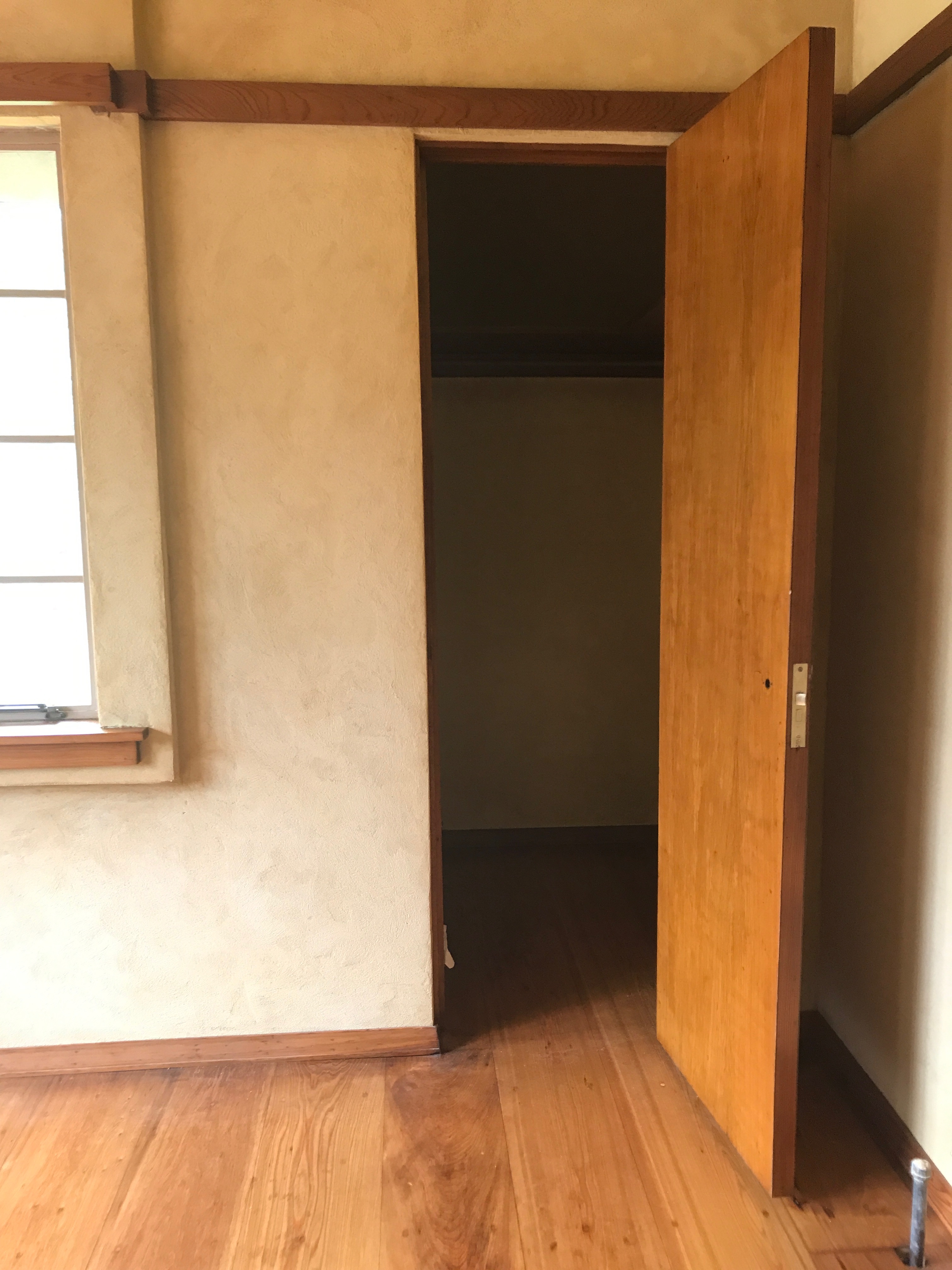
The door was rather interesting. Although the house was designed in 1926, the door reminds me very much of the “mid-century modern” vibe.

Look at how wide the floor planks are! And, there is that pipe coming up through the floor again. It must be for a radiator.
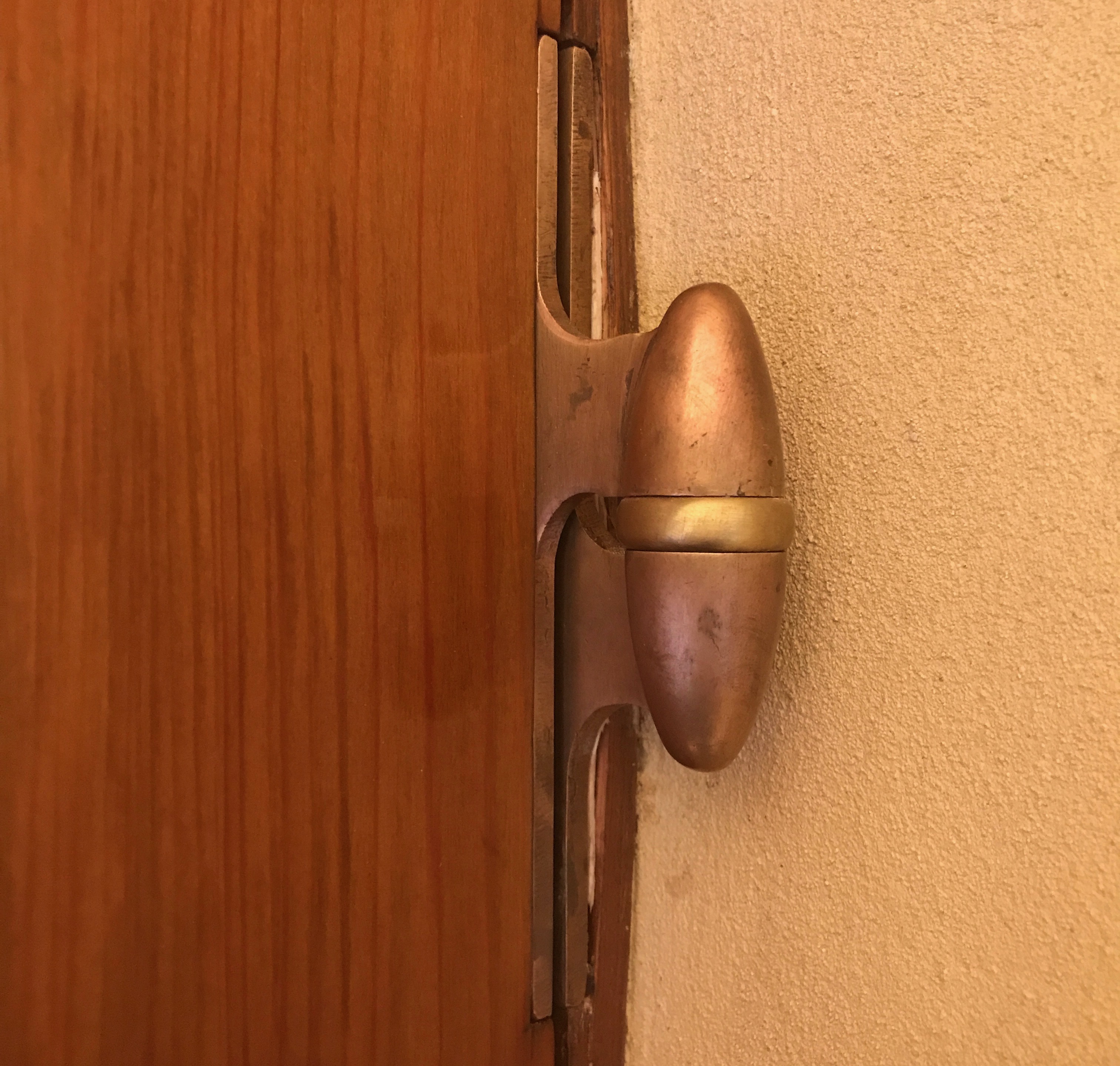
While the door looks a little mid-century modern, the hinge just screams “art deco.”
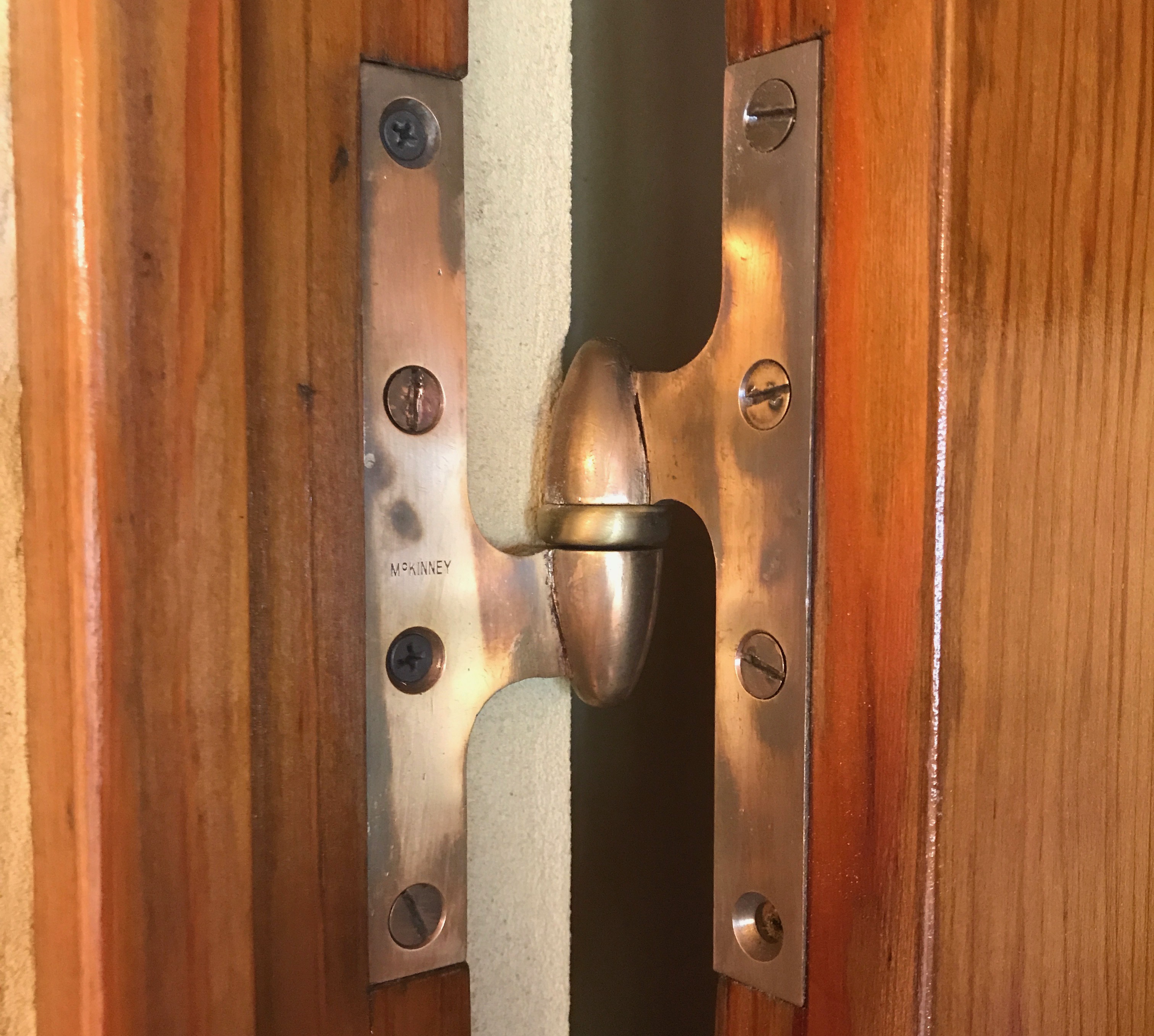
They don’t make hinges like that anymore! (At least not in my price range, they don’t!)
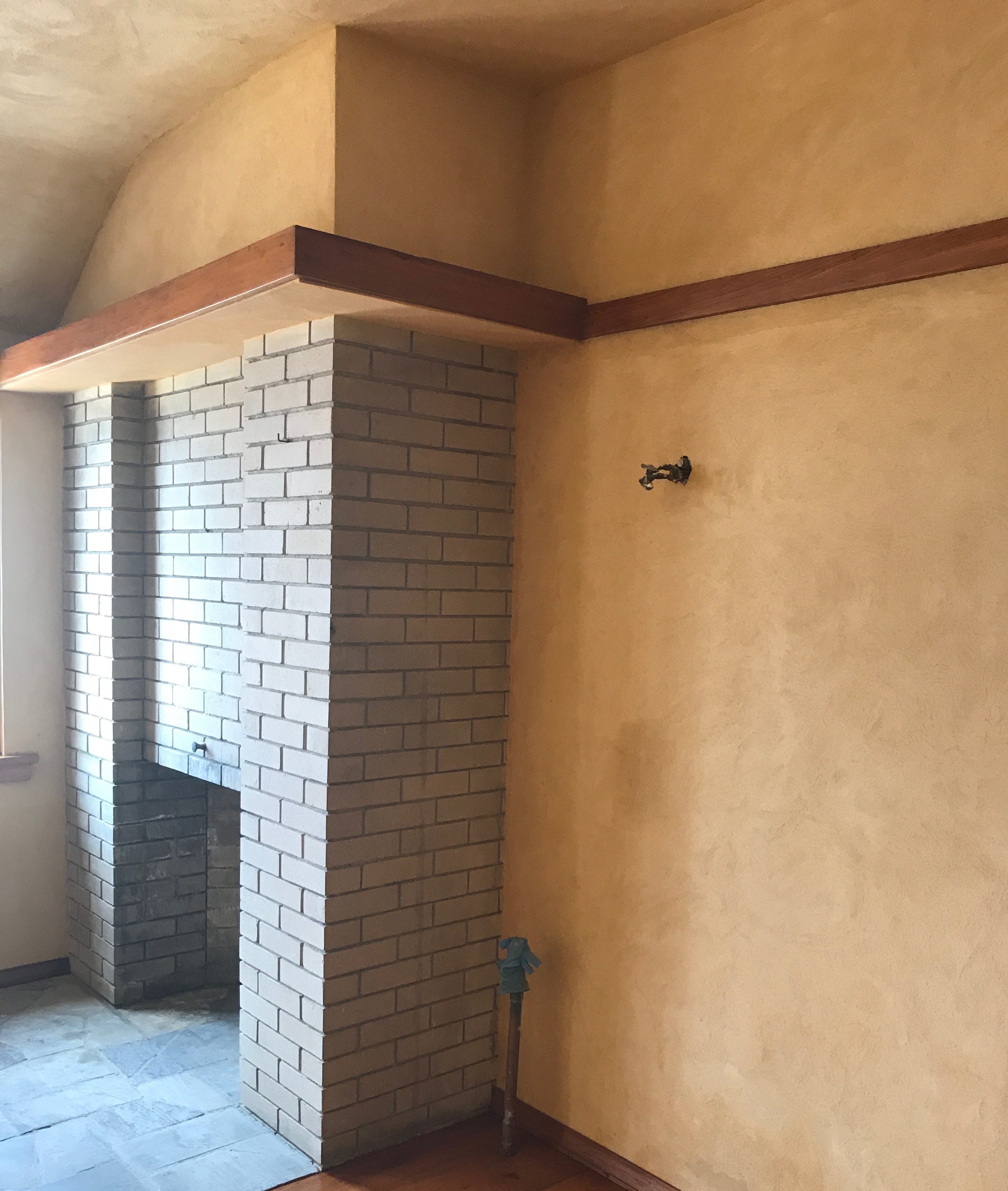
This is a fireplace from a bedroom. There is that pipe coming up through the floor again.
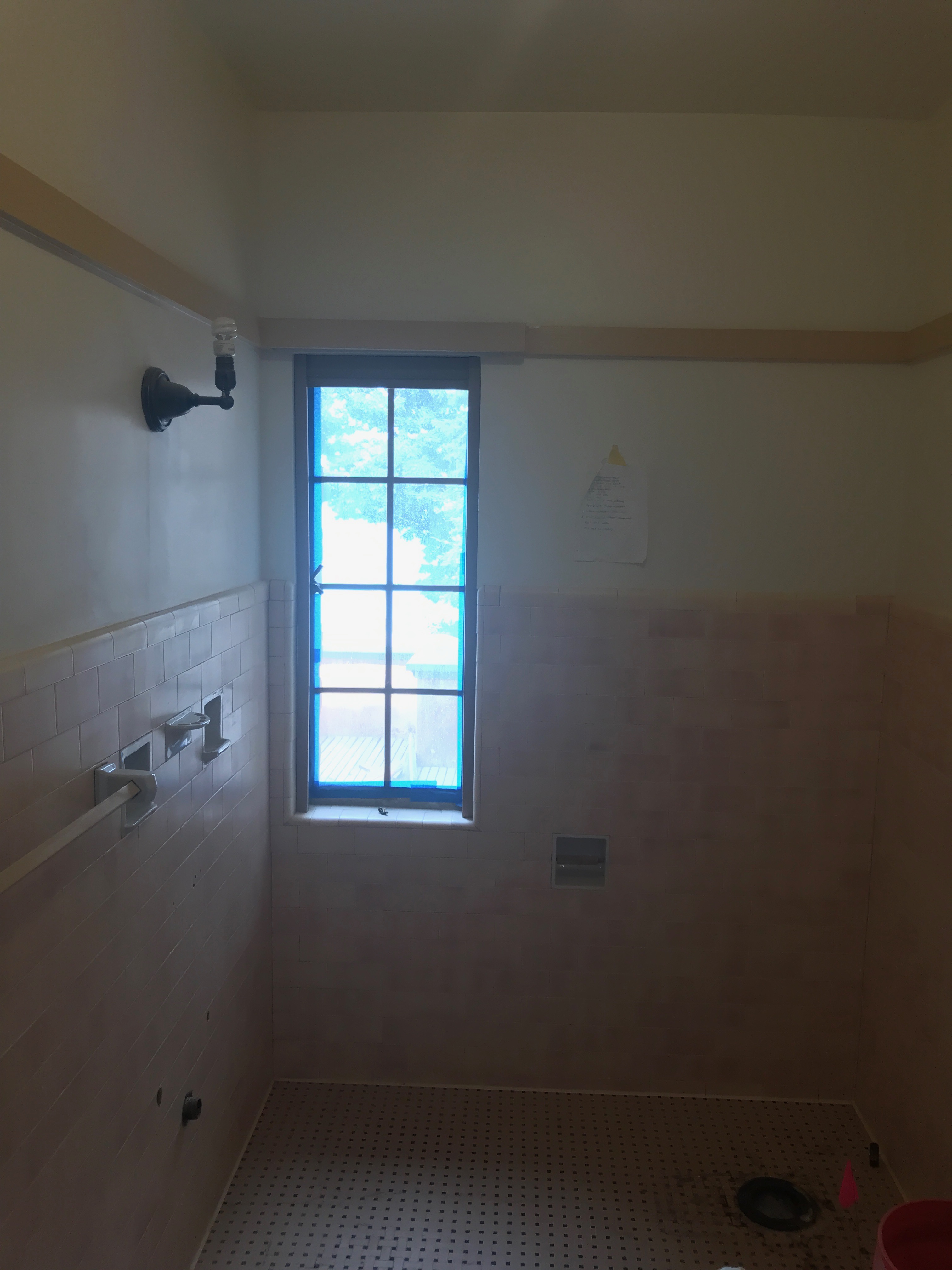
This is a shot of one of the bathrooms. I seem to recall some story about Mrs. Martin doing battle with Frank Lloyd Wright over the placement of the window. He didn’t want to put it in, but she insisted.
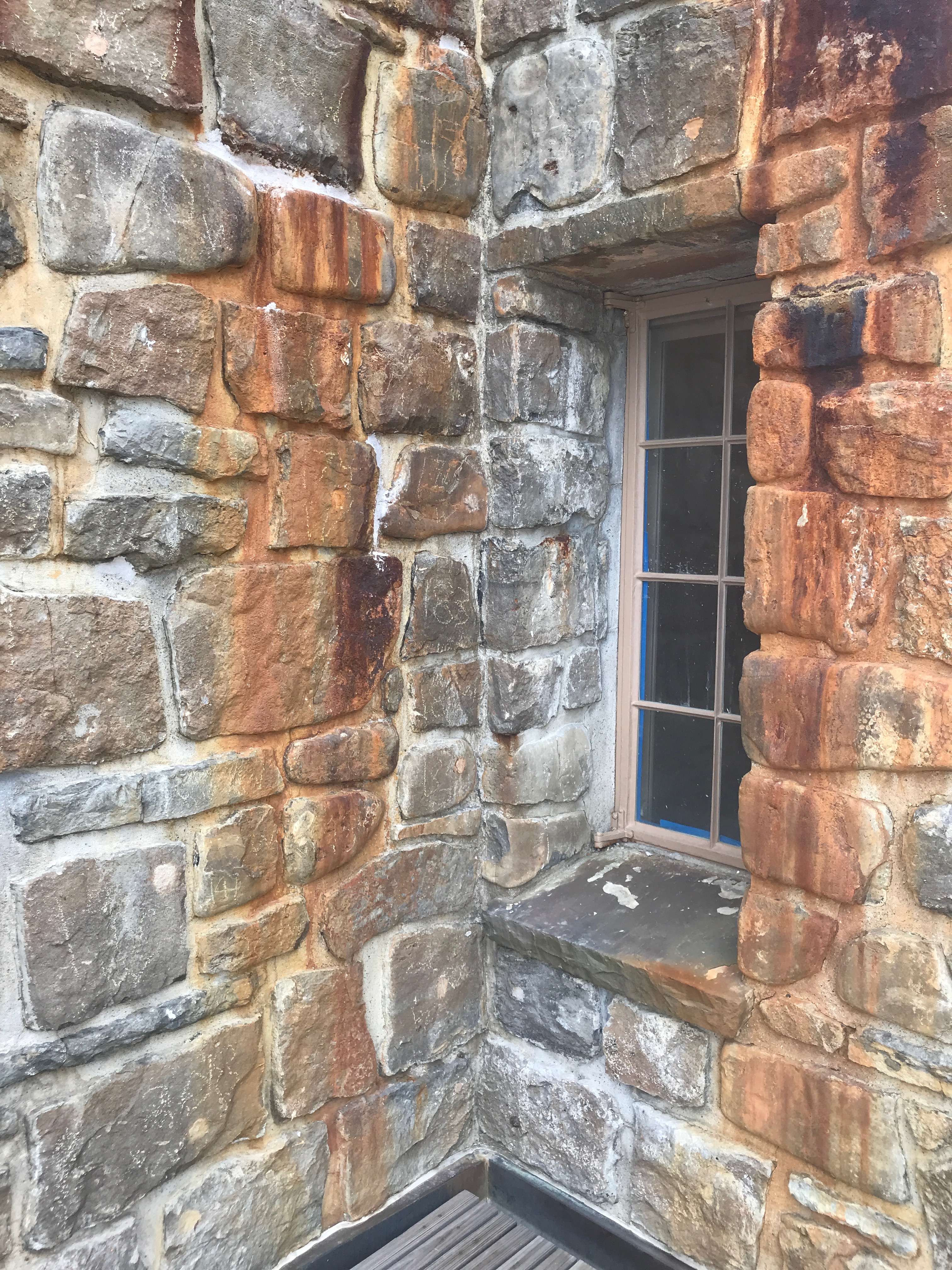
In the end, he relented, but he had to put it in through the stonework.

On the other hand, maybe I am conflating stories.
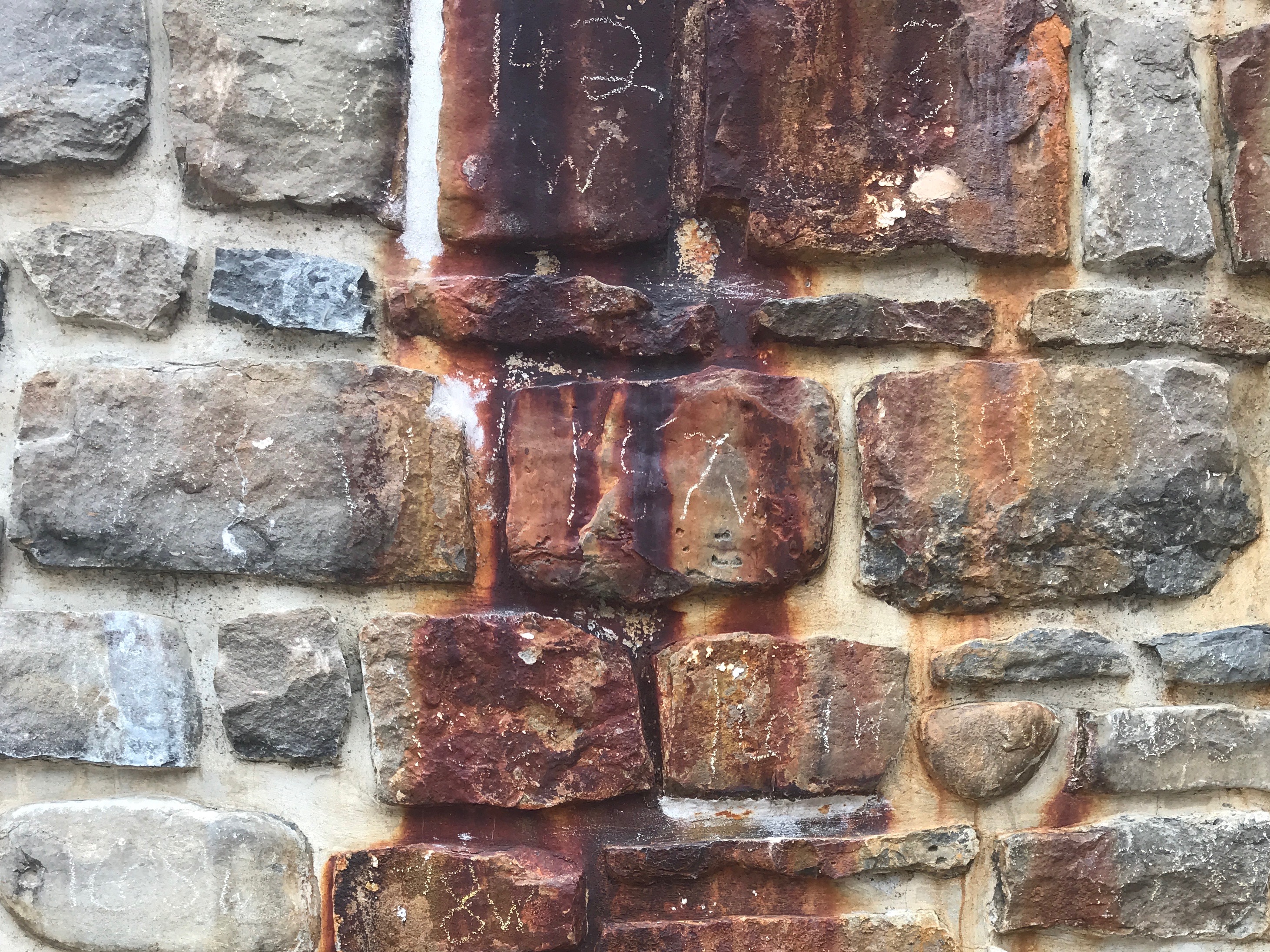
Ah, grafitti! Well, these folks are now part of the historical record. I wonder if any of these marks were made by the boys at the school run by the Piarist Fathers? Heck, the priests themselves might have done it!
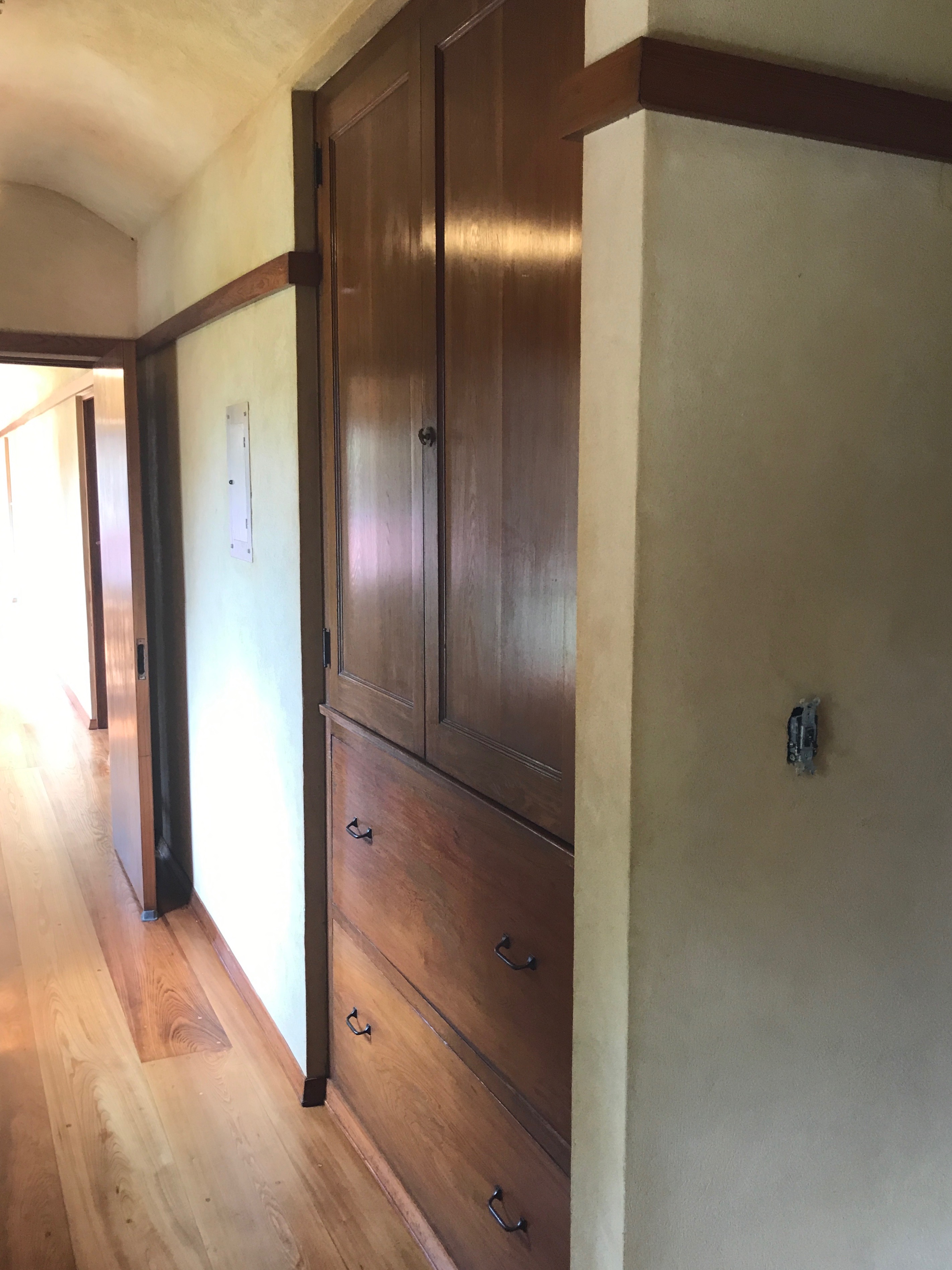
One of the things I’ve heard about Wright and his designs was that he was resistant to including closets and storage. I was glad to see that there was a linen closet built in.
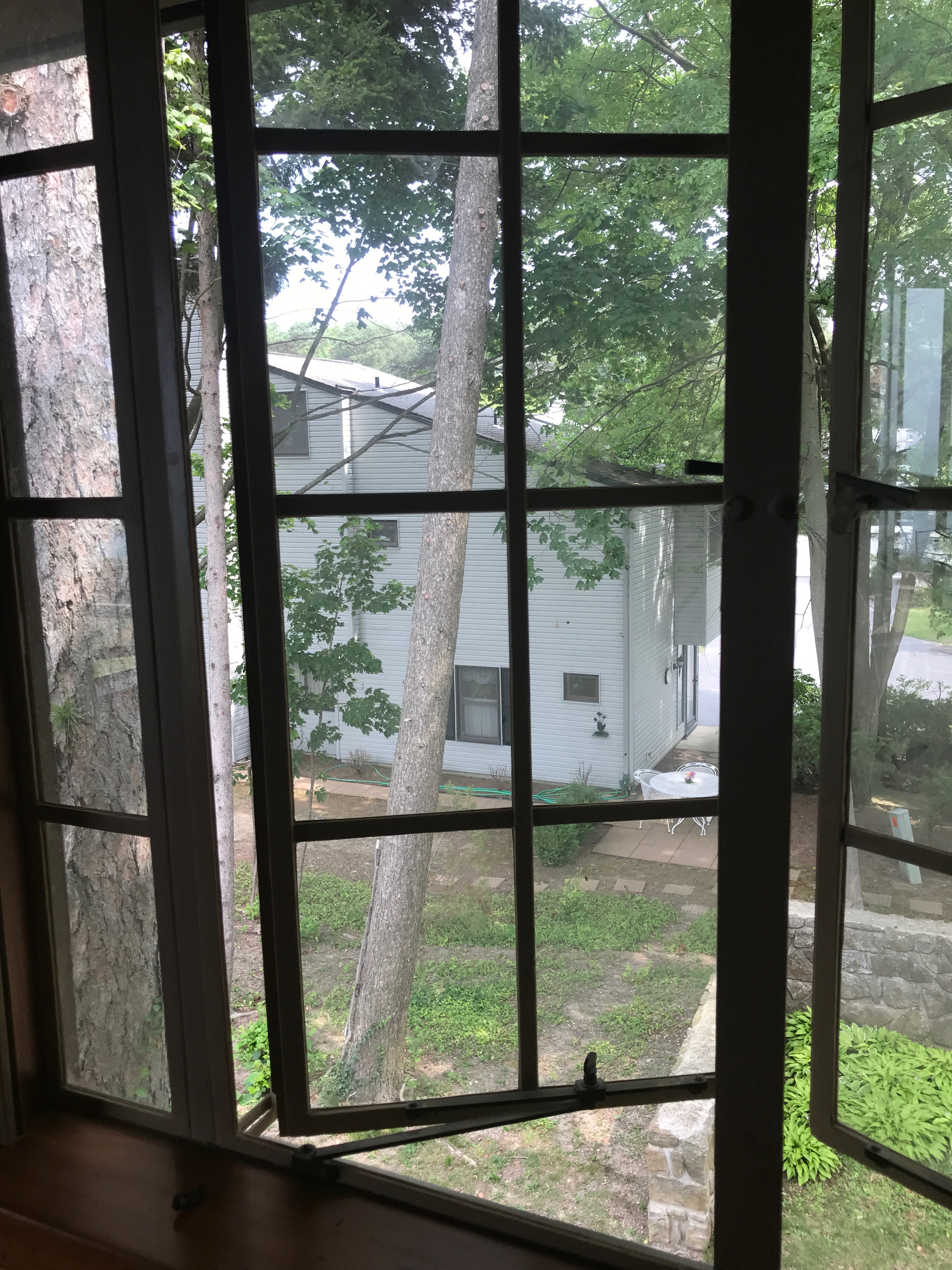
Although the original property was sited on an 8.5 acre estate, apparently tracts of land were sold off over the years. I am sure that Wright would not approve of the neighbors being so close to his design. While the land around the Martin House in Buffalo has been re-acquired and the original designs rebuilt, I can’t imagine that they will ever be able to re-acquire lakefront property. I would love to be proven wrong. According to my Preferred Source, Greycliff had one of the few, if not only, landscape designs in his own hand.
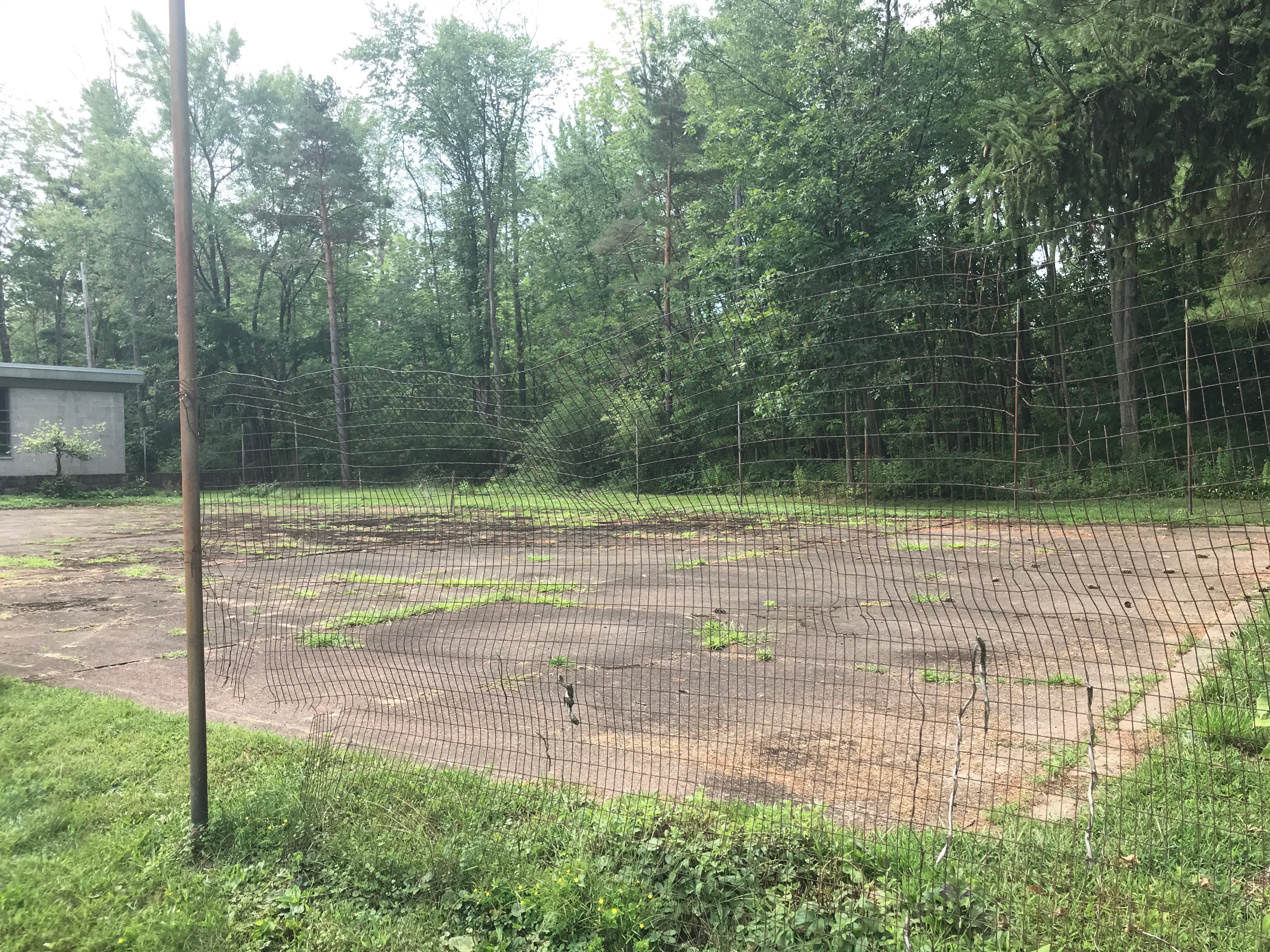
His design even included a tennis court.
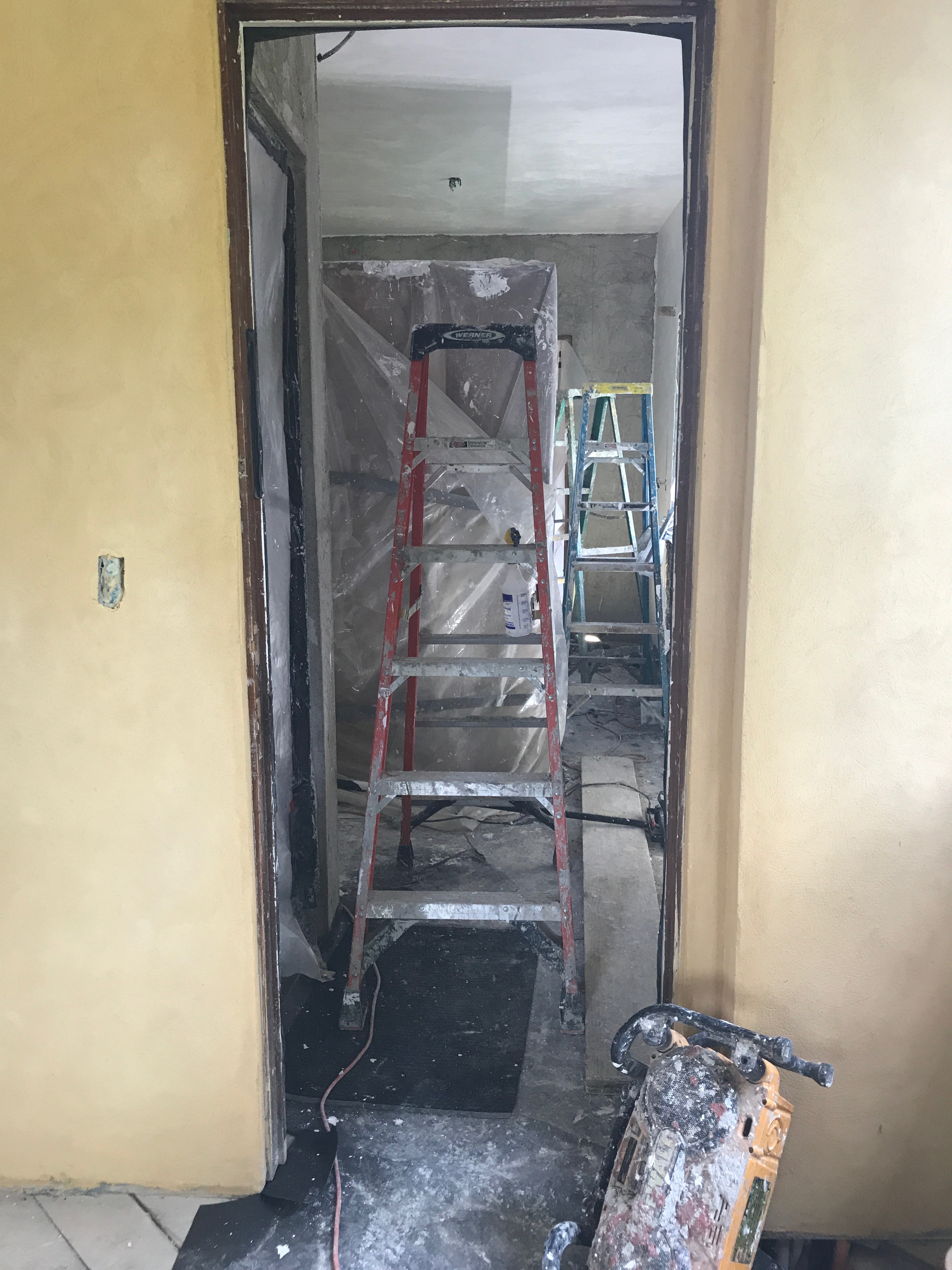
Apparently there is a need for the building permit. Work continues on the house.
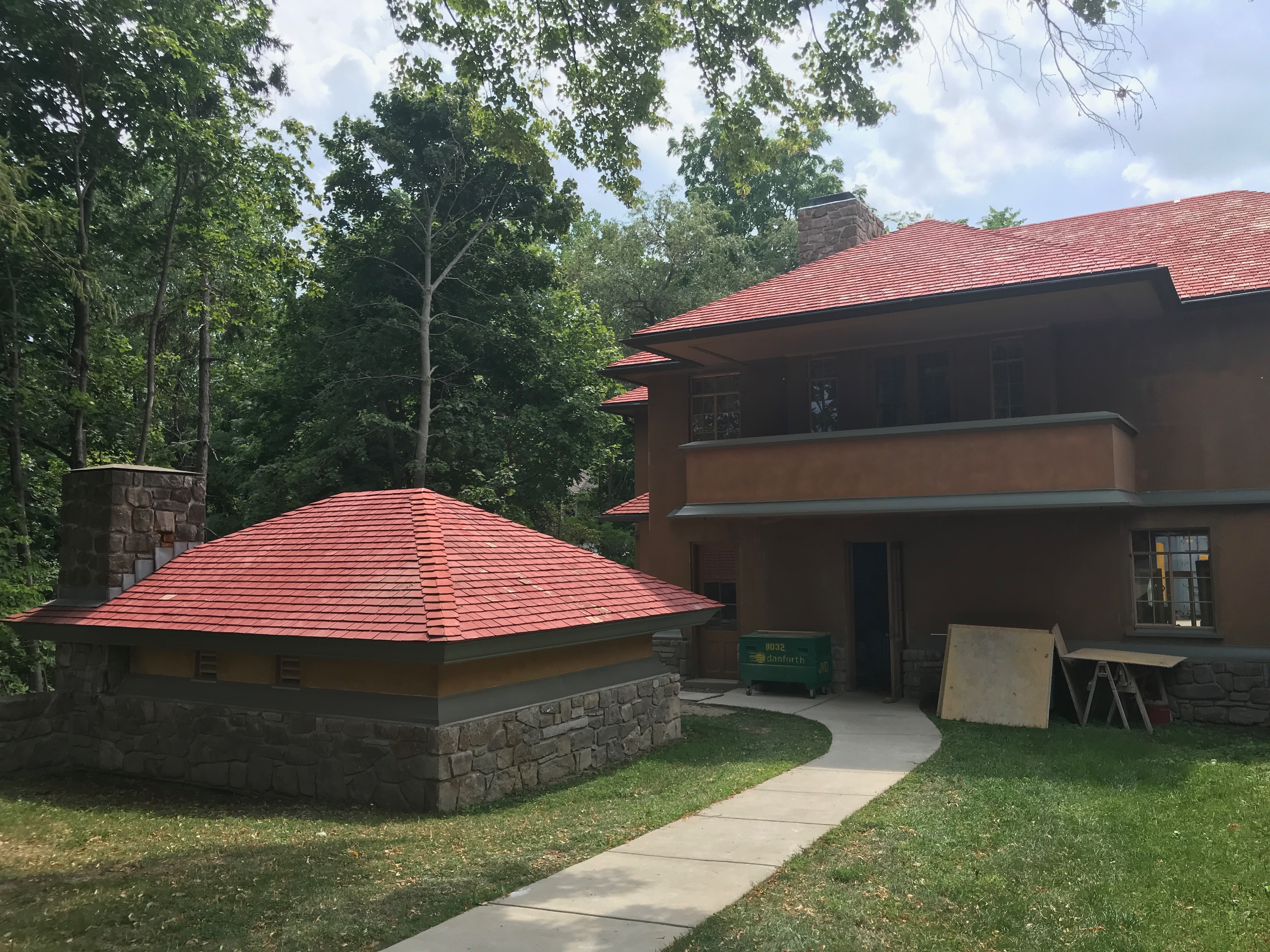
We left the Isabelle R. Martin House by the back door and headed back toward the visitor center. We passed the Heat Hut and walked around the Foster House.
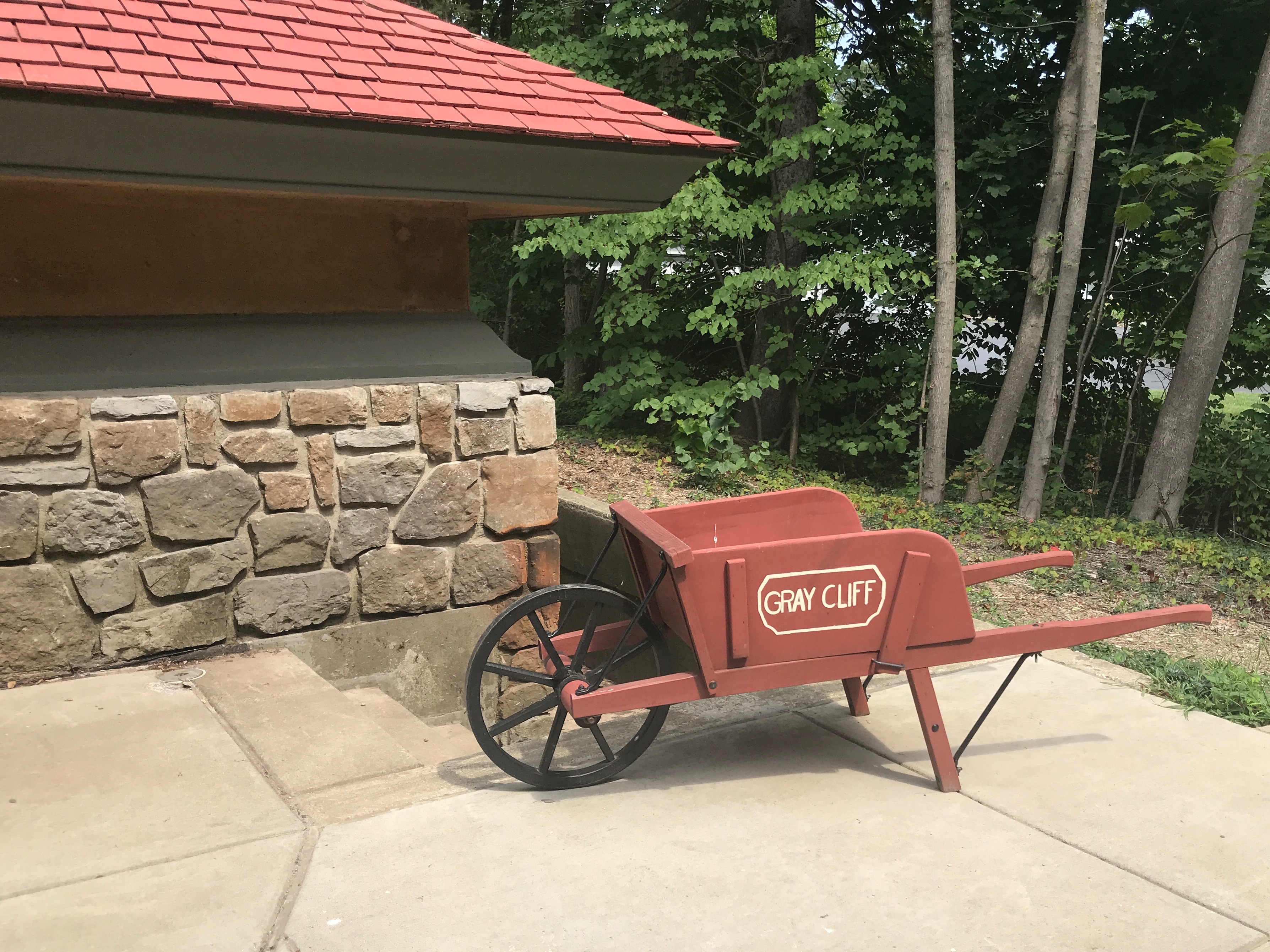
What a cute, decorative wheelbarrow!
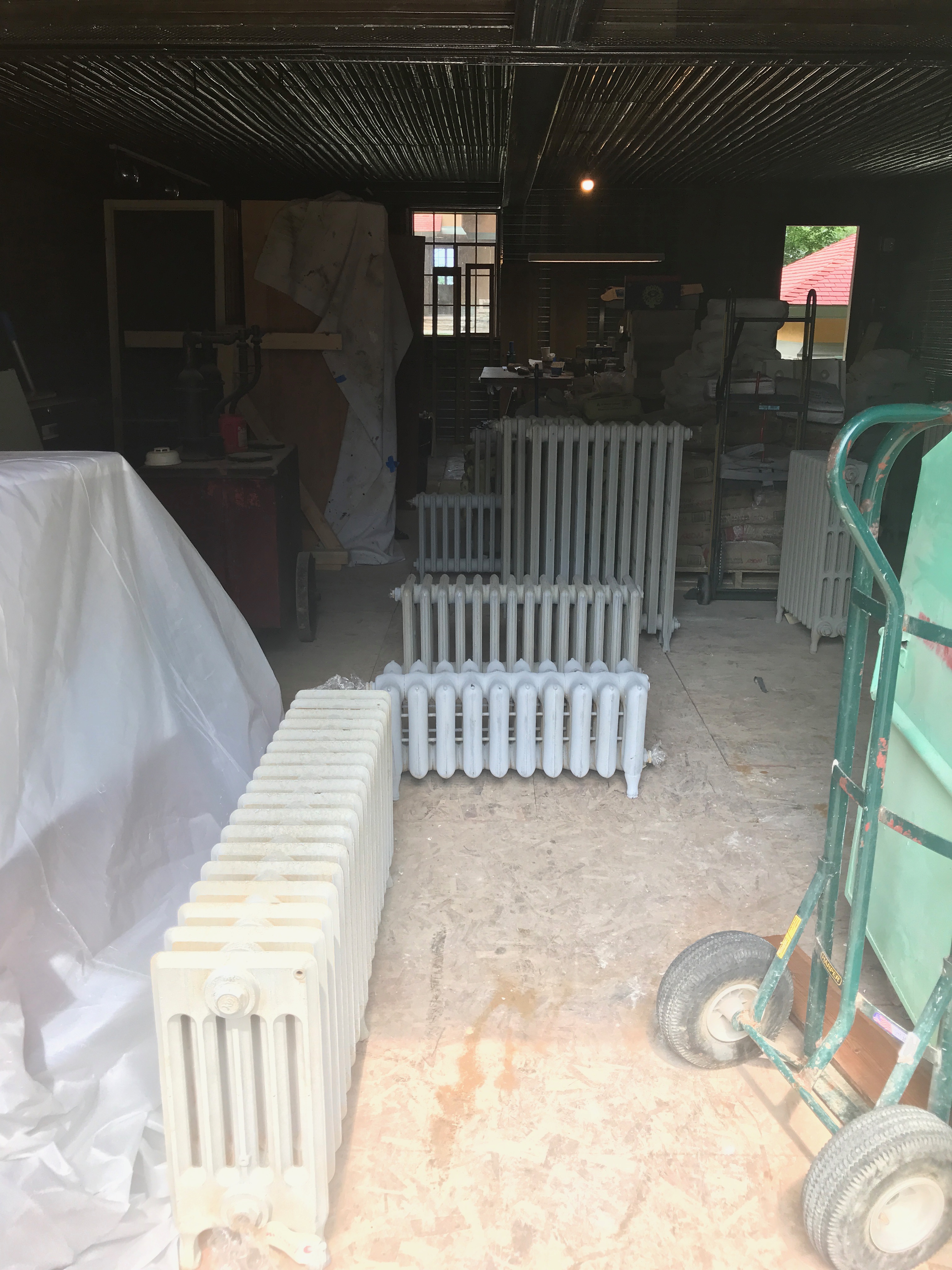
Ah! That’s where all the radiators are! I hope they got them in before the winter weather hit.
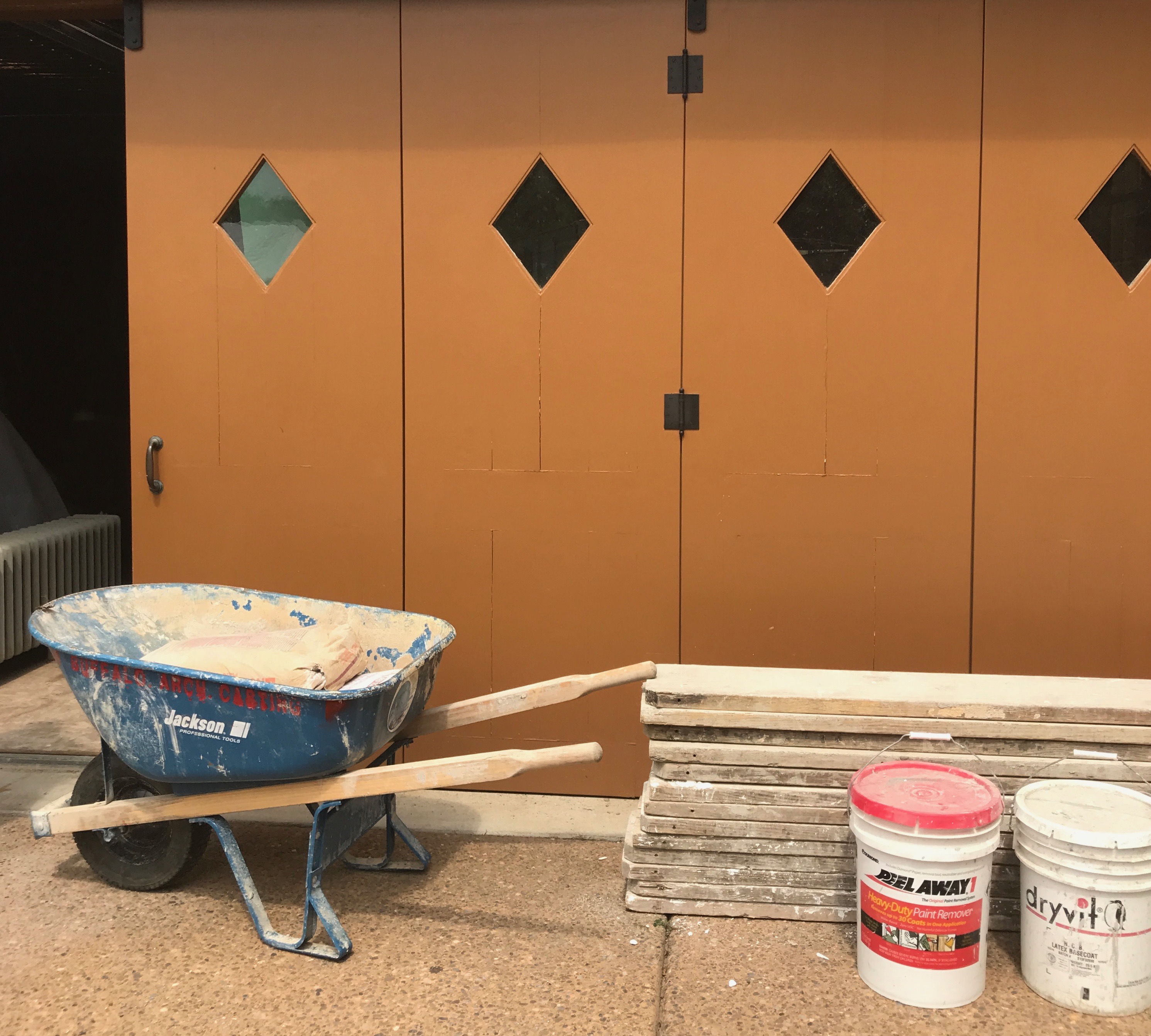
We passed the garage doors with the distinctive diamond shaped windows. Now, here’s a real working wheelbarrow, and it appears that there is real work continuing.
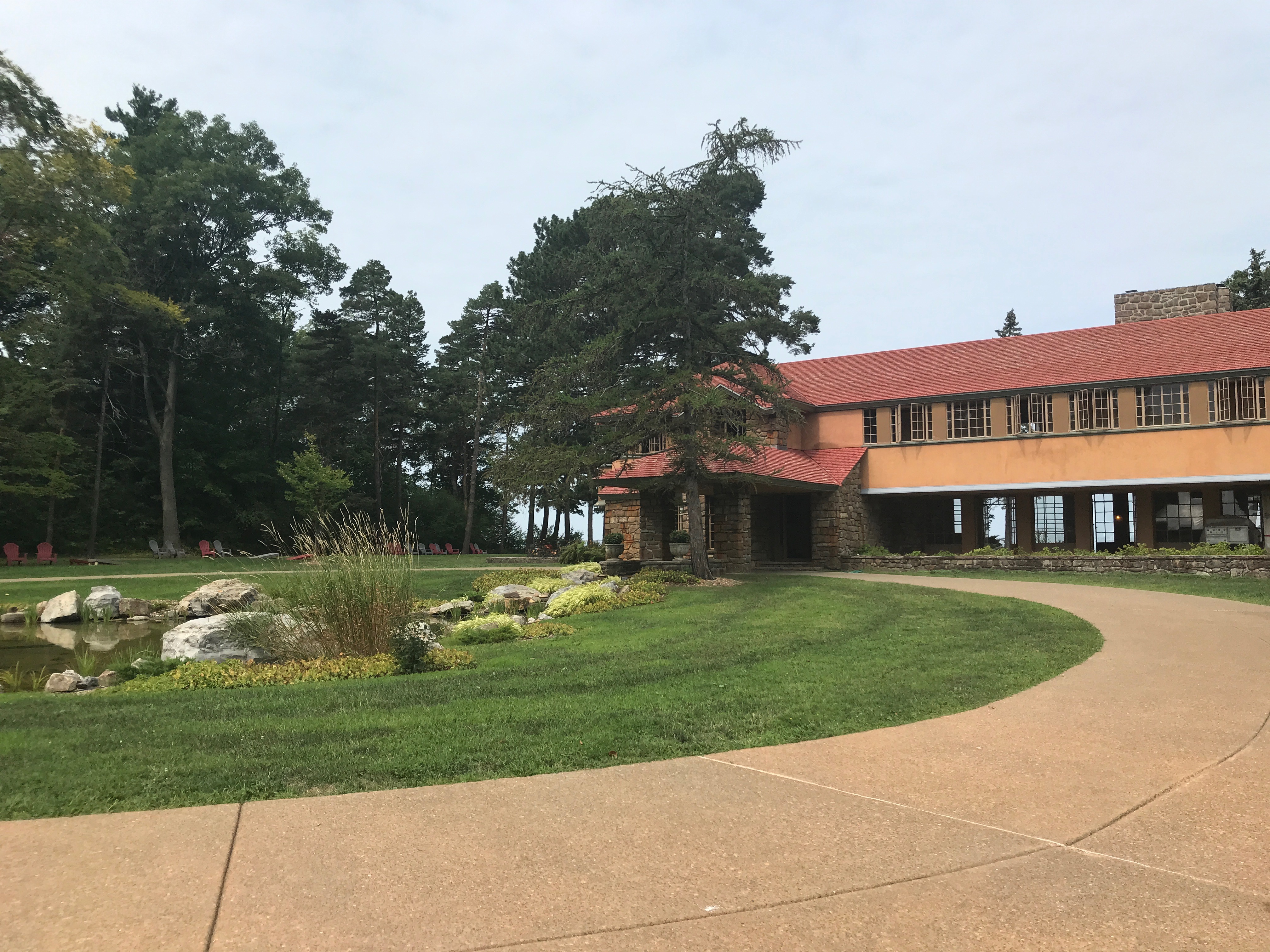
One more look back and then it was time to head out.

Once I was back in my car, I fired up Google Maps to map out the route to my next stop.
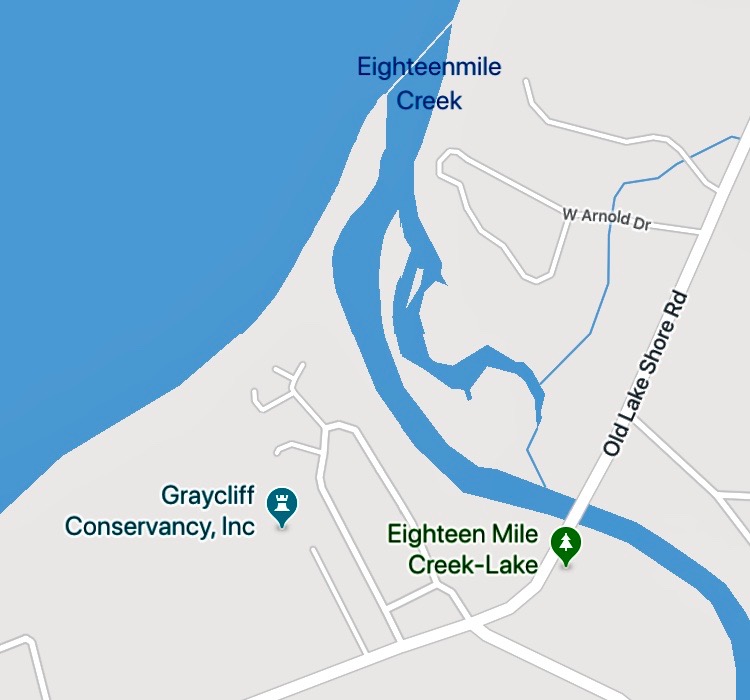
I saw a park on I had never seen before just up the road. I wondered what it was, so I took small detour to check it out. It wasn’t much of a park, but there was access to Eighteen-Mile Creek.
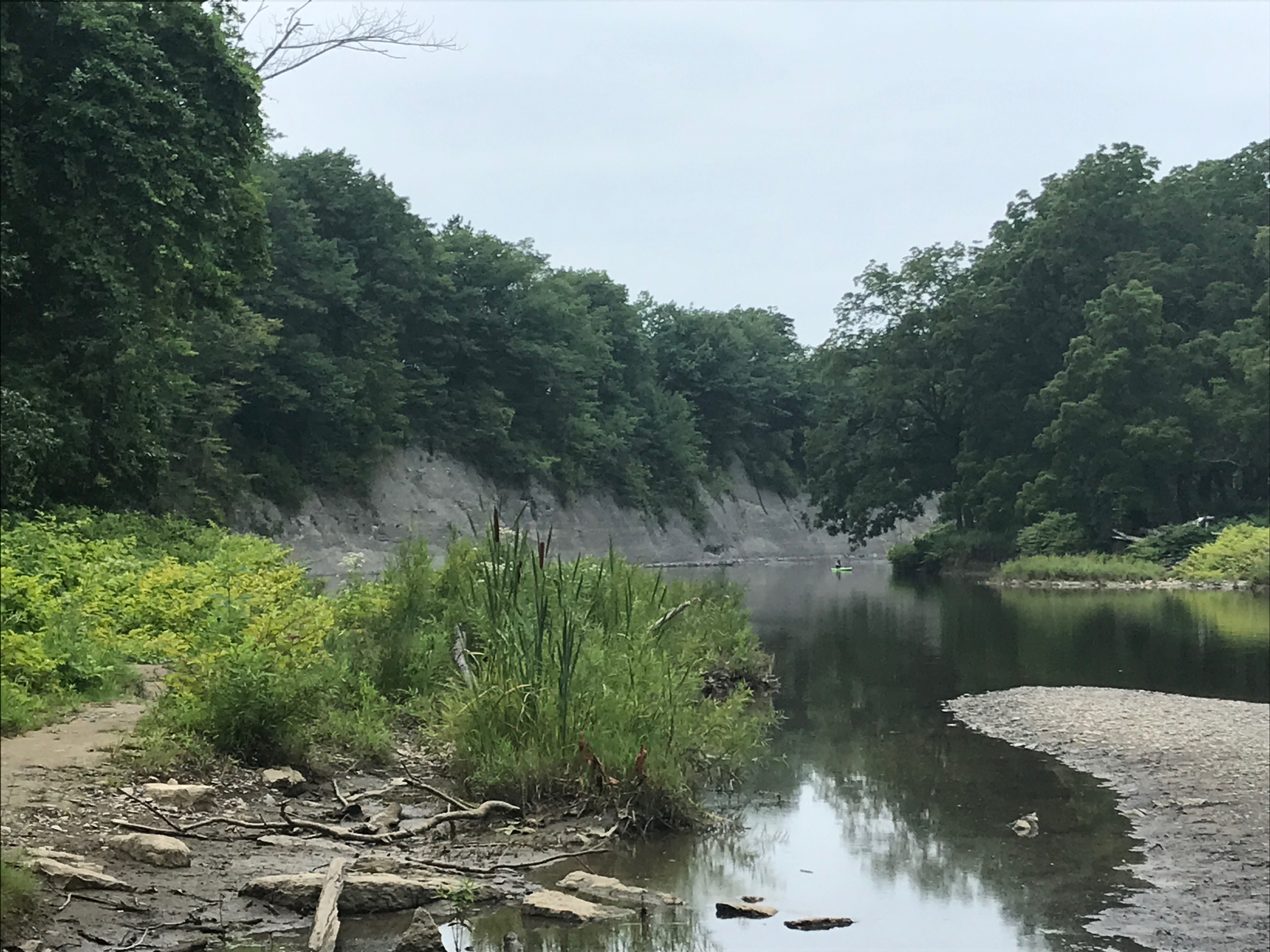
And I got a good view of the real grey cliffs! One of those layers must be Tichenor Limestone.
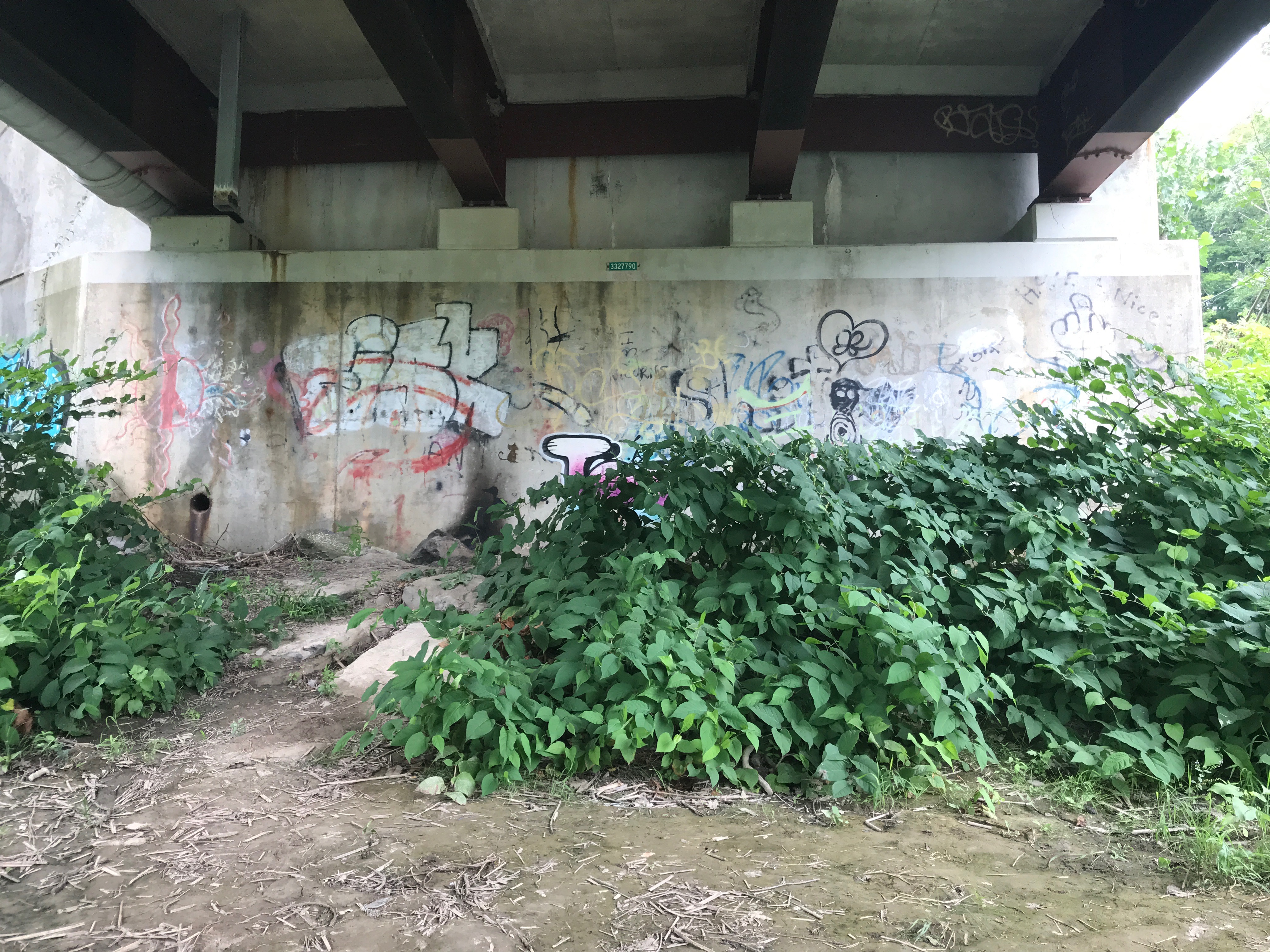
The park seemed like a place for people to hang out and make their mark, although kayakers might have been able to launch here. In the first photo, you can see a kayak going around the bend.
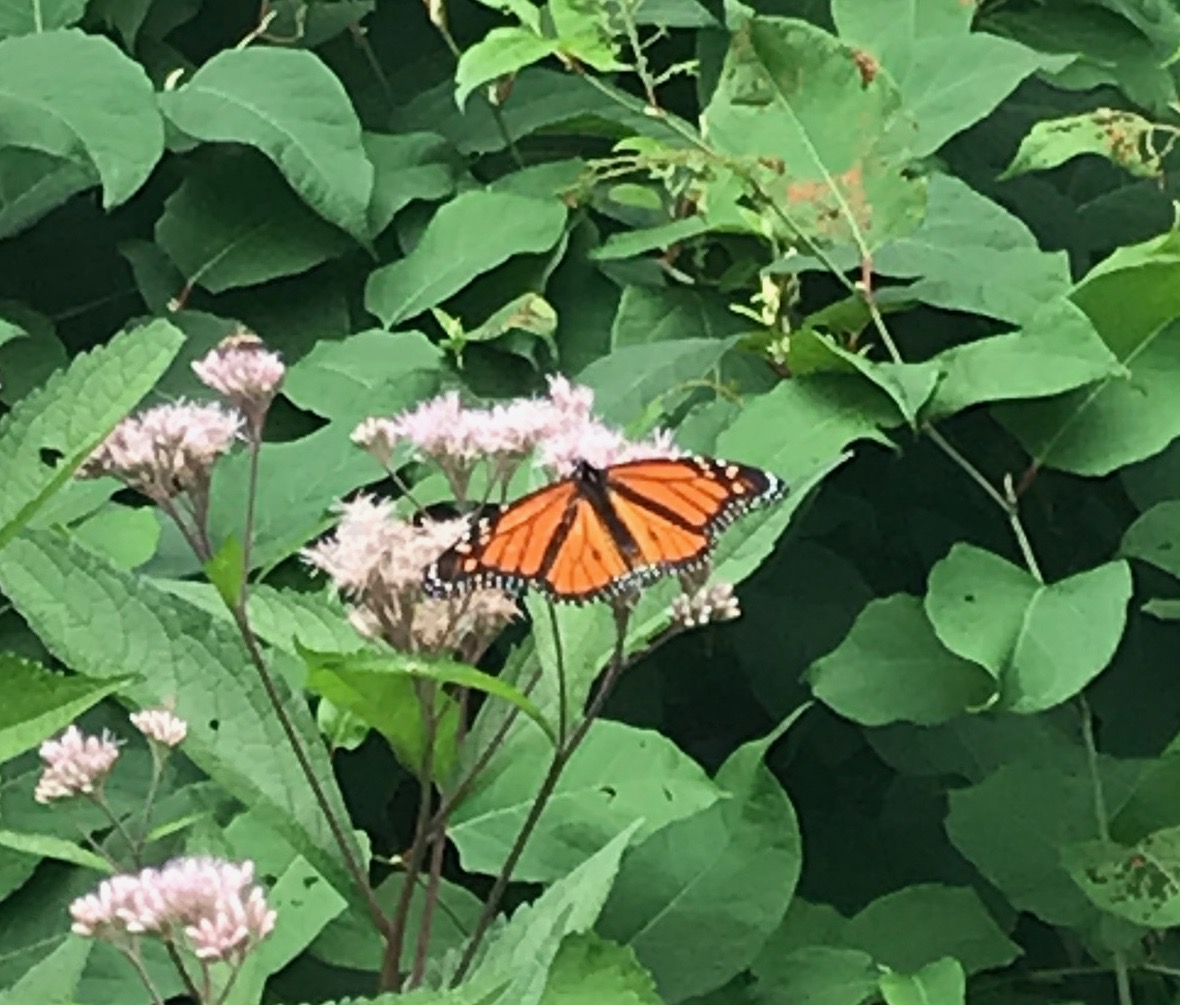
It was a peaceful place. I spent some time enjoying the plants and butterflies and then set off for wherever it was I was planning on going.



What is Open on Easter Sunday?

Nothing.

Nothing is open on Easter Sunday.

I should have tried to find a church. At this point, I don’t remember why I didn’t go to church or if I looked or what. (Remember that I am writing this report about a year after the fact.) In any event, I set out to see what I could see. I do take my touristic duties seriously, even if I did neglect my Easter obligations.

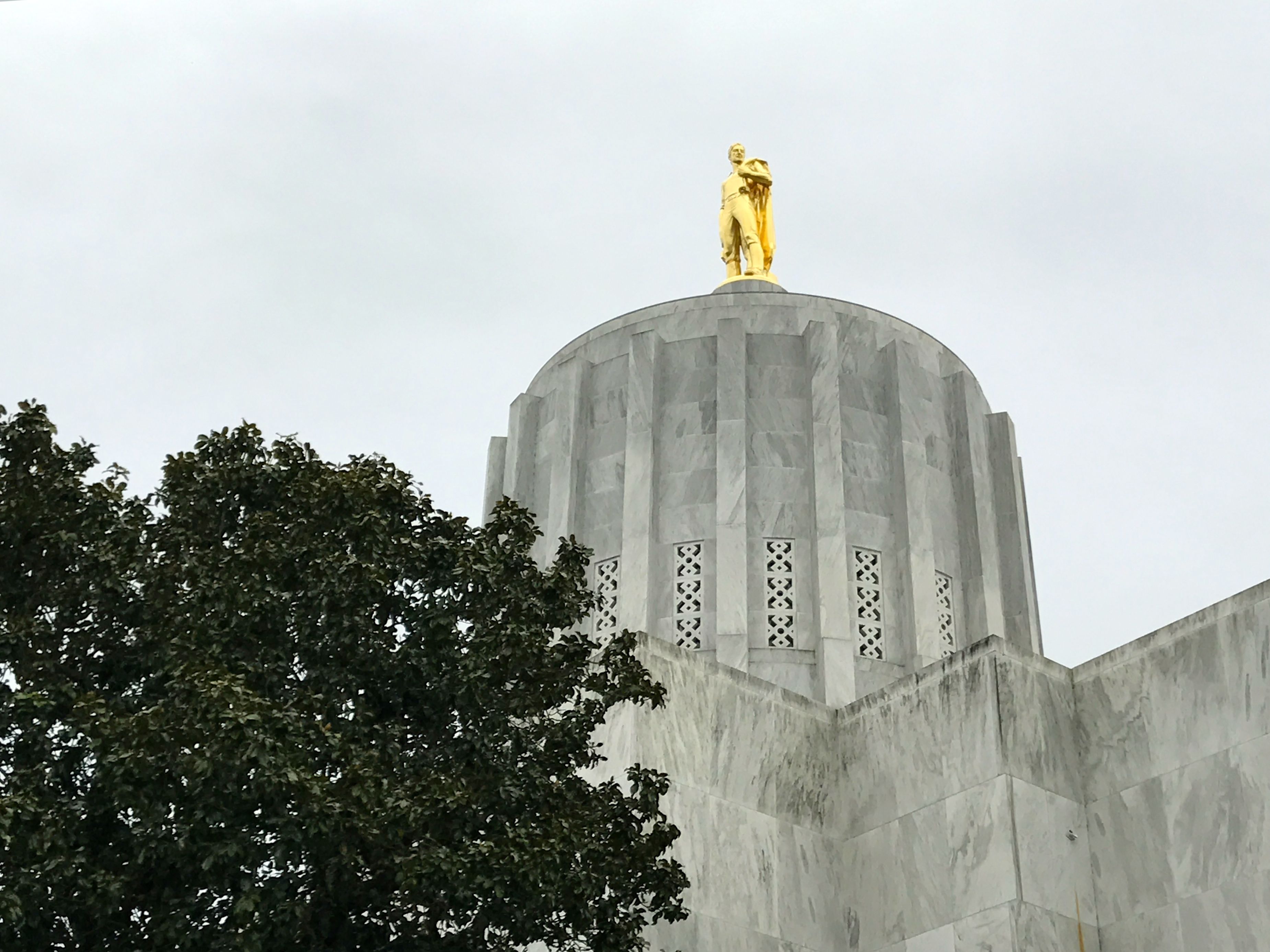
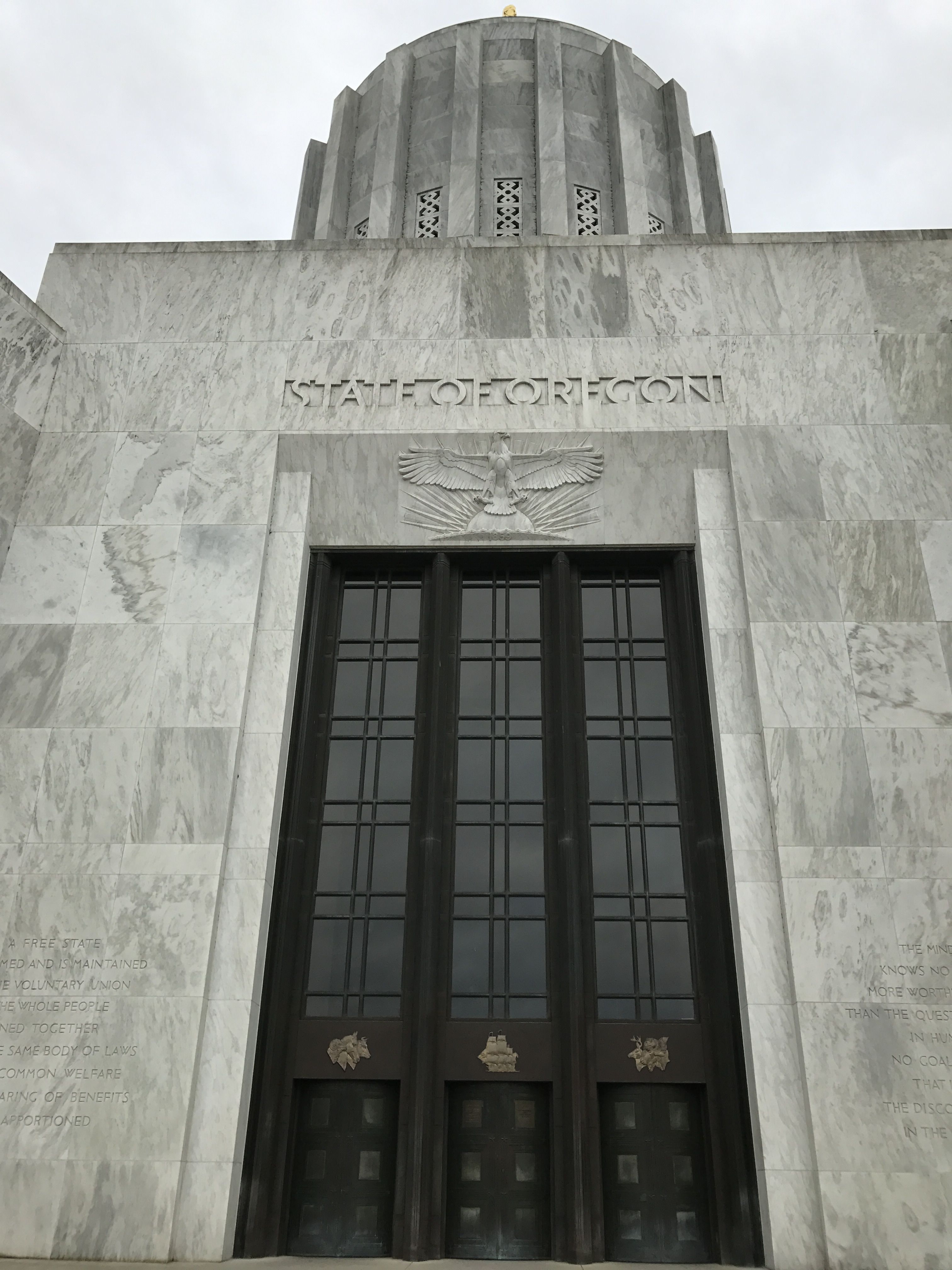
I decided to head over to Salem to see the state capital building.
It has one of the most original domes I’ve ever seen on a state capital – or any building, for that matter.

This is the third state capital building in Salem. The first capital of the Oregon Territory was in Oregon City but moved to Salem in 1850. There was some dispute about there is should be. Corvallis was the next capital, but people objected to that because construction in Salem had already begun. Governor George Curry sent the matter to the Secretary of the Treasury in Washington in 1855. Secretary James Guthrie declared the move invalid unless acted upon by the United States Congress.

So, the legislature convened in Corvallis in December 1855, just long enough to pass a bill that moved the capital back to Salem. The bill passed on December 15. Three days later, the legislature re-convened in Salem. Two weeks later, the statehouse burned down.

The legislature re-opened debate about where the capital should be. They held a vote, but voting irregularities and low voter turnout lead to them ignore the results, which would have moved the capital to Eugene. They tried again in 1860 and in 1862, but no city received the 50 percent minimum required by law. In 1864, Salem received 79 percent and was declared the state capital. By this time, Oregon had been a state for five years.

And, yes, information for this post came from my preferred source. Check it out, if I’ve piqued your curiosity.

As I mentioned earlier, I made my visit on Easter Sunday. I don’t know if it is open on other Sundays, but it was definitely closed when I visited. However, there are always things to see.

The current capital building was completed in 1938. It was partially funded by the Public Works Administration, which was part of FDR’s New Deal of 1933.

As with any public project, there were complaints. One complaint was that the dome looked like a “paint can”. It was also called a “squirrel cage”. (It kind of reminds me of a nuclear reactor.)

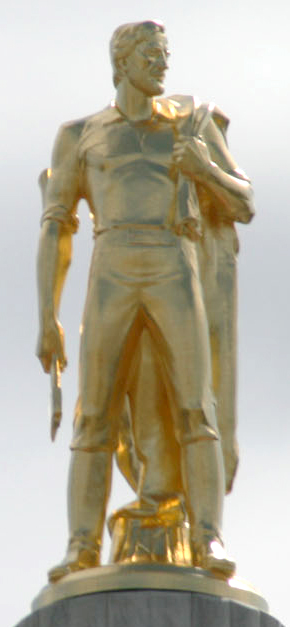
The pubic was also slow to warm up to the gold Oregon Pioneer statue atop the dome.

By Andrew Nealon + EncMstr – EncMstr reprocessed photo w:Image:At the top.jpg by cropping, and adjusting RGB curve for more detail of statue, CC BY-SA 3.0, https://commons.wikimedia.org/w/index.php?curid=1857964

I am proud of myself for finally getting on board with properly attributing sources when I borrow images. Thank goodness that Wikipedia makes it easy! I have been approached a few time by people who want to use photos I’ve taken for their projects, and it feels good to be acknowledged.

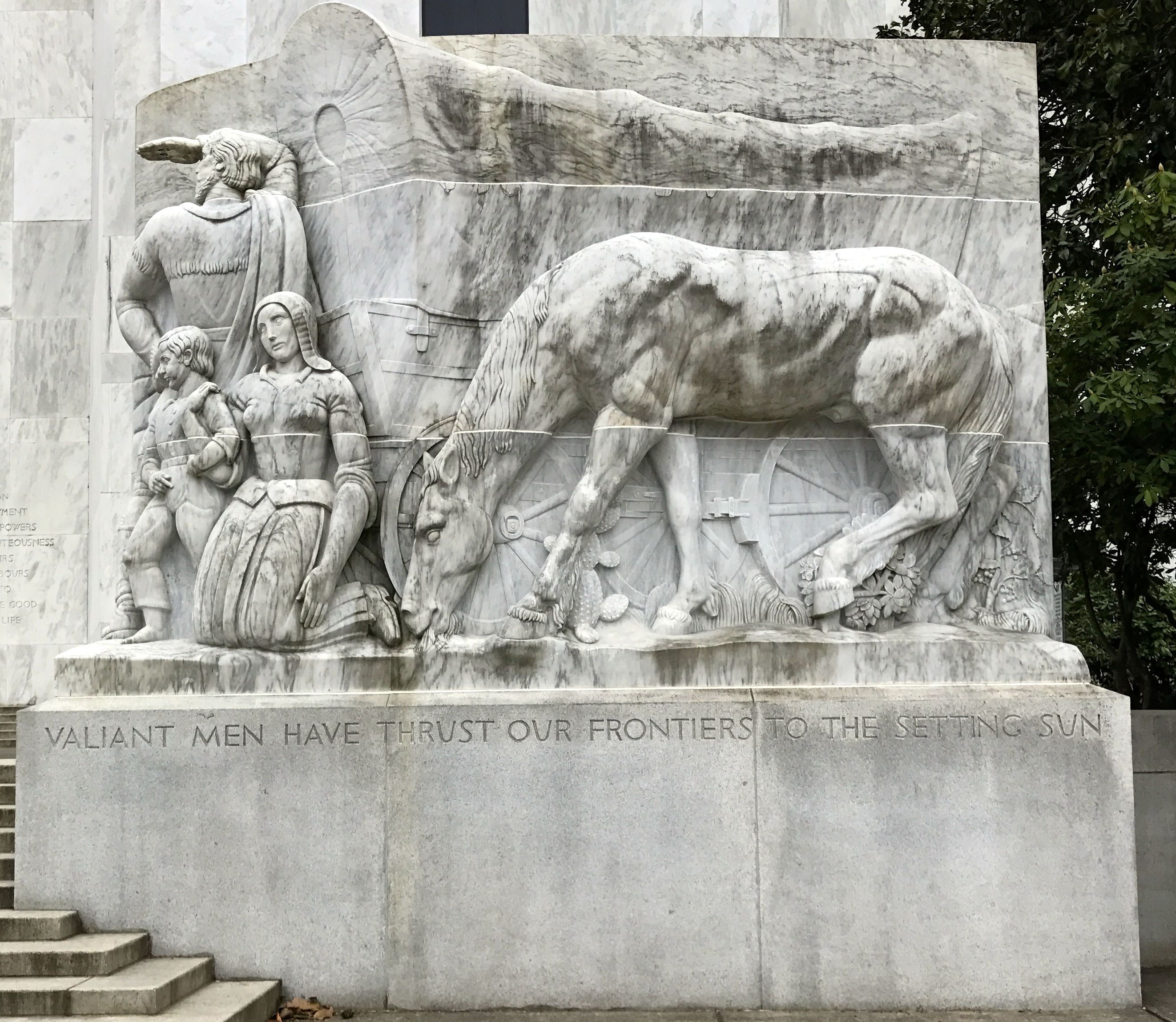
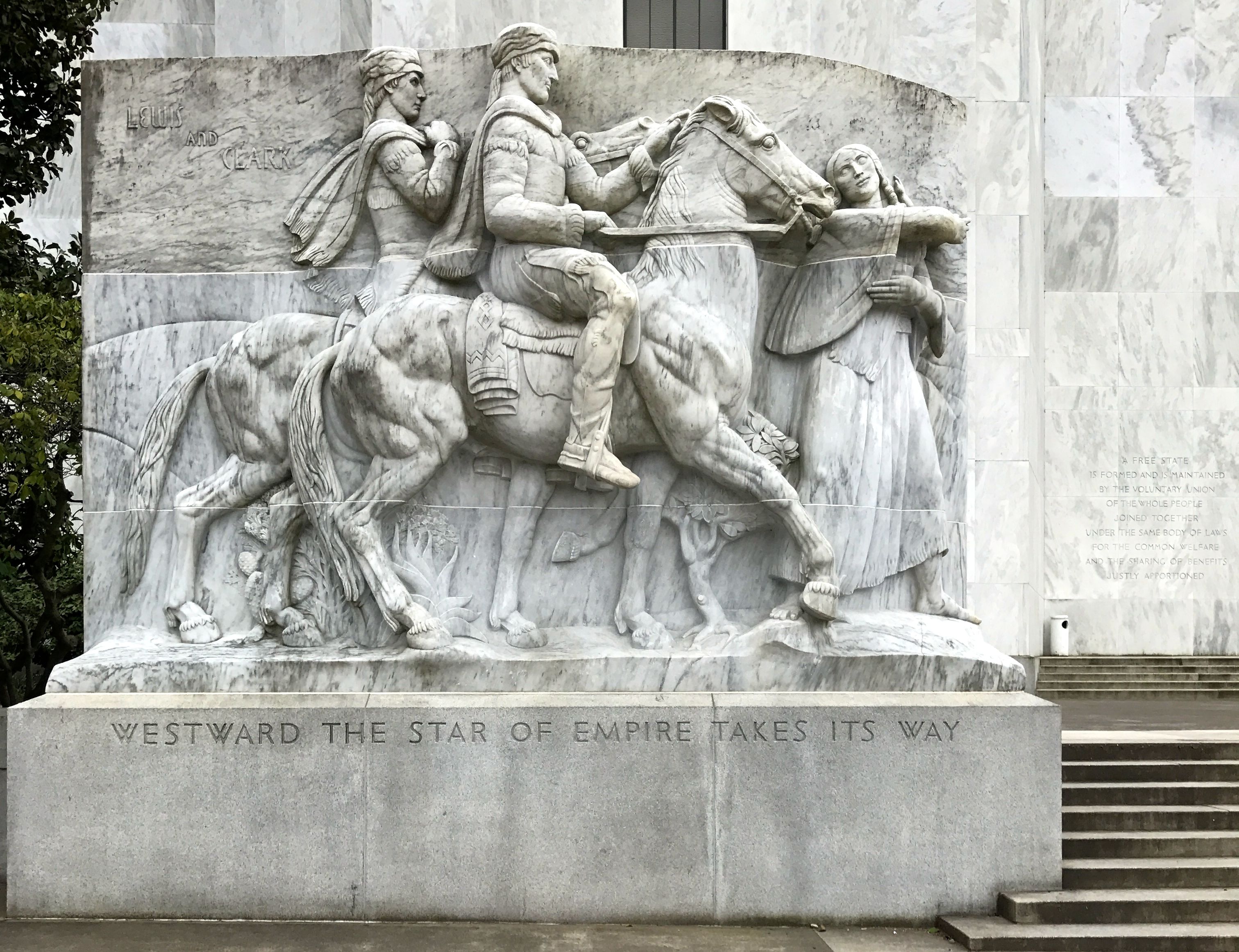
Sculptor Leo Friedlander created the large pieces on either side of the entrance. Ah, those valiant men! How about some mention of the valiant women who went west, too?

I mean, how about some mention of Sacajawea?

There were some bronze statues around the capital as well.

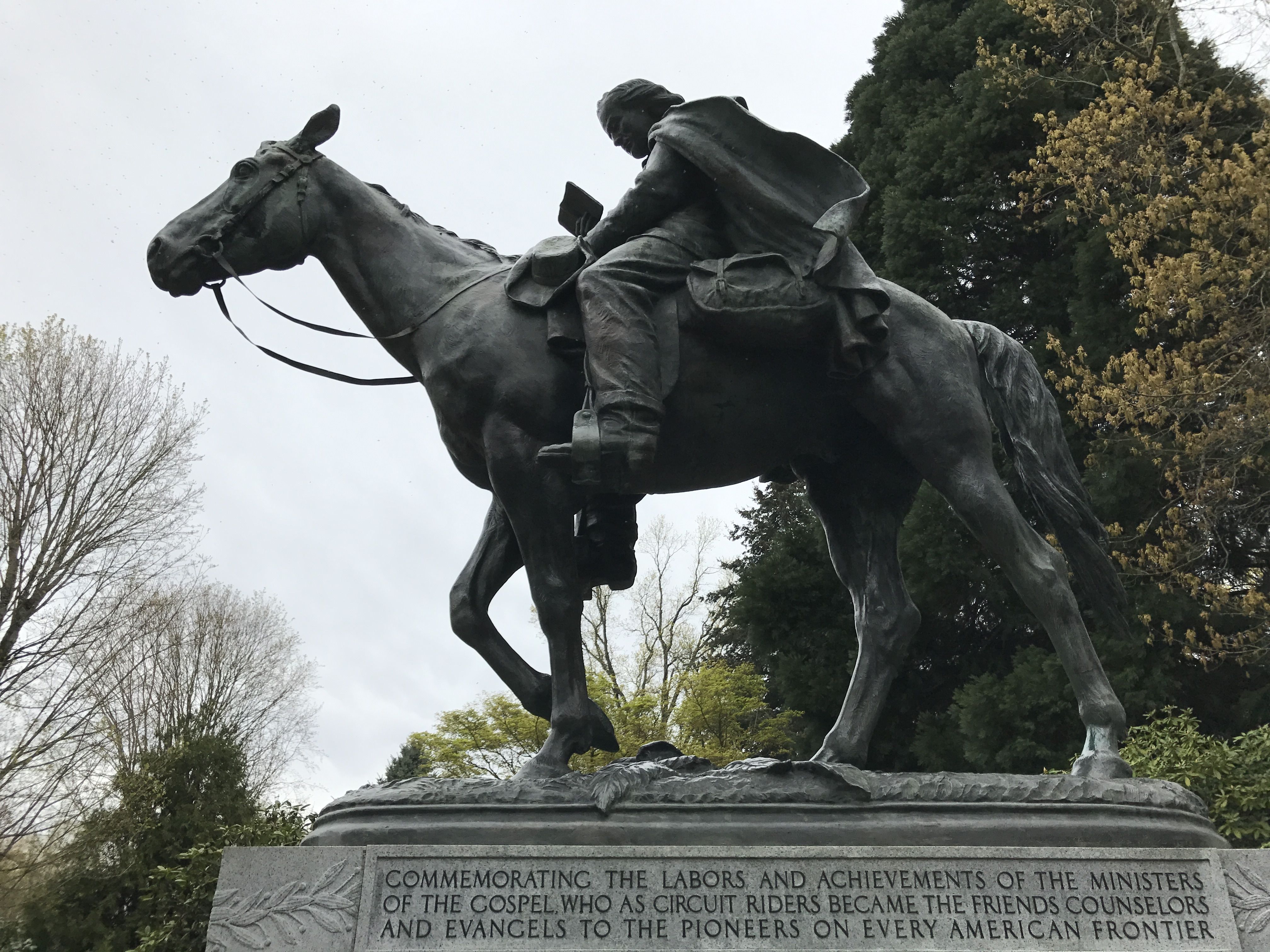
This one is a tribute to Robert Booth, who was a pioneer minister in Oregon.

It was also a tribute to his son, Robert A. Booth, who put his own name on the dedication plaque.

This statue is of Reverend Jason Lee, who lived from 1803 – 1845. The inscription of the plinth describes him as the first missionary in Oregon and a colonizer from 1834 – 1843.

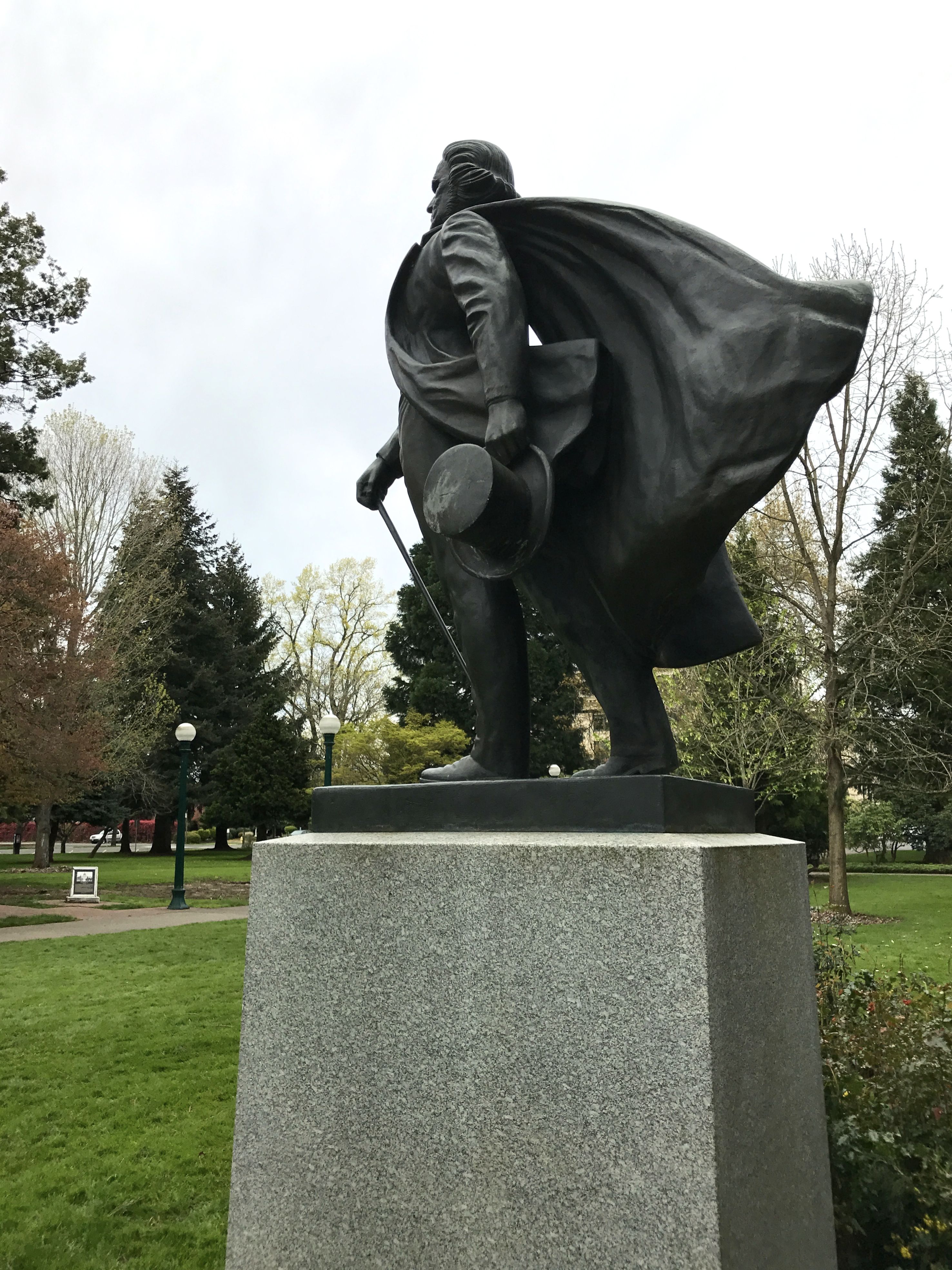
Then there is this dramatic statue of Dr. John McLoughlin, who was the first to govern the Oregon Country, from 1824 – 1843.

I find it interesting that he was born in 1784 in Rivière-du-Loup, Quebecand he came to government through his work with the Hudson’s Bay Company.

Since I have a primarily east coast orientation, I  learned many new things on my west coast adventures. For instance, I did not know that at one time there was talk of establishing Oregon as an independent nation, free of the United States. In fact, Dr. McLoughlin advocated for such an arrangement. He also got in trouble with his bosses for extending aid to the American settlers who arrived in Oregon via the Oregon Trail in the 1840s. His assistance to the new arrivals was not entirely altruistic, however. The aid he extended to the Americans probably prevented armed attacks on his outpost by the numerous settlers.

According to my preferred source, the settlers understood that his motives were not purely selfless. Some resented the assistance and worked against him for the rest of his life.

In 1843, his bosses directed him to relocate to Vancouver Island. He refused to leave the Willamette River Valley and spent the remainder of his life there. He died of natural causes in 1857 at the age of 72 .

As I explored further, I came across these sections of pillars.

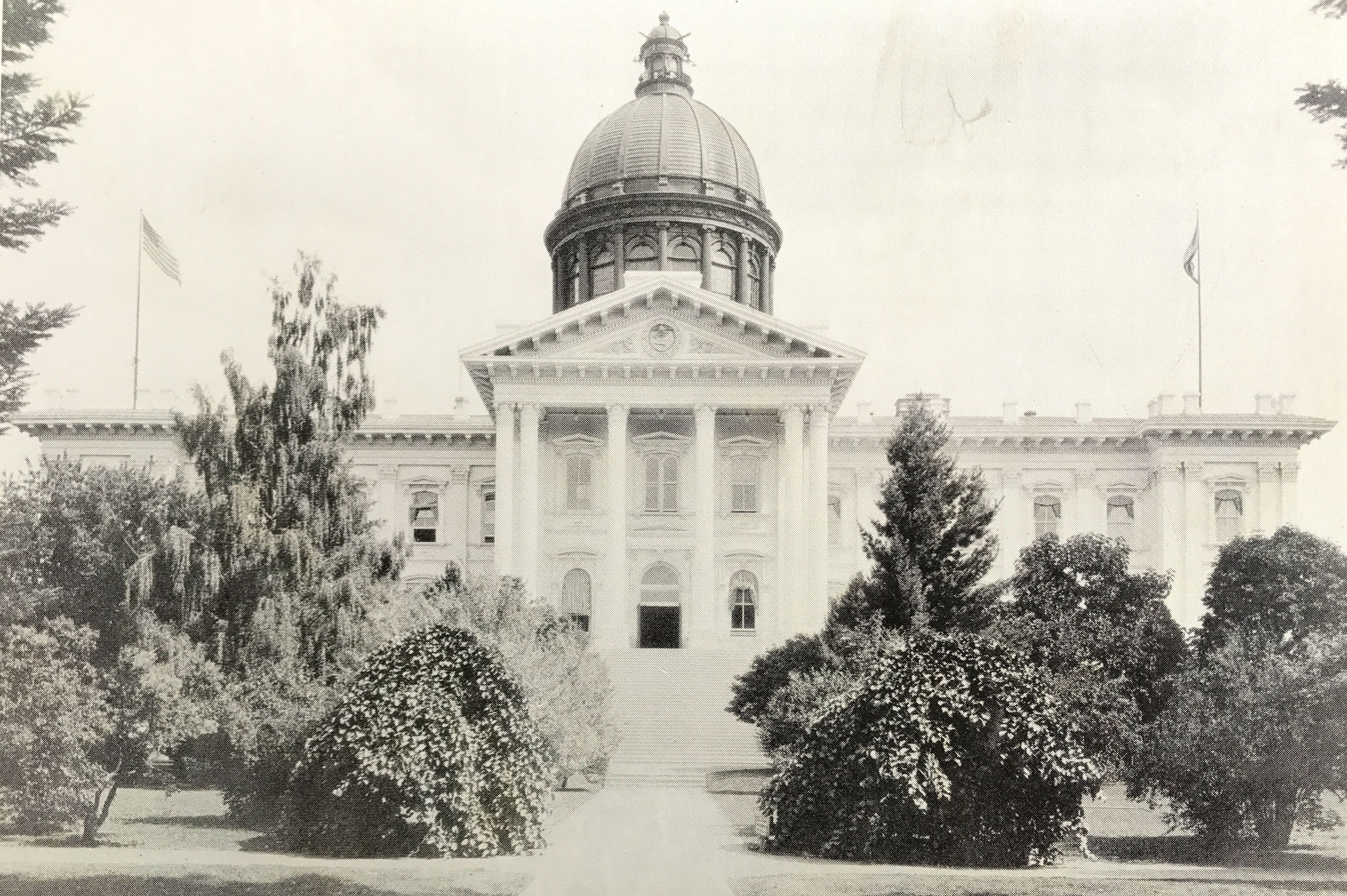
They were from the capital that burned in 1935.

According to an information plaque near the column segments, the bricks for the inner core construction of the columns and for the building were made by convicts at the Oregon State Penitentiary. The fluted limestone veneer facings came from Douglas County quarries, south of Salem.

Incidentally, Douglas Country was named after Stephen A. Douglas, who strongly supported statehood for Oregon. You may be familiar with his name from the famous Lincoln-Douglas debates. 

(I do go on, don’t I?)

Anyway, according to the plaque, the columns were found in Mill Creek, near the residence of the Governor. First Lady Dolores Atiyeh and Governor Atiyeh promoted the idea of preserving the column segments as a piece of Oregon history.

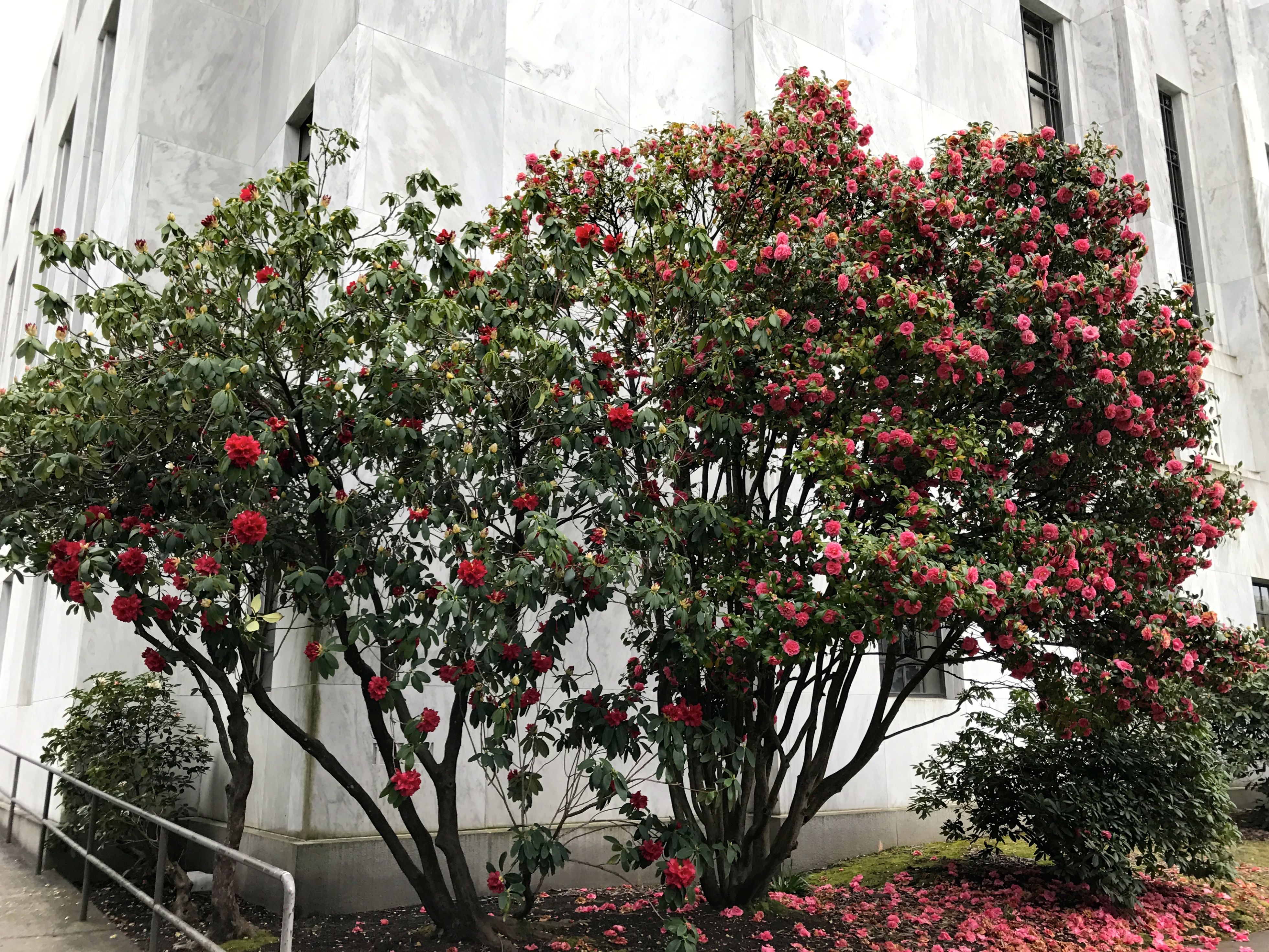
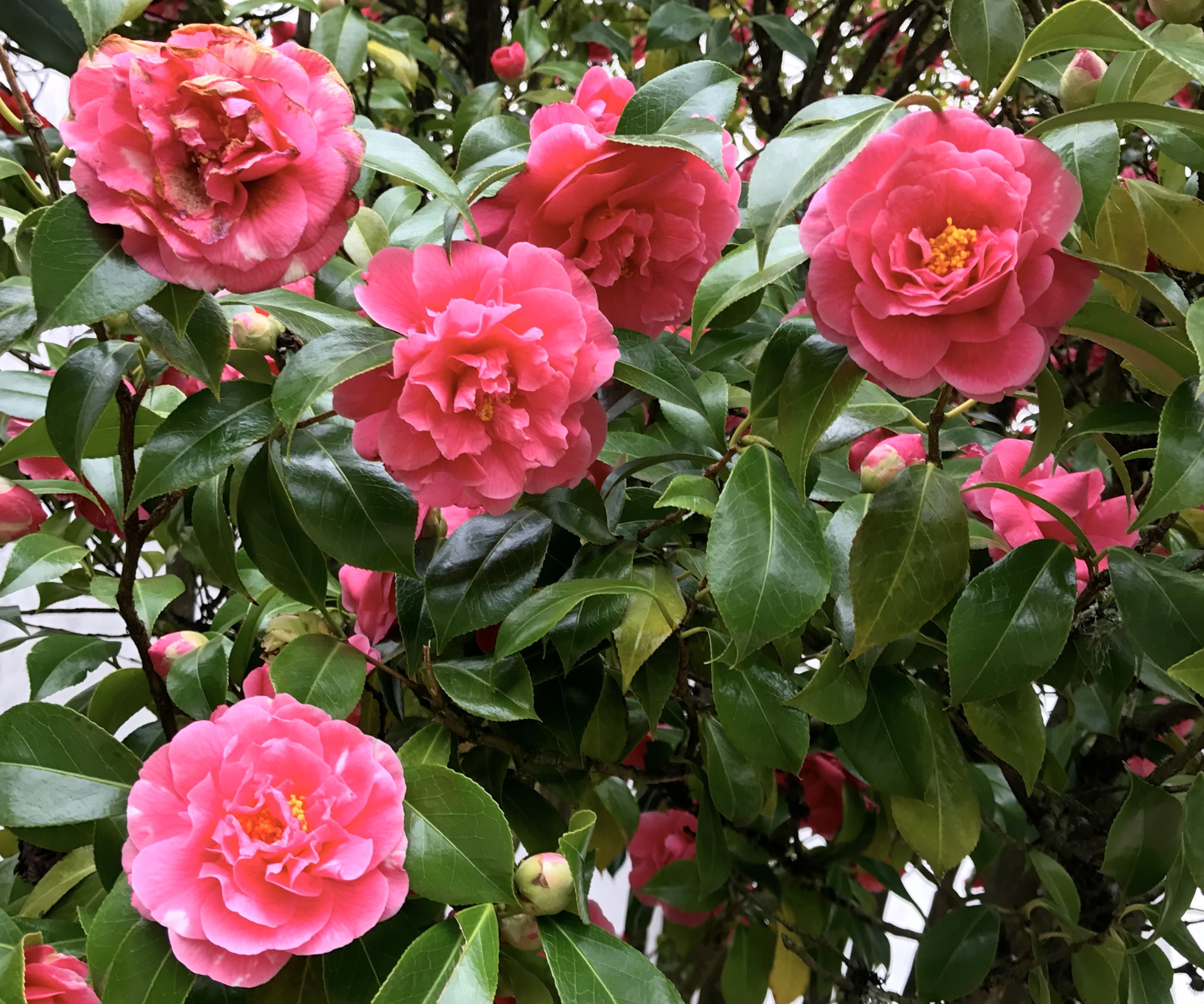
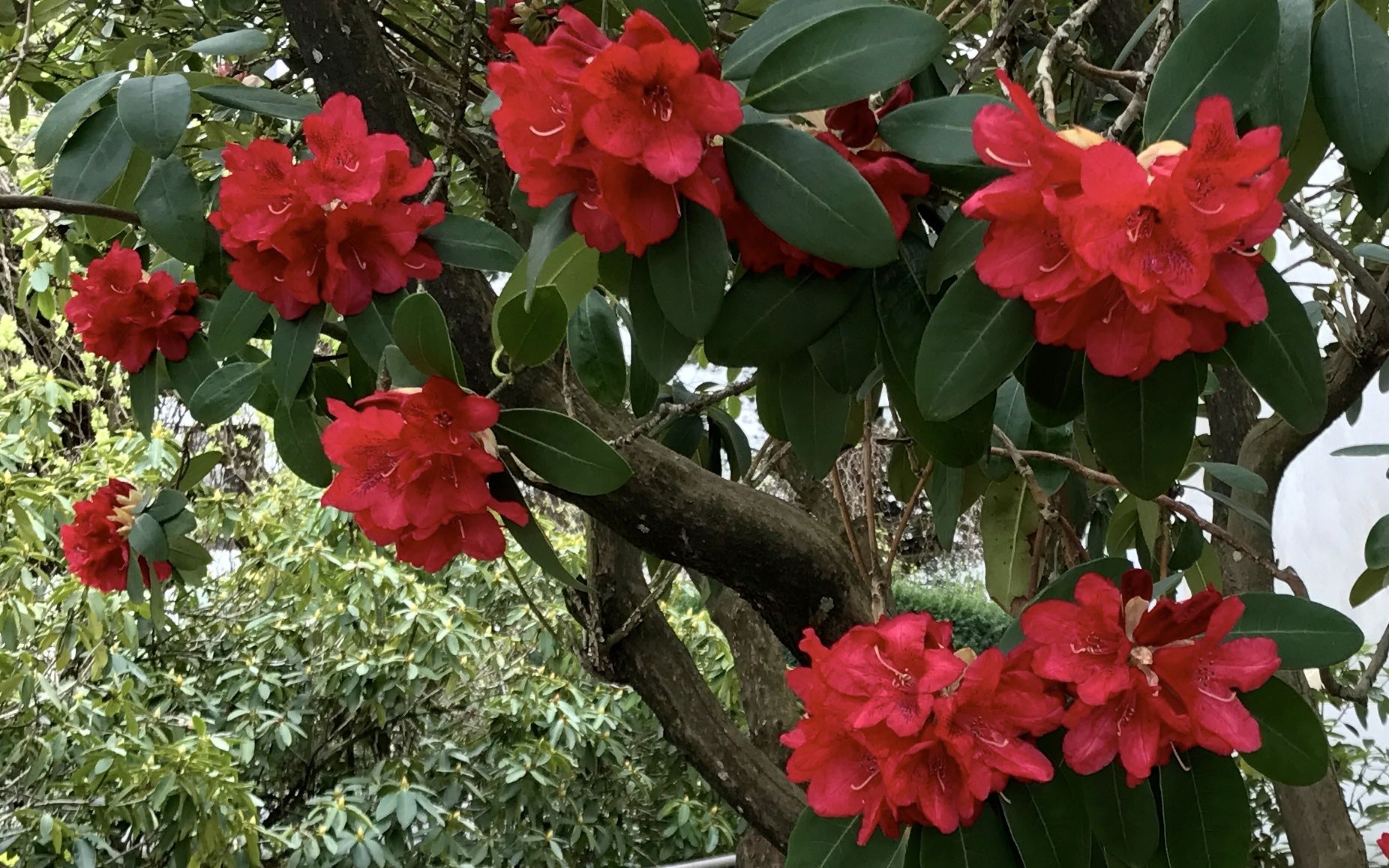
The capital’s campus was in bloom.

Even on this grey day, there were splashes of color.

The flowers seemed exotic to me, in comparison with the ones I grew up with.

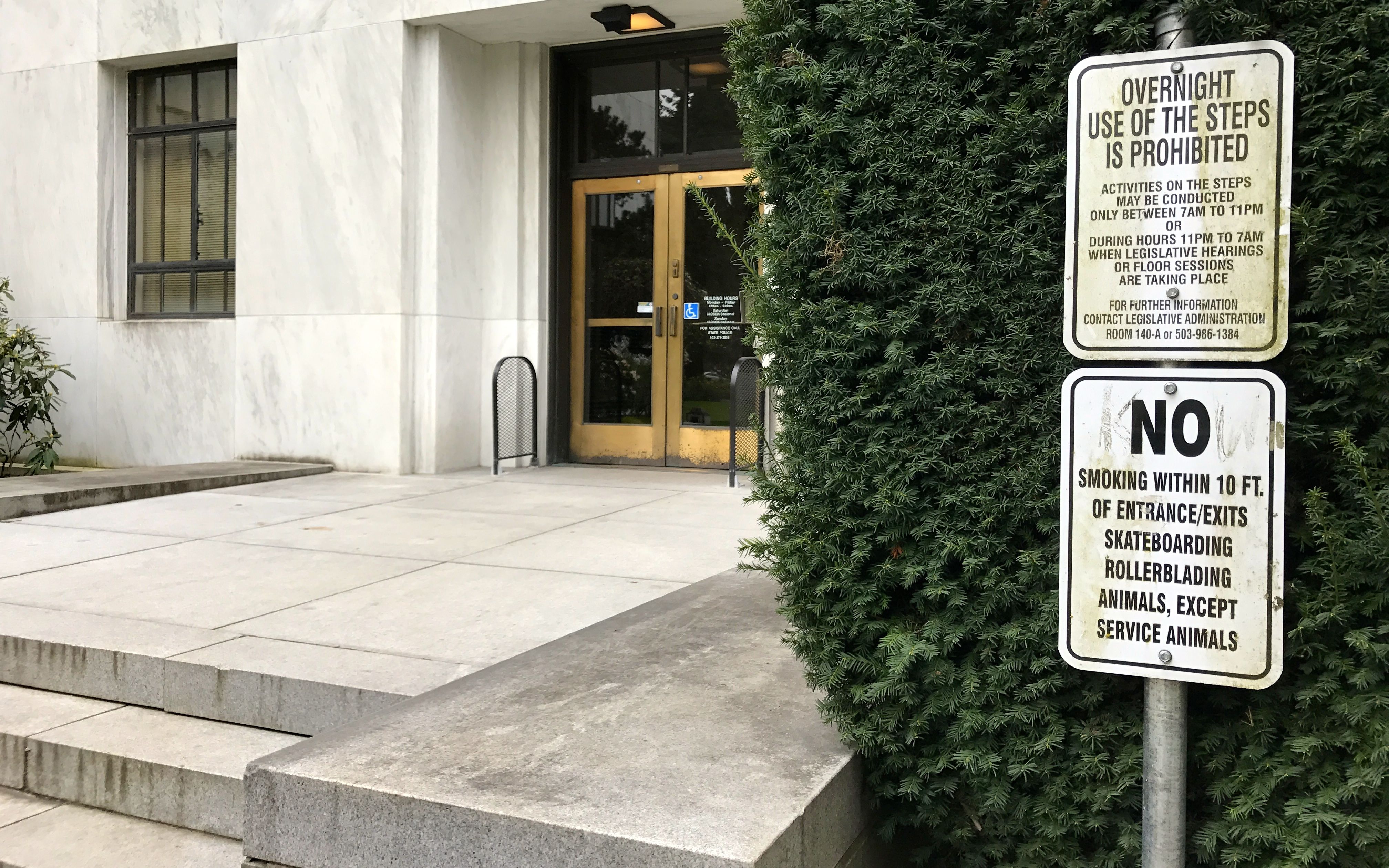
I don’t know about you, but I always thought of Oregon as kind of a free-wheeling place. Would you look at those signs!

OVERNIGHT USE OF THE STEPS IS PROHIBITED

(Okay…there are two steps here.)

Activities on the steps may be conducted only between 7 AM to 11 PM

OR

During hours 11 PM to 7 AM when legislative hearings or floor sessions are taking place.

I wonder what happened to inspire such precise regulation of these two steps?

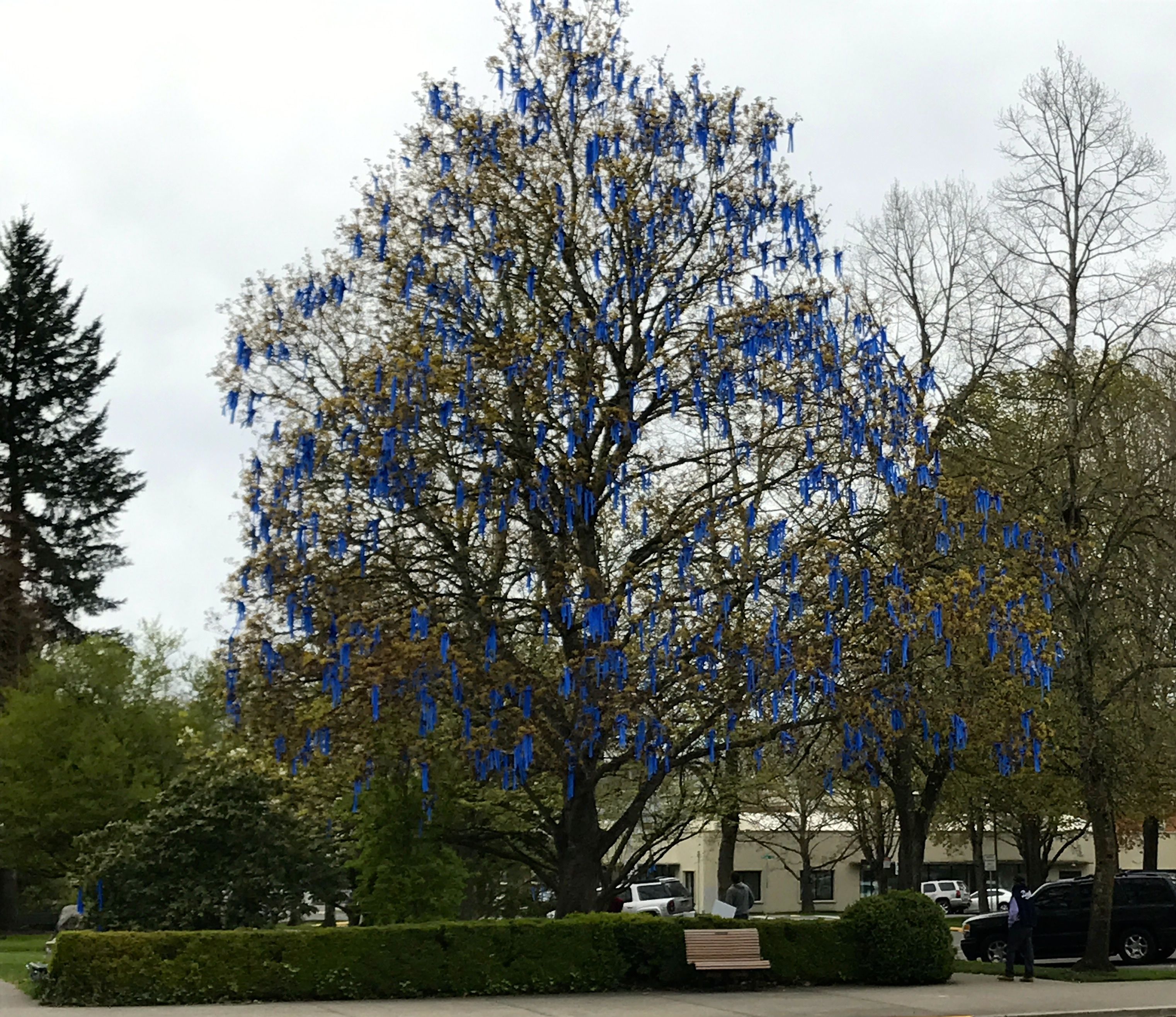
I figured that I had seen all that I was likely to see, what with the building being closed, so I got ready to head back to my truck. This tree festooned with blue decorations caught my eye. I wandered over to check it out.

At the base of the tree was a sign explaining the project.

I got back in my truck as set off for more adventures.

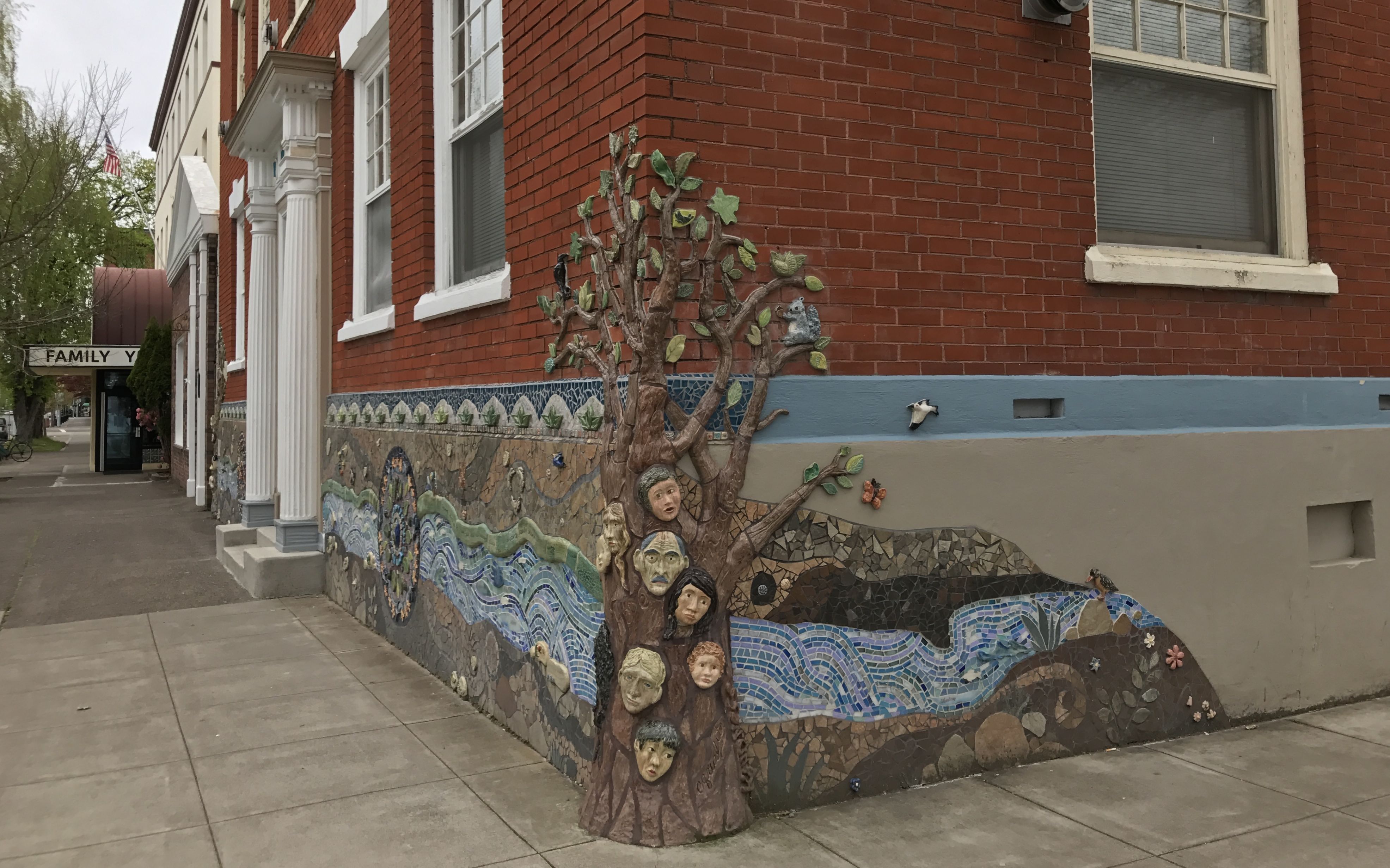
As I tooled down the street, this building with mosaic decorations caught my attention. I love mosaics and I didn’t have to be anywhere at any specific time, so I pulled over and found a place to park.

Things might not be open on Easter Sunday, true, but it sure makes parking easier.

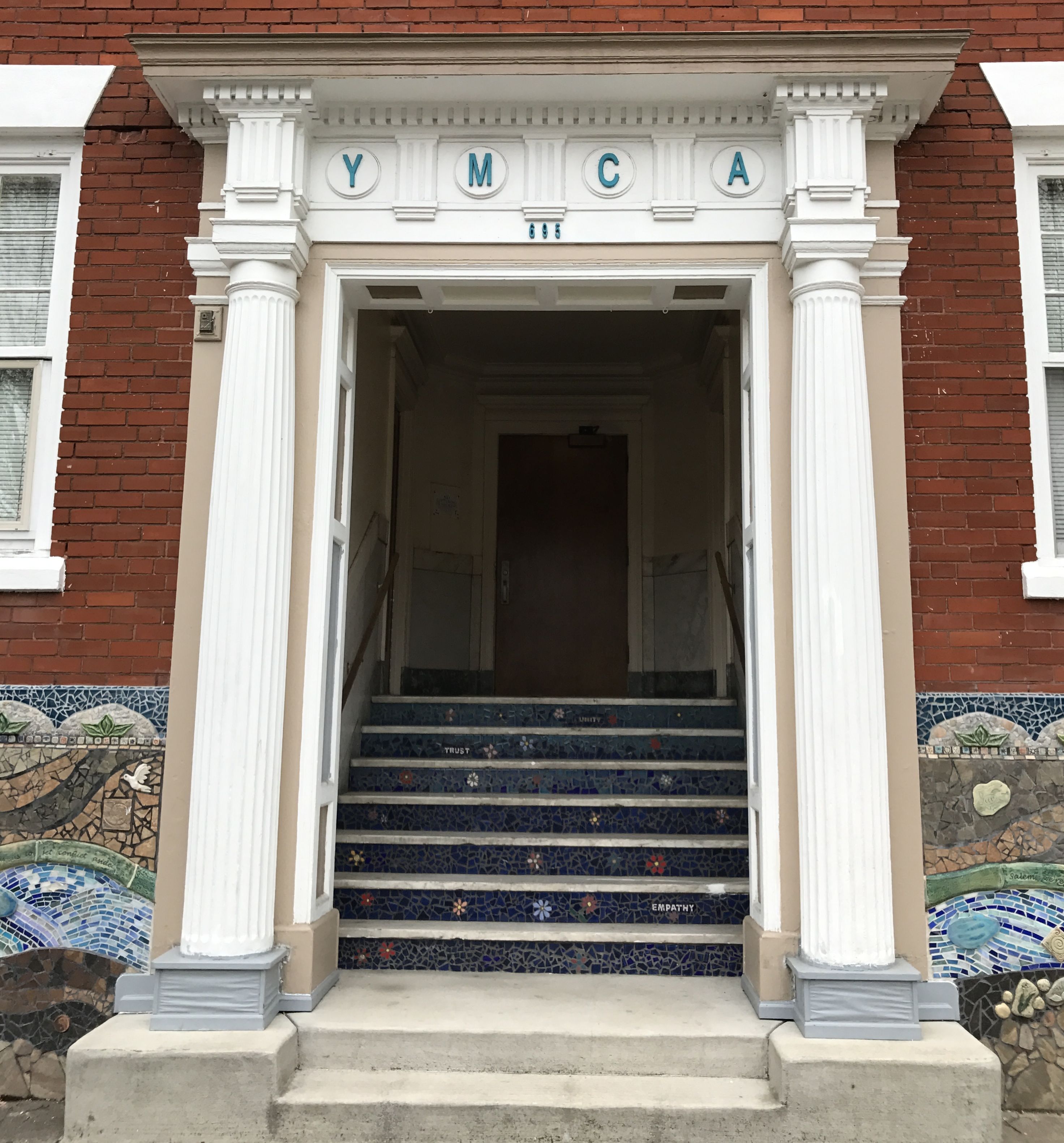
It turns out that this building was the YMCA.

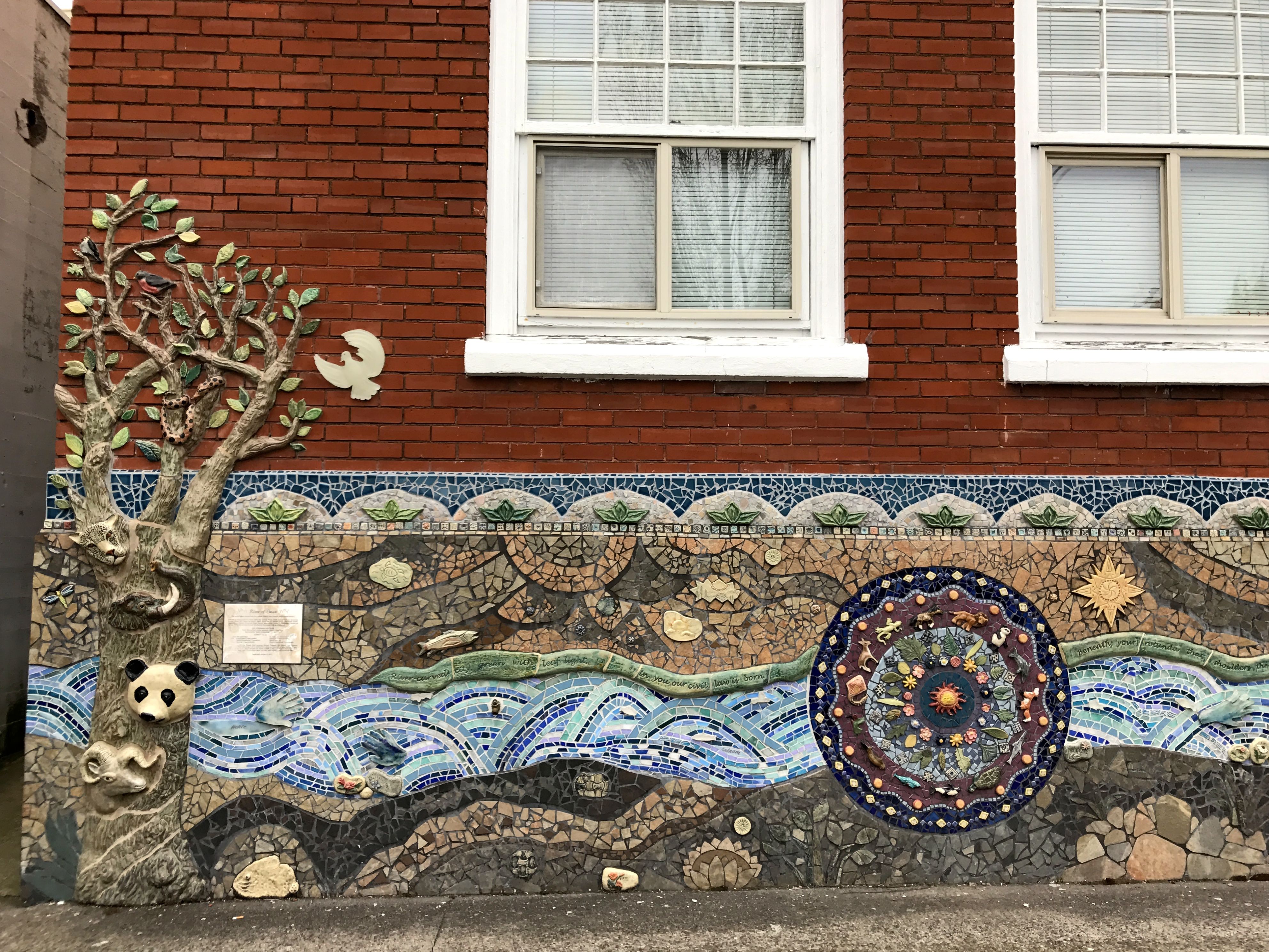
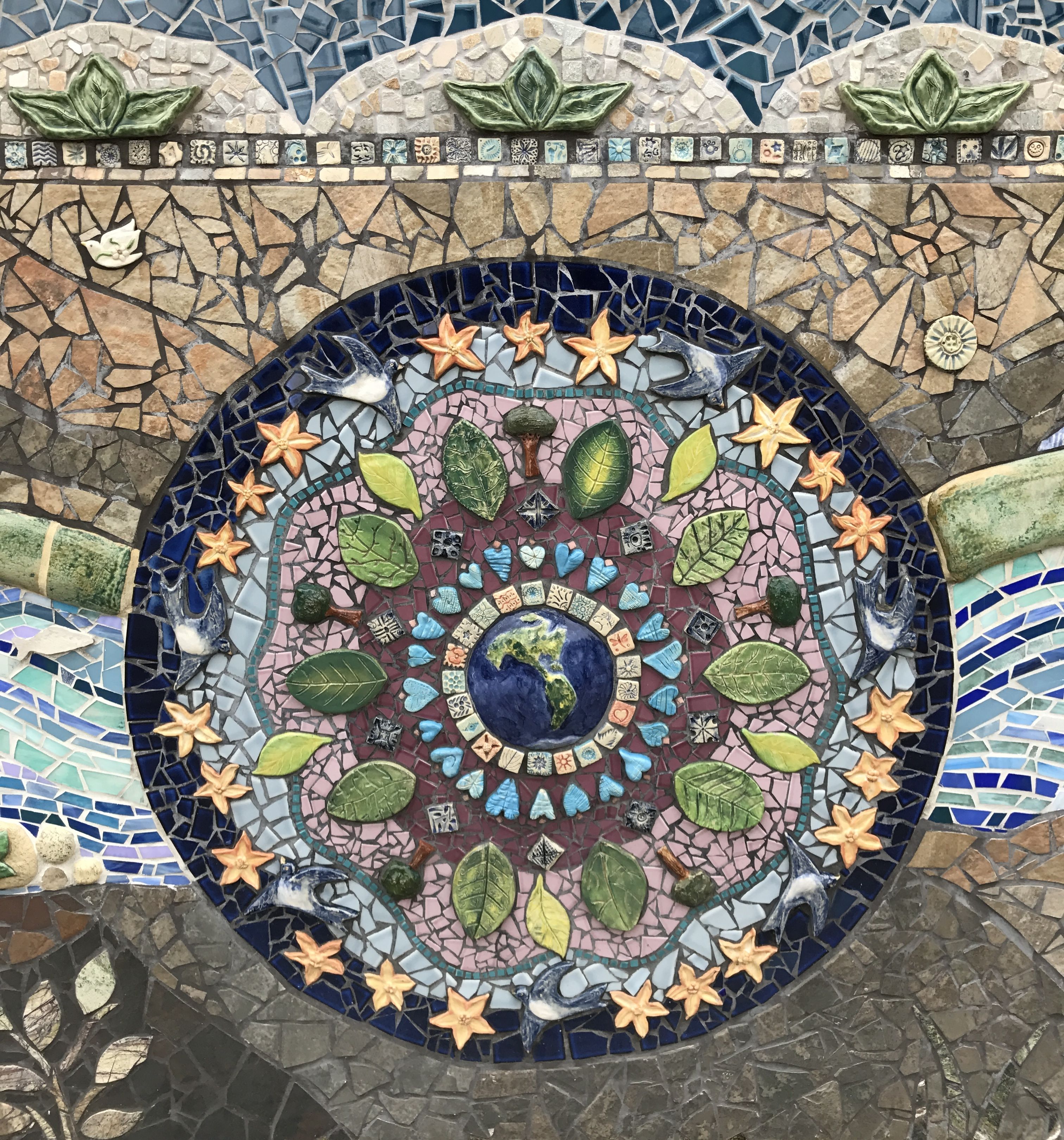
The mosaic is called River of Peace. This was most appropriate, as the word Salem comes from the words “shalom” and “salaam” which mean peace.

Lynn Takata was the artist-in-residence for this project. Over 600 people worked on this mosaic, which is 60 feet long. There are some lovely photos of the work and the process on her website.
It was a rather gloomy day, so my photos don’t really pop. There are some beautiful ones on her website, if you’d like to check them out.

I was glad I stopped. What a wonderful community art project! This is something like a project I had hoped to do at my school before my retirement. Oh, well…

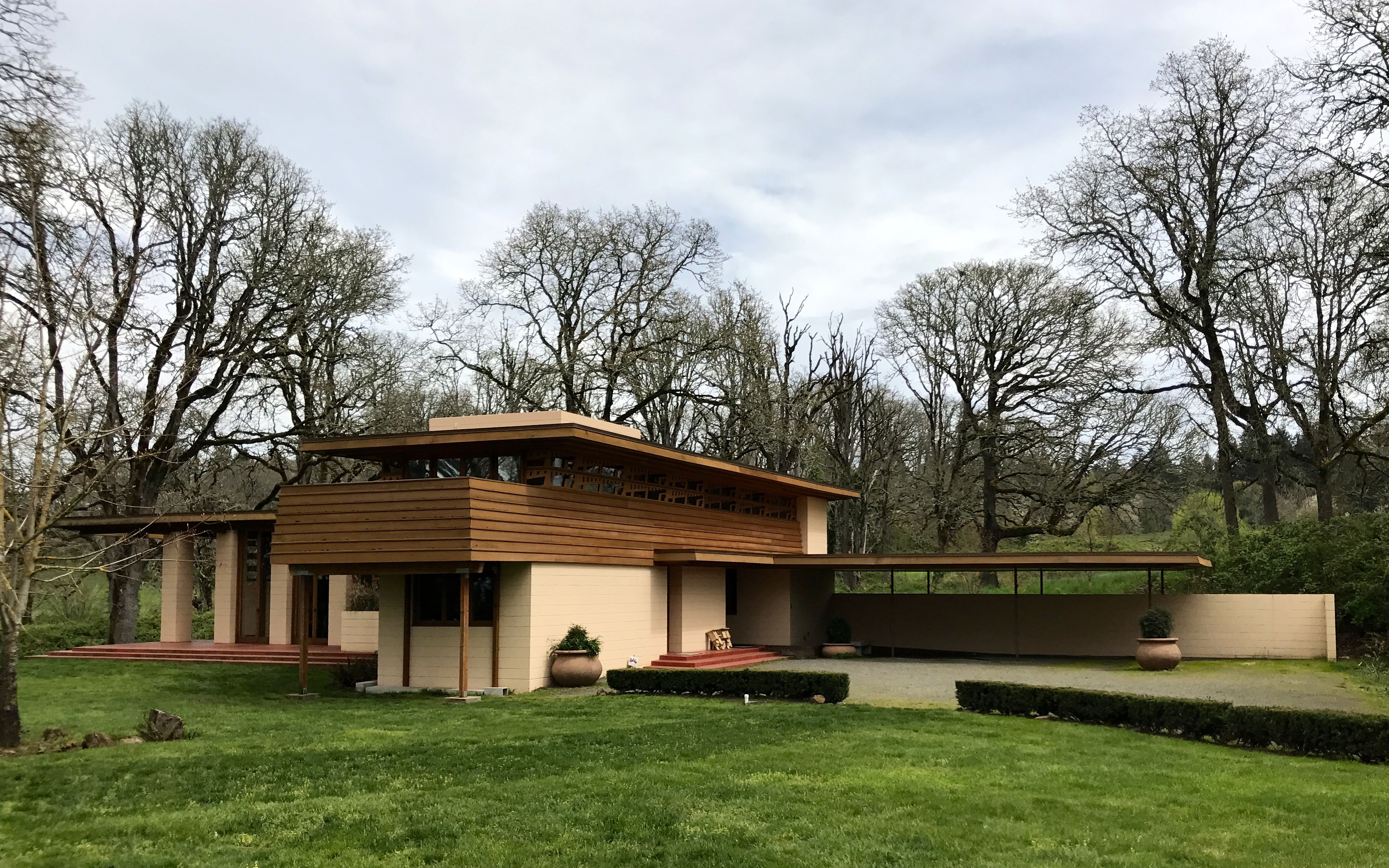
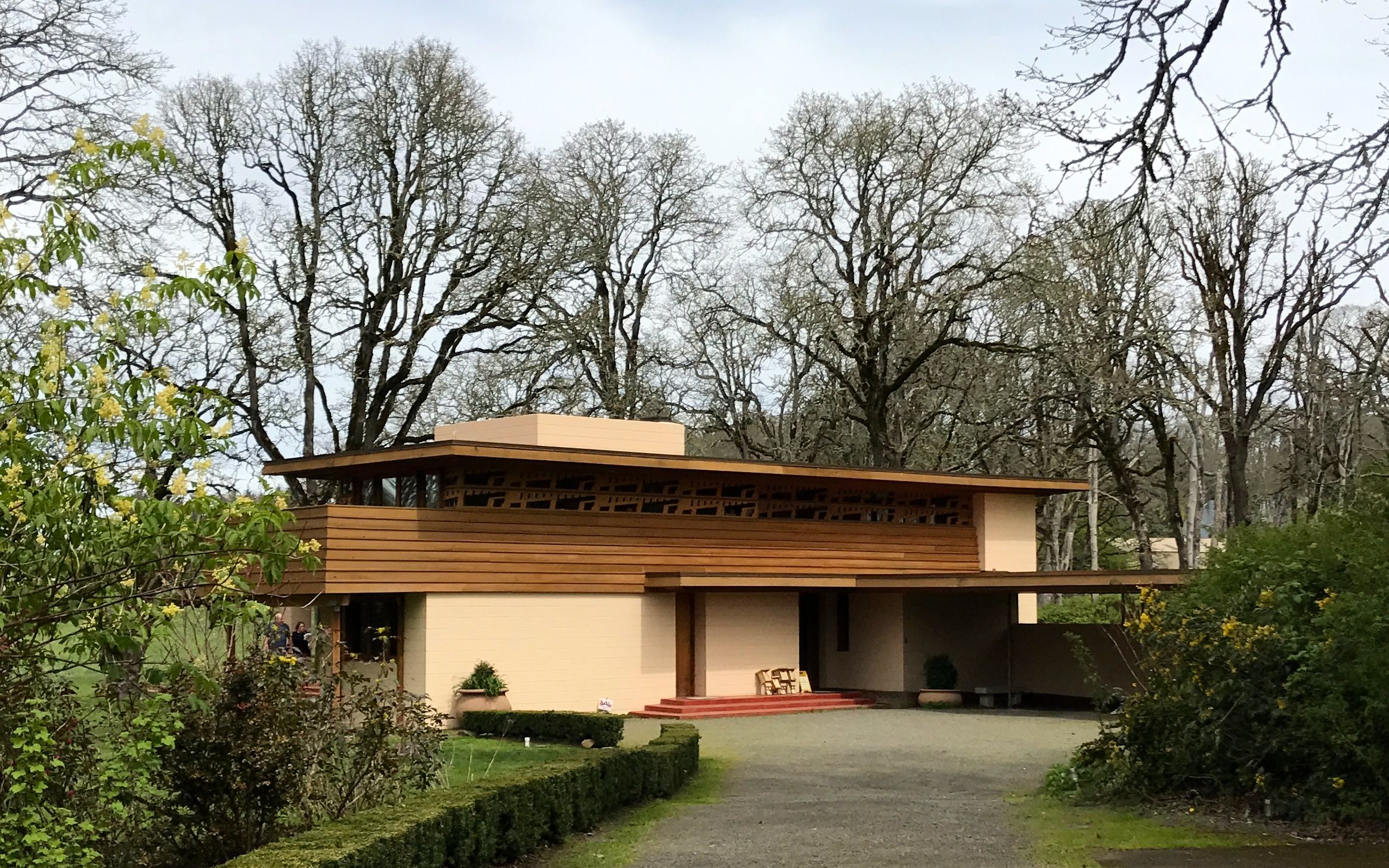
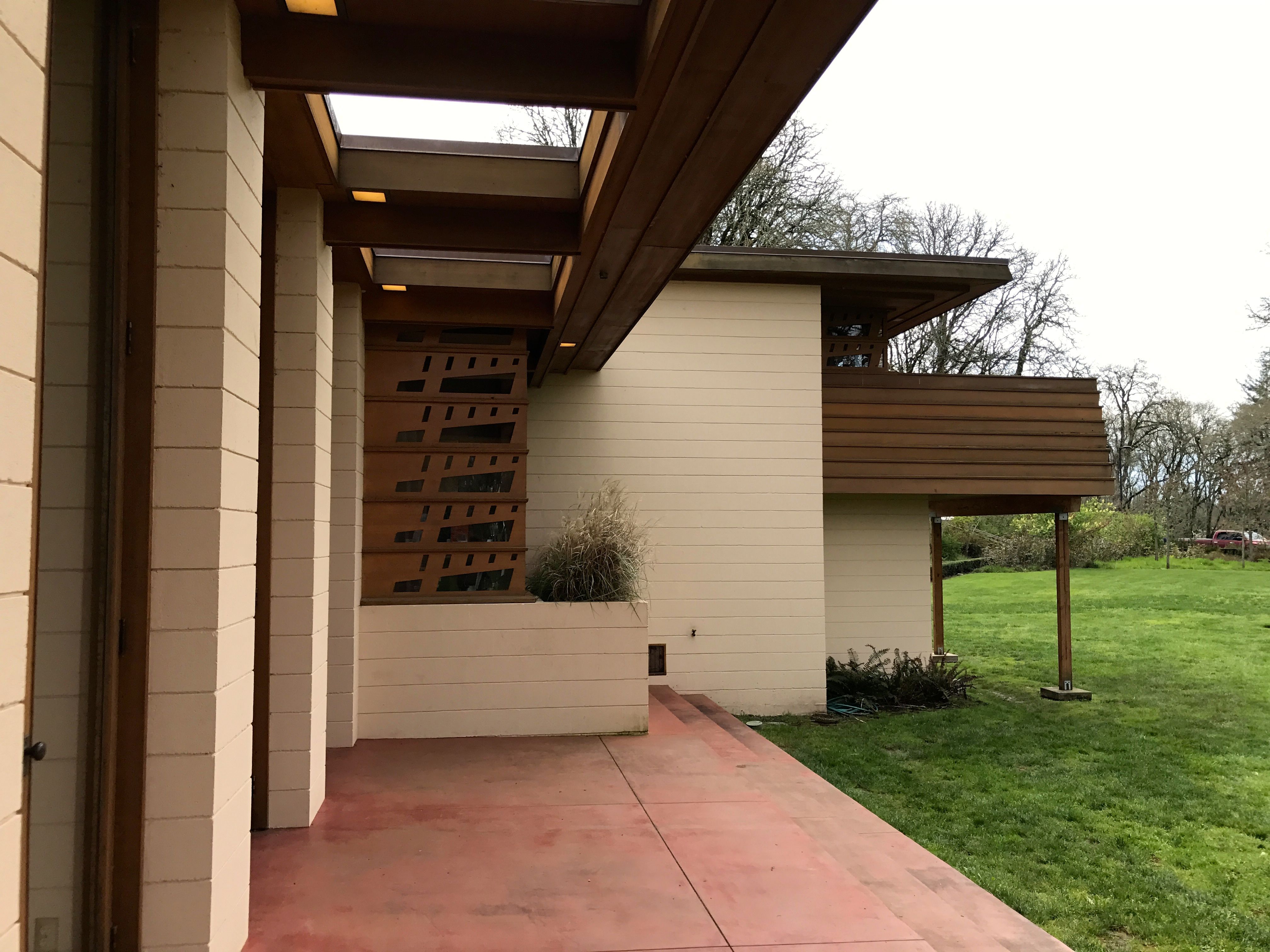
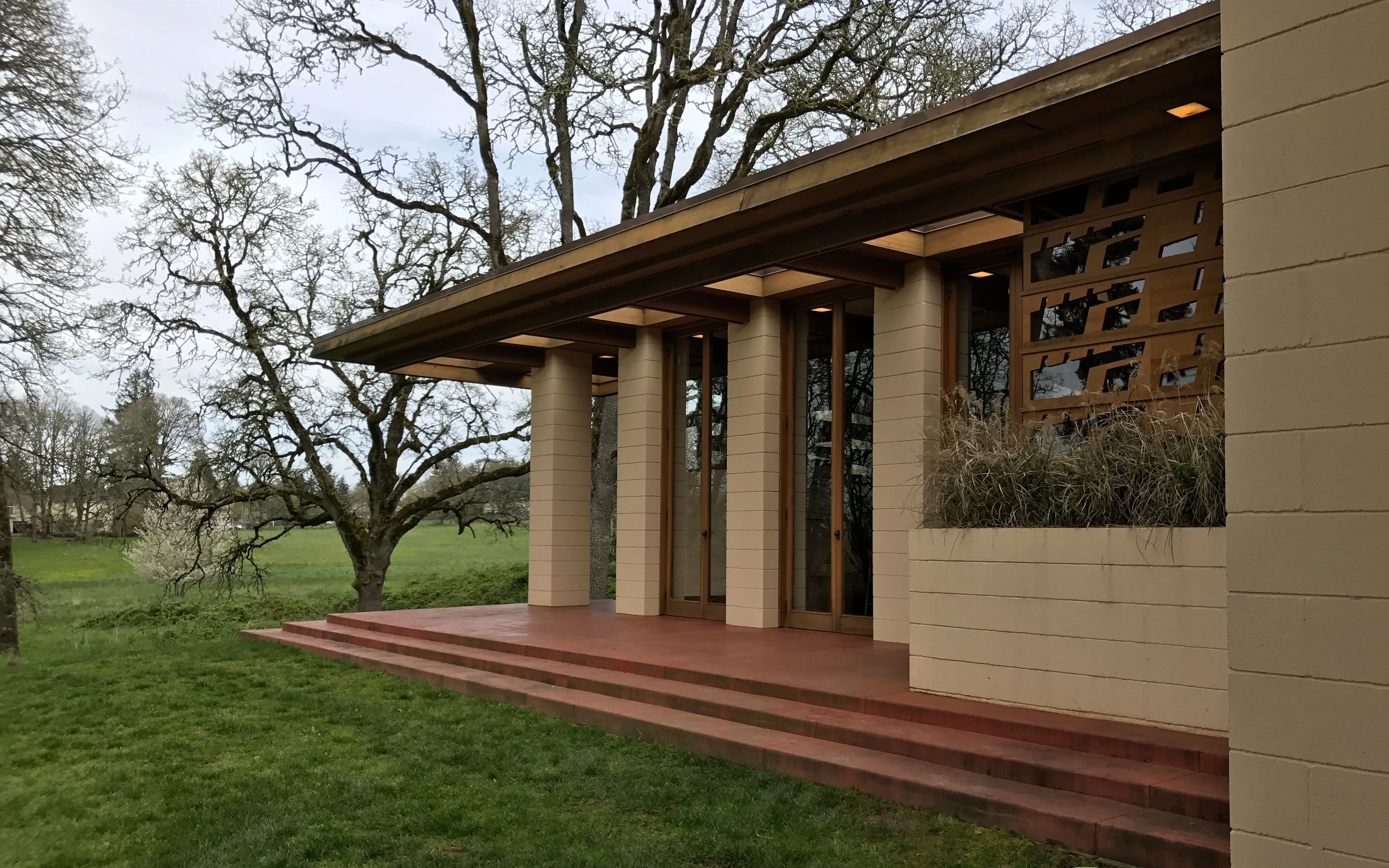
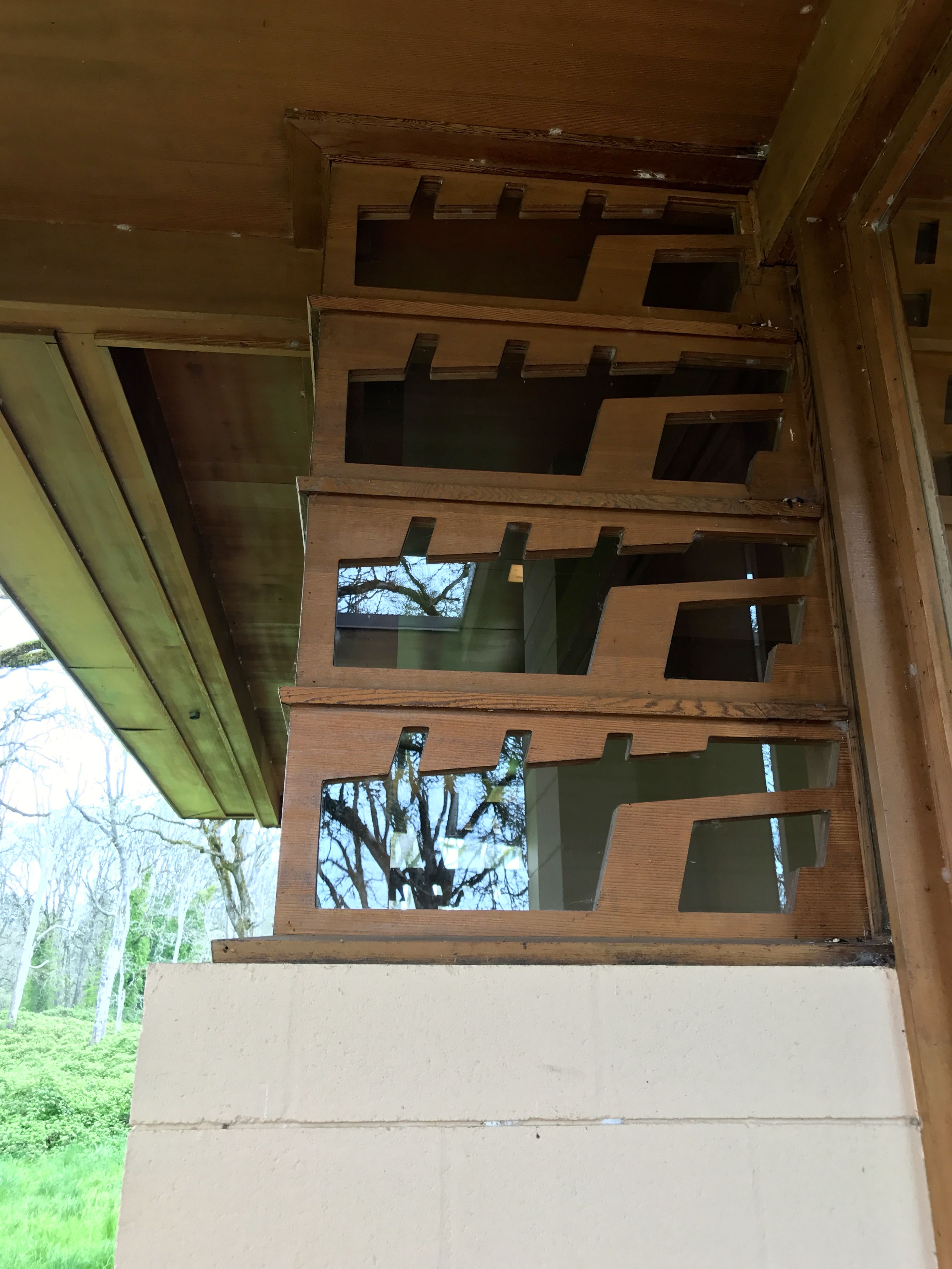
Another love I have, in addition to mosaics, is the architecture of Frank Lloyd Wright. There was one structure he designed in all of Oregon and I wasn’t too far away.  The sources I consulted at the time indicated that it was open for visits on Sundays and it didn’t say anything about Easter, so I decided to head over. The Gordon House was my next stop.

This house was designed in Wright’s Usonian style. These smaller, more modest houses were designed for the middle class. He started designing them in the 1930s when an annual income of $5000 – $6000 put you in the middle class. This house was created for Evelyn and Conrad Gordon in 1957, but it wasn’t completed until 1963, four years after Frank Lloyd Wright’s death.

I walked up to the front door. And yes, the house was closed.

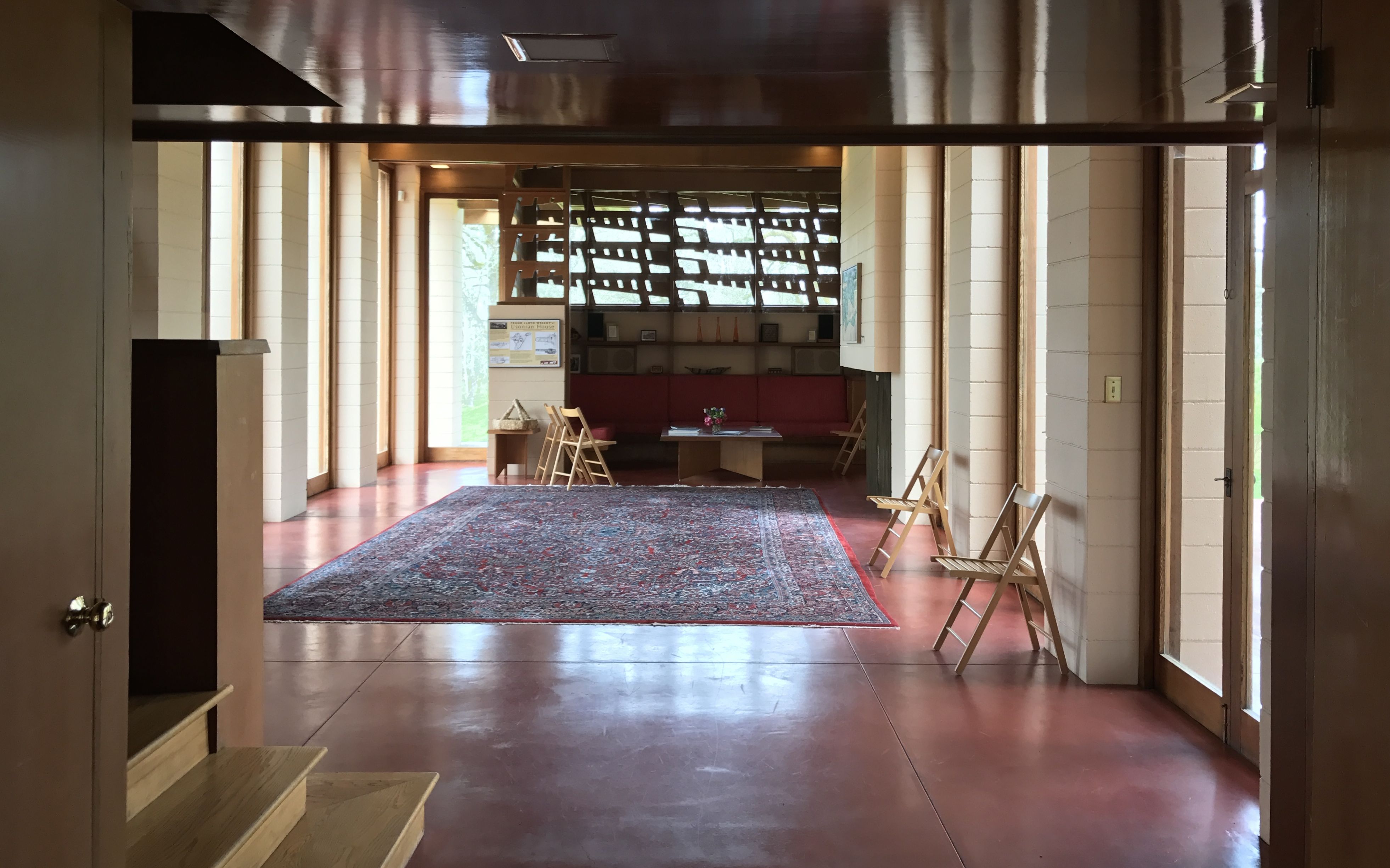
But, you can still look inside. This is the view through the front door. You can see the Cherokee red floors. An interesting fact I learned in my study of Wright is that he always identified his red floors as “Cherokee red,” but they weren’t necessarily the same shade of red.

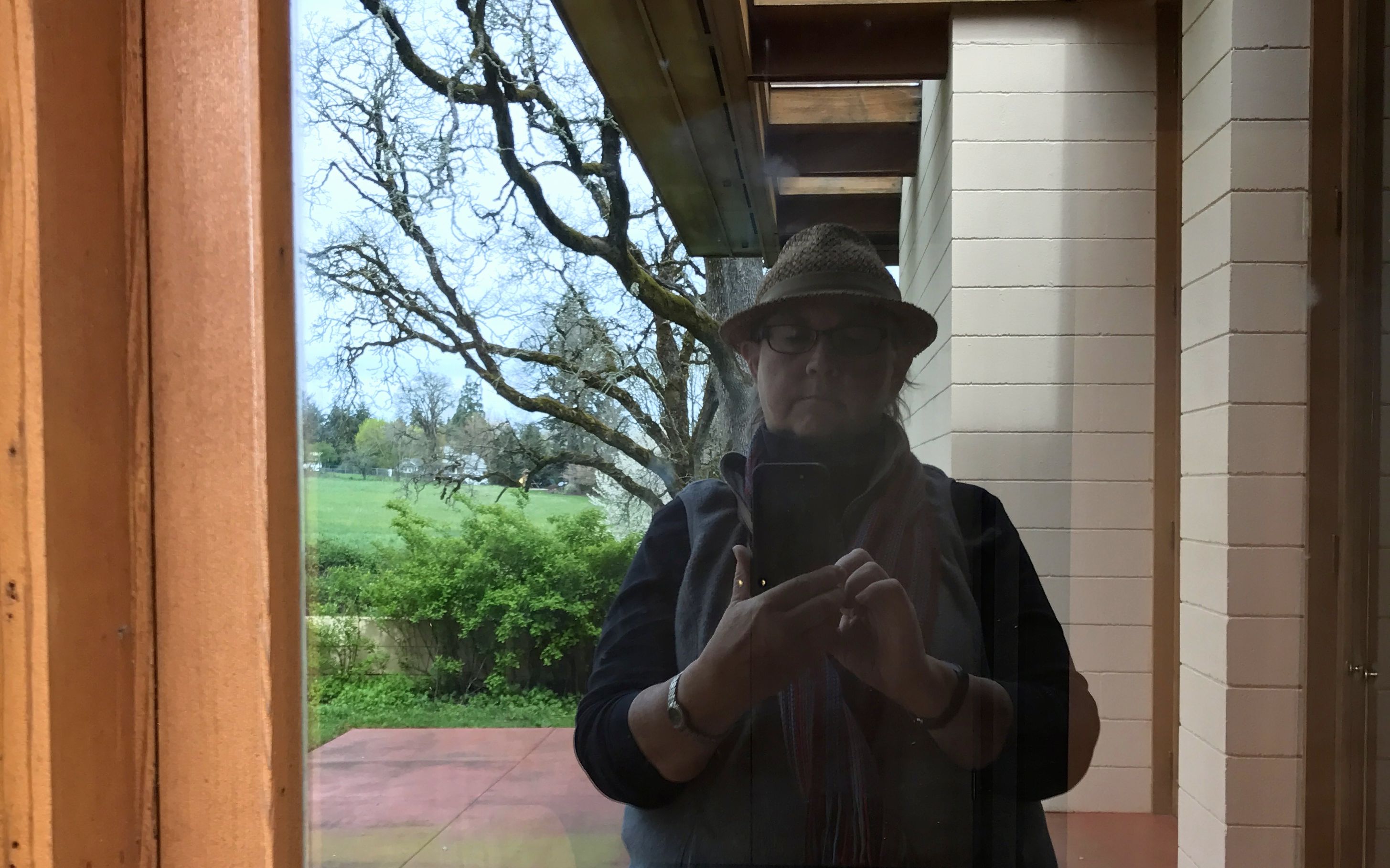
As I made my way around the house, I couldn’t resist the opportunity for a reflection selfie.

This house was originally located near Wilsonville, Oregon. After Evelyn Gordon’s death in 1997, the house was sold to new owners. They wanted to tear it down to make room for a larger, more contemporary structure. I guess they valued the location, which had views of the Willamette River and Mount Hood.

With all these glorious windows, the views must have been spectacular.

Many groups worked together to preserve the house and move it about 21 miles to the Oregon Garden in Silverton. The dismantling began on March 9, 2001, and it was moved in four large pieces. A lot of work was required to refurbish the building due to overall neglected maintenance. The team working on this project was up to the task and the house was opened to one year later as the only publicly accessible Frank Lloyd Wright home in the Pacific Northwest.

Since I couldn’t go in, I decided to head off for my last stop of the day. Third time’s the charm, maybe?

Nope. The End of the Oregon Trail Historic Site was closed, too.  But, I walked around outside for a bit to see what I could see.

I am always drawn to maps. Can you imagine the effort it took to get from St. Louis to Oregon?

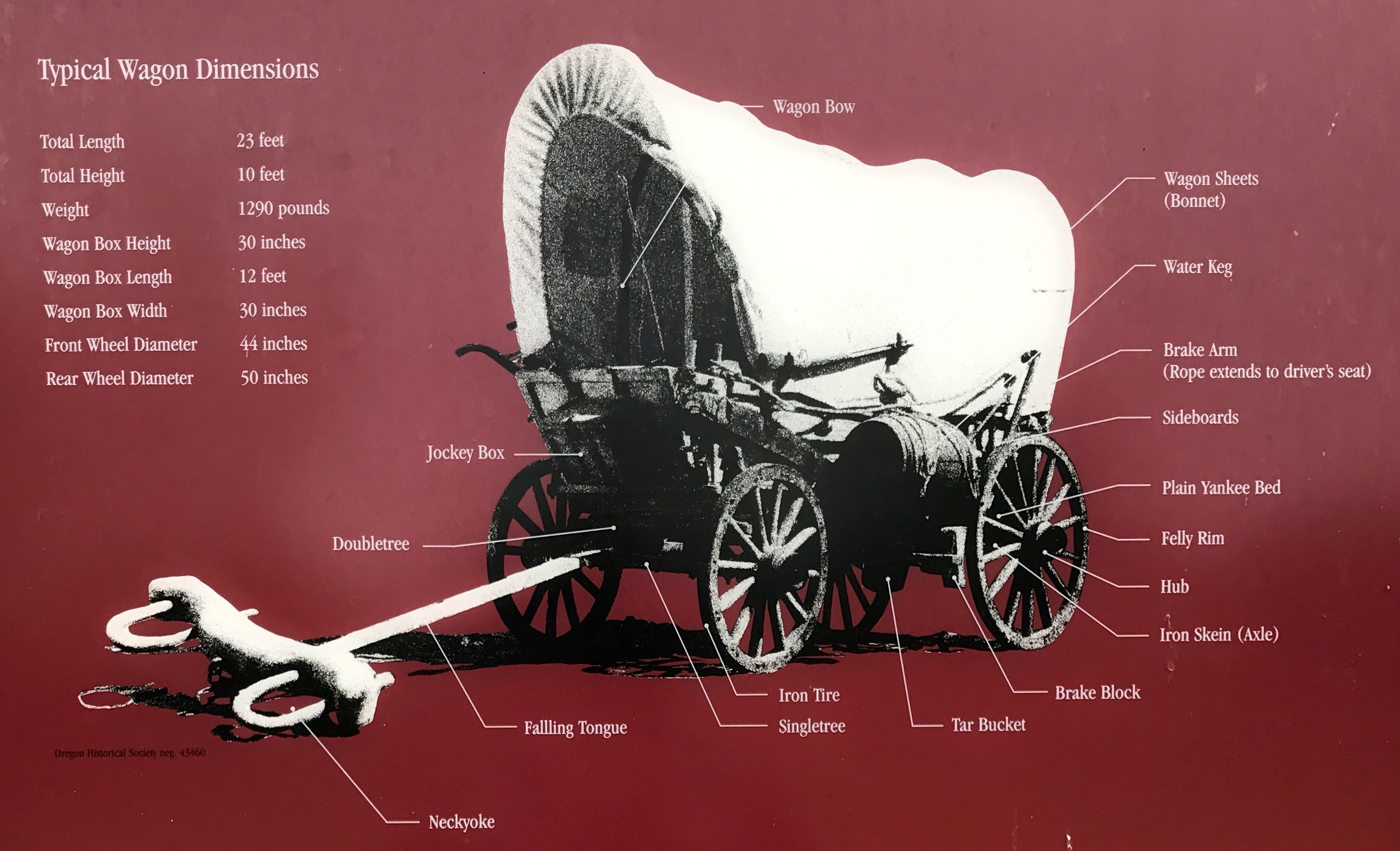
I like diagrams, too. Hmm, with the weight of the wagon at 1290 pounds, I could easily tow it with Bart. Heck! I could have towed two or three of them!

I imagine that they were quite heavy when loaded down with all the settlers’ possessions, though. They were big enough to be an RV, but not all that comfortable. At least, not as comfortable as an Airstream!

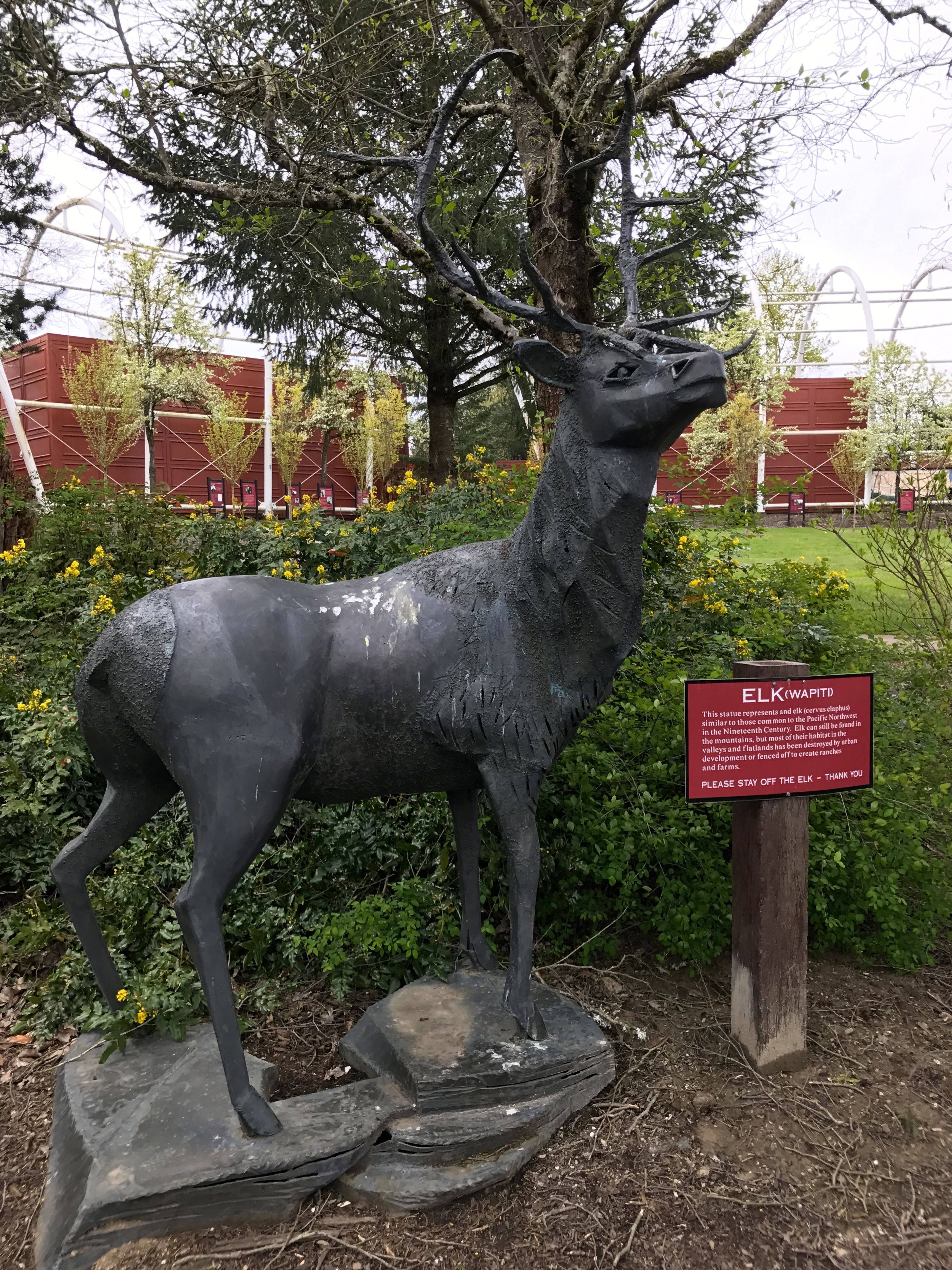
I stopped by to pay my respects to the elk, as many a bird had done before me.

And with that it was time to head back to Flo, have a little dinner and make plans for another day.


Taliesin West: Part One

Any of you who have been following my budget blog posts already know that I don’t send my money lightly when it comes to entertainment and tourism. However, when it comes to Frank Lloyd Wright tours, I don’t skimp. I opted for the $70 Behind the Scenes tour – the most expensive tour they have listed.

I’m not bragging, just letting you know.

Not only was this tour expensive, it was scheduled to start at 9:15 AM and they wanted us to be there 15 – 30 minutes ahead of time. I am not a morning person anymore. Thirty years of getting up to teach has cured me.

Luckily, WestWorld was only a mile or two away from Taliesin West, so it wasn’t too painful to get there on time. I may have been the last member of my tour to check in, but I made it!

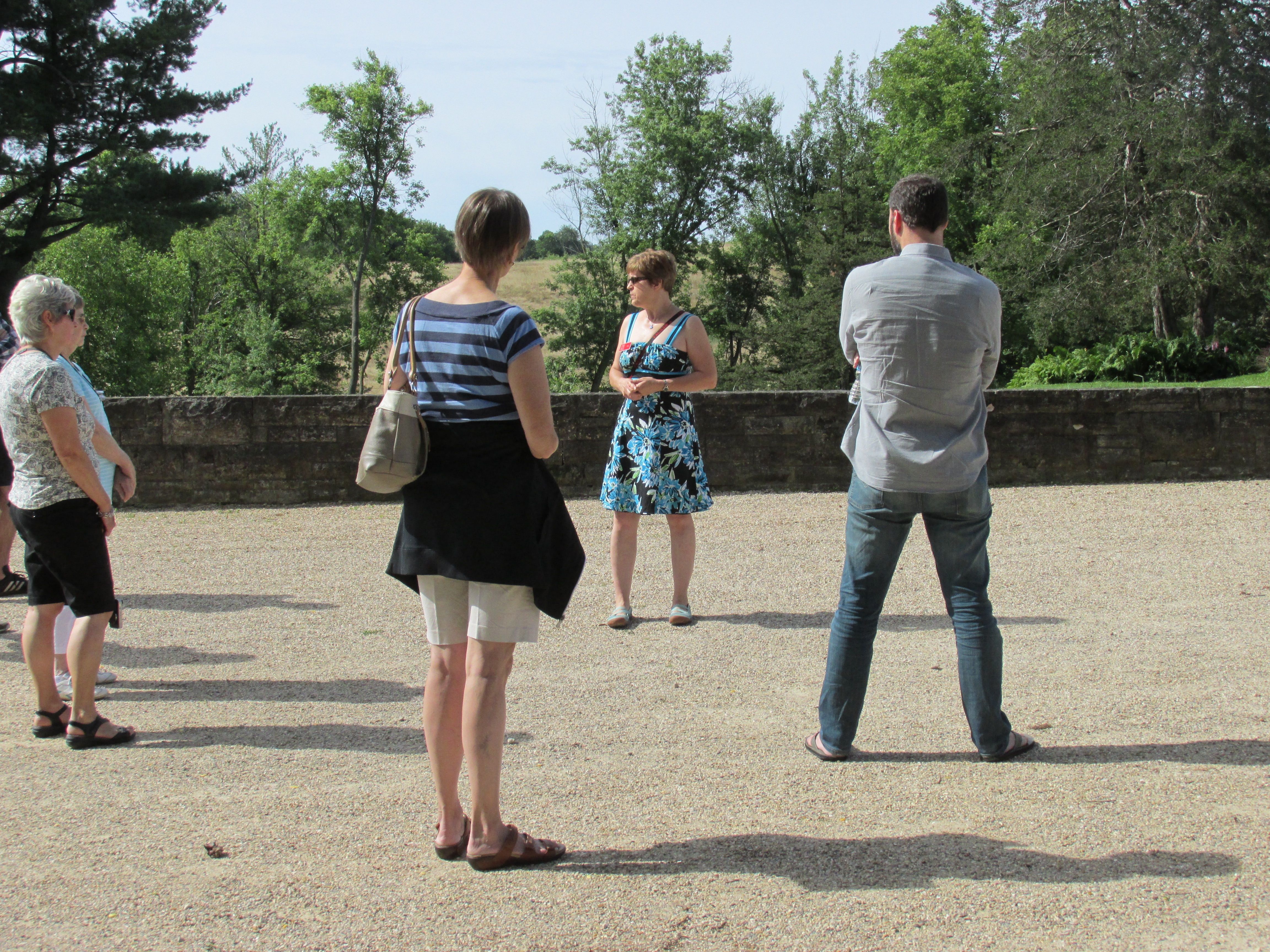
Our tour guide was a dynamo! She may have walked with a cane, but the rest of us had to focus to keep up with her.
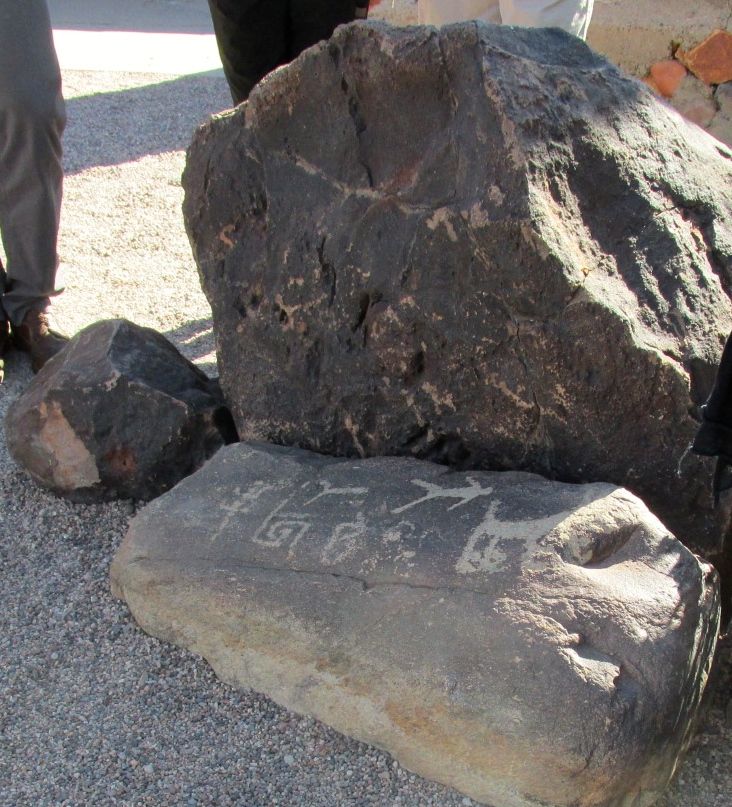
Petroglyphs

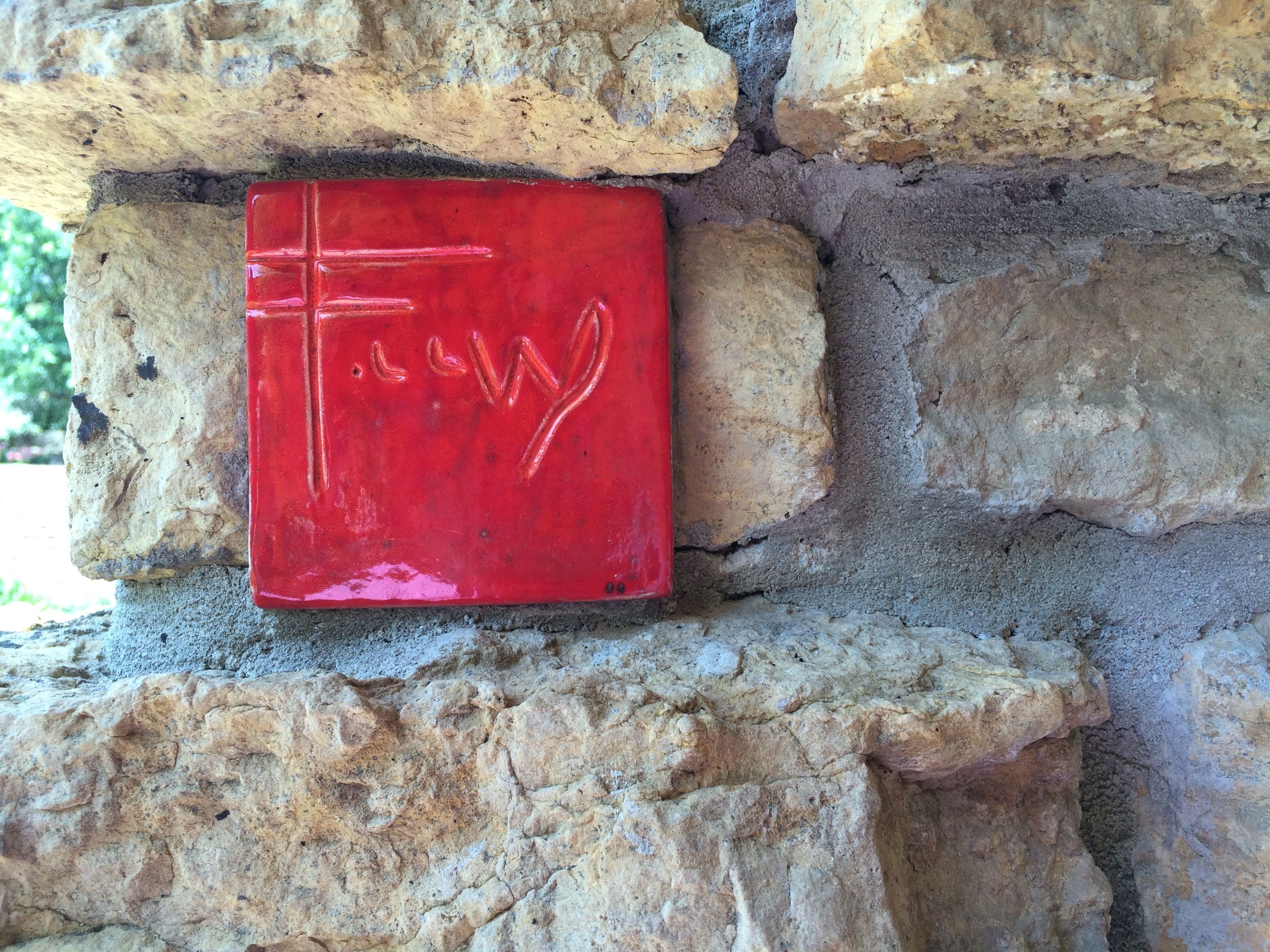
Our first stop was this grouping of petroglyphs that were found on the property. She pointed out one of them that Wright adapted for the Taliesin logo.

Taliesin Logo 2

It’s pretty easy to pick out the one that inspired Wright’s design. The next stop was the office.

Office fireplace

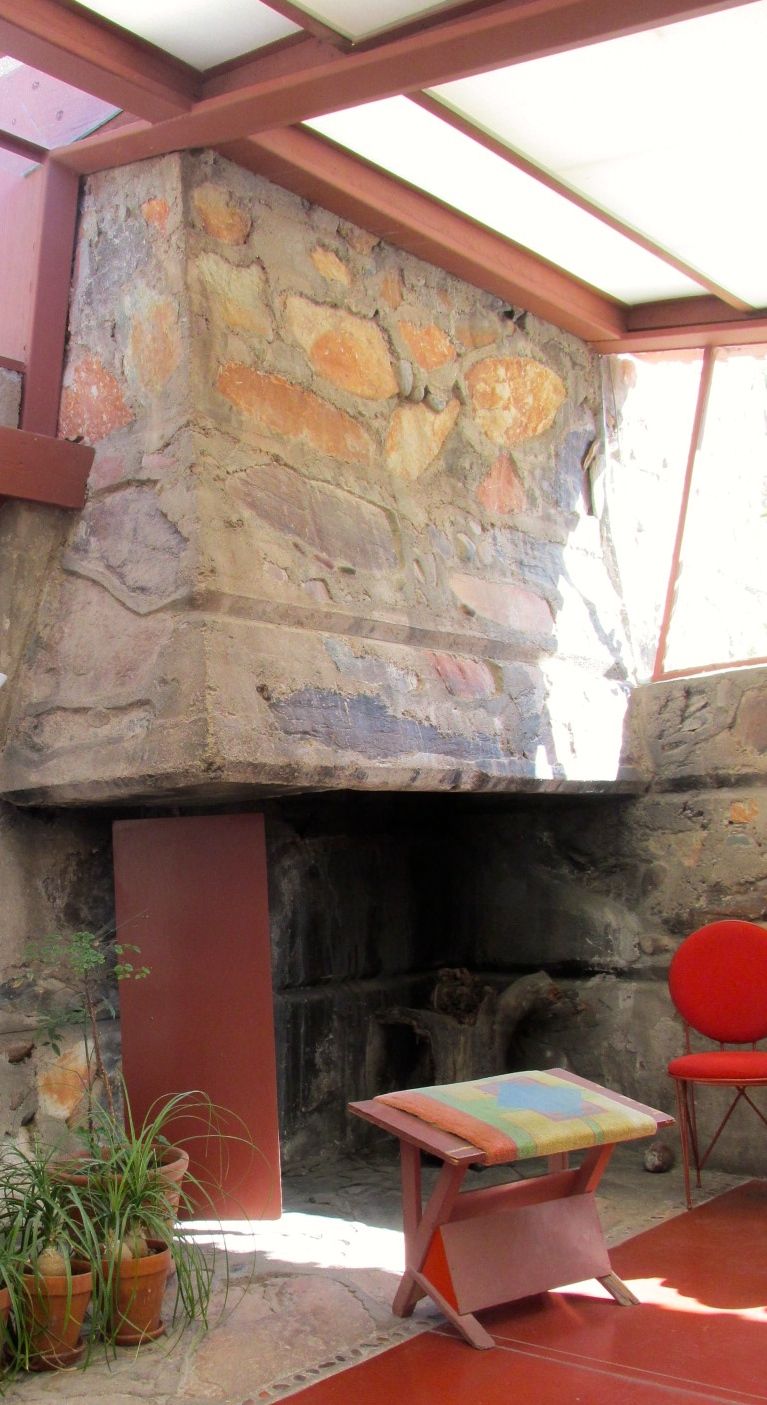
Of course, Wright would design a fireplace into his office. I imagine that it was for warmth as well as for its design qualities. While the desert is warm, there are cool mornings and nights. Also Wright was 70 when he began building Taliesin West in 1937. A little warmth during the cold times would be especially appreciated.

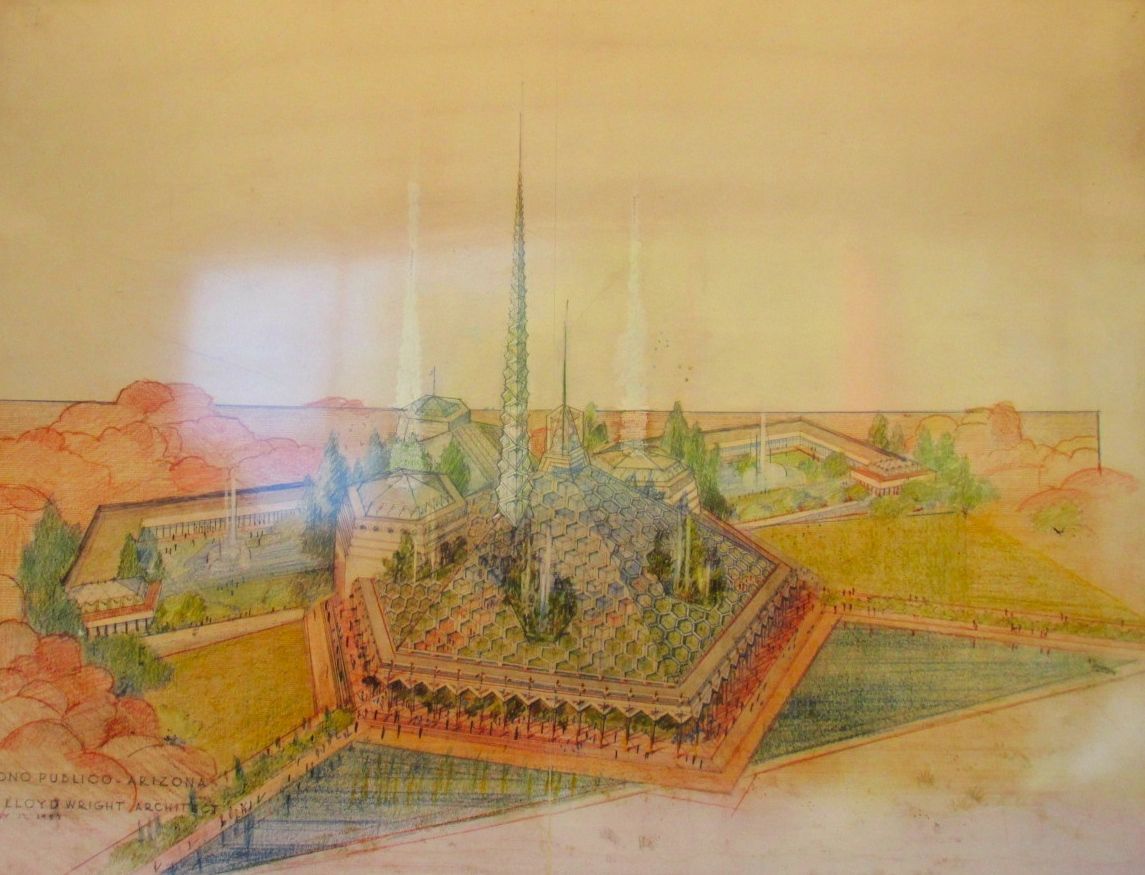
While we were in the office, our guide pointed out Wright’s proposal for a new state capital. He did it pro bono, but it wasn’t accepted.

State capital design pro bono

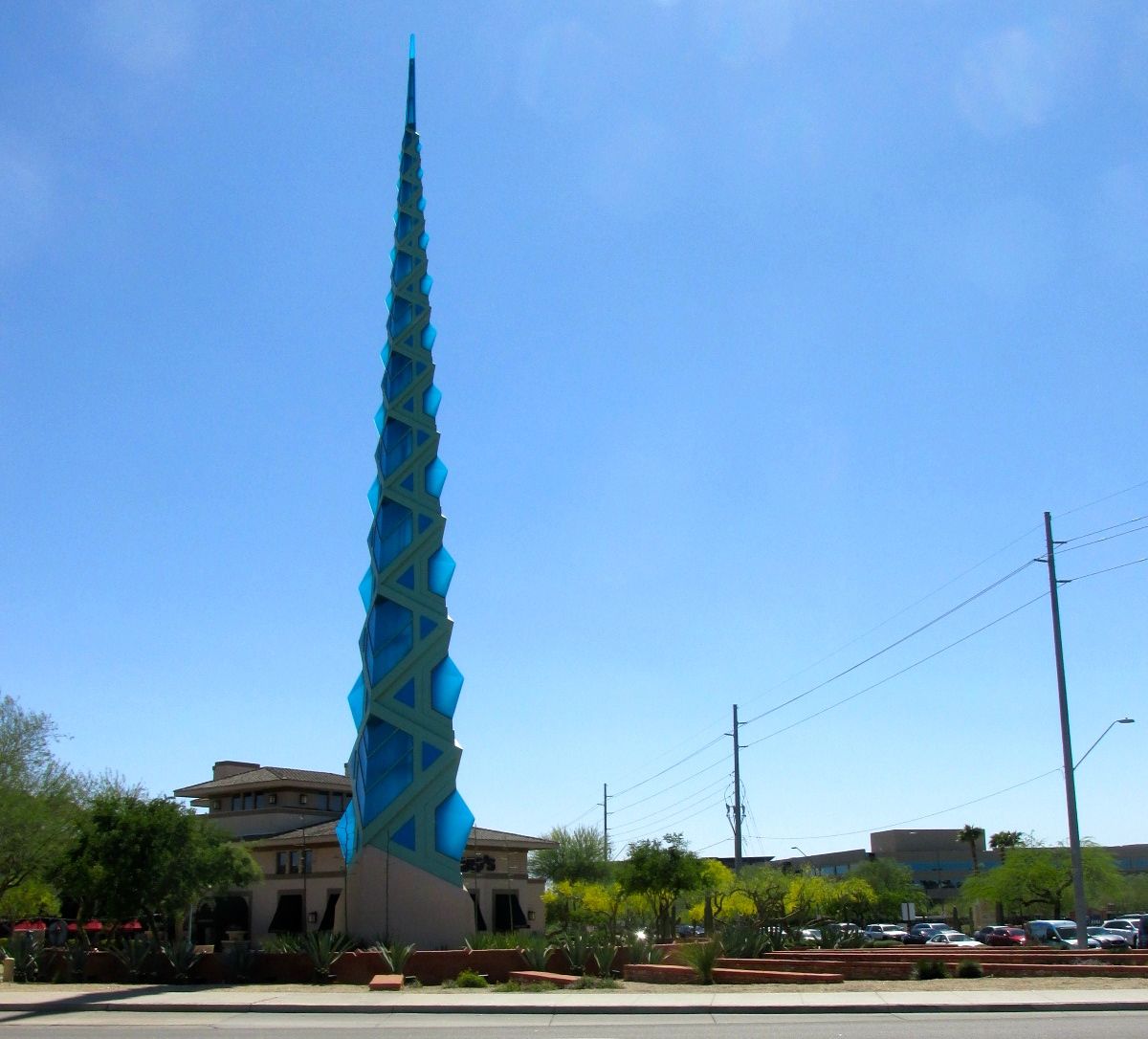
Years after his passing, however, the spire was built on a corner. I spotted it when I was out an about, and I thought it looked a little Wright-esque. I was pleased to find that I was right.

Part of the unbuilt capital's design in a shopping center

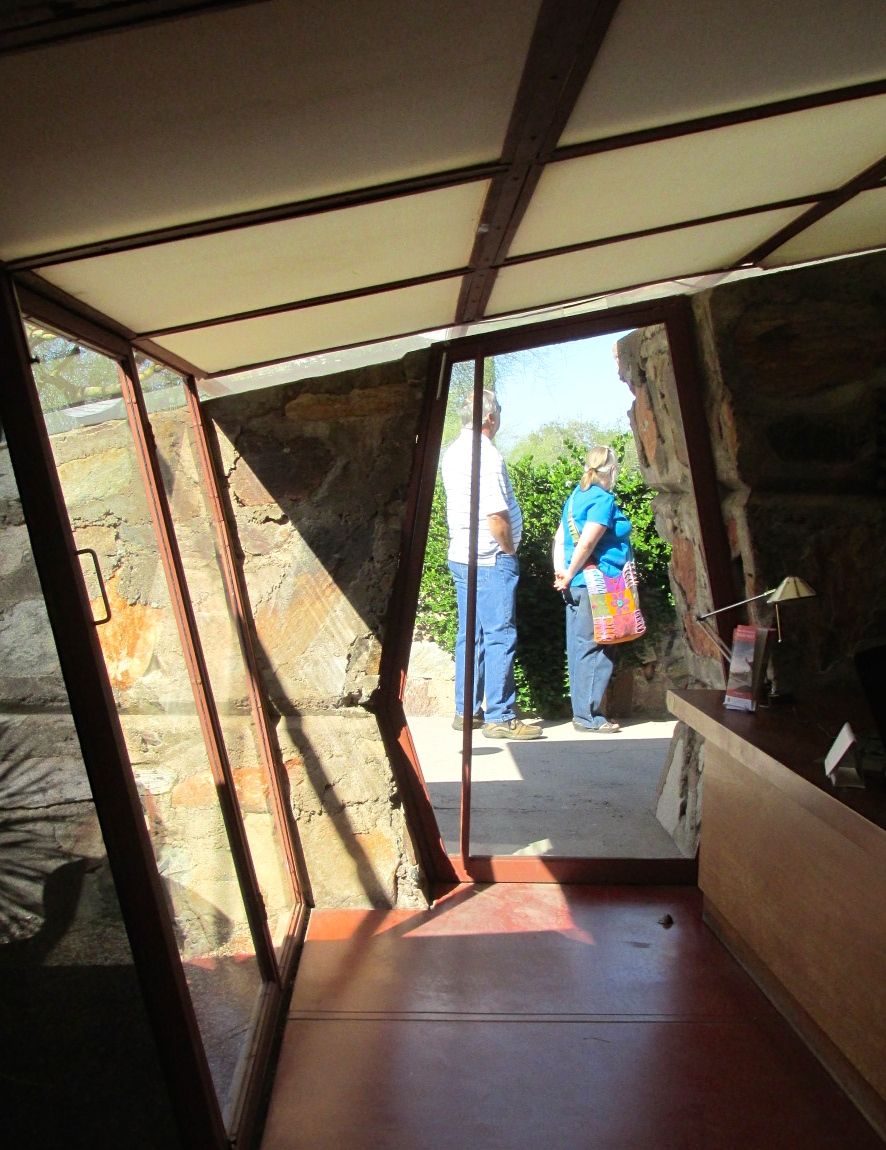
The door to the office was unique.

Office door

And you will notice the red floors and details. Cherokee red – a color that Wright used in many of his buildings. In fact, we were told that he always had a new car and that he went right out and had it painted Cherokee red. That was a bit of Wright trivia that I had never heard before.

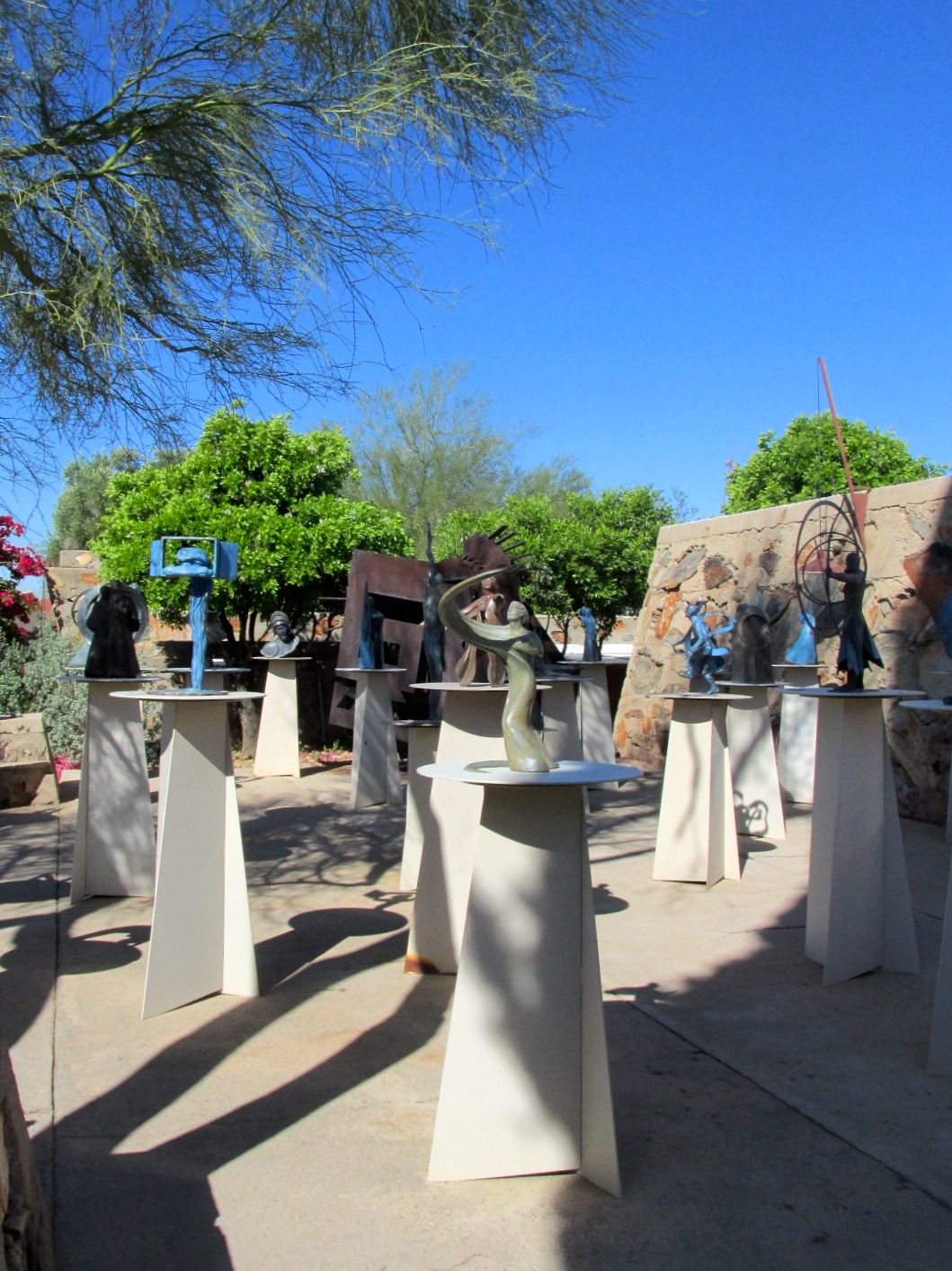
Sculpture yard

We paused to look at these sculptures in a courtyard outside the music hall. They were all made by Heloise Crista. She had started out as one of Wright’s Fellows, but decided to follow her sculpture interests. If I understand correctly, she still lives here and is continuing to work.

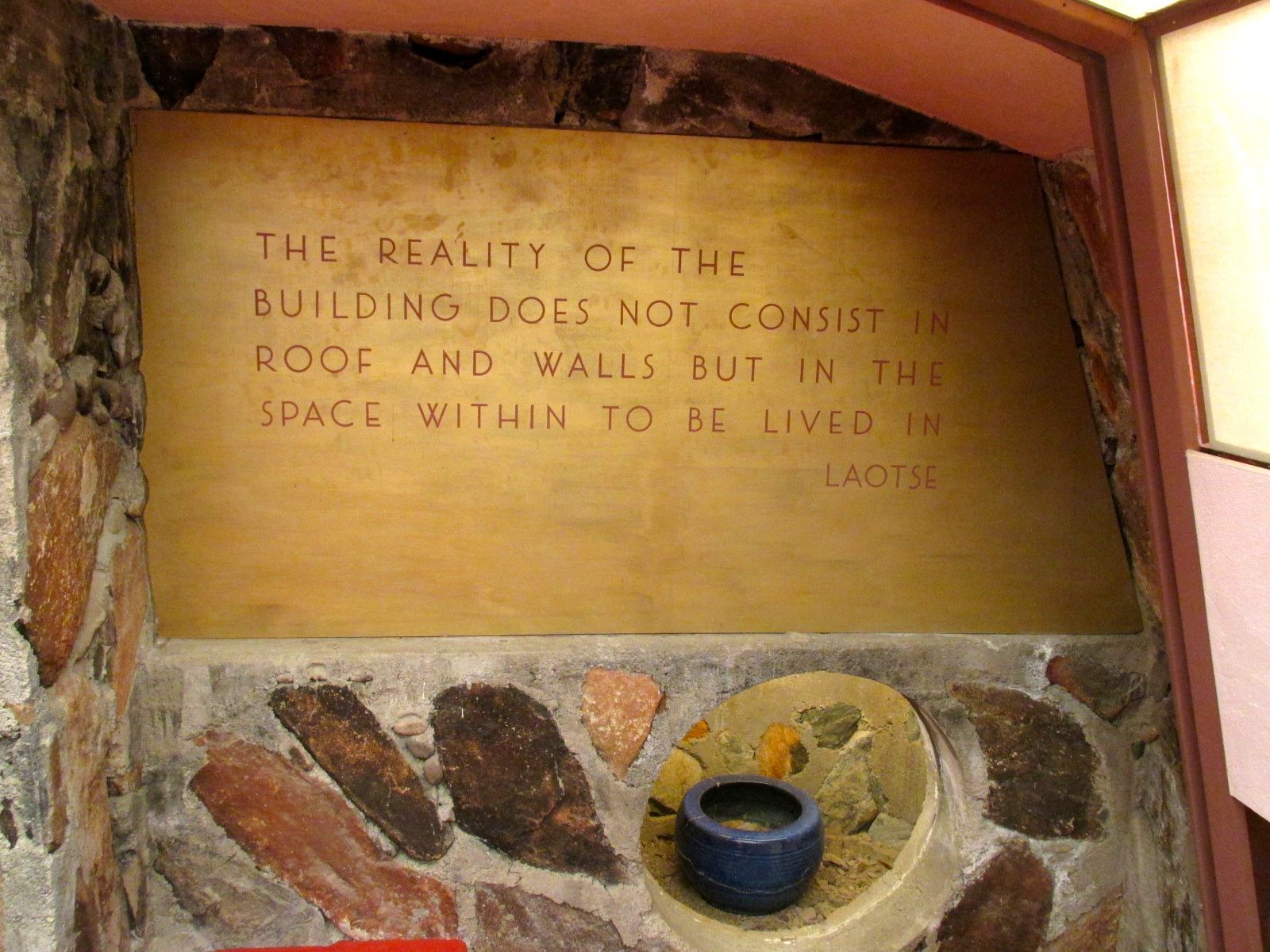
This quote greeted us as we entered the music hall.

Laotse quote

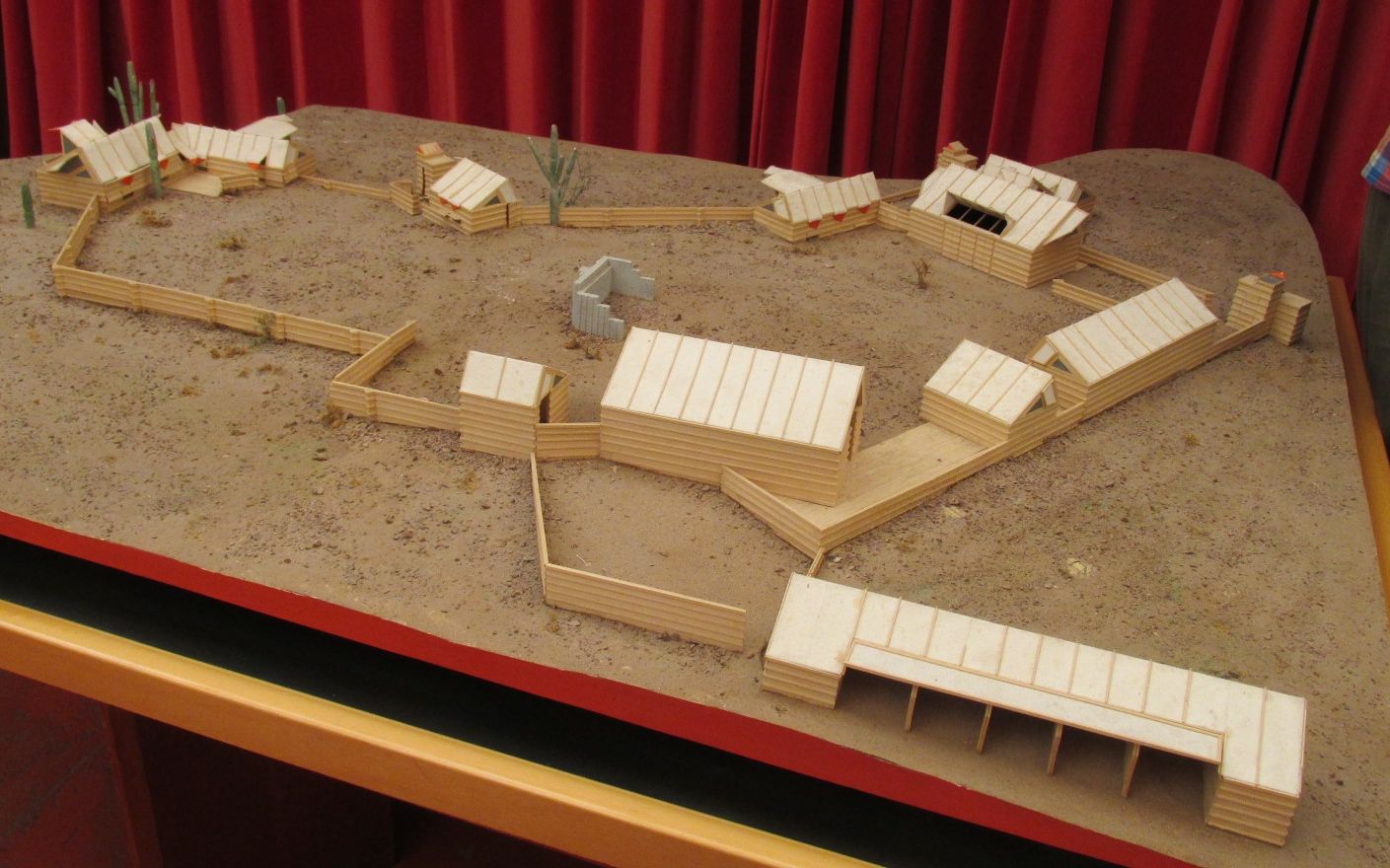
At the top of the music hall, there were some models.

Ocatillo near Chandler 1928 first home

This is a model of Ocotillo, Wright’s first attempt at an Arizona residence. He was going to work on a hotel in near Chandler. Unfortunately, the soil wasn’t suitable for building. They abandoned the site and the building materials were scavenged by the Apaches living in the area.
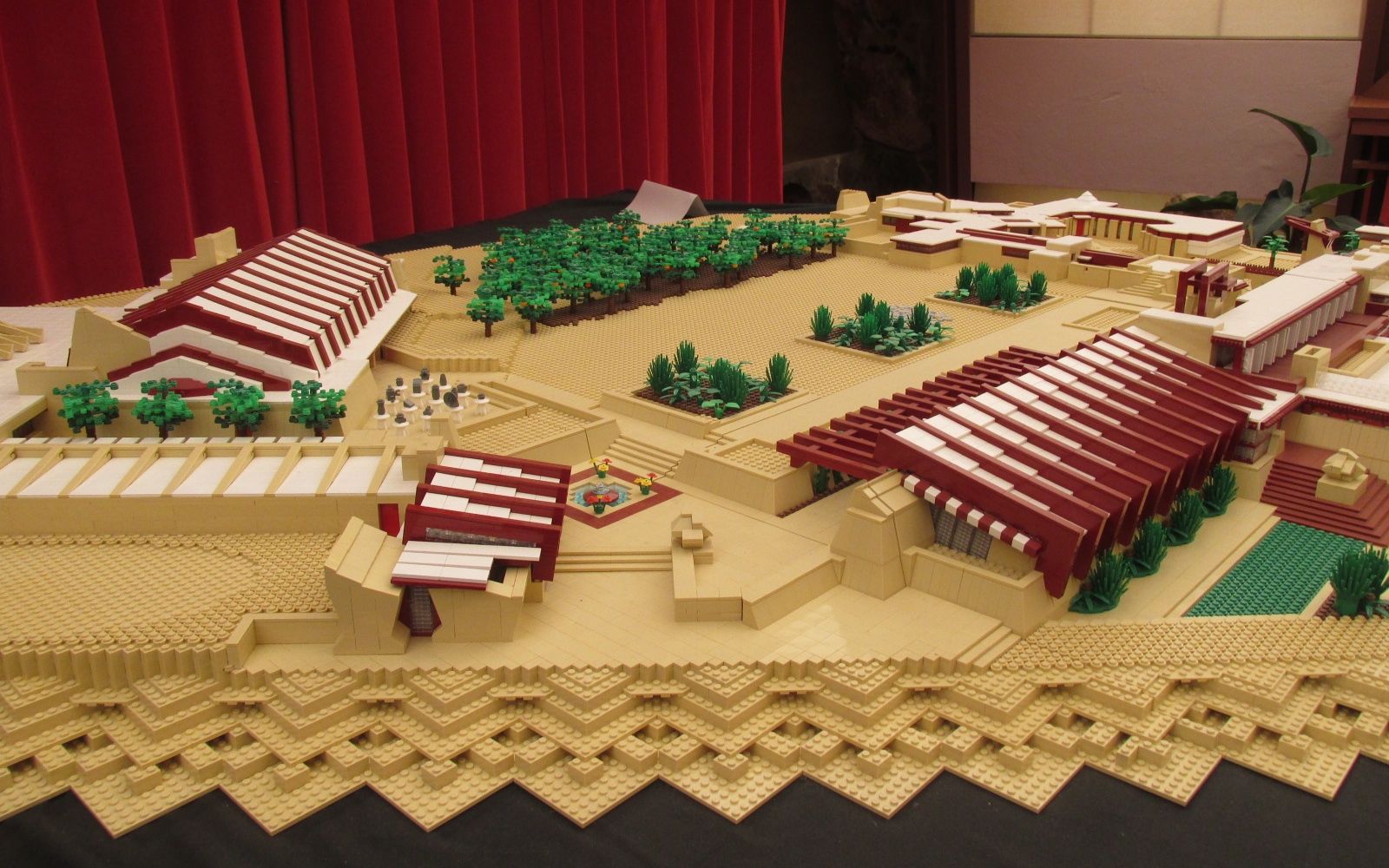
Lego Taliesin West

This model of Taliesin West was built out of Legos. When Wright was alive, he had a completely natural desert landscape. According to the guide, he told his wife, Olgivanna Lloyd Wright, who was 30 years his junior, that she could change things after he was gone. The model reflects the orange grove she put in as well as grass and other plantings.

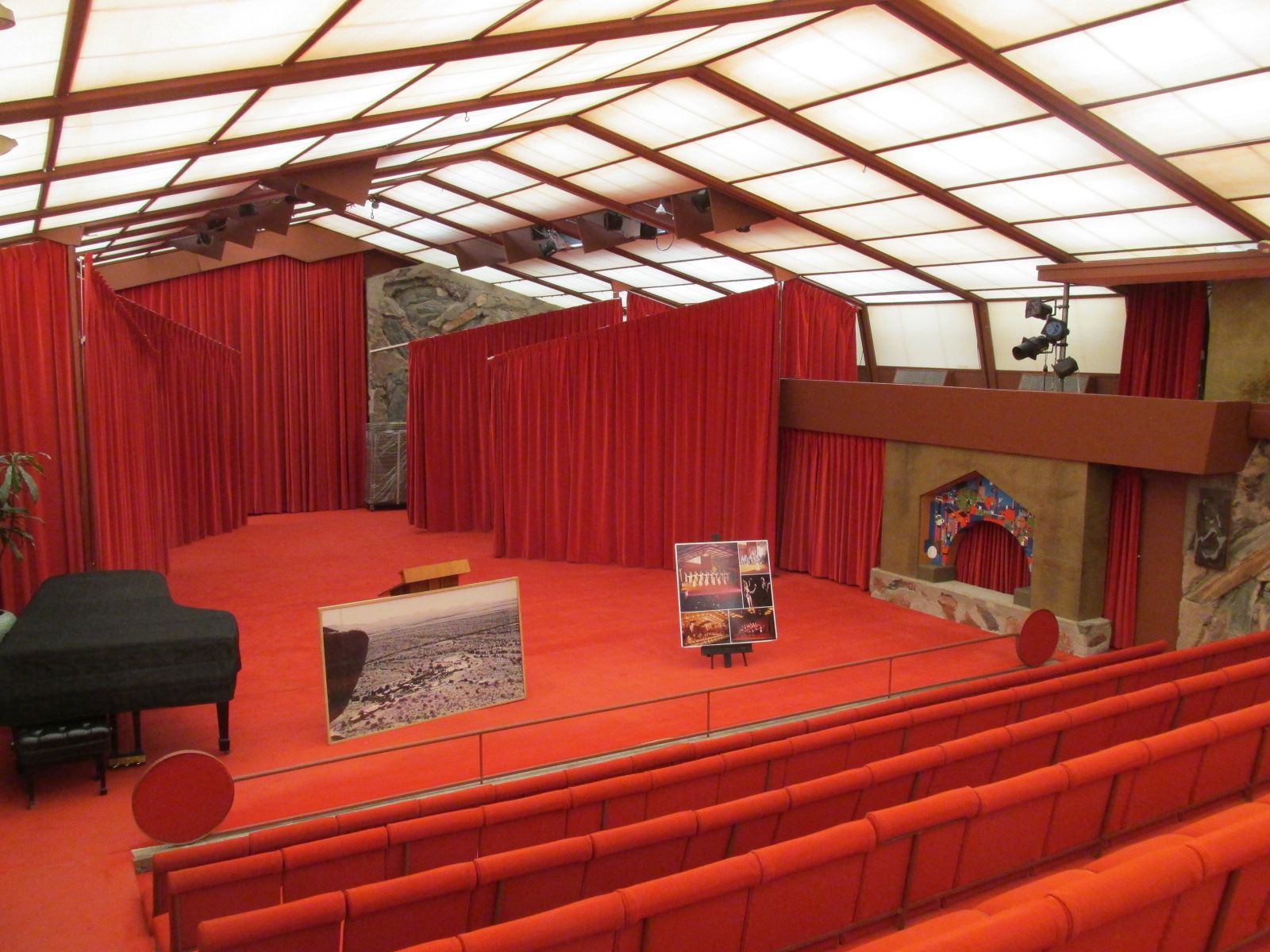
Music hall

The grand piano is one of Wright’s pianos. He was a music enthusiast and often accepted fellows based on their musical ability.

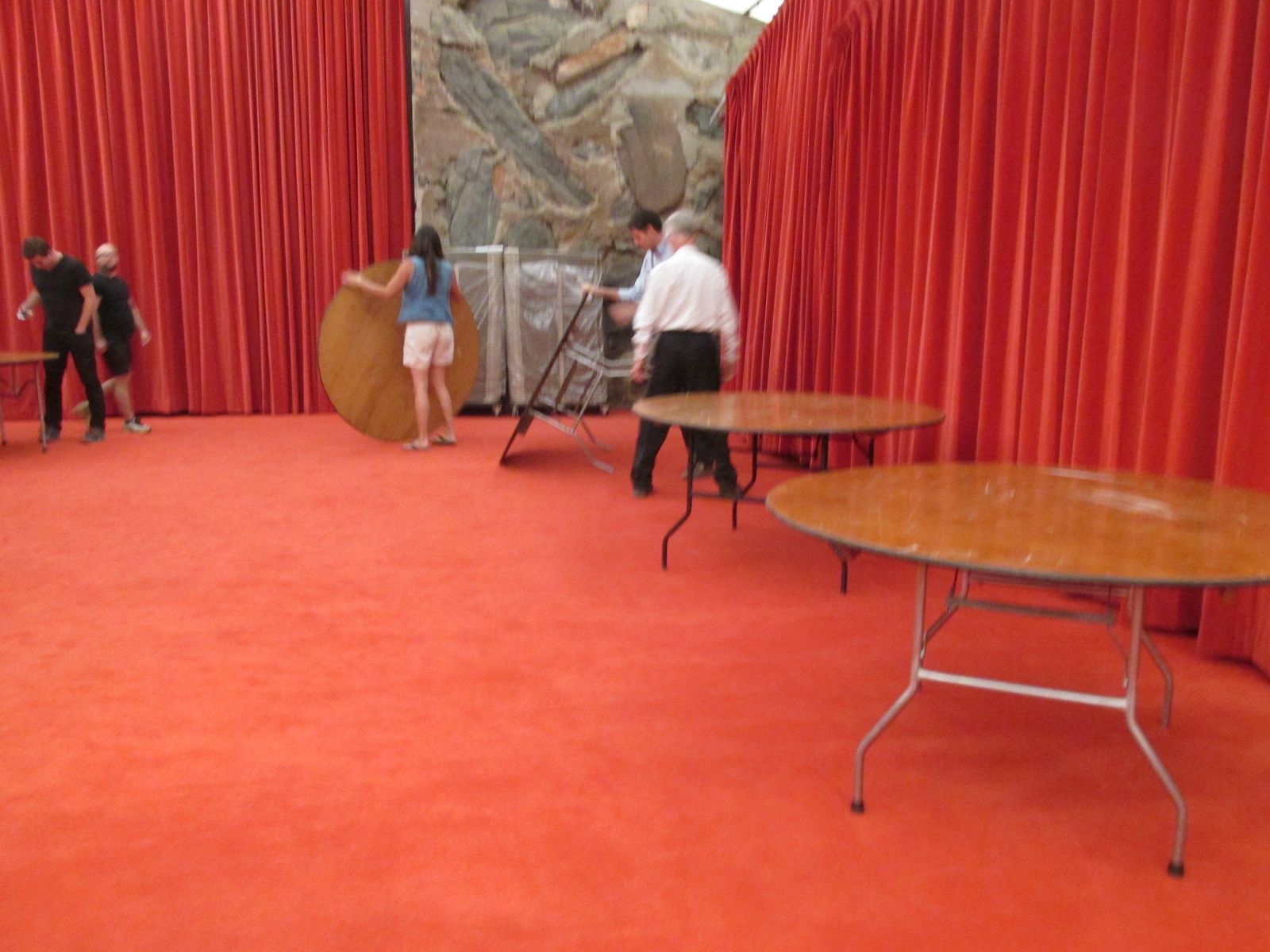
Set up for Easter

While our guide was talking, people came in and started setting up for a brunch the following day. The guide was not amused. She said that she was scheduled to be in the music hall at that time. They did stop, though, and let her finish her presentation.

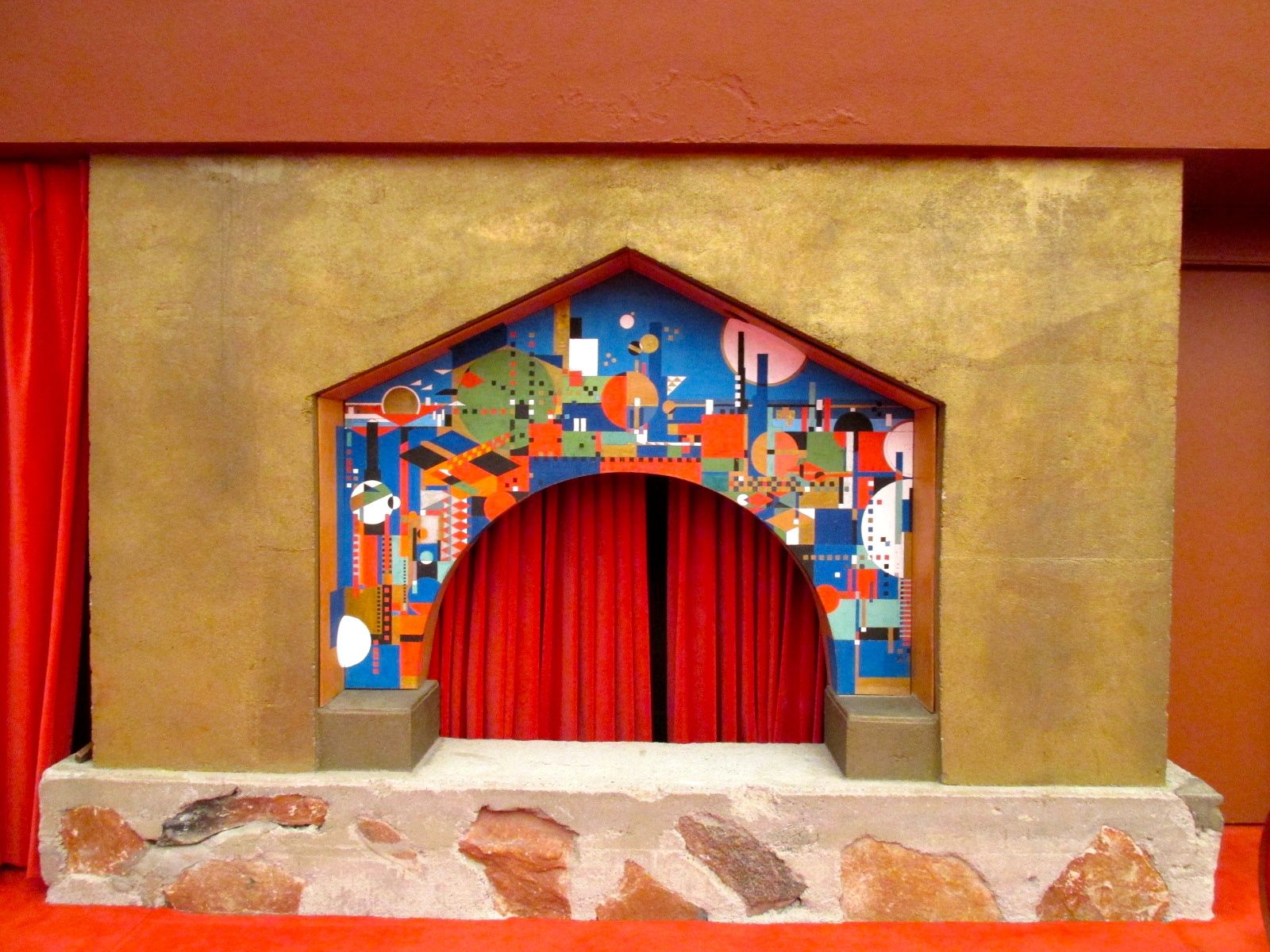
In theater

This structure was to the side of the stage. It looks like a fireplace to me, but the curtains would suggest that it is something else.

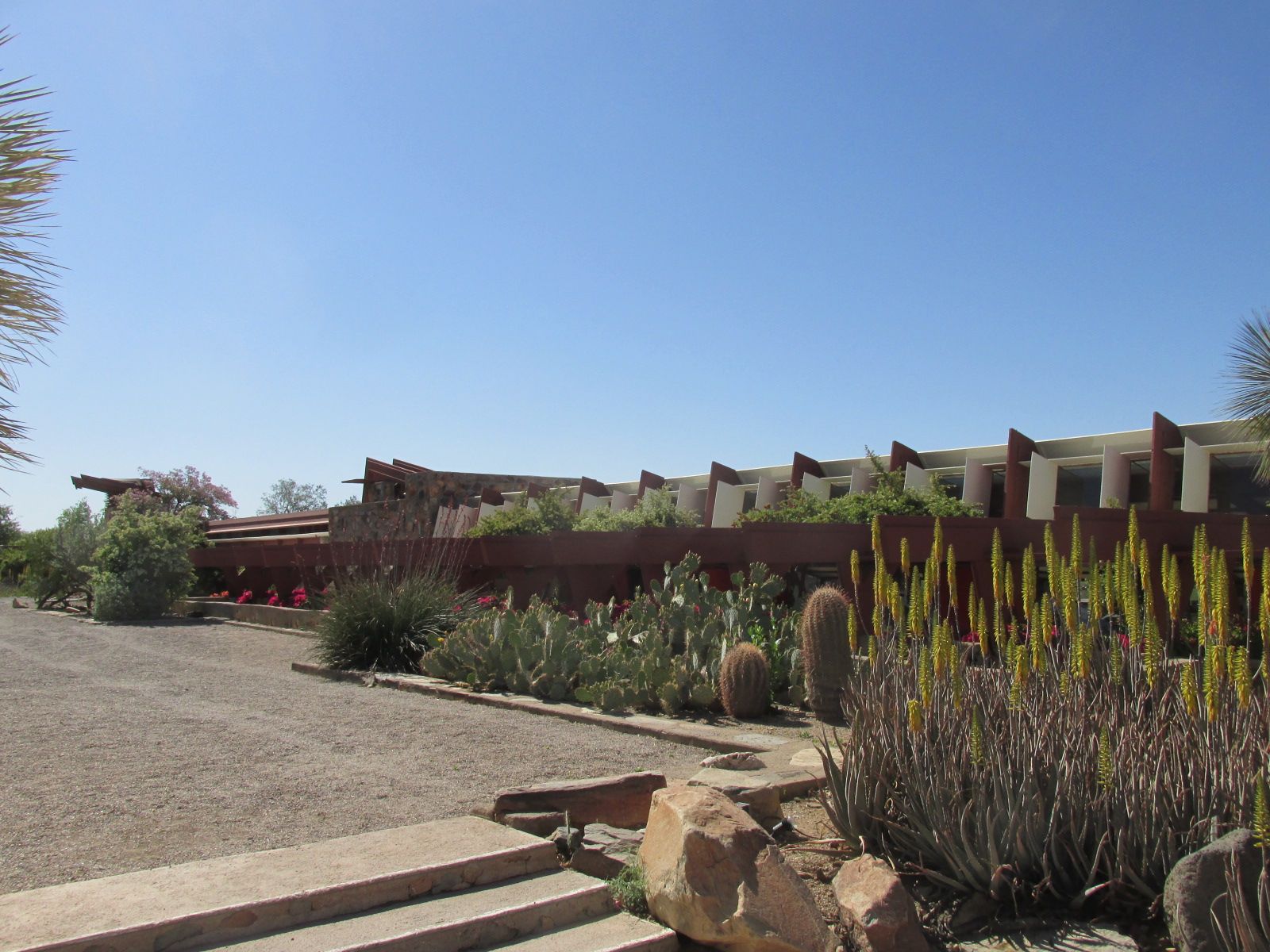
Drafting building

This is the back of the building with the drafting room.

Goose eggs details

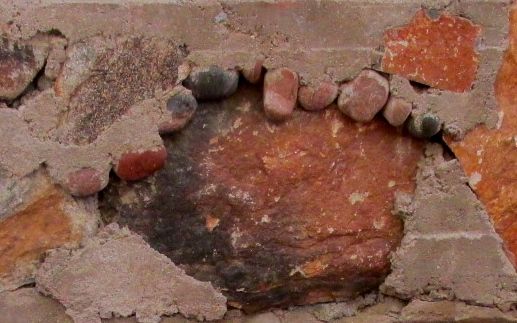
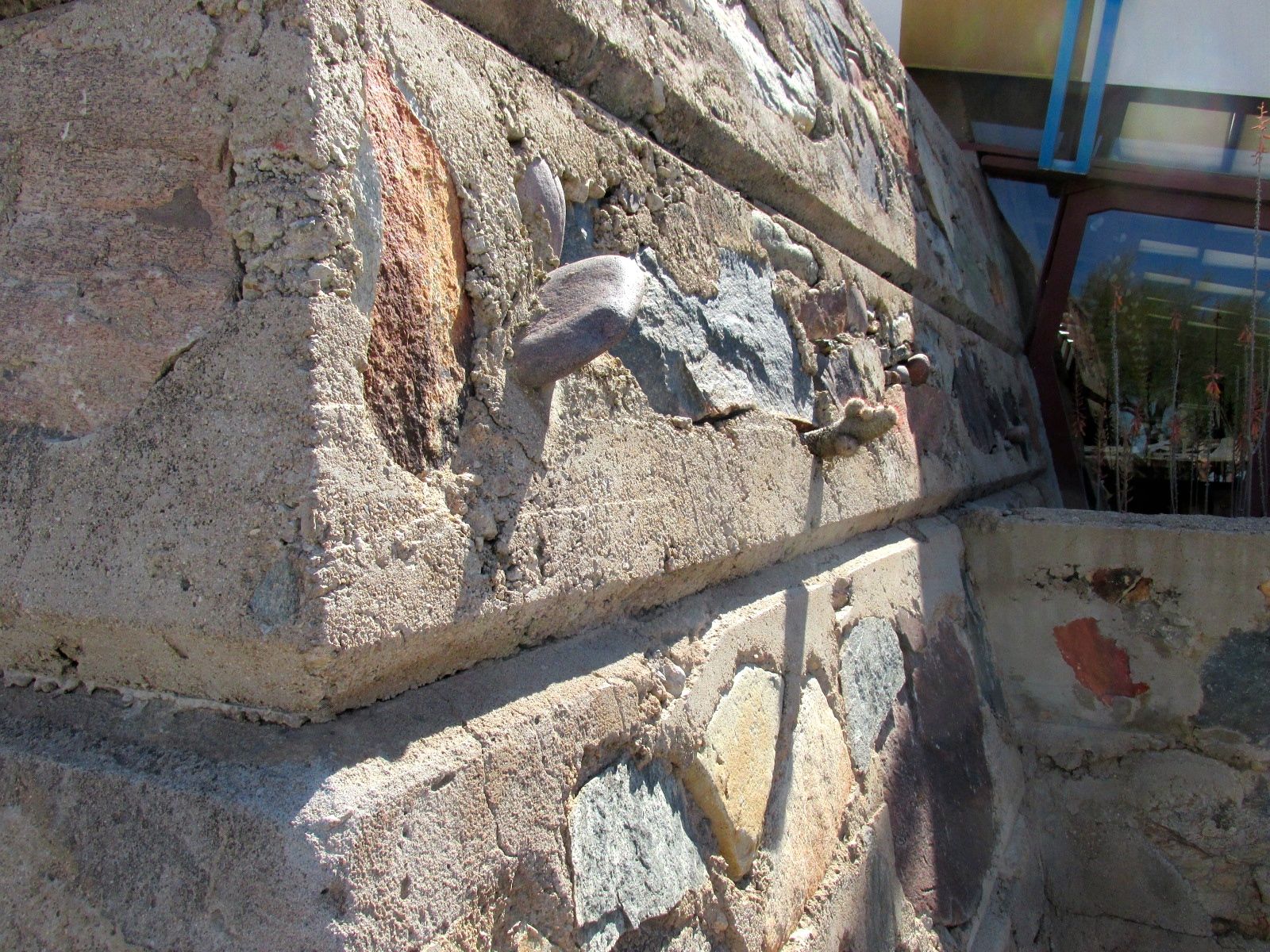
All the building was done by Wright’s Fellows. They took to using round river stones around the larger mountain rocks to keep the cement in place. If it covered the large rocks, they would have to scrape it off. Wright liked the technique and called them “goose eggs.”

Wall with cactus growing out

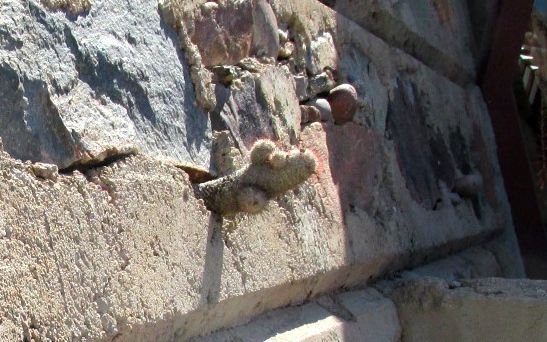
It’s fairly easy to see a rounded stone sticking out of the wall, but if you look a little further down the wall, you can see a cactus growing out of a hole.

Cactus close up

According to the guide, the cactus was planted there by a bird and is just growing there. I wonder how long it has been there and how much longer it will survive?

Drafting studio with pool

We came around the corner and were greeted by an unexpected expanse of green. I imagine that all the green was thanks to Olgivanna.

nestled in the landscape

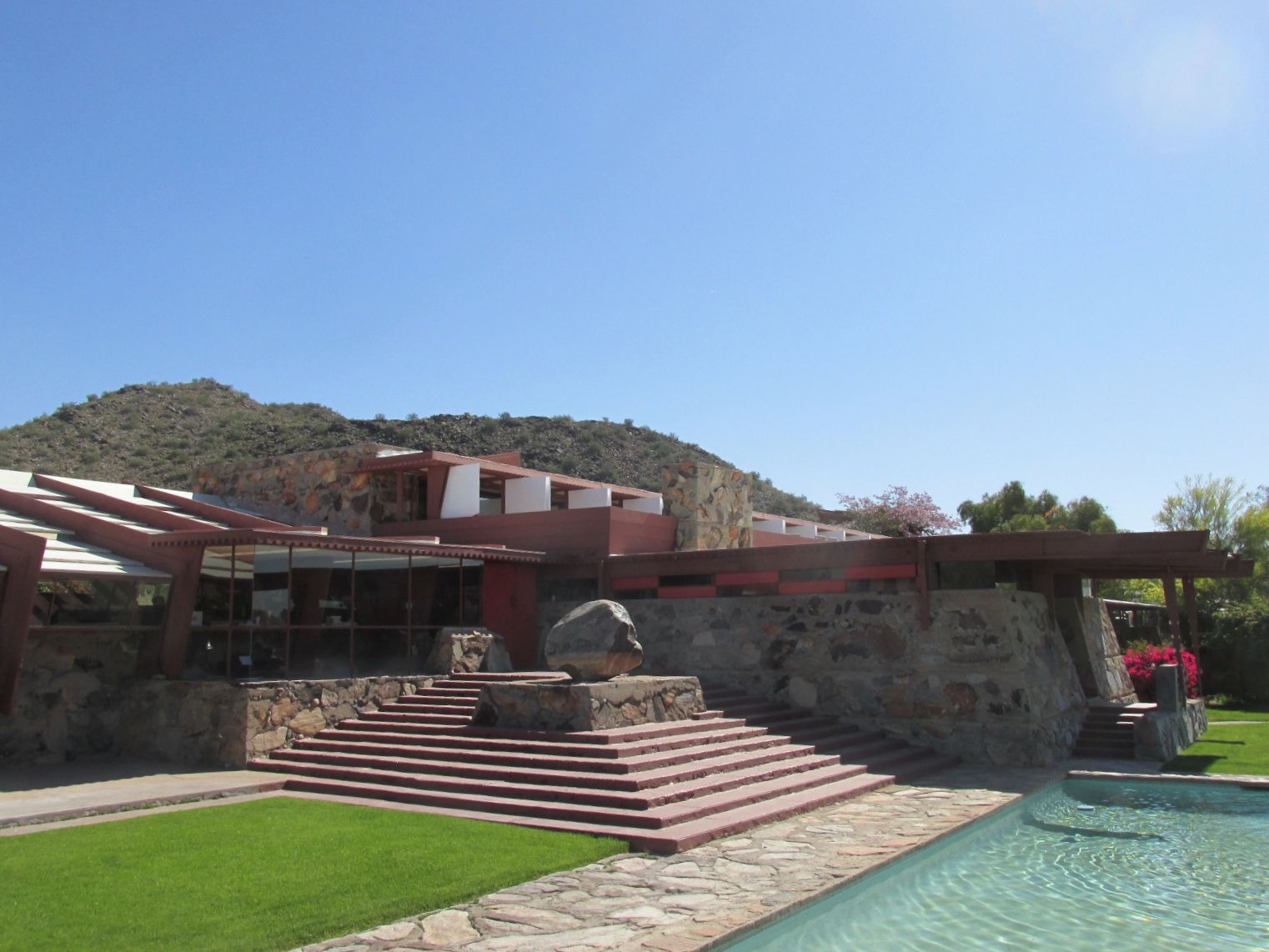
This is the other side of the building with the drafting hall. It was designed to be cooled by the breezes blowing across the shallow pool, up the steps and into the door, which was thrown open to take advantage of the weather.

This view really shows how the buildings nestle into the Arizona landscape.  In Wright’s words, “Arizona needs its own architecture… Arizona’s long, low, sweeping lines, uptilting planes. Surface patterned after such abstraction in line and color as find ‘realism’ in the patterns of the rattlesnake, the Gila monster, the chameleon, and the saguaro, cholla or staghorn – or is it the other way around—are inspiration enough.”

Eminent domain

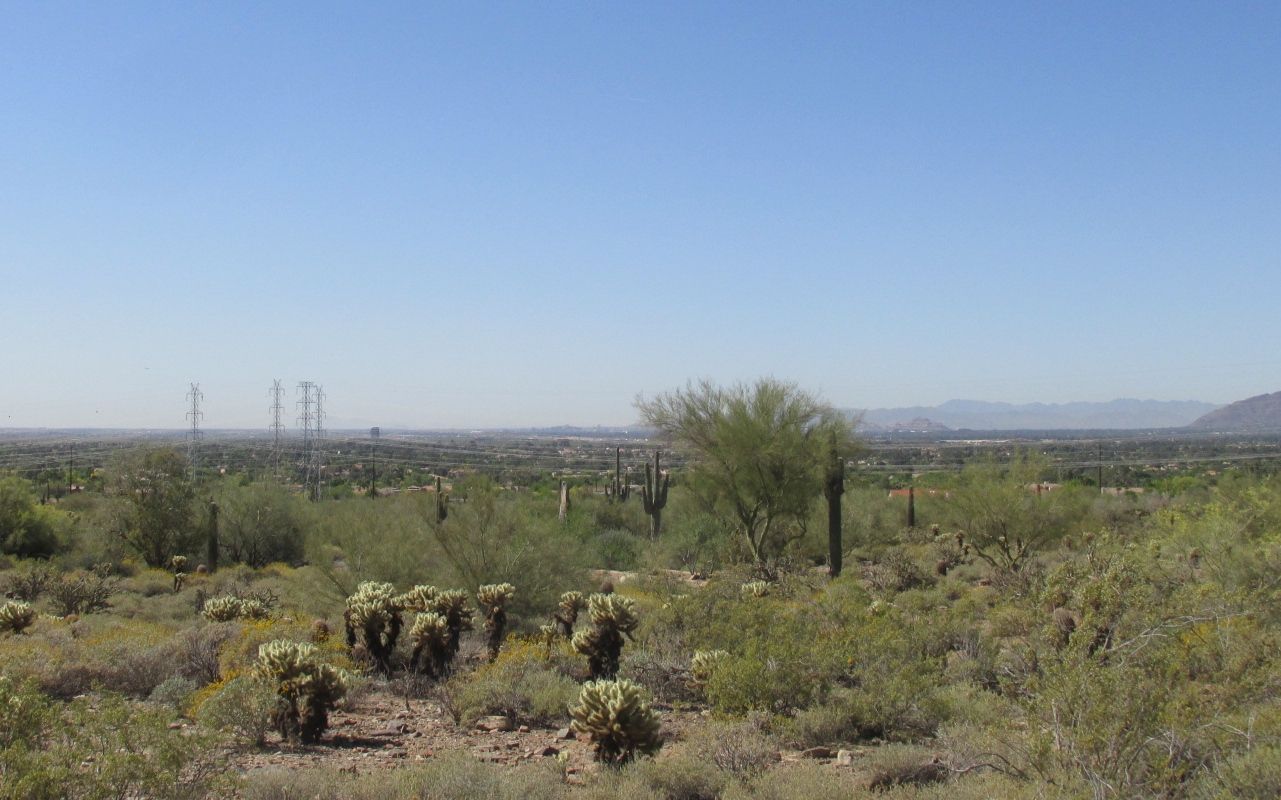
This is the view from this building. Wright was really angry about the electric wires that were strung across his view and through his land, thanks to eminent domain. The dining room used to look out on this vista. After the wires were strung, though, he moved the dining room to the other side of the building.
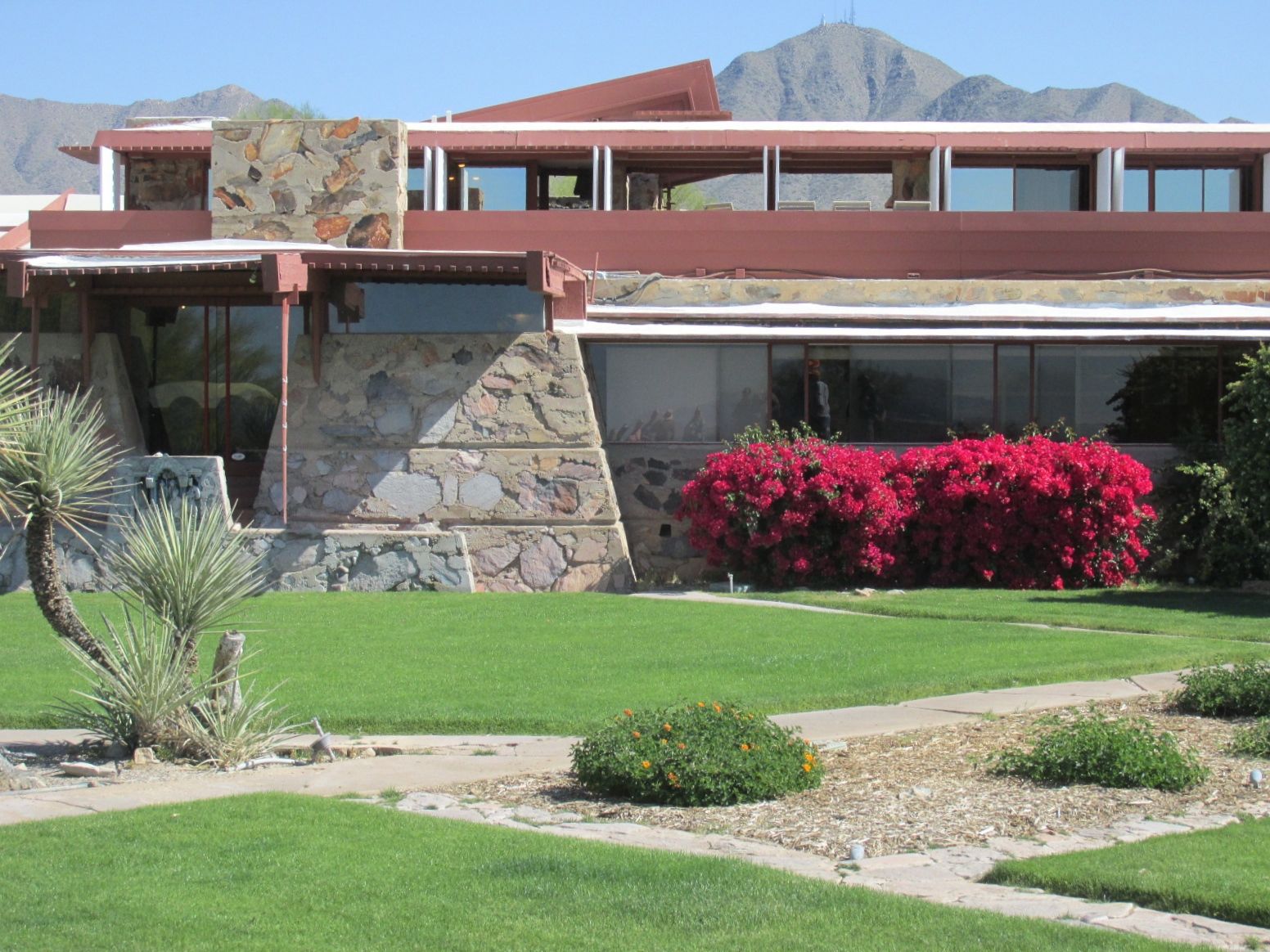
Old dining room

The windows above the bright bougainvilleas are from the original dining room. Now it is used as office space.
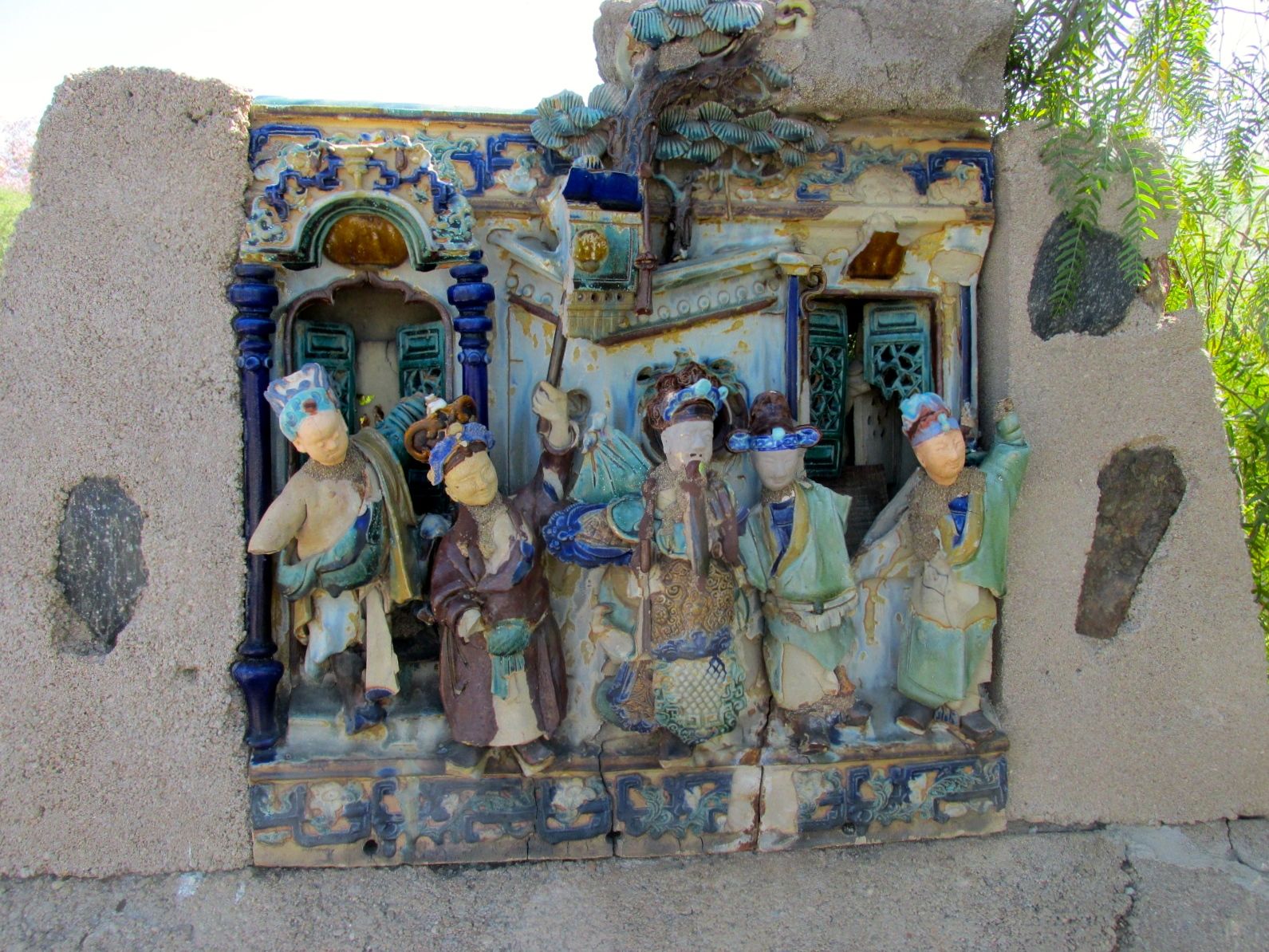
As we approached the dining room where we were to have our snack, we passed one of Wright’s Chinese terracottas.

Chinese Terracotta 2

Wright was an art collector and he acquired a dozen of these sculptures. They were broken when he got them, but one of his Fellows managed to repair them. The Fellow returned to continue and tend to the terracottas, but I think he has since passed on. The birds would come and snatch the pieces as they would break off and drop to the ground. You can see where some pieces should be that aren’t anymore.

And this is where I’ll pause for now. Come back for the next installment to see the rest of the tour.


Last Call for Buffalo!

My thanks to all of you who have been following along with me. I spent three weeks in Western New York, and I have a bunch of little bits and pieces that I wanted to include in the Official Record, but never quite got them fit in. So here it is:

LAST CALL FOR BUFFALO!

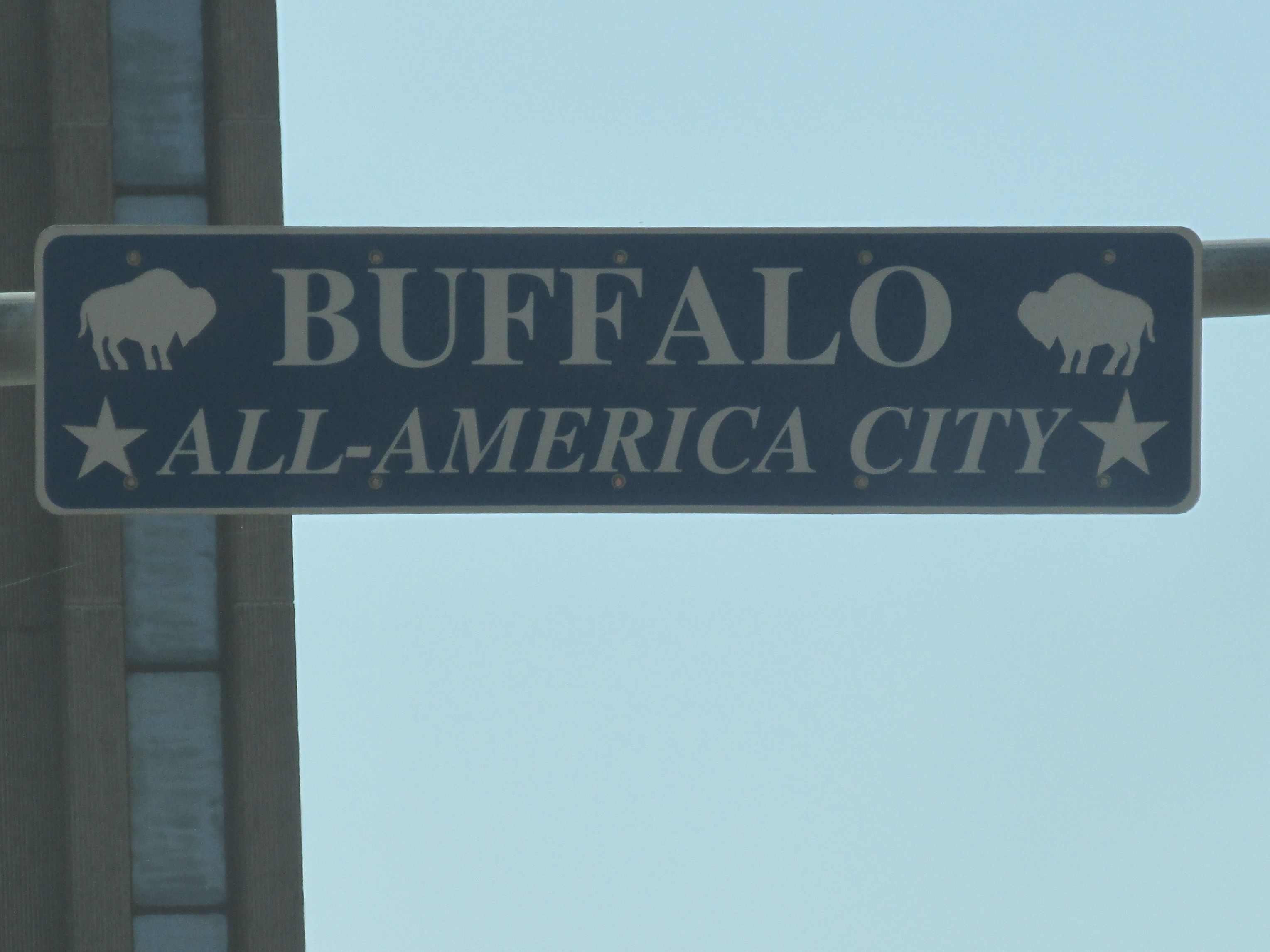
Buffalo all america city sign

Buffalo is a great place to eat!

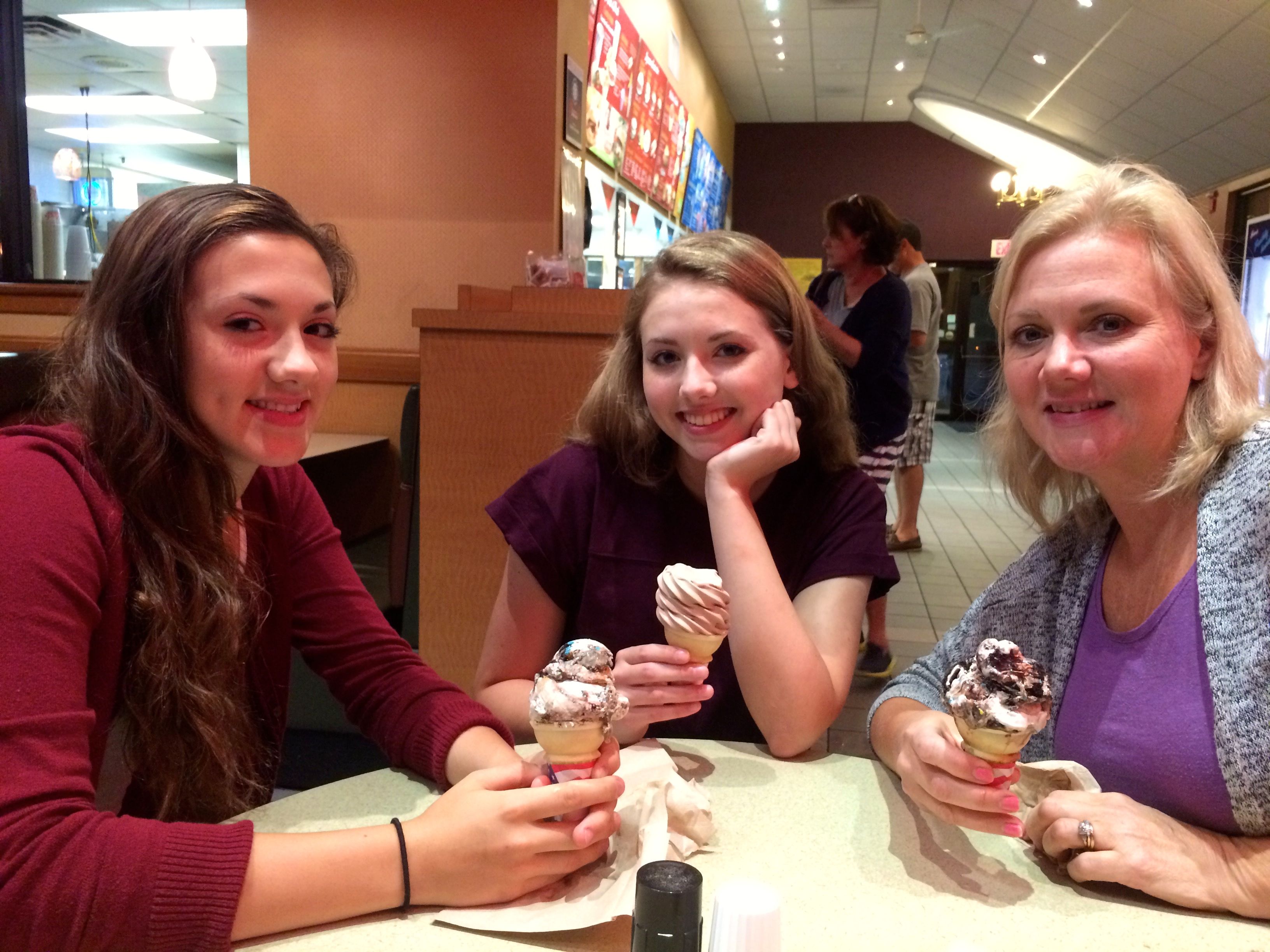
There’s Andersons:

My nieces and my sister out for treats

Of course, there are many great places for beef on weck.

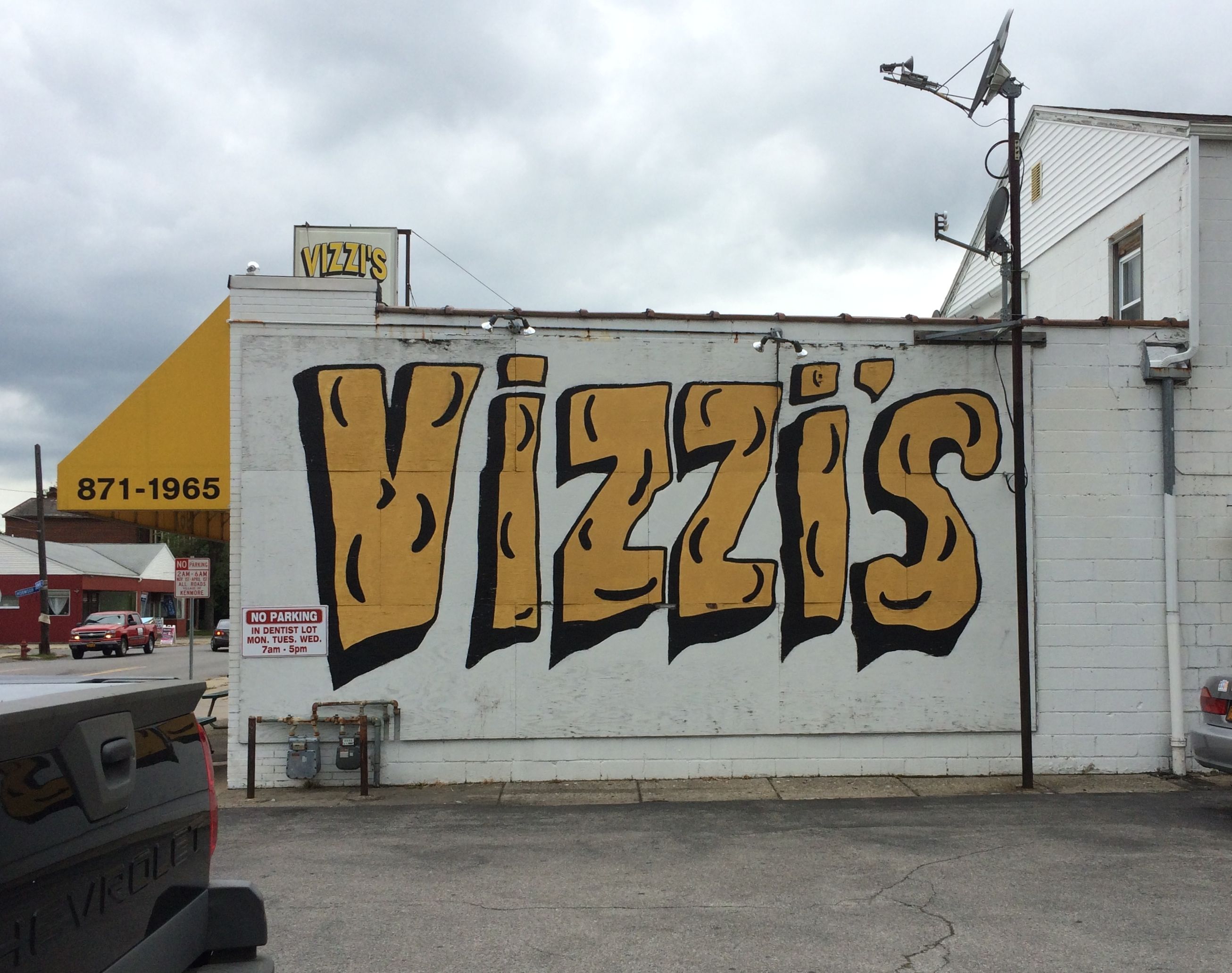
Vizzi's on Kenmore Avenue
Vizzi’s on Kenmore Avenue
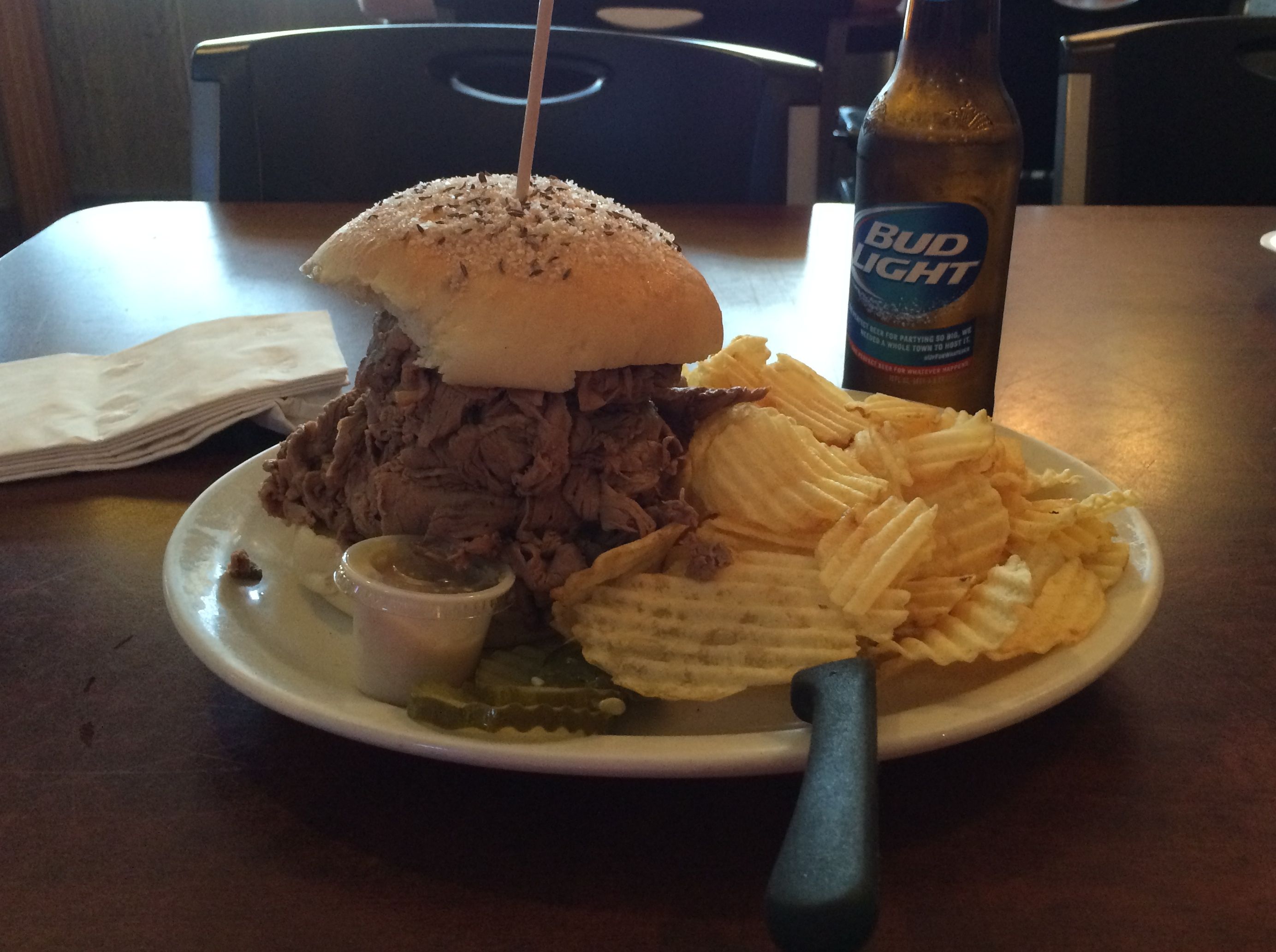
A sandwich as big as your head!

There was so much meat on this sandwich that I took some off and asked for a to-go box. I took home enough for two more sandwiches!

Just in case you don’t know what “weck” is, allow me to explain. It is a German style hard roll with rock salt and caraway seeds baked on top. In German, kummel means caraway and weck means roll. So a beef on weck is a thinly sliced roast beef sandwich on kummelweck.

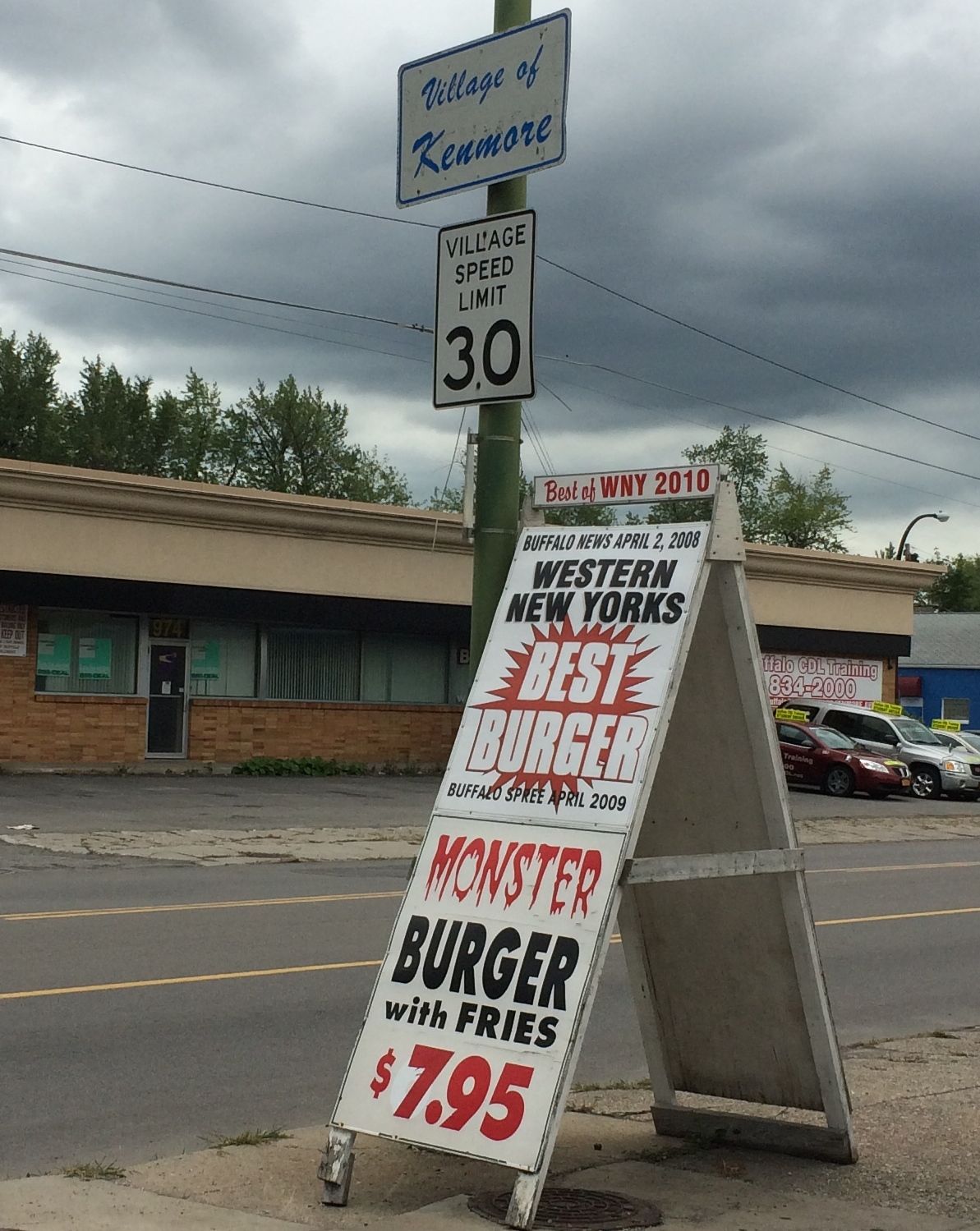
Vizzi's A frame sign

Best of WNY 2010.  Have they been resting on their laurels?

The other great bar food mainstay is Buffalo style chicken wings. I didn’t get around to the Anchor Bar this trip. If you are going to have chicken wings in Buffalo, you might as well go to the place that started the whole thing off. But, no wings for me this time around.

Bocce Club Pizza

Bocce’s Pizza. It’s always been a family favorite. And, it was voted one of the top 33 pizzerias in America. You can read it right on the box.

Bocce Club boxes

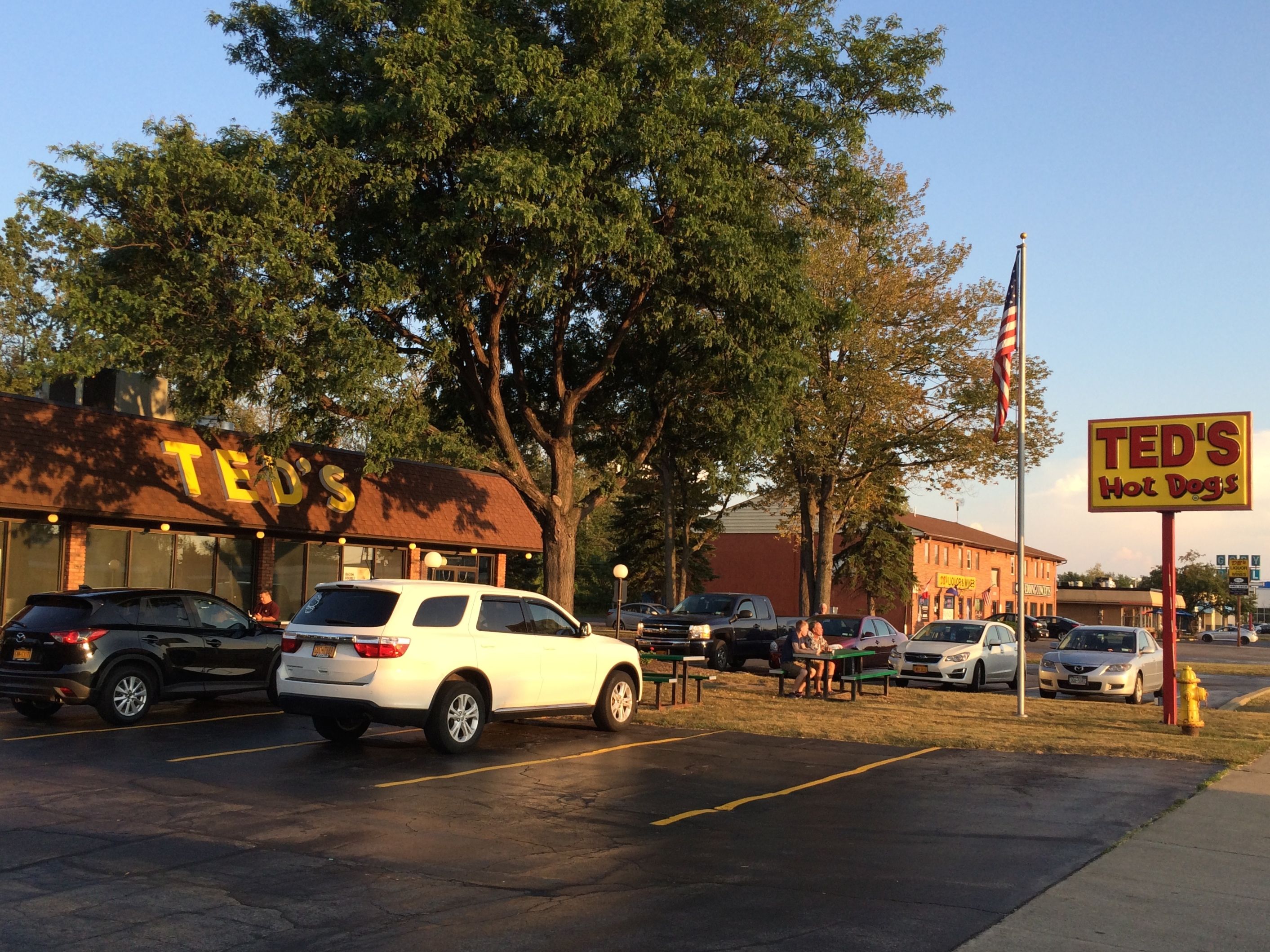
And then there’s Ted’s. High school chum Susan suggested Ted’s when we were trying to decide on a place to go for dinner. I never really cared for Ted’s, so we picked another place. But, I got to thinking about it. I was out and I was hungry and I said, “Why not?”

Ted's Hot Dog stand

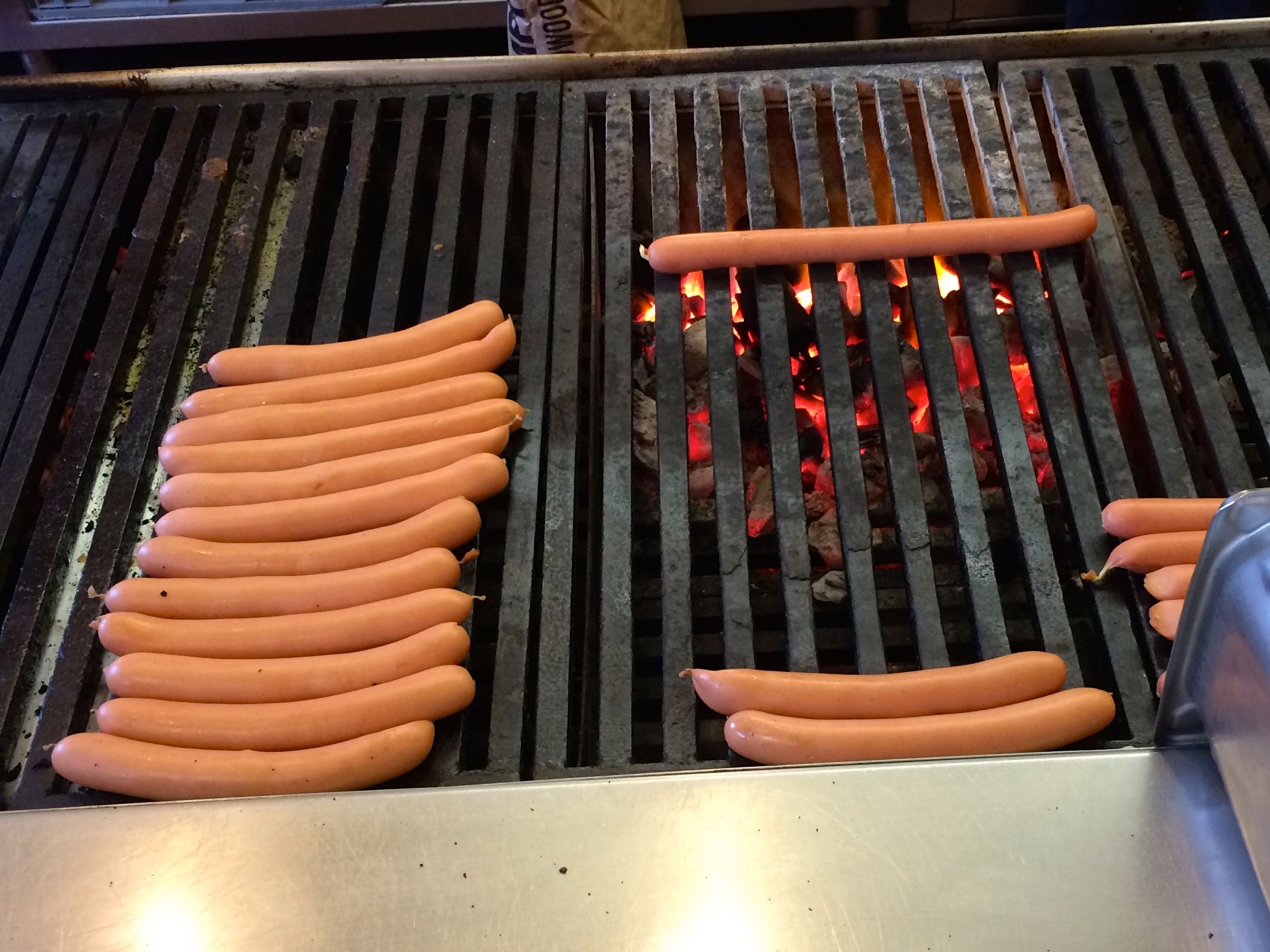
Ted's hot dog on the charcoal

They grill the dogs right over the charcoal. I could never understand why people in Kalamazoo got so worked up about The Root Beer Stand and their boiled hot dogs.

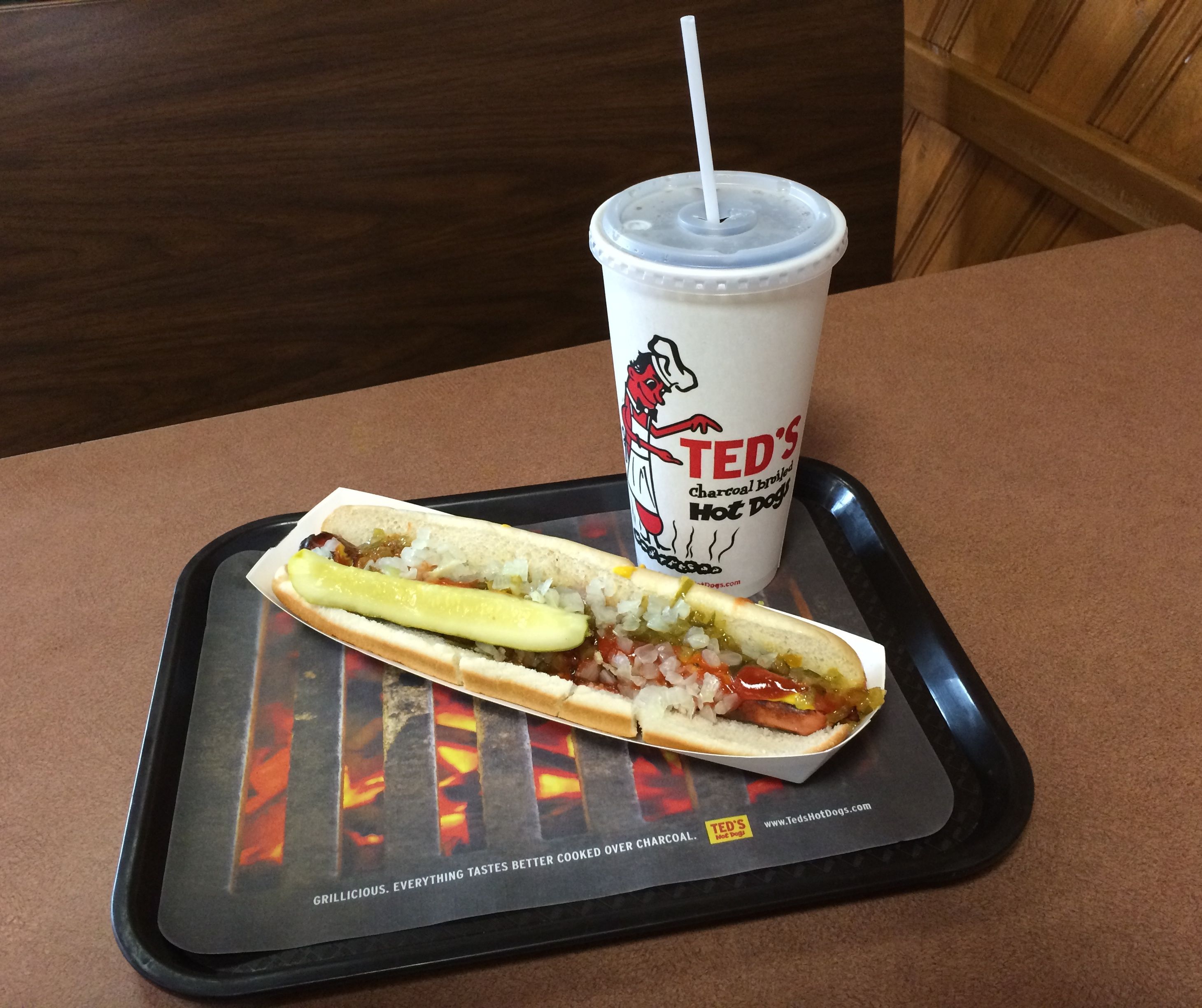
Ted's Hot dogs

Pretty good presentation. I liked the tray liner that looks like glowing charcoal. Unfortunately, I guess I really don’t care for Ted’s all that much.

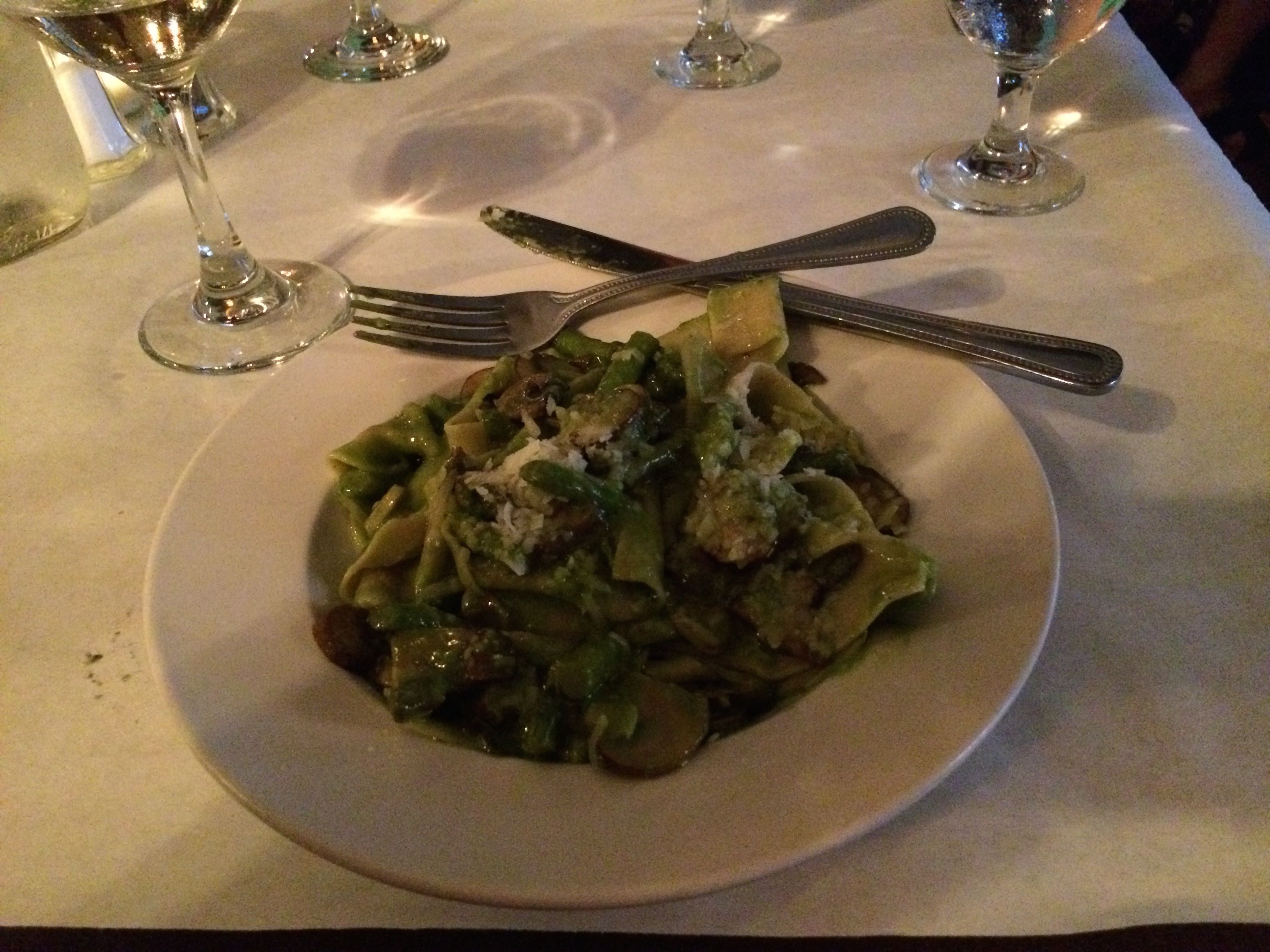
But I did like the meal I had with Susan and Kay at Crav on Hertle. I had Handkerchief Pasta. I was intrigued by the name.

Handkerchief pasta

Me and Susan
Me and Susan
Susan and Kay
Susan and Kay

Unfortunately, my flash didn’t go off.

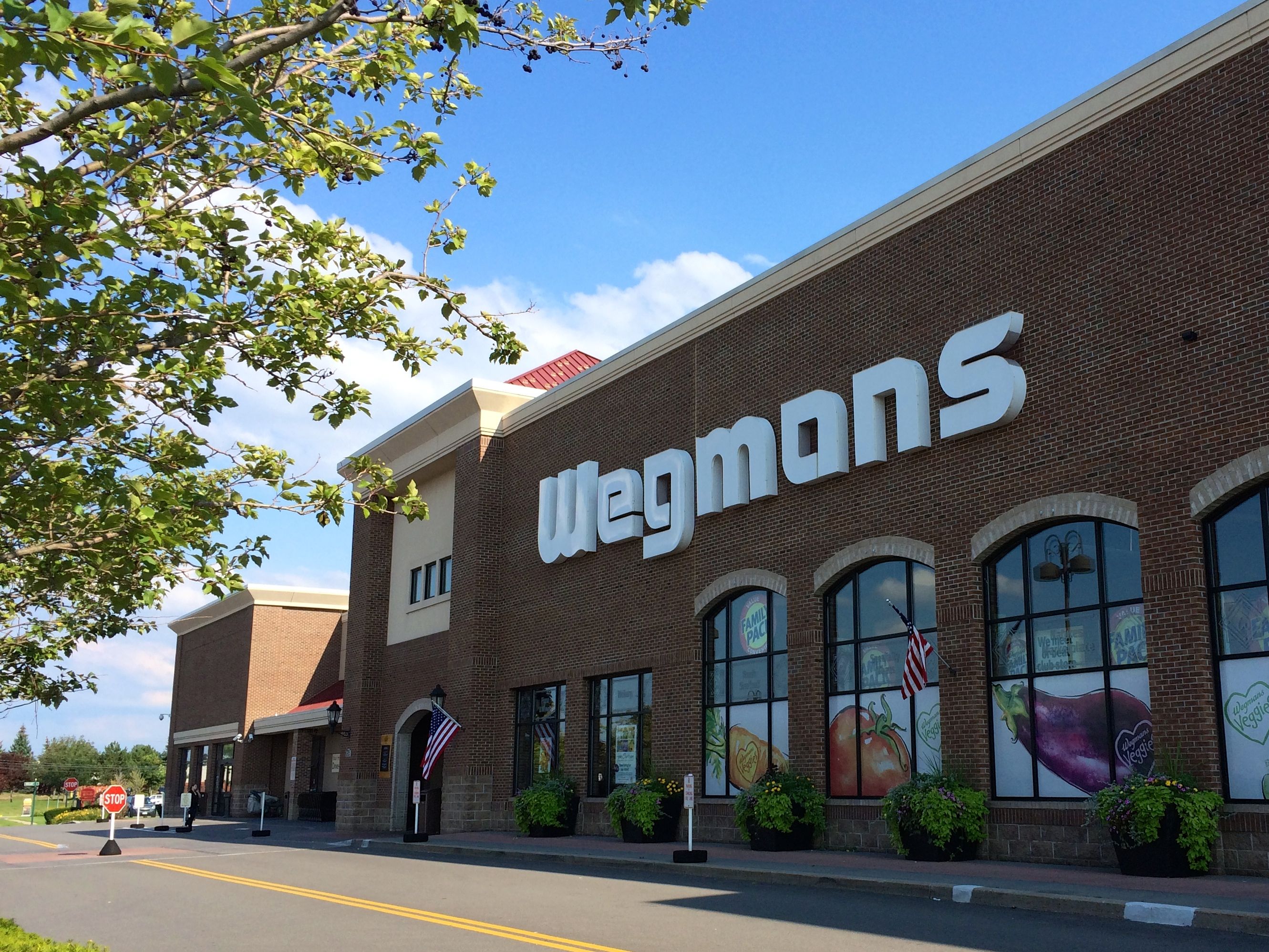
Wegmans!
Wegmans!

And, if you can’t find a restaurant you like, you can always buy great food at Wegmans and cook it yourself. (I’ve been told that some people do cook.)

When I am in Buffalo, I always have to at least go by the Darwin Martin House. It is one of Frank Lloyd Wright’s masterpieces finished in 1905

Darwin martin House

They have done an absolutely fantastic job of renovating it. In fact, they tore down buildings and recreated parts of the estate that had been demolished to make way for apartment buildings. It’s difficult to tell the old sections from the new.

Gardener's Cottage
Gardener’s Cottage at the Martin Complex

Living in a house like that would make being someone’s gardener a pleasure!

My first visit to the house was back in the 70’s, before it was renovated. In fact, it was in desperate condition. I take special joy in going by and seeing how beautiful it looks.

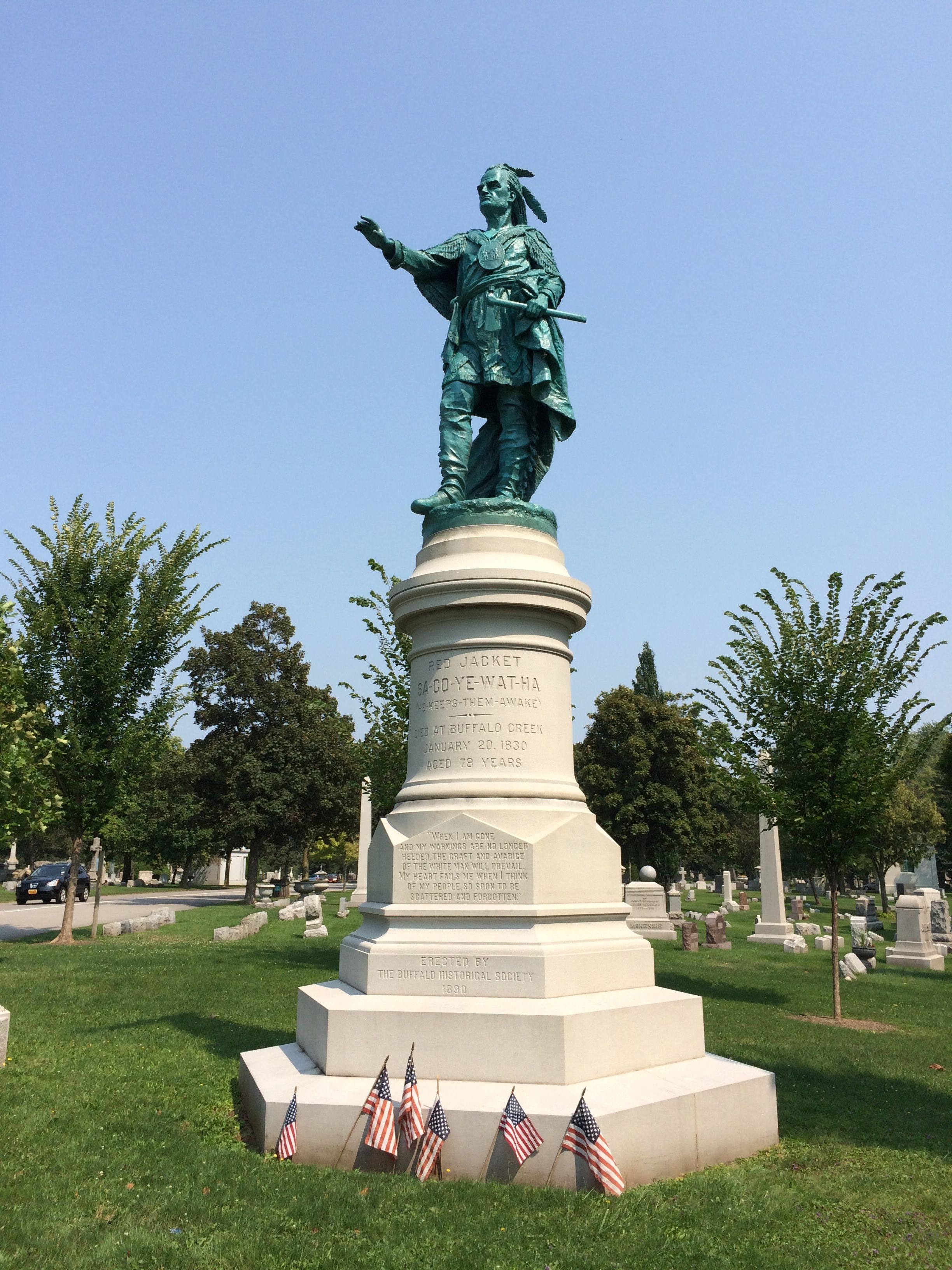
Since I was in the neighborhood, I decided to take a trip through Forest Lawn Cemetery.  The first statue that greets you as you enter is Red Jacket.

Red jacket Monument
Red jacket Monument

I have been doing a bit of reading to try refresh my memory regarding Red Jacket. What I am sure of is that he was a powerful Seneca orator and negotiated on behalf of the Wolf Clan with the new United States. He died in 1830 and was buried near a church in South Buffalo. His remains and those of some of his compatriots were reinterred here and this monument was erected in 1890.

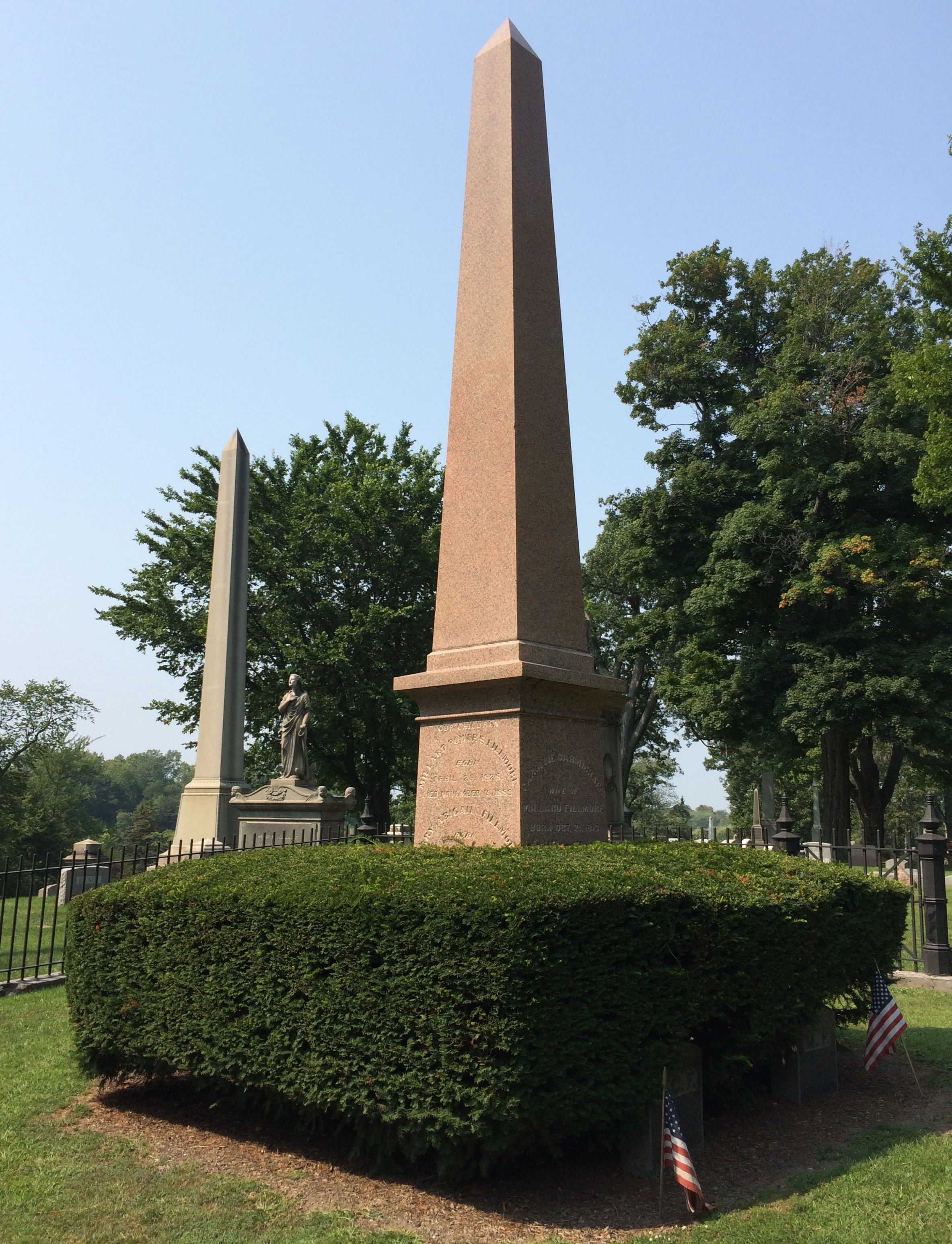
Millard Fillmore Momument
Millard Fillmore's grave
Millard Fillmore’s grave

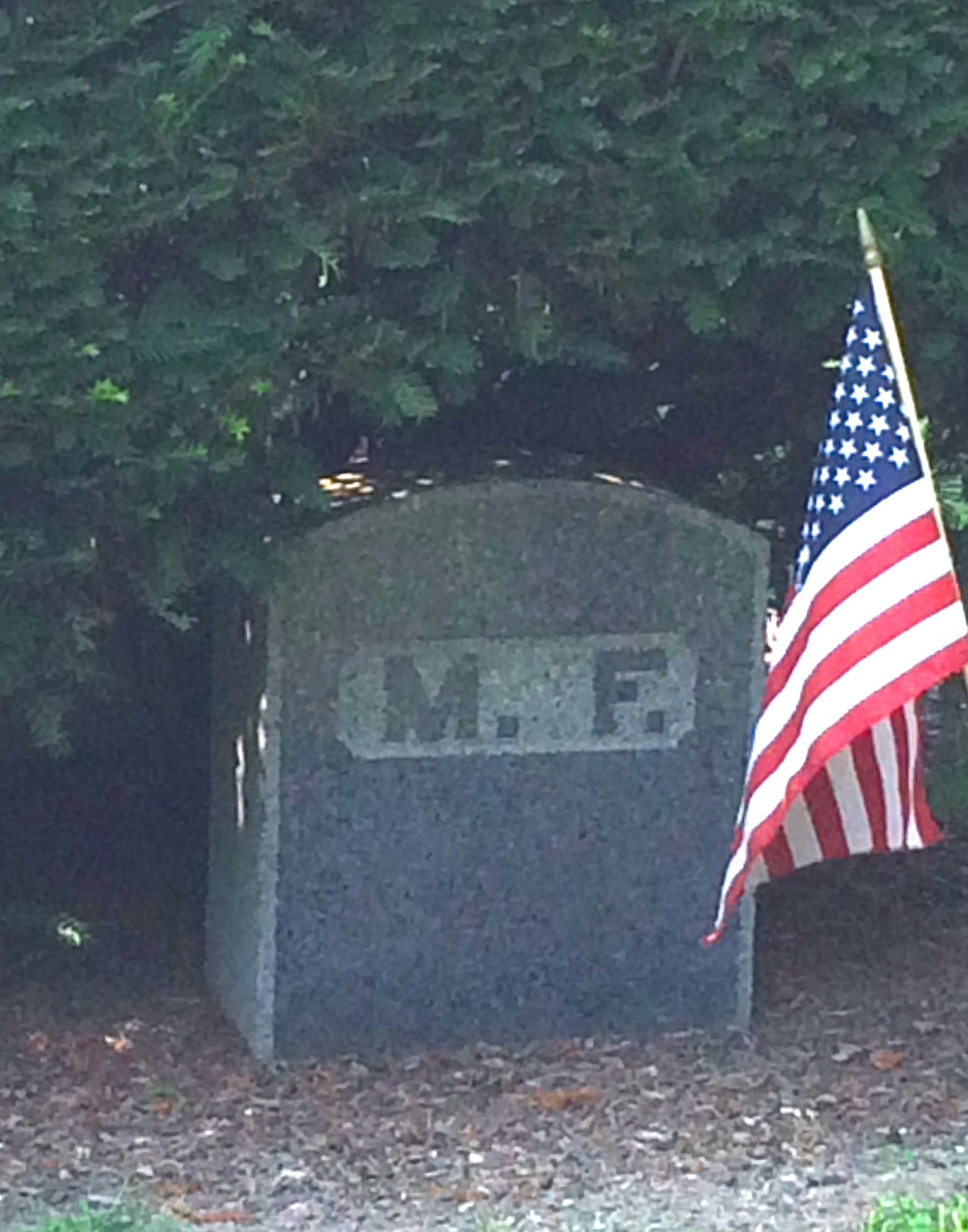
More Millard than you can shake a stick at! I did a bit of research on him, and I think this understated marker is completely as he would have had it.

Nerd Alert! Skip down to the next photo if you don’t want to read about our 13th president.

In an earlier post I mentioned that he had been apprenticed to a cloth maker. He managed to buy out out his apprenticeship and got some schooling. He married his teacher, read the law and established himself as a lawyer in East Aurora. He was self-taught, in large degree. He served three terms in Congress and had hoped to run as Vice President with Henry Clay. Thurlow Weed, head of the NYS Whig party “convinced” him to run for governor, but he lost.

At the Whig convention in 1848, General Taylor, an under-educated slave owner from Louisiana, was their choice for President on the ticket. To appease the faction in the party that disapproved of Taylor, Fillmore, a man opposed to slavery but promoting compromise as the solution, was included on the ticket.

He was elected as Taylor’s Vice President, but they got on so poorly that he was all but excluded from participating in government. Taylor came down with cholera that he caught at a Fourth of July celebration in 1850 and died shortly after that. Fillmore became president. He supported the Compromise of 1850, which was an attempt to resolve the issue of slavery. It didn’t succeed. He didn’t run for a term after completing Taylor’s term. It sounds like he was just disillusioned with politics.

His wife died shortly after he left Washington. He took an extended tour of Europe, and when Oxford heard he was in the neighborhood, they wanted to award him an honorary degree. He declined the offer, saying that he was uneducated and that since the degree would be written in Latin, he wouldn’t be able to read it.

Which brings me back to his grave marker. It is in keeping with his humble nature.

If you want to know more about Millard, I suggest you check out the information about him at The Miller Center.

*Whew!* Back to our normally scheduled content.

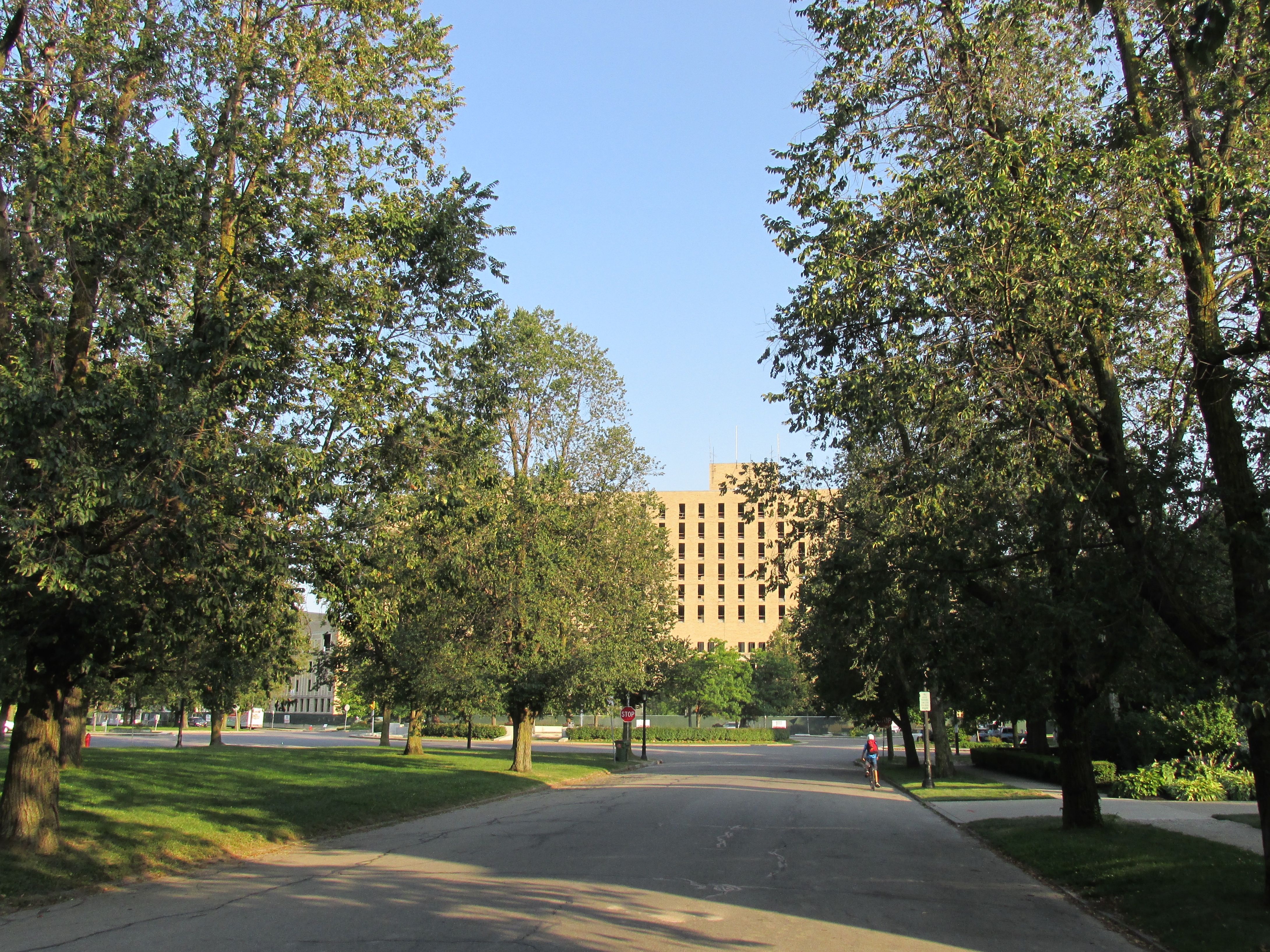
Chapin Parkway looking toward Gates Circle

Frederick Law Olmstead laid out Buffalo’s beautiful system of parks and parkways. The parkways were lined with towering elms. Due to the Dutch Elm Disease of the 1960s and 1970s, the parkways were left bare. I was thrilled to see how the replacements have grown and filled the spaces left behind by the elms.

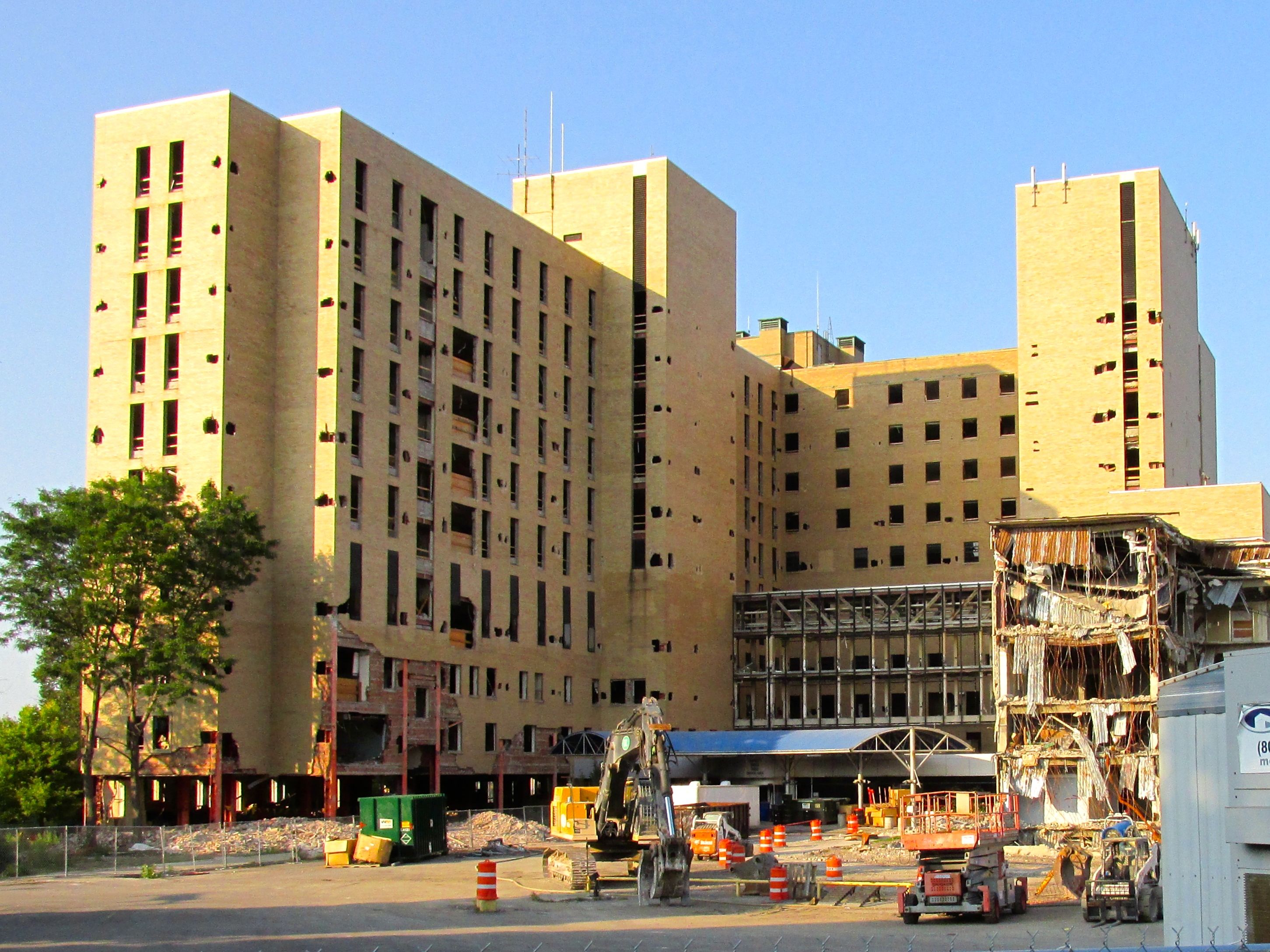
Oh, and see that building at the end of the street? That was Millard Fillmore Hospital.

Coming down!
Coming down!

I hear that this plot of land is going to be redeveloped as a multi-use building – apartments, condos and retail. It’ll be interesting to see what is in its place next time I am in town.

It was a great treat to be able to spend time with family and friends. I got to help out Amy and Steve with driving Katie to practice. Her team won!

Katie after the field hockey game
Sarah working on her AP coursework

Two lovely young ladies!

And, with that, I hitched up and headed out of town.

Bye Bye Buffalo!
Bye Bye Buffalo!


MWAH-kee!

I could have sworn the name of the city was pronounced Mil-WAH-key. However, after listening to the newscasters for a few days, I now know that it is MWAH-kee.

I learn so much in my travels,

The main reason for including Milwaukee in this trip – nay, the reason I came to Wisconsin in the first place – was to celebrate my godson’s wedding.

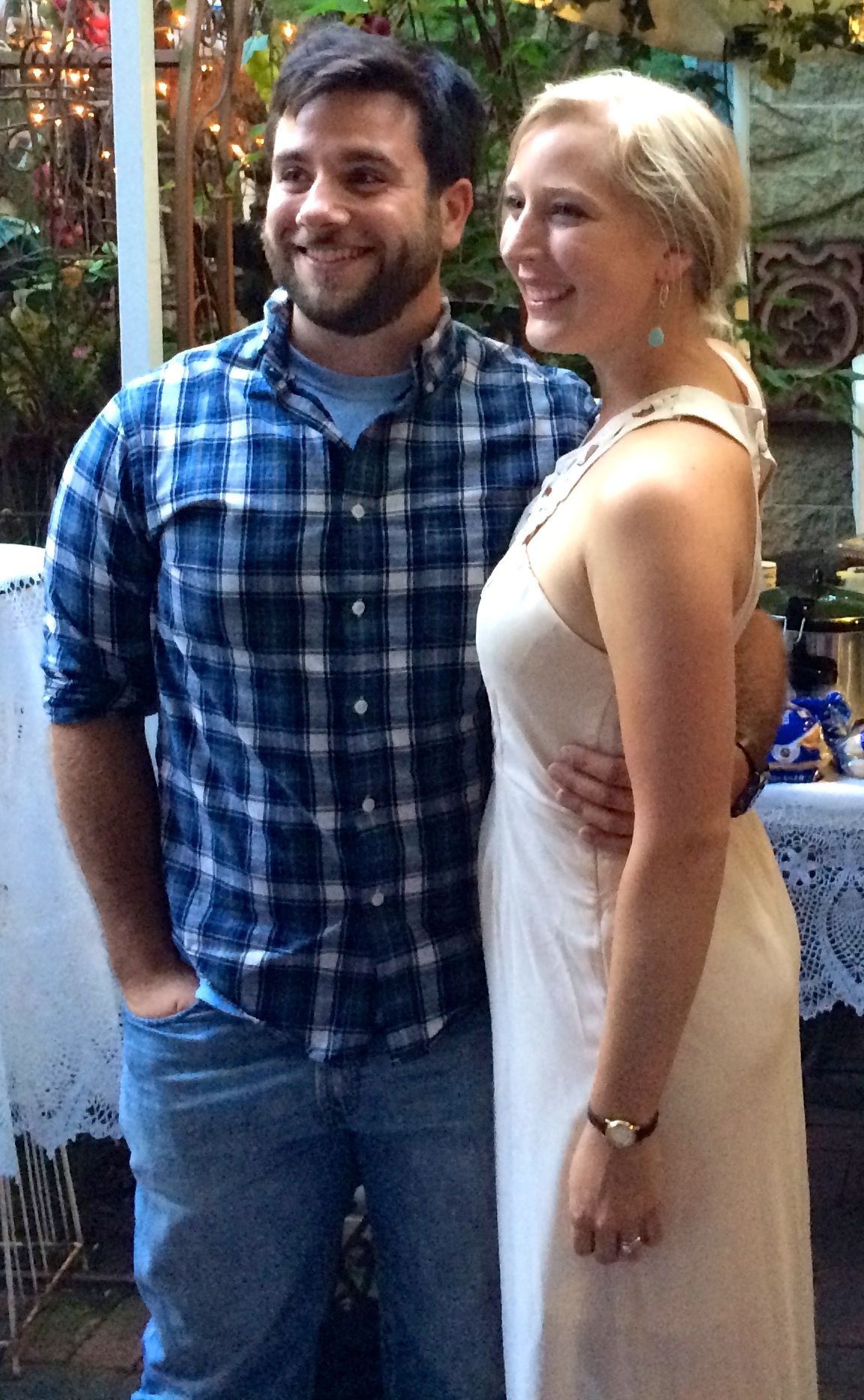
Me and my godson, Paul

Oh, wait, that’s an old photo.

Here’s one that’s more up to date.


Me and my godson, Paul.

Me and my godson, Paul.

One thing that surprised me was that there are so few places to camp near Milwaukee. I ended up at the Wisconsin State Fair RV Park. It was another one of those “acres o’ asphalt” places. There were full-hookup sites, but I opted for a more budget-friendly electric-only site. Budget-friendly is relative, though. Supply and demand rules the day.

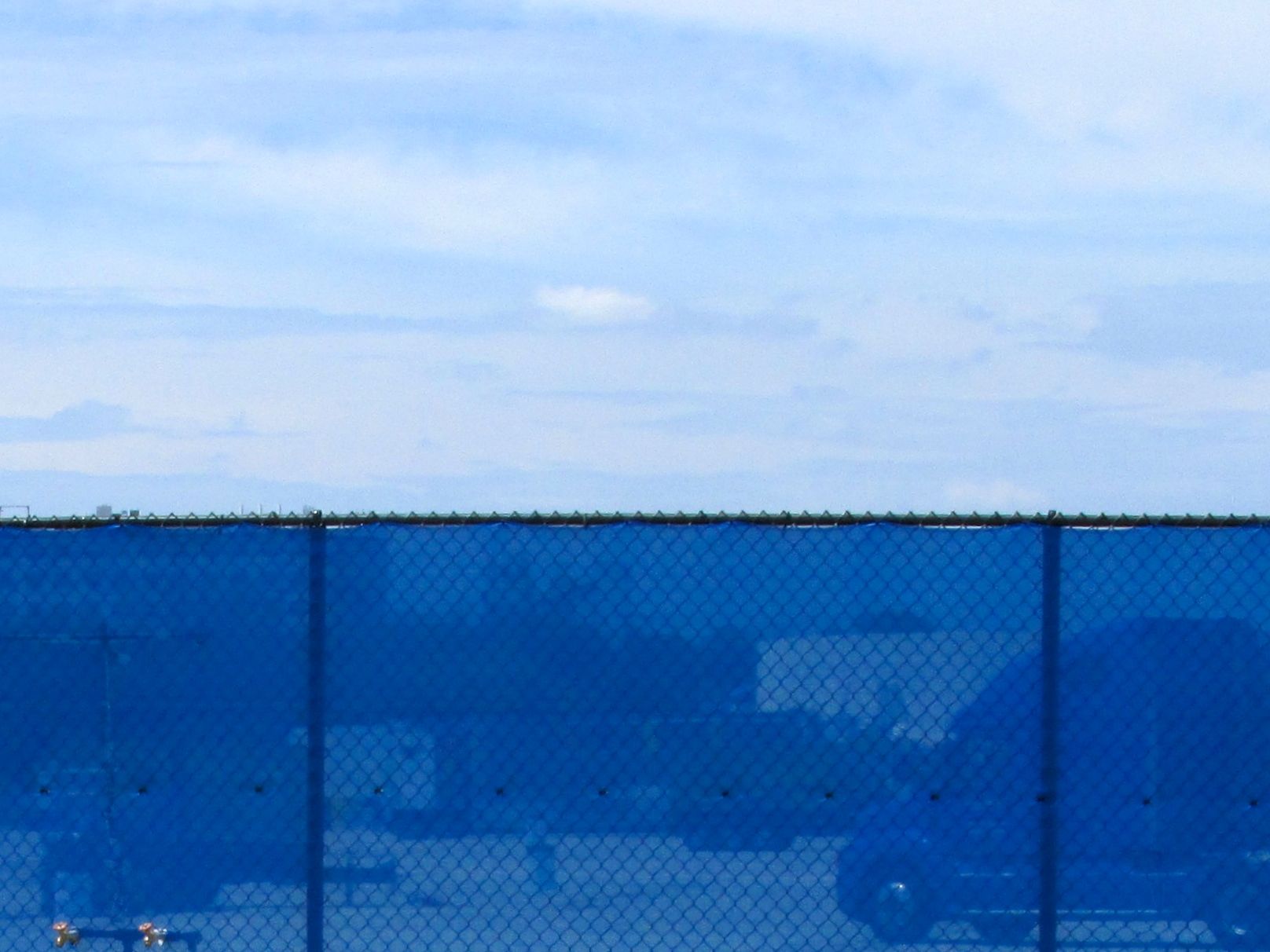
However, when I would peek out my window in the morning, sometimes I almost thought I was at the shore when I saw the blue privacy cover on the chain link fence.

view out my windowview out my window

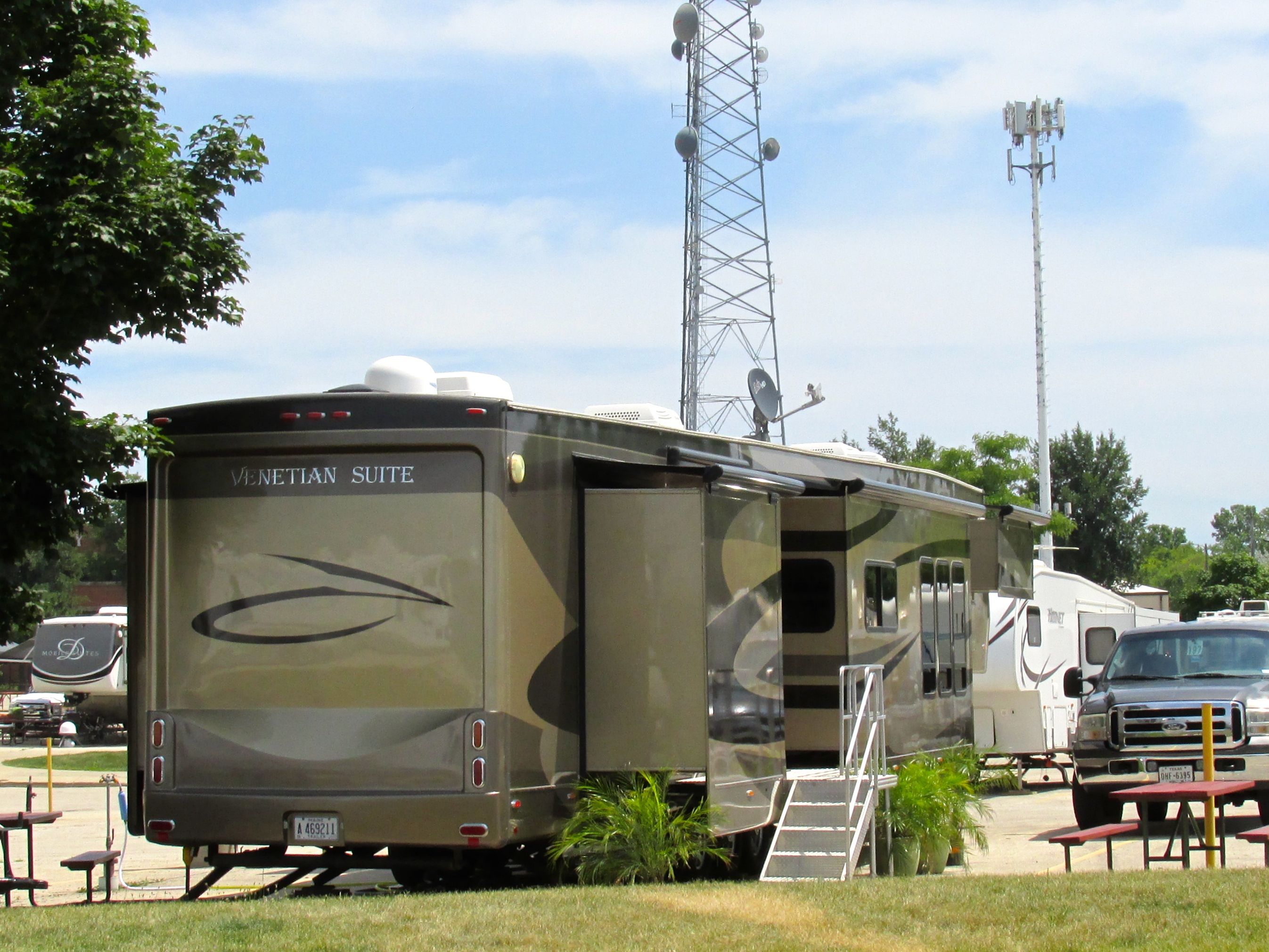
The full-hookup sites did have a bit of grass, picnic tables and the occasional tree. And, if that is not enough to suit you, you can always bring your own greenery.

The high rent district

But, I wasn’t there to hang out at the park, I was there to celebrate with my friends – and celebrate we did!

First there was the shower for all the women-folk. This gave those of us who had never met the chance to meet and greet.

Lisa, the Maid of Honor, and Amber, the bride

It was a lovely party, with tasty food and the requisite games along with gift opening.

The sister and the mother of the groom
Teresa, the sister, and Kathy, the mother of the groom.

Towards the end of the party, the men-folk joined us. They had been out enjoying a Friday night fish fry.

Paul and Amber
Paul and Amber

The next day was the rehearsal, so it was a day off for me. Most of the day, I enjoyed the comforts of my Airstream, electricity, wifi, and good TV reception.

However, I did join up with them later for the rehearsal dinner. It was a wonderful picnic in the park. Here’s something that surprised me: the parks in Milwaukee not only allow beer, they have beer gardens in the parks! Must be part of the beer culture. Pabst, Schlitz, Miller, Blatz.

I have no photos of the picnic, but I would highly recommend Estabrook Park for anyone looking for picnic venue in Milwaukee. Lush and green and well-maintained.

That night, I decided that I should do something in Milwaukee besides take part in wedding events. I googled top things to do in Milwaukee and came up with a couple things to do before the wedding on Sunday.

Surprise, surprise! I found some Frank Lloyd Wright buildings that I had never heard of.

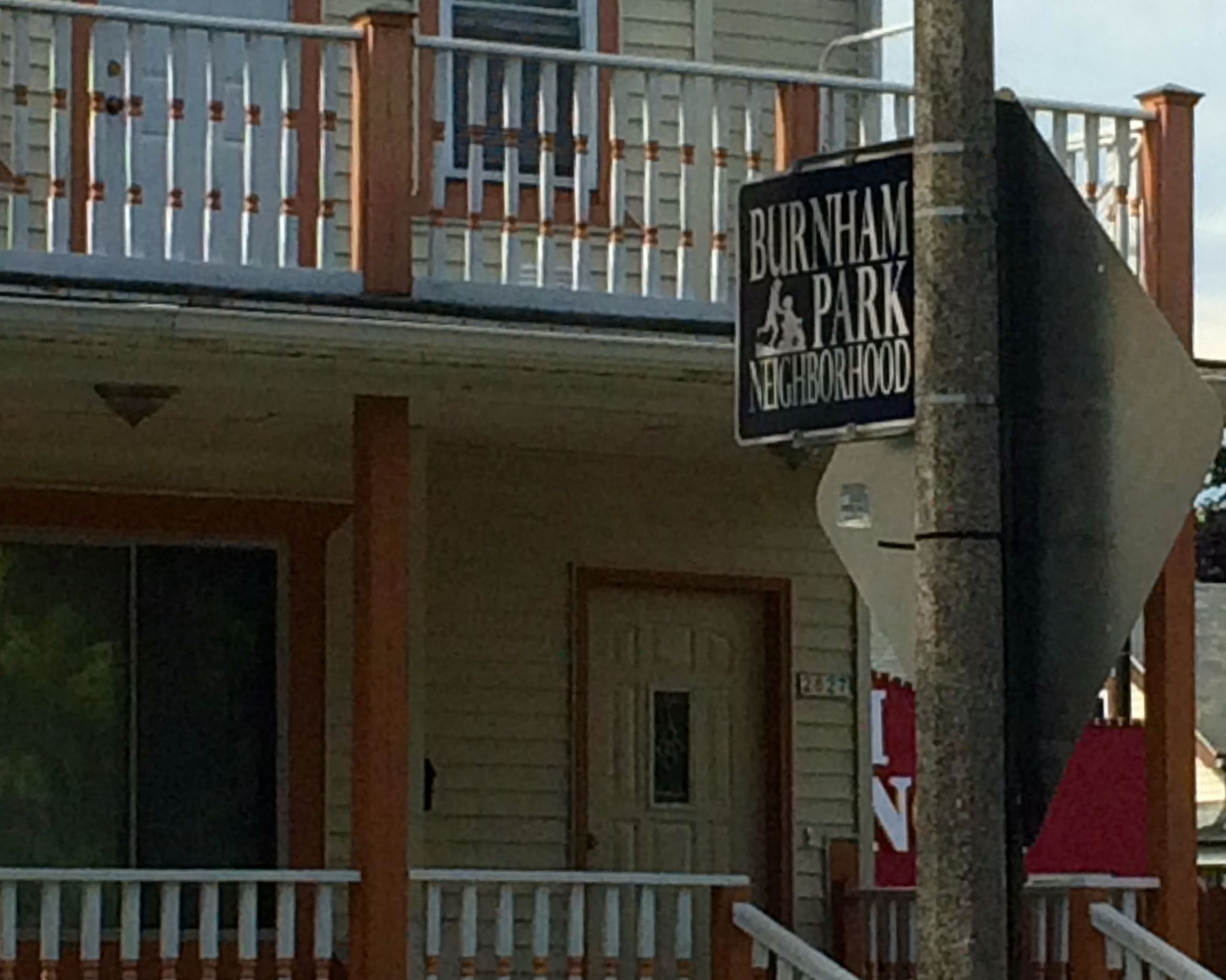
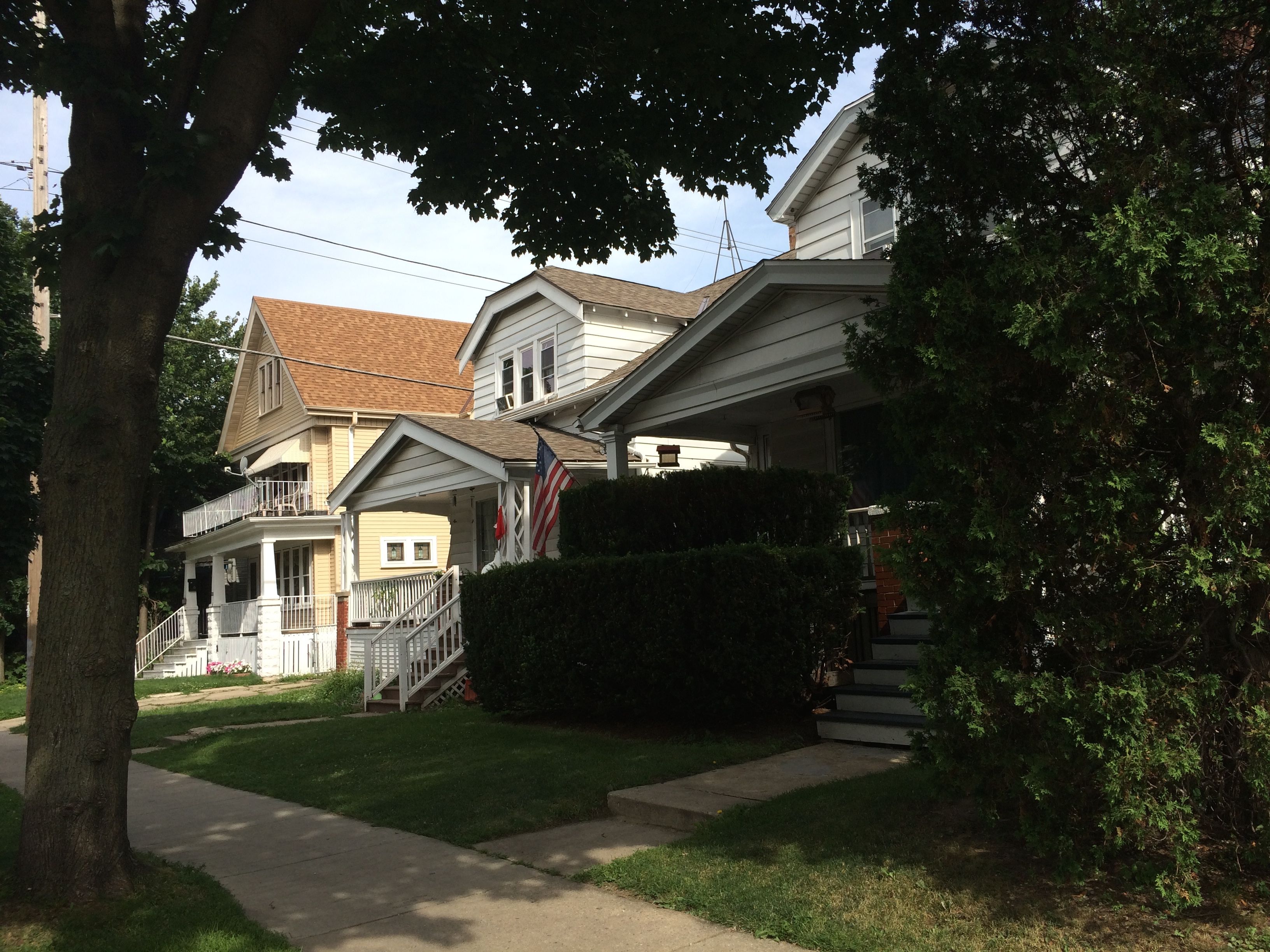
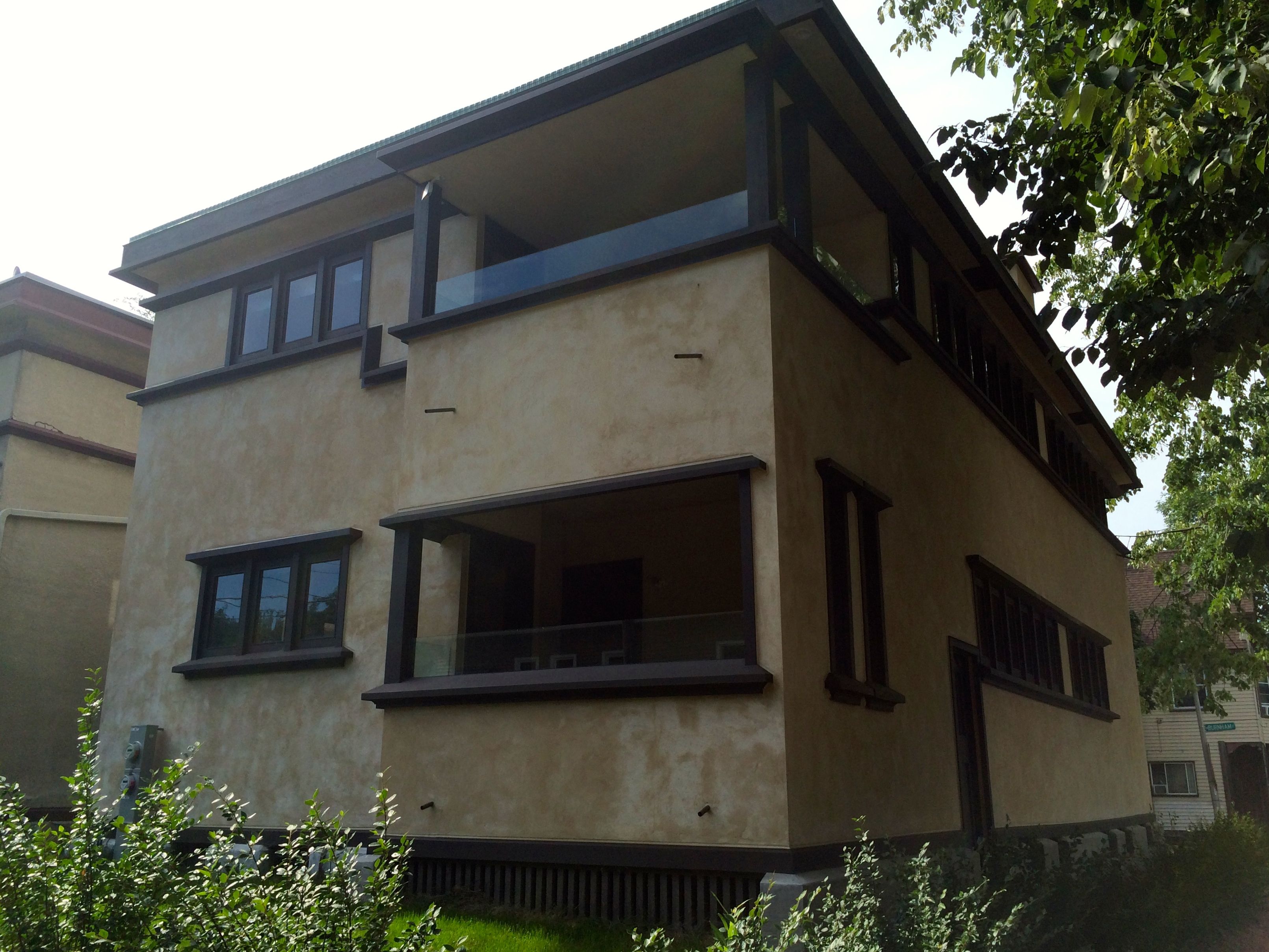
I visited the Burnham Street Historic District.

FLW 10 neighborhood sign

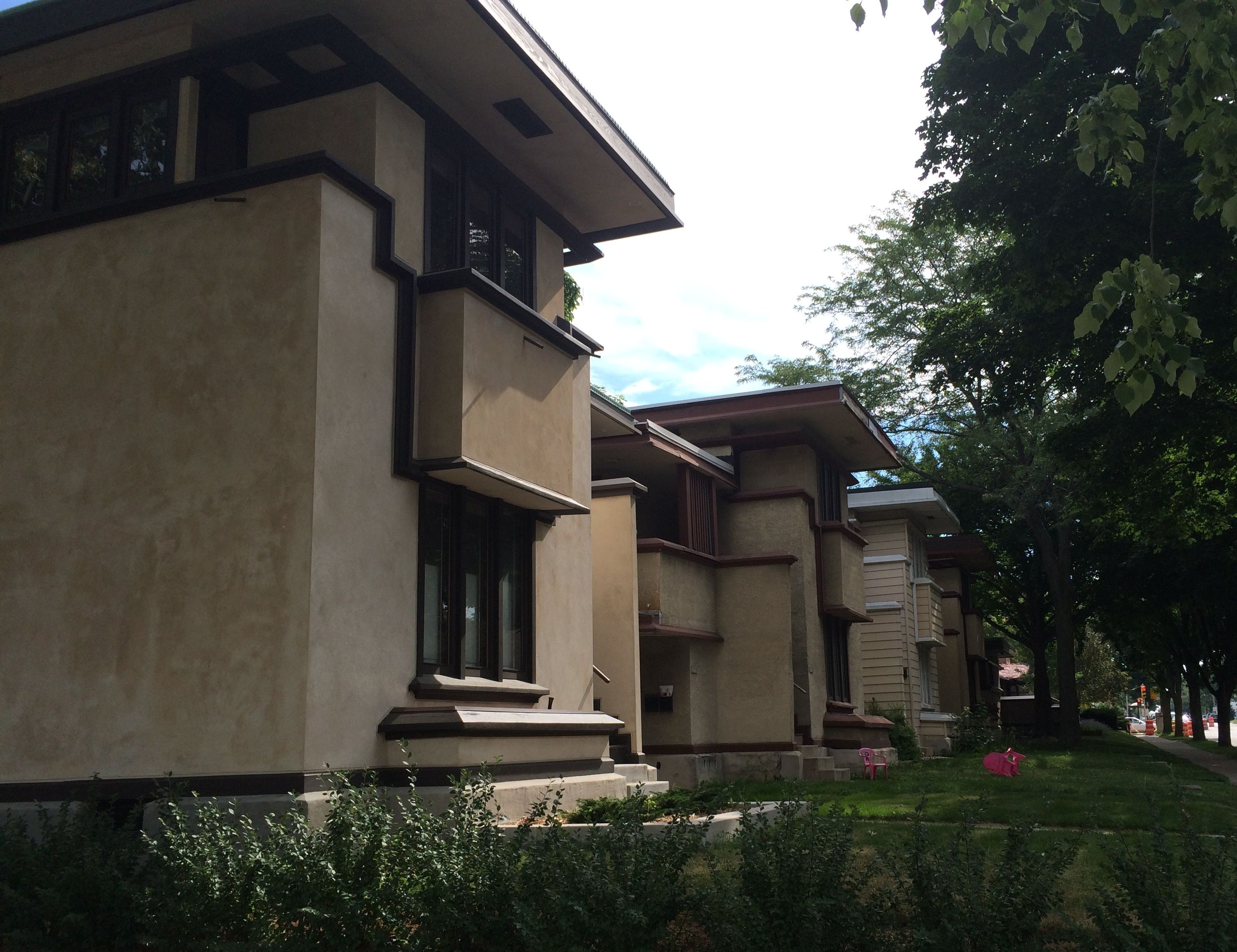
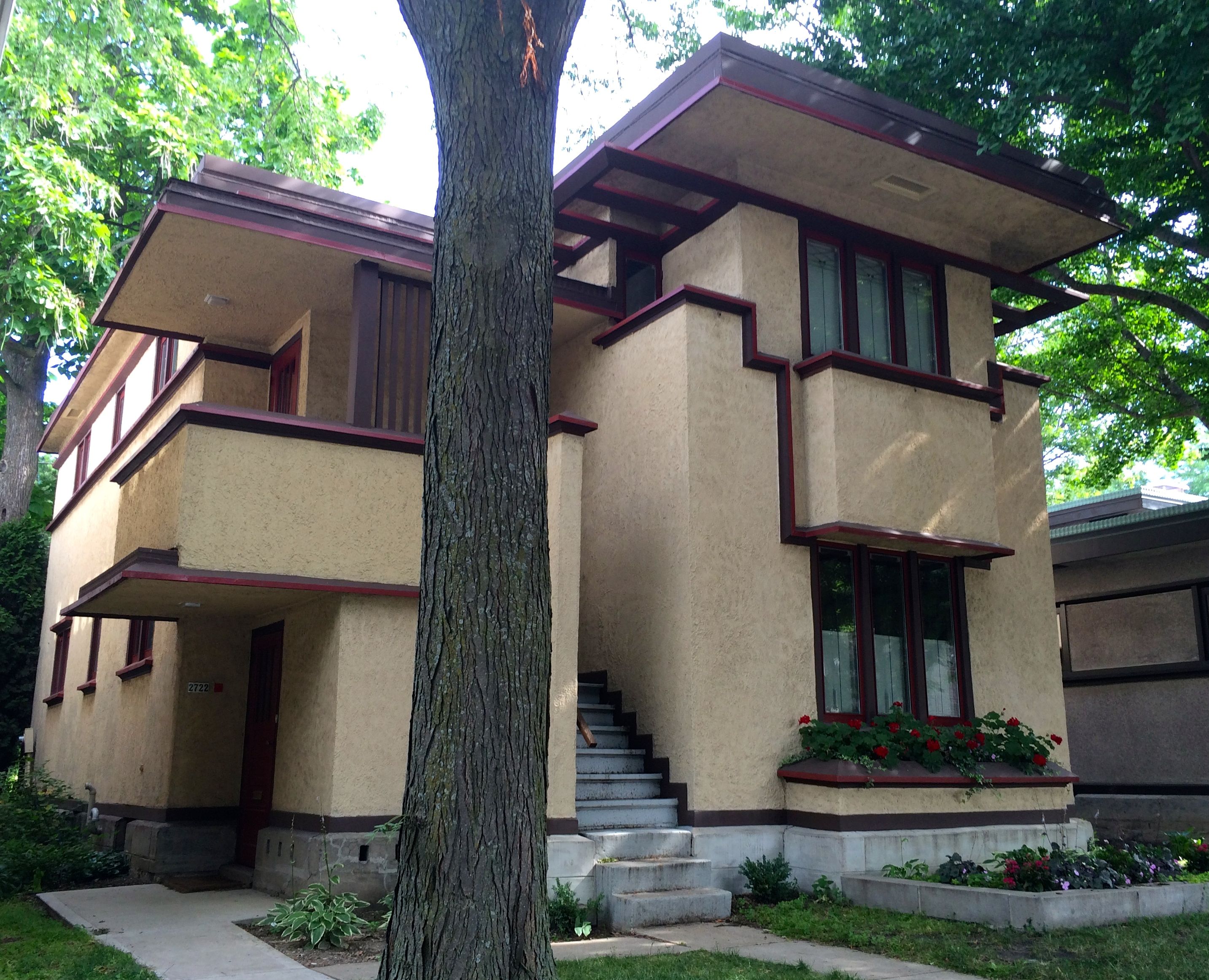
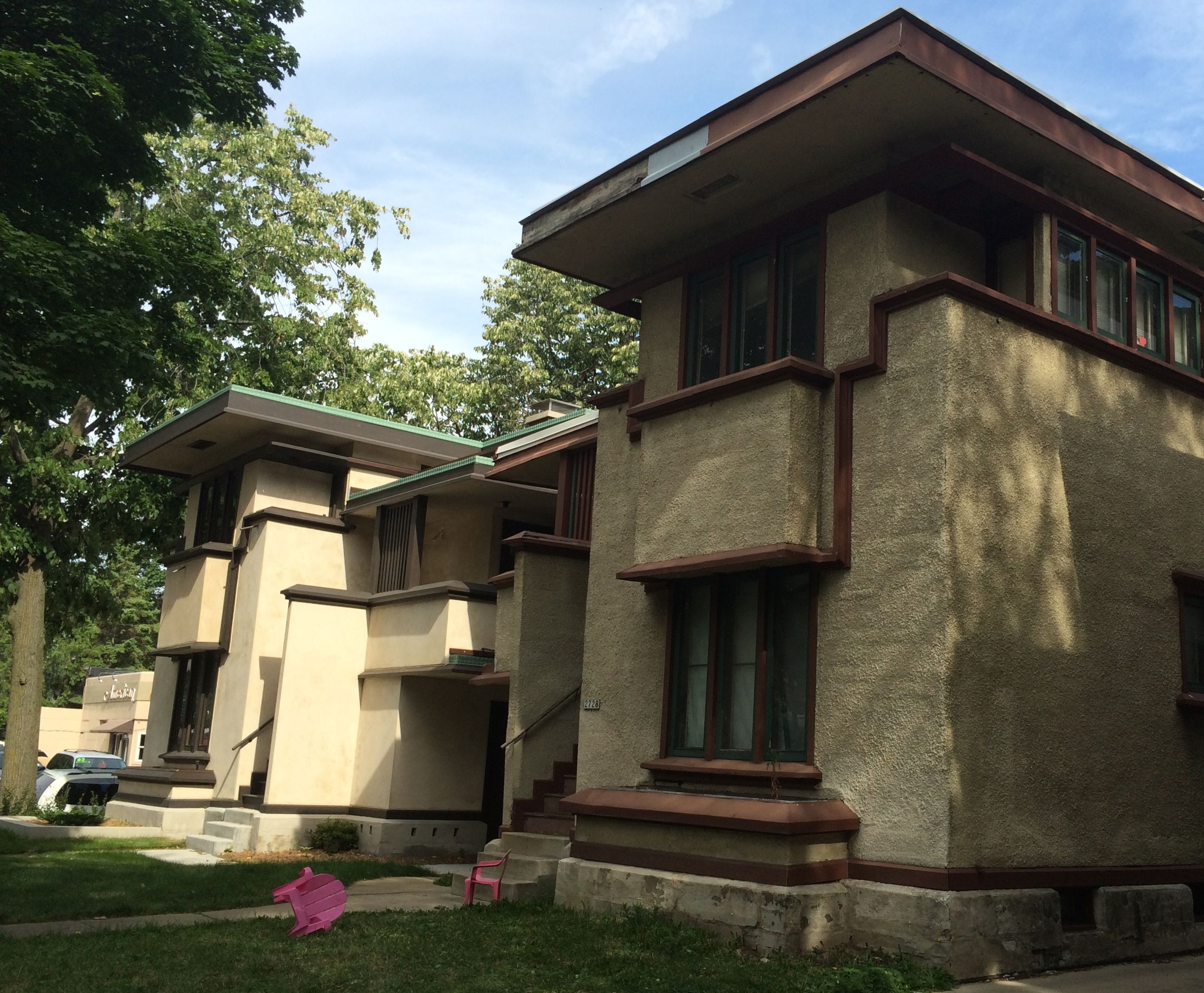
There was a grouping of Wright’s American System-Built Homes. These designs were Wright’s first efforts to create affordable housing. Essentially, all the materials were cut, labeled and prepared off-site. They were delivered to the job site and constructed there.

These houses were built by Arthur L. Richards in 1914. This grouping was built as demonstrator models. He held the franchise to market these buildings, but World War I interfered with the supply of materials. Then Wright sued Richards for non-payment of royalties and fees, and that was the end of the American System-Built Homes.

FLW 7

This is the view standing on the corner looking right.

FLW 9 neighborhood

This is the view looking left. I assume they were built around the same time, but what a difference in styles!

FLW 2

Some of the buildings were duplexes and fairly well-maintained.

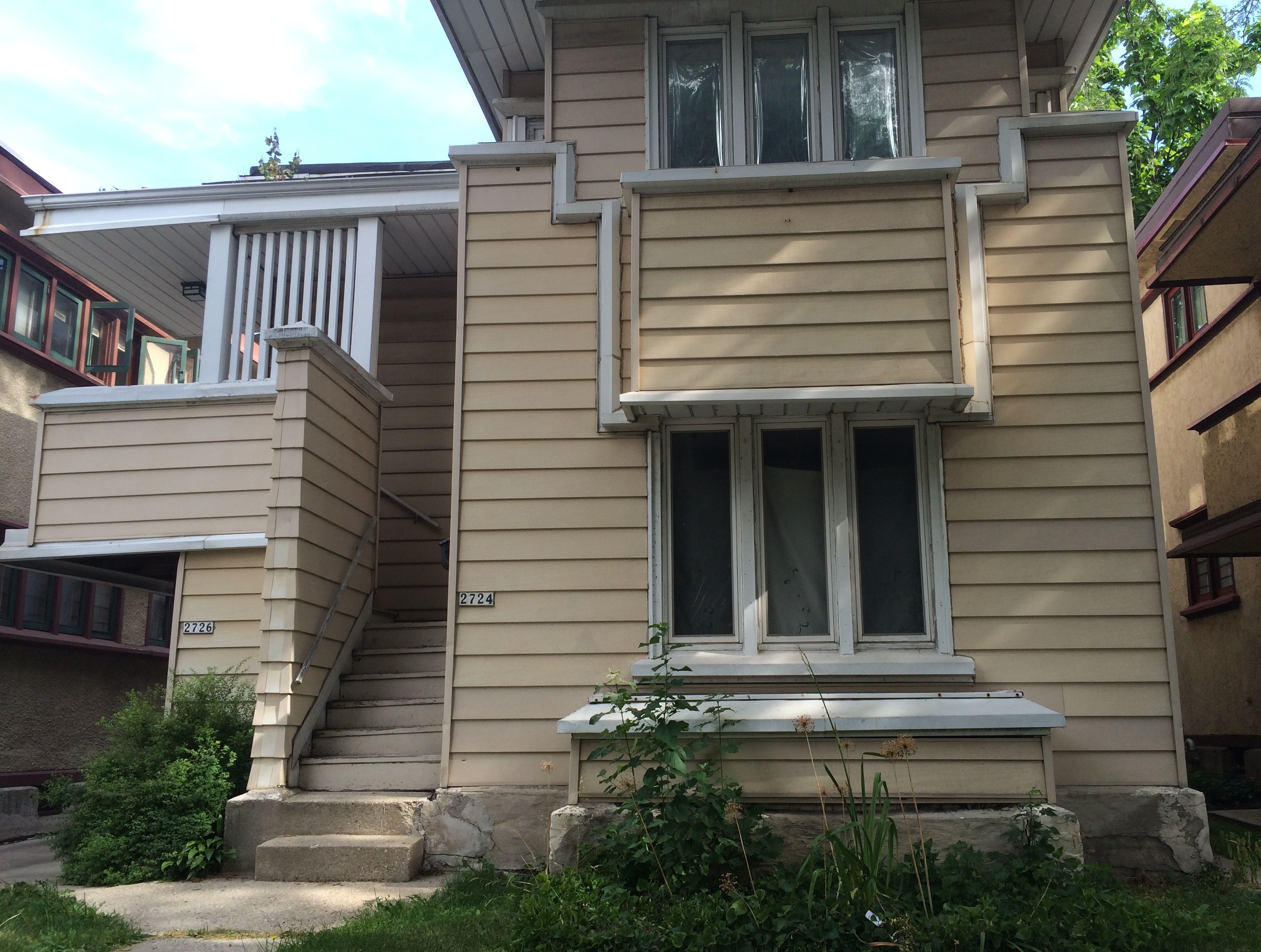
FLW 5This one, however, was more of a Frank Lloyd Wrong. Imagine covering a Wright building with aluminum siding. Horrors!

FLW 3There was also a bungalow design that was purchased by the Frank Lloyd Wright Wisconsin Program and was renovated in 2010. I read on the web that they open it for tours several times a month. This wasn’t one of the times.

FLW 6It looks like pink lawn chairs are the new pink flamingoes.

FLW 8 backI found it interesting that the owner of this building added a clear barrier to the back porch. I wonder if that is because Wright designed the porch too low to be safe. From what I have heard from tour guides at other Wright sites, he was “vertically challenged” but designed for his height – which was naturally perfect.

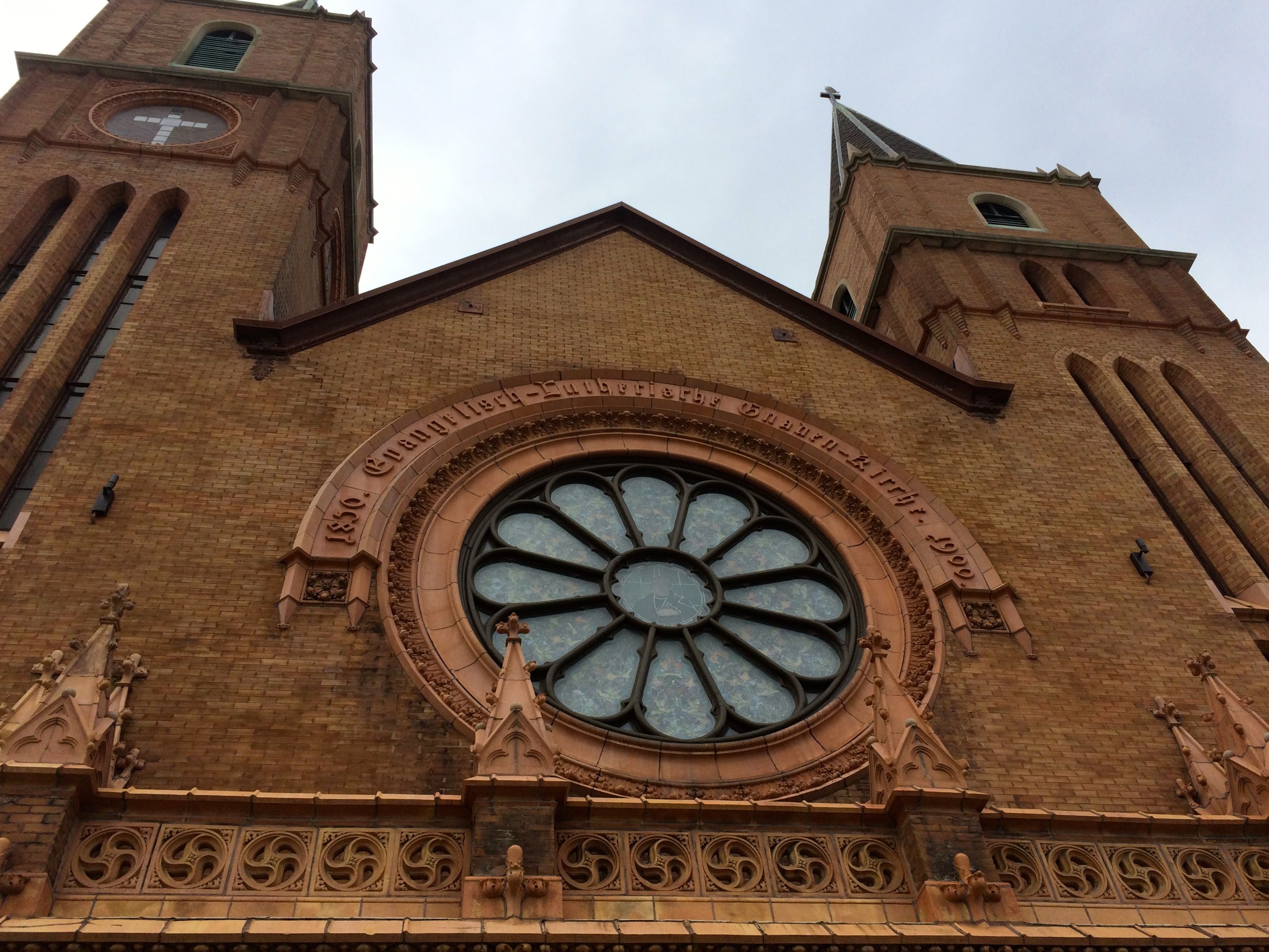
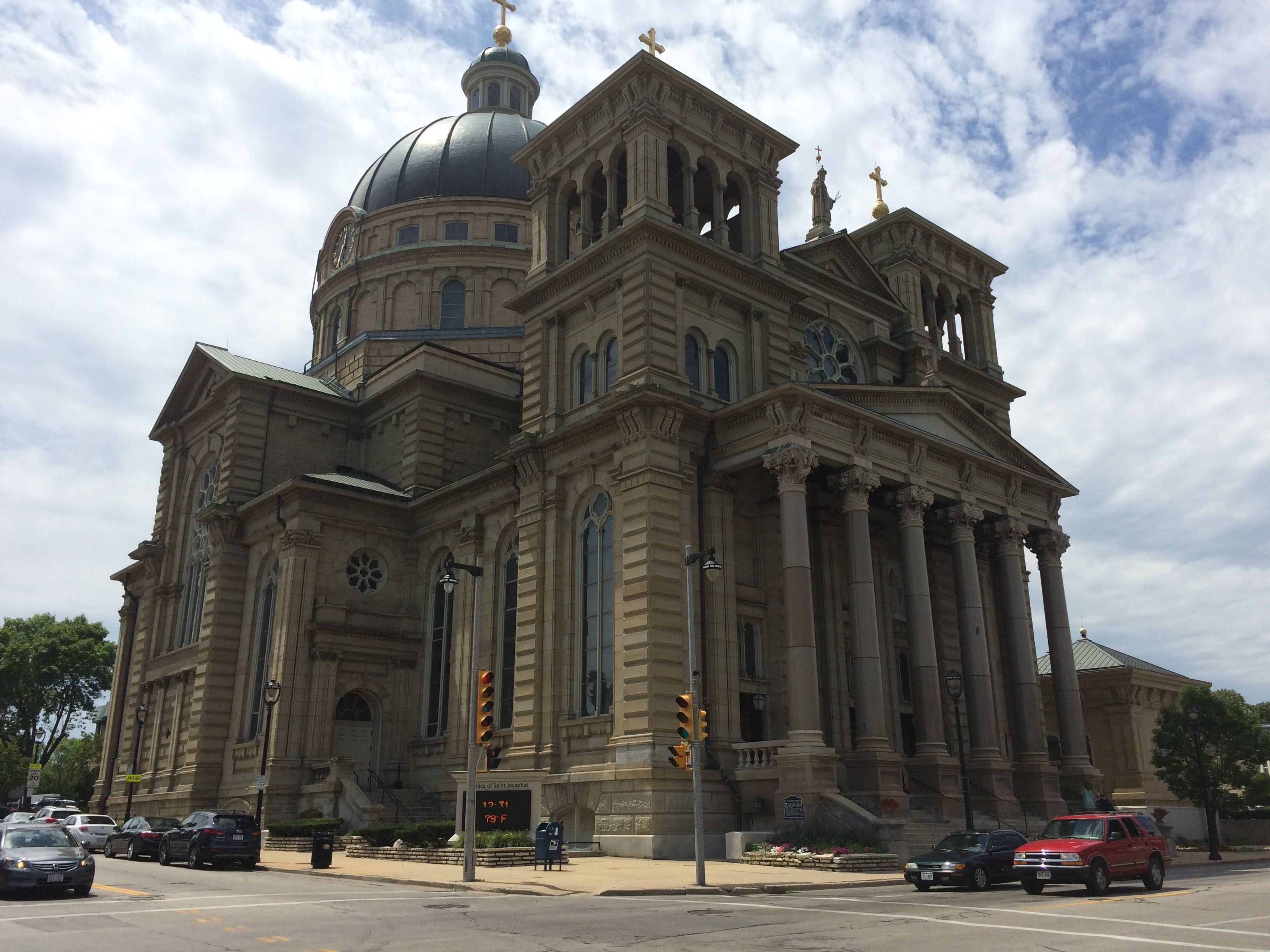
My next stop was the Basilica of St. Josaphat.

ST J 1

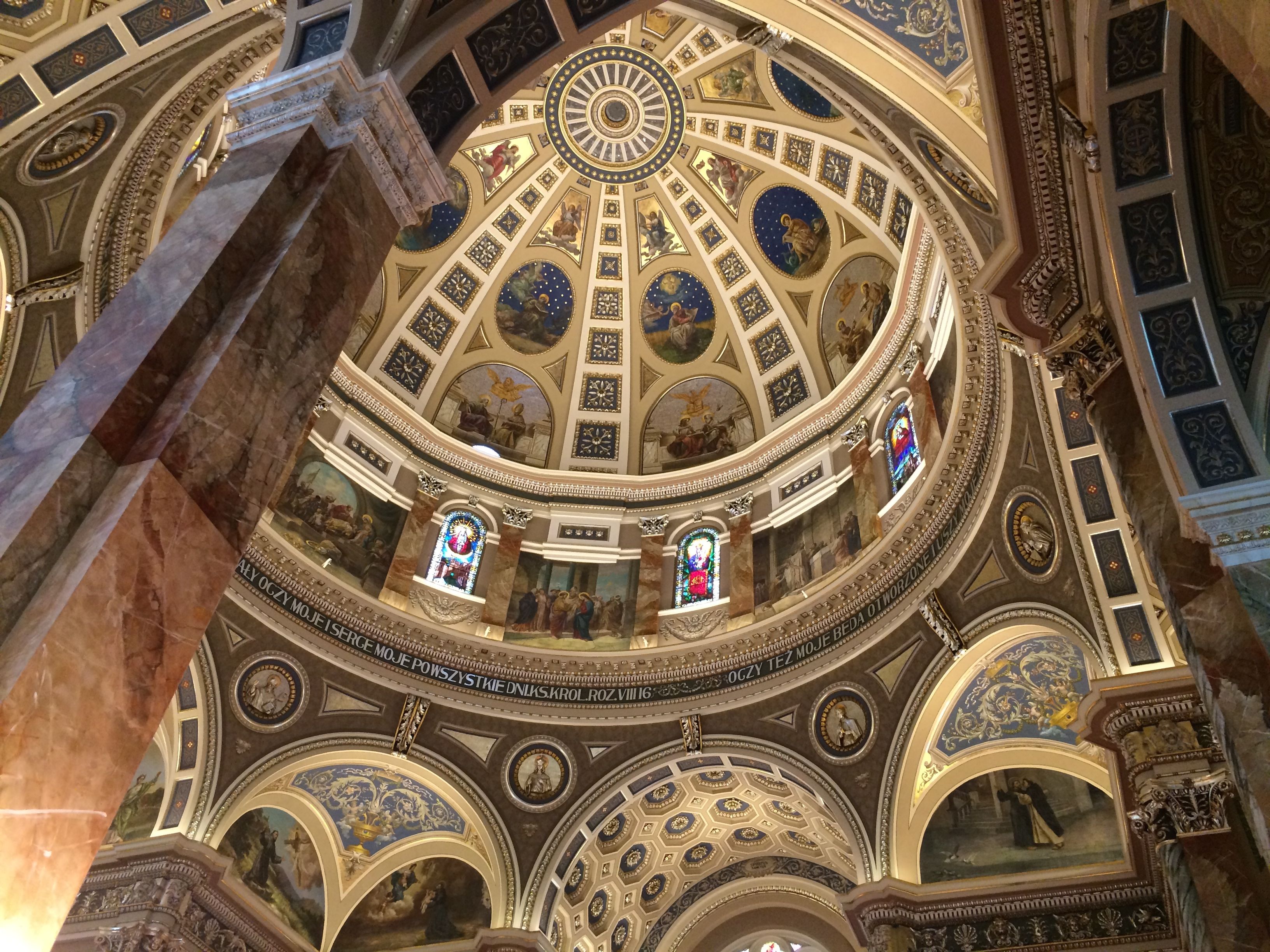
The outside is amazing. The interior is eye-popping!

St J DomeThe first church was built in 1888, but destroyed by fire in less than a year. They rebuilt, but by 1895, the growing Polish population had exceeded its capacity. Erhard Breilmaeir was hired to design a new church that was to be built in brick and terra cotta and to be modeled after St. Peter’s in Rome.

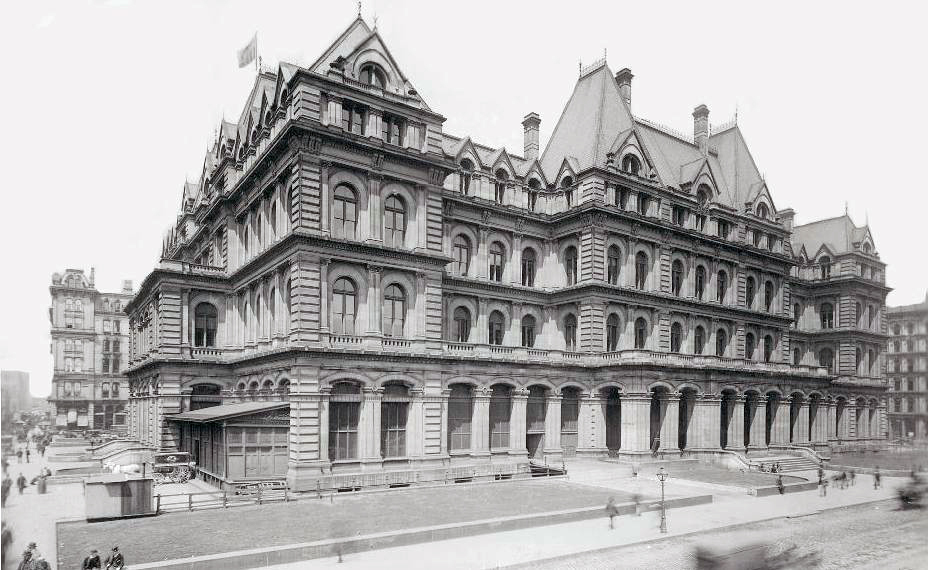
In 1896, the U.S. Post Office and Customs House in Chicago was demolished because it was too heavy for the ground it was built on. Father Grutza asked Mr. Breilmaeir if he could adapt his design to the materials used in the Chicago building. He said he could and they bought it for $20,000 and it was transported to Milwaukee on 500 railroad flatcars. The tour guide told us that they managed to use the materials with a minimum of reworking.

postofficecustom

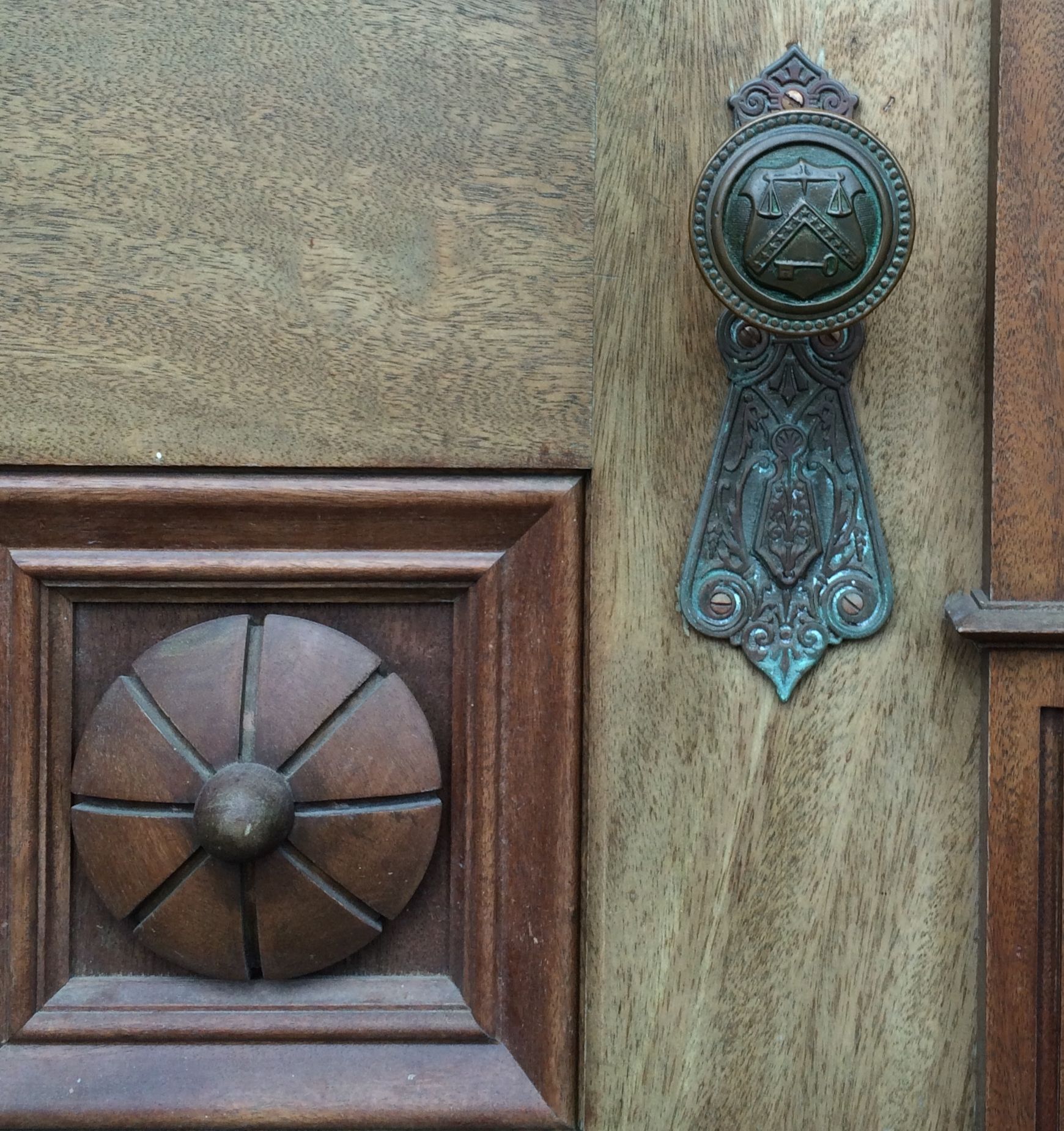
They even used the doorknobs!

St J doorknob

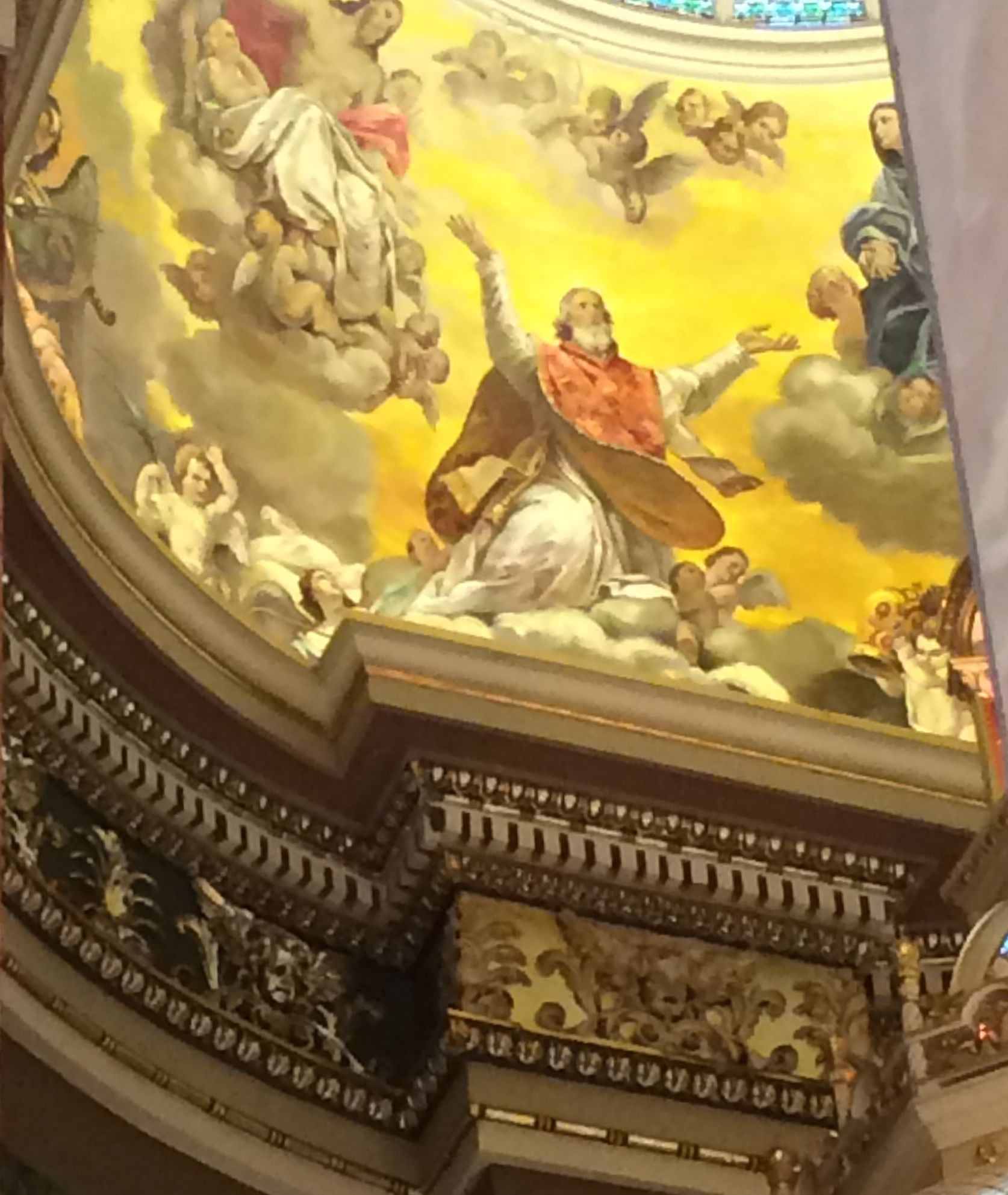
Artists and artisans were brought to Milwaukee from Rome to handle the interior. The guide told us that the paintings were painted in buildings nearby and that the figures were cut out and attached to the surfaces with the backgrounds already painted in.

St. Josaphat
St. Josaphat
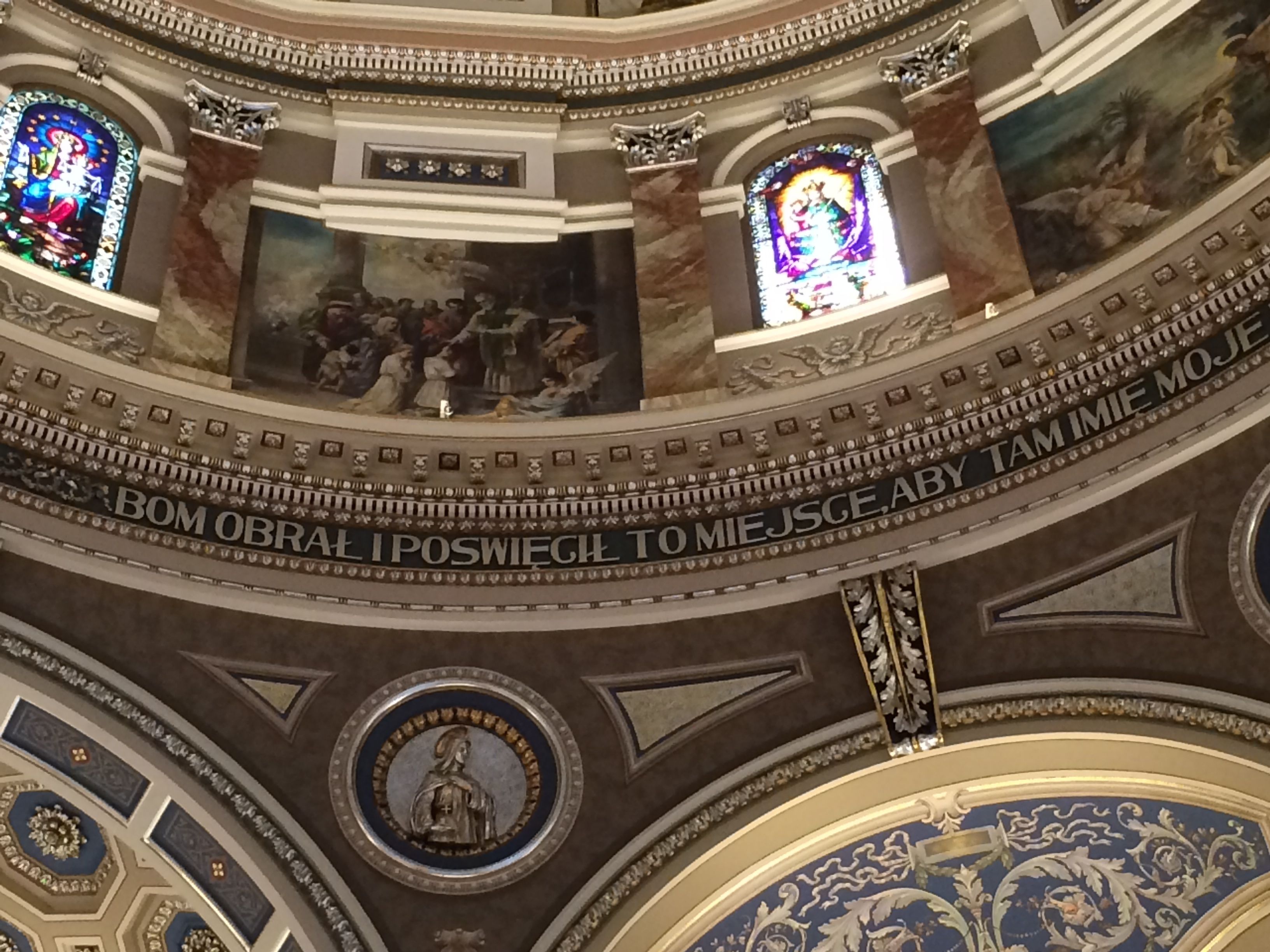
The Polish built the church
The Polish built the church and quoted scripture in Polish.
Loads of marble everywhere

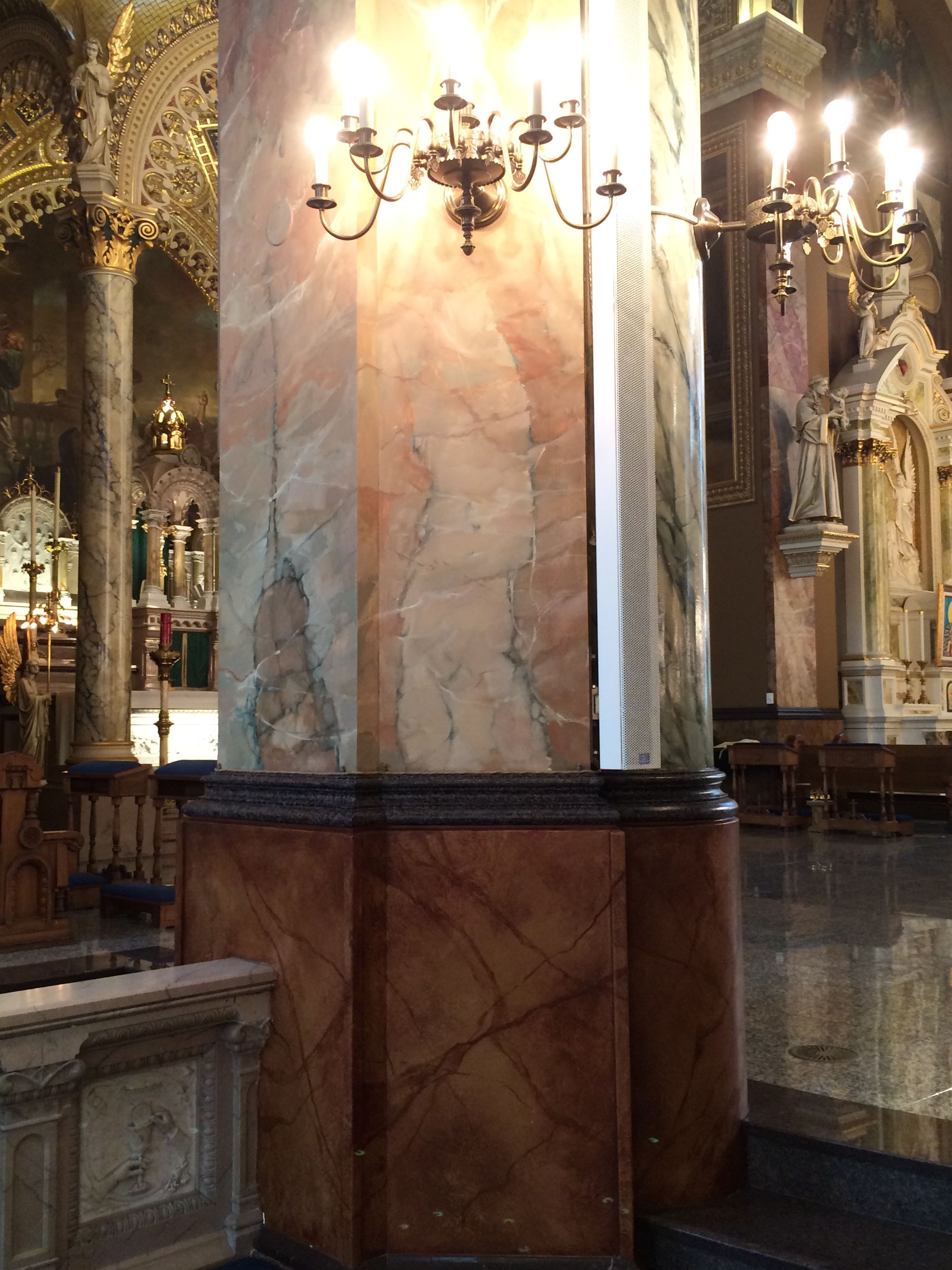
Oops. Not all that much marble. Some of the artisans they brought were faux marble painters.

Faux marble close up

You can see the brush marks so you know that it is a painted surface, but the overall effect is richly veined marble.

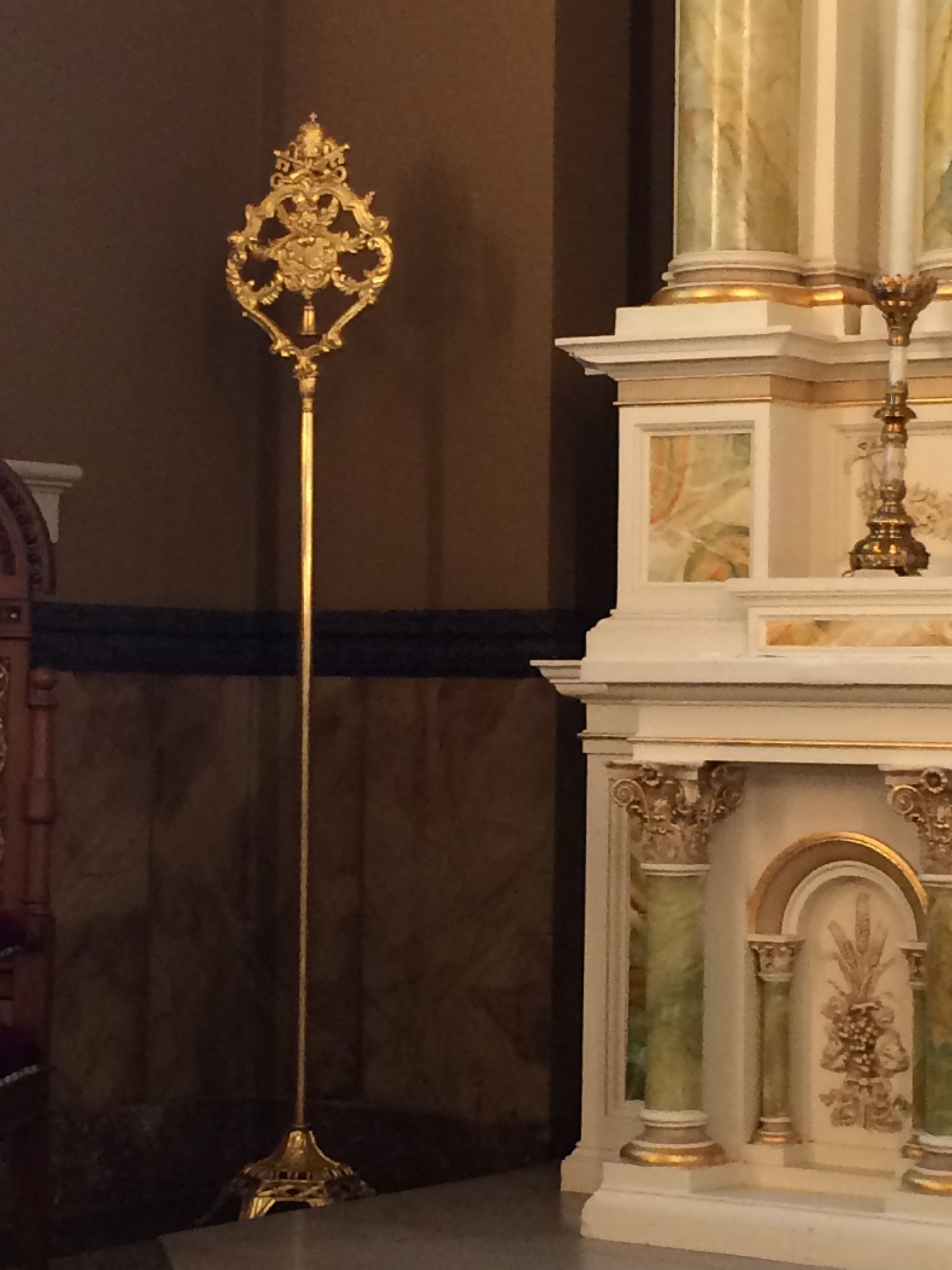
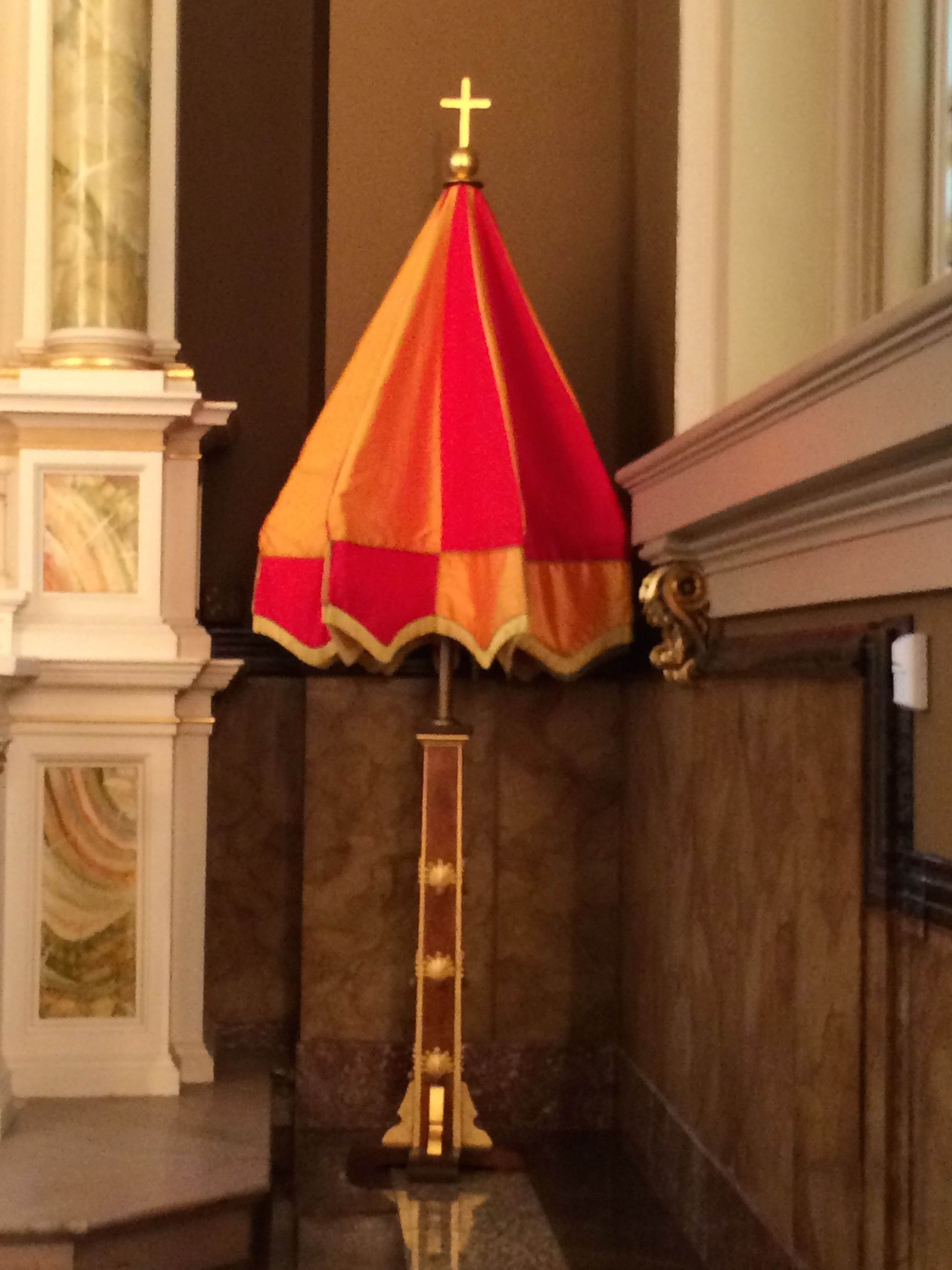
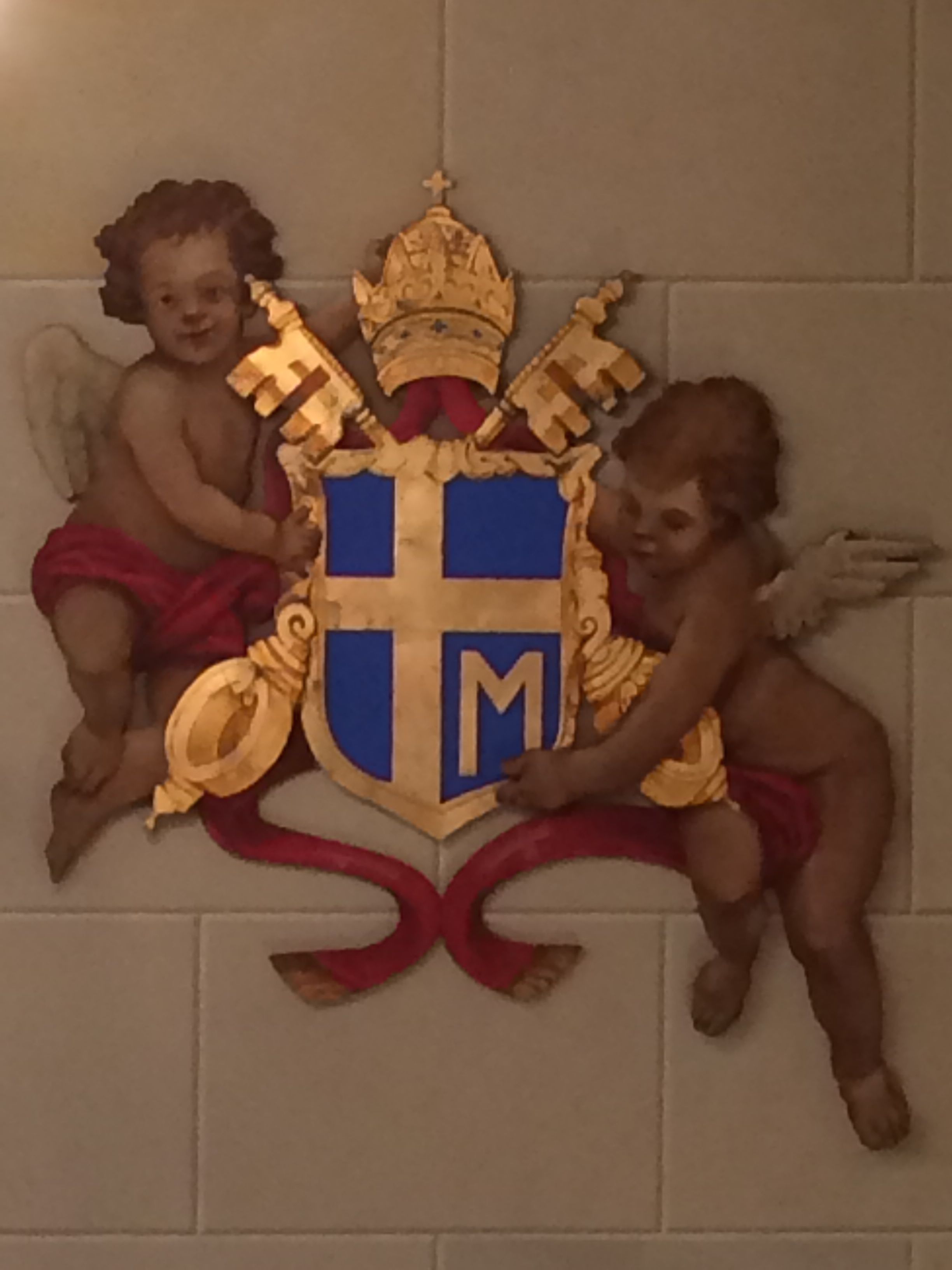
In addition to lavish decoration, a basilica is entitled to three symbols that ordinary churches aren’t allowed to use, a tintinnabulum, an umbraculum and to use the papal keys in their symbols.

Tintinnabulum
Tintinnabulum
Umbraculum
Umbraculum
Crest with Papal keys

The guide told us that the first two symbols were used in processions; the tintinnabulum was carried at the head of the procession, and that the umbraculum was carried over the host.

Time until the wedding was going to start was growing short, and Amber, the bride, had told me to be sure to have lunch before the wedding. Just across the street was a Salvadoran restaurant.

St J restaurant

They had me at pupusas!

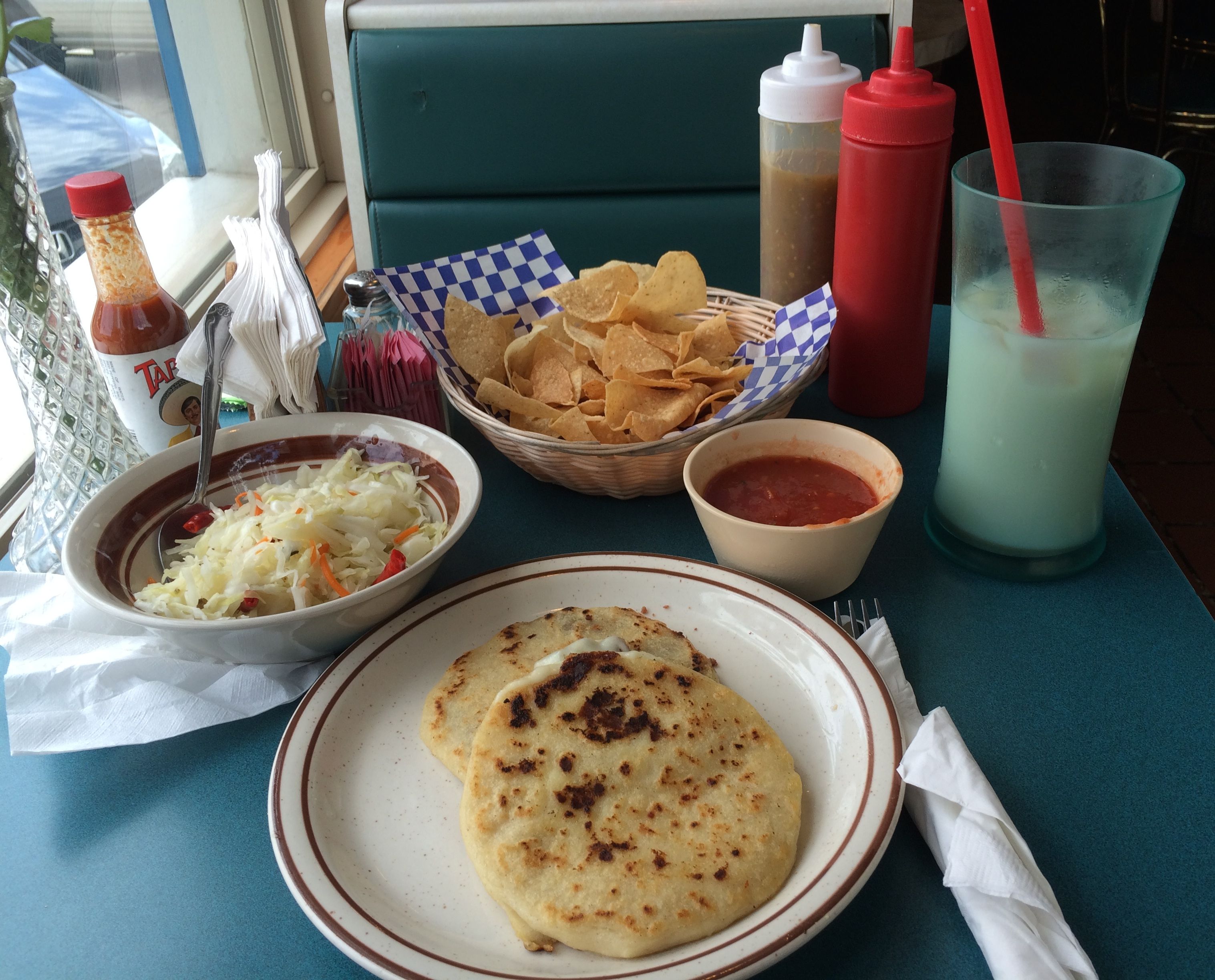
Two pupusas with repollo
Two pupusas with repollo and a glass of horchata

Pupusas are filled tortillas. A little pocket of filling is put into the center of the corn dough and then it is patted into shape. I chose one of cheese and one of bean. The repollo is a spicy cabbage garnish. Horchata is a rice beverage flavored with cinnamon and sugar.

Yum!

I had a window seat, and while I was waiting for  my lunch, I noticed lights mounted on a nearby building to illuminate the dome of the basilica at night.

Lights, camera, action!

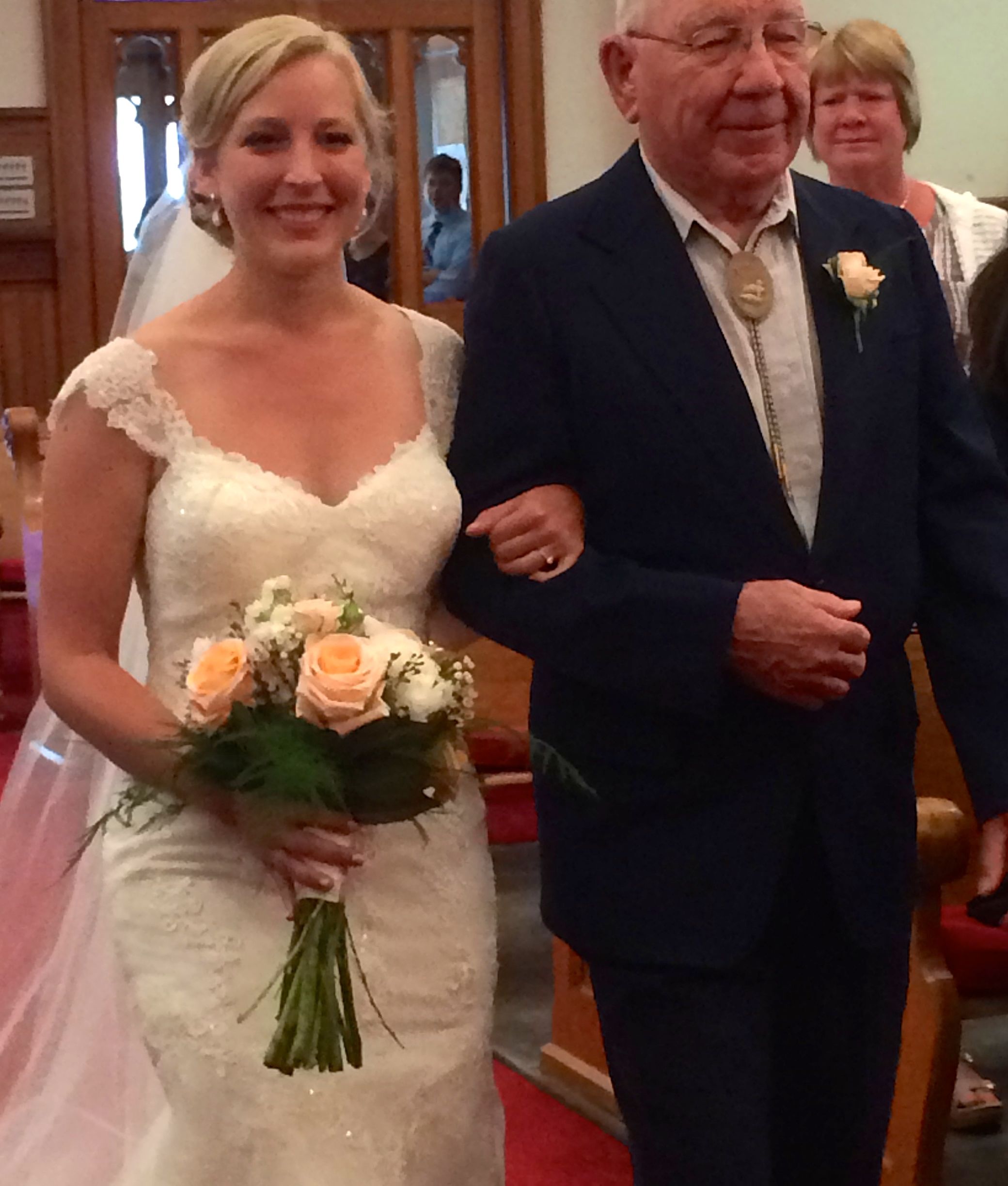
And then it was time for THE WEDDING!

Grace Lutheran Church

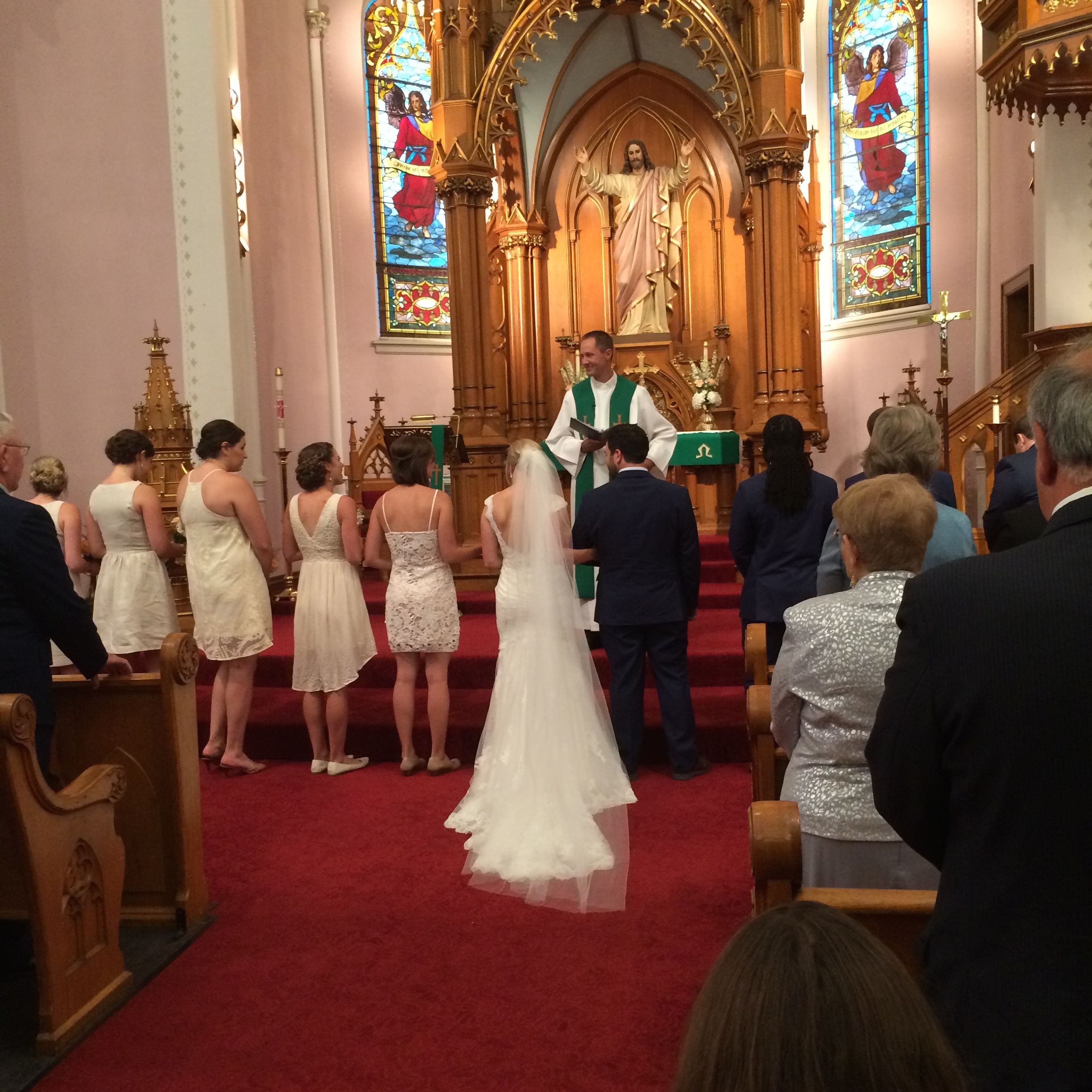
Everyone is in place, the music is starting.

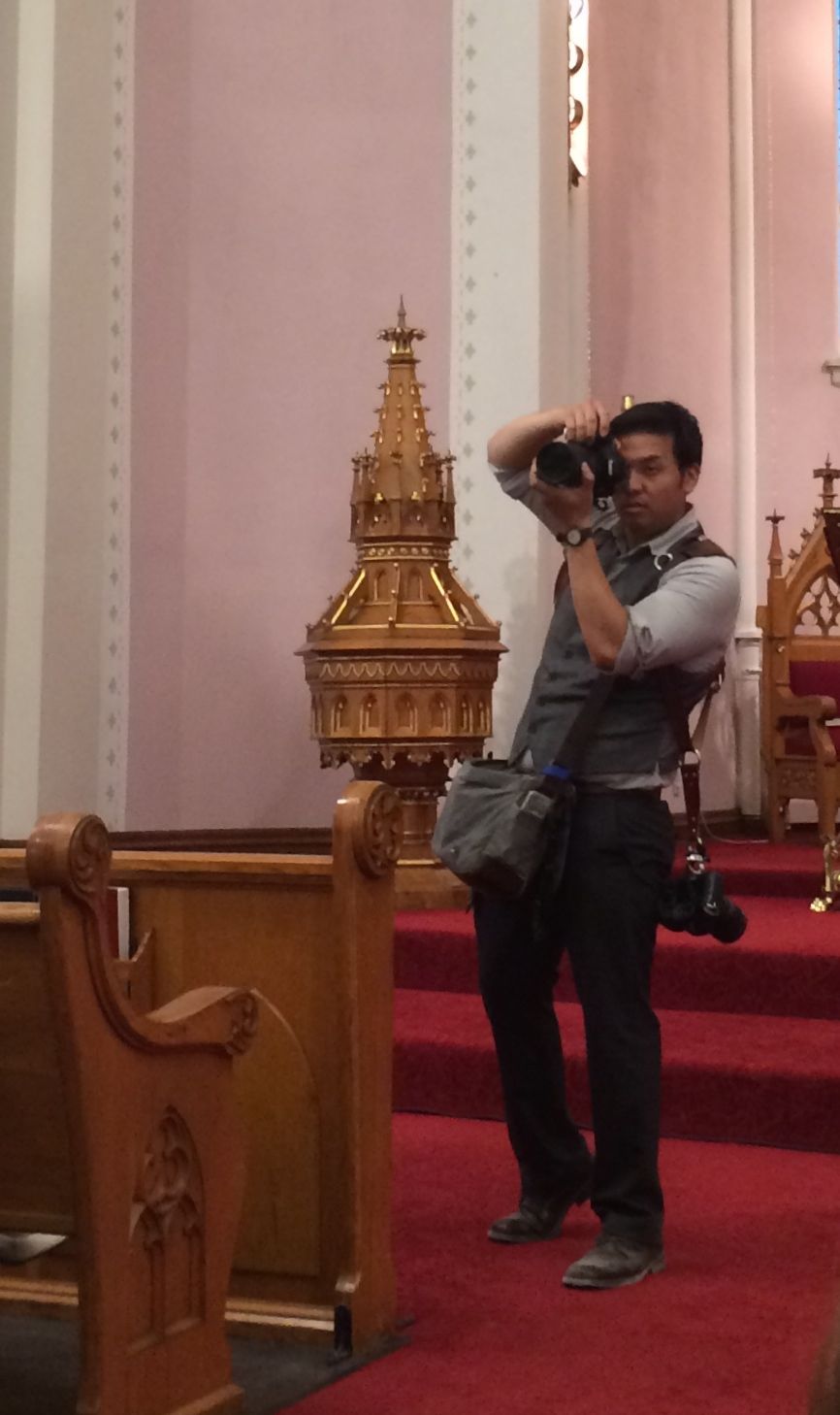
What’s a wedding without a photographer?

W - photographer

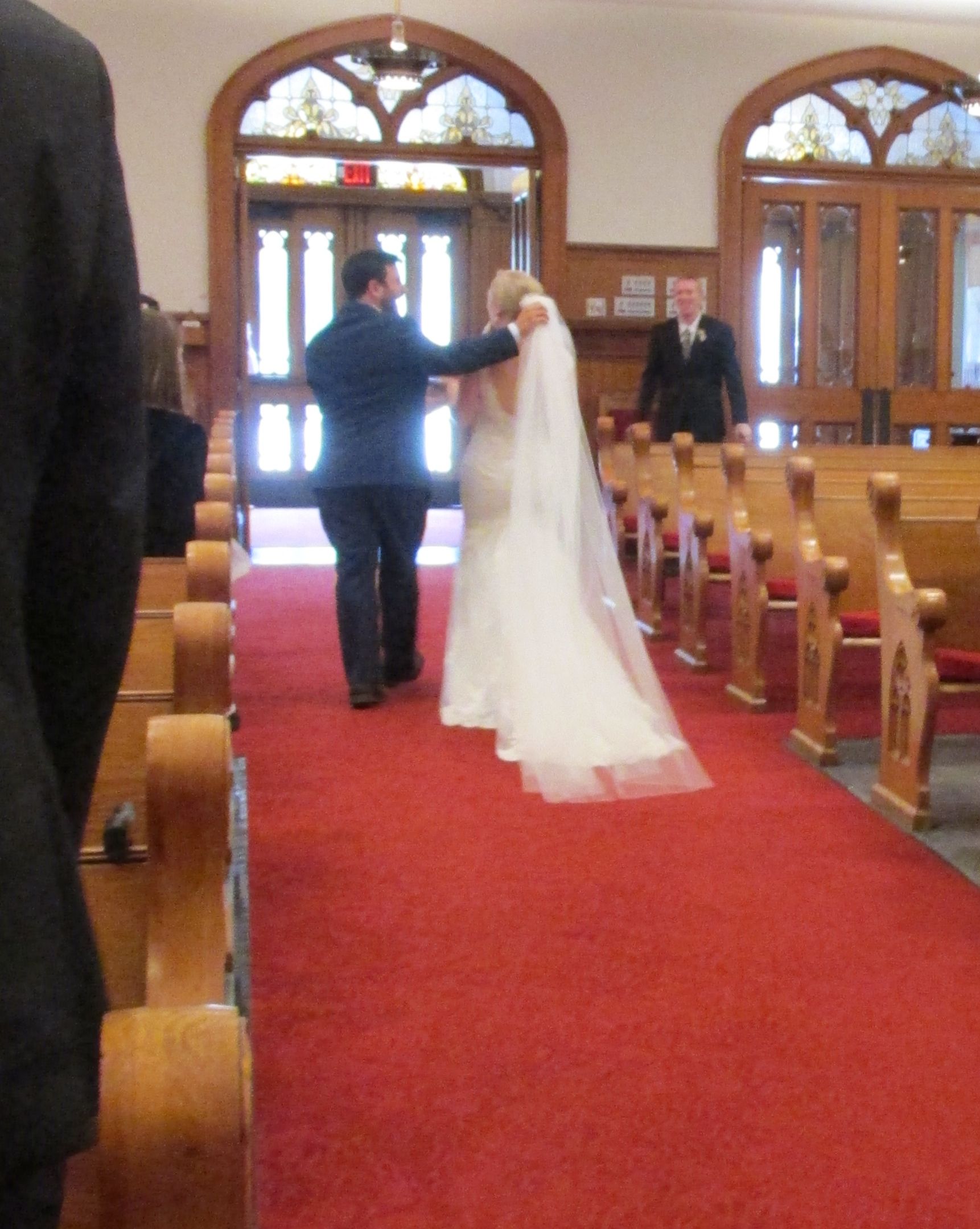
Here comes the bride!
The wedding in progress
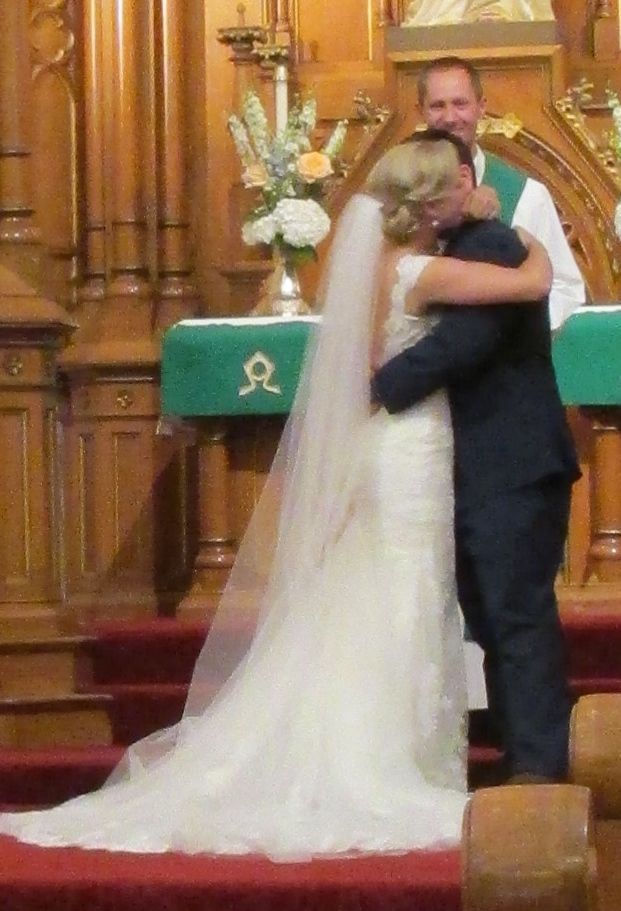
The kiss
The kiss
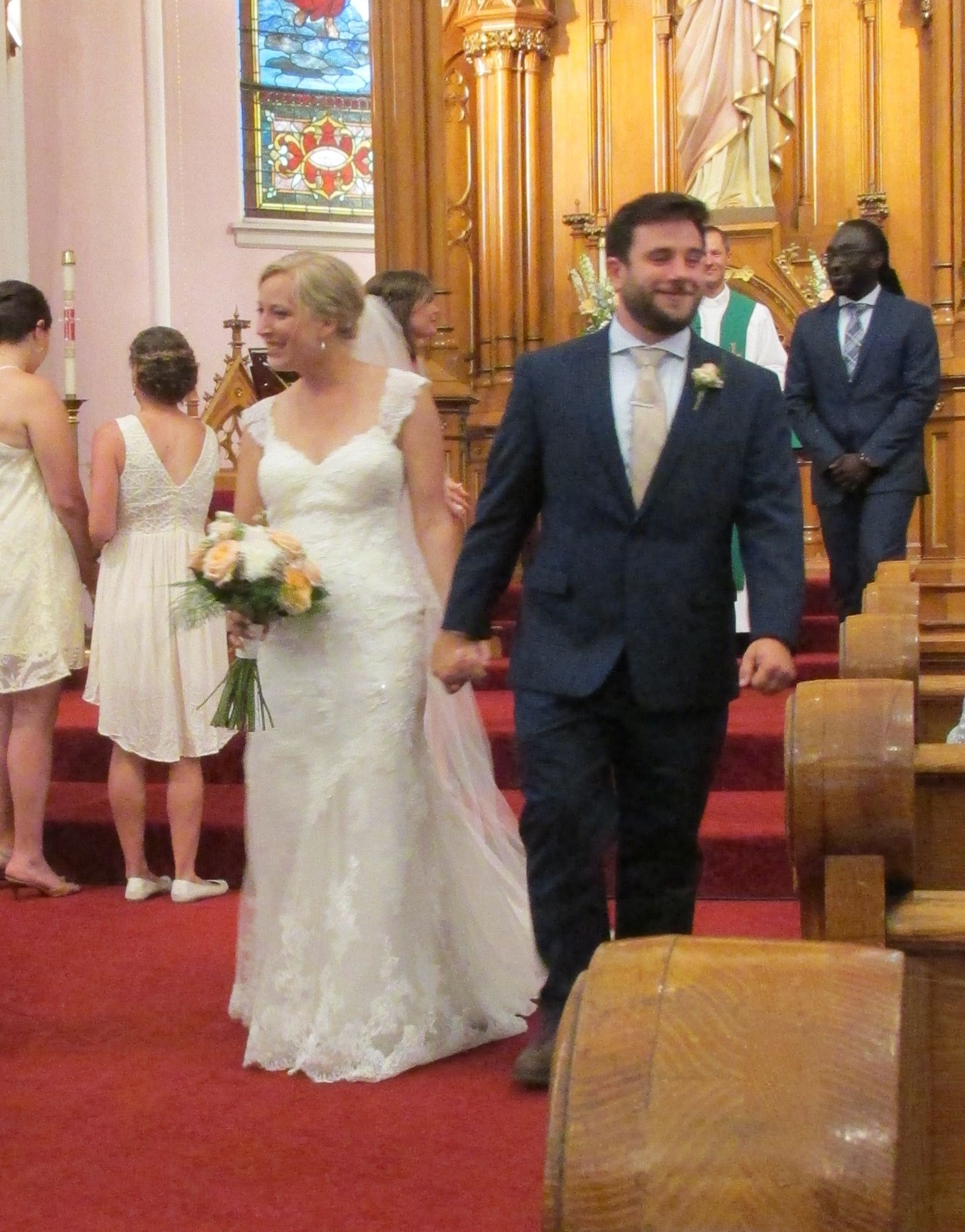
On their way out
On their way out
There goes the bride!

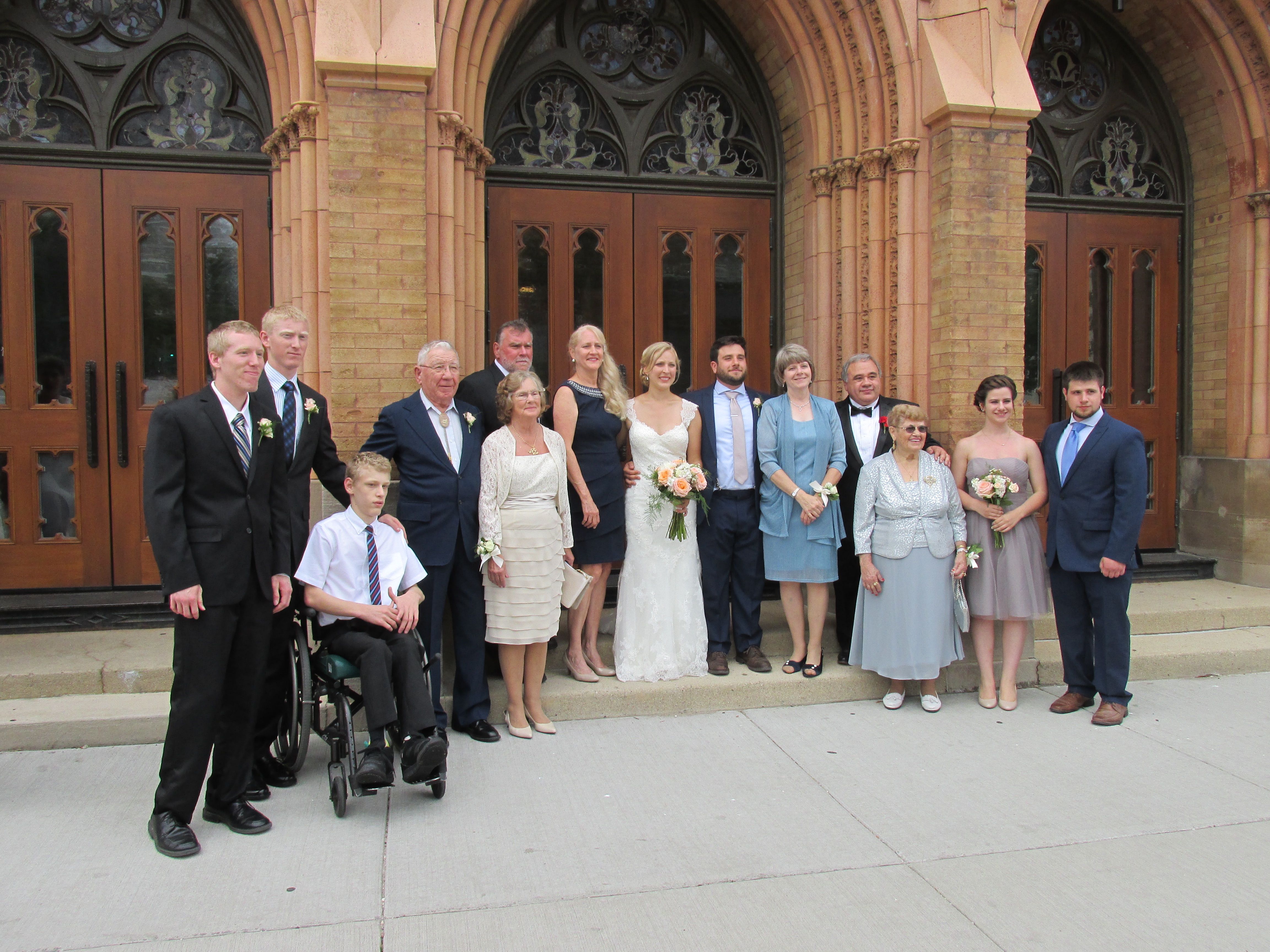
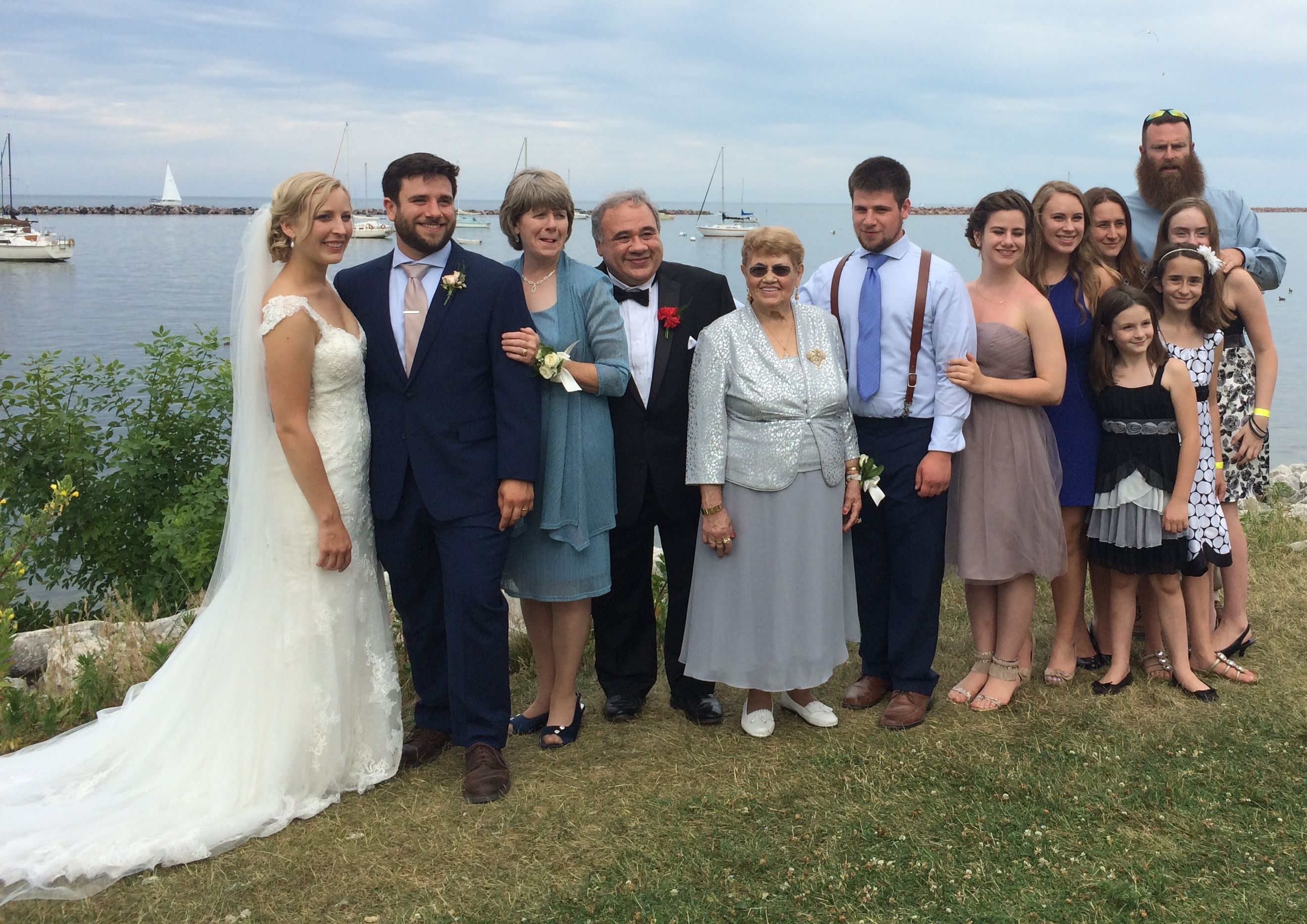
Then, the family photos.

Two families are joined
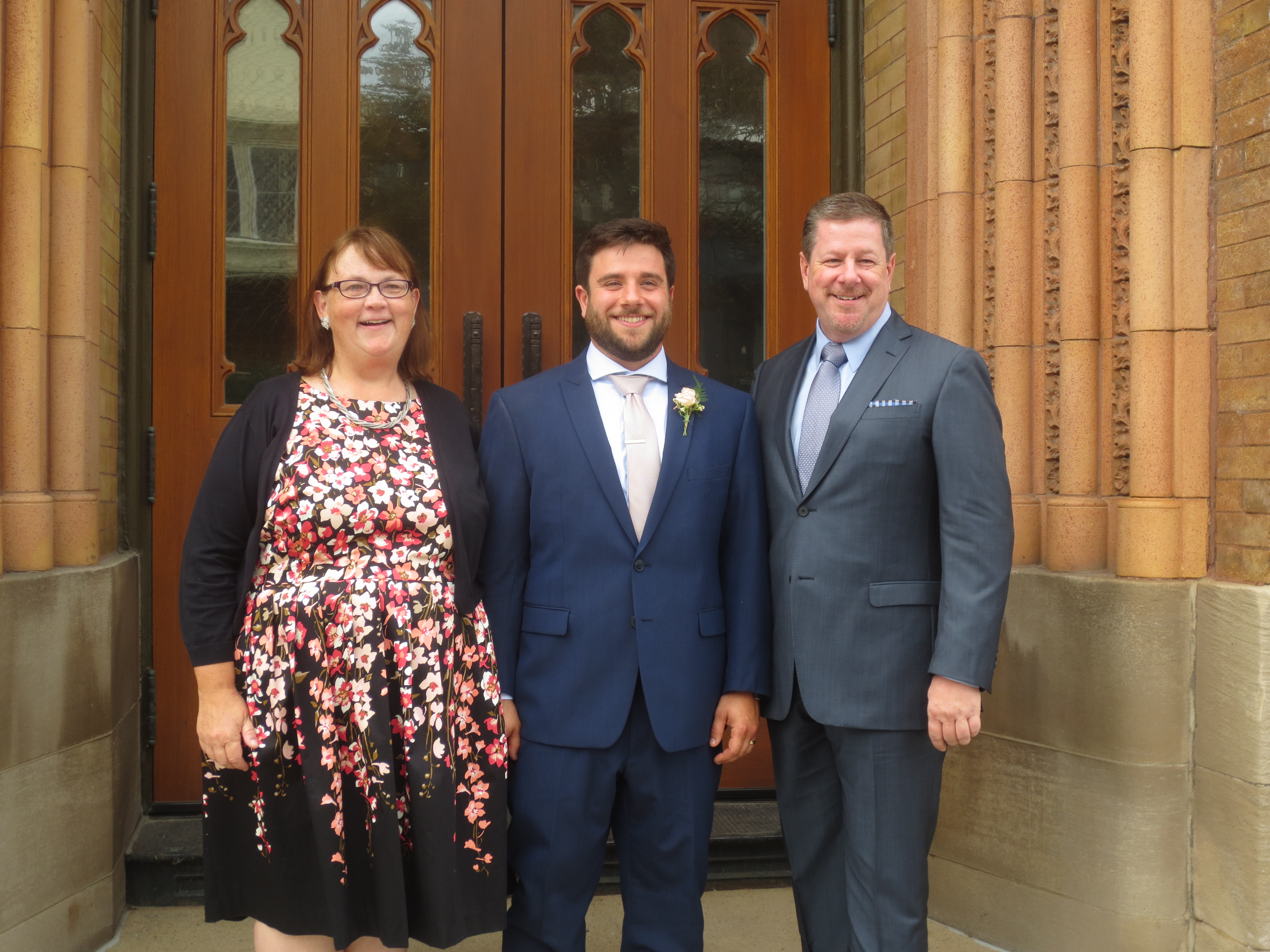
Paul with his godparents, me and his uncle Michael
Paul with his godparents; me and his uncle Michael

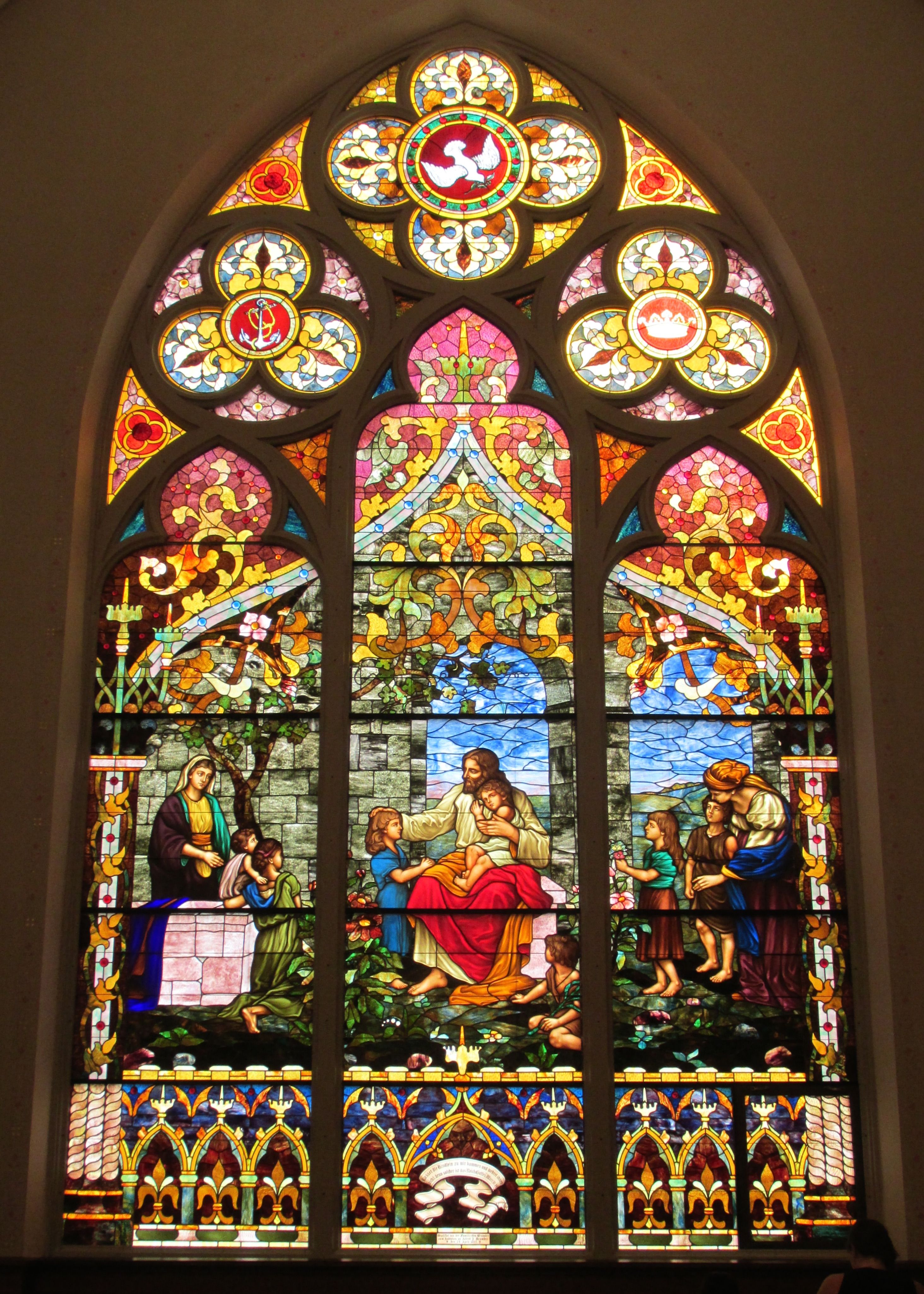
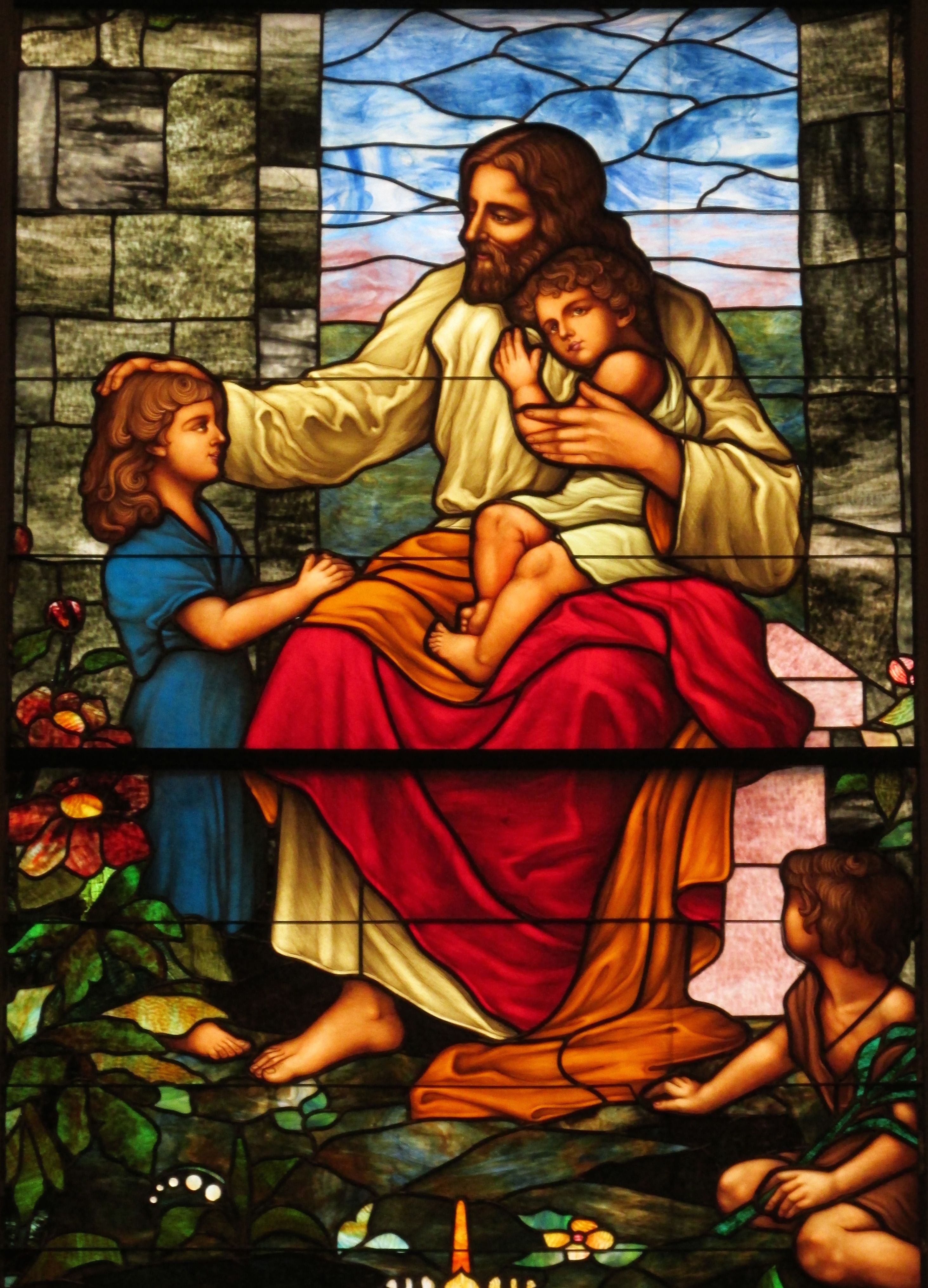
There were many more photos by the photographer, and I went inside to admire the church that had been built by German immigrants. W - Suffer the children large

W - suffer the children close up

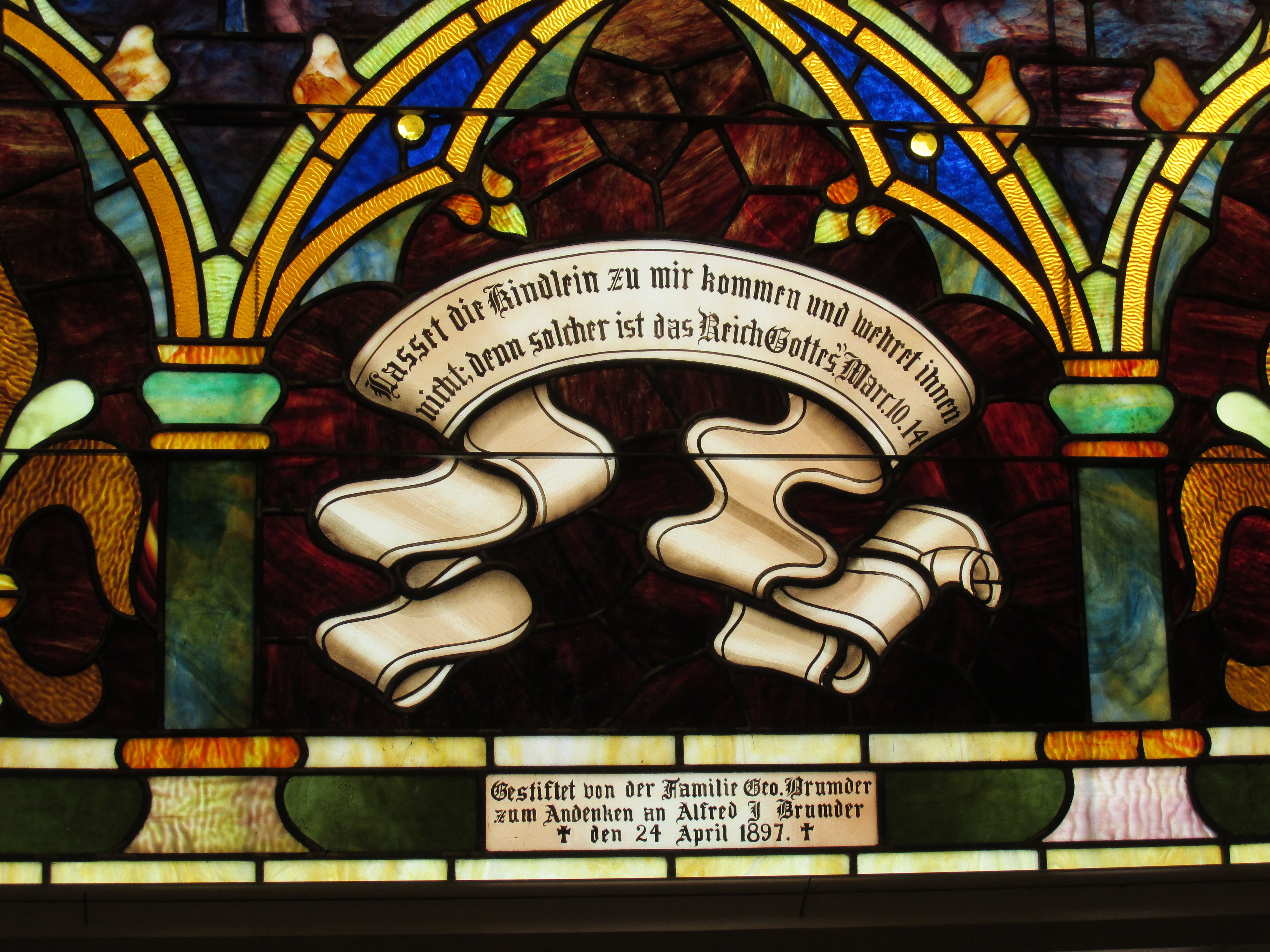
W - Suffer the children text

“But when Jesus saw it, he was much displeased, and said unto them, Suffer the little children to come unto me, and forbid them not: for of such is the kingdom of God.”                                                                     Mark 10:14

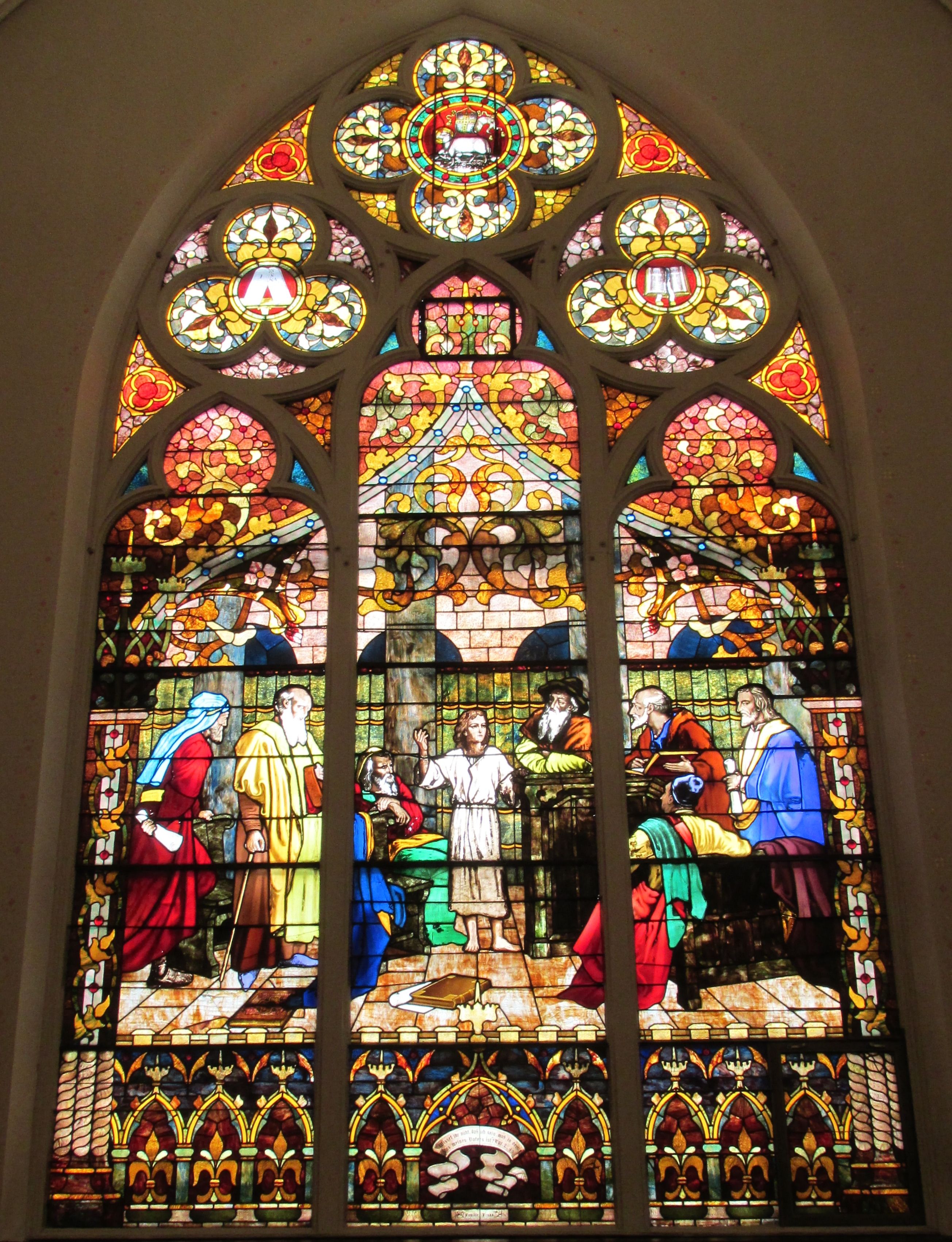
W - My father's house

“And He said to them, “Why is it that you were looking for Me? Did you not know that I had to be in My Father’s house?”                                                   Luke 2:49

Okay, so these might not be the literal translation of the German, these are the Bible verses that correspond to the illustrations.

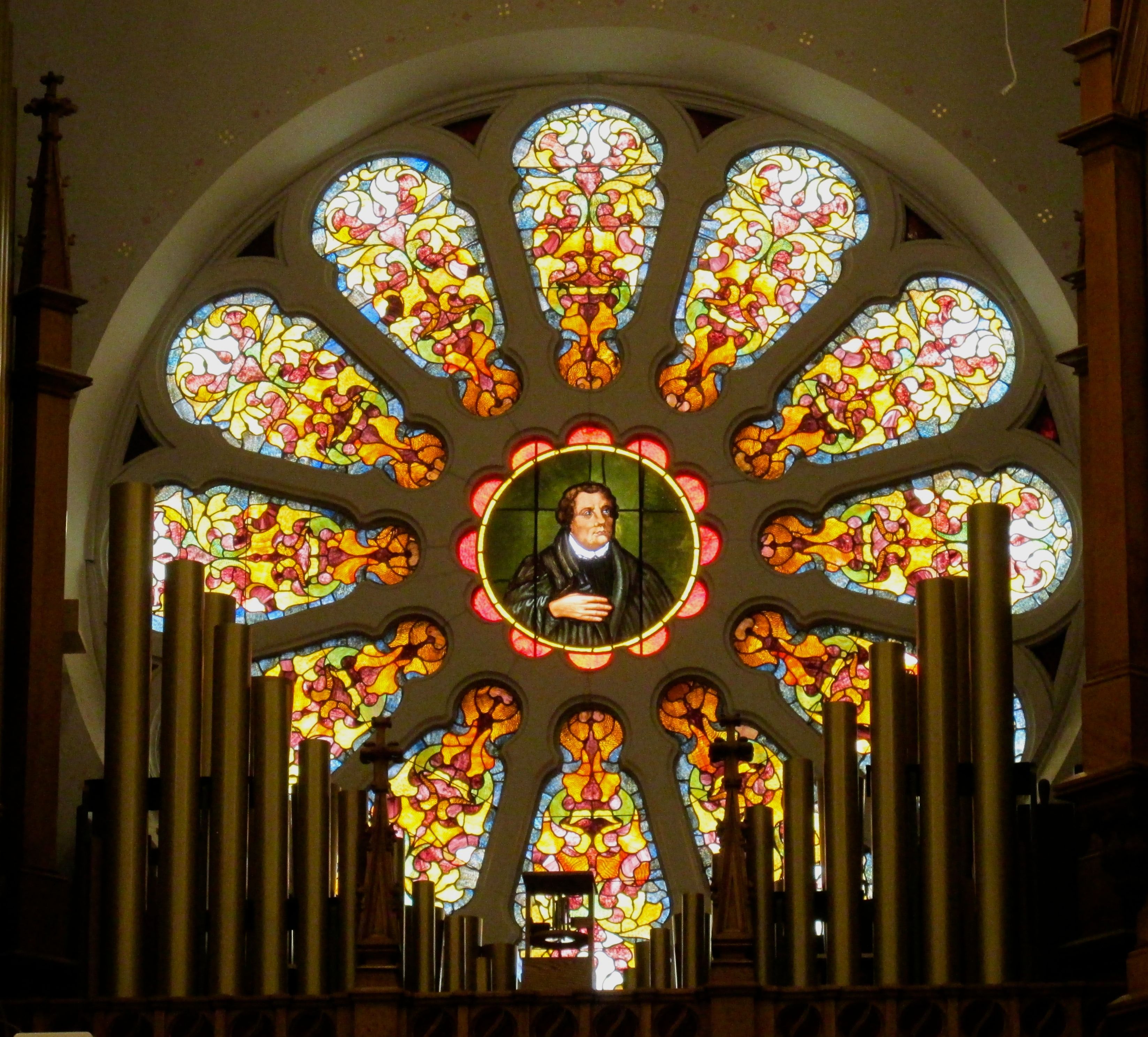
Rose window in the organ loft with Martin Luther's portrait
Rose window in the organ loft with Martin Luther’s portrait

Then it was time for the celebrating. They chose a lovely venue on the shore of Lake Michigan. The reception started with a cheese curd and chicken wing buffet.

After we were sufficiently refueled, there was more photography.

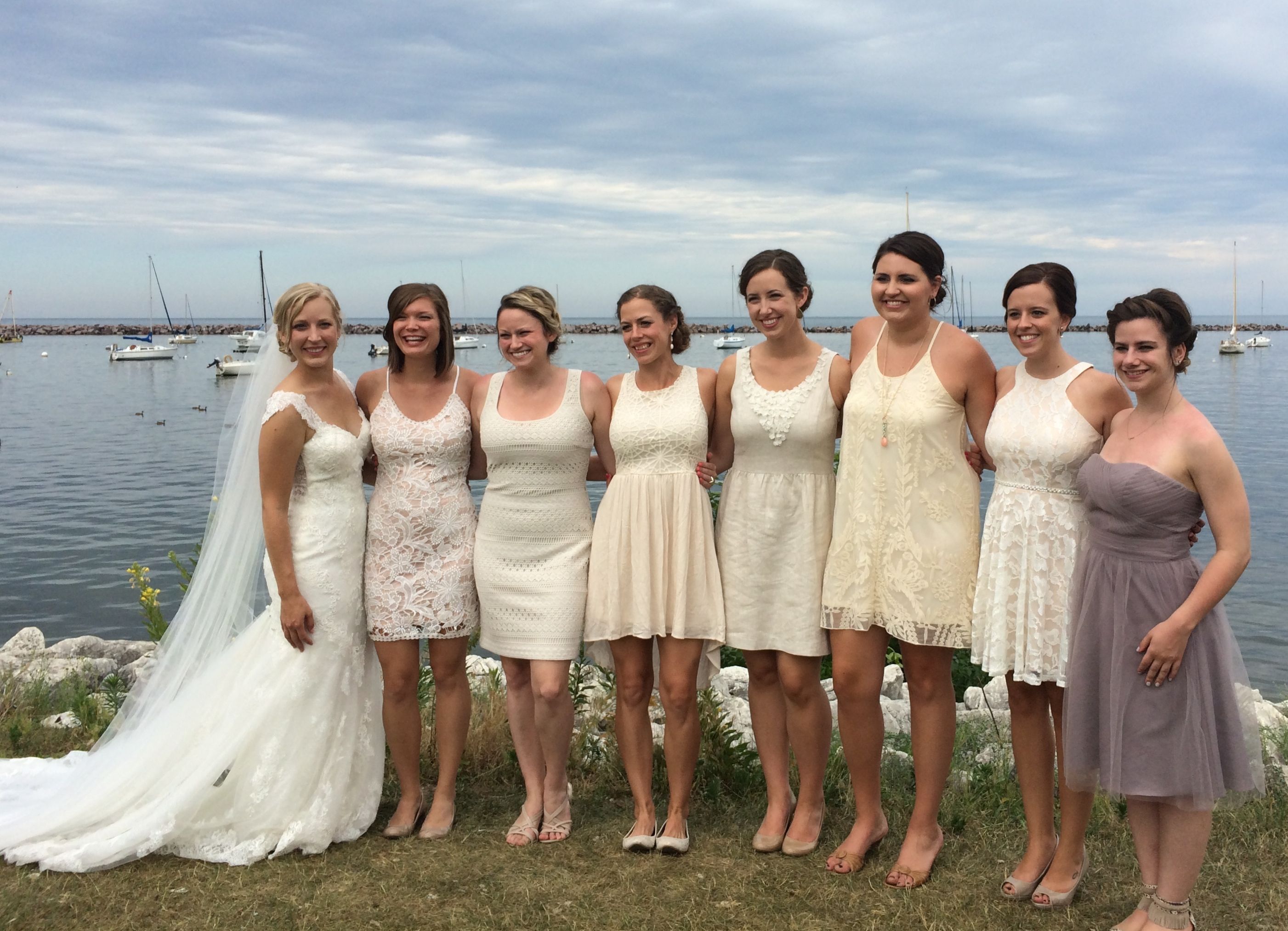
W - bride and maids reception

W - the grooms family

And of course, there were many more photos, much eating, much drinking, and – after I left – dancing and high jinks.  I had a lovely time, but left early. I was tired and worn out with joy.

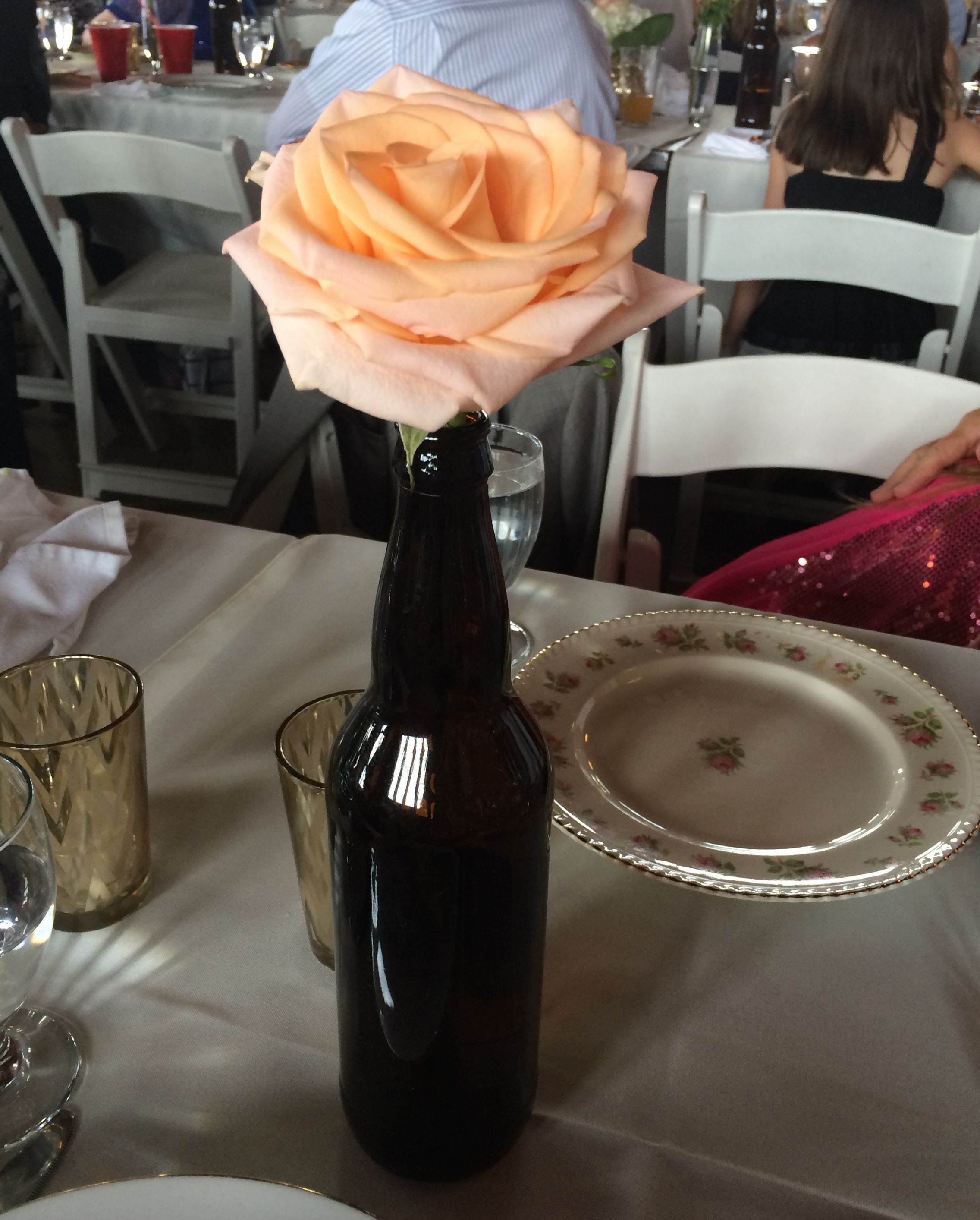
W - table

Best wishes, Paul and Amber!


Racine

Can I ever get enough Frank Lloyd Wright? Apparently not. And, I am glad my friend, Dina, was also into his buildings, which made for a great visit to Racine.

Actually, not only am I seeing some Wright buildings for the first time, but I am also meeting Dina face-to-face for the first time. We have been Facebook friends, introduced by a mutual  friend. It was great to finally meet her!

I guess we both got the tie dye memo!

Our first stop was Wingspread, the home of Herbert F. Johnson. It was built in 1938-1939.

Wingspread 2

The house has four wings that extend from the central public space.

One of the wings
One of the wings

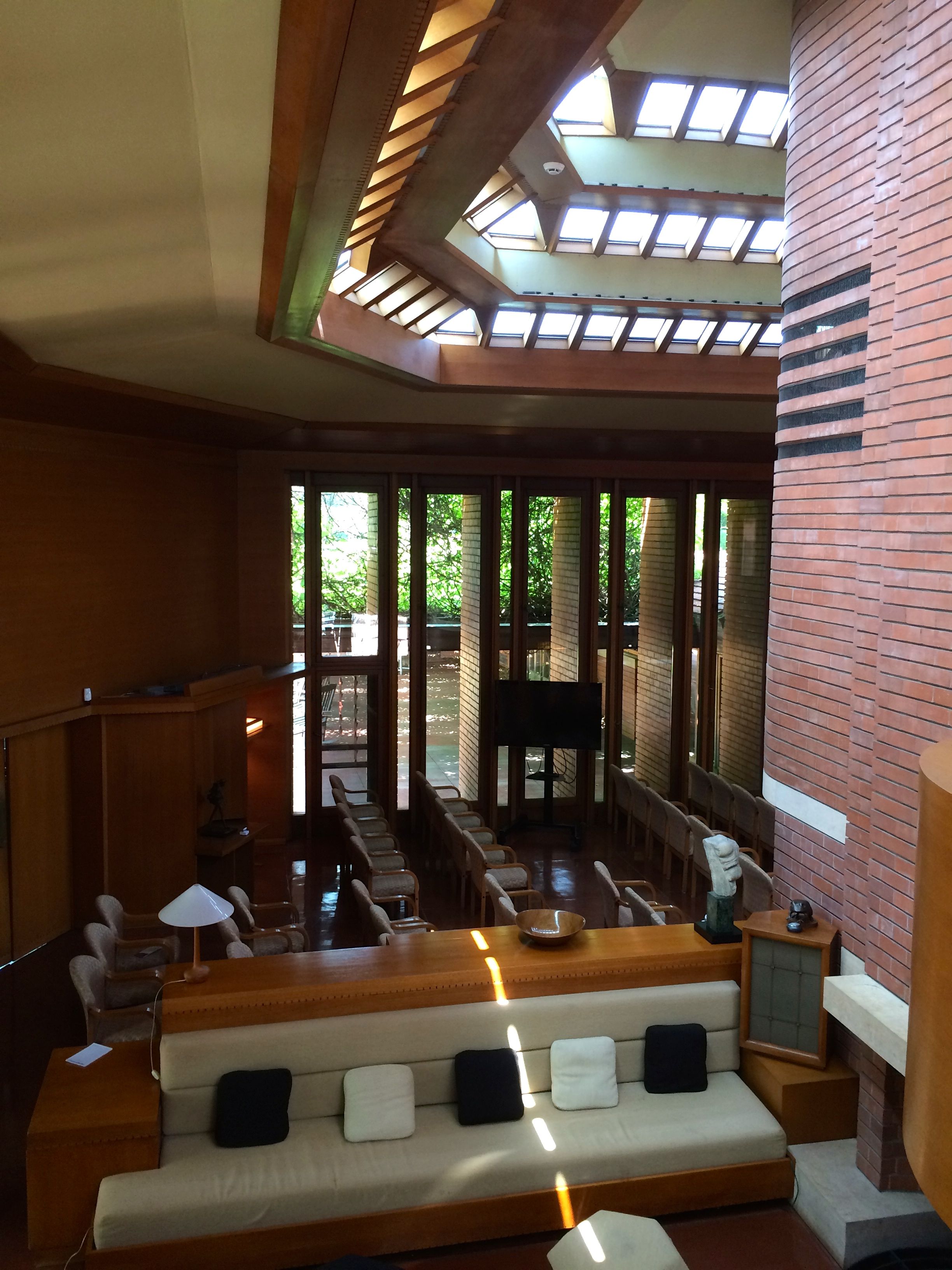
The central space contains the living room, dining room, sitting areas and places for entertaining. It is capped with a roof filled with multiple skylights.

Another view of the living room from the mezzanine.
A  view of the living room from the mezzanine.

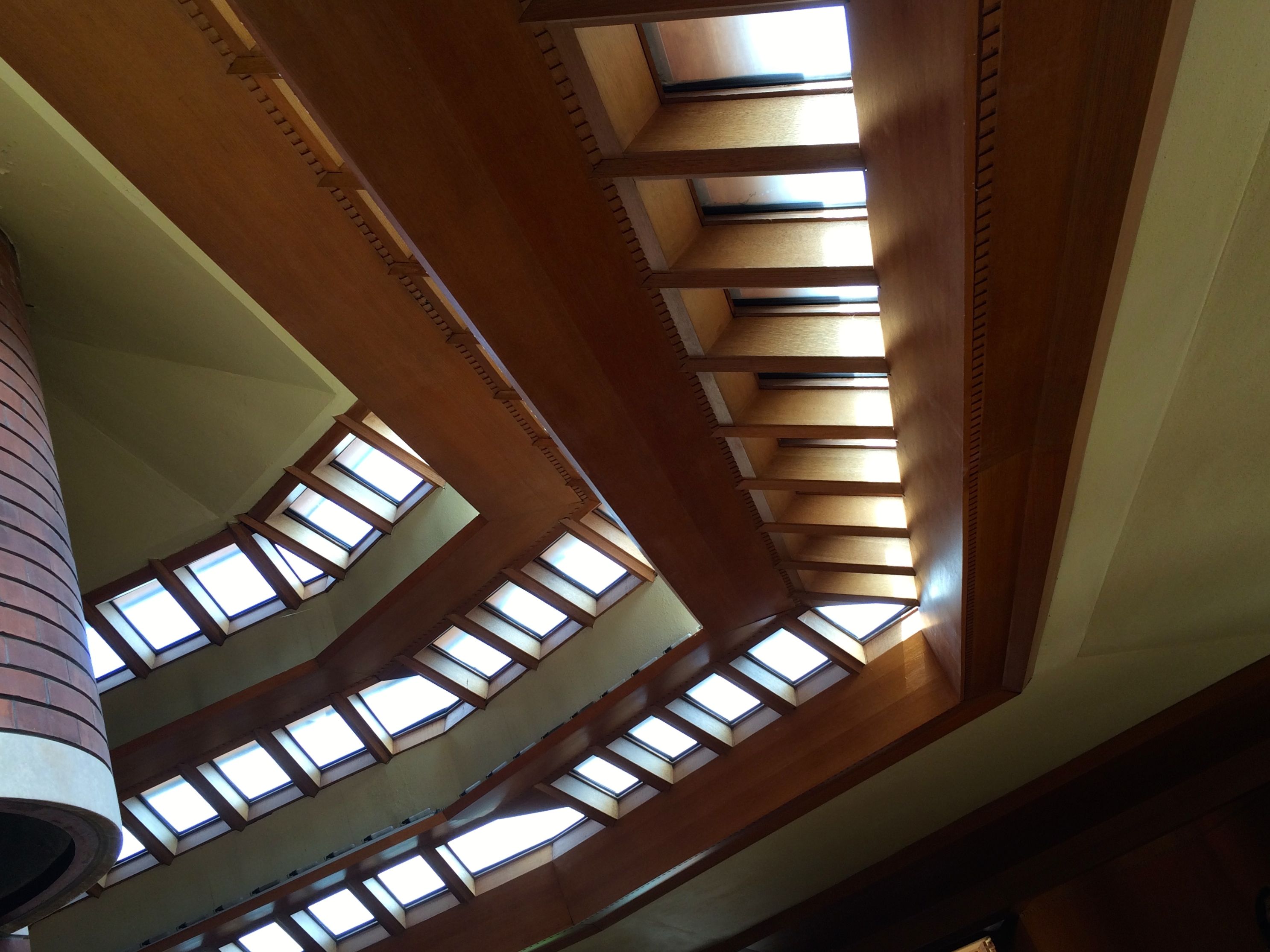
SkylightsThe light that these skylights provide illuminates the spaces beautifully. However, they did leak. Wright’s designs are always inspirational, but not always practical.

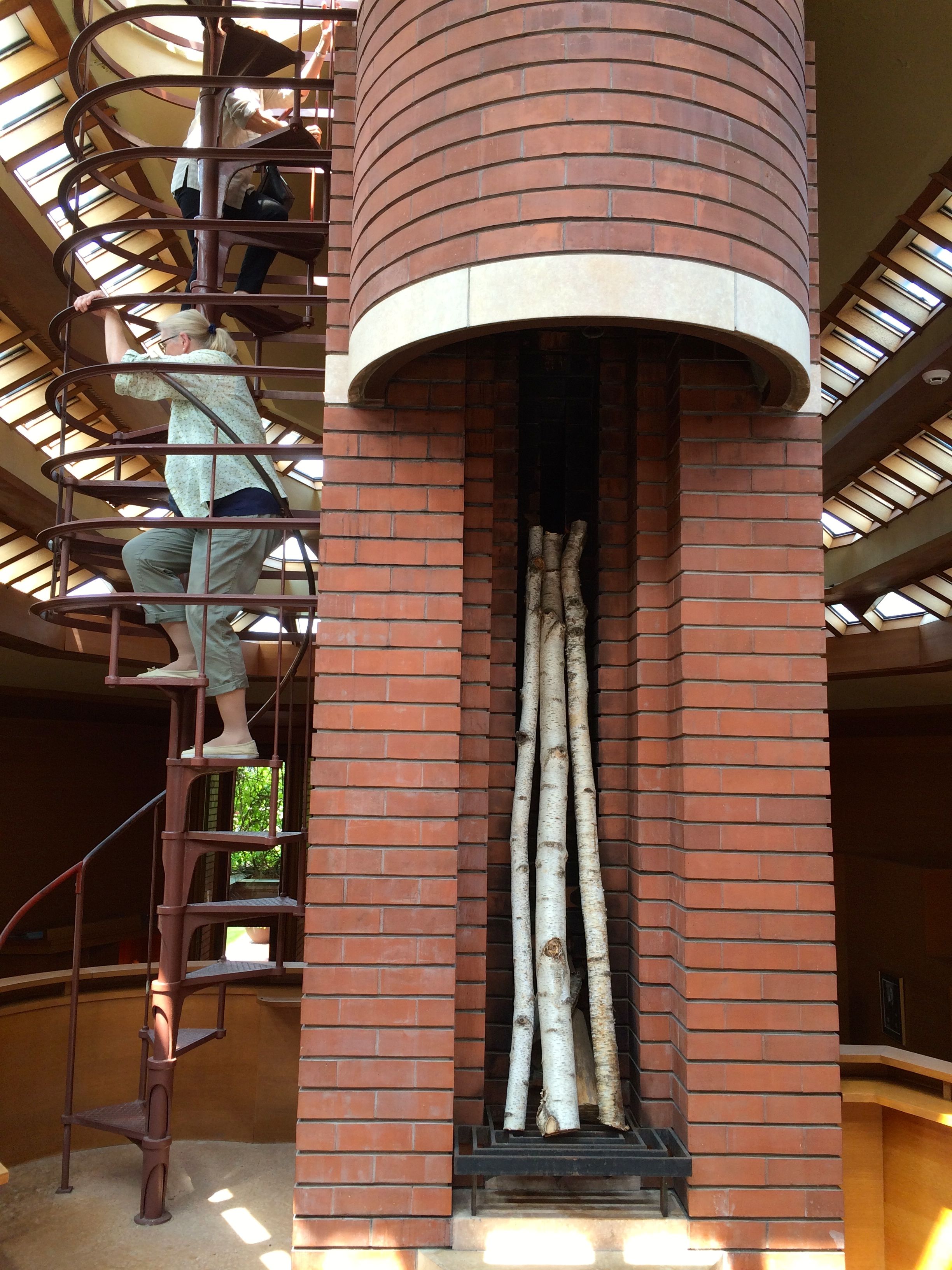
Speaking of impractical designs, have you ever heard of a vertical fireplace? In the central chimney, he has four fireplaces on the main floor and that vertical fireplace on the mezzanine.

Vertical fireplace
Vertical fireplace

It was designed to be stoked with eight-foot birch logs. The first time it was lit, the logs burned away at the base and then they fell out onto the floor. The Johnsons quickly got the fire extinguished and the logs out of the house. From what I understand, the logs have been purely ornamental since then.

To the left of the fireplace, you see a feature that Wright designed for the boys. They wanted to have an area they could use for a lookout, like the cupola that their grandparents had at their house. At the top of the circular staircase is a room that looks out over the hillside. Sam used to talk with his father via walkie talkies as he would fly by the house.

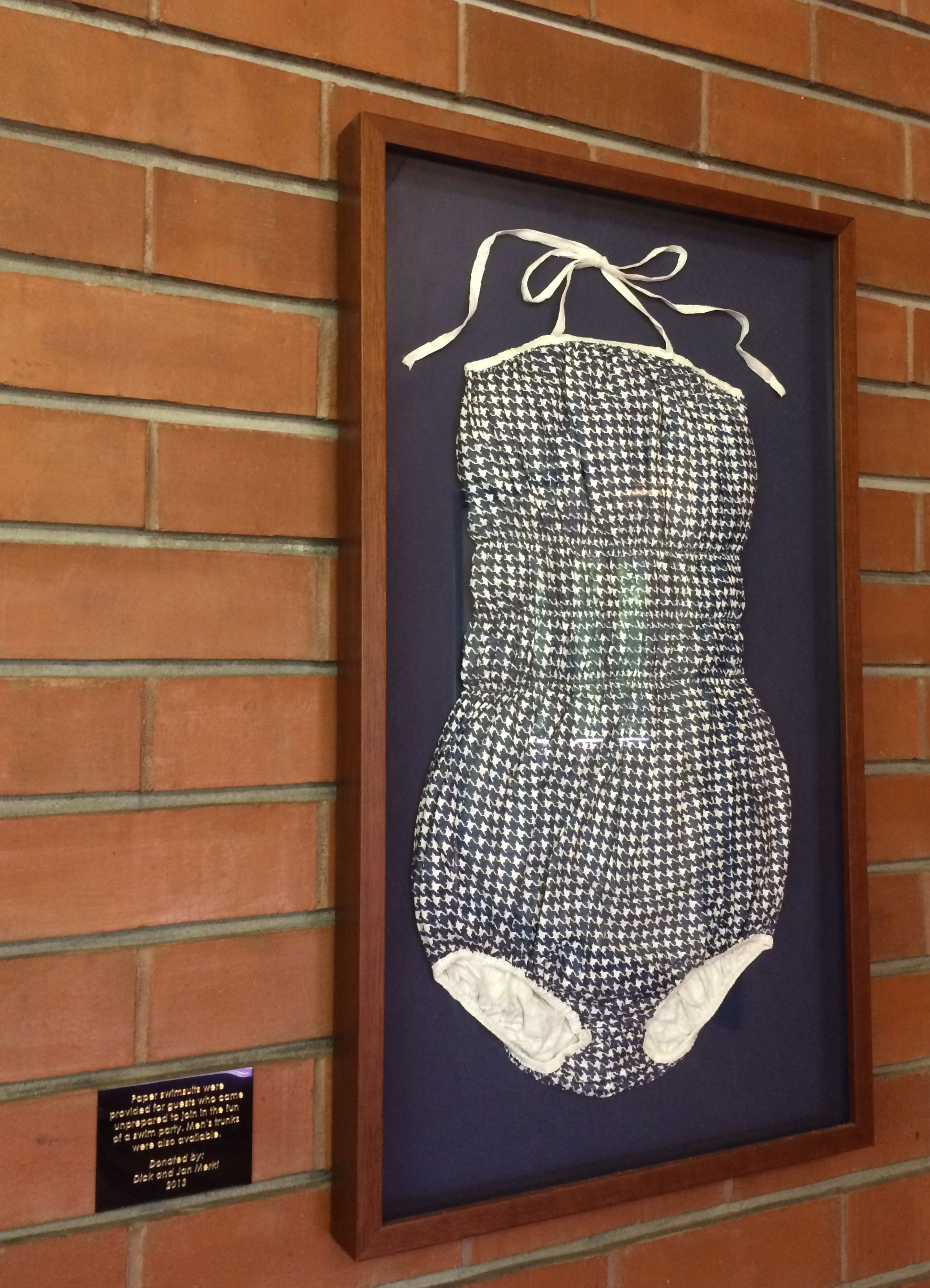
Another thing that the boys wanted was a swimming pool. Wright didn’t approve of swimming pools, so this was a very deep reflecting pool. The pool was included to get the kids’ friends to make the trek all the way out of town to the new house. To insure that everyone could enjoy the pool, they had “paper” bathing suits that guest could wear in the pool.

Paper bathing suit
Paper bathing suit

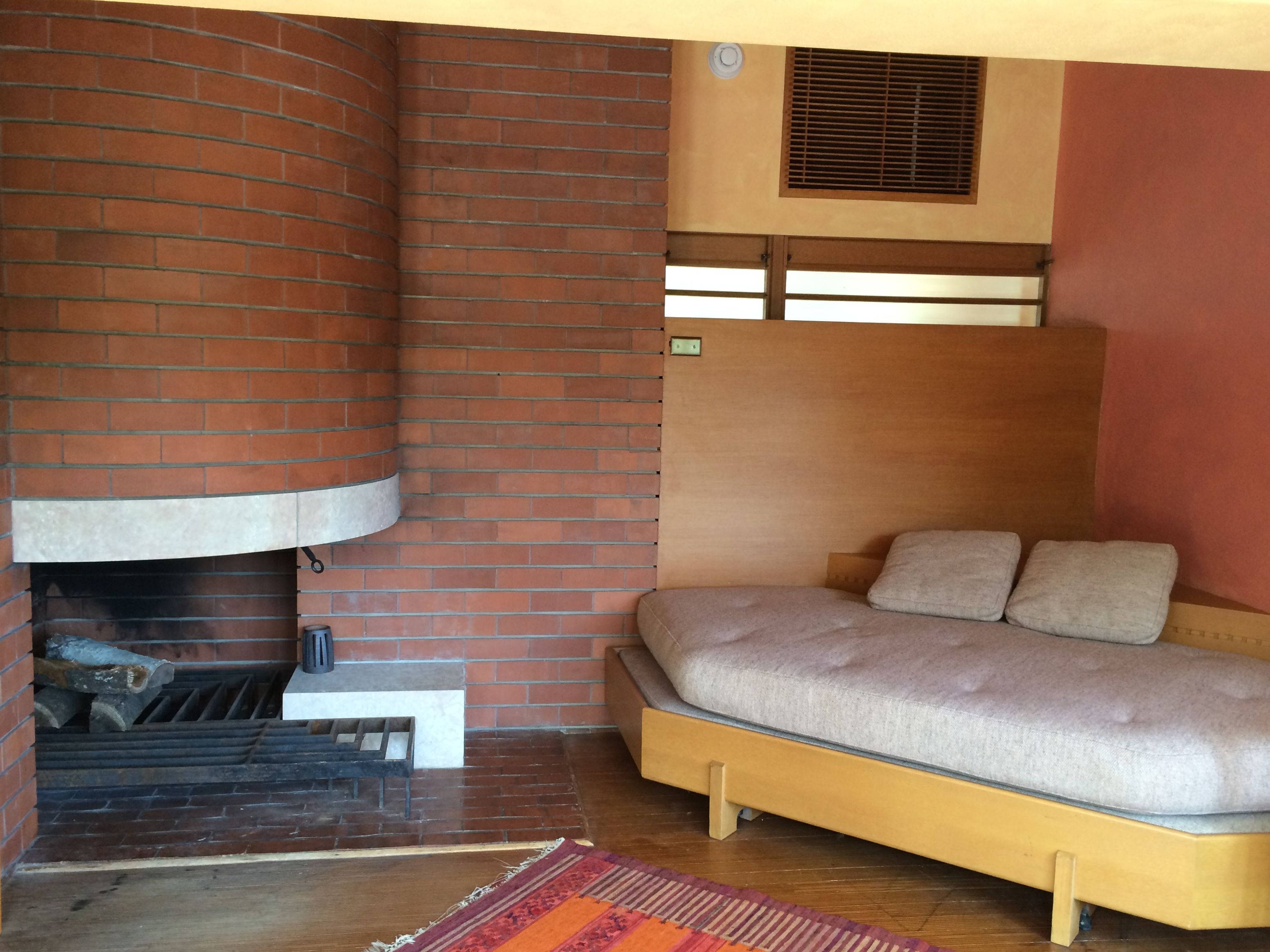
This was hanging in what had been the boys’ playroom. With Wright’s fondness for fireplaces, this room has one, too. It is now used as a meeting room.

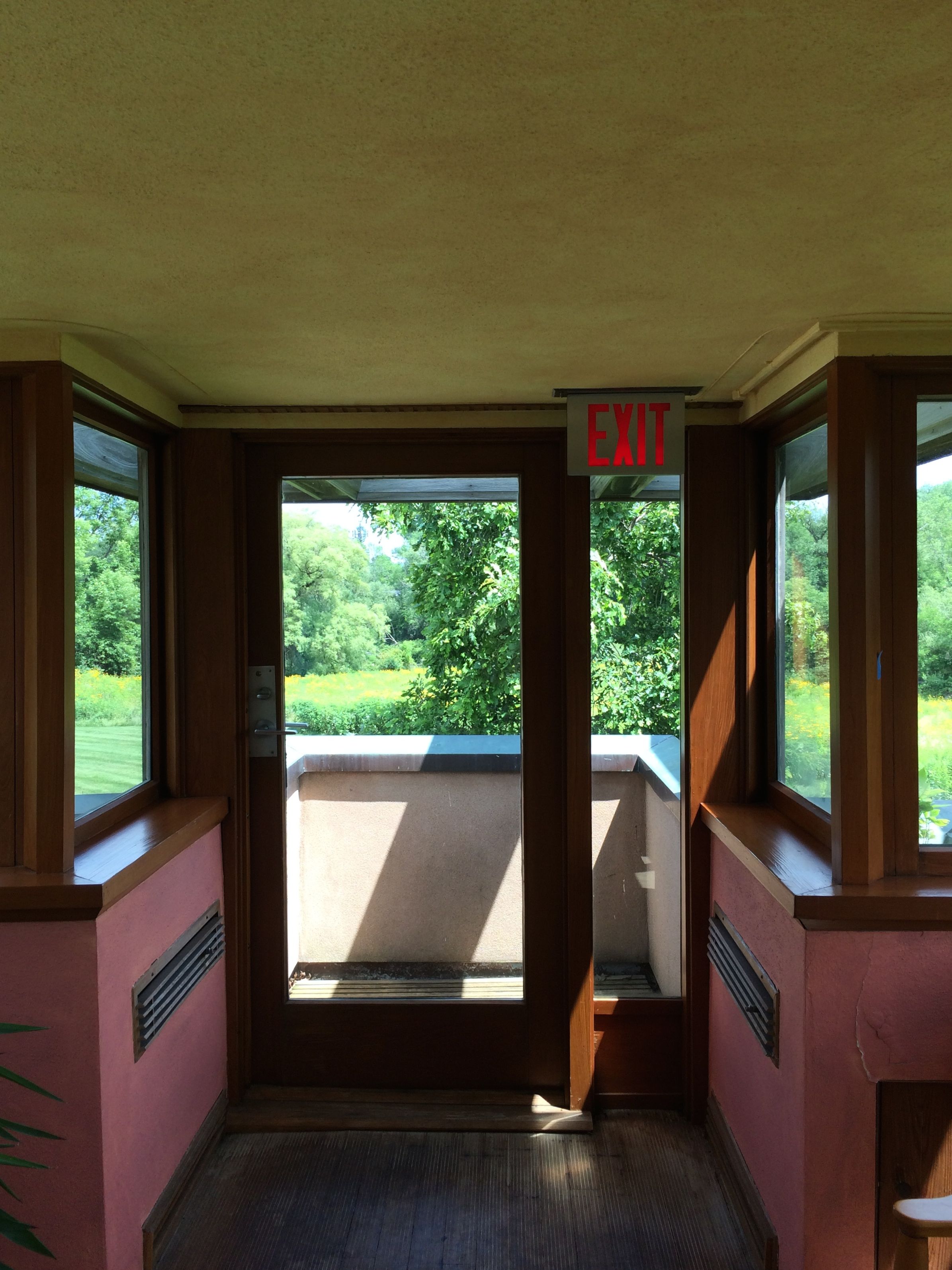
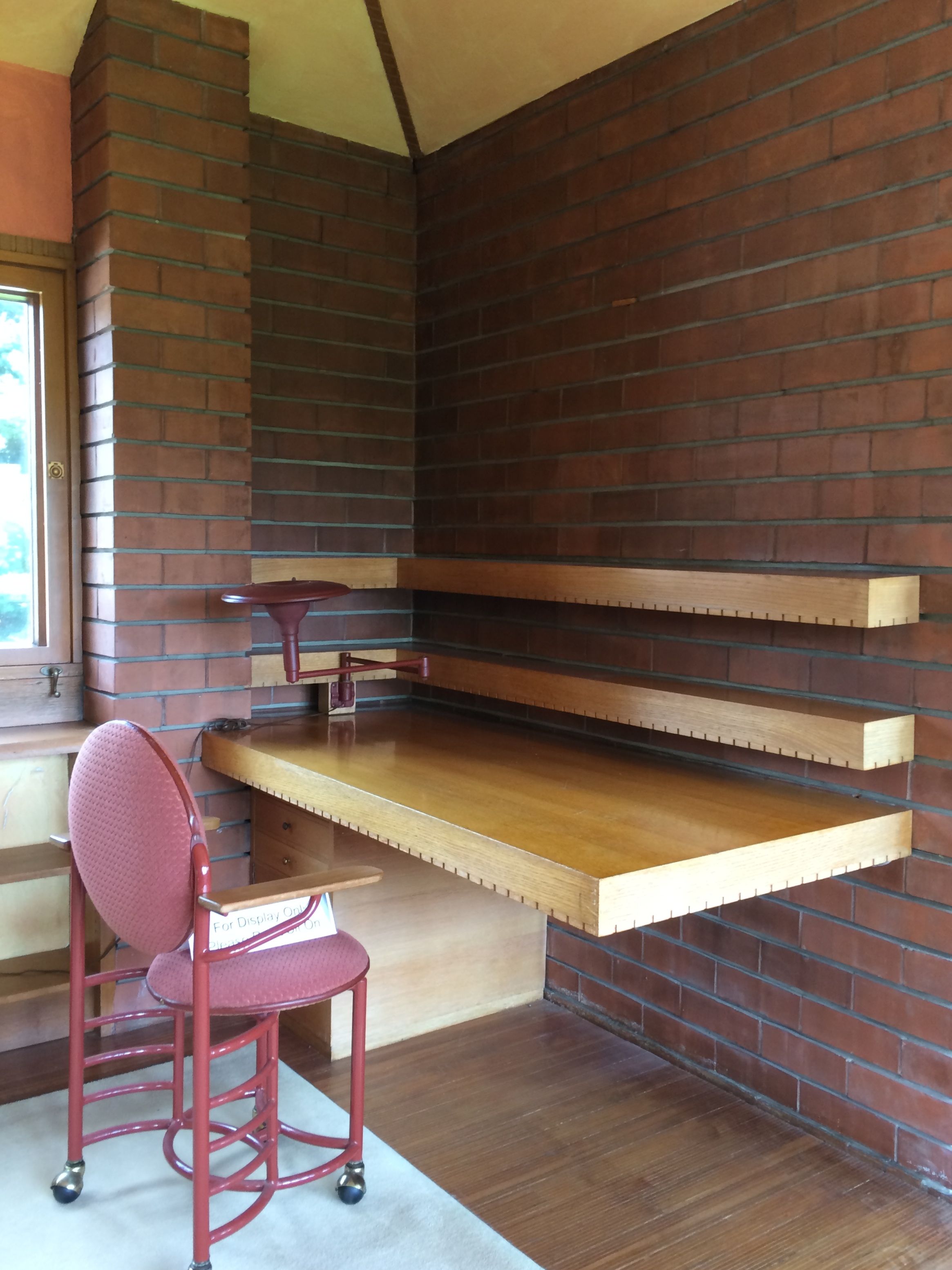
Wright didn’t leave the daughter out of the design. He designed her room to have a Juliet balcony at the end of it. It’s a small balcony, but it was all hers.

The Juliet balcony
The Juliet balcony
The daughter's built-in desk
The daughter’s built-in desk

The parents each had their own bedrooms, but shared a sitting room. Of course, it had its own fireplace. Dina told me that Eleanor Roosevelt once took a nap on the couch. She heard that bit of information when she took a previous tour.sitting room with Eleanor Roosevelt couch

high up windows

You can see how Wright allowed light to enter the private areas of the building. He didn’t use leaded glass windows that he used in houses he built in cities as there was no traffic out in the country. In the wings, though, he did manage the amount of clear glass that he used to preserve privacy but still illuminate the area.

We weren’t allowed in all the parts of the building, as it is used by the The Johnson Foundation. We could see that they were setting up for meetings and events later in the day.

The Johnson Foundation is an organization dedicated to helping to create change that leads to healthier environments and communities. They use Wingspread to hold their meetings and the offices of the Foundation are on the property as well.

Even though we couldn’t see all parts of the building, it was amazing to be able to take pictures inside.

We weren’t so fortunate with the Johnson Wax building, but it was a splendid building to see.

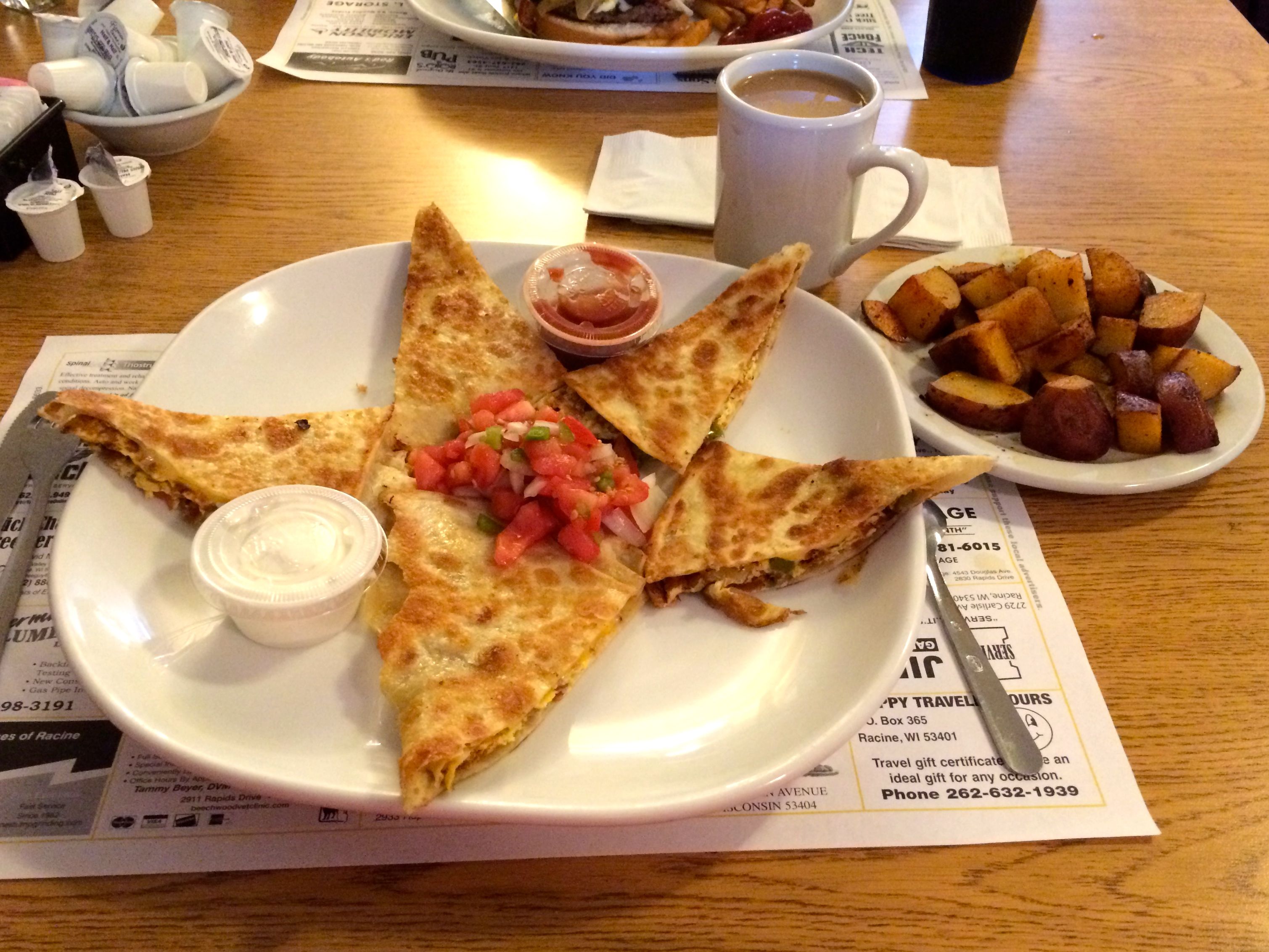
However, before we went to the Johnson Wax building, we stopped off for a bit of lunch at Honey B’s.

Breakfast quesadilla

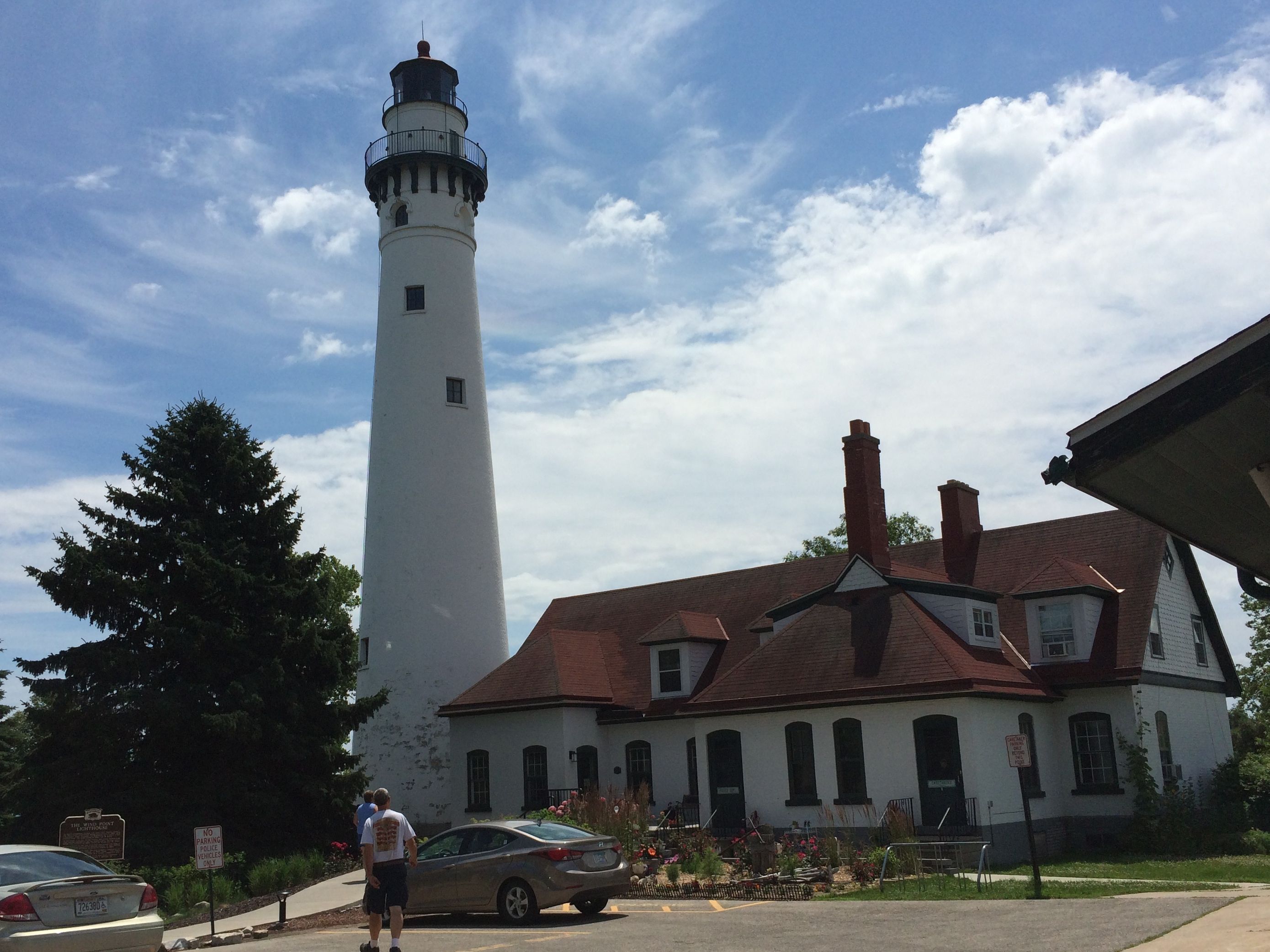
And then we zipped by the lighthouse on Wind Point.

lighthouse

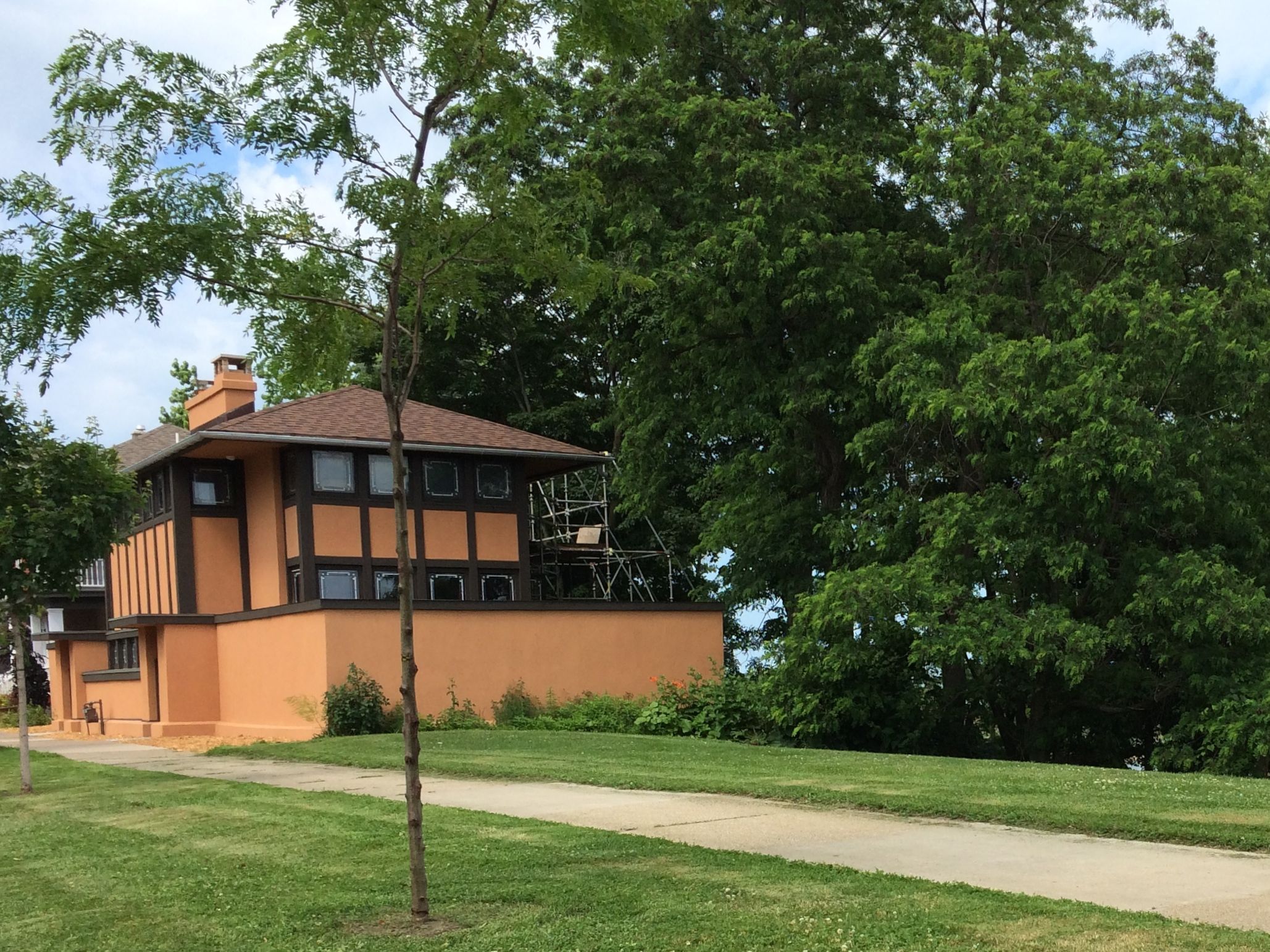
En route to the Johnson Wax compound, we just happened to pass another Wright building: a house on the shore of Lake Michigan.

FLW is EVERYWHERE!
FLW is EVERYWHERE!

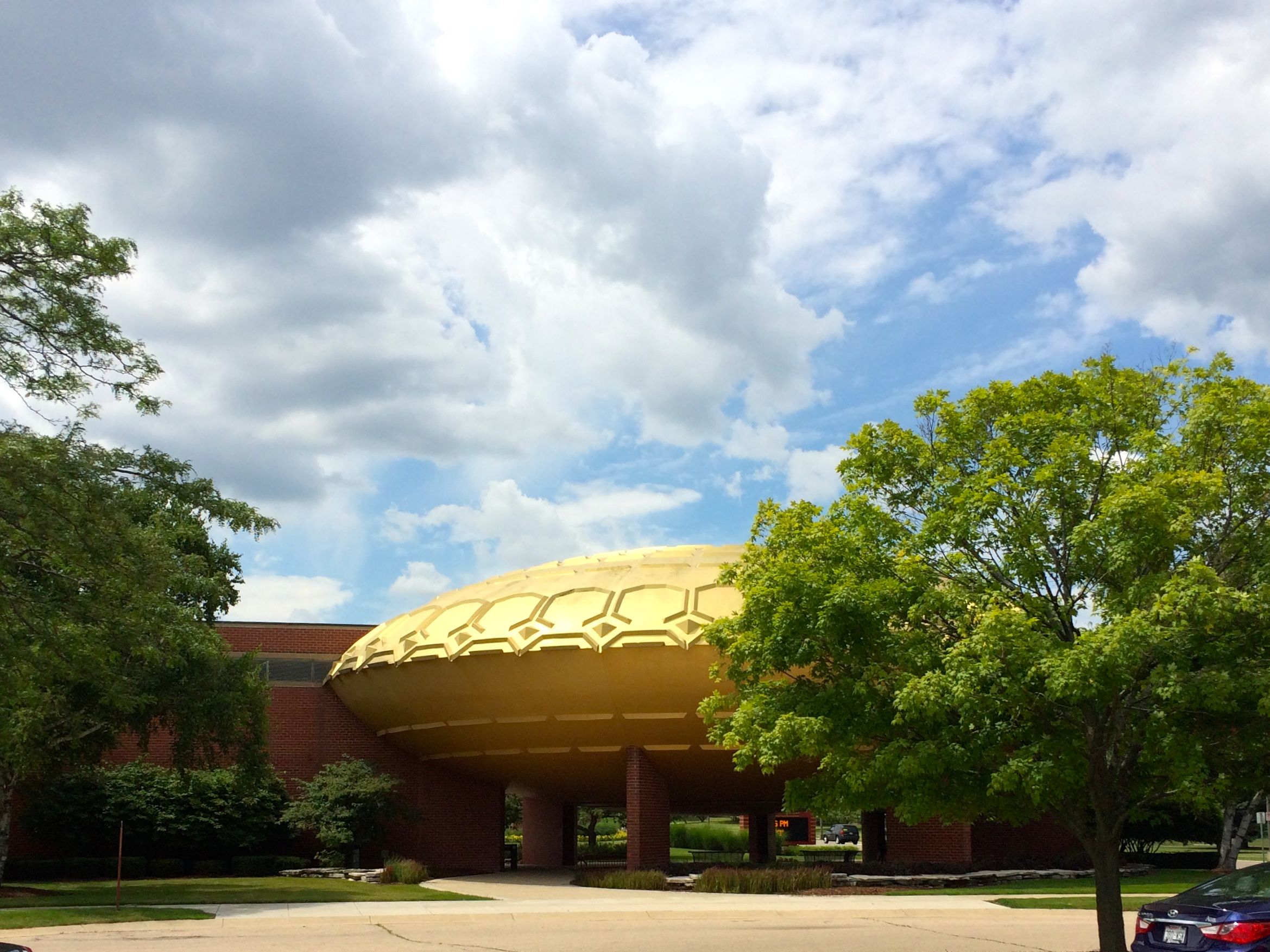
We met our tour guide at the Golden Rondelle, which was the Johnson Pavilion at the 1964 New York World’s Fair.

The Golden Rondelle
The Golden Rondelle
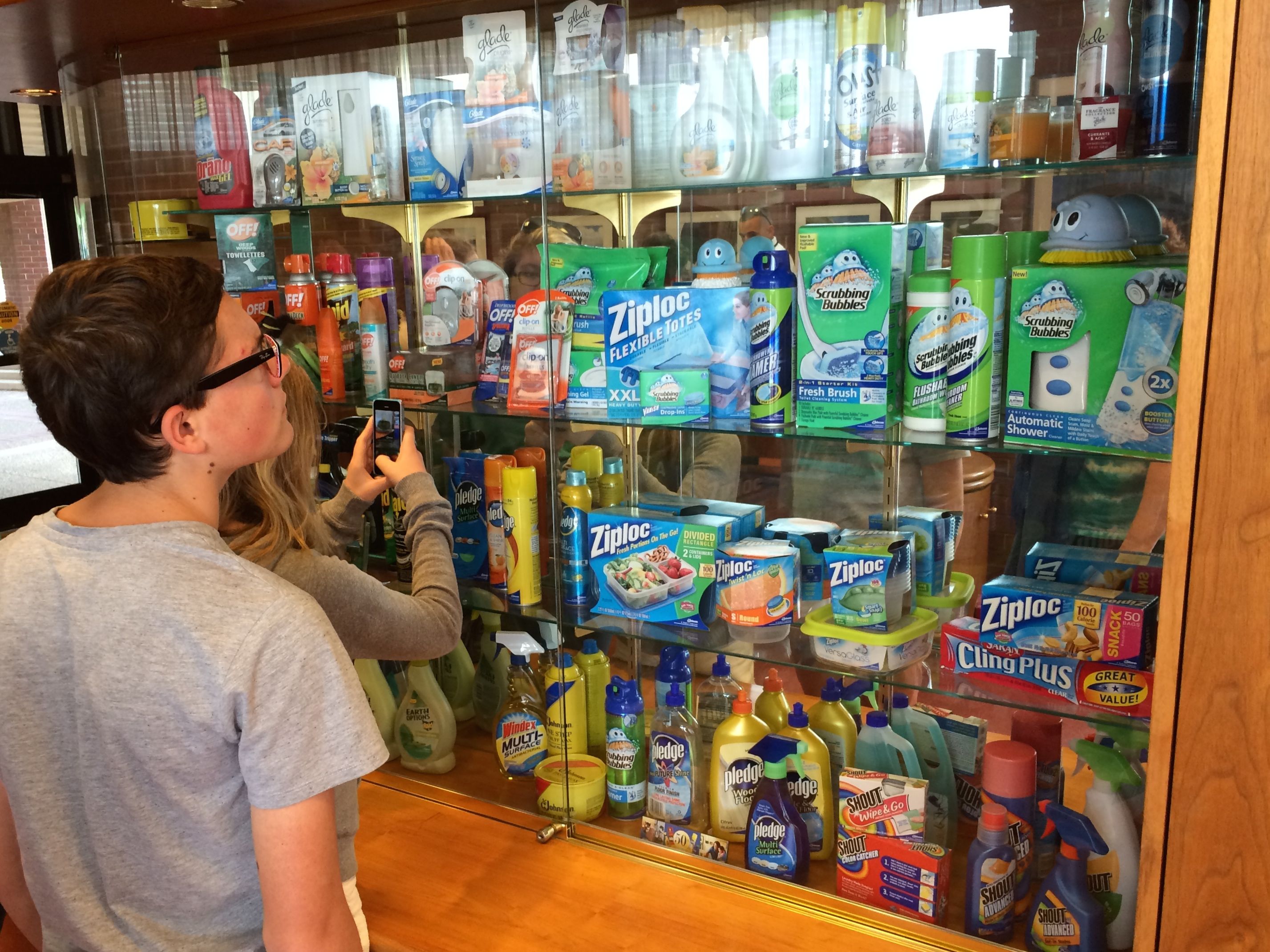
SC Johnson products on display

From there, we walked over to the Administration Building, which Wright designed beginning in 1936. It opened in 1939.

Johnson Wax Administration Building
Johnson Wax Headquarters

The Administration Building is the lower building. The taller building is the Research Tower. It was opened in 1950. The building to the left in the picture is Fortaleza Hall, which opened in 2010.

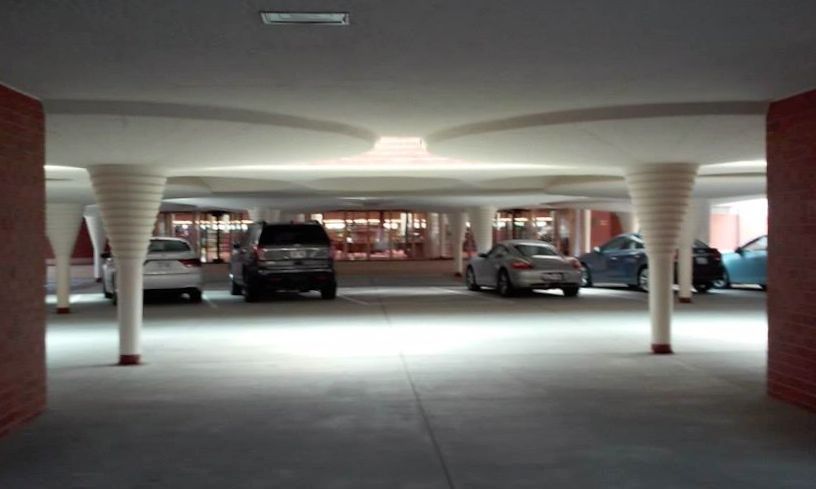
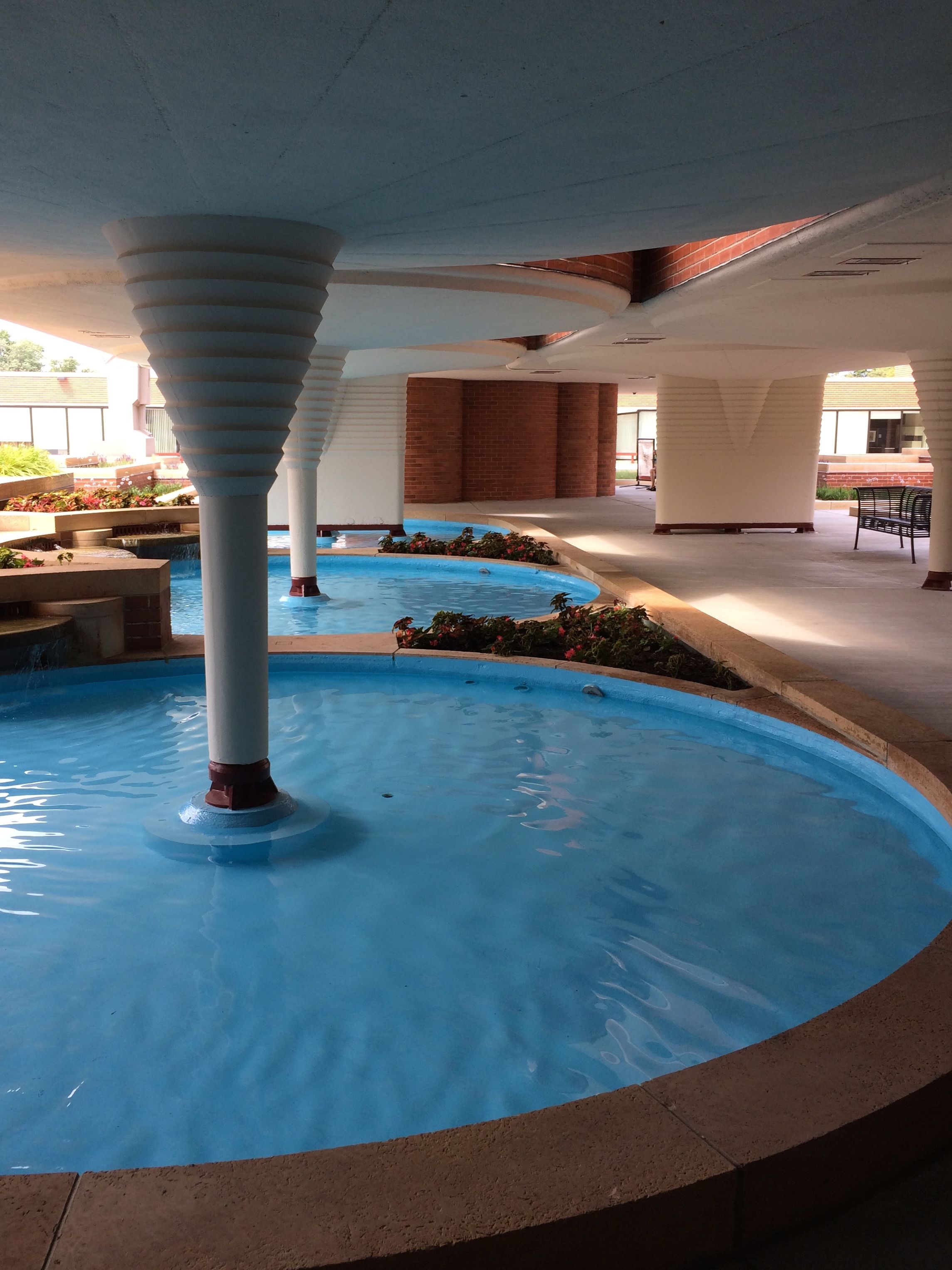
A dendriform column is one that has the form of a tree. The Administration Building is supported by them, which give a very light and airy feeling to the interior. Unfortunately, I have no interior shots to share. Interior shots are not allowed here.

However, the lovely parking area gives a bit of a feel of the airiness of the interior.

Parking garage Johnson Wax Buiding

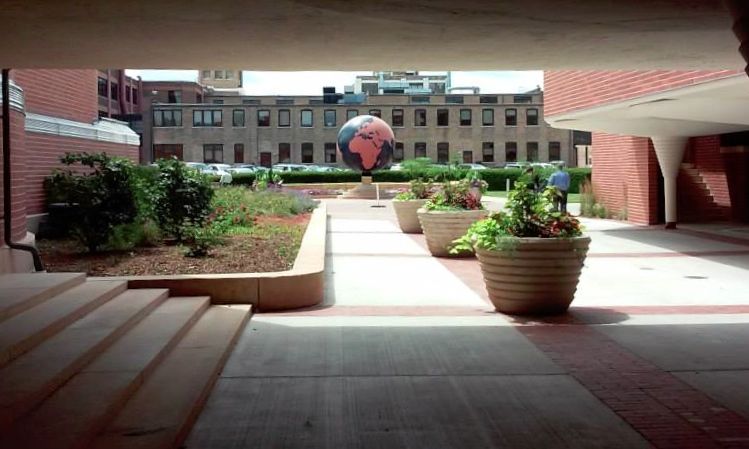
Globe at Johnson Wax

You can get a sense of the compression and release that Wright is known for. It is absolutely glorious passing from the parking area into the Administration Building.

Rounded brick walls
Rounded brick walls

Wright emphasize the horizontal aspects of his design by raking the horizontal mortar and leaving the vertical mortar flush with the bricks.

water feature

At the end of the covered walkway is the Research Tower. It is a fantastic structure that has round mezzanine-like floors interspersed between the square floors. You could look from the round floor down to the square floor below.

The Research Tower is no longer in use. While it was a marvelous structure, there was only one stairway. Not only was it a circular stairway, but it was only 29 inches wide. I can’t speak to the practicality of the work spaces, as I have no science lab experience. It may have been a good place to work. However, as accustomed as we have become to accessible spaces, it seemed quaint.

I was particularly taken with the restrooms that were snugged into small spaces next to the circular stair case. They even had curved doors that slid into place when the facilities were in use.

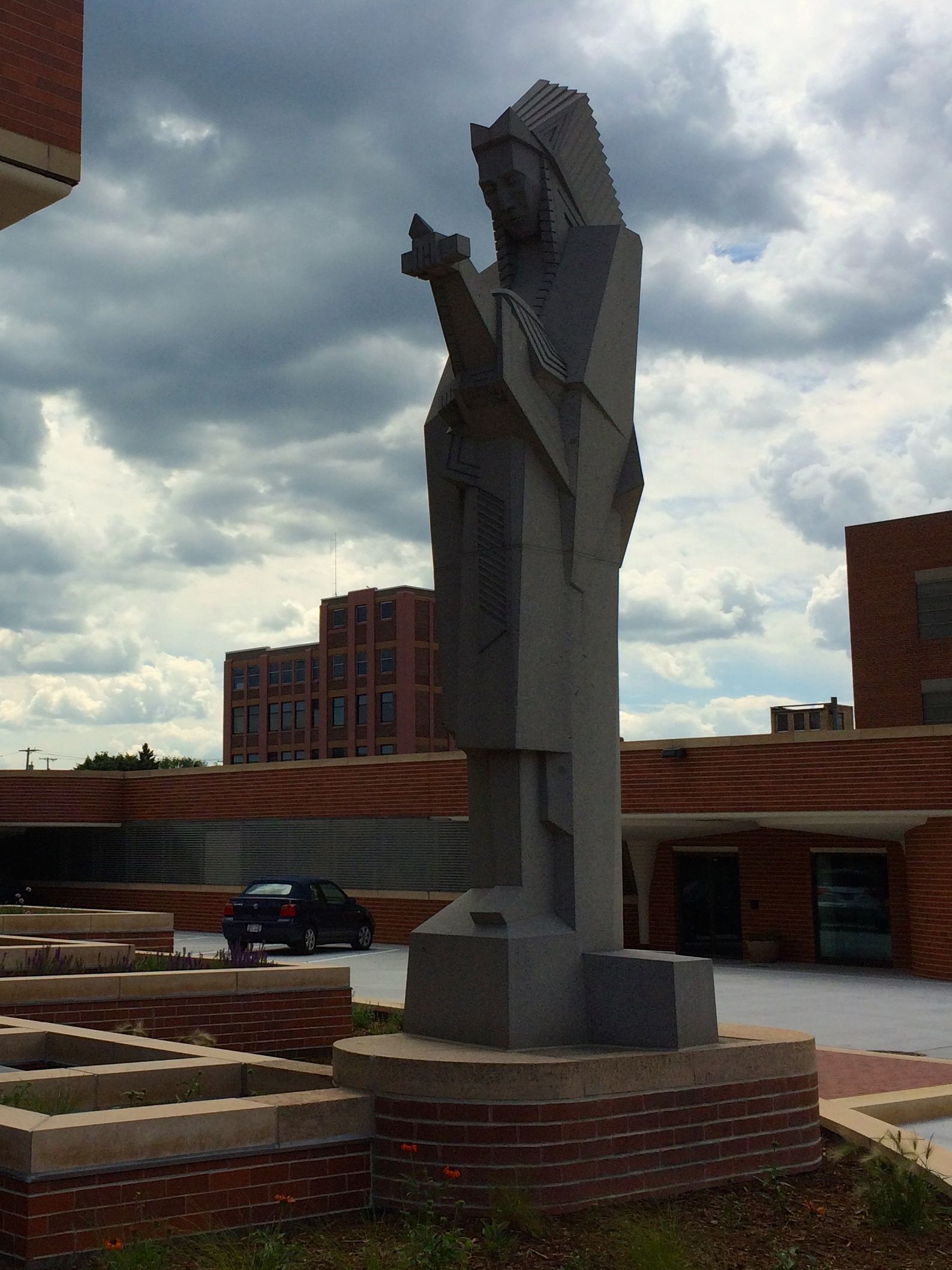
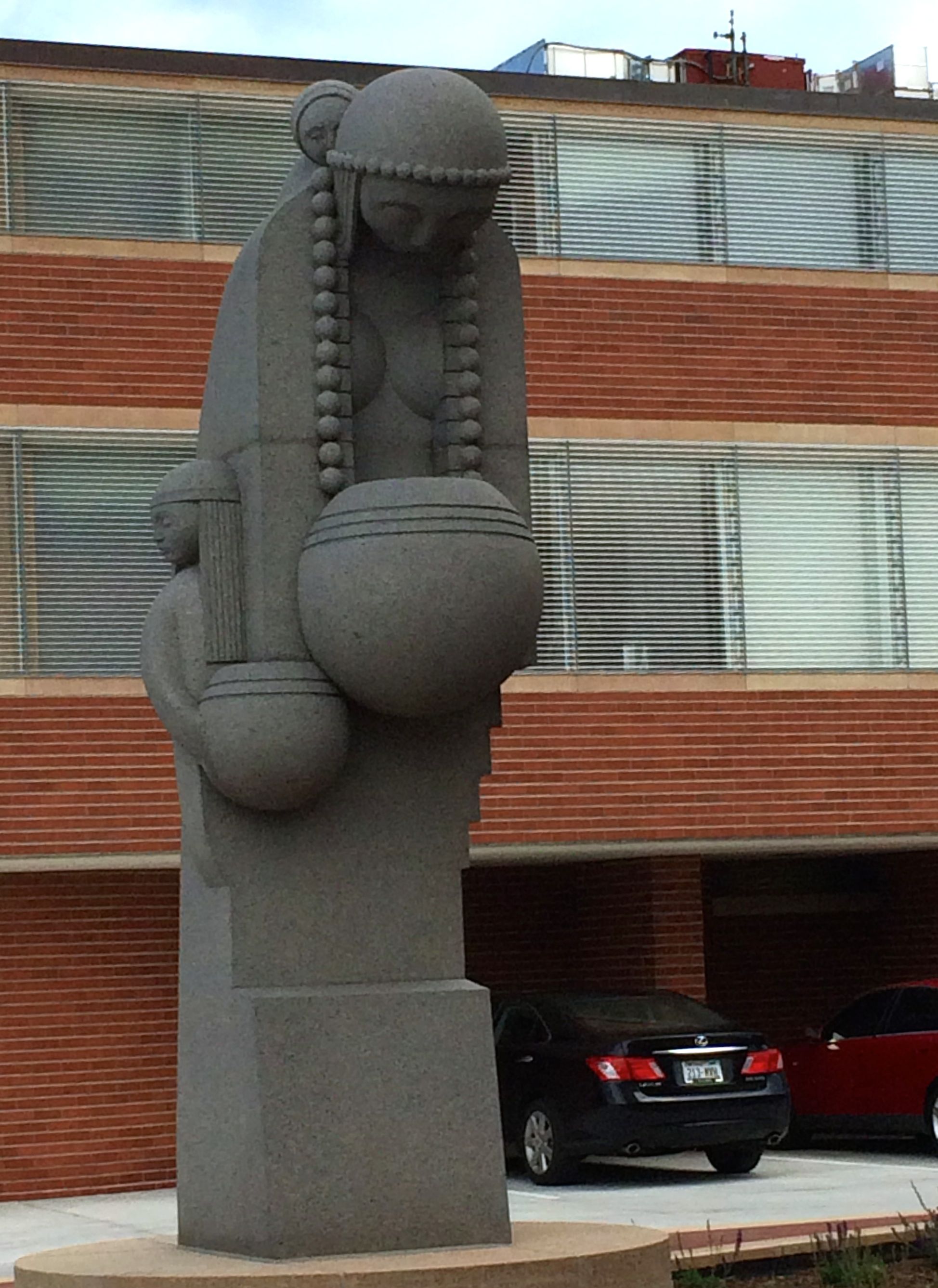
Nakomis
Nakomis
Nakoma
Nakoma

These sculptures, which paid homage to the Winnebago people of the area, were designed by Wright, but not completed until the late 1970’s. They are carved from granite quarried in Cold Spring, Minnesota. Nakomis is nearly 18 feet tall and weighs 40 tons. Nakoma is 12 feet tall and weighs 12 tons.

After our visit to the Research Tower, we went over to Fortaleza Hall. We got to look at a display of Wright’s work taken from the Wasmuth Portfolio,  a book of lithographs, which was published in Germany in 1911.

And, of course, exit was through the gift shop.

I am a fan of the Ziploc!

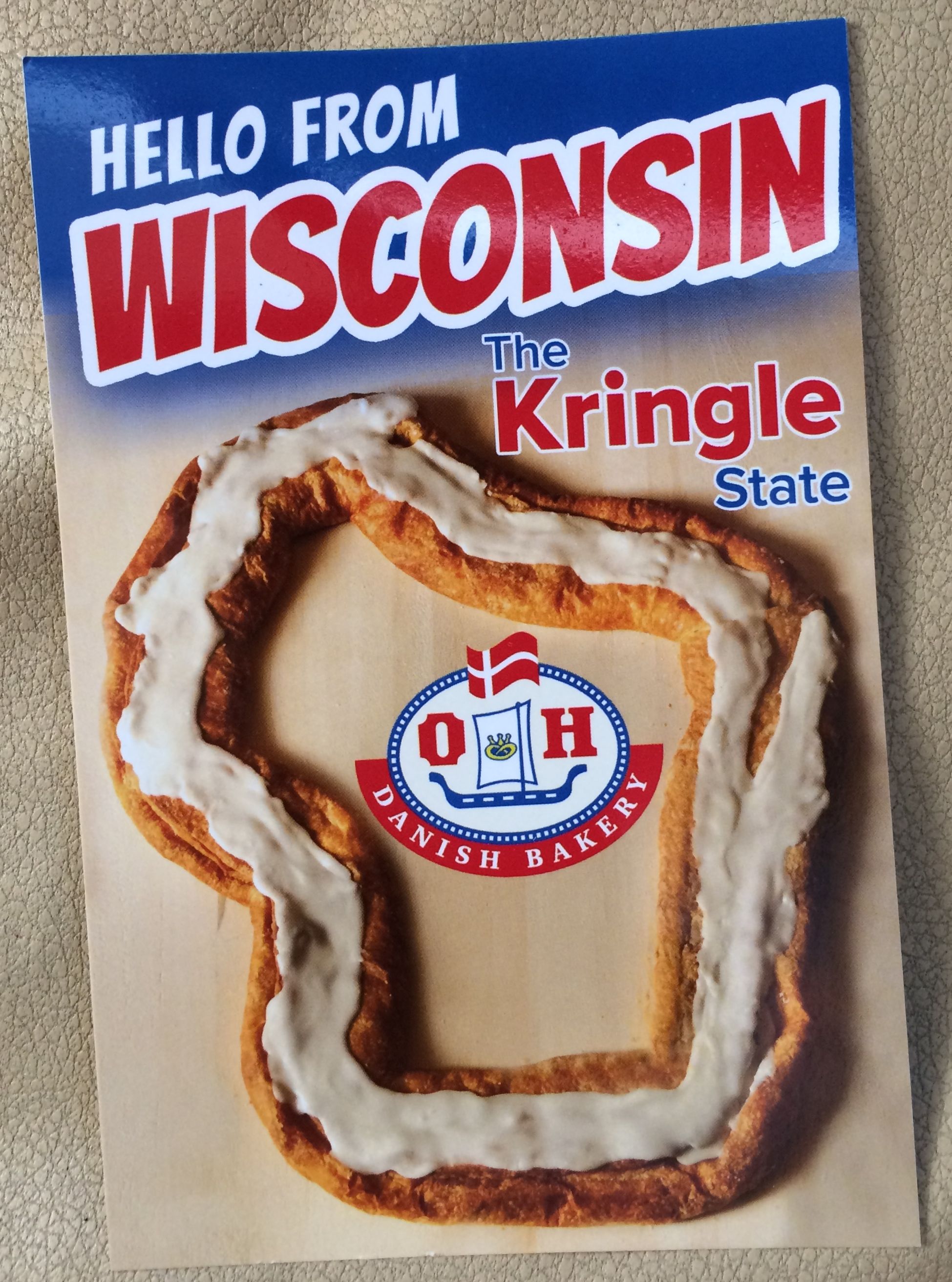
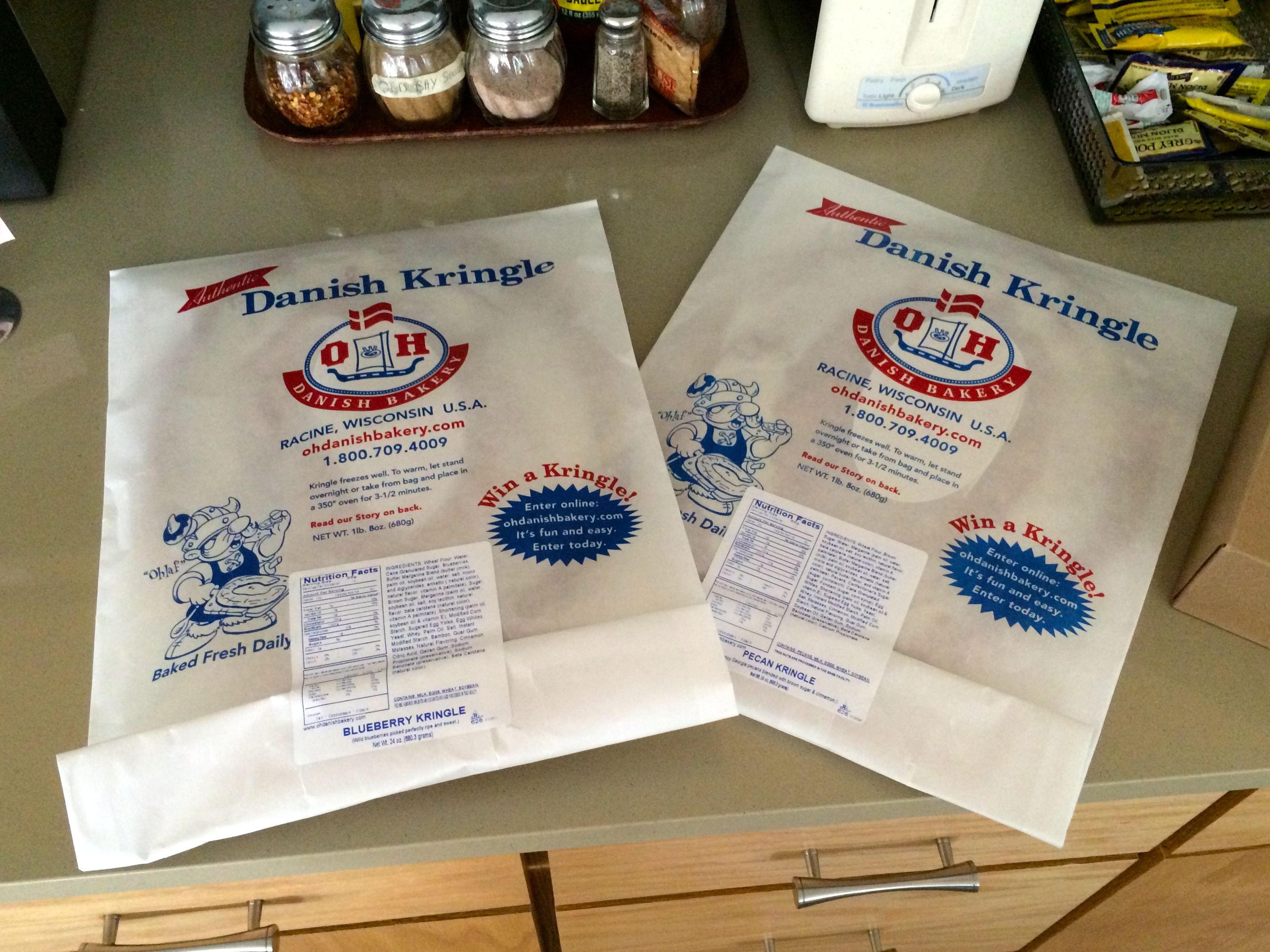
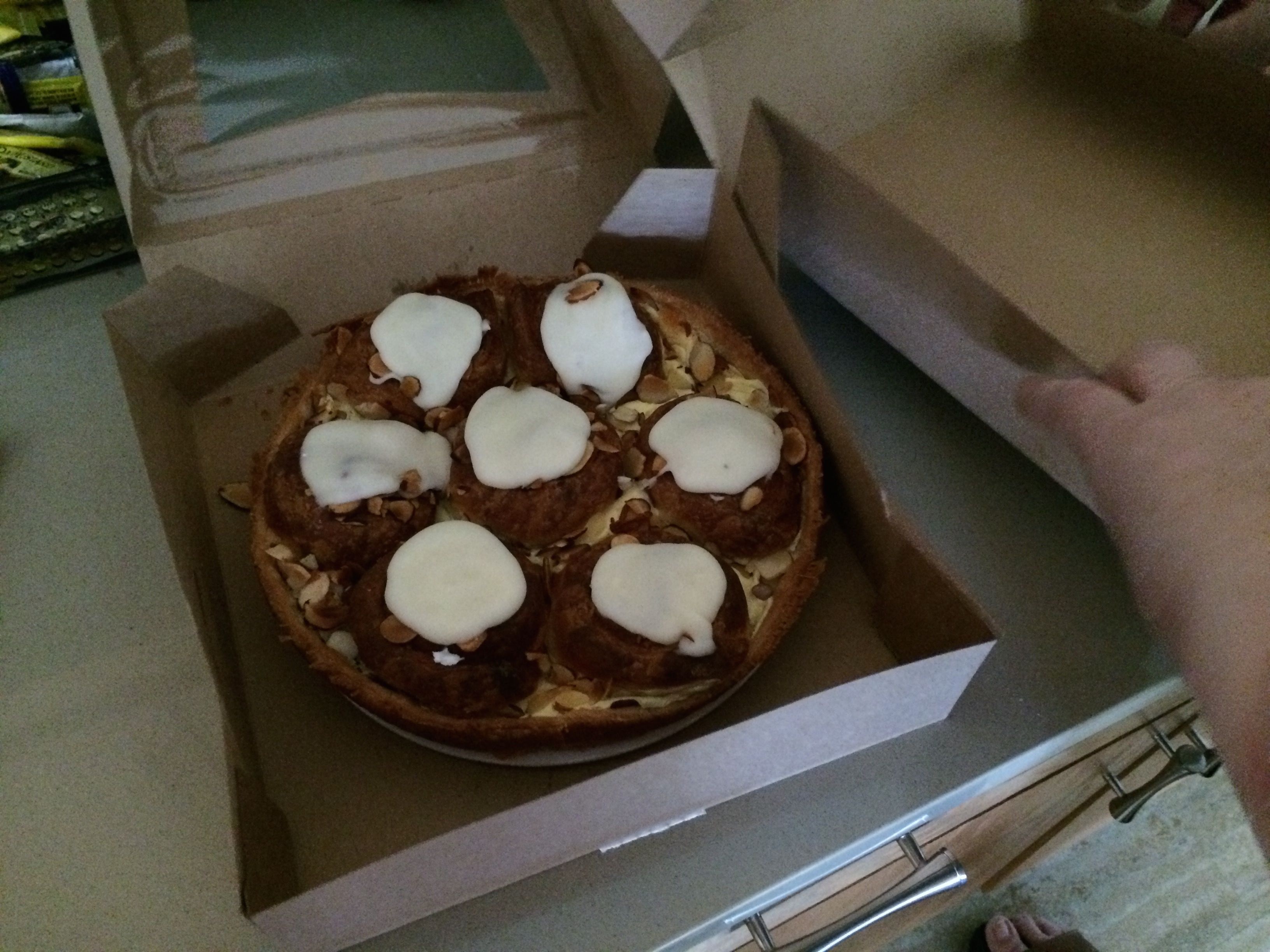
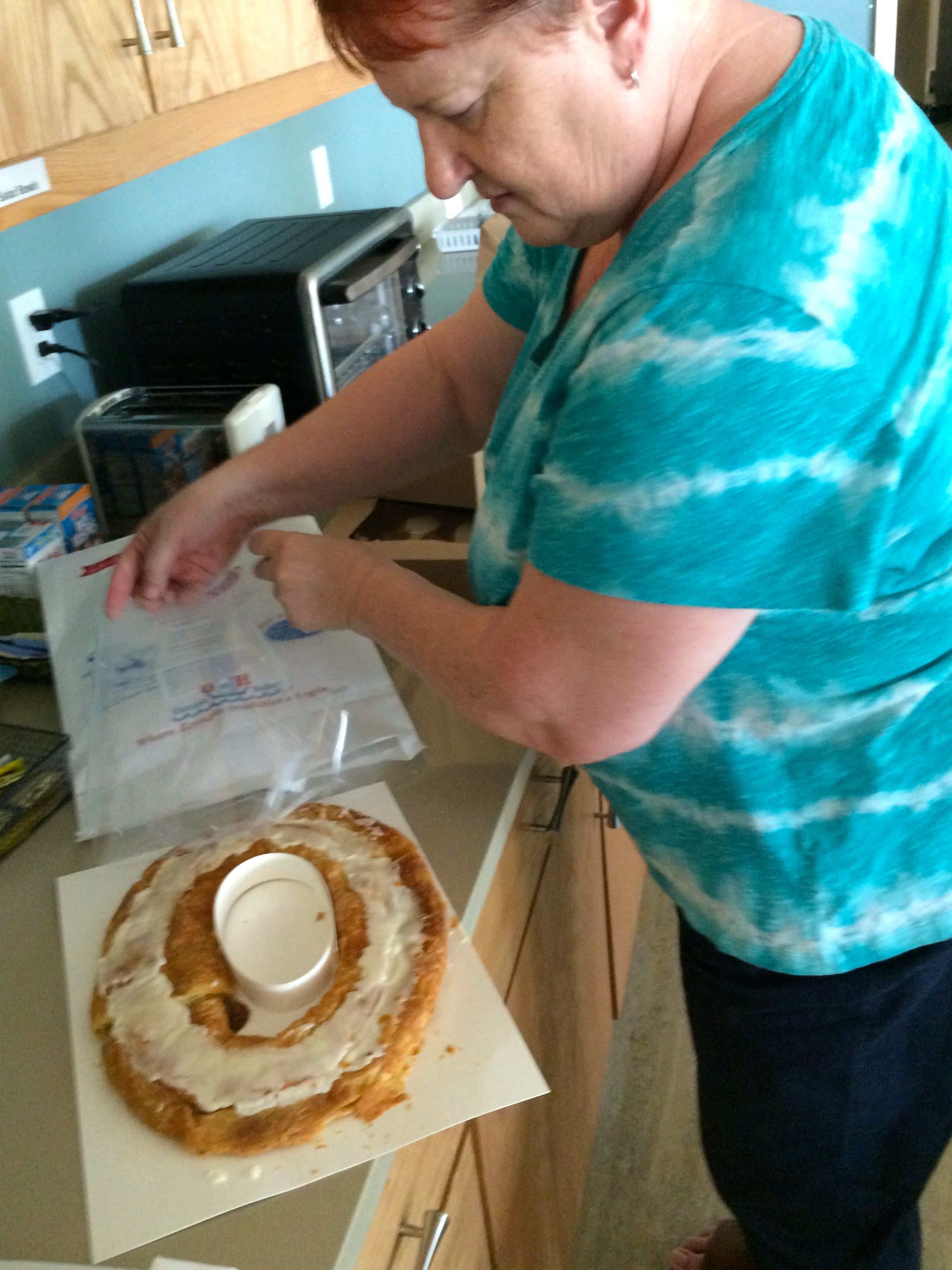
Before Dina and I parted ways, she had to treat me to some wonderful Danish pastry. I am always up for a bit of culture, and I never knew that the Danes had such a strong presence in Wisconsin.

Kringle postcard

KRINGLE IN WRAPPERS

Seven Sisters pastry

We stopped off at her place of employment to pick up Bart, and she made up a lovely box of treats for me to take on my way.

Dina and the Kringle


Next stop, MILWAUKEE!


Taliesin Time! Cross Another One off the List

Oh, my! Taliesin!

Like many people, I consider myself quite knowledgeable about Frank Lloyd Wright, his life and the evolution of his work. After visiting Taliesin and taking the four hour tour, I realized that I didn’t know as much as I thought.

The tour started at the Wright-designed Visitor Center on the bank of the Wisconsin River. After we met our guide, Cyndi, we boarded the little red bus with Taliesin emblazoned on the side that took us to the first stop on our tour.

I have plenty of exterior shots of the buildings, but interior photography is not permitted. However, there are books and postcards available. Exit through the gift shop.

Cyndi, a most excellent tour guide

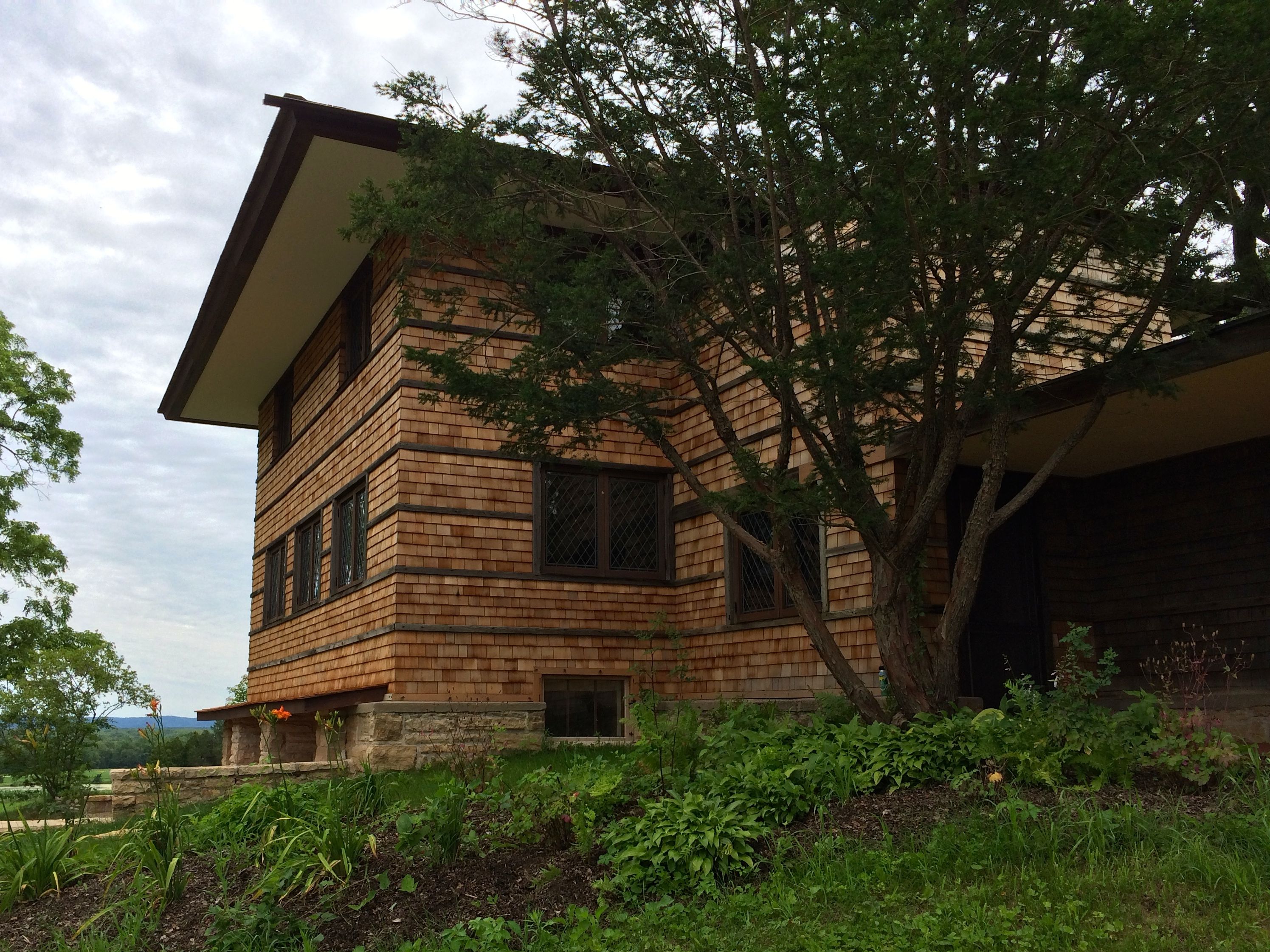
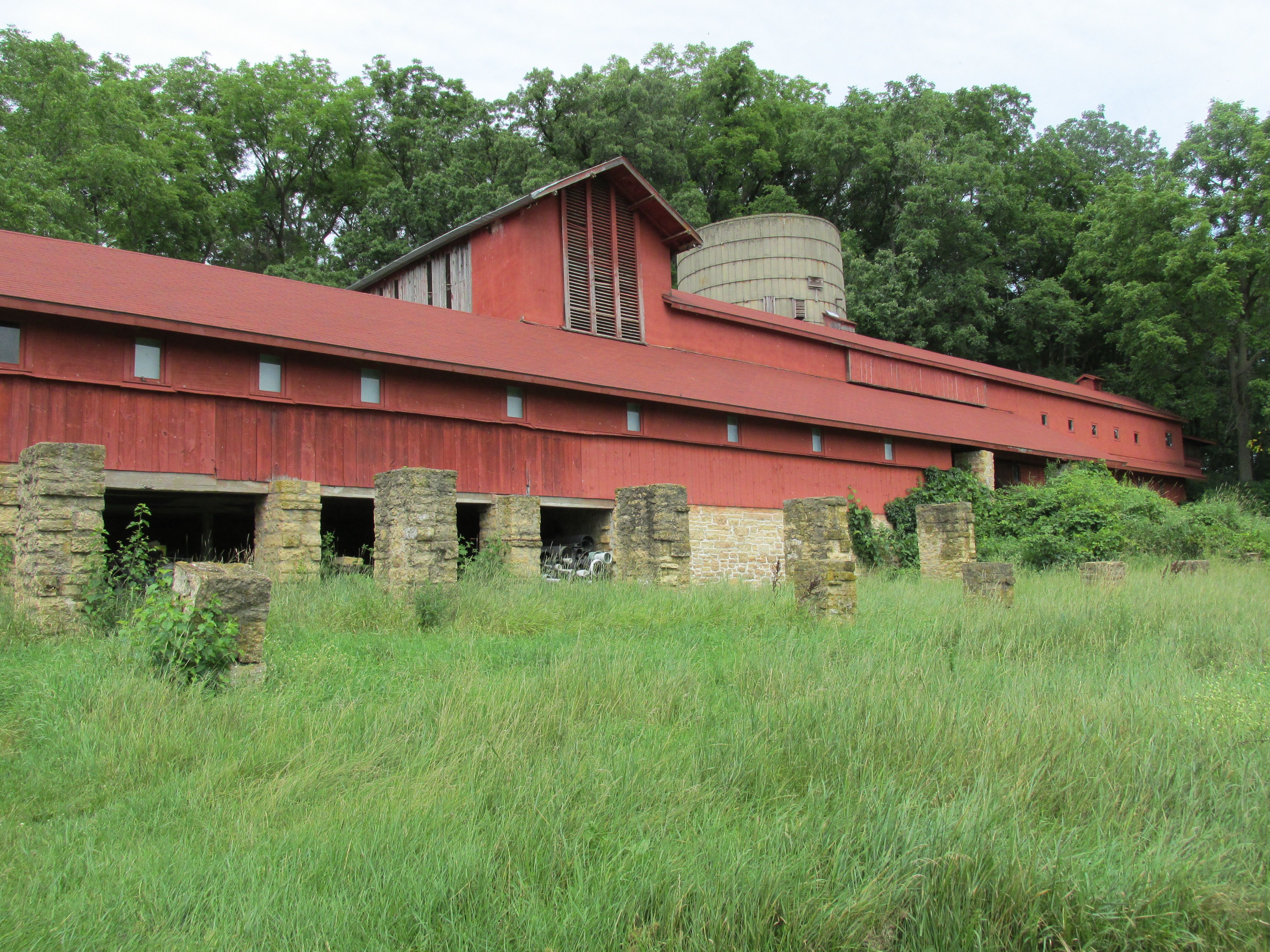
We got off the bus at the Hillside School, which Wright designed for his aunts in 1902. They ran a progressive school that they called Hillside Home School. It was so radical that they even educated boys and girls together.  They did a lot of learning by doing, which is the best way to learn – in my humble opinion.

Hillside School
Hillside School

This building replaced an earlier building that Wright had designed for them in 1887. Cyndi showed us the site of the Victorian style building, and told us that it was Wright’s first independent commission.

This was the first building he designed for the school. The second building was a classroom building to the right, across the bridge.

Hillside School, the drafting room wing

The school is now the summer home of the Taliesin Architecture School, and the drafting room and bedrooms have been added on to the classroom building. The drafting room is lit by the skylights; the windows on the sides of the building are for the students’ bedrooms.

The interior of the drafting room is amazing in its construction. The trusses and rafters support the roof in a way that is reminiscent of a forest. The skylights on the roof face north, to provide even light. There are also windows to the east and west on this wing.

West side of the drafting room

The last building in this complex originally built as a gymnasium, but is now used as a theater.

Hillside Theater
Hillside Theater

One interesting feature is a tree that is growing right by the roof overhang. A tree that was planted by one of Wright’s uncles was growing there, and it was allowed to stay. Cyndi told us that it reflected Wright’s attitude that he was designing for now. Problems were in the realm of the future and would be worked out later.

Build for the present. Let the future take care of itself.

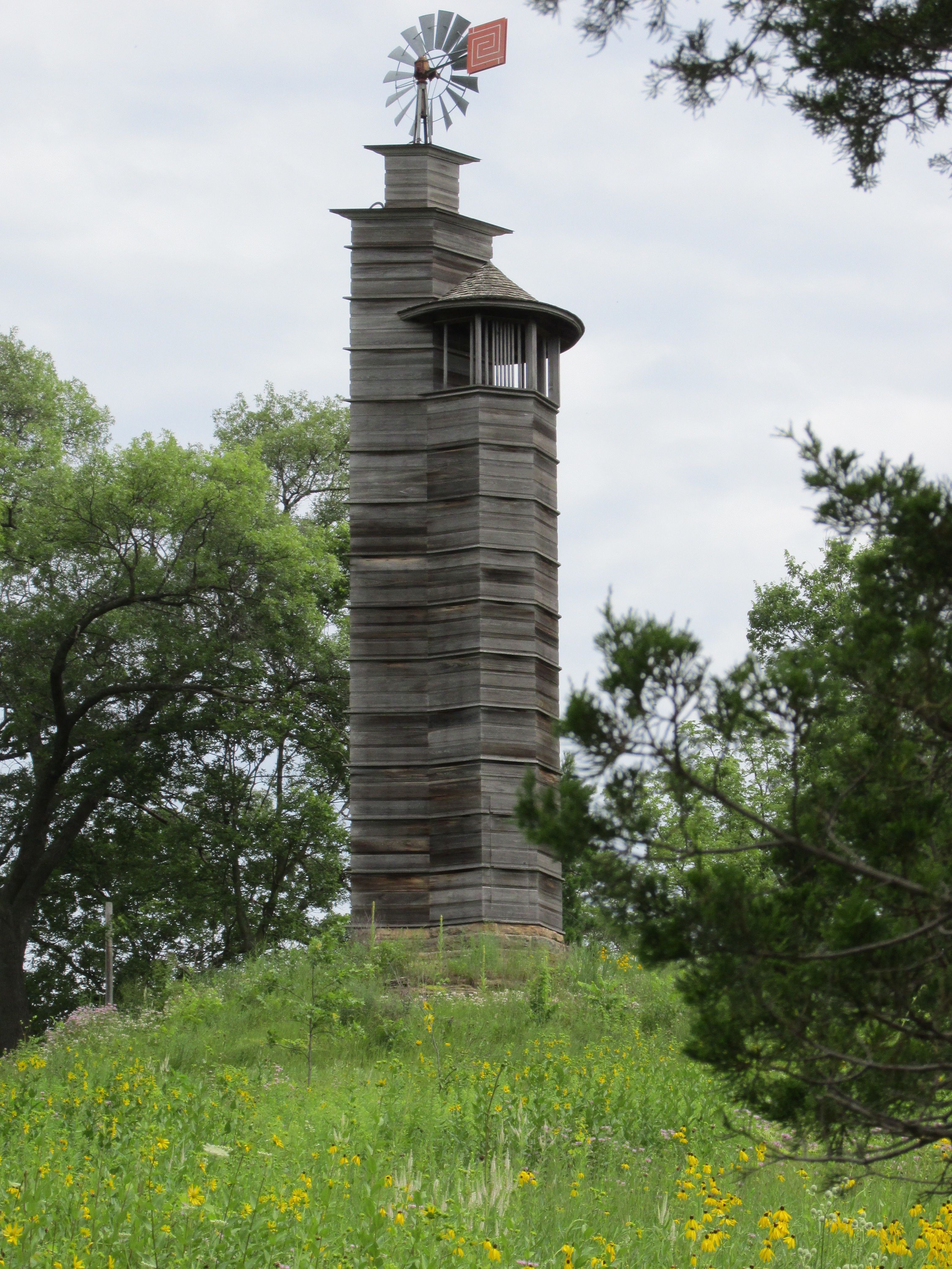
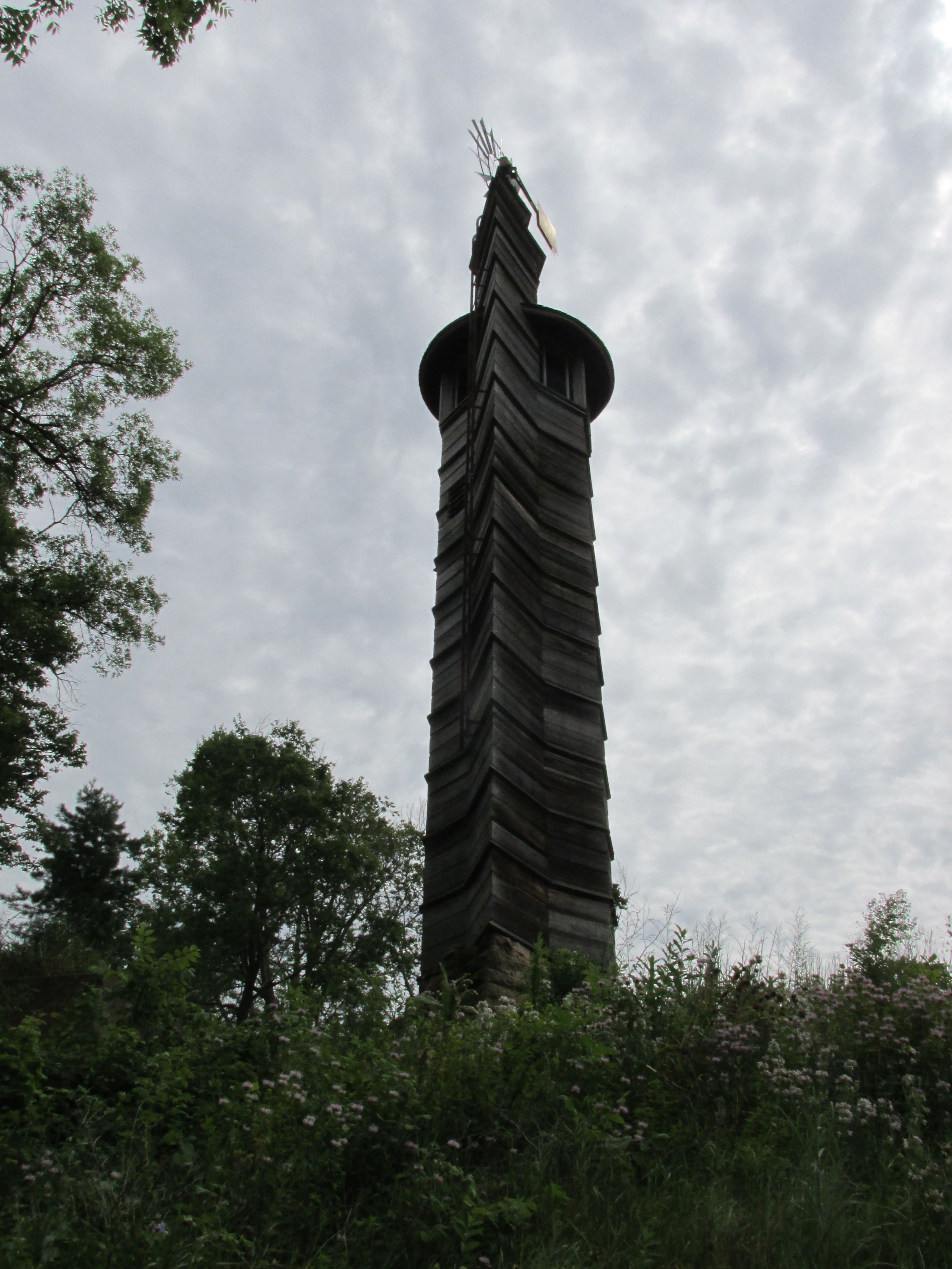
The next commission he received on the family land was the Romeo and Juilet Tower.T- Romeo and Juliet tower

The name came from the method of construction. Cyndi told us that it referred to the diamond and hexagonal shapes that interlocked to make the tower strong.

T- Romeo and Juliet tower bowside

This side operated like the prow of a ship, facing into the prevailing direction of the wind. The wind pressure served to make the structure stronger.

Porter House entrance

The next stop on our tour was Tan-Y-Deri, which Wright designed for his sister, Jane Porter, and her husband. The name is Welsh for “under the oaks.”  She saw the design for his $5000 fireproof house that was published in The Ladies Home Journal in 1907 and wanted to build it. Wright refused. He told her that he would design a house that would fit the land.

T- Porter house apartment entrance to basement

The family added an apartment in a mechanical area. Cyndi told us that Wright was incensed about the addition of the apartment, as it added vertical elements  that disrupted the flow of the horizontal.

The view from Tan-Y-Deri

We were fortunate in that we were able to enter the public areas of the main floor. This is the first year it has been open for visits. Taliesin fellows live here – and in many of the buildings here. The preservations and renovation work is continuing, as it is with all of the buildings at Taliesin.

T- Porter house porch side

We continued on our track across the property. Next stop was The Farm.

The milling parlor
The milling parlor

It was difficult to get a view of the total. Wright had designed The Farm as a system where the farmers would be able to care for the animals without having to  go outside.

The chicken coop
The chicken coop

After The Farm, it was on to the main attraction: Taliesin!

T- Taliesin shining brow

After a couple of hours of cross-country trekking, we were offered a light refreshment on the patio.

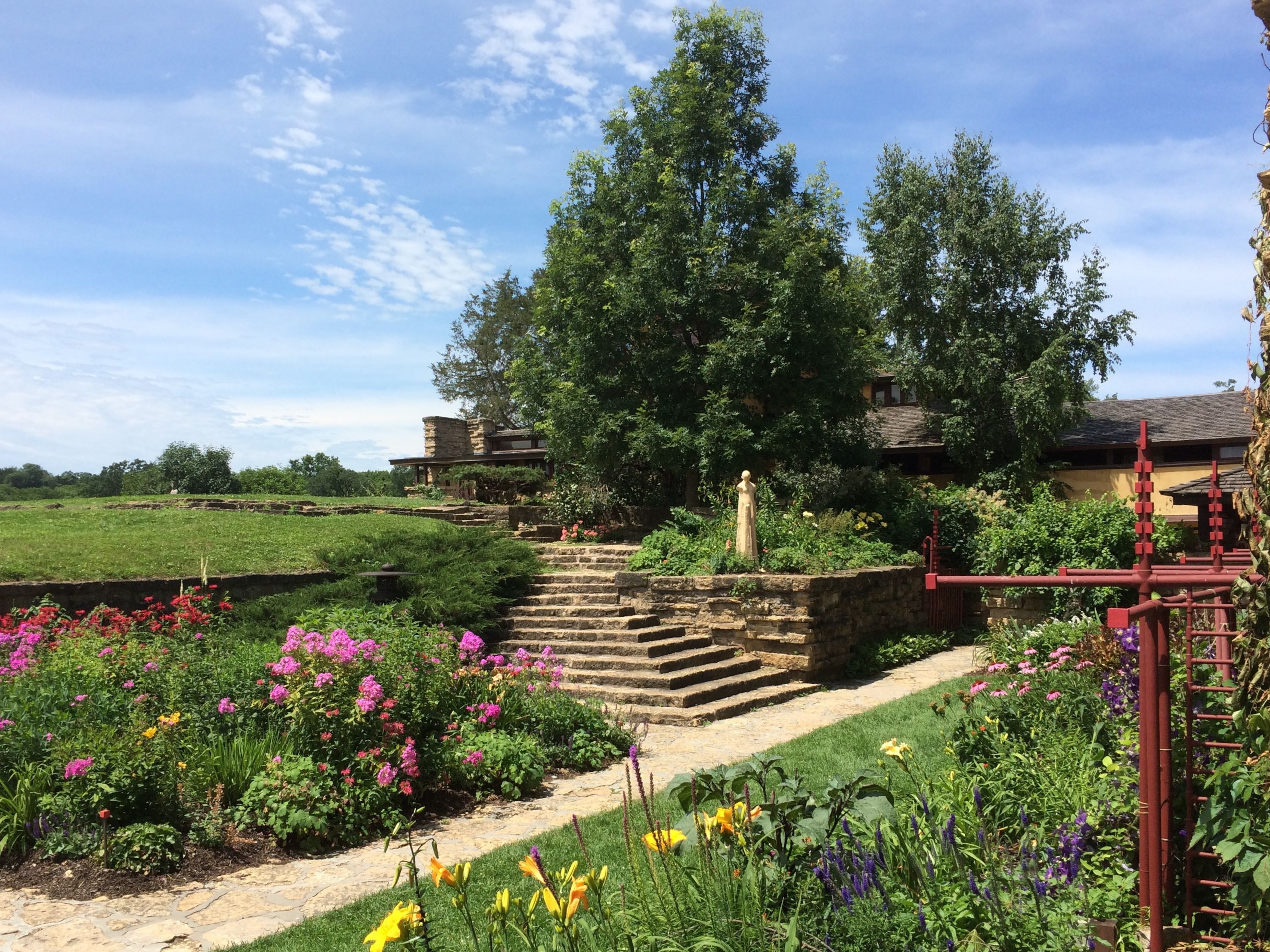
A shot from the patio during the coffee break

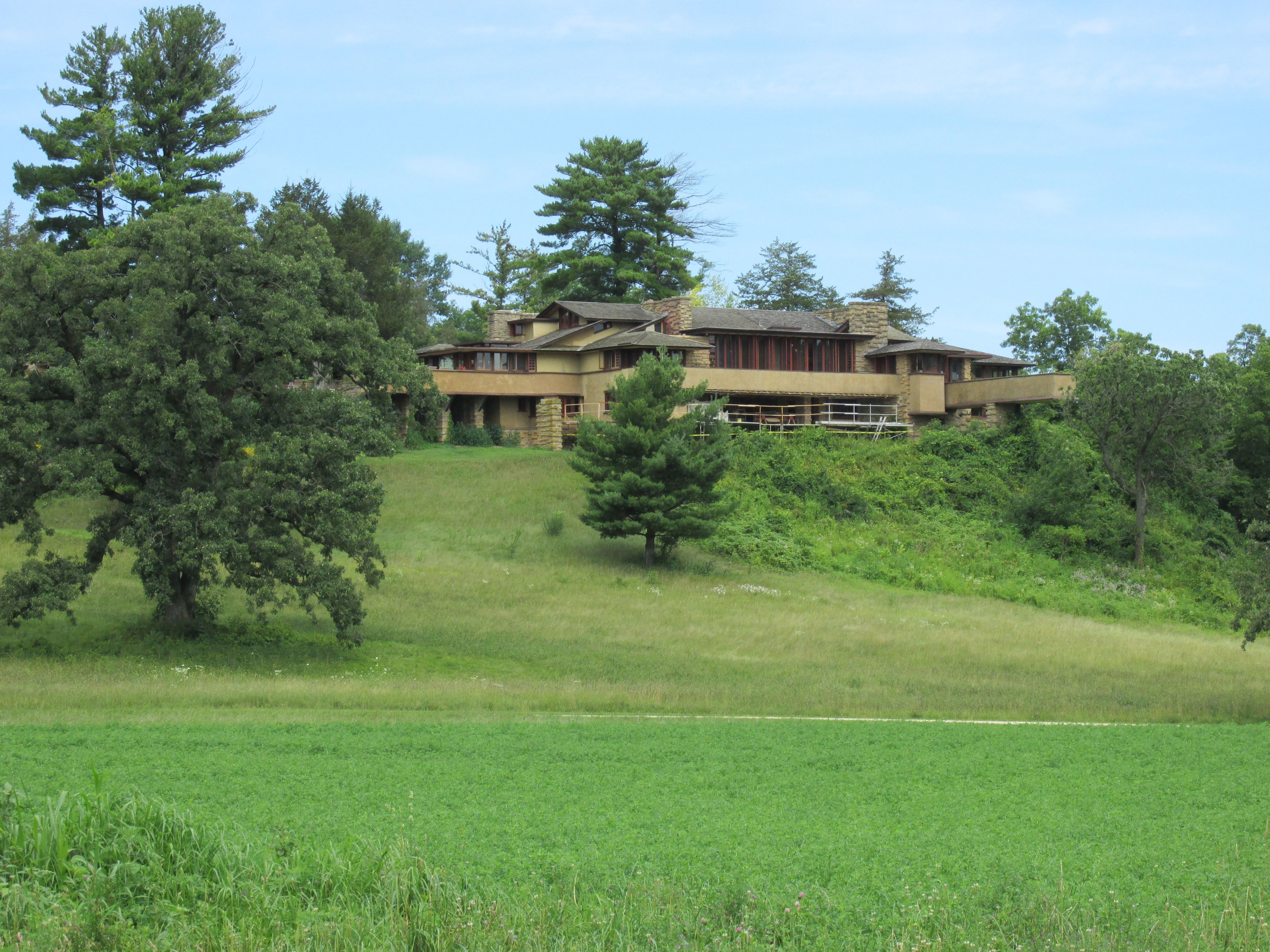
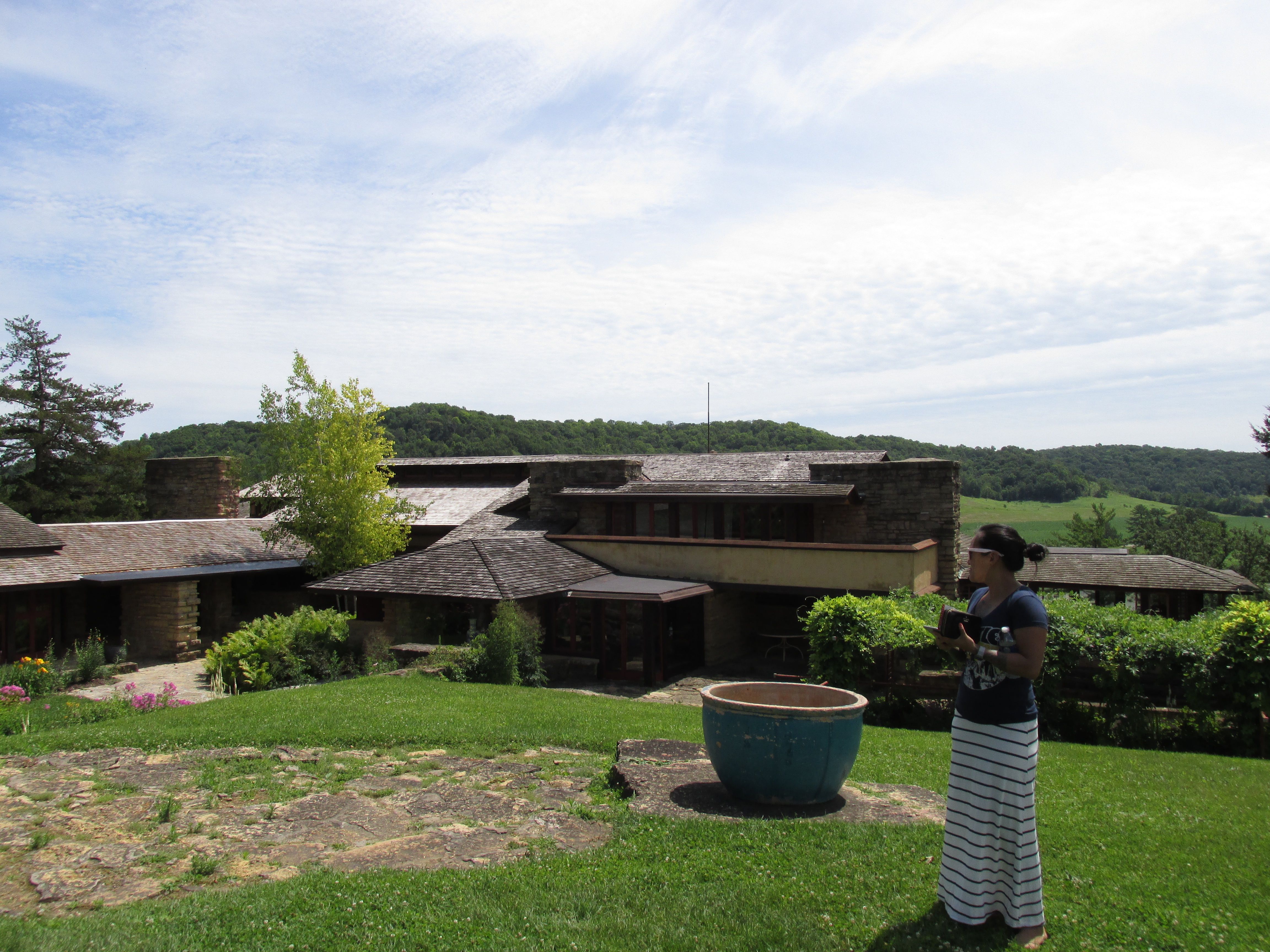
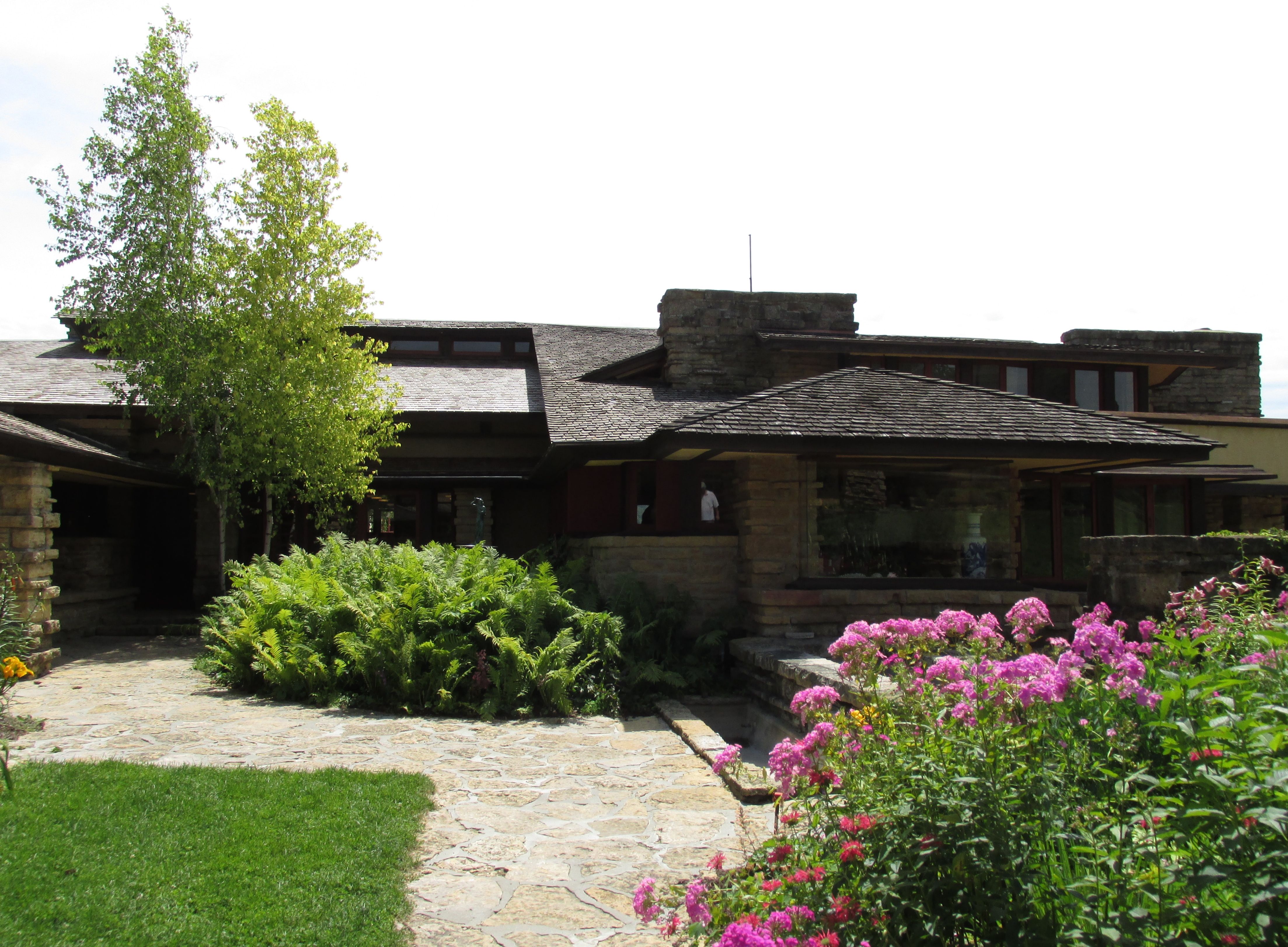
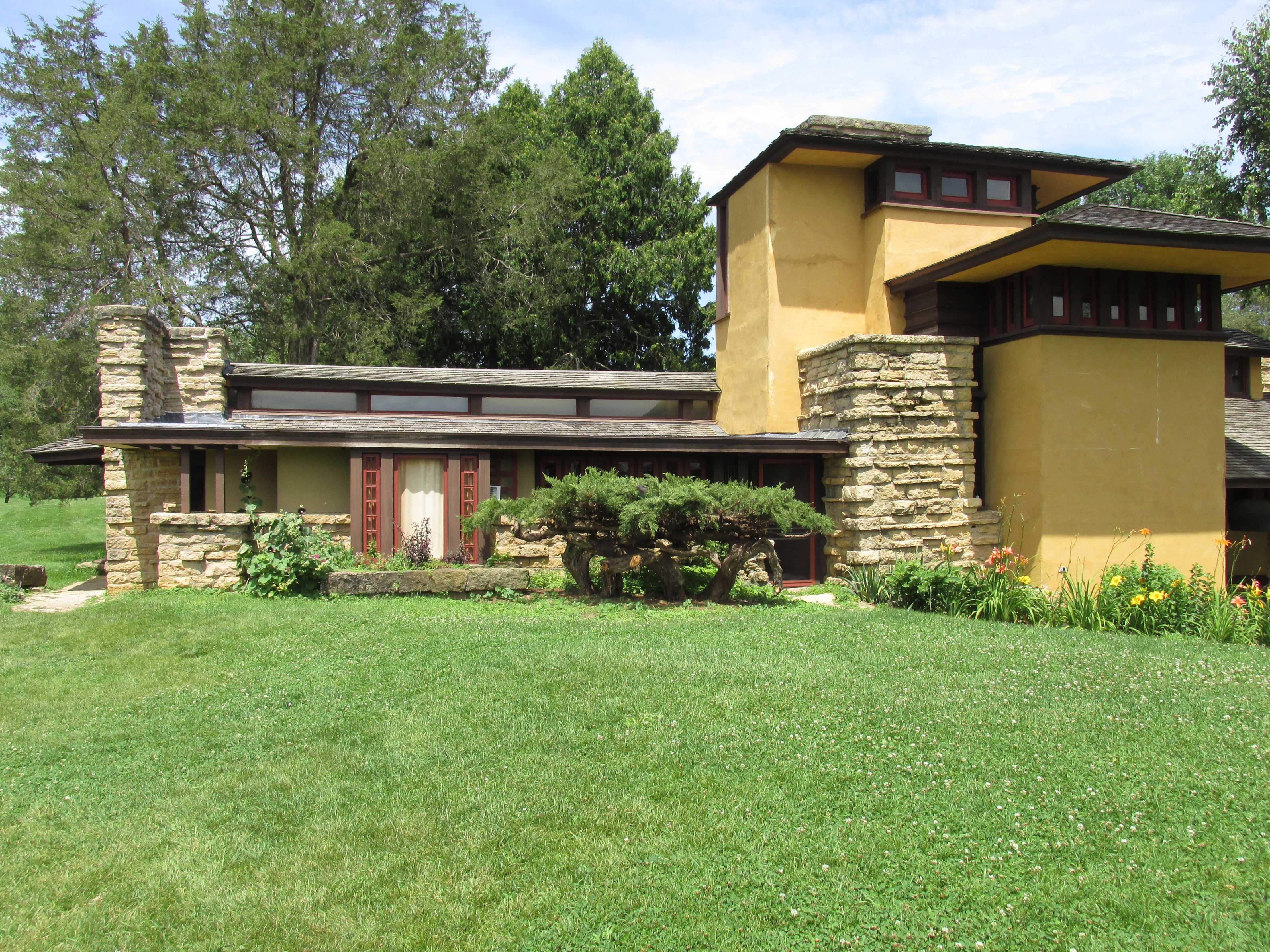
Taliesin is a Welsh name whig means “shining brow”. Wright placed his home on the brow of the hill, leaving the top of the hill open. The complex circles the top of the hill.

Wright started building Taliesin in 1911, and it went through two major revisions, as well as many smaller ones. Again, his “build it for today and let the future take care of the problems” has caused the Foundation many preservation issues, which they have handled and are continuing to address.

Wright didn't like hand railings
Wright didn’t like hand railings

Here you can see the crown of the hill and get a feeling for the manner in which the building encircled it.

T- Taliesin circle the hill

The woman in this photo had just gotten married at Kentuck Knob, another Wright building. It is located in Pennsylvania, not too far from Fallingwater. I didn’t ask, but I got the feeling that she and her husband were on a Frank Lloyd Wright-inspired honeymoon.

I learned many things I didn’t know about Wright and his work during this tour. One of the things I didn’t know was that Wright had designed his home to be as self-sufficient as possible. We’d already walked past The Farm. During the tour of Taliesin, we saw some other features that showed that desire for independence and self-sufficiency.

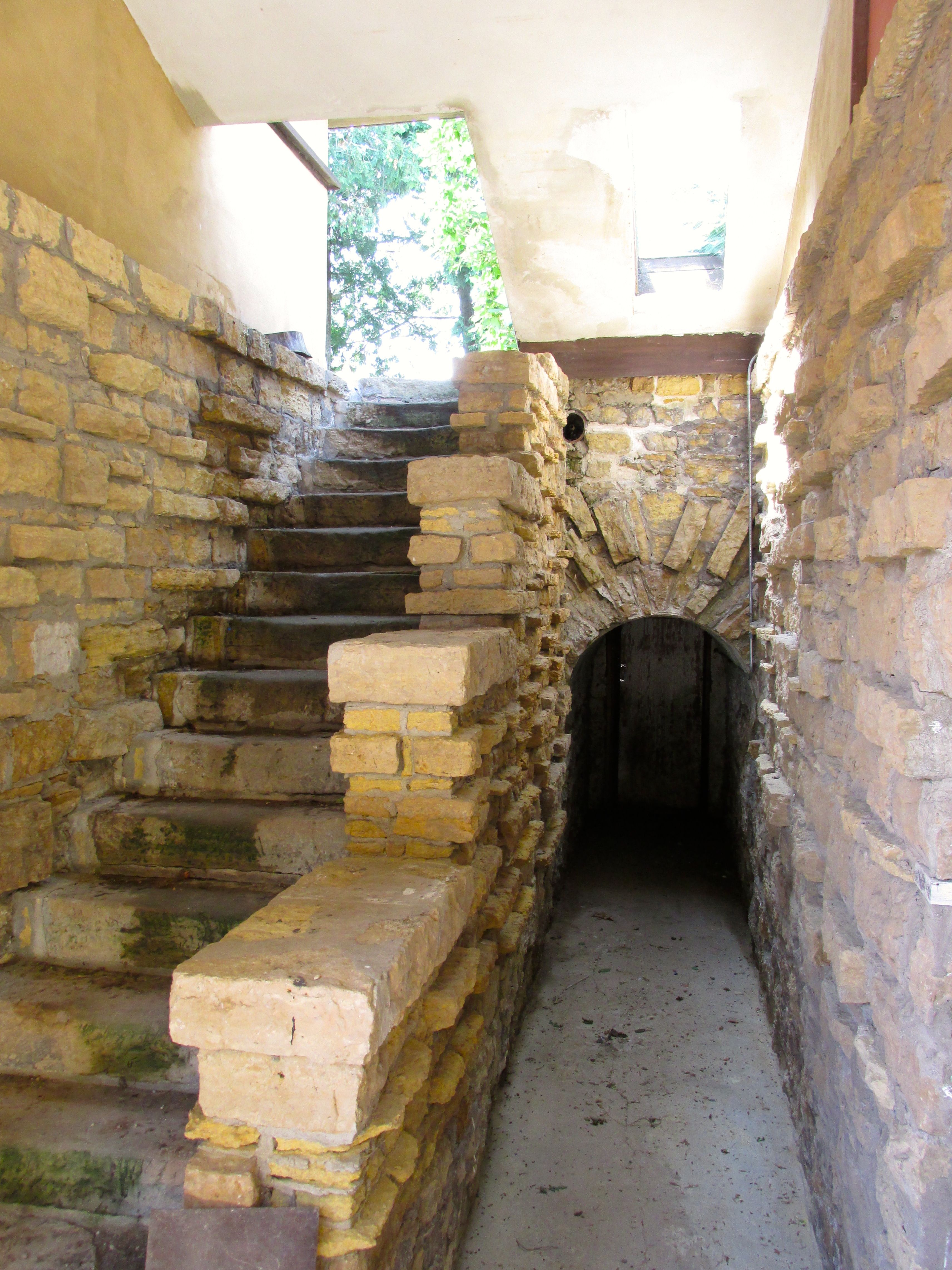
The entrance to the root cellar

I was struck by the arched doorway. I’d never seen something like that in a Wright building. But, it was just in a utility area.

The West Wing apartment

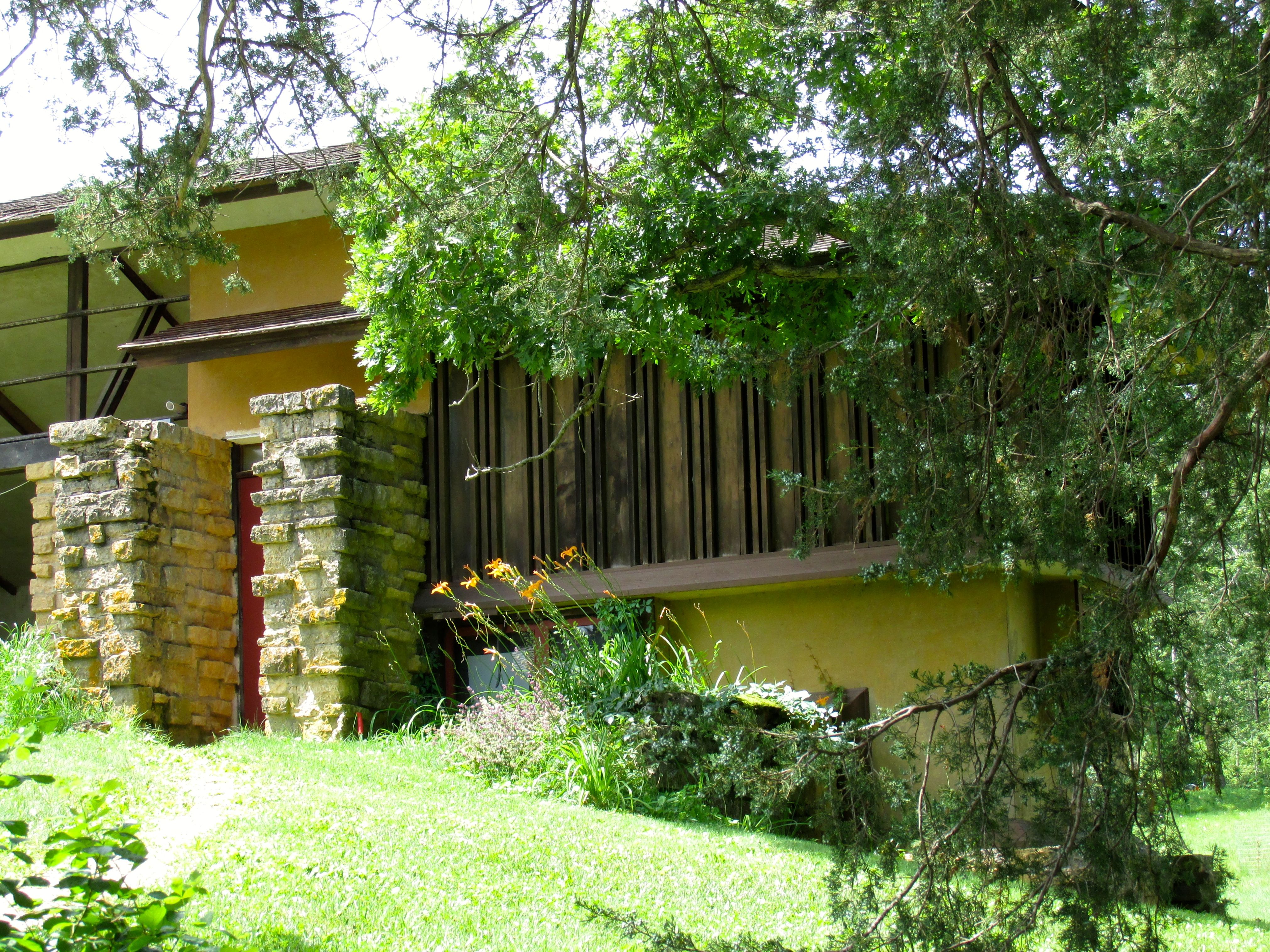
Another was this apartment that houses one of the Taliesin Fellows. The call it The West Wing, but it is not as grand as television’s The West Wing. It was built in the pig pen! Pretty nice digs!

When the property was handed over to the Foundation, provisions were made for the Taliesin Fellows who had worked with Wright to be able to live there for the rest of their lives. The eat with the students in the dining hall at the school and are included in all aspects of the community life. I think that is wonderful!

Another thing that I learned – although I might have figured it out, had I thought about it – was that this building was begun in the era of horse and buggy and was worked on and revised right up to Wright’s death in 1959.

That meant that the building changed to accommodate the technology.

T- former port cochere apartment

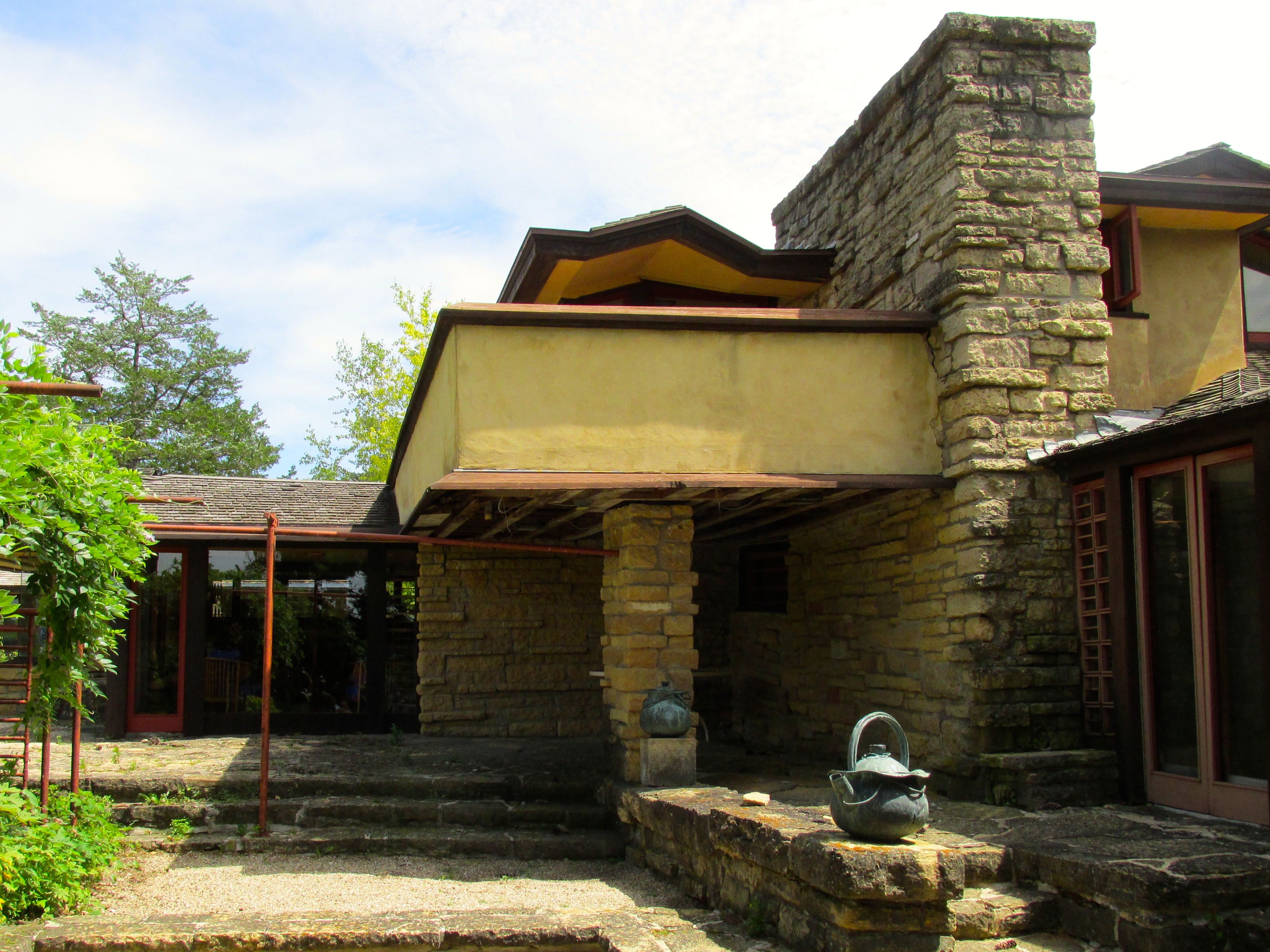
If I understood Cyndi correctly, the main entrance used to be via a porte cochere that was under that triangular shaped roof. When people stopped using horses, he rerouted the traffic to the back of the house where he put in stalls for cars. He filled in the former porte cochere to bring the floor level up and build a meeting area with a tremendous view of the courtyard and the land around it. The corners are mitered glass so that the sense on indoors and outdoors would be undetectable.  Cyndi told us that he built this area to pitch his ideas for the Guggenheim Museum in New York City.

Apparently, this is a good strategy for getting a job – IF you are Frank Lloyd Wright. I think the rest of us had better stick to resumes.

And, if you are an architect, and you enjoy indulging your children, why not build them something? It the above photo, to the right and just under the roof is the APARTMENT he built for his you daughter. Some kids want tree houses or play houses – she wanted an apartment, and that is what she got, complete with guest bedroom and sitting area.

There are remnants of old technology here and there, however.

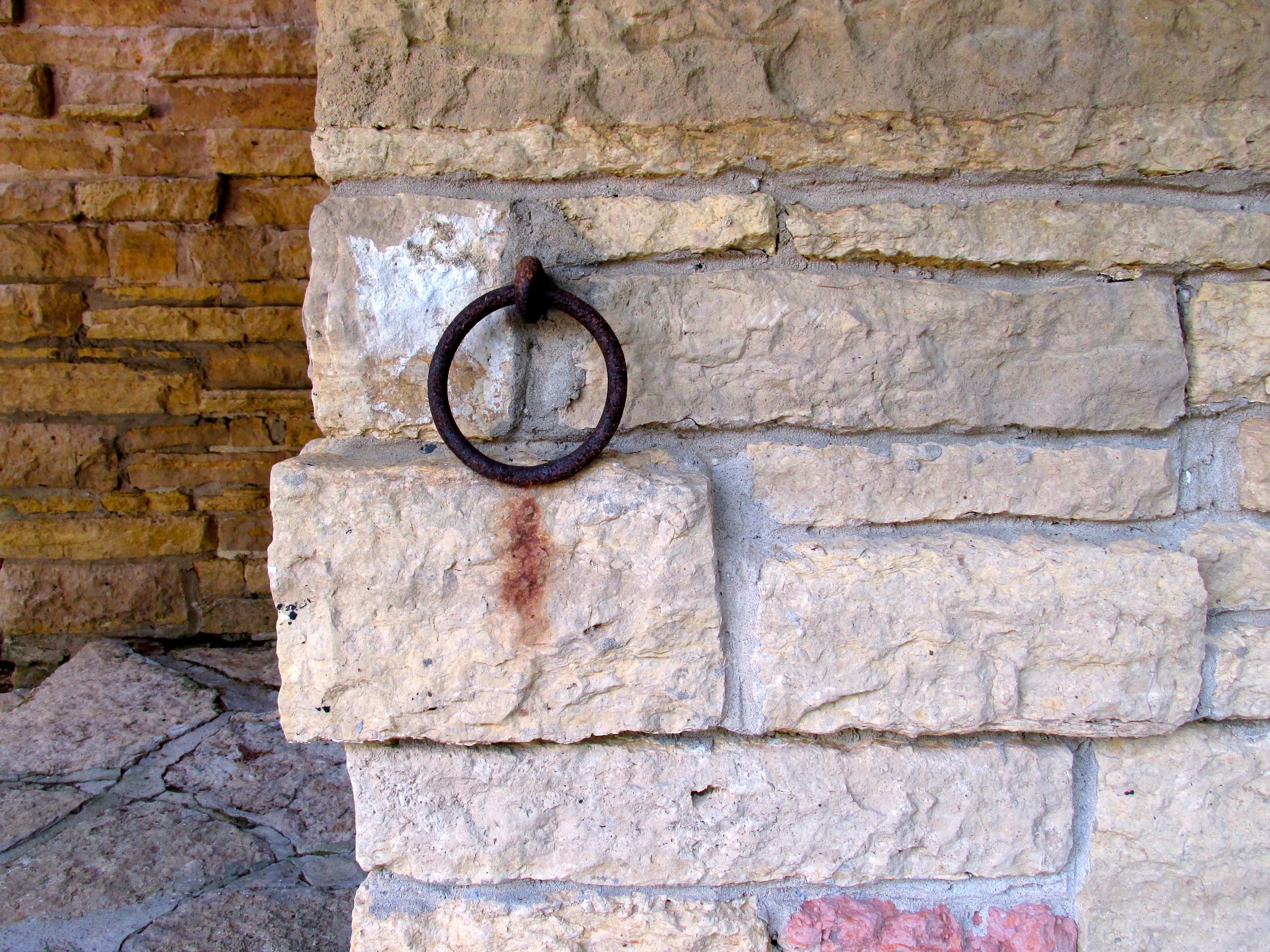
Iron ring to tie up horses

I didn’t manage to take a picture, but Wright even generated his own electricity for a time. He dammed a stream and built a generator that was topped with a Japanese pagoda, according to Cyndi. A flood took it out  in the ’40’s, if I remember correctly. The dam still exists and water is still flowing over it.

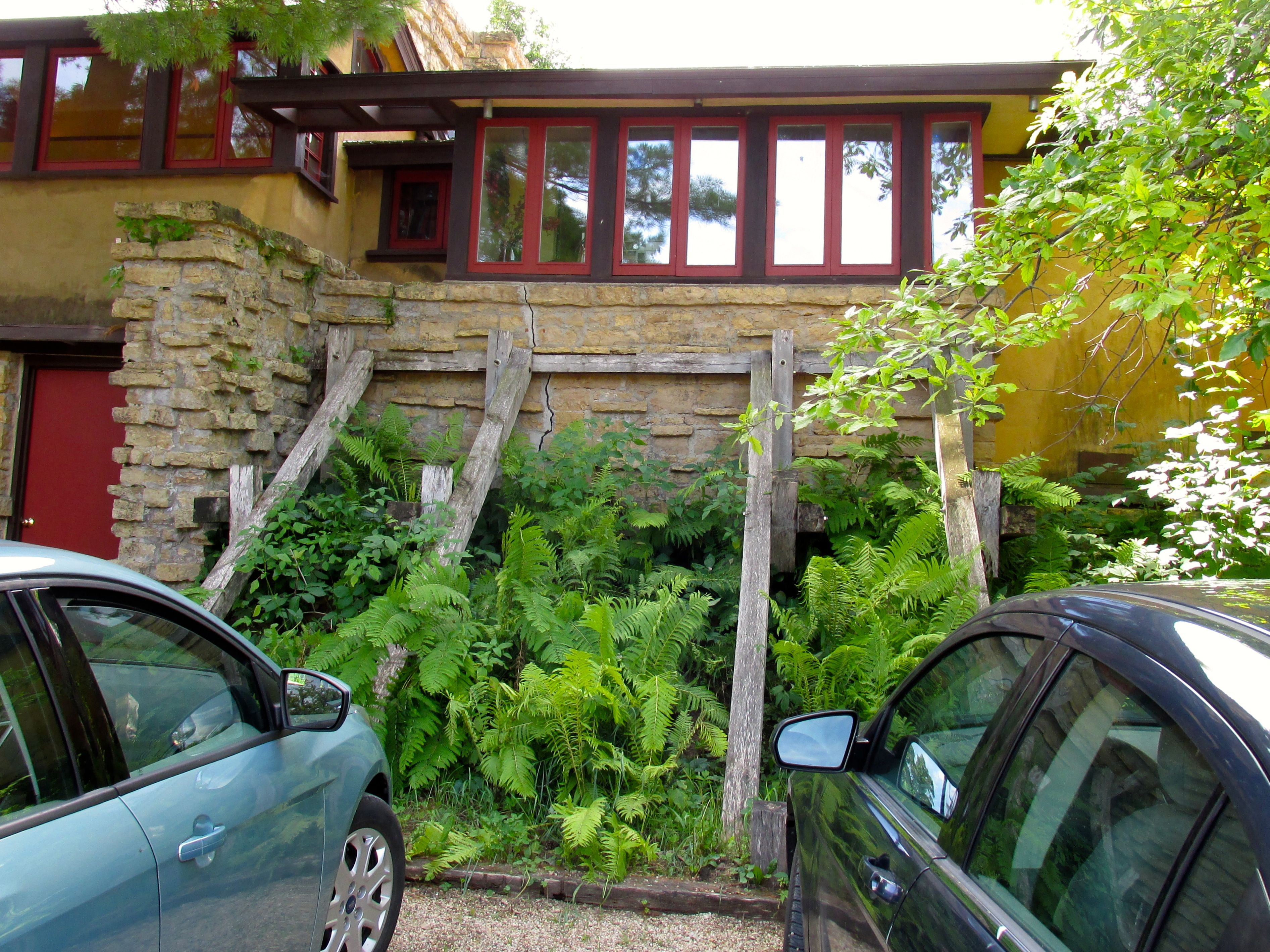
T- structure fail apartment

Time is catching up to this lovely building. Repairs need to be made constantly. This is an apartment where a Taliesin Fellow currently resides. They are doing Just enough work to keep the structure sound. When the time comes, they will do major preservation work.

It makes me wonder what percentage of the building failures are due to Wright’s tendency to build for the present and let the future solve the problems down the road, what is due to deferred maintenance due to lack of funding and what is due to the fact that Wright’s buildings are old. It’s hard to remember that they are old when they look so modern.

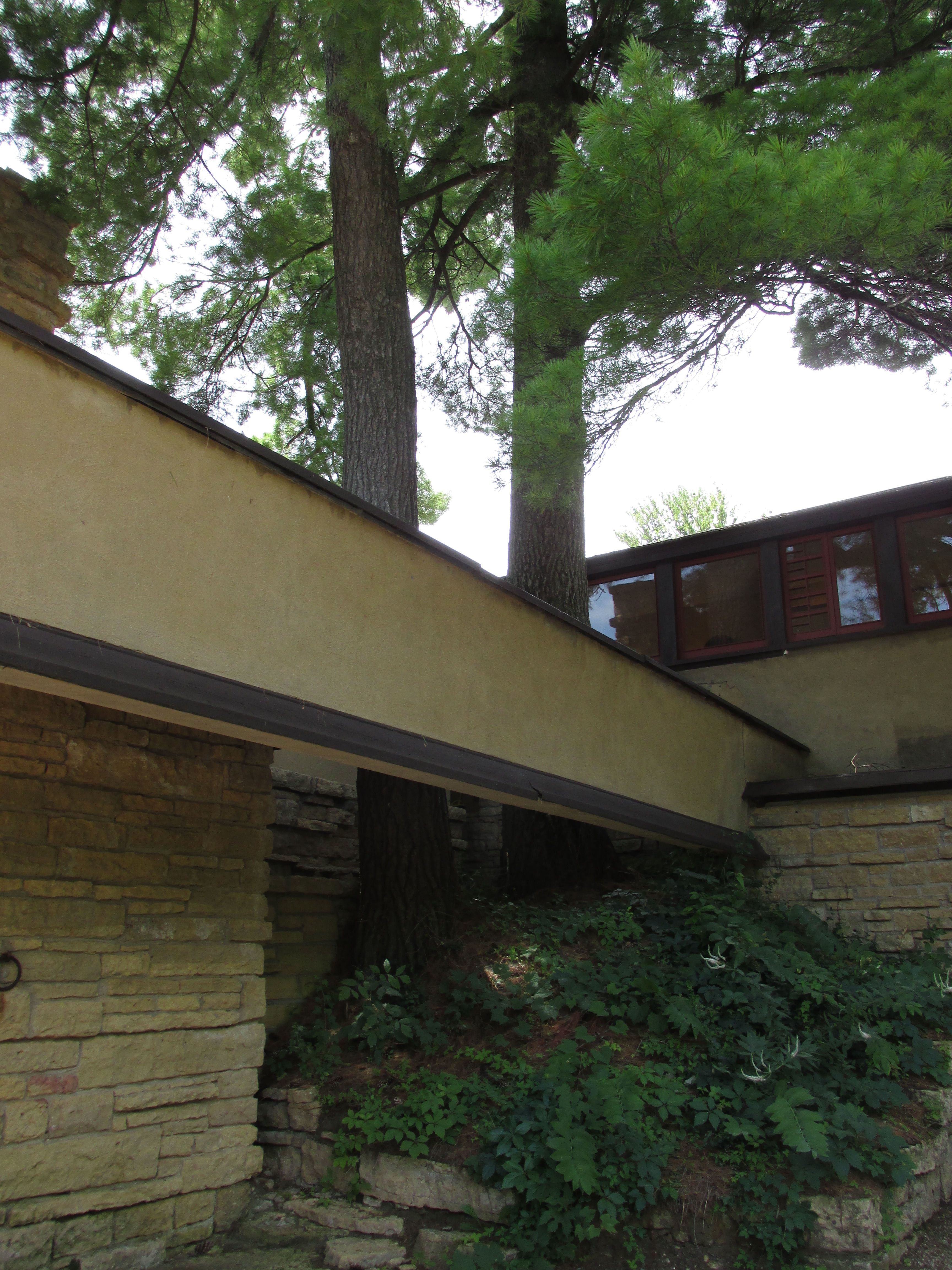
T- Trees in a structureWright built around these two trees. It looks good from this side, but on the other side, you can see that the roots are pushing walls over.

T- another view Taliesin

Still, what a wonderful building!

At the end of the tour, we got to put on little booties over our shoes and experience Taliesin from the inside. Of course, I have no photos to share, but it was lovely. We are able to enter areas that had been closed for years. Preservation is ongoing, and we got to enjoy the fruits of their labors.

Another thing I found interesting and amusing was that Wright ordered upholstered furniture from Marshal Fields for his house. He insisted on designing furniture for his clients that many found uncomfortable. He didn’t hold himself to the same standards.

And then it was time to go. We slid off our booties and exited the building.

T- signature

T- self portrait outside Taliesin

We got back into the little red Taliesin bus and headed back to the Visitor Center.

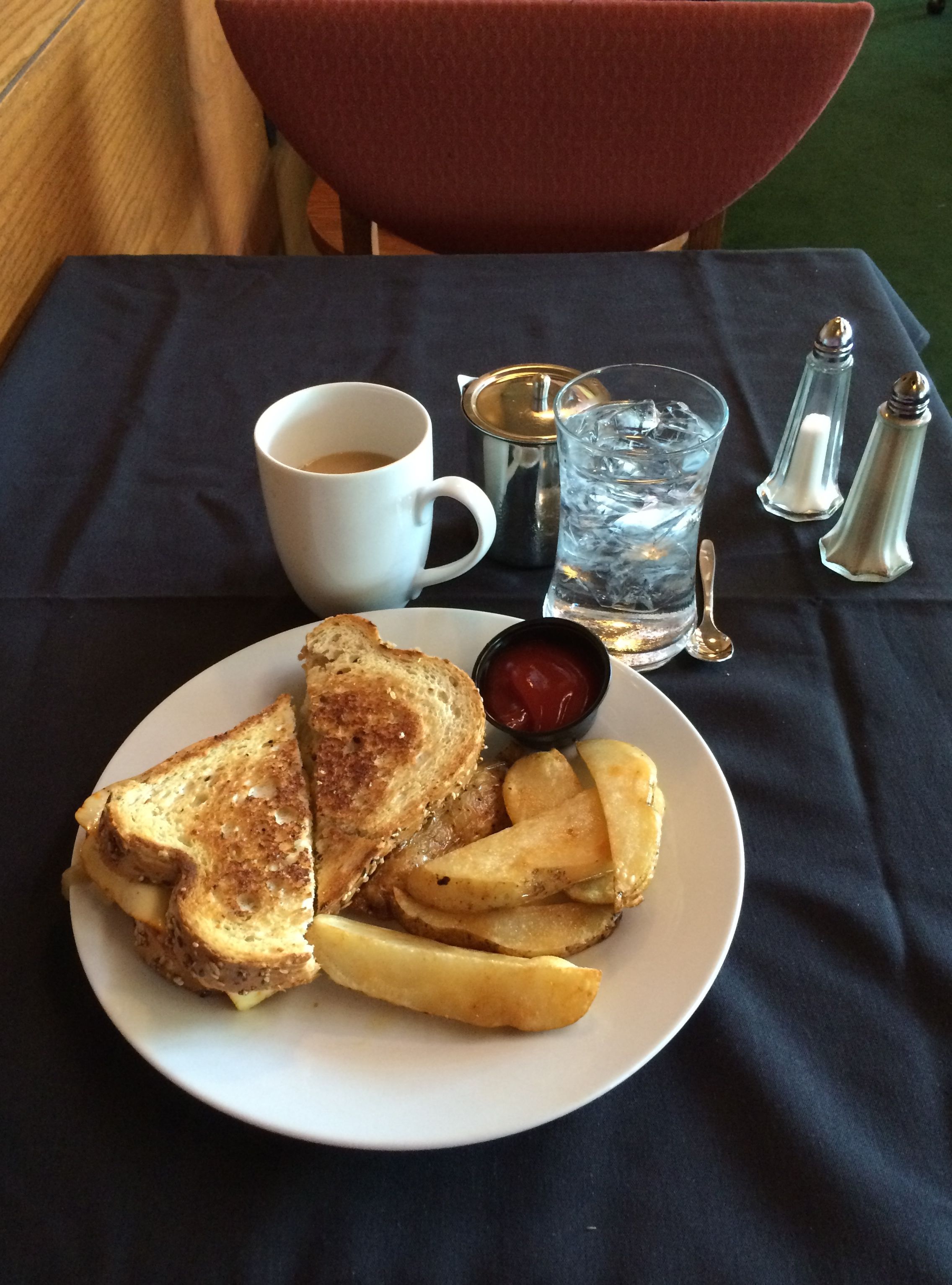
A Wisconsin lunch at Riverview Terrace Cafe in the Visitor's Center - a grilled cheese sandwich
A Wisconsin lunch at Riverview Terrace Cafe in the Visitor’s Center – a grilled cheese sandwich

Where I had lunch.

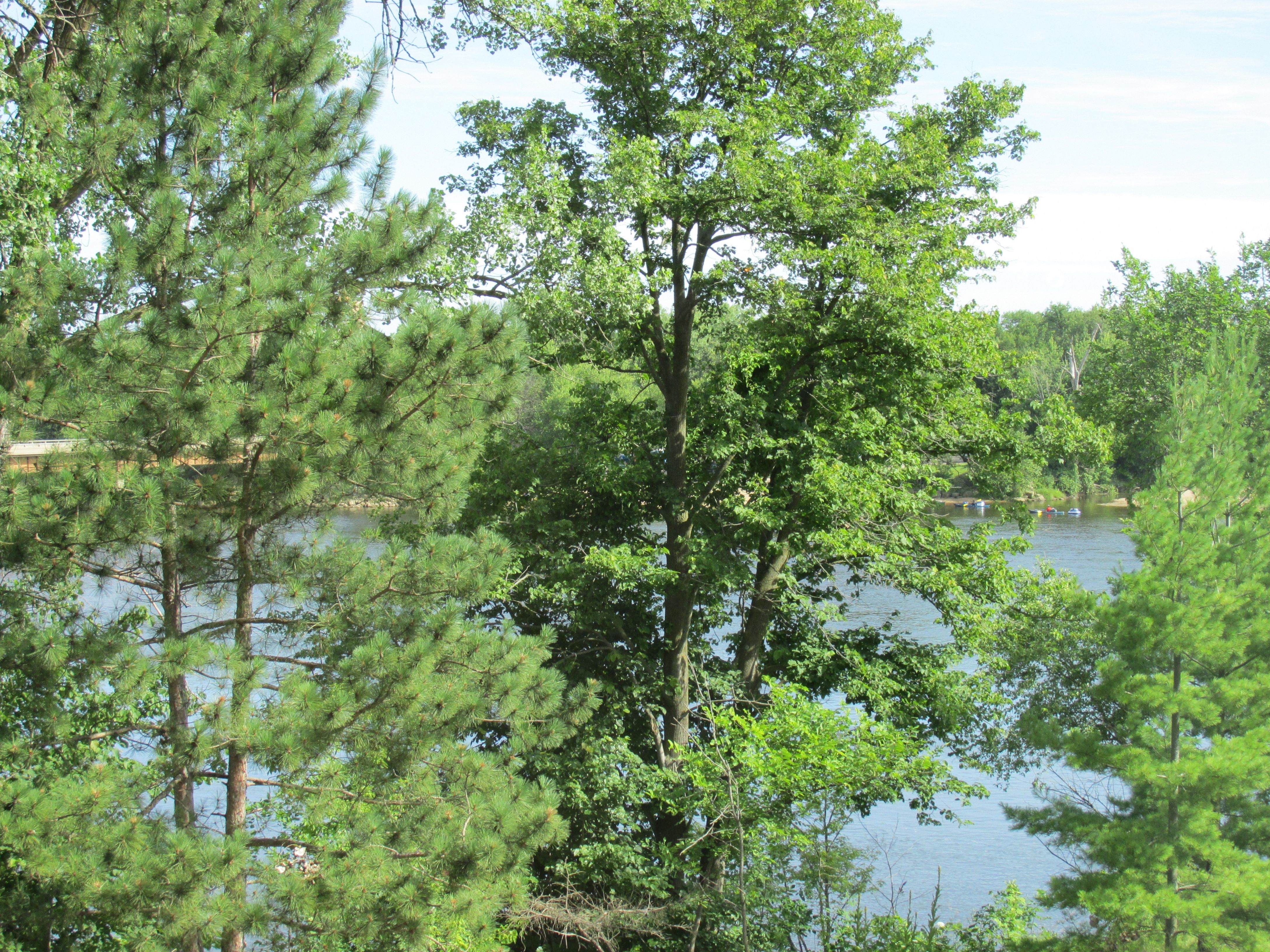
The view from the visitor's center
The view from the visitor’s center

And a view.

Next stop: Racine, Wisconsin.