The War to End All Wars

The Great War.
The War to End War.
The War to End All Wars.

World War I.

Kansas City is home to The National World War I Museum and Memorial. It tells the story of the story of The Great War from the seeds of the conflict to the 1918 armistice to the 1919 Paris Peace Conference. I was taught that the assassination of Archduke Ferdinand was the reason behind World War I, but it was more complex than that. The demands from Austria-Hungary for impossibly large reparations from Serbia lead them to declare war on Serbia. A complex web of alliances was activated as Russia declared war on Austria-Hungary, Germany declared war on Russia and France and Britain declared war on Germany and Austria-Hungary.

World War I had begun.
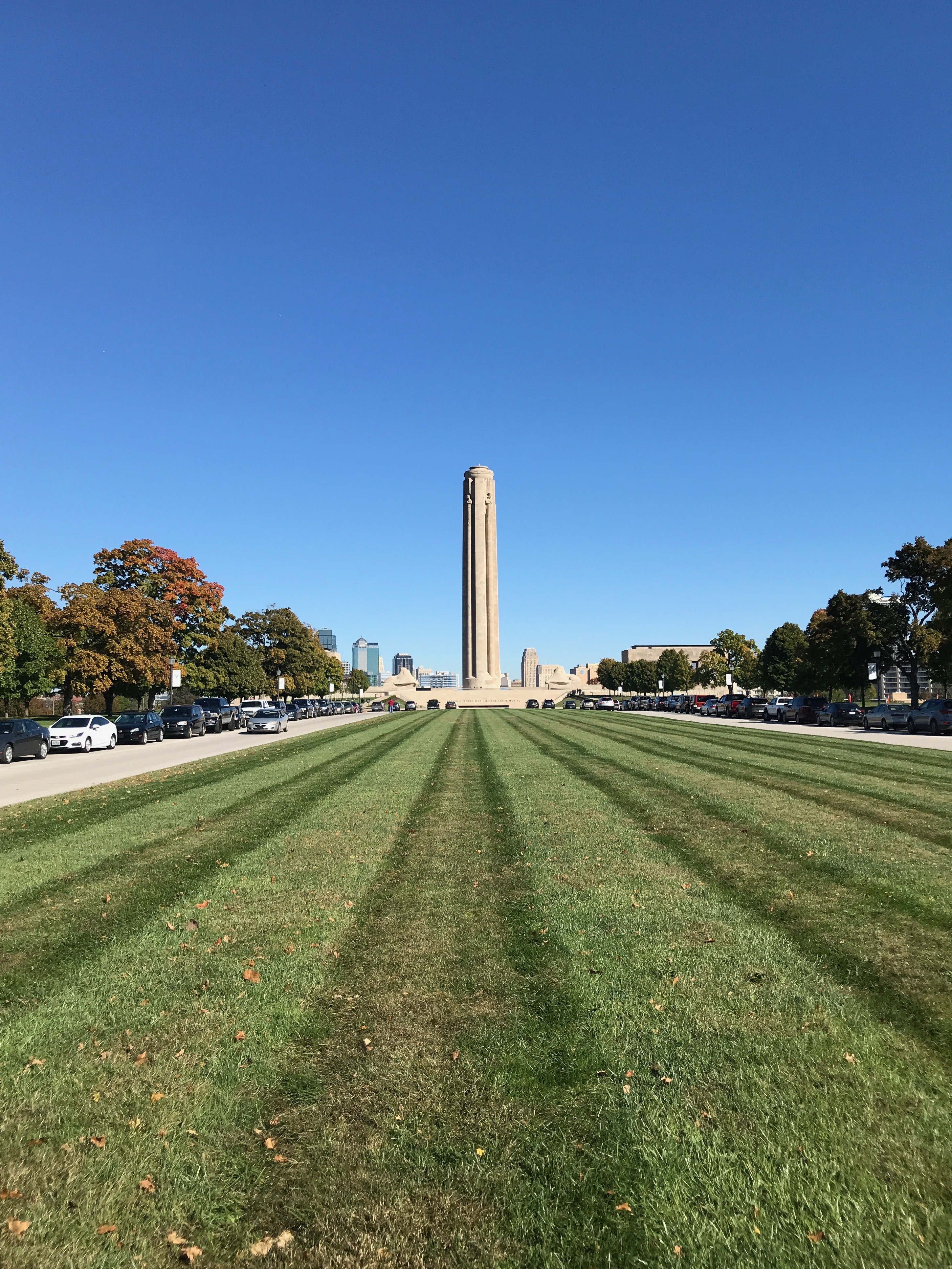
On this glorious October day in 2019, I was going to visit the Memorial and Museum.  The Liberty Tower rises above the complex. It’s 217 feet tall, and I’m told that at night the tower displays a “flame effect” that is created by steam illuminated by bright red and orange lights. I’ll bet that’s something to see. It’ll have to go on the “The List” for next time.
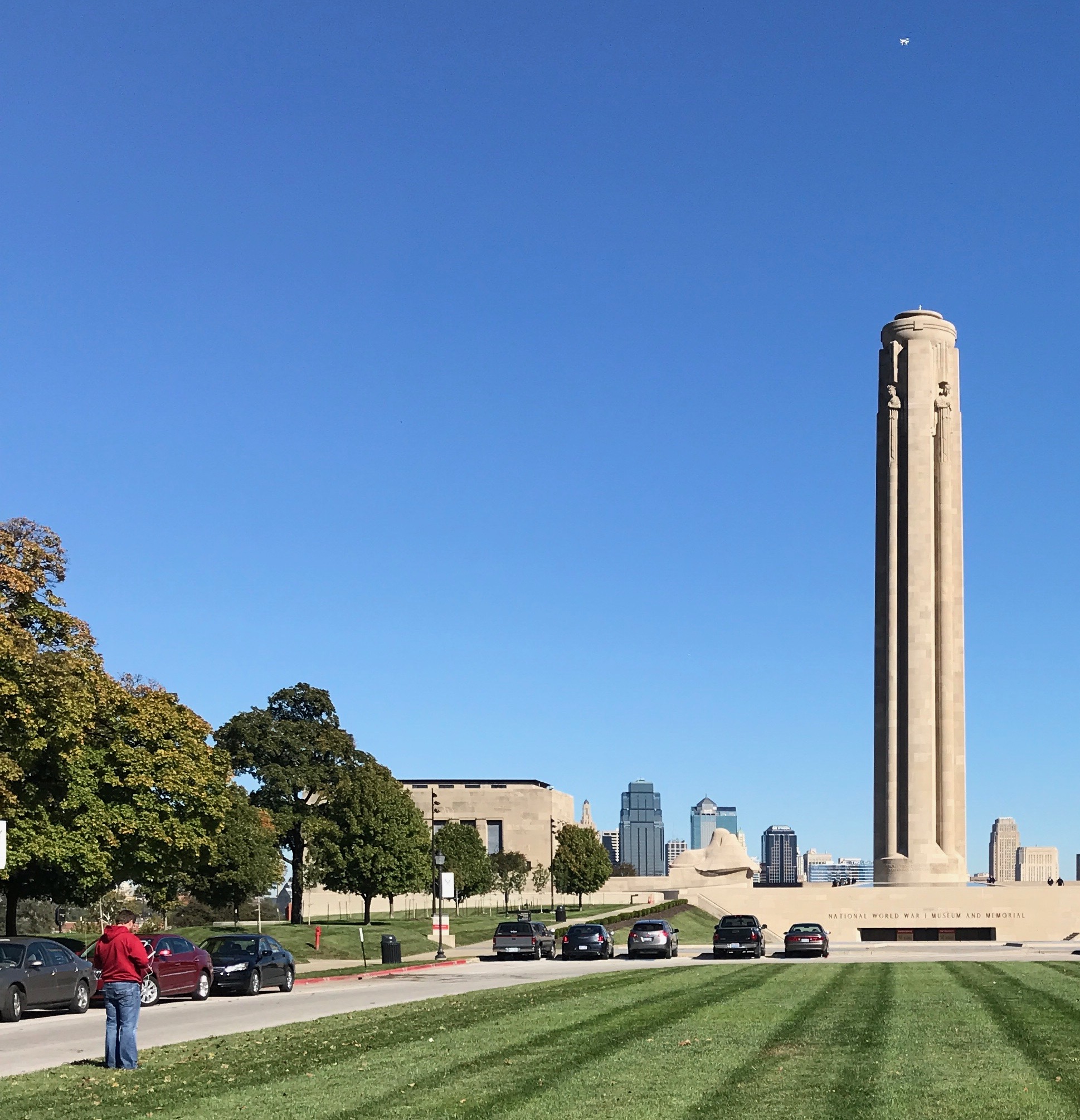
I parked and walked closer. I found a person flying his drone.
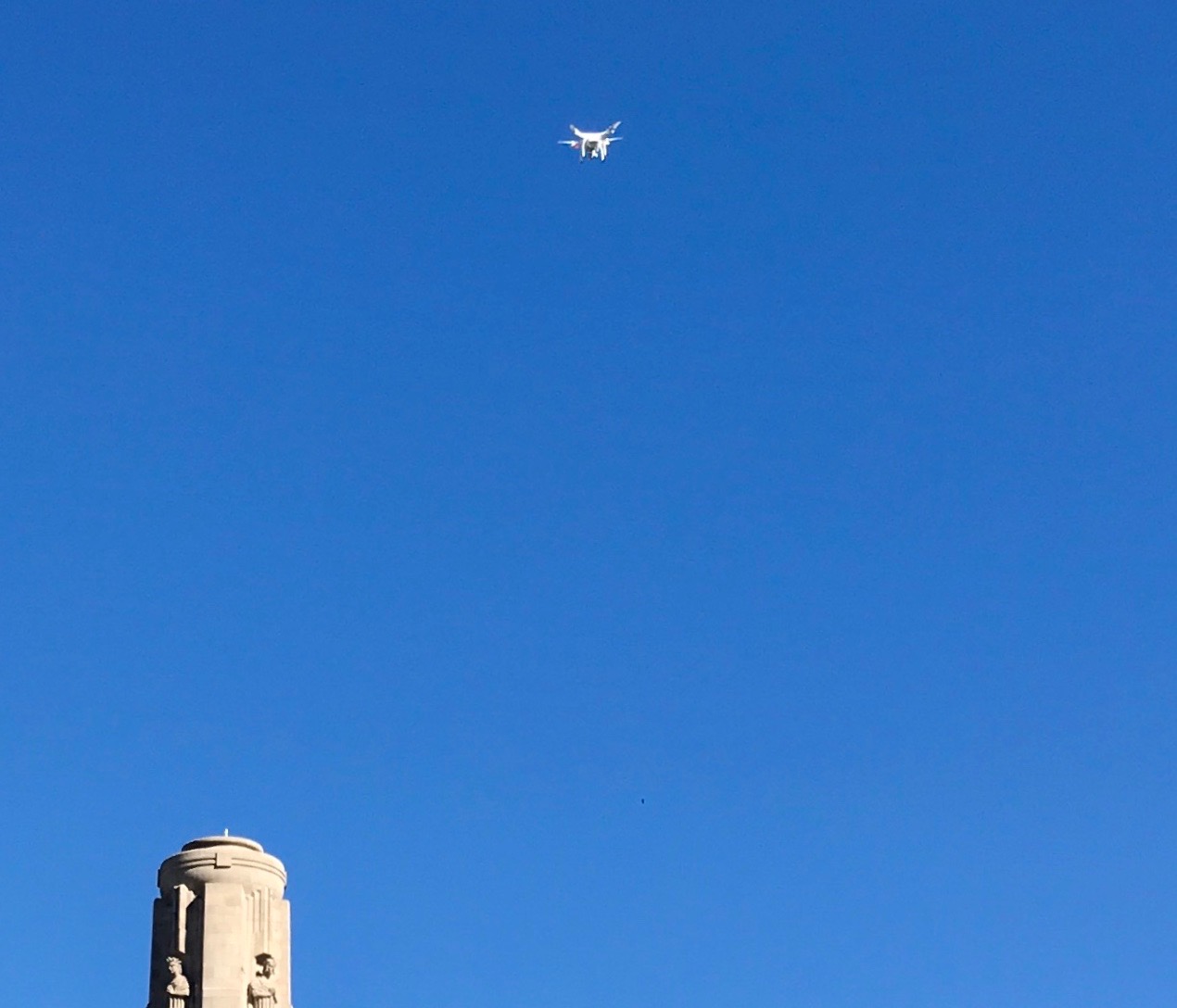
Look! Up in the sky! It’s a bird! It’s a plane!

No, just a drone. I stopped and talked with him for a bit, and asked him if it he could see if it was crowded on top of the tower. He said it wasn’t.
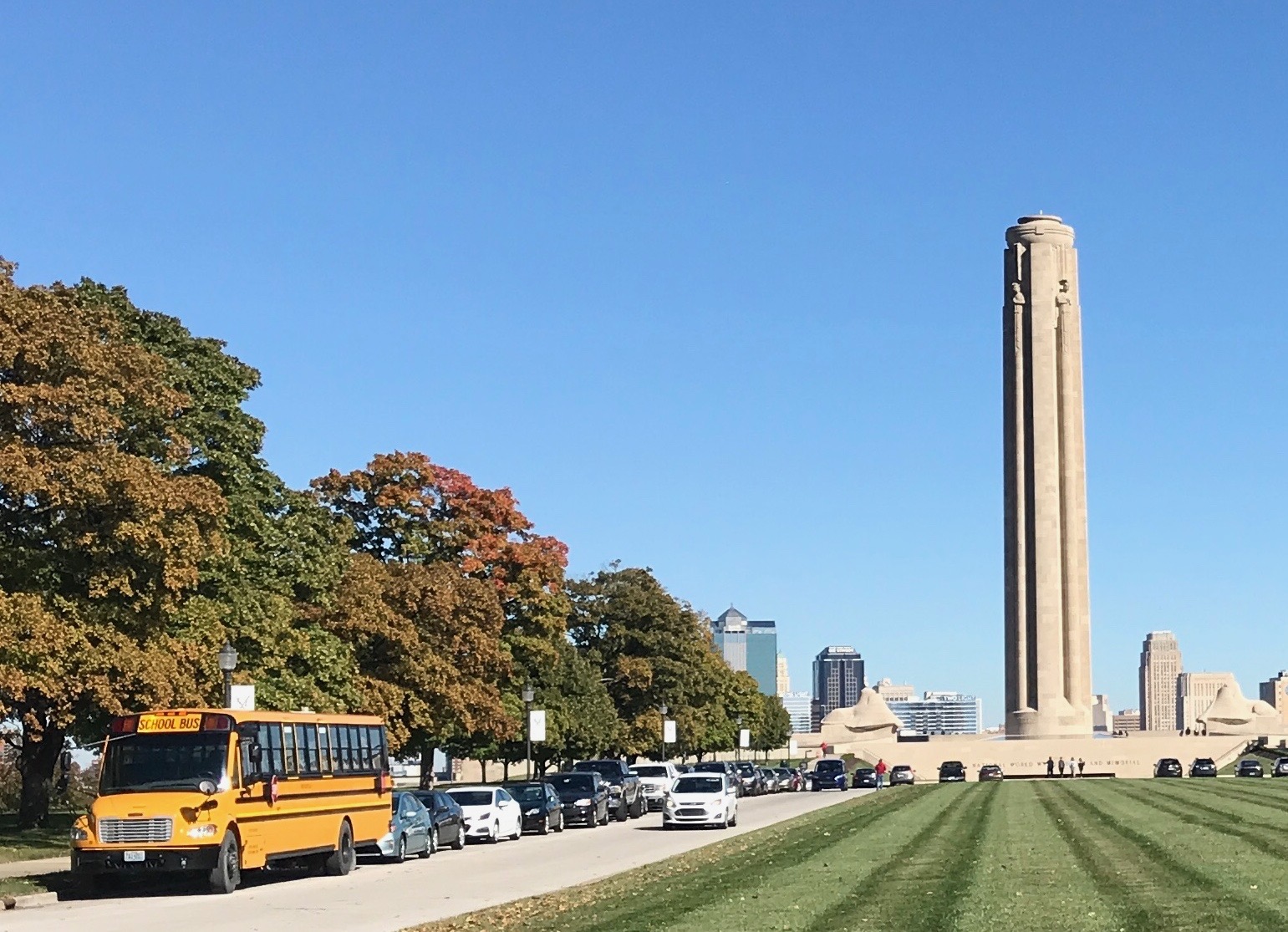
You see that yellow thing on the left side of the photo? I was afraid that the Memorial and Museum might be filled with {shudder} students on field trips!
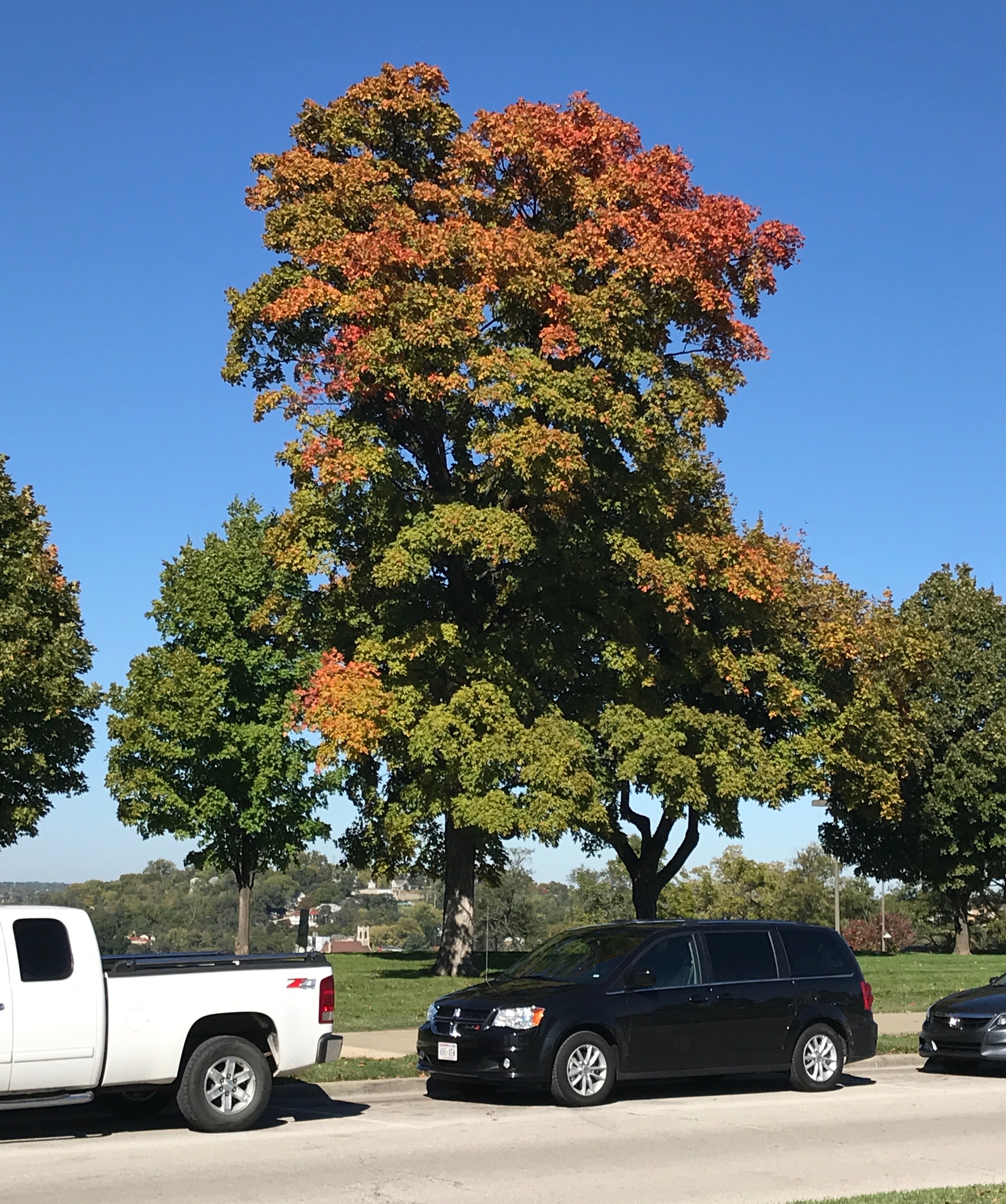
What a perfect day to be out and about! You can see the fall colors starting to decorate the trees.
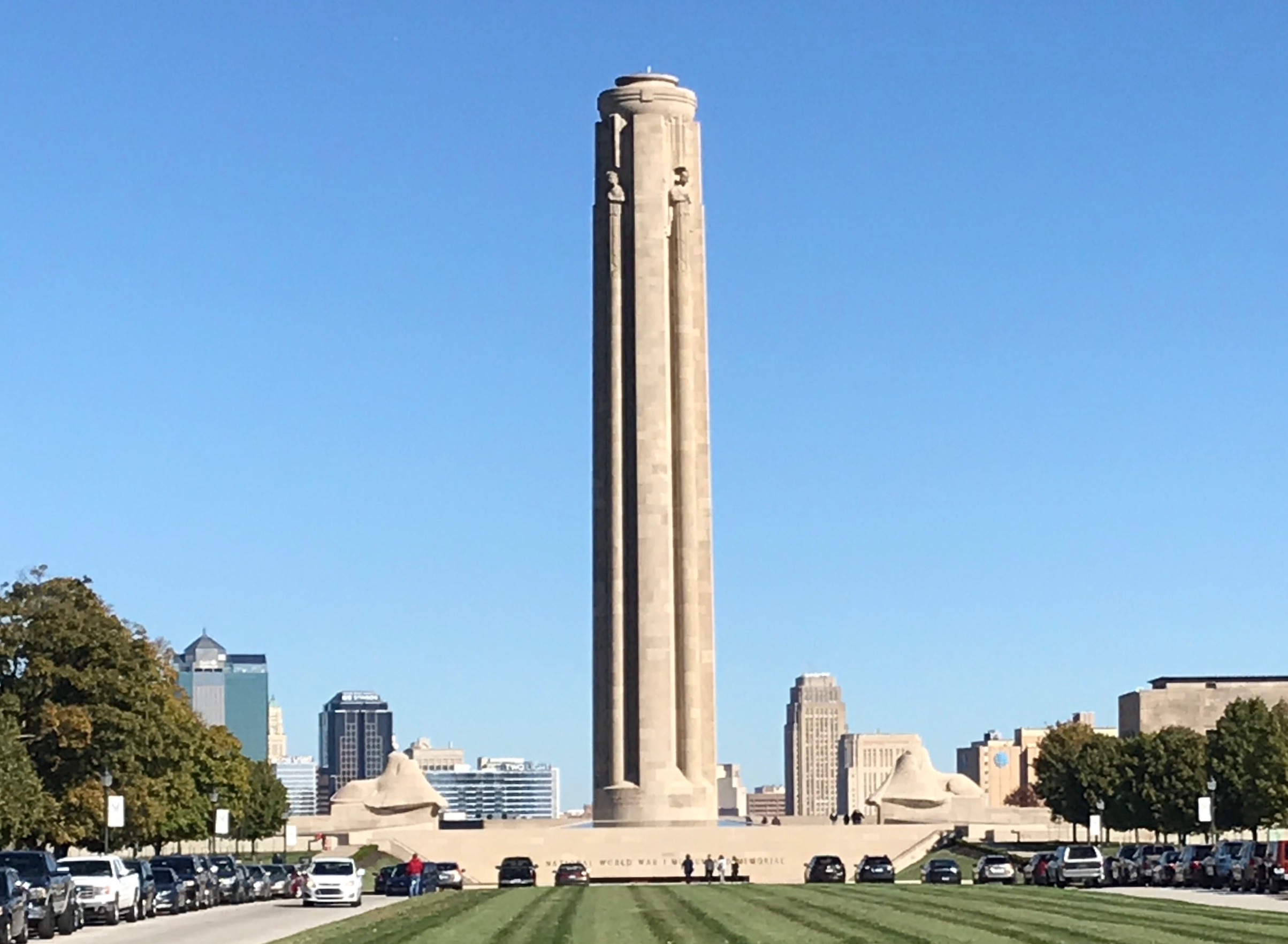
I kept walking and got closer…
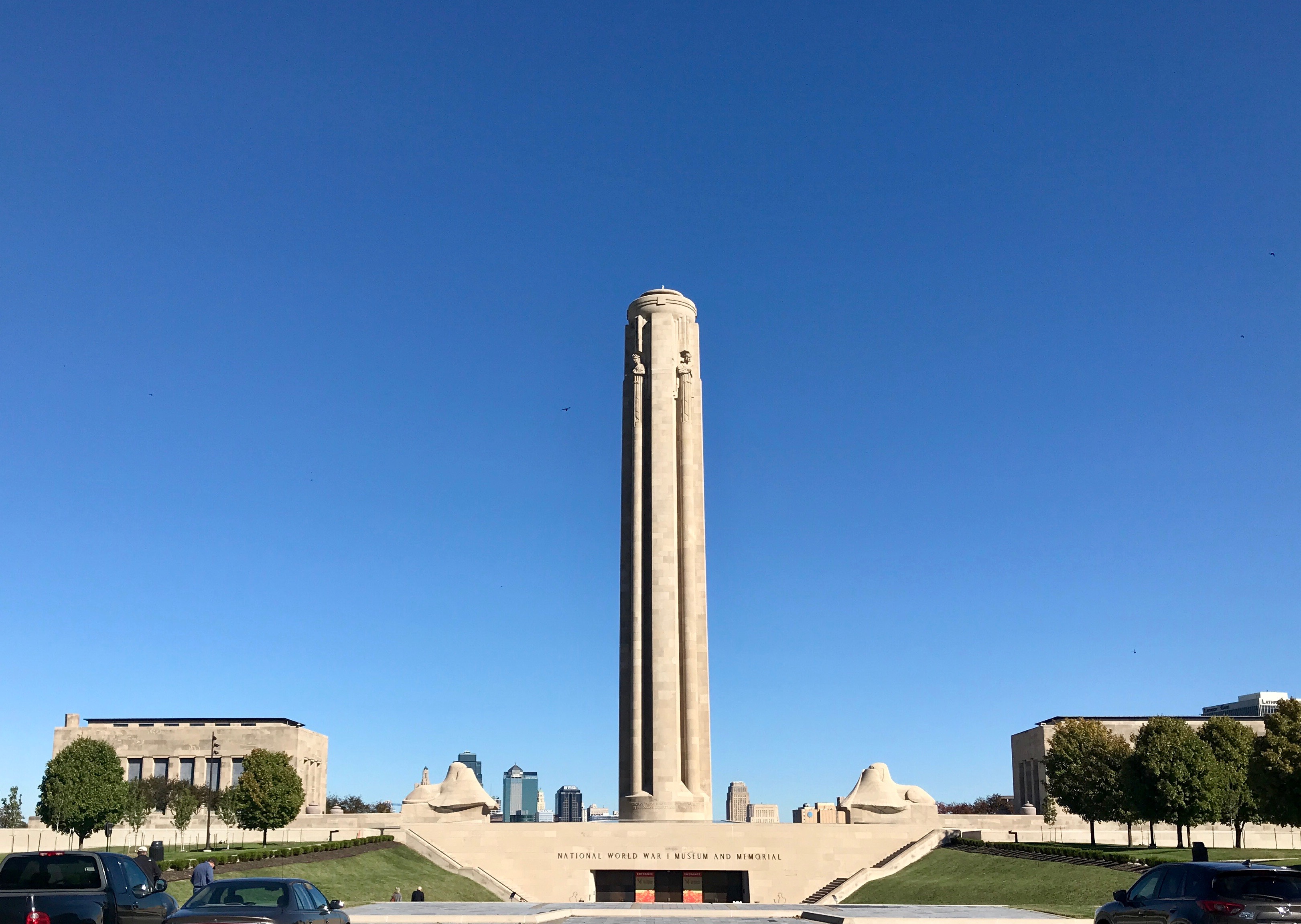
…and closer. Finally, the entrance was in sight.

The walk into the Museum was paved with blocks honoring people who served. I found this one for Thomas J. Hurst to be particularly poignant.
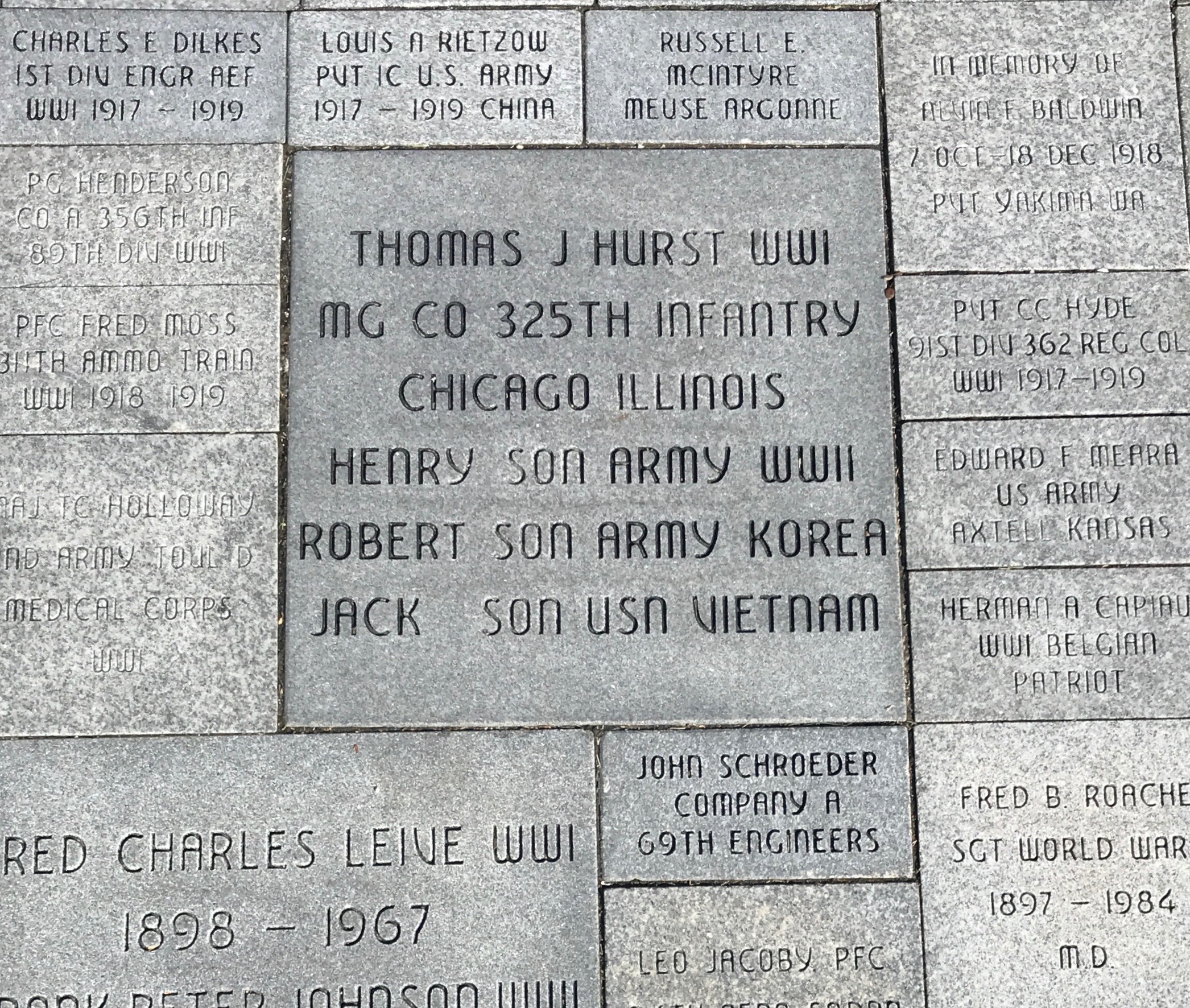
He served in World War I – the War to End All Wars. His sons served in World War II, Korea and Vietnam.
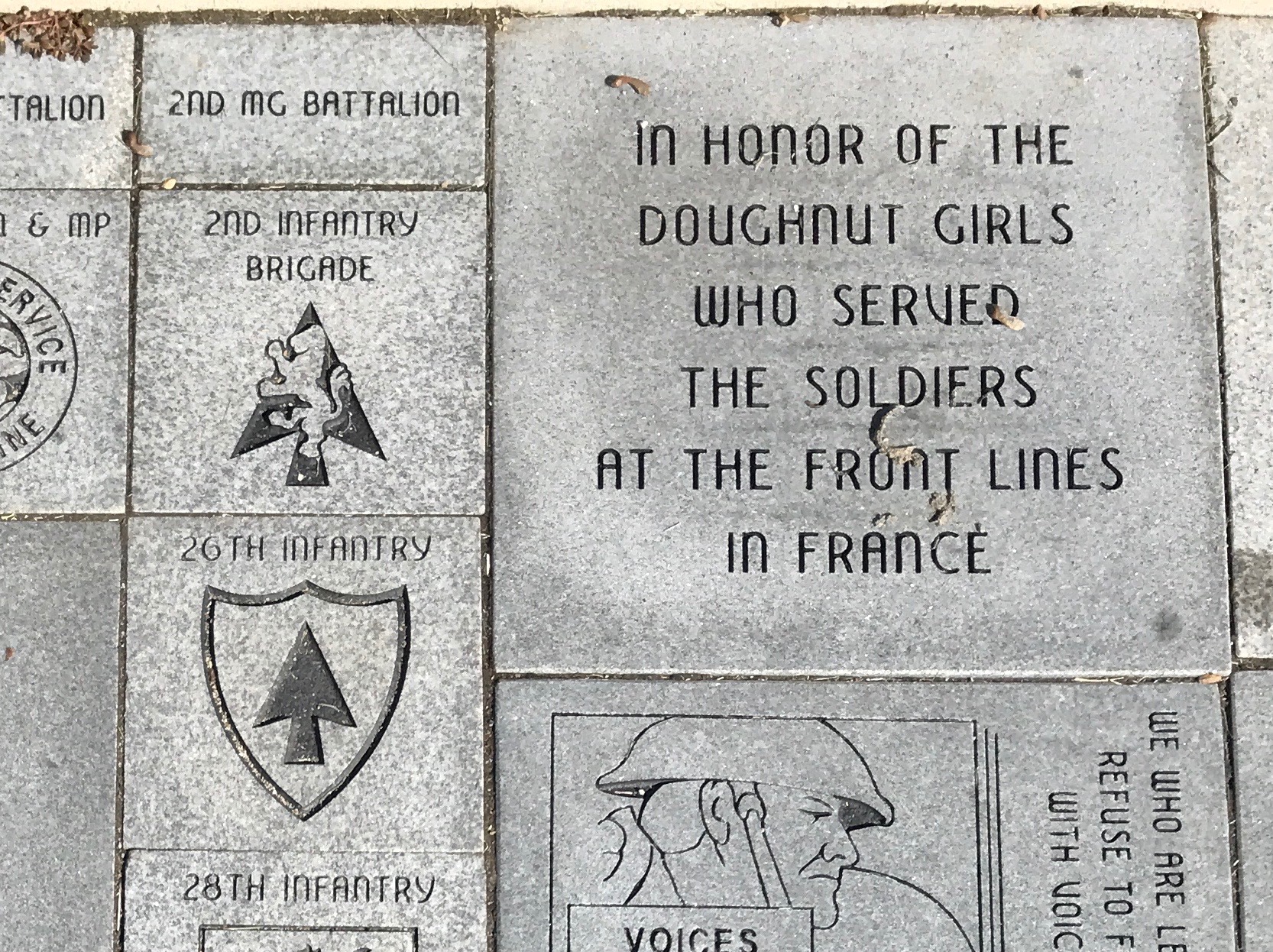
I appreciated this one in honor of the Doughnut Girls. If you are interested in learning more about their service, Smithsonian Magazine has an interesting article.

Fun fact: We have The Doughnut Girls to thank for National Doughnut Day, which is held yearly on the first Friday of June.
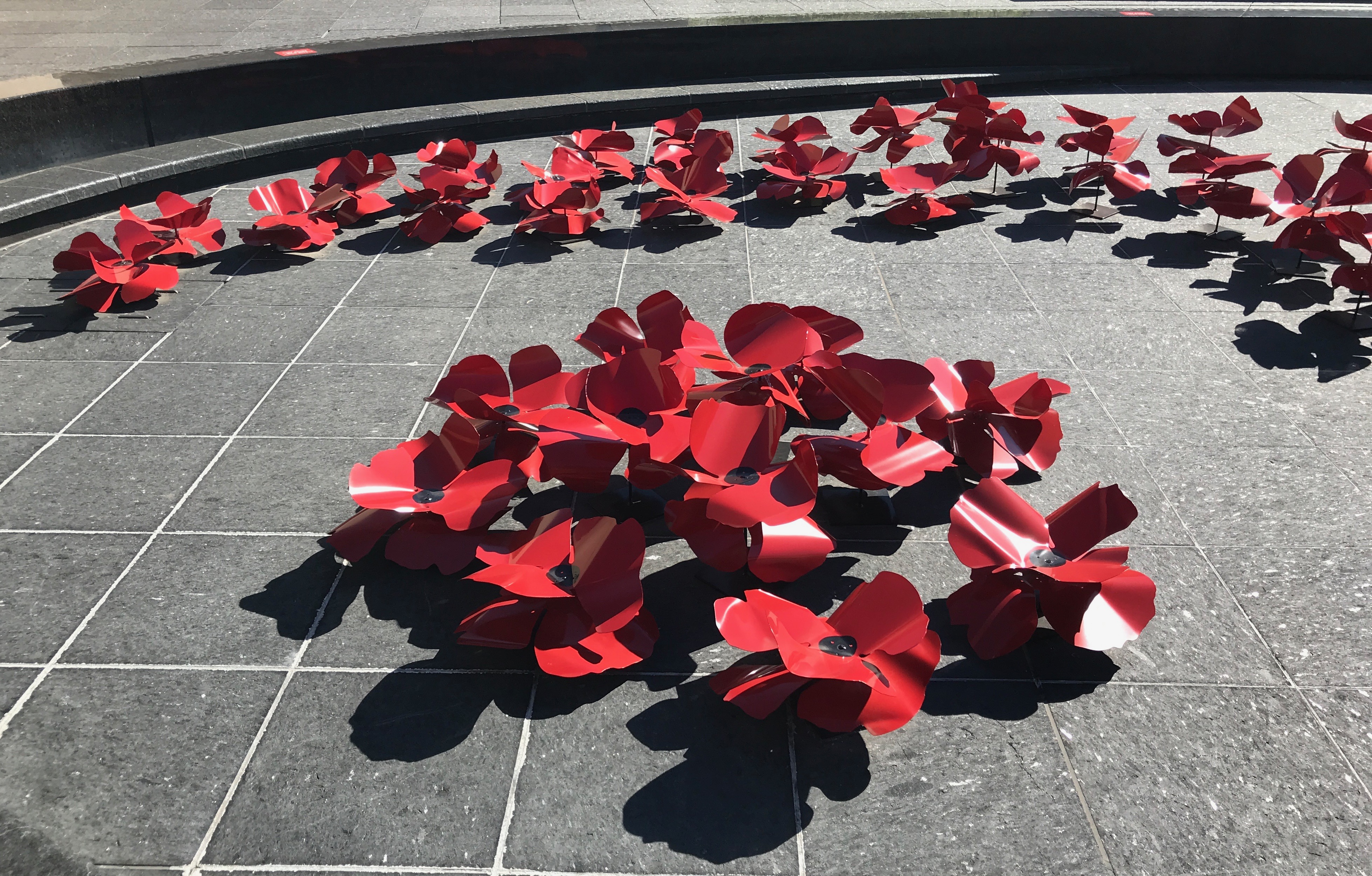
I continued on. Right in front of the entrance is “Reflections of Hope – Armistice 1918.” I imagine that it is spectacular when there is water in the reflecting pool. Altogether, there are 117 metal poppies. Each poppy represents 1,000 American lives lost, but not forgotten.

Why poppies?

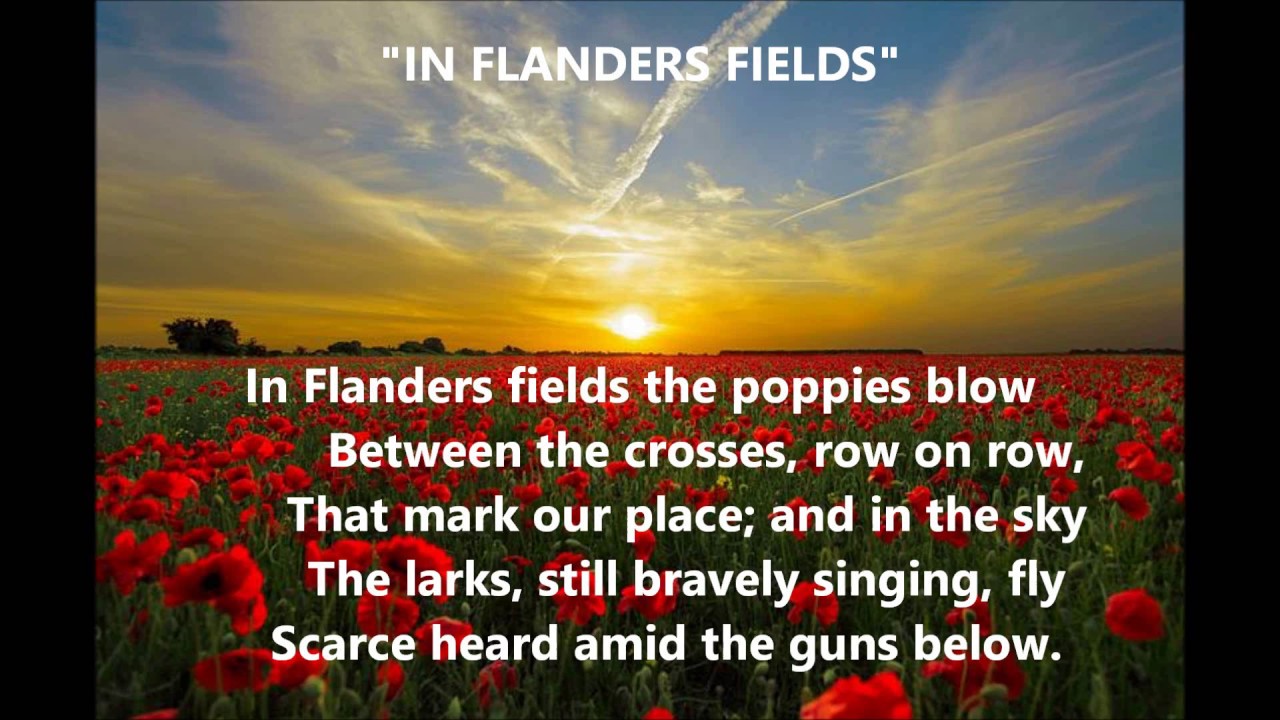
Poppies have come to be a symbol for World War I. It is based on Lieutenant-Colonel John McCrae’s poem, “In Flanders Fields.”
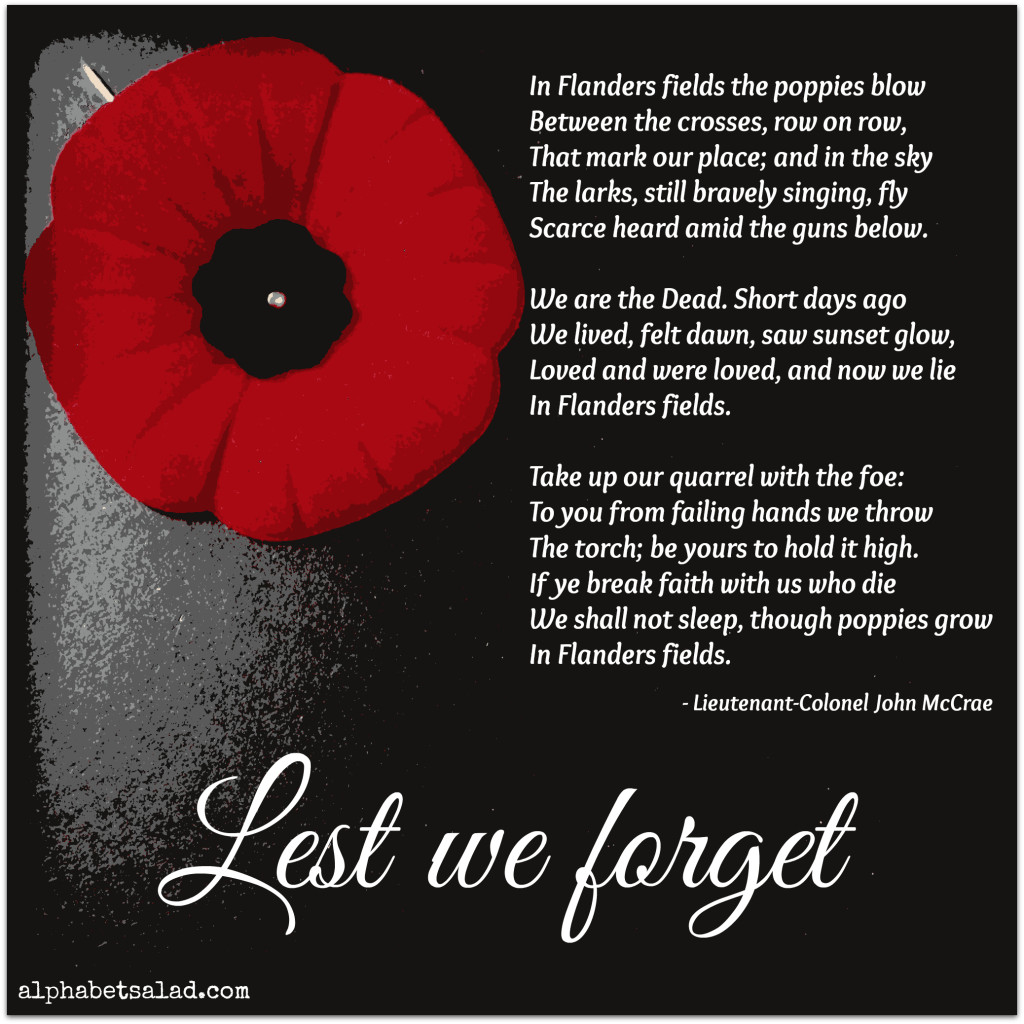
This is my favorite poem, and I loved some of the projects I did with my students “back in the day.”

John McCrae was worn in 1872 in Guelph, Ontario, which is about 100 miles from my hometown, Buffalo, NY. He was a medical doctor, and fought in the South African War before starting his practice. When Germany declared war on Britain in 1914, he joined up immediately. He was a medical officer with the First Brigade of the Canadian Field Artillery.

On August 4, 1914, Britain declared war on Germany. Canada, as a member of the British Empire, was automatically at war, and its citizens from all across the land responded quickly. 45,000 Canadians rushed to join up within three weeks. John McCrae was among them. He was appointed a medical officer with the First Brigade of the Canadian Field Artillery with the rank of Major and second-in-command. Unfortunately, he was a casualty of the war. He died of pneumonia.

While two out of three soldiers died in battle, the rest died due to infections or disease. The Spanish flu pandemic also killed many in prisoner camps

But, back to the Memorial and Museum.

I entered and bought my tickets to the museum and to the tower. As long as I was here, I figured I ought to see both. They advised me that I ought to do the tower first, as the school group would be going up later. They didn’t need to tell me twice!
I took the elevator up to the plaza level.
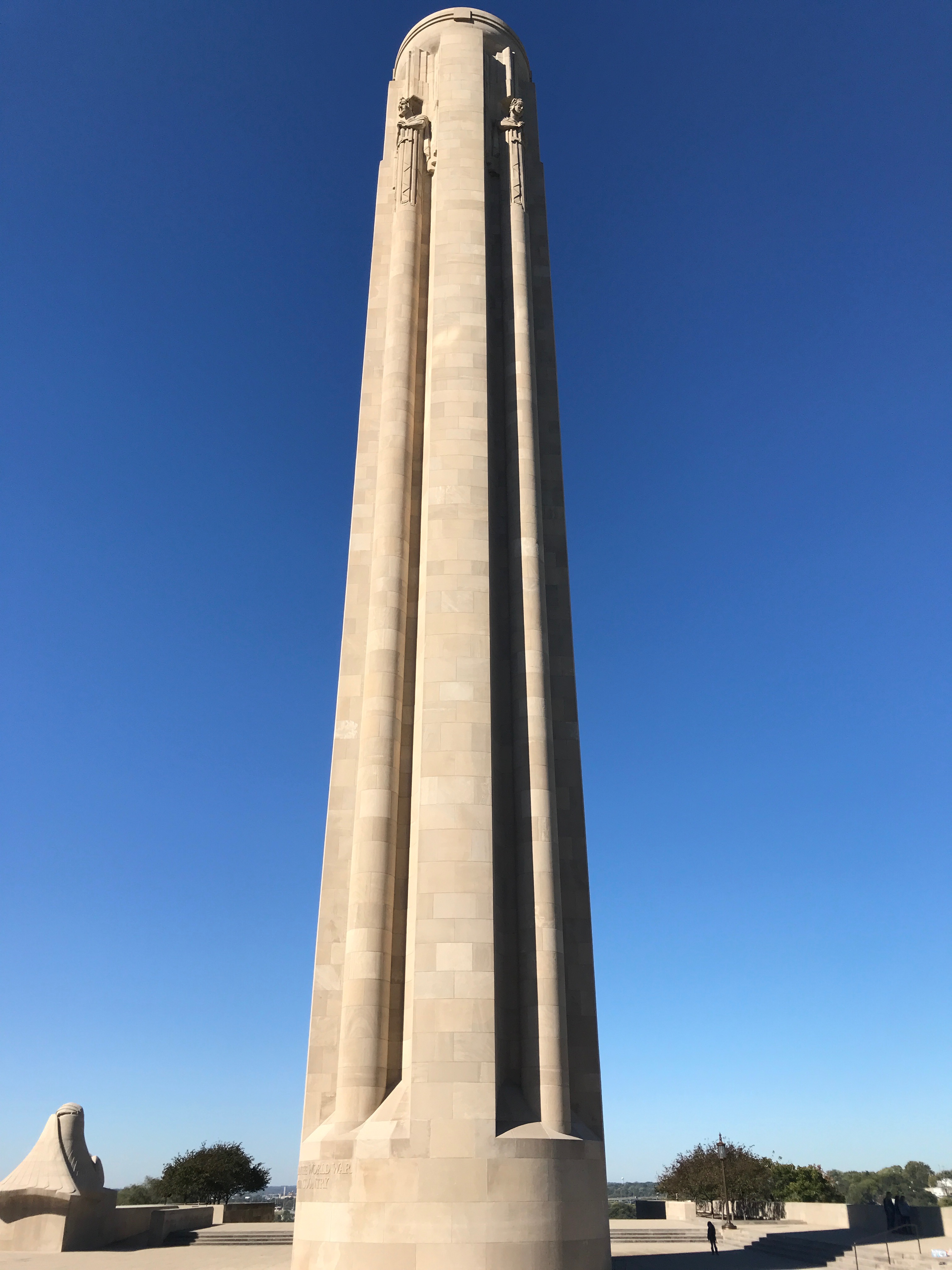
That person on the right side of the tower gives you some idea of the size of the structure.
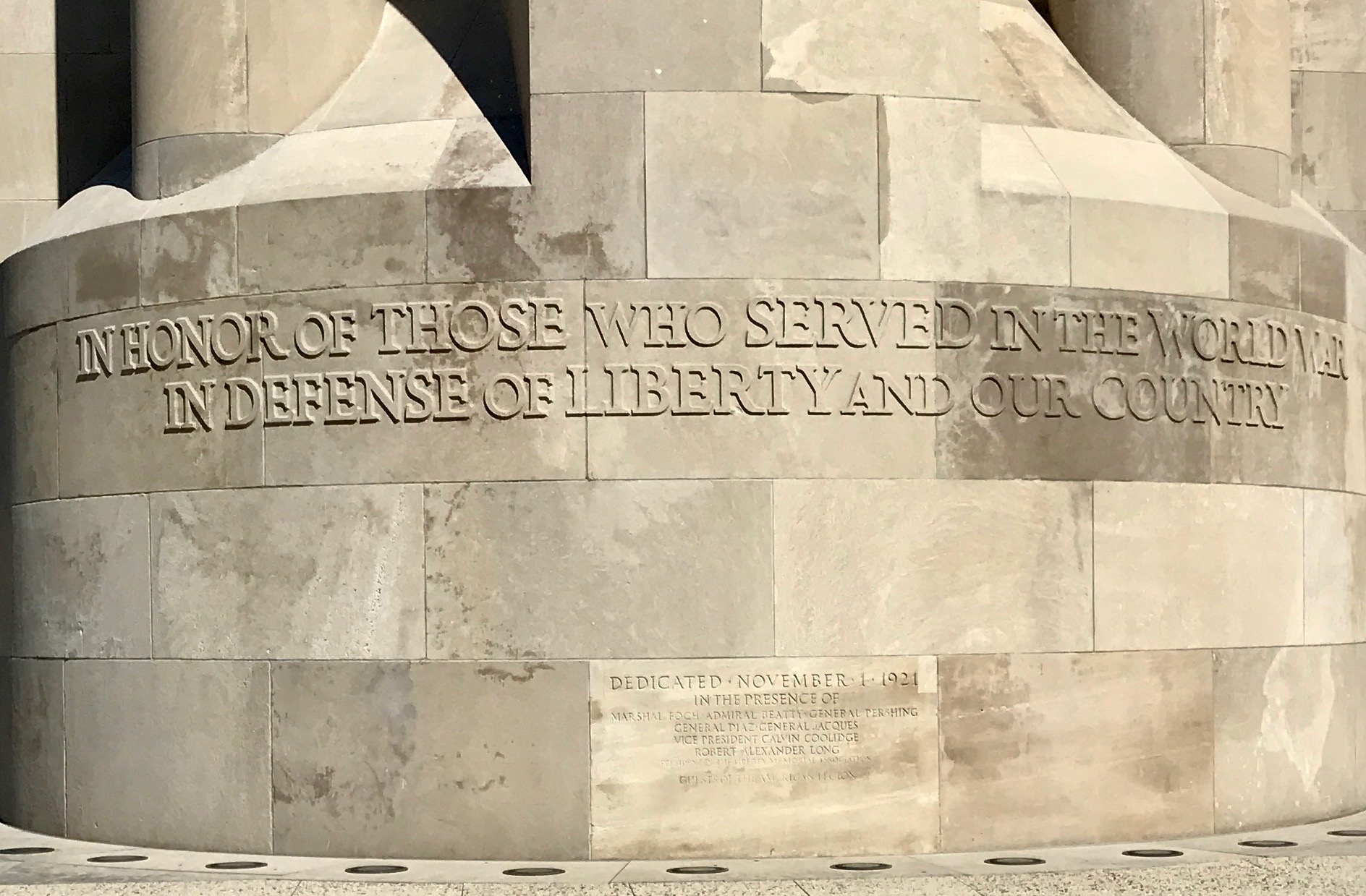
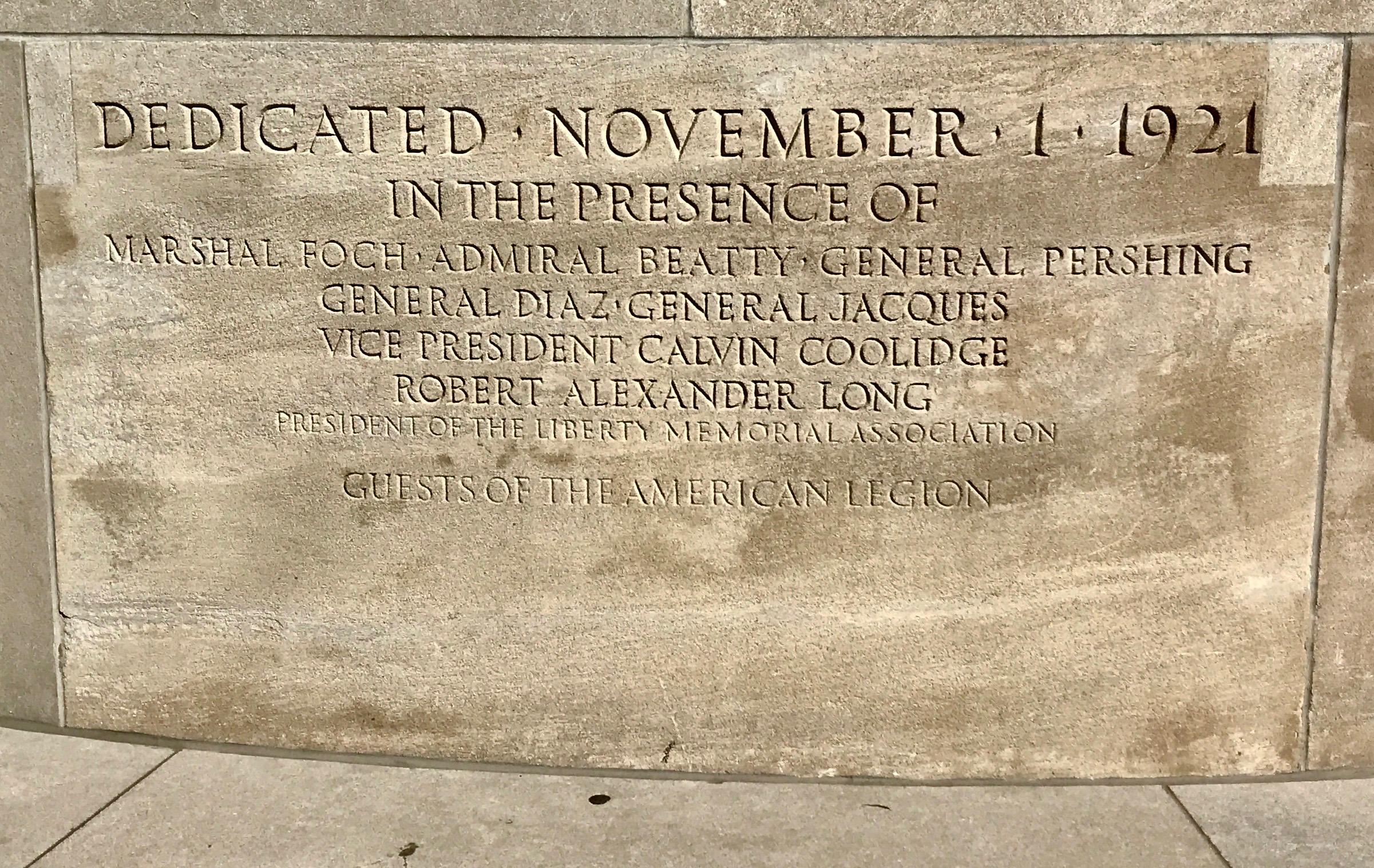
Warren G. Harding was president at that time, having taken the reins from Woodrow Wilson in March 1921. According to my Preferred Source, during his time in office, he was one of the most popular U.S.Presidents up to this point. It rather puzzles me as to why he was not in attendance at the dedication. Maybe back in those days, presidents stayed in Washington and attended to the business of running the country.

Harding did send his vice president, Calvin Coolidge. Interestingly enough, future president Harry S. Truman was also there, along with 60,000 members of the American Legion. He was chosen to present flags to the commanders that were present. In all, 200,000 people were in attendance at the dedication.
I was glad to be going up before the tour. I don’t think it would be much fun to be on top of that relatively small space with a bunch of kids.

I got in the very small elevator in the tower and rode up to the top.
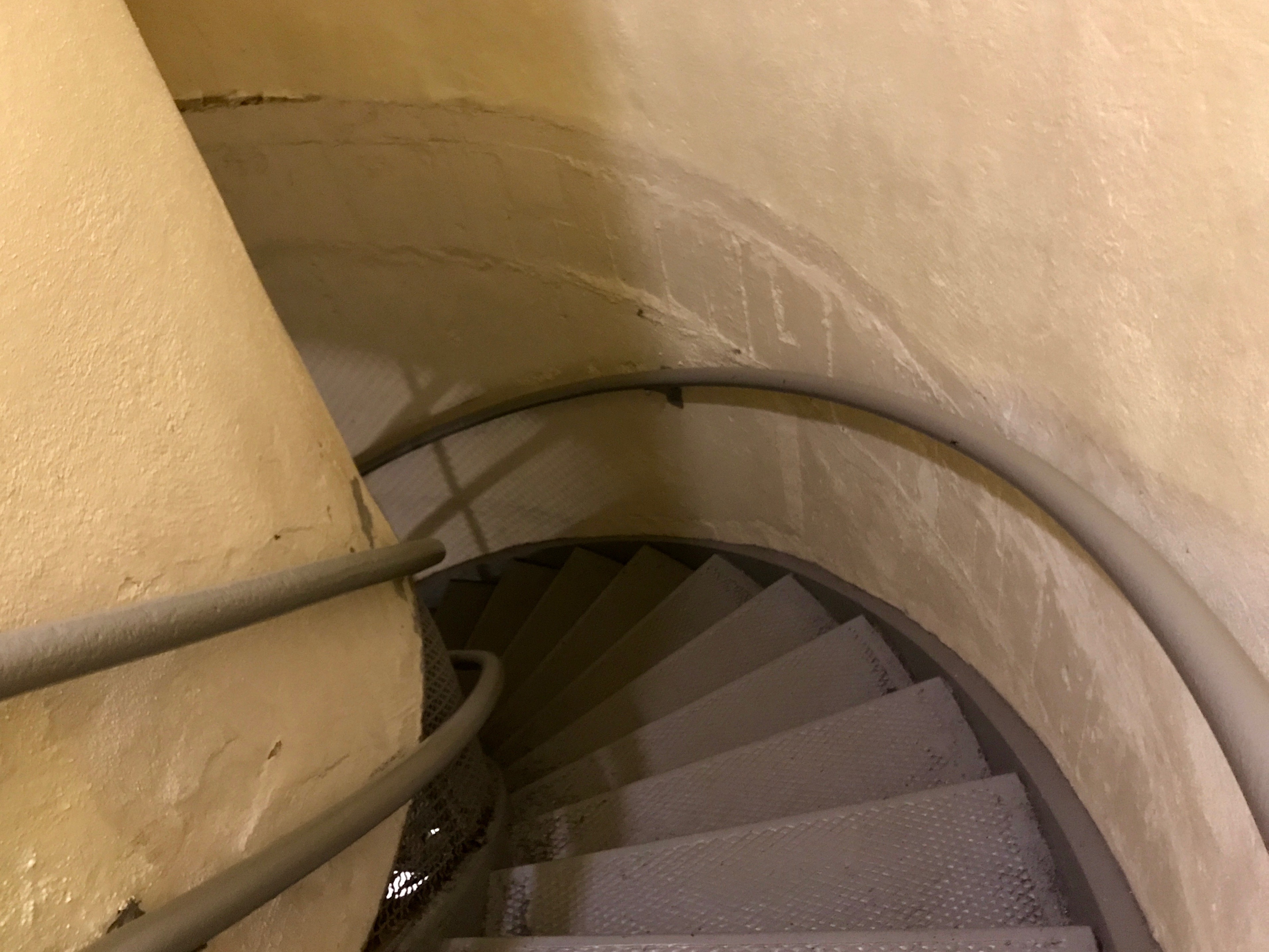
I walked up the 45 steps to the Observation Deck and turned around to take a photo of the stairs. (If there isn’t a photo, it didn’t happen.)

Then out to Observe.
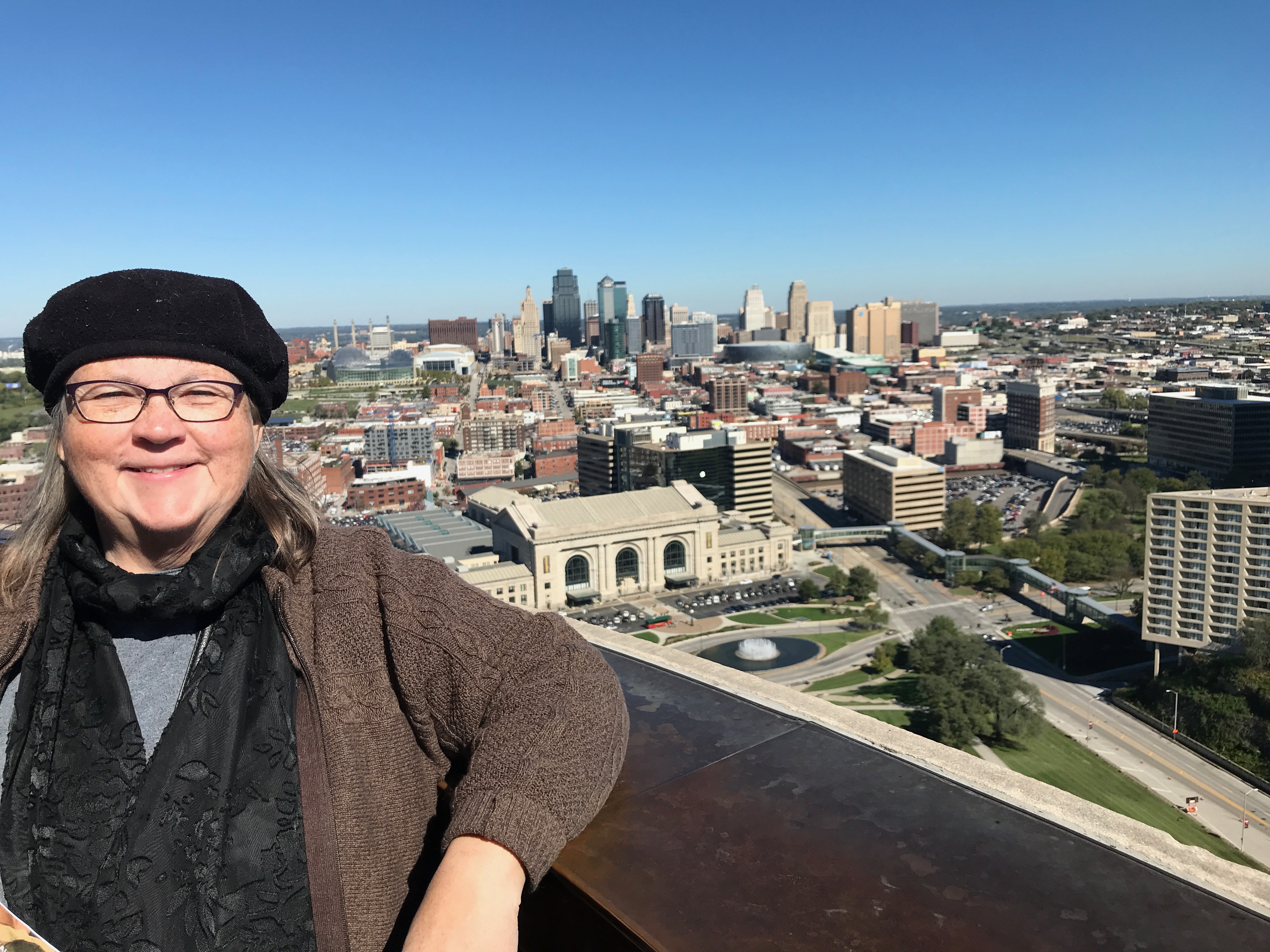
There’s a photo, so you can tell I really did spring for the elevator trip to the top of Liberty Tower. That’s Union Station in the background. It’s one of those repurposed train stations that so many of our cities have, but are no longer transportation hubs. The website for Union Station describes it as a “hub of culture, education and entertainment.” I might visit it one of these days.
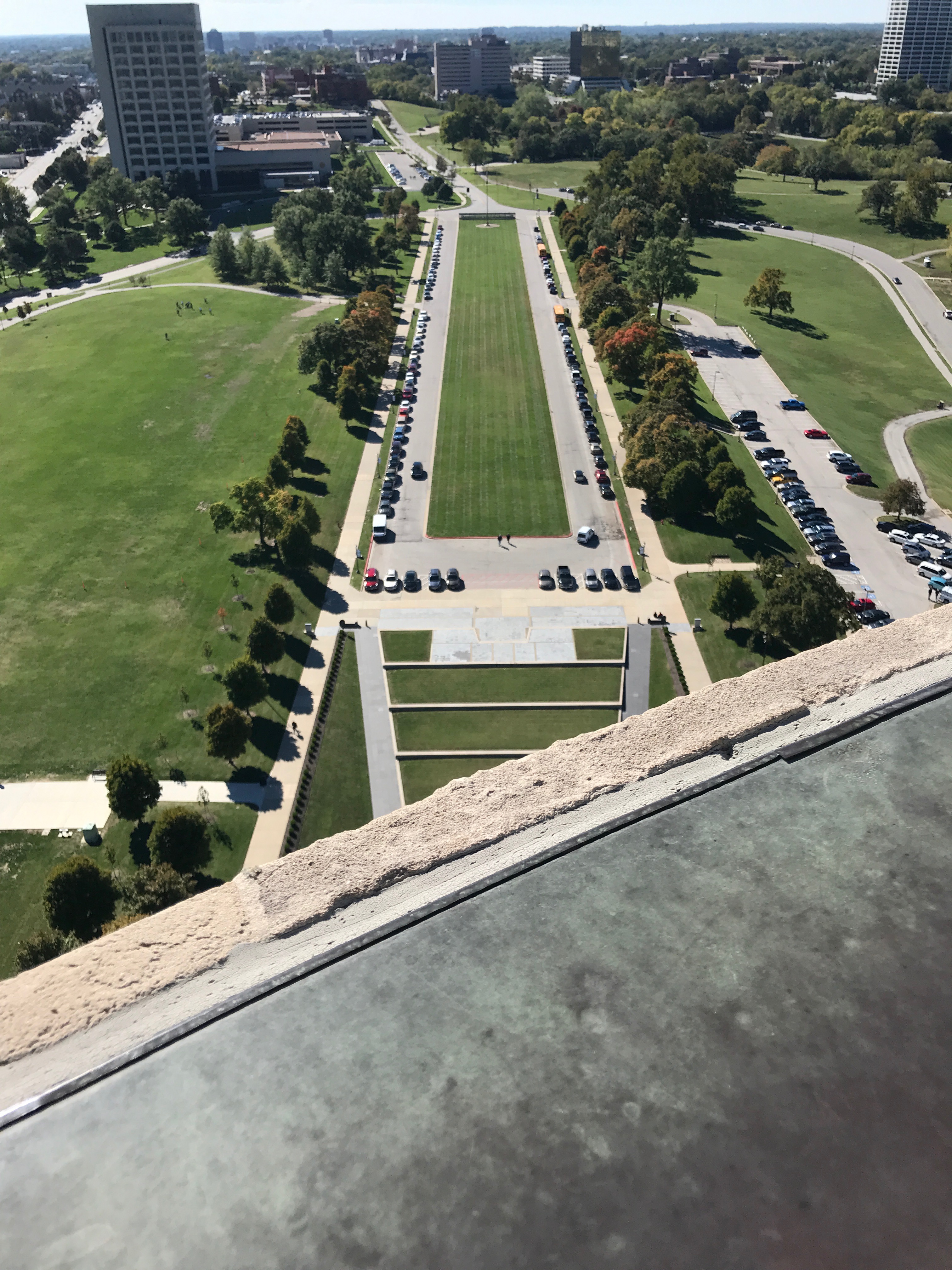
My car is down there somewhere.
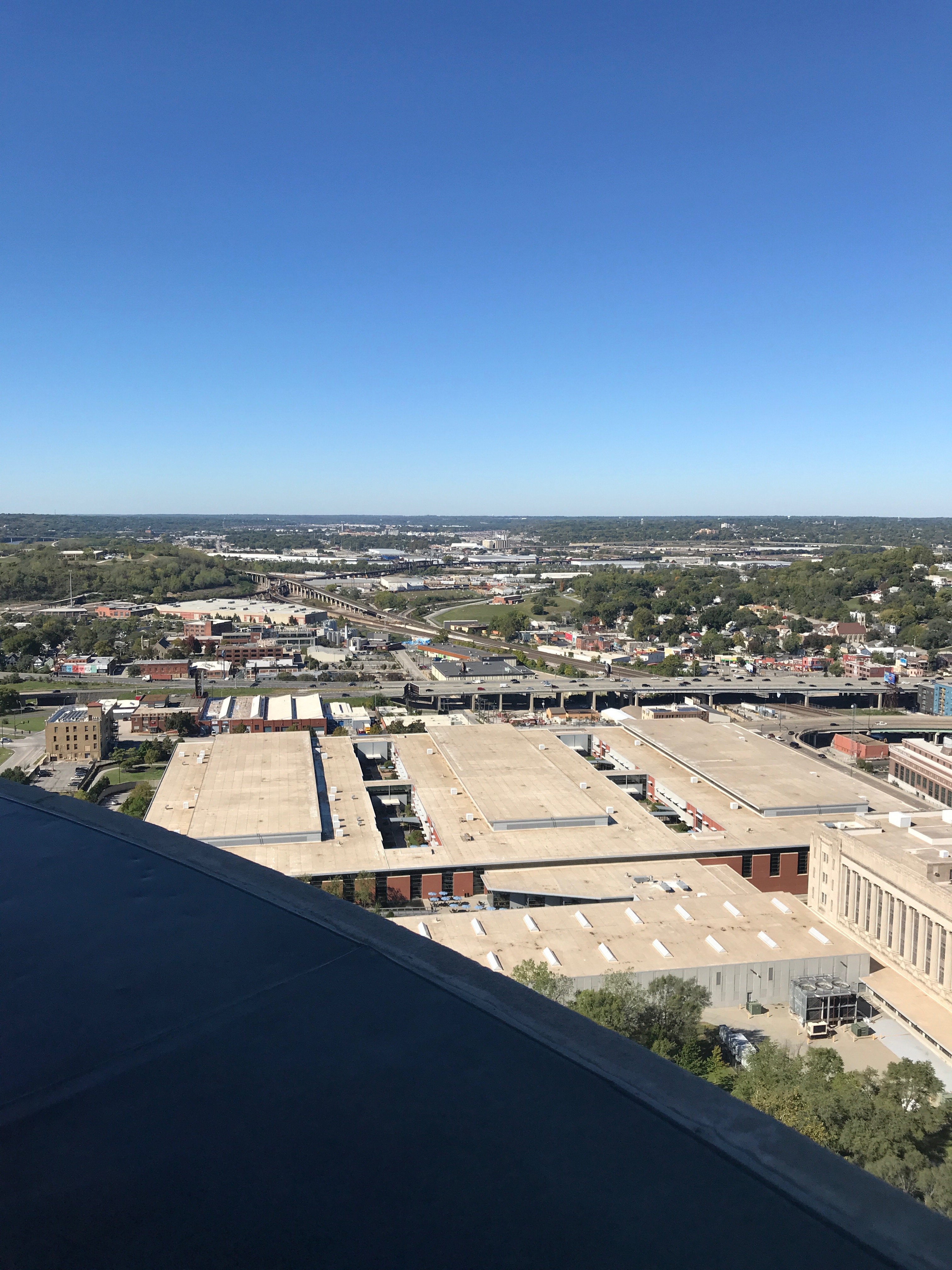
Here’s the view in another direction. I can’t get enough of the blue skies! (Have I mentioned lately that I hate rain?)
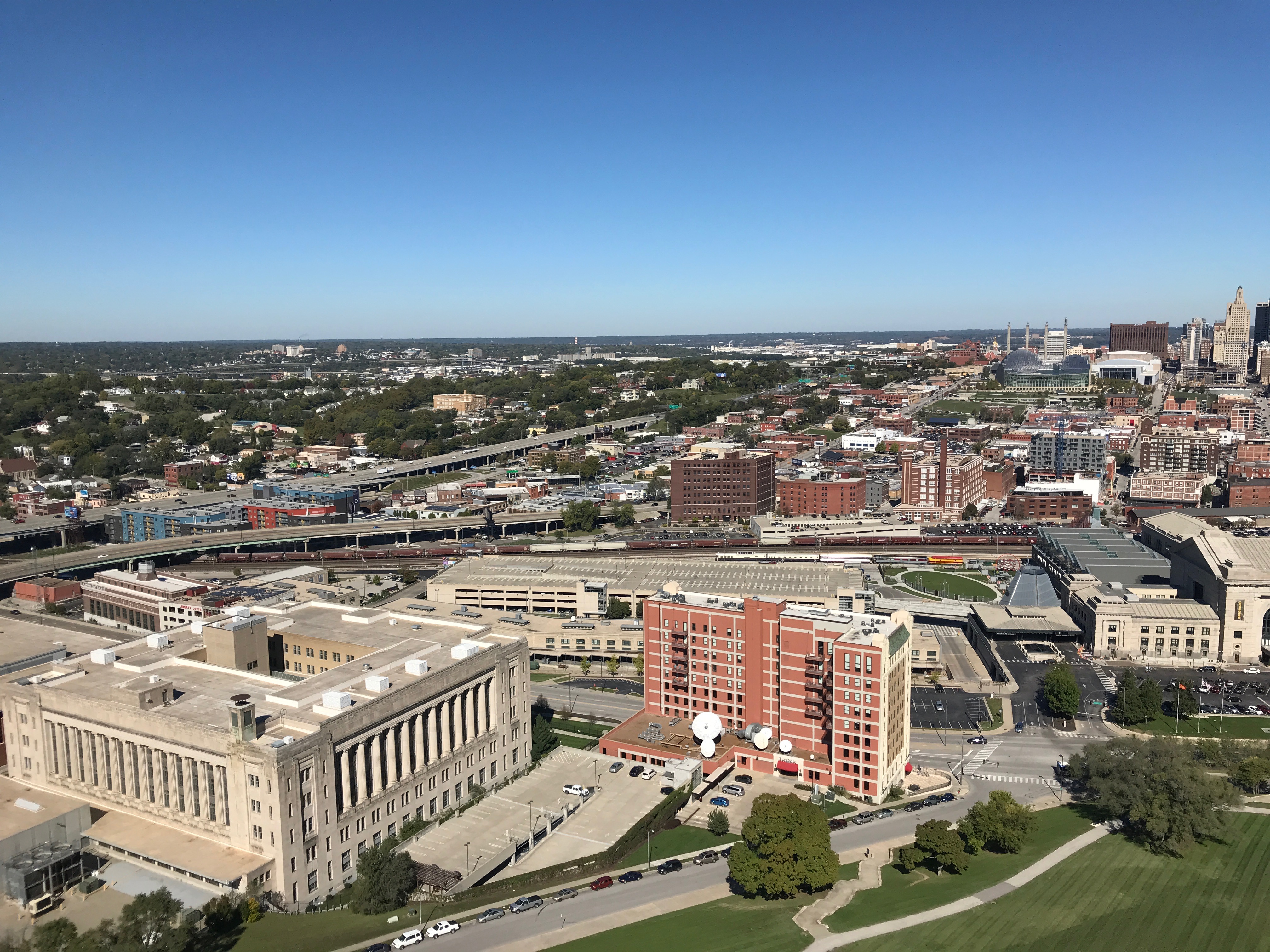
Here’s a look in the final direction, and then it was time to descend the tower. I made it before the field trip arrived! Hooray!
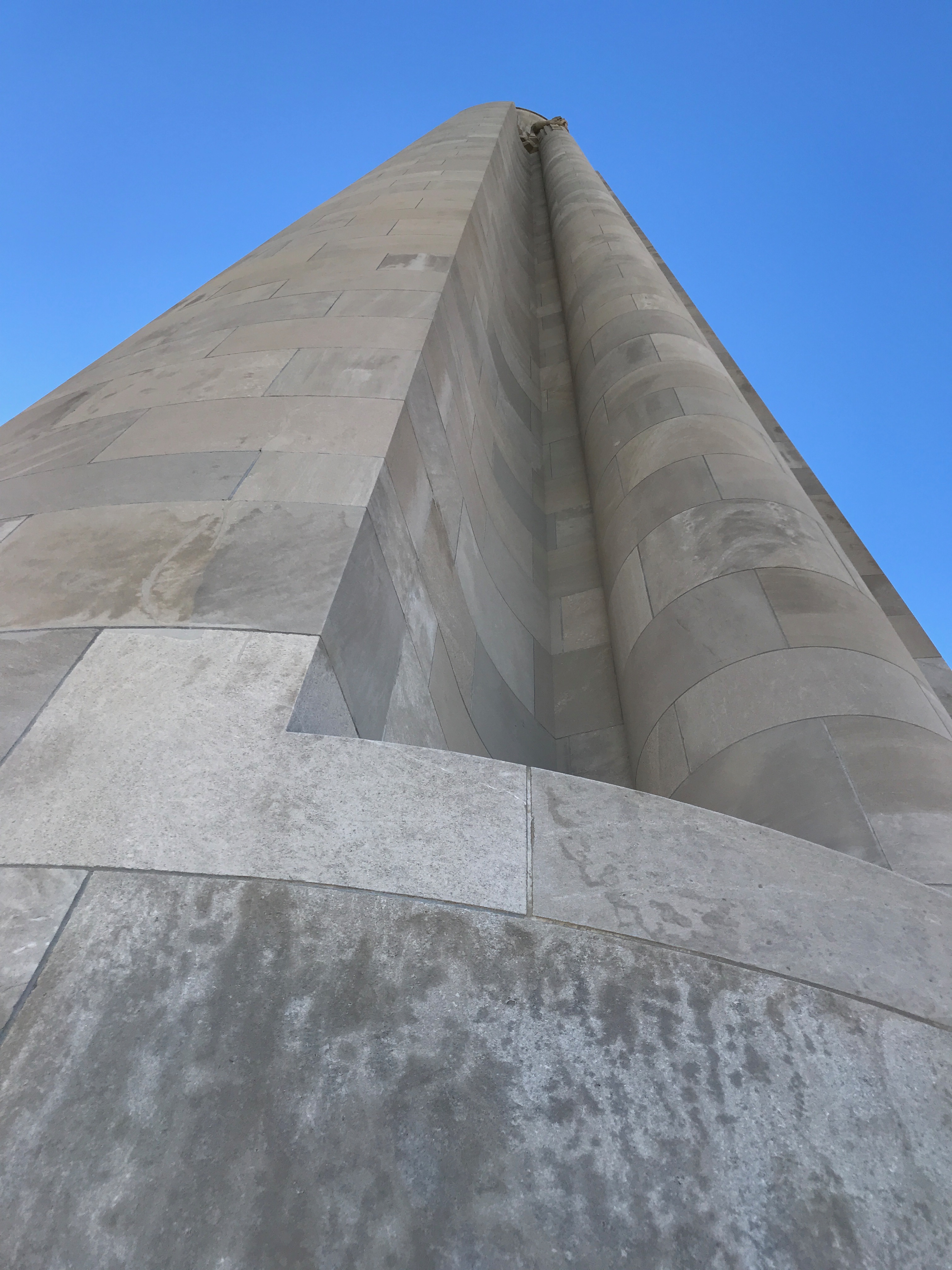
I paused at the base of the tower to look up.

On this level, there are two buildings that serve as memorials and museums. Incidentally, the original structures are built in the Egyptian Revival style.
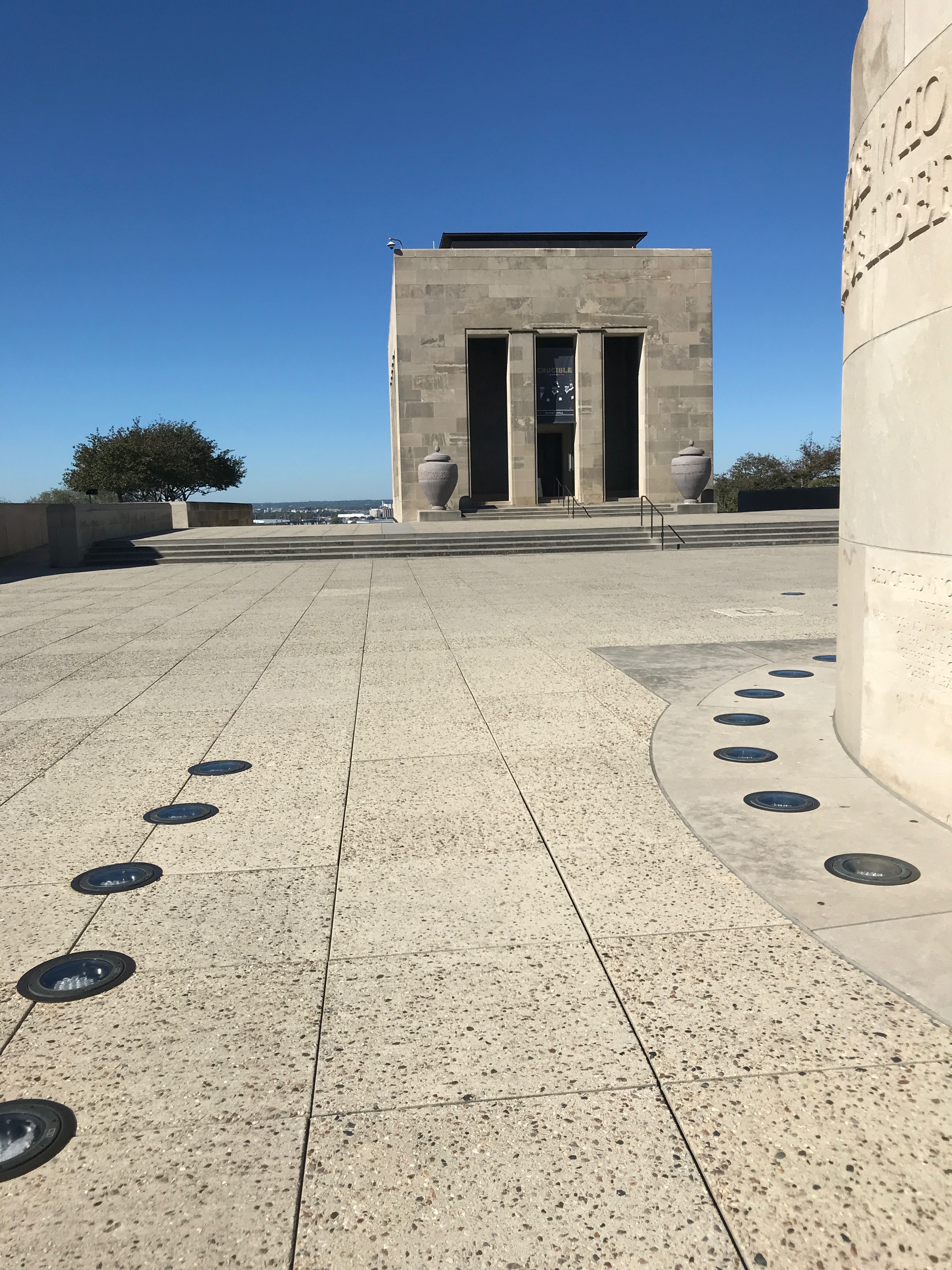
Between each hall and the tower sit two stone sphinxes, named “Memory” and “Future.” Memory faces east, hiding its face from the horrors of the European battlefields. Its twin faces west and shields its eyes from a future yet unseen.
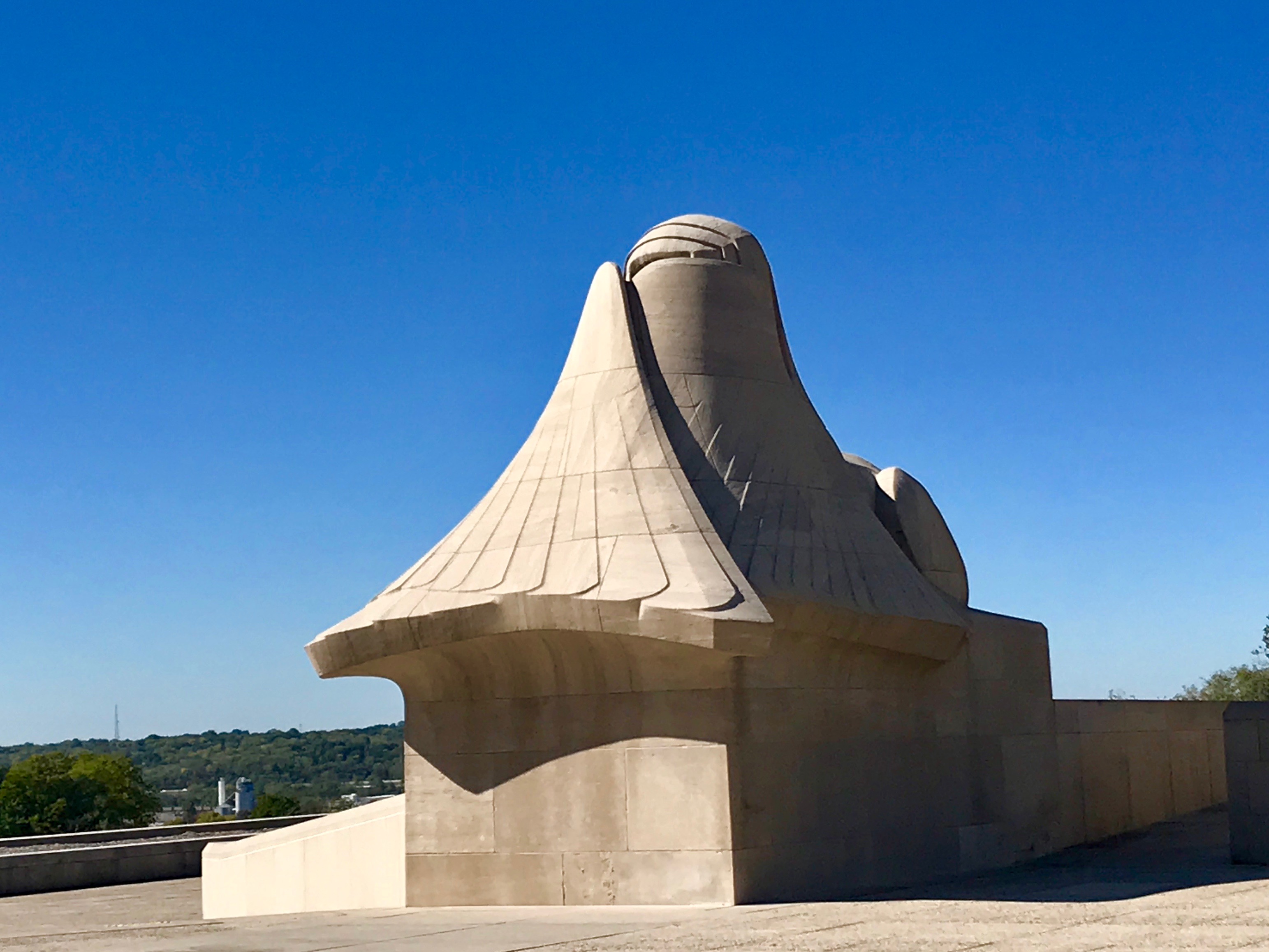
I guess it goes to show you that even back in 1921, they didn’t believe that this really was the War to End All Wars. The future was so bleak that the sphinx didn’t even want to look at what was going to happen next.
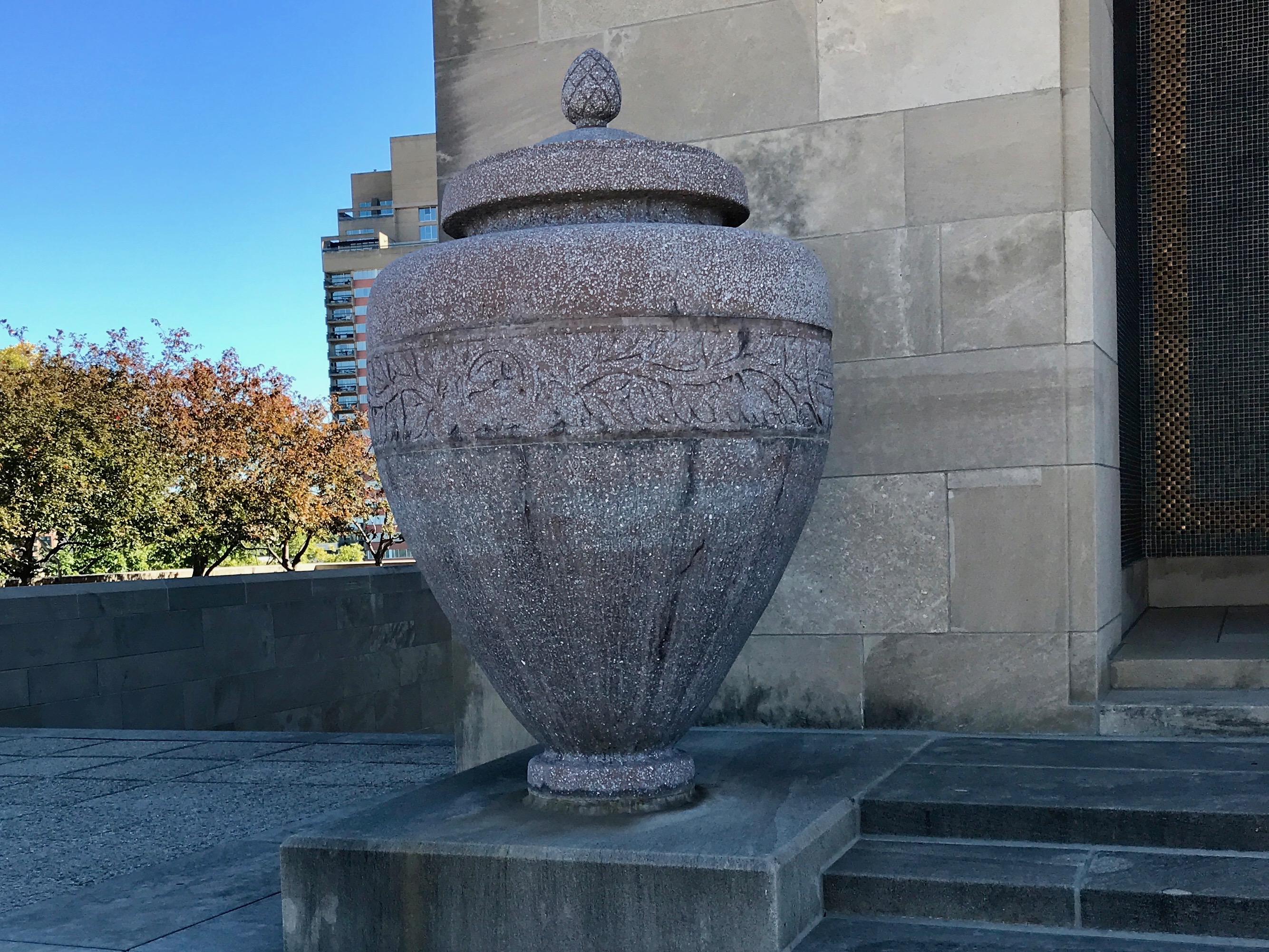
I climbed the steps past the ornamental urns.
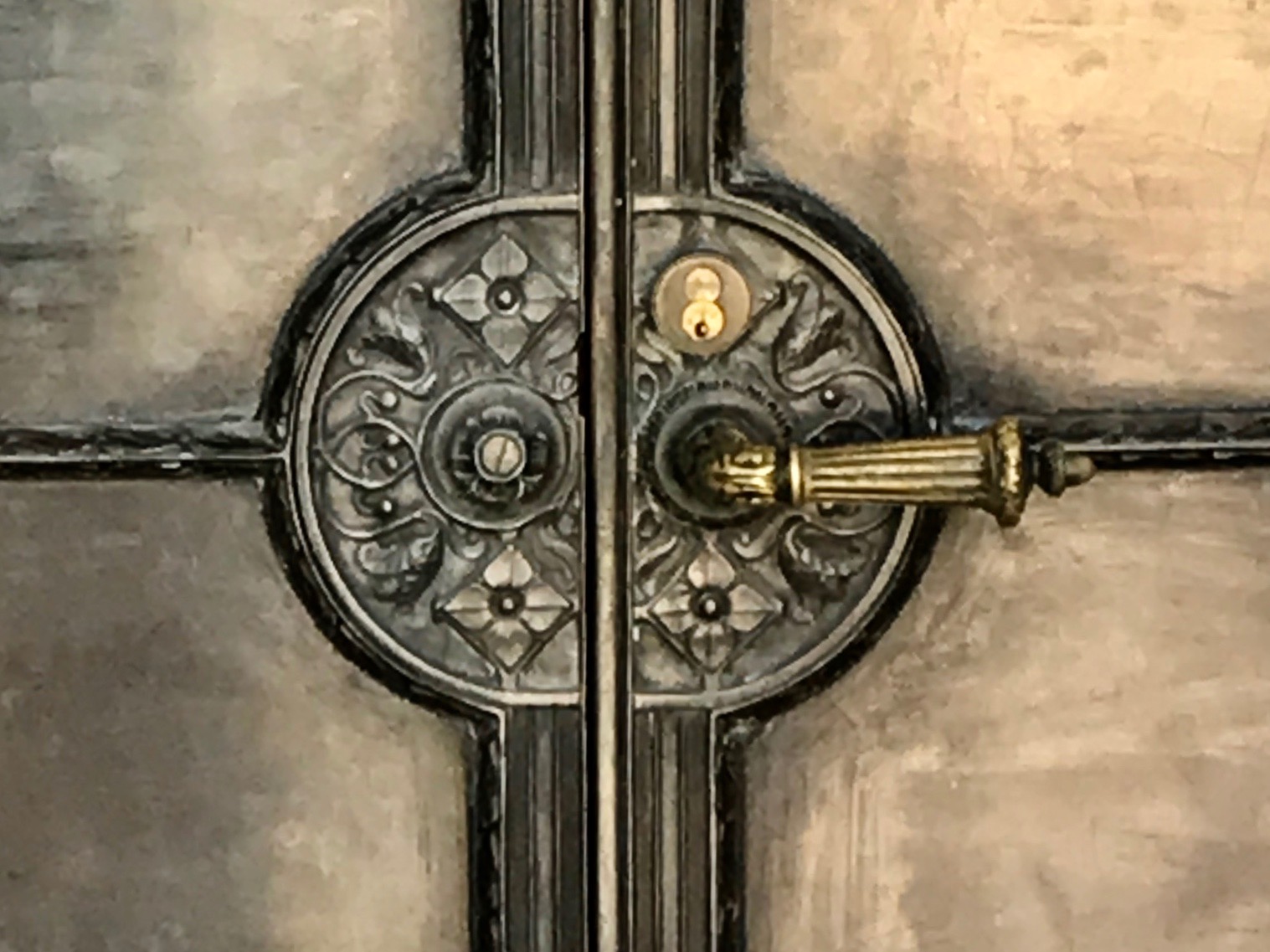
The doors had some intricate work on them.
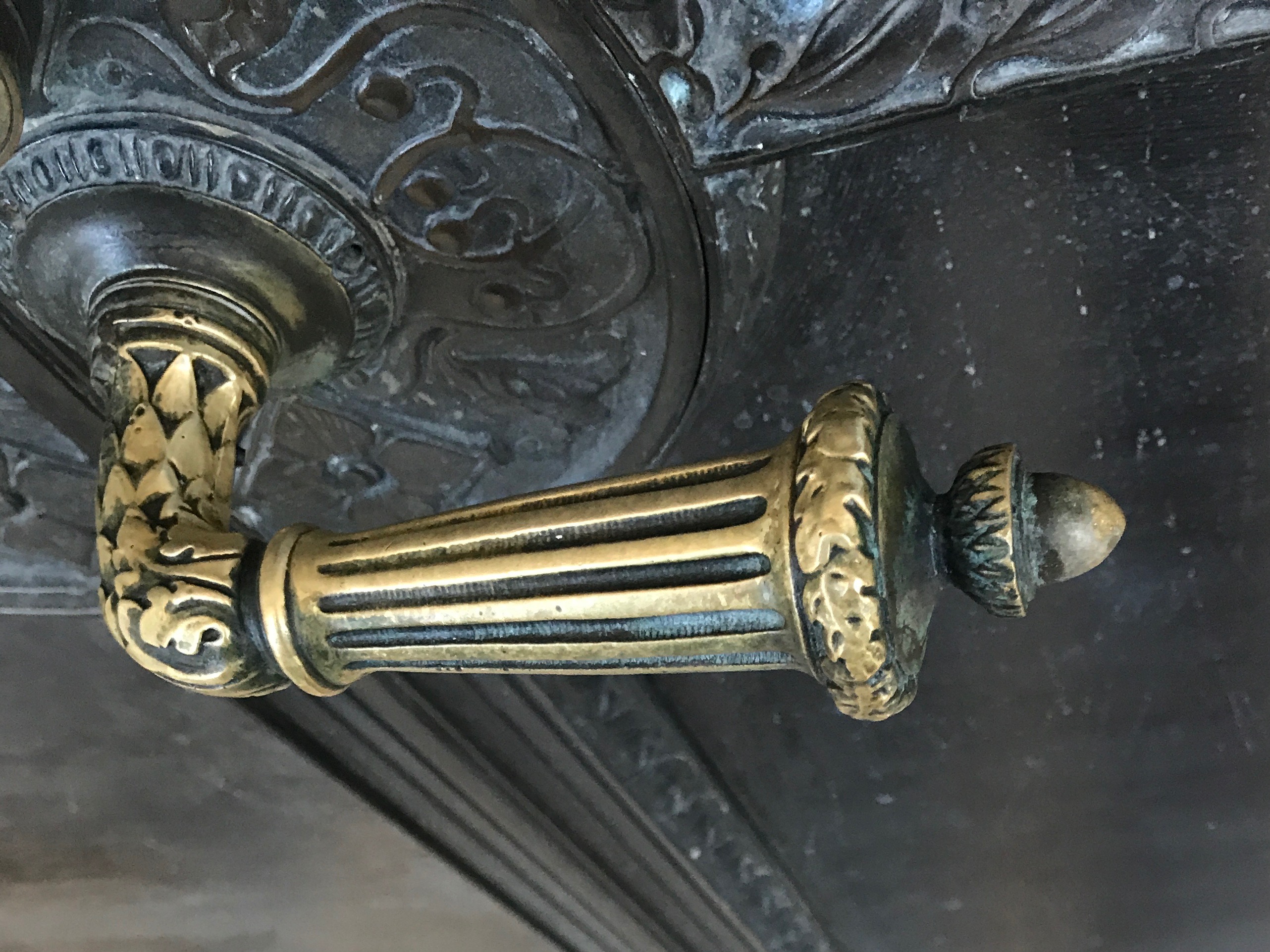
Wait! There’s an acorn on the handle. I racked my brain for a connection. I seemed to remember something about the oaks of Verdun.

It turns out that the forests around Verdun were devastated during the longest running battle of the war. More that 400,000 French and German Lives were lost, and the Verdun’s oak and chestnut forests still bear the scars of the conflict that took place over a century ago. More than 700 square miles of forests were destroyed.

There are a few stories about how the acorns got to England, but they were planted as tributes to the fallen, even while the battles were still raging. Woodland Trust, a United Kingdom conservation charity, has succeeded in locating some of the original trees grown from the seeds taken from the battlefield and they are now engaged in growing the next generation of the trees as a perpetual memorial.
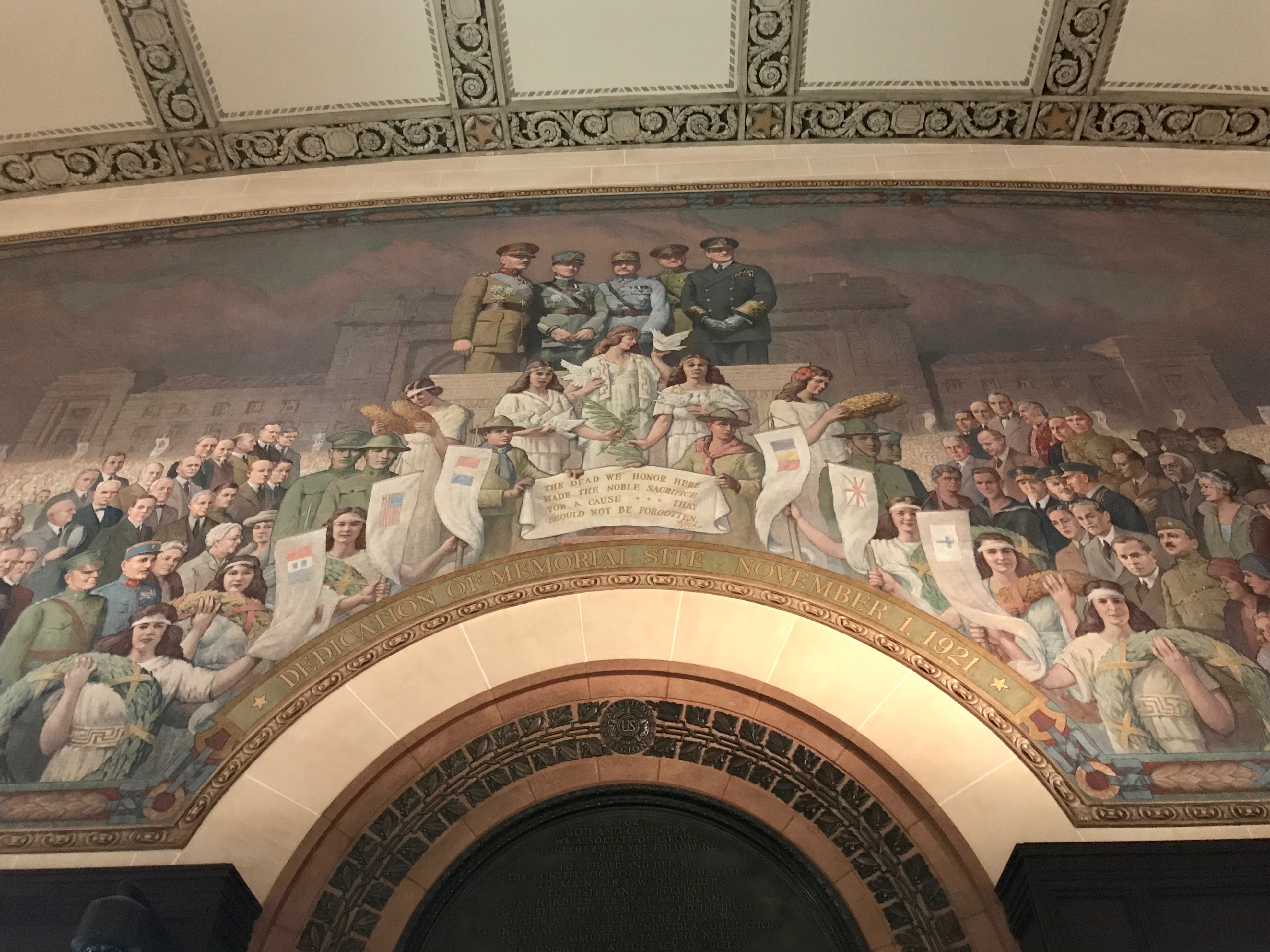
Inside the buildings are some interesting murals.
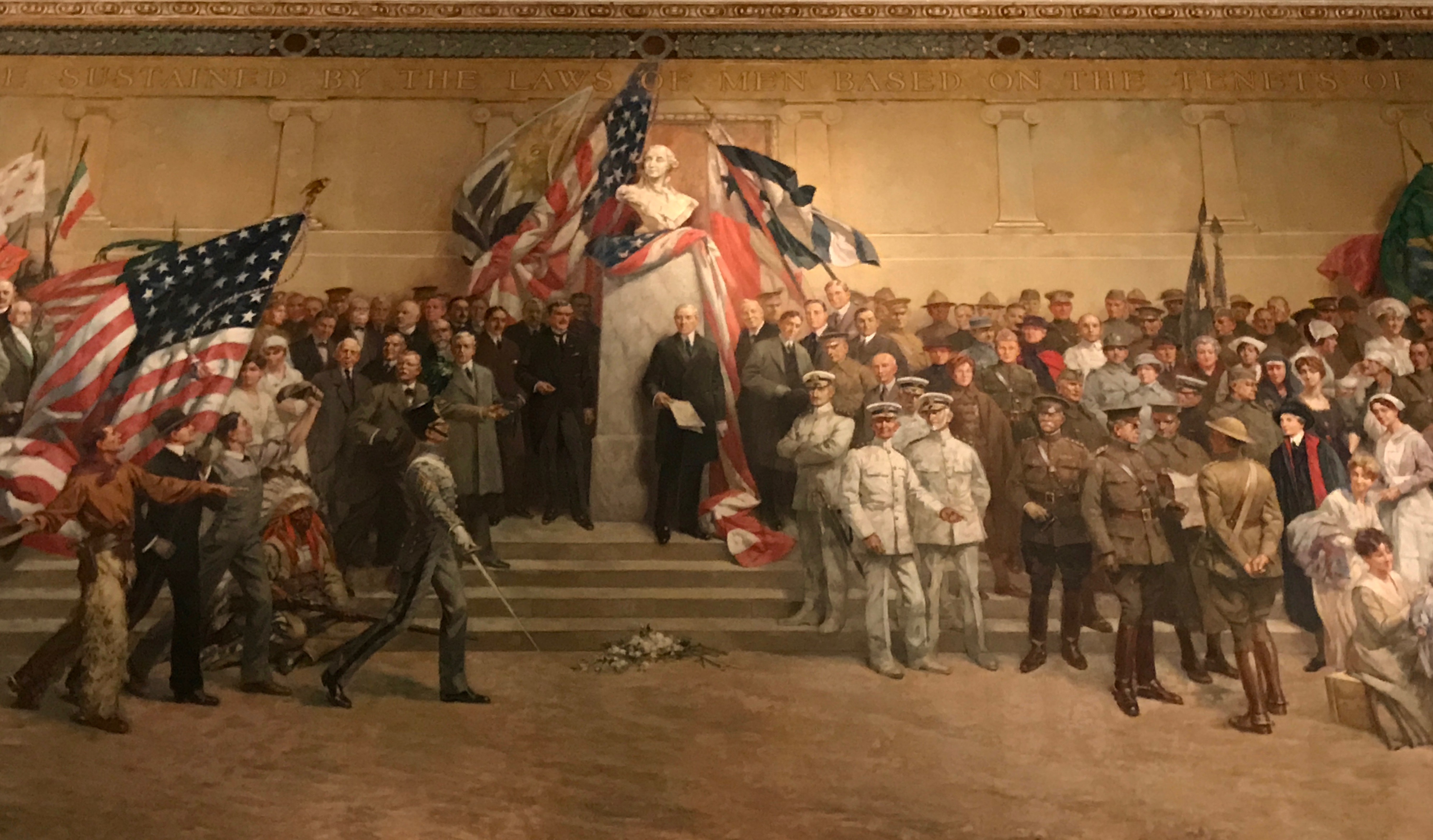
What is exhibited in the two buildings are actually portions of a massive painting called the Panthéon de la Guerre. The project was begun in September 1914, after the Battle of the Marne. It was coordinated by French artists Pierre Carrier-Belleuse and Auguste François-Marie Gorguet, who were apparently well-known at the time. Around 130 artists participated in creating the monumental artwork – a circular panorama that was 402 feet tin circumference and 45 feet high. It has been described as the largest painting in the world.
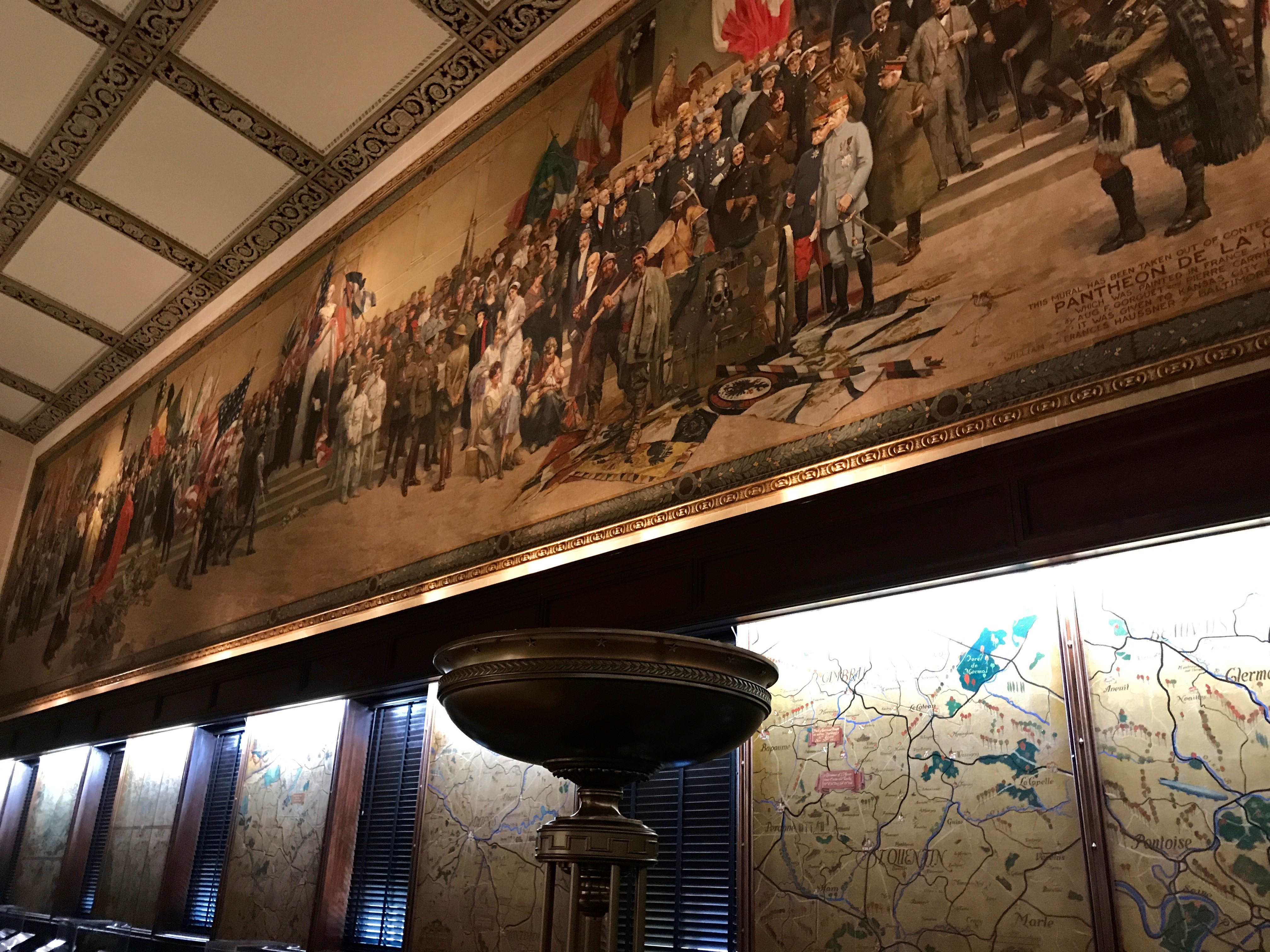
The painting included full-length portraits of around 6,000 wartime figures from France and its allies. It was executed while the war raged on and had to be updated as countries left or joined the alliance. An entire section of the cyclorama had to be repainted when the United States entered the war in 1917.
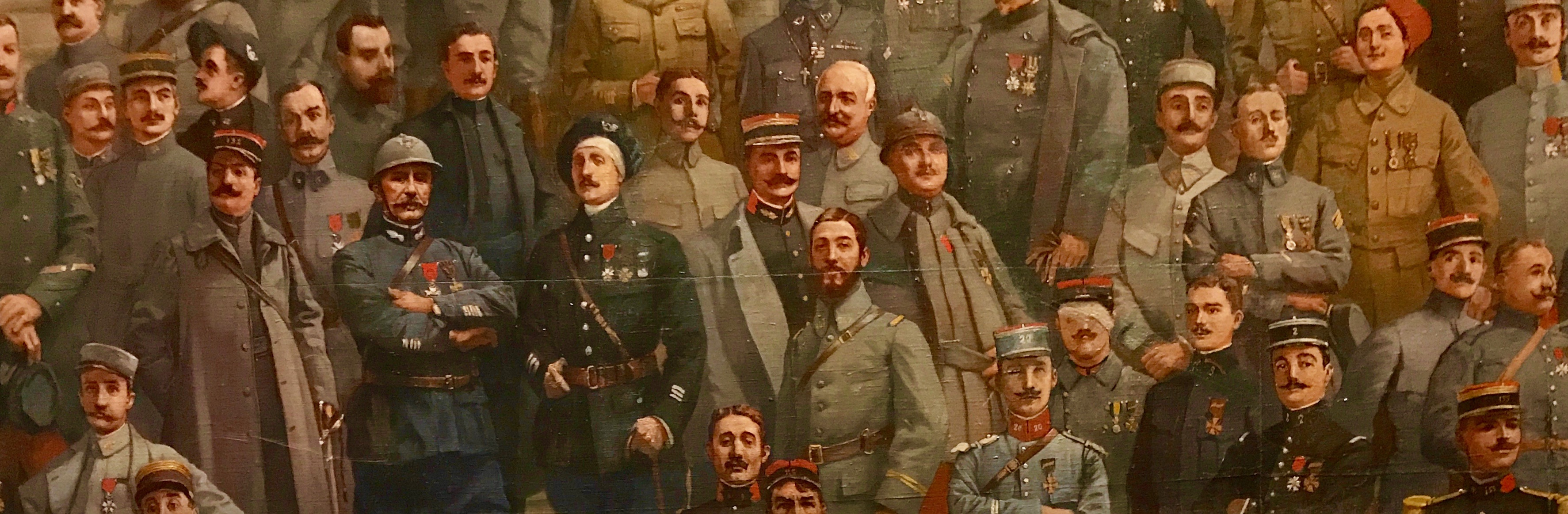
It was inaugurated by French president Raymond Poincaré in October 1918, just three weeks before the Armistice was signed. The Panthéon became an almost sacred pilgrimage site for the French people and the soldiers passing through Paris. It was visited by three million people between 1918 and 1927.

In 1927, the painting was bought by U.S. businessmen and sent on a U.S. tour. For political and marketing reasons, several figures were added to the painting and others were altered before it was shipped across the ocean. In the U.S., the Panthéon was no longer treated as the sacred object it had been in Paris. Instead, it was promoted as a “great spectacle.” I imagine the low point of public respect was when it was exhibited on the Midway at Chicago’s Century of Progress World’s Fair in 1933-1934.

The painting was all but forgotten after World War II. It sat moldering in outdoor storage until Kansas City Artist Daniel MacMorris procured it for the Liberty Memorial in 1957. MacMorris cut up the panorama, drastically reducing it and reconfiguring it to fit into the space available. In the process, he transformed the original, French-focused composition into the U.S.-centric mural that we see today. He altered and cut the French section – the Panthéon’s largest section – to fit the west wall of the other building.
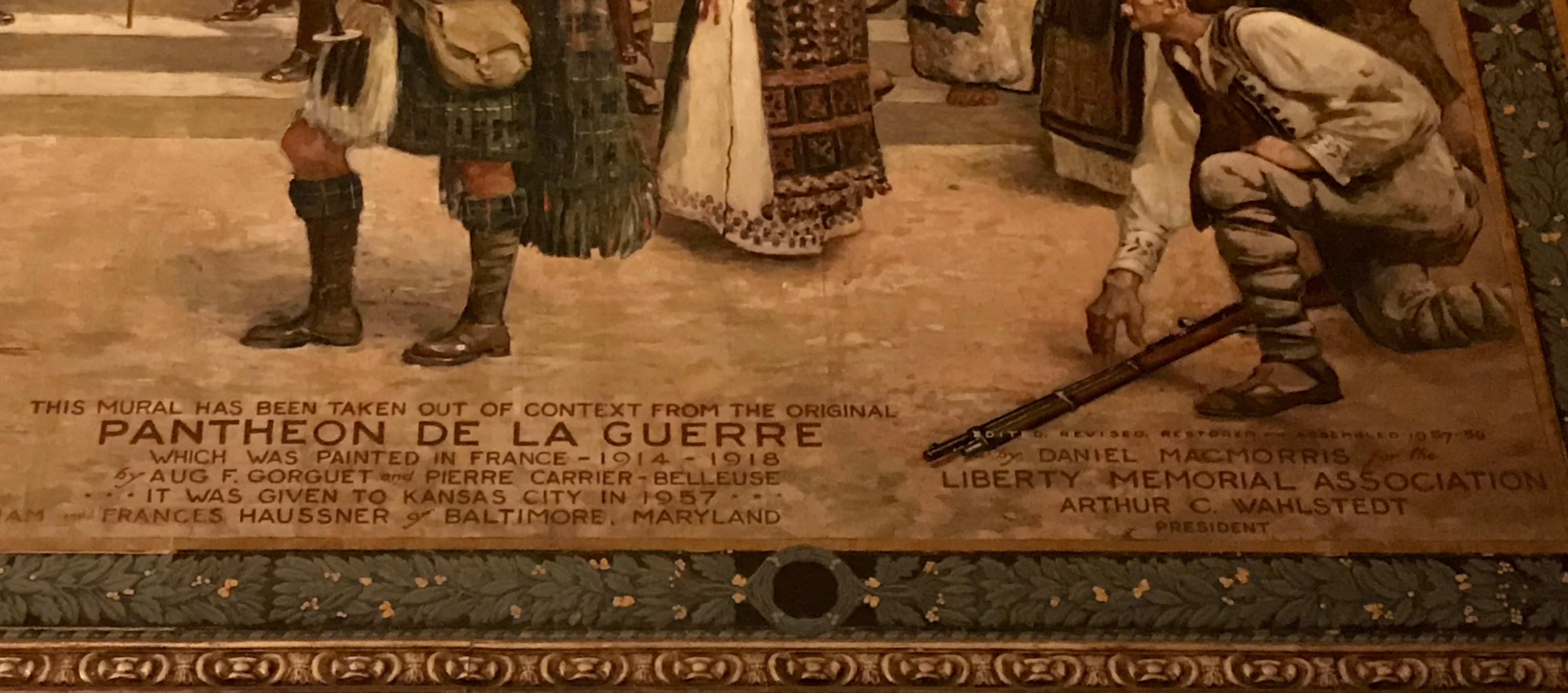
In case you can’t make out the writing on this part of the mural, it says, “This mural has been taken out of context from the original Panthéon de la Guerre, which was painted in France – 1914 – 1918. It was given to Kansas City in 1957. Frances Haussner of Baltimore, Maryland. Edited, revised, restored and assembled by Daniel MacMorris for the Liberty Memorial Association. Arthur C.  Wahlsted, President”

While it might seem like a pity that such a monumental work of art that moved so many people for so many years should not be conserved in its original form, it is an interesting metaphor for how we reimagine and reshape our personal and national histories.

There were many more things that were displayed in these two halls. Perhaps I’ll share them in my next post.
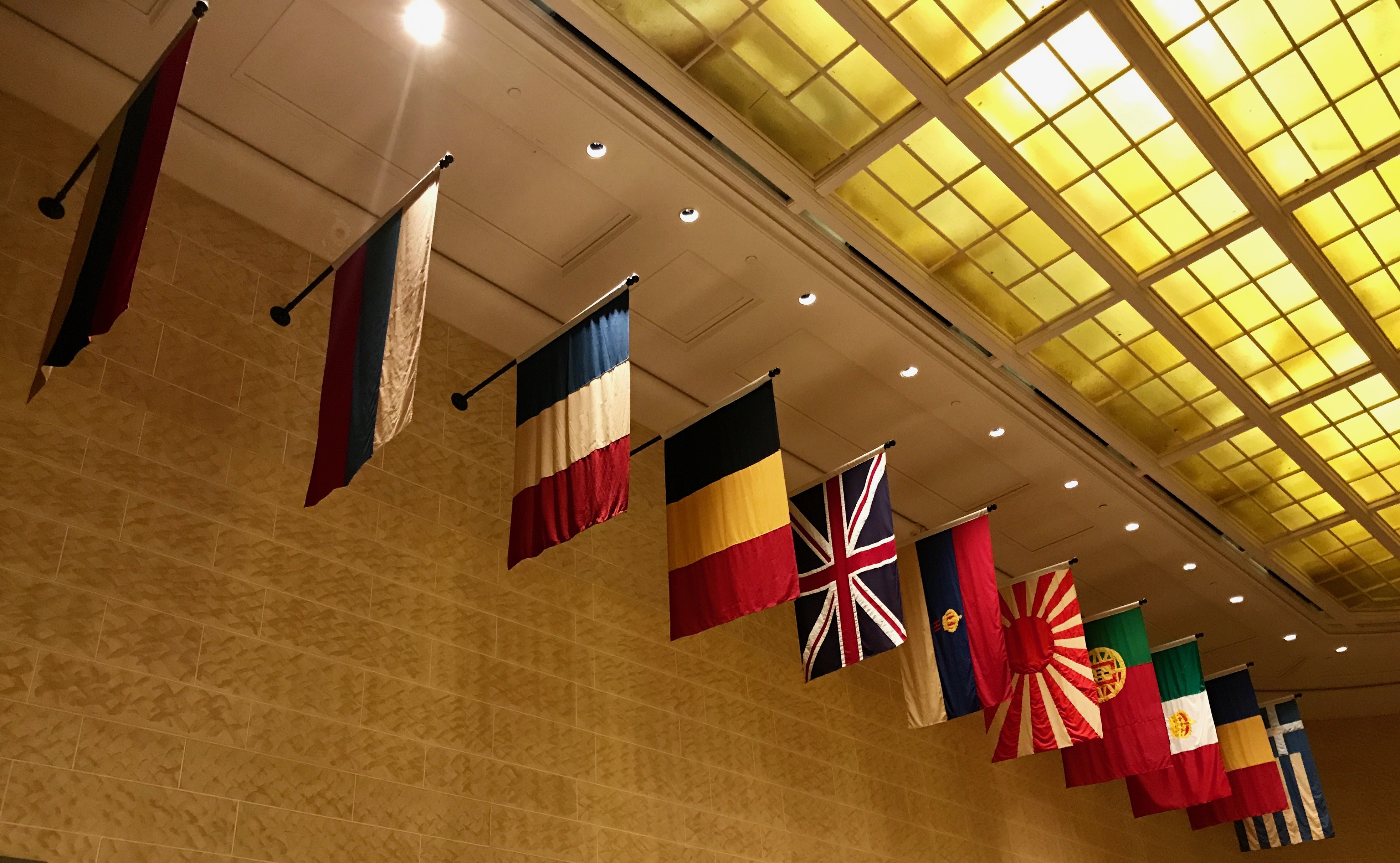
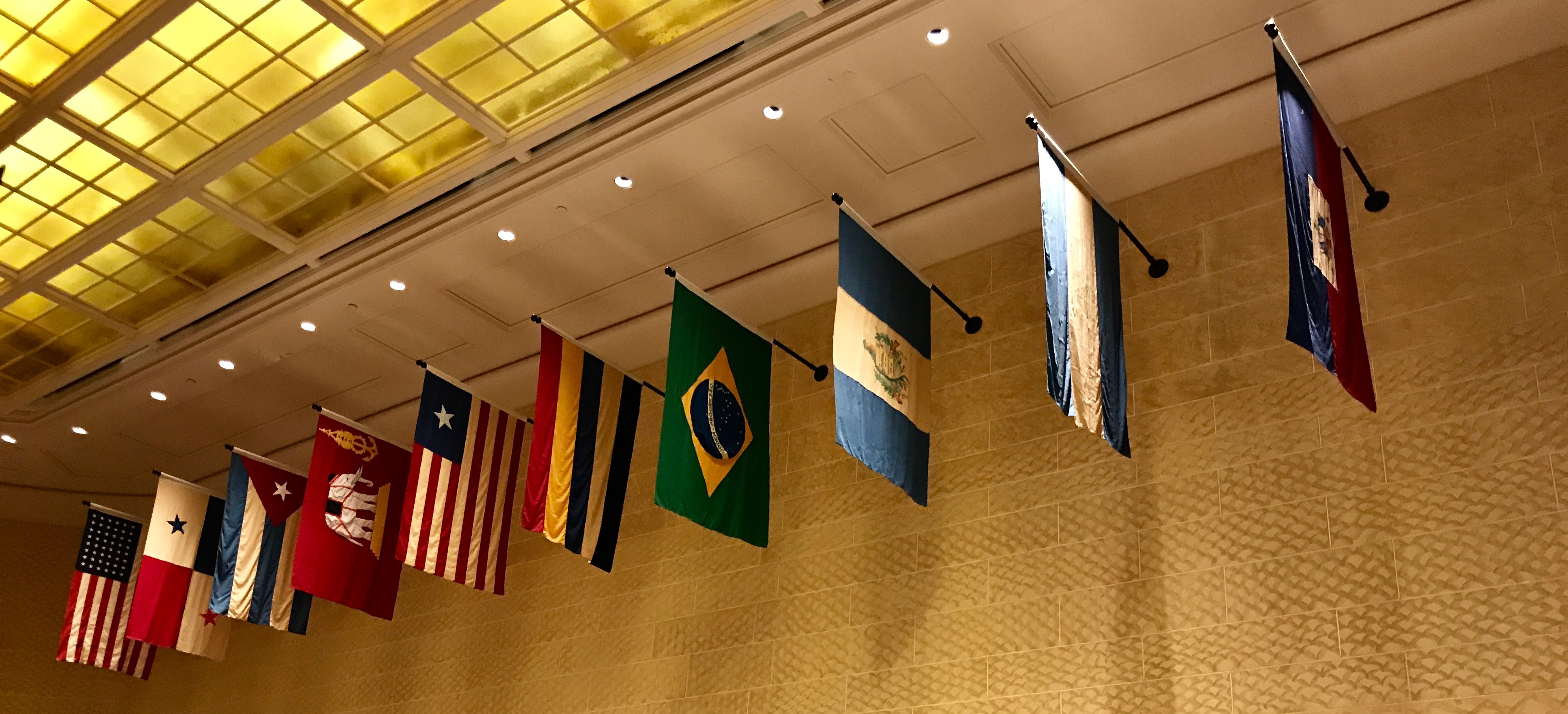
Until then, I’ll close with the flags of the allies.
And a map showing that it really was a global conflict.

Map of Alliances in World War I.
Helmandsare, Joaopais, El Jaber, Aivazovsky
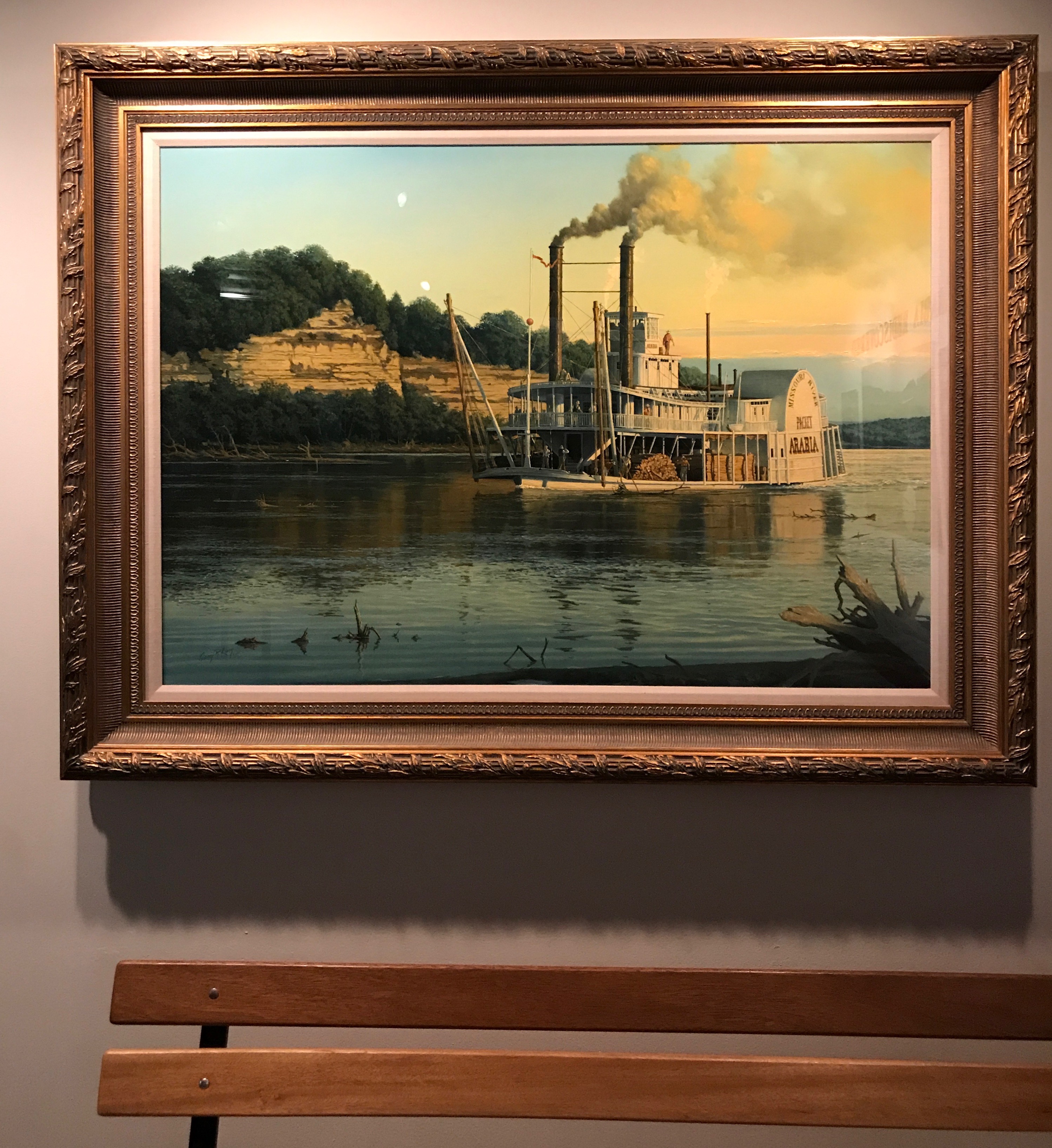


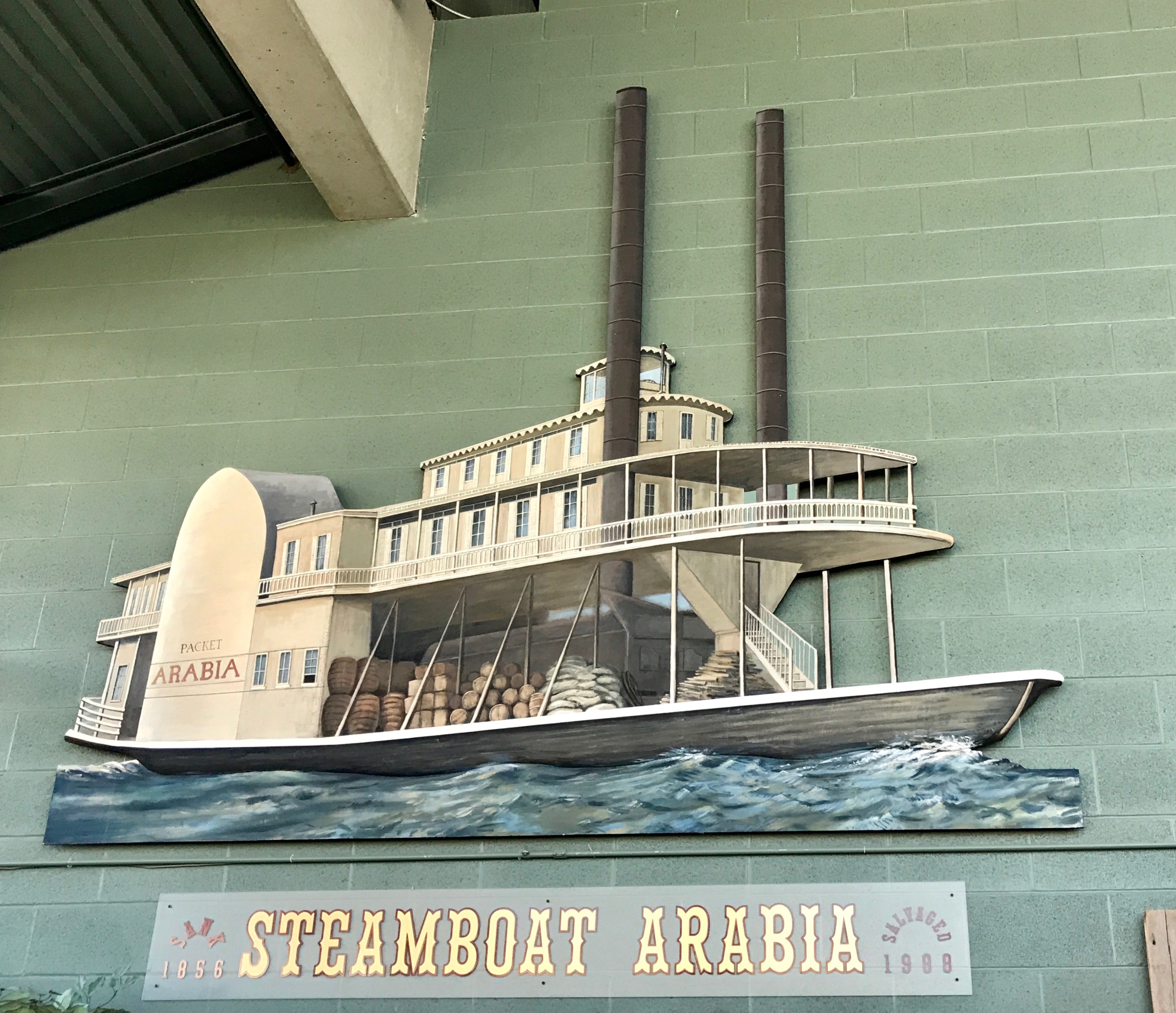
Steamboat Arabia

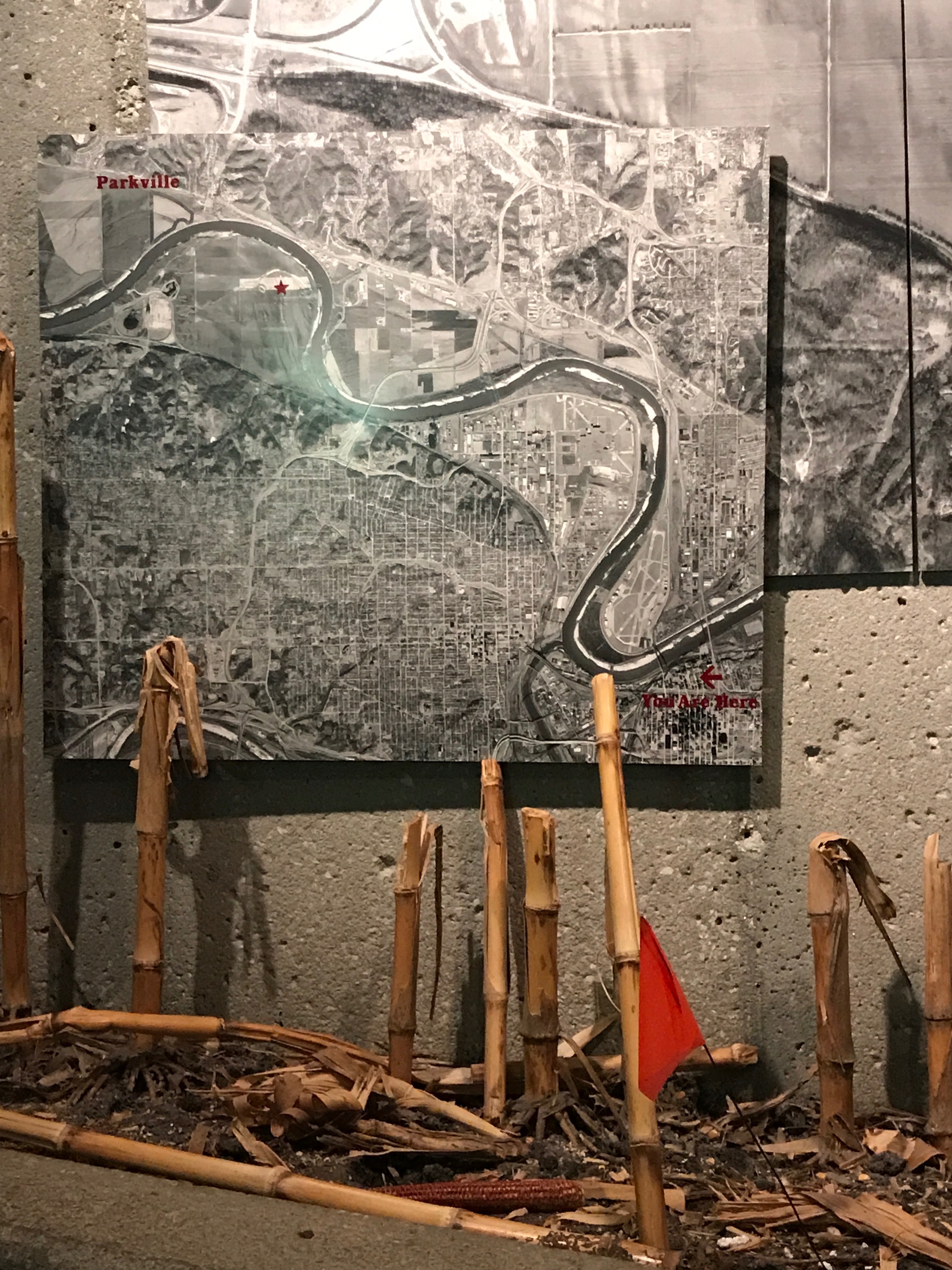
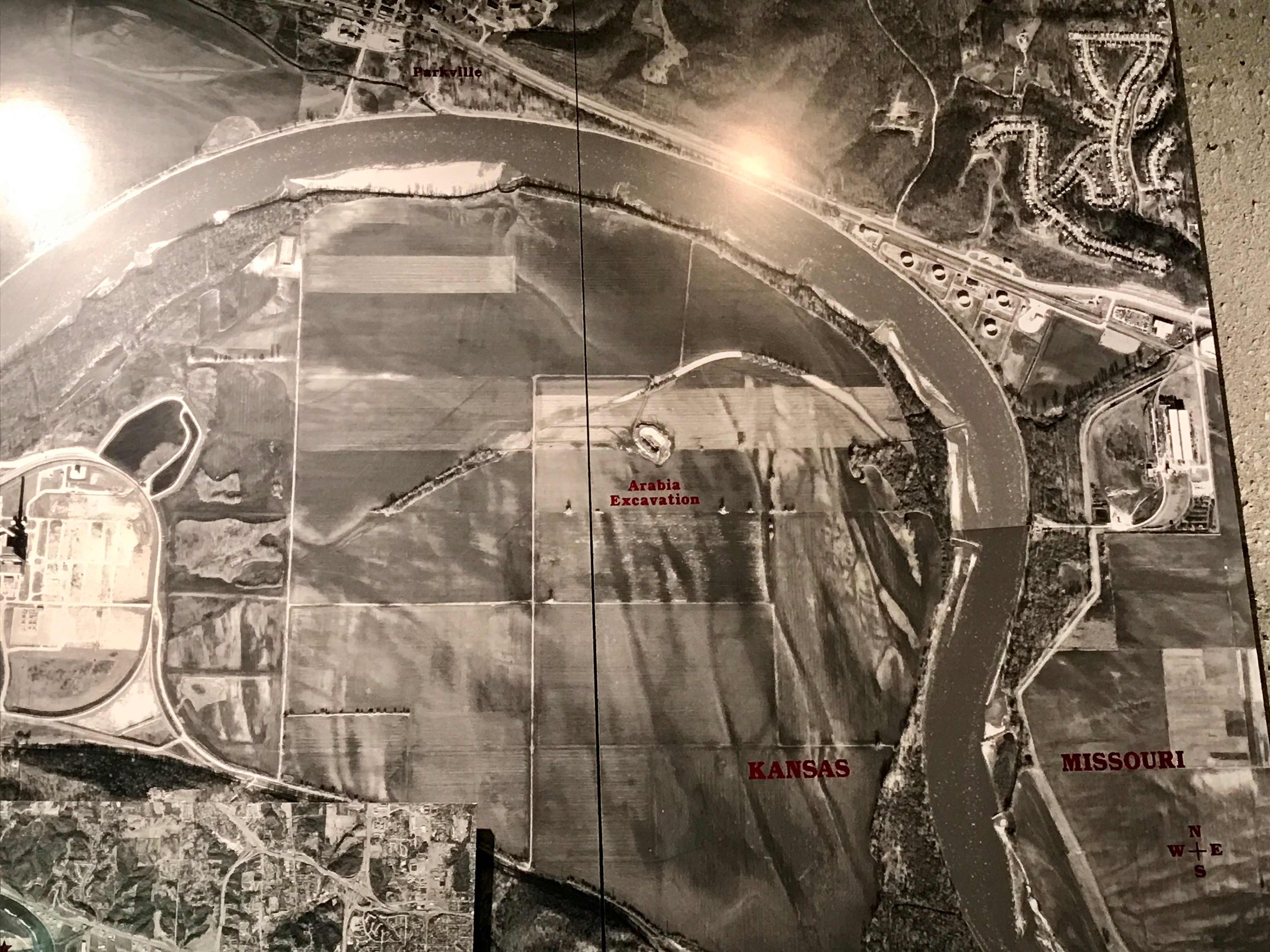
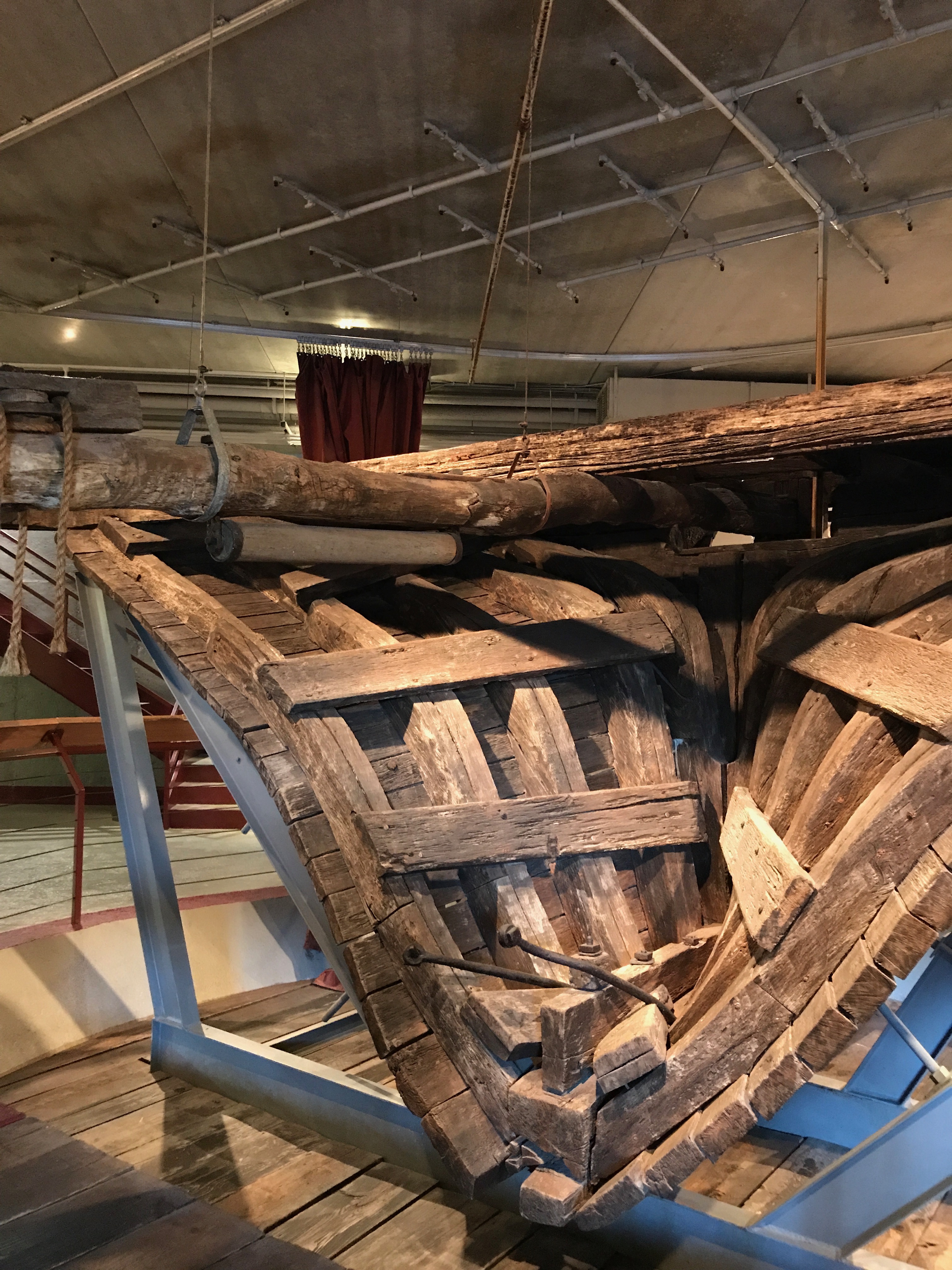
Long ago, I remembered hearing about the recovery of the Steamboat Arabia that  hit a snag and sank in the Missouri River in 1856 near Kansas City. What was amazing to me is that they found it buried 45 feet beneath a farmer’s field and about half a mile from where the river runs today.

This painting, by Gary R. Lucy, is titled THE ARABIA: The Afternoon of Her Last Voyage, 1856.

The Arabia, loaded down with whiskey and other frontier necessities,  was on a routine run when it hit a snag.

Incidentally, snag refers to trees, branches and such that are found sunken in rivers and streams. In this case, The Arabia ran afoul of a dead sycamore. it ripped open the hull, which filled with water. The upper decks stayed above water, and the only casualty was a mule that was tied to some equipment and was forgotten in the rush to abandon ship.

Although the upper decks were above water the day it hit the snag, the boat sank into the mud that by the next day only the smokestack and the pilot house remained visible. Within a few days, these traces were also swept away.

I found the story of the recovery pretty incredible.

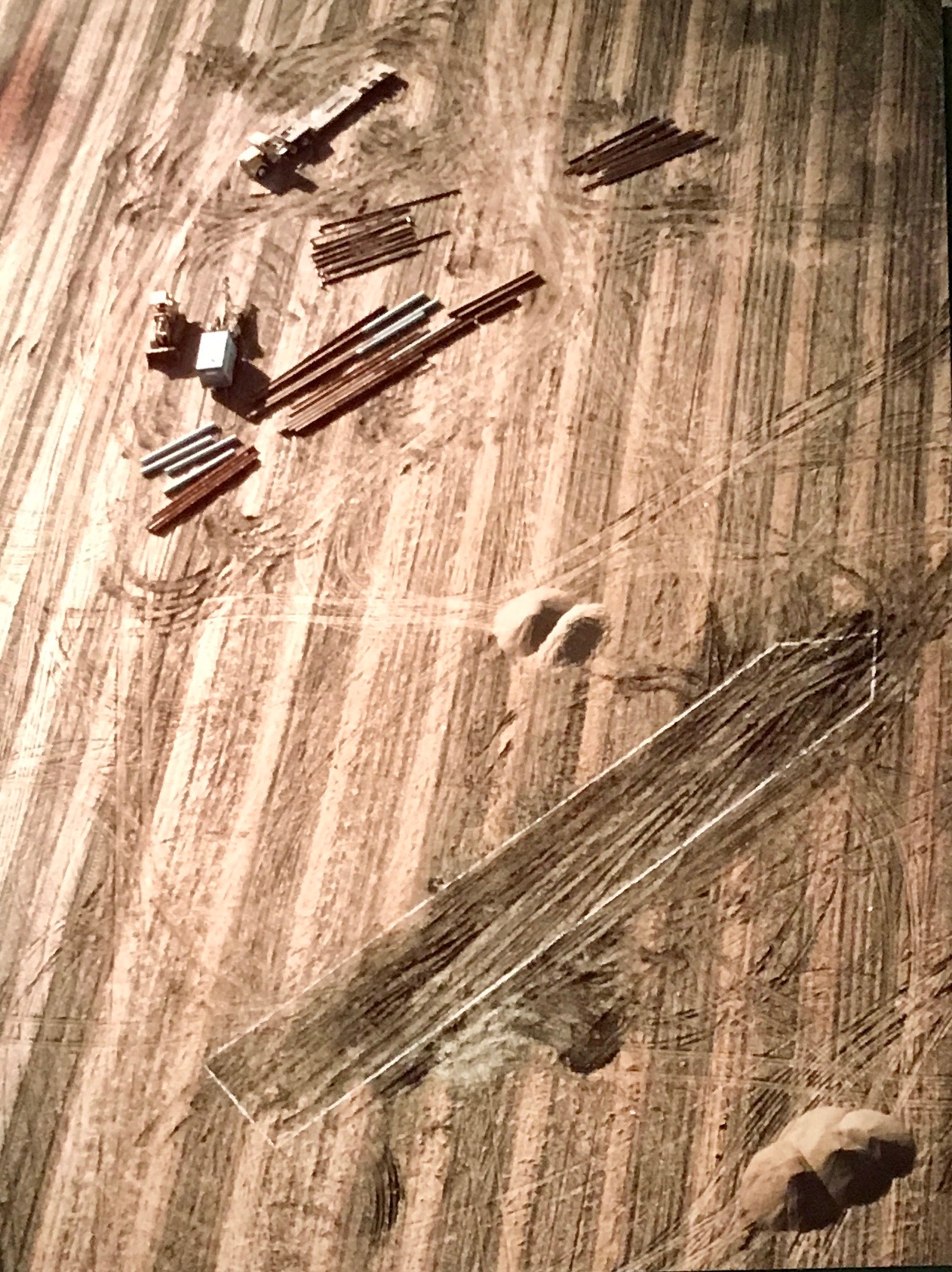
How would you know where to begin to look? In 1987, Bob Hawley and his sons, Greg and David, along with  Jerry Mackey and David Lutrell and their families, set out to find the Arabia They used old maps and a proton magnetometer to decide on a probable location.

While the steamboat was found in Kansas, the museum is in Missouri.

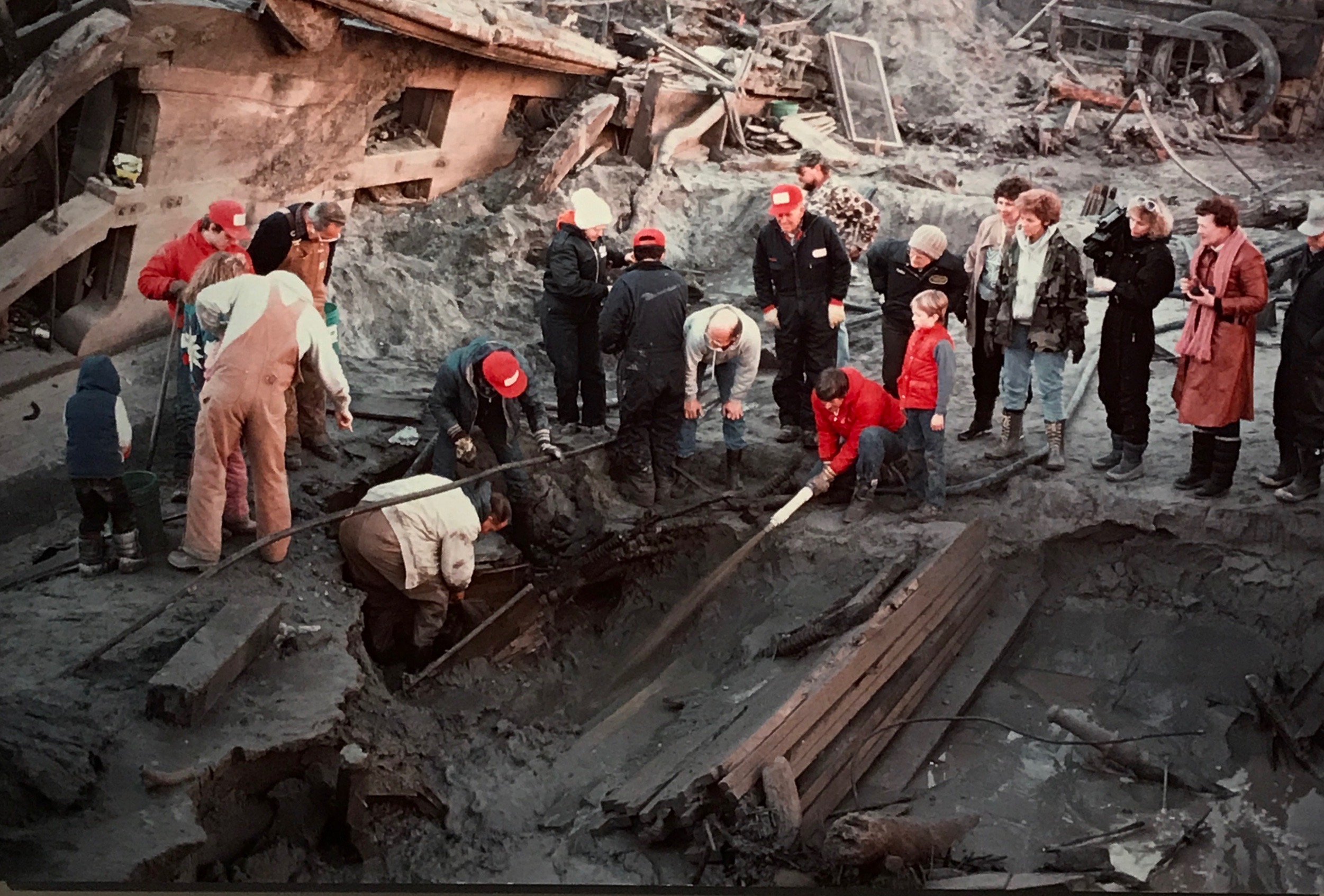
They found what they thought was the site and commenced digging in November 1988. They dug until February 1987. They were digging with the landowner’s permission. Permission was granted with one condition: the fields had to be ready for spring planting.

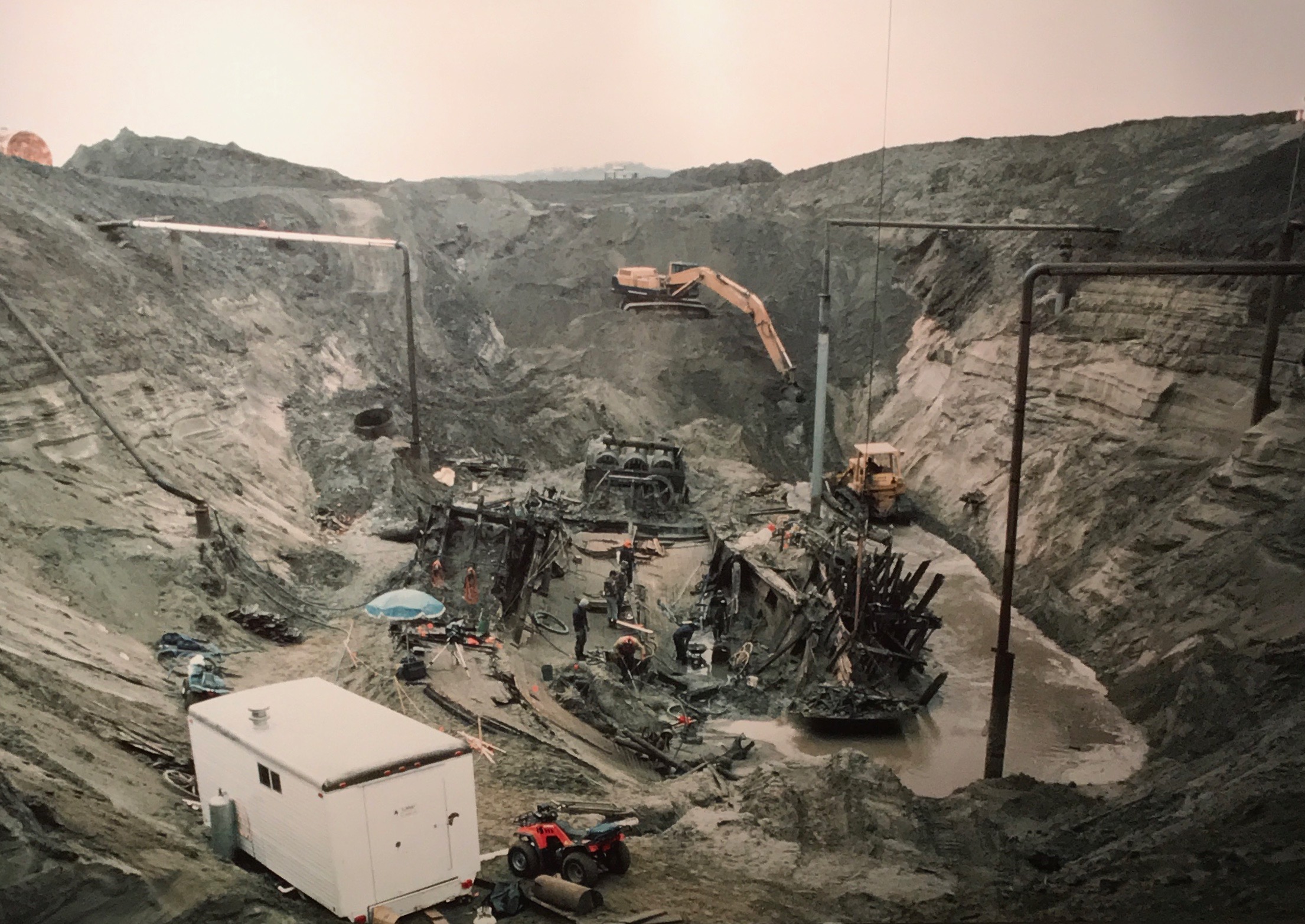
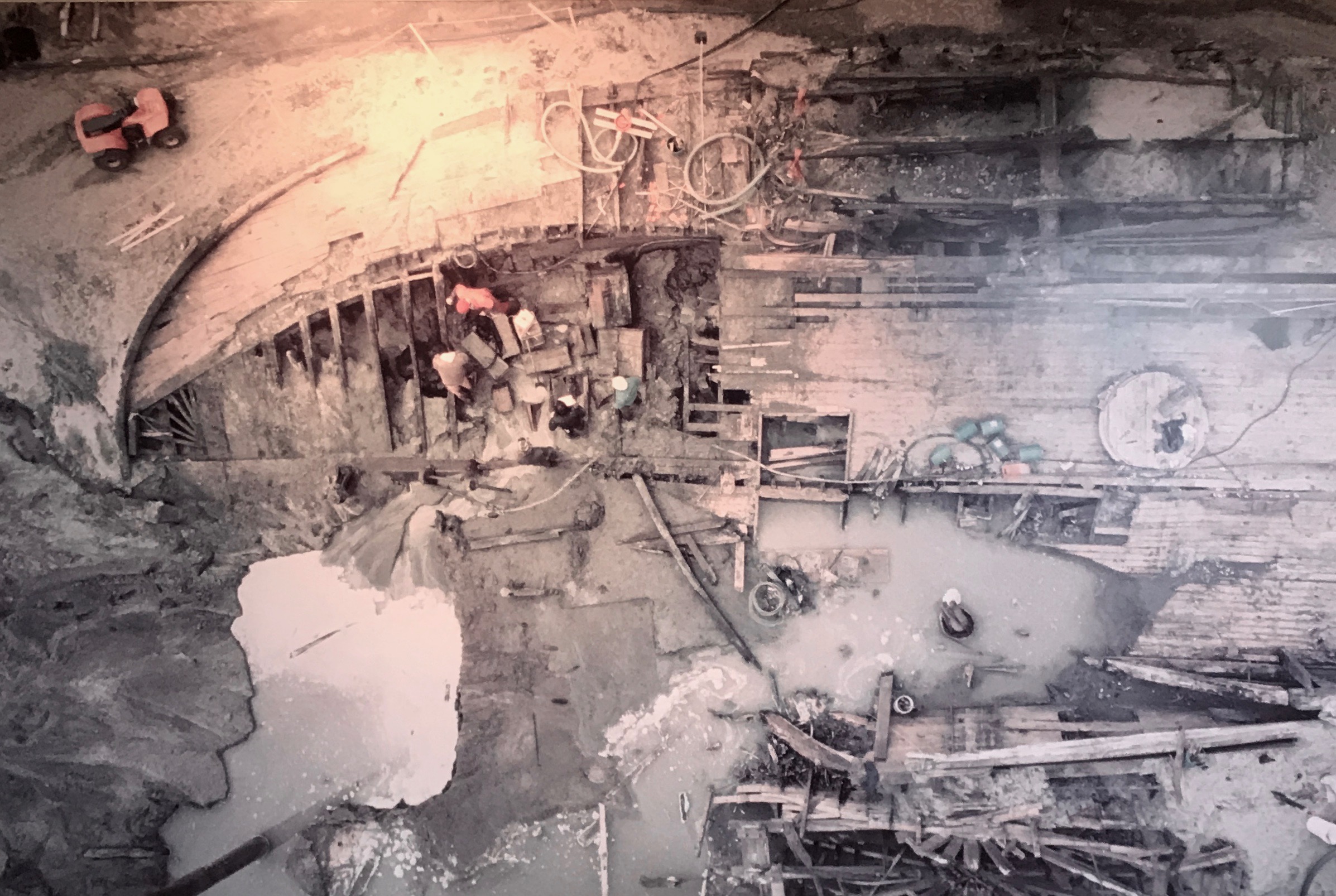
This photo gives you a view into the pit. What a monumental task!

And then they had to get the field ready for spring planting! I wonder if they made the deadline?

Their original goal was to sell their discoveries.  The historical importance of what they found buried under this Kansas farmer’s field made them change course. They started to plan a museum – a privately owned museum. Today it is still owned and operated by the Hawley family.

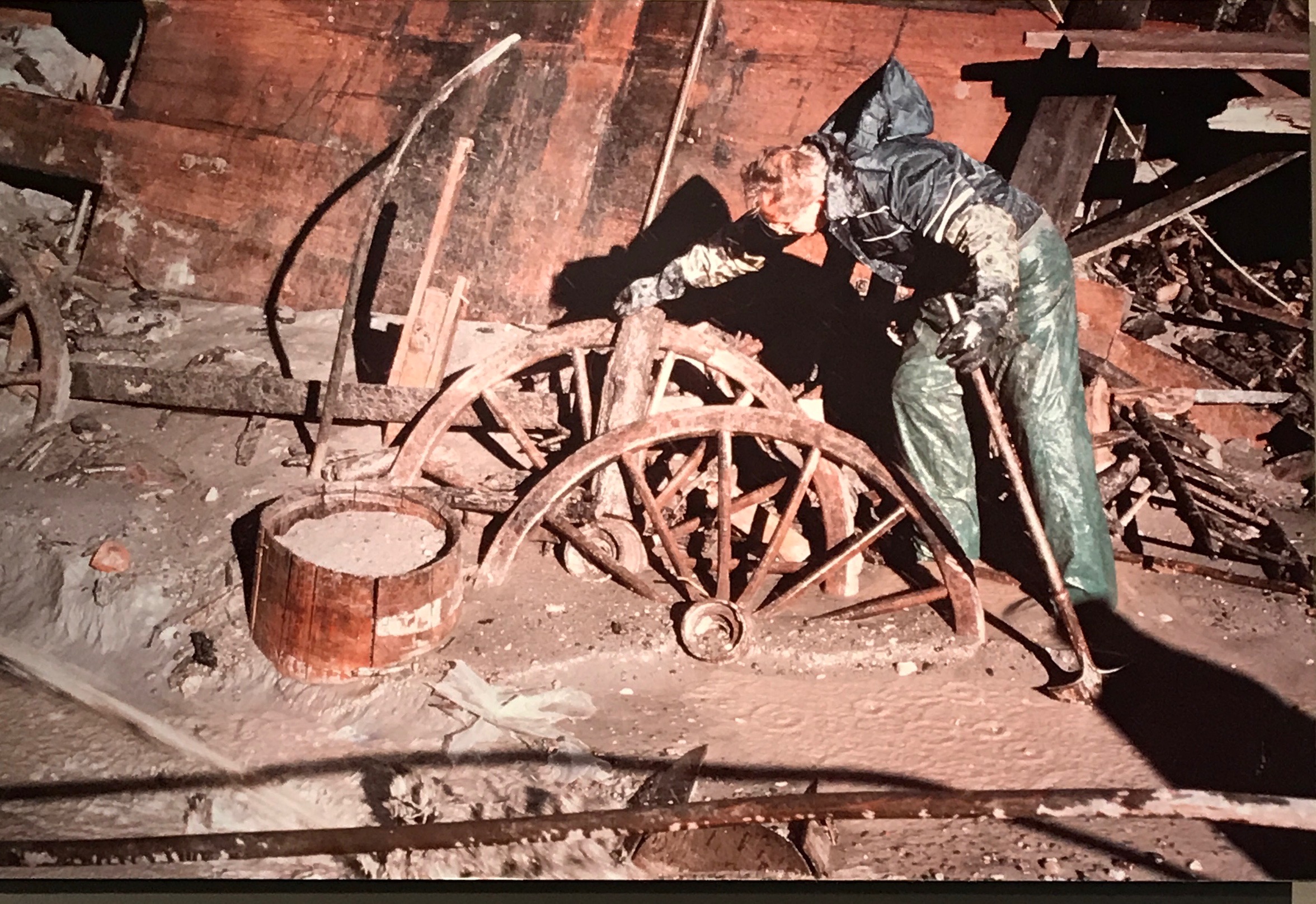
In all, they unearthed 200 tons of artifacts!

With the contents of the ship protected from light and oxygen, the artifacts they found were incredibly well preserved. Their website proclaims that the museum contains “… the largest single collection of pre-Civil War artifacts in the world.” The quantity of items is amazing – and they still have 60 tons of what they excavated yet to process.

Well, enough of the preamble. Let’s go inside.

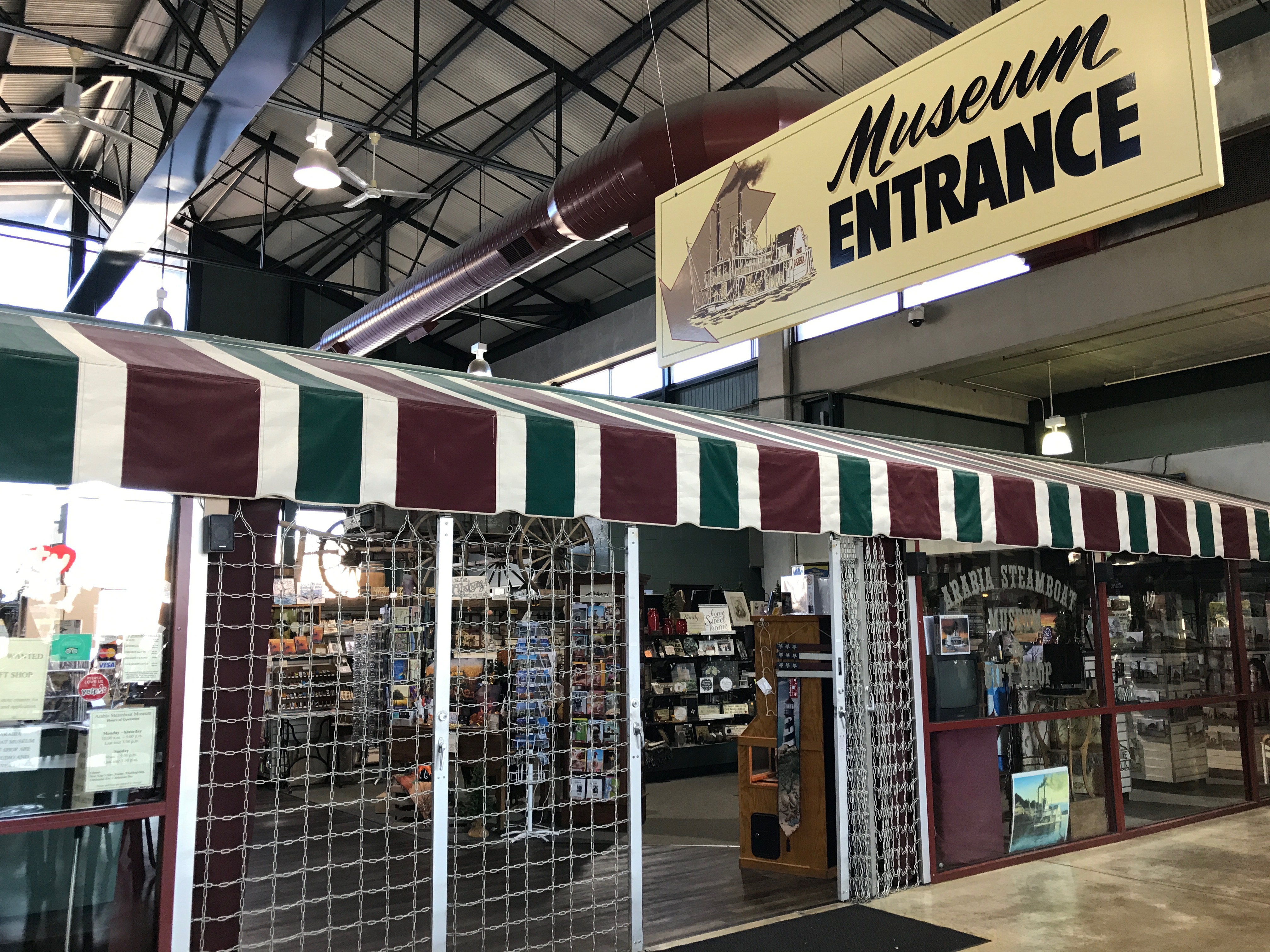
Enter through the gift shop…that’s a variation on a theme!

The sign let me know I was heading in the right direction.

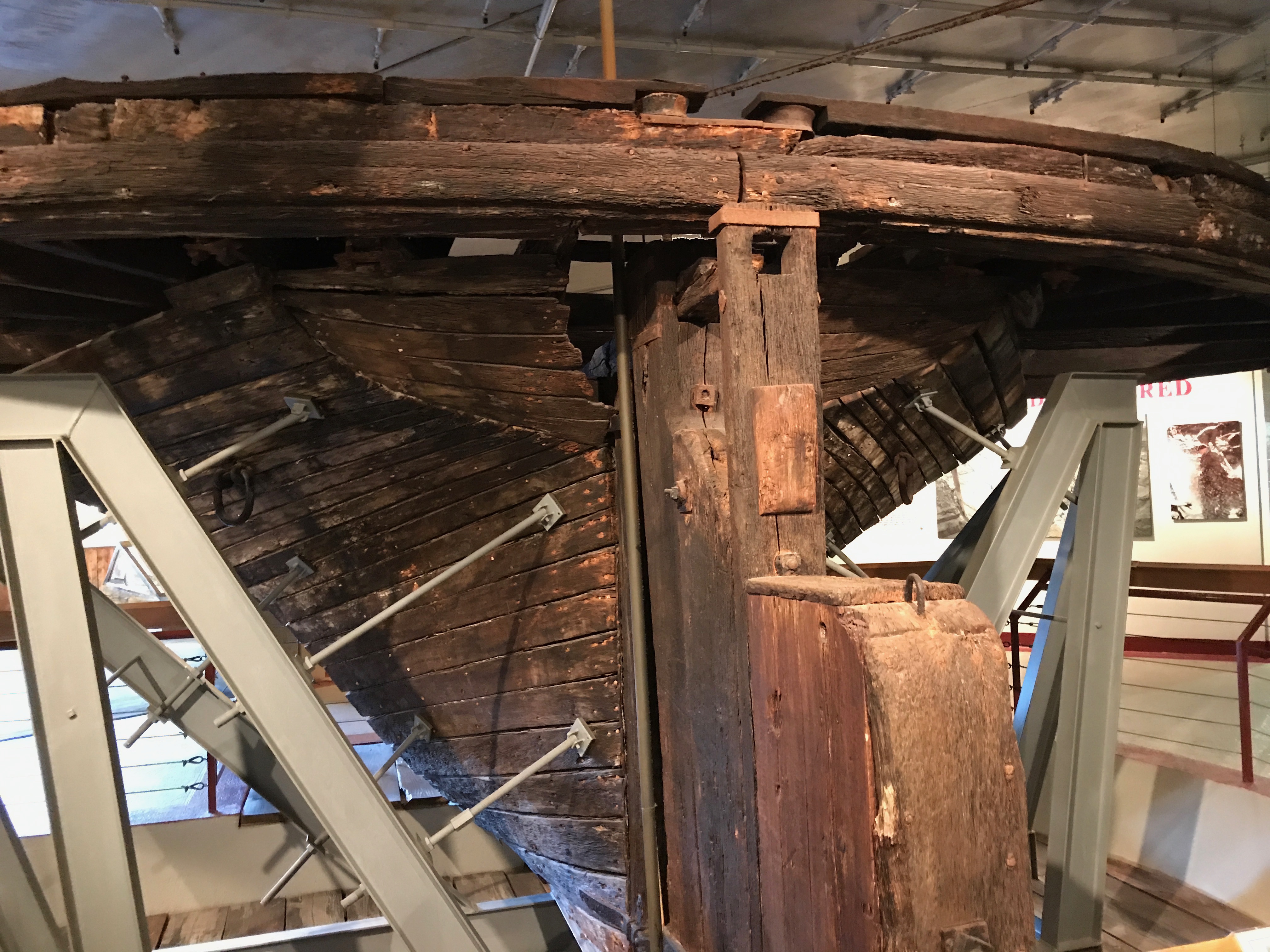
The steamboat was built in Brownsville, Pennsylvania on the Monongahela River. This hull originally travelled on the Ohio and Mississippi Rivers before it came to the Missouri River.

“But, what did they find in the cargo?!” I can practically hear you shouting at your screens. Your wait is over!

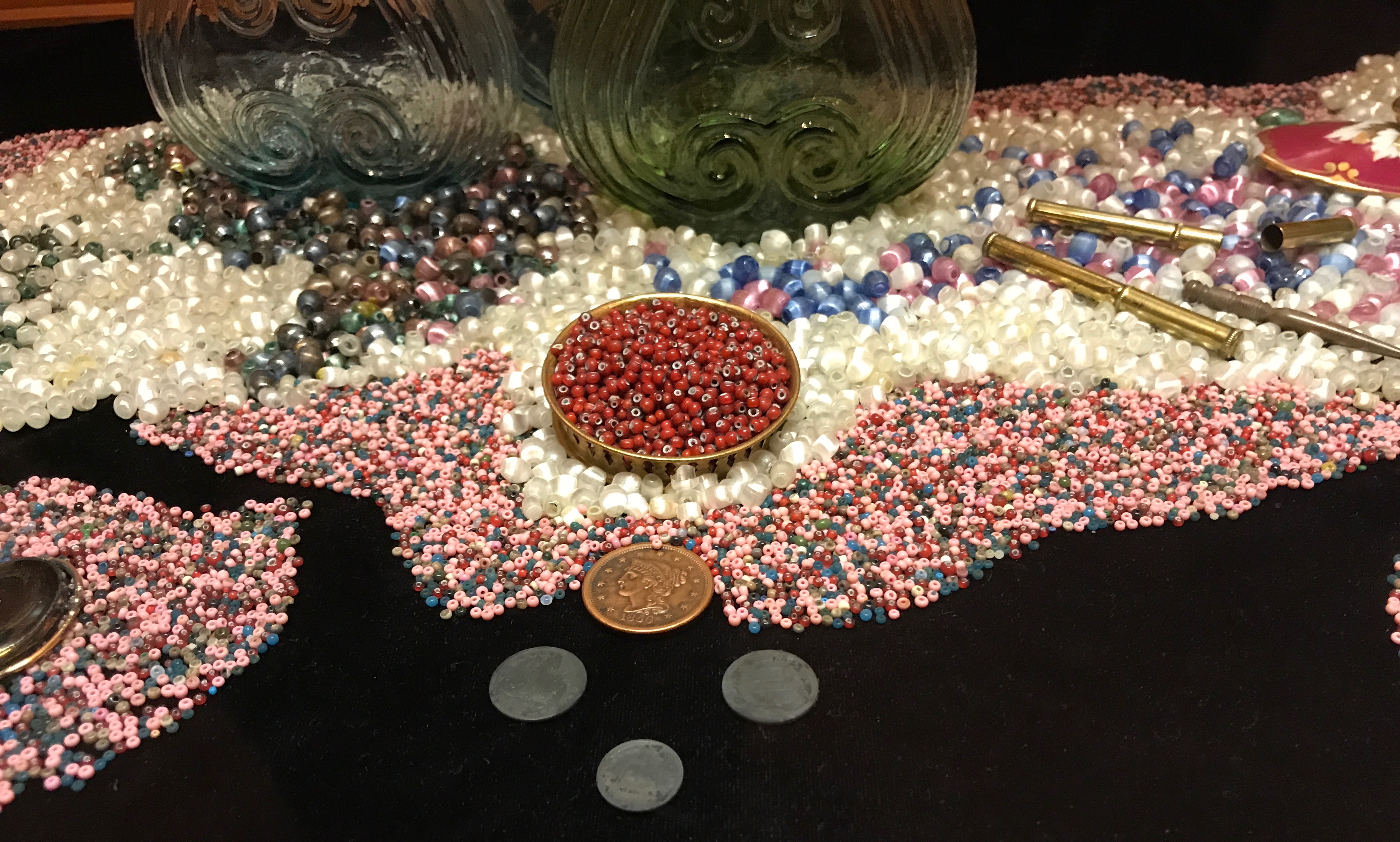
They found beads.

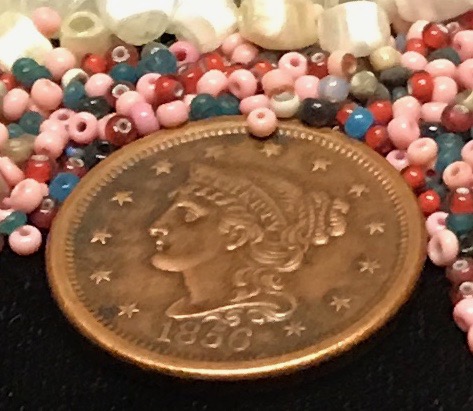
And a coin that was newly minted when the boat sank.

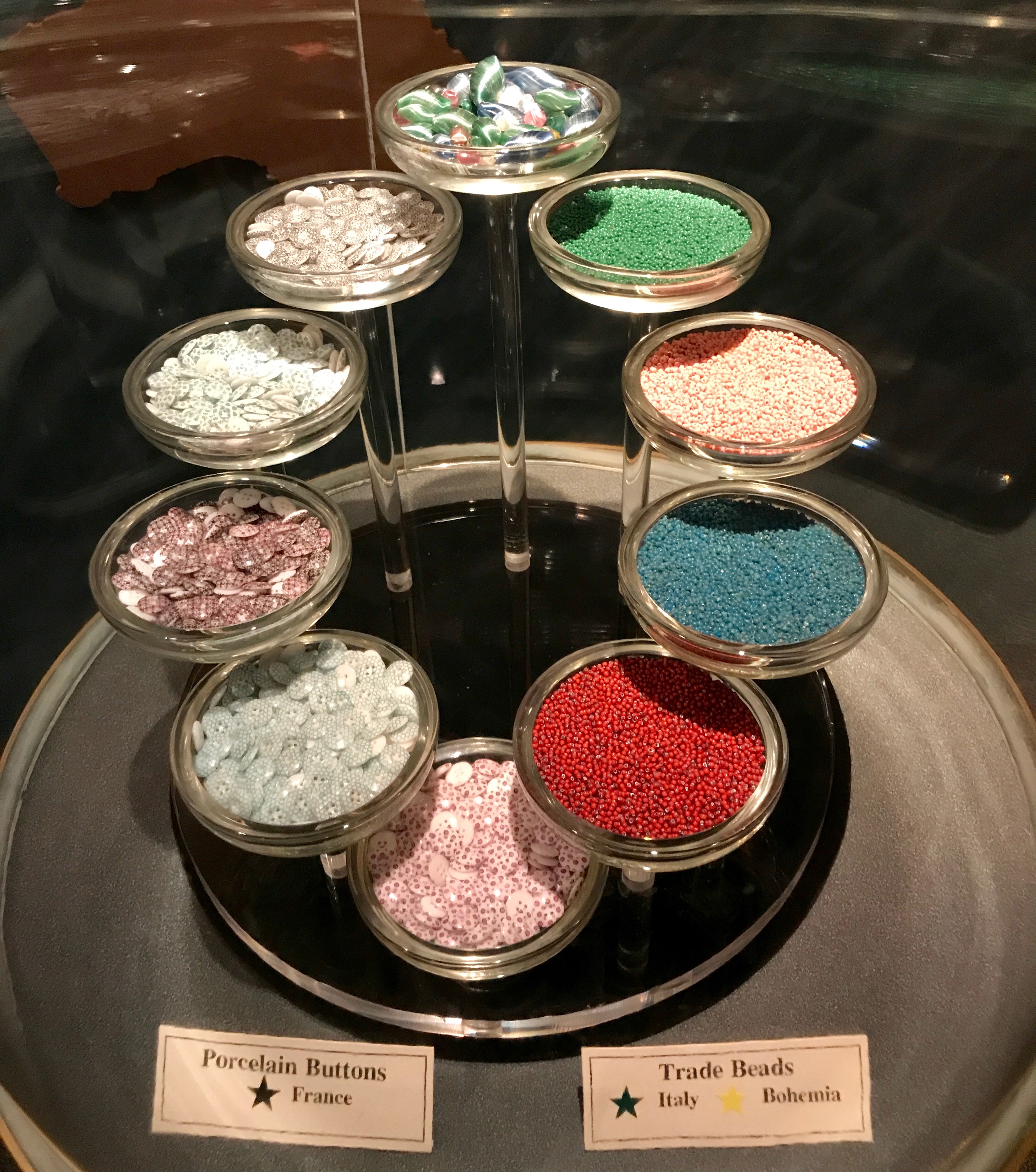
Beads and buttons – from France, Italy, and Bohemia. (Bohemia is where Czechoslovakia is today.)

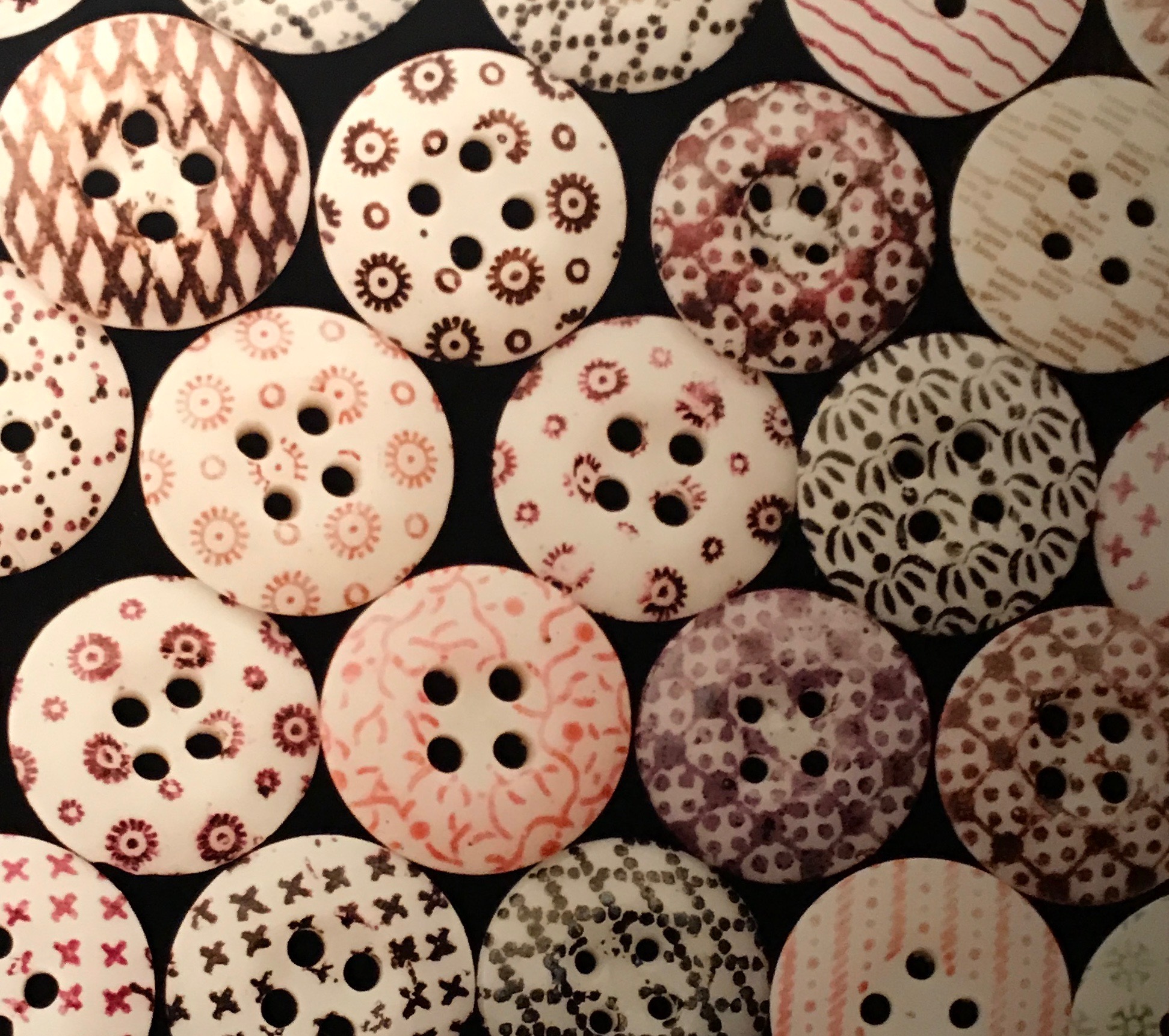
Those buttons were pretty snazzy! Each of the thousands and thousands of the buttons and beads had to be cleaned by hand.

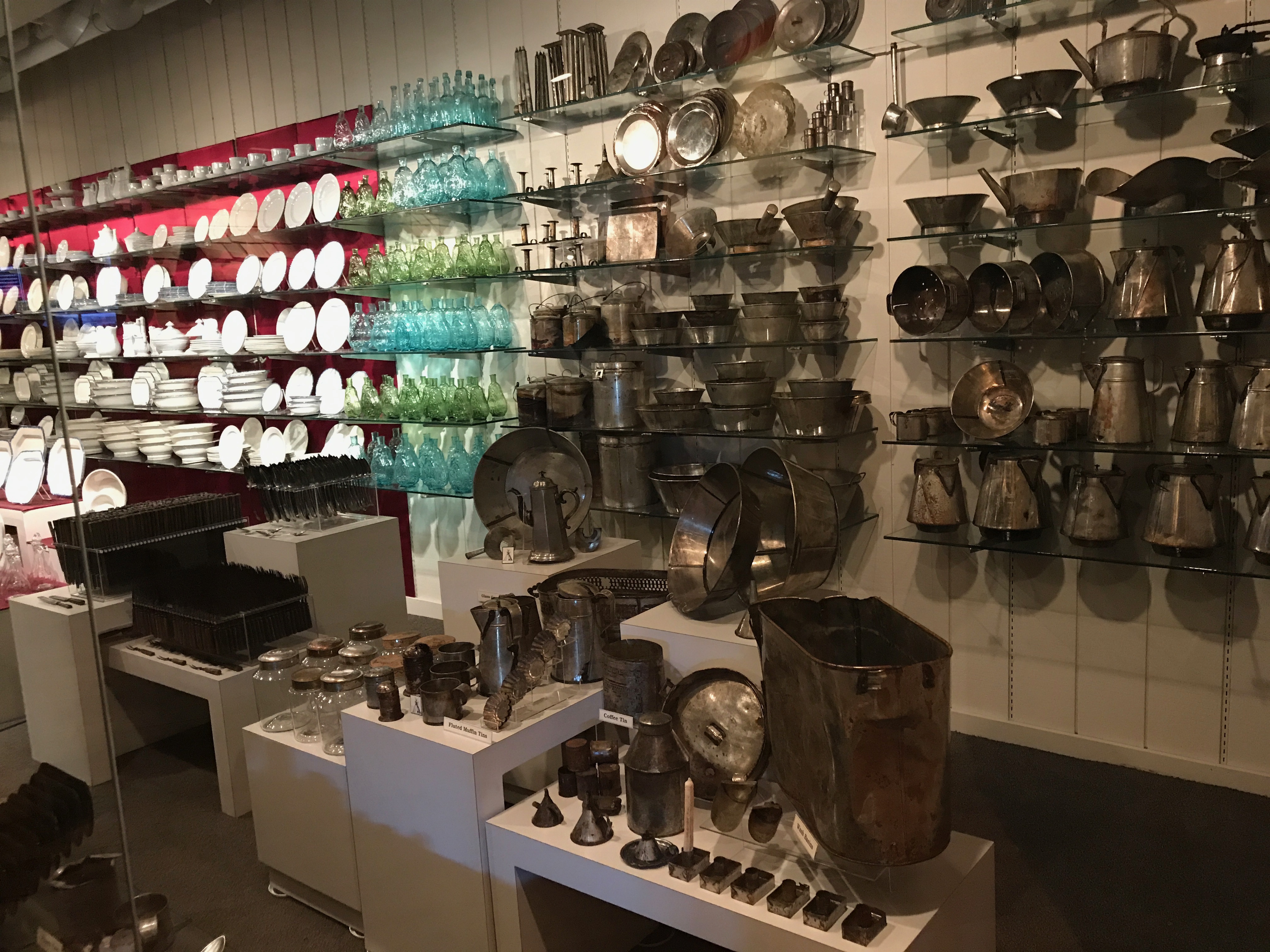
Dishes, glassware and metalware were on board.

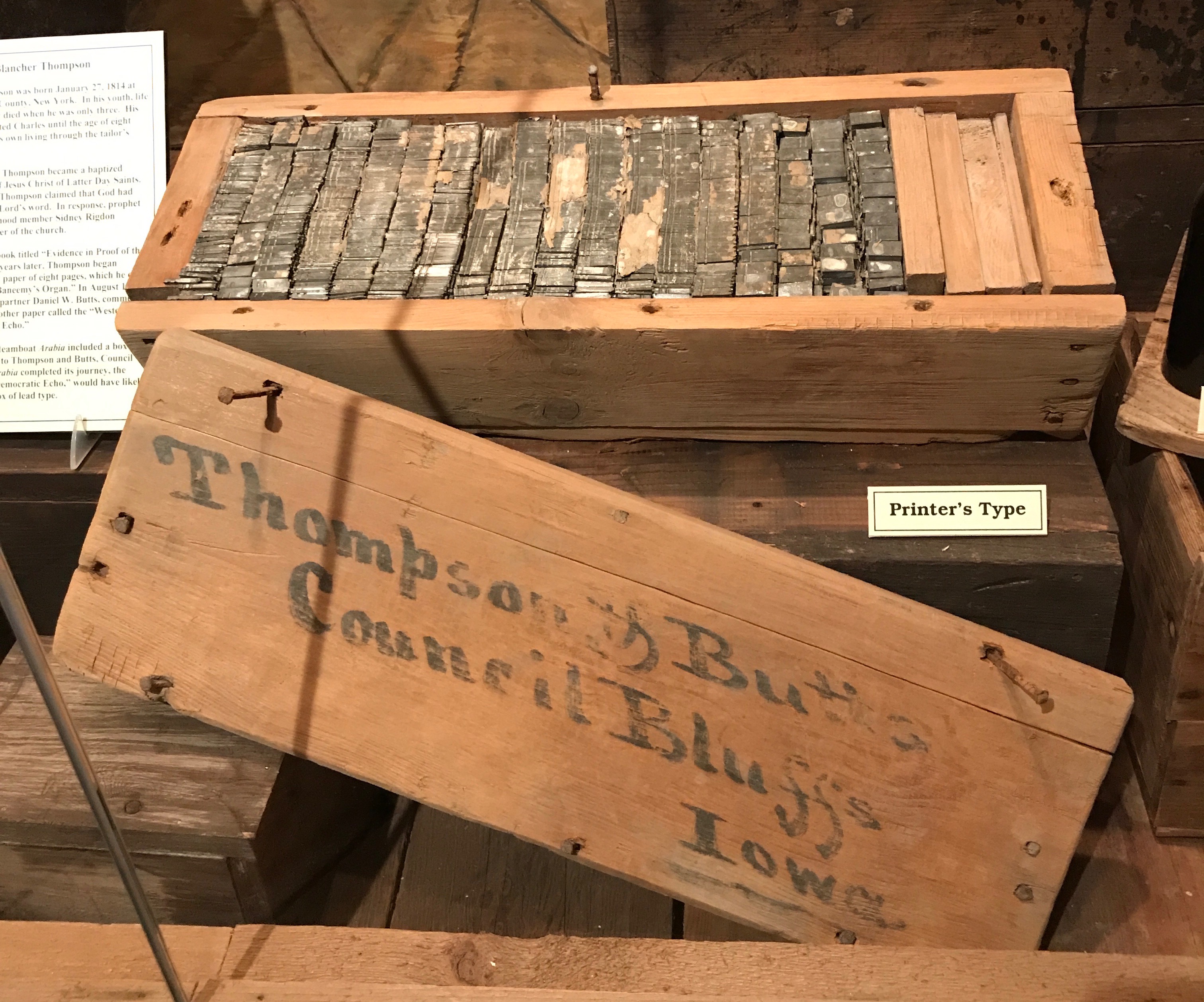
And printer’s type, bound for Council Bluffs, Iowa.

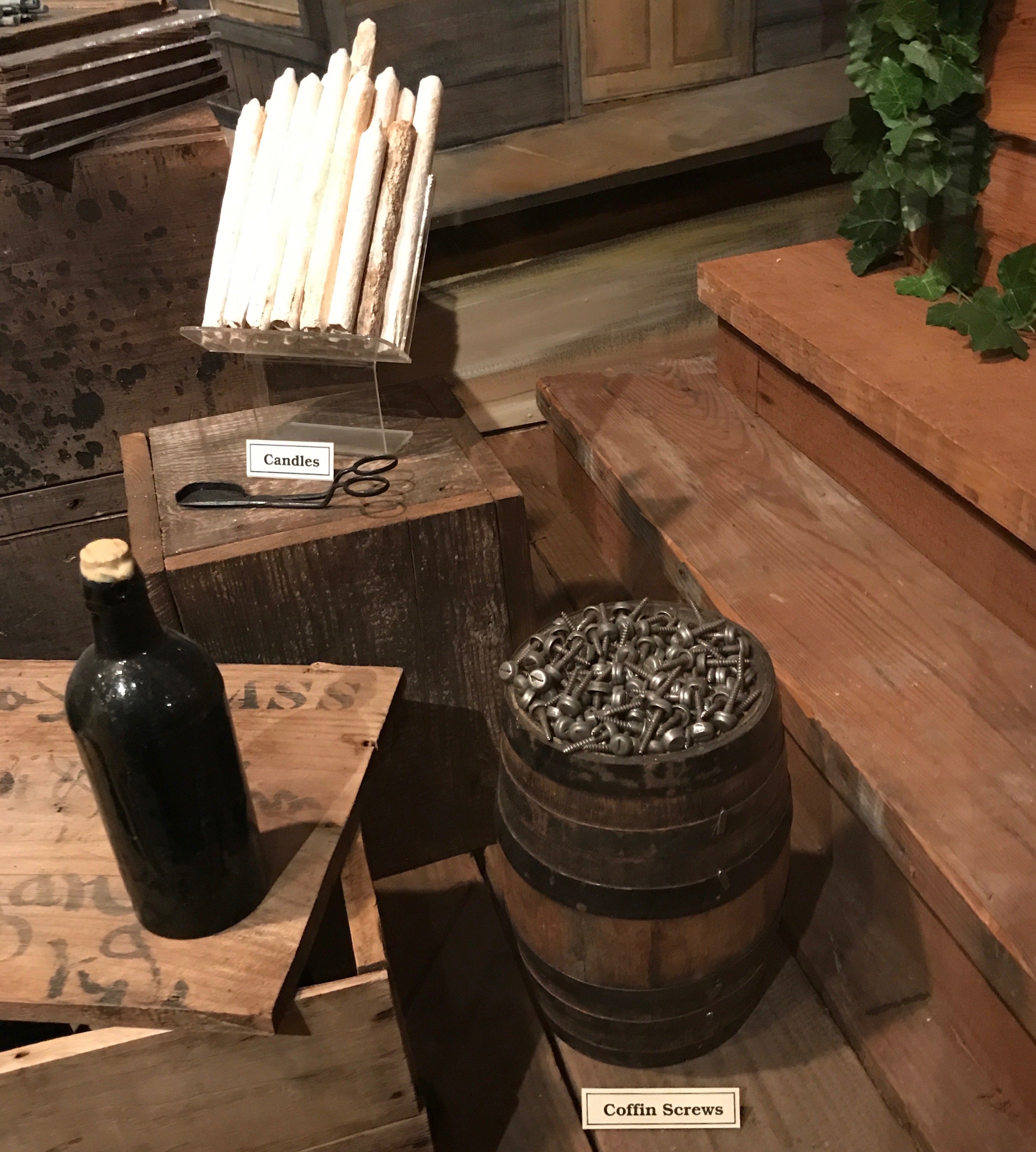
Coffin screws and candles.

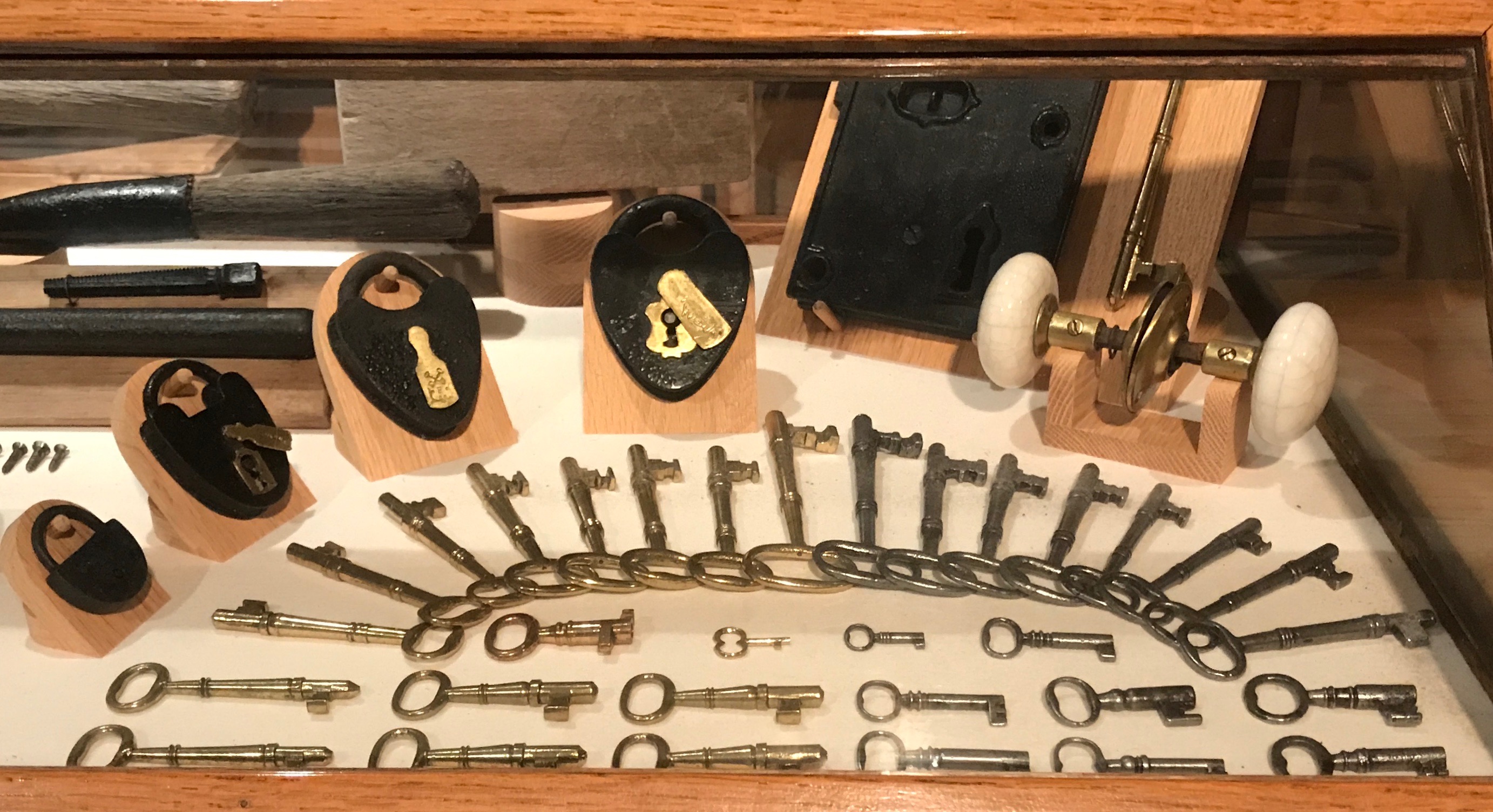
Locks and keys and doorknobs.

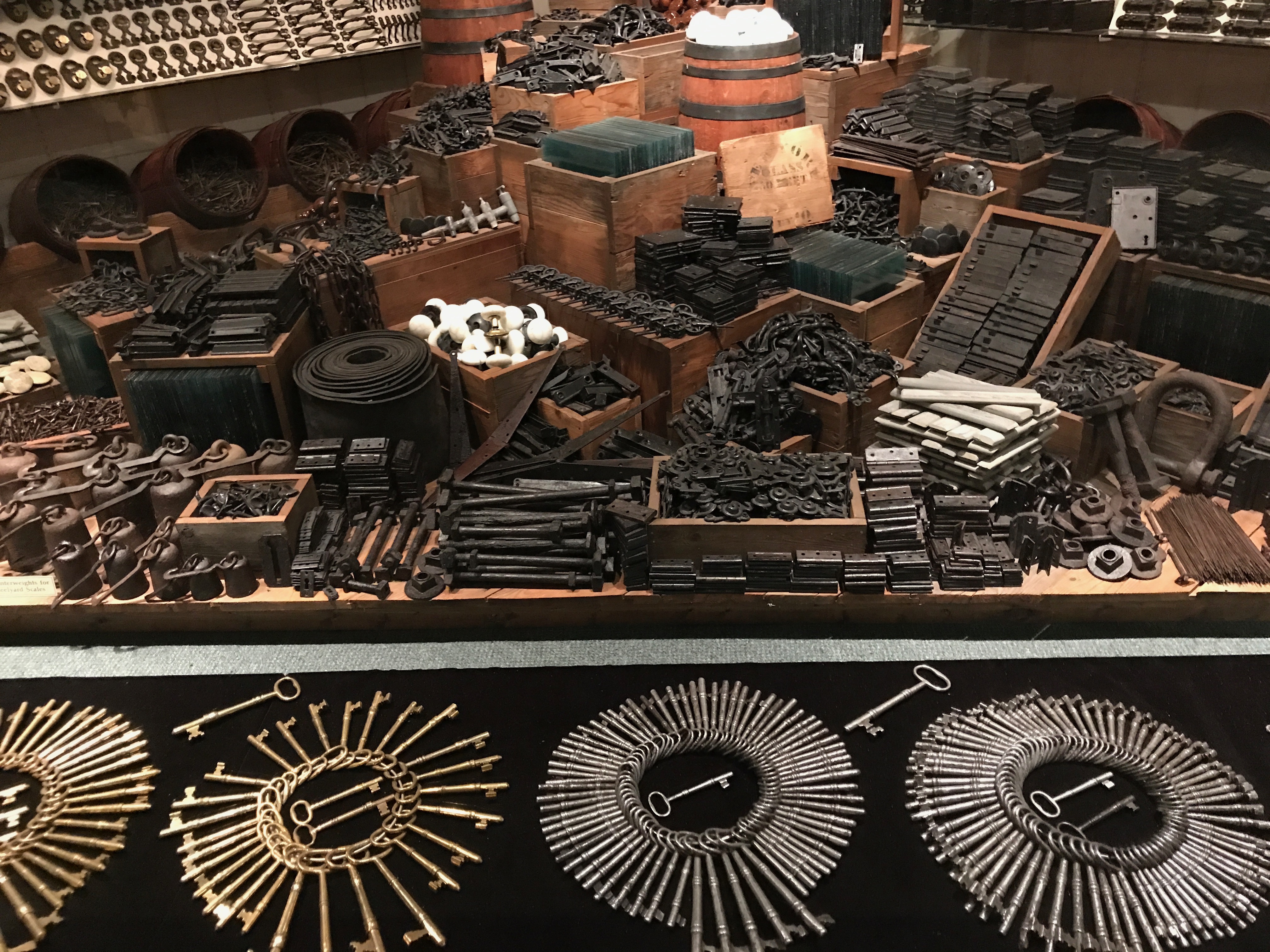
Lots of keys and all sorts of metal products.

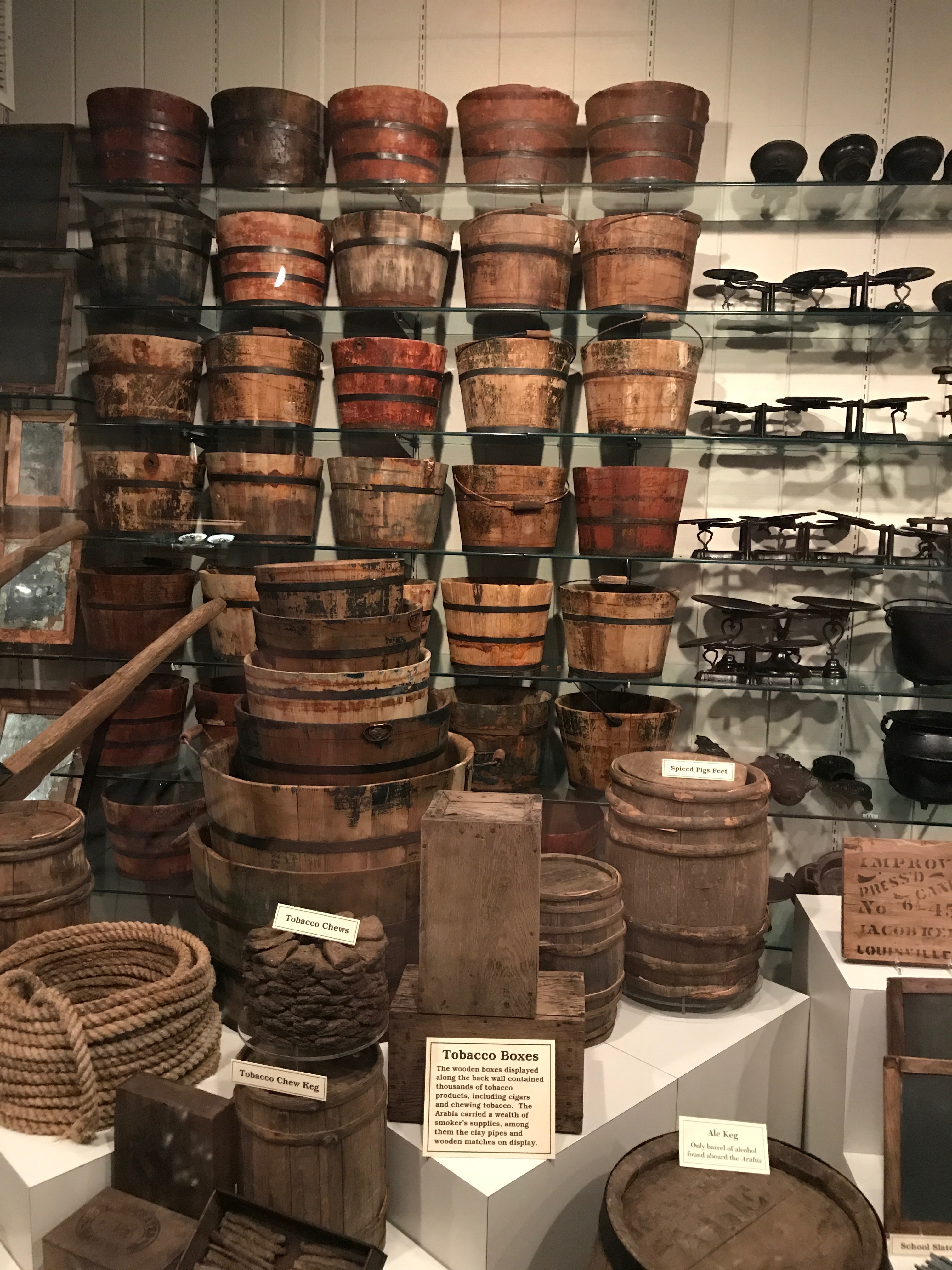
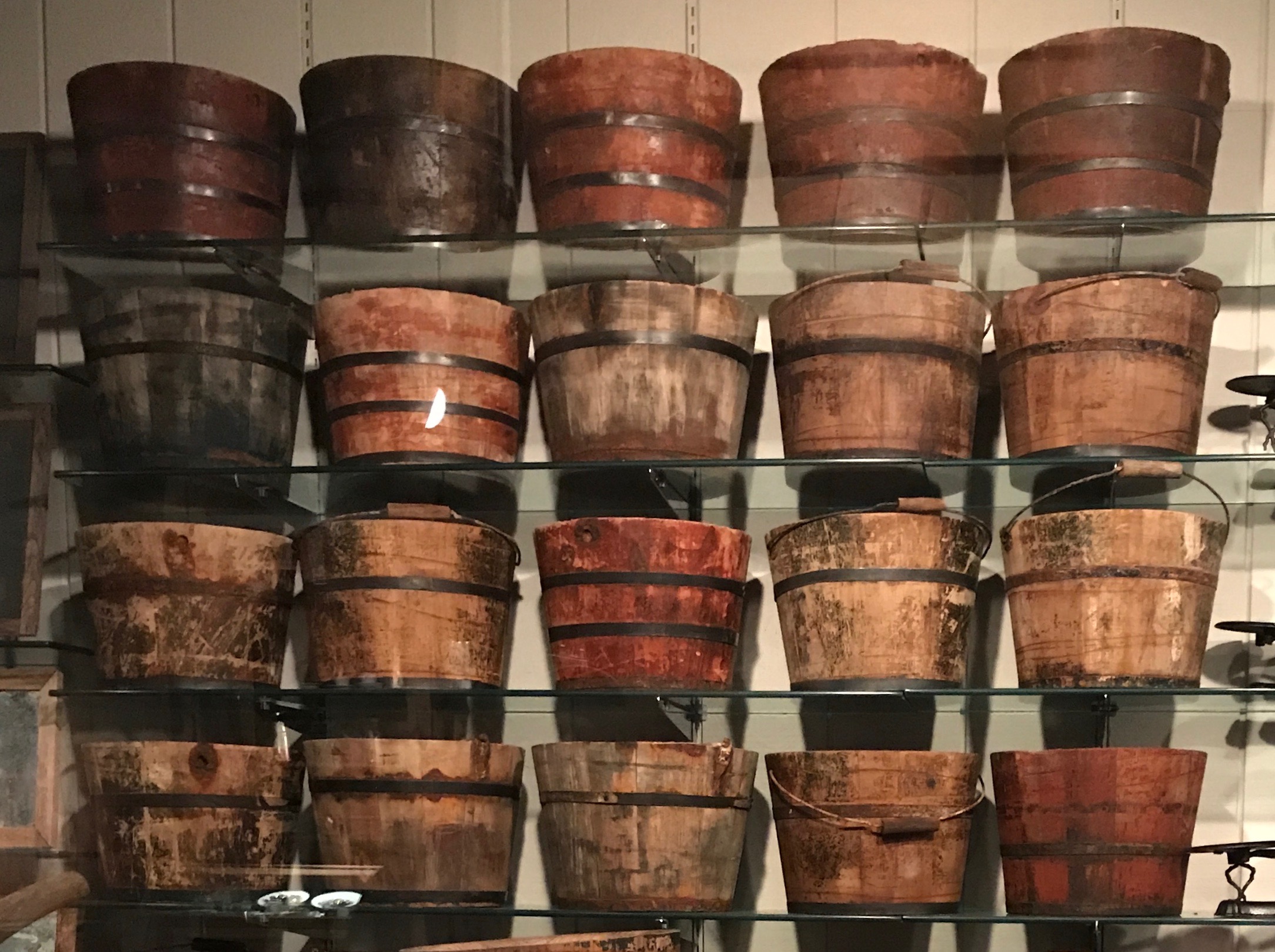
Wooden buckets, boxes, kegs, scales, rope

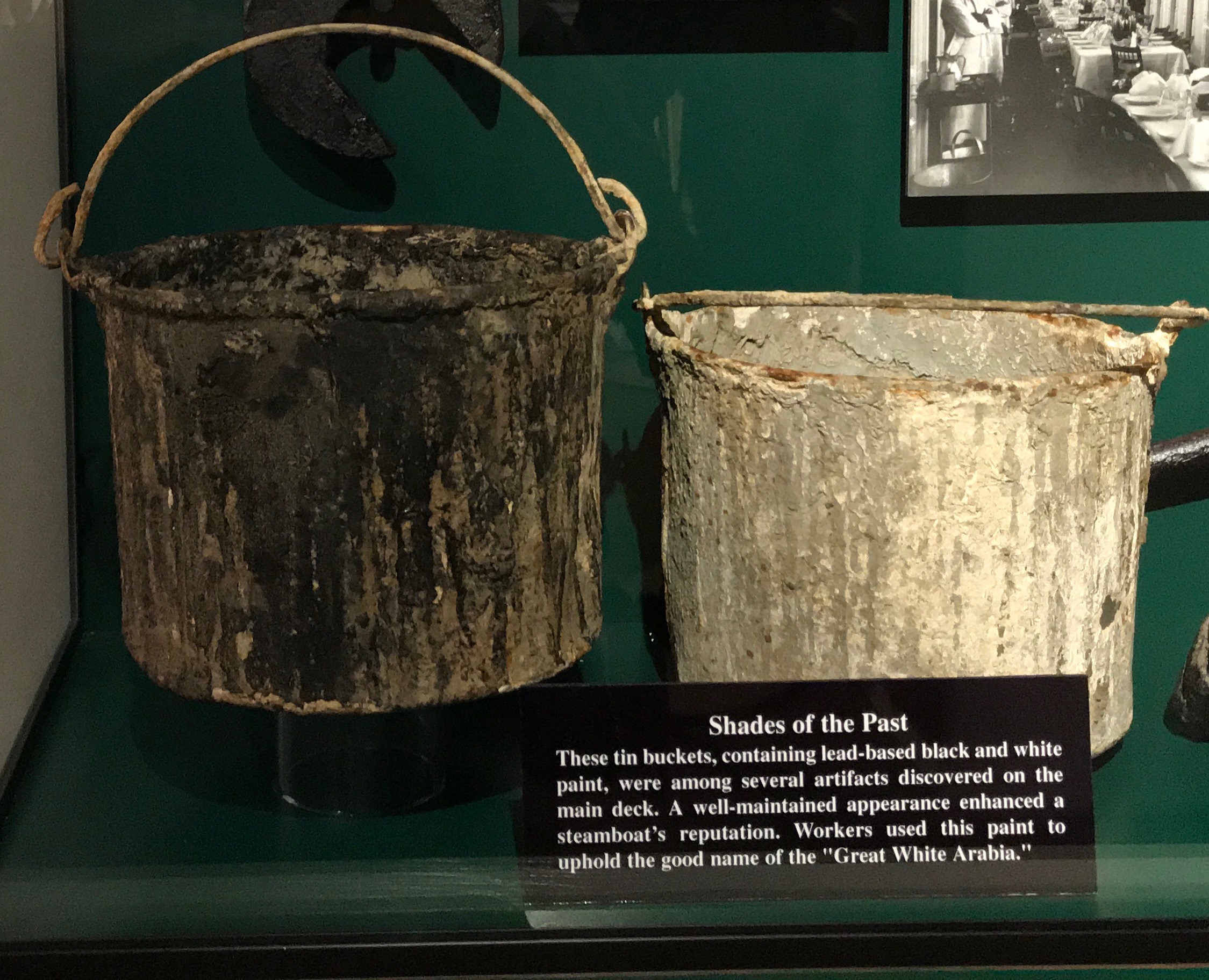
I liked the buckets, so here’s another shot of them.

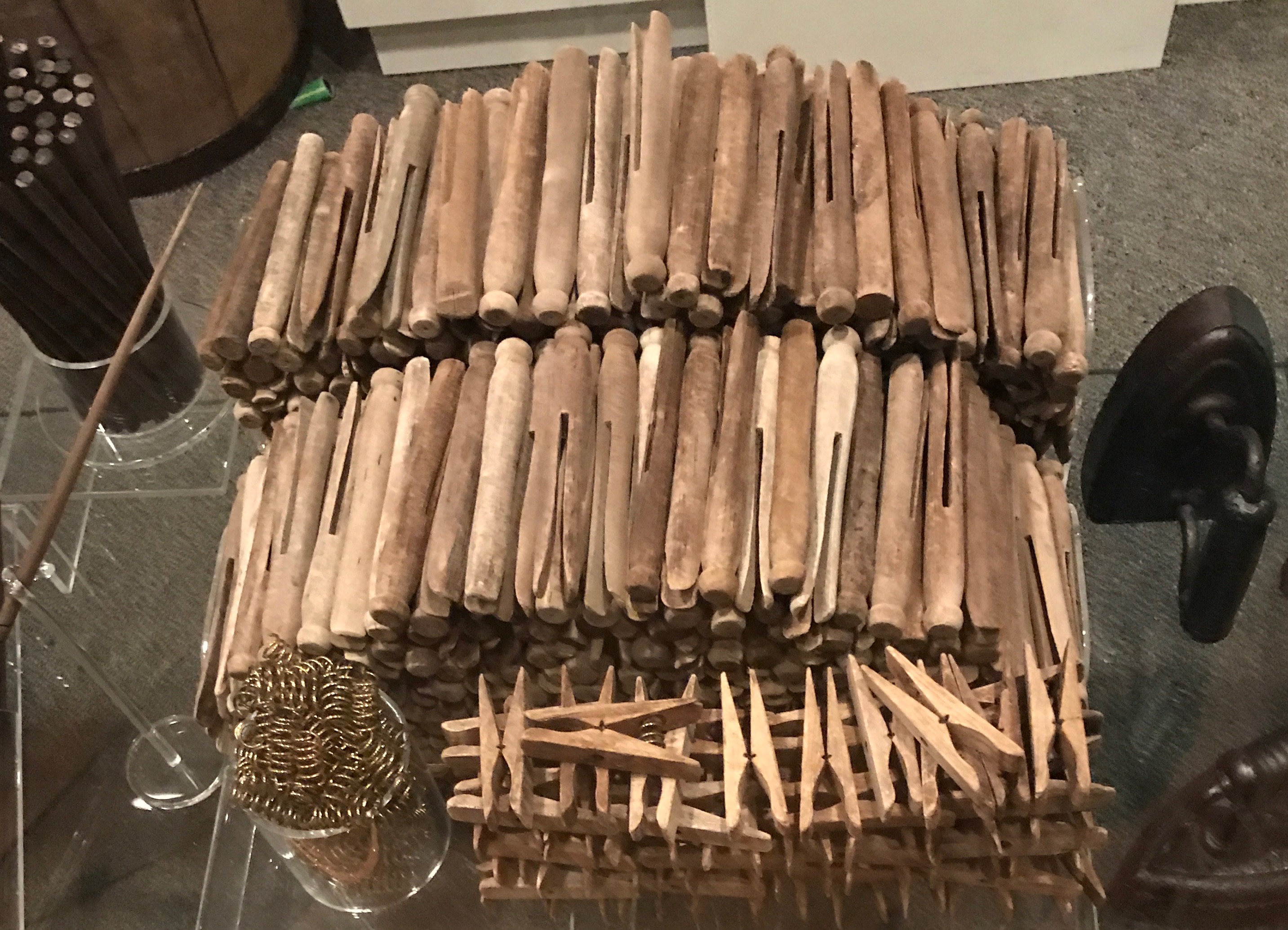
Clothes pins – or clothes pegs, if you prefer. I assume that the brass springs had something to do with laundry. There are also sad irons in the photo. What is so sad about the irons? I knew at one time, but couldn’t find that fact rattling around in my memory. I looked it up.

“Sad” is an Old English word for “solid,” and the term “sad iron” is often used to distinguish the largest and heaviest of the flat irons, usually 5 to 9 pounds.”

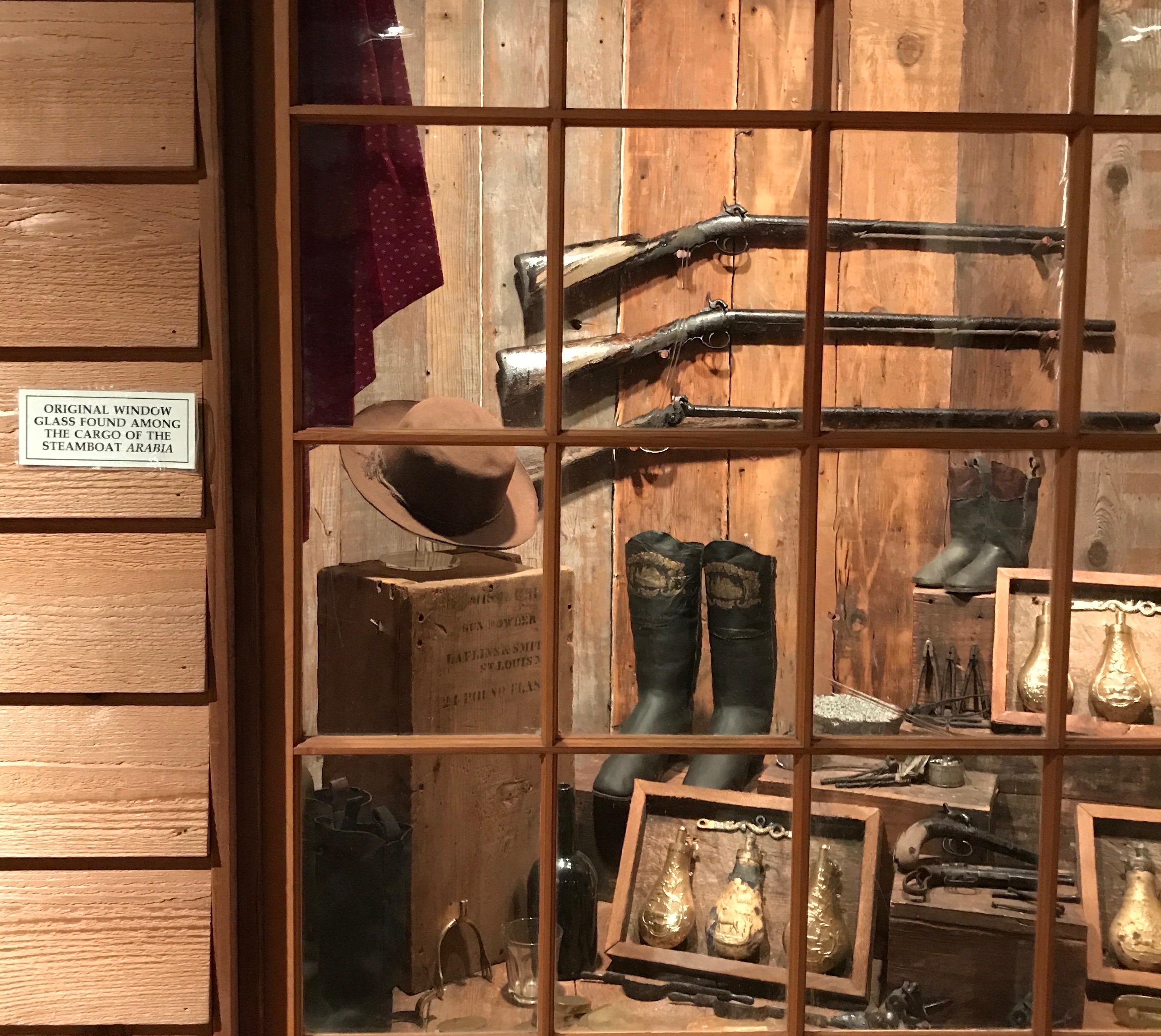
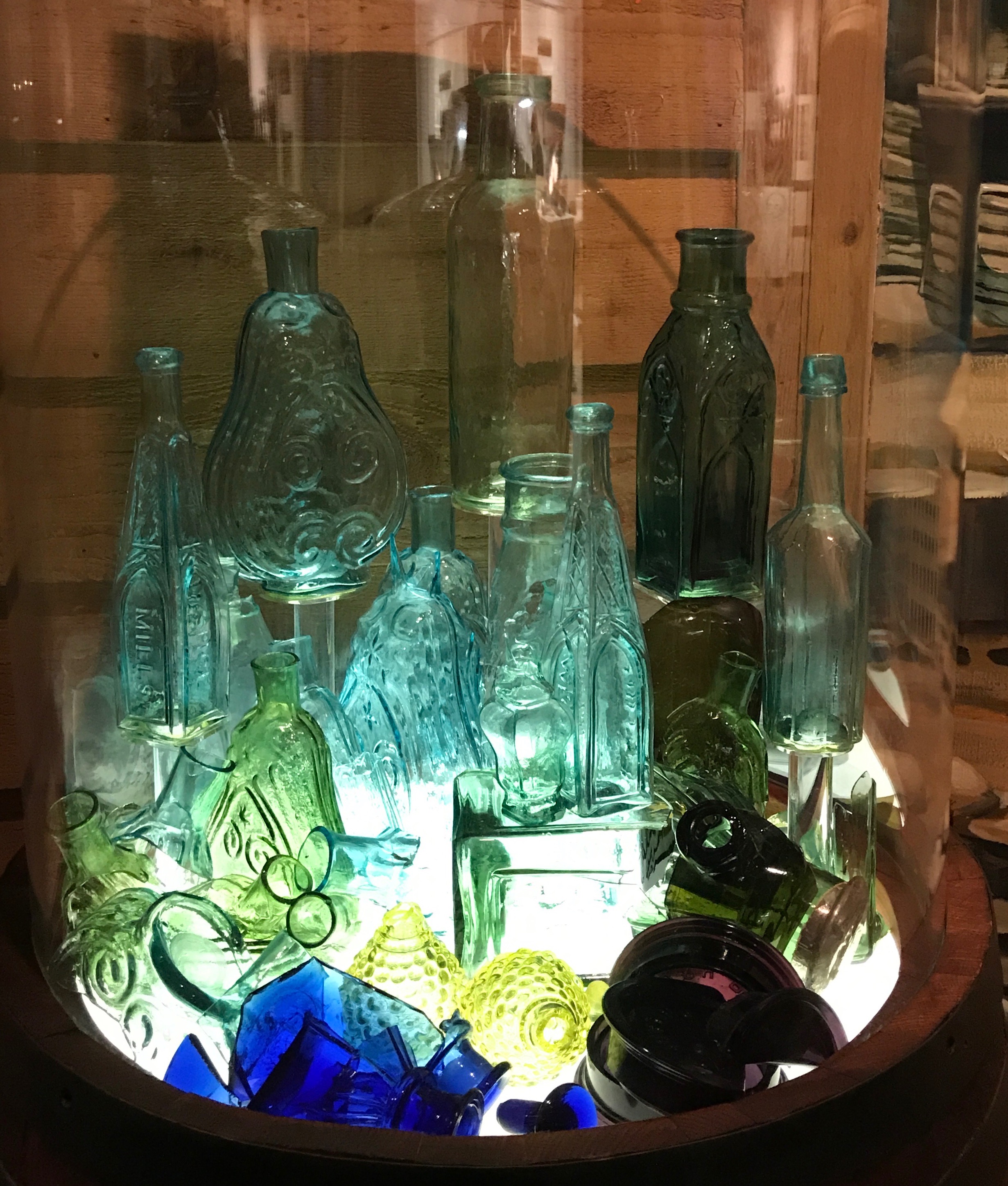
Glass was on board the Arabia when it went down – this glass, in fact.

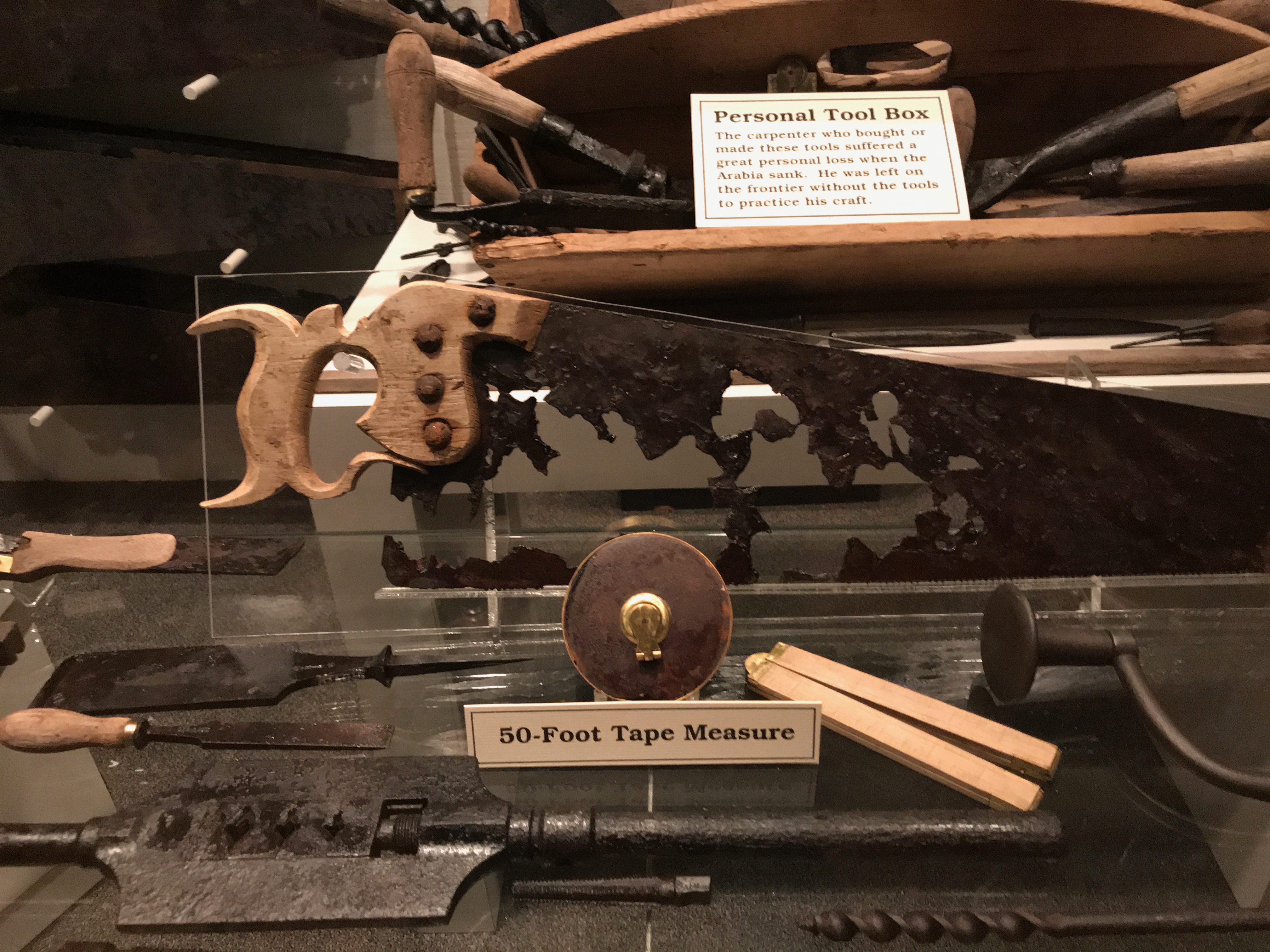
Tools. That poor saw looks kind of woe-begone, though.

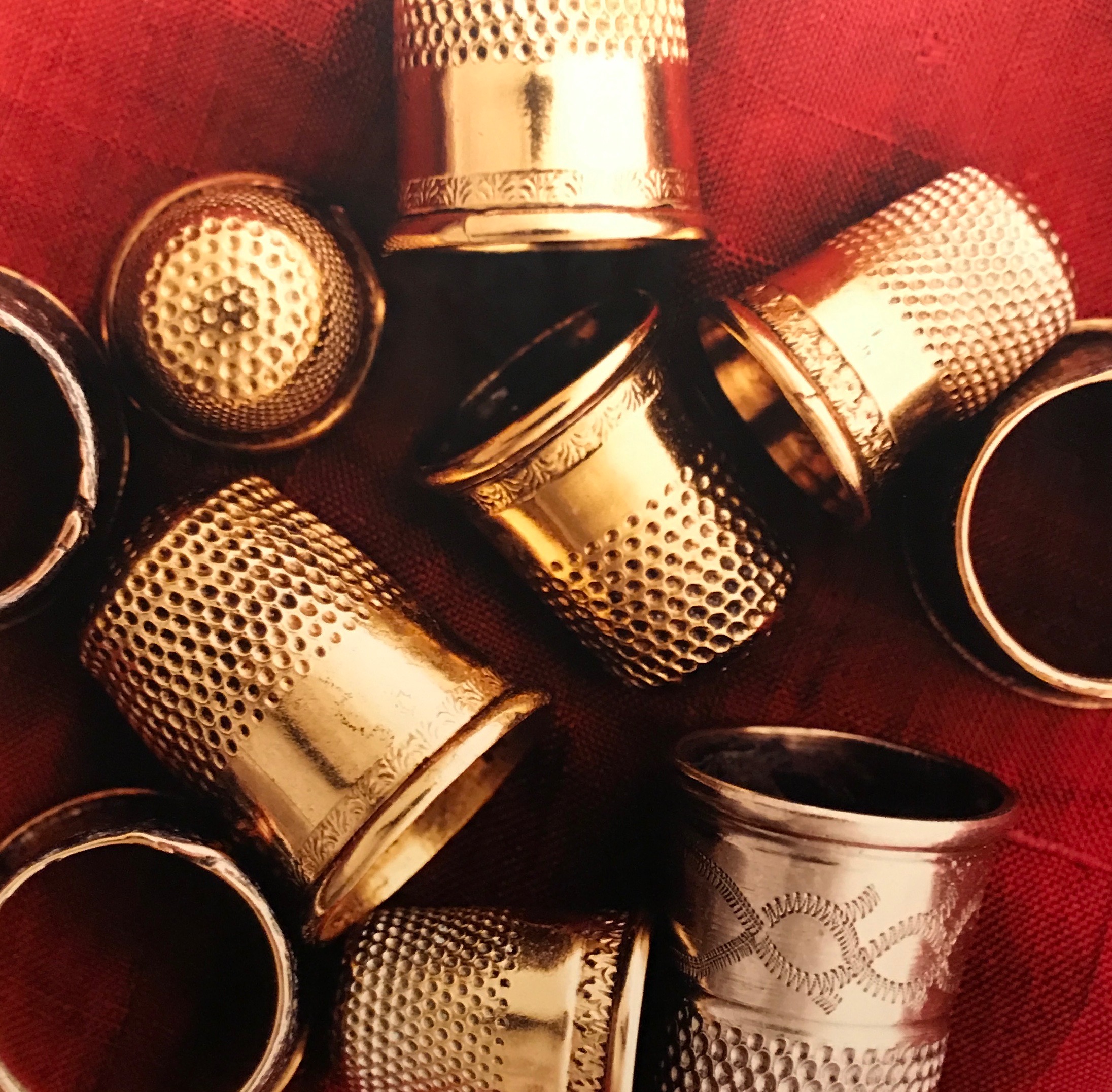
Some lovely thimbles

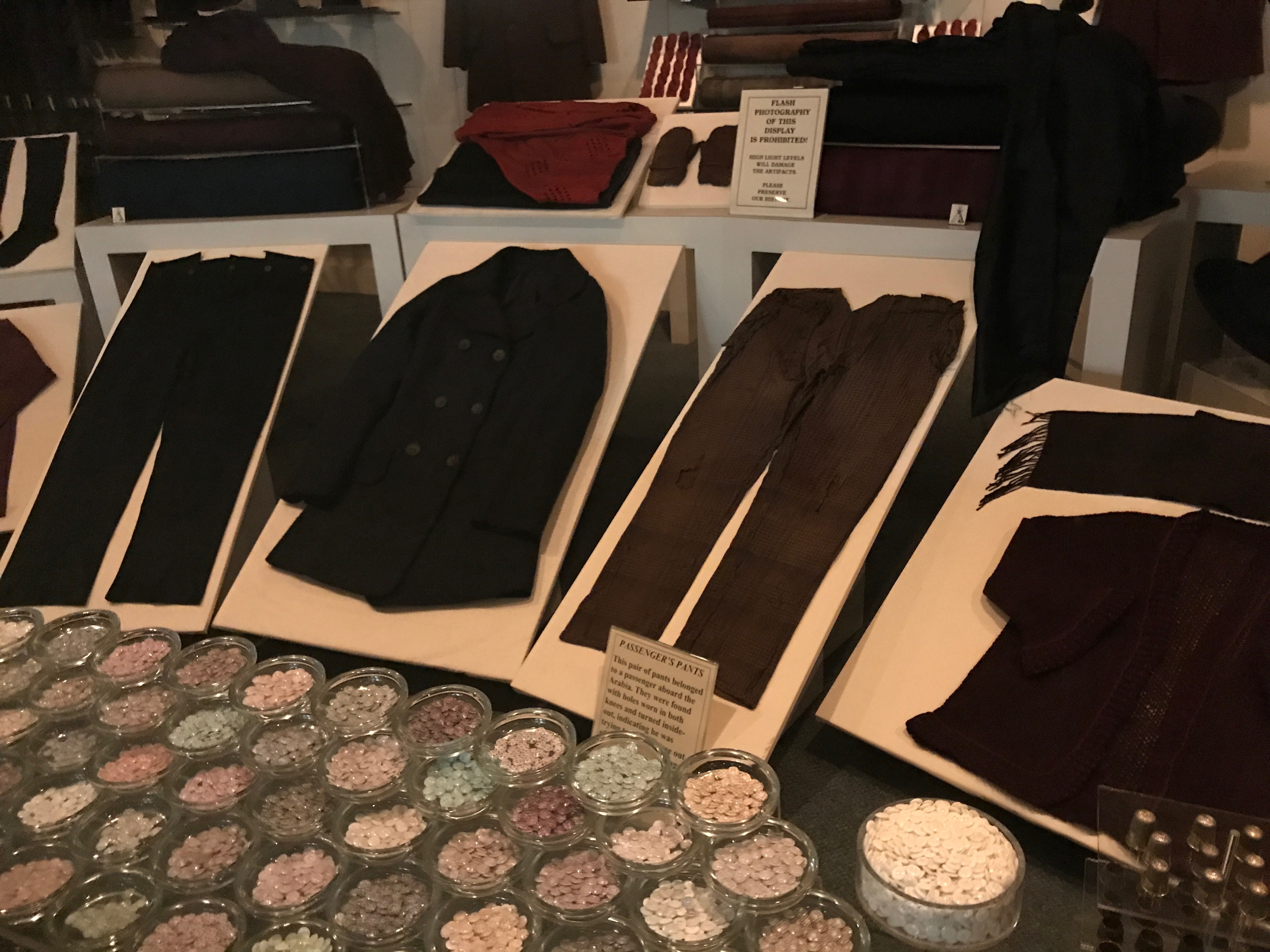
The sign by the brown pants says:

Passenger’s Pants
This pair of pants belonged to a passenger aboard the Arabia. There were found with holes worn in both knees and turned inside-out, indicating he was trying to get extra use out of them. His other meager belongings included cooking supplies, a whale oil lamp, a spittoon and 25 cents.

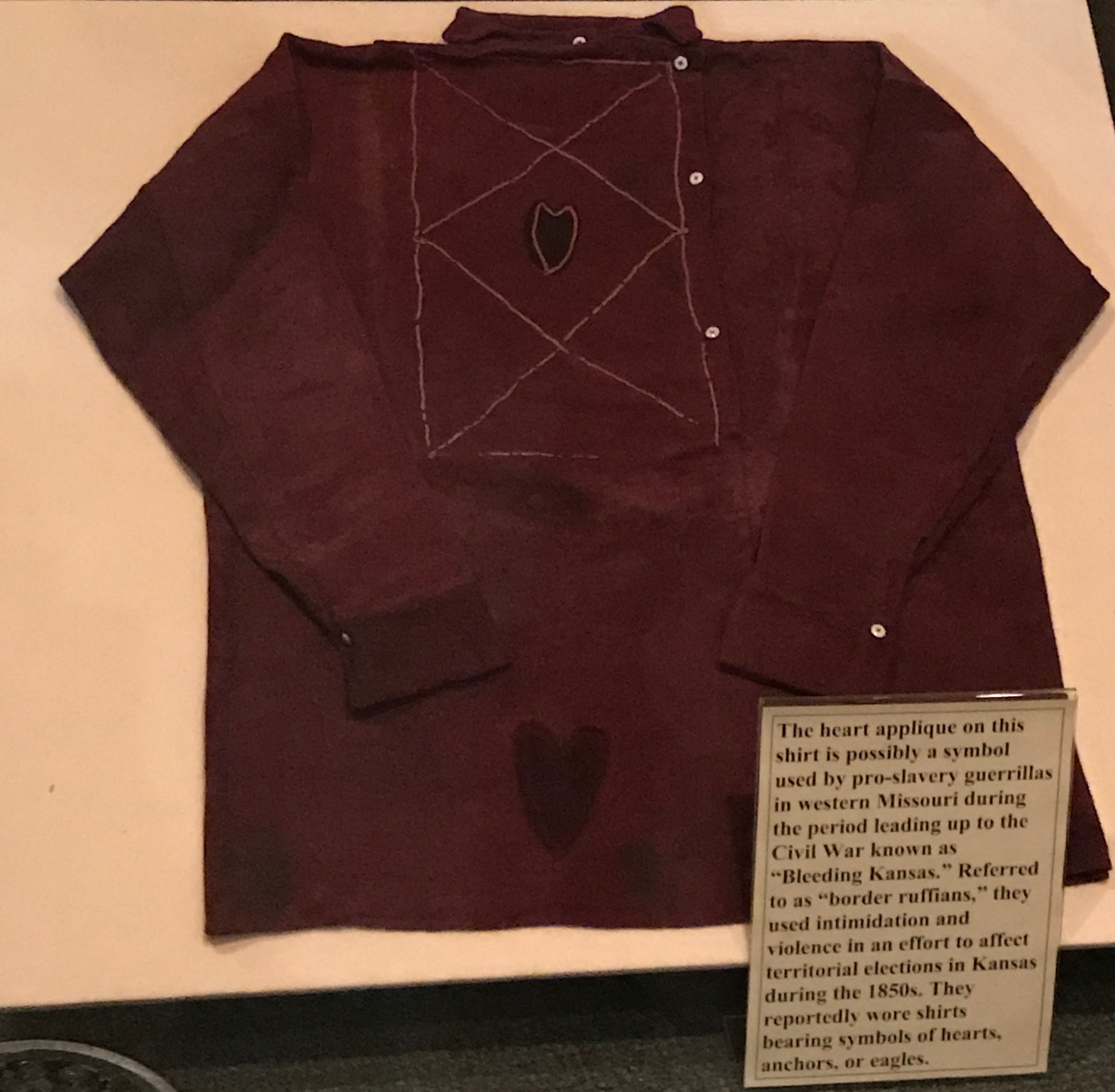
In case  you are reading this on a small screen, allow me to tell you what the sign by the shirt says.

“The heart appliqué on this shirt is possibly a symbol used by pro-slavery guerrillas in west Missouri during the period leading to the Civil War known as “Bleeding Kansas.” Referred to as “border ruffians,” they used intimidation and violence in an effort to affect territorial elections in Kansas during the 1850s. They reportedly wore shirts bearing symbols of hearts, anchors, or eagles.”

Back to the inventory…

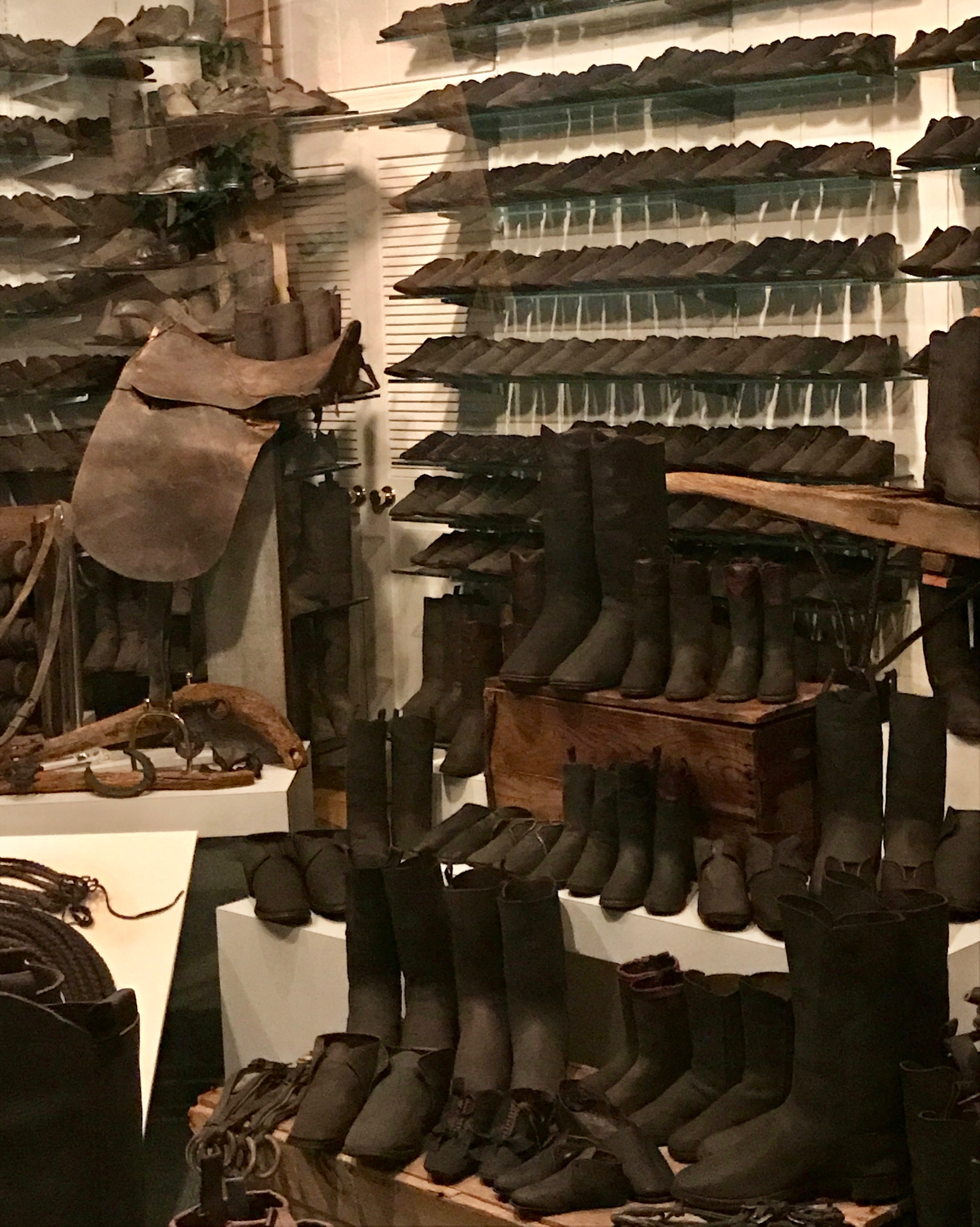
Shoes and saddles

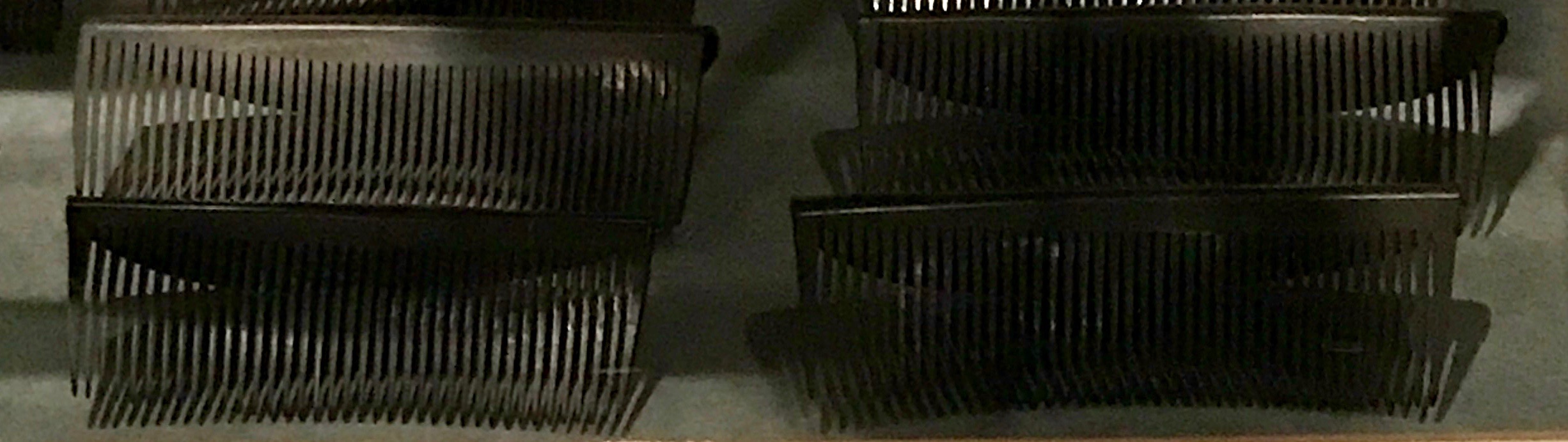
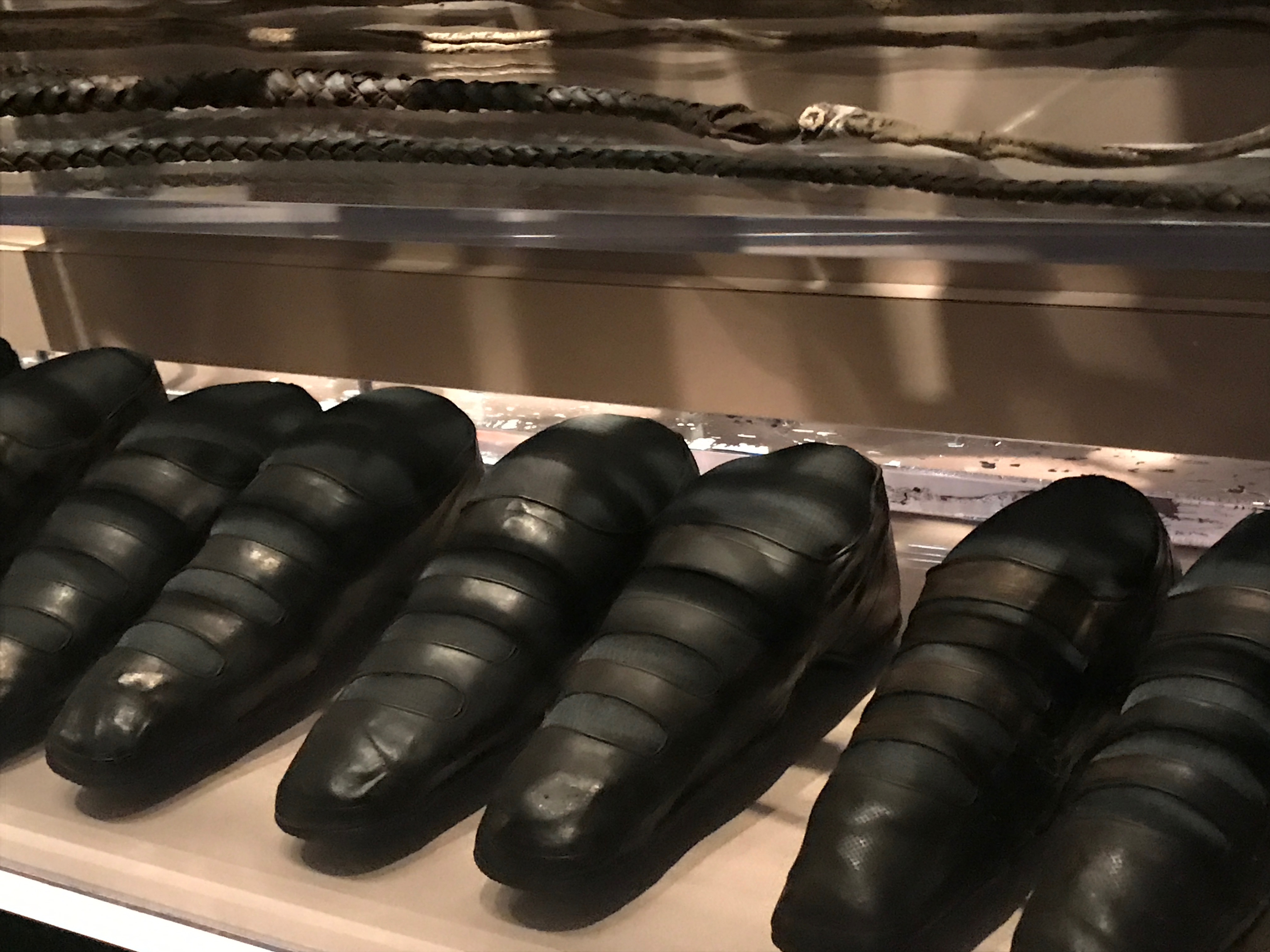
And rubber artifacts…

Combs

Shoes and bullwhips.

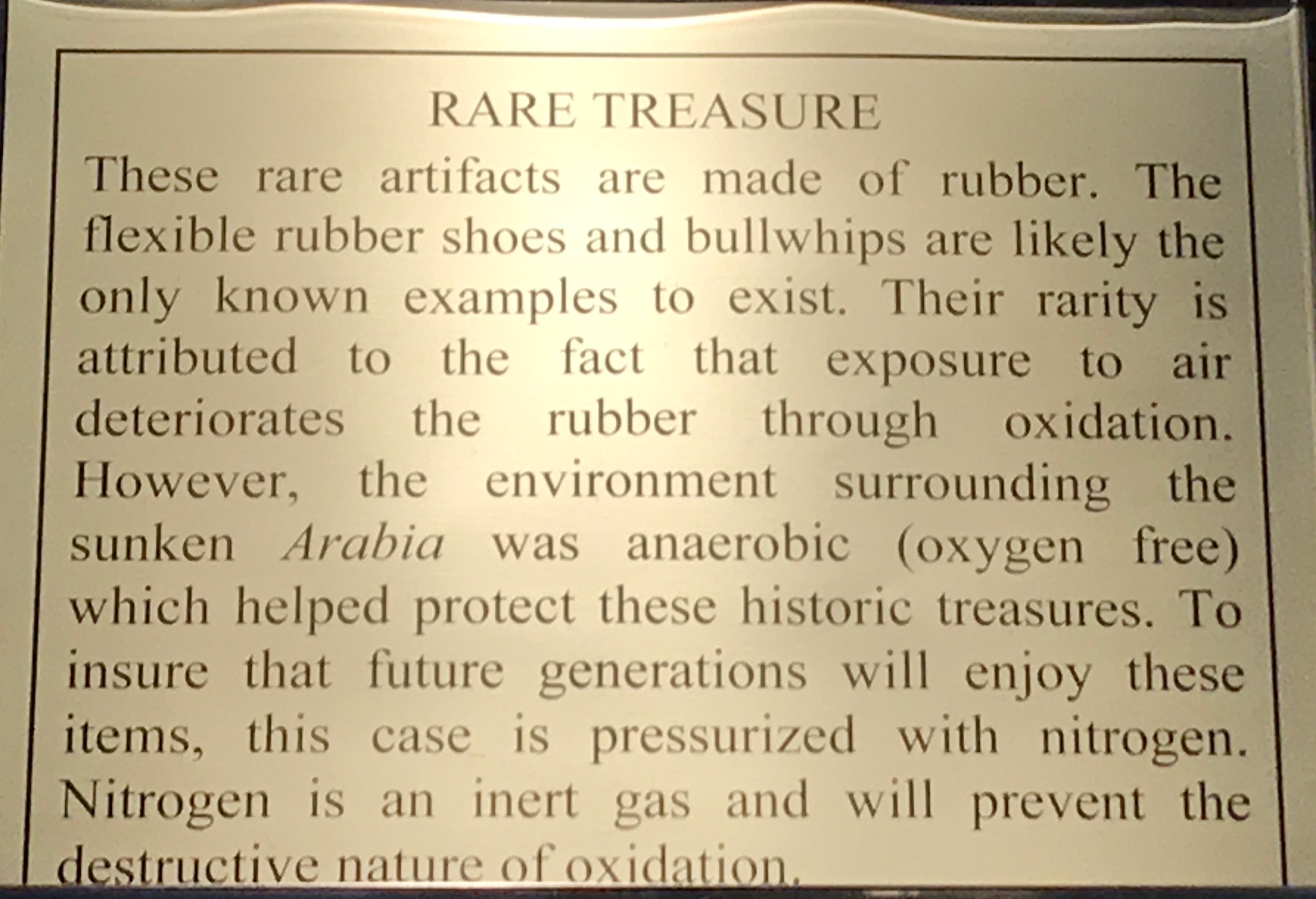
I’ll let you read the sign that was posted by the rubber items.

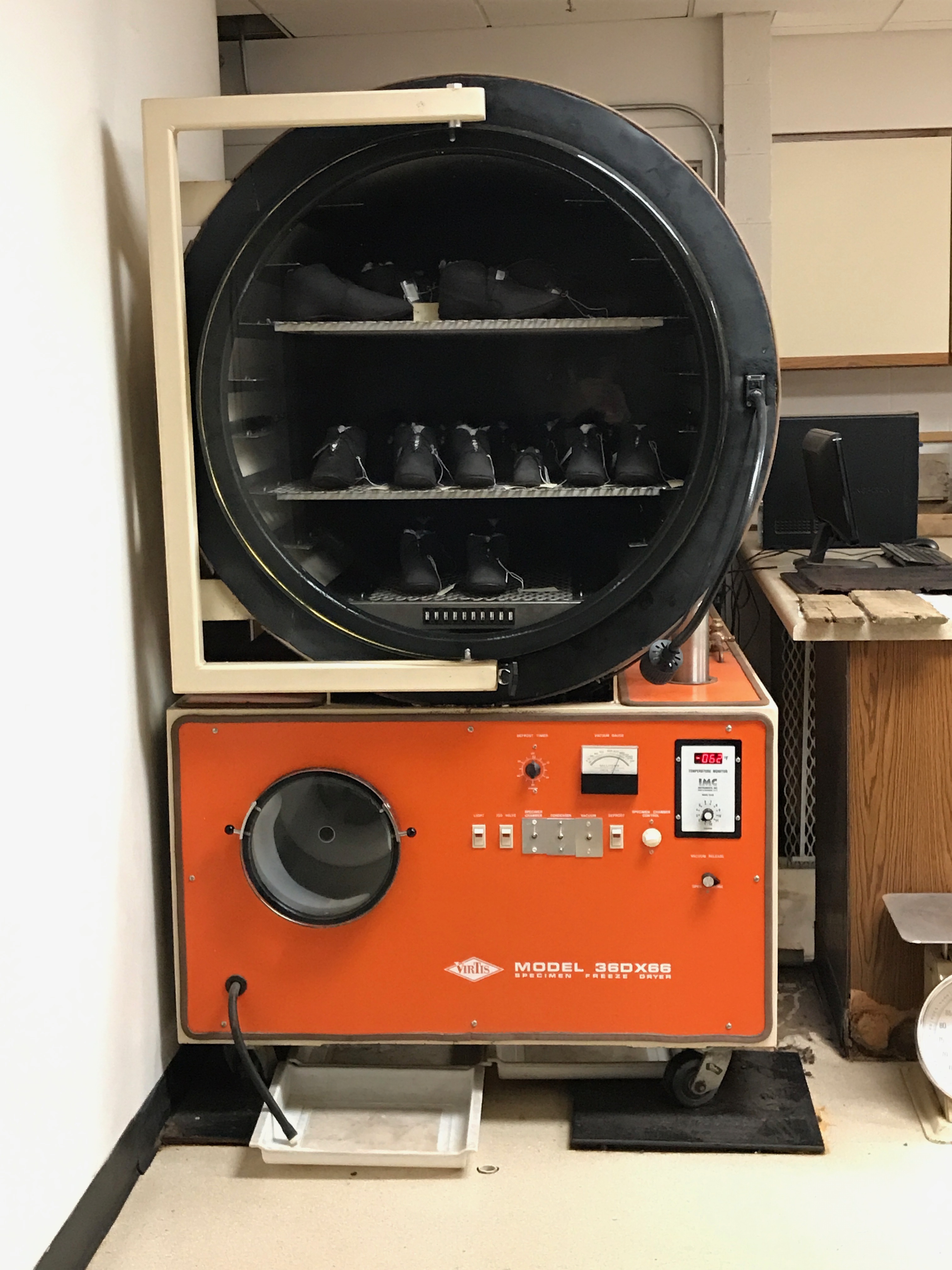
Here is some of the equipment used to preserve the rubber artifacts.

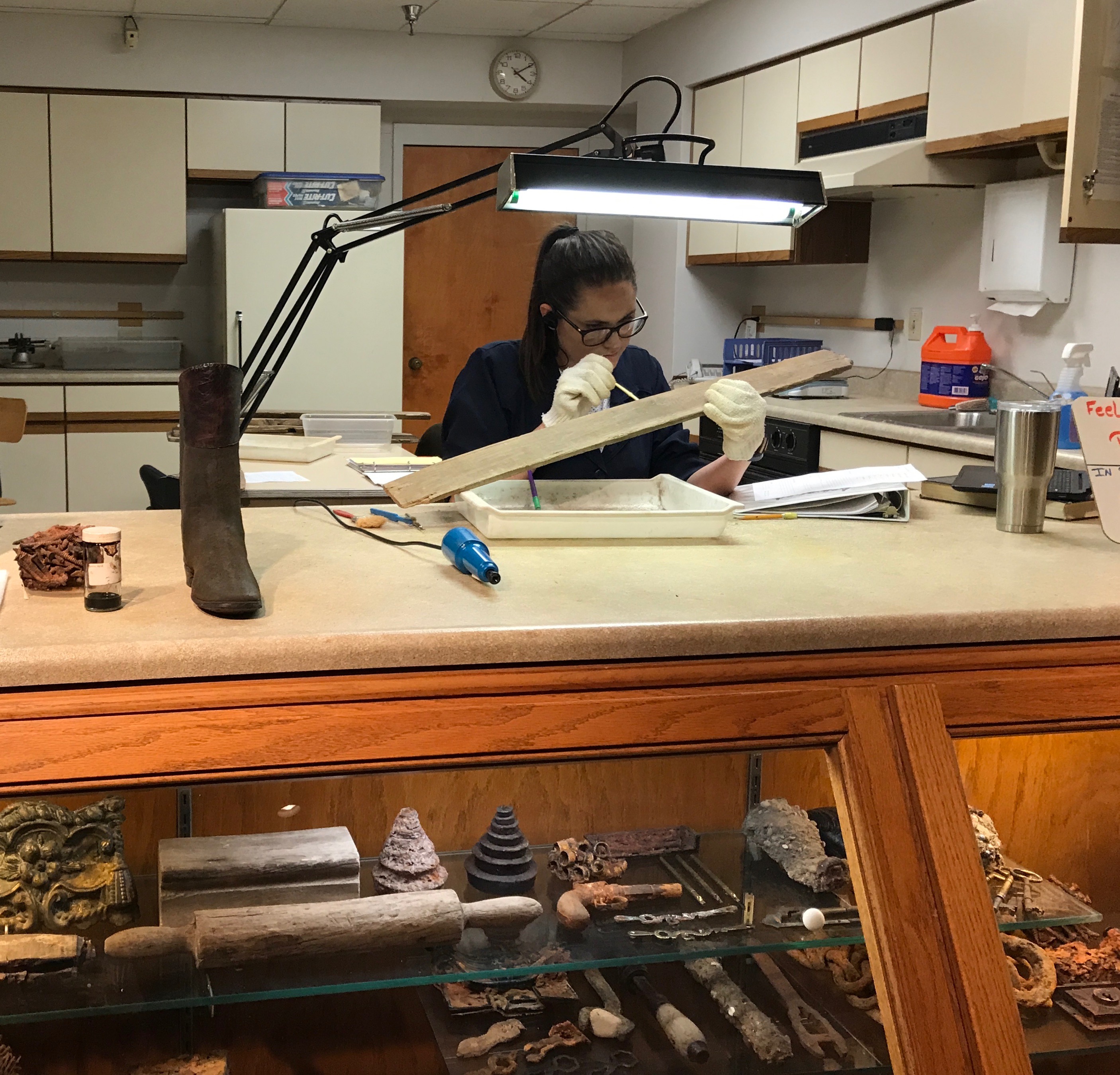
The promised us a view of the conservation lab – and there was even a conservator at work.

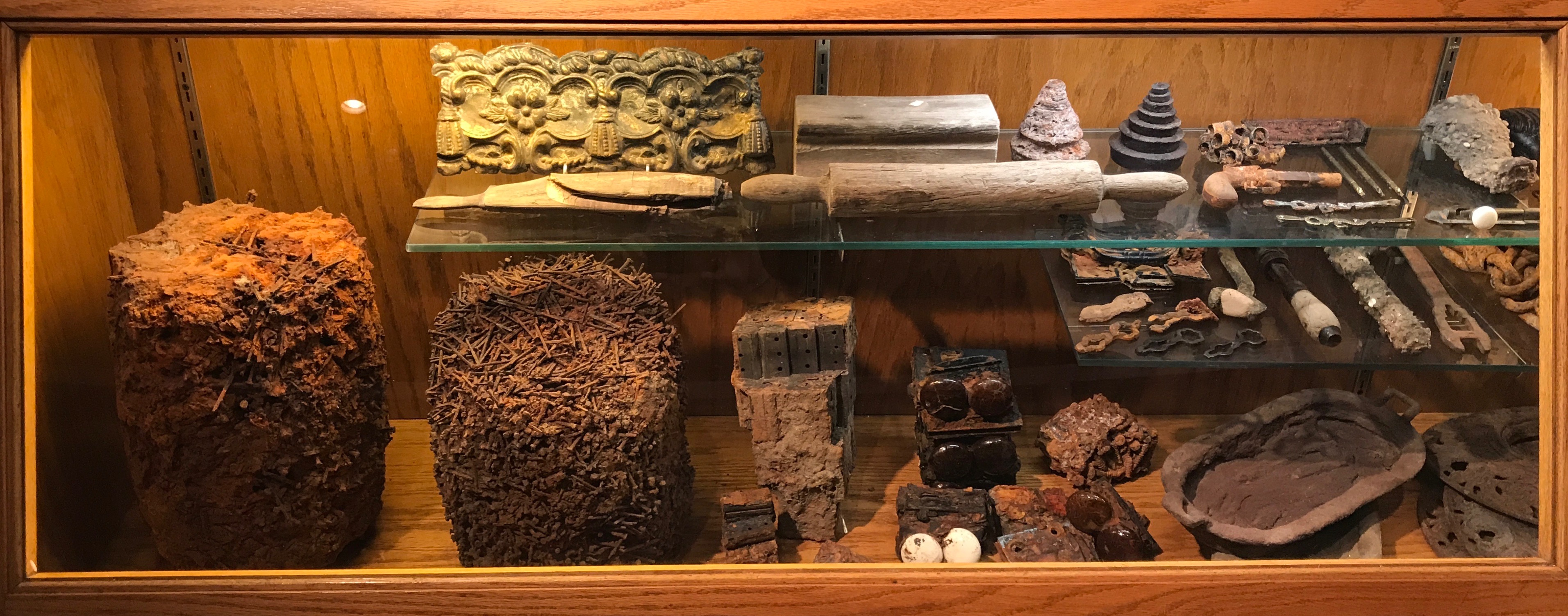
Here are some of the items in the 60 tons that are left to process

I would not look forward to having to conserve the nails in the two lumps on the left.

Not all the artifacts that were aboard survived in such pristine condition.

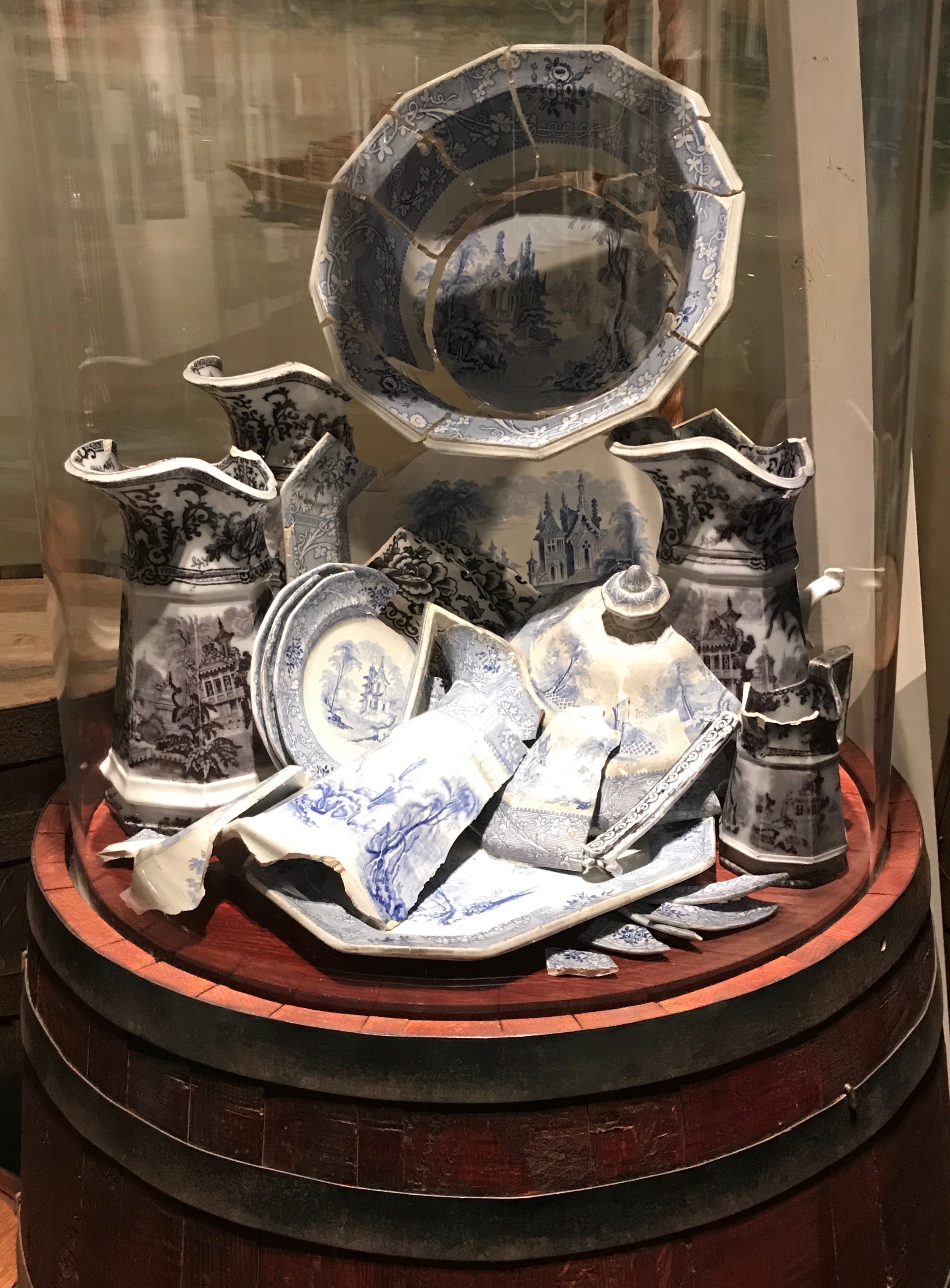
This china didn’t fare well.

The bottles also took a hit. If you look closely, though, you can see that five of these bottles survived without a scratch.

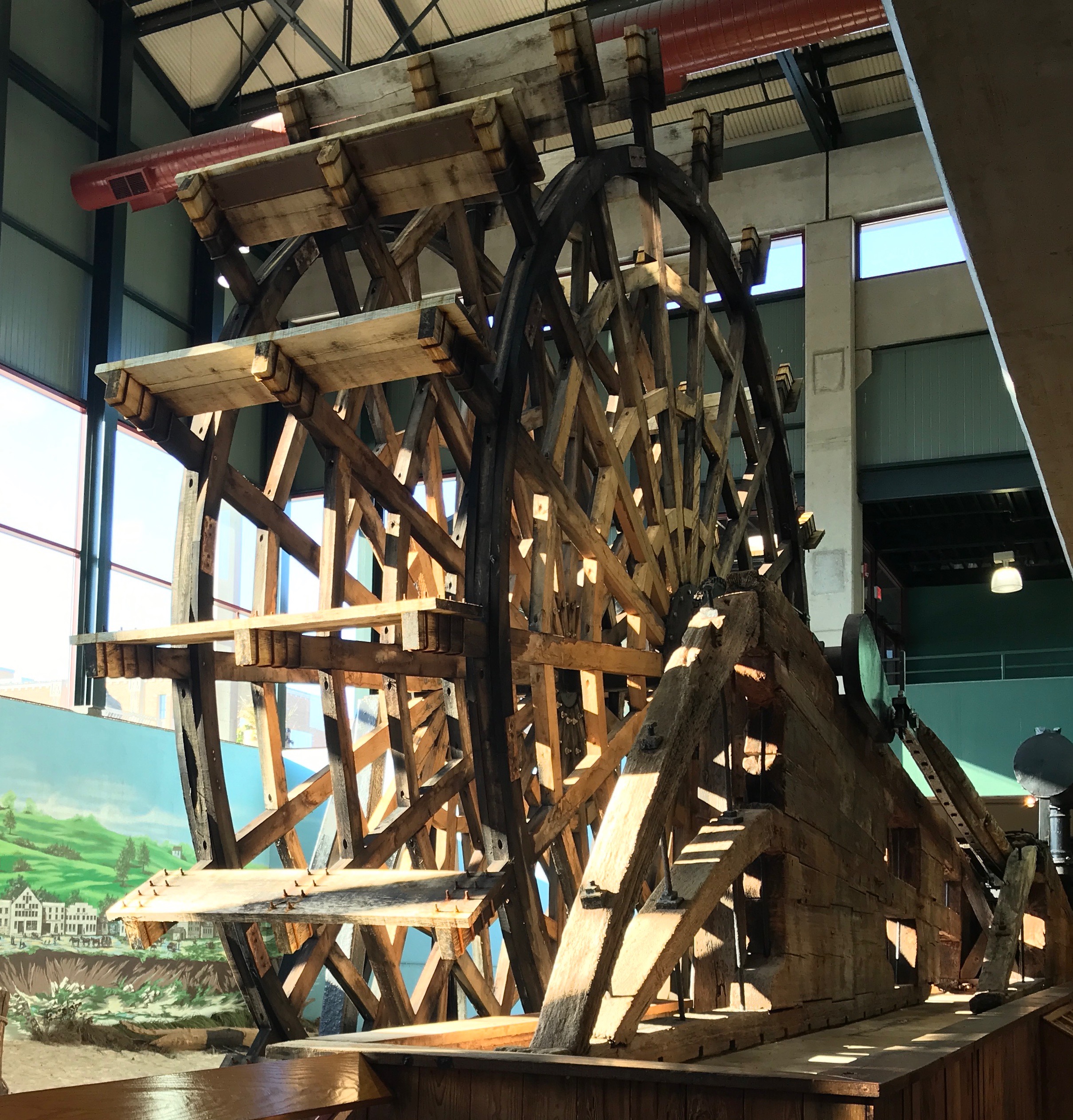
There was also an interesting display about how the boat actually worked. It could make about five miles an hour going upstream, and it burnt about 30 cords of wood a day. How much is a cord, you ask?

“A full cord is determined by the total cubic feet of firewood, not necessary the measurements of the stack. However, the 4′ x 4′ x 8′ shape is the most common.”

128 cubic feet are in a cord. 30 cords of wood would be 3,840 cubic feet a day. That is about the size of the largest school bus that you would see on the road today. I wonder what the infrastructure was for replenishing their fuel supply?

These buckets were also part of the working of the boat. The workers had to keep the Arabia looking good.

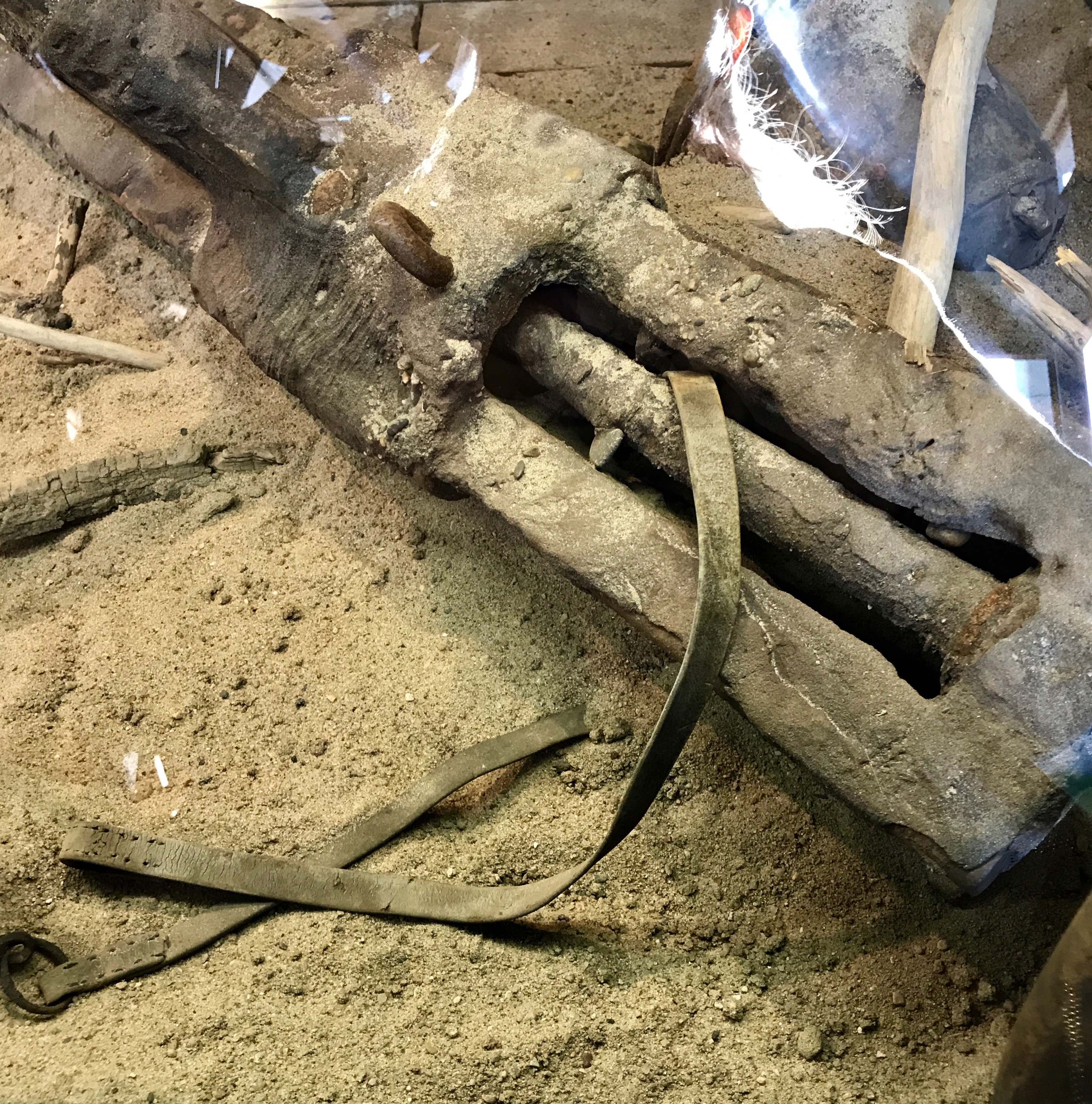
Oh, and you know the story about the mule being the sole casualty of the sinking of the Arabia? The owner was interviewed shortly after the sinking and he said that he tried to free his mule, but it was too stubborn and would not leave the sinking steamboat. The reins tell a different story. They were discovered firmly tied to this lumber mill jack.

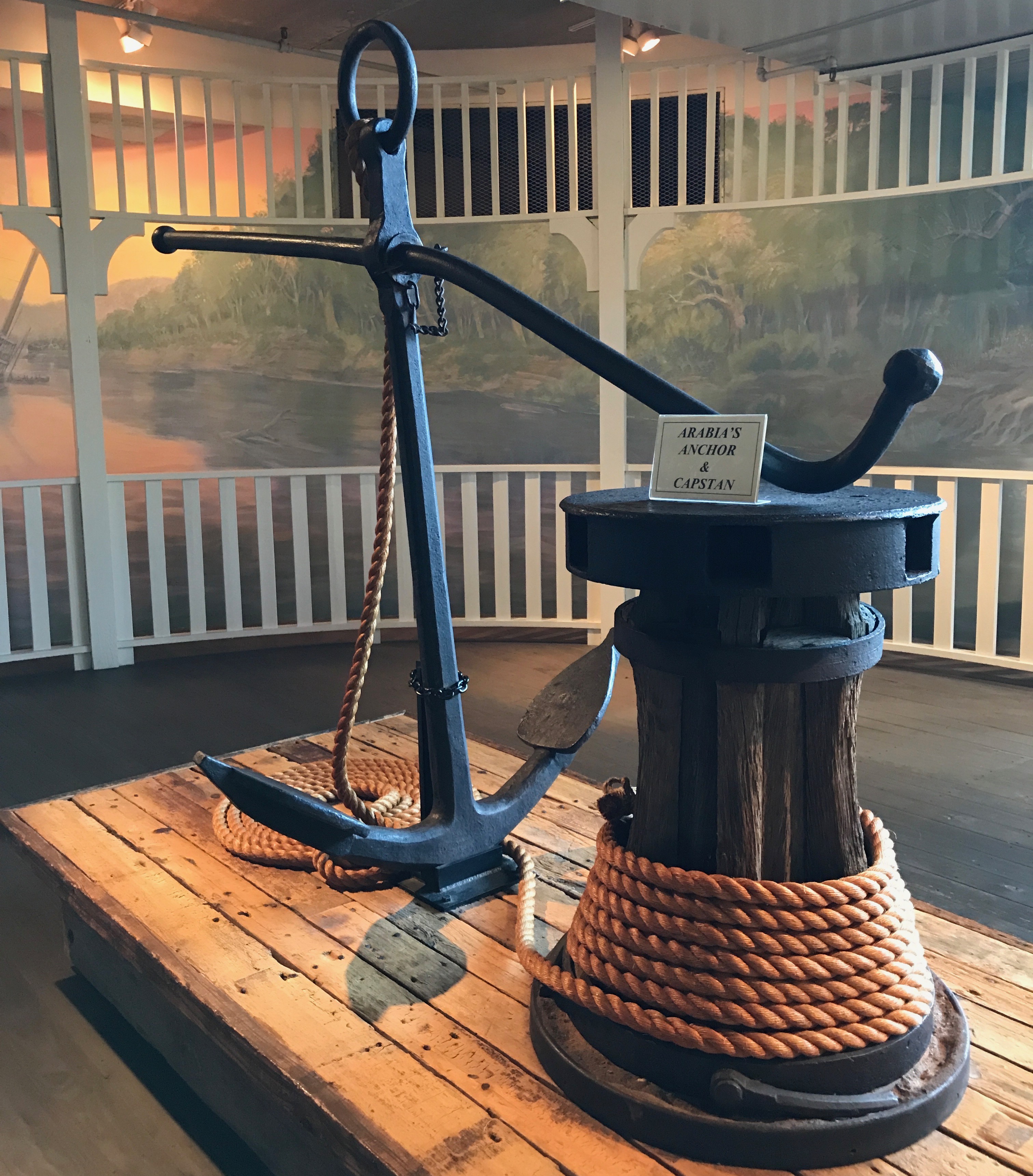
With that, it was time to weigh anchor

and head off to my next adventure.

Next Stop: Kansas City!

Kansas City, Missouri or Kansas City, Kansas?

Yes!

Why limit my visit to one Kansas City when I can visit two?

I am going to have to try to swing through Peculiar, Missouri next time I’m in the area. The name intrigues me. I wonder if they have T shirts?

This makes three new states so far for this trip: Indiana, where I “mooch-docked” in the parking lot of the Cracker Barrel, Jefferson City, Missouri, and now Kansas City, Kansas.

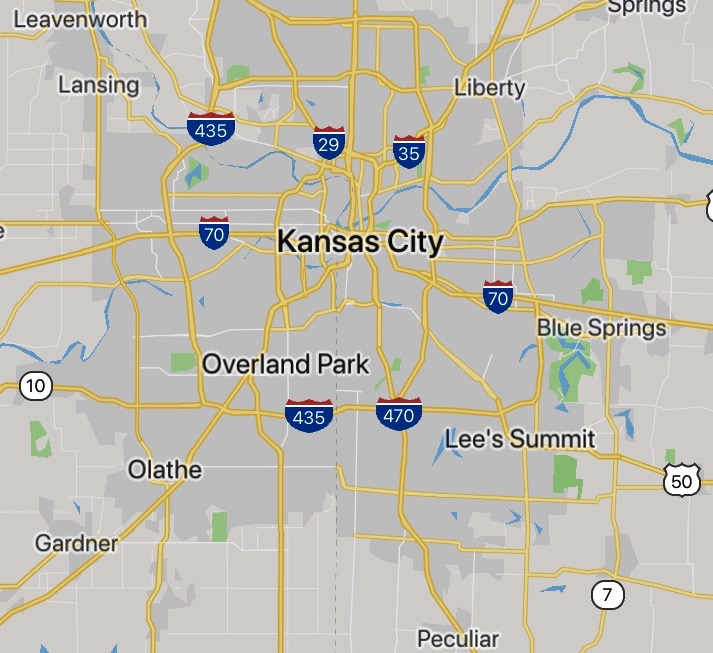
I set up camp at Walnut Grove RV Park, which is actually in Merriam, Kansas. It was a pretty good campground for an urban setup. It definitely had a great location for what I wanted to do. There were a few places on The List in Kansas City for next time, and I wanted to visit some friends. I love how the internet introduces me to new people and makes it possible for us to stay connected.

My first visit was with Sue, who had me over for dinner.

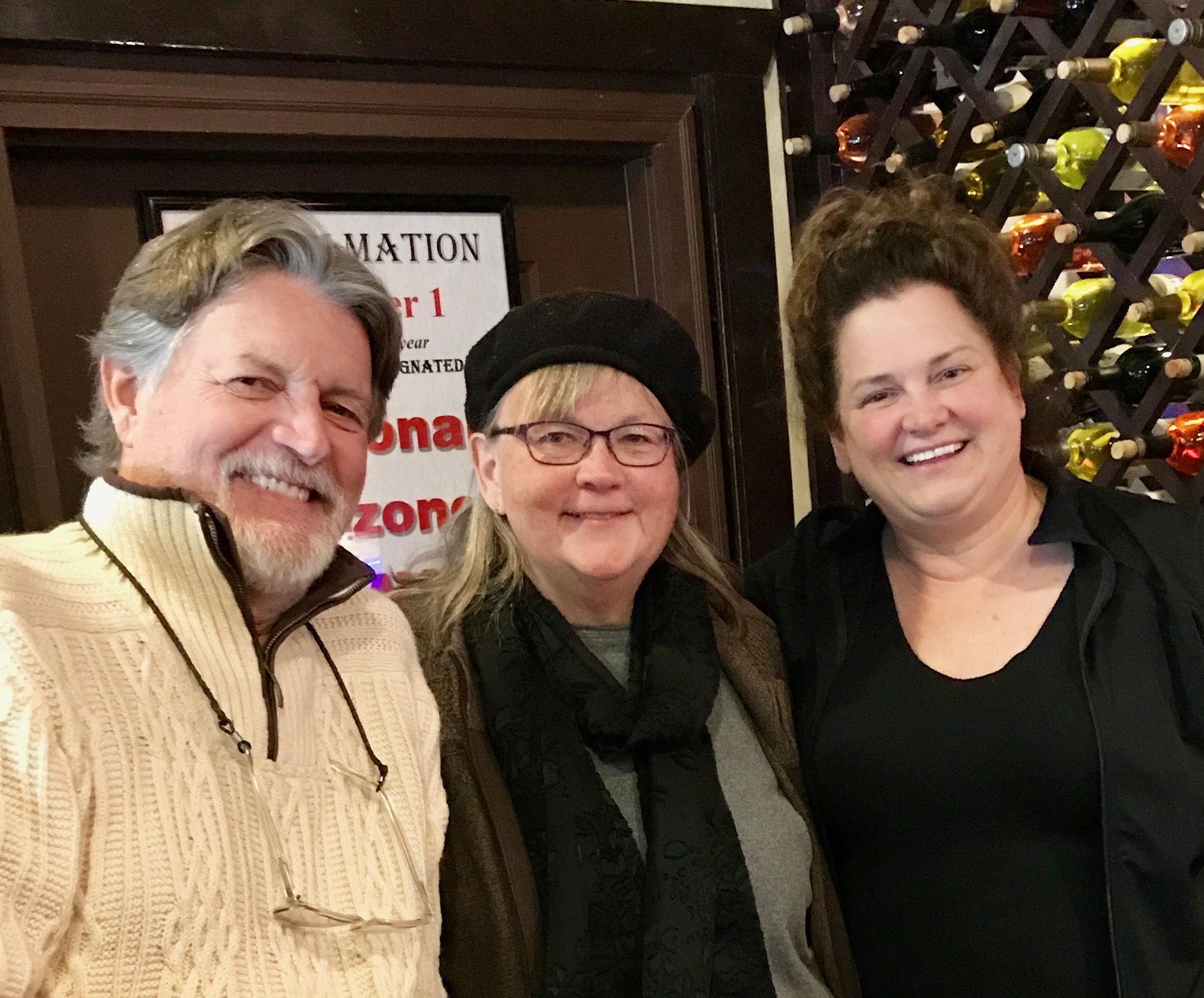
We met in a Facebook group for interesting women a few years back. (In my opinion, we both meet that criteria.)  When I mentioned that I was planning to pass through her area, she invited me to visit. We had a lovely visit. Her husband, Tom, stuck his head in from time to time. He did let me snap a photo of him, but he had on a cap pulled low and stood in the shadows. It didn’t turn out well, so I guess you’ll just have to take my word that we met without the photo to back it up.

Hmm. Could he be in the witness protection program? That might explain why he wasn’t eager to have me take his photo.

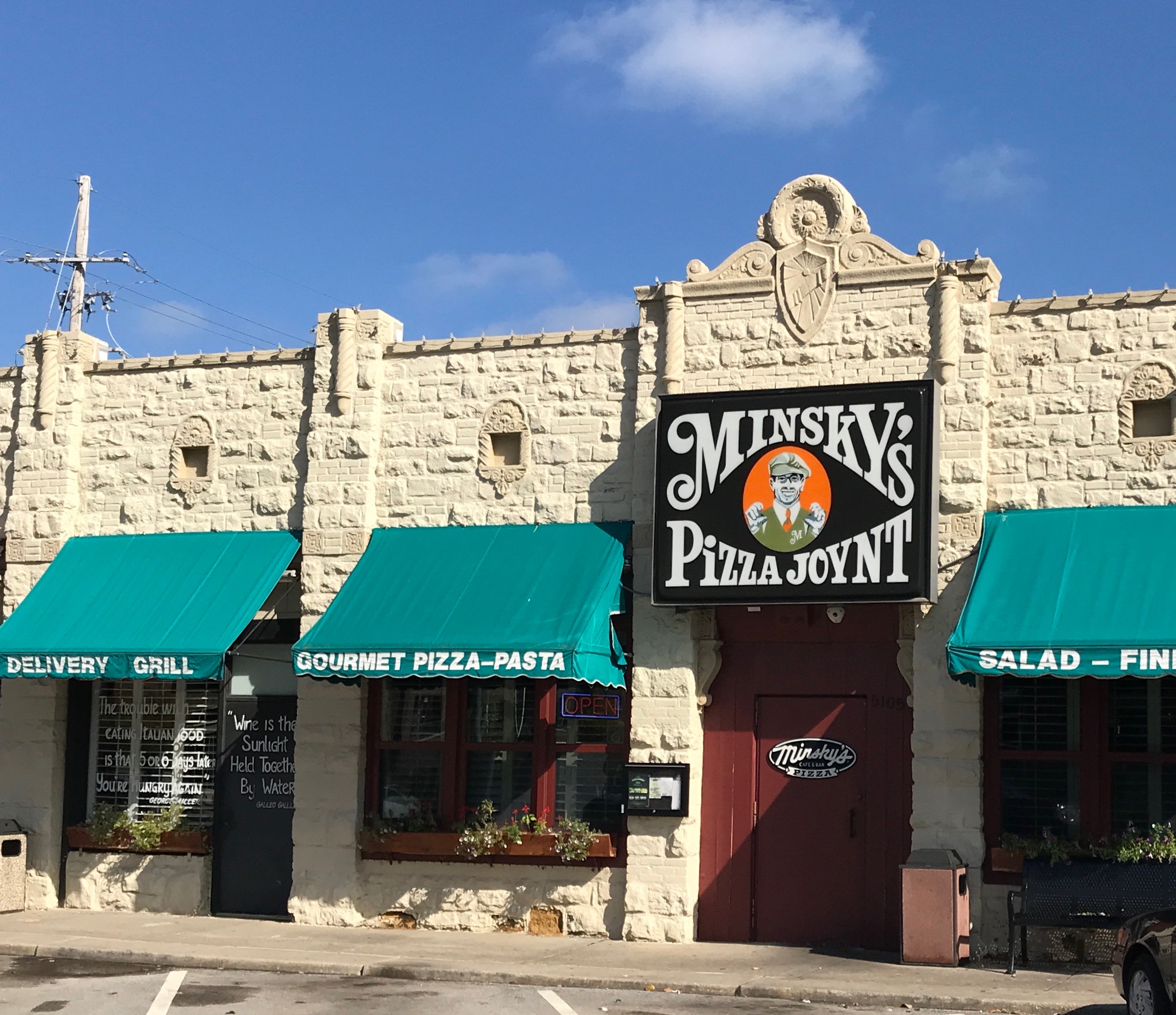
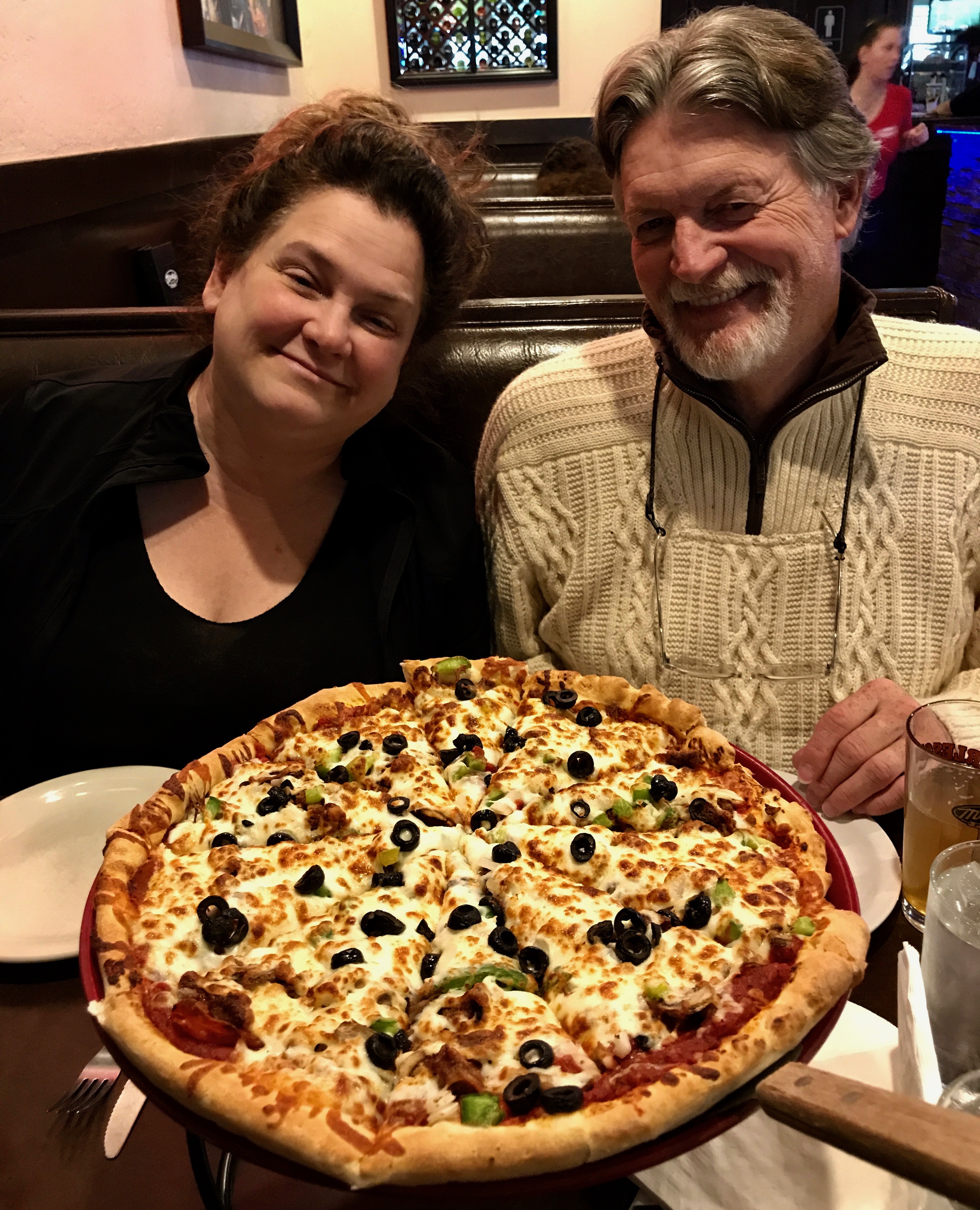
The next day, I met up with Airstreamer friends, Elizabeth and Jack. They recommended this place. They said it had THE BEST PIZZA.

Quite frankly, I do believe they were correct. This is a local chain, and they have many locations. My friends, the experts, said that the one at 5105 Main Street, Kansas City, MO is the best one, so we met up there.

We compared notes about what had been going on in our lives and then parted ways.

They got into their TV (which is how RVers refer to their tow vehicles.)

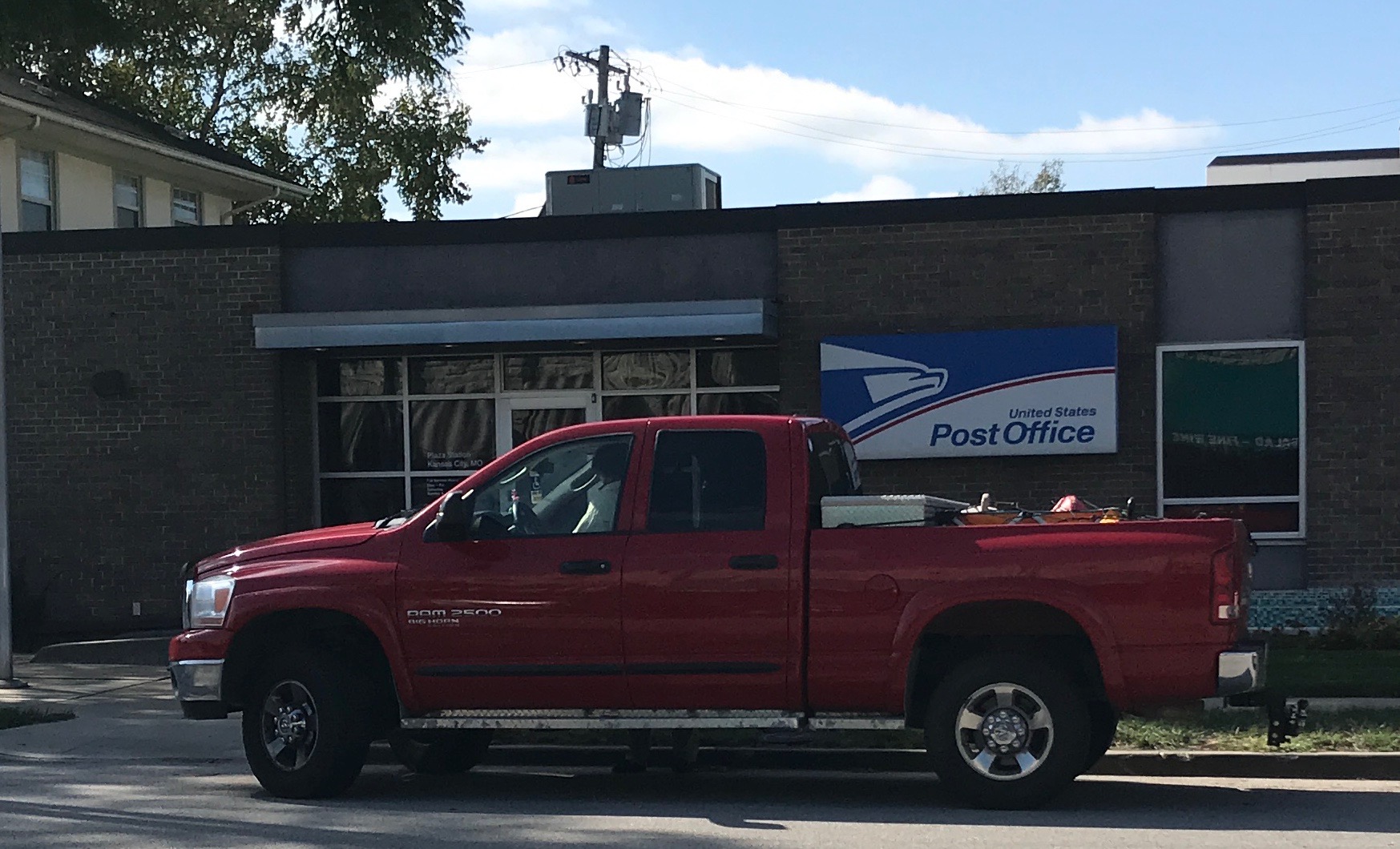
Incidentally, their RAM 2500 is a Big Red Truck, but they call him BeRT, as opposed to my RAM 2500, which I called BART, for Big Ass Red Truck.

They got in BeRT and headed off to further adventures. Until next time! I wonder where that will be? So far, we’ve met up in Arizona, Ohio and now Missouri.

In the meanwhile, there is always social media!

I’ve Crossed the Capitol off My List. What’s next?

After all that art ‘n’ architecture, I was feeling quite peckish. I found myself a Mexican restaurant and tucked in.

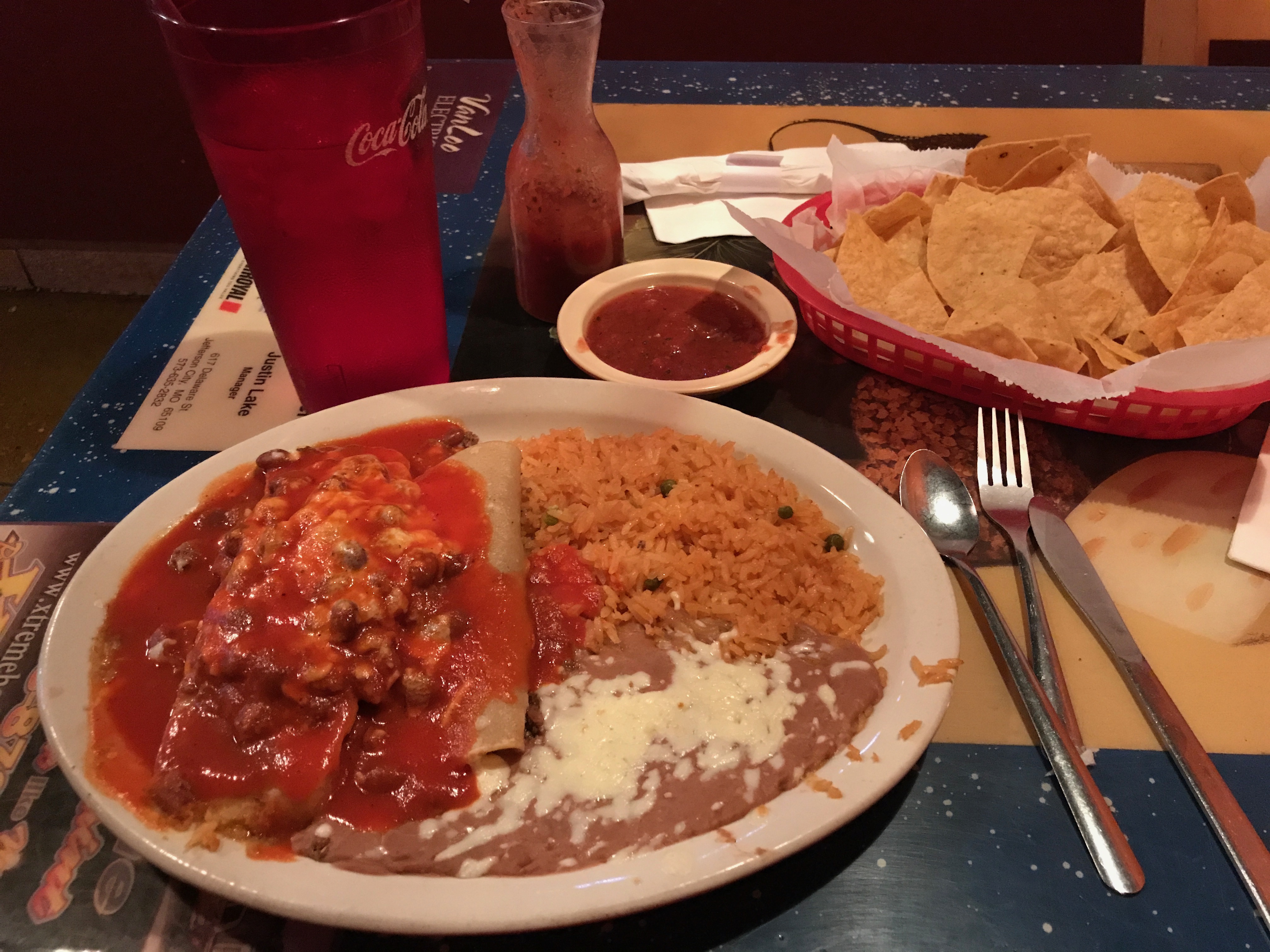
Beans, rice and corn – my favorites!

After that, it was time to find something else to explore before I moved on. I thought I’d see if the cathedral was as elegant as the capitol.

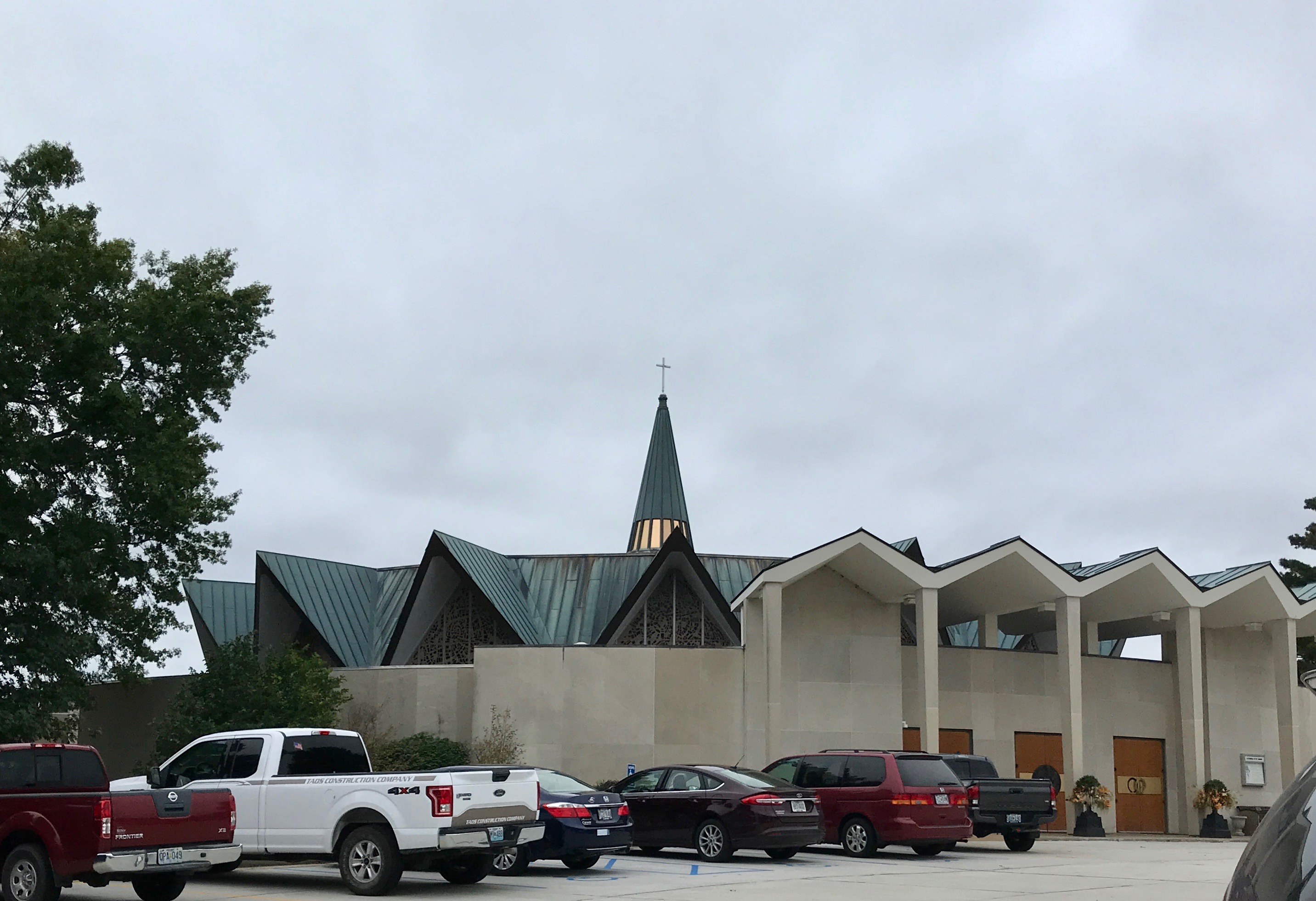
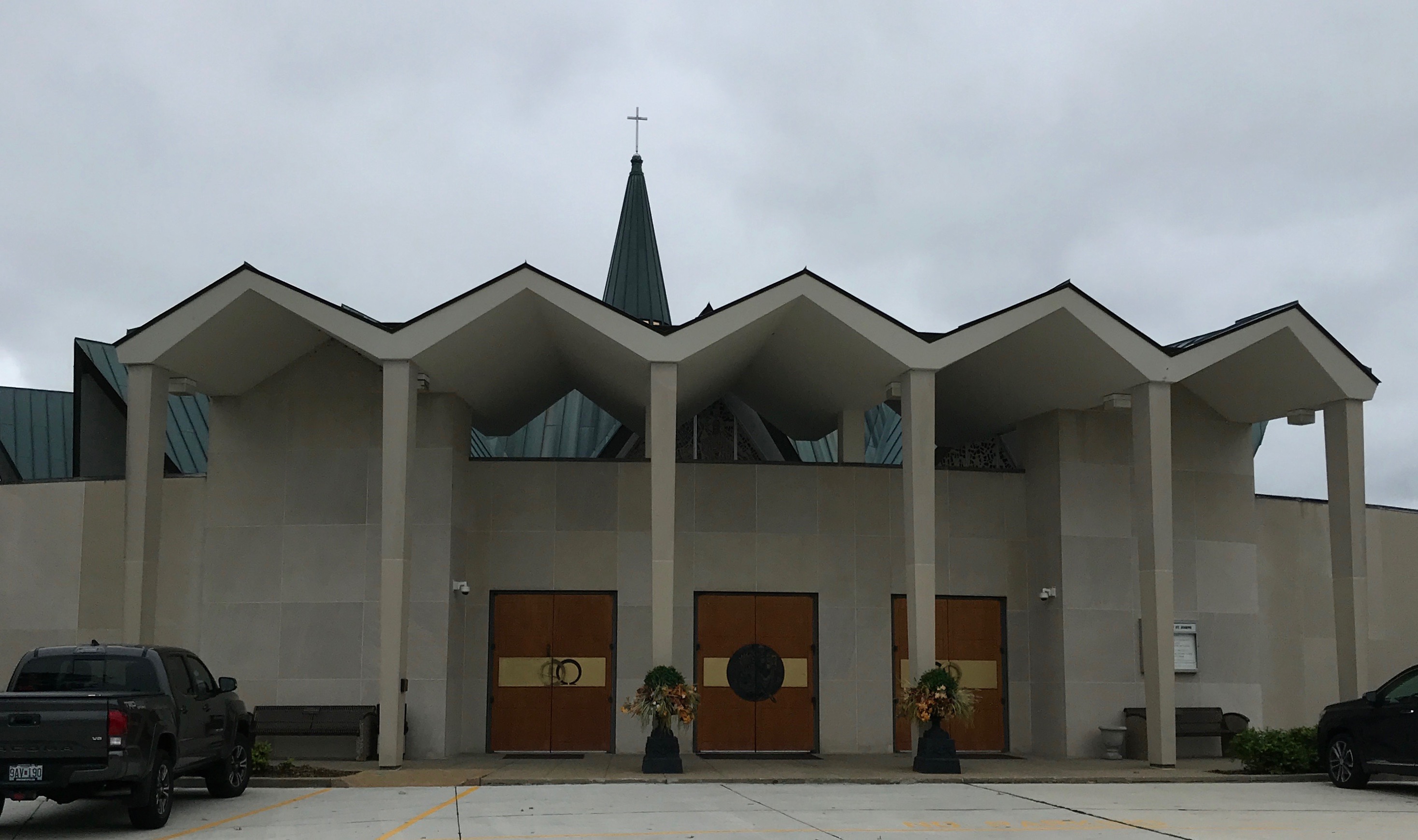
I have to admit that I wasn’t expecting such a modern building.

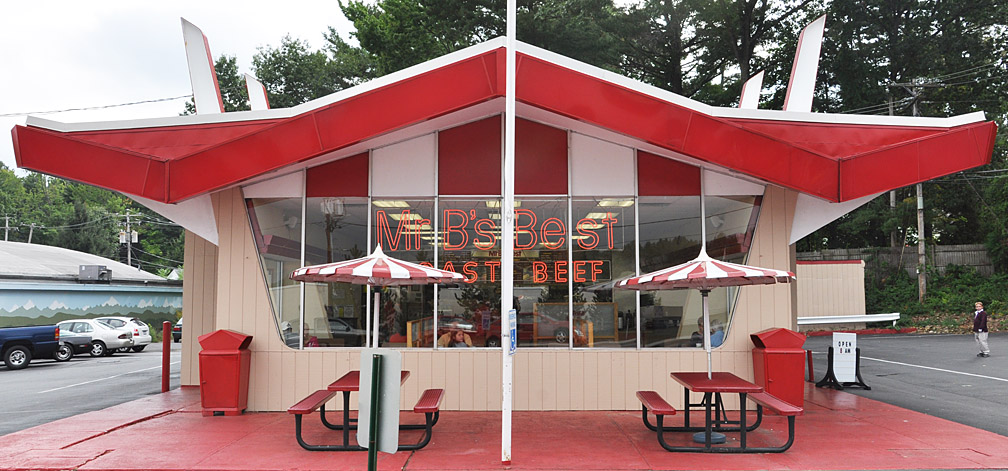
I decided to walk up and see what I could see. Quite frankly, the roofline made me think of fast-food restaurants from the 1960s. That style of roof is known as a folded plate roof. I did a Google search to see if I could find any examples. Here’s a repurposed Neba restaurant.

Supposedly Neba stood for “Nicest Eating Beef Around.” I could have sworn that my father said it was named after the founder’s dog. My father had a rather fey sense of humor.

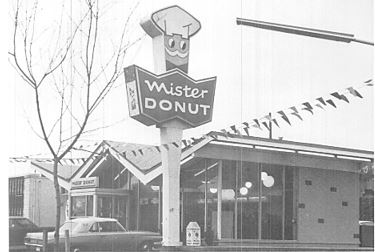
Not all such ’60s restaurants got repurposed. This one reminds me of the Mister Donuts you used to see around.

http://whatitusedtobewarwick.blogspot.com/2017/06/cranston.html

Ah! There it is! Mister Donut with the folded plate roof.

But, I digress, which is to be expected. This cathedral was built after the Diocese of Jefferson City was created. In 1956, territory was taken from the Archdiocese of St. Louis, the diocese of Kansas City and the Diocese of Saint Joseph. The plans for the church were drawn up in 1966, and the first mass was held in 1968.

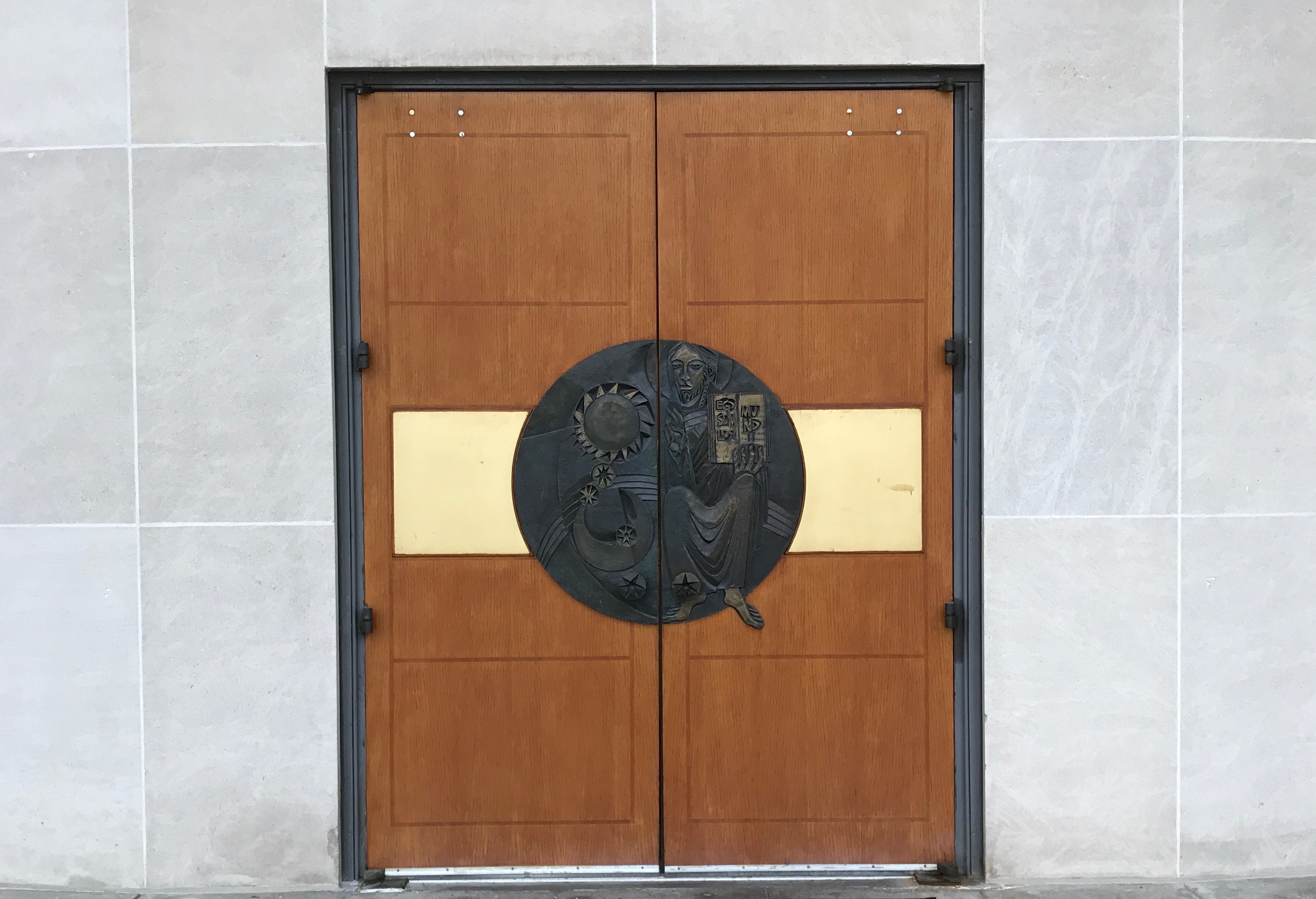
I walked up to the doors, which were designed by Brother Stephen Erspammer, S.M. of St. Louis. According to my Preferred Source, since the cathedral is built into a slope, the doors open at ground level, which makes for a barrier-free access. These doors weigh 500 pounds each, though. I hope that doesn’t keep out the weak! I did managed to make my way in, so they must be very well balanced.

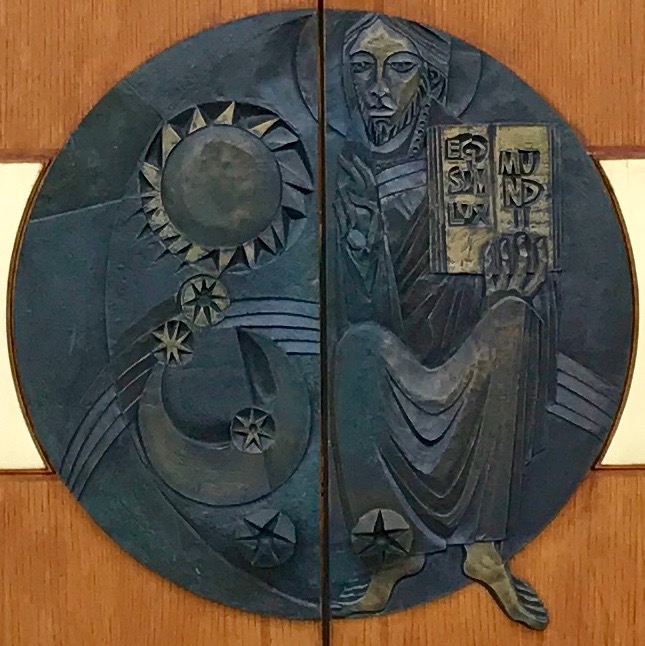
The bronze medallion embedded in the center set of doors depicts an eternal Christ. He is seated among the sun, moon, stars and rainbows of the heavens. With one hand, the figure makes the ancient gesture of a teacher.

Teacher friends, how many of you make this gesture?

The other hand hold the book of Scriptures, with the words “Ego sum lux mundi,” which means I am the light of the world.

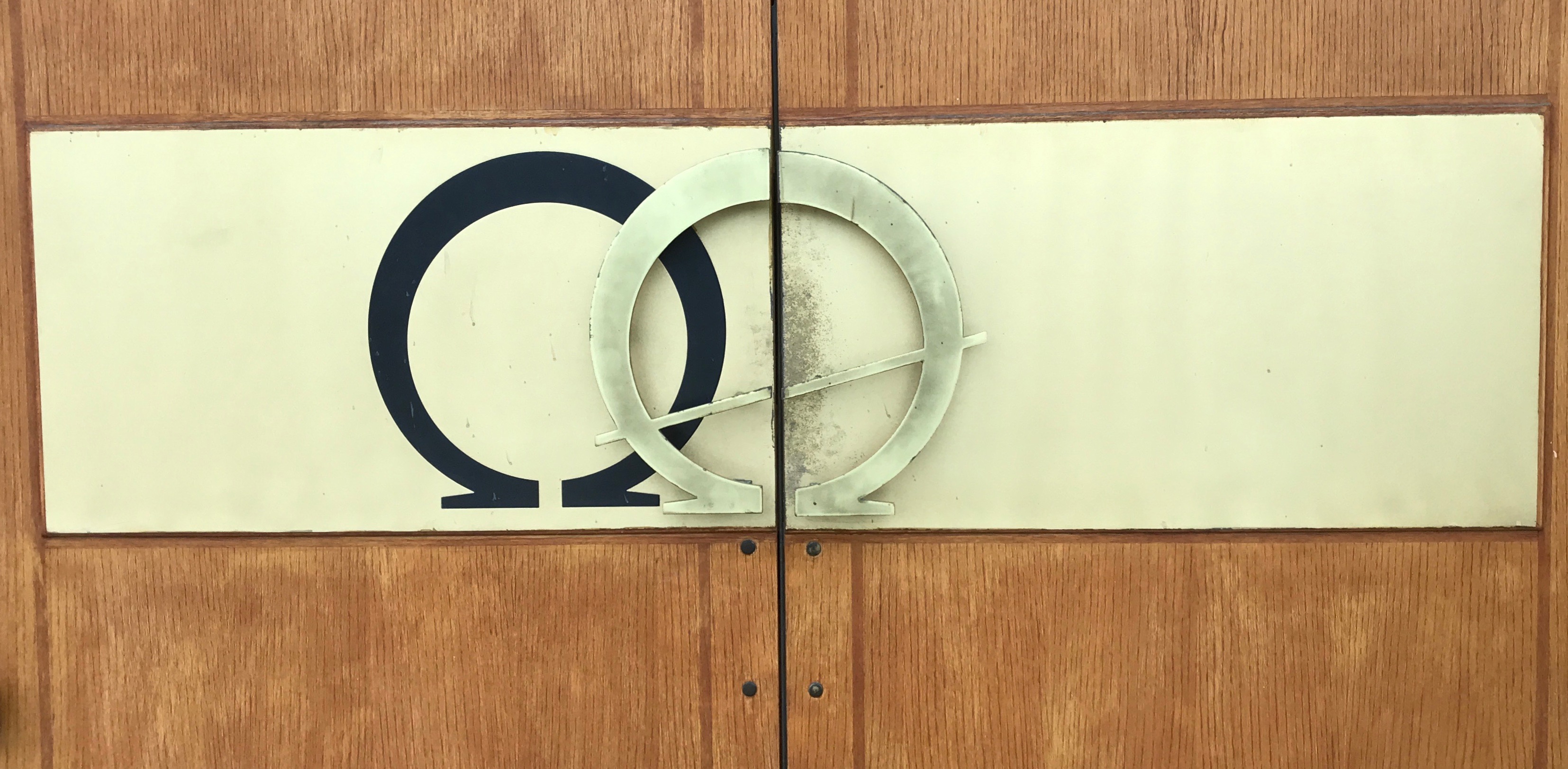
The doors on right and left sides have handles designed in the shape of the Greek letters, Alpha and Omega, recalling John’s vision of Christ in Revelation.

With all the cars in the parking lot, I assumed that a mass was underway, or, perhaps, about to start. Since I miss a many of my weekly masses when I am on the road, I was hopeful that I might be in time for a service.

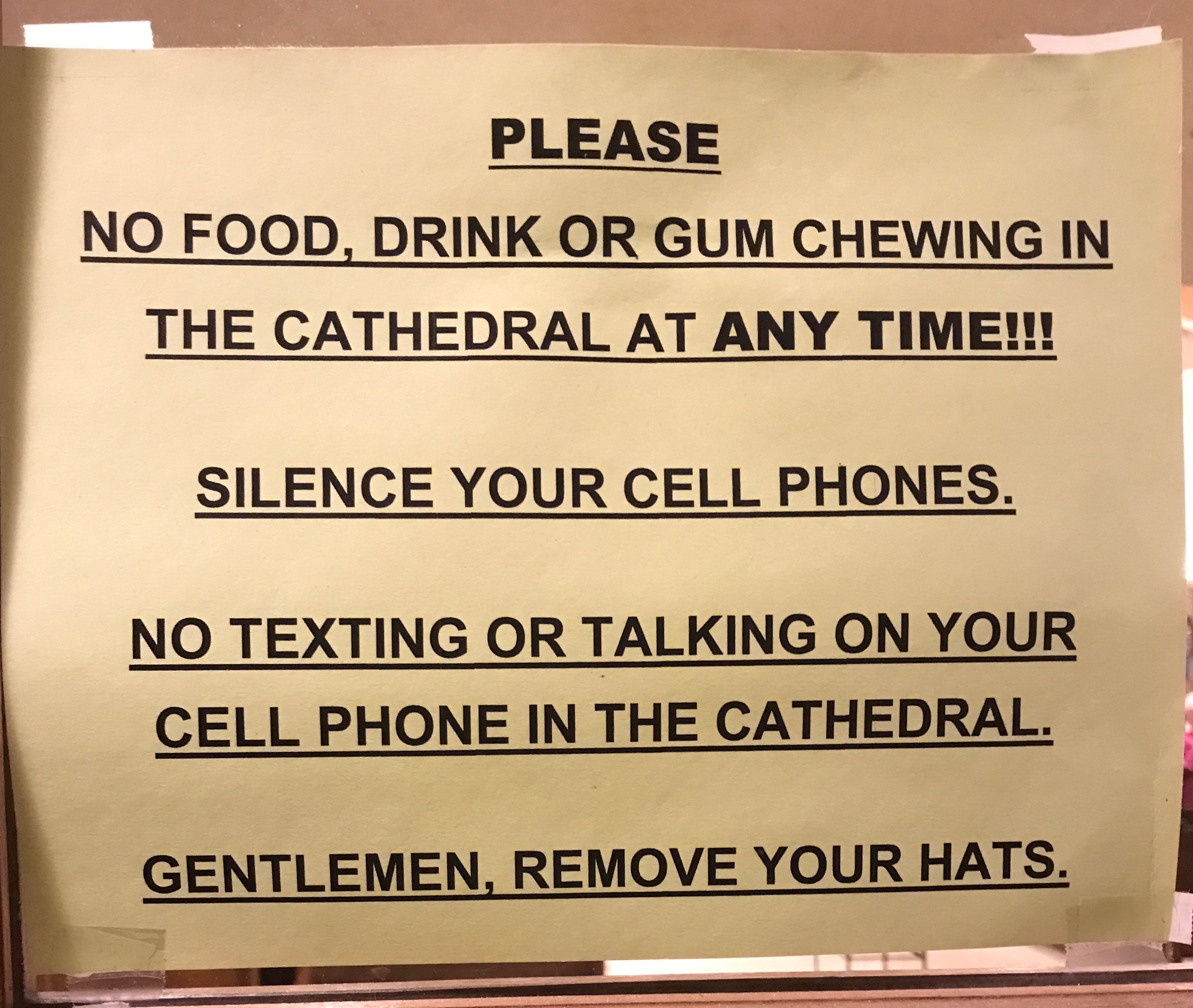
I passed by this sign, reminding people of proper church etiquette.

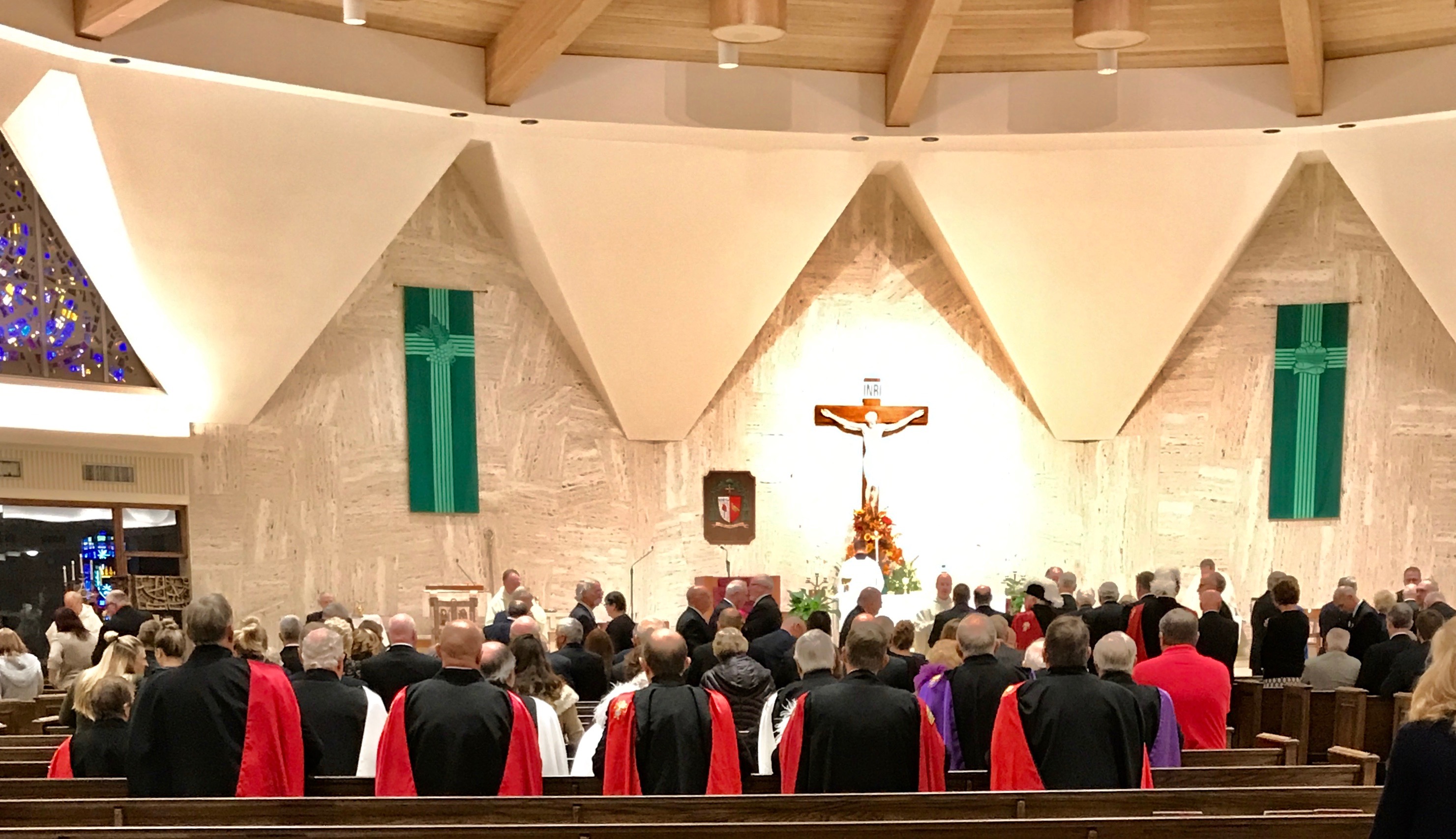
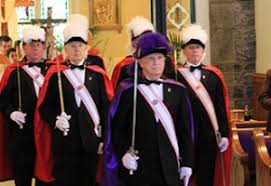
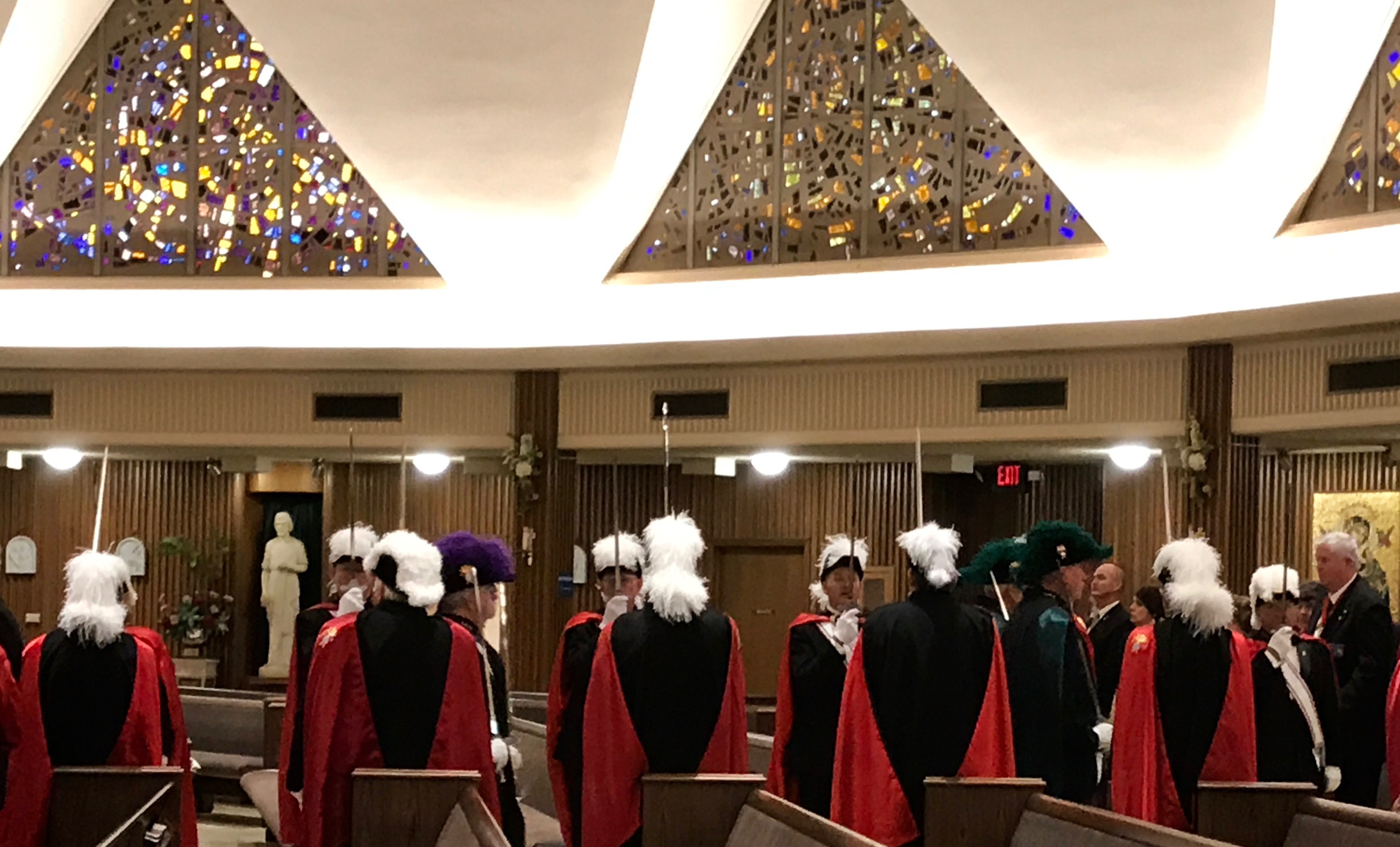
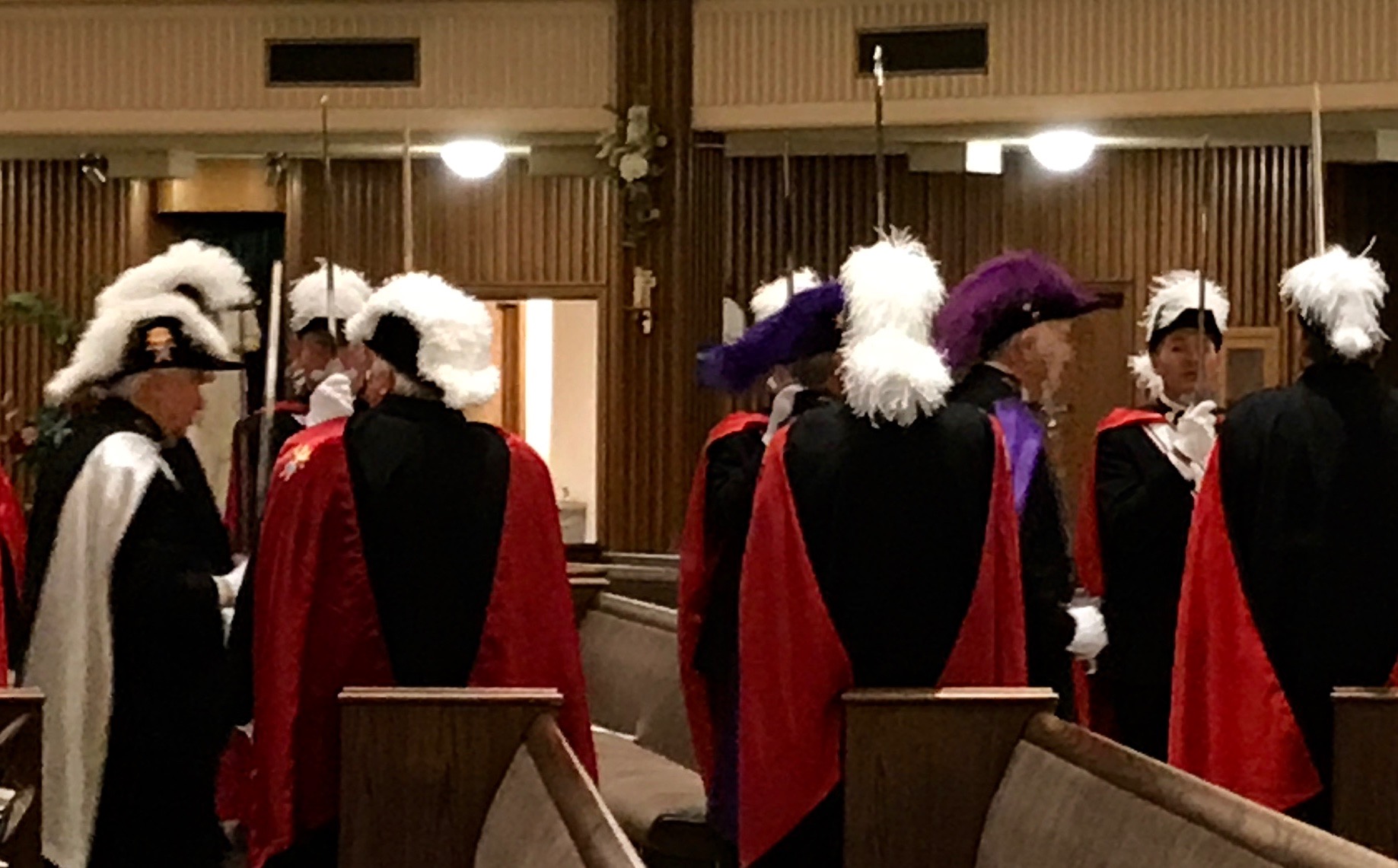
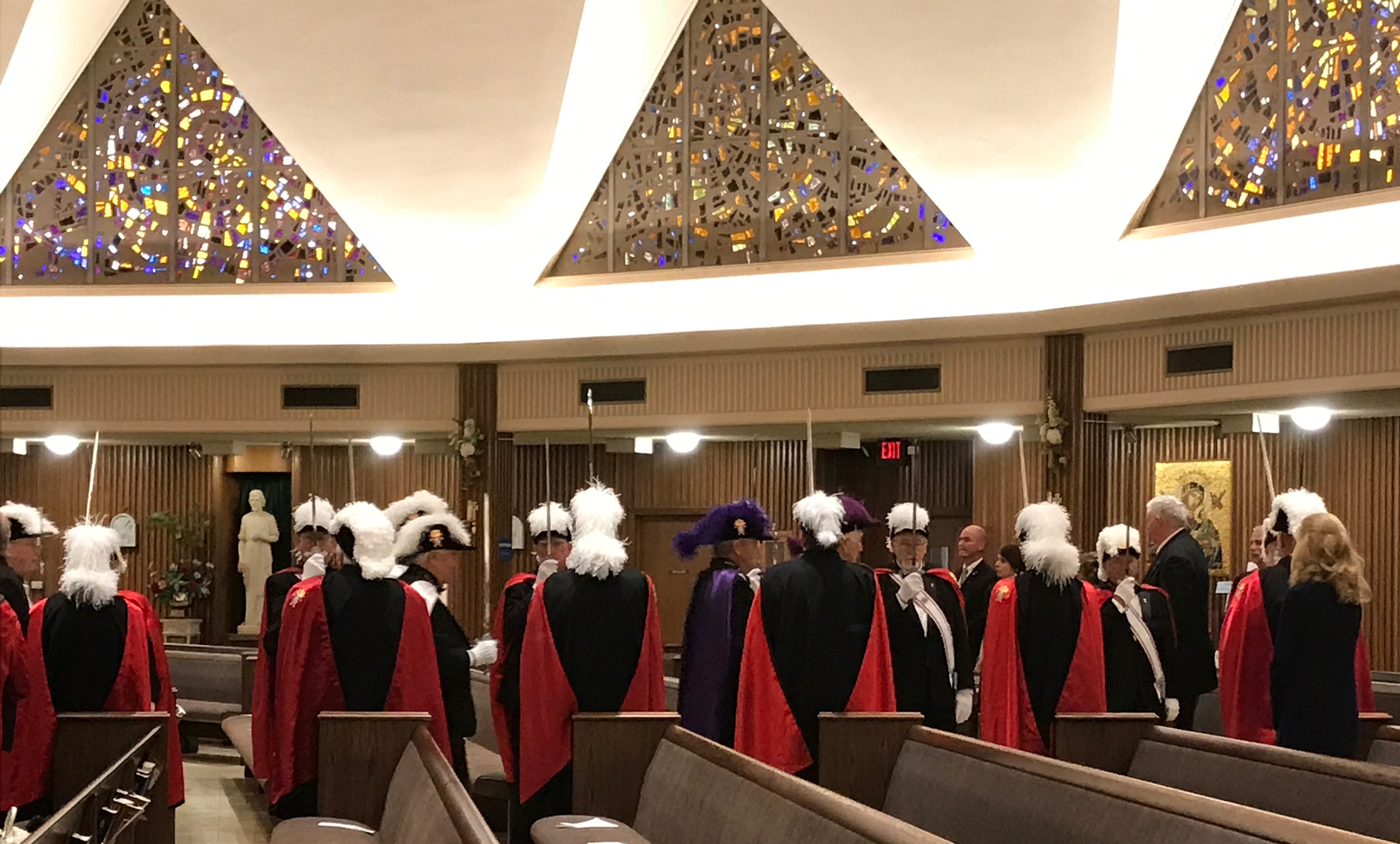
My goodness! I had walked in on a Knights of Columbus mass! I had seen them from time to time at masses in the cathedral in Kalamazoo, but I always felt they were kind of a “secret society,” although if they want to be a secret society, they need to come up with a uniform that is a little more inconspicuous. 

The Knights of Columbus is the world’s largest Catholic fraternal service organization. It was founded in 1882 by Michael J. McGivney in New Haven, Connecticut and named in honor of the explorer Christoper Columbus. It was originally designed to serve as a mutual benefit society for working-class and immigrant Catholics in the United States. It developed into a fraternal benefit society dedicated to providing charitable services, including war and disaster relief, and actively defending Catholicism across the globe and promoting Catholic education.

Incidentally, JFK was a fourth degree member of the Bunker Hill Council number 62. Many other notable Catholic men from the United States have been Knights of Columbus, including  Americans Ted Kennedy, Vince Lombardi, Al Smith, Sargent Shriver, Samuel Alito, John Boehner, Ray Flynn, Jeb Bush and Sergeant Major Daniel Daly, a two-time Medal of Honor recipient.

I had a few minutes before mass began, so I took a quick look around.

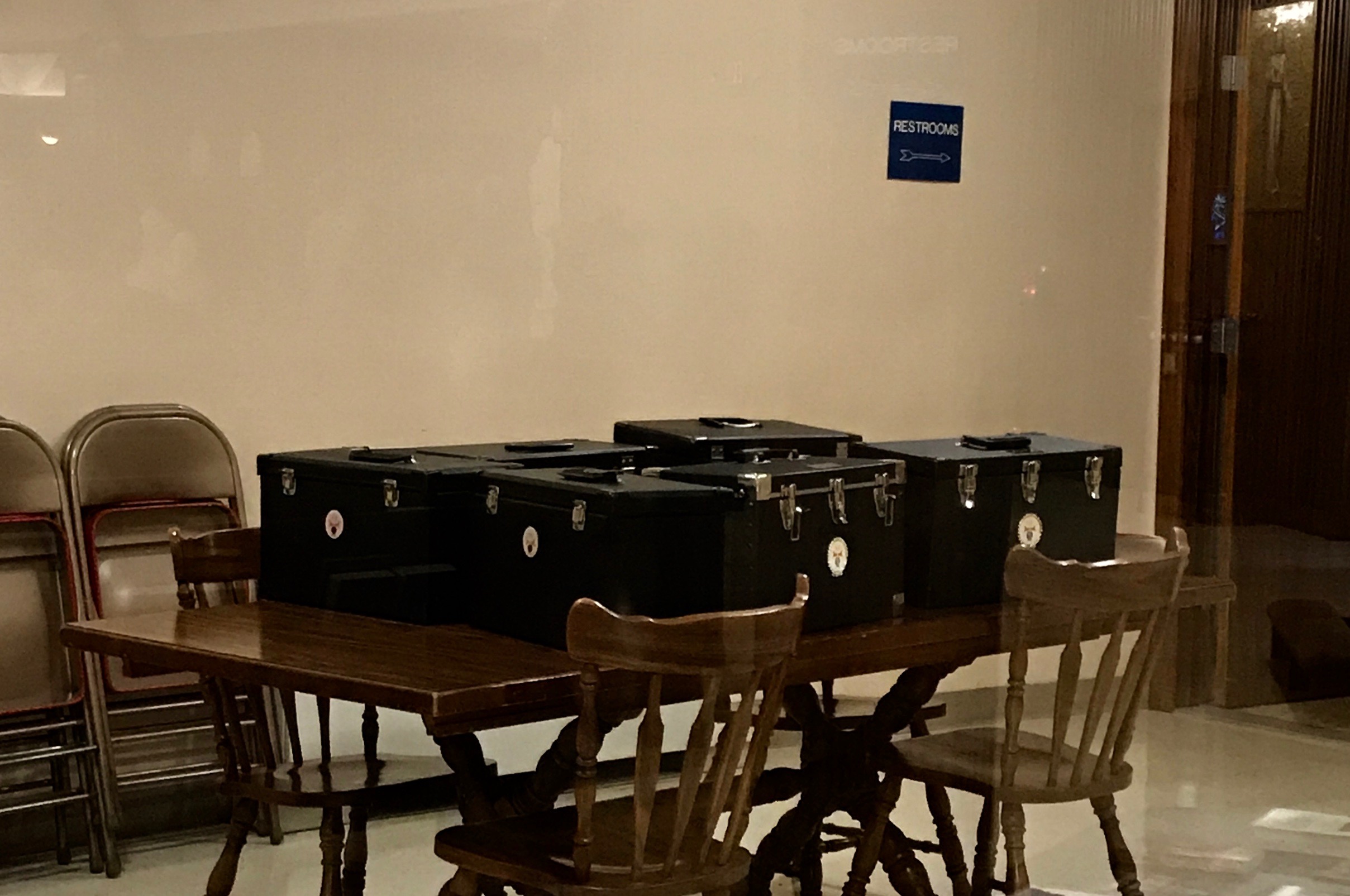
This collection of hat boxes in what I assume was the “crying room” tickled my fancy. I imagine those be-plumed, cockaded chapeaus would be hard to wear in the car!

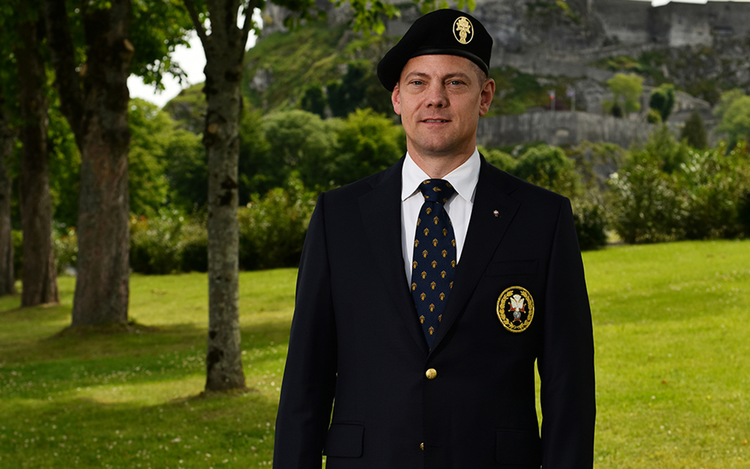
But, in case you are a Catholic male and you were put off joining by having to wear the regalia, you are in luck! As of July 1, 2019, the new uniform for fourth degree members will be a blazer and beret.

CNS photo/Knights of Columbus

Ceremonial swords will still be part of the uniform. Knights are free to continue to wear the old uniforms, but the thinking is that updating the look will attract more members to the organization.

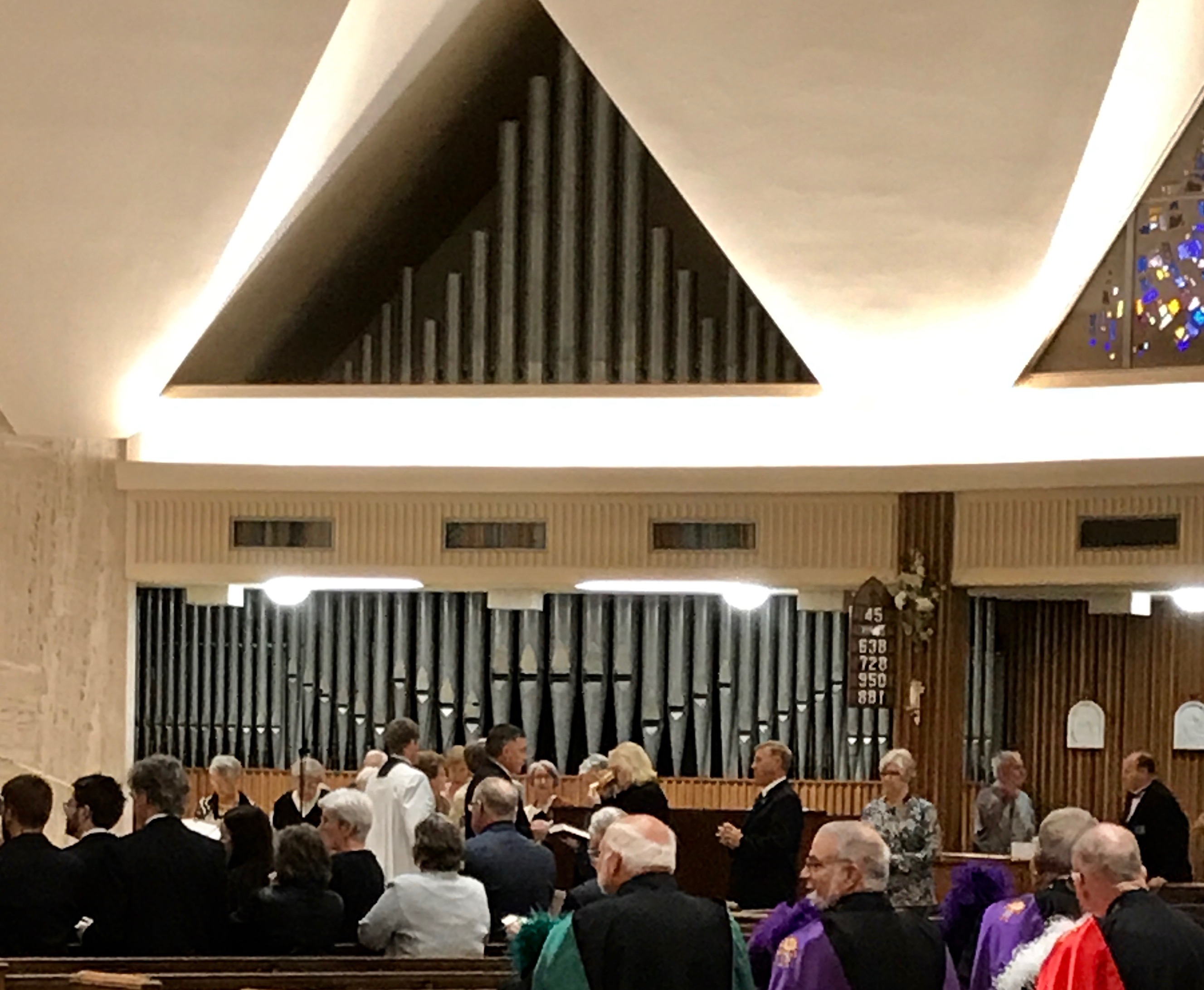
Oh, dear! They have a pipe organ. Well, I can put up with anything for a while.

The time came to receive the Eucharist. And soon, mass had come to a close.

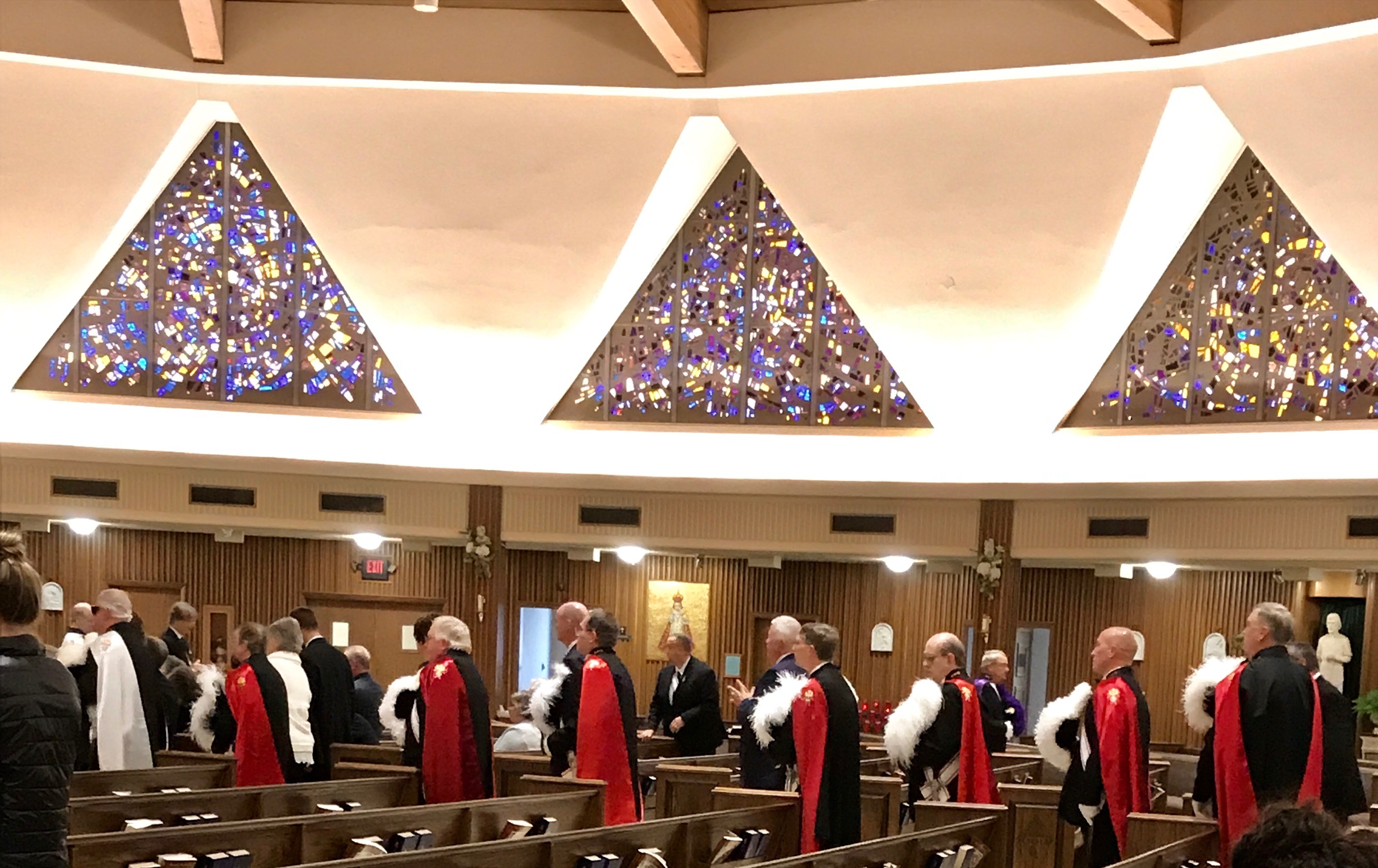
The Knights of Columbus lined up holding their chapeaus.

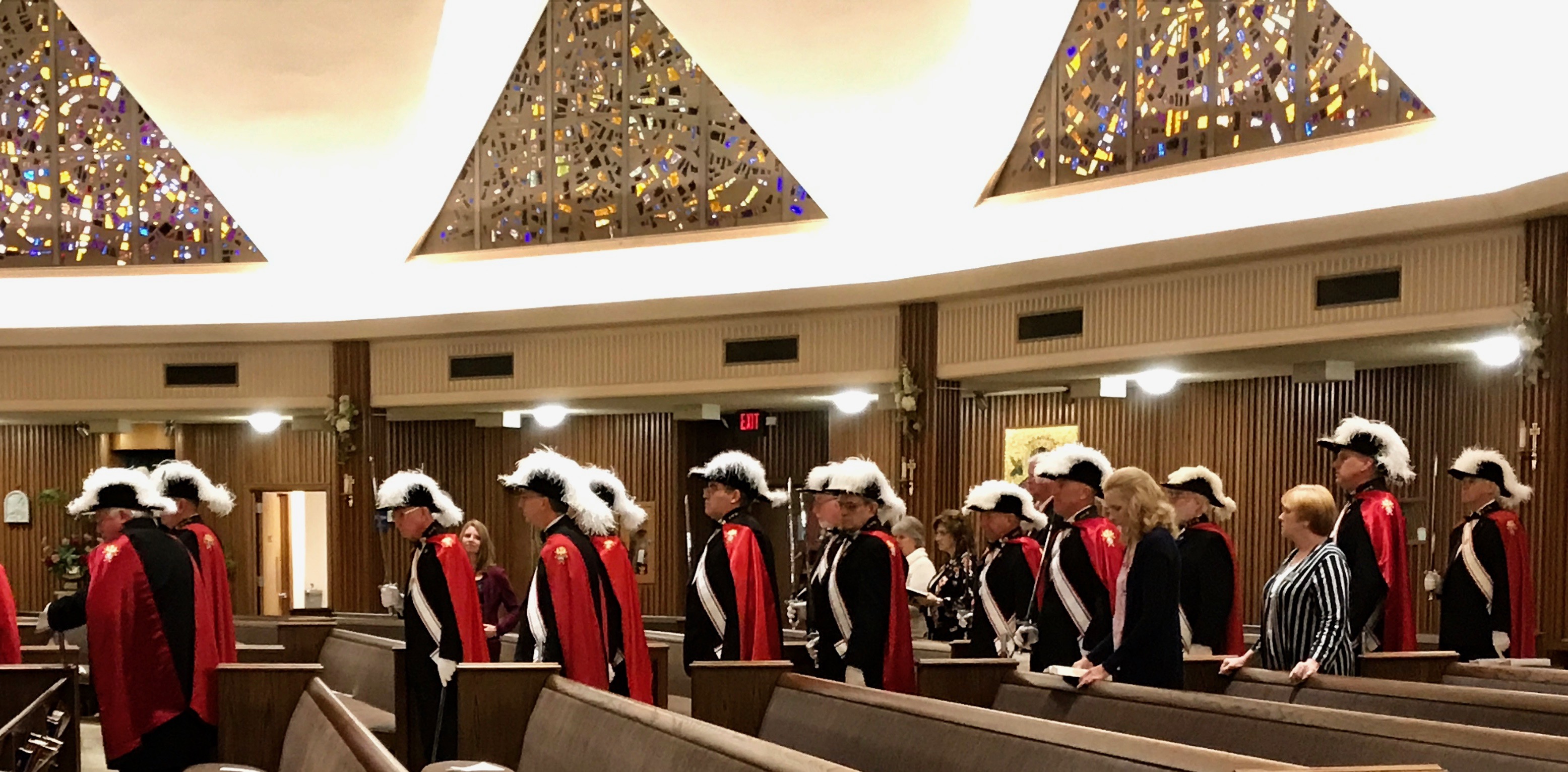
They put them on.

They raised their swords.

Due to the color of the lining  of their capes, what I must assume were higher ranking officials processed through the phalanx of Knights.

Then mass was over. I didn’t want to intrude, so I didn’t pull any of them aside to ask what I had just witnessed.

I got in the car and headed back toward the capitol. My next stop was Jefferson Landing.

I found a place to park and got out to explore. This was going to have to be a quick visit. The weather wasn’t “tourism friendly” and the day was winding to a close. However, a quick visit is better than no visit.

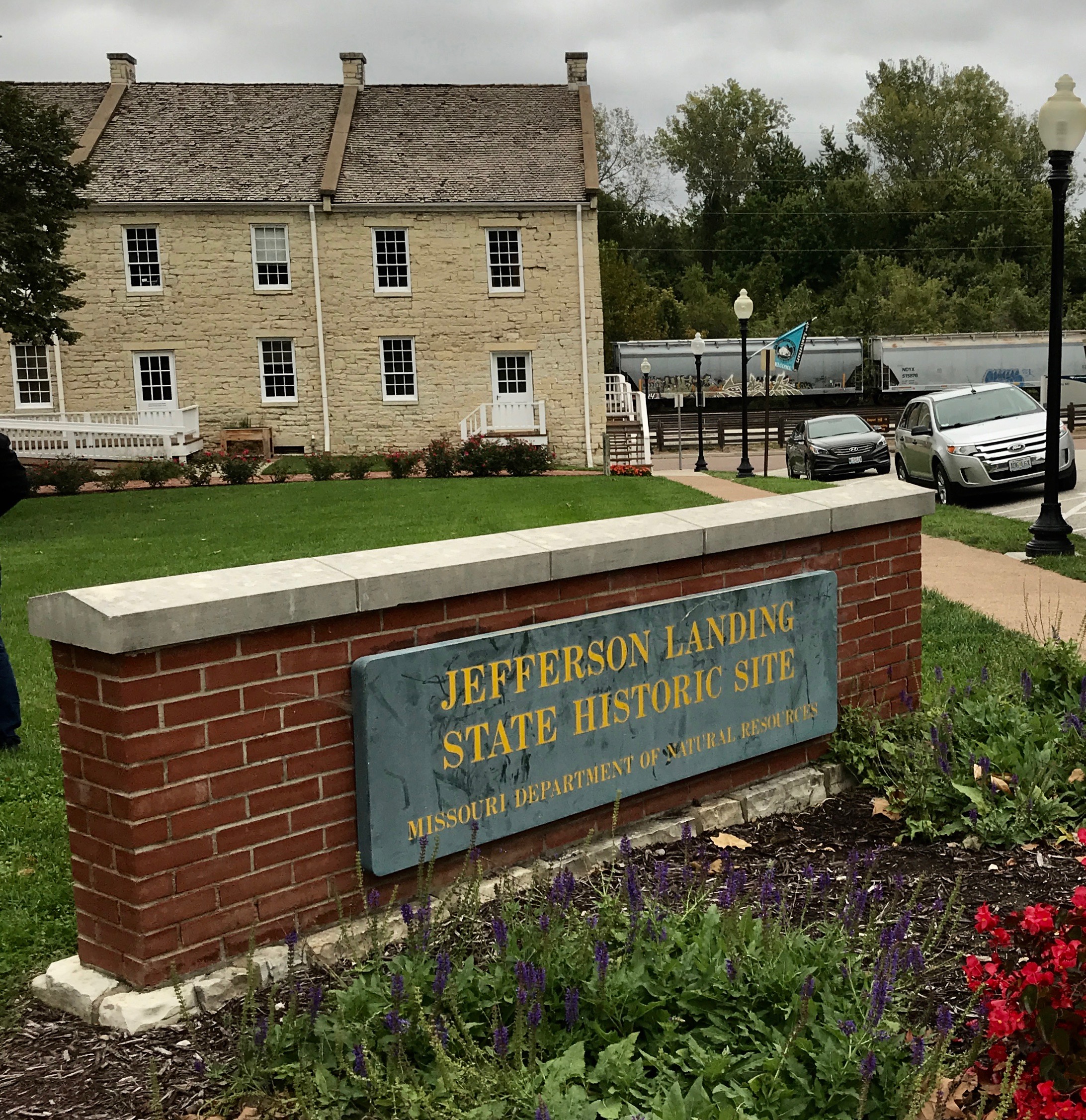
Jefferson Landing State Historic Site is significant because it is a rare preserved Missouri River Landing.

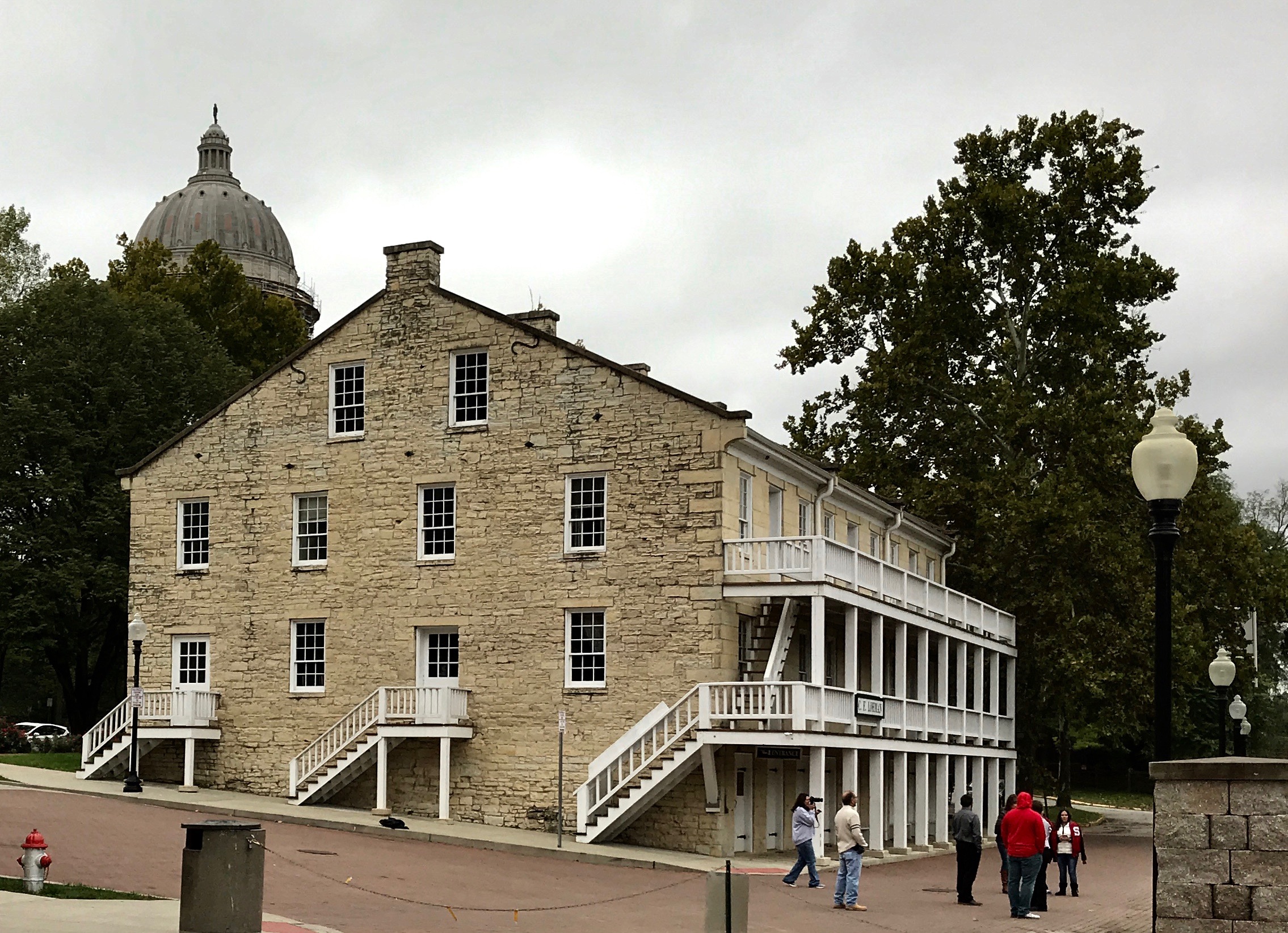
On one side, you have the Lohman Building. It was constructed in 1839 by James Crump. Over the years it was used as a grocery store, warehouse, telegraph office, tavern and hotel. It earned the nickname “the landing” and was recognized as a popular meeting place for lawmakers and businessmen.

So, if Crump built it, why is it know as the “Lohman Building?” Crump’s business partner eventually bought him out. I guess naming rights went with the purchase.

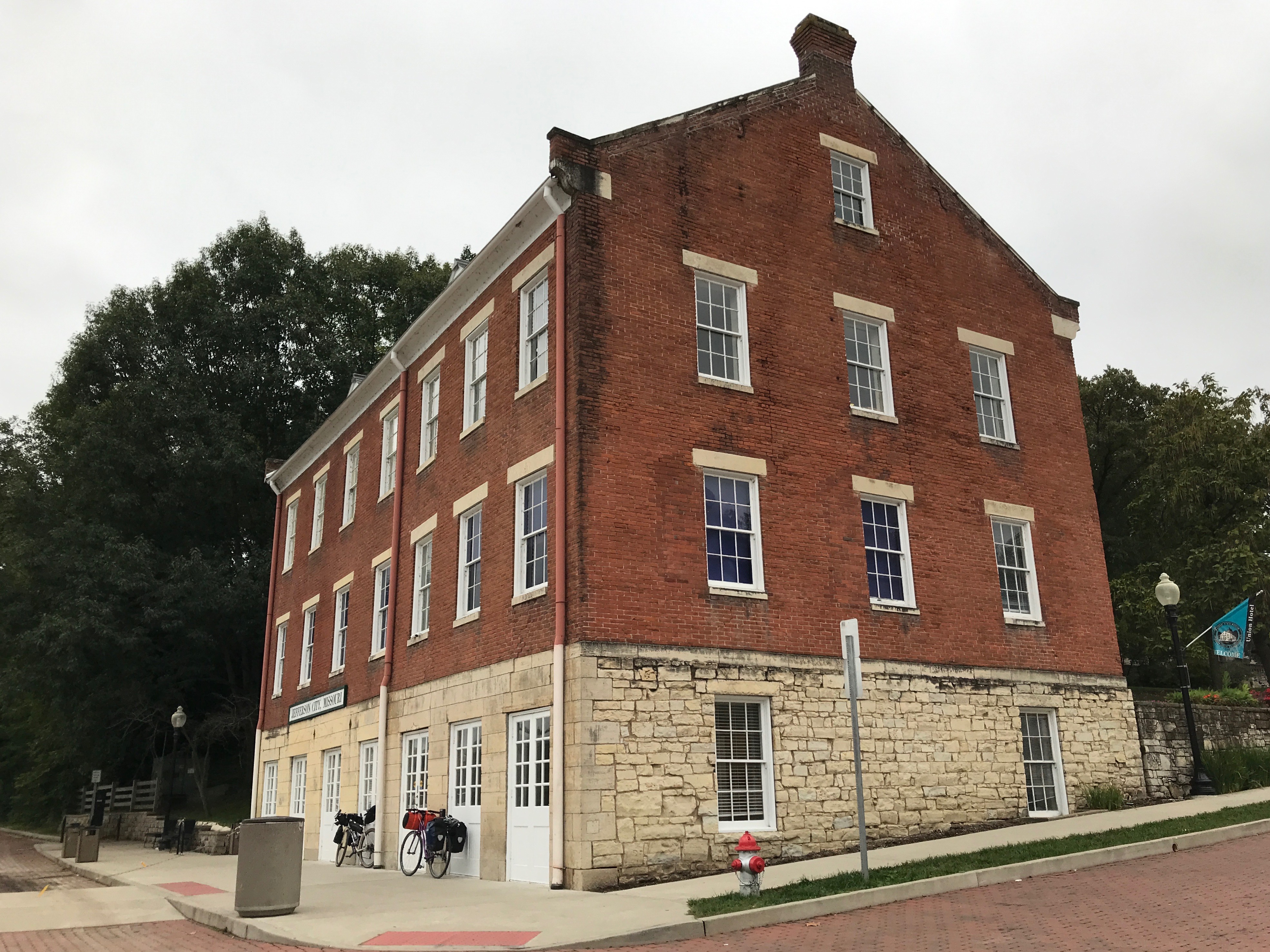
On the other side of the street is a hotel built by Charles Maus. He built it in 1855 and it opened as the Missouri Hotel. For some reason, the name was changed to Veranda Hotel. I wonder if it had a veranda at some point? However it finally became known as the Union Hotel after the Civil War.

The buildings were restored as part of the state’s bicentennial celebration in 1976. The Lohman building depicts and 1850s general store and ware house and features a film on the history of the site and of Jefferson City. The Union Hotel houses the Elizabeth Rozier Gallery, which has changing exhibits that emphasize Missouri’s history, art and Culture.

Of course, it was so late in the day that I had to rely on my Preferred Source for this information. The exhibits were closed, but if you plan to visit, up-to-date information can be found at the Missouri State Parks website.

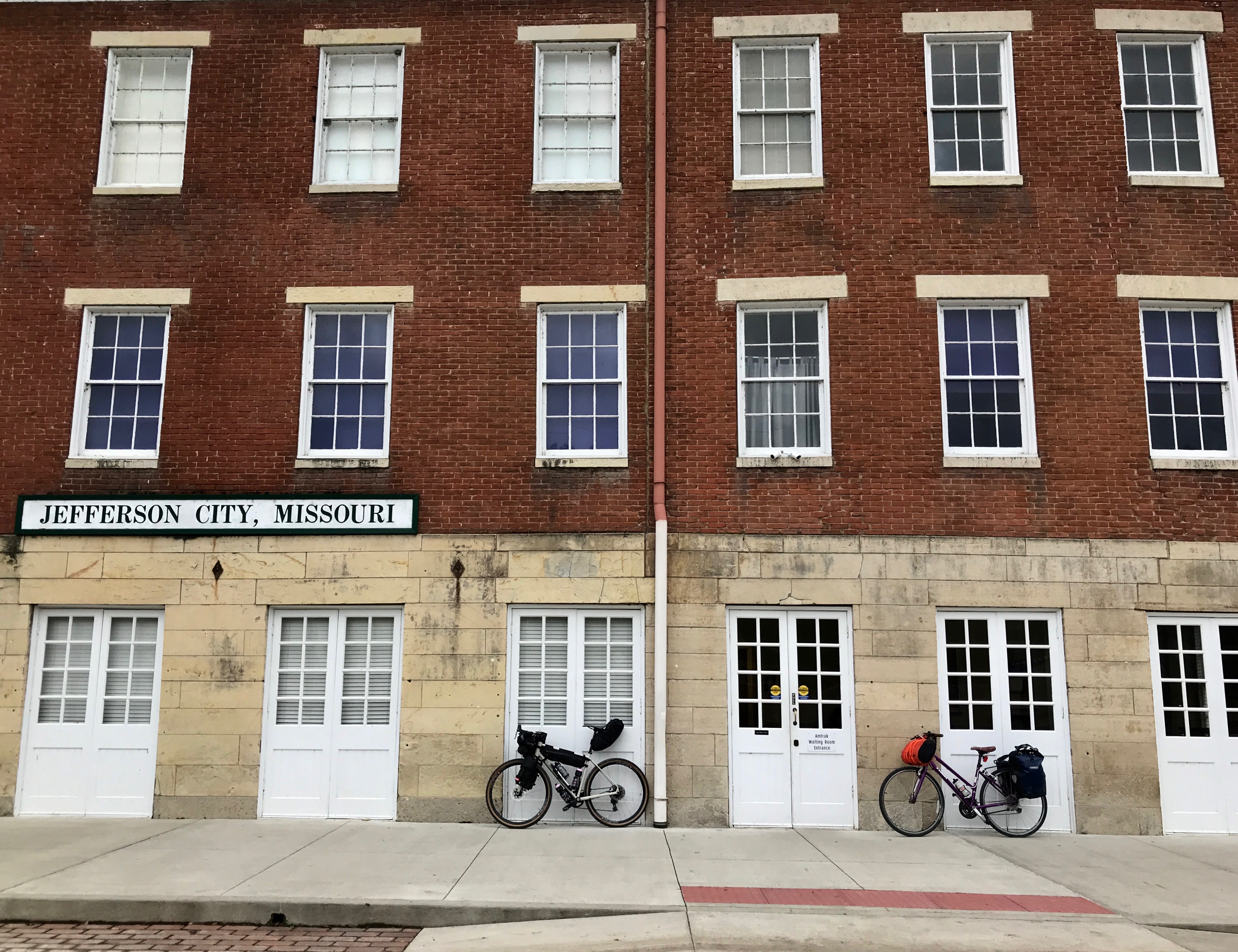
The lower level of the Union Hotel is used as the Amtrak station.

Jefferson City is pretty close to halfway between the two – smack dab in the middle of the state. That seems to be a good place for a state capital.

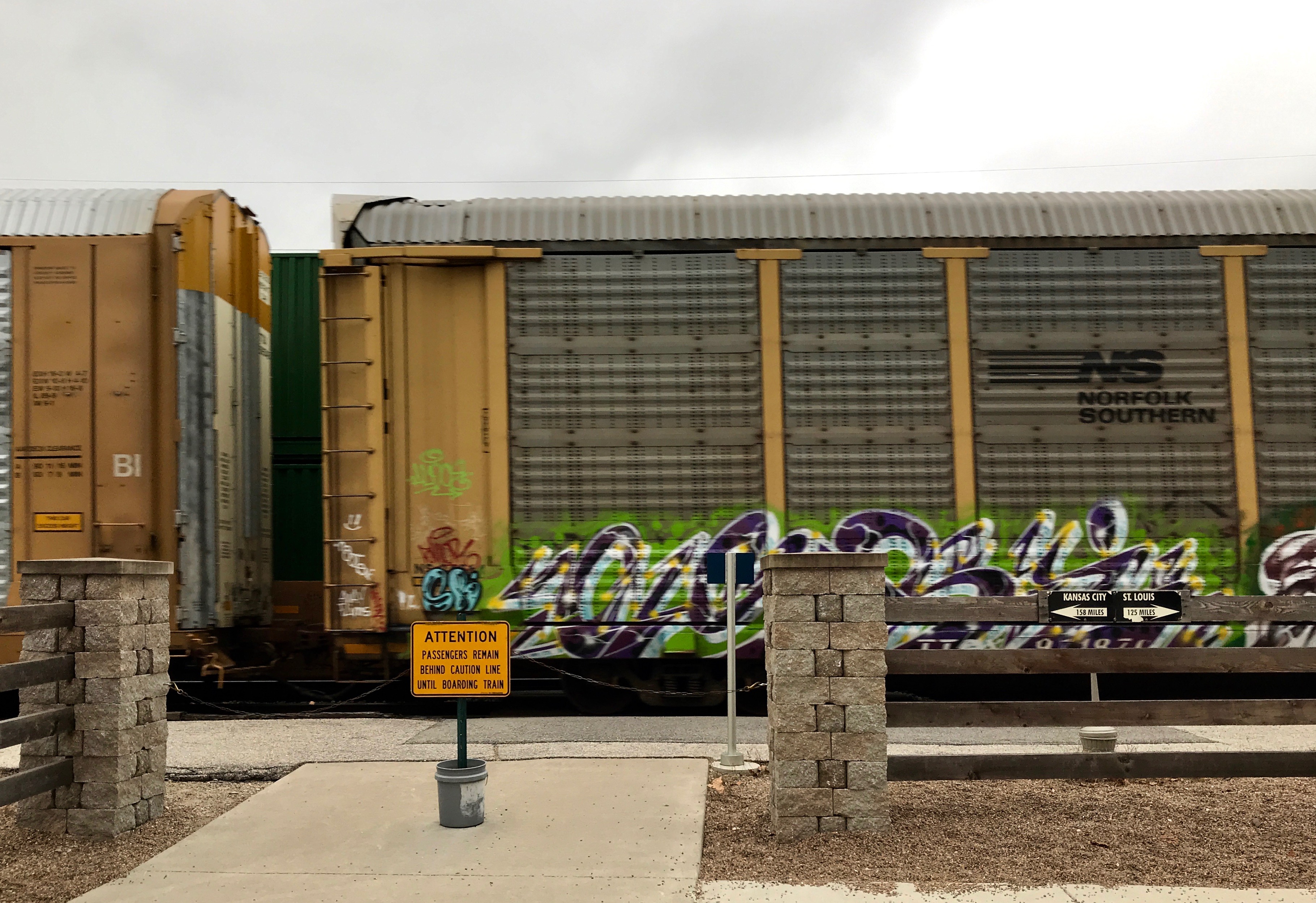
A freight train rumbled by while I was standing there taking it all in. I know that graffiti is technically vandalism, but some of it is really eye catching.

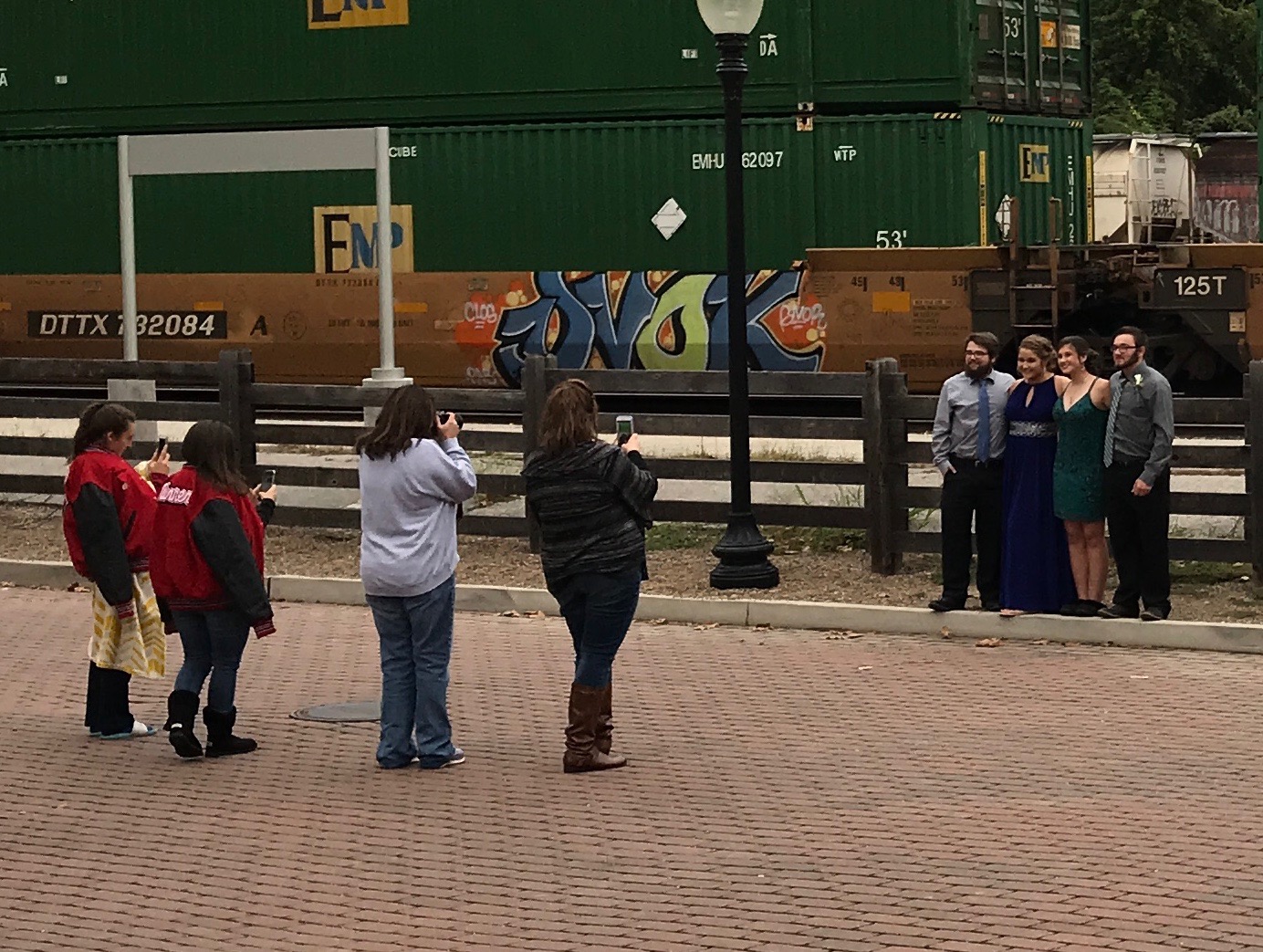
I wonder if it was fall formal season in the high schools. These folks spent several minutes snapping photos of the friends.

I headed up the brick road.

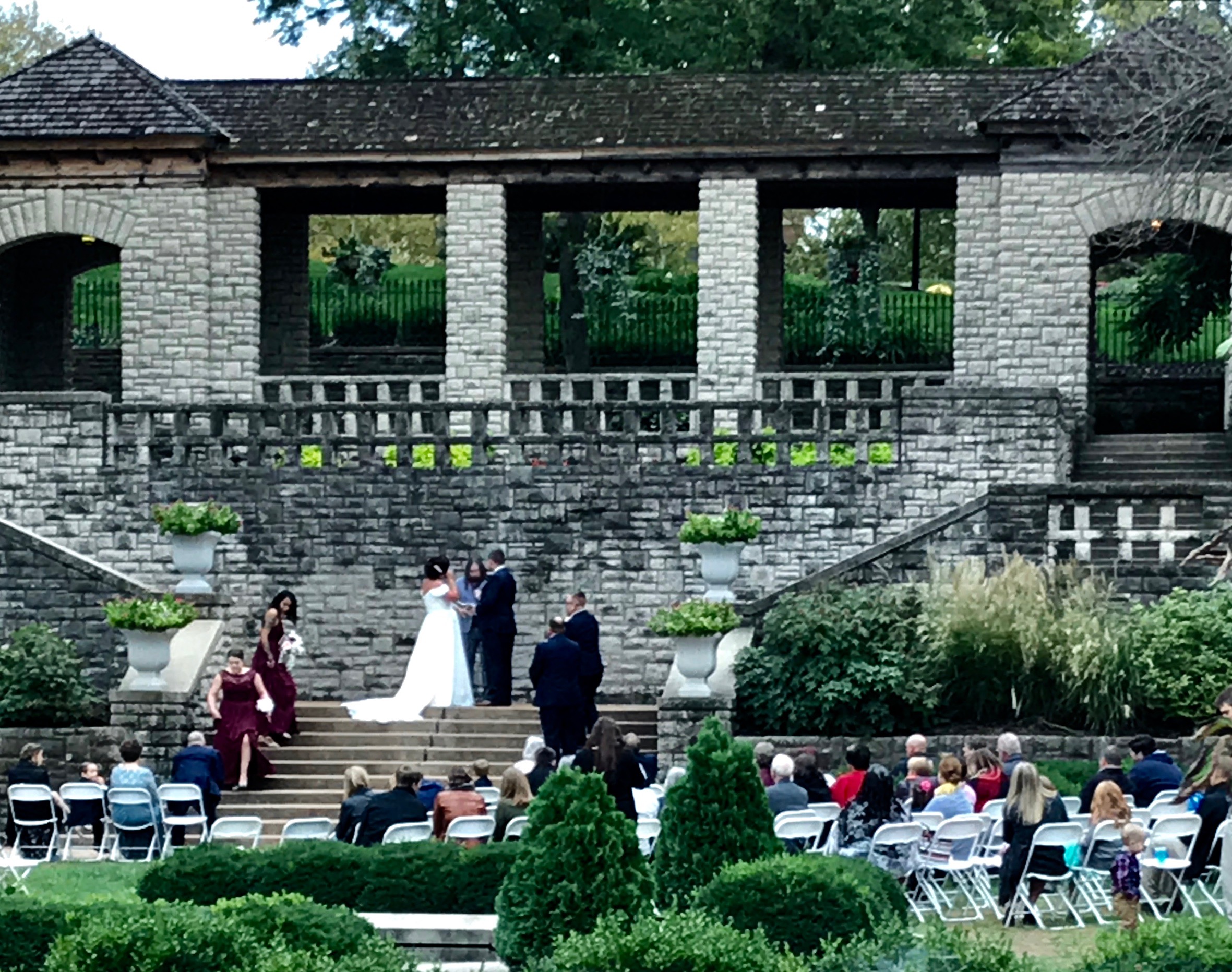
On the left side of the street, a wedding was taking place.

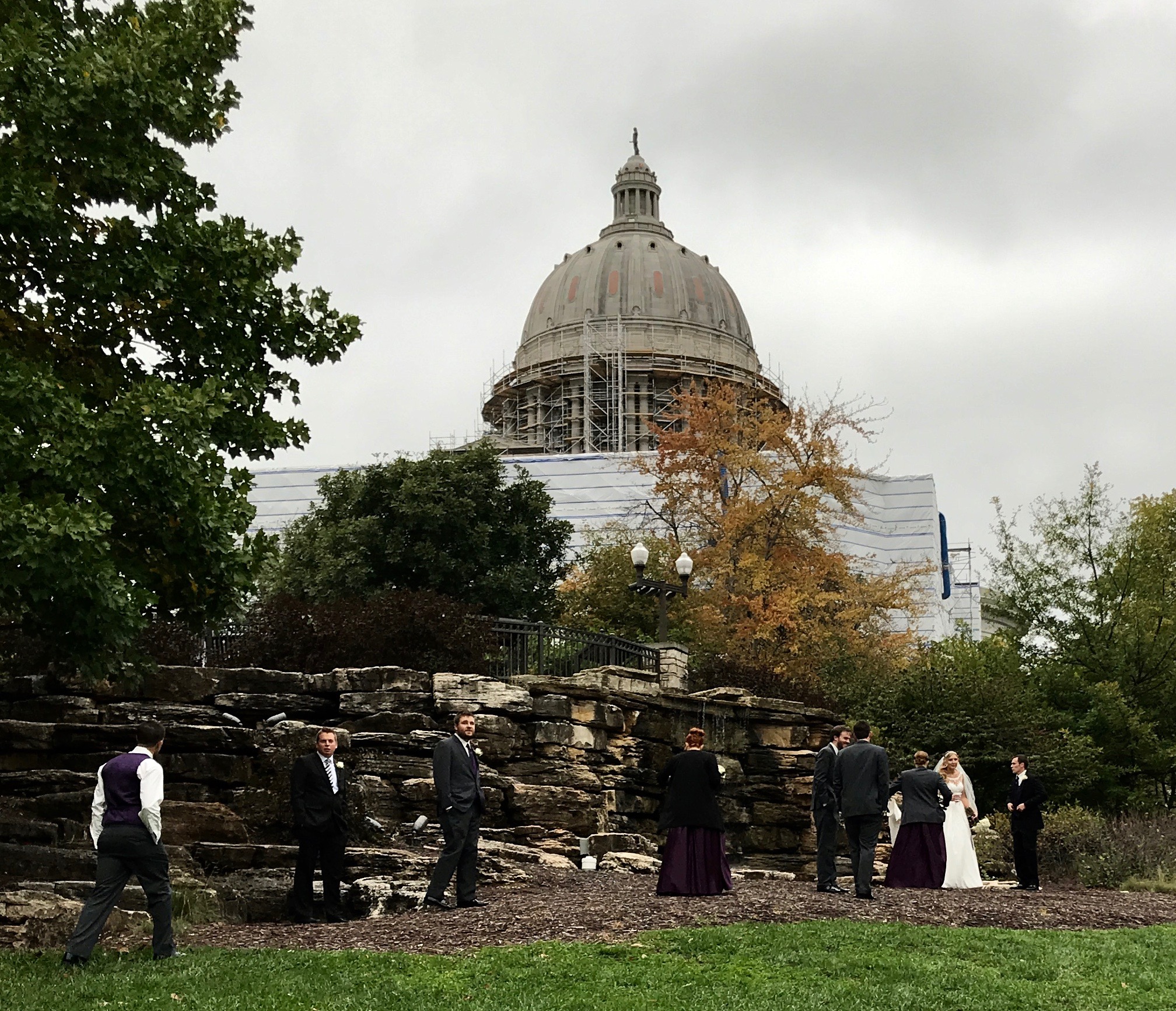
On the other side, a wedding party photo shoot was underway. On top of that rock outcropping, art was imitating life – or was it the other way around?

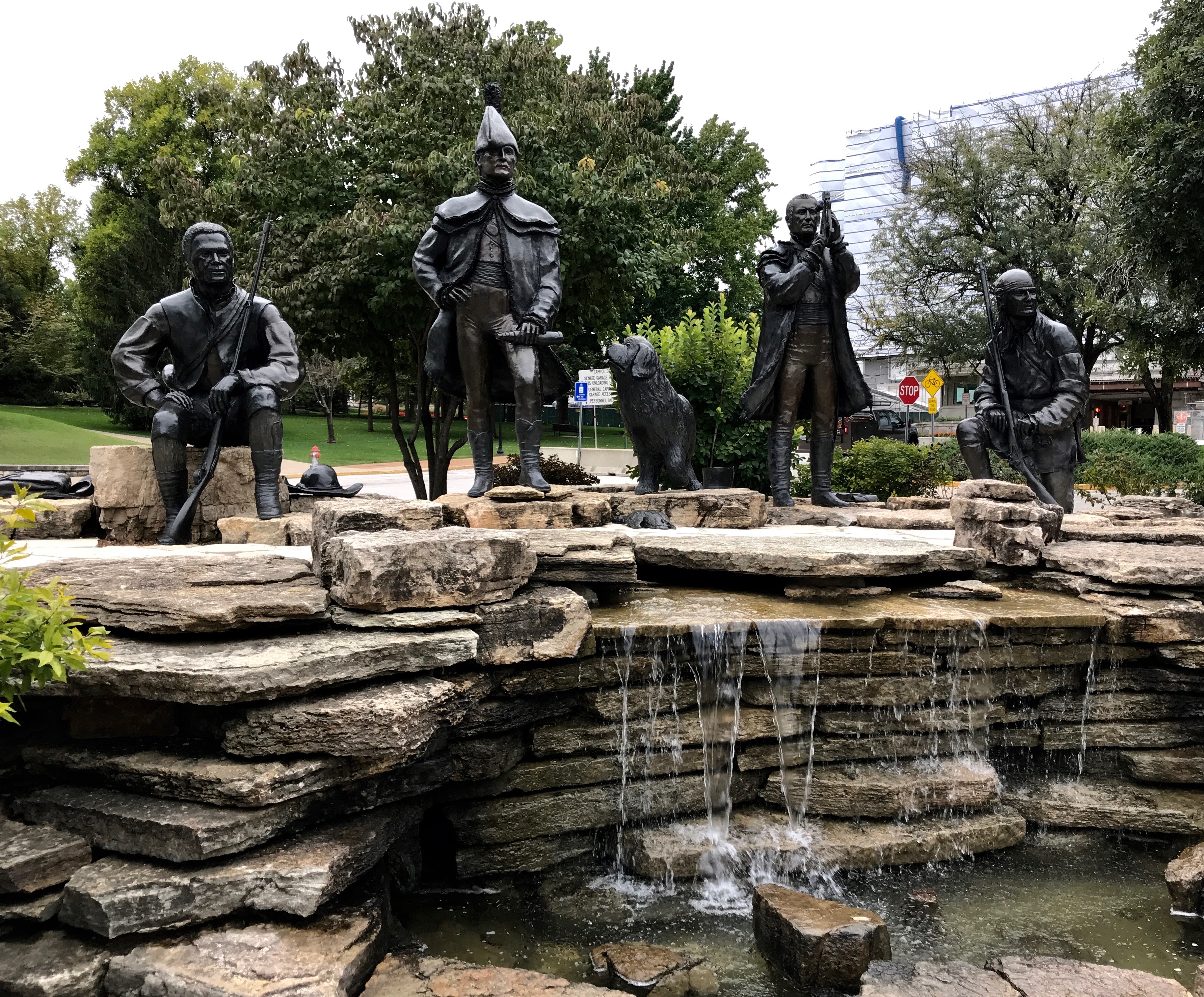
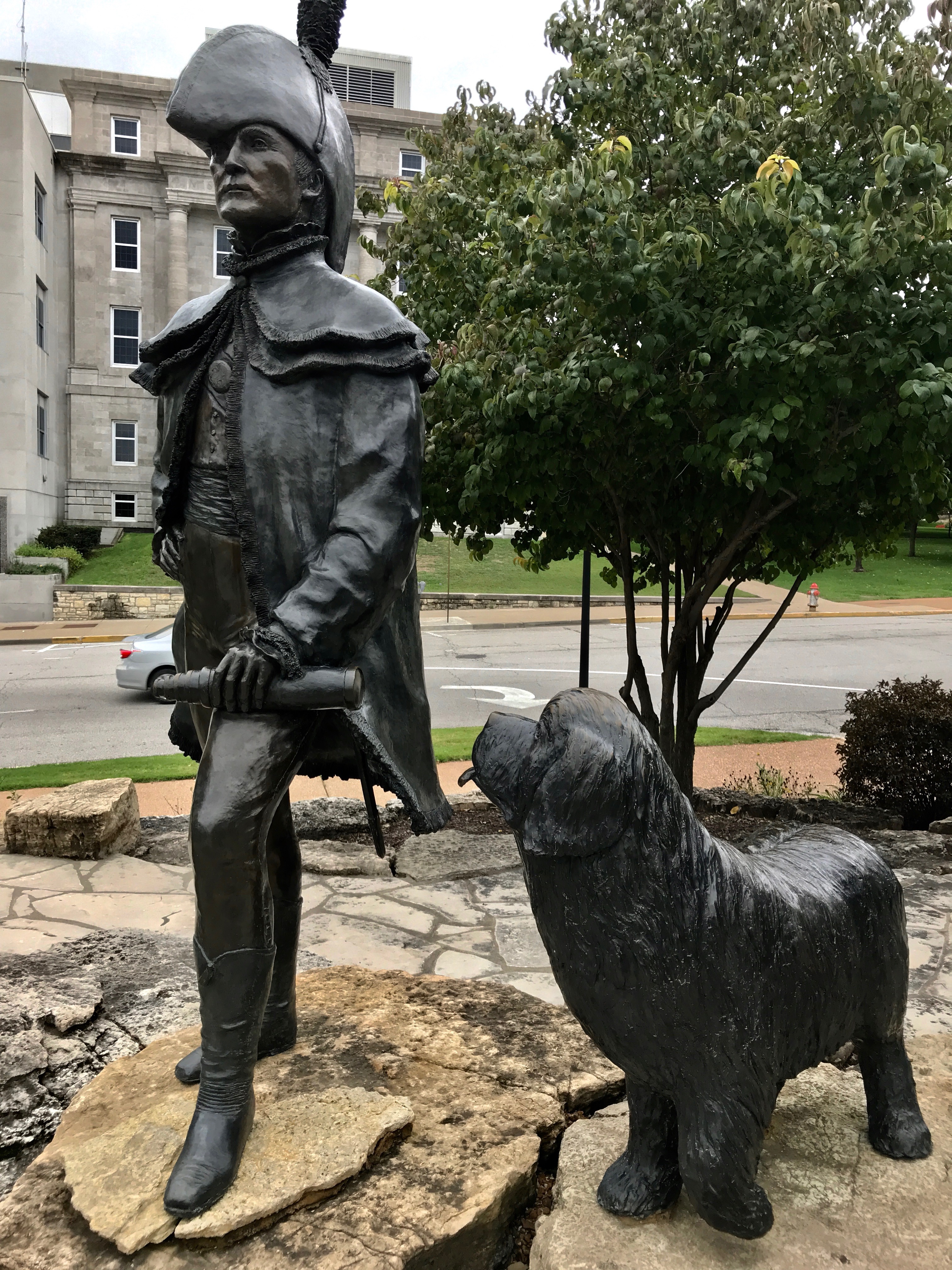
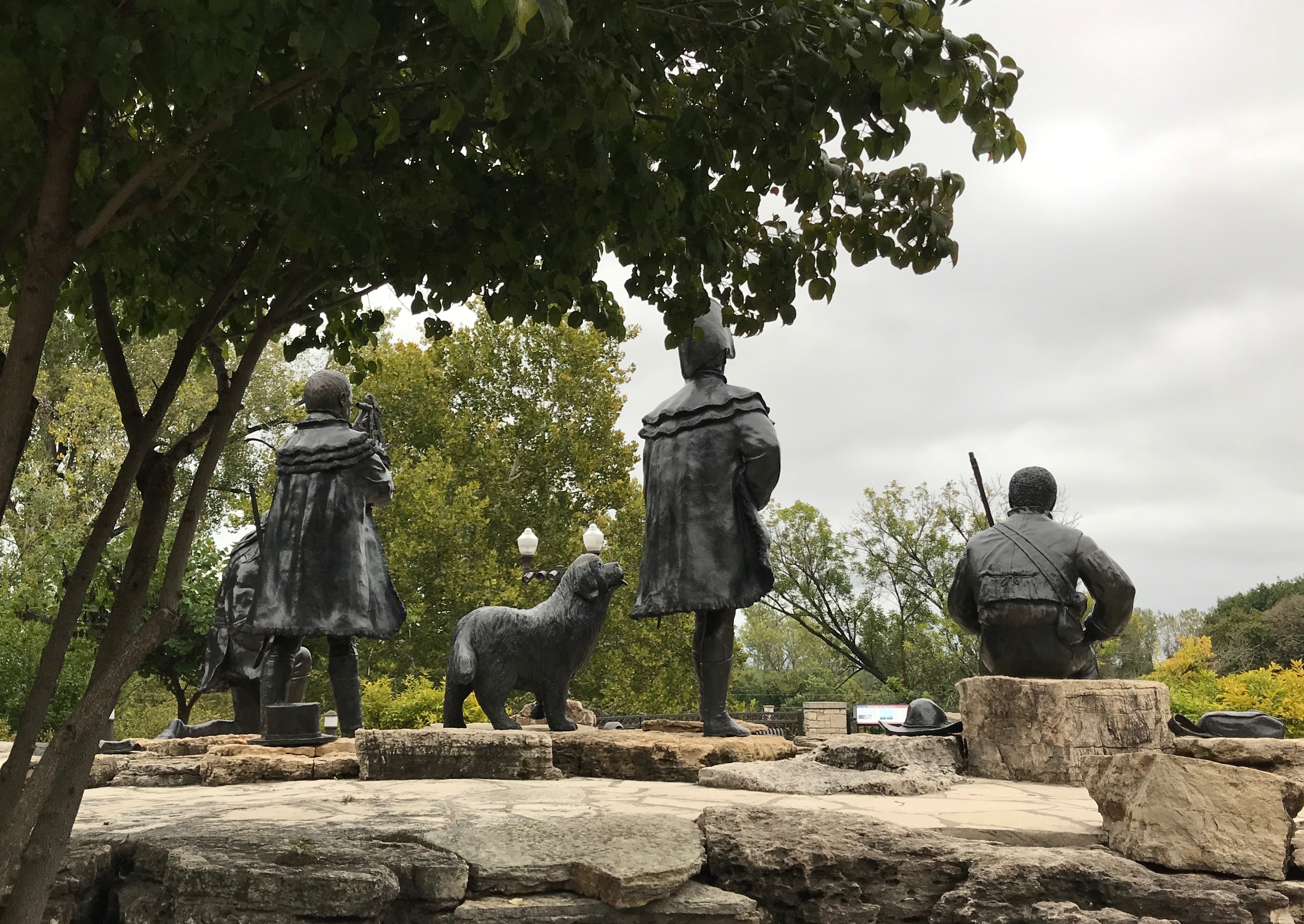
It was a statuary grouping of the Corps of Discovery!

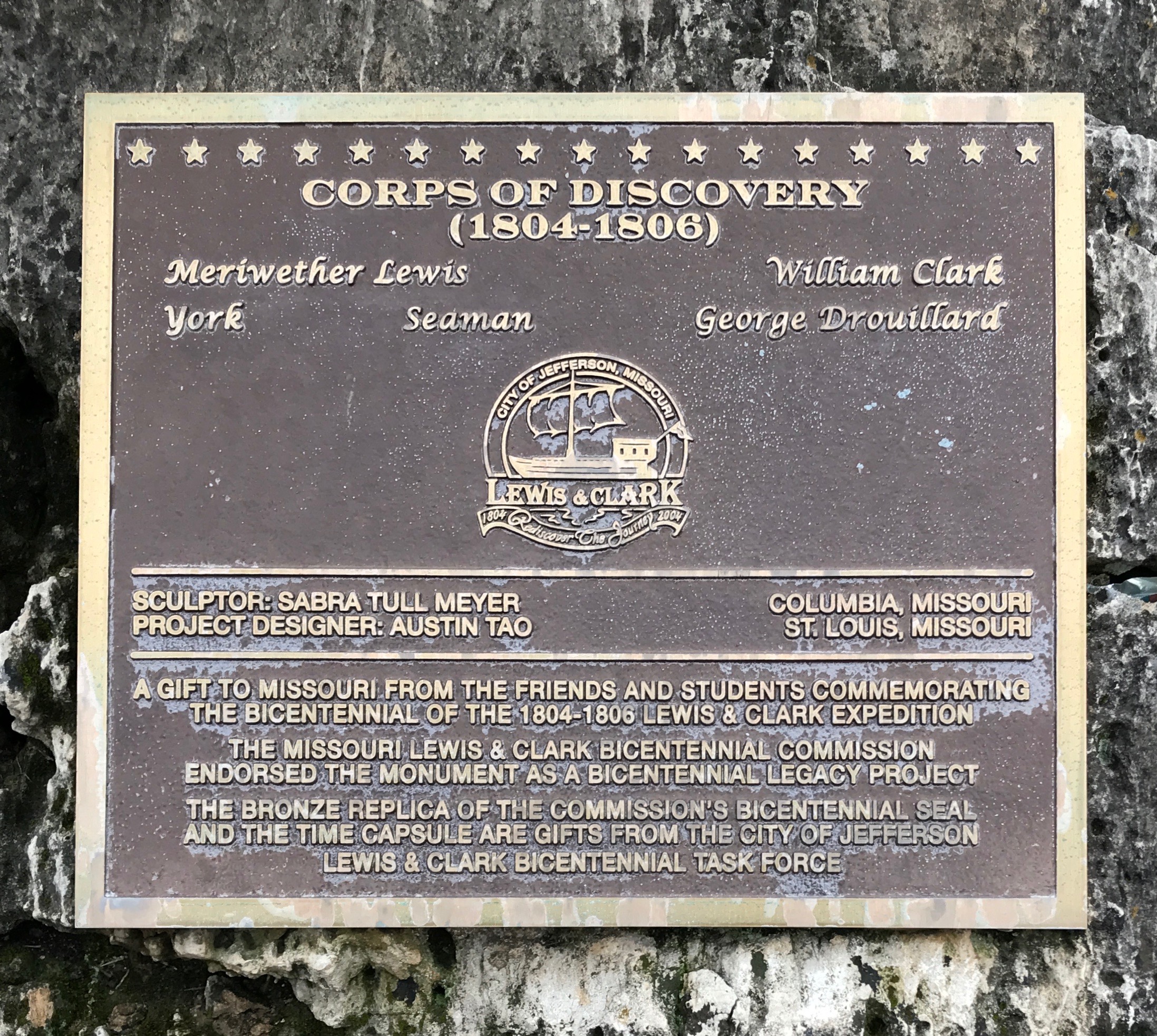
Hey! The sculptor was Sabra Tull Meyer! Where have I seen that name before? Oh, yeah! In the capitol! She is very good at capturing portraits in bronze.

I just love how she incorporated all the details into the people. There are York, Meriwether Lewis, William Clark and George Drouillard. Oh, and let us not forget  Seaman, the dog.

This monument depicts a specific day in the historic journey of the Corps of Discovery. According to a marker at the site, “…on June 4, 1804, a keelboat and two pirogues containing the members of the Corps of Discovery passed this spot as they headed upstream to the headwaters of the Missouri River and across the Rocky Mountains to the Pacific Ocean. The Lewis and Clark Expedition was in the twenty-second day of their two-year, four month long odyssey. Already fighting the strong currents of the Missouri River, the party had managed to cover over 145 miles since leaving their winter encampment at the River DuBois, in present day Illinois. The expedition still had 3,855 hard miles stretching ahead before they reached their destination on the western rim of the continent.”
The sculptures were unveiled June 4, 2008, 204 years later.

York was William Clark’s slave. According to another source, “He was William Clark’s servant from boyhood, and was left to William in his father’s will. He had a wife, and possibly a family, before the Lewis and Clark Expedition. In 1804, York was compelled to leave his family and accompany Clark and 40 others on the Lewis and Clark Expedition.”

Lewis was not in favor of slavery. Seaman was his companion, purchased for $20 in Pittsburgh, Pennsylvania while he was waiting for the boats to be completed for the expedition. According to my Preferred Source, the corps ate over 200 dogs  while traveling the trail, but Seaman was spared. Lewis felt so strongly about his dog that when he was stolen by one of the tribes, he threatened to send three armed men to kill them.


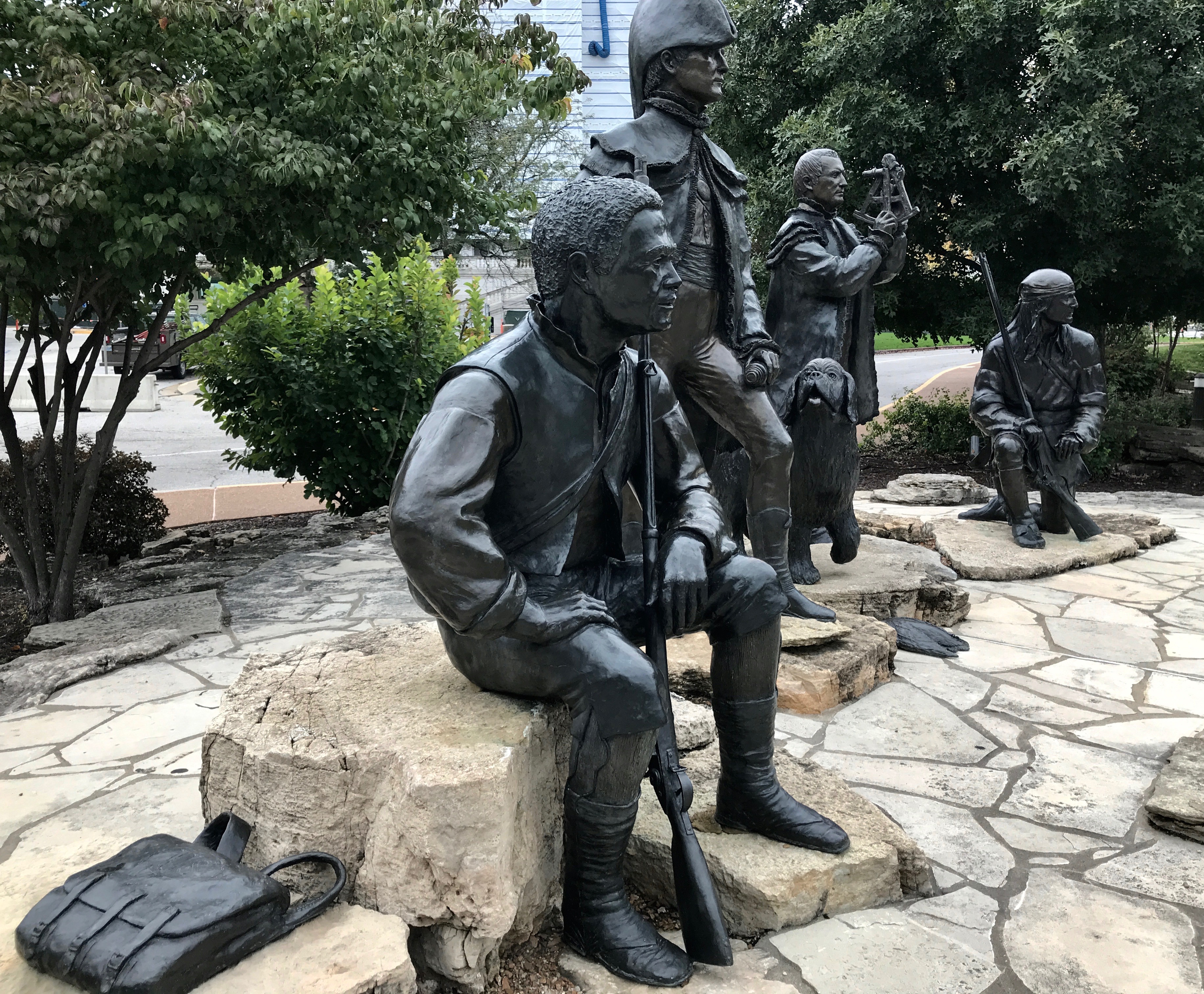
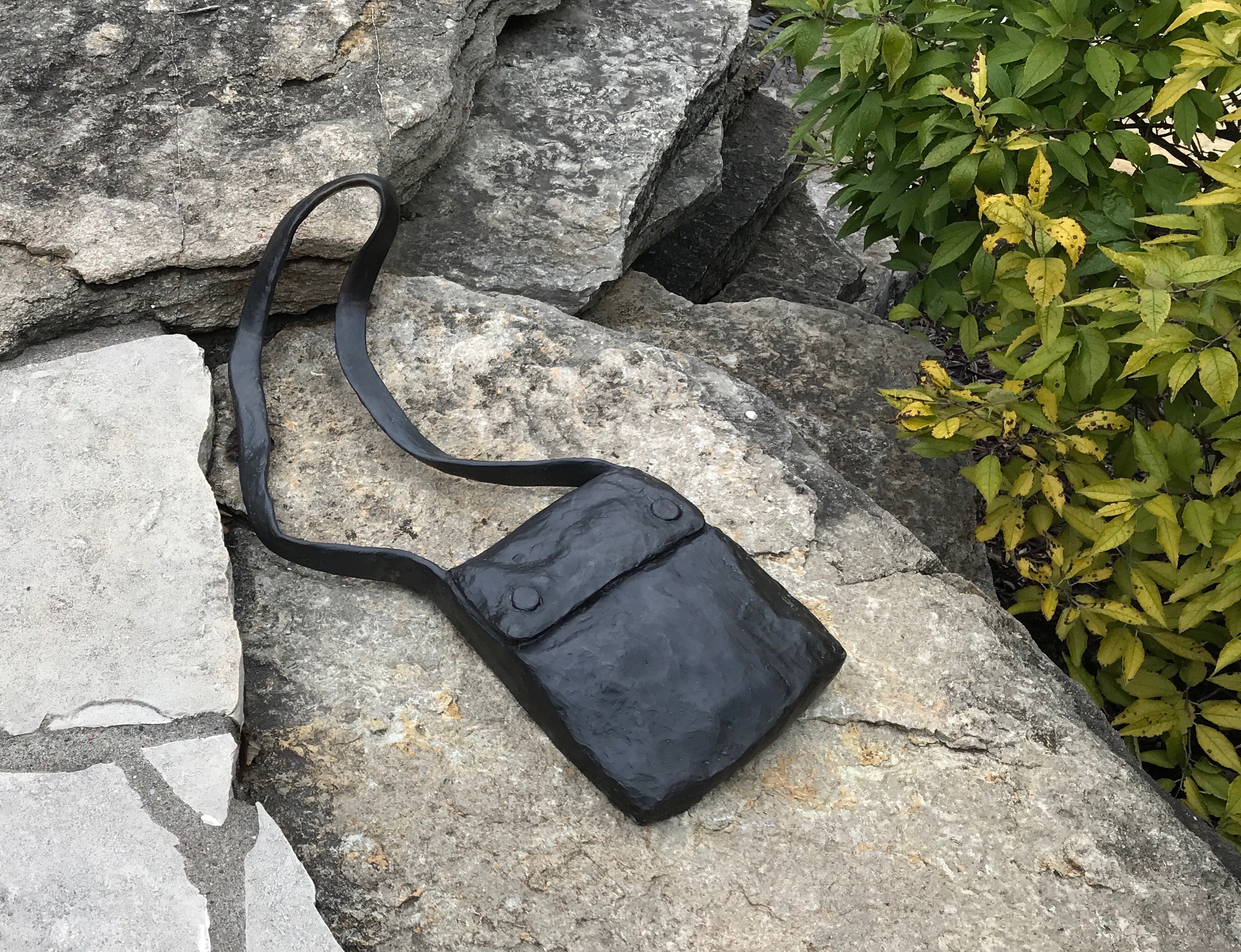
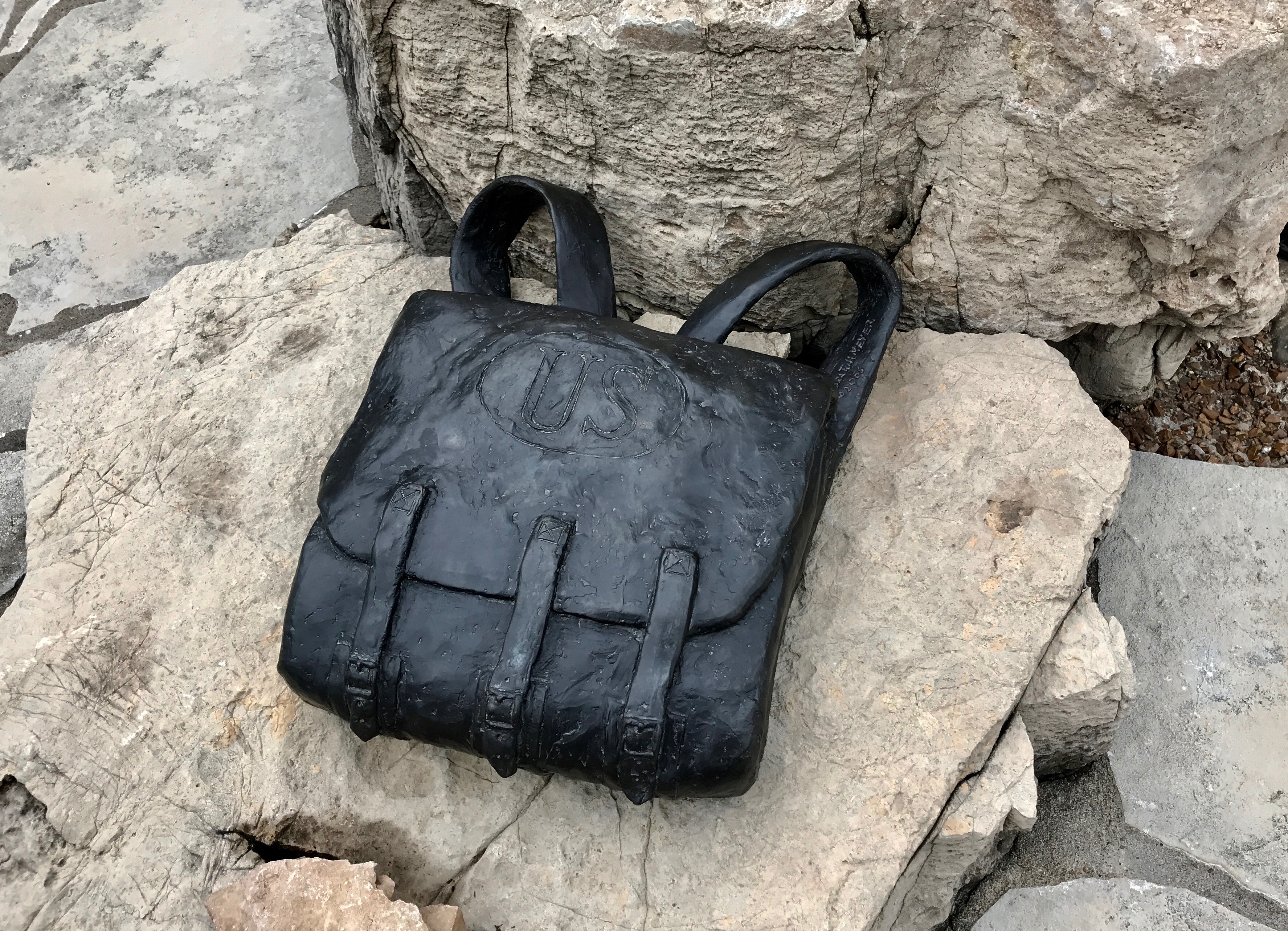
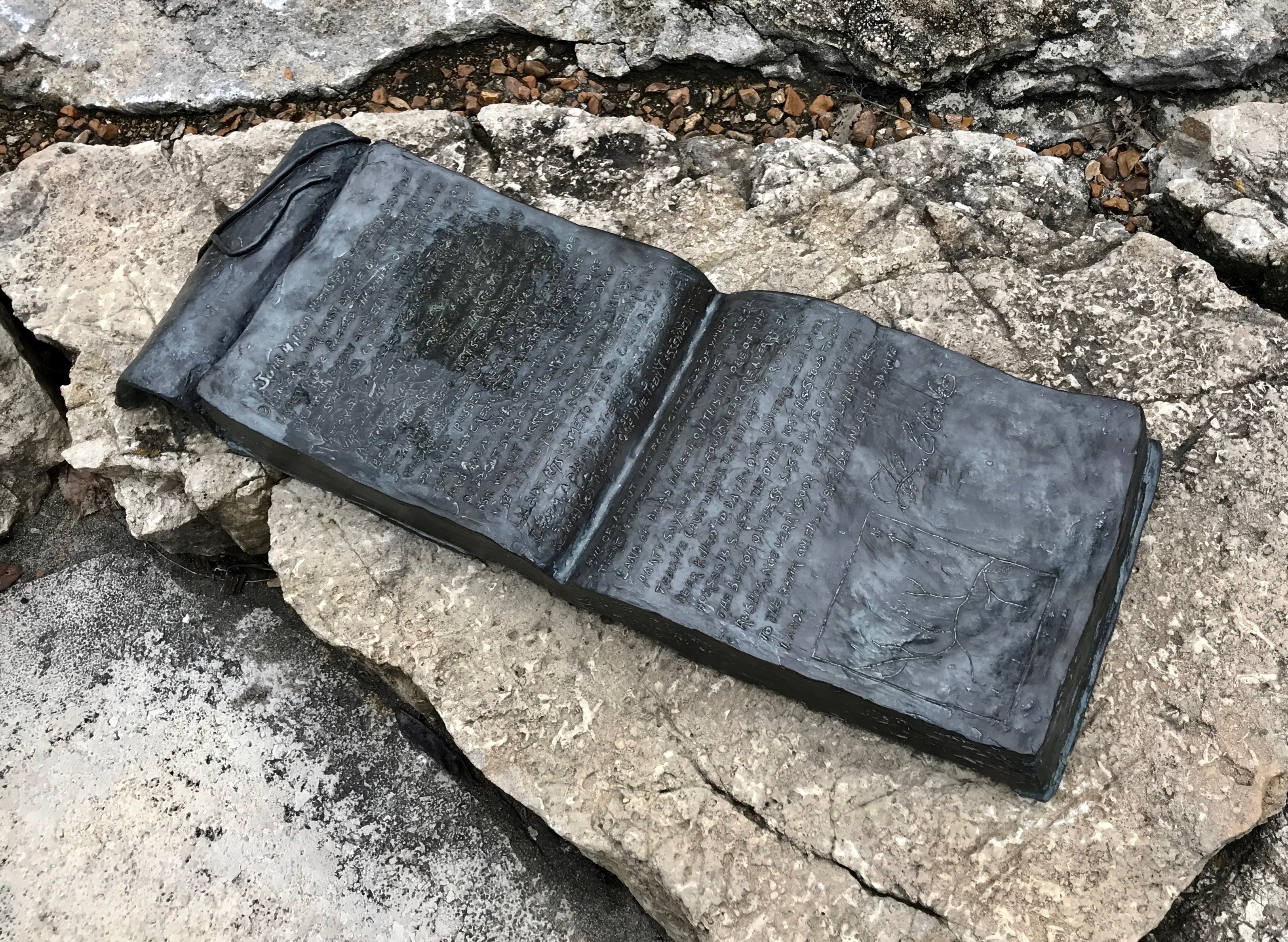
Not only were the participants in the Corps rendered so well, I was taken with the items that were on the rocks around them.

This bag seemed to be carried by Drouillard, or maybe it was the bag that Clark used to carry his sextant.

York carried this bag.

I imagine that this must have been Meriwether Lewis’ journal.

I wonder if this belonged to York or Douillard?

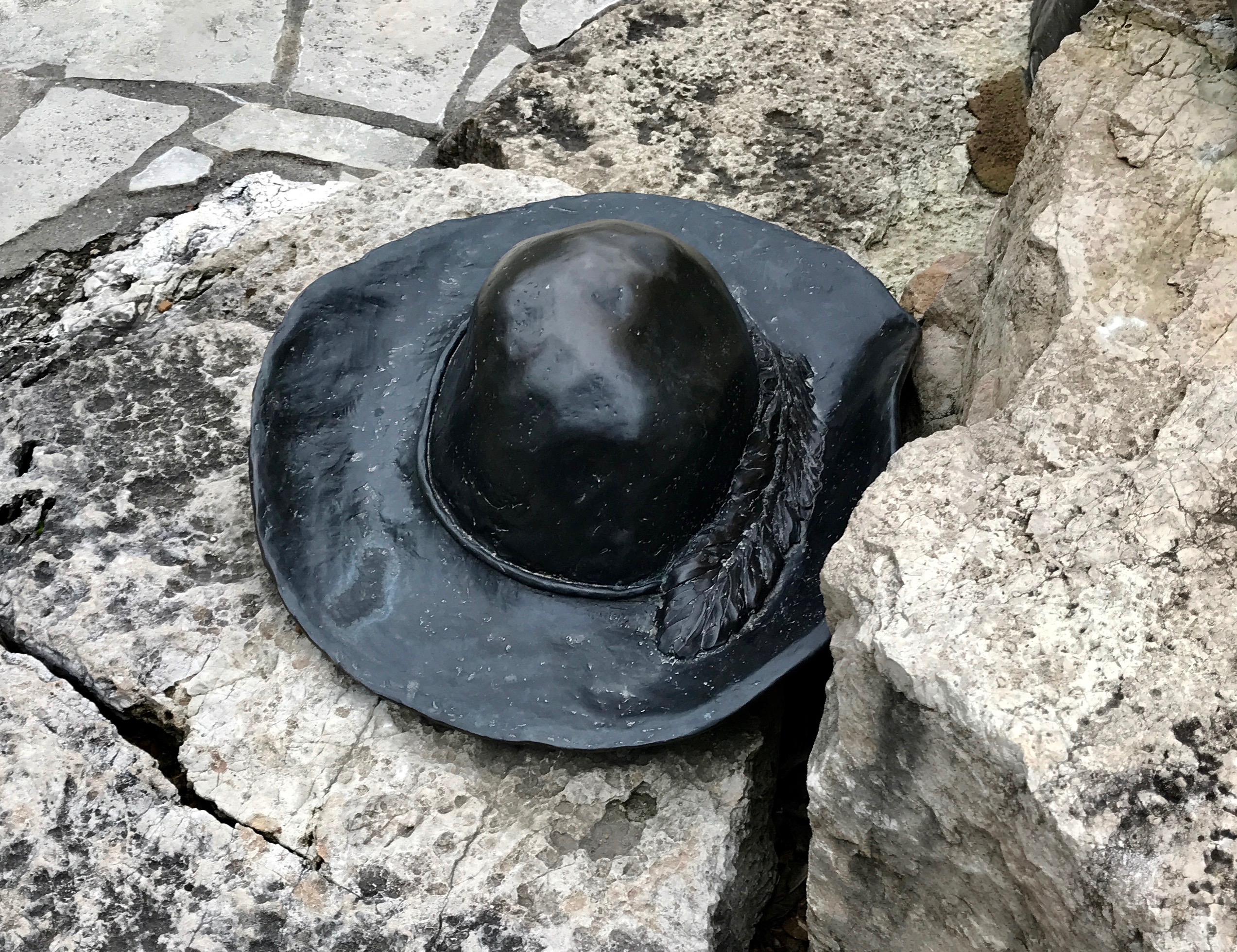
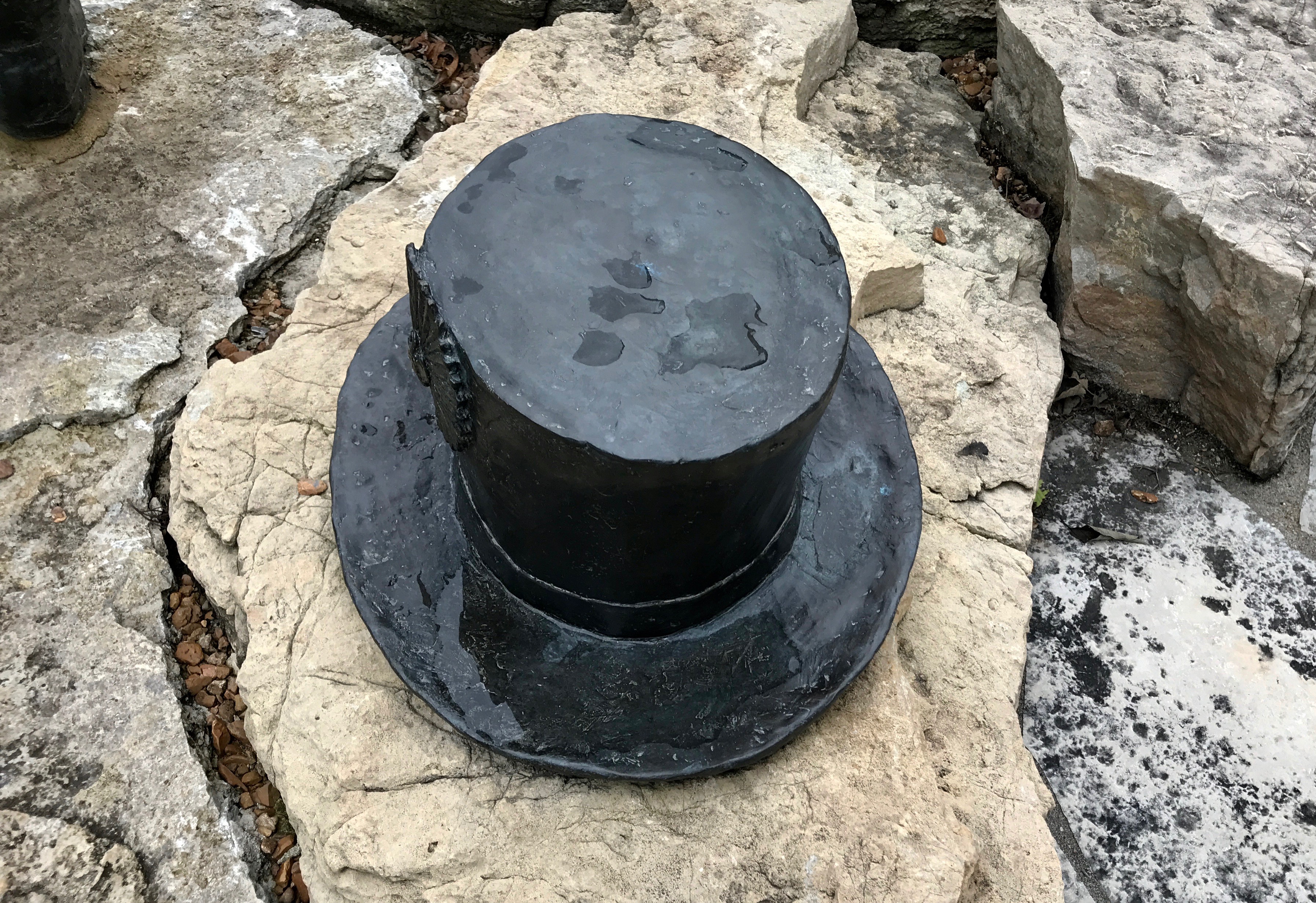
I bet that this hat belonged to Clark. Lewis was already wearing his.

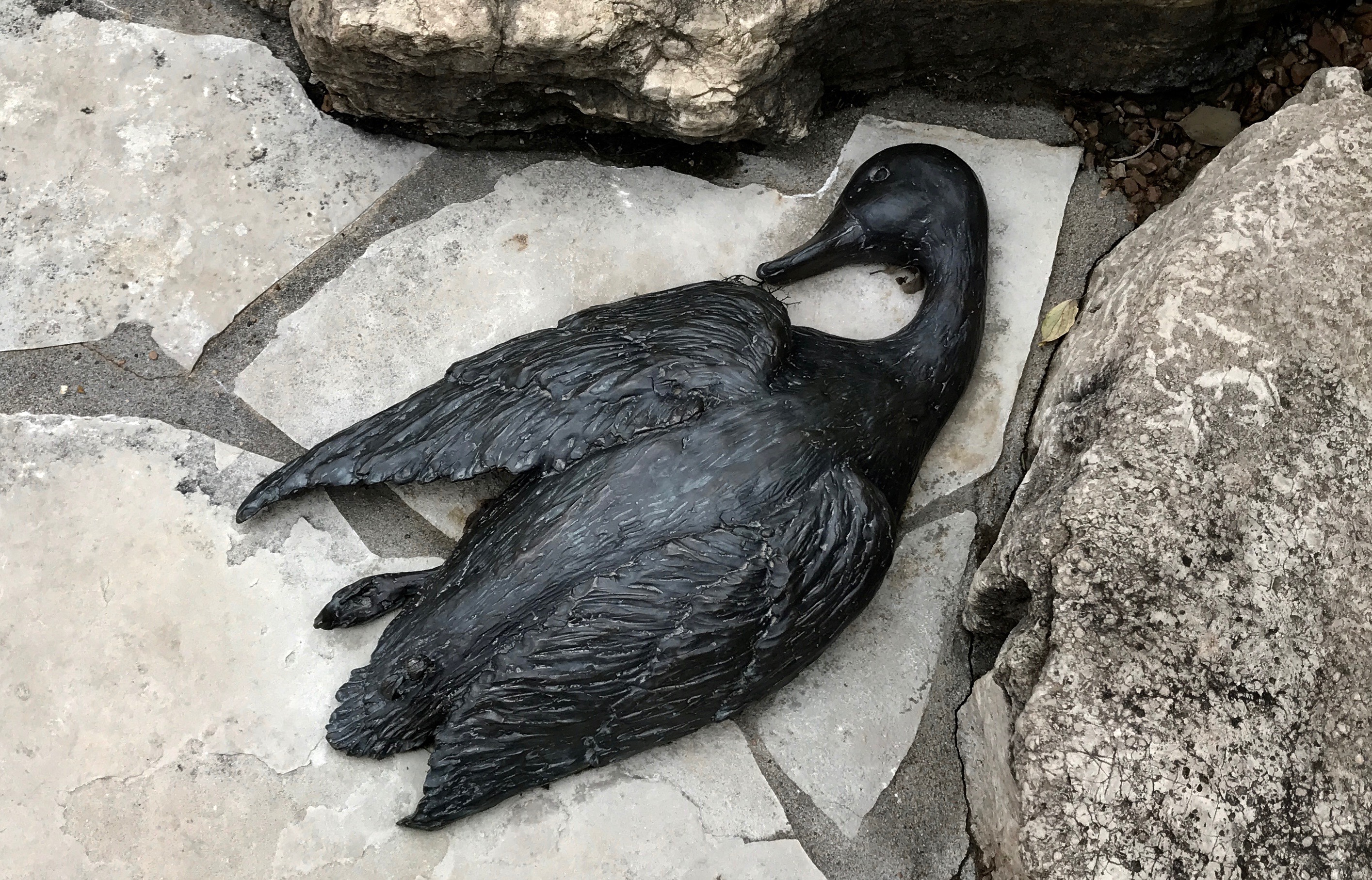
Duck – it’s what’s for dinner!

Just one more look and then back to the car.

It’s time to get back to the the trailer and get ready to roll in the morning. Next stop: Kansas City!


One Last Look at the Missouri Capitol

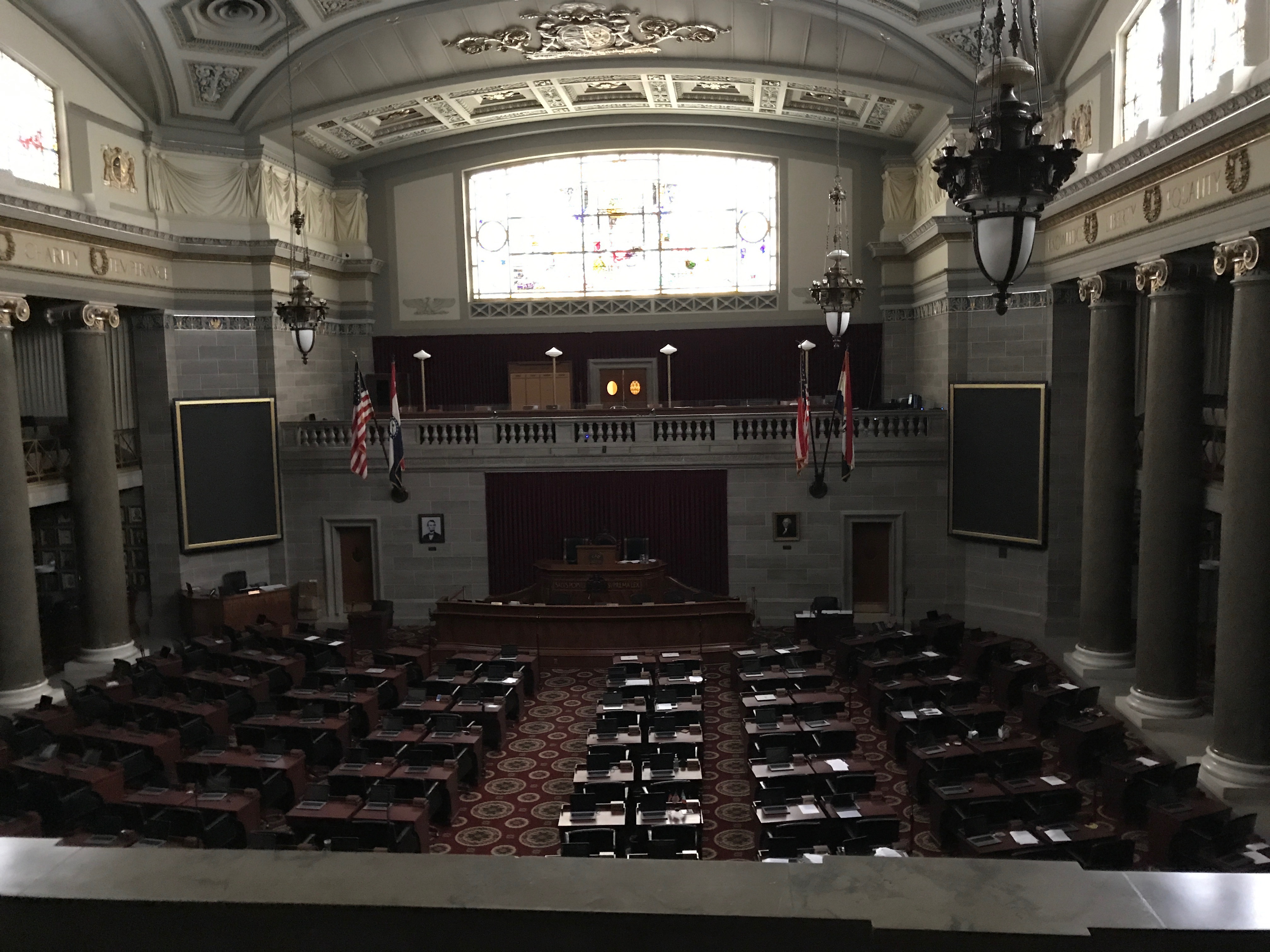
When last, I left you, we had exited the House Lounge after appreciating the Thomas Hart Benton murals. Our next stop is the House Chamber.

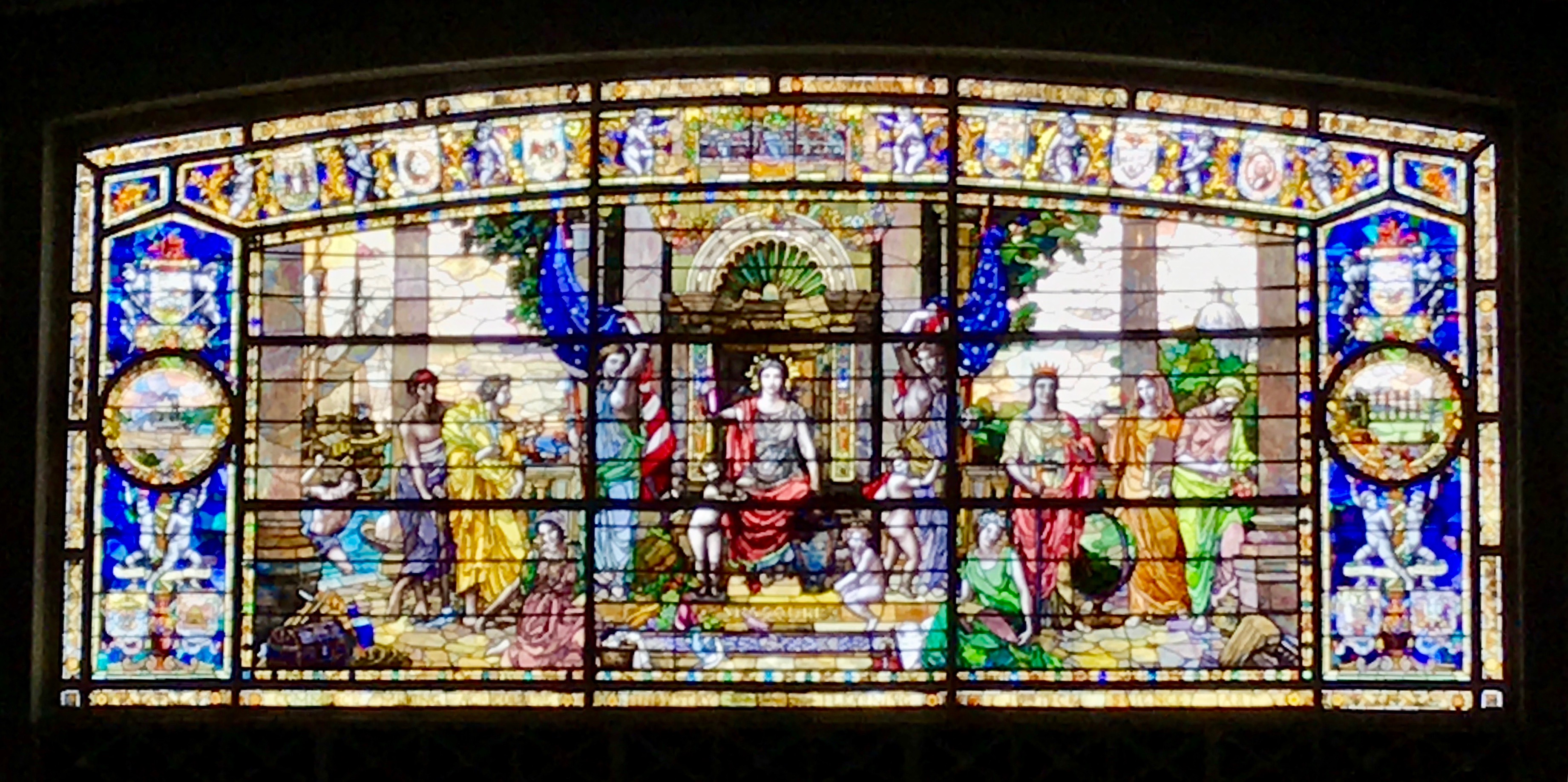
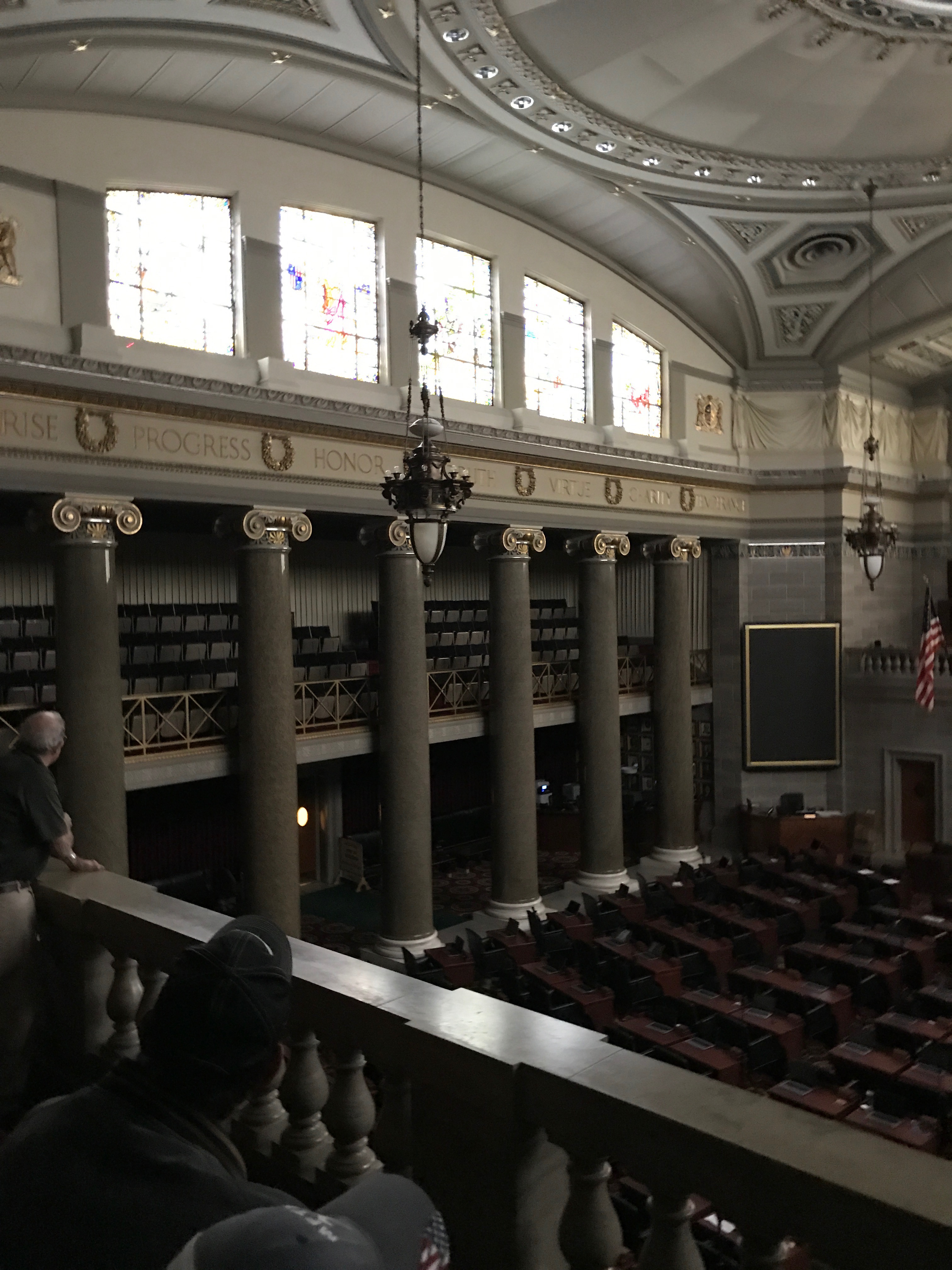
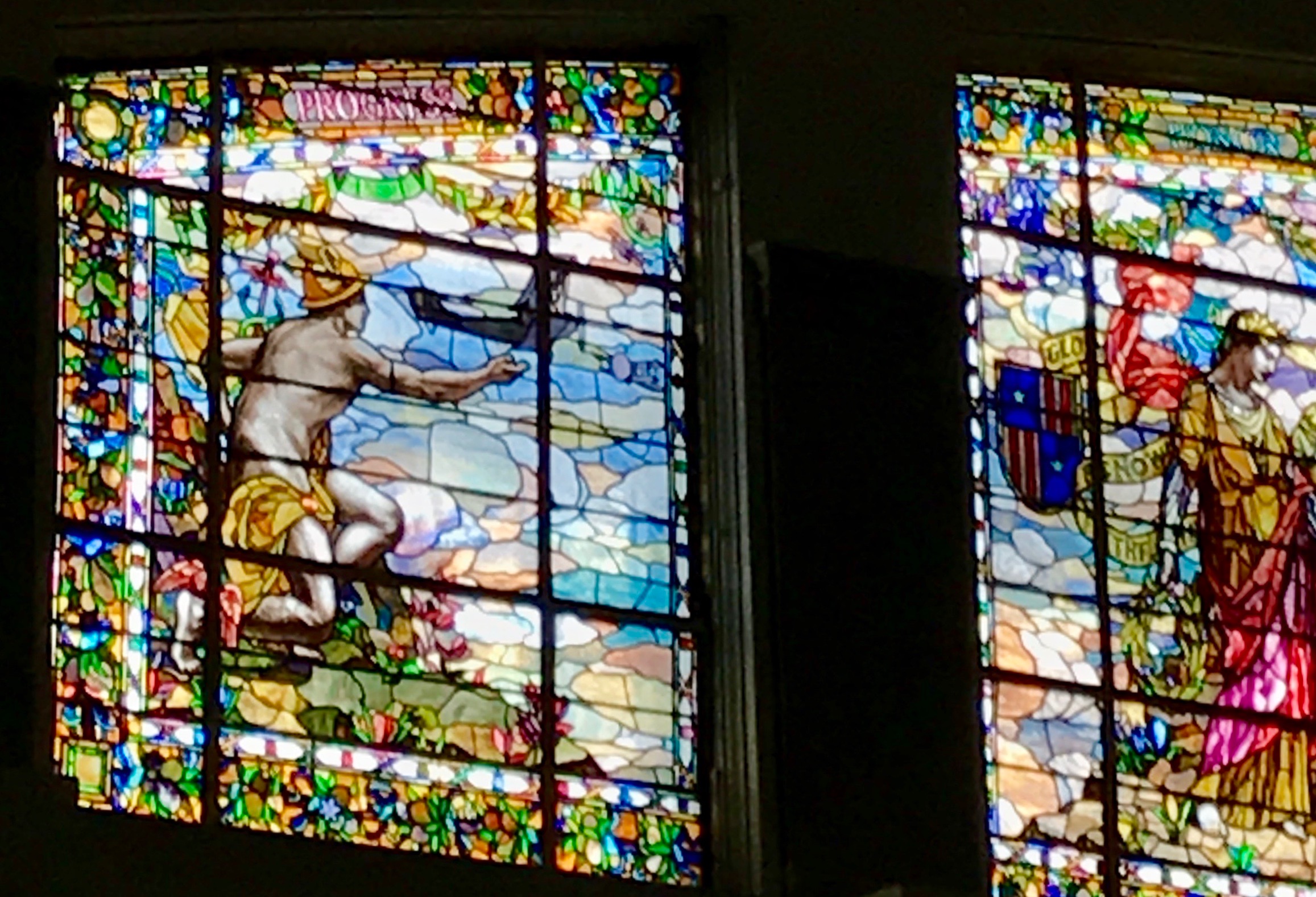
The windows are exquisite. By playing around with the exposure, I was able to bring up the colors a bit.

This is the stained glass window above the speaker’s platform.

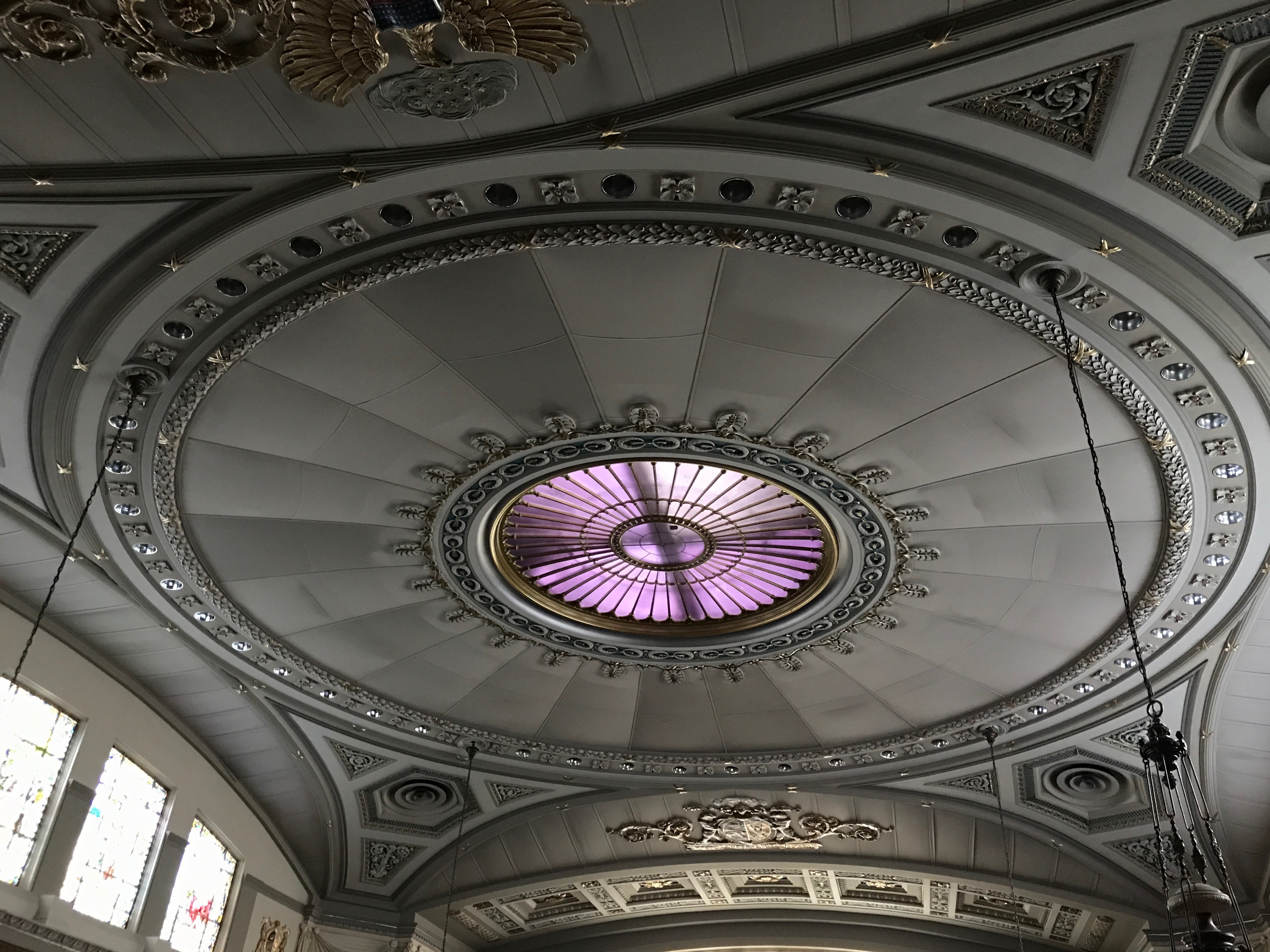
The ceiling has a beautiful piece of leaded glass in it. I’m not sure why it’s purple, but there you have it.

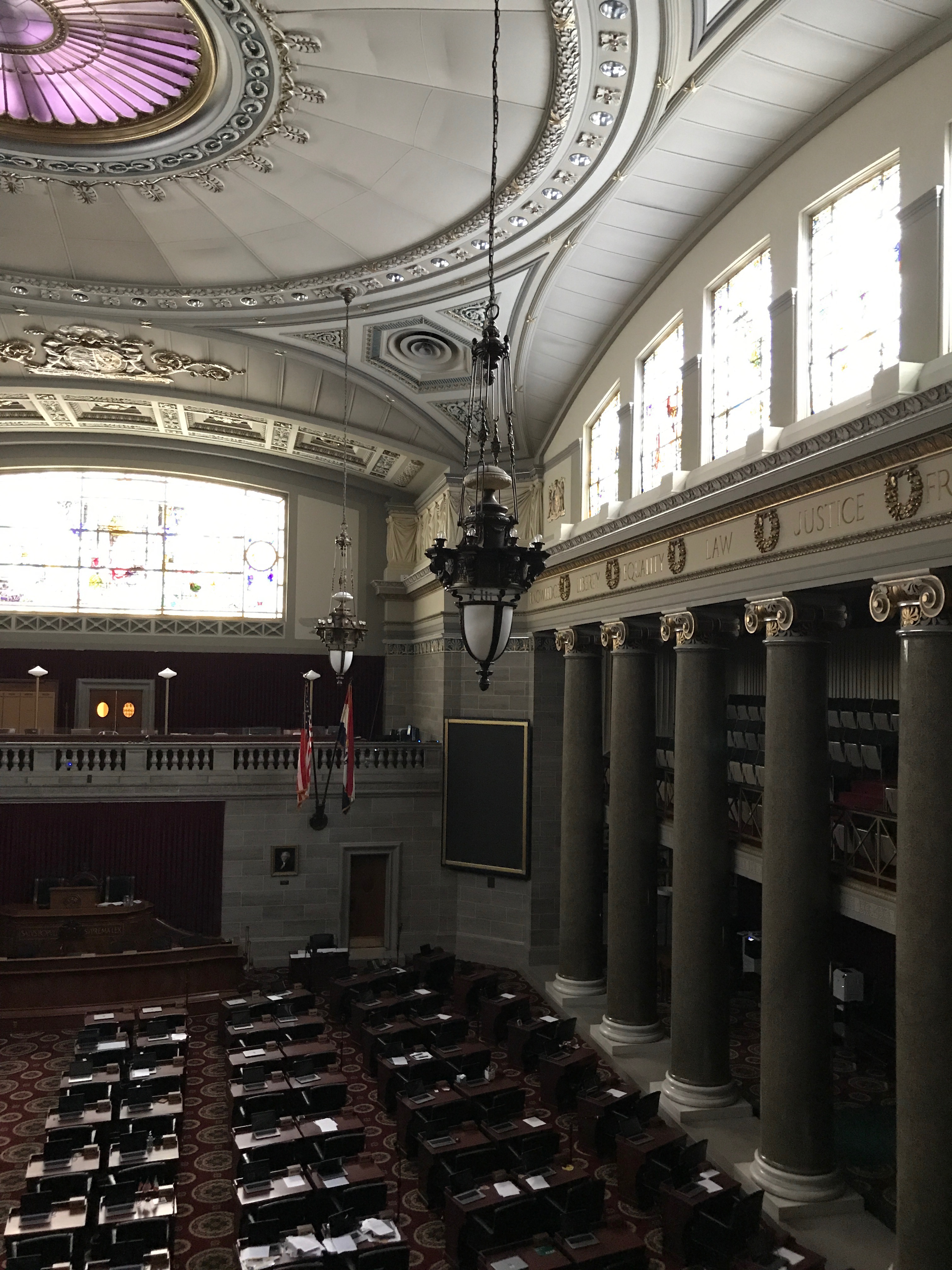
The sides of the chamber are decorated with words that I imagine are intended to inspire the legislators.

LIBERTY…EQUALITY…LAW…JUSTICE…

ENTERPRISE…PROGRESS…HONOR.

The window immediately above the word PROGRESS shows the world as it was unfolding. From what the guide said, I gathered that the artist was really forward-thinking in his depiction of the airplane. Progress, indeed.

I was captured by this decorative detail and decided to include it in this post.

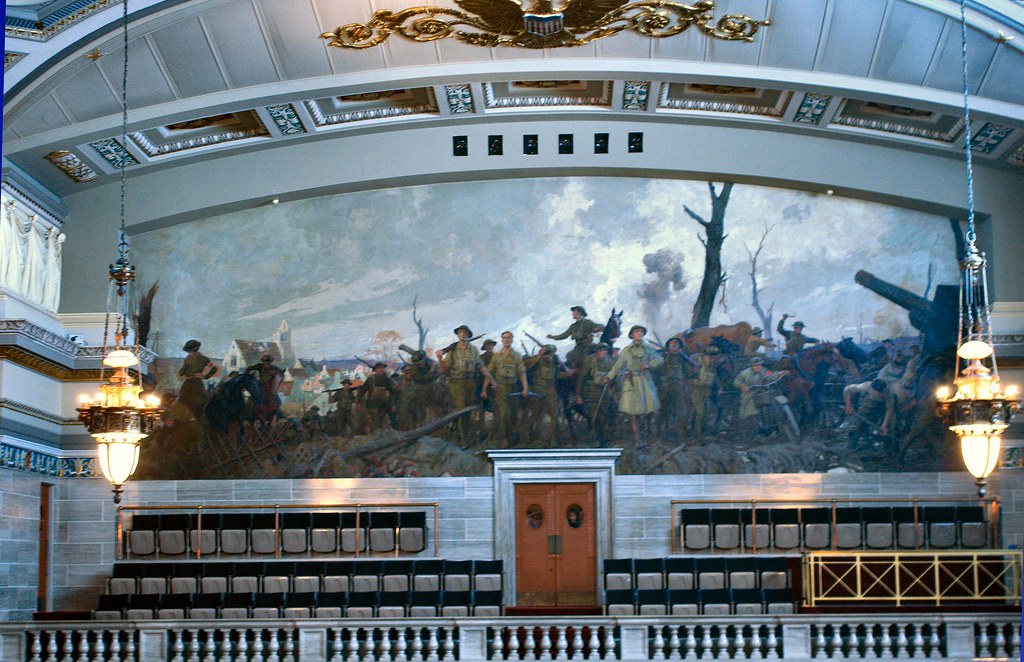
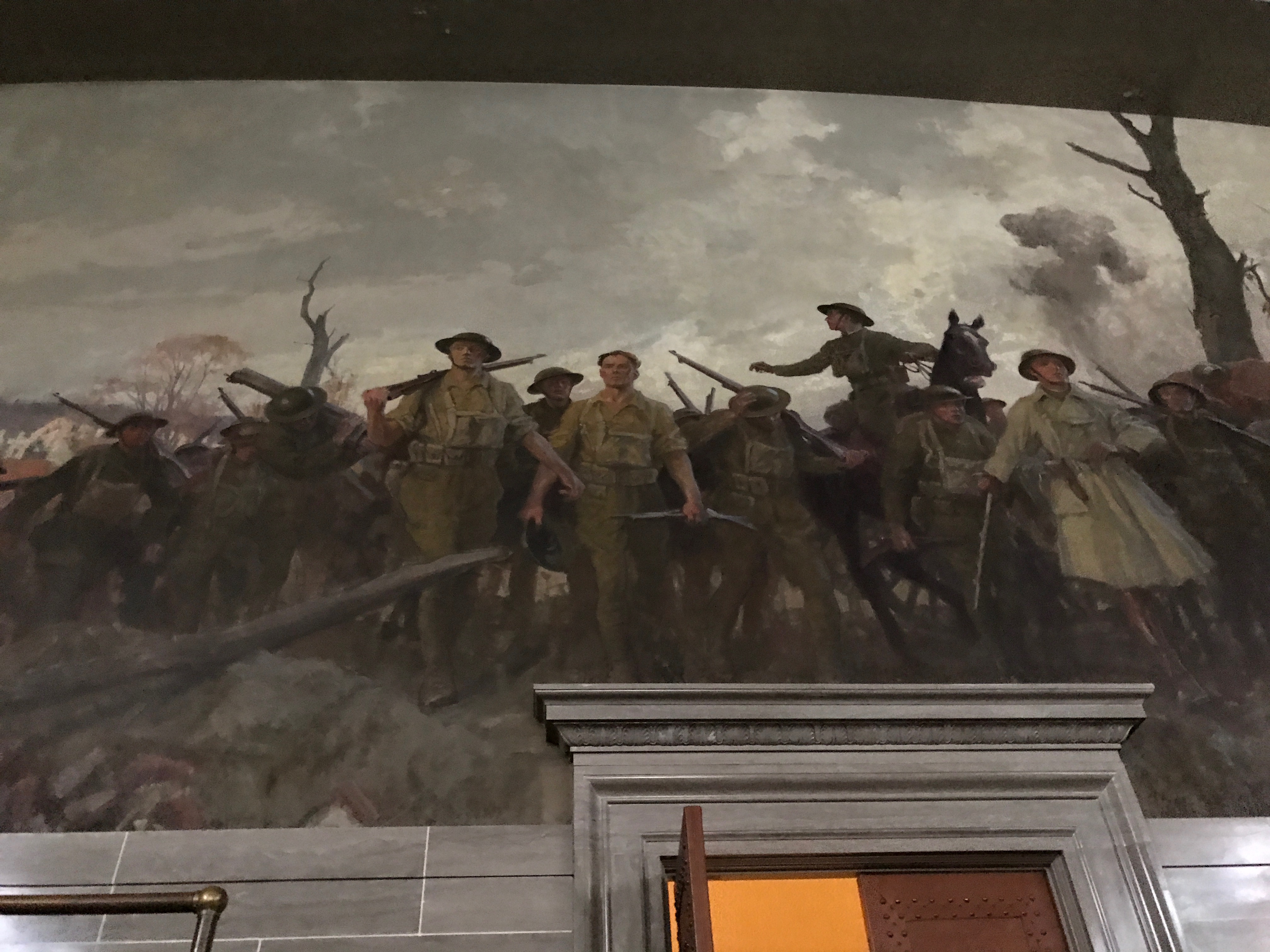
At the back of the chamber is this mural dedicated to the War to End All Wars, now known as World War I. I borrowed this from someplace on the internet. I’d cite the source, but I lost it.

Here are the photos that I managed to snap.

From one side…

And as far away from it as I could get while still in the visitors’ gallery.

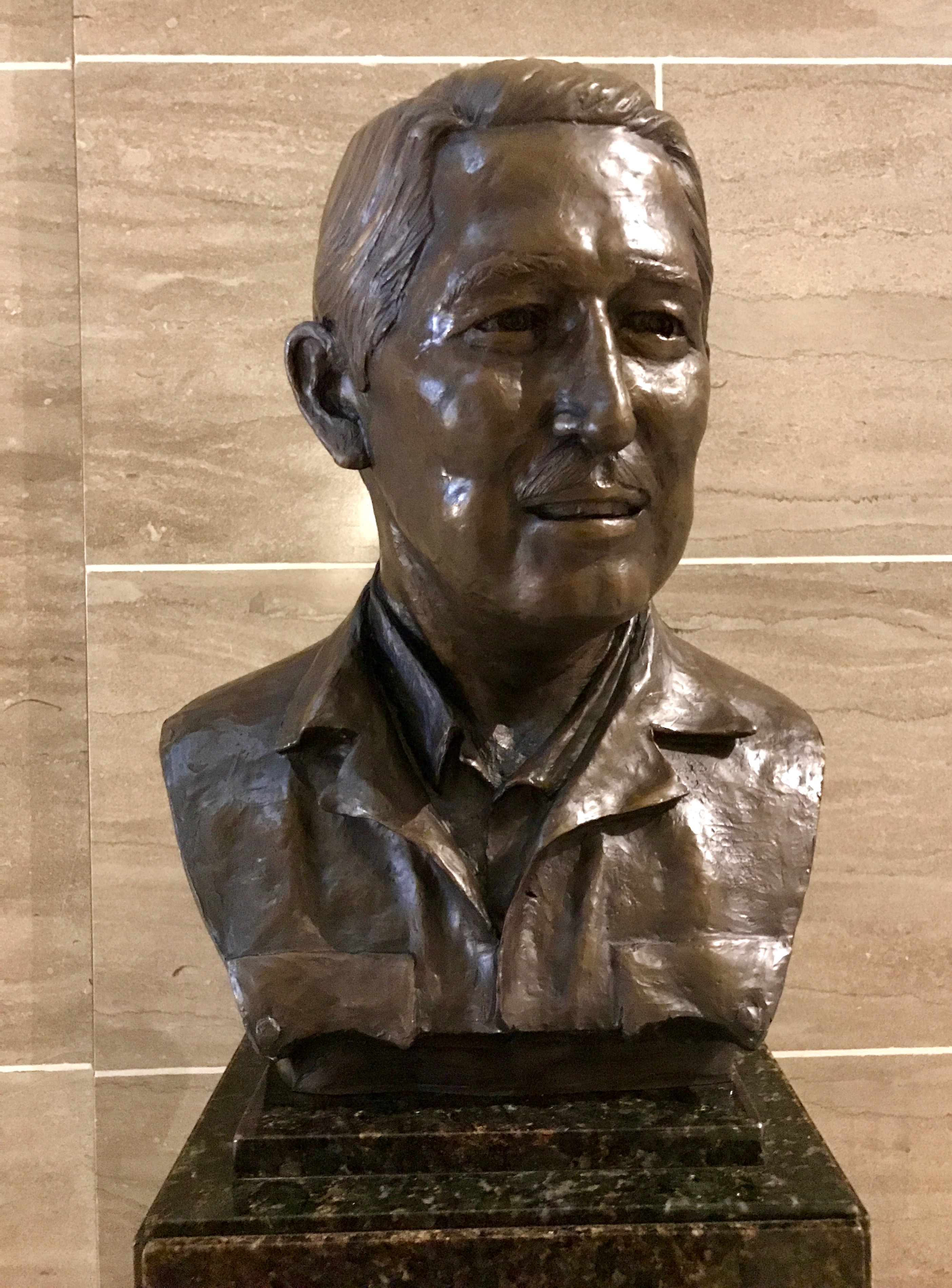
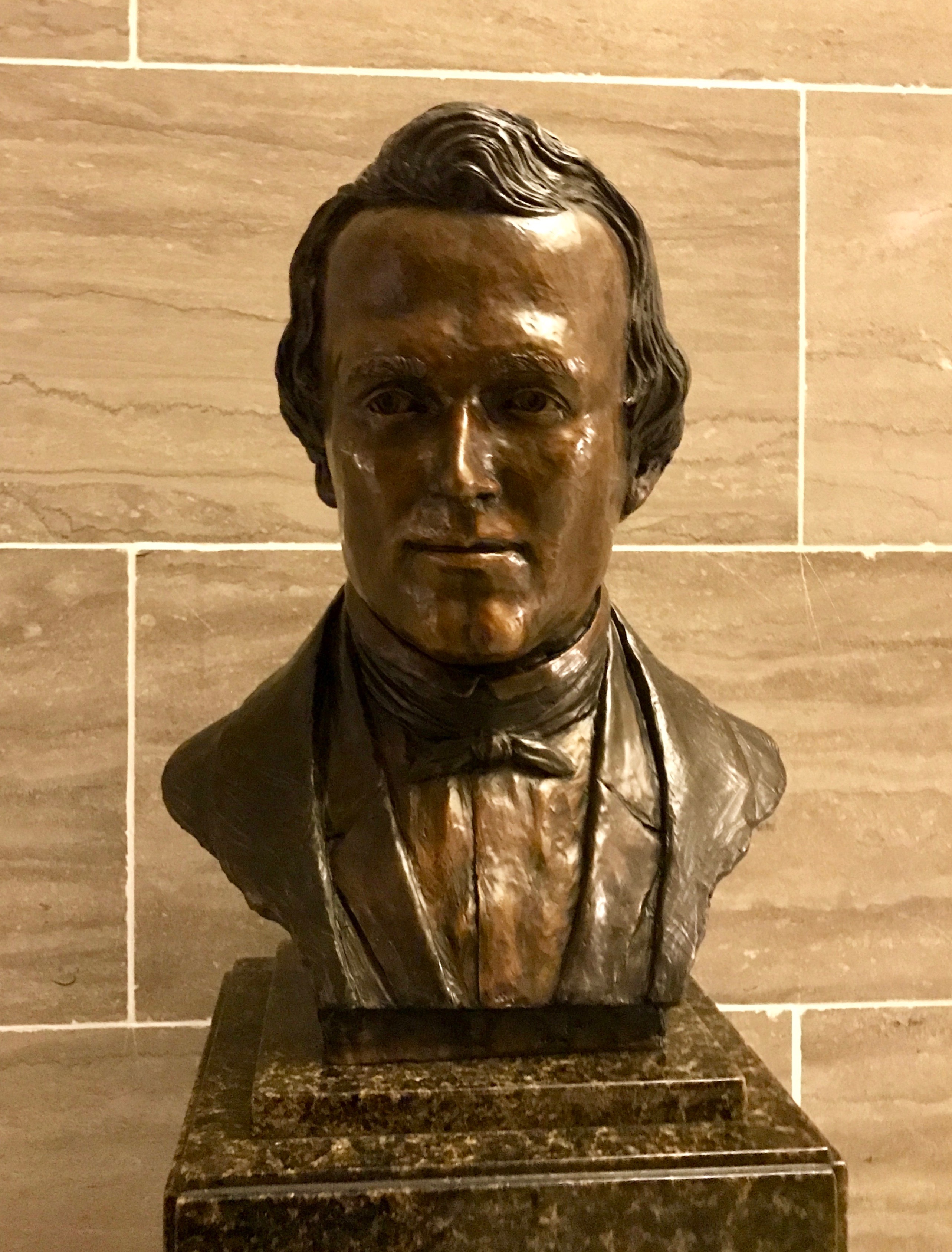
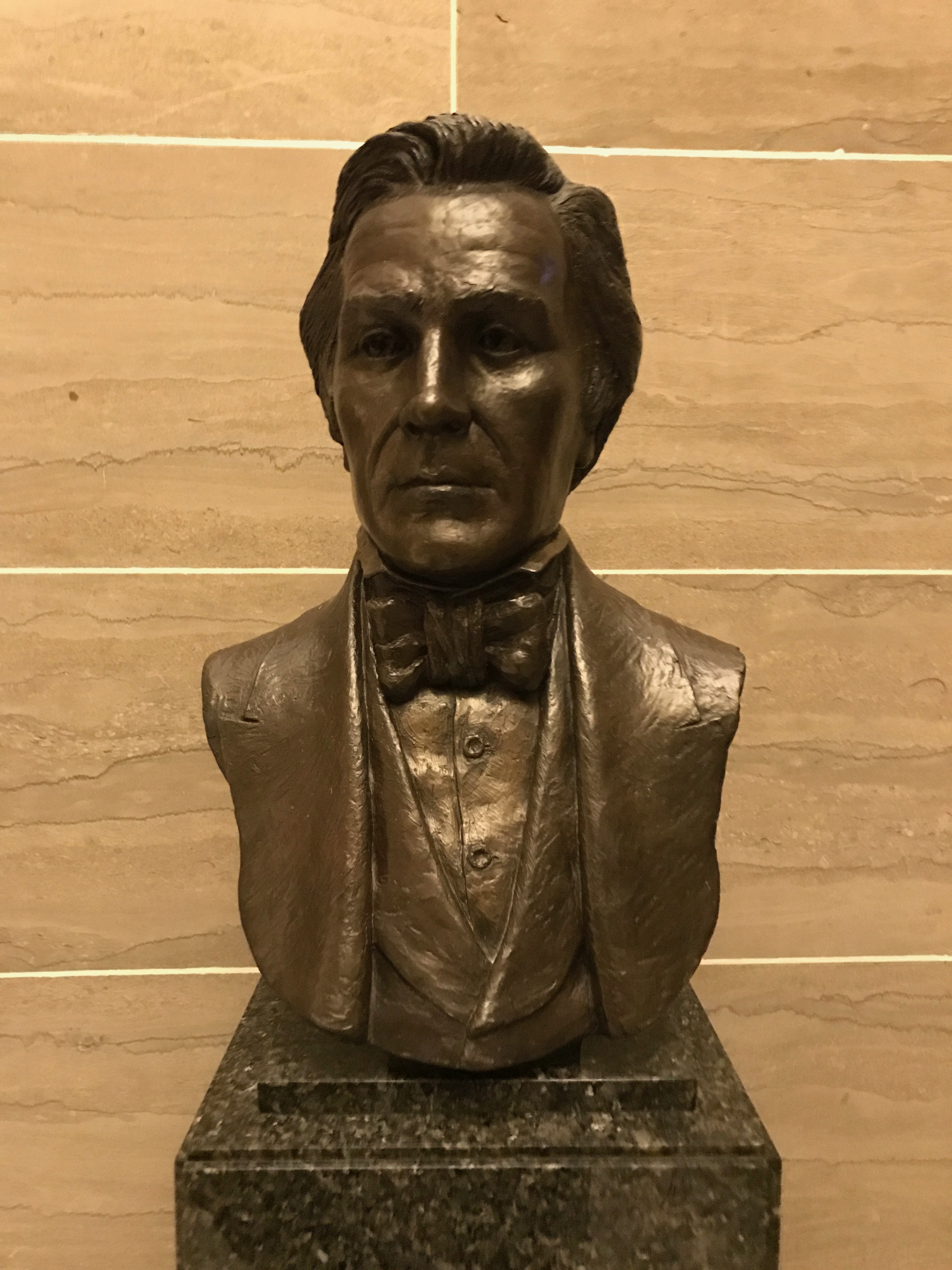
The last stop on this tour is the Hall of Famous Missourians. These busts are all privately funded and depict prominent Missourians honored for their achievements and contributions to the state. According to my Preferred Source, these busts were created by Missouri sculptors Sabra Tull Meyer, E. Spencer Schubert and William J. Williams. As of 2013, there were 44 inductees in the Hall.

You can relax. I am not going to present all of the honorees.

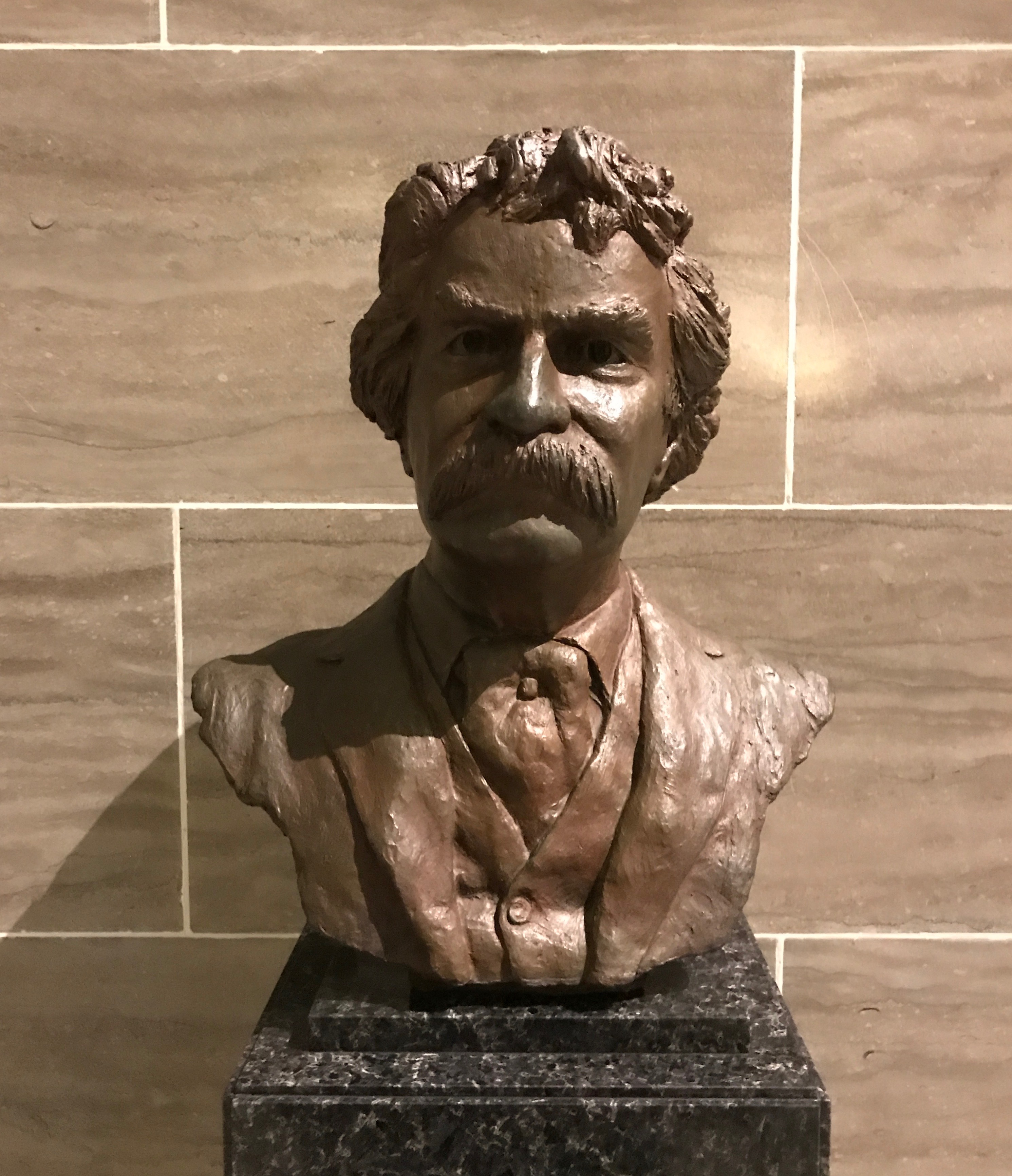
First we have Mark Twain, otherwise known as Samuel Langhorne Clements. Born in Hannibal, Missouri in 1835. He died in 1910. I visited his grave in Elmira, New York as well as his house in Hartford, Connecticut.

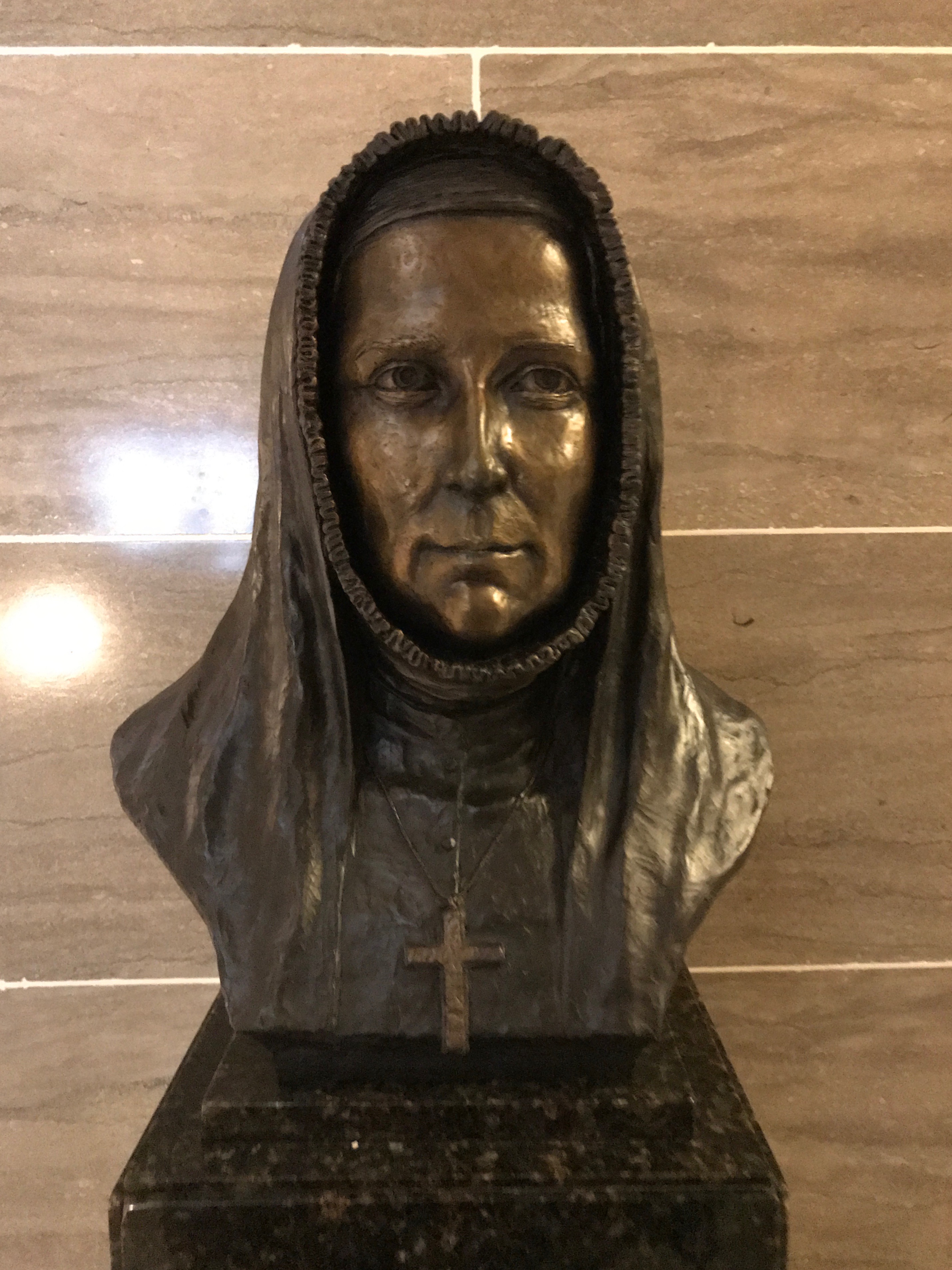
Saint Rose Philippine Duchesne, 1769-1852. She is recognized for being an American Frontier Educator. Born in Grenoble, France, she came to America in 1818 and open the first free school west of the Mississippi in a log cabin in St. Charles, Missouri.

She worked with the American Indians, who called her “Quah-kah-ka-num-ad” or “The Woman Who Prays Always.” She was beatified by Pope Pius XII in 1940 and canonized by Pope John Paul II in 1988.

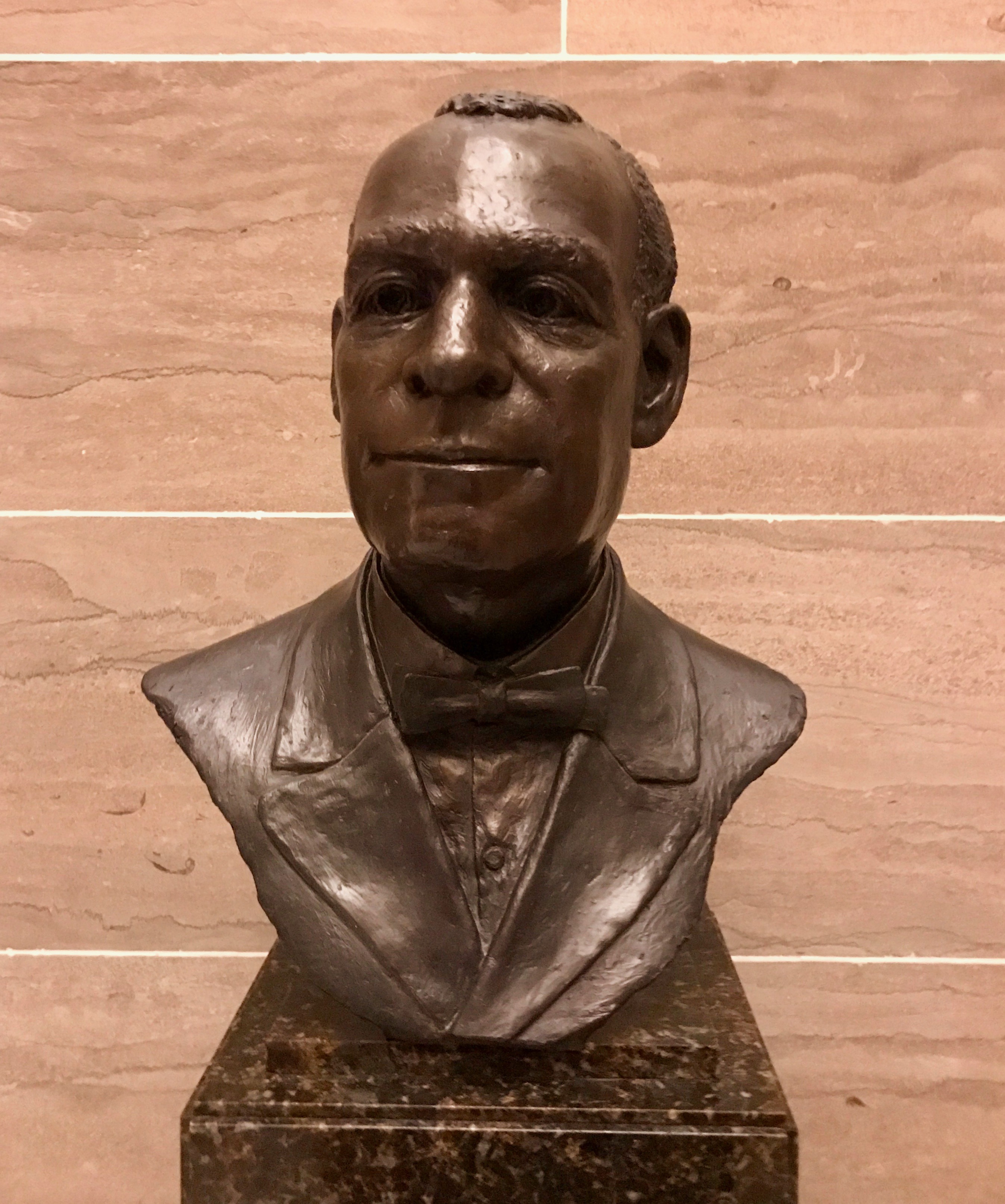
Tom Bass was born into slavery in Boone County in 1859. He lived most of his life in Mexico, Missouri. He became one of the most popular horse trainers of the late 19th and early 20th centuries. He is credited with helping to start the American Royal Horse Show in Kansas City. He died in 1934 at the age of 75. He succumbed to a heart attack, which people attributed to his distress over the death of Belle Beach, one of his favorite horses.

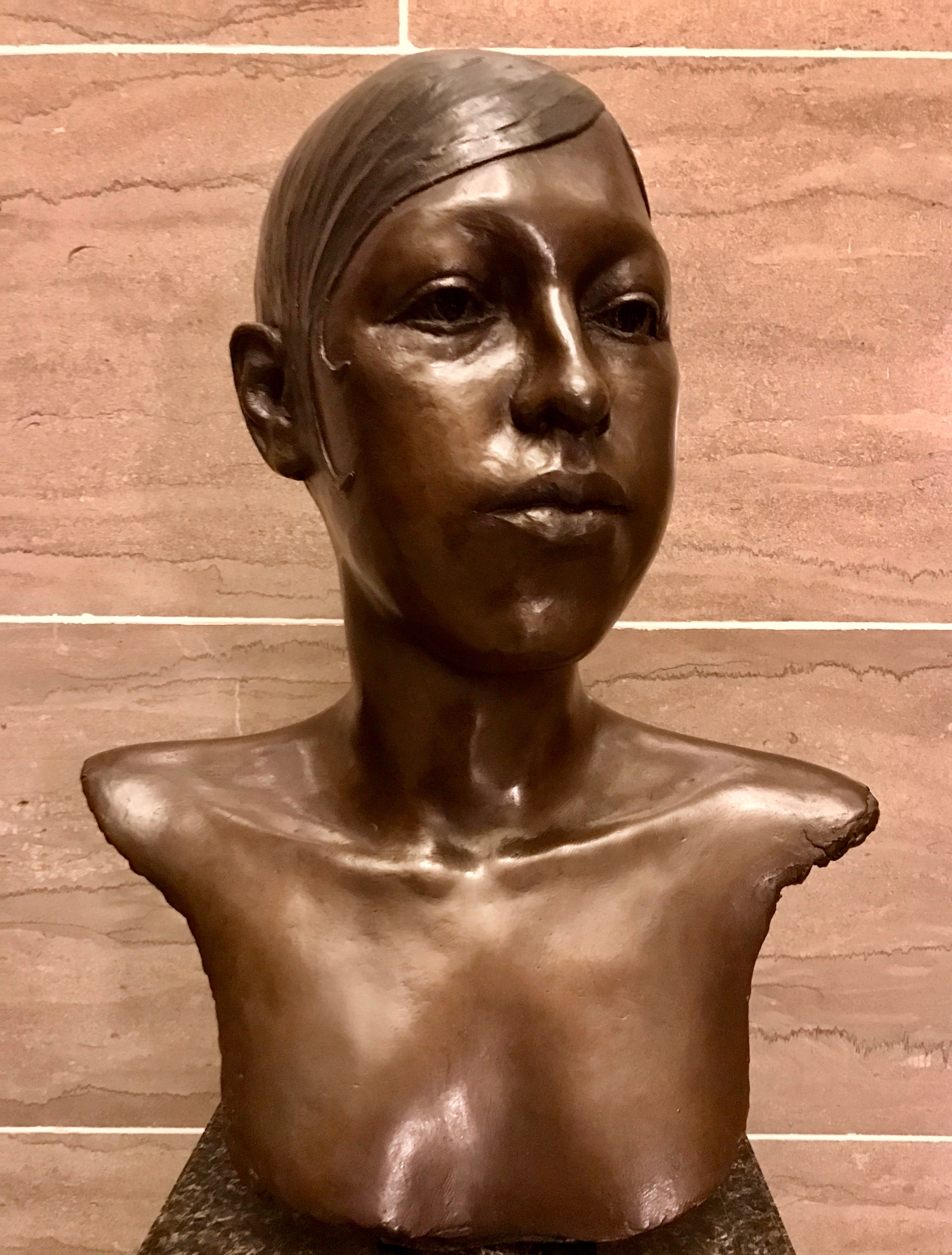
Josephine Baker is also claimed as one of Missouri’s own. She was born in St. Louis in 1906 and her plaque honors her for being an international entertainer and human rights activist. She lead an interesting life. Not only as a singer and dancer, but as a movie star, a civil rights activist, and working with the French Resistance during World War II. After the war, she was awarded the Croix de guerre by the French military and named a Chevalier of the Legion d’honneur by General Charles de Gaulle. Although she had renounced her U.S. citizenship when she married French industrialist Jean Lion in 1937, Coretta Scott King offered her unofficial leadership in the Civil Rights Movement after Martin Luther King’s assassination.

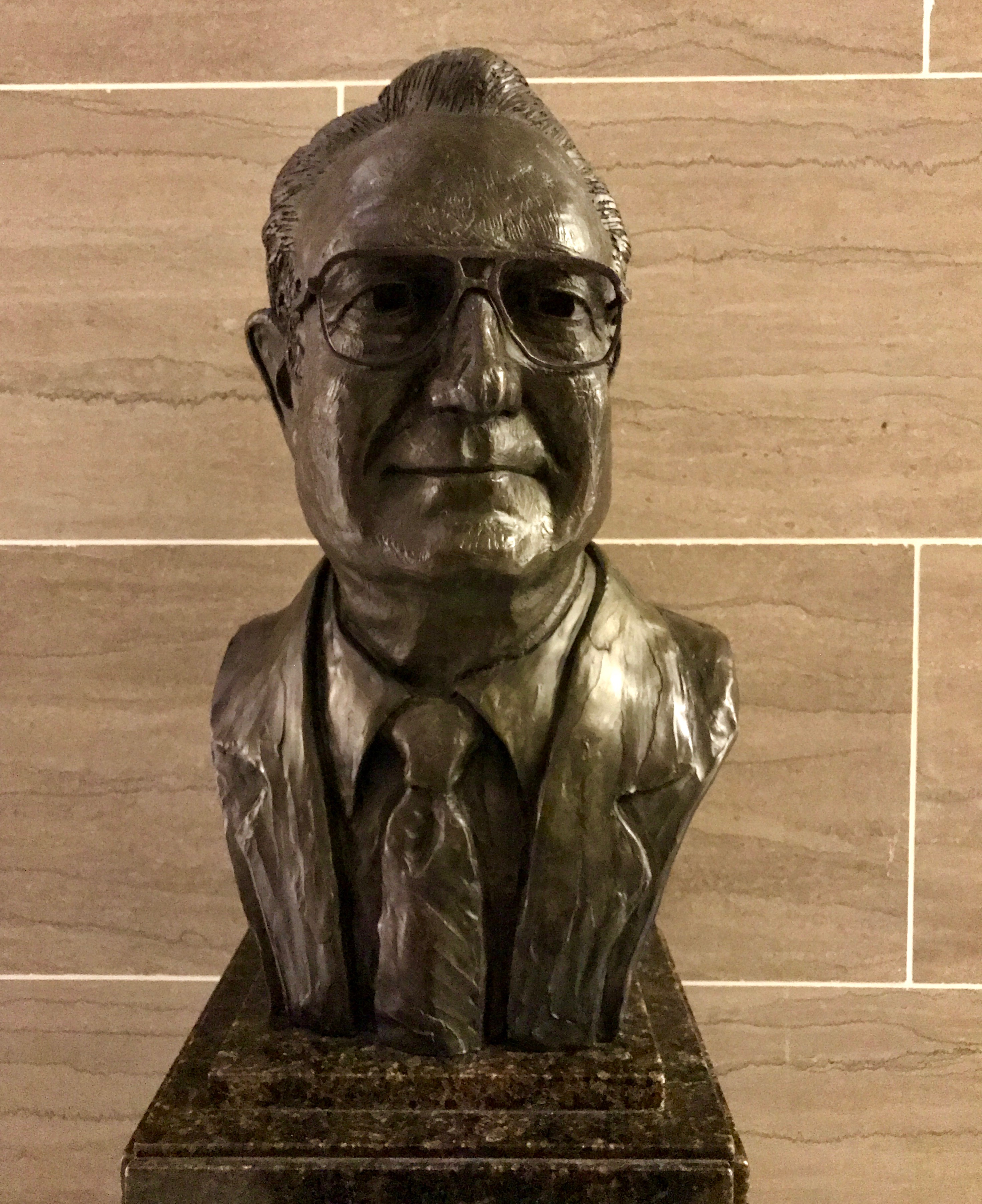
Melton D. “Mel” Hancock is included in the Hall. He is the founder The Taxpayer’s Survival Association, which put forth “The Hancock Amendment.” This is Missouri’s Constitution Tax and Spending Limitation. His organization worked with other groups in the state and got it placed on the ballot through a petition drive and it was adopted by the voters in 1980. (Side note, if this were Michigan, the legislators would feel free to do something to thwart the will of the voters.) From 1989 – 1996, he represented the state’s 7th congressional district in the United States House of Representatives.

Astronomer Edwin Powell Hubble, 1889-1953, is also one of the honorees. Hubble developed the theory and law proving that the universe is expanding, developed the theory that the universe extends beyond the Milky Way and a technique to measure the distance of those galaxies from our galaxy. Hubble Classification is still used today to measure and classify all galaxies beyond the Milky Way. The Hubble Space Telescope is named in his honor.
I always associated Marlin Perkins with Nebraska. I guess it was due to “Mutual of Omaha’s Wild Kingdom.” But, no, this well-known zoologist and naturalist was born and raised in Carthage, Missouri. He was also director of the Saint Louis Zoo from 1962-1970. He hosted the television show 1963-1985, which was almost to the end of his life in 1986. I’d say he had a good, long run.

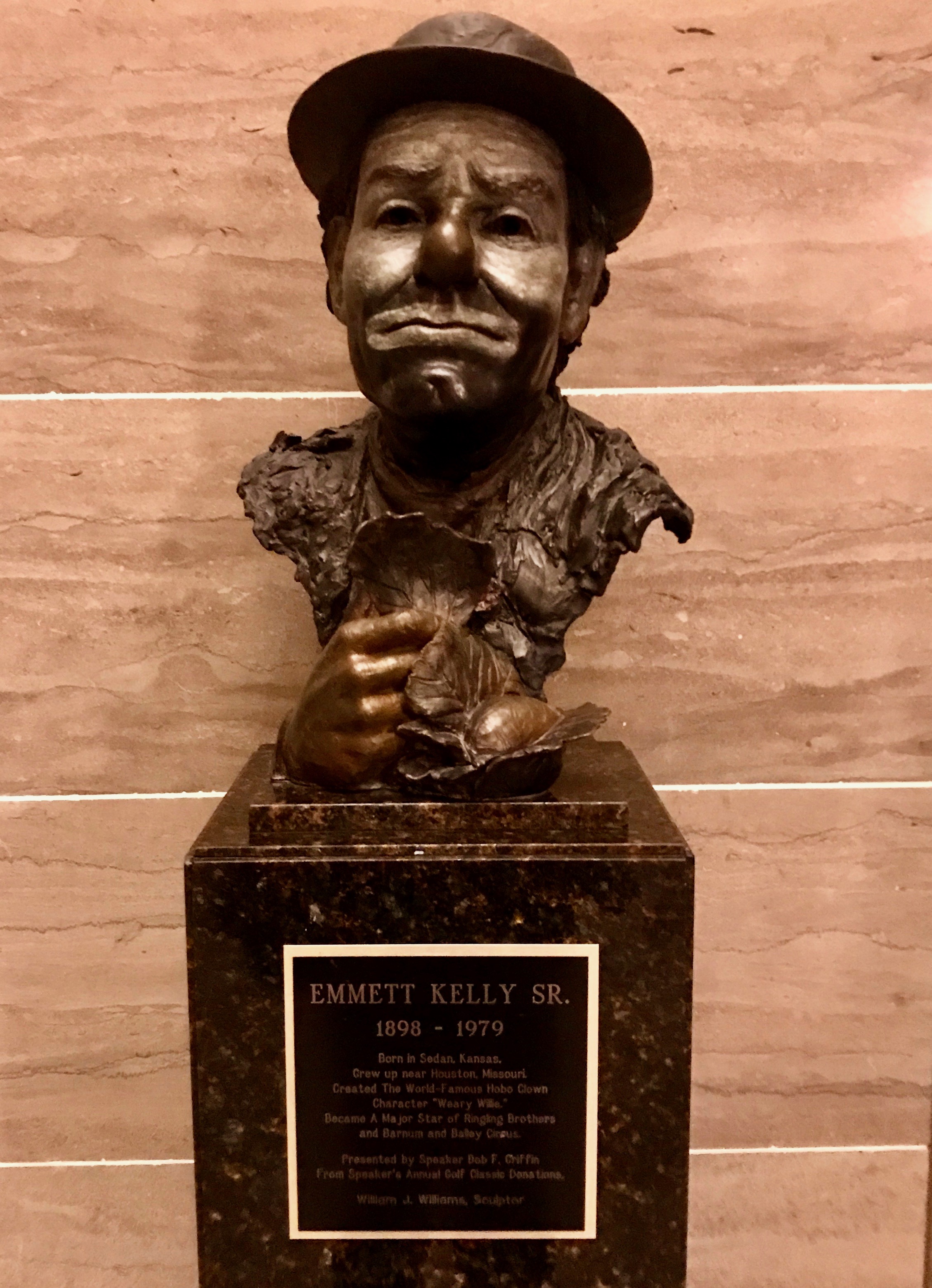
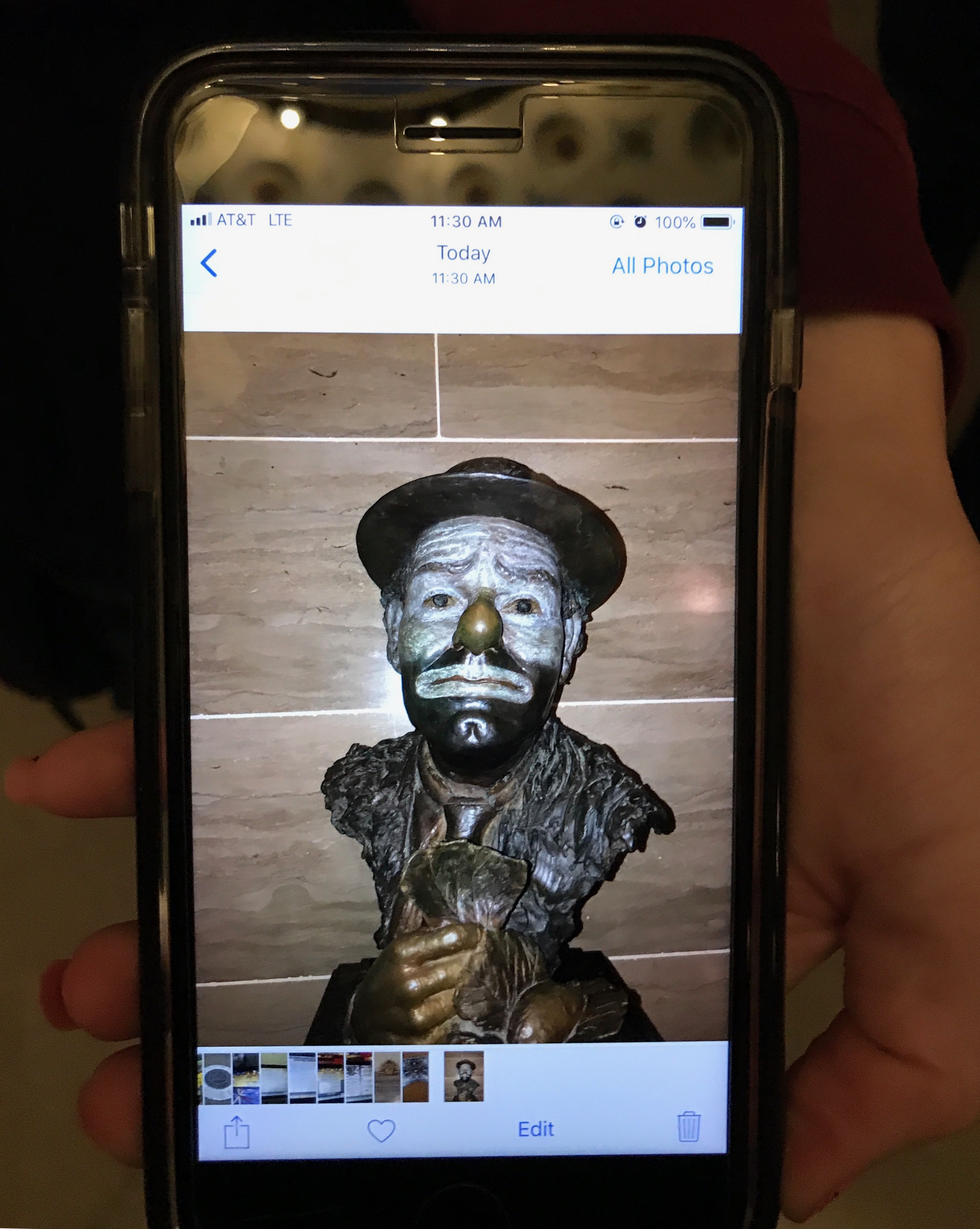
I did not know that Emmet Kelly Sr. was from Missouri, but it appears that they claim him as their own. While he was born in Kansas in 1898, his hometown was Houston, Missouri. His character, based on the hobos of the Depression Era, was known as Weary Willie. Our guide told us that the statue held a secret, if you took a flash photo of it.

One of the tour members managed to snap a photo with flash, and I took a photo of her photo. Amazing!

Next is a completely different sort of clown. Rush Limbaugh. The citation honors him for overcoming adversity while climbing the ladder to become the top radio talk show host in the country. I read over his Wikipedia entry. The only adversity I could find was that he dropped out of college. His mother said that, “He flunked everything,” and “he just didn’t seem interested in anything except radio.”

Virginia Louis Minor was born in Virginia in 1824 and moved to St. Louis in 1843. She founded the first woman’s suffrage organization in the United States. She attempted to register to vote in 1872 and she sued the registrar who refused to let her register. Her case, Minor v Happensett, went to the United State Supreme Court, which denied women the right to vote under the 14th Amendment.

She worked for women’s suffrage until her death in 1894.

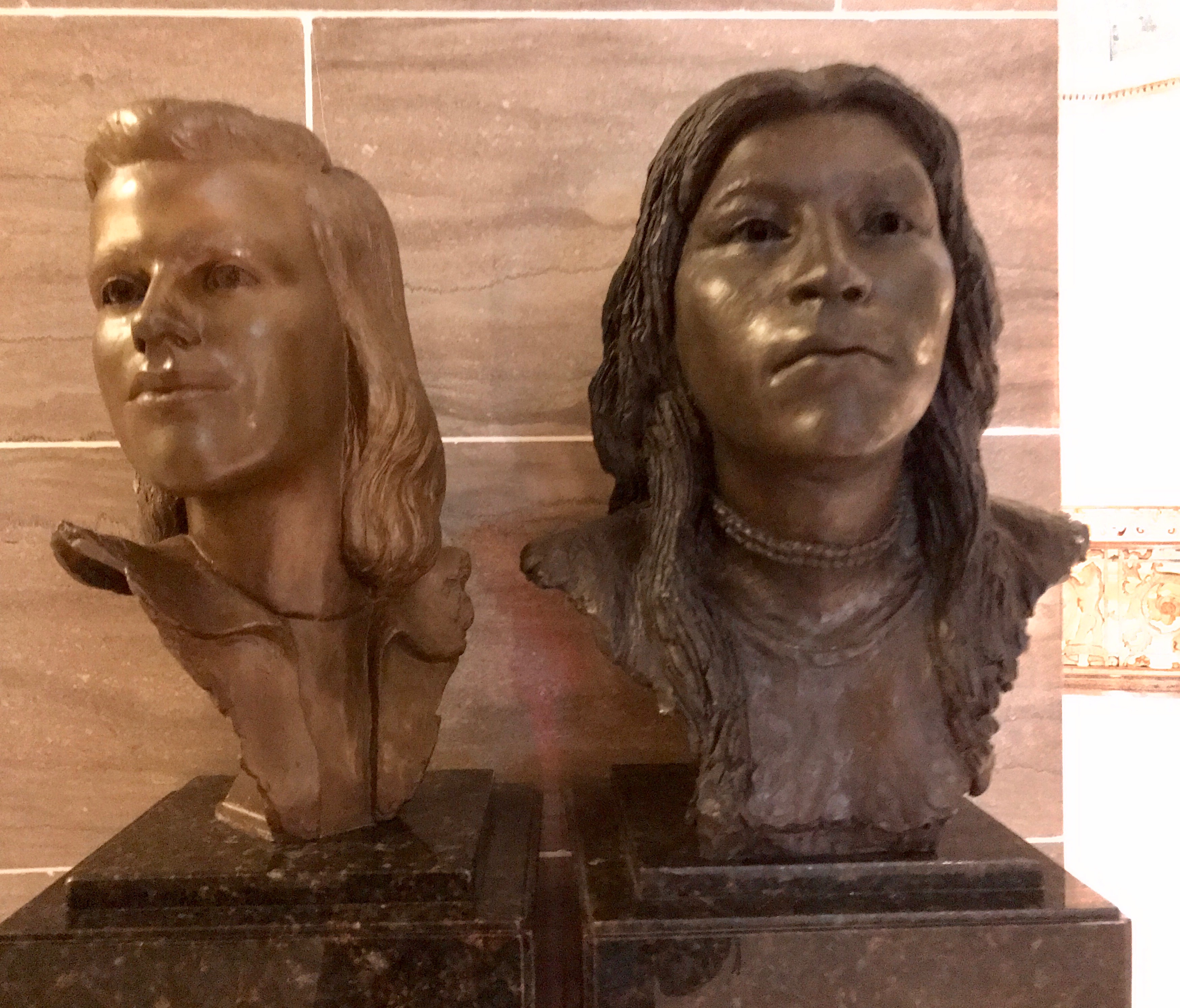
I’m not sure why Ginger Rogers and Sacajawea are displayed so close together. Do you suppose they are running out of space?

Ginger Rogers was born in Independence, Missouri in 1911. She won a Best Actress Oscar for the 1940 film, “Kitty Foyle.” She danced with Fred Astaire in ten films. Her most famous quotes is “I do everything the man does, only backwards and in high heels.”

Sacajawea was born in 1788 Lemhi River Valley, near present day  Salmon, Idaho. On her plaque, she is recognized as being the Shosone interpreter for the Lewis and Clark Expedition. in 1800, when she was around 12 years old, she and several other girls were kidnapped by a group of Hidata after a battle that resulted in the deaths of several Shoshone. She was taken to the Hidatsa village, near present-day Washburn, North Dakota.

According to my Preferred Source, When she was about 13, she was sold into a “nonconsensual” marriage along with another young girl to Toussaint Charbonneau, a Quebecois trapper living in the village. She was pregnant with her first child when Lewis and Clark spent the first winter near there. Charbonneau professed to be able to speak Big Belley language, which is what the Hidatsa spoke. He told them that his wives spoke the Shoshone language. They hired him and told him to bring along one of his wives.

Sacajawea died in 1812. Or was it 1884? There is no definitive proof, although 1812 is the more accepted date.

This gentleman is George Caleb Bingham. He was a 19th century American painter of the American West, with a large selections of his works of at the St. Louis Museum of Art. Much of his best work generally relates to life and commerce along the Mississippi and Missouri rivers, and to the people of Missouri in and around St. Louis, Jefferson city and Kansas City, among other Missouri places. He became known as “The Missouri Artist” and is considered by some to be Missouri’s first artist.

In addition to being an artist. he also served in the Missouri House of Representatives and other various positions in government.

David Rice Atchison is another interesting politician. Although he was born near Lexington, Kentucky in 1807, he was the U.S. Senator from Missouri for 1843-1855, and there are those who claim that he was President for one day in 1849. That’s the President of the United States, mind you.

How did that happen?  The term of outgoing president, James K. Polk, ended at on noon March 4, which was as Sunday.  On March 2, outgoing vice president George M. Dallas relinquished his position as President of the Senate, at which time Atchison was elected President pro tempore of the Senate. According to the Presidential Succession Act of 1792, the Senate president pro tempore immediately followed the vice president in the presidential line of succession. As Dallas’s term also ended at noon on the 4th, and neither President-elect Zachary Taylor nor Vice President-elect Millard Fillmore had been sworn in to office on the day, it was claimed by some of Atchison’s friends and colleagues that on March 4-5, 1849, Atchison was Acting President of the United States.

It must be noted that Atchison himself never claimed to be Acting President and historians, constitutional scholars and biographers all dismiss the claim. tI is a fun little story, nevertheless.

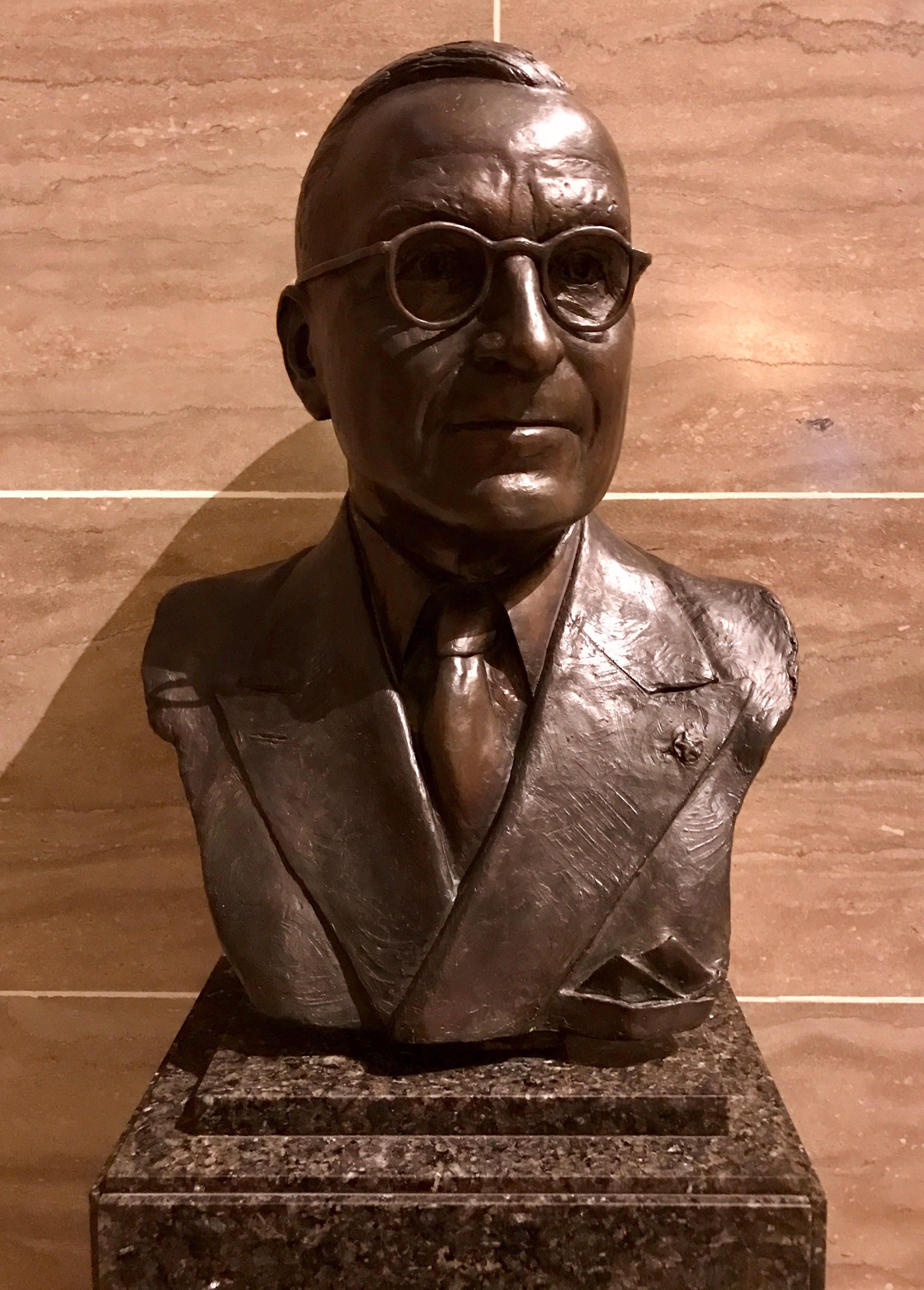
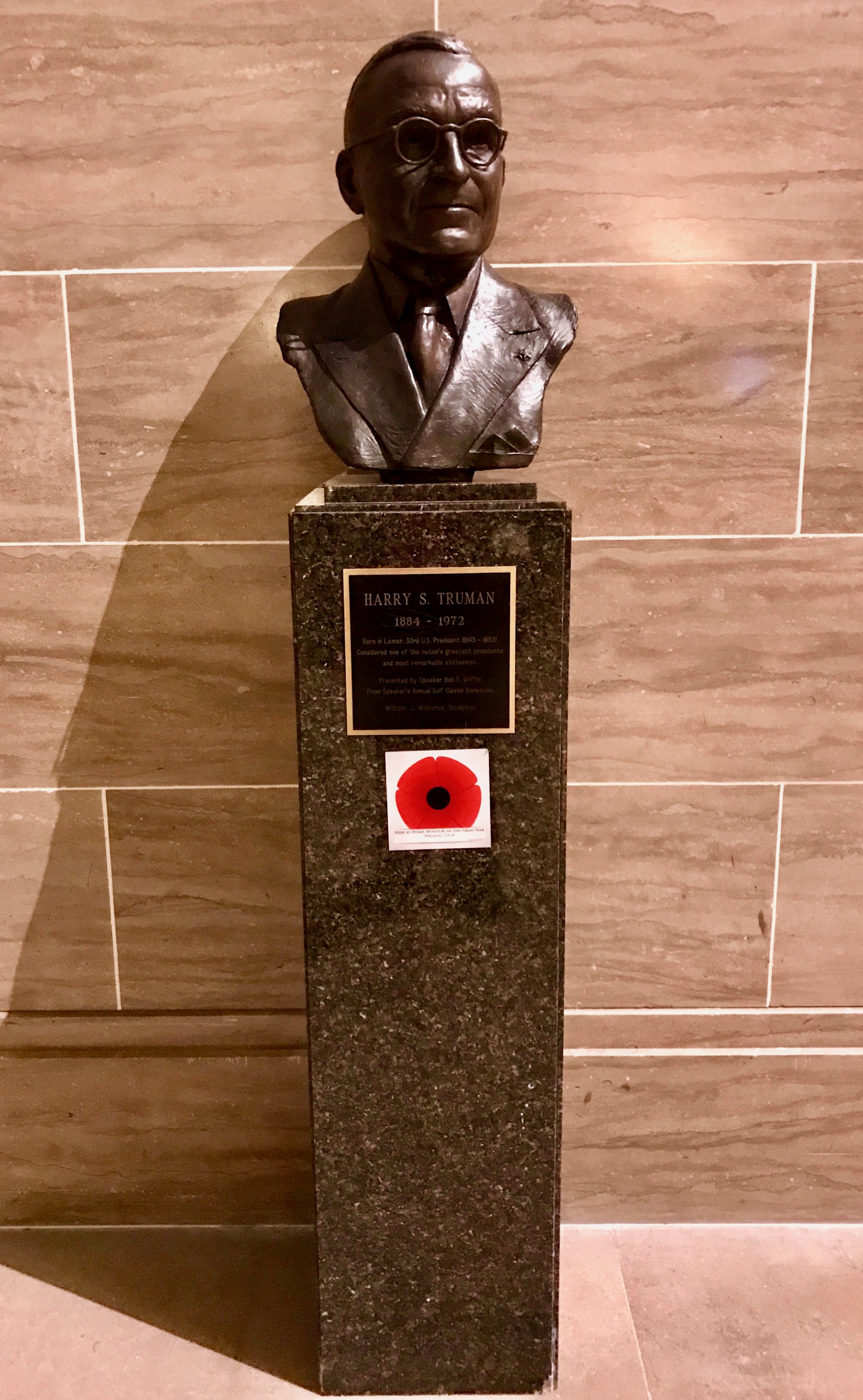
Missouri does have one genuine native son who was President – Harry S Truman. According to the plaque, he was considered one of the Nation’s greatest presidents and most remarkable statesmen. Born in Lamar, Missouri in 1884, he lived out his post-presidential years in Independence, Missouri.

He was a Missouri Senator from 1935 – 1945, when he became Franklin D. Roosevelt’s third vice president. He followed John Nance Garner, 1933-1941, and Henry A. Wallace, 1941-1945. One of these days, I am going to have to research just why FDR felt that he needed to switch vice presidents. In any event, Truman had been vice president for less than three months when FDR died from a cerebral hemorrhage in the Little White House in Warm Springs, Georgia. Talk about on-the-job training! He had to take the reins and bring WW II to a close, which included making the decision to use the atomic bomb. I  have read in several sources, that when he took office he wasn’t even aware that there was an atom bomb being developed.

I am including this photo of his bust on the pedestal so that you can see the poppy on it. Truman served in WW I, which he only managed to get into because he secretly memorized the eye chart to compensate for his poor vision. My visit to the capitol was in 2018, which was the 100th anniversary of the end of WW I. The poppy is the symbol of remembrance. I believe it gained popularity because of the poem “In Flanders Fields” by John McCrae.

And now, I really will move along. Thank you for bearing with me through this long series of posts about the Missouri State Capitol.

It’s Time for Some Art

Actually, it’s time for a whole lot of art!

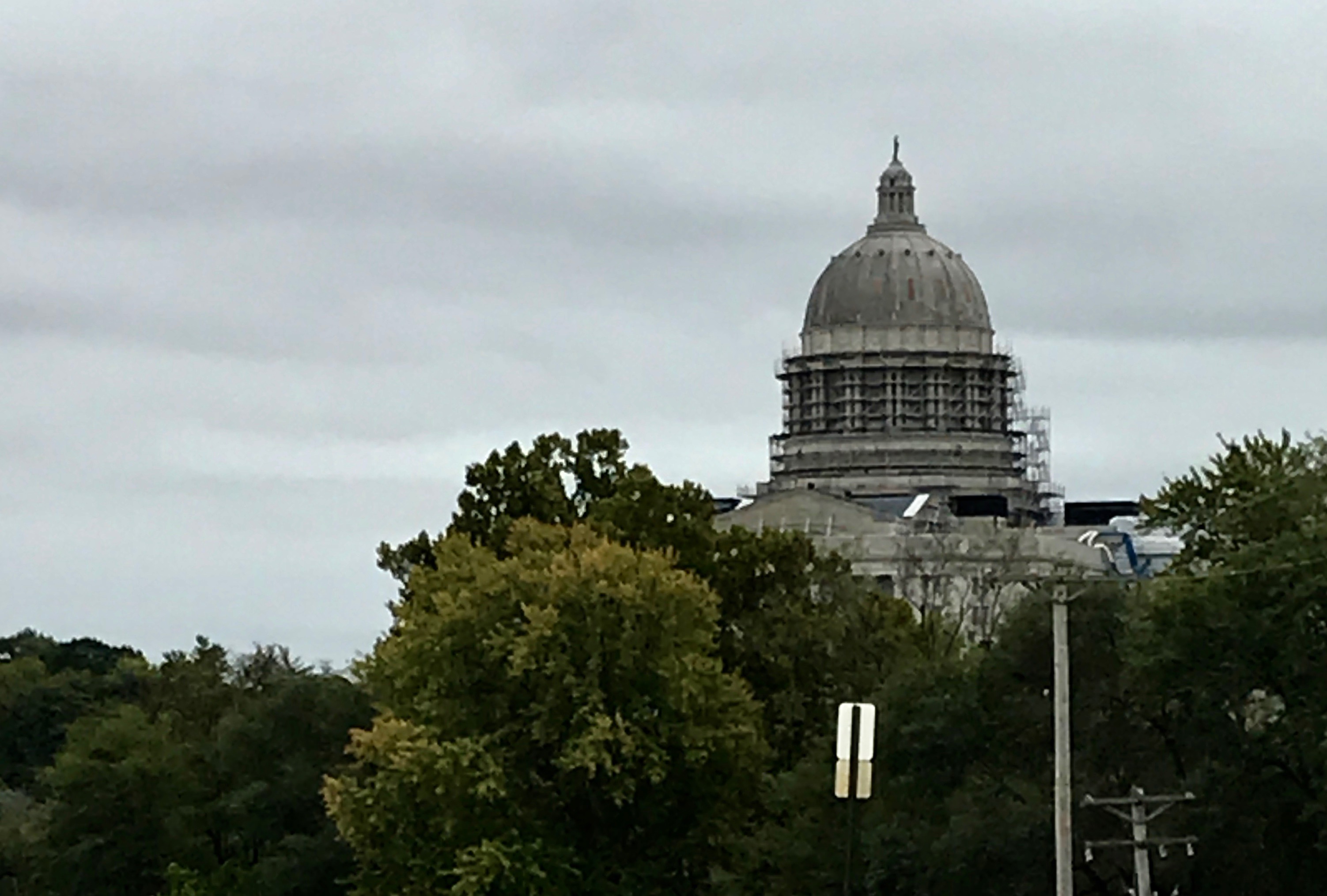
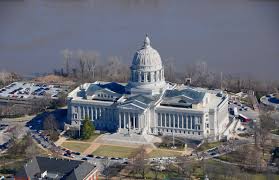
We’re back at the Missouri State Capitol, on the south bank of the Missouri River is Jefferson City. According to my Preferred Source, it was designed by the architectural firm of Tracy and Swartwout out of New York City.

NEW YORK CITY??!!!

Yeah, well, everyone has to be somewhere.

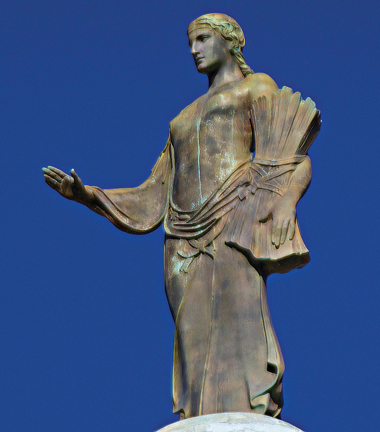
This capitol was completed in 1917, and the dome was topped with a statue of Ceres, the Roman goddess of agriculture.

According to the Missouri Capitol website, Ceres was installed in 1924, and she was on top of the dome until November 2018, which is just weeks after my visit. I miss everything!

They had to winch her up in three pieces and then assemble it on top of the dome. She weights about one ton,  and stands 10 feet, four inches tall. They took her down as part of a multi-year renovation. The last time she was cleaned was in 1995, when a crew restored her on top of the dome, which is 238 feet above ground level. She was suffering from “bronze rot.” If I were one of the conservators, I’d be suffering from a whole lot more than “bronze rot.” I do believe, though, that my face might have been a nice shade of verdigris. “Height” is not something I do willingly.

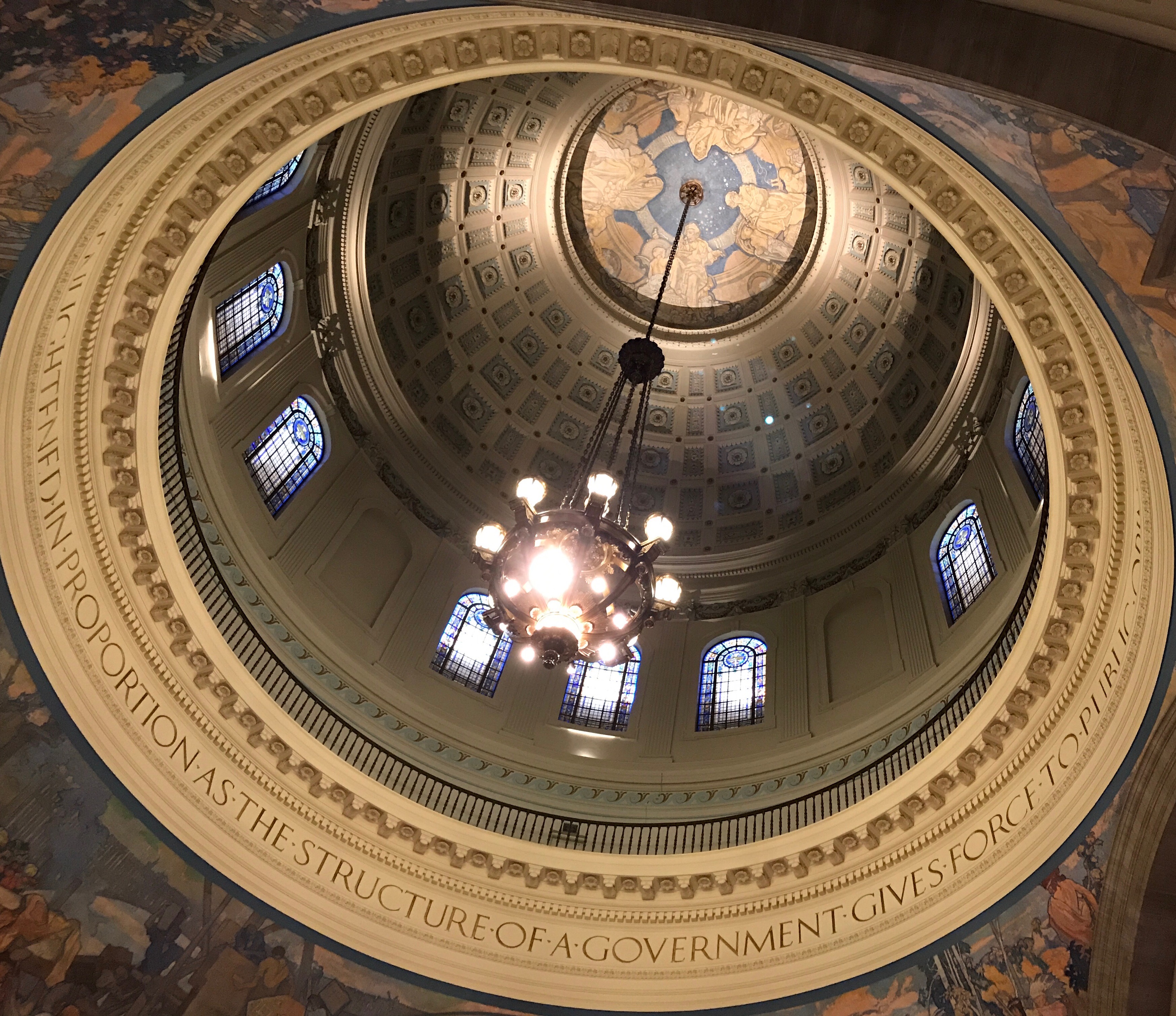
Hanging from the eye of the dome is a 9,000 pound chandelier. It hung there safely until 2006. It was lowered almost to the floor for maintenance when it fell the remaining five feet. While the chandelier cost $5,000 in 1918, which would be $83,285 in 2018 dollars, it cost $500,000 to be restored. That is $641,410 in 2018 dollars. It was reinstalled nearly a full year later.

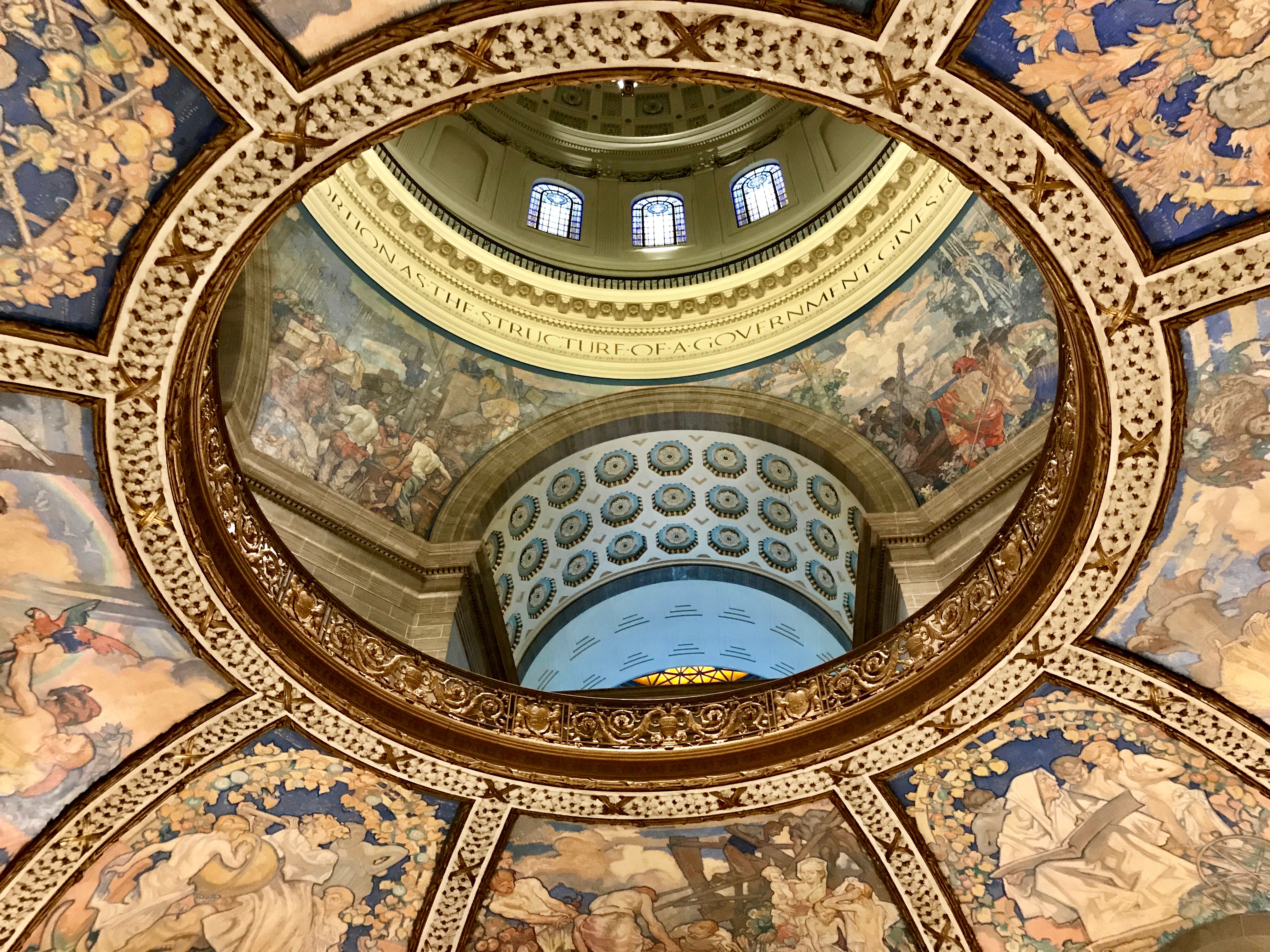
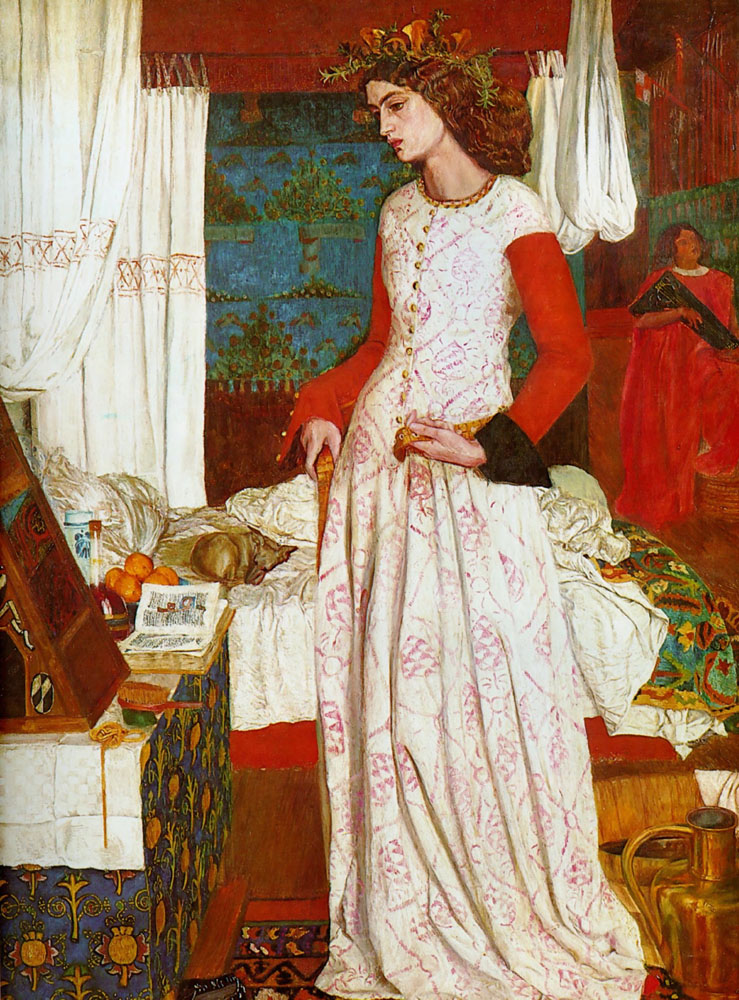
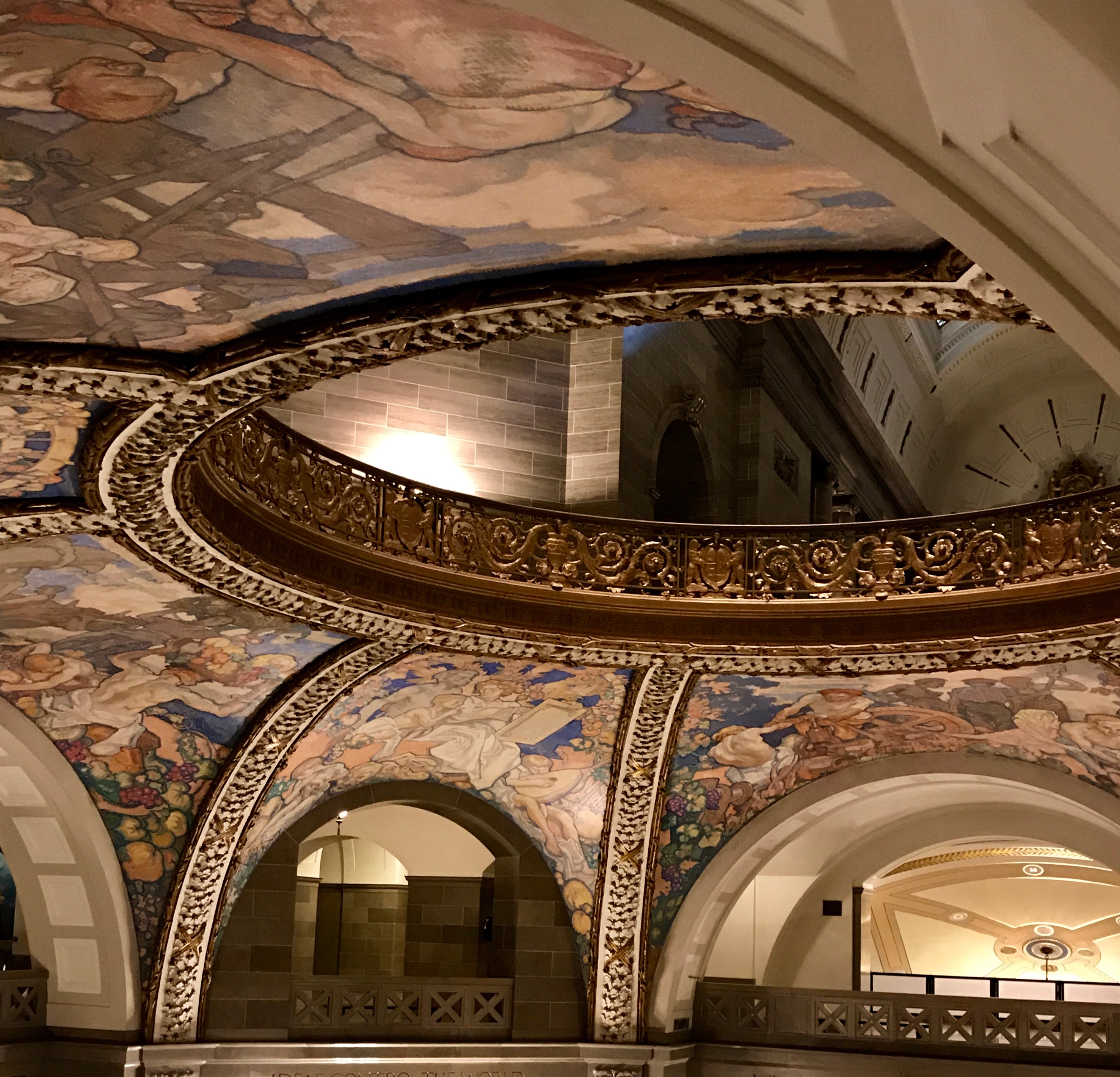
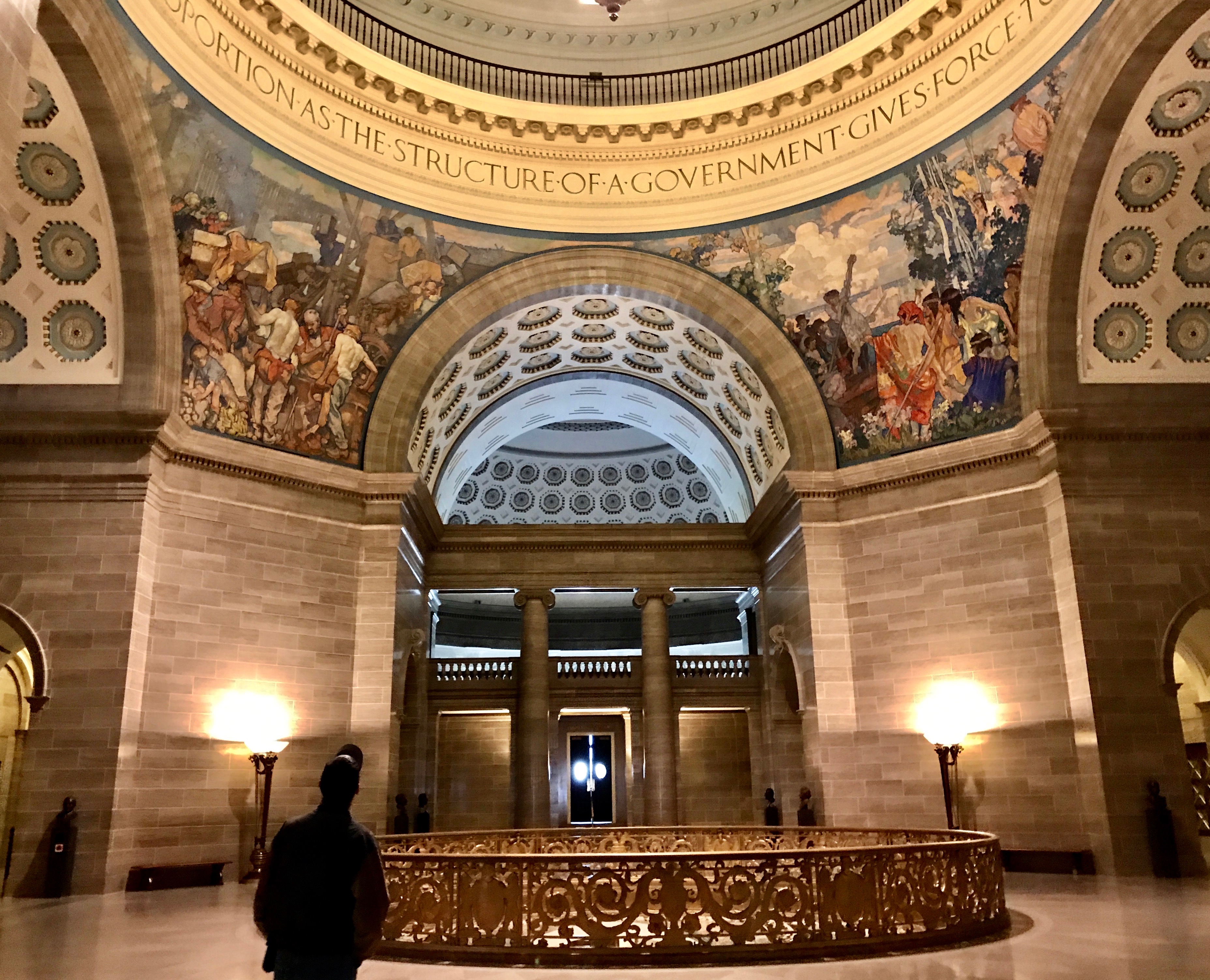
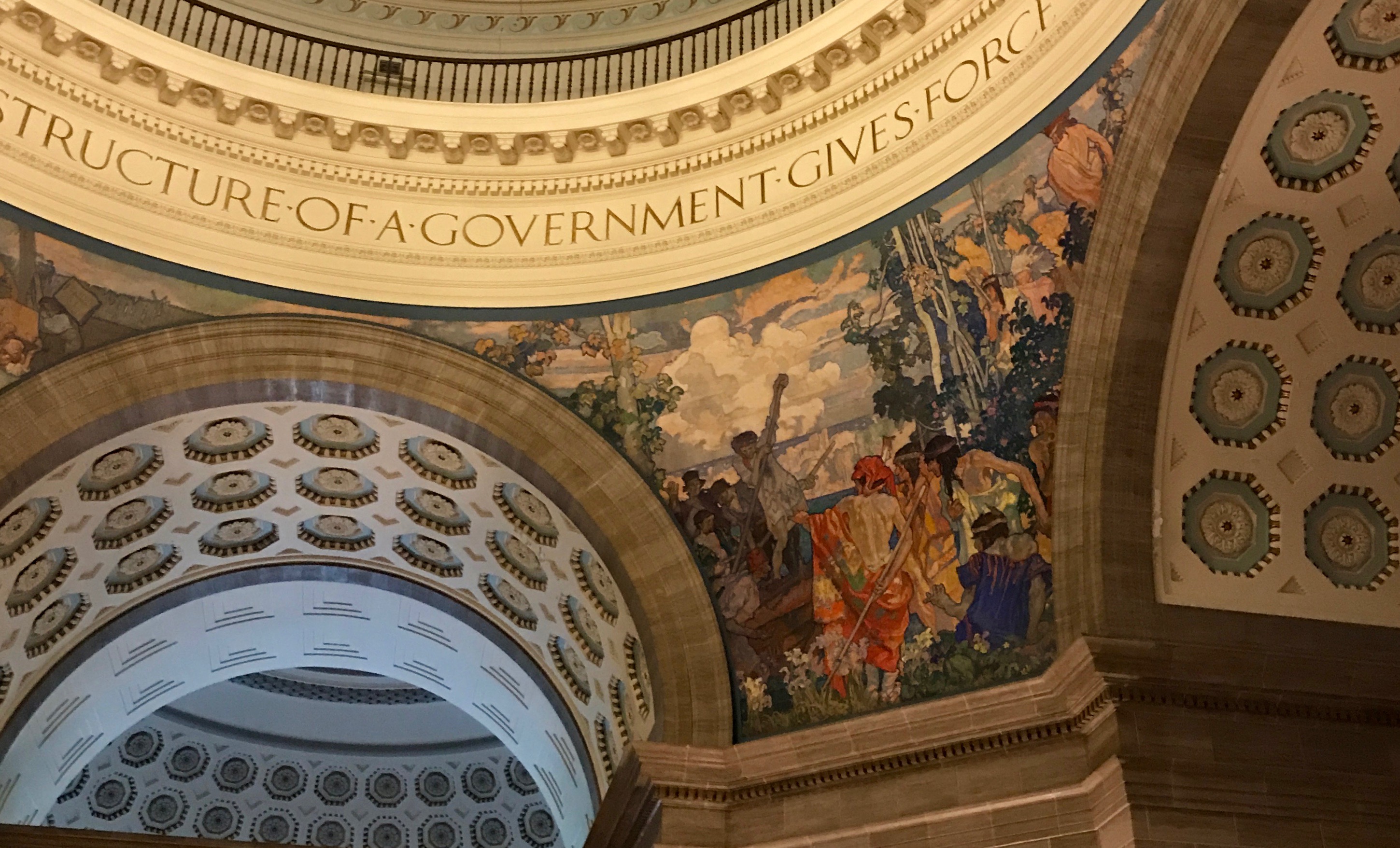
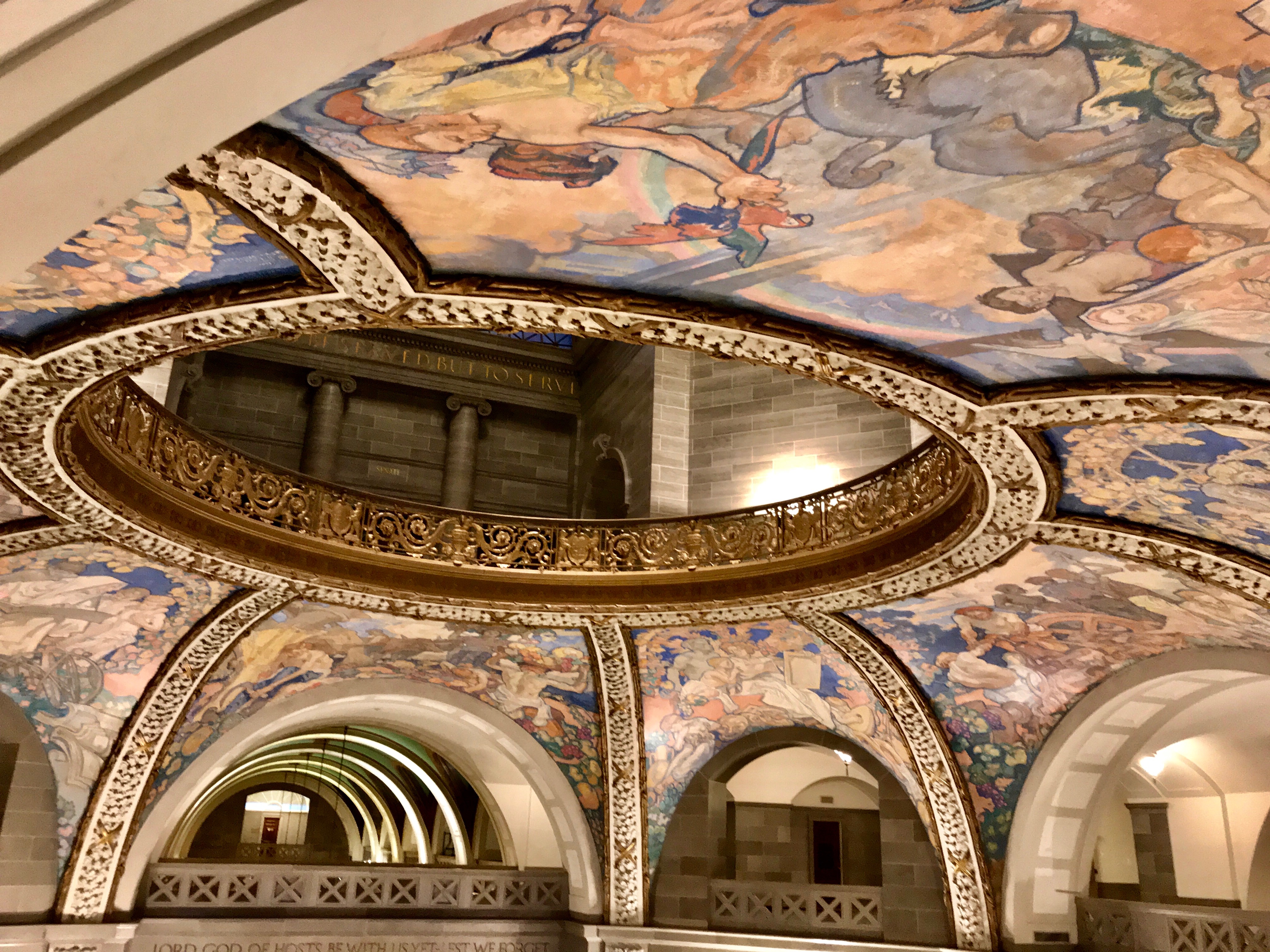
The dome is covered with murals created by Frank Brangwyn, a prolific, popular and much awarded artist of the time. He was largely self-taught, but he did work in the studios of William Morris for a time.

Those familiar with the work of William Morris might see some of his influences in his work.

By William Morris – The Yorck Project (2002) 10.000 Meisterwerke der Malerei (DVD-ROM), distributed by DIRECTMEDIA Publishing GmbH. ISBN: 3936122202., Public Domain, https://commons.wikimedia.org/w/index.php?curid=155928

William Morris’ most famous quote is one that Marie Condo seems to have adopted:

“Have nothing in your house that you do not know to be useful, or believe to be beautiful.”

The interior of the dome almost reminds me of a Faberge egg, turned inside out.

Around this level of the dome, there are works of art that show important aspects of Missouri’s history.

Really, there are so many levels that open onto the rotunda that it’s hard to keep track of which ones were on which level. The differing decorative bands help to sort it out.

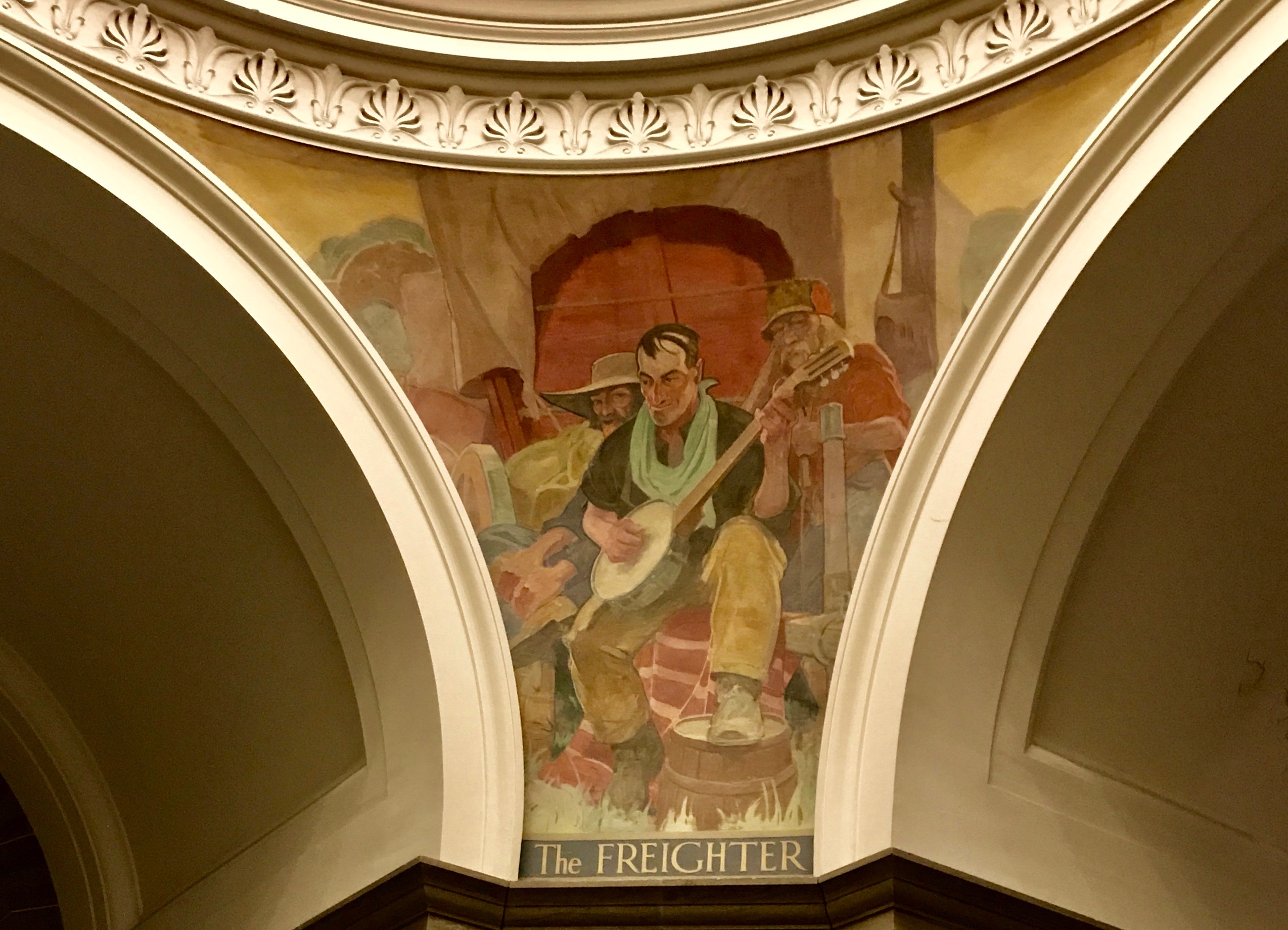
I have seen “freighters” honored in several of the western capitols. These wagon drivers were the long haul truckers of their day. The products and supplies they carried in their wagons made settlement possible.

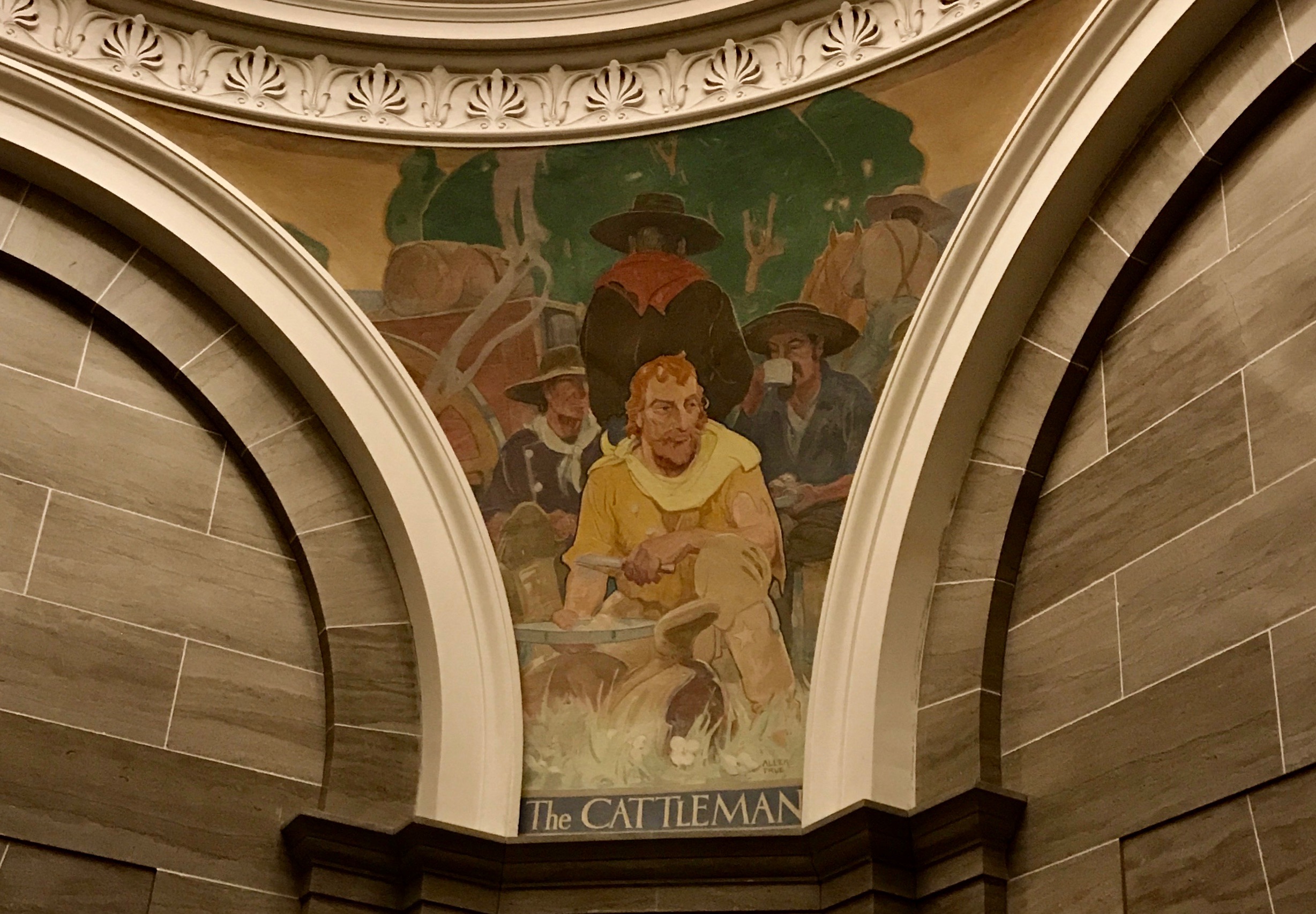
The cattlemen played a large part in Missouri’s economic development.

This is a section I shared in my last post. I like it, so I am sharing it again.

One more look up and then on to the works of other artists.

Okay, make that two more photos. Honestly, Frank Brangwyn did an amazing job of painting a complicated surface.

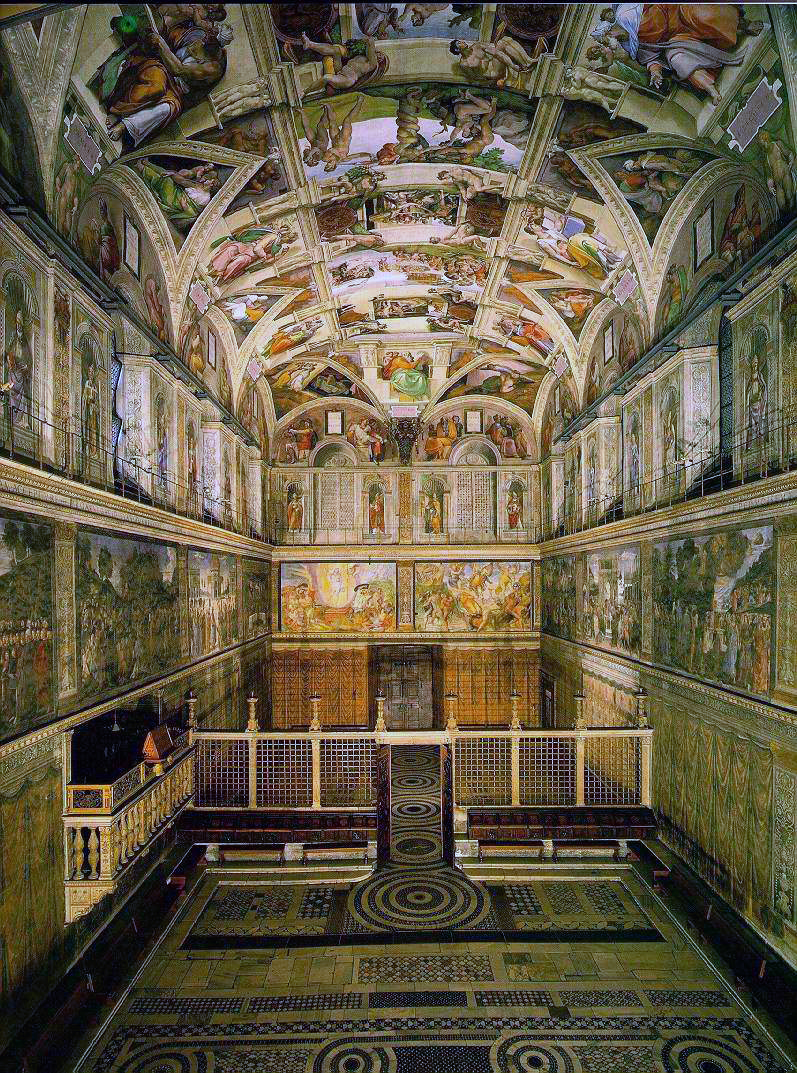
By The original uploader was Snowdog at Italian Wikipedia. – http://artchive.com/ftp_site.htm Transferred from it.wikipedia to Commons by Pierpao using CommonsHelper., CC BY-SA 3.0, https://commons.wikimedia.org/w/index.php?curid=18462479

It’s not the Sistine Chapel, but it made me think of it.

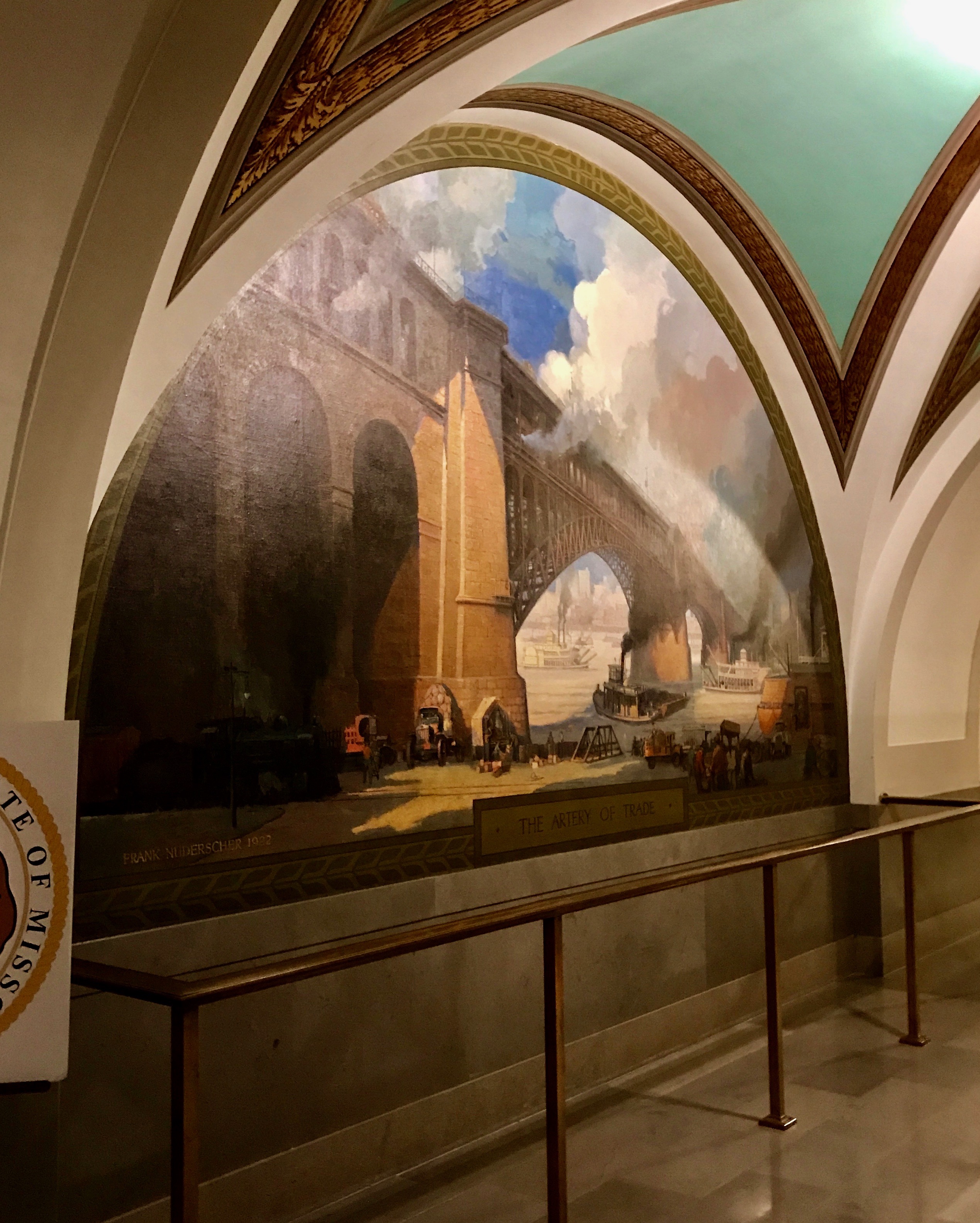
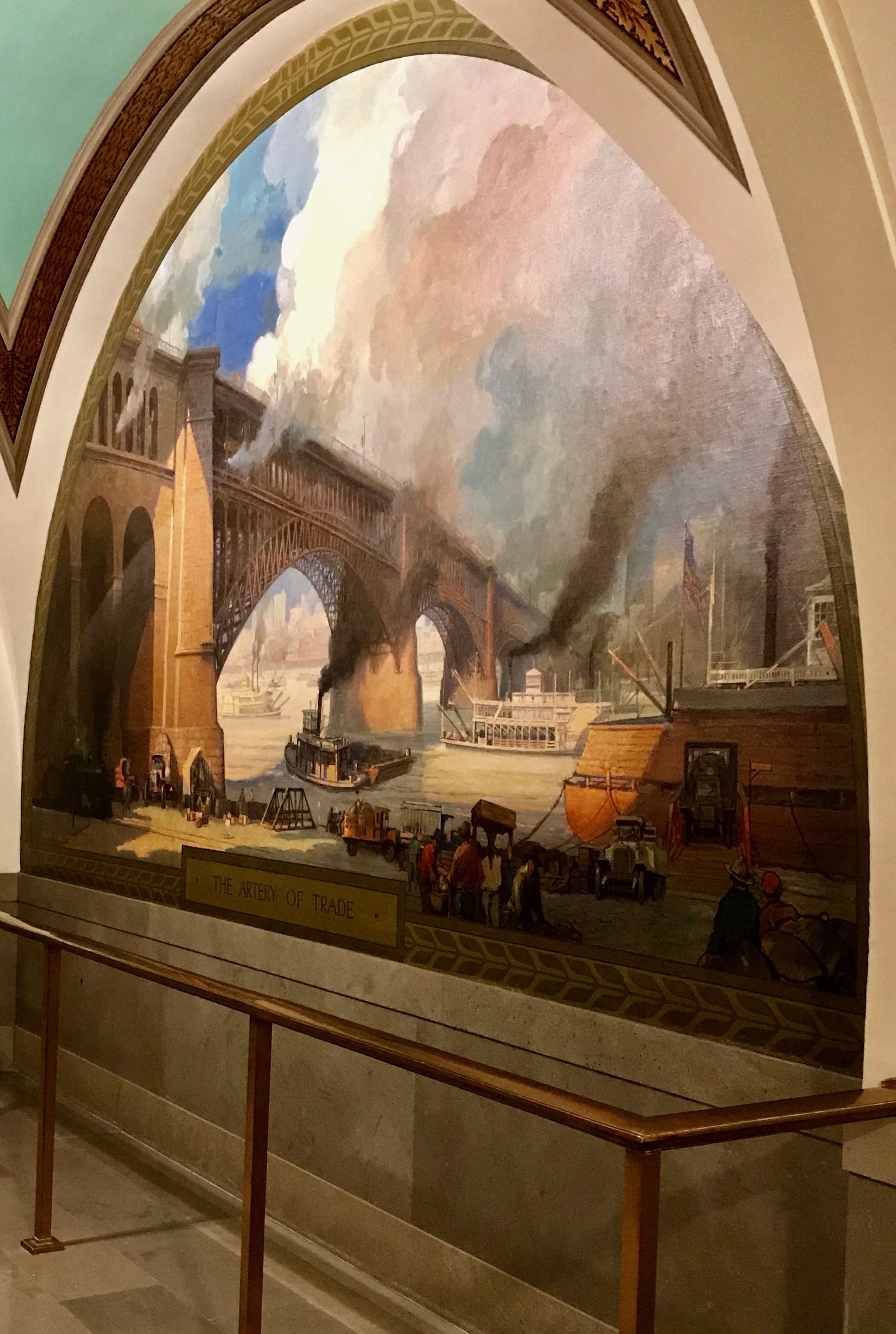
Our guide made a point of showing us these works of art by Frank Nuderscher.

Born in St. Louis in 1880, he was an illustrator, muralist, and painter of the American Impressionism style. He was called the “dean of St. Louis artists” for his leadership in the Missouri art community.

Our guide was very intent on showing us his painting from the two sides. He told us that there was a trick in the perspective that made things look different. Quite frankly, I don’t see it.

There was a second Nuderscher painting in the same hallway.

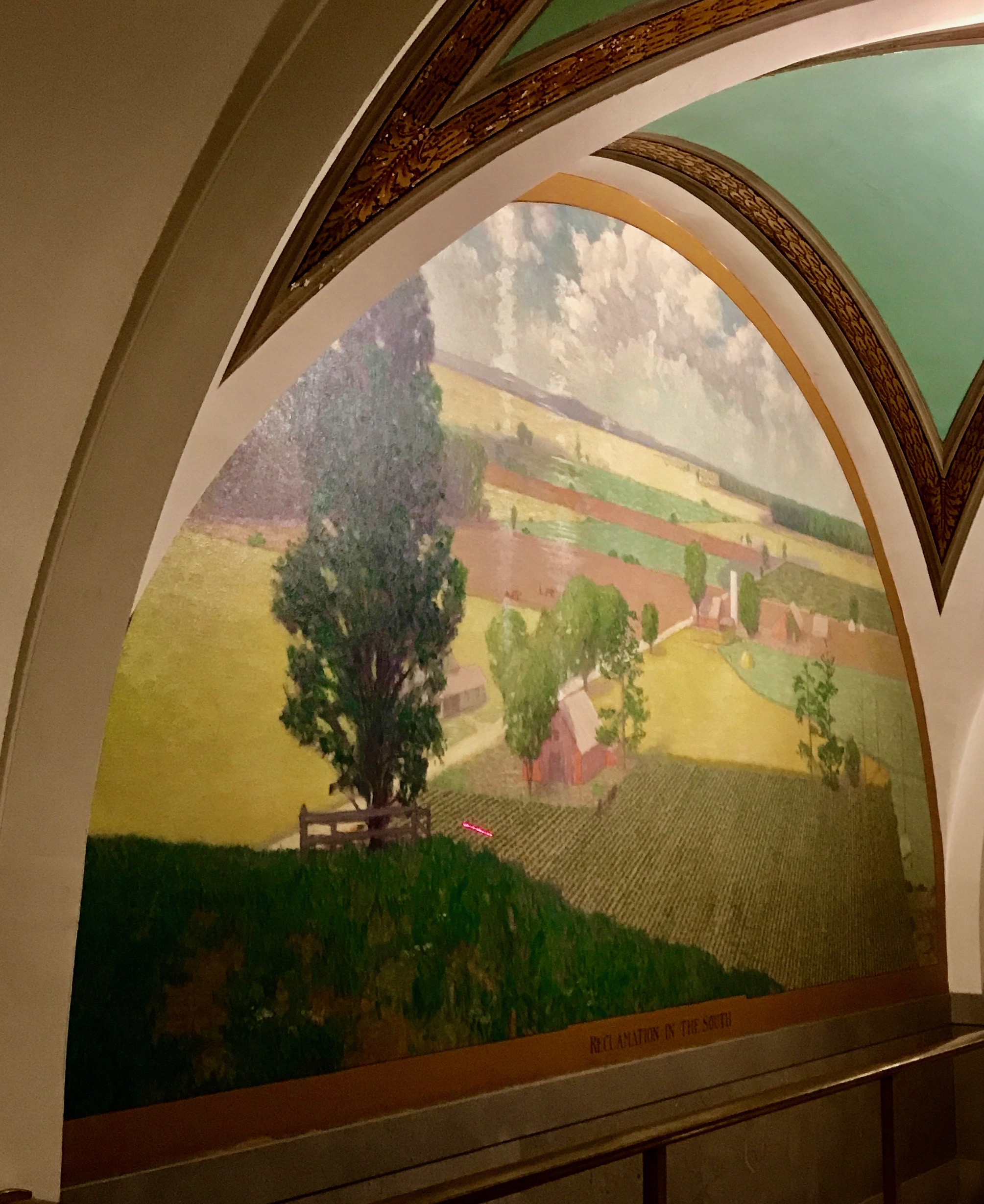
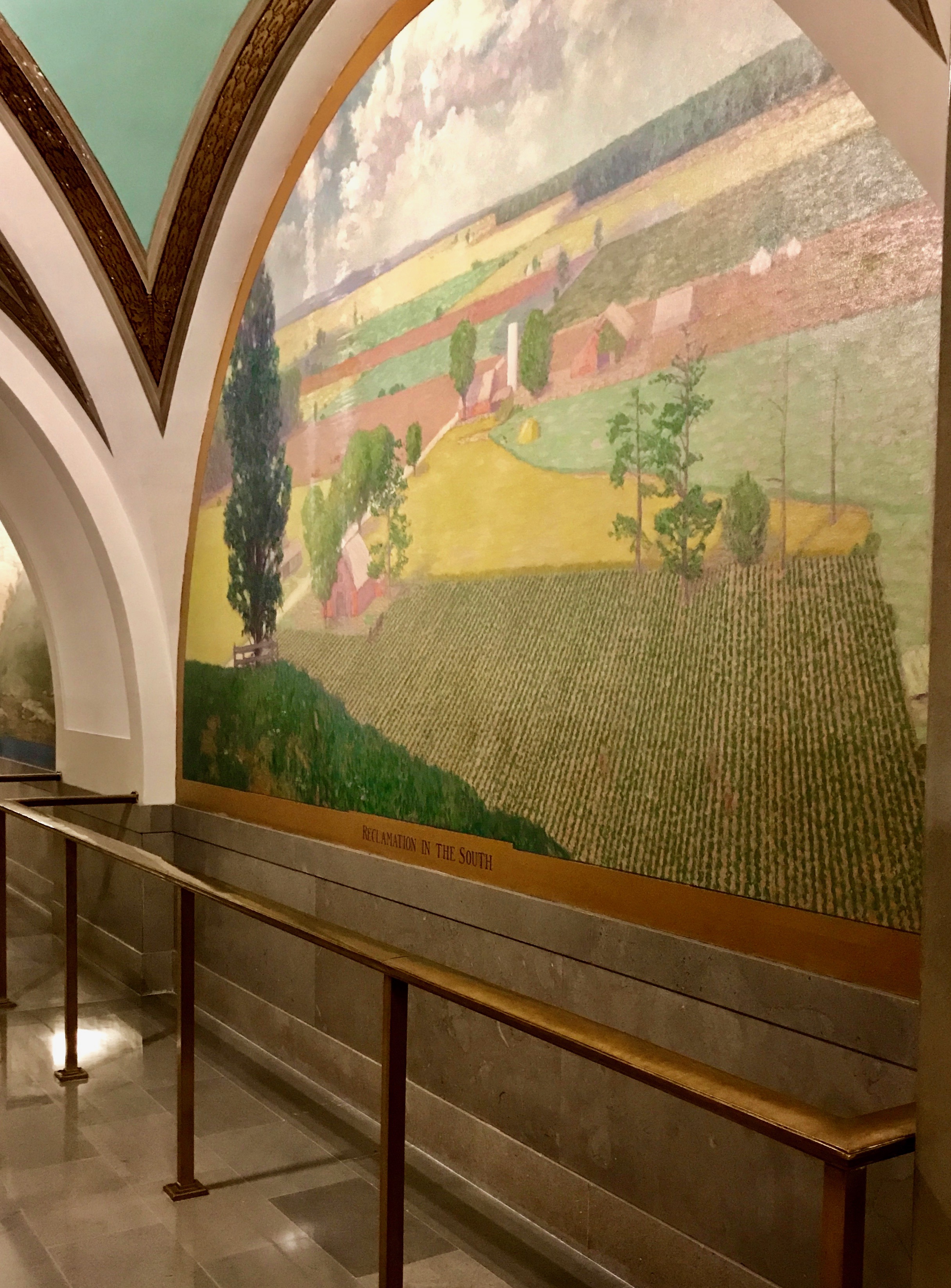
Again, there is supposed to be some sort of trick in the perspective. Supposedly the rows of crops change direction. If you see it, please let me know. Maybe I am looking in the wrong places.

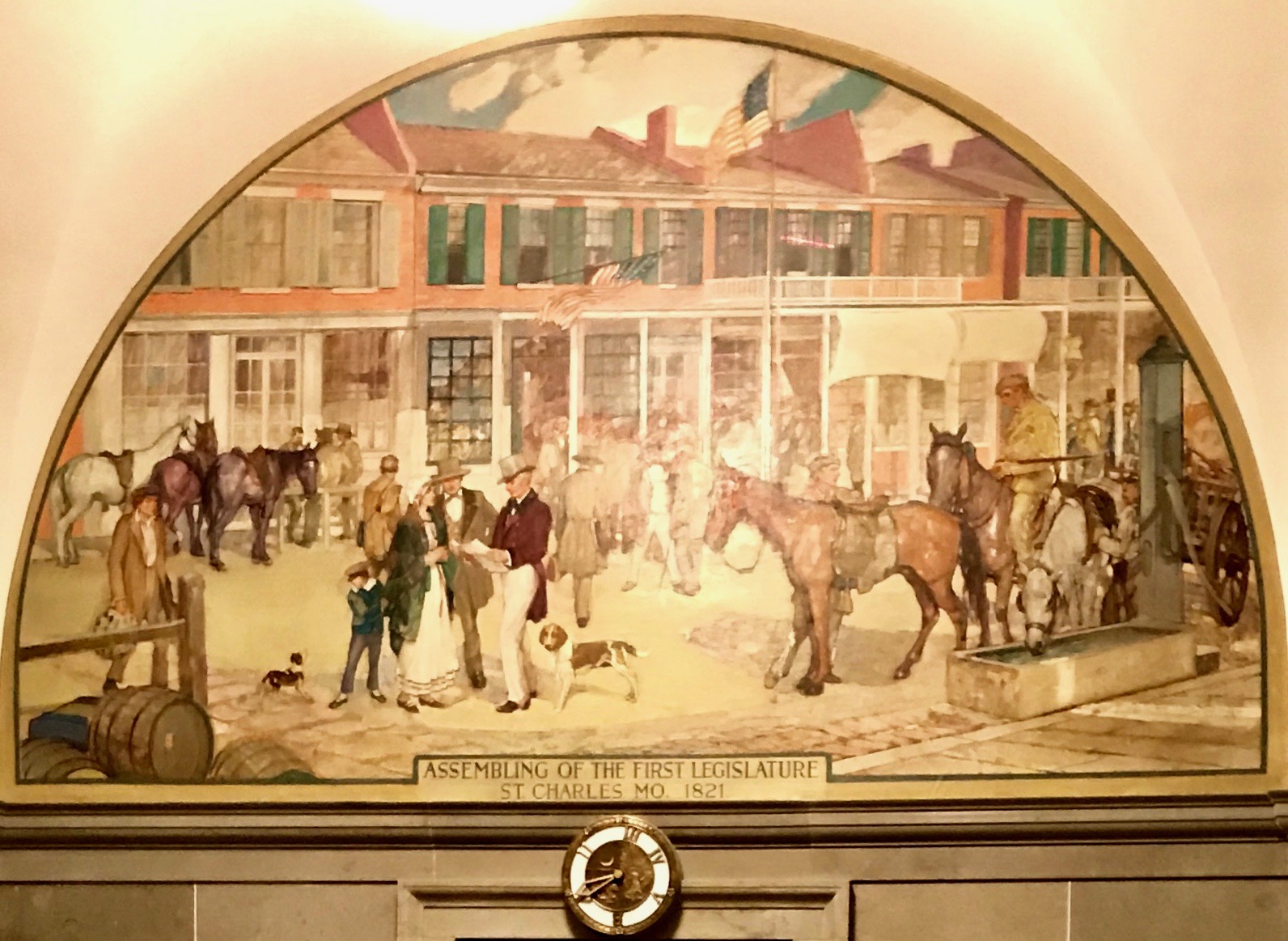
Smaller lunettes in the same hallway showed some of the history of Missouri. This is the assembling of the first legislature in St. Charles in 1821.

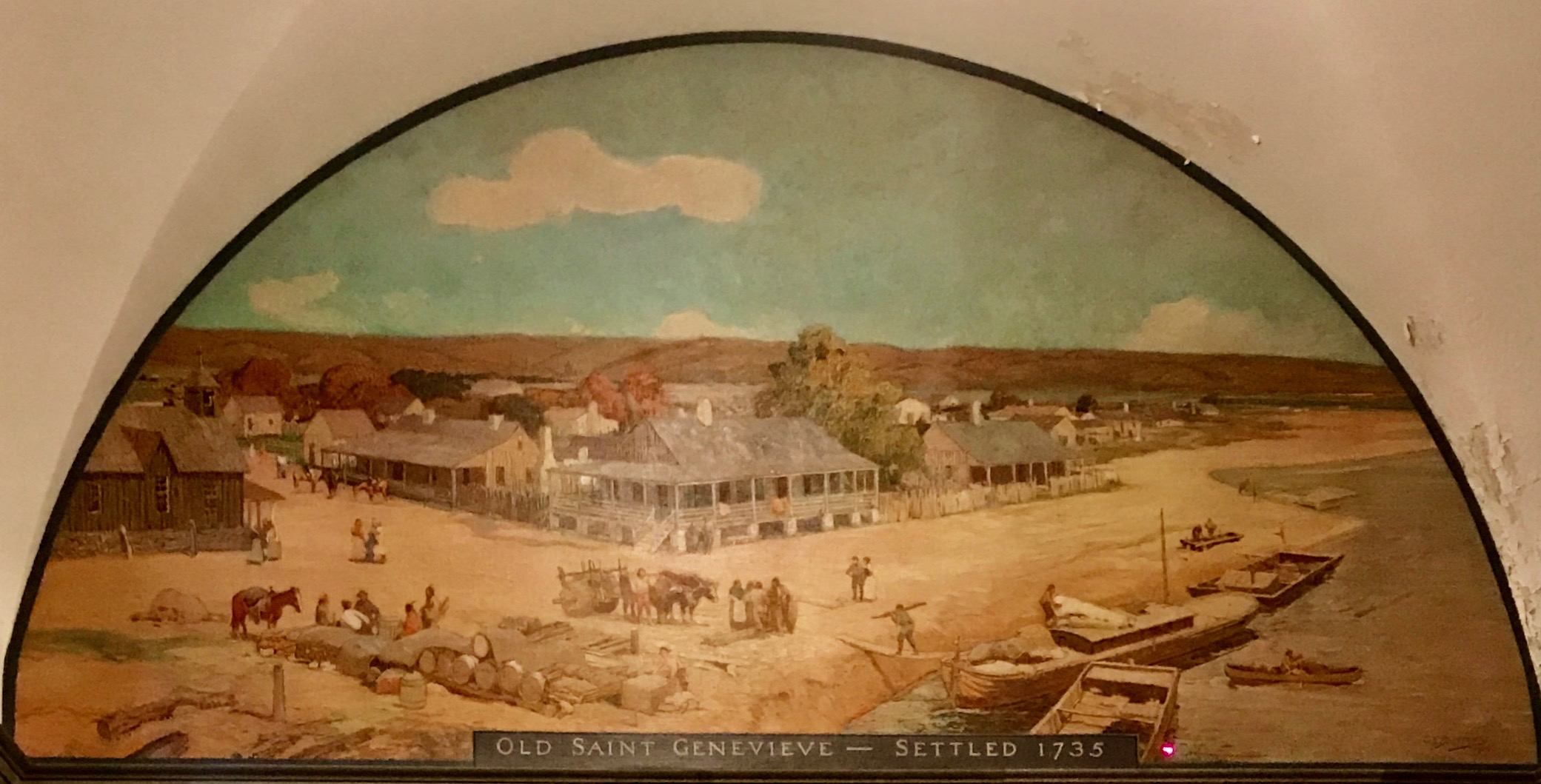
Old Saint Genevieve is in one of the lunettes. According to sources, it is the “first permanent civilized settlement” in Missouri. The French established it on the Mississippi River, about 60 miles south of St. Louis. According to the source, one of the reasons they settled there was to take advantage of the salt springs on Saline Creek. I didn’t know there were salt springs!

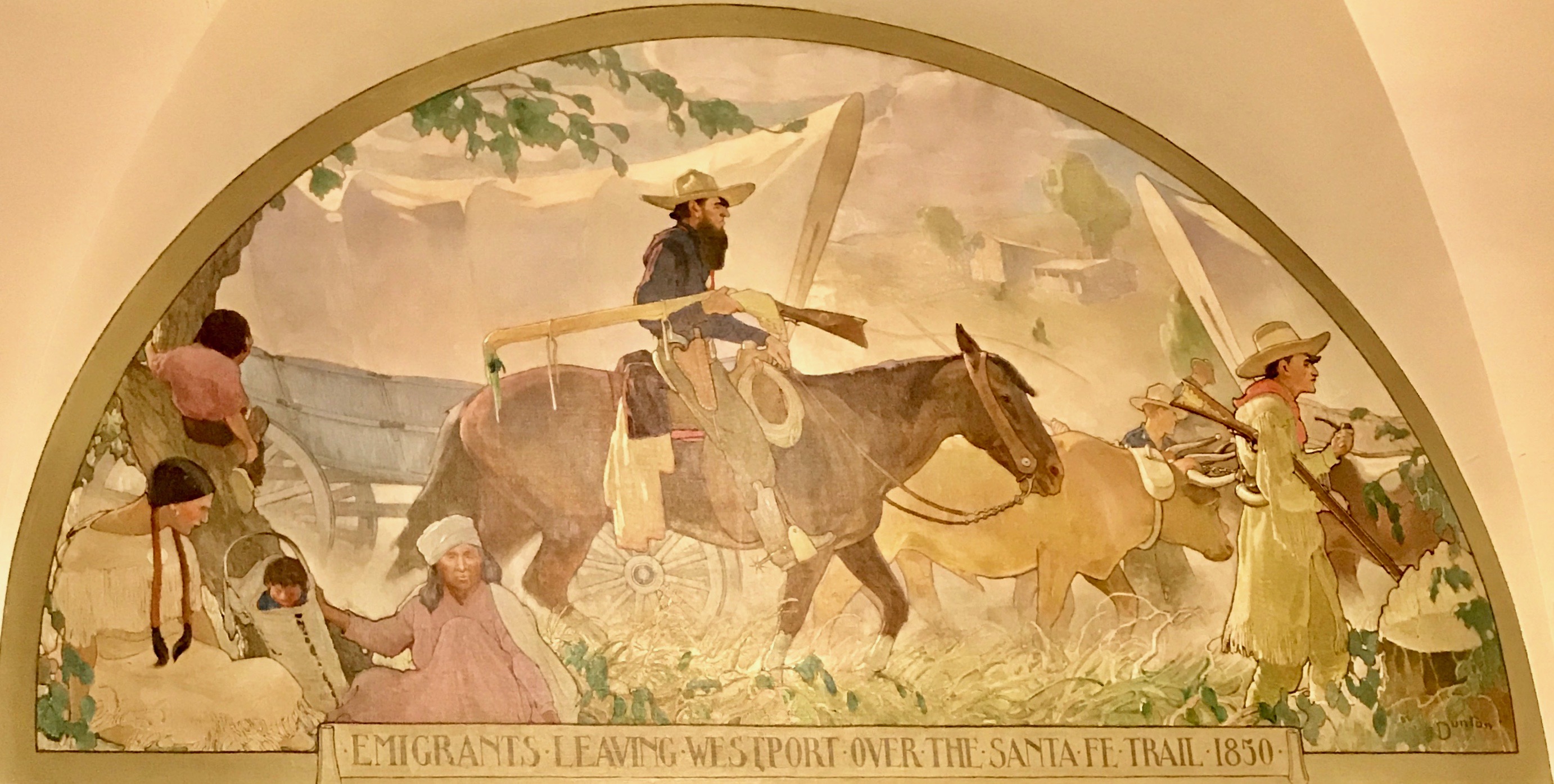
With all the discussion these days about immigrants, I had completely forgotten about emigrants. It wasn’t all that long ago that our own people were leaving all that they knew to make a better life for themselves and their families.

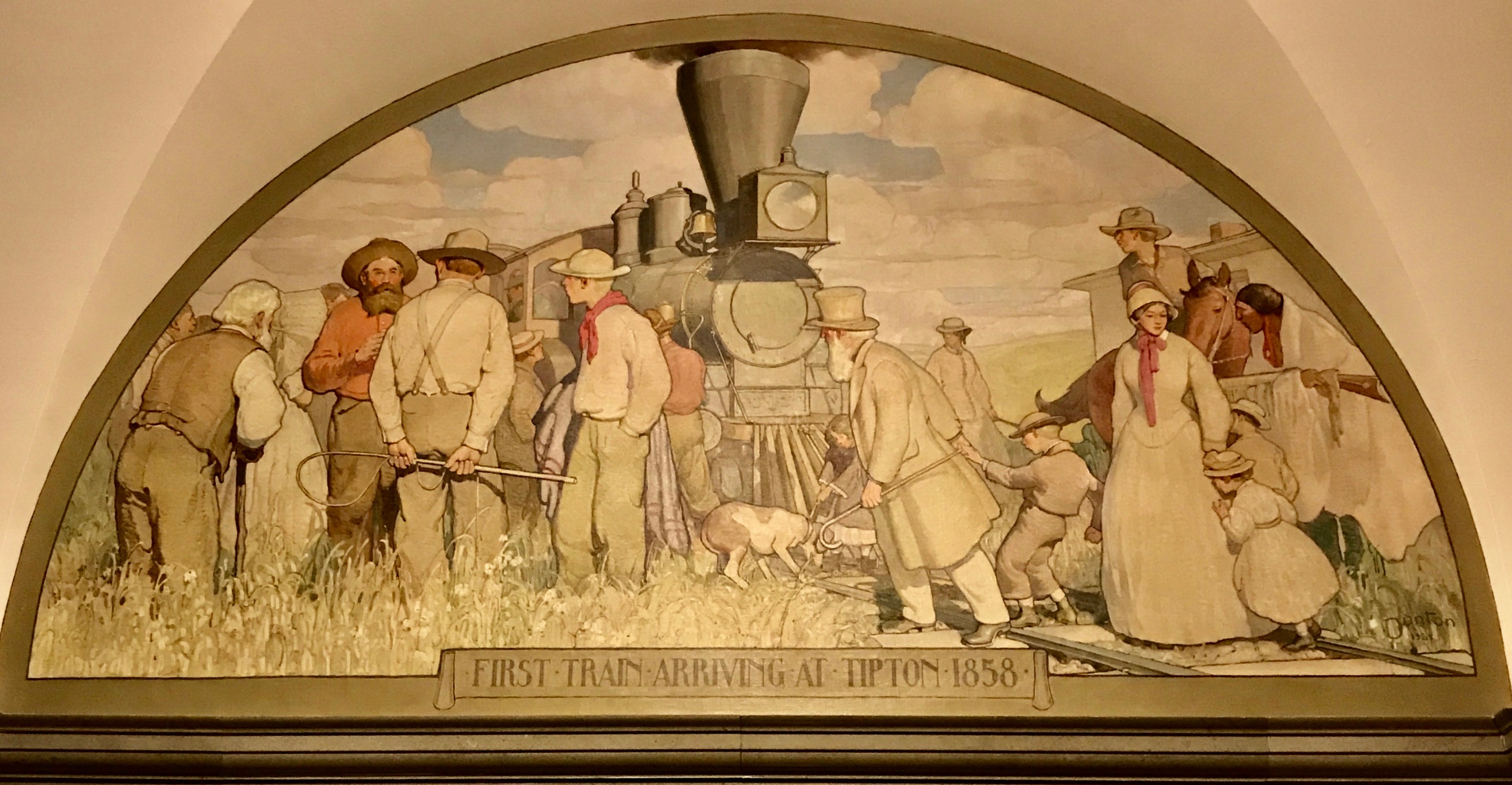
I guess pushing ever westward was a big part of Missouri’s history.

There’s Tipton, west of Jefferson City.

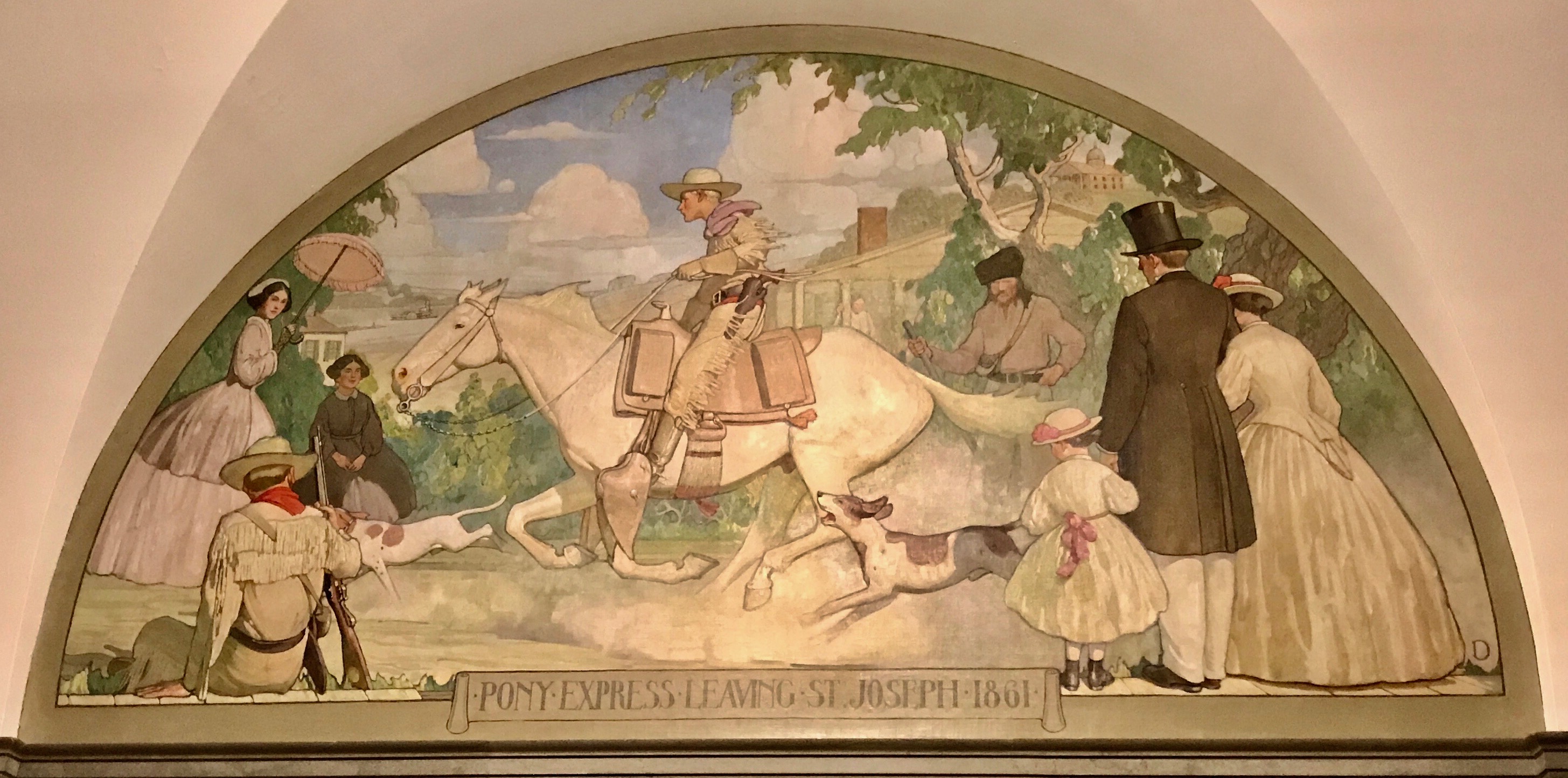
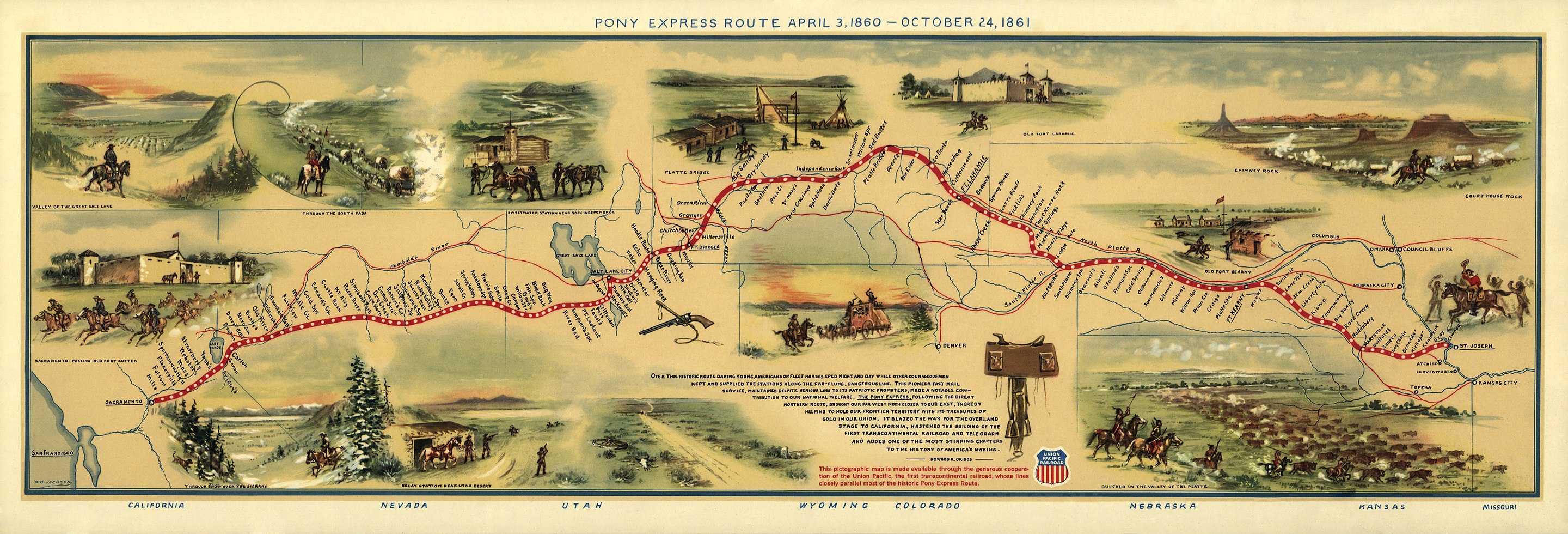
Moving information west (and east) was also important. The Pony Express was only in operation for 18 months, but it remains vivid in our imaginations.

By William Henry Jackson – Illustration: William Henry Jackson, American artist. Text: Howard Roscoe Driggs. Scan: US Library of CongressPhoto image obtained/rendered by Gwillhickers. Restoration by Crisco 1492, Public Domain, https://commons.wikimedia.org/w/index.php?curid=10111804

The first westbound Pony Express trip left St. Joseph, on April 3, 1860 and arrived in Sacramento, California on April 14. According to a famous advertisement, the employers were looking for,  “Young, skinny, wiry fellows not over eighteen. Must be expert riders, willing to risk death daily. Orphans preferred.”

Whether or not that is true or an exaggeration, what is true is that they could not weigh over 125 pounds and they had to swear an oath:

“I, , do hereby swear, before the Great and Living God, that during my engagement, and while I am an employee of Russell, Majors, and Waddell, I will, under no circumstances, use profane language, that I will drink no intoxicating liquors, that I will not quarrel or fight with any other employee of the firm, and that in every respect I will conduct myself honestly, be faithful to my duties, and so direct all my acts as to win the confidence of my employers, so help me God.”

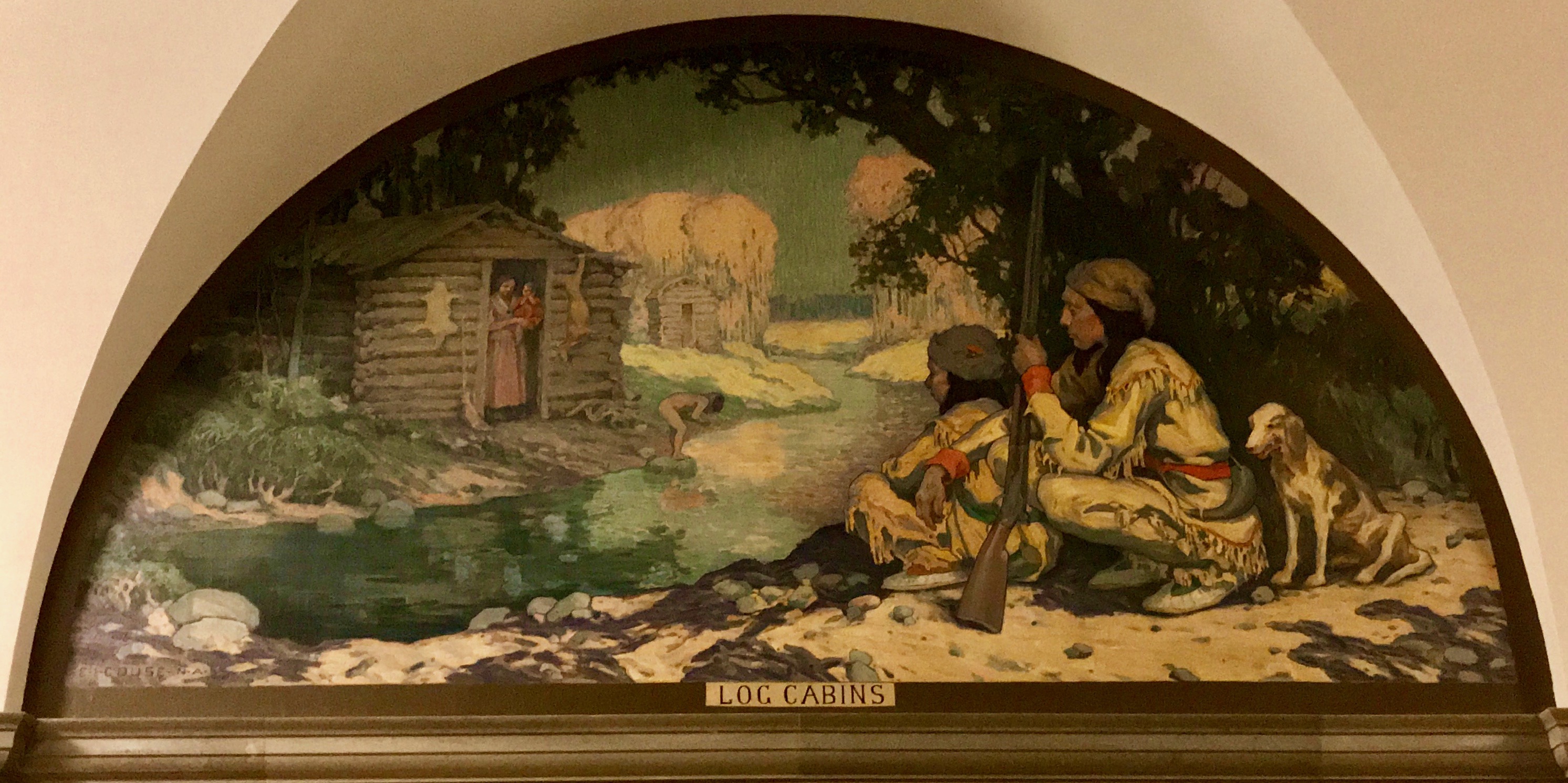
I am not quite sure what to make of this painting. At first, I thought that it showed the Osage looking at the settler’s cabin. Upon closer examination, I think the two figures on the right side are male anglo settlers watching a young girl bathe outside her cabin, with her mother looking on from the doorway. I wonder what the artist’s intent was?

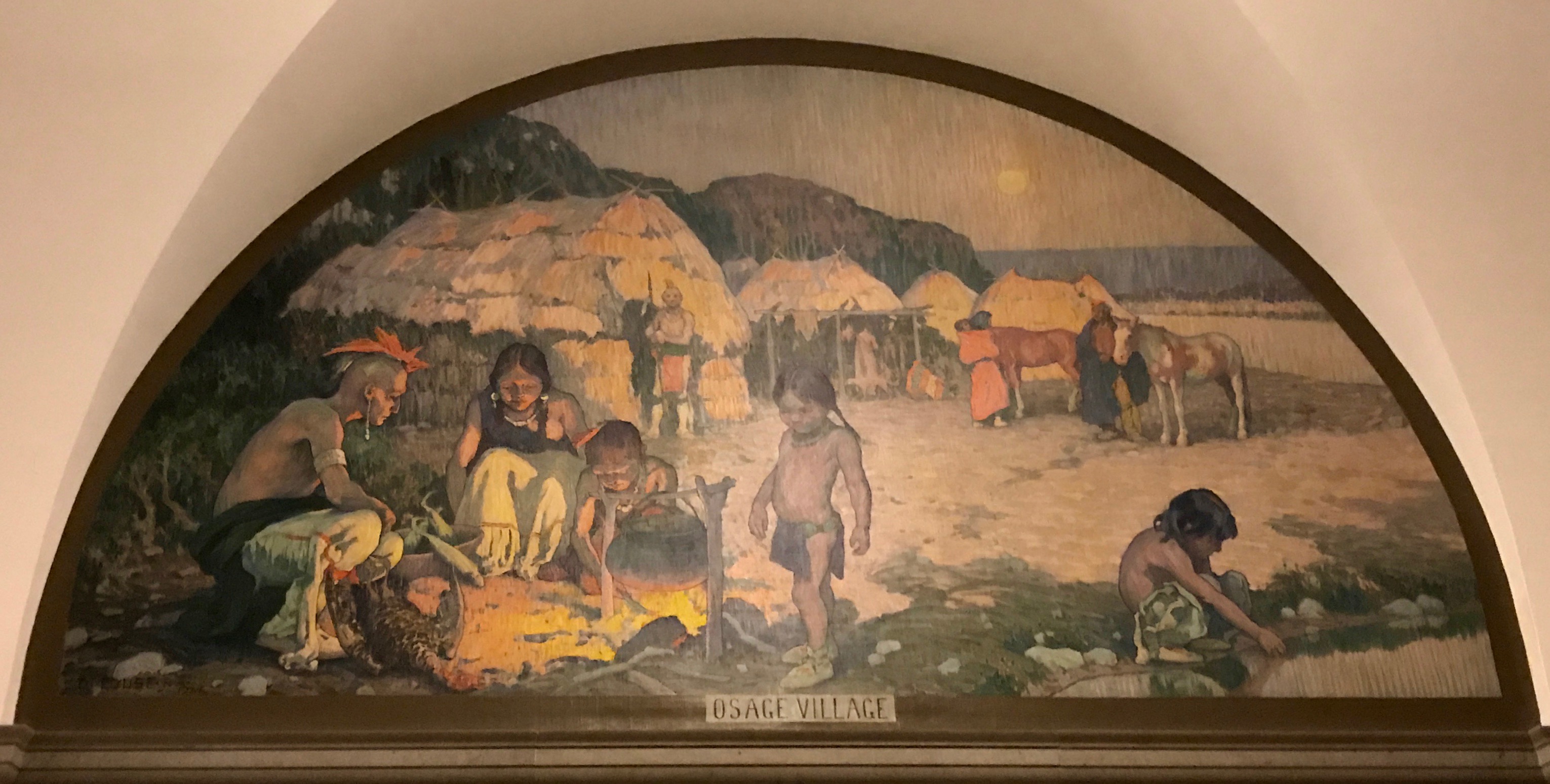
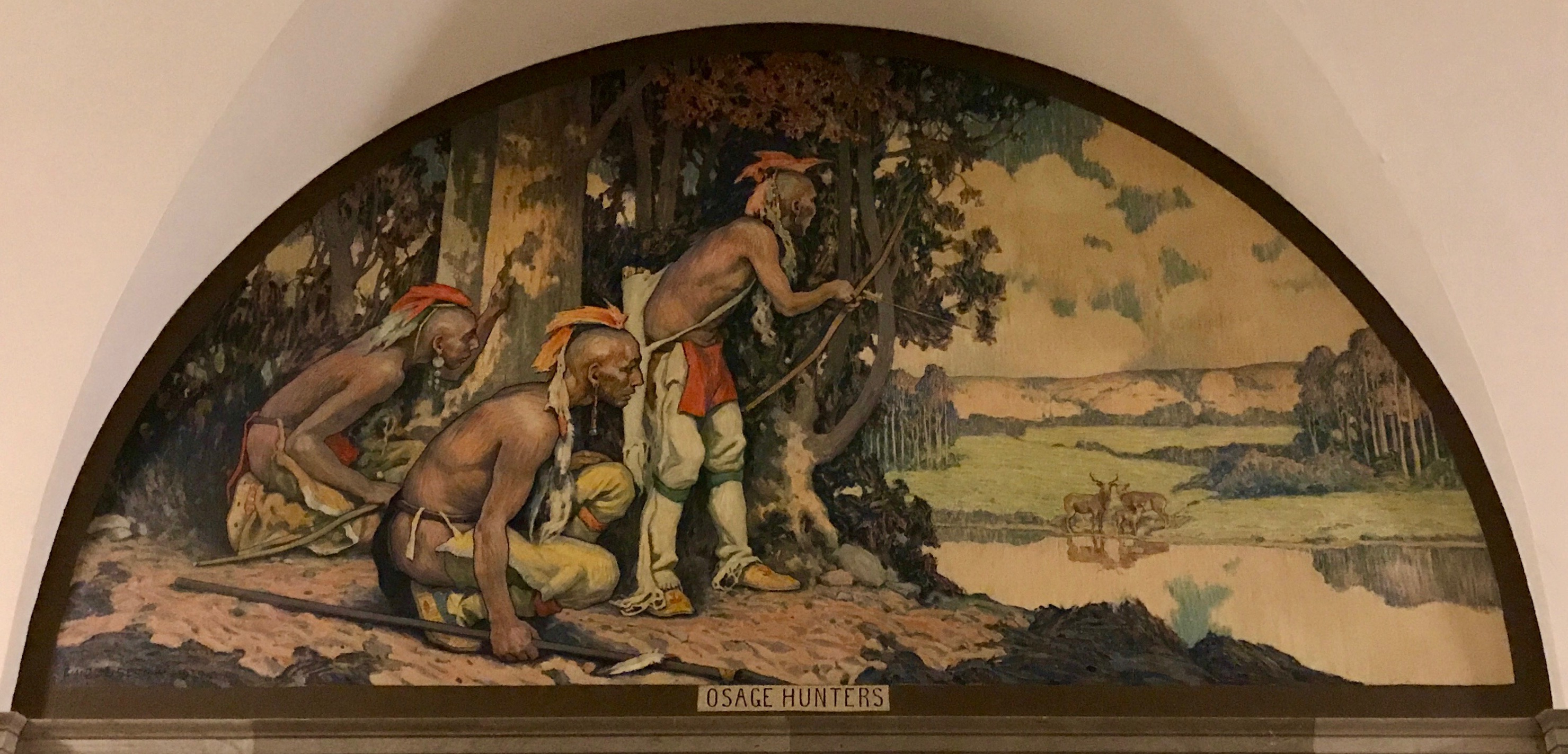
They did not completely ignore the first inhabitants of the land. Here’s a lunette showing an Osage village. We know it must be depicting a scene after 1942, as there were no horses in the Americas prior to the Columbian exchange.

These people certainly knew how to make use of the resources available to them.

While these works of art were good – and in any other capitol, I’d say they were great – next up was what I was really eager to see. The Thomas Hart Benton murals.

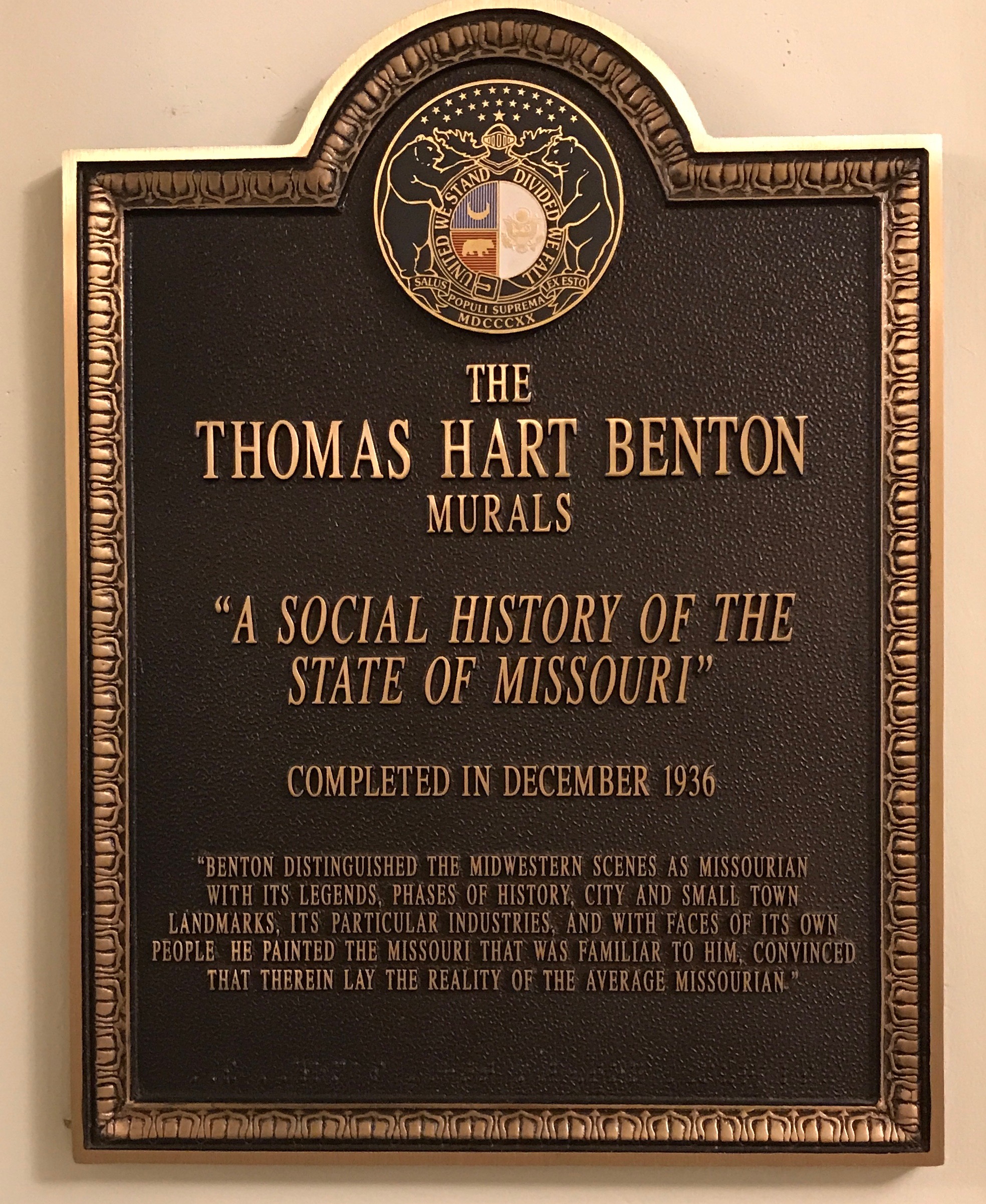
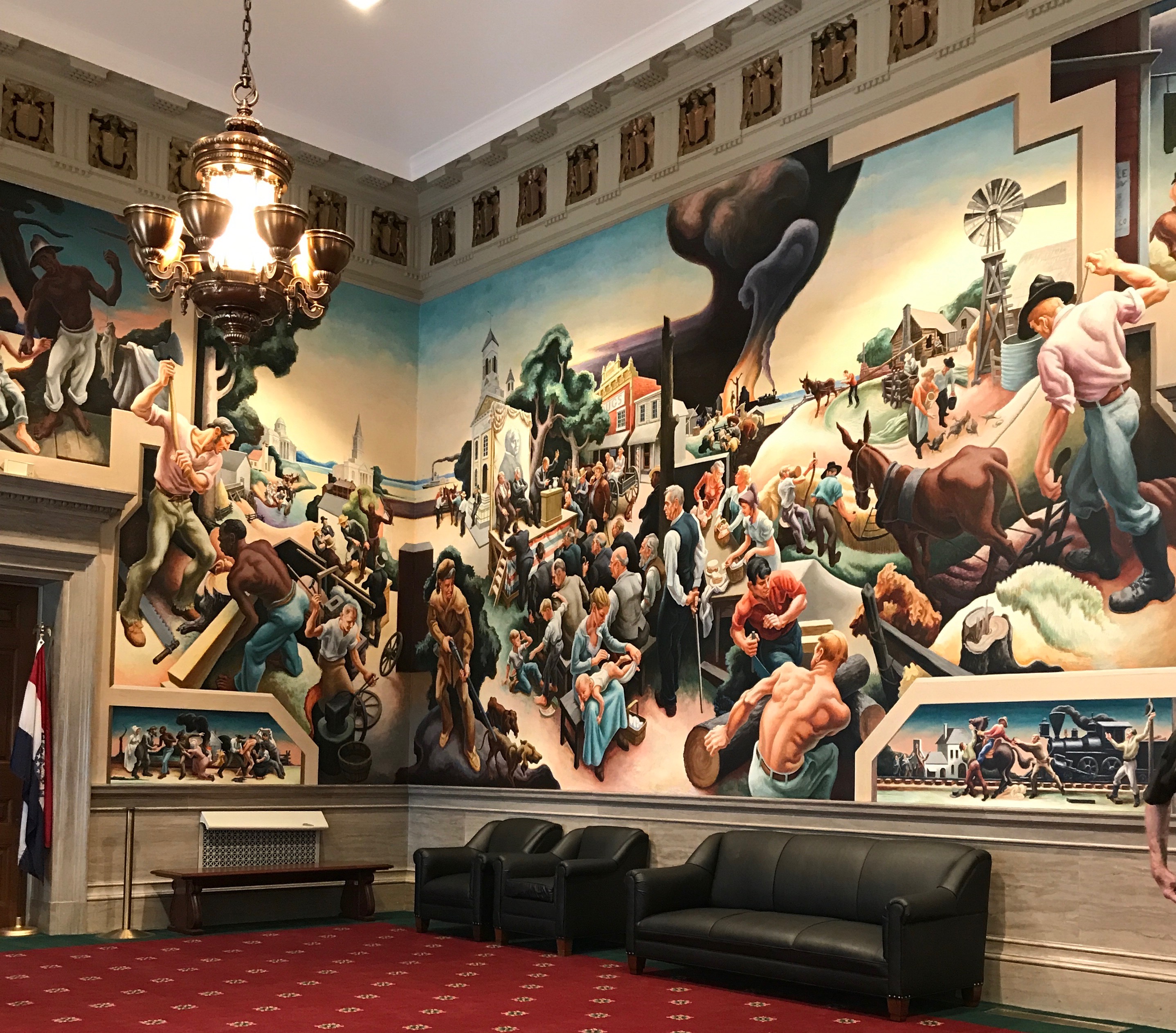
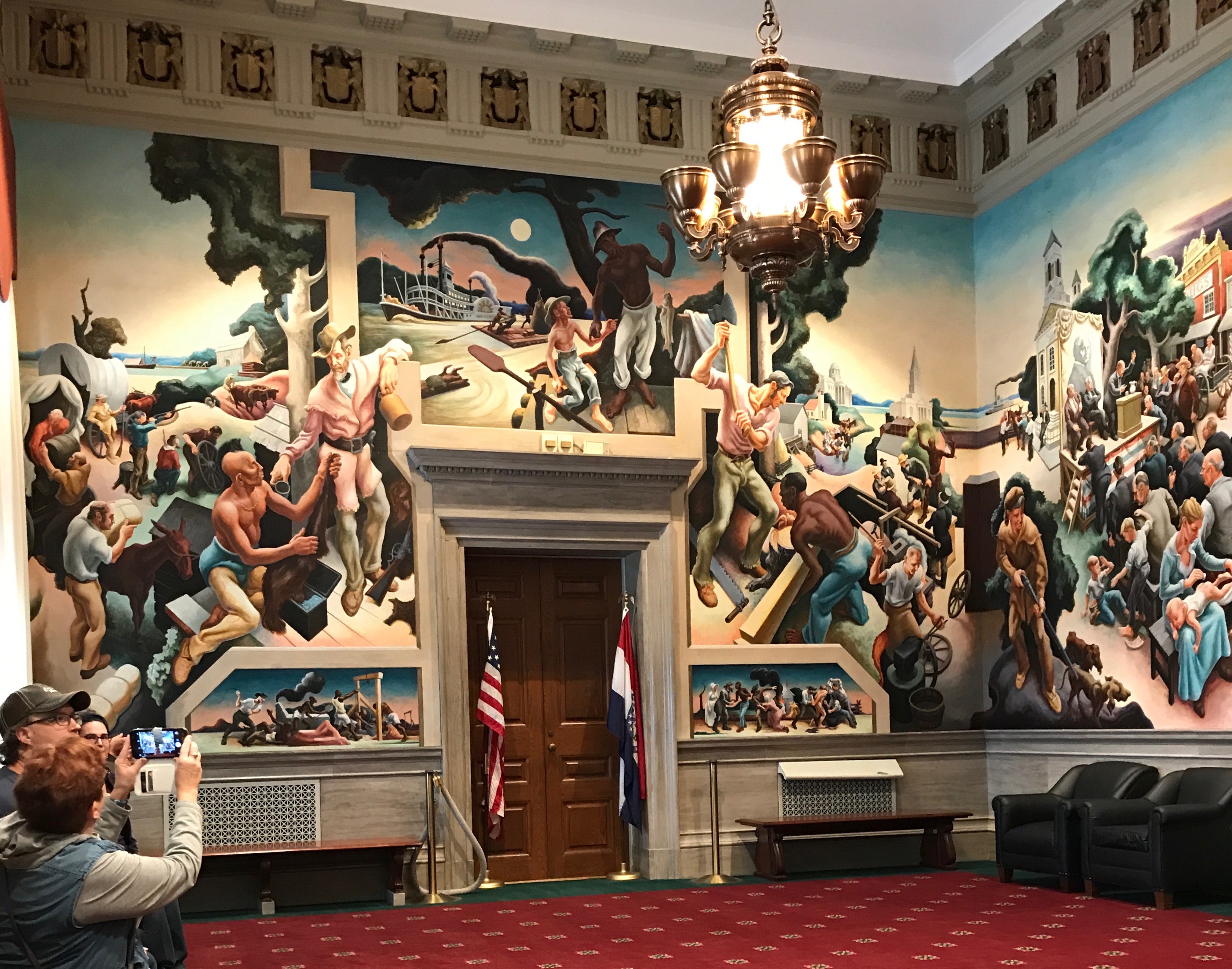
Thomas Hart Benton was commissioned to paint murals for the House Lounge, which is now used as a reception room – not what I think of as a lounge.

Thomas Hart Benton was an American painter who was in the forefront of the Regionalist art movement, along with Grant Wood and John Steuart Curry.

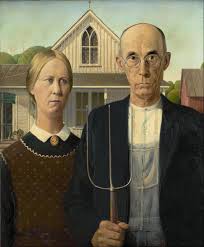
You all know Grant Wood, if for nothing more that his iconic American Gothic and the multitudinous parodies. 

In fact, I visited the house that was used in the background and wrote about it in and earlier post.

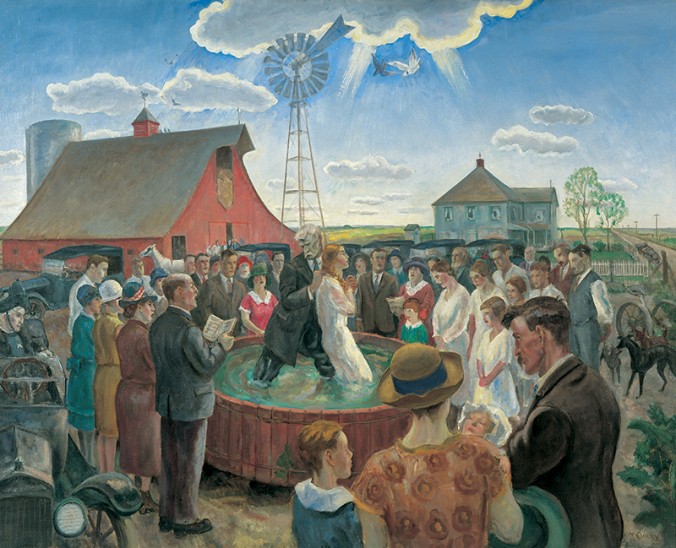
The other name often mentioned as a Regionalist artist is John Steuart Curry. I have to admit that I wasn’t familiar with that name. Perhaps Sister Jeanne taught us about him, but that was a good 40 years ago. (gulp!) I may have forgotten.

By John Steuart Curry – http://janieusart.web.unc.edu/, Public Domain, https://commons.wikimedia.org/w/index.php?curid=48542300

Curry also did murals, but in the state capitol of Kansas. I guess Regionalist art  makes sense in a Midwest state capitol.

Regionalism is a realist modern art movement arose in the 1930s as a response to the Great Depression and ended in the 1940s, along with the end of World War II. Its height of  popularity was from 1930 to 1935.  It was appreciated for its reassuring images that focused on depicting scenes of rural and small-town America primarily in the Midwest and Deep South. According to my Preferred Source, Regionalist Art in general was in a relatively conservative and traditionalist style that appealed to popular American sensibilities.

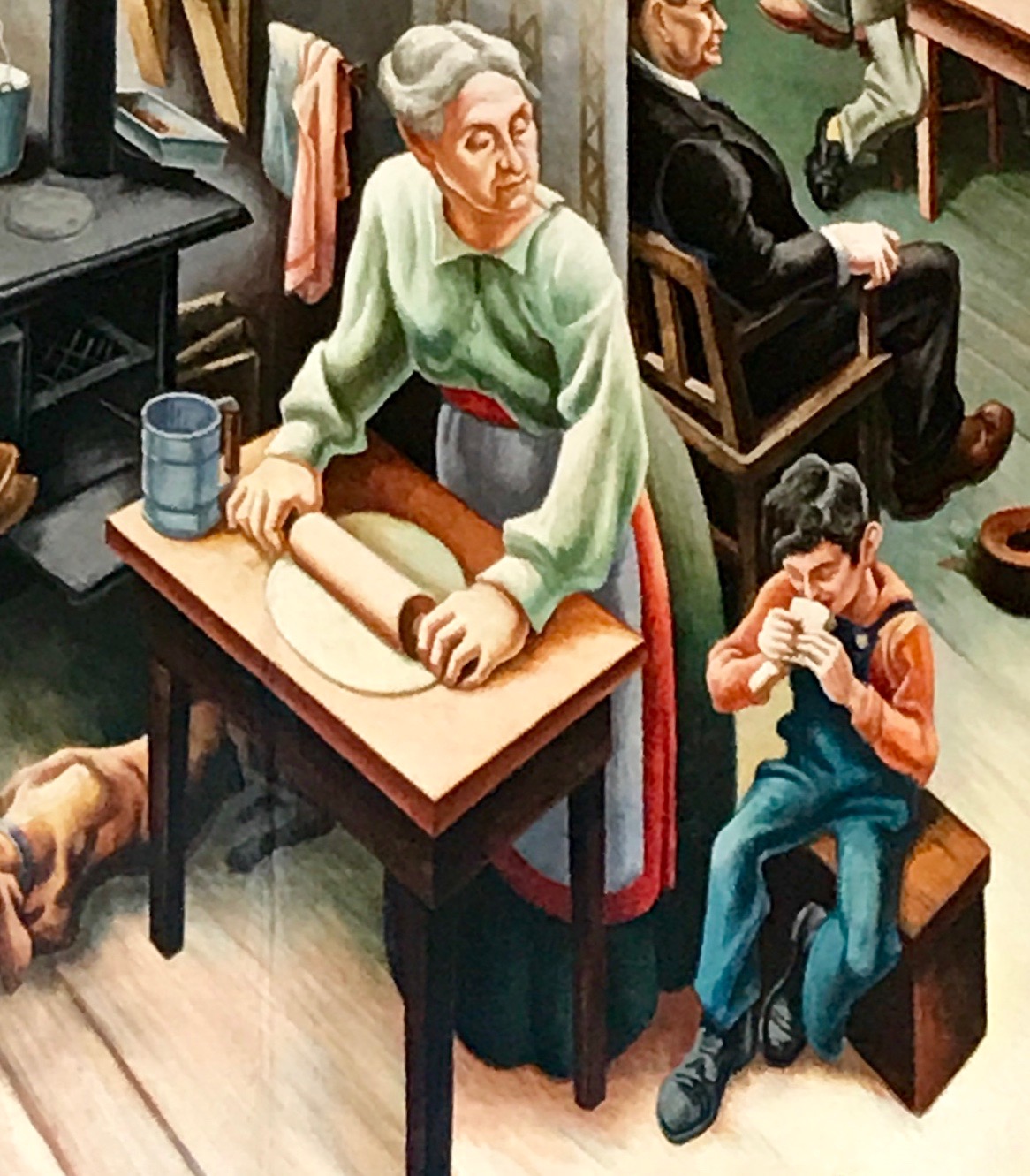
I am not sure that the legislators found Benton’s work particularly reassuring. In fact, when the legislature convened in 1937, there was an uproar. The legislators wanted the murals covered up. They gave many reasons for wanting the murals covered up, including: the subject matter; the largeness of the figures; the bright colors; and the crowds flocking to the Lounge to look at the murals.

At the time, legislators did not have their own offices, and they used the Lounge to  congregate and to get work done.

There is no denying any of those criticisms.

Benton was given the princely sum of $16,000 for decorating the Lounge. It was a considerable amount, considering that this was the height of the Depression. It was more than the Governor’s annual salary. In 2019 funds, this would be equal to almost $300,000. Quite frankly, I think they got their money’s worth.

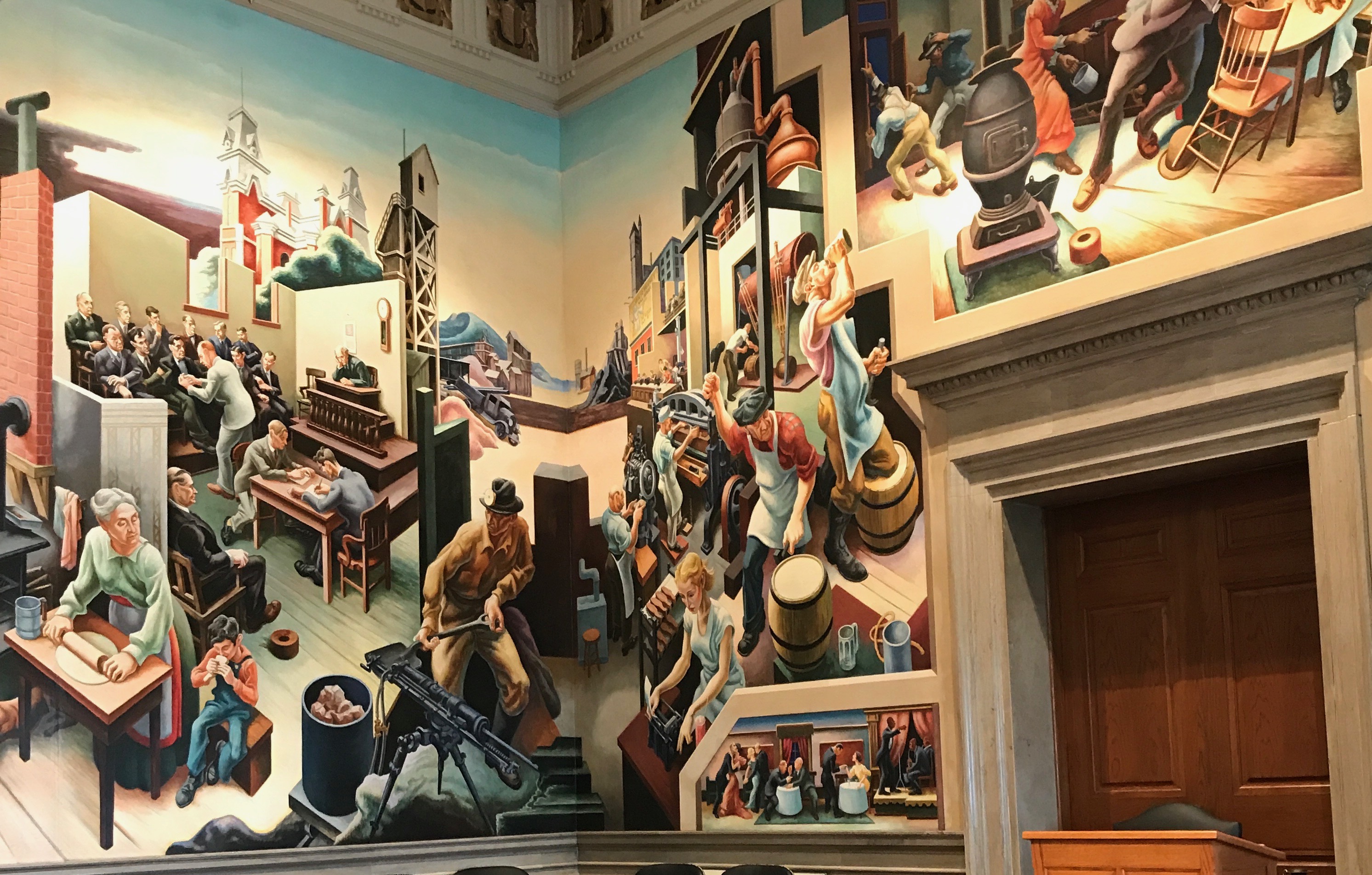
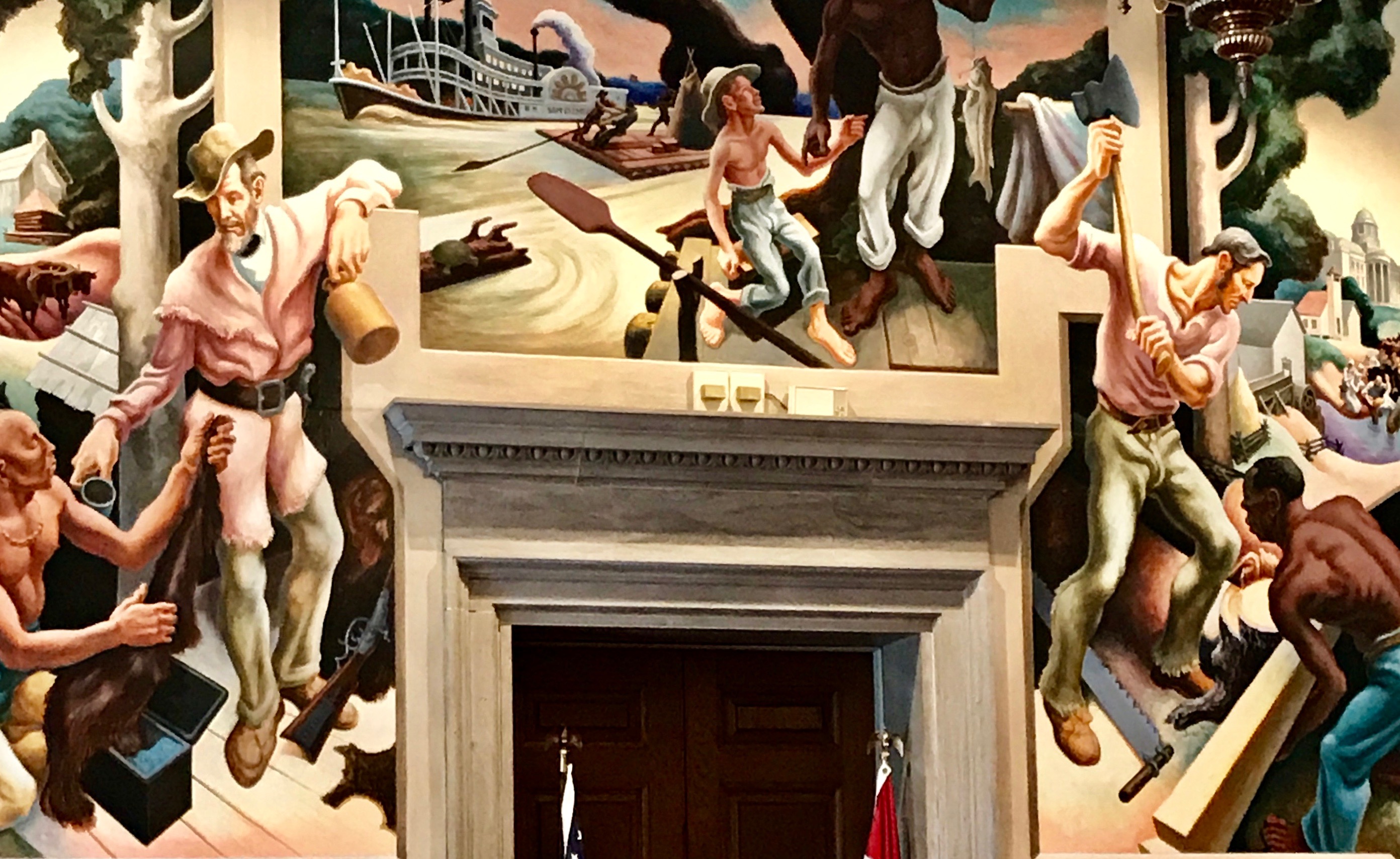
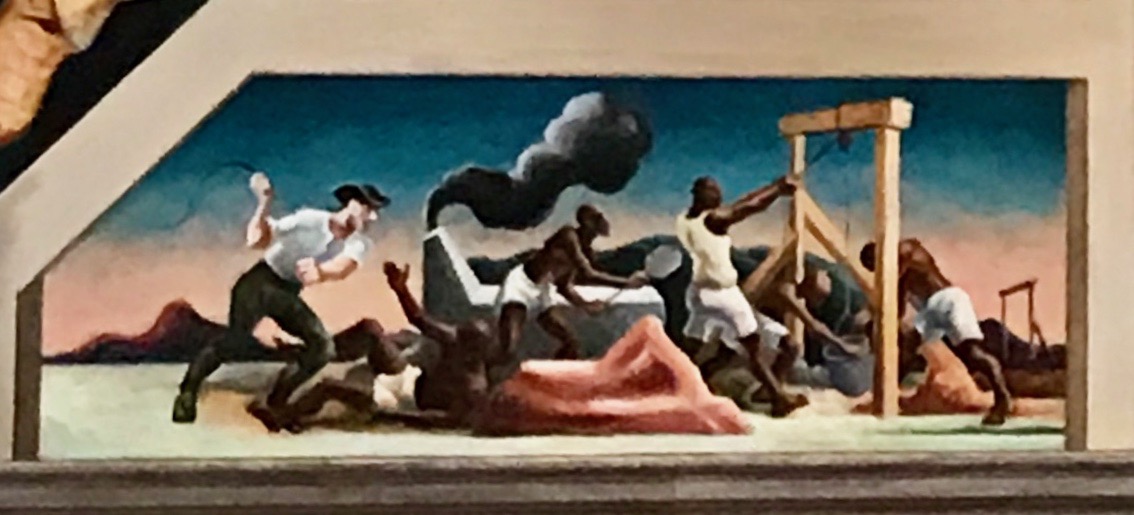
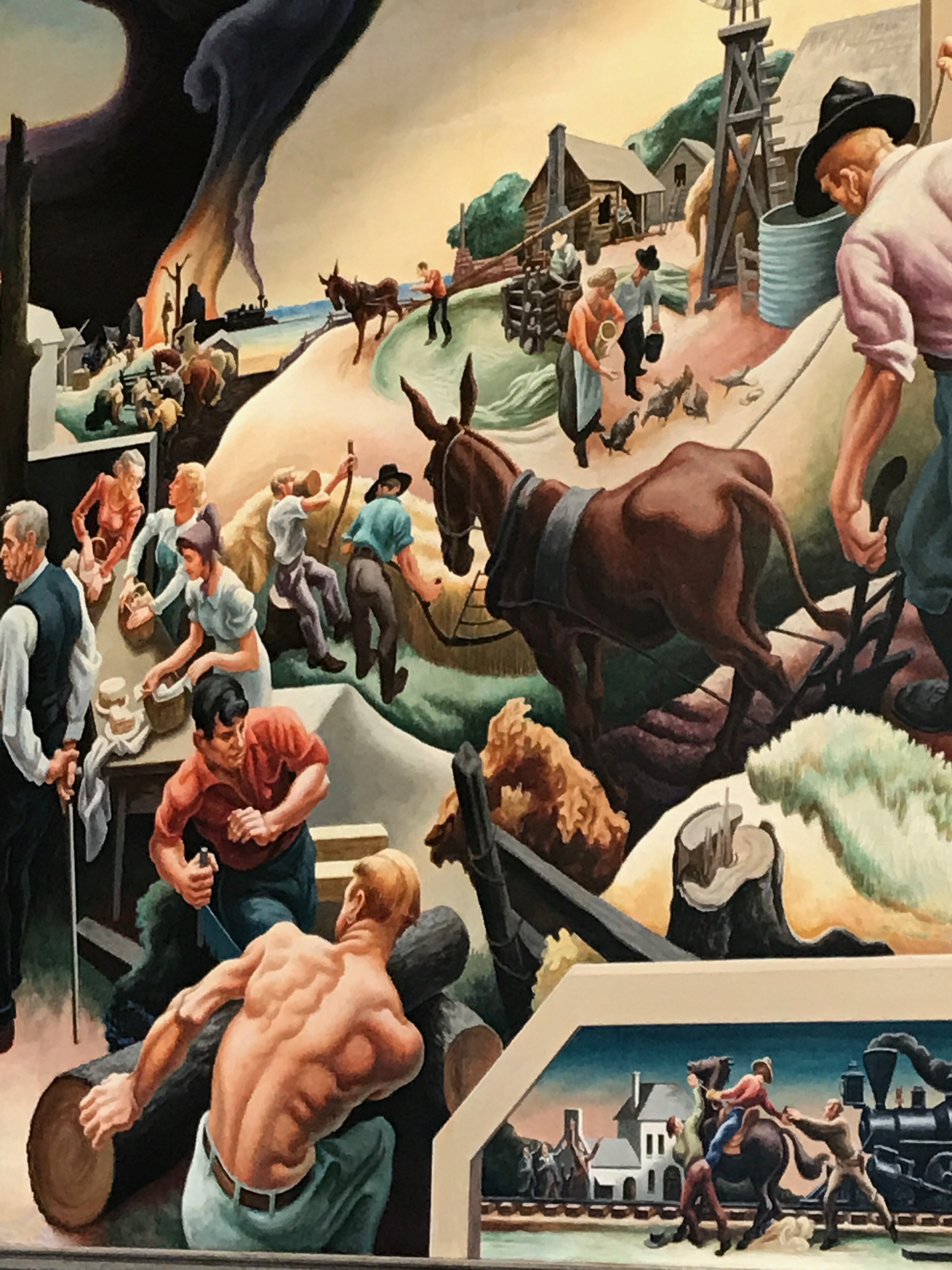
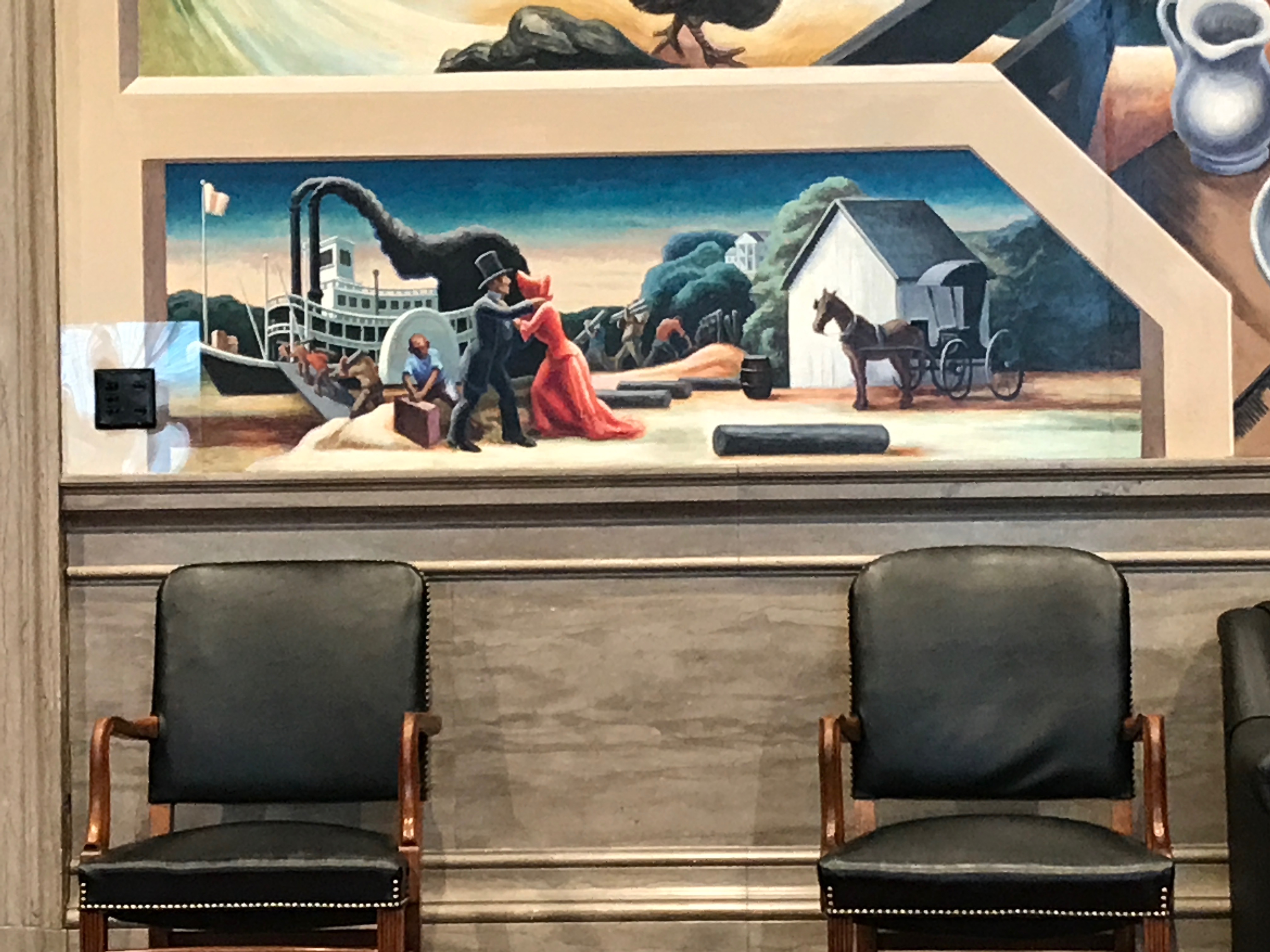
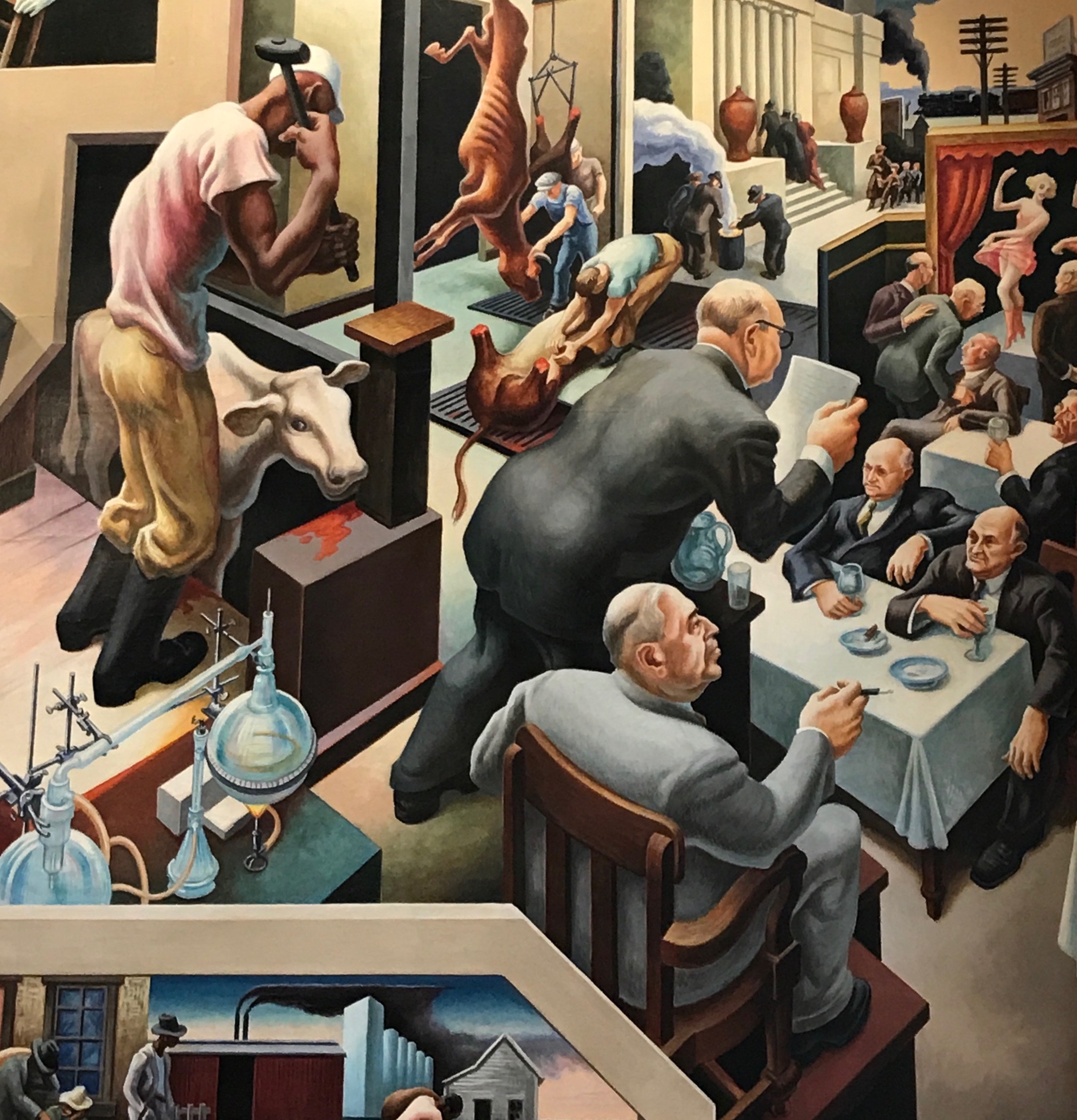
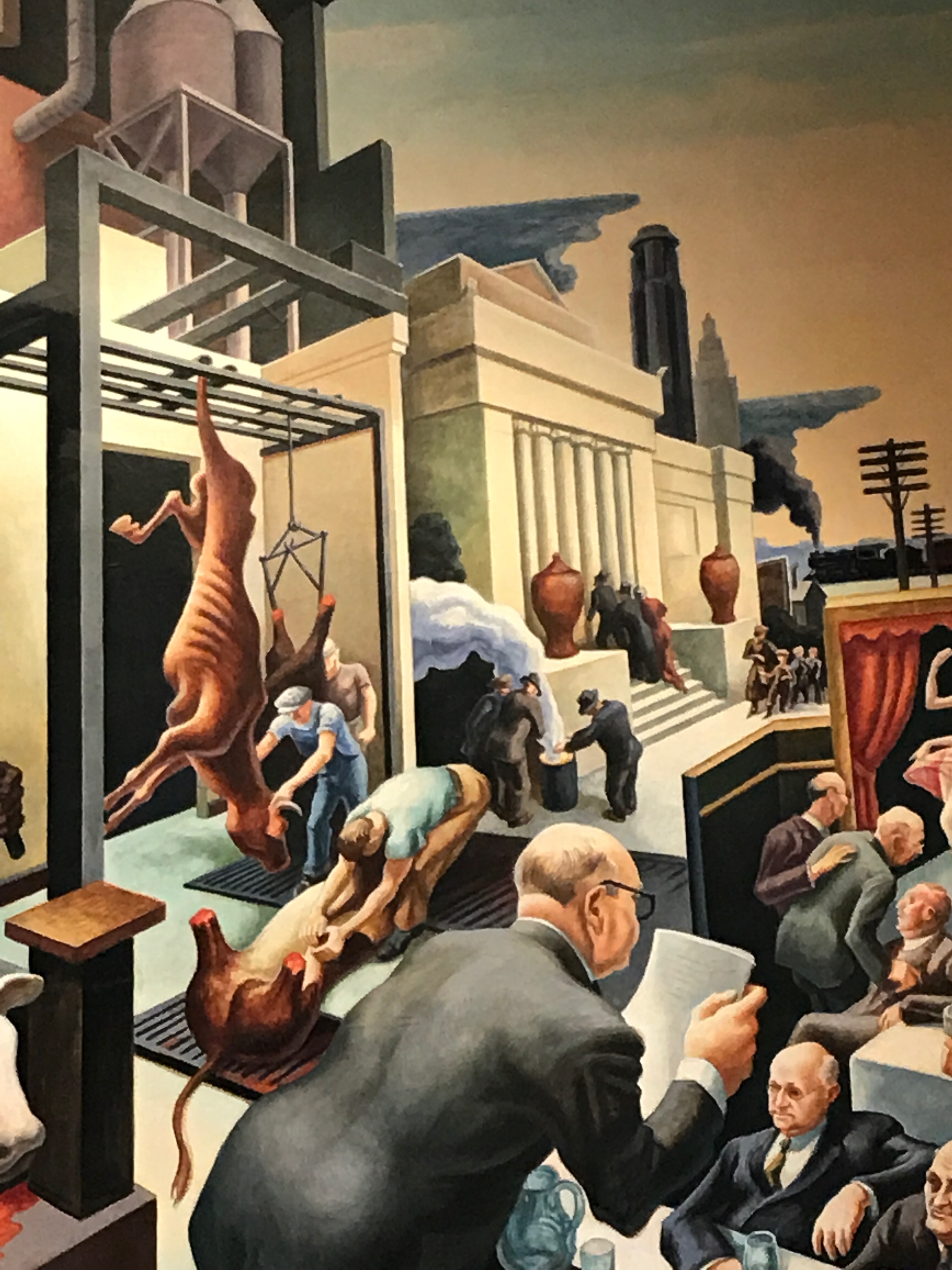
Benton was charged with showing the history of Missouri from the arrival of the French in the 1750s to the 1930s, when the painting was completed. It doesn’t look away from the darker episodes of the state’s history, including slavery and the Missouri Compromise.

Notice the European settler on the left giving and native resident what I can only assume is alcohol.

The treatment of slaves was included in the historical record.

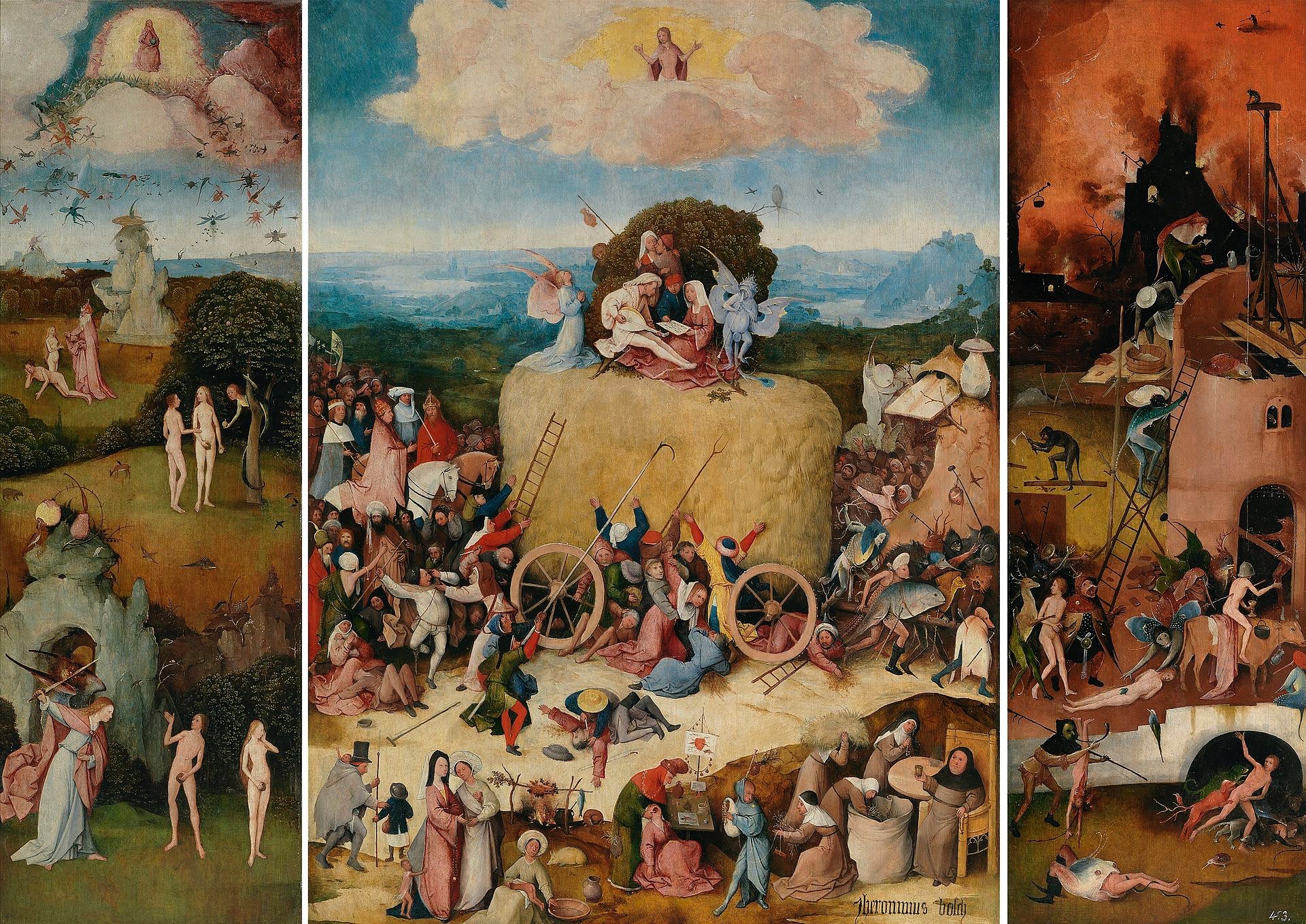
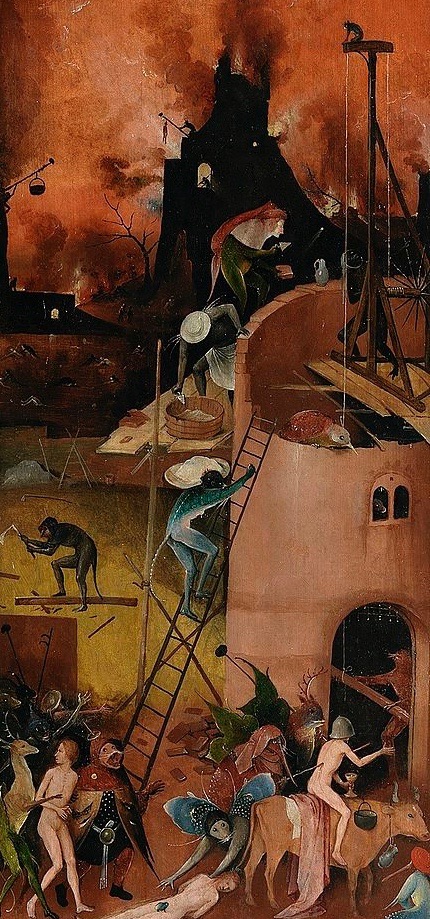
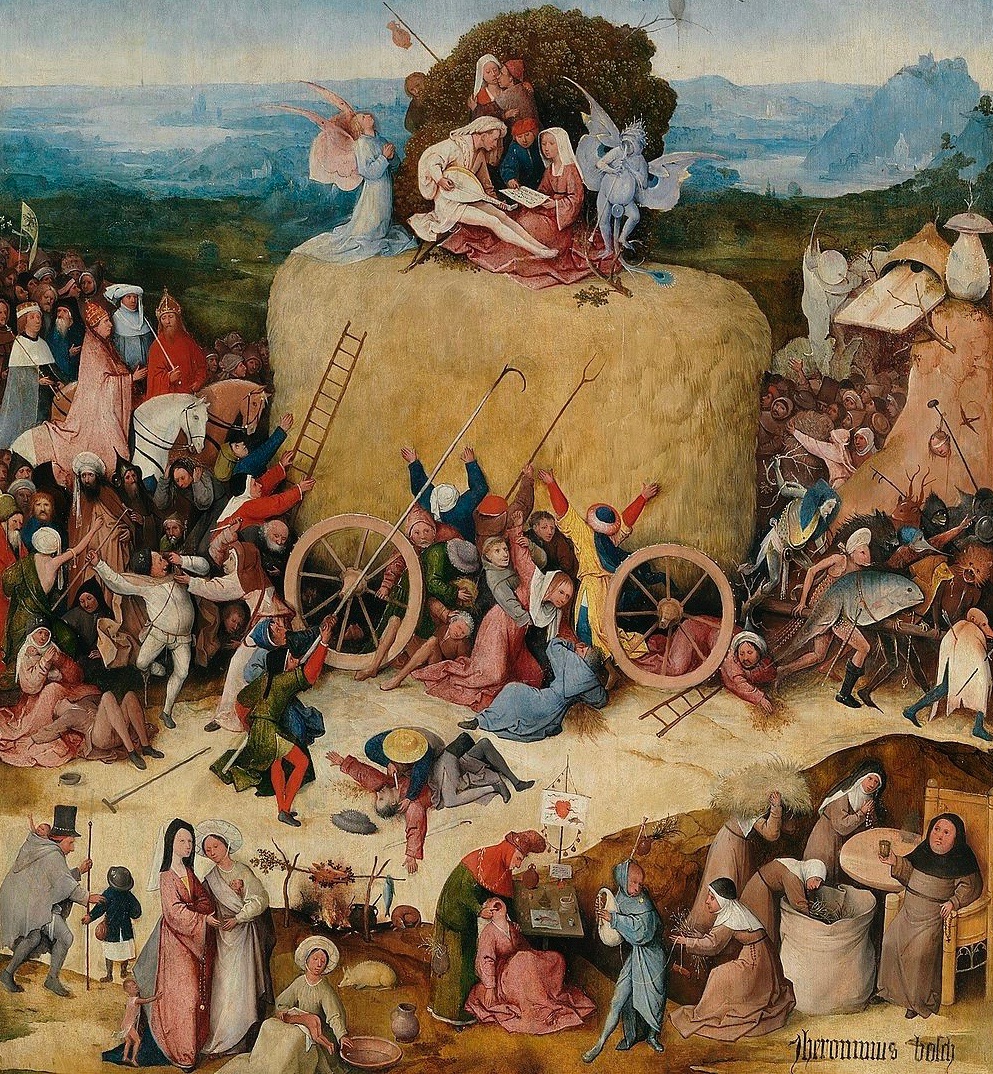
This painting reminds me of the work of Hieronymus Bosch, a Dutch painter born in the 15th century.

By Hieronymus Bosch or workshop – Museo Nacional del Prado, Public Domain, https://commons.wikimedia.org/w/index.php?curid=27598882

Everywhere you look is something astounding.

By Hieronymus Bosch or workshop – Museo Nacional del Prado, Public Domain, https://commons.wikimedia.org/w/index.php?curid=27598882

And unsettling.

By Hieronymus Bosch or workshop – Museo Nacional del Prado, Public Domain, https://commons.wikimedia.org/w/index.php?curid=27598882

But we’re not here to talk about Hieronymus Bosch. Back to Thomas Hart Benton.

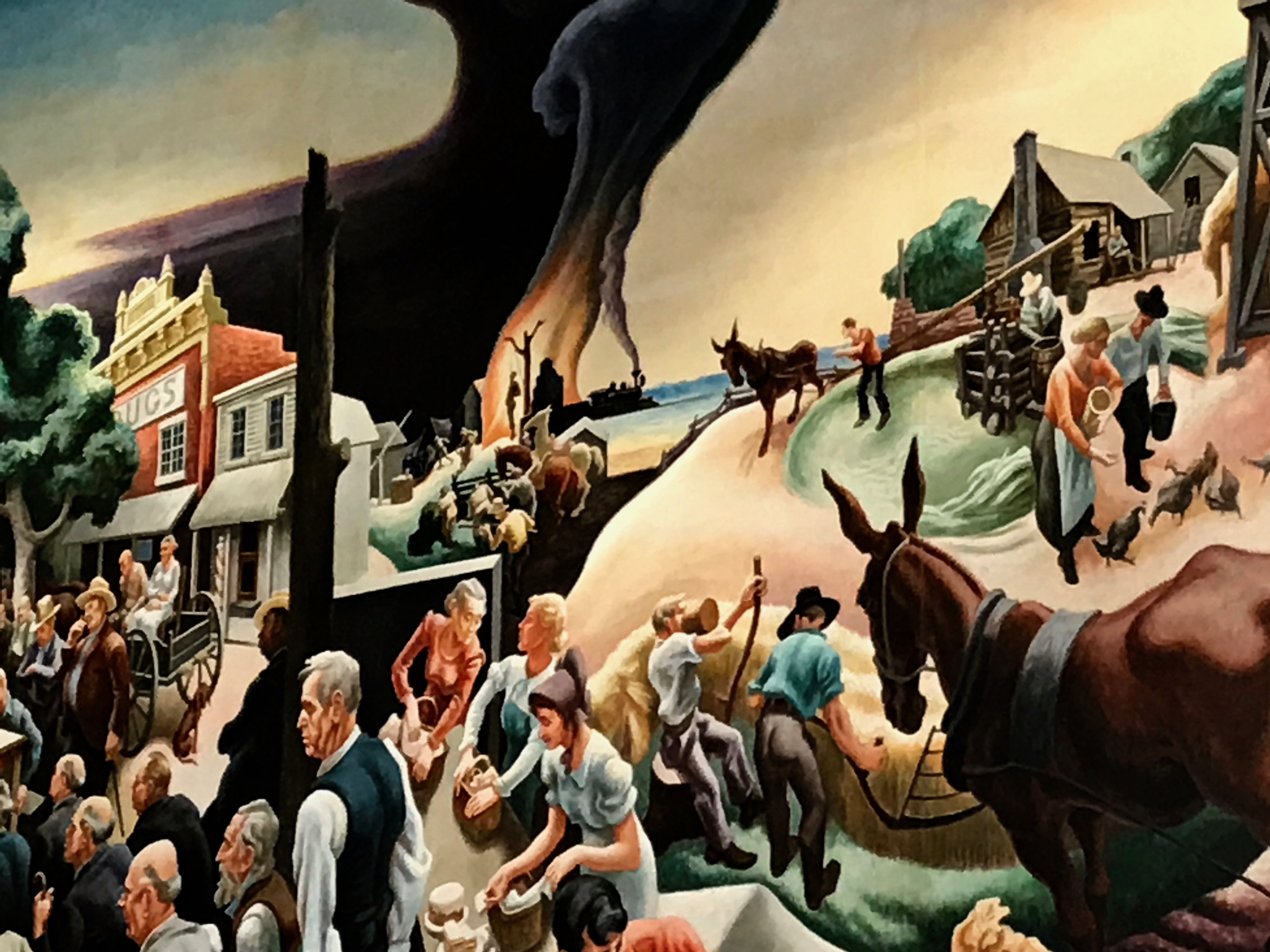
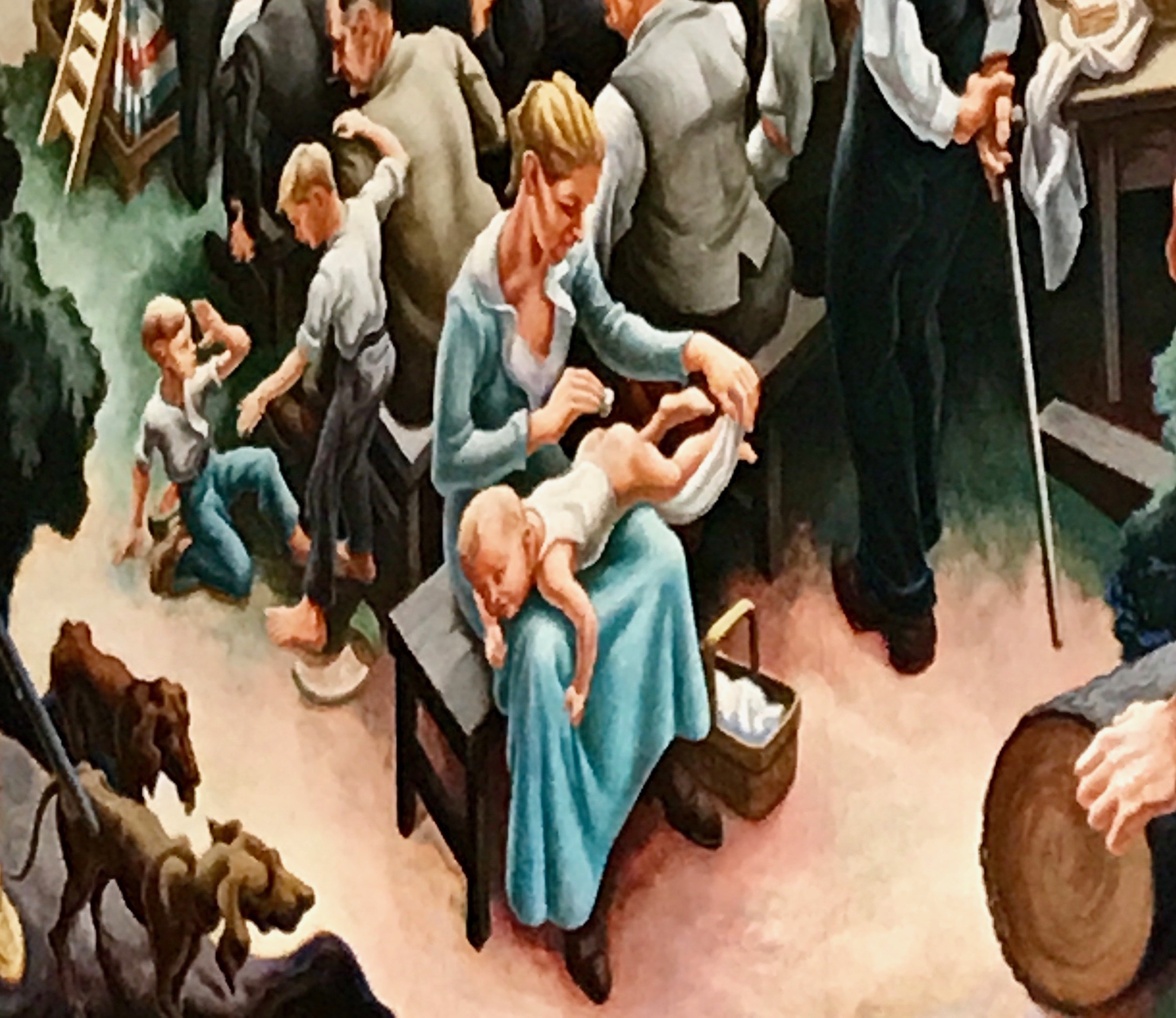
The lawmakers were scandalized by the inclusion of such quotidian activities.

I think some of the models for these figures were family members.

The lumberjack reminds me of the statue, “Laocoön and His Sons,” an ancient Greek statue. (Thank you, Sister Jeanne!) One of the things I remember her telling me about the Greek statue was that they really got into showing all the muscles bulging – and not in a natural way. I mean, if you are really doing something, some muscles are tense and others are relaxed. Anyway, if you want to see what I am referring to, click on the link.

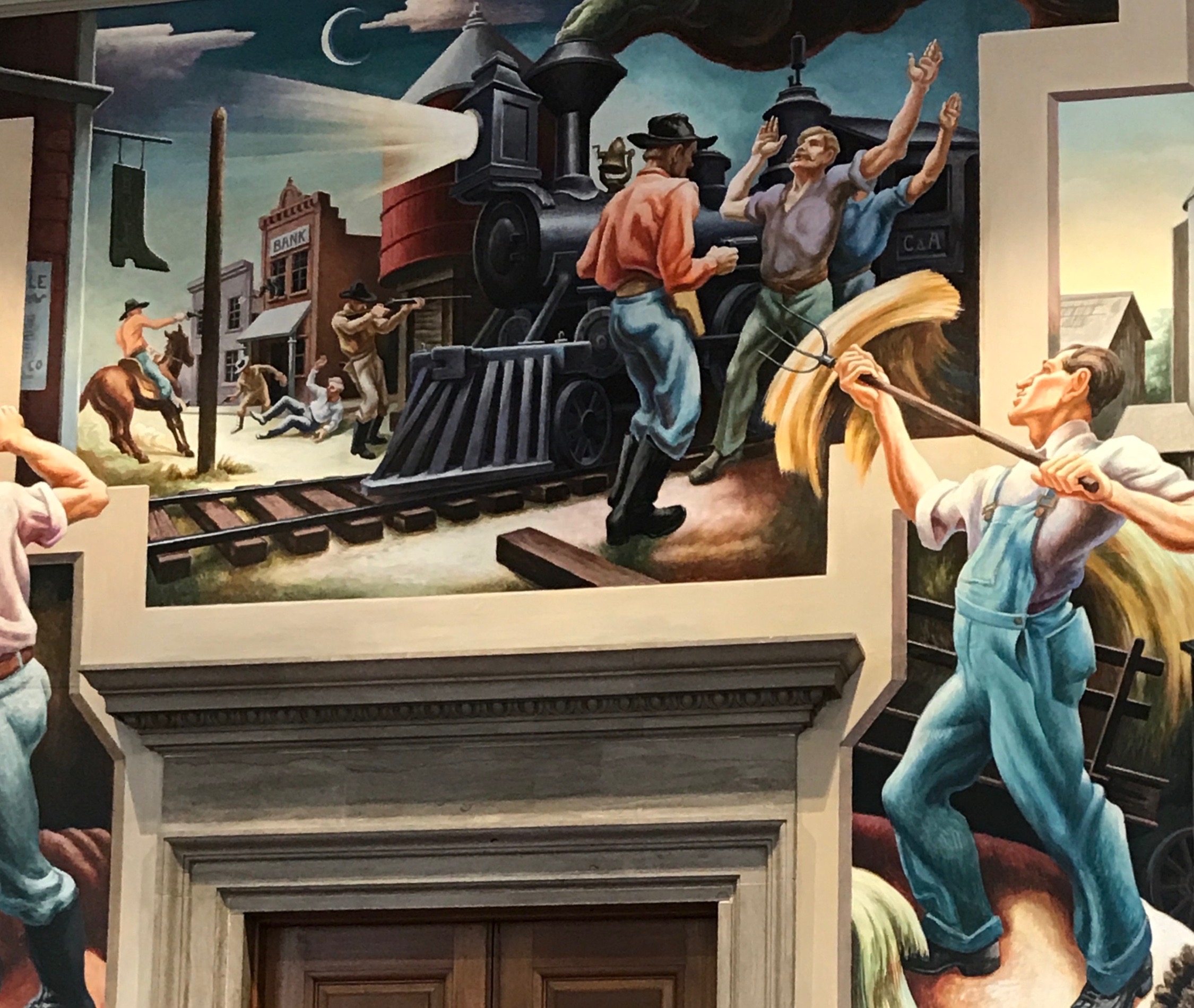
Benton included all sorts of things that were part of the history of Missouri, including Jesse James robbing trains.

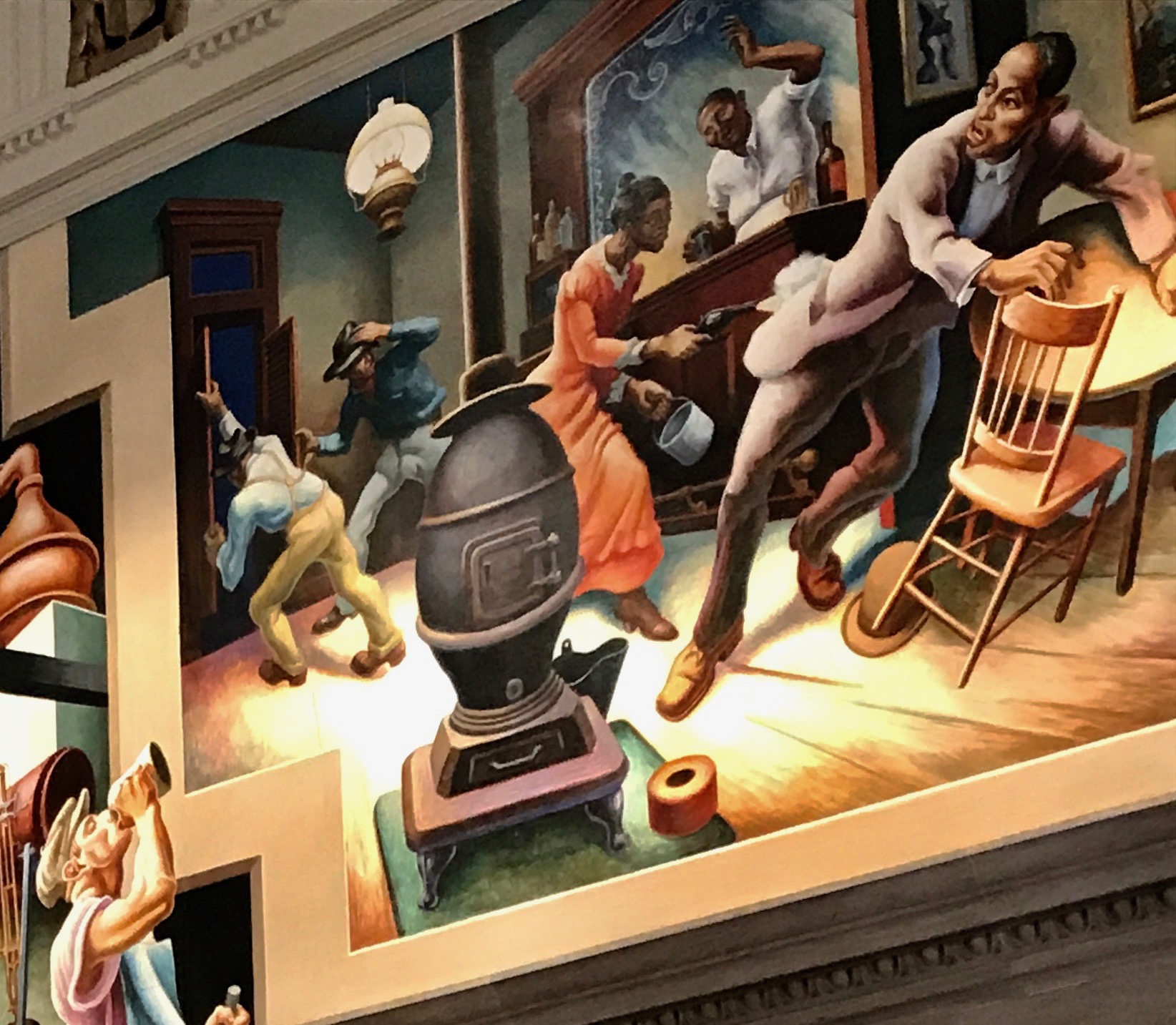
And the real life story behind the song, Frankie and Johnny. It was based on an 1899 St. Louis murder.

There are many versions of the song out there floating around. I selected this one for your enjoyment.

This detail looks like misogyny is also part of the state’s history.

I’ve mentioned Tom Pendergast and his political machine before. Here he is, right on the walls of the state capitol. In fact, at the time this mural was painted in 1936, he was still very much in charge of Missouri politics. In 1939, he was convicted of income tax evasion and served 15 months in a Federal prison.

I have zoomed in on these images, because they are of places I hope to see while I am in Kansas City: The Nelson-Atkins Museum of Art and the Liberty Memorial, now known as the National WW I Museum and Memorial.

And, with that, we leave the House Lounge and the Thomas Hart Benton murals.

Believe it or not, there is yet another post coming about the Missouri State Capitol.

So, stay tuned!

(I promise the next one will be the last post about the capitol, at least for this visit.)


Oh, My! The Capitol Building of Missouri!

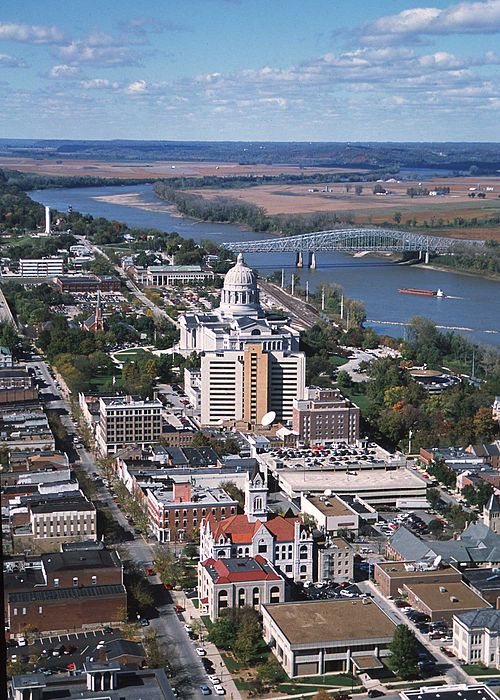
The capital of Missouri is Jefferson City – that’s Jeff City to its friends. It’s a surprisingly small city for a state capital. The 2010 census pegged it at about 43,000. According to my Preferred Source, it is the 15th largest city in Missouri. The largest city in the state is Kansas City, at about 460,000, and the populations continue down from there. In fact, the smallest place listed as a city in this source is Triplett with a population of 41 in 2010. What is at the bottom of the list? Well, it’s Goss, with a population of 0, according to the 2010 census. (But it’s only identified as a town.)

While the city is on the small side, the capitol building is not. It is built on a bluff on the south side of the Missouri River. Lewis and Clark paddled past this very spot on their 1804-1806 Corps of Discovery Expedition. Of course, none of these buildings were here.

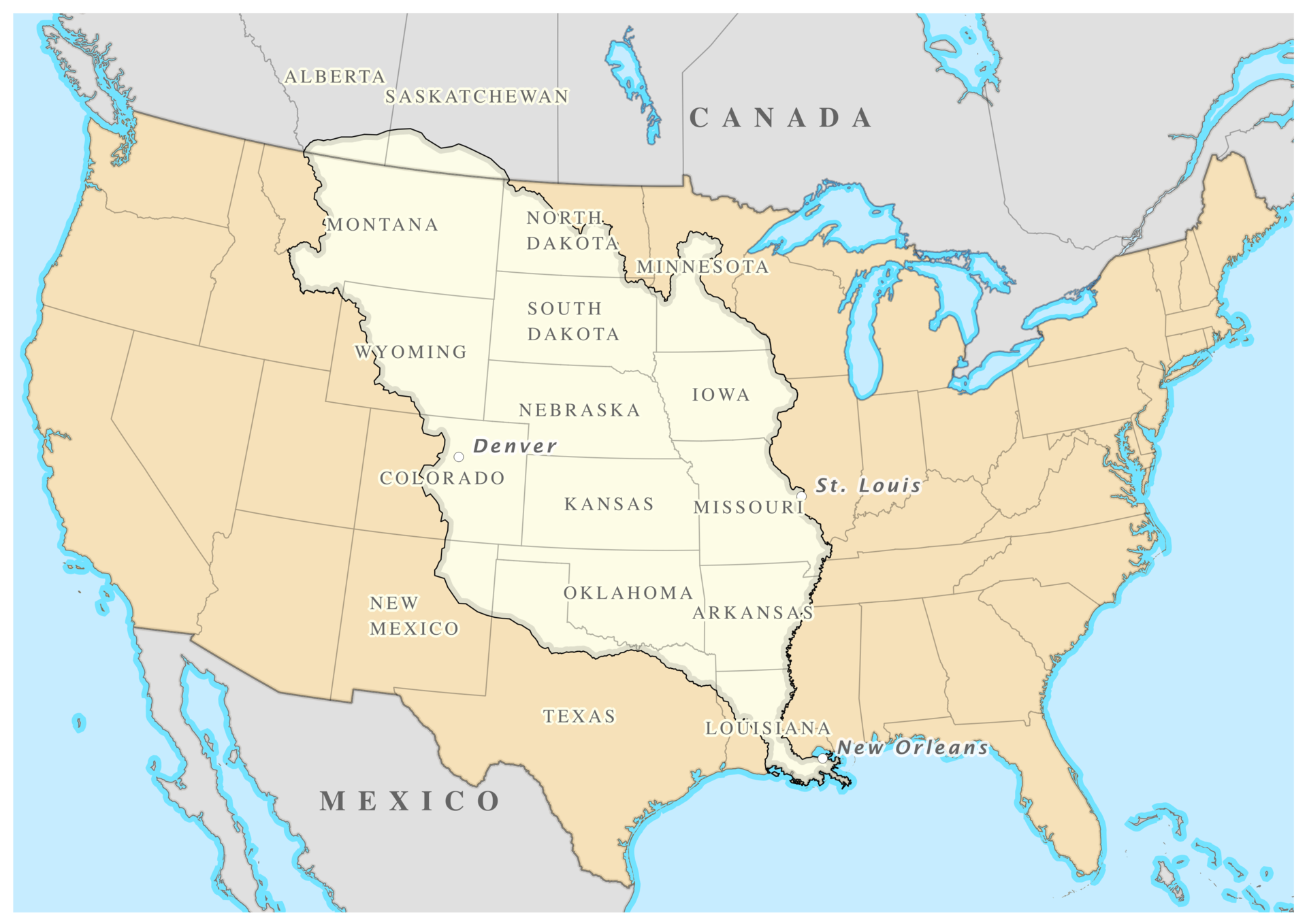
I was tempted to say that Missouri wasn’t even part of the United States at that time, but it was acquired from the French in 1803 as part of the Louisiana Purchase. The USA paid the French fifteen million dollars, or approximately $18 per square mile. That works out to about three cents an acre. They acquired a total of 530,000,000 acres – or about 830,000 square miles.

The Missouri Territory was organized in 1812. St. Louis, on the Mississippi River, was the seat of government. St. Charles, located on the Missouri River, became the second seat of government. Jefferson City was chosen as the new capital in 1821. The village was first called “Lohman’s Landing.” When the legislature decided to relocate there, they proposed changing the name to “Missouriopolis.”

I don’t know about you, but I prefer the name Jefferson City.

The settlement was incorporated as a city in 1825 and the Missouri legislature met there for the first time a year later.

I spent a lot of time trying to figure out how to present this capitol building. The building itself is mammoth, but it is filled with the more amazing works of art that I have seen in most state capitols. So, I have decided to break this up in to two posts. The first one will focus mainly on the building. If you’re not so much into the building, the post with the artwork should be along in a few days.

If you are not a fan of my state capitol posts, well, something else will be along in a eventually.

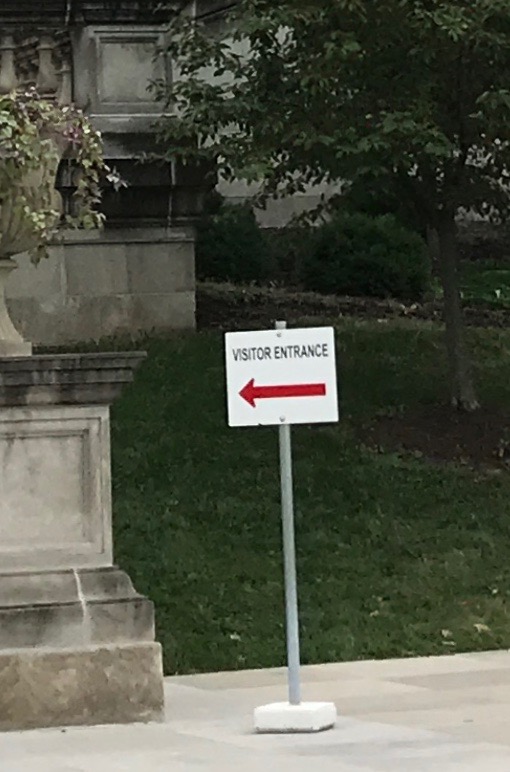
It was still a soggy day when I got up, but not quite as bad as what I had driven through the day before. I got myself ready and headed to the Capitol Building. I parked and found a sign directing me to the visitor’s entrance.

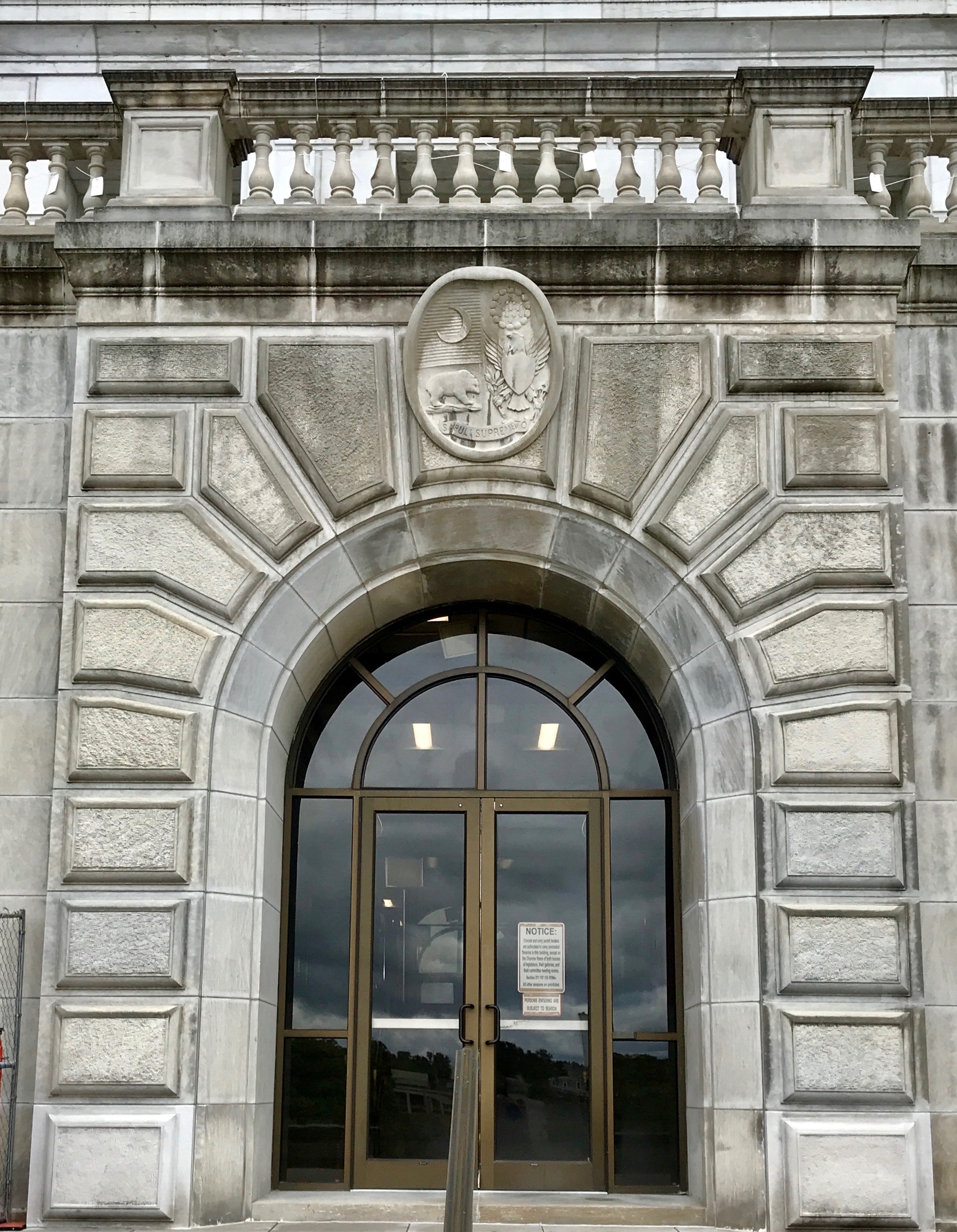
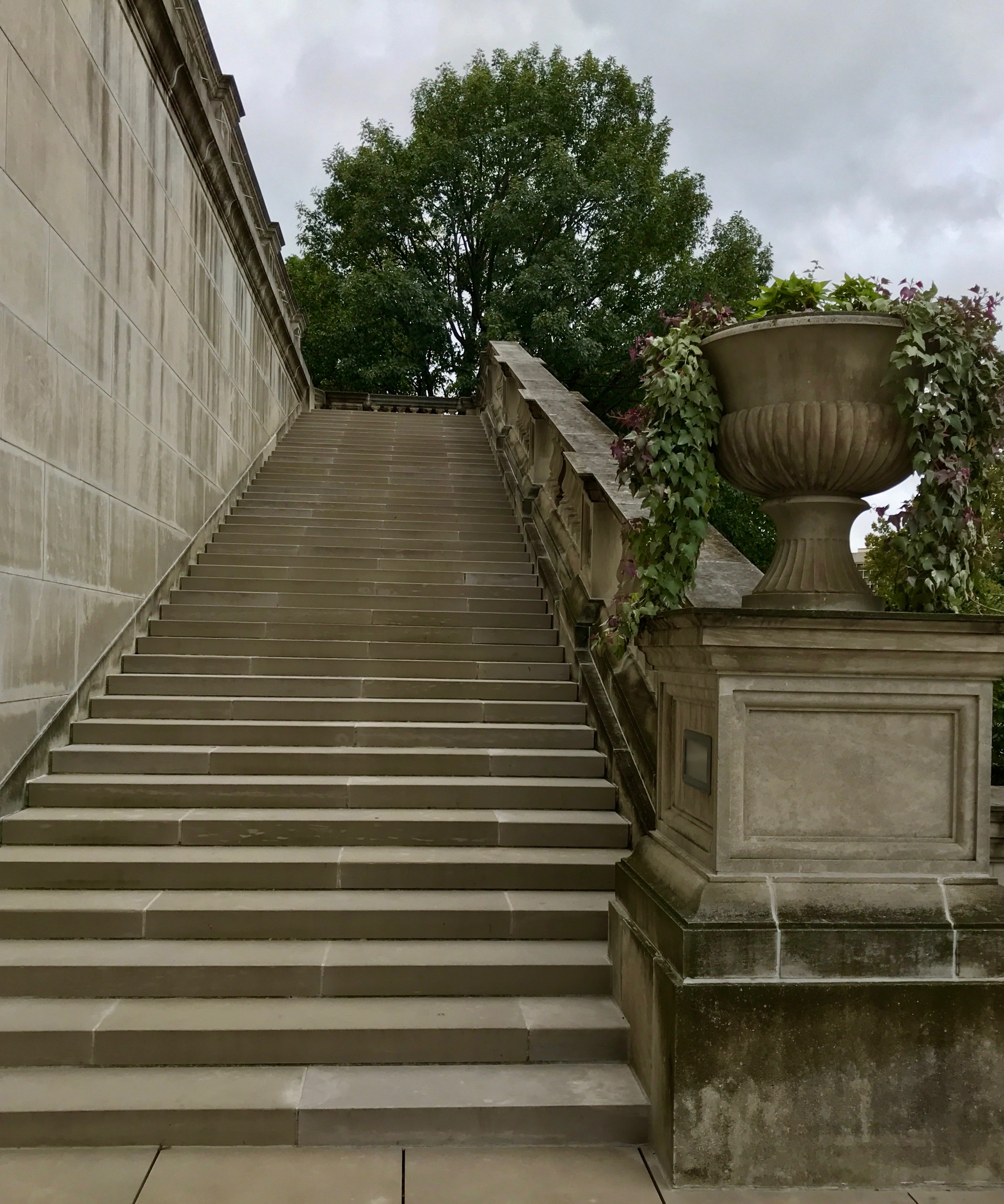
I started climbing. At one landing, there was an entrance. It wasn’t my entrance, however.

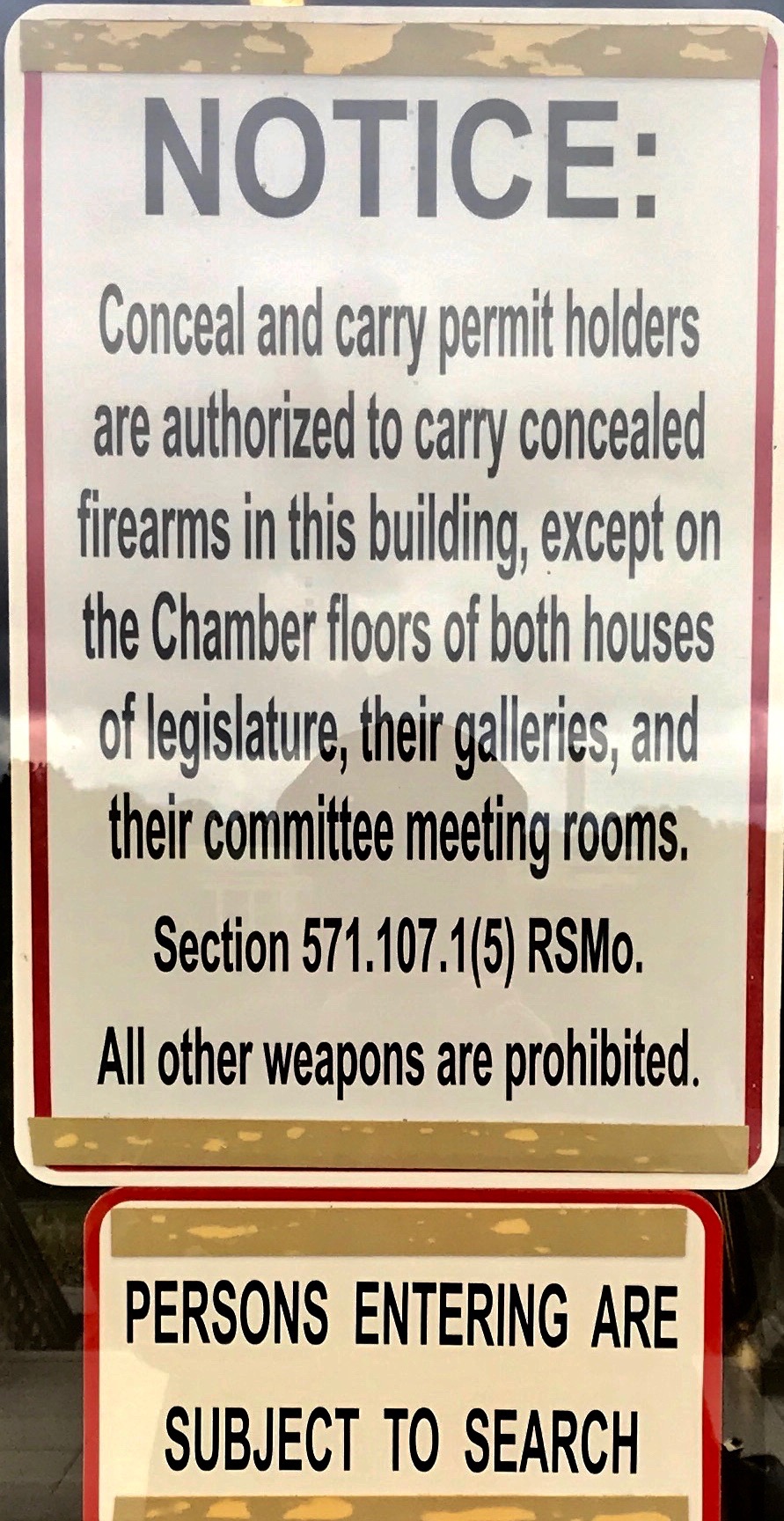
Of course, I had to go up and read the signs on the door.

And, if you wanted to know what the signs said, now you do. I continued on up the stairs.

I wish I had been counting the number of stairs! They seemed to go on for ever.

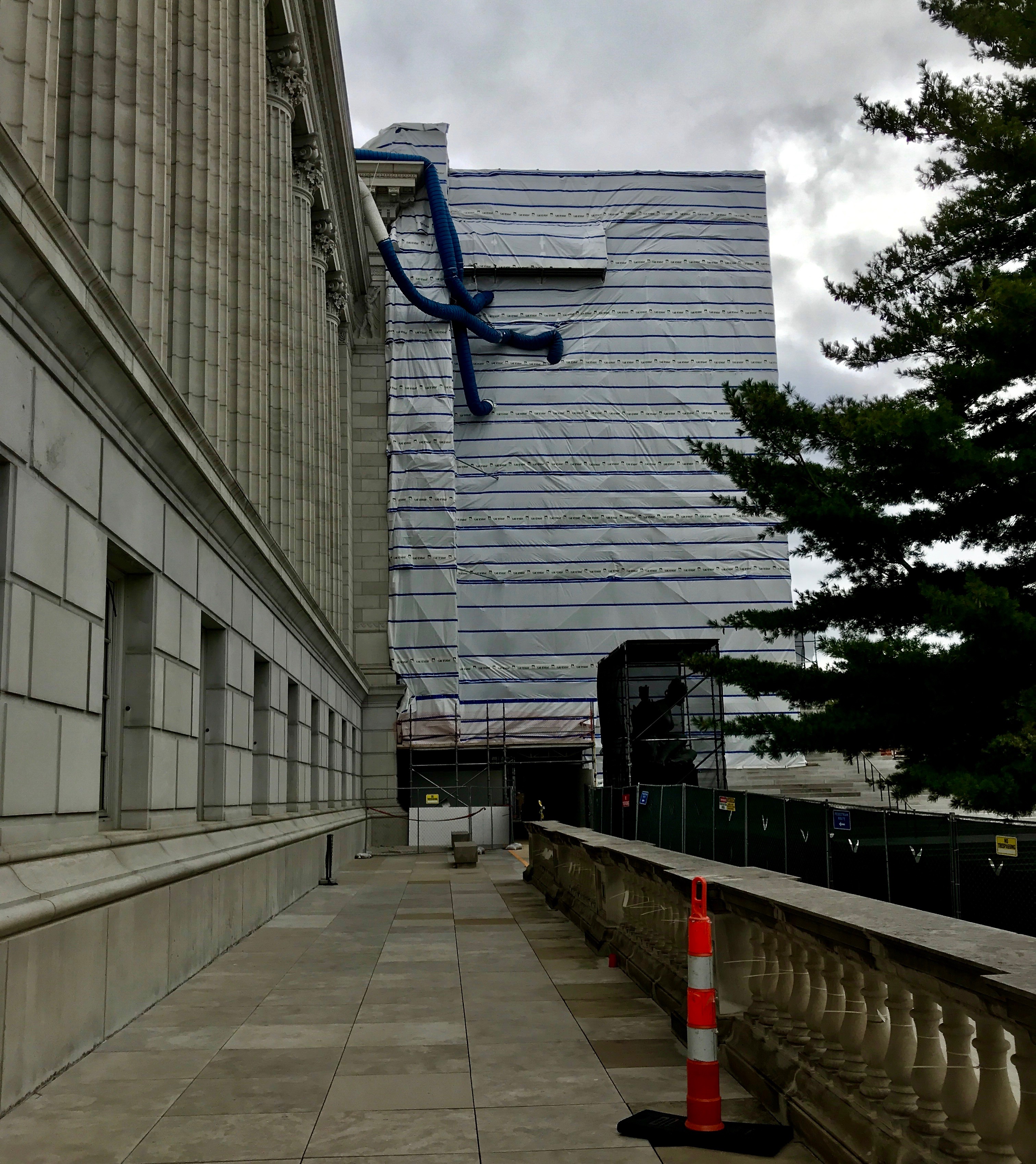
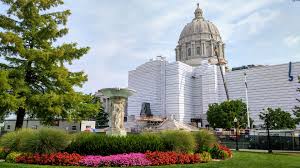
I followed the arrows around to the visitor’s entrance. I guess they must be doing some renovations. It kind of reminds me of one of Christo’s wrapped buildings.

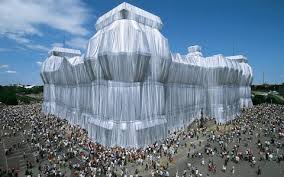
Here’s a photo of the Reichstad in Berlin in 1995.

You can see the similarities, although Christo’s wrapping was only up for fourteen days. I wonder how long the wrapping on the capitol will be up? Incidentally, while Christo didn’t wrap the Reichstad until 1995, I first heard about it in art history class with Sister Jeanne when I was in college. Christo started planning that temporary work of art in the sevenities.

Thank you, Sister Jeanne!

Anyway, I entered the building and looked around for a restroom. The tour wasn’t going to start for a bit, and I figured that I might as well make myself comfortable.

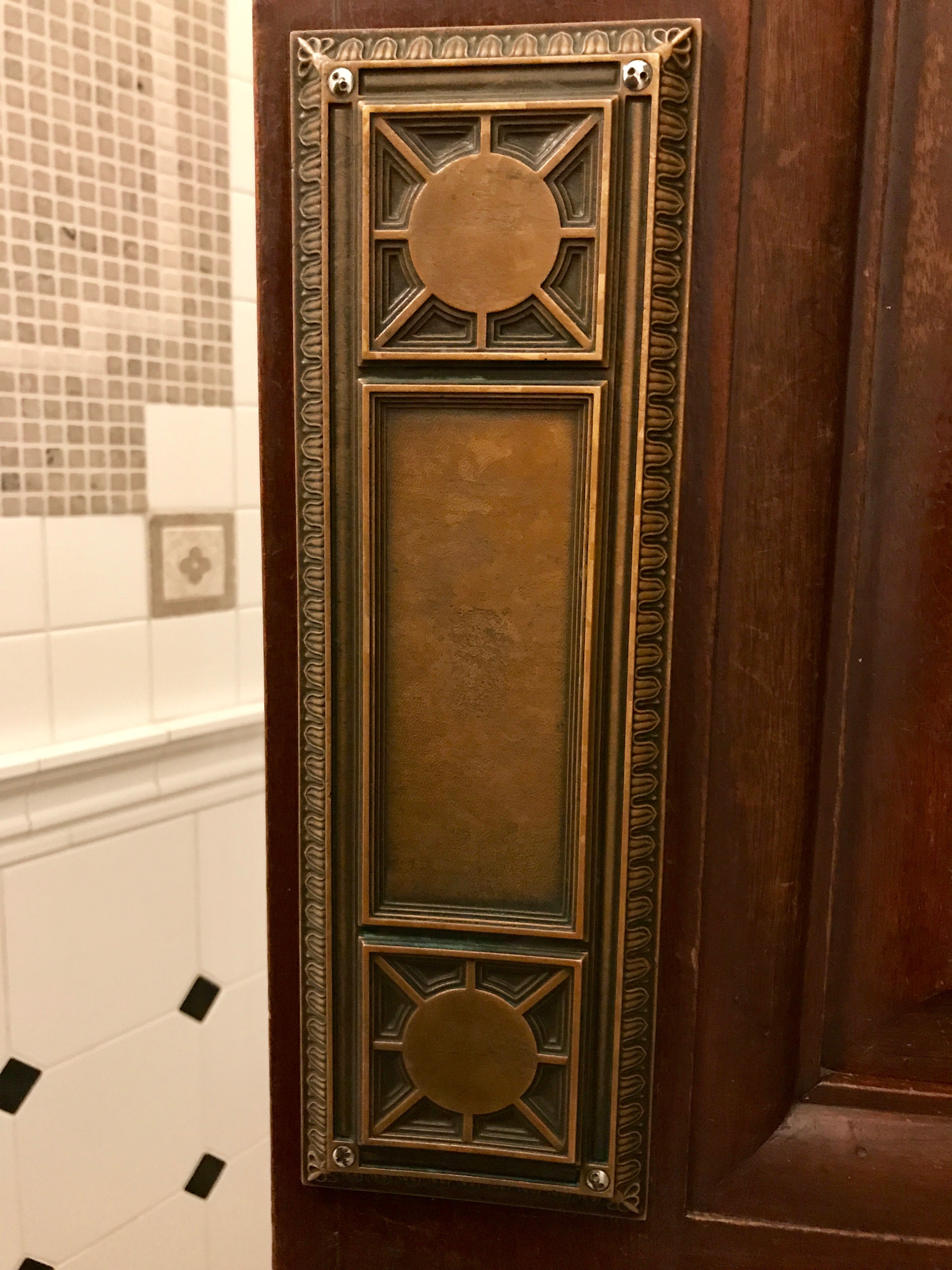
The push plate on the door was quite lovely.

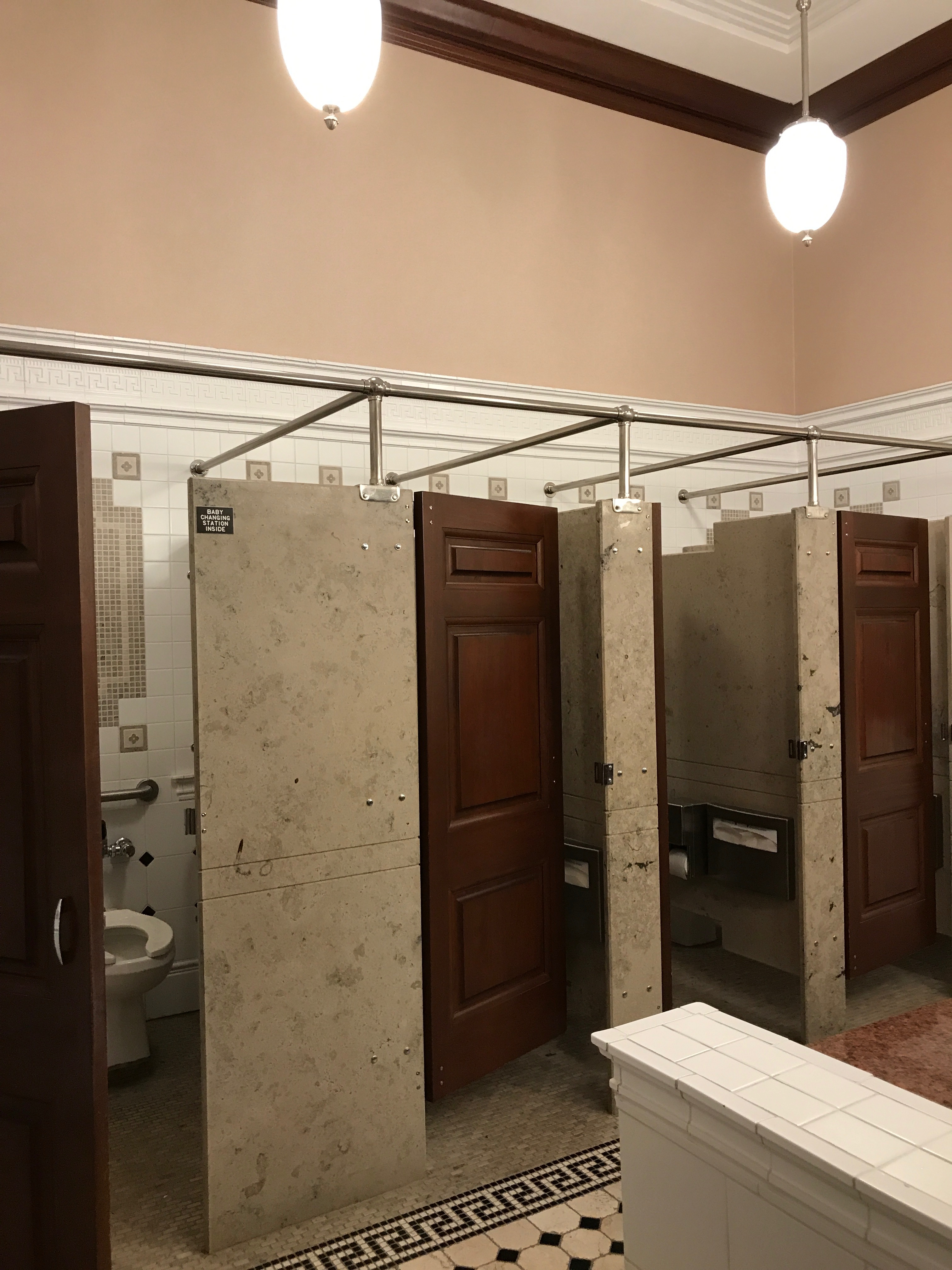
The restroom was also elegantly appointed with marble and tile work.

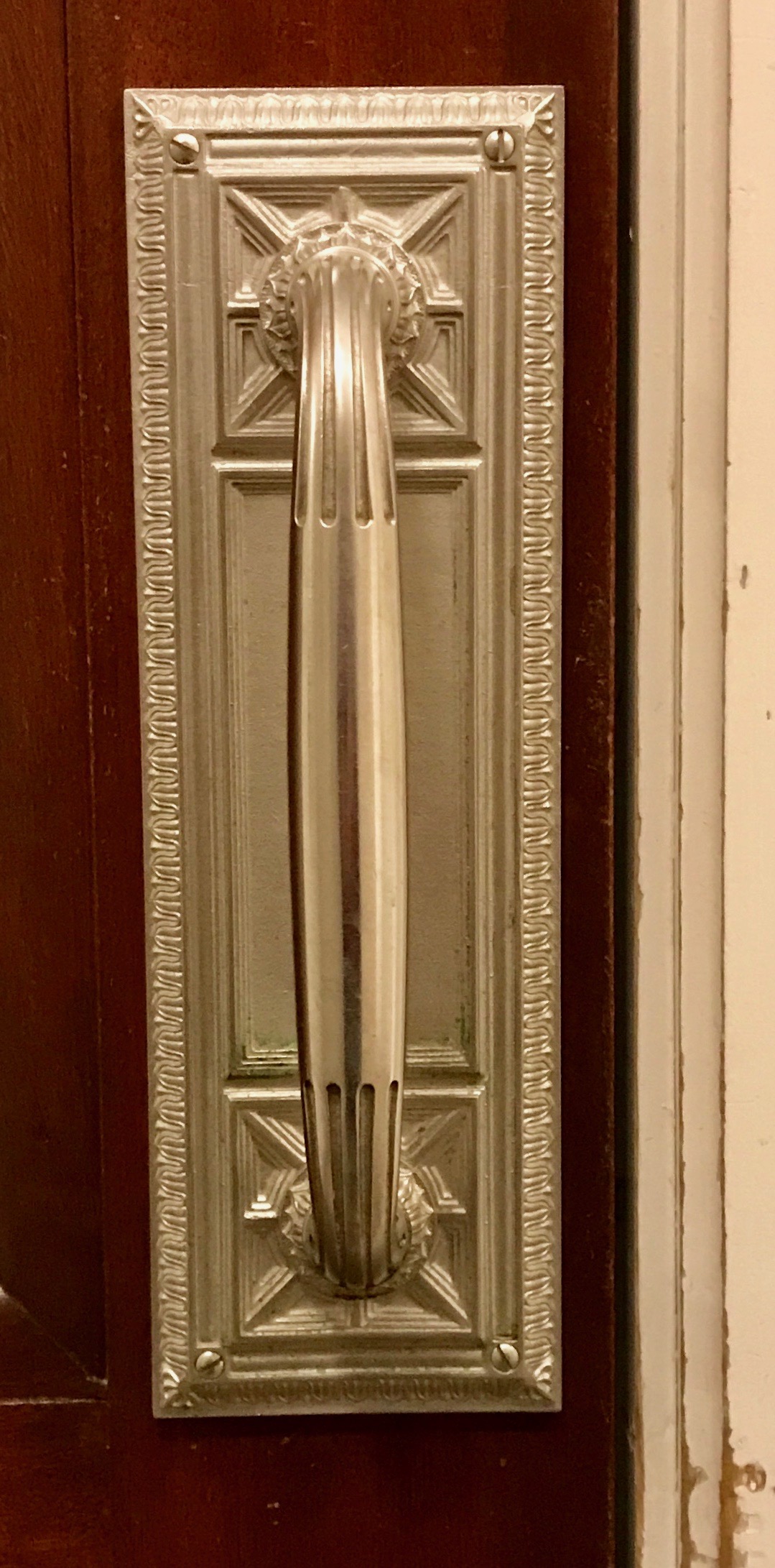
As I left, I was struck by the quality of the pull plate. At this point, I was starting to think that this building might really be something out of the ordinary.

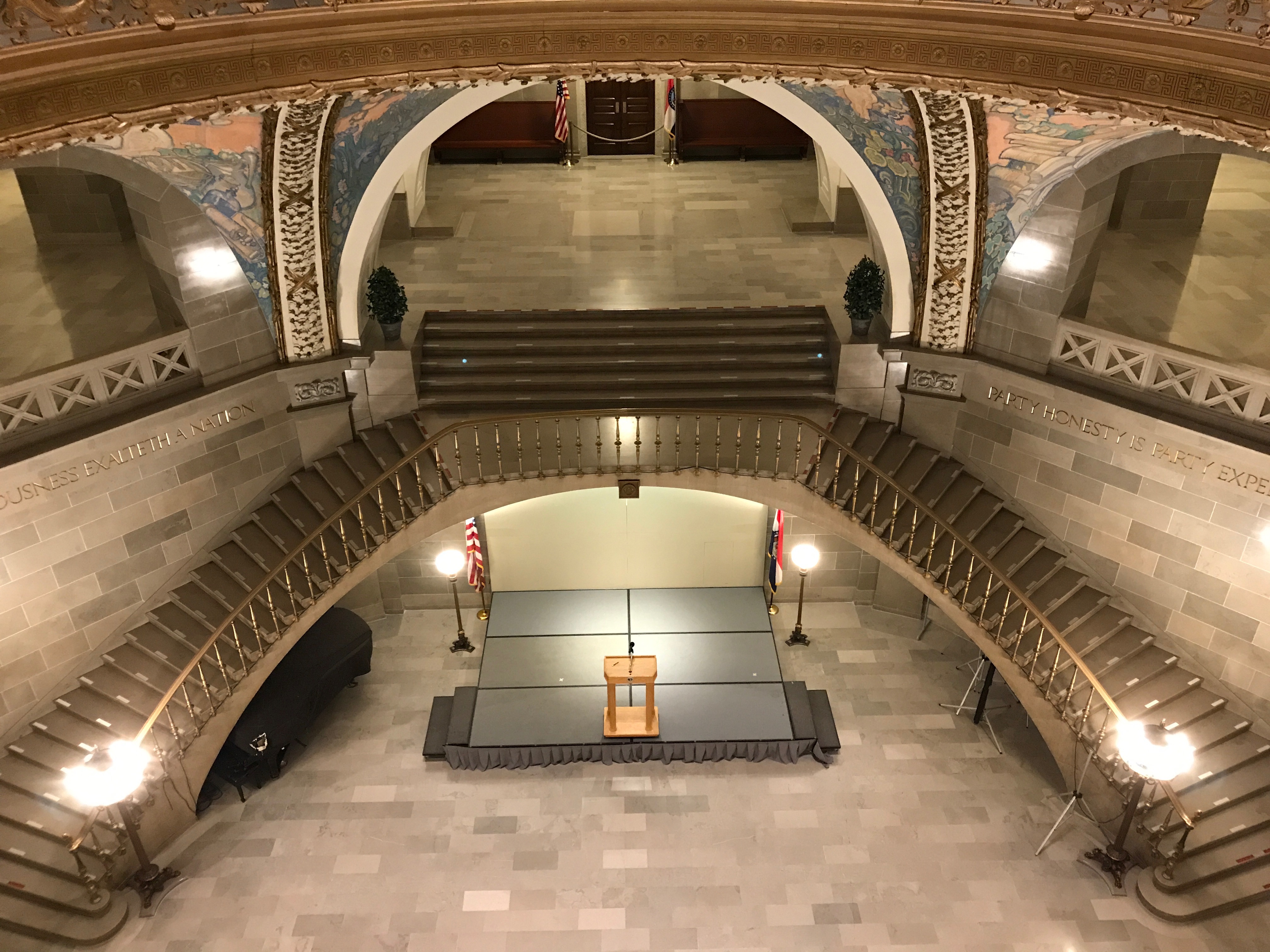
Oh, my! I do believe this building is designed to be inspirational as well as elegant.

This is one of the views looking up into the dome.

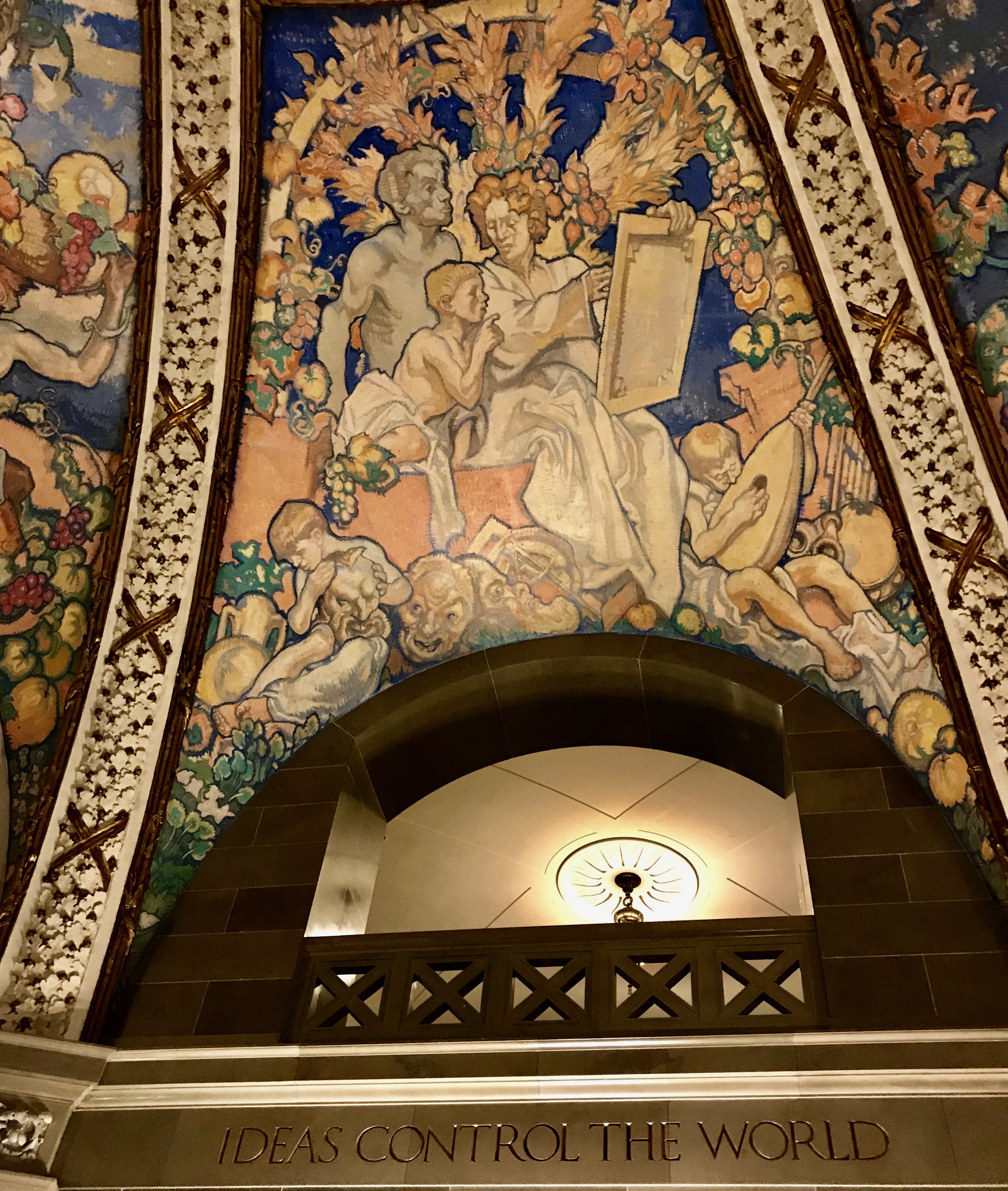
All the areas of the dome are covered with artwork and inscriptions designed to inspire. I particularly liked with panel. I think of it as a pro-education, pro-teacher segment. But, even if it is just “pro-get-a-clue,” I like it.

The views change depending on which floor you are standing on and where exactly you are standing.

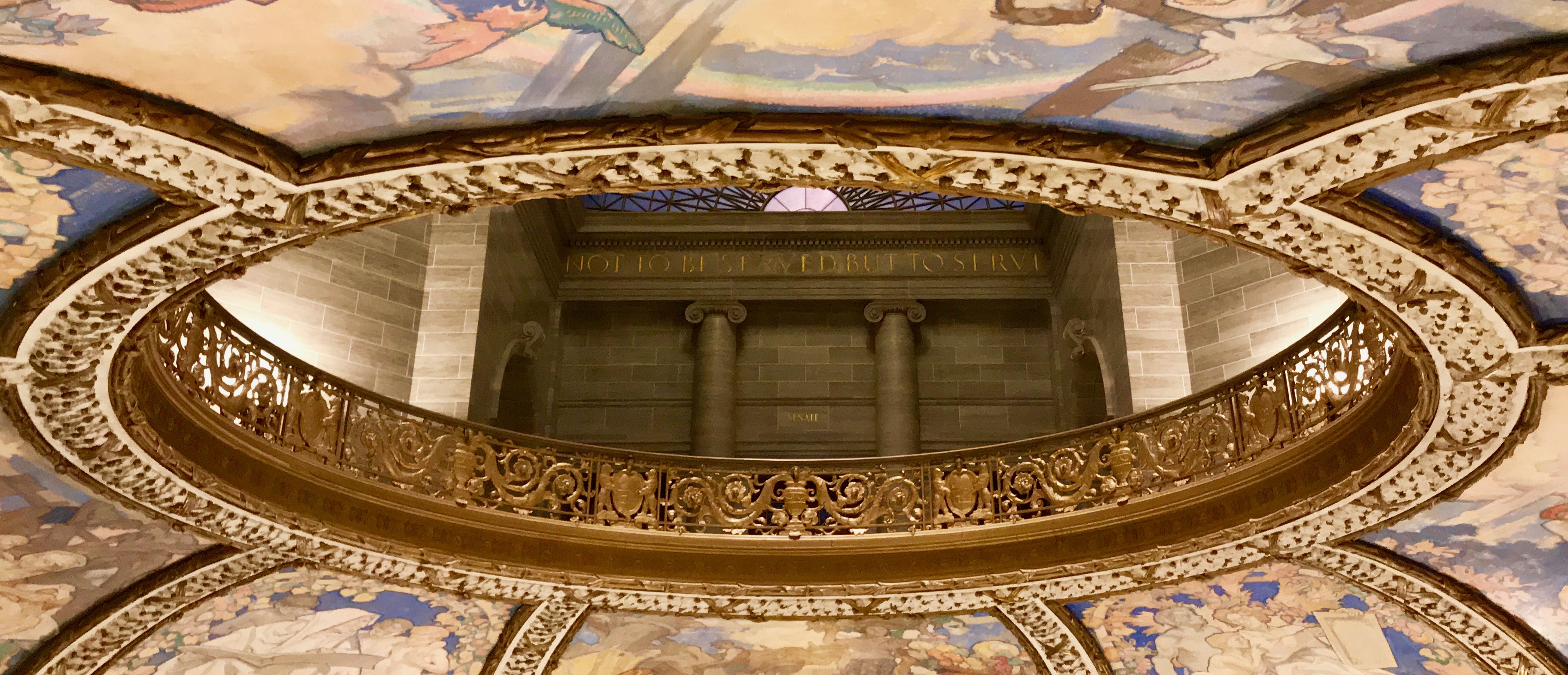
These are noble words, as well. In case you can’t read the inscription seen through the circle, it says, “Not to be served but to serve.” I hope that is over the entrance to one of the legislative chambers – and I hope they look up and read it from time to time. Maybe they could even think about it. (Incidentally, this is not a critique of the Missouri legislators. I am not familiar with the workings of Missouri politics.)

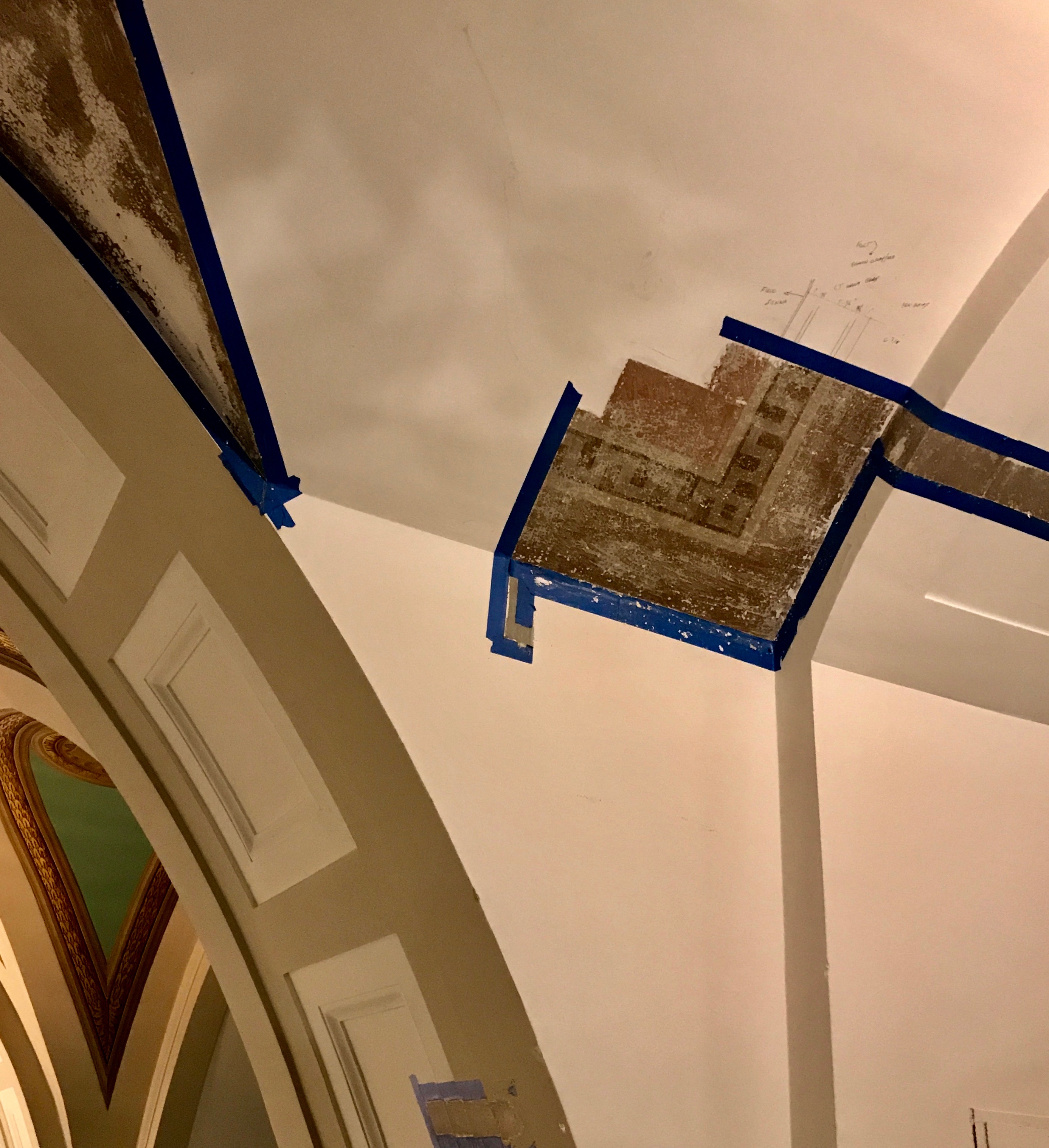
This is a building under renovation. This is the third building to serve as the capitol in Jefferson City. It was completed in 1917. You can see a remnant of some of the original paint in this fragment.

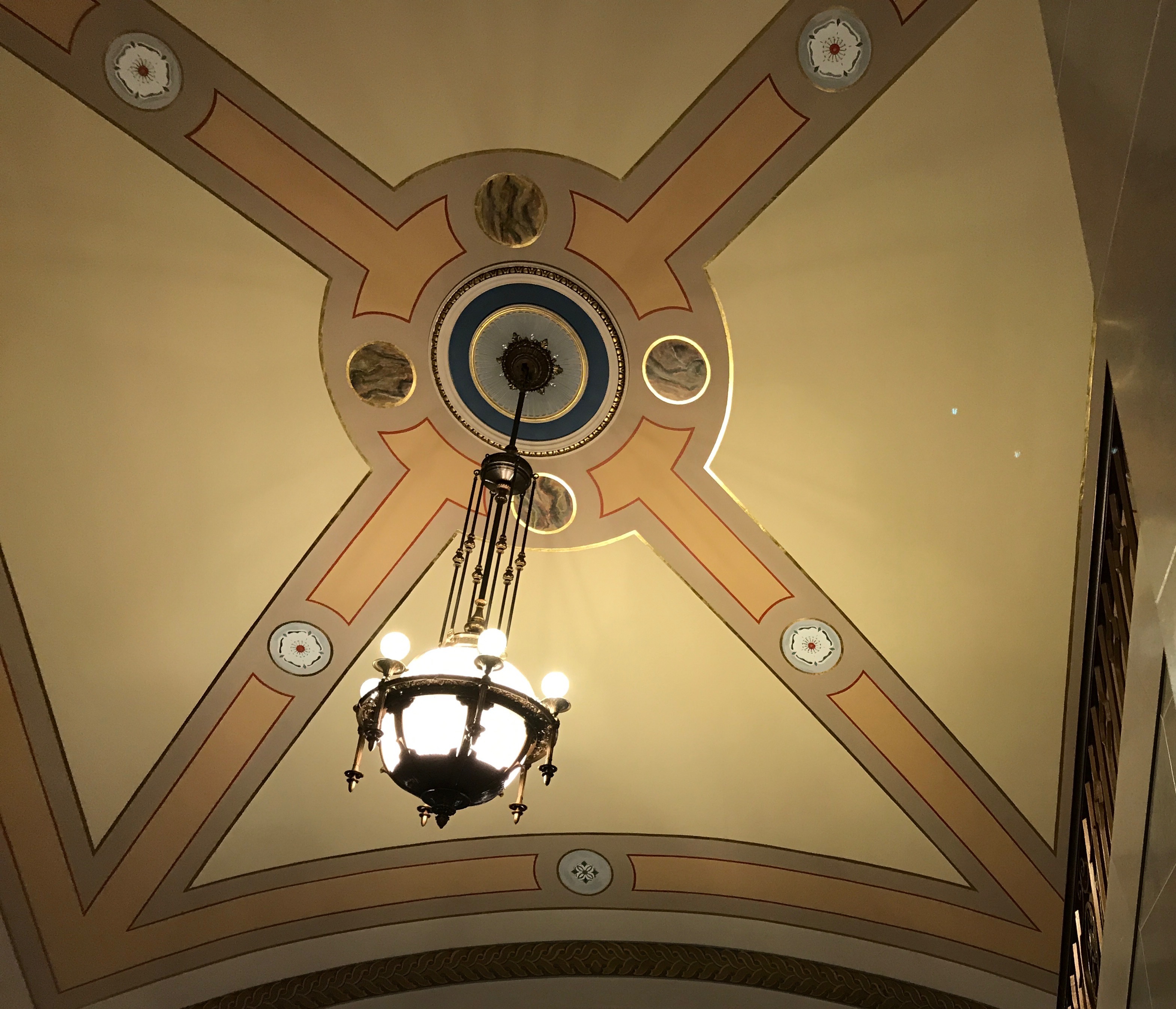
The colors and the sensibilities have been used in some of the restorations that are already complete. This was in the area that visitors pass through when they enter.

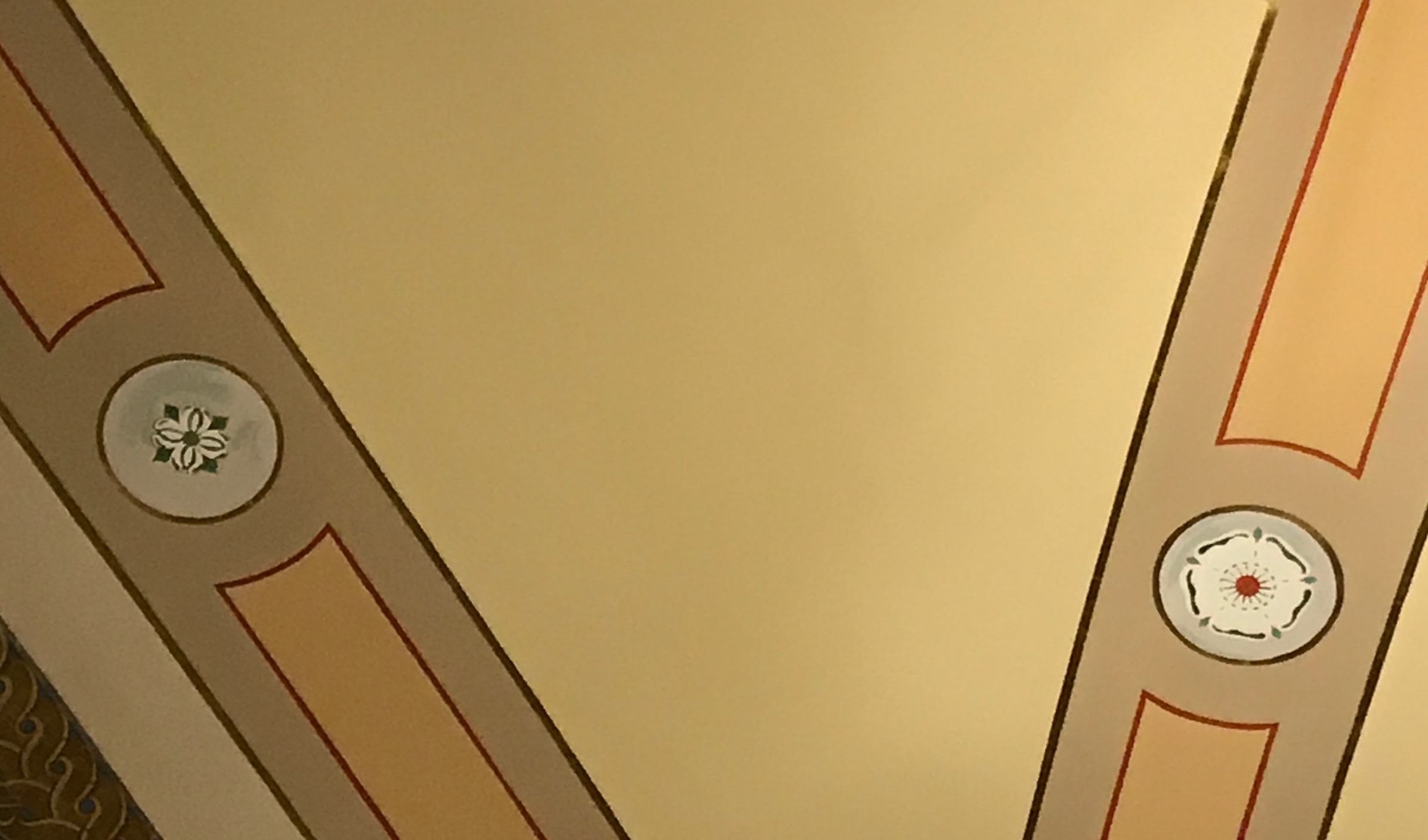
Incidentally, the state flower and the state tree are included in the designs. The state flower is Crataegus punctata, which is a kind of hawthorn. The state tree is the Cornus florida, or the flowering dogwood.

This is the state flower, which looks almost like a tree.

This is the flowering dogwood, which is a tree.

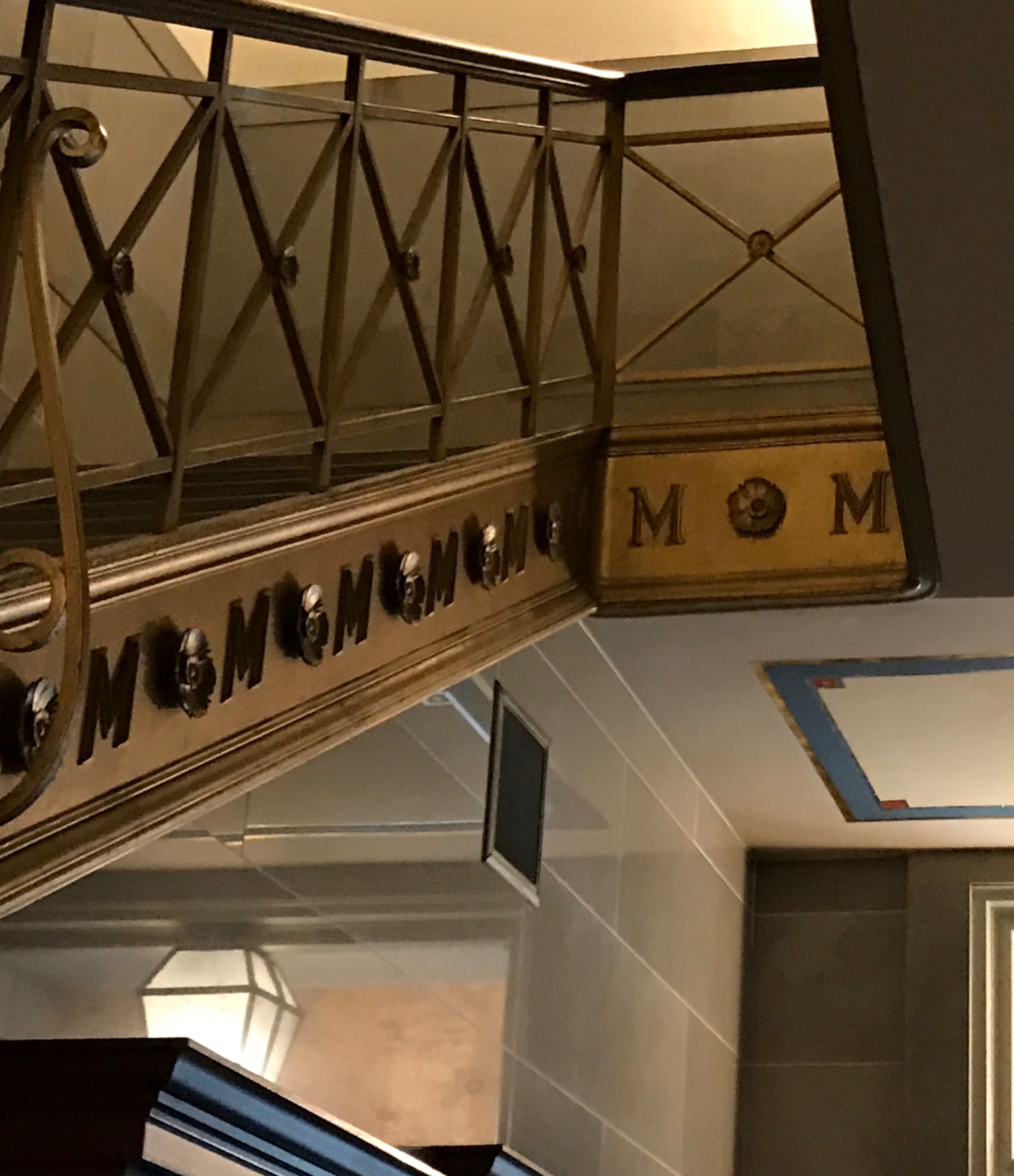
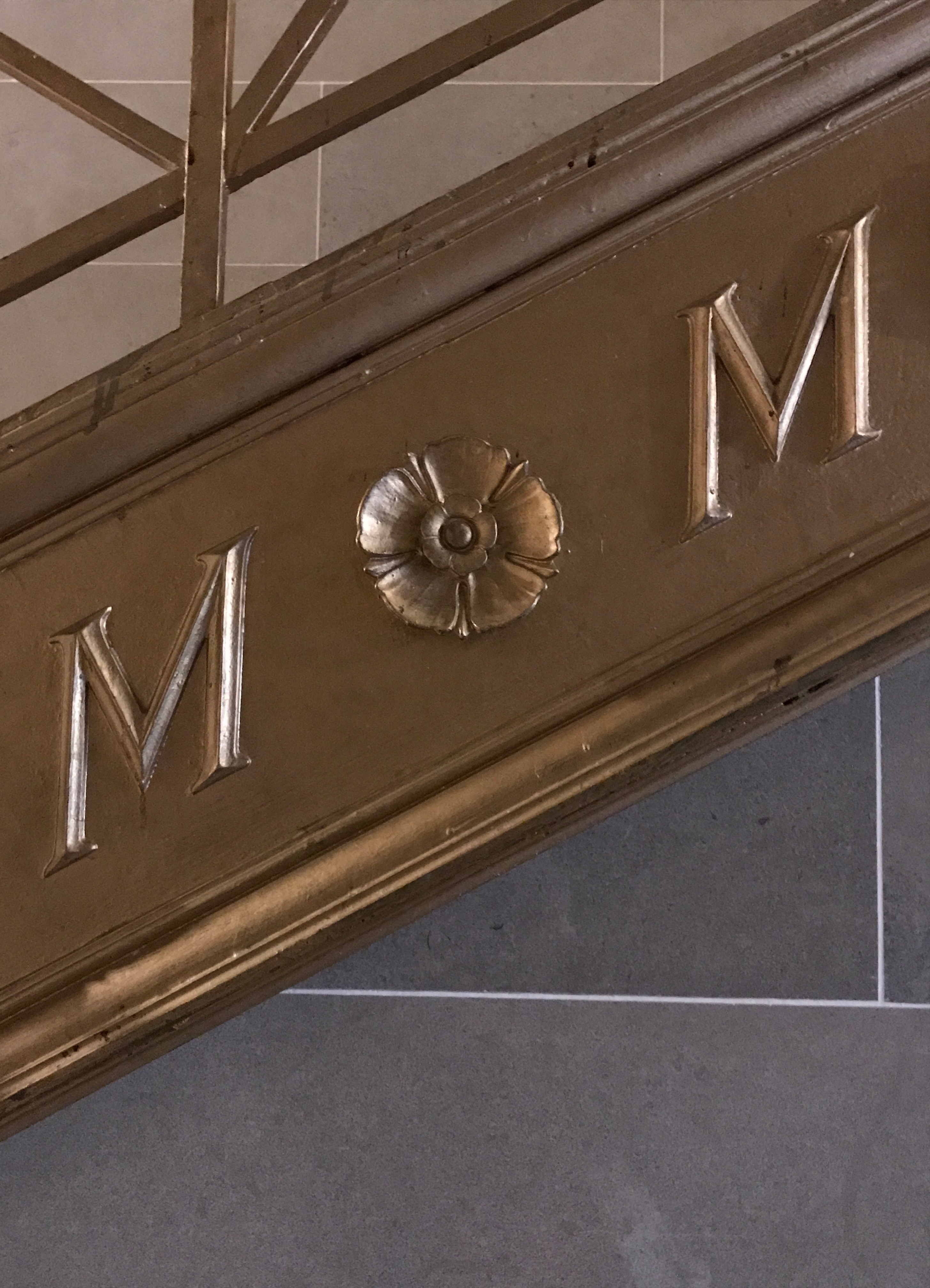
This stairway in the same area had the hawthorn as a repeating motif.

It also tickled me the way it looked like it spelled out “MOM.”

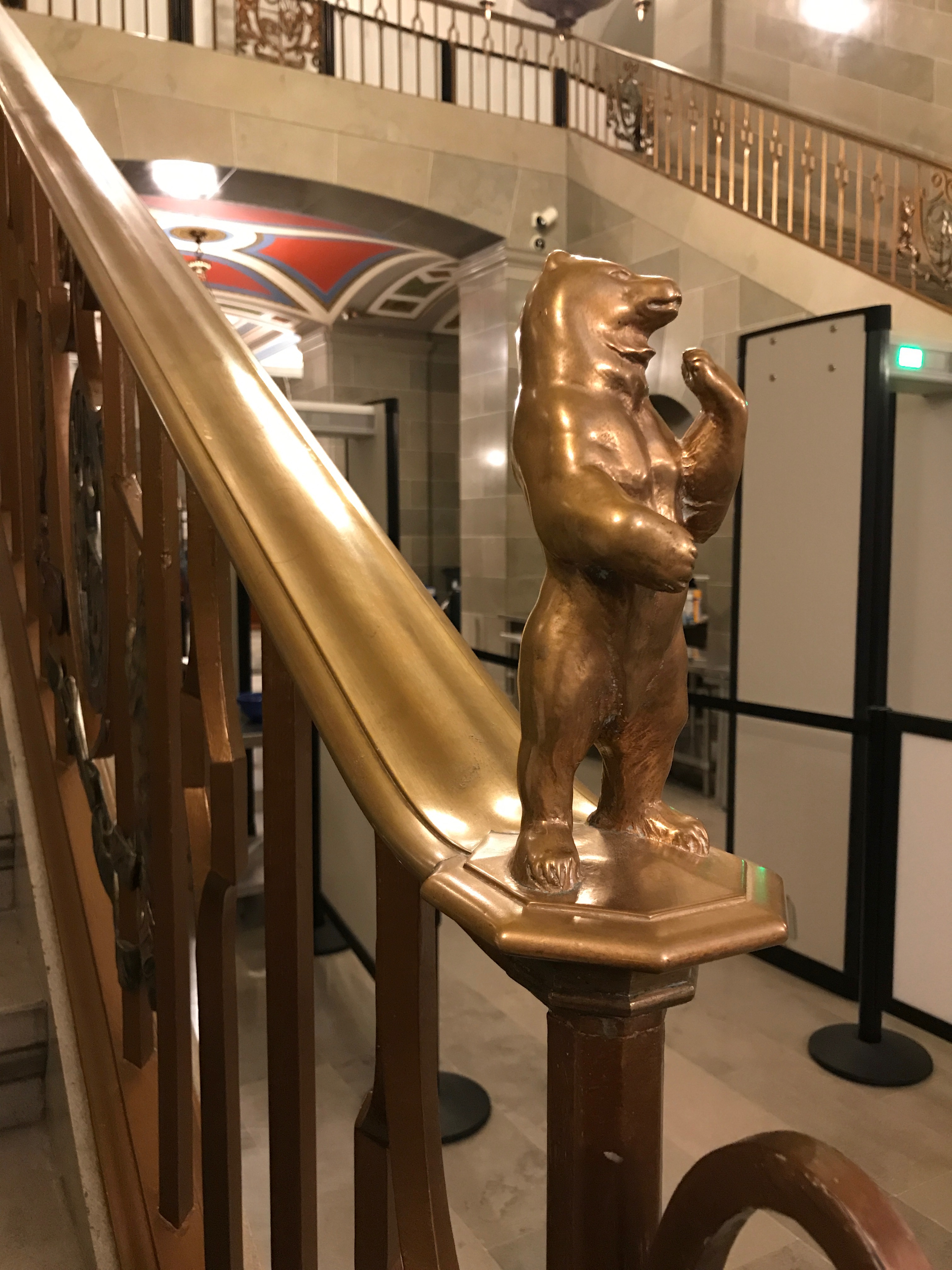
Incidentally, at the end of the balustrade, was this amazing finial. I figured that the bear must be the state animal. I asked our guide if it was, but, no, it turns out that the state animal is the mule. Incidentally, the state bird is the bluebird, the state dessert is the ice cream cone and the state dance is the square dance. The factoids you can find if you look!

You might be wondering why the ice cream cone is Missouri’s state dessert. I had an idea about that, so I did a little research. According to my Preferred Source, the ice cram cone became mainstream in the USA at the St. Louis World’s Fair in 1904. Arnold Fornachou ran out of the paper cups he was using to serve the ice cream he was selling. Next door to him as a waffle vendor named Ernest Hamwi. He sold Arnold some of his waffles. Arnold rolled the waffles into cones to hold the ice cream. The rest is history.

And mighty delicious history, at that!

Speaking of our guide, he spent a lot of the tour talking about the artwork. Really, this building is so rich in art, that it’s hard to separate the art from the building. You do notice that I haven’t completely avoided the art. The reason that there is so much art in the building is that they ended up with too much money.

The original budget allotted $3 million for the building and and additional $500,000 allocated for the site and furnishings. The state miscalculated on the revenue projections and ended up collecting $4,215,000.  I whipped out my calculator, and figured that they collected $715,000 more than they thought they would need. If I remember correctly what the guide told us, by law they could only spend the money they raised on the capitol. That is why there is so much artwork and why it is of such high calibre. I will talk more about the artwork in the next post.

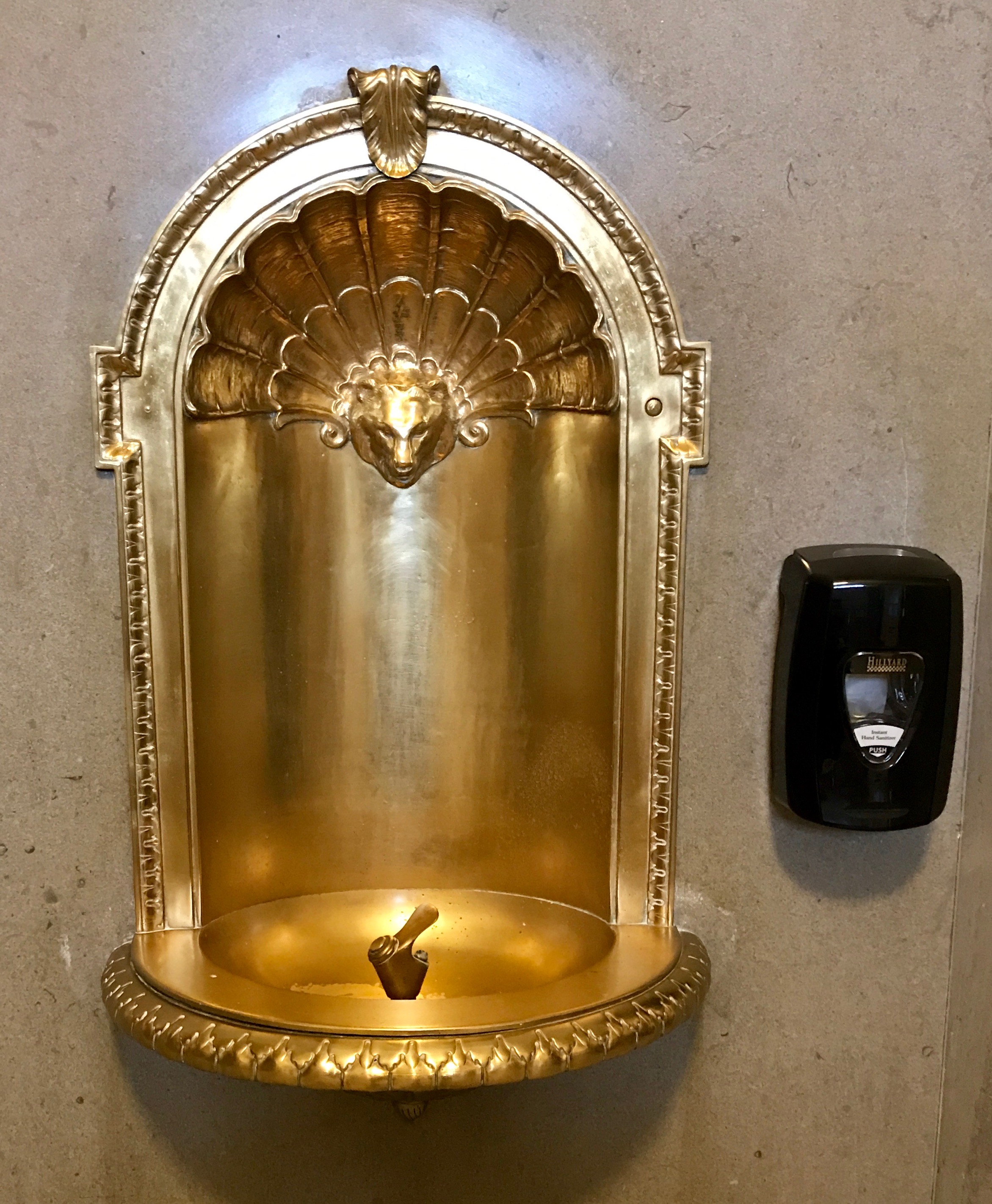
But, as long as I’ve paused to talk about funding, compare and contrast this original drinking fountain with the hand sanitizer dispenser. (Go ahead, I’ll wait.)

In my opinion, they ought to fling that ugly piece of plastic far away. I doesn’t belong next to that glorious drinking fountain.

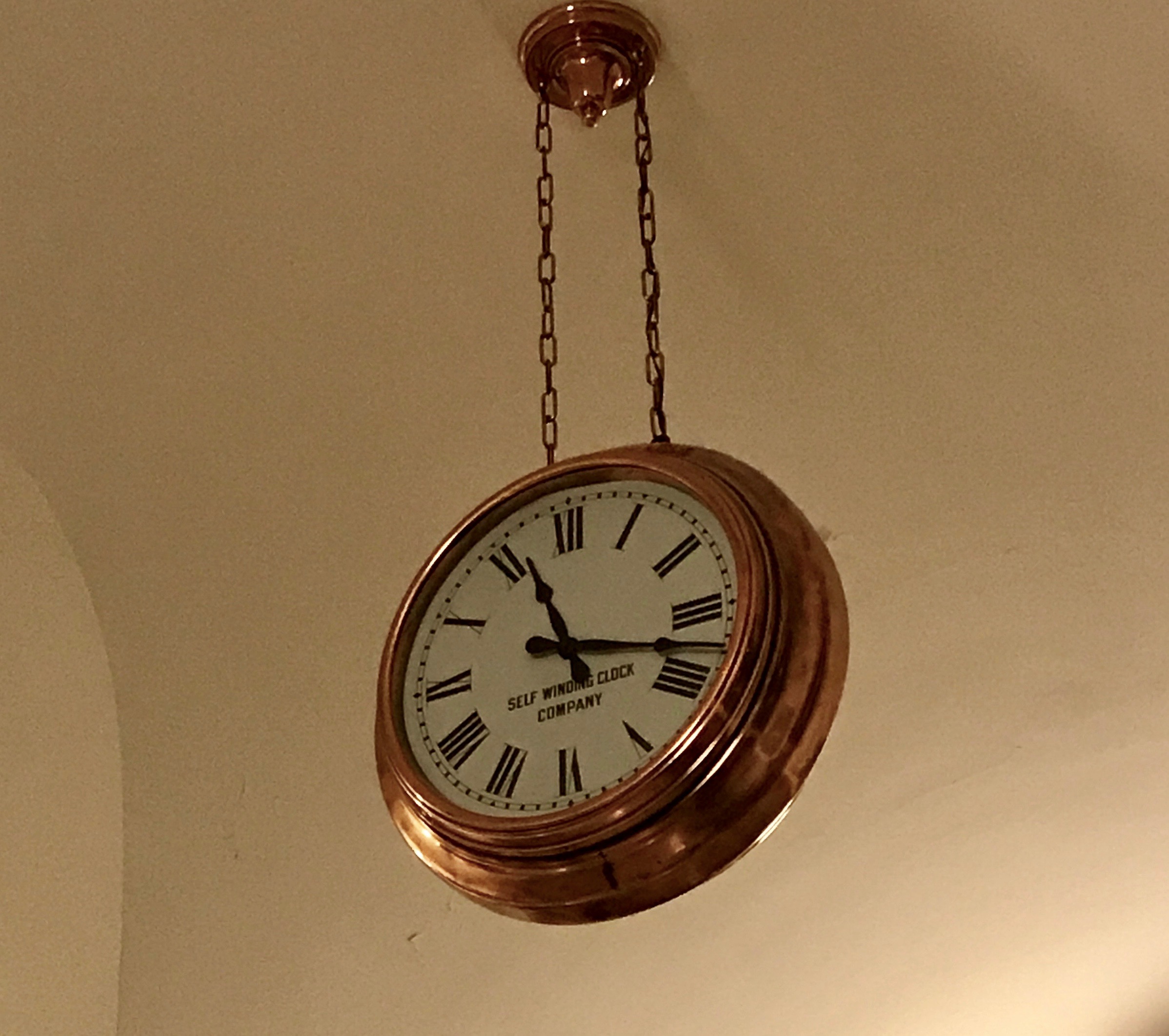
And how about that elegant clock hanging in the hallway? The dial proclaims it to be “self winding.” I wonder how that works? Do you think the wire woven into the chain on the right side has something to do with it how it operates?

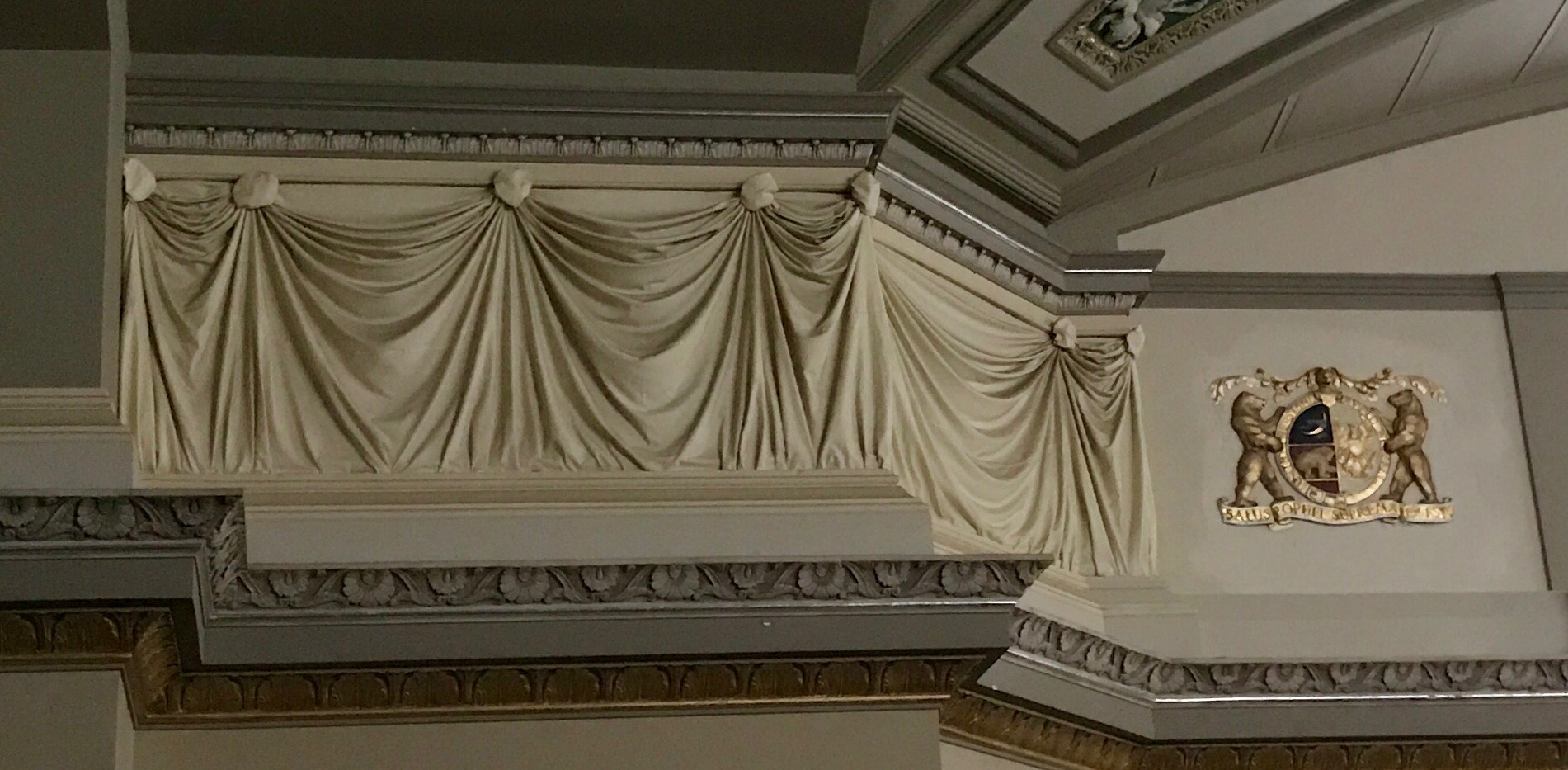
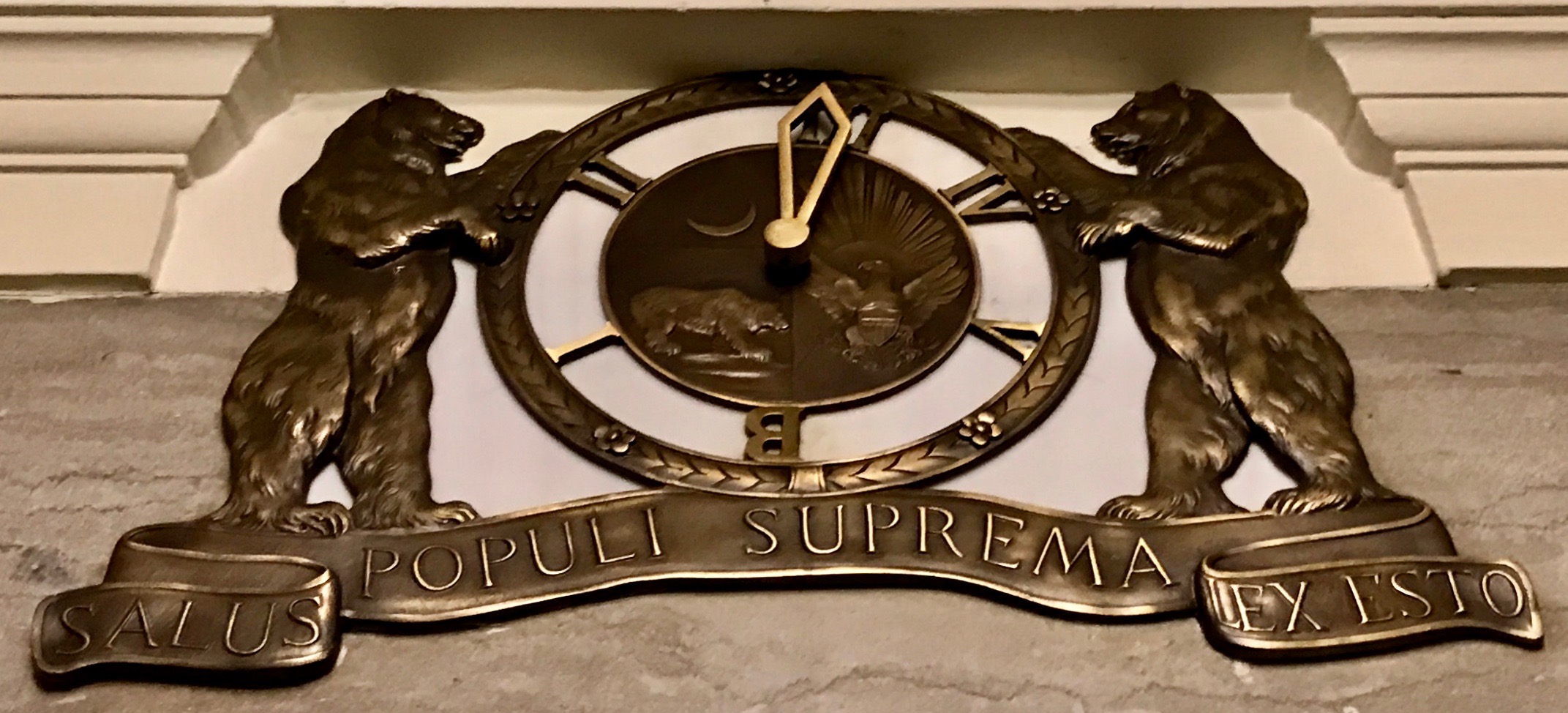
Take a look at this elevator dial! I am sure someone wanted a bear as the state animal. The state’s motto is “Salus populi suprema lex esto” which means “Let the good of the people be the supreme law.”

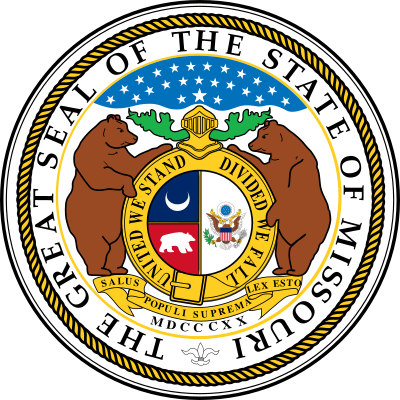
The elevator dial is based on the Great Seal of the State of Missouri. The bears represent strength and bravery. The crescent moon represents the newness of statehood and the potential for growth. MDCCCXX is Roman numerals for 1820, although Missouri wasn’t admitted to the union until 1821. They must have been into the power of positive thinking. Incidentally, take a look at the yellow belt with the words “United we stand divided we fall” in the enter of the seal. Do you see the buckle? The buckle signifies the State’s ability to secede from the Union if they deemed it necessary. The belt can be unbuckled.

So, did Missouri unbuckle during the Civil War? According to my Preferred Source, it was a “hotly contested border state, populated by both Union and Confederate sympathizers.” Both the Union and the Confederacy claimed the state. It sent armies, generals and supplies to both sides and maintained dual governments. They carried on a bloody neighbor-against-neighbor intrastate war within the larger national war.

By the end of the war in 1865, nearly 110,000 Missourians had served in the Union Army, and at least 30,000 had served in the Confederate Army. The war in Missouri was continuous between 1861 and 1865. There were battles and skirmishes in all areas of the state. The largest battle west of the Mississippi River  was the Battle of Westport in Kansas City. If you count all the military actions, from the large ones to the minor skirmishes, Missouri saw more than 1.200 distinct engagements within its boundaries. Only Virginia and Tennessee had exceeded that number.

I guess the belt buckle stayed fastened.

I wandered around a bit more. You can really see the money that was spent on the building.

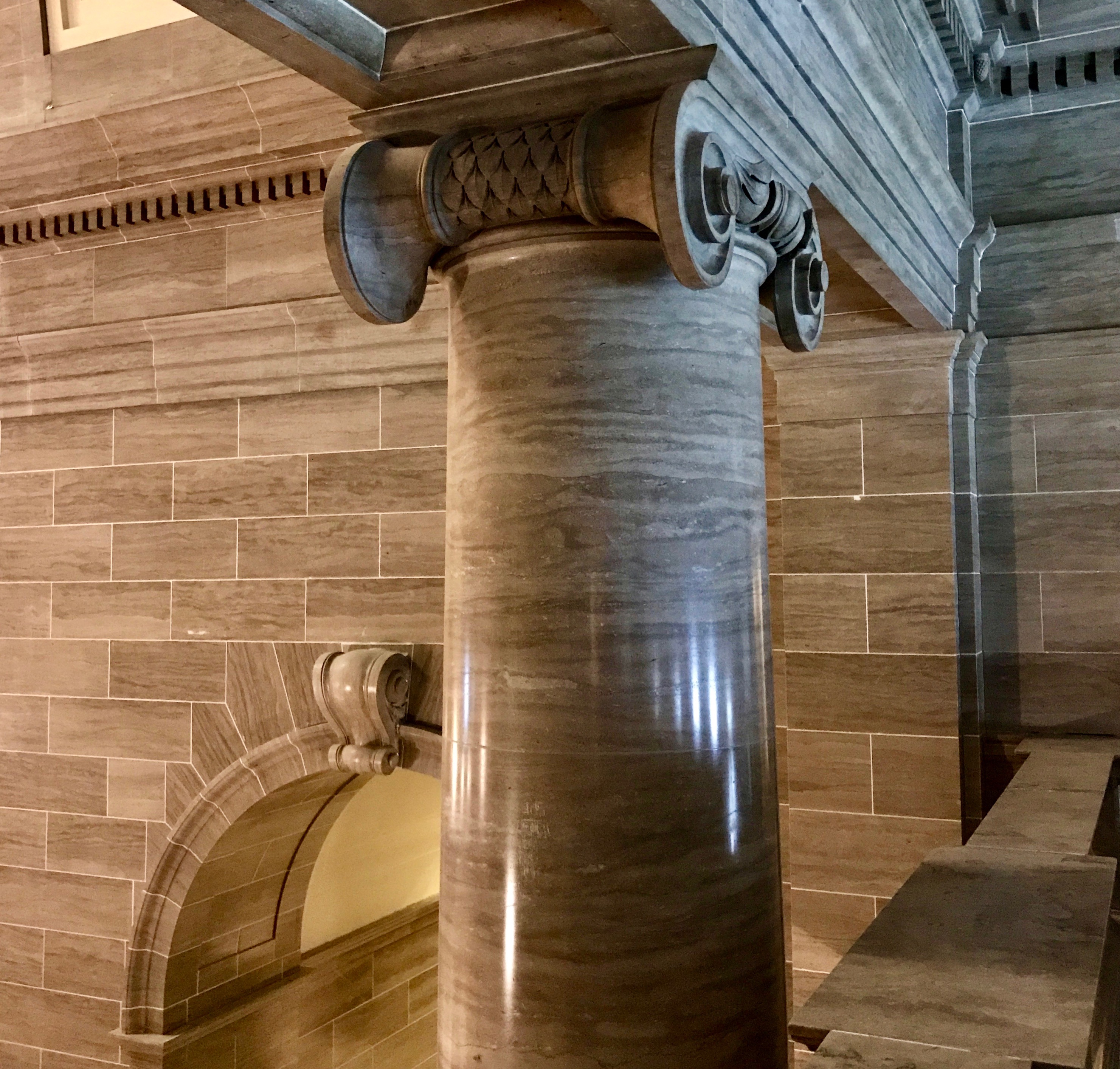
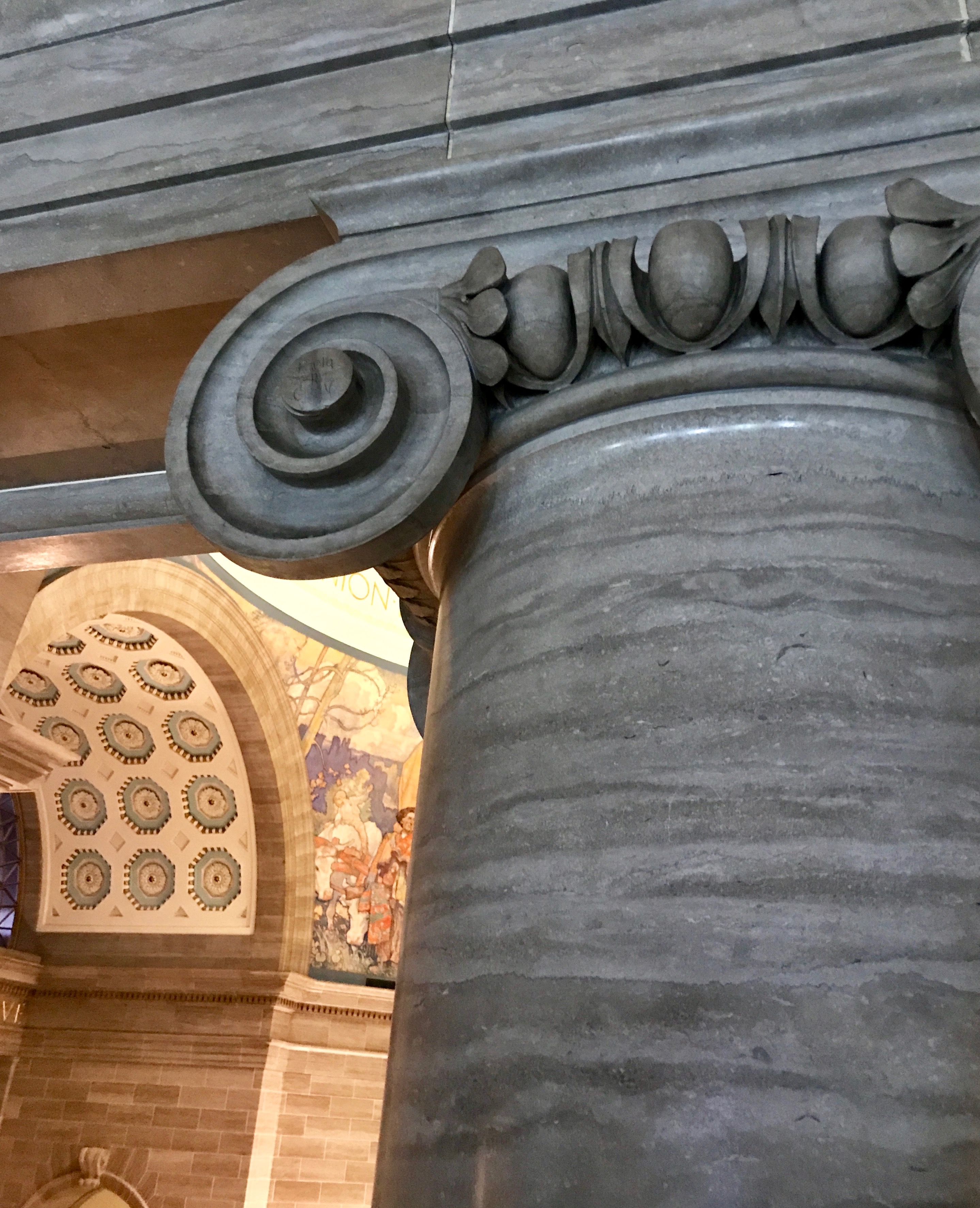
The stonework is so well done.

I wonder if there are even enough skilled artisans left in the world if we wanted to recreated these structures?

Everywhere you look, there is a little vignette waiting to be appreciated.

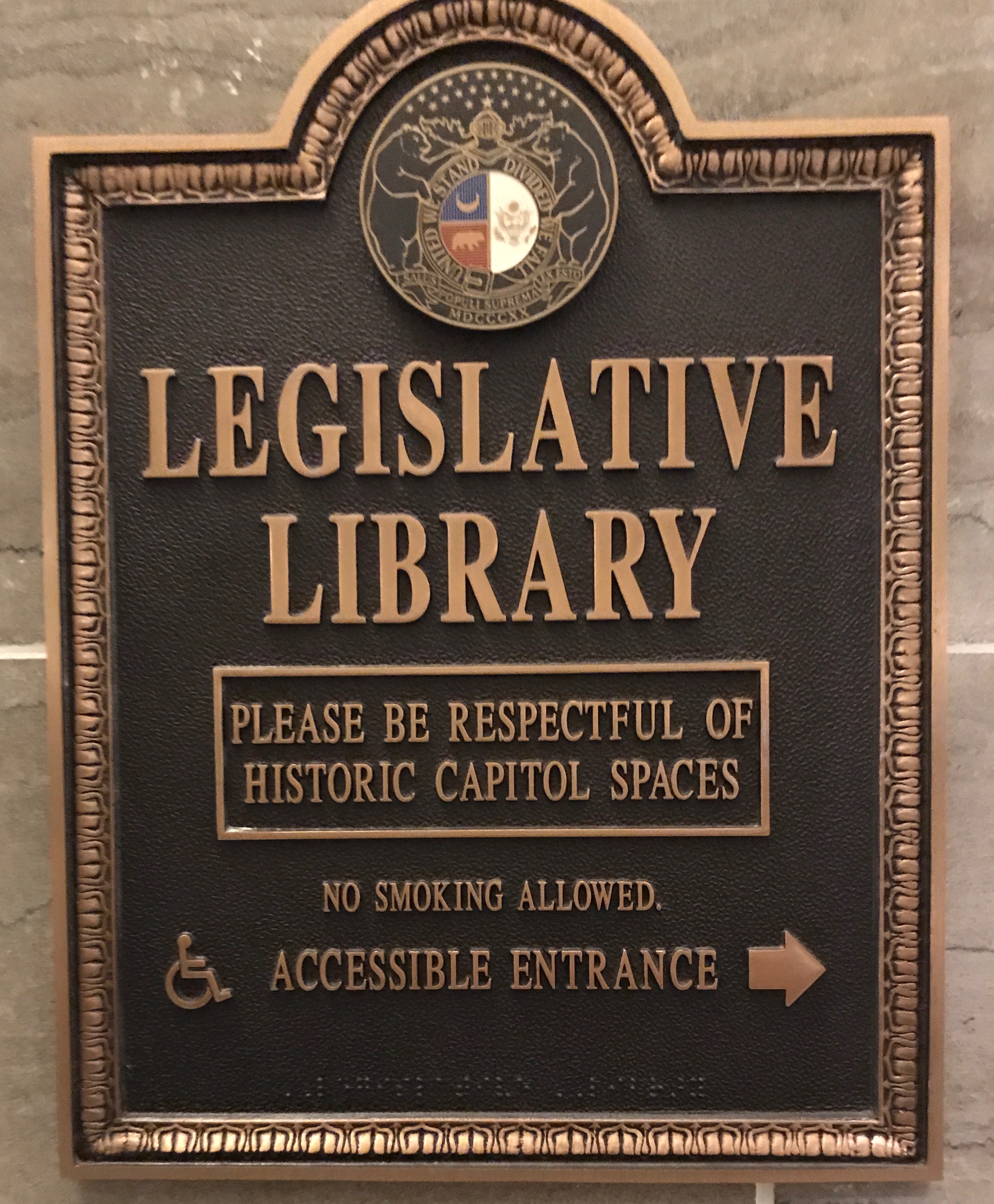
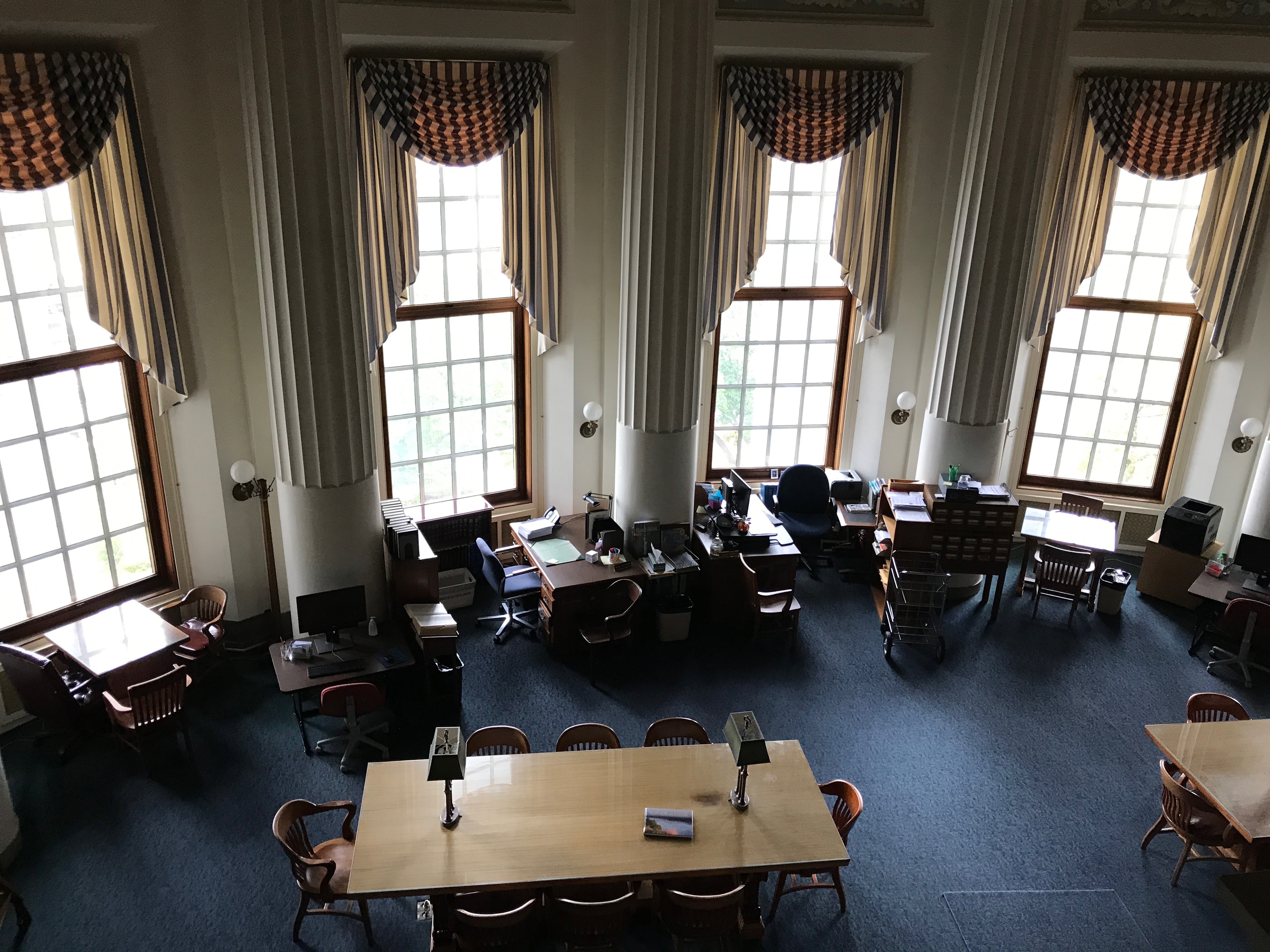
The Legislative Library was open to be viewed.

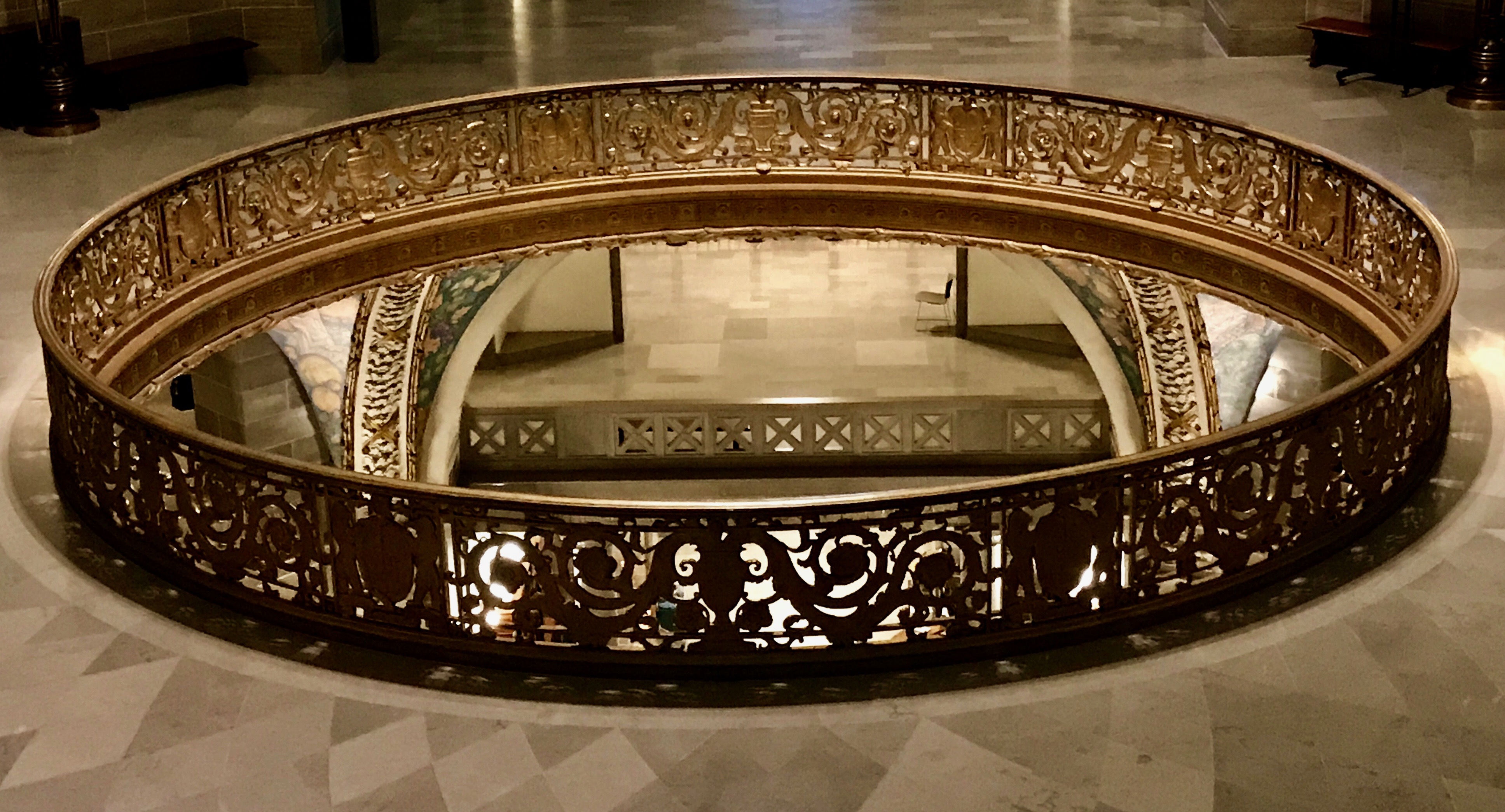
You had to look at it from above, but that makes it easier of take a photo, anyway.

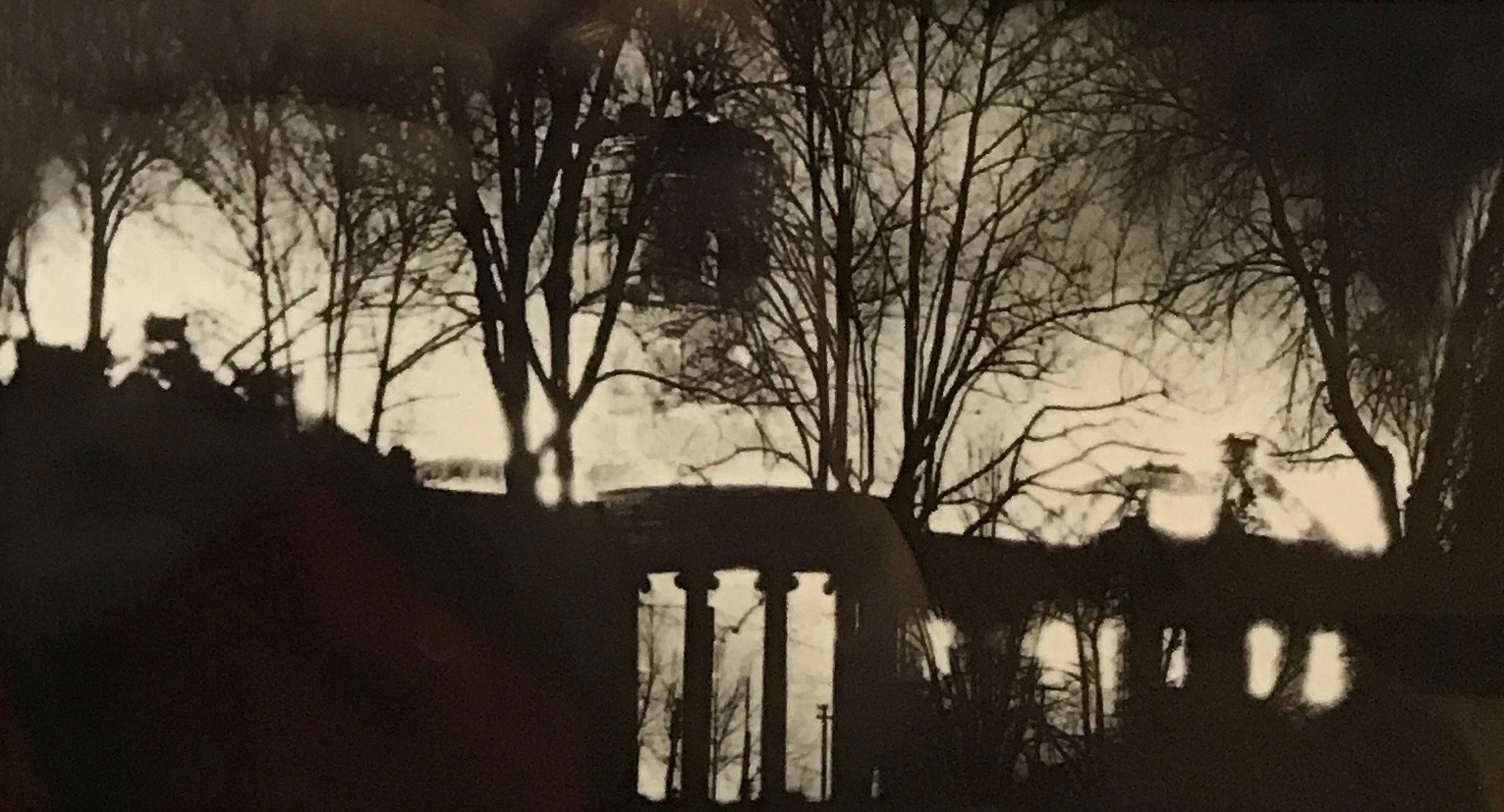
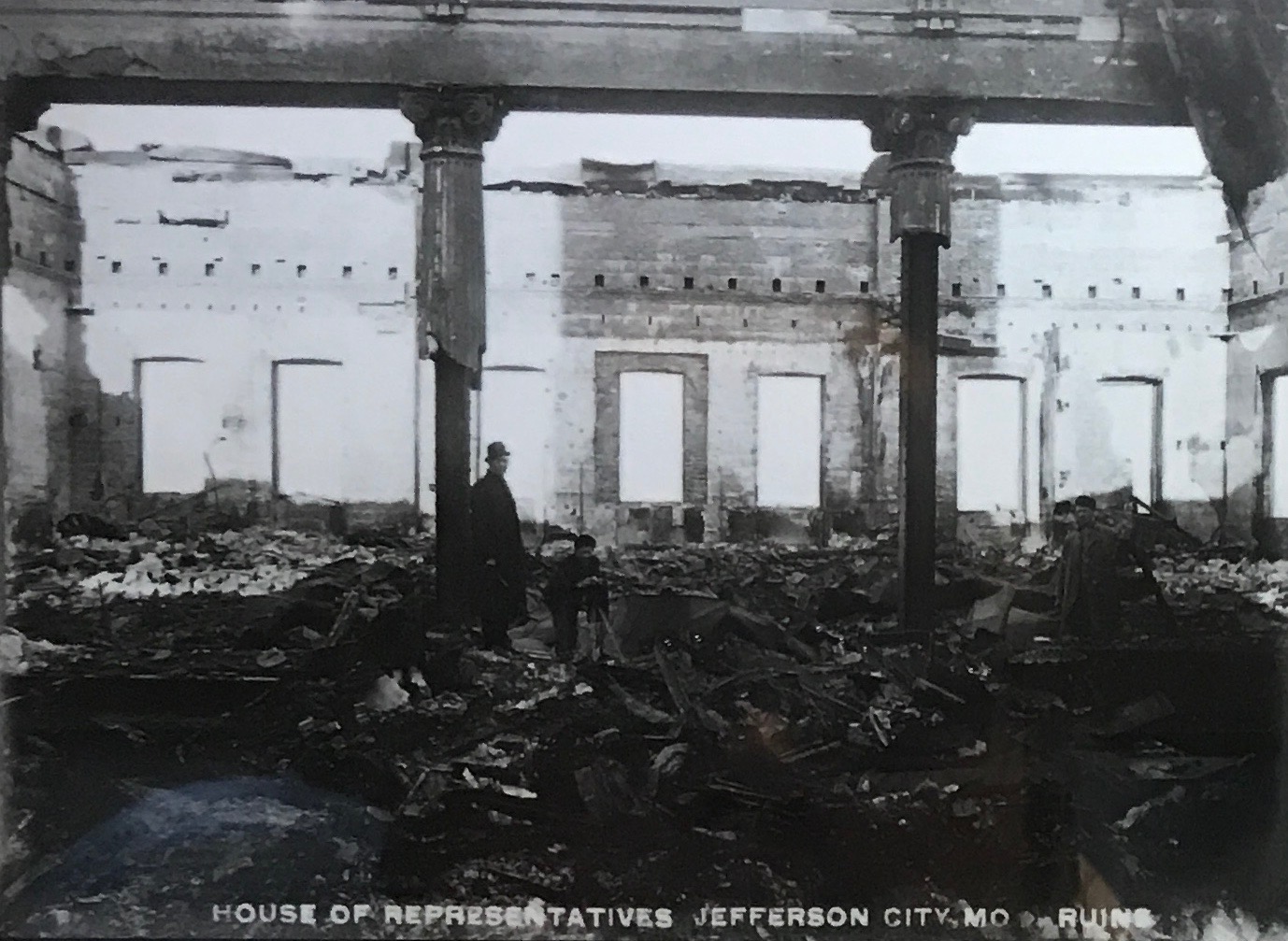
In the basement was a display about the fire that took down the previous capitol. It was struck by lightning in 1911 and burned throughout the night.

The House of Representatives lay in ruins – along with the rest of the building.

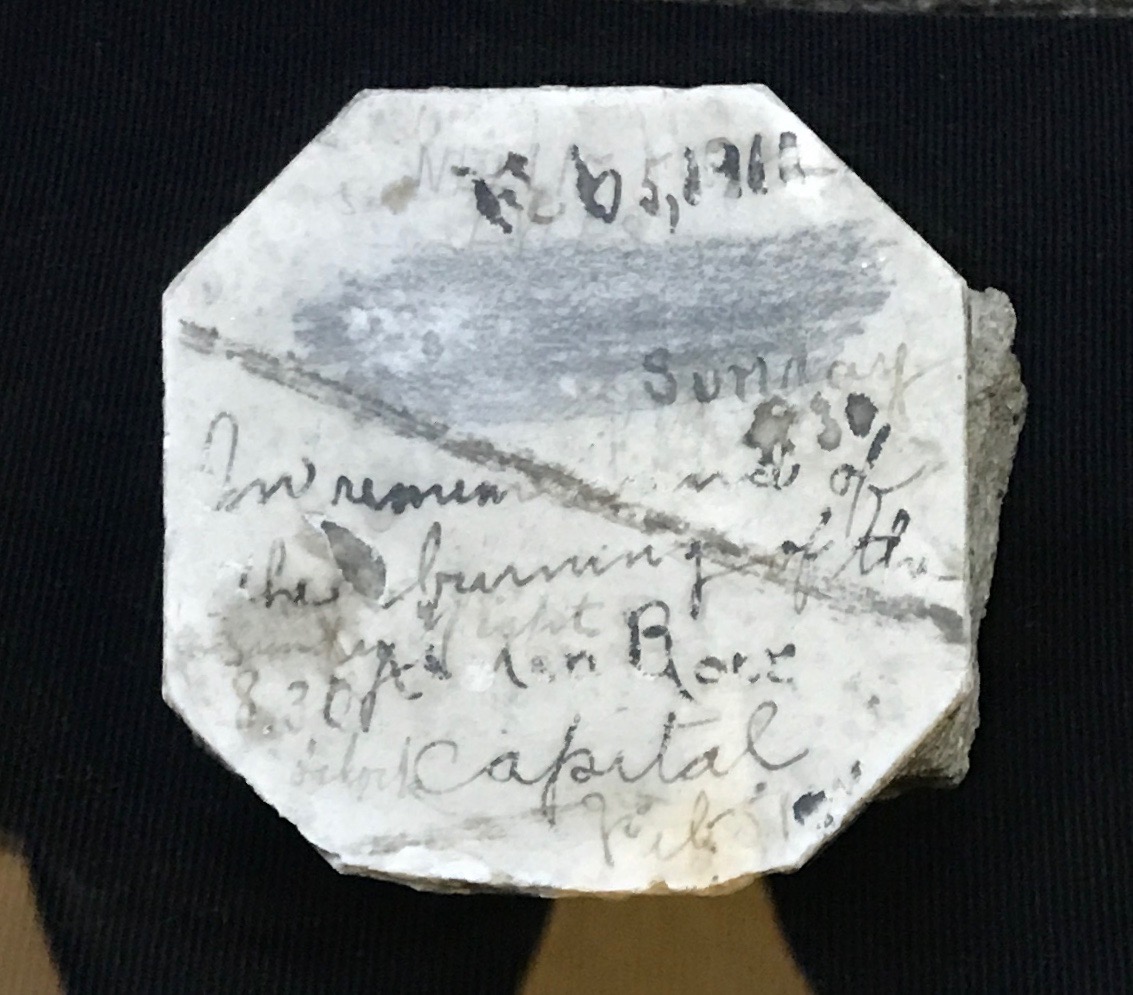
According to the sign with this artifact, “A curiosity seeker pulled this floor tile from the rubble of the 1911 fire. It reads, “Feb. 5, 1911…Sunday…In remembrance of the burning of the Capitol…8:30 A[M]” the rest of the inscription may be names.

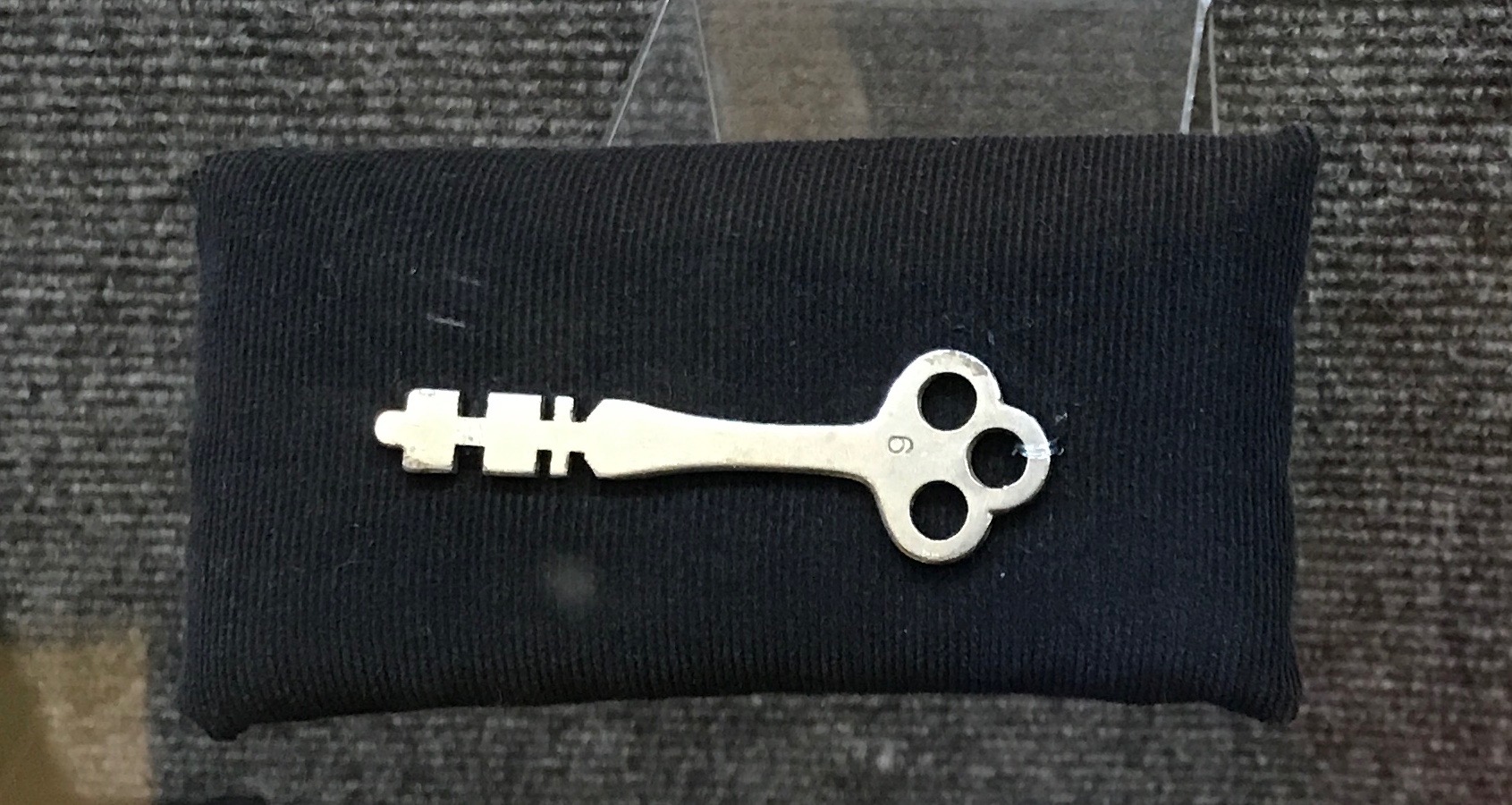
This is the key to the dome of the capitol that burned in 1911. If I remember correctly what the guide said, someone had taken it home. Since it wasn’t at the capitol, it hampered the fire fighting. This key may be the reason why the building burned to the ground. But, maybe I am not remembering this correctly.

I will tell you more about the artwork in my next installment. At this point, I wound my way out.

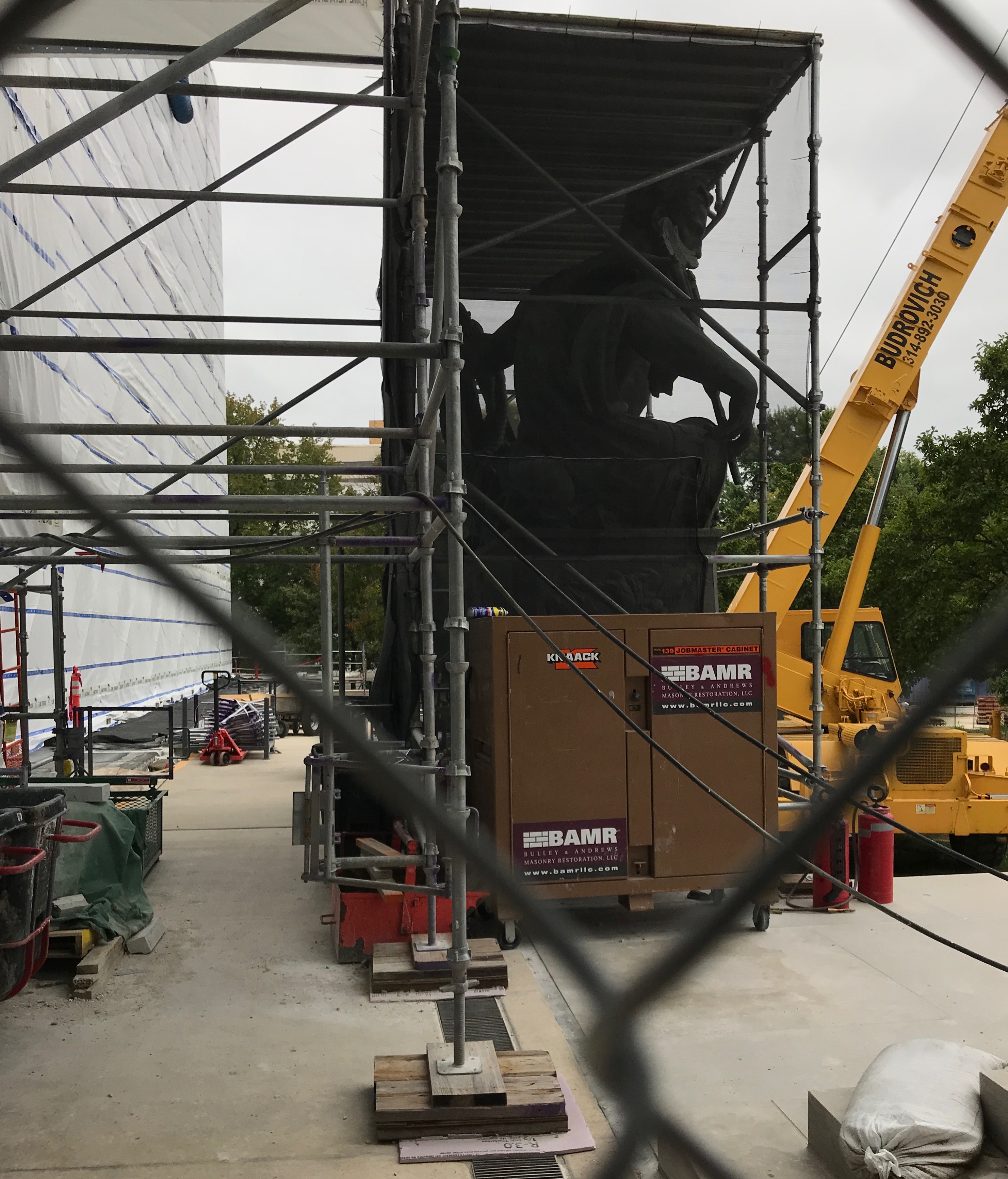
I passed the statuary that was protected by mesh during the reconstruction.

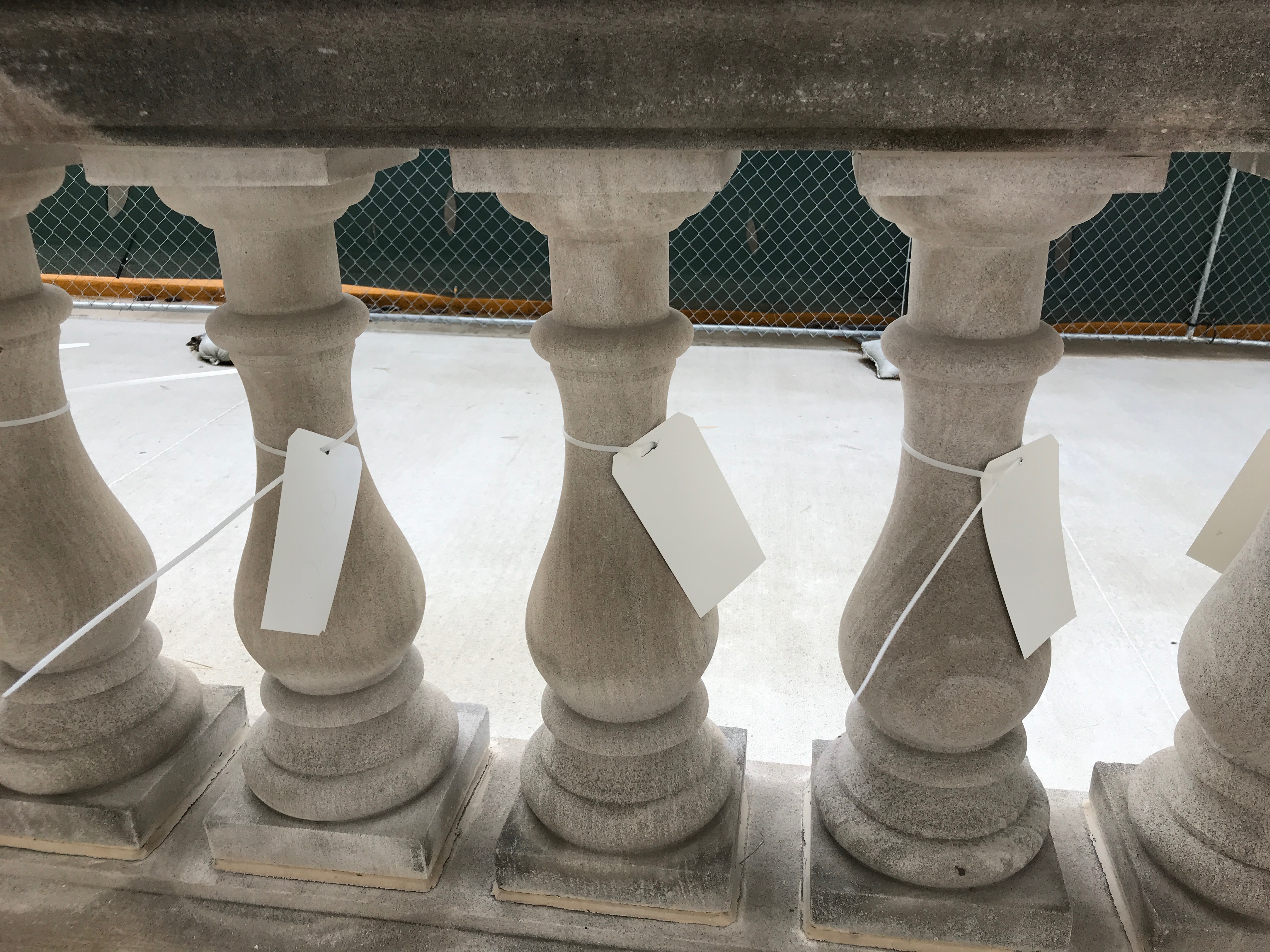
I passed the tagged balustrade. I imagine they are going to remove these and then return them when the work is complete. You want to make sure you put things in the right spots!

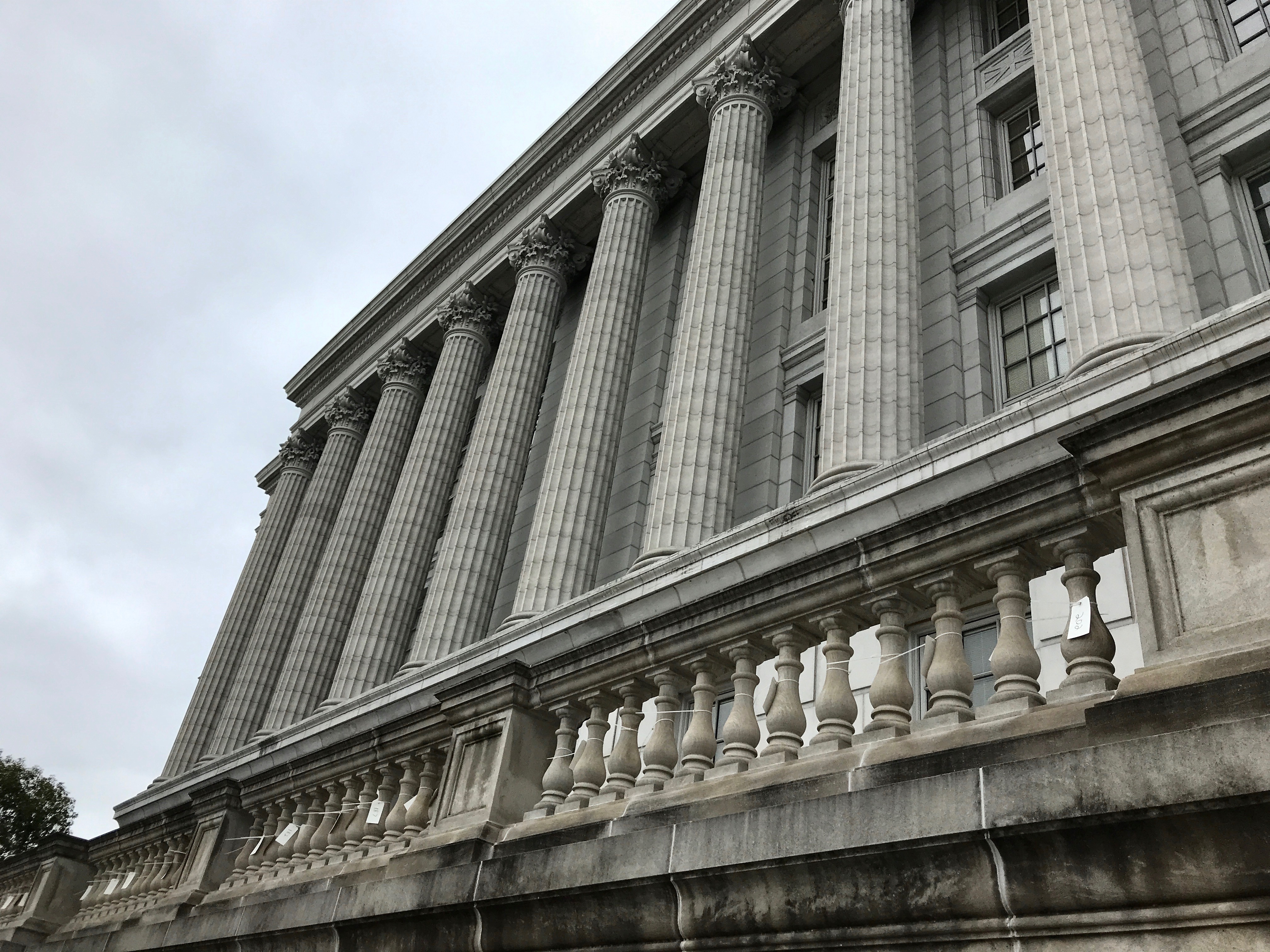
I looked up at the columns.

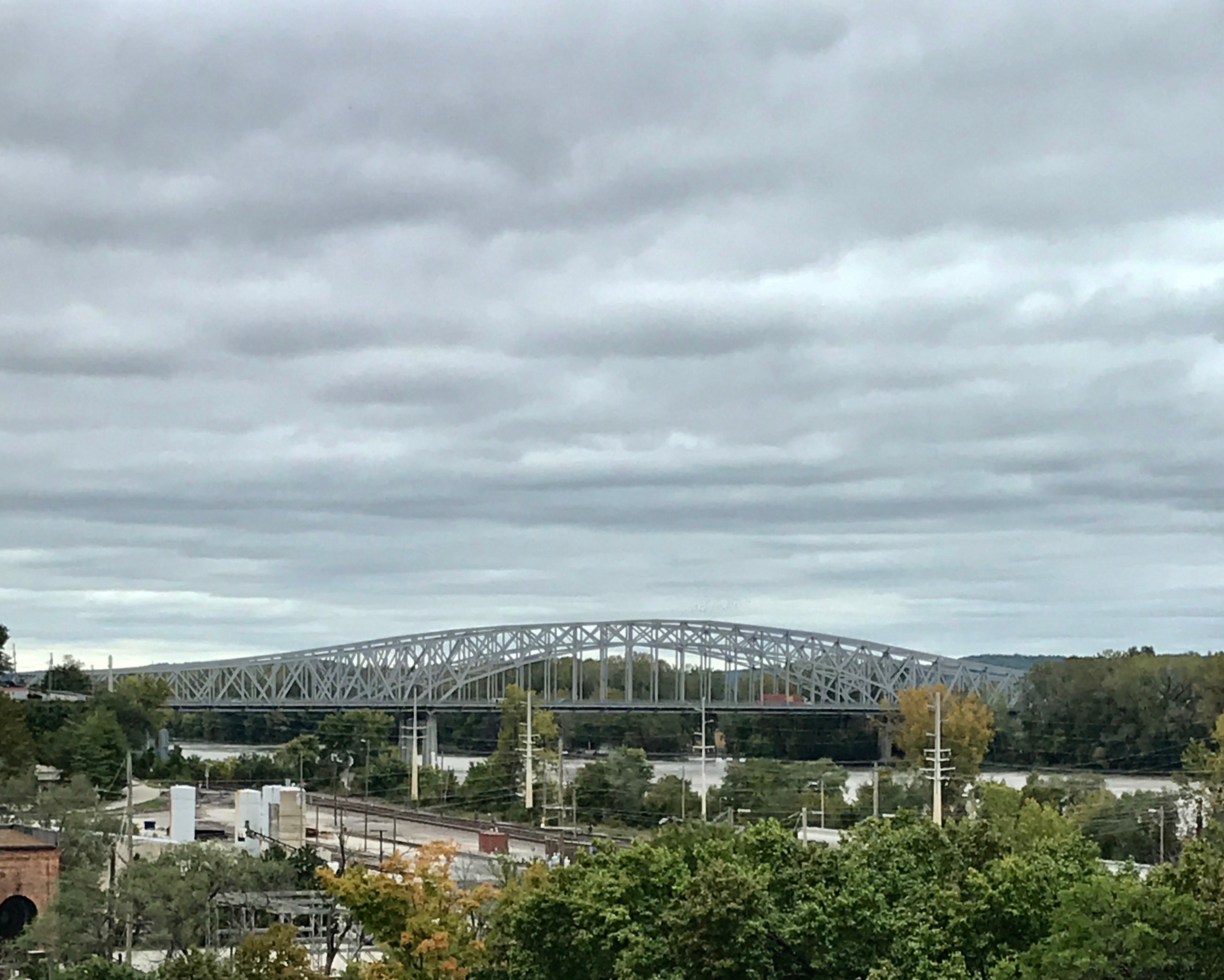
I paused to snap a photo of the bridge across the Missouri, and then I went to find my car. It was time to go find something to eat!


Mission: Cross Some Items off “The List”

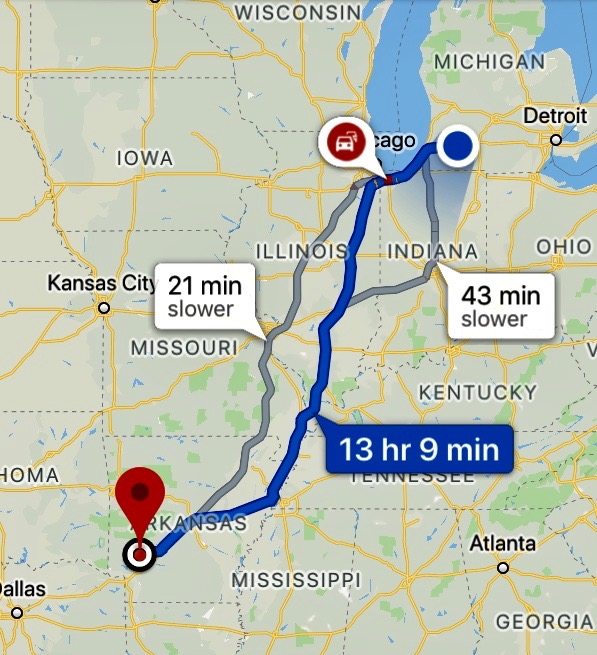
Fall came, and I decided that I needed to get the T@b out for another trip in calendar year 2018. I checked out my list of things I had to put on The List for “next time.” I decided to aim for Crater of Diamonds State Park in Arkansas and see what else might fill in along the way.Hmm…Just how close to Chicago do I want to get? I mean, if that is the most logical thing to do, I will drive the Interstates to get around Chicago. I towed Flo the Airstream on I-94 through Chicago once. Once. That was enough to persuade me of the wisdom of avoiding it – especially with a trailer in tow.

Since the trip is 13 hours at a minimum, I decided to take the Indiana route and ,stop for the night at the Cracker Barrel near Effingham.I love the welcome Cracker Barrel extends to us “nomads.” I have to admit, though, that their definition of “comfort food” is not mine. I was thrilled to find this bowl of beans on the menu. Beans are more my speed. I hope they leave it on the menu, because it is going to be my “go-to” dinner when I stop at Cracker Barrels to spend the night.

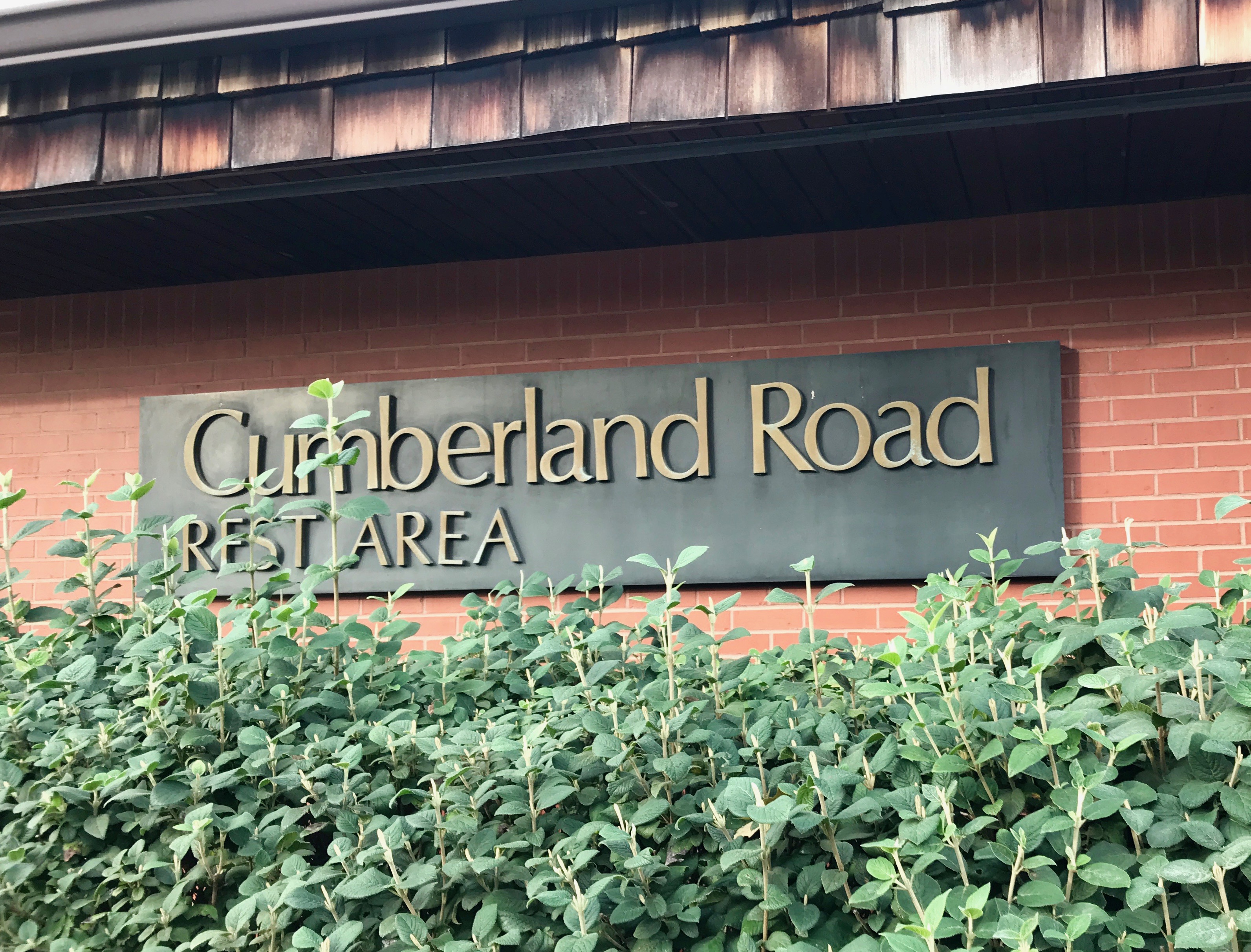
I got going early-ish in the morning and headed west on I-70. I stopped to take a break at this rest area near, Marshall, Illinois. (Never pass up a restroom!)What do you know? Cumberland!

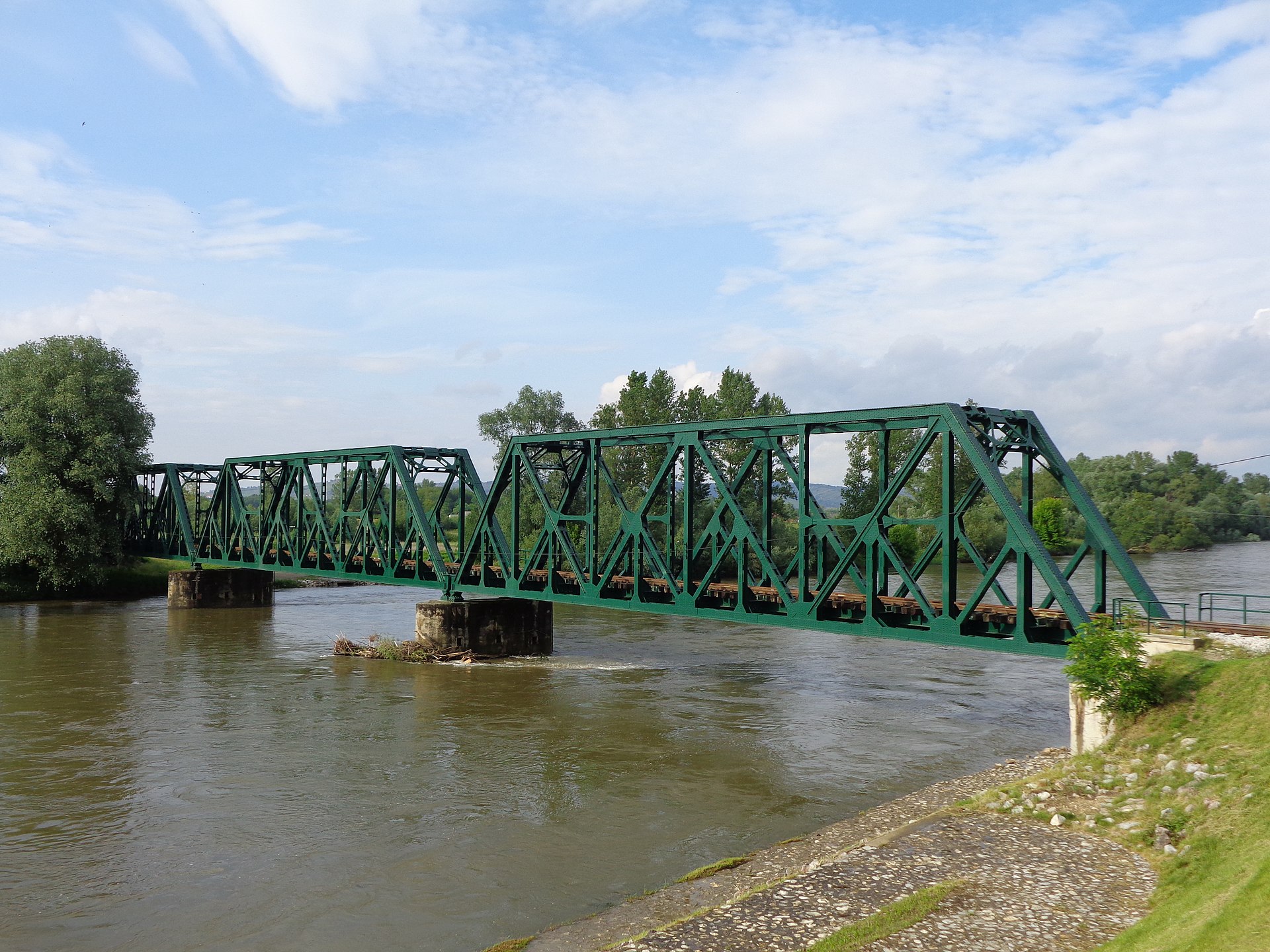
It was a decent rest area. While stretching my legs, I spied this bridge and decided to check it out.It turns out that it is what is left of the Fancher Pony Truss Bridge.

The Trout brothers, Hiram and Everett, were born in the area and the operated a machine shop in Shelbyville, Illinois in the late 1800s. They invented and patented this design for a pony truss bridge.

“What is a pony truss bridge?” I can hear you screaming this at your screen. Well, I imagine you know what a truss is on a bridge, right?

Well, in case your education on bridges was lacking, according to my Preferred Source, a truss is: “an assembly of beams or other elements that creates a rigid structure. In engineering, a truss is a structure that “consists of two-force members only, where the members are organized so that the assemblage as a whole behaves a a single object.”

Essentially, it is material fastened together into a bunch of triangles that work together to hold up the bridge.I’m sure you’ve seen bridges like this before…and this.

My beloved Peace Bridge is also a truss bridge, albeit a bit fancier than the previous ones. I am sure I drove my folks nuts asking them why it had that hump on top. They told me that it held the bridge up. I couldn’t wrap my mind around the concept that something on top could hold something up. Why wasn’t it underneath?
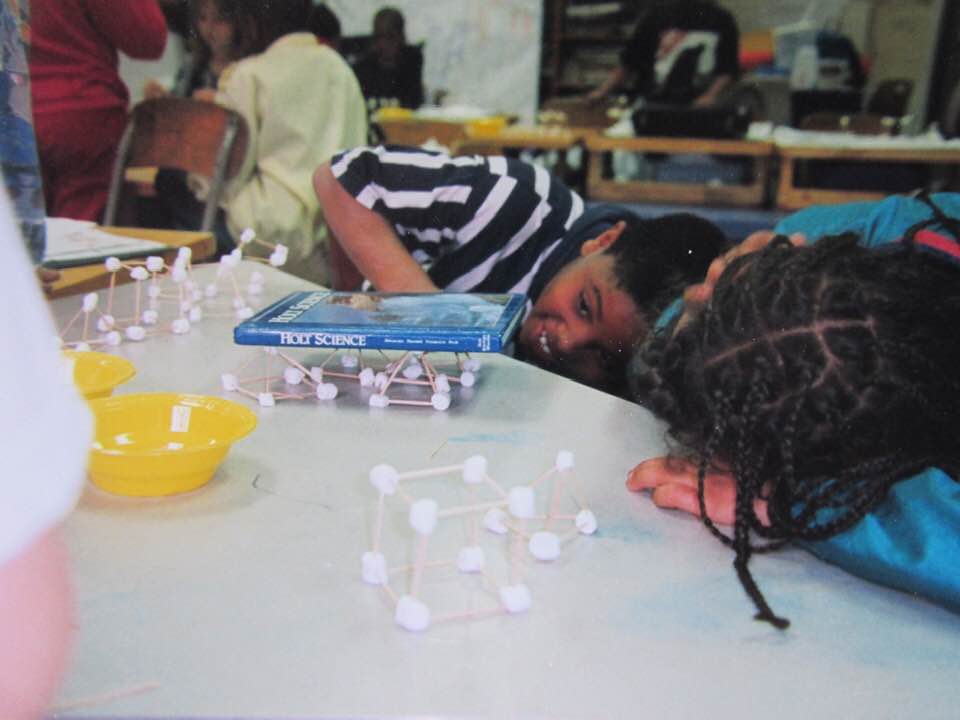
It took teaching shapes by building with toothpicks and marshmallows that I finally got it. (Personally, I preferred building with toothpicks and gumdrops, but I didn’t have a photo of one of those activities in my files.
Okay, so that’s what a truss is. So what is a pony truss?
A pony truss is a short truss that doesn’t connect overhead, like the other examples I showed you. That explains (to me, at least) why they call short walls in houses “pony walls.”

Anyway, our friends, the Trout Brothers, built about 150 of these bridges between 1892 and 1897. That’s about 30 bridges a year! They must have been churning them out at a rate of a bridge about every week and a half.

According to the sign that was at the bridge, what makes these bridges unique is that they used round pipe in construction, instead of the usual rivet-connected channel plates and angle iron. I guess that’s why they were awarded a patent on the bridge.

This bridge was in use for 88 years, from 1895 until 1983. It was reduced in width from 15 feet to 8 feet and moved 70 miles to this location for preservation.

And that’s all I have to say about that.
The reasons for the stop having been satisfied, I set out again. My next destination was Jefferson City, Missouri. But first, I had to go through St. Louis.
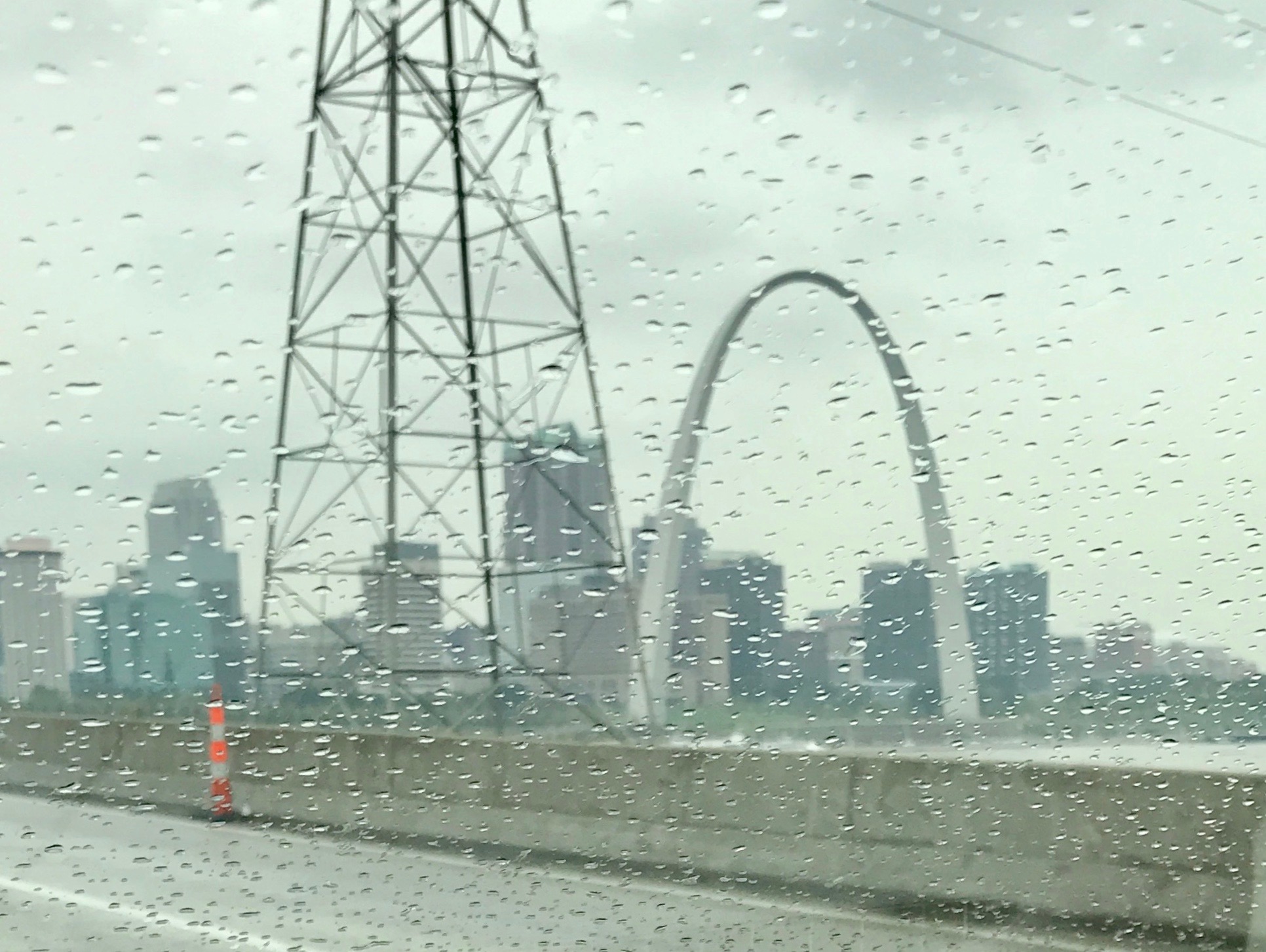
It was raining. (I hate rain!) The traffic was dreadful, thanks to construction. At least the stop-and-go traffic gave me the opportunity to snap this water-logged photo of the Arch. (I’ve been there before, so it is not on The List.)
My purpose in visiting Jefferson City was to see the capitol. I booked a site in the closest campground I could find. I pulled in and signed their two page (TWO PAGE!) list of rules and they gave me my site for the next two nights.
If they need a two page list of rules, they must have some rowdy customers at times. At this time of year, though, the campground was largely empty. I settled in for the night and got ready to visit the capitol on the morrow.
Stay turned!


Family Fun

The other important component of my first adventure with my new trailer was family fun.

I’ve already mentioned getting together with my sister.

Later, I got together with sister Amy and brother Craig’s families. Food and fun!

and games!

Here’s Craig’s daughter, Mariel, and Amy’s husband, Steve, playing Connect Four with stuffed animals as proxies.

Here are two-thirds of my nieces, Sarah and Mariel. I wonder where Katie was?

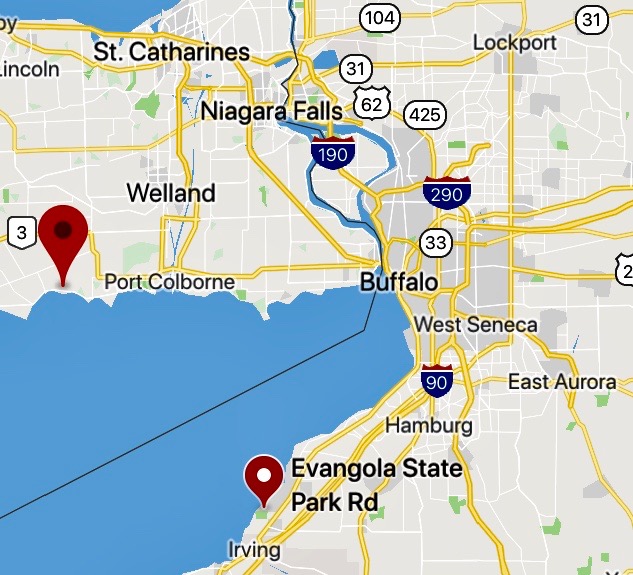
The next day it was time for me to break camp at Evangola State Park. I got hitched up and headed to

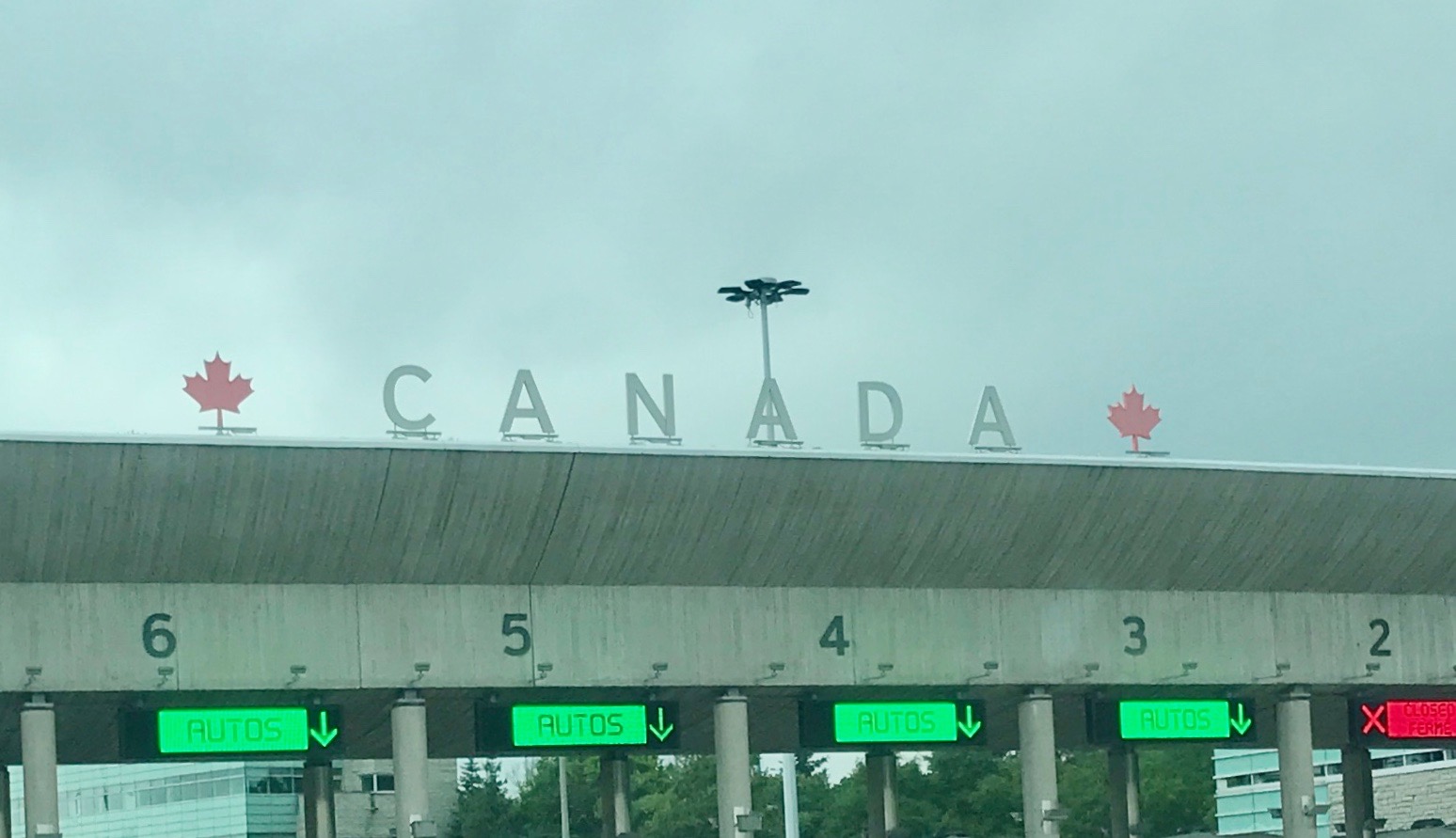
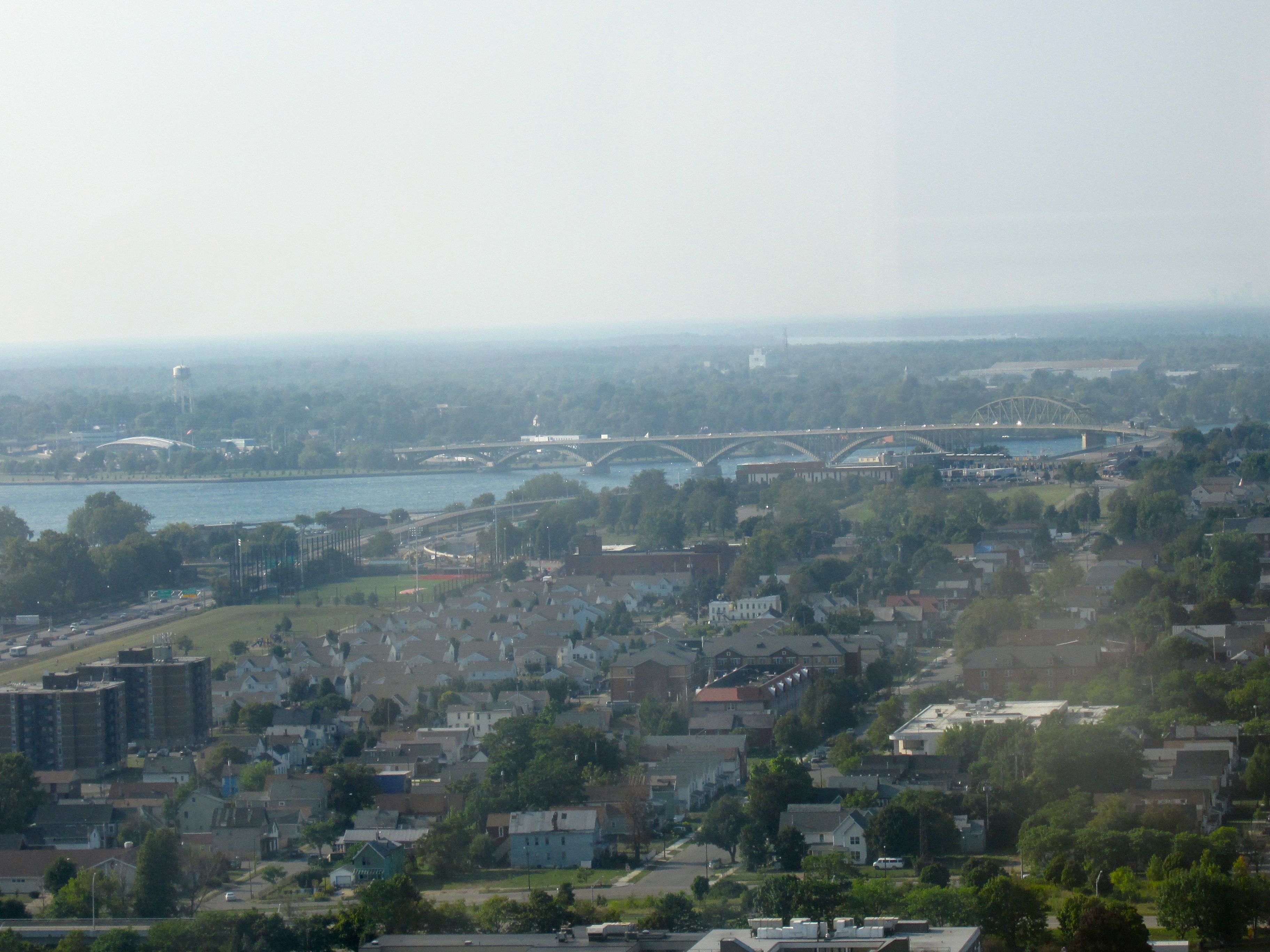
It was my first border crossing with the T@b, but hardly my first crossing. With family on both sides of the border, I’ve been back and forth across the Peace Bridge thousands of times.

I took this photo of The Bridge a few years ago when I was on the top of the Buffalo City Hall.

My destination was Long Beach, Ontario.

My cousin, Bill, and his wife, Lori, have a site for the season at Long Beach Conservation Area and Campground. We’d been talking about camping together for a few years. It was time to finally get it done!

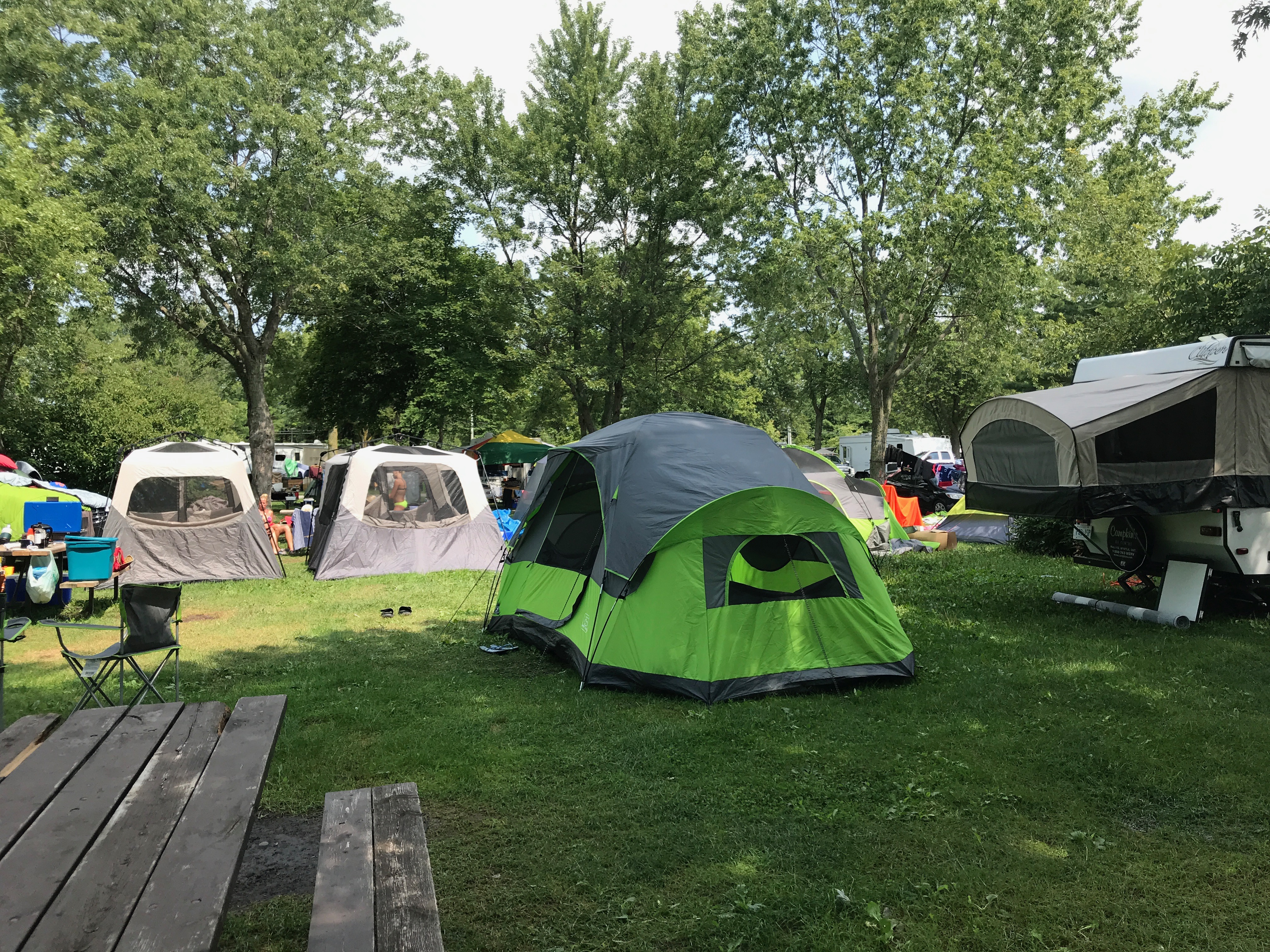
It was a very popular campground!

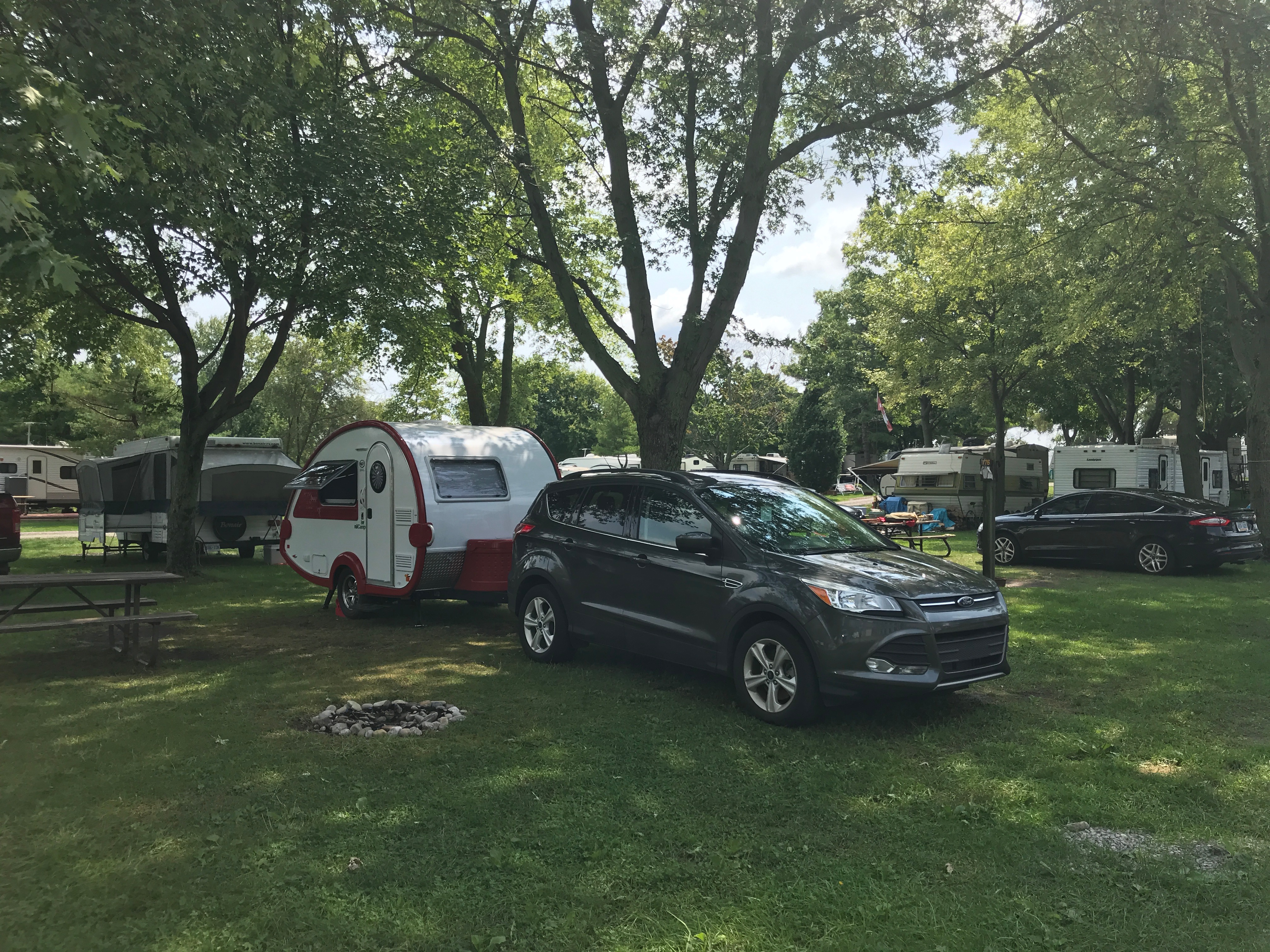
I got my T@b wedged in. More people packed in around me after I got set up.

Lori and Bill had a primo site – right at the shore.

I like this close up photo better. I am really big on cropping!

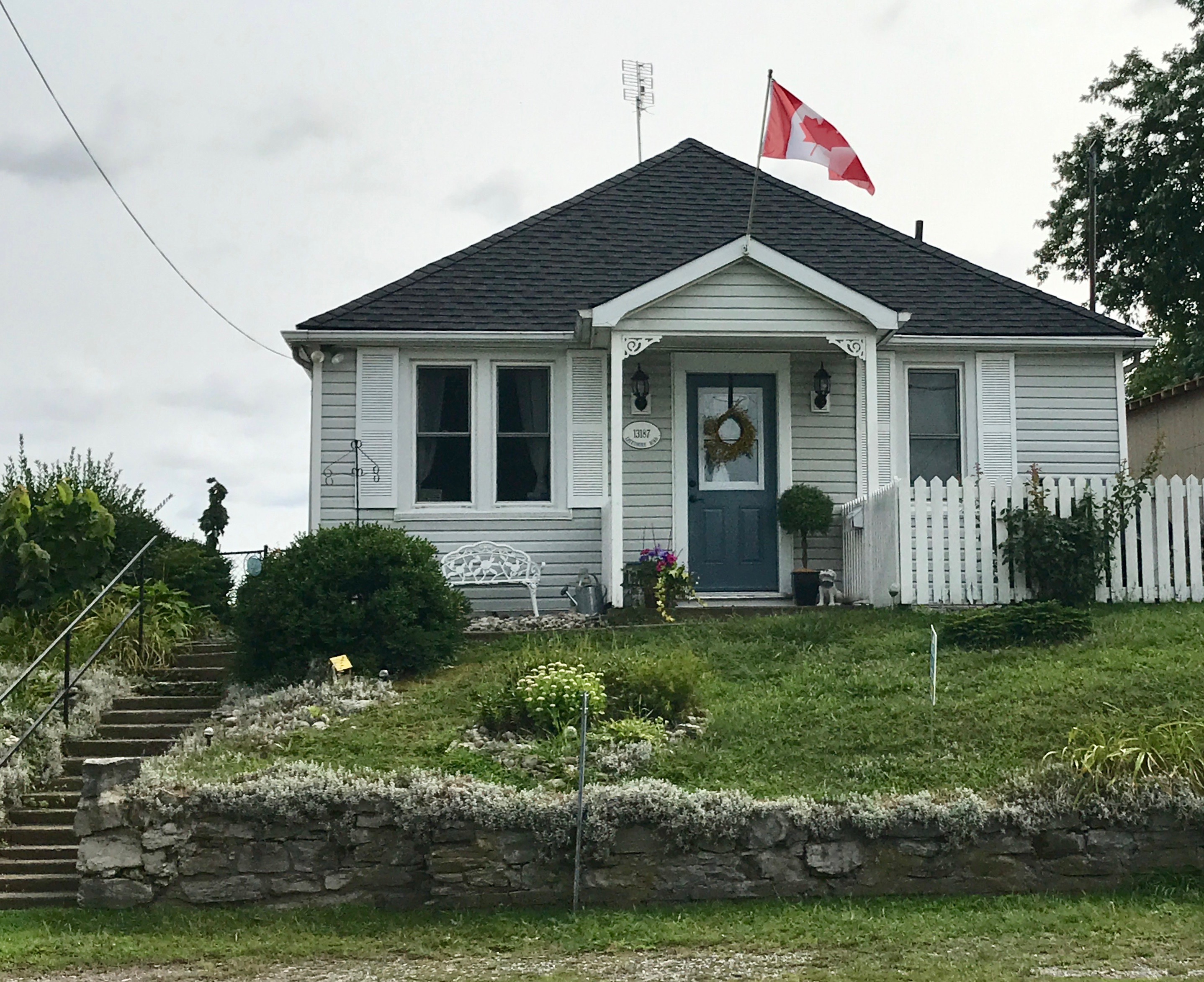
Amy and Katie came over to spend some time with our cousins, Bill and Wayne. After snacking and hanging out a bit, we went for a little drive. I asked if we were near our Auntie Lo and Uncle Bill’s cottage. We were!

The neighbor on the right was outside, and I got out and engaged her in conversation. After a bit, the current owner came up, and we chatted with him, too. He had just finished renovating it and he insisted us up to see what he had done.

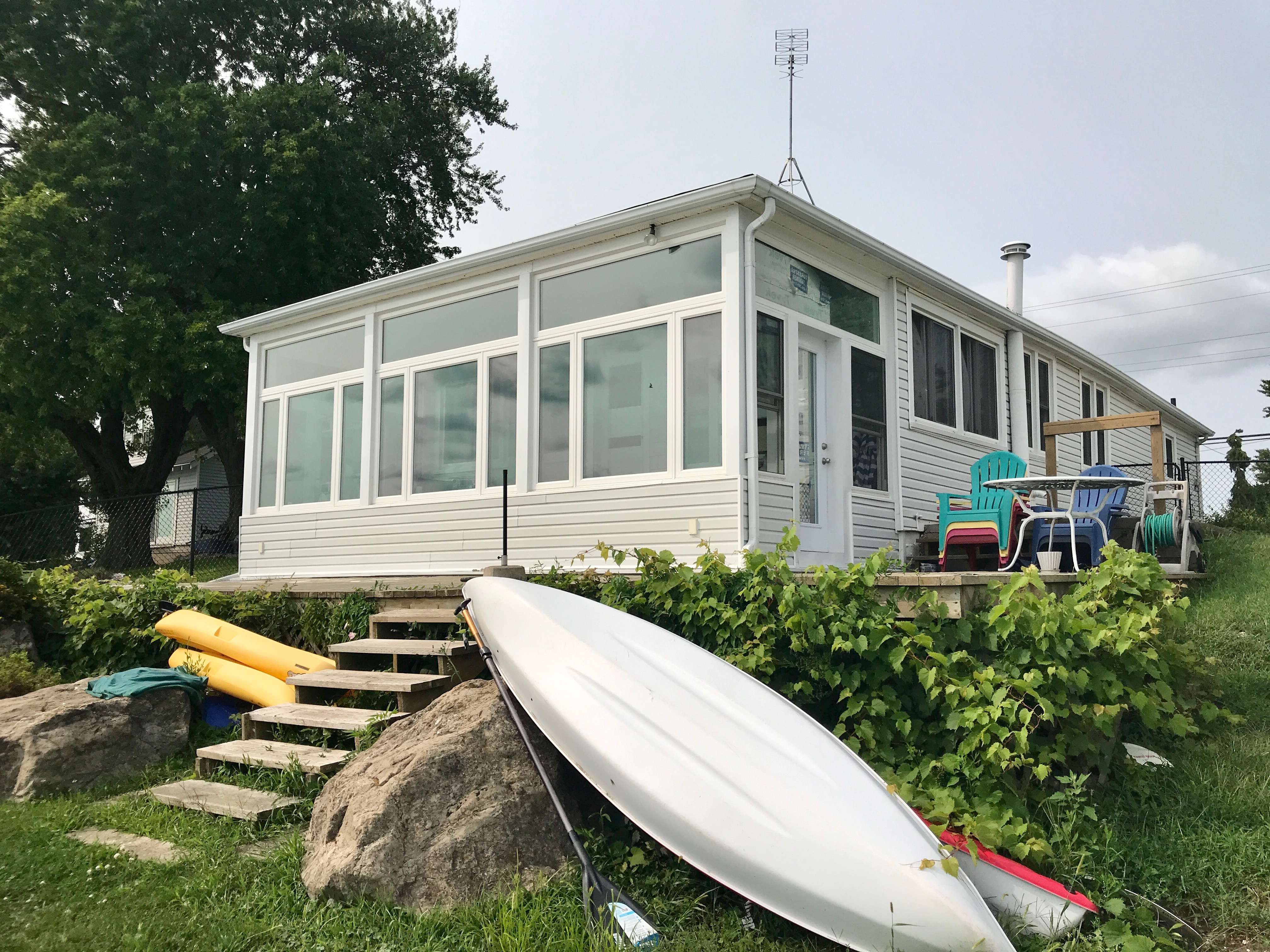
He did a really great job! The floor plan was the same as I remember, except for the bedroom that was to the right of the door.  Well, actually, the floor plan of that room was the same, but the amazing bunk beds were gone. Auntie Lo and Uncle Bill had triple decker double sized bunk beds! They could really cram a lot of guests in the house!

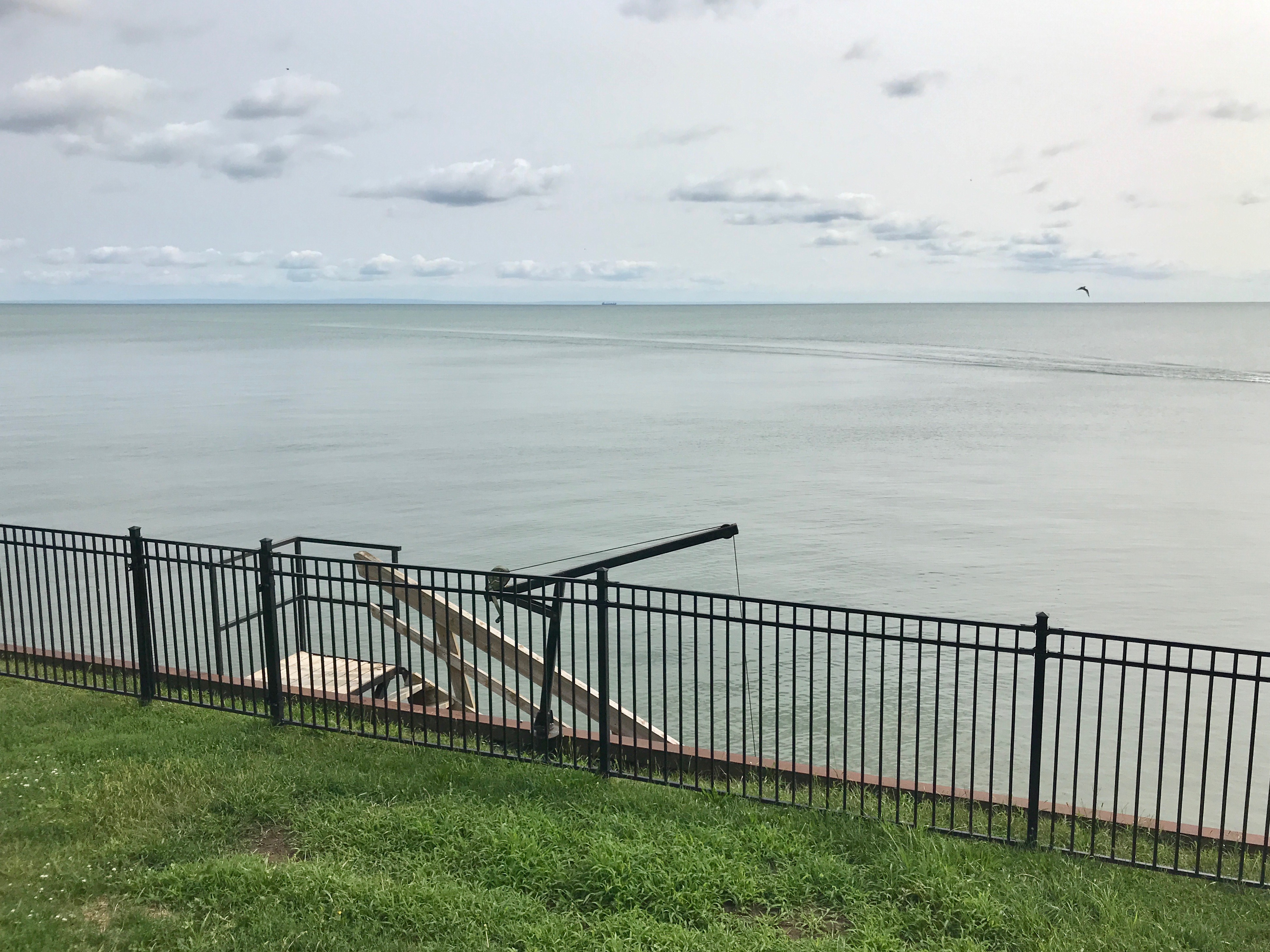
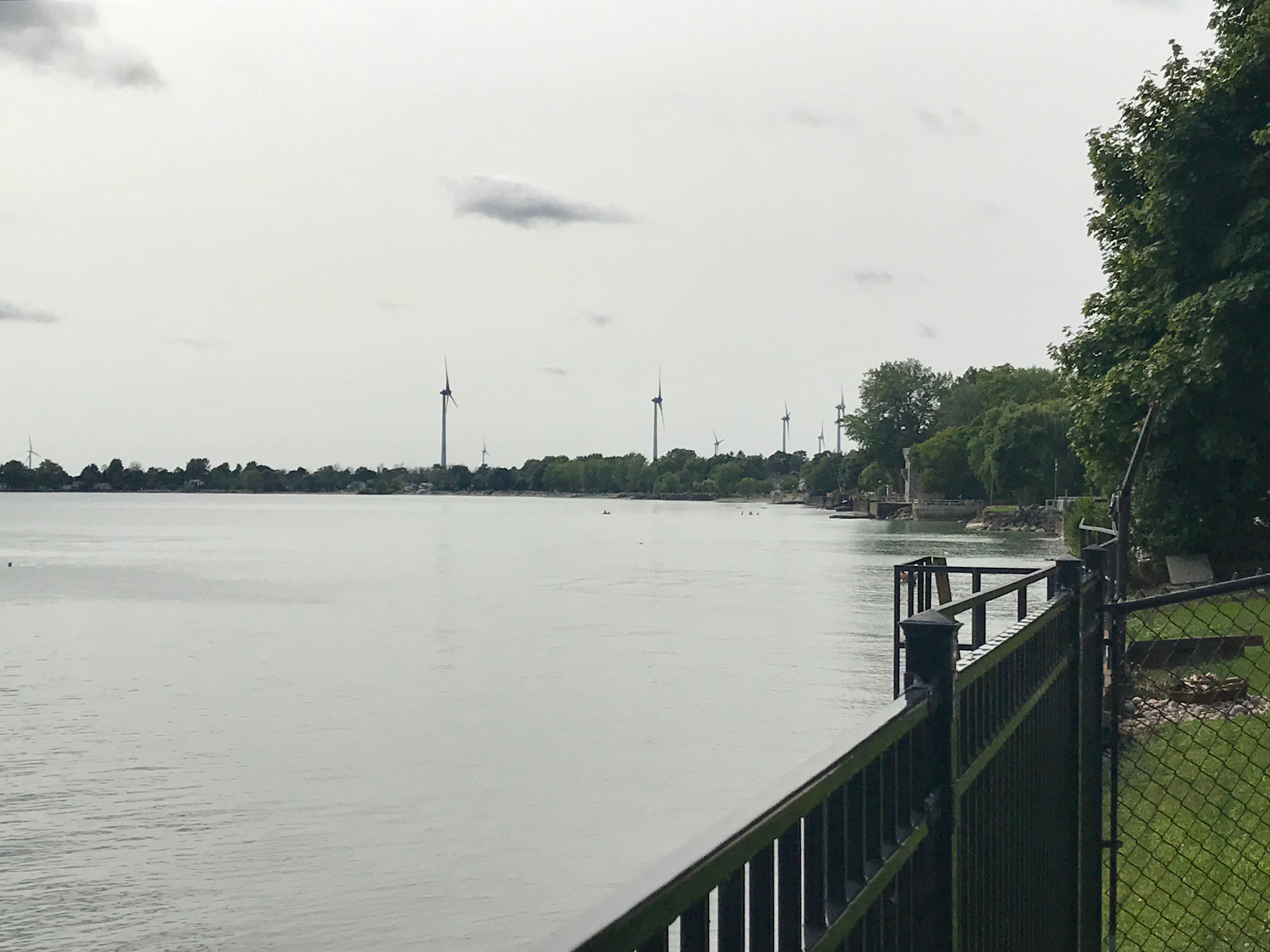
They even had couches on the porch facing the lake that people couple sleep on. There were changes. For instance, the beach.

The beach was gone!

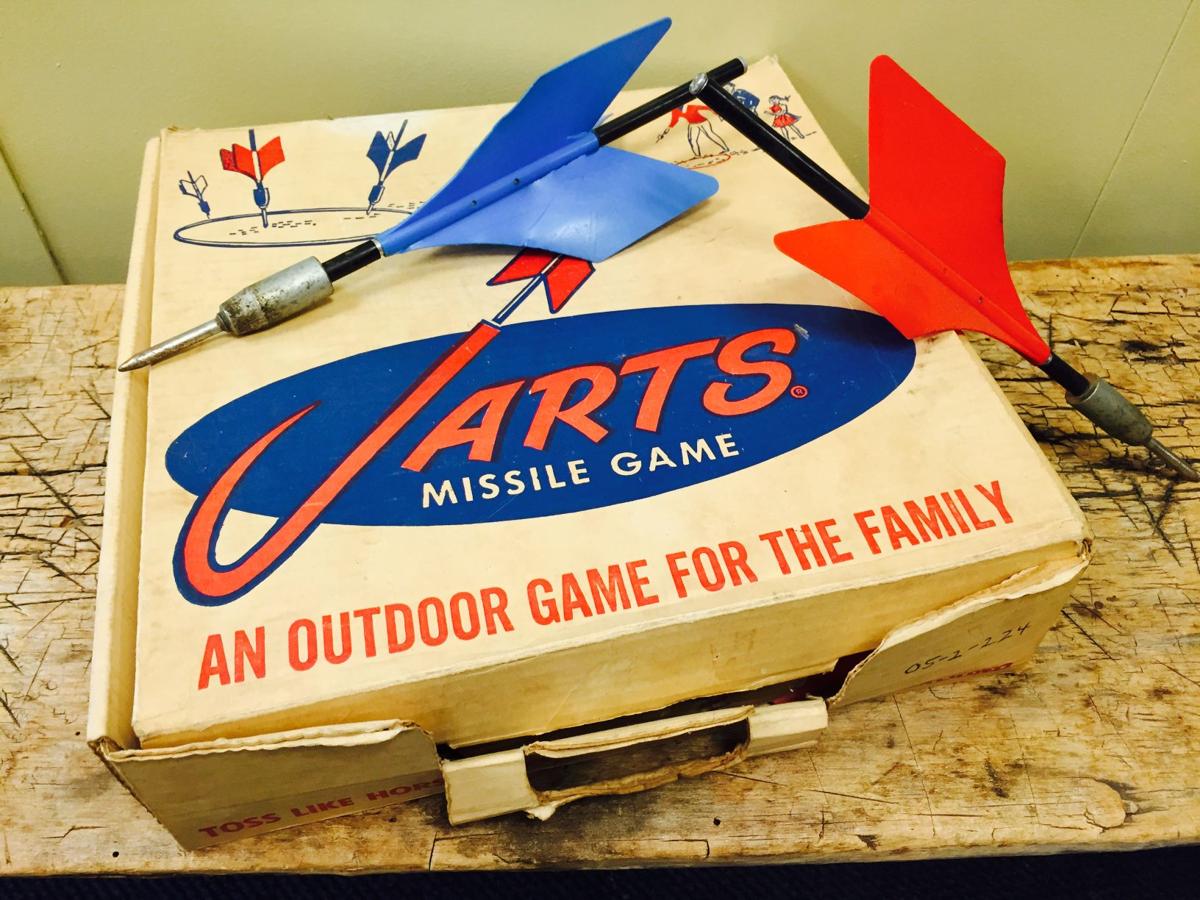
As I remember it, there was a good sized yard that we played games on. For some reason, I think we played Jarts. But, I could be mis-remembering it.

The beach was wide. There was a black rubber conveyor belt to make it easier to walk across the rocky beach. The idea was great, except that – boy – did it get hot in the sun!

Really, the beach was absolutely gone! If the owners who came after Auntie Lo sold it in 1976 hadn’t put in a restraining wall, they cottage probably would have tumbled in the lake.

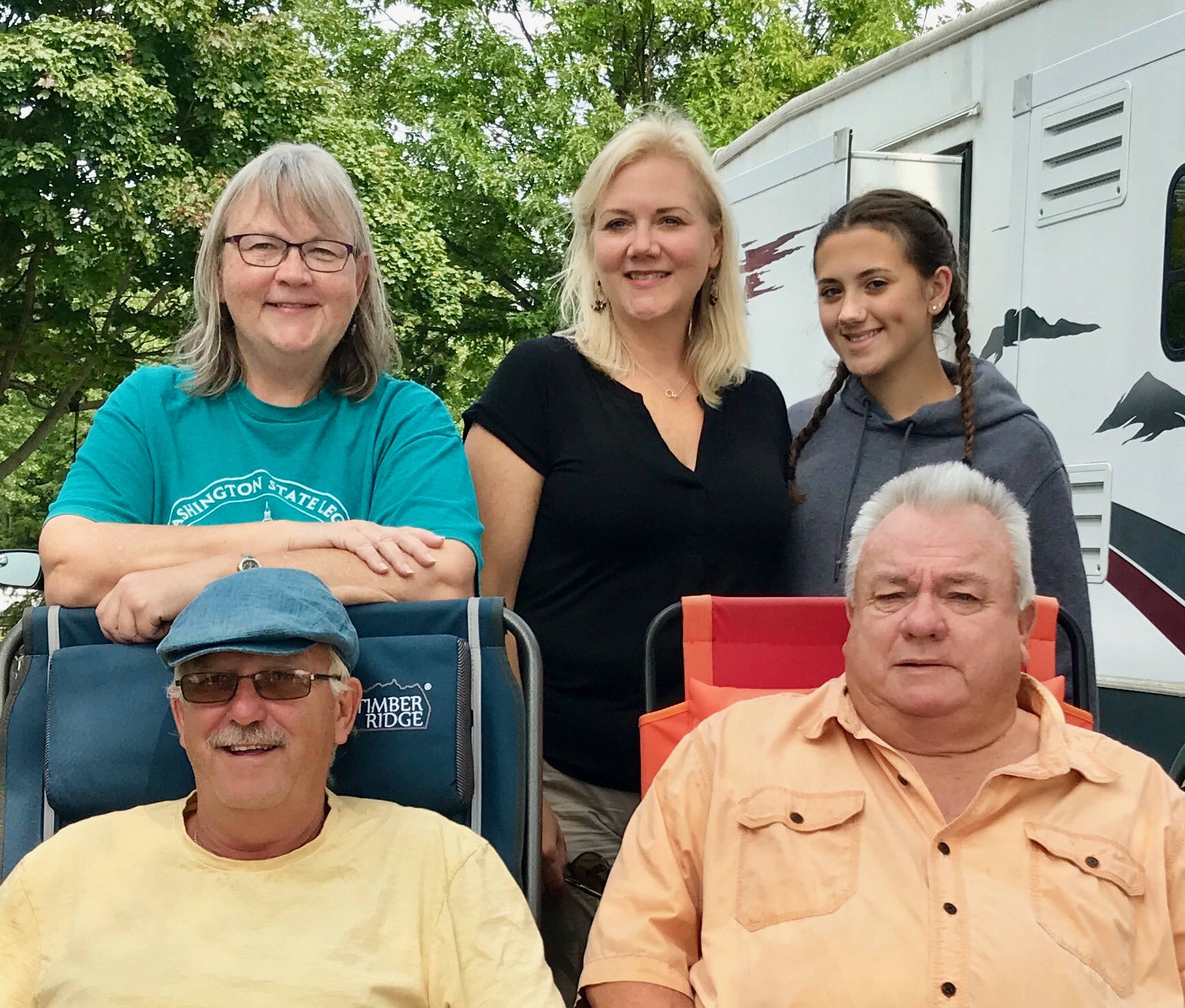
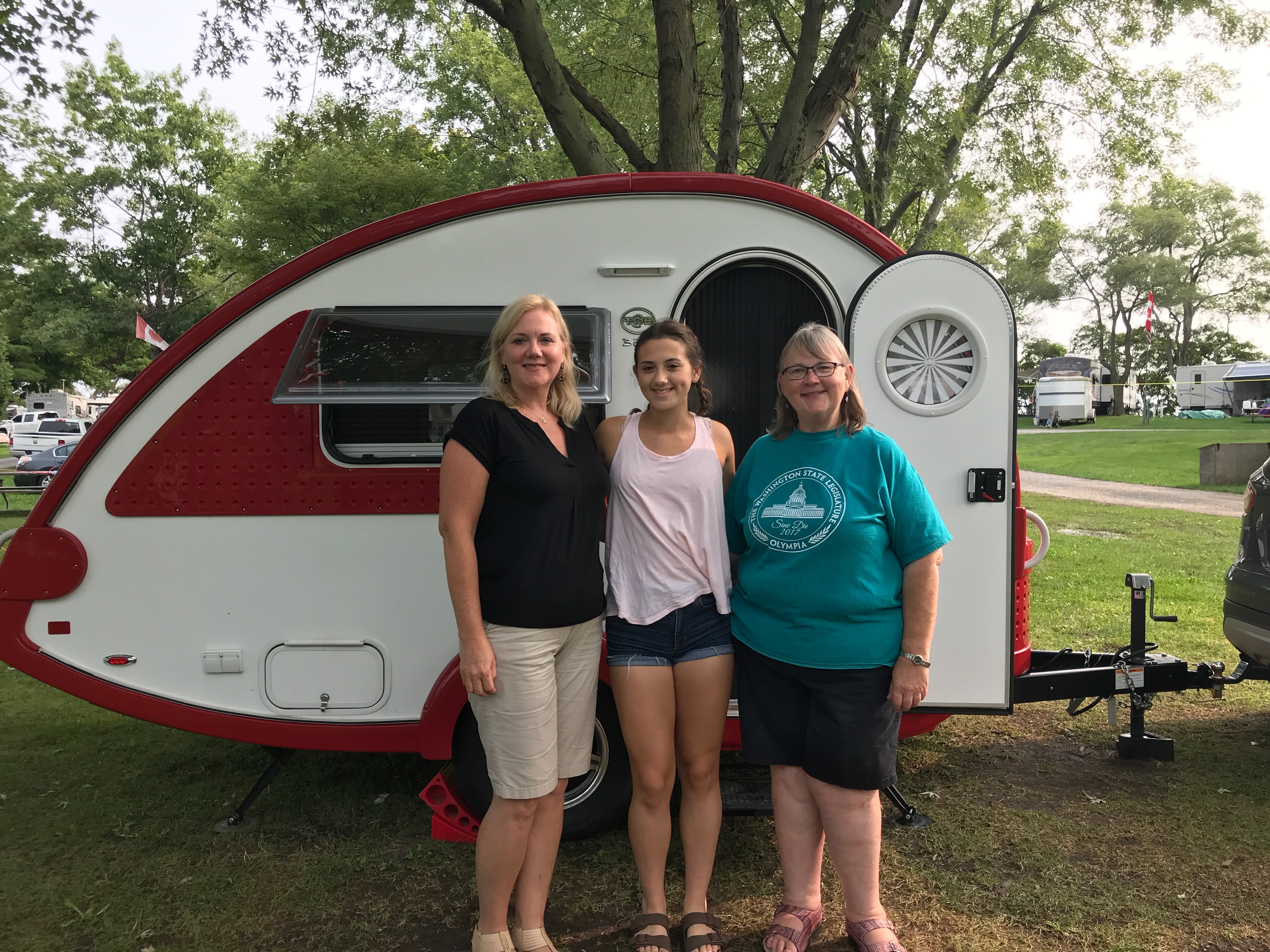
After our trip down memory lane, Amy and Katie needed to be getting back. We had a photo taken by my trailer and said our goodbyes.

That evening, The rest of us, headed to a beachside restaurant in Lowbanks.

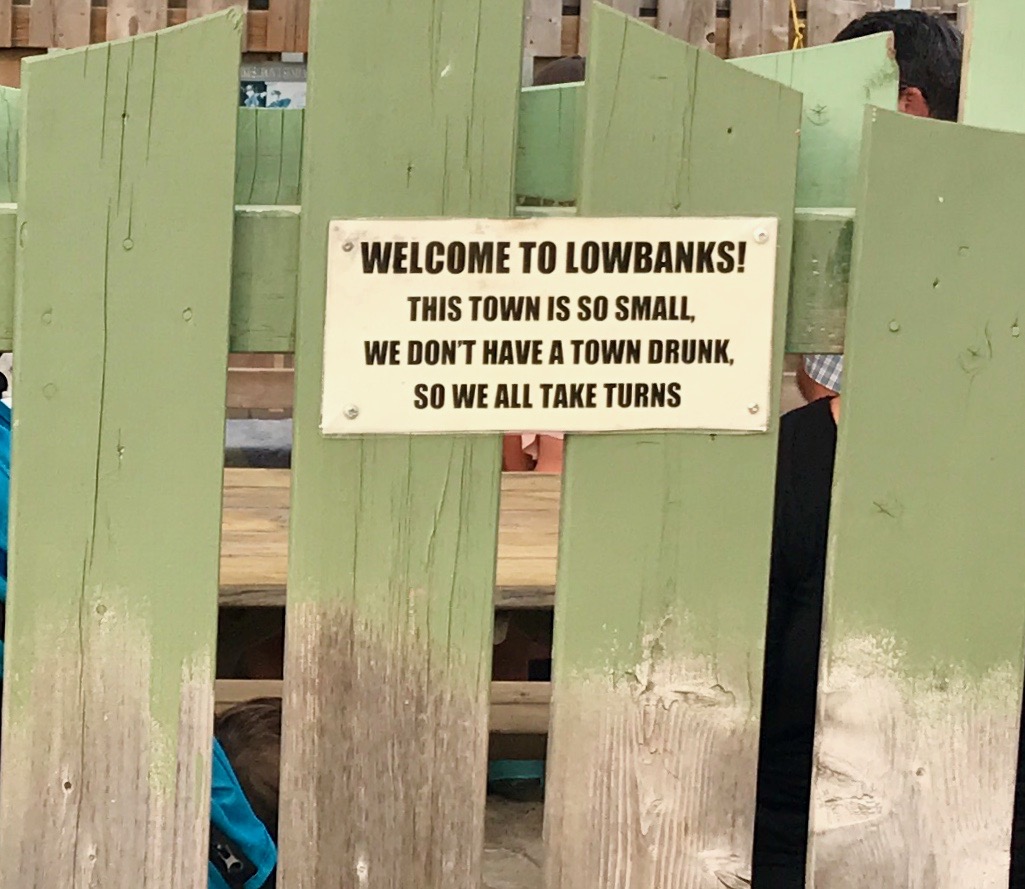
A good time was had by all. The sign made me giggle.

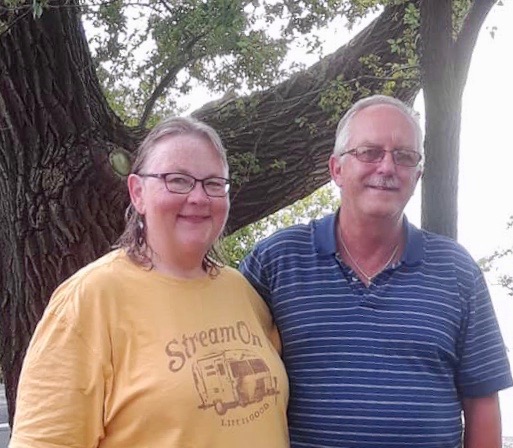
In the morning, I got myself ready to hit the road. We thought it would be a good thing to take a photo of me and my cousin, Bill, to commemorate the visit. The wet hair makes me wonder if it really was a good thing.

But, there’s a photo and it so it happened.

Time to hit the road.

Destination: Kalamazoo.


Greycliff: The Restorations Continue

Long time readers of my blog – or those people who know me in real life – know that I am very interested in the work of Frank Lloyd Wright. I grew up with his famous Martin House in Buffalo. I even toured it with a Girl Scout group back when it was in real disrepair. Man, you should see it now! Honestly, if you ever get to Buffalo, you must visit the Martin House.

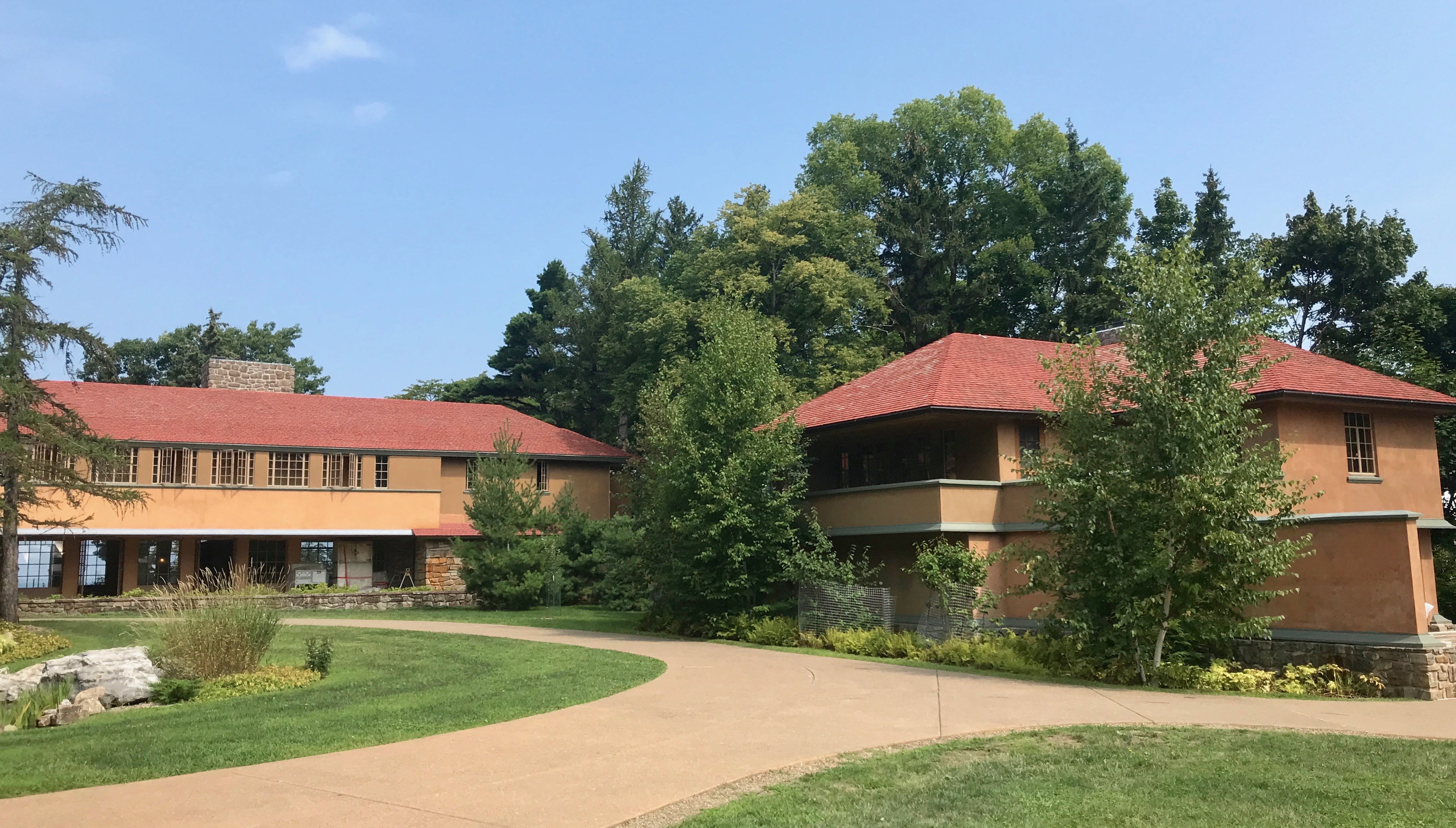
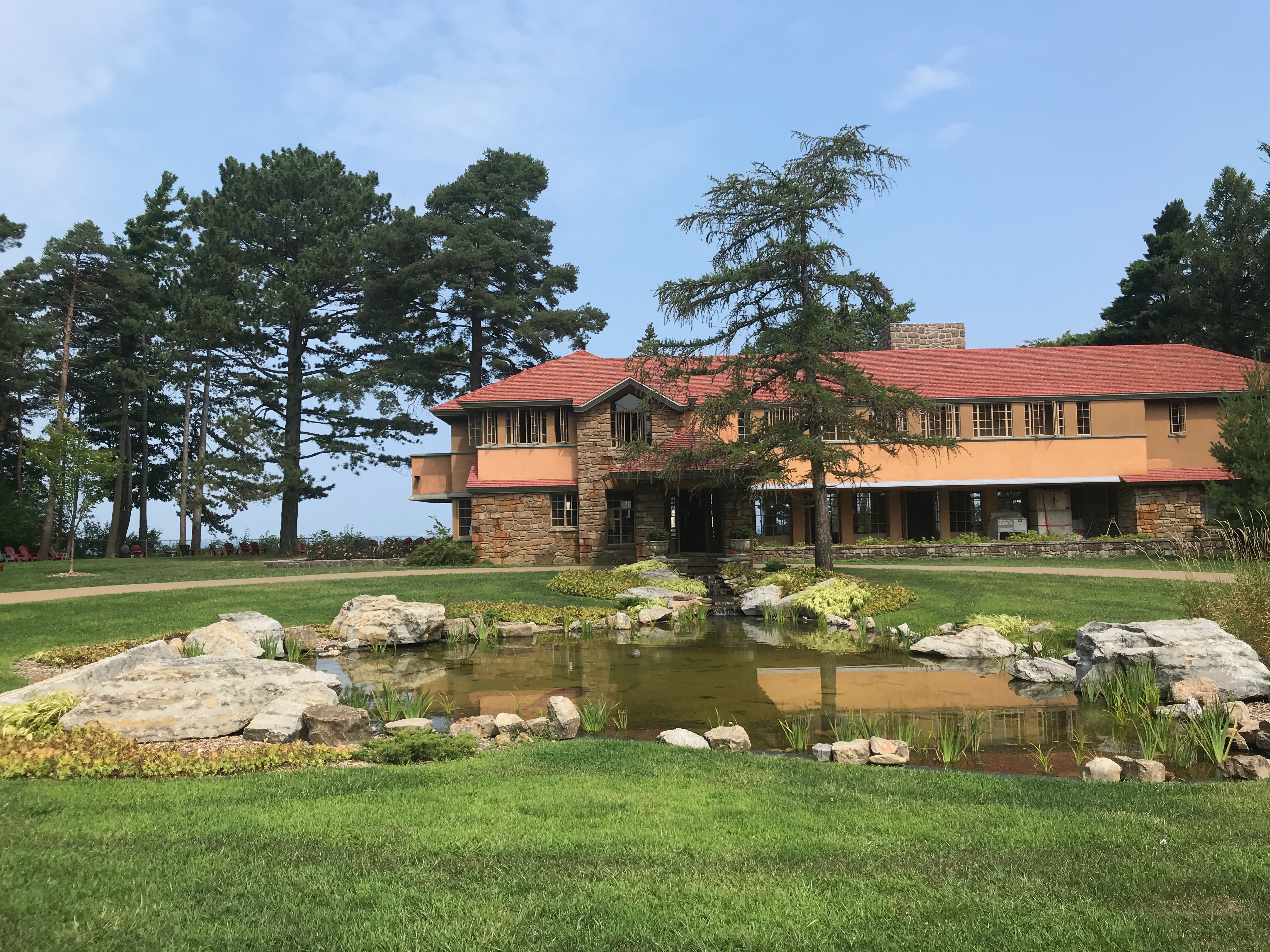
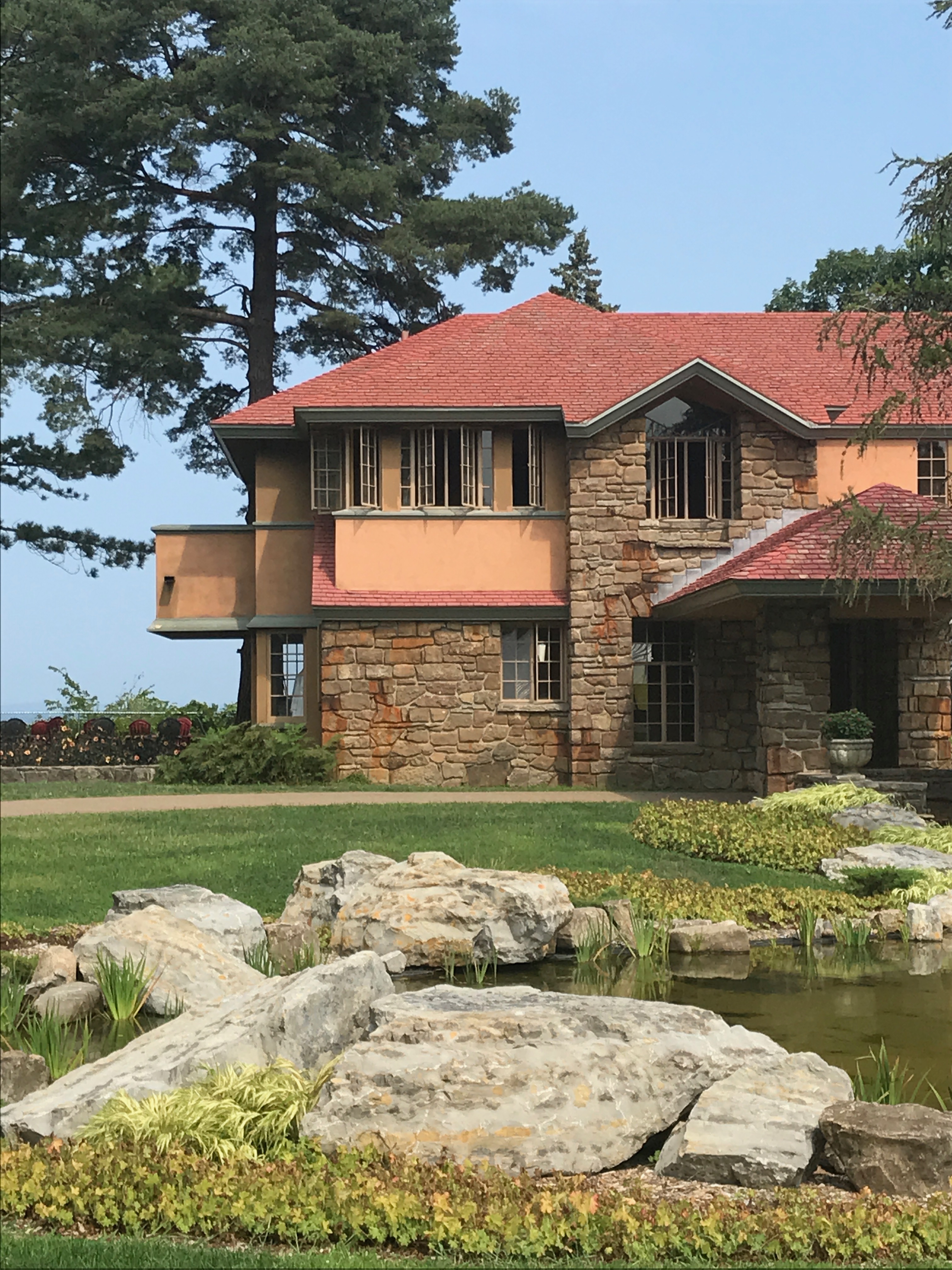
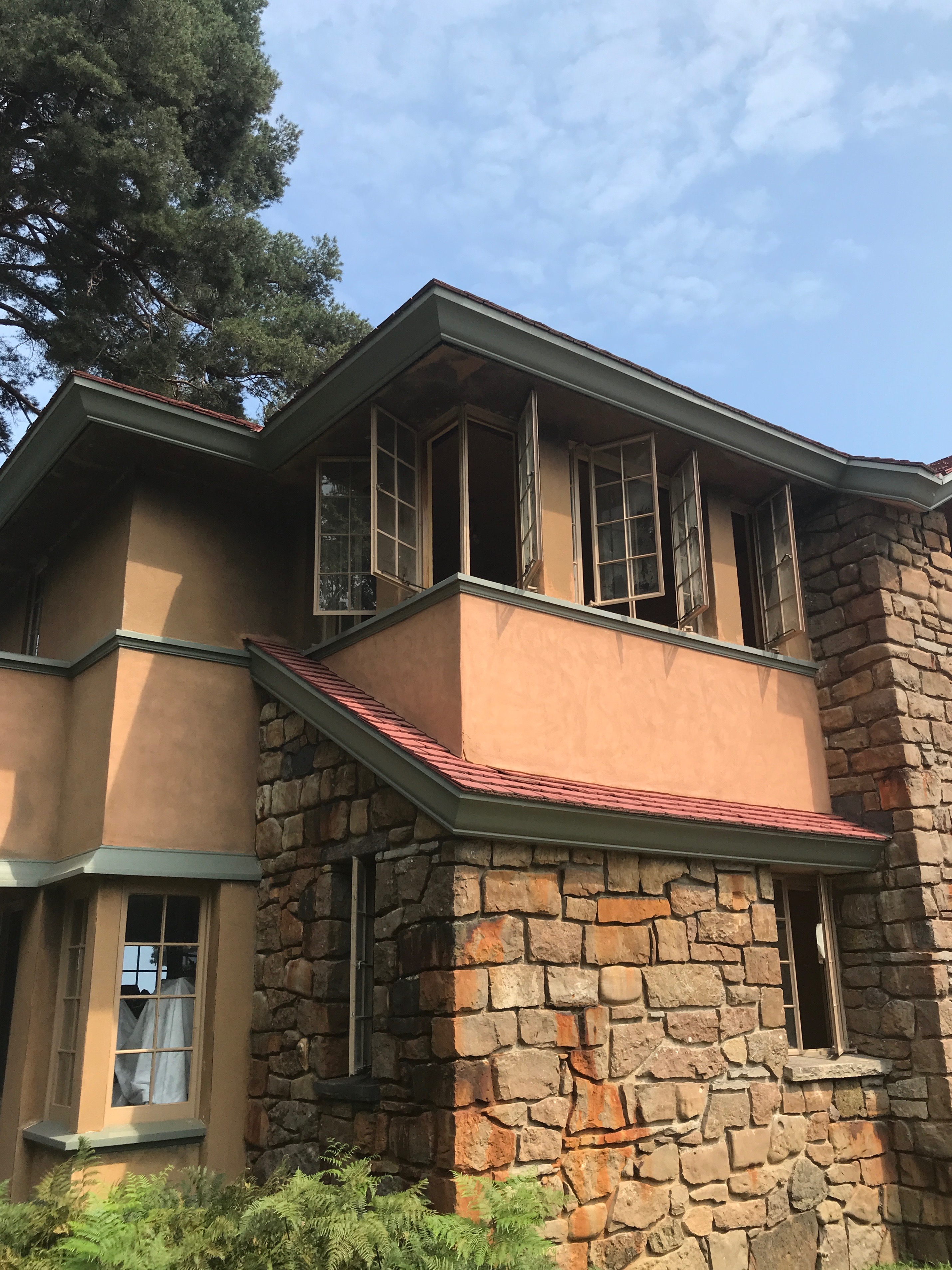
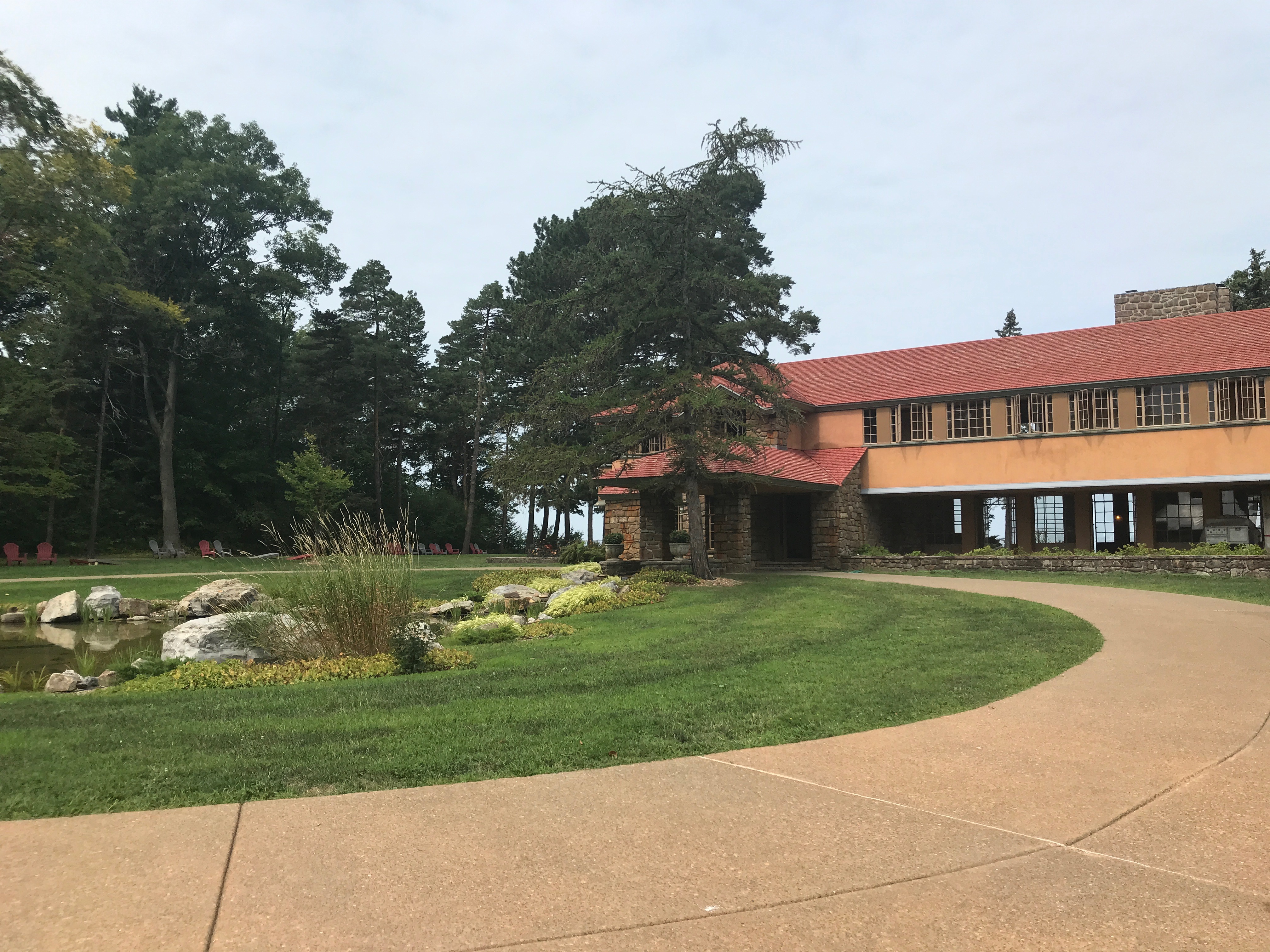
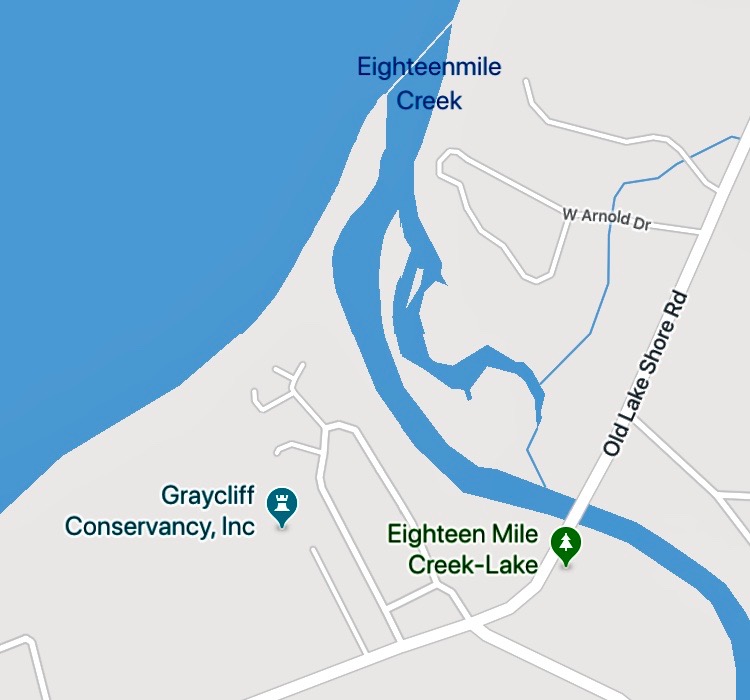
But, I digress – sort of. Greycliff is another Frank Lloyd Wright house – and another Martin House. It’s their summer place, on the Lake Erie shore, and only about ten miles from Evangola State Park. I decided to take a tour.

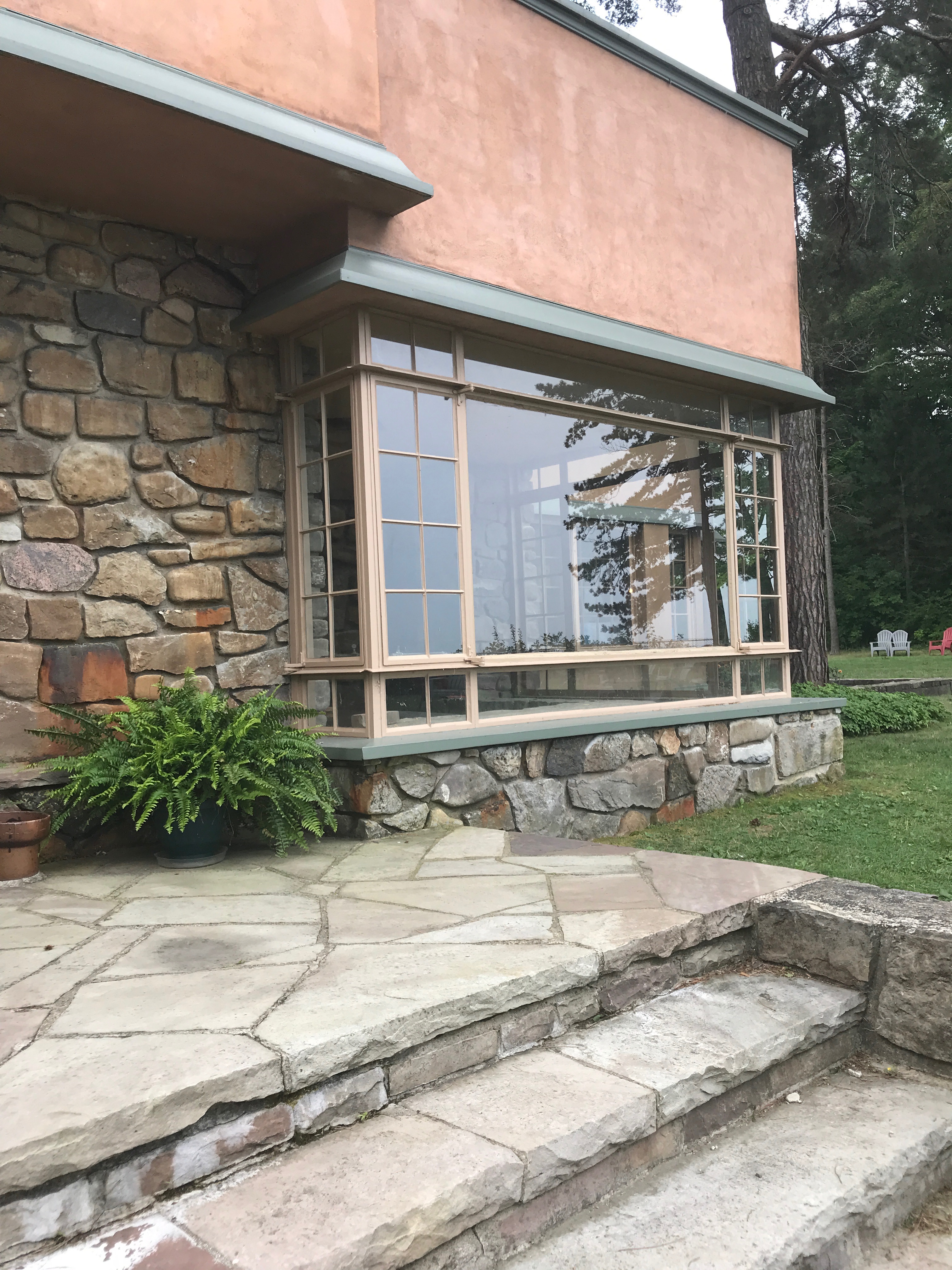
It was built between 1926 and 1931, and is one of only five Frank Lloyd Wright designs that were built between 1925 and 1935, and it is the only Wright designed structure built between Taliesin (1914) and Fallingwater (1936) that was built using stone. According to my Preferred Source, Greycliff is considered to be one of Wright’s most important mid-career works in his Organic Style.

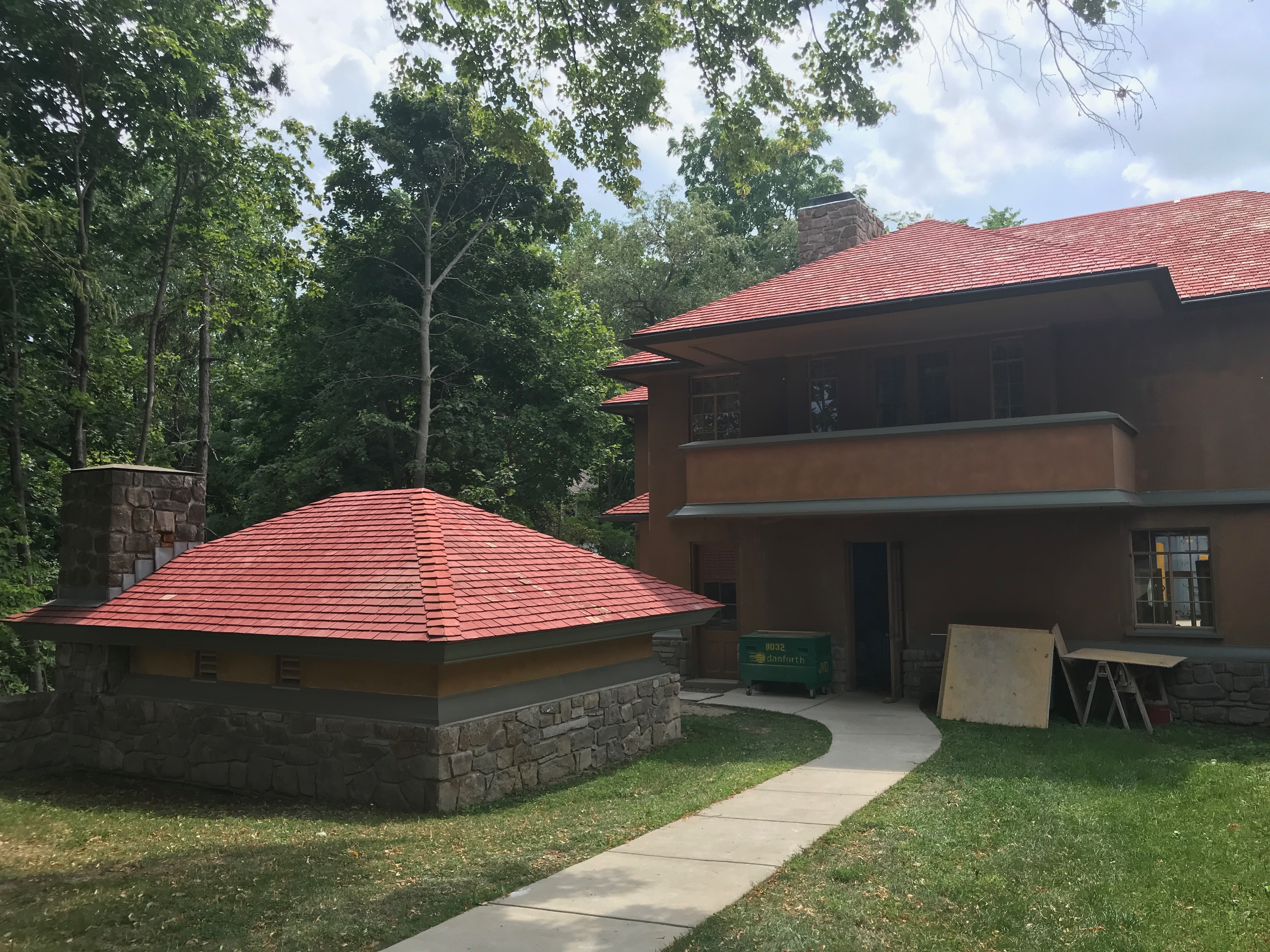
While I was waiting, I managed to snap a photo of a drawing of the complex made from a bird’s eye view. The building on the left is known as the Isabelle R. Martin House. The structure to the right is the Foster House. It was originally designed as a garage with quarters for the chauffeur and his family. It was expanded, and eventually the Martins’ daughter, Dorothy and her husband James Foster, and their children spent many happy summers there. It kind of makes me wonder what happened to the chauffeur and his family. There is a small building between the two larger ones. It’s called the Heat Hut, and it housed the furnace.

Incidentally, my first visit to Greycliff was while I was at Daemen College. Sister Jeanne took us on a field trip here. We didn’t go to see the house, though. I imagine it was in really rough shape at that point, as it had been a school run by the Piarist Fathers. As I recall, this school was started by a group of Hungarian priests that had fled the Communists. The order was founded in 1617 by Saint Joseph Calasanctius, who was from Spain.

Okay, stay with me. This bit of information is important to me because my first teaching job was at Calasanctius Preparatory School in Buffalo, New York, founded and run by the Piarist Fathers. Isn’t that a great big circle of coincidences?

They also had a school here. The modifications they made to the original plan are not shown in the drawing. Luckily, they didn’t do anything with the Wright buildings that couldn’t be reversed. They built a classroom annex in front of the garage to the right of the drawing. What we originally came out to see was a sgrafitto work of art that was on the facade.

I mentioned this to the docent giving the tour. She told me what became of the work of art after the classroom building was demolished – but I forget what she said! I wish I took better notes.

I did send a message to Greycliff and received a response from Ryan Gravell, Greycliff Director of Operations. He told me that the sgrafitto was removed from Greycliff in the early 2000s and it was rehouses on the campus of Buffalo State College and became part of their collections.

I have sent and email to Buffalo State, but I haven’t heard back yet. If they respond, I’ll add the information I get.

Incidentally, Buffalo State College is right next door to the famous H.H. Richardson building I wrote about a while back. It was the old Buffalo Psychiatric Hospital but has since been repurposed into an upscale hotel. But, once again, I digress…

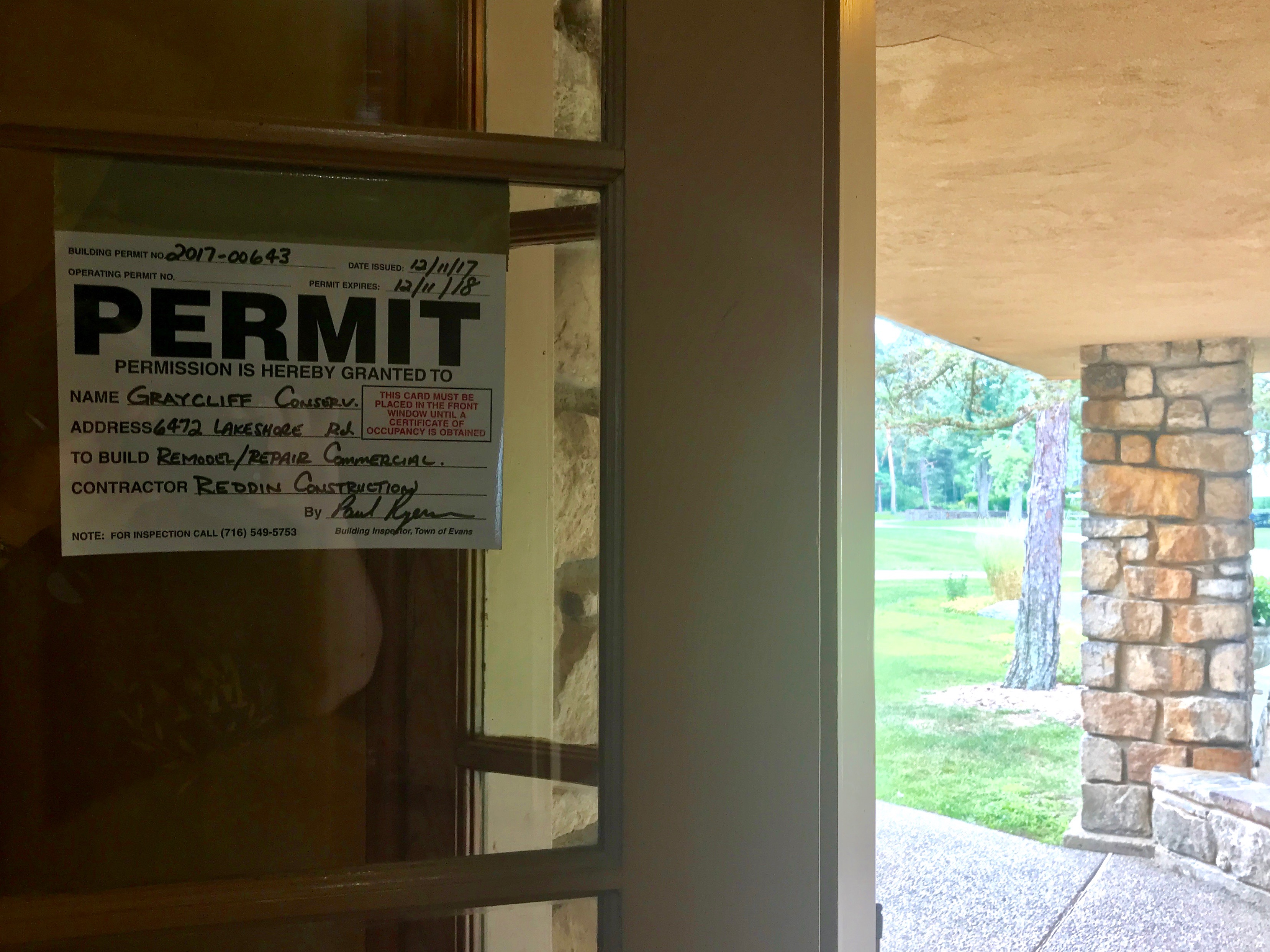
I made a second trip to see the house many years ago, just as restorations were getting serious. I was eager to see what they had managed to do in the years since my last visit.

I continued checking out the displays, as the waiting area filled with Wright enthusiasts waiting to take the tour.

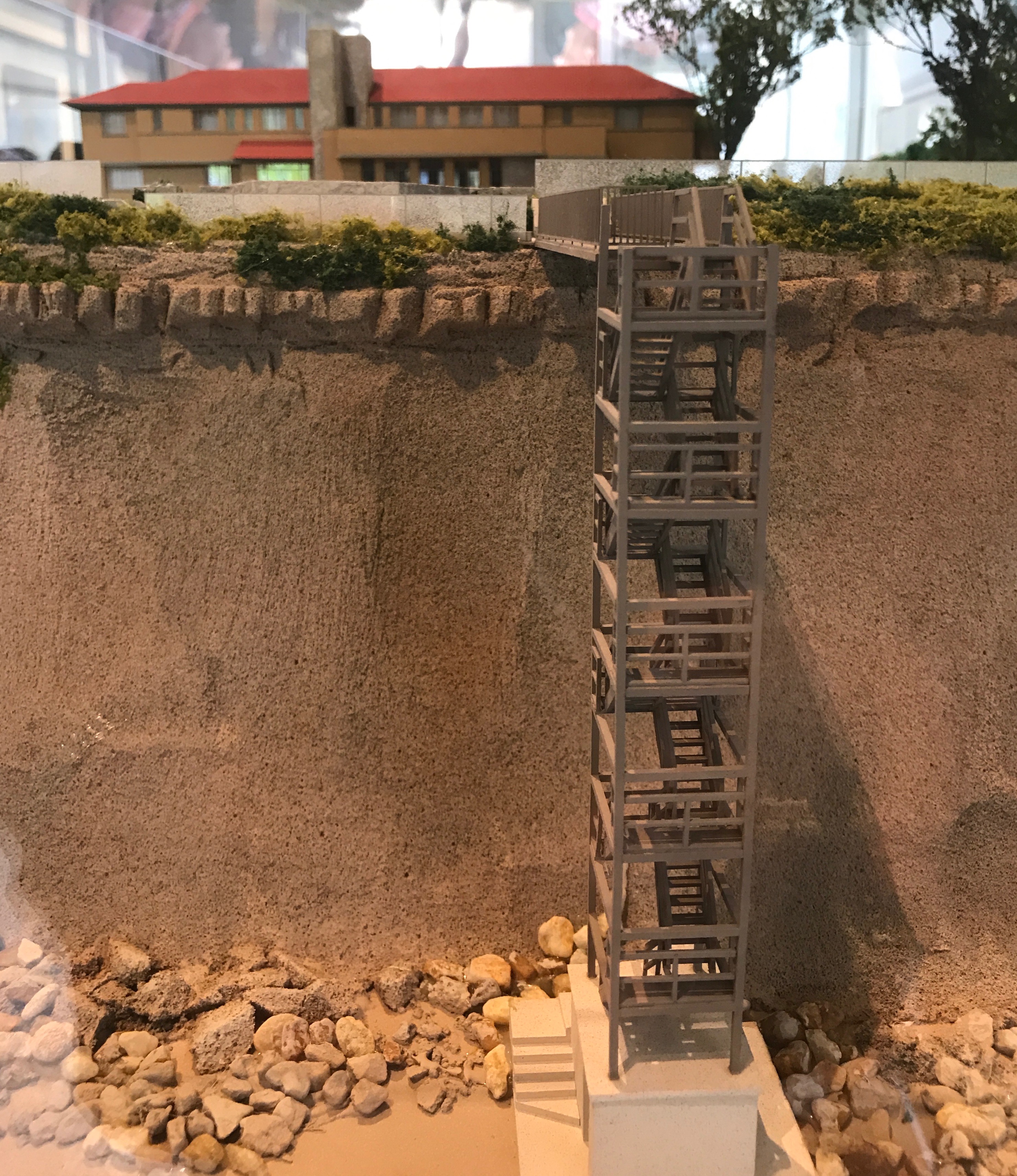
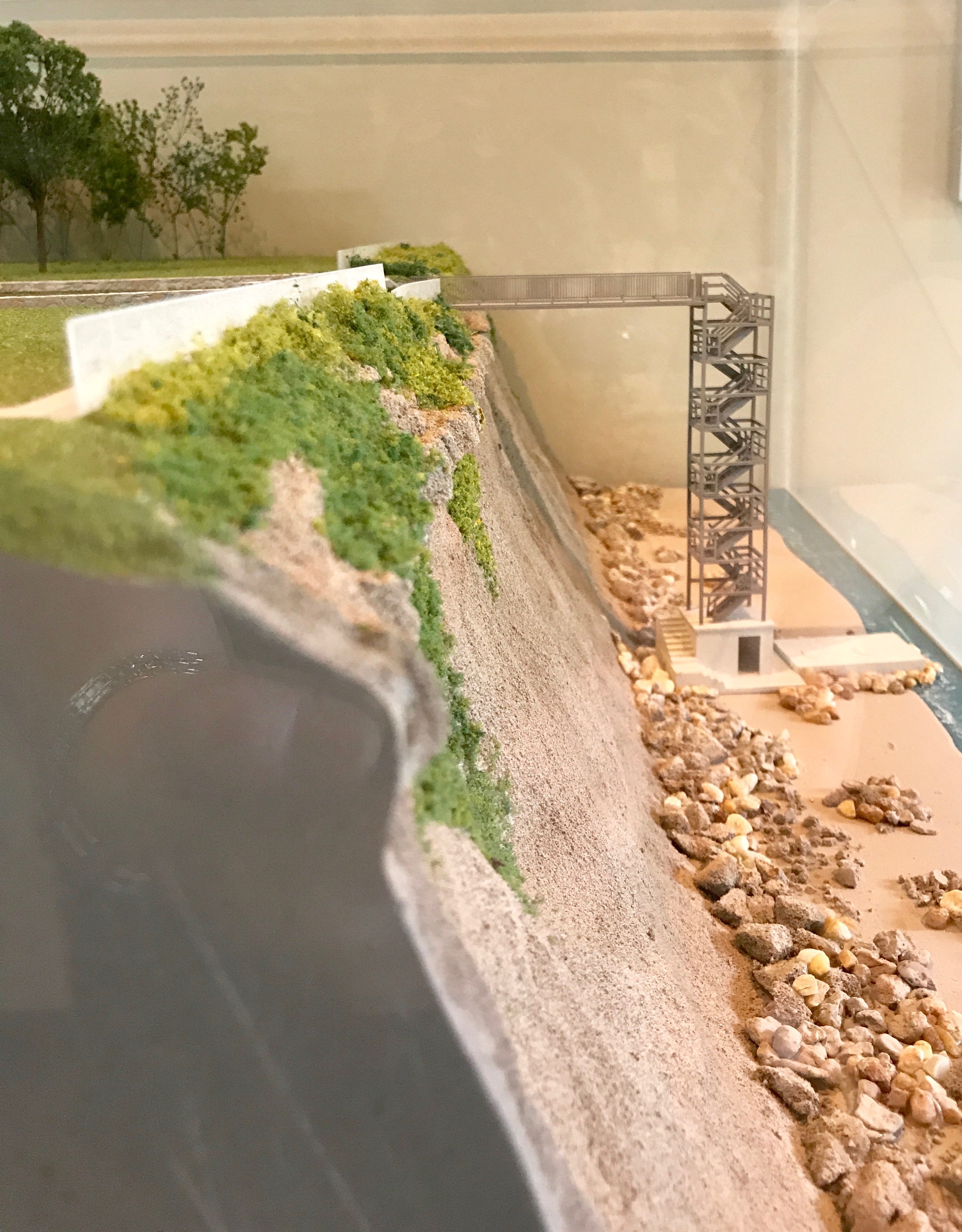
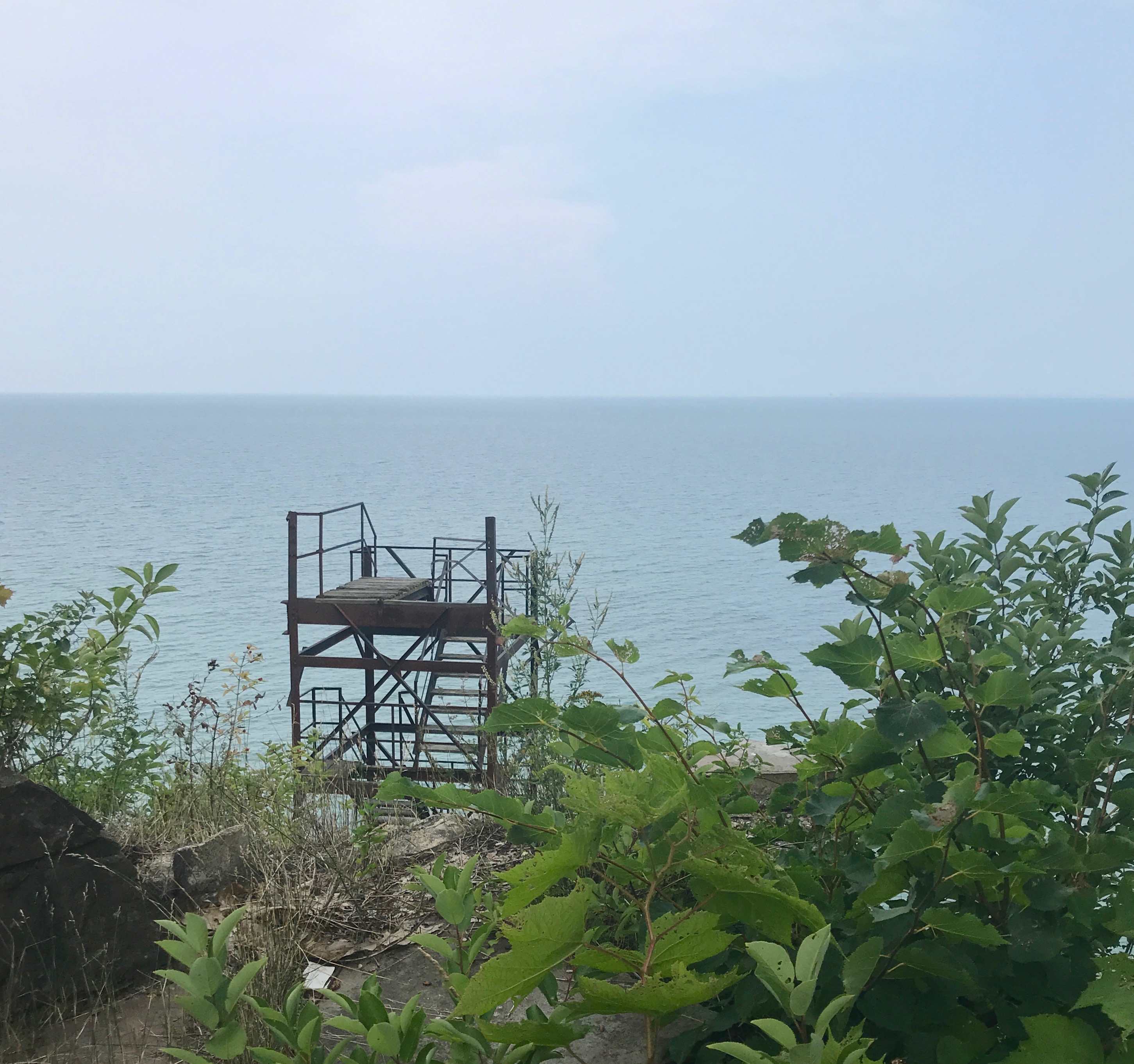
This is a view from an angle I had never seen before – from the lake.

I don’t think I would want to take that walk down to the beach. My hair would be standing straight up just walking from the cliff to the stairs. And then all those stairs! Whoah!

Luckily, I didn’t have to think about that trip too much longer. It was time for the tour to begin.

We walked out of the visitor center. The building to the right is the garage, with quarters originally intended for their chauffeur.  The building on the left side is the main house.

The house is reflected in the pond in front of it.

From this view, you can see one of Wright’s famous cantilevered porches.

To me, there is nothing more summer-y than having the windows open and cooling the house naturally. The breezes off Lake Erie must have been a welcome respite in the summer.

In the winter, I imagine that those Lake Erie breezes would not be near as salubrious. (Yes, that car is parked by Lake Erie. It was covered in ice during a storm in 2016.)

We got up to the entrance and looked back at the pond from under the porte-cochere. That sounds so much more classy than “car port.”

Just inside the door is the stairway to the second floor.

We headed over to the living room. Of course Wright designed a fireplace into the room. He was very big on fireplaces.

In fact, on the other side of that fireplace is another fireplace. I believe that is area is the dining room. I think the fire extinguisher is a nice touch.

The floors appear to have been freshly refinished and they are gorgeous, wide planks. I believe the floor is pine, but I may be wrong. Unfortunately, this Wright building is not one of the ones that has been written about extensively, although I am sure there is extensive documentation somewhere.

This house was built for the pleasure of Isabelle Martin. She wanted lots of light. After the long, gloomy Buffalo winters, I can completely understand that. Buffalo is the 19th least sunny city in the United States.   On Average, there are 155 sunny days per year in Buffalo. The US average is 205 sunny days per year.

We walked down the stairs off the living room and turned to look back at the house. You can see the light shining through from the other side. This would give Isabelle the light she craved.

Originally, there was supposed to be some sort of water feature that tied the pond at the entrance to the lake. According to my Preferred Source, “…a broad esplanade connects the terrace to the cliff and lake. The esplanade was designed to carry water, pumped from Lake Erie, down its length and over the bluffs, completing the illusion of water flowing through. Deemed financially extravagant this feature was halted after only the esplanade itself was completed.”

I have to agree that this water feature would have been financially extravagant. I’m not even sure that it would have been feasible. I would be concerned about the effects of the water on the stability of the site. But, what do I know?

We continued over to the edge of the cliff and we could see the remains of the stairs down to the beach. If I remember correctly, the docent told us that there are plans in the works to renovate the structure. Or, was that tear and them down and rebuild them? Either way, it doesn’t matter to me in a practical sense, as I will not be using them. I do not like heights!

We returned to the house to continue our tour. This is a good view of the stone used in construction. According to my Preferred Source, it is constructed of stone found at the lake’s edge. The only note I managed to record from the docent was that the building was constructed of Tichenor Limestone. While researching this information, I found out that Tichenor Limestone is “richly fossiliferous.” If you would like to know more about what fossils are found in this rock, click on the link above. If I go back, I’m going to see if I can spot any of those fossils.

Apparently, there is still work going on.

We took those stairs up to the second floor.

A hallway ran along the east side of the building. The lake was on the west side, and they wanted to save that side for the views. Judging by the pipe coming up from the floor, they probably had a radiators there to heat the hallway. That is just my guess.

The docent demonstrated the diamond windows.

The door was rather interesting. Although the house was designed in 1926, the door reminds me very much of the “mid-century modern” vibe.

Look at how wide the floor planks are! And, there is that pipe coming up through the floor again. It must be for a radiator.

While the door looks a little mid-century modern, the hinge just screams “art deco.”

They don’t make hinges like that anymore! (At least not in my price range, they don’t!)

This is a fireplace from a bedroom. There is that pipe coming up through the floor again.

This is a shot of one of the bathrooms. I seem to recall some story about Mrs. Martin doing battle with Frank Lloyd Wright over the placement of the window. He didn’t want to put it in, but she insisted.

In the end, he relented, but he had to put it in through the stonework.

On the other hand, maybe I am conflating stories.

Ah, grafitti! Well, these folks are now part of the historical record. I wonder if any of these marks were made by the boys at the school run by the Piarist Fathers? Heck, the priests themselves might have done it!

One of the things I’ve heard about Wright and his designs was that he was resistant to including closets and storage. I was glad to see that there was a linen closet built in.

Although the original property was sited on an 8.5 acre estate, apparently tracts of land were sold off over the years. I am sure that Wright would not approve of the neighbors being so close to his design. While the land around the Martin House in Buffalo has been re-acquired and the original designs rebuilt, I can’t imagine that they will ever be able to re-acquire lakefront property. I would love to be proven wrong. According to my Preferred Source, Greycliff had one of the few, if not only, landscape designs in his own hand.

His design even included a tennis court.

Apparently there is a need for the building permit. Work continues on the house.

We left the Isabelle R. Martin House by the back door and headed back toward the visitor center. We passed the Heat Hut and walked around the Foster House.

What a cute, decorative wheelbarrow!

Ah! That’s where all the radiators are! I hope they got them in before the winter weather hit.

We passed the garage doors with the distinctive diamond shaped windows. Now, here’s a real working wheelbarrow, and it appears that there is real work continuing.

One more look back and then it was time to head out.

Once I was back in my car, I fired up Google Maps to map out the route to my next stop.

I saw a park on I had never seen before just up the road. I wondered what it was, so I took small detour to check it out. It wasn’t much of a park, but there was access to Eighteen-Mile Creek.

And I got a good view of the real grey cliffs! One of those layers must be Tichenor Limestone.

The park seemed like a place for people to hang out and make their mark, although kayakers might have been able to launch here. In the first photo, you can see a kayak going around the bend.

It was a peaceful place. I spent some time enjoying the plants and butterflies and then set off for wherever it was I was planning on going.